EP2780762B1 - Dispositif électrochromique à polymères complémentaires - Google Patents
Dispositif électrochromique à polymères complémentaires Download PDFInfo
- Publication number
- EP2780762B1 EP2780762B1 EP12850225.9A EP12850225A EP2780762B1 EP 2780762 B1 EP2780762 B1 EP 2780762B1 EP 12850225 A EP12850225 A EP 12850225A EP 2780762 B1 EP2780762 B1 EP 2780762B1
- Authority
- EP
- European Patent Office
- Prior art keywords
- propylenedioxythiophene
- polymeric material
- polymer
- benzyl
- bis
- Prior art date
- Legal status (The legal status is an assumption and is not a legal conclusion. Google has not performed a legal analysis and makes no representation as to the accuracy of the status listed.)
- Active
Links
- SBMVFQDNXLLWLZ-UHFFFAOYSA-N Nc1ccc(CC2(Cc(cc3)ccc3N)COc3c[s]cc3OC2)cc1 Chemical compound Nc1ccc(CC2(Cc(cc3)ccc3N)COc3c[s]cc3OC2)cc1 SBMVFQDNXLLWLZ-UHFFFAOYSA-N 0.000 description 1
- PFCRJTRHWVTDDB-UHFFFAOYSA-N [O-][N+](c1ccc(CC2(Cc(cc3)ccc3[N+]([O-])=O)COc3c[s]cc3OC2)cc1)=O Chemical compound [O-][N+](c1ccc(CC2(Cc(cc3)ccc3[N+]([O-])=O)COc3c[s]cc3OC2)cc1)=O PFCRJTRHWVTDDB-UHFFFAOYSA-N 0.000 description 1
Images









Classifications
-
- C—CHEMISTRY; METALLURGY
- C07—ORGANIC CHEMISTRY
- C07C—ACYCLIC OR CARBOCYCLIC COMPOUNDS
- C07C29/00—Preparation of compounds having hydroxy or O-metal groups bound to a carbon atom not belonging to a six-membered aromatic ring
- C07C29/132—Preparation of compounds having hydroxy or O-metal groups bound to a carbon atom not belonging to a six-membered aromatic ring by reduction of an oxygen containing functional group
- C07C29/136—Preparation of compounds having hydroxy or O-metal groups bound to a carbon atom not belonging to a six-membered aromatic ring by reduction of an oxygen containing functional group of >C=O containing groups, e.g. —COOH
- C07C29/147—Preparation of compounds having hydroxy or O-metal groups bound to a carbon atom not belonging to a six-membered aromatic ring by reduction of an oxygen containing functional group of >C=O containing groups, e.g. —COOH of carboxylic acids or derivatives thereof
-
- B—PERFORMING OPERATIONS; TRANSPORTING
- B05—SPRAYING OR ATOMISING IN GENERAL; APPLYING FLUENT MATERIALS TO SURFACES, IN GENERAL
- B05D—PROCESSES FOR APPLYING FLUENT MATERIALS TO SURFACES, IN GENERAL
- B05D5/00—Processes for applying liquids or other fluent materials to surfaces to obtain special surface effects, finishes or structures
- B05D5/12—Processes for applying liquids or other fluent materials to surfaces to obtain special surface effects, finishes or structures to obtain a coating with specific electrical properties
-
- C—CHEMISTRY; METALLURGY
- C07—ORGANIC CHEMISTRY
- C07C—ACYCLIC OR CARBOCYCLIC COMPOUNDS
- C07C33/00—Unsaturated compounds having hydroxy or O-metal groups bound to acyclic carbon atoms
- C07C33/40—Halogenated unsaturated alcohols
- C07C33/46—Halogenated unsaturated alcohols containing only six-membered aromatic rings as cyclic parts
-
- C—CHEMISTRY; METALLURGY
- C07—ORGANIC CHEMISTRY
- C07C—ACYCLIC OR CARBOCYCLIC COMPOUNDS
- C07C57/00—Unsaturated compounds having carboxyl groups bound to acyclic carbon atoms
- C07C57/30—Unsaturated compounds having carboxyl groups bound to acyclic carbon atoms containing six-membered aromatic rings
- C07C57/38—Unsaturated compounds having carboxyl groups bound to acyclic carbon atoms containing six-membered aromatic rings polycyclic
-
- C—CHEMISTRY; METALLURGY
- C07—ORGANIC CHEMISTRY
- C07C—ACYCLIC OR CARBOCYCLIC COMPOUNDS
- C07C69/00—Esters of carboxylic acids; Esters of carbonic or haloformic acids
- C07C69/62—Halogen-containing esters
- C07C69/65—Halogen-containing esters of unsaturated acids
-
- C—CHEMISTRY; METALLURGY
- C07—ORGANIC CHEMISTRY
- C07D—HETEROCYCLIC COMPOUNDS
- C07D495/00—Heterocyclic compounds containing in the condensed system at least one hetero ring having sulfur atoms as the only ring hetero atoms
- C07D495/02—Heterocyclic compounds containing in the condensed system at least one hetero ring having sulfur atoms as the only ring hetero atoms in which the condensed system contains two hetero rings
- C07D495/04—Ortho-condensed systems
-
- C—CHEMISTRY; METALLURGY
- C09—DYES; PAINTS; POLISHES; NATURAL RESINS; ADHESIVES; COMPOSITIONS NOT OTHERWISE PROVIDED FOR; APPLICATIONS OF MATERIALS NOT OTHERWISE PROVIDED FOR
- C09D—COATING COMPOSITIONS, e.g. PAINTS, VARNISHES OR LACQUERS; FILLING PASTES; CHEMICAL PAINT OR INK REMOVERS; INKS; CORRECTING FLUIDS; WOODSTAINS; PASTES OR SOLIDS FOR COLOURING OR PRINTING; USE OF MATERIALS THEREFOR
- C09D5/00—Coating compositions, e.g. paints, varnishes or lacquers, characterised by their physical nature or the effects produced; Filling pastes
- C09D5/44—Coating compositions, e.g. paints, varnishes or lacquers, characterised by their physical nature or the effects produced; Filling pastes for electrophoretic applications
- C09D5/4419—Coating compositions, e.g. paints, varnishes or lacquers, characterised by their physical nature or the effects produced; Filling pastes for electrophoretic applications with polymers obtained otherwise than by polymerisation reactions only involving carbon-to-carbon unsaturated bonds
-
- C—CHEMISTRY; METALLURGY
- C09—DYES; PAINTS; POLISHES; NATURAL RESINS; ADHESIVES; COMPOSITIONS NOT OTHERWISE PROVIDED FOR; APPLICATIONS OF MATERIALS NOT OTHERWISE PROVIDED FOR
- C09D—COATING COMPOSITIONS, e.g. PAINTS, VARNISHES OR LACQUERS; FILLING PASTES; CHEMICAL PAINT OR INK REMOVERS; INKS; CORRECTING FLUIDS; WOODSTAINS; PASTES OR SOLIDS FOR COLOURING OR PRINTING; USE OF MATERIALS THEREFOR
- C09D5/00—Coating compositions, e.g. paints, varnishes or lacquers, characterised by their physical nature or the effects produced; Filling pastes
- C09D5/44—Coating compositions, e.g. paints, varnishes or lacquers, characterised by their physical nature or the effects produced; Filling pastes for electrophoretic applications
- C09D5/4476—Coating compositions, e.g. paints, varnishes or lacquers, characterised by their physical nature or the effects produced; Filling pastes for electrophoretic applications comprising polymerisation in situ
-
- C—CHEMISTRY; METALLURGY
- C09—DYES; PAINTS; POLISHES; NATURAL RESINS; ADHESIVES; COMPOSITIONS NOT OTHERWISE PROVIDED FOR; APPLICATIONS OF MATERIALS NOT OTHERWISE PROVIDED FOR
- C09K—MATERIALS FOR MISCELLANEOUS APPLICATIONS, NOT PROVIDED FOR ELSEWHERE
- C09K9/00—Tenebrescent materials, i.e. materials for which the range of wavelengths for energy absorption is changed as a result of excitation by some form of energy
- C09K9/02—Organic tenebrescent materials
-
- C—CHEMISTRY; METALLURGY
- C25—ELECTROLYTIC OR ELECTROPHORETIC PROCESSES; APPARATUS THEREFOR
- C25D—PROCESSES FOR THE ELECTROLYTIC OR ELECTROPHORETIC PRODUCTION OF COATINGS; ELECTROFORMING; APPARATUS THEREFOR
- C25D3/00—Electroplating: Baths therefor
- C25D3/02—Electroplating: Baths therefor from solutions
-
- C—CHEMISTRY; METALLURGY
- C25—ELECTROLYTIC OR ELECTROPHORETIC PROCESSES; APPARATUS THEREFOR
- C25D—PROCESSES FOR THE ELECTROLYTIC OR ELECTROPHORETIC PRODUCTION OF COATINGS; ELECTROFORMING; APPARATUS THEREFOR
- C25D9/00—Electrolytic coating other than with metals
- C25D9/02—Electrolytic coating other than with metals with organic materials
-
- G—PHYSICS
- G02—OPTICS
- G02F—OPTICAL DEVICES OR ARRANGEMENTS FOR THE CONTROL OF LIGHT BY MODIFICATION OF THE OPTICAL PROPERTIES OF THE MEDIA OF THE ELEMENTS INVOLVED THEREIN; NON-LINEAR OPTICS; FREQUENCY-CHANGING OF LIGHT; OPTICAL LOGIC ELEMENTS; OPTICAL ANALOGUE/DIGITAL CONVERTERS
- G02F1/00—Devices or arrangements for the control of the intensity, colour, phase, polarisation or direction of light arriving from an independent light source, e.g. switching, gating or modulating; Non-linear optics
- G02F1/01—Devices or arrangements for the control of the intensity, colour, phase, polarisation or direction of light arriving from an independent light source, e.g. switching, gating or modulating; Non-linear optics for the control of the intensity, phase, polarisation or colour
- G02F1/13—Devices or arrangements for the control of the intensity, colour, phase, polarisation or direction of light arriving from an independent light source, e.g. switching, gating or modulating; Non-linear optics for the control of the intensity, phase, polarisation or colour based on liquid crystals, e.g. single liquid crystal display cells
- G02F1/133—Constructional arrangements; Operation of liquid crystal cells; Circuit arrangements
- G02F1/1333—Constructional arrangements; Manufacturing methods
- G02F1/1343—Electrodes
- G02F1/13439—Electrodes characterised by their electrical, optical, physical properties; materials therefor; method of making
-
- G—PHYSICS
- G02—OPTICS
- G02F—OPTICAL DEVICES OR ARRANGEMENTS FOR THE CONTROL OF LIGHT BY MODIFICATION OF THE OPTICAL PROPERTIES OF THE MEDIA OF THE ELEMENTS INVOLVED THEREIN; NON-LINEAR OPTICS; FREQUENCY-CHANGING OF LIGHT; OPTICAL LOGIC ELEMENTS; OPTICAL ANALOGUE/DIGITAL CONVERTERS
- G02F1/00—Devices or arrangements for the control of the intensity, colour, phase, polarisation or direction of light arriving from an independent light source, e.g. switching, gating or modulating; Non-linear optics
- G02F1/01—Devices or arrangements for the control of the intensity, colour, phase, polarisation or direction of light arriving from an independent light source, e.g. switching, gating or modulating; Non-linear optics for the control of the intensity, phase, polarisation or colour
- G02F1/15—Devices or arrangements for the control of the intensity, colour, phase, polarisation or direction of light arriving from an independent light source, e.g. switching, gating or modulating; Non-linear optics for the control of the intensity, phase, polarisation or colour based on an electrochromic effect
- G02F1/1503—Devices or arrangements for the control of the intensity, colour, phase, polarisation or direction of light arriving from an independent light source, e.g. switching, gating or modulating; Non-linear optics for the control of the intensity, phase, polarisation or colour based on an electrochromic effect caused by oxidation-reduction reactions in organic liquid solutions, e.g. viologen solutions
-
- G—PHYSICS
- G02—OPTICS
- G02F—OPTICAL DEVICES OR ARRANGEMENTS FOR THE CONTROL OF LIGHT BY MODIFICATION OF THE OPTICAL PROPERTIES OF THE MEDIA OF THE ELEMENTS INVOLVED THEREIN; NON-LINEAR OPTICS; FREQUENCY-CHANGING OF LIGHT; OPTICAL LOGIC ELEMENTS; OPTICAL ANALOGUE/DIGITAL CONVERTERS
- G02F1/00—Devices or arrangements for the control of the intensity, colour, phase, polarisation or direction of light arriving from an independent light source, e.g. switching, gating or modulating; Non-linear optics
- G02F1/01—Devices or arrangements for the control of the intensity, colour, phase, polarisation or direction of light arriving from an independent light source, e.g. switching, gating or modulating; Non-linear optics for the control of the intensity, phase, polarisation or colour
- G02F1/15—Devices or arrangements for the control of the intensity, colour, phase, polarisation or direction of light arriving from an independent light source, e.g. switching, gating or modulating; Non-linear optics for the control of the intensity, phase, polarisation or colour based on an electrochromic effect
- G02F1/1506—Devices or arrangements for the control of the intensity, colour, phase, polarisation or direction of light arriving from an independent light source, e.g. switching, gating or modulating; Non-linear optics for the control of the intensity, phase, polarisation or colour based on an electrochromic effect caused by electrodeposition, e.g. electrolytic deposition of an inorganic material on or close to an electrode
-
- G—PHYSICS
- G02—OPTICS
- G02F—OPTICAL DEVICES OR ARRANGEMENTS FOR THE CONTROL OF LIGHT BY MODIFICATION OF THE OPTICAL PROPERTIES OF THE MEDIA OF THE ELEMENTS INVOLVED THEREIN; NON-LINEAR OPTICS; FREQUENCY-CHANGING OF LIGHT; OPTICAL LOGIC ELEMENTS; OPTICAL ANALOGUE/DIGITAL CONVERTERS
- G02F1/00—Devices or arrangements for the control of the intensity, colour, phase, polarisation or direction of light arriving from an independent light source, e.g. switching, gating or modulating; Non-linear optics
- G02F1/01—Devices or arrangements for the control of the intensity, colour, phase, polarisation or direction of light arriving from an independent light source, e.g. switching, gating or modulating; Non-linear optics for the control of the intensity, phase, polarisation or colour
- G02F1/15—Devices or arrangements for the control of the intensity, colour, phase, polarisation or direction of light arriving from an independent light source, e.g. switching, gating or modulating; Non-linear optics for the control of the intensity, phase, polarisation or colour based on an electrochromic effect
- G02F1/153—Constructional details
- G02F1/155—Electrodes
-
- C—CHEMISTRY; METALLURGY
- C09—DYES; PAINTS; POLISHES; NATURAL RESINS; ADHESIVES; COMPOSITIONS NOT OTHERWISE PROVIDED FOR; APPLICATIONS OF MATERIALS NOT OTHERWISE PROVIDED FOR
- C09K—MATERIALS FOR MISCELLANEOUS APPLICATIONS, NOT PROVIDED FOR ELSEWHERE
- C09K2211/00—Chemical nature of organic luminescent or tenebrescent compounds
- C09K2211/14—Macromolecular compounds
- C09K2211/1408—Carbocyclic compounds
- C09K2211/1433—Carbocyclic compounds bridged by heteroatoms, e.g. N, P, Si or B
-
- C—CHEMISTRY; METALLURGY
- C09—DYES; PAINTS; POLISHES; NATURAL RESINS; ADHESIVES; COMPOSITIONS NOT OTHERWISE PROVIDED FOR; APPLICATIONS OF MATERIALS NOT OTHERWISE PROVIDED FOR
- C09K—MATERIALS FOR MISCELLANEOUS APPLICATIONS, NOT PROVIDED FOR ELSEWHERE
- C09K2211/00—Chemical nature of organic luminescent or tenebrescent compounds
- C09K2211/14—Macromolecular compounds
- C09K2211/1441—Heterocyclic
- C09K2211/1491—Heterocyclic containing other combinations of heteroatoms
-
- G—PHYSICS
- G02—OPTICS
- G02F—OPTICAL DEVICES OR ARRANGEMENTS FOR THE CONTROL OF LIGHT BY MODIFICATION OF THE OPTICAL PROPERTIES OF THE MEDIA OF THE ELEMENTS INVOLVED THEREIN; NON-LINEAR OPTICS; FREQUENCY-CHANGING OF LIGHT; OPTICAL LOGIC ELEMENTS; OPTICAL ANALOGUE/DIGITAL CONVERTERS
- G02F1/00—Devices or arrangements for the control of the intensity, colour, phase, polarisation or direction of light arriving from an independent light source, e.g. switching, gating or modulating; Non-linear optics
- G02F1/01—Devices or arrangements for the control of the intensity, colour, phase, polarisation or direction of light arriving from an independent light source, e.g. switching, gating or modulating; Non-linear optics for the control of the intensity, phase, polarisation or colour
- G02F1/15—Devices or arrangements for the control of the intensity, colour, phase, polarisation or direction of light arriving from an independent light source, e.g. switching, gating or modulating; Non-linear optics for the control of the intensity, phase, polarisation or colour based on an electrochromic effect
- G02F1/1514—Devices or arrangements for the control of the intensity, colour, phase, polarisation or direction of light arriving from an independent light source, e.g. switching, gating or modulating; Non-linear optics for the control of the intensity, phase, polarisation or colour based on an electrochromic effect characterised by the electrochromic material, e.g. by the electrodeposited material
- G02F1/1516—Devices or arrangements for the control of the intensity, colour, phase, polarisation or direction of light arriving from an independent light source, e.g. switching, gating or modulating; Non-linear optics for the control of the intensity, phase, polarisation or colour based on an electrochromic effect characterised by the electrochromic material, e.g. by the electrodeposited material comprising organic material
- G02F1/15165—Polymers
-
- G—PHYSICS
- G02—OPTICS
- G02F—OPTICAL DEVICES OR ARRANGEMENTS FOR THE CONTROL OF LIGHT BY MODIFICATION OF THE OPTICAL PROPERTIES OF THE MEDIA OF THE ELEMENTS INVOLVED THEREIN; NON-LINEAR OPTICS; FREQUENCY-CHANGING OF LIGHT; OPTICAL LOGIC ELEMENTS; OPTICAL ANALOGUE/DIGITAL CONVERTERS
- G02F1/00—Devices or arrangements for the control of the intensity, colour, phase, polarisation or direction of light arriving from an independent light source, e.g. switching, gating or modulating; Non-linear optics
- G02F1/01—Devices or arrangements for the control of the intensity, colour, phase, polarisation or direction of light arriving from an independent light source, e.g. switching, gating or modulating; Non-linear optics for the control of the intensity, phase, polarisation or colour
- G02F1/15—Devices or arrangements for the control of the intensity, colour, phase, polarisation or direction of light arriving from an independent light source, e.g. switching, gating or modulating; Non-linear optics for the control of the intensity, phase, polarisation or colour based on an electrochromic effect
- G02F2001/1502—Devices or arrangements for the control of the intensity, colour, phase, polarisation or direction of light arriving from an independent light source, e.g. switching, gating or modulating; Non-linear optics for the control of the intensity, phase, polarisation or colour based on an electrochromic effect complementary cell
Definitions
- CP conducting polymer
- electrochromic devices containing the same. More particularly, this invention relates to CP compositions and electrochromic devices responsive in the visible-to-near-IR spectral region.
- Electrochromic materials change color upon application of a voltage, generally a small ( ⁇ 5 V) DC voltage.
- the "color" change may be in the visible spectral region, but it may also be in the near infrared (NIR), infrared and microwave spectral region.
- Electrochromic devices may be transmissive-mode, in which light passes through the device and is modulated by the device, and reflective-mode, in which light is reflected off the device and also modulated by the device. Electrochromic devices may be used in windows, rear view automobile mirrors, flat panel displays, variable emittance materials for spacecraft application, and infrared camouflage.
- Electrochromic materials active in the visible spectral region include metal oxides, such as tungsten, molybdenum, nickel and tantalum oxides, showing a transition from highly colored to near transparent depending on the potential (voltage) applied to them.
- Electrochromic materials are conducting polymers. Redox of a conducting polymer, which changes its color as well as conductivity, is usually accompanied by an inflow or outflow of counterions in the conducting polymer known as "dopants". Common dopant counterions include ClO 4 - and BF 4 - .
- the conducting polymer poly(pyrrole) is dark blue and conductive in its oxidized ("doped” or “colored”) state and pale-green in its reduced (“de-doped” or “undoped”) state, and the conducting polymer poly(aniline) is nearly transparent in its reduced state, transitioning to green or dark green in its oxidized state.
- An electrochromic material is said to be “anodically coloring” if application of a positive voltage to it causes it to transition to a colored or dark state, and “cathodically coloring” if application of a negative voltage causes it to transition to a colored or dark state.
- Poly(pyrrole) and poly(aniline) are anodically coloring polymers.
- the most convenient and common method of synthesis of conducting polymers for electrochromic uses is electro-polymerization from a solution of the monomer directly onto a conductive, transparent substrate, such as indium-tin-oxide (ITO) on glass, poly(ethylene terephthalate) (PET, "Mylar”) or other transparent plastic substrate.
- the electro-polymerization may be carried out using a constant applied potential (potentiostatic mode), a potential sweep (potential sweep mode) or other applied potential programs.
- poly(diphenyl amine) may be electrochemically deposited onto ITO/glass or ITO/PET from a 0.05 M solution of the monomer in acetonitrile at about +0.8 V (potentiostatic mode).
- a common transmissive-mode electrochromic device is fabricated by depositing an electrochromic material on a conductive, transparent substrate, such as ITO/glass or ITO/ PET, forming the active or working electrode.
- a conductive, transparent substrate such as ITO/glass or ITO/ PET
- ITO/glass comprises the opposing or counter electrode.
- a liquid, solid or gel electrolyte is disposed as a layer between the two electrodes or incorporated into the polymers.
- the active electrochromic material on the working electrode may be switched to a dark "colored” or a less colored “bleached” state, depending on the voltage applied to it in this 2-electrode device, thus modulating the transmission through the device.
- a common reflective-mode electrochromic device may be fabricated in a similar fashion, with the difference that, in place of the transparent, conductive substrate, an opaque, conductive substrate, such as Au deposited on a microporous membrane, may be used.
- the counter electrode in such a device may be a similar conductive substrate disposed behind the working electrode.
- Such a reflective mode device is described in U.S. Pat. Nos. 5,995,273 (1999 ) and 6,033,592 (2000 ), issued to Chandrasekhar (collectively, the "Chandrasekhar IR patents").
- a voltage is applied to the working electrode.
- the active electrochromic material thereon is anodically coloring, then a positive voltage will cause it to transition to a colored state.
- a corresponding inflow of counterions, in this case anions will occur into the polymer.
- the likely electrochemical reaction that occurs is reduction of impurities present in the electrolyte, including, by way of example, dissolved gases (including oxygen); in the case of dissolved oxygen, species such as the superoxide ion or radical oxygen species may then be generated which have lifetimes as long as 20 seconds and which oxidatively or reductively degrade the active electrochromic material present on the other electrode (Menon et al., 1998) (Chandrasekhar IR patents, Chandrasekhar et al. 2002, Chandrasekhar et al. 1987). In such a circumstance, the overall electrochemical processes occurring within the electrochromic device are said to exhibit poor reversibility. This leads to a number of detrimental results, e.g. much more rapid degradation of the active electrochromic material and much slower electrochromic switching time.
- Anodically-coloring conducting polymers described include poly(aniline), poly(pyrrole) as well as the structurally related series comprising poly(diphenyl amine), poly(4-amino-biphenyl) (Dao and coworkers (Guay et al., 1988, 1989, LeClerc et al., 1988, Nguyen et al., 1990)) and poly( N,N' -diphenyl benzidine) ( Suzuki et al., U.S. Pat. No. 4,874,481 (1989 )).
- these poly(aromatic amines) constitute an ideal set of anodically coloring electrochromic polymers, if they could be paired with a well-performing set of cathodically coloring electrochromic polymers in a single electrochromic device.
- a series of cathodically coloring polymers based on poly(3,4-ethylenedioxythiophene) (PEDOT) and on other polymers containing the thiophene moiety have been described by Groenendal et al., (2000), Sapp et al. (1998), Gazotti et al. (1998) and others. These yield a variety of colors in their colored state, including yellow, red, blue and blue-black. Among their drawbacks are modest light/dark contrast, large and asymmetric switching voltages, and modest cyclability. These polymers are generally not transparent in their light state, but rather lightly colored, semi-translucent, the colors varying from undesirable reds, yellows and blues to desirable grays.
- the propylene analogues of PEDOT derivatives of poly(3,4-propylenedioxythiophene) (PProDOT) show improved electrochromic performance over PEDOT derivatives.
- PProDOT poly(3,4-propylenedioxythiophene)
- This dibenzyl PProDOT (“P(DiBz-ProDOT)”) thus appears to be very well suited for use as the cathodically coloring counterpart in a complimentary-polymer electrochromic device also incorporating a well-performing anodically coloring polymer.
- Its wavelength of highest absorbance (630 nm) is a little on the higher wavelength side, close to the near-IR; if this could be shifted to near 550 nm, more towards the green, perhaps by a fortuitous substitution on the benzyl ring, it would constitute an ideal cathodically-coloring polymer.
- Electrochromic devices incorporating complimentarily-coloring (i.e., anodically and cathodically coloring) electrochromic materials may show improved performance over devices containing a single (either anodically or cathodically coloring) electrochromic material. Set forth here now are examples of such improved performance in actually reported data to date.
- a substrate reference rather than an air reference is coupled with very fast switching time, ⁇ 2 seconds, as is to be expected for such a complimentary polymer device based on the discussion above.
- complimentary polymer devices based on co-polymers of ethylene-dioxythiophene derivatives with N -methylcarbazole are described in a publication of Sapp et al. In this work, twelve complimentary polymer pairs are studied, all having EDOT derivatives as the cathodically coloring component. The best switching time reported in this work is ca.
- U.S. Pat. No. 6,859,297 (2005), issued to Lee et al. discloses an amorphous, anodically coloring electrochromic material comprising nickel oxide doped with tantalum. This material is deposited on a transparent, conductive substrate. Notably, it is coupled with a cathodically coloring material, such as electrochromic material based on tungsten oxide, yielding a complimentary-electrochromic device having cathodically and anodically electrochromic materials in the same device.
- the composite device is shown to be significantly superior in performance to single-electrochromic (either cathodically or anodically coloring) devices.
- WO2005/050294 describes a method for producing a high quality electrochromic polymer film using cyclic voltammetry to polymerise an electrochromic monomer.
- WO2009/058877 describes transmissive soluble electrochromic polymers having a plurality of repeating units that are substituted dioxyheterocycle based donor groups coupled to an acceptor group.
- the first of these drawbacks is that the complimentary polymers are not well matched in terms of the potential at which they undergo oxidation/reduction.
- the cathodically-coloring poly(isothianapthene) shows two sharp oxidation peaks between +0.5 and +1.2 V, a reduction peak at ca. +0.8 V, and another reduction peak at ca. +0.4 V, all vs. Ag/AgCl (Chandrasekhar, 1990).
- the anodically-coloring poly(diphenyl amine) and poly(4-amino-biphenyl) both show oxidation peaks at ca. +0.5 V and ca. +0.8 V and reduction peaks at ca. +0.8 V and +0.5 V (all vs. Ag/AgCl) (Guay et al. 1989).
- the anodically-coloring poly( N,N '-diphenyl benzidine) shows a single oxidation peak at ca. +1.4 V and a single reduction peak at ca. 0.0 V (all vs. Ag/AgCl) (Chandrasekhar et al., 1991).
- a second drawback of these complimentary-polymer systems is that nearly all of the cathodically-coloring polymers used do not themselves (i.e. on their own, in single-polymer devices) show significant light/dark contrast; they also frequently show narrow-band absorption.
- a high-contrast cathodically coloring polymer such as the dibenzyl-PProDOT (P(DiBz-ProDOT)) referenced above, has been used in a complimentary polymer device, it has been paired with poorly matched anodic conducting polymers which also display mediocre electrochromic performance. See, e.g., Invernale et al. (2009) and Padilla et al. (2007).
- cathodically-coloring polymers used in such devices are not transparent in their light state, but rather translucent, with significant, sometimes undesirable (e.g. light green or blue) coloration.
- cathodically-coloring polymers used in complimentary devices to date generally have narrow band absorption which is frequently in the red region, with the wavelength of highest absorption generally in the 620 to 650 nm range.
- a third drawback of these prior art complimentary-polymer systems, related to the first two, is that the redox reactions of the pair are not matched in terms of number of electrons involved.
- the anodically coloring redox reaction in many of the pairs studied is a 2-electron reaction whilst the cathodically coloring reaction is a 1-electron reaction.
- Such a mismatch generates significant overpotential which reduces the electrochromic efficiency of the device.
- the present invention provides dual-polymer electrochromic devices which overcome the drawbacks of prior-art dual-polymer devices, as described at length in the discussion above. Moreover, the present invention provides novel cathodically-coloring polymers especially suitable for such dual-polymer devices. Indeed, the present invention provides cathodically-coloring polymers that are well matched electrochromically and electrochemically to appropriate anodically-coloring polymers, as described in more detail below.
- the present invention provides a complimentary electrochromic device comprising:
- At least one benzyl moiety of the substituted 2,2-dibenzyl-3,4-propylenedioxythiophene is para substituted with a substituent selected from the group consisting of halo, sulfonyl, nitro, and alkyl.
- the benzyl moiety of the substituted 2,2-dibenzyl-3,4-propylenedioxythiophene is substituted with a chloro or bromo substituent.
- the cathodically coloring conducting polymeric material may comprise a copolymer.
- the polymeric material may comprise poly(2,2-dibenzyl-3,4-propylenedioxythiophene), poly(2,2-bis(4-chloro-benzyl)-3,4-propylenedioxythiophene), poly(2,2-bis(4-bromo-benzyl)-3,4-propylenedioxythiophene), poly(2,2-bis(4-nitro-benzyl)-3,4-propylenedioxythiophene), or combinations thereof.
- the cathodically coloring conducting polymeric material may comprise at least one monomer selected from the group consisting of 2,2-bis(4-chloro-benzyl)-3,4-propylenedioxythiophene, 2,2-bis(4-bromo-benzyl)-3,4-propylenedioxythiophene), and combinations thereof.
- the cathodically conducting polymeric material may comprise a copolymer of the monomers 2,2-dibenzyl-3,4-propylenedioxythiophene, 2,2-bis(4-chloro-benzyl)-3,4-propylenedioxythiophene), and 2,2-bis(4-bromo-benzyl)-3,4-propylenedioxythiophene).
- the cathodically conducting polymeric material may comprise a copolymer of the monomers 2,2-dibenzyl-3,4-propylenedioxythiophene, 2,2-bis(4-chloro-benzyl)-3,4-propylenedioxythiophene), and 2,2-bis(4-bromo-benzyl)-3,4-propylenedioxythiophene), in a molar ratio in the range of 1:1:1 to 50:7:1, respectively.
- the anodically coloring conducting polymeric material may comprise a poly(aromatic amine).
- the anodically conducting polymeric material comprises a copolymer.
- the anodically conducting polymer material may comprise at least one monomer selected from the group consisting of N,N' -diphenyl benzidine, diphenyl amine, 4-aminobiphenyl, and combinations thereof.
- the anodically coloring conducting polymeric material comprises a copolymer of the monomers N,N' -diphenyl benzidine, diphenyl amine and 4-aminobiphenyl in a molar ratio in the range of 1:1:1 to 50:1:1, respectively.
- the first and/or second electrode comprises a first and/or second conductive transparent substrate.
- the first and/or second conductive substrate may comprise indium-tin-oxide(ITO)/glass, ITO/poly(ethylene terephthalate)(PET), tin-oxide/glass, tin-oxide/PET, gold/glass, carbon-nanotubes/glass, carbon-nanotubes/PET, gold/PET, or a combination thereof.
- the electrolyte may comprise a liquid electrolyte, solid electrolyte, gel electrolyte, or a combination thereof.
- the instant invention encompasses a method for obtaining a complimentary electrochromic device comprising the steps of:
- an electrochemically active material possessing highly reversible electrochemical activity may be configured to act in a complimentary and highly reversible fashion to the material at a working electrode.
- the complimentary material at the counter electrode would undergo reduction, and vice versa.
- a complimentary polymer or "dual-polymer” electrochromic device having electrodes and comprising an anodically-coloring conductive polymeric material, an electrolyte layer, and a cathodically coloring conductive polymeric material.
- a "coloring conductive polymeric material” is said to be “anodically coloring” if application of a positive voltage to it causes it to transition to a colored or dark state, and “cathodically coloring” if application of a negative voltage causes it to transition to a colored or dark state.
- cathodically and anodically coloring conductive polymeric materials comprise cathodically and anodically coloring polymers, respectively.
- polymer refers to the product of a polymerization reaction, and is inclusive of homopolymers, copolymers, terpolymers, etc.
- homopolymer is used with reference to a polymer resulting from the polymerization of a single monomer, i.e., a polymer consisting essentially of a single type of repeating unit.
- copolymer refers to polymers formed by the polymerization reaction of at least two different monomers and, moreover, the term copolymer is inclusive of random copolymers, block copolymers, graft copolymers, etc.
- the cathodically coloring conductive polymeric material of the invention may comprise one or more polymers that comprise an unsubstituted or substituted derivative of 2,2-dibenzyl-3,4-propylene-dioxythiophene monomer.
- the substitution may be located at the para position of the benzyl group, wherein the substituents at the benzyl moiety may be halo (e.g., chloro, bromo, iodo, fluoro), sulfonyl, nitro, amino or alkyl (e.g., n-propyl, iso-propyl, n-butyl, iso-butyl, n-pentyl, n-hexyl) substituents.
- the cathodically coloring polymer is a copolymer of monomers based on a 3,4-propylenedioxythiophene skeleton.
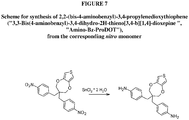
- monomers include, but are not limited to, 2,2-bis(4-chlorobenzyl)-3,4- propylenedioxythiophene, 2,2-bis(4-bromobenzyl)-3,4-propylenedioxythiophene, 2,2-bis(4-nitrobenzyl)-3,4- propylenedioxythiophene, 2,2-bis(4-aminobenzyl)-3,4- propylenedioxythiophene and 2,2-dibenzyl-1,3-propylenedioxythiophene.
- the cathodically coloring conducting polymer is a copolymer of the monomers 2,2-dibenzyl-3,4-propylenedioxythiophene, 2,2-bis(4-chlorobenzyl)-3,4-propylenedioxythiophene, and 2,2-bis(4-bromobenzyl)-3,4- propylenedioxythiophene, taken in a molar ratio of about 1:1:1 to 50:1:1, reflecting the variation of the first monomer's proportion, and again from 50:1:1 to 50:7:1 and 1:1:1 to 1:7:1, reflecting the variation of the second monomer's proportion. More preferably, the above molar ratio is 50:1:1 to 3:1:1.
- the above molar ratio is 20:1:1 to 3:1:1. Most preferably, the above molar ratio is about 10:1:1.
- the electrochromic performance of electrochromic devices containing these copolymer systems is seen to be superior to that of devices having only pure polymers of these monomers.
- Anodically coloring conducting polymeric materials of the invention may comprise one or more polymers or, more preferably, may be a copolymer of monomers known in the art which include but are not limited to poly(aromatic amine) polymers. Examples of such monomers include, but are not limited to, diphenyl amine, N,N' -diphenyl benzidine, 4-aminobiphenyl and aniline.
- the anodically coloring polymer is preferably a copolymer of monomers N,N' -diphenyl benzidine, diphenyl amine and 4-aminobiphenyl taken in a molar ratio of about 1:1:1 to 50:1:1, with electrochromic performance seen to be superior to that of the pure polymers of these monomers.
- the above molar ratio is from about 1:1:1 to about 20:1:1. More preferably, the above molar ratio is from about 1:1:1 to about 9:1:1 and even more preferably , the above molar ratio is about 3:1:1 to 7:1:1. In an especially preferred embodiment, the above molar ratio is about 5:1:1.
- the cathodically and anodically coloring conductive polymers of the complimentary-polymer electrochromic device of the present invention are electrochromically and electrochemically matched.
- the redox potentials of the cathodically coloring polymeric material and anodically coloring polymeric material in a 2-electrode electrochromic device are considered "substantially matched" when, at a given potential, the cathodically coloring polymeric material is fully oxidized and the anodically coloring polymeric material is fully reduced, and vice versa.
- the cathodically and anodically coloring polymeric materials are considered "substantially matched" when the cathodically and anodically coloring polymeric materials both show at least about 85%, about 90%, or about 95% of their total charge transferred corresponding to their electrochromically relevant oxidation or reduction peaks, at a given potential, as determined by examining the area under the curve of the cathodically and anodically coloring polymeric material's individual voltammetric peaks.
- the cathodically and anodically coloring polymeric materials have substantially matched redox potentials, upon application of the (-) potential where the cathodically coloring polymeric material is at its darkest state, the anodically coloring polymeric material is at its lightest state; and, upon application of the (+) potential where the anodically coloring polymeric material is at its darkest state, the cathodically coloring polymeric material is at its lightest state.
- the dual-polymer devices Due to this good matching of the electrochemical redox potentials and the electrochromic properties of the complimentary polymers, the dual-polymer devices display electrochromic performance superior to that of the single-polymer devices as well as to prior art dual-polymer devices wherein either the cathodically-coloring or anodically-coloring polymer are different from the above listed polymers and are not electrochromically and electrochemically matched as described above. (Electrochromic performance is described by light/dark contrast, switching speed, cyclability, and related parameters).
- the cathodically and anodically coloring polymeric materials may be composed of homopolymers.
- at least one of the cathodically coloring polymeric material and anodically coloring polymeric material may be composed of a copolymer.
- both the cathodically and anodically coloring polymeric materials are composed of copolymers.
- the anodically and cathodically coloring polymeric materials may be deposited on transparent conductive substrates which may form opposing electrodes in an electrochromic device with a thin layer (preferably a thin layer) of liquid, gel or solid electrolyte disposed between them.
- the device may further comprise a means (e.g. gasket) for sealing and containing said electrolyte within the device.
- the deposition solution used in the device and methods set forth may comprise (A) (1) for depositing a cathodically coloring polymer, (i) a 2,2-bis(benzyl)-3,4-propylenedioxythiophene derivative substituted at the para position of at least one benzyl group with a halo, sulfonyl, nitro or alkyl moiety and optionally (ii) 2,2-dibenzyl-3,4-propylenedioxythiophene; OR (2) for depositing an anodically coloring polymer, monomers N,N' -diphenyl benzidine, diphenyl amine and/or 4-aminobiphenyl; (b) a salt containing a counterion that is ultimately incorporated as the dopant in the polymer or copolymer deposited onto an electrode and (c) a solvent.
- the deposition solution may be obtained by combining a 2,2-bis(benzyl)-3,4-propylenedioxythiophene substituted at the para position of at least one benzyl group with a halo, sulfonyl, nitro or alkyl moiety and optionally 2,2-dibenzyl-3,4-propylenedioxythiophene with one or more salts in a solvent.
- Salts that may be used in the deposition solution include but are not limited to Na + , Li + , Et 4 N + as cations and poly(vinylsulfonate), sulfate, trifluoromethane sulfonate and poly(styrene sulfonate) as anions.
- Solvents that may be used include but are not limited to acetonitrile, N,N'dimethyl formamide (DMF), tetrahydrofuran (THF) and mixtures thereof.
- the polymer may be deposited from the deposition solution onto said transparent conductive substrate using a multiple potential sweep method, or a potential step (constant potential) method. More preferably for the cathodically coloring polymers, it may be deposited with a potential sweep method, with the potential from about 0.0 V to about +1.5V.
- the cathodically-coloring polymer comprises substituted and unsubstituted derivatives of poly(2,2-dibenzyl-3,4-propylenedioxythiophene) ("DiBz-PProDOT").
- Dibenzyl-PProDOT substituted Dibenzyl-PProDOT
- at least one benzyl moiety is substituted with an amino, nitro, halo, sulfonyl or alkyl group (e.g., propyl, isopropyl, n-butyl, iso-butyl, n-pentyl, n-hexyl).
- halo may be defined as comprising fluoro, chloro, bromo and iodo substituents.
- the para position of the benzyl group is substituted.
- the cathodically-coloring polymers exhibit large electrochromic contrast and electrochemical and electrochromic compatibility with anodically-coloring polymers.
- DiBz-PProDOT polymers with dichloro- or other substituents at the para- position of each of the benzyl groups may exhibit very significant improvement in electrochromic properties over their unsubstituted-dibenzyl- counterparts.
- the polymer absorption may change such that it is more broad-band; additionally, the wavelength of highest absorption may also shift, potentially more towards the center of the visible spectral region (ca. 575 nm), and again, potentially, the switching voltages may be slightly lowered and made more symmetrical.
- the polymer may comprise a copolymer of derivatives of poly(2,2-dibenzyl-3,4-propylenedioxythiophene) substituted at the para position of the benzyl moiety.
- the monomer components may include 2,2-dibenzyl-3,4-propylenedioxythiophene, a derivative of 2,2-dibenzyl-3,4-propylenedioxythiophene substituted at the para position of the benzyl moiety with a chloro substituent and optionally a derivative of 2,2-dibenzyl-3,4-propylenedioxythiophene substituted at the para position of the benzyl moiety with a bromo substituent.
- a particular cathodically coloring polymer composition of the invention is a copolymer of the monomers 2,2-dibenzyl-3,4-propylenedioxythiophene, 2,2-bis(4-chloro-benzyl)-3,4-propylenedioxythiophene, and 2,2-bis(4-bromo-benzyl)-3,4-propylenedioxythiophene, taken in a molar ratio of about 1:1:1 to 50:1:1, reflecting the variation of the first monomer's proportion, and again from 50:1:1 to 50:7:1 and 1:1:1 to 1:7:1, reflecting the variation of the second monomer's proportion.
- the electrochromic performance of electrochromic devices containing these copolymer systems is seen to be superior to that of devices having only pure polymers of these monomers. More preferably, the above molar ratio is 50:1:1 to 3:1:1. More preferably still, the above molar ratio is 20:1:1 to 3:1:1. Most preferably, the above molar ratio is about 10:1:1.
- the monomers used, particularly the derivatives set forth above may be obtained by providing a 2,2- dibenzyl-1, 3-propanediol substituted at the 4-position (i.e., para position) of the benzyl group with the desired substituent (such as but not limited to the halo, alkyl, sulfonyl or nitro group).
- the desired substituent such as but not limited to the halo, alkyl, sulfonyl or nitro group.
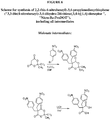
- the p-bromo-substituted 2,2-bis(benzyl)-3,4-propylenedioxythiophene is particularly valuable as an intermediate in the further synthesis of monomer derivatives of 2,2-bis(benzyl)-3,4-propylenedioxythiophene with other substituents at the p -position of the benzyl group through common synthetic organic chemical techniques known to anyone skilled in the art.
- the 1,3-propanediol may be obtained by reducing a 2,2-dibenzyl-malonate substituted at the 4 position of the benzyl group with the desired substituent (such as but not limited to the halo, alkyl, sulfonyl or nitro group). Examples of various malonates that may be used and methods of synthesis are set forth in the text below and in the EXAMPLES.
- the 2,2- bis(benzyl)-1, 3-propanediol substituted at the 4 position of the benzyl group with the desired substituent is reacted with 1,3-dimethoxythiophene in a transesterification reaction facilitated by, for example, p -toluene sulfonic acid to yield the monomer, bis(4-substitued-benzyl)-3,4-propylenedioxythiophene.
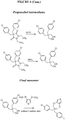
- Another subject of the present invention is the successful synthesis of the precursors required to synthesize the p -dichloro-, p -dibromo and p -dinitro-substituted dibenzyl PPro-DOT electrochromic polymers, specifically, 2,2-bis(4-chloro-benzyl)-1,3-propanediol, 2,2-bis(4-bromo-benzyl)-1,3-propanediol, and 2,2-bis(4-nitro-benzyl)-1,3-propanediol.
- Typical syntheses are described in EXAMPLES 1, 5 and 6.
- EXAMPLE 8 describes a typical electrochemical deposition (i.e., polymerization) of the polymer, poly(2,2-bis(4-chloro-benzyl)-3,4-propylenedioxythiophene) ("poly(Cl-Bz-ProDOT)”) from monomer solution.
- the polymer is preferably deposited from a nonaqueous monomer solution.
- a potential sweep method is preferably used.
- a potentiostatic (constant potential) method yields poorly formed, inhomogeneous polymer films with poor electrochromic performance and with a tendency to crack.
- a multiple potential sweep method is used with total charge during deposition controlled carefully. The potential is swept from about 0.0 V to +1.5 V (vs. Pt quasi-reference). More preferably, the potential sweep rate is 10-25 mV/s with potential step size between 2 and 7 mV, and the total charge during deposition is 7.5 to 12.5 mC/cm 2 .
- Polymer films deposited using these parameters have a blue-violet coloration, are extremely homogeneous and uniform, and yield a %T, at 575 nm (the approximate wavelength of maximum absorption for this polymer), of 45% to 50%. They display the most optimal electrochromic performance in devices, as characterized by light/dark contrast (Delta %T at 575 nm), switching time, cyclability and durability.
- electrochemical deposition of the cathodically coloring polymer is provided with a potential sweep method rather than a potentiostatic method; the latter yields poor films with poor electrochromic performance.
- the potential is swept from about 0.0 V to +1.5 V (vs. Pt quasi-reference), a preferred scan rate is 2 mV/s to 50 mV/s and a preferred potential step size from 1 mV to 10 mV.
- a more preferred scan rate is 10-20 mV/s, and a more preferred potential step size is between 2 and 4 mV; a preferred total charge is 11 to 19 mC/cm 2 and a preferred %T of the film as deposited at 575 nm is 41% to 55%.
- Highly uniform, homogeneous polymer films with a dark blue/violet coloration are obtained.
- a typical such electrochemical deposition is described in EXAMPLE 11. Based on established principles of electrochemical polymerization of conducting polymers (see Chandrasekhar, 1999, Chapters 1-3), and without being confined to any particular theory of operation, it is highly likely that the polymer chain in this copolymer contains random units of the three monomers in the proportions noted above (e.g.
- the extended conjugation in the polymer chain has properties corresponding to contributions from the strongly electron-withdrawing chloro-substituent and the less electron-withdrawing bromo-substituent, along with the "neutral" unsubstituted monomer.
- the larger substituents benzyl, chloro-benzyl, bromo-benzyl
- impose greater structural order reflected, e.g. in less cross-linking
- EXAMPLES 8 and 10 describe the electrochemical depositions of other cathodically-coloring polymers.
- COMPARATIVE EXAMPLE 9 describes such deposition using a potentiostatic (constant potential) method; this yields poorly formed, non-uniform polymer susceptible to cracking and displaying much poorer electrochromic properties.
- the anodically coloring polymers used in the electrochromic device may be those materials known in the art and may include but are not limited to: poly(pyrrole); the structurally related poly(aromatic amine) series comprising poly(diphenyl amine), poly(4-amino-biphenyl) (Guay et al., 1989) and poly(aniline); poly( N,N' -diphenyl benzidine) (Suzuki et al., 1989); poly(phenylene); poly(phenylene vinylene); poly(allylene vinylene); poly(amino quinoline).
- poly(pyrrole) the structurally related poly(aromatic amine) series comprising poly(diphenyl amine), poly(4-amino-biphenyl) (Guay et al., 1989) and poly(aniline); poly( N,N' -diphenyl benzidine) (Suzuki et al., 1989); poly(phenylene);
- a preferred composition for the anodically coloring polymer is a copolymer of N,N'- diphenyl benzidine, diphenyl amine and 4-amino-biphenyl, in a ratio of about 1:1:1 to 50:1:1 to, with electrochromic performance seen to be superior to that of the pure (i.e. non-copolymer) polymers of these monomers. More preferably, the above molar ratio is from about 1:1:1 to about 20:1:1 and even more preferably, the above molar ratio is about 10:1:1 to 20:1:1.
- the above molar ratio is about 3:1:1 to 9:1:1, and even more preferably, the above molar ratio is about 4:1:1 to 7:1:1. In a specifically preferred embodiment, the above molar ratio is about 5:1:1.
- Another aspect addressed in the present invention is the improvement of procedures for preparation of monomer solutions of anodically coloring polymers described in the prior art, which were found in extensive studies to either not work or work very poorly.
- An example of this is the preparation of the monomer solution of the N,N' -diphenyl benzidine, as described in the work of Suzuki et al. (1989).
- the ca. 6:1 ratio of DMF:acetonitrile was an unexpected result in that it yielded viable films of polymer, both for the monomer N,N' -diphenyl benzidine alone, and its copolymers with other aromatic amine monomers.
- Preferred substrates are ITO (indium tin oxide) on a chemically inert plastic such as poly(ethylene terephthalate) (PET), i.e. ITO/Mylar®, although any other conductive, transparent substrate may be used, such as: ITO/glass; doped tin oxide on glass or plastic; very thin ( ⁇ 60 nm) Au on plastic or glass; "NESA" glass; and a more recently studied substrate, carbon nanotubes on plastic or glass.
- the preferred surface resistivity is ⁇ 60 Ohms/square (dimensionless units).
- the polymer is preferably deposited from a nonaqueous monomer solution.
- a potential sweep method is preferably used in the case of the cathodically coloring polymers and a potential step method is preferably used in the case of the anodically coloring polymers addressed here.
- EXAMPLES 8 and 10 describe the electrochemical depositions of other cathodically-coloring polymers.
- COMPARATIVE EXAMPLE 9 describes such deposition of the cathodically coloring polymers using a potentiostatic (constant potential) method; this yields poorly formed, non-uniform polymer susceptible to cracking and displaying much poorer electrochromic properties.
- a multiple potential sweep method is used with total charge during deposition controlled carefully.
- the potential is swept from about 0.0 V to +1.5 V (vs. Pt quasi-reference).
- the potential sweep rate is 10-25 mV/s with potential step size between 2 and 7 mV, and the total charge during deposition is 7.5 to 12.5 mC/cm 2 .
- Polymer films deposited using these parameters have a blue-violet coloration, are extremely homogeneous and uniform, and yield a %T, at 575 nm (the approximate wavelength of maximum absorption for this polymer), of 45% to 50%. They display the most optimal electrochromic performance in devices, as characterized by light/dark contrast (Delta %T at 575 nm), switching time, cyclability and durability.
- Similar procedures may be used to deposit a copolymer.
- the potential is swept from about 0.0 V to +1.5 V (vs. Pt quasi-reference), a preferred scan rate is 2 mV/s to 50 mV/s and a preferred potential step size from 1 mV to 10 mV.
- a more preferred scan rate is 10-20 mV/s, and a more preferred potential step size is between 2 and 4 mV; a preferred total charge is 11 to 19 mC/cm 2 and a preferred %T of the film as deposited at 575 nm is 41% to 55%.
- Highly uniform, homogeneous polymer films with a dark blue/violet coloration are obtained.
- EXAMPLE 11 A typical such electrochemical deposition is described in EXAMPLE 11. Based on established principles of electrochemical polymerization of conducting polymers (see Chandrasekhar, 1999, Chapters 1-3), and without being confined to any particular theory of operation, it is likely that the polymer chain in this copolymer contains random units of the three monomers in the proportions noted above (e.g. 5:1:1) such that the extended conjugation in the polymer chain has properties corresponding to contributions from the strongly electron-withdrawing chloro-substituent and the strongly electron-donating amino-substituent, along with the "neutral" unsubstituted monomer.
- Electrochromic Device Including Assembly Thereof and Electrolytes
- Electrochromic devices are assembled according to the schematic of FIG. 1 . Typical assemblies are described in EXAMPLE 14 and COMPARATIVE EXAMPLES 15 - 17.
- a gel electrolyte is preferred.
- a preferred electrolyte uses a polymer such as poly(methyl methacrylate) (PMMA) or poly(ethyl methacrylate) (PEMA) as a matrix, appropriate salts such as Li trifluoromethane sulfonate (Li triflate) and LiBF 4 , and plasticizers and/or further solvating agents such as propylene carbonate, which is an organic solvent (typically used in Li battery electrolytes) with a very high b.p., 240 °C.
- the gel electrolyte resembles a hard but flexible, rubbery plastic.
- the components of the electrochromic devices comprise the two conducting polymer electrodes (with cathodically- and anodically-coloring polymers, respectively), the electrolyte and gaskets for sealing and for containing the electrolyte.
- the electrolyte is applied to both polymer electrodes as a very thin layer using a doctor-blade technique. Overnight setting yields a complete device, which may then be optionally sealed with additional edge-sealants.
- EXAMPLE 14 describes in detail the assembly of a typical dual-polymer device.
- the cathodically-coloring polymer is a copolymer of 2,2-(bis-4-chloro-benzyl)-3,4-propylenedioxythiophene, 2,2-(bis-4-bromo-benzyl)-3,4-propylenedioxythiophene and 2,2-dibenzyl-3,4-propylenedioxythiophene and the anodically-coloring polymer is a copolymer of N,N' -diphenyl benzidine, diphenyl amine and 4-amino-biphenyl.
- COMPARATIVE EXAMPLE 15 describes the assembly of dual-polymer electrochromic device comprising poly(2,2-(bis-4-chloro-benzyl)-3,4-propylenedioxythiophene) ("poly(Cl-Bz-ProDOT)") as the cathodically coloring polymer and a copolymer of N,N'-diphenyl benzidine, diphenyl amine and 4-amino-biphenyl as the anodically coloring polymer.
- COMPARATIVE EXAMPLE 16 describes the assembly of dual-polymer electrochromic device comprising the prior art polymer, poly(isothianaphthene) (PITN), as the cathodically coloring polymer and a copolymer of N,N'-diphenyl benzidine, diphenyl amine and 4-amino-biphenyl as the anodically coloring polymer.
- COMPARATIVE EXAMPLE 17 describes the assembly of single-polymer electrochromic device comprising poly( N,N' -diphenyl benzidine) as the anodically coloring polymer.
- a known cathodically-coloring polymer poly(isothianaphthene) (PITN)
- PITN poly(isothianaphthene)
- the redox potentials of this polymer, PITN are somewhat poorly matched to those of virtually all anodically-coloring polymers, and particularly poorly matched to those of poly(aromatic amines) such as poly(diphenyl amine), poly(4-amino-biphenyl) and poly( N,N' -diphenyl benzidine). This is further confirmed in the cyclic voltammogram shown in FIG.
- FIG. 8 which shows cyclic voltammograms of a device as assembled in COMPARATIVE EXAMPLE 16, i.e. with PITN as the cathodically-coloring polymer and a copolymer of N,N' -diphenyl benzidine, diphenyl amine and 4-amino-biphenyl as the anodically-coloring polymer, between the voltages corresponding to its extreme light and dark states.
- the voltammogram is seen to have poorly defined oxidation peaks. More telling is the poor electrochromic performance embodied in FIG. 9 , which shows the UV-Vis-NIR spectra of this device in its extreme light and dark states; the poor contrast (Delta %T) is clearly seen. Nevertheless, being a dual-polymer device, this device shows a switching time ⁇ 5 s, and cyclability, > 2000 cycles.
- COMPARATIVE EXAMPLE 17 Another useful comparison is obtained from the performance of the device as assembled in COMPARATIVE EXAMPLE 17, i.e. a single-polymer electrochromic device comprising poly(N,N'-diphenyl benzidine) as the anodically coloring polymer.
- COMPARATIVE EXAMPLE 17 i.e. a single-polymer electrochromic device comprising poly(N,N'-diphenyl benzidine) as the anodically coloring polymer.
- Its extreme light/dark state electrochromic performance, seen in FIG. 10 shows a Delta %T at the wavelength of maximum absorption of about 40%, which may be considered fair to good.
- the device shows a rather poor switching time, ca. 15 to 20 s, and starts to degrade significantly after about 1000 light/dark cycles.
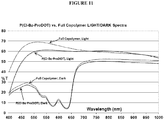
- FIG. 11 shows the UV-Vis-NIR spectra in the extreme light/dark states of the dual-polymer device assembled according to COMPARATIVE EXAMPLE 15, i.e.
- Poly(Cl-Bz-ProDOT) poly(2,2-(bis-4-chloro-benzyl)-3,4-propylenedioxythiophene)
- Poly(Cl-Bz-ProDOT) poly(2,2-(bis-4-chloro-benzyl)-3,4-propylenedioxythiophene)
- Poly(Cl-Bz-ProDOT) poly(2,2-(bis-4-chloro-benzyl)-3,4-propylenedioxythiophene)
- Poly(Cl-Bz-ProDOT) poly(2,2-(bis-4-chloro-benzyl)-3,4-propylenedioxythiophene)
- the single-cathodically-coloring-polymer device shows a very large light/dark contrast, about Delta %T 55% at 575 nm (the approximate wavelength of maximum absorption).
- the copolymer-cathodically-coloring-polymer device shows significantly increased contrast, Delta %T about 60% at 575 nm, and a more broad-band response in the light state, although the dark state is nearly identical to that of the single-polymer device.
- FIG. 12 shows switching time data for the same devices. Although the switching times appear nearly identical for the two devices, the copolymer devices again show a larger light/dark contrast.
- cathodically-coloring and anodically-coloring copolymers of the device of EXAMPLE 14 are extremely well matched electrochemically, i.e. in terms of their redox potentials, is clearly seen from the relevant electrochemical, i.e. cyclic voltammetric data, as shown in FIG. 13 .
- a key indicator of this is that the currents observed in the redox of the single-polymer devices are much smaller than those of the composite, dual-polymer device, clearly seen in the figure. Since, in the case of the dual-polymer device, oxidation or reduction at one electrode is accompanied by a companion, highly reversible opposite process, i.e.
- the cathodically-coloring copolymer i.e. the copolymer of 2,2-bis(4-chloro-benzyl)-3,4-propylenedioxythiophene, 2,2-bis(4-bromo-benzyl)-3,4-propylenedioxythiophene and 2,2-dibenzyl-3,4-propylenedioxythiophene, constitutes a better electrochemical match for the anodically-coloring copolymer (the copolymer of N,N' -diphenyl benzidine, diphenyl amine and 4-amino-biphenyl ) than the individual polymer, poly(2,2-bis(4-chloro-benzyl)-3,4-propylenedioxythiophene) (P(Cl-Bz-ProDOT)), alone is seen in the cyclic voltammetric data of FIG.
- the anodically-coloring copolymer the copolymer of N,N
- the voltammogram for the copolymer device is more well defined and has significantly higher currents than that for the P(Cl-Bz-ProDOT)-only device. Again, this implies that more of the polymer in the former case is electroactive and switching.
- the dual-copolymer devices of the present invention is that the light/dark spectra "window" can be shifted up or down with ease. That is to say, if, e.g., the dark and light state transmissions (%T) of a device are 8% and 60% respectively (at 575 nm), then with appropriate adjustment of the total charge during deposition of the polymers, i.e. their thickness, the dark and light state %T can be shifted, e.g., to 2% and 54%, in a nearly linear fashion. This is seen in the light/dark data in FIG. 15 .
- the dark state shows a %T of about 0% in approximately the 550 nm to 630 nm region
- this is somewhat deceptive in terms of the visibility through such a device.
- Such a device just appears tinted, and is still easily seen through; there is no impediment to visibility whatsoever, due to the fact that there is significant transmission at the other visible wavelengths.
- the present invention encompasses windows, mirrors, flat panel displays, visors, glasses, and camouflage, comprising the complimentary electrochromic devices of the present invention.
- bromo-substituted derivative monomer provides a very facile route to monomers substituted with alkyl- and other substituents.
- the monomer produced as in EXAMPLE 1 was placed in a vacuum oven for about 0.5 hour before preparation of the deposition solution.
- Li trifluoromethane sulfonate Li triflate
- Acetonitrile was dried using activated molecular sieves.
- a stock solution of 250 mL of 0.4 M Li triflate Sulf I/acetonitrile was prepared.
- a 4 mM solution of the Cl-BzProDOT monomer deposition solution was prepared by adding the appropriate quantity of the monomer to the 250 mL stock solution in a conical flask with stirring. A yellow deposition solution was obtained.
- the polymer, poly(Cl-Bz-ProDOT) was deposited on ITO/Mylar (preferred surface resistivity ⁇ 60 Ohms/square, dimensionless units) using a 3 electrode configuration, with graphite counter electrode and Pt wire quasi-reference electrode.
- a multiple potential sweep method was used to deposit polymer, with the number of sweeps dependent on the thickness of polymer desired, which was monitored by measuring the total charge deposited using standard electrochemical methods.
- the optimal total charge during deposition was found to be 7.5 to 12.5 mC/cm 2 , for films showing the best performance in devices; such films had a typical %T, at 575 nm, of 45% to 50%.
- a potential sweep method was found to be superior to a potentiostatic method (see COMPARATIVE EXAMPLE 9).
- potential was swept from 0 to +1.5 V (vs. Pt Q-R), at a scan rate of 10-25 mV/s, with potential step size between 2 and 7 mV.
- a most preferred scan rate was 12.5 to 22 mV/s and a most preferred step size 4 mV.
- a small difference in the scan rate e.g. a rate of 17 mV/s vs. 13 mV/s, made a significant difference in the darkness of the films obtained and thus their suitability for the fabrication of "very dark” or "very light” devices.
- the polymer film was held at an applied potential of 0.0V for 1 min, then immersed from the deposition solution while at this potential. Films were rinsed with acetonitrile, soaked in 0.2 M Li triflate/acetonitrile solution for 1 min, rinsed with acetonitrile, and dried at 50 to 75°C. Highly uniform, homogeneous polymer films with a blue/violet coloration were obtained.
- a film of poly(Cl-Bz-ProDOT) was deposited on ITO/Mylar using a procedure identical to that of EXAMPLE 8, except that in place of the potential sweep method described, a potentiostatic (constant potential) method was used. The applied potential was held at +0.9 V in one experiment, and +1.1 V in a second, these voltages being carefully selected from the linear sweep voltammogram of the deposition solution. Total charge was carefully monitored and held close to the optimum values listed in EXAMPLE 8. The switching time of electrochromic devices made with these films was significantly slower (about 10 s vs.
- the monomer produced as in EXAMPLE 5 was used to prepare a deposition solution and then to electrochemically deposit films of the polymer, Poly(2,2-(bis-4-bromo-benzyl)-3,4-propylenedioxythiophene) ("Poly(Br-Bz-ProDOT)", on ITO/Mylar substrates.
- Poly(2,2-(bis-4-bromo-benzyl)-3,4-propylenedioxythiophene) ("Poly(Br-Bz-ProDOT)”
- Poly(Br-Bz-ProDOT) Poly(Br-Bz-ProDOT)
- the monomers, 2,2-(bis-4-chloro-benzyl)-3,4-propylenedioxythiophene, 2,2-(bis-4-bromo-benzyl)-3,4-propylenedioxythiophene, and 2,2-dibenzyl-3,4-propylenedioxythiophene, were used to prepare a deposition solution and then to electrochemically deposit films of the corresponding copolymer on ITO/Mylar substrates.
- Li triflate salt in a proportion of ca. 6.24 g per 100 mL of solution. This solution may be used as is for electrochemical polymerization, if it is desired to produce the single polymer, poly( N,N'- diphenyl benzidine).
- Electrodeposition electrochemical polymerization from monomer solution: The above stock solution was used for electropolymerization of the subject polymer onto ITO/Mylar substrates using a potentiostatic (i.e., constant potential) mode of deposition. A 3-electrode setup, with graphite counter and Pt wire quasi-reference electrodes was used. A potentiostatic (i.e., constant potential) deposition, at +0.5 V (vs. Pt quasi-reference) was used. Charge during deposition was monitored coulometrically, and set to between 140 and 200 mC/cm 2 , for very light and very dark films respectively.
- Electro-depositions of this monomer were also tested from acetonitrile solution, again attempting to reproduce the methodology of Suzuki et al. (1989).
- the saturated solution of the monomer in acetonitrile, prepared as described in EXAMPLE 12 was used, with 0.4 M Li triflate added thereto.
- times in excess of 2 h were required to obtain even a very thin film of the polymer (poly(N,N'-diphenyl benzidine) on the ITO substrates.
- Dual-Polymer Electrochromic Device Comprising [Copolymer of 2,2-(bis-4-chloro-benzyl)-3,4-propylenedioxythiophene, 2,2-(bis-4-bromo-benzyl)-3,4-propylenedioxythiophene and 2,2-dibenzyl-3,4-propylenedioxythiophene] as the Cathodically Coloring Polymer and [Copolymer of N,N'-Diphenyl Benzidine, Diphenyl Amine and 4-Amino-Biphenyl] as the Anodically Coloring Polymer
- An electrochemical device was fabricated substantially as described in EXAMPLE 14 except that, in place of the cathodically coloring polymer in that EXAMPLE, which was a copolymer constituted from three separate monomers, the simple polymer, poly(2,2-(bis-4-chloro-benzyl)-3,4-propylenedioxythiophene) ("poly(Cl-Bz-ProDOT)”) was used. In particular, it was ensured the polymer thicknesses, as measured by the total amount of charge deposited, was nearly identical to those for the corresponding polymers in EXAMPLE 14.
- An electrochemical device was fabricated substantially as described in EXAMPLE 14 except that, in place of the cathodically coloring polymer in that EXAMPLE, poly(isothianaphthene) (PITN) was used.
- PITN poly(isothianaphthene)
- a PITN film was electrochemically polymerized on ITO/Mylar as described by Chandrasekhar et al. (1989). In particular, it was ensured the thickness of the anodically coloring copolymer, as measured by the total amount of charge deposited, was nearly identical to that for the anodically coloring copolymer of EXAMPLE 14.
- An electrochemical device was fabricated substantially as described in EXAMPLE 14 except that, in place of the cathodically coloring polymer in that EXAMPLE, no cathodically coloring polymer, i.e. a blank ITO/Mylar electrode, was used.
- the spectrometer was brought to the wavelength of maximum absorption of the devices (575 nm for the device of EXAMPLE 14) and the device then rapidly switched between its extreme light and dark state with appropriate applied voltage. Relevant results are presented in the FIGURES.
Landscapes
- Chemical & Material Sciences (AREA)
- Organic Chemistry (AREA)
- Physics & Mathematics (AREA)
- Nonlinear Science (AREA)
- Engineering & Computer Science (AREA)
- Materials Engineering (AREA)
- General Physics & Mathematics (AREA)
- Optics & Photonics (AREA)
- Chemical Kinetics & Catalysis (AREA)
- Life Sciences & Earth Sciences (AREA)
- Electrochemistry (AREA)
- Metallurgy (AREA)
- Health & Medical Sciences (AREA)
- Inorganic Chemistry (AREA)
- Molecular Biology (AREA)
- Wood Science & Technology (AREA)
- Mathematical Physics (AREA)
- Crystallography & Structural Chemistry (AREA)
- Polyoxymethylene Polymers And Polymers With Carbon-To-Carbon Bonds (AREA)
- Electrochromic Elements, Electrophoresis, Or Variable Reflection Or Absorption Elements (AREA)
Claims (15)
- Dispositif électrochrome complémentaire comprenant :(a) une première électrode comprenant un matériau polymère conducteur à coloration cathodique, le matériau polymère conducteur à coloration cathodique comprenant un monomère 2,2-dibenzyl-3,4-propylènedioxythiophène substitué ou non substitué, le matériau polymère conducteur à coloration cathodique ayant un potentiel redox ;(b) une seconde électrode comprenant un matériau polymère conducteur à coloration anodique, le matériau polymère conducteur à coloration anodique ayant un potentiel redox qui est adapté au potentiel redox du matériau polymère conducteur à coloration cathodique ; et(c) un électrolyte disposé entre la première électrode et la seconde électrode et en communication électrochimique avec celles-ci ;dans lequel lorsque l'un desdits matériaux polymères est totalement oxydé, l'autre desdits matériaux polymères est totalement réduit.
- Procédé permettant d'obtenir un dispositif électrochrome complémentaire comprenant les étapes consistant à :(a) préparer une première électrode par dépôt d'un matériau polymère conducteur à coloration cathodique sur un premier substrat conducteur transparent pour obtenir la première électrode, le matériau polymère conducteur à coloration cathodique comprenant un monomère 2,2-dibenzyl-3,4-propylènedioxythiophène substitué ou non substitué, le matériau polymère conducteur à coloration cathodique ayant un potentiel redox ;(b) préparer une seconde électrode par dépôt d'un matériau polymère conducteur à coloration anodique sur un second substrat conducteur transparent pour obtenir la seconde électrode, le matériau polymère conducteur à coloration anodique ayant un potentiel redox qui est adapté au potentiel redox du matériau polymère conducteur à coloration cathodique ;(c) superposer la première électrode et la seconde électrode et ménager un espace entre les première et seconde électrodes ; et(d) placer un électrolyte dans l'espace entre les première et seconde électrodes pour fournir le dispositif électrochrome, l'électrolyte étant en communication électrochimique avec les première et seconde électrodes ;dans lequel lorsque l'un desdits matériaux polymères est totalement oxydé, l'autre desdits matériaux polymères est totalement réduit.
- Dispositif électrochrome selon la revendication 1 ou procédé selon la revendication 2, dans lesquels au moins une fraction benzyle du 2,2-dibenzyl-3,4-propylènedioxythiophène substitué est substituée en position para par un substituant choisi dans le groupe constitué par les substituants halogéno, sulfonyle, nitro, alkyle ; et/ou
dans lesquels au moins une fraction benzyle du 2,2-dibenzyl-3,4-propylènedioxythiophène substitué porte un substituant choisi dans le groupe constitué par les substituants chloro et bromo ; et/ou
dans lesquels au moins une fraction benzyle du 2,2-dibenzyl-3,4-propylènedioxythiophène substitué porte un substituant choisi dans le groupe constitué par les substituants n-propyle, isopropyle, n-butyle, isobutyle, n-pentyle et n-hexyle ; et/ou dans lesquels au moins une fraction benzyle du 2,2-dibenzyl-3,4-propylènedioxythiophène substitué porte un substituant amino. - Dispositif électrochrome ou procédé selon l'une quelconque des revendications précédentes, dans lesquels au moins l'un du matériau polymère conducteur à coloration cathodique et du matériau polymère conducteur à coloration anodique comprend un copolymère.
- Dispositif électrochrome ou procédé selon l'une quelconque des revendications précédentes, dans lesquels le matériau polymère conducteur à coloration cathodique comprend du poly(2,2-dibenzyl-3,4-propylènedioxythiophène), du poly(2,2-bis(4-chlorobenzyl)-3,4-propylènedioxythiophène), du poly(2,2-bis(4-bromobenzyl)-3,4-propylènedioxythiophène), du poly(2,2-bis(4-nitrobenzyl)-3,4-propylènedioxythiophène) ou des associations de ceux-ci ; et/ou
dans lesquels le matériau polymère conducteur à coloration cathodique comprend au moins un monomère choisi dans le groupe constitué par le 2,2-bis(4-chlorobenzyl)-3,4-propylènedioxythiophène, le 2,2-bis(4-bromobenzyl)-3,4-propylènedioxythiophène et les associations de ceux-ci ; et/ou
dans lesquels le matériau polymère conducteur à coloration cathodique comprend un copolymère des monomères 2,2-dibenzyl-3,4-propylènedioxythiophène, 2,2-bis(4-chlorobenzyl)-3,4-propylènedioxythiophène et 2,2-bis(4-bromobenzyl)-3,4-propylènedioxythiophène. - Dispositif électrochrome ou procédé selon l'une quelconque des revendications précédentes, dans lesquels le matériau polymère conducteur à coloration cathodique comprend un copolymère des monomères 2,2-dibenzyl-3,4-propylènedioxythiophène, 2,2-bis(4-chlorobenzyl)-3,4-propylènedioxythiophène et 2,2-bis(4-bromobenzyl)-3,4-propylènedioxythiophène, en un rapport molaire dans la plage de 1:1:1 à 50:7:1, respectivement ; de préférence en un rapport molaire de 10:1:1, respectivement.
- Dispositif électrochrome ou procédé selon l'une quelconque des revendications précédentes, dans lesquels le matériau polymère conducteur à coloration anodique comprend une poly(amine aromatique).
- Dispositif électrochrome ou procédé selon l'une quelconque des revendications précédentes, dans lesquels le matériau polymère conducteur à coloration anodique comprend au moins un monomère choisi dans le groupe constitué par la N,N'-diphénylbenzidine, la diphénylamine, le 4-aminobiphényle et les associations de ceux-ci.
- Dispositif électrochrome ou procédé selon l'une quelconque des revendications précédentes, dans lesquels le matériau polymère conducteur à coloration anodique comprend un copolymère des monomères N,N'-diphénylbenzidine, diphénylamine et 4-aminobiphényle en un rapport molaire dans la plage de 1:1:1 à 50:1:1, respectivement ; de préférence en un rapport molaire de 5:1:1, respectivement.
- Dispositif électrochrome selon l'une quelconque des revendications 1 et 3-9, dans lequel au moins l'une des première et seconde électrodes comprend un substrat transparent conducteur.
- Dispositif électrochrome selon la revendication 10, dans lequel le substrat transparent conducteur comprend de l'oxyde d'indium-étain (ITO)/verre, de l'ITO/poly(téréphtalate d'éthylène) (PET), de l'oxyde d'étain/verre, de l'oxyde d'étain/PET, de l'or/verre, des nanotubes de carbone/verre, des nanotubes de carbone/PET, de l'or/PET ou une association de ceux-ci.
- Dispositif électrochrome selon la revendication 10 ou 11, dans lequel au moins l'un du matériau polymère conducteur à coloration cathodique et du matériau polymère conducteur à coloration anodique est déposé sur une surface du substrat transparent conducteur.
- Procédé selon l'une quelconque des revendications 2-9, dans lequel au moins l'un des premier et second substrats transparents comprend de l'oxyde d'indium-étain (ITO)/verre, de l'ITO/poly(téréphtalate d'éthylène) (PET), de l'oxyde d'étain/verre, de l'oxyde d'étain/PET, de l'or/verre, des nanotubes de carbone/verre, des nanotubes de carbone/PET, de l'or/PET ou une association de ceux-ci.
- Dispositif électrochrome selon l'une quelconque des revendications 1 et 3-12 ou procédé selon l'une quelconque des revendications 2-9 et 13, dans lesquels l'électrolyte comprend un électrolyte liquide, un électrolyte solide, un électrolyte sous forme de gel ou une association de ceux-ci.
- Dispositif électrochrome selon l'une quelconque des revendications 1, 3-12 et 14, comprenant un joint d'étanchéité disposé autour des bords du dispositif, ledit joint d'étanchéité étant efficace pour confiner l'électrolyte à l'intérieur du dispositif.
Applications Claiming Priority (2)
| Application Number | Priority Date | Filing Date | Title |
|---|---|---|---|
| US201161560243P | 2011-11-15 | 2011-11-15 | |
| PCT/US2012/065123 WO2013074702A1 (fr) | 2011-11-15 | 2012-11-14 | Dispositif électrochromique à polymères complémentaires |
Publications (3)
| Publication Number | Publication Date |
|---|---|
| EP2780762A1 EP2780762A1 (fr) | 2014-09-24 |
| EP2780762A4 EP2780762A4 (fr) | 2015-07-15 |
| EP2780762B1 true EP2780762B1 (fr) | 2017-06-28 |
Family
ID=48280381
Family Applications (1)
| Application Number | Title | Priority Date | Filing Date |
|---|---|---|---|
| EP12850225.9A Active EP2780762B1 (fr) | 2011-11-15 | 2012-11-14 | Dispositif électrochromique à polymères complémentaires |
Country Status (6)
| Country | Link |
|---|---|
| US (3) | US9274395B2 (fr) |
| EP (1) | EP2780762B1 (fr) |
| CN (1) | CN104040417B (fr) |
| CA (1) | CA2852711C (fr) |
| ES (1) | ES2637799T3 (fr) |
| WO (1) | WO2013074702A1 (fr) |
Cited By (1)
| Publication number | Priority date | Publication date | Assignee | Title |
|---|---|---|---|---|
| US10197881B2 (en) | 2011-11-15 | 2019-02-05 | Ashwin-Ushas Corporation, Inc. | Complimentary polymer electrochromic device |
Families Citing this family (43)
| Publication number | Priority date | Publication date | Assignee | Title |
|---|---|---|---|---|
| US8432603B2 (en) | 2009-03-31 | 2013-04-30 | View, Inc. | Electrochromic devices |
| US12043890B2 (en) | 2009-03-31 | 2024-07-23 | View, Inc. | Electrochromic devices |
| US8582193B2 (en) | 2010-04-30 | 2013-11-12 | View, Inc. | Electrochromic devices |
| US10261381B2 (en) | 2009-03-31 | 2019-04-16 | View, Inc. | Fabrication of low defectivity electrochromic devices |
| US10156762B2 (en) | 2009-03-31 | 2018-12-18 | View, Inc. | Counter electrode for electrochromic devices |
| US10852613B2 (en) | 2009-03-31 | 2020-12-01 | View, Inc. | Counter electrode material for electrochromic devices |
| US10591795B2 (en) | 2009-03-31 | 2020-03-17 | View, Inc. | Counter electrode for electrochromic devices |
| US12353109B2 (en) | 2009-12-22 | 2025-07-08 | View Operating Corporation | Electrochromic cathode materials |
| US8770749B2 (en) | 2010-04-15 | 2014-07-08 | Oakley, Inc. | Eyewear with chroma enhancement |
| US9759975B2 (en) | 2010-04-30 | 2017-09-12 | View, Inc. | Electrochromic devices |
| EP3447563A1 (fr) | 2011-10-20 | 2019-02-27 | Oakley, Inc. | Lunettes à chrominance améliorée |
| WO2013169987A1 (fr) | 2012-05-10 | 2013-11-14 | Oakley, Inc. | Lunettes à couches fonctionnelles stratifiées |
| US10761393B2 (en) | 2013-02-04 | 2020-09-01 | E-Vision, Llc | Electro-chromic devices including solid or quasi-solid electrolyte layers and methods of making the same |
| US9207515B2 (en) | 2013-03-15 | 2015-12-08 | Ashwin-Ushas Corporation, Inc. | Variable-emittance electrochromic devices and methods of preparing the same |
| ES2981413T3 (es) | 2013-07-25 | 2024-10-08 | E Vision Llc | Métodos para fabricar películas electrocrómicas |
| US8902486B1 (en) * | 2013-11-20 | 2014-12-02 | Ashwin-Ushas Corporation, Inc. | Method and apparatus for control of electrochromic devices |
| US9575335B1 (en) | 2014-01-10 | 2017-02-21 | Oakley, Inc. | Eyewear with chroma enhancement for specific activities |
| US9977262B2 (en) * | 2014-03-12 | 2018-05-22 | Honeywell International, Inc. | Electrochromic lenses and methods of fabricating the same |
| US11891327B2 (en) | 2014-05-02 | 2024-02-06 | View, Inc. | Fabrication of low defectivity electrochromic devices |
| WO2016077431A2 (fr) | 2014-11-13 | 2016-05-19 | Oakley, Inc. | Lunettes d'atténuation de lumière variable présentant une accentuation de couleurs |
| US9738140B2 (en) | 2014-08-04 | 2017-08-22 | Gentex Corporation | Electrochromic devices |
| EP3189373B1 (fr) | 2014-09-05 | 2019-11-06 | View, Inc. | Empilement électrochrome avec contre-électrode particulier et son procédé de fabrication |
| EP4462179A3 (fr) * | 2014-11-26 | 2025-01-29 | View, Inc. | Système de dépôt intégré pour la formation de dispositifs électrochromiques |
| CN116789175A (zh) | 2014-11-26 | 2023-09-22 | 唯景公司 | 用于电致变色装置的对电极 |
| JP6813246B2 (ja) * | 2015-07-14 | 2021-01-13 | ビュー, インコーポレイテッド | エレクトロクロミックデバイス用の対電極 |
| US9632059B2 (en) | 2015-09-03 | 2017-04-25 | Ashwin-Ushas Corporation, Inc. | Potentiostat/galvanostat with digital interface |
| US9482880B1 (en) | 2015-09-15 | 2016-11-01 | Ashwin-Ushas Corporation, Inc. | Electrochromic eyewear |
| US9945045B2 (en) | 2015-12-02 | 2018-04-17 | Ashwin-Ushas Corporation, Inc. | Electrochemical deposition apparatus and methods of using the same |
| CN106290529B (zh) * | 2016-08-04 | 2018-12-25 | 北京工业大学 | 一种基于多循环双阶跃计时分析技术的电致变色材料循环稳定性测试及分析方法 |
| US10254170B2 (en) * | 2017-08-08 | 2019-04-09 | The United States of America, as Represented by the Secretary of Homeland Security | Contrast phantoms and uses thereof for active millimeter wave imaging systems |
| US10267904B2 (en) * | 2017-08-08 | 2019-04-23 | The United States of America, as Represented by the Secretary of Homeland Security | Artificial skin and human phantom for use in active millimeter wave imaging systems |
| US12124116B2 (en) | 2017-10-20 | 2024-10-22 | Luxottica S.R.L. | Eyewear with variable transmission lens |
| US11112622B2 (en) | 2018-02-01 | 2021-09-07 | Luxottica S.R.L. | Eyewear and lenses with multiple molded lens components |
| JP7073770B2 (ja) * | 2018-02-14 | 2022-05-24 | 株式会社デンソー | 電気光学素子およびその製造方法 |
| JP7073771B2 (ja) * | 2018-02-14 | 2022-05-24 | 株式会社デンソー | エレクトロクロミック材料およびその製造方法 |
| JP2019191579A (ja) * | 2018-04-24 | 2019-10-31 | 株式会社リコー | エレクトロクロミック素子及びエレクトロクロミック素子の製造方法 |
| US11340479B2 (en) | 2018-05-17 | 2022-05-24 | Cardinal Cg Company | Elastomeric optical device and related operation methods |
| US10775649B2 (en) | 2018-05-17 | 2020-09-15 | Cardinal Cg Company | Elastomeric optical device and related methods |
| JP7472705B2 (ja) * | 2020-07-29 | 2024-04-23 | 株式会社リコー | エレクトロクロミック素子、エレクトロクロミック調光素子、及びエレクトロクロミック装置 |
| CN111948866B (zh) * | 2020-08-18 | 2023-03-31 | 云南电网有限责任公司电力科学研究院 | 一种绝缘电致变色器件的制备方法 |
| CN117940844A (zh) * | 2021-07-28 | 2024-04-26 | 安比莱特 | 具有改进的循环稳定性的电致变色器件 |
| CN114296283B (zh) * | 2021-12-15 | 2023-09-05 | 北京大学深圳研究生院 | 一种电致变色器件及其制备方法 |
| WO2026015777A1 (fr) * | 2024-07-11 | 2026-01-15 | Magna Mirrors Of America, Inc. | Élément réfléchissant de rétroviseur électrochromique à substrat unique destiné à un ensemble rétroviseur de véhicule |
Family Cites Families (188)
| Publication number | Priority date | Publication date | Assignee | Title |
|---|---|---|---|---|
| US3807832A (en) | 1972-11-09 | 1974-04-30 | American Cyanamid Co | Electrochromic (ec) mirror which rapidly changes reflectivity |
| US3844636A (en) | 1972-12-13 | 1974-10-29 | American Cyanamid Co | Electrochromic mirror |
| US4215917A (en) | 1976-10-27 | 1980-08-05 | American Cyanamid Company | Ion exchange-electrolyte layer for electrochromic devices |
| SU851320A1 (ru) | 1978-05-16 | 1981-07-30 | Предприятие П/Я Р-6429 | Электрохромный индикатор |
| US4304465A (en) | 1979-10-29 | 1981-12-08 | International Business Machines Corporation | Electrochromic display device |
| DE3142907A1 (de) | 1981-10-29 | 1983-05-11 | Fa. Carl Zeiss, 7920 Heidenheim | Optische regelschaltung fuer elektrochrome schichten |
| US4500840A (en) | 1982-10-28 | 1985-02-19 | International Business Machines Corporation | High speed, power potentiostat/galvanostat with IR compensation for use with an electrochemical cell |
| US4559122A (en) | 1983-11-07 | 1985-12-17 | Luciano Folco | Continuous-cycle electroplating plant |
| US4618218A (en) | 1984-04-19 | 1986-10-21 | The Boeing Company | Radiation modulating apparatus and method |
| US4749260A (en) | 1984-08-31 | 1988-06-07 | The Board Of Governors For Higher Education, State Of Rhode Island And Providence Plantations | Variable color transparent panels |
| US4586792A (en) | 1984-08-31 | 1986-05-06 | Board Of Governors For Higher Education, State Of Rhode Island | Electronic display element |
| US5253100A (en) | 1984-08-31 | 1993-10-12 | The Board Of Governors For Higher Education, State Of Rhode Island And Providence Plantations | Solid electrolytes for conducting polymer-based color switchable windows and electronic display services |
| JPH075716B2 (ja) | 1985-09-02 | 1995-01-25 | 株式会社リコー | N,n’―ジフェニルベンジジン重合体の製造方法 |
| US4902108A (en) | 1986-03-31 | 1990-02-20 | Gentex Corporation | Single-compartment, self-erasing, solution-phase electrochromic devices, solutions for use therein, and uses thereof |
| US5173443A (en) | 1987-02-13 | 1992-12-22 | Northrop Corporation | Method of manufacture of optically transparent electrically conductive semiconductor windows |
| US4939043A (en) | 1987-02-13 | 1990-07-03 | Northrop Corporation | Optically transparent electrically conductive semiconductor windows |
| US5241411A (en) | 1987-07-02 | 1993-08-31 | Saint-Gobain Vitrage | Electrochromic variable transmission glazing |
| FR2624526B1 (fr) * | 1987-12-14 | 1992-04-30 | Ricoh Kk | Electrode composite comprenant un corps en aluminium lie a un polymere electroconducteur et cellule electrique utilisant une telle electrode composite |
| US5355245A (en) | 1988-02-12 | 1994-10-11 | Donnelly Corporation | Ultraviolet protected electrochemichromic rearview mirror |
| US5137991A (en) | 1988-05-13 | 1992-08-11 | The Ohio State University Research Foundation | Polyaniline compositions, processes for their preparation and uses thereof |
| US5079334A (en) | 1988-05-13 | 1992-01-07 | The Ohio State University Research Foundation | Electromagnetic radiation absorbers and modulators comprising polyaniline |
| US5159031A (en) | 1988-05-13 | 1992-10-27 | Ohio State University Research Foundation | Sulfonated polyaniline salt compositions and uses thereof |
| US5164465A (en) | 1988-05-13 | 1992-11-17 | Ohio State University Research Foundation | Sulfonated polyaniline salt compositions, processes for their preparation and uses thereof |
| IT1227260B (it) * | 1988-09-30 | 1991-03-28 | Himont Inc | Dieteri utilizzabili nella preparazione di catalizzatori ziegler-natta |
| WO1991014198A1 (fr) | 1990-03-06 | 1991-09-19 | The Dow Chemical Company | Dispositif electrochromique |
| US5446576A (en) | 1990-11-26 | 1995-08-29 | Donnelly Corporation | Electrochromic mirror for vehicles with illumination and heating control |
| US5593852A (en) | 1993-12-02 | 1997-01-14 | Heller; Adam | Subcutaneous glucose electrode |
| US5608567A (en) | 1991-11-05 | 1997-03-04 | Asulab S.A. | Variable transparency electro-optical device |
| US5184156A (en) | 1991-11-12 | 1993-02-02 | Reliant Laser Corporation | Glasses with color-switchable, multi-layered lenses |
| KR940704009A (ko) | 1992-01-10 | 1994-12-12 | 테릴 켄트 퀼리 | 개량 전극을 구비한 광 변조 장치(light modulating devices incorporating an improved electrode) |
| CA2089778C (fr) | 1992-05-19 | 1998-08-25 | Leo Joseph Amore | Membrane pare-soleil transparente aux ondes rf pour antenne |
| EP0600054B1 (fr) | 1992-05-19 | 1998-08-05 | Lockheed Martin Corporation | Membrane de protection solaire pour antennes transparentes aux frequences radio |
| EP0597234B1 (fr) | 1992-10-01 | 1997-05-28 | Ykk Corporation | Copolymerès, méthode de leur production et matériel de coloration-décoloration avec usage de ce polymère |
| US5413739A (en) | 1992-12-22 | 1995-05-09 | Coleman; James P. | Electrochromic materials and displays |
| WO1994016356A1 (fr) | 1993-01-05 | 1994-07-21 | Martin Marietta Corporation | Electrode amelioree pour dispositifs d'affichage |
| JP3308333B2 (ja) | 1993-03-30 | 2002-07-29 | 三菱電機株式会社 | 電解メッキ装置,及び電解メッキ処理方法 |
| US5455638A (en) | 1993-09-10 | 1995-10-03 | Comdisco, Inc. | Electrochromic eyewear |
| US5835185A (en) | 1993-09-10 | 1998-11-10 | Kallman; William R. | Spring-hinged frame for eyeware |
| US5657150A (en) | 1993-09-10 | 1997-08-12 | Eyeonics Corporation | Electrochromic edge isolation-interconnect system, process, and device for its manufacture |
| US5900720A (en) | 1993-09-10 | 1999-05-04 | Kallman; William R. | Micro-electronic power supply for electrochromic eyewear |
| US5455637A (en) | 1993-09-10 | 1995-10-03 | Comdisco, Inc. | Electrochromic eyewear system, rechargeable eyewear and external charger therefor |
| US5466356A (en) | 1994-04-29 | 1995-11-14 | Mine Safety Appliances Company | Potentiostat circuit for electrochemical cells |
| FR2723594B1 (fr) | 1994-08-11 | 1996-09-13 | Kodak Pathe | Procede d'extraction de l'etain de solutions organiques par electrolyse |
| US5780160A (en) | 1994-10-26 | 1998-07-14 | Donnelly Corporation | Electrochromic devices with improved processability and methods of preparing the same |
| US6207369B1 (en) | 1995-03-10 | 2001-03-27 | Meso Scale Technologies, Llc | Multi-array, multi-specific electrochemiluminescence testing |
| WO1997027348A1 (fr) | 1996-01-23 | 1997-07-31 | Minnesota Mining And Manufacturing Company | Appareil et procede de metallisation electrolytique d'un substrat |
| EP0879440A1 (fr) | 1996-02-02 | 1998-11-25 | Pilkington Plc | Dispositifs electrochromes |
| US5728943A (en) | 1996-03-15 | 1998-03-17 | Northwest Pipeline Corporation | Method and system for detection and prevention of stress corrosion cracking in buried structures |
| US5951844A (en) | 1996-04-23 | 1999-09-14 | Agfa Gevaert | Process and apparatus for desilvering a silver-containing solution |
| US6231728B1 (en) | 1996-11-22 | 2001-05-15 | Hubert F. Metzger | Electroplating apparatus |
| DE19706918A1 (de) | 1997-02-20 | 1998-08-27 | Flachglas Ag | Verfahren zum Betreiben eines elektrochromen Elementes |
| US6089721A (en) | 1997-04-02 | 2000-07-18 | Donnelly Corporation | Digital electrochromic mirror system |
| JP3269827B2 (ja) | 1997-04-04 | 2002-04-02 | ユニバーシティ・オブ・サザン・カリフォルニア | 電気化学製造のための物品、方法、および装置 |
| US6132583A (en) | 1997-05-16 | 2000-10-17 | Technic, Inc. | Shielding method and apparatus for use in electroplating process |
| US6130772A (en) | 1997-06-06 | 2000-10-10 | Cava; Frank James | Electrochromic device and method |
| US6033548A (en) | 1997-07-28 | 2000-03-07 | Micron Technology, Inc. | Rotating system and method for electrodepositing materials on semiconductor wafers |
| AU5907798A (en) | 1997-09-30 | 1999-04-23 | Semitool, Inc. | Electroplating system having auxiliary electrode exterior to main reactor chamber for contact cleaning operations |
| US6818110B1 (en) | 1997-09-30 | 2004-11-16 | Symyx Technologies, Inc. | Combinatorial electrochemical deposition and testing system |
| US6071398A (en) | 1997-10-06 | 2000-06-06 | Learonal, Inc. | Programmed pulse electroplating process |
| GB2330151A (en) | 1997-10-07 | 1999-04-14 | Process Automation Internation | An electroplating apparatus with movable diaphragms |
| US5969847A (en) | 1997-12-22 | 1999-10-19 | Ppg Industries Ohio, Inc. | Method for sealing a laminated electrochromic device edge |
| US5995273A (en) | 1998-02-25 | 1999-11-30 | Ashwin-Ushas Corporation | Electrochromic display device |
| EP0991795B1 (fr) | 1998-04-21 | 2006-02-22 | Applied Materials, Inc. | Systeme de depot electrochimique et procede de galvanoplastie sur substrats |
| US6261425B1 (en) | 1998-08-28 | 2001-07-17 | Process Automation International, Ltd. | Electroplating machine |
| US5973818A (en) | 1998-09-21 | 1999-10-26 | Ppg Industries Ohio, Inc. | Method and apparatus for controlling an electrochromic device |
| US7449098B1 (en) | 1999-10-05 | 2008-11-11 | Novellus Systems, Inc. | Method for planar electroplating |
| US6267853B1 (en) | 1999-07-09 | 2001-07-31 | Applied Materials, Inc. | Electro-chemical deposition system |
| US6099117A (en) | 1998-12-15 | 2000-08-08 | Ppg Industries Ohio, Inc. | Hinge with wire extending therethrough |
| KR100347056B1 (ko) | 1999-02-24 | 2002-08-01 | 학교법인 포항공과대학교 | 고속 전기화학 임피던스 측정장치 및 방법 |
| KR100317598B1 (ko) | 1999-03-13 | 2001-12-22 | 박찬구 | 라플라스 변환 임피던스 측정방법 및 측정장치 |
| US6551484B2 (en) | 1999-04-08 | 2003-04-22 | Applied Materials, Inc. | Reverse voltage bias for electro-chemical plating system and method |
| US6585876B2 (en) | 1999-04-08 | 2003-07-01 | Applied Materials Inc. | Flow diffuser to be used in electro-chemical plating system and method |
| US6837978B1 (en) | 1999-04-08 | 2005-01-04 | Applied Materials, Inc. | Deposition uniformity control for electroplating apparatus, and associated method |
| US6189835B1 (en) | 1999-04-30 | 2001-02-20 | Hughes Electronics Corporation | Apparatus for spacecraft angular momentum control through the use of reflective thermal blankets |
| US7012600B2 (en) | 1999-04-30 | 2006-03-14 | E Ink Corporation | Methods for driving bistable electro-optic displays, and apparatus for use therein |
| DE19928047A1 (de) | 1999-06-19 | 2000-12-21 | Gerhard Hoffacker | Schadstoffarme bis schadstoffreie wäßrige Systeme zur galvanischen Abscheidung von Edelmetallen und Edelmetall-Legierungen |
| US6197182B1 (en) | 1999-07-07 | 2001-03-06 | Technic Inc. | Apparatus and method for plating wafers, substrates and other articles |
| US6299753B1 (en) | 1999-09-01 | 2001-10-09 | Applied Materials, Inc. | Double pressure vessel chemical dispenser unit |
| US6294060B1 (en) | 1999-10-21 | 2001-09-25 | Ati Properties, Inc. | Conveyorized electroplating device |
| US6409903B1 (en) | 1999-12-21 | 2002-06-25 | International Business Machines Corporation | Multi-step potentiostatic/galvanostatic plating control |
| DE10007435A1 (de) | 2000-02-18 | 2001-08-23 | Enthone Omi Deutschland Gmbh | Verfahren zum Galvanisieren eines mit einem elektrisch leitenden Polymer beschichteten Werkstücks |
| US6538796B1 (en) | 2000-03-31 | 2003-03-25 | The United States Of America As Represented By The Administrator Of The National Aeronautics And Space Administration | MEMS device for spacecraft thermal control applications |
| US6279857B1 (en) | 2000-04-25 | 2001-08-28 | Trw Inc. | Silicon thermal control blanket |
| WO2001084230A1 (fr) | 2000-05-04 | 2001-11-08 | Schott Donnelly Llc | Vitrage chromogene |
| DE10029520A1 (de) | 2000-06-21 | 2002-01-17 | Merck Patent Gmbh | Beschichtung für metallische Implantatmaterialien |
| US6547945B2 (en) | 2000-07-31 | 2003-04-15 | United Technologies Corporation | Method and apparatuses for electrochemically treating an article |
| US6428684B1 (en) | 2000-08-02 | 2002-08-06 | Industrial Scientific Corporation | Method and apparatus for diagnosing the condition of a gas sensor |
| US6713774B2 (en) | 2000-11-30 | 2004-03-30 | Battelle Memorial Institute | Structure and method for controlling the thermal emissivity of a radiating object |
| DE60218814T2 (de) | 2001-01-03 | 2007-12-06 | Santa Fe Science and Technology, Inc., Santa Fe | Stabile, konjugiertes polymer enthaltende elektrochrome vorrichtungen mit ionischen flüssigkeiten |
| US7850304B2 (en) | 2001-01-23 | 2010-12-14 | Kenneth Martin Jacobs | Continuous adjustable 3Deeps filter spectacles for optimized 3Deeps stereoscopic viewing and its control method and means |
| GB0108502D0 (en) | 2001-04-04 | 2001-05-23 | Isis Innovation | Structure with variable emittance |
| US6580545B2 (en) | 2001-04-19 | 2003-06-17 | E Ink Corporation | Electrochromic-nanoparticle displays |
| US6733909B2 (en) | 2001-05-03 | 2004-05-11 | Ford Motor Company | Fuel cell power plant with electrochemical enhanced carbon monoxide removal |
| US7450290B2 (en) | 2001-06-25 | 2008-11-11 | University Of Washington | Electropolymerization of enhanced electrochromic (EC) polymer film |
| US6859297B2 (en) | 2001-08-07 | 2005-02-22 | Midwest Research Institute | Electrochromic counter electrode |
| US7156965B1 (en) | 2001-11-09 | 2007-01-02 | Veeco Instruments Inc. | Scanning electrochemical potential microscope |
| US8593396B2 (en) | 2001-11-20 | 2013-11-26 | E Ink Corporation | Methods and apparatus for driving electro-optic displays |
| US7952557B2 (en) | 2001-11-20 | 2011-05-31 | E Ink Corporation | Methods and apparatus for driving electro-optic displays |
| US8241228B1 (en) | 2003-09-24 | 2012-08-14 | Microfabrica Inc. | Micro-scale and meso-scale hydraulic and pneumatic tools, methods for using, and methods for making |
| US6950220B2 (en) | 2002-03-18 | 2005-09-27 | E Ink Corporation | Electro-optic displays, and methods for driving same |
| US7808691B2 (en) | 2002-06-25 | 2010-10-05 | University Of Washington | Green electrochromic materials |
| EP1826294A1 (fr) | 2002-06-25 | 2007-08-29 | Integran Technologies Inc. | Processus de dépôt électrique métallique, et microcomposants et feuilles composites de matrice métallique |
| US7223323B2 (en) | 2002-07-24 | 2007-05-29 | Applied Materials, Inc. | Multi-chemistry plating system |
| US7247222B2 (en) | 2002-07-24 | 2007-07-24 | Applied Materials, Inc. | Electrochemical processing cell |
| US7033466B2 (en) | 2002-09-27 | 2006-04-25 | United Technologies Corporation | Electrochemical stripping using single loop control |
| US20040256222A1 (en) | 2002-12-05 | 2004-12-23 | Surfect Technologies, Inc. | Apparatus and method for highly controlled electrodeposition |
| US7578912B2 (en) | 2002-12-30 | 2009-08-25 | California Institute Of Technology | Electro-active sensor, method for constructing the same; apparatus and circuitry for detection of electro-active species |
| US6921050B2 (en) | 2003-01-17 | 2005-07-26 | Northrop Grumman Corporation | Solar torque control using thin film directionally reflective, emissive, absorptive and transmissive surfaces |
| EP1608719A2 (fr) | 2003-03-05 | 2005-12-28 | Electrochromix, Inc | Miroirs electrochromiques et autres dispositifs electro-optiques |
| US7500747B2 (en) | 2003-10-09 | 2009-03-10 | Ipventure, Inc. | Eyeglasses with electrical components |
| US8465151B2 (en) | 2003-04-15 | 2013-06-18 | Ipventure, Inc. | Eyewear with multi-part temple for supporting one or more electrical components |
| US7806525B2 (en) | 2003-10-09 | 2010-10-05 | Ipventure, Inc. | Eyeglasses having a camera |
| US8109629B2 (en) | 2003-10-09 | 2012-02-07 | Ipventure, Inc. | Eyewear supporting electrical components and apparatus therefor |
| FR2857467B1 (fr) | 2003-07-09 | 2005-08-19 | Saint Gobain | Dispositif electrocommandable a proprietes optiques et/ou energetiques variables |
| KR20060061831A (ko) | 2003-08-15 | 2006-06-08 | 이-비젼 엘엘씨 | 향상된 전기 활성 렌즈 시스템 |
| EP1533400A1 (fr) | 2003-11-20 | 2005-05-25 | Process Automation International Limited | Un système pour la délivrance d'un liquide pour un appareil de galvanoplastie, un appareil de galvanoplastie avec d'un tel système et un procédé d'opération d'un appareil de galvanoplastie |
| US7368050B2 (en) | 2004-03-26 | 2008-05-06 | Baker Hughes Incorporated | Quantitative transient analysis of localized corrosion |
| US7342708B2 (en) | 2004-04-26 | 2008-03-11 | Tropics Enterprise Co. Ltd. | Electrochromic device using poly(3,4-ethylenedioxythiophene) and derivatives thereof |
| US7427346B2 (en) | 2004-05-04 | 2008-09-23 | Advanced Technology Materials, Inc. | Electrochemical drive circuitry and method |
| US20070215457A1 (en) | 2004-06-01 | 2007-09-20 | Glassman Steven P | Apparatus for electroplating an article |
| US7133181B2 (en) | 2004-07-23 | 2006-11-07 | Sage Electrochromics, Inc. | Control system for electrochromic devices |
| US20060070883A1 (en) | 2004-10-04 | 2006-04-06 | Chemical Safety Technology, Inc. | Fixtureless vertical paddle electroplating cell |
| US8931896B2 (en) | 2004-11-02 | 2015-01-13 | E-Vision Smart Optics Inc. | Eyewear including a docking station |
| US7270891B2 (en) | 2004-11-17 | 2007-09-18 | Northrop Grumman Corporation | Mixed germanium-silicon thermal control blanket |
| FR2879764B1 (fr) | 2004-12-21 | 2007-03-23 | Eads Ccr Groupement D Interet | Cellule electrochimique souple, aqueuse, a emission controlee |
| US7384522B2 (en) | 2005-04-29 | 2008-06-10 | United Technologies Corporation | Ergonomic loading apparatus for electroplating processes |
| WO2007002989A1 (fr) | 2005-07-01 | 2007-01-11 | Schefenacker Vision Systems Australia Pty Ltd | Support conducteur de charge |
| WO2007008978A2 (fr) * | 2005-07-11 | 2007-01-18 | University Of Connecticut | Dispositifs electrochromiques utilisant des contre-electrodes conjuguees possedant une largeur de bande tres limitee, preparation et utilisation |
| US7390123B2 (en) | 2005-08-09 | 2008-06-24 | United States Of America As Represented By The Secretary Of The Army | Variable emittance surfaces |
| US7306332B2 (en) | 2005-08-30 | 2007-12-11 | Chien Pong Chen | Eyewear temple assembly |
| US8005526B2 (en) | 2005-08-31 | 2011-08-23 | The Regents Of The University Of Michigan | Biologically integrated electrode devices |
| US7593154B2 (en) | 2005-10-11 | 2009-09-22 | Sage Electrochromics, Inc. | Electrochromic devices having improved ion conducting layers |
| US7333258B2 (en) | 2005-10-31 | 2008-02-19 | National Research Council Of Canada | Electrochromic material |
| US7355161B2 (en) | 2005-12-15 | 2008-04-08 | The Boeing Company | Systems and methods for controlling windows with variable light transmission |
| US20080273166A1 (en) | 2007-05-04 | 2008-11-06 | William Kokonaski | Electronic eyeglass frame |
| US7990603B2 (en) | 2006-06-09 | 2011-08-02 | Gentex Corporation | Variable transmission window system |
| EP2033182B1 (fr) | 2006-06-09 | 2014-04-02 | Gentex Corporation | Système de fenêtre à transmission variable |
| CA2656267A1 (fr) | 2006-06-23 | 2008-01-03 | Pixeloptics, Inc. | Adaptateur electronique pour verres de lunettes electro-actifs |
| JP4937655B2 (ja) | 2006-07-18 | 2012-05-23 | 株式会社東設 | 電気めっき装置 |
| DE602007012890D1 (de) | 2006-07-28 | 2011-04-14 | Chromogenics Sweden Ab | Kontaktierung von elektrochromen anordnungen |
| US7691284B2 (en) | 2006-08-29 | 2010-04-06 | The Boeing Company | Tunable variable emissivity materials and methods for controlling the temperature of spacecraft using tunable variable emissivity materials |
| US7761053B2 (en) | 2006-09-08 | 2010-07-20 | Mpb Communications Inc. | Variable emittance thermochromic material and satellite system |
| TW200815817A (en) | 2006-09-11 | 2008-04-01 | Alphamicron Inc | Interconnection tab used with optical devices |
| US9018019B2 (en) | 2006-10-04 | 2015-04-28 | President And Fellows Of Harvard College | Engineered conductive polymer films to mediate biochemical interactions |
| US7704352B2 (en) | 2006-12-01 | 2010-04-27 | Applied Materials, Inc. | High-aspect ratio anode and apparatus for high-speed electroplating on a solar cell substrate |
| GB2446415A (en) | 2007-02-09 | 2008-08-13 | Seiko Epson Corp | Potentiostat |
| US7874666B2 (en) | 2007-03-26 | 2011-01-25 | University Of Washington Through Its Center For Commercialization | Smart sunglasses, helmet faceshields and goggles based on electrochromic polymers |
| US8133345B2 (en) | 2007-04-05 | 2012-03-13 | Curtis Goad | Method and apparatus for lining process tanks |
| US8597630B2 (en) * | 2007-04-19 | 2013-12-03 | University Of Massachusetts | Thermal-responsive polymer networks, compositions, and methods and applications related thereto |
| US8944590B2 (en) | 2010-07-02 | 2015-02-03 | Mitsui Chemicals, Inc. | Electronic spectacle frames |
| JP2010529488A (ja) | 2007-06-01 | 2010-08-26 | クロモゲニクス アクティエボラーグ | エレクトロクロミックデバイスの制御 |
| US9224342B2 (en) | 2007-10-12 | 2015-12-29 | E Ink California, Llc | Approach to adjust driving waveforms for a display device |
| HRP20160930T1 (hr) | 2007-10-30 | 2016-10-07 | University Of Florida Research Foundation, Inc. | Zeleni do propusni topljivi elektrokromni polimeri |
| FR2923296B1 (fr) | 2007-11-02 | 2009-11-20 | Commissariat Energie Atomique | Potentiostat multi-voies ayant un potentiel de contre-electrode ajustable. |
| PL211690B1 (pl) | 2007-11-23 | 2012-06-29 | Pz Htl Społka Akcyjna | Pipeta z nastawianą objętością pobieranej cieczy |
| ITBO20070792A1 (it) | 2007-11-30 | 2009-06-01 | Francesco Rambaldi | Schermo di protezione |
| EP2232249A4 (fr) | 2007-12-13 | 2014-04-16 | Univ Monash | Système biocapteur nanocomposite électrochimique |
| EP2233964B1 (fr) | 2007-12-21 | 2014-03-12 | Panasonic Corporation | Procédé de fabrication d'un verre pour lunettes électroniques, verre pour lunettes électroniques et lunettes électroniques |
| JP5295266B2 (ja) * | 2008-01-11 | 2013-09-18 | ダウ・コーニング・コーポレイション | エレクトロクロミック組成物、エレクトロクロミック組成物の形成方法、およびエレクトロクロミック装置 |
| US7951902B2 (en) * | 2008-01-21 | 2011-05-31 | The University Of Connecticut | Conjugated polymers from substituted 3,4-propylenedioxythiophene, compositions, method of making, and use thereof |
| WO2009114965A1 (fr) | 2008-03-19 | 2009-09-24 | Acm Research (Shanghai) Inc. | Système de dépôt électrochimique |
| US8017217B1 (en) | 2008-05-09 | 2011-09-13 | Hrl Laboratories, Llc | Variable emissivity material |
| AU2009266816B2 (en) | 2008-07-03 | 2014-09-18 | Oakley, Inc. | Floating lens mounting system |
| FR2933814B1 (fr) | 2008-07-11 | 2011-03-25 | Commissariat Energie Atomique | Electrolytes liquides ioniques comprenant un surfactant et dispositifs electrochimiques tels que des accumulateurs les comprenant |
| US7880484B2 (en) | 2008-11-10 | 2011-02-01 | Saudi Arabian Oil Company | Method and apparatus for estimating the condition of a coating on an underground pipeline |
| US8234507B2 (en) | 2009-01-13 | 2012-07-31 | Metrologic Instruments, Inc. | Electronic-ink display device employing a power switching mechanism automatically responsive to predefined states of device configuration |
| US8500983B2 (en) | 2009-05-27 | 2013-08-06 | Novellus Systems, Inc. | Pulse sequence for plating on thin seed layers |
| US9677188B2 (en) | 2009-06-17 | 2017-06-13 | Novellus Systems, Inc. | Electrofill vacuum plating cell |
| US9018802B2 (en) | 2009-07-10 | 2015-04-28 | National Research Council Of Canada | Pulsed power supply for plasma electrolytic deposition and other processes |
| US20110111147A1 (en) | 2009-11-06 | 2011-05-12 | Ajjer Llc | Variable emissivity coatings and their applications |
| US8094361B2 (en) | 2010-01-05 | 2012-01-10 | Raytheon Company | Polymer shutter compositions and devices for infrared systems |
| US9129295B2 (en) | 2010-02-28 | 2015-09-08 | Microsoft Technology Licensing, Llc | See-through near-eye display glasses with a fast response photochromic film system for quick transition from dark to clear |
| EP2550557B1 (fr) | 2010-03-25 | 2023-07-19 | University of Connecticut | Formation de polymères conjugués pour dispositifs à l'état solide |
| WO2012079159A1 (fr) | 2010-12-15 | 2012-06-21 | Switch Materials Inc. | Dispositifs optiques à transmittance variable |
| CN102176102B (zh) | 2010-12-27 | 2013-06-26 | 航天材料及工艺研究所 | 一种变发射率、变反射率电致变色智能热控涂层及制备方法 |
| US8845870B2 (en) | 2011-02-11 | 2014-09-30 | Board Of Trustees Of Southern Illinois University | Digital potentiostat circuit and system |
| US8496790B2 (en) | 2011-05-18 | 2013-07-30 | Applied Materials, Inc. | Electrochemical processor |
| US8932443B2 (en) | 2011-06-07 | 2015-01-13 | Deca Technologies Inc. | Adjustable wafer plating shield and method |
| EP2753673A4 (fr) * | 2011-09-09 | 2015-05-06 | Univ Connecticut | Dispositifs électrochromiques obtenus par formation in situ de polymères conjugués |
| WO2013074702A1 (fr) | 2011-11-15 | 2013-05-23 | Ashwin-Ushas Corporation, Inc. | Dispositif électrochromique à polymères complémentaires |
| CN202705536U (zh) | 2012-07-23 | 2013-01-30 | 江门市蓬江区亿晶五金电子有限公司 | Led支架自动化电镀的电镀槽 |
| US9207515B2 (en) | 2013-03-15 | 2015-12-08 | Ashwin-Ushas Corporation, Inc. | Variable-emittance electrochromic devices and methods of preparing the same |
| GB2512056B (en) | 2013-03-18 | 2018-04-18 | Spts Technologies Ltd | Electrochemical deposition chamber |
| CN203256361U (zh) | 2013-04-08 | 2013-10-30 | 广东雅洁五金有限公司 | 龙门式自动电镀生产线 |
| CN103436946A (zh) | 2013-08-01 | 2013-12-11 | 黄海 | 一种自动化电镀系统 |
| CN103498134B (zh) | 2013-10-18 | 2015-11-18 | 北京吉阳技术股份有限公司 | 一种全自动槽式化学镀设备及化学镀方法 |
| CN203530467U (zh) | 2013-11-13 | 2014-04-09 | 深圳市美高塑胶金属制品有限公司 | 机器人垂直升降五金自动电镀加工系统 |
| US8902486B1 (en) | 2013-11-20 | 2014-12-02 | Ashwin-Ushas Corporation, Inc. | Method and apparatus for control of electrochromic devices |
-
2012
- 2012-11-14 WO PCT/US2012/065123 patent/WO2013074702A1/fr not_active Ceased
- 2012-11-14 US US13/677,197 patent/US9274395B2/en active Active
- 2012-11-14 EP EP12850225.9A patent/EP2780762B1/fr active Active
- 2012-11-14 CN CN201280056304.9A patent/CN104040417B/zh active Active
- 2012-11-14 ES ES12850225.9T patent/ES2637799T3/es active Active
- 2012-11-14 CA CA2852711A patent/CA2852711C/fr active Active
-
2015
- 2015-06-12 US US14/738,036 patent/US9594284B2/en active Active
-
2017
- 2017-03-10 US US15/455,984 patent/US10197881B2/en active Active
Non-Patent Citations (1)
| Title |
|---|
| None * |
Cited By (1)
| Publication number | Priority date | Publication date | Assignee | Title |
|---|---|---|---|---|
| US10197881B2 (en) | 2011-11-15 | 2019-02-05 | Ashwin-Ushas Corporation, Inc. | Complimentary polymer electrochromic device |
Also Published As
| Publication number | Publication date |
|---|---|
| US20150275385A1 (en) | 2015-10-01 |
| HK1198719A1 (en) | 2015-05-29 |
| US9594284B2 (en) | 2017-03-14 |
| CA2852711C (fr) | 2020-10-27 |
| EP2780762A4 (fr) | 2015-07-15 |
| EP2780762A1 (fr) | 2014-09-24 |
| CN104040417A (zh) | 2014-09-10 |
| US20130120821A1 (en) | 2013-05-16 |
| CN104040417B (zh) | 2017-07-18 |
| US9274395B2 (en) | 2016-03-01 |
| CA2852711A1 (fr) | 2013-05-23 |
| WO2013074702A1 (fr) | 2013-05-23 |
| US20170184936A1 (en) | 2017-06-29 |
| US10197881B2 (en) | 2019-02-05 |
| ES2637799T3 (es) | 2017-10-17 |
Similar Documents
| Publication | Publication Date | Title |
|---|---|---|
| EP2780762B1 (fr) | Dispositif électrochromique à polymères complémentaires | |
| EP2270116B1 (fr) | Dispositif électrochromique à couleur stabilisée | |
| EP1740672B1 (fr) | Nouveaux materiaux electrochromiques et dispositifs associes | |
| JP5340518B2 (ja) | エレクトロクロミックポリマーおよびポリマーエレクトロクロミックデバイス | |
| Unur et al. | Black to transmissive switching in a pseudo three-electrode electrochromic device | |
| EP2013312B9 (fr) | Mélange électrochromes-électrolytes | |
| US12271090B2 (en) | Functional and transparent gel electrolyte system and fast switching electrochromic/electrochemical devices thereof | |
| US12234408B2 (en) | Photochromic and electrochromic compounds | |
| EP0995146B1 (fr) | Dispositif electrochromique d'attenuation ou de filtrage de la lumiere | |
| US20230266631A1 (en) | Multilayer low current electro-optic assembly | |
| HK1198719B (en) | Complimentary polymer electrochromic device | |
| EP0628848A1 (fr) | Dispositif electrochromique | |
| HK1128486B (en) | Electrochromic electrolyte blends |
Legal Events
| Date | Code | Title | Description |
|---|---|---|---|
| PUAI | Public reference made under article 153(3) epc to a published international application that has entered the european phase |
Free format text: ORIGINAL CODE: 0009012 |
|
| 17P | Request for examination filed |
Effective date: 20140609 |
|
| AK | Designated contracting states |
Kind code of ref document: A1 Designated state(s): AL AT BE BG CH CY CZ DE DK EE ES FI FR GB GR HR HU IE IS IT LI LT LU LV MC MK MT NL NO PL PT RO RS SE SI SK SM TR |
|
| DAX | Request for extension of the european patent (deleted) | ||
| RA4 | Supplementary search report drawn up and despatched (corrected) |
Effective date: 20150616 |
|
| RIC1 | Information provided on ipc code assigned before grant |
Ipc: C07C 69/65 20060101ALI20150610BHEP Ipc: C07C 33/46 20060101ALI20150610BHEP Ipc: C07D 495/04 20060101ALI20150610BHEP Ipc: C09K 9/02 20060101ALI20150610BHEP Ipc: C07C 29/147 20060101ALI20150610BHEP Ipc: G02F 1/15 20060101AFI20150610BHEP |
|
| 17Q | First examination report despatched |
Effective date: 20160913 |
|
| STAA | Information on the status of an ep patent application or granted ep patent |
Free format text: STATUS: EXAMINATION IS IN PROGRESS |
|
| RIC1 | Information provided on ipc code assigned before grant |
Ipc: C07C 33/46 20060101ALI20170126BHEP Ipc: C07C 69/65 20060101ALI20170126BHEP Ipc: C25D 9/02 20060101ALI20170126BHEP Ipc: C07C 29/147 20060101ALI20170126BHEP Ipc: G02F 1/155 20060101ALI20170126BHEP Ipc: C09K 9/02 20060101ALI20170126BHEP Ipc: G02F 1/15 20060101AFI20170126BHEP Ipc: G02F 1/1343 20060101ALI20170126BHEP Ipc: C07D 495/04 20060101ALI20170126BHEP |
|
| GRAP | Despatch of communication of intention to grant a patent |
Free format text: ORIGINAL CODE: EPIDOSNIGR1 |
|
| STAA | Information on the status of an ep patent application or granted ep patent |
Free format text: STATUS: GRANT OF PATENT IS INTENDED |
|
| INTG | Intention to grant announced |
Effective date: 20170307 |
|
| GRAS | Grant fee paid |
Free format text: ORIGINAL CODE: EPIDOSNIGR3 |
|
| GRAA | (expected) grant |
Free format text: ORIGINAL CODE: 0009210 |
|
| STAA | Information on the status of an ep patent application or granted ep patent |
Free format text: STATUS: THE PATENT HAS BEEN GRANTED |
|
| AK | Designated contracting states |
Kind code of ref document: B1 Designated state(s): AL AT BE BG CH CY CZ DE DK EE ES FI FR GB GR HR HU IE IS IT LI LT LU LV MC MK MT NL NO PL PT RO RS SE SI SK SM TR |
|
| REG | Reference to a national code |
Ref country code: GB Ref legal event code: FG4D |
|
| REG | Reference to a national code |
Ref country code: CH Ref legal event code: EP |
|
| REG | Reference to a national code |
Ref country code: AT Ref legal event code: REF Ref document number: 905382 Country of ref document: AT Kind code of ref document: T Effective date: 20170715 |
|
| REG | Reference to a national code |
Ref country code: IE Ref legal event code: FG4D |
|
| REG | Reference to a national code |
Ref country code: DE Ref legal event code: R096 Ref document number: 602012034059 Country of ref document: DE |
|
| REG | Reference to a national code |
Ref country code: NL Ref legal event code: FP |
|
| REG | Reference to a national code |
Ref country code: ES Ref legal event code: FG2A Ref document number: 2637799 Country of ref document: ES Kind code of ref document: T3 Effective date: 20171017 |
|
| PG25 | Lapsed in a contracting state [announced via postgrant information from national office to epo] |
Ref country code: HR Free format text: LAPSE BECAUSE OF FAILURE TO SUBMIT A TRANSLATION OF THE DESCRIPTION OR TO PAY THE FEE WITHIN THE PRESCRIBED TIME-LIMIT Effective date: 20170628 Ref country code: LT Free format text: LAPSE BECAUSE OF FAILURE TO SUBMIT A TRANSLATION OF THE DESCRIPTION OR TO PAY THE FEE WITHIN THE PRESCRIBED TIME-LIMIT Effective date: 20170628 Ref country code: NO Free format text: LAPSE BECAUSE OF FAILURE TO SUBMIT A TRANSLATION OF THE DESCRIPTION OR TO PAY THE FEE WITHIN THE PRESCRIBED TIME-LIMIT Effective date: 20170928 Ref country code: GR Free format text: LAPSE BECAUSE OF FAILURE TO SUBMIT A TRANSLATION OF THE DESCRIPTION OR TO PAY THE FEE WITHIN THE PRESCRIBED TIME-LIMIT Effective date: 20170929 Ref country code: FI Free format text: LAPSE BECAUSE OF FAILURE TO SUBMIT A TRANSLATION OF THE DESCRIPTION OR TO PAY THE FEE WITHIN THE PRESCRIBED TIME-LIMIT Effective date: 20170628 |
|
| REG | Reference to a national code |
Ref country code: LT Ref legal event code: MG4D |
|
| REG | Reference to a national code |
Ref country code: FR Ref legal event code: PLFP Year of fee payment: 6 |
|
| PG25 | Lapsed in a contracting state [announced via postgrant information from national office to epo] |
Ref country code: BG Free format text: LAPSE BECAUSE OF FAILURE TO SUBMIT A TRANSLATION OF THE DESCRIPTION OR TO PAY THE FEE WITHIN THE PRESCRIBED TIME-LIMIT Effective date: 20170928 Ref country code: RS Free format text: LAPSE BECAUSE OF FAILURE TO SUBMIT A TRANSLATION OF THE DESCRIPTION OR TO PAY THE FEE WITHIN THE PRESCRIBED TIME-LIMIT Effective date: 20170628 Ref country code: SE Free format text: LAPSE BECAUSE OF FAILURE TO SUBMIT A TRANSLATION OF THE DESCRIPTION OR TO PAY THE FEE WITHIN THE PRESCRIBED TIME-LIMIT Effective date: 20170628 Ref country code: LV Free format text: LAPSE BECAUSE OF FAILURE TO SUBMIT A TRANSLATION OF THE DESCRIPTION OR TO PAY THE FEE WITHIN THE PRESCRIBED TIME-LIMIT Effective date: 20170628 |
|
| PG25 | Lapsed in a contracting state [announced via postgrant information from national office to epo] |
Ref country code: CZ Free format text: LAPSE BECAUSE OF FAILURE TO SUBMIT A TRANSLATION OF THE DESCRIPTION OR TO PAY THE FEE WITHIN THE PRESCRIBED TIME-LIMIT Effective date: 20170628 Ref country code: SK Free format text: LAPSE BECAUSE OF FAILURE TO SUBMIT A TRANSLATION OF THE DESCRIPTION OR TO PAY THE FEE WITHIN THE PRESCRIBED TIME-LIMIT Effective date: 20170628 Ref country code: RO Free format text: LAPSE BECAUSE OF FAILURE TO SUBMIT A TRANSLATION OF THE DESCRIPTION OR TO PAY THE FEE WITHIN THE PRESCRIBED TIME-LIMIT Effective date: 20170628 Ref country code: EE Free format text: LAPSE BECAUSE OF FAILURE TO SUBMIT A TRANSLATION OF THE DESCRIPTION OR TO PAY THE FEE WITHIN THE PRESCRIBED TIME-LIMIT Effective date: 20170628 |
|
| PG25 | Lapsed in a contracting state [announced via postgrant information from national office to epo] |
Ref country code: PL Free format text: LAPSE BECAUSE OF FAILURE TO SUBMIT A TRANSLATION OF THE DESCRIPTION OR TO PAY THE FEE WITHIN THE PRESCRIBED TIME-LIMIT Effective date: 20170628 Ref country code: SM Free format text: LAPSE BECAUSE OF FAILURE TO SUBMIT A TRANSLATION OF THE DESCRIPTION OR TO PAY THE FEE WITHIN THE PRESCRIBED TIME-LIMIT Effective date: 20170628 Ref country code: IS Free format text: LAPSE BECAUSE OF FAILURE TO SUBMIT A TRANSLATION OF THE DESCRIPTION OR TO PAY THE FEE WITHIN THE PRESCRIBED TIME-LIMIT Effective date: 20171028 |
|
| REG | Reference to a national code |
Ref country code: DE Ref legal event code: R097 Ref document number: 602012034059 Country of ref document: DE |
|
| PG25 | Lapsed in a contracting state [announced via postgrant information from national office to epo] |
Ref country code: DK Free format text: LAPSE BECAUSE OF FAILURE TO SUBMIT A TRANSLATION OF THE DESCRIPTION OR TO PAY THE FEE WITHIN THE PRESCRIBED TIME-LIMIT Effective date: 20170628 |
|
| PLBE | No opposition filed within time limit |
Free format text: ORIGINAL CODE: 0009261 |
|
| 26N | No opposition filed |
Effective date: 20180329 |
|
| PG25 | Lapsed in a contracting state [announced via postgrant information from national office to epo] |
Ref country code: MC Free format text: LAPSE BECAUSE OF FAILURE TO SUBMIT A TRANSLATION OF THE DESCRIPTION OR TO PAY THE FEE WITHIN THE PRESCRIBED TIME-LIMIT Effective date: 20170628 |
|
| PG25 | Lapsed in a contracting state [announced via postgrant information from national office to epo] |
Ref country code: CH Free format text: LAPSE BECAUSE OF NON-PAYMENT OF DUE FEES Effective date: 20171130 Ref country code: LI Free format text: LAPSE BECAUSE OF NON-PAYMENT OF DUE FEES Effective date: 20171130 |
|
| PG25 | Lapsed in a contracting state [announced via postgrant information from national office to epo] |
Ref country code: SI Free format text: LAPSE BECAUSE OF FAILURE TO SUBMIT A TRANSLATION OF THE DESCRIPTION OR TO PAY THE FEE WITHIN THE PRESCRIBED TIME-LIMIT Effective date: 20170628 Ref country code: LU Free format text: LAPSE BECAUSE OF NON-PAYMENT OF DUE FEES Effective date: 20171114 |
|
| REG | Reference to a national code |
Ref country code: BE Ref legal event code: MM Effective date: 20171130 |
|
| REG | Reference to a national code |
Ref country code: IE Ref legal event code: MM4A |
|
| PG25 | Lapsed in a contracting state [announced via postgrant information from national office to epo] |
Ref country code: MT Free format text: LAPSE BECAUSE OF NON-PAYMENT OF DUE FEES Effective date: 20171114 |
|
| PG25 | Lapsed in a contracting state [announced via postgrant information from national office to epo] |
Ref country code: IE Free format text: LAPSE BECAUSE OF NON-PAYMENT OF DUE FEES Effective date: 20171114 |
|
| PG25 | Lapsed in a contracting state [announced via postgrant information from national office to epo] |
Ref country code: BE Free format text: LAPSE BECAUSE OF NON-PAYMENT OF DUE FEES Effective date: 20171130 |
|
| PG25 | Lapsed in a contracting state [announced via postgrant information from national office to epo] |
Ref country code: HU Free format text: LAPSE BECAUSE OF FAILURE TO SUBMIT A TRANSLATION OF THE DESCRIPTION OR TO PAY THE FEE WITHIN THE PRESCRIBED TIME-LIMIT; INVALID AB INITIO Effective date: 20121114 |
|
| REG | Reference to a national code |
Ref country code: AT Ref legal event code: UEP Ref document number: 905382 Country of ref document: AT Kind code of ref document: T Effective date: 20170628 |
|
| PG25 | Lapsed in a contracting state [announced via postgrant information from national office to epo] |
Ref country code: CY Free format text: LAPSE BECAUSE OF NON-PAYMENT OF DUE FEES Effective date: 20170628 |
|
| PG25 | Lapsed in a contracting state [announced via postgrant information from national office to epo] |
Ref country code: MK Free format text: LAPSE BECAUSE OF FAILURE TO SUBMIT A TRANSLATION OF THE DESCRIPTION OR TO PAY THE FEE WITHIN THE PRESCRIBED TIME-LIMIT Effective date: 20170628 |
|
| PG25 | Lapsed in a contracting state [announced via postgrant information from national office to epo] |
Ref country code: TR Free format text: LAPSE BECAUSE OF FAILURE TO SUBMIT A TRANSLATION OF THE DESCRIPTION OR TO PAY THE FEE WITHIN THE PRESCRIBED TIME-LIMIT Effective date: 20170628 |
|
| PGFP | Annual fee paid to national office [announced via postgrant information from national office to epo] |
Ref country code: AT Payment date: 20191021 Year of fee payment: 8 |
|
| PG25 | Lapsed in a contracting state [announced via postgrant information from national office to epo] |
Ref country code: PT Free format text: LAPSE BECAUSE OF FAILURE TO SUBMIT A TRANSLATION OF THE DESCRIPTION OR TO PAY THE FEE WITHIN THE PRESCRIBED TIME-LIMIT Effective date: 20170628 |
|
| PG25 | Lapsed in a contracting state [announced via postgrant information from national office to epo] |
Ref country code: AL Free format text: LAPSE BECAUSE OF FAILURE TO SUBMIT A TRANSLATION OF THE DESCRIPTION OR TO PAY THE FEE WITHIN THE PRESCRIBED TIME-LIMIT Effective date: 20170628 |
|
| PGFP | Annual fee paid to national office [announced via postgrant information from national office to epo] |
Ref country code: NL Payment date: 20201125 Year of fee payment: 9 |
|
| PGFP | Annual fee paid to national office [announced via postgrant information from national office to epo] |
Ref country code: ES Payment date: 20210122 Year of fee payment: 9 |
|
| REG | Reference to a national code |
Ref country code: AT Ref legal event code: MM01 Ref document number: 905382 Country of ref document: AT Kind code of ref document: T Effective date: 20201114 |
|
| STAA | Information on the status of an ep patent application or granted ep patent |
Free format text: STATUS: NO OPPOSITION FILED WITHIN TIME LIMIT |
|
| PG25 | Lapsed in a contracting state [announced via postgrant information from national office to epo] |
Ref country code: AT Free format text: LAPSE BECAUSE OF NON-PAYMENT OF DUE FEES Effective date: 20201114 |
|
| REG | Reference to a national code |
Ref country code: NL Ref legal event code: MM Effective date: 20211201 |
|
| PG25 | Lapsed in a contracting state [announced via postgrant information from national office to epo] |
Ref country code: NL Free format text: LAPSE BECAUSE OF NON-PAYMENT OF DUE FEES Effective date: 20211201 |
|
| REG | Reference to a national code |
Ref country code: ES Ref legal event code: FD2A Effective date: 20230224 |
|
| PG25 | Lapsed in a contracting state [announced via postgrant information from national office to epo] |
Ref country code: ES Free format text: LAPSE BECAUSE OF NON-PAYMENT OF DUE FEES Effective date: 20211115 |
|
| PGFP | Annual fee paid to national office [announced via postgrant information from national office to epo] |
Ref country code: DE Payment date: 20251014 Year of fee payment: 14 |
|
| PGFP | Annual fee paid to national office [announced via postgrant information from national office to epo] |
Ref country code: GB Payment date: 20251013 Year of fee payment: 14 |
|
| PGFP | Annual fee paid to national office [announced via postgrant information from national office to epo] |
Ref country code: IT Payment date: 20251023 Year of fee payment: 14 |
|
| PGFP | Annual fee paid to national office [announced via postgrant information from national office to epo] |
Ref country code: FR Payment date: 20251014 Year of fee payment: 14 |