EP2800068A2 - Relay attack prevention for passive entry passive start (peps) vehicle security systems - Google Patents
Relay attack prevention for passive entry passive start (peps) vehicle security systems Download PDFInfo
- Publication number
- EP2800068A2 EP2800068A2 EP14164269.4A EP14164269A EP2800068A2 EP 2800068 A2 EP2800068 A2 EP 2800068A2 EP 14164269 A EP14164269 A EP 14164269A EP 2800068 A2 EP2800068 A2 EP 2800068A2
- Authority
- EP
- European Patent Office
- Prior art keywords
- vehicle
- uwbx
- controller
- time
- request
- Prior art date
- Legal status (The legal status is an assumption and is not a legal conclusion. Google has not performed a legal analysis and makes no representation as to the accuracy of the status listed.)
- Withdrawn
Links
Images




Classifications
-
- G—PHYSICS
- G07—CHECKING-DEVICES
- G07C—TIME OR ATTENDANCE REGISTERS; REGISTERING OR INDICATING THE WORKING OF MACHINES; GENERATING RANDOM NUMBERS; VOTING OR LOTTERY APPARATUS; ARRANGEMENTS, SYSTEMS OR APPARATUS FOR CHECKING NOT PROVIDED FOR ELSEWHERE
- G07C9/00—Individual registration on entry or exit
- G07C9/00174—Electronically operated locks; Circuits therefor; Nonmechanical keys therefor, e.g. passive or active electrical keys or other data carriers without mechanical keys
- G07C9/00309—Electronically operated locks; Circuits therefor; Nonmechanical keys therefor, e.g. passive or active electrical keys or other data carriers without mechanical keys operated with bidirectional data transmission between data carrier and locks
-
- B—PERFORMING OPERATIONS; TRANSPORTING
- B60—VEHICLES IN GENERAL
- B60R—VEHICLES, VEHICLE FITTINGS, OR VEHICLE PARTS, NOT OTHERWISE PROVIDED FOR
- B60R25/00—Fittings or systems for preventing or indicating unauthorised use or theft of vehicles
- B60R25/01—Fittings or systems for preventing or indicating unauthorised use or theft of vehicles operating on vehicle systems or fittings, e.g. on doors, seats or windscreens
-
- B—PERFORMING OPERATIONS; TRANSPORTING
- B60—VEHICLES IN GENERAL
- B60R—VEHICLES, VEHICLE FITTINGS, OR VEHICLE PARTS, NOT OTHERWISE PROVIDED FOR
- B60R25/00—Fittings or systems for preventing or indicating unauthorised use or theft of vehicles
- B60R25/20—Means to switch the anti-theft system on or off
- B60R25/24—Means to switch the anti-theft system on or off using electronic identifiers containing a code not memorised by the user
- B60R25/245—Means to switch the anti-theft system on or off using electronic identifiers containing a code not memorised by the user where the antenna reception area plays a role
-
- G—PHYSICS
- G01—MEASURING; TESTING
- G01S—RADIO DIRECTION-FINDING; RADIO NAVIGATION; DETERMINING DISTANCE OR VELOCITY BY USE OF RADIO WAVES; LOCATING OR PRESENCE-DETECTING BY USE OF THE REFLECTION OR RERADIATION OF RADIO WAVES; ANALOGOUS ARRANGEMENTS USING OTHER WAVES
- G01S13/00—Systems using the reflection or reradiation of radio waves, e.g. radar systems; Analogous systems using reflection or reradiation of waves whose nature or wavelength is irrelevant or unspecified
- G01S13/74—Systems using reradiation of radio waves, e.g. secondary radar systems; Analogous systems
- G01S13/76—Systems using reradiation of radio waves, e.g. secondary radar systems; Analogous systems wherein pulse-type signals are transmitted
- G01S13/765—Systems using reradiation of radio waves, e.g. secondary radar systems; Analogous systems wherein pulse-type signals are transmitted with exchange of information between interrogator and responder
-
- G—PHYSICS
- G07—CHECKING-DEVICES
- G07C—TIME OR ATTENDANCE REGISTERS; REGISTERING OR INDICATING THE WORKING OF MACHINES; GENERATING RANDOM NUMBERS; VOTING OR LOTTERY APPARATUS; ARRANGEMENTS, SYSTEMS OR APPARATUS FOR CHECKING NOT PROVIDED FOR ELSEWHERE
- G07C9/00—Individual registration on entry or exit
- G07C9/00174—Electronically operated locks; Circuits therefor; Nonmechanical keys therefor, e.g. passive or active electrical keys or other data carriers without mechanical keys
- G07C9/00309—Electronically operated locks; Circuits therefor; Nonmechanical keys therefor, e.g. passive or active electrical keys or other data carriers without mechanical keys operated with bidirectional data transmission between data carrier and locks
- G07C2009/00555—Electronically operated locks; Circuits therefor; Nonmechanical keys therefor, e.g. passive or active electrical keys or other data carriers without mechanical keys operated with bidirectional data transmission between data carrier and locks comprising means to detect or avoid relay attacks
-
- G—PHYSICS
- G07—CHECKING-DEVICES
- G07C—TIME OR ATTENDANCE REGISTERS; REGISTERING OR INDICATING THE WORKING OF MACHINES; GENERATING RANDOM NUMBERS; VOTING OR LOTTERY APPARATUS; ARRANGEMENTS, SYSTEMS OR APPARATUS FOR CHECKING NOT PROVIDED FOR ELSEWHERE
- G07C2209/00—Indexing scheme relating to groups G07C9/00 - G07C9/38
- G07C2209/60—Indexing scheme relating to groups G07C9/00174 - G07C9/00944
- G07C2209/63—Comprising locating means for detecting the position of the data carrier, i.e. within the vehicle or within a certain distance from the vehicle
Definitions
- This disclosure generally relates to a passive entry passive start (PEPS) vehicle security system, and more particularly relates to using ultra wideband transceivers (UWBX) to determine a distance based on a round trip time of flight (TOF) measurement of a request pulse and a reply pulse.
- PEPS passive entry passive start
- UWBX ultra wideband transceivers
- PEPS passive keyless entry/passive start
- the first relay receives a request signal transmitted by the vehicle security system, and relays the information to the second unit relay unit.
- the second relay unit retransmits the signal to the PEPS key fob.
- the PEPS key fob will automatically reply to this retransmitted signal which is relayed back to the vehicle to unlock the door or allow the vehicle to be started.
- a passive entry and passive start (PEPS) system that employs an Ultra Wideband (UWB) communication protocol.
- the UWB protocol is able to determine accurately a distance (e.g. +/- 2 mm unobstructed) between one or more UWBXs on a vehicle, and a UWBX in a nomadic device such as a key fob or smart phone.
- a feature of the UWB communication protocol is that communication is by way of pulses or bursts of electromagnetic energy that spread the signal from a UWBX across a wider spectrum of frequency than is typically the case for communications protocols that transmit at a particular carrier frequency. The spreading of the signal across a wider band enhances the security of the transmission.
- a relay attack is thwarted by measuring the time of flight (TOF) for a signal to travel from the vehicle to the nomadic device and to the vehicle. Any TOF delay caused by the nomadic device responding to a request from the vehicle is assumed to be fixed, and so the round trip TOF can be used to determine a distance between the vehicle and the nomadic device. By determining the distance between the vehicle and the nomadic device, actions such as unlocking the vehicle doors by a relay attack can be prevented as it can be surmised if the vehicle owner carrying the nomadic device is further away from the vehicle than a predetermined distance.
- TOF time of flight
- UWB pulse or signals differ from widely used narrowband by their relatively large bandwidths.
- a common signaling scheme for UWB systems is known as impulse radio (IR) UWB, which consists of short duration pulses (on the order of a nanosecond) with low duty cycles, and employs different time-hopping and polarity codes.
- IR impulse radio
- UWB signals have some very important properties which make them good candidates for many applications.
- UWB systems can employ very short duration waveforms, and hence, they can achieve high time resolution and facilitate accurate range and position estimation. Large bandwidths of UWB signals also enable high-speed data transmission.
- UWB signals can cover a large portion of the frequency spectrum, including low as well as high frequencies (i.e., they can have large relative bandwidths), they achieve high penetration capability through obstacles.
- UWB systems can be operated in baseband in a carrier-free manner, which makes it possible to design low-cost and low-power systems.
- UWB systems have greater immunity to multi-path errors common in typical narrow band systems. Due to their high time resolution, UWB signals can be employed in applications that require high positioning accuracy.
- a passive entry passive start (PEPS) vehicle security system configured to thwart a relay attack on the system.
- the system includes a first ultra wideband transceiver (UWBX), a mobile UWBX, and a controller.
- the first UWBX is installed on a vehicle and is configured to transmit a request pulse at a request time.
- the mobile UWBX is installed in a nomadic device and is configured to transmit a reply pulse in response to the request pulse.
- the controller is configured to determine a distance between the first UWBX and the mobile UWBX based on a first time interval between the request time and a first time that corresponds to when the reply pulse is received by the first UWBX.
- the controller is further configured to unlock doors of the vehicle only if the distance is less than an unlock threshold.
- the request pulse includes a vehicle identification.
- the reply pulse includes a nomadic device identification .
- the reply pulse includes a vehicle identification from the request pulse.
- the passive entry passive start (PEPS) vehicle security system further comprises a second UWBX installed on the vehicle, and wherein the controller is further configured to determine a direction from the vehicle to the nomadic device based on the first time interval and a second time interval between the request time and a second time that corresponds to when the reply pulse is received by the second UWBX.
- PEPS passive entry passive start
- the passive entry passive start (PEPS) vehicle security system further comprises a third UWBX installed on the vehicle, and wherein the controller is further configured to further determine the direction from the vehicle to the nomadic device based on the first time interval, the second time interval, and a third time interval between the request time and a third time that corresponds to when the reply pulse is received by the third UWBX.
- the controller is further configured to prevent unlocking of a door lock of the vehicle if the distance is greater than a lock threshold.
- the controller is further configured to allow passive starting of the vehicle by pressing a start button only if the distance indicates that the nomadic device is inside the vehicle.
- a passive entry passive start (PEPS) vehicle security controller configured to thwart a relay attack on a PEPS system comprising the vehicle and the nomadic device.
- the controller includes a processor configured to operate one or more UWBXs to determine a distance between a first UWBX coupled to the controller and a mobile UWBX located apart from the controller. The distance is based on a first time interval between a request time that corresponds to when the first UWBX transmits a request pulse at a request time, and a first time that corresponds to when a reply pulse is received by the first UWBX from the mobile UWBX.
- the controller is further configured to unlock doors of the vehicle only if the distance is less than an unlock threshold.
- the controller is further configured to determine a direction from the vehicle to the nomadic device based on the first time interval and a second time interval between the request time and a second time that corresponds to when the reply pulse is received by a second UWBX.
- the controller is further configured to further determine the direction from the vehicle to the nomadic device based on the first time interval, the second time interval, and a third time interval between the request time and a third time that corresponds to when the reply pulse is received by a third UWBX.
- the controller is further configured to lock doors of the vehicle if the distance is greater than a lock threshold.
- the controller is further configured to allow passive starting of the vehicle only if the distance indicates that the nomadic device is inside the vehicle.
- Fig. 1 illustrates a non-limiting example of a passive entry passive start (PEPS) vehicle security system, hereafter the system 10.
- PEPS passive entry passive start
- the system 10 is generally configured to thwart a relay attack on the system 10 by determining a distance 12 between a vehicle 14 and a nomadic device 16.
- nomadic device may be anything that an operator (not shown) of the vehicle 14 carries on his/her person.
- the nomadic device may be a key fob, a smart phone, a communication device accessory as set forth in United States Published Application 2012/0172010 by Oman published July 5, 2012 , a tablet, a wrist watch, or other personal object that can be equipped as described below.
- the system generally includes a controller 18.
- the controller 18 may include a processor 20 such as a microprocessor or other control circuitry as should be evident to those in the art.
- the controller 18 may include memory (not shown) including non-volatile memory, such as electrically erasable programmable read-only memory (EEPROM) for storing one or more routines, thresholds and captured data.
- the one or more routines may be executed by the processor 20 to perform steps for operating one or more ultra wideband transceivers (UWBXs) on the vehicle 14 to determine a distance and/or direction to the nomadic device 16 based on signals output and received by the controller 18 from the one or more UWBXs as described herein.
- UWBXs ultra wideband transceivers
- a suitable example of a UWBX is a PULSEONTM P410 available from Time Domain of Huntsville, Alabama.
- Fig. 2 illustrates a non-limiting example of a first UWBX 22 installed at a central location of the vehicle 14, for example as part of a rear view mirror assembly (not shown), and optionally coupled to an antenna (not shown) on top of the vehicle 14.
- the circle around the vehicle 14 indicates the potential locations of the nomadic device 16 equipped with the mobile UWBX 30.
- the first UWBX 22 is electrically coupled to the controller 18 in a manner effective for the first UWBX 22 to be operated by the controller 18 and send signals to the controller 18.
- the electrical coupling may be by way of wires, fiber optics, or wireless connection, as will be recognized by those in the art.
- the controller 18 and the first UWBX 22 cooperate to transmit a request pulse 24 at a request time 26 ( Fig. 5 ).
- the request pulse 24 is an electromagnetic signal emitted by the first UWBX 22 in accordance with UWB communication protocols. However, this does not exclude emissions of other pulses by other UWBXs on the vehicle 14.
- the request time 26 marks the beginning of a first time interval 28 use to determine a distance between the vehicle 14 and the nomadic device 16.
- the controller 18 is shown separated from the first UWBX 22 only for the purpose of illustration. It is recognized that the controller 18 and the first UWBX 22 may be integrated into a single housing (not shown). A single housing may be preferable to minimize signal propagation delays caused by having the controller 18 and the first UWBX 22 at separate locations on the vehicle 14.
- the system 10 also includes a mobile UWBX 30, preferably installed in the nomadic device 16 and configured to transmit a reply pulse 32 in response to the request pulse 24.
- the mobile UWBX 30 may be the same make and model as the first UWBX 22, or it may be a specialized device particularly well suited for being installed in the nomadic device 16.
- the mobile UWBX 30 may be configured so that the physical orientation of the mobile UWBX 30 does not interfere with the ability to transmit the reply pulse 32.
- the first UWBX 22 may also be configured to detect the reply pulse 32 emitted by the mobile UWBX 30, and communicate that detection to the controller 18.
- the controller 18 may be further configured to determine the distance 12 between the first UWBX 22 and the mobile UWBX 30 based on the first time interval 28 ( Fig. 5 ) between the request time 26 and a first time 34 that corresponds to when the reply pulse 32 is received by the first UWBX 22. By determining the distance 12, the controller 18 can surmise if the nomadic device 16 is close enough to the vehicle for an owner or operator of the vehicle to see if some thief is trying to access the vehicle 14. For example, the controller 18 may be further configured to unlock doors of the vehicle 14 only if the distance 12 is less than an unlock threshold, for example one meter (1m).
- UWBXs to determine a time-of-flight (TOF) of the request pulse 24 and the reply pulse 32 allows for the distance 12 to be determined with greater accuracy than other PEPS systems that rely on signal strength to estimate distance. While not subscribing to any particular theory, estimating distance based on signal strength has limited accuracy because multipath, interposed objects, antenna orientation, clothing, and other factors influence signal strength in an unpredictable manner. In contrast, measuring TOF to determine the distance 12 is generally not influenced by these factors, and so the distance 12 can be determined with more accuracy by using UWBXs.
- the request pulse 24 may include a vehicle identification 36 such as a vehicle identification number (VIN) or a serial number of the first UWBX 22.
- vehicle identification 36 may be stored in the first UWBX 22, or communicated to the first UWBX 22 by the controller 18. Transmitting the vehicle identification 36 may be advantageous because the mobile UWBX 30 may be configured to only respond if a signal received by mobile UWBX includes a proper vehicle identification, and so would not waste battery power or unnecessarily clutter the airwaves by responding to a request pulse from some unknown source.
- the reply pulse 32 may include a nomadic device identification 38 such as a serial number of the mobile UWBX 30, a code entered into the mobile UWBX via the smart phone into which it is installed, or a code derived from the vehicle identification 36 using a secret algorithm. Transmitting the nomadic device identification 38 may be advantageous to improve the security of the system 10 by requiring the mobile UWBX 30 to be properly recognized by the controller 18.
- the reply pulse 32 may include the nomadic device identification and the vehicle identification 36, where the vehicle identification 36 may either be stored in the mobile UWBX, or be the vehicle identification 36 received in the request pulse 24. As such, the reply pulse 32 may include a vehicle identification 36 from the request pulse 24.
- the distance 12 is illustrated and discussed elsewhere herein as being from the vehicle 14 to the nomadic device 16.
- the actual distance is based on the distance between the first UWBX 22 and the mobile UWBX 30.
- Having a single UWBX on the vehicle 14 may be sufficient when the distances of interest from the vehicle are relatively large (e.g. > 1m) and/or the direction from the vehicle 14 to the nomadic device 16 is not of interest.
- the system 10 may require more than one UWBX.
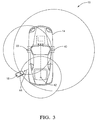
- Fig. 3 illustrates a non-limiting example of the system 10 with the first UWBX 22 mounted on the vehicle proximate to the driver's (left) side view mirror.
- a mounting location may be advantageous since an operator (not shown) carrying the nomadic device 16 typically approaches the vehicle 14 from the driver's (left) side of the vehicle 14, and so the proximity of the operator (i.e. the nomadic device 16) to the driver's (left) door may be better estimated.
- the system 10 also optionally includes a second UWBX 40 and a third UWBX 42.
- each of the UWBXs indicates a distance to the nomadic device 16 indicated by the differences in time that the reply pulses 32 are received by each of the UWBXs. It should be appreciated that a system equipped with a single UWBX generally cannot determine a direction 44 of the nomadic device 16 relative to the vehicle 14. However, by determining a location where the circles intersect, the direction 44 can be determined in addition to the distance 12.
- the system 10 in most instances, can only indicate the direction as to one of two choices. For example, if the nomadic device is directly forward of the vehicle 14 (i.e - due North of the vehicle 14), the system could indicate that the nomadic device 16 is North or South of the vehicle 14, but can't definitely determine which of the two directions is correct. Likewise, if the nomadic device 16 is located as shown in Fig.3 , the system could indicate that the nomadic device is either Southwest or Southeast of the vehicle 14.
- the controller 18 may be configured to determine a direction from the vehicle 14 to the nomadic device 16 based on the first time interval 28 and a second time interval 46 ( Fig. 5 ) between the request time 26 and a second time 48 that corresponds to when the reply pulse 32 is received by the second UWBX 40.
- the system 10 can distinctly determine the direction 44 using the known technique of triangulation.
- the controller 18 may be configured to further determine the direction 44 from the vehicle 14 to the nomadic device 16 based on the first time interval 28, the second time interval 46, and a third time interval 50 ( Fig. 5 ) between the request time 26 and a third time 52 that corresponds to when the reply pulse 32 is received by the third UWBX 42.
- the system 10 may be configured so each of the UWBXs on the vehicle 14 take turns transmitting the request pulse, and so the relationship between each of the signals received by the controller 18 would need to be considered to determine the distance 12 and the direction 44.
- the system 10 or the controller 18 may be further configured to operate the vehicle 14 in a manner that increases the security of the vehicle and/or the convenience of the vehicle 14 for the owner or operator of the vehicle 14.
- the controller 18 in addition to the controller 18 being configured to unlock doors of the vehicle 14 only if the distance 12 is less than an unlock threshold (e.g. - 1m), the controller 18 may be further configured to prevent unlocking of a door lock 54 of the vehicle 14 if the distance is greater than a lock threshold, three meters (3m) for example.
- the lock threshold is preferably greater than the unlock threshold to provide hysteresis so that the vehicle doors are not unnecessarily locked and unlocked as could happen if the thresholds were equal.
- Fig. 4 illustrates a non-limiting example of the vehicle 14 equipped with the three UWBXs shown in Fig. 3 , but now the nomadic device 16 is within the vehicle 14.
- the other parts of the system 10 are not shown only to simplify the illustration.
- the controller can determine that the nomadic device 16 is within the vehicle 14, and so the system 10 is operated to allow passive starting of the vehicle by pressing a start button 56 ( Fig. 1 ) only if the distance 12 and direction 44 indicates that the nomadic device 16 is inside the vehicle 14. It follows that starting of the vehicle 14 would be prevented if the nomadic device 16 was determined to be outside of the vehicle 14.
- the arrangement of the three UWBXs may be configured to function for ranging and communications to an active tag (electronic key) and for short range (less than 10m) detection of passive targets such as pedestrians or inanimate objects around the vehicle to allow for the implementation of the functions described below by a single set of hardware to provide vehicle interior and exterior sensing.
- Interior sensing functions may include: Intrusion Sensing, Child Left Behind sensing, Occupant Presence sensing for seat belt or airbag deploy, and Occupant state of health (posture) sensing.
- Exterior sensing functions may include: Object Detection and motion sensing, Blind Zone Detection, Backup Aid, Security Detection, Operator protection, Vehicle protection, Pre-crash Detection and protective device deployment safing for frontal, side, or rear impact, Vehicle Dynamics determination, loss of control, Passive Approach Lighting (software definable approach area geometries), Passive Entry wake-up and key verification, Passive Trunk Release, Passive Lift-gate open and close, Vehicle to Vehicle Communications, Vehicle to Infrastructure Communications, Tire Pressure Sensor location determination.
- the active tag mode employed to realize the Passive Entry and Passive Start functions can be used for additional location- based functions including, but not limited to Passive Approach Lighting, Passive Entry wake-up and key verification, Passive Trunk Release, Passive Lift-gate open & close, Passive Window open & close, Vehicle to Vehicle Communications, Vehicle to Infrastructure Communications, & Tire Pressure Sensor location determined automatically. These functions are extensions of the PEPS functionality with the exception of the latter.
- Tire pressure sensor programming is a problematic procedure usually requiring the service technician to activate the tire sensors in a sequencing procedure which allows the vehicle to learn the locations of the respective RF ID's of each tire to a dedicated location on the car (i.e. right front RF, LF, RR, LR). Typically, this can be done with a magnet to each sensor.
- the system 10 can automatically determine the position of the tire transponder (and ID) by time of flight triangulation between the vehicle Ultra Wideband system and each tire transponder. This allows distance recognition to within 1cm.
- the three transponders provide three distances to the sensor which is used to triangulate the sensor location ( Fig. 1 ). This would eliminate the current practice of a vehicle operator having to manually identify which of the tire transponders is mounted at which location on the vehicle 14. If an onboard UWB positioning system already exists for PEPS functions, the tire pressure sensor location system would be a subset UWB system reducing the cost of the function.
- the vehicle's UWBX(s) can be used in a radar mode to function similar to radar applications such as Intrusion Sensing, Child Left Behind Detection, Occupant Classification for seat belt tensioning or airbag deployment control, Occupant State of Health (posture), Exterior perimeter scanning for Object Detection for Crash Detection, Blind Zone Detection, Backup Aid.
- radar applications such as Intrusion Sensing, Child Left Behind Detection, Occupant Classification for seat belt tensioning or airbag deployment control, Occupant State of Health (posture), Exterior perimeter scanning for Object Detection for Crash Detection, Blind Zone Detection, Backup Aid.
- Security Threat Detection utilizes the vehicle's UWBXs which allows position range and tracking of electronic tags (fob/cellphone) as well as passive targets both inside and outside the vehicle.
- UWBXs electronic tags
- passive targets both inside and outside the vehicle.
- motion of potential intruder targets are detected by passive radar scanning, and if detected, vehicle perimeter lights enabled to indicate location, lights at location of intruder can flashed to further discourage the intruder, and warning status send to operators electronic key with haptic or audible feedback.
- a passive entry passive start (PEPS) vehicle security system e.g. the system 10
- a controller 18 for the system 10 configured to thwart a relay attack on the system 10
- TOF time-of-flight
- UWBXs provides for long range electronic key location to facilitate new functions beyond passive entry & passive start such as approach lights, hot cabin window control, automatic start, etc.; provides algorithm inputs and secure communication protocol for electronic key location that prevents relay attacks as it replaces the current low frequency/ultra-high frequency (LF/UHF) system currently in use along with the associated large antennas; reduces weight and increase flexibility for component placement; and reduces the transmitter power requirements due to frequency and bandwidth associate with UWBXs, typically 0.05 to 10 mW for tens to hundreds of meters of range.
- LF/UHF low frequency/ultra-high frequency
Landscapes
- Engineering & Computer Science (AREA)
- Radar, Positioning & Navigation (AREA)
- Remote Sensing (AREA)
- Computer Networks & Wireless Communication (AREA)
- Physics & Mathematics (AREA)
- General Physics & Mathematics (AREA)
- Mechanical Engineering (AREA)
- Lock And Its Accessories (AREA)
Abstract
Description
- This disclosure generally relates to a passive entry passive start (PEPS) vehicle security system, and more particularly relates to using ultra wideband transceivers (UWBX) to determine a distance based on a round trip time of flight (TOF) measurement of a request pulse and a reply pulse.
- Typical features of passive keyless entry/passive start (PEPS) security systems for vehicles are that the vehicle doors automatically unlock when an authorized key fob is brought near the vehicle, and the vehicle can be started by pressing a button instead of using a key if the key fob is within the vehicle. It has been discovered that some PEPS systems can be deceived using a two-transceiver/two-person method commonly called a 'relay attack'. The method deceives the vehicle security system by relaying the normally short-range request/reply communications commonly associated with PEPS systems over relatively long distance without the owner's knowledge. One relay device is located close to the car and a second relay device is positioned close to the car owner carrying a PEPS key fob. Then, in response to pulling a door handle or pushing a start button, the first relay receives a request signal transmitted by the vehicle security system, and relays the information to the second unit relay unit. The second relay unit retransmits the signal to the PEPS key fob. The PEPS key fob will automatically reply to this retransmitted signal which is relayed back to the vehicle to unlock the door or allow the vehicle to be started.
- Described herein is a passive entry and passive start (PEPS) system that employs an Ultra Wideband (UWB) communication protocol. The UWB protocol is able to determine accurately a distance (e.g. +/- 2 mm unobstructed) between one or more UWBXs on a vehicle, and a UWBX in a nomadic device such as a key fob or smart phone. A feature of the UWB communication protocol is that communication is by way of pulses or bursts of electromagnetic energy that spread the signal from a UWBX across a wider spectrum of frequency than is typically the case for communications protocols that transmit at a particular carrier frequency. The spreading of the signal across a wider band enhances the security of the transmission. A relay attack is thwarted by measuring the time of flight (TOF) for a signal to travel from the vehicle to the nomadic device and to the vehicle. Any TOF delay caused by the nomadic device responding to a request from the vehicle is assumed to be fixed, and so the round trip TOF can be used to determine a distance between the vehicle and the nomadic device. By determining the distance between the vehicle and the nomadic device, actions such as unlocking the vehicle doors by a relay attack can be prevented as it can be surmised if the vehicle owner carrying the nomadic device is further away from the vehicle than a predetermined distance.
- UWB pulse or signals differ from widely used narrowband by their relatively large bandwidths. A common signaling scheme for UWB systems is known as impulse radio (IR) UWB, which consists of short duration pulses (on the order of a nanosecond) with low duty cycles, and employs different time-hopping and polarity codes. UWB signals have some very important properties which make them good candidates for many applications. First, due to their large absolute bandwidths, UWB systems can employ very short duration waveforms, and hence, they can achieve high time resolution and facilitate accurate range and position estimation. Large bandwidths of UWB signals also enable high-speed data transmission. In addition, since UWB signals can cover a large portion of the frequency spectrum, including low as well as high frequencies (i.e., they can have large relative bandwidths), they achieve high penetration capability through obstacles. Furthermore, UWB systems can be operated in baseband in a carrier-free manner, which makes it possible to design low-cost and low-power systems. Also, UWB systems have greater immunity to multi-path errors common in typical narrow band systems. Due to their high time resolution, UWB signals can be employed in applications that require high positioning accuracy.
- In accordance with one embodiment, a passive entry passive start (PEPS) vehicle security system configured to thwart a relay attack on the system is provided. The system includes a first ultra wideband transceiver (UWBX), a mobile UWBX, and a controller. The first UWBX is installed on a vehicle and is configured to transmit a request pulse at a request time. The mobile UWBX is installed in a nomadic device and is configured to transmit a reply pulse in response to the request pulse. The controller is configured to determine a distance between the first UWBX and the mobile UWBX based on a first time interval between the request time and a first time that corresponds to when the reply pulse is received by the first UWBX. The controller is further configured to unlock doors of the vehicle only if the distance is less than an unlock threshold. The request pulse includes a vehicle identification. The reply pulse includes a nomadic device identification .The reply pulse includes a vehicle identification from the request pulse. The passive entry passive start (PEPS) vehicle security system further comprises a second UWBX installed on the vehicle, and wherein the controller is further configured to determine a direction from the vehicle to the nomadic device based on the first time interval and a second time interval between the request time and a second time that corresponds to when the reply pulse is received by the second UWBX. The passive entry passive start (PEPS) vehicle security system further comprises a third UWBX installed on the vehicle, and wherein the controller is further configured to further determine the direction from the vehicle to the nomadic device based on the first time interval, the second time interval, and a third time interval between the request time and a third time that corresponds to when the reply pulse is received by the third UWBX. The controller is further configured to prevent unlocking of a door lock of the vehicle if the distance is greater than a lock threshold. The controller is further configured to allow passive starting of the vehicle by pressing a start button only if the distance indicates that the nomadic device is inside the vehicle.
- In another embodiment, a passive entry passive start (PEPS) vehicle security controller configured to thwart a relay attack on a PEPS system comprising the vehicle and the nomadic device is provided. The controller includes a processor configured to operate one or more UWBXs to determine a distance between a first UWBX coupled to the controller and a mobile UWBX located apart from the controller. The distance is based on a first time interval between a request time that corresponds to when the first UWBX transmits a request pulse at a request time, and a first time that corresponds to when a reply pulse is received by the first UWBX from the mobile UWBX. The controller is further configured to unlock doors of the vehicle only if the distance is less than an unlock threshold. The controller is further configured to determine a direction from the vehicle to the nomadic device based on the first time interval and a second time interval between the request time and a second time that corresponds to when the reply pulse is received by a second UWBX. The controller is further configured to further determine the direction from the vehicle to the nomadic device based on the first time interval, the second time interval, and a third time interval between the request time and a third time that corresponds to when the reply pulse is received by a third UWBX. The controller is further configured to lock doors of the vehicle if the distance is greater than a lock threshold. The controller is further configured to allow passive starting of the vehicle only if the distance indicates that the nomadic device is inside the vehicle.
- Further features and advantages will appear more clearly on a reading of the following detailed description of the preferred embodiment, which is given by way of non-limiting example only and with reference to the accompanying drawings.
- The present invention will now be described, by way of example with reference to the accompanying drawings, in which:
-
Fig. 1 is a diagram of a passive entry passive start (PEPS) system in accordance with one embodiment; -
Fig. 2 is a top view of a vehicle equipped with the PEPS system ofFig. 1 in accordance with one embodiment; -
Fig. 3 is a top view of a vehicle equipped with the PEPS system ofFig. 1 in accordance with one embodiment; -
Fig. 4 is a top view of a vehicle equipped with the PEPS system ofFig. 1 in accordance with one embodiment; and -
Fig. 5 is a timing diagram of signals present the PEPS system ofFig. 1 in accordance with one embodiment. -
Fig. 1 illustrates a non-limiting example of a passive entry passive start (PEPS) vehicle security system, hereafter thesystem 10. As will become apparent in the description that follows, thesystem 10 is generally configured to thwart a relay attack on thesystem 10 by determining adistance 12 between avehicle 14 and anomadic device 16. As used herein, nomadic device may be anything that an operator (not shown) of thevehicle 14 carries on his/her person. By way of example and not limitation, the nomadic device may be a key fob, a smart phone, a communication device accessory as set forth in United States Published Application2012/0172010 by Oman published July 5, 2012 , a tablet, a wrist watch, or other personal object that can be equipped as described below. - The system generally includes a
controller 18. Thecontroller 18 may include aprocessor 20 such as a microprocessor or other control circuitry as should be evident to those in the art. Thecontroller 18 may include memory (not shown) including non-volatile memory, such as electrically erasable programmable read-only memory (EEPROM) for storing one or more routines, thresholds and captured data. The one or more routines may be executed by theprocessor 20 to perform steps for operating one or more ultra wideband transceivers (UWBXs) on thevehicle 14 to determine a distance and/or direction to thenomadic device 16 based on signals output and received by thecontroller 18 from the one or more UWBXs as described herein. A suitable example of a UWBX is a PULSEON™ P410 available from Time Domain of Huntsville, Alabama. -
Fig. 2 illustrates a non-limiting example of afirst UWBX 22 installed at a central location of thevehicle 14, for example as part of a rear view mirror assembly (not shown), and optionally coupled to an antenna (not shown) on top of thevehicle 14. The circle around thevehicle 14 indicates the potential locations of thenomadic device 16 equipped with themobile UWBX 30. In general, thefirst UWBX 22 is electrically coupled to thecontroller 18 in a manner effective for thefirst UWBX 22 to be operated by thecontroller 18 and send signals to thecontroller 18. The electrical coupling may be by way of wires, fiber optics, or wireless connection, as will be recognized by those in the art. In particular, thecontroller 18 and thefirst UWBX 22 cooperate to transmit arequest pulse 24 at a request time 26 (Fig. 5 ). As used herein, therequest pulse 24 is an electromagnetic signal emitted by thefirst UWBX 22 in accordance with UWB communication protocols. However, this does not exclude emissions of other pulses by other UWBXs on thevehicle 14. In general, therequest time 26 marks the beginning of afirst time interval 28 use to determine a distance between thevehicle 14 and thenomadic device 16. - The
controller 18 is shown separated from thefirst UWBX 22 only for the purpose of illustration. It is recognized that thecontroller 18 and thefirst UWBX 22 may be integrated into a single housing (not shown). A single housing may be preferable to minimize signal propagation delays caused by having thecontroller 18 and thefirst UWBX 22 at separate locations on thevehicle 14. - The
system 10 also includes amobile UWBX 30, preferably installed in thenomadic device 16 and configured to transmit areply pulse 32 in response to therequest pulse 24. Themobile UWBX 30 may be the same make and model as thefirst UWBX 22, or it may be a specialized device particularly well suited for being installed in thenomadic device 16. For example, themobile UWBX 30 may be configured so that the physical orientation of themobile UWBX 30 does not interfere with the ability to transmit thereply pulse 32. - The
first UWBX 22 may also be configured to detect thereply pulse 32 emitted by themobile UWBX 30, and communicate that detection to thecontroller 18. Thecontroller 18 may be further configured to determine thedistance 12 between thefirst UWBX 22 and themobile UWBX 30 based on the first time interval 28 (Fig. 5 ) between therequest time 26 and afirst time 34 that corresponds to when thereply pulse 32 is received by thefirst UWBX 22. By determining thedistance 12, thecontroller 18 can surmise if thenomadic device 16 is close enough to the vehicle for an owner or operator of the vehicle to see if some thief is trying to access thevehicle 14. For example, thecontroller 18 may be further configured to unlock doors of thevehicle 14 only if thedistance 12 is less than an unlock threshold, for example one meter (1m). - It should be recognized that using UWBXs to determine a time-of-flight (TOF) of the
request pulse 24 and thereply pulse 32 allows for thedistance 12 to be determined with greater accuracy than other PEPS systems that rely on signal strength to estimate distance. While not subscribing to any particular theory, estimating distance based on signal strength has limited accuracy because multipath, interposed objects, antenna orientation, clothing, and other factors influence signal strength in an unpredictable manner. In contrast, measuring TOF to determine thedistance 12 is generally not influenced by these factors, and so thedistance 12 can be determined with more accuracy by using UWBXs. - The
request pulse 24 may include avehicle identification 36 such as a vehicle identification number (VIN) or a serial number of thefirst UWBX 22. Thevehicle identification 36 may be stored in thefirst UWBX 22, or communicated to thefirst UWBX 22 by thecontroller 18. Transmitting thevehicle identification 36 may be advantageous because themobile UWBX 30 may be configured to only respond if a signal received by mobile UWBX includes a proper vehicle identification, and so would not waste battery power or unnecessarily clutter the airwaves by responding to a request pulse from some unknown source. - Similarly, the
reply pulse 32 may include anomadic device identification 38 such as a serial number of themobile UWBX 30, a code entered into the mobile UWBX via the smart phone into which it is installed, or a code derived from thevehicle identification 36 using a secret algorithm. Transmitting thenomadic device identification 38 may be advantageous to improve the security of thesystem 10 by requiring themobile UWBX 30 to be properly recognized by thecontroller 18. Alternatively, thereply pulse 32 may include the nomadic device identification and thevehicle identification 36, where thevehicle identification 36 may either be stored in the mobile UWBX, or be thevehicle identification 36 received in therequest pulse 24. As such, thereply pulse 32 may include avehicle identification 36 from therequest pulse 24. - Continuing to refer to
Fig. 2 , thedistance 12 is illustrated and discussed elsewhere herein as being from thevehicle 14 to thenomadic device 16. However, it should be appreciated that for this example the actual distance is based on the distance between thefirst UWBX 22 and themobile UWBX 30. Having a single UWBX on the vehicle 14 (e.g. the first UWBX 22) may be sufficient when the distances of interest from the vehicle are relatively large (e.g. > 1m) and/or the direction from thevehicle 14 to thenomadic device 16 is not of interest. However, if the distances are relatively short as is the case when trying to determine if thenomadic device 16 is inside or outside thevehicle 14, or if the direction thenomadic device 16 relative to thevehicle 14 is desired, then thesystem 10 may require more than one UWBX. -
Fig. 3 illustrates a non-limiting example of thesystem 10 with thefirst UWBX 22 mounted on the vehicle proximate to the driver's (left) side view mirror. Such a mounting location may be advantageous since an operator (not shown) carrying thenomadic device 16 typically approaches thevehicle 14 from the driver's (left) side of thevehicle 14, and so the proximity of the operator (i.e. the nomadic device 16) to the driver's (left) door may be better estimated. In this non-limiting example, thesystem 10 also optionally includes asecond UWBX 40 and athird UWBX 42. The circles centered on each of the UWBXs indicates a distance to thenomadic device 16 indicated by the differences in time that thereply pulses 32 are received by each of the UWBXs. It should be appreciated that a system equipped with a single UWBX generally cannot determine adirection 44 of thenomadic device 16 relative to thevehicle 14. However, by determining a location where the circles intersect, thedirection 44 can be determined in addition to thedistance 12. - If the
system 10 is configured with only two transceivers, for example thefirst UWBX 22 and thesecond UWBX 40 located on the vehicle as shown, thesystem 10, in most instances, can only indicate the direction as to one of two choices. For example, if the nomadic device is directly forward of the vehicle 14 (i.e - due North of the vehicle 14), the system could indicate that thenomadic device 16 is North or South of thevehicle 14, but can't definitely determine which of the two directions is correct. Likewise, if thenomadic device 16 is located as shown inFig.3 , the system could indicate that the nomadic device is either Southwest or Southeast of thevehicle 14. It should be recognized that if the nomadic device was located due West of the vehicle, thesystem 10 could specifically indicate the direction correctly as West. As such, if the vehicle is equipped with two UWBXs, thecontroller 18 may be configured to determine a direction from thevehicle 14 to thenomadic device 16 based on thefirst time interval 28 and a second time interval 46 (Fig. 5 ) between therequest time 26 and asecond time 48 that corresponds to when thereply pulse 32 is received by thesecond UWBX 40. - If the
system 10 is configured with three transceivers, for example thefirst UWBX 22, thesecond UWBX 40, and thethird UWBX 42 located on the vehicle as shown, thesystem 10 can distinctly determine thedirection 44 using the known technique of triangulation. Accordingly, thecontroller 18 may be configured to further determine thedirection 44 from thevehicle 14 to thenomadic device 16 based on thefirst time interval 28, thesecond time interval 46, and a third time interval 50 (Fig. 5 ) between therequest time 26 and athird time 52 that corresponds to when thereply pulse 32 is received by thethird UWBX 42. Alternatively, thesystem 10 may be configured so each of the UWBXs on thevehicle 14 take turns transmitting the request pulse, and so the relationship between each of the signals received by thecontroller 18 would need to be considered to determine thedistance 12 and thedirection 44. - Once the
distance 12 and/or thedirection 44 are known, thesystem 10 or thecontroller 18 may be further configured to operate thevehicle 14 in a manner that increases the security of the vehicle and/or the convenience of thevehicle 14 for the owner or operator of thevehicle 14. For example, referring again toFig. 1 , in addition to thecontroller 18 being configured to unlock doors of thevehicle 14 only if thedistance 12 is less than an unlock threshold (e.g. - 1m), thecontroller 18 may be further configured to prevent unlocking of adoor lock 54 of thevehicle 14 if the distance is greater than a lock threshold, three meters (3m) for example. The lock threshold is preferably greater than the unlock threshold to provide hysteresis so that the vehicle doors are not unnecessarily locked and unlocked as could happen if the thresholds were equal. -
Fig. 4 illustrates a non-limiting example of thevehicle 14 equipped with the three UWBXs shown inFig. 3 , but now thenomadic device 16 is within thevehicle 14. The other parts of thesystem 10 are not shown only to simplify the illustration. Based on signals received from the three UWBXs, the controller can determine that thenomadic device 16 is within thevehicle 14, and so thesystem 10 is operated to allow passive starting of the vehicle by pressing a start button 56 (Fig. 1 ) only if thedistance 12 anddirection 44 indicates that thenomadic device 16 is inside thevehicle 14. It follows that starting of thevehicle 14 would be prevented if thenomadic device 16 was determined to be outside of thevehicle 14. - By way of further example and not limitation on the
system 10, the arrangement of the three UWBXs may be configured to function for ranging and communications to an active tag (electronic key) and for short range (less than 10m) detection of passive targets such as pedestrians or inanimate objects around the vehicle to allow for the implementation of the functions described below by a single set of hardware to provide vehicle interior and exterior sensing. Interior sensing functions may include: Intrusion Sensing, Child Left Behind sensing, Occupant Presence sensing for seat belt or airbag deploy, and Occupant state of health (posture) sensing. Exterior sensing functions may include: Object Detection and motion sensing, Blind Zone Detection, Backup Aid, Security Detection, Operator protection, Vehicle protection, Pre-crash Detection and protective device deployment safing for frontal, side, or rear impact, Vehicle Dynamics determination, loss of control, Passive Approach Lighting (software definable approach area geometries), Passive Entry wake-up and key verification, Passive Trunk Release, Passive Lift-gate open and close, Vehicle to Vehicle Communications, Vehicle to Infrastructure Communications, Tire Pressure Sensor location determination. - The active tag mode employed to realize the Passive Entry and Passive Start functions can be used for additional location- based functions including, but not limited to Passive Approach Lighting, Passive Entry wake-up and key verification, Passive Trunk Release, Passive Lift-gate open & close, Passive Window open & close, Vehicle to Vehicle Communications, Vehicle to Infrastructure Communications, & Tire Pressure Sensor location determined automatically. These functions are extensions of the PEPS functionality with the exception of the latter. Tire pressure sensor programming is a problematic procedure usually requiring the service technician to activate the tire sensors in a sequencing procedure which allows the vehicle to learn the locations of the respective RF ID's of each tire to a dedicated location on the car (i.e. right front RF, LF, RR, LR). Typically, this can be done with a magnet to each sensor. Often this process is incorrectly done or not completed. Some systems have a costly dedicated receive antenna near each wheel. With a UWBX installed in each tire to communicate with the vehicle's UWBX(s), the
system 10 can automatically determine the position of the tire transponder (and ID) by time of flight triangulation between the vehicle Ultra Wideband system and each tire transponder. This allows distance recognition to within 1cm. The three transponders provide three distances to the sensor which is used to triangulate the sensor location (Fig. 1 ). This would eliminate the current practice of a vehicle operator having to manually identify which of the tire transponders is mounted at which location on thevehicle 14. If an onboard UWB positioning system already exists for PEPS functions, the tire pressure sensor location system would be a subset UWB system reducing the cost of the function. - For the passive target mode, the vehicle's UWBX(s) can be used in a radar mode to function similar to radar applications such as Intrusion Sensing, Child Left Behind Detection, Occupant Classification for seat belt tensioning or airbag deployment control, Occupant State of Health (posture), Exterior perimeter scanning for Object Detection for Crash Detection, Blind Zone Detection, Backup Aid.
- By combining the active and passive modes a Security Threat Detection with Automated Panic function can be implemented. Security Threat Detection utilizes the vehicle's UWBXs which allows position range and tracking of electronic tags (fob/cellphone) as well as passive targets both inside and outside the vehicle. When the tag is within range of the vehicle, if the motion of the tag carried by the operator approaching the vehicle indicates rapid movement, a panic situation is identified and the vehicle's horn is activated. Alternatively, motion of potential intruder targets are detected by passive radar scanning, and if detected, vehicle perimeter lights enabled to indicate location, lights at location of intruder can flashed to further discourage the intruder, and warning status send to operators electronic key with haptic or audible feedback.
- Accordingly, a passive entry passive start (PEPS) vehicle security system (e.g. the system 10), and a
controller 18 for thesystem 10 configured to thwart a relay attack on thesystem 10 is provided. Using the time-of-flight (TOF) determining capabilities associated with ultra wideband transceivers (UWBXs) or devices to determine distance instead of signal strength solves the long standing problem of how to prevent relay attacks. Furthermore, using UWBXs provides for long range electronic key location to facilitate new functions beyond passive entry & passive start such as approach lights, hot cabin window control, automatic start, etc.; provides algorithm inputs and secure communication protocol for electronic key location that prevents relay attacks as it replaces the current low frequency/ultra-high frequency (LF/UHF) system currently in use along with the associated large antennas; reduces weight and increase flexibility for component placement; and reduces the transmitter power requirements due to frequency and bandwidth associate with UWBXs, typically 0.05 to 10 mW for tens to hundreds of meters of range.
Claims (13)
- A passive entry passive start (PEPS) vehicle security controller (18) configured to thwart a relay attack on a PEPS system (10) comprising a vehicle (14) and a nomadic device (16), said controller (18) comprising:a processor (20) configured to operate one or more UWBXs to determine a distance (12) between a first ultra wideband transceiver (UWBX (22)) coupled to the controller (18) and a mobile UWBX (30) located apart from the controller (18), said distance (12) based on a first time interval (28) between a request time (26) that corresponds to when the first UWBX (22) transmits a request pulse (24) at a request time (26), and a first time (34) that corresponds to when a reply pulse (32) is received by the first UWBX (22) from the mobile UWBX (30), wherein the controller (18) is further configured to unlock doors of the vehicle (14) only if the distance (12) is less than an unlock threshold.
- Controller (18) according to the preceding claim, wherein the controller (18) is further configured to determine a direction (44) from the vehicle (14) to the nomadic device (16) based on the first time interval (28) and a second time interval (46) between the request time (26) and a second time (48) that corresponds to when the reply pulse (32) is received by a second UWBX (40).
- Controller (18) according to claim 2, wherein the controller (18) is further configured to further determine the direction (44) from the vehicle (14) to the nomadic device (16) based on the first time interval (28), the second time interval (46), and a third time interval (50) between the request time (26) and a third time (52) that corresponds to when the reply pulse (32) is received by a third UWBX (42).
- Controller (18) according to any one of the preceding claims, wherein the controller (18) is further configured to lock doors of the vehicle (14) if the distance (12) is greater than a lock threshold.
- Controller (18) according to any one of the preceding claims, wherein the controller (18) is further configured to allow passive starting of the vehicle (14) only if the distance (12) indicates that the nomadic device (16) is inside the vehicle (14).
- A passive entry passive start (PEPS) vehicle security system (10) configured to thwart a relay attack on the system (10), said system (10) comprising:a controller (18) as set in claim 1;.the first ultra wideband transceiver (UWBX (22)) installed on the vehicle (14) and configured to transmit the request pulse (24) at the request time (26); andthe mobile UWBX (30) installed in the nomadic device (16) and configured to transmit the reply pulse (32) in response to the request pulse (24).
- System (10) according to the preceding claim, wherein the request pulse (24) includes a vehicle identification (36).
- System (10) according to any one of claims 6 to 7, wherein the reply pulse (32) includes a nomadic device identification (38).
- System (10) according to any one of claims 6 to 8, wherein the reply pulse (32) includes a vehicle identification (36) from the request pulse (24).
- System (10) according to any one of claims 6 to 9, wherein the system (10) further comprises a second UWBX (40) installed on the vehicle (14), and wherein the controller (18) is further configured to determine a direction (44) from the vehicle (14) to the nomadic device (16) based on the first time interval (28) and a second time interval (46) between the request time (26) and a second time (48) that corresponds to when the reply pulse (32) is received by the second UWBX (40).
- System (10) according to claim 10, wherein the system (10) further comprises a third UWBX (42) installed on the vehicle (14), and wherein the controller (18) is further configured to further determine the direction (44) from the vehicle (14) to the nomadic device (16) based on the first time interval (28), the second time interval (46), and a third time interval (50) between the request time (26) and a third time (52) that corresponds to when the reply pulse (32) is received by the third UWBX (42).
- System (10) according to any one of claims 6 to 11, wherein the controller (18) is further configured to prevent unlocking of a door lock (54) of the vehicle (14) if the distance (12) is greater than a lock threshold.
- System (10) according to any one of claims 6 to 12, wherein the controller (18) is further configured to allow passive starting of the vehicle (14) by pressing a start button (56) only if the distance (12) indicates that the nomadic device (16) is inside the vehicle (14).
Applications Claiming Priority (1)
| Application Number | Priority Date | Filing Date | Title |
|---|---|---|---|
| US13/874,519 US8930045B2 (en) | 2013-05-01 | 2013-05-01 | Relay attack prevention for passive entry passive start (PEPS) vehicle security systems |
Publications (2)
| Publication Number | Publication Date |
|---|---|
| EP2800068A2 true EP2800068A2 (en) | 2014-11-05 |
| EP2800068A3 EP2800068A3 (en) | 2018-01-03 |
Family
ID=50732779
Family Applications (1)
| Application Number | Title | Priority Date | Filing Date |
|---|---|---|---|
| EP14164269.4A Withdrawn EP2800068A3 (en) | 2013-05-01 | 2014-04-10 | Relay attack prevention for passive entry passive start (peps) vehicle security systems |
Country Status (2)
| Country | Link |
|---|---|
| US (1) | US8930045B2 (en) |
| EP (1) | EP2800068A3 (en) |
Cited By (42)
| Publication number | Priority date | Publication date | Assignee | Title |
|---|---|---|---|---|
| CN104484923A (en) * | 2014-12-03 | 2015-04-01 | 朗曦科技(上海)有限公司 | Access control system and method based on authentication and location awareness of intelligent mobile terminal |
| CN104483141A (en) * | 2014-12-29 | 2015-04-01 | 重庆集诚汽车电子有限责任公司 | System and method for wireless communication test of automobile passive entry and passive start system |
| CN105590049A (en) * | 2015-12-22 | 2016-05-18 | 广东欧珀移动通信有限公司 | Method and device for unlocking and locking screen by using ring |
| CN106100763A (en) * | 2016-05-30 | 2016-11-09 | 北京汽车股份有限公司 | The High frequency receiving sensitivity method of testing of PEPS system and device |
| CN106161421A (en) * | 2015-05-14 | 2016-11-23 | 李尔公司 | Being additionally related to multi-functional passive entry of having that relay attack prevents passive starts (PEPS) system |
| FR3042631A1 (en) * | 2015-10-19 | 2017-04-21 | Valeo Comfort & Driving Assistance | METHOD OF EVALUATING DISTANCE SEPARATING IDENTIFIER AND VEHICLE, ELECTRONIC UNIT AND IDENTIFIER THEREOF |
| WO2017068202A1 (en) | 2015-10-19 | 2017-04-27 | Valeo Comfort And Driving Assistance | Method and system for controlling functionality of a vehicle |
| EP3163925A1 (en) * | 2015-10-30 | 2017-05-03 | Nxp B.V. | Wireless authentication method and apparatus |
| IT201600084502A1 (en) * | 2016-08-10 | 2018-02-10 | Massimo Marini | "LOCALIZATION AND POSITIONING SYSTEM IN THE ACTIVE TARGET AREA", |
| WO2018050178A1 (en) * | 2016-09-14 | 2018-03-22 | Continental Teves Ag & Co. Ohg | Method for improving road safety |
| WO2018071674A1 (en) * | 2016-10-12 | 2018-04-19 | Denso Corporation | Peps portable device localisation |
| CN108024329A (en) * | 2017-12-13 | 2018-05-11 | 深圳市中舟智能科技有限公司 | A kind of more base station extended methods self-positioning based on UWB labels and equipment |
| WO2018071671A3 (en) * | 2016-10-12 | 2018-08-09 | Denso Corporation | Passive entry / passive start systems and methods for vehicles |
| WO2018148687A1 (en) * | 2017-02-10 | 2018-08-16 | Apple Inc. | Enhanced automotive passive entry |
| WO2018193132A1 (en) * | 2017-04-21 | 2018-10-25 | Valeo Comfort And Driving Assistance | Device for identifying a position of an electronic unit on a motor vehicle |
| WO2018193133A1 (en) * | 2017-04-21 | 2018-10-25 | Valeo Comfort And Driving Assistance | Device for identifying a position of an electronic unit on a motor vehicle |
| EP3396639A1 (en) * | 2017-04-28 | 2018-10-31 | HUF Hülsbeck & Fürst GmbH & Co. KG | Vehicle door handle with antenna arrangement |
| EP3396640A1 (en) * | 2017-04-28 | 2018-10-31 | HUF Hülsbeck & Fürst GmbH & Co. KG | Portable id transmitter for an authentication system and method for operating an authentication system |
| WO2018197116A1 (en) * | 2017-04-28 | 2018-11-01 | Huf Hülsbeck & Fürst Gmbh & Co. Kg | Method for operating authentication system and authentication system |
| WO2018197065A1 (en) * | 2017-04-28 | 2018-11-01 | Huf Hülsbeck & Fürst Gmbh & Co. Kg | Vehicle authentication system |
| CN109064586A (en) * | 2018-06-22 | 2018-12-21 | 福建省汽车工业集团云度新能源汽车股份有限公司 | A kind of remote control key freezes, defreezing method and management system |
| EP3425420A1 (en) * | 2017-07-03 | 2019-01-09 | Nxp B.V. | Ranging apparatus and method |
| US10275964B2 (en) | 2017-04-28 | 2019-04-30 | Huf Huelsbeck & Fuerst Gmbh & Co. Kg | Portable ID-transmitter for an authentication system and an authentication operating system for use therewith |
| EP3496054A1 (en) * | 2017-12-08 | 2019-06-12 | Carrier Corporation | Secure seamless access control |
| EP3503044A1 (en) * | 2017-12-21 | 2019-06-26 | Gemalto Sa | Method of getting access to a vehicle |
| DE102018105837A1 (en) | 2018-03-14 | 2019-09-19 | HELLA GmbH & Co. KGaA | Vehicle with passive access control device |
| CN110363899A (en) * | 2019-08-02 | 2019-10-22 | 华为技术有限公司 | Method and device for detecting relay attack based on communication channel |
| EP3495834A3 (en) * | 2017-12-08 | 2019-10-23 | Sonarax Technologies Ltd. | Sound based authentication and distance measurement |
| US10573104B2 (en) | 2018-06-29 | 2020-02-25 | Robert Bosch Gmbh | Ultra-wideband based vehicle access system and communication protocol for localization of a target device |
| CN110949072A (en) * | 2018-09-27 | 2020-04-03 | 通用汽车环球科技运作有限责任公司 | Advanced tire pressure detection system with software self-learning |
| US10706651B2 (en) | 2018-03-28 | 2020-07-07 | Denso International America, Inc. | Systems and methods for communication bus security in a vehicle |
| US10730479B2 (en) | 2018-03-28 | 2020-08-04 | Denso International America, Inc. | Tamper security systems and methods for vehicles |
| US10839627B2 (en) | 2018-03-28 | 2020-11-17 | Denso International America, Inc. | Reflective environment detection systems and methods |
| US10917784B2 (en) | 2018-03-27 | 2021-02-09 | Denso International America, Inc. | Systems and methods of cloud bonding for vehicles |
| US11097689B2 (en) | 2018-03-27 | 2021-08-24 | Denso International America, Inc. | Passive entry and passive start system and method using temporary keys |
| WO2021249594A1 (en) * | 2020-06-10 | 2021-12-16 | Continental Automotive Gmbh | Access arrangement for a vehicle |
| US11269323B2 (en) | 2018-03-27 | 2022-03-08 | Denso International America, Inc. | Remote park assist message flow systems and methods |
| US11330431B2 (en) | 2018-03-28 | 2022-05-10 | Denso International America, Inc. | Targeted advertising with privacy and anti-replay protection |
| EP4059784A1 (en) * | 2021-03-17 | 2022-09-21 | Nxp B.V. | Entry system and method of operating the same |
| US11548517B2 (en) | 2018-03-28 | 2023-01-10 | Denso International America, Inc. | Activating vehicle functions based on vehicle occupant location |
| WO2024061520A1 (en) * | 2022-09-21 | 2024-03-28 | Marquardt Gmbh | Method for operating an authentication system, and authentication system having a plurality of uwb antennas |
| WO2024061582A1 (en) * | 2022-09-21 | 2024-03-28 | Marquardt Gmbh | Method for operating an authentication system, and authentication system having exactly one uwb module |
Families Citing this family (108)
| Publication number | Priority date | Publication date | Assignee | Title |
|---|---|---|---|---|
| US9554286B2 (en) | 2011-12-02 | 2017-01-24 | Lear Corporation | Apparatus and method for detecting a location of a wireless device |
| GB2517129B (en) * | 2013-05-31 | 2015-12-09 | Jaguar Land Rover Ltd | Vehicle communication system |
| GB2515007A (en) | 2013-05-31 | 2014-12-17 | Jaguar Land Rover Ltd | Vehicle communication system |
| GB2515006B (en) * | 2013-05-31 | 2015-11-25 | Jaguar Land Rover Ltd | Vehicle communication system |
| US9842445B2 (en) * | 2013-07-15 | 2017-12-12 | Trw Automotive U.S. Llc | Passive remote keyless entry system with time-based anti-theft feature |
| US10543808B2 (en) * | 2013-07-22 | 2020-01-28 | Trw Automotive U.S. Llc | Passive remote keyless entry system with level-based anti-theft feature |
| US20160059827A1 (en) * | 2014-08-27 | 2016-03-03 | Lear Corporation | Optimizing uwb satellite antenna in-vehicle positioning |
| US9802574B2 (en) * | 2014-09-16 | 2017-10-31 | Qualcomm Incorporated | Relay attack inhibiting |
| FR3026212B1 (en) * | 2014-09-24 | 2018-05-25 | Valeo Comfort And Driving Assistance | DEVICE FOR CHECKING LOCKING / UNLOCKING AND / OR STARTING A VEHICLE |
| US20160257198A1 (en) | 2015-03-02 | 2016-09-08 | Ford Global Technologies, Inc. | In-vehicle component user interface |
| US9747740B2 (en) | 2015-03-02 | 2017-08-29 | Ford Global Technologies, Llc | Simultaneous button press secure keypad code entry |
| US9613475B2 (en) * | 2015-05-27 | 2017-04-04 | Nxp B.V. | Communications with interaction detection |
| FR3037410B1 (en) * | 2015-06-12 | 2019-09-13 | Valeo Comfort And Driving Assistance | DEVICE AND METHOD FOR DETERMINING THE PRESENCE OF AN IDENTIFIER, AND ASSOCIATED COMPUTER PROGRAM |
| JP6534875B2 (en) * | 2015-07-03 | 2019-06-26 | 株式会社東海理化電機製作所 | Electronic key and electronic key system |
| US9928673B2 (en) * | 2015-07-16 | 2018-03-27 | GM Global Technology Operations LLC | Vehicle PEPS system using directional sensors |
| JP6499040B2 (en) * | 2015-08-07 | 2019-04-10 | 株式会社東海理化電機製作所 | Communication fraud prevention system |
| DE102015216331B4 (en) * | 2015-08-26 | 2017-09-07 | Continental Automotive Gmbh | Methods and devices for distance determination, in particular by runtime-based distance measurement with multiple devices |
| US9914418B2 (en) | 2015-09-01 | 2018-03-13 | Ford Global Technologies, Llc | In-vehicle control location |
| US9622159B2 (en) | 2015-09-01 | 2017-04-11 | Ford Global Technologies, Llc | Plug-and-play interactive vehicle interior component architecture |
| US9967717B2 (en) | 2015-09-01 | 2018-05-08 | Ford Global Technologies, Llc | Efficient tracking of personal device locations |
| US9860710B2 (en) | 2015-09-08 | 2018-01-02 | Ford Global Technologies, Llc | Symmetrical reference personal device location tracking |
| US9744852B2 (en) | 2015-09-10 | 2017-08-29 | Ford Global Technologies, Llc | Integration of add-on interior modules into driver user interface |
| US9783158B2 (en) | 2015-10-27 | 2017-10-10 | Ford Global Technologies, Llc | System and method for on-demand passive entry disable |
| JP6429169B2 (en) * | 2015-12-10 | 2018-11-28 | パナソニックIpマネジメント株式会社 | On-vehicle device, portable device, and vehicle wireless communication system |
| US10046637B2 (en) | 2015-12-11 | 2018-08-14 | Ford Global Technologies, Llc | In-vehicle component control user interface |
| AU2016371057A1 (en) * | 2015-12-17 | 2018-07-19 | Humatics Corporation | Radio-frequency localization techniques and associated systems, devices, and methods |
| DE102015226631B4 (en) * | 2015-12-23 | 2020-07-02 | Continental Automotive Gmbh | Method for enabling one or more functions in a vehicle |
| CN108701381A (en) * | 2016-02-26 | 2018-10-23 | 胡夫·许尔斯贝克和福斯特有限及两合公司 | Band is useful for the modular unit of the interface of communication apparatus |
| JP6616714B2 (en) * | 2016-03-14 | 2019-12-04 | アルプスアルパイン株式会社 | COMMUNICATION SYSTEM, COMMUNICATION DEVICE, AND COMMUNICATION METHOD |
| US10082877B2 (en) | 2016-03-15 | 2018-09-25 | Ford Global Technologies, Llc | Orientation-independent air gesture detection service for in-vehicle environments |
| KR102127064B1 (en) | 2016-04-14 | 2020-06-25 | 애플 인크. | Method and architecture for secure ranging |
| DE102016206539B4 (en) * | 2016-04-19 | 2019-05-16 | Volkswagen Aktiengesellschaft | Method for passive access control |
| US9914415B2 (en) | 2016-04-25 | 2018-03-13 | Ford Global Technologies, Llc | Connectionless communication with interior vehicle components |
| DE102016207110B4 (en) | 2016-04-27 | 2023-02-09 | Continental Automotive Technologies GmbH | Methods and devices for detecting changes in the positions of transmitting and/or receiving devices such as in particular motor vehicle transceivers relative to one another |
| JP2019523866A (en) | 2016-06-02 | 2019-08-29 | ヘラ・ゲーエムベーハー・ウント・コムパニー・カーゲーアーアー | Vehicle anti-theft system |
| EP3255805B1 (en) * | 2016-06-08 | 2020-09-02 | Nxp B.V. | Signal processing system and method |
| US10549722B2 (en) | 2016-06-23 | 2020-02-04 | GM Global Technology Operations LLC | Radar-based vehicle perimeter security and control |
| US9924318B2 (en) * | 2016-07-01 | 2018-03-20 | Lear Corporation | Passive entry systems employing time of flight distance measurements |
| DE102016215934B4 (en) * | 2016-08-24 | 2024-02-29 | Continental Automotive Technologies GmbH | Method and device for determining a transit time and/or a distance between several transceivers, in particular for a vehicle access and/or start system |
| JP6652040B2 (en) * | 2016-12-05 | 2020-02-19 | 株式会社Soken | Portable device position estimation system |
| US10035494B2 (en) | 2016-12-06 | 2018-07-31 | Denso International America, Inc. | Vehicle passive entry/passive start system |
| EP3335942B1 (en) * | 2016-12-14 | 2019-11-20 | Nxp B.V. | Secure vehicle access system, key, vehicle and method therefor |
| CN110574414B (en) | 2016-12-27 | 2023-04-04 | 株式会社电装 | System and method for micro positioning sensor communication |
| GB2558589A (en) * | 2017-01-09 | 2018-07-18 | Jaguar Land Rover Ltd | Vehicle entry system |
| US9911259B1 (en) | 2017-01-20 | 2018-03-06 | Lear Corporation | Passive entry passive start (PEPS) system with integrated authorization and ranging communications |
| DE102017001092A1 (en) * | 2017-02-07 | 2018-08-09 | Giesecke+Devrient Mobile Security Gmbh | Protection against a relay attack |
| KR102689221B1 (en) | 2017-02-13 | 2024-07-30 | 삼성전자 주식회사 | Method and apparatus for authenticating smart car key |
| US20180339676A1 (en) * | 2017-05-25 | 2018-11-29 | GM Global Technology Operations LLC | Systems and methods for determining device location for passive entry and vehicle startup |
| US10557301B2 (en) * | 2017-07-18 | 2020-02-11 | Portal Entryways, Inc | Automated door system |
| JP6885258B2 (en) * | 2017-08-09 | 2021-06-09 | トヨタ自動車株式会社 | Mobile terminal device and authentication system |
| JP6885259B2 (en) * | 2017-08-09 | 2021-06-09 | トヨタ自動車株式会社 | Vehicle function control device |
| JP7088426B2 (en) * | 2017-08-09 | 2022-06-21 | トヨタ自動車株式会社 | Mobile terminal devices, devices, control methods, programs, and systems |
| JP7276561B2 (en) * | 2017-08-09 | 2023-05-18 | トヨタ自動車株式会社 | Mobile terminal device, device, control method, program, and system |
| CN109542526A (en) * | 2017-09-20 | 2019-03-29 | 上海汽车集团股份有限公司 | A kind of starting method and device of in-car entertainment system |
| US10300748B2 (en) * | 2017-09-21 | 2019-05-28 | Ford Global Technologies, Llc | Systems and methods for vehicle TPMS localization |
| US10486646B2 (en) | 2017-09-29 | 2019-11-26 | Apple Inc. | Mobile device for communicating and ranging with access control system for automatic functionality |
| CN111542460B (en) * | 2017-11-20 | 2023-04-07 | 罗伯特·博世(澳大利亚)私人有限公司 | Method and system for joining motion for preventing relay attack |
| US10089810B1 (en) * | 2017-12-01 | 2018-10-02 | OpenPath Security Inc. | Rolling code based proximity verification for entry access |
| DE102018102405A1 (en) * | 2018-02-02 | 2019-08-08 | Huf Hülsbeck & Fürst Gmbh & Co. Kg | Communication system of a vehicle |
| US10919493B2 (en) * | 2018-02-08 | 2021-02-16 | Ford Global Technologies, Llc | Mobile device relay attack detection and power management for vehicles |
| GB2572584B (en) * | 2018-04-04 | 2022-09-28 | Jaguar Land Rover Ltd | Controlling an access control device based on position |
| US11397259B2 (en) * | 2018-05-25 | 2022-07-26 | Texas Instmments Incorporated | Time-of-flight measurement system and method |
| US10410450B1 (en) | 2018-06-27 | 2019-09-10 | Ford Global Technologies, Llc | Wireless backscatter with time-of-flight for vehicle communication |
| EP3594911B1 (en) * | 2018-07-11 | 2023-04-19 | Aptiv Technologies Limited | Method for preventing security breaches of a passive remote keyless entry system |
| US10573107B2 (en) * | 2018-07-23 | 2020-02-25 | Nxp B.V. | Method for protecting a passive keyless entry system against a relay attack |
| US10629011B2 (en) * | 2018-08-01 | 2020-04-21 | Nxp B.V. | Wireless receiver and method for detecting an attack on a keyless entry system for a vehicle |
| EP3844727B1 (en) * | 2018-08-30 | 2026-03-25 | dormakaba Schweiz AG | Device and method for access control |
| KR102545375B1 (en) | 2018-09-14 | 2023-06-20 | 삼성전자 주식회사 | Electronic device for performing authorization using accessory and method for the same |
| JP6971945B2 (en) * | 2018-09-19 | 2021-11-24 | 株式会社東芝 | Distance measurement system, distance measurement device and distance measurement method |
| CN112970050A (en) * | 2018-09-25 | 2021-06-15 | 久益环球地表采矿公司 | Proximity detection system for industrial machines including externally mounted indicators |
| JP2020070676A (en) * | 2018-11-02 | 2020-05-07 | 株式会社オートネットワーク技術研究所 | Communication device |
| DE102019203029A1 (en) * | 2019-03-06 | 2020-09-10 | Volkswagen Aktiengesellschaft | Method for operating a locking system of a vehicle with separate interior detection and exterior detection of a key device and locking system |
| US11483320B2 (en) * | 2019-03-22 | 2022-10-25 | Voxx International Corporation | System and method for detecting active relay station attacks between two multimedia communication platforms |
| US11146934B2 (en) | 2019-03-29 | 2021-10-12 | Aptiv Technologies Limited | System and method of reducing a communication range |
| US11789135B2 (en) | 2019-03-29 | 2023-10-17 | Robert Bosch Gmbh | Ultra-wideband intelligent sensing system and method for car states detection |
| KR102751281B1 (en) * | 2019-07-04 | 2025-01-10 | 현대자동차주식회사 | Smart entry system for vehicle and operating method thereof |
| WO2021062463A1 (en) * | 2019-09-30 | 2021-04-08 | Robert Bosch (Australia) Pty Ltd | Method and system for relay attack prevention incorporating channel coherence |
| JP2021085719A (en) * | 2019-11-26 | 2021-06-03 | 株式会社Soken | Digital key system and onboard system |
| CN113015161B (en) * | 2019-12-20 | 2022-05-13 | 华为技术有限公司 | Authentication method, medium thereof, and electronic device |
| CN111212413B (en) * | 2020-01-13 | 2023-07-18 | 北京小米移动软件有限公司 | Unlocking communication method and device, computer storage medium |
| US12325381B2 (en) * | 2020-03-11 | 2025-06-10 | Aptiv Technologies AG | Detection device |
| JP7366815B2 (en) * | 2020-03-23 | 2023-10-23 | 株式会社東海理化電機製作所 | Communication unit, communication device and position estimation method |
| JP7437201B2 (en) | 2020-03-23 | 2024-02-22 | 株式会社東海理化電機製作所 | Communication device and position estimation method |
| JP7372863B2 (en) * | 2020-03-23 | 2023-11-01 | 株式会社東海理化電機製作所 | Communication device and location identification method |
| JP2021150918A (en) * | 2020-03-23 | 2021-09-27 | 株式会社東海理化電機製作所 | Communication device and program |
| KR20220029874A (en) * | 2020-09-02 | 2022-03-10 | 현대자동차주식회사 | Vehicle and controlling method of vehicle |
| US12339386B2 (en) * | 2020-09-28 | 2025-06-24 | Hyundai Mobis Co., Ltd. | UWB ranging control device and UWB ranging method using the same |
| DE102020126547A1 (en) | 2020-10-09 | 2022-04-14 | Huf Hülsbeck & Fürst Gmbh & Co. Kg | UWB actuation system for a moving part of a vehicle |
| JP7603414B2 (en) * | 2020-10-29 | 2024-12-20 | 株式会社東海理化電機製作所 | Wireless communication system, wireless communication device, and program |
| JP7512864B2 (en) | 2020-11-24 | 2024-07-09 | 株式会社アイシン | Mobile terminal position estimation method, mobile terminal position estimation device, and mobile terminal position estimation system |
| JP7512865B2 (en) | 2020-11-24 | 2024-07-09 | 株式会社アイシン | Mobile terminal position estimation method, mobile terminal position estimation device, and mobile terminal position estimation system |
| US11827179B2 (en) | 2021-02-01 | 2023-11-28 | Aptiv Technologies Limited | Gesture recognition system for hands-free vehicle access using ultra-wideband communication |
| US11917094B2 (en) * | 2021-02-01 | 2024-02-27 | Aptiv Technologies Limited | Automatic control of smartphone driver mode using ultra-wideband communication |
| CN112929917B (en) * | 2021-02-03 | 2022-12-13 | 上海瓶钵信息科技有限公司 | Method for monitoring user terminal, secondary base station and computer readable storage medium |
| US11987208B2 (en) | 2021-03-15 | 2024-05-21 | Denso International America, Inc. | UWB module auto location in vehicle |
| CN115195761B (en) * | 2021-04-09 | 2025-11-28 | Oppo广东移动通信有限公司 | Vehicle control method and device, vehicle and storage medium |
| DE102021204529A1 (en) | 2021-05-05 | 2022-08-04 | Continental Automotive Gmbh | Device and method for wireless communication |
| EP4112370A1 (en) * | 2021-07-01 | 2023-01-04 | Nxp B.V. | Systems and methods for facilitating guiding a vehicle to a predefined location |
| US12518584B2 (en) * | 2021-07-02 | 2026-01-06 | Minebea Mitsumi Inc. | Lock control system, program, terminal device, and lock control method |
| EP4116735A1 (en) * | 2021-07-06 | 2023-01-11 | Nxp B.V. | Localization with reduced power consumption |
| DE102021120220A1 (en) | 2021-08-04 | 2023-02-09 | Bayerische Motoren Werke Aktiengesellschaft | Method for controlling vehicle access, computer-readable medium, system, and vehicle |
| JP2023088012A (en) * | 2021-12-14 | 2023-06-26 | ミネベアミツミ株式会社 | Position determination system |
| FR3131009B1 (en) * | 2021-12-21 | 2023-11-03 | Continental Automotive Gmbh | Method for locating a communication device near a vehicle |
| DE102022000182A1 (en) * | 2022-01-18 | 2023-07-20 | Mercedes-Benz Group AG | Ultra wideband locating method for a locating device arranged in a motor vehicle, locating device and motor vehicle with the same |
| US12351129B2 (en) | 2022-04-25 | 2025-07-08 | Toyota Research Institute, Inc. | Systems and methods to utilize user trajectory analysis for automatic vehicle controls |
| JP2023099553A (en) * | 2022-06-02 | 2023-07-13 | トヨタ自動車株式会社 | Mobile terminal device, device, control method, program, and system |
| JP7800311B2 (en) * | 2022-06-07 | 2026-01-16 | 株式会社Soken | Electronic key systems, lock control devices |
| DE112023003293T5 (en) * | 2022-07-29 | 2025-06-12 | Bosch Engineering K.K | Radio wave communication system, control device therefor and control method therefor |
Citations (1)
| Publication number | Priority date | Publication date | Assignee | Title |
|---|---|---|---|---|
| US20120172010A1 (en) | 2010-12-30 | 2012-07-05 | Delphi Technologies, Inc. | Medium range vehicle communication system |
Family Cites Families (18)
| Publication number | Priority date | Publication date | Assignee | Title |
|---|---|---|---|---|
| US6617961B1 (en) * | 1999-11-15 | 2003-09-09 | Strattec Security Corporation | Security system for a vehicle and method of operating same |
| DE10334625A1 (en) * | 2003-07-29 | 2005-03-03 | Siemens Ag | Method for proving an authorization for locking and unlocking and / or the use of an object and security device |
| DE10341286A1 (en) * | 2003-09-04 | 2005-04-28 | Daimler Chrysler Ag | Access control system for vehicles |
| GB0404857D0 (en) | 2004-03-04 | 2004-04-07 | Koninkl Philips Electronics Nv | Improvements in or relating to time-of-flight ranging systems |
| GB0411193D0 (en) | 2004-05-20 | 2004-06-23 | Koninkl Philips Electronics Nv | Method and apparatus for determining distance to a radio transponder |
| US7466219B2 (en) * | 2004-10-19 | 2008-12-16 | Sanyo Electric Co., Ltd. | Communication device and distance calculation system |
| JP2006118889A (en) * | 2004-10-19 | 2006-05-11 | Sanyo Electric Co Ltd | Position detection system, position detection method for the position detection system, position detection communications device, and the communications device |
| US20080061929A1 (en) * | 2006-07-31 | 2008-03-13 | Cromer Daryl C | Method and system for transmit scheduling and dynamic strength adjustment of a security fob signal |
| US7791457B2 (en) * | 2006-12-15 | 2010-09-07 | Lear Corporation | Method and apparatus for an anti-theft system against radio relay attack in passive keyless entry/start systems |
| US8319605B2 (en) | 2007-06-19 | 2012-11-27 | Magna Electronics, Inc. | Remote vehicle control system utilizing multiple antennas |
| EP2158497A4 (en) | 2007-06-19 | 2012-03-21 | Magna Electronics Inc | Mobile control node system and method for vehicles |
| KR20110030486A (en) * | 2008-05-26 | 2011-03-23 | 엔엑스피 비 브이 | Readers, transponders, connection validation methods and computer readable media |
| US8335598B2 (en) | 2008-09-23 | 2012-12-18 | Lear Corporation | System and method for detecting radio frequency signals and controlling vehicle operations in response thereto |
| DE102009002448A1 (en) | 2009-04-16 | 2010-10-21 | Huf Hülsbeck & Fürst Gmbh & Co. Kg | Method for securing keyless entry communication for motor vehicles |
| EP2247024B1 (en) * | 2009-04-30 | 2015-08-19 | Nxp B.V. | Determining the validity of a connection between a reader and a transponder |
| US20120268242A1 (en) * | 2011-04-21 | 2012-10-25 | Delphi Technologies, Inc. | Vehicle security system and method of operation based on a nomadic device location |
| US9554286B2 (en) * | 2011-12-02 | 2017-01-24 | Lear Corporation | Apparatus and method for detecting a location of a wireless device |
| US20130342379A1 (en) * | 2012-06-25 | 2013-12-26 | Lear Corporation | Vehicle Remote Function System and Method |
-
2013
- 2013-05-01 US US13/874,519 patent/US8930045B2/en active Active
-
2014
- 2014-04-10 EP EP14164269.4A patent/EP2800068A3/en not_active Withdrawn
Patent Citations (1)
| Publication number | Priority date | Publication date | Assignee | Title |
|---|---|---|---|---|
| US20120172010A1 (en) | 2010-12-30 | 2012-07-05 | Delphi Technologies, Inc. | Medium range vehicle communication system |
Cited By (80)
| Publication number | Priority date | Publication date | Assignee | Title |
|---|---|---|---|---|
| CN104484923A (en) * | 2014-12-03 | 2015-04-01 | 朗曦科技(上海)有限公司 | Access control system and method based on authentication and location awareness of intelligent mobile terminal |
| CN104483141A (en) * | 2014-12-29 | 2015-04-01 | 重庆集诚汽车电子有限责任公司 | System and method for wireless communication test of automobile passive entry and passive start system |
| CN104483141B (en) * | 2014-12-29 | 2017-07-04 | 重庆集诚汽车电子有限责任公司 | A kind of automobile no-key enters and radio communication detecting system and method without key activation system |
| CN106161421B (en) * | 2015-05-14 | 2017-10-10 | 李尔公司 | Passive startup (PEPS) system is additionally related to multi-functional passive entry with what relay attack was prevented |
| CN106161421A (en) * | 2015-05-14 | 2016-11-23 | 李尔公司 | Being additionally related to multi-functional passive entry of having that relay attack prevents passive starts (PEPS) system |
| WO2017067891A1 (en) * | 2015-10-19 | 2017-04-27 | Valeo Comfort And Driving Assistance | Method for evaluating the distance between an identifier and a vehicle, associated electronic unit and identifier |
| FR3042631A1 (en) * | 2015-10-19 | 2017-04-21 | Valeo Comfort & Driving Assistance | METHOD OF EVALUATING DISTANCE SEPARATING IDENTIFIER AND VEHICLE, ELECTRONIC UNIT AND IDENTIFIER THEREOF |
| WO2017068202A1 (en) | 2015-10-19 | 2017-04-27 | Valeo Comfort And Driving Assistance | Method and system for controlling functionality of a vehicle |
| US10578731B2 (en) | 2015-10-19 | 2020-03-03 | Valeo Comfort And Driving Assistance | Method for evaluating the distance between an identifier and a vehicle, associated electronic unit and identifier |
| EP3163925A1 (en) * | 2015-10-30 | 2017-05-03 | Nxp B.V. | Wireless authentication method and apparatus |
| CN105590049A (en) * | 2015-12-22 | 2016-05-18 | 广东欧珀移动通信有限公司 | Method and device for unlocking and locking screen by using ring |
| CN106100763A (en) * | 2016-05-30 | 2016-11-09 | 北京汽车股份有限公司 | The High frequency receiving sensitivity method of testing of PEPS system and device |
| IT201600084502A1 (en) * | 2016-08-10 | 2018-02-10 | Massimo Marini | "LOCALIZATION AND POSITIONING SYSTEM IN THE ACTIVE TARGET AREA", |
| WO2018050178A1 (en) * | 2016-09-14 | 2018-03-22 | Continental Teves Ag & Co. Ohg | Method for improving road safety |
| US11007977B2 (en) | 2016-10-12 | 2021-05-18 | Denso International America, Inc. | Passive entry/passive start systems and methods for vehicles |
| CN114501363A (en) * | 2016-10-12 | 2022-05-13 | 株式会社电装 | Passive entry/passive start system and method for vehicle |
| JP2019528387A (en) * | 2016-10-12 | 2019-10-10 | 株式会社デンソー | Passive entry / passive start system and method for vehicles |
| US12384329B2 (en) | 2016-10-12 | 2025-08-12 | Denso International America, Inc. | Passive entry/passive start systems and methods |
| JP2019535931A (en) * | 2016-10-12 | 2019-12-12 | 株式会社デンソー | Locate PEPS mobile devices |
| US11993228B2 (en) | 2016-10-12 | 2024-05-28 | Denso International America, Inc. | Passive entry/passive start systems and methods for vehicles |
| US11951944B2 (en) | 2016-10-12 | 2024-04-09 | Denso International America, Inc. | Localization and passive entry/passive start systems and methods for vehicles |
| WO2018071674A1 (en) * | 2016-10-12 | 2018-04-19 | Denso Corporation | Peps portable device localisation |
| US11597350B2 (en) | 2016-10-12 | 2023-03-07 | Denso International America, Inc. | Passive entry/passive start systems and methods for vehicles |
| US11572038B2 (en) | 2016-10-12 | 2023-02-07 | Denso International America, Inc. | Localization and passive entry/passive start systems and methods for vehicles |
| CN109844822B (en) * | 2016-10-12 | 2022-08-02 | 株式会社电装 | Passive entry/passive start system and method for a vehicle |
| WO2018071671A3 (en) * | 2016-10-12 | 2018-08-09 | Denso Corporation | Passive entry / passive start systems and methods for vehicles |
| US10647296B2 (en) | 2016-10-12 | 2020-05-12 | Denso International America, Inc. | Passive entry/passive start systems and methods for vehicles |
| US12565173B2 (en) | 2016-10-12 | 2026-03-03 | Denso International America, Inc. | Localization and passive entry/passive start systems and methods for vehicles |
| US10654446B2 (en) | 2016-10-12 | 2020-05-19 | Denso International America, Inc. | Localization and passive entry/passive start systems and methods for vehicles |
| CN109844822A (en) * | 2016-10-12 | 2019-06-04 | 株式会社电装 | Passive entry/passive start system and method for a vehicle |
| US11001229B2 (en) | 2016-10-12 | 2021-05-11 | Denso International America, Inc. | Localization and passive entry/passive start systems and methods for vehicles |
| US10328898B2 (en) | 2016-10-12 | 2019-06-25 | Denso International America, Inc. | Passive entry / passive start systems and methods for vehicles |
| US10328899B2 (en) | 2016-10-12 | 2019-06-25 | Denso International America, Inc. | Localization and passive entry / passive start systems and methods for vehicles |
| US10285013B2 (en) | 2017-02-10 | 2019-05-07 | Apple Inc. | Enhanced automotive passive entry |
| US11212642B2 (en) | 2017-02-10 | 2021-12-28 | Apple Inc. | Enhanced automotive passive entry |
| US11627433B2 (en) | 2017-02-10 | 2023-04-11 | Apple Inc. | Enhanced automotive passive entry |
| US12200567B2 (en) | 2017-02-10 | 2025-01-14 | Apple Inc. | Enhanced automotive passive entry |
| WO2018148687A1 (en) * | 2017-02-10 | 2018-08-16 | Apple Inc. | Enhanced automotive passive entry |
| CN110546045A (en) * | 2017-04-21 | 2019-12-06 | 法雷奥舒适驾驶助手公司 | Device for identifying the position of an electronic unit on a motor vehicle |
| WO2018193133A1 (en) * | 2017-04-21 | 2018-10-25 | Valeo Comfort And Driving Assistance | Device for identifying a position of an electronic unit on a motor vehicle |
| CN110546045B (en) * | 2017-04-21 | 2022-05-03 | 法雷奥舒适驾驶助手公司 | Device for identifying the position of an electronic unit on a motor vehicle |
| US11408968B2 (en) | 2017-04-21 | 2022-08-09 | Valeo Comfort And Driving Assistance | Device for identifying a position of an electronic unit on a motor vehicle |
| FR3065600A1 (en) * | 2017-04-21 | 2018-10-26 | Valeo Comfort And Driving Assistance | DEVICE FOR IDENTIFYING A POSITION OF AN ELECTRONIC UNIT ON A MOTOR VEHICLE |
| WO2018193132A1 (en) * | 2017-04-21 | 2018-10-25 | Valeo Comfort And Driving Assistance | Device for identifying a position of an electronic unit on a motor vehicle |
| FR3065602A1 (en) * | 2017-04-21 | 2018-10-26 | Valeo Comfort And Driving Assistance | DEVICE FOR IDENTIFYING A POSITION OF AN ELECTRONIC UNIT ON A VEHICLE. |
| EP3571676B1 (en) | 2017-04-28 | 2021-12-08 | Huf Hülsbeck & Fürst GmbH & Co. KG | Vehicle authentication system |
| US10275964B2 (en) | 2017-04-28 | 2019-04-30 | Huf Huelsbeck & Fuerst Gmbh & Co. Kg | Portable ID-transmitter for an authentication system and an authentication operating system for use therewith |
| EP3396640A1 (en) * | 2017-04-28 | 2018-10-31 | HUF Hülsbeck & Fürst GmbH & Co. KG | Portable id transmitter for an authentication system and method for operating an authentication system |
| US11277742B2 (en) | 2017-04-28 | 2022-03-15 | Huf Hülsbeck & Fürst Gmbh & Co. Kg | Method for operating authentication system and authentication system |
| EP3396639A1 (en) * | 2017-04-28 | 2018-10-31 | HUF Hülsbeck & Fürst GmbH & Co. KG | Vehicle door handle with antenna arrangement |
| US10351101B2 (en) | 2017-04-28 | 2019-07-16 | Huf Huelsbeck & Fuerst Gmbh & Co. Kg | Vehicle door handle with antenna arrangement |
| WO2018197116A1 (en) * | 2017-04-28 | 2018-11-01 | Huf Hülsbeck & Fürst Gmbh & Co. Kg | Method for operating authentication system and authentication system |
| CN110574080A (en) * | 2017-04-28 | 2019-12-13 | 胡夫·许尔斯贝克和福斯特有限及两合公司 | Method for operating authentication system and authentication system |
| WO2018197065A1 (en) * | 2017-04-28 | 2018-11-01 | Huf Hülsbeck & Fürst Gmbh & Co. Kg | Vehicle authentication system |
| US10768280B2 (en) | 2017-07-03 | 2020-09-08 | Nxp B.V. | Ranging apparatus and method |
| EP3425420A1 (en) * | 2017-07-03 | 2019-01-09 | Nxp B.V. | Ranging apparatus and method |
| EP3496054A1 (en) * | 2017-12-08 | 2019-06-12 | Carrier Corporation | Secure seamless access control |
| EP3495834A3 (en) * | 2017-12-08 | 2019-10-23 | Sonarax Technologies Ltd. | Sound based authentication and distance measurement |
| US11368845B2 (en) | 2017-12-08 | 2022-06-21 | Carrier Corporation | Secure seamless access control |
| CN108024329A (en) * | 2017-12-13 | 2018-05-11 | 深圳市中舟智能科技有限公司 | A kind of more base station extended methods self-positioning based on UWB labels and equipment |
| EP3503044A1 (en) * | 2017-12-21 | 2019-06-26 | Gemalto Sa | Method of getting access to a vehicle |
| WO2019175007A1 (en) | 2018-03-14 | 2019-09-19 | HELLA GmbH & Co. KGaA | Vehicle having a device for passive access control |
| CN111837164A (en) * | 2018-03-14 | 2020-10-27 | 海拉有限双合股份公司 | Vehicle with device for passive access control |
| DE102018105837A1 (en) | 2018-03-14 | 2019-09-19 | HELLA GmbH & Co. KGaA | Vehicle with passive access control device |
| US10917784B2 (en) | 2018-03-27 | 2021-02-09 | Denso International America, Inc. | Systems and methods of cloud bonding for vehicles |
| US11269323B2 (en) | 2018-03-27 | 2022-03-08 | Denso International America, Inc. | Remote park assist message flow systems and methods |
| US11097689B2 (en) | 2018-03-27 | 2021-08-24 | Denso International America, Inc. | Passive entry and passive start system and method using temporary keys |
| US10730479B2 (en) | 2018-03-28 | 2020-08-04 | Denso International America, Inc. | Tamper security systems and methods for vehicles |
| US11548517B2 (en) | 2018-03-28 | 2023-01-10 | Denso International America, Inc. | Activating vehicle functions based on vehicle occupant location |
| US11330431B2 (en) | 2018-03-28 | 2022-05-10 | Denso International America, Inc. | Targeted advertising with privacy and anti-replay protection |
| US10839627B2 (en) | 2018-03-28 | 2020-11-17 | Denso International America, Inc. | Reflective environment detection systems and methods |
| US10706651B2 (en) | 2018-03-28 | 2020-07-07 | Denso International America, Inc. | Systems and methods for communication bus security in a vehicle |
| CN109064586A (en) * | 2018-06-22 | 2018-12-21 | 福建省汽车工业集团云度新能源汽车股份有限公司 | A kind of remote control key freezes, defreezing method and management system |
| US10573104B2 (en) | 2018-06-29 | 2020-02-25 | Robert Bosch Gmbh | Ultra-wideband based vehicle access system and communication protocol for localization of a target device |
| CN110949072A (en) * | 2018-09-27 | 2020-04-03 | 通用汽车环球科技运作有限责任公司 | Advanced tire pressure detection system with software self-learning |
| CN110363899A (en) * | 2019-08-02 | 2019-10-22 | 华为技术有限公司 | Method and device for detecting relay attack based on communication channel |
| WO2021249594A1 (en) * | 2020-06-10 | 2021-12-16 | Continental Automotive Gmbh | Access arrangement for a vehicle |
| EP4059784A1 (en) * | 2021-03-17 | 2022-09-21 | Nxp B.V. | Entry system and method of operating the same |
| WO2024061520A1 (en) * | 2022-09-21 | 2024-03-28 | Marquardt Gmbh | Method for operating an authentication system, and authentication system having a plurality of uwb antennas |
| WO2024061582A1 (en) * | 2022-09-21 | 2024-03-28 | Marquardt Gmbh | Method for operating an authentication system, and authentication system having exactly one uwb module |
Also Published As
| Publication number | Publication date |
|---|---|
| US8930045B2 (en) | 2015-01-06 |
| EP2800068A3 (en) | 2018-01-03 |
| US20140330449A1 (en) | 2014-11-06 |
Similar Documents
| Publication | Publication Date | Title |
|---|---|---|
| US8930045B2 (en) | Relay attack prevention for passive entry passive start (PEPS) vehicle security systems | |
| US11084460B2 (en) | Method for activation of at least one security function of a security system of a vehicle | |
| US10906508B2 (en) | Method for activating at least one security function of a security system of a vehicle | |
| US20210358236A1 (en) | Vehicular position estimation system | |
| US11897420B2 (en) | Method for door or tailgate operation in a vehicle, authentication element and vehicle | |
| JP7009328B2 (en) | Distance measurement system | |
| US10902690B2 (en) | Method for activating of at least one security function of a security system of a vehicle | |
| US11691594B2 (en) | Automotive authorization control | |
| CN107539273B (en) | Radar-based vehicle perimeter safety and control | |
| EP2216756B1 (en) | Mobile device for vehicle keyless entry system | |
| US10235823B1 (en) | Passive entry system of a vehicle having relay attack prevention | |
| EP2514643A2 (en) | Vehicle security system and method of operation based on a mobile device location | |
| US9129454B2 (en) | Passive entry system and method for a vehicle | |
| CN114089269A (en) | Method for detecting persons and/or objects in the interior of a motor vehicle, and motor vehicle | |
| US20120286927A1 (en) | Wake Channel Indication for Passive Entry System | |
| US10744977B2 (en) | Method for controlling access to a motor vehicle | |
| CN111989448A (en) | Electronic key system for vehicle | |
| WO2018079600A1 (en) | Electronic key system | |
| WO2016059451A1 (en) | Method and system for detecting relay attack for pase system | |
| US20090206989A1 (en) | Electronic communication system, in particular access control system for p(assive)k(eyless)e(ntry), as well as method for detecting a relay attack thereon | |
| WO2019095023A1 (en) | Method and system for relay attack prevention incorporating motion | |
| US20060176147A1 (en) | Vehicle security system | |
| US10479321B2 (en) | Method for operating a radio-based monitoring system of a transportation vehicle and monitoring system and transmitting and receiving unit for the monitoring system | |
| US11584200B2 (en) | Arrangement for operating one or more windows installed in a vehicle | |
| CN112026710B (en) | Access control method and access control system for a motor vehicle |
Legal Events
| Date | Code | Title | Description |
|---|---|---|---|
| PUAI | Public reference made under article 153(3) epc to a published international application that has entered the european phase |
Free format text: ORIGINAL CODE: 0009012 |
|
| 17P | Request for examination filed |
Effective date: 20140410 |
|
| AK | Designated contracting states |
Kind code of ref document: A2 Designated state(s): AL AT BE BG CH CY CZ DE DK EE ES FI FR GB GR HR HU IE IS IT LI LT LU LV MC MK MT NL NO PL PT RO RS SE SI SK SM TR |
|
| AX | Request for extension of the european patent |
Extension state: BA ME |
|
| PUAL | Search report despatched |
Free format text: ORIGINAL CODE: 0009013 |
|
| AK | Designated contracting states |
Kind code of ref document: A3 Designated state(s): AL AT BE BG CH CY CZ DE DK EE ES FI FR GB GR HR HU IE IS IT LI LT LU LV MC MK MT NL NO PL PT RO RS SE SI SK SM TR |
|
| AX | Request for extension of the european patent |
Extension state: BA ME |
|
| RIC1 | Information provided on ipc code assigned before grant |
Ipc: G07C 9/00 20060101AFI20171124BHEP |
|
| STAA | Information on the status of an ep patent application or granted ep patent |
Free format text: STATUS: THE APPLICATION IS DEEMED TO BE WITHDRAWN |
|
| 18D | Application deemed to be withdrawn |
Effective date: 20180704 |