EP2816081A1 - Polyesterformmassen mit geringer TOC Emission - Google Patents
Polyesterformmassen mit geringer TOC Emission Download PDFInfo
- Publication number
- EP2816081A1 EP2816081A1 EP13172274.6A EP13172274A EP2816081A1 EP 2816081 A1 EP2816081 A1 EP 2816081A1 EP 13172274 A EP13172274 A EP 13172274A EP 2816081 A1 EP2816081 A1 EP 2816081A1
- Authority
- EP
- European Patent Office
- Prior art keywords
- acid
- molding compositions
- weight
- compositions according
- component
- Prior art date
- Legal status (The legal status is an assumption and is not a legal conclusion. Google has not performed a legal analysis and makes no representation as to the accuracy of the status listed.)
- Withdrawn
Links
- 239000000203 mixture Substances 0.000 title claims abstract description 52
- 229920000728 polyester Polymers 0.000 title claims description 27
- 238000000465 moulding Methods 0.000 title claims description 19
- 238000009757 thermoplastic moulding Methods 0.000 claims abstract description 11
- -1 polyethylene terephthalate Polymers 0.000 claims description 30
- 229920001283 Polyalkylene terephthalate Polymers 0.000 claims description 13
- 239000000047 product Substances 0.000 claims description 12
- KCXVZYZYPLLWCC-UHFFFAOYSA-N EDTA Chemical compound OC(=O)CN(CC(O)=O)CCN(CC(O)=O)CC(O)=O KCXVZYZYPLLWCC-UHFFFAOYSA-N 0.000 claims description 11
- OKTJSMMVPCPJKN-UHFFFAOYSA-N Carbon Chemical compound [C] OKTJSMMVPCPJKN-UHFFFAOYSA-N 0.000 claims description 10
- 239000000654 additive Substances 0.000 claims description 8
- 239000002738 chelating agent Substances 0.000 claims description 8
- 229920001707 polybutylene terephthalate Polymers 0.000 claims description 8
- 229910052799 carbon Inorganic materials 0.000 claims description 7
- 235000013305 food Nutrition 0.000 claims description 6
- DMQQXDPCRUGSQB-UHFFFAOYSA-N 2-[3-[bis(carboxymethyl)amino]propyl-(carboxymethyl)amino]acetic acid Chemical compound OC(=O)CN(CC(O)=O)CCCN(CC(O)=O)CC(O)=O DMQQXDPCRUGSQB-UHFFFAOYSA-N 0.000 claims description 4
- QPCDCPDFJACHGM-UHFFFAOYSA-N N,N-bis{2-[bis(carboxymethyl)amino]ethyl}glycine Chemical compound OC(=O)CN(CC(O)=O)CCN(CC(=O)O)CCN(CC(O)=O)CC(O)=O QPCDCPDFJACHGM-UHFFFAOYSA-N 0.000 claims description 4
- CVIBEPBSEBXMEB-UHFFFAOYSA-N Polyester A2 Natural products CC1CC(OC(=O)c2ccccc2)C(OC(=O)C)C3(COC(=O)C)C(OC(=O)C)C(OC(=O)c4ccccc4)C5C(OC(=O)C)C13OC5(C)C CVIBEPBSEBXMEB-UHFFFAOYSA-N 0.000 claims description 4
- MGFYIUFZLHCRTH-UHFFFAOYSA-N nitrilotriacetic acid Chemical compound OC(=O)CN(CC(O)=O)CC(O)=O MGFYIUFZLHCRTH-UHFFFAOYSA-N 0.000 claims description 4
- 229920000139 polyethylene terephthalate Polymers 0.000 claims description 4
- 239000005020 polyethylene terephthalate Substances 0.000 claims description 4
- 239000011734 sodium Substances 0.000 claims description 4
- 229910052708 sodium Inorganic materials 0.000 claims description 4
- DGAQECJNVWCQMB-PUAWFVPOSA-M Ilexoside XXIX Chemical compound C[C@@H]1CC[C@@]2(CC[C@@]3(C(=CC[C@H]4[C@]3(CC[C@@H]5[C@@]4(CC[C@@H](C5(C)C)OS(=O)(=O)[O-])C)C)[C@@H]2[C@]1(C)O)C)C(=O)O[C@H]6[C@@H]([C@H]([C@@H]([C@H](O6)CO)O)O)O.[Na+] DGAQECJNVWCQMB-PUAWFVPOSA-M 0.000 claims description 3
- 239000003513 alkali Substances 0.000 claims description 3
- 229910052783 alkali metal Inorganic materials 0.000 claims description 3
- 150000001340 alkali metals Chemical class 0.000 claims description 3
- 239000002537 cosmetic Substances 0.000 claims description 3
- 239000000835 fiber Substances 0.000 claims description 3
- 238000004519 manufacturing process Methods 0.000 claims description 3
- 229960003330 pentetic acid Drugs 0.000 claims description 3
- VKZRWSNIWNFCIQ-WDSKDSINSA-N (2s)-2-[2-[[(1s)-1,2-dicarboxyethyl]amino]ethylamino]butanedioic acid Chemical compound OC(=O)C[C@@H](C(O)=O)NCCN[C@H](C(O)=O)CC(O)=O VKZRWSNIWNFCIQ-WDSKDSINSA-N 0.000 claims description 2
- 150000003863 ammonium salts Chemical class 0.000 claims description 2
- 125000002843 carboxylic acid group Chemical group 0.000 claims description 2
- 239000003651 drinking water Substances 0.000 claims description 2
- 235000020188 drinking water Nutrition 0.000 claims description 2
- 229940079593 drug Drugs 0.000 claims description 2
- 239000003814 drug Substances 0.000 claims description 2
- 150000001447 alkali salts Chemical class 0.000 claims 1
- 229920002215 polytrimethylene terephthalate Polymers 0.000 claims 1
- 239000000178 monomer Substances 0.000 description 35
- 229920001971 elastomer Polymers 0.000 description 27
- KAKZBPTYRLMSJV-UHFFFAOYSA-N Butadiene Chemical compound C=CC=C KAKZBPTYRLMSJV-UHFFFAOYSA-N 0.000 description 16
- 150000001875 compounds Chemical class 0.000 description 16
- 239000005060 rubber Substances 0.000 description 15
- 125000004432 carbon atom Chemical group C* 0.000 description 14
- RRHGJUQNOFWUDK-UHFFFAOYSA-N Isoprene Chemical compound CC(=C)C=C RRHGJUQNOFWUDK-UHFFFAOYSA-N 0.000 description 12
- IISBACLAFKSPIT-UHFFFAOYSA-N bisphenol A Chemical compound C=1C=C(O)C=CC=1C(C)(C)C1=CC=C(O)C=C1 IISBACLAFKSPIT-UHFFFAOYSA-N 0.000 description 12
- 239000000806 elastomer Substances 0.000 description 12
- 238000000034 method Methods 0.000 description 12
- 229920000515 polycarbonate Polymers 0.000 description 12
- 239000004417 polycarbonate Substances 0.000 description 12
- 229920000642 polymer Polymers 0.000 description 12
- 150000002148 esters Chemical class 0.000 description 11
- PPBRXRYQALVLMV-UHFFFAOYSA-N Styrene Chemical compound C=CC1=CC=CC=C1 PPBRXRYQALVLMV-UHFFFAOYSA-N 0.000 description 10
- 229920001577 copolymer Polymers 0.000 description 10
- CERQOIWHTDAKMF-UHFFFAOYSA-N Methacrylic acid Chemical compound CC(=C)C(O)=O CERQOIWHTDAKMF-UHFFFAOYSA-N 0.000 description 9
- 125000003118 aryl group Chemical group 0.000 description 9
- CQEYYJKEWSMYFG-UHFFFAOYSA-N butyl acrylate Chemical compound CCCCOC(=O)C=C CQEYYJKEWSMYFG-UHFFFAOYSA-N 0.000 description 9
- QQVIHTHCMHWDBS-UHFFFAOYSA-N isophthalic acid Chemical compound OC(=O)C1=CC=CC(C(O)=O)=C1 QQVIHTHCMHWDBS-UHFFFAOYSA-N 0.000 description 8
- 239000012071 phase Substances 0.000 description 8
- 238000006116 polymerization reaction Methods 0.000 description 8
- KKEYFWRCBNTPAC-UHFFFAOYSA-N Terephthalic acid Chemical compound OC(=O)C1=CC=C(C(O)=O)C=C1 KKEYFWRCBNTPAC-UHFFFAOYSA-N 0.000 description 7
- 238000004806 packaging method and process Methods 0.000 description 7
- BAPJBEWLBFYGME-UHFFFAOYSA-N Methyl acrylate Chemical compound COC(=O)C=C BAPJBEWLBFYGME-UHFFFAOYSA-N 0.000 description 6
- NIXOWILDQLNWCW-UHFFFAOYSA-N acrylic acid group Chemical group C(C=C)(=O)O NIXOWILDQLNWCW-UHFFFAOYSA-N 0.000 description 6
- 125000003178 carboxy group Chemical group [H]OC(*)=O 0.000 description 6
- 239000003054 catalyst Substances 0.000 description 6
- 239000000523 sample Substances 0.000 description 6
- SMZOUWXMTYCWNB-UHFFFAOYSA-N 2-(2-methoxy-5-methylphenyl)ethanamine Chemical compound COC1=CC=C(C)C=C1CCN SMZOUWXMTYCWNB-UHFFFAOYSA-N 0.000 description 5
- NLHHRLWOUZZQLW-UHFFFAOYSA-N Acrylonitrile Chemical compound C=CC#N NLHHRLWOUZZQLW-UHFFFAOYSA-N 0.000 description 5
- 229920002943 EPDM rubber Polymers 0.000 description 5
- VGGSQFUCUMXWEO-UHFFFAOYSA-N Ethene Chemical compound C=C VGGSQFUCUMXWEO-UHFFFAOYSA-N 0.000 description 5
- 239000005977 Ethylene Substances 0.000 description 5
- YCKRFDGAMUMZLT-UHFFFAOYSA-N Fluorine atom Chemical compound [F] YCKRFDGAMUMZLT-UHFFFAOYSA-N 0.000 description 5
- UFHFLCQGNIYNRP-UHFFFAOYSA-N Hydrogen Chemical compound [H][H] UFHFLCQGNIYNRP-UHFFFAOYSA-N 0.000 description 5
- QIGBRXMKCJKVMJ-UHFFFAOYSA-N Hydroquinone Chemical compound OC1=CC=C(O)C=C1 QIGBRXMKCJKVMJ-UHFFFAOYSA-N 0.000 description 5
- OFOBLEOULBTSOW-UHFFFAOYSA-N Malonic acid Chemical compound OC(=O)CC(O)=O OFOBLEOULBTSOW-UHFFFAOYSA-N 0.000 description 5
- WYURNTSHIVDZCO-UHFFFAOYSA-N Tetrahydrofuran Chemical compound C1CCOC1 WYURNTSHIVDZCO-UHFFFAOYSA-N 0.000 description 5
- 125000001931 aliphatic group Chemical group 0.000 description 5
- 150000001408 amides Chemical class 0.000 description 5
- 125000003700 epoxy group Chemical group 0.000 description 5
- 229910052731 fluorine Inorganic materials 0.000 description 5
- 239000011737 fluorine Substances 0.000 description 5
- 239000008187 granular material Substances 0.000 description 5
- 229910052739 hydrogen Inorganic materials 0.000 description 5
- 239000001257 hydrogen Substances 0.000 description 5
- PNJWIWWMYCMZRO-UHFFFAOYSA-N pent‐4‐en‐2‐one Natural products CC(=O)CC=C PNJWIWWMYCMZRO-UHFFFAOYSA-N 0.000 description 5
- 238000002360 preparation method Methods 0.000 description 5
- GHMLBKRAJCXXBS-UHFFFAOYSA-N resorcinol Chemical compound OC1=CC=CC(O)=C1 GHMLBKRAJCXXBS-UHFFFAOYSA-N 0.000 description 5
- 150000004756 silanes Chemical class 0.000 description 5
- 239000000126 substance Chemical group 0.000 description 5
- 125000001424 substituent group Chemical group 0.000 description 5
- 239000010936 titanium Substances 0.000 description 5
- VZCYOOQTPOCHFL-UHFFFAOYSA-N trans-butenedioic acid Natural products OC(=O)C=CC(O)=O VZCYOOQTPOCHFL-UHFFFAOYSA-N 0.000 description 5
- GOXQRTZXKQZDDN-UHFFFAOYSA-N 2-Ethylhexyl acrylate Chemical compound CCCCC(CC)COC(=O)C=C GOXQRTZXKQZDDN-UHFFFAOYSA-N 0.000 description 4
- SDDLEVPIDBLVHC-UHFFFAOYSA-N Bisphenol Z Chemical compound C1=CC(O)=CC=C1C1(C=2C=CC(O)=CC=2)CCCCC1 SDDLEVPIDBLVHC-UHFFFAOYSA-N 0.000 description 4
- ZAMOUSCENKQFHK-UHFFFAOYSA-N Chlorine atom Chemical compound [Cl] ZAMOUSCENKQFHK-UHFFFAOYSA-N 0.000 description 4
- 239000004908 Emulsion polymer Substances 0.000 description 4
- JIGUQPWFLRLWPJ-UHFFFAOYSA-N Ethyl acrylate Chemical compound CCOC(=O)C=C JIGUQPWFLRLWPJ-UHFFFAOYSA-N 0.000 description 4
- LYCAIKOWRPUZTN-UHFFFAOYSA-N Ethylene glycol Chemical compound OCCO LYCAIKOWRPUZTN-UHFFFAOYSA-N 0.000 description 4
- VZCYOOQTPOCHFL-OWOJBTEDSA-N Fumaric acid Chemical compound OC(=O)\C=C\C(O)=O VZCYOOQTPOCHFL-OWOJBTEDSA-N 0.000 description 4
- VVQNEPGJFQJSBK-UHFFFAOYSA-N Methyl methacrylate Chemical compound COC(=O)C(C)=C VVQNEPGJFQJSBK-UHFFFAOYSA-N 0.000 description 4
- ISWSIDIOOBJBQZ-UHFFFAOYSA-N Phenol Chemical compound OC1=CC=CC=C1 ISWSIDIOOBJBQZ-UHFFFAOYSA-N 0.000 description 4
- YGYAWVDWMABLBF-UHFFFAOYSA-N Phosgene Chemical compound ClC(Cl)=O YGYAWVDWMABLBF-UHFFFAOYSA-N 0.000 description 4
- 239000002253 acid Substances 0.000 description 4
- 150000007513 acids Chemical class 0.000 description 4
- 150000001735 carboxylic acids Chemical class 0.000 description 4
- 239000000460 chlorine Substances 0.000 description 4
- 229910052801 chlorine Inorganic materials 0.000 description 4
- 238000000354 decomposition reaction Methods 0.000 description 4
- 150000001993 dienes Chemical class 0.000 description 4
- UKMSUNONTOPOIO-UHFFFAOYSA-N docosanoic acid Chemical compound CCCCCCCCCCCCCCCCCCCCCC(O)=O UKMSUNONTOPOIO-UHFFFAOYSA-N 0.000 description 4
- 239000011521 glass Substances 0.000 description 4
- 229920000578 graft copolymer Polymers 0.000 description 4
- NAQMVNRVTILPCV-UHFFFAOYSA-N hexane-1,6-diamine Chemical compound NCCCCCCN NAQMVNRVTILPCV-UHFFFAOYSA-N 0.000 description 4
- 125000004464 hydroxyphenyl group Chemical group 0.000 description 4
- FPYJFEHAWHCUMM-UHFFFAOYSA-N maleic anhydride Chemical compound O=C1OC(=O)C=C1 FPYJFEHAWHCUMM-UHFFFAOYSA-N 0.000 description 4
- 239000012764 mineral filler Substances 0.000 description 4
- 238000002156 mixing Methods 0.000 description 4
- 229920000573 polyethylene Polymers 0.000 description 4
- YLQBMQCUIZJEEH-UHFFFAOYSA-N tetrahydrofuran Natural products C=1C=COC=1 YLQBMQCUIZJEEH-UHFFFAOYSA-N 0.000 description 4
- NIRYBKWMEWFDPM-UHFFFAOYSA-N 4-[3-(4-hydroxyphenyl)-3-methylbutyl]phenol Chemical compound C=1C=C(O)C=CC=1C(C)(C)CCC1=CC=C(O)C=C1 NIRYBKWMEWFDPM-UHFFFAOYSA-N 0.000 description 3
- PIICEJLVQHRZGT-UHFFFAOYSA-N Ethylenediamine Chemical compound NCCN PIICEJLVQHRZGT-UHFFFAOYSA-N 0.000 description 3
- PEDCQBHIVMGVHV-UHFFFAOYSA-N Glycerine Chemical compound OCC(O)CO PEDCQBHIVMGVHV-UHFFFAOYSA-N 0.000 description 3
- OKKJLVBELUTLKV-UHFFFAOYSA-N Methanol Chemical compound OC OKKJLVBELUTLKV-UHFFFAOYSA-N 0.000 description 3
- DNIAPMSPPWPWGF-UHFFFAOYSA-N Propylene glycol Chemical compound CC(O)CO DNIAPMSPPWPWGF-UHFFFAOYSA-N 0.000 description 3
- RTAQQCXQSZGOHL-UHFFFAOYSA-N Titanium Chemical compound [Ti] RTAQQCXQSZGOHL-UHFFFAOYSA-N 0.000 description 3
- 125000000732 arylene group Chemical group 0.000 description 3
- VCCBEIPGXKNHFW-UHFFFAOYSA-N biphenyl-4,4'-diol Chemical group C1=CC(O)=CC=C1C1=CC=C(O)C=C1 VCCBEIPGXKNHFW-UHFFFAOYSA-N 0.000 description 3
- 239000003086 colorant Substances 0.000 description 3
- 238000004132 cross linking Methods 0.000 description 3
- 150000001991 dicarboxylic acids Chemical class 0.000 description 3
- 239000012765 fibrous filler Substances 0.000 description 3
- 239000000945 filler Substances 0.000 description 3
- 150000002431 hydrogen Chemical class 0.000 description 3
- VZCYOOQTPOCHFL-UPHRSURJSA-N maleic acid Chemical compound OC(=O)\C=C/C(O)=O VZCYOOQTPOCHFL-UPHRSURJSA-N 0.000 description 3
- 239000011976 maleic acid Substances 0.000 description 3
- 150000002734 metacrylic acid derivatives Chemical class 0.000 description 3
- RPQRDASANLAFCM-UHFFFAOYSA-N oxiran-2-ylmethyl prop-2-enoate Chemical compound C=CC(=O)OCC1CO1 RPQRDASANLAFCM-UHFFFAOYSA-N 0.000 description 3
- 239000002245 particle Substances 0.000 description 3
- 229960001755 resorcinol Drugs 0.000 description 3
- 150000003839 salts Chemical class 0.000 description 3
- 229920006395 saturated elastomer Polymers 0.000 description 3
- 229910052719 titanium Inorganic materials 0.000 description 3
- 239000012855 volatile organic compound Substances 0.000 description 3
- LJQVLJXQHTULEP-UHFFFAOYSA-N (3-hydroxyphenyl)-(4-hydroxyphenyl)methanone Chemical compound C1=CC(O)=CC=C1C(=O)C1=CC=CC(O)=C1 LJQVLJXQHTULEP-UHFFFAOYSA-N 0.000 description 2
- 125000006832 (C1-C10) alkylene group Chemical group 0.000 description 2
- MYRTYDVEIRVNKP-UHFFFAOYSA-N 1,2-Divinylbenzene Chemical compound C=CC1=CC=CC=C1C=C MYRTYDVEIRVNKP-UHFFFAOYSA-N 0.000 description 2
- RFFLAFLAYFXFSW-UHFFFAOYSA-N 1,2-dichlorobenzene Chemical compound ClC1=CC=CC=C1Cl RFFLAFLAYFXFSW-UHFFFAOYSA-N 0.000 description 2
- HECLRDQVFMWTQS-RGOKHQFPSA-N 1755-01-7 Chemical compound C1[C@H]2[C@@H]3CC=C[C@@H]3[C@@H]1C=C2 HECLRDQVFMWTQS-RGOKHQFPSA-N 0.000 description 2
- VXHYVVAUHMGCEX-UHFFFAOYSA-N 2-(2-hydroxyphenoxy)phenol Chemical compound OC1=CC=CC=C1OC1=CC=CC=C1O VXHYVVAUHMGCEX-UHFFFAOYSA-N 0.000 description 2
- BLDLRWQLBOJPEB-UHFFFAOYSA-N 2-(2-hydroxyphenyl)sulfanylphenol Chemical compound OC1=CC=CC=C1SC1=CC=CC=C1O BLDLRWQLBOJPEB-UHFFFAOYSA-N 0.000 description 2
- XSVZEASGNTZBRQ-UHFFFAOYSA-N 2-(2-hydroxyphenyl)sulfinylphenol Chemical compound OC1=CC=CC=C1S(=O)C1=CC=CC=C1O XSVZEASGNTZBRQ-UHFFFAOYSA-N 0.000 description 2
- QUWAJPZDCZDTJS-UHFFFAOYSA-N 2-(2-hydroxyphenyl)sulfonylphenol Chemical compound OC1=CC=CC=C1S(=O)(=O)C1=CC=CC=C1O QUWAJPZDCZDTJS-UHFFFAOYSA-N 0.000 description 2
- XBQRPFBBTWXIFI-UHFFFAOYSA-N 2-chloro-4-[2-(3-chloro-4-hydroxyphenyl)propan-2-yl]phenol Chemical compound C=1C=C(O)C(Cl)=CC=1C(C)(C)C1=CC=C(O)C(Cl)=C1 XBQRPFBBTWXIFI-UHFFFAOYSA-N 0.000 description 2
- 125000003903 2-propenyl group Chemical group [H]C([*])([H])C([H])=C([H])[H] 0.000 description 2
- YMTYZTXUZLQUSF-UHFFFAOYSA-N 3,3'-Dimethylbisphenol A Chemical compound C1=C(O)C(C)=CC(C(C)(C)C=2C=C(C)C(O)=CC=2)=C1 YMTYZTXUZLQUSF-UHFFFAOYSA-N 0.000 description 2
- UMPGNGRIGSEMTC-UHFFFAOYSA-N 4-[1-(4-hydroxyphenyl)-3,3,5-trimethylcyclohexyl]phenol Chemical compound C1C(C)CC(C)(C)CC1(C=1C=CC(O)=CC=1)C1=CC=C(O)C=C1 UMPGNGRIGSEMTC-UHFFFAOYSA-N 0.000 description 2
- ODJUOZPKKHIEOZ-UHFFFAOYSA-N 4-[2-(4-hydroxy-3,5-dimethylphenyl)propan-2-yl]-2,6-dimethylphenol Chemical compound CC1=C(O)C(C)=CC(C(C)(C)C=2C=C(C)C(O)=C(C)C=2)=C1 ODJUOZPKKHIEOZ-UHFFFAOYSA-N 0.000 description 2
- HGINCPLSRVDWNT-UHFFFAOYSA-N Acrolein Chemical compound C=CC=O HGINCPLSRVDWNT-UHFFFAOYSA-N 0.000 description 2
- 235000021357 Behenic acid Nutrition 0.000 description 2
- WKBOTKDWSSQWDR-UHFFFAOYSA-N Bromine atom Chemical compound [Br] WKBOTKDWSSQWDR-UHFFFAOYSA-N 0.000 description 2
- IRIAEXORFWYRCZ-UHFFFAOYSA-N Butylbenzyl phthalate Chemical compound CCCCOC(=O)C1=CC=CC=C1C(=O)OCC1=CC=CC=C1 IRIAEXORFWYRCZ-UHFFFAOYSA-N 0.000 description 2
- CAWFQMQBSLHCAC-UHFFFAOYSA-N ClC=1C(=C(C(=C(C1)Cl)O)C(C)(C)C1=C(C(=CC(=C1O)Cl)Cl)O)O Chemical compound ClC=1C(=C(C(=C(C1)Cl)O)C(C)(C)C1=C(C(=CC(=C1O)Cl)Cl)O)O CAWFQMQBSLHCAC-UHFFFAOYSA-N 0.000 description 2
- VQTUBCCKSQIDNK-UHFFFAOYSA-N Isobutene Chemical compound CC(C)=C VQTUBCCKSQIDNK-UHFFFAOYSA-N 0.000 description 2
- LRHPLDYGYMQRHN-UHFFFAOYSA-N N-Butanol Chemical compound CCCCO LRHPLDYGYMQRHN-UHFFFAOYSA-N 0.000 description 2
- 239000006057 Non-nutritive feed additive Substances 0.000 description 2
- JUJWROOIHBZHMG-UHFFFAOYSA-N Pyridine Chemical compound C1=CC=NC=C1 JUJWROOIHBZHMG-UHFFFAOYSA-N 0.000 description 2
- VYPSYNLAJGMNEJ-UHFFFAOYSA-N Silicium dioxide Chemical compound O=[Si]=O VYPSYNLAJGMNEJ-UHFFFAOYSA-N 0.000 description 2
- 229920002125 Sokalan® Polymers 0.000 description 2
- 235000021355 Stearic acid Nutrition 0.000 description 2
- QYKIQEUNHZKYBP-UHFFFAOYSA-N Vinyl ether Chemical class C=COC=C QYKIQEUNHZKYBP-UHFFFAOYSA-N 0.000 description 2
- VXTCGLOHVOYPOD-UHFFFAOYSA-N [2-(2-hydroxybenzoyl)phenyl]-(2-hydroxyphenyl)methanone Chemical compound OC1=CC=CC=C1C(=O)C1=CC=CC=C1C(=O)C1=CC=CC=C1O VXTCGLOHVOYPOD-UHFFFAOYSA-N 0.000 description 2
- OCKWAZCWKSMKNC-UHFFFAOYSA-N [3-octadecanoyloxy-2,2-bis(octadecanoyloxymethyl)propyl] octadecanoate Chemical compound CCCCCCCCCCCCCCCCCC(=O)OCC(COC(=O)CCCCCCCCCCCCCCCCC)(COC(=O)CCCCCCCCCCCCCCCCC)COC(=O)CCCCCCCCCCCCCCCCC OCKWAZCWKSMKNC-UHFFFAOYSA-N 0.000 description 2
- 150000001252 acrylic acid derivatives Chemical class 0.000 description 2
- WNLRTRBMVRJNCN-UHFFFAOYSA-N adipic acid Chemical compound OC(=O)CCCCC(O)=O WNLRTRBMVRJNCN-UHFFFAOYSA-N 0.000 description 2
- 150000001298 alcohols Chemical class 0.000 description 2
- 125000002947 alkylene group Chemical group 0.000 description 2
- 150000001412 amines Chemical class 0.000 description 2
- 238000004458 analytical method Methods 0.000 description 2
- 239000003963 antioxidant agent Substances 0.000 description 2
- TZCXTZWJZNENPQ-UHFFFAOYSA-L barium sulfate Chemical compound [Ba+2].[O-]S([O-])(=O)=O TZCXTZWJZNENPQ-UHFFFAOYSA-L 0.000 description 2
- 229940116226 behenic acid Drugs 0.000 description 2
- GDTBXPJZTBHREO-UHFFFAOYSA-N bromine Substances BrBr GDTBXPJZTBHREO-UHFFFAOYSA-N 0.000 description 2
- 229910052794 bromium Inorganic materials 0.000 description 2
- WERYXYBDKMZEQL-UHFFFAOYSA-N butane-1,4-diol Chemical compound OCCCCO WERYXYBDKMZEQL-UHFFFAOYSA-N 0.000 description 2
- 239000011575 calcium Substances 0.000 description 2
- 229910052791 calcium Inorganic materials 0.000 description 2
- 235000012241 calcium silicate Nutrition 0.000 description 2
- 229910052918 calcium silicate Inorganic materials 0.000 description 2
- OYACROKNLOSFPA-UHFFFAOYSA-N calcium;dioxido(oxo)silane Chemical compound [Ca+2].[O-][Si]([O-])=O OYACROKNLOSFPA-UHFFFAOYSA-N 0.000 description 2
- KBPLFHHGFOOTCA-UHFFFAOYSA-N caprylic alcohol Natural products CCCCCCCCO KBPLFHHGFOOTCA-UHFFFAOYSA-N 0.000 description 2
- 239000003795 chemical substances by application Substances 0.000 description 2
- 230000000052 comparative effect Effects 0.000 description 2
- 239000012141 concentrate Substances 0.000 description 2
- 239000000470 constituent Substances 0.000 description 2
- 238000010276 construction Methods 0.000 description 2
- ZSWFCLXCOIISFI-UHFFFAOYSA-N cyclopentadiene Chemical compound C1C=CC=C1 ZSWFCLXCOIISFI-UHFFFAOYSA-N 0.000 description 2
- GHVNFZFCNZKVNT-UHFFFAOYSA-N decanoic acid Chemical compound CCCCCCCCCC(O)=O GHVNFZFCNZKVNT-UHFFFAOYSA-N 0.000 description 2
- POULHZVOKOAJMA-UHFFFAOYSA-N dodecanoic acid Chemical compound CCCCCCCCCCCC(O)=O POULHZVOKOAJMA-UHFFFAOYSA-N 0.000 description 2
- 239000000975 dye Substances 0.000 description 2
- 125000001495 ethyl group Chemical group [H]C([H])([H])C([H])([H])* 0.000 description 2
- 238000001125 extrusion Methods 0.000 description 2
- 239000001530 fumaric acid Substances 0.000 description 2
- 239000007789 gas Substances 0.000 description 2
- 239000003365 glass fiber Substances 0.000 description 2
- 230000009477 glass transition Effects 0.000 description 2
- 125000003055 glycidyl group Chemical group C(C1CO1)* 0.000 description 2
- VOZRXNHHFUQHIL-UHFFFAOYSA-N glycidyl methacrylate Chemical compound CC(=C)C(=O)OCC1CO1 VOZRXNHHFUQHIL-UHFFFAOYSA-N 0.000 description 2
- 229910052736 halogen Inorganic materials 0.000 description 2
- 150000002367 halogens Chemical class 0.000 description 2
- 238000003988 headspace gas chromatography Methods 0.000 description 2
- KEMQGTRYUADPNZ-UHFFFAOYSA-N heptadecanoic acid Chemical compound CCCCCCCCCCCCCCCCC(O)=O KEMQGTRYUADPNZ-UHFFFAOYSA-N 0.000 description 2
- PYGSKMBEVAICCR-UHFFFAOYSA-N hexa-1,5-diene Chemical compound C=CCCC=C PYGSKMBEVAICCR-UHFFFAOYSA-N 0.000 description 2
- IPCSVZSSVZVIGE-UHFFFAOYSA-N hexadecanoic acid Chemical compound CCCCCCCCCCCCCCCC(O)=O IPCSVZSSVZVIGE-UHFFFAOYSA-N 0.000 description 2
- XXMIOPMDWAUFGU-UHFFFAOYSA-N hexane-1,6-diol Chemical compound OCCCCCCO XXMIOPMDWAUFGU-UHFFFAOYSA-N 0.000 description 2
- 125000000959 isobutyl group Chemical group [H]C([H])([H])C([H])(C([H])([H])[H])C([H])([H])* 0.000 description 2
- JVTAAEKCZFNVCJ-UHFFFAOYSA-N lactic acid Chemical compound CC(O)C(O)=O JVTAAEKCZFNVCJ-UHFFFAOYSA-N 0.000 description 2
- 239000000314 lubricant Substances 0.000 description 2
- 239000000463 material Substances 0.000 description 2
- 239000000155 melt Substances 0.000 description 2
- 125000002496 methyl group Chemical group [H]C([H])([H])* 0.000 description 2
- 239000006082 mold release agent Substances 0.000 description 2
- 239000012778 molding material Substances 0.000 description 2
- 125000004108 n-butyl group Chemical group [H]C([H])([H])C([H])([H])C([H])([H])C([H])([H])* 0.000 description 2
- SLCVBVWXLSEKPL-UHFFFAOYSA-N neopentyl glycol Chemical compound OCC(C)(C)CO SLCVBVWXLSEKPL-UHFFFAOYSA-N 0.000 description 2
- BDJRBEYXGGNYIS-UHFFFAOYSA-N nonanedioic acid Chemical compound OC(=O)CCCCCCCC(O)=O BDJRBEYXGGNYIS-UHFFFAOYSA-N 0.000 description 2
- FBUKVWPVBMHYJY-UHFFFAOYSA-N nonanoic acid Chemical compound CCCCCCCCC(O)=O FBUKVWPVBMHYJY-UHFFFAOYSA-N 0.000 description 2
- UTOPWMOLSKOLTQ-UHFFFAOYSA-N octacosanoic acid Chemical compound CCCCCCCCCCCCCCCCCCCCCCCCCCCC(O)=O UTOPWMOLSKOLTQ-UHFFFAOYSA-N 0.000 description 2
- GLDOVTGHNKAZLK-UHFFFAOYSA-N octadecan-1-ol Chemical compound CCCCCCCCCCCCCCCCCCO GLDOVTGHNKAZLK-UHFFFAOYSA-N 0.000 description 2
- QIQXTHQIDYTFRH-UHFFFAOYSA-N octadecanoic acid Chemical compound CCCCCCCCCCCCCCCCCC(O)=O QIQXTHQIDYTFRH-UHFFFAOYSA-N 0.000 description 2
- OQCDKBAXFALNLD-UHFFFAOYSA-N octadecanoic acid Natural products CCCCCCCC(C)CCCCCCCCC(O)=O OQCDKBAXFALNLD-UHFFFAOYSA-N 0.000 description 2
- WXZMFSXDPGVJKK-UHFFFAOYSA-N pentaerythritol Chemical compound OCC(CO)(CO)CO WXZMFSXDPGVJKK-UHFFFAOYSA-N 0.000 description 2
- 125000001997 phenyl group Chemical group [H]C1=C([H])C([H])=C(*)C([H])=C1[H] 0.000 description 2
- 239000004014 plasticizer Substances 0.000 description 2
- 229920001343 polytetrafluoroethylene Polymers 0.000 description 2
- 239000004810 polytetrafluoroethylene Substances 0.000 description 2
- 125000002924 primary amino group Chemical group [H]N([H])* 0.000 description 2
- 238000012545 processing Methods 0.000 description 2
- CXMXRPHRNRROMY-UHFFFAOYSA-N sebacic acid Chemical compound OC(=O)CCCCCCCCC(O)=O CXMXRPHRNRROMY-UHFFFAOYSA-N 0.000 description 2
- 239000008117 stearic acid Substances 0.000 description 2
- 125000000999 tert-butyl group Chemical group [H]C([H])([H])C(*)(C([H])([H])[H])C([H])([H])[H] 0.000 description 2
- 229920001169 thermoplastic Polymers 0.000 description 2
- 239000004416 thermosoftening plastic Substances 0.000 description 2
- VMPHSYLJUKZBJJ-UHFFFAOYSA-N trilaurin Chemical compound CCCCCCCCCCCC(=O)OCC(OC(=O)CCCCCCCCCCC)COC(=O)CCCCCCCCCCC VMPHSYLJUKZBJJ-UHFFFAOYSA-N 0.000 description 2
- DCXXMTOCNZCJGO-UHFFFAOYSA-N tristearoylglycerol Chemical compound CCCCCCCCCCCCCCCCCC(=O)OCC(OC(=O)CCCCCCCCCCCCCCCCC)COC(=O)CCCCCCCCCCCCCCCCC DCXXMTOCNZCJGO-UHFFFAOYSA-N 0.000 description 2
- 125000000391 vinyl group Chemical group [H]C([*])=C([H])[H] 0.000 description 2
- XLYOFNOQVPJJNP-UHFFFAOYSA-N water Substances O XLYOFNOQVPJJNP-UHFFFAOYSA-N 0.000 description 2
- DNIAPMSPPWPWGF-VKHMYHEASA-N (+)-propylene glycol Chemical compound C[C@H](O)CO DNIAPMSPPWPWGF-VKHMYHEASA-N 0.000 description 1
- OJOWICOBYCXEKR-APPZFPTMSA-N (1S,4R)-5-ethylidenebicyclo[2.2.1]hept-2-ene Chemical compound CC=C1C[C@@H]2C[C@@H]1C=C2 OJOWICOBYCXEKR-APPZFPTMSA-N 0.000 description 1
- RRKODOZNUZCUBN-CCAGOZQPSA-N (1z,3z)-cycloocta-1,3-diene Chemical class C1CC\C=C/C=C\C1 RRKODOZNUZCUBN-CCAGOZQPSA-N 0.000 description 1
- UXUFTKZYJYGMGO-CMCWBKRRSA-N (2s,3s,4r,5r)-5-[6-amino-2-[2-[4-[3-(2-aminoethylamino)-3-oxopropyl]phenyl]ethylamino]purin-9-yl]-n-ethyl-3,4-dihydroxyoxolane-2-carboxamide Chemical compound O[C@@H]1[C@H](O)[C@@H](C(=O)NCC)O[C@H]1N1C2=NC(NCCC=3C=CC(CCC(=O)NCCN)=CC=3)=NC(N)=C2N=C1 UXUFTKZYJYGMGO-CMCWBKRRSA-N 0.000 description 1
- WYTZZXDRDKSJID-UHFFFAOYSA-N (3-aminopropyl)triethoxysilane Chemical compound CCO[Si](OCC)(OCC)CCCN WYTZZXDRDKSJID-UHFFFAOYSA-N 0.000 description 1
- PRBHEGAFLDMLAL-GQCTYLIASA-N (4e)-hexa-1,4-diene Chemical compound C\C=C\CC=C PRBHEGAFLDMLAL-GQCTYLIASA-N 0.000 description 1
- 125000000008 (C1-C10) alkyl group Chemical group 0.000 description 1
- 125000004178 (C1-C4) alkyl group Chemical group 0.000 description 1
- 125000004169 (C1-C6) alkyl group Chemical group 0.000 description 1
- 125000004209 (C1-C8) alkyl group Chemical group 0.000 description 1
- VMEZXMFPKOMWHR-UHFFFAOYSA-N (dimethylamino)methyl prop-2-enoate Chemical compound CN(C)COC(=O)C=C VMEZXMFPKOMWHR-UHFFFAOYSA-N 0.000 description 1
- 150000005207 1,3-dihydroxybenzenes Chemical class 0.000 description 1
- YPFDHNVEDLHUCE-UHFFFAOYSA-N 1,3-propanediol Substances OCCCO YPFDHNVEDLHUCE-UHFFFAOYSA-N 0.000 description 1
- 150000005208 1,4-dihydroxybenzenes Chemical class 0.000 description 1
- QFGCFKJIPBRJGM-UHFFFAOYSA-N 12-[(2-methylpropan-2-yl)oxy]-12-oxododecanoic acid Chemical compound CC(C)(C)OC(=O)CCCCCCCCCCC(O)=O QFGCFKJIPBRJGM-UHFFFAOYSA-N 0.000 description 1
- YIYBRXKMQFDHSM-UHFFFAOYSA-N 2,2'-Dihydroxybenzophenone Chemical compound OC1=CC=CC=C1C(=O)C1=CC=CC=C1O YIYBRXKMQFDHSM-UHFFFAOYSA-N 0.000 description 1
- DSAYAFZWRDYBQY-UHFFFAOYSA-N 2,5-dimethylhexa-1,5-diene Chemical compound CC(=C)CCC(C)=C DSAYAFZWRDYBQY-UHFFFAOYSA-N 0.000 description 1
- STMDPCBYJCIZOD-UHFFFAOYSA-N 2-(2,4-dinitroanilino)-4-methylpentanoic acid Chemical compound CC(C)CC(C(O)=O)NC1=CC=C([N+]([O-])=O)C=C1[N+]([O-])=O STMDPCBYJCIZOD-UHFFFAOYSA-N 0.000 description 1
- KAIRTVANLJFYQS-UHFFFAOYSA-N 2-(3,5-dimethylheptyl)phenol Chemical compound CCC(C)CC(C)CCC1=CC=CC=C1O KAIRTVANLJFYQS-UHFFFAOYSA-N 0.000 description 1
- JJRUAPNVLBABCN-UHFFFAOYSA-N 2-(ethenoxymethyl)oxirane Chemical compound C=COCC1CO1 JJRUAPNVLBABCN-UHFFFAOYSA-N 0.000 description 1
- AAAWJUMVTPNRDT-UHFFFAOYSA-N 2-methylpentane-1,5-diol Chemical compound OCC(C)CCCO AAAWJUMVTPNRDT-UHFFFAOYSA-N 0.000 description 1
- ZDWSNKPLZUXBPE-UHFFFAOYSA-N 3,5-ditert-butylphenol Chemical compound CC(C)(C)C1=CC(O)=CC(C(C)(C)C)=C1 ZDWSNKPLZUXBPE-UHFFFAOYSA-N 0.000 description 1
- ZSPTYLOMNJNZNG-UHFFFAOYSA-N 3-Buten-1-ol Chemical compound OCCC=C ZSPTYLOMNJNZNG-UHFFFAOYSA-N 0.000 description 1
- SJECZPVISLOESU-UHFFFAOYSA-N 3-trimethoxysilylpropan-1-amine Chemical compound CO[Si](OC)(OC)CCCN SJECZPVISLOESU-UHFFFAOYSA-N 0.000 description 1
- VPWNQTHUCYMVMZ-UHFFFAOYSA-N 4,4'-sulfonyldiphenol Chemical compound C1=CC(O)=CC=C1S(=O)(=O)C1=CC=C(O)C=C1 VPWNQTHUCYMVMZ-UHFFFAOYSA-N 0.000 description 1
- CUAUDSWILJWDOD-UHFFFAOYSA-N 4-(3,5-dimethylheptyl)phenol Chemical compound CCC(C)CC(C)CCC1=CC=C(O)C=C1 CUAUDSWILJWDOD-UHFFFAOYSA-N 0.000 description 1
- KJWMCPYEODZESQ-UHFFFAOYSA-N 4-Dodecylphenol Chemical compound CCCCCCCCCCCCC1=CC=C(O)C=C1 KJWMCPYEODZESQ-UHFFFAOYSA-N 0.000 description 1
- JLBJTVDPSNHSKJ-UHFFFAOYSA-N 4-Methylstyrene Chemical compound CC1=CC=C(C=C)C=C1 JLBJTVDPSNHSKJ-UHFFFAOYSA-N 0.000 description 1
- RIBPTGQSXYJRBQ-UHFFFAOYSA-N 4-[2,5-di(propan-2-yl)phenyl]phenol Chemical compound CC(C)C1=CC=C(C(C)C)C(C=2C=CC(O)=CC=2)=C1 RIBPTGQSXYJRBQ-UHFFFAOYSA-N 0.000 description 1
- SWDDLRSGGCWDPH-UHFFFAOYSA-N 4-triethoxysilylbutan-1-amine Chemical compound CCO[Si](OCC)(OCC)CCCCN SWDDLRSGGCWDPH-UHFFFAOYSA-N 0.000 description 1
- RBVMDQYCJXEJCJ-UHFFFAOYSA-N 4-trimethoxysilylbutan-1-amine Chemical compound CO[Si](OC)(OC)CCCCN RBVMDQYCJXEJCJ-UHFFFAOYSA-N 0.000 description 1
- OJOWICOBYCXEKR-UHFFFAOYSA-N 5-ethylidenebicyclo[2.2.1]hept-2-ene Chemical compound C1C2C(=CC)CC1C=C2 OJOWICOBYCXEKR-UHFFFAOYSA-N 0.000 description 1
- DMGCMUYMJFRQSK-UHFFFAOYSA-N 5-prop-1-en-2-ylbicyclo[2.2.1]hept-2-ene Chemical compound C1C2C(C(=C)C)CC1C=C2 DMGCMUYMJFRQSK-UHFFFAOYSA-N 0.000 description 1
- HRPVXLWXLXDGHG-UHFFFAOYSA-N Acrylamide Chemical compound NC(=O)C=C HRPVXLWXLXDGHG-UHFFFAOYSA-N 0.000 description 1
- NIXOWILDQLNWCW-UHFFFAOYSA-M Acrylate Chemical compound [O-]C(=O)C=C NIXOWILDQLNWCW-UHFFFAOYSA-M 0.000 description 1
- 229920002126 Acrylic acid copolymer Polymers 0.000 description 1
- 239000005995 Aluminium silicate Substances 0.000 description 1
- LSNNMFCWUKXFEE-UHFFFAOYSA-M Bisulfite Chemical compound OS([O-])=O LSNNMFCWUKXFEE-UHFFFAOYSA-M 0.000 description 1
- ROVXTOKRTTYXPY-UHFFFAOYSA-N CCCN(CC)CCN(C)CC(O)=O Chemical compound CCCN(CC)CCN(C)CC(O)=O ROVXTOKRTTYXPY-UHFFFAOYSA-N 0.000 description 1
- 239000005632 Capric acid (CAS 334-48-5) Substances 0.000 description 1
- 229920000049 Carbon (fiber) Polymers 0.000 description 1
- 239000004215 Carbon black (E152) Substances 0.000 description 1
- 239000004970 Chain extender Substances 0.000 description 1
- 239000004971 Cross linker Substances 0.000 description 1
- MQIUGAXCHLFZKX-UHFFFAOYSA-N Di-n-octyl phthalate Natural products CCCCCCCCOC(=O)C1=CC=CC=C1C(=O)OCCCCCCCC MQIUGAXCHLFZKX-UHFFFAOYSA-N 0.000 description 1
- 239000004641 Diallyl-phthalate Substances 0.000 description 1
- MYMOFIZGZYHOMD-UHFFFAOYSA-N Dioxygen Chemical group O=O MYMOFIZGZYHOMD-UHFFFAOYSA-N 0.000 description 1
- 239000004593 Epoxy Substances 0.000 description 1
- LFQSCWFLJHTTHZ-UHFFFAOYSA-N Ethanol Chemical compound CCO LFQSCWFLJHTTHZ-UHFFFAOYSA-N 0.000 description 1
- CGBXSWXZXBQCMR-UHFFFAOYSA-N Glycerol 1-hexadecanoate Chemical compound OCC(O)CO.CCCCCCCCCCCCCCCC(O)=O CGBXSWXZXBQCMR-UHFFFAOYSA-N 0.000 description 1
- 239000004609 Impact Modifier Substances 0.000 description 1
- 239000005639 Lauric acid Substances 0.000 description 1
- GYCMBHHDWRMZGG-UHFFFAOYSA-N Methylacrylonitrile Chemical compound CC(=C)C#N GYCMBHHDWRMZGG-UHFFFAOYSA-N 0.000 description 1
- REYJJPSVUYRZGE-UHFFFAOYSA-N Octadecylamine Chemical compound CCCCCCCCCCCCCCCCCCN REYJJPSVUYRZGE-UHFFFAOYSA-N 0.000 description 1
- 235000021314 Palmitic acid Nutrition 0.000 description 1
- 239000005643 Pelargonic acid Substances 0.000 description 1
- 239000004698 Polyethylene Substances 0.000 description 1
- 239000004743 Polypropylene Substances 0.000 description 1
- ZLMJMSJWJFRBEC-UHFFFAOYSA-N Potassium Chemical compound [K] ZLMJMSJWJFRBEC-UHFFFAOYSA-N 0.000 description 1
- 239000012963 UV stabilizer Substances 0.000 description 1
- XTXRWKRVRITETP-UHFFFAOYSA-N Vinyl acetate Chemical compound CC(=O)OC=C XTXRWKRVRITETP-UHFFFAOYSA-N 0.000 description 1
- YIMQCDZDWXUDCA-UHFFFAOYSA-N [4-(hydroxymethyl)cyclohexyl]methanol Chemical compound OCC1CCC(CO)CC1 YIMQCDZDWXUDCA-UHFFFAOYSA-N 0.000 description 1
- 239000002250 absorbent Substances 0.000 description 1
- IKHGUXGNUITLKF-XPULMUKRSA-N acetaldehyde Chemical compound [14CH]([14CH3])=O IKHGUXGNUITLKF-XPULMUKRSA-N 0.000 description 1
- 125000004018 acid anhydride group Chemical group 0.000 description 1
- 239000001361 adipic acid Substances 0.000 description 1
- 235000011037 adipic acid Nutrition 0.000 description 1
- 125000003158 alcohol group Chemical group 0.000 description 1
- 150000001335 aliphatic alkanes Chemical class 0.000 description 1
- 150000007933 aliphatic carboxylic acids Chemical class 0.000 description 1
- 125000003545 alkoxy group Chemical group 0.000 description 1
- 125000000217 alkyl group Chemical group 0.000 description 1
- XYLMUPLGERFSHI-UHFFFAOYSA-N alpha-Methylstyrene Chemical compound CC(=C)C1=CC=CC=C1 XYLMUPLGERFSHI-UHFFFAOYSA-N 0.000 description 1
- 235000012211 aluminium silicate Nutrition 0.000 description 1
- 125000003368 amide group Chemical group 0.000 description 1
- 150000008064 anhydrides Chemical class 0.000 description 1
- 150000004056 anthraquinones Chemical class 0.000 description 1
- 239000004760 aramid Substances 0.000 description 1
- 229920006231 aramid fiber Polymers 0.000 description 1
- 239000010425 asbestos Substances 0.000 description 1
- 239000002585 base Substances 0.000 description 1
- 239000011324 bead Substances 0.000 description 1
- 239000012965 benzophenone Chemical class 0.000 description 1
- 150000008366 benzophenones Chemical class 0.000 description 1
- 150000001565 benzotriazoles Chemical class 0.000 description 1
- BJQHLKABXJIVAM-UHFFFAOYSA-N bis(2-ethylhexyl) phthalate Chemical compound CCCCC(CC)COC(=O)C1=CC=CC=C1C(=O)OCC(CC)CCCC BJQHLKABXJIVAM-UHFFFAOYSA-N 0.000 description 1
- ZPOLOEWJWXZUSP-AATRIKPKSA-N bis(prop-2-enyl) (e)-but-2-enedioate Chemical compound C=CCOC(=O)\C=C\C(=O)OCC=C ZPOLOEWJWXZUSP-AATRIKPKSA-N 0.000 description 1
- ZPOLOEWJWXZUSP-WAYWQWQTSA-N bis(prop-2-enyl) (z)-but-2-enedioate Chemical compound C=CCOC(=O)\C=C/C(=O)OCC=C ZPOLOEWJWXZUSP-WAYWQWQTSA-N 0.000 description 1
- QUDWYFHPNIMBFC-UHFFFAOYSA-N bis(prop-2-enyl) benzene-1,2-dicarboxylate Chemical compound C=CCOC(=O)C1=CC=CC=C1C(=O)OCC=C QUDWYFHPNIMBFC-UHFFFAOYSA-N 0.000 description 1
- 229920001400 block copolymer Polymers 0.000 description 1
- 239000006085 branching agent Substances 0.000 description 1
- 239000000378 calcium silicate Substances 0.000 description 1
- 230000000711 cancerogenic effect Effects 0.000 description 1
- 239000002775 capsule Substances 0.000 description 1
- 239000006229 carbon black Substances 0.000 description 1
- 239000004917 carbon fiber Substances 0.000 description 1
- 239000002041 carbon nanotube Substances 0.000 description 1
- 229910021393 carbon nanotube Inorganic materials 0.000 description 1
- 150000004649 carbonic acid derivatives Chemical class 0.000 description 1
- 125000002915 carbonyl group Chemical group [*:2]C([*:1])=O 0.000 description 1
- 231100000315 carcinogenic Toxicity 0.000 description 1
- 230000015556 catabolic process Effects 0.000 description 1
- UHZZMRAGKVHANO-UHFFFAOYSA-M chlormequat chloride Chemical compound [Cl-].C[N+](C)(C)CCCl UHZZMRAGKVHANO-UHFFFAOYSA-M 0.000 description 1
- YACLQRRMGMJLJV-UHFFFAOYSA-N chloroprene Chemical compound ClC(=C)C=C YACLQRRMGMJLJV-UHFFFAOYSA-N 0.000 description 1
- PMMYEEVYMWASQN-IMJSIDKUSA-N cis-4-Hydroxy-L-proline Chemical compound O[C@@H]1CN[C@H](C(O)=O)C1 PMMYEEVYMWASQN-IMJSIDKUSA-N 0.000 description 1
- 239000011248 coating agent Substances 0.000 description 1
- 238000000576 coating method Methods 0.000 description 1
- 239000008139 complexing agent Substances 0.000 description 1
- 238000007796 conventional method Methods 0.000 description 1
- 238000007334 copolymerization reaction Methods 0.000 description 1
- 239000003431 cross linking reagent Substances 0.000 description 1
- 150000001924 cycloalkanes Chemical class 0.000 description 1
- 125000002993 cycloalkylene group Chemical group 0.000 description 1
- MGNZXYYWBUKAII-UHFFFAOYSA-N cyclohexa-1,3-diene Chemical class C1CC=CC=C1 MGNZXYYWBUKAII-UHFFFAOYSA-N 0.000 description 1
- QYQADNCHXSEGJT-UHFFFAOYSA-N cyclohexane-1,1-dicarboxylate;hydron Chemical class OC(=O)C1(C(O)=O)CCCCC1 QYQADNCHXSEGJT-UHFFFAOYSA-N 0.000 description 1
- 125000002704 decyl group Chemical group [H]C([H])([H])C([H])([H])C([H])([H])C([H])([H])C([H])([H])C([H])([H])C([H])([H])C([H])([H])C([H])([H])C([H])([H])* 0.000 description 1
- 238000006731 degradation reaction Methods 0.000 description 1
- 230000001419 dependent effect Effects 0.000 description 1
- KYQODXQIAJFKPH-UHFFFAOYSA-N diazanium;2-[2-[bis(carboxymethyl)amino]ethyl-(carboxylatomethyl)amino]acetate Chemical compound [NH4+].[NH4+].OC(=O)CN(CC([O-])=O)CCN(CC(O)=O)CC([O-])=O KYQODXQIAJFKPH-UHFFFAOYSA-N 0.000 description 1
- UCVPKAZCQPRWAY-UHFFFAOYSA-N dibenzyl benzene-1,2-dicarboxylate Chemical compound C=1C=CC=C(C(=O)OCC=2C=CC=CC=2)C=1C(=O)OCC1=CC=CC=C1 UCVPKAZCQPRWAY-UHFFFAOYSA-N 0.000 description 1
- 150000001990 dicarboxylic acid derivatives Chemical class 0.000 description 1
- 235000014113 dietary fatty acids Nutrition 0.000 description 1
- 125000001664 diethylamino group Chemical group [H]C([H])([H])C([H])([H])N(*)C([H])([H])C([H])([H])[H] 0.000 description 1
- ISRJTGUYHVPAOR-UHFFFAOYSA-N dihydrodicyclopentadienyl acrylate Chemical compound C1CC2C3C(OC(=O)C=C)C=CC3C1C2 ISRJTGUYHVPAOR-UHFFFAOYSA-N 0.000 description 1
- VVYDVQWJZWRVPE-UHFFFAOYSA-L dimethyltin(2+);diiodide Chemical compound C[Sn](C)(I)I VVYDVQWJZWRVPE-UHFFFAOYSA-L 0.000 description 1
- 150000002009 diols Chemical class 0.000 description 1
- DMBHHRLKUKUOEG-UHFFFAOYSA-N diphenylamine Chemical class C=1C=CC=CC=1NC1=CC=CC=C1 DMBHHRLKUKUOEG-UHFFFAOYSA-N 0.000 description 1
- NJLLQSBAHIKGKF-UHFFFAOYSA-N dipotassium dioxido(oxo)titanium Chemical compound [K+].[K+].[O-][Ti]([O-])=O NJLLQSBAHIKGKF-UHFFFAOYSA-N 0.000 description 1
- 239000006185 dispersion Substances 0.000 description 1
- BYNVYIUJKRRNNC-UHFFFAOYSA-N docosanoic acid;propane-1,2,3-triol Chemical compound OCC(O)CO.CCCCCCCCCCCCCCCCCCCCCC(O)=O BYNVYIUJKRRNNC-UHFFFAOYSA-N 0.000 description 1
- TVIDDXQYHWJXFK-UHFFFAOYSA-N dodecanedioic acid Chemical class OC(=O)CCCCCCCCCCC(O)=O TVIDDXQYHWJXFK-UHFFFAOYSA-N 0.000 description 1
- 239000003995 emulsifying agent Substances 0.000 description 1
- 238000007720 emulsion polymerization reaction Methods 0.000 description 1
- KCWGHIAGIBAKFB-UHFFFAOYSA-N ethane-1,2-diamine;octadecanoic acid Chemical compound NCCN.CCCCCCCCCCCCCCCCCC(O)=O.CCCCCCCCCCCCCCCCCC(O)=O KCWGHIAGIBAKFB-UHFFFAOYSA-N 0.000 description 1
- HQQADJVZYDDRJT-UHFFFAOYSA-N ethene;prop-1-ene Chemical group C=C.CC=C HQQADJVZYDDRJT-UHFFFAOYSA-N 0.000 description 1
- 229920001038 ethylene copolymer Polymers 0.000 description 1
- 239000000194 fatty acid Substances 0.000 description 1
- 229930195729 fatty acid Natural products 0.000 description 1
- 150000004665 fatty acids Chemical class 0.000 description 1
- 239000010433 feldspar Substances 0.000 description 1
- 238000011049 filling Methods 0.000 description 1
- 229920002313 fluoropolymer Polymers 0.000 description 1
- 239000004811 fluoropolymer Substances 0.000 description 1
- 125000000524 functional group Chemical group 0.000 description 1
- 235000011187 glycerol Nutrition 0.000 description 1
- 229910021389 graphene Inorganic materials 0.000 description 1
- 239000010439 graphite Substances 0.000 description 1
- 229910002804 graphite Inorganic materials 0.000 description 1
- 239000012760 heat stabilizer Substances 0.000 description 1
- QVTWBMUAJHVAIJ-UHFFFAOYSA-N hexane-1,4-diol Chemical compound CCC(O)CCCO QVTWBMUAJHVAIJ-UHFFFAOYSA-N 0.000 description 1
- 229920001519 homopolymer Polymers 0.000 description 1
- 229930195733 hydrocarbon Natural products 0.000 description 1
- 150000002430 hydrocarbons Chemical class 0.000 description 1
- 238000010348 incorporation Methods 0.000 description 1
- 239000011261 inert gas Substances 0.000 description 1
- 239000004615 ingredient Substances 0.000 description 1
- 238000001746 injection moulding Methods 0.000 description 1
- 229910052500 inorganic mineral Inorganic materials 0.000 description 1
- 239000001023 inorganic pigment Substances 0.000 description 1
- 238000009434 installation Methods 0.000 description 1
- 125000001449 isopropyl group Chemical group [H]C([H])([H])C([H])(*)C([H])([H])[H] 0.000 description 1
- NLYAJNPCOHFWQQ-UHFFFAOYSA-N kaolin Chemical compound O.O.O=[Al]O[Si](=O)O[Si](=O)O[Al]=O NLYAJNPCOHFWQQ-UHFFFAOYSA-N 0.000 description 1
- 150000002576 ketones Chemical class 0.000 description 1
- 239000004310 lactic acid Substances 0.000 description 1
- 235000014655 lactic acid Nutrition 0.000 description 1
- 150000004668 long chain fatty acids Chemical class 0.000 description 1
- ZLNQQNXFFQJAID-UHFFFAOYSA-L magnesium carbonate Chemical compound [Mg+2].[O-]C([O-])=O ZLNQQNXFFQJAID-UHFFFAOYSA-L 0.000 description 1
- 239000001095 magnesium carbonate Substances 0.000 description 1
- 229910000021 magnesium carbonate Inorganic materials 0.000 description 1
- 235000014380 magnesium carbonate Nutrition 0.000 description 1
- 238000005259 measurement Methods 0.000 description 1
- 235000013622 meat product Nutrition 0.000 description 1
- 238000002844 melting Methods 0.000 description 1
- 230000008018 melting Effects 0.000 description 1
- FQPSGWSUVKBHSU-UHFFFAOYSA-N methacrylamide Chemical compound CC(=C)C(N)=O FQPSGWSUVKBHSU-UHFFFAOYSA-N 0.000 description 1
- 125000005397 methacrylic acid ester group Chemical group 0.000 description 1
- 239000010445 mica Substances 0.000 description 1
- 229910052618 mica group Inorganic materials 0.000 description 1
- 235000013336 milk Nutrition 0.000 description 1
- 239000008267 milk Substances 0.000 description 1
- 210000004080 milk Anatomy 0.000 description 1
- 239000011707 mineral Substances 0.000 description 1
- 239000012170 montan wax Substances 0.000 description 1
- TVMXDCGIABBOFY-UHFFFAOYSA-N n-Octanol Natural products CCCCCCCC TVMXDCGIABBOFY-UHFFFAOYSA-N 0.000 description 1
- WQEPLUUGTLDZJY-UHFFFAOYSA-N n-Pentadecanoic acid Natural products CCCCCCCCCCCCCCC(O)=O WQEPLUUGTLDZJY-UHFFFAOYSA-N 0.000 description 1
- GOQYKNQRPGWPLP-UHFFFAOYSA-N n-heptadecyl alcohol Natural products CCCCCCCCCCCCCCCCCO GOQYKNQRPGWPLP-UHFFFAOYSA-N 0.000 description 1
- 125000004123 n-propyl group Chemical group [H]C([H])([H])C([H])([H])C([H])([H])* 0.000 description 1
- RXOHFPCZGPKIRD-UHFFFAOYSA-N naphthalene-2,6-dicarboxylic acid Chemical compound C1=C(C(O)=O)C=CC2=CC(C(=O)O)=CC=C21 RXOHFPCZGPKIRD-UHFFFAOYSA-N 0.000 description 1
- 229910052757 nitrogen Inorganic materials 0.000 description 1
- HYBLFDUGSBOMPI-UHFFFAOYSA-N octa-1,4-diene Chemical compound CCCC=CCC=C HYBLFDUGSBOMPI-UHFFFAOYSA-N 0.000 description 1
- UTOPWMOLSKOLTQ-UHFFFAOYSA-M octacosanoate Chemical compound CCCCCCCCCCCCCCCCCCCCCCCCCCCC([O-])=O UTOPWMOLSKOLTQ-UHFFFAOYSA-M 0.000 description 1
- UQDVHJGNIFVBLG-UHFFFAOYSA-N octadecanoic acid;propane-1,2,3-triol Chemical compound OCC(O)CO.CCCCCCCCCCCCCCCCCC(O)=O.CCCCCCCCCCCCCCCCCC(O)=O UQDVHJGNIFVBLG-UHFFFAOYSA-N 0.000 description 1
- 235000019645 odor Nutrition 0.000 description 1
- 239000003921 oil Substances 0.000 description 1
- 150000002894 organic compounds Chemical class 0.000 description 1
- 239000012860 organic pigment Substances 0.000 description 1
- 229910052760 oxygen Inorganic materials 0.000 description 1
- 239000001301 oxygen Substances 0.000 description 1
- QYZLKGVUSQXAMU-UHFFFAOYSA-N penta-1,4-diene Chemical compound C=CCC=C QYZLKGVUSQXAMU-UHFFFAOYSA-N 0.000 description 1
- 150000002989 phenols Chemical class 0.000 description 1
- 125000000843 phenylene group Chemical group C1(=C(C=CC=C1)*)* 0.000 description 1
- AQSJGOWTSHOLKH-UHFFFAOYSA-N phosphite(3-) Chemical class [O-]P([O-])[O-] AQSJGOWTSHOLKH-UHFFFAOYSA-N 0.000 description 1
- 239000000049 pigment Substances 0.000 description 1
- 229920003023 plastic Polymers 0.000 description 1
- 239000004033 plastic Substances 0.000 description 1
- 239000004584 polyacrylic acid Substances 0.000 description 1
- 229920001155 polypropylene Polymers 0.000 description 1
- 229920000166 polytrimethylene carbonate Polymers 0.000 description 1
- 239000011591 potassium Substances 0.000 description 1
- 229910052700 potassium Inorganic materials 0.000 description 1
- 238000004313 potentiometry Methods 0.000 description 1
- FBCQUCJYYPMKRO-UHFFFAOYSA-N prop-2-enyl 2-methylprop-2-enoate Chemical compound CC(=C)C(=O)OCC=C FBCQUCJYYPMKRO-UHFFFAOYSA-N 0.000 description 1
- QTECDUFMBMSHKR-UHFFFAOYSA-N prop-2-enyl prop-2-enoate Chemical compound C=CCOC(=O)C=C QTECDUFMBMSHKR-UHFFFAOYSA-N 0.000 description 1
- 125000001436 propyl group Chemical group [H]C([*])([H])C([H])([H])C([H])([H])[H] 0.000 description 1
- PNXMTCDJUBJHQJ-UHFFFAOYSA-N propyl prop-2-enoate Chemical compound CCCOC(=O)C=C PNXMTCDJUBJHQJ-UHFFFAOYSA-N 0.000 description 1
- AOHJOMMDDJHIJH-UHFFFAOYSA-N propylenediamine Chemical compound CC(N)CN AOHJOMMDDJHIJH-UHFFFAOYSA-N 0.000 description 1
- UMJSCPRVCHMLSP-UHFFFAOYSA-N pyridine Natural products COC1=CC=CN=C1 UMJSCPRVCHMLSP-UHFFFAOYSA-N 0.000 description 1
- 239000010453 quartz Substances 0.000 description 1
- 150000003254 radicals Chemical class 0.000 description 1
- 235000015504 ready meals Nutrition 0.000 description 1
- 229910052895 riebeckite Inorganic materials 0.000 description 1
- 150000003873 salicylate salts Chemical class 0.000 description 1
- 239000003352 sequestering agent Substances 0.000 description 1
- 229910000077 silane Inorganic materials 0.000 description 1
- 229920002379 silicone rubber Polymers 0.000 description 1
- 239000002884 skin cream Substances 0.000 description 1
- 239000007790 solid phase Substances 0.000 description 1
- 239000000243 solution Substances 0.000 description 1
- 239000002904 solvent Substances 0.000 description 1
- 239000003381 stabilizer Substances 0.000 description 1
- 238000010561 standard procedure Methods 0.000 description 1
- 239000007858 starting material Substances 0.000 description 1
- 230000001954 sterilising effect Effects 0.000 description 1
- 238000004659 sterilization and disinfection Methods 0.000 description 1
- 229920001909 styrene-acrylic polymer Polymers 0.000 description 1
- 125000000472 sulfonyl group Chemical group *S(*)(=O)=O 0.000 description 1
- 229910052717 sulfur Chemical group 0.000 description 1
- 125000004434 sulfur atom Chemical group 0.000 description 1
- 238000010557 suspension polymerization reaction Methods 0.000 description 1
- ISXSCDLOGDJUNJ-UHFFFAOYSA-N tert-butyl prop-2-enoate Chemical compound CC(C)(C)OC(=O)C=C ISXSCDLOGDJUNJ-UHFFFAOYSA-N 0.000 description 1
- 150000003509 tertiary alcohols Chemical class 0.000 description 1
- 229910052718 tin Inorganic materials 0.000 description 1
- 238000004448 titration Methods 0.000 description 1
- 229920001567 vinyl ester resin Polymers 0.000 description 1
- 229920002554 vinyl polymer Polymers 0.000 description 1
- 239000001993 wax Substances 0.000 description 1
- 239000010456 wollastonite Substances 0.000 description 1
- 229910052882 wollastonite Inorganic materials 0.000 description 1
- XOOUIPVCVHRTMJ-UHFFFAOYSA-L zinc stearate Chemical compound [Zn+2].CCCCCCCCCCCCCCCCCC([O-])=O.CCCCCCCCCCCCCCCCCC([O-])=O XOOUIPVCVHRTMJ-UHFFFAOYSA-L 0.000 description 1
Classifications
-
- C—CHEMISTRY; METALLURGY
- C08—ORGANIC MACROMOLECULAR COMPOUNDS; THEIR PREPARATION OR CHEMICAL WORKING-UP; COMPOSITIONS BASED THEREON
- C08K—Use of inorganic or non-macromolecular organic substances as compounding ingredients
- C08K5/00—Use of organic ingredients
- C08K5/16—Nitrogen-containing compounds
- C08K5/17—Amines; Quaternary ammonium compounds
- C08K5/175—Amines; Quaternary ammonium compounds containing COOH-groups; Esters or salts thereof
Definitions
- Polyesters in particular polyalkylene terephthalates or polymers with such units or also blends with such polyalkylene terephthalates, are prepared by polymerization of the corresponding monomers, for example in the presence of a titanium catalyst.
- the (titanium) catalyst is still reactive in the system after complete polymerization, and therefore, upon subsequent processing of the polymer (particularly in the molten state, such as by extrusion or injection molding), may degrade the polymer to gaseous or subliming products.
- Such depolymerization processes take place in particular when polyesters are kept in the melt for a long time or are processed under extreme conditions (high temperature, high pressure, high shear or the like).
- the decomposition products are emitted immediately, they can also be stored in the PBT and released at a later date.
- Granules or injection-molded PBT bodies emit organic compounds when used at elevated temperature. This is the case in many E & E applications where polyesters are used in relays, switches, plugs, in automotive interior applications, or in food or cosmetic packaging.
- the emission of the decomposition products should be reduced because the compounds emitted can lead to unpleasant odors or changes in taste and may be irritating or harmful to health. There are strict guidelines especially for use in automobile interiors or in contact with food.
- VOC volatile organic compounds
- THF tetrahydrofuran
- the molding compositions according to the invention contain from 30 to 99.99, preferably from 35 to 99, and in particular from 35 to 85,% by weight of a thermoplastic polyester synthesized from 50 to 100, in particular from 60 to 100,% by weight of a polyalkylene terephthalate A1) (based on 100 wt .-% A) and 0 to 50, preferably 0 to 40 wt .-% of a polyester A2) - different from A1).
- a first group of preferred polyesters A1) are polyalkylene terephthalates having 2 to 10 carbon atoms in the alcohol part.
- Such polyalkylene terephthalates are known per se and described in the literature. They contain an aromatic ring in the main chain derived from the aromatic dicarboxylic acid.
- the aromatic ring may also be substituted, for example by halogen, such as chlorine and bromine, or by C 1 -C 4 -alkyl groups, such as methyl, ethyl, i- or n-propyl and n, i and t-butyl groups ,
- polyalkylene terephthalates can be prepared by reacting aromatic dicarboxylic acids, their esters or other ester-forming derivatives with aliphatic dihydroxy compounds in a manner known per se.
- a part of the terephthalic acid, up to 30 mol%, can be replaced by, for example, 2,6-naphthalenedicarboxylic acid, or isophthalic acid or mixtures thereof.
- Up to 70 mol%, preferably not more than 10 mol% of the aromatic dicarboxylic acids can be replaced by aliphatic or cycloaliphatic dicarboxylic acids such as adipic acid, azelaic acid, sebacic acid, dodecanedioic acids and cyclohexanedicarboxylic acids.
- aliphatic dihydroxy compounds are diols having 2 to 6 carbon atoms, in particular 1,2-ethanediol, 1,3-propanediol, 1,4-butanediol, 1,6-hexanediol, 1,4-hexanediol, 1,4-cyclohexanediol , 1,4-cyclohexanedimethanol and neopentyl glycol or mixtures thereof.
- Particularly preferred polyalkylene terephthalates are derived from alkanediols having 2 to 6 carbon atoms. Of these, particularly preferred are polyethylene terephthalate, polypropylene terephthalate and polybutylene terephthalate or mixtures thereof. Preference is furthermore given to PET and / or PBT which contain up to 1% by weight, preferably up to 0.75% by weight, of 1,6-hexanediol and / or 2-methyl-1,5-pentanediol as further monomer units.
- the viscosity number of the polyesters (A) is generally in the range from 50 to 220, preferably from 80 to 160 (measured in a 0.5% strength by weight solution in a phenol / o-dichlorobenzene mixture (wt. 1 at 25 ° C) according to ISO 1628.
- polyesters can, for example, according to the method of DE-A 44 01 055 getting produced.
- the carboxyl end group content is usually determined by titration methods (eg potentiometry).
- Particularly preferred polyalkylene terephthalates are prepared with Ti catalysts. These have, after the polymerization, a residual Ti content of less than or equal to 250, in particular less than 200, particularly preferably less than 150 ppm.
- Suitable aromatic dicarboxylic acids are the compounds already described for the polyalkylene terephthalates. Preference is given to mixtures of from 5 to 100 mol% of isophthalic acid and 0 to 95 mole% terephthalic acid, especially mixtures of about 80% terephthalic acid with 20% isophthalic acid to about equivalent mixtures of these two acids.
- polyester block copolymers such as copolyetheresters may also be used.
- Such products are known per se and in the literature, for example in the US Pat. No. 3,651,014 , described. Also in the trade corresponding products are available, eg Hytrel® (DuPont).
- polyester A2 should also be understood halogen-free polycarbonates.
- Suitable halogen-free polycarbonates are, for example, those based on diphenols of the general formula wherein Q is a single bond, a C 1 to C 8 alkylene, a C 2 to C 3 alkylidene, a C 3 to C 6 cycloalkylidene group, a C 6 to C 12 arylene group, and -O- , -S- or -SO 2 - and m is an integer from 0 to 2.
- the diphenols may also have substituents on the phenylene radicals, such as C 1 - to C 6 -alkyl or C 1 - to C 6 -alkoxy.
- Preferred diphenols of the formula are, for example, hydroquinone, resorcinol, 4,4'-dihydroxydiphenyl, 2,2-bis (4-hydroxyphenyl) propane, 2,4-bis (4-hydroxyphenyl) -2-methylbutane, 1,1 bis (4-hydroxyphenyl) -cyclohexane.
- Particularly preferred are 2,2-bis (4-hydroxyphenyl) propane and 1,1-bis (4-hydroxyphenyl) cyclohexane, and 1,1-bis (4-hydroxyphenyl) -3,3,5- trimethylcyclohexane.
- both homopolycarbonates and copolycarbonates are suitable as component A, and in addition to the bisphenol A homopolymer, the copolycarbonates of bisphenol A are preferred.
- the suitable polycarbonates may be branched in a known manner, preferably by the incorporation of from 0.05 to 2.0 mol%, based on the sum of the diphenols used, of at least trifunctional compounds, for example those having three or more than three phenolic compounds OH groups.
- Polycarbonates which have proved to be particularly suitable have the relative viscosities ⁇ rel of from 1.10 to 1.50, in particular from 1.25 to 1.40. This corresponds to average molecular weights M w (weight average) of 10,000 to 200,000, preferably from 20,000 to 80,000 g / mol.
- the diphenols of the general formula are known per se or can be prepared by known processes.
- the polycarbonates can be prepared, for example, by reacting the diphenols with phosgene by the phase boundary process or with phosgene by the homogeneous phase process (the so-called pyridine process), the molecular weight to be set in each case being achieved in a known manner by a corresponding amount of known chain terminators.
- phosgene by the phase boundary process or with phosgene by the homogeneous phase process (the so-called pyridine process)
- pyridine process the molecular weight to be set in each case being achieved in a known manner by a corresponding amount of known chain terminators.
- Suitable chain terminators are, for example, phenol, pt-butylphenol but also long-chain alkylphenols such as 4- (1,3-tetramethyl-butyl) -phenol, according to DE-OS 28 42 005 or monoalkylphenols or dialkylphenols having a total of 8 to 20 C atoms in the alkyl substituents according to DE-A 35 06 472 such as p-nonylphenyl, 3,5-di-t-butylphenol, pt-octylphenol, p-dodecylphenol, 2- (3,5-dimethyl-heptyl) -phenol and 4- (3,5-dimethylheptyl) -phenol.
- alkylphenols such as 4- (1,3-tetramethyl-butyl) -phenol, according to DE-OS 28 42 005 or monoalkylphenols or dialkylphenols having a total of 8 to 20 C atoms in the alkyl substituent
- Halogen-free polycarbonates in the context of the present invention means that the polycarbonates are composed of halogen-free diphenols, halogen-free chain terminators and optionally halogen-free branching agents, the content of minor ppm amounts of saponifiable chlorine, resulting, for example, from the preparation of the polycarbonates with phosgene by the interfacial process, is not to be regarded as halogen-containing in the context of the invention.
- Such polycarbonates with ppm contents of saponifiable chlorine are halogen-free polycarbonates in the context of the present invention.
- suitable components A) may be mentioned amorphous polyester carbonates, wherein phosgene was replaced by aromatic dicarboxylic acid units such as isophthalic acid and / or terephthalic acid units in the preparation.
- aromatic dicarboxylic acid units such as isophthalic acid and / or terephthalic acid units in the preparation.
- bisphenol A can be replaced by bisphenol TMC.
- polycarbonates are available under the trademark APEC HT® from Bayer.
- the molding compositions according to the invention contain 0.01 to 2, preferably 0.05 to 1.5 and in particular 0.1 to 1 wt .-% of a chelating agent.
- a chelating agent also called complexing agent, chelating agent or sequestering agent
- chelating agent is understood as meaning substances that form "chelates" with the hardness constituents of the water, ie complex compounds, see Römpp Online Encyclopedia 2013, Georg Thieme Verlag , Version 3.12.
- Chelating agents according to the invention are preferably aliphatic. In particular, these preferably have at least 3 carboxylic acid groups.
- 1,3-propylenediaminetetraacetic acid or their alkali metal or ammonium salts or mixtures thereof.
- Preferred components B) have a maximum of 3, preferably 2 alkali, alkaline earth, or ammonium cations or mixtures thereof, with sodium and / or potassium being preferred as the alkali metal.
- the preferred partially neutralized compounds include the diammonium salt or disodium salt of EDTA.
- Trilon® BASF SE
- the molding compositions according to the invention may contain 0 to 70, in particular up to 50% by weight of further additives and processing aids which are different from B) and / or A), based on 100% by weight of A), B) and C).
- Conventional additives C) are, for example, in amounts of up to 40, preferably up to 15 wt .-% rubber-elastic polymers (often also referred to as impact modifiers, elastomers or rubbers).
- these are copolymers which are preferably composed of at least two of the following monomers: ethylene, propylene, butadiene, isobutene, isoprene, chloroprene, vinyl acetate, styrene, acrylonitrile and acrylic or methacrylic acid esters having 1 to 18 C atoms in the alcohol component.
- elastomers are the so-called ethylene-propylene (EPM) and ethylene-propylene-diene (EPDM) rubbers.
- EPM rubbers generally have virtually no double bonds, while EPDM rubbers can have 1 to 20 double bonds / 100 carbon atoms.
- diene monomers for EPDM rubbers for example, conjugated dienes such as isoprene and butadiene, non-conjugated dienes having 5 to 25 carbon atoms such as penta-1,4-diene, hexa-1,4-diene, hexa-1,5 -diene, 2,5-dimethylhexa-1,5-diene and octa-1,4-diene, cyclic dienes such as cyclopentadiene, cyclohexadienes, cyclooctadienes and dicyclopentadiene and alkenylnorbornenes such as 5-ethylidene-2-norbornene, 5-butylidene-2 norbornene, 2-methallyl-5-norbornene, 2-isopropenyl-5-norbornene and tricyclodienes such as 3-methyl-tricyclo (5.2.1.0.2.6) -3,8-decadiene or mixtures thereof.
- the diene content of the EPDM rubbers is preferably 0.5 to 50, in particular 1 to 8 wt .-%, based on the total weight of the rubber.
- EPM or EPDM rubbers may preferably also be grafted with reactive carboxylic acids or their derivatives.
- reactive carboxylic acids or their derivatives e.g. Acrylic acid, methacrylic acid and its derivatives, e.g. Glycidyl (meth) acrylate, and called maleic anhydride.
- Another group of preferred rubbers are copolymers of ethylene with acrylic acid and / or methacrylic acid and / or the esters of these acids.
- the rubbers may also contain dicarboxylic acids such as maleic acid and fumaric acid or derivatives of these acids, for example esters and anhydrides, and / or monomers containing epoxy groups.
- dicarboxylic acid derivatives or monomers containing epoxy groups are preferably incorporated into the rubber by addition of monomers containing dicarboxylic acid or epoxy groups of the general formulas I or II or III or IV to the monomer mixture
- R 1 C (COOR 2 ) C (COOR 3 )
- R 4 (I) wherein R 1 to R 9 represent hydrogen or alkyl groups having 1 to 6 carbon atoms and m is an integer of 0 to 20, g is an integer of 0 to 10 and p is an integer of 0 to 5.
- the radicals R 1 to R 9 preferably denote hydrogen, where m is 0 or 1 and g is 1.
- the corresponding compounds are maleic acid, fumaric acid, maleic anhydride, allyl glycidyl ether and vinyl glycidyl ether.
- Preferred compounds of formulas I, II and IV are maleic acid, maleic anhydride and epoxy group-containing esters of acrylic acid and / or methacrylic acid, such as glycidyl acrylate, glycidyl methacrylate and the esters with tertiary alcohols, such as t-butyl acrylate. Although the latter have no free carboxyl groups, their behavior is close to the free acids and are therefore termed monomers with latent carboxyl groups.
- the copolymers consist of 50 to 98 wt .-% of ethylene, 0.1 to 20 wt .-% of monomers containing epoxy groups and / or methacrylic acid and / or monomers containing acid anhydride groups and the remaining amount of (meth) acrylic acid esters.
- esters of acrylic and / or methacrylic acid are the methyl, ethyl, propyl and i- or t-butyl esters.
- vinyl esters and vinyl ethers can also be used as comonomers.
- the ethylene copolymers described above can be prepared by methods known per se, preferably by random copolymerization under high pressure and elevated temperature. Corresponding methods are generally known.
- Preferred elastomers are also emulsion polymers, their preparation e.g. at Blackley in the monograph "Emulsion Polymerization".
- the emulsifiers and catalysts which can be used are known per se.
- homogeneously constructed elastomers or those with a shell structure can be used.
- the shell-like structure is determined by the order of addition of the individual monomers; the morphology of the polymers is also influenced by this order of addition.
- acrylates such as e.g. N-butyl acrylate and 2-ethylhexyl acrylate, corresponding methacrylates, butadiene and isoprene and their mixtures called.
- monomers for the preparation of the rubber portion of the elastomers acrylates such as e.g. N-butyl acrylate and 2-ethylhexyl acrylate, corresponding methacrylates, butadiene and isoprene and their mixtures called.
- monomers may be reacted with other monomers such as e.g. Styrene, acrylonitrile, vinyl ethers and other acrylates or methacrylates such as methyl methacrylate, methyl acrylate, ethyl acrylate and propyl acrylate are copolymerized.
- the soft or rubber phase (with a glass transition temperature below 0 ° C) of the elastomers may be the core, the outer shell, or a middle shell (for elastomers having more than two shell construction); in the case of multi-shell elastomers, it is also possible for a plurality of shells to consist of a rubber phase.
- one or more hard components having glass transition temperatures of more than 20 ° C.
- these are generally prepared by polymerization of styrene, acrylonitrile, methacrylonitrile, ⁇ -methylstyrene, p-methylstyrene, acrylic esters and methacrylates such as methyl acrylate, ethyl acrylate and methyl methacrylate produced as main monomers.
- acrylic esters and methacrylates such as methyl acrylate, ethyl acrylate and methyl methacrylate produced as main monomers.
- smaller proportions of other comonomers can also be used here.
- acrylamide methacrylamide and substituted esters of acrylic acid or methacrylic acid, such as (Nt-butylamino) -ethyl methacrylate, (N, N-dimethylamino) ethyl acrylate, (N, N-dimethylamino) -methyl acrylate and (N, N-) Diethylamino) ethyl acrylate.
- the particles of the rubber phase can also be crosslinked.
- monomers acting as crosslinking agents are buta-1,3-diene, divinylbenzene, diallyl phthalate and dihydrodicyclopentadienyl acrylate and those described in US Pat EP-A 50 265 described compounds.
- graft-linking monomers can also be used, ie monomers having two or more polymerizable double bonds which react at different rates during the polymerization. Preference is given to using those compounds in which at least one reactive group polymerizes at about the same rate as the other monomers, while the other reactive group (or reactive groups), for example, polymerizes (polymerizes) much more slowly.
- the different polymerization rates bring a certain proportion of unsaturated Double bonds in rubber with it. If a further phase is subsequently grafted onto such a rubber, the double bonds present in the rubber react at least partially with the grafting monomers to form chemical bonds, ie the grafted-on phase is at least partially linked to the grafting base via chemical bonds.
- graft-crosslinking monomers examples include allyl-containing monomers, in particular allyl esters of ethylenically unsaturated carboxylic acids such as allyl acrylate, allyl methacrylate, diallyl maleate, diallyl fumarate, diallyl itaconate or the corresponding monoallyl compounds of these dicarboxylic acids.
- allyl-containing monomers in particular allyl esters of ethylenically unsaturated carboxylic acids such as allyl acrylate, allyl methacrylate, diallyl maleate, diallyl fumarate, diallyl itaconate or the corresponding monoallyl compounds of these dicarboxylic acids.
- graft-crosslinking monomers examples include graft-crosslinking monomers, for more details, for example, on the U.S. Patent 4,148,846 directed.
- the proportion of these crosslinking monomers in the impact-modifying polymer is up to 5% by weight, preferably not more than 3% by weight, based on the impact-modifying polymer.
- graft polymers having a core and at least one outer shell, which have the following structure: Type Monomers for the core Monomers for the shell I Buta-1,3-diene, isoprene, n-butyl acrylate, ethylhexyl acrylate or mixtures thereof Styrene, acrylonitrile, methylmethacrylate II like I but with the co-use of crosslinkers like I III like I or II n-butyl acrylate, ethyl acrylate, methyl acrylate, buta-1,3-diene, isoprene, ethylhexyl acrylate IV like I or II as I or III but with the concomitant use of monomers having reactive groups as described herein V Styrene, acrylonitrile, methyl methacrylate or mixtures thereof first shell of monomers as described under I and II for the core second shell as described under I or IV for the shell
- graft polymers in particular ABS and / or ASA polymers in amounts of up to 40 wt .-%, are preferably for toughening of PBT, optionally in admixture used with up to 40 wt .-% polyethylene terephthalate.
- Corresponding blend products are available under the trademark Ultradur®S (formerly Ultrablend®S from BASF AG).
- graft polymers having a multi-shell structure instead of graft polymers having a multi-shell structure, homogeneous, i. single-shell elastomers of buta-1,3-diene, isoprene and n-butyl acrylate or copolymers thereof are used. These products can also be prepared by concomitant use of crosslinking monomers or monomers having reactive groups.
- emulsion polymers examples include n-butyl acrylate / (meth) acrylic acid copolymers, n-butyl acrylate / glycidyl acrylate or n-butyl acrylate / glycidyl methacrylate copolymers, graft polymers having an inner core of n-butyl acrylate or butadiene-based and an outer shell of the above copolymers and copolymers of ethylene with comonomers which provide reactive groups.
- the described elastomers may also be prepared by other conventional methods, e.g. by suspension polymerization.
- Silicone rubbers as in DE-A 37 25 576 , of the EP-A 235 690 , of the DE-A 38 00 603 and the EP-A 319 290 are also preferred.
- Fibrous fillers C glass fibers, glass beads, amorphous silica, asbestos, calcium silicate, calcium metasilicate, magnesium carbonate, kaolin, chalk, powdered quartz, mica, barium sulfate and feldspar may be mentioned.
- Fibrous fillers C) are used in amounts of up to 60 wt .-%, in particular up to 35 wt .-%, particulate fillers are used in amounts of up to 30% by weight, in particular up to 10% by weight.
- Preferred fibrous fillers are aramid fibers and potassium titanate fibers, glass fibers being particularly preferred as E glass. These can be used as rovings or cut glass in the commercial forms.
- Highly laser-absorbent fillers such as carbon fibers, carbon black, graphite, graphene or carbon nanotubes are preferably used in amounts of less than 1% by weight, more preferably less than 0.05% by weight.
- the fibrous fillers can be surface-pretreated for better compatibility with the thermoplastic with a silane compound.
- Preferred silane compounds are aminopropyltrimethoxysilane, aminobutyltrimethoxysilane, aminopropyltriethoxysilane, aminobutyltriethoxysilane and the corresponding silanes which contain a glycidyl group as substituent X.
- the silane compounds are generally used in amounts of 0.05 to 5, preferably 0.1 to 1.5 and in particular 0.2 to 0.5 wt .-% (based on C) for surface coating.
- acicular mineral fillers are also suitable.
- needle-shaped mineral fillers are understood to mean a mineral filler with a pronounced needle-like character.
- An example is acicular wollastonite.
- the mineral has an L / D (length diameter) ratio of 8: 1 to 35: 1, preferably 8: 1 to 11: 1.
- the mineral filler may optionally be pretreated with the silane compounds mentioned above; however, pretreatment is not essential.
- thermoplastic molding compositions of the invention may contain conventional processing aids such as stabilizers, antioxidants, agents against heat decomposition and decomposition by ultraviolet light, lubricants and mold release agents, colorants such as dyes and pigments, plasticizers, etc.
- antioxidants and heat stabilizers sterically hindered phenols and / or phosphites, hydroquinones, aromatic secondary amines such as diphenylamines, various substituted representatives of these groups and mixtures thereof in concentrations up to 1 wt .-%, based on the weight of the thermoplastic molding compositions mentioned.
- UV stabilizers which are generally used in amounts of up to 2 wt .-%, based on the molding composition, various substituted resorcinols, salicylates, benzotriazoles and benzophenones may be mentioned.
- Inorganic and organic pigments and dyes such as nigrosine and anthraquinones may be added as colorants.
- Particularly suitable colorants are, for example, in EP 1722984 B1 .
- esters or amides of saturated or unsaturated aliphatic carboxylic acids having 10 to 40, preferably 16 to 22 carbon atoms with aliphatic saturated alcohols or amines containing 2 to 40, preferably 2 to 6 carbon atoms.
- the carboxylic acids can be 1- or 2-valent. Examples which may be mentioned are pelargonic acid, palmitic acid, lauric acid, margaric acid, dodecanedioic acid, behenic acid and particularly preferably stearic acid, capric acid and montanic acid (mixture of fatty acids having 30 to 40 carbon atoms).
- the aliphatic alcohols can be 1 to 4 valent.
- examples of alcohols are n-butanol, n-octanol, stearyl alcohol, ethylene glycol, propylene glycol, neopentyl glycol, pentaerythritol, with glycerol and pentaerythritol being preferred.
- the aliphatic amines can be monohydric to trihydric. Examples of these are stearylamine, ethylenediamine, propylenediamine, hexamethylenediamine, di (6-aminohexyl) amine, with ethylenediamine and hexamethylenediamine being particularly preferred. Accordingly, preferred esters or amides are glycerin distearate, glycerol tristearate, ethylenediamine distearate, glycerin monopalmitate, glycerol trilaurate, glycerin monobehenate and pentaerythritol tetrastearate.
- lubricants and mold release agents are usually used in amounts of up to 1 wt .-%.
- Preferred are long-chain fatty acids (eg stearic acid or behenic acid), their salts (eg Ca or Zn stearate) or montan waxes (mixtures of straight-chain, saturated carboxylic acids with chain lengths of 28 to 32 C atoms) and Ca or Na montanate and also low molecular weight polyethylene or polypropylene waxes.
- plasticizers examples include dioctyl phthalate, dibenzyl phthalate, butyl benzyl phthalate, hydrocarbon oils, N- (n-butyl) benzenesulfone amide.
- the novel molding materials may contain from 0 to 2% by weight of fluorine-containing ethylene polymers. These are polymers of ethylene with a fluorine content of 55 to 76 wt .-%, preferably 70 to 76 wt .-%.
- Examples include polytetrafluoroethylene (PTFE), tetrafluoroethylene-hexafluoro-propylene copolymers or tetrafluoroethylene copolymers with smaller proportions (usually up to 50% by weight) of copolymerizable ethylenically unsaturated monomers. These are eg of Schildknecht in “Vinyl and Related Polymers", Wiley-Verlag, 1952, pages 484 to 494 and from Wall in “Fluoropolymers” (Wiley Interscience, 1972 ).
- PTFE polytetrafluoroethylene
- tetrafluoroethylene-hexafluoro-propylene copolymers or tetrafluoroethylene copolymers with smaller proportions (usually up to 50% by weight) of copolymerizable ethylenically unsaturated monomers.
- fluorine-containing ethylene polymers are homogeneously distributed in the molding compositions and preferably have a particle size d 50 (number average) in the range of 0.05 to 10 .mu.m, in particular from 0.1 to 5 .mu.m. These small particle sizes can be achieved particularly preferably by using aqueous dispersions of fluorine-containing ethylene polymers and incorporating them into a polyester melt.
- thermoplastic molding compositions according to the invention can be prepared by processes known per se, by mixing the starting components in conventional mixing devices such as screw extruders, Brabender mills or Banbury mills and then extruded. After extrusion, the extrudate can be cooled and comminuted. It is also possible to pre-mix individual components (for example by applying or tumbling component B) onto the granules, and then to add the remaining starting materials individually and / or likewise mixed. The mixing temperatures are usually 230 to 290 ° C. Preferably component B) may also be added hot feed or directly into the feeder of the extruder.
- the components B) and optionally C) can be mixed with a polyester prepolymer, formulated and granulated.
- the resulting granules are then condensed in solid phase under inert gas continuously or discontinuously at a temperature below the melting point of component A) to the desired viscosity.
- a batch (concentrate) of A) and B) is first prepared, wherein component B up to 20 wt .-%, preferably up to 10 wt .-% in A) (based on A) + B )) is incorporated.
- This concentrate is added in the preparation of the tube or profile extrudates to the polyester (without additives) as granules, or in the appropriate ratio, e.g. premixed in a tumble mixer, assembled and extruded as a molded part.
- novel molding materials or moldings have a reduced TOC emission, preferably less than or equal to 110, in particular less than or equal to 80 and very particularly preferably less than or equal to 65 ppm (according to VDA 277).
- Cosmetic packaging lipsticks and make-up sticks, skin cream packaging, hair care products, dental care products.
- Packaging for medicines, injectors, syringes, thermoformed packaging for tablets are packaged for medicines, injectors, syringes, thermoformed packaging for tablets.
- Food packaging Coffee capsules, ready meals, packaging, suitable for hot filling and sterilization (meat products, jams, milk products, ...), possibly with multiple use.
- Components in contact with drinking water e.g. Ingredients of Home Installations Food contact utensils, e.g. Cutlery, spatula, etc.
- Components of kitchen appliances in food contact e.g. water-bearing parts of coffee machines (brewing units) juicers, etc.
- PBT Polybutylene terephthalate having an MVR of 106.7 cm 3 / g 10 min. / G (according to ISO 1133 at 250 ° C / 2.16 kg) and VN of 88.4 ml (according to ISO 1628).
- the residual titer content was 100 ppm.
- Nitrilotriacetic acid (CAS: 139-13-9; Trilon ® AS BASF SE)
- Disodium salt of EDTA (CAS: 139-33-3; Trilon BD ® from BASF SE)
- Diammonium salt of EDTA (CAS: 20824-56-0; Trilon ® BAD BASF SE)
- Ethylenediaminetetraacetic acid EDTA (CAS 60-00-4; Trilon BS ® from BASF SE)
- 1,3-propylenediaminetetraacetic acid (CAS: 1939-36-2, Trilon® FS from BASF SE)
- Component A was extruded with various additives B) in a twin-screw extruder at a melt temperature of 265-275 ° C, a flow rate of 5 kg / hr and a speed of 300 min -1 .
- the dosage of the additives was carried out with the granules in Kalteinzug.
- the extruded material was then sprayed into 60 x 60 x 0.5 mm plates.
Landscapes
- Chemical & Material Sciences (AREA)
- Health & Medical Sciences (AREA)
- Chemical Kinetics & Catalysis (AREA)
- Medicinal Chemistry (AREA)
- Polymers & Plastics (AREA)
- Organic Chemistry (AREA)
- Compositions Of Macromolecular Compounds (AREA)
Abstract
Die Erfindung betrifft thermoplastische Formmassen, enthaltend
wobei die Summe der Gewichtsprozente der Komponenten A) bis C) 100 % ergibt.
Description
- Die Erfindung betrifft thermoplastische Formmassen, enthaltend
- A) 30 bis 99,9 Gew.-% eines Polyesters, aufgebaut aus 50 bis 100 Gew.-% mindestens eines Polyalkylenterephtalates A1) und 0 bis 50 Gew.-% eines Polyesters A2), verschieden von A1)
- B) 0,01 bis 2 Gew.-% eines Chelatbildners
- C) 0 bis 70 Gew.-% weiterer Zusatzstoffe,
- Polyester, insbesondere Polyalkylenterephthalate oder Polymere mit solchen Einheiten oder auch Blends mit derartigen Polyalkylenterephthalaten werden durch Polymerisation der entsprechenden Monomere beispielsweise in Gegenwart eines Titan-Katalysators hergestellt. Der (Titan-) Katalysator liegt nach der abschlossenen Polymerisation noch reaktiv im System vor und kann daher bei einer sich anschließenden Verarbeitung des Polymers (besonders im geschmolzenen Zustand, wie z.B. bei Extrusion oder Spritzguss) das Polymer zu gasförmigen oder sublimierenden Produkten zersetzen. Derartige Depolymerisationsprozesse erfolgen insbesondere dann, wenn Polyester lange in der Schmelze gehalten werden oder unter extremen Bedingungen (hoher Temperatur, hoher Druck, hohe Scherung o.ä.) verarbeitet werden. Sofern die Zersetzungsprodukte nicht sofort emittiert werden, können sie auch im PBT gespeichert werden und zu einem späteren Zeitpunkt abgegeben werden. So können z.B. Granulate oder spritzgegossene PBT-Formkörper organische Verbindungen emittieren, wenn sie bei erhöhter Temperatur verwendet werden. Dies ist bei vielen E&E-Anwendungen der Fall, in denen Polyester in Relais, Schaltern, Steckern eingesetzt werden, außerdem bei Anwendungen im Auto-mobil-Innenraum, oder bei Lebensmittel- oder Kosmetikverpackungen. Für viele Anwendungen sollte die Emission der Zersetzungsprodukte reduziert werden, denn die emittierten Verbindungen können zu Geruchsbelästigungen oder Geschmacksveränderungen führen und sind unter Umständen reizend oder gesundheitsschädlich. Besonders für die Verwendung im AutomobilInnenraum oder in Kontakt mit Lebensmitteln gibt es strenge Richtlinien. Die emittierten Produkte sind meistens flüchtige organische Verbindungen VOC (= volatile organic compounds), insbesondere Tetrahydrofuran (THF) zu 98 % sowie Butadien, Acetaldehyd, Furan, Acrolein, Methanol, 1-Buten-4-ol und weitere THF Derivate.
- Zur Verringerung der Emission aus Polyestern wurden im Stand der Technik folgende Additive verwendet:
- EP-A 683 201
- Zugabe einer Sulfonsäurekomponente bei der Polymerisation, welche als gesundheitsgefährdend bis krebserregend eingestuft werden.
- US 2007/225475
- Zugabe einer P-haltigen Komponente zur Desaktivierung des Titan-Katalysators. Die hier angegebenen Werte der Emission sind prozentual, d.h. keine Absolutwerte und sind verbesserungswürdig.
- EP-A-2427 511
- Zugabe eines Kettenverlängerers auf Basis eines epoxidierten Styrol-Acryl-Polymers, welches auch zu einem unerwünschten Molgewichtsaufbau führt, jedoch können Oligomere oder Lösungsmittelreste damit verringert werden.
- US 6114495
- Zugabe von Polyacrylsäure zu Polyestern auf Basis von Milchsäure bei der Polymerisation zur Deaktivierung der Sn - oder Sb-Katalysatoren.
- Der vorliegenden Erfindung lag daher die Aufgabe zugrunde, Polyesterformmassen mit mindestens 50 Gew.-% Alkylenterephthalat-Einheiten zur Verfügung zu stellen, die eine verringerte TOC (total organic carbon) Emission aufweisen und stabiler gegen Zersetzung bei der Verarbeitung sind.
- Demgemäß wurden die eingangs definierten Formmassen gefunden. Bevorzugte Ausführungsformen sind den Unteransprüchen zu entnehmen.
- Als Komponente (A) enthalten die erfindungsgemäßen Formmassen 30 bis 99,99, bevorzugt 35 bis 99 und insbesondere 35 bis 85 Gew.-% eines thermoplastischen Polyesters, aufgebaut aus 50 bis 100, insbesondere 60 bis 100 Gew.-% eines Polyalkylenterephthalates A1) (bezogen auf 100 Gew.-% A) und 0 bis 50, vorzugsweise 0 bis 40 Gew.-% eines Polyesters A2) - verschieden von A1).
- Unter diesem Mengenanteil sollen sowohl Blends von Polyalkylenterephthalaten mit Polyestern verstanden werden als auch Co-Polyester, welche zu mindestens 50 Gew.-% Alkylenterephthalateinheiten aufweisen.
- Eine erste Gruppe bevorzugter Polyester A1) sind Polyalkylenterephthalate mit 2 bis 10 C-Atomen im Alkoholteil.
- Derartige Polyalkylenterephthalate sind an sich bekannt und in der Literatur beschrieben. Sie enthalten einen aromatischen Ring in der Hauptkette, der von der aromatischen Dicarbonsäure stammt. Der aromatische Ring kann auch substituiert sein, z.B. durch Halogen wie Chlor und Brom oder durch C1-C4-Alkylgruppen wie Methyl-, Ethyl-, i- bzw. n-Propyl- und n-, i- bzw. t-Butylgruppen.
- Diese Polyalkylenterephthalate können durch Umsetzung von aromatischen Dicarbonsäuren, deren Estern oder anderen esterbildenden Derivaten mit aliphatischen Dihydroxyverbindungen in an sich bekannter Weise hergestellt werden.
- Ein Teil der Terephthalsäure, bis zu 30 mol-%, kann beispielsweise durch 2,6-Naphthalindicarbonsäure, oder Isophthalsäure oder deren Mischungen ersetzt werden. Bis zu 70 mol-%, vorzugsweise nicht mehr als 10 mol-% der aromatischen Dicarbonsäuren können durch aliphatische oder cycloaliphatische Dicarbonsäuren wie Adipinsäure, Azelainsäure, Sebacinsäure, Dodecandisäuren und Cyclohexandicarbonsäuren ersetzt werden.
- Von den aliphatischen Dihydroxyverbindungen werden Diole mit 2 bis 6 Kohlenstoff-atomen, insbesondere 1,2-Ethandiol, 1,3-Propandiol, 1,4-Butandiol, 1,6-Hexandiol, 1,4-Hexandiol, 1,4-Cyclohexandiol, 1,4-Cyclohexandimethanol und Neopentylglykol oder deren Mischungen bevorzugt.
- Besonders bevorzugte Polyalkylenterephthalate leiten sich von Alkandiolen mit 2 bis 6 C-Atomen ab. Von diesen werden insbesondere Polyethylenterephthalat, Polypropylenterephthalat und Polybutylenterephthalat oder deren Mischungen bevorzugt. Weiterhin bevorzugt sind PET und/oder PBT, welche bis zu 1 Gew.-%, vorzugsweise bis zu 0,75 Gew.-% 1,6-Hexandiol und/oder 2-Methyl-1,5-Pentandiol als weitere Monomereinheiten enthalten.
- Die Viskositätszahl der Polyester (A) liegt im allgemeinen im Bereich von 50 bis 220, vorzugsweise von 80 bis 160 (gemessen in einer 0,5 gew.-%igen Lösung in einem Phenol/o-Dichlorbenzolgemisch (Gew.-Verh. 1:1 bei 25°C) gemäß ISO 1628.
- Insbesondere bevorzugt sind solche, deren Carboxylendgruppengehalt bis zu 100 mval/kg, bevorzugt bis zu 50 mval/kg und insbesondere bis zu 40 mval/kg Polyester beträgt. Derartige Polyester können beispielsweise nach dem Verfahren der
DE-A 44 01 055 hergestellt werden. Der Carboxylendgruppengehalt wird üblicherweise durch Titrationsverfahren (z.B. Potentiometrie) bestimmt. - Insbesondere bevorzugte Polyalkylenterephthalate werden mit Ti-Katalysatoren hergestellt. Diese weisen nach der Polymerisation einen restlichen Ti-Gehalt von kleiner/gleich 250, insbesondere kleiner 200, besonders bevorzugt kleiner 150 ppm auf.
- Als weitere Gruppe sind voll aromatische Polyester A2) zu nennen, die sich von aromatischen Dicarbonsäuren und aromatischen Dihydroxyverbindungen ableiten und in Mischung oder Bestandteil der Wiederholungseinheiten mit den Polyalkylenterephthalaten vorliegen können.
- Als aromatische Dicarbonsäuren eignen sich die bereits bei den Polyalkylenterephthalaten beschriebenen Verbindungen. Bevorzugt werden Mischungen aus 5 bis 100 mol-% Isophthalsäure und 0 bis 95 mol-% Terephthalsäure, insbesondere Mischungen von etwa 80 % Terephthalsäure mit 20 % Isophthalsäure bis etwa äquivalente Mischungen dieser beiden Säuren verwendet.
- Die aromatischen Dihydroxyverbindungen haben vorzugsweise die allgemeine Formel

- Dihydroxydiphenyl,
- Di-(hydroxyphenyl)alkan,
- Di-(hydroxyphenyl)cycloalkan,
- Di-(hydroxyphenyl)sulfid,
- Di-(hydroxyphenyl)ether,
- Di-(hydroxyphenyl)keton,
- di-(hydroxyphenyl)sulfoxid,
- a,a'-Di-(hydroxyphenyl)-dialkylbenzol,
- Di-(hydroxyphenyl)sulfon, Di-(hydroxybenzoyl)benzol
- Resorcin und Hydrochinon sowie deren kernalkylierte oder kernhalogenierte Derivate genannt.
- Von diesen werden
- 4,4'-Dihydroxydiphenyl,
- 2,4-Di-(4'-hydroxyphenyl)-2-methylbutan
- α,α'-Di-(4-hydroxyphenyl)-p-diisopropylbenzol,
- 2,2-Di-(3'-methyl-4'-hydroxyphenyl)propan und
- 2,2-Di-(3'-chlor-4'-hydroxyphenyl)propan,
- 2,2-Di-(4'-hydroxyphenyl)propan
- 2,2-Di-(3',5-dichlordihydroxyphenyl)propan,
- 1,1-Di-(4'-hydroxyphenyl)cyclohexan,
- 3,4'-Dihydroxybenzophenon,
- 4,4'-Dihydroxydiphenylsulfon und
- 2,2-Di(3',5'-dimethyl-4'-hydroxyphenyl)propan
- Selbstverständlich können auch Polyesterblockcopolymere wie Copolyetherester verwendet werden. Derartige Produkte sind an sich bekannt und in der Literatur, z.B. in der
US-A 3 651 014 , beschrieben. Auch im Handel sind entsprechende Produkte erhältlich, z.B. Hytrel® (DuPont). - Als Polyester A2 sollen erfindungsgemäß auch halogenfreie Polycarbonate verstanden werden. Geeignete halogenfreie Polycarbonate sind beispielsweise solche auf Basis von Diphenolen der allgemeinen Formel

- Die Diphenole können an den Phenylenresten auch Substituenten haben wie C1- bis C6-Alkyl oder C1- bis C6-Alkoxy.
- Bevorzugte Diphenole der Formel sind beispielsweise Hydrochinon, Resorcin, 4,4'-Dihydroxydiphenyl, 2,2-Bis-(4-hydroxyphenyl)-propan, 2,4-Bis-(4-hydroxyphenyl)-2-methylbutan, 1,1-Bis-(4-hydroxyphenyl)-cyclohexan. Besonders bevorzugt sind 2,2-Bis-(4-hydroxyphenyl)-propan und 1,1-Bis-(4-hydroxyphenyl)-cyclohexan, sowie 1,1-Bis-(4-hydroxyphenyl)-3,3,5-trimethylcyclohexan.
- Sowohl Homopolycarbonate als auch Copolycarbonate sind als Komponente A geeignet, bevorzugt sind neben dem Bisphenol A-Homopolymerisat die Copolycarbonate von Bisphenol A.
- Die geeigneten Polycarbonate können in bekannter Weise verzweigt sein, und zwar vorzugsweise durch den Einbau von 0,05 bis 2,0 mol-%, bezogen auf die Summe der eingesetzten Diphenole, an mindestens trifunktionellen Verbindungen, beispielsweise solchen mit drei oder mehr als drei phenolischen OH-Gruppen.
- Als besonders geeignet haben sich Polycarbonate erwiesen, die relative Viskositäten ηrel von 1,10 bis 1,50, insbesondere von 1,25 bis 1,40 aufweisen. Dies entspricht mittleren Molekulargewichten Mw (Gewichtsmittelwert) von 10 000 bis 200 000, vorzugsweise von 20 000 bis 80 000 g/mol.
- Die Diphenole der allgemeinen Formel sind an sich bekannt oder nach bekannten Verfahren herstellbar.
- Die Herstellung der Polycarbonate kann beispielsweise durch Umsetzung der Diphenole mit Phosgen nach dem Phasengrenzflächenverfahren oder mit Phosgen nach dem Verfahren in homogener Phase (dem sogenannten Pyridinverfahren) erfolgen, wobei das jeweils einzustellende Molekulargewicht in bekannter Weise durch eine entsprechende Menge an bekannten Kettenabbrechern erzielt wird. (Bezüglich polydiorganosiloxanhaltigen Polycarbonaten siehe beispielsweise
DE-OS 33 34 782 - Geeignete Kettenabbrecher sind beispielsweise Phenol, p-t-Butylphenol aber auch langkettige Alkylphenole wie 4-(1,3-Tetramethyl-butyl)-phenol, gemäß
DE-OS 28 42 005 DE-A 35 06 472 , wie p-Nonylphenyl, 3,5-di-t-Butylphenol, p-t-Octylphenol, p-Dodecylphenol, 2-(3,5-dimethyl-heptyl)-phenol und 4-(3,5-Dimethylheptyl)-phenol. - Halogenfreie Polycarbonate im Sinne der vorliegenden Erfindung bedeutet, dass die Polycarbonate aus halogenfreien Diphenolen, halogenfreien Kettenabbrechern und gegebenenfalls halogenfreien Verzweigern aufgebaut sind, wobei der Gehalt an untergeordneten ppm-Mengen an verseifbarem Chlor, resultierend beispielsweise aus der Herstellung der Polycarbonate mit Phosgen nach dem Phasengrenzflächenverfahren, nicht als halogenhaltig im Sinne der Erfindung anzusehen ist. Derartige Polycarbonate mit ppm-Gehalten an verseifbarem Chlor sind halogenfreie Polycarbonate im Sinne vorliegender Erfindung.
Als weitere geeignete Komponenten A) seien amorphe Polyestercarbonate genannt, wobei Phosgen gegen aromatische Dicarbonsäureeinheiten wie Isophthalsäure und/oder Terephthalsäureeinheiten, bei der Herstellung ersetzt wurde. Für nähere Einzelheiten sei an dieser Stelle auf dieEP-A 711 810 - Weitere geeignete Copolycarbonate mit Cycloalkylresten als Monomereinheiten sind in der
EP-A 365 916 - Weiterhin kann Bisphenol A durch Bisphenol TMC ersetzt werden. Derartige Polycarbonate sind unter dem Warenzeichen APEC HT® der Firma Bayer erhältlich.
- Als Komponente B) enthalten die erfindungsgemäßen Formmassen 0,01 bis 2, vorzugsweise 0,05 bis 1,5 und insbesondere 0,1 bis 1 Gew.-% eines Chelatbildners.
- Unter einem Chelatbildner (auch Komplexbildner, Chelatoren oder Sequestrierungsmittel genannt) versteht man Stoffe, die mit dem Härtebildnern des Wassers "Chelate" bilden, also Komplexverbindungen, siehe Römpp Online Lexikon 2013, Georg Thieme Verlag, Version 3.12. Erfindungsgemäße Chelatbildner sind vorzugsweise aliphatisch. Insbesondere weisen diese vorzugsweise mindestens 3 Carbonsäuregruppen auf.
- Bevorzugte Komponenten B) sind

- Ethylendiamindibernsteinsäure oder

- Nitrilotriessigsäure oder

- Ethylendiamintetraessigsäure oder

- Diethylentriaminpentaessigsäure oder

- Hydroxylethylendiamintriessigsäure oder

- 1,3 Propylendiamintetraessigsäure
oder deren Alkali- oder Ammoniumsalze oder deren Mischungen. - Bevorzugte Komponenten B) weisen maximal 3, vorzugsweise 2 Alkali-, Erdalkali-, oder Ammoniumkationen oder deren Mischungen auf, wobei Natrium und/oder Kalium als Alkalimetall bevorzugt sind.
- Als bevorzugte teilneutralisierte Verbindungen seien das Diammoniumsalz oder Dinatriumsalz von EDTA genannt.
- Derartige Chelatbildner sind unter der Marke Trilon® (BASF SE) erhältlich.
- Als Komponente C) können die erfindungsgemäßen Formmassen 0 bis 70, insbesondere bis zu 50 Gew.-% weiterer Zusatzstoffe und Verarbeitungshilfsmittel enthalten, welche verschieden von B) und/oder A) sind, bezogen auf 100 Gew.% A), B) und C).
- Übliche Zusatzstoffe C) sind beispielsweise in Mengen bis zu 40, vorzugsweise bis zu 15 Gew.-% kautschukelastische Polymerisate (oft auch als Schlagzähmodifier, Elastomere oder Kautschuke bezeichnet).
- Ganz allgemein handelt es sich dabei um Copolymerisate die bevorzugt aus mindestens zwei der folgenden Monomeren aufgebaut sind: Ethylen, Propylen, Butadien, Isobuten, Isopren, Chloropren, Vinylacetat, Styrol, Acrylnitril und Acryl- bzw. Methacrylsäureester mit 1 bis 18 C-Atomen in der Alkoholkomponente.
- Derartige Polymere werden z.B. in Houben-Weyl, Methoden der organischen Chemie, Bd. 14/1 (Georg-Thieme-Verlag, Stuttgart, 1961). Seiten 392 bis 406 und in der Monographie von C.B. Bucknall, "Toughened Plastics" (Applied Science Publishers, London, 1977) beschrieben.
- Im folgenden werden einige bevorzugte Arten solcher Elastomere vorgestellt.
- Bevorzugte Arten von Elastomeren sind die sog. Ethylen-Propylen (EPM) bzw. Ethylen-Propylen-Dien-(EPDM)-Kautschuke.
- EPM-Kautschuke haben im allgemeinen praktisch keine Doppelbindungen mehr, während EPDM-Kautschuke 1 bis 20 Doppelbindungen/100 C-Atome aufweisen können.
- Als Dien-Monomere für EPDM-Kautschuke seien beispielsweise konjugierte Diene wie Isopren und Butadien, nicht-konjugierte Diene mit 5 bis 25 C-Atomen wie Penta-1,4-dien, Hexa-1,4-dien, Hexa-1,5-dien, 2,5-Dimethylhexa-1,5-dien und Octa-1,4-dien, cyclische Diene wie Cyclopentadien, Cyclohexadiene, Cyclooctadiene und Dicyclopentadien sowie Alkenylnorbornene wie 5-Ethyliden-2-norbornen, 5-Butyliden-2-norbornen, 2-Methallyl-5-norbornen, 2-Isopropenyl-5-norbornen und Tricyclodiene wie 3-Methyl-tricyclo(5.2.1.0.2.6)-3,8-decadien oder deren Mischungen genannt. Bevorzugt werden Hexa-1,5-dien, 5-Ethylidennorbornen und Dicyclopentadien. Der Diengehalt der EPDM-Kautschuke beträgt vorzugsweise 0,5 bis 50, insbesondere 1 bis 8 Gew.-%, bezogen auf das Gesamtgewicht des Kautschuks.
- EPM- bzw. EPDM-Kautschuke können vorzugsweise auch mit reaktiven Carbonsäuren oder deren Derivaten gepfropft sein. Hier seien z.B. Acrylsäure, Methacrylsäure und deren Derivate, z.B. Glycidyl(meth)acrylat, sowie Maleinsäureanhydrid genannt.
- Eine weitere Gruppe bevorzugter Kautschuke sind Copolymere des Ethylens mit Acrylsäure und/oder Methacrylsäure und/oder den Estern dieser Säuren. Zusätzlich können die Kautschuke noch Dicarbonsäuren wie Maleinsäure und Fumarsäure oder Derivate dieser Säuren, z.B. Ester und Anhydride, und/oder Epoxy-Gruppen enthaltende Monomere enthalten. Diese Dicarbonsäurederivate bzw. Epoxygruppen enthaltende Monomere werden vorzugsweise durch Zugabe von Dicarbonsäure- bzw. Epoxygruppen enthaltenden Monomeren der allgemeinen Formeln I oder II oder III oder IV zum Mono-merengemisch in den Kautschuk eingebaut
R1C(COOR2)=C(COOR3)R4 (I)
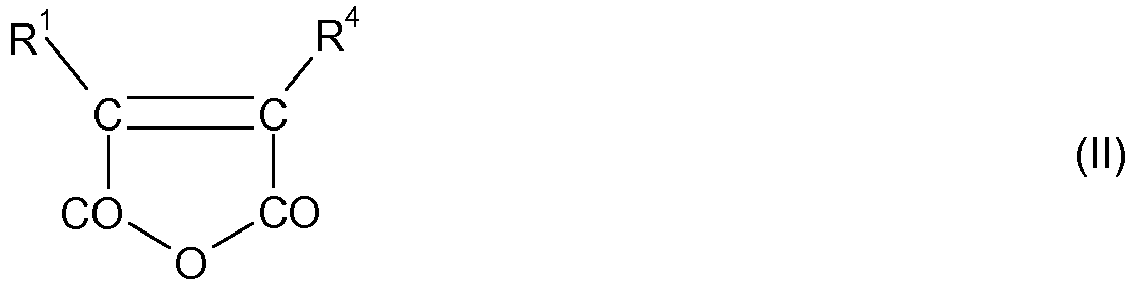


- Vorzugsweise bedeuten die Reste R1 bis R9 Wasserstoff, wobei m für 0 oder 1 und g für 1 steht. Die entsprechenden Verbindungen sind Maleinsäure, Fumarsäure, Maleinsäureanhydrid, Allylglycidylether und Vinylglycidylether.
- Bevorzugte Verbindungen der Formeln I, II und IV sind Maleinsäure, Maleinsäureanhydrid und Epoxygruppen-enthaltende Ester der Acrylsäure und/oder Methacrylsäure, wie Glycidylacrylat, Glycidylmethacrylat und die Ester mit tertiären Alkoholen, wie t-Butylacrylat. Letztere weisen zwar keine freien Carboxylgruppen auf, kommen in ihrem Verhalten aber den freien Säuren nahe und werden deshalb als Monomere mit latenten Carboxylgruppen bezeichnet.
- Vorteilhaft bestehen die Copolymeren aus 50 bis 98 Gew.-% Ethylen, 0,1 bis 20 Gew.-% Epoxygruppen enthaltenden Monomeren und/oder Methacrylsäure und/oder Säureanhydridgruppen enthaltenden Monomeren sowie der restlichen Menge an (Meth)acrylsäureestern.
- Besonders bevorzugt sind Copolymerisate aus
50 bis 98, insbesondere 55 bis 95 Gew.-% Ethylen,
0,1 bis 40, insbesondere 0,3 bis 20 Gew.-% Glycidylacrylat und/oder Glycidylmethacrylat, (Meth)acrylsäure und/oder Maleinsäureanhydrid, und
1 bis 45, insbesondere 10 bis 40 Gew.-% n-Butylacrylat und/oder 2-Ethylhexylacrylat. - Weitere bevorzugte Ester der Acryl- und/oder Methacrylsäure sind die Methyl-, Ethyl-, Propyl-und i- bzw. t-Butylester.
- Daneben können auch Vinylester und Vinylether als Comonomere eingesetzt werden.
- Die vorstehend beschriebenen Ethylencopolymeren können nach an sich bekannten Verfahren hergestellt werden, vorzugsweise durch statistische Copolymerisation unter hohem Druck und erhöhter Temperatur. Entsprechende Verfahren sind allgemein bekannt.
- Bevorzugte Elastomere sind auch Emulsionspolymerisate, deren Herstellung z.B. bei Blackley in der Monographie "Emulsion Polymerization" beschrieben wird. Die verwendbaren Emulgatoren und Katalysatoren sind an sich bekannt.
- Grundsätzlich können homogen aufgebaute Elastomere oder aber solche mit einem Schalenaufbau eingesetzt werden. Der schalenartige Aufbau wird durch die Zugabereihenfolge der einzelnen Monomeren bestimmt; auch die Morphologie der Polymeren wird von dieser Zugabereihenfolge beeinflusst.
- Nur stellvertretend seien hier als Monomere für die Herstellung des Kautschukteils der Elastomeren Acrylate wie z.B. n-Butylacrylat und 2-Ethylhexylacrylat, entsprechende Methacrylate, Butadien und Isopren sowie deren Mischungen genannt. Diese Monomeren können mit weiteren Monomeren wie z.B. Styrol, Acrylnitril, Vinylethern und weiteren Acrylaten oder Methacrylaten wie Methylmethacrylat, Methylacrylat, Ethylacrylat und Propylacrylat copolymerisiert werden.
- Die Weich- oder Kautschukphase (mit einer Glasübergangstemperatur von unter 0°C) der Elastomeren kann den Kern, die äußere Hülle oder eine mittlere Schale (bei Elastomeren mit mehr als zweischaligem Aufbau) darstellen; bei mehrschaligen Elastomeren können auch mehrere Schalen aus einer Kautschukphase bestehen.
- Sind neben der Kautschukphase noch eine oder mehrere Hartkomponenten (mit Glasübergangstemperaturen von mehr als 20°C) am Aufbau des Elastomeren beteiligt, so werden diese im allgemeinen durch Polymerisation von Styrol, Acrylnitril, Methacrylnitril, α-Methylstyrol, p-Methylstyrol, Acrylsäureestern und Methacrylsäureestern wie Methylacrylat, Ethylacrylat und Methylmethacrylat als Hauptmonomeren hergestellt. Daneben können auch hier geringere Anteile an weiteren Comonomeren eingesetzt werden.
- In einigen Fällen hat es sich als vorteilhaft herausgestellt, Emulsionspolymerisate einzusetzen, die an der Oberfläche reaktive Gruppen aufweisen. Derartige Gruppen sind z.B. Epoxy-, Carboxyl-, latente Carboxyl-, Amino- oder Amidgruppen sowie funktionelle Gruppen, die durch Mitverwendung von Monomeren der allgemeinen Formel

wobei die Substituenten folgende Bedeutung haben können: - R10
- Wasserstoff oder eine C1- bis C4-Alkylgruppe,
- R11
- Wasserstoff, eine C1- bis C8-Alkylgruppe oder eine Arylgruppe, insbesondere Phenyl,
- R12
- Wasserstoff, eine C1- bis C10-Alkyl-, eine C6- bis C12-Arylgruppe oder -OR13
- R13
- eine C1- bis C8-Alkyl- oder C6- bis C12-Arylgruppe, die gegebenenfalls mit O- oder N-haltigen Gruppen substituiert sein können,
- X
- eine chemische Bindung, eine C1- bis C10-Alkylen- oder C6-C12-Arylengruppe oder
- Y
- O-Z oder NH-Z und
- Z
- eine C1- bis C10-Alkylen- oder C6- bis C12-Arylengruppe.
- Auch die in der
EP-A 208 187 - Als weitere Beispiele seien noch Acrylamid, Methacrylamid und substituierte Ester der Acrylsäure oder Methacrylsäure wie (N-t-Butylamino)-ethylmethacrylat, (N,N-Dimethyl-amino)ethylacrylat, (N,N-Dimethylamino)-methylacrylat und (N,N-Diethylamino)ethyl-acrylat genannt.
- Weiterhin können die Teilchen der Kautschukphase auch vernetzt sein. Als Vernetzer wirkende Monomere sind beispielsweise Buta-1,3-dien, Divinylbenzol, Diallylphthalat und Dihydrodicyclo-pentadienylacrylat sowie die in der
EP-A 50 265 - Ferner können auch sogenannten pfropfvernetzende Monomere (graft-linking monomers) verwendet werden, d.h. Monomere mit zwei oder mehr polymerisierbaren Doppelbindungen, die bei der Polymerisation mit unterschiedlichen Geschwindigkeiten reagieren. Vorzugsweise werden solche Verbindungen verwendet, in denen mindestens eine reaktive Gruppe mit etwa gleicher Geschwindigkeit wie die übrigen Monomeren polymerisiert, während die andere reaktive Gruppe (oder reaktive Gruppen) z.B. deutlich langsamer polymerisiert (polymerisieren). Die unterschiedlichen Polymerisationsgeschwindigkeiten bringen einen bestimmten Anteil an ungesättigten Doppelbindungen im Kautschuk mit sich. Wird anschließend auf einen solchen Kautschuk eine weitere Phase aufgepfropft, so reagieren die im Kautschuk vorhandenen Doppelbindungen zumindest teilweise mit den Pfropfmonomeren unter Ausbildung von chemischen Bindungen, d.h. die aufgepfropfte Phase ist zumindest teilweise über chemische Bindungen mit der Pfropfgrundlage verknüpft.
- Beispiele für solche pfropfvernetzende Monomere sind Allylgruppen enthaltende Monomere, insbesondere Allylester von ethylenisch ungesättigten Carbonsäuren wie Allylacrylat, Allylmethacrylat, Diallylmaleat, Diallylfumarat, Diallylitaconat oder die entsprechenden Monoallylverbindungen dieser Dicarbonsäuren. Daneben gibt es eine Vielzahl weiterer geeigneter pfropfvernetzender Monomerer; für nähere Einzelheiten sei hier beispielsweise auf die
US-PS 4 148 846 verwiesen. - Im allgemeinen beträgt der Anteil dieser vernetzenden Monomeren an dem schlagzäh modifizierenden Polymer bis zu 5 Gew.-%, vorzugsweise nicht mehr als 3 Gew.-%, bezogen auf das schlagzäh modifizierende Polymere.
- Nachfolgend seien einige bevorzugte Emulsionspolymerisate aufgeführt. Zunächst sind hier Pfropfpolymerisate mit einem Kern und mindestens einer äußeren Schale zu nennen, die folgenden Aufbau haben:
Typ Monomere für den Kern Monomere für die Hülle I Buta-1,3-dien, Isopren, n-Butylacrylat, Ethylhexylacrylat oder deren Mischungen Styrol, Acrylnitril, Methylmethacrylat II wie I aber unter Mitverwendung von Vernetzern wie I III wie I oder II n-Butylacrylat, Ethylacrylat, Methylacrylat, Buta-1,3-dien, Isopren, Ethylhexylacrylat IV wie I oder II wie I oder III aber unter Mitverwendung von Monomeren mit reaktiven Gruppen wie hierin beschrieben V Styrol, Acrylnitril, Methylmethacrylat oder deren Mischungen erste Hülle aus Monomeren wie unter I und II für den Kern beschrieben zweite Hülle wie unter I oder IV für die Hülle beschrieben - Diese Pfropfpolymerisate, insbesondere ABS- und/oder ASA-Polymere in Mengen bis zu 40 Gew.-%, werden vorzugsweise zur Schlagzähmodifizierung von PBT, gegebenenfalls in Mischung mit bis zu 40 Gew.-% Polyethylenterephthalat eingesetzt. Entsprechende Blend-Produkte sind unter dem Warenzeichen Ultradur®S (ehemals Ultrablend®S der BASF AG) erhältlich.
- Anstelle von Pfropfpolymerisaten mit einem mehrschaligen Aufbau können auch homogene, d.h. einschalige Elastomere aus Buta-1,3-dien, Isopren und n-Butylacrylat oder deren Copolymeren eingesetzt werden. Auch diese Produkte können durch Mitverwendung von vernetzenden Monomeren oder Monomeren mit reaktiven Gruppen hergestellt werden.
- Beispiele für bevorzugte Emulsionspolymerisate sind n-Butylacrylat/(Meth)acrylsäure-Copolymere, n-Butylacrylat/Glycidylacrylat- oder n-Butylacrylat/Glycidylmethacrylat-Copolymere, Pfropfpolymerisate mit einem inneren Kern aus n-Butylacrylat oder auf Butadienbasis und einer äußeren Hülle aus den vorstehend genannten Copolymeren und Copolymere von Ethylen mit Comonomeren, die reaktive Gruppen liefern.
- Die beschriebenen Elastomere können auch nach anderen üblichen Verfahren, z.B. durch Suspensionspolymerisation, hergestellt werden.
- Siliconkautschuke, wie in der
DE-A 37 25 576 , derEP-A 235 690 DE-A 38 00 603 und derEP-A 319 290 - Selbstverständlich können auch Mischungen der vorstehend aufgeführten Kautschuktypen eingesetzt werden.
- Als faser- oder teilchenförmige Füllstoffe C) seien Glasfasern, Glaskugeln, amorphe Kieselsäure, Asbest, Calciumsilicat, Calciummetasilicat, Magnesiumcarbonat, Kaolin, Kreide, gepulverter Quarz, Glimmer, Bariumsulfat und Feldspat genannt. Faserförmige Füllstoffe C) werden in Mengen bis zu 60 Gew.-%, insbesondere bis zu 35 Gew.-% eingesetzt, teilchenförmige Füllstoffe werden in Mengen bis zu 30 Gew%, insbesondere bis zu 10 Gew% eingesetzt.
- Als bevorzugte faserförmige Füllstoffe seien Aramid-Fasern und Kaliumtitanat-Fasern genannt, wobei Glasfasern als E-Glas besonders bevorzugt sind. Diese können als Rovings oder Schnittglas in den handelsüblichen Formen eingesetzt werden.
- Stark laserabsorbierende Füllstoffe wie beispielsweise Kohlenstofffasern, Russ, Graphit, Graphen oder Kohlenstoffnanoröhrchen werden bevorzugt in Mengen unter 1 Gew.-%, besonders bevorzugt unter 0,05 Gew.-% eingesetzt.
- Die faserförmigen Füllstoffe können zur besseren Verträglichkeit mit dem Thermoplasten mit einer Silanverbindung oberflächlich vorbehandelt sein.
- Geeignete Silanverbindungen sind solche der allgemeinen Formel
(X-(CH2)n)k-Si-(O-CmH2m+1)4-k
in der die Substituenten folgende Bedeutung haben: - X NH2-,

- n
- eine ganze Zahl von 2 bis 10, bevorzugt 3 bis 4
- m
- eine ganze Zahl von 1 bis 5, bevorzugt 1 bis 2
- k
- eine ganze Zahl von 1 bis 3, bevorzugt 1.
- Bevorzugte Silanverbindungen sind Aminopropyltrimethoxysilan, Aminobutyltrimeth-oxysilan, Aminopropyltriethoxysilan, Aminobutyltriethoxysilan sowie die entsprechenden Silane, welche als Substituent X eine Glycidylgruppe enthalten.
- Die Silanverbindungen werden im allgemeinen in Mengen von 0,05 bis 5, vorzugsweise 0,1 bis 1,5 und insbesondere 0,2 bis 0,5 Gew.-% (bezogen auf C) zur Oberflächenbeschichtung eingesetzt.
- Geeignet sind auch nadelförmige mineralische Füllstoffe.
- Unter nadelförmigen mineralischen Füllstoffen wird im Sinne der Erfindung ein mineralischer Füllstoff mit stark ausgeprägtem nadelförmigen Charakter verstanden. Als Beispiel sei nadelförmiger Wollastonit genannt. Vorzugsweise weist das Mineral ein L/D-(Länge Durchmesser)-Verhältnis von 8 : 1 bis 35 : 1, bevorzugt von 8 : 1 bis 11 : 1 auf. Der mineralische Füllstoff kann gegebenenfalls mit den vorstehend genannten Silanverbindungen vorbehandelt sein; die Vorbehandlung ist jedoch nicht unbedingt erforderlich.
- Als Komponente C) können die erfindungsgemäßen thermoplastischen Formmassen übliche Verarbeitungshilfsmittel wie Stabilisatoren, Oxidationsverzögerer, Mittel gegen Wärmezersetzung und Zersetzung durch ultraviolettes Licht, Gleit- und Entformungsmittel, Färbemittel wie Farbstoffe und Pigmente, Weichmacher usw. enthalten.
- Als Beispiele für Oxidationsverzögerer und Wärmestabilisatoren sind sterisch gehinderte Phenole und/oder Phosphite, Hydrochinone, aromatische sekundäre Amine wie Diphenylamine, verschiedene substituierte Vertreter dieser Gruppen und deren Mischungen in Konzentrationen bis zu 1 Gew.-%, bezogen auf das Gewicht der thermoplastischen Formmassen genannt.
- Als UV-Stabilisatoren, die im allgemeinen in Mengen bis zu 2 Gew.-%, bezogen auf die Formmasse, verwendet werden, seien verschiedene substituierte Resorcine, Salicylate, Benzotriazole und Benzophenone genannt.
- Es können anorganische und organische Pigmente sowie Farbstoffe, wie Nigrosin und Anthrachinone als Farbmittel zugesetzt werden. Besonders geeignete Farbmittel sind beispielsweise in
EP 1722984 B1 ,EP 1353986 B1 oderDE 10054859 A1 genannt. - Weiterhin bevorzugt sind Ester oder Amide gesättigter oder ungesättigter aliphatischer Carbonsäuren mit 10 bis 40, bevorzugt 16 bis 22 C-Atomen mit aliphatischen gesättigten Alkoholen oder Aminen die 2 bis 40, vorzugsweise 2 bis 6 C-Atomen enthalten.
- Die Carbonsäuren können 1- oder 2-wertig sein. Als Beispiele seien Pelargonsäure, Palmitinsäure, Laurinsäure, Margarinsäure, Dodecandisäure, Behensäure und besonders bevorzugt Stearinsäure, Caprinsäure sowie Montansäure (Mischung von Fettsäuren mit 30 bis 40 C-Atomen) genannt.
- Die aliphatischen Alkohole können 1- bis 4-wertig sein. Beispiele für Alkohole sind n-Butanol, n-Octanol, Stearylalkohol, Ethylenglykol, Propylenglykol, Neopentylglykol, Pentaerythrit, wobei Glycerin und Pentaerythrit bevorzugt sind.
- Die aliphatischen Amine können 1- bis 3-wertig sein. Beispiele hierfür sind Stearylamin, Ethylendiamin, Propylendiamin, Hexamethylendiamin, Di(6-Aminohexyl)amin, wobei Ethylendiamin und Hexamethylendiamin besonders bevorzugt sind. Bevorzugte Ester oder Amide sind entsprechend Glycerindistearat, Glycerintristearat, Ethylendiamindistearat, Glycerinmonopalmitat, Glycerintrilaurat, Glycerinmonobehenat und Pentaerythrittetrastearat.
- Es können auch Mischungen verschiedener Ester oder Amide oder Ester mit Amiden in Kombination eingesetzt werden, wobei das Mischungsverhältnis beliebig ist.
- Weitere Gleit- und Entformungsmittel werden üblicherweise in Mengen bis zu 1 Gew.-% eingesetzt. Es sind bevorzugt langkettige Fettsäuren (z.B. Stearinsäure oder Behensäure), deren Salze (z.B. Ca- oder Zn-Stearat) oder Montanwachse (Mischungen aus geradkettigen, gesättigten Carbonsäuren mit Kettenlängen von 28 bis 32 C-Atomen) sowie Ca- oder Na-Montanat sowie niedermolekulare Polyethylen- bzw. Polypropylenwachse.
- Als Beispiele für Weichmacher seien Phthalsäuredioctylester, Phthalsäuredibenzylester, Phthalsäurebutylbenzylester, Kohlenwasserstofföle, N-(n-Butyl)benzolsulfon-amid genannt.
- Die erfindungsgemäßen Formmassen können noch 0 bis 2 Gew.-% fluorhaltige Ethylenpolymerisate enthalten. Hierbei handelt es sich um Polymerisate des Ethylens mit einem Fluorgehalt von 55 bis 76 Gew.-%, vorzugsweise 70 bis 76 Gew.-%.
- Beispiele hierfür sind Polytetrafluorethylen (PTFE), Tetrafluorethylen-hexafluor-propylen-Copolymere oder Tetrafluorethylen-Copolymerisate mit kleineren Anteilen (in der Regel bis zu 50 Gew.-%) copolymerisierbarer ethylenisch ungesättigter Mono-merer. Diese werden z.B. von Schildknecht in "Vinyl and Related Polymers", Wiley-Verlag, 1952, Seite 484 bis 494 und von Wall in "Fluorpolymers" (Wiley Interscience, 1972) beschrieben.
- Diese fluorhaltigen Ethylenpolymerisate liegen homogen verteilt in den Formmassen vor und weisen bevorzugt eine Teilchengröße d50 (Zahlenmittelwert) im Bereich von 0,05 bis 10 µm, insbesondere von 0,1 bis 5 µm auf. Diese geringen Teilchengrößen lassen sich besonders bevorzugt durch Verwendung von wässrigen Dispersionen von fluorhaltigen Ethylenpolymerisaten und deren Einarbeitung in eine Polyesterschmelze erzielen.
- Die erfindungsgemäßen thermoplastischen Formmassen können nach an sich bekannten Verfahren hergestellt werden, indem man die Ausgangskomponenten in üblichen Mischvorrichtungen wie Schneckenextrudern, Brabender-Mühlen oder Banbury-Mühlen mischt und anschließend extrudiert. Nach der Extrusion kann das Extrudat abgekühlt und zerkleinert werden. Es können auch einzelne Komponenten vorgemischt (z.B. Auftragen, oder Auftrommeln der Komponente B) auf das Granulat) werden und dann die restlichen Ausgangsstoffe einzeln und/oder ebenfalls gemischt hinzugegeben werden. Die Mischtemperaturen liegen in der Regel bei 230 bis 290°C. Vorzugsweise kann Komponente B) auch hot feed oder direkt in den Einzug des Extruders zugegeben werden.
- Nach einer weiteren bevorzugten Arbeitsweise können die Komponenten B) sowie gegebenenfalls C) mit einem Polyesterpräpolymeren gemischt, konfektioniert und granuliert werden. Das erhaltene Granulat wird in fester Phase anschließend unter Inertgas kontinuierlich oder diskontinuierlich bei einer Temperatur unterhalb des Schmelzpunktes der Komponente A) bis zur gewünschten Viskosität kondensiert.
- In einer weiteren bevorzugten Herstellungsmethode wird zunächst ein Batch (Konzentrat) aus A) und B) hergestellt, wobei die Komponente B bis zu 20 Gew.-%, vorzugsweise bis zu 10 Gew.-% in A) (bezogen auf A) + B)) eingearbeitet wird. Dieses Konzentrat wird bei der Herstellung der Rohr- oder Profilextrudate zum Polyester (ohne Zusatzstoffe) als Granulat zudosiert, oder im entsprechenden Mengenverhältnis, z.B. im Taumelmischer vorgemischt, konfektioniert und als Formteil extrudiert.
- Die erfindungsgemäßen Formmassen oder Formkörper weisen eine verringerte TOC Emission auf, vorzugsweise kleiner/gleich 110, insbesondere kleiner/gleich 80 und ganz besonders bevorzugt kleiner/gleich 65 ppm auf (gemäß VDA 277).
- Beispiele für Anwendungen und Formteile sind:
- Formteile: Tiefgezogene oder spritzgegossene Kavitäten und Formteile
- Kosmetikverpackungen: Lippenstifte und Schminkstifte, Verpackungen für Hautcremes, Haarpflegeprodukte, Zahnpflegeprodukte.
- Verpackungen für Medikamente, Injektoren, Spritzen, tiefgezogene Verpackungen für Tabletten.
- Lebensmittelverpackungen: Kaffeekapseln, Fertiggerichte, Verpackungen, geeignet für die Heißabfüllung und Sterilisation (Fleischerzeugnisse, Marmeladen, Michprodukte, ...), evtl. mit Mehrfachnutzung.
- Bauteile im Kontakt mit Trinkwasser, wie z.B. Bestandteile von Hausinstallationen Bedarfsgegenstände für den Lebensmittelkontakt, wie z.B. Bestecke, Pfannenwender usw.
- Bauteile von Küchengeräten im Lebensmittelkontakt, wie z.B. wasserführende Teile von Kaffeemaschinen (Brüheinheiten) Entsafter usw.
- Automobilinnenraum: Kinematiksysteme
- Es wurden folgende Komponenten eingesetzt.
- Polybutylenterephthalat (PBT) mit einem MVR von 106,7 cm3/g 10 Min. (gemäß ISO 1133 bei 250 °C/2,16 kg) und VZ von 88,4 ml/g (gemäß ISO 1628).
- Der Resttitangehalt betrug 100 ppm.
- Natriumhypophosphit
- Nitrilotriessigsäure (CAS:139-13-9; Trilon® AS der BASF SE)
- Dinatriumsalz von EDTA (CAS:139-33-3; Trilon® BD der BASF SE)
- Diammoniumsalz von EDTA (CAS:20824-56-0; Trilon® BAD der BASF SE)
- Ethylendiamintetraessigsäure EDTA (CAS-60-00-4; Trilon® BS der BASF SE)
- Diethylentriaminpentaessigsäure (CAS:67-43-6; Trilon® CS der BASF SE)
- Hydroxylethylethylendiamintriessigsäure
- 1,3 Propylendiamintetraessigsäure (CAS:1939-36-2, Trilon® FS der BASF SE)
- Ethylendiamindibernsteinsäure
- Pentaerythrittetrastearat
- Komponente A wurde mit verschiedenen Additiven B) in einem Doppelschnecken-Extruder bei einer Schmelztemperatur von 265-275 °C, einem Durchsatz von 5 kg/h und einer Drehzahl von 300 min-1 extrudiert. Die Dosierung der Additive erfolgte mit dem Granulat im Kalteinzug.
- Das extrudierte Material wurde anschließend zu Plättchen der Abmessungen 60 x 60 x 0,5 mm verspritzt.
- Analyse der Emissionsmenge:
- Die Analyse der Emissionsmenge erfolgte nach VDA277, einem Standardverfahren des Verbands der Automobilindustrie zur Bestimmung der TOC (= totale organic carbon emission). Bei der VDA 277 werden nichtmetallische Kfz-Werkstoffe hinsichtlich ihrer Kohlenstoff-Emission untersucht. Dabei werden die spritzgegossenen Plättchen zerkleinert und in ein Glasgefäß gegeben, das versiegelt wird. Anschließend wird die Probe für 5 Stunden bei 120 °C gelagert.
- Daraufhin wird das Gasvolumen oberhalb der Probe im Gaschromatographen analysiert (Headspace-GC). Die Emission wird dabei in µg Kohlenstoff (TOC) pro Gramm Probe ermittelt.
- Die Zusammensetzungen der Formmassen und die Ergebnisse der Messungen sind der Tabelle zu entnehmen.

Tabelle 2 Zusammensetzung TOC nach VDA 277 [ppm] Vergleichsbeispiel 1 239 Vergleichsbeispiel 2 128 Beispiel 1 101 Beispiel 2 105 Beispiel 3 87 Beispiel 4 58 Beispiel 5 50 Beispiel 6 75 Beispiel 7 48 Beispiel 8 70 Beispiel 9 55 Beispiel 10 85 Beispiel 11 60 Beispiel 12 109
Weiterhin betrifft die Erfindung die Verwendung der erfindungsgemäßen Formmassen zur Herstellung von Formkörpern jeglicher Art, insbesondere mit einer TOC-Emission kleiner/gleich 110 ppm und die hierbei erhältlichen Formkörper, vorzugsweise mit einer TOC Emission von kleiner/gleich 110 ppm.

Claims (11)
- Thermoplastische Formmassen, enthaltendA) 30 bis 99,9 Gew.-% eines Polyesters, aufgebaut aus 50 bis 100 Gew.-% mindestens eines Polyalkylenterephtalates A1) und 0 bis 50 Gew.-% eines Polyesters A2), verschieden von A1)B) 0,01 bis 2 Gew.-% eines ChelatbildnersC) 0 bis 70 Gew.-% weiterer Zusatzstoffe,
wobei die Summe der Gewichtsprozente der Kompenenten A) bis C) 100 % ergibt. - Thermoplastische Formmassen nach Anspruch 1, enthaltend als Komponente A1) Polyethylenterephtalat, Polybutylenterephthalat, Polytrimethylenterephthalat oder deren Mischungen.
- Thermoplastische Formmassen nach den Ansprüchen 1 oder 2, in denen die Komponente B) mindestens 3 Carbonsäuregruppen aufweist.
- Thermoplastische Formmassen nach den Ansprüchen 1 bis 3, wobei die Komponente B)
aus


- Thermoplastische Formmassen nach den Ansprüchen 1 bis 4, wobei die Komponente B) maximal 2 Alkali- oder Ammoniumkationen oder deren Mischungen aufweist.
- Thermoplastische Formmassen nach den Ansprüchen 1 bis 5, wobei das Alkalimetall Natrium ist.
- Verwendung von Chelatbildnern B) zur Verringerung der TOC (total organic carbon) Emission von Polyestern A) gemäß Anspruch 1.
- Polyesterformmassen nach den Ansprüchen 1 bis 6 mit einer TOC Emission von kleiner/gleich 110 ppm (gemäß VDA 277).
- Verwendung von Polyesterformmassen gemäß den Ansprüchen 1 bis 6 und 8 zur Herstellung von Fasern, Folien und Formkörpern.
- Fasern, Folien, Formkörper erhältlich gemäß den Ansprüchen 1 bis 7 mit einer TOC Emission von kleiner/gleich 110 qqm (gemäß VDA 277).
- Formkörper jeglicher Art gemäß Anspruch 10, welche bei Lebensmitteln, Kosmetikprodukten, Medikamenten, Trinkwasseranwendungen, im Kfz-Innenraum oder für Kinematiksystemen eingesetzt werden.
Priority Applications (1)
| Application Number | Priority Date | Filing Date | Title |
|---|---|---|---|
| EP13172274.6A EP2816081A1 (de) | 2013-06-17 | 2013-06-17 | Polyesterformmassen mit geringer TOC Emission |
Applications Claiming Priority (1)
| Application Number | Priority Date | Filing Date | Title |
|---|---|---|---|
| EP13172274.6A EP2816081A1 (de) | 2013-06-17 | 2013-06-17 | Polyesterformmassen mit geringer TOC Emission |
Publications (1)
| Publication Number | Publication Date |
|---|---|
| EP2816081A1 true EP2816081A1 (de) | 2014-12-24 |
Family
ID=48613523
Family Applications (1)
| Application Number | Title | Priority Date | Filing Date |
|---|---|---|---|
| EP13172274.6A Withdrawn EP2816081A1 (de) | 2013-06-17 | 2013-06-17 | Polyesterformmassen mit geringer TOC Emission |
Country Status (1)
| Country | Link |
|---|---|
| EP (1) | EP2816081A1 (de) |
Cited By (3)
| Publication number | Priority date | Publication date | Assignee | Title |
|---|---|---|---|---|
| WO2021018847A1 (de) | 2019-07-29 | 2021-02-04 | Lanxess Deutschland Gmbh | Polybutylenterephthalat mit niedrigem thf gehalt |
| WO2021018848A1 (de) | 2019-07-29 | 2021-02-04 | Lanxess Deutschland Gmbh | Polybutylenterephthalat mit niedrigem thf gehalt |
| WO2021018845A1 (de) | 2019-07-29 | 2021-02-04 | Lanxess Deutschland Gmbh | Polybutylenterephthalat mit niedrigem thf gehalt |
Citations (25)
| Publication number | Priority date | Publication date | Assignee | Title |
|---|---|---|---|---|
| US3651014A (en) | 1969-07-18 | 1972-03-21 | Du Pont | Segmented thermoplastic copolyester elastomers |
| US4148846A (en) | 1970-09-10 | 1979-04-10 | Rohm And Haas Company | Acrylic modifiers for polycarbonamides |
| DE2842005A1 (de) | 1978-09-27 | 1980-04-10 | Bayer Ag | Polycarbonate mit alkylphenyl-endgruppen, ihre herstellung und ihre verwendung |
| EP0050265A1 (de) | 1980-10-16 | 1982-04-28 | Bayer Ag | Thermoplastische Polyester-Formmassen mit verbesserter Zähigkeit |
| DE3334782A1 (de) | 1983-04-19 | 1984-10-25 | Bayer Ag, 5090 Leverkusen | Verfahren zur herstellung von polydiorganosiloxanen mit hydroxyaryloxy-endgruppen |
| DE3506472A1 (de) | 1985-02-23 | 1986-08-28 | Bayer Ag, 5090 Leverkusen | Neue polydiorganosiloxan-polycarbonat-blockcopolymere |
| EP0208187A2 (de) | 1985-07-06 | 1987-01-14 | Bayer Ag | Neue Pfropfpolymerisate und deren Abmischungen mit Polyamiden |
| EP0235690A2 (de) | 1986-03-04 | 1987-09-09 | Bayer Ag | Pfropfpolymerisate auf Kautschukpolymeren mit blockartiger Struktur |
| DE3725576A1 (de) | 1987-08-01 | 1989-02-09 | Bayer Ag | Formmassen aus aromatischem polyester und gepfropftem silikonkautschuk |
| EP0319290A2 (de) | 1987-12-04 | 1989-06-07 | Polyplastics Co. Ltd. | Harzzusammensetzung |
| DE3800603A1 (de) | 1988-01-12 | 1989-07-20 | Bayer Ag | Formmassen aus aromatischen polyestern, vinyl-copolymerisaten und gepfropftem siliconkautschuk |
| EP0365916A1 (de) | 1988-10-24 | 1990-05-02 | Bayer Ag | Polymermischungen |
| US5045580A (en) * | 1988-12-02 | 1991-09-03 | Polyplastics Co., Ltd. | Antistatic thermoplastic polyester resin composition |
| DE4401055A1 (de) | 1994-01-15 | 1995-07-20 | Basf Ag | Verfahren zur Herstellung von thermoplastischen Polyestern mit niedrigem Carboxylendgruppengehalt |
| EP0683201A1 (de) | 1992-12-03 | 1995-11-22 | Polyplastics Co. Ltd. | Verfahren zur Herstellung von modifiziertem Polybutylenterephthalatharz |
| EP0711810A1 (de) | 1994-11-14 | 1996-05-15 | General Electric Company | Autoklavenbeständige Zusammensetzungen aus Polyestercarbonat- und Polyetherimidharzen |
| US5686540A (en) * | 1995-09-29 | 1997-11-11 | Dainippon Ink And Chemicals, Inc. | Process for the preparation of lactic acid-based polyester |
| US6114495A (en) | 1998-04-01 | 2000-09-05 | Cargill Incorporated | Lactic acid residue containing polymer composition and product having improved stability, and method for preparation and use thereof |
| DE10054859A1 (de) | 2000-11-06 | 2002-05-08 | Basf Ag | Verfahren zum Verbinden von Formteilen |
| US6784233B1 (en) * | 1999-07-01 | 2004-08-31 | Basf Aktiengesellschaft | Polyester/polycarbonate blends |
| EP1353986B1 (de) | 2000-11-13 | 2006-04-12 | E. I. du Pont de Nemours and Company | Gefärbte thermoplastische harzzusammensetzungen zum laserschweissen, anthrachinon-farbmittel dafür und formteil daraus |
| US20070161737A1 (en) * | 2006-01-09 | 2007-07-12 | Bayer Materialscience Llc | Thermoplastic composition containing polycarbonate-polyester and nanoclay |
| US20070225475A1 (en) | 2006-03-24 | 2007-09-27 | Judith Alison Peacock | Thermoplastic resins containing PBT units, having reduced organic carbon emissions |
| EP1722984B1 (de) | 2004-03-04 | 2008-06-04 | Evonik Degussa GmbH | Durch farbmittel transparent, transluzent oder gedeckt eingefärbte laserschweissbare kunststoffmaterialien |
| EP2427511A1 (de) | 2009-05-07 | 2012-03-14 | Basf Se | Verwendung eines polyesters zur herstellung von formteilen mit einem niedrigen gehalt an extrahierbaren verbindungen |
-
2013
- 2013-06-17 EP EP13172274.6A patent/EP2816081A1/de not_active Withdrawn
Patent Citations (25)
| Publication number | Priority date | Publication date | Assignee | Title |
|---|---|---|---|---|
| US3651014A (en) | 1969-07-18 | 1972-03-21 | Du Pont | Segmented thermoplastic copolyester elastomers |
| US4148846A (en) | 1970-09-10 | 1979-04-10 | Rohm And Haas Company | Acrylic modifiers for polycarbonamides |
| DE2842005A1 (de) | 1978-09-27 | 1980-04-10 | Bayer Ag | Polycarbonate mit alkylphenyl-endgruppen, ihre herstellung und ihre verwendung |
| EP0050265A1 (de) | 1980-10-16 | 1982-04-28 | Bayer Ag | Thermoplastische Polyester-Formmassen mit verbesserter Zähigkeit |
| DE3334782A1 (de) | 1983-04-19 | 1984-10-25 | Bayer Ag, 5090 Leverkusen | Verfahren zur herstellung von polydiorganosiloxanen mit hydroxyaryloxy-endgruppen |
| DE3506472A1 (de) | 1985-02-23 | 1986-08-28 | Bayer Ag, 5090 Leverkusen | Neue polydiorganosiloxan-polycarbonat-blockcopolymere |
| EP0208187A2 (de) | 1985-07-06 | 1987-01-14 | Bayer Ag | Neue Pfropfpolymerisate und deren Abmischungen mit Polyamiden |
| EP0235690A2 (de) | 1986-03-04 | 1987-09-09 | Bayer Ag | Pfropfpolymerisate auf Kautschukpolymeren mit blockartiger Struktur |
| DE3725576A1 (de) | 1987-08-01 | 1989-02-09 | Bayer Ag | Formmassen aus aromatischem polyester und gepfropftem silikonkautschuk |
| EP0319290A2 (de) | 1987-12-04 | 1989-06-07 | Polyplastics Co. Ltd. | Harzzusammensetzung |
| DE3800603A1 (de) | 1988-01-12 | 1989-07-20 | Bayer Ag | Formmassen aus aromatischen polyestern, vinyl-copolymerisaten und gepfropftem siliconkautschuk |
| EP0365916A1 (de) | 1988-10-24 | 1990-05-02 | Bayer Ag | Polymermischungen |
| US5045580A (en) * | 1988-12-02 | 1991-09-03 | Polyplastics Co., Ltd. | Antistatic thermoplastic polyester resin composition |
| EP0683201A1 (de) | 1992-12-03 | 1995-11-22 | Polyplastics Co. Ltd. | Verfahren zur Herstellung von modifiziertem Polybutylenterephthalatharz |
| DE4401055A1 (de) | 1994-01-15 | 1995-07-20 | Basf Ag | Verfahren zur Herstellung von thermoplastischen Polyestern mit niedrigem Carboxylendgruppengehalt |
| EP0711810A1 (de) | 1994-11-14 | 1996-05-15 | General Electric Company | Autoklavenbeständige Zusammensetzungen aus Polyestercarbonat- und Polyetherimidharzen |
| US5686540A (en) * | 1995-09-29 | 1997-11-11 | Dainippon Ink And Chemicals, Inc. | Process for the preparation of lactic acid-based polyester |
| US6114495A (en) | 1998-04-01 | 2000-09-05 | Cargill Incorporated | Lactic acid residue containing polymer composition and product having improved stability, and method for preparation and use thereof |
| US6784233B1 (en) * | 1999-07-01 | 2004-08-31 | Basf Aktiengesellschaft | Polyester/polycarbonate blends |
| DE10054859A1 (de) | 2000-11-06 | 2002-05-08 | Basf Ag | Verfahren zum Verbinden von Formteilen |
| EP1353986B1 (de) | 2000-11-13 | 2006-04-12 | E. I. du Pont de Nemours and Company | Gefärbte thermoplastische harzzusammensetzungen zum laserschweissen, anthrachinon-farbmittel dafür und formteil daraus |
| EP1722984B1 (de) | 2004-03-04 | 2008-06-04 | Evonik Degussa GmbH | Durch farbmittel transparent, transluzent oder gedeckt eingefärbte laserschweissbare kunststoffmaterialien |
| US20070161737A1 (en) * | 2006-01-09 | 2007-07-12 | Bayer Materialscience Llc | Thermoplastic composition containing polycarbonate-polyester and nanoclay |
| US20070225475A1 (en) | 2006-03-24 | 2007-09-27 | Judith Alison Peacock | Thermoplastic resins containing PBT units, having reduced organic carbon emissions |
| EP2427511A1 (de) | 2009-05-07 | 2012-03-14 | Basf Se | Verwendung eines polyesters zur herstellung von formteilen mit einem niedrigen gehalt an extrahierbaren verbindungen |
Non-Patent Citations (5)
| Title |
|---|
| "Römpp Online Lexikon", 2013, GEORG THIEME VERLAG |
| C.B. BUCKNALL: "Toughened Plastics", 1977, APPLIED SCIENCE PUBLISHERS |
| HOUBEN-WEYL: "Methoden der organischen Chemie", vol. 14/1, 1961, GEORG-THIEME-VERLAG, pages: 392 - 406 |
| SCHILDKNECHT: "Vinyl and Related Polymers", 1952, WILEY-VERLAG, pages: 484 - 494 |
| WALL: "Fluorpolymers", 1972, WILEY INTERSCIENCE |
Cited By (3)
| Publication number | Priority date | Publication date | Assignee | Title |
|---|---|---|---|---|
| WO2021018847A1 (de) | 2019-07-29 | 2021-02-04 | Lanxess Deutschland Gmbh | Polybutylenterephthalat mit niedrigem thf gehalt |
| WO2021018848A1 (de) | 2019-07-29 | 2021-02-04 | Lanxess Deutschland Gmbh | Polybutylenterephthalat mit niedrigem thf gehalt |
| WO2021018845A1 (de) | 2019-07-29 | 2021-02-04 | Lanxess Deutschland Gmbh | Polybutylenterephthalat mit niedrigem thf gehalt |
Similar Documents
| Publication | Publication Date | Title |
|---|---|---|
| EP3004242B1 (de) | Polyesterformmassen mit geringer toc emission | |
| EP0736571B1 (de) | Flammgeschützte thermoplastische Formmassen | |
| EP1713861B1 (de) | Fliessfähige polyesterformmassen | |
| EP1192221A1 (de) | Polyester/polycarbonat blends | |
| WO2008052998A1 (de) | Emissionsarme polyesterformmassen | |
| EP2976385B1 (de) | Polyester für profilextrusion und/oder rohrextrusion | |
| EP2816081A1 (de) | Polyesterformmassen mit geringer TOC Emission | |
| EP3044255B1 (de) | Flammgeschützte polyester | |
| EP1812514A1 (de) | Polymerblends aus polyestern und linearen oligomeren polycarbonaten | |
| WO2013189779A1 (de) | Flammgeschützte polyester mit polyacrylnitrilhomopolymerisaten | |
| EP4437042A1 (de) | Thermoplastische mischungen | |
| EP1537178B1 (de) | Verfahren zur herstellung von thermoplastische polyesterformmassen | |
| EP1917308B1 (de) | Scheinwerferteile aus Polyester | |
| WO2007090781A1 (de) | Emissionsarmes pbt durch spritzguss mit entgasungsvorrichtung | |
| EP2683765A1 (de) | Lasertransparente polyester mit anorganischen salzen | |
| DE19913987A1 (de) | Dimensionsstabile Polyester/Polycarbonat Blends | |
| WO2000041470A2 (de) | Verfahren zur herstellung von polyesterblends | |
| WO2009050094A1 (de) | Thermoplastische polyester-formmassen, die hochverzweigte polyetheramine enthalten | |
| DE19825350A1 (de) | Thermoplastische Polyesterformmasse mit verbesserter Stabilität | |
| WO2000046294A2 (de) | Polyesterblends mit verbesserter kristallisationsneigung | |
| DE19904813A1 (de) | Schlagzähe Polyesterformmassen | |
| DE102004029775A1 (de) | Verstärkte Formmassen | |
| WO2007088125A1 (de) | Polyesterformmassen enthaltend maleinimid-copolymere |
Legal Events
| Date | Code | Title | Description |
|---|---|---|---|
| PUAI | Public reference made under article 153(3) epc to a published international application that has entered the european phase |
Free format text: ORIGINAL CODE: 0009012 |
|
| 17P | Request for examination filed |
Effective date: 20130617 |
|
| AK | Designated contracting states |
Kind code of ref document: A1 Designated state(s): AL AT BE BG CH CY CZ DE DK EE ES FI FR GB GR HR HU IE IS IT LI LT LU LV MC MK MT NL NO PL PT RO RS SE SI SK SM TR |
|
| AX | Request for extension of the european patent |
Extension state: BA ME |
|
| STAA | Information on the status of an ep patent application or granted ep patent |
Free format text: STATUS: THE APPLICATION IS DEEMED TO BE WITHDRAWN |
|
| 18D | Application deemed to be withdrawn |
Effective date: 20150625 |