EP2817761B1 - Partitionnement de systèmes fonctionnant dans de multiples domaines - Google Patents
Partitionnement de systèmes fonctionnant dans de multiples domaines Download PDFInfo
- Publication number
- EP2817761B1 EP2817761B1 EP13718922.1A EP13718922A EP2817761B1 EP 2817761 B1 EP2817761 B1 EP 2817761B1 EP 13718922 A EP13718922 A EP 13718922A EP 2817761 B1 EP2817761 B1 EP 2817761B1
- Authority
- EP
- European Patent Office
- Prior art keywords
- system partition
- partition
- domain
- usmc
- safety
- Prior art date
- Legal status (The legal status is an assumption and is not a legal conclusion. Google has not performed a legal analysis and makes no representation as to the accuracy of the status listed.)
- Active
Links
Images






Classifications
-
- G—PHYSICS
- G06—COMPUTING OR CALCULATING; COUNTING
- G06F—ELECTRIC DIGITAL DATA PROCESSING
- G06F3/00—Input arrangements for transferring data to be processed into a form capable of being handled by the computer; Output arrangements for transferring data from processing unit to output unit, e.g. interface arrangements
- G06F3/06—Digital input from, or digital output to, record carriers, e.g. RAID, emulated record carriers or networked record carriers
- G06F3/0601—Interfaces specially adapted for storage systems
- G06F3/0628—Interfaces specially adapted for storage systems making use of a particular technique
- G06F3/0638—Organizing or formatting or addressing of data
- G06F3/0644—Management of space entities, e.g. partitions, extents, pools
-
- G—PHYSICS
- G06—COMPUTING OR CALCULATING; COUNTING
- G06F—ELECTRIC DIGITAL DATA PROCESSING
- G06F21/00—Security arrangements for protecting computers, components thereof, programs or data against unauthorised activity
- G06F21/50—Monitoring users, programs or devices to maintain the integrity of platforms, e.g. of processors, firmware or operating systems
- G06F21/52—Monitoring users, programs or devices to maintain the integrity of platforms, e.g. of processors, firmware or operating systems during program execution, e.g. stack integrity ; Preventing unwanted data erasure; Buffer overflow
- G06F21/53—Monitoring users, programs or devices to maintain the integrity of platforms, e.g. of processors, firmware or operating systems during program execution, e.g. stack integrity ; Preventing unwanted data erasure; Buffer overflow by executing in a restricted environment, e.g. sandbox or secure virtual machine
-
- G—PHYSICS
- G06—COMPUTING OR CALCULATING; COUNTING
- G06F—ELECTRIC DIGITAL DATA PROCESSING
- G06F21/00—Security arrangements for protecting computers, components thereof, programs or data against unauthorised activity
- G06F21/50—Monitoring users, programs or devices to maintain the integrity of platforms, e.g. of processors, firmware or operating systems
- G06F21/55—Detecting local intrusion or implementing counter-measures
- G06F21/554—Detecting local intrusion or implementing counter-measures involving event detection and direct action
-
- G—PHYSICS
- G06—COMPUTING OR CALCULATING; COUNTING
- G06F—ELECTRIC DIGITAL DATA PROCESSING
- G06F3/00—Input arrangements for transferring data to be processed into a form capable of being handled by the computer; Output arrangements for transferring data from processing unit to output unit, e.g. interface arrangements
- G06F3/06—Digital input from, or digital output to, record carriers, e.g. RAID, emulated record carriers or networked record carriers
- G06F3/0601—Interfaces specially adapted for storage systems
- G06F3/0602—Interfaces specially adapted for storage systems specifically adapted to achieve a particular effect
- G06F3/061—Improving I/O performance
-
- G—PHYSICS
- G06—COMPUTING OR CALCULATING; COUNTING
- G06F—ELECTRIC DIGITAL DATA PROCESSING
- G06F3/00—Input arrangements for transferring data to be processed into a form capable of being handled by the computer; Output arrangements for transferring data from processing unit to output unit, e.g. interface arrangements
- G06F3/06—Digital input from, or digital output to, record carriers, e.g. RAID, emulated record carriers or networked record carriers
- G06F3/0601—Interfaces specially adapted for storage systems
- G06F3/0668—Interfaces specially adapted for storage systems adopting a particular infrastructure
- G06F3/0671—In-line storage system
- G06F3/0673—Single storage device
-
- G—PHYSICS
- G06—COMPUTING OR CALCULATING; COUNTING
- G06F—ELECTRIC DIGITAL DATA PROCESSING
- G06F9/00—Arrangements for program control, e.g. control units
- G06F9/06—Arrangements for program control, e.g. control units using stored programs, i.e. using an internal store of processing equipment to receive or retain programs
- G06F9/46—Multiprogramming arrangements
- G06F9/50—Allocation of resources, e.g. of the central processing unit [CPU]
- G06F9/5061—Partitioning or combining of resources
- G06F9/5077—Logical partitioning of resources; Management or configuration of virtualized resources
-
- H—ELECTRICITY
- H04—ELECTRIC COMMUNICATION TECHNIQUE
- H04L—TRANSMISSION OF DIGITAL INFORMATION, e.g. TELEGRAPHIC COMMUNICATION
- H04L63/00—Network architectures or network communication protocols for network security
- H04L63/02—Network architectures or network communication protocols for network security for separating internal from external traffic, e.g. firewalls
-
- H—ELECTRICITY
- H04—ELECTRIC COMMUNICATION TECHNIQUE
- H04L—TRANSMISSION OF DIGITAL INFORMATION, e.g. TELEGRAPHIC COMMUNICATION
- H04L67/00—Network arrangements or protocols for supporting network services or applications
- H04L67/01—Protocols
- H04L67/12—Protocols specially adapted for proprietary or special-purpose networking environments, e.g. medical networks, sensor networks, networks in vehicles or remote metering networks
-
- B—PERFORMING OPERATIONS; TRANSPORTING
- B61—RAILWAYS
- B61L—GUIDING RAILWAY TRAFFIC; ENSURING THE SAFETY OF RAILWAY TRAFFIC
- B61L15/00—Indicators provided on the vehicle or train for signalling purposes
- B61L15/0063—Multiple on-board control systems, e.g. "2 out of 3"-systems
-
- Y—GENERAL TAGGING OF NEW TECHNOLOGICAL DEVELOPMENTS; GENERAL TAGGING OF CROSS-SECTIONAL TECHNOLOGIES SPANNING OVER SEVERAL SECTIONS OF THE IPC; TECHNICAL SUBJECTS COVERED BY FORMER USPC CROSS-REFERENCE ART COLLECTIONS [XRACs] AND DIGESTS
- Y02—TECHNOLOGIES OR APPLICATIONS FOR MITIGATION OR ADAPTATION AGAINST CLIMATE CHANGE
- Y02D—CLIMATE CHANGE MITIGATION TECHNOLOGIES IN INFORMATION AND COMMUNICATION TECHNOLOGIES [ICT], I.E. INFORMATION AND COMMUNICATION TECHNOLOGIES AIMING AT THE REDUCTION OF THEIR OWN ENERGY USE
- Y02D10/00—Energy efficient computing, e.g. low power processors, power management or thermal management
Definitions
- the present invention relates to partitioned systems in general and, more particularly, to the partitioning of systems that operate in both a safety domain and a user domain.
- An Embedded System can be seen as an electronic processing system functionally integrated with another system.
- the latter which can be called the Target System
- the Target System typically is a mechanical system (or has at least some mechanical components or aspects), such as, for example a washing machine, a printing machine, a vehicle, an aeroplane, a manufacturing robot, or a medical diagnostic system. Therefore, the one (or more) Embedded Systems themselves become a component of said Target System, an aspect which is explained in Wolf, W. H. (2001 ); Computers as Components: Principles of Embedded Computing System Design; Morgan Kaufman. The design of Embedded Systems itself (which is hardware, software, firmware, a computer architecture, real-time, etc) is well researched and documented, for example in Marwedel, P.
- Embedded Systems such as almost all electronics are driven by Moore's Law: In semiconductor technology, every 18 months, or so, semiconductor innovation brings a so-called node size shrink which allows to double the number of transistors on a chip, effectively doubling the functionality of what can be integrated on a semiconductor device. This innovation has made compact, functionality-rich, battery-operated devices such as smart phones, for example, possible. However, Moore's Law can also be seen as an economic law where the cost of a semiconductor device somewhat halves over 18 months. In our daily lives we are experiencing this when our personal computer (PC), or our mobile phone gets cheaper, every day.
- PC personal computer
- PCs digest a lot of semiconductor parts and ship around in 100M units per year.
- Mobile phones also need a lot of semiconductor parts, and ship in 1 B units per year.
- the embedded and the consumer electronics market. Embedded means that a computer - as complex as it may be - is merely a component to an overall system; an important one for the functionality and/or value add but just one component.
- This embedded market is highly fragmented, and every application requires something totally different, plus it may have a short life-cycle. So, more and more systems need semiconductor parts in smaller and smaller individual quantities.
- Security is information security as applied to computers, embedded systems and networks, and means the collective processes and mechanisms by which sensitive and valuable information and services are protected from publication, tampering or collapse by unauthorized activities or untrustworthy individuals and unplanned events respectively.
- SIL Safety Integrity Level and is defined as a relative level of risk-reduction provided by a safety function, or to specify a target level of risk reduction. In simple terms, SIL is a measurement of performance required for a safety instrumented function according to the European Functional Safety standards based on the IEC 61508 standard, as it is defined in David, S. and Kennath, S; (2004); Functional Safety, A Straightforward Guide to Applying IEC 61508 and Related Standards; Elsevier Butterworth-Heinemann , or in Alessandro, B. (2007); Reliability Engineering - Theory and Practice; Springer Verlag .
- ASIL is Automotive Safety Integrity Level, as it is defined in DIN/ISO 26262.
- An Embedded System is a computer system designed for specific control functions within a larger system, typically with real-time computing constraints. It is embedded as part of a complete device often including hardware and mechanical parts, as it is defined in Marwedel, P. (2010); Embedded and cyber-physical systems in a nutshell; DAC.COM Knowledge Center Article .
- PCB is a Printed Circuit Board.
- ECU is an Electronic Control Unit and is a generic term for any embedded system that controls one or more of the electrical systems or subsystems in a motor vehicle.
- PLC is a Programmable Logic Controller and is a digital computer used for automation of electromechanical processes, such as control of machinery on factory assembly lines, amusement rides, or light fixtures.
- IVI is In-Vehicle Infotainment and is an electronic product which combines multi-media, audio/video and personal navigation system integrated within a motor vehicle.
- PND is a Personal Navigation Device which is a portable electronic product which combines a positioning capability (such as GPS) and navigation functions.
- IFE In-Flight Entertainment and is an electronic product which combines multi-media and audio/video and personal entertainment and is typically integrated in airplanes.
- IFEC In-Flight Entertainment and Connectivity and is another term for IFE which also indicates Internet connectivity.
- MMI Man-Machine Interface, sometimes also known as User Interface for interaction between a (computing) machine and a human.
- the goal of interaction between a human and a machine at the user interface is effective operation and control of the machine, and feedback from the machine which aids an operator in making operational decisions.
- HMI Human-Machine Interface
- MMI Human-Machine Interface
- a Programmable Circuit is an integrated digital and/or analog circuit device which can be user-programmed without a manufacturing step, typically by uploading a configuration bit file into the device after power-up.
- FPGA is a Field-Programmable Gate-Array, a special digital Programmable Circuit device.
- FPAA is a Field-Programmable Analog-Array, a special analog Programmable Circuit device.
- PLD is a Programmable Logic Device, another special Programmable Circuit device.
- CPLD is a Complex Programmable Logic Device, another special Programmable Circuit device.
- FSM Finite State Machine which can be implemented in a digital circuit.
- CPU is a Central Processing Unit, typically a Von-Neumann data processing machine.
- DSP Digital Signal Processor
- ASIC is an Application Specific Integrated Circuit which is a digital, or mixed-signal, or analog integrated circuit optimized and built for a specific application.
- ASSP is an Application-Specific Standard Processor which is an integrated digital circuit device which comprises one, or more, CPUs, plus application-specific circuitry.
- Microcontroller is a digital and/or mixed-signal integrated circuit device which comprises one, or more, CPUs plus special-purpose peripherals and inputs/outputs.
- SOC is a System-on-a-Chip which is a digital and/or mixed-signal integrated circuit device which comprises one, or more, CPUs, special-purpose peripherals, inputs/outputs, application-specific circuitry, memory, etc.
- PSOC is a Programmable System-on-a-Chip, a SOC which is implemented using Programmable Circuits.
- HW is Hardware, typically integrated circuits, and passive electronic components, combined on a PCB.
- SW is Software, typically human and/or machine-readable code for execution by a data processing machine.
- FW is Firmware, typically Hardware-dependent Software code.
- HDL Hardware Description Language which is a human and machine readable language typically used to describe the behavior, structure, concurrency, and/or timing of integrated digital, or analog, circuitry. Examples of HDL are VHDL, Verilog, SystemVerilog, SystemC, or C, or C++.
- VHDL is VHSIC hardware description language which is the HDL specified and standardized, for example, by IEEE 1076-2008.
- Verilog is the HDL specified and standardized for example, by IEEE 1364-2005.
- SystemVerilog is the HDL specified and standardized, for example, by IEEE 1800-2009.
- SystemC is the HDL specified and standardized, for example, by IEEE 1666-2005.
- PLB Processor Local Bus which is defined by IBM's CoreConnect on- chip architecture.
- AXI is the Advanced extensible Interface which is part of the Advanced Microcontroller Bus Architecture (AMBA) defined by ARM Ltd.
- AMBA Advanced Microcontroller Bus Architecture
- MCU is a Memory Controller Unit.
- An MCU can, sometimes, also include a Memory Management Unit (MMU) which handles physical and virtual memory addressing.
- MMU Memory Management Unit
- RAM Random Access Memory which typically is volatile digital storage, such as DDR2 RAM or DDR3 RAM or LPDDR RAM.
- OS is Operating System which is Software code for resource, task, and user management of a data processing system.
- Android is a Linux-based operating system for mobile devices such as smart-phones and tablet computers which is developed by the Open Handset Alliance led by Google.
- Proxy is a Proxy Server which is a computer system or an application that acts as an intermediary for requests from clients seeking resources from other computer systems or applications.
- Router is a device or an application that forwards data packets between computer networks, creating an overlay inter-network.
- a Bridge applies a forwarding technique used in packet-switched computer networks and typically makes no assumptions about where in a network a particular address is located.
- Filter is a data processing system which controls which content is permitted to a client.
- Gateway is a networking node typically equipped for interfacing with another network that uses different protocols.
- Firewall is a device or set of devices designed to permit or deny network transmissions based upon a set of rules and is frequently used to protect networks from unauthorized access while permitting legitimate communications to pass.
- a Tunnel is using a networking protocol where one network protocol (the delivery protocol) encapsulates a different payload protocol, for example to carry a payload over an incompatible delivery-network, or to provide a secure path through an untrusted network.
- the delivery protocol encapsulates a different payload protocol
- GSM Global System for Mobile Communications and is a standard set developed by the European Telecommunications Standards Institute to describe technologies for second generation digital cellular networks.
- UMTS stands for Universal Mobile Telecommunications System and is a third generation mobile cellular technology for networks based on the GSM standard.
- LTE Long-Term Evolution and is a fourth generation mobile cellular technology for networks based on the GSM standard.
- GPS Global Positioning System which is a space-based satellite navigation system that provides location and time information in all weather, anywhere on or near the Earth.
- CAN Controller Area Network which is a vehicle bus standard ISO 1 1898 designed to allow microcontrollers and devices to communicate with each other within a vehicle without a host computer.
- MOST Media Oriented Systems Transport which is a high-speed multimedia network technology optimized by the automotive industry.
- Flexray is an automotive network communications protocol developed by the FlexRay Consortium, and which is currently being converted into an ISO standard.
- LIN is Local Interconnect Network which is a vehicle bus standard or computer networking bus-system used within current automotive network architectures.
- AFDX is Avionics Full-Duplex Switched Ethernet which is a data network for safety-critical applications that utilizes dedicated bandwidth while providing deterministic Quality of Service.
- AFDX is based on IEEE 802.3 Ethernet technology and is described specifically by the ARINC 664 specification.
- SPI Serial Peripheral Interface Bus which is a synchronous serial data link standard, named by Motorola, that operates in full duplex mode.
- IIC Inter-Integrated Circuit which is a multi-master serial single-ended computer bus invented by Philips that typically is used to attach low-speed peripherals.
- GPIO General Purpose Input/Output is generic pins on an integrated circuit whose behavior (including whether it is an input or output pin) can be controlled through software.
- Ethernet is a family of computer networking technologies for local area networks and is standardized in IEEE 802.3.
- EtherCat is Ethernet for Control Automation Technology which is an open high performance Ethernet-based field-bus system.
- ProfiNET is the open industrial Ethernet standard of PROFIBUS & PROFINET International for automation.
- Sercos is Serial Real-Time Communication System Interface which is a globally standardized open digital interface for the communication between industrial controls, motion devices (drives) and input output devices (I/O) and is classified as standard IEC 61491 and EN 61491.
- TTCAN Time-Triggered communication on CAN which is defined by the ISO 1 1898-4 standard.
- CANOpen is a communication protocol and device profile specification for embedded systems used in automation. The basic CANopen device and communication profiles are given in the CiA 301 specification released by CAN in Automation.
- IO-Link is the industrial communication standard IEC 61131-9 to connect smart sensors and actuators.
- UDP is User Datagram Protocol which is one of the core members of the Internet Protocol Suite, the set of network protocols used for the Internet.
- TCP/IP is Transmission Control Protocol/Internet Protocol is a descriptive framework for the Internet Protocol Suite of computer network protocols created in the 1970s by DARPA. TCP/IP has four abstraction layers and is defined in RFC 1 122.
- IPSec is Internet Protocol Security which is a protocol suite for securing Internet Protocol (IP) communications by authenticating and encrypting each IP packet of a communication session.
- IP Internet Protocol
- IPSec also includes protocols for establishing mutual authentication between agents at the beginning of the session and negotiation of cryptographic keys to be used during the session.
- RS232 is Recommended Standard 232 which is the traditional name for a series of standards for serial binary single-ended data and control signals connecting between a DTE (Data Terminal Equipment) and a DCE (Data Circuit-terminating Equipment).
- DTE Data Terminal Equipment
- DCE Data Circuit-terminating Equipment
- EIA-485 also known as EIA-485
- TIA/EIA-485 is a standard defining the electrical characteristics of drivers and receivers for use in balanced digital multi-point systems. This standard is published by the ANSI Telecommunications Industry Association/Electronic Industries Alliance (TIA/EIA).
- USB is Universal Serial Bus which is an industry standard developed in the mid-1990s that defines the cables, connectors and communications protocols used in a bus for connection, communication and power supply between computers and electronic devices.
- PATA is Parallel ATA which is an interface standard for the connection of storage devices such as hard disks, solid-state drives, floppy drives, and optical disc drives in computers.
- SATA Serial Advanced Technology Attachment which is a computer bus interface for connecting host bus adapters to mass storage devices such as hard disk drives and optical drives.
- PCIe also known as PCI Express (Peripheral Component Interconnect Express) is a computer expansion bus standard maintained and developed by the PCI Special Interest Group.
- WiFi is a mechanism that allows electronic devices to exchange data wirelessly over a computer network using the IEEE 802.1 1 family of standards.
- Bluetooth is a proprietary open wireless technology standard for exchanging data over short distances, creating personal area networks with high levels of security, a standard which is maintained by the Bluetooth Special Interest Group.
- US 2005/049724 A1 describes a motion control system and method for configuring a motion controller drive.
- the system may comprise a motion controller coupled through a digital communication link to the motion controller drive.
- the motion controller drive includes a reconfigurable portion that is configurable with, for example, different communication protocols for communication with different motion controllers.
- US 7,210,014 B2 describes a system including a microprocessor executing an operating system, a memory, a bus connecting the microprocessor to the memory, and a memory protection module controlling access to the memory independent of the microprocessor. Access to the memory may be based on a combination of an address, data, and memory control signals received from the microprocessor.
- OPC Process Control
- OPC OLE for Process Control
- OPC stands for Object Linking and Embedding and is a SW technology from Microsoft.
- OPC is, for example, described in Lange, J., Iwanitz, F., and Burke, T. J. (2010); OPC - From Data Access to Unified Architecture; VDE VERLAG GMBH .
- OPC was designed to provide a common bridge for Microsoft Windows based software applications and process control hardware where standards define consistent methods of accessing field data from plant floor devices.
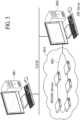
- the basic concept of OPC is shown in FIG. 3 where an OPC client 3001 can observe and/or control one, or more, device of a Control System 3003 in the Safety Domain 3010 via an OPC server 3002.
- OPC is a standard to interface between Embedded Systems, for example ES 1002 of FIG. 1A , and certain MMI, for example MMI 1009 of FIG. 1A, FIG. 1 B and FIG. 1 C . As such it cannot be used to migrate certain functionality out of the Embedded System, for example ES 1002, into separate devices, such as MMI, for example, which are outside of the safety domain, for example Safety Domain 1010 of FIG. 1 D . Neither does OPC enable to bring in any upgraded and/or replacement Embedded System into the Safety Domain without having to go through extensive safety re-certification processes and procedures.
- OPC cannot serve as a means for de-coupling the life-cycle of the Embedded System from the life-cycle of the Target System.
- OPC is a fixed SW interface and as such cannot provide (nor does it teach how to possibly provide) the necessary flexibility for changing the interfaces, at electrical level, for example.
- MirrorLink goes back to the so-called Terminal Mode and is a standard owned by the Car Connectivity Consortium, a non-profit legal entity registered in Delaware, USA.
- MirrorLink is, for example, described in Car Connectivity Consortium (2012) on January 6th, 2012 .
- FIG. 2 outlines the concept of MirrorLink, and is based on the above mentioned description.
- MirrorLink provides a standardized interface to connect a mobile phone, for example mobile phone 2003, to an automotive IVI system, for example IVI 2002, and where the mobile phone's MMI is augmented - or, sometimes, even be replaced - by the car's IVI inputs (such as buttons 2004, 2005, 2006) and outputs (such as display 2004 and loudspeakers 2001 ).
- the Safety Domain for example the car's Safety Domain2010, and allows to bring in, upgrade, replace mobile phones.
- MirrorLink does not provide any means to upgrade the car's IVI system 2002 from the car's Safety Domain 2010 without having to go through extensive safety certification processes and procedures.
- MirrorLink is a fixed, software-only protocol that runs over USB and/or WiFi and as such it does not provide (nor does it teach how to provide) the necessary flexibility on changing the interfaces between the Safety Domain and the User Domain, at electrical level, for example.
- the Embedded System comprises multiple components which communicate with each other; this communication is complex, often has to meet so-called realtime constraints which make it hard to partition.
- so-called meta functionality is implemented by close interaction between two, or more, Embedded System components, an example of which is automotive ESP (Electronic Stability Program) which typically is implemented by an automotive engine ECU interoperating with the automotive ECU for anti-lock braking.
- automotive ESP Electrical Stability Program
- the Embedded Systems have crucial responsibility for a safe operation of the Target System, and as such must fulfill certain safety requirements. Good examples are the above mentioned anti-lock brake ECUs for cars, or emergency shutdown control in heavy machinery.
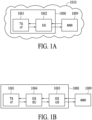
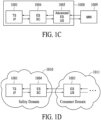
- FIG. 1A, FIG. 1 B , FIG. 1 C and FIG. 1 D each show such a system partitioning where a Target System 1000 comprises an Embedded System 1002. That Embedded System ES 1002 is partitioned into one part for the safety critical aspects, part ES SC 1004, and the remainder Embedded System ES US 1003, which may be untrusted, or unsafe, or uncertified.
- the safety critical part ES SC 1004 interfaces with said untrusted part ES US 1003 and, combined, provides at least the functionality of the original Embedded System ES 1002.
- the Embedded System part ES SC 1004 also interfaces with the Target System interface TS i/f 1001, designated for initially interfacing with the original Embedded System ES 1002.
- an ES SC 1004 part can be designed that has substantial and sufficient flexibility, to solve the life-cycle mismatch between the Embedded System and the Target System.
- a potentially unsafe, or unreliable, second system partition does (or does not) infringe a first system partition such that the first system partition's safe function will be impaired.
- Such impairment can be that the second system partition is not operating in accordance to its specification, for example by overheating, or by drawing too much current (so- called physical malfunctions), or by generating input data for the first system partition which may not represent legal or valid input data, or which may force the first system partition into an unsafe, or unspecified, system state.
- detection can be done by constantly monitoring the first system partition, its' health and appearance as well as the control and data signals that said second system partition inputs into the first system partition.
- second system partition controls the first system partition
- control is to be monitored and, if found to lead to a potentially unsafe, or unspecified, state, such control must not be executed, or handed over, to the first system partition, or not be passed on to the first system partition.
- said first system partition can not be impaired by the second system partition.
- the invention must further provide sufficient means to adopt to changes in the interfaces to the second system partition.
- flexibility in the connectivity to first system partition becomes important to reestablish the connectivity to the second system partition, or the advanced second system partition, for observing and/ or controlling the first system partition.
- a Control System CS 4001 which may represent said first system partition, for example, is connected via Communication Link CL 4006 to a User System Mediator Controller USMC 4003. Said USMC 4003, again, is connected via another Communication Link CL 4007 to a User System US 4002, which, for example, can be said second system partition.
- the USMC 4003 does perform the above described monitoring and supervisory functions to warrant proper, safe functioning of CS 4001, in accordance to its' specifications, as well as proper, safe functioning of the overall system 4000, in accordance to its' specifications. Obviously, this monitoring and supervision done by the USMC is not meant to be a replacement of any monitoring and supervision already done the either CS 4001 or the overall system 4000.
- This overall system 4000 thereby partitions into two domains: One is the domain 4010 which can be called Safety Domain or Control System Domain, or Control System, and the domain 401 1 which can be called user domain, consumer domain, user system domain, or user system.
- the monitoring and supervision performed by USMC 4003 is done in order maintain requirements of safety domain 4010 and to protect overall system 4000 or operators of overall system 4000 from harm when using any information that originates in user domain 4011 .
- the USMC 4003 can have a companion automaton 4008 which supports and facilitates USMC 4003 in monitoring, or supervising, the safe functioning of CS 4001 in accordance to its' specifications, by observing and/or controlling. It is important to mention that this companion automaton 4008 may be physically separate from USMC 4003.
- companion automaton 4008 may be a dedicated ECU, or it may be a SW subroutine running in the system partition CS 4001.
- the USMC 4003 can have another companion automaton 4009 which support and facilitates USMC 4003 in observing and/or controlling the safe functioning, in accordance to its' specifications, of US 4002. Similar to companion automaton 4008 the companion automaton 4009 may be physically separate from USMC 4003.
- companion automaton 4009 may be a dedicated ECU, or it may be a SW subroutine running in the system partition US 4002.
- the invention is the system of FIG. 5A where a USMC 5003, which may be USMC 4003 of FIG. 4A or FIG. 4B , is connected via a Communication Link CL 5006 to a Control System CS 5001.
- CS 5001 can, for example, be CS 4001 of FIG. 4A or FIG. 4B .
- USMC 5003 is further connected to two, or more, User System, for example US1 5002, US2 5012, and US3 5022. Connectivity between USMC 5003 and the two, or more, User System is established via shared Communication Link CL 5027.
- FIG. 5B where a USMC 5003, which may be USMC 4003 of FIG. 4A or FIG. 4B , is connected via a Communication Link CL 5007 to a User System US 5002.
- US 5002 can, for example, be US 4002 of FIG. 4A or FIG. 4B .
- USMC 5003 is further connected to two, or more, Control System, for example CS1 5001, CS2 5011, and CS3 5021. Connectivity between USMC 5003 and the two, or more, Control System is established via shared Communication Link CL 5026.
- the invention is the system of FIG. 5C where a USMC 5003, which may be USMC 4003 of FIG. 4A or FIG. 4B , is connected to two, or more, Control System, for example CS1 5001, CS2 5011, and CS3 5021. Connectivity between USMC 5003 and the two, or more, Control System is established via shared Communication Link CL 5026. USMC 5003 is further connected to two, or more, User System, for example US1 5002, US2 5012, and US3 5022. Connectivity between USMC 5003 and the two, or more, User System is established via shared Communication Link CL 5027.
- a USMC 5003 which may be USMC 4003 of FIG. 4A or FIG. 4B
- Control System for example CS1 5001, CS2 5011, and CS3 5021.
- Connectivity between USMC 5003 and the two, or more, Control System is established via shared Communication Link CL 5026.
- USMC 5003 is further connected to two, or more, User System, for example US1 5002, US
- the invention is the system of FIG. 5D where a USMC 5003, which may be USMC 4003 of FIG. 4A or FIG. 4B , is connected via a Communication Link CL 5006 to a Control System CS 5001.
- CS 5001 can, for example, be CS 4001 of FIG. 4A or FIG. 4B .
- USMC 5003 is further connected to two, or more, User System, for example US1 5002, US2 5012. Connectivity between USMC 5003 and the two, or more, User System is established via dedicated Communication Link CL 5007 and dedicated Communication Link CL 5017.
- the invention is the system of FIG. 5E where a USMC 5003, which may be USMC 4003 of FIG. 4A or FIG. 4B , is connected via a Communication Link CL 5007 to a User System US 5002.
- US 5002 can, for example, be US 4002 of FIG. 4A or FIG. 4B .
- USMC 5003 is further connected to two, or more, Control System, for example CS1 5001, CS2 5011. Connectivity between USMC 5003 and the two, or more, Control System is established via dedicated Communication Link CL 5006 and dedicated Communication Link CL 5016.
- a USMC 5003 may be USMC 4003 of FIG. 4A or FIG. 4B .
- USMC 5003 is connected to two, or more, Control System, for example CS1 5001, CS2 5011. Connectivity between USMC 5003 and the two, or more, Control System is established via dedicated Communication Link CL 5006 and dedicated Communication Link CL 5016.
- USMC 5003 is further connected to two, or more, User System, for example US1 5002, US2 5012. Connectivity between USMC 5003 and the two, or more, User System is established via dedicated Communication Link CL 5007 and dedicated Communication Link CL 5017.
- Our invention supports a wide variety of communication standards, or combinations thereof, for connecting to the USMC, for example USMC 4003 of FIG. 4A or FIG. 4B , or USMC 5003 of FIG. 5A, FIG. 5B, FIG. 5C , FIG. 5D, FIG. 5E and FIG. 5F .
- the connectivity in the Safety Domain in general follows certain approved standards for fail-safe, and/or reliable, and/or resilient, and/or secure communication
- our invention has a lot of flexibility in the connectivity.
- Connectivity to the Safety Domain for example Communication Link CL 4006 of FIG. 4A or FIG. 4B , or Communication Link CL 5006, or 5016, or 5026 of FIG. 5A, FIG. 5B, FIG. 5C , FIG. 5D, FIG. 5E and FIG.
- 5F can be any one, or more, of: CAN, MOST, FlexRay, LIN, EtherCat, ProfiNET, Sercos, TTCAN, CANOpen, IO- Link, SPI, IIC, TCP/IP v4, TCP/IP v6, IPsec, WiFi, AFDX, RS232, RS485, or any other current, or many other future connectivity standard.
- CAN CAN
- MOST FlexRay
- LIN EtherCat
- ProfiNET ProfiNET
- Sercos TTCAN
- CANOpen IO- Link
- SPI IIC
- TCP/IP v4 TCP/IP v6, IPsec
- WiFi AFDX
- RS232 RS485
- RS485F any other current, or many other future connectivity standard.
- shared Communication Link as it is, for example Communication Link CL 5026 of FIG. 5B and FIG. 5C , only those communication standards apply which support bus-like (such as CAN, for example) or network-like (such as Ethernet
- connectivity to the user domain for example Communication Link CL 4007 of FIG. 4A or FIG. 4B or CL 5007 or CL 5017 or CL 5027 of FIG. 5A, FIG. 5B, FIG. 5C , FIG. 5D, FIG. 5E and FIG. 5F can be an one, or more, of the following standards: USB 2.0, USB 3.0, PATA, SATA, PCIe V2.0, PCIe V3.0, WiFi, Ethernet, TCP/IP v4, TCP/IP v6, IPsec, RS232, SPI, IIC, IO- Link, GPIO, or any other current, or many other future connectivity standard.
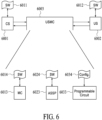
- a Control System CS 6001 is a data processing system executing the computer program 601 1 and a User System US 6002, also a data processing system executing the computer program 6012, are connected to each other indirectly via a User System Mediator Controller USMC 6003.
- USMC 6003 is a microcontroller system uC 6013, executing a microcontroller program 6014.
- USMC 6003 is an ASSP 6023, executing a computer program 6024.
- USMC 6003 is a Configurable System comprising programmable circuitry 6003, configured via Configuration Description 6034.
- SW in this context, is human and/or machine readable instructions that can be executed by a CPU, a DSP, an ASSP, and/or a SOC.
- HW in this context, is analog and/or digital circuitry which can be configured, for example an FPGA, or an FPAA, or a PLD, or a CPLD, or one or more combinations thereof assembled on a PCB.
- Control System such as CS 4001 of FIG. 4A or FIG. 4B , or CS 5001 or CS 501 1 or CS 5021 of FIG. 5A, FIG. 5B, FIG. 5C , FIG. 5D, FIG. 5E and FIG. 5F , can be one or more of the following:
- a User System Mediator Controller for example USMC 4003 of FIG. 4A or FIG. 4B or USMC 5003 of FIG. 5A, FIG. 5B, FIG. 5C , FIG. 5D, FIG. 5E and FIG. 5F or USMC 6003 of FIG. 6 , does provide a multitude of connectivity, data transport, and monitoring functionality. These can be one, or more, of the following:
- the USMC is a Firewall which ensures that certain data, or certain signals either get blocked or do pass from one domain to the other domain.
- the USMC can be the Firewall as it is described in Coss, M. J. and et al. (2000); Methods and Apparatus for a Computer Network Firewall with Stateful Packet Filtering; Patent US 6,141 ,749 , USPTO.
- the USMC can be the Firewall as it is described in Balakrishnan, S. and et al. (2007); Stateful Packet Content Matching Mechanisms; Patent Application WIPO 2007/120165 , WIPO.
- the USMC can be the Firewall as it is described in Luft, S. J.
- the USMC can be the Firewall as it is described in Balakrishnan, S. and et al. (2009); Multi-Pattern Packet Content Inspection Mechanism Employing Tagged Values; Patent US 7,624,436 , USPTO.
- the USMC can be the Firewall as it is described in Matityahu, E. and et al. (2009); Active Packet Content Analyzer for Communications Network; Patent US 7,499,412 , USPTO.
- the USMC can be the Firewall as it is described in Bagepalli, N. and et al.
- the USMC can be the Firewall as it is described in Varadarajan, S. and et al. (201 1 ); System and Method for Deep Packet Inspection; Patent US 8,068,431 , USPTO.
- the concepts described therein - and similar concepts known in the art - can be adopted to any other packet-based Communication Link, not just TCP/IP or UDP, such as, for example, CAN or Flexray or USB.
- the USMC acts as a Filter to filter information passing between the two domains.
- a Filter can be used to filter out information so that it does not pass from one domain to the other.
- the Filter exhibits similar behavior as the aforementioned Firewall.
- the Filter only lets pass particular information from one domain to the other.
- the USMC can filter information as it is described, for example, in Lukovsky, J. A. (2005); System and Method for a Process Attribute Based Computer Network Filter; Patent US 6,868,450 , USPTO.
- the USMC can filter information as it is described, for example, in Swander, B. D. and et al. (2008); Method for Managing Network Filter Based Policies; Patent US 7,409,707 , USPTO.
- the USMC functions like a communication Bridge where it forwards certain information, data, or signals from one system partition in one domain to another system partition in the other domain.
- Various approaches for a Bridge are known in the art that can be applied to the USMC.
- the USMC can perform functionality common to a Router:
- the USMC takes certain information, data, or signals from one domain and sends it to one particular, or more, system partitions in the other domain.
- the USMC can provide the functionality of the Router described in Sugai, K. and et al. (2006); Network Routing Apparatus; Patent US 7,088,716 , USPTO, or the Router described in Muranaka, T. and et al. (2008); Network Routing Apparatus; Patent US 7,379,456 , USPTO.
- the USMC acts as a Gateway between the Safety Domain and the user domain, or vice versa, by receiving information, data, or signals from one, or more, system partitions in one domain, translating, transposing, or altering said information, data, or signals to make it suitable to be sent to one, or more, system partition in the other domain.
- This is an important functionality because in a typical use case the communication protocols used by system partitions in one domain likely are different from the communication protocols used by system partitions in the other domain.
- Various approaches for such Gateways are known in the art, depending on the protocols involved.
- the USMC can be the Gateway described in Skoog, F. H.
- the USMC performs the functionality of a Proxy, for example to intercept the information, data, or signals going from one domain to the other domain.
- the USMC effectively proxies certain services, information, data, or signals, from one, or more, system partitions in the Safety Domain, to make them available for observing, or monitoring, or displaying by system partitions in the user domain.
- certain temperature values, pressure values, voltages, and other sensor values used internal to the Safety Domain for processing by system partitions in the Safety Domain can be proxied, or relayed, for monitoring, or for display, or for processing by system partitions in the user domain.
- a proxy The benefit of a proxy is that the system partition of the user domain does not have to directly communicate with system partitions in the Safety Domain. This can increase the robustness and the safety, for example, of the system partitions in the Safety Domain.
- Various concepts and methods are known in the art to build such Proxy.
- the USMC can implement some, or all, of the Proxy described in Green, M. W. and et al. (1999); Secure Network Proxy for Connecting Entities; Patent US 6,003,084 , USPTO, or the Proxy described in Knauerhase, R. C. and et al.
- the USMC can transport information, data, or signals from one domain to the other domain via a Tunnel.
- Such a Tunnel can use encryption and/or other security means to protect the information, data, or signals from being visible to any other system partition other than the system partitions it is meant for.
- a Tunnel can also protect from intercepting information, data, or signals and can also protect from so-called man-in-the-middle attacks. Therefore, in one embodiment of this invention the USMC performs functionality of a Tunnel as it is, for example, described in Ullas, V. and et al.
- the USMC can combine the aforementioned functionalities and can, for example, be one, or more, of a Firewall, a Filter, a Bridge, a Router, a Gateway, a Proxy, a Tunnel, possibly even at the same time, if necessary to meet the applications requirement.
- the USMC can, in one preferred embodiment of this invention be the USMC 7003 of FIG. 7A .
- This USMC comprises a User System Protocol Application Procedure Interface USPAPI 7018.
- the USPAPI 7018 interfaces with the one, or more, system partitions in the user domain. It can support multiple Communication Link and protocols, at physical-level, at electrical-level, at transaction-level, and/or at higher ISO/OSI communication levels.
- the USPAPI 7018 can perform some of the above mentioned Filter functions, for example by not transporting certain information, data, or signals from system partitions in the user domain. In combination with the User System to Control System Block U2C 7017, it can perform the Gateway function.
- U2C 7017 which receives its inputs from the USPAPI 7018 can also translate, transform, or transpose the information, data, or signals from the one, or more, User System into a format, or protocol, or data representation, suitable for processing by system partitions in the Safety Domain.
- the U2C 7017 can also perform Bridge functionality to transport information, data, or signals from one, or more, User System to one, or more, Control System.
- USMC 7003 additionally has a Controller Checker CC 7016 which can, for example, perform certain Firewall functionality to drop information, data, or signals that shall not pass through to the Safety Domain.
- Database DB 7014 can be used by the CC 7016 to share past information, data, or signals, or prior states of the CC 7014.
- Database DB7014 can also store past information, data, or signals, or prior states of Watchdog WD 7015.
- Database DB 7014 can also store past information, data, or signals, or prior states of the Firewall FW 7012.
- CSPAPI 7011 interfaces with the one, or more, system partitions in the Safety Domain. Therefore, it can support multiple Communication Link and protocols, at physical-level, at electrical-level, at transaction-level, and/or at higher ISO/OSI communication levels.
- the CSPAPI 7011 can also perform Filter functionality, for example by not passing through certain information, data, or signals from one, or more, system partitions in the Safety Domain.
- Firewall FW 7012 Gateway and/or Firewall functionality can be implemented: information, data, or signals from one, or more, system partitions in the Safety Domain can be blocked and/or forwarded to one, or more, system partitions in the user domain.
- FW 7012 can access the Database DB 7014 and received, or store, past information, data, or signals, or prior states.
- the Control System to User System Block C2U 7013 receives its input from said Firewall FW 7012.
- the information, data, or signals is then translated, or transformed, or transposed into a format, protocol, or data representation suitable for the one, or more, system partitions in the user domain.
- Such data is provided to the USPAPI 7018 for access by the one, or more, system partitions of the user domain. This, to some respect, provides a Bridge functionality, as well.
- the USMC 7003 can also have a powerful Watchdog Block WD 7015.
- This Watchdog WD 7015 takes care of safe interaction between any system partition in the user domain with the Control System. For example, based on information from the CC 7016 and/or FW 7012, which can be stored in the Database DB 7014, for example, the WD 7015 can perform Router functionality, and/or Proxy functionality, and/or Tunnel functionality. Router functionality can, for example, be done by the WD 7015 inserting, or changing, algorithms, heuristics, or rules in the Database DB 7014, which then impact the behavior of the CC 7016 or the FW 7012.
- Proxy functionality can be done in a similar way: WD 7015 stores past information, data, or signals or current information, data, or signals in Database DB 7014. This is the accessed by CC 7016 who presents it to one, or more, system partitions in the Safety Domain, via CSPAPI 7011. Or, this is then accessed by the FW 7012 who presents it to USPAPI 7018, after processing in C2U 7013, such that the information, data, or signals is then accessible by one, or more, system partitions in the user domain. Using the Database DB 7014 Proxy functionality can also include caching to reduce the Communication Link load.
- the USPAPI 7018 as well as the CSPAPI 701 1 can also perform Tunnel functionality.
- certain system partitions can use encryption, or other tunneling techniques for secure communication, to have a Virtual Private Communication Link, despite being on a shared Communication Link with other system partitions of the same domain. This is of particular importance when sensitive information, data, or signals, for example, from the Safety Domain, shall only be provided to very special system partitions in the user domain, but not to any others. Or, when very special system partitions in the user domain shall provide information, data, or signals, for example, for controlling the Safety Domain, but it must be ensured that other system partitions in the user domain do not interfere.
- WD 7015 can use DB 7014 and can interact with USPAPI 7018 to provide additional safety and security measures to be utilized by the one, or more, User System.
- Various measure can be provided by the USMC:
- One, or more, system partitions in the user domain can be registered and as such can have certain privileges in interacting with the Control System. Registration can occur by data exchange between a stub in the User System, for example, the stub 4009 of FIG. 4B . The existence of such a stub may be used to validate the User System to interact with the USMC and, thereby, with the Control System. In one preferred embodiment of this invention, the User System can identify itself to the USMC for interacting with the Control System.
- the User System would authenticate itself to the USMC.
- Various concepts for authentication, more or less sophisticated, are known in the art.
- one, or more, system partitions of the user domain can authenticate themselves using the concepts described in See, M. E. and et al; (2000). Deterministic User Authentication Service for Communication Network; Patent US 6,070,243 , USPTO, or the concepts described in Hemsath, D. K. (2005); Secure Shell Protocol Access Control; Patent US 6,851,113 , USPTO, or the concepts described in See, M. E. and et al. (2005); Deterministic User Authentication Service for Communication Network; Patent US 6,874,090 , USPTO, or the concepts described in Roux, P.
- Authentication may happen once, prior to interaction between the User System and the USMC, or authentication may happen on an ongoing basis.
- a system partition of the user domain may sufficiently be trusted to interact with the Control System via the USMC.
- the USMC may have different trust levels with different system partitions, or may change trust levels in the course of operation. Trust levels can be managed by the Watchdog, for example WD 7015 of FIG. 7 , and can be held persistent in a database, for example Database DB 7014 of FIG. 7A and FIG. 7B .
- different levels of validating the system partitions in the user domain are possible, ranging from simple detection, over registering, identification, authentication, all the way to ongoing challenge-response authentication methods.
- the USMC can ensure, from time to time, that the one, or more, system partitions of the user domain are eligible to interact with the Control System.
- the USMC can also monitor the livelihood, stability, consistency, trustedness, fitness, and/or health of the User System.
- the User System may be sending a so-called heartbeat signal indicating its death. Information about the death, stability, consistency, trustedness, fitness, and/or health can be embedded into that heartbeat.
- the User System can be sending a so-called keep-alive signal to the USMC to keep the connection to the USMC alive and valid.
- Health and/or fitness data can be hash sums, MD5 sums, Cyclic Redundancy Check (CRC) sums, system parameters, local physical sensor readings, which by itself, or in combination, enable the USMC to decide on the death, stability, consistency, trustedness, fitness, and/or health of the User System and/or at least one system partition of the user domain.
- CRC Cyclic Redundancy Check
- the USMC can also monitor the information, data, or signals on the one, or more, Communication Link. This can be used to avoid malicious behavior and/or failures when using shared Communication Link, for example.
- Various concepts for such analysis are known in the art that can be used by the USMC: For example, the USMC can detect so-called Denial-of-Service attacks by one, or more, system partitions of the user domain. Or, the USMC can detect a so-called Babbling Idiot situation on one, or more, Communication Link.
- the monitoring data which can be from the one, or more, system partitions in the user domain or from the one, or more, Communication Link with the User System can be recorded for later analysis.
- Data Logging can, for example, be done by the Watchdog WD 7015 which receives such data from the USPAPI 7018 and stores it for later retrieval in the Database DB 7014.
- This also enables the USMC to make decisions on whether to block or to pass the information, data, or signals from, or to, the User System based on past information, data, or signals and/or based on prior systems states.
- the USMC can block Audio/Video data sent from the User System to the Control System, based on current information, data, or signals from the Control System.
- the USMC blocks Audio/Video data from an IFE system in the User System upon a Passenger Attention Call in the Control System.
- the USMC blocks Audio/Video data from a Media Player in the User System upon a certain state in the Control System, for example when a Control System detects that it is in motion.
- the USMC has a model of at least one system partition of the Control System and, thereby, can decide whether an input from the User System may not be a legal information, data, or signals and/or may bring the Control System into an unsafe, or unspecified, or illegal state. In that case the USMC may decide to block the information, data, or signals from the User System to prevent unsafe operation.
- the USMC may report back to the User System that said information, data, or signals may have been unacceptable and thus was blocked.
- the sensitive blocks of the USMC for example the FW 7012, the C2U 7013, the DB 7014, the WD 7015, the CC 7016, and/or the U2C 7017 can be combined in a redundant Block 7010, which his instantiated more than once, for example in a second Block 7020, and/or a third Block 7030.
- a Voter 7041 controls via Multiplexor 7024 which output from which redundant Block, 7010, 7020, or 7030 is fed to the User System via USPAPI 7018.
- FIG. 70 Another Voter 7043 controls via a Multiplexor 7044 which output of which Blocks, 7010, 7020, or 7030, goes to the Control System via CSPAPI 7011.
- Various concepts for adding reliability, integrity, and/or availability via redundancy are known in the art that can be applied to the USMC: For example, the fault tolerance of Bello, S. E. and et al. (2000). Fault-Tolerant Multiple Processor System with Signature Voting.
- Patent US 6,128,755 , USPTO can be used. Or the concepts described in Glaser, R. S. and et al. (2002); Process Control Interface System Having Triply Redundant Remote Field Units; Patent EPO 1 193 576 , EPO, or the concepts described in Glaser, R. S. and et al. (1993); Process Control Interface Having Triply Redundant Remote Field Units; Patent Application WlPO 93/20488 , WIPO, can be used.
- the USMC can always and at any time maintain the safety and integrity of the Control System even if one, or more, system partitions in the user domain may be unsafe, may fail, and/or may be changed, upgraded, or replaced, with an advanced system partition.
- a Watchdog for example Watchdog WD 7015 of FIG. 7A and FIG. 7B , executes the method of FIG. 8 .
- this method is outlined for one single system partition. However, by running multiple instances of that Watchdog method two, or more, system partitions in the user domain can be interacted with.
- the Watchdog detects the existence and the connectivity of the User System in Step 8002. This can, for example, be done by querying a predetermined list of User System, or by listening to the traffic on the Communication Link to the User System, or by the User System actively requesting a connection. Once the one User System is detected it can be identified in Step 8003. Identification can, for example, be done by a unique device identifier of the User System, such as a MAC address for Ethernet, or via header information in the information, data, or signals sent from the User System. Or identification can be done by a stub running on the User System, for example stub 4009 of FIG. 4B , which sends a unique identifier to the USMC.
- Step 8003 can be optional.
- the Watchdog can authenticate the User System in Step 8004. Authentication can be done, for example, using the aforementioned concepts for authentication.
- the Step 8004 can be optional.
- Step 8005 the Watchdog validates the User System. Validation, again, can be done using the various aforementioned concepts including the heartbeat, keep-alive, and/or health monitoring concepts described above. Obviously, this Step 8005 can be performed once, or more than once, or from time to time, or on a regular basis.
- The, once or repeatedly, executed Decision 8006 decides whether the User System is valid. If the User System is valid that validation Step 8005 may be performed again, and again, and the User System may interact as specified with the USMC and, thereby, with the Control System.
- failure handling mode the USMC can go through certain steps to either remedy the situation, or to escalate, to ensure a proper, safe, integer operation of the overall Embedded System, in accordance to its specifications.
- the Watchdog makes the Decision 8007 whether to reset the User System. If the Watchdog decides that the User System shall be reset, for example based on current or past information, data, or signals, the Watchdog enters Step 8008 and does perform a resetting of the User System. Various possibilities exist for resetting a User System, for example by pulling a hardware reset line to Ground, or by restarting a software program from start. After Step 8008 the Watchdog must go back to Step 8002 again to re- detect the User System. If the Watchdog decides against resetting the User System, the Watchdog may decide via Decision 8009 whether, or not, to power-cycle the User System. Similar to Decision 8007, this may be based on past or current information, data, or signals.
- the Watchdog decides to power-cycle the User System, in a subsequent step 8010 the User System is power-cycled.
- the Watchdog can issue a power-cycle request to the USPAPI which then disconnects the User System from its power-supply for a short moment.
- the Watchdog sends a power-cycle command to a power-supply in the User System.
- the Watchdog goes back to Step 8002 to re-detect the User System.
- Step 801 the Watchdog may directly, or indirectly via the USPAPI, disconnect or ignore the User System.
- Disconnecting can, for example, be done by electrically disconnecting the User System.
- Ignoring can, for example, be done by adding a Filter to the USPAPI which filters out all information, data, or signals from that once User System.
- Ignoring can also be done, for example, by adding an additional rule to the Firewall not to send any more information, data, or signals to that User System. However, sometimes it may be necessary to disconnect the User System to ensure proper and safe functioning of the overall Embedded System.
- a physical disconnect may be the best solution.
- Various concepts to physically and/or electrically disconnect a device, a component, or a system partition from a system are known in the art that can be applied.
- the USMC like e. g. 4003
- the attached critical Control System such as CS 4001 of FIG. 4A or FIG. 4B
- CS 4001 of FIG. 4A or FIG. 4B the attached critical Control System
- some means of protection have to be foreseen in the attachment of the User System to the USMC.
- the invention includes the protection means as described in FIG. 9 .
- the User System US 9002 which can, for example, be User System US 4002, is attached via a chain of protection elements 9001 to the USMC 9003.
- the chain of protection elements 9001 depicted in FIG. 9 comprises different protection elements which can be combined in a multitude of different ways.
- the chain can comprise elements to protect against electrical shock (ESD) 9010, to effectively fuse over-current 9020, to protect against line conducted electromagnetic distortion 9030, and/or to electrically disconnect the User System from the USMC controlled by the USMC with stage 9040.
- ESD electrical shock
- a chain of protection elements can be built up completely from such protection elements or from only parts of such elements. This depends on the concrete requirements and the environmental conditions the USMC operates in. Different embodiments and topologies for the connectivity between the User System and the USMC are possible.
- protection elements 9010, 9020, 9030, 9040 and 9050 The elements depicted in FIG. 9 are exemplarily sketched in protection elements 9010, 9020, 9030, 9040 and 9050.
- the given protection elements are shown for a single system partition connectivity only and, obviously, can be extended for connecting to two, or more, User System.
- the given protection elements are for common mode distortion only, as in single line connections differential mode distortion may not happen. Obviously, differential mode protection has to be added when multi line protection is needed.
- the protection elements shall be selected in a way that it does not adversely interfere with data communication. So for each and every different embodiment of connection, proper protection elements have to be selected according to good engineering practice.
- Protection element 9010 shows one typical embodiment of ESD protection comprised only of a simple capacitor 9011 to lower the voltage of the external ESD event. Other embodiments of ESD protection are well known in the art and may be used as well.
- Protection element 9020 shows one typical embodiment of overcurrent limitation respectively overcurrent fuse. Overcurrent limitation is realized using a resistor 9021 and overcurrent fuse is realized using a cut-out fuse 9022.
- Protection element 9030 shows one typical embodiment of overvoltage protection. Instead of the shown voltage limitation diode 9031, other elements can be used as well. These can be, for example Varistors, gas filled dischargers, spark gaps, Zener diodes. With overvoltage protection it is especially necessary to incorporate means of protection for common mode and for differential overvoltage events in multi line connections.
- Protection element 9040 shows one typical embodiment of an EMI filter stage to filter out line conducted electromagnetic distortion.
- a ferrite bead 9041 is used to filter out higher frequency distortions.
- Other elements can be used. These can be, but are not limited to e. g. coils, suction circuits, current compensated coils, oscillation circuitry. With EMI filtering it is especially necessary to incorporate means of protection for common mode and for differential EM distortion events in multi line connections.
- Protection element 9050 shows one typical embodiment of a switch 9051 controlled by the USMC.
- Various devices can be used to deliver the switching functionality. These can, for example, be relays, analog switches using bipolar transistors, analog switches using FETs, optocouplers to also provide galvanic isolation. Special attention has to be laid on the monitoring functions of the USMC 9003 to evaluate the conditions when hazardous events make a cut of the US 9002 necessary.
- a multistage protection concept can be foreseen, for example, the potential damage that can happen to the critical circuit from the outside include but are not limited to electrostatic discharge, overvoltages, overcurrent, electrical or magnetic interference.
- a multi stage protection circuit design can be foreseen to prevent these conditions from being hazardous to the critical circuit in the User System.
- protection element circuit 10000 shows a typical implementation for ESD protection and line current limiter
- protection element circuit 10100 shows a typical implementation for overvoltage protection using diodes
- protection element circuit 10200 shows a typical implementation for overvoltage protection using varistor elements
- protection element circuit 10300 shows a typical implementation for overvoltage protection using gas filled dischargers
- protection element circuit 10400 shows a typical implementation for overvoltage protection using spark gap
- protection element circuit 10500 shows a typical implementation for overcurrent fuse
- protection element circuit 10600 shows a typical implementation for detachable connection using analog switches
- protection element circuit 10700 shows a typical implementation for detachable connection using relays
- protection element circuit 10800 shows a typical implementation for galvanic isolation using optocoupler
- protection element circuit 10900 shows a typical implementation for EMI filters using ferrites
- protection element circuit 1 1000 shows a typical implementation for EMI filters using coil and capacitor networks.
- chain of protection elements shall be selected in accordance to the physical interface and the possible threats to the critical system in the Control System. Protection elements can be selected within a wide range from simple protection means up to very complex combinations of the mentioned means and other non mentioned means.
- the principle of operation ranges from limiting the excess voltage/current/field while maintaining full operation, over transient cut-down of excess voltage/current/field up to complete disconnection of the external device (reversible or non-reversible).
- the aforementioned techniques enable an Embedded System to be partitioned into a Control System and a User System, and via the User System Mediator Controller USMC, both domains can interact with each other safely, and reliably.
- a Configurable System is a data processing and compute system where certain functionality in the data processing, or in the computation, or in the input/output connectivity, or in the Communication Link can be altered, changed, upgraded, or replaced during the life-cycle. This is possible because in a Configurable System not only the SW and the FW can be altered, changed, upgraded, or replaced, but also, to a wide extent, the underlying integrated circuitry, the so-called Configurable System Integrated Circuitry, CSIC. Altering, changing, upgrading, replacing the underlying CSIC is done by a combination of two techniques: Programmable digital, or analog, circuitry and a processing environment that controls how, and when, to program, or configure, the digital, or analog, circuitry.
- the CSIC again, has at least two types of programmable, or configurable, fabric out of the following: A Manufacturing-Time Fabric, MTF, which gets configured during the manufacturing step of the CSIC; a Compile- Time Fabric, CTF, which gets configured during the compile time of the CSIC; and third, a Run-Time Fabric which gets configured during the run-time of the CSIC.
- MTF Manufacturing-Time Fabric
- CTF Compile- Time Fabric
- CTF Compile- Time Fabric
- Run-Time Fabric which gets configured during the run-time of the CSIC.
- Manufacturing a CSIC is the step in semiconductor fabrication where integrated transistors and integrated wires are built (typically by etching silicon) in the semiconductor fabrication process. Once manufactured, the functionality of this CSIC fabric cannot be altered, an aspect which is well known from ASIC.
- Compiling a CSIC is a step which involves taking an HDL description and processing that HDL description through Electronic Design Automation (EDA) tools including synthesis, place and route.
- EDA Electronic Design Automation
- a typical example of compiling a CSIC is the EDA tool ISE Design Suite from Xilinx, Inc. in San Jose, CA. ISE Design Suite is described in the ISE 13.4 Design Suite User Guide, available for download at http://www.xilinx.com/support/documentation/dt_ise.htm.
- the result of such compile-time step is a so-called Configuration File (also known as bitfile) which can be uploaded into programmable logic, for example, to implement the desired digital, or analog, functionality.
- Configuration File also known as bitfile
- Compile-Time step can be done repeatedly, by changing the HDL description, for example, and by a subsequent re-compile step, a different Configuration File can be obtained, with possibly different digital, or analog, functionality.
- a different Configuration File can be obtained, with possibly different digital, or analog, functionality.
- Run-Time is the phase where a data processing, or compute system is actively operating.
- Run-Time Fabric is programmable, or configurable, fabric where one, or more, predetermined Configuration Files are generated in a Compile-Time step, as it is described above, and where certain portions of the CSIC can be reconfigured by uploading the one, or more, Configuration Files without affecting other areas of the running integrated circuitry.
- this run-time configurability is achieved by Dynamic Partial Reconfiguration of FPGA.
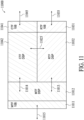
- the CSIC is the CSIC 11000 of FIG. 11 which has MTF, CTF, and RTF.
- CSIC 11000 comprises the MTF for data and signal processing, MTF DSP 11012, as well as input/output MTF connectivity, MTF IOB 11011, for flexible connectivity and versatile Communication Link, 11015.
- CSIC 11000 also comprises the CTF for data and signal processing, CTF DSP 11042, as well as input/output CTF connectivity, CTF IOB 11041, for flexible connectivity and versatile Communication Link, 11045.
- CSIC 11000 further comprises the RTF for data and signal processing, RTF DSP 11032, as well as input/output RTF connectivity, RTF IOB 11031, for flexible connectivity and versatile Communication Link, 11035.
- the Communication Link 11015, or the Communication Link 11035, or the Communication Link 11045 can be one, or more, out of GSM, UMTS, LTE, GPS, CAN, MOST, Flexray, LIN, AFDX, SPI, IIC, GPIO, Ethernet, EtherCat, ProfiNET, Sercos, TTCAN, CANOpen, UDP, TCP/IP, IPSec, RS232, RS485, USB, PATA, SATA, PCIe, WiFi, Bluetooth, or any current or future Communication Link that can be implemented with digital, or analog, circuitry.
- an interface within a mediator controller for example an interface within USMC 4003 of FIG. 4A or FIG. 4B or USMC 5003 of FIG. 5A, FIG. 5B, FIG. 5C , FIG. 5D, FIG. 5E and FIG. 5F or USMC 6003 of FIG. 6 , is reconfigurable so as to accommodate changes made to and within an associated second system partition such as US 4002 shown in FIG 4A , US 5002 shown in FIG. 5B or US 6002 shown in FIG 6 .
- MTF DSP 11012 can be one, or more, of the following: A FSM, a CPU, a DSP, an ASSP, or any other combinatorial or sequential digital circuitry.
- the CSIC is implemented by multiple devices, connected to each other, and to their respective Communication Link via a PCB.
- the CSIC is implemented by one single integrated semiconductor device, with the one, or more, Communication Link connected via a PCB.
- the CSIC is a single FPGA device, for example a device from the Virtex device family from Xilinx, Inc. in San Jose, CA, or the Stratix device family from Altera Corp. in San Jose, CA.
- a special processing environment controls how, and when, the RTF can be programmed, or configured, during run-time.
- the processing environment shall be implemented either in MTF or in CTF.
- this processing environment is the Processing Environment 12000 of FIG. 12 .
- a connectivity means 12105 multiple data processing and compute blocks are connected to each other, to interact and to exchange information, data, or signals.
- connectivity means for example an on-chip bus architecture like the PLB, or a network-on-chip architecture like AXI, or any other digital, or analog, connectivity.
- the basic Processing Environment 12000 has at least one CPU, CPU1 12103, at least one MCU, MCU 12102, and at least one RAM, RAM 12101, connected to each other by connectivity means 12105.
- the Processing Environment can have more than one CPU, for example it can have a second CPU, CPU2 12104, to implement symmetric multi-processing, or asymmetric multiprocessing compute architectures.
- SW 12010 The one, or more, CPU of the Processing Environment execute Software, for example SW 12010.
- This SW 12010 comprises, among other Software, and/or Firmware, and/or OS code, one, or more, Configuration Files for co-processing, and/or one, or more, Configuration Files for peripherals.
- SW 12010 comprises Configuration Files CB1 12021, CB2 12022, CB3 12023 for co-processing, and PB1 12011, PB2 12012, PB3 12013 for peripherals.
- SW 12010 can be executed on the one, or more CPU, once, or from time to time, or repeatedly, or on a regular basis.
- CB1 12021, or CB2 12022, or CB3 12023, or PB1 12011, or PB2 12012, or PB3 12013 can be uploaded into dedicated programmable, or configurable, blocks, such as, for example co-processing block CBA 12106, or CBB 12107, or peripheral block PBA 12108, or PBB 12109, respectively.
- co-processing block CBA 12106, or CBB 12107, or peripheral block PBA 12108, or PBB 12109 Obviously these coprocessing blocks and these peripheral blocks reside in the RTF.
- a CSIC can be implemented that has significant flexibility and versatility to alter, change, upgrade, or replace data processing and compute functionality as well as input/output connectivity and Communication Link over the life-cycle, either once, at manufacturing time, or many times during compile time, or if required by the application even at run-time.
- this can be used to build a more light-weight and power- efficient and less heat dissipating IFEC. Or, it can be used to build a more cost- efficient IVI with rich multi-media. Or, it can be used to build a more ergonomic MMI for robotics and medical systems.
Landscapes
- Engineering & Computer Science (AREA)
- Theoretical Computer Science (AREA)
- Software Systems (AREA)
- Computer Security & Cryptography (AREA)
- General Engineering & Computer Science (AREA)
- Physics & Mathematics (AREA)
- General Physics & Mathematics (AREA)
- Computer Hardware Design (AREA)
- Computing Systems (AREA)
- Computer Networks & Wireless Communication (AREA)
- Signal Processing (AREA)
- Human Computer Interaction (AREA)
- Health & Medical Sciences (AREA)
- General Health & Medical Sciences (AREA)
- Medical Informatics (AREA)
- Storage Device Security (AREA)
- Telephonic Communication Services (AREA)
- Safety Devices In Control Systems (AREA)
Claims (9)
- Système partitionné, comprenant :une première partition système (6001) fonctionnant dans un domaine de sécurité dans lequel l'exploitation de la première partition système (6001) se fait dans le cadre d'un Niveau d'Intégrité de Sécurité (SIL) défini comme niveau de réduction de risque par une fonction de sécurité ;une deuxième partition système (6002) fonctionnant dans un domaine d'utilisateur dans lequel l'exploitation de la deuxième partition système (6002) ne se fait pas dans le SIL et dans lequel des informations fournies par la deuxième partition système (6002) ne sont pas suffisamment fiables pour être utilisées par la première partition système (6001) dans le domaine de sécurité ; et,un contrôleur médiateur (6003) connecté à la première partition système (6001) via une première liaison de communication et à la deuxième partition système (6002) via une autre, deuxième, liaison de communication, le contrôleur médiateur (6003) recevant les informations fournies par la deuxième partition système (6002), le contrôleur médiateur (6003) surveillant et supervisant l'utilisation des informations fournies par la deuxième partition système (6002) afin de maintenir le SIL du domaine de sécurité, le contrôleur médiateur (6003) étant configurable de façon à s'adapter aux changements apportés à la deuxième partition système (6002) et à l'intérieur de celle-ci, le contrôleur médiateur (6003) agissant en tant que proxy pour fournir à la deuxième partition système (6002) des informations, données et signaux de services provenant de la première partition système (6001), etle contrôleur médiateur (6003) étant mis en œuvre à l'aide d'un système configurable, où les circuits intégrés, CI, sous-jacents du système configurable comprennent une matrice de fabrication, MTF (Manufacturing-Time Fabric), qui est configurée pendant la fabrication du CI, une matrice de compilation, CTF (Compile-Time Fabric), qui est configurée pendant la compilation du CI, et une matrice d'exécution, RTF (Run-Time Fabric), qui est configurée pendant l'exécution du CI, etla RTF étant une matrice programmable ou configurable configurée pour exploiter un ou plusieurs fichiers binaires de configuration prédéterminés qui ont été générés lors d'une étape de compilation, et où certaines parties du CI sont configurées pour être reconfigurées par téléchargement du ou des fichiers binaires de configuration sans modification d'autres zones du circuit intégré en cours d'exécution.
- Système partitionné selon la revendication 1, dans lequel le contrôleur médiateur (6003) est situé dans le domaine de sécurité.
- Système partitionné selon la revendication 1, dans lequel le contrôleur médiateur (6003) a une interface avec la deuxième partition système (6002), l'interface étant reconfigurable de façon à s'adapter aux changements apportés à la deuxième partition système (6002) et à l'intérieur de celle-ci.
- Système partitionné selon la revendication 1, dans lequel le contrôleur médiateur (6003) agit en tant que mandataire pour fournir à la première partition système (6001) des informations, données ou signaux de services provenant de la deuxième partition système (6002).
- Système partitionné selon la revendication 1, dans lequel la première partition système (6001) est l'une d'une pluralité de partitions système dans le domaine de sécurité, le contrôleur médiateur (6003) étant connecté à chacune de la pluralité de partitions système dans le domaine de sécurité, le contrôleur médiateur (6003) surveillant et supervisant l'utilisation des informations par la pluralité de partitions système dans le domaine de sécurité afin de maintenir les exigences du domaine de sécurité pour protéger le système ou les opérateurs du système contre les dommages.
- Système partitionné selon la revendication 1, dans lequel la deuxième partition système (6002) est l'une d'une pluralité de partitions système dans le domaine d'utilisateur, le contrôleur médiateur (6003) étant connecté à chacune de la pluralité de partitions système dans le domaine d'utilisateur, le contrôleur médiateur (6003) surveillant et supervisant l'utilisation de toute information fournie par la pluralité de partitions système afin de maintenir les exigences du domaine de sécurité pour protéger le système ou les opérateurs du système contre les dommages.
- Procédé d'exploitation d'un système partitionné, lequel procédé comprend :l'exploitation d'une première partition système (6001) dans un domaine de sécurité dans lequel l'exploitation de la première partition système (6001) se fait dans le cadre d'un Niveau d'Intégrité de Sécurité (SIL) défini comme niveau de réduction de risque par une fonction de sécurité ;l'exploitation d'une deuxième partition système (6002) dans un domaine d'utilisateur dans lequel l'exploitation de la deuxième partition système (6002) ne se fait pas dans le SIL et dans lequel des informations fournies par la deuxième partition système (6002) ne sont pas suffisamment fiables pour être utilisées par la première partition système (6001) dans le domaine de sécurité ;la réception des informations en provenance de la deuxième partition système (6002) par un contrôleur médiateur (6003) connecté à la première partition système (6001) via une première liaison de communication et à la deuxième partition système (6002) via une autre, deuxième, liaison de communication ; et,la surveillance et la supervision de l'utilisation des informations provenant de la deuxième partition système (6002) afin de maintenir le SIL du domaine de sécurité, la surveillance et la supervision étant exécutées par le contrôleur médiateur (6003), le contrôleur médiateur (6003) étant configurable de façon à s'adapter aux changements apportés à la deuxième partition système et à l'intérieur de celle-ci, le contrôleur médiateur (6003) agissant en tant que mandataire pour fournir à la deuxième partition système (6002) des informations, données ou signaux de services provenant de la première partition système (6001), etla mise en œuvre du contrôleur médiateur (6003) à l'aide d'un système configurable, où les circuits intégrés, CI, sous-jacents du système configurable comprennent une matrice de fabrication, MTF (Manufacturing-Time Fabric), qui est configurée pendant la fabrication du CI, une matrice de compilation, CTF (Compile-Time Fabric), qui est configurée pendant la compilation du CI, et une matrice d'exécution, RTF (Run-Time Fabric), qui est configurée pendant l'exécution du CI, etla RTF étant une matrice programmable ou configurable configurée pour exploiter un ou plusieurs fichiers binaires de configuration prédéterminés qui ont été générés lors d'une étape de compilation, et où certaines parties du CI sont configurées pour être reconfigurées par téléchargement du ou des fichiers binaires de configuration sans modification d'autres zones du circuit intégré en cours d'exécution.
- Procédé selon la revendication 7, comprenant en outre :
la reconfiguration d'une interface du contrôleur médiateur (6003) avec la deuxième partition système (6002) de façon qu'il s'adapte aux changements apportés à la deuxième partition système (6002) et à l'intérieur de celle-ci. - Procédé selon la revendication 8, dans lequel la surveillance et la supervision incluent l'action en tant que mandataire pour fournir à la première partition système (6001) des informations, données ou signaux de services provenant de la deuxième partition système (6002) .
Applications Claiming Priority (2)
| Application Number | Priority Date | Filing Date | Title |
|---|---|---|---|
| US201261603200P | 2012-02-24 | 2012-02-24 | |
| PCT/US2013/027528 WO2013126852A2 (fr) | 2012-02-24 | 2013-02-23 | Partitionnement de systèmes fonctionnant dans de multiples domaines |
Publications (3)
| Publication Number | Publication Date |
|---|---|
| EP2817761A2 EP2817761A2 (fr) | 2014-12-31 |
| EP2817761B1 true EP2817761B1 (fr) | 2024-10-23 |
| EP2817761C0 EP2817761C0 (fr) | 2024-10-23 |
Family
ID=48190576
Family Applications (1)
| Application Number | Title | Priority Date | Filing Date |
|---|---|---|---|
| EP13718922.1A Active EP2817761B1 (fr) | 2012-02-24 | 2013-02-23 | Partitionnement de systèmes fonctionnant dans de multiples domaines |
Country Status (3)
| Country | Link |
|---|---|
| US (1) | US10140049B2 (fr) |
| EP (1) | EP2817761B1 (fr) |
| WO (1) | WO2013126852A2 (fr) |
Families Citing this family (26)
| Publication number | Priority date | Publication date | Assignee | Title |
|---|---|---|---|---|
| US8429735B2 (en) * | 2010-01-26 | 2013-04-23 | Frampton E. Ellis | Method of using one or more secure private networks to actively configure the hardware of a computer or microchip |
| US12401619B2 (en) | 2010-01-26 | 2025-08-26 | Frampton E. Ellis | Computer or microchip with a secure system bios having a separate private network connection to a separate private network |
| DE102011107318A1 (de) * | 2011-07-06 | 2013-01-10 | Abb Ag | Verfahren zur Konfigurierung eines Kommunikationsschnittstellenmoduls in einem Steuerungs- oder Automatisierungssystem |
| US9627880B2 (en) * | 2013-11-01 | 2017-04-18 | Infineon Technologies Ag | Electronic safety path |
| US9501667B2 (en) * | 2014-06-20 | 2016-11-22 | Arm Limited | Security domain prediction |
| US9330030B2 (en) * | 2014-06-24 | 2016-05-03 | Google Inc. | Bridge decoder for a vehicle infotainment system |
| US10158966B2 (en) | 2014-11-05 | 2018-12-18 | At&T Intellectual Property I, L.P. | Connected car data links aggregator |
| DE102015200801A1 (de) * | 2015-01-20 | 2016-07-21 | Continental Teves Ag & Co. Ohg | Elektronische Steuerungsvorrichtung |
| CN104601423B (zh) * | 2015-02-06 | 2018-09-14 | 上海联影医疗科技有限公司 | Spi总线节点设备及其通信方法以及spi总线系统 |
| US9686316B2 (en) * | 2015-09-25 | 2017-06-20 | Cisco Technology, Inc. | Layer-2 security for industrial automation by snooping discovery and configuration messages |
| US10637841B2 (en) | 2015-12-08 | 2020-04-28 | Honeywell International Inc. | Apparatus and method for using a security appliance with IEC 61131-3 |
| DE102016113178A1 (de) * | 2016-07-18 | 2018-01-18 | Visteon Global Technologies Inc. | Elektronische Kontrolleinheit und Verfahren zur Wiedergabe von Audio- und/oder Video- oder holografischen Daten |
| EP4113302B1 (fr) * | 2017-01-05 | 2024-01-24 | Guardknox Cyber Technologies Ltd. | Systèmes informatiques spécialement programmés avec des dispositifs associés conçus pour mettre en oeuvre une unité de commande électronique de services centralisée basés sur une architecture orientée services et leurs procédés d'utilisation |
| US10754997B1 (en) * | 2017-05-30 | 2020-08-25 | The University Of Tulsa | Security data diode |
| US9932108B1 (en) * | 2017-09-11 | 2018-04-03 | Kitty Hawk Corporation | Flexible and robust communication interface |
| WO2019081326A1 (fr) * | 2017-10-26 | 2019-05-02 | Siemens Mobility GmbH | Concept pour faire fonctionner un véhicule ferroviaire |
| KR101956604B1 (ko) * | 2017-12-08 | 2019-03-11 | 현대오트론 주식회사 | 차량용 캔 메시지의 동적 라우팅 장치 및 방법 |
| GB2578268B (en) | 2018-01-29 | 2021-12-29 | Ge Aviat Systems Ltd | Configurable network switch for industrial control systems including deterministic networks |
| US10991255B2 (en) * | 2018-04-05 | 2021-04-27 | Ge Aviation Systems Llc | Providing an open interface to a flight management system |
| WO2020005857A1 (fr) | 2018-06-24 | 2020-01-02 | Hex Five Security, Inc. | Configuration, mise en application, et surveillance de la séparation d'environnements d'exécution de confiance |
| US10959100B1 (en) * | 2019-10-17 | 2021-03-23 | Charter Communications Operating, Llc | Secured communications routing in a network |
| CN110995726B (zh) * | 2019-12-11 | 2021-03-30 | 博依特(广州)工业互联网有限公司 | 一种基于内嵌arm的fpga芯片的网络隔离系统 |
| CN113742795B (zh) * | 2020-05-27 | 2024-07-02 | 台湾积体电路制造股份有限公司 | 对集成电路中的半导体存储器的安全级别进行认证的方法 |
| CN112783818B (zh) * | 2020-12-30 | 2024-07-30 | 加弘科技咨询(上海)有限公司 | 一种多核嵌入式系统的在线升级方法及系统 |
| US20230290189A1 (en) * | 2022-03-10 | 2023-09-14 | Xilinx, Inc. | Flexible queue provisioning for partitioned acceleration device |
| US20240383487A1 (en) * | 2023-05-15 | 2024-11-21 | GM Global Technology Operations LLC | Systems for detecting actuator misconfigurations in vehicles |
Citations (1)
| Publication number | Priority date | Publication date | Assignee | Title |
|---|---|---|---|---|
| US7210014B2 (en) * | 2004-05-27 | 2007-04-24 | Microsoft Corporation | Alternative methods in memory protection |
Family Cites Families (55)
| Publication number | Priority date | Publication date | Assignee | Title |
|---|---|---|---|---|
| DE3730468A1 (de) | 1987-09-08 | 1989-03-16 | Bergmann Kabelwerke Ag | Bordnetz fuer kraftfahrzeuge und verfahren zum betrieb des bordnetzes |
| US4922503A (en) | 1988-10-28 | 1990-05-01 | Infotron Systems Corporation | Local area network bridge |
| US5159673A (en) | 1990-03-22 | 1992-10-27 | Square D Company | Apparatus for networking programmable logic controllers to host computers |
| JP2500038B2 (ja) | 1992-03-04 | 1996-05-29 | インターナショナル・ビジネス・マシーンズ・コーポレイション | マルチプロセッサ・コンピュ―タ・システム、フォ―ルト・トレラント処理方法及びデ―タ処理システム |
| US5428769A (en) | 1992-03-31 | 1995-06-27 | The Dow Chemical Company | Process control interface system having triply redundant remote field units |
| US6708171B1 (en) | 1996-04-23 | 2004-03-16 | Sun Microsystems, Inc. | Network proxy |
| US6003084A (en) | 1996-09-13 | 1999-12-14 | Secure Computing Corporation | Secure network proxy for connecting entities |
| US6345303B1 (en) | 1997-03-25 | 2002-02-05 | Intel Corporation | Network proxy capable of dynamically selecting a destination device for servicing a client request |
| US6081591A (en) | 1997-04-16 | 2000-06-27 | Skoog; Frederick H. | Signaling network gateway device and method for use in a signaling network |
| US6173399B1 (en) | 1997-06-12 | 2001-01-09 | Vpnet Technologies, Inc. | Apparatus for implementing virtual private networks |
| US6070243A (en) | 1997-06-13 | 2000-05-30 | Xylan Corporation | Deterministic user authentication service for communication network |
| US6141749A (en) | 1997-09-12 | 2000-10-31 | Lucent Technologies Inc. | Methods and apparatus for a computer network firewall with stateful packet filtering |
| US6229819B1 (en) | 1997-10-21 | 2001-05-08 | Mci Communications Corporation | Advanced intelligent network gateway |
| US6339595B1 (en) | 1997-12-23 | 2002-01-15 | Cisco Technology, Inc. | Peer-model support for virtual private networks with potentially overlapping addresses |
| US6131163A (en) | 1998-02-17 | 2000-10-10 | Cisco Technology, Inc. | Network gateway mechanism having a protocol stack proxy |
| US6614800B1 (en) | 1999-09-02 | 2003-09-02 | International Business Machines Corporation | Method and system for virtual private network administration channels |
| JP4294821B2 (ja) | 2000-01-26 | 2009-07-15 | 株式会社日立製作所 | ネットワーク中継装置 |
| US6868450B1 (en) | 2000-05-17 | 2005-03-15 | Hewlett-Packard Development Company, L.P. | System and method for a process attribute based computer network filter |
| DE60042800D1 (de) | 2000-06-16 | 2009-10-01 | Fujitsu Ltd | Kommunikationsgerät mit VPN-Ermöglichungsfunktion |
| US7565407B1 (en) | 2000-12-22 | 2009-07-21 | Nortel Networks Limited | Network proxy apparatus and methods |
| US7136374B1 (en) | 2001-03-19 | 2006-11-14 | Juniper Networks, Inc. | Transport networks supporting virtual private networks, and configuring such networks |
| WO2002088972A1 (fr) | 2001-04-26 | 2002-11-07 | The Boeing Company | Systeme et procede permettant de conserver une terminaison appropriee et une communication sans erreur dans un bus de reseau |
| DE10123475A1 (de) | 2001-05-15 | 2002-11-21 | Volkswagen Ag | Multimediasystem für ein Fahrzeug |
| US6851113B2 (en) | 2001-06-29 | 2005-02-01 | International Business Machines Corporation | Secure shell protocol access control |
| US6963911B2 (en) | 2001-07-19 | 2005-11-08 | General Instrument Corporation | Distributed element network management |
| US6931004B2 (en) | 2001-08-31 | 2005-08-16 | Motorola, Inc. | Vehicle active network with backbone structure |
| US20030147534A1 (en) * | 2002-02-06 | 2003-08-07 | Ablay Sewim F. | Method and apparatus for in-vehicle device authentication and secure data delivery in a distributed vehicle network |
| JP3661946B2 (ja) | 2002-09-04 | 2005-06-22 | 三菱電機株式会社 | コントローラエリアネットワーク通信装置 |
| US7366774B2 (en) | 2003-01-31 | 2008-04-29 | Rockwell Automation Technologies, Inc. | Network delay monitor for safety control networks |
| JP2004260365A (ja) | 2003-02-25 | 2004-09-16 | Hitachi Ltd | 高速高ポート密度なネットワーク中継装置 |
| US7409707B2 (en) | 2003-06-06 | 2008-08-05 | Microsoft Corporation | Method for managing network filter based policies |
| GB2404827A (en) | 2003-08-05 | 2005-02-09 | Motorola Inc | Fault containment at non-faulty processing nodes in TDMA networks |
| US7103424B2 (en) * | 2003-09-02 | 2006-09-05 | National Instruments Corporation | Re-configurable motion controller drive |
| US7305706B2 (en) | 2004-01-15 | 2007-12-04 | Cisco Technology, Inc. | Establishing a virtual private network for a road warrior |
| US7757074B2 (en) | 2004-06-30 | 2010-07-13 | Citrix Application Networking, Llc | System and method for establishing a virtual private network |
| WO2006015245A2 (fr) * | 2004-07-29 | 2006-02-09 | Modius, Inc. | Passerelle pour dispositif configurable universelle |
| US7719966B2 (en) | 2005-04-13 | 2010-05-18 | Zeugma Systems Inc. | Network element architecture for deep packet inspection |
| US7784094B2 (en) | 2005-06-30 | 2010-08-24 | Intel Corporation | Stateful packet content matching mechanisms |
| US7624436B2 (en) | 2005-06-30 | 2009-11-24 | Intel Corporation | Multi-pattern packet content inspection mechanisms employing tagged values |
| US7499412B2 (en) | 2005-07-01 | 2009-03-03 | Net Optics, Inc. | Active packet content analyzer for communications network |
| US7313394B2 (en) | 2005-07-15 | 2007-12-25 | Intel Corporation | Secure proxy mobile apparatus, systems, and methods |
| US7725717B2 (en) | 2005-08-31 | 2010-05-25 | Motorola, Inc. | Method and apparatus for user authentication |
| US8407699B2 (en) * | 2008-03-10 | 2013-03-26 | Citrix Systems, Inc. | System and method for managing code isolation |
| US7991351B2 (en) | 2007-02-28 | 2011-08-02 | Kuban Paul A | Extension of wired controller area networks to wireless personal area networks |
| US7895463B2 (en) | 2007-08-28 | 2011-02-22 | Cisco Technology, Inc. | Redundant application network appliances using a low latency lossless interconnect link |
| GB2460393B (en) * | 2008-02-29 | 2012-03-28 | Advanced Risc Mach Ltd | A data processing apparatus and method for controlling access to secure memory by virtual machines executing on processing circuitry |
| US8510753B2 (en) * | 2008-06-27 | 2013-08-13 | Microsoft Corporation | Untrusted component hosting |
| GB2462302B (en) | 2008-08-01 | 2012-06-27 | Trilogy Comm Holdings Ltd | Communications network bridge |
| US8068431B2 (en) | 2009-07-17 | 2011-11-29 | Satyam Computer Services Limited | System and method for deep packet inspection |
| US8665882B2 (en) | 2009-10-30 | 2014-03-04 | Honeywell International Inc. | Serialized enforced authenticated controller area network |
| US9157955B2 (en) * | 2010-01-21 | 2015-10-13 | Freescale Semiconductor, Inc. | Chip damage detection device for a semiconductor integrated circuit |
| EP2556628A4 (fr) | 2010-04-07 | 2014-12-17 | Hewlett Packard Development Co | Système et procédé de découverte automatique de dispositifs côté abonné et de connexions d'interface dans environnement de mise en réseau privé virtuel |
| US8831821B2 (en) * | 2010-12-17 | 2014-09-09 | GM Global Technology Operations LLC | Controller area network message transmission disable testing systems and methods |
| US8583913B1 (en) * | 2011-09-14 | 2013-11-12 | Amazon Technologies, Inc. | Securely determining internet connectivity between networks |
| US9274578B2 (en) * | 2012-05-09 | 2016-03-01 | Apple Inc. | Enable power from an accessory to a host device based on whether the accessory is able to alter an electrical characteristic of the power path |
-
2013
- 2013-02-23 US US14/373,023 patent/US10140049B2/en active Active
- 2013-02-23 EP EP13718922.1A patent/EP2817761B1/fr active Active
- 2013-02-23 WO PCT/US2013/027528 patent/WO2013126852A2/fr not_active Ceased
Patent Citations (1)
| Publication number | Priority date | Publication date | Assignee | Title |
|---|---|---|---|---|
| US7210014B2 (en) * | 2004-05-27 | 2007-04-24 | Microsoft Corporation | Alternative methods in memory protection |
Non-Patent Citations (1)
| Title |
|---|
| KATHERINE COMPTON ET AL: "Programming Architectures For Run-Time Reconfigurable Systems Master's Thesis", 1 December 1999 (1999-12-01), XP055676496, Retrieved from the Internet <URL:https://kmorrow.ece.wisc.edu/Publications/Compton_MSThesis.pdf> [retrieved on 20200313] * |
Also Published As
| Publication number | Publication date |
|---|---|
| WO2013126852A3 (fr) | 2014-08-14 |
| US20140380001A1 (en) | 2014-12-25 |
| WO2013126852A2 (fr) | 2013-08-29 |
| US10140049B2 (en) | 2018-11-27 |
| EP2817761A2 (fr) | 2014-12-31 |
| EP2817761C0 (fr) | 2024-10-23 |
Similar Documents
| Publication | Publication Date | Title |
|---|---|---|
| EP2817761B1 (fr) | Partitionnement de systèmes fonctionnant dans de multiples domaines | |
| Bello et al. | Recent advances and trends in on-board embedded and networked automotive systems | |
| US10848442B2 (en) | Heterogeneous packet-based transport | |
| US10002258B2 (en) | Security system and method for protecting a vehicle electronic system | |
| CN117597903A (zh) | 对应用容器的动态代理响应 | |
| RU2562760C2 (ru) | Система управления маршрутом связи и способ управления маршрутом связи | |
| US11818235B1 (en) | Systems, devices and methods for hardware accelerated universal routing interface | |
| US10592322B1 (en) | Adaptive timeout mechanism | |
| US20080195747A1 (en) | Control protocol encapsulation | |
| CN103795615A (zh) | 灵活地将终端逻辑集成到各种平台的装置、方法和系统 | |
| CA2832019A1 (fr) | Systeme de reseau, commutateur et procede de detection de terminal de connexion | |
| CN110337799A (zh) | 具有车辆内部的数据网络的机动车以及运行机动车的方法 | |
| CN103380600A (zh) | 网络系统和网络流跟踪方法 | |
| CN104219333A (zh) | 用于提供通用接口的方法以及具有通用接口的微控制器 | |
| US20070217392A1 (en) | Programmbale controller and communication unit | |
| EP2717169A1 (fr) | Dispositif d'administration, dispositif de traitement d'information, système de traitement d'information, procédé de transfert de données, programme de sélection de chemin et programme de requête de transfert | |
| Shanker | Enhancing automotive embedded systems with FPGAs | |
| CN105432044A (zh) | 软冗余协议 | |
| US11954235B1 (en) | One-way communication data diode on a chip | |
| EP3566170B1 (fr) | Sécurisation d'un bus matériel non protégé | |
| JP2020021338A (ja) | 監視制御装置 | |
| Geier et al. | Hardware-accelerated data acquisition and authentication for high-speed video streams on future heterogeneous automotive processing platforms | |
| US20250379924A1 (en) | Systems and methods for managing communications across devices in a ring network | |
| Pereira | IoT Na gestão Remota De Centrais De deteção De incêndio | |
| Shreejith et al. | Enhancing communication on automotive networks using data layer extensions |
Legal Events
| Date | Code | Title | Description |
|---|---|---|---|
| PUAI | Public reference made under article 153(3) epc to a published international application that has entered the european phase |
Free format text: ORIGINAL CODE: 0009012 |
|
| 17P | Request for examination filed |
Effective date: 20140908 |
|
| AK | Designated contracting states |
Kind code of ref document: A2 Designated state(s): AL AT BE BG CH CY CZ DE DK EE ES FI FR GB GR HR HU IE IS IT LI LT LU LV MC MK MT NL NO PL PT RO RS SE SI SK SM TR |
|
| AX | Request for extension of the european patent |
Extension state: BA ME |
|
| DAX | Request for extension of the european patent (deleted) | ||
| STAA | Information on the status of an ep patent application or granted ep patent |
Free format text: STATUS: EXAMINATION IS IN PROGRESS |
|
| 17Q | First examination report despatched |
Effective date: 20181019 |
|
| REG | Reference to a national code |
Ref country code: DE Ref legal event code: R079 Free format text: PREVIOUS MAIN CLASS: G06F0021600000 Ipc: G06F0009500000 Ref country code: DE Ref legal event code: R079 Ref document number: 602013086219 Country of ref document: DE Free format text: PREVIOUS MAIN CLASS: G06F0021600000 Ipc: G06F0009500000 |
|
| GRAP | Despatch of communication of intention to grant a patent |
Free format text: ORIGINAL CODE: EPIDOSNIGR1 |
|
| STAA | Information on the status of an ep patent application or granted ep patent |
Free format text: STATUS: GRANT OF PATENT IS INTENDED |
|
| RIC1 | Information provided on ipc code assigned before grant |
Ipc: B61L 15/00 20060101ALN20240419BHEP Ipc: H04L 67/12 20220101ALI20240419BHEP Ipc: H04L 9/40 20220101ALI20240419BHEP Ipc: G06F 21/55 20130101ALI20240419BHEP Ipc: G06F 21/53 20130101ALI20240419BHEP Ipc: G06F 9/50 20060101AFI20240419BHEP |
|
| RIC1 | Information provided on ipc code assigned before grant |
Ipc: B61L 15/00 20060101ALN20240503BHEP Ipc: H04L 67/12 20220101ALI20240503BHEP Ipc: H04L 9/40 20220101ALI20240503BHEP Ipc: G06F 21/55 20130101ALI20240503BHEP Ipc: G06F 21/53 20130101ALI20240503BHEP Ipc: G06F 9/50 20060101AFI20240503BHEP |
|
| INTG | Intention to grant announced |
Effective date: 20240523 |
|
| GRAS | Grant fee paid |
Free format text: ORIGINAL CODE: EPIDOSNIGR3 |
|
| GRAA | (expected) grant |
Free format text: ORIGINAL CODE: 0009210 |
|
| STAA | Information on the status of an ep patent application or granted ep patent |
Free format text: STATUS: THE PATENT HAS BEEN GRANTED |
|
| AK | Designated contracting states |
Kind code of ref document: B1 Designated state(s): AL AT BE BG CH CY CZ DE DK EE ES FI FR GB GR HR HU IE IS IT LI LT LU LV MC MK MT NL NO PL PT RO RS SE SI SK SM TR |
|
| REG | Reference to a national code |
Ref country code: GB Ref legal event code: FG4D |
|
| REG | Reference to a national code |
Ref country code: CH Ref legal event code: EP |
|
| REG | Reference to a national code |
Ref country code: DE Ref legal event code: R096 Ref document number: 602013086219 Country of ref document: DE |
|
| REG | Reference to a national code |
Ref country code: IE Ref legal event code: FG4D |
|
| U01 | Request for unitary effect filed |
Effective date: 20241023 |
|
| U07 | Unitary effect registered |
Designated state(s): AT BE BG DE DK EE FI FR IT LT LU LV MT NL PT RO SE SI Effective date: 20241104 |
|
| U20 | Renewal fee for the european patent with unitary effect paid |
Year of fee payment: 13 Effective date: 20250217 |
|
| PG25 | Lapsed in a contracting state [announced via postgrant information from national office to epo] |
Ref country code: IS Free format text: LAPSE BECAUSE OF FAILURE TO SUBMIT A TRANSLATION OF THE DESCRIPTION OR TO PAY THE FEE WITHIN THE PRESCRIBED TIME-LIMIT Effective date: 20250223 Ref country code: HR Free format text: LAPSE BECAUSE OF FAILURE TO SUBMIT A TRANSLATION OF THE DESCRIPTION OR TO PAY THE FEE WITHIN THE PRESCRIBED TIME-LIMIT Effective date: 20241023 |
|
| PG25 | Lapsed in a contracting state [announced via postgrant information from national office to epo] |
Ref country code: ES Free format text: LAPSE BECAUSE OF FAILURE TO SUBMIT A TRANSLATION OF THE DESCRIPTION OR TO PAY THE FEE WITHIN THE PRESCRIBED TIME-LIMIT Effective date: 20241023 |
|
| PG25 | Lapsed in a contracting state [announced via postgrant information from national office to epo] |
Ref country code: NO Free format text: LAPSE BECAUSE OF FAILURE TO SUBMIT A TRANSLATION OF THE DESCRIPTION OR TO PAY THE FEE WITHIN THE PRESCRIBED TIME-LIMIT Effective date: 20250123 |
|
| PG25 | Lapsed in a contracting state [announced via postgrant information from national office to epo] |
Ref country code: GR Free format text: LAPSE BECAUSE OF FAILURE TO SUBMIT A TRANSLATION OF THE DESCRIPTION OR TO PAY THE FEE WITHIN THE PRESCRIBED TIME-LIMIT Effective date: 20250124 |
|
| PG25 | Lapsed in a contracting state [announced via postgrant information from national office to epo] |
Ref country code: PL Free format text: LAPSE BECAUSE OF FAILURE TO SUBMIT A TRANSLATION OF THE DESCRIPTION OR TO PAY THE FEE WITHIN THE PRESCRIBED TIME-LIMIT Effective date: 20241023 |
|
| PG25 | Lapsed in a contracting state [announced via postgrant information from national office to epo] |
Ref country code: RS Free format text: LAPSE BECAUSE OF FAILURE TO SUBMIT A TRANSLATION OF THE DESCRIPTION OR TO PAY THE FEE WITHIN THE PRESCRIBED TIME-LIMIT Effective date: 20250123 |
|
| PG25 | Lapsed in a contracting state [announced via postgrant information from national office to epo] |
Ref country code: SM Free format text: LAPSE BECAUSE OF FAILURE TO SUBMIT A TRANSLATION OF THE DESCRIPTION OR TO PAY THE FEE WITHIN THE PRESCRIBED TIME-LIMIT Effective date: 20241023 |
|
| PG25 | Lapsed in a contracting state [announced via postgrant information from national office to epo] |
Ref country code: SK Free format text: LAPSE BECAUSE OF FAILURE TO SUBMIT A TRANSLATION OF THE DESCRIPTION OR TO PAY THE FEE WITHIN THE PRESCRIBED TIME-LIMIT Effective date: 20241023 |
|
| PG25 | Lapsed in a contracting state [announced via postgrant information from national office to epo] |
Ref country code: CZ Free format text: LAPSE BECAUSE OF FAILURE TO SUBMIT A TRANSLATION OF THE DESCRIPTION OR TO PAY THE FEE WITHIN THE PRESCRIBED TIME-LIMIT Effective date: 20241023 |
|
| PLBE | No opposition filed within time limit |
Free format text: ORIGINAL CODE: 0009261 |
|
| STAA | Information on the status of an ep patent application or granted ep patent |
Free format text: STATUS: NO OPPOSITION FILED WITHIN TIME LIMIT |
|
| PG25 | Lapsed in a contracting state [announced via postgrant information from national office to epo] |
Ref country code: MC Free format text: LAPSE BECAUSE OF FAILURE TO SUBMIT A TRANSLATION OF THE DESCRIPTION OR TO PAY THE FEE WITHIN THE PRESCRIBED TIME-LIMIT Effective date: 20241023 |
|
| REG | Reference to a national code |
Ref country code: CH Ref legal event code: PL |
|
| 26N | No opposition filed |
Effective date: 20250724 |
|
| PG25 | Lapsed in a contracting state [announced via postgrant information from national office to epo] |
Ref country code: CH Free format text: LAPSE BECAUSE OF NON-PAYMENT OF DUE FEES Effective date: 20250228 |
|
| PG25 | Lapsed in a contracting state [announced via postgrant information from national office to epo] |
Ref country code: IE Free format text: LAPSE BECAUSE OF NON-PAYMENT OF DUE FEES Effective date: 20250223 |
|
| U20 | Renewal fee for the european patent with unitary effect paid |
Year of fee payment: 14 Effective date: 20260217 |
|
| PGFP | Annual fee paid to national office [announced via postgrant information from national office to epo] |
Ref country code: GB Payment date: 20260218 Year of fee payment: 14 |