EP2819128B1 - Aimant fritté en ferrite ainsi que moteur mettant en oeuvre celui-ci - Google Patents
Aimant fritté en ferrite ainsi que moteur mettant en oeuvre celui-ci Download PDFInfo
- Publication number
- EP2819128B1 EP2819128B1 EP13751491.5A EP13751491A EP2819128B1 EP 2819128 B1 EP2819128 B1 EP 2819128B1 EP 13751491 A EP13751491 A EP 13751491A EP 2819128 B1 EP2819128 B1 EP 2819128B1
- Authority
- EP
- European Patent Office
- Prior art keywords
- sintered ferrite
- ferrite magnet
- sintered
- ferrite
- crystal grains
- Prior art date
- Legal status (The legal status is an assumption and is not a legal conclusion. Google has not performed a legal analysis and makes no representation as to the accuracy of the status listed.)
- Active
Links
Images



Classifications
-
- H—ELECTRICITY
- H01—ELECTRIC ELEMENTS
- H01F—MAGNETS; INDUCTANCES; TRANSFORMERS; SELECTION OF MATERIALS FOR THEIR MAGNETIC PROPERTIES
- H01F1/00—Magnets or magnetic bodies characterised by the magnetic materials therefor; Selection of materials for their magnetic properties
- H01F1/01—Magnets or magnetic bodies characterised by the magnetic materials therefor; Selection of materials for their magnetic properties of inorganic materials
- H01F1/03—Magnets or magnetic bodies characterised by the magnetic materials therefor; Selection of materials for their magnetic properties of inorganic materials characterised by their coercivity
- H01F1/032—Magnets or magnetic bodies characterised by the magnetic materials therefor; Selection of materials for their magnetic properties of inorganic materials characterised by their coercivity of hard-magnetic materials
- H01F1/10—Magnets or magnetic bodies characterised by the magnetic materials therefor; Selection of materials for their magnetic properties of inorganic materials characterised by their coercivity of hard-magnetic materials non-metallic substances, e.g. ferrites, e.g. [(Ba,Sr)O(Fe2O3)6] ferrites with hexagonal structure
- H01F1/11—Magnets or magnetic bodies characterised by the magnetic materials therefor; Selection of materials for their magnetic properties of inorganic materials characterised by their coercivity of hard-magnetic materials non-metallic substances, e.g. ferrites, e.g. [(Ba,Sr)O(Fe2O3)6] ferrites with hexagonal structure in the form of particles
-
- C—CHEMISTRY; METALLURGY
- C04—CEMENTS; CONCRETE; ARTIFICIAL STONE; CERAMICS; REFRACTORIES
- C04B—LIME, MAGNESIA; SLAG; CEMENTS; COMPOSITIONS THEREOF, e.g. MORTARS, CONCRETE OR LIKE BUILDING MATERIALS; ARTIFICIAL STONE; CERAMICS; REFRACTORIES; TREATMENT OF NATURAL STONE
- C04B35/00—Shaped ceramic products characterised by their composition; Ceramics compositions; Processing powders of inorganic compounds preparatory to the manufacturing of ceramic products
- C04B35/01—Shaped ceramic products characterised by their composition; Ceramics compositions; Processing powders of inorganic compounds preparatory to the manufacturing of ceramic products based on oxide ceramics
- C04B35/26—Shaped ceramic products characterised by their composition; Ceramics compositions; Processing powders of inorganic compounds preparatory to the manufacturing of ceramic products based on oxide ceramics based on ferrites
-
- C—CHEMISTRY; METALLURGY
- C04—CEMENTS; CONCRETE; ARTIFICIAL STONE; CERAMICS; REFRACTORIES
- C04B—LIME, MAGNESIA; SLAG; CEMENTS; COMPOSITIONS THEREOF, e.g. MORTARS, CONCRETE OR LIKE BUILDING MATERIALS; ARTIFICIAL STONE; CERAMICS; REFRACTORIES; TREATMENT OF NATURAL STONE
- C04B35/00—Shaped ceramic products characterised by their composition; Ceramics compositions; Processing powders of inorganic compounds preparatory to the manufacturing of ceramic products
- C04B35/622—Forming processes; Processing powders of inorganic compounds preparatory to the manufacturing of ceramic products
- C04B35/626—Preparing or treating the powders individually or as batches ; preparing or treating macroscopic reinforcing agents for ceramic products, e.g. fibres; mechanical aspects section B
- C04B35/62605—Treating the starting powders individually or as mixtures
- C04B35/62685—Treating the starting powders individually or as mixtures characterised by the order of addition of constituents or additives
-
- H—ELECTRICITY
- H02—GENERATION; CONVERSION OR DISTRIBUTION OF ELECTRIC POWER
- H02K—DYNAMO-ELECTRIC MACHINES
- H02K1/00—Details of the magnetic circuit
- H02K1/02—Details of the magnetic circuit characterised by the magnetic material
-
- C—CHEMISTRY; METALLURGY
- C04—CEMENTS; CONCRETE; ARTIFICIAL STONE; CERAMICS; REFRACTORIES
- C04B—LIME, MAGNESIA; SLAG; CEMENTS; COMPOSITIONS THEREOF, e.g. MORTARS, CONCRETE OR LIKE BUILDING MATERIALS; ARTIFICIAL STONE; CERAMICS; REFRACTORIES; TREATMENT OF NATURAL STONE
- C04B2235/00—Aspects relating to ceramic starting mixtures or sintered ceramic products
- C04B2235/02—Composition of constituents of the starting material or of secondary phases of the final product
- C04B2235/30—Constituents and secondary phases not being of a fibrous nature
- C04B2235/32—Metal oxides, mixed metal oxides, or oxide-forming salts thereof, e.g. carbonates, nitrates, (oxy)hydroxides, chlorides
- C04B2235/3201—Alkali metal oxides or oxide-forming salts thereof
-
- C—CHEMISTRY; METALLURGY
- C04—CEMENTS; CONCRETE; ARTIFICIAL STONE; CERAMICS; REFRACTORIES
- C04B—LIME, MAGNESIA; SLAG; CEMENTS; COMPOSITIONS THEREOF, e.g. MORTARS, CONCRETE OR LIKE BUILDING MATERIALS; ARTIFICIAL STONE; CERAMICS; REFRACTORIES; TREATMENT OF NATURAL STONE
- C04B2235/00—Aspects relating to ceramic starting mixtures or sintered ceramic products
- C04B2235/02—Composition of constituents of the starting material or of secondary phases of the final product
- C04B2235/30—Constituents and secondary phases not being of a fibrous nature
- C04B2235/32—Metal oxides, mixed metal oxides, or oxide-forming salts thereof, e.g. carbonates, nitrates, (oxy)hydroxides, chlorides
- C04B2235/3205—Alkaline earth oxides or oxide forming salts thereof, e.g. beryllium oxide
- C04B2235/3208—Calcium oxide or oxide-forming salts thereof, e.g. lime
-
- C—CHEMISTRY; METALLURGY
- C04—CEMENTS; CONCRETE; ARTIFICIAL STONE; CERAMICS; REFRACTORIES
- C04B—LIME, MAGNESIA; SLAG; CEMENTS; COMPOSITIONS THEREOF, e.g. MORTARS, CONCRETE OR LIKE BUILDING MATERIALS; ARTIFICIAL STONE; CERAMICS; REFRACTORIES; TREATMENT OF NATURAL STONE
- C04B2235/00—Aspects relating to ceramic starting mixtures or sintered ceramic products
- C04B2235/02—Composition of constituents of the starting material or of secondary phases of the final product
- C04B2235/30—Constituents and secondary phases not being of a fibrous nature
- C04B2235/32—Metal oxides, mixed metal oxides, or oxide-forming salts thereof, e.g. carbonates, nitrates, (oxy)hydroxides, chlorides
- C04B2235/3205—Alkaline earth oxides or oxide forming salts thereof, e.g. beryllium oxide
- C04B2235/3213—Strontium oxides or oxide-forming salts thereof
-
- C—CHEMISTRY; METALLURGY
- C04—CEMENTS; CONCRETE; ARTIFICIAL STONE; CERAMICS; REFRACTORIES
- C04B—LIME, MAGNESIA; SLAG; CEMENTS; COMPOSITIONS THEREOF, e.g. MORTARS, CONCRETE OR LIKE BUILDING MATERIALS; ARTIFICIAL STONE; CERAMICS; REFRACTORIES; TREATMENT OF NATURAL STONE
- C04B2235/00—Aspects relating to ceramic starting mixtures or sintered ceramic products
- C04B2235/02—Composition of constituents of the starting material or of secondary phases of the final product
- C04B2235/30—Constituents and secondary phases not being of a fibrous nature
- C04B2235/32—Metal oxides, mixed metal oxides, or oxide-forming salts thereof, e.g. carbonates, nitrates, (oxy)hydroxides, chlorides
- C04B2235/327—Iron group oxides, their mixed metal oxides, or oxide-forming salts thereof
- C04B2235/3272—Iron oxides or oxide forming salts thereof, e.g. hematite, magnetite
-
- C—CHEMISTRY; METALLURGY
- C04—CEMENTS; CONCRETE; ARTIFICIAL STONE; CERAMICS; REFRACTORIES
- C04B—LIME, MAGNESIA; SLAG; CEMENTS; COMPOSITIONS THEREOF, e.g. MORTARS, CONCRETE OR LIKE BUILDING MATERIALS; ARTIFICIAL STONE; CERAMICS; REFRACTORIES; TREATMENT OF NATURAL STONE
- C04B2235/00—Aspects relating to ceramic starting mixtures or sintered ceramic products
- C04B2235/02—Composition of constituents of the starting material or of secondary phases of the final product
- C04B2235/30—Constituents and secondary phases not being of a fibrous nature
- C04B2235/34—Non-metal oxides, non-metal mixed oxides, or salts thereof that form the non-metal oxides upon heating, e.g. carbonates, nitrates, (oxy)hydroxides, chlorides
- C04B2235/3418—Silicon oxide, silicic acids or oxide forming salts thereof, e.g. silica sol, fused silica, silica fume, cristobalite, quartz or flint
-
- C—CHEMISTRY; METALLURGY
- C04—CEMENTS; CONCRETE; ARTIFICIAL STONE; CERAMICS; REFRACTORIES
- C04B—LIME, MAGNESIA; SLAG; CEMENTS; COMPOSITIONS THEREOF, e.g. MORTARS, CONCRETE OR LIKE BUILDING MATERIALS; ARTIFICIAL STONE; CERAMICS; REFRACTORIES; TREATMENT OF NATURAL STONE
- C04B2235/00—Aspects relating to ceramic starting mixtures or sintered ceramic products
- C04B2235/02—Composition of constituents of the starting material or of secondary phases of the final product
- C04B2235/30—Constituents and secondary phases not being of a fibrous nature
- C04B2235/44—Metal salt constituents or additives chosen for the nature of the anions, e.g. hydrides or acetylacetonate
- C04B2235/442—Carbonates
-
- C—CHEMISTRY; METALLURGY
- C04—CEMENTS; CONCRETE; ARTIFICIAL STONE; CERAMICS; REFRACTORIES
- C04B—LIME, MAGNESIA; SLAG; CEMENTS; COMPOSITIONS THEREOF, e.g. MORTARS, CONCRETE OR LIKE BUILDING MATERIALS; ARTIFICIAL STONE; CERAMICS; REFRACTORIES; TREATMENT OF NATURAL STONE
- C04B2235/00—Aspects relating to ceramic starting mixtures or sintered ceramic products
- C04B2235/02—Composition of constituents of the starting material or of secondary phases of the final product
- C04B2235/50—Constituents or additives of the starting mixture chosen for their shape or used because of their shape or their physical appearance
- C04B2235/54—Particle size related information
- C04B2235/5409—Particle size related information expressed by specific surface values
-
- C—CHEMISTRY; METALLURGY
- C04—CEMENTS; CONCRETE; ARTIFICIAL STONE; CERAMICS; REFRACTORIES
- C04B—LIME, MAGNESIA; SLAG; CEMENTS; COMPOSITIONS THEREOF, e.g. MORTARS, CONCRETE OR LIKE BUILDING MATERIALS; ARTIFICIAL STONE; CERAMICS; REFRACTORIES; TREATMENT OF NATURAL STONE
- C04B2235/00—Aspects relating to ceramic starting mixtures or sintered ceramic products
- C04B2235/02—Composition of constituents of the starting material or of secondary phases of the final product
- C04B2235/50—Constituents or additives of the starting mixture chosen for their shape or used because of their shape or their physical appearance
- C04B2235/54—Particle size related information
- C04B2235/5418—Particle size related information expressed by the size of the particles or aggregates thereof
- C04B2235/5436—Particle size related information expressed by the size of the particles or aggregates thereof micrometer sized, i.e. from 1 to 100 micron
-
- C—CHEMISTRY; METALLURGY
- C04—CEMENTS; CONCRETE; ARTIFICIAL STONE; CERAMICS; REFRACTORIES
- C04B—LIME, MAGNESIA; SLAG; CEMENTS; COMPOSITIONS THEREOF, e.g. MORTARS, CONCRETE OR LIKE BUILDING MATERIALS; ARTIFICIAL STONE; CERAMICS; REFRACTORIES; TREATMENT OF NATURAL STONE
- C04B2235/00—Aspects relating to ceramic starting mixtures or sintered ceramic products
- C04B2235/02—Composition of constituents of the starting material or of secondary phases of the final product
- C04B2235/50—Constituents or additives of the starting mixture chosen for their shape or used because of their shape or their physical appearance
- C04B2235/54—Particle size related information
- C04B2235/5418—Particle size related information expressed by the size of the particles or aggregates thereof
- C04B2235/5445—Particle size related information expressed by the size of the particles or aggregates thereof submicron sized, i.e. from 0,1 to 1 micron
-
- C—CHEMISTRY; METALLURGY
- C04—CEMENTS; CONCRETE; ARTIFICIAL STONE; CERAMICS; REFRACTORIES
- C04B—LIME, MAGNESIA; SLAG; CEMENTS; COMPOSITIONS THEREOF, e.g. MORTARS, CONCRETE OR LIKE BUILDING MATERIALS; ARTIFICIAL STONE; CERAMICS; REFRACTORIES; TREATMENT OF NATURAL STONE
- C04B2235/00—Aspects relating to ceramic starting mixtures or sintered ceramic products
- C04B2235/02—Composition of constituents of the starting material or of secondary phases of the final product
- C04B2235/50—Constituents or additives of the starting mixture chosen for their shape or used because of their shape or their physical appearance
- C04B2235/54—Particle size related information
- C04B2235/5418—Particle size related information expressed by the size of the particles or aggregates thereof
- C04B2235/5454—Particle size related information expressed by the size of the particles or aggregates thereof nanometer sized, i.e. below 100 nm
-
- C—CHEMISTRY; METALLURGY
- C04—CEMENTS; CONCRETE; ARTIFICIAL STONE; CERAMICS; REFRACTORIES
- C04B—LIME, MAGNESIA; SLAG; CEMENTS; COMPOSITIONS THEREOF, e.g. MORTARS, CONCRETE OR LIKE BUILDING MATERIALS; ARTIFICIAL STONE; CERAMICS; REFRACTORIES; TREATMENT OF NATURAL STONE
- C04B2235/00—Aspects relating to ceramic starting mixtures or sintered ceramic products
- C04B2235/60—Aspects relating to the preparation, properties or mechanical treatment of green bodies or pre-forms
- C04B2235/602—Making the green bodies or pre-forms by moulding
-
- C—CHEMISTRY; METALLURGY
- C04—CEMENTS; CONCRETE; ARTIFICIAL STONE; CERAMICS; REFRACTORIES
- C04B—LIME, MAGNESIA; SLAG; CEMENTS; COMPOSITIONS THEREOF, e.g. MORTARS, CONCRETE OR LIKE BUILDING MATERIALS; ARTIFICIAL STONE; CERAMICS; REFRACTORIES; TREATMENT OF NATURAL STONE
- C04B2235/00—Aspects relating to ceramic starting mixtures or sintered ceramic products
- C04B2235/70—Aspects relating to sintered or melt-casted ceramic products
- C04B2235/72—Products characterised by the absence or the low content of specific components, e.g. alkali metal free alumina ceramics
-
- C—CHEMISTRY; METALLURGY
- C04—CEMENTS; CONCRETE; ARTIFICIAL STONE; CERAMICS; REFRACTORIES
- C04B—LIME, MAGNESIA; SLAG; CEMENTS; COMPOSITIONS THEREOF, e.g. MORTARS, CONCRETE OR LIKE BUILDING MATERIALS; ARTIFICIAL STONE; CERAMICS; REFRACTORIES; TREATMENT OF NATURAL STONE
- C04B2235/00—Aspects relating to ceramic starting mixtures or sintered ceramic products
- C04B2235/70—Aspects relating to sintered or melt-casted ceramic products
- C04B2235/74—Physical characteristics
- C04B2235/76—Crystal structural characteristics, e.g. symmetry
- C04B2235/767—Hexagonal symmetry, e.g. beta-Si3N4, beta-Sialon, alpha-SiC or hexa-ferrites
-
- C—CHEMISTRY; METALLURGY
- C04—CEMENTS; CONCRETE; ARTIFICIAL STONE; CERAMICS; REFRACTORIES
- C04B—LIME, MAGNESIA; SLAG; CEMENTS; COMPOSITIONS THEREOF, e.g. MORTARS, CONCRETE OR LIKE BUILDING MATERIALS; ARTIFICIAL STONE; CERAMICS; REFRACTORIES; TREATMENT OF NATURAL STONE
- C04B2235/00—Aspects relating to ceramic starting mixtures or sintered ceramic products
- C04B2235/70—Aspects relating to sintered or melt-casted ceramic products
- C04B2235/74—Physical characteristics
- C04B2235/78—Grain sizes and shapes, product microstructures, e.g. acicular grains, equiaxed grains, platelet-structures
- C04B2235/782—Grain size distributions
-
- C—CHEMISTRY; METALLURGY
- C04—CEMENTS; CONCRETE; ARTIFICIAL STONE; CERAMICS; REFRACTORIES
- C04B—LIME, MAGNESIA; SLAG; CEMENTS; COMPOSITIONS THEREOF, e.g. MORTARS, CONCRETE OR LIKE BUILDING MATERIALS; ARTIFICIAL STONE; CERAMICS; REFRACTORIES; TREATMENT OF NATURAL STONE
- C04B2235/00—Aspects relating to ceramic starting mixtures or sintered ceramic products
- C04B2235/70—Aspects relating to sintered or melt-casted ceramic products
- C04B2235/74—Physical characteristics
- C04B2235/78—Grain sizes and shapes, product microstructures, e.g. acicular grains, equiaxed grains, platelet-structures
- C04B2235/785—Submicron sized grains, i.e. from 0,1 to 1 micron
-
- C—CHEMISTRY; METALLURGY
- C04—CEMENTS; CONCRETE; ARTIFICIAL STONE; CERAMICS; REFRACTORIES
- C04B—LIME, MAGNESIA; SLAG; CEMENTS; COMPOSITIONS THEREOF, e.g. MORTARS, CONCRETE OR LIKE BUILDING MATERIALS; ARTIFICIAL STONE; CERAMICS; REFRACTORIES; TREATMENT OF NATURAL STONE
- C04B2235/00—Aspects relating to ceramic starting mixtures or sintered ceramic products
- C04B2235/70—Aspects relating to sintered or melt-casted ceramic products
- C04B2235/74—Physical characteristics
- C04B2235/78—Grain sizes and shapes, product microstructures, e.g. acicular grains, equiaxed grains, platelet-structures
- C04B2235/788—Aspect ratio of the grains
Definitions
- the present invention relates to a sintered ferrite magnet and a motor provided therewith.
- M type Sr ferrite As magnetic materials that are used in a sintered ferrite magnet, Ba ferrite, Sr ferrite, and Ca ferrite which have a hexagonal crystal structure are known. Recently, among these magnetic materials, as a magnet material for motors and the like, magnetoplumbite type (M type) Sr ferrite has been mainly employed.
- the M type ferrite is expressed by, for example, General Formula of AFe 12 O 19 .
- the Sr ferrite has Sr at an A site of the crystal structure.
- Patent Literature 1 discloses a technology of improving a residual magnetic flux density (Br) and a coercive force (HcJ) by substituting parts of the A site and the B site with a specific amount of rare-earth element and Co.
- a motor may be exemplified.
- the sintered ferrite magnet that is used in a motor is demanded to be excellent in both characteristics of the Br and the HcJ.
- the Br and the HcJ are in a trade-off relationship. Therefore, it has been demanded to establish a technology capable of further improving both characteristics of Br and HcJ.
- JP S58 156575 A , JP S51 133798 A , JP S54 71395 A and JP S52 17694 A disclose sintered Sr ferrite magnets.
- JP 2006 327883 A relates to W-type Sr ferrite magnets.
- Patent Literature 1 Japanese Unexamined Patent Application Publication No. 11-154604
- Patent Literature 1 it is effective to improve the magnetic characteristics by controlling a composition of main crystal grains that constitutes the sintered ferrite magnet.
- some accessory components that are contained in the sintered ferrite magnet have an operation of improving the magnetic characteristics or sinterability.
- reliability in excellent strength, external appearance, and the like of the sintered ferrite magnet may be damaged depending on a kind of the accessory component or an amount thereof in some cases.
- a sintered ferrite magnet having low strength or a sintered ferrite magnet in which foreign matter tends to precipitate on a surface thereof in a motor there is a concern that the sintered ferrite magnet is broken, or peeled off and falls down during use of the motor. Therefore, a sintered ferrite magnet, which has not only the magnetic characteristics and but also high reliability, has been demanded.
- the invention has been made in consideration of the above-described circumstances, and an object thereof is to provide a sintered ferrite magnet which is excellent in both characteristics of a residual magnetic flux density (Br) and a coercive force (HcJ), and which has high reliability.
- another object of the invention is to provide a motor which has high efficiency and which is excellent in reliability.
- the present inventors have made an examination on improvement of magnetic characteristics by giving attention to the entire composition of the sintered ferrite magnet and a composition of a grain boundary in addition to a composition of a crystal grain. As a result, the present inventors have found that when a predetermined accessory component is contained, the magnetic characteristics and the reliability of the sintered ferrite magnet can be improved, and they have accomplished the invention.
- a sintered ferrite magnet comprising Sr ferrite having a hexagonal crystal structure, wherein a total amount of Na and K is 0.02 to 0.15 % by mass in terms of Na 2 O and K 2 O, an amount of Si is 0.3 to 0.94% by mass in terms of SiO 2 , and the following Expression (1) is satisfied.
- Sr F represents an amount of Sr, on a molar basis, other than Sr which constitutes the Sr ferrite, and Ba, Ca, Na, and K represent amounts of respective elements on a molar basis.
- the sintered ferrite magnet of the invention is excellent in both characteristics of Br and HcJ and has high reliability.
- the present inventors consider that the reason of obtaining these effects is because a grain boundary composition of the sintered ferrite magnet contributes to the effects. That is, it is considered that silicate glass, which contains Sr other than Sr that constitutes the Sr ferrite and at least one of Ba, Ca, Na, and K as a constituent element, is formed at the grain boundary of the sintered ferrite magnet. It is considered that the sintered ferrite magnet of the invention has a grain boundary composition in a ratio with which the silicate glass is stably formed. Accordingly, the sintered ferrite magnet tends to have a stable and dense structure, and thus it is considered that the sintered ferrite magnet has high Br and HcJ and high reliability.
- the sintered ferrite magnet of the invention satisfy the following Expression (2). According to this, it is possible to further increase the value of Br +1/3HcJ.
- Sr F represents an amount of Sr, on a molar basis, other than Sr which constitutes the Sr ferrite, and Ba, Ca, Na, and K represent amounts of respective elements on a molar basis. 1.7 ⁇ Sr F + Ba + Ca + 2 Na + 2 K / Si ⁇ 2.7
- the sintered ferrite magnet of the invention satisfy the following Expression (3). According to this, the sintered ferrite magnet has more excellent magnetic characteristics. Br + 1 / 3 ⁇ HcJ ⁇ 5.3
- Br and HcJ represent a residual magnetic flux density (kG) and a coercive force (kOe), respectively.
- an average grain size of crystal grains of the Sr ferrite be 1.0 ⁇ m or less, and a ratio of crystal grains, which have a grain size of 2.0 ⁇ m or more, on the number basis be 1% or less. According to this, it is possible to make the magnetic characteristics and the reliability be highly compatible with each other.
- a motor including the above-described sintered ferrite magnet.
- the motor includes the sintered ferrite magnet having the above-described characteristics, and thus the motor has both of high efficiency and high reliability.
- FIG. 1 is a perspective view schematically illustrating a sintered ferrite magnet of this embodiment.
- the sintered ferrite magnet 10 has a curved shape in which an end face has an arc shape, and generally, the sintered ferrite magnet 10 has a shape called an arc segment shape, a C shape, a roof tile shape, or a bow shape.
- the sintered ferrite magnet 10 is suitably used as a magnet for motors.
- the sintered ferrite magnet 10 is a sintered Sr ferrite magnet that contains M-type Sr ferrite having a hexagonal structure as a main component.
- the Sr ferrite that is a main component is expressed by the following Formula (4). SrFe 12 O 19 (4)
- the Sr ferrite of Expression (4) parts of A-site Sr and B-site Fe may be substituted with an impurity or an intentionally added element. In addition, a ratio between the A site and the B site may slightly deviate. In this case, the Sr ferrite may be expressed, for example, by the following General Formula (5).
- x and y range from 0.1 to 0.5, and z ranges from 0.7 to 1.2.
- M in General Formula (5) represents one or more kinds of elements selected from the group consisting of Co (cobalt), Zn (zinc), Ni (nickel), Mn (manganese), Al (aluminum), and Cr (chromium).
- R in General Formula (5) is a rare-earth element and represents one or more kinds of elements selected from the group consisting of La (lanthanum), Ce (cerium), Pr (praseodymium), Nd (neodymium), and Sm (samarium).
- Sr F can be calculated on the assumption that M and R constitute the Sr ferrite as expressed by General Formula (5).
- a mass ratio of the Sr ferrite in the sintered ferrite magnet 10 is preferably 90% by mass or more, more preferably 95% by mass or more, and still more preferably 97% by mass or more. As described above, it is possible to further improve the magnetic characteristics by reducing the mass ratio of a crystal phase different from the Sr ferrite.
- the sintered ferrite magnet 10 contains a component different from the Sr ferrite.
- the accessory component include oxides.
- the oxides include oxides and composite oxides which have at least one kind of elements selected from the group consisting of K (potassium), Na (sodium), Si (silicon), Ca (calcium), Sr (strontium), and Ba (barium) as a constituent element.
- the oxides include SiO 2 , K 2 O, Na 2 O, CaO, SrO, and BaO.
- silicate glass may be contained.
- the total amount of Na and K in the sintered ferrite magnet 10 is 0.02 to 0.15 % by mass in terms of Na 2 O and K 2 O.
- the lower limit of the total amount of Na and K is preferably 0.03% by mass.
- the upper limit of the total amount of Na and K is preferably 0.1% by mass.
- the total amount of Na and K excessively increases, a white powder tends to be generated on a surface of the sintered ferrite magnet 10.
- adhesion between a motor member and the sintered ferrite magnet 10 decreases, and thus there is a possibility that the sintered ferrite magnet 10 may be peeled from the motor member. That is, the reliability of the sintered ferrite magnet 10 deteriorates.
- An amount of Si in the sintered ferrite magnet 10 is 0.3 to 0.94% by mass in terms of SiO 2 .
- the lower limit of the amount of Si is 0.4% by mass in terms of SiO 2 , and more preferably 0.45% by mass.
- the upper limit of the amount of Si is preferably 0.9% by mass in terms of SiO 2 , and more preferably 0.8% by mass.
- An amount of Sr in the sintered ferrite magnet 10 is preferably 10 to 13% by mass in terms of SrO from the viewpoint of further improving the magnetic characteristics and the reliability, and more preferably 10.3 to 11.9% by mass.
- an amount of Ba in the sintered ferrite magnet 10 is preferably 0.01 to 2.0% by mass in terms of BaO from the same viewpoint, and more preferably 0.01 to 0.2% by mass.
- An amount of Ca in the sintered ferrite magnet 10 is preferably 0.05 to 2% by mass in terms of CaO from the viewpoint of further improving the magnetic characteristics and the reliability, and more preferably 0.1 to 1.5% by mass.
- impurities that are contained in a raw material, or unavoidable components that are derived from a manufacturing facility may be contained in the sintered ferrite magnet 10.
- the impurities and the unavoidable components include oxides of Ti (titanium), Cr (chromium), Mn (manganese), Mo (molybdenum), V (vanadium), Al (aluminum), and the like.
- the accessory component is mainly contained in a grain boundary of crystal grains of the Sr ferrite in the sintered ferrite magnet 10.
- a ratio of respective elements that are included in the accessory component varies, a composition of a grain boundary varies.
- this variation may have an effect on the magnetic characteristics and the reliability of the sintered ferrite magnet 10.
- the sintered ferrite magnet 10 of this embodiment has excellent magnetic characteristics and the high reliability.
- the amount of respective components of the sintered ferrite magnet 10 can be measured by fluorescent X-ray analysis and inductively coupled plasma emission spectroscopic analysis (ICP analysis).
- the sintered ferrite magnet 10 satisfies the following Expression (1), preferably the following Expression (1)', still more preferably the following Expression (6), and still more preferably the following Expression (2).
- Expression (1) preferably the following Expression (1)', still more preferably the following Expression (6), and still more preferably the following Expression (2).
- Sr F represents an amount of Sr, on a molar basis, other than Sr which constitutes the Sr ferrite, and Ba, Ca, Na, and K represent amounts of respective elements on a molar basis.
- Sr F is created in a case where a ratio of a Sr source to an Fe source is made to be more than a stoichiometric ratio of the Sr ferrite [SrFe 12 O 19 or R x Sr 1-x (Fe 12-y M y ) z O 19 ] during a process of manufacturing the sintered ferrite magnet 10.
- the Sr F becomes a numerical value less than 0, that is, a negative numerical value.
- silicate glass containing the element, which is exemplified as an accessory component, as a constituent element is generated at a grain boundary of the sintered ferrite magnet 10. It is considered that when the sintered ferrite magnet 10 satisfies Expression (1), Expression (1)', Expression (6), or Expression (2), a composition of the grain boundary is stabilized, and this stabilization contributes to improvement in the magnetic characteristics and the reliability.
- An average grain size of crystal grains of the Sr ferrite in the sintered ferrite magnet 10 is preferably 1.0 ⁇ m or less, and still more preferably 0.3 ⁇ m to 1.0 ⁇ m.
- the average grain size of crystal grains of the Sr ferrite exceeds 2.0 ⁇ m, there is a tendency that it is difficult to obtain sufficiently excellent magnetic characteristics.
- the average grain size of crystal grains of the Sr ferrite of the sintered ferrite magnet 10 can be measured by using a SEM or a TEM.
- a cross-section of the sintered ferrite magnet is mirror-polished, and the cross-section is etched with an acid such as hydrofluoric acid. Then, the resultant etched surface is observed with the SEM.
- a contour of crystal grains is made to be clear, and image processing and the like are performed. Then, a grain size distribution of a c-plane is measured.
- Gram size in this specification represents the major axis (diameter in an a-axis direction) in an a-plane.
- the major axis is obtained as the longest side of a "rectangle with the smallest area" which circumscribes each of the crystal grains.
- a ratio of the longest side to the shortest side in the "rectangular with the smallest area” is an “aspect ratio”.
- a so-called thermal etching in which a sample is heated and etched may be performed instead of the etching with the acid.
- an average value of the grain size of crystal grains on the number basis is calculated.
- a standard deviation is calculated from the grain size distribution and the average value which are measured.
- the average value and the grain size distribution are set as an average grain size of crystal grains of the Sr ferrite and a standard deviation thereof. It is preferable that a ratio of crystal grains having a grain size of 2.0 ⁇ m or more to the entirety of crystal grains of the Sr ferrite on the number basis be 0.9% or less. According to this, it is possible to obtain a sintered ferrite magnet having sufficiently high magnetic characteristics. From the same viewpoint, it is preferable that a number average value (average aspect ratio) of the aspect ratio of respective crystal grains be approximately 1.0.
- the sintered ferrite magnet 10 satisfy the following Expression (3). Crystal grains of the Sr ferrite in the sintered ferrite magnet of this embodiment are sufficiently fine and the sintered ferrite magnet has a specific composition, and thus high magnetic characteristics which satisfy Expression (3) are obtained. A sintered ferrite magnet, which satisfies Expression (3), has sufficiently excellent magnetic characteristics. It is possible to provide a motor having further higher efficiency with such a sintered ferrite magnet. Br + 1 / 3 ⁇ HcJ ⁇ 5.3
- Br and HcJ represent a residual magnetic flux density (kG) and a coercive force (kOe), respectively.
- FIG. 2 is a graph obtained by plotting a relationship between Br (G) and HcJ (Oe) of a plurality of sintered ferrite magnets in Examples and Comparative Examples of the invention.
- FIG. 2 only data satisfying a relationship of Hk/HcJ > 90% is plotted.
- magnetic characteristics such as Br and HcJ typically vary due to a change in manufacturing conditions such as a composition, addition conditions, and a firing temperature.
- the Br and the HcJ are in a trade-off relationship.
- the sintered ferrite magnet 10 may be used as a magnet of motors for vehicles such as motors for a fuel pump, a power window, an anti-lock brake system (ABS), a fan, a wiper, power steering, an active suspension, a starter, a door lock, and an electric mirror.
- motors for a fuel pump a power window
- ABS anti-lock brake system
- a fan a fan
- wiper a wiper
- power steering an active suspension
- a starter a starter
- a door lock and an electric mirror.
- the sintered ferrite magnet 10 may also be used as a magnet of motors for OA/AV apparatuses such as motors for an FDD spindle, a VTR capstan, a VTR rotary head, a VTR reel, VTR loading, a VTR camera capstan, a VTR camera rotary head, VTR camera zooming, VTR camera focusing, a radio cassette recorder capstan, a CD/DVD/MD spindle, CD/DVD/MD loading, and CD/DVD optical pickup.
- motors for an FDD spindle a VTR capstan, a VTR rotary head, a VTR reel, VTR loading, a VTR camera capstan, a VTR camera rotary head, VTR camera zooming, VTR camera focusing, a radio cassette recorder capstan, a CD/DVD/MD spindle, CD/DVD/MD loading, and CD/DVD optical pickup.
- the sintered ferrite magnet 10 may also be used as a magnet of motors for household electrical appliances such as motors for a compressor of an air-conditioner, a compressor of a freezer, electric tool driving, a drier fan, shaver driving, and an electric toothbrush. Furthermore, the sintered ferrite magnet 10 may also be used as a magnet of motors for FA apparatuses such as motors for driving of a robot shaft and a joint, main driving of a robot, driving of a machine tool table, and driving of a machine tool belt.
- the sintered ferrite magnet 10 is bonded to the above-described motor member and is provided inside the motor.
- the sintered ferrite magnet 10 having excellent magnetic characteristics, generation of a crack and generation of foreign matter (white powder) on a surface are sufficiently suppressed, and thus the sintered ferrite magnet 10 is bonded to the motor member in a sufficiently strong manner.
- the use of the sintered ferrite magnet 10 is not limited to the motors, and the sintered ferrite magnet 10 may be used, for example, as a member such as a generator for motorcycles, a magnet for speakers and headphones, a magnetron tube, a magnetic field generating apparatus for an MRI, a clamper for a CD-ROM, a sensor for a distributor, a sensor for an ABS, a fuel and oil level sensor, a magnet latch, and an isolator.
- the sintered ferrite magnet 10 may be used as a target (pellet) during formation of a magnetic layer of a magnetic recording medium by a deposition method, a sputtering method, and the like.
- the method of manufacturing the sintered ferrite magnet 10 includes a blending process, a calcination process, a pulverization process, a molding process in a magnetic field, and a firing process.
- a blending process includes a blending process, a calcination process, a pulverization process, a molding process in a magnetic field, and a firing process.
- the blending process is a process of preparing a mixed powder for calcination.
- first, starting raw materials are weighed and are blended in a predetermined ratio, and then are mixed with a wet-type attritor, a ball mill, and the like for 1 hour to 20 hours. Pulverization is also performed during the mixing.
- As the starting raw materials compounds having constituent elements of the Sr ferrite that is a main component are prepared.
- powders such as SiO 2 , CaCO 3 , Na 2 CO 3 , and K 2 CO 3 which are accessory components may be added.
- a silicate or an organic compound (dispersing agent) that contains Na or K may be used in addition to a carbonate.
- the compounds that have the constituent elements of the Sr ferrite compounds such as oxides, and carbonates, hydroxides, and nitrites which become oxides by firing may be used.
- the compounds include SrCO 3 , La(OH) 3 , Fe 2 O 3 , Co 3 O 4 , and the like.
- An average particle size of the starting raw material is not particularly limited. For example, the average particle size is 0.1 ⁇ m to 2.0 ⁇ m. It is not necessary to mix all of the starting raw materials in the blending process before the calcination, and parts of the respective compound or the entirety thereof may be added after the calcination.
- the calcination process is a process of calcinating the raw material composition that is obtained in the blending process.
- the calcination can be performed in an oxidizing atmosphere such as in the air.
- a calcination temperature is preferably 800°C to 1450°C, more preferably 850°C to 1300°C, and still more preferably 900°C to 1200°C.
- a calcination time at the calcination temperature is preferably 1 second to 10 hours, and more preferably 1 minute to 3 hours.
- An amount of the Sr ferrite in a calcined material that can be obtained by the calcination is preferably 70% by mass or more, and more preferably 90% by mass or more.
- a primary particle size of the calcined material is preferably 10 ⁇ m or less, and more preferably 2.0 ⁇ m or less.
- the pulverization process is a process of pulverizing the calcined material to obtain a powder of a ferrite magnet.
- the pulverization process may be performed in a single step, or in two steps divided into a rough pulverization process and a fine pulverization process.
- the calcined material is present in a granular shape or an agglomerated shape and thus it is preferable to perform the rough pulverization process at first.
- pulverization is performed in a dry type by using a vibration rod mill and the like to prepare a pulverized powder having an average particle size of 0.5 ⁇ m to 5.0 ⁇ m.
- the pulverized powder that is prepared in this manner is wet-pulverized by using a wet-type attritor, a ball mill, a jet mill, and the like to obtain a fine powder having an average particle size of 0.08 ⁇ m to 2.0 ⁇ m, more preferably 0.1 ⁇ m to 1.0 ⁇ m, and still more preferably 0.2 ⁇ m to 0.8 ⁇ m.
- a specific surface area of the fine powder in accordance with a BET method is preferably 5 m 2 /g to 14 m 2 /g, and more preferably 7 m 2 /g to 12 m 2 /g.
- a pulverization time is 30 minutes to 10 hours, and in a case of using the ball mill, the pulverization time is 5 hours to 50 hours. It is preferable that the pulverization time be appropriately adjusted in accordance with a pulverization method.
- powders such as CaCO 3 , SrCO 3 , and BaCO 3 may be added in addition to powders such as SiO 2 , Na 2 CO 3 , and K 2 CO 3 which are accessory components.
- a silicate or an organic compound (dispersing agent) that contains Na or K may be used in addition to a carbonate.
- the accessory components may flow out together with a solvent of slurry, and thus it is preferable to blend the accessory component in an amount more than a target amount in a sintered ferrite magnet.
- polyhydric alcohol in the fine pulverization process in addition to the above-described accessory component.
- An added amount of the polyhydric alcohol is 0.05 to 5.0% by mass with respect to materials to be added, preferably 0.1 to 3.0% by mass, and more preferably 0.3 to 2.0% by mass.
- the added polyhydric alcohol is removed by thermal decomposition in the firing process after the molding process in a magnetic field.
- the molding process in a magnetic field is a process of molding the fine powder, which is obtained in the pulverization process, in a magnetic field to prepare a molded body.
- the molding process in a magnetic field may be performed by either dry molding or wet molding.
- the wet molding is preferable from the viewpoint of increasing the magnetic orientation degree.
- the slurry which is obtained by performing the fine pulverization process in a wet manner, may be adjusted to have a predetermined concentration, and the slurry may be set as slurry for wet molding. Concentration of the slurry may be performed by centrifugal separation, filter pressing and the like.
- An amount of the fine powder in the slurry for wet molding is preferably 30 to 85% by mass.
- Water or nonaqueous solvent may be used as a dispersion medium of the slurry.
- surfactants such as gluconic acid, gluconate, and sorbitol may be added to the slurry for wet molding.
- the molding in a magnetic field is performed by using the slurry for wet molding.
- a molding pressure is, for example, 0.1 to 0.5 ton/cm 2
- an applied magnetic field is, for example, 5 kOe to 15 kOe.
- the firing process is a process of firing the molded body to obtain a sintered body.
- the firing process is typically performed in an oxidizing atmosphere such as in the air.
- a firing temperature is preferably 1050 to 1300°C, and more preferably 1150 to 1250°C.
- a firing time at the firing temperature is preferably 0.5 to 3 hours.
- the sintered ferrite magnet and the motor of the invention are not limited to the above-described sintered ferrite magnet and motor.
- the shape of the sintered ferrite magnet is not limited to the shape in FIG. 1 , and may be appropriately modified into a shape that is suitable for the above-described uses.
- Sorbitol, the SiO 2 powder and the CaCO 3 powder were added to 130 g of roughly pulverized powder in a predetermined amount, and then wet pulverization was performed for 21 hours by using a ball mill to obtain slurry.
- An added amount of the sorbitol was 1% by mass on the basis of the mass of the roughly pulverized powder.
- the specific surface area of a fine powder after pulverization was 6 m 2 /g to 8 m 2 /g.
- the Na 2 CO 3 powder and/or the K 2 CO 3 powder were added to the slurry after completion of the pulverization in a predetermined amount, and then stirring was performed.
- a concentration of a solid content of the slurry was adjusted, and molding was performed by using a wet magnetic field molding machine in an applied magnetic field of 12 kOe, thereby obtaining a molded body.
- Four pieces of molded bodies were prepared. The molded bodies were fired in the air at 1180°C, 1200°C, 1220°C, and 1240°C, respectively, thereby obtaining four kinds of cylindrical sintered ferrite magnets in which firing temperatures were different from each other. In this manner, sintered ferrite magnets of Example 1 were prepared.
- sintered ferrite magnets of Examples 2 to 72 and Comparative Examples 1 to 13, which had a composition different from that of Example 1 were prepared in the same manner as Example 1 except that at least one of an added amount of the SrCO 3 powder before calcination, an added amount of the SiO 2 powder and the CaCO 3 powder during preparation of slurry, and an added amount of the Na 2 CO 3 powder and the K 2 CO 3 powder to the slurry was changed.
- the composition of the prepared sintered ferrite magnets of respective Examples and Comparative Examples was measured by inductively coupled plasma emission spectroscopic analysis (ICP analysis) and fluorescent X-ray analysis.
- elements Ba and the like
- ICP analysis inductively coupled plasma emission spectroscopic analysis
- fluorescent X-ray analysis In the sintered ferrite magnets, elements (Ba and the like), which were derived from impurities contained in the starting raw materials, were detected in addition to Fe, Sr, Si, and Ca.
- Tables 1 to 5 show respective amounts of Na, Al, K, Si, Ca, Cr, Mn, Fe, Ni, Sr, and Ba which were detected in terms of Na 2 O, Al 2 O 3 , K 2 O, SiO 2 , CaO, Cr 2 O 3 , MnO, Fe 2 O 3 , NiO, SrO, and BaO.
- each of the amounts is a value (% by mass) on the basis of the entirety of the sintered ferrite magnet.
- the reason why the total value of the amounts is not 100% by mass is that each of the sintered ferrite magnets contains a minor component such as an impurity in addition to the above-described components, and oxidation numbers of constituent elements of respective oxides may be different in some cases.
- a rare-earth element R was not contained, and thus x in General Formula (5) is 0.
- Example 2 The same starting raw materials as Example 1 were prepared. 1000 g of Fe 2 CO 3 powder, 161.2 g of SrCO 3 powder, and 2.3 g of SiO 2 powder were mixed while pulverizing the powders by using a wet attritor, and then drying and granulation were performed. The resultant powder that was obtained in this manner was fired in the air at 1250 °C for 3 hours, thereby obtaining a granular calcined material. The calcined material was roughly pulverized by using a dry vibration rod mill, thereby preparing a powder having a specific surface area of 1 m 2 /g in accordance with a BET method.
- Sorbitol, the SiO 2 powder and the CaCO 3 powder were added to 200 g of roughly pulverized powder in a predetermined amount, and then wet pulverization was performed for 40 hours by using a ball mill to obtain slurry.
- An added amount of the sorbitol was 1% by mass on the basis of the mass of the roughly pulverized powder.
- the specific surface area of a fine powder contained in the slurry was 6 m 2 /g to 8 m 2 /g.
- the Na 2 CO 3 powder and/or the K 2 CO 3 powder were added to the slurry after completion of the pulverization in a predetermined amount, and then stirring was performed.
- FIG. 3 is an electron microscope photograph illustrating an enlarged cross-section of the sintered ferrite magnet of Example 73 (magnification: 10,000 times).
- FIG. 4 is an electron microscope photograph illustrating an enlarged cross-section of the sintered ferrite magnet of Example 74 (magnification: 10,000 times).
- FIG. 5 is an electron microscope photograph illustrating an enlarged cross-section of the sintered ferrite magnet of Comparative Example 14 (magnification: 10,000 times).
- FIG. 6 is a histogram illustrating a grain size distribution of crystal grains of the Sr ferrite that is contained in the sintered ferrite magnet of Example 73.
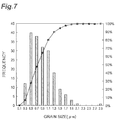
- FIG. 7 is a histogram illustrating a grain size distribution of crystal grains of the Sr ferrite that is contained in the sintered ferrite magnet of Example 74.
- FIG. 8 is a histogram illustrating a grain size distribution of crystal grains of the Sr ferrite that is contained in the sintered ferrite magnet of Comparative Example 14.
- the grain size distribution of the Sr ferrite was measured in the same manner as Example 1, and the average grain size of crystal grains of the Sr ferrite on the number basis and the standard deviation thereof were obtained.
- the average grain size of crystal grains of the Sr ferrite was 1.0 ⁇ m or less.
- a ratio of crystal grains having a grain size of 2.0 ⁇ m or more to the entirety of crystal grains of the Sr ferrite on the number basis was 1% or less.
- a composition inside crystal grains of ferrite constituting the sintered body of Example 74, and a composition in the vicinity of a grain boundary between two crystal grains were measured by using a high-resolution TEM-EDS.
- a spectrum was 100-point measured, and the resultant values were integrated and quantified. This measurement was performed for five sites at the inside of crystal grains and in the vicinity of the grain boundary, respectively.
- the total amount of Na, Si, Ca, Fe, and Sr was set to 100% by mass, an amount of each element is shown in Table 8.
Landscapes
- Engineering & Computer Science (AREA)
- Chemical & Material Sciences (AREA)
- Ceramic Engineering (AREA)
- Manufacturing & Machinery (AREA)
- Organic Chemistry (AREA)
- Materials Engineering (AREA)
- Structural Engineering (AREA)
- Power Engineering (AREA)
- Inorganic Chemistry (AREA)
- Hard Magnetic Materials (AREA)
- Magnetic Ceramics (AREA)
- Manufacturing Cores, Coils, And Magnets (AREA)
- Permanent Field Magnets Of Synchronous Machinery (AREA)
Claims (4)
- Aimant fritté en ferrite, comprenant :- du ferrite Sr de type M ayant une structure cristalline hexagonale en tant que composant principal,
une quantité totale de Na et K étant de 0,02 % à 0,15 % en masse en termes de Na2O et K2O,
une quantité de Si étant de 0,3 à 0,94 % en masse en termes de SiO2, et
l'Expression (1) suivante étant satisfaite
et une taille du grain moyenne de grains cristallins du ferrite Sr étant de 1,0 µm ou moins, et
un rapport des grains cristallins, qui ont une taille du grain de 2,0 µm ou plus, sur la base en nombre étant de 1 % ou moins,- un composant additionnel, différent du ferrite Sr étant principalement contenu dans un joint de grain des grains cristallins du ferrite Sr dans l'aimant fritté en ferrite. - Aimant fritté en ferrite selon la revendication 1,
l'Expression (2) suivante étant satisfaite
- Aimant fritté en ferrite selon la revendication 1 ou 2,
l'Expression (3) suivante étant satisfaite
- Moteur, comprenant :
l'aimant fritté en ferrite selon l'une quelconque des revendications 1 à 3.
Applications Claiming Priority (2)
| Application Number | Priority Date | Filing Date | Title |
|---|---|---|---|
| JP2012034039 | 2012-02-20 | ||
| PCT/JP2013/054230 WO2013125600A1 (fr) | 2012-02-20 | 2013-02-20 | Aimant fritté en ferrite ainsi que moteur mettant en oeuvre celui-ci |
Publications (3)
| Publication Number | Publication Date |
|---|---|
| EP2819128A1 EP2819128A1 (fr) | 2014-12-31 |
| EP2819128A4 EP2819128A4 (fr) | 2015-12-16 |
| EP2819128B1 true EP2819128B1 (fr) | 2019-05-01 |
Family
ID=49005782
Family Applications (1)
| Application Number | Title | Priority Date | Filing Date |
|---|---|---|---|
| EP13751491.5A Active EP2819128B1 (fr) | 2012-02-20 | 2013-02-20 | Aimant fritté en ferrite ainsi que moteur mettant en oeuvre celui-ci |
Country Status (6)
| Country | Link |
|---|---|
| US (1) | US9514871B2 (fr) |
| EP (1) | EP2819128B1 (fr) |
| JP (1) | JP5733463B2 (fr) |
| KR (1) | KR101588581B1 (fr) |
| CN (1) | CN104137199B (fr) |
| WO (1) | WO2013125600A1 (fr) |
Families Citing this family (11)
| Publication number | Priority date | Publication date | Assignee | Title |
|---|---|---|---|---|
| JP3423567B2 (ja) | 1997-02-26 | 2003-07-07 | 本田技研工業株式会社 | ベルト組付装置 |
| CN104350029B (zh) | 2012-06-07 | 2017-07-18 | Tdk株式会社 | 烧结磁铁用Sr铁氧体颗粒的制造方法、Sr铁氧体颗粒的使用方法、Sr铁氧体烧结磁铁及其制造方法、以及马达和发电机 |
| WO2014017551A1 (fr) * | 2012-07-25 | 2014-01-30 | Tdk株式会社 | PROCÉDÉ DE PRODUCTION D'UN AIMANT FRITTÉ EN FERRITE DE Sr, MOTEUR ET GÉNÉRATEUR DE PUISSANCE |
| JP6488675B2 (ja) * | 2013-12-06 | 2019-03-27 | Tdk株式会社 | Srフェライト焼結磁石、モータ及び発電機 |
| JP6488892B2 (ja) * | 2015-06-05 | 2019-03-27 | Tdk株式会社 | Srフェライト焼結磁石、モータ及び発電機 |
| JP6276472B2 (ja) * | 2015-11-28 | 2018-02-07 | 京セラ株式会社 | 釣り糸用ガイド部材 |
| JP7358758B2 (ja) | 2019-03-27 | 2023-10-11 | Tdk株式会社 | フェライト焼結磁石及びこれを備える回転電気機械 |
| JP7268440B2 (ja) | 2019-03-27 | 2023-05-08 | Tdk株式会社 | フェライト焼結磁石及びこれを備える回転電気機械 |
| JP7275739B2 (ja) | 2019-03-27 | 2023-05-18 | Tdk株式会社 | フェライト焼結磁石及びこれを備える回転電気機械 |
| JP7275740B2 (ja) | 2019-03-27 | 2023-05-18 | Tdk株式会社 | フェライト焼結磁石及びこれを備える回転電気機械 |
| JP7338395B2 (ja) * | 2019-10-18 | 2023-09-05 | Tdk株式会社 | フェライト焼結磁石及びこれを備える回転電気機械 |
Family Cites Families (16)
| Publication number | Priority date | Publication date | Assignee | Title |
|---|---|---|---|---|
| JPS541279B2 (fr) * | 1974-08-22 | 1979-01-23 | ||
| JPS51133798A (en) * | 1975-05-16 | 1976-11-19 | Daido Steel Co Ltd | Oxide permanent magnet |
| JPS6020881B2 (ja) * | 1975-07-31 | 1985-05-24 | 大同特殊鋼株式会社 | 酸化物焼結磁石 |
| JPS52126795A (en) * | 1976-04-17 | 1977-10-24 | Daido Steel Co Ltd | Method of manufacturing oxide sintered permanent magnet |
| JPS5471395A (en) * | 1977-11-18 | 1979-06-07 | Daido Steel Co Ltd | Blank for ferrite magnet and ferrite magnet |
| JPS58156575A (ja) * | 1982-03-09 | 1983-09-17 | 東北金属工業株式会社 | 酸化物永久磁石の製造方法 |
| US5945028A (en) * | 1992-04-24 | 1999-08-31 | Tdk Corporation | Hexagonal system ferrite particles and their production process |
| JPH09186010A (ja) * | 1995-08-23 | 1997-07-15 | Hitachi Metals Ltd | 高電気抵抗希土類磁石およびその製造方法 |
| US5858124A (en) | 1995-10-30 | 1999-01-12 | Hitachi Metals, Ltd. | Rare earth magnet of high electrical resistance and production method thereof |
| JP3163279B2 (ja) | 1997-02-25 | 2001-05-08 | ティーディーケイ株式会社 | 焼結磁石およびモータ |
| WO1998038654A1 (fr) * | 1997-02-25 | 1998-09-03 | Tdk Corporation | Materiau magnetique a base d'oxyde, particule de ferrite, aimant obtenu par frittage, aimant issu d'une liaison, support d'enregistrement magnetique et moteur |
| EP1193723A4 (fr) * | 2000-04-28 | 2008-06-25 | Tdk Corp | Poudre de ferrite magnetique, agglomere de ferrite magnetique, structure de ferrite en couches, et procede de production de structure de ferrite en couches |
| JP5256612B2 (ja) * | 2004-12-17 | 2013-08-07 | 日立金属株式会社 | 六方晶フェライト並びにそれを用いたアンテナ及び通信機器 |
| JP2006327883A (ja) * | 2005-05-27 | 2006-12-07 | Tdk Corp | フェライト磁石及びフェライト焼結磁石の製造方法 |
| US8524190B2 (en) * | 2008-05-30 | 2013-09-03 | Skyworks Solutions, Inc. | Enhanced hexagonal ferrite material and methods of preparation and use thereof |
| CN102167574B (zh) * | 2011-01-06 | 2013-04-03 | 广东正民高新磁电有限公司 | 一种锶铁氧体磁性材料及其制备方法 |
-
2013
- 2013-02-20 US US14/379,667 patent/US9514871B2/en active Active
- 2013-02-20 EP EP13751491.5A patent/EP2819128B1/fr active Active
- 2013-02-20 JP JP2014500746A patent/JP5733463B2/ja active Active
- 2013-02-20 KR KR1020147023554A patent/KR101588581B1/ko active Active
- 2013-02-20 CN CN201380010164.6A patent/CN104137199B/zh active Active
- 2013-02-20 WO PCT/JP2013/054230 patent/WO2013125600A1/fr not_active Ceased
Non-Patent Citations (1)
| Title |
|---|
| None * |
Also Published As
| Publication number | Publication date |
|---|---|
| US20150325350A1 (en) | 2015-11-12 |
| CN104137199B (zh) | 2017-04-26 |
| US9514871B2 (en) | 2016-12-06 |
| CN104137199A (zh) | 2014-11-05 |
| EP2819128A1 (fr) | 2014-12-31 |
| EP2819128A4 (fr) | 2015-12-16 |
| KR20140125400A (ko) | 2014-10-28 |
| JPWO2013125600A1 (ja) | 2015-07-30 |
| WO2013125600A1 (fr) | 2013-08-29 |
| KR101588581B1 (ko) | 2016-01-26 |
| JP5733463B2 (ja) | 2015-06-10 |
Similar Documents
| Publication | Publication Date | Title |
|---|---|---|
| EP2819128B1 (fr) | Aimant fritté en ferrite ainsi que moteur mettant en oeuvre celui-ci | |
| US9627112B2 (en) | Sintered ferrite magnet and motor provided therewith | |
| US9530548B2 (en) | Method for manufacturing Sr ferrite particle for sintered magnet, method for using Sr ferrite particle, Sr ferrite sintered magnet and method for manufacturing same, and motor and generator | |
| EP2819129B1 (fr) | Aimant fritté en ferrite ainsi que moteur mettant en oeuvre celui-ci | |
| WO2014017637A2 (fr) | Procédé de fabrication de particules de ferrite sr pour aimant fritté et procédé de fabrication d'aimant fritté de ferrite sr | |
| WO2014087932A1 (fr) | PROCÉDÉ POUR PRODUIRE UN AIMANT FRITTÉ EN FERRITE DE Sr | |
| US9589713B2 (en) | Sintered ferrite magnet and motor provided therewith | |
| WO2014017551A1 (fr) | PROCÉDÉ DE PRODUCTION D'UN AIMANT FRITTÉ EN FERRITE DE Sr, MOTEUR ET GÉNÉRATEUR DE PUISSANCE | |
| WO2014174876A1 (fr) | Procédé de fabrication d'aimant fritté de sr-ferrite, ainsi que moteur et générateur d'électricité équipés d'un aimant fritté de sr-ferrite |
Legal Events
| Date | Code | Title | Description |
|---|---|---|---|
| PUAI | Public reference made under article 153(3) epc to a published international application that has entered the european phase |
Free format text: ORIGINAL CODE: 0009012 |
|
| 17P | Request for examination filed |
Effective date: 20140905 |
|
| AK | Designated contracting states |
Kind code of ref document: A1 Designated state(s): AL AT BE BG CH CY CZ DE DK EE ES FI FR GB GR HR HU IE IS IT LI LT LU LV MC MK MT NL NO PL PT RO RS SE SI SK SM TR |
|
| AX | Request for extension of the european patent |
Extension state: BA ME |
|
| DAX | Request for extension of the european patent (deleted) | ||
| RA4 | Supplementary search report drawn up and despatched (corrected) |
Effective date: 20151113 |
|
| RIC1 | Information provided on ipc code assigned before grant |
Ipc: C04B 35/26 20060101AFI20151109BHEP Ipc: H01F 1/11 20060101ALI20151109BHEP Ipc: C04B 35/626 20060101ALI20151109BHEP Ipc: H01F 41/02 20060101ALI20151109BHEP |
|
| STAA | Information on the status of an ep patent application or granted ep patent |
Free format text: STATUS: EXAMINATION IS IN PROGRESS |
|
| 17Q | First examination report despatched |
Effective date: 20170616 |
|
| GRAP | Despatch of communication of intention to grant a patent |
Free format text: ORIGINAL CODE: EPIDOSNIGR1 |
|
| STAA | Information on the status of an ep patent application or granted ep patent |
Free format text: STATUS: GRANT OF PATENT IS INTENDED |
|
| INTG | Intention to grant announced |
Effective date: 20181121 |
|
| GRAS | Grant fee paid |
Free format text: ORIGINAL CODE: EPIDOSNIGR3 |
|
| GRAA | (expected) grant |
Free format text: ORIGINAL CODE: 0009210 |
|
| STAA | Information on the status of an ep patent application or granted ep patent |
Free format text: STATUS: THE PATENT HAS BEEN GRANTED |
|
| AK | Designated contracting states |
Kind code of ref document: B1 Designated state(s): AL AT BE BG CH CY CZ DE DK EE ES FI FR GB GR HR HU IE IS IT LI LT LU LV MC MK MT NL NO PL PT RO RS SE SI SK SM TR |
|
| RAP1 | Party data changed (applicant data changed or rights of an application transferred) |
Owner name: TDK CORPORATION |
|
| REG | Reference to a national code |
Ref country code: GB Ref legal event code: FG4D |
|
| REG | Reference to a national code |
Ref country code: CH Ref legal event code: EP Ref country code: AT Ref legal event code: REF Ref document number: 1126705 Country of ref document: AT Kind code of ref document: T Effective date: 20190515 |
|
| REG | Reference to a national code |
Ref country code: DE Ref legal event code: R096 Ref document number: 602013054653 Country of ref document: DE |
|
| REG | Reference to a national code |
Ref country code: IE Ref legal event code: FG4D |
|
| REG | Reference to a national code |
Ref country code: NL Ref legal event code: MP Effective date: 20190501 |
|
| REG | Reference to a national code |
Ref country code: LT Ref legal event code: MG4D |
|
| PG25 | Lapsed in a contracting state [announced via postgrant information from national office to epo] |
Ref country code: NO Free format text: LAPSE BECAUSE OF FAILURE TO SUBMIT A TRANSLATION OF THE DESCRIPTION OR TO PAY THE FEE WITHIN THE PRESCRIBED TIME-LIMIT Effective date: 20190801 Ref country code: FI Free format text: LAPSE BECAUSE OF FAILURE TO SUBMIT A TRANSLATION OF THE DESCRIPTION OR TO PAY THE FEE WITHIN THE PRESCRIBED TIME-LIMIT Effective date: 20190501 Ref country code: ES Free format text: LAPSE BECAUSE OF FAILURE TO SUBMIT A TRANSLATION OF THE DESCRIPTION OR TO PAY THE FEE WITHIN THE PRESCRIBED TIME-LIMIT Effective date: 20190501 Ref country code: SE Free format text: LAPSE BECAUSE OF FAILURE TO SUBMIT A TRANSLATION OF THE DESCRIPTION OR TO PAY THE FEE WITHIN THE PRESCRIBED TIME-LIMIT Effective date: 20190501 Ref country code: PT Free format text: LAPSE BECAUSE OF FAILURE TO SUBMIT A TRANSLATION OF THE DESCRIPTION OR TO PAY THE FEE WITHIN THE PRESCRIBED TIME-LIMIT Effective date: 20190901 Ref country code: NL Free format text: LAPSE BECAUSE OF FAILURE TO SUBMIT A TRANSLATION OF THE DESCRIPTION OR TO PAY THE FEE WITHIN THE PRESCRIBED TIME-LIMIT Effective date: 20190501 Ref country code: AL Free format text: LAPSE BECAUSE OF FAILURE TO SUBMIT A TRANSLATION OF THE DESCRIPTION OR TO PAY THE FEE WITHIN THE PRESCRIBED TIME-LIMIT Effective date: 20190501 Ref country code: LT Free format text: LAPSE BECAUSE OF FAILURE TO SUBMIT A TRANSLATION OF THE DESCRIPTION OR TO PAY THE FEE WITHIN THE PRESCRIBED TIME-LIMIT Effective date: 20190501 Ref country code: HR Free format text: LAPSE BECAUSE OF FAILURE TO SUBMIT A TRANSLATION OF THE DESCRIPTION OR TO PAY THE FEE WITHIN THE PRESCRIBED TIME-LIMIT Effective date: 20190501 |
|
| PG25 | Lapsed in a contracting state [announced via postgrant information from national office to epo] |
Ref country code: GR Free format text: LAPSE BECAUSE OF FAILURE TO SUBMIT A TRANSLATION OF THE DESCRIPTION OR TO PAY THE FEE WITHIN THE PRESCRIBED TIME-LIMIT Effective date: 20190802 Ref country code: LV Free format text: LAPSE BECAUSE OF FAILURE TO SUBMIT A TRANSLATION OF THE DESCRIPTION OR TO PAY THE FEE WITHIN THE PRESCRIBED TIME-LIMIT Effective date: 20190501 Ref country code: BG Free format text: LAPSE BECAUSE OF FAILURE TO SUBMIT A TRANSLATION OF THE DESCRIPTION OR TO PAY THE FEE WITHIN THE PRESCRIBED TIME-LIMIT Effective date: 20190801 Ref country code: RS Free format text: LAPSE BECAUSE OF FAILURE TO SUBMIT A TRANSLATION OF THE DESCRIPTION OR TO PAY THE FEE WITHIN THE PRESCRIBED TIME-LIMIT Effective date: 20190501 |
|
| REG | Reference to a national code |
Ref country code: AT Ref legal event code: MK05 Ref document number: 1126705 Country of ref document: AT Kind code of ref document: T Effective date: 20190501 |
|
| PG25 | Lapsed in a contracting state [announced via postgrant information from national office to epo] |
Ref country code: IS Free format text: LAPSE BECAUSE OF FAILURE TO SUBMIT A TRANSLATION OF THE DESCRIPTION OR TO PAY THE FEE WITHIN THE PRESCRIBED TIME-LIMIT Effective date: 20190901 |
|
| PG25 | Lapsed in a contracting state [announced via postgrant information from national office to epo] |
Ref country code: RO Free format text: LAPSE BECAUSE OF FAILURE TO SUBMIT A TRANSLATION OF THE DESCRIPTION OR TO PAY THE FEE WITHIN THE PRESCRIBED TIME-LIMIT Effective date: 20190501 Ref country code: EE Free format text: LAPSE BECAUSE OF FAILURE TO SUBMIT A TRANSLATION OF THE DESCRIPTION OR TO PAY THE FEE WITHIN THE PRESCRIBED TIME-LIMIT Effective date: 20190501 Ref country code: CZ Free format text: LAPSE BECAUSE OF FAILURE TO SUBMIT A TRANSLATION OF THE DESCRIPTION OR TO PAY THE FEE WITHIN THE PRESCRIBED TIME-LIMIT Effective date: 20190501 Ref country code: AT Free format text: LAPSE BECAUSE OF FAILURE TO SUBMIT A TRANSLATION OF THE DESCRIPTION OR TO PAY THE FEE WITHIN THE PRESCRIBED TIME-LIMIT Effective date: 20190501 Ref country code: DK Free format text: LAPSE BECAUSE OF FAILURE TO SUBMIT A TRANSLATION OF THE DESCRIPTION OR TO PAY THE FEE WITHIN THE PRESCRIBED TIME-LIMIT Effective date: 20190501 Ref country code: SK Free format text: LAPSE BECAUSE OF FAILURE TO SUBMIT A TRANSLATION OF THE DESCRIPTION OR TO PAY THE FEE WITHIN THE PRESCRIBED TIME-LIMIT Effective date: 20190501 |
|
| REG | Reference to a national code |
Ref country code: DE Ref legal event code: R097 Ref document number: 602013054653 Country of ref document: DE |
|
| PG25 | Lapsed in a contracting state [announced via postgrant information from national office to epo] |
Ref country code: IT Free format text: LAPSE BECAUSE OF FAILURE TO SUBMIT A TRANSLATION OF THE DESCRIPTION OR TO PAY THE FEE WITHIN THE PRESCRIBED TIME-LIMIT Effective date: 20190501 Ref country code: SM Free format text: LAPSE BECAUSE OF FAILURE TO SUBMIT A TRANSLATION OF THE DESCRIPTION OR TO PAY THE FEE WITHIN THE PRESCRIBED TIME-LIMIT Effective date: 20190501 |
|
| PLBE | No opposition filed within time limit |
Free format text: ORIGINAL CODE: 0009261 |
|
| STAA | Information on the status of an ep patent application or granted ep patent |
Free format text: STATUS: NO OPPOSITION FILED WITHIN TIME LIMIT |
|
| PG25 | Lapsed in a contracting state [announced via postgrant information from national office to epo] |
Ref country code: TR Free format text: LAPSE BECAUSE OF FAILURE TO SUBMIT A TRANSLATION OF THE DESCRIPTION OR TO PAY THE FEE WITHIN THE PRESCRIBED TIME-LIMIT Effective date: 20190501 |
|
| 26N | No opposition filed |
Effective date: 20200204 |
|
| PG25 | Lapsed in a contracting state [announced via postgrant information from national office to epo] |
Ref country code: PL Free format text: LAPSE BECAUSE OF FAILURE TO SUBMIT A TRANSLATION OF THE DESCRIPTION OR TO PAY THE FEE WITHIN THE PRESCRIBED TIME-LIMIT Effective date: 20190501 |
|
| PG25 | Lapsed in a contracting state [announced via postgrant information from national office to epo] |
Ref country code: SI Free format text: LAPSE BECAUSE OF FAILURE TO SUBMIT A TRANSLATION OF THE DESCRIPTION OR TO PAY THE FEE WITHIN THE PRESCRIBED TIME-LIMIT Effective date: 20190501 |
|
| REG | Reference to a national code |
Ref country code: CH Ref legal event code: PL |
|
| GBPC | Gb: european patent ceased through non-payment of renewal fee |
Effective date: 20200220 |
|
| REG | Reference to a national code |
Ref country code: BE Ref legal event code: MM Effective date: 20200229 |
|
| PG25 | Lapsed in a contracting state [announced via postgrant information from national office to epo] |
Ref country code: LU Free format text: LAPSE BECAUSE OF NON-PAYMENT OF DUE FEES Effective date: 20200220 Ref country code: MC Free format text: LAPSE BECAUSE OF FAILURE TO SUBMIT A TRANSLATION OF THE DESCRIPTION OR TO PAY THE FEE WITHIN THE PRESCRIBED TIME-LIMIT Effective date: 20190501 |
|
| PG25 | Lapsed in a contracting state [announced via postgrant information from national office to epo] |
Ref country code: CH Free format text: LAPSE BECAUSE OF NON-PAYMENT OF DUE FEES Effective date: 20200229 Ref country code: LI Free format text: LAPSE BECAUSE OF NON-PAYMENT OF DUE FEES Effective date: 20200229 |
|
| PG25 | Lapsed in a contracting state [announced via postgrant information from national office to epo] |
Ref country code: FR Free format text: LAPSE BECAUSE OF NON-PAYMENT OF DUE FEES Effective date: 20200229 Ref country code: IE Free format text: LAPSE BECAUSE OF NON-PAYMENT OF DUE FEES Effective date: 20200220 Ref country code: GB Free format text: LAPSE BECAUSE OF NON-PAYMENT OF DUE FEES Effective date: 20200220 |
|
| PG25 | Lapsed in a contracting state [announced via postgrant information from national office to epo] |
Ref country code: BE Free format text: LAPSE BECAUSE OF NON-PAYMENT OF DUE FEES Effective date: 20200229 |
|
| PG25 | Lapsed in a contracting state [announced via postgrant information from national office to epo] |
Ref country code: MT Free format text: LAPSE BECAUSE OF FAILURE TO SUBMIT A TRANSLATION OF THE DESCRIPTION OR TO PAY THE FEE WITHIN THE PRESCRIBED TIME-LIMIT Effective date: 20190501 Ref country code: CY Free format text: LAPSE BECAUSE OF FAILURE TO SUBMIT A TRANSLATION OF THE DESCRIPTION OR TO PAY THE FEE WITHIN THE PRESCRIBED TIME-LIMIT Effective date: 20190501 |
|
| PG25 | Lapsed in a contracting state [announced via postgrant information from national office to epo] |
Ref country code: MK Free format text: LAPSE BECAUSE OF FAILURE TO SUBMIT A TRANSLATION OF THE DESCRIPTION OR TO PAY THE FEE WITHIN THE PRESCRIBED TIME-LIMIT Effective date: 20190501 |
|
| PGFP | Annual fee paid to national office [announced via postgrant information from national office to epo] |
Ref country code: DE Payment date: 20251230 Year of fee payment: 14 |