EP2823866A1 - Batteurs de jeux à balle avec son amélioré - Google Patents
Batteurs de jeux à balle avec son amélioré Download PDFInfo
- Publication number
- EP2823866A1 EP2823866A1 EP13176133.0A EP13176133A EP2823866A1 EP 2823866 A1 EP2823866 A1 EP 2823866A1 EP 13176133 A EP13176133 A EP 13176133A EP 2823866 A1 EP2823866 A1 EP 2823866A1
- Authority
- EP
- European Patent Office
- Prior art keywords
- opening
- ball game
- strings
- string
- angle
- Prior art date
- Legal status (The legal status is an assumption and is not a legal conclusion. Google has not performed a legal analysis and makes no representation as to the accuracy of the status listed.)
- Granted
Links
Images
Classifications
-
- A—HUMAN NECESSITIES
- A63—SPORTS; GAMES; AMUSEMENTS
- A63B—APPARATUS FOR PHYSICAL TRAINING, GYMNASTICS, SWIMMING, CLIMBING, OR FENCING; BALL GAMES; TRAINING EQUIPMENT
- A63B49/00—Stringed rackets, e.g. for tennis
- A63B49/02—Frames
- A63B49/022—String guides on frames, e.g. grommets
-
- A—HUMAN NECESSITIES
- A63—SPORTS; GAMES; AMUSEMENTS
- A63B—APPARATUS FOR PHYSICAL TRAINING, GYMNASTICS, SWIMMING, CLIMBING, OR FENCING; BALL GAMES; TRAINING EQUIPMENT
- A63B51/00—Stringing tennis, badminton or like rackets; Strings therefor; Maintenance of racket strings
-
- A—HUMAN NECESSITIES
- A63—SPORTS; GAMES; AMUSEMENTS
- A63B—APPARATUS FOR PHYSICAL TRAINING, GYMNASTICS, SWIMMING, CLIMBING, OR FENCING; BALL GAMES; TRAINING EQUIPMENT
- A63B49/00—Stringed rackets, e.g. for tennis
- A63B49/02—Frames
- A63B49/028—Means for achieving greater mobility of the string bed
-
- A—HUMAN NECESSITIES
- A63—SPORTS; GAMES; AMUSEMENTS
- A63B—APPARATUS FOR PHYSICAL TRAINING, GYMNASTICS, SWIMMING, CLIMBING, OR FENCING; BALL GAMES; TRAINING EQUIPMENT
- A63B60/00—Details or accessories of golf clubs, bats, rackets or the like
- A63B60/002—Resonance frequency related characteristics
-
- A—HUMAN NECESSITIES
- A63—SPORTS; GAMES; AMUSEMENTS
- A63B—APPARATUS FOR PHYSICAL TRAINING, GYMNASTICS, SWIMMING, CLIMBING, OR FENCING; BALL GAMES; TRAINING EQUIPMENT
- A63B60/00—Details or accessories of golf clubs, bats, rackets or the like
- A63B60/54—Details or accessories of golf clubs, bats, rackets or the like with means for damping vibrations
Definitions
- the present application relates to a ball game racket with an improved sound.
- Ball game racket usually produce a characteristic sound when hitting a ball on the fabric of the ball game racket. This is influenced primarily by the shape and material of the racket frame, the material of the strings forming the string, the hardness of the string, the string pattern and to some extent by the impacting ball.
- Players usually find certain sound patterns more pleasant and other sounds more uncomfortable. For example, very high frequencies when beating the ball are usually rather distracting, whereas a rich sound with a rather low tone gives the feeling of a powerful beat.
- the type and duration of the reverberation of the sound can trigger positive or negative associations in the player.
- the frame of the ball game racket invention forms a head portion for receiving a fabric with one or more strings and a handle portion.
- the fabric defines a clothing level.
- the complete clothing is formed by one or two strings, which form the clothing by repeated folding on the head portion.
- the term "string” in each case a string section will be referred to, extending from the frame outside through an opening, on the string bed, through a further opening to the extends opposite frame outside. Depending on the orientation of such a string section, this is referred to as "cross string” or "longitudinal string”.
- the strings of the string are passed through openings in the head portion of the racquet frame, each string being passed through two opposing apertures.
- the further consideration always refers to openings on one side.
- at least three strings are guided through three of the openings (on the same side of the club head) such that the longitudinal axis of the opening extends in a first direction and the string guided through the opening runs in a second direction within the clothing, the first one and second direction include an angle ⁇ with an absolute value between 0.5 ° and 15 °, and wherein the angle ⁇ of these three strings differs in its absolute value by a maximum of 3 °.
- the longitudinal axis of the opening denotes an axis perpendicular to the opening cross-section.
- the at least three strings are preferably pressed against the opening wall section delimiting the opening.
- the strings passing through the openings on entering the opening undergo a change of direction or a deflection or have a kink there, since the strings within the clothing, that is, where they are non-guided, in a second direction while extending within the aperture (or at least in an area within the aperture) along the longitudinal axis of the aperture in a first direction.
- the first and second directions are preferably arranged relative to one another such that the strings are pressed against the opening wall section delimiting the opening.
- the at least three strings are preferably in a substantially permanent contact with the respective opening wall sections delimiting the openings.
- At least three centrally arranged strings generally begin to vibrate strongly when a ball strikes the clothing and have a correspondingly great influence on the sound, according to the invention at least three strings should achieve an essentially analogous effect by having at least three strings approximately equal experience great distraction.
- the absolute value of the angle for the at least three strings should differ by a maximum of 3 °.
- at least four, more preferably at least five strings are respectively guided through openings in order to achieve a greater effect or to achieve the effect even when the ball does not hit exactly the center of the clothing.
- At least three strings are preferred at both ends, i. on opposite sides of the racket head, guided through openings such that each of the longitudinal axis of the opening extends in a first direction and the string guided through the opening extends within the string in a second direction, wherein the first and second directions are at an angle with an absolute value between 0.5 ° and 15 ° and wherein the angle of these three strings differs in all six openings in its absolute value by a maximum of 3 °.
- the absolute value of the angle between the first and the second direction is preferably between 1 ° and 10 °, more preferably between 3 ° and 7 ° and particularly preferably about 5 °.
- the angle of the at least three strings in its absolute value differs by a maximum of 2 °, preferably by a maximum of 1.5 °.
- the force with which the strings are pressed against the opening wall portions delimiting the opening is between 3.5 N and 150 N, more preferably between 7 N and 70 N, even more preferably between 20 N and 50 N and particularly preferably about 35 N.
- the angle between the first and the second direction can basically be realized in different ways.
- the strings within the clothing may be parallel to the club axes (ie, the longitudinal sides parallel to the longitudinal axis of the ball game racket and the transverse sides perpendicular to the longitudinal axis of the ball game racket) and the longitudinal axes of the openings may be angled relative thereto.
- the longitudinal axes of the openings along the Club axes that is, parallel or perpendicular to the longitudinal axis of the ball game racket
- both effects can be combined to achieve the desired angle between the first and second directions.
- the course of the opening longitudinal axis can be adapted in different ways, for example by the formation of holes in the club head, which are angled relative to the club axes and are inserted into the substantially symmetrical eyes, or through holes which extend substantially parallel to the club axes and in the asymmetric lugs are used, so that the ⁇ senö Stammsachse opposite the bore axis at an angle.
- the opening is understood to mean the actual cavity through which the string passes.
- the orientation of this aperture, and hence the string course within it, is determined by the orientation of the bore, on the one hand, and the symmetry of the eyelet (if present, as discussed above), on the other hand.
- the present invention basically relates to both transverse strings and longitudinal strings.
- the deflection according to the invention may be provided according to the invention on three or more transverse strings and / or on three or more longitudinal strings.
- the invention will be described below with reference to the transverse strings.
- the longitudinal strings all features described as preferred apply analogously.
- the longitudinal axis of the racket defines a third direction, the first and third directions an angle between 75 ° and 89.5 °, preferably between 80 ° and 89 °, more preferably between 83 ° and 87 ° and more preferably about 85 °.
- the strings within the clothing preferably extend substantially perpendicular to the longitudinal axis of the racquet.
- the ball game racket of this preferred embodiment transverse strings, which are perpendicular to the racket longitudinal axis, are guided through one or more openings in the head portion and enclose an angle between 75 ° and 89.5 ° with the longitudinal axis of the racket within these openings.
- the ball game racket of this preferred embodiment may alternatively or in combination with these cross strings also have longitudinal strings, whose course is angled or deflected through corresponding openings.
- the first and third directions are at an angle between 0.5 ° and 15 °, preferably between 1 ° and 10 °, more preferably between 3 ° and 7 °, and most preferably enclose about 5 °.
- transverse strings are the openings through which the at least three strings are guided, preferably at about three o'clock and / or at about nine o'clock of the head portion of the racket frame (the positions are to be defined by the fact that the handle portion opposite head portion with twelve o'clock and the handle section adjacent head section is called six o'clock).
- the openings are preferably at about six o'clock and / or at about twelve o'clock. All angle data, which are disclosed in the present application with respect to transverse strings, can be transferred analogously to the above statements in corresponding angle specifications for longitudinal strings.
- both transverse strings and also longitudinal strings of the ball game racket according to the invention are guided through openings according to the invention.
- a plurality of transverse strings particularly preferably 5 to 10 transverse strings, and / or a plurality of longitudinal strings, preferably 5 to 10 longitudinal strings, are respectively pressed against the opening wall portions of corresponding openings.
- the openings are formed by eyelets which are mounted in the bores in the club head.
- the openings are formed by eyelets which are mounted in the bores in the club head.
- the openings then defines the longitudinal axis of the racket a third direction and the longitudinal axis of the bore a fourth direction, wherein the ⁇ senö Stammsachse and the longitudinal axis of the bore substantially parallel and wherein the third and fourth direction an angle between 75 ° and 89.5 °, preferably between 80 ° and 89 °, more preferably between 83 ° and 87 °, and most preferably about 85 °.
- the eyelet is formed substantially symmetrical, so that the orientation of the opening is defined substantially by the orientation of the bore.
- the ⁇ senö Stammsachse with the longitudinal axis of the bore forms an angle between 0.5 ° and 15 °, preferably between 1 ° and 10 °, more preferably between 3 ° and 7 ° and particularly preferably about 5 °.
- the eyelet is asymmetrical, so that the orientation of the opening is defined substantially by the course of the eyelet opening within the eyelet.
- the Longitudinal axis of the racket and the longitudinal axis of the bore preferably at an angle of about 90 ° (in the case of longitudinal strings, the longitudinal axis of the racket and the longitudinal axis of the bore are substantially parallel to each other).
- This embodiment has the advantage that it is easier to produce, since the attachment of holes in the club head with a defined orientation is technically more complicated than the attachment of holes which are aligned parallel or perpendicular to the longitudinal axis of the racket.
- the ball game rackets have opposing openings which are directly connected to each other via a string, an offset in the club longitudinal direction (or in racket transverse direction in the long sides) on.
- the offset is preferably between 1 mm and 25 mm, more preferably between 2 mm and 20 mm, even more preferably between 5 mm and 15 mm and particularly preferably about 10 mm.
- the string between these opposing openings is oriented such that it is opposite the Schlägerquer- or -lijnsachse with an angle between 0.5 ° and 15 °, preferably between 1 ° and 10 °, more preferably between 3 ° and 7 °, more preferably about 5 °.
- the longitudinal axes of the openings preferably extend in the direction of the club or the longitudinal direction.
- the openings or the offset of opposing openings are formed such that it can be controlled with the help of different textures or string patterns, which and / or how many of the transverse and / or longitudinal strings are pressed against an opening wall portion. In this way, different sound profiles of the racket can be realized with the help of different string patterns.
- the at least three openings have a cross-section whose extent is substantially perpendicular to the clothing plane greater than its extent substantially in the clothing plane.
- the string guided through such an opening should have more clearance or freedom of movement in a direction that is substantially perpendicular to the clothing plane than in a direction that extends essentially within the clothing plane.
- the cross-section of the at least three openings is formed substantially non-linearly substantially perpendicular to the clothing plane and / or that the longer cross-sectional axis encloses an angle between 85 ° and 90 ° with the clothing plane.
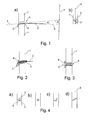
- Fig. 1a shows in a longitudinal section a part of a head portion 1 of a ball game racket according to a preferred embodiment.
- a ball game racket preferably a tennis or squash racket
- the covering is usually formed from one or more strings and defines a covering plane (in Fig. 1a the drawing plane).
- the strings of the clothing are usually passed through several openings in the head section, so that a certain string pattern is formed.
- Fig. 1a only a small section of a head portion 1 is shown, which has a single opening 3.
- the club longitudinal axis extending from the handle section to Head section extends, is in Fig. 1a denoted by the reference numeral 7. Furthermore, in Fig. 1a to recognize a string section 2 which is passed through the opening 3.
- the opening 3 according to the invention in the head portion 1 of the ball game racket of the preferred embodiment has a cross-section which in Fig. 1b can be seen in plan view and its extent is substantially perpendicular to the clothing plane 9 is greater than its extent substantially in the clothing plane 9. According to the invention, however, the cross section of the opening 3 can be formed symmetrically and in particular round.
- the string 2 is thereby guided through the opening 3, that the longitudinal axis 4 of the opening 3 in a first direction (see. Fig. 1a ) and the guided through the opening 3 string 2 within the fabric or the string bed in a second direction 5, wherein the first and second directions an angle ⁇ between 0.5 ° and 15 ° (or between -0.5 ° and -15 °).
- This preferably leads to the string 2 being pressed against the opening wall section 6 delimiting the opening 3 with the normal force N (cf. Fig. 1b ).
- At least three strings are guided in this way through corresponding openings.
- the absolute value of the angle ⁇ for these three strings should differ by a maximum of 3 ° from each other. In the illustrated embodiment, this would mean, for example, that two further openings are provided substantially parallel to the opening 3 shown.
- the term "within the clothing” is intended to define that region of the clothing which is delimited by the head portion of the racket frame and runs inside the club head or string bed.
- the string 2 is to be deflected at the transition from the area within the clothing in the opening 3 such that the string 2 is pressed or pressed against the opening wall portion 6. Because the string 2 is tensioned with the cable force, the deflected or angled portion of the string 2 automatically generates a normal force N, which presses the string 2 in the direction of the opening wall portion 6.
- the in Fig. 1b shown string 2 substantially perpendicular to the clothing plane 9 after deflected left or right.
- the string 2 starts to vibrate and rubs along the opening wall section 6.
- the sliding friction properties are defined by the sliding friction coefficient ⁇ between the string 2 and the opening wall section 6.
- the sliding friction force depends, as explained above, on the other hand from the sliding friction coefficient on the one hand and the normal force.
- the normal force in turn is a function of the cable force in the string (ie the string hardness), the angle ⁇ and the geometry of the opening wall portion 6. If the angle ⁇ is too small, the normal force is more or less negligible and it does not appreciably attenuate Sliding friction on. On the other hand, if the angle ⁇ is too large, the normal force can become so great that stiction occurs, the string does not slide along the opening wall portion, and thus no damping also occurs.
- the angle ⁇ using for the strings and the eyelets of conventional materials preferably between 0.5 ° and 15 °, more preferably between 1 ° and 10 °, even more preferably between 3 ° and 7 ° particularly preferably about 5 °.
- the normal force with which the string is pressed against the aperture bounding opening wall portion is preferably between 3.5 N and 150 N, more preferably between 7 N and 70 N, even more preferably between 20 N and 50 N, and most preferably about 35 N.
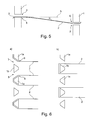
- the normal force can, as explained above, also vary by the choice of the geometry of the support surface or the support area for the string 2 within the opening 3. Is the opening wall portion 6, to which the string 2 is pressed, such as in Fig. 1b illustrated, designed substantially flat, the normal force is in a first approximation only a function of the angle ⁇ and, regardless of the deflection of the string 2, substantially constant. However, the opening wall portion 6, as in FIGS FIGS. 4b-d shown, an uneven surface or slope, the normal force is a function of the deflection of the string.
- the normal force in a first approximation linearly dependent on the deflection of the string, whereas the normal force in the embodiment of the FIGS.
- the sliding friction force depends, as explained above, further from the sliding friction coefficient ⁇ . This is essentially determined by the material of the string 2, the material of the opening wall section 6, on which the string 2 rests, and the roughness. Since the material of the string and the material of the club head 1 must satisfy a variety of requirements, it is particularly preferred to influence the sliding friction coefficient ⁇ , that only the opening wall portion 6 of the bore 3 is provided with a specific material and / or a certain roughness ,
- the inner surface of the opening 3 may be coated with a certain material that increases the sliding friction.
- Suitable materials are soft materials, such as those used in the conventional eyelet band material (PA6.6, PA11). classic elastomers or thermoplastic elastomers, e.g. Pebax and also thermoplastic polyurethanes (TPUs).
- the inner surface of the opening 3 can be roughened in a targeted manner in order to increase the sliding friction.
- the openings of the present invention in the head portion of a ball game racket can be realized, for example, that appropriate holes are mounted in the club head of a ball game racket.
- the club head 1 has at least three holes as in Fig. 1a shown on, so that at least three transverse strings are guided through such openings, that they are pressed against the opening wall portions of the openings.
- One and the same string can be guided on a club head side through an opening according to the invention and guided on the opposite club head side through a conventional string opening.
- Particularly preferred are each opposing string openings as in Fig. 1a executed to the Damping effect to reinforce. More preferably, these openings are approximately at three o'clock and / or nine o'clock.
- the club head preferably has 8 to 28 openings according to the invention, more preferably 10 to 24 preferred openings, and particularly preferably 12 to 20 preferred openings.
- the ball game racket according to the invention may have corresponding openings for as many longitudinal strings. These are preferably at about six o'clock and / or about twelve o'clock.
- the openings 3 are formed by eyelets 8, which are mounted in holes in the club head 1 and inserted into these.
- the eyelets can either be made accurately fit so that they fit exactly into the tapered holes in the club head or be made of a flexible material so that the eyelets can adapt to different degrees beveled holes.
- the use of eyelets makes it possible to vary the sliding friction coefficient ⁇ in a particularly simple manner by using a corresponding eyelet material.
- Particularly preferred materials for such eyelets are various polyamides (PA 6.6, PA11, PA12) or Pebax in various Shore hardness.
- FIG. 3 Another preferred embodiment is in Fig. 3 shown. Also in this preferred embodiment, the opening 3 is formed by an eyelet opening of the eyelet 8, which is inserted into a bore in the club head 1.
- the ⁇ senö Stammsachse and the longitudinal axis of the bore are substantially parallel, closes the ⁇ senö Samuelsachse in the embodiment of the Fig. 3 Make an angle with the longitudinal axis of the hole. This is preferably between 0.5 ° and 15 °, more preferably between 1 ° and 10 °, even more preferably between 3 ° and 7 °, and most preferably about 5 °.
- This embodiment has the advantage that regular holes can be mounted in the club head 1 and the geometry of the opening 3 is defined only by the inserted eyelet 8. In this way, on the one hand, the geometry of the opening 3 can be controlled more simply and at the same time more precisely.
- the sound image of the ballplayer according to the invention can be variably adapted to the personal preferences of a player by appropriately shaped eyelets are used in the already existing club head holes. Accordingly, one can also retrofit commercial racket with a corresponding set of eyelets according to the invention.
- the present invention accordingly also relates to an eyelet for a ball game racket, wherein the eyelet outer geometry defines an eyelet longitudinal axis, and wherein the eyelet has an opening defining an eyelet opening axis.
- the eye longitudinal axis and the eye opening axis include an angle between 0.5 ° and 15 °, preferably between 1 ° and 10 °, more preferably between 3 ° and 7 °, and most preferably about 5 °.
- the eyelet preferably consists of one or a combination of the following materials: polyamide 6.6, polyamide 11, polyamide 12, Pebax.
- the present invention further relates to a set of a plurality of such eyelets or an eyelet strip with a plurality of such eyelets.
- the eyelet openings may, in preferred embodiments, have all the features discussed above generally in connection with apertures according to the invention, individually or in combination.
- the ⁇ senö Samuelen can in connection with Fig. 4 have discussed opening cross sections.
- opposing openings in the club head which are directly connected to each other via a string section, offset in the club longitudinal direction against each other (this applies in the case of cross strings, in the case of longitudinal strings, the offset occurs perpendicular to the club longitudinal direction).
- the offset is preferably between 1 mm and 25 mm, more preferably between 2 mm and 20 mm, even more preferably between 5 mm and 15 mm and particularly preferably about 10 mm.
- such an offset can cause with appropriate covering that, for example, a transverse string runs within the clothing along a direction which deviates from the perpendicular to the racket longitudinal axis.
- the angle ⁇ is preferably between 0.5 ° and 15 °, more preferably between 1 ° and 10 °, even more preferably between 3 ° and 7 °, and most preferably about 5 °.
- the openings 3 in the club head 1 are designed such that the effect of sound optimization according to the invention can be adjusted and set off depending on the string pattern.
- An example of a corresponding configuration and arrangement of the openings 3 is in the Figures 6a and 6b shown. If the racket is covered as in Fig. 6a shown, the strings 2 each circumscribe the sections 1a of the club head and accordingly undergo a deflection upon entry into the openings 3, so that the strings 2 are pressed against the opening wall sections 6 delimiting the openings 3. Accordingly, the damping effect discussed above occurs and the sound when a ball hits the ball game racket of the invention is improved. However, if the bat is in the in Fig. 6b Covered illustrated alternative pattern, the strings 2 each circumscribe the sections 1b of the club head and accordingly undergo no deflection upon entry into the openings 3. In this case, occurs substantially no normal force, so that no sliding friction and thus no damping effect.
- FIGS Figures 6a and 6b Effect can also be achieved by other means.
- holes in the club head can be mounted in such a way that at least for some holes on the opposite club head side both a hole with offset and a hole without offset is available, so that depending on the choice of the string pattern, the offset is used or omitted the offset can.
- the string 2 runs either as in Fig. 5 shown, slightly inclined or exactly perpendicular to the longitudinal axis of the racket. In this way, the sound improvement of the invention could be switched on or off by different clothing.
Landscapes
- Health & Medical Sciences (AREA)
- General Health & Medical Sciences (AREA)
- Physical Education & Sports Medicine (AREA)
- Pivots And Pivotal Connections (AREA)
- Golf Clubs (AREA)
Priority Applications (2)
| Application Number | Priority Date | Filing Date | Title |
|---|---|---|---|
| EP13176133.0A EP2823866B1 (fr) | 2013-07-11 | 2013-07-11 | Batteurs de jeux à balle avec son amélioré |
| US14/328,082 US9302159B2 (en) | 2013-07-11 | 2014-07-10 | Racket for ball games having sound |
Applications Claiming Priority (1)
| Application Number | Priority Date | Filing Date | Title |
|---|---|---|---|
| EP13176133.0A EP2823866B1 (fr) | 2013-07-11 | 2013-07-11 | Batteurs de jeux à balle avec son amélioré |
Publications (2)
| Publication Number | Publication Date |
|---|---|
| EP2823866A1 true EP2823866A1 (fr) | 2015-01-14 |
| EP2823866B1 EP2823866B1 (fr) | 2017-09-13 |
Family
ID=48748081
Family Applications (1)
| Application Number | Title | Priority Date | Filing Date |
|---|---|---|---|
| EP13176133.0A Active EP2823866B1 (fr) | 2013-07-11 | 2013-07-11 | Batteurs de jeux à balle avec son amélioré |
Country Status (2)
| Country | Link |
|---|---|
| US (1) | US9302159B2 (fr) |
| EP (1) | EP2823866B1 (fr) |
Families Citing this family (7)
| Publication number | Priority date | Publication date | Assignee | Title |
|---|---|---|---|---|
| EP2823866B1 (fr) * | 2013-07-11 | 2017-09-13 | Head Technology GmbH | Batteurs de jeux à balle avec son amélioré |
| CN105107166B (zh) * | 2015-09-23 | 2018-04-03 | 沈阳建筑大学 | 网球羽毛球拍线切线台 |
| JP6943608B2 (ja) * | 2017-05-11 | 2021-10-06 | ヨネックス株式会社 | ラケット |
| DE102018003690B3 (de) * | 2018-04-19 | 2019-05-09 | Head Technology Gmbh | Öse und Ösenband für Ballspielschläger |
| US11161016B2 (en) * | 2019-03-19 | 2021-11-02 | Sumitomo Rubber Industries, Ltd. | Racket |
| PL247429B1 (pl) * | 2021-05-25 | 2025-06-30 | Piotr Masierak | Rakieta z naciągiem strunowym |
| US20240390741A1 (en) * | 2023-05-26 | 2024-11-28 | Holger KIEWE genannt KOENIG-BERTHOLD | Stringing arrangement and ball sports racket having an arrangement of this type |
Citations (7)
| Publication number | Priority date | Publication date | Assignee | Title |
|---|---|---|---|---|
| FR2340747A1 (fr) * | 1976-02-11 | 1977-09-09 | Septier Jacqueline | Raquette de tennis, badminton ou analogues |
| WO1985000114A1 (fr) * | 1983-06-29 | 1985-01-17 | Parwenit Projekt Ag | Raquette pour un jeu de balle, en particulier le tennis |
| GB2253793A (en) * | 1991-01-07 | 1992-09-23 | Carlo Zaccaro | A racquet |
| WO1998028049A1 (fr) * | 1996-12-23 | 1998-07-02 | Prince Sports Group, Inc. | Oeillet muni d'encoches et fendu pour raquette de sport |
| US5993337A (en) * | 1998-05-08 | 1999-11-30 | Prince Sports Group, Inc. | Multi-hole grommet for sports racquets |
| US6074315A (en) * | 1998-02-19 | 2000-06-13 | Linda C. Yimoyines | Racquet with visually differentiated grommets and method of stringing thereof |
| DE202006007812U1 (de) * | 2006-05-16 | 2006-09-28 | Yuan Min An Enterprise Co., Ltd. | Schläger |
Family Cites Families (21)
| Publication number | Priority date | Publication date | Assignee | Title |
|---|---|---|---|---|
| US1132214A (en) * | 1914-10-16 | 1915-03-16 | Harry W Ries | Tennis-racket. |
| US1528311A (en) * | 1923-08-03 | 1925-03-03 | Surridge Percival | Lawn tennis and the like racket |
| US1611232A (en) * | 1925-10-22 | 1926-12-21 | Spalding And Bros Ag | Racket frame |
| US1627621A (en) * | 1926-02-10 | 1927-05-10 | Carl Schindler Inc | Tennis racket |
| US3567225A (en) * | 1968-03-26 | 1971-03-02 | Brancroft Racket Co | Racket including string engaging elastomeric bushings and pads |
| US4033582A (en) * | 1974-02-28 | 1977-07-05 | Linden Gaylord C | Method of stringing rackets |
| US4172596A (en) * | 1974-02-28 | 1979-10-30 | Linden Gaylord C | Racquet means and method of stringing same |
| GB1543839A (en) * | 1976-03-17 | 1979-04-11 | Alloway Trust Ltd | Games racquets and to methods of manufacture of same |
| US5014987A (en) * | 1982-09-27 | 1991-05-14 | Soong Tsai C | Frame for sports racket |
| USRE34420E (en) * | 1986-06-19 | 1993-10-26 | Darling James P | Sports racquet |
| JPS6320867U (fr) * | 1986-07-25 | 1988-02-10 | ||
| US5251895A (en) * | 1991-05-02 | 1993-10-12 | Darling James P | Sports racquet |
| US5383662A (en) * | 1991-12-10 | 1995-01-24 | Gabrielidis; Pericles | Racket with improved strings pattern |
| ATE132381T1 (de) * | 1992-01-29 | 1996-01-15 | Voelkl Franz Ski | Ballspielschläger, insbesondere tennisschläger |
| US5209472A (en) * | 1992-05-15 | 1993-05-11 | Kuni Tseng | Racket with frame attachments |
| US5263709A (en) * | 1992-07-22 | 1993-11-23 | Kuni Tseng | Racket with improved dimensional stability |
| US5232219A (en) * | 1992-10-14 | 1993-08-03 | Kuni Tseng | Bumper for racket frame |
| US5322279A (en) * | 1992-12-11 | 1994-06-21 | Prince Manufacturing, Inc. | Double strung tennis racquet |
| US6050909A (en) * | 1997-06-13 | 2000-04-18 | Wilson Sporting Goods Co. | Game racquet with string slots in inner wall |
| ITBG20030016A1 (it) * | 2003-02-28 | 2004-09-01 | Benetton Group S P A Ora Benetton Trading Usa In | Struttura di racchetta sportiva migliorata con aperture sul telaio |
| EP2823866B1 (fr) * | 2013-07-11 | 2017-09-13 | Head Technology GmbH | Batteurs de jeux à balle avec son amélioré |
-
2013
- 2013-07-11 EP EP13176133.0A patent/EP2823866B1/fr active Active
-
2014
- 2014-07-10 US US14/328,082 patent/US9302159B2/en active Active
Patent Citations (7)
| Publication number | Priority date | Publication date | Assignee | Title |
|---|---|---|---|---|
| FR2340747A1 (fr) * | 1976-02-11 | 1977-09-09 | Septier Jacqueline | Raquette de tennis, badminton ou analogues |
| WO1985000114A1 (fr) * | 1983-06-29 | 1985-01-17 | Parwenit Projekt Ag | Raquette pour un jeu de balle, en particulier le tennis |
| GB2253793A (en) * | 1991-01-07 | 1992-09-23 | Carlo Zaccaro | A racquet |
| WO1998028049A1 (fr) * | 1996-12-23 | 1998-07-02 | Prince Sports Group, Inc. | Oeillet muni d'encoches et fendu pour raquette de sport |
| US6074315A (en) * | 1998-02-19 | 2000-06-13 | Linda C. Yimoyines | Racquet with visually differentiated grommets and method of stringing thereof |
| US5993337A (en) * | 1998-05-08 | 1999-11-30 | Prince Sports Group, Inc. | Multi-hole grommet for sports racquets |
| DE202006007812U1 (de) * | 2006-05-16 | 2006-09-28 | Yuan Min An Enterprise Co., Ltd. | Schläger |
Also Published As
| Publication number | Publication date |
|---|---|
| US9302159B2 (en) | 2016-04-05 |
| EP2823866B1 (fr) | 2017-09-13 |
| US20150018137A1 (en) | 2015-01-15 |
Similar Documents
| Publication | Publication Date | Title |
|---|---|---|
| EP2823866B1 (fr) | Batteurs de jeux à balle avec son amélioré | |
| EP0553769B1 (fr) | Raquette, en particulier raquette de tennis | |
| EP0106850B1 (fr) | Raquette de tennis ou de squash | |
| DE69928906T2 (de) | Führung für eine schlägerbespannung, welche auf der rahmenseite hohl ausgeführt ist | |
| DE3312834A1 (de) | Ballschlaeger, insbesondere tennisschlaeger | |
| DE102018003690B3 (de) | Öse und Ösenband für Ballspielschläger | |
| DE10308532B3 (de) | Schläger für Ballspiele | |
| EP1557203B1 (fr) | Raquette pour jeux de balle et méthode de fabrication | |
| EP1557204B1 (fr) | Raquette pour jeux de balle et méthode de fabrication | |
| DE102021126574B4 (de) | Dämpfungsvorrichtung für einen Ballsportschläger und Ballsportschläger | |
| WO2016066706A1 (fr) | Corde superélastique pour raquette | |
| EP2314361B1 (fr) | Raquette dotée d'une longueur d'oscillation variable | |
| DE4203682C2 (de) | Ballspielschläger, insbesondere Tennisschläger | |
| DE102006004863B4 (de) | Schläger für Ballspiele | |
| EP2138207B1 (fr) | Batteur de jeux de balle | |
| EP1452209A1 (fr) | Raquette pour jeux de balle | |
| EP4470637A1 (fr) | Ensemble de cordage et raquette de sport de balle le comprenant | |
| EP2018215B1 (fr) | Instrument de frappe de balle, en particulier raquette de tennis ou de squash | |
| DE202023104861U1 (de) | Besaitungsanordnung und Ballsportschläger mit einer solchen | |
| DE19725430C1 (de) | Ballschlaggerät, insbesondere Tennis-, Squash- oder Badminton-Schläger | |
| DE3211738A1 (de) | Tennisschlaeger | |
| DE202007016352U1 (de) | Ballspielschläger, insbesondere Tennisschläger | |
| DE202018100192U1 (de) | Kopfrahmen für ein Ballschlaggerät sowie damit ausgestattetes Ballschlaggerät | |
| DE10257821A1 (de) | Ballspielschläger, insbesondere Tennisschläger | |
| DE202004002090U1 (de) | Schläger für Ballspiele |
Legal Events
| Date | Code | Title | Description |
|---|---|---|---|
| 17P | Request for examination filed |
Effective date: 20130711 |
|
| AK | Designated contracting states |
Kind code of ref document: A1 Designated state(s): AL AT BE BG CH CY CZ DE DK EE ES FI FR GB GR HR HU IE IS IT LI LT LU LV MC MK MT NL NO PL PT RO RS SE SI SK SM TR |
|
| AX | Request for extension of the european patent |
Extension state: BA ME |
|
| PUAI | Public reference made under article 153(3) epc to a published international application that has entered the european phase |
Free format text: ORIGINAL CODE: 0009012 |
|
| R17P | Request for examination filed (corrected) |
Effective date: 20150518 |
|
| RBV | Designated contracting states (corrected) |
Designated state(s): AL AT BE BG CH CY CZ DE DK EE ES FI FR GB GR HR HU IE IS IT LI LT LU LV MC MK MT NL NO PL PT RO RS SE SI SK SM TR |
|
| 17Q | First examination report despatched |
Effective date: 20160802 |
|
| GRAP | Despatch of communication of intention to grant a patent |
Free format text: ORIGINAL CODE: EPIDOSNIGR1 |
|
| INTG | Intention to grant announced |
Effective date: 20170324 |
|
| GRAS | Grant fee paid |
Free format text: ORIGINAL CODE: EPIDOSNIGR3 |
|
| GRAA | (expected) grant |
Free format text: ORIGINAL CODE: 0009210 |
|
| AK | Designated contracting states |
Kind code of ref document: B1 Designated state(s): AL AT BE BG CH CY CZ DE DK EE ES FI FR GB GR HR HU IE IS IT LI LT LU LV MC MK MT NL NO PL PT RO RS SE SI SK SM TR |
|
| REG | Reference to a national code |
Ref country code: GB Ref legal event code: FG4D Free format text: NOT ENGLISH |
|
| REG | Reference to a national code |
Ref country code: CH Ref legal event code: EP |
|
| REG | Reference to a national code |
Ref country code: IE Ref legal event code: FG4D Free format text: LANGUAGE OF EP DOCUMENT: GERMAN |
|
| REG | Reference to a national code |
Ref country code: AT Ref legal event code: REF Ref document number: 927578 Country of ref document: AT Kind code of ref document: T Effective date: 20171015 |
|
| REG | Reference to a national code |
Ref country code: DE Ref legal event code: R096 Ref document number: 502013008327 Country of ref document: DE |
|
| REG | Reference to a national code |
Ref country code: NL Ref legal event code: MP Effective date: 20170913 |
|
| REG | Reference to a national code |
Ref country code: LT Ref legal event code: MG4D |
|
| PG25 | Lapsed in a contracting state [announced via postgrant information from national office to epo] |
Ref country code: FI Free format text: LAPSE BECAUSE OF FAILURE TO SUBMIT A TRANSLATION OF THE DESCRIPTION OR TO PAY THE FEE WITHIN THE PRESCRIBED TIME-LIMIT Effective date: 20170913 Ref country code: SE Free format text: LAPSE BECAUSE OF FAILURE TO SUBMIT A TRANSLATION OF THE DESCRIPTION OR TO PAY THE FEE WITHIN THE PRESCRIBED TIME-LIMIT Effective date: 20170913 Ref country code: NO Free format text: LAPSE BECAUSE OF FAILURE TO SUBMIT A TRANSLATION OF THE DESCRIPTION OR TO PAY THE FEE WITHIN THE PRESCRIBED TIME-LIMIT Effective date: 20171213 Ref country code: LT Free format text: LAPSE BECAUSE OF FAILURE TO SUBMIT A TRANSLATION OF THE DESCRIPTION OR TO PAY THE FEE WITHIN THE PRESCRIBED TIME-LIMIT Effective date: 20170913 Ref country code: HR Free format text: LAPSE BECAUSE OF FAILURE TO SUBMIT A TRANSLATION OF THE DESCRIPTION OR TO PAY THE FEE WITHIN THE PRESCRIBED TIME-LIMIT Effective date: 20170913 |
|
| PG25 | Lapsed in a contracting state [announced via postgrant information from national office to epo] |
Ref country code: RS Free format text: LAPSE BECAUSE OF FAILURE TO SUBMIT A TRANSLATION OF THE DESCRIPTION OR TO PAY THE FEE WITHIN THE PRESCRIBED TIME-LIMIT Effective date: 20170913 Ref country code: GR Free format text: LAPSE BECAUSE OF FAILURE TO SUBMIT A TRANSLATION OF THE DESCRIPTION OR TO PAY THE FEE WITHIN THE PRESCRIBED TIME-LIMIT Effective date: 20171214 Ref country code: LV Free format text: LAPSE BECAUSE OF FAILURE TO SUBMIT A TRANSLATION OF THE DESCRIPTION OR TO PAY THE FEE WITHIN THE PRESCRIBED TIME-LIMIT Effective date: 20170913 Ref country code: BG Free format text: LAPSE BECAUSE OF FAILURE TO SUBMIT A TRANSLATION OF THE DESCRIPTION OR TO PAY THE FEE WITHIN THE PRESCRIBED TIME-LIMIT Effective date: 20171213 Ref country code: ES Free format text: LAPSE BECAUSE OF FAILURE TO SUBMIT A TRANSLATION OF THE DESCRIPTION OR TO PAY THE FEE WITHIN THE PRESCRIBED TIME-LIMIT Effective date: 20170913 |
|
| PG25 | Lapsed in a contracting state [announced via postgrant information from national office to epo] |
Ref country code: NL Free format text: LAPSE BECAUSE OF FAILURE TO SUBMIT A TRANSLATION OF THE DESCRIPTION OR TO PAY THE FEE WITHIN THE PRESCRIBED TIME-LIMIT Effective date: 20170913 |
|
| PG25 | Lapsed in a contracting state [announced via postgrant information from national office to epo] |
Ref country code: CZ Free format text: LAPSE BECAUSE OF FAILURE TO SUBMIT A TRANSLATION OF THE DESCRIPTION OR TO PAY THE FEE WITHIN THE PRESCRIBED TIME-LIMIT Effective date: 20170913 Ref country code: PL Free format text: LAPSE BECAUSE OF FAILURE TO SUBMIT A TRANSLATION OF THE DESCRIPTION OR TO PAY THE FEE WITHIN THE PRESCRIBED TIME-LIMIT Effective date: 20170913 Ref country code: RO Free format text: LAPSE BECAUSE OF FAILURE TO SUBMIT A TRANSLATION OF THE DESCRIPTION OR TO PAY THE FEE WITHIN THE PRESCRIBED TIME-LIMIT Effective date: 20170913 |
|
| PG25 | Lapsed in a contracting state [announced via postgrant information from national office to epo] |
Ref country code: SK Free format text: LAPSE BECAUSE OF FAILURE TO SUBMIT A TRANSLATION OF THE DESCRIPTION OR TO PAY THE FEE WITHIN THE PRESCRIBED TIME-LIMIT Effective date: 20170913 Ref country code: SM Free format text: LAPSE BECAUSE OF FAILURE TO SUBMIT A TRANSLATION OF THE DESCRIPTION OR TO PAY THE FEE WITHIN THE PRESCRIBED TIME-LIMIT Effective date: 20170913 Ref country code: EE Free format text: LAPSE BECAUSE OF FAILURE TO SUBMIT A TRANSLATION OF THE DESCRIPTION OR TO PAY THE FEE WITHIN THE PRESCRIBED TIME-LIMIT Effective date: 20170913 Ref country code: IS Free format text: LAPSE BECAUSE OF FAILURE TO SUBMIT A TRANSLATION OF THE DESCRIPTION OR TO PAY THE FEE WITHIN THE PRESCRIBED TIME-LIMIT Effective date: 20180113 Ref country code: IT Free format text: LAPSE BECAUSE OF FAILURE TO SUBMIT A TRANSLATION OF THE DESCRIPTION OR TO PAY THE FEE WITHIN THE PRESCRIBED TIME-LIMIT Effective date: 20170913 |
|
| REG | Reference to a national code |
Ref country code: DE Ref legal event code: R097 Ref document number: 502013008327 Country of ref document: DE |
|
| PLBE | No opposition filed within time limit |
Free format text: ORIGINAL CODE: 0009261 |
|
| STAA | Information on the status of an ep patent application or granted ep patent |
Free format text: STATUS: NO OPPOSITION FILED WITHIN TIME LIMIT |
|
| PG25 | Lapsed in a contracting state [announced via postgrant information from national office to epo] |
Ref country code: DK Free format text: LAPSE BECAUSE OF FAILURE TO SUBMIT A TRANSLATION OF THE DESCRIPTION OR TO PAY THE FEE WITHIN THE PRESCRIBED TIME-LIMIT Effective date: 20170913 |
|
| 26N | No opposition filed |
Effective date: 20180614 |
|
| PG25 | Lapsed in a contracting state [announced via postgrant information from national office to epo] |
Ref country code: MT Free format text: LAPSE BECAUSE OF FAILURE TO SUBMIT A TRANSLATION OF THE DESCRIPTION OR TO PAY THE FEE WITHIN THE PRESCRIBED TIME-LIMIT Effective date: 20170913 |
|
| PG25 | Lapsed in a contracting state [announced via postgrant information from national office to epo] |
Ref country code: SI Free format text: LAPSE BECAUSE OF FAILURE TO SUBMIT A TRANSLATION OF THE DESCRIPTION OR TO PAY THE FEE WITHIN THE PRESCRIBED TIME-LIMIT Effective date: 20170913 |
|
| REG | Reference to a national code |
Ref country code: CH Ref legal event code: PL |
|
| PG25 | Lapsed in a contracting state [announced via postgrant information from national office to epo] |
Ref country code: LU Free format text: LAPSE BECAUSE OF NON-PAYMENT OF DUE FEES Effective date: 20180711 Ref country code: MC Free format text: LAPSE BECAUSE OF FAILURE TO SUBMIT A TRANSLATION OF THE DESCRIPTION OR TO PAY THE FEE WITHIN THE PRESCRIBED TIME-LIMIT Effective date: 20170913 |
|
| REG | Reference to a national code |
Ref country code: BE Ref legal event code: MM Effective date: 20180731 |
|
| REG | Reference to a national code |
Ref country code: IE Ref legal event code: MM4A |
|
| PG25 | Lapsed in a contracting state [announced via postgrant information from national office to epo] |
Ref country code: CH Free format text: LAPSE BECAUSE OF NON-PAYMENT OF DUE FEES Effective date: 20180731 Ref country code: IE Free format text: LAPSE BECAUSE OF NON-PAYMENT OF DUE FEES Effective date: 20180711 Ref country code: LI Free format text: LAPSE BECAUSE OF NON-PAYMENT OF DUE FEES Effective date: 20180731 |
|
| PG25 | Lapsed in a contracting state [announced via postgrant information from national office to epo] |
Ref country code: BE Free format text: LAPSE BECAUSE OF NON-PAYMENT OF DUE FEES Effective date: 20180731 |
|
| PG25 | Lapsed in a contracting state [announced via postgrant information from national office to epo] |
Ref country code: TR Free format text: LAPSE BECAUSE OF FAILURE TO SUBMIT A TRANSLATION OF THE DESCRIPTION OR TO PAY THE FEE WITHIN THE PRESCRIBED TIME-LIMIT Effective date: 20170913 |
|
| PG25 | Lapsed in a contracting state [announced via postgrant information from national office to epo] |
Ref country code: PT Free format text: LAPSE BECAUSE OF FAILURE TO SUBMIT A TRANSLATION OF THE DESCRIPTION OR TO PAY THE FEE WITHIN THE PRESCRIBED TIME-LIMIT Effective date: 20170913 Ref country code: HU Free format text: LAPSE BECAUSE OF FAILURE TO SUBMIT A TRANSLATION OF THE DESCRIPTION OR TO PAY THE FEE WITHIN THE PRESCRIBED TIME-LIMIT; INVALID AB INITIO Effective date: 20130711 |
|
| PG25 | Lapsed in a contracting state [announced via postgrant information from national office to epo] |
Ref country code: CY Free format text: LAPSE BECAUSE OF FAILURE TO SUBMIT A TRANSLATION OF THE DESCRIPTION OR TO PAY THE FEE WITHIN THE PRESCRIBED TIME-LIMIT Effective date: 20170913 Ref country code: MK Free format text: LAPSE BECAUSE OF NON-PAYMENT OF DUE FEES Effective date: 20170913 |
|
| PG25 | Lapsed in a contracting state [announced via postgrant information from national office to epo] |
Ref country code: AL Free format text: LAPSE BECAUSE OF FAILURE TO SUBMIT A TRANSLATION OF THE DESCRIPTION OR TO PAY THE FEE WITHIN THE PRESCRIBED TIME-LIMIT Effective date: 20170913 |
|
| PGFP | Annual fee paid to national office [announced via postgrant information from national office to epo] |
Ref country code: AT Payment date: 20220610 Year of fee payment: 10 |
|
| PGFP | Annual fee paid to national office [announced via postgrant information from national office to epo] |
Ref country code: FR Payment date: 20220708 Year of fee payment: 10 |
|
| REG | Reference to a national code |
Ref country code: AT Ref legal event code: MM01 Ref document number: 927578 Country of ref document: AT Kind code of ref document: T Effective date: 20230711 |
|
| PG25 | Lapsed in a contracting state [announced via postgrant information from national office to epo] |
Ref country code: AT Free format text: LAPSE BECAUSE OF NON-PAYMENT OF DUE FEES Effective date: 20230711 |
|
| PG25 | Lapsed in a contracting state [announced via postgrant information from national office to epo] |
Ref country code: AT Free format text: LAPSE BECAUSE OF NON-PAYMENT OF DUE FEES Effective date: 20230711 |
|
| PG25 | Lapsed in a contracting state [announced via postgrant information from national office to epo] |
Ref country code: FR Free format text: LAPSE BECAUSE OF NON-PAYMENT OF DUE FEES Effective date: 20230731 |
|
| PGFP | Annual fee paid to national office [announced via postgrant information from national office to epo] |
Ref country code: GB Payment date: 20240711 Year of fee payment: 12 |
|
| PGFP | Annual fee paid to national office [announced via postgrant information from national office to epo] |
Ref country code: DE Payment date: 20250627 Year of fee payment: 13 |