EP2851159B1 - Outil électrique - Google Patents
Outil électrique Download PDFInfo
- Publication number
- EP2851159B1 EP2851159B1 EP14185339.0A EP14185339A EP2851159B1 EP 2851159 B1 EP2851159 B1 EP 2851159B1 EP 14185339 A EP14185339 A EP 14185339A EP 2851159 B1 EP2851159 B1 EP 2851159B1
- Authority
- EP
- European Patent Office
- Prior art keywords
- rotation
- transmitting
- driven
- driven member
- tool bit
- Prior art date
- Legal status (The legal status is an assumption and is not a legal conclusion. Google has not performed a legal analysis and makes no representation as to the accuracy of the status listed.)
- Active
Links
Images










Classifications
-
- B—PERFORMING OPERATIONS; TRANSPORTING
- B25—HAND TOOLS; PORTABLE POWER-DRIVEN TOOLS; MANIPULATORS
- B25B—TOOLS OR BENCH DEVICES NOT OTHERWISE PROVIDED FOR, FOR FASTENING, CONNECTING, DISENGAGING OR HOLDING
- B25B21/00—Portable power-driven screw or nut setting or loosening tools; Attachments for drilling apparatus serving the same purpose
-
- B—PERFORMING OPERATIONS; TRANSPORTING
- B25—HAND TOOLS; PORTABLE POWER-DRIVEN TOOLS; MANIPULATORS
- B25F—COMBINATION OR MULTI-PURPOSE TOOLS NOT OTHERWISE PROVIDED FOR; DETAILS OR COMPONENTS OF PORTABLE POWER-DRIVEN TOOLS NOT PARTICULARLY RELATED TO THE OPERATIONS PERFORMED AND NOT OTHERWISE PROVIDED FOR
- B25F5/00—Details or components of portable power-driven tools not particularly related to the operations performed and not otherwise provided for
- B25F5/001—Gearings, speed selectors, clutches or the like specially adapted for rotary tools
-
- B—PERFORMING OPERATIONS; TRANSPORTING
- B25—HAND TOOLS; PORTABLE POWER-DRIVEN TOOLS; MANIPULATORS
- B25B—TOOLS OR BENCH DEVICES NOT OTHERWISE PROVIDED FOR, FOR FASTENING, CONNECTING, DISENGAGING OR HOLDING
- B25B15/00—Screwdrivers
- B25B15/06—Screwdrivers operated by axial movement of the handle
Definitions
- the present invention relates to a power tool which rotationally drives a tool bit.
- EP 2 468 453 A2 discloses a power tool according to the preamble of claim 1.
- Japanese Unexamined Patent Application Publication No. 2012-135842 discloses a screw driver which rotationally drives a driver bit.
- a roller pushes a roller holding member while rolling during a screw operation and thereby rotation of a driving gear is transmitted to a spindle.
- a power tool which rotationally drives a tool bit.
- the power tool comprises a motor which includes an output shaft, and a rotation transmission member which transmits rotation of the output shaft to the tool bit and thereby rotationally drives the tool bit.
- the power tool comprises a driving member which includes a rotation shaft, the driving member being rotationally driven by the motor, a driven member to which the tool bit is attached, the driven member being disposed coaxially with the rotation shaft, a transmitting member which is disposed between the driving member and the driven member and is movable in a circumference direction of the rotation shaft between a transmittable position in which rotation of the output shaft is transmitted to the driven member via the transmitting member and a non-transmittable position which is different position from the transmittable position with respect to the driving member or driven member, in which the transmission of rotation is interrupted, and a switching member which is configured to switch a position of the transmitting member between the transmittable position and the non-transmittable position by moving in the circumference direction of the rotation shaft with respect to the driven member.
- the driven member is configured to move between a first position and a second position in an axial direction of the rotation shaft.
- the switching member is allowed to move in the circumference direction of the rotation shaft with respect to the driven member based on the position of the driven member in the axial direction of the rotation shaft, and the transmitting member is switched between the transmittable position and the non-transmittable position by the movement of the switching member.
- the rotation shaft and the tool bit may be provided coaxially or in parallel to each other.
- the transmitting member is switched between the transmittable position and the non-transmittable position in the circumference direction of the rotation shaft, therefore the transmitting member is rationally switched in position with respect to the driving member which rotationally drives. As a result, rotation of the driving member is rationally transmitted to the tool bit.
- the driven member is moved to the second position from the first position by pushing against a workpiece via the tool bit.
- the switching member is prevented from moving in the circumference direction of the rotation shaft and thereby the switching member holds the transmitting member in the non-transmittable member.
- the switching member is allowed to move in the circumference direction of the rotation shaft and thereby the switching member switches the position of the transmitting member to the transmittable position and the transmitting member transmits rotation of the output shaft in the first direction to the driven member.
- the switching member when the output shaft is rotated in a second direction opposed to the first direction and the driven member is positioned in the first position, the switching member is allowed to move in the circumference direction of the rotation shaft and thereby the switching member switches the position of the transmitting member to the transmittable position and the transmitting member transmits rotation of the output shaft in the second direction is transmitted to the driven member.
- a drive of the tool bit via the driven member is switched based on the rotation directions of the output shaft of the motor and the positions of the driven member. Accordingly, the power tool is rationally driven according to an operational mode. Further, the power tool is configured not to work by an erroneous operation of a user.
- the rotation transmission mechanism includes an axially movable element which is configured to move in the axial direction of the rotation shaft in accordance with movement of the driven member in the axial direction of the rotation shaft. Further, the axially movable element moves the switching member in the circumference direction of the rotation shaft by moving in the axial direction of the rotation shaft.
- the axially movable element may be formed integrally with the driven member, on the other hand, the axially movable element may be provided separately from the driven member. In a case that the axially movable element is provided separately from the driven member, the axially movable element is preferably formed as a spherical member.
- the switching member since the axially movable element moves the switching member in the circumference direction of the rotation shaft, an axial movement of the axial movable element is changed to a circumference movement of the switching member.
- the switching member is rationally moved in the circumference direction by the axial movement of the axial movable element during an operation of the power tool.
- the axially movable element is configured to normally prevent a relative movement of the switching member with respect to the driven member in the circumference direction. Further, the axially movable element is moved in the axial direction of the rotation shaft by movement of the driven member to the second position from the first position and thereby the relative movement of the switching member is allowed. Further, in a state that the relative movement of the switching member is allowed, when the driving member is rotated, the switching member switches the position of the transmitting member to the transmittable position from the non-transmittable position by rotation of the driving member.
- the axially movable element is configured to normally prevent the relative movement of the switching member with respect to the driven member in the circumference direction, malfunction of the power tool under the normal situation is prevented. Further, the power tool is configured not to work by an erroneous operation of a user.
- the power tool is constructed as a screw fastening tool which performs a screw operation in which the tool bit fastens a screw into a workpiece.
- the power tool comprises a workpiece contact portion which is contactable with a workpiece during the screw operation. Further, in a state that the workpiece contact portion contacts with a workpiece, the driven member moves so as to be close to a workpiece in the axial direction of the tool bit by fastening a screw by the tool bit.
- the axially movable element moves in the axial direction in accordance with the axial movement of the driven member during the screw operation and thereby the axially movable element moves the switching member in the circumference direction and the switching member switches the position of the transmitting member to the non-transmittable position from the transmittable position.
- the workpiece contact portion may be formed as a part of a main housing which houses the rotation transmission mechanism, or a locator which is mounted to the main housing.
- the driven member is switched to the non-transmittable position when a screw is fastened in a predetermined depth into a workpiece during the screw operation. Accordingly, when the screw is screwed into the predetermined depth into a workpiece, the screw operation is automatically finished. Thus, constant mount of screwing of a screw is achieved.
- one component of the axially movable element and the switching member has a guide portion which extends in the circumference direction of the rotation shaft, and the other component has a contact portion which is contactable with the guide portion.
- At least one element among the guide portion and the contact portion may have an incline portion which includes an incline surface inclining the axial direction of the rotation shaft.
- another element moves in the axial direction and in the circumference direction while contacting with the incline portion. Namely, the axial movement and the incline portion cause the circumference movement.
- the axial movement of the axial movable element is changed to the circumference movement of the switching member by contact between the guide portion and the contact portion.
- one component of the driving member and the driven member is formed as a cylinder and the other component is formed as a polygonal column arranged coaxially with the cylinder of said one component.
- the transmitting member comprises a plurality of transmitting elements each of which is disposed to correspond to each side surface of the polygonal column.
- the transmitting member since the transmitting member is intervened between the cylinder and the polygonal column, the transmitting member is clamped between the driving member and the driven member with a wedge effect. Thus, rotation of the driving member is steadily transmitted to the driven member via the transmitting element.
- the driven member is disposed inside the driving member, an internal form of the driving member being formed as a cylinder, an external form of the driven member being formed as a polygonal column.
- the transmitting element is formed as a roller, and each transmitting element is disposed to correspond to each side surface of the polygonal column of the driven member.
- the roller preferably includes a cylindrical roller or a conical roller.
- the transmitting member is formed as a roller, the transmitting member moves between the transmittable position and the non-transmittable position while rolling. Thus, friction of the transmitting member is reduced.
- the transmitting element belonging to a first group when the output shaft is rotated in the first direction, the transmitting element belonging to a first group is switched to the transmittable position from the non-transmittable position by pushing the driven member against a workpiece via the tool bit. Further, when the output shaft is rotated in the second direction, in a state that the transmitting element of the first group is held in the non-transmittable position, rest of the transmitting element belonging to a second group being different from the first group is switched to the transmittable position from the non-transmittable position without pushing the driven member against a workpiece.
- the transmitting member is provided with a plurality of transmitting elements, the transmitting element of the first group and the transmitting element of the second group are respectively utilized based on operational modes. Namely, the transmitting element is rationally used based on rotational directions of the output shaft of the motor.
- a power tool which rotationally drives a tool bit.
- the power tool comprises a motor which includes an output shaft, and a rotation transmission member which transmits rotation of the output shaft to the tool bit and thereby rotationally drives the tool bit.
- the rotation transmission mechanism has a driving member which includes a rotation shaft, the driving member being rotationally driven by the motor, and a driven member to which the tool bit is attached.
- the driven member is configured to be moved from a first position to a second position in an axial direction of the tool bit by pushing against a workpiece via the tool bit.
- the driven member When the output shaft is rotated in a predetermined first direction, the driven member is moved in the second position from the first position by pushing against a workpiece via the tool bit and thereby rotation of the output shaft in the first direction is transmitted from the driving member to the driven member.
- the first position of the driven member is defined as a rotation non-transmittable position in which rotation of the output shaft is not transmitted to the driven member
- the second position of the driven member is defined as a rotation transmittable position in which rotation of the output shaft is transmitted to the driven member.
- the output shaft when the output shaft is rotated in a second direction opposed to the first direction, rotation of the output shaft in the second direction is transmitted from the driving member to the driven member in a state that the driven member is positioned in the first position without pushing against a workpiece.
- the first position of the driven member is defined as the rotation transmittable position.
- the driven member when the output shaft is rotated in the second direction, the driven member may be prevented from moving in the axial direction of the tool bit.
- both constructions of (1) a construction in which rotation of the output shaft is transmitted to the tool bit by pushing the transmitted member against a workpiece via the tool bit, and (2) another construction in which rotation of the output shaft is transmitted to the tool bit without pushing the transmitted member against a workpiece via the tool bit are achieved in a single power tool. That is, the power tool is driven based on operational modes.
- the rotation transmitting mechanism includes a transmitting member which is disposed selectively in a transmittable position in which rotation of the output shaft is transmitted to the driven member via the transmitting member and in a non-transmittable position in which the transmission of rotation is interrupted.
- the transmitting member is switched in its position between the transmittable position and the non-transmittable position based on a rotation direction of the output shaft and a position of the driven member in the axial direction of the tool bit.
- the transmitting member is positioned in the transmittable position by movement of the driven member from the first position to the second position, and thereby rotation of the driving member in the first direction is transmitted to the driven member via the transmitting member.
- the transmitting member is positioned in the transmittable position in a state that the driven member is positioned in the first position, and thereby rotation of the driving member in the second direction is transmitted to the driven member via the transmitting member.
- the power tool is rationally driven in accordance with operational modes.
- the rotation transmitting mechanism includes a switching member which is configured to switch the position of the transmitting member between the transmittable position and the non-transmittable position. Further, the switching member switches the position of the transmitting member between the transmittable position and the non-transmittable position based on the rotation direction of the output shaft and a position of the driven member in the axial direction of the tool bit.
- the switching member switches the position of the transmitting member by moving in a circumference direction of the rotation shaft.
- the rotation transmitting mechanism includes an axially movable element which is configured to move in the axial direction of the tool bit in accordance with movement of the driven member in the axial direction of the tool bit.
- the axially movable element moves the switching member in the circumference direction of the rotation shaft by moving in the axial direction of the tool bit.
- the axially movable element may be formed integrally with the driven member or formed separately from the driven member. In such a construction in which the axially movable element is provided separately from the driven member, the axially movable element may be formed as a spherical member.
- the switching member since the switching member switches the position of the transmitting member by moving in the circumference direction of the rotation shaft, the position of the transmitting member is rationally switched with respect to the rotating driving member. Further, since the switching member is moved in the circumference direction by the axially movable element, the axial movement is changed to the circumferential direction. Thus, the switching member is rationally moved in the circumference direction by the axial movement of the driven member during an operation of the power tool.
- the switching member is configured to move the transmitting member in the axial direction of the rotation shaft.
- the switching member may switch the position of the transmitting member in the axial direction of the rotation shaft by utilizing magnetic force.
- the position of the transmitting member is rationally switched by utilizing the magnetic force.
- the power tool is constructed as a screw fastening tool which performs a screw operation in which the tool bit fastens a screw into a workpiece.
- the power tool comprises a workpiece contact portion which is contactable with a workpiece during the screw operation. Further, in a state that the workpiece contact portion contacts with a workpiece, the driven member moves to be close to a workpiece in the axial direction of the tool bit by fastening a screw by the tool bit. Further, the switching member is configured to switch the position of the transmitting member between the transmittable position and the non-transmittable position based on a position of the driven member which is moving in the axial direction of the tool bit during the screw operation.
- the position of the transmitting member is switched from the transmittable position to the non-transmittable position.
- the workpiece contact portion may be formed as a part of a main housing which houses the rotation transmission mechanism, or a locator which is mounted to the main housing.
- the driven member is switched to the non-transmittable position when a screw is fastened in a predetermined depth into a workpiece during the screw operation. Accordingly, when the screw is screwed into the predetermined depth into a workpiece, the screw operation is automatically finished. Thus, constant mount of screwing of a screw is achieved.
- a screw driver 100 which performs a screw tightening operation on a workpiece such as a plaster board is constructed as one example of the power tool.
- the screw driver 100 is mainly provided with a main body 101 and a handle 107.
- the main body 101 is mainly provided with a main housing 103 and a locator 105.
- the main housing 103 houses a motor 110 and a driving mechanism, 120.
- the locator 105 is mounted on a front region of the main housing 103.
- a tool bit 119 is detachably attached to the driving mechanism 120 at the front region of the main body 101.
- the tool bit 119 protrudes from the locator 105 and is relatively movable with respect to the locator 105 in an axial direction of the tool bit 119.
- the handle 107 is connected to a rear region of the main body 101.
- a trigger 107a and a switch 107b are disposed on the handle 107.
- the trigger 107a When the trigger 107a is manipulated, current is provided to the motor 101 via a cable 109, and thereby the motor 101 is energized and driven.
- the switch 107b When the switch 107b is manipulated, rotation direction of an output shaft 111 of the motor 110 is switched. That is, a clockwise direction or a counter-clockwise direction is selected by the switch 107b and the output shaft 111 is rotated in the selected direction.
- the motor 110 and the output shaft 111 are examples which correspond to "a motor” and "an output shaft", respectively.
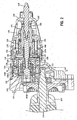
- the driving mechanism 120 is mainly provided with a driving gear 125, a retainer 130, a transmitting mechanism 140, a coil spring 145 and a spindle 150.
- the driving mechanism 120 is one example which corresponds to "a rotation transmitting mechanism".
- the driving gear 125 is a substantially cup-shaped member which has a side wall 126 and a bottom wall 127. Inside region of the side wall 126 is formed cylindrically and thereby the driving gear 125 houses the retainer 130 and the transmitting mechanism 140 therein. Gear teeth 126a is formed on the side wall 126. The gear teeth 126a mesh with gear teeth 112 which are formed on the output shaft 111 of the motor 110. A through-hole through which the spindle 150 penetrates is provided on a center region of the bottom wall 127. A contact portion 127a which is contactable with the retainer 130 is defined around the through-hole.
- the driving gear 125 and the retainer 130 contact with each other via the contact portion 127a, that is, other part of the driving gear 125 does not contact with the retainer 130.
- the driving gear 125 is rotatably supported by a bearing 128. Further, the driving gear 125 is disposed such that it moves in a longitudinal direction of the spindle 150 (axial direction of the tool bit 119).
- the driving gear 125 is one example which corresponds to "a driving member".
- the retainer 130 is substantially cylindrical member which comprises a base portion 131 and a side portion 136.
- the base portion 131 faces the bottom wall 127 of the driving gear 125 and the side portion 136 faces the side wall 126 of the driving gear 125.
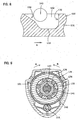
- components other than the retainer 130 and balls 143 are not shown in Fig. 4 .
- two grooves 132 are formed on the base portion 131 along a circumference direction of the retainer 130.
- a horizontal portion 133 which parallel to the base portion 131, an incline portion 134 which inclines with respect to the horizontal portion 133 and a perpendicular portion 135 which is perpendicular to the horizontal portion 133 are provided.
- the grooves 132 are configured to contact with the ball 143. Further, only one ball 143 which contacts with the groove 132 among three balls 143 is illustrated in Fig. 5 . Other sections of the groove are similarly illustrated.
- the side portion 136 is disposed so as to protrude from the base portion 131 in an axial direction of the cylindrical retainer 130.
- Six side portions 136 are disposed with predetermined interval to one another in a circumference direction of the retainer 130.
- a roller 141 is disposed between two side portions 136 which are disposed next to each other.
- an end portion of the side portion 136 in the axial direction of the retainer 130 is supported by a needle bearing 137, and therefore the retainer 130 is rotatably supported.
- the retainer 130 is one example which corresponds to "a switching member".
- the transmitting mechanism 140 is mainly provided with rollers 141, a transmitted member 142 and the balls 143.
- the transmitting mechanism 140 is configured to transmit rotation of the driving gear 125 to the spindle 150.
- the transmitted member 142 has a substantially hexagonal shape section.
- Six rollers 141 are disposed on the outer surface of the transmitted member 142 such that each roller 142 corresponds to each side of the hexagon of the transmitted member 142.
- the roller 141 is disposed such that a longitudinal direction of the roller 141 is parallel to the axial direction of the spindle 150.
- the roller 141 is one example which corresponds to "a transmitting members".
- each ball 143 is held by a ball holding groove 142a formed on the transmitted member 142 and a ball holding groove 156 formed on the spindle 150. Accordingly, the transmitted member 142 and the spindle 150 are configured to rotate integrally via the balls 143. In each ball holding groove 142a, three balls 143 are disposed such that they can move in the axial direction of the spindle 150. Further, a stopping portion 142b is formed on the transmitted member 142, and thereby the ball 143 is prevented from moving by the stopping portion 142b in the axial direction of the spindle 150.
- the spindle 150 is formed by a substantially cylindrical bit holding portion 151 and a substantially cylindrical rotation transmitting shaft 155.
- the bit holding portion 151 and the rotation transmitting shaft 155 are coupled integrally to each other.
- the bit holding portion 151 comprises a bit holding ball 152 and a leaf spring 153, and thereby the bit holding portion 151 detachably holds the tool bit 119.
- a flange portion 154 is formed on the opposite side to the tool bit 119 in the axial direction of the spindle 150.
- the flange portion 154 protrudes outwardly in a radial direction of the spindle 150.
- the flange portion 154 is disposed such that its rear surface faces the driving gear 125 in the axial direction of the spindle 150.
- the rotation transmitting shaft 155 is provided such that one end side of the transmitting shaft 155 is connected to the bit holding portion 151 and another end side of the transmitting shaft 155 is penetrated the driving gear 125 and extended to the motor 110 side.
- Two ball holding grooves 156 are provided in positions opposed by 180 degrees on the rotation transmitting shaft 155 such that the ball holding grooves 156 face two ball holding grooves 142a of the transmitted member 142.
- the ball holding grooves 156 respectively extend in an axial direction of the rotation transmitting shaft 155 (longitudinal direction of the spindle 150).
- the spindle 150 described above is rotatably held by a bearing 159. Further, the spindle 150 is movably held in a longitudinal direction of the spindle 150.
- the spindle 150 is one example which corresponds to "a driven member".
- the coil spring 145 is provided coaxially around the spindle 150 so as to extend in the longitudinal direction of the spindle 150.
- One end of the coil spring 145 is in contact with the driving gear 125, and the other end is in contact with the spindle 150, and thereby the spindle 150 is biased toward a front region to which the tool bit 119 is attached (toward front side of the screw driver 100).
- a stopper 146 is provided in front of the flange portion 154. Accordingly, by contact between the stopper 146 and the flange portion 154, the spindle 150 is prevented from moving frontward of the screw driver 100.
- the driving gear 125 is biased toward rear region (toward rear side of the screw driver 100) which is opposite to the front region in the longitudinal direction of the spindle 150.
- the driving gear 125 is prevented from moving rearward of the screw driver 100 by the retainer 130 and the needle bearing 137.
- the motor 110 when the trigger 107a is manipulated, the motor 110 is turned on and actuated.
- the driving gear 125 is rotated by rotation of the output shaft 111 of the motor 110. Thereafter, rotation of the driving gear 125 is transmitted to the spindle 150, and thereby the tool bit 119 held by the spindle 150 is rotationally driven.
- the roller 141 is moved by rotation of the retainer 130, and thereby the roller 141 is clamped between the driving gear 125 and the transmitted member 142.
- the driving gear 125 and the transmitted member 142 are integrally rotated in the A-direction by a wedge effect of the roller 141.
- torque of the driving gear 125 is transmitted to the transmitted member 142.
- the transmitted member 142 is rotationally driven, the rotation transmitting shaft 155 (spindle 150) is rotated.
- the tool bit 119 held by the spindle 150 is rotationally driven and performs the screw operation.
- the locator 105 is one example which corresponds to "a workpiece contact portion".
- the spindle 150 By screwing the screw into the workpiece in a state that the locator 105 contacts with the workpiece, the spindle 150 is moved forward of the screw driver 100, and the ball 143 pushes the incline portion 134 as shown in Fig. 11 .
- the retainer 130 is rotated in B-direction with respect to the driving gear 125 rotating in the A-direction.
- the retainer 130 and the roller 141 are moved into a position indicated in Fig. 6 , and thereby transmission of rotation of the driving gear 125 to the transmitted member 142 is interrupted. Accordingly, the screw is screwed in a predetermined depth to the workpiece and the screw operation is finished.
- the predetermined depth where a screw is screwed into a workpiece is adjustable by a user by changing a mounting position of the locator 105 with respect to the main housing 103 so that a distance between a screw head of the screw held by the tool bit 119 and a front surface of the locator 105 is changed.
- the ball 143 and the incline portion 134 of the groove 132 are examples which correspond to "a contact portion" and "a guide portion", respectively.
- the screw driver 100 rotates the screw in an opposite direction and thereby the screw is unscrewed. At this time, it is not rational that the tool bit 119 pushes the screw in order to actuate (drive) the tool bit 119. Therefore, during an unscrew operation, the screw driver 100 drives the tool bit 119 is driven by the motor 110 without pushing the tool bit 119 rearward.
- the switch 107b is switched so that the output shaft 111 of the motor 110 is rotated in a direction (opposite direction) opposite to the forward direction in which the output shaft 111 is rotated in the screw operation.
- a direction opposite direction
- torque of the driving gear 125 is transmitted to the retainer 130 via the contact portion 127a by friction force.
- the retainer 130 shown in Fig. 5 is moved in the B-direction as shown in Fig. 12 . That is, the ball 143 is moved far from the incline portion 134 of the groove 132 of the retainer 130 and close to the perpendicular portion 135. In other words, the ball 143 does not prevent rotational movement of the retainer 130.
- the rotational direction (opposite direction) of the output shaft 111 during the unscrew operation is one example which corresponds to "a second direction".
- the rollers 141 are moved and clamped between driving gear 125 and the transmitted member 142.
- the driving gear 125 and the transmitted member 142 are integrally rotated in the B-direction by a wedge effect of the roller 141.
- the tool bit 119 is rotationally driven without pushing the tool bit 119 against a screw and unscrew operation is rationally performed.
- the position of the roller 141 indicated in Fig. 13 is one example which corresponds to "a transmittable position".
- both rotations of the A-direction and the B-direction of the driving gear 125 are transmitted by the same roller 141. That is, when the driving gear 125 is rotated in the A-direction, the tool bit 119 and the spindle 150 are moved in the longitudinal direction and thereby torque of the driving gear 125 is transmitted to the spindle 150 via the roller 141. On the other hand, when the driving gear 125 is rotated in the B-direction, torque of the driving gear 125 is transmitted to the spindle 150 via the roller 141 without axial movement of the tool bit 119 and the spindle 150. Accordingly, based on rational operation aspects, the same roller 141 transmits torque of the motor 110 (driving gear 125) to the tool bit 119 (spindle 150).
- the tool bit 119 when the unscrew operation is performed, the tool bit 119 is driven without pushing the tool bit 119 against a workpiece via a screw.
- the tool bit 119 may be driven by pushing the tool bit 119 against a workpiece via a screw.
- an incline portion" 134 may be formed instead of the perpendicular portion 135 in the groove 132 of the retainer 130. Accordingly, in a state that the tool bit 119 is not pushed against a workpiece, the retainer 130 is prevented from moving in both of the A-direction and the B-direction by contact between the ball 143 and the incline portion 143. In other words, it is necessary to push the tool bit 119 against a workpiece for driving the tool bit 119 in both of the screw and the unscrew operations.
- a driving mechanism 220 is mainly provided with a driving gear 225, a retainer 230, a transmitting mechanism 240, the coil spring 145 and the spindle 150.
- the driving mechanism 220 is one example which corresponds to "a rotation transmitting mechanism".
- the driving gear 225 is a substantially cup-shaped member which has a side wall 226 and a bottom wall 227. Inside region of the side wall 226 is formed cylindrically and thereby the driving gear 225 houses the retainer 230 and the transmitting mechanism 240 therein. Gear teeth 226a is formed on the side wall 226. The gear teeth 226a mesh with gear teeth 112 which are formed on the output shaft 111 of the motor 110. A through-hole through which the spindle 150 penetrates is provided on a center region of the bottom wall 227. A contact portion 227a which is contactable with the retainer 230 is defined around the through-hole.
- the driving gear 225 and the retainer 230 contact with each other via the contact portion 227a, that is, other part of the driving gear 225 does not contact with the retainer 230.
- the driving gear 225 is disposed such that it moves in a longitudinal direction of the spindle 150 (axial direction of the tool bit 119) . Further, a stopper 229 is provided in front of the driving gear 225 and thereby forward movement of the driving gear 225 in the screw driver 200 is prevented by the stopper 229.
- the driving gear 225 is one example which corresponds to "a driving member".
- the retainer 230 is substantially cylindrical member which comprises a base portion 231 and a side portion 236.
- the base portion 231 faces the bottom wall 227 of the driving gear 225 and the side portion 236 faces the side wall 226 of the driving gear 225. Further, components other than the retainer 230 and balls 143 are not shown in Fig. 17 .
- each groove 232 is formed by two incline portions 234 which incline with respect to the base portion 231.
- the side portion 236 is, similar to the first embodiment, provided so as to protrude from the base portion 231 in an axial direction of the cylindrical retainer 230.
- the retainer 230 is one example which corresponds to "a switching member".
- the transmitting mechanism 240 is mainly provided with rollers 141, a transmitted member 242 and the balls 143.
- the transmitted member 242 has a substantially hexagonal shape section. Similar to the first embodiment, six rollers 141 are disposed on the outer surface of the transmitted member 242 such that each roller 142 corresponds to each side of the hexagon of the transmitted member 242.
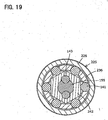
- illustrations of components which are arranged outside of the driving gear 225 are omitted in Fig. 19 and in Figs thereafter regarding sections of the driving gear and the retainer.
- each ball 143 is held by a ball holding groove 242a formed on the transmitted member 242 and the ball holding groove 156 formed on the spindle 150. Accordingly, the transmitted member 242 and the spindle 150 are configured to rotate integrally via the balls 143.
- the coil spring 145 is provided coaxially with the spindle 150 around the rotation transmitting shaft 155 so as to extend in the longitudinal direction of the spindle 150.
- One end of the coil spring 145 penetrates the driving gear 225 and contacts with the retainer 230, and the other end is in contact with the spindle 150, and thereby the spindle 150 is biased toward a front region to which the tool bit 119 is attached (toward front side of the screw driver 200) .
- the spindle 150 is prevented from moving forward of the screw driver 200 by contact of the ball holding groove 156 and the ball 143 and contact of the retainer 230 and the ball 143.
- the retainer 230 is prevented from moving forward by the stopper 229 via the driving gear 225.
- the retainer 230 is biased toward a rear region opposite to the front region (toward rear side of the screw driver 200) by the coil spring 145. At this time, the retainer 230 is prevented from moving rearward of the screw driver 200-by the needle bearing 137.
- the roller 141 is moved by rotation of the retainer 230, and thereby the roller 141 is clamped between the driving gear 225 and the transmitted member 242.
- the driving gear 225 and the transmitted member 242 are integrally rotated in the A-direction by a wedge effect of the roller 141.
- the tool bit 119 held by the spindle 150 is rotationally driven and performs the screw operation.
- the spindle 150 By screwing a screw into the workpiece in a state that the locator 105 contacts with the workpiece, the spindle 150 is moved forward of the screw driver 200. Similar to the first embodiment, the ball 143 pushes the incline portion 234. Thus, the retainer 230 is rotated in the B-direction with respect to the driving gear 225 rotating in the A-direction. As a result, the retainer 230 and the roller 141 are moved into a position indicated in Fig. 19 , and thereby transmission of rotation of the driving gear 225 to the transmitted member 242 is interrupted. Accordingly, the screw is screwed in a predetermined depth to the workpiece and the screw operation is finished.
- the inclined portion 234 of the groove 232 is one example which corresponds to "a guide portion".
- the spindle 150 is pushed against a workpiece via tool bit 119, and thereby the tool bit 119 (spindle 150) is driven.
- the driving gear 225 is rotated in the B-direction.
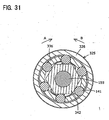
- a third embodiment is explained with reference to Fig. 23 to Fig. 31 .
- a screw driver 300 the same components described in the first embodiment are assigned the same symbols as in the first embodiment and explanations thereof are therefore omitted.
- a driving mechanism 320 is mainly provided with a driving gear 325, a retainer 330, a transmitting mechanism 340, the coil spring 145 and the spindle 150.
- the driving mechanism 320 is one example which corresponds to "a rotation transmitting mechanism".
- the driving gear 325 is a substantially cup-shaped member which has a side wall 326 and a bottom wall 327. Inside region of the side wall 326 is formed cylindrically and thereby the driving gear 325 houses the retainer 330 and the transmitting mechanism 340 therein. Gear teeth 326a is formed on the side wall 326. The gear teeth 326a mesh with gear teeth 112 which are formed on the output shaft 111 of the motor 110. A through-hole through which the spindle 150 penetrates is provided on a center region of the bottom wall 327. A contact portion 327a which is contactable with the retainer 330 is defined around the through-hole.
- the driving gear 325 and the retainer 330 contact with each other via the contact portion 327a, that is, other part of the driving gear 325 does not contact with the retainer 330.
- the driving gear 325 is disposed such that it moves in a longitudinal direction of the spindle 150 (axial direction of the tool bit 119). Further, a stopper 229 is provided in front of the driving gear 325 and thereby forward movement of the driving gear 325 in the screw driver 300 is prevented by the stopper 329.
- the driving gear 325 is one example which corresponds to "a driving member" of the present invention.
- the retainer 330 is substantially cylindrical member which comprises a base portion 331 and a side portion 336.
- the base portion 331 faces the bottom wall 327 of the driving gear 325 and the side portion 336 faces the side wall 326 of the driving gear 325. Further, components other than the retainer 330 and the transmitted member 342 are not shown in Fig. 25 .
- each groove 332 is formed by two incline portions 334 which incline with respect to the base portion 331.
- the side portion 336 is, similar to the first embodiment, provided so as to protrude from the base portion 331 in an axial direction of the cylindrical retainer 330.
- the retainer 330 is one example which corresponds to "a switching member".
- the transmitting mechanism 340 is mainly provided with rollers 141 and a transmitted member 342.
- the transmitted member 342 has a substantially hexagonal shape section. Similar to the first embodiment, six rollers 141 are disposed on the outer surface of the transmitted member 342 such that each roller 142 corresponds to each side of the hexagon of the transmitted member 342.
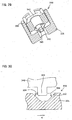
- the transmitted member 342 has two protrusion 343 which correspond to two grooves 332 of the retainer 330, respectively.
- the rotation transmitting shaft 155 is fitted into the transmitted member 342 and thereby the spindle 150 and the transmitted member 342 are configured to rotate integrally.
- the protrusion 343 is one example which corresponds to "an axially movable element”.
- the coil spring 145 is provided coaxially with the spindle 150 around the rotation transmitting shaft 155 so as to extend in the longitudinal direction of the spindle 150.
- One end of the coil spring 145 penetrates the driving gear 325 and contacts with the retainer 330, and the other end is in contact with the spindle 150, and thereby the spindle 150 is biased toward a front region to which the tool bit 119 is attached (toward front side of the screwdriver 300) .
- the stopper 146 is provided in front of the flange portion 154. Thus, the spindle 150 is prevented from moving forward of the screw driver 300 by contact of the flange portion 154 and the stopper 146.
- the retainer 330 is biased toward a rear region opposite to the front region (toward rear side of the screw driver 200) by the coil spring 145. At this time, the retainer 330 is prevented from moving rearward of the screw driver 300 by the needle bearing 137.
- the roller 141 is moved by rotation of the retainer 330, and thereby the roller 141 is clamped between the driving gear 325 and the transmitted member 342.
- the driving gear 325 and the transmitted member 342 are integrally rotated in the A-direction by a wedge effect of the roller 141.
- the tool bit 119 held by the spindle 150 is rotationally driven and performs the screw operation.
- the spindle 150 By screwing a screw into the workpiece in a state that the locator 105 contacts with the workpiece, the spindle 150 is moved forward of the screw driver 300 and thereby the protrusion 343 pushes the incline portion 334. Accordingly, the retainer 330 rotates relatively in the B-direction with respect to the driving gear 325 rotating in the A-direction. As a result, the retainer 330 and the roller 141 are moved into a position indicated in Fig. 27 , and thereby transmission of rotation of the driving gear 325 to the transmitted member 342 is interrupted. Accordingly, the screw is screwed in a predetermined depth to the workpiece and the screw operation is finished.
- the protrusion 343 and the incline portion 334 of the groove 332 are examples which correspond to "a contact portion" and "a guide portion", respectively.
- the spindle 150 is pushed against a workpiece via tool bit 119, and thereby the tool bit 119 (spindle 150) is driven.
- the driving gear 325 is rotated in the B-direction.
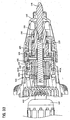
- a fourth embodiment is explained with reference to Fig. 32 to Fig. 43 .
- a screw driver 400 the same components described in the first embodiment are assigned the same symbols as in the first embodiment and explanations thereof are therefore omitted.
- a driving mechanism 420 is mainly provided with a driving gear 425, a retainer 430, a transmitting mechanism 440, the coil spring 145 and the spindle 150.
- the driving mechanism 420 is one example which corresponds to "a rotation transmitting mechanism”.
- the driving gear 425 is a substantially cup-shaped member which has a side wall 426 and a bottom wall 427. Inside region of the side wall 426 is formed cylindrically and thereby the driving gear 425 houses the retainer 430 and the transmitting mechanism 440 therein. Gear teeth 426a is formed on the side wall 426. The gear teeth 426a mesh with gear teeth 112 which are formed on the output shaft 111 of the motor 110. A through-hole through which the spindle 150 penetrates is provided on a center region of the bottom wall 427. A contact portion which is contactable with the retainer 430 is defined around the through-hole.
- the driving gear 425 and the retainer 430 contact with each other via the contact portion, that is, other part of the driving gear 425 does not contact with the retainer 430.
- the driving gear 425 is disposed such that it moves in a longitudinal direction of the spindle 150 (axial direction of the tool bit 119) .
- the driving gear 425 is one example which corresponds to "a driving member".
- the retainer 430 is substantially cylindrical member which comprises a base portion 431 and a side portion 435.
- the base portion 431 faces the bottom wall 427 of the driving gear 425 and the side portion 435 faces the side wall 426 of the driving gear 425.
- components other than the retainer 430 and the balls 143 are not shown in Fig. 34 .
- the retainer 430 is one example which corresponds to "a switching member".
- each groove 432 is formed by two incline portions 434 which incline with respect to the base portion 431.
- the side portion 436 is provided so as to protrude from the base portion 431 in an axial direction of the cylindrical retainer 430.
- the side portion 436 has three wide portions 435a and three narrow portions 435b.
- the wide portion 435a and the narrow portion 435b are arranged one after the other in the circumference direction of the retainer 430.
- the wide portion 435a is provided such that its length is longer than a length of the narrow portion 435b in the circumference direction.
- a first roller holding portion 436a and a second roller holding portion 436b are defined by space between the wide portion 435a and the narrow portion 435b in the circumference direction of the retainer 430.
- the first roller holding portion 436a and the second roller holding portion 436b are arranged one after the other in the circumference direction of the retainer 430.
- the first roller holding portion 436a is defined such that its length is longer than a length of the second roller holding portion 436b in the circumference direction.
- the first roller holding portion 436a is formed so as to penetrate the base portion 431 in the axial direction of the retainer 430, in other words, the first roller holding portion 436a is formed from one end another in the axial direction of the retainer 430.
- a first roller 441a is provided in the first roller holding portion 436a, and a second roller 441b is provided in the second roller holding portion 436b.
- the first roller 441a is formed such that its axial length is longer than the second roller 441b.
- the first roller 441a has circular arc shape at its both ends. The both ends are formed as a circular arc of which diameter is equal to the axial length of the first roller 441a.
- the first roller 441a and the second roller 441b are one example which corresponds to "a transmitting member".
- the transmitting mechanism 440 is mainly provided with the first roller 441a, the second roller 441b, a transmitted member 442 and the balls 143.
- the transmitted member 442 has a hexagonal section.
- each ball 143 is held by a ball holding groove 442a formed on the transmitted member 442 and the ball holding groove 156 formed on the spindle 150. Accordingly, the transmitted member 442 and the spindle 150 are configured to rotate integrally via the balls 143.
- the coil spring 145 is provided coaxially with the spindle 150 around the rotation transmitting shaft 155 so as to extend in the longitudinal direction of the spindle 150.
- One end of the coil spring 145 contacts with the driving gear 425, and the other end contacts with the spindle 150, and thereby the spindle 150 is biased toward a front region to which the tool bit 119 is attached (toward front side of the screw driver 400) .
- the stopper 146 is provided in front of the flange portion 154. Thus, the spindle 150 is prevented from moving forward of the screw driver 400 by contact of the flange portion 154 and the stopper 146.
- the driving gear 425 is biased toward a rear region opposite to the front region (toward rear side of the screw driver 400) by the coil spring 145. At this time, the driving gear 425 is prevented from moving rearward of the screw driver 400 by the retainer 430 and the needle bearing 137.
- the first roller 441a and the second roller 441b are positioned in each center region which corresponds to center of each side of the hexagonal section of the transmitted member 442.
- the second roller holding portion 436b is positioned so as to face the center region.
- the first roller holding portion 436a is positioned so as to face a back region (rear region) with respect to the center region in a rotational direction (A-direction) during the screw operation.
- the second roller 441b is moved by rotation of the retainer 430, and thereby the second roller 441b is clamped between the driving gear 425 and the transmitted member 442.
- the driving gear 425 and the transmitted member 442 are integrally rotated in the A-direction by a wedge effect of the second roller 441b.
- the tool bit 119 held by the spindle 150 is rotationally driven and performs the screw operation.
- the spindle 150 By screwing a screw into the workpiece in a state that the locator 105 contacts with the workpiece, the spindle 150 is moved forward of the screw driver 400. Similar to the first embodiment, the ball 143 pushes the incline portion 434. Thus, the retainer 430 is rotated in the B-direction with respect to the driving gear 425 rotating in the A-direction. As a result, the retainer 430 and the second roller 441b are moved into a position indicated in Fig. 38 , and thereby transmission of rotation of the driving gear 425 to the transmitted member 442 is interrupted. Accordingly, the screw is screwed in a predetermined depth to the workpiece and the screw operation is finished.
- the second roller 441b is one example which corresponds to "a transmitting element belonging to a first group”. Further, the incline portion 434 of the groove 432 is one example which corresponds to "a guide portion”.
- the tool bit 119 is driven by the motor 111 in a state that the tool bit 119 is not pushed against a screw (workpiece) during the unscrew operation.
- the tool bit 119 is rotationally driven without pushing the tool bit 119 against the screw (workpiece) .
- the first roller 441a is not limited to be inclined within the first roller holding portion 436a as shown in Fig. 44 .
- the first roller 441a may be moved in the rotation direction of the driving gear 425 and be positioned in parallel with the axial direction of the tool bit 119. by moving the needle bearing 137 side of the first roller 441a is moved before the driving gear 425 side portion of the first roller 441a is clamped.
- the first roller 441a is one example which corresponds to "a transmitting element belonging to a second group".
- the rollers 141, 441 are switched in positions between a rotation transmittable position and a rotation non-transmittable position, by rotation of the retainer 130, 230, 330, 440 in a circumference direction of the spindle 150. That is, the position of the rollers 141, 441 is rationally switched by rotation of the driving gear 125, 225, 325, 425.
- the wedge effect of the roller 141, 441 which is clamped between the driving gear 125, 225, 325, 425 and the transmitted member 142, 242, 342, 442 is easily obtained.
- rotation of the output shaft 111 of the motor 110 is transmitted to the spindle 150 by means of the wedge effect.
- the ball 143 contacts with the incline portion 134, 234, 434 of the groove 132, 232, 432 formed on the retainer 130, 230, 430 with screwing of a screw and thereby rotation transmission from the driving gear 125, 225, 425 to the transmitted member 142, 242, 442 is interrupted.
- the screw operation is finished precisely in a predetermined depth of the screwing.
- the protrusion 343 of the transmitted member 342 contacts with the incline portion 334 of the groove 332 formed on the retainer 330 with screwing of a screw and thereby rotation transmission from the driving gear 325 to the transmitted member 342 is interrupted. Further, since the protrusion 343 formed on the transmitted member 342 rotates the retainer 330 with screwing a screw, it is not necessary to provide additional members other than the transmitted member 342 and the retainer 340 for rotating the retainer 340.
- an inner surface section of the driving gear 125, 225, 325, 425 is defined as a circular section and an outer surface section of the transmitted member 142, 242, 342, 442 is defined as a regular hexagonal section.
- an inner surface section of the driving gear may be defined as a regular hexagonal section and an outer surface section of the transmitted member may be defined as a circular section.
- a regular polygonal section may be applicable to the present teachings. In this case, the rollers may be provided in accordance with number of sides of the regular polygon.
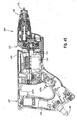
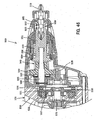
- a fifth embodiment is explained with reference to Fig. 45 and Fig. 46 .
- a screw driver 500 the same components described in the first embodiment are assigned the same symbols as in the first embodiment and explanations thereof are therefore omitted.
- a driving mechanism 520 is mainly provided with a transmission mechanism 530, a driven gear 540, a spindle 550, a load cell 560, and a controller 570.
- the driving mechanism 520 is one example which corresponds to "a rotation transmitting mechanism".
- the transmission mechanism 530 is configured to transmit rotation of the output shaft 111 of the motor 110 to the driven gear 540.
- the transmission mechanism 530 is mainly provided with a rotor 531, an electromagnet 532, a driving gear 535, a driven clutch member 536, and a leaf spring 537.
- the rotor 531 is mounted onto the outer surface of the output shaft 111 so that the rotor 531 rotates integrally with the output shaft 111.
- the electromagnet 532 which is electrically connected to the controller 570 is mounted on the rotor 531.
- the driving gear 535 is provided coaxially with the output shaft 111 and the driven clutch member 536 is mounted via the leaf spring 537 at a region of the driving gear 535, which is opposite to the rotor 531.
- the driven clutch member 536 is formed by a magnetic material. When current is not provided to the electromagnet 532, the rotor 531 and the driven clutch member 536 are separated by biasing force of the leaf spring 537.
- the rotor 531 is one example which corresponds to "a driving member”.
- driving gear 535 and the driven clutch member 536 are one example which corresponds to "a transmitting member”. Further, a position of the driving gear 535 and the driven clutch member 536 which are separated from the rotor 531 is one example which corresponds to "a non-transmittable position”.
- the driven gear 540 is arranged so as to engage with the driving gear 535.
- the rotation transmitting shaft 555 penetrates the center of the driven gear 540 and connects with the driven gear 540 by a spline connection.
- a needle bearing 541 is disposed at rear side of the driven gear 540 and a coil spring 545 is disposed at front side of the driven gear 540.
- the driven gear 540 is rotatably supported and biased toward front region of the screw driver 500.
- the spindle 550 is mainly provided with a bit holding portion 551 and the rotation transmitting shaft 555.
- the tool bit 119 is held by the bit holding portion 551 by utilizing a bit holding ball 552 and a leaf spring 553.
- a flange portion 554 is formed at the opposite side which is opposite to the tool bit 119 side of the bit holding portion 551 in a longitudinal direction of the spindle 550.
- One end of the rotation transmitting shaft 555 is fixedly connected to the bit holding portion 551, and the other end is extended to the motor 110 side by protruding the driven gear 540.
- the bit holding portion 551 and the rotation transmitting shaft 555 are configured to integrally rotate.
- the spindle 550 described above is biased forward of the screw driver 500 by the coil spring 545 which contacts with the flange portion 554.
- a stopper 556 is disposed on the main housing 103 in front of the flange portion 554.
- the spindle 550 is prevented from moving forward of the screw driver 500 by contacting the flange portion 554 with the stopper 556.
- the spindle 550 is moved rearward of the screw driver 500 by being pushed against biasing force of the coil spring 545.
- the spindle 550 is one example which corresponds to "a driven member".
- the load cell 560 which is connected to the controller 570 is disposed at a rearward area of the spindle 550.
- the load cell 560 detects pushing force of the spindle 550 which is pushed via the tool bit 119.
- the spindle 550 When the tool bit 119 is pushed on a screw (not shown) in a state that the output shaft 111 of the motor 110 rotates based on an operation (manipulation) of the trigger 107a, the spindle 550 is moved rearward of the screw driver 500 against the biasing force of the coil spring 545. Thereafter, the rear end of the rotation transmitting shaft 555 is contacted with the load cell 560 and the controller 570 detects the pushing force of the spindle 550 via the load cell 560. When the pushing force of the spindle 550 exceeds a predetermined threshold, the controller 570 provides current to the electromagnet 532.
- the driven clutch member 536 disposed on the driving gear 535 is moved by the electromagnetic so that the driving gear 535 and the rotor 531 integrally rotate.
- rotation of the output shaft 111 is transmitted to the spindle 550 (tool bit 119) via the transmission mechanism 530, and thereby a screw operation is performed.
- a rotation direction of the output shaft 111 during the screw operation is one example which corresponds to "a first direction”.
- a position of the driving gear 535 and the driven clutch member 536 which are integrally rotated with the rotor 531 is one example which corresponds to "a transmittable position”.
- the forward position of the spindle 550 and the rearward position of the spindle 550 are examples which correspond to "a first position" and "a second position", respectively.
- the electromagnet 532 is one example which corresponds to "a switching member".
- the switch 107b When a screw screwed into a workpiece is unscrewed from a workpiece, the switch 107b is switched so that the output shaft 111 of the motor 110 is rotated in a direction (opposite direction) opposite to the forward direction in which the output shaft 111 is rotated in the screw operation. Thereafter, when the trigger 107a is operated, the controller 570 provides current to the electromagnet 532 without detecting the pushing force of the spindle 550. Accordingly, the driven clutch member 536 disposed on the driving gear 535 is moved by the electromagnetic so that the driving gear 535 and the rotor 531 integrally rotate.
- a rotation direction of the output shaft 111 during the unscrew operation is one example which corresponds to "a second direction".
- the tool bit 119 is driven in a state that the tool bit 119 is not pushed against a screw (workpiece) . Accordingly, the unscrew operation is rationally performed.
- both rotations of the A-direction and the B-direction of the driving gear 125 are transmitted by the single transmission mechanism 530. That is, by utilizing the electromagnet 532, one rotation transmission mechanism which transmits rotation of the output shaft 111 in a forward direction to the tool bit 119 in a state that the spindle 550 is pushed and another rotation transmission mechanism which transmits rotation of the output shaft 111 in a opposite direction to the tool bit 119 in a state that the spindle 550 is not pushed are provided by the single transmission mechanism 530. In other words, rotations of both directions of the output shaft 111 are transmitted via the same member. Accordingly, transmission members based on each rotation direction of the output shaft 111 are not needed, and thereby number of components of the screw driver 500 is reduces.
- the electromagnet 532 is mounted on the rotor 531 and the driven clutch member 536 is mounted on the driving gear 535, however it is not limited to such construction.
- an electromagnet may be mounted on the driving gear 535 and a driven clutch member may be mounted on the rotor 531.
- the output shaft 111 of the motor 110 is configured to engage with the driven bear 540. Further, the motor 110 is connected to the controller 570. During the screw operation, when the trigger 107a is operated and the pushing force of the spindle 550 detected by the load cell 570 exceeds the threshold, the controller 570 provides electric current to the motor 110. When the pushing force falls below the threshold, the controller 570 interrupts a provision of electric current to the motor 110, and thereby the screw operation is finished.
- the controller 570 provides electric current to the motor 110 without detecting the pushing force of the spindle 550. Accordingly, the tool bit 119 is driven without the pushing force. Further, when the operation of the trigger 107a is cancelled, the controller 570 interrupts the provision of electric current to the moto 110. Thus, the unscrew operation is rationally performed.
- a moving prevention member which is configured to prevent the spindle 150, 550 from moving rearward of the screw driver 100, 200, 300, 400, 500 during the unscrew operation may be provided.
- the moving prevention member may be configured to be movable to change its positions based on a switching of the switch 107b such that the moving prevention member contacts with the rear surface of the flange portion 154, 554 during the unscrew operation and it does not contact with the flange portion 154, 554 during the screw operation.
- the power tool comprises a biasing member which is configured to bias the axially movable element, wherein the axially movable element prevents the switching member from moving in the circumference direction of the rotation shaft by means of biasing force of the biasing member.
- the power tool which is configured as a screw fastening tool which performs a screw operation in which the tool bit fastens a screw into a workpiece, comprising:
- the axially movable element is formed integrally with the driven member.
- the axially movable element is formed as a spherical member which is a separate member from the driving member.
- the axially movable element is configured to normally prevent the switching member from moving in the circumference direction with respect to the driven member, wherein the axially movable element is moved in the axial direction by movement of the driven member from the first position to the second position and thereby rotation of the switching member with respect to the driven member in the circumference direction is allowed, and wherein in a state that the rotation of the switching member is allowed, the driving member is rotated and thereby the switching member switches the position of the transmitting member from the non-transmittable position to the transmittable position.
- One of the axially movable element and the switching member has a guide portion which extends in the circumference direction, and the other has a contact portion which is contactable with the guide portion, wherein in a state that the guide portion and the contact portion contact with each other, the axially movable element moves so as to be close to a workpiece in the axial direction during the screw operation and thereby the switching member is moved in the circumference direction and switches the position of the transmitting member from the transmittable position to the non-transmittable position.
- One of the driving member and the driven member has a cylindrical column part which faces a polygonal column part of the other member, wherein the transmitting member is provided with a plurality of transmitting elements which is arranged on the each surface of the polygonal column part.
- the driven member is arranged inside the driving member, wherein an internal form of the driving member is formed as a cylindrical column and an external form of the driven member is formed as a polygonal column, and wherein the transmitting member is provided as a cylindrical roller which is arranged on the each surface of the polygonal column.
- a power tool which rotationally drives a tool bit comprising:
- the power tool comprises a transmitting member which is disposed between the driving member and the driven member, wherein the transmitting member is configured to transmit .both rotation in a first direction of the output shaft and in a second direction which is opposite to the first direction of the output shaft.
- the screw driver 100, 200, 300, 400, 500 corresponds to "a power tool" of the invention.
- the motor 110 corresponds to "a motor”.
- the output shaft 111 corresponds to "an output shaft”.
- the driving mechanism 120, 220, 320, 420, 520 corresponds to "a rotation transmission mechanism".
- the driving gear 125, 225, 325, 425, 535 corresponds to "a driving member”.
- the spindle 150, 550 corresponds to "a transmitted member”.
- the roller 141, 441a, 441b corresponds to "a transmitting member".
- the roller 141, 441a, 441b corresponds to "a transmitting element".
- the retainer 130, 230, 330, 430 corresponds to "a switching member”.
- the ball 143 corresponds to "an axially movable element”.
- the ball 143 corresponds to "a contact portion”.
- the protrusion 343 corresponds to "an axially movable element”.
- the protrusion 343 corresponds to "a contact portion”.
- the groove 132, 232, 332, 432 corresponds to "a guide portion".
- the locator 105 corresponds to "a workpiece contact portion".
- the rotor 531 corresponds to "a driving member”.
- the driven clutch member 536 corresponds to "a driven member”.
- the electromagnet 532 corresponds to "a switching member”.
Landscapes
- Engineering & Computer Science (AREA)
- Mechanical Engineering (AREA)
- Details Of Spanners, Wrenches, And Screw Drivers And Accessories (AREA)
- Portable Power Tools In General (AREA)
Claims (12)
- Outil électrique (100 ; 200 ; 300 ; 400 ; 500) qui entraîne en rotation un grain (119), comprenant :un moteur (110) qui comprend un arbre de sortie (111), etun mécanisme de transmission de rotation (120 ; 220 ; 320 ; 420 ; 520) qui transmet une rotation de l'arbre de sortie (111) au grain (119) et entraîne ainsi en rotation le grain (119),le mécanisme de transmission de rotation (120 ; 220 ; 320 ; 420 ; 520) comprend :un organe d'entraînement (125 ; 225 ; 325 ; 425 ; 535) qui comprend un arbre de rotation, l'organe d'entraînement (125 ; 225 ; 325 ; 425 ; 535) étant entraîné en rotation par le moteur (110), etun organe entraîné (150 ; 550) auquel est fixé le grain (119), dans lequel l'organe entraîné (150 ; 550) est disposé coaxialement avec l'arbre de rotation et est configuré pour se déplacer entre une première position et une seconde position dans une direction axiale de l'arbre de rotation,caractérisé en ce que
le mécanisme de transmission de rotation (120 ; 220 ; 320 ; 420 ; 520) comprend en outre
un organe de transmission (141 ; 441a, 441b) qui est disposé entre l'organe d'entraînement (125 ; 225 ; 325 ; 425 ; 535) et l'organe entraîné (150 ; 550) et est mobile dans une direction de circonférence de l'arbre de rotation entre une position transmissible dans laquelle une rotation de l'arbre de sortie (111) est transmise à l'organe entraîné (150 ; 550) via l'organe de transmission (141 ; 441a, 441b) et une position non transmissible qui est une position différente de la position transmissible dans laquelle la transmission de rotation est interrompue, et
un organe de permutation (130 ; 230 ; 330 ; 430 ; 532) qui est configuré pour permuter une position de l'organe de transmission (141 ; 441a, 441b) entre la position transmissible et la position non transmissible par déplacement dans la direction de circonférence de l'arbre de rotation par rapport à l'organe entraîné (150 ; 550),
dans lequel l'organe de permutation (130 ; 230 ; 330 ; 430 ; 532) est autorisé à se déplacer dans la direction de circonférence de l'arbre de rotation par rapport à l'organe entraîné (150 ; 550) d'après la position de l'organe entraîné (150 ; 550) dans la direction axiale de l'arbre de rotation, et l'organe de transmission (141 ; 441a, 441b) est permuté entre la position transmissible et la position non-transmissible par le déplacement de l'organe de permutation (130 ; 230 ; 330 ; 430 ; 532). - Outil électrique (100 ; 200 ; 300 ; 400) selon la revendication 1, dans lequel l'organe entraîné (150) est déplacé vers la seconde position depuis la première position par poussée contre une pièce via le grain (119),
dans lequel l'arbre de sortie (111) est tourné dans une première direction prédéterminée et l'organe entraîné (150) est positionné dans la première position, l'organe de permutation (130 ; 230 ; 330 ; 430) ne peut pas se déplacer dans la direction de circonférence de l'arbre de rotation et ainsi l'organe de permutation (130 ; 230 ; 330 ; 430) maintient l'organe de transmission (141 ; 441a, 441b) dans la position non transmissible,
et lorsque l'arbre de sortie (111) est tourné dans la première direction et l'organe entraîné (150) est déplacé vers la seconde position depuis la première position, l'organe de permutation (130 ; 230 ; 330 ; 430) est autorisé à se déplacer dans la direction de circonférence de l'arbre de rotation et ainsi l'organe de permutation (130 ; 230 ; 330 ; 430) permute la position de l'organe de transmission (141 ; 441a, 441b) avec la position transmissible et l'organe de transmission (141 ; 441a, 441b) transmet une rotation de l'arbre de sortie (111) dans la première direction à l'organe entraîné (150). - Outil électrique (100 ; 200 ; 300 ; 400) selon la revendication 2, lorsque l'arbre de sortie (111) est tourné dans une seconde direction opposée à la première direction et l'organe entraîné (150) est positionné dans la première position, l'organe de permutation (130 ; 230 ; 330 ; 430) est autorisé à se déplacer dans la direction de circonférence de l'arbre de rotation et ainsi l'organe de permutation (130 ; 230 ; 330 ; 430) permute la position de l'organe de transmission (141 ; 441a, 441b) avec la position transmissible et l'organe de transmission (141 ; 441a, 441b) transmet une rotation de l'arbre de sortie (111) dans la seconde direction à l'organe entraîné (150).
- Outil électrique (100 ; 200 ; 300 ; 400) selon l'une quelconque des revendications 1 à 3, dans lequel le mécanisme de transmission de rotation (120 ; 220 ; 320 ; 420) comprend un élément mobile axialement (143 ; 343) qui est configuré pour se déplacer dans la direction axiale de l'arbre de rotation conformément à un déplacement de l'organe entraîné (150) dans la direction axiale de l'arbre de rotation, et dans lequel l'élément mobile axialement (143 ; 343) déplace l'organe de permutation (130 ; 230 ; 330 ; 430) dans la direction de circonférence de l'arbre de rotation par déplacement dans la direction axiale de l'arbre de rotation.
- Outil électrique (300) selon la revendication 4, dans lequel l'élément mobile axialement (343) est formé d'un seul tenant avec l'organe entraîné.
- Outil électrique (100 ; 200 ; 400) selon la revendication 4, dans lequel l'élément mobile axialement (143) est formé comme un organe sphérique qui est séparé de l'organe entraîné (150).
- Outil électrique (100 ; 400) selon l'une quelconque des revendications 4 à 6, dans lequel l'élément mobile axialement (143) est configuré pour empêcher normalement un déplacement relatif de l'organe de permutation (130 ; 430) par rapport à l'organe entraîné (150) dans la direction de circonférence,
et dans lequel l'élément mobile axialement (143) est déplacé dans la direction axiale de l'arbre de rotation par déplacement de l'organe entraîné (150) vers la seconde position depuis la première position et ainsi le mouvement relatif de l'organe de permutation (130 ; 430) est autorisé,
dans un état où le déplacement relatif de l'organe de permutation (130 ; 430) est autorisé, lorsque l'organe d'entraînement (125 ; 425) est tourné, l'organe de permutation (130 ; 430) permute la position de l'organe de transmission (141 ; 441a, 441b) vers la position transmissible depuis la position non transmissible par rotation de l'organe d'entraînement (125 ; 425). - Outil électrique (100 ; 200 ; 300 ; 400) selon l'une quelconque des revendications 4 à 7, dans lequel l'outil électrique (100 ; 200 ; 300 ; 400) est construit comme un outil de fixation de vis qui réalise une opération de vissage dans laquelle le grain (119) fixe une vis dans une pièce, comprenant en outre :une portion de contact de pièce (105) qui peut être mise en contact avec une pièce pendant l'opération de vissage,dans lequel, dans un état où la portion de contact de pièce (105) entre en contact avec une pièce, l'organe entraîné (150) se déplace pour être proche d'une pièce dans la direction axiale du grain (119) par fixation d'une vis par le grain (119),et dans lequel l'élément mobile axialement (143 ; 343) se déplace dans la direction axiale conformément au déplacement axial de l'organe entraîné (150) pendant l'opération de vissage et ainsi l'élément mobile axialement (143 ; 343) déplace l'organe de permutation (130 ; 230 ; 330 ; 430) dans la direction de circonférence et l'organe de permutation (130 ; 230 ; 330 ; 430) permute la position de l'organe de transmission (141 ; 441a ; 441b) vers la position non transmissible depuis la position transmissible.
- Outil électrique (100 ; 200 ; 300 ; 400) selon la revendication 8, dans lequel un composant de l'élément mobile axialement (143 ; 343) et de l'organe de permutation (130 ; 230 ; 330 ; 430) a une portion de guidage (132 ; 232 ; 332 ; 432) qui s'étend dans la direction de circonférence de l'arbre de rotation, et l'autre composant a une portion de contact (143 ; 343) qui peut être mise en contact avec la portion de guidage (132 ; 232 ; 332 ; 432),
dans un état où la portion de guidage (132 ; 232 ; 332 ; 432) et la portion de contact (143 ; 343) sont mises en contact l'une avec l'autre pendant l'opération de vissage, l'élément mobile axialement (143 ; 343) se déplace pour être proche du grain (119) dans la direction axiale et ainsi l'organe de permutation (130 ; 230 ; 330 ; 430) est déplacé dans la direction de circonférence de l'arbre de rotation par l'élément mobile axialement (143 ; 343), et l'organe de permutation (130 ; 230 ; 330 ; 430) permute la position de l'organe de transmission (141 ; 441a, 441b) vers la position transmissible depuis la position non transmissible par déplacement de l'organe de permutation (130 ; 230 ; 330 ; 430) dans la direction de circonférence. - Outil électrique (100 ; 400) selon l'une quelconque des revendications 1 à 9, dans lequel un composant de l'organe d'entraînement (125 ; 425) et de l'organe entraîné (150) est formé comme un cylindre et l'autre composant est formé comme une colonne polygonale agencée coaxialement avec le cylindre dudit un composant,
et dans lequel l'organe de transmission (141 ; 441a, 441b) comprend une pluralité d'éléments de transmission (141 ; 441a ; 441b) dont chacun est disposé pour correspondre à chaque surface de côté de la colonne polygonale. - Outil électrique (100 ; 400) selon la revendication 10, dans lequel l'organe entraîné (150) est disposé à l'intérieur de l'organe d'entraînement (125 ; 425), l'intérieur de l'organe d'entraînement (125 ; 425) étant formé comme un cylindre, l'extérieur de l'organe entraîné (150) étant formé comme une colonne polygonale,
et dans lequel l'élément de transmission (141 ; 441a, 441b) est formé comme un rouleau et chaque élément de transmission (141 ; 441a, 441b) est disposé pour correspondre à chaque surface de côté de la colonne polygonale de l'organe entraîné (150). - Outil électrique (400) selon la revendication 10 ou 11, lorsque l'arbre de sortie (111) est tourné dans la première direction, l'élément de transmission (441b) appartenant à un premier groupe est permuté vers la position transmissible depuis la position non transmissible par poussée de l'organe entraîné (150) contre une pièce via le grain,
et lorsque l'arbre de sortie (111) est tourné dans la seconde direction, dans un état où l'élément de transmission (441b) du premier groupe est maintenu dans la position non transmissible, le reste de l'élément de transmission (441a) appartenant à un second groupe différent de l'élément de transmission (441b) du premier groupe est permuté vers la position transmissible depuis la position non transmissible sans pousser l'organe entraîné (150) contre une pièce.
Applications Claiming Priority (2)
| Application Number | Priority Date | Filing Date | Title |
|---|---|---|---|
| JP2013194717A JP6105446B2 (ja) | 2013-09-19 | 2013-09-19 | 作業工具 |
| JP2013194716A JP6105445B2 (ja) | 2013-09-19 | 2013-09-19 | 作業工具 |
Publications (2)
| Publication Number | Publication Date |
|---|---|
| EP2851159A1 EP2851159A1 (fr) | 2015-03-25 |
| EP2851159B1 true EP2851159B1 (fr) | 2016-11-09 |
Family
ID=51584974
Family Applications (1)
| Application Number | Title | Priority Date | Filing Date |
|---|---|---|---|
| EP14185339.0A Active EP2851159B1 (fr) | 2013-09-19 | 2014-09-18 | Outil électrique |
Country Status (3)
| Country | Link |
|---|---|
| US (1) | US9815182B2 (fr) |
| EP (1) | EP2851159B1 (fr) |
| CN (1) | CN104440739B (fr) |
Families Citing this family (11)
| Publication number | Priority date | Publication date | Assignee | Title |
|---|---|---|---|---|
| JP6410347B2 (ja) * | 2014-08-27 | 2018-10-24 | 株式会社マキタ | 作業工具 |
| EP3112087A1 (fr) * | 2015-06-30 | 2017-01-04 | HILTI Aktiengesellschaft | Machine-outil portative a couplage de securite |
| JP6657527B2 (ja) * | 2015-11-11 | 2020-03-04 | 株式会社マキタ | 作業工具 |
| CN107442797B (zh) * | 2017-03-17 | 2018-12-21 | 涡阳凯达机械制造有限公司 | 一种钻孔机 |
| US11529725B2 (en) | 2017-10-20 | 2022-12-20 | Milwaukee Electric Tool Corporation | Power tool including electromagnetic clutch |
| WO2019084280A1 (fr) | 2017-10-26 | 2019-05-02 | Milwaukee Electric Tool Corporation | Procédés de commande du recul pour outils électriques |
| CN111757793B (zh) * | 2018-02-19 | 2022-05-10 | 株式会社牧田 | 作业工具 |
| US11607780B2 (en) | 2018-02-19 | 2023-03-21 | Makita Corporation | Work tool |
| JP2019155533A (ja) | 2018-03-13 | 2019-09-19 | 株式会社マキタ | ネジ締め工具 |
| JP7217077B2 (ja) * | 2019-04-16 | 2023-02-02 | 株式会社マキタ | ネジ締め工具 |
| US11641102B2 (en) | 2020-03-10 | 2023-05-02 | Smart Wires Inc. | Modular FACTS devices with external fault current protection within the same impedance injection module |
Family Cites Families (18)
| Publication number | Priority date | Publication date | Assignee | Title |
|---|---|---|---|---|
| US4809572A (en) * | 1986-12-09 | 1989-03-07 | Makita Electric Works, Ltd. | Power driven screwdriver |
| JP2501726Y2 (ja) | 1990-01-26 | 1996-06-19 | 日立工機株式会社 | 電動スクリュドライバの動力伝達機構 |
| JPH0825146B2 (ja) * | 1990-09-19 | 1996-03-13 | 株式会社マキタ | 電動スクリュードライバにおけるクラッチ装置 |
| US5372206A (en) * | 1992-10-01 | 1994-12-13 | Makita Corporation | Tightening tool |
| CN1054797C (zh) | 1995-01-31 | 2000-07-26 | 日立工机株式会社 | 螺钉拧紧装置和离合器机构 |
| JP3676479B2 (ja) | 1995-01-31 | 2005-07-27 | 日立工機株式会社 | ねじ締め装置及びクラッチ機構 |
| JP3653205B2 (ja) * | 2000-01-28 | 2005-05-25 | 株式会社マキタ | オイルパルス回転工具 |
| JP3716798B2 (ja) | 2002-02-08 | 2005-11-16 | 日立工機株式会社 | ねじ締め機 |
| JP4322162B2 (ja) | 2004-04-14 | 2009-08-26 | Ntn株式会社 | 2方向ローラクラッチ |
| JP4939821B2 (ja) * | 2006-03-07 | 2012-05-30 | 株式会社マキタ | 回転締付工具 |
| CA2698787C (fr) * | 2007-10-02 | 2013-09-24 | Hitachi Koki Co., Ltd. | Outil electrique dote d'un embrayage a friction |
| JP2009101502A (ja) | 2007-10-02 | 2009-05-14 | Hitachi Koki Co Ltd | ねじ締め機 |
| JP5201529B2 (ja) | 2008-06-13 | 2013-06-05 | 日立工機株式会社 | 動力工具 |
| TW201201969A (en) * | 2010-07-01 | 2012-01-16 | Shu-Wen Guo | Pneumatic tool containing fixed torsion mechanism |
| RU2013129992A (ru) * | 2010-12-02 | 2015-01-10 | Макита Корпорейшн | Инструмент с приводом |
| JP5693211B2 (ja) * | 2010-12-27 | 2015-04-01 | 株式会社マキタ | 作業工具 |
| JP2012135842A (ja) | 2010-12-27 | 2012-07-19 | Makita Corp | 作業工具 |
| CN103158100B (zh) * | 2013-03-01 | 2015-01-07 | 郁圣明 | 一种气动拧螺丝工具 |
-
2014
- 2014-09-17 CN CN201410476001.3A patent/CN104440739B/zh active Active
- 2014-09-18 EP EP14185339.0A patent/EP2851159B1/fr active Active
- 2014-09-19 US US14/491,542 patent/US9815182B2/en active Active
Non-Patent Citations (1)
| Title |
|---|
| None * |
Also Published As
| Publication number | Publication date |
|---|---|
| US9815182B2 (en) | 2017-11-14 |
| US20150075827A1 (en) | 2015-03-19 |
| EP2851159A1 (fr) | 2015-03-25 |
| CN104440739A (zh) | 2015-03-25 |
| CN104440739B (zh) | 2016-06-29 |
Similar Documents
| Publication | Publication Date | Title |
|---|---|---|
| EP2851159B1 (fr) | Outil électrique | |
| EP1574294B1 (fr) | Dispositif de commande à percussion | |
| US6863165B2 (en) | Overload protection arrangement for a rotatable power tool | |
| US7712546B2 (en) | Power tool having torque limiter | |
| EP2248633B1 (fr) | Outil électrique doté d'un dispositif intégré de rétention de foret | |
| US5996707A (en) | Hand power tool | |
| US9737984B2 (en) | Power tool | |
| US10682752B2 (en) | Handheld power tool | |
| EP2495075A2 (fr) | Outil électrique | |
| EP1563960A2 (fr) | Outil à impulsion ayant un mode de percussion pouvant être activé ou désactivé | |
| US20170129092A1 (en) | Power tool | |
| US20090038816A1 (en) | Impact wrench | |
| US7886841B2 (en) | Power tool torque overload clutch | |
| US9175745B2 (en) | Handheld power tool having a planetary gear | |
| EP3546131B1 (fr) | Outil électrique rotatif comprenant un manchon de boîtier de transmission | |
| CN103269832A (zh) | 驱动工具 | |
| GB2274416A (en) | Percussion screwdriver | |
| US20190283230A1 (en) | Screw driving tool | |
| US7669507B2 (en) | Tightening tool | |
| JP6105446B2 (ja) | 作業工具 | |
| CN104552186A (zh) | 手持式工具机 | |
| US8302273B2 (en) | Joining unit | |
| US6892611B2 (en) | Screwdriver | |
| JP2018187698A (ja) | 電動工具 | |
| JP6105445B2 (ja) | 作業工具 |
Legal Events
| Date | Code | Title | Description |
|---|---|---|---|
| PUAI | Public reference made under article 153(3) epc to a published international application that has entered the european phase |
Free format text: ORIGINAL CODE: 0009012 |
|
| 17P | Request for examination filed |
Effective date: 20140918 |
|
| AK | Designated contracting states |
Kind code of ref document: A1 Designated state(s): AL AT BE BG CH CY CZ DE DK EE ES FI FR GB GR HR HU IE IS IT LI LT LU LV MC MK MT NL NO PL PT RO RS SE SI SK SM TR |
|
| AX | Request for extension of the european patent |
Extension state: BA ME |
|
| R17P | Request for examination filed (corrected) |
Effective date: 20150925 |
|
| RBV | Designated contracting states (corrected) |
Designated state(s): AL AT BE BG CH CY CZ DE DK EE ES FI FR GB GR HR HU IE IS IT LI LT LU LV MC MK MT NL NO PL PT RO RS SE SI SK SM TR |
|
| RIC1 | Information provided on ipc code assigned before grant |
Ipc: B25F 5/00 20060101AFI20160324BHEP Ipc: B25B 21/00 20060101ALI20160324BHEP Ipc: B25B 15/06 20060101ALI20160324BHEP |
|
| GRAP | Despatch of communication of intention to grant a patent |
Free format text: ORIGINAL CODE: EPIDOSNIGR1 |
|
| INTG | Intention to grant announced |
Effective date: 20160512 |
|
| GRAJ | Information related to disapproval of communication of intention to grant by the applicant or resumption of examination proceedings by the epo deleted |
Free format text: ORIGINAL CODE: EPIDOSDIGR1 |
|
| GRAR | Information related to intention to grant a patent recorded |
Free format text: ORIGINAL CODE: EPIDOSNIGR71 |
|
| GRAS | Grant fee paid |
Free format text: ORIGINAL CODE: EPIDOSNIGR3 |
|
| INTG | Intention to grant announced |
Effective date: 20160823 |
|
| GRAA | (expected) grant |
Free format text: ORIGINAL CODE: 0009210 |
|
| AK | Designated contracting states |
Kind code of ref document: B1 Designated state(s): AL AT BE BG CH CY CZ DE DK EE ES FI FR GB GR HR HU IE IS IT LI LT LU LV MC MK MT NL NO PL PT RO RS SE SI SK SM TR |
|
| REG | Reference to a national code |
Ref country code: GB Ref legal event code: FG4D |
|
| REG | Reference to a national code |
Ref country code: AT Ref legal event code: REF Ref document number: 843454 Country of ref document: AT Kind code of ref document: T Effective date: 20161115 Ref country code: CH Ref legal event code: EP |
|
| REG | Reference to a national code |
Ref country code: IE Ref legal event code: FG4D |
|
| REG | Reference to a national code |
Ref country code: DE Ref legal event code: R096 Ref document number: 602014004721 Country of ref document: DE |
|
| PG25 | Lapsed in a contracting state [announced via postgrant information from national office to epo] |
Ref country code: LV Free format text: LAPSE BECAUSE OF FAILURE TO SUBMIT A TRANSLATION OF THE DESCRIPTION OR TO PAY THE FEE WITHIN THE PRESCRIBED TIME-LIMIT Effective date: 20161109 |
|
| REG | Reference to a national code |
Ref country code: LT Ref legal event code: MG4D |
|
| REG | Reference to a national code |
Ref country code: NL Ref legal event code: MP Effective date: 20161109 |
|
| REG | Reference to a national code |
Ref country code: AT Ref legal event code: MK05 Ref document number: 843454 Country of ref document: AT Kind code of ref document: T Effective date: 20161109 |
|
| PG25 | Lapsed in a contracting state [announced via postgrant information from national office to epo] |
Ref country code: NL Free format text: LAPSE BECAUSE OF FAILURE TO SUBMIT A TRANSLATION OF THE DESCRIPTION OR TO PAY THE FEE WITHIN THE PRESCRIBED TIME-LIMIT Effective date: 20161109 Ref country code: LT Free format text: LAPSE BECAUSE OF FAILURE TO SUBMIT A TRANSLATION OF THE DESCRIPTION OR TO PAY THE FEE WITHIN THE PRESCRIBED TIME-LIMIT Effective date: 20161109 Ref country code: SE Free format text: LAPSE BECAUSE OF FAILURE TO SUBMIT A TRANSLATION OF THE DESCRIPTION OR TO PAY THE FEE WITHIN THE PRESCRIBED TIME-LIMIT Effective date: 20161109 Ref country code: NO Free format text: LAPSE BECAUSE OF FAILURE TO SUBMIT A TRANSLATION OF THE DESCRIPTION OR TO PAY THE FEE WITHIN THE PRESCRIBED TIME-LIMIT Effective date: 20170209 Ref country code: GR Free format text: LAPSE BECAUSE OF FAILURE TO SUBMIT A TRANSLATION OF THE DESCRIPTION OR TO PAY THE FEE WITHIN THE PRESCRIBED TIME-LIMIT Effective date: 20170210 |
|
| PG25 | Lapsed in a contracting state [announced via postgrant information from national office to epo] |
Ref country code: IS Free format text: LAPSE BECAUSE OF FAILURE TO SUBMIT A TRANSLATION OF THE DESCRIPTION OR TO PAY THE FEE WITHIN THE PRESCRIBED TIME-LIMIT Effective date: 20170309 Ref country code: HR Free format text: LAPSE BECAUSE OF FAILURE TO SUBMIT A TRANSLATION OF THE DESCRIPTION OR TO PAY THE FEE WITHIN THE PRESCRIBED TIME-LIMIT Effective date: 20161109 Ref country code: PT Free format text: LAPSE BECAUSE OF FAILURE TO SUBMIT A TRANSLATION OF THE DESCRIPTION OR TO PAY THE FEE WITHIN THE PRESCRIBED TIME-LIMIT Effective date: 20170309 Ref country code: PL Free format text: LAPSE BECAUSE OF FAILURE TO SUBMIT A TRANSLATION OF THE DESCRIPTION OR TO PAY THE FEE WITHIN THE PRESCRIBED TIME-LIMIT Effective date: 20161109 Ref country code: RS Free format text: LAPSE BECAUSE OF FAILURE TO SUBMIT A TRANSLATION OF THE DESCRIPTION OR TO PAY THE FEE WITHIN THE PRESCRIBED TIME-LIMIT Effective date: 20161109 Ref country code: FI Free format text: LAPSE BECAUSE OF FAILURE TO SUBMIT A TRANSLATION OF THE DESCRIPTION OR TO PAY THE FEE WITHIN THE PRESCRIBED TIME-LIMIT Effective date: 20161109 Ref country code: ES Free format text: LAPSE BECAUSE OF FAILURE TO SUBMIT A TRANSLATION OF THE DESCRIPTION OR TO PAY THE FEE WITHIN THE PRESCRIBED TIME-LIMIT Effective date: 20161109 Ref country code: AT Free format text: LAPSE BECAUSE OF FAILURE TO SUBMIT A TRANSLATION OF THE DESCRIPTION OR TO PAY THE FEE WITHIN THE PRESCRIBED TIME-LIMIT Effective date: 20161109 |
|
| PG25 | Lapsed in a contracting state [announced via postgrant information from national office to epo] |
Ref country code: SK Free format text: LAPSE BECAUSE OF FAILURE TO SUBMIT A TRANSLATION OF THE DESCRIPTION OR TO PAY THE FEE WITHIN THE PRESCRIBED TIME-LIMIT Effective date: 20161109 Ref country code: CZ Free format text: LAPSE BECAUSE OF FAILURE TO SUBMIT A TRANSLATION OF THE DESCRIPTION OR TO PAY THE FEE WITHIN THE PRESCRIBED TIME-LIMIT Effective date: 20161109 Ref country code: DK Free format text: LAPSE BECAUSE OF FAILURE TO SUBMIT A TRANSLATION OF THE DESCRIPTION OR TO PAY THE FEE WITHIN THE PRESCRIBED TIME-LIMIT Effective date: 20161109 Ref country code: RO Free format text: LAPSE BECAUSE OF FAILURE TO SUBMIT A TRANSLATION OF THE DESCRIPTION OR TO PAY THE FEE WITHIN THE PRESCRIBED TIME-LIMIT Effective date: 20161109 Ref country code: EE Free format text: LAPSE BECAUSE OF FAILURE TO SUBMIT A TRANSLATION OF THE DESCRIPTION OR TO PAY THE FEE WITHIN THE PRESCRIBED TIME-LIMIT Effective date: 20161109 |
|
| REG | Reference to a national code |
Ref country code: DE Ref legal event code: R097 Ref document number: 602014004721 Country of ref document: DE |
|
| PG25 | Lapsed in a contracting state [announced via postgrant information from national office to epo] |
Ref country code: BG Free format text: LAPSE BECAUSE OF FAILURE TO SUBMIT A TRANSLATION OF THE DESCRIPTION OR TO PAY THE FEE WITHIN THE PRESCRIBED TIME-LIMIT Effective date: 20170209 Ref country code: BE Free format text: LAPSE BECAUSE OF FAILURE TO SUBMIT A TRANSLATION OF THE DESCRIPTION OR TO PAY THE FEE WITHIN THE PRESCRIBED TIME-LIMIT Effective date: 20161109 Ref country code: SM Free format text: LAPSE BECAUSE OF FAILURE TO SUBMIT A TRANSLATION OF THE DESCRIPTION OR TO PAY THE FEE WITHIN THE PRESCRIBED TIME-LIMIT Effective date: 20161109 Ref country code: IT Free format text: LAPSE BECAUSE OF FAILURE TO SUBMIT A TRANSLATION OF THE DESCRIPTION OR TO PAY THE FEE WITHIN THE PRESCRIBED TIME-LIMIT Effective date: 20161109 |
|
| PLBE | No opposition filed within time limit |
Free format text: ORIGINAL CODE: 0009261 |
|
| STAA | Information on the status of an ep patent application or granted ep patent |
Free format text: STATUS: NO OPPOSITION FILED WITHIN TIME LIMIT |
|
| REG | Reference to a national code |
Ref country code: FR Ref legal event code: PLFP Year of fee payment: 4 |
|
| 26N | No opposition filed |
Effective date: 20170810 |
|
| PG25 | Lapsed in a contracting state [announced via postgrant information from national office to epo] |
Ref country code: SI Free format text: LAPSE BECAUSE OF FAILURE TO SUBMIT A TRANSLATION OF THE DESCRIPTION OR TO PAY THE FEE WITHIN THE PRESCRIBED TIME-LIMIT Effective date: 20161109 |
|
| REG | Reference to a national code |
Ref country code: CH Ref legal event code: PL |
|
| PG25 | Lapsed in a contracting state [announced via postgrant information from national office to epo] |
Ref country code: MC Free format text: LAPSE BECAUSE OF FAILURE TO SUBMIT A TRANSLATION OF THE DESCRIPTION OR TO PAY THE FEE WITHIN THE PRESCRIBED TIME-LIMIT Effective date: 20161109 |
|
| REG | Reference to a national code |
Ref country code: IE Ref legal event code: MM4A |
|
| PG25 | Lapsed in a contracting state [announced via postgrant information from national office to epo] |
Ref country code: LU Free format text: LAPSE BECAUSE OF NON-PAYMENT OF DUE FEES Effective date: 20170918 |
|
| PG25 | Lapsed in a contracting state [announced via postgrant information from national office to epo] |
Ref country code: IE Free format text: LAPSE BECAUSE OF NON-PAYMENT OF DUE FEES Effective date: 20170918 Ref country code: CH Free format text: LAPSE BECAUSE OF NON-PAYMENT OF DUE FEES Effective date: 20170930 Ref country code: LI Free format text: LAPSE BECAUSE OF NON-PAYMENT OF DUE FEES Effective date: 20170930 |
|
| REG | Reference to a national code |
Ref country code: FR Ref legal event code: PLFP Year of fee payment: 5 |
|
| PG25 | Lapsed in a contracting state [announced via postgrant information from national office to epo] |
Ref country code: MT Free format text: LAPSE BECAUSE OF NON-PAYMENT OF DUE FEES Effective date: 20170918 |
|
| PG25 | Lapsed in a contracting state [announced via postgrant information from national office to epo] |
Ref country code: HU Free format text: LAPSE BECAUSE OF FAILURE TO SUBMIT A TRANSLATION OF THE DESCRIPTION OR TO PAY THE FEE WITHIN THE PRESCRIBED TIME-LIMIT; INVALID AB INITIO Effective date: 20140918 |
|
| PG25 | Lapsed in a contracting state [announced via postgrant information from national office to epo] |
Ref country code: CY Free format text: LAPSE BECAUSE OF FAILURE TO SUBMIT A TRANSLATION OF THE DESCRIPTION OR TO PAY THE FEE WITHIN THE PRESCRIBED TIME-LIMIT Effective date: 20161109 |
|
| PG25 | Lapsed in a contracting state [announced via postgrant information from national office to epo] |
Ref country code: MK Free format text: LAPSE BECAUSE OF FAILURE TO SUBMIT A TRANSLATION OF THE DESCRIPTION OR TO PAY THE FEE WITHIN THE PRESCRIBED TIME-LIMIT Effective date: 20161109 |
|
| PG25 | Lapsed in a contracting state [announced via postgrant information from national office to epo] |
Ref country code: TR Free format text: LAPSE BECAUSE OF FAILURE TO SUBMIT A TRANSLATION OF THE DESCRIPTION OR TO PAY THE FEE WITHIN THE PRESCRIBED TIME-LIMIT Effective date: 20161109 |
|
| PG25 | Lapsed in a contracting state [announced via postgrant information from national office to epo] |
Ref country code: AL Free format text: LAPSE BECAUSE OF FAILURE TO SUBMIT A TRANSLATION OF THE DESCRIPTION OR TO PAY THE FEE WITHIN THE PRESCRIBED TIME-LIMIT Effective date: 20161109 |
|
| PGFP | Annual fee paid to national office [announced via postgrant information from national office to epo] |
Ref country code: DE Payment date: 20250730 Year of fee payment: 12 |
|
| PGFP | Annual fee paid to national office [announced via postgrant information from national office to epo] |
Ref country code: GB Payment date: 20250731 Year of fee payment: 12 |
|
| PGFP | Annual fee paid to national office [announced via postgrant information from national office to epo] |
Ref country code: FR Payment date: 20250808 Year of fee payment: 12 |