EP2859053B1 - Selbstreinigende beschichtungen und verfahren zur herstellung davon - Google Patents
Selbstreinigende beschichtungen und verfahren zur herstellung davon Download PDFInfo
- Publication number
- EP2859053B1 EP2859053B1 EP13834452.8A EP13834452A EP2859053B1 EP 2859053 B1 EP2859053 B1 EP 2859053B1 EP 13834452 A EP13834452 A EP 13834452A EP 2859053 B1 EP2859053 B1 EP 2859053B1
- Authority
- EP
- European Patent Office
- Prior art keywords
- substrate
- silane
- chemical agent
- coating
- trichloro
- Prior art date
- Legal status (The legal status is an assumption and is not a legal conclusion. Google has not performed a legal analysis and makes no representation as to the accuracy of the status listed.)
- Active
Links
Images




Classifications
-
- C—CHEMISTRY; METALLURGY
- C09—DYES; PAINTS; POLISHES; NATURAL RESINS; ADHESIVES; COMPOSITIONS NOT OTHERWISE PROVIDED FOR; APPLICATIONS OF MATERIALS NOT OTHERWISE PROVIDED FOR
- C09D—COATING COMPOSITIONS, e.g. PAINTS, VARNISHES OR LACQUERS; FILLING PASTES; CHEMICAL PAINT OR INK REMOVERS; INKS; CORRECTING FLUIDS; WOODSTAINS; PASTES OR SOLIDS FOR COLOURING OR PRINTING; USE OF MATERIALS THEREFOR
- C09D5/00—Coating compositions, e.g. paints, varnishes or lacquers, characterised by their physical nature or the effects produced; Filling pastes
-
- B—PERFORMING OPERATIONS; TRANSPORTING
- B05—SPRAYING OR ATOMISING IN GENERAL; APPLYING FLUENT MATERIALS TO SURFACES, IN GENERAL
- B05D—PROCESSES FOR APPLYING FLUENT MATERIALS TO SURFACES, IN GENERAL
- B05D5/00—Processes for applying liquids or other fluent materials to surfaces to obtain special surface effects, finishes or structures
- B05D5/08—Processes for applying liquids or other fluent materials to surfaces to obtain special surface effects, finishes or structures to obtain an anti-friction or anti-adhesive surface
- B05D5/083—Processes for applying liquids or other fluent materials to surfaces to obtain special surface effects, finishes or structures to obtain an anti-friction or anti-adhesive surface involving the use of fluoropolymers
-
- C—CHEMISTRY; METALLURGY
- C03—GLASS; MINERAL OR SLAG WOOL
- C03C—CHEMICAL COMPOSITION OF GLASSES, GLAZES OR VITREOUS ENAMELS; SURFACE TREATMENT OF GLASS; SURFACE TREATMENT OF FIBRES OR FILAMENTS MADE FROM GLASS, MINERALS OR SLAGS; JOINING GLASS TO GLASS OR OTHER MATERIALS
- C03C17/00—Surface treatment of glass, not in the form of fibres or filaments, by coating
- C03C17/28—Surface treatment of glass, not in the form of fibres or filaments, by coating with organic material
- C03C17/30—Surface treatment of glass, not in the form of fibres or filaments, by coating with organic material with silicon-containing compounds
-
- C—CHEMISTRY; METALLURGY
- C09—DYES; PAINTS; POLISHES; NATURAL RESINS; ADHESIVES; COMPOSITIONS NOT OTHERWISE PROVIDED FOR; APPLICATIONS OF MATERIALS NOT OTHERWISE PROVIDED FOR
- C09D—COATING COMPOSITIONS, e.g. PAINTS, VARNISHES OR LACQUERS; FILLING PASTES; CHEMICAL PAINT OR INK REMOVERS; INKS; CORRECTING FLUIDS; WOODSTAINS; PASTES OR SOLIDS FOR COLOURING OR PRINTING; USE OF MATERIALS THEREFOR
- C09D5/00—Coating compositions, e.g. paints, varnishes or lacquers, characterised by their physical nature or the effects produced; Filling pastes
- C09D5/16—Antifouling paints; Underwater paints
- C09D5/1606—Antifouling paints; Underwater paints characterised by the anti-fouling agent
- C09D5/1612—Non-macromolecular compounds
- C09D5/1625—Non-macromolecular compounds organic
-
- C—CHEMISTRY; METALLURGY
- C09—DYES; PAINTS; POLISHES; NATURAL RESINS; ADHESIVES; COMPOSITIONS NOT OTHERWISE PROVIDED FOR; APPLICATIONS OF MATERIALS NOT OTHERWISE PROVIDED FOR
- C09D—COATING COMPOSITIONS, e.g. PAINTS, VARNISHES OR LACQUERS; FILLING PASTES; CHEMICAL PAINT OR INK REMOVERS; INKS; CORRECTING FLUIDS; WOODSTAINS; PASTES OR SOLIDS FOR COLOURING OR PRINTING; USE OF MATERIALS THEREFOR
- C09D5/00—Coating compositions, e.g. paints, varnishes or lacquers, characterised by their physical nature or the effects produced; Filling pastes
- C09D5/16—Antifouling paints; Underwater paints
- C09D5/1681—Antifouling coatings characterised by surface structure, e.g. for roughness effect giving superhydrophobic coatings or Lotus effect
-
- H—ELECTRICITY
- H02—GENERATION; CONVERSION OR DISTRIBUTION OF ELECTRIC POWER
- H02S—GENERATION OF ELECTRIC POWER BY CONVERSION OF INFRARED RADIATION, VISIBLE LIGHT OR ULTRAVIOLET LIGHT, e.g. USING PHOTOVOLTAIC [PV] MODULES
- H02S40/00—Components or accessories in combination with PV modules, not provided for in groups H02S10/00 - H02S30/00
- H02S40/10—Cleaning arrangements
-
- B—PERFORMING OPERATIONS; TRANSPORTING
- B05—SPRAYING OR ATOMISING IN GENERAL; APPLYING FLUENT MATERIALS TO SURFACES, IN GENERAL
- B05D—PROCESSES FOR APPLYING FLUENT MATERIALS TO SURFACES, IN GENERAL
- B05D2203/00—Other substrates
- B05D2203/30—Other inorganic substrates, e.g. ceramics, silicon
- B05D2203/35—Glass
-
- B—PERFORMING OPERATIONS; TRANSPORTING
- B05—SPRAYING OR ATOMISING IN GENERAL; APPLYING FLUENT MATERIALS TO SURFACES, IN GENERAL
- B05D—PROCESSES FOR APPLYING FLUENT MATERIALS TO SURFACES, IN GENERAL
- B05D3/00—Pretreatment of surfaces to which liquids or other fluent materials are to be applied; After-treatment of applied coatings, e.g. intermediate treating of an applied coating preparatory to subsequent applications of liquids or other fluent materials
- B05D3/02—Pretreatment of surfaces to which liquids or other fluent materials are to be applied; After-treatment of applied coatings, e.g. intermediate treating of an applied coating preparatory to subsequent applications of liquids or other fluent materials by baking
-
- B—PERFORMING OPERATIONS; TRANSPORTING
- B05—SPRAYING OR ATOMISING IN GENERAL; APPLYING FLUENT MATERIALS TO SURFACES, IN GENERAL
- B05D—PROCESSES FOR APPLYING FLUENT MATERIALS TO SURFACES, IN GENERAL
- B05D3/00—Pretreatment of surfaces to which liquids or other fluent materials are to be applied; After-treatment of applied coatings, e.g. intermediate treating of an applied coating preparatory to subsequent applications of liquids or other fluent materials
- B05D3/12—Pretreatment of surfaces to which liquids or other fluent materials are to be applied; After-treatment of applied coatings, e.g. intermediate treating of an applied coating preparatory to subsequent applications of liquids or other fluent materials by mechanical means
-
- B—PERFORMING OPERATIONS; TRANSPORTING
- B05—SPRAYING OR ATOMISING IN GENERAL; APPLYING FLUENT MATERIALS TO SURFACES, IN GENERAL
- B05D—PROCESSES FOR APPLYING FLUENT MATERIALS TO SURFACES, IN GENERAL
- B05D3/00—Pretreatment of surfaces to which liquids or other fluent materials are to be applied; After-treatment of applied coatings, e.g. intermediate treating of an applied coating preparatory to subsequent applications of liquids or other fluent materials
- B05D3/14—Pretreatment of surfaces to which liquids or other fluent materials are to be applied; After-treatment of applied coatings, e.g. intermediate treating of an applied coating preparatory to subsequent applications of liquids or other fluent materials by electrical means
- B05D3/141—Plasma treatment
- B05D3/142—Pretreatment
-
- B—PERFORMING OPERATIONS; TRANSPORTING
- B05—SPRAYING OR ATOMISING IN GENERAL; APPLYING FLUENT MATERIALS TO SURFACES, IN GENERAL
- B05D—PROCESSES FOR APPLYING FLUENT MATERIALS TO SURFACES, IN GENERAL
- B05D5/00—Processes for applying liquids or other fluent materials to surfaces to obtain special surface effects, finishes or structures
- B05D5/02—Processes for applying liquids or other fluent materials to surfaces to obtain special surface effects, finishes or structures to obtain a matt or rough surface
-
- C—CHEMISTRY; METALLURGY
- C03—GLASS; MINERAL OR SLAG WOOL
- C03C—CHEMICAL COMPOSITION OF GLASSES, GLAZES OR VITREOUS ENAMELS; SURFACE TREATMENT OF GLASS; SURFACE TREATMENT OF FIBRES OR FILAMENTS MADE FROM GLASS, MINERALS OR SLAGS; JOINING GLASS TO GLASS OR OTHER MATERIALS
- C03C2217/00—Coatings on glass
- C03C2217/70—Properties of coatings
- C03C2217/76—Hydrophobic and oleophobic coatings
-
- C—CHEMISTRY; METALLURGY
- C03—GLASS; MINERAL OR SLAG WOOL
- C03C—CHEMICAL COMPOSITION OF GLASSES, GLAZES OR VITREOUS ENAMELS; SURFACE TREATMENT OF GLASS; SURFACE TREATMENT OF FIBRES OR FILAMENTS MADE FROM GLASS, MINERALS OR SLAGS; JOINING GLASS TO GLASS OR OTHER MATERIALS
- C03C2218/00—Methods for coating glass
- C03C2218/30—Aspects of methods for coating glass not covered above
- C03C2218/31—Pre-treatment
-
- Y—GENERAL TAGGING OF NEW TECHNOLOGICAL DEVELOPMENTS; GENERAL TAGGING OF CROSS-SECTIONAL TECHNOLOGIES SPANNING OVER SEVERAL SECTIONS OF THE IPC; TECHNICAL SUBJECTS COVERED BY FORMER USPC CROSS-REFERENCE ART COLLECTIONS [XRACs] AND DIGESTS
- Y02—TECHNOLOGIES OR APPLICATIONS FOR MITIGATION OR ADAPTATION AGAINST CLIMATE CHANGE
- Y02E—REDUCTION OF GREENHOUSE GAS [GHG] EMISSIONS, RELATED TO ENERGY GENERATION, TRANSMISSION OR DISTRIBUTION
- Y02E10/00—Energy generation through renewable energy sources
- Y02E10/50—Photovoltaic [PV] energy
-
- Y—GENERAL TAGGING OF NEW TECHNOLOGICAL DEVELOPMENTS; GENERAL TAGGING OF CROSS-SECTIONAL TECHNOLOGIES SPANNING OVER SEVERAL SECTIONS OF THE IPC; TECHNICAL SUBJECTS COVERED BY FORMER USPC CROSS-REFERENCE ART COLLECTIONS [XRACs] AND DIGESTS
- Y10—TECHNICAL SUBJECTS COVERED BY FORMER USPC
- Y10T—TECHNICAL SUBJECTS COVERED BY FORMER US CLASSIFICATION
- Y10T428/00—Stock material or miscellaneous articles
- Y10T428/24—Structurally defined web or sheet [e.g., overall dimension, etc.]
- Y10T428/24355—Continuous and nonuniform or irregular surface on layer or component [e.g., roofing, etc.]
-
- Y—GENERAL TAGGING OF NEW TECHNOLOGICAL DEVELOPMENTS; GENERAL TAGGING OF CROSS-SECTIONAL TECHNOLOGIES SPANNING OVER SEVERAL SECTIONS OF THE IPC; TECHNICAL SUBJECTS COVERED BY FORMER USPC CROSS-REFERENCE ART COLLECTIONS [XRACs] AND DIGESTS
- Y10—TECHNICAL SUBJECTS COVERED BY FORMER USPC
- Y10T—TECHNICAL SUBJECTS COVERED BY FORMER US CLASSIFICATION
- Y10T428/00—Stock material or miscellaneous articles
- Y10T428/26—Web or sheet containing structurally defined element or component, the element or component having a specified physical dimension
- Y10T428/263—Coating layer not in excess of 5 mils thick or equivalent
- Y10T428/264—Up to 3 mils
- Y10T428/265—1 mil or less
Definitions
- This invention relates to methods and instrumentations for making self-cleaning substrates.
- Self-cleaning surfaces are desired for paints, construction materials, glass and windows, textiles, and more.
- Such self-cleaning coatings provide protection from dirt and wear and improve in certain circumstances the aesthetic qualities and lifetime of industrial and consumer articles thereby reducing the need for chemical detergents, labor and energy expenditure.
- varieties of materials and processes for artificial hydrophobic or superhydrophobic coatings using methods such as chemical vapor deposition, layer-by-layer assembly and micro-patterning, have been reported, all of these methods and coatings require complicated application processes which are difficult to apply to large substrates.
- US 2012/040179 A1 discloses coatings and their uses. More particularly, the US 2012/040179 A1 is directed to coating compositions that include silane-based precursors that are used to form coatings through a sol-gel process.
- the coatings so formed are characterized by anti-reflective, abrasion resistant, and anti-soiling properties.
- the coatings also have extended weatherability to heat, humidity, and protection against ambient corrosives.
- the coatings formed from the compositions described herein have wide application, including, for example, use as coatings on the outer glass of solar cells.
- An aspect of the present invention relates to a method of forming a self-cleaning coating on a substrate comprising the steps of selecting a substrate; cleaning the substrate; roughening the substrate with an abrasive to create microscopic tortuous grooves, wherein the abrasive is moved down to contact the substrate and the substrate is moved back-and-forth along an X-axis with a first actuator to roughen the substrate, and the microscopic tortuous grooves created on the substrate range in depth from 1 ⁇ m to 1 mm; washing the substrate with de-ionized water; and coating the roughened surface with at least one hydrophobic chemical agent.
- the chemical agent is selected from the group consisting of trichloro(3,3,3-trifluoropropyl)silane, dichloro-methyl(3,3,3-trifluoropropyl)silane, chlorodimethyl(3,3,3-trifluoropropyl)silane, trichloro( 1H,1H,2H,2H -perfluorooctyl)silane, dichloro-methyl( 1H,1H,2H,2H- perfluorooctyl)silane, chlorodimethyl( 1H,1H,2H,2H -perfluorooctyl)silane, trichloro(3,3,4,4,5,5,6,6,7,7,8,8,8-tridecafluorooctyl)silane, dichloro-methyl(3,3,4,4,5,5,6,6,7,7,8,8,8-tridecafluorooctyl)silane, dichloro
- the coating step is performed by evaporating the at least one hydrophobic chemical agent in a controlled humidity environment, the hydrophobic chemical agent binds to the roughened surface to create nanoscopic grooves on the substrate ranging from 10 nm to 1 ⁇ m.
- a second aspect of the invention relates to an apparatus for depositing a self-cleaning coating on a substrate
- a station for forming microscopic grooves on the substrate wherein microscopic grooves are formed in the substrate with an abrasive that is moved down to contact the substrate and the substrate is moved back-and-forth along an X-axis to roughen the substrate, and the microscopic tortuous grooves created on the substrate range in depth from about 1 ⁇ m to about 1 mm; and a chamber for coating the substrate with at least one hydrophobic chemical agent, wherein_the hydrophobic chemical agent is selected from the group consisting of trichloro(3,3,3-trifluoropropyl)silane, dichloromethyl(3,3,3-trifluoropropyl)silane, chlorodimethyl(3,3,3-trifluoropropyl)silane, trichloro( 1H,1H,2H,2H -perfluorooctyl)silane, dich
- the chamber for coating comprising a dehumidifier that allows the at least one hydrophobic chemical agent to be evaporated in a controlled humidity environment, and the coating creates nanoscopic grooves on the substrate ranging from 10 nm to 1 ⁇ m.
- the apparatus further comprises a drying chamber connected to the coating chamber, wherein the station is operatively connected to transport the substrate to the coating chamber, and wherein the coating chamber is operatively connected to transport the substrate to the drying chamber.
- a third aspect of the present invention relates to a self-cleaning coating on a substrate comprising a hydrophobic chemical agent covalently bonded to at least one roughened surface of the substrate.
- the hydrophobic chemical agent is selected from the group consisting of trichloro(3,3,3-trifluoropropyl)silane, dichloromethyl(3,3,3-trifluoropropyl)silane, chlorodimethyl(3,3,3-trifluoropropyl)silane, trichloro( 1H,1H,2H,2H -perfluorooctyl)silane, dichloromethyl( 1H,1H,2H,2H- perfluorooctyl)silane, chlorodimethyl( 1H,1H,2H,2H -perfluorooctyl)silane, trichloro(3,3,4,4,5,5,6,6,7,7,8,8,8-tridecafluorooc
- the coating is applied by evaporating the at least one hydrophobic chemical agent in a controlled humidity environment, the substrate is roughened with an abrasive to create microscopic grooves, wherein the abrasive is moved down to contact the substrate and the substrate is moved back-and-forth along an X-axis to roughen the substrate, and the microscopic tortuous grooves created on the substrate range in depth from 1 ⁇ m to 1 mm, wherein the bonding creates nanoscopic grooves on the roughened surface of the substrate ranging from 10 nm to 1 ⁇ m, and wherein the coating renders the substrate self-cleaning when tilted above a critical angle ⁇ where a water droplet starts to move down the substrate surface.
- An embodiment of the present disclosure relates to a method of forming a self-cleaning coating on a substrate.
- Such a method comprises the step of selecting a substrate.
- the substrate may be a flat or a non-flat substrate.
- the substrate may comprise of metals, metal oxides, plastic with silicon dioxide, or a metal oxide layers.
- the method comprises the step of cleaning the substrate.
- the method comprises the step of roughening the substrate. Roughening of the substrate creates microscopic tortuous grooves on the substrate.
- the method comprises the step of coating the roughened surface with at least one hydrophobic chemical agent.
- the hydrophobic chemical agent covalently binds with the substrate creating nanoscopic grooves on the roughened surface coated with the hydrophobic chemical agent.
- the hydrophobic chemical agent is a Fluoroalkylsilane.
- the coated substrate has a light transmission or reflection similar to or higher than that of the uncoated substrate.
- an apparatus for depositing a self-cleaning coating on a substrate Such an apparatus comprises a station for forming microscopic grooves on the substrate, where an abrasive roughens the substrate.
- the station for creating microscopic grooves additionally comprises a dehumidifier.
- the station may also comprise an outlet for reaction byproducts and gas, optionally fitted with chemical filters.
- the apparatus comprises a coating chamber for coating the substrate with at least one hydrophobic chemical agent. The coating of the hydrophobic chemical agent creates nanoscopic grooves on the roughened substrate.
- the hydrophobic chemical agent is a Fluoroalkylsilane.
- the coating chamber may also comprise an outlet for reaction byproducts and gas, optionally fitted with chemical filters.
- the apparatus comprises a drying chamber. The station is operatively connected to transport the substrate to the coating chamber and the coating chamber is operatively connected to transport the substrate to the drying chamber.
- a further embodiment of the present disclosure pertains to a self-cleaning coating on a substrate comprising a hydrophobic chemical agent covalently bonded to at least one roughened surface of the substrate.
- the covalent bonding of the hydrophobic chemical agent creates nanoscopic grooves on the roughened surface of the substrate.
- the coating renders the substrate self-cleaning when tilted above a critical angle ⁇ .
- the present disclosure relates to methods of forming self-cleaning coatings on substrates and apparatuses for the application of self-cleaning coatings on different substrates.
- Self-cleaning or superhydrophobic surface finishes inspired by the self-cleaning mechanism of lotus plants and other organisms (e.g., many large-winged insects) are desirable in numerous applications across various industries.
- self-cleaning surfaces have attracted significant interest not only because of their potential applications in the industry but also because of a renewed interest in the fundamental understanding of wetting behavior that has been inspired by superhydrophobic properties exhibited by living organisms observed in nature.
- Lotus plants Nelumbo nucifera ) stay dirt-free, an obvious advantage for an aquatic plant living in typically muddy habitats, and they do so without using detergent or expending energy.
- the plant's cuticle like that of other plants, is made up of soluble lipids embedded in a polyester matrix - wax - but the degree of its water repellency is extreme (superhydrophobic). This is accomplished through the micro-topography of their leaf surfaces, which while showing a variety of structures, all share a similar mathematical set of proportions associated with superhydrophobicity.
- superhydrophobic and self-cleaning may be defined in various manners.
- a superhydrophobic surface may be defined to have a minimum static contact angle of 150° and a maximum sliding angle of 5°.
- superhydrophobic and self-cleaning are sometimes used interchangeably.
- Figure 1 describes a general phenomenon where a water droplet slides down a tilted substrate surface of common materials such as glass (that has no coating). Due to the strong surface tension between the substrate surface and water, the water droplet tends to break into small droplets and leaves a trail of smaller water droplets. The adhesion between the dust particles and the substrate surface also prevents the particles being washed away (depicted in black) by the movement of a water droplet.
- Figure 2 describes a phenomenon where a water droplet slides down a tilted substrate surface that has been previously treated with a "self-cleaning" coating. Due to the greatly reduced surface tension between water and the coated substrate surface, the water droplet slides down without any remnant of the droplet adhering to the surface. The adhesion between the dust particles and the coated substrate surface is also reduced so the particles are washed away (depicted in black) by the movement of a water droplet.
- Figure 3 describes yet another phenomenon where a water droplet rolls down a tilted substrate surface that has been previously treated with a "self-cleaning" coating. Due to the greatly reduced surface tension and contact area between water and the coated substrate surface, the water droplet rolls down leaving no trail. The adhesion between the dust particles and the coated substrate surface is also reduced so the particles are washed away (depicted in black) when they are in contact with the water droplet.
- ⁇ the critical angle for a given water droplet starts to moving down the substrate surface
- m the mass of the water droplet
- g the acceleration due to gravity
- w the width horizontal to the direction of drop movement
- ⁇ R and ⁇ A are the receding contact angle and the advancing contact angle of the water droplet on a substrate surface, respectively.
- the difference between advancing and receding contact angles is termed hysteresis.
- ⁇ LV is the surface tension between the liquid (water) and the vapor (air) interface.
- a "self-cleaning" event is best described when water drops with a set volume (thus, a set mass) can move by sliding, rolling or some combination of the two when the "self-cleaning" substrate is tilted above the critical angle ⁇ . Due to the greatly reduced surface tension between water and the "self-cleaning" surface, the water droplet slides down leaving no trail. Dirt/dust particles may be washed away by sliding or rolling water droplets due to the reduced adhesion of dirt to the "self-cleaning" surface once the particles are sufficiently small enough to be gathered up by the liquid.
- a method for the measurement of the critical water sliding (rolling) angle is shown in Figure 5 .
- a sessile drop of water with a set volume is placed on the substrate surface tilted at a lower angle than ⁇ .
- a force pushes at the bottom end of the substrate slowly raising it up until the water droplet starts to slide (roll).
- a right triangle is formed by the incline plane (hypotenuse) and the horizontal surface as shown ( Figure 5 ).
- Man-made (artificial) self-cleaning surfaces are most commonly fabricated in one of two general ways. They can either be produced by creating hierarchical micro/nanostructures on hydrophobic substrates or by chemically modifying a micro/nanostructured surface with molecules of low surface free energy.
- compositions and methods for making self-cleaning coatings which comprises the following steps: Step 1) Choosing any substrate of interest.
- the substrates can be but not limited to silicon dioxide, metals/metal oxides, organic/inorganic composites containing metals/metal oxides and plastic with silicon dioxide or metal oxides layer by sol-gel formation or other methods.
- Step 2) Cleaning the substrate.
- Step 3) Roughening the substrate surface using abrasives to generate microscopic tortuous grooves of depth of about 1 ⁇ m to 1 mm as illustrated in Figure 6 , which is achieved using a mechanical grinder/polisher, and if necessary, in coupling with grinding disc/abrasive paper and polishing suspensions.
- the abrasive is selected from the group consisting of diamond, carbonado, boron, boron nitride, corundum, silicon carbide, tungsten carbide, titanium carbide, chromium, silicon nitride, topaz, zirconia, tungsten, quartz and glass.
- Step 4) washing the substrate with deionized water, and Step 5) Coating the roughened substrate with a hydrophobic chemical agent as defined in the claims under a controlled environment if necessary (as illustrated in Figure 7 ), to create a hydrophobic surface with nanoscopic grooves of about 10 nm to 1 ⁇ m.
- Roughened surfaces tend to reduce adhesive force on water droplets, as trapped air in the interstitial spaces of the roughened surface result in a reduced liquid-to-solid contact area. This allows the self-attraction of the polar molecule of water to express more fully, causing it to form spheres. Dirt particles on the surface of the substrate stick to these droplets, both due to natural adhesion between water and solids and because contact with the substrate's surface is reduced by over 95% from the substrate's micro-topography. The slightest angle in the surface of the substrate then causes the balls of water to roll off due to gravity, taking the attached dirt particles with them and cleaning the substrate.
- the self-cleaning surface on a substrate is produced by first polishing the substrate with a first abrasive (abrasive I) to generate microscopic tortuous grooves.
- abrasive I abrasive
- the resulting substrate may be polished with a second abrasive (abrasive II) to generate a secondary microscopic feature.
- a mechanical polisher is used in couple with polishing paper and diamond suspension.
- the self-cleaning coating system described herein includes two microscopic tortuous surface grooves generated by roughing the glass with two diamond abrasives having different grain sizes (1 ⁇ m and 0.1 ⁇ m) in a liquid suspension consecutively to generate a self-cleaning coating with a critical angle inferior to 30°.
- the preferred choice of abrasives is such that the hardness of abrasives is greater than that of the chosen substrate.
- abrasives may include but are not limited to diamond dust, silicon carbide, ceramic, metal oxide and glass powder.
- the abrasive material may exist as either a solid form in combination with other binding materials (such as grinding disc and abrasive paper) or as a liquid suspension. Typical abrasive grain sizes may range from 10 nm to 10 mm.
- the resulting surface is then treated with hydrophobic chemical agents, which renders the surface hydrophobic and also generates nanoscopic topography.
- hydrophobic chemical agents used as coating in Step 4 includes at least one agent covalently bonded to the resulting surface, which renders the surface hydrophobic and also generates nanoscopic topography.
- the preferred hydrophobic chemical agent may include trichloro(3,3,3-trifluoropropyl)silane, dichloro-methyl(3,3,3-trifluoropropyl)silane, chloro-dimethyl(3,3,3-trifluoropropyl)silane, trichloro(1 H, 1 H, 2 H, 2 H -perfluorooctyl)silane, dichloromethyl(1 H, 1 H, 2 H, 2 H -perfluorooctyl)silane, chloro-dimethyl(1 H, 1 H, 2 H, 2 H- perfluorooctyl)silane, trichloro(3,3,4,4,5,5,6,6,7,7,8,8,8-tridecafluorooctyl)silane, dichloromethyl(3,3,4,4,5,5,6,6,7,7,8,8,8-tridecafluorooctyl)silane, chloromethyl(3,
- the preferred chemical species may include chlorosilane, dichlorosilane, trichlorosilane, chlorotrimethylsilane, dichlorodimethylsilane, trichloromethylsilane, chlorophenylsilane, dichlorophenylsilane, trichlorophenylsilane, chloro methylphenylsilane, chlorodimethylphenylsilane, dichloromethylphenylsilane, chlorodimethylphenethylsilane, dichloromethylphenethylsilane, trichlorophenethylsilane, chlorodimethyldodecylsilane, dichloromethyldodecylsilane, trichlorododecylsilane, chlorodecyldimethylsilane, dichlorodecylmethylsilane
- FIG. 7 it describes the enclosure for conducting the hydrophobic treatment on a substrate such as a solar panel.
- the solution of hydrophobic chemicals in anhydrous toluene is injected through several re-sealable rubber septa.
- extra water molecules may be needed to promote polymerization of the hydrophobic chemicals.
- the humidity level is controlled through the dehumidifier to be about 20% of related humidity.
- An extra opening on top is used for ventilation.
- the self-cleaning coating system described here uses trichloro(1 H, 1 H, 2 H, 2 H- perfluorooctyl)silane to render the surface hydrophobic and generates nanoscopic topography.
- the resulting self-cleaning coatings show no apparent loss of transmission of the visible light to the substrate.
- Such self-cleaning coatings are therefore well suited for a range of applications including the self-cleaning of solar panels.
- Other applications include but are not limited to products that require regular cleaning of their surface in order to maintain their proper functions, such as for example automobile windshields, windows, and sunroofs.
- the self-cleaning coatings may also have the desired properties for corrosion protection and anti-fouling of metallic structures.
- the resulting self-cleaning coating exhibit self-cleaning properties.
- a pre-cleaned plain glass slide (Coming) is polished for 3 minutes with a 0.1 ⁇ m polycrystalline diamond suspension (MetaDi, Buehler) using a polishing cloth (MasterTex, Buehler) attached to a mechanical polisher.
- the polished glass is cleaned with soap water and washed with de-ionized water thoroughly. After drying, the glass is transferred into a controlled environment with relative humidity level of 16% and submerged into a solution of trichloro(1 H, 1 H, 2 H, 2 H -perfluorooctyl)silane in anhydrous toluene.
- a pre-cleaned smooth aluminum plate is polished with 1.0 and 0.1 ⁇ m polycrystalline diamond suspension (MetaDi, Buehler) consecutively using a polishing cloth (MasterTex, Buehler) attached to a mechanical polisher.
- the polished aluminum is cleaned with soap water and washed with de-ionized water thoroughly. After drying, the aluminum plate with mirror-like surface is placed in an ozone plasma environment for 1 hour.
- the aluminum is transferred into a controlled environment with relative humidity level of 16% and submerged into a solution of trichloro(1 H, 1 H, 2 H, 2 H -perfluorooctyl)silane in anhydrous toluene.
- the glass is removed from the solution and washed with anhydrous toluene.
- the treated aluminum is cleaned with soap water and washed with de-ionized water thoroughly.
- the transmission of the resulting coating at the visible light range remains the same as the pristine aluminum surface (the difference in reflection is undetectable by common human eyes).
- the critical angle for a 0.05 mL sessile drop of de-ionized water to sliding down the coated surface is less than 30°.
- the invention is exemplified in a preferred embodiment wherein a roughed substrate is produced on the large substrate (1) such as the glass surface of a solar panel using abrasives.
- the substrate is loaded onto the station composed of a flat plate, a stage and two actuators.
- a flat plate (2) with an abrasive pad attached below is controlled by the Z-actuator (3) along the Z-axis to contact with the substrate surface.
- the substrate is locked into a stage (4) that is controlled by the X -actuator (5) along the X-axis.
- the process starts with the injection of abrasive solutions (6) onto the substrate surface.
- the flat plate with an abrasive pad is moved down to contact with the substrate and to spread the abrasive solutions over the whole surface.
- the back-and-forth motion of the stage along the X-axis with reference to the stationary flat plate therefore moves the abrasives to rough the substrate surface. If necessary, the same motion along the Y -axis can be added with a Y -actuator (not shown here).
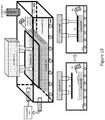
- the invention is exemplified in a preferred embodiment wherein the self-cleaning surface on a roughed substrate is produced, for example, a large flat substrate (7) such as the glass surface of a solar panel.
- the hydrophobic treatment solution (8) such as fluoroalkylsilanes in anhydrous solvent is injected by a dispenser onto the polished glass surface of the solar panel.
- a flat plate (9) measured the same size as the glass is pushed closer to the glass surface by an actuator (10) to allow the spreading of the solution evenly throughout the whole glass surface.
- the actuator lifts the plate and the substrate is moved to the next station by a conveyor belt (11).
- the humidity level is controlled by the dehumidifier (12) to the optimized level of related humidity.
- An extra opening on top is used for ventilation (13) of reaction byproduct and solvent vapor.
- the opening may be coupled with chemical filters.
- the self-cleaning surface on a roughed substrate is produced without solvents.
- Figure 11 describes the process for conducting the hydrophobic treatment (in absence of solvent) on a large flat substrate (14) such as a solar panel. This process is especially suitable for substrates which may be damaged by the solvent.
- the substrate is suspended on a conveyor belt (15) located at the top of the enclosure.
- the hydrophobic chemicals (16) such as fluoroalkylsilanes are injected on the top of heating elements (17).
- the evaporation of the chemicals is controlled by the heating temperature adjusted by the heating elements as well as the pressure between 0.1 KPa to 100 KPa adjusted by the vacuum pump (18).
- the vacuum pump may be coupled with chemical filters.
- the humidity level is controlled by the dehumidifier (19) to the optimized level of related humidity.
- the resulting self-cleaning coating exhibit self-cleaning properties.
- This embodiment is exemplified as following: A pre-cleaned solar panel (having the surface area of ⁇ 2 m 2 ) was polished with 1.0 ⁇ m polycrystalline diamond suspension (MetaDi, Buehler) using a polishing cloth (MasterTex, Buehler) attached to a mechanical polisher. The polished glass surface of the solar panel was cleaned with soap water and washed with de-ionized water thoroughly.
- the panel was transferred into a controlled enclosure with relative humidity level of about 20% and subjected to a vapor of trichloro(1 H, 1 H, 2 H, 2 H -perfluorooctyl)silane generated by heating the chemical with a hotplate at 120 °C. After 30 minutes, the panel was removed from the enclosure and cleaned with soap water and washed with de-ionized water thoroughly. The transmission of the resulting coating at the visible light range remains the same as the pristine glass surface of the solar panel (the difference in reflection is undetectable by common human eyes). The critical angle for a 0.05 mL sessile drop of de-ionized water to sliding down the coated surface is less than 30°.
- Figure 12 describes the process for conducting the ozone plasma treatment on non-flat substrates (20) such as an extruded aluminum frame.
- the substrate is suspended on a trail (21) operating by a rotational motor (22) once inside the enclosure.
- a set of UV lamps (23) are used to convert the oxygen from the atmosphere to active ozone plasma.
- An extra oxygen supply (24) may be needed to improve the efficiency of the treatment and thus reduces the treatment time.
- An extra opening on top is used for ventilation (25) of ozone and byproducts if workers need to enter the area. The opening may be coupled with chemical filters.
- Figure 13 describes the process for conducting the hydrophobic treatment on non-flat substrates bearing intricate 3-D structures (26) such as aluminum frames.
- the substrate is suspended on a trail (27) operating by a rotational motor (28) once inside the enclosure.
- the hydrophobic chemicals (29) such as fluoroalkylsilanes are transported by a liquid pump (30) into the dispenser/controller (31) and an inert gas such as N 2 from the gas supply (32) is used as the deliver media to distribute the chemicals onto the substrate surface while the substrates are rotating.
- the spreading of the chemicals is controlled by adjusting the pressure ratio of the chemical pump and the gas.
- the humidity level is controlled though the dehumidifier (33) to the optimized level of related humidity.
- An extra opening on top is used for ventilation (34) of reaction byproduct and gas if workers need to enter the area.
- the opening may be coupled with chemical filters.
Landscapes
- Chemical & Material Sciences (AREA)
- Materials Engineering (AREA)
- Engineering & Computer Science (AREA)
- Life Sciences & Earth Sciences (AREA)
- Organic Chemistry (AREA)
- Wood Science & Technology (AREA)
- Chemical Kinetics & Catalysis (AREA)
- Geochemistry & Mineralogy (AREA)
- General Chemical & Material Sciences (AREA)
- Crystallography & Structural Chemistry (AREA)
- Application Of Or Painting With Fluid Materials (AREA)
- Surface Treatment Of Glass (AREA)
- Laminated Bodies (AREA)
- Detergent Compositions (AREA)
- Paints Or Removers (AREA)
Claims (19)
- Ein Verfahren zum Bilden einer selbstreinigenden Beschichtung auf einem Substrat, das die folgenden Schritte beinhaltet:Auswählen eines Substrats;Reinigen des Substrats;Aufrauen des Substrats mit einem Abrasivstoff, um mikroskopische, gewundene Rillen zu erzeugen, wobei der Abrasivstoff nach unten bewegt wird, um das Substrat zu berühren, und das Substrat mit einer ersten Betätigungseinrichtung entlang einer X-Achse hin- und herbewegt wird, um das Substrat aufzurauen, und die mikroskopischen, gewundenen Rillen, die auf dem Substrat erzeugt werden, eine Tiefe im Bereich 1 µm bis 1 mm aufweisen;
Waschen des Substrats mit deionisiertem Wasser; und
Beschichten der aufgerauten Oberfläche mit mindestens einem hydrophoben Chemikalienmittel, wobei das mindestens eine hydrophobe Chemikalienmittel aus der Gruppe ausgewählt ist, die aus Trichlor(3,3,3-trifluorpropyl)silan, Dichlormethyl(3,3,3-trifluorpropyl)silan, Chlordimethyl(3,3,3-trifluorpropyl)silan, Trichlor(1H,1H,2H,2H-perfluorctyl)silan, Dichlormethyhl(1H,1H,2H,2H-perfluoroctyl)silan, Chlordimethyl (1H,1H,2H,2H-perfluoroctyl)silan, Trichlor(3,3,4,4,5,5,6,6,7,7,8,8,8-tridecafluoroctyl)silan, Dichlormethyl(3,3,4,4,5,5,6,6,7,7,8,8,8-tridecafluoroctyl)silan, Chlordimethyl(3,3,4,4,5,5,6,6,7,7,8,8,8-tridecafluoroctyl)silan, Trichlor(1H,1H,2H,2H-perfluordecyl)silan, Dichlormethyl(1H,1H,2H,2H-perfluordecyl)silan, Chlordimethyhl(1H,1H,2H,2H-perfluordecyl)silan, Trichlor(1H,1H,2H,2H-perfluordodecyl)silan, Dichlormethyl(1H,1H,2H,2H-perfluordodecyl)silan, Chlordimethyl(1H,1H,2H,2H-perfluordodecyl)silan, Chlorsilan, Dichlorsilan, Trichlorsilan, Chlortrimethylsilan, Dichlordimethylsilan, Trichlormethylsilan, Chlorphenylsilan, Dichlorphenylsilan, Trichlorphenylsilan, Chlormethylphenylsilan, Chlordimethylphenylsilan, Dichlormethylphenylsilan, Chlordimethylphenethylsilan, Dichlormethylphenethylsilan, Trichlorphenethylsilan, Chlordimethyldodecylsilan, Dichlormethyldodecylsilan, Trichlordodecylsilan, Chlordecyldimethylsilan, Dichlordecylmethylsilan, Trichlordecylsilan, Chlordimethyloctadecylsilan, Dichlormethyloctadecylsilan, Trichloroctadecylsilan, Chlordimethyloctylsilan, Dichlormethyloctylsilan, Trichloroctylsilan, Chlordimethylhexylsilan, Dichlormethylhexylsilan, Trichlorhexylsilan, Chlordimethylthexylsilan, Dichlormethylthexylsilan, Trichlorhexylsilan, Allyldichlormethylsilan, Allylchlordimethylsilan, Allyltrichlorsilan, (Cyclohexylmethyl)chlordimethylsilan, (Cyclohexylmethyl)dichlormethylsilan und (Cyclohexylmethyl)trichlorsilan besteht;
wobei der Beschichtungsschritt durch Verdampfen des mindestens einen hydrophoben Chemikalienmittels in einer geregelten Feuchtigkeitsumgebung durchgeführt wird, wobei das hydrophobe Chemikalienmittel an der aufgerauten Oberfläche bindet, um nanoskopische Rillen auf dem Substrat im Bereich von 10 nm bis 1 µm zu erzeugen. - Verfahren gemäß Anspruch 1, wobei das mindestens eine hydrophobe Chemikalienmittel lösungsmittelfrei ist.
- Verfahren gemäß Anspruch 1, das ferner den Schritt des Aufrauens des Substrats mit dem Abrasivstoff beinhaltet, um sekundäre mikroskopische Rillen zu erzeugen, wobei das Substrat durch Hin- und Herbewegen des Substrats mit einer zweiten Betätigungseinrichtung entlang einer X-Achse aufgeraut wird.
- Verfahren gemäß Anspruch 1, wobei das Substrat ein flaches oder nicht flaches Substrat ist; oder wobei das Substrat Metalle, Metalloxide, organische/anorganische Komposite, die Metalle/Metalloxide und Kunststoff mit Siliziumdioxid oder Metalloxidschichten durch Sol-Gel-Bildung oder andere Verfahren enthalten, beinhaltet.
- Verfahren gemäß Anspruch 1, wobei der Schritt des Aufrauens des Substrats, um die mikroskopischen, gewundenen Rillen zu erzeugen, das Verwenden einer mechanischen Schleifenmaschine oder einer Poliermaschine beinhaltet; optional(A) wobei die mechanische Schleichmaschine mit einer Schleimscheibe oder einem Abrasivstoffpapier verwendet wird; oder optional(B) wobei die Poliermaschine mit einer Poliersuspension verwendet wird; oder optional(C) ferner beinhaltend das Verwenden von mindestens einem Abrasivstoff, wobei die Härte des mindestens einen Abrasivstoffs größer ist als die des Substrats; optional wobei der Abrasivstoff aus der Gruppe ausgewählt ist, die aus Diamant, Carbonado, Bor, Bornitrid, Korund, Siliziumcarbid, Wolframcarbid, Titaniumcarbid, Chrom, Siliziumnitrid, Topas, Zirkonerde, Wolfram, Quarz und Glas besteht.
- Verfahren gemäß Anspruch 1, wobei die Feuchtigkeit auf etwa 20 % der bezogenen Feuchtigkeit geregelt wird.
- Verfahren gemäß Anspruch 1, wobei der Schritt des Beschichten des aufgerauten Substrats mit dem hydrophoben Chemikalienmittel der Prozess der physikalischen Dampfphasenabscheidung ist; optional wobei die physikalische Dampfphasenabscheidung des hydrophoben Chemikalienmittels durch Regeln der Verdampfung des hydrophoben Chemikalienmittels ausgeführt wird; und ferner optional wobei das Regeln der Verdampfung des hydrophoben Chemikalienmittels das Regeln des Drucks für die Einspritzung und der Temperatur für die Erhitzung des hydrophoben Chemikalienmittels beinhaltet.
- Eine Vorrichtung zum Aufbringen einer selbstreinigenden Beschichtung auf einem Substrat, die Folgendes beinhaltet:eine Station zum Bilden von mikroskopischen Rillen auf dem Substrat, wobei die mikroskopischen Rillen in dem Substrat mit einem Abrasivstoff gebildet werden, der nach unten bewegt wird, um das Substrat zu berühren, und das Substrat entlang einer X-Achse hin- und herbewegt wird, um das Substrat aufzurauen, und die mikroskopischen, gewundenen Rillen, die auf dem Substrat erzeugt werden, eine Tiefe im Bereich 1 µm bis 1 mm aufweisen;eine Kammer zum Beschichten des Substrats mit mindestens einem hydrophoben Chemikalienmittel, wobei das mindestens eine hydrophobe Chemikalienmittel aus der Gruppe ausgewählt ist, die aus Trichlor(3,3,3-trifluorpropyl)silan, Dichlormethyl(3,3,3-trifluorpropyl)silan, Chlordimethyl(3,3,3-trifluorpropyl)silan, Trichlor(1H,1H,2H,2H-perfluorctyl)silan, Dichlormethyh1(1H,1H,2H,2H-perfluoroctyl)silan, Chlordimethyl (1H,1H,2H,2H-perfluoroctyl)silan, Trichlor(3,3,4,4,5,5,6,6,7,7,8,8,8-tridecafluoroctyl)silan, Dichlormethyl(3,3,4,4,5,5,6,6,7,7,8,8,8-tridecafluoroctyl)silan, Chlordimethyl(3,3,4,4,5,5,6,6,7,7,8,8,8-tridecafluoroctyl)silan, Trichlor(1H,1H,2H,2H-perfluordecyl)silan, Dichlormethyl(1H,1H,2H,2H-perfluordecyl)silan, Chlordimethyhl(1H,1H,2H,2H-perfluordecyl)silan, Trichlor(1H,1H,2H,2H-perfluordodecyl)silan, Dichlormethyl(1H,1H,2H,2H-perfluordodecyl)silan, Chlordimethyl(1H,1H,2H,2H-perfluordodecyl)silan, Chlorsilan, Dichlorsilan, Trichlorsilan, Chlortrimethylsilan, Dichlordimethylsilan, Trichlormethylsilan, Chlorphenylsilan, Dichlorphenylsilan, Trichlorphenylsilan, Chlormethylphenylsilan, Chlordimethylphenylsilan, Dichlormethylphenylsilan, Chlordimethylphenethylsilan, Dichlormethylphenethylsilan, Trichlorphenethylsilan, Chlordimethyldodecylsilan, Dichlormethyldodecylsilan, Trichlordodecylsilan, Chlordecyldimethylsilan, Dichlordecylmethylsilan, Trichlordecylsilan, Chlordimethyloctadecylsilan, Dichlormethyloctadecylsilan, Trichloroctadecylsilan, Chlordimethyloctylsilan, Dichlormethyloctylsilan, Trichloroctylsilan, Chlordimethylhexylsilan, Dichlormethylhexylsilan, Trichlorhexylsilan, Chlordimethylthexylsilan, Dichlormethylthexylsilan, Trichlorhexylsilan, Allyldichlormethylsilan, Allylchlordimethylsilan, Allyltrichlorsilan, (Cyclohexylmethyl)chlordimethylsilan, (Cyclohexylmethyl)dichlormethylsilan und (Cyclohexylmethyl)trichlorsilan besteht;wobei die Kammer zum Beschichten einen Entfeuchter beinhaltet, der erlaubt, dass das mindestens eine hydrophobe Chemikalienmittel in einer geregelten Feuchtigkeitsumgebung verdampft wird, und die Beschichtung nanoskopische Rillen auf dem Substrat im Bereich von 10 nm bis 1 µm zu erzeugt; undeine Trocknungskammer, die mit der Beschichtungskammer verbunden ist, wobei die Station betriebsfähig verbunden ist, um das Substrat zur Beschichtungskammer zu transportieren, und wobei die Beschichtungskammer betriebsfähig verbunden ist, um das Substrat zur Trocknungskammer zu transportieren.
- Vorrichtung gemäß Anspruch 8, wobei die Station zum Bilden von mikroskopischen Rillen auf dem Substrat Folgendes beinhaltet:mindestens eine flache Platte mit einer Abrasivstoffauflage;mindestens einen Spender zum Spenden einer Abrasivstofflösung;mindestens ein Gestell zum Laden des Substrats; undmindestens zwei Betätigungseinrichtungen, wobei eine der mindestens zwei Betätigungseinrichtungen entlang der Z-Achse in Bezug auf die flache Platte liegt und bei Betätigung die Abrasivstoffauflage mit der Substratsoberfläche, und berührt, und wobei einer der mindestens zwei Betätigungseinrichtungen entlang der X-Achse in Bezug auf die flache Platte liegt und bei Aktivierung das Gestell entlang der X-Achse hin- und herbewegt.
- Vorrichtung gemäß Anspruch 9, die ferner mindestens eine Betätigungseinrichtung entlang der Y-Achse in Bezug auf die flache Platte beinhaltet, sodass bei Betätigung die Betätigungseinrichtung das Gestell entlang der Y-Achse hin- und herbewegt.
- Vorrichtung gemäß Anspruch 9, wobei die Abrasivstofflösung Diamant, Carbonado, Bor, Bornitrid, Korund, Siliziumcarbid, Wolframcarbid, Titaniumcarbid, Chrom, Siliziumnitrid, Topas, Zirkonerde, Wolfram, Quarz und Glas beinhaltet.
- Vorrichtung gemäß Anspruch 8, wobei die Kammer zum Beschichten des Substrats mit mindestens einem hydrophoben Chemikalienmittel Folgendes beinhaltet:ein Gestell zum Laden des Substrats;mindestens einen Spender, der mit einem Einspritzer verbunden ist, wobei der Spender mindestens ein hydrophobes Chemikalienmittel enthält;eine Auftrageeinrichtung zum Auftragen des mindestens einen hydrophoben Mittels auf das Substrat;eine Betätigungseinrichtung, die mit der Auftrageeinrichtung verbunden ist,wobei die Auftrageeinrichtung bei Betätigung der Betätigungseinrichtung und bei Einspritzung des hydrophoben Chemikalienmittels von dem Spender näher an das aufgeraute Substrat geschoben wird, um das hydrophobe Chemikalienmittel auf dem Substrat zu verteilen;einen Auslass für Reaktionsnebenprodukte; undeinen Entfeuchter.
- Vorrichtung gemäß Anspruch 12, wobei das hydrophobe Chemikalienmittel in einem organischen Lösungsmittel gelöst ist; optional wobei das organische Lösungsmittel wasserfreies Toluol ist.
- Vorrichtung gemäß Anspruch 8, wobei die Beschichtungskammer ein Heizelement und eine Vakuumpumpe beinhaltet.
- Vorrichtung gemäß Anspruch 8, wobei die Station zum Erzeugen von mikroskopischen Rillen auf dem Substrat eine Kammer mit geregelter Feuchtigkeit beinhaltet, die Folgendes beinhaltet:eine rotierende Schleppe zum Suspendieren des Substrats;eine Vielzahl von Ultraviolettlampen;eine Sauerstoffversorgung; undeinen Auslass für Reaktionsnebenprodukte, der optional mit Chemikalienfiltern ausgestattet ist.
- Vorrichtung gemäß Anspruch 8, wobei die Beschichtungskammer Folgendes beinhaltet:eine rotierende Schleppe zum Suspendieren des Substrats;eine Flüssigkeitspumpe, die mit einem Spender verbunden ist, wobei die Flüssigkeitspumpe mindestens ein hydrophobes Chemikalienmittel enthält;eine Inertgasversorgung, wobei die Inertgasversorgung das mindestens eine hydrophobe Chemikalienmittel auf das Substrat verteilt;ein Gerät zum Regeln des Verhältnisses des Flüssigkeitspumpensprühdrucks zum Inertgasdruck; einen Entfeuchter; und
einen Auslass für Reaktionsnebenprodukt und Gas, der optional Chemikalienfiltern ausgestattet ist; optional wobei das Verhältnis des Flüssigkeitspumpensprühdrucks zum Inertgasdruck im Bereich von etwa 1 : 10 bis etwa 1 : 100000 geregelt wird. - Eine selbstreinigende Beschichtung auf einem Substrat, die Folgendes beinhaltet:eine hydrophobes chemisches Mittel, das an mindestens eine aufgeraute Oberfläche des Substrats kovalent gebunden ist, wobei das hydrophobe chemische Mittel aus der Gruppe ausgewählt ist, die aus Trichlor(3,3,3-trifluorpropyl)silan, Dichlormethyl(3,3,3-trifluorpropyl)silan, Chlordimethyl(3,3,3-trifluorpropyl)silan, Trichlor(1H,1H,2H,2H-perfluorctyl)silan, Dichlormethyhl(1H,1H,2H,2H-perfluoroctyl)silan, Chlordimethyl(1H,1H,2H,2H-perfluoroctyl)silan, Trichlor(3,3,4,4,5,5,6,6,7,7,8,8,8-tridecafluoroctyl)silan, Dichlormethyl(3,3,4,4,5,5,6,6,7,7,8,8,8-tridecafluoroctyl)silan, Chlordimethyl(3,3,4,4,5,5,6,6,7,7,8,8,8-tridecafluoroctyl)silan, Trichlor(1H,1H,2H,2H-perfluordecyl)silan, Dichlormethyl(1H,1H,2H,2H-perfluordecyl)silan, Chlordimethyhl(1H,1H,2H,2H-perfluordecyl)silan, Trichlor(1H,1H,2H,2H-perfluordodecyl)silan, Dichlormethyl(1H,1H,2H,2H-perfluordodecyl)silan, Chlordimethyl(1H,1H,2H,2H-perfluordodecyl)silan, Chlorsilan, Dichlorsilan, Trichlorsilan, Chlortrimethylsilan, Dichlordimethylsilan, Trichlormethylsilan, Chlorphenylsilan, Dichlorphenylsilan, Trichlorphenylsilan, Chlormethylphenylsilan, Chlordimethylphenylsilan, Dichlormethylphenylsilan, Chlordimethylphenethylsilan, Dichlormethylphenethylsilan, Trichlorphenethylsilan, Chlordimethyldodecylsilan, Dichlormethyldodecylsilan, Trichlordodecylsilan, Chlordecyldimethylsilan, Dichlordecylmethylsilan, Trichlordecylsilan, Chlordimethyloctadecylsilan, Dichlormethyloctadecylsilan, Trichloroctadecylsilan, Chlordimethyloctylsilan, Dichlormethyloctylsilan, Trichloroctylsilan, Chlordimethylhexylsilan, Dichlormethylhexylsilan, Trichlorhexylsilan, Chlordimethylthexylsilan, Dichlormethylthexylsilan, Trichlorhexylsilan, Allyldichlormethylsilan, Allylchlordimethylsilan, Allyltrichlorsilan, (Cyclohexylmethyl)chlordimethylsilan, (Cyclohexylmethyl)dichlormethylsilan und (Cyclohexylmethyl)trichlorsilan besteht;wobei die Beschichtung durch Verdampfen des mindestens einen hydrophoben Chemikalienmittels in einer geregelten Feuchtigkeitsumgebung aufgetragen wird, das Substrat mit einem Abrasivstoff aufgeraut wird, um mikroskopische Rillen zu erzeugen, wobei der Abrasivstoff nach unten bewegt wird, um das Substrat zu berühren, und das Substrat entlang einer X-Achse hin- und herbewegt wird, um das Substrat aufzurauen, und die mikroskopischen, gewundenen Rillen, die auf dem Substrat erzeugt werden, eine Tiefe im Bereich 1 µm bis 1 mm aufweisen, wobei die Bindung nanoskopische Rillen auf der aufgerauten Oberfläche des Substrats im Bereich von 10 nm bis 1 µm erzeugt, und wobei die Beschichtung das Substrat selbstreinigend macht, wenn es über einen kritischen Winkel α geneigt wird, bei dem ein Wassertröpfchen beginnt, sich auf dem Substrat nach unten zu bewegen.
- Selbstreinigende Beschichtung gemäß Anspruch 17, wobei das Substrat mit dem Abrasivstoff poliert wird, um sekundäre mikroskopische Rillen zu erzeugen.
- Selbstreinigende Beschichtung gemäß Anspruch 17, wobei der kritische Winkel α durch tan-1 (y/x) definiert ist, wenn die Substratoberfläche auf einer schiefen Ebene geneigt ist und durch die schiefe Ebene (Hypotenuse) und eine horizontale Oberfläche ein rechtwinkliges Dreieck gebildet wird, wobei y = Länge des gegenüberliegenden Schenkels des rechtwinkligen Dreiecks und x = Länge des angrenzenden Schenkels des rechtwinkligen Dreiecks.
Applications Claiming Priority (3)
| Application Number | Priority Date | Filing Date | Title |
|---|---|---|---|
| US201261657152P | 2012-06-08 | 2012-06-08 | |
| US201261667203P | 2012-07-02 | 2012-07-02 | |
| PCT/US2013/044913 WO2014039130A2 (en) | 2012-06-08 | 2013-06-10 | Self-cleaning coatings and methods for making same |
Publications (3)
| Publication Number | Publication Date |
|---|---|
| EP2859053A2 EP2859053A2 (de) | 2015-04-15 |
| EP2859053A4 EP2859053A4 (de) | 2016-03-02 |
| EP2859053B1 true EP2859053B1 (de) | 2019-12-25 |
Family
ID=49756171
Family Applications (1)
| Application Number | Title | Priority Date | Filing Date |
|---|---|---|---|
| EP13834452.8A Active EP2859053B1 (de) | 2012-06-08 | 2013-06-10 | Selbstreinigende beschichtungen und verfahren zur herstellung davon |
Country Status (6)
| Country | Link |
|---|---|
| US (1) | US10266702B2 (de) |
| EP (1) | EP2859053B1 (de) |
| CA (1) | CA2876151C (de) |
| MX (1) | MX349646B (de) |
| SG (2) | SG10201610218WA (de) |
| WO (1) | WO2014039130A2 (de) |
Families Citing this family (30)
| Publication number | Priority date | Publication date | Assignee | Title |
|---|---|---|---|---|
| CA3085086C (en) | 2011-12-06 | 2023-08-08 | Delta Faucet Company | Ozone distribution in a faucet |
| US9694388B2 (en) | 2013-05-14 | 2017-07-04 | University Of Houston System | Waterproof coating with nanoscopic/microscopic features and methods of making same |
| US20150328663A1 (en) * | 2014-05-13 | 2015-11-19 | Michael Lawrence Abbot | Methods and systems for moisture revealed indicia on glass and other surfaces |
| US10704191B2 (en) | 2014-11-12 | 2020-07-07 | University Of Houston System | Soil-resistant, stain-resistant coatings and methods of applying on textile or other flexible materials |
| EP3218540A4 (de) | 2014-11-12 | 2018-07-11 | The University Of Houston System | Schmutzabweisende, fleckenbeständige fluorfreie beschichtungen und verfahren zum aufbringen auf materialien |
| US11345821B2 (en) * | 2014-11-12 | 2022-05-31 | University Of Houston System | Weather-resistant, fungal-resistant, and stain-resistant coatings and methods of applying on wood, masonry, or other porous materials |
| US10749465B2 (en) | 2015-06-05 | 2020-08-18 | Jagadish Iyer | Solar Energy Collection Panel Cleaning System |
| US10450469B2 (en) * | 2015-06-09 | 2019-10-22 | Nbd Nanotechnologies, Inc. | Transparent self-healing oleophobic and hydrophobic coatings |
| SE540714C2 (en) * | 2015-06-18 | 2018-10-16 | Stora Enso Oyj | Container with oleophilic pattern on a sealing surface |
| CN108463437B (zh) | 2015-12-21 | 2022-07-08 | 德尔塔阀门公司 | 包括消毒装置的流体输送系统 |
| TWI583011B (zh) * | 2016-04-01 | 2017-05-11 | 國立中央大學 | 大面積鈣鈦礦膜及鈣鈦礦太陽能電池模組及其製作方法 |
| KR102415046B1 (ko) * | 2016-08-08 | 2022-06-29 | 쉬르픽스 베붸 | 고체 표면의 개질 방법 |
| US20190054571A1 (en) * | 2017-08-21 | 2019-02-21 | University Of Iowa Research Foundation | Nanosecond laser-based high-throughput surface nano-structuring (nhsn) process |
| US12180581B2 (en) | 2017-09-18 | 2024-12-31 | Waters Technologies Corporation | Use of vapor deposition coated flow paths for improved chromatography of metal interacting analytes |
| US11709156B2 (en) | 2017-09-18 | 2023-07-25 | Waters Technologies Corporation | Use of vapor deposition coated flow paths for improved analytical analysis |
| US12181452B2 (en) | 2017-09-18 | 2024-12-31 | Waters Technologies Corporation | Use of vapor deposition coated flow paths for improved chromatography of metal interacting analytes |
| US11709155B2 (en) | 2017-09-18 | 2023-07-25 | Waters Technologies Corporation | Use of vapor deposition coated flow paths for improved chromatography of metal interacting analytes |
| CN109292730B (zh) * | 2018-09-03 | 2020-07-24 | 山东科技大学 | 一种超滑表面的制备方法 |
| CN109347414B (zh) * | 2018-10-18 | 2020-10-16 | 国网山东省电力公司潍坊供电公司 | 一种光伏板用集摆动与清洗于一体的固定架 |
| EP3930867B1 (de) | 2019-02-27 | 2025-11-12 | Waters Technologies Corporation | Chromatographische dichtung und beschichtete strömungspfade zur minimierung der adsorption von analyten |
| WO2020206343A1 (en) | 2019-04-05 | 2020-10-08 | Forsight Vision6, Inc. | Fluorosilicone copolymers |
| US11844172B2 (en) * | 2019-10-16 | 2023-12-12 | Kla Corporation | System and method for vacuum ultraviolet lamp assisted ignition of oxygen-containing laser sustained plasma sources |
| CN110982434B (zh) * | 2019-11-28 | 2021-04-13 | 德米特(苏州)电子环保材料有限公司 | 一种用于抛光砷化镓的抛光粉体及抛光液的制备方法 |
| US11918936B2 (en) | 2020-01-17 | 2024-03-05 | Waters Technologies Corporation | Performance and dynamic range for oligonucleotide bioanalysis through reduction of non specific binding |
| US11484987B2 (en) * | 2020-03-09 | 2022-11-01 | Applied Materials, Inc. | Maintenance methods for polishing systems and articles related thereto |
| EP4165134A4 (de) | 2020-06-15 | 2024-07-31 | ForSight Vision6, Inc. | Fluorsilikonpolymere, zusammensetzungen und verwendungen davon |
| CN111802951A (zh) * | 2020-07-30 | 2020-10-23 | 湖南人文科技学院 | 一种定向超疏液的无水自清洁小便器及其制作方法 |
| US12352734B2 (en) | 2020-09-24 | 2025-07-08 | Waters Technologies Corporation | Chromatographic hardware improvements for separation of reactive molecules |
| CN114751654B (zh) * | 2022-05-16 | 2023-08-01 | 常州大学 | 一种高透明度疏水自清洁MOFs涂层及其制备方法 |
| CN115057629A (zh) * | 2022-07-15 | 2022-09-16 | 佛山市恒洁凯乐德卫浴有限公司 | 一种具有表面易洁功能的玻璃及其制备方法 |
Family Cites Families (40)
| Publication number | Priority date | Publication date | Assignee | Title |
|---|---|---|---|---|
| US3354022A (en) * | 1964-03-31 | 1967-11-21 | Du Pont | Water-repellant surface |
| US5328768A (en) | 1990-04-03 | 1994-07-12 | Ppg Industries, Inc. | Durable water repellant glass surface |
| US5523161A (en) | 1990-04-03 | 1996-06-04 | Ppg Industries, Inc. | Water repellent surface treatment with integrated primer |
| US5424130A (en) | 1991-05-13 | 1995-06-13 | Toyota Jidosha Kabushiki Kaisha | Water repellent glass and process for producing the same |
| JPH09268281A (ja) | 1996-03-29 | 1997-10-14 | Toray Dow Corning Silicone Co Ltd | 車両ガラス用撥水剤組成物および車両用撥水性ガラス |
| US20060113231A1 (en) | 2000-10-23 | 2006-06-01 | Abdul Malik | Sample pre-concentration tubes with sol-gel surface coatings and/or sol-gel monolithic beds |
| DE10118352A1 (de) | 2001-04-12 | 2002-10-17 | Creavis Tech & Innovation Gmbh | Selbstreinigende Oberflächen durch hydrophobe Strukturen und Verfahren zu deren Herstellung |
| WO2003015891A1 (en) | 2001-08-13 | 2003-02-27 | The Board Of Trustees Of The Leland Stanford Junior University | Bonded phase photopolymerized sol-gel column and associated methods |
| EP1560468B1 (de) * | 2002-07-19 | 2018-03-21 | LG Display Co., Ltd. | Quelle zur thermischen PVD-Beschichtung für organische elektrolumineszente Schichten |
| US20040018301A1 (en) | 2002-07-26 | 2004-01-29 | Ackerman John F. | Process for improved inorganic polymerization |
| US6811467B1 (en) * | 2002-09-09 | 2004-11-02 | Seagate Technology Llc | Methods and apparatus for polishing glass substrates |
| DE10253839A1 (de) | 2002-11-14 | 2004-05-27 | Hansgrohe Ag | Beschichtungsverfahren |
| WO2004076570A1 (en) | 2003-02-28 | 2004-09-10 | Koninklijke Philips Electronics N.V. | Fluoropolymer-containing sol-gel coating |
| US7828889B2 (en) * | 2003-12-18 | 2010-11-09 | The Clorox Company | Treatments and kits for creating transparent renewable surface protective coatings |
| US7138186B2 (en) * | 2004-02-05 | 2006-11-21 | Guardian Industries Corp. | Hydrophobic coatings and methods |
| US7622191B2 (en) | 2004-07-19 | 2009-11-24 | University Of South Florida | Titania-based coating for capillary microextraction |
| DE102004037045A1 (de) | 2004-07-29 | 2006-04-27 | Degussa Ag | Wässrige Silan-Nanokomposite |
| US20060029808A1 (en) | 2004-08-06 | 2006-02-09 | Lei Zhai | Superhydrophobic coatings |
| FR2886309B1 (fr) | 2005-05-31 | 2007-08-17 | Airbus France Sas | Sol pour le revetement par voie sol-gel d'une surface et procede de revetement par voie sol-gel le mettant en oeuvre |
| US20060292345A1 (en) | 2005-06-14 | 2006-12-28 | Dave Bakul C | Micropatterned superhydrophobic silica based sol-gel surfaces |
| US20090011222A1 (en) | 2006-03-27 | 2009-01-08 | Georgia Tech Research Corporation | Superhydrophobic surface and method for forming same |
| US7700184B2 (en) | 2006-08-14 | 2010-04-20 | University Of Houston System | Pd nanopore and palladium encapsulated membranes |
| US20080113188A1 (en) | 2006-11-09 | 2008-05-15 | Shah Pratik B | Hydrophobic organic-inorganic hybrid silane coatings |
| EP1935929B1 (de) | 2006-12-19 | 2011-11-30 | Evonik Degussa GmbH | Sol-Gel-Prozess zur Herstellung von Schutzfolien für Polymersubstrate |
| US8883291B2 (en) | 2007-08-07 | 2014-11-11 | President And Fellows Of Harvard College | Metal oxide coating on surfaces |
| GB2452552A (en) | 2007-09-08 | 2009-03-11 | Univ Sheffield Hallam | Corrosion-inhibiting sol-gel coating |
| US20110159289A1 (en) | 2009-12-24 | 2011-06-30 | Blizzard John D | Method of encapsulating particulate materials |
| CN101544476A (zh) | 2008-03-28 | 2009-09-30 | 皮尔金顿集团有限公司 | 超疏水性透明涂层及其制备方法 |
| US9535215B2 (en) | 2008-09-15 | 2017-01-03 | Brphotonics Productos Optoelectronicos Ltda. | Fluorinated sol-gel low refractive index hybrid optical cladding and electro-optic devices made therefrom |
| US20100203287A1 (en) | 2009-02-10 | 2010-08-12 | Ngimat Co. | Hypertransparent Nanostructured Superhydrophobic and Surface Modification Coatings |
| US20100249445A1 (en) | 2009-03-24 | 2010-09-30 | The Regents Of The University Of California | Post-spin-on silylation method for hydrophobic and hydrofluoric acid-resistant porous silica films |
| WO2010114632A2 (en) | 2009-04-03 | 2010-10-07 | University Of Houston | Metal nanoparticles functionalized with rationally designed coatings and uses thereof |
| US8864897B2 (en) | 2009-04-30 | 2014-10-21 | Enki Technology, Inc. | Anti-reflective and anti-soiling coatings with self-cleaning properties |
| FR2949471B1 (fr) | 2009-08-27 | 2011-10-28 | Commissariat Energie Atomique | Procede de preparation de particules de silice contenant un derive de phtalocyanine, lesdites particules et leurs utilisations. |
| US20110250428A1 (en) | 2010-02-07 | 2011-10-13 | Aerogel Technologies, Llc | Preparation of cross-linked aerogels and derivatives thereof |
| US9896549B2 (en) * | 2010-04-13 | 2018-02-20 | Aaron Kessman | Hydrophobic and oleophobic coatings |
| US9017476B2 (en) | 2010-05-14 | 2015-04-28 | Kri, Inc. | Modified metal oxide sol |
| JP2014521809A (ja) | 2011-08-02 | 2014-08-28 | エイビーエス マテリアルズ インコーポレイテッド | ゾル−ゲル誘導組成物 |
| US9109121B2 (en) | 2011-10-13 | 2015-08-18 | Intermolecular, Inc. | Sol-gel based antireflective coatings using alkyltrialkoxysilane binders having low refractive index and high durability |
| US9694388B2 (en) | 2013-05-14 | 2017-07-04 | University Of Houston System | Waterproof coating with nanoscopic/microscopic features and methods of making same |
-
2013
- 2013-06-10 EP EP13834452.8A patent/EP2859053B1/de active Active
- 2013-06-10 US US13/913,728 patent/US10266702B2/en active Active
- 2013-06-10 SG SG10201610218WA patent/SG10201610218WA/en unknown
- 2013-06-10 SG SG11201408177VA patent/SG11201408177VA/en unknown
- 2013-06-10 MX MX2014015040A patent/MX349646B/es active IP Right Grant
- 2013-06-10 WO PCT/US2013/044913 patent/WO2014039130A2/en not_active Ceased
- 2013-06-10 CA CA2876151A patent/CA2876151C/en active Active
Non-Patent Citations (1)
| Title |
|---|
| None * |
Also Published As
| Publication number | Publication date |
|---|---|
| SG10201610218WA (en) | 2017-02-27 |
| MX2014015040A (es) | 2015-07-17 |
| US10266702B2 (en) | 2019-04-23 |
| WO2014039130A3 (en) | 2014-05-15 |
| WO2014039130A2 (en) | 2014-03-13 |
| MX349646B (es) | 2017-08-04 |
| CA2876151A1 (en) | 2014-03-13 |
| US20130337226A1 (en) | 2013-12-19 |
| EP2859053A2 (de) | 2015-04-15 |
| CA2876151C (en) | 2021-05-25 |
| SG11201408177VA (en) | 2015-01-29 |
| EP2859053A4 (de) | 2016-03-02 |
Similar Documents
| Publication | Publication Date | Title |
|---|---|---|
| EP2859053B1 (de) | Selbstreinigende beschichtungen und verfahren zur herstellung davon | |
| Abu Jarad et al. | Fabrication of superamphiphobic surfaces via spray coating; a review | |
| Maharjan et al. | Self-cleaning hydrophobic nanocoating on glass: A scalable manufacturing process | |
| JP6728067B2 (ja) | 超疎水性または超親水性表面の新規製造方法 | |
| EP2950940B1 (de) | Superhydrophobe und antistatische zusammensetzung | |
| Hozumi et al. | Hydrophobicity of perfluoroalkyl isocyanate monolayers on oxidized aluminum surfaces | |
| US10253190B2 (en) | Transparent durable superhydrophobic ceramic coating | |
| CN105102558A (zh) | 超疏水涂层 | |
| CN116018383A (zh) | 抗微生物涂层 | |
| CN104185658A (zh) | 包含无机氧化物纳米粒子和有机碱的碱性组合物、涂布基底、制品和方法 | |
| CN105246986A (zh) | 含聚(乙烯醇)和二氧化硅纳米粒子的多层涂层和方法 | |
| JP6043663B2 (ja) | 付着汚れに対する自己洗浄能力に優れた皮膜を形成する水系親水性塗料組成物並びに付着汚れに対する自己洗浄能力に優れた皮膜を形成した表面処理材 | |
| CN102549083A (zh) | 防尘纳米颗粒表面 | |
| Wang et al. | Feasible fabrication of durable superhydrophobic SiO2 coatings with translucency and self-cleaning performance | |
| AU2024204644A1 (en) | Coating process | |
| Wen et al. | Substrate Engineering for Durable Omniphobic Liquid‐Like Surfaces | |
| GR20220100627A (el) | Μεθοδος αναπτυξης προστατευτικων και ευκολα καθαριζομενων νανοεπικαλυπτικων συστηματων υψηλης αντοχης για πολλαπλα υποστρωματα | |
| Jundle et al. | Fabrication of bunny ear cactus-mimicking superhydrophobic silica coatings on marble to protect architectural heritage | |
| JP6664227B2 (ja) | 積層体、及び積層体の形成方法 | |
| JP2000321412A (ja) | 浴室用防曇性鏡 | |
| JP2007145977A (ja) | 水性コーティング液及び機能性皮膜 | |
| Madhuri et al. | Mechanism of the Wettability of Coating Materials | |
| Gener et al. | Surface characterization of new silane-based pretreatments applied on aluminium |
Legal Events
| Date | Code | Title | Description |
|---|---|---|---|
| PUAI | Public reference made under article 153(3) epc to a published international application that has entered the european phase |
Free format text: ORIGINAL CODE: 0009012 |
|
| 17P | Request for examination filed |
Effective date: 20141209 |
|
| AK | Designated contracting states |
Kind code of ref document: A2 Designated state(s): AL AT BE BG CH CY CZ DE DK EE ES FI FR GB GR HR HU IE IS IT LI LT LU LV MC MK MT NL NO PL PT RO RS SE SI SK SM TR |
|
| AX | Request for extension of the european patent |
Extension state: BA ME |
|
| DAX | Request for extension of the european patent (deleted) | ||
| A4 | Supplementary search report drawn up and despatched |
Effective date: 20160128 |
|
| RIC1 | Information provided on ipc code assigned before grant |
Ipc: B05D 3/08 20060101ALI20160122BHEP Ipc: C09D 7/12 20060101AFI20160122BHEP Ipc: C09D 183/00 20060101ALI20160122BHEP Ipc: C09D 5/16 20060101ALI20160122BHEP |
|
| STAA | Information on the status of an ep patent application or granted ep patent |
Free format text: STATUS: EXAMINATION IS IN PROGRESS |
|
| 17Q | First examination report despatched |
Effective date: 20180306 |
|
| REG | Reference to a national code |
Ref country code: DE Ref legal event code: R079 Ref document number: 602013064436 Country of ref document: DE Free format text: PREVIOUS MAIN CLASS: C09D0005000000 Ipc: C09D0183000000 |
|
| RIC1 | Information provided on ipc code assigned before grant |
Ipc: B05D 3/02 20060101ALI20190226BHEP Ipc: C03C 17/30 20060101ALI20190226BHEP Ipc: B05D 3/14 20060101ALI20190226BHEP Ipc: B05D 3/08 20060101ALI20190226BHEP Ipc: C09D 5/16 20060101ALI20190226BHEP Ipc: H02S 40/10 20140101ALI20190226BHEP Ipc: B05D 5/02 20060101ALI20190226BHEP Ipc: C09D 183/00 20060101AFI20190226BHEP Ipc: B05D 3/12 20060101ALI20190226BHEP Ipc: B05D 5/08 20060101ALI20190226BHEP |
|
| GRAP | Despatch of communication of intention to grant a patent |
Free format text: ORIGINAL CODE: EPIDOSNIGR1 |
|
| STAA | Information on the status of an ep patent application or granted ep patent |
Free format text: STATUS: GRANT OF PATENT IS INTENDED |
|
| INTG | Intention to grant announced |
Effective date: 20190410 |
|
| GRAJ | Information related to disapproval of communication of intention to grant by the applicant or resumption of examination proceedings by the epo deleted |
Free format text: ORIGINAL CODE: EPIDOSDIGR1 |
|
| STAA | Information on the status of an ep patent application or granted ep patent |
Free format text: STATUS: EXAMINATION IS IN PROGRESS |
|
| GRAP | Despatch of communication of intention to grant a patent |
Free format text: ORIGINAL CODE: EPIDOSNIGR1 |
|
| STAA | Information on the status of an ep patent application or granted ep patent |
Free format text: STATUS: GRANT OF PATENT IS INTENDED |
|
| INTC | Intention to grant announced (deleted) | ||
| INTG | Intention to grant announced |
Effective date: 20190807 |
|
| GRAS | Grant fee paid |
Free format text: ORIGINAL CODE: EPIDOSNIGR3 |
|
| GRAA | (expected) grant |
Free format text: ORIGINAL CODE: 0009210 |
|
| STAA | Information on the status of an ep patent application or granted ep patent |
Free format text: STATUS: THE PATENT HAS BEEN GRANTED |
|
| AK | Designated contracting states |
Kind code of ref document: B1 Designated state(s): AL AT BE BG CH CY CZ DE DK EE ES FI FR GB GR HR HU IE IS IT LI LT LU LV MC MK MT NL NO PL PT RO RS SE SI SK SM TR |
|
| REG | Reference to a national code |
Ref country code: GB Ref legal event code: FG4D |
|
| REG | Reference to a national code |
Ref country code: CH Ref legal event code: EP |
|
| REG | Reference to a national code |
Ref country code: AT Ref legal event code: REF Ref document number: 1217100 Country of ref document: AT Kind code of ref document: T Effective date: 20200115 |
|
| REG | Reference to a national code |
Ref country code: DE Ref legal event code: R096 Ref document number: 602013064436 Country of ref document: DE |
|
| REG | Reference to a national code |
Ref country code: IE Ref legal event code: FG4D |
|
| REG | Reference to a national code |
Ref country code: NL Ref legal event code: MP Effective date: 20191225 |
|
| PG25 | Lapsed in a contracting state [announced via postgrant information from national office to epo] |
Ref country code: GR Free format text: LAPSE BECAUSE OF FAILURE TO SUBMIT A TRANSLATION OF THE DESCRIPTION OR TO PAY THE FEE WITHIN THE PRESCRIBED TIME-LIMIT Effective date: 20200326 Ref country code: LT Free format text: LAPSE BECAUSE OF FAILURE TO SUBMIT A TRANSLATION OF THE DESCRIPTION OR TO PAY THE FEE WITHIN THE PRESCRIBED TIME-LIMIT Effective date: 20191225 Ref country code: NO Free format text: LAPSE BECAUSE OF FAILURE TO SUBMIT A TRANSLATION OF THE DESCRIPTION OR TO PAY THE FEE WITHIN THE PRESCRIBED TIME-LIMIT Effective date: 20200325 Ref country code: SE Free format text: LAPSE BECAUSE OF FAILURE TO SUBMIT A TRANSLATION OF THE DESCRIPTION OR TO PAY THE FEE WITHIN THE PRESCRIBED TIME-LIMIT Effective date: 20191225 Ref country code: LV Free format text: LAPSE BECAUSE OF FAILURE TO SUBMIT A TRANSLATION OF THE DESCRIPTION OR TO PAY THE FEE WITHIN THE PRESCRIBED TIME-LIMIT Effective date: 20191225 Ref country code: BG Free format text: LAPSE BECAUSE OF FAILURE TO SUBMIT A TRANSLATION OF THE DESCRIPTION OR TO PAY THE FEE WITHIN THE PRESCRIBED TIME-LIMIT Effective date: 20200325 Ref country code: FI Free format text: LAPSE BECAUSE OF FAILURE TO SUBMIT A TRANSLATION OF THE DESCRIPTION OR TO PAY THE FEE WITHIN THE PRESCRIBED TIME-LIMIT Effective date: 20191225 |
|
| REG | Reference to a national code |
Ref country code: LT Ref legal event code: MG4D |
|
| PG25 | Lapsed in a contracting state [announced via postgrant information from national office to epo] |
Ref country code: HR Free format text: LAPSE BECAUSE OF FAILURE TO SUBMIT A TRANSLATION OF THE DESCRIPTION OR TO PAY THE FEE WITHIN THE PRESCRIBED TIME-LIMIT Effective date: 20191225 Ref country code: RS Free format text: LAPSE BECAUSE OF FAILURE TO SUBMIT A TRANSLATION OF THE DESCRIPTION OR TO PAY THE FEE WITHIN THE PRESCRIBED TIME-LIMIT Effective date: 20191225 |
|
| PG25 | Lapsed in a contracting state [announced via postgrant information from national office to epo] |
Ref country code: AL Free format text: LAPSE BECAUSE OF FAILURE TO SUBMIT A TRANSLATION OF THE DESCRIPTION OR TO PAY THE FEE WITHIN THE PRESCRIBED TIME-LIMIT Effective date: 20191225 |
|
| PG25 | Lapsed in a contracting state [announced via postgrant information from national office to epo] |
Ref country code: NL Free format text: LAPSE BECAUSE OF FAILURE TO SUBMIT A TRANSLATION OF THE DESCRIPTION OR TO PAY THE FEE WITHIN THE PRESCRIBED TIME-LIMIT Effective date: 20191225 Ref country code: RO Free format text: LAPSE BECAUSE OF FAILURE TO SUBMIT A TRANSLATION OF THE DESCRIPTION OR TO PAY THE FEE WITHIN THE PRESCRIBED TIME-LIMIT Effective date: 20191225 Ref country code: CZ Free format text: LAPSE BECAUSE OF FAILURE TO SUBMIT A TRANSLATION OF THE DESCRIPTION OR TO PAY THE FEE WITHIN THE PRESCRIBED TIME-LIMIT Effective date: 20191225 Ref country code: PT Free format text: LAPSE BECAUSE OF FAILURE TO SUBMIT A TRANSLATION OF THE DESCRIPTION OR TO PAY THE FEE WITHIN THE PRESCRIBED TIME-LIMIT Effective date: 20200520 Ref country code: EE Free format text: LAPSE BECAUSE OF FAILURE TO SUBMIT A TRANSLATION OF THE DESCRIPTION OR TO PAY THE FEE WITHIN THE PRESCRIBED TIME-LIMIT Effective date: 20191225 |
|
| PG25 | Lapsed in a contracting state [announced via postgrant information from national office to epo] |
Ref country code: SM Free format text: LAPSE BECAUSE OF FAILURE TO SUBMIT A TRANSLATION OF THE DESCRIPTION OR TO PAY THE FEE WITHIN THE PRESCRIBED TIME-LIMIT Effective date: 20191225 Ref country code: IS Free format text: LAPSE BECAUSE OF FAILURE TO SUBMIT A TRANSLATION OF THE DESCRIPTION OR TO PAY THE FEE WITHIN THE PRESCRIBED TIME-LIMIT Effective date: 20200425 Ref country code: SK Free format text: LAPSE BECAUSE OF FAILURE TO SUBMIT A TRANSLATION OF THE DESCRIPTION OR TO PAY THE FEE WITHIN THE PRESCRIBED TIME-LIMIT Effective date: 20191225 |
|
| REG | Reference to a national code |
Ref country code: DE Ref legal event code: R097 Ref document number: 602013064436 Country of ref document: DE |
|
| PG25 | Lapsed in a contracting state [announced via postgrant information from national office to epo] |
Ref country code: DK Free format text: LAPSE BECAUSE OF FAILURE TO SUBMIT A TRANSLATION OF THE DESCRIPTION OR TO PAY THE FEE WITHIN THE PRESCRIBED TIME-LIMIT Effective date: 20191225 Ref country code: ES Free format text: LAPSE BECAUSE OF FAILURE TO SUBMIT A TRANSLATION OF THE DESCRIPTION OR TO PAY THE FEE WITHIN THE PRESCRIBED TIME-LIMIT Effective date: 20191225 |
|
| PLBE | No opposition filed within time limit |
Free format text: ORIGINAL CODE: 0009261 |
|
| STAA | Information on the status of an ep patent application or granted ep patent |
Free format text: STATUS: NO OPPOSITION FILED WITHIN TIME LIMIT |
|
| REG | Reference to a national code |
Ref country code: AT Ref legal event code: MK05 Ref document number: 1217100 Country of ref document: AT Kind code of ref document: T Effective date: 20191225 |
|
| PG25 | Lapsed in a contracting state [announced via postgrant information from national office to epo] |
Ref country code: SI Free format text: LAPSE BECAUSE OF FAILURE TO SUBMIT A TRANSLATION OF THE DESCRIPTION OR TO PAY THE FEE WITHIN THE PRESCRIBED TIME-LIMIT Effective date: 20191225 |
|
| 26N | No opposition filed |
Effective date: 20200928 |
|
| PG25 | Lapsed in a contracting state [announced via postgrant information from national office to epo] |
Ref country code: IT Free format text: LAPSE BECAUSE OF FAILURE TO SUBMIT A TRANSLATION OF THE DESCRIPTION OR TO PAY THE FEE WITHIN THE PRESCRIBED TIME-LIMIT Effective date: 20191225 Ref country code: AT Free format text: LAPSE BECAUSE OF FAILURE TO SUBMIT A TRANSLATION OF THE DESCRIPTION OR TO PAY THE FEE WITHIN THE PRESCRIBED TIME-LIMIT Effective date: 20191225 Ref country code: MC Free format text: LAPSE BECAUSE OF FAILURE TO SUBMIT A TRANSLATION OF THE DESCRIPTION OR TO PAY THE FEE WITHIN THE PRESCRIBED TIME-LIMIT Effective date: 20191225 |
|
| REG | Reference to a national code |
Ref country code: CH Ref legal event code: PL |
|
| PG25 | Lapsed in a contracting state [announced via postgrant information from national office to epo] |
Ref country code: PL Free format text: LAPSE BECAUSE OF FAILURE TO SUBMIT A TRANSLATION OF THE DESCRIPTION OR TO PAY THE FEE WITHIN THE PRESCRIBED TIME-LIMIT Effective date: 20191225 |
|
| GBPC | Gb: european patent ceased through non-payment of renewal fee |
Effective date: 20200610 |
|
| PG25 | Lapsed in a contracting state [announced via postgrant information from national office to epo] |
Ref country code: LU Free format text: LAPSE BECAUSE OF NON-PAYMENT OF DUE FEES Effective date: 20200610 |
|
| REG | Reference to a national code |
Ref country code: BE Ref legal event code: MM Effective date: 20200630 |
|
| PG25 | Lapsed in a contracting state [announced via postgrant information from national office to epo] |
Ref country code: FR Free format text: LAPSE BECAUSE OF NON-PAYMENT OF DUE FEES Effective date: 20200630 Ref country code: LI Free format text: LAPSE BECAUSE OF NON-PAYMENT OF DUE FEES Effective date: 20200630 Ref country code: IE Free format text: LAPSE BECAUSE OF NON-PAYMENT OF DUE FEES Effective date: 20200610 Ref country code: GB Free format text: LAPSE BECAUSE OF NON-PAYMENT OF DUE FEES Effective date: 20200610 Ref country code: CH Free format text: LAPSE BECAUSE OF NON-PAYMENT OF DUE FEES Effective date: 20200630 |
|
| PG25 | Lapsed in a contracting state [announced via postgrant information from national office to epo] |
Ref country code: BE Free format text: LAPSE BECAUSE OF NON-PAYMENT OF DUE FEES Effective date: 20200630 |
|
| PG25 | Lapsed in a contracting state [announced via postgrant information from national office to epo] |
Ref country code: TR Free format text: LAPSE BECAUSE OF FAILURE TO SUBMIT A TRANSLATION OF THE DESCRIPTION OR TO PAY THE FEE WITHIN THE PRESCRIBED TIME-LIMIT Effective date: 20191225 Ref country code: MT Free format text: LAPSE BECAUSE OF FAILURE TO SUBMIT A TRANSLATION OF THE DESCRIPTION OR TO PAY THE FEE WITHIN THE PRESCRIBED TIME-LIMIT Effective date: 20191225 Ref country code: CY Free format text: LAPSE BECAUSE OF FAILURE TO SUBMIT A TRANSLATION OF THE DESCRIPTION OR TO PAY THE FEE WITHIN THE PRESCRIBED TIME-LIMIT Effective date: 20191225 |
|
| PG25 | Lapsed in a contracting state [announced via postgrant information from national office to epo] |
Ref country code: MK Free format text: LAPSE BECAUSE OF FAILURE TO SUBMIT A TRANSLATION OF THE DESCRIPTION OR TO PAY THE FEE WITHIN THE PRESCRIBED TIME-LIMIT Effective date: 20191225 |
|
| PGFP | Annual fee paid to national office [announced via postgrant information from national office to epo] |
Ref country code: DE Payment date: 20250627 Year of fee payment: 13 |