EP2861431B1 - Procédé d'application d'éléments décoratifs sur des surfaces courbées - Google Patents
Procédé d'application d'éléments décoratifs sur des surfaces courbées Download PDFInfo
- Publication number
- EP2861431B1 EP2861431B1 EP13731961.2A EP13731961A EP2861431B1 EP 2861431 B1 EP2861431 B1 EP 2861431B1 EP 13731961 A EP13731961 A EP 13731961A EP 2861431 B1 EP2861431 B1 EP 2861431B1
- Authority
- EP
- European Patent Office
- Prior art keywords
- decorative elements
- fabric
- adhesive layer
- template
- label
- Prior art date
- Legal status (The legal status is an assumption and is not a legal conclusion. Google has not performed a legal analysis and makes no representation as to the accuracy of the status listed.)
- Not-in-force
Links
- 238000000034 method Methods 0.000 title claims description 63
- 239000004744 fabric Substances 0.000 claims description 123
- 239000012790 adhesive layer Substances 0.000 claims description 50
- 238000005034 decoration Methods 0.000 claims description 32
- 239000003292 glue Substances 0.000 claims description 22
- 239000010410 layer Substances 0.000 claims description 15
- 239000000463 material Substances 0.000 claims description 11
- 239000000853 adhesive Substances 0.000 claims description 9
- 230000001681 protective effect Effects 0.000 claims description 4
- 238000011144 upstream manufacturing Methods 0.000 claims description 4
- 239000004745 nonwoven fabric Substances 0.000 claims description 3
- 229920000728 polyester Polymers 0.000 claims description 2
- 238000009966 trimming Methods 0.000 claims description 2
- 238000009941 weaving Methods 0.000 claims description 2
- 238000004026 adhesive bonding Methods 0.000 description 26
- 239000011521 glass Substances 0.000 description 8
- 239000002313 adhesive film Substances 0.000 description 7
- 238000010438 heat treatment Methods 0.000 description 5
- CSCPPACGZOOCGX-UHFFFAOYSA-N Acetone Chemical compound CC(C)=O CSCPPACGZOOCGX-UHFFFAOYSA-N 0.000 description 4
- 230000015572 biosynthetic process Effects 0.000 description 4
- 239000010437 gem Substances 0.000 description 4
- 230000003993 interaction Effects 0.000 description 4
- 239000000126 substance Substances 0.000 description 4
- QTBSBXVTEAMEQO-UHFFFAOYSA-N Acetic acid Chemical compound CC(O)=O QTBSBXVTEAMEQO-UHFFFAOYSA-N 0.000 description 3
- KFZMGEQAYNKOFK-UHFFFAOYSA-N Isopropanol Chemical compound CC(C)O KFZMGEQAYNKOFK-UHFFFAOYSA-N 0.000 description 3
- 239000012535 impurity Substances 0.000 description 3
- 238000003780 insertion Methods 0.000 description 3
- 230000037431 insertion Effects 0.000 description 3
- 229910052751 metal Inorganic materials 0.000 description 3
- 239000002184 metal Substances 0.000 description 3
- 239000004575 stone Substances 0.000 description 3
- 239000000758 substrate Substances 0.000 description 3
- 239000004753 textile Substances 0.000 description 3
- 230000001070 adhesive effect Effects 0.000 description 2
- 238000000926 separation method Methods 0.000 description 2
- 238000003892 spreading Methods 0.000 description 2
- 239000004593 Epoxy Substances 0.000 description 1
- 230000006978 adaptation Effects 0.000 description 1
- 230000001464 adherent effect Effects 0.000 description 1
- 235000013334 alcoholic beverage Nutrition 0.000 description 1
- 229910010293 ceramic material Inorganic materials 0.000 description 1
- 238000004140 cleaning Methods 0.000 description 1
- 238000005260 corrosion Methods 0.000 description 1
- 230000007797 corrosion Effects 0.000 description 1
- 238000005238 degreasing Methods 0.000 description 1
- SWXVUIWOUIDPGS-UHFFFAOYSA-N diacetone alcohol Natural products CC(=O)CC(C)(C)O SWXVUIWOUIDPGS-UHFFFAOYSA-N 0.000 description 1
- 239000006185 dispersion Substances 0.000 description 1
- 230000000694 effects Effects 0.000 description 1
- 239000011121 hardwood Substances 0.000 description 1
- 230000001788 irregular Effects 0.000 description 1
- 229910052943 magnesium sulfate Inorganic materials 0.000 description 1
- 235000019341 magnesium sulphate Nutrition 0.000 description 1
- 230000013011 mating Effects 0.000 description 1
- 125000005395 methacrylic acid group Chemical group 0.000 description 1
- 239000000203 mixture Substances 0.000 description 1
- 229910000510 noble metal Inorganic materials 0.000 description 1
- 239000002245 particle Substances 0.000 description 1
- 239000003755 preservative agent Substances 0.000 description 1
- 239000007787 solid Substances 0.000 description 1
- 239000002966 varnish Substances 0.000 description 1
- 238000010792 warming Methods 0.000 description 1
- XLYOFNOQVPJJNP-UHFFFAOYSA-N water Substances O XLYOFNOQVPJJNP-UHFFFAOYSA-N 0.000 description 1
- 238000003466 welding Methods 0.000 description 1
Images




Classifications
-
- B—PERFORMING OPERATIONS; TRANSPORTING
- B44—DECORATIVE ARTS
- B44C—PRODUCING DECORATIVE EFFECTS; MOSAICS; TARSIA WORK; PAPERHANGING
- B44C5/00—Processes for producing special ornamental bodies
- B44C5/005—Processes for producing special ornamental bodies comprising inserts
-
- G—PHYSICS
- G09—EDUCATION; CRYPTOGRAPHY; DISPLAY; ADVERTISING; SEALS
- G09F—DISPLAYING; ADVERTISING; SIGNS; LABELS OR NAME-PLATES; SEALS
- G09F3/00—Labels, tag tickets, or similar identification or indication means; Seals; Postage or like stamps
- G09F3/02—Forms or constructions
-
- B—PERFORMING OPERATIONS; TRANSPORTING
- B44—DECORATIVE ARTS
- B44C—PRODUCING DECORATIVE EFFECTS; MOSAICS; TARSIA WORK; PAPERHANGING
- B44C1/00—Processes, not specifically provided for elsewhere, for producing decorative surface effects
- B44C1/18—Applying ornamental structures, e.g. shaped bodies consisting of plastic material
-
- B—PERFORMING OPERATIONS; TRANSPORTING
- B44—DECORATIVE ARTS
- B44C—PRODUCING DECORATIVE EFFECTS; MOSAICS; TARSIA WORK; PAPERHANGING
- B44C5/00—Processes for producing special ornamental bodies
-
- B—PERFORMING OPERATIONS; TRANSPORTING
- B65—CONVEYING; PACKING; STORING; HANDLING THIN OR FILAMENTARY MATERIAL
- B65C—LABELLING OR TAGGING MACHINES, APPARATUS, OR PROCESSES
- B65C3/00—Labelling other than flat surfaces
- B65C3/06—Affixing labels to short rigid containers
-
- C—CHEMISTRY; METALLURGY
- C03—GLASS; MINERAL OR SLAG WOOL
- C03C—CHEMICAL COMPOSITION OF GLASSES, GLAZES OR VITREOUS ENAMELS; SURFACE TREATMENT OF GLASS; SURFACE TREATMENT OF FIBRES OR FILAMENTS MADE FROM GLASS, MINERALS OR SLAGS; JOINING GLASS TO GLASS OR OTHER MATERIALS
- C03C17/00—Surface treatment of glass, not in the form of fibres or filaments, by coating
- C03C17/001—General methods for coating; Devices therefor
- C03C17/003—General methods for coating; Devices therefor for hollow ware, e.g. containers
- C03C17/005—Coating the outside
-
- G—PHYSICS
- G09—EDUCATION; CRYPTOGRAPHY; DISPLAY; ADVERTISING; SEALS
- G09F—DISPLAYING; ADVERTISING; SIGNS; LABELS OR NAME-PLATES; SEALS
- G09F3/00—Labels, tag tickets, or similar identification or indication means; Seals; Postage or like stamps
- G09F3/08—Fastening or securing by means not forming part of the material of the label itself
- G09F3/10—Fastening or securing by means not forming part of the material of the label itself by an adhesive layer
-
- G—PHYSICS
- G09—EDUCATION; CRYPTOGRAPHY; DISPLAY; ADVERTISING; SEALS
- G09F—DISPLAYING; ADVERTISING; SIGNS; LABELS OR NAME-PLATES; SEALS
- G09F3/00—Labels, tag tickets, or similar identification or indication means; Seals; Postage or like stamps
- G09F3/02—Forms or constructions
- G09F2003/023—Adhesive
- G09F2003/0239—Permanent adhesive
-
- G—PHYSICS
- G09—EDUCATION; CRYPTOGRAPHY; DISPLAY; ADVERTISING; SEALS
- G09F—DISPLAYING; ADVERTISING; SIGNS; LABELS OR NAME-PLATES; SEALS
- G09F3/00—Labels, tag tickets, or similar identification or indication means; Seals; Postage or like stamps
- G09F3/02—Forms or constructions
- G09F2003/0272—Labels for containers
- G09F2003/0273—Labels for bottles, flasks
-
- Y—GENERAL TAGGING OF NEW TECHNOLOGICAL DEVELOPMENTS; GENERAL TAGGING OF CROSS-SECTIONAL TECHNOLOGIES SPANNING OVER SEVERAL SECTIONS OF THE IPC; TECHNICAL SUBJECTS COVERED BY FORMER USPC CROSS-REFERENCE ART COLLECTIONS [XRACs] AND DIGESTS
- Y10—TECHNICAL SUBJECTS COVERED BY FORMER USPC
- Y10T—TECHNICAL SUBJECTS COVERED BY FORMER US CLASSIFICATION
- Y10T428/00—Stock material or miscellaneous articles
- Y10T428/28—Web or sheet containing structurally defined element or component and having an adhesive outermost layer
- Y10T428/2848—Three or more layers
Definitions
- the present invention refers to a new method for applying rhinestones and/or precious stones and/or decorative elements in general on curved surfaces.
- the present invention refers to a new method, which provides for first applying the rhinestones to a fabric and subsequently applying the latter in a conformation perfectly spread on curved surfaces, like those characteristic of glass bottles suitable for containing drinks. The result of this method allows obtaining decorations free of irregularities and stably fixed in an indirect manner on a curved surface.
- the assembly of the decorative element to the sublayer made of glass and/or metal occurs by means of setting, thus making the object itself difficult to attain.
- the decoration of the object in this case requires not only the use of a specific instrumentation, but also requires precision and accuracy by the operator, given that this procedure is hard to attain at the industrial level and it is usually executed manually.
- the alternative to the setting of decorative elements on rigid surfaces is represented by the gluing of said decorative elements on the surface in question.
- epoxy or methacrylic glues which have a very low volumetric shrinkage coefficient and which give rise, after desiccation, to a colorless, high-strength welding are particularly suitable.
- Acetone-based and acetic acid stabilized water dispersion glues which develop excessive pressure on the glued parts due to the high volumetric shrinkage coefficient during desiccation, are instead particularly unsuitable. This involves damaging the protective varnish, which is usually present on the lower part of the stone, causing a consequent possible separation of the vitreous mass from the reflecting layer.
- a further aspect that has considerable importance in the actuation of the gluing procedure regards the handling of the rhinestones and in particular the handling of the lower part thereof.
- a decorative element such as a rhinestone on a sublayer represented by a fabric by means of gluing is generally more effective than that relative to an analogous rhinestone on a rigid surface such as a metal or glass.
- the greater effectiveness of the method on a fabric is verified when the rigid surface in question is not a flat surface but rather a curved surface, or a surface that has flat and curved sections at which it is desired and/or necessary to apply one or more rhinestones.
- a fabric can indeed be adapted to the surface of the rhinestones on which the glue is placed, assuming various conformations, a curved rigid surface as it is cannot always be perfectly adapted to the adhesive surface of the rhinestones.
- the perfect adaptation condition is encountered for example in the case of two rigid and flat surfaces perfectly adherent to each other.
- one surface is flat, such as the lower surface of a rhinestone to be glued on a sublayer, and the other surface is curved, as in the case of a sublayer that has curves such as a common bottle for drinks
- the adhesion is instead incomplete.
- not all the points of the rhinestone surface are in contact with the points of the surface of the sublayer involved in the gluing.
- the gluing will still have "weak" points, or points wherein the separation of the rhinestones from the sublayer is more likely.
- a recently employed technique provides for previously applying the rhinestone, or decorative element in general, to a fabric and subsequently applying the latter (it too for example by means of gluing) on the curved surface of the sublayer that one wishes to decorate.
- One such method is disclosed in GB-A-2 467 365 in which decorative items are applied to a textile substrate.
- GB-A-2 467 365 discloses a method for applying decorative items to a textile substrate using a stencil with holes for the decorative items prior to transferring and fixing the items to the textile substrate. Nevertheless, though this technique ensures an effective gluing of the rhinestones to the fabric, it involves difficulties in correctly and precisely applying the fabric to the sublayer having curves.
- the present industrial invention patent application proposes a new method for the stable, precise and regular application of decorative elements on a fabric, to be glued in a conformation perfectly spread on a rigid surface having curves like the surface of a common bottle for drinks.
- the present invention describes a new and innovative method for applying decorative elements such as precious stones and/or rhinestones on partially and/or totally curved surfaces. More in detail, the method according to the present invention allows adorning and/or decorating a surface having curved sections, like the surface of a common bottle for alcoholic drinks, by applying a fabric that has been previously decorated on said surface, preferably decorated with rhinestones, in a conformation perfectly spread on said curved surface.
- the present invention describes a method for applying decorative elements on curved surfaces in which said decorative elements are first glued to a fabric that is preformed in a manner such that it can be spread and glued on the curved surface of the object to be decorated in a perfectly spread conformation, in a manner so as to avoid having any folds when applied on the surface in question.
- the main advantage offered by the method for applying decorative elements on curved surfaces is that of being able to stably fix, with extreme accuracy and precision, decorative elements like rhinestones on any object having curved and rigid surfaces (like a bottle).
- the application of the rhinestones on the rigid and curved surface occurs, as stated above, in an indirect manner since the rhinestones are first applied on the fabric and then the latter is applied to the surface.
- a fundamental characteristic of the described invention is represented by the form of the used fabric, which is such to prevent the formation of folds on the applied fabric itself when the fabric is spread and applied (e.g. by means of gluing) on the surface of an object like a bottle.
- the absence of said folds which would also be unaesthetic, allows representing the decorative writing or image in a perfectly precise and regular manner.
- a further advantage offered by the present industrial invention patent application occurs in the industrial utility of the present method.
- the method for applying decorative elements on curved surfaces allows attaining, in an automated manner, the aforesaid ornamental objects, i.e. objects having rhinestones as decorations that were previously applied on fabric.
- the method indeed provides for applying a decorated fabric to a rigid surface, and not for applying decorative elements directly on said curved and rigid surface. The latter condition is in fact hard to attain on the industrial level and requires extreme accuracy and manual precision.
- the method for the application of decorative elements on curved and rigid surfaces comprises several steps. More in detail, a first step consists of attaining, by means of the use of a socket punch, an industrial template representing the form of the decorative writing and/or image that it is desired to represent on the rigid object with curved surfaces. The obtained template must also have a thickness and holes with size analogous to those of the decorative elements used.
- the second step of the present method consists of the random spreading of a plurality of decorative elements and preferably rhinestones on the template. This operation causes the insertion of the rhinestones into the holes present on the template in a manner so as to cover the entire represented image and/or writing. The excess rhinestones present on the surface of the template are subsequently removed by using a common spatula.
- the third step of the method described in the present document provides for applying an adhesive film having an adhesive layer to be applied on the template.
- the application occurs in an extremely precise manner due to guide points present both on the template and on the adhesive film.
- the function of this operation is to make the adhesive layer of the film adhere on all the rhinestones forming the decoration.
- the subsequent removal of the adhesive film from the template will consequently allow "collecting” and extracting from the template all the rhinestones forming the design and maintaining the selected configuration.
- the subsequent step provides for the application of the adhesive film having the rhinestones on the preformed fabric, which will in the end be applied on the bottle.
- This operation thus allows transferring the decoration from the film to the fabric.
- the transfer is ensured since each decorative element, and more in detail each rhinestone has a glue layer on the lower surface thereof that is adapted to be applied on the fabric.
- the chemical interaction that is established between the glue layer present on the lower part of the rhinestones and the fabric is also stronger than that pre-existing between the rhinestones and the adhesive film, so that removing the film, having the rhinestones, from the fabric ensures that all the rhinestones are glued on the latter.
- the application of the adhesive film having the rhinestones, to the fabric occurs in a precise manner by using guide points present both on the adhesive layer of the film and on the surface of the pre-formed fabric to be decorated.
- the fabric having the rhinestone decoration is subjected to a warming press treatment. This treatment allows simultaneously compressing the rhinestones on the fabric, and heating the glue contributing to the fixing of the rhinestones on the fabric.
- the pressure exerted during this step of the method described herein is not necessarily constant, but varies according to the size of the rhinestones glued on the fabric.
- rhinestones with small size are subjected to a greater pressure than that applied to the larger-size rhinestones.
- the decorated fabric has both rhinestones with relatively small size and rhinestones with relatively large size, the entire fabric having the set of rhinestones will be compressed and heated by applying a relatively large pressure thereon, adapted to fix the rhinestones with small size, and then lower pressure for the gluing of the greater size elements.
- the fabric thus obtained has a decoration of rhinestones stably fixed by means of gluing on the surface thereof.
- the method according to the present invention provides for using a layer of double-adhesive material having two adhesive surfaces. One of these surfaces is adapted to be glued to the fabric having the decoration, while the other is adapted for applying the double-adhesive back fabric to the curved and rigid surface and in particular to the bottle to be decorated.
- the application of the layer of double-adhesive material to the fabric is executed before the decoration of the fabric, i.e. upstream of the above-described steps.
- the form of the decorated fabric and double-adhesive back is of critical importance in the entire described method.
- the form was designed in relation to the type of sublayer on which said fabric will be applied, which in the case of the embodiments reported in this description is a common bottle for drinks, and is such to ensure the perfect extension of the fabric on the surface in question.
- the final step of the described method provides for the removal of a film present on the adhesive layer placed on the back of the decorated fabric and the application of the latter on the surface of the bottle.
- This application occurs with a technology of known type, analogous to that used for the application of labels on the body of many bottles suitable for containing drinks.
- the ornamental objects decorated with this method in addition to being easy to attain, also certainly have a high added value from an aesthetic standpoint.
- glass bottles adapted for containing drinks, decorated with the aforesaid method can be used for celebrating particular events and/or for celebrating an anniversary.
- the form of the decorated fabric and the label applied to the bottle is such to allow not only its decoration with applied elements, but also to allow sufficient space for showing on the object, specifically on the bottle, all the indications that are usually shown, such as the company producing the product and its characteristics.
- the method for applying decorative elements on rigid and curved surfaces according to the present invention provides for the application of decorative elements, such as rhinestones, in an indirect manner to the object to be decorated, which in the present description is a common bottle for drinks.
- the application occurs in an indirect manner since the rhinestones are first applied on a fabric and then the latter is applied on the bottle.
- the method for applying decorative elements on rigid and curved surfaces described herein comprises a plurality of steps:
- the next step of the described method provides for the insertion of the decorative elements 3, i.e. rhinestones, inside the holes 2 present on the template 1. Said insertion occurs by scattering a plurality of decorative elements 3 across the template 1, in a manner such that said decorative elements 3 are inserted in each hole 2 present on the template 1. The excess decorative elements 1 are easily removed from the surface of the template 1 by using a common spatula.
- the method according to the present invention provides for using an adhesive film 4 adapted to transfer the decorative elements 3, forming the drawing and/or the writing, on the fabric which will then be applied to the object to be decorated 100. More in detail, the film 4 has an adhesive layer 4' which then adheres on the surface of the template 1 containing the decorative elements 3.
- the perfect adhesion of the film 4 and its adhesive layer 4' is ensured due to the presence of a plurality of guide points 5 and 5' respectively present on the film 4 and on the surface of the template 1.
- the presence of said guide points 5 and 5' allows matching the adhesive layer 4' of the film 4 in a precise manner on the surface of the template 1 in a manner so as to not create irregularities in the final decoration, i.e. in a manner such to render the design and/or the writing present on the template 1 perfectly reproducible on the object to be decorated 100.
- the next step consists of removing the film 4 containing the decorative elements 3 from the template 1. This operation allows collecting all the rhinestones forming the drawing and/or the writing, ensuring that the configuration given to the set of decorative elements 3 remains. In other words, due to the presence of the adhesive layer 4', all the rhinestones or decorative elements 3 that adhere to said adhesive layer 4' remain in the same configuration, i.e. in the same spatial arrangement with respect to the others.
- the film 4 containing the set of decorative elements 3 forming any decoration 9 is then applied to a fabric 6 having a form 7 suitably designed to ensure that the fabric 6 is perfectly spread when suitably applied on the curved surface of an object to be decorated 100, like that of a bottle for drinks. More in detail the form 7 of fabric 6 is similar to the known form of the Contour bottle.
- the adhesion of the film 4, containing the rhinestones, to the fabric 6 occurs in a precise manner due to the presence di guide points.
- the fabric 6 has on its front surface 6', i.e. on the surface adapted to receive the decoration 9, a plurality of guide points 8 to be matched with the corresponding plurality of guide points 5 present on the adhesive layer 4' of the film 4.
- this operation serves to transfer all the decorative elements 3 forming the writing and/or the drawing on the fabric 6 and more in detail on the front surface 6' of the fabric 6.
- each decorative element 3 has a glue layer on its rear surface 3'. More in detail, each decorative element 3 has a glue layer on its rear surface 3' i.e. on the surface opposite that adhering to the layer 4' of the film 4. Said glue layer can be applied to the rhinestones, or, as in most cases, it can already be present on said rear surface 3' of each decorative element 3.
- the transfer of the set of the decorative elements 3 on the front surface 6' of the fabric 6 thus occurs by means of gluing of said decorative elements 3 on the front surface 6' due to the presence of a glue layer on each rear surface 3' of each decorative element 3.
- the transfer is also ensured since the chemical interaction that is established between the glue layer present on the rear surface 3' of each element 3 and the front surface 6' of the fabric 6, is stronger than the interaction that allows the adhesion of the decorative elements 3 to the adhesive layer 4' of the film 4.
- the next step of the method for applying decorative elements on curved, rigid surfaces consist of removing the film 4 from the fabric 6.
- the result of this operation allows obtaining a fabric 6 that has on its front surface 6' the decoration 9 that is represented by a writing and/or a drawing of decorative elements 3.
- a subsequent step of the described method provides for subjecting the fabric 6, having the decoration 9, to a treatment with a heating press, or with a thermal press 10.
- the function of this treatment of the fabric 6 with thermal press 10 is that if efficiently gluing the decorative elements 3 on the front surface 6' of the fabric 6.
- This condition of efficient gluing is obtained by subjecting the fabric to a pressure whose value varies as a function of the size of the decorative elements 3. More in detail, in the case of a fabric 6 having a decoration 9 formed by decorative elements 3 of various sizes, the decorative elements 3 of relatively small size require a higher pressure than that to be applied at the decorative elements 3 of greater size.
- the fabric is first subjected to a specific pressure adapted to efficiently fix all the decorative elements 3 with relatively small size and then to a lower pressure for fixing those with greater size.
- the fabric 6 is simultaneously subjected to heating, in a manner so as to cause the heating of the glue, consequently contributing to the gluing of the decorative elements 3 on the fabric 6.
- the next step of the method according to the present invention provides for the application of the fabric 6 having the decoration 9 to the object to be decorated 100.
- This application occurs also in this case by means of gluing and more in detail due to the presence of a double-adhesive layer 11 placed on the rear of the fabric 6 or on the surface opposite the surface 6' on which the decoration 9 is present.
- the fabric 6 has on its rear surface 6" i.e. on the surface adapted to be applied to the object to be decorated 100, a double-adhesive layer 11 which is applied to said fabric 6 upstream of the entire method described above.
- the fabric 6 is already provided, on its rear surface 6", with a double-adhesive layer 11 before the decorative elements 3 are applied on the fabric 6.
- the function of the double-adhesive layer 11 is that of allowing the application by means of gluing of the fabric 6 to the object to be decorated 100.
- Said double-adhesive layer 11 indeed has a front adhesive layer 11' to be joined with the rear surface 6" of the fabric 6, and a rear adhesive layer 11" to be joined with the surface of the object to be decorated 100.
- the application of the decoration 9 on the surface 6' of the fabric 6, having the double-adhesive layer 11 on its rear surface 6" gives rise to the formation of a label 12 ready to be applied both manually and in an automated manner on the surface of an object to be decorated 100.
- the application of the label 12 on the object to be decorated 100 occurs by means of removal of a protective film 11"' that covers the rear adhesive layer 11" of the double-adhesive layer 11.
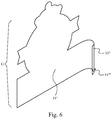
- a fundamental characteristic of the method for applying decorative elements on curved and rigid surfaces is represented by the particular form 7 of the label 12 as well as by the form of the fabric 6. More in detail, this form 7 was suitably and accurately designed in order to allow spreading the fabric 6 as well as the label 12 in a conformation perfectly spread on the curved surface of the object to be decorated 100, which in the case of the embodiments and the figures reported in the present description is a common bottle for drinks.
- Said form 7, which recalls the form of the Contour bottle, is profiled in a manner so as to have two main portions or zones, and in particular a lower portion 7', which is spread on the lower part of the object to be decorated 100 i.e.
- Said lower portion 7' also has a rectangular profile with the greater parallel sides directed parallel to the ground level.
- Said upper portion 7" instead has an elliptical profile, with the greater axis of the ellipse also directed parallel to the ground level.
- Said upper portion 7", with elliptical form is also spread centrally and in the upper zone of the lower portion 7' in a manner so as to form, with said lower portion 7', recesses 13 that are symmetric with respect to a vertical symmetry axis 50.
- the same form 7 is also completely symmetric with respect to said vertical symmetry axis 50.
- the upper portion 7" with elliptical form also has two lateral projections 14, shaped as a dovetail, and these too are symmetric with respect to the vertical symmetry axis 50.
- Said portion 7" additionally has, at the central zone of the greater upper arc 15 of the ellipse, a projection 16 shaped as a royal crown.
- the label 12 having the aforesaid form 7, as an alternative and in a second embodiment, is such to have the internal part thereof hollow. More in detail, in a second embodiment the label 12 is only constituted by the profile of the form 7 having edges of a width sufficient for receiving a specific decoration. More in detail, in a second embodiment the form 7 of the label 12 is analogous to that described above and has edges 17 whose width varies from 3 mm to 15 mm and preferably said edges have a width of 10 mm.
- This described embodiment is particularly advantageous when it is desired to apply any decoration 9 on the surface of a bottle at the curved sections, for example at the base of the bottle neck, leaving the entire space required for showing the indications pre-existing on the bottle free.
- indications such as the manufacturer of the substance contained in the bottle, and/or the composition of the product and/or other indications, can also be obtained by using the label described in the first embodiment. Said indications can in any case be represented on the lower portion 7' of the label 12, and by applying the decoration 9 on the upper portion 7" of the label 12.
- the decorative elements 3 are preferably represented by rhinestones having dimensions that vary from 1 mm to 10 mm and preferably from 2 mm to 5 mm.
- the decorative elements 3 are variously colored rhinestones with dimensions that vary between 1 mm and 10 mm and preferably between 2 mm and 6 mm, and said decorative elements 3 are also variously profiled, having various faceting and a variable geometry that is spherical, ellipsoidal, teardrop-shaped, polyhedral and the like.
- the decorative elements 3 can be variously-colored paillettes.
- the fabric 6 of the label 12 is also suitable for the application of a thermo-adhesive label thereon. More in detail, the label 12 can comprise a fabric 6 having on its front surface 6' any one thermo-adhesive label representing any one trademark or logo.
- the advantage is that of accurately reproducing any trademark or logo on a curved and rigid surface, like that of a bottle for drinks.
- the optionally fluorescent material constituting the fabric 6 can be represented by a fabric or by a non-woven fabric.
- said fabric 6 is a cloth treated with a weaving that varies from 70 to 100 denier, having trimming with yarns and/or with lamé.
- the material constituting the fabric 6 is polyester with a basis weight that varies from 70 g to 100 g.
Landscapes
- Engineering & Computer Science (AREA)
- Chemical & Material Sciences (AREA)
- General Physics & Mathematics (AREA)
- Theoretical Computer Science (AREA)
- Physics & Mathematics (AREA)
- Chemical Kinetics & Catalysis (AREA)
- Life Sciences & Earth Sciences (AREA)
- General Chemical & Material Sciences (AREA)
- Geochemistry & Mineralogy (AREA)
- Materials Engineering (AREA)
- Organic Chemistry (AREA)
- Decoration Of Textiles (AREA)
- Decoration By Transfer Pictures (AREA)
- Application Of Or Painting With Fluid Materials (AREA)
- Laminated Bodies (AREA)
Claims (10)
- Procédé servant à appliquer des éléments décoratifs sur des surfaces courbes et rigides telles que le goulot d'une bouteille, comportant les étapes consistant à :a) obtenir un gabarit (1) ayant une pluralité de trous (2) ayant une forme et une taille analogues à celles de la pluralité d'éléments décoratifs (3) adaptés à des fins d'insertion à l'intérieur desdits trous (2), lesdits trous (2) étant dans leur totalité adaptés en vue de donner lieu à une forme quelconque, à un dessin quelconque et/ou à une écriture quelconque ;b) insérer une pluralité d'éléments décoratifs (3) sur la surface dudit gabarit (1), lesdits éléments décoratifs (3) étant adaptés à des fins d'insertion à l'intérieur desdits trous (2) de manière à diriger leur surface arrière (3') à l'intérieur desdits trous (2) ;c) retirer les éléments décoratifs (3) en excès en provenance de la surface dudit gabarit (1) ;d) appliquer un film (4), sur la surface du gabarit (1), ayant une couche d'adhésif (4') adaptée à des fins d'adhésion sur ladite surface courbe desdits éléments décoratifs (3) de manière à recevoir les éléments décoratifs (3) en provenance des trous (2) du gabarit (1), lesdits éléments décoratifs (3) étant adhérés sur ladite couche d'adhésif (4'), tout en maintenant la configuration dudit dessin présent et/ou de ladite écriture présente sur ledit gabarit (1) et l'application de ladite couche d'adhésif (4'), sur la surface du gabarit (1), étant exécutée avec précision au moyen de points de guidage (5) présents sur ladite couche d'adhésif (4') adaptés à des fins d'appariement avec des points de guidage correspondants (5') présents sur la surface du gabarit (1) ;e) retirer le film (4) ayant la couche d'adhésif (4') en provenance de la surface du gabarit (1), ladite couche d'adhésif (4') ayant, après ledit retrait du film (4) en provenance du gabarit (1), le jeu exact d'éléments décoratifs (3) formant ledit dessin et/ou ladite écriture ;f) appliquer la couche d'adhésif (4') sur un tissu (6), ledit tissu (6) ayant une surface avant (6') et une surface arrière (6") comportant une double couche d'adhésif (11), ladite application desdits éléments décoratifs (3) se faisant sur la surface avant (6') du tissu (6) guidée par une pluralité de points de guidage (8) présents sur ladite surface avant (6') adaptés à des fins d'appariement avec une pluralité de points de guidage correspondants (5) présents sur la couche d'adhésif (4') du film (4) ;g) retirer le film (4) en provenance de la surface avant (6') du tissu (6) afin d'obtenir le transfert des éléments décoratifs (3) en provenance de la couche d'adhésif (4') jusque sur ladite surface avant (6'), lesdits éléments décoratifs (3) étant dotés d'une couche de colle sur leur surface arrière (3') et ladite surface arrière (3') étant adaptée à des fins d'application sur la surface avant (6'), lesdits éléments décoratifs (3') formant, après ledit retrait, une décoration (9) présente sur la surface avant (6') du tissu (6) ;h) traiter le tissu (6), ayant la décoration (9) d'éléments décoratifs (3), au moyen d'une presse thermique (10) ;i) retirer le film de protection (11"') présent sur la couche d'adhésif arrière (11 ") de la double couche d'adhésif (11) placée sur la surface arrière (6") du tissu (6), ladite double couche d'adhésif (11) ayant une couche d'adhésif (11") appliquée sur ladite surface arrière (6") du tissu (6) en amont de la mise en oeuvre du présent procédé servant à appliquer des éléments décoratifs sur des surfaces courbes et rigides ;j) obtenir une étiquette (12) devant être appliquée sur des surfaces courbes et rigides en une conformation étalée de manière uniforme sur lesdites surfaces courbes et rigides, comportant un tissu (6) ayant une décoration (9) sur sa surface avant (6') et une double couche d'adhésif (11) sur sa surface arrière (6"),ledit procédé étant caractérisé en ce que ladite étiquette (12) est étalée de manière parfaite et uniforme sur la surface d'une bouteille à contour devant être décorée (100) en raison de la forme particulière (7) de ladite étiquette (12), ladite forme (7) ayant la forme d'une bouteille à contour, d'où la mise en oeuvre d'une partie inférieure (7') et d'une partie supérieure (7") raccordées ensemble par les évidements (13).
- Procédé servant à appliquer des éléments décoratifs selon la revendication précédente, caractérisé en ce que la forme (7) de l'étiquette (12) a deux zones, une partie inférieure (7') ayant une forme rectangulaire et une partie supérieure (7") ayant une forme elliptique ayant respectivement les plus grands côtés du rectangle caractérisant ladite partie inférieure (7'), et le plus grand axe de l'ellipse caractérisant ladite partie supérieure (7"), parallèles l'une par rapport à l'autre et au plan de butée de la bouteille elle-même, en ce que ladite forme (7) est symétrique par rapport à l'axe de symétrie vertical (50), en ce que ladite forme (7) a au moins deux parties saillantes latérales (14) formées en queue d'aronde et celles-ci sont aussi symétriques par rapport audit axe de symétrie vertical (50) et sont placées sur la partie supérieure (7") avec au moins une partie saillante (16) qui est étalée de manière centrale sur le plus grand arc supérieur (15) de l'ellipse.
- Procédé servant à appliquer des éléments décoratifs selon les revendications précédentes, caractérisé en ce que les éléments décoratifs (3) sont des pierres du Rhin.
- Procédé servant à appliquer des éléments décoratifs selon les revendications précédentes, caractérisé en ce que lesdits éléments décoratifs (3) sont des pierres du Rhin aux couleurs variées ayant des dimensions qui varient entre 1 mm et 10 mm et de préférence entre 2 mm et 6 mm, et en ce que lesdits éléments décoratifs (3) sont à profils variés, ayant un facettage varié et une géométrie variable qui est en forme de sphère, d'ellipse, de larme, de polyèdre et analogue.
- Procédé servant à appliquer des éléments décoratifs selon les revendications précédentes, caractérisé en ce que le matériau constituant le tissu (6) est un tissu ou un tissu non tissé, éventuellement fluorescent, et de préférence est un tissu traité au moyen d'un tissage qui varie de 70 à 100 denier à garniture de fils et/ou de lamé.
- Procédé servant à appliquer des éléments décoratifs selon les revendications précédentes, caractérisé en ce que le matériau constituant le tissu (6) est du polyester ayant une masse surfacique qui varie de 70 g à 100 g.
- Procédé servant à appliquer des éléments décoratifs selon les revendications précédentes, caractérisé en ce que l'étiquette (12) est éventuellement creuse à l'intérieur, ayant des bords (17) encadrant toute la forme (7) de ladite étiquette (12) et ayant une largeur qui varie de 2 mm à 15 mm sur laquelle toute décoration (9) est en mesure d'être appliquée, comme selon les revendications précédentes.
- Procédé servant à appliquer des éléments décoratifs selon les revendications précédentes, caractérisé en ce que les éléments décoratifs (3) sont des paillettes à couleurs variées et/ou en ce que l'étiquette (12) peut éventuellement comporter un tissu (6) ayant une étiquette thermocollante sur sa surface avant (6').
- Étiquette (12) obtenue au moyen du procédé servant à appliquer des éléments décoratifs selon les revendications précédentes.
- Utilisation d'une étiquette (12) obtenue au moyen du procédé servant à appliquer des éléments décoratifs selon les revendications précédentes pour la représentation de toute décoration (9) sur une surface courbe et rigide d'une bouteille à contour devant être décorée (100), et de préférence pour la représentation de ladite décoration quelconque (9) sur ladite surface courbe et rigide d'une bouteille à contour servant à contenir des boissons.
Applications Claiming Priority (2)
| Application Number | Priority Date | Filing Date | Title |
|---|---|---|---|
| IT000282A ITRM20120282A1 (it) | 2012-06-18 | 2012-06-18 | Metodo per l¿applicazione di elementi decorativi su superfici curve. |
| PCT/IB2013/054228 WO2013190404A1 (fr) | 2012-06-18 | 2013-05-22 | Procédé d'application d'éléments décoratifs sur des surfaces courbées |
Publications (2)
| Publication Number | Publication Date |
|---|---|
| EP2861431A1 EP2861431A1 (fr) | 2015-04-22 |
| EP2861431B1 true EP2861431B1 (fr) | 2016-09-28 |
Family
ID=46758913
Family Applications (1)
| Application Number | Title | Priority Date | Filing Date |
|---|---|---|---|
| EP13731961.2A Not-in-force EP2861431B1 (fr) | 2012-06-18 | 2013-05-22 | Procédé d'application d'éléments décoratifs sur des surfaces courbées |
Country Status (7)
| Country | Link |
|---|---|
| US (1) | US20150199923A1 (fr) |
| EP (1) | EP2861431B1 (fr) |
| AU (1) | AU2013278957B2 (fr) |
| ES (1) | ES2609120T3 (fr) |
| IT (1) | ITRM20120282A1 (fr) |
| RU (1) | RU2015100979A (fr) |
| WO (1) | WO2013190404A1 (fr) |
Families Citing this family (5)
| Publication number | Priority date | Publication date | Assignee | Title |
|---|---|---|---|---|
| FR3011510A1 (fr) * | 2013-10-03 | 2015-04-10 | Patrick Montagne | Ornementation d'une bouteille de verre ou cristal avec une plaque de verre colore, etire ou souffle |
| JP5698403B1 (ja) * | 2014-06-20 | 2015-04-08 | 株式会社ギンガムジャパン | 伸縮性部材に接着された固形物を含む製品 |
| IT201600073522A1 (it) * | 2016-07-14 | 2018-01-14 | Arte In Strass S R L | Decoro ornamentale del tipo perfezionato, particolarmente per l'abbellimento di oggetti. |
| IT201900025258A1 (it) | 2019-12-23 | 2021-06-23 | Transfermania Int Srl | Assieme e procedimento per ottenere supporti trasferibili di strass |
| CN116363942A (zh) * | 2023-03-23 | 2023-06-30 | 北京场景智能科技有限公司 | 一种汽车零部件用可识读贴合标签的生产方法 |
Family Cites Families (11)
| Publication number | Priority date | Publication date | Assignee | Title |
|---|---|---|---|---|
| US2458493A (en) * | 1946-07-26 | 1949-01-04 | Troy Ellen | Method of ornamentation |
| DE2901728C2 (de) * | 1979-01-17 | 1980-08-14 | D. Swarovski & Co, Wattens, Tirol (Oesterreich) | Dekoratives Material und Verfahren zur Herstellung desselben |
| US5167743A (en) * | 1991-07-26 | 1992-12-01 | Margola Import Corp. | Method and apparatus for attaching decorative articles to fabric |
| US5662991A (en) * | 1994-12-23 | 1997-09-02 | Gentex Corporation | Laminated biocidal fabric |
| US5620775A (en) * | 1995-11-03 | 1997-04-15 | Minnesota Mining And Manufacturing Company | Low refractive index glass microsphere coated article having a smooth surface and a method for preparing same |
| US20050076998A1 (en) * | 2003-10-10 | 2005-04-14 | Thomas Buffum | Rhinestone kit |
| US20100108247A1 (en) * | 2006-08-01 | 2010-05-06 | Tao-Ming Tom King | Method and Apparatus for a Retro-reflective Material |
| AT505288B1 (de) * | 2008-01-14 | 2008-12-15 | Juergen Fasching | Verfahren zum anbringen von kristallen auf einem glaskörper |
| GB2467365B (en) * | 2009-01-31 | 2011-02-02 | Charterhouse Holdings Plc | Method of applying items to a substrate |
| US8356651B2 (en) * | 2009-05-22 | 2013-01-22 | Zaher Faraj | Device and system to apply faceted beads |
| US8661702B2 (en) * | 2011-03-18 | 2014-03-04 | David C. Ihm | Kit and method for assembling a decorative object pattern upon a separate article |
-
2012
- 2012-06-18 IT IT000282A patent/ITRM20120282A1/it unknown
-
2013
- 2013-05-22 US US14/408,533 patent/US20150199923A1/en not_active Abandoned
- 2013-05-22 ES ES13731961.2T patent/ES2609120T3/es active Active
- 2013-05-22 AU AU2013278957A patent/AU2013278957B2/en not_active Expired - Fee Related
- 2013-05-22 WO PCT/IB2013/054228 patent/WO2013190404A1/fr not_active Ceased
- 2013-05-22 EP EP13731961.2A patent/EP2861431B1/fr not_active Not-in-force
- 2013-05-22 RU RU2015100979A patent/RU2015100979A/ru not_active Application Discontinuation
Also Published As
| Publication number | Publication date |
|---|---|
| WO2013190404A1 (fr) | 2013-12-27 |
| RU2015100979A (ru) | 2016-08-10 |
| US20150199923A1 (en) | 2015-07-16 |
| AU2013278957A1 (en) | 2015-02-05 |
| ES2609120T3 (es) | 2017-04-18 |
| ITRM20120282A1 (it) | 2013-12-19 |
| AU2013278957B2 (en) | 2016-07-07 |
| EP2861431A1 (fr) | 2015-04-22 |
Similar Documents
| Publication | Publication Date | Title |
|---|---|---|
| EP2861431B1 (fr) | Procédé d'application d'éléments décoratifs sur des surfaces courbées | |
| CN105644249A (zh) | 陶瓷镶嵌金属装饰工艺 | |
| US20170036480A1 (en) | Precious metal sheet display and method of manufacturing | |
| KR20160004521A (ko) | 전통 박 공예품 제작방법 | |
| CN103373167A (zh) | 玉彩绣及其制作方法 | |
| JP2003325224A (ja) | ヒートスタンピングされた金属製人工爪 | |
| KR100441322B1 (ko) | 합성수지제 손톱손질구 | |
| CN105266293A (zh) | 装饰珠的附着方法及通过该方法附着装饰珠的产品 | |
| US2076387A (en) | Manufacture of ornaments | |
| RU164161U1 (ru) | Ювелирная подвеска | |
| RU163898U1 (ru) | Ювелирная подвеска | |
| US10455897B2 (en) | Method of decorating shoes and decorated shoes | |
| JP6191089B2 (ja) | 装飾方法及びその方法により装飾された物品 | |
| ITTV20110057A1 (it) | Realizzazione di rivestimenti e decori per bottiglie | |
| US10632783B1 (en) | Method for adhering embellishments to a glass substrate | |
| KR0138692B1 (ko) | 가구 표면 장식재 제조 방법 | |
| JP7124239B6 (ja) | 漆製品の製造方法 | |
| JP6180222B2 (ja) | 装飾体の取付構造およびその取付方法 | |
| US20210230506A1 (en) | Decorative wax element and a method of decorating a candle using a decorative wax element | |
| KR101475176B1 (ko) | 자개 장식물의 성형방법 | |
| KR100506645B1 (ko) | 패각을 이용한 손톱장식구 및 그 제조방법 | |
| KR101187667B1 (ko) | 핫피스 시트 제조방법 및 그 핫피스 시트 | |
| ITVI20140039U1 (it) | Applicazione a vasi e coprivasi in plastica di minuterie metalliche o plastiche o vetrose | |
| US20150068046A1 (en) | Jeweled article and method for making jeweled article | |
| KR940010615B1 (ko) | 자개를 이용한 장신구 및 그 제조방법 |
Legal Events
| Date | Code | Title | Description |
|---|---|---|---|
| PUAI | Public reference made under article 153(3) epc to a published international application that has entered the european phase |
Free format text: ORIGINAL CODE: 0009012 |
|
| 17P | Request for examination filed |
Effective date: 20150119 |
|
| AK | Designated contracting states |
Kind code of ref document: A1 Designated state(s): AL AT BE BG CH CY CZ DE DK EE ES FI FR GB GR HR HU IE IS IT LI LT LU LV MC MK MT NL NO PL PT RO RS SE SI SK SM TR |
|
| AX | Request for extension of the european patent |
Extension state: BA ME |
|
| DAX | Request for extension of the european patent (deleted) | ||
| GRAP | Despatch of communication of intention to grant a patent |
Free format text: ORIGINAL CODE: EPIDOSNIGR1 |
|
| INTG | Intention to grant announced |
Effective date: 20160419 |
|
| GRAS | Grant fee paid |
Free format text: ORIGINAL CODE: EPIDOSNIGR3 |
|
| GRAA | (expected) grant |
Free format text: ORIGINAL CODE: 0009210 |
|
| AK | Designated contracting states |
Kind code of ref document: B1 Designated state(s): AL AT BE BG CH CY CZ DE DK EE ES FI FR GB GR HR HU IE IS IT LI LT LU LV MC MK MT NL NO PL PT RO RS SE SI SK SM TR |
|
| REG | Reference to a national code |
Ref country code: GB Ref legal event code: FG4D |
|
| REG | Reference to a national code |
Ref country code: CH Ref legal event code: EP |
|
| REG | Reference to a national code |
Ref country code: AT Ref legal event code: REF Ref document number: 832401 Country of ref document: AT Kind code of ref document: T Effective date: 20161015 |
|
| REG | Reference to a national code |
Ref country code: IE Ref legal event code: FG4D |
|
| REG | Reference to a national code |
Ref country code: DE Ref legal event code: R096 Ref document number: 602013012172 Country of ref document: DE |
|
| REG | Reference to a national code |
Ref country code: LT Ref legal event code: MG4D |
|
| PG25 | Lapsed in a contracting state [announced via postgrant information from national office to epo] |
Ref country code: FI Free format text: LAPSE BECAUSE OF FAILURE TO SUBMIT A TRANSLATION OF THE DESCRIPTION OR TO PAY THE FEE WITHIN THE PRESCRIBED TIME-LIMIT Effective date: 20160928 Ref country code: LT Free format text: LAPSE BECAUSE OF FAILURE TO SUBMIT A TRANSLATION OF THE DESCRIPTION OR TO PAY THE FEE WITHIN THE PRESCRIBED TIME-LIMIT Effective date: 20160928 Ref country code: HR Free format text: LAPSE BECAUSE OF FAILURE TO SUBMIT A TRANSLATION OF THE DESCRIPTION OR TO PAY THE FEE WITHIN THE PRESCRIBED TIME-LIMIT Effective date: 20160928 Ref country code: RS Free format text: LAPSE BECAUSE OF FAILURE TO SUBMIT A TRANSLATION OF THE DESCRIPTION OR TO PAY THE FEE WITHIN THE PRESCRIBED TIME-LIMIT Effective date: 20160928 Ref country code: NO Free format text: LAPSE BECAUSE OF FAILURE TO SUBMIT A TRANSLATION OF THE DESCRIPTION OR TO PAY THE FEE WITHIN THE PRESCRIBED TIME-LIMIT Effective date: 20161228 |
|
| REG | Reference to a national code |
Ref country code: NL Ref legal event code: MP Effective date: 20160928 |
|
| REG | Reference to a national code |
Ref country code: AT Ref legal event code: MK05 Ref document number: 832401 Country of ref document: AT Kind code of ref document: T Effective date: 20160928 |
|
| PG25 | Lapsed in a contracting state [announced via postgrant information from national office to epo] |
Ref country code: GR Free format text: LAPSE BECAUSE OF FAILURE TO SUBMIT A TRANSLATION OF THE DESCRIPTION OR TO PAY THE FEE WITHIN THE PRESCRIBED TIME-LIMIT Effective date: 20161229 Ref country code: SE Free format text: LAPSE BECAUSE OF FAILURE TO SUBMIT A TRANSLATION OF THE DESCRIPTION OR TO PAY THE FEE WITHIN THE PRESCRIBED TIME-LIMIT Effective date: 20160928 Ref country code: NL Free format text: LAPSE BECAUSE OF FAILURE TO SUBMIT A TRANSLATION OF THE DESCRIPTION OR TO PAY THE FEE WITHIN THE PRESCRIBED TIME-LIMIT Effective date: 20160928 Ref country code: LV Free format text: LAPSE BECAUSE OF FAILURE TO SUBMIT A TRANSLATION OF THE DESCRIPTION OR TO PAY THE FEE WITHIN THE PRESCRIBED TIME-LIMIT Effective date: 20160928 |
|
| REG | Reference to a national code |
Ref country code: ES Ref legal event code: FG2A Ref document number: 2609120 Country of ref document: ES Kind code of ref document: T3 Effective date: 20170418 |
|
| PG25 | Lapsed in a contracting state [announced via postgrant information from national office to epo] |
Ref country code: RO Free format text: LAPSE BECAUSE OF FAILURE TO SUBMIT A TRANSLATION OF THE DESCRIPTION OR TO PAY THE FEE WITHIN THE PRESCRIBED TIME-LIMIT Effective date: 20160928 Ref country code: EE Free format text: LAPSE BECAUSE OF FAILURE TO SUBMIT A TRANSLATION OF THE DESCRIPTION OR TO PAY THE FEE WITHIN THE PRESCRIBED TIME-LIMIT Effective date: 20160928 |
|
| PG25 | Lapsed in a contracting state [announced via postgrant information from national office to epo] |
Ref country code: BE Free format text: LAPSE BECAUSE OF FAILURE TO SUBMIT A TRANSLATION OF THE DESCRIPTION OR TO PAY THE FEE WITHIN THE PRESCRIBED TIME-LIMIT Effective date: 20160928 Ref country code: IS Free format text: LAPSE BECAUSE OF FAILURE TO SUBMIT A TRANSLATION OF THE DESCRIPTION OR TO PAY THE FEE WITHIN THE PRESCRIBED TIME-LIMIT Effective date: 20170128 Ref country code: SM Free format text: LAPSE BECAUSE OF FAILURE TO SUBMIT A TRANSLATION OF THE DESCRIPTION OR TO PAY THE FEE WITHIN THE PRESCRIBED TIME-LIMIT Effective date: 20160928 Ref country code: PT Free format text: LAPSE BECAUSE OF FAILURE TO SUBMIT A TRANSLATION OF THE DESCRIPTION OR TO PAY THE FEE WITHIN THE PRESCRIBED TIME-LIMIT Effective date: 20170130 Ref country code: SK Free format text: LAPSE BECAUSE OF FAILURE TO SUBMIT A TRANSLATION OF THE DESCRIPTION OR TO PAY THE FEE WITHIN THE PRESCRIBED TIME-LIMIT Effective date: 20160928 Ref country code: CZ Free format text: LAPSE BECAUSE OF FAILURE TO SUBMIT A TRANSLATION OF THE DESCRIPTION OR TO PAY THE FEE WITHIN THE PRESCRIBED TIME-LIMIT Effective date: 20160928 Ref country code: BG Free format text: LAPSE BECAUSE OF FAILURE TO SUBMIT A TRANSLATION OF THE DESCRIPTION OR TO PAY THE FEE WITHIN THE PRESCRIBED TIME-LIMIT Effective date: 20161228 Ref country code: AT Free format text: LAPSE BECAUSE OF FAILURE TO SUBMIT A TRANSLATION OF THE DESCRIPTION OR TO PAY THE FEE WITHIN THE PRESCRIBED TIME-LIMIT Effective date: 20160928 Ref country code: PL Free format text: LAPSE BECAUSE OF FAILURE TO SUBMIT A TRANSLATION OF THE DESCRIPTION OR TO PAY THE FEE WITHIN THE PRESCRIBED TIME-LIMIT Effective date: 20160928 |
|
| REG | Reference to a national code |
Ref country code: FR Ref legal event code: PLFP Year of fee payment: 5 |
|
| REG | Reference to a national code |
Ref country code: DE Ref legal event code: R097 Ref document number: 602013012172 Country of ref document: DE |
|
| PG25 | Lapsed in a contracting state [announced via postgrant information from national office to epo] |
Ref country code: IT Free format text: LAPSE BECAUSE OF FAILURE TO SUBMIT A TRANSLATION OF THE DESCRIPTION OR TO PAY THE FEE WITHIN THE PRESCRIBED TIME-LIMIT Effective date: 20160928 |
|
| PG25 | Lapsed in a contracting state [announced via postgrant information from national office to epo] |
Ref country code: DK Free format text: LAPSE BECAUSE OF FAILURE TO SUBMIT A TRANSLATION OF THE DESCRIPTION OR TO PAY THE FEE WITHIN THE PRESCRIBED TIME-LIMIT Effective date: 20160928 |
|
| PGFP | Annual fee paid to national office [announced via postgrant information from national office to epo] |
Ref country code: FR Payment date: 20170531 Year of fee payment: 5 Ref country code: GB Payment date: 20170531 Year of fee payment: 5 |
|
| PLBE | No opposition filed within time limit |
Free format text: ORIGINAL CODE: 0009261 |
|
| STAA | Information on the status of an ep patent application or granted ep patent |
Free format text: STATUS: NO OPPOSITION FILED WITHIN TIME LIMIT |
|
| PG25 | Lapsed in a contracting state [announced via postgrant information from national office to epo] |
Ref country code: LU Free format text: LAPSE BECAUSE OF NON-PAYMENT OF DUE FEES Effective date: 20170531 |
|
| PGFP | Annual fee paid to national office [announced via postgrant information from national office to epo] |
Ref country code: ES Payment date: 20170601 Year of fee payment: 5 |
|
| 26N | No opposition filed |
Effective date: 20170629 |
|
| PG25 | Lapsed in a contracting state [announced via postgrant information from national office to epo] |
Ref country code: SI Free format text: LAPSE BECAUSE OF FAILURE TO SUBMIT A TRANSLATION OF THE DESCRIPTION OR TO PAY THE FEE WITHIN THE PRESCRIBED TIME-LIMIT Effective date: 20160928 |
|
| REG | Reference to a national code |
Ref country code: DE Ref legal event code: R119 Ref document number: 602013012172 Country of ref document: DE |
|
| REG | Reference to a national code |
Ref country code: CH Ref legal event code: PL |
|
| PG25 | Lapsed in a contracting state [announced via postgrant information from national office to epo] |
Ref country code: MC Free format text: LAPSE BECAUSE OF FAILURE TO SUBMIT A TRANSLATION OF THE DESCRIPTION OR TO PAY THE FEE WITHIN THE PRESCRIBED TIME-LIMIT Effective date: 20160928 |
|
| REG | Reference to a national code |
Ref country code: IE Ref legal event code: MM4A |
|
| PG25 | Lapsed in a contracting state [announced via postgrant information from national office to epo] |
Ref country code: CH Free format text: LAPSE BECAUSE OF NON-PAYMENT OF DUE FEES Effective date: 20170531 Ref country code: LI Free format text: LAPSE BECAUSE OF NON-PAYMENT OF DUE FEES Effective date: 20170531 |
|
| PG25 | Lapsed in a contracting state [announced via postgrant information from national office to epo] |
Ref country code: LU Free format text: LAPSE BECAUSE OF NON-PAYMENT OF DUE FEES Effective date: 20170522 |
|
| PG25 | Lapsed in a contracting state [announced via postgrant information from national office to epo] |
Ref country code: DE Free format text: LAPSE BECAUSE OF NON-PAYMENT OF DUE FEES Effective date: 20171201 Ref country code: IE Free format text: LAPSE BECAUSE OF NON-PAYMENT OF DUE FEES Effective date: 20170522 |
|
| PG25 | Lapsed in a contracting state [announced via postgrant information from national office to epo] |
Ref country code: MT Free format text: LAPSE BECAUSE OF NON-PAYMENT OF DUE FEES Effective date: 20170522 |
|
| PG25 | Lapsed in a contracting state [announced via postgrant information from national office to epo] |
Ref country code: AL Free format text: LAPSE BECAUSE OF FAILURE TO SUBMIT A TRANSLATION OF THE DESCRIPTION OR TO PAY THE FEE WITHIN THE PRESCRIBED TIME-LIMIT Effective date: 20160928 |
|
| GBPC | Gb: european patent ceased through non-payment of renewal fee |
Effective date: 20180522 |
|
| PG25 | Lapsed in a contracting state [announced via postgrant information from national office to epo] |
Ref country code: GB Free format text: LAPSE BECAUSE OF NON-PAYMENT OF DUE FEES Effective date: 20180522 Ref country code: FR Free format text: LAPSE BECAUSE OF NON-PAYMENT OF DUE FEES Effective date: 20180531 |
|
| PG25 | Lapsed in a contracting state [announced via postgrant information from national office to epo] |
Ref country code: HU Free format text: LAPSE BECAUSE OF FAILURE TO SUBMIT A TRANSLATION OF THE DESCRIPTION OR TO PAY THE FEE WITHIN THE PRESCRIBED TIME-LIMIT; INVALID AB INITIO Effective date: 20130522 |
|
| REG | Reference to a national code |
Ref country code: ES Ref legal event code: FD2A Effective date: 20190913 |
|
| PG25 | Lapsed in a contracting state [announced via postgrant information from national office to epo] |
Ref country code: CY Free format text: LAPSE BECAUSE OF FAILURE TO SUBMIT A TRANSLATION OF THE DESCRIPTION OR TO PAY THE FEE WITHIN THE PRESCRIBED TIME-LIMIT Effective date: 20160928 Ref country code: ES Free format text: LAPSE BECAUSE OF NON-PAYMENT OF DUE FEES Effective date: 20180523 |
|
| PG25 | Lapsed in a contracting state [announced via postgrant information from national office to epo] |
Ref country code: MK Free format text: LAPSE BECAUSE OF FAILURE TO SUBMIT A TRANSLATION OF THE DESCRIPTION OR TO PAY THE FEE WITHIN THE PRESCRIBED TIME-LIMIT Effective date: 20160928 |
|
| PG25 | Lapsed in a contracting state [announced via postgrant information from national office to epo] |
Ref country code: TR Free format text: LAPSE BECAUSE OF FAILURE TO SUBMIT A TRANSLATION OF THE DESCRIPTION OR TO PAY THE FEE WITHIN THE PRESCRIBED TIME-LIMIT Effective date: 20160928 |