EP2871222B1 - Composé pour dispositif opto-électrique organique, dispositif opto-électrique organique le contenant, et dispositif d'affichage comprenant ledit dispositif opto-électrique organique - Google Patents
Composé pour dispositif opto-électrique organique, dispositif opto-électrique organique le contenant, et dispositif d'affichage comprenant ledit dispositif opto-électrique organique Download PDFInfo
- Publication number
- EP2871222B1 EP2871222B1 EP13812616.4A EP13812616A EP2871222B1 EP 2871222 B1 EP2871222 B1 EP 2871222B1 EP 13812616 A EP13812616 A EP 13812616A EP 2871222 B1 EP2871222 B1 EP 2871222B1
- Authority
- EP
- European Patent Office
- Prior art keywords
- substituted
- unsubstituted
- group
- compound
- chemical formula
- Prior art date
- Legal status (The legal status is an assumption and is not a legal conclusion. Google has not performed a legal analysis and makes no representation as to the accuracy of the status listed.)
- Active
Links
- 0 *c(c(*)c(c(*)c1*)[Np])c1O Chemical compound *c(c(*)c(c(*)c1*)[Np])c1O 0.000 description 4
Images
Classifications
-
- C—CHEMISTRY; METALLURGY
- C07—ORGANIC CHEMISTRY
- C07F—ACYCLIC, CARBOCYCLIC OR HETEROCYCLIC COMPOUNDS CONTAINING ELEMENTS OTHER THAN CARBON, HYDROGEN, HALOGEN, OXYGEN, NITROGEN, SULFUR, SELENIUM OR TELLURIUM
- C07F15/00—Compounds containing elements of Groups 8, 9, 10 or 18 of the Periodic Table
-
- C—CHEMISTRY; METALLURGY
- C07—ORGANIC CHEMISTRY
- C07F—ACYCLIC, CARBOCYCLIC OR HETEROCYCLIC COMPOUNDS CONTAINING ELEMENTS OTHER THAN CARBON, HYDROGEN, HALOGEN, OXYGEN, NITROGEN, SULFUR, SELENIUM OR TELLURIUM
- C07F15/00—Compounds containing elements of Groups 8, 9, 10 or 18 of the Periodic Table
- C07F15/0006—Compounds containing elements of Groups 8, 9, 10 or 18 of the Periodic Table compounds of the platinum group
- C07F15/0033—Iridium compounds
-
- C—CHEMISTRY; METALLURGY
- C09—DYES; PAINTS; POLISHES; NATURAL RESINS; ADHESIVES; COMPOSITIONS NOT OTHERWISE PROVIDED FOR; APPLICATIONS OF MATERIALS NOT OTHERWISE PROVIDED FOR
- C09K—MATERIALS FOR MISCELLANEOUS APPLICATIONS, NOT PROVIDED FOR ELSEWHERE
- C09K11/00—Luminescent materials, e.g. electroluminescent or chemiluminescent
- C09K11/06—Luminescent materials, e.g. electroluminescent or chemiluminescent containing organic luminescent materials
-
- H—ELECTRICITY
- H10—SEMICONDUCTOR DEVICES; ELECTRIC SOLID-STATE DEVICES NOT OTHERWISE PROVIDED FOR
- H10K—ORGANIC ELECTRIC SOLID-STATE DEVICES
- H10K50/00—Organic light-emitting devices
- H10K50/10—OLEDs or polymer light-emitting diodes [PLED]
- H10K50/11—OLEDs or polymer light-emitting diodes [PLED] characterised by the electroluminescent [EL] layers
-
- H—ELECTRICITY
- H10—SEMICONDUCTOR DEVICES; ELECTRIC SOLID-STATE DEVICES NOT OTHERWISE PROVIDED FOR
- H10K—ORGANIC ELECTRIC SOLID-STATE DEVICES
- H10K50/00—Organic light-emitting devices
- H10K50/10—OLEDs or polymer light-emitting diodes [PLED]
- H10K50/11—OLEDs or polymer light-emitting diodes [PLED] characterised by the electroluminescent [EL] layers
- H10K50/12—OLEDs or polymer light-emitting diodes [PLED] characterised by the electroluminescent [EL] layers comprising dopants
- H10K50/121—OLEDs or polymer light-emitting diodes [PLED] characterised by the electroluminescent [EL] layers comprising dopants for assisting energy transfer, e.g. sensitization
-
- H—ELECTRICITY
- H10—SEMICONDUCTOR DEVICES; ELECTRIC SOLID-STATE DEVICES NOT OTHERWISE PROVIDED FOR
- H10K—ORGANIC ELECTRIC SOLID-STATE DEVICES
- H10K59/00—Integrated devices, or assemblies of multiple devices, comprising at least one organic light-emitting element covered by group H10K50/00
- H10K59/30—Devices specially adapted for multicolour light emission
- H10K59/32—Stacked devices having two or more layers, each emitting at different wavelengths
-
- H—ELECTRICITY
- H10—SEMICONDUCTOR DEVICES; ELECTRIC SOLID-STATE DEVICES NOT OTHERWISE PROVIDED FOR
- H10K—ORGANIC ELECTRIC SOLID-STATE DEVICES
- H10K85/00—Organic materials used in the body or electrodes of devices covered by this subclass
- H10K85/30—Coordination compounds
- H10K85/341—Transition metal complexes, e.g. Ru(II)polypyridine complexes
- H10K85/342—Transition metal complexes, e.g. Ru(II)polypyridine complexes comprising iridium
-
- H—ELECTRICITY
- H10—SEMICONDUCTOR DEVICES; ELECTRIC SOLID-STATE DEVICES NOT OTHERWISE PROVIDED FOR
- H10K—ORGANIC ELECTRIC SOLID-STATE DEVICES
- H10K85/00—Organic materials used in the body or electrodes of devices covered by this subclass
- H10K85/40—Organosilicon compounds, e.g. TIPS pentacene
-
- C—CHEMISTRY; METALLURGY
- C09—DYES; PAINTS; POLISHES; NATURAL RESINS; ADHESIVES; COMPOSITIONS NOT OTHERWISE PROVIDED FOR; APPLICATIONS OF MATERIALS NOT OTHERWISE PROVIDED FOR
- C09K—MATERIALS FOR MISCELLANEOUS APPLICATIONS, NOT PROVIDED FOR ELSEWHERE
- C09K2211/00—Chemical nature of organic luminescent or tenebrescent compounds
- C09K2211/10—Non-macromolecular compounds
- C09K2211/1003—Carbocyclic compounds
- C09K2211/1007—Non-condensed systems
-
- C—CHEMISTRY; METALLURGY
- C09—DYES; PAINTS; POLISHES; NATURAL RESINS; ADHESIVES; COMPOSITIONS NOT OTHERWISE PROVIDED FOR; APPLICATIONS OF MATERIALS NOT OTHERWISE PROVIDED FOR
- C09K—MATERIALS FOR MISCELLANEOUS APPLICATIONS, NOT PROVIDED FOR ELSEWHERE
- C09K2211/00—Chemical nature of organic luminescent or tenebrescent compounds
- C09K2211/10—Non-macromolecular compounds
- C09K2211/1018—Heterocyclic compounds
- C09K2211/1025—Heterocyclic compounds characterised by ligands
- C09K2211/1029—Heterocyclic compounds characterised by ligands containing one nitrogen atom as the heteroatom
-
- C—CHEMISTRY; METALLURGY
- C09—DYES; PAINTS; POLISHES; NATURAL RESINS; ADHESIVES; COMPOSITIONS NOT OTHERWISE PROVIDED FOR; APPLICATIONS OF MATERIALS NOT OTHERWISE PROVIDED FOR
- C09K—MATERIALS FOR MISCELLANEOUS APPLICATIONS, NOT PROVIDED FOR ELSEWHERE
- C09K2211/00—Chemical nature of organic luminescent or tenebrescent compounds
- C09K2211/18—Metal complexes
- C09K2211/185—Metal complexes of the platinum group, i.e. Os, Ir, Pt, Ru, Rh or Pd
-
- H—ELECTRICITY
- H10—SEMICONDUCTOR DEVICES; ELECTRIC SOLID-STATE DEVICES NOT OTHERWISE PROVIDED FOR
- H10K—ORGANIC ELECTRIC SOLID-STATE DEVICES
- H10K2101/00—Properties of the organic materials covered by group H10K85/00
- H10K2101/10—Triplet emission
-
- H—ELECTRICITY
- H10—SEMICONDUCTOR DEVICES; ELECTRIC SOLID-STATE DEVICES NOT OTHERWISE PROVIDED FOR
- H10K—ORGANIC ELECTRIC SOLID-STATE DEVICES
- H10K85/00—Organic materials used in the body or electrodes of devices covered by this subclass
- H10K85/30—Coordination compounds
- H10K85/321—Metal complexes comprising a group IIIA element, e.g. Tris (8-hydroxyquinoline) gallium [Gaq3]
- H10K85/324—Metal complexes comprising a group IIIA element, e.g. Tris (8-hydroxyquinoline) gallium [Gaq3] comprising aluminium, e.g. Alq3
-
- H—ELECTRICITY
- H10—SEMICONDUCTOR DEVICES; ELECTRIC SOLID-STATE DEVICES NOT OTHERWISE PROVIDED FOR
- H10K—ORGANIC ELECTRIC SOLID-STATE DEVICES
- H10K85/00—Organic materials used in the body or electrodes of devices covered by this subclass
- H10K85/60—Organic compounds having low molecular weight
- H10K85/631—Amine compounds having at least two aryl rest on at least one amine-nitrogen atom, e.g. triphenylamine
- H10K85/633—Amine compounds having at least two aryl rest on at least one amine-nitrogen atom, e.g. triphenylamine comprising polycyclic condensed aromatic hydrocarbons as substituents on the nitrogen atom
-
- H—ELECTRICITY
- H10—SEMICONDUCTOR DEVICES; ELECTRIC SOLID-STATE DEVICES NOT OTHERWISE PROVIDED FOR
- H10K—ORGANIC ELECTRIC SOLID-STATE DEVICES
- H10K85/00—Organic materials used in the body or electrodes of devices covered by this subclass
- H10K85/60—Organic compounds having low molecular weight
- H10K85/649—Aromatic compounds comprising a hetero atom
- H10K85/657—Polycyclic condensed heteroaromatic hydrocarbons
- H10K85/6572—Polycyclic condensed heteroaromatic hydrocarbons comprising only nitrogen in the heteroaromatic polycondensed ring system, e.g. phenanthroline or carbazole
Definitions
- a compound for an organic optoelectric device, an organic light emitting diode including the same, and a display device including the organic light emitting diode are disclosed.
- An organic optoelectric device is a device requiring a charge exchange between an electrode and an organic material by using holes or electrons.
- EP 2 182 002 A1 refers to compounds for electronic material of high efficiency, and organic electronic devices and organic solar cells comprising the same.
- the novel compounds for electronic material according to the invention are characterized in that they are represented by Chemical Formula (1) : wherein, R1 and R2, or R3 and R4 are linked via (C3- C12) alkylene or (C3-C12) alkenylene to form at least one fused ring(s); provided that, if the ring formed from R3 and R4 of Formula (II) by linkage via alkylene or alkenylene is benzene, the ring formed from R7 and R8 of Formula (III) by linkage via alkylene or alkenylene is not benzene.
- US 2008/074033 A1 refers to to electroluminescent complexes of iridium(III) with silylated, germanylated and stannylated ligands; and to electronic devices in which the active layer includes an electroluminescent Ir(III) complex with silylated, germanylated and stannylated ligands.
- An organic optoelectric device may be classified as follows in accordance with its driving principles.
- a first organic optoelectric device is an electronic device driven as follows: excitons are generated in an organic material layer by photons from an external light source; the excitons are separated into electrons and holes; and the electrons and holes are transferred to different electrodes as a current source (voltage source).
- a second organic optoelectric device is an electronic device driven as follows: a voltage or a current is applied to at least two electrodes to inject holes and/or electrons into an organic material semiconductor positioned at an interface of the electrodes, and the device is driven by the injected electrons and holes.
- Examples of an organic optoelectric device include an organic photoelectric device, an organic light emitting diode, an organic solar cell, an organic photo conductor drum, an organic transistor, and the like, which require a hole injecting or transport material, an electron injecting or transport material, or a light emitting material.
- organic light emitting diode has recently drawn attention due to an increase in demand for flat panel displays.
- organic light emission refers to conversion of electrical energy into photo-energy.
- Such an organic light emitting diode converts electrical energy into light by applying current to an organic light emitting material. It has a structure in which a functional organic material layer is interposed between an anode and a cathode.
- the organic material layer includes a multi-layer including different materials, for example a hole injection layer, a hole transport layer, an emission layer, an electron transport layer, and an electron injection layer, in order to improve efficiency and stability of an organic light emitting diode.
- an organic light emitting diode when a voltage is applied between an anode and a cathode, holes from the anode and electrons from the cathode are injected to an organic material layer and recombined to generate excitons having high energy.
- the generated excitons generate light having certain wavelengths while shifting to a ground state.
- a phosphorescent light emitting material may be used for a light emitting material of an organic light emitting diode in addition to the fluorescent light emitting material.
- a phosphorescent material emits lights by transporting the electrons from a ground state to an exited state, non-radiance transiting of a singlet exciton to a triplet exciton through intersystem crossing, and transiting a triplet exciton to a ground state to emit light.
- an organic material layer includes a light emitting material and a charge transport material, for example a hole injection material, a hole transport material, an electron transport material, an electron injection material, and the like.
- the light emitting material is classified as blue, green, and red light emitting materials according to emitted colors, and yellow and orange light emitting materials to emit colors approaching natural colors.
- a maximum light emitting wavelength is shifted to a long wavelength or color purity decreases because of interactions between molecules, or device efficiency decreases because of a light emitting quenching effect. Therefore, a host/dopant system is included as a light emitting material in order to improve color purity and increase luminous efficiency and stability through energy transfer.
- a material constituting an organic material layer for example a hole injection material, a hole transport material, a light emitting material, an electron transport material, an electron injection material, and a light emitting material such as a host and/or a dopant, should be stable and have good efficiency.
- a hole injection material, a hole transport material, a light emitting material, an electron transport material, an electron injection material, and a light emitting material such as a host and/or a dopant
- the low molecular organic light emitting diode is manufactured as a thin film in a vacuum deposition method and can have good efficiency and life-span performance, and a polymer organic light emitting diode is manufactured in an inkjet or spin coating method has an advantage of low initial cost and being large-sized.
- Both low molecular organic light emitting and polymer organic light emitting diodes have an advantage of self-light emitting, high speed response, wide viewing angle, ultra-thin, high image quality, durability, large driving temperature range, and the like. In particular, they have good visibility due to self-light emitting characteristics compared with a conventional LCD (liquid crystal display) and have an advantage of decreasing a thickness and weight of LCD up to a third, because they do not need a backlight.
- a composition for an organic optoelectric device being capable of providing an organic optoelectric device having characteristics such as high efficiency, long life-span and the like may be provided.
- An organic light emitting diode including the compound for an organic optoelectric device and a display device including the organic light emitting diode are provided.
- a compound represented by the following Chemical Formula 1 for an organic optoelectric device is represented.
- R 1 to R 16 are independently hydrogen, deuterium, a substituted or unsubstituted C1 to C10 alkyl group, a substituted or unsubstituted C6 to C20 aryl group, or -SiR 17 R 18 R 19 , wherein the R 17 to R 19 are independently a substituted or unsubstituted C1 to C6 alkyl group.
- R 1 to R 8 is a functional group represented by the following Chemical Formula 2, and another of the R 1 to R 8 is -SiR 17 R 18 R 19 .
- R 9 to R 16 is a functional group represented by the following Chemical Formula 2, and another of the R 9 to R 16 is -SiR 17 R 18 R 19 .
- L is a bidentate ligand of a monovalent anion, and is a ligand coordination-bonding with iridium through a unshared electron pair of carbon or heteroatom, and n and m are independently integers of 0 to 3, and n + m is one of integers of 1 to 3.
- R 20 to R 24 are independently hydrogen, deuterium, a substituted or unsubstituted C1 to C10 alkyl group, or a substituted or unsubstituted C6 to C20 aryl group, and * denotes position bonding with a carbon atom.
- an organic optoelectric device in another embodiment, includes an anode, a cathode, and at least one or more organic thin layer between the anode and the cathode, and at least one of the organic thin layers may include the compound for an organic optoelectric device.
- the organic thin layer may be an emission layer.
- the compound for an organic optoelectric device may be used as a dopant in an emission layer.
- a display device including the organic light emitting diode is provided.
- An organic optoelectric device including the compound for an organic optoelectric device has excellent electrochemical and thermal stability and life-span characteristic, and has high luminous efficiency at a low driving voltage.
- the compound for an organic optoelectric device may be desirable for a solution process.
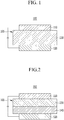
- FIGS. 1 and 2 are cross-sectional views showing organic light emitting diodes according to various embodiments of the present invention including the compounds for an organic optoelectric device according to one embodiment of the present invention.
- substituted refers to one substituted with deuterium, a halogen, a hydroxy group, an amino group, a substituted or unsubstituted C1 to C30 amine group, a nitro group, a substituted or unsubstituted C3 to C40 silyl group, a C1 to C30 alkyl group, a C1 to C10 alkylsilyl group, a C3 to C30 cycloalkyl group, a C6 to C30 aryl group, a C1 to C20 alkoxy group, a fluoro group, a C1 to C10 trifluoroalkyl group such as a trifluoromethyl group and the like, or a cyano group, instead of at least one hydrogen of a substituent or a compound.
- the two adjacent substituent of the substituted halogen, hydroxy group, an amino group, a substituted or unsubstituted C1 to C20 amine group, a nitro group, a substituted or unsubstituted C3 to C40 silyl group, C1 to C30 alkyl group, C1 to C10 alkylsilyl group, C3 to C30 cycloalkyl group, C6 to C30 aryl group, C1 to C20 alkoxy group, fluoro group, C1 to C10 trifluoroalkyl group such as trifluoromethyl group and the like, or cyano group may be fused to form a ring.
- hetero refers to one including 1 to 3 hetero atoms selected from N, O, S, and P, and remaining carbons in one functional group.
- alkyl group refers to an aliphatic hydrocarbon group.
- the alkyl group may be a saturated alkyl group without any double bond or a triple bond.
- the alkyl group may be a C1 to C20 alkyl group. More specifically, the alkyl group may be a C1 to C10 alkyl group or a C1 to C6 alkyl group.
- a C1 to C4 alkyl group may have 1 to 4 carbon atoms in alkyl chain which may be selected from methyl, ethyl, propyl, iso-propyl, n-butyl, iso-butyl, sec-butyl, and t-butyl.
- alkyl group may be a methyl group, an ethyl group, a propyl group, an isopropyl group, a butyl group, an isobutyl group, a t-butyl group, a pentyl group, a hexyl groupa cyclopropyl group, a cyclobutyl group, a cyclopentyl group, a cyclohexyl group, and the like.
- Aryl group refers to a cyclic functional group where all elements have p-orbitals, and these p-orbitals forms conjugation and includes monocyclic or fused ring polycyclic (i.e., rings sharing adjacent pairs of carbon atoms) groups.
- heteroaryl group refers to aryl group including 1 to 3 hetero atoms selected from N, O, S, and P, and remaining carbons.
- each ring may include 1 to 3 hetero atoms.
- the substituted or unsubstituted aryl group and/or a substituted or unsubstituted heteroaryl group may be a substituted or unsubstituted phenyl group, a substituted or unsubstituted naphthyl group, a substituted or unsubstituted anthracenyl group, a substituted or unsubstituted phenanthryl group, a substituted or unsubstituted naphthacenyl group, a substituted or unsubstituted pyrenyl group, a substituted or unsubstituted biphenylyl group, a substituted or unsubstituted p-terphenyl group, a substituted or unsubstituted m-terphenyl group, a substituted or unsubstituted chrysenyl group, a substituted or unsubstituted triphenylenyl group, a substituted or unsubstituted
- hole characteristics refer to characteristics that holes formed in the anode is easily injected into the emission layer and transported in the emission layer due to conductive characteristics according to HOMO level. More specifically, it is similar to electron-repelling characteristics.
- Electron characteristics refer to characteristics that electron formed in the cathode is easily injected into the emission layer and transported in the emission layer due to conductive characteristics according to LUMO level. More specifically, it is similar to electron-withdrawing characteristics.
- a compound represented by the following Chemical Formula 1 for an organic optoelectric device is provided.
- R 1 to R 16 are independently hydrogen, deuterium, a substituted or unsubstituted C1 to C10 alkyl group, a substituted or unsubstituted C6 to C20 aryl group, or -SiR 17 R 18 R 19 , wherein the R 17 to R 19 are independently a substituted or unsubstituted C1 to C6 alkyl group.
- R 1 to R 8 is a functional group represented by the following Chemical Formula 2, and another of the R 1 to R 8 is -SiR 17 R 18 R 19 .
- R 9 to R 16 is a functional group represented by the following Chemical Formula 2, and another of the R 9 to R 16 is -SiR 17 R 18 R 19 .
- L is a bidentate ligand of a monovalent anion, and is a ligand coordination-bonding with iridium through a unshared electron pair of carbon or heteroatom, and n and m are independently integers of 0 to 3, and n + m is one of integers of 1 to 3.
- Chemical Formula 2 is a form of a substituted or unsubstituted phenyl group, and in Chemical Formula 2, R 20 to R 24 are independently hydrogen, deuterium, a substituted or unsubstituted C1 to C10 alkyl group, or a substituted or unsubstituted C6 to C20 aryl group, and * denotes a position bonding with a carbon atom.
- the compound represented by the above Chemical Formula 1 for an organic optoelectric device necessarily has a substituted or unsubstituted phenyl group represented by the above Chemical Formula 2 in a main ligand having a 2-phenylpyridine backbone and also, necessarily -SiR 17 R 18 R 19 .
- the main ligand is marked as a combination No. n or m among the ligands having a coordination bond with iridium.
- the compound represented by the above Chemical Formula 1 for an organic optoelectric device may have excellent heat resistance stability and life-span characteristics and high luminous efficiency at a low driving voltage.
- a device manufactured by using a phosphorescent material has a drawback of sharply decreased efficiency by an extinction phenomenon due to saturation of a triplet exited state at a high current density.
- This drawback may be overcome by introducing a very bulky substituent into a luminous material or making the luminous material have a branch having a dendrimer structure to prevent the triplet-triplet extinction phenomenon.
- a dopant as the luminous material has decreased interactions among molecules due to introduction of -SiR 17 R 18 R 19 and a phenyl group having large steric hindrance and thus, is prevented from the triplet-triplet extinction phenomenon and may realize a device having vey excellent life-span and luminous efficiency.
- the introduction of a bulky substituent decreases interactions among molecules and thus, may have an effect on decreasing a deposition temperature.
- one main ligand has one -SiR 17 R 18 R 19 .
- n may be an integer of 1 to 3
- one of R 1 to R 4 may be -SiR 17 R 18 R 19
- the rest of R 1 to R 4 may be independently hydrogen, deuterium, or a substituted or unsubstituted C1 to C10 alkyl group.
- one of R 5 to R 8 may be the functional group represented by the above Chemical Formula 2, and the rest of R 5 to R 8 may be independently hydrogen, deuterium, or a substituted or unsubstituted C1 to C10 alkyl group.
- the compound for an organic optoelectric device may realize excellent heat resistance stability, life-span characteristics and luminous efficiency.
- a bulky substituent such as the -SiR 17 R 18 R 19 and the phenyl group may make a ligand have an overall three dimensional shape, and accordingly, a dopant as a luminous material also has a bulky three dimensional structure suppressing interactions among molecules and thus, may realize a device having excellent life-span characteristics and luminous efficiency.
- n may be an integer of 1 to 3
- R 2 is -SiR 17 R 18 R 19
- R 6 is a phenyl group
- R 1 , R 3 to R 5 , R 7 and R 8 may be independently hydrogen, deuterium, or a substituted or unsubstituted C1 to C10 alkyl group.
- the compound for an organic optoelectric device has improved heat resistance stability, life-span characteristic and luminous efficiency.
- the phenyl group When a phenyl group is substituted at the R 6 , the phenyl group does not only change color purity of green luminescence but also increases entire volume of molecules and thus, minimizes interactions among the molecules, resultantly realizing a light emitting device having high efficiency and a long life-span.
- n may be an integer of 1 to 3
- one of R 1 to R 4 may be the functional group represented by the above Chemical Formula 2
- another of the R 1 to R 4 may be -SiR 17 R 18 R 19
- the rest of R 1 to R 4 and R 5 to R 8 may be independently hydrogen, deuterium, or a substituted or unsubstituted C1 to C10 alkyl group.
- the -SiR 17 R 18 R 19 and the functional group represented by Chemical Formula 2 may be bonded at an ortho, meta, or para position.
- n may be an integer of 1 to 3
- R 2 is a phenyl group
- R 3 is-SiR 17 R 18 R 19
- R 1 , R 4 to R 8 may be independently hydrogen, deuterium, or a substituted or unsubstituted C1 to C10 alkyl group.
- the compound for an organic optoelectric device has improved heat resistance stability, life-span characteristic and luminous efficiency.
- n may be an integer of 1 to 3
- one of R 1 to R 4 may be -SiR 17 R 18 R 19
- the rest of R 1 to R 4 may be independently hydrogen, deuterium, or a substituted or unsubstituted C1 to C10 alkyl group.
- one of R 5 to R 8 may be the functional group represented by the above Chemical Formula 2, and the rest of R 5 to R 8 may be independently hydrogen, deuterium, or a substituted or unsubstituted C1 to C10 alkyl group.
- m may be an integer of 1 to 3
- one of R 9 to R 12 may be the functional group represented by the above Chemical Formula 2
- another of the R 9 to R 12 may be -SiR 17 R 18 R 19
- the rest of R 9 to R 12 and R 13 to R 16 may be independently hydrogen, deuterium, or a substituted or unsubstituted C1 to C10 alkyl group.
- the -SiR 17 R 18 R 19 and the functional group represented by Chemical Formula 2 may be bonded at an ortho, meta, or para position.
- n may be an integer of 1 to 3
- at least one of R 1 to R 8 may be a substituted or unsubstituted C1 to C20 alkyl group, specifically a unsubstituted C1 to C10 alkyl group, for example a methyl group. In this case, thermal stability may be improved.
- the R 17 to R 19 may be independently a methyl group. That is to say, the -SiR 17 R 18 R 19 may be a trimethylsilyl group.
- the compound for an organic optoelectric device may realize improved heat resistance stability, life-span characteristic and luminous efficiency.
- n + m may be 3.
- n or m may be 3. This means that in Chemical Formula 1, the ligand represented by L is not included. In this case, its synthesis becomes easier and the compound may be stabilized. Accordingly, a light emitting device having life-span characteristics may be provided.
- n + m may be 1 or 2. This means that in Chemical Formula 1, at least one of the ligand represented by L is included. In this case, a color tuning of the compound may be possible.
- L is an auxiliary ligand, and may be selected from the following Chemical Formulae L-1 to L-14. These are examples of ligands represented by L, but the present invention is not limited thereto.
- the asterisk (*) denotes a position bonding with iridium (Ir)
- R 101 to R 103 are independently hydrogen, deuterium, a C1 to C30 alkyl group substituted or unsubstituted with a halogen, a C6 to C30 aryl group substituted or unsubstituted with a C1 to C30 alkyl, or a halogen.
- R 104 to R 115 are independently hydrogen, deuterium, halogen, a substituted or unsubstituted C1 to C30 alkyl group, a substituted or unsubstituted C1 to C30 alkoxy group, a substituted or unsubstituted C3 to C30 cycloalkyl group, a substituted or unsubstituted C2 to C30 alkenyl group, a substituted or unsubstituted C6 to C30 aryl group, a substituted or unsubstituted C1 to C30 heteroaryl group, a substituted or unsubstituted C1 to C30 amino group, a substituted or unsubstituted C6 to C30 arylamino group, SF 5 , a trialkylsilyl group having a substituted or unsubstituted C1 to C30 alkyl group, a dialkylarylsilyl group having a substituted or unsubstituted C1 to C30
- R 116 to R 117 are independently hydrogen, deuterium, a C1 to C30 alkyl group substituted or unsubstituted with a halogen, a C6 to C30 aryl group substituted or unsubstituted with a C1 to C30 alkyl.
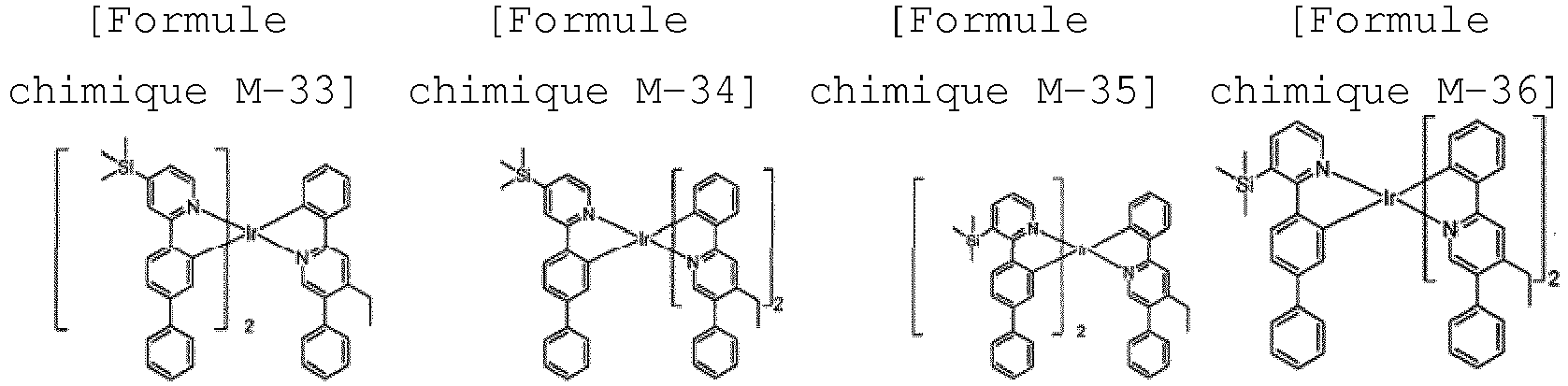
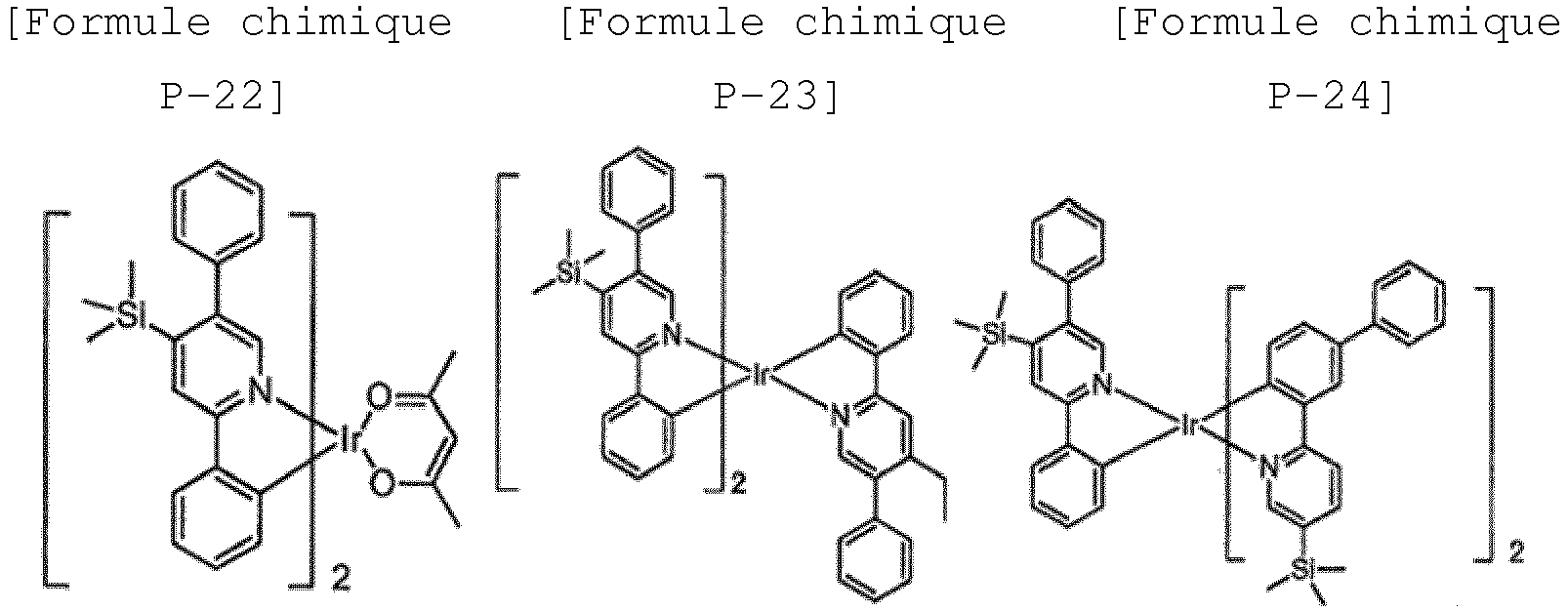
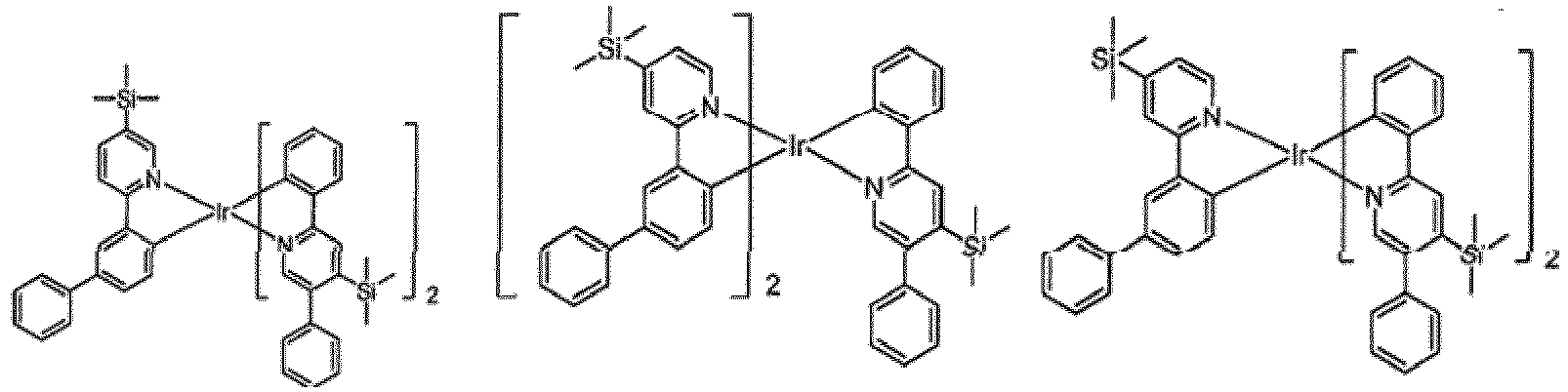
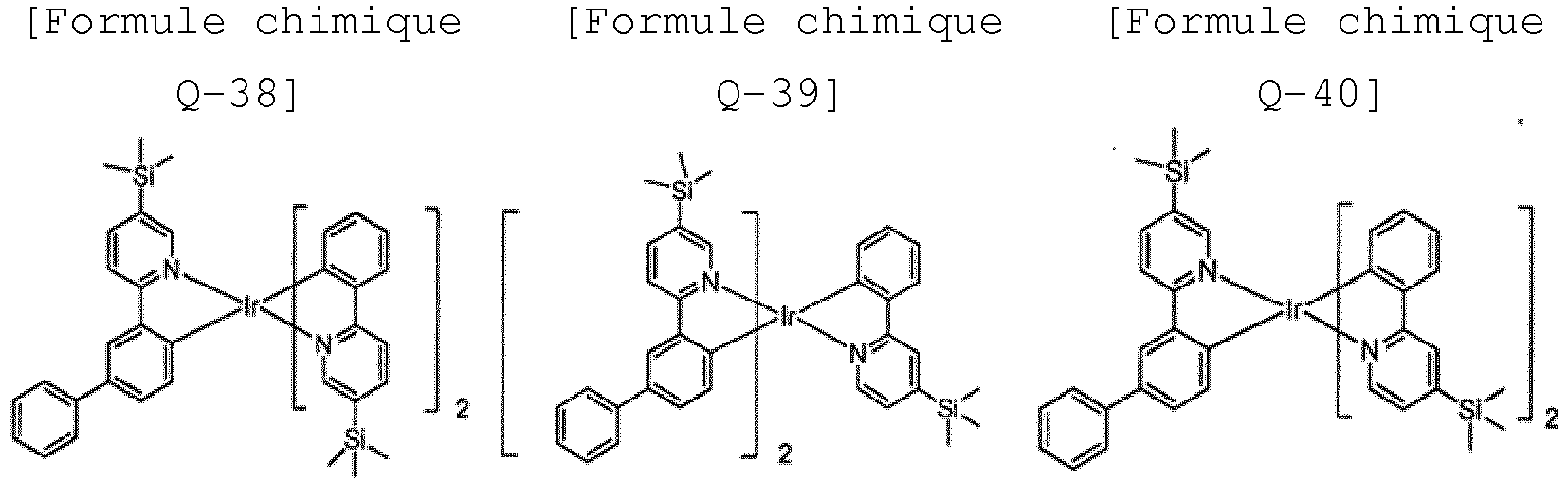
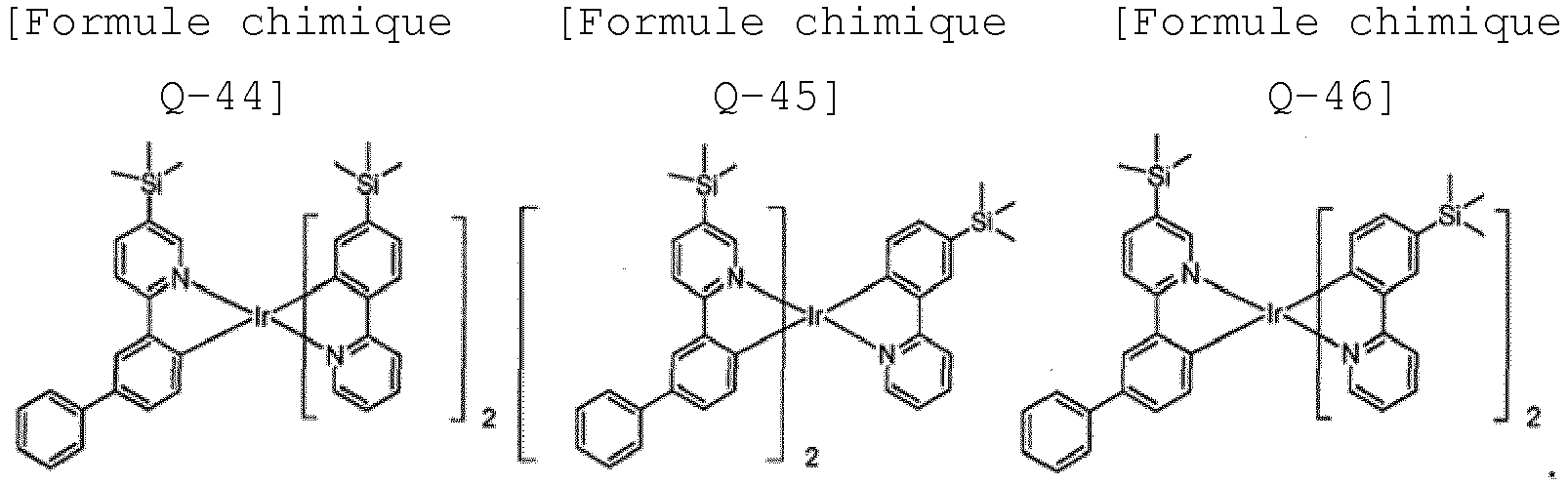
- Chemical Formula 1 may be one of the following Chemical Formulae M-1 to M-40, Chemical Formulae P-1 to P-26, and Chemical Formulae Q-1 to Q-46. These have a structure where the main ligand is substituted with one phenyl group and one trimethylsilyl group. However, these are specific examples of Chemical Formula 1 which is not limited thereto.
- an organic optoelectric device in another embodiment, includes an anode, a cathode, and at least one or more organic thin layer between the anode and the cathode, and at least one of the organic thin layers may include the compound for an organic optoelectric device.
- the compound for an organic optoelectric device is used in an organic thin layer and thus improves life-span characteristics, efficiency characteristics, electrochemical stability, and thermal stability of an organic optoelectric device, and lowers a driving voltage.
- the organic thin layer may be specifically an emission layer.
- the organic optoelectric device may be an organic light emitting diode, an organic photoelectric device, an organic solar cell, an organic transistor, an organic photo-conductor drum, or an organic memory device.
- the organic optoelectric device may be an organic light emitting diode.
- FIGS. 1 and 2 are cross-sectional views showing organic light emitting diodes including the compound for an organic optoelectric device according to one embodiment of the present invention.
- organic light emitting diodes 100 and 200 includes an anode 120, a cathode 110, and at least one organic thin layer 105 between the anode and the cathode.
- the anode 120 includes an anode material having a large work function to help hole injection into an organic thin layer.
- the anode material includes: a metal such as nickel, platinum, vanadium, chromium, copper, zinc, and gold, or alloys thereof; a metal oxide such as zinc oxide, indium oxide, indium tin oxide (ITO), and indium zinc oxide (IZO); a bonded metal and oxide such as ZnO:Al or SnO 2 :Sb; or a conductive polymer such as poly(3-methylthiophene), poly[3,4-(ethylene-1,2-dioxy)thiophene] (PEDT), polypyrrole, and polyaniline, but is not limited thereto. It is preferable to include a transparent electrode including indium tin oxide (ITO) as an anode.
- ITO indium tin oxide
- the cathode 110 includes a cathode material having a small work function to help electron injection into an organic thin layer.
- the cathode material includes: a metal such as magnesium, calcium, sodium, potassium, titanium, indium, yttrium, lithium, gadolinium, aluminum, silver, tin, and lead, or alloys thereof; or a multi-layered material such as LiF/Al, Liq/Al, LiO 2 /Al, LiF/Ca, LiF/Al, and BaF 2 /Ca, but is not limited thereto. It is preferable to include a metal electrode including aluminum as a cathode.
- the organic light emitting diode 100 includes an organic thin layer 105 including only an emission layer 130.
- a double-layered organic light emitting diode 200 includes an organic thin layer 105 including an emission layer 230 including an electron transport layer (ETL), and a hole transport layer (HTL) 140.
- the organic thin layer 105 includes a double layer of the emission layer 230 and hole transport layer (HTL) 140.
- the emission layer 130 also functions as an electron transport layer (ETL), and the hole transport layer (HTL) 140 layer has an excellent binding property with a transparent electrode such as ITO or an excellent hole transport capability.
- an organic light emitting diode that further includes an electron transport layer (ETL), an electron injection layer (EIL), a hole injection layer, and the like as an organic thin layer 105 may be provided.
- the emission layers 130 and 230, the hole transport layer (HTL) 140 or even though not drawn in the drawings, one selected from the group consisting of the electron transport layer (ETL), the electron injection layer (EIL), the hole injection layer (HIL) and a combination thereof which constitute the organic thin layer 105 may include the compound for an organic optoelectric device.
- the compound for an organic optoelectric device may be used in the emission layers 130 and 230, and may be used as a green phosphorescent dopant material in the emission layers.
- the organic light emitting diode may be manufactured by: forming an anode on a substrate; forming an organic thin layer in accordance with a dry coating method such as evaporation, sputtering, plasma plating, and ion plating or a wet coating method such as spin coating, dipping, and flow coating; and providing a cathode thereon.
- a dry coating method such as evaporation, sputtering, plasma plating, and ion plating
- a wet coating method such as spin coating, dipping, and flow coating
- a display device including the organic optoelectric device is provided.
- a glass substrate coated with 1500 A-thick ITO indium tin oxide
- a distilled water When the washing with distilled water was terminated, the coated glass substrate was ultrasonic wave-washed with a solvent such as isopropyl alcohol, acetone, methanol and the like, dried, delivered to a plasma cleaner, cleaned for 5 minutes by using an oxygen plasma, and delivered to a vacuum depositor.
- a solvent such as isopropyl alcohol, acetone, methanol and the like
- HTM N-(biphenyl-4-yl)-9,9-diphenyl-N-(4-(9-phenyl-9H-carbazole)-3-yl)phenyl)9H-fluorene-2-amine
- Chemical Formula Z-1 was vacuum-deposited on the ITO substrate to form a 1200 A-thick hole injection layer (HIL).
- a 300 A-thick emission layer was formed by using CBP as a host and doping the host with 7 wt% of PhGD (tris(3-methyl-2-pyridine) iridium) represented by the following Chemical Formula Z-2 as a green phosphorescent dopant.
- PhGD tris(3-methyl-2-pyridine) iridium
- An organometallic compound represented by the following Chemical Formula T-1 was manufactured according to the same method as a method used in Preparation Example 1 in order to compare characteristics of the compounds according to the present invention, and an organic light emitting diode was manufactured according to the same method as a method used in Comparative Example 1 except for using 10 wt% of the compound represented by the following Chemical Formula T-1 instead of PhGD represented by the above Chemical Formula Z-2 as a green phosphorescent dopant.
- An organic light emitting diode was manufactured according to the same method as a method used in Comparative Example 1 except for using 10 wt% of the compound M-1 according to Preparation Example 1 instead of PhGD represented by the above Chemical Formula Z-2 as a green phosphorescent dopant.
- An organic light emitting diode was manufactured according to the same method as Example 1 except for using the dopant according to Preparation Example 2 instead of the dopant according to Preparation Example 1.
- An organic light emitting diode was manufactured according to the same method as Example 1 except for using the dopant according to Preparation Example 3.
- An organic light emitting diode was manufactured according to the same method as Example 1 except for using the dopant according to Preparation Example 4.
- An organic light emitting diode was manufactured according to the same method as Example 1 except for using the dopant according to Preparation Example 5.
- An organic light emitting diode was manufactured according to the same method as Example 1 except for using the dopant according to Preparation Example 6.
- An organic light emitting diode was manufactured according to the same method as Example 1 except for using the dopant according to Preparation Example 7.
- An organic light emitting diode was manufactured according to the same method as Example 1 except for using the dopant according to Preparation Example 8.
- the obtained organic light emitting diodes were measured for current value flowing in the unit device while increasing the voltage from 0 V to 10 V using a current-voltage meter (Keithley 2400), and the measured current value was divided by area to provide the results.
- Luminance was measured by using a luminance meter (Minolta Cs-1000A), while the voltage of the organic light emitting diodes was increased from 0 V to 10 V.
- the luminance, current density, and voltage obtained from the (1) and (2) were used to calculate current efficiency (cd/A) at the same luminance (9000 cd/m 2 ).
- the organic light emitting diodes manufactured by using a material provided in the present invention showed much excellent luminous efficiency and life-span.
- the result shows that the compound according to the present invention may be used as a preferable material for an organic light emitting diode.
- organic light emitting diode 110 cathode 120 : anode 105 : organic thin layer 130 : emission layer 140 : hole transport layer (HTL) 230 : emission layer + electron transport layer (ETL)
Landscapes
- Chemical & Material Sciences (AREA)
- Engineering & Computer Science (AREA)
- Materials Engineering (AREA)
- Organic Chemistry (AREA)
- Physics & Mathematics (AREA)
- Inorganic Chemistry (AREA)
- Crystallography & Structural Chemistry (AREA)
- Optics & Photonics (AREA)
- Spectroscopy & Molecular Physics (AREA)
- Electroluminescent Light Sources (AREA)
- Organic Low-Molecular-Weight Compounds And Preparation Thereof (AREA)
Claims (14)
- Composé représenté par la formule chimique 1 suivante pour un dispositif optoélectrique organique :
 R1 à R16 représentent indépendamment l'hydrogène, le deutérium, un groupe alkyle en C1 à C10 substitué ou non substitué, un groupe aryle en C6 à C20 substitué ou non substitué, ou -SiR17R18R19,les R17 à R19 représentent indépendamment un groupe alkyle en C1 à C6 substitué ou non substitué,un des R1 à R8 est un groupe fonctionnel représenté par la formule chimique 2 suivante, et un autre des R1 à R8 est -SiR17R18R19,un des R9 à R16 est un groupe fonctionnel représenté par la formule chimique 2 suivante, et un autre des R9 à R16 est -SiR17R18R19,L est un ligand bidenté d'un anion monovalent, et est un ligand se liant par coordination à l'iridium par le biais d'une paire d'électrons non partagée d'un carbone ou d'un hétéroatome, etn et m représentent indépendamment des entiers de 0 à 3, et n+m vaut un des entiers de 1 à 3,
 R20 à R24 représentent indépendamment l'hydrogène, le deutérium, un groupe alkyle en C1 à C10 substitué ou non substitué, ou un groupe aryle en C6 à C20 substitué ou non substitué, et* désigne une position se liant à un atome de carbone.
 - Composé pour un dispositif optoélectrique organique de la revendication 1 dans lequel, dans la formule chimique 1 ci-dessus,
n est un entier de 1 à 3,
un des R1 à R4 est -SiR17R18R19, le reste des R1 à R4 représentent indépendamment l'hydrogène, le deutérium, ou un groupe alkyle en C1 à C10 substitué ou non substitué, et
un des R5 à R8 est le groupe fonctionnel représenté par la formule chimique 2 ci-dessus, et le reste des R5 à R8 représentent indépendamment l'hydrogène, le deutérium, ou un groupe alkyle en C1 à C10 substitué ou non substitué. - Composé pour un dispositif optoélectrique organique de la revendication 1 dans lequel, dans la formule chimique 1 ci-dessus,
n est un entier de 1 à 3,
un des R1 à R4 est le groupe fonctionnel représenté par la formule chimique 2 ci-dessus, et un autre des R1 à R4 est -SiR17R18R19,
le reste des R1 à R4 et R5 à R8 représentent indépendamment l'hydrogène, le deutérium, ou un groupe alkyle en C1 à C10 substitué ou non substitué. - Composé pour un dispositif optoélectrique organique de la revendication 1 dans lequel, dans la formule chimique 1 ci-dessus, R17 à R19 représentent indépendamment un groupe méthyle.
- Composé pour un dispositif optoélectrique organique de la revendication 1 dans lequel, dans la formule chimique 1 ci-dessus,
n est un entier de 1 à 3,
R2 est -SiR17R18R19,
R6 est un groupe phényle, et
R1, R3 à R5, R7 et R8 représentent indépendamment l'hydrogène, le deutérium, ou un groupe alkyle en C1 à C10 substitué ou non substitué. - Composé pour un dispositif optoélectrique organique de la revendication 1 dans lequel, dans la formule chimique 1 ci-dessus,
n est un entier de 1 à 3,
R2 est un groupe phényle,
R3 est -SiR17R18R19, et
R1 et R4 à R8 représentent indépendamment l'hydrogène, le deutérium, ou un groupe alkyle en C1 à C10 substitué ou non substitué. - Composé pour un dispositif optoélectrique organique de la revendication 1 dans lequel, dans la formule chimique 1 ci-dessus, n+m vaut 3.
- Composé pour un dispositif optoélectrique organique de la revendication 1 dans lequel, dans la formule chimique 1 ci-dessus, n+m vaut 1 ou 2.
- Composé pour un dispositif optoélectrique organique de la revendication 1 dans lequel, dans la formule chimique 1 ci-dessus, L répond à une des formules chimiques L-1 à L-14 suivantes :


 l'astérisque (*) désigne une position se liant à l'iridium (Ir),R101 à R103 représentent indépendamment l'hydrogène, le deutérium, un groupe alkyle en C1 à C30 substitué par un halogène ou non substitué, ou un groupe aryle en C6 à C30 substitué par un alkyle en C1 à C30 ou un halogène ou non substitué,R104 à R115 représentent indépendamment l'hydrogène, le deutérium, un halogène, un groupe alkyle en C1 à C30 substitué ou non substitué, un groupe alcoxy en C1 à C30 substitué ou non substitué, un groupe cycloalkyle en C3 à C30 substitué ou non substitué, un groupe alcényle en C2 à C30 substitué ou non substitué, un groupe aryle en C6 à C30 substitué ou non substitué, un groupe hétéroaryle en C1 à C30 substitué ou non substitué, un groupe amino en C1 à C30 substitué ou non substitué, un groupe arylamino en C6 à C30 substitué ou non substitué, SF5, un groupe trialkylsilyle ayant un groupe alkyle en C1 à C30 substitué ou non substitué, un groupe dialkylarylsilyle ayant un groupe alkyle en C1 à C30 substitué ou non substitué et un groupe aryle en C6 à C30, ou un groupe triarylsilyle ayant un groupe aryle en C6 à C30 substitué ou non substitué, etR116 et R117 représentent indépendamment l'hydrogène, le deutérium, un groupe alkyle en C1 à C30 substitué par un halogène ou non substitué, ou un groupe aryle en C6 à C30 substitué par un alkyle en C1 à C30 ou non substitué.
 - Composé pour un dispositif optoélectrique organique de la revendication 1, dans lequel la formule chimique 1 ci-dessus est une des formules chimiques M-1 à M-40, des formules chimiques P-1 à P-26 et des formules chimiques Q-1 à Q-46 suivantes :












- Diode électroluminescente organique, comprenant
une anode, une cathode, et
une couche mince organique intercalée entre l'anode et la cathode,
dans laquelle au moins une de la couche mince organique comprend le composé pour un dispositif optoélectrique organique de la revendication 1. - Diode électroluminescente organique de la revendication 11, dans laquelle la dans laquelle la couche mince organique est une couche d'émission.
- Diode électroluminescente organique de la revendication 12, dans laquelle le composé pour un dispositif optoélectrique organique est utilisé comme dopant dans la couche d'émission.
- Dispositif d'affichage comprenant la diode électroluminescente organique de la revendication 11.
Applications Claiming Priority (3)
| Application Number | Priority Date | Filing Date | Title |
|---|---|---|---|
| KR20120073091 | 2012-07-04 | ||
| KR20120124963 | 2012-11-06 | ||
| PCT/KR2013/005954 WO2014007565A1 (fr) | 2012-07-04 | 2013-07-04 | Composé pour dispositif opto-électrique organique, dispositif opto-électrique organique le contenant, et dispositif d'affichage comprenant ledit dispositif opto-électrique organique |
Publications (3)
| Publication Number | Publication Date |
|---|---|
| EP2871222A1 EP2871222A1 (fr) | 2015-05-13 |
| EP2871222A4 EP2871222A4 (fr) | 2016-04-06 |
| EP2871222B1 true EP2871222B1 (fr) | 2017-04-26 |
Family
ID=49882259
Family Applications (1)
| Application Number | Title | Priority Date | Filing Date |
|---|---|---|---|
| EP13812616.4A Active EP2871222B1 (fr) | 2012-07-04 | 2013-07-04 | Composé pour dispositif opto-électrique organique, dispositif opto-électrique organique le contenant, et dispositif d'affichage comprenant ledit dispositif opto-électrique organique |
Country Status (6)
| Country | Link |
|---|---|
| US (1) | US9882149B2 (fr) |
| EP (1) | EP2871222B1 (fr) |
| JP (1) | JP6189431B2 (fr) |
| KR (1) | KR101344787B1 (fr) |
| CN (1) | CN104428391B (fr) |
| WO (1) | WO2014007565A1 (fr) |
Families Citing this family (114)
| Publication number | Priority date | Publication date | Assignee | Title |
|---|---|---|---|---|
| KR102384222B1 (ko) * | 2014-09-26 | 2022-04-07 | 삼성전자주식회사 | 유기금속 화합물 및 이를 포함한 유기 발광 소자 |
| KR102343144B1 (ko) * | 2014-10-17 | 2021-12-27 | 삼성디스플레이 주식회사 | 유기 발광 소자 |
| KR102577004B1 (ko) * | 2014-10-17 | 2023-09-13 | 삼성디스플레이 주식회사 | 유기 발광 소자 |
| KR102417121B1 (ko) | 2014-10-17 | 2022-07-06 | 삼성디스플레이 주식회사 | 유기 발광 소자 |
| KR102429869B1 (ko) * | 2014-10-17 | 2022-08-05 | 삼성전자주식회사 | 유기 발광 소자 |
| US20160111663A1 (en) * | 2014-10-17 | 2016-04-21 | Samsung Display Co., Ltd. | Organic light-emitting device |
| KR102429870B1 (ko) * | 2014-10-17 | 2022-08-05 | 삼성전자주식회사 | 유기 발광 소자 |
| KR102323210B1 (ko) | 2014-11-14 | 2021-11-08 | 삼성전자주식회사 | 유기금속 화합물 및 이를 포함한 유기 발광 소자 |
| EP3026056B1 (fr) | 2014-11-28 | 2017-11-08 | Samsung Electronics Co., Ltd. | Composé organométallique et dispositif électroluminescent organique l'incluant |
| US10003035B2 (en) | 2014-11-28 | 2018-06-19 | Samsung Electronics Co., Ltd. | Organometallic compound and organic light-emitting device including the same |
| US20160164012A1 (en) | 2014-11-28 | 2016-06-09 | Samsung Electronics Co., Ltd. | Organometallic compound and organic light-emitting device including the same |
| KR102344883B1 (ko) * | 2014-12-17 | 2021-12-29 | 삼성전자주식회사 | 유기금속 화합물 및 이를 포함한 유기 발광 소자 |
| KR102395990B1 (ko) * | 2014-12-30 | 2022-05-10 | 삼성전자주식회사 | 유기금속 화합물 및 이를 포함한 유기 발광 소자 |
| US9929361B2 (en) | 2015-02-16 | 2018-03-27 | Universal Display Corporation | Organic electroluminescent materials and devices |
| US9701671B2 (en) * | 2015-02-20 | 2017-07-11 | Canon Kabushiki Kaisha | Organic compound, electrochromic element containing the same, optical filter, lens unit, imaging device, and window component |
| US11056657B2 (en) | 2015-02-27 | 2021-07-06 | University Display Corporation | Organic electroluminescent materials and devices |
| KR102429871B1 (ko) * | 2015-03-13 | 2022-08-05 | 삼성전자주식회사 | 유기금속 화합물 및 이를 포함한 유기 발광 소자 |
| KR102434696B1 (ko) * | 2015-03-13 | 2022-08-22 | 삼성전자주식회사 | 유기금속 화합물 및 이를 포함한 유기 발광 소자 |
| US11672167B2 (en) | 2015-03-13 | 2023-06-06 | Samsung Electronics Co., Ltd. | Organometallic compound and organic light-emitting device including the same |
| KR102390371B1 (ko) * | 2015-03-13 | 2022-04-25 | 삼성전자주식회사 | 유기금속 화합물 및 이를 포함한 유기 발광 소자 |
| US9859510B2 (en) | 2015-05-15 | 2018-01-02 | Universal Display Corporation | Organic electroluminescent materials and devices |
| US10418568B2 (en) | 2015-06-01 | 2019-09-17 | Universal Display Corporation | Organic electroluminescent materials and devices |
| US11127905B2 (en) | 2015-07-29 | 2021-09-21 | Universal Display Corporation | Organic electroluminescent materials and devices |
| EP3133078B1 (fr) | 2015-08-18 | 2019-01-30 | Samsung Electronics Co., Ltd. | Composé organométallique et dispositif électroluminescent organique l'incluant |
| US10361381B2 (en) | 2015-09-03 | 2019-07-23 | Universal Display Corporation | Organic electroluminescent materials and devices |
| KR102541267B1 (ko) * | 2015-10-05 | 2023-06-12 | 삼성전자주식회사 | 축합환 화합물 및 이를 포함한 유기 발광 소자 |
| US20170141330A1 (en) * | 2015-11-17 | 2017-05-18 | Semiconductor Energy Laboratory Co., Ltd. | Organometallic Complex, Light-Emitting Element, Light-Emitting Device, Electronic Device, and Lighting Device |
| CN106883270B (zh) | 2015-11-26 | 2019-03-26 | 财团法人工业技术研究院 | 有机金属化合物、包含其的有机发光装置 |
| US20170155063A1 (en) * | 2015-11-26 | 2017-06-01 | Industrial Technology Research Institute | Organic metal compound, organic light-emitting devices employing the same |
| US20170229663A1 (en) | 2016-02-09 | 2017-08-10 | Universal Display Corporation | Organic electroluminescent materials and devices |
| US10236456B2 (en) | 2016-04-11 | 2019-03-19 | Universal Display Corporation | Organic electroluminescent materials and devices |
| US11482683B2 (en) | 2016-06-20 | 2022-10-25 | Universal Display Corporation | Organic electroluminescent materials and devices |
| US10862054B2 (en) | 2016-06-20 | 2020-12-08 | Universal Display Corporation | Organic electroluminescent materials and devices |
| US10672997B2 (en) | 2016-06-20 | 2020-06-02 | Universal Display Corporation | Organic electroluminescent materials and devices |
| US10608186B2 (en) | 2016-09-14 | 2020-03-31 | Universal Display Corporation | Organic electroluminescent materials and devices |
| US10680187B2 (en) | 2016-09-23 | 2020-06-09 | Universal Display Corporation | Organic electroluminescent materials and devices |
| US11196010B2 (en) | 2016-10-03 | 2021-12-07 | Universal Display Corporation | Organic electroluminescent materials and devices |
| US11081658B2 (en) | 2016-10-03 | 2021-08-03 | Universal Display Corporation | Organic electroluminescent materials and devices |
| US11011709B2 (en) | 2016-10-07 | 2021-05-18 | Universal Display Corporation | Organic electroluminescent materials and devices |
| US12317745B2 (en) | 2016-11-09 | 2025-05-27 | Universal Display Corporation | Organic electroluminescent materials and devices |
| US10680188B2 (en) | 2016-11-11 | 2020-06-09 | Universal Display Corporation | Organic electroluminescent materials and devices |
| US11780865B2 (en) | 2017-01-09 | 2023-10-10 | Universal Display Corporation | Organic electroluminescent materials and devices |
| US10844085B2 (en) | 2017-03-29 | 2020-11-24 | Universal Display Corporation | Organic electroluminescent materials and devices |
| US10944060B2 (en) | 2017-05-11 | 2021-03-09 | Universal Display Corporation | Organic electroluminescent materials and devices |
| US12098157B2 (en) | 2017-06-23 | 2024-09-24 | Universal Display Corporation | Organic electroluminescent materials and devices |
| US11228010B2 (en) | 2017-07-26 | 2022-01-18 | Universal Display Corporation | Organic electroluminescent materials and devices |
| US11744142B2 (en) | 2017-08-10 | 2023-08-29 | Universal Display Corporation | Organic electroluminescent materials and devices |
| WO2019088281A1 (fr) | 2017-11-06 | 2019-05-09 | 保土谷化学工業株式会社 | Composé à structure cyclique indénocarbazole, et élément électroluminescent organique |
| EP3712975A4 (fr) | 2017-11-16 | 2021-08-25 | Hodogaya Chemical Co., Ltd. | Élément électroluminescent organique |
| US12180230B2 (en) | 2017-11-28 | 2024-12-31 | University Of Southern California | Carbene compounds and organic electroluminescent devices |
| EP3492480B1 (fr) | 2017-11-29 | 2021-10-20 | Universal Display Corporation | Matériaux et dispositifs électroluminescents organiques |
| US11937503B2 (en) | 2017-11-30 | 2024-03-19 | Universal Display Corporation | Organic electroluminescent materials and devices |
| KR102705103B1 (ko) | 2017-12-05 | 2024-09-10 | 호도가야 가가쿠 고교 가부시키가이샤 | 아릴아민 화합물 및 유기 일렉트로루미네선스 소자 |
| CN111247658B (zh) | 2017-12-14 | 2023-04-04 | 广州华睿光电材料有限公司 | 过渡金属配合物、聚合物、混合物、组合物及其应用 |
| CN111247159A (zh) | 2017-12-14 | 2020-06-05 | 广州华睿光电材料有限公司 | 一种过渡金属配合物材料及其在电子器件的应用 |
| CN111278839B (zh) | 2017-12-14 | 2023-10-17 | 广州华睿光电材料有限公司 | 一种有机金属配合物、高聚物、混合物、组合物及有机电子器件 |
| WO2019120263A1 (fr) | 2017-12-21 | 2019-06-27 | 广州华睿光电材料有限公司 | Mélange organique et application de celui-ci dans des dispositifs électroniques organiques |
| US11542289B2 (en) | 2018-01-26 | 2023-01-03 | Universal Display Corporation | Organic electroluminescent materials and devices |
| US11165028B2 (en) | 2018-03-12 | 2021-11-02 | Universal Display Corporation | Organic electroluminescent materials and devices |
| US12453279B2 (en) | 2018-08-22 | 2025-10-21 | Universal Display Corporation | Organic electroluminescent materials and devices |
| KR102673818B1 (ko) | 2018-12-05 | 2024-06-10 | 삼성전자주식회사 | 유기금속 화합물 및 이를 포함한 유기 발광 소자 |
| CN110746422B (zh) * | 2018-12-10 | 2023-01-10 | 广州华睿光电材料有限公司 | 有机化合物、高聚物、混合物、组合物及其有机电子器件 |
| US11737349B2 (en) | 2018-12-12 | 2023-08-22 | Universal Display Corporation | Organic electroluminescent materials and devices |
| US11780829B2 (en) | 2019-01-30 | 2023-10-10 | The University Of Southern California | Organic electroluminescent materials and devices |
| US12477890B2 (en) | 2019-02-01 | 2025-11-18 | Universal Display Corporation | Organic electroluminescent materials and devices |
| JP2020158491A (ja) | 2019-03-26 | 2020-10-01 | ユニバーサル ディスプレイ コーポレイション | 有機エレクトロルミネセンス材料及びデバイス |
| US12281128B2 (en) | 2019-07-30 | 2025-04-22 | Universal Display Corporation | Organic electroluminescent materials and devices |
| US12139501B2 (en) | 2019-08-16 | 2024-11-12 | Universal Display Corporation | Organic electroluminescent materials and devices |
| CN112480180A (zh) | 2019-09-11 | 2021-03-12 | 三星电子株式会社 | 有机金属化合物、包括其的有机发光器件和包括所述有机发光器件的电子设备 |
| US20210135130A1 (en) | 2019-11-04 | 2021-05-06 | Universal Display Corporation | Organic electroluminescent materials and devices |
| TWI728594B (zh) * | 2019-12-13 | 2021-05-21 | 財團法人工業技術研究院 | 有機金屬化合物及包含其之有機發光裝置 |
| US12538698B2 (en) | 2020-01-06 | 2026-01-27 | Universal Display Corporation | Organic electroluminescent materials and devices |
| US12426495B2 (en) | 2020-01-28 | 2025-09-23 | Universal Display Corporation | Organic electroluminescent materials and devices |
| EP3937268B1 (fr) | 2020-07-10 | 2025-05-07 | Universal Display Corporation | Delo plasmoniques et émetteurs à dipôle vertical |
| KR102852290B1 (ko) * | 2020-08-04 | 2025-08-28 | 삼성전자주식회사 | 조성물 및 이를 포함한 유기 발광 소자 |
| US12187748B2 (en) | 2020-11-02 | 2025-01-07 | Universal Display Corporation | Organic electroluminescent materials and devices |
| US20220158096A1 (en) | 2020-11-16 | 2022-05-19 | Universal Display Corporation | Organic electroluminescent materials and devices |
| US20220165967A1 (en) | 2020-11-24 | 2022-05-26 | Universal Display Corporation | Organic electroluminescent materials and devices |
| US12325717B2 (en) | 2020-11-24 | 2025-06-10 | Universal Display Corporation | Organic electroluminescent materials and devices |
| CN116745296A (zh) | 2021-01-13 | 2023-09-12 | 浙江光昊光电科技有限公司 | 一种有机化合物、组合物及其在有机电子器件中的应用 |
| US12575316B2 (en) | 2021-02-03 | 2026-03-10 | Universal Display Corporation | Organic electroluminescent materials and devices |
| EP4060758A3 (fr) | 2021-02-26 | 2023-03-29 | Universal Display Corporation | Matériaux et dispositifs électroluminescents organiques |
| EP4059915B1 (fr) | 2021-02-26 | 2025-12-24 | Universal Display Corporation | Matériaux et dispositifs électroluminescents organiques |
| US12606582B2 (en) | 2021-03-05 | 2026-04-21 | Universal Display Corporation | Organic electroluminescent materials and devices |
| US12428599B2 (en) | 2021-03-09 | 2025-09-30 | Universal Display Corporation | Organic electroluminescent materials and devices |
| US20220298190A1 (en) | 2021-03-12 | 2022-09-22 | Universal Display Corporation | Organic electroluminescent materials and devices |
| US12421262B2 (en) | 2021-03-15 | 2025-09-23 | Universal Display Corporation | Organic electroluminescent materials and devices |
| US20220340607A1 (en) | 2021-04-05 | 2022-10-27 | Universal Display Corporation | Organic electroluminescent materials and devices |
| US12480042B2 (en) | 2021-04-09 | 2025-11-25 | Universal Display Corporation | Organic electroluminescent materials and devices |
| EP4075531A1 (fr) | 2021-04-13 | 2022-10-19 | Universal Display Corporation | Delo plasmoniques et émetteurs à dipôle vertical |
| US20220352478A1 (en) | 2021-04-14 | 2022-11-03 | Universal Display Corporation | Organic eletroluminescent materials and devices |
| US20230006149A1 (en) | 2021-04-23 | 2023-01-05 | Universal Display Corporation | Organic electroluminescent materials and devices |
| US20220407020A1 (en) * | 2021-04-23 | 2022-12-22 | Universal Display Corporation | Organic electroluminescent materials and devices |
| US20230133787A1 (en) | 2021-06-08 | 2023-05-04 | University Of Southern California | Molecular Alignment of Homoleptic Iridium Phosphors |
| US12550611B2 (en) | 2021-08-03 | 2026-02-10 | Universal Display Corporation | Organic electroluminescent materials and devices |
| EP4151699A1 (fr) | 2021-09-17 | 2023-03-22 | Universal Display Corporation | Matériaux et dispositifs électroluminescents organiques |
| US12473318B2 (en) | 2021-10-08 | 2025-11-18 | Universal Display Corporation | Organic electroluminescent materials and devices |
| US20230117045A1 (en) * | 2021-10-12 | 2023-04-20 | Universal Display Corporation | Organic electroluminescent materials and devices |
| US12509628B2 (en) | 2021-12-16 | 2025-12-30 | Universal Display Corporation | Organic electroluminescent materials and devices |
| EP4231804A3 (fr) | 2022-02-16 | 2023-09-20 | Universal Display Corporation | Matériaux et dispositifs électroluminescents organiques |
| US20230292592A1 (en) | 2022-03-09 | 2023-09-14 | Universal Display Corporation | Organic electroluminescent materials and devices |
| US20230337516A1 (en) | 2022-04-18 | 2023-10-19 | Universal Display Corporation | Organic electroluminescent materials and devices |
| US20230389421A1 (en) | 2022-05-24 | 2023-11-30 | Universal Display Corporation | Organic electroluminescent materials and devices |
| EP4293001A1 (fr) | 2022-06-08 | 2023-12-20 | Universal Display Corporation | Matériaux électroluminescents organiques et dispositifs |
| US20240016051A1 (en) | 2022-06-28 | 2024-01-11 | Universal Display Corporation | Organic electroluminescent materials and devices |
| US20240107880A1 (en) | 2022-08-17 | 2024-03-28 | Universal Display Corporation | Organic electroluminescent materials and devices |
| US20240180025A1 (en) | 2022-10-27 | 2024-05-30 | Universal Display Corporation | Organic electroluminescent materials and devices |
| US20240188319A1 (en) | 2022-10-27 | 2024-06-06 | Universal Display Corporation | Organic electroluminescent materials and devices |
| US20240196730A1 (en) | 2022-10-27 | 2024-06-13 | Universal Display Corporation | Organic electroluminescent materials and devices |
| US20240188316A1 (en) | 2022-10-27 | 2024-06-06 | Universal Display Corporation | Organic electroluminescent materials and devices |
| US20240188419A1 (en) | 2022-10-27 | 2024-06-06 | Universal Display Corporation | Organic electroluminescent materials and devices |
| US20240247017A1 (en) | 2022-12-14 | 2024-07-25 | Universal Display Corporation | Organic electroluminescent materials and devices |
| US20250204239A1 (en) | 2023-12-15 | 2025-06-19 | Universal Display Corporation | Organic electroluminescent materials and devices |
| US20250204238A1 (en) | 2023-12-15 | 2025-06-19 | Universal Display Corporation | Organic electroluminscent materials and devices |
Family Cites Families (20)
| Publication number | Priority date | Publication date | Assignee | Title |
|---|---|---|---|---|
| KR100880220B1 (ko) | 2004-10-04 | 2009-01-28 | 엘지디스플레이 주식회사 | 유기 실리콘을 갖는 페닐 피리딘기를 포함하는 이리듐화합물계 발광 화합물 및 이를 발색 재료로서 사용하는유기전계발광소자 |
| US7675228B2 (en) * | 2006-06-14 | 2010-03-09 | E.I. Du Pont De Nemours And Company | Electroluminescent iridium compounds with silylated, germanylated, and stannylated ligands, and devices made with such compounds |
| US20090315454A1 (en) * | 2006-11-07 | 2009-12-24 | Showa Denko K.K. | Iridium complex compound, organic electroluminescent device obtained by using the same, and uses of the device |
| US8119255B2 (en) | 2006-12-08 | 2012-02-21 | Universal Display Corporation | Cross-linkable iridium complexes and organic light-emitting devices using the same |
| KR100894135B1 (ko) | 2007-06-29 | 2009-04-20 | 제일모직주식회사 | 유기전계 발광소자용 금속착체 화합물 및 이를 이용한유기전계발광 표시소자 |
| KR100907564B1 (ko) | 2007-06-29 | 2009-07-14 | 제일모직주식회사 | 유기전계발광 소자용 발광층 조성물 및 이를 이용한 유기전계발광 소자 |
| KR100933226B1 (ko) * | 2007-11-20 | 2009-12-22 | 다우어드밴스드디스플레이머티리얼 유한회사 | 신규한 적색 인광 화합물 및 이를 발광재료로서 채용하고있는 유기발광소자 |
| KR100933225B1 (ko) * | 2007-11-27 | 2009-12-22 | 다우어드밴스드디스플레이머티리얼 유한회사 | 신규한 인광 화합물 및 이를 발광재료로서 채용하고 있는유기발광소자 |
| KR100966885B1 (ko) * | 2008-02-29 | 2010-06-30 | 다우어드밴스드디스플레이머티리얼 유한회사 | 신규한 유기 발광 화합물 및 이를 발광재료로서 채용하고있는 유기 전계 발광 소자 |
| KR100946409B1 (ko) * | 2008-03-19 | 2010-03-09 | 다우어드밴스드디스플레이머티리얼 유한회사 | 신규한 유기 발광 화합물 및 이를 발광재료로서 채용하고있는 유기 전계 발광 소자 |
| KR100880224B1 (ko) | 2008-06-20 | 2009-01-28 | 엘지디스플레이 주식회사 | 유기 실리콘을 갖는 페닐 피리딘기를 포함하는 이리듐화합물계 발광 화합물 및 이를 발색 재료로서 사용하는유기전계발광소자 |
| WO2010027583A1 (fr) | 2008-09-03 | 2010-03-11 | Universal Display Corporation | Matières phosphorescentes |
| KR20100047466A (ko) * | 2008-10-29 | 2010-05-10 | 다우어드밴스드디스플레이머티리얼 유한회사 | 신규한 전자재료용 화합물 및 이를 포함하는 유기 전자 소자 |
| JP4474493B1 (ja) | 2009-07-31 | 2010-06-02 | 富士フイルム株式会社 | 有機電界発光素子 |
| JP4500364B1 (ja) | 2009-08-31 | 2010-07-14 | 富士フイルム株式会社 | 有機電界発光素子 |
| CN102439004A (zh) | 2010-04-20 | 2012-05-02 | 出光兴产株式会社 | 双咔唑衍生物、有机电致发光元件用材料及使用其的有机电致发光元件 |
| KR20110122051A (ko) | 2010-05-03 | 2011-11-09 | 제일모직주식회사 | 유기광전소자용 화합물 및 이를 포함하는 유기광전소자 |
| EP2806008A1 (fr) * | 2010-07-30 | 2014-11-26 | Rohm And Haas Electronic Materials Korea Ltd. | Dispositif électroluminescent organique utilisant un composé électroluminescent organique comme matériau électroluminescent |
| KR102004629B1 (ko) | 2010-08-20 | 2019-07-26 | 유니버셜 디스플레이 코포레이션 | Oled를 위한 바이카르바졸 화합물 |
| DE112011103600B4 (de) * | 2010-10-28 | 2018-05-03 | Furuya Metal Co., Ltd. | Verfahren zum Erzeugen eines Komplexes von tris-orthometalliertem Iridium |
-
2013
- 2013-07-04 KR KR1020130078591A patent/KR101344787B1/ko active Active
- 2013-07-04 WO PCT/KR2013/005954 patent/WO2014007565A1/fr not_active Ceased
- 2013-07-04 US US14/390,570 patent/US9882149B2/en active Active
- 2013-07-04 EP EP13812616.4A patent/EP2871222B1/fr active Active
- 2013-07-04 CN CN201380033478.8A patent/CN104428391B/zh active Active
- 2013-07-04 JP JP2015520065A patent/JP6189431B2/ja active Active
Also Published As
| Publication number | Publication date |
|---|---|
| CN104428391B (zh) | 2017-06-09 |
| JP2015530356A (ja) | 2015-10-15 |
| US9882149B2 (en) | 2018-01-30 |
| US20150090974A1 (en) | 2015-04-02 |
| EP2871222A4 (fr) | 2016-04-06 |
| CN104428391A (zh) | 2015-03-18 |
| KR101344787B1 (ko) | 2013-12-26 |
| JP6189431B2 (ja) | 2017-08-30 |
| WO2014007565A1 (fr) | 2014-01-09 |
| EP2871222A1 (fr) | 2015-05-13 |
Similar Documents
| Publication | Publication Date | Title |
|---|---|---|
| EP2871222B1 (fr) | Composé pour dispositif opto-électrique organique, dispositif opto-électrique organique le contenant, et dispositif d'affichage comprenant ledit dispositif opto-électrique organique | |
| EP2871223A1 (fr) | Composite pour diode électroluminescente organique, couche électroluminescente organique le contenant, et diode électroluminescente organique | |
| CN110294703B (zh) | 用于有机光电器件的组合物、有机光电器件及显示器件 | |
| TWI500604B (zh) | 有機光電元件用組成物及有機光電元件及顯示元件 | |
| EP3032606B1 (fr) | Dispositif opto-électronique organique et dispositif d'affichage | |
| EP2860783B1 (fr) | Dispositif opto-électronique organique et dispositif d'affichage | |
| JP6416169B2 (ja) | 燐光oledのためのホスト物質 | |
| KR102808074B1 (ko) | 방향족 복소환 유도체, 그것을 사용한 유기 일렉트로루미네센스 소자, 조명 장치 및 표시 장치 | |
| KR101820865B1 (ko) | 유기광전자소자용 재료, 이를 포함하는 유기발광소자 및 상기 유기발광소자를 포함하는 표시장치 | |
| EP2799515B1 (fr) | Composé pour dispositif optoélectronique organique, diode organique émettant de la lumière le comprenant et dispositif d'affichage comprenant une diode organique émettant de la lumière | |
| CN113227108B (zh) | 化合物和包含其的有机发光二极管 | |
| JP6046701B2 (ja) | 新規な有機電界発光化合物および同化合物を使用した有機電界発光素子 | |
| CN110088110B (zh) | 新型化合物及包含其的有机发光元件 | |
| JPWO2017195669A1 (ja) | 有機エレクトロルミネッセンス素子用材料、有機エレクトロルミネッセンス素子、表示装置及び照明装置 | |
| EP3006433B1 (fr) | Composé, élément électroluminescent organique comprenant ce composé et dispositif d'affichage comprenant cet élément électroluminescent organique | |
| EP4369901A2 (fr) | Composition pour diode optoélectronique organique, diode optoélectronique organique, et dispositif d'affichage | |
| KR20160035043A (ko) | Oled와 같은 전자 디바이스에 사용하기 위한 발광 디아자- 모노아자-및 벤즈이미다졸 금속 카르벤 착물 | |
| EP2889296A1 (fr) | Composé pour dispositif optoélectrique organique, diode électroluminescente organique le contenant et dispositif d'affichage contenant la diode électroluminescente organique | |
| WO2018097461A1 (fr) | Élément optoélectronique organique et dispositif d'affichage | |
| CN111742035A (zh) | 有机电致发光化合物以及包含其的有机电致发光装置 | |
| WO2014104545A1 (fr) | Composé pour dispositif optoélectronique organique, élément électroluminescent organique le comprenant et appareil d'affichage comprenant ledit élément électroluminescent organique | |
| EP4509579A1 (fr) | Composé hétérocyclique contenant du fluorène et dispositif électroluminescent organique associé | |
| KR20230102743A (ko) | 유기 광전자 소자용 화합물, 유기 광전자 소자 및 표시 장치 | |
| KR102146791B1 (ko) | 유기 광전자 소자용 화합물, 유기 광전자 소자 및 표시 장치 | |
| CN115745731B (zh) | 用于有机光电装置的化合物、有机光电装置及显示装置 |
Legal Events
| Date | Code | Title | Description |
|---|---|---|---|
| PUAI | Public reference made under article 153(3) epc to a published international application that has entered the european phase |
Free format text: ORIGINAL CODE: 0009012 |
|
| 17P | Request for examination filed |
Effective date: 20150127 |
|
| AK | Designated contracting states |
Kind code of ref document: A1 Designated state(s): AL AT BE BG CH CY CZ DE DK EE ES FI FR GB GR HR HU IE IS IT LI LT LU LV MC MK MT NL NO PL PT RO RS SE SI SK SM TR |
|
| AX | Request for extension of the european patent |
Extension state: BA ME |
|
| DAX | Request for extension of the european patent (deleted) | ||
| RA4 | Supplementary search report drawn up and despatched (corrected) |
Effective date: 20160304 |
|
| RIC1 | Information provided on ipc code assigned before grant |
Ipc: H01L 51/54 20060101ALI20160229BHEP Ipc: C09K 11/06 20060101AFI20160229BHEP Ipc: H01L 51/50 20060101ALI20160229BHEP |
|
| REG | Reference to a national code |
Ref country code: DE Ref legal event code: R079 Ref document number: 602013020409 Country of ref document: DE Free format text: PREVIOUS MAIN CLASS: C09K0011060000 Ipc: H01L0051540000 |
|
| GRAP | Despatch of communication of intention to grant a patent |
Free format text: ORIGINAL CODE: EPIDOSNIGR1 |
|
| RIC1 | Information provided on ipc code assigned before grant |
Ipc: C09K 11/06 20060101ALI20161017BHEP Ipc: H01L 51/54 20060101AFI20161017BHEP |
|
| STAA | Information on the status of an ep patent application or granted ep patent |
Free format text: STATUS: GRANT OF PATENT IS INTENDED |
|
| INTG | Intention to grant announced |
Effective date: 20161124 |
|
| GRAS | Grant fee paid |
Free format text: ORIGINAL CODE: EPIDOSNIGR3 |
|
| GRAA | (expected) grant |
Free format text: ORIGINAL CODE: 0009210 |
|
| STAA | Information on the status of an ep patent application or granted ep patent |
Free format text: STATUS: THE PATENT HAS BEEN GRANTED |
|
| AK | Designated contracting states |
Kind code of ref document: B1 Designated state(s): AL AT BE BG CH CY CZ DE DK EE ES FI FR GB GR HR HU IE IS IT LI LT LU LV MC MK MT NL NO PL PT RO RS SE SI SK SM TR |
|
| REG | Reference to a national code |
Ref country code: GB Ref legal event code: FG4D |
|
| REG | Reference to a national code |
Ref country code: CH Ref legal event code: EP |
|
| REG | Reference to a national code |
Ref country code: AT Ref legal event code: REF Ref document number: 888572 Country of ref document: AT Kind code of ref document: T Effective date: 20170515 |
|
| REG | Reference to a national code |
Ref country code: IE Ref legal event code: FG4D |
|
| REG | Reference to a national code |
Ref country code: DE Ref legal event code: R096 Ref document number: 602013020409 Country of ref document: DE |
|
| REG | Reference to a national code |
Ref country code: NL Ref legal event code: MP Effective date: 20170426 |
|
| REG | Reference to a national code |
Ref country code: LT Ref legal event code: MG4D |
|
| REG | Reference to a national code |
Ref country code: AT Ref legal event code: MK05 Ref document number: 888572 Country of ref document: AT Kind code of ref document: T Effective date: 20170426 |
|
| PG25 | Lapsed in a contracting state [announced via postgrant information from national office to epo] |
Ref country code: NL Free format text: LAPSE BECAUSE OF FAILURE TO SUBMIT A TRANSLATION OF THE DESCRIPTION OR TO PAY THE FEE WITHIN THE PRESCRIBED TIME-LIMIT Effective date: 20170426 |
|
| PG25 | Lapsed in a contracting state [announced via postgrant information from national office to epo] |
Ref country code: LT Free format text: LAPSE BECAUSE OF FAILURE TO SUBMIT A TRANSLATION OF THE DESCRIPTION OR TO PAY THE FEE WITHIN THE PRESCRIBED TIME-LIMIT Effective date: 20170426 Ref country code: FI Free format text: LAPSE BECAUSE OF FAILURE TO SUBMIT A TRANSLATION OF THE DESCRIPTION OR TO PAY THE FEE WITHIN THE PRESCRIBED TIME-LIMIT Effective date: 20170426 Ref country code: GR Free format text: LAPSE BECAUSE OF FAILURE TO SUBMIT A TRANSLATION OF THE DESCRIPTION OR TO PAY THE FEE WITHIN THE PRESCRIBED TIME-LIMIT Effective date: 20170727 Ref country code: NO Free format text: LAPSE BECAUSE OF FAILURE TO SUBMIT A TRANSLATION OF THE DESCRIPTION OR TO PAY THE FEE WITHIN THE PRESCRIBED TIME-LIMIT Effective date: 20170726 Ref country code: ES Free format text: LAPSE BECAUSE OF FAILURE TO SUBMIT A TRANSLATION OF THE DESCRIPTION OR TO PAY THE FEE WITHIN THE PRESCRIBED TIME-LIMIT Effective date: 20170426 Ref country code: HR Free format text: LAPSE BECAUSE OF FAILURE TO SUBMIT A TRANSLATION OF THE DESCRIPTION OR TO PAY THE FEE WITHIN THE PRESCRIBED TIME-LIMIT Effective date: 20170426 Ref country code: AT Free format text: LAPSE BECAUSE OF FAILURE TO SUBMIT A TRANSLATION OF THE DESCRIPTION OR TO PAY THE FEE WITHIN THE PRESCRIBED TIME-LIMIT Effective date: 20170426 |
|
| PG25 | Lapsed in a contracting state [announced via postgrant information from national office to epo] |
Ref country code: SE Free format text: LAPSE BECAUSE OF FAILURE TO SUBMIT A TRANSLATION OF THE DESCRIPTION OR TO PAY THE FEE WITHIN THE PRESCRIBED TIME-LIMIT Effective date: 20170426 Ref country code: LV Free format text: LAPSE BECAUSE OF FAILURE TO SUBMIT A TRANSLATION OF THE DESCRIPTION OR TO PAY THE FEE WITHIN THE PRESCRIBED TIME-LIMIT Effective date: 20170426 Ref country code: BG Free format text: LAPSE BECAUSE OF FAILURE TO SUBMIT A TRANSLATION OF THE DESCRIPTION OR TO PAY THE FEE WITHIN THE PRESCRIBED TIME-LIMIT Effective date: 20170726 Ref country code: RS Free format text: LAPSE BECAUSE OF FAILURE TO SUBMIT A TRANSLATION OF THE DESCRIPTION OR TO PAY THE FEE WITHIN THE PRESCRIBED TIME-LIMIT Effective date: 20170426 Ref country code: IS Free format text: LAPSE BECAUSE OF FAILURE TO SUBMIT A TRANSLATION OF THE DESCRIPTION OR TO PAY THE FEE WITHIN THE PRESCRIBED TIME-LIMIT Effective date: 20170826 Ref country code: PL Free format text: LAPSE BECAUSE OF FAILURE TO SUBMIT A TRANSLATION OF THE DESCRIPTION OR TO PAY THE FEE WITHIN THE PRESCRIBED TIME-LIMIT Effective date: 20170426 |
|
| REG | Reference to a national code |
Ref country code: DE Ref legal event code: R097 Ref document number: 602013020409 Country of ref document: DE |
|
| PG25 | Lapsed in a contracting state [announced via postgrant information from national office to epo] |
Ref country code: EE Free format text: LAPSE BECAUSE OF FAILURE TO SUBMIT A TRANSLATION OF THE DESCRIPTION OR TO PAY THE FEE WITHIN THE PRESCRIBED TIME-LIMIT Effective date: 20170426 Ref country code: DK Free format text: LAPSE BECAUSE OF FAILURE TO SUBMIT A TRANSLATION OF THE DESCRIPTION OR TO PAY THE FEE WITHIN THE PRESCRIBED TIME-LIMIT Effective date: 20170426 Ref country code: RO Free format text: LAPSE BECAUSE OF FAILURE TO SUBMIT A TRANSLATION OF THE DESCRIPTION OR TO PAY THE FEE WITHIN THE PRESCRIBED TIME-LIMIT Effective date: 20170426 Ref country code: SK Free format text: LAPSE BECAUSE OF FAILURE TO SUBMIT A TRANSLATION OF THE DESCRIPTION OR TO PAY THE FEE WITHIN THE PRESCRIBED TIME-LIMIT Effective date: 20170426 Ref country code: CZ Free format text: LAPSE BECAUSE OF FAILURE TO SUBMIT A TRANSLATION OF THE DESCRIPTION OR TO PAY THE FEE WITHIN THE PRESCRIBED TIME-LIMIT Effective date: 20170426 |
|
| PG25 | Lapsed in a contracting state [announced via postgrant information from national office to epo] |
Ref country code: IT Free format text: LAPSE BECAUSE OF FAILURE TO SUBMIT A TRANSLATION OF THE DESCRIPTION OR TO PAY THE FEE WITHIN THE PRESCRIBED TIME-LIMIT Effective date: 20170426 Ref country code: SM Free format text: LAPSE BECAUSE OF FAILURE TO SUBMIT A TRANSLATION OF THE DESCRIPTION OR TO PAY THE FEE WITHIN THE PRESCRIBED TIME-LIMIT Effective date: 20170426 |
|
| REG | Reference to a national code |
Ref country code: CH Ref legal event code: PL |
|
| PLBE | No opposition filed within time limit |
Free format text: ORIGINAL CODE: 0009261 |
|
| STAA | Information on the status of an ep patent application or granted ep patent |
Free format text: STATUS: NO OPPOSITION FILED WITHIN TIME LIMIT |
|
| GBPC | Gb: european patent ceased through non-payment of renewal fee |
Effective date: 20170726 |
|
| 26N | No opposition filed |
Effective date: 20180129 |
|
| REG | Reference to a national code |
Ref country code: IE Ref legal event code: MM4A |
|
| REG | Reference to a national code |
Ref country code: FR Ref legal event code: ST Effective date: 20180330 |
|
| PG25 | Lapsed in a contracting state [announced via postgrant information from national office to epo] |
Ref country code: LI Free format text: LAPSE BECAUSE OF NON-PAYMENT OF DUE FEES Effective date: 20170731 Ref country code: CH Free format text: LAPSE BECAUSE OF NON-PAYMENT OF DUE FEES Effective date: 20170731 Ref country code: IE Free format text: LAPSE BECAUSE OF NON-PAYMENT OF DUE FEES Effective date: 20170704 Ref country code: GB Free format text: LAPSE BECAUSE OF NON-PAYMENT OF DUE FEES Effective date: 20170726 |
|
| PG25 | Lapsed in a contracting state [announced via postgrant information from national office to epo] |
Ref country code: SI Free format text: LAPSE BECAUSE OF FAILURE TO SUBMIT A TRANSLATION OF THE DESCRIPTION OR TO PAY THE FEE WITHIN THE PRESCRIBED TIME-LIMIT Effective date: 20170426 Ref country code: FR Free format text: LAPSE BECAUSE OF NON-PAYMENT OF DUE FEES Effective date: 20170731 |
|
| REG | Reference to a national code |
Ref country code: BE Ref legal event code: MM Effective date: 20170731 |
|
| PG25 | Lapsed in a contracting state [announced via postgrant information from national office to epo] |
Ref country code: LU Free format text: LAPSE BECAUSE OF NON-PAYMENT OF DUE FEES Effective date: 20170704 |
|
| PG25 | Lapsed in a contracting state [announced via postgrant information from national office to epo] |
Ref country code: BE Free format text: LAPSE BECAUSE OF NON-PAYMENT OF DUE FEES Effective date: 20170731 |
|
| PG25 | Lapsed in a contracting state [announced via postgrant information from national office to epo] |
Ref country code: MT Free format text: LAPSE BECAUSE OF NON-PAYMENT OF DUE FEES Effective date: 20170704 |
|
| PG25 | Lapsed in a contracting state [announced via postgrant information from national office to epo] |
Ref country code: HU Free format text: LAPSE BECAUSE OF FAILURE TO SUBMIT A TRANSLATION OF THE DESCRIPTION OR TO PAY THE FEE WITHIN THE PRESCRIBED TIME-LIMIT; INVALID AB INITIO Effective date: 20130704 Ref country code: MC Free format text: LAPSE BECAUSE OF FAILURE TO SUBMIT A TRANSLATION OF THE DESCRIPTION OR TO PAY THE FEE WITHIN THE PRESCRIBED TIME-LIMIT Effective date: 20170426 |
|
| PG25 | Lapsed in a contracting state [announced via postgrant information from national office to epo] |
Ref country code: CY Free format text: LAPSE BECAUSE OF FAILURE TO SUBMIT A TRANSLATION OF THE DESCRIPTION OR TO PAY THE FEE WITHIN THE PRESCRIBED TIME-LIMIT Effective date: 20170426 |
|
| PG25 | Lapsed in a contracting state [announced via postgrant information from national office to epo] |
Ref country code: MK Free format text: LAPSE BECAUSE OF FAILURE TO SUBMIT A TRANSLATION OF THE DESCRIPTION OR TO PAY THE FEE WITHIN THE PRESCRIBED TIME-LIMIT Effective date: 20170426 |
|
| PG25 | Lapsed in a contracting state [announced via postgrant information from national office to epo] |
Ref country code: TR Free format text: LAPSE BECAUSE OF FAILURE TO SUBMIT A TRANSLATION OF THE DESCRIPTION OR TO PAY THE FEE WITHIN THE PRESCRIBED TIME-LIMIT Effective date: 20170426 |
|
| PG25 | Lapsed in a contracting state [announced via postgrant information from national office to epo] |
Ref country code: PT Free format text: LAPSE BECAUSE OF FAILURE TO SUBMIT A TRANSLATION OF THE DESCRIPTION OR TO PAY THE FEE WITHIN THE PRESCRIBED TIME-LIMIT Effective date: 20170426 |
|
| PG25 | Lapsed in a contracting state [announced via postgrant information from national office to epo] |
Ref country code: AL Free format text: LAPSE BECAUSE OF FAILURE TO SUBMIT A TRANSLATION OF THE DESCRIPTION OR TO PAY THE FEE WITHIN THE PRESCRIBED TIME-LIMIT Effective date: 20170426 |
|
| REG | Reference to a national code |
Ref country code: DE Ref legal event code: R079 Ref document number: 602013020409 Country of ref document: DE Free format text: PREVIOUS MAIN CLASS: H01L0051540000 Ipc: H10K0085000000 |
|
| P01 | Opt-out of the competence of the unified patent court (upc) registered |
Effective date: 20230528 |
|
| PGFP | Annual fee paid to national office [announced via postgrant information from national office to epo] |
Ref country code: DE Payment date: 20250624 Year of fee payment: 13 |