EP2898384B1 - Self tracking system and its operation method - Google Patents
Self tracking system and its operation method Download PDFInfo
- Publication number
- EP2898384B1 EP2898384B1 EP13802427.8A EP13802427A EP2898384B1 EP 2898384 B1 EP2898384 B1 EP 2898384B1 EP 13802427 A EP13802427 A EP 13802427A EP 2898384 B1 EP2898384 B1 EP 2898384B1
- Authority
- EP
- European Patent Office
- Prior art keywords
- person
- distance
- vehicle
- motors
- axis
- Prior art date
- Legal status (The legal status is an assumption and is not a legal conclusion. Google has not performed a legal analysis and makes no representation as to the accuracy of the status listed.)
- Active
Links
Images



Classifications
-
- G—PHYSICS
- G05—CONTROLLING; REGULATING
- G05D—SYSTEMS FOR CONTROLLING OR REGULATING NON-ELECTRIC VARIABLES
- G05D1/00—Control of position, course, altitude or attitude of land, water, air or space vehicles, e.g. using automatic pilots
- G05D1/02—Control of position or course in two dimensions
- G05D1/021—Control of position or course in two dimensions specially adapted to land vehicles
- G05D1/0231—Control of position or course in two dimensions specially adapted to land vehicles using optical position detecting means
- G05D1/0246—Control of position or course in two dimensions specially adapted to land vehicles using optical position detecting means using a video camera in combination with image processing means
-
- H—ELECTRICITY
- H04—ELECTRIC COMMUNICATION TECHNIQUE
- H04N—PICTORIAL COMMUNICATION, e.g. TELEVISION
- H04N13/00—Stereoscopic video systems; Multi-view video systems; Details thereof
- H04N13/20—Image signal generators
- H04N13/204—Image signal generators using stereoscopic image cameras
-
- G—PHYSICS
- G01—MEASURING; TESTING
- G01B—MEASURING LENGTH, THICKNESS OR SIMILAR LINEAR DIMENSIONS; MEASURING ANGLES; MEASURING AREAS; MEASURING IRREGULARITIES OF SURFACES OR CONTOURS
- G01B11/00—Measuring arrangements characterised by the use of optical techniques
- G01B11/14—Measuring arrangements characterised by the use of optical techniques for measuring distance or clearance between spaced objects or spaced apertures
-
- G—PHYSICS
- G01—MEASURING; TESTING
- G01S—RADIO DIRECTION-FINDING; RADIO NAVIGATION; DETERMINING DISTANCE OR VELOCITY BY USE OF RADIO WAVES; LOCATING OR PRESENCE-DETECTING BY USE OF THE REFLECTION OR RERADIATION OF RADIO WAVES; ANALOGOUS ARRANGEMENTS USING OTHER WAVES
- G01S3/00—Direction-finders for determining the direction from which infrasonic, sonic, ultrasonic or electromagnetic waves, or particle emission, not having a directional significance, are being received
- G01S3/78—Direction-finders for determining the direction from which infrasonic, sonic, ultrasonic or electromagnetic waves, or particle emission, not having a directional significance, are being received using electromagnetic waves other than radio waves
- G01S3/782—Systems for determining direction or deviation from predetermined direction
- G01S3/785—Systems for determining direction or deviation from predetermined direction using adjustment of orientation of directivity characteristics of a detector or detector system to give a desired condition of signal derived from that detector or detector system
- G01S3/786—Systems for determining direction or deviation from predetermined direction using adjustment of orientation of directivity characteristics of a detector or detector system to give a desired condition of signal derived from that detector or detector system the desired condition being maintained automatically
- G01S3/7864—T.V. type tracking systems
-
- G—PHYSICS
- G06—COMPUTING OR CALCULATING; COUNTING
- G06F—ELECTRIC DIGITAL DATA PROCESSING
- G06F3/00—Input arrangements for transferring data to be processed into a form capable of being handled by the computer; Output arrangements for transferring data from processing unit to output unit, e.g. interface arrangements
- G06F3/01—Input arrangements or combined input and output arrangements for interaction between user and computer
- G06F3/03—Arrangements for converting the position or the displacement of a member into a coded form
- G06F3/041—Digitisers, e.g. for touch screens or touch pads, characterised by the transducing means
-
- B—PERFORMING OPERATIONS; TRANSPORTING
- B60—VEHICLES IN GENERAL
- B60R—VEHICLES, VEHICLE FITTINGS, OR VEHICLE PARTS, NOT OTHERWISE PROVIDED FOR
- B60R2300/00—Details of viewing arrangements using cameras and displays, specially adapted for use in a vehicle
- B60R2300/10—Details of viewing arrangements using cameras and displays, specially adapted for use in a vehicle characterised by the type of camera system used
- B60R2300/107—Details of viewing arrangements using cameras and displays, specially adapted for use in a vehicle characterised by the type of camera system used using stereoscopic cameras
Definitions
- This way it is thus useful for the transportation of objects in different day-to-day situations. It can be used by everyone, including people with reduced mobility.
- This system has application in retail areas or any other area that benefits from object carrying technologies that make use of image recognition and artificial intelligence.
- the numbers of elderly and / or disabled people are between 60 and 80 million [3]. These numbers are growing and it is estimated that by the year 2020, 25% of the population will have some type of disability. In the U.S., approximately 54 million people have a disability, 61% of those are still in working age, it is estimated that this number will double in just 15 years.
- CVA - stroke cerebrovascular accidents
- arthritis typically associated with aging
- other situations such as multiple sclerosis, lack or loss of lower limbs, paraplegia and orthopedic problems, not correlated with age, also have significant expression in these numbers.
- the document WO2007034434A2 describes a device and a computer program to recognize the movement of an object or a person by capturing conventional video frames (eg RGB).
- the video frames are processed by means of logic processing, using corresponding block codes.
- the correspondence block defines a pixels block in a frame search block and pixels in an area of the next frame, and by the location of the search area in the next frame, the correspondence is automatically adjusted based on the measured values.
- the document US2007045014A1 describes a conventional scooter controlled by a joystick, which is used to transport people and to circulate in the street. It has no basket for shopping, it does not follow people, it has no cameras and the system of motors and steering has axis which link the wheels and serve to give direction.
- WO2004039612A2 describes a system / platform similar to the base of a caterpillar which enables the coupling of wheelchairs, for example, so that they are able to cross difficult terrain, which they wouldn't be able to on their own (such as the stairs) . It does not use cameras, nor follows people.
- Document US 2011/026770 A1 discloses a method for using a remote vehicle having a stereo vision camera to detect, track, and follow a person. This disclosure aims to develop a system that enables humans and remote vehicles to work cooperatively, side-by-side, in real world environments. The solution allows navigating the remote vehicle to an appropriate location relative to the person.
- Document US 2005/216126 A1 discloses an autonomous personal device robot to identify, track and learn habits of a specific person and determine if an out-of-ordinary event has occurred. This solution aims to monitor and attend to people such as the elderly or disabled and report their status and the status of their living environments.
- the system is additionally configured to stop the engine if it detects both the proximity and / or touch of an object by the mentioned distance and / or touch sensors.
- the system is additionally configured to stop both motors if the 3D depth camera detects that the distance between the system and the individual's position to be followed is inferior than a predetermined limit of safety.
- system is further configured to, prior to following an individual, recognize the individual to be followed by face recognition, predefined gesture recognition, RFID tag or bar code.
- system is further configured to, prior to following an individual:
- the system works as an autonomous device, designed to follow people, disabled or not, thus allowing to carry objects without difficulty, making life easier for them, providing more comfort and safety to those who already face several daily obstacles.
- main features of the product emphasis on:
- the invention may be presented with the same dimensions of regular shopping carts, which can be found in supermarkets.
- regular shopping carts which can be found in supermarkets.
- the system comprises one or more: motors, batteries, 3D depth cameras, distance sensors, control boards (i.e. control sensor board, control motors board and general control board) and processing units (i.e. tablet, PC or a components of a PC) that can be applied to any physical system.
- control boards i.e. control sensor board, control motors board and general control board
- processing units i.e. tablet, PC or a components of a PC
- Motors - component that gives power to the system and enables it to move.
- the system for shopping malls, airports and residence is designed for people with disabilities or reduced mobility, but it can be used by anyone.
- the system consists of two main units: Control and Acquisition Unit and the Decision Unit.
- the Control and Acquisition Unit is the hardware and software module which transmits orders for motors and performs value' reading of the distance sensors. This will communicate with the Decision Unit through a data connection, i.e. Ethernet or USB.
- this module (Control and Acquisition Unit) has the power to order the immediate stop or to recalculate the path. Then, it shall transmit the information from the sensors to the Decision Unit.
- the Decision Unit is the software module which is connected to a 3D depth camera. This camera provides the identification of the current user and, based on its position towards the system, allows the decision module to calculate motion or stop commands.
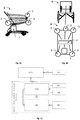
- the scene capture (see Figure 3 ) enables the system to identify objects and people.
- the system can obtain the distances from these objects.
- the 3D depth camera has the capacity to detect a human form. This is accomplish by a projection of an infrared matrix in from of the camera.
- a sensing depth camera is able to read the location of the infrared points in the matrix and calculate the distances from one another.
- the algorithms embedded in the 3D depth camera libraries allow the recognition of a person's shape through these data.
- Biometric Data can be calculated, using variables such as height, length of arms, legs, basically the entire human physiognomy.
- the identification of objects is made through the same depth camera, by adding the RGB camera functionalities, therefore providing higher data reliability on objects, since color is added to the shape.
- the depth camera has the purpose of identifying a human physiognomy. Through gestures, position, voice or personal features (structure and / or facial recognition) it is created a virtual connection of the system to the person recognized by the depth camera. As long as the person stays in the viewing angle of the depth camera, the system will not lose the user.
- Another alternative recognition system implemented is based on the use of bar codes or two-dimensional codes (QR Codes) which will be placed by the person in front of the camera and, using the proper algorithm, will associate the person to the system.
- QR Codes two-dimensional codes
- Another embodiment has to do with the use of voice commands or facial recognition.
- the procedure of recognition and analysis is the same as the one used in the person recognition.
- the calibration consists in adjusting the camera towards people, as their physical characteristics vary dramatically from one individual to another.
- the depth camera has an engine allowing the adjustment of the angle within the horizontal plane.
- the algorithm absorbs the data collected by the depth camera and processes it, so that it can be able to identify the person's movements.
- the depth camera gathers data from the person whom is following. This data structure contains the information on both the distance and position of the user. Based on these distances and relative positions, differentiating values can be seen when identifying the user and allowing the system to follow the person.
- the system can identify where the person is moving to (forward, back, side, rotate, etc.).
- the system keeps the person at its center of vision at a fixed distance that is presented and programmable. When one moves laterally, and leaves the system's center of vision, it calculates the error (distance from the person to the center of vision) and calculates the force that must be applied to the left and / or right motor, so it can adjust back and have the person at its center of vision, depending on whether the person moves to the left and / or right.
- the system based on the depth camera, the system identifies how far the person is from the it, and it will always keep the same distance.
- the error is calculated (position of the user regarding the ideal distance separating the system from the him) and correct commands will be provided to correct those distances. This process allows the front and rear movement of the system to maintain the ideal distance with the person, always keeping a constant alignment with them. Combining these data, the system follows the person to all possible directions.
- the diagrams of Figure 4 show the operation described above.
- this document describes a decision support system (see Figure 5 ) based on heuristics and artificial intelligence algorithms, which give assistance in specific tasks such as:
- the device also comprises distance sensors planned to avoid collisions with the surrounding environment.
- the sensors are able to analyze obstacles, sending ultrasound signals and, depending on the time it takes to reach an obstacle and bounce back to the sensor, therefore calculating the distance to the object. Based on this information, the system verifies if there are any obstacles in the way, complying a safe distance specified, in which the system has to stop or create a curved path around the object in order to prevent collision. These distances have millimetric precision in a preferential embodiment.
- the system is forced to stop by default.
- a set of sound alerts and written notifications on the screen are defined to indicate the correct functioning of the system. Starting by the battery level warning, to a notification that indicates if the system has lost the person or if any component is malfunctioning or crashed, amongst others.
- One of the main components of the system is the 3D depth camera. Additional cameras can be considered to be used in the system, such as the Microsoft's Kinect Sensor, the Asus' Xtion Pro Sensor, PrimeSense Capri or any other device with the same technical specifications and functioning.
- the system can be developed using the official Microsoft's SDK or the OpenNI open source SDK, which detects all hardware from any 3D depth camera, thus allowing the system development regardless of the camera used.
- any depth sensing camera capable of capturing a real time scenario, as well as capable of human form segmentations and recognition may be used by the system.
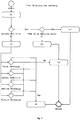
- Figure 6 describes the algorithm's overall functioning.
- a skeleton is a data structure which contains information about the user's joints and bones, as well as its global position.
- that data is sent to the User Detection and Recovery Algorithm (2). This will return a user to follow or not. If there are no users to track, the system will do nothing and will wait for the next cycle. If there are users to track, the system will provide the active follow algorithm with the user's skeleton tracked (3). This procedure will return the final speed to send to the motors, through the Motor Control Unit Communication module (4), and then the loop is repeated.
- the user's Detection and Recovery Algorithm ( fig 7 ) describes how the system creates a virtual link to a user's skeleton. Once it gets a collection of skeletons, it will check whether it's a new user or not, by finding if it was already following someone. In case it was not following anyone, it will try to lock on a user by voice, facial, gesture or posture detection. This procedure consists on locking on the user and returning a skeleton and skeleton ID to track.
- the system If the system was already following a user, it will check if the collection of skeletons has the same tracking ID of the previously tracked user. If the same user ID is found, the skeletal information of that user is updated and returned. If the collection of skeletons does not have the current tracked ID, the system assumes to have lost the user.
- the Active follow Algorithm accepts a user skeleton and parses its global position (1).
- X defines how far to the side the user is.
- Z defines how far the user is to the device, as explained on figure 10 .
- two different PID controllers provided with those values, one for each axis.
- the PIDs will return two errors based on predefined set points. Set points are the optimal position on which the user must be, which are configured in the PID. These two errors will define whether the system moves forwards, backwards, to the left or to the right. Having those errors (2)(3), a final speed will be calculated (4)(5). In case those errors are bigger than a predefined threshold, we join the different speeds into a final speed (7) and return the value.
- a speed modifier is a value between 0 and 1 which represents the percentage of the speed to be taken into account, 1 being maximum speed, and 0 being minimum speed.
- This procedure will act as a braking system that will make the wheels slow down, in case there is an obstacle approaching.
- Speed Modifier is a value between 0.0 and 1.0 that will reduce or not, motor's speed, independently for obstacle avoidance or both for obstacle detection.
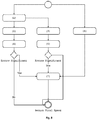
- Figure 9 describes the Obstacle Detection and Avoidance Algorithm.
- This component reads information from distance sensors (1), parses and updates the data structure (2). There is a verification in each sensor to check for distances that are smaller than predefined safe zones (3). If the sensors detect an obstacle in the direction, forwards or backwards of the device (5), the system will calculate a speed modifier to both motors (6), slowing down or stopping the device. If the sensors detect an obstacle on the side of the device (4), the system will calculate two different speed modifiers (7) to give to each motor, resulting in a curve movement, allowing the avoidance of the obstacle.
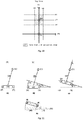
- Figure 10 represents the schematic view of the system. This describes the actuation method of the device (2).
- the device (2) follows the user at all times by correcting its position in relation to the user, so the user remains inside the Safe Zone / No Actuation Zone.
- the system has two axis of actuation, the X axis (9) and the Z axis (5).
- the X axis represents the user's position sideways in relation to the device.
- the Z axis represents how far or how close the user is to the device.
- the system has thresholds, minimum (4) and maximum (3) X axis thresholds and minimum (8) and maximum (6) Z axis threshold. These thresholds will define when the system actuates. If the user to inside these thresholds, the device will not move. If the user is outside those bounds, the device will start moving. If the user is farther from the maximum Z threshold (6), the device will follow the user. If the user is closer than the minimum threshold, the device will go back.
- Figure 11 describes how the system calculates the amount of acceleration each wheel needs to be provided with to follow a user during a curved path.
- Figure 11a describes a scenario where the user (1) is on the right of the device's (2) reference setpoint (5).
- the system needs to calculate how much acceleration it has to give to the left (4) and right (3) motors, so it calculates the angle the user is making with the reference setpoint / Z axis (5).
- the system calculates the angle the user is making (6). It can create the same angle of curvature (7) in order to calculate the acceleration for the wheels to create the outer curved path (9) and inner curved path (8). These paths will correct the angle (6) to zero, as shown in Figure 11c .
- Figure 11d describes the speed calculation method for both wheels.
- Right Wheel R ⁇ b / 2 ⁇ Alpha
- R is the Turn Radius (11)
- b is the Distance between wheels (10)
- Alpha is the rotation angle (7).
- the Instantaneous Center of Curvature (12) will define on which point the device will turn around. If the Turn Radius is zero, the ICC will be half the distance between the wheels.
Landscapes
- Engineering & Computer Science (AREA)
- Physics & Mathematics (AREA)
- General Physics & Mathematics (AREA)
- Multimedia (AREA)
- Remote Sensing (AREA)
- Electromagnetism (AREA)
- Radar, Positioning & Navigation (AREA)
- General Engineering & Computer Science (AREA)
- Theoretical Computer Science (AREA)
- Computer Vision & Pattern Recognition (AREA)
- Aviation & Aerospace Engineering (AREA)
- Automation & Control Theory (AREA)
- Signal Processing (AREA)
- Human Computer Interaction (AREA)
- Control Of Position, Course, Altitude, Or Attitude Of Moving Bodies (AREA)
- Manipulator (AREA)
- Image Analysis (AREA)
- Mechanical Engineering (AREA)
Priority Applications (1)
| Application Number | Priority Date | Filing Date | Title |
|---|---|---|---|
| PL13802427T PL2898384T3 (pl) | 2012-09-19 | 2013-09-19 | System automatycznie śledzący i jego sposób działania |
Applications Claiming Priority (2)
| Application Number | Priority Date | Filing Date | Title |
|---|---|---|---|
| PT10654212 | 2012-09-19 | ||
| PCT/IB2013/058672 WO2014045225A1 (en) | 2012-09-19 | 2013-09-19 | Self tracking system and its operation method |
Publications (2)
| Publication Number | Publication Date |
|---|---|
| EP2898384A1 EP2898384A1 (en) | 2015-07-29 |
| EP2898384B1 true EP2898384B1 (en) | 2019-10-16 |
Family
ID=49726816
Family Applications (1)
| Application Number | Title | Priority Date | Filing Date |
|---|---|---|---|
| EP13802427.8A Active EP2898384B1 (en) | 2012-09-19 | 2013-09-19 | Self tracking system and its operation method |
Country Status (8)
| Country | Link |
|---|---|
| US (1) | US9948917B2 (pl) |
| EP (1) | EP2898384B1 (pl) |
| BR (1) | BR112015006203B1 (pl) |
| CA (1) | CA2885630C (pl) |
| ES (1) | ES2766875T3 (pl) |
| PL (1) | PL2898384T3 (pl) |
| PT (1) | PT2898384T (pl) |
| WO (1) | WO2014045225A1 (pl) |
Families Citing this family (42)
| Publication number | Priority date | Publication date | Assignee | Title |
|---|---|---|---|---|
| US12084824B2 (en) | 2015-03-06 | 2024-09-10 | Walmart Apollo, Llc | Shopping facility assistance systems, devices and methods |
| US12366043B2 (en) | 2015-03-06 | 2025-07-22 | Walmart Apollo, Llc | Overriding control of motorized transport unit systems, devices and methods |
| US20160255969A1 (en) | 2015-03-06 | 2016-09-08 | Wal-Mart Stores, Inc. | Shopping facility assistance systems, devices and methods pertaining to movement of a mobile retail product display |
| WO2016142794A1 (en) | 2015-03-06 | 2016-09-15 | Wal-Mart Stores, Inc | Item monitoring system and method |
| US20180099846A1 (en) | 2015-03-06 | 2018-04-12 | Wal-Mart Stores, Inc. | Method and apparatus for transporting a plurality of stacked motorized transport units |
| GB2542469B (en) * | 2015-07-17 | 2018-02-07 | Wal Mart Stores Inc | Shopping facility assistance systems, devices, and method to identify security and safety anomalies |
| US9691248B2 (en) | 2015-11-30 | 2017-06-27 | International Business Machines Corporation | Transition to accessibility mode |
| CA2961938A1 (en) | 2016-04-01 | 2017-10-01 | Wal-Mart Stores, Inc. | Systems and methods for moving pallets via unmanned motorized unit-guided forklifts |
| US10527423B1 (en) | 2016-04-07 | 2020-01-07 | Luftronix, Inc. | Fusion of vision and depth sensors for navigation in complex environments |
| CN105825627B (zh) * | 2016-05-23 | 2018-03-27 | 蔡俊豪 | 一种婴儿车防盗方法及防盗系统 |
| CN106056633A (zh) * | 2016-06-07 | 2016-10-26 | 速感科技(北京)有限公司 | 运动控制方法、装置及系统 |
| US20180053304A1 (en) * | 2016-08-19 | 2018-02-22 | Korea Advanced Institute Of Science And Technology | Method and apparatus for detecting relative positions of cameras based on skeleton data |
| US10689021B2 (en) * | 2016-08-27 | 2020-06-23 | Anup S. Deshpande | Automatic load mover |
| DE102016221365B4 (de) | 2016-10-28 | 2025-12-24 | Ford Global Technologies, Llc | Verfahren und Vorrichtung zum automatischen Manövrieren eines Rollstuhls relativ zu einem Fahrzeug |
| CN106778471B (zh) * | 2016-11-17 | 2019-11-19 | 京东方科技集团股份有限公司 | 自动跟踪购物车 |
| CN106681326B (zh) * | 2017-01-04 | 2020-10-30 | 京东方科技集团股份有限公司 | 座椅、控制座椅运动的方法和用于座椅的运动控制系统 |
| WO2018134763A1 (en) | 2017-01-20 | 2018-07-26 | Follow Inspiration, S.A. | Autonomous robotic system |
| US12287628B2 (en) | 2017-01-20 | 2025-04-29 | Follow Inspiration, S.A. | Method and system to improve autonomous robotic systems responsive behavior |
| KR102624560B1 (ko) * | 2017-01-31 | 2024-01-15 | 엘지전자 주식회사 | 청소기 |
| CN109144043A (zh) * | 2017-06-27 | 2019-01-04 | 金宝电子工业股份有限公司 | 追踪目标物的方法 |
| US20190041868A1 (en) * | 2017-08-03 | 2019-02-07 | Walmart Apollo, Llc | Autonomous Vehicle-Based Item Retrieval System and Method |
| DE102017216702A1 (de) | 2017-09-21 | 2019-03-21 | Zf Friedrichshafen Ag | Steuergerät zum autonomen Betrieb eines Leichtkraftfahrzeugs |
| DE102017218498A1 (de) | 2017-10-17 | 2019-04-18 | Zf Friedrichshafen Ag | Steuergerät zum autonomen Betrieb eines Leichtkraftfahrzeugs |
| US10818031B2 (en) | 2017-11-22 | 2020-10-27 | Blynk Technology | Systems and methods of determining a location of a mobile container |
| JP6981241B2 (ja) * | 2017-12-26 | 2021-12-15 | トヨタ自動車株式会社 | 車両 |
| WO2019187123A1 (ja) * | 2018-03-30 | 2019-10-03 | 本田技研工業株式会社 | 自律走行車両および自律走行装置 |
| WO2020014991A1 (en) * | 2018-07-20 | 2020-01-23 | Lingdong Technology (Beijing) Co. Ltd | Smart self-driving systems with side follow and obstacle avoidance |
| US11174022B2 (en) | 2018-09-17 | 2021-11-16 | International Business Machines Corporation | Smart device for personalized temperature control |
| JP7178061B2 (ja) * | 2018-10-10 | 2022-11-25 | 霊動科技(北京)有限公司 | 人間相互作用無人搬送車 |
| WO2020077481A1 (en) * | 2018-10-15 | 2020-04-23 | Lingdong Technology (Beijing) Co. Ltd | Self-driving vehicle system with steerable camera and indicator |
| CN109521768B (zh) * | 2018-11-16 | 2022-03-22 | 楚天智能机器人(长沙)有限公司 | 一种基于双pid控制的agv小车的路径纠偏方法 |
| CN110187639B (zh) * | 2019-06-27 | 2021-05-11 | 吉林大学 | 一种基于参数决策框架的轨迹规划控制方法 |
| CN110312078B (zh) * | 2019-08-02 | 2021-06-29 | 睿魔智能科技(深圳)有限公司 | 一种自动环绕目标拍摄方法及系统 |
| US11449065B2 (en) * | 2019-09-03 | 2022-09-20 | Honda Motor Co., Ltd. | System and method for controlling an autonomous carriage based on user intentions |
| CN112918381B (zh) * | 2019-12-06 | 2023-10-27 | 广州汽车集团股份有限公司 | 一种车载机器人迎送宾方法、装置及系统 |
| IT202000001399A1 (it) * | 2020-01-24 | 2021-07-24 | E Cosi S R L | Dispositivo per il trasporto di utensili, strumenti, e oggetti di utilizzo professionale |
| CN111507225A (zh) * | 2020-04-08 | 2020-08-07 | 绍兴埃瓦科技有限公司 | 一种智能跟随系统及方法 |
| US12384410B2 (en) | 2021-03-05 | 2025-08-12 | The Research Foundation For The State University Of New York | Task-motion planning for safe and efficient urban driving |
| CN113616436B (zh) * | 2021-08-23 | 2024-01-16 | 南京邮电大学 | 一种基于运动想象脑电与头姿的智能轮椅及控制方法 |
| US12552650B2 (en) * | 2022-12-15 | 2026-02-17 | Bastian Solutions, Llc | Hands free advance control for material handling vehicle |
| CN117400961A (zh) * | 2023-09-01 | 2024-01-16 | 南开大学 | 一种智能调速跟随算法 |
| CN118426528B (zh) * | 2024-03-11 | 2024-11-15 | 湖北第二师范学院 | 一种基于摄像头循迹的麦克纳姆轮小车 |
Family Cites Families (13)
| Publication number | Priority date | Publication date | Assignee | Title |
|---|---|---|---|---|
| DE19509320A1 (de) * | 1995-03-15 | 1996-09-19 | Technologietransfer Anstalt Te | Folgesteuerung für ein selbstfahrendes Fahrzeug |
| AU2003274668A1 (en) | 2002-10-29 | 2004-05-25 | Benjamin Sharon | Intelligent terrain-traversing vehicle |
| ATE524783T1 (de) * | 2004-03-27 | 2011-09-15 | Harvey Koselka | Autonomer persönlicher dienstroboter |
| JP4316477B2 (ja) * | 2004-11-18 | 2009-08-19 | パナソニック株式会社 | 移動ロボットの追従方法 |
| US20070045014A1 (en) | 2005-08-29 | 2007-03-01 | Greig Mark E | Maneuverable motorized personally operated vehicle |
| KR20080049061A (ko) | 2005-09-26 | 2008-06-03 | 코닌클리케 필립스 일렉트로닉스 엔.브이. | 물체 또는 사람의 운동을 추적하기 위한 방법 및 디바이스 |
| US9026301B2 (en) * | 2005-10-14 | 2015-05-05 | Aethon, Inc. | Robotic ordering and delivery system software and methods |
| CN101449180A (zh) | 2006-05-17 | 2009-06-03 | 优尔影技术有限公司 | 机器人高尔夫球车 |
| US20110026770A1 (en) * | 2009-07-31 | 2011-02-03 | Jonathan David Brookshire | Person Following Using Histograms of Oriented Gradients |
| EP2506106B1 (en) * | 2009-11-27 | 2019-03-20 | Toyota Jidosha Kabushiki Kaisha | Autonomous moving object and control method |
| US8213680B2 (en) * | 2010-03-19 | 2012-07-03 | Microsoft Corporation | Proxy training data for human body tracking |
| US9204823B2 (en) * | 2010-09-23 | 2015-12-08 | Stryker Corporation | Video monitoring system |
| JP2014509417A (ja) * | 2010-12-30 | 2014-04-17 | アイロボット コーポレイション | 可動式ヒューマンインターフェースロボット |
-
2013
- 2013-09-19 PT PT138024278T patent/PT2898384T/pt unknown
- 2013-09-19 US US14/429,262 patent/US9948917B2/en active Active
- 2013-09-19 CA CA2885630A patent/CA2885630C/en active Active
- 2013-09-19 EP EP13802427.8A patent/EP2898384B1/en active Active
- 2013-09-19 WO PCT/IB2013/058672 patent/WO2014045225A1/en not_active Ceased
- 2013-09-19 PL PL13802427T patent/PL2898384T3/pl unknown
- 2013-09-19 BR BR112015006203-2A patent/BR112015006203B1/pt active IP Right Grant
- 2013-09-19 ES ES13802427T patent/ES2766875T3/es active Active
Non-Patent Citations (1)
| Title |
|---|
| None * |
Also Published As
| Publication number | Publication date |
|---|---|
| BR112015006203B1 (pt) | 2022-05-24 |
| BR112015006203A2 (pt) | 2019-11-26 |
| US20150229906A1 (en) | 2015-08-13 |
| ES2766875T3 (es) | 2020-06-15 |
| CA2885630A1 (en) | 2014-03-27 |
| PT2898384T (pt) | 2020-01-21 |
| PL2898384T3 (pl) | 2020-05-18 |
| WO2014045225A1 (en) | 2014-03-27 |
| US9948917B2 (en) | 2018-04-17 |
| CA2885630C (en) | 2020-09-29 |
| EP2898384A1 (en) | 2015-07-29 |
Similar Documents
| Publication | Publication Date | Title |
|---|---|---|
| EP2898384B1 (en) | Self tracking system and its operation method | |
| EP3735365B2 (en) | Primary preview region and gaze based driver distraction detection | |
| US11684526B2 (en) | Patient support apparatuses with navigation and guidance systems | |
| JP5179686B2 (ja) | 運転行動危険度演算装置 | |
| US9355368B2 (en) | Computer-based method and system for providing active and automatic personal assistance using a robotic device/platform | |
| AU2020331567B2 (en) | Object moving system | |
| JP2021530069A (ja) | 状況的ドライバ監視システム | |
| JP2004362586A (ja) | 車両用画像処理システム | |
| US20240118713A1 (en) | System and method for navigation support for a motorized mobile system | |
| US20230019157A1 (en) | Automatically adjusting a vehicle seating area based on the characteristics of a passenger | |
| Hashizume et al. | Telewheelchair: The remote controllable electric wheelchair system combined human and machine intelligence | |
| Hijaz et al. | Towards a driver monitoring system for estimating driver situational awareness | |
| Manta et al. | Wheelchair control by head motion using a noncontact method in relation to the pacient | |
| Al Mamun et al. | Autonomous bus boarding robotic wheelchair using bidirectional sensing systems | |
| EP4567764A1 (en) | Vehicular emergency notification | |
| KR20210019645A (ko) | 자율 주행 차량내의 탑승자 모니터링 장치 | |
| Satoh et al. | A secure and reliable next generation mobility—An intelligent electric wheelchair with a stereo omni-directional camera system— | |
| KR20210019646A (ko) | 자율 주행 차량내의 탑승자 모니터링 방법 | |
| Tsai et al. | Human-robot interaction of an active mobile robotic assistant in intelligent space environments | |
| US20260003366A1 (en) | Travel control system and travel control method for particular mobile body | |
| Ding | DEEP LEARNING BASED MOBILITY SCOOTER DRIVING SAFETY ASSESSMENT SYSTEM | |
| Tapaswi et al. | Autonomous vehicle model for implementation and challenge in traffic observation and lane detection | |
| Patil et al. | Intelligent Driver Assistance | |
| WO2024232157A1 (ja) | 走行検知システム、走行検知方法、および走行検知プログラム | |
| CN121761858A (zh) | 一种用于引导目标用户的导航系统 |
Legal Events
| Date | Code | Title | Description |
|---|---|---|---|
| PUAI | Public reference made under article 153(3) epc to a published international application that has entered the european phase |
Free format text: ORIGINAL CODE: 0009012 |
|
| 17P | Request for examination filed |
Effective date: 20150420 |
|
| AK | Designated contracting states |
Kind code of ref document: A1 Designated state(s): AL AT BE BG CH CY CZ DE DK EE ES FI FR GB GR HR HU IE IS IT LI LT LU LV MC MK MT NL NO PL PT RO RS SE SI SK SM TR |
|
| AX | Request for extension of the european patent |
Extension state: BA ME |
|
| DAX | Request for extension of the european patent (deleted) | ||
| STAA | Information on the status of an ep patent application or granted ep patent |
Free format text: STATUS: EXAMINATION IS IN PROGRESS |
|
| 17Q | First examination report despatched |
Effective date: 20180917 |
|
| GRAP | Despatch of communication of intention to grant a patent |
Free format text: ORIGINAL CODE: EPIDOSNIGR1 |
|
| STAA | Information on the status of an ep patent application or granted ep patent |
Free format text: STATUS: GRANT OF PATENT IS INTENDED |
|
| INTG | Intention to grant announced |
Effective date: 20190712 |
|
| RIN1 | Information on inventor provided before grant (corrected) |
Inventor name: CORREIA FIGUEIRA, ANA RAQUEL Inventor name: INACIO DE MATOS, LUIS CARLOS Inventor name: FERRO MARTINS, DAVID JOSE Inventor name: GONCALVES ADAIXO, MICHAEL CARLOS Inventor name: NEVES GOULAO, VITOR EMANUEL Inventor name: FRAGOSO MENDES GARDETE CORREIRA, LUIS RODRIGO Inventor name: GUERRA DE ARAUJO, PEDRO JOSE Inventor name: CRUZ PONCIANO, RICARDO SAMUEL Inventor name: DOS SANTOS NASCIMENTO, PEDRO MANUEL |
|
| GRAS | Grant fee paid |
Free format text: ORIGINAL CODE: EPIDOSNIGR3 |
|
| GRAA | (expected) grant |
Free format text: ORIGINAL CODE: 0009210 |
|
| STAA | Information on the status of an ep patent application or granted ep patent |
Free format text: STATUS: THE PATENT HAS BEEN GRANTED |
|
| AK | Designated contracting states |
Kind code of ref document: B1 Designated state(s): AL AT BE BG CH CY CZ DE DK EE ES FI FR GB GR HR HU IE IS IT LI LT LU LV MC MK MT NL NO PL PT RO RS SE SI SK SM TR |
|
| REG | Reference to a national code |
Ref country code: GB Ref legal event code: FG4D |
|
| REG | Reference to a national code |
Ref country code: CH Ref legal event code: EP |
|
| REG | Reference to a national code |
Ref country code: DE Ref legal event code: R096 Ref document number: 602013061809 Country of ref document: DE |
|
| REG | Reference to a national code |
Ref country code: IE Ref legal event code: FG4D |
|
| REG | Reference to a national code |
Ref country code: AT Ref legal event code: REF Ref document number: 1191895 Country of ref document: AT Kind code of ref document: T Effective date: 20191115 |
|
| REG | Reference to a national code |
Ref country code: CH Ref legal event code: NV Representative=s name: NOVAGRAAF INTERNATIONAL SA, CH |
|
| REG | Reference to a national code |
Ref country code: PT Ref legal event code: SC4A Ref document number: 2898384 Country of ref document: PT Date of ref document: 20200121 Kind code of ref document: T Free format text: AVAILABILITY OF NATIONAL TRANSLATION Effective date: 20200114 |
|
| REG | Reference to a national code |
Ref country code: NL Ref legal event code: MP Effective date: 20191016 |
|
| REG | Reference to a national code |
Ref country code: LT Ref legal event code: MG4D |
|
| REG | Reference to a national code |
Ref country code: AT Ref legal event code: MK05 Ref document number: 1191895 Country of ref document: AT Kind code of ref document: T Effective date: 20191016 |
|
| PG25 | Lapsed in a contracting state [announced via postgrant information from national office to epo] |
Ref country code: FI Free format text: LAPSE BECAUSE OF FAILURE TO SUBMIT A TRANSLATION OF THE DESCRIPTION OR TO PAY THE FEE WITHIN THE PRESCRIBED TIME-LIMIT Effective date: 20191016 Ref country code: AT Free format text: LAPSE BECAUSE OF FAILURE TO SUBMIT A TRANSLATION OF THE DESCRIPTION OR TO PAY THE FEE WITHIN THE PRESCRIBED TIME-LIMIT Effective date: 20191016 Ref country code: LV Free format text: LAPSE BECAUSE OF FAILURE TO SUBMIT A TRANSLATION OF THE DESCRIPTION OR TO PAY THE FEE WITHIN THE PRESCRIBED TIME-LIMIT Effective date: 20191016 Ref country code: SE Free format text: LAPSE BECAUSE OF FAILURE TO SUBMIT A TRANSLATION OF THE DESCRIPTION OR TO PAY THE FEE WITHIN THE PRESCRIBED TIME-LIMIT Effective date: 20191016 Ref country code: LT Free format text: LAPSE BECAUSE OF FAILURE TO SUBMIT A TRANSLATION OF THE DESCRIPTION OR TO PAY THE FEE WITHIN THE PRESCRIBED TIME-LIMIT Effective date: 20191016 Ref country code: BG Free format text: LAPSE BECAUSE OF FAILURE TO SUBMIT A TRANSLATION OF THE DESCRIPTION OR TO PAY THE FEE WITHIN THE PRESCRIBED TIME-LIMIT Effective date: 20200116 Ref country code: NL Free format text: LAPSE BECAUSE OF FAILURE TO SUBMIT A TRANSLATION OF THE DESCRIPTION OR TO PAY THE FEE WITHIN THE PRESCRIBED TIME-LIMIT Effective date: 20191016 Ref country code: NO Free format text: LAPSE BECAUSE OF FAILURE TO SUBMIT A TRANSLATION OF THE DESCRIPTION OR TO PAY THE FEE WITHIN THE PRESCRIBED TIME-LIMIT Effective date: 20200116 |
|
| PG25 | Lapsed in a contracting state [announced via postgrant information from national office to epo] |
Ref country code: HR Free format text: LAPSE BECAUSE OF FAILURE TO SUBMIT A TRANSLATION OF THE DESCRIPTION OR TO PAY THE FEE WITHIN THE PRESCRIBED TIME-LIMIT Effective date: 20191016 Ref country code: RS Free format text: LAPSE BECAUSE OF FAILURE TO SUBMIT A TRANSLATION OF THE DESCRIPTION OR TO PAY THE FEE WITHIN THE PRESCRIBED TIME-LIMIT Effective date: 20191016 Ref country code: IS Free format text: LAPSE BECAUSE OF FAILURE TO SUBMIT A TRANSLATION OF THE DESCRIPTION OR TO PAY THE FEE WITHIN THE PRESCRIBED TIME-LIMIT Effective date: 20200224 |
|
| REG | Reference to a national code |
Ref country code: ES Ref legal event code: FG2A Ref document number: 2766875 Country of ref document: ES Kind code of ref document: T3 Effective date: 20200615 |
|
| PG25 | Lapsed in a contracting state [announced via postgrant information from national office to epo] |
Ref country code: AL Free format text: LAPSE BECAUSE OF FAILURE TO SUBMIT A TRANSLATION OF THE DESCRIPTION OR TO PAY THE FEE WITHIN THE PRESCRIBED TIME-LIMIT Effective date: 20191016 |
|
| REG | Reference to a national code |
Ref country code: DE Ref legal event code: R097 Ref document number: 602013061809 Country of ref document: DE |
|
| PG2D | Information on lapse in contracting state deleted |
Ref country code: IS |
|
| PG25 | Lapsed in a contracting state [announced via postgrant information from national office to epo] |
Ref country code: EE Free format text: LAPSE BECAUSE OF FAILURE TO SUBMIT A TRANSLATION OF THE DESCRIPTION OR TO PAY THE FEE WITHIN THE PRESCRIBED TIME-LIMIT Effective date: 20191016 Ref country code: CZ Free format text: LAPSE BECAUSE OF FAILURE TO SUBMIT A TRANSLATION OF THE DESCRIPTION OR TO PAY THE FEE WITHIN THE PRESCRIBED TIME-LIMIT Effective date: 20191016 Ref country code: RO Free format text: LAPSE BECAUSE OF FAILURE TO SUBMIT A TRANSLATION OF THE DESCRIPTION OR TO PAY THE FEE WITHIN THE PRESCRIBED TIME-LIMIT Effective date: 20191016 Ref country code: DK Free format text: LAPSE BECAUSE OF FAILURE TO SUBMIT A TRANSLATION OF THE DESCRIPTION OR TO PAY THE FEE WITHIN THE PRESCRIBED TIME-LIMIT Effective date: 20191016 Ref country code: IS Free format text: LAPSE BECAUSE OF FAILURE TO SUBMIT A TRANSLATION OF THE DESCRIPTION OR TO PAY THE FEE WITHIN THE PRESCRIBED TIME-LIMIT Effective date: 20200216 |
|
| PLBE | No opposition filed within time limit |
Free format text: ORIGINAL CODE: 0009261 |
|
| STAA | Information on the status of an ep patent application or granted ep patent |
Free format text: STATUS: NO OPPOSITION FILED WITHIN TIME LIMIT |
|
| PG25 | Lapsed in a contracting state [announced via postgrant information from national office to epo] |
Ref country code: SK Free format text: LAPSE BECAUSE OF FAILURE TO SUBMIT A TRANSLATION OF THE DESCRIPTION OR TO PAY THE FEE WITHIN THE PRESCRIBED TIME-LIMIT Effective date: 20191016 Ref country code: SM Free format text: LAPSE BECAUSE OF FAILURE TO SUBMIT A TRANSLATION OF THE DESCRIPTION OR TO PAY THE FEE WITHIN THE PRESCRIBED TIME-LIMIT Effective date: 20191016 Ref country code: IT Free format text: LAPSE BECAUSE OF FAILURE TO SUBMIT A TRANSLATION OF THE DESCRIPTION OR TO PAY THE FEE WITHIN THE PRESCRIBED TIME-LIMIT Effective date: 20191016 |
|
| 26N | No opposition filed |
Effective date: 20200717 |
|
| PG25 | Lapsed in a contracting state [announced via postgrant information from national office to epo] |
Ref country code: SI Free format text: LAPSE BECAUSE OF FAILURE TO SUBMIT A TRANSLATION OF THE DESCRIPTION OR TO PAY THE FEE WITHIN THE PRESCRIBED TIME-LIMIT Effective date: 20191016 |
|
| PG25 | Lapsed in a contracting state [announced via postgrant information from national office to epo] |
Ref country code: MC Free format text: LAPSE BECAUSE OF FAILURE TO SUBMIT A TRANSLATION OF THE DESCRIPTION OR TO PAY THE FEE WITHIN THE PRESCRIBED TIME-LIMIT Effective date: 20191016 |
|
| REG | Reference to a national code |
Ref country code: BE Ref legal event code: MM Effective date: 20200930 |
|
| PG25 | Lapsed in a contracting state [announced via postgrant information from national office to epo] |
Ref country code: LU Free format text: LAPSE BECAUSE OF NON-PAYMENT OF DUE FEES Effective date: 20200919 |
|
| PG25 | Lapsed in a contracting state [announced via postgrant information from national office to epo] |
Ref country code: IE Free format text: LAPSE BECAUSE OF NON-PAYMENT OF DUE FEES Effective date: 20200919 Ref country code: BE Free format text: LAPSE BECAUSE OF NON-PAYMENT OF DUE FEES Effective date: 20200930 |
|
| PG25 | Lapsed in a contracting state [announced via postgrant information from national office to epo] |
Ref country code: TR Free format text: LAPSE BECAUSE OF FAILURE TO SUBMIT A TRANSLATION OF THE DESCRIPTION OR TO PAY THE FEE WITHIN THE PRESCRIBED TIME-LIMIT Effective date: 20191016 Ref country code: MT Free format text: LAPSE BECAUSE OF FAILURE TO SUBMIT A TRANSLATION OF THE DESCRIPTION OR TO PAY THE FEE WITHIN THE PRESCRIBED TIME-LIMIT Effective date: 20191016 Ref country code: CY Free format text: LAPSE BECAUSE OF FAILURE TO SUBMIT A TRANSLATION OF THE DESCRIPTION OR TO PAY THE FEE WITHIN THE PRESCRIBED TIME-LIMIT Effective date: 20191016 |
|
| PG25 | Lapsed in a contracting state [announced via postgrant information from national office to epo] |
Ref country code: MK Free format text: LAPSE BECAUSE OF FAILURE TO SUBMIT A TRANSLATION OF THE DESCRIPTION OR TO PAY THE FEE WITHIN THE PRESCRIBED TIME-LIMIT Effective date: 20191016 |
|
| PG25 | Lapsed in a contracting state [announced via postgrant information from national office to epo] |
Ref country code: GR Free format text: LAPSE BECAUSE OF FAILURE TO SUBMIT A TRANSLATION OF THE DESCRIPTION OR TO PAY THE FEE WITHIN THE PRESCRIBED TIME-LIMIT Effective date: 20191016 |
|
| REG | Reference to a national code |
Ref country code: DE Ref legal event code: R079 Ref document number: 602013061809 Country of ref document: DE Free format text: PREVIOUS MAIN CLASS: G05D0001020000 Ipc: G05D0001430000 |
|
| REG | Reference to a national code |
Ref country code: CH Ref legal event code: U11 Free format text: ST27 STATUS EVENT CODE: U-0-0-U10-U11 (AS PROVIDED BY THE NATIONAL OFFICE) Effective date: 20251001 |
|
| PGFP | Annual fee paid to national office [announced via postgrant information from national office to epo] |
Ref country code: PT Payment date: 20250827 Year of fee payment: 13 |
|
| PGFP | Annual fee paid to national office [announced via postgrant information from national office to epo] |
Ref country code: DE Payment date: 20250919 Year of fee payment: 13 |
|
| PGFP | Annual fee paid to national office [announced via postgrant information from national office to epo] |
Ref country code: PL Payment date: 20250915 Year of fee payment: 13 |
|
| PGFP | Annual fee paid to national office [announced via postgrant information from national office to epo] |
Ref country code: GB Payment date: 20250918 Year of fee payment: 13 |
|
| PGFP | Annual fee paid to national office [announced via postgrant information from national office to epo] |
Ref country code: FR Payment date: 20250922 Year of fee payment: 13 |
|
| PGFP | Annual fee paid to national office [announced via postgrant information from national office to epo] |
Ref country code: CH Payment date: 20251001 Year of fee payment: 13 |
|
| PGFP | Annual fee paid to national office [announced via postgrant information from national office to epo] |
Ref country code: ES Payment date: 20251028 Year of fee payment: 13 |