EP2900716B1 - Polyisocyanat-polyadditionsprodukte - Google Patents
Polyisocyanat-polyadditionsprodukte Download PDFInfo
- Publication number
- EP2900716B1 EP2900716B1 EP13766073.4A EP13766073A EP2900716B1 EP 2900716 B1 EP2900716 B1 EP 2900716B1 EP 13766073 A EP13766073 A EP 13766073A EP 2900716 B1 EP2900716 B1 EP 2900716B1
- Authority
- EP
- European Patent Office
- Prior art keywords
- radicals
- independently
- hydrogen
- carbon atoms
- process according
- Prior art date
- Legal status (The legal status is an assumption and is not a legal conclusion. Google has not performed a legal analysis and makes no representation as to the accuracy of the status listed.)
- Active
Links
- 0 Cc1c(C)c(*)c(*)c(*)c1* Chemical compound Cc1c(C)c(*)c(*)c(*)c1* 0.000 description 2
- ZHEWSWQXNLFFLU-UHFFFAOYSA-L CN(CCO1)CCO[Sn]1(Cl)Cl Chemical compound CN(CCO1)CCO[Sn]1(Cl)Cl ZHEWSWQXNLFFLU-UHFFFAOYSA-L 0.000 description 1
Classifications
-
- C—CHEMISTRY; METALLURGY
- C08—ORGANIC MACROMOLECULAR COMPOUNDS; THEIR PREPARATION OR CHEMICAL WORKING-UP; COMPOSITIONS BASED THEREON
- C08G—MACROMOLECULAR COMPOUNDS OBTAINED OTHERWISE THAN BY REACTIONS ONLY INVOLVING UNSATURATED CARBON-TO-CARBON BONDS
- C08G18/00—Polymeric products of isocyanates or isothiocyanates
- C08G18/06—Polymeric products of isocyanates or isothiocyanates with compounds having active hydrogen
- C08G18/08—Processes
- C08G18/16—Catalysts
- C08G18/22—Catalysts containing metal compounds
- C08G18/24—Catalysts containing metal compounds of tin
-
- B—PERFORMING OPERATIONS; TRANSPORTING
- B01—PHYSICAL OR CHEMICAL PROCESSES OR APPARATUS IN GENERAL
- B01J—CHEMICAL OR PHYSICAL PROCESSES, e.g. CATALYSIS OR COLLOID CHEMISTRY; THEIR RELEVANT APPARATUS
- B01J31/00—Catalysts comprising hydrides, coordination complexes or organic compounds
- B01J31/02—Catalysts comprising hydrides, coordination complexes or organic compounds containing organic compounds or metal hydrides
- B01J31/12—Catalysts comprising hydrides, coordination complexes or organic compounds containing organic compounds or metal hydrides containing organo-metallic compounds or metal hydrides
-
- C—CHEMISTRY; METALLURGY
- C08—ORGANIC MACROMOLECULAR COMPOUNDS; THEIR PREPARATION OR CHEMICAL WORKING-UP; COMPOSITIONS BASED THEREON
- C08G—MACROMOLECULAR COMPOUNDS OBTAINED OTHERWISE THAN BY REACTIONS ONLY INVOLVING UNSATURATED CARBON-TO-CARBON BONDS
- C08G18/00—Polymeric products of isocyanates or isothiocyanates
- C08G18/06—Polymeric products of isocyanates or isothiocyanates with compounds having active hydrogen
- C08G18/28—Polymeric products of isocyanates or isothiocyanates with compounds having active hydrogen characterised by the compounds used containing active hydrogen
- C08G18/2805—Compounds having only one group containing active hydrogen
- C08G18/281—Monocarboxylic acid compounds
-
- C—CHEMISTRY; METALLURGY
- C08—ORGANIC MACROMOLECULAR COMPOUNDS; THEIR PREPARATION OR CHEMICAL WORKING-UP; COMPOSITIONS BASED THEREON
- C08G—MACROMOLECULAR COMPOUNDS OBTAINED OTHERWISE THAN BY REACTIONS ONLY INVOLVING UNSATURATED CARBON-TO-CARBON BONDS
- C08G18/00—Polymeric products of isocyanates or isothiocyanates
- C08G18/06—Polymeric products of isocyanates or isothiocyanates with compounds having active hydrogen
- C08G18/28—Polymeric products of isocyanates or isothiocyanates with compounds having active hydrogen characterised by the compounds used containing active hydrogen
- C08G18/2805—Compounds having only one group containing active hydrogen
- C08G18/2815—Monohydroxy compounds
- C08G18/283—Compounds containing ether groups, e.g. oxyalkylated monohydroxy compounds
- C08G18/2835—Compounds containing ether groups, e.g. oxyalkylated monohydroxy compounds having less than 5 ether groups
-
- C—CHEMISTRY; METALLURGY
- C08—ORGANIC MACROMOLECULAR COMPOUNDS; THEIR PREPARATION OR CHEMICAL WORKING-UP; COMPOSITIONS BASED THEREON
- C08G—MACROMOLECULAR COMPOUNDS OBTAINED OTHERWISE THAN BY REACTIONS ONLY INVOLVING UNSATURATED CARBON-TO-CARBON BONDS
- C08G18/00—Polymeric products of isocyanates or isothiocyanates
- C08G18/06—Polymeric products of isocyanates or isothiocyanates with compounds having active hydrogen
- C08G18/28—Polymeric products of isocyanates or isothiocyanates with compounds having active hydrogen characterised by the compounds used containing active hydrogen
- C08G18/30—Low-molecular-weight compounds
- C08G18/34—Carboxylic acids; Esters thereof with monohydroxyl compounds
-
- C—CHEMISTRY; METALLURGY
- C08—ORGANIC MACROMOLECULAR COMPOUNDS; THEIR PREPARATION OR CHEMICAL WORKING-UP; COMPOSITIONS BASED THEREON
- C08G—MACROMOLECULAR COMPOUNDS OBTAINED OTHERWISE THAN BY REACTIONS ONLY INVOLVING UNSATURATED CARBON-TO-CARBON BONDS
- C08G18/00—Polymeric products of isocyanates or isothiocyanates
- C08G18/06—Polymeric products of isocyanates or isothiocyanates with compounds having active hydrogen
- C08G18/70—Polymeric products of isocyanates or isothiocyanates with compounds having active hydrogen characterised by the isocyanates or isothiocyanates used
- C08G18/72—Polyisocyanates or polyisothiocyanates
- C08G18/73—Polyisocyanates or polyisothiocyanates acyclic
-
- C—CHEMISTRY; METALLURGY
- C08—ORGANIC MACROMOLECULAR COMPOUNDS; THEIR PREPARATION OR CHEMICAL WORKING-UP; COMPOSITIONS BASED THEREON
- C08G—MACROMOLECULAR COMPOUNDS OBTAINED OTHERWISE THAN BY REACTIONS ONLY INVOLVING UNSATURATED CARBON-TO-CARBON BONDS
- C08G18/00—Polymeric products of isocyanates or isothiocyanates
- C08G18/06—Polymeric products of isocyanates or isothiocyanates with compounds having active hydrogen
- C08G18/70—Polymeric products of isocyanates or isothiocyanates with compounds having active hydrogen characterised by the isocyanates or isothiocyanates used
- C08G18/72—Polyisocyanates or polyisothiocyanates
- C08G18/77—Polyisocyanates or polyisothiocyanates having heteroatoms in addition to the isocyanate or isothiocyanate nitrogen and oxygen or sulfur
- C08G18/78—Nitrogen
- C08G18/79—Nitrogen characterised by the polyisocyanates used, these having groups formed by oligomerisation of isocyanates or isothiocyanates
- C08G18/791—Nitrogen characterised by the polyisocyanates used, these having groups formed by oligomerisation of isocyanates or isothiocyanates containing isocyanurate groups
- C08G18/792—Nitrogen characterised by the polyisocyanates used, these having groups formed by oligomerisation of isocyanates or isothiocyanates containing isocyanurate groups formed by oligomerisation of aliphatic and/or cycloaliphatic isocyanates or isothiocyanates
-
- C—CHEMISTRY; METALLURGY
- C09—DYES; PAINTS; POLISHES; NATURAL RESINS; ADHESIVES; COMPOSITIONS NOT OTHERWISE PROVIDED FOR; APPLICATIONS OF MATERIALS NOT OTHERWISE PROVIDED FOR
- C09D—COATING COMPOSITIONS, e.g. PAINTS, VARNISHES OR LACQUERS; FILLING PASTES; CHEMICAL PAINT OR INK REMOVERS; INKS; CORRECTING FLUIDS; WOODSTAINS; PASTES OR SOLIDS FOR COLOURING OR PRINTING; USE OF MATERIALS THEREFOR
- C09D175/00—Coating compositions based on polyureas or polyurethanes; Coating compositions based on derivatives of such polymers
- C09D175/04—Polyurethanes
- C09D175/08—Polyurethanes from polyethers
-
- B—PERFORMING OPERATIONS; TRANSPORTING
- B01—PHYSICAL OR CHEMICAL PROCESSES OR APPARATUS IN GENERAL
- B01J—CHEMICAL OR PHYSICAL PROCESSES, e.g. CATALYSIS OR COLLOID CHEMISTRY; THEIR RELEVANT APPARATUS
- B01J2231/00—Catalytic reactions performed with catalysts classified in B01J31/00
- B01J2231/10—Polymerisation reactions involving at least dual use catalysts, e.g. for both oligomerisation and polymerisation
- B01J2231/14—Other (co) polymerisation, e.g. of lactides or epoxides
Definitions
- the invention relates to the production of polyisocyanate polyaddition products using special catalysts, the products being particularly suitable for the coating sector.
- Polyurethane coatings have been known for a long time and are used in many areas. They are usually made from a polyisocyanate and a hydroxyl component by mixing immediately before application (2K technology). For lightfast coatings, polyisocyanate components based on aliphatic polyisocyanates are generally used, which react with the hydroxyl component much more slowly than products with aromatically bound isocyanate groups. In most cases, the reaction must therefore be catalyzed, especially when it is not possible or unwilling to use reaction temperatures which are too high, even if heating is used to accelerate the reaction as much as possible. Organic tin compounds, in particular dibutyltin dilaurate (DBTL), have proven successful as catalysts.
- DBTL dibutyltin dilaurate
- organotin compounds have at least one Sn-C bond in the molecule. They have the general disadvantage of an unfavorable ecological profile, which u. a. has already led to the ban on the class of organotin compounds from marine paints, to which they have been added as a biocide.
- Organotin-free catalysts for polyurethane production were and are therefore the focus of new developments. Often one switches to elements whose toxicological profile per se is considered to be less critical compared to organotin compounds, e.g. Bismuth, titanium or zinc.
- organotin compounds e.g. Bismuth, titanium or zinc.
- a disadvantage of all of these catalysts is that they cannot be used as universally as organotin compounds.
- many of the catalysts discussed as alternatives have disadvantages in a number of application areas up to the complete loss of catalytic activity. Examples of this are the rapid hydrolysis of bismuth compounds in an aqueous environment, which makes them uninteresting in the area of water-based coating technologies that will become increasingly important in the future, and the sometimes unsatisfactory color effects of titanium compounds in certain coating formulations.
- a general disadvantage of 2K technology is that the NCO-OH reaction is slow, but catalyzed much faster at room temperature, which means that the processing of the formulated mixture of such a 2K system only requires a narrow processing window is available (the so-called pot life), which is further shortened by the presence of the catalyst.
- Catalysts are referred to as thermolatence if their catalytic activity only becomes apparent when a temperature characteristic of the respective catalyst is exceeded.
- a class of latent catalysts used particularly in the field of cast elastomers are organomercury compounds.
- the most prominent representative here is phenylmercury neodecanoate (trade names: Thorcat® 535, Cocure® 44).
- Thorcat® 535, Cocure® 44 phenylmercury neodecanoate
- the disadvantage of the two last-mentioned systems of the prior art is that, on the one hand, a defined, reproducible migration of (atmospheric) moisture or oxygen, regardless of the coating formulation (degree of crosslinking, glass transition temperature, solvent content, etc.) and the ambient conditions, can be poorly guaranteed, and on the other hand , in particular in pigmented systems, the use of radiation sources for activating the photolatent catalyst is limited.
- the WO 2009/132784 and WO 2011/051247 describe the use of special inorganic Sn (IV) catalysts to overcome the above pot life-hardness time problem.
- the disadvantage of these catalysts is the activity, which is sometimes significantly lower than that of standard catalysts such as dibutyltin dilaurate, with the same (molar) amount of inorganic tin catalyst, cf. WO 2011/051247 Examples 7, 8 and 10-14: in no case was the NCO content of the mixture (1.1%) achieved in comparative experiment 4 with the equimolar amount of DBTL in the same procedure, at initially 2 h 30 ° C. and then 60 ° C. reached or fallen below after 4:00 h). For this the reaction temperature had to be increased to 80 ° C after the 30 ° C phase, WO 2011/051247 , Examples 9 and 15.
- the reactivity can be increased with an increase in the catalyst concentration in addition to an increase in temperature (which is not possible to any extent), but surprisingly the latency suffers (Examples 5 to 8), which is shown in WO 2011/051247 otherwise is not mentioned.
- the primary products have a particularly simple and therefore inexpensive synthesis method for the in WO 2011/051247 inorganic tin compounds claimed as catalyst class, that is Sn (IV) -centric spirocylene, cf. WO 2011/113926 , a particularly low activity on what their use as catalysts according WO 2011/051247 makes little appear promising.
- their catalytic activity for the, here undesirable, reaction of the isocyanate groups with one another is markedly reduced compared to the type of catalyst used in Example 22a of the present application, which is advantageous (cf. Example 22b of the present application).
- thermolatent catalysts it was therefore the task of taking advantage of the WO 2011/051247 To bring the above-mentioned thermolatent catalysts into effect at the lowest possible (molar) catalyst concentration, ie to keep them at a comparable or even improved level compared to the well-known, conventional systems based on organotin, without having to accept major disadvantages in terms of the storage stability of the catalyzed isocyanate component .
- inorganic, halogen-free, Sn (IV) -centric spirocylene the synthesis of which, for example, in WO 2011/113926 , Ex. 3, is listed, can be used without any problems.
- This task was surprisingly achieved by adding protonic acids to the reaction mixture, the quantitative ratio of protonic acid to the catalyst and to the NCO-reactive compound playing an important role.
- D is preferably -N (R 1 ) -.
- R 1 is preferably hydrogen or an alkyl, aralkyl, alkaryl or aryl radical having up to 20 carbon atoms or the rest particularly preferably around hydrogen or an alkyl, aralkyl, alkaryl or aryl radical having up to 12 C atoms or around the rest very particularly preferably hydrogen or a methyl, ethyl, propyl, butyl, hexyl or octyl radical, propyl, butyl, hexyl and octyl for all isomeric propyl, Butyl, hexyl and octyl radicals are around Ph, CH 3 Ph or around the rest
- D * is preferably -0-.
- X, Y and Z are preferably the alkylene radicals -C (R 2 ) (R 3 ) -, -C (R2) (R 3 ) -C (R 4 ) (R 5 ) - or the ortho-arylene radical
- R 2 to R 7 are preferably hydrogen or alkyl, aralkyl, alkaryl or aryl radicals having up to 20 carbon atoms, particularly preferably hydrogen or alkyl, aralkyl, alkaryl or aryl radicals having up to 8 C atoms, very particularly preferably around hydrogen or alkyl radicals with up to 8 C atoms, even more preferably around hydrogen or methyl.
- R 8 to R 11 are preferably hydrogen or alkyl radicals having up to 8 carbon atoms, particularly preferably hydrogen or methyl.
- R 12 is preferably hydrogen or an alkyl, aralkyl, alkaryl or aryl radical having up to 20 C atoms, particularly preferably hydrogen or an alkyl, aralkyl, alkaryl or aryl radical having up to 12 C.
- -Atoms very particularly preferably hydrogen or a methyl, ethyl, propyl, butyl, hexyl or octyl radical, where propyl, butyl, hexyl and octyl for all isomeric propyl, butyl, Hexyl and octyl radicals are available.
- L 3 and L 4 are particularly preferably Cl, MeO, EtO, PrO, BuO, HexO, OctO, PhO, formate, acetate, propanoate, butanoate, pentanoate, hexanoate, octanoate, Laurate, lactate or benzoate, where Pr, Bu, Hex and Oct represent all isomeric propyl, butyl, hexyl and octyl radicals, more preferably by Cl, MeO, EtO, PrO, BuO, HexO- , OctO, PhO, hexanoate, laurate or benzoate, where Pr, Bu, Hex and Oct stand for all isomeric propyl, butyl, hexyl and octyl radicals.
- R 15 to R 20 are preferably hydrogen or alkyl, aralkyl, alkaryl or aryl radicals having up to 20 C atoms, particularly preferably hydrogen or alkyl, aralkyl, alkaryl or aryl radicals having up to 12 C.
- -Atoms very particularly preferably around hydrogen, methyl, ethyl, propyl, butyl, hexyl or octyl radicals, propyl, butyl, hexyl and octyl for all isomeric propyl, butyl, Hexyl and octyl radicals are available.
- the tin atoms are preferably connected to one another via oxygen atoms ('oxygen bridges', vide intra ).
- Typical oligomeric complexes arise, for example, through condensation of the tin atoms via oxygen or sulfur, for example with n> 1 (see formula II). Cyclic oligomers with OH or SH end groups are frequently found at low degrees of oligomerization, linear at higher degrees of oligomerization (cf. formula III).
- the catalyst can be incorporated into the product in the polyisocyanate polyaddition reaction.
- a particular advantage of these built-in catalysts is their greatly reduced fogging behavior, which is particularly important when using polyurethane coatings in the automobile interior.
- the catalysts can be combined with further catalysts / activators known from the prior art; for example titanium, zirconium, bismuth, tin (II) - and / or iron-containing catalysts, as described for example in WO 2005/058996 are described. It is also possible to add amines or amidines.
- the catalyst according to the invention optionally predissolved in a suitable solvent, can be added to the reaction mixture together with the NCO-reactive compound (polyol) or the polyisocyanate.
- polyisocyanates (a) suitable for the production of polyisocyanate polyaddition products, in particular polyurethanes are the organic aliphatic, cycloaliphatic, araliphatic and / or aromatic polyisocyanates known per se to the person skilled in the art with at least two isocyanate groups per molecule and mixtures thereof.
- polyisocyanates examples include di- or triisocyanates, such as butane diisocyanate, pentane diisocyanate, hexane diisocyanate (hexamethylene diisocyanate, HDI), 4-isocyanatomethyl-1,8-octane diisocyanate (triisocyanatononane, TIN), 4,4'-methylenebis (cyclohexyl isocyanate) (H 12 MDI), 3,5,5-trimethyl-1-isocyanato-3-isocyanatomethylcyclohexane (isophorone diisocyanate, IPDI), 1,3- and 1,4-bis (isocyanatomethyl) cyclohexane (H 6 XDI), 1,5-naphthalene diisocyanate, Diisocyanatodiphenylmethane (2,2'-, 2,4'- and 4,4'-MDI or mixtures thereof), diisocyanatomethylbenzene (2,
- the polyisocyanate component (a) can be present in a suitable solvent.
- suitable solvents are those which have sufficient solubility of the polyisocyanate component and are free from groups which are reactive toward isocyanates. Examples of such solvents are acetone, methyl ethyl ketone, cyclohexanone, methyl isobutyl ketone, methyl isoamyl ketone, diisobutyl ketone, ethyl acetate, n-butyl acetate, ethylene glycol diacetate, butyrolactone, diethyl carbonate, propylene carbonate, ethylene carbonate, N, N-dimethylformamide, N, N-dimethylacetamide, and -Ethylpyrrolidone, methylal, ethylal, butylal, 1,3-dioxolane, glycerol formal, benzene, toluene, n-hexane, cycl
- the isocyanate component can moreover be conventional auxiliaries and additives, such as e.g. Rheology improvers (for example ethylene carbonate, propylene carbonate, dibasic esters, citric acid esters), UV protection agents (for example 2,6-dibutyl-4-methylphenol), hydrolysis protection agents (for example sterically hindered carbodiimides), emulsifiers and catalysts (for example trialkylamines, diazabicyclooctane, Tin dioctoate, dibutyltin dilaurate, N-alkylmorpholine, lead, zinc, tin, calcium, magnesium octoate, the corresponding naphthenates and p-nitrophenolate and / or also mercury phenyl neodecanoate) and fillers (e.g. chalk), optionally in the / the later Forming / s polyurethane / polyurea build-in dyes (which therefore have Zerewitinoff-active hydrogen
- NCO-reactive compounds can be, for example, low molecular weight diols (for example 1,2-ethanediol, 1,3- or 1,2-propanediol, 1,4-butanediol), triols (for example glycerol, trimethylolpropane) and tetraols (for example pentaerythritol), but short-chain polyamines also higher molecular weight polyhydroxy compounds such as polyether polyols, polyester polyols, polycarbonate polyols, polysiloxane polyols, polyamines and polyether polyamines as well as polybutadiene polyols.
- diols for example 1,2-ethanediol, 1,3- or 1,2-propanediol, 1,4-butanediol
- triols for example glycerol, trimethylolpropane
- tetraols for example pentaerythritol
- Polyether polyols are accessible in a manner known per se by alkoxylation of suitable starter molecules with base catalysis or by using double metal cyanide compounds (DMC compounds).
- Suitable starter molecules for the production of polyether polyols are, for example, simple, low molecular weight polyols, water, organic polyamines with at least two NH bonds or any mixtures of such starter molecules.
- Preferred starter molecules for the production of polyether polyols by alkoxylation, in particular according to the DMC process are in particular simple polyols such as ethylene glycol, 1,3-propylene glycol and 1,4-butanediol, 1,6-hexanediol, neopentylglycol, and 2-ethylhexanediol , 3, glycerin, trimethylolpropane, pentaerythritol and low molecular weight, hydroxyl groups containing esters of such polyols with dicarboxylic acids of the type exemplified below or low molecular weight ethoxylation or propoxylation products of such simple polyols or any mixtures of such modified or unmodified alcohols.
- simple polyols such as ethylene glycol, 1,3-propylene glycol and 1,4-butanediol, 1,6-hexanediol, neopentylg
- Alkylene oxides suitable for the alkoxylation are, in particular, ethylene oxide and / or propylene oxide, which can be used in the alkoxylation in any order or in a mixture.
- Polyester polyols can in a known manner by polycondensation of low molecular weight polycarboxylic acid such as succinic acid, adipic acid, suberic acid, azelaic acid, sebacic acid, dodecanedioic acid, tetrahydrophthalic anhydride, hexahydrophthalic anhydride, tetrachlorophthalic anhydride, endomethylenetetrahydrophthalic anhydride, glutaric anhydride, maleic acid, maleic anhydride, fumaric acid, dimer fatty acid, trimer acid, phthalic acid, phthalic anhydride, isophthalic acid , Terephthalic acid, citric acid or trimellitic acid, with low molecular weight polyols, such as ethylene glycol
- polyester polyols can also be polycondensed to polyester polyols.
- polyester polyols of oleochemical origin can also be used.
- Such polyester polyols can be prepared, for example, by completely ring opening epoxidized triglycerides of a fat mixture containing at least partially olefinically unsaturated fatty acids with one or more alcohols having 1 to 12 carbon atoms and by subsequent partial transesterification of the triglyceride derivatives to alkyl ester polyols having 1 to 12 carbon atoms in the alkyl radical become.
- suitable polyacrylate polyols are known per se to the person skilled in the art. They are obtained by free-radical polymerization of hydroxyl-containing, olefinically unsaturated monomers or by free-radical copolymerization of hydroxyl-containing, olefinically unsaturated monomers with optionally other olefinically unsaturated monomers, such as, for example, ethyl acrylate, butyl acrylate, 2-ethylhexyl acrylate, isobornyl acrylate, methyl methacrylate, methyl methacrylate, methyl methacrylate Obtained isobornyl methacrylate, styrene, acrylonitrile and / or methacrylonitrile.
- Suitable hydroxyl group-containing, olefinically unsaturated monomers are in particular 2-hydroxyethyl acrylate, 2-hydroxyethyl methacrylate, the hydroxypropyl acrylate isomer mixture obtainable by addition of propylene oxide to acrylic acid and the hydroxypropyl methacrylate isomer mixture obtainable by addition of propylene oxide to methacrylic acid.
- Suitable radical initiators are those from the group of azo compounds, such as azoisobutyronitrile (AIBN), or from the group of peroxides, such as di-tert-butyl peroxide.
- B) is preferably a higher molecular weight polyhydroxy compound.
- Component (b) can be present in a suitable solvent.
- suitable solvents are those which have sufficient solubility of the component. Examples of such solvents are acetone, methyl ethyl ketone, cyclohexanone, methyl isobutyl ketone, methyl isoamyl ketone, diisobutyl ketone, ethyl acetate, n-butyl acetate, ethylene glycol diacetate, butyrolactone, diethyl carbonate, propylene carbonate, ethylene carbonate, N, N-dimethylformamide, N, N-dimethylacetamide, and -Ethylpyrrolidone, methylal, ethylal, butylal, 1,3-dioxolane, glycerol formal, benzene, toluene, n-hexane, cyclohexane, solvent naphtha, 2-methoxypropyl acetate (
- the solvents can also carry groups that are reactive toward isocyanates.
- reactive solvents are those which have an average functionality of isocyanate-reactive groups of at least 1.8.
- These can be, for example, low-molecular diols (for example 1,2-ethanediol, 1,3- or 1,2-propanediol, 1,4-butanediol), triols (for example glycerol, trimethylolpropane), but also low-molecular diamines, for example polyaspartic acid esters, his.
- the process for the preparation of the polyisocyanate polyaddition products can be carried out in the presence of customary rheology improvers, stabilizers, UV protection agents, catalysts, hydrolysis protection agents, emulsifiers, fillers, and, where appropriate, dyestuffs which can be incorporated (which therefore have Zerewitinoff-active hydrogen atoms) and / or color pigments. It is also possible to add zeolites.
- auxiliaries and additives are blowing agents, fillers, chalk, carbon black or zeolites, flame retardants, color pastes, water, microbial protection agents, flow improvers, thixotropic agents, surface modifiers and retarders in the preparation of the polyisocyanate polyaddition products.
- Other auxiliaries and additives include defoamers, emulsifiers, foam stabilizers and cell regulators.
- the protonic acids to be used according to the invention can be selected as desired from an abundance of substances which appear suitable for this purpose to the person skilled in the art. It is only important that they do not have any negative interactions with the polyurethane matrix or lead to incompatibilities, which can be achieved in almost any manner by suitable choice of the molecular structure of the radical X in the protonic acid HX.
- the protonic acid may also be present via the radical X in the polymer matrix of the reaction partner b), which generally has OH groups, for the isocyanate component a).
- many prior art polyacrylates contain acidic protons from the incorporation of (meth) acrylic acid units in their manufacture. Sometimes the resulting acid number is even so high that the thermolatence of the catalyst system according to the invention suffers, which can be easily adjusted to the desired level by simple preliminary tests with targeted variation of the acid number, buffering with suitable bases etc.
- the protonic acid to be used according to the invention can also only be used in the curing reaction from suitable precursors such as acid anhydrides, halides, etc., e.g. through the influence of (air) moisture.
- the systems produced according to the invention can be applied to the object to be coated in solution or from the melt and in powder form in solid form using methods such as brushing, rolling, pouring, spraying, dipping, fluidized bed processes or by electrostatic spraying processes.
- Materials such as metals, wood, plastics or ceramics are suitable as substrates.
- the amount of catalyst was stated as mg Sn per kg (solvent-free) polyisocyanate hardener (ppm), the commercial product Desmodur® N 3300 from Bayer MaterialScience AG, Leverkusen, as the polyisocyanate hardener , DE, and as a model compound for the isocyanate-reactive component (, poly'ol) exactly one equivalent (based on the free isocyanate groups of the polyisocyanate hardener) triethylene glycol monomethyl ether, TEGMME (product from Aldrich, Tauf Wegn, D), was used.
- ppm mg Sn per kg (solvent-free) polyisocyanate hardener
- DE solvent-free polyisocyanate hardener
- TEGMME triethylene glycol monomethyl ether
- Comparative experiment 1 at a constant 30 ° C. shows the extremely slow decrease in the NCO content of the mixture in the uncatalyzed case (table 2, experiment 1).
- Table 2, experiments 2 and 3 To enable a comparison of the acceleration of the reaction at 60 ° C or 80 ° C, curing temperature 'compared to the uncatalyzed case, tests were also carried out at initially constant 30 ° C (2h) and then 60 or 80 ° C uncatalyzed (Table 2, experiments 2 and 3).
- Comparative experiment 4 represents the "standard case" carried out with dibutyltin dilaurate according to the prior art.
- Comparative experiments 5 to 8 demonstrate the decreasing thermal latency of the in WO 2011/051247 described systems when increasing the catalyst dose using the example of the most active of the compounds described in the examples there (2,2-dichloro-6-methyl-1,3,6,2-dioxazastannocane, in WO 2011/051247 "Catalyst 3" here "Catalyst 1").
- Comparative experiments 12 to 15 demonstrate the clearly lower activity when using the catalyst 1 which is structurally similar but halogen-free, spirocyclic Sn (IV) -centrated catalysts 2 (4,12-dimethyl-1,7,9,15-tetraoxa- 4,12-diaza-8-stannaspiro [7.7] pentadecane), 3 (4,12-dibutyl-1,7,9,15-tetraoxa-4,12-diaza-8-stannaspiro [7.7] pentadecane) and 4 ( 4,12-dibutyl-2,6,10,14-tetramethyl-1,7,9,15-tetraoxa-4,12-diaza-8-stannaspiro [7.7] pentadecane, mixture of isomers).
- Example 22 shows the significantly lower stability of a highly catalyzed isocyanate hardener solution when using catalyst 1 vs. catalyst 2.
- ⁇ b> ⁇ u> Table 1 ⁇ /u> ⁇ /b> Overview of the catalysts used catalyst Structural formula Molecular formula Molecular weight [g / mol] Sn content DBTL (comparison) C 32 H 64 O 4 Sn 631.55 18.79% Cat. 1 C 5 H 11 Cl 2 NO 2 Sn 306.74 38.69% Cat. 2 C 10 H 22 N 2 O 4 Sn 352.98 33.62% Cat. 3 C 16 H 34 N 2 O 4 Sn 437.15 27.15% Cat. 4 C 20 H 42 N 2 O 4 Sn 493.26 24.06% Example no.
Landscapes
- Chemical & Material Sciences (AREA)
- Organic Chemistry (AREA)
- Chemical Kinetics & Catalysis (AREA)
- Health & Medical Sciences (AREA)
- Medicinal Chemistry (AREA)
- Polymers & Plastics (AREA)
- Engineering & Computer Science (AREA)
- Materials Engineering (AREA)
- Life Sciences & Earth Sciences (AREA)
- Wood Science & Technology (AREA)
- Polyurethanes Or Polyureas (AREA)
Description
- Die Erfindung betrifft die Herstellung von Polyisocyanat-Polyadditionsprodukten unter Verwendung spezieller Katalysatoren, wobei sich die Produkte insbesondere für den Beschichtungsbereich eignen.
- Polyurethanbeschichtungen sind seit langem bekannt und werden in vielen Bereichen eingesetzt. Sie werden in der Regel aus einer Polyisocyanat- und einer Hydroxylkomponente durch Vermischen unmittelbar vor der Applikation hergestellt (2K-Technologie). Für lichtechte Beschichtungen werden in der Regel Polyisocyanatkomponenten auf Basis aliphatischer Polyisocyanate eingesetzt, die im Vergleich zu Produkten mit aromatisch gebundenen Isocyanatgruppen deutlich langsamer mit der Hydroxylkomponente in Reaktion treten. In den meisten Fällen muss daher die Reaktion katalysiert werden, insbesondere dann, wenn man keine allzu hohen Reaktionstemperaturen anwenden kann oder will, auch wenn möglichst zur weiteren Beschleunigung der Reaktion erwärmt wird. Als Katalysatoren haben sich dabei organische Zinnverbindungen, insbes. Dibutylzinndilaurat (DBTL) bewährt. Organozinnverbindungen haben per Definition mindestens eine Sn-C-Bindung im Molekül. Sie weisen den generellen Nachteil eines ungünstigen ökologischen Profils auf, was u. a. bereits dazu geführt hat, die Stoffklasse der Organozinnverbindungen aus Schiffsanstrichstoffen, denen sie als Biozid beigemengt wurden, vollständig zu verbannen.
- Organozinn-freie Katalysatoren für die Polyurethanherstellung waren und sind daher im Fokus von Neuentwicklungen. Häufig weicht man dabei auf Elemente aus, deren toxikologisches Profil per se als weniger kritisch verglichen mit Organozinnverbindungen eingeschätzt wird, z.B. Wismut, Titan oder Zink. Ein Nachteil all dieser Katalysatoren ist allerdings, dass sie nicht so universell einsetzbar sind wie Organozinnverbindungen. So weisen viele der als Alternative diskutierten Katalysatoren in einer Reihe von Anwendungsgebieten Nachteile bis hin zum völligen Verlust der katalytischen Aktivität auf. Beispiele hierfür sind die rasche Hydrolyse von Wismutverbindungen im wässrigen Milieu, was sie für das aktuell und in Zukunft immer wichtiger werdende Gebiet der wasserbasierten Beschichtungstechnologien uninteressant macht, und die zuweilen unbefriedigenden Farbeffekte von Titanverbindungen in bestimmten Lackformulierungen.
- Ein genereller Nachteil der 2K-Technologie ist weiterhin, dass die NCO-OH-Reaktion bereits bei Zimmertemperatur langsam, jedoch katalysiert deutlich schneller abläuft, was dazu führt, dass für die Verarbeitung der fertig formulierten Mischung eines derartigen 2K-Systems nur ein zeitlich enges Verarbeitungsfenster zur Verfügung steht (die so genannte Topfzeit), welches durch die Anwesenheit des Katalysators weiter verkürzt wird.
- Es hat deshalb nicht an Versuchen gefehlt, Katalysatoren zu entwickeln, die die Vernetzungsreaktion bei der Bereitung der 2K-Mischung kaum, nach Applikation aber deutlich beschleunigen (latente Katalysatoren) und dabei weitgehend unabhängig vom gewählten Applikationsgebiet zu vergleichbaren Resultaten führen.
- Man spricht bei Katalysatoren von Thermolatenz, wenn deren katalytische Aktivität erst bei Überschreitung einer für den jeweiligen Katalysator charakteristischen Temperatur zu Tage tritt.
- Eine insbesondere im Bereich der Giesselastomere verwendete Klasse von latenten Katalysatoren sind Organoquecksilberverbindungen. Der prominenteste Vertreter ist hierbei das Phenylquecksilberneodecanoat (Handelsbezeichnungen: Thorcat® 535, Cocure® 44). U.a. wegen der Toxikologie der Quecksilberverbindungen spielen sie in der Beschichtungstechnologie jedoch keine Rolle. Ihr Einsatz wird auch in anderen Anwendungsgebieten zunehmend hinterfragt.
- Hier hat man sich eher auf chemisch, z.B. durch (Luft-)Feuchtigkeit und/oder -sauerstoff (vgl.
WO 2007/075561 , Organometallics 1994 (13) 1034-1038,DE-A 69521682 ) sowie photochemisch aktivierbare Systeme konzentriert (vgl.US-A 4 549 945 ). Nachteil der beiden letztgenannten Systeme des Standes der Technik ist, dass einerseits eine definierte, reproduzierbare Migration von (Luft-)Feuchtigkeit bzw. -sauerstoff unabhängig von der Beschichtungsrezeptur (Vernetzungsgrad, Glasübergangstemperatur, Lösemittelgehalt etc.) sowie den Umgebungsbedingungen schlecht gewährleistet werden kann und andererseits, insbesondere bei pigmentierten Systemen, dem Einsatz von Strahlungsquellen zur Aktivierung des photolatenten Katalysators Grenzen gesetzt sind. - Die
WO 2009/132784 undWO 2011/051247 beschreiben den Einsatz spezieller anorganischer Sn(IV)-Katalysatoren für die Überwindung des o.g. Topfzeit-Härtezeit-Problems. - Nachteil dieser Katalysatoren ist die mitunter gegenüber Standardkatalysatoren wie Dibutylzinndilaurat deutlich geringere Aktivität bei gleicher (molarer) Menge an anorganischem Zinnkatalysator, vgl.
WO 2011/051247 , Beispiele 7, 8 sowie 10-14: in keinem Fall wurde bei anfänglich 2 h 30°C und anschließend 60°C der im Vergleichsversuch 4 mit der äquimolaren Menge an DBTL bei gleicher Fahrweise erreichte NCO-Gehalt der Mischung (1,1% nach 4:00 h) erreicht bzw. unterschritten. Hierfür musste die Reaktionstemperatur nach der 30°C-Phase auf 80°C erhöht werden,WO 2011/051247 , Beispiele 9 und 15. - Zwar lässt sich prinzipiell die Reaktivität außer durch Temperaturerhöhung (die nicht überall in beliebigem Ausmaß möglich ist) mit Erhöhung der Katalysatorkonzentration erhöhen, allerdings leidet hierbei überraschenderweise die Latenz (Beispiele 5 bis 8), was in
WO 2011/051247 im Übrigen nicht erwähnt wird. - Letzterer Umstand eröffnet zwar prinzipiell den Zugang zu universell einsetzbaren, Organozinnfreien und damit toxikologisch unbedenklichen Katalysatoren, allerdings ist man in der Praxis bemüht, mit so wenig Katalysator wie möglich auszukommen und wird - nur um den Effekt der Thermolatenz zurückzudrängen und auch bei Zimmertemperatur eine hinreichende Beschleunigung der Reaktion zu bewirken - daher eine gezielte "Überdosierung" des Katalysators nur ungern in Kauf nehmen. Hinzu kommt, dass viele der in
WO 2011/051247 aufgeführten anorganischen Zinnverbindungen nur eine geringe Löslichkeit im organischen Milieu der Polyurethan-Ausgangsstoffe aufweisen, was dem Einsatz sehr hoher Katalysatormengen ohnehin entgegen steht (die in Beispiel 8 aufgeführte Katalysatorkonzentration liegt im Bereich der Sättigungskonzentration des Katalysators im hier gewählten Polyisocyanat). Zwar kann man diesen Löslichkeitsdefiziten durch geeignete Substitution der organischen Reste in den beanspruchten Verbindungen entgegenwirken, allerdings sinkt damit einerseits der Gehalt an "aktivem" Zentralatom (Sn) und wird andererseits die Herstellung der Spezies aufwändiger und teurer, da zu ihrer Herstellung nicht mehr, wie im einfachsten Fall, auf preiswerte, kommerziell gut zugängliche Ethanolaminderivate wie N(CH2CH2OH)3 oder CH3N(CH2CH2OH)2 zurückgegriffen werden kann. Schließlich wird gerade bei den aktivsten der inWO 2011/051247 beanspruchten Katalysatoren, insbesondere dem Katalysator 3, dort eingesetzt in Beispiel 7, eine - besonders bei höherer Lagertemperatur - nur eingeschränkte Stabilität der katalysierten Polyisocyanatkomponente beobachtet, was ebenfalls von Nachteil ist (Beispiel 22a der vorliegenden Anmeldung). - Weiterhin weisen die Primärprodukte einer besonders einfachen und damit kostengünstigen Synthesemethode für die in
WO 2011/051247 als Katalysatorenklasse beanspruchten anorganischen Zinnverbindungen, das sind Sn(IV)-zentrierte Spirocylen, vgl.WO 2011/113926 , eine besonders geringe Aktivität auf, was ihren Einsatz als Katalysatoren gemäßWO 2011/051247 wenig aussichtsreich erscheinen lässt. Allerdings ist ihre katalytische Aktivität für die, hier unerwünschte, Reaktion der Isocyanatgruppen untereinander gegenüber dem in Beispiel 22a der vorliegenden Anmeldung verwendeten Katalysatortyp deutlich verringert, was von Vorteil ist (vgl. Beispiel 22b der vorlegenden Anmeldung). - Es bestand daher die Aufgabe, die Vorteile der in der
WO 2011/051247 genannten, thermolatenten Katalysatoren bei möglichst niedrigerer (molarer) Katalysatorkonzentration zur Geltung zu bringen, d.h. gegenüber den altbekannten, konventionellen Systemen auf Organozinnbasis auf vergleichbarem oder sogar verbessertem Niveau zu halten, ohne dabei allzu große Nachteile bei der Lagerstabilität der katalysierten Isocyanatkomponente in Kauf nehmen zu müssen. Weiterhin sollten dazu anorganische, Halogen-freie, Sn(IV)-zentrierte Spirocylen, deren Synthese beispielsweise inWO 2011/113926 , Bsp. 3, aufgeführt wird, problemlos einsetzbar sein. - Diese Aufgabe konnte überraschenderweise durch den Zusatz von Protonensäuren zum Reaktionsgemisch gelöst werden, wobei das Mengenverhältnis der Protonensäure zum Katalysator und zur NCO-reaktiven Verbindung eine wesentliche Rolle spielt.
- Gegenstand der Erfindung ist daher ein Verfahren zur Herstellung von Polyisocyanat-Polyadditionsprodukten, wobei
- a) mindestens ein aliphatisches, cycloaliphatisches, araliphatisches und/oder aromatisches Polyisocyanat
- b) mindestens einer NCO-reaktiveVerbindung
- c) mindestens ein thermolatenter, anorganischer, Zinn enthaltender Katalysator
- d) gegebenenfalls weitere von c) verschiedene Katalysatoren und/oder Aktivatoren
- e) gegebenenfalls Füllstoffe, Pigmente, Additive, Verdicker, Entschäumer und/oder anderen Hilfs- und Zusatzstoffe und
- f) eine, bezogen auf den unter c) genannten Katalysator mindestens äquimolare Menge und bezogen auf die NCO-reaktiven Gruppen aus der Verbindung aus b) maximal äquimolare Menge einer Protonensäure
- D steht für -O-, -S- oder -N(R1)-
wobei R1 für einen gesättigten oder ungesättigten, linearen oder verzweigten, aliphatischen oder cycloaliphatischen oder einen gegebenenfalls substituierten, aromatischen oder araliphatischen Rest mit bis zu 20 Kohlenstoffatomen steht, der gegebenenfalls Heteroatome aus der Reihe Sauerstoff, Schwefel, Stickstoff enthalten kann, oder für Wasserstoff oder den Rest
oder R1 und L3 zusammen für -Z-L5- stehen; - D* steht für -O- oder -S-;
- X, Y und Z stehen für gleiche oder unterschiedliche Reste ausgewählt aus Alkylenresten der Formeln -C(R2)(R3)-, -C(R2)(R3)-C(R4)(R5)- oder -C(R2)(R3)-C(R4)(R5)-C(R6)(R7)- oder ortho-Arylenresten der Formeln

- L1, L2 und L5 stehen unabhängig voneinander für -O-, -S-, -OC(=O)-, -OC(=S)-, -SC(=0)-, -SC(=S)-, -OS(=O)2O-, -OS(=O)2- oder -N(R12)-,
wobei R12 für einen gesättigten oder ungesättigten, linearen oder verzweigten, aliphatischen oder cycloaliphatischen oder einen gegebenenfalls substituierten, aromatischen oder araliphatischen Rest mit bis zu 20 Kohlenstoffatomen, der gegebenenfalls Heteroatome aus der Reihe Sauerstoff, Schwefel, Stickstoff enthalten kann, oder für Wasserstoff steht; - L3 und L4 stehen unabhängig voneinander für -OH, -SH, -OR13, -Hal, -OC(=O)R14, -SR15,-OC(=S)R16, -OS(=O)2OR17, -OS(=O)2R18 oder -NR19R20, oder L3 und L4 zusammen stehen für -L1-X-D-Y-L2- , bevorzugt stehen L3 und L4 unabhängig voneinander für -OR13, -Hal,-OC(=O)R14, oder L3 und L4 zusammen stehen für -U-X-D-Y-L2-
wobei für R13 bis R20 unabhängig voneinander für gesättigte oder ungesättigte, lineare oder verzweigte, aliphatische oder cycloaliphatische oder gegebenenfalls substituierte, aromatische oder araliphatische Reste mit bis zu 20 Kohlenstoffatomen, die gegebenenfalls Heteroatome aus der Reihe Sauerstoff, Schwefel, Stickstoff enthalten können, oder für Wasserstoff stehen. - Bevorzugt handelt es sich bei D um -N(R1)-.
- Bevorzugt handelt es sich bei R1 um Wasserstoff oder einen Alkyl-, Aralkyl-, Alkaryl- oder Arylrest mit bis zu 20 C-Atomen oder um den Rest


Butyl-, Hexyl- sowie Octylreste stehen, um Ph-, CH3Ph- oder um den Rest
- Bevorzugt handelt es sich bei D* um -0-.
- Bevorzugt handelt es sich bei X, Y und Z um die Alkylenreste -C(R2)(R3)-, -C(R2)(R3)-C(R4)(R5)- oder den ortho-Arylenrest

- Bevorzugt handelt es sich bei R2 bis R7 um Wasserstoff oder Alkyl-, Aralkyl-, Alkaryl- oder Arylreste mit bis zu 20 C-Atomen, besonders bevorzugt um Wasserstoff oder Alkyl-, Aralkyl-, Alkaryl- oder Arylreste mit bis zu 8 C-Atomen, ganz besonders bevorzugt um Wasserstoff oder Alkylreste mit bis zu 8 C-Atomen, noch weiter bevorzugt um Wasserstoff oder Methyl.
- Bevorzugt handelt es sich bei R8 bis R11 um Wasserstoff oder Alkylreste mit bis zu 8 C-Atomen, besonders bevorzugt um Wasserstoff oder Methyl.
- Bevorzugt handelt es sich bei L1, L2 und L5 um -NR12-, -S-, -SC(=S)-, -SC(=0)-, -OC(=S)-, -O-, oder -OC(=O)-, besonders bevorzugt um -O-, oder -OC(=O)-.
- Bevorzugt handelt es sich bei R12 um Wasserstoff oder einen Alkyl-, Aralkyl-, Alkaryl- oder Arylrest mit bis zu 20 C-Atomen, besonders bevorzugt um Wasserstoff oder einen Alkyl-, Aralkyl-, Alkaryl- oder Arylrest mit bis zu 12 C-Atomen, ganz besonders bevorzugt um Wasserstoff oder einen Methyl-, Ethyl-, Propyl-, Butyl-, Hexyl-oder Octyl-Rest, wobei Propyl-, Butyl-, Hexyl-, und Octyl für alle isomeren Propyl-, Butyl-, Hexyl- sowie Octylreste stehen.
- Bevorzugt handelt es sich bei L3 und L4 um -Hal, -OH, -SH, -OR13, -OC(=O)R14, wobei die Reste R13 und R14 bis zu 20 Kohlenstoffatome, bevorzugt bis zu 12 Kohlenstoffatome aufweisen. Besonders bevorzugt handelt es sich bei L3 und L4 um Cl-, MeO-, EtO-, PrO-, BuO-, HexO-, OctO-, PhO-, Formiat, Acetat, Propanoat, Butanoat, Pentanoat, Hexanoat, Octanoat, Laurat, Lactat oder Benzoat, wobei Pr, Bu, Hex und Oct für alle isomeren Propyl-, Butyl-, Hexyl- sowie Octylreste stehen, noch weiter bevorzugt um Cl-, MeO-, EtO-, PrO-, BuO-, HexO-, OctO-, PhO-, Hexanoat, Laurat, oder Benzoat, wobei Pr, Bu, Hex und Oct für alle isomeren Propyl-, Butyl-, Hexyl- sowie Octylreste stehen.
- Bevorzugt handelt es bei R15 bis R20 um Wasserstoff oder Alkyl-, Aralkyl-, Alkaryl- oder Arylreste mit bis zu 20 C-Atomen, besonders bevorzugt um Wasserstoff oder Alkyl-, Aralkyl-, Alkaryl- oder Arylreste mit bis zu 12 C-Atomen, ganz besonders bevorzugt um Wasserstoff, Methyl-, Ethyl-, Propyl-, Butyl-, Hexyl-, oder Octyl-Reste, wobei Propyl-, Butyl-, Hexyl-, und Octyl für alle isomeren Propyl-, Butyl-, Hexyl- sowie Octylreste stehen.
- Die Einheiten L1-X, L2-Y und L5-Z stehen bevorzugt für -CH2CH2O-, -CH2CH(Me)O-, -CH(Me)CH2O-, -CH2C(Me)2O-, -C(Me)2 CH2O- oder -CH2C(=O)O-.
- Die Einheit L1-X-D-Y-L2 steht bevorzugt für: HN[CH2CH2O-]2, HN[CH2CH(Me)O-]2, HN[CH2CH(Me)O-][CH(Me)CH2O-], HN[CH2C(Me)2O-]2, HN[CH2C(Me)2O-][C(Me)2CH2O-], HN[CH2C(=O)O-]2, MeN[CH2CH2O-]2, MeN[CH2CH(Me)O-]2, MeN[CH2CH(Me)O-][CH(Me)CH2O-], MeN[CH2C(Me)2O-]2, MeN[CH2C(Me)2O-][C(Me)2CH2O-], MeN[CH2C(=O)O-]2, EtN[CH2CH2O-]2, EtN[CH2CH(Me)O-]2, EtN[CH2CH(Me)O-][CH(Me)CH2O-], EtN[CH2C(Me)2O-]2, EtN[CH2C(Me)2O-][C(Me)2CH2O-], EtN[CH2C(=O)O-]2, PrN[CH2CH2O-]2, PrN[CH2CH(Me)O-]2, PrN[CH2CH(Me)O-][CH(Me)CH2O-], PrN[CH2C(Me)2O-]2, PrN[CH2C(Me)2O-][C(Me)2CH2O-], PrN[CH2C(=O)O-]2, BuN[CH2CH2O-]2, BuN[CH2CH(Me)O-]2, BuN[CH2CH(Me)O-][CH(Me)CH2O-], BuN[CH2C(Me)2O-]2, BuN[CH2C(Me)2O-][C(Me)2CH2O-], BuN[CH2C(=O)O-]2, HexN[CH2CH2O-]2, HexN[CH2CH(Me)O-]2, HexN[CH2CH(Me)O-][CH(Me)CH2O-], HexN[CH2C(Me)2O-]2, HexN[CH2C(Me)2O-][C(Me)2CH2O-], HexN[CH2C(=O)O-]2, OctN[CH2CH2O-]2, OctN[CH2CH(Me)O-]2, OctN[CH2CH(Me)O-][CH(Me)CH2O-], OctN[CH2C(Me)2O-]2, OctN[CH2C(Me)2O-][C(Me)2CH2O-], OctN[CH2C(=O)O-]2, wobei Pr, Bu, Hex und Oct für alle isomeren Propyl-, Butyl- sowie Octylreste stehen können, PhN[CH2CH2O-]2, PhN[CH2CH(Me)O-]2, PhN[CH2CH(Me)O-][CH(Me)CH2O-], PhN[CH2C(Me)2O-]2, PhN[CH2C(Me)2O-][C(Me)2CH2O-], PhN[CH2C(=O)O-]2,

- Die Zinnverbindungen - wie dem Fachmann bekannt ist - neigen zur Oligomerisierung, so dass häufig mehrkernige Zinnverbindungen oder Gemische aus ein- und mehrkernigen Zinnverbindungen vorliegen. In den mehrkernigen Zinnverbindungen sind die Zinnatome bevorzugt über Sauerstoffatome (,Sauerstoffbrücken', vide intra) miteinander verbunden. Typische oligomere Komplexe (mehrkernige Zinnverbindungen) entstehen z.B. durch Kondensation der Zinnatome über Sauerstoff oder Schwefel, z.B.

- In den Fällen, in denen die Zinnverbindungen Liganden mit freien OH- und/oder NH-Resten aufweisen, kann der Katalysator bei der Polyisocyanat-Polyadditionsreaktion in das Produkt eingebaut werden. Besonderer Vorteil dieser einbaubaren Katalysatoren ist ihr stark reduziertes Fogging-Verhalten, was besonders beim Einsatz von Polyurethanbeschichtungen im Automobilinnenraum wichtig ist.
- Die verschiedenen Herstellungsmethoden für die erfindungsgemäß zu verwendenden Zinn(IV)-Verbindungen bzw. ihrer Zinn(II)-Precursoren sind u.a. beschrieben in:
WO 2011/113926 , J. Organomet. Chem. 2009 694 3184-3189, Chem. Heterocycl. Comp. 2007 43 813-834, Indian J. Chem. 1967 5 643-645 sowie in darin angeführter Literatur. - Eine Reihe zyklischer Zinnverbindungen wurde bereits auch für die Verwendung als Katalysator für das Isocyanat-Polyadditionsverfahren vorgeschlagen, vgl.
DD-A 242 617 US-A 3 164 557 ,DE-A 1 111377 ,US-A 4 430 456 ,GB-A 899 948 US-A 2008/0277137 . Allen diesen vorbeschriebenen Systemen des Standes der Technik ist allerdings gemein, dass es sich ausnahmslos um Sn-II- oder Organo-zinn-IV-verbindungen handelt. - Die Katalysatoren können mit weiteren aus dem Stand der Technik bekannten Katalysatoren/Aktivatoren kombiniert werden; zum Beispiel Titan-, Zirkonium-, Bismut-, Zinn(II)- und/oder eisenhaltigen Katalysatoren, wie sie beispielsweise in
WO 2005/058996 beschrieben sind. Möglich ist auch eine Zugabe von Aminen oder Amidinen. - Der erfindungsgemäße Katalysator kann, ggf. in einem geeigneten Lösungsmittel vorgelöst, gemeinsam mit der NCO-reaktiven Verbindung (Polyol) oder dem Polyisocyanat der Reaktionsmischung zugegeben werden.
- Gleiches gilt für die erfindungsgemäß einzusetzende Protonensäure. Sie kann gemeinsam mit dem Katalysator, z.B. vorgelöst in einer der o.g. Komponenten, wahlweise aber auch separat, vorgelöst in der nicht den Katalysator enthaltenden Komponente, zum Einsatz gelangen. Bei letzterer Vorgehensweise resultiert als weiterer Vorteil, dass man an sich, d.h. in Abwesenheit von Protonensäuren, vergleichsweise inaktive Katalysatoren (was nachteilig ist), die in der Regel aber auch bzgl. der unerwünschten Umsetzung der Isocyanatgruppen untereinander weniger aktiv sind (was von Vorteil ist), in der Isocyanatkomponente gelöst einsetzen kann und dabei trotzdem vergleichsweise lagerstabile Zubereitungen erhält, die erst nach Vermischung mit dem Reaktionspartner, in der Regel einem OH-funktionellen Polyol auf Polyether-, Polyester-, Polyacrylat- und/oder Polycarbonatbasis, welcher die Protonensäure enthält, bei der Aushärtungsreaktion die erfindungsgemäßen Vorteile entfalten.
- Die für die Herstellung von Polyisocyanat-Polyadditionsprodukten, insbesondere Polyurethanen geeigneten Polyisocyanate (a) sind die dem Fachmann an sich bekannten organischen aliphatischen, cycloaliphatischen, araliphatischen und/oder aromatischen Polyisocyanate mit mindestens zwei Isocyanatgruppen pro Molekül sowie Gemische davon. Beispiele für derartige Polyisocyanate sind Di- oder Triisocyanate, wie z.B. Butandiisocyanat, Pentandiisocyanat, Hexandiisocyanat (Hexamethylendiisocyanat, HDI), 4-Isocyanatomethyl-1,8-octandiisocyanat (Triisocyanatononan, TIN), 4,4'-Methylenbis(cyclohexylisocyanat) (H12MDI), 3,5,5-Trimethyl-1-isocyanato-3-isocyanatomethylcyclohexan (Isophorondiisocyanat, IPDI), 1,3- sowie 1,4-Bis(isocyanatomethyl)cyclohexan (H6XDI), 1,5-Naphthalindiisocyanat, Diisocyanatodiphenylmethan (2,2'-, 2,4'- und 4,4'-MDI oder Mischungen daraus), Diisocyanatomethylbenzol (2,4- und 2,6-Toluylendiisocyanat, TDI) und technische Gemische der beiden Isomeren sowie 1,3-Bis(isocyanatomethyl)benzol (XDI), 3,3'-Dimethyl-4,4'-biphenyldiisocyanat (TODI), 1,4-Paraphenylendiisocyanat (PPDI) sowie Cyclohexyldiisocyanat (CHDI) und die aus vorgenannten, einzeln oder in Mischung erhältlichen, höhermolekularen Oligomeren mit Biuret-, Uretdion-, Isocyanurat-, Iminooxadiazindion-, Allophanat-, Urethan- sowie Carbodiimid/Uretonimin-Struktuereinheiten. Bevorzugt werden Polyisocyanate auf Basis aliphatischer und cycloaliphatischer Diisocyanate eingesetzt.
- Die Polyisocyanatkomponente (a) kann in einem geeigneten Lösemittel vorliegen. Geeignete Lösemittel sind solche, die eine ausreichende Löslichkeit der Polyisocyanatkomponente aufweisen und frei von gegenüber Isocyanaten reaktiven Gruppen sind. Beispiele für solche Lösemittel sind Aceton, Methylethylketon, Cyclohexanon, Methylisobutylketon, Methylisoamylketon, Diisobutylketon, Ethylacetat, n-Butylacetat, Ethylenglykoldiacetat, Butyrolacton, Diethylcarbonat, Propylencarbonat, Ethylencarbonat, N,N-Dimethylformamid, N,N-Dimethylacetamid, N-Methylpyrrolidon, N-Ethylpyrrolidon, Methylal, Ethylal, Butylal, 1,3-Dioxolan, Glycerolformal, Benzol, Toluol, n-Hexan, Cyclohexan, Solventnaphtha, 2-Methoxypropylacetat (MPA).
- Die Isocyanatkomponente kann darüber hinaus übliche Hilfs- und Zusatzmittel, wie z.B. Rheologieverbesserer (zum Beispiel Ethylencarbonat, Propylencarbonat, dibasische Ester, Zitronensäureester), UV-Schutzmittel (zum Beispiel 2,6-Dibutyl-4-methylphenol), Hydrolyseschutzmittel (zum Beispiel sterisch gehinderte Carbodiimide), Emulgatoren sowie Katalysatoren (zum Beispiel Trialkylamine, Diazabicyclooctan, Zinndioctoat, Dibutylzinndilaurat, N-Alkylmorpholin, Blei-, Zink-, Zinn-, Calcium-, Magnesiumoctoat, die entsprechenden Naphthenate und p-Nitrophenolat und/oder auch Quecksilberphenylneodecanoat) und Füllstoffe (zum Beispiel Kreide), gegebenenfalls in das/den später zu bildende/n Polyurethan/Polyharnstoff einbaufähige Farbstoffe (die also über Zerewitinoff-aktive Wasserstoffatome verfügen) und/oder Farbpigmente enthalten.
- Als NCO-reaktive Verbindungen (b) können alle dem Fachmann bekannten Verbindungen eingesetzt werden, welche eine mittlere OH- bzw. NH-Funktionalität von mindestens 1,5 aufweisen. Dies können beispielsweise niedermolekulare Diole (z.B. 1,2-Ethandiol, 1,3- bzw. 1,2-Propandiol, 1,4-Butandiol), Triole (z.B. Glycerin, Trimethylolpropan) und Tetraole (z.B. Pentaerythrit) sein, kurzkettige Polyamine aber auch höhermolekulare Polyhydroxyverbindungen wie Polyetherpolyole, Polyesterpolyole, Polycarbonatpolyole, Polysiloxanpolyole, Polyamine und Polyetherpolyamine sowie Polybutadienpolyole. Polyetherpolyole sind in an sich bekannter Weise durch Alkoxylierung von geeigneten Starter-Molekülen unter Basenkatalyse oder Einsatz von Doppelmetallcyanidverbindungen (DMC-Verbindungen) zugänglich. Geeignete Starter-Moleküle für die Herstellung von Polyetherpolyolen sind beispielsweise einfache, niedermolekulare Polyole, Wasser, organische Polyamine mit mindestens zwei N-H-Bindungen oder beliebige Gemische derartiger Starter-Moleküle. Bevorzugte Starter-Moleküle zur Herstellung von Polyetherpolyolen durch Alkoxylierung, insbesondere nach dem DMC-Verfahren, sind insbesondere einfache Polyole wie Ethylenglykol, Propylenglykol-1,3 und Butandiol-1,4, Hexandiol-1,6, Neopentylglykol, 2-Ethylhexandiol-1,3, Glyzerin, Trimethylolpropan, Pentaerythrit sowie niedermolekulare, Hydroxylgruppen aufweisende Ester derartiger Polyole mit Dicarbonsäuren der nachstehend beispielhaft genannten Art oder niedermolekulare Ethoxylierungs- oder Propoxylierungsprodukte derartiger einfacher Polyole oder beliebige Gemische derartiger modifizierter oder nicht modifizierter Alkohole. Für die Alkoxylierung geeignete Alkylenoxide sind insbesondere Ethylenoxid und/oder Propylenoxid, die in beliebiger Reihenfolge oder auch im Gemisch bei der Alkoxylierung eingesetzt werden können. Polyesterpolyole können in bekannter Weise durch Polykondensation von niedermolekularen Polycarbonsäurederivaten, wie beispielsweise Bernsteinsäure, Adipinsäure, Korksäure, Azelainsäure, Sebacinsäure, Dodekandisäure, Tetrahydrophthalsäureanhydrid, Hexahydrophthalsäureanhydrid, Tetrachlorphthalsäureanhydrid, Endomethylentetrahydrophthalsäureanhydrid, Glutarsäureanhydrid, Maleinsäure, Maleinsäureanhydrid, Fumarsäure, Dimerfettsäure, Trimerfettsäure, Phthalsäure, Phthalsäureanhydrid, Isophthalsäure, Terephthalsäure, Zitronensäure oder Trimellithsäure, mit niedermolekularen Polyolen, wie beispielsweise Ethylenglykol, Diethylenglykol, Neopentylglykol, Hexandiol, Butandiol, Propylenglykol, Glycerin, Trimethylolpropan, 1,4-Hydroxymethylcyclohexan, 2-Methyl-1,3-propandiol, Butantriol-1,2,4, Triethylenglykol, Tetraethylenglykol, Polyethylenglykol, Dipropylenglykol, Polypropylenglykol, Dibutylenglykol und Polybutylenglykol, oder durch Ring-öffnende Polymerisation cyclischer Carbonsäureester, wie ε-Caprolacton, hergestellt werden. Darüber hinaus lassen sich auch Hydroxycarbonsäurederivate, wie beispielsweise Milchsäure, Zimtsäure oder ω-Hydroxycapronsäure zu Polyesterpolyolen polykondensieren. Es können aber auch Polyesterpolyole oleochemischer Herkunft verwendet werden. Derartige Polyesterpolyole können beispielsweise durch vollständige Ringöffnung von epoxidierten Triglyceriden eines wenigstens teilweise olefinisch ungesättigten Fettsäureenthaltenden Fettgemisches mit einem oder mehreren Alkoholen mit 1 bis 12 C-Atomen und durch anschließende partielle Umesterung der Triglycerid-Derivate zu Alkylesterpolyolen mit 1 bis 12 C-Atomen im Alkylrest hergestellt werden. Die Herstellung geeigneter Polyacrylatpolyole ist dem Fachmann an sich bekannt. Sie werden durch radikalische Polymerisation von Hydroxylgruppen aufweisenden, olefinisch ungesättigten Monomeren oder durch radikalische Copolymiersation von Hydroxylgruppen aufweisenden, olefinisch ungesättigten Monomeren mit gegebenenfalls anderen olefinisch ungesättigten Monomeren, wie z.B. Ethylacrylat, Butylacrylat, 2-Ethylhexylacrylat, Isobornylacrylat, Methylmethacrylat, Ethylmethacrylat, Butylmethacrylat, Cyclohexylmethacrylat, Isobornylmethacrylat, Styrol, Acrylnitril und/oder Methacrylnitril erhalten. Geeignete Hydroxylgruppen aufweisende, olefinisch ungesättigte Monomere sind insbesondere 2-Hydroxyethylacrylat, 2-Hydroxyethyl-methacrylat, das durch Anlagerung von Propylenoxid an Acrylsäure erhältliche Hydroxypropyl-acrylat-Isomerengemisch sowie das durch Anlagerung von Propylenoxid an Methacrylsäure erhältliche Hydroxypropyl-methacrylat-Isomerengemisch. Geeignete Radikalinitiatoren sind die aus der Gruppe der Azoverbindungen, wie zum Beispiel Azoisobutyronitril (AIBN), oder aus der Gruppe der Peroxide, wie beispielsweise Di-tert.-butylperoxid.
- Bevorzugt handelt es sich bei b) um höhermolekulare Polyhydroxyverbindungen.
- Die Komponente (b) kann in einem geeigneten Lösemittel vorliegen. Geeignete Lösemittel sind solche, die eine ausreichende Löslichkeit der Komponente aufweisen. Beispiele für solche Lösemittel sind Aceton, Methylethylketon, Cyclohexanon, Methylisobutylketon, Methylisoamylketon, Diisobutylketon, Ethylacetat, n-Butylacetat, Ethylenglykoldiacetat, Butyrolacton, Diethylcarbonat, Propylencarbonat, Ethylencarbonat, N,N-Dimethylformamid, N,N-Dimethylacetamid, N-Methylpyrrolidon, N-Ethylpyrrolidon, Methylal, Ethylal, Butylal, 1,3-Dioxolan, Glycerolformal, Benzol, Toluol, n-Hexan, Cyclohexan, Solventnaphtha, 2-Methoxypropylacetat (MPA). Darüber hinaus können die Lösemittel auch gegenüber Isocyanaten reaktive Gruppen tragen. Beispiele für solche Reaktivlösemittel sind solche, die eine mittlere Funktionalität gegenüber Isocyanaten reaktiver Gruppen von mindestens 1,8 aufweisen. Dies können beispielsweise niedermolekulare Diole (z.B. 1,2-Ethandiol, 1,3- bzw. 1,2-Propandiol, 1,4-Butandiol), Triole (z.B. Glycerin, Trimethylolpropan), aber auch niedermolekulare Diamine, wie zum Beispiel Polyasparaginsäureester, sein.
- Das Verfahren zur Herstellung der Polyisocyanat-Polyadditionsprodukte kann in Gegenwart üblicher Rheologieverbesserer, Stabilisatoren, UV-Schutzmittel, Katalyatoren, Hydrolyseschutzmittel, Emulgatoren, Füllstoffe, gegebenenfalls einbaufähiger Farbstoffe (die also über Zerewitinoff-aktive Wasserstoffatome verfügen) und/oder Farbpigmente durchgeführt werden. Möglich ist auch eine Zugabe von Zeolithen.
- Bevorzugte Hilfs- und Zusatzmittel sind Treibmittel, Füllstoffe, Kreide, Ruß oder Zeolithe, Flammschutzmittel, Farbpasten, Wasser, Mikrobenschutzmittel, Fließverbesserer, Thixotropiermittel, Oberflächenmodifizierungsmittel und Verzögerer bei der Herstellung der Polyisocyanat-Polyadditionsprodukte. Weitere Hilfs- und Zusatzstoffe umfassen Entschäumer, Emulgatoren, Schaumstabilisatoren und Zellregler. Eine Übersicht ist in G. Oertel, Polyurethane Handbook, 2nd Edition, Carl Hanser Verlag, München, 1994, Kap. 3.4., enthalten.
- Die erfindungsgemäß einzusetzenden Protonensäuren können beliebig aus einer Fülle an dem Fachmann als hierfür geeignet erscheinenden Stoffen ausgewählt werden. Wichtig ist lediglich, dass sie mit der Polyurethanmatrix keine negativen Wechselwirkungen eingehen bzw. zu Unverträglichkeiten führen, was durch geeignete Wahl der Molekülstruktur des Restes X- in der Protonensäure HX auf nahezu beliebige Weise realisiert werden kann. Auch kann die Protonsäure über den Rest X in der Polymermatrix des, in der Regel OH-Gruppen tragenden, Reaktionspartners b) für die Isocyanatkomponente a) gebunden vorliegen. So enthalten viele Polyacrylate des Standes der Technik acide Protonen aus dem Einbau von (Meth)acrylsäureeinheiten bei deren Herstellung. Mitunter ist die daraus resultierende Säurezahl sogar so hoch, dass die Thermolatenz des erfindungsgemäßen Katalysatorsystems leidet, was man durch einfache Vorversuche unter gezielter Variation der Säurezahl, Abpuffern mit geeigneten Basen etc. leicht auf das jeweils gewünschte Maß einstellen kann.
- Schließlich kann die erfindungsgemäß einzusetzende Protonensäure auch erst bei der Aushärtungsreaktion aus geeigneten Precursoren wie Säureanhydriden, -halogeniden etc. z.B. durch die Einwirkung von (Luft)feuchtigkeit, generiert werden.
- Die erfindungsgemäß hergestellten Systeme können in Lösung oder aus der Schmelze sowie bei Pulverlacken in fester Form mit Methoden wie Streichen, Rollen, Gießen, Spritzen, Tauchen, Wirbelschichtverfahren oder durch elektrostatische Sprühverfahren auf dem zu beschichtenden Gegenstand appliziert werden. Als Substrate eigenen sich beispielsweise Werkstoffe wie Metalle, Holz, Kunststoffe oder Keramiken.
- Die Erfindung soll anhand der nachfolgenden Beispiele näher erläutert werden. In den Beispielen sind alle Prozentangaben, soweit nicht anders vermerkt, als Gewichtsprozent zu verstehen. Alle Reaktionen wurden unter einer trockenen Stickstoffatmosphäre durchgeführt. Die Katalysatoren aus Tabelle 1 wurden nach Standard-Literaturvorschriften erhalten (vgl. Chem. Heterocycl. Comp. 2007 43 813-834 und darin zitierte Literatur), DBTL wurde von der Fa. Kever Technologie, Ratingen, D, bezogen.
- Die Katalysatormenge wurde zur besseren Vergleichbarkeit der Aktivität der bei erfindungsgemäßer Herangehensweise durchgeführten Versuche mit den Vergleichsbeispielen als mg Sn je kg (Lösemittel-freiem) Polyisocyanathärter (ppm) angegeben, wobei als Polyisocyanathärter das Handelsprodukt Desmodur® N 3300 der Fa. Bayer MaterialScience AG, Leverkusen, DE, und als Modellverbindung für die Isocyanat-reaktive Komponente (,Poly'ol) genau ein Äquivalent (bezogen auf die freien Isocyanatgruppen des Polyisocyanathärters) Triethylenglykolmonomethylether, TEGMME (Produkt der Fa. Aldrich, Taufkirchen, D), eingesetzt wurden. Durch Zugabe von 10% (bezogen auf Desmodur® N 3300) n-Butylacetat wurde sichergestellt, über den gesamten Reaktionsverlauf hinreichend niedrigviskose Proben ziehen zu können, die eine genaue Erfassung des NCO-Gehaltes mittels Titration gemäß DIN 53 185 gestatten. Der zu Beginn der Reaktion ohne jedwede NCO-OH-Reaktion berechnete NCO-Gehalt beläuft sich dabei auf 10,9 +/-0,1 %, Versuche bei denen der NCO-Gehalt auf 0,1 % gefallen war oder bei denen nach 4 h Reaktionszeit noch mehr als 6% NCO-Gehalt vorlagen, wurden beendet.
- Vergleichsversuch 1 bei konstant 30°C zeigt die äußerst langsame Abnahme des NCO-Gehaltes der Mischung im unkatalysierten Fall (Tabelle 2, Versuch 1). Um einen Vergleich der Beschleunigung der Reaktion bei 60°C bzw. 80°C ,Aushärtungstemperatur' gg. dem unkatalysierten Fall zu ermöglichen, wurden darüber hinaus Versuche bei anfangs konstant 30°C (2h) und anschließend 60 bzw. 80°C unkatalysiert durchgeführt (Tabelle 2, Versuch 2 und 3). Vergleichsversuch 4 stellt den mit Dibutylzinndilaurat gemäß Stand der Technik durchgeführten "Standardfall" dar. Vergleichsversuche 5 bis 8 belegen die abnehmende Thermolatenz der in
WO 2011/051247 beschriebenen Systeme bei Erhöhung der Katalysatordosis am Beispiel des aktivsten der in den dortigen Beispielen beschriebenen Verbindungen (2,2-Dichlor-6-methyl-1,3,6,2-dioxazastannocan, inWO 2011/051247 "Katalysator 3" hier "Katalysator 1"). Vergleichsversuche 12 bis 15 belegen die deutlich geringere Aktivität bei Verwendung der gg. Katalysator 1 strukturell ähnlichen, jedoch Halogen-freien, spirocyclischen Sn(IV)-zentrierten Katalysatoren 2 (4,12-Dimethyl-1,7,9,15-tetraoxa-4,12-diaza-8-stannaspiro[7.7]pentadecan), 3 (4,12-Dibutyl-1,7,9,15-tetraoxa-4,12-diaza-8-stannaspiro[7.7]pentadecan) und 4 (4,12-Dibutyl-2,6,10,14-tetramethyl-1,7,9,15-tetraoxa-4,12-diaza-8-stannaspiro [7.7]pentadecan, Isomerengemisch). - Beispiel 22 (Vergleich) zeigt die deutlich geringere Stabilität einer hoch-katalysierten Isocyanathärterlösung bei Verwendung des Katalysators 1 gg. Katalysator 2.
Tabelle 1 Übersicht der verwendeten Katalysatoren Katalysator Strukturformel Summenformel Molgewicht [g/mol] Sn-Gehalt DBTL (Vergleich) 
C32H64O4Sn 631,55 18,79% Kat. 1 
C5H11Cl2NO2Sn 306,74 38,69% Kat. 2 
C10H22N2O4Sn 352,98 33,62% Kat. 3 
C16H34N2O4Sn 437,15 27,15% Kat. 4 
C20H42N2O4Sn 493,26 24,06% Tabelle 2 Übersicht über die durchgeführten Versuche (Beispiele 1 - 8 sowie 12 bis 15: Vergleichsbeispiele, Beispiele 9 - 11 sowie 14 - 21: erfindungsgemäß) Bsp. -Nr. Kat Kat.-konz. 1) NCO-Gehalt der Mischung [%] nach [hh:mm] 00:30 1:00 1:30 2:00 2:10 2:20 2:30 3:00 3:30 4:00 1 ohne 02) 11,0 11,0 10,9 10,9 10,9 10,9 10,9 10,9 10,9 10,9 2 ohne 03) 11,0 10,9 10,9 10,9 10,8 10,7 10,7 10,6 10,5 10,1 3 ohne 04) 11,0 11,0 10,9 10,9 10,9 10,9 10,6 10,3 10,1 9,7 4 DBTL 203) 10,3 9,7 9,2 8,6 8,3 7,8 7,6 2,9 1,4 0,1 5 Kat. 1 203) 11,0 11,0 11,0 10,9 10,8 10,7 10,3 8,8 7,3 6,2 6 Kat. 1 403) 10,9 10,7 10,5 9,9 9,6 9,0 8,0 5,5 4,2 2,6 7 Kat. 1 603) 10,6 10,5 10,1 9,7 9,6 9,1 5,3 2,5 1,3 0,8 8 Kat. 1 2003) 10,1 9,2 8,3 7,6 6,9 4,5 3,5 1,0 0,2 - 9 Kat. 1 203),5) 7,5 7,0 6,2 5,7 5,2 3,7 2,8 1,5 0,9 0,2 10 Kat. 1 203),6) 10,5 10,4 10,0 9,9 9,2 8,2 6,7 3,8 2,2 1,3 11 Kat. 1 203),7) 10,8 10,5 10,4 10,2 9,7 8,8 7,8 5,9 3,4 2,8 12 Kat. 2 203) 11,0 11,0 10,9 10,9 10,7 10,5 10,3 10,0 9,7 9,5 13 Kat. 2 603) 10,9 10,8 10,7 10,6 10,3 9,8 9,7 8,9 8,2 6,0 14 Kat. 3 503) 11,0 11,0 11,0 11,0 10,7 10,5 10,2 9,7 9,2 8,1 15 Kat. 4 503) 10,9 10,7 10,7 10,6 10,5 10,2 10,1 8,6 7,5 6,8 16 Kat. 2 203),5) 10,5 10,5 10,3 10,1 10,1 8,7 6,1 1,3 0,5 - 17 Kat. 2 203),8) 11,0 11,0 11,0 11,0 10,9 10,7 10,5 9,8 9,0 8,3 18 Kat. 2 603),8),9) 10,5 10,5 10,4 10,4 10,2 9,8 9,5 8,5 6,6 4,2 19 Kat. 2 603),10) 10,5 10,3 10,1 10,0 9,7 8,1 4,8 0,2 - - 20 Kat. 3 503),5) 10,8 10,0 9,8 9,7 9,2 3,3 0,9 - - - 21 Kat. 4 503),10) 11,0 10,6 10,4 10,1 9,8 7,0 6,2 0,6 - - 1) Sn [ppm] auf Polyisocyanathärter
2) konstant 30°C; nach 97 h bei 30°C: 8,9% NCO
3) erste 2 h 30°C, dann 60°C
4) erste 2 h 30°C, dann 80°C
5) 1% Essigsäure auf TEGMME
6) 0,1% Essigsäure auf TEGMME
7) 0,15% Terephthalsäure auf TEGMME
8) 0,25% Essigsäure auf TEGMME
9) nach 4:30: 0,5%
10) 0,5% Essigsäure auf TEGMME - Durch jeweils 3-tägiges Rühren bei 50°C mit überschüssigem Katalysator 1 bzw. 2 (Feststoff) gesättigte und anschließend filtrierte Lösungen von
- a) Katalysator 1 (nach Filtration 22,5 % NCO-Gehalt, Viskosität 1500 mPas bei 23°C) bzw.
- b) Katalysator 2 (nach Filtration 22,7 % NCO-Gehalt, Viskosität 1250 mPas bei 23°C) in Desmodur® N 3600, Handelsprodukt der Fa. Bayer MaterialScience AG, Leverkusen, D, wurden bei 50°C im Trockenschrank aufbewahrt. Nach 6 monatiger Lagerung war die Mischung aus Beispiel 22a) vollständig geliert. Die Mischung aus Beispiel 22b) hingegen war nur leicht verändert und wies folgende Daten auf: 21,9 % NCO-Gehalt, 1860 mPas bei 23°C.
dadurch gekennzeichnet, dass als thermolatente Katalysatoren c) zyklische Zinnverbindungen der Formel I, II oder III eingesetzt werden:
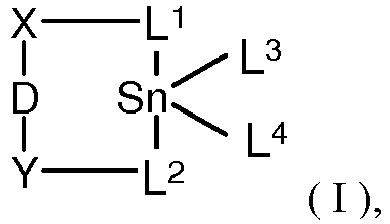


Claims (11)
- Verfahren zur Herstellung von Polyisocyanat-Polyadditionsprodukten wobeia) mindestens ein aliphatisches, cycloaliphatisches, araliphatisches und/oder aromatisches Polyisocyanatb) mindestens eine NCO-reaktive Verbindungc) mindestens ein anorganischer, Zinn enthaltender Katalysatord) gegebenenfalls weitere von c) verschiedene Katalysatoren und/oder Aktivatorene) gegebenenfalls Füllstoffe, Pigmente, Additive, Verdicker, Entschäumer und/oder andere Hilfs- und Zusatzstoffe undf) eine, bezogen auf den unter c) genannten Katalysator mindestens äquimolare Menge und bezogen auf die NCO-reaktiven Gruppen aus der Verbindung aus b) maximal äquimolare Menge einer Protonensäuremiteinander zur Reaktion gebracht werden, wobei das Verhältnis des Gewichts des Zinns aus Komponente c) und des Gewichts der Komponente a) weniger als 1000 ppm beträgt, wenn Komponente a) ein aliphatisches Polyisocyanat ist und weniger als 80 ppm beträgt, wenn Komponente a) ein aromatisches Polyisocyanat ist,
dadurch gekennzeichnet, dass als Katalysatoren c) zyklische Zinnverbindungen der Formel I, II oder III eingesetzt werden:

 D für -O-, -S- oder -N(R1)- steht,
wobei R1 für einen gesättigten oder ungesättigten, linearen oder verzweigten, aliphatischen oder cycloaliphatischen oder einen gegebenenfalls substituierten, aromatischen oder araliphatischen Rest mit bis zu 20 Kohlenstoffatomen steht, der gegebenenfalls Heteroatome aus der Reihe Sauerstoff, Schwefel, Stickstoff enthalten kann, oder für Wasserstoff oder den Rest
oder R1 und L3 zusammen für -Z-L5- stehen, undD* für -O- oder -S- steht, sowieX, Y und Z für gleiche oder unterschiedliche Reste ausgewählt aus Alkylenresten der Formeln -C(R2)(R3)-, -C(R2)(R3)-C(R4)(R5)- oder -C(R2)(R3)-C(R4)(R5)-C(R6)(R7)- oder ortho-Arylenresten der Formeln

wobei R2 bis R11 unabhängig voneinander für gesättigte oder ungesättigte, linare oder verzweigte, aliphatische oder cycloaliphatische oder gegebenenfalls substituierte, aromatische oder araliphatische Reste mit bis zu 20 Kohlenstoffatomen stehen, die gegebenenfalls Heteroatome aus der Reihe Sauerstoff, Schwefel, Stickstoff enthalten können, oder für Wasserstoff stehen, undL1, L2 und L5 unabhängig voneinander für -O-, -S-, -OC(=O)-, -OC(=S)-, -SC(=O)-,-SC(=S)-, -OS(=O)2O-, -OS(=O)2- oder -N(R12)- stehen,
wobei R12 für einen gesättigten oder ungesättigten, linearen oder verzweigten, aliphatischen oder cycloaliphatischen oder einen gegebenenfalls substituierten, aromatischen oder araliphatischen Rest mit bis zu 20 Kohlenstoffatomen steht, der gegebenenfalls Heteroatome aus der Reihe Sauerstoff, Schwefel, Stickstoff enthalten kann, oder für Wasserstoff steht, und;L3 und L4 unabhängig voneinander für -OH, -SH, -OR13, -Hal, -OC(=O)R14, -SR15,-OC(=S)R16, -OS(=O)2OR17, -OS(=O)2R18 oder -NR19R20 stehen, oder L3 und L4 zusammen für -L1-X-D-Y-L2- stehen,
wobei für R13 bis R20 unabhängig voneinander für gesättigte oder ungesättigte, lineare oder verzweigte, aliphatische oder cycloaliphatische oder gegebenenfalls substituierte, aromatische oder araliphatische Reste mit bis zu 20 Kohlenstoffatomen stehen, die gegebenenfalls Heteroatome aus der Reihe Sauerstoff, Schwefel, Stickstoff enthalten können, oder für Wasserstoff stehen. - Verfahren gemäß Anspruch 1, wobei L3 und L4 zusammen für -L1-X-D-Y-L2 stehen.
- Verfahren gemäß Ansprüchen 1 und 2, wobei D -N(R1)- ist und R1 Wasserstoff oder ein Alkyl-, Aralkyl-, Alkaryl- oder Arylrest mit bis zu 20 C-Atomen ist oder der Rest

- Verfahren Anspruch 2, wobei R1 Wasserstoff oder ein Methyl-, Ethyl-, Propyl-, Butyl-, Hexyl-, Octyl-, Ph-, oder CH3Ph-Rest oder der Rest

- Verfahren gemäß einem der Ansprüche 1 bis 3, wobei D* -O- ist.
- Verfahren gemäß einem der Ansprüche 1 bis 4, wobei X, Y und Z unabhängig voneinander Alkylenreste der Formel -C(R2)(R3)-
oder -C(R2)(R3)-C(R4)(R5)- oder ortho-Arylenreste der Formel
- Verfahren gemäß Anspruch 5, wobei die Reste R2 bis R5 unabhängig voneinander Wasserstoff oder Alkylreste mit bis zu 8 C-Atomen sind und R8 bis R11 unabhängig voneinander Wasserstoff oder Methyl sind.
- Verfahren gemäß einem der Ansprüche 1 bis 6, wobei L1, L2 und L5 unabhängig voneinander -N(R12)-, -S-, -SC(=S)-, -SC(=O)-, -OC(=S)-, -O- oder -OC(=O)- sind und R12 Wasserstoff oder ein Alkyl-, Aralkyl-, Alkaryl- oder Arylrest mit bis zu 20 C-Atomen ist.
- Verfahren gemäß Anspruch 7, wobei L1, L2 und L5 unabhängig voneinander -N(H)-, -N(CH3)-, -N(C2H5)-, -N(C4H9)-, -N(C8H17)-, -N(C6H5)-, -S-, -SC(=S)-, -SC(=O)-, -OC(=S)-, -O- oder -OC(=O)- sind.
- Verfahren einem der Ansprüche 1 bis 8, wobei L3 und L4 unabhängig voneinander -OH,-SH, -OR13, -Hal oder -OC(=O)R14 sind und die Reste R13 und R14 bis zu 20 Kohlenstoffatome aufweisen.
- Verfahren gemäß Anspruch 9, wobei L3 und L4 unabhängig voneinander Cl-, MeO-, EtO-, PrO-, BuO-, HexO-, OctO-, PhO-, Formiat, Acetat, Propanoat, Butanoat, Pentanoat, Hexanoat, Octanoat, Laurat, Lactat oder Benzoat sind, wobei Pr, Bu, Hex und Oct für alle isomeren Propyl-, Butyl-, Hexyl- sowie Octylreste stehen.
Priority Applications (1)
| Application Number | Priority Date | Filing Date | Title |
|---|---|---|---|
| EP13766073.4A EP2900716B1 (de) | 2012-09-25 | 2013-09-23 | Polyisocyanat-polyadditionsprodukte |
Applications Claiming Priority (3)
| Application Number | Priority Date | Filing Date | Title |
|---|---|---|---|
| EP12185928 | 2012-09-25 | ||
| EP13766073.4A EP2900716B1 (de) | 2012-09-25 | 2013-09-23 | Polyisocyanat-polyadditionsprodukte |
| PCT/EP2013/069730 WO2014048879A1 (de) | 2012-09-25 | 2013-09-23 | Polyisocyanat-polyadditionsprodukte |
Publications (2)
| Publication Number | Publication Date |
|---|---|
| EP2900716A1 EP2900716A1 (de) | 2015-08-05 |
| EP2900716B1 true EP2900716B1 (de) | 2020-04-15 |
Family
ID=47044816
Family Applications (1)
| Application Number | Title | Priority Date | Filing Date |
|---|---|---|---|
| EP13766073.4A Active EP2900716B1 (de) | 2012-09-25 | 2013-09-23 | Polyisocyanat-polyadditionsprodukte |
Country Status (4)
| Country | Link |
|---|---|
| US (1) | US20150240024A1 (de) |
| EP (1) | EP2900716B1 (de) |
| CN (1) | CN104640896B (de) |
| WO (1) | WO2014048879A1 (de) |
Families Citing this family (14)
| Publication number | Priority date | Publication date | Assignee | Title |
|---|---|---|---|---|
| EP3307833A1 (de) | 2015-06-15 | 2018-04-18 | BASF Coatings GmbH | Verfahren zur beschichtung von radfelgen sowie die hierbei erhaltenen schmutzabweisenden und bremsstraubresistenten beschichtungen |
| CN107771200A (zh) | 2015-06-15 | 2018-03-06 | 巴斯夫涂料有限公司 | 涂覆轮辋的方法及以此得到的防污和防制动粉尘的涂层 |
| MX2017016472A (es) * | 2015-06-15 | 2018-05-17 | Basf Coatings Gmbh | Composiciones de un material de recubrimiento de poliuretano y su uso para producir sistemas de pintura de multiples recubrimientos. |
| WO2017085268A1 (de) | 2015-11-20 | 2017-05-26 | Covestro Deutschland Ag | Mehrschichtiger lackaufbau mit thermolatentem katalysator |
| US10815330B2 (en) | 2016-04-22 | 2020-10-27 | Covestro Deutschland Ag | Thermolatently catalysed two-component system |
| EP3381959A1 (de) | 2017-03-27 | 2018-10-03 | Covestro Deutschland AG | Dual cure-verfahren unter verwendung von thermisch latenten zinnkatalysatoren |
| EP3428213A1 (de) | 2017-07-12 | 2019-01-16 | Covestro Deutschland AG | Anorganische zinnverbindungen und ihre verwendung |
| EP3502185A1 (de) * | 2017-12-22 | 2019-06-26 | Covestro Deutschland AG | Feuchtigkeitshärtende zusammensetzungen |
| EP3770198A1 (de) | 2019-07-26 | 2021-01-27 | Covestro Intellectual Property GmbH & Co. KG | Verfahren zur herstellung und aufarbeitung von katalysatorlösungen |
| EP4001334A1 (de) | 2020-11-16 | 2022-05-25 | Covestro Deutschland AG | Verwendung spezieller katalysatoren für die herstellung von polyurethanbeschichtungen |
| EP4234602A1 (de) | 2022-02-28 | 2023-08-30 | Covestro Deutschland AG | Verwendung spezieller katalysatoren für die herstellung von polyurethanbeschichtungen |
| CN115975586B (zh) * | 2022-12-08 | 2025-01-14 | 湖北回天新材料股份有限公司 | 一种双组分聚氨酯结构胶及其应用 |
| EP4455177A1 (de) | 2023-04-25 | 2024-10-30 | Covestro Deutschland AG | Verwendung eines thermolatenten katalysators zur verbesserung der eigenschaften von einschichtigen polyurethanbeschichtungen |
| WO2025168572A1 (en) | 2024-02-08 | 2025-08-14 | Allnex Netherlands B.V. | Non-aqueous crosslinkable composition |
Family Cites Families (16)
| Publication number | Priority date | Publication date | Assignee | Title |
|---|---|---|---|---|
| GB899948A (de) | 1900-01-01 | |||
| NL247436A (de) | 1959-01-17 | |||
| DE2243628A1 (de) * | 1972-09-06 | 1974-03-14 | Bayer Ag | Polymere mit alkoxysilyl-substituierten biuretgruppen und verfahren zu ihrer herstellung |
| US4430456A (en) | 1981-02-02 | 1984-02-07 | Air Products And Chemicals, Inc. | Polyurethane-forming process using amino and amido dialkyl tin carboxylates |
| US4549945A (en) | 1984-01-11 | 1985-10-29 | Phillips Petroleum Company | UV Cured polyurethanes using organotin promoters |
| DD242617A1 (de) | 1985-11-13 | 1987-02-04 | Akad Wissenschaften Ddr | Verfahren zur herstellung von polyurethanen und polyurethanharnstoffen |
| FR2716124B1 (fr) | 1994-02-11 | 1996-06-28 | Rhone Poulenc Chimie | Utilisation de dérivés de l'étain comme catalyseurs latents de polycondensation et prémélange en contenant. |
| CN1214346A (zh) * | 1997-10-15 | 1999-04-21 | 应燕 | 水性聚氨酯合成工艺 |
| GB0329272D0 (en) | 2003-12-18 | 2004-01-21 | Johnson Matthey Plc | Catalyst and method of making polyurethane materials |
| EP1934270A2 (de) | 2005-09-13 | 2008-06-25 | Dow Gloval Technologies Inc. | Distannoxankatalysatoren für die silanvernetzung und kondensationsreaktionen |
| US8026333B2 (en) | 2005-12-16 | 2011-09-27 | E. I. Du Pont De Nemours And Company | Protected air-activated organotin catalysts for polyurethane synthesis and processes therefore |
| CN101240056A (zh) * | 2008-03-07 | 2008-08-13 | 华中科技大学 | 一种蓖麻油增韧聚乳酸型聚氨酯的制备方法 |
| DE102008021980A1 (de) * | 2008-05-02 | 2009-11-05 | Bayer Materialscience Ag | Neue Katalysatoren und deren Einsatz bei der Herstellung von Polyurethanen |
| DE102009051445A1 (de) | 2009-10-30 | 2011-05-05 | Bayer Materialscience Ag | Verwendung spezieller Katalysatoren für die Herstellung von Polyurethanbeschichtungen |
| DE102010012237A1 (de) | 2010-03-19 | 2011-09-22 | Technische Universität Dortmund | Direktsynthese von Zinn(II)- und Zinn(IV)-Alkoxiden aus elementarem Zinn und Alkoholen |
| DE102010031682A1 (de) * | 2010-07-20 | 2012-01-26 | Bayer Materialscience Ag | Bindemittelkombinationen für konstruktive Trinkwasserrohrbeschichtungen |
-
2013
- 2013-09-23 US US14/430,325 patent/US20150240024A1/en not_active Abandoned
- 2013-09-23 WO PCT/EP2013/069730 patent/WO2014048879A1/de not_active Ceased
- 2013-09-23 EP EP13766073.4A patent/EP2900716B1/de active Active
- 2013-09-23 CN CN201380049618.0A patent/CN104640896B/zh not_active Expired - Fee Related
Non-Patent Citations (1)
| Title |
|---|
| None * |
Also Published As
| Publication number | Publication date |
|---|---|
| EP2900716A1 (de) | 2015-08-05 |
| US20150240024A1 (en) | 2015-08-27 |
| WO2014048879A1 (de) | 2014-04-03 |
| CN104640896A (zh) | 2015-05-20 |
| CN104640896B (zh) | 2019-03-15 |
Similar Documents
| Publication | Publication Date | Title |
|---|---|---|
| EP2900716B1 (de) | Polyisocyanat-polyadditionsprodukte | |
| EP2493948B1 (de) | Verwendung von zinn-katalysatoren für die herstellung von polyurethanbeschichtungen | |
| EP2900717B1 (de) | Polyisocyanat-polyadditionsprodukte | |
| EP2274092B1 (de) | Neue katalysatoren und deren einsatz bei der herstellung von polyurethanen | |
| EP2531538A1 (de) | Polyisocyanat-polyadditionsprodukte, ein verfahren zu ihrer herstellung und ihre verwendung | |
| EP2651999A1 (de) | Polyisocyanat-polyadditionsprodukte, ein verfahren zu ihrer herstellung und ihre verwendung | |
| WO2005097737A1 (de) | Verfahren zur herstellung von polyetherallophanaten unter verwendung von zink-verbindungen als katalysatoren | |
| EP2698200B1 (de) | Thermolatente Katalysatoren, deren Herstellung und Verwendung | |
| WO2023161345A1 (de) | Verwendung spezieller katalysatoren für die herstellung von polyurethanbeschichtungen | |
| DE102007037641A1 (de) | Verfahren zur Herstellung von Urethangruppen und Isocyanatgruppen enthaltenden Prepolymeren | |
| EP3652232B1 (de) | Anorganische zinnverbindungen und ihre verwendung | |
| EP2493614A1 (de) | Katalysatoren und ihre verwendung | |
| WO2012020027A1 (de) | Lichtechte polyurethane und ihre verwendung | |
| EP4001334A1 (de) | Verwendung spezieller katalysatoren für die herstellung von polyurethanbeschichtungen | |
| HK1172634B (en) | Use of tin catalysts for producing polyurethane coatings |
Legal Events
| Date | Code | Title | Description |
|---|---|---|---|
| PUAI | Public reference made under article 153(3) epc to a published international application that has entered the european phase |
Free format text: ORIGINAL CODE: 0009012 |
|
| 17P | Request for examination filed |
Effective date: 20150428 |
|
| AK | Designated contracting states |
Kind code of ref document: A1 Designated state(s): AL AT BE BG CH CY CZ DE DK EE ES FI FR GB GR HR HU IE IS IT LI LT LU LV MC MK MT NL NO PL PT RO RS SE SI SK SM TR |
|
| AX | Request for extension of the european patent |
Extension state: BA ME |
|
| RAP1 | Party data changed (applicant data changed or rights of an application transferred) |
Owner name: COVESTRO DEUTSCHLAND AG |
|
| DAX | Request for extension of the european patent (deleted) | ||
| STAA | Information on the status of an ep patent application or granted ep patent |
Free format text: STATUS: EXAMINATION IS IN PROGRESS |
|
| 17Q | First examination report despatched |
Effective date: 20190327 |
|
| GRAP | Despatch of communication of intention to grant a patent |
Free format text: ORIGINAL CODE: EPIDOSNIGR1 |
|
| STAA | Information on the status of an ep patent application or granted ep patent |
Free format text: STATUS: GRANT OF PATENT IS INTENDED |
|
| INTG | Intention to grant announced |
Effective date: 20200107 |
|
| GRAS | Grant fee paid |
Free format text: ORIGINAL CODE: EPIDOSNIGR3 |
|
| GRAA | (expected) grant |
Free format text: ORIGINAL CODE: 0009210 |
|
| STAA | Information on the status of an ep patent application or granted ep patent |
Free format text: STATUS: THE PATENT HAS BEEN GRANTED |
|
| AK | Designated contracting states |
Kind code of ref document: B1 Designated state(s): AL AT BE BG CH CY CZ DE DK EE ES FI FR GB GR HR HU IE IS IT LI LT LU LV MC MK MT NL NO PL PT RO RS SE SI SK SM TR |
|
| REG | Reference to a national code |
Ref country code: CH Ref legal event code: EP |
|
| REG | Reference to a national code |
Ref country code: DE Ref legal event code: R096 Ref document number: 502013014588 Country of ref document: DE |
|
| REG | Reference to a national code |
Ref country code: IE Ref legal event code: FG4D Free format text: LANGUAGE OF EP DOCUMENT: GERMAN |
|
| REG | Reference to a national code |
Ref country code: AT Ref legal event code: REF Ref document number: 1257205 Country of ref document: AT Kind code of ref document: T Effective date: 20200515 |
|
| REG | Reference to a national code |
Ref country code: NL Ref legal event code: MP Effective date: 20200415 |
|
| REG | Reference to a national code |
Ref country code: LT Ref legal event code: MG4D |
|
| PG25 | Lapsed in a contracting state [announced via postgrant information from national office to epo] |
Ref country code: NL Free format text: LAPSE BECAUSE OF FAILURE TO SUBMIT A TRANSLATION OF THE DESCRIPTION OR TO PAY THE FEE WITHIN THE PRESCRIBED TIME-LIMIT Effective date: 20200415 Ref country code: SE Free format text: LAPSE BECAUSE OF FAILURE TO SUBMIT A TRANSLATION OF THE DESCRIPTION OR TO PAY THE FEE WITHIN THE PRESCRIBED TIME-LIMIT Effective date: 20200415 Ref country code: FI Free format text: LAPSE BECAUSE OF FAILURE TO SUBMIT A TRANSLATION OF THE DESCRIPTION OR TO PAY THE FEE WITHIN THE PRESCRIBED TIME-LIMIT Effective date: 20200415 Ref country code: GR Free format text: LAPSE BECAUSE OF FAILURE TO SUBMIT A TRANSLATION OF THE DESCRIPTION OR TO PAY THE FEE WITHIN THE PRESCRIBED TIME-LIMIT Effective date: 20200716 Ref country code: IS Free format text: LAPSE BECAUSE OF FAILURE TO SUBMIT A TRANSLATION OF THE DESCRIPTION OR TO PAY THE FEE WITHIN THE PRESCRIBED TIME-LIMIT Effective date: 20200815 Ref country code: NO Free format text: LAPSE BECAUSE OF FAILURE TO SUBMIT A TRANSLATION OF THE DESCRIPTION OR TO PAY THE FEE WITHIN THE PRESCRIBED TIME-LIMIT Effective date: 20200715 Ref country code: PT Free format text: LAPSE BECAUSE OF FAILURE TO SUBMIT A TRANSLATION OF THE DESCRIPTION OR TO PAY THE FEE WITHIN THE PRESCRIBED TIME-LIMIT Effective date: 20200817 Ref country code: LT Free format text: LAPSE BECAUSE OF FAILURE TO SUBMIT A TRANSLATION OF THE DESCRIPTION OR TO PAY THE FEE WITHIN THE PRESCRIBED TIME-LIMIT Effective date: 20200415 |
|
| PG25 | Lapsed in a contracting state [announced via postgrant information from national office to epo] |
Ref country code: LV Free format text: LAPSE BECAUSE OF FAILURE TO SUBMIT A TRANSLATION OF THE DESCRIPTION OR TO PAY THE FEE WITHIN THE PRESCRIBED TIME-LIMIT Effective date: 20200415 Ref country code: RS Free format text: LAPSE BECAUSE OF FAILURE TO SUBMIT A TRANSLATION OF THE DESCRIPTION OR TO PAY THE FEE WITHIN THE PRESCRIBED TIME-LIMIT Effective date: 20200415 Ref country code: BG Free format text: LAPSE BECAUSE OF FAILURE TO SUBMIT A TRANSLATION OF THE DESCRIPTION OR TO PAY THE FEE WITHIN THE PRESCRIBED TIME-LIMIT Effective date: 20200715 Ref country code: HR Free format text: LAPSE BECAUSE OF FAILURE TO SUBMIT A TRANSLATION OF THE DESCRIPTION OR TO PAY THE FEE WITHIN THE PRESCRIBED TIME-LIMIT Effective date: 20200415 |
|
| PG25 | Lapsed in a contracting state [announced via postgrant information from national office to epo] |
Ref country code: AL Free format text: LAPSE BECAUSE OF FAILURE TO SUBMIT A TRANSLATION OF THE DESCRIPTION OR TO PAY THE FEE WITHIN THE PRESCRIBED TIME-LIMIT Effective date: 20200415 |
|
| REG | Reference to a national code |
Ref country code: DE Ref legal event code: R097 Ref document number: 502013014588 Country of ref document: DE |
|
| PG25 | Lapsed in a contracting state [announced via postgrant information from national office to epo] |
Ref country code: RO Free format text: LAPSE BECAUSE OF FAILURE TO SUBMIT A TRANSLATION OF THE DESCRIPTION OR TO PAY THE FEE WITHIN THE PRESCRIBED TIME-LIMIT Effective date: 20200415 Ref country code: CZ Free format text: LAPSE BECAUSE OF FAILURE TO SUBMIT A TRANSLATION OF THE DESCRIPTION OR TO PAY THE FEE WITHIN THE PRESCRIBED TIME-LIMIT Effective date: 20200415 Ref country code: DK Free format text: LAPSE BECAUSE OF FAILURE TO SUBMIT A TRANSLATION OF THE DESCRIPTION OR TO PAY THE FEE WITHIN THE PRESCRIBED TIME-LIMIT Effective date: 20200415 Ref country code: SM Free format text: LAPSE BECAUSE OF FAILURE TO SUBMIT A TRANSLATION OF THE DESCRIPTION OR TO PAY THE FEE WITHIN THE PRESCRIBED TIME-LIMIT Effective date: 20200415 Ref country code: EE Free format text: LAPSE BECAUSE OF FAILURE TO SUBMIT A TRANSLATION OF THE DESCRIPTION OR TO PAY THE FEE WITHIN THE PRESCRIBED TIME-LIMIT Effective date: 20200415 Ref country code: ES Free format text: LAPSE BECAUSE OF FAILURE TO SUBMIT A TRANSLATION OF THE DESCRIPTION OR TO PAY THE FEE WITHIN THE PRESCRIBED TIME-LIMIT Effective date: 20200415 |
|
| PLBE | No opposition filed within time limit |
Free format text: ORIGINAL CODE: 0009261 |
|
| STAA | Information on the status of an ep patent application or granted ep patent |
Free format text: STATUS: NO OPPOSITION FILED WITHIN TIME LIMIT |
|
| PG25 | Lapsed in a contracting state [announced via postgrant information from national office to epo] |
Ref country code: PL Free format text: LAPSE BECAUSE OF FAILURE TO SUBMIT A TRANSLATION OF THE DESCRIPTION OR TO PAY THE FEE WITHIN THE PRESCRIBED TIME-LIMIT Effective date: 20200415 Ref country code: SK Free format text: LAPSE BECAUSE OF FAILURE TO SUBMIT A TRANSLATION OF THE DESCRIPTION OR TO PAY THE FEE WITHIN THE PRESCRIBED TIME-LIMIT Effective date: 20200415 |
|
| 26N | No opposition filed |
Effective date: 20210118 |
|
| PG25 | Lapsed in a contracting state [announced via postgrant information from national office to epo] |
Ref country code: MC Free format text: LAPSE BECAUSE OF FAILURE TO SUBMIT A TRANSLATION OF THE DESCRIPTION OR TO PAY THE FEE WITHIN THE PRESCRIBED TIME-LIMIT Effective date: 20200415 |
|
| REG | Reference to a national code |
Ref country code: CH Ref legal event code: PL |
|
| GBPC | Gb: european patent ceased through non-payment of renewal fee |
Effective date: 20200923 |
|
| PG25 | Lapsed in a contracting state [announced via postgrant information from national office to epo] |
Ref country code: SI Free format text: LAPSE BECAUSE OF FAILURE TO SUBMIT A TRANSLATION OF THE DESCRIPTION OR TO PAY THE FEE WITHIN THE PRESCRIBED TIME-LIMIT Effective date: 20200415 |
|
| REG | Reference to a national code |
Ref country code: BE Ref legal event code: MM Effective date: 20200930 |
|
| PG25 | Lapsed in a contracting state [announced via postgrant information from national office to epo] |
Ref country code: LU Free format text: LAPSE BECAUSE OF NON-PAYMENT OF DUE FEES Effective date: 20200923 |
|
| PG25 | Lapsed in a contracting state [announced via postgrant information from national office to epo] |
Ref country code: GB Free format text: LAPSE BECAUSE OF NON-PAYMENT OF DUE FEES Effective date: 20200923 Ref country code: LI Free format text: LAPSE BECAUSE OF NON-PAYMENT OF DUE FEES Effective date: 20200930 Ref country code: IE Free format text: LAPSE BECAUSE OF NON-PAYMENT OF DUE FEES Effective date: 20200923 Ref country code: BE Free format text: LAPSE BECAUSE OF NON-PAYMENT OF DUE FEES Effective date: 20200930 Ref country code: CH Free format text: LAPSE BECAUSE OF NON-PAYMENT OF DUE FEES Effective date: 20200930 |
|
| REG | Reference to a national code |
Ref country code: AT Ref legal event code: MM01 Ref document number: 1257205 Country of ref document: AT Kind code of ref document: T Effective date: 20200923 |
|
| PG25 | Lapsed in a contracting state [announced via postgrant information from national office to epo] |
Ref country code: AT Free format text: LAPSE BECAUSE OF NON-PAYMENT OF DUE FEES Effective date: 20200923 |
|
| PG25 | Lapsed in a contracting state [announced via postgrant information from national office to epo] |
Ref country code: TR Free format text: LAPSE BECAUSE OF FAILURE TO SUBMIT A TRANSLATION OF THE DESCRIPTION OR TO PAY THE FEE WITHIN THE PRESCRIBED TIME-LIMIT Effective date: 20200415 Ref country code: MT Free format text: LAPSE BECAUSE OF FAILURE TO SUBMIT A TRANSLATION OF THE DESCRIPTION OR TO PAY THE FEE WITHIN THE PRESCRIBED TIME-LIMIT Effective date: 20200415 Ref country code: CY Free format text: LAPSE BECAUSE OF FAILURE TO SUBMIT A TRANSLATION OF THE DESCRIPTION OR TO PAY THE FEE WITHIN THE PRESCRIBED TIME-LIMIT Effective date: 20200415 |
|
| PG25 | Lapsed in a contracting state [announced via postgrant information from national office to epo] |
Ref country code: MK Free format text: LAPSE BECAUSE OF FAILURE TO SUBMIT A TRANSLATION OF THE DESCRIPTION OR TO PAY THE FEE WITHIN THE PRESCRIBED TIME-LIMIT Effective date: 20200415 |
|
| PGFP | Annual fee paid to national office [announced via postgrant information from national office to epo] |
Ref country code: IT Payment date: 20220829 Year of fee payment: 10 Ref country code: DE Payment date: 20220609 Year of fee payment: 10 |
|
| PGFP | Annual fee paid to national office [announced via postgrant information from national office to epo] |
Ref country code: FR Payment date: 20220822 Year of fee payment: 10 |
|
| REG | Reference to a national code |
Ref country code: DE Ref legal event code: R119 Ref document number: 502013014588 Country of ref document: DE |
|
| PG25 | Lapsed in a contracting state [announced via postgrant information from national office to epo] |
Ref country code: FR Free format text: LAPSE BECAUSE OF NON-PAYMENT OF DUE FEES Effective date: 20230930 Ref country code: DE Free format text: LAPSE BECAUSE OF NON-PAYMENT OF DUE FEES Effective date: 20240403 |
|
| PG25 | Lapsed in a contracting state [announced via postgrant information from national office to epo] |
Ref country code: IT Free format text: LAPSE BECAUSE OF NON-PAYMENT OF DUE FEES Effective date: 20230923 |
|
| PG25 | Lapsed in a contracting state [announced via postgrant information from national office to epo] |
Ref country code: IT Free format text: LAPSE BECAUSE OF NON-PAYMENT OF DUE FEES Effective date: 20230923 |