EP2907565A1 - Dialyse-Einheit zum kontinuierlichen Puffer- bzw. Medienaustausch aus einer Proteinlösung - Google Patents
Dialyse-Einheit zum kontinuierlichen Puffer- bzw. Medienaustausch aus einer Proteinlösung Download PDFInfo
- Publication number
- EP2907565A1 EP2907565A1 EP14155338.8A EP14155338A EP2907565A1 EP 2907565 A1 EP2907565 A1 EP 2907565A1 EP 14155338 A EP14155338 A EP 14155338A EP 2907565 A1 EP2907565 A1 EP 2907565A1
- Authority
- EP
- European Patent Office
- Prior art keywords
- ultrafiltration
- capillary
- unit
- module
- product
- Prior art date
- Legal status (The legal status is an assumption and is not a legal conclusion. Google has not performed a legal analysis and makes no representation as to the accuracy of the status listed.)
- Withdrawn
Links
Images

Classifications
-
- B—PERFORMING OPERATIONS; TRANSPORTING
- B01—PHYSICAL OR CHEMICAL PROCESSES OR APPARATUS IN GENERAL
- B01D—SEPARATION
- B01D61/00—Processes of separation using semi-permeable membranes, e.g. dialysis, osmosis or ultrafiltration; Apparatus, accessories or auxiliary operations specially adapted therefor
- B01D61/24—Dialysis ; Membrane extraction
- B01D61/243—Dialysis
- B01D61/244—Dialysis comprising multiple dialysis steps
-
- B—PERFORMING OPERATIONS; TRANSPORTING
- B01—PHYSICAL OR CHEMICAL PROCESSES OR APPARATUS IN GENERAL
- B01D—SEPARATION
- B01D61/00—Processes of separation using semi-permeable membranes, e.g. dialysis, osmosis or ultrafiltration; Apparatus, accessories or auxiliary operations specially adapted therefor
- B01D61/14—Ultrafiltration; Microfiltration
- B01D61/145—Ultrafiltration
-
- B—PERFORMING OPERATIONS; TRANSPORTING
- B01—PHYSICAL OR CHEMICAL PROCESSES OR APPARATUS IN GENERAL
- B01D—SEPARATION
- B01D61/00—Processes of separation using semi-permeable membranes, e.g. dialysis, osmosis or ultrafiltration; Apparatus, accessories or auxiliary operations specially adapted therefor
- B01D61/24—Dialysis ; Membrane extraction
-
- B—PERFORMING OPERATIONS; TRANSPORTING
- B01—PHYSICAL OR CHEMICAL PROCESSES OR APPARATUS IN GENERAL
- B01D—SEPARATION
- B01D61/00—Processes of separation using semi-permeable membranes, e.g. dialysis, osmosis or ultrafiltration; Apparatus, accessories or auxiliary operations specially adapted therefor
- B01D61/24—Dialysis ; Membrane extraction
- B01D61/243—Dialysis
-
- B—PERFORMING OPERATIONS; TRANSPORTING
- B01—PHYSICAL OR CHEMICAL PROCESSES OR APPARATUS IN GENERAL
- B01D—SEPARATION
- B01D61/00—Processes of separation using semi-permeable membranes, e.g. dialysis, osmosis or ultrafiltration; Apparatus, accessories or auxiliary operations specially adapted therefor
- B01D61/24—Dialysis ; Membrane extraction
- B01D61/246—Membrane extraction
-
- B—PERFORMING OPERATIONS; TRANSPORTING
- B01—PHYSICAL OR CHEMICAL PROCESSES OR APPARATUS IN GENERAL
- B01D—SEPARATION
- B01D61/00—Processes of separation using semi-permeable membranes, e.g. dialysis, osmosis or ultrafiltration; Apparatus, accessories or auxiliary operations specially adapted therefor
- B01D61/24—Dialysis ; Membrane extraction
- B01D61/246—Membrane extraction
- B01D61/2461—Membrane extraction comprising multiple membrane extraction steps
-
- B—PERFORMING OPERATIONS; TRANSPORTING
- B01—PHYSICAL OR CHEMICAL PROCESSES OR APPARATUS IN GENERAL
- B01D—SEPARATION
- B01D61/00—Processes of separation using semi-permeable membranes, e.g. dialysis, osmosis or ultrafiltration; Apparatus, accessories or auxiliary operations specially adapted therefor
- B01D61/24—Dialysis ; Membrane extraction
- B01D61/28—Apparatus therefor
-
- B—PERFORMING OPERATIONS; TRANSPORTING
- B01—PHYSICAL OR CHEMICAL PROCESSES OR APPARATUS IN GENERAL
- B01D—SEPARATION
- B01D61/00—Processes of separation using semi-permeable membranes, e.g. dialysis, osmosis or ultrafiltration; Apparatus, accessories or auxiliary operations specially adapted therefor
- B01D61/24—Dialysis ; Membrane extraction
- B01D61/32—Controlling or regulating
-
- B—PERFORMING OPERATIONS; TRANSPORTING
- B01—PHYSICAL OR CHEMICAL PROCESSES OR APPARATUS IN GENERAL
- B01D—SEPARATION
- B01D61/00—Processes of separation using semi-permeable membranes, e.g. dialysis, osmosis or ultrafiltration; Apparatus, accessories or auxiliary operations specially adapted therefor
- B01D61/58—Multistep processes
-
- B—PERFORMING OPERATIONS; TRANSPORTING
- B01—PHYSICAL OR CHEMICAL PROCESSES OR APPARATUS IN GENERAL
- B01D—SEPARATION
- B01D63/00—Apparatus in general for separation processes using semi-permeable membranes
- B01D63/02—Hollow fibre modules
-
- B—PERFORMING OPERATIONS; TRANSPORTING
- B01—PHYSICAL OR CHEMICAL PROCESSES OR APPARATUS IN GENERAL
- B01D—SEPARATION
- B01D63/00—Apparatus in general for separation processes using semi-permeable membranes
- B01D63/02—Hollow fibre modules
- B01D63/031—Two or more types of hollow fibres within one bundle or within one potting or tube-sheet
-
- B—PERFORMING OPERATIONS; TRANSPORTING
- B01—PHYSICAL OR CHEMICAL PROCESSES OR APPARATUS IN GENERAL
- B01D—SEPARATION
- B01D63/00—Apparatus in general for separation processes using semi-permeable membranes
- B01D63/02—Hollow fibre modules
- B01D63/032—More than two tube sheets for one bundle
-
- B—PERFORMING OPERATIONS; TRANSPORTING
- B01—PHYSICAL OR CHEMICAL PROCESSES OR APPARATUS IN GENERAL
- B01D—SEPARATION
- B01D63/00—Apparatus in general for separation processes using semi-permeable membranes
- B01D63/02—Hollow fibre modules
- B01D63/033—Specific distribution of fibres within one potting or tube-sheet
-
- B—PERFORMING OPERATIONS; TRANSPORTING
- B01—PHYSICAL OR CHEMICAL PROCESSES OR APPARATUS IN GENERAL
- B01D—SEPARATION
- B01D63/00—Apparatus in general for separation processes using semi-permeable membranes
- B01D63/02—Hollow fibre modules
- B01D63/034—Lumen open in more than two directions
-
- C—CHEMISTRY; METALLURGY
- C07—ORGANIC CHEMISTRY
- C07K—PEPTIDES
- C07K1/00—General methods for the preparation of peptides, i.e. processes for the organic chemical preparation of peptides or proteins of any length
- C07K1/14—Extraction; Separation; Purification
- C07K1/34—Extraction; Separation; Purification by filtration, ultrafiltration or reverse osmosis
-
- C—CHEMISTRY; METALLURGY
- C07—ORGANIC CHEMISTRY
- C07K—PEPTIDES
- C07K16/00—Immunoglobulins [IG], e.g. monoclonal or polyclonal antibodies
-
- C—CHEMISTRY; METALLURGY
- C07—ORGANIC CHEMISTRY
- C07K—PEPTIDES
- C07K16/00—Immunoglobulins [IG], e.g. monoclonal or polyclonal antibodies
- C07K16/06—Immunoglobulins [IG], e.g. monoclonal or polyclonal antibodies from serum
- C07K16/065—Purification, fragmentation
-
- C—CHEMISTRY; METALLURGY
- C12—BIOCHEMISTRY; BEER; SPIRITS; WINE; VINEGAR; MICROBIOLOGY; ENZYMOLOGY; MUTATION OR GENETIC ENGINEERING
- C12M—APPARATUS FOR ENZYMOLOGY OR MICROBIOLOGY; APPARATUS FOR CULTURING MICROORGANISMS FOR PRODUCING BIOMASS, FOR GROWING CELLS OR FOR OBTAINING FERMENTATION OR METABOLIC PRODUCTS, i.e. BIOREACTORS OR FERMENTERS
- C12M47/00—Means for after-treatment of the produced biomass or of the fermentation or metabolic products, e.g. storage of biomass
- C12M47/10—Separation or concentration of fermentation products
-
- B—PERFORMING OPERATIONS; TRANSPORTING
- B01—PHYSICAL OR CHEMICAL PROCESSES OR APPARATUS IN GENERAL
- B01D—SEPARATION
- B01D2311/00—Details relating to membrane separation process operations and control
- B01D2311/04—Specific process operations in the feed stream; Feed pretreatment
-
- B—PERFORMING OPERATIONS; TRANSPORTING
- B01—PHYSICAL OR CHEMICAL PROCESSES OR APPARATUS IN GENERAL
- B01D—SEPARATION
- B01D2311/00—Details relating to membrane separation process operations and control
- B01D2311/08—Specific process operations in the concentrate stream
-
- B—PERFORMING OPERATIONS; TRANSPORTING
- B01—PHYSICAL OR CHEMICAL PROCESSES OR APPARATUS IN GENERAL
- B01D—SEPARATION
- B01D2311/00—Details relating to membrane separation process operations and control
- B01D2311/16—Flow or flux control
- B01D2311/165—Cross-flow velocity control
-
- B—PERFORMING OPERATIONS; TRANSPORTING
- B01—PHYSICAL OR CHEMICAL PROCESSES OR APPARATUS IN GENERAL
- B01D—SEPARATION
- B01D2311/00—Details relating to membrane separation process operations and control
- B01D2311/25—Recirculation, recycling or bypass, e.g. recirculation of concentrate into the feed
-
- B—PERFORMING OPERATIONS; TRANSPORTING
- B01—PHYSICAL OR CHEMICAL PROCESSES OR APPARATUS IN GENERAL
- B01D—SEPARATION
- B01D2311/00—Details relating to membrane separation process operations and control
- B01D2311/25—Recirculation, recycling or bypass, e.g. recirculation of concentrate into the feed
- B01D2311/251—Recirculation of permeate
- B01D2311/2512—Recirculation of permeate to feed side
-
- B—PERFORMING OPERATIONS; TRANSPORTING
- B01—PHYSICAL OR CHEMICAL PROCESSES OR APPARATUS IN GENERAL
- B01D—SEPARATION
- B01D2311/00—Details relating to membrane separation process operations and control
- B01D2311/25—Recirculation, recycling or bypass, e.g. recirculation of concentrate into the feed
- B01D2311/251—Recirculation of permeate
- B01D2311/2513—Recirculation of permeate to concentrate side
-
- B—PERFORMING OPERATIONS; TRANSPORTING
- B01—PHYSICAL OR CHEMICAL PROCESSES OR APPARATUS IN GENERAL
- B01D—SEPARATION
- B01D2311/00—Details relating to membrane separation process operations and control
- B01D2311/25—Recirculation, recycling or bypass, e.g. recirculation of concentrate into the feed
- B01D2311/252—Recirculation of concentrate
- B01D2311/2521—Recirculation of concentrate to permeate side
-
- B—PERFORMING OPERATIONS; TRANSPORTING
- B01—PHYSICAL OR CHEMICAL PROCESSES OR APPARATUS IN GENERAL
- B01D—SEPARATION
- B01D2311/00—Details relating to membrane separation process operations and control
- B01D2311/25—Recirculation, recycling or bypass, e.g. recirculation of concentrate into the feed
- B01D2311/252—Recirculation of concentrate
- B01D2311/2523—Recirculation of concentrate to feed side
-
- B—PERFORMING OPERATIONS; TRANSPORTING
- B01—PHYSICAL OR CHEMICAL PROCESSES OR APPARATUS IN GENERAL
- B01D—SEPARATION
- B01D2311/00—Details relating to membrane separation process operations and control
- B01D2311/25—Recirculation, recycling or bypass, e.g. recirculation of concentrate into the feed
- B01D2311/253—Bypassing of feed
- B01D2311/2531—Bypassing of feed to permeate side
-
- B—PERFORMING OPERATIONS; TRANSPORTING
- B01—PHYSICAL OR CHEMICAL PROCESSES OR APPARATUS IN GENERAL
- B01D—SEPARATION
- B01D2311/00—Details relating to membrane separation process operations and control
- B01D2311/25—Recirculation, recycling or bypass, e.g. recirculation of concentrate into the feed
- B01D2311/253—Bypassing of feed
- B01D2311/2532—Bypassing of feed to concentrate side
-
- B—PERFORMING OPERATIONS; TRANSPORTING
- B01—PHYSICAL OR CHEMICAL PROCESSES OR APPARATUS IN GENERAL
- B01D—SEPARATION
- B01D2315/00—Details relating to the membrane module operation
- B01D2315/10—Cross-flow filtration
-
- B—PERFORMING OPERATIONS; TRANSPORTING
- B01—PHYSICAL OR CHEMICAL PROCESSES OR APPARATUS IN GENERAL
- B01D—SEPARATION
- B01D2317/00—Membrane module arrangements within a plant or an apparatus
- B01D2317/02—Elements in series
-
- B—PERFORMING OPERATIONS; TRANSPORTING
- B01—PHYSICAL OR CHEMICAL PROCESSES OR APPARATUS IN GENERAL
- B01D—SEPARATION
- B01D2317/00—Membrane module arrangements within a plant or an apparatus
- B01D2317/04—Elements in parallel
Definitions
- the invention relates to an ultrafiltration unit for continuous buffer or media exchange, a method for continuous buffer or media exchange in the Ultrafiltrationsunit, and a system especially for the (semi-) continuous production of biopharmaceutical and biological macromolecular products especially such as proteins, eg. As monoclonal antibodies and vaccines comprising the ultrafiltration according to the invention.
- Continuous operation in the sense of the application means that the feed flow into the bioreactor and the removal of the product stream from the production plant are non-stop, with some steps being semi-continuous.
- the loss of use of the reactors due to the provisioning procedures may be on the order of the reactor availability, in particular in the case of short periods of use and frequent product changes.
- WO2012 / 078677 describes a method and a plant for the continuous preparation of biopharmaceutical products by chromatography and their integration in a production plant, especially in a disposable plant. Although WO2012 / 078677 Provides approaches for the continuous production of biopharmaceutical and biological products, the disclosed solution is not sufficient in practice.
- the nutrient solution is also an ideal growth medium for bacteria and spores.
- a continuous process solution must preferably be found for a continuous process.
- WO2012 / 078677 does not concern a buffer or media exchange or the adjustment of the feed stream, in particular in the run-up to the chromatography unit, so that the applicability of the disclosed continuous plant is limited to types of chromatographs which do not require special adjustments, in particular with regard to concentration, pH and conductivity.
- buffering is known in the art.
- batchwise diafiltration with an ultrafiltration membrane is used.
- a product solution is placed in a container.
- the solution is circulated through an ultrafiltration membrane, with the product retained as far as possible from the membrane, while salts / buffers are separated through the membrane as permeate.
- the level in the product container is usually kept constant, in which the permeate is replaced by washing liquid.
- Dynamic dialysis uses flow dynamics to increase both rate and efficiency of dialysis.
- the circulation of the sample and / or dialysate produces the highest possible concentration gradient to significantly shorten the dialysis time.
- Other advantages of the flow are that it prevents membrane contamination while in some cases creating a pressure differential. This additional driving force increases the hypoosmotic mass transfer rate across the semipermeable membrane and allows sample concentration during the dialysis process.
- the dialysate flows and the sample can be either static or flowing. These methods are used for various reasons and for various purposes in dynamic dialysis. If the sample flows, it is guided in the prior art in a circular system comprising a product kettle [http://de.spectrumlabs.com/dialysis/Dynamic.html].
- continuous diafiltration means that a feed stream and a washing stream are continuously fed to the ultrafiltration unit.
- Semi-continuous operation in the sense of the application means what is generally understood as batch or batch purification, ie. H. in that one or more batches of a protein solution from one or more containers are fed continuously to the ultrafiltration unit, the washing liquid also being supplied continuously here.
- the first object to provide a solution that allows adjustment of the product stream, in particular the adjustment of the concentration, pH and / or conductivity of a continuous product stream, by rebuffering.
- the solution should be flexible and allow the adjustment of the product stream to the requirements of one or more different chromatographic purification steps.
- a countercurrently operated hollow fiber ultrafiltration module capillary ultrafiltration module
- hemodialysis module in an ultrafiltration unit
- the product stream which is transported into the capillary as usual in the membrane technology in the application also called feed stream or feed.
- Product stream, which is conveyed out of the capillaries, is also called retentate as usual in membrane technology in the application.
- the molecular weight cut-off (MWCO) of the ultrafiltration membrane is to be selected such that the membrane retains the target product in the hollow fibers / capillaries such that a yield loss of ⁇ 90%, preferably ⁇ 30% and particularly preferably ⁇ 10%, is not exceeded. Smaller molecules and ions are not retained by the membrane.
- the loss in yield means the loss of the product permeating the membrane in relation to the product in the feed stream and is usually measured by measuring a sample by one of the known methods, such as e.g. As chromatographic method, ELISA, etc. measured.
- capillary ultrafiltration modules steam-sterilized or gamma-sterilized are accordingly commercially available.
- a hollow fiber module such.
- the GE Healthcare Process Scale Ultrafiltration Hollow Fiber Cartridge UFP-750-E-55A
- the feed stream is conveyed in a controlled manner into the hollow fibers / capillaries of the ultrafiltration module and a washing liquid is conveyed in a controlled manner into the shell side.
- the retentate is conveyed out of the hollow fibers / capillaries in a controlled manner and forwarded to the plant.
- the recirculation can be carried out successfully without circulation flow of the product stream. This is already done when using a single ultrafiltration module. However, it may be advantageous to connect several ultrafiltration modules in series or in parallel.
- the washing liquid is pumped either in cocurrent, in cross-flow or in countercurrent, preferably in crossflow, particularly preferably in countercurrent to the feed stream.
- the operation in countercurrent in which the product stream (eg, the protein solution in buffer A) flows from bottom to top through the hollow fibers / capillaries of the ultrafiltration module while the washing liquid (buffer S) usually on the shell side from top to bottom on the hollow fibers / Passed capillaries, allows higher purity with less washing liquid.
- the product stream can flow from top to bottom through the capillaries of the hemodialysis module while the washing liquid is guided on the shell side from bottom to top at the capillaries.
- one pump is used in each case.
- another pump or a control valve is used as a means for the controlled removal of the product stream.
- the pressure ratio between capillary and shell side is set for the controlled removal of the washing liquid. This is usually also done by using a further pump or a control valve for removing the washing liquid as a means for controlled removal of the washing liquid.
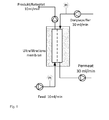
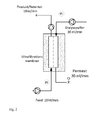
- Ultrafiltration units according to the invention comprising a capillary ultrafiltration module are shown in FIG Fig. 1 and 2 exemplified without limiting itself to it.
- the feed flow and the washing liquid flow are realized by means of pumps.
- the retentate flow is preferably realized via a positive-conveying pump such as a peristaltic pump ( Fig. 1 ), or alternatively via a control valve and a flow control (embodiment not shown).
- a positive-conveying pump such as a peristaltic pump ( Fig. 1 ), or alternatively via a control valve and a flow control (embodiment not shown).
- the ratio of the pressures of the input streams Fig. 1 , Feed and dialysis buffer
- an additional fourth pump can be used in the permeate ( Fig. 1 ) or preferably the permeate outlet through a valve or hydrostatic pressure ( Fig. 2 ) are throttled.
- FIG Fig. 3 Another embodiment of the ultrafiltration unit is shown in FIG Fig. 3 schematically illustrated without limiting itself thereto.
- a pump M0303 conveys a volume flow into one or more hemodialysis modules (DF module). Preferably, one or more hemodialysis modules are incorporated in Series connected.
- a pressure sensor P0303 preferably monitors the feed pressure of the ultrafiltration unit. If this exceeds the maximum pressure, the stage is switched off.
- pump M0304 preferably pumps as fast as M0303 to prevent concentration change of the product in the hemodialysis module and gel layer formation on the membrane. Pump M0304 delivers the dialyzed retentate to an intermediate bag B0302.
- the flow rate of the pump M0303 is set so high that the desired concentrations of buffer in the retentate are achieved.
- the used washing liquid is collected in bag B0304.
- a means for controlled removal of the washing liquid from the ultrafiltration module is used.
- the invention further relates to a process for the continuous ultrafiltration of a feed stream containing biopharmaceutical and biological macromolecular products in the unit for continuous ultrafiltration according to the invention, wherein the feed stream is washed with a washing liquid via at least one capillary ultrafiltration membrane of a capillary ultrafiltration module, characterized in that the feed stream in the capillary is conveyed and the washing liquid is flowed over the outside of the capillary, wherein the feed stream is continuously fed into the ultrafiltration module, and continuously discharged from the ultrafiltration module, wherein the feed stream and the washing liquid is not circulated into the ultrafiltration module.
- Diffusive transport is achieved, in particular, when the dilution or concentration of the non-permeating substances takes place at most by a factor of 1 to 5, preferably by a factor of 1 to 2, particularly preferably by a factor of 1.
- ultrafiltration modules can be connected in series or in parallel.
- the number of ultrafiltration modules in series must be selected so that the total pressure loss through the ultrafiltration modules does not exceed 1 bar.
- the number of ultrafiltration modules connected in parallel should be such that the feed flow into the capillaries does not exceed the maximum flow rate recommended by the manufacturer, preferably a flow rate of 0.1 to 15% of the recommended flow rate, especially 0.1 to 5% of these flow rate.
- hemodialysis modules Revaclear 300 Capillary Dialyzer from Gambro were used in the test facility.
- the feed flow should not exceed 500 ml / min, preferably 75 ml / min, more preferably 25 ml / min per module.
- priming start-up by washing and venting
- the dialysis modules is decisive for the quality of washing, since otherwise not all capillaries are utilized. Due to the preferably low flow rates, it is a particular difficulty to bleed the dialysis modules capillary side as well as shell side.
- each dialysis module is preferably flushed before startup, both the feed side and the shell side with a buffer solution of at least 10% to 100%, preferably 15 to 100% and particularly preferably 30 to 100% of the blood flow rate recommended by the manufacturer until no Gas bubbles more escape the dialysis module. It is critical that both the feed side and the shell side is bubble-free.
- the unit according to the invention for continuous ultrafiltration is inventively integrated into a production plant, in particular in a production plant for the continuous or semi-continuous implementation of one or more above-mentioned production steps.
- a further subject of the application is therefore a production plant comprising at least one unit according to the invention for the continuous ultrafiltration of a product stream containing biopharmaceutical and biological macromolecular products.
- the production plant according to the invention before or after one of the unit for the continuous ultrafiltration of a product stream comprises a unit for concentrating the product stream (also called Konzentrationsunit).
- the unit according to the invention for continuous ultrafiltration in the production plant is preferably connected to the outlet line of a concentration unit.
- concentration loop the concentration loop
- a pump M0301 usually conveys the product stream from a supply bag into the concentration loop.
- a membrane module usually one or more CFF ultrafiltration modules (Cross Flow Filtration) alternatively ATF (Alternating Tangential Flow) ultrafiltration modules, but preferably a CFF module is used.
- CFF modules Cross Flow Filtration
- ATF Alternating Tangential Flow ultrafiltration modules
- CFF modules RTP UFP-30-C-5S from GE Healthcare LifeScience were used in the test facility.
- the delivery rate of M0302 is usually set at least to the minimum overflow rate specified by the membrane manufacturer. For example, at least 21 rpm was set for the RTP UFP-30-C-5S module.
- the pump M303 pumps the product flow out of the concentration loop.
- the delivery rate of the pump M303 is set in relation to the delivery rate of the pump M301. This ratio corresponds to the desired concentration factor.
- the pressure sensor P0301 and P0302 establish a pressure which causes liquid from the concentration loop to permeate through the membrane, but the biological product is largely retained.
- a membrane is used which retains at least 90%, preferably 90-95%, more preferably 95-100% of the biological product.
- a positive-conveying pump is used which can also hold a pre-pressure without the liquid flowing through the pump and not through the membrane.
- a peristaltic pump is used here.
- a control valve-flow meter combination can be used, through which the permeate flow is adjusted.
- the permeate passing through the membrane of the membrane module is collected through the permeate outlet in vessel B0304.
- the P0301 pressure sensor between the M0301 pump and the concentration loop monitors the pressure in front of the diaphragm module and may cause M0302 to trip if a maximum pressure is exceeded.
- the membrane module must be replaced.
- the concentration loop in this case is replaced as a whole by a new sterilized.
- a pressure sensor P0302 measures the pressure behind the concentration loop, whereby the transmembrane pressure can be determined.
- a flow sensor F0301 (not shown) measures the Volume flow in the concentration loop.
- the pump M0303 conveys a volume flow out of the concentration loop into the ultrafiltration unit.
- Compliance with the sterility is another challenge and task for a (semi-) continuous production plant.
- all elements are connected by lines esp. Disposable lines with each other.
- biocompatible lines Pharmed BPT® temperature resistant silicone tubing
- the other elements of the system are preferably disposable elements;
- elements are selected from the group of disposable reactors, disposable filtration elements, disposable valves, disposable sensors (flow, pH, conductivity, UV, pressure), disposable cell restraint systems, disposable tubing, disposable membranes, disposable connectors , Disposable chromatography columns, disposable containers, disposable sampling systems used.
- means for conveying liquid, in particular pumps are preferably disposable pumps.
- the product flow is interrupted and an intermediate bag (original bag B0301 in Fig. 3 ) fills up for the duration of the change.
- the life of the respective modules can be improved so as to justify interruption and catching of the product stream in an intermediate bag for the duration of the change.
- the concentration step significantly reduces the volume flow and increases the product concentration.
- the production plant according to the invention comprises one or more units for chromatography connected downstream of the unit for continuous ultrafiltration of the product stream.
- a test system was used according to Fig. 3 exemplified.
- Pharmed BPT® lines with an internal diameter of 3.2 mm were used.
- the test equipment included a 10 L container filled with a cell-free fermentation broth as a test product stream.
- a first pump (M0301) connected by conduits to the container (not shown) delivered the product stream as on Fig. 3 presented for the time being in the concentration unit.
- an immunoglobulin G antibody IgG antibody
- the concentration unit included a pump M0302 for recirculation flow into the concentration loop, a vent bag (no numbering) connected to the concentration loop and a diaphragm module (UF module 3.1) by means of lines and manual pinch valves AB0301, AB0302 and AB0303.
- the membrane module used was, by way of example, a CFF ultrafiltration module RTP UFP-30-C-5S from GE Healthcare LifeScience.
- the delivery rate of M0302 was set to the minimum overflow rate specified by the membrane manufacturer. For example, at least 2 l / min was set for the RTP UFP-30-C-5S module.
- the concentration loop Prior to the actual concentration, the concentration loop is first vented in which AB0301 and AB0303 and AB0302 are partially opened. If the concentration loop is bubble-free, AB0302 will be fully opened and AB0301 and AB0302 will be closed.
- the M0303 pump delivered the product stream from the concentration loop.
- the delivery rate of the pump M0303 was set in relation to the delivery rate of the pump M0301, which corresponded to the desired concentration factor.
- a pressure was established which caused liquid from the concentration loop to permeate through the membrane, but the biological product was largely retained.
- the permeate passing through the membrane of the membrane module was collected in vessel B0304.
- Pressure sensor P0301 between pump M0301 and the concentration loop monitored the pressure upstream of the diaphragm module and could cause M0302 to trip if a maximum pressure was exceeded. In this case, the membrane module would have to be replaced.
- the pressure sensor P0302 measured the pressure behind the concentration loop, which allowed the transmembrane pressure to be determined.
- a flow sensor F0301 (not shown) measured the volume flow in the concentration loop.
- the pump M0303 conveyed a volume flow from the concentration unit into the following ultrafiltration unit.
- Pump M0303 delivered a volume flow into the hemodialysis module.
- a pressure sensor P0303 monitored the feed pressure of the ultrafiltration unit.
- the feed stream was then adjusted to 3 ml / min per module.
- the dialysis buffer was pumped to the permeate side of the hemodialysis modules with the pump M0305 at a flow rate of 3 and 6 ml / min respectively as that of M0303 countercurrent to the feed flow.
- the flow rate in M0303 was adjusted so high that the desired concentrations of buffers in the product were reached.
- the spent wash was collected in Bag B0304.
- pump M0304 just as fast as M0303, to prevent concentration change of the product in the dialysis module and gel layering on the membrane, delivered the concentrated and dialysed product stream to an intermediate bag B0302, the filling of which was monitored with a WO302 load cell.
- Table A shows the measurements of the conductivity of the feed (LF feed) and the retentate (LF retentate) at different target flow rates of the respective pumps.
- Table B shows the measurements of the retentate conductivity (LF retentate) at different target flow rates of the respective pumps and the concentration of IgG antibody in the retentate as measured by HPLC ProtA.
- the concentration of IgG in the aggregate sample at elevated flow rate was determined by the above-mentioned method for calculating the yield loss.
- the yield loss in the permeate was therefore 1.4%.
Landscapes
- Chemical & Material Sciences (AREA)
- Engineering & Computer Science (AREA)
- Health & Medical Sciences (AREA)
- Chemical Kinetics & Catalysis (AREA)
- Water Supply & Treatment (AREA)
- Organic Chemistry (AREA)
- Life Sciences & Earth Sciences (AREA)
- Urology & Nephrology (AREA)
- Biochemistry (AREA)
- General Health & Medical Sciences (AREA)
- Genetics & Genomics (AREA)
- Biotechnology (AREA)
- Proteomics, Peptides & Aminoacids (AREA)
- Molecular Biology (AREA)
- Medicinal Chemistry (AREA)
- Biophysics (AREA)
- Wood Science & Technology (AREA)
- Bioinformatics & Cheminformatics (AREA)
- Zoology (AREA)
- Immunology (AREA)
- General Engineering & Computer Science (AREA)
- Sustainable Development (AREA)
- Microbiology (AREA)
- Biomedical Technology (AREA)
- Analytical Chemistry (AREA)
- Separation Using Semi-Permeable Membranes (AREA)
- Peptides Or Proteins (AREA)
- External Artificial Organs (AREA)
- Medicines Containing Antibodies Or Antigens For Use As Internal Diagnostic Agents (AREA)
- Medicines Containing Material From Animals Or Micro-Organisms (AREA)
Abstract
Die Erfindung betrifft eine Ultrafiltrationsunit zum kontinuierlichen Puffer- bzw. Medienaustausch, ein Verfahren zum kontinuierlichen Puffer- bzw. Medienaustausch in der Ultrafiltrationsunit, sowie eine Anlage insbesondere zur (semi-)kontinuierlichen Produktion von biopharmazeutischen und biologischen makromolekulare Produkten insbesondere wie Proteinen, z. B. monoklonale Antikörper und Impfstoffe umfassend die erfindungsgemäße Ultrafiltrationsunit.
Description
- Die Erfindung betrifft eine Ultrafiltrationsunit zum kontinuierlichen Puffer- bzw. Medienaustausch, ein Verfahren zum kontinuierlichen Puffer- bzw. Medienaustausch in der Ultrafiltrationsunit, sowie eine Anlage insbesondere zur (semi-)kontinuierlichen Produktion von biopharmazeutischen und biologischen makromolekulare Produkten insbesondere wie Proteinen, z. B. monoklonale Antikörper und Impfstoffe umfassend die erfindungsgemäße Ultrafiltrationsunit.
- Ein kontinuierlicher Betrieb bedeutet im Sinne der Anmeldung, dass die Zufuhr von Feedstrom in den Bioreaktor und die Abfuhr des Produktstroms aus der Produktionsanlage pausenlos erfolgen, wobei manche Schritte semi-kontinuierlich sein können.
- Die stark regulierte pharmazeutische Produktion erfordert einen großen zeitlichen, technischen und personellen Aufwand für die Bereitstellung gereinigter und sterilisierter Bioreaktoren und Gewährleistung eines keimfreien Produkts. Um Kreuz-kontaminationen bei einem Produktwechsel in einer Multi-Purpose-Anlage oder zwischen zwei Produktchargen sicher zu vermeiden, wird außer der Reinigung eine sehr aufwändige Reinigungsvalidierung benötigt, welche bei einer Prozessadaption ggf. wiederholt werden muss.
- Dies gilt sowohl für das Upstream-Processing USP, d. h. die Herstellung biologischer Produkte in Fermentern als auch für das Downstream-Processing DSP, d. h. die Aufreinigung der Fermentationsprodukte.
- Gerade bei der Fermentation ist eine keimfreie Umgebung für eine erfolgreiche Kultivierung essentiell. Zur Sterilisation von Batch- oder Fedbatch-Fermentern kommt in der Regel die SIP-Technik zum Einsatz (SIP = sterilizable-in-place).
- Der durch die Bereitstellungsprozeduren bedingte Nutzungsausfall der Reaktoren kann insbesondere bei kurzen Nutzungsperioden und häufigem Produktwechsel in der Größenordnung der Reaktorverfügbarkeit liegen. Betroffen sind im USP der biotechnologischen Produktion z. B. die Prozessschritte der Medienherstellung und Fermentation und im DSP das Solubilisieren, Einfrieren, Auftauen, pH-Adjustieren, Produkttrennung wie z. B. durch Chromatographie, Fällen, oder Kristallisieren, das Umpuffem und die Virusinaktivierung.
- Um der Forderung an ein schnelles und flexibles Neubeschicken der Produktionsanlage unter Wahrung maximaler Sauberkeit und Keimfreiheit gerecht zu werden, erfreuen sich auf dem Markt Konzepte für eine kontinuierliche Produktion bevorzugt mit Einwegtechnologie eines ständig wachsenden Interesses.
-
WO2012/078677 beschreibt ein Verfahren und eine Anlage zur kontinuierlichen Aufbereitung von biopharmazeutischen Produkten durch Chromatographie und deren Integration in einer Produktionsanlage insbesondere in einer Einweg-Anlage.Obwohl WO2012/078677 Ansätze zur kontinuierlichen Produktion von biopharmazeutischen und biologischen Produkten liefert, reicht die offenbarte Lösung in der Praxis nicht aus. - Ein Verfahren zur Herstellung von biopharmazeutischen und biologischen Produkten umfasst üblicherweise folgende Produktionsschritte, die miteinander verschaltet werden:
- 1. Perfusionskultur
- 2. Zellrückhaltesystem,
alternativ zu Schritt 1 und 2 ist eine Fedbatchkultur. - 3. Zellabtrennung
- 4. Puffer- bzw. Medienaustausch bevorzugt mit Konzentrierung
- 5. BioBurden Reduzierung bevorzugt durch Sterilfiltration
- 6. Capture Chromatographie
- Üblicherweise werden weitere Schritte zur weiteren Reinigung des Produktstroms durchgeführt, insbesondere:
- 7. Virus Inaktivierung
- 8. Neutralisation
- 9. Optional eine weitere BioBurden Reduzierung (Sterilfiltration)
- Angesichts der hohen Qualitätsstandards bei der Herstellung von Biopharmazeutika werden üblicherweise darüber hinaus folgen folgende Schritte:
- 10. Chromatographische Zwischen- und Feinreinigung
- 11. BioBurden Reduzierung z. B. Sterilfiltration
- 12. Virenfiltration
- 13. Pufferaustausch und bevorzugt Konzentrierung
- 14. Sterilfiltration.
- Bei der obig beschrieben Herstellung stellen Zellen in einem Fermenter mit Nährstofflösung ein biologisches Produkt her. Die Nährstofflösung ist dabei auch ein ideales Wachstumsmedium für Bakterien und Sporen.
- Eine Aufgabe ist es daher das Verkeimungsrisiko in den nachfolgenden Prozessschritten zu verringern. Die Lösung dieser Aufgabe ist umso dringlicher je länger ein Prozess dauert, insbesondere in einem kontinuierlichen Prozess. Bei der Herstellung von Proteinen wird mindestens an einem Prozessschritt ein Puffer- bzw. Medienaustausch (=Umpufferung) der Produktlösung durchgeführt.
- Weiterhin sind mehr oder wenige aufwändige Einstellungen eines oder mehrerer Parameter des Feedstroms/Produktstroms, insbesondere Konzentration, Volumen/Flussrate, pH und Leitfähigkeit für manche Prozessschritte erforderlich. Insbesondere können verschiedene chromatographische Schritte verschiedene Neueinstellungen eines oder mehrerer Parameter des Feedstroms erfordern. Für einen kontinuierlichen Prozess muss vorzugsweise zudem eine kontinuierliche Verfahrenslösung gefunden werden.
-
WO2012/078677 geht auf ein Puffer- bzw. Medienaustausch oder auf die Einstellung des Feedstroms insbesondere im Vorfeld der Chromatographie Unit nicht ein, so dass die Anwendbarkeit der offenbarten kontinuierlichen Anlage sich auf Chromatographietypen begrenzt, die keine besondere Einstellungen insbesondere bezüglich Konzentration, pH und Leitfähigkeit erfordern. - Als Maßnahme zur Einstellung der Parameter des Feeds in einem Batch-Verfahren ist die Umpufferung im Stand der Technik bekannt. Üblicherweise wird eine batchweise Diafiltration mit einer Ultrafiltrationsmembran verwendet. Dabei wird eine Produktlösung in einen Behälter vorgelegt. Die Lösung wird über eine Ultrafiltrationsmembran im Kreis gepumpt, wobei das Produkt möglichst von der Membran zurückgehalten wird, während Salze/Puffer durch die Membran als Permeat abgetrennt werden. Der Füllstand im Produktbehälter wird gewöhnlich konstant gehalten, in dem die Permeatmenge durch Waschflüssigkeit ersetzt wird. Die Restkonzentration der Salze im Produkt errechnet sich dann idealerweise wie folgt: C=Co*(-Waschmenge/Menge Produktlösung), wobei Co die Anfangskonzentration des Salzes ist. Dieser Prozess wird in der Literatur meist fälschlicherweise als kontinuierliche Diafiltration benannt, obwohl es ein Batch Prozess ist, da kein Feedstrom in den Behälter kontinuierlich zugeführt wird und aus dem Behälter kein Produktstrom kontinuierlich abgeführt wird. Dies ist dem Umstand geschuldet, dass kontinuierliche Puffer dem System zugeführt werden bis der Batch fertig prozessiert ist [Alois Jungbauer, "Continuous downstream processing of biopharmaceuticals", Trends in Biotech., 2013 (8), 479-492,
WO2009017491 ]. - Ultrafiltrationsmodule werden auch in der Hämodialyse, Hämofiltration und Hämodiafiltration eingesetzt. Die Hämodialyse unterscheidet sich von den anderen Ultrafiltrationsverfahren dadurch, dass es sich um einen rein diffusiven und nicht druckgesteuerten Prozess handelt. Verfahrenstechnisch ist jedoch auch die Hämodialyse ein absatzweiser Prozess bei dem der menschliche Körper als Produktbehälter angesehen werden kann und das Blut des Patienten in der Regel über mehrere Stunden gewaschen werden muss. Die Dialyse ist außerdem im Labor zur Entsalzung und Umpufferung von Proteinlösungen im Stand der Technik bekannt. Dabei ist die Dialyse aufgrund der vermeintlich langsamen Diffusion nur ein Verfahren für kleinere Labormengen [ThermoScientific http://www. piercenet.com/browse. cfm?fld I D=5753AFD9-5056-8A 76-4E 13-5F9E9B4324DA, CN102703550].
- Die dynamische Dialyse verwendet die Flussdynamik, um sowohl die Rate als auch die Effizienz der Dialyse zu erhöhen. Durch die Zirkulation der Probe und/oder des Dialysats entsteht der höchstmögliche Konzentrationsgradient, um die Dialysezeit erheblich zu verkürzen. Andere Vorteile der Anströmung sind, dass die Membranverschmutzung verhindert wird, während in manchen Fällen ein Druckdifferential erzeugt wird. Diese zusätzliche treibende Kraft erhöht die hypoosmotische Stoffübergangsrate über die semipermeable Membran und ermöglicht die Probenkonzentration während des Dialysevorgangs. Je nach der Anwendung gibt es zwei grundlegende Verfahren, in dem das Dialysat strömt und die Probe entweder statisch oder strömend sein kann. Diese Verfahren werden aus verschiedenen Gründen und für verschiedene Zwecke in der dynamischen Dialyse verwendet. Strömt die Probe wird sie im Stand der Technik in einem Kreissystem umfassend einen Produktkessel geführt [http://de.spectrumlabs.com/dialysis/Dynamic.html].
- Eine kontinuierliche Diafiltration bedeutet im Sinne der Anmeldung, dass ein Feedstrom und ein Waschstrom kontinuierlich der Ultrafiltrationseinheit zugeführt werden. Ein semi-kontinuierlicher Betrieb bedeutet im Sinne der Anmeldung, was im Allgemeinen als Ansatz oder Batch Aufreinigung verstanden wird, d. h. dass ein oder mehrere Ansätze einer Proteinlösung aus einem oder mehreren Behältern kontinuierlich der Ultrafiltrationseinheit zugeführt werden, wobei auch hier die Waschflüssigkeit kontinuierlich zugeführt wird.
- Eine tatsächliche kontinuierliche Diafiltration lässt sich im Stand der Technik dadurch realisieren, dass man mehrere Diafiltrationsstufen im Gleichstrom bzw. im Gegenstrom miteinander verschaltet. Der apparative Aufwand ist hierfür jedoch entsprechend groß [Alois Jungbauer, "Continuous downstream processing of biopharmaceuticals", Trends in Biotech., 2013 (8), 479-492,].
- Eine einfache kontinuierliche Lösung zur Einstellung der Feed-Parameter und insbesondere zur Umpufferung des Produktstroms ist bisher nicht bekannt.
- Es bestand daher die erste Aufgabe darin, eine Lösung bereit zu stellen, die eine Einstellung des Produktstroms, insbesondere die Einstellung der Konzentration, pH und/oder Leitfähigkeit eines kontinuierlichen Produktstroms, durch Umpufferung, ermöglicht. Insbesondere soll die Lösung flexibel sein und die Einstellung des Produktstroms an die Erfordernisse eines oder mehrerer unterschiedlicher chromatographischer Reinigungsschritte ermöglichen.
- Die Aufgabe wurde durch die Nutzung von mindestens einem im Gleichstrom, Gegenstrom oder Kreuzstrom, vorzugsweise im Gegenstrom betriebenen Hohlfaser-Ultrafiltrationsmodul (=Kapillar-Ultrafiltrationsmodul), bevorzugt Hämodialysemodul in einer Ultrafiltrationsunit gelöst, in dem der Produktstrom (=Feedstrom) und die Waschflüssigkeit (=Dialysat) strömend sind, wobei die Umpufferung ohne Kreislaufströmung des Produktstroms und der Waschflüssigkeit in das Hohlfaser-Ultrafiltrationsmodul erfolgt.
- Der Produktstrom, der in die Kapillare befördert wird wie üblich in der Membrantechnik in der Anmeldung auch Feedstrom oder Feed genannt. Produktstrom, der aus den Kapillaren gefördert wird, wird wie üblich in der Membrantechnik in der Anmeldung auch Retentat genannt.
- Üblicherweise werden kommerziell erhältliche Hohlfaser-Ultrafiltrationsmodule / Kapillar-Ultrafiltrationsmodul verwendet. Der Molecular Weight Cut-off (MWCO) der Ultrafiltrationsmembran ist dabei so zu wählen, dass die Membran das Zielprodukt derart in den Hohlfasern/Kapillaren zurückhält, dass ein Ausbeuteverlust ≤ 90 % bevorzugt ≤ 30 % und besonders bevorzugt ≤ 10 % nicht überschritten wird. Kleinere Moleküle und Ionen werden dabei nicht von der Membran zurückgehalten. Als Ausbeuteverlust ist der Verlust des durch die Membran permeierenden Produkts im Verhältnis zum Produkt in Feedstrom gemeint und wird üblicherweise durch Messung einer Probe mit einer der bekannten Methoden, wie z. B. chromatographische Methode, ELISA, usw. gemessen.
- Von Vorteil ist, dass Kapillar-Ultrafiltrationsmodule dampfsterilisiert bzw. gammasterilisiert den Erfordernissen der pharmazeutischen Industrie entsprechend kommerziell erhältlich sind. Z. B. wurden in einer Testanlage Hämodialysemodule Revaclear 300 Capillary Dialyzer der Firma Gambro, umfassend Kapillare aus einem Polymerblend aus Polyaryethersulfone (PAES) und Polyvinylpyrrolidone (PVP) mit einem internen Durchmesser von 190 µm und mit einer Wanddicke von 35 µm verwendet (http://www.gambro.com/PageFiles/21256/Revaclear%20White%20Paper.pdf?epslanguage=en). Alternativ ist auch ein Hohlfasermodul wie z. B. die Process Scale Ultrafiltration Hollow Fiber Cartridge (UFP-750-E-55A) der Firma GE Healthcare anwendbar.
- Erfindungsgemäß wird der Feedstrom kontrolliert in die Hohlfasern/Kapillaren des Ultrafiltrationsmoduls gefördert und eine Waschflüssigkeit kontrolliert in die Mantelseite gefördert. Das Retentat wird kontrolliert aus den Hohlfasern/Kapillaren herausgefördert und in die Anlage weitergeleitet. Überraschenderweise wurde festgestellt, dass die Umpufferung ohne Kreislaufströmung des Produktstroms erfolgreich durchgeführt werden kann. Dies erfolgt bereits bei der Nutzung eines einzigen Ultrafiltrationsmoduls. Es kann aber vorteilhaft sein mehrere Ultrafiltrationsmodule in Serie oder parallel zu verschalten. Bei dem Verfahren wird die Waschflüssigkeit entweder im Gleichstrom, im Kreuzstrom oder im Gegenstrom bevorzugt im Kreuzstrom, besonders bevorzugt im Gegenstrom zum Feedstrom gepumpt. Der Betrieb im Gegenstrom, in dem der Produktstrom (z. B. die Proteinlösung in Puffer A) dabei von unten nach oben durch die Hohlfasern/Kapillaren des Ultrafiltrationsmoduls strömt während die Waschflüssigkeit (Puffer S) mantelseitig üblicherweise von oben nach unten an den Hohlfasern/Kapillaren vorbeigeführt geführt wird, ermöglicht höhere Reinheit bei weniger Waschflüssigkeit. Ebenso kann der Produktstrom von oben nach unten durch die Kapillaren des Hämodialysemoduls strömen während die Waschflüssigkeit mantelseitig von unten nach oben an den Kapillaren vorbeigeführt wird. Überraschenderweise wurde festgestellt, dass diese einfache Lösung eine effiziente Umpufferung des Produktstroms auch im kontinuierlichen Betrieb ermöglicht.
- Zur Beförderung des Produktstroms (=Feedstroms) und der Waschflüssigkeit wird jeweils eine Pumpe eingesetzt. Zur kontrollierten Abfuhr des Produktstroms aus den Kapillaren (=Retentats) wird üblicherweise eine weitere Pumpe oder ein Regelungsventil als Mittel zur geregelten Abfuhr des Produktstroms eingesetzt. Bevorzugt wird zur kontrollierten Abfuhr der Waschflüssigkeit das Druckverhältnis zwischen Kapillar- und Mantelseite (=Außenseite) eingestellt. Dies erfolgt üblicherweise ebenfalls durch Anwendung einer weiteren Pumpe oder eines Regelungsventils zur Abfuhr der Waschflüssigkeit als Mittel zur geregelten Abfuhr der Waschflüssigkeit.
- Erfindungsgemäße Ultrafiltrationsunits umfassend ein Kapillar-Ultrafiltrationsmodul sind in
Fig. 1 und2 exemplarisch dargestellt ohne sich darauf zu begrenzen. - Die Feedströmung und die Waschflüssigkeitströmung (=Dialyse Puffer) werden über Pumpen realisiert. Die Retentatströmung wird bevorzugt über eine zwangsfördernde Pumpe wie eine peristaltische Pumpe realisiert (
Fig. 1 ), bzw. alternativ über ein Regelventil und eine Flussteuerung (Ausführungsform nicht dargestellt). Bevorzugt wird das Verhältnis der Drücke der Eingangsströme (Fig. 1 , Feed und Dialysepuffer) geregelt um eine Kurzschlussströmung von einer Membranseite zur anderen zu vermeiden. Hierzu kann wie inFigur 1 dargestellt, eine zusätzliche vierte Pumpe im Permeatausgang eingesetzt werden (Fig. 1 ) oder bevorzugt der Permeatausgang durch ein Ventil oder hydrostatischen Druck (Fig. 2 ) angedrosselt werden. - Eine weitere Ausführungsform der Ultrafiltrationsunit ist in
Fig. 3 schematisch dargestellt ohne sich darauf zu begrenzen. Eine Pumpe M0303 fördert einen Volumenstrom in ein oder mehrere Hämodialysemodule (DF-Modul). Vorzugsweise werden ein oder mehrere Hämodialysemodule in Serie verbunden. Ein Drucksensor P0303 überwacht vorzugsweise den Feed-Druck der Ultrafiltrationsunit. Steigt dieser über den maximalen Druck, wird die Stufe abgeschaltet. Nach der Ultrafiltrationsunit pumpt die Pumpe M0304 bevorzugt genauso schnell wie M0303, um eine Konzentrationsveränderung des Produkts im Hämodialysemodul und eine Gelschichtbildung auf der Membran zu verhindern. Die Pumpe M0304 fördert das dialysierte Retentat in einen Zwischenbag B0302. Die Waschfüssigkeit wird mit der Pumpe M0305 in einer schnelleren Flussrate als M0303 in die Permeatseite der Hämodialysemodule (=Mantelseite der Kapillare) gepumpt. Die Flussrate der Pumpe M0303 wird dabei so hoch eingestellt, dass die gewünschten Konzentrationen an Puffer im Retentat erreicht werden. Die verbrauchte Waschflüssigkeit wird in Bag B0304 gesammelt. - Erster Gegenstand der vorliegenden Anmeldung ist eine Unit zur kontinuierlichen Ultrafiltration eines Produktstroms enthaltend biopharmazeutischen und biologischen makromolekularen Produkten umfassend mindestens ein Kapillar-Ultrafiltrationsmodul, wobei
- mindestens eine Pumpe, die den Produktstrom in die Kapillaren des Ultrafiltrationsmoduls fördert,
- ein Mittel zur geregelten Abfuhr des Produktstroms den Produktstrom aus den Kapillaren fördert und
- mindestens eine weitere Pumpe die Waschflüssigkeit über die Außenseite der Kapillaren strömt,
- ohne Maßnahmen zur Kreislaufströmung des Produktstroms und der Waschflüssigkeit in das Ultrafiltrationsmodul.
- Bevorzugt wird ein Mittel zur geregelten Abfuhr der Waschflüssigkeit aus dem Ultrafiltrationsmodul eingesetzt.
- Weiterer Gegenstand der Anmeldung ist ein Verfahren zur kontinuierlichen Ultrafiltration eines Feedstroms enthaltend biopharmazeutische und biologische makromolekulare Produkte in der erfindungsgemäßen Unit zur kontinuierlichen Ultrafiltration, wobei der Feedstrom mit einer Waschflüssigkeit über mindestens eine Kapillar-Ultrafiltrationsmembran eines Kapillar-Ultrafiltrationsmoduls gewaschen wird, dadurch dass der Feedstrom in das Kapillar gefördert wird und die Waschflüssigkeit über die Außenseite der Kapillare geströmt wird, wobei der Feedstrom in das Ultrafiltrationsmodul kontinuierlich zugeführt, und aus dem Ultrafiltrationsmodul kontinuierlich abgeführt wird, wobei der Feedstrom und die Waschflüssigkeit nicht im Kreislauf in das Ultrafiltrationsmodul gefördert wird.
- Um einen effizienten Austausch kleiner Moleküle und Ionen zwischen den Membranseiten zu erreichen, wird möglichst der Nettovolumenstrom (= Volumenstrom im Mantelraum und im Kapillarenraum bleibt konstant) über die Membranen minimiert, so dass der Transport wie in einem Dialyseverfahren weitestgehend diffusiv erfolgt. Ein diffusiver Transport wird insbesondere erreicht, wenn die Verdünnung oder Aufkonzentrierung der nicht permeierenden Substanzen höchstens mit einem Faktor von 1 bis 5, bevorzugt mit einem Faktor von 1 bis 2 besonders bevorzugt mit einem Faktor 1 erfolgt.
- Erfindungsgemäß können mehrere Ultrafiltrationsmodule in Serie oder parallel verschaltet werden. Die Anzahl der Ultrafiltrationsmodule in Serie ist dabei so auszuwählen, dass der gesamte Druckverlust über die Ultrafiltrationsmodule nicht 1 bar überschreitet. Die Anzahl der parallel geschalteten Ultrafiltrationsmodule ist so zu wählen, dass die Feedströmung in die Kapillaren nicht die maximale vom Hersteller empfohlene Flussrate übersteigt, bevorzugt ist eine Flussrate von 0,1 bis 15 % der empfohlenen Flussrate, besonders von 0,1 bis 5 % dieser Flussrate.
- Z. B. wurden in der Testanlage Hämodialysemodule Revaclear 300 Capillary Dialyzer der Firma Gambro verwendet. In diesen Modulen sollte der Feedstrom 500 ml/min, bevorzugt 75 ml/min, noch besser 25 ml/min pro Modul nicht überschreiten. Module können so in Serie geschaltet werden, dass die gesamte Druckdifferenz über Eingang/Ausgang Module (=Druckverlust über die Membranen der Kapillar-Ultrafiltrationsmodule) die empfohlene Flussrate von 1 bar nicht überschreiten.
- Um eine möglichst hohe Abreicherung der Verunreinigungen im Retentat zu erzielen, wird üblicherweise das Verhältnis der Strömung von Waschflüssigkeit (=Dialysatstrom) und Feedstrom möglichst hoch gewählt. Die exakte Höhe dieses Verhältnisses hängt von der geforderten Mindestabreicherung, wie auch der Diffusionsrate der Moleküle ab. Auch der Dialysatstrom in ein Modul sollte dabei den maximalen vom Hersteller empfohlenen Fluss nicht überschreiten. Auch aus wirtschaftlicher Sicht ist es sinnvoll den Dialysatstrom zu begrenzen. Es ist für einen batchweise betriebenen Diafiltrationsprozess gängige Praxis ein Verhältnis der Waschflüssigkeitsmenge zu Feedflüssigkeitsmenge von 3 - 6 einzustellen. In dem erfindungsgemäßen Verfahren kann eine vergleichbare Einstellung des Verhältnisses von Dialysatstroms zu Feedstroms von 3 - 6 als erster Ansatzpunkt gewählt werden und wird in der Regel experimentell an die Eigenschaften des Produkts angepasst.
- Es zeigte sich überraschend, dass das Priming (Inbetriebnahme durch Waschen und Entlüften) der Dialysemodule entscheidend für die Waschgüte ist, da ansonsten nicht alle Kapillare ausgenutzt werden. Aufgrund der bevorzugt niedrigen Flussraten ist es eine besondere Schwierigkeit die Dialysemodule kapillarseitig wie auch mantelseitig zu entlüften.
- Erfindungsgemäß wird bevorzugt jedes Dialysemodul vor Inbetriebnahme, sowohl die Feedseite, wie auch die Mantelseite mit einer Pufferlösung mit mindestens 10 % bis 100 %, bevorzugt mit 15 bis 100 % und besonders bevorzugt mit 30 bis 100 % der vom Hersteller empfohlenen Blutflussrate eingespült, bis keine Gasblasen mehr dem Dialysemodul entweichen. Es ist dabei kritisch, dass sowohl die Feedseite wie auch Mantelseite blasenfrei ist.
- Erfindungsgemäß werden die Feed- und Dialysatströme so geregelt, dass diese Ströme eindeutig definiert sind, d. h. es zu keinen unerwünschten Nettoströmungen aus dem Feedraum (=Kapillarinnere) in den Dialysatraum (=Kapillaraußenseite/Mantelseite) oder umgekehrt kommen kann. Hierzu können folgende Maßnahmen getroffen werden:
- Überwachung des Produktstroms durch offline/online Signale UV, Leitfähigkeit, pH, Flussmessung, oder offline Messungen zur Bestimmung der Produktqualität, wie HPLC, Elisa usw.
- Es kann vorteilhaft sein, die Mantelseite (=Dialysatraum) oder Feedseite (=Feedraum) mit Druck zu beaufschlagen. Zu diesem Zweck, kann auf den jeweiligen Ausgängen ein Mittel zur geregelten Abfuhr der entsprechenden Flüssigkeit, entweder eine Pumpe oder ein Ventil, eingesetzt werden.
- Die erfindungsgemäße Unit zur kontinuierlichen Ultrafiltration wird erfindungsgemäß in eine Produktionsanlage insbesondere in einer Produktionsanlage zur kontinuierlichen oder semikontinuierlichen Durchführung einer oder mehreren oben genannten Produktionsschritten integriert.
- Weiterer Gegenstand der Anmeldung ist daher eine Produktionsanlage umfassend mindestens eine erfindungsgemäße Unit zur kontinuierlichen Ultrafiltration eines Produktstroms enthaltend biopharmazeutischen und biologischen makromolekularen Produkten.
- Darüber hinaus finden in manchen der oben aufgeführten Produktionsschritten zur Herstellung von biopharmazeutischen und biologischen Produkten eine Sequenz von Verdünnungen und Konzentrationen des Produktstroms statt, die für eine kontinuierliche Verfahrensführung eine Herausforderung darstellen. Hiermit wird die erfindungsgemäße Produktionsanlage mit verschiedenen Durchflussraten betrieben, die vorzugsweise kompensiert werden sollten.
- Vorzugsweise umfasst die erfindungsgemäße Produktionsanlage vor oder nach einer der Unit zur kontinuierlichen Ultrafiltration eines Produktstroms eine Unit zur Konzentration des Produktstroms (auch Konzentrationsunit genannt). Bevorzugt ist die erfindungsmäße Unit zur kontinuierlichen Ultrafiltration in der Produktionsanlage an der Austrittleitung einer Konzentrationsunit verbunden. Erfindungsgemäß umfasst die Konzentrationsunit wie in
Fig. 3 exemplarisch dargestellt eine Rezirkulationsschleife (= Konzentrationsschleife), und in der Konzentrationsschleife ein oder mehrere Membranmodule mit einem Permeatausgang, eine Pumpe M0302 zur Umlaufströmung in der Konzentrationsschleife und ein Entlüftungsbag (keine Nummerierung). In der Konzentrationsschleife wird der Produktstrom kontinuierlich konzentriert. Eine Pumpe M0301 fördert den Produktstrom üblicherweise aus einem Vorlagebag in die Konzentrationsschleife. Als Membranmodul werden üblicherweise ein oder mehrere CFF-Ultrafiltrationsmodule (Cross Flow Filtration) alternativ ATF (Alternating Tangential Flow)-Ultrafiltrationsmodule, bevorzugt aber ein CFF-Modul verwendet. Z. B. wurden in der Testanlage CFF-Module RTP UFP-30-C-5S der Firma GE Healthcare LifeScience verwendet. - Die Förderrate von M0302 wird üblicherweise mindestens auf die minimale Überströmungsgeschwindigkeit eingestellt, die vom Membranhersteller angegeben wird. Z. B. wurden für das Modul RTP UFP-30-C-5S mindestens 21/min eingestellt.
- Die Pumpe M303 fördert den Produktstrom aus der Konzentrationsschleife. Dabei wird die Förderrate der Pumpe M303 im Verhältnis zur Förderrate der Pumpe M301 eingestellt. Dieses Verhältnis entspricht dem gewünschten Aufkonzentrierungsfaktor. Dabei stellt sich am Drucksensor P0301 und P0302 ein Druck ein, der bewirkt, dass Flüssigkeit aus der Konzentrationsschleife durch die Membran permeiert, wobei jedoch das biologische Produkt weitestgehend zurückgehalten wird. Üblicherweise wird eine Membran verwendet, die mindestens 90 %, bevorzugt 90 - 95 %, besonders bevorzugt 95 - 100 % des biologischen Produkts zurückhält. In dem beschriebenen Aufbau wird eine zwangsfördernde Pumpe eingesetzt, die auch einen Vordruck halten kann, ohne dass die Flüssigkeit durch die Pumpe und nicht durch die Membran strömt. Vorzugsweise wird hier eine Schlauchpumpe eingesetzt. Als Alternative kann auch eine Regelventil-Flussmesser-Kombination eingesetzt werden, durch den der Permeatfluss eingestellt wird.
- Das durch die Membran des Membranmoduls hindurchtretende Permeat wird durch den Permeatausgang im Behälter B0304 gesammelt. Der Drucksensor P0301 zwischen der Pumpe M0301 und der Konzentrationsschleife überwacht den Druck vor dem Membranmodul und kann zur Abschaltung von M0302 führen, falls ein maximaler Druck überschritten wird. In diesem Fall muss das Membranmodul ausgewechselt werden. Vorzugsweise wird die Konzentrationsschleife in diesem Fall als Ganzes durch eine neue sterilisierte ersetzt. Es ist aber durchaus bei der Nutzung von Membrankassetten üblich Kassetten parallel zu betreiben. Die Membrankassetten können seriell oder parallel, vorzugsweise parallel angeordnet sein. Üblicherweise misst ein Drucksensor P0302 den Druck hinter der Konzentrationsschleife, wodurch der Transmembrandruck bestimmt werden kann. Üblicherweise misst ein Durchflusssensor F0301 (nicht dargestellt) den Volumenstrom in der Konzentrationsschleife. In einem festen Verhältnis zu der Förderrate von M0301 fördert die Pumpe M0303 einen Volumenstrom aus der Konzentrationsschleife hinaus in die Ultrafiltrationseinheit.
- Die Einhaltung der Keimfreiheit stellt eine weitere Herausforderung und Aufgabe für eine (semi-)kontinuierliche Produktionsanlage dar. In der erfindungsgemäßen Produktionsanlage werden alle Elemente durch Leitungen insb. Einweg-Leitungen miteinander verbunden. Beispielsweise werden biokompatible Leitungen Pharmed BPT® (temperaturbeständige Silikonschläuche) eingesetzt. Auch die weiteren Elemente der Anlage sind bevorzugt Einweg-Elemente; insbesondere werden Elemente selektiert aus der Gruppe von Einweg-Reaktoren, Einweg-Filtrationselemente, Einweg-Ventile, Einweg-Sensoren (Fluss, pH, Leitfähigkeit, UV, Druck), Einweg-Zellrückhaltesysteme, Einweg-Schläuche, Einweg-Membranen, Einweg-Verbindungsstücke, Einweg-Chromatographiesäulen, Einweg-Behälter, Einweg Probennahmesysteme verwendet. Auch Mittel zur Beförderung von Flüssigkeit insbesondere Pumpen sind vorzugsweise Einweg-Pumpen.
- Für den Wechsel des Membranmoduls und / oder eines Ultrafiltrationsmoduls wird üblicherweise der Produktstrom unterbrochen und ein Zwischenbag (Vorlagebag B0301 in
Fig. 3 ) füllt sich auf für die Dauer des Wechsels. - Durch die Anwendung von Units zur Sterilfiltration zur weiteren Reduzierung des BioBurdens kann die Lebensdauer der jeweiligen Module so verbessert werden, dass eine Unterbrechung und der Fang des Produktstroms in einem Zwischenbag für die Dauer des Wechsels vertretbar ist.
- Alternativ zur Konzentrationsschleife kann als Unit zur Konzentration des Produkstroms eine oder mehrere Cadence™ Single-Pass Tangential Flow Filtrationskassetten der Firma Pall Corp verwendet werden (
US 7.682.511 B2 , http://www.pall.com/main/biopharmaceuticals/product.page?id=52742). - Durch den Konzentrierungsschritt wird der Volumenstrom deutlich verringert und die Produktkonzentration erhöht.
- In einer besonderen Ausführungsform umfasst die erfindungsgemäße Produktionsanlage eine oder mehrere Units zur Chromatographie angeschlossen nach der Unit zur kontinuierlichen Ultrafiltration des Produktstroms.
- Zur Untersuchung der Anwendbarkeit der erfindungsgemäßen Lösung zur Umpufferung eines Produktstroms aus einer Fermentationsbrühe wurde eine Testanlage gemäß
Fig. 3 exemplarisch aufgebaut. Als Leitungen der Testanlage wurden Pharmed BPT® Leitungen mit einem Innendurchmesser von 3,2 mm verwendet. Über die Elemente derFig. 3 hinaus umfasste die Testanlage ein 10 L Behälter gefüllt mit einer von Zellen befreiten Fermentationsbrühe als Testproduktstrom. Eine erste Pumpe (M0301) verbunden mit Hilfe von Leitungen mit dem Behälter (nicht dargestellt) förderte den Produktstrom wie aufFig. 3 dargestellt vorerst in die Konzentrationsunit. Als Testmolekül wurde ein Immunoglobulin G-Antikörper (IgG-Antikörper) ausgewählt. - Die Konzentrationsunit umfasste eine Pumpe M0302 zur Umlaufströmung in die Konzentrationsschleife, ein Entlüftungsbag (keine Nummerierung) verbunden mit Hilfe von Leitungen und manuellen Quetschventilen AB0301, AB0302 und AB0303 an die Konzentrationsschleife und ein Membranmodul (UF-Modul 3.1). Als Membranmodul wurde exemplarisch ein CFF-Ultrafiltrationsmodul RTP UFP-30-C-5S der Firma GE Healthcare LifeScience verwendet.
- Die Förderrate von M0302 wurde auf die minimale Überströmungsgeschwindigkeit eingestellt, die vom Membranhersteller angegeben wird. Z. B. wurde für das Modul RTP UFP-30-C-5S mindestens 2 l/min eingestellt. Vor der eigentlichen Aufkonzentrierung wird zunächst die Konzentrationsschleife entlüftet in dem AB0301 und AB0303 und AB0302 teilweise geöffnet werden. Wenn die Konzentrierungsschleife blasenfrei ist, wird AB0302 vollständig geöffnet und AB0301 und AB0302 geschlossen.
- Die Pumpe M0303 förderte den Produktstrom aus der Konzentrationsschleife. Dabei wurde die Förderrate der Pumpe M0303 im Verhältnis zur Förderrate der Pumpe M0301 eingestellt, der dem gewünschten Aufkonzentrierungsfaktor entsprach. Am Drucksensor P0301 und P0302 stellte sich ein Druck ein, der bewirkte, dass Flüssigkeit aus der Konzentrationsschleife durch die Membran permeierte, wobei jedoch das biologische Produkt weitestgehend zurückgehalten wurde.
- Das durch die Membran des Membranmoduls hindurchtretende Permeat wurde im Behälter B0304 gesammelt. Der Drucksensor P0301 zwischen der Pumpe M0301 und der Konzentrationsschleife überwachte den Druck vor dem Membranmodul und konnte zur Abschaltung von M0302 führen, falls ein maximaler Druck überschritten wurde. In diesem Fall müsste das Membranmodul ausgewechselt werden. Der Drucksensor P0302 maß den Druck hinter der Konzentrationsschleife, wodurch der Transmembrandruck bestimmt werden konnte. Ein Durchflusssensor F0301 (nicht dargestellt) maß den Volumenstrom in der Konzentrationsschleife.
- In einem festen Verhältnis zu der Förderrate von M0301 förderte die Pumpe M0303 einen Volumenstrom aus der Konzentrationseinheit hinaus in die folgende Ultrafiltrationsunit.
- In der Testanlage umfasste die Ultrafiltrationsunit, wie in
Fig. 3 dargestellt ein Hämodialysemodul (Dialyse Modul) Revaclear 300 Capillary Dialyzer der Firma Gambro umfassend Kapillare aus einem Polymerblend aus Polyaryethersulfone (PAES) und Polyvinylpyrrolidone (PVP) mit einem internen Durchmesser von 190 µm und mit einer Wanddicke von 35 µm verwendet (http://www.gambro.com/PageFiles/21256/Revaclear%20White%20Paper.pdf?epslanguage=en). Pumpe M0303 förderte einen Volumenstrom in das Hämodialysemodul. Ein Drucksensor P0303 überwachte den Feed-Druck der Ultrafiltrationsunit. - Vor Inbetriebnahme des Hämodialysemoduls wurden sowohl die Feedseite wie auch die Mantelseite mit einer Pufferlösung (=Waschflüssigkeit) mit 80 - 100 ml/min Blutflussrate gewaschen, bis keine Gasblasen mehr dem Modul entwichen (Priming). Es war dabei kritisch, dass sowohl die Feedseite wie auch Mantelseite blasenfrei waren.
- Für die Dialyse des Produktstroms wurde dann der Feedstrom auf 3 ml/min pro Modul eingestellt.
- Der Dialysepuffer wurde mit der Pumpe M0305 in einer Flussrate von 3 bzw. 6 ml/min als der von M0303 im Gegenstrom zum Feedstrom in die Permeatseite der Hämodialysemodule gepumpt. Die Flussrate in M0303 wurde dabei so hoch eingestellt, dass die gewünschten Konzentrationen an Puffern im Produkt erreicht wurden. Die verbrauchte Waschflüssigkeit wurde in Bag B0304 gesammelt.
- Die Feed- und Dialysatströme wurden so geregelt, dass diese Ströme eindeutig definiert sind, d. h. es zu keinen unerwünschten Nettoströmungen aus dem Feedraum (Kapillarinnnere) in den Dialysatraum (Kapillaraußenseite) oder umgekehrt kommen kann.
- Hierzu wurden folgende Maßnahmen getroffen:
- Überwachung des Produktstroms durch offline/online Signale UV, Leitfähigkeit, pH, Flussmessung, oder offline Messungen zur Bestimmung der Produktqualität, wie HPLC, Elisa.
- Nach der Ultrafiltrationsunit förderte die Pumpe M0304 genauso schnell wie M0303, um eine Konzentrationsveränderung des Produkts im Dialysemodul und eine Gelschichtbildung auf der Membran zu verhindern, den konzentrierten und dialysierten Produktstrom in einen Zwischenbag B0302, dessen Füllung mit einer Wägezelle WO302 überwacht wurde.
- Ausbeuteverlust und erfolgreiche Umpufferung des Produktstroms wurden durch die Konzentrationsbestimmungen von Produkt, Glukose und Salz geprüft und ergaben:
- In einem ersten Experiment wurde der Ionenaustausch mit einem Produktstrom ohne biologisches Produkt getestet.
- Tabelle A zeigt die Messungen der Leitfähigkeit des Feeds (LF Feed) und des Retentats (LF Retentat) bei verschiedenen Sollflussraten der jeweiligen Pumpen.

- In einem weiteren Versuch wurde der Ionenaustausch mit einem Produktstrom mit IgG-Antikörper (gemessen über HPLC Prot A) getestet.
- Tabelle B zeigt die Messungen der Leitfähigkeit des Retentats (LF Retentat) bei verschiedenen Sollflussraten der jeweiligen Pumpen und die Konzentration des IgG Antikörper im Retentat gemessen mittels HPLC ProtA.
- Auch im Permeat wurde die Konzentration des IgGin der Sammelprobe bei erhöhter Flussrate mit der o. g. Methode ermittelt, zur Berechnung des Ausbeuteverlusts. Der Ausbeuteverlust im Permeat betrug demnach 1.4 %.
- Die Messung der Konzentration an Natrium Acetat mittels Ionenchromatographie zeigt die erfolgreiche Umpufferung des Produktstroms.

- Die Arbeiten, die zu dieser Anmeldung geführt haben, wurden gemäß der Finanzhilfevereinbarung "Bio.NRW: MoBiDiK - Modulare Bioproduktion - Disposable und Kontinuierlich" im Rahmen des Europäischen Fonds für regionale Entwicklung (EFRE) gefördert.
Claims (10)
- Unit zur kontinuierlichen Ultrafiltration eines Produktstroms enthaltend biopharmazeutische und biologische makromolekulare Produkte umfassend mindestens ein Kapillar-Ultrafiltrationsmodul, wobei- mindestens eine Pumpe den Produktstrom in die Kapillaren des Ultrafiltrationsmoduls fördert,- ein Mittel zur geregelten Abfuhr des Produktstroms den Produktstrom aus den Kapillaren fördert und- mindestens eine weitere Pumpe die Waschflüssigkeit über die Außenseite der Kapillaren strömt,- die Unit keine Maßnahme zur Kreislaufströmung des Produktstroms und der Waschflüssigkeit in das Ultrafiltrationsmodul umfasst.
- Unit nach Anspruch 1, umfassend ein Mittel zur geregelten Abfuhr der Waschflüssigkeit aus dem Ultrafiltrationsmodul eingesetzt.
- Unit nach einem der Ansprüche 1 oder 2, wobei mehrere Kapillar-Ultrafiltrationsmodule in Serie oder in Parallel verschaltet sind.
- Verfahren zur kontinuierlichen Ultrafiltration eines Feedstroms enthaltend biopharmazeutische und biologische makromolekulare Produkte in der Unit zur kontinuierlichen Ultrafiltration, wobei der Feedstrom mit einer Waschflüssigkeit über mindestens eine Kapillar-Ultrafiltrationsmembran eines Kapillar-Ultrafiltrationsmoduls gewaschen wird, dadurch dass der Feedstrom in das Kapillar gefördert wird und die Waschflüssigkeit über die Außenseite der Kapillare geströmt wird, wobei der Feedstrom in das Ultrafiltrationsmodul kontinuierlich zugeführt, und aus dem Ultrafiltrationsmodul kontinuierlich abgeführt wird, wobei der Feedstrom und die Waschflüssigkeit nicht im Kreislauf in das Ultrafiltrationsmodul gefördert wird.
- Verfahren nach Anspruch 4, wobei in der Unit zur kontinuierlichen Ultrafiltration das Produkt im Feedstrom maximal um ein Faktor 2 konzentriert bzw. um ein Faktor 2 verdünnt wird.
- Verfahren nach einem der Ansprüche 4 oder 5, wobei die Waschflüssigkeit im Kreuzstrom oder Gegenstrom, bevorzugt im Gegenstrom zum Feedstrom betrieben wird.
- Verfahren nach einem der Ansprüche 4 bis 6, wobei mehrere Kapillar-Ultrafiltrationsmodule in Serie oder in Parallel und der maximale Druckverlust über die Membranen der Kapillar-Ultrafiltrationsmodule 1 bar nicht überschreitet.
- Produktionsanlage umfassend mindestens eine Unit zur kontinuierlichen Ultrafiltration eines Produktstroms enthaltend biopharmazeutische und biologische makromolekulare Produkte gemäß einem der Ansprüche 1 bis 3.
- Produktionsanlage nach Anspruch 8, weiterhin umfassend mindestens eine Konzentrationsunit verbunden mit der Unit zur kontinuierlichen Ultrafiltration.
- Produktionsanlage nach Anspruch 9, wobei die Konzentrationsunit umfasst:- eine Pumpe zur Beförderung des Produktstroms in eine Konzentrationsschleife umfassend ein oder mehrere Membranmodule mit einem Permeatausgang, eine Pumpe zur Umlaufströmung in der Konzentrationsschleife und ein Entlüftungsbag, sowie- eine Pumpe zur Beförderung der proteinhaltigen Lösung aus der Konzentrationsschleife.
Priority Applications (19)
| Application Number | Priority Date | Filing Date | Title |
|---|---|---|---|
| EP14155338.8A EP2907565A1 (de) | 2014-02-17 | 2014-02-17 | Dialyse-Einheit zum kontinuierlichen Puffer- bzw. Medienaustausch aus einer Proteinlösung |
| ARP150100390A AR099462A1 (es) | 2014-02-17 | 2015-02-11 | Unidad de ultrafiltración para el intercambio continuo de medio o tampón de una solución proteica |
| MX2016010542A MX380369B (es) | 2014-02-17 | 2015-02-13 | Unidad de ultrafiltración para el intercambio continuo de medio o amortiguador de una solución proteica. |
| CN201580009079.7A CN106255542B (zh) | 2014-02-17 | 2015-02-13 | 用于从蛋白质溶液的连续缓冲或介质交换的超滤单元 |
| KR1020167021971A KR102285176B1 (ko) | 2014-02-17 | 2015-02-13 | 단백질 용액으로부터의 연속식 완충제 또는 배지 교환을 위한 한외여과 장치 |
| RU2016137161A RU2676639C2 (ru) | 2014-02-17 | 2015-02-13 | Блок ультрафильтрации для непрерывной замены буферного раствора или среды из раствора белка |
| AU2015217006A AU2015217006B2 (en) | 2014-02-17 | 2015-02-13 | Ultrafiltration unit for continuous buffer or media exchange from a protein solution |
| CA2939579A CA2939579A1 (en) | 2014-02-17 | 2015-02-13 | Ultrafiltration unit for continuous buffer or media exchange from a protein solution |
| JP2016569012A JP6605504B2 (ja) | 2014-02-17 | 2015-02-13 | タンパク質溶液からバッファーまたは媒体を連続的に交換するための限外ろ過ユニット |
| BR112016018536-6A BR112016018536A2 (pt) | 2014-02-17 | 2015-02-13 | unidade de ultrafiltração para troca contínua de tampão ou meio a partir de uma solução de proteína. |
| SG11201606341PA SG11201606341PA (en) | 2014-02-17 | 2015-02-13 | Ultrafiltration unit for continuous buffer or media exchange from a protein solution |
| PCT/EP2015/053060 WO2015121403A1 (de) | 2014-02-17 | 2015-02-13 | Ultrafiltrationsunit zum kontinuierlichen puffer- bzw. medienaustausch aus einer proteinlösung. |
| US15/119,126 US10421042B2 (en) | 2014-02-17 | 2015-02-13 | Ultrafiltration unit for continuous buffer or medium exchange from a protein solution |
| NZ721864A NZ721864A (en) | 2014-02-17 | 2015-02-13 | Ultrafiltration unit for continuous buffer or media exchange from a protein solution |
| EP15705577.3A EP3107641A1 (de) | 2014-02-17 | 2015-02-13 | Ultrafiltrationsunit zum kontinuierlichen puffer- bzw. medienaustausch aus einer proteinlösung. |
| TW104104908A TWI632156B (zh) | 2014-02-17 | 2015-02-13 | 用於自一蛋白質溶液的連續緩衝或介質交換的超過濾單元 |
| ZA2016/04982A ZA201604982B (en) | 2014-02-17 | 2016-07-18 | Ultrafiltration unit for continuous buffer or media exchange from a protein solution |
| IL247033A IL247033B (en) | 2014-02-17 | 2016-08-01 | Ultrafiltration unit for continuous buffer or media exchange from protein solution |
| SA516371679A SA516371679B1 (ar) | 2014-02-17 | 2016-08-16 | وحدة ترشيح فائق من أجل تبادل أوساط أو مثبت أس هيدروجيني مستمر من محلول بروتين |
Applications Claiming Priority (1)
| Application Number | Priority Date | Filing Date | Title |
|---|---|---|---|
| EP14155338.8A EP2907565A1 (de) | 2014-02-17 | 2014-02-17 | Dialyse-Einheit zum kontinuierlichen Puffer- bzw. Medienaustausch aus einer Proteinlösung |
Publications (1)
| Publication Number | Publication Date |
|---|---|
| EP2907565A1 true EP2907565A1 (de) | 2015-08-19 |
Family
ID=50115700
Family Applications (2)
| Application Number | Title | Priority Date | Filing Date |
|---|---|---|---|
| EP14155338.8A Withdrawn EP2907565A1 (de) | 2014-02-17 | 2014-02-17 | Dialyse-Einheit zum kontinuierlichen Puffer- bzw. Medienaustausch aus einer Proteinlösung |
| EP15705577.3A Withdrawn EP3107641A1 (de) | 2014-02-17 | 2015-02-13 | Ultrafiltrationsunit zum kontinuierlichen puffer- bzw. medienaustausch aus einer proteinlösung. |
Family Applications After (1)
| Application Number | Title | Priority Date | Filing Date |
|---|---|---|---|
| EP15705577.3A Withdrawn EP3107641A1 (de) | 2014-02-17 | 2015-02-13 | Ultrafiltrationsunit zum kontinuierlichen puffer- bzw. medienaustausch aus einer proteinlösung. |
Country Status (18)
| Country | Link |
|---|---|
| US (1) | US10421042B2 (de) |
| EP (2) | EP2907565A1 (de) |
| JP (1) | JP6605504B2 (de) |
| KR (1) | KR102285176B1 (de) |
| CN (1) | CN106255542B (de) |
| AR (1) | AR099462A1 (de) |
| AU (1) | AU2015217006B2 (de) |
| BR (1) | BR112016018536A2 (de) |
| CA (1) | CA2939579A1 (de) |
| IL (1) | IL247033B (de) |
| MX (1) | MX380369B (de) |
| NZ (1) | NZ721864A (de) |
| RU (1) | RU2676639C2 (de) |
| SA (1) | SA516371679B1 (de) |
| SG (1) | SG11201606341PA (de) |
| TW (1) | TWI632156B (de) |
| WO (1) | WO2015121403A1 (de) |
| ZA (1) | ZA201604982B (de) |
Cited By (6)
| Publication number | Priority date | Publication date | Assignee | Title |
|---|---|---|---|---|
| WO2017029305A1 (en) * | 2015-08-20 | 2017-02-23 | Ge Healthcare Bio-Sciences Ab | Re-circulation loop in cff/tff single use flow path |
| EP3293252A1 (de) * | 2016-09-08 | 2018-03-14 | Tokyo Electron Limited | Puffertank und kultursystem |
| WO2018210644A1 (de) * | 2017-05-15 | 2018-11-22 | Sartorius Stedim Biotech Gmbh | Einwegsfiltrationsmodul, einwegsreinigungsmodul jeweils einsetzbar in ein modulares filtrationssystem |
| EP3431168A1 (de) * | 2017-07-19 | 2019-01-23 | Bayer Aktiengesellschaft | Entfernen eines ungebundenen arzneimittels nach antikörperarzneimittelkonjugatkopplung |
| EP3436176A4 (de) * | 2016-07-15 | 2019-06-19 | Hewlett-Packard Development Company, L.P. | Mikrofluidisches filtersystem |
| WO2019243063A1 (de) * | 2018-06-19 | 2019-12-26 | Sartorius Stedim Biotech Gmbh | Modulares prozessiersystem und verfahren zum modularen aufbau eines prozessiersystems |
Families Citing this family (15)
| Publication number | Priority date | Publication date | Assignee | Title |
|---|---|---|---|---|
| US10207225B2 (en) | 2014-06-16 | 2019-02-19 | Emd Millipore Corporation | Single-pass filtration systems and processes |
| US10550148B2 (en) | 2014-06-16 | 2020-02-04 | Emd Millipore Corporation | Methods for increasing the capacity of flow-through processes |
| JP6339674B2 (ja) | 2014-06-25 | 2018-06-06 | イー・エム・デイー・ミリポア・コーポレイシヨン | 小型スパイラル型フィルターエレメント、モジュール、およびシステム |
| KR102079585B1 (ko) | 2014-08-29 | 2020-02-21 | 이엠디 밀리포어 코포레이션 | 잔류물의 재순환을 이용한 싱글 패스 접선 유동 여과 시스템 및 접선 유동 여과 시스템 |
| US10350518B2 (en) | 2014-08-29 | 2019-07-16 | Emd Millipore Corporation | Processes for filtering liquids using single pass tangential flow filtration systems and tangential flow filtration systems with recirculation of retentate |
| ES2925059T3 (es) | 2016-06-09 | 2022-10-13 | Emd Millipore Corp | Elementos de filtro de trayectoria radial, sistemas y métodos de uso de los mismos |
| CN107102538A (zh) * | 2017-06-21 | 2017-08-29 | 利穗科技(苏州)有限公司 | 一种配液层析系统中的流量校正方法 |
| DE102017127020A1 (de) * | 2017-11-16 | 2019-05-16 | Sartorius Stedim Biotech Gmbh | Verfahren zum Filtrieren eines großen Volumens eines Mediums mit einer vorsterilisierbaren, wenigstens teilautomatisierten Einweg-Filtrationsvorrichtung |
| CN111565823B (zh) * | 2018-01-12 | 2023-03-31 | 富默乐有限公司 | 切向流过滤tff系统和包括集成泵装置的一次性tff单元 |
| CN111220429A (zh) * | 2018-11-23 | 2020-06-02 | 中国科学院大连化学物理研究所 | 一种阵列高通量蛋白质样品预处理装置 |
| EP3960281A1 (de) * | 2020-08-31 | 2022-03-02 | Brita GmbH | Verfahren zum entlüften eines hohlfasermembranfilters und hohlfasermembranfiltervorrichtung |
| KR20230108301A (ko) * | 2020-11-23 | 2023-07-18 | 아벡, 아이엔씨. | 여과 시스템, 구성요소 및 방법 |
| WO2022182388A1 (en) * | 2021-02-26 | 2022-09-01 | The Penn State Research Foundation | Separation apparatus and method |
| CA3210568A1 (en) * | 2021-03-08 | 2022-09-15 | Boehringer Ingelheim International Gmbh | Systems and methods for single pass counter current diafiltration |
| KR20250085800A (ko) * | 2022-10-10 | 2025-06-12 | 아스트라제네카 아베 | 관류 생물반응기 접선 유동 여과 |
Citations (7)
| Publication number | Priority date | Publication date | Assignee | Title |
|---|---|---|---|---|
| US3582488A (en) * | 1965-06-25 | 1971-06-01 | Rashid A Zeineh | Method and apparatus for buffering,dialysis and concentrating biological fluid specimens |
| US4963264A (en) * | 1985-06-10 | 1990-10-16 | The Standard Oil Company | Process for selective dialysis using polymeric affinity adsorbents and size selective membranes |
| DE4234728A1 (de) * | 1992-10-15 | 1994-04-21 | Peter Prof Dr Bartholmes | Verfahren für die Gewinnung und die Umpufferung und/oder Einengung von gelösten Makromolekülen eines Makromolekülegemisches |
| WO2009017491A1 (en) | 2006-06-14 | 2009-02-05 | Smithkline Beecham Corporation | Methods for purifying antibodies using ceramic hydroxyapatite |
| US7682511B2 (en) | 2005-12-29 | 2010-03-23 | Spf Innovations, Llc | Method and apparatus for the filtration of biological solutions |
| WO2012078677A2 (en) | 2010-12-06 | 2012-06-14 | Tarpon Biosystems, Inc. | Continuous processing methods for biological products |
| CN102703550A (zh) | 2012-03-06 | 2012-10-03 | 南京工业大学 | 一种从蜡样芽孢杆菌高密度发酵液中提取蛋白质的方法 |
Family Cites Families (18)
| Publication number | Priority date | Publication date | Assignee | Title |
|---|---|---|---|---|
| US3827561A (en) * | 1972-09-20 | 1974-08-06 | Milton Roy Co | Deaerator for dialysis system |
| DE2801018A1 (de) * | 1978-01-11 | 1979-07-19 | Jenaer Glaswerk Schott & Gen | Hochdruck-ultrafiltrations-anlage |
| US4670152A (en) * | 1984-02-27 | 1987-06-02 | Omnis Surgical Inc. | Priming system for ultrafiltration unit |
| US5932103A (en) * | 1995-02-13 | 1999-08-03 | Aksys, Ltd. | Withdrawal of priming fluid from extracorporeal circuit of hemodialysis machines or the like |
| US5591344A (en) * | 1995-02-13 | 1997-01-07 | Aksys, Ltd. | Hot water disinfection of dialysis machines, including the extracorporeal circuit thereof |
| RU2112747C1 (ru) * | 1997-06-18 | 1998-06-10 | Владимир Яковлевич Микиртычев | Способ очистки воды и мембранная установка для его осуществления |
| IT1295216B1 (it) * | 1997-10-07 | 1999-05-04 | Bellco Spa | Apparecchiatura per trattamento di dialisi. |
| US5951870A (en) * | 1997-10-21 | 1999-09-14 | Dsu Medical Corporation | Automatic priming of blood sets |
| ATE316391T1 (de) * | 1999-04-30 | 2006-02-15 | Childrens Hosp Medical Center | Hämofiltrationssystem |
| AU2002235257A1 (en) * | 2000-12-20 | 2002-07-01 | Nephros, Inc. | Multistage hemodiafiltration/hemofiltration method and apparatus |
| ITBO20020119A1 (it) * | 2002-03-08 | 2003-09-08 | Bellco Spa | Gruppo per il controllo e la variazione del flusso di una soluzione dializzante in un processo di emodiafiltrazione |
| CA2516836A1 (en) | 2003-02-24 | 2004-09-10 | Gtc Biotherapeutics, Inc. | Methods of tangential flow filtration and an apparatus therefore |
| NL2000799C2 (nl) * | 2007-08-08 | 2009-02-10 | Prime Water Internat N V | Inrichting voor het filtreren van verontreinigd water. |
| DE102007044922B4 (de) * | 2007-09-20 | 2012-04-19 | Manfred Völker | Filtermodul und dessen Aneinanderreihung zu einem Filtersystem |
| DE102007052571A1 (de) * | 2007-11-03 | 2009-05-07 | Fresenius Medical Care Deutschland Gmbh | Verfahren und Vorrichtung zur Überwachung der Zufuhr von Substitutionsflüssigkeit während einer extrakorporalen Blutbehandlung |
| EP2627428A4 (de) | 2010-10-15 | 2016-08-31 | Ge Healthcare Bio Sciences | Einweg-ultrafiltrationssysteme und -verfahren mit grossem volumen |
| CN104470554B (zh) | 2013-07-15 | 2017-03-08 | 甘布罗伦迪亚股份公司 | 用于透析装置中的超滤控制的相对泵校准 |
| JP6146831B2 (ja) * | 2014-01-16 | 2017-06-14 | 国立大学法人九州大学 | 低分子量成分の除去方法 |
-
2014
- 2014-02-17 EP EP14155338.8A patent/EP2907565A1/de not_active Withdrawn
-
2015
- 2015-02-11 AR ARP150100390A patent/AR099462A1/es active IP Right Grant
- 2015-02-13 CN CN201580009079.7A patent/CN106255542B/zh not_active Expired - Fee Related
- 2015-02-13 CA CA2939579A patent/CA2939579A1/en not_active Abandoned
- 2015-02-13 TW TW104104908A patent/TWI632156B/zh not_active IP Right Cessation
- 2015-02-13 US US15/119,126 patent/US10421042B2/en not_active Expired - Fee Related
- 2015-02-13 KR KR1020167021971A patent/KR102285176B1/ko not_active Expired - Fee Related
- 2015-02-13 JP JP2016569012A patent/JP6605504B2/ja not_active Expired - Fee Related
- 2015-02-13 NZ NZ721864A patent/NZ721864A/en unknown
- 2015-02-13 WO PCT/EP2015/053060 patent/WO2015121403A1/de not_active Ceased
- 2015-02-13 EP EP15705577.3A patent/EP3107641A1/de not_active Withdrawn
- 2015-02-13 SG SG11201606341PA patent/SG11201606341PA/en unknown
- 2015-02-13 MX MX2016010542A patent/MX380369B/es unknown
- 2015-02-13 BR BR112016018536-6A patent/BR112016018536A2/pt active Search and Examination
- 2015-02-13 RU RU2016137161A patent/RU2676639C2/ru active
- 2015-02-13 AU AU2015217006A patent/AU2015217006B2/en not_active Ceased
-
2016
- 2016-07-18 ZA ZA2016/04982A patent/ZA201604982B/en unknown
- 2016-08-01 IL IL247033A patent/IL247033B/en active IP Right Grant
- 2016-08-16 SA SA516371679A patent/SA516371679B1/ar unknown
Patent Citations (7)
| Publication number | Priority date | Publication date | Assignee | Title |
|---|---|---|---|---|
| US3582488A (en) * | 1965-06-25 | 1971-06-01 | Rashid A Zeineh | Method and apparatus for buffering,dialysis and concentrating biological fluid specimens |
| US4963264A (en) * | 1985-06-10 | 1990-10-16 | The Standard Oil Company | Process for selective dialysis using polymeric affinity adsorbents and size selective membranes |
| DE4234728A1 (de) * | 1992-10-15 | 1994-04-21 | Peter Prof Dr Bartholmes | Verfahren für die Gewinnung und die Umpufferung und/oder Einengung von gelösten Makromolekülen eines Makromolekülegemisches |
| US7682511B2 (en) | 2005-12-29 | 2010-03-23 | Spf Innovations, Llc | Method and apparatus for the filtration of biological solutions |
| WO2009017491A1 (en) | 2006-06-14 | 2009-02-05 | Smithkline Beecham Corporation | Methods for purifying antibodies using ceramic hydroxyapatite |
| WO2012078677A2 (en) | 2010-12-06 | 2012-06-14 | Tarpon Biosystems, Inc. | Continuous processing methods for biological products |
| CN102703550A (zh) | 2012-03-06 | 2012-10-03 | 南京工业大学 | 一种从蜡样芽孢杆菌高密度发酵液中提取蛋白质的方法 |
Non-Patent Citations (2)
| Title |
|---|
| ALOIS JUNGBAUER: "Continuous downstream processing of biopharmaceuticals", TRENDS IN BIOTECH., 2013, pages 479 - 492 |
| KURNIK RONALD T ET AL: "Buffer exchange using size exclusion chromatography, countercurrent dialysis, and tangential flow filtration: Models, development, and industrial application", BIOTECHNOLOGY AND BIOENGINEERING - COMBINATORIAL CHEMISTRY, WILEY, NEW YORK, NY, US, vol. 45, no. 2, 1 January 1995 (1995-01-01), pages 149 - 157, XP002311649 * |
Cited By (15)
| Publication number | Priority date | Publication date | Assignee | Title |
|---|---|---|---|---|
| WO2017029305A1 (en) * | 2015-08-20 | 2017-02-23 | Ge Healthcare Bio-Sciences Ab | Re-circulation loop in cff/tff single use flow path |
| WO2017029307A1 (en) * | 2015-08-20 | 2017-02-23 | Ge Healthcare Bio-Sciences Ab | Improved method for enhancing filtration yields in tangential flow filtration system |
| EP4166224A1 (de) * | 2015-08-20 | 2023-04-19 | Cytiva Sweden AB | Verbessertes verfahren zur verbesserung der filtrationsausbeute in einem tangentialflussfiltrationssystem |
| US11097270B2 (en) | 2016-07-15 | 2021-08-24 | Hewlett-Packard Development Company, L.P. | Microfluidic filtering system |
| EP3436176A4 (de) * | 2016-07-15 | 2019-06-19 | Hewlett-Packard Development Company, L.P. | Mikrofluidisches filtersystem |
| EP3293252A1 (de) * | 2016-09-08 | 2018-03-14 | Tokyo Electron Limited | Puffertank und kultursystem |
| WO2018210644A1 (de) * | 2017-05-15 | 2018-11-22 | Sartorius Stedim Biotech Gmbh | Einwegsfiltrationsmodul, einwegsreinigungsmodul jeweils einsetzbar in ein modulares filtrationssystem |
| US11219867B2 (en) | 2017-05-15 | 2022-01-11 | Sartorius Stedim Biotech Gmbh | Single-use filtering module and single-use cleaning module, each insertable in a modular filtering system |
| EP3431168A1 (de) * | 2017-07-19 | 2019-01-23 | Bayer Aktiengesellschaft | Entfernen eines ungebundenen arzneimittels nach antikörperarzneimittelkonjugatkopplung |
| WO2019016070A1 (en) * | 2017-07-19 | 2019-01-24 | Bayer Aktiengesellschaft | DISPOSAL OF NON-BOUND MEDICINAL PRODUCT AFTER CONJUGATED COUPLING MEDICINE-ANTIBODY |
| JP2020527102A (ja) * | 2017-07-19 | 2020-09-03 | バイエル、アクチエンゲゼルシャフトBayer Aktiengesellschaft | 抗体薬物複合体結合後の非結合薬物の除去 |
| WO2019243063A1 (de) * | 2018-06-19 | 2019-12-26 | Sartorius Stedim Biotech Gmbh | Modulares prozessiersystem und verfahren zum modularen aufbau eines prozessiersystems |
| EP4245837A1 (de) * | 2018-06-19 | 2023-09-20 | Sartorius Stedim Biotech GmbH | Modulares prozessiersystem und verfahren zum modularen aufbau eines prozessiersystems |
| US11993768B2 (en) | 2018-06-19 | 2024-05-28 | Sartorius Stedim Biotech Gmbh | Modular processing system and method for the modular construction of a processing system |
| US12448597B2 (en) | 2018-06-19 | 2025-10-21 | Sartorius Stedim Biotech Gmbh | Modular processing system and method for the modular construction of a processing system |
Also Published As
| Publication number | Publication date |
|---|---|
| JP2017511751A (ja) | 2017-04-27 |
| AU2015217006B2 (en) | 2019-09-12 |
| SG11201606341PA (en) | 2016-09-29 |
| RU2016137161A (ru) | 2018-03-22 |
| SA516371679B1 (ar) | 2020-05-27 |
| RU2676639C2 (ru) | 2019-01-09 |
| EP3107641A1 (de) | 2016-12-28 |
| NZ721864A (en) | 2021-12-24 |
| CN106255542A (zh) | 2016-12-21 |
| ZA201604982B (en) | 2019-04-24 |
| BR112016018536A2 (pt) | 2018-05-08 |
| KR102285176B1 (ko) | 2021-08-04 |
| JP6605504B2 (ja) | 2019-11-13 |
| IL247033A0 (en) | 2016-09-29 |
| US10421042B2 (en) | 2019-09-24 |
| TWI632156B (zh) | 2018-08-11 |
| IL247033B (en) | 2020-07-30 |
| KR20160138949A (ko) | 2016-12-06 |
| CN106255542B (zh) | 2019-11-12 |
| MX380369B (es) | 2025-03-12 |
| TW201542585A (zh) | 2015-11-16 |
| RU2016137161A3 (de) | 2018-08-16 |
| MX2016010542A (es) | 2016-11-30 |
| US20170056825A1 (en) | 2017-03-02 |
| AU2015217006A1 (en) | 2016-08-18 |
| CA2939579A1 (en) | 2015-08-20 |
| AR099462A1 (es) | 2016-07-27 |
| WO2015121403A1 (de) | 2015-08-20 |
Similar Documents
| Publication | Publication Date | Title |
|---|---|---|
| EP2907565A1 (de) | Dialyse-Einheit zum kontinuierlichen Puffer- bzw. Medienaustausch aus einer Proteinlösung | |
| EP3337598B1 (de) | Rückführungsschleife in einem cff/tff-strömungsweg zum einmaligen gebrauch | |
| US20220290093A1 (en) | Method for Proliferation of Cells Within a Bioreactor Using a Disposable Pumphead and Filter Assembly | |
| Agrawal et al. | A review of tangential flow filtration: process development and applications in the pharmaceutical industry | |
| WO2016180797A1 (de) | Verfahren zur kontinuierlichen elution eines produktes von chromatographiesäulen | |
| EP3015542A1 (de) | Modulare anlage und verfahren zur kontinuierlichen, keimreduzierten produktion und/oder aufbereitung eines produktes | |
| EP3288596B1 (de) | Verfahren zur kontinuierlichen virusinaktivierung in einem mikroreaktor | |
| Yehl et al. | Single-use, single-pass tangential flow filtration using low-cost hollow fiber modules | |
| EP3890870A1 (de) | Vorrichtung und verfahren zur mehrfachen änderung der zusammensetzung eines fluids | |
| US11680239B2 (en) | Filter for mammalian cell culture perfusion and clarification with hydrophobic hollow fiber | |
| DE102022208467A1 (de) | Modulare Vorrichtung und Verfahren zur kontinuierlichen Herstellung von biotechnologischen Produkten | |
| HK1227350B (zh) | 用於从蛋白质溶液的连续缓冲或介质交换的超滤单元 | |
| HK1227350A1 (en) | Ultrafiltration unit for continuous buffer or media exchange from a protein solution | |
| WO2023247798A1 (de) | Modulare vorrichtung und verfahren zur kontinuierlichen herstellung von biotechnologischen produkten |
Legal Events
| Date | Code | Title | Description |
|---|---|---|---|
| PUAI | Public reference made under article 153(3) epc to a published international application that has entered the european phase |
Free format text: ORIGINAL CODE: 0009012 |
|
| AK | Designated contracting states |
Kind code of ref document: A1 Designated state(s): AL AT BE BG CH CY CZ DE DK EE ES FI FR GB GR HR HU IE IS IT LI LT LU LV MC MK MT NL NO PL PT RO RS SE SI SK SM TR |
|
| AX | Request for extension of the european patent |
Extension state: BA ME |
|
| STAA | Information on the status of an ep patent application or granted ep patent |
Free format text: STATUS: THE APPLICATION IS DEEMED TO BE WITHDRAWN |
|
| 18D | Application deemed to be withdrawn |
Effective date: 20160220 |