EP2907898A1 - Verfahren zur elektrochemischen Herstellung von 2,2,4-Trimethyladipinsäure und 2,4,4-Trimethyladipinsäure - Google Patents
Verfahren zur elektrochemischen Herstellung von 2,2,4-Trimethyladipinsäure und 2,4,4-Trimethyladipinsäure Download PDFInfo
- Publication number
- EP2907898A1 EP2907898A1 EP15152135.8A EP15152135A EP2907898A1 EP 2907898 A1 EP2907898 A1 EP 2907898A1 EP 15152135 A EP15152135 A EP 15152135A EP 2907898 A1 EP2907898 A1 EP 2907898A1
- Authority
- EP
- European Patent Office
- Prior art keywords
- electrolysis
- cell
- nickel
- adipic acid
- tmcol
- Prior art date
- Legal status (The legal status is an assumption and is not a legal conclusion. Google has not performed a legal analysis and makes no representation as to the accuracy of the status listed.)
- Withdrawn
Links
Images



Classifications
-
- C—CHEMISTRY; METALLURGY
- C25—ELECTROLYTIC OR ELECTROPHORETIC PROCESSES; APPARATUS THEREFOR
- C25B—ELECTROLYTIC OR ELECTROPHORETIC PROCESSES FOR THE PRODUCTION OF COMPOUNDS OR NON-METALS; APPARATUS THEREFOR
- C25B3/00—Electrolytic production of organic compounds
- C25B3/20—Processes
- C25B3/23—Oxidation
-
- C—CHEMISTRY; METALLURGY
- C25—ELECTROLYTIC OR ELECTROPHORETIC PROCESSES; APPARATUS THEREFOR
- C25B—ELECTROLYTIC OR ELECTROPHORETIC PROCESSES FOR THE PRODUCTION OF COMPOUNDS OR NON-METALS; APPARATUS THEREFOR
- C25B11/00—Electrodes; Manufacture thereof not otherwise provided for
- C25B11/02—Electrodes; Manufacture thereof not otherwise provided for characterised by shape or form
- C25B11/03—Electrodes; Manufacture thereof not otherwise provided for characterised by shape or form perforated or foraminous
-
- C—CHEMISTRY; METALLURGY
- C25—ELECTROLYTIC OR ELECTROPHORETIC PROCESSES; APPARATUS THEREFOR
- C25B—ELECTROLYTIC OR ELECTROPHORETIC PROCESSES FOR THE PRODUCTION OF COMPOUNDS OR NON-METALS; APPARATUS THEREFOR
- C25B11/00—Electrodes; Manufacture thereof not otherwise provided for
- C25B11/04—Electrodes; Manufacture thereof not otherwise provided for characterised by the material
-
- C—CHEMISTRY; METALLURGY
- C25—ELECTROLYTIC OR ELECTROPHORETIC PROCESSES; APPARATUS THEREFOR
- C25B—ELECTROLYTIC OR ELECTROPHORETIC PROCESSES FOR THE PRODUCTION OF COMPOUNDS OR NON-METALS; APPARATUS THEREFOR
- C25B11/00—Electrodes; Manufacture thereof not otherwise provided for
- C25B11/04—Electrodes; Manufacture thereof not otherwise provided for characterised by the material
- C25B11/042—Electrodes formed of a single material
-
- C—CHEMISTRY; METALLURGY
- C25—ELECTROLYTIC OR ELECTROPHORETIC PROCESSES; APPARATUS THEREFOR
- C25B—ELECTROLYTIC OR ELECTROPHORETIC PROCESSES FOR THE PRODUCTION OF COMPOUNDS OR NON-METALS; APPARATUS THEREFOR
- C25B11/00—Electrodes; Manufacture thereof not otherwise provided for
- C25B11/04—Electrodes; Manufacture thereof not otherwise provided for characterised by the material
- C25B11/042—Electrodes formed of a single material
- C25B11/046—Alloys
-
- C—CHEMISTRY; METALLURGY
- C25—ELECTROLYTIC OR ELECTROPHORETIC PROCESSES; APPARATUS THEREFOR
- C25B—ELECTROLYTIC OR ELECTROPHORETIC PROCESSES FOR THE PRODUCTION OF COMPOUNDS OR NON-METALS; APPARATUS THEREFOR
- C25B11/00—Electrodes; Manufacture thereof not otherwise provided for
- C25B11/04—Electrodes; Manufacture thereof not otherwise provided for characterised by the material
- C25B11/051—Electrodes formed of electrocatalysts on a substrate or carrier
- C25B11/073—Electrodes formed of electrocatalysts on a substrate or carrier characterised by the electrocatalyst material
- C25B11/075—Electrodes formed of electrocatalysts on a substrate or carrier characterised by the electrocatalyst material consisting of a single catalytic element or catalytic compound
- C25B11/077—Electrodes formed of electrocatalysts on a substrate or carrier characterised by the electrocatalyst material consisting of a single catalytic element or catalytic compound the compound being a non-noble metal oxide
-
- C—CHEMISTRY; METALLURGY
- C25—ELECTROLYTIC OR ELECTROPHORETIC PROCESSES; APPARATUS THEREFOR
- C25B—ELECTROLYTIC OR ELECTROPHORETIC PROCESSES FOR THE PRODUCTION OF COMPOUNDS OR NON-METALS; APPARATUS THEREFOR
- C25B15/00—Operating or servicing cells
- C25B15/02—Process control or regulation
-
- C—CHEMISTRY; METALLURGY
- C25—ELECTROLYTIC OR ELECTROPHORETIC PROCESSES; APPARATUS THEREFOR
- C25B—ELECTROLYTIC OR ELECTROPHORETIC PROCESSES FOR THE PRODUCTION OF COMPOUNDS OR NON-METALS; APPARATUS THEREFOR
- C25B15/00—Operating or servicing cells
- C25B15/02—Process control or regulation
- C25B15/023—Measuring, analysing or testing during electrolytic production
- C25B15/025—Measuring, analysing or testing during electrolytic production of electrolyte parameters
- C25B15/027—Temperature
Definitions
- the invention relates to a process for the electrochemical preparation of 2,2,4-trimethyladipic acid and 2,4,4-trimethyladipic acid by ring-split electrochemical oxidation of a mixture of cis and trans-3.3.5-trimethylcyclohexanol.
- TMAS 2,2,4-trimethyladipic acid and 2,4,4-trimethyladipic acid
- nitric acid Disadvantages of this method by the use of nitric acid include u.a. Corrosion, safety problems and formation of nitrous components.
- the adipic acid is formed as a disodium salt.
- a conversion into the H-acid form is possible by simple acidification, for example with hydrochloric acid.
- the solubility of cyclohexanol in water is 40 g / l at 20 ° C.
- the solubility of the 3-times methyl-substituted cyclohexanol, TMCol, in water is only 1.8 g / l at 20 ° C.
- TMCol despite the low solubility in water under alkaline conditions by ring-splitting electrochemical oxidation to 2.2.4-trimethyladipic acid and 2.4.4-trimethyladipic acid (TMAS) can be implemented.
- TMAS 2.4.4-trimethyladipic acid
- Intermediate here is 3.3.5-trimethylcyclohexanone (TMCon).
- the invention relates to a process for the electrochemical preparation of 2,2,4-trimethyladipic acid and 2,4,4-trimethyladipic acid by ring-cleavage electrochemical oxidation of a mixture of cis- and trans-3.3.5-trimethylcyclohexanol in aqueous alkaline solution.
- the electrochemical conversion of TMCol to TMAS takes place in an electrolysis cell.
- the method is in principle not limited to a specific type of electrolytic cell.
- the reaction takes place in aqueous alkaline solution.
- lye are in principle all known inorganic bases.
- Sodium hydroxide solution or potassium hydroxide solution is particularly preferably used according to the invention.
- transition metals are suitable as the anode material.
- nickel is used.
- transition metals are suitable as the cathode material.
- stainless steel is used.
- Electrode types with a large specific surface area are preferably suitable as the anode. Particularly preferred are nets, pellet beds, foams.
- the electrolysis can be carried out batchwise or continuously.
- the electrolysis can be carried out in a batch electrolysis cell as well as in a continuous electrolysis cell.
- the electrolysis is operated in a continuous electrolysis cell.
- the electrolysis is preferably operated at elevated temperature. Preferred is a temperature of 60 to 100 ° C. Particularly preferred is a temperature of 70 to 90 ° C.
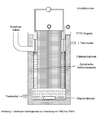
- the electrochemical conversion of TMCol to TMAS can be found in the in illustration 1 carried out electrolysis batch apparatus.
- the cathode is a stainless steel stamp, and the anode is a cylindrical nickel mesh.
- the filled solution is stirred by a magnetic stir bar, heated by a thermostat.
- a pump allows additional external circulation of the solution to further intensify the mixing.
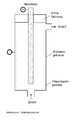
- TMCol to TMAS can alternatively be described in the US Pat Figure 2 carried electrolysis apparatus.
- This includes an electrolysis cell, a temperature-controlled template, a pump and a cooler.
- the electrolysis cell is a continuous electrolysis cell with stainless steel cathode and nickel anode.
- pumps for the in Figure 2 shown electrolyzer different types of pumps can be used. Particularly suitable are pumps which achieve in addition to the conveying effect, a dispersion of the organic substrate in the alkaline aqueous solution, eg. B. peripheral pumps.
- a Swiss roll cell can be used as a continuously flowable electro-lyse cell (see " Peter. M. Robertson, F. Schwager, A new cell for electrochemical processes, Journal of Electroanalytical Chemistry Vol. 65 pp. 883-900, 1975 "," Peter Seiler, Peter M. Robertson, The anodic oxidation of diacetone-L-sorbose on an industrial scale, Chimia Vol. 7/8 pp 305-312, 1982
- the Swiss Roll cell is in Figure 3 shown.
- a nickel and a stainless steel mesh separated by a polypropylene fabric, are wound around one another around a central nickel rod.
- the nickel rod has only contact to the nickel network.
- the cell housing is made of stainless steel, which only has contact with the stainless steel net.
- an electrolytic cell made of a stainless steel housing, a central nickel rod and filled nickel pellets can also be used.
- the cell type is in Figure 4 shown.
- the nickel pellets have electrical contact with the central nickel rod.
- the nickel pellets are electrically insulated from the stainless steel housing by a polypropylene mesh, which is located on the inside of the stainless steel housing.
- the in Figure 4 shown cell type can be equipped with a flat-layered nickel foam and a stainless steel mesh instead of nickel pellets. These are wrapped, separated by a polypropylene fabric, one above the other around the central nickel rod. The nickel rod has only contact to the nickel foam.
- the cell housing is made of stainless steel, which only has contact with the stainless steel net.
- the Ni anode surface Prior to TMAS electrosynthesis, the Ni anode surface is conditioned to electrochemically deposit a thin multilayer nickel oxide hydroxide capping layer over the Ni anode surface.
- 280 ml of a conditioning solution containing 0.1 mol / l NiSO 4 ⁇ 6H 2 O, 0.1 mol / l NaOAcx 3 H 2 O, 0.005 mol / l NaOH in distilled water are introduced into the electrolysis.
- the electrolysis apparatus in Figure 2 is pumped in addition.
- the nickel mesh is alternatively poled as the anode or cathode for a short time (10 s) until a black surface layer has formed (current 150 mA, charge amount 100 C).
- the conditioning solution is then emptied from the entire apparatus. Subsequently, the entire apparatus is rinsed intensively with distilled water. The freshly activated electrolytic cell is then immediately used for electrolysis.
- the electrolysis cell For the electrosynthesis of TMAS, the electrolysis cell is filled with water and dissolved therein sodium hydroxide and TMCol. Subsequently, the pumped solution is tempered. The electrolysis is carried out by passing galvanostatic current through the cell for several hours.
- the solution is completely emptied from the electrolysis apparatus, then the electrolysis apparatus is rinsed with deionized water. Between the experiments, the electrolysis remains dry.
- the combined solution from the electrolysis apparatus is worked up to isolate TMCol, TMCon, TMAS, possibly by-products after completion of the electrolysis.
- the electrolysis was in the in illustration 1 shown electrolysis batch apparatus with a wound 100 mesh nickel mesh of 0.1 mm nickel wire with an area of 10 cm * 25 cm and an internal, round stainless steel punch with a diameter of 7 cm as described above.
- the electrolysis cell was charged with 260 ml of water, 11.2 g of sodium hydroxide and 5.73 g of TMCol.
- the electrolysis was carried out by passing 2 A through the cell for 6 hours.
- the temperature was 80 ° C.
- the electrolysis was in the in Figure 2 shown electrolysis apparatus using a in Figure 3 Swiss-roll electrolysis cell with a wound 100 mesh nickel mesh of 0.1 mm nickel wire with a surface area of 6.5 cm * 24.5 cm, a polypropylene fabric and a wound 100 mesh stainless steel mesh made of 0.114 mm stainless steel wire with an area of 6 , 5 cm * 26.5 cm as described above.
- the electrolyzer was charged with 260 ml of water, 11.2 g of sodium hydroxide and 5.93 g of TMCol. It came a peripheral pump used.
- the electrolysis was carried out by passing 2 A through the cell for 24 hours.
- the temperature was 80 ° C.
- the electrolysis was in the in Figure 2 shown electrolysis apparatus using an electrolysis cell shown in Figures 4a and 4b with nickel pellets (bulk volume 60 cm 3 ) as described above.
- the electrolysis cell was charged with 264 ml of water, 11.2 g of sodium hydroxide and 5.93 g of TMCol. It came a peripheral pump used.
- the electrolysis was carried out by passing 2 A through the cell for 24 hours.
- the temperature was 80 ° C.
- the electrolysis was in the in Figure 2 shown electrolysis apparatus using a in Figure 3a shown electrolysis cell with a wound, flat-layered nickel foam with a surface of 6.5 cm * 19 cm, a polypropylene fabric and a wound 100 mesh stainless steel mesh made of 0.114 mm stainless steel wire as described above.
- the electrolysis cell was charged with 264 ml of water, 11.2 g of sodium hydroxide and 5.93 g of TMCol. It came a peripheral pump used.
- the electrolysis was carried out by passing 2 A through the cell for 17 hours.
- the temperature was 80 ° C.
- the purpose of the workup of the electrolysis solution described below is to isolate TMCol, TMCon, TMAS, possibly by-products after completion of the electrolysis and then to determine the conversion, yield and selectivity.
- the ether phase is dried with anhydrous magnesium sulfate. To this is added to the ether phase so much magnesium sulfate until newly added magnesium sulfate remains fine-grained in the liquid and no longer clumps. The magnesium sulfate is then filtered off.
- the ether is spun off. First, it is evaporated at atmospheric pressure. Towards the end of the distilling off, the boiling point of the solution rises sharply. It is therefore necessary to apply a slight vacuum and increase the negative pressure as the solution becomes depleted of MTBE in order to always achieve a sufficient distillation rate (up to 300 mbar at 90 ° C). The distillation at 300 mbar and 90 ° C is continued until the head temperature has fallen to a constant room temperature in a rotary evaporator.
- the isolation of the TMAS is done by perforation.
- a larger volume of liquid is necessary. Accordingly, it is diluted with water.
- the acidified, aqueous phase is perforated with MTBE (p.a.) for 48 h.
- the ether phase is then dried with anhydrous magnesium sulfate. To this is added to the ether phase so much magnesium sulfate until newly added magnesium sulfate remains fine-grained in the liquid and no longer clumps. The magnesium sulfate is then filtered off.
- the MTBE is spun off. First, it is evaporated at atmospheric pressure. Towards the end of the distilling off, the boiling point of the solution rises sharply. Therefore, a slight vacuum is applied and the vacuum is increased as the solution becomes depleted of MTBE to always achieve a sufficient distillation rate (up to 300 mbar at 90 ° C, but insufficient to remove MTBE quantitatively). The distillation at 300 mbar and 90 ° C is continued until the head temperature has fallen in a rotary evaporator to a constant room temperature.
- TMAS and by-products remain after distilling off in a residual amount of MTBE and are determined by gas chromatography after esterification with diazomethane.
Landscapes
- Chemical & Material Sciences (AREA)
- Engineering & Computer Science (AREA)
- Organic Chemistry (AREA)
- Chemical Kinetics & Catalysis (AREA)
- Electrochemistry (AREA)
- Materials Engineering (AREA)
- Metallurgy (AREA)
- Automation & Control Theory (AREA)
- Analytical Chemistry (AREA)
- Electrolytic Production Of Non-Metals, Compounds, Apparatuses Therefor (AREA)
Abstract
Die Erfindung betrifft ein Verfahren zur elektrochemischen Herstellung von 2.2.4-Trimethyladipinsäure und 2,4,4-Trimethyladipinsäure durch ringspaltende elektrochemische Oxidation eines Gemisches von cis- und trans-3.3.5-Trimethylcyclohexanol in wässriger alkalischer Lösung, vorzugsweise an Nickel Anoden, die durch elektrochemische Abscheidung einer Nickeloxidhydroxid Deckschicht konditioniert wurden.
Description
- Die Erfindung betrifft ein Verfahren zur elektrochemischen Herstellung von 2.2.4-Trimethyladipinsäure und 2.4.4-Trimethyladipinsäure durch ringspaltende elektrochemische Oxidation eines Gemisches von cis- und trans-3.3.5-Trimethylcyclohexanol.
- Die Herstellung von 2.2.4-Trimethyladipinsäure und 2.4.4-Trimethyladipinsäure (TMAS) aus einem Gemisch von cis- und trans-3.3.5-Trimethylcyclohexanol (TMCol) erfolgt nach heutigem Stand der Technik durch ringspaltende Oxidation mittels Salpetersäure.
- Nachteile dieses Verfahrens durch den Einsatz von Salpetersäure sind u.a. Korrosion, Sicherheitsprobleme und Bildung nitroser Komponenten.
- In Hans-Jürgen Schäfer, Oxidation of organic compounds at the nickel hydroxide electrode, Topics in Current Chemistry, Vol. 142, pp. 101-129, 1987
- Johannes Kaulen, Hans-Jürgen Schäfer, Oxidation of alcohols by electrochemically regenerated nickel oxide hydroxide. Selektive oxidation of hydroxysteroids, Tetrahedron Vol. 38 No. 22 pp. 3299 - 3308, 1982
- Johannes Kaulen: Oxidation von Diolen und sekundären Alkoholen an der Nickelhydroxid-Elektrode. Anwendung zur selektiven Oxidation von Hydroxysteroiden, Dissertation Universität Münster 1981
wird erwähnt, dass die elektrochemische Oxidation von Cyclohexanol bei höheren Temperaturen zum Teil unter ringspaltender Bildung von Adipinsäure verläuft. Die Umsetzung erfolgt unter Einsatz von Nickelhydroxid-Elektroden. Es wurden Ausbeuten an Adipinsäure bei 25 °C von 16 % bzw. 24 % und bei 80 °C von 42 % gefunden. - In B.V. Lyalin, V.A. Petrosyan, Electrosynthesis of adipic acid by undivided cell elektrolysis, Russian Chemical Bulletin, International Edition, Vol. 53 No. 3 pp. 688-692, March, 2004 ist die ringspaltende elektrochemische Oxidation von Cyclohexanol zu Adipinsäure an Nickelhydroxid-Elektroden ebenfalls behandelt. In der Veröffentlichung ist eine maximale Ausbeute an Adipinsäure von 46,7 % bei gleichzeitiger Stromausbeute von 11,5 % angegeben. Nebenprodukte bei der Umsetzung sind Bernsteinsäure und Glutarsäure, die mit einer Ausbeute von 6,3 % bzw. 11,5 % gebildet werden. Diese Komponenten entstehen durch oxidative Abspaltung von CH2-Gruppen aus dem C6-Grundkörper von Cyclohexanol.
- Gemäß oben aufgeführten Veröffentlichungen wird die Adipinsäure als Dinatrium-Salz gebildet. Eine Umwandlung in die H-Säureform gelingt durch einfache Ansäuerung beispielsweise mit Salzsäure.
- Die Löslichkeit von Cyclohexanol in Wasser beträgt 40 g/l bei 20 °C. Die Löslichkeit des 3-fach methyl-substituierten Cyclohexanols, TMCol, in Wasser beträgt nur 1,8 g/l bei 20 °C.
- Überraschend wurde festgestellt, dass sich TMCol trotz der geringen Löslichkeit in Wasser unter alkalischen Bedingungen durch ringspaltende elektrochemische Oxidation zu 2.2.4-Trimethyladipinsäure und 2.4.4-Trimethyladipinsäure (TMAS) umsetzen lässt. Zwischenprodukt hierbei ist 3.3.5-Trimethylcyclohexanon (TMCon).
- Vorteile dieses Verfahrens gegenüber dem oben geschriebenen Verfahren durch die Vermeidung des Einsatzes von Salpetersäure sind: Vermeidung von Korrosivität, keine Bildung von nitrosen Gasen.
- Gegenstand der Erfindung ist ein Verfahren zur elektrochemischen Herstellung von 2.2.4-Trimethyladipinsäure und 2.4.4-Trimethyladipinsäure durch ringspaltende elektrochemische Oxidation eines Gemisches von cis- und trans-3.3.5-Trimethylcyclohexanol in wässriger alkalischer Lösung.
- Die elektrochemische Umsetzung von TMCol zu TMAS erfolgt in einer Elektrolysezelle. Das Verfahren ist im Prinzip nicht auf eine bestimmte Bauart der Elektrolysezelle beschränkt. Die Umsetzung findet in wässriger alkalischer Lösung statt. Als Laugen eignen sich im Prinzip alle bekannten anorganischen Basen. Bevorzugt werden Alkalimetallhydroxide, wie LiOH, NaOH, KOH, und lösliche Erdalkalimetallhydroxide. Besonders bevorzugt wird erfindungsgemäß Natronlauge oder Kalilauge eingesetzt.
- Als Anodenmaterial kommen im Prinzip Übergangsmetalle in Betracht. Bevorzugt wird Nickel eingesetzt.
- Als Kathodenmaterial kommen im Prinzip Übergangsmetalle in Betracht. Bevorzugt wird Edelstahl eingesetzt.
- Als Anode sind bevorzugt Elektrodentypen mit großer spezifischer Oberfläche geeignet. Besonders bevorzugt sind Netze, Pelletschüttungen, Schäume.
- Die Elektrolyse kann diskontinuierlich oder kontinuierlich erfolgen.
- Die Elektrolyse kann in einer Batch-Elektrolysezelle sowie in einer kontinuierlich durchströmbaren Elektrolysezelle durchgeführt werden.
- Bevorzugt wird die Elektrolyse in einer kontinuierlich durchströmbaren Elektrolysezelle betrieben.
- Die Elektrolyse wird bevorzugt bei erhöhter Temperatur betrieben. Bevorzugt ist eine Temperatur von 60 bis 100 °C. Besonders bevorzugt ist eine Temperatur von 70 bis 90 °C.
- Nachfolgend erfolgt die Beschreibung von bevorzugten Varianten des Verfahrens.
- Die elektrochemische Umsetzung von TMCol zu TMAS kann in der in
Abbildung 1 gezeigten Elektrolyse-Batchapparatur erfolgen. Als Kathode fungiert ein Edelstahlstempel, als Anode ein zylindrisches Nickelnetz. Die eingefüllte Lösung wird durch einen Magnetrührstab gerührt, durch einen Thermostat beheizt. Eine Pumpe ermöglicht eine zusätzliche externe Zirkulation der Lösung, um die Durchmischung weiter zu intensivieren. - Die elektrochemische Umsetzung von TMCol zu TMAS kann alternativ in der in
Abbildung 2 gezeigten Elektrolyseapparatur erfolgen. Diese umfasst eine Elektrolysezelle, eine temperierbare Vorlage, eine Pumpe sowie einen Kühler. - Bei der Elektrolysezelle handelt es sich um eine kontinuierlich durchströmbare Elektrolysezelle mit Edelstahlkathode und Nickelanode.
- Als Pumpen für die in
Abbildung 2 gezeigte Elektrolyseapparatur können unterschiedliche Pumpentypen verwendet werden. Besonders geeignet sind Pumpen, die zusätzlich zur Förderwirkung eine Dispergierung des organischen Substrats in der alkalischen, wässrigen Lösung erzielen, z. B. Peripheralpumpen. - Als kontinuierlich durchströmbare Elektroysezelle kann im Speziellen eine Swiss-Roll-Zelle (siehe "Peter. M. Robertson, F. Schwager, A new cell for electrochemical processes, Journal of Electroanalytical Chemistry Vol. 65 pp. 883-900, 1975", "Peter Seiler, Peter M. Robertson, Die anodische Oxidation von Diaceton-L-sorbose im technischen Maßstab, Chimia Vol. 36 No. 7/8 pp. 305-312, 1982") verwendet werden. Die Swiss-Roll-Zelle ist in
Abbildung 3 dargestellt. Bei diesem Elektrolysezellentyp sind ein Nickel- sowie ein Edelstahlnetz, getrennt durch ein Polypropylengewebe, übereinanderliegend um einen zentralen Nickelstab gewickelt. Der Nickelstab hat dabei nur Kontakt zum Nickelnetz. Das Zellgehäuse besteht aus Edelstahl, das nur Kontakt zum Edelstahlnetz hat. - Es wurde gefunden, dass eine Elektrolysezelle aus einem Edelstahlgehäuse, einem zentralen Nickelstab sowie eingefüllten Nickelpellets ebenfalls verwendet werden kann. Der Zelltyp ist in
Abbildung 4 dargestellt. Die Nickelpellets haben dabei elektrischen Kontakt zum zentralen Nickelstab. Die Nickelpellets sind durch ein Polypropylengewebe, das sich auf der Innenseite des Edelstahlgehäuses befindet, vom Edelstahlgehäuse elektrisch isoliert. - Weiterhin wurde gefunden, dass der in
Abbildung 4 gezeigte Zelltyp anstatt mit Nickelpellets mit einem flachlagigen Nickelschaum sowie einem Edelstahlnetz ausgerüstet werden kann. Diese werden, getrennt durch ein Polypropylengewebe, übereinanderliegend um den zentralen Nickelstab gewickelt. Der Nickelstab hat dabei nur Kontakt zum Nickelschaum. Das Zellgehäuse besteht aus Edelstahl, das nur Kontakt zum Edelstahlnetz hat. - Vor der TMAS-Elektrosynthese wird die Ni-Anodenfläche konditioniert, um eine dünne Mehrschicht-Nickeloxidhydroxid-Deckschicht auf der Ni-Anodenoberfläche elektrochemisch abzuscheiden.
- Dies kann beispielhaft wie nachfolgend beschrieben durchgeführt werden:
- Es werden 280 ml einer Konditionierlösung mit 0,1 mol/l NiSO4x6H2O, 0,1 mol/l NaOAcx3H2O, 0,005 mol/l NaOH in destillertem Wasser in die Elektrolyse eingefüllt. Im Falle der Elektrolyseapparatur in
Abbildung 2 wird zusätzlich umgepumpt. Durch automatisches Umschalten der Elektrodenpolarisation wird das Nickelnetz alternativ als Anode oder Kathode für kurze Zeit (10 s) gepolt, bis sich eine schwarze Oberflächenschicht gebildet hat (Stromstärke 150 mA, Ladungsmenge 100 C). Die Konditionierlösung wird anschließend aus der gesamten Apparatur entleert. Anschließend wird die gesamte Apparatur intensiv mit destilliertem Wasser gespült. Die frisch aktivierte Elektrolysezelle wird anschließend sofort zur Elektrolyse eingesetzt. - Zur Elektrosynthese vom TMAS wird die Elektrolysezelle mit Wasser sowie darin gelöstem Natriumhydroxid und TMCol befüllt. Anschließend wird die umgepumpte Lösung temperiert. Die Elektrolyse wird durchgeführt, indem mehrere Stunden galvanostatisch Strom durch die Zelle geleitet wird.
- Nach Beendigung der Elektrolyse wird die Lösung aus der Elektrolyseapparatur vollständig entleert, anschließend wird die Elektrolyseapparatur mit VE-Wasser ausgespült. Zwischen den Versuchen bleibt die Elektrolyseapparatur trocken stehen. Die vereinigte Lösung aus der Elektrolyseapparatur wird aufgearbeitet, um TMCol, TMCon, TMAS, ggf. Nebenprodukte nach Beendigung der Elektrolyse zu isolieren.
- Die Elektrolyse wurde in der in
Abbildung 1 gezeigten Elektrolysebatchapparatur mit einem gewickelten 100 mesh Nickelnetz aus 0,1 mm Nickeldraht mit einer Fläche von 10 cm * 25 cm sowie einem innenbefindlichen, runden Edelstahlstempel mit einem Durchmesser von 7 cm wie oben beschrieben durchgeführt. - In die Elektrolysezelle wurden 260 ml Wasser, 11,2 g Natriumhydroxid sowie 5,73 g TMCol gefüllt.
- Die Elektrolyse wurde durchgeführt, indem 6 Stunden 2 A durch die Zelle geleitet wurden. Die Temperatur betrug 80 °C.
- Nach Aufarbeitung wurden 2,45 g TMCol, 2,34 g TMCon sowie 1,06 g TMAS isoliert. Die Ausbeute von TMAS bezogen auf das eingesetzte TMCol betrug 14 %.
- Die Elektrolyse wurde in der in
Abbildung 2 gezeigten Elektrolyseapparatur unter Einsatz einer inAbbildung 3 gezeigten Swiss-Roll-Elektrolysezelle mit einem gewickelten 100 mesh Nickelnetz aus 0,1 mm Nickeldraht mit einer Fläche von 6,5 cm * 24,5 cm, einem Polypropylengewebe sowie mit einem gewickelten 100 mesh Edelstahlnetz aus 0,114 mm Edelstahldraht mit einer Fläche von 6,5 cm * 26,5 cm wie oben beschrieben durchgeführt. - In die Elektrolyseapparatur wurden 260 ml Wasser, 11,2 g Natriumhydroxid sowie 5,93 g TMCol gefüllt. Es kam eine Peripheralpumpe zum Einsatz.
- Die Elektrolyse wurde durchgeführt, indem 24 Stunden 2 A durch die Zelle geleitet wurden. Die Temperatur betrug 80 °C.
- Nach Aufarbeitung wurden 0,05 g TMCol, 0,03 g TMCon sowie 2,70 g TMAS isoliert. Die Ausbeute von TMAS bezogen auf das eingesetzte TMCol betrug 34 %.
- Die Elektrolyse wurde in der in
Abbildung 2 gezeigten Elektrolyseapparatur unter Einsatz einer in den Abbildungen 4a und 4b gezeigten Elektrolysezelle mit Nickelpellets (Schüttvolumen 60 cm3) wie oben beschrieben durchgeführt. - In die Elektrolysezelle wurden 264 ml Wasser, 11,2 g Natriumhydroxid sowie 5,93 g TMCol gefüllt. Es kam eine Peripheralpumpe zum Einsatz.
- Die Elektrolyse wurde durchgeführt, indem 24 Stunden 2 A durch die Zelle geleitet werden. Die Temperatur betrug 80 °C.
- Nach Aufarbeitung wurden 0,06 g TMCol, 0,04 g TMCon sowie 2,52 g TMAS isoliert. Die Ausbeute von TMAS bezogen auf das eingesetzte TMCol betrug 32 %.
- Die Elektrolyse wurde in der in
Abbildung 2 gezeigten Elektrolyseapparatur unter Einsatz einer inAbbildung 3a gezeigten Elektrolysezelle mit einem gewickelten, flachlagigen Nickelschaum mit einer Fläche von 6,5 cm * 19 cm, einem Polypropylengewebe sowie mit einem gewickelten 100 mesh Edelstahlnetz aus 0,114 mm Edelstahldraht wie oben beschrieben durchgeführt. - In die Elektrolysezelle wurden 264 ml Wasser, 11,2 g Natriumhydroxid sowie 5,93 g TMCol gefüllt. Es kam eine Peripheralpumpe zum Einsatz.
- Die Elektrolyse wurde durchgeführt, indem 17 Stunden 2 A durch die Zelle geleitet werden. Die Temperatur betrug 80 °C.
- Nach Aufarbeitung wurden 0,09 g TMCol, 0,14 g TMCon sowie 2,06 g TMAS isoliert. Die Ausbeute von TMAS bezogen auf das eingesetzte TMCol betrug 26 %.
- Zweck der nachfolgend beschriebenen Aufarbeitung der Elektrolyselösung ist es, TMCol, TMCon, TMAS, ggf. Nebenprodukte nach Beendigung der Elektrolyse zu isolieren und anschließend Umsatz, Ausbeute sowie Selektivität zu bestimmen.
- Zur aus der Elektrolyseapparatur gegossenen, wässrigen Lösung werden 50 g Natriumchlorid gegeben.
- Man extrahiert die alkalische, wässrige Phase zur Entfernung von noch vorhandenem TMCol und TMCon mit Methyl-tert-Butyl-Ether (p. a.) durch mehrfach wiederholtes (min. 4-faches) Ausschütteln im Scheidetrichter.
- Die Etherphase wird mit wasserfreiem Magnesiumsulfat getrocknet. Hierzu gibt man zu der Etherphase so viel Magnesiumsulfat, bis neu zugesetztes Magnesiumsulfat in der Flüssigkeit feinkörnig bleibt und nicht mehr verklumpt. Das Magnesiumsulfat wird anschließend abfiltriert.
- Der Ether wird abrotiert. Zuerst wird bei Normaldruck einrotiert. Gegen Ende des Abdestillierens steigt der Siedepunkt der Lösung stark an. Man legt deshalb ein leichtes Vakuum an und vergrößert den Unterdruck in dem Maße, wie die Lösung an MTBE verarmt, um stets eine ausreichende Destillationsgeschwindigkeit zu erzielen (bis 300 mbar bei 90 °C). Die Destillation bei 300 mbar und 90 °C wird fortgesetzt bis die Kopftemperatur im Rotationsverdampfer auf konstant bleibende Raumtemperatur gefallen ist.
- Es bleibt nicht abreagiertes TMCol sowie TMCon in einer Restmenge an MTBE zurück. Diese werden gaschromatografisch auf Reinheit und Menge hin untersucht.
- Die Isolierung des TMAS erfolgt über Perforation. Für den Perforator ist ein größeres Flüssigkeitsvolumen notwendig. Entsprechend wird mit Wasser verdünnt.
- Anschließend säuert man die alkalische, wässrige Phase mit konz. Salzsäure bis zu einem pH-Wert von 1 an.
- Die angesäuerte, wässrige Phase wird mit MTBE (p. a.) 48 h perforiert.
- Die Etherphase wird anschließend mit wasserfreiem Magnesiumsulfat getrocknet. Hierzu gibt man zu der Etherphase so viel Magnesiumsulfat, bis neu zugesetztes Magnesiumsulfat in der Flüssigkeit feinkörnig bleibt und nicht mehr verklumpt. Das Magnesiumsulfat wird anschließend abfiltriert.
- Das MTBE wird abrotiert. Zuerst wird bei Normaldruck einrotiert. Gegen Ende des Abdestillierens steigt der Siedepunkt der Lösung stark an. Man legt deshalb ein leichtes Vakuum an und vergrößert den Unterdruck in dem Maße, wie die Lösung an MTBE verarmt, um stets eine ausreichende Destillationsgeschwindigkeit zu erzielen (bis 300 mbar bei 90 °C, allerdings nicht ausreichend, um MTBE quantitativ zu entfernen). Die Destillation bei 300 mbar und 90 °C wird fortgesetzt bis die Kopftemperatur im Rotationsverdampfer auf konstante bleibende Raumtemperatur gefallen ist.
- TMAS und Nebenprodukte bleiben nach dem Abdestillieren in einer Restmenge an MTBE zurück und werden nach Veresterung mit Diazomethan gaschromatografisch quantitativ bestimmt.
Claims (11)
- Verfahren zur elektrochemischen Herstellung von 2.2.4-Trimethyladipinsäure und 2.4.4-Trimethyladipinsäure durch ringspaltende elektrochemische Oxidation eines Gemisches von cis- und trans-3.3.5-Trimethylcyclohexanol in wässriger alkalischer Lösung.
- Verfahren nach Anspruch 1, dadurch gekennzeichnet, dass Natronlauge oder Kalilauge eingesetzt wird.
- Verfahren nach mindestens einem der vorherigen Ansprüche dadurch gekennzeichnet, dass die Elektrolyse in einer Batch-Elektrolysezelle oder in einer kontinuierlich durchströmbaren Elektrolysezelle durchgeführt wird.
- Verfahren nach mindestens einem der vorherigen Ansprüche dadurch gekennzeichnet, dass die Elektrolyse in einer kontinuierlich durchströmbaren Elektrolysezelle durchgeführt wird.
- Verfahren nach mindestens einem der vorherigen Ansprüche dadurch gekennzeichnet, dass als Anodenmaterial Nickel eingesetzt wird.
- Verfahren nach mindestens einem der vorherigen Ansprüche dadurch gekennzeichnet, dass als Kathodenmaterial Edelstahl eingesetzt wird.
- Verfahren nach mindestens einem der vorherigen Ansprüche dadurch gekennzeichnet, dass als Anode Elektrodentypen mit großer spezifischer Oberfläche, bevorzugt Netze, Pelletschüttungen, Schäume, eingesetzt werden.
- Verfahren nach mindestens einem der vorherigen Ansprüche dadurch gekennzeichnet, dass als Anode Elektrodentypen ausgewählt ais Ni-Netze, Ni-Pelletschüttungen, Ni-Schäume, eingesetzt werden.
- Verfahren nach mindestens einem der vorherigen Ansprüche dadurch gekennzeichnet, dass die Ni-Anodenfläche konditioniert wird, um eine dünne Mehrschicht-Nickeloxidhydroxid-Deckschicht auf der Ni-Anodenoberfläche elektrochemisch abzuscheiden.
- Verfahren nach mindestens einem der vorherigen Ansprüche dadurch gekennzeichnet, dass die Elektrolyse bei erhöhter Temperatur betrieben wird.
- Verfahren nach mindestens einem der vorherigen Ansprüche dadurch gekennzeichnet, dass die Elektrolyse bei Temperaturen von 60 bis 100 °C, bevorzugt von 70 bis 90 °C, durchgeführt wird.
Applications Claiming Priority (1)
| Application Number | Priority Date | Filing Date | Title |
|---|---|---|---|
| DE102014202502.8A DE102014202502A1 (de) | 2014-02-12 | 2014-02-12 | Verfahren zur elektrochemischen Herstellung von 2.2.4-Trimethyladipinsäure und 2.4.4-Trimethyladipinsäure |
Publications (1)
| Publication Number | Publication Date |
|---|---|
| EP2907898A1 true EP2907898A1 (de) | 2015-08-19 |
Family
ID=52449956
Family Applications (1)
| Application Number | Title | Priority Date | Filing Date |
|---|---|---|---|
| EP15152135.8A Withdrawn EP2907898A1 (de) | 2014-02-12 | 2015-01-22 | Verfahren zur elektrochemischen Herstellung von 2,2,4-Trimethyladipinsäure und 2,4,4-Trimethyladipinsäure |
Country Status (4)
| Country | Link |
|---|---|
| US (1) | US20150225861A1 (de) |
| EP (1) | EP2907898A1 (de) |
| CN (1) | CN104831310A (de) |
| DE (1) | DE102014202502A1 (de) |
Cited By (3)
| Publication number | Priority date | Publication date | Assignee | Title |
|---|---|---|---|---|
| EP3922758A1 (de) | 2020-06-10 | 2021-12-15 | Evonik Operations GmbH | Verfahren zur elektrochemischen herstellung von alkandicarbonsäuren durch ringöffnende oxidation mittels einer dotierten ni(o)oh schaumelektrode |
| CN113832485A (zh) * | 2020-06-04 | 2021-12-24 | 清华大学 | 电催化氧化环醇/环酮制备二元羧酸耦合产氢的方法 |
| EP4459011A1 (de) | 2023-05-02 | 2024-11-06 | Evonik Operations GmbH | Elektrochemisches hochdurchsatz-oxidationsverfahren |
Families Citing this family (1)
| Publication number | Priority date | Publication date | Assignee | Title |
|---|---|---|---|---|
| CN120060920B (zh) * | 2025-03-24 | 2025-12-12 | 上海交通大学 | 一种有机分子修饰金属氢氧化物的电催化剂材料及其制备方法、应用 |
-
2014
- 2014-02-12 DE DE102014202502.8A patent/DE102014202502A1/de not_active Withdrawn
-
2015
- 2015-01-22 EP EP15152135.8A patent/EP2907898A1/de not_active Withdrawn
- 2015-02-11 US US14/619,525 patent/US20150225861A1/en not_active Abandoned
- 2015-02-11 CN CN201510070289.9A patent/CN104831310A/zh active Pending
Non-Patent Citations (9)
| Title |
|---|
| "Inaugural-Dissertation zur Erlangung des Doktorgrades der Naturwissenschaften", 12 November 1981, WESTFÄLISCHE WILHELMS-UNIVERSITÄT, article JOHANNES KAULEN: "Oxidation von Diolen und sekundären Alkoholen an der Nickelhydroxid-Elektrode", XP055194378 * |
| B V LYALIN ET AL: "Electrosynthesis of adipic acid by undivided cell electrolysis", RUSSIAN CHEMICAL BULLETIN, vol. 53, no. 3, 1 March 2004 (2004-03-01), pages 688 - 692, XP055194391, ISSN: 1066-5285, DOI: 10.1023/B:RUCB.0000035658.50123.07 * |
| B.V. LYALIN; V.A. PETROSYAN: "Electrosynthesis of adipic acid by undivided cell elektrolysis", RUSSIAN CHEMICAL BULLETIN, INTERNATIONAL EDITION, vol. 53, no. 3, March 2004 (2004-03-01), pages 688 - 692 |
| HANS-JUERGEN SCHAEFER: "Oxidation of organic compounds at the nickel hydroxide electrode", TOPICS IN CURRENT CHEMISTRY, SPRINGER, BERLIN, DE, vol. 142, 1 January 1982 (1982-01-01), pages 101 - 129, XP009184429, ISSN: 0340-1022, DOI: 10.1007/3-540-17871-6_13 * |
| HANS-JÜRGEN SCHÄFER: "Oxidation of organic compounds at the nickel hydroxide electrode", TOPICS IN CURRENT CHEMISTRY, vol. 142, 1987, pages 101 - 129 |
| JOHANNES KAULEN: "Oxidation von Diolen und sekundären Alkoholen an der Nickelhydroxid-Elektrode. Anwendung zur selektiven Oxidation von Hydroxysteroiden", DISSERTATION, 1981 |
| JOHANNES KAULEN; HANS-JÜRGEN SCHÄFER: "Oxidation of alcohols by electrochemically regenerated nickel oxide hydroxide. Selektive oxidation of hydroxysteroids", TETRAHEDRON, vol. 38, no. 22, 1982, pages 3299 - 3308 |
| PETER SEILER; PETER M. ROBERTSON: "Die anodische Oxidation von Diaceton-L-sorbose im technischen Maßstab", CHIMIA, vol. 36, no. 7/8, 1982, pages 305 - 312 |
| PETER. M. ROBERTSON; F. SCHWAGER: "A new cell for electrochemical processes", JOURNAL OF ELECTROANALYTICAL CHEMISTRY, vol. 65, 1975, pages 883 - 900 |
Cited By (6)
| Publication number | Priority date | Publication date | Assignee | Title |
|---|---|---|---|---|
| CN113832485A (zh) * | 2020-06-04 | 2021-12-24 | 清华大学 | 电催化氧化环醇/环酮制备二元羧酸耦合产氢的方法 |
| EP3922758A1 (de) | 2020-06-10 | 2021-12-15 | Evonik Operations GmbH | Verfahren zur elektrochemischen herstellung von alkandicarbonsäuren durch ringöffnende oxidation mittels einer dotierten ni(o)oh schaumelektrode |
| WO2021249775A1 (de) | 2020-06-10 | 2021-12-16 | Evonik Operations Gmbh | Verfahren zur elektrochemischen herstellung von alkandicarbonsäuren durch ringöffnende oxidation mittels einer dotierten ni(o)oh schaumelektrode |
| US11976373B2 (en) | 2020-06-10 | 2024-05-07 | Evonik Operations Gmbh | Method for electrochemically producing alkane dicarboxylic acids by means of a ring-opening oxidation using a doped Ni(O)OH foam electrode |
| EP4459011A1 (de) | 2023-05-02 | 2024-11-06 | Evonik Operations GmbH | Elektrochemisches hochdurchsatz-oxidationsverfahren |
| WO2024227776A1 (de) | 2023-05-02 | 2024-11-07 | Evonik Operations Gmbh | Elektrochemisches hochdurchsatz-oxidationsverfahren |
Also Published As
| Publication number | Publication date |
|---|---|
| US20150225861A1 (en) | 2015-08-13 |
| DE102014202502A1 (de) | 2015-08-13 |
| CN104831310A (zh) | 2015-08-12 |
Similar Documents
| Publication | Publication Date | Title |
|---|---|---|
| DE69420356T2 (de) | Verfahren zur Herstellung von Hydroxiden und Alkoxiden von hoher Reinheit | |
| EP2907898A1 (de) | Verfahren zur elektrochemischen Herstellung von 2,2,4-Trimethyladipinsäure und 2,4,4-Trimethyladipinsäure | |
| AU595683B2 (en) | Electrochemical process for the replacement of halogen atoms in an organic compound | |
| EP4041939A1 (de) | Verfahren und elektrolysevorrichtung zur herstellung von chlor, kohlenmonoxid und gegebenenfalls wasserstoff | |
| DE2818066A1 (de) | Verfahren zum dehalogenieren halogenierter kohlenwasserstoffe unter freisetzung elementaren halogens | |
| DE1803893C3 (de) | Verfahren zur elektrochemischen Fluorierung von organischen Verbindungen, die 1 bis 8 Kohlenstoffatome pro Molekül enthalten | |
| EP1283281A2 (de) | Verfahren zur elektrochemischen Herstellung von Chlor aus wässrigen Lösungen von Chlorwasserstoff | |
| DE3143304A1 (de) | Verfahren zum betreiben einer elektrolytischen zelle | |
| DE1693005C3 (de) | Verfahren zur Herstellung von Adipinsäuredinitril | |
| DE102013202976A1 (de) | Niedertemperaturverfahren zur Herstellung von Lithium aus schwerlöslichen Lithiumsalzen | |
| CN113802138B (zh) | 一种用于电解硝基苯合成对氨基苯酚的电极材料及其制备方法和应用 | |
| DE2713236A1 (de) | Verfahren zur herstellung basischer aluminiumchloride | |
| DE3522304C2 (de) | Verfahren zur Herstellung von Carbonsäuren durch elektrochemische Reduktion | |
| WO2014016247A1 (de) | Verfahren zur herstellung eines alkalimetalls | |
| DE674965C (de) | Verfahren zur Herstellung von schwerem Wasser | |
| DE2756588A1 (de) | Verfahren zur elektrochemischen oxidation alkoxysubstituierter aromatischer verbindungen | |
| EP0589214B1 (de) | Verfahren zur Herstellung von perfluorierten Bromalkanen oder Ethergruppen enthaltenden perfluorierten Bromalkanen | |
| DE2727409A1 (de) | Verfahren zur gewinnung von ammoniak und schwefelsaeure aus ammoniumsulfatloesungen | |
| DE2460468C3 (de) | Verfahren zur elektrolytischen Herstellung von Hexafluorpropenepoxid | |
| DE2725213B2 (de) | Verfahren zur Herstellung von perfluorierten organischen Säurefluoriden | |
| DD271722A5 (de) | Elektrochemisches verfahren zur herstellung von fluorkohlenwasserstoffen | |
| DE2812508B2 (de) | Verfahren zur Herstellung von NJS'dialkylsubstituierten Tetrahydro-4,4'bipyridylen | |
| CH321096A (de) | Elektrochemisches Verfahren zur Herstellung von Perfluorcarbonsäurefluoriden | |
| DE2331711A1 (de) | Verfahren zur selektiven elektrolytischen entbromierung | |
| DE1912738C3 (de) | Verfahren zur Herstellung von PerfluoralkylsuHonyHIuorlden |
Legal Events
| Date | Code | Title | Description |
|---|---|---|---|
| PUAI | Public reference made under article 153(3) epc to a published international application that has entered the european phase |
Free format text: ORIGINAL CODE: 0009012 |
|
| 17P | Request for examination filed |
Effective date: 20150122 |
|
| AK | Designated contracting states |
Kind code of ref document: A1 Designated state(s): AL AT BE BG CH CY CZ DE DK EE ES FI FR GB GR HR HU IE IS IT LI LT LU LV MC MK MT NL NO PL PT RO RS SE SI SK SM TR |
|
| AX | Request for extension of the european patent |
Extension state: BA ME |
|
| STAA | Information on the status of an ep patent application or granted ep patent |
Free format text: STATUS: THE APPLICATION HAS BEEN WITHDRAWN |
|
| 18W | Application withdrawn |
Effective date: 20151125 |