EP2911231B1 - Solution d'électrolyte non-aqueux pour batteries secondaires et batterie secondaire de type lithium-ion comprenant cette dernière - Google Patents
Solution d'électrolyte non-aqueux pour batteries secondaires et batterie secondaire de type lithium-ion comprenant cette dernière Download PDFInfo
- Publication number
- EP2911231B1 EP2911231B1 EP13849555.1A EP13849555A EP2911231B1 EP 2911231 B1 EP2911231 B1 EP 2911231B1 EP 13849555 A EP13849555 A EP 13849555A EP 2911231 B1 EP2911231 B1 EP 2911231B1
- Authority
- EP
- European Patent Office
- Prior art keywords
- electrolyte solution
- compound
- aqueous electrolyte
- fluorinated
- mass
- Prior art date
- Legal status (The legal status is an assumption and is not a legal conclusion. Google has not performed a legal analysis and makes no representation as to the accuracy of the status listed.)
- Not-in-force
Links
Classifications
-
- H—ELECTRICITY
- H01—ELECTRIC ELEMENTS
- H01M—PROCESSES OR MEANS, e.g. BATTERIES, FOR THE DIRECT CONVERSION OF CHEMICAL ENERGY INTO ELECTRICAL ENERGY
- H01M10/00—Secondary cells; Manufacture thereof
- H01M10/05—Accumulators with non-aqueous electrolyte
- H01M10/052—Li-accumulators
-
- H—ELECTRICITY
- H01—ELECTRIC ELEMENTS
- H01M—PROCESSES OR MEANS, e.g. BATTERIES, FOR THE DIRECT CONVERSION OF CHEMICAL ENERGY INTO ELECTRICAL ENERGY
- H01M10/00—Secondary cells; Manufacture thereof
- H01M10/05—Accumulators with non-aqueous electrolyte
- H01M10/052—Li-accumulators
- H01M10/0525—Rocking-chair batteries, i.e. batteries with lithium insertion or intercalation in both electrodes; Lithium-ion batteries
-
- H—ELECTRICITY
- H01—ELECTRIC ELEMENTS
- H01M—PROCESSES OR MEANS, e.g. BATTERIES, FOR THE DIRECT CONVERSION OF CHEMICAL ENERGY INTO ELECTRICAL ENERGY
- H01M10/00—Secondary cells; Manufacture thereof
- H01M10/05—Accumulators with non-aqueous electrolyte
- H01M10/056—Accumulators with non-aqueous electrolyte characterised by the materials used as electrolytes, e.g. mixed inorganic/organic electrolytes
- H01M10/0564—Accumulators with non-aqueous electrolyte characterised by the materials used as electrolytes, e.g. mixed inorganic/organic electrolytes the electrolyte being constituted of organic materials only
- H01M10/0566—Liquid materials
- H01M10/0567—Liquid materials characterised by the additives
-
- H—ELECTRICITY
- H01—ELECTRIC ELEMENTS
- H01M—PROCESSES OR MEANS, e.g. BATTERIES, FOR THE DIRECT CONVERSION OF CHEMICAL ENERGY INTO ELECTRICAL ENERGY
- H01M10/00—Secondary cells; Manufacture thereof
- H01M10/05—Accumulators with non-aqueous electrolyte
- H01M10/056—Accumulators with non-aqueous electrolyte characterised by the materials used as electrolytes, e.g. mixed inorganic/organic electrolytes
- H01M10/0564—Accumulators with non-aqueous electrolyte characterised by the materials used as electrolytes, e.g. mixed inorganic/organic electrolytes the electrolyte being constituted of organic materials only
- H01M10/0566—Liquid materials
- H01M10/0568—Liquid materials characterised by the solutes
-
- H—ELECTRICITY
- H01—ELECTRIC ELEMENTS
- H01M—PROCESSES OR MEANS, e.g. BATTERIES, FOR THE DIRECT CONVERSION OF CHEMICAL ENERGY INTO ELECTRICAL ENERGY
- H01M10/00—Secondary cells; Manufacture thereof
- H01M10/05—Accumulators with non-aqueous electrolyte
- H01M10/056—Accumulators with non-aqueous electrolyte characterised by the materials used as electrolytes, e.g. mixed inorganic/organic electrolytes
- H01M10/0564—Accumulators with non-aqueous electrolyte characterised by the materials used as electrolytes, e.g. mixed inorganic/organic electrolytes the electrolyte being constituted of organic materials only
- H01M10/0566—Liquid materials
- H01M10/0569—Liquid materials characterised by the solvents
-
- H—ELECTRICITY
- H01—ELECTRIC ELEMENTS
- H01M—PROCESSES OR MEANS, e.g. BATTERIES, FOR THE DIRECT CONVERSION OF CHEMICAL ENERGY INTO ELECTRICAL ENERGY
- H01M10/00—Secondary cells; Manufacture thereof
- H01M10/42—Methods or arrangements for servicing or maintenance of secondary cells or secondary half-cells
- H01M10/4235—Safety or regulating additives or arrangements in electrodes, separators or electrolyte
-
- H—ELECTRICITY
- H01—ELECTRIC ELEMENTS
- H01M—PROCESSES OR MEANS, e.g. BATTERIES, FOR THE DIRECT CONVERSION OF CHEMICAL ENERGY INTO ELECTRICAL ENERGY
- H01M4/00—Electrodes
- H01M4/02—Electrodes composed of, or comprising, active material
- H01M4/36—Selection of substances as active materials, active masses, active liquids
- H01M4/38—Selection of substances as active materials, active masses, active liquids of elements or alloys
- H01M4/381—Alkaline or alkaline earth metals elements
- H01M4/382—Lithium
-
- H—ELECTRICITY
- H01—ELECTRIC ELEMENTS
- H01M—PROCESSES OR MEANS, e.g. BATTERIES, FOR THE DIRECT CONVERSION OF CHEMICAL ENERGY INTO ELECTRICAL ENERGY
- H01M4/00—Electrodes
- H01M4/02—Electrodes composed of, or comprising, active material
- H01M4/36—Selection of substances as active materials, active masses, active liquids
- H01M4/58—Selection of substances as active materials, active masses, active liquids of inorganic compounds other than oxides or hydroxides, e.g. sulfides, selenides, tellurides, halogenides or LiCoFy; of polyanionic structures, e.g. phosphates, silicates or borates
- H01M4/583—Carbonaceous material, e.g. graphite-intercalation compounds or CFx
- H01M4/587—Carbonaceous material, e.g. graphite-intercalation compounds or CFx for inserting or intercalating light metals
-
- H—ELECTRICITY
- H01—ELECTRIC ELEMENTS
- H01M—PROCESSES OR MEANS, e.g. BATTERIES, FOR THE DIRECT CONVERSION OF CHEMICAL ENERGY INTO ELECTRICAL ENERGY
- H01M2220/00—Batteries for particular applications
- H01M2220/20—Batteries in motive systems, e.g. vehicle, ship, plane
-
- H—ELECTRICITY
- H01—ELECTRIC ELEMENTS
- H01M—PROCESSES OR MEANS, e.g. BATTERIES, FOR THE DIRECT CONVERSION OF CHEMICAL ENERGY INTO ELECTRICAL ENERGY
- H01M2300/00—Electrolytes
- H01M2300/0017—Non-aqueous electrolytes
- H01M2300/0025—Organic electrolyte
- H01M2300/0028—Organic electrolyte characterised by the solvent
- H01M2300/0034—Fluorinated solvents
-
- H—ELECTRICITY
- H01—ELECTRIC ELEMENTS
- H01M—PROCESSES OR MEANS, e.g. BATTERIES, FOR THE DIRECT CONVERSION OF CHEMICAL ENERGY INTO ELECTRICAL ENERGY
- H01M2300/00—Electrolytes
- H01M2300/0017—Non-aqueous electrolytes
- H01M2300/0025—Organic electrolyte
- H01M2300/0028—Organic electrolyte characterised by the solvent
- H01M2300/0037—Mixture of solvents
-
- Y—GENERAL TAGGING OF NEW TECHNOLOGICAL DEVELOPMENTS; GENERAL TAGGING OF CROSS-SECTIONAL TECHNOLOGIES SPANNING OVER SEVERAL SECTIONS OF THE IPC; TECHNICAL SUBJECTS COVERED BY FORMER USPC CROSS-REFERENCE ART COLLECTIONS [XRACs] AND DIGESTS
- Y02—TECHNOLOGIES OR APPLICATIONS FOR MITIGATION OR ADAPTATION AGAINST CLIMATE CHANGE
- Y02E—REDUCTION OF GREENHOUSE GAS [GHG] EMISSIONS, RELATED TO ENERGY GENERATION, TRANSMISSION OR DISTRIBUTION
- Y02E60/00—Enabling technologies; Technologies with a potential or indirect contribution to GHG emissions mitigation
- Y02E60/10—Energy storage using batteries
Definitions
- the present invention relates to a non-aqueous electrolyte solution for secondary batteries, and a lithium ion secondary battery.
- non-aqueous electrolyte solution to be used for lithium ion secondary batteries (hereinafter sometimes referred to simply as "secondary batteries")
- secondary batteries a non-aqueous electrolyte solution comprising a fluorinated solvent, a cyclic carbonate compound, a cyclic carboxylic acid ester compound and a lithium salt
- Patent Documents 1 and 2 a non-aqueous electrolyte solution comprising a fluorinated solvent, a cyclic carbonate compound, a cyclic carboxylic acid ester compound and a lithium salt
- Patent Documents 3 to 6 disclose non-aqueous electrolytic solutions including a lithium salt dissolved in a solvent mixture comprising a fluorinated ether compound and a cyclic carboxylic acid ester compound, such as ⁇ -butyrolactone (GBL) or ⁇ -valerolactone (GVL).
- Patent Documents 7 to 12 describe non-aqueous electrolyte compositions comprising a lithium chelate complex, such as lithium bis(oxalato)borate (LiBOB) or lithium difluoro(oxalato)borate (LiDFOB).
- thermal runaway may occur to cause breakage of the battery.
- thermal runaway is known to be caused by heat generation which occurs when the electrolyte solution and the positive electrodes and negative electrodes are reacted and decomposed. That is, thermal runaway starts when, due to Joule heat, the temperature of the secondary battery reaches a temperature at which the electrolyte solution and the positive and negative electrodes are reactive and decomposable. Therefore, it is important that the non-aqueous electrolyte solution to be used for a secondary battery has a low reactivity with positive and negative electrodes and is less likely to cause heat generation due to a reaction with them.
- a secondary battery is being actively studied for application to e.g. a battery mounted on a vehicle such as an electric car which requires higher energy.
- the non-aqueous electrolyte solution is required to be excellent in battery properties such as cycle properties and rate properties while thermal runaway is prevented.
- the present invention provides the following [1] to [17] as its gist.
- the non-aqueous electrolyte solution for secondary batteries of the present invention has a low reactivity with a positive electrode and a negative electrode and is excellent in stability to prevent thermal runaway of a secondary battery and excellent also in battery properties such as cycle properties and rate properties.
- the lithium ion secondary battery of the present invention is less likely to undergo thermal runaway and is excellent in stability and excellent also in battery properties such as cycle properties and rate properties.
- fluorinated means that some or all of hydrogen atoms bonded to carbon atoms are substituted by fluorine atoms.
- a “fluorinated alkyl group” is a group having some or all of hydrogen atoms in an alkyl group substituted by fluorine atoms. In a partly fluorinated group, hydrogen atoms and fluorine atoms are present.
- the non-aqueous electrolyte solution for secondary batteries of the present invention (hereinafter sometimes referred to simply as “the non-aqueous electrolyte solution”) comprises an electrolyte salt and a liquid composition.
- the electrolyte salt is a lithium salt.
- the liquid composition comprises a fluorinated solvent (A) and a cyclic carboxylic acid ester compound (B), which will be described later.
- a non-aqueous electrolyte solution is an electrolyte solution containing substantially no water, and even if it contains water, the amount of water is within such a range that performance degradation of a secondary battery using the non-aqueous electrolyte solution is thereby not observed.
- the amount of water contained in such a non-aqueous electrolyte solution is preferably at most 500 mass ppm, more preferably at most 100 mass ppm, particularly preferably at most 50 mass ppm, based on the total mass of the non-aqueous electrolyte solution.
- the lower limit of the amount of water is 0 mass ppm.
- the lithium salt is an electrolyte salt which will be dissociated in the non-aqueous electrolyte solution to supply lithium ions.
- the non-aqueous electrolyte solution of the present invention contains, as such a lithium salt, the following compound (1) as an essential component.
- the non-aqueous electrolyte solution of the present invention contains the compound (1) as a lithium salt, it becomes a non-aqueous electrolyte solution excellent in battery properties such as cycle properties and rate properties. This is considered to be as follows.
- the compound (1) is decomposed on the negative electrode to form a lithium ion conductive coating film (SEI: solid electrolyte interface) having a small interface resistance on the negative electrode surface.
- SEI lithium ion conductive coating film
- VC vinylene carbonate
- the compound (1) is capable of forming good SEI having a smaller interface resistance, whereby the non-aqueous electrolyte solution is considered to become excellent in battery properties such as cycle properties and rate properties.
- M is a boron atom or a phosphorus atom
- R 1 is a C 1-10 alkylene group which may have a substituent
- X is a halogen atom
- n is an integer of from 0 to 4
- m is 0 or 1
- p is 1 or 2.
- two m may both be 0 or both be 1, or one of them may be 0 and the other may be 1.
- two R 1 may be groups different from each other or may be the same groups.
- R 1 is a C 1-10 alkylene group, and this alkylene group may have a substituent.
- the substituent may specifically be e.g. a halogen atom, a chain or cyclic alkyl group, an aryl group, a sulfonyl group, a cyano group, a hydroxy group or an alkoxy group, as a substitute for a hydrogen atom on an alkylene group.
- X is preferably a fluorine atom or a chlorine atom, particularly preferably a fluorine atom.
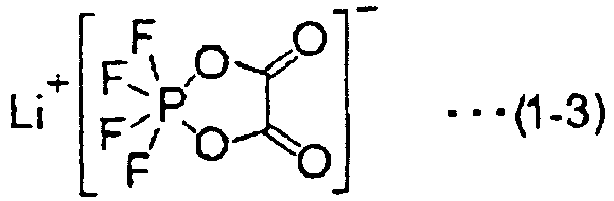
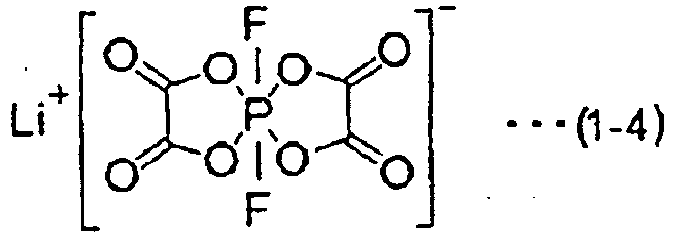
- one type may be used alone, or two or more types may be used in combination.
- the compound represented by the formula (1) preferably contains at least one member selected from the group consisting of the following compounds (1-1) to (1-5), since it is thereby possible to readily obtain a non-aqueous electrolyte solution excellent in battery properties such as cycle properties and rate properties.
- the lithium salt may contain lithium salts other than the compound (1).
- LiPF 6 the following compound (7) (wherein k is an integer of from 1 to 5), FSO 2 N(Li)SO 2 F, CF 3 SO 2 N(Li)SO 2 CF 3 , CF 3 CF 2 SO 2 N(Li)SO 2 CF 2 CF 3 , LiClO 4 , LibF 4 , etc. may be mentioned.
- LiPF 6 is preferred as other lithium salt.
- the lithium salt it is particularly preferred to contain the compound (1) and LiPF 6 . When the lithium salt contains LiPF 6 , the ion conductivity will be good.
- the lithium salt to be contained in the non-aqueous electrolyte solution may be one type only, or two or more types in combination.
- the lower limit value for the content of the compound (1) in the lithium salt to be contained in the non-aqueous electrolyte solution of the present invention is preferably 0.05 mol%, more preferably 0.1 mol%, further preferably 0.5 mol%, particularly preferably 1 mol%.
- the upper limit value for the content of the compound (1) in the lithium salt to be contained in the non-aqueous electrolyte solution of the present invention is preferably 95 mol%, more preferably 80 mol%, further preferably 60 mol%, particularly preferably 40 mol%.
- the lower limit value for the content of LiPF 6 in the lithium salt is preferably 5 mol%, more preferably 20 mol%, further preferably 40 mol%, particularly preferably 60 mol%.
- the upper limit value for the content of LiPF 6 in the lithium salt is preferably 99.95 mol%, more preferably 99.9 mol%, further preferably 99.5 mol%, particularly preferably 99 mol%.
- the lower limit value for the total content of the compound (1) and LiPF 6 in the lithium salt is preferably 50 mol%, more preferably 80 mol%.
- the upper limit value for the total content of the compound (1) and LiPF 6 in the lithium salt is 100 mol%.
- the content of the lithium salt in the non-aqueous electrolyte solution is not particularly limited and is preferably from 0.5 to 1.8 mol/L.
- the lower limit value for the content of the lithium salt is more preferably 0.8 mol/L.
- the upper limit value for the content of the lithium salt is more preferably 1.6 mol/L.
- the content of the lithium salt in the non-aqueous electrolyte solution is preferably from 5 mass% to 25 mass%.
- the lower limit value for the content of the lithium salt is more preferably 7 mass %, further preferably 8 mass%.
- the upper limit value for the content of the lithium salt is more preferably 20 mass%, further preferably 17 mass%.
- the content of the lithium salt is at least the lower limit value, a non-aqueous electrolyte solution having a high ion conductivity is obtainable. Further, when the content of the lithium salt is at most the upper limit value, the lithium salt is readily soluble uniformly in the liquid composition, and even under a low temperature condition, the lithium salt is less likely to be precipitated, whereby a highly practical electrolyte solution excellent in safety is readily obtainable.
- the content of the compound (1) in the non-aqueous electrolyte solution of the present invention is preferably from 0.01 to 10 mass%.
- the lower limit value for the content of the compound (1) is more preferably 0.02 mass%, further preferably 0.1 mass%, particularly preferably 0.5 mass%.
- the upper limit value for the content of the compound (1) is more preferably 8 mass%, further preferably 5 mass%.
- the content of the compound (1) is at least the lower limit value
- a non-aqueous electrolyte solution excellent in battery properties such as cycle properties and rate properties is readily obtainable.
- the content of the compound (1) is at most the upper limit value, the lithium salt is readily soluble uniformly in the liquid composition, and even under a low temperature condition, the lithium salt is less likely to be precipitated, whereby a highly practical electrolyte solution excellent in safety is readily obtainable.
- the fluorinated solvent (A) is a fluorinated solvent containing at least one member selected from the group consisting of a fluorinated ether compound, a fluorinated chain carboxylic acid ester compound and a fluorinated chain carbonate compound.
- the fluorinated solvent (A) is a solvent having fluorine atoms in its molecule and is excellent in flame retardance.
- fluorinated solvent (A) one type may be used alone, or two or more types may be used in combination. When two or more types of the fluorinated solvent (A) are to be used, their ratio may optionally be set.
- the fluorinated solvent (A) preferably contains a fluorinated ether compound.
- a fluorinated ether compound at least one member selected from the group consisting of the following compound (2) and the following compound (3) is preferred.
- each of R 2 and R 3 which are independent of each other, is a C 1-10 alkyl group, a C 3-10 cycloalkyl group, a C 1-10 fluorinated alkyl group, a C 3-10 fluorinated cycloalkyl group, a C 2-10 alkyl group having an etheric oxygen atom, or a C 2-10 fluorinated alkyl group having an etheric oxygen atom, provided that one or each of R 2 and R 3 is a C 1-10 fluorinated alkyl group, a C 3-10 fluorinated cycloalkyl group or a C 2-10 fluorinated alkyl group having an etheric oxygen atom.
- Y is a C 1-5 alkylene group, a C 1-5 fluorinated alkylene group, a C 2-5 alkylene group having an etheric oxygen atom, or a C 2 - 5 fluorinated alkylene group having an etheric oxygen atom.
- Each of the alkyl group and the alkyl group having an etheric oxygen atom may, for example, be a group having a straight chain structure, a branched structure or a partially cyclic structure (e.g. a cycloalkylalkyl group).
- R 2 and R 3 in the compound (2) is a C 1-10 fluorinated alkyl group, a C 3-10 fluorinated cycloalkyl group or a C 2-10 fluorinated alkyl group having an etheric oxygen atom.
- R 2 and R 3 in the compound (2) may be the same or different.
- the compound (2) is preferably a compound (2-A) wherein each of R 2 and R 3 is a C 1-10 fluorinated alkyl group, a compound (2-B) wherein R 2 is a C 2-10 fluorinated alkyl group having an etheric oxygen atom and R 3 is a C 1-10 fluorinated alkyl group, or a compound (2-C) wherein R 2 is a C 2-10 fluorinated alkyl group and R 3 is a C 1-10 alkyl group, more preferably the compound (2-A) or the compound (2-C), particularly preferably the compound (2-A).
- the total number of carbon atoms in the compound (2) is preferably from 4 to 10, more preferably from 4 to 8, since if it is too small, the boiling point will be too low, and if it is too large, the viscosity will be too high.
- the molecular weight of the compound (2) is preferably from 150 to 800, more preferably from 150 to 500, particularly preferably from 200 to 500.
- the number of etheric oxygen atoms in the compound (2) is influential over flammability. Therefore, the number of etheric oxygen atoms in the compound (2) having an etheric oxygen atom is preferably from 1 to 4, more preferably 1 or 2, particularly preferably 1. Further, when the fluorine content in the compound (2) is high, the flame retardance is excellent. Therefore, the fluorine content in the compound (2) is preferably at least 50 mass%, more preferably at least 60 mass%.
- the fluorine content is meant for the proportion of the total mass of fluorine atoms in the molecular weight.
- the compound (2) is preferably a compound wherein each of R 2 and R 3 is a partially fluorinated alkyl group having some of hydrogen atoms in an alkyl group fluorinated, since the solubility of the lithium salt in the liquid composition will be thereby excellent.
- the compound (2) is preferably a compound wherein one or each of R 2 and R 3 is -CF 2 H.
- the compound (2-A), the compound (2-B) and the fluorinated ether compound other than the compound (2-A) and the compound (2-B), may, for example, be compounds disclosed in WO2009/133899 .
- the compound (2) is preferably the compound (2-A), more preferably at least one member selected from the group consisting of CF 3 CH 2 OCF 2 CHF 2 (trade name: ASAHIKLlN AE-3000, manufactured by Asahi Glass Co., Ltd.), CF 3 CH 2 OCF 2 CHFCF 3 , CHF 2 CF 2 CH 2 OCF 2 CHF 2 , CH 3 CH 2 CH 2 OCF 2 CHF 2 , CH 3 CH 2 OCF 2 CHF 2 and CHF 2 CF 2 CH 2 OCF 2 CHFCF 3 , further preferably at least one member selected from the group consisting of CF 3 CH 2 OCF 2 CHF 2 , CHF 2 CF 2 CH 2 OCF 2 CHF 2 and CHF 2 CF 2 CH 2 OCF 2 CHFCF 3 , particularly preferably at least one member selected from the group consisting of CF 3 CH 2 OCF 2 CHF 2 and CHF 2 CF 2 CH 2 OCF 2 CHF 2 .
- CF 3 CH 2 OCF 2 CHF 2 trade name
- Y may have a straight chain structure or a branched structure.
- Y is preferably a C 1-5 alkylene group, more preferably a C 2-4 alkylene group.
- Such an alkylene group preferably has a straight chain structure or a branched structure.
- the side chain is preferably a C 1-3 alkyl group or a C 1-3 alkyl group having an etheric oxygen atom.
- the compound (3) is preferably a compound of the formula (3) wherein Y is at least one member selected from the group consisting of -CH 2 -, -CH 2 CH 2 -, - CH(CH 3 )CH 2 - and -CH 2 CH 2 CH 2 -, more preferably at least one of a compound wherein Y is -CH 2 CH 2 - and a compound wherein Y is -CH(CH 3 )CH 2 -, further preferably either a compound wherein Y is -CH 2 CH 2 - or a compound wherein Y is -CH(CH 3 )CH 2 -.
- Specific examples of the compound (3) may, for example, be the following compounds.
- the non-aqueous electrolyte solution will be capable of uniformly dissolving the lithium salt, will be excellent in flame retardance and will have high ion conductivity.
- the fluorinated ether compound is preferably the compound (2) alone, the compound (3) alone, or a mixture of the compound (2) and the compound (3), more preferably the compound (2) alone or the compound (3) alone.
- the compound (2) may be one type alone, or two or more types in combination.
- the compound (3) may be one type alone, or two or more types in combination.
- the fluorinated chain carboxylic acid ester compound is a chain compound which has no ring structure, has an ester bond and has fluorine atoms.
- the fluorinated chain carboxylic acid ester compound is preferably at least one member selected from the group consisting of the following compounds (4).
- each of R 4 and R 5 which are independent of each other is a C 1-3 alkyl group or a C 1-3 fluorinated alkyl group, provided that one or each of R 4 and R 5 is a C 1-3 fluorinated alkyl group.
- Each of the alkyl group and the fluorinated alkyl group may have a straight chain structure or a branched structure.
- one or each of R 4 and R 5 is a C 1-3 fluorinated alkyl group.
- R 4 and R 5 in the compound (4) may be the same or different.
- R 4 is preferably a methyl group, an ethyl group, a difluoromethyl group, a trifluoromethyl group, a tetrafluoroethyl group or a pentafluoroethyl group, more preferably a difluoromethyl group or a trifluoromethyl group.
- R 5 is preferably a methyl group, an ethyl group, a trifluoromethyl group, a 2-fluoroethyl group, a 2,2-difluoroethyl group, or a 2,2,2-trifluoroethyl group, more preferably a methyl group, an ethyl group or a 2,2,2-trifluoroethyl group, particularly preferably a methyl group or an ethyl group.
- the total number of carbon atoms in the compound (4) is preferably from 3 to 8, more preferably from 3 to 6, particularly preferably 3 to 5, since if it is too small, the boiling point tends to be too low, and if it is too large, the viscosity tends to be too high.
- the molecular weight of the compound (4) is preferably from 100 to 300, more preferably from 100 to 250, particularly preferably from 100 to 200.
- the fluorine content in the compound (4) is preferably at least 25 mass%, more preferably at least 30 mass%, since the flame retardance will thereby be excellent.
- the compound (4) may, for example, be (2,2,2-trifluoroethyl) acetate, methyl difluoroacetate, ethyl difluoroacetate, ethyl trifluoroacetate, etc.
- methyl difluoroacetate or ethyl trifluoroacetate is preferred from the viewpoint of availability and excellent battery performance such as cycle properties.
- the fluorinated chain carboxylic acid ester compound may be one type alone, or two or more types in combination. In a case where the fluorinated chain carboxylic acid ester compound is two or more types in combination, their ratio may be optionally set.
- the compound (4) may be one type alone, or two or more types in combination.
- the fluorinated chain carboxylic acid ester compound preferably contains the compound (4), more preferably consists solely of the compound (4).
- the fluorinated chain carbonate compound is preferably at least one member selected from the group consisting of the following compounds (5).
- each of R 6 and R 7 which are independent of each other is a C 1-3 alkyl group or a C 1-3 fluorinated alkyl group, provided that one or each of R 4 and R 5 is a C 1-3 fluorinated alkyl group.
- Each of the alkyl group and the fluorinated alkyl group may have a straight chain structure or a branched structure.
- one or each of R 6 and R 7 is a C 1-3 fluorinated alkyl group.
- R 6 and R 7 in the compound (5) may be the same or different.
- the compound (5) is preferably a compound wherein each of R 6 and R 7 is a C 1-3 fluorinated alkyl group.
- R 6 and R 7 CF 3 CH 2 - or CHF 2 CF 2 CH 2 - is preferred.
- the total number of carbon atoms in the compound (5) is preferably from 4 to 10, more preferably from 4 to 7, since if it is too large, the viscosity tends to be too high.
- the molecular weight of the compound (5) is preferably from 180 to 400, more preferably from 200 to 350, particularly preferably from 210 to 300.
- the fluorine content in the compound (5) is preferably at least 25 mass%, more preferably at least 30 mass%, since the flame retardance will thereby be excellent.
- the compound (5) may, for example, be bis(2,2,2-trifluoroethyl) carbonate, bis(2,2,3,3-tetrafluoropropyl) carbonate, etc.
- bis(2,2,2-trifluoroethyl) carbonate is preferred from the viewpoint of the viscosity, availability and battery performance such as output properties.
- the fluorinated chain carbonate compound may be one type alone, or two or more types in combination. In a case where the fluorinated chain carbonate compound is two or more types in combination, their ratio may be optionally set.
- the compound (5) may be one type alone, or two or more types in combination.
- the fluorinated chain carbonate compound preferably contains the compound (5), more preferably consists solely of the compound (5).
- the fluorinated solvent (A) may contain a fluorinated alkane compound as a fluorinated solvent other than the fluorinated ether compound, the fluorinated chain carboxylic acid ester compound and the fluorinated chain carbonate compound.
- the non-aqueous electrolyte solution of the present invention contains such a fluorinated alkane compound
- the non-aqueous electrolyte solution has its vapor pressure suppressed, whereby the flame retardance would be more improved.
- the fluorinated alkane compound is a compound having at least one of hydrogen atoms in an alkane substituted by a fluorine atom so that one or more hydrogen atoms remain.
- the fluorinated alkane compound is preferably a C 4-12 fluorinated alkane compound.
- the fluorine content in the fluorinated alkane compound is preferably from 50 to 80 mass%.
- the fluorine content in the fluorinated alkane compound is at least 50 mass%, the flame retardance is excellent.
- the fluorine content in the fluorinated alkane compound is at most 80 mass%, the solubility of the lithium salt can easily be maintained.
- the fluorinated alkane compound is preferably a compound having a straight chain structure and may, for example, be n-C 4 F 9 CH 2 CH 3 , n-C 6 F 13 CH 2 CH 3 , n-C 6 F 13 H or n-C 8 F 17 H.
- a fluorinated alkane compound one type may be used alone, or two or more types may be used in combination.
- the fluorinated ether compound and at least one member selected from the group consisting of the fluorinated chain carboxylic acid ester compound, the fluorinated chain carbonate compound and the fluorinated alkane compound are to be used in combination, as the fluorinated compound (A), their ratio may optionally be set.
- the content of the fluorinated solvent (A) in the non-aqueous electrolyte solution of the present invention is preferably from 30 to 80 mass%.
- the lower limit value for the content of the fluorinated solvent (A) is more preferably 45 mass%, further preferably 50 mass%, particularly preferably 55 mass%.
- the upper limit value for the content of the fluorinated solvent (A) is more preferably 75 mass%, further preferably 73 mass%, particularly preferably 70 mass%.
- the non-aqueous electrolyte solution is excellent in flame retardance, has low positive electrode reactivity and negative electrode reactivity, is less likely to undergo thermal runaway and has a high level of high voltage resistance property.
- the lithium salt can easily be uniformly dissolved, and the lithium salt is less likely to be precipitated at a low temperature, whereby ion conductivity is less likely to decrease.
- the content of the fluorinated solvent (A) in the liquid composition is preferably from 45 to 90 mass%, more preferably from 50 to 85 mass%, further preferably from 55 to 80 mass%, particularly preferably from 60 to 75 mass%.
- the content of the fluorinated ether compound in the fluorinated solvent (A) is preferably from 25 to 100 mass%.
- the lower limit value for the content of the fluorinated ether compound is more preferably 30 mass%, further preferably 50 mass%, particularly preferably 60 mass%, most preferably 70 mass%.
- the fluorinated solvent (A) contains the fluorinated ether compound.
- the proportion of the mass of the fluorinated ether compound to the total mass of the fluorinated solvent ( ⁇ ) is preferably from 25 to 100 mass%, more preferably from 30 to 100 mass%, further preferably from 50 to 100 mass%, still further preferably from 60 to 100 mass%, particularly preferably from 70 to 100 mass%.
- the fluorinated solvent ( ⁇ ) consists solely of the fluorinated ether compound.
- the proportion of the mass of the fluorinated ether compound to the total mass of the fluorinated solvent ( ⁇ ) is at least the lower limit value, the flame retardance of the non-aqueous electrolyte solution is easily obtainable, and it becomes easy to improve the safety of the battery.
- the content of the fluorinated ether compound in the non-aqueous electrolyte solution of the present invention is preferably from 10 to 80 mass%.
- the lower limit value for the content of the fluorinated ether compound is more preferably 20 mass%, further preferably 30 mass%, particularly preferably 45 mass%, most preferably 50 mass%.
- the upper limit value for the content of the fluorinated ether compound is more preferably 75 mass%, further preferably 73 mass%, particularly preferably 70 mass%.
- the proportion of the mass of the fluorinated ether compound to the total mass of the non-aqueous electrolyte solution is at least the lower limit value, the flame retardance of the non-aqueous electrolyte solution is readily obtainable, and it becomes easy to improve the safety of the battery.
- the proportion of the mass of the fluorinated ether compound to the total mass of the non-aqueous electrolyte solution is at most the upper limit value, the solubility of the lithium salt can easily be increased, and a non-aqueous electrolyte solution excellent in conductivity and excellent also in cycle properties and output properties, is readily obtainable.
- the content of the fluorinated chain carboxylic acid ester compound in the fluorinated solvent (A) is preferably from 0.01 to 50 mass%.
- the upper limit value for the content of the fluorinated chain carboxylic acid ester compound is more preferably 40 mass%, further preferably 30 mass%, particularly preferably 20 mass%.
- the content of the fluorinated chain carbonate compound in the fluorinated solvent (A) is preferably from 0.01 to 50 mass%.
- the upper limit value for the content of the fluorinated chain carbonate compound is more preferably 40 mass%, further preferably 30 mass%, particularly preferably 20 mass%.
- the content of the fluorinated alkane compound in the non-aqueous electrolyte solution is preferably from 0.01 to 5 mass%.
- the content of the fluorinated alkane compound is at least 0.01 mass%, the vapor pressure is low, and the flame retardance is excellent.
- the content of the fluorinated alkane compound is at most 5 mass%, the solubility of the lithium salt can easily be maintained.
- the lithium salt is uniformly dissolved in the fluorinated solvent (A). Further, in the present invention, by using the cyclic carboxylic acid ester compound (B), the non-aqueous electrolyte solution is made less reactive with the positive electrode and the negative electrode, and thermal runaway in the secondary battery is made less likely to occur.
- the cyclic carboxylic acid ester compound (B) is a cyclic compound having an ester bond in its molecule.
- the cyclic carboxylic acid ester compound (B) is preferably a saturated cyclic carboxylic acid ester compound containing no carbon-carbon unsaturated bond in its molecule.
- the ring structure in the cyclic carboxylic acid ester compound (B) is preferably a 4- to 10-membered ring, more preferably a 4- to 7-membered ring, and from the viewpoint of availability, a 5- or 6-membered ring is further preferred, and a 5-membered ring is particularly preferred.
- the total number of carbon atoms in the cyclic carboxylic acid ester compound is preferably from 4 to 8, more preferably 4 to 6.
- the ring structure of the cyclic carboxylic acid ester compound (B) is preferably a ring structure having a straight chain alkylene group and one ester bond linking both terminals of the straight chain alkylene group.
- the cyclic carboxylic acid ester compound (B) may be a compound having at least one of hydrogen atoms in the straight chain alkylene group substituted by a substituent.
- the substituent may, for example, be a fluorine atom, a chlorine atom, an alkyl group, a fluorinated alkyl group or the like.
- the number of carbon atoms in the alkyl group is preferably 1 or 2, and the number of carbon atoms in the fluorinated alkyl group is preferably 1 or 2.
- the cyclic carboxylic acid ester compound is preferably at least one member selected from the group consisting of the following compounds (6).
- each of R 8 to R 13 which are independent of each other is a hydrogen atom, a fluorine atom, a chlorine atom, a C 1-2 alkyl group, a C 1-2 fluorinated alkyl group, or a C 2-3 alkyl group having an etheric oxygen atom, and q is an integer of from 0 to 3.
- R 8 to R 13 may be the same or different.
- R 8 to R 13 a hydrogen atom, a methyl group or a fluorine atom is preferred, and a hydrogen atom, a methyl group or an ethyl group is more preferred.
- q is preferably 1 or 2, more preferably 1.
- the compound (6) may, for example, be a cyclic ester compound such as ⁇ -butyrolactone, ⁇ -valerolactone, ⁇ -hexanolactone, ⁇ -valerolactone or ⁇ -caprolactone, or a compound having at least one of hydrogen atoms bonded to carbon atoms forming the ring of such a cyclic ester compound substituted by a fluorine atom, a chlorine atom, a C 1-2 alkyl group, a C 1-2 fluorinated alkyl group or a C 2-3 alkyl group having an etheric oxygen atom.
- a cyclic ester compound such as ⁇ -butyrolactone, ⁇ -valerolactone, ⁇ -hexanolactone, ⁇ -valerolactone or ⁇ -caprolactone
- the cyclic carboxylic acid ester compound (B) may be one type only, or two or more types in combination.
- cyclic carboxylic acid ester compound (B) preferably contains the compound (6) and more preferably consists solely of the compound (6).
- the content of the cyclic carboxylic acid ester compound (B) in the non-aqueous electrolyte solution of the present invention is preferably from 4 to 60 mass%.
- the lower limit value for the content of the cyclic carboxylic acid ester compound (B) is more preferably 7 mass%, further preferably 10 mass%, particularly preferably 15 mass%.
- the upper limit value for the content of the cyclic carboxylic acid ester compound (B) is more preferably 45 mass%, further preferably 40 mass%, particularly preferably 35 mass%.
- the non-aqueous electrolyte solution tends to uniformly dissolve the lithium salt, and it becomes possible to readily obtain a non-aqueous electrolyte solution excellent in conductivity and excellent also in cycle properties and output properties. Further, when the content of the cyclic carboxylic acid ester compound (B) is at most the upper limit value, the non-aqueous electrolyte solution is excellent in flame retardance, and the reactivity of the non-aqueous electrolyte solution with the positive electrode and the negative electrode is low, whereby thermal runaway is less likely to occur. Further, it becomes possible to use the fluorinated solvent in a larger amount, whereby the flame retardance of the electrolyte solution may be readily improved.
- N B /N Li i.e. the ratio of the total number of moles (N B ) of the cyclic carboxylic acid ester compound (B) to the total number of moles (N Li ) of lithium atoms derived from the lithium salt, is preferably from 1.5 to 8.0.
- the lower limit value for such N B /N Li is more preferably 2, further preferably 2.5, particularly preferably 3.
- the upper limit value for such N B /N Li is more preferably 7, further preferably 6.5, particularly preferably 6.
- the non-aqueous electrolyte solution tends to uniformly dissolve the lithium salt. Further, when such N B /N Li is at most the upper limit value, the non-aqueous electrolyte solution is excellent in flame retardance, and the reactivity of the non-aqueous electrolyte solution with the positive electrode and the negative electrode is low, whereby thermal runaway is less likely to occur. Further, it becomes possible to use the fluorinated solvent in a larger amount, whereby the flame retardance of the electrolyte solution may be readily improved.
- the liquid composition in the non-aqueous electrolyte solution of the present invention may contain other solvents in addition to the fluorinated solvent (A) and the cyclic carboxylic acid ester compound (B).
- other solvents at least one compound (C) selected from the group consisting of a cyclic carbonate compound, a chain carbonate compound having no fluorine atom (hereinafter referred to also as a "non-fluorinated chain carbonate compound”), and a chain carboxylic acid ester compound having no fluorine atom (hereinafter referred to also as a "non-fluorinated chain carboxylic acid ester compound”), is preferred, whereby the non-aqueous electrolyte solution is excellent in the solubility of the lithium salt, ion conductivity and battery properties such as cycle properties and output properties.
- the cyclic carbonate compound may, for example, be a saturated cyclic carbonate compound (such as propylene carbonate, ethylene carbonate or 4-fluoro-1,3-dioxolan-2-one), or an unsaturated cyclic carbonate compound (such as dimethyl vinylene carbonate, vinylene carbonate, vinyl ethylene carbonate (4-vinyl-1,3-dioxolan-2-one), 3-methyl-4-vinyl ethylene carbonate, 4,5-divinyl ethylene carbonate or 4,5-bis(2-methyl vinyl)ethylene carbonate).
- a saturated cyclic carbonate compound such as propylene carbonate, ethylene carbonate or 4-fluoro-1,3-dioxolan-2-one
- an unsaturated cyclic carbonate compound such as dimethyl vinylene carbonate, vinylene carbonate, vinyl ethylene carbonate (4-vinyl-1,3-dioxolan-2-one), 3-methyl-4-vinyl ethylene carbonate, 4,5-diviny
- the cyclic carbonate compound may be a fluorinated cyclic carbonate compound such as 4-fluoro-1,3-dioxolan-2-one (fluoroethylene carbonate) or 4,5-difluoro-1,3-dioxolan-2-one (difluoroethylene carbonate).
- the non-fluorinated chain carbonate compound may, for example, be dimethyl carbonate (DMC), ethylmethyl carbonate (EMC) or diethyl carbonate (DEC).
- DMC dimethyl carbonate
- EMC ethylmethyl carbonate
- DEC diethyl carbonate
- the non-fluorinated chain carboxylic acid ester compound is a chain compound having no ring structure, has an ester bond and has no fluorine atom.
- the non-fluorinated chain carboxylic acid ester compound may, for example, be ethyl propionate, methyl propionate or ethyl acetate.
- the non-aqueous electrolyte solution of the present invention may not contain other solvents, but in a case where it contains other solvents, the upper limit for the content of other solvents in the non-aqueous electrolyte solution is preferably 30 mass%, more preferably 20 mass%, further preferably 15 mass%, particularly preferably less than 10 mass%.
- the lower limit value for the content of such other solvents is 0 mass%.
- the upper limit value for the content of the compound (C) in the non-aqueous electrolyte solution is preferably 30 mass%, more preferably 20 mass%, further preferably 15 mass%, particularly preferably less than 10 mass%.
- the non-aqueous electrolyte solution of the present invention contains the compound (C), (N B +N C )/N Li i.e. the ratio of the sum of the total number of moles (N B ) of the cyclic carboxylic acid ester compound (B) and the total number of moles (Nc) of the compound (C), to the total number of moles (N Li ) of lithium atoms derived from the lithium salt, is preferably 3 to 8.
- the lower limit value for such (N B +N C )/NLi is more preferably 3.2, further preferably 3.5.
- the upper limit value for such (N B +N C )/N Li is more preferably 7.5, further preferably 7, particularly preferably 6.5, most preferably 6.
- the content of the cyclic carbonate compound in the non-aqueous electrolyte solution of the present invention is preferably at most 20 mass%, more preferably at most 15 mass%, further preferably less than 10 mass%, particularly preferably at most 5 mass%, most preferably at most 3 mass%.
- the content of the cyclic carbonate compound in the non-aqueous electrolyte solution is preferably from 0.01 to 20 mass%, more preferably from 0.01 to 15 mass%, further preferably at least 0.01 mass% and less than 10 mass%, particularly preferably from 0.01 to 5 mass%, most preferably from 0.01 to 3 mass%.
- the content of the cyclic carbonate compound is at most the upper limit value, the cyclic carbonate compound is less likely to react with the charging electrodes, and the non-aqueous electrolyte solution is excellent in stability and flame retardance.
- the content of the non-fluorinated chain carbonate compound in the non-aqueous electrolyte solution of the present invention is preferably at most 20 mass%, more preferably at most 15 mass%, further preferably less than 10 mass%.
- the content of the non-fluorinated chain carbonate compound in the non-aqueous electrolyte solution is preferably from 0.01 to 20 mass%, more preferably from 0.01 to 15 mass%, further preferably at least 0.01 mass% and less than 10 mass%, for the same reason as in the case of the non-fluorinated cyclic carbonate compound.
- the content of the non-fluorinated chain carboxylic acid ester compound in the non-aqueous electrolyte solution of the present invention is preferably at most 20 mass%, more preferably at most 15 mass%, further preferably less than 10 mass%.
- the content of the non-fluorinated chain carboxylic acid ester compound in the non-aqueous electrolyte solution is preferably from 0.01 to 20 mass%, more preferably from 0.01 to 15 mass%, further preferably at least 0.01 mass% and less than 10 mass%, for the same reason as in the case of the non-fluorinated cyclic carbonate compound.
- the proportion of the mass of the cyclic carboxylic acid ester compound (B) to the total mass of the cyclic carboxylic acid ester compound (B) and the compound (C) is preferably from 40 to 100 mass%.
- the lower limit value for the proportion of the cyclic carboxylic acid ester compound (B) is preferably 50 mass%, more preferably 60 mass%, further preferably 70 mass%, particularly preferably 80 mass%.
- the liquid composition preferably does not contain a nitrile compound such as acetonitrile and an ether compound having no fluorine atom, such as monoglyme (1,2-dimethoxyethane), whereby it is readily possible to obtain a non-aqueous electrolyte solution, of which the reactivity with the positive electrode and the negative electrode is lower and which is less likely to cause thermal runaway.
- a nitrile compound such as acetonitrile and an ether compound having no fluorine atom, such as monoglyme (1,2-dimethoxyethane
- the content of a nitrile compound in the non-aqueous electrolyte solution of the present invention is preferably at most 10 mass%, more preferably at most 5 mass%, further preferably at most 3 mass%.
- the content of an ether compound having no fluorine atom in the non-aqueous electrolyte solution of the present invention is preferably at most 10 mass%, more preferably at most 5 mass%, further preferably at most 3 mass%, particularly preferably at most 1 mass%.
- non-aqueous electrolyte solution of the present invention other components may be incorporated as the case requires, in order to improve the functions of the non-aqueous electrolyte solution.
- Such other components may, for example, be known overcharge-preventing agents, dehydrating agents, deoxidizing agents, property-improving assistants to improve the cycle properties and capacity-maintaining properties after high temperature storage, surfactants to help impregnation of the non-aqueous electrolyte solution to the electrode assembly or to a separator, etc.
- the overcharge-preventing agents may, for example, be an aromatic compound such as biphenyl, an alkyl biphenyl, terphenyl, a partially hydrated product of terphenyl, cyclohexylbenzene, t-butylbenzene, t-amylbenzene, diphenyl ether or dibenzofuran; a partially fluorinated product of such an aromatic compound, such as 2-fluorobiphenyl, o-cyclohexylfluorobenzene or p-cyclohexylfluorobenzene; and a fluorinated anisole compound such as 2,4-difluoroanisole, 2,5-difluoroanisole or 2,6-difluoroanisole.
- an aromatic compound such as biphenyl, an alkyl biphenyl, terphenyl, a partially hydrated product of terphenyl, cyclohexylbenzene, t-butylbenzen
- the content of the overcharge-preventing agent in the non-aqueous electrolyte solution is preferably from 0.01 to 5 mass%.
- the dehydrating agents may, for example, be molecular sieves, sodium sulfate, magnesium sulfate, calcium hydride, sodium hydride, potassium hydride, lithium aluminum hydride, etc.
- the solvent to be used for the non-aqueous electrolyte solution of the present invention is preferably one which has been subjected to dehydration with such a dehydrating agent, followed by rectification. Otherwise, a solvent which has been subjected only to dehydration with such a dehydrating agent without being subjected to rectification, may be used.
- the property-improving assistants to improve the cycle properties and capacity-maintaining properties after high temperature storage may, for example, be a sulfur-containing compound such as ethylene sulfite, 1,3-propane sultone, 1,4-butane sultone, methyl methanesulfonate, busulfan, sulfolene, dimethylsulfone, diphenylsulfone, methylphenylsulfone, dibutyl disulfide, dicyclohexyl disulfide, tetramethylthiuram monosulfide, N,N-dimethylmethane sulfonamide or N,N-diethylmethane sulfonamide; a hydrocarbon compound such as heptane, octane or cycloheptane; and a fluorinated aromatic compound such as fluorobenzene, difluorobenzene or hexafluorobenzene.
- the content of the property-improving assistant in the non-aqueous electrolyte solution is preferably from 0.01 to 5 mass%.
- the surfactants may be cationic surfactants, anionic surfactants, non-ionic surfactants or amphoteric surfactants, but anionic surfactants are preferred, since they are readily available and their surface activities are high. Further, as the surfactants, fluorinated surfactants are preferred, since their oxidizing resistance is high, and their cycle properties and rate properties are good.
- each of R 14 and R 15 which are independent of each other, is a C 4-20 perfluoroalkyl group, or a C 4-20 perfluoroalkyl group having an etheric oxygen atom.
- Each of M 1 and M 2 which are independent of each other, is an alkali metal or NH(R 16 ) 3 (R 16 is a hydrogen atom or a C 1-8 alkyl group, and they may be the same groups or different groups).
- Each of R 14 and R 15 is preferably a C 4-20 perfluoroalkyl group, or a C 4-20 perfluoroalkyl group having an etheric oxygen atom, since the degree of decreasing the surface tension of the non-aqueous electrolyte solution is thereby good, more preferably a C 4-8 perfluoroalkyl group, or a C 4-8 perfluoroalkyl group having an etheric oxygen atom, from the viewpoint of the solubility and environmental accumulation.
- R 14 and R 15 may be a straight chain structure or a branched structure, and may contain a ring structure.
- the structure of R 14 and R 15 is preferably a straight chain structure from the viewpoint of availability and good surface active effects.
- the alkali metal for M 1 and M 2 is preferably Li, Na or K.
- NH 4+ is particularly preferred.
- the compound (8-1) may, for example, be fluorinated carboxylic acid salts, such as , C 4 F 9 COO - NH 4 + , C 5 F 11 COO - NH 4 + , C 6 F 13 COO - NH 4 + , C 5 F 11 COO - NH(CH 3 ) 3 + , C 6 F 13 COO - NH(CH 3 ) 3 + , C 4 F 9 COO - Li + , C 5 F 11 COO - Li + , C 6 F 13 COO - Li + , C 3 F 7 OCF(CF 3 )COO - NH 4 + , C 3 F 7 OCF(CF 3 )CF 2 OCF(CF 3 )COO - NH 4 + , C 3 F 7 OCF(CF 3 )COO - NH 4 + , C 3 F 7 OCF(CF 3 )COO - NH(CH 3 ) 3 + , C 3 F 7 OCF(CF 3 )CF 2 O
- the compound (8-2) may, for example, be fluorinated sulfonic acid salts, such as C 4 F 9 SO 3 - NH 4 + , C 5 F 11 SO 3 - NH4 + , C 6 F 13 SO 3 NH 4 + , C 4 F 9 SO 3 - NH(CH 3 ) 3 + , C 5 F 11 SO3 - NH(CH 3 ) 3 + , C 6 F 13 SO 3 - NH(CH 3 ) 3 + , C 4 F 9 SO 3 - Li + , C 5 F 11 SO 3 - Li + , C 6 F 13 SO 3 - Li + , C 3 F 7 OCF(CF 3 )CF 2 OC(CF 3 )FSO 3 - NH 4 + , C 3 F 7 OCF(CF 3 )CF 2 OCF(CF 3 )CF 2 OCF(CF 3 )SO 3 - NH 4 + , HCF 2 CF 2 OCF 2 CF 2 SO 3 - NH 4 + , HCF 2
- the surfactant may be one type alone, or two or more types in combination.
- the upper limit value for the content of the surfactant in the non-aqueous electrolyte solution is preferably 5 mass%, more preferably 3 mass%, further preferably 2 mass%. Further, the lower limit value is preferably 0.05 mass%.
- the lower limit value for the ion conductivity at 25°C of the non-aqueous electrolyte solution of the present invention is preferably 0.30 S/m.
- a secondary battery using an electrolyte solution, of which the ion conductivity at 25°C is less than 0.30 S/m, is inferior in battery properties and thus is poor in practical applicability.
- the ion conductivity at 25°C of the non-aqueous electrolyte solution is at least 0.30 S/m, the secondary battery will be excellent in battery properties.
- the non-aqueous electrolyte solution of the present invention preferably has the following composition 1 to provide the effects intended by the present invention.
- a non-aqueous electrolyte solution comprising a lithium salt containing compound (1) and LiPF 6 , at least one fluorinated solvent (A) selected from the group consisting of compounds (2) to (5), and compound (6).
- composition 2 is more preferred.
- a non-aqueous electrolyte solution comprising a lithium salt containing compound (1) and LiPF 6 , at least one member selected from the group consisting of CF 3 CH 2 OCF 2 CHF 2 , CF 3 CH 2 OCF 2 CHFCF 3 , CHF 2 CF 2 CH 2 OCF 2 CHF 2 , CH 3 CH 2 CH 2 OCF 2 .
- composition 3 is particularly preferred.
- a non-aqueous electrolyte solution comprising compound (1) and LiPF 6 , at least one member selected from the group consisting of CF 3 CH 2 OCF 2 CHF 2 and CHF 2 CF 2 CH 2 OCF 2 CHFCF 3 , and at least one member selected from the group consisting of y-butyrolactone and y-valerolactone.
- the non-aqueous electrolyte solution of the present invention contains a cyclic carboxylic acid ester compound (B), whereby the reactivity with the positive electrode and the negative electrode is low, so that it is possible to sufficiently prevent thermal runaway of the secondary battery, and the stability is good. Further, the non-aqueous electrolyte solution of the present invention contains compound (1) as a lithium salt, whereby, while maintaining good stability, it is excellent in battery properties such as cycle properties and rate properties.
- the lithium ion secondary battery of the present invention is a secondary battery comprising a positive electrode, a negative electrode and the non-aqueous electrolyte solution of the present invention.
- the positive electrode may be an electrode wherein a positive electrode layer containing a positive electrode active material, a conductivity-imparting agent and a binder, is formed on a current collector.
- the positive electrode active material may be any material so long as it is capable of absorbing and desorbing lithium ions, and a positive electrode active material for conventional lithium ion secondary batteries may be employed.
- a lithium-containing transition metal oxide, a lithium-containing transition metal composite oxide using at least two transition metals, a transition metal oxide, a transition metal sulfide, a metal oxide or an olivine type metal lithium salt may be mentioned.
- the lithium-containing transition metal oxide may, for example, be lithium cobalt oxide such as LiCoO 2 , lithium nickel oxide such as LiNiO 2 or lithium manganese oxide such as LiMnO 2 , LiMn 2 O 4 , Li 2 MnO 3 .
- LiMn 0.5 Ni 0.5 O 2, LiMn 1.8 Al 0.2 O 4 , LiNi 0.85 Co 0.10 Al 0.05 O 2 , LiMn 1.5 Ni 0.5 O 4 or LiNi 1/3 Co 1/3 Mm 1/3 O 2 may be mentioned.
- the transition metal oxide may, for example, be TiO 2 , MnO 2 , MoO 3 , V 2 O 5 , V 6 O 13 .
- the transition metal sulfide may, for example, be TiS 2 , FeS or MoS 2 .
- the metal oxide may, for example, be SnO 2 or SiO 2 .
- the olivine type metal lithium salt is a substance represented by the formula Li L M 3 xM 4 y O z F g (wherein M 3 is Fe(II), Co(II), Mn(II), Ni(II), V(II) or Cu(II), M 4 is P or Si, and L, x, y, z and g are, respectively, 0 ⁇ L ⁇ 3, 1 ⁇ x ⁇ 2, 1 ⁇ y ⁇ 3, 4 ⁇ z ⁇ 12 and 0 ⁇ g ⁇ 1) or a composite thereof.
- LiFePO 4 , Li 3 Fe 2 (PO 4 ) 3 , LiFeP 2 O 7 , LiMnPO 4, LiNiPO 4 , LiCoPO 4 , Li 2 FePO 4 F, Li 2 MnPO 4 F, Li 2 NiPO 4 F, Li 2 CoPO 4 F, Li 2 FeSiO 4 , Li 2 MnSiO 4 , Li 2 NiSiO4 or L i2 CoS i O4 may be mentioned.
- These positive electrode active materials may be used alone or in combination as a mixture of two or more of them.
- Such a positive electrode active material having on its surface an attached substance having a composition different from the substance constituting the positive electrode active material as the main component may also be used.
- the surface-attached substance may, for example, be an oxide such as aluminum oxide, silicon oxide, titanium oxide, zirconium oxide, magnesium oxide, calcium oxide, boron oxide, antimony oxide or bismuth oxide; a sulfate such as lithium sulfate, sodium sulfate, potassium sulfate, magnesium sulfate, calcium sulfate or aluminum sulfate; or a carbonate such as lithium carbonate, calcium carbonate or magnesium carbonate.
- the lower limit of the mass to the positive electrode active material is preferably 0.1 mass ppm, more preferably 1 mass ppm, further preferably 10 mass ppm.
- the upper limit is preferably 20 mass%, more preferably 10 mass%, further preferably 5 mass%.
- the positive electrode active material is preferably a lithium-containing transition metal oxide having an ⁇ -NaCrO 2 structure as matrix, such as LiCoO 2 , LiNiO 2 or LiMnO 2 , or a lithium-containing transition metal oxide having a spinel structure as matrix, such as LiMn 2 O 4 , since its discharge voltage is high and its electrochemical stability is high.
- the conductivity-imparting agent may, for example, be a metal material such as Al or a powder of a conductive oxide, in addition to a carbon material.
- the binder may, for example, be a resin binder such as polyvinylidene fluoride, or a rubber binder such as hydrocarbon rubber or fluorinated rubber.
- the current collector may be a thin metal film composed mainly of e.g. Al.
- the negative electrode may be an electrode wherein a negative electrode layer containing a negative electrode active material, a conductivity-imparting agent and a binder, is formed on a current collector.
- the negative electrode active material may be at least one member selected from the group consisting of lithium metal, a lithium alloy and a carbon material capable of absorbing and desorbing lithium ions.
- the carbon material may, for example, be graphite, coke or hard carbon.
- the lithium alloy may, for example, be a Li-Si alloy, a Li-Al alloy, a Li-Pb alloy or a Li-Sn alloy.
- binder and conductivity-imparting agent for the negative electrode ones equal to those for the positive electrode may be used.
- the negative electrode active material can maintain the shape by itself (e.g. a thin lithium metal film)
- the negative electrode may be formed solely of the negative electrode active material.
- a separator is usually interposed in order to prevent short circuiting.
- a separator may, for example, be a porous film.
- the non-aqueous electrolyte solution is used as impregnated to the porous film.
- a porous film having the non-aqueous electrolyte solution impregnated and gelated may be used as a gel electrolyte.
- porous film one which is stable against the non-aqueous electrolyte solution and is excellent in the liquid-maintaining property, may be used.
- a porous sheet or a non-woven fabric made of a fluororesin such as polyvinylidene fluoride, polytetrafluoroethylene or a copolymer of ethylene and tetrafluoroethylene, a polyimide, or a polyolefin such as polyethylene or polypropylene.
- the material for the porous film is more preferably a polyolefin such as polyethylene or polypropylene. Further, such materials may be laminated to have a two-layered or three-layered structure.
- a fine inorganic particle layer may be provided on the surface of the separator and/or the electrode in order to improve the heat resistance or shape-maintaining property.
- fine inorganic particles silica, alumina, titania, magnesia, etc. may, for example, be mentioned.
- the material for a battery exterior package to be used for the lithium ion secondary battery of the present invention may, for example, be nickel-plated iron, stainless steel, aluminum or its alloy, nickel, titanium, a resin material, or a film material.
- the shape of the secondary battery may be selected depending upon the particular application, and it may be a coin-form, a cylindrical form, a square form or a laminate form. Further, the shapes of the positive electrode and the negative electrode may also be suitably selected to meet with the shape of the secondary battery.
- the charging voltage of the secondary battery of the present invention is preferably at least 4.25 V, more preferably at least 4.30 V, further preferably at least 4.35 V, particularly preferably at least 4.40 V.
- the secondary battery of the present invention employs the non-aqueous electrolyte solution of the present invention, whereby thermal runaway is less likely to occur, the stability is good, and it is excellent in battery properties such as cycle properties and rate properties.
- the secondary battery of the present invention may be used in various applications to e.g. mobile phones, portable game devices, digital cameras, digital video cameras, electric tools, notebook computers, portable information terminals, portable music players, electric vehicles, hybrid cars, electric trains, aircrafts, satellites, submarines, ships, uninterruptible power supply systems, robots and electric power storage systems.
- the secondary battery of the present invention is particularly effective as a large size secondary battery for e.g. electric vehicles, hybrid cars, electric trains, aircrafts, satellites, submarines, ships, uninterruptible power supply systems, robots and electric power storage systems.
- LPF LiPF 6
- LiFOB Lithium difluoro(oxalato) borate (LiBF 2 (C 2 O 4 ))
- LiDFOP Lithium difluorobis(oxalato) phosphate (LiPF 2 (C 2 O 4 ) 2
- LiTFOP Lithium tetrafluoro(oxalato) phosphate (LiPF 4 (C 2 O 4 ))
- AE3000 CF 3 CH 2 OCF 2 CF 2 H (trade name: "ASAHIKLIN AE-3000", manufactured by Asahi Glass Co., Ltd.
- HFE5510 CF 2 HCF 2 CH 2 OCF 2 CHFCF 3
- DFAM Methyl difluoroacetate
- GBL ⁇ -butyrolactone
- DMC Dimethyl carbonate
- DEC Diethyl carbonate
- PRE Ethyl propionate
- FEC Fluoroethylene carbonate
- VC Vinylene carbonate
- styrene-butadiene rubber aqueous dispersion latex (0.13 g) having a solid content concentration adjusted to 40 mass%, was added, followed by stirring at a rotational speed of 2,000 rpm for 5 minutes by means of the above mixer to obtain a slurry.
- the above slurry was applied in a thickness of 150 ⁇ m and dried, followed by punching out in a circular shape having a diameter of 16 mm to obtain an electrode (negative electrode) for evaluation.
- N-methyl-2-pyrrolidone (1.0 g), followed by stirring at a rotational speed of 2,000 rpm for 3 minutes by means of the above mixer, was repeated 3 times. Further, an N-methyl-2-pyrrolidone solution of polyvinylidene fluoride (11 mass%, 7.45 g) was added, followed by stirring at a rotational speed of 2,000 rpm for one minute by means of the above mixer to obtain a slurry.
- the above slurry was applied in a thickness of 150 ⁇ m and dried, and the obtained coated electrode was pressed by a roll press and then punched out in a circular shape having a diameter of 15 mm to obtain an electrode (positive electrode) for evaluation.
- LPF (0.15 g) as a lithium salt
- AE3000 (0.31 g) and HFE5510 (0.54 g) as fluorinated solvents (A)
- GBL (0.34 g) as a cyclic carboxylic acid ester compound (B) and DMC (0.15 g) as other solvent
- LiFOB LiFOB as a lithium salt was added to a concentration of 2 mass% to obtain a non-aqueous electrolyte solution 1.
- the positive electrode and the negative electrode were disposed to face each other; between the electrodes, a polyolefin type porous membrane was interposed as an electrode separator for evaluation, and the non-aqueous electrolyte solution 1 (0.1 mL) was added to prepare a cell 1 comprising LiCoO 2 electrode-graphite electrode.
- Non-aqueous electrolyte solutions 2 to 21 were obtained in the same manner as in Ex. 1 except that the composition of the respective compounds such as a lithium salt, etc. was changed as shown in Table 1. Further, cells 2 to 21 were prepared in the same manner as in Ex. 1 except that instead of the non-aqueous electrolyte solution 1, the electrolyte solutions 2 to 21 were used.
- the cell obtained in each Ex. was charged to 3.4 V (cell voltage, the same applies hereinafter) at a constant current corresponding to 0.05C at 25°C and further charged to 4.35 V at a constant current corresponding to 0.2C, and further, charging was carried out until the current value at the charging lower limit voltage became a current corresponding to 0.02C. Thereafter, discharging to 3.0 V was carried out at a constant current corresponding to 0.2C.
- the charging/discharging capacities in this cycle 1 were taken as the initial charge capacity and the initial discharge capacity, and the proportion of the initial discharge capacity to the initial charge capacity [(initial discharge capacity)/(initial charge capacity) x 100] was taken as the initial charge/discharge efficiency (unit: %).
- the proportion of the discharge capacity in cycle 50 to the discharge capacity in cycle 11 was evaluated as a cycle 50 discharge capacity retention rate. Further, the proportion of the discharge capacity in cycle 100 to the discharge capacity in cycle 11 was evaluated as a cycle 100 discharge capacity retention rate.
- 1C means the amount of current at which the standard capacity of a battery is discharged in 1 hour.
- the non-aqueous electrolyte solution for secondary batteries of the present invention is less likely to cause thermal runaway and excellent in stability, and thus is useful for the production of a lithium ion secondary battery excellent in battery properties such as cycle properties and rate properties.
Landscapes
- Chemical & Material Sciences (AREA)
- Engineering & Computer Science (AREA)
- Chemical Kinetics & Catalysis (AREA)
- Electrochemistry (AREA)
- General Chemical & Material Sciences (AREA)
- Manufacturing & Machinery (AREA)
- Inorganic Chemistry (AREA)
- Physics & Mathematics (AREA)
- Condensed Matter Physics & Semiconductors (AREA)
- General Physics & Mathematics (AREA)
- Materials Engineering (AREA)
- Secondary Cells (AREA)
Claims (17)
- Solution d'électrolyte non aqueux pour piles rechargeables, comprenant un sel électrolyte et une composition liquide, dans laquelle
le sel électrolyte est un sel de lithium,
le sel de lithium contient un composé représenté par la formule (1) suivante, et
la composition liquide comprend un solvant fluoré (A) contenant au moins un membre choisi dans l'ensemble constitué par un composé éther fluoré, un composé ester d'acide carboxylique à chaîne fluorée et un composé carbonate à chaîne fluorée, et un composé ester d'acide carboxylique cyclique (B) :
- Solution d'électrolyte non aqueux pour piles rechargeables selon la revendication 1, dans laquelle la teneur en solvant fluoré (A) dans la solution d'électrolyte non aqueux est de 30 à 80 % en masse.
- Solution d'électrolyte non aqueux pour piles rechargeables selon la revendication 1 ou 2, dans laquelle NB/NLi, c'est-à-dire le rapport du nombre total de moles (NB) du composé ester d'acide carboxylique cyclique (B) sur le nombre total de moles (NLi) d'atomes de lithium dérivés du sel de lithium, est de 1,5 à 8,0.
- Solution d'électrolyte non aqueux pour piles rechargeables selon l'une quelconque des revendications 1 à 3, dans laquelle le composé représenté par la formule (1) contient au moins un membre choisi dans l'ensemble constitué par les composés représentés par les formules (1-1) à (1-5) suivantes :



- Solution d'électrolyte non aqueux pour piles rechargeables selon l'une quelconque des revendications 1 à 4, dans laquelle, dans la solution d'électrolyte non aqueux, la teneur en composé représenté par la formule (1) est de 0,01 à 10 % en masse.
- Solution d'électrolyte non aqueux pour piles rechargeables selon l'une quelconque des revendications 1 à 5, dans laquelle le composé éther fluoré est au moins un membre choisi dans l'ensemble constitué par les composés représentés par la formule (2) suivante et les composés représentés par la formule (3) suivante :
R2-O-R3 ··· (2)

- Solution d'électrolyte non aqueux pour piles rechargeables selon l'une quelconque des revendications 1 à 6, dans laquelle le composé ester d'acide carboxylique cyclique (B) est au moins un membre choisi dans l'ensemble constitué par les composés représentés par la formule (6) suivante :

- Solution d'électrolyte non aqueux pour piles rechargeables selon l'une quelconque des revendications 1 à 7, dans laquelle le composé éther fluoré est au moins un membre choisi dans l'ensemble constitué par CF3CH2OCF2CHF2, CF3CH2OCF2CHFCF3, CHF2CF2CH2OCF2CHF2, CH3CH2CH2OCF2CHF2, CH3CH2OCF2CHF2 et CHF2CF2CH2OCF2CHFCF3.
- Solution d'électrolyte non aqueux pour piles rechargeables selon l'une quelconque des revendications 1 à 8, dans laquelle le solvant fluoré (A) contient le composé éther fluoré.
- Solution d'électrolyte non aqueux pour piles rechargeables selon l'une quelconque des revendications 1 à 9, dans laquelle le composé ester d'acide carboxylique cyclique (B) est au moins un membre choisi dans l'ensemble constitué par la γ-butyrolactone et la γ-valérolactone.
- Solution d'électrolyte non aqueux pour piles rechargeables selon l'une quelconque des revendications 1 à 10, dans laquelle le sel de lithium contient du LiPF6.
- Solution d'électrolyte non aqueux pour piles rechargeables selon l'une quelconque des revendications 1 à 11, dans laquelle la teneur en le composé représenté par la formule (1) dans le sel de lithium est de 0,05 à 95 % en moles.
- Solution d'électrolyte non aqueux pour piles rechargeables selon l'une quelconque des revendications 1 à 12, dans laquelle la proportion de la masse du composé ester d'acide carboxylique cyclique (B) par rapport à la masse totale d'au moins un composé (C) choisi dans l'ensemble constitué par un composé carbonate cyclique, un composé carbonate à chaîne ne comportant pas d'atome de fluor, et un composé ester d'acide carboxylique à chaîne ne comportant pas d'atome de fluor, dans la solution d'électrolyte non aqueux, est d'au plus 30 % en masse.
- Solution d'électrolyte non aqueux pour piles rechargeables selon l'une quelconque des revendications 1 à 13, dans laquelle la teneur en un composé carbonate à chaîne ne comportant pas d'atome de fluor dans la solution d'électrolyte non aqueux est d'au plus 20 % en masse.
- Solution d'électrolyte non aqueux pour piles rechargeables selon l'une quelconque des revendications 1 à 14, dans laquelle la teneur en le sel de lithium dans la solution d'électrolyte non aqueux est de 0,5 à 1,8 mol/l.
- Solution d'électrolyte non aqueux pour piles rechargeables selon l'une quelconque des revendications 1 à 15, dans laquelle la teneur en le composé ester d'acide carboxylique cyclique (B) dans la solution d'électrolyte non aqueux est de 4 à 60 % en masse.
- Pile rechargeable de type lithium-ion comprenant une électrode positive contenant, à titre de matériau actif, un matériau capable d'absorber et de désorber les ions lithium, une électrode négative contenant, à titre de matériau actif, au moins un membre choisi dans l'ensemble constitué par le lithium métallique, un alliage de lithium et un matériau carboné capable d'absorber et de désorber les ions lithium, et la solution d'électrolyte non aqueux pour piles rechargeables telle que définie dans l'une quelconque des revendications 1 à 16.
Applications Claiming Priority (2)
| Application Number | Priority Date | Filing Date | Title |
|---|---|---|---|
| JP2012233286 | 2012-10-22 | ||
| PCT/JP2013/078503 WO2014065246A1 (fr) | 2012-10-22 | 2013-10-21 | Solution d'électrolyte non aqueux pour batteries secondaires et batterie secondaire au lithium-ion |
Publications (3)
| Publication Number | Publication Date |
|---|---|
| EP2911231A1 EP2911231A1 (fr) | 2015-08-26 |
| EP2911231A4 EP2911231A4 (fr) | 2016-07-06 |
| EP2911231B1 true EP2911231B1 (fr) | 2017-03-22 |
Family
ID=50544625
Family Applications (1)
| Application Number | Title | Priority Date | Filing Date |
|---|---|---|---|
| EP13849555.1A Not-in-force EP2911231B1 (fr) | 2012-10-22 | 2013-10-21 | Solution d'électrolyte non-aqueux pour batteries secondaires et batterie secondaire de type lithium-ion comprenant cette dernière |
Country Status (6)
| Country | Link |
|---|---|
| US (1) | US20150171476A1 (fr) |
| EP (1) | EP2911231B1 (fr) |
| JP (1) | JP6299603B2 (fr) |
| KR (1) | KR20150079586A (fr) |
| CN (1) | CN104737356A (fr) |
| WO (1) | WO2014065246A1 (fr) |
Families Citing this family (32)
| Publication number | Priority date | Publication date | Assignee | Title |
|---|---|---|---|---|
| EP3091603B1 (fr) * | 2014-03-27 | 2020-01-29 | Daikin Industries, Ltd. | Solution électrolytique et dispositif électrochimique |
| HUE063650T2 (hu) | 2015-08-04 | 2024-01-28 | Solvay | Lítium-oxaláto-foszfátokat tartalmazó nemvizes elektrolit-összetételek |
| US12597640B2 (en) | 2016-02-12 | 2026-04-07 | Samsung Sdi Co., Ltd. | Organic electrolytic solution and lithium battery including the same |
| US11637322B2 (en) | 2016-02-12 | 2023-04-25 | Samsung Sdi Co., Ltd. | Lithium battery |
| US11114694B2 (en) | 2016-02-12 | 2021-09-07 | Samsung Sdi Co., Ltd. | Lithium battery |
| US11335952B2 (en) | 2016-02-12 | 2022-05-17 | Samsung Sdi Co., Ltd. | Lithium battery |
| US12609297B2 (en) | 2016-02-12 | 2026-04-21 | Samsung Sdi Co., Ltd. | Lithium battery |
| US11264645B2 (en) | 2016-02-12 | 2022-03-01 | Samsung Sdi Co., Ltd. | Lithium battery |
| US11264644B2 (en) * | 2016-02-12 | 2022-03-01 | Samsung Sdi Co., Ltd. | Lithium battery |
| US12573611B2 (en) | 2016-02-12 | 2026-03-10 | Samsung Sdi Co., Ltd. | Lithium battery |
| US11145900B2 (en) | 2016-02-12 | 2021-10-12 | Samsung Sdi Co., Ltd. | Lithium battery |
| US12592417B2 (en) | 2016-02-12 | 2026-03-31 | Samsung Sdi Co., Ltd. | Lithium battery |
| US11251432B2 (en) | 2016-02-12 | 2022-02-15 | Samsung Sdi Co., Ltd. | Lithium battery |
| KR102152365B1 (ko) | 2016-02-12 | 2020-09-04 | 삼성에스디아이 주식회사 | 유기전해액 및 상기 전해액을 채용한 리튬 전지 |
| CN105932331A (zh) * | 2016-06-14 | 2016-09-07 | 东莞市联洲知识产权运营管理有限公司 | 一种绿色高容量锂离子二次电池 |
| EP3501057B1 (fr) * | 2016-08-19 | 2020-09-09 | Solvay SA | Compositions d'électrolyte non aqueuse comprenant des oxalates de silyle |
| EP3544110B1 (fr) | 2016-12-20 | 2023-12-20 | Daikin Industries, Ltd. | Solution électrolytique, dispositif électrochimique, batterie secondaire au lithium-ion, et module |
| US10978742B2 (en) * | 2016-12-27 | 2021-04-13 | Daikin Industries, Ltd. | Electrolytic solution, electrochemical device, lithium-ion secondary cell, and module |
| KR102488601B1 (ko) * | 2017-09-05 | 2023-01-12 | 삼성에스디아이 주식회사 | 리튬 이차 전지 |
| KR102259744B1 (ko) | 2018-03-06 | 2021-06-02 | 주식회사 엘지에너지솔루션 | 비수 전해액 및 이를 포함하는 리튬 이차 전지 |
| CN109742447B (zh) * | 2018-12-28 | 2022-06-03 | 江苏国泰超威新材料有限公司 | 一种二氟双草酸磷酸锂溶液的制备方法 |
| WO2020190076A1 (fr) * | 2019-03-21 | 2020-09-24 | 주식회사 엘지화학 | Électrolyte non aqueux pour batterie secondaire au lithium et batterie secondaire au lithium le comprenant |
| CN110085914A (zh) * | 2019-06-04 | 2019-08-02 | 东莞维科电池有限公司 | 一种软包高电压锂离子电池电解液及一种锂离子电池 |
| KR102697788B1 (ko) | 2019-08-30 | 2024-08-23 | 주식회사 엘지에너지솔루션 | 리튬 이차 전지용 전해질 및 이를 포함하는 리튬 이차 전지 |
| CN110690498B (zh) * | 2019-09-12 | 2021-12-10 | 东莞维科电池有限公司 | 一种高电压锂离子电池电解液及高电压锂离子电池 |
| EP4224551A4 (fr) * | 2020-09-30 | 2024-03-27 | Panasonic Intellectual Property Management Co., Ltd. | Batterie secondaire au lithium |
| CN112382791A (zh) * | 2020-11-24 | 2021-02-19 | 河南省法恩莱特新能源科技有限公司 | 一种用于tws蓝牙耳机锂离子电池的电解液及其制备方法,以及锂离子电池 |
| CN113363581B (zh) * | 2021-06-16 | 2022-07-29 | 珠海市赛纬电子材料股份有限公司 | 非水电解液及其二次电池 |
| WO2023004821A1 (fr) * | 2021-07-30 | 2023-02-02 | 宁德时代新能源科技股份有限公司 | Électrolyte, batterie secondaire, module de batterie, bloc-batterie et dispositif électrique |
| CN113889671B (zh) * | 2021-09-30 | 2022-12-27 | 厦门海辰储能科技股份有限公司 | 电解液和锂离子电池 |
| WO2023184506A1 (fr) * | 2022-04-01 | 2023-10-05 | 宁德时代新能源科技股份有限公司 | Batterie secondaire, module de batterie, batterie et dispositif électrique |
| WO2024196936A2 (fr) * | 2023-03-20 | 2024-09-26 | Sila Nanotechnologies, Inc. | Électrolyte à haute concentration localisé et batterie au lithium-ion le comprenant |
Family Cites Families (18)
| Publication number | Priority date | Publication date | Assignee | Title |
|---|---|---|---|---|
| JP4175792B2 (ja) * | 2001-08-27 | 2008-11-05 | セントラル硝子株式会社 | 電気化学ディバイス用電解液またはゲル電解質並びに電池 |
| JP4416991B2 (ja) * | 2002-08-22 | 2010-02-17 | 三星エスディアイ株式会社 | リチウム二次電池用の非水電解液及びリチウム二次電池 |
| US6787268B2 (en) * | 2002-09-03 | 2004-09-07 | Quallion Llc | Electrolyte |
| JP4901089B2 (ja) * | 2004-10-29 | 2012-03-21 | 三洋電機株式会社 | 非水電解質二次電池 |
| US8632918B2 (en) * | 2005-02-03 | 2014-01-21 | The United States Of America As Represented By The Secretary Of The Army | Electrolyte formulations for wide temperature lithium ion batteries |
| EP1879252A4 (fr) * | 2005-04-19 | 2010-06-23 | Panasonic Corp | Solution d'electrolyte non aqueux, dispositif de stockage d'energie electrochimique utilisant cette solution et accumulateur auxiliaire a electrolyte non aqueux |
| US7255965B2 (en) * | 2005-04-25 | 2007-08-14 | Ferro Corporation | Non-aqueous electrolytic solution |
| JP4284348B2 (ja) * | 2006-09-27 | 2009-06-24 | 株式会社東芝 | 非水電解質電池、電池パック及び自動車 |
| JP2008135273A (ja) * | 2006-11-28 | 2008-06-12 | Sony Corp | 電解液および電池 |
| JP2008192504A (ja) | 2007-02-06 | 2008-08-21 | Daikin Ind Ltd | 非水系電解液 |
| JP2008257988A (ja) | 2007-04-04 | 2008-10-23 | Daikin Ind Ltd | 非水系電解液 |
| TW201004012A (en) | 2008-04-28 | 2010-01-16 | Asahi Glass Co Ltd | Secondary cell non-aqueous electrolyte and secondary cell |
| KR101002566B1 (ko) * | 2008-07-29 | 2010-12-17 | 삼성에스디아이 주식회사 | 리튬 이온 이차 전지용 전해액 및 이를 포함하는 리튬 이온이차 전지 |
| JP5369589B2 (ja) * | 2008-10-02 | 2013-12-18 | ダイキン工業株式会社 | 含フッ素蟻酸エステル溶媒を含む非水電解液 |
| JP5278442B2 (ja) * | 2009-01-06 | 2013-09-04 | 株式会社村田製作所 | 非水電解液二次電池 |
| CN102598390A (zh) * | 2009-10-27 | 2012-07-18 | 旭硝子株式会社 | 二次电池用非水电解液及二次电池 |
| JP2013211095A (ja) * | 2010-07-21 | 2013-10-10 | Asahi Glass Co Ltd | 二次電池用非水電解液および二次電池 |
| CN102306838B (zh) * | 2011-08-17 | 2016-04-13 | 深圳新宙邦科技股份有限公司 | 一种锂离子电池非水电解液及其制成的电池 |
-
2013
- 2013-10-21 KR KR1020157008653A patent/KR20150079586A/ko not_active Withdrawn
- 2013-10-21 WO PCT/JP2013/078503 patent/WO2014065246A1/fr not_active Ceased
- 2013-10-21 CN CN201380054978.XA patent/CN104737356A/zh active Pending
- 2013-10-21 EP EP13849555.1A patent/EP2911231B1/fr not_active Not-in-force
- 2013-10-21 JP JP2014543289A patent/JP6299603B2/ja not_active Expired - Fee Related
-
2015
- 2015-02-25 US US14/631,356 patent/US20150171476A1/en not_active Abandoned
Non-Patent Citations (1)
| Title |
|---|
| None * |
Also Published As
| Publication number | Publication date |
|---|---|
| JP6299603B2 (ja) | 2018-03-28 |
| WO2014065246A1 (fr) | 2014-05-01 |
| EP2911231A4 (fr) | 2016-07-06 |
| JPWO2014065246A1 (ja) | 2016-09-08 |
| US20150171476A1 (en) | 2015-06-18 |
| EP2911231A1 (fr) | 2015-08-26 |
| KR20150079586A (ko) | 2015-07-08 |
| CN104737356A (zh) | 2015-06-24 |
Similar Documents
| Publication | Publication Date | Title |
|---|---|---|
| EP2911231B1 (fr) | Solution d'électrolyte non-aqueux pour batteries secondaires et batterie secondaire de type lithium-ion comprenant cette dernière | |
| US9960450B2 (en) | Non-aqueous electrolyte solution for secondary batteries, and lithium ion secondary battery | |
| EP2833468B1 (fr) | Solution d'électrolyte non-aqueux pour batteries secondaires et batterie secondaire de type lithium-ion | |
| JP5605221B2 (ja) | 二次電池用非水電解液および二次電池 | |
| CN104335409A (zh) | 二次电池用非水电解液和锂离子二次电池 | |
| US20160149265A1 (en) | Non-aqueous electrolyte solution for secondary batteries, and lithium ion secondary battery | |
| JP2015069704A (ja) | 二次電池用非水電解液およびリチウムイオン二次電池 | |
| JP2013161706A (ja) | 二次電池用非水電解液およびリチウムイオン二次電池 | |
| JP2015064990A (ja) | 二次電池用非水電解液およびリチウムイオン二次電池 | |
| WO2015046174A1 (fr) | Batterie secondaire à électrolyte non aqueux | |
| JP2015069705A (ja) | 二次電池用非水電解液およびリチウムイオン二次電池 | |
| JP2015065131A (ja) | 二次電池用非水電解液およびリチウムイオン二次電池 | |
| WO2015159824A1 (fr) | Solution électrolytique non aqueuse pour batterie rechargeable, et batterie rechargeable au lithium-ion | |
| WO2014128940A1 (fr) | Solution d'électrolyte non aqueux pour batteries secondaires et batterie secondaire au lithium-ion | |
| JP2013101766A (ja) | 二次電池用非水電解液および二次電池 | |
| JP2015069703A (ja) | 二次電池用非水電解液およびリチウムイオン二次電池 | |
| WO2012173253A1 (fr) | Electrolyte non aqueux pour cellule secondaire et cellule secondaire | |
| WO2012115112A1 (fr) | Solution électrolytique non aqueuse pour pile secondaire et pile secondaire |
Legal Events
| Date | Code | Title | Description |
|---|---|---|---|
| PUAI | Public reference made under article 153(3) epc to a published international application that has entered the european phase |
Free format text: ORIGINAL CODE: 0009012 |
|
| 17P | Request for examination filed |
Effective date: 20150226 |
|
| AK | Designated contracting states |
Kind code of ref document: A1 Designated state(s): AL AT BE BG CH CY CZ DE DK EE ES FI FR GB GR HR HU IE IS IT LI LT LU LV MC MK MT NL NO PL PT RO RS SE SI SK SM TR |
|
| AX | Request for extension of the european patent |
Extension state: BA ME |
|
| DAX | Request for extension of the european patent (deleted) | ||
| RA4 | Supplementary search report drawn up and despatched (corrected) |
Effective date: 20160607 |
|
| RIC1 | Information provided on ipc code assigned before grant |
Ipc: H01M 10/0568 20100101ALN20160601BHEP Ipc: H01M 10/0567 20100101ALI20160601BHEP Ipc: H01M 10/0569 20100101AFI20160601BHEP Ipc: H01M 10/0525 20100101ALI20160601BHEP Ipc: H01M 10/42 20060101ALI20160601BHEP |
|
| RIC1 | Information provided on ipc code assigned before grant |
Ipc: H01M 10/42 20060101ALI20161026BHEP Ipc: H01M 10/0525 20100101ALI20161026BHEP Ipc: H01M 10/0568 20100101ALN20161026BHEP Ipc: H01M 10/0569 20100101AFI20161026BHEP Ipc: H01M 10/0567 20100101ALI20161026BHEP |
|
| GRAP | Despatch of communication of intention to grant a patent |
Free format text: ORIGINAL CODE: EPIDOSNIGR1 |
|
| INTG | Intention to grant announced |
Effective date: 20161213 |
|
| GRAS | Grant fee paid |
Free format text: ORIGINAL CODE: EPIDOSNIGR3 |
|
| GRAA | (expected) grant |
Free format text: ORIGINAL CODE: 0009210 |
|
| AK | Designated contracting states |
Kind code of ref document: B1 Designated state(s): AL AT BE BG CH CY CZ DE DK EE ES FI FR GB GR HR HU IE IS IT LI LT LU LV MC MK MT NL NO PL PT RO RS SE SI SK SM TR |
|
| REG | Reference to a national code |
Ref country code: GB Ref legal event code: FG4D |
|
| REG | Reference to a national code |
Ref country code: CH Ref legal event code: EP |
|
| REG | Reference to a national code |
Ref country code: AT Ref legal event code: REF Ref document number: 878581 Country of ref document: AT Kind code of ref document: T Effective date: 20170415 |
|
| REG | Reference to a national code |
Ref country code: IE Ref legal event code: FG4D |
|
| REG | Reference to a national code |
Ref country code: DE Ref legal event code: R096 Ref document number: 602013019028 Country of ref document: DE |
|
| REG | Reference to a national code |
Ref country code: NL Ref legal event code: MP Effective date: 20170322 |
|
| PG25 | Lapsed in a contracting state [announced via postgrant information from national office to epo] |
Ref country code: NO Free format text: LAPSE BECAUSE OF FAILURE TO SUBMIT A TRANSLATION OF THE DESCRIPTION OR TO PAY THE FEE WITHIN THE PRESCRIBED TIME-LIMIT Effective date: 20170622 Ref country code: LT Free format text: LAPSE BECAUSE OF FAILURE TO SUBMIT A TRANSLATION OF THE DESCRIPTION OR TO PAY THE FEE WITHIN THE PRESCRIBED TIME-LIMIT Effective date: 20170322 Ref country code: GR Free format text: LAPSE BECAUSE OF FAILURE TO SUBMIT A TRANSLATION OF THE DESCRIPTION OR TO PAY THE FEE WITHIN THE PRESCRIBED TIME-LIMIT Effective date: 20170623 Ref country code: FI Free format text: LAPSE BECAUSE OF FAILURE TO SUBMIT A TRANSLATION OF THE DESCRIPTION OR TO PAY THE FEE WITHIN THE PRESCRIBED TIME-LIMIT Effective date: 20170322 Ref country code: HR Free format text: LAPSE BECAUSE OF FAILURE TO SUBMIT A TRANSLATION OF THE DESCRIPTION OR TO PAY THE FEE WITHIN THE PRESCRIBED TIME-LIMIT Effective date: 20170322 |
|
| REG | Reference to a national code |
Ref country code: LT Ref legal event code: MG4D |
|
| REG | Reference to a national code |
Ref country code: AT Ref legal event code: MK05 Ref document number: 878581 Country of ref document: AT Kind code of ref document: T Effective date: 20170322 |
|
| PG25 | Lapsed in a contracting state [announced via postgrant information from national office to epo] |
Ref country code: LV Free format text: LAPSE BECAUSE OF FAILURE TO SUBMIT A TRANSLATION OF THE DESCRIPTION OR TO PAY THE FEE WITHIN THE PRESCRIBED TIME-LIMIT Effective date: 20170322 Ref country code: SE Free format text: LAPSE BECAUSE OF FAILURE TO SUBMIT A TRANSLATION OF THE DESCRIPTION OR TO PAY THE FEE WITHIN THE PRESCRIBED TIME-LIMIT Effective date: 20170322 Ref country code: BG Free format text: LAPSE BECAUSE OF FAILURE TO SUBMIT A TRANSLATION OF THE DESCRIPTION OR TO PAY THE FEE WITHIN THE PRESCRIBED TIME-LIMIT Effective date: 20170622 Ref country code: RS Free format text: LAPSE BECAUSE OF FAILURE TO SUBMIT A TRANSLATION OF THE DESCRIPTION OR TO PAY THE FEE WITHIN THE PRESCRIBED TIME-LIMIT Effective date: 20170322 |
|
| REG | Reference to a national code |
Ref country code: FR Ref legal event code: PLFP Year of fee payment: 5 |
|
| PG25 | Lapsed in a contracting state [announced via postgrant information from national office to epo] |
Ref country code: NL Free format text: LAPSE BECAUSE OF FAILURE TO SUBMIT A TRANSLATION OF THE DESCRIPTION OR TO PAY THE FEE WITHIN THE PRESCRIBED TIME-LIMIT Effective date: 20170322 |
|
| PG25 | Lapsed in a contracting state [announced via postgrant information from national office to epo] |
Ref country code: AT Free format text: LAPSE BECAUSE OF FAILURE TO SUBMIT A TRANSLATION OF THE DESCRIPTION OR TO PAY THE FEE WITHIN THE PRESCRIBED TIME-LIMIT Effective date: 20170322 Ref country code: SK Free format text: LAPSE BECAUSE OF FAILURE TO SUBMIT A TRANSLATION OF THE DESCRIPTION OR TO PAY THE FEE WITHIN THE PRESCRIBED TIME-LIMIT Effective date: 20170322 Ref country code: RO Free format text: LAPSE BECAUSE OF FAILURE TO SUBMIT A TRANSLATION OF THE DESCRIPTION OR TO PAY THE FEE WITHIN THE PRESCRIBED TIME-LIMIT Effective date: 20170322 Ref country code: CZ Free format text: LAPSE BECAUSE OF FAILURE TO SUBMIT A TRANSLATION OF THE DESCRIPTION OR TO PAY THE FEE WITHIN THE PRESCRIBED TIME-LIMIT Effective date: 20170322 Ref country code: IT Free format text: LAPSE BECAUSE OF FAILURE TO SUBMIT A TRANSLATION OF THE DESCRIPTION OR TO PAY THE FEE WITHIN THE PRESCRIBED TIME-LIMIT Effective date: 20170322 Ref country code: ES Free format text: LAPSE BECAUSE OF FAILURE TO SUBMIT A TRANSLATION OF THE DESCRIPTION OR TO PAY THE FEE WITHIN THE PRESCRIBED TIME-LIMIT Effective date: 20170322 Ref country code: EE Free format text: LAPSE BECAUSE OF FAILURE TO SUBMIT A TRANSLATION OF THE DESCRIPTION OR TO PAY THE FEE WITHIN THE PRESCRIBED TIME-LIMIT Effective date: 20170322 |
|
| PG25 | Lapsed in a contracting state [announced via postgrant information from national office to epo] |
Ref country code: SM Free format text: LAPSE BECAUSE OF FAILURE TO SUBMIT A TRANSLATION OF THE DESCRIPTION OR TO PAY THE FEE WITHIN THE PRESCRIBED TIME-LIMIT Effective date: 20170322 Ref country code: PL Free format text: LAPSE BECAUSE OF FAILURE TO SUBMIT A TRANSLATION OF THE DESCRIPTION OR TO PAY THE FEE WITHIN THE PRESCRIBED TIME-LIMIT Effective date: 20170322 Ref country code: PT Free format text: LAPSE BECAUSE OF FAILURE TO SUBMIT A TRANSLATION OF THE DESCRIPTION OR TO PAY THE FEE WITHIN THE PRESCRIBED TIME-LIMIT Effective date: 20170724 Ref country code: IS Free format text: LAPSE BECAUSE OF FAILURE TO SUBMIT A TRANSLATION OF THE DESCRIPTION OR TO PAY THE FEE WITHIN THE PRESCRIBED TIME-LIMIT Effective date: 20170722 |
|
| REG | Reference to a national code |
Ref country code: DE Ref legal event code: R097 Ref document number: 602013019028 Country of ref document: DE |
|
| PLBE | No opposition filed within time limit |
Free format text: ORIGINAL CODE: 0009261 |
|
| STAA | Information on the status of an ep patent application or granted ep patent |
Free format text: STATUS: NO OPPOSITION FILED WITHIN TIME LIMIT |
|
| PG25 | Lapsed in a contracting state [announced via postgrant information from national office to epo] |
Ref country code: DK Free format text: LAPSE BECAUSE OF FAILURE TO SUBMIT A TRANSLATION OF THE DESCRIPTION OR TO PAY THE FEE WITHIN THE PRESCRIBED TIME-LIMIT Effective date: 20170322 |
|
| 26N | No opposition filed |
Effective date: 20180102 |
|
| PG25 | Lapsed in a contracting state [announced via postgrant information from national office to epo] |
Ref country code: SI Free format text: LAPSE BECAUSE OF FAILURE TO SUBMIT A TRANSLATION OF THE DESCRIPTION OR TO PAY THE FEE WITHIN THE PRESCRIBED TIME-LIMIT Effective date: 20170322 |
|
| PG25 | Lapsed in a contracting state [announced via postgrant information from national office to epo] |
Ref country code: MC Free format text: LAPSE BECAUSE OF FAILURE TO SUBMIT A TRANSLATION OF THE DESCRIPTION OR TO PAY THE FEE WITHIN THE PRESCRIBED TIME-LIMIT Effective date: 20170322 |
|
| REG | Reference to a national code |
Ref country code: CH Ref legal event code: PL |
|
| GBPC | Gb: european patent ceased through non-payment of renewal fee |
Effective date: 20171021 |
|
| REG | Reference to a national code |
Ref country code: IE Ref legal event code: MM4A |
|
| PG25 | Lapsed in a contracting state [announced via postgrant information from national office to epo] |
Ref country code: GB Free format text: LAPSE BECAUSE OF NON-PAYMENT OF DUE FEES Effective date: 20171021 Ref country code: CH Free format text: LAPSE BECAUSE OF NON-PAYMENT OF DUE FEES Effective date: 20171031 Ref country code: LI Free format text: LAPSE BECAUSE OF NON-PAYMENT OF DUE FEES Effective date: 20171031 Ref country code: LU Free format text: LAPSE BECAUSE OF NON-PAYMENT OF DUE FEES Effective date: 20171021 |
|
| REG | Reference to a national code |
Ref country code: BE Ref legal event code: MM Effective date: 20171031 |
|
| PG25 | Lapsed in a contracting state [announced via postgrant information from national office to epo] |
Ref country code: BE Free format text: LAPSE BECAUSE OF NON-PAYMENT OF DUE FEES Effective date: 20171031 |
|
| REG | Reference to a national code |
Ref country code: DE Ref legal event code: R082 Ref document number: 602013019028 Country of ref document: DE Representative=s name: MUELLER-BORE & PARTNER PATENTANWAELTE PARTG MB, DE Ref country code: DE Ref legal event code: R081 Ref document number: 602013019028 Country of ref document: DE Owner name: AGC INC., JP Free format text: FORMER OWNER: ASAHI GLASS COMPANY, LIMITED, TOKYO, JP |
|
| PG25 | Lapsed in a contracting state [announced via postgrant information from national office to epo] |
Ref country code: MT Free format text: LAPSE BECAUSE OF NON-PAYMENT OF DUE FEES Effective date: 20171021 |
|
| REG | Reference to a national code |
Ref country code: FR Ref legal event code: PLFP Year of fee payment: 6 |
|
| PG25 | Lapsed in a contracting state [announced via postgrant information from national office to epo] |
Ref country code: IE Free format text: LAPSE BECAUSE OF NON-PAYMENT OF DUE FEES Effective date: 20171021 |
|
| PG25 | Lapsed in a contracting state [announced via postgrant information from national office to epo] |
Ref country code: HU Free format text: LAPSE BECAUSE OF FAILURE TO SUBMIT A TRANSLATION OF THE DESCRIPTION OR TO PAY THE FEE WITHIN THE PRESCRIBED TIME-LIMIT; INVALID AB INITIO Effective date: 20131021 |
|
| PG25 | Lapsed in a contracting state [announced via postgrant information from national office to epo] |
Ref country code: CY Free format text: LAPSE BECAUSE OF FAILURE TO SUBMIT A TRANSLATION OF THE DESCRIPTION OR TO PAY THE FEE WITHIN THE PRESCRIBED TIME-LIMIT Effective date: 20170322 |
|
| PG25 | Lapsed in a contracting state [announced via postgrant information from national office to epo] |
Ref country code: MK Free format text: LAPSE BECAUSE OF FAILURE TO SUBMIT A TRANSLATION OF THE DESCRIPTION OR TO PAY THE FEE WITHIN THE PRESCRIBED TIME-LIMIT Effective date: 20170322 |
|
| PGFP | Annual fee paid to national office [announced via postgrant information from national office to epo] |
Ref country code: DE Payment date: 20191021 Year of fee payment: 7 |
|
| PGFP | Annual fee paid to national office [announced via postgrant information from national office to epo] |
Ref country code: FR Payment date: 20191028 Year of fee payment: 7 |
|
| PG25 | Lapsed in a contracting state [announced via postgrant information from national office to epo] |
Ref country code: TR Free format text: LAPSE BECAUSE OF FAILURE TO SUBMIT A TRANSLATION OF THE DESCRIPTION OR TO PAY THE FEE WITHIN THE PRESCRIBED TIME-LIMIT Effective date: 20170322 |
|
| PG25 | Lapsed in a contracting state [announced via postgrant information from national office to epo] |
Ref country code: AL Free format text: LAPSE BECAUSE OF FAILURE TO SUBMIT A TRANSLATION OF THE DESCRIPTION OR TO PAY THE FEE WITHIN THE PRESCRIBED TIME-LIMIT Effective date: 20170322 |
|
| REG | Reference to a national code |
Ref country code: DE Ref legal event code: R119 Ref document number: 602013019028 Country of ref document: DE |
|
| PG25 | Lapsed in a contracting state [announced via postgrant information from national office to epo] |
Ref country code: DE Free format text: LAPSE BECAUSE OF NON-PAYMENT OF DUE FEES Effective date: 20210501 Ref country code: FR Free format text: LAPSE BECAUSE OF NON-PAYMENT OF DUE FEES Effective date: 20201031 |