EP2915663A2 - 3-d diamond printing using a pre-ceramic polymer with a nanoparticle filler - Google Patents
3-d diamond printing using a pre-ceramic polymer with a nanoparticle filler Download PDFInfo
- Publication number
- EP2915663A2 EP2915663A2 EP15157074.4A EP15157074A EP2915663A2 EP 2915663 A2 EP2915663 A2 EP 2915663A2 EP 15157074 A EP15157074 A EP 15157074A EP 2915663 A2 EP2915663 A2 EP 2915663A2
- Authority
- EP
- European Patent Office
- Prior art keywords
- ceramic
- powder
- deposited
- ceramic polymer
- poly
- Prior art date
- Legal status (The legal status is an assumption and is not a legal conclusion. Google has not performed a legal analysis and makes no representation as to the accuracy of the status listed.)
- Granted
Links
Images




Classifications
-
- B—PERFORMING OPERATIONS; TRANSPORTING
- B28—WORKING CEMENT, CLAY, OR STONE
- B28B—SHAPING CLAY OR OTHER CERAMIC COMPOSITIONS; SHAPING SLAG; SHAPING MIXTURES CONTAINING CEMENTITIOUS MATERIAL, e.g. PLASTER
- B28B1/00—Producing shaped prefabricated articles from the material
- B28B1/001—Rapid manufacturing of 3D objects by additive depositing, agglomerating or laminating of material
-
- B—PERFORMING OPERATIONS; TRANSPORTING
- B28—WORKING CEMENT, CLAY, OR STONE
- B28B—SHAPING CLAY OR OTHER CERAMIC COMPOSITIONS; SHAPING SLAG; SHAPING MIXTURES CONTAINING CEMENTITIOUS MATERIAL, e.g. PLASTER
- B28B11/00—Apparatus or processes for treating or working the shaped or preshaped articles
-
- B—PERFORMING OPERATIONS; TRANSPORTING
- B32—LAYERED PRODUCTS
- B32B—LAYERED PRODUCTS, i.e. PRODUCTS BUILT-UP OF STRATA OF FLAT OR NON-FLAT, e.g. CELLULAR OR HONEYCOMB, FORM
- B32B18/00—Layered products essentially comprising ceramics, e.g. refractory products
-
- B—PERFORMING OPERATIONS; TRANSPORTING
- B33—ADDITIVE MANUFACTURING TECHNOLOGY
- B33Y—ADDITIVE MANUFACTURING, i.e. MANUFACTURING OF THREE-DIMENSIONAL [3D] OBJECTS BY ADDITIVE DEPOSITION, ADDITIVE AGGLOMERATION OR ADDITIVE LAYERING, e.g. BY 3D PRINTING, STEREOLITHOGRAPHY OR SELECTIVE LASER SINTERING
- B33Y10/00—Processes of additive manufacturing
-
- B—PERFORMING OPERATIONS; TRANSPORTING
- B33—ADDITIVE MANUFACTURING TECHNOLOGY
- B33Y—ADDITIVE MANUFACTURING, i.e. MANUFACTURING OF THREE-DIMENSIONAL [3D] OBJECTS BY ADDITIVE DEPOSITION, ADDITIVE AGGLOMERATION OR ADDITIVE LAYERING, e.g. BY 3D PRINTING, STEREOLITHOGRAPHY OR SELECTIVE LASER SINTERING
- B33Y70/00—Materials specially adapted for additive manufacturing
-
- C—CHEMISTRY; METALLURGY
- C04—CEMENTS; CONCRETE; ARTIFICIAL STONE; CERAMICS; REFRACTORIES
- C04B—LIME, MAGNESIA; SLAG; CEMENTS; COMPOSITIONS THEREOF, e.g. MORTARS, CONCRETE OR LIKE BUILDING MATERIALS; ARTIFICIAL STONE; CERAMICS; REFRACTORIES; TREATMENT OF NATURAL STONE
- C04B35/00—Shaped ceramic products characterised by their composition; Ceramics compositions; Processing powders of inorganic compounds preparatory to the manufacturing of ceramic products
- C04B35/515—Shaped ceramic products characterised by their composition; Ceramics compositions; Processing powders of inorganic compounds preparatory to the manufacturing of ceramic products based on non-oxide ceramics
- C04B35/52—Shaped ceramic products characterised by their composition; Ceramics compositions; Processing powders of inorganic compounds preparatory to the manufacturing of ceramic products based on non-oxide ceramics based on carbon, e.g. graphite
-
- C—CHEMISTRY; METALLURGY
- C04—CEMENTS; CONCRETE; ARTIFICIAL STONE; CERAMICS; REFRACTORIES
- C04B—LIME, MAGNESIA; SLAG; CEMENTS; COMPOSITIONS THEREOF, e.g. MORTARS, CONCRETE OR LIKE BUILDING MATERIALS; ARTIFICIAL STONE; CERAMICS; REFRACTORIES; TREATMENT OF NATURAL STONE
- C04B35/00—Shaped ceramic products characterised by their composition; Ceramics compositions; Processing powders of inorganic compounds preparatory to the manufacturing of ceramic products
- C04B35/515—Shaped ceramic products characterised by their composition; Ceramics compositions; Processing powders of inorganic compounds preparatory to the manufacturing of ceramic products based on non-oxide ceramics
- C04B35/52—Shaped ceramic products characterised by their composition; Ceramics compositions; Processing powders of inorganic compounds preparatory to the manufacturing of ceramic products based on non-oxide ceramics based on carbon, e.g. graphite
- C04B35/524—Shaped ceramic products characterised by their composition; Ceramics compositions; Processing powders of inorganic compounds preparatory to the manufacturing of ceramic products based on non-oxide ceramics based on carbon, e.g. graphite obtained from polymer precursors, e.g. glass-like carbon material
-
- C—CHEMISTRY; METALLURGY
- C04—CEMENTS; CONCRETE; ARTIFICIAL STONE; CERAMICS; REFRACTORIES
- C04B—LIME, MAGNESIA; SLAG; CEMENTS; COMPOSITIONS THEREOF, e.g. MORTARS, CONCRETE OR LIKE BUILDING MATERIALS; ARTIFICIAL STONE; CERAMICS; REFRACTORIES; TREATMENT OF NATURAL STONE
- C04B35/00—Shaped ceramic products characterised by their composition; Ceramics compositions; Processing powders of inorganic compounds preparatory to the manufacturing of ceramic products
- C04B35/515—Shaped ceramic products characterised by their composition; Ceramics compositions; Processing powders of inorganic compounds preparatory to the manufacturing of ceramic products based on non-oxide ceramics
- C04B35/52—Shaped ceramic products characterised by their composition; Ceramics compositions; Processing powders of inorganic compounds preparatory to the manufacturing of ceramic products based on non-oxide ceramics based on carbon, e.g. graphite
- C04B35/528—Shaped ceramic products characterised by their composition; Ceramics compositions; Processing powders of inorganic compounds preparatory to the manufacturing of ceramic products based on non-oxide ceramics based on carbon, e.g. graphite obtained from carbonaceous particles with or without other non-organic components
-
- C—CHEMISTRY; METALLURGY
- C04—CEMENTS; CONCRETE; ARTIFICIAL STONE; CERAMICS; REFRACTORIES
- C04B—LIME, MAGNESIA; SLAG; CEMENTS; COMPOSITIONS THEREOF, e.g. MORTARS, CONCRETE OR LIKE BUILDING MATERIALS; ARTIFICIAL STONE; CERAMICS; REFRACTORIES; TREATMENT OF NATURAL STONE
- C04B35/00—Shaped ceramic products characterised by their composition; Ceramics compositions; Processing powders of inorganic compounds preparatory to the manufacturing of ceramic products
- C04B35/622—Forming processes; Processing powders of inorganic compounds preparatory to the manufacturing of ceramic products
-
- C—CHEMISTRY; METALLURGY
- C04—CEMENTS; CONCRETE; ARTIFICIAL STONE; CERAMICS; REFRACTORIES
- C04B—LIME, MAGNESIA; SLAG; CEMENTS; COMPOSITIONS THEREOF, e.g. MORTARS, CONCRETE OR LIKE BUILDING MATERIALS; ARTIFICIAL STONE; CERAMICS; REFRACTORIES; TREATMENT OF NATURAL STONE
- C04B35/00—Shaped ceramic products characterised by their composition; Ceramics compositions; Processing powders of inorganic compounds preparatory to the manufacturing of ceramic products
- C04B35/622—Forming processes; Processing powders of inorganic compounds preparatory to the manufacturing of ceramic products
- C04B35/626—Preparing or treating the powders individually or as batches ; preparing or treating macroscopic reinforcing agents for ceramic products, e.g. fibres; mechanical aspects section B
- C04B35/62605—Treating the starting powders individually or as mixtures
- C04B35/62625—Wet mixtures
- C04B35/6264—Mixing media, e.g. organic solvents
-
- C—CHEMISTRY; METALLURGY
- C04—CEMENTS; CONCRETE; ARTIFICIAL STONE; CERAMICS; REFRACTORIES
- C04B—LIME, MAGNESIA; SLAG; CEMENTS; COMPOSITIONS THEREOF, e.g. MORTARS, CONCRETE OR LIKE BUILDING MATERIALS; ARTIFICIAL STONE; CERAMICS; REFRACTORIES; TREATMENT OF NATURAL STONE
- C04B35/00—Shaped ceramic products characterised by their composition; Ceramics compositions; Processing powders of inorganic compounds preparatory to the manufacturing of ceramic products
- C04B35/622—Forming processes; Processing powders of inorganic compounds preparatory to the manufacturing of ceramic products
- C04B35/626—Preparing or treating the powders individually or as batches ; preparing or treating macroscopic reinforcing agents for ceramic products, e.g. fibres; mechanical aspects section B
- C04B35/63—Preparing or treating the powders individually or as batches ; preparing or treating macroscopic reinforcing agents for ceramic products, e.g. fibres; mechanical aspects section B using additives specially adapted for forming the products, e.g.. binder binders
- C04B35/632—Organic additives
- C04B35/634—Polymers
-
- C—CHEMISTRY; METALLURGY
- C04—CEMENTS; CONCRETE; ARTIFICIAL STONE; CERAMICS; REFRACTORIES
- C04B—LIME, MAGNESIA; SLAG; CEMENTS; COMPOSITIONS THEREOF, e.g. MORTARS, CONCRETE OR LIKE BUILDING MATERIALS; ARTIFICIAL STONE; CERAMICS; REFRACTORIES; TREATMENT OF NATURAL STONE
- C04B35/00—Shaped ceramic products characterised by their composition; Ceramics compositions; Processing powders of inorganic compounds preparatory to the manufacturing of ceramic products
- C04B35/622—Forming processes; Processing powders of inorganic compounds preparatory to the manufacturing of ceramic products
- C04B35/64—Burning or sintering processes
-
- B—PERFORMING OPERATIONS; TRANSPORTING
- B33—ADDITIVE MANUFACTURING TECHNOLOGY
- B33Y—ADDITIVE MANUFACTURING, i.e. MANUFACTURING OF THREE-DIMENSIONAL [3D] OBJECTS BY ADDITIVE DEPOSITION, ADDITIVE AGGLOMERATION OR ADDITIVE LAYERING, e.g. BY 3D PRINTING, STEREOLITHOGRAPHY OR SELECTIVE LASER SINTERING
- B33Y30/00—Apparatus for additive manufacturing; Details thereof or accessories therefor
-
- C—CHEMISTRY; METALLURGY
- C04—CEMENTS; CONCRETE; ARTIFICIAL STONE; CERAMICS; REFRACTORIES
- C04B—LIME, MAGNESIA; SLAG; CEMENTS; COMPOSITIONS THEREOF, e.g. MORTARS, CONCRETE OR LIKE BUILDING MATERIALS; ARTIFICIAL STONE; CERAMICS; REFRACTORIES; TREATMENT OF NATURAL STONE
- C04B2235/00—Aspects relating to ceramic starting mixtures or sintered ceramic products
- C04B2235/02—Composition of constituents of the starting material or of secondary phases of the final product
- C04B2235/30—Constituents and secondary phases not being of a fibrous nature
- C04B2235/42—Non metallic elements added as constituents or additives, e.g. sulfur, phosphor, selenium or tellurium
- C04B2235/422—Carbon
- C04B2235/427—Diamond
-
- C—CHEMISTRY; METALLURGY
- C04—CEMENTS; CONCRETE; ARTIFICIAL STONE; CERAMICS; REFRACTORIES
- C04B—LIME, MAGNESIA; SLAG; CEMENTS; COMPOSITIONS THEREOF, e.g. MORTARS, CONCRETE OR LIKE BUILDING MATERIALS; ARTIFICIAL STONE; CERAMICS; REFRACTORIES; TREATMENT OF NATURAL STONE
- C04B2235/00—Aspects relating to ceramic starting mixtures or sintered ceramic products
- C04B2235/02—Composition of constituents of the starting material or of secondary phases of the final product
- C04B2235/30—Constituents and secondary phases not being of a fibrous nature
- C04B2235/48—Organic compounds becoming part of a ceramic after heat treatment, e.g. carbonising phenol resins
-
- C—CHEMISTRY; METALLURGY
- C04—CEMENTS; CONCRETE; ARTIFICIAL STONE; CERAMICS; REFRACTORIES
- C04B—LIME, MAGNESIA; SLAG; CEMENTS; COMPOSITIONS THEREOF, e.g. MORTARS, CONCRETE OR LIKE BUILDING MATERIALS; ARTIFICIAL STONE; CERAMICS; REFRACTORIES; TREATMENT OF NATURAL STONE
- C04B2235/00—Aspects relating to ceramic starting mixtures or sintered ceramic products
- C04B2235/02—Composition of constituents of the starting material or of secondary phases of the final product
- C04B2235/30—Constituents and secondary phases not being of a fibrous nature
- C04B2235/48—Organic compounds becoming part of a ceramic after heat treatment, e.g. carbonising phenol resins
- C04B2235/483—Si-containing organic compounds, e.g. silicone resins, (poly)silanes, (poly)siloxanes or (poly)silazanes
-
- C—CHEMISTRY; METALLURGY
- C04—CEMENTS; CONCRETE; ARTIFICIAL STONE; CERAMICS; REFRACTORIES
- C04B—LIME, MAGNESIA; SLAG; CEMENTS; COMPOSITIONS THEREOF, e.g. MORTARS, CONCRETE OR LIKE BUILDING MATERIALS; ARTIFICIAL STONE; CERAMICS; REFRACTORIES; TREATMENT OF NATURAL STONE
- C04B2235/00—Aspects relating to ceramic starting mixtures or sintered ceramic products
- C04B2235/60—Aspects relating to the preparation, properties or mechanical treatment of green bodies or pre-forms
- C04B2235/602—Making the green bodies or pre-forms by moulding
- C04B2235/6026—Computer aided shaping, e.g. rapid prototyping
-
- C—CHEMISTRY; METALLURGY
- C04—CEMENTS; CONCRETE; ARTIFICIAL STONE; CERAMICS; REFRACTORIES
- C04B—LIME, MAGNESIA; SLAG; CEMENTS; COMPOSITIONS THEREOF, e.g. MORTARS, CONCRETE OR LIKE BUILDING MATERIALS; ARTIFICIAL STONE; CERAMICS; REFRACTORIES; TREATMENT OF NATURAL STONE
- C04B2237/00—Aspects relating to ceramic laminates or to joining of ceramic articles with other articles by heating
- C04B2237/30—Composition of layers of ceramic laminates or of ceramic or metallic articles to be joined by heating, e.g. Si substrates
- C04B2237/32—Ceramic
- C04B2237/36—Non-oxidic
- C04B2237/363—Carbon
-
- Y—GENERAL TAGGING OF NEW TECHNOLOGICAL DEVELOPMENTS; GENERAL TAGGING OF CROSS-SECTIONAL TECHNOLOGIES SPANNING OVER SEVERAL SECTIONS OF THE IPC; TECHNICAL SUBJECTS COVERED BY FORMER USPC CROSS-REFERENCE ART COLLECTIONS [XRACs] AND DIGESTS
- Y10—TECHNICAL SUBJECTS COVERED BY FORMER USPC
- Y10T—TECHNICAL SUBJECTS COVERED BY FORMER US CLASSIFICATION
- Y10T428/00—Stock material or miscellaneous articles
- Y10T428/30—Self-sustaining carbon mass or layer with impregnant or other layer
Definitions
- This invention relates generally to three-dimensional (3-D) printing and in particular to 3-D printing using a pre-ceramic polymer with a ceramic powder filler.
- Three-dimensional (3-D) printing is an additive manufacturing process that allows for the manufacture of objects by "building up" an object.
- subtractive techniques such as machining
- 3-D printing lays down successive layers of material to form the shape of an object.
- Typical materials used for 3-D printing may include plastics, ceramics, and metals.
- a method includes depositing alternating layers of a ceramic powder and a pre-ceramic polymer dissolved in a solvent. Each layer of the pre-ceramic polymer is deposited in a shape corresponding to a cross section of an object. The alternating layers of the ceramic powder and the pre-ceramic polymer are deposited until the layers of the pre-ceramic polymer form the shape of the object.
- the method includes heating the deposited ceramic powder and pre-ceramic polymer to at least a decomposition temperature of the pre-ceramic polymer. The decomposition temperature of the pre-ceramic polymer is less than a sintering temperature of the ceramic powder. The method further includes removing excess ceramic powder that the pre-ceramic polymer was not deposited onto.
- Technical advantages of certain embodiments may include using a diamond forming pre-ceramic polymer in a 3-D printer to form a diamond object. Some embodiments may provide methods of forming an object by depositing layers of multiple types of pre-ceramic polymers and multiple types of ceramic powders. Additional technical advantages of some embodiments may include use of ceramic powders that can be left in place to provide support for an object during heating. Other technical advantages will be readily apparent to one skilled in the art from the following figures, descriptions, and claims. Moreover, while specific advantages have been enumerated above, various embodiments may include all, some, or none of the enumerated advantages.
- FIGURES 1 through 7 of the drawings like numerals being used for like and corresponding parts of the various drawings.
- Diamond is a form of the element carbon that has many unique properties. Diamond is among the hardest known materials, has a high melting and boiling point, and is an excellent thermal conductor as well as electrical insulator. Objects made out of diamond may be able to take advantage of these properties. For example, tools made out of diamond, such as drill bits, saws, or knives, may be more durable than tools made of conventional materials due to the hardness of diamond. Diamond can be produced in a variety of ways including as a powder in the form of diamond nanoparticles and from the pyrolysis of a pre-ceramic polymer.
- using three-dimensional (3-D) printing techniques with a pre-ceramic polymer and nanoparticle powder may allow for the creation of objects made of a variety of ceramics in a variety of useful shapes.
- using 3-D printing techniques with a diamond forming pre-ceramic polymer and a diamond nanoparticle powder may allow for the creation of diamond objects in a variety of shapes.
- using 3-D printing with a diamond forming pre-ceramic polymer and a diamond nanoparticle powder a diamond drill bit having almost any geometry could be printed.
- 3-D printing with a diamond forming pre-ceramic polymer and a diamond nanoparticle powder may be used to print brake pad inserts, avionics boxes, lightweight armor, diamond dialysis filters, vacuum micro-electronics, or any other appropriate object.
- the properties of a printed object could be varied to meet various design objectives.
- a nanoparticle powder that does not sinter may be used to support an object during the 3-D printing process. The following describes methods and systems of 3-D printing using a pre-ceramic polymer with a nanoparticle filler.
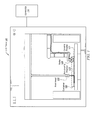
- FIGURE 1 illustrates an example embodiment of a 3-D printer 100.
- 3-D printer 100 includes a print head 110 and a roller 120. Roller 120 deposits layers of a ceramic powder 125 into a container 160.
- Print head 110 deposits a pre-ceramic polymer 115 dissolved in a solvent onto the layers of ceramic powder 125.
- 3-D printer 100 may include a computer system 150 that controls the printing of an object by providing instructions to 3-D printer 100.
- Computer system 150 may be either external to 3-D printer 100 or incorporated into 3-D printer 100. Certain embodiments of computer system are discussed in more detail below with respect to FIGURE 7 .
- 3-D printer 100 print 3-D diamond objects using roller 120 and print head 110.
- 3-D printer 100 may print the 3-D object 200 illustrated in FIGURE 2 by depositing successive layers of pre-ceramic polymer 115 through print head 110 onto layers of ceramic powder 125 that were deposited by roller 120 into container 160.
- roller 120 may initially deposit a first layer of ceramic powder 125 into container 160.
- Print head 110 may then deposit a first layer of pre-ceramic polymer 115 onto the first layer of ceramic powder 125 in the shape of a first cross section or "slice" of the desired 3-D object.
- roller 120 may then deposit a second layer of ceramic powder 125 on top of the first layer of ceramic powder 125 and first layer of pre-ceramic polymer 115.
- the certain amount of time may be sufficient to allow for solvent to evaporate.
- Print head 110 may then deposit a second layer of pre-ceramic polymer 115 onto the second layer of ceramic powder 125 in the shape of a cross section of the object that is adjacent to and above the first cross section. Subsequent layers of ceramic powder 125 and pre-ceramic polymer 115 may be deposited in alternating fashion until the layers of pre-ceramic polymer 115 form the shape of the desired 3-D object.
- container 160 may then be placed into a furnace for baking.
- baking may take place in an inert atmosphere.
- excess ceramic powder 125 i.e., ceramic powder 125 that was not sprayed with any pre-ceramic polymer 115
- This may provide additional advantages to prior processes by providing support for the 3-D object during baking.
- Print head 110 may be any commercially-available print head such as any ink jet or any aerosol jet print head. Depending on the type of print head 110 used, different feature sizes may be printed for an object. For example, an aerosol jet print head 110 may allow features as small as 10 microns to be printed. Print head 110 may be able to precisely control the volume of pre-ceramic polymer 115 deposited to ensure that pre-ceramic polymer 115 does not "soak through" the most recent layer of ceramic powder 125 into previously deposited layers of ceramic powder 125. While specific embodiments of print head 110 have been described, any appropriate system or method of depositing pre-ceramic polymer 115 onto ceramic powder 125 may be utilized. For example, certain embodiments of 3-D printer 100 may utilize techniques to deposit pre-ceramic polymer 115 onto ceramic powder 125 that do not involve any form of print head 110.
- Roller 120 may be any device operable to deposit layers of ceramic powder 125.
- roller 120 may be a roller that is fed by a hopper of ceramic powder 125.
- roller 120 may be a nozzle that is able to uniformly deposit layers of ceramic powder 125. While specific systems of depositing ceramic powder 125 have been described, any appropriate system or method of depositing layers of ceramic powder 125 may be utilized.
- certain embodiments of 3-D printer 100 may utilize techniques to deposit layers of ceramic powder 125 that do not involve any form of roller 120.
- pre-ceramic polymer 115 may be poly(hydridocarbyne) ("PHC”), poly(methylsilyne) (“PMS”), or any sp3-hybridized polymer.
- PLC poly(hydridocarbyne)
- PMS poly(methylsilyne)
- Pre-ceramic polymer 115 may react with itself (e.g. pyrolyze, thermolyze, or decompose) to form a ceramic above a certain temperature known as a decomposition, or pyrolysis, temperature of pre-ceramic polymer 115.
- pre-ceramic polymer 115 may be dissolved in a solvent such as acetone, tetra hydrofuran, toluene, acetonitrile, an aprotic solvent, a mixture of any two or more of these solvents, and the like.
- a solvent such as acetone, tetra hydrofuran, toluene, acetonitrile, an aprotic solvent, a mixture of any two or more of these solvents, and the like.
- 3-D printer 100 may pause for a predetermined amount of time to allow the solvent to evaporate before depositing another layer of ceramic powder 125. Because layers of pre-ceramic polymer 115 may be relatively thin in certain embodiments, a pause of several seconds or less may be sufficient to allow the solvent to evaporate. Allowing the solvent to evaporate after each layer of pre-ceramic polymer 115 is deposited may prevent the solvent from becoming entrained in ceramic powder 125 as subsequent layers of ceramic powder 125 and pre-ceramic polymer 115 are deposited. This may prevent any graphitic contaminate from forming within any 3-D printed object.
- Ceramic powder 125 may be any appropriate nanoparticle filler.
- ceramic powder 125 may be any one or a mixture of the following: detonation nanodiamond ("DND") powder, silicon carbide powder, graphene nano-platlet powder, graphene oxide nano-platelet powder, carbon nanotube powder, various fullerenes (such as Buckminsterfullerenes), boron nitride nano-platelet powder, a carbide forming metal powder, or any other powder that will not sinter at the decomposition temperature of pre-ceramic polymer 115.
- DND detonation nanodiamond
- silicon carbide powder silicon carbide powder
- graphene nano-platlet powder graphene oxide nano-platelet powder
- carbon nanotube powder various fullerenes (such as Buckminsterfullerenes)
- boron nitride nano-platelet powder a carbide forming metal powder
- carbide forming metals include, but are not limited to, titanium, hafn
- an average particle diameter of ceramic powder 125 may be less than a colloidal particle diameter of pre-ceramic polymer 115. In some embodiments, the average particle diameter of ceramic powder 125 may be less than 30 nanometers.
- One example of a possible ceramic powder 125, DND may be formed by the detonation of explosives in an enclosed chamber in an inert atmosphere. The resulting nanodiamonds may have a diameter between 2 and 20 nanometers. Through processing, a powder of nanodiamonds having diameters of 4 to 5 nanometers may be created. Detonation nanodiamonds have a cubic crystal structure, like that of most naturally occurring diamond.
- 3-D printer 100 may be controlled by computer system 150.
- Computer system 150 may be any suitable computer system in any suitable physical form.
- computer system 150 may store a digital representation of a 3-D object and provide 3-D printer 100 with information to print the 3-D object.
- computer system 150 may store a 3-D computer aided design (CAD) model of an object and provide the model to 3-D printer 100 when printing the object.
- CAD computer aided design
- Computer system 150 may be integrated into 3-D printer 100, connected to 3-D printer 100, or be multiple computer systems both integrated into 3-D printer 100 and separate from 3-D printer 100.
- computer system 150 may be a virtual machine (VM), an embedded computer system, a system-on-chip (SOC), a single-board computer system (SBC) (e.g., a computer-on-module (COM or a system-on-module (SOM)), a desktop computer system, a laptop or notebook computer system, a mainframe, a mesh of computer systems, a server, an application server, or a combination of two or more of these.
- VM virtual machine
- SOC system-on-chip
- SBC single-board computer system
- COM computer-on-module
- SOM system-on-module
- computer system 150 may include one or more computer systems 150; be unitary or distributed; span multiple locations; span multiple machines; or reside in a cloud, which may include one or more cloud components in one or more networks.
- one or more computer systems 150 may perform without substantial spatial or temporal limitation one or more steps of one or more methods described or illustrated herein.
- one or more computer systems 150 may perform in real time or in batch mode one or more steps of one or more methods described or illustrated herein.
- One or more computer systems 150 may perform at different times or at different locations one or more steps of one or more methods described or illustrated herein, where appropriate.
- a particular embodiment of computer system 150 is described in more detail below in reference to FIGURE 7 .
- FIGURE 2 illustrates an example of a 3-D printed object 200 printed by 3-D printer 100 within excess ceramic powder 125.
- the volume of ceramic powder 125 onto which pre-ceramic polymer 115 was deposited will be in the shape of object 200 within ceramic powder 125.
- Pre-ceramic polymer 115 may act as a binder, binding ceramic powder 125 together in the areas where print head 110 deposited pre-ceramic polymer 115.
- the remaining excess ceramic powder 125 may act as a support for the object. For example, the excess ceramic powder 125 may keep thin sections of object 200 from collapsing.
- FIGURE 3 illustrates an example of a vertical cross section 300 of 3-D printed object 200 illustrated in FIGURE 2 .
- Vertical cross section 300 illustrates how a pattern of pre-ceramic polymer 115, when deposited onto subsequent layers of ceramic powder 125, forms the shape of object 200.
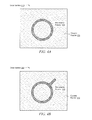
- FIGURE 3 also includes horizontal cross sections 310 and 320, which are illustrated in FIGURES 4A and 4B .
- Horizontal cross section 310 corresponds to a horizontal cross section of pre-ceramic polymer 115 that may be deposited near the bottom of object 200 illustrated in FIGURE 2 .
- Horizontal cross section 320 corresponds to a horizontal cross section of pre-ceramic polymer 115 that may be deposited near the top of object 200 illustrated in FIGURE 2 .
- FIGURE 5A illustrates the chemical structure of poly(hydridocarbyne), which may be used for pre-ceramic polymer 115 in some embodiments.
- Poly-(hydridocarbyne) may pyrolyze to form diamond-like carbon or polycrystalline diamond when heated to a decomposition temperature such as between about 100 degrees Celsius and 800 degrees Celsius in an inert atmosphere. Upon sustained heating at or above the decomposition temperature for a predetermined amount of time (e.g., 12 to 24 hours), diamond-like carbon may anneal to form polycrystalline diamond.
- Diamond formed by pyrolysis of poly(hydridocarbyne) may have a hexagonal crystal structure. Diamond having a hexagonal crystal structure is also known as lonsdaleite.
- poly(hydridocarbyne) may react with the surface of ceramic powder 125 and bond to it.
- ceramic powder 125 is comprised of DND
- poly(hydridocarbyne) may react to form polycrystalline diamond bonded to the DND.
- the 3-D printed object will be composed of polycrystalline diamond. More specifically, the object may be composed of cubic crystal structure DND bonded within polycrystalline hexagonal diamond.
- objects comprised entirely of solid diamond may be printed in almost any shape. For example, drill heads used for boring through the earth, such as drill heads with complex geometries that are used in the oil industry, could be printed using DND and poly(hydridocarbyne) to form a polycrystalline diamond drill head.
- the poly(hydridocarbyne) may react with the surface of the metal particles to form metal carbide bonds.
- the 3-D printed object after heating may comprise tungsten particles suspended in polycrystalline diamond, with the polycrystalline diamond bonded to the surface of the tungsten particles by tungsten carbide bonds.
- FIGURE 5B illustrates the chemical structure of poly(methylsilyne), which may be used for pre-ceramic polymer 115 in some embodiments.
- Poly(methylsilyne) may pyrolyze to form silicon carbide when heated to a decomposition temperature such as between about 100 degrees Celsius and 800 degrees Celsius. At its pyrolysis temperature, poly(methylsilyne) may react with the surface of ceramic powder 125 and bond to it. For example, if ceramic powder 125 is comprised of DND, poly(methylsilyne) may react to form silicon carbide bonded to the DND.
- the 3-D printed object may be composed of cubic crystal structure detonation nanodiamonds within silicon carbide, with the silicon carbide bonded to the surface of the detonation nanodiamonds.
- the ceramic powder comprises silicon carbide powder
- poly(methylsilyne) will react to form silicon carbide bonded to the silicon carbide powder, forming a 3-D object of polycrystalline silicon carbide.
- 3-D printer 100 may print object 200 by depositing alternating layers of ceramic powder 125 and pre-ceramic polymer 115.
- 3-D printer 100 may deposit pre-ceramic polymer 115 in the shape of cross sections of the object being printed, such as those illustrated in FIGURES 4A and 4B .
- the 3-D printing of object 200 using pre-ceramic polymer 115 and ceramic powder 125 may take place in an inert atmosphere. Examples of inert gases include, but are not limited to, argon, nitrogen, neon, xenon, and the like.
- Depositing layers of pre-ceramic polymer 115 and ceramic powder 125 in an inert atmosphere prevents oxygen from becoming entrained in object 200 and in excess ceramic powder 125 in which print head 110 did not deposit pre-ceramic polymer 115.
- 3-D printer 100 deposits all layers of ceramic powder 125 and pre-ceramic polymer 115, object 200 and excess ceramic powder 125 may be baked to a temperature at or above the decomposition temperature of pre-ceramic polymer 115 and below the sintering temperature of ceramic powder 125. In some embodiments, this temperature range may be between about 100 degrees Celsius and 800 degrees Celsius.
- 3-D printer 100 may incorporate a heater or oven to bake the printed layers of pre-ceramic polymer 115 and ceramic powder 125.
- the printed layers of pre-ceramic polymer 115 and ceramic powder 125 may be moved to an oven for baking after printing.
- the layers of pre-ceramic polymer 115 and ceramic powder 125 may be deposited in container 160 in some embodiments and container 160 may be moved to an oven for baking after printing.
- the baking occurs at any temperature in which ceramic powder 125 may remain a powder and pre-ceramic polymer 115 decomposes.
- the baking may occur at a decomposition temperature that is between about 100 degrees Celsius and about 800 degrees Celsius.
- the baking may occur at a temperature that is at least 100 degrees Celsius, plus or minus 0%-1%, 1%-5%, 5%-10%, or 10%-20%, but is less than 800 degrees Celsius, plus or minus 0%-1%, 1%-5%, 5%-10%, or 10%-20%. While specific baking temperatures have been disclosed, it should be noted that any appropriate temperature in which ceramic powder 125 remains a powder (i.e. any temperature at which ceramic powder 125 does not sinter to itself) while pre-ceramic polymer 115 decomposes may be utilized.
- the baking occurs in an inert atmosphere such as nitrogen, argon, xenon, neon, and the like. Baking in an inert atmosphere may prevent the printed pre-ceramic polymer 115 and ceramic powder 125 from reacting with any oxygen in the air.
- the oxygen may additionally or alternatively be purged from the printed pre-ceramic polymer 115 and ceramic powder 125 before baking.
- the printed pre-ceramic polymer 115 and ceramic powder 125 may be placed in a vacuum or inert atmosphere to allow the oxygen to diffuse out. Removal of entrained oxygen may take an extended period of time (e.g., up to twenty four hours). Given the amount of time required to purge oxygen from the printed pre-ceramic polymer 115 and ceramic powder 125, 3-D printing in an inert atmosphere may be desirable in order to expedite the 3-D printing process.
- the decomposition temperature may be between about 100 degrees Celsius and about 800 degrees Celsius.
- Pre-ceramic polymer 115 may react with itself and with the surface of particles of ceramic powder 125 at this temperature. In this temperature range, particles of ceramic powder 125 will not sinter, meaning they will not react with, or bind to, other particles of ceramic powder 125. Therefore, ceramic powder 125 may remain a powder at the temperatures at which pre-ceramic polymer 115 decomposes. The excess ceramic powder 125 that is not in contact with pre-ceramic polymer 115 may act as a support for the printed object during heating.
- Ceramic powder 125 containing pre-ceramic polymer 115 After heating the ceramic powder 125 containing pre-ceramic polymer 115, excess ceramic powder may be removed from the object. The excess ceramic powder may be recycled and used to print another 3-D object. 3-D printer 100 may remove excess ceramic powder 125 from the 3-D diamond object using a brush, vacuum, compressed air, or any other appropriate tool. Excess ceramic powder 125 may also be removed manually after heating.
- 3-D printer 100 may be able to print a layer of ceramic powder 125 and a layer of pre-ceramic polymer 115 continuously.
- 3-D printer 100 may have multiple rollers 120 and print heads 110 in order to print multiple layers continuously.
- Multiple rollers 120 and print heads 110 may be arranged sequentially on a moving line which feeds directly into a heater or oven to heat the printed layers.
- the printed object may be a thin continuous object, such as a printed cloth that can be rolled upon exit from the oven.
- 3-D printer 100 may print object 200 using multiple ceramic powders 125 and pre-ceramic polymers 115.
- the use of different ceramic powders 125 may produce objects having different properties. Properties that may depend on the choice of ceramic powders 125 include toughness, hardness, yield strength, density, friction, electrical conductivity, thermal conductivity, thermal expansion coefficient, optical transparence, index of refraction, or other physical properties, in a printed object. For example, printing an object using carbon nanotube powder may result in an object that is tougher than one printed using DND, while objects printed using DND may be harder than those printed using carbon nanotube powder.
- certain ceramic powders 125 may also be mixed to tune the desired properties of object 200.
- a mixture of carbon nanotubes and DND may be used as ceramic powder 125 to create an object 200 having desired levels of toughness and hardness.
- roller 120 may deposit layers of different ceramic powders 125.
- roller 120 may deposit a first layer of DND, followed by a layer of Buckminsterfullerenes.
- Depositing layers of different ceramic powers 125 allows the printing of an object with desirable properties.
- printing an object with layers that alternate between being hard and being tough may allow for the creation of an object with properties desirable as an armor.
- an armor having alternating layers of diamond and metal carbide may be printed.
- print head 110 may deposit both poly(hydridocarbyne) and poly(methylsilyne) to print object 200.
- poly(hydridocarbyne) could be used to print some layers of an object and poly(methylsilyne) could be used to print other layers of the object.
- poly(hydridocarbyne) could be used to print a section of an object and poly(methylsilyne) could be used to print another section.
- poly(hydridocarbyne) could be used to print the handle portion of object 200 illustrated in FIGURE 2 and poly (methylsilyne) could be used to print the cup portion of object 200.
- poly(hydridocarbyne) could be printed onto a layer of a first type of ceramic powder 125 and poly(methylsilyne) could be printed onto a layer of a second type of ceramic powder 125.
- Printing objects 200 using multiple types of ceramic powders 125 and both poly(methylsilyne) and poly(hydridocarbyne) may allow for the creation of objects that would be otherwise difficult to manufacture.
- a missile radome could be printed out of diamond with a silicon carbide coating to prevent oxidation of the diamond at high temperatures.
- Such an object could be printed by using layers of DND and poly(hydridocarbyne) to form the structure of the radome, and using silicon carbide powder and poly(methylsilyne) to form the outer surface of the radome.
- FIGURE 6 illustrates a method 600 for printing a 3-D object such as object 200 in a ceramic powder using a pre-ceramic polymer.
- Method 600 may be implemented by 3-D printer 100.
- Method 600 begins at step 605 where a layer of ceramic powder is deposited.
- the layer of ceramic powder is deposited by an apparatus such as roller 120 or any other suitable method.
- the ceramic powder deposited in step 605 may be ceramic powder 125 discussed above.
- the ceramic powder may be deposited into a container such as container 160 above.
- a layer of pre-ceramic polymer is deposited in the shape of a cross section of the desired object onto the layer of ceramic powder deposited in step 605.
- the pre-ceramic polymer is deposited in step 610 by print head 110 or any other appropriate apparatus.
- the pre-ceramic polymer is pre-ceramic polymer 115 above. After depositing the pre-ceramic polymer in step 610, some embodiments of method 600 may pause to allow any solvent within the pre-ceramic polymer to evaporate.
- step 620 all layers of pre-ceramic polymer needed to form the object have not been deposited, 3-D printer 100 will select the next cross section to be printed and move back to step 605 where a new layer of ceramic powder is deposited.
- step 610 pre-ceramic polymer 115 is deposited in the shape of the next cross section of the object.
- method 600 proceeds to step 640.
- step 640 the printed ceramic powder and pre-ceramic polymer is heated at or above the pre-ceramic polymer's decomposition temperature. At this temperature, the pre-ceramic polymer may react to form a ceramic and may bind to the ceramic powder. In some embodiments, step 640 occurs in an inert atmosphere as described above.
- step 650 excess ceramic powder that is not in contact with the reacted pre-ceramic polymer is removed.
- the excess powder may be either removed mechanically (e.g., by 3-D printer 100) or manually removed.
- the excess ceramic powder is recycled or discarded.
- the object may be subjected to additional processing steps to prepare the object for use.
- post-printing processing may include: painting the object, polishing the object, treating the surface of the object to render it chemically inert or to make it chemically active, and assembly of another object or device from multiple printed objects.
- FIGURE 7 illustrates an example computer system 700.
- Computer system 700 may be utilized by computer system 150 of FIGURE 1 .
- one or more computer systems 700 perform one or more steps of one or more methods described or illustrated herein.
- one or more computer systems 700 provide functionality described or illustrated herein.
- software running on one or more computer systems 700 performs one or more steps of one or more methods described or illustrated herein or provides functionality described or illustrated herein.
- Particular embodiments include one or more portions of one or more computer systems 700.
- reference to a computer system may encompass a computing device, and vice versa, where appropriate.
- reference to a computer system may encompass one or more computer systems, where appropriate.
- computer system 700 may be an embedded computer system, a system-on-chip (SOC), a single-board computer system (SBC) (such as, for example, a computer-on-module (COM) or system-on-module (SOM)), a desktop computer system, a laptop or notebook computer system, an interactive kiosk, a mainframe, a mesh of computer systems, a mobile telephone, a personal digital assistant (PDA), a server, a tablet computer system, or a combination of two or more of these.
- SOC system-on-chip
- SBC single-board computer system
- COM computer-on-module
- SOM system-on-module
- computer system 700 may include one or more computer systems 700; be unitary or distributed; span multiple locations; span multiple machines; span multiple data centers; or reside in a cloud, which may include one or more cloud components in one or more networks.
- one or more computer systems 700 may perform without substantial spatial or temporal limitation one or more steps of one or more methods described or illustrated herein.
- one or more computer systems 700 may perform in real time or in batch mode one or more steps of one or more methods described or illustrated herein.
- One or more computer systems 700 may perform at different times or at different locations one or more steps of one or more methods described or illustrated herein, where appropriate.
- computer system 700 includes a processor 702, memory 704, storage 706, an input/output (I/O) interface 708, a communication interface 710, and a bus 712.
- processor 702 memory 704, storage 706, an input/output (I/O) interface 708, a communication interface 710, and a bus 712.
- I/O input/output
- this disclosure describes and illustrates a particular computer system having a particular number of particular components in a particular arrangement, this disclosure contemplates any suitable computer system having any suitable number of any suitable components in any suitable arrangement.
- processor 702 includes hardware for executing instructions, such as those making up a computer program.
- processor 702 may retrieve (or fetch) the instructions from an internal register, an internal cache, memory 704, or storage 706; decode and execute them; and then write one or more results to an internal register, an internal cache, memory 704, or storage 706.
- processor 702 may include one or more internal caches for data, instructions, or addresses. This disclosure contemplates processor 702 including any suitable number of any suitable internal caches, where appropriate.
- processor 702 may include one or more instruction caches, one or more data caches, and one or more translation lookaside buffers (TLBs).
- TLBs translation lookaside buffers
- Instructions in the instruction caches may be copies of instructions in memory 704 or storage 706, and the instruction caches may speed up retrieval of those instructions by processor 702.
- Data in the data caches may be copies of data in memory 704 or storage 706 for instructions executing at processor 702 to operate on; the results of previous instructions executed at processor 702 for access by subsequent instructions executing at processor 702 or for writing to memory 704 or storage 706; or other suitable data.
- the data caches may speed up read or write operations by processor 702.
- the TLBs may speed up virtual-address translation for processor 702.
- processor 702 may include one or more internal registers for data, instructions, or addresses. This disclosure contemplates processor 702 including any suitable number of any suitable internal registers, where appropriate. Where appropriate, processor 702 may include one or more arithmetic logic units (ALUs); be a multi-core processor; or include one or more processors 702. Although this disclosure describes and illustrates a particular processor, this disclosure contemplates any suitable processor.
- ALUs
- memory 704 includes main memory for storing instructions for processor 702 to execute or data for processor 702 to operate on.
- computer system 700 may load instructions from storage 706 or another source (such as, for example, another computer system 700) to memory 704.
- Processor 702 may then load the instructions from memory 704 to an internal register or internal cache.
- processor 702 may retrieve the instructions from the internal register or internal cache and decode them.
- processor 702 may write one or more results (which may be intermediate or final results) to the internal register or internal cache.
- Processor 702 may then write one or more of those results to memory 704.
- processor 702 executes only instructions in one or more internal registers or internal caches or in memory 704 (as opposed to storage 706 or elsewhere) and operates only on data in one or more internal registers or internal caches or in memory 704 (as opposed to storage 706 or elsewhere).
- One or more memory buses (which may each include an address bus and a data bus) may couple processor 702 to memory 704.
- Bus 712 may include one or more memory buses, as described below.
- one or more memory management units reside between processor 702 and memory 704 and facilitate accesses to memory 704 requested by processor 702.
- memory 704 includes random access memory (RAM). This RAM may be volatile memory, where appropriate.
- this RAM may be dynamic RAM (DRAM) or static RAM (SRAM). Moreover, where appropriate, this RAM may be single-ported or multi-ported RAM. This disclosure contemplates any suitable RAM.
- Memory 704 may include one or more memories 704, where appropriate. Although this disclosure describes and illustrates particular memory, this disclosure contemplates any suitable memory.
- storage 706 includes mass storage for data or instructions.
- storage 706 may include a hard disk drive (HDD), a floppy disk drive, flash memory, an optical disc, a magneto-optical disc, magnetic tape, or a Universal Serial Bus (USB) drive or a combination of two or more of these.
- Storage 706 may include removable or non-removable (or fixed) media, where appropriate.
- Storage 706 may be internal or external to computer system 700, where appropriate.
- storage 706 is non-volatile, solid-state memory.
- storage 706 includes read-only memory (ROM).
- this ROM may be mask-programmed ROM, programmable ROM (PROM), erasable PROM (EPROM), electrically erasable PROM (EEPROM), electrically alterable ROM (EAROM), or flash memory or a combination of two or more of these.
- This disclosure contemplates mass storage 706 taking any suitable physical form.
- Storage 706 may include one or more storage control units facilitating communication between processor 702 and storage 706, where appropriate. Where appropriate, storage 706 may include one or more storages 706. Although this disclosure describes and illustrates particular storage, this disclosure contemplates any suitable storage.
- I/O interface 708 includes hardware, software, or both, providing one or more interfaces for communication between computer system 700 and one or more I/O devices.
- Computer system 700 may include one or more of these I/O devices, where appropriate.
- One or more of these I/O devices may enable communication between a person and computer system 700.
- an I/O device may include a keyboard, keypad, microphone, monitor, mouse, printer, scanner, speaker, still camera, stylus, tablet, touch screen, trackball, video camera, another suitable I/O device or a combination of two or more of these.
- An I/O device may include one or more sensors.
- I/O interface 708 may include one or more device or software drivers enabling processor 702 to drive one or more of these I/O devices.
- I/O interface 708 may include one or more I/O interfaces 708, where appropriate.
- communication interface 710 includes hardware, software, or both providing one or more interfaces for communication (such as, for example, packet-based communication) between computer system 700 and one or more other computer systems 700 or one or more networks.
- communication interface 710 may include a network interface controller (NIC) or network adapter for communicating with an Ethernet or other wire-based network or a wireless NIC (WNIC) or wireless adapter for communicating with a wireless network, such as a WI-FI network.
- NIC network interface controller
- WNIC wireless NIC
- WI-FI network wireless network
- computer system 700 may communicate with an ad hoc network, a personal area network (PAN), a local area network (LAN), a wide area network (WAN), a metropolitan area network (MAN), or one or more portions of the Internet or a combination of two or more of these.
- PAN personal area network
- LAN local area network
- WAN wide area network
- MAN metropolitan area network
- computer system 700 may communicate with a wireless PAN (WPAN) (such as, for example, a BLUETOOTH WPAN), a WI-FI network, a WI-MAX network, a cellular telephone network (such as, for example, a Global System for Mobile Communications (GSM) network), or other suitable wireless network or a combination of two or more of these.
- WPAN wireless PAN
- WI-FI wireless personal area network
- WI-MAX wireless personal area network
- WI-MAX wireless personal area network
- cellular telephone network such as, for example, a Global System for Mobile Communications (GSM) network
- GSM Global System
- bus 712 includes hardware, software, or both coupling components of computer system 700 to each other.
- bus 712 may include an Accelerated Graphics Port (AGP) or other graphics bus, an Enhanced Industry Standard Architecture (EISA) bus, a front-side bus (FSB), a HYPERTRANSPORT (HT) interconnect, an Industry Standard Architecture (ISA) bus, an INFINIBAND interconnect, a low-pin-count (LPC) bus, a memory bus, a Micro Channel Architecture (MCA) bus, a Peripheral Component Interconnect (PCI) bus, a PCI-Express (PCIe) bus, a serial advanced technology attachment (SATA) bus, a Video Electronics Standards Association local (VLB) bus, or another suitable bus or a combination of two or more of these.
- Bus 712 may include one or more buses 712, where appropriate.
- the components of computer system 700 may be integrated or separated. In some embodiments, components of computer system 700 may each be housed within a single chassis. The operations of computer system 700 may be performed by more, fewer, or other components. Additionally, operations of computer system 700 may be performed using any suitable logic that may comprise software, hardware, other logic, or any suitable combination of the preceding.
Landscapes
- Engineering & Computer Science (AREA)
- Chemical & Material Sciences (AREA)
- Ceramic Engineering (AREA)
- Manufacturing & Machinery (AREA)
- Materials Engineering (AREA)
- Structural Engineering (AREA)
- Organic Chemistry (AREA)
- Mechanical Engineering (AREA)
- Inorganic Chemistry (AREA)
- Chemical Kinetics & Catalysis (AREA)
- Producing Shaped Articles From Materials (AREA)
- Life Sciences & Earth Sciences (AREA)
- General Life Sciences & Earth Sciences (AREA)
- Geology (AREA)
- Inks, Pencil-Leads, Or Crayons (AREA)
Abstract
Description
- This invention relates generally to three-dimensional (3-D) printing and in particular to 3-D printing using a pre-ceramic polymer with a ceramic powder filler.
- Three-dimensional (3-D) printing is an additive manufacturing process that allows for the manufacture of objects by "building up" an object. In contrast to subtractive techniques, such as machining, in which material is removed from a bulk material in order to form the shape of an object, 3-D printing lays down successive layers of material to form the shape of an object. Typical materials used for 3-D printing may include plastics, ceramics, and metals.
- According to some embodiments, a method includes depositing alternating layers of a ceramic powder and a pre-ceramic polymer dissolved in a solvent. Each layer of the pre-ceramic polymer is deposited in a shape corresponding to a cross section of an object. The alternating layers of the ceramic powder and the pre-ceramic polymer are deposited until the layers of the pre-ceramic polymer form the shape of the object. The method includes heating the deposited ceramic powder and pre-ceramic polymer to at least a decomposition temperature of the pre-ceramic polymer. The decomposition temperature of the pre-ceramic polymer is less than a sintering temperature of the ceramic powder. The method further includes removing excess ceramic powder that the pre-ceramic polymer was not deposited onto.
- Technical advantages of certain embodiments may include using a diamond forming pre-ceramic polymer in a 3-D printer to form a diamond object. Some embodiments may provide methods of forming an object by depositing layers of multiple types of pre-ceramic polymers and multiple types of ceramic powders. Additional technical advantages of some embodiments may include use of ceramic powders that can be left in place to provide support for an object during heating. Other technical advantages will be readily apparent to one skilled in the art from the following figures, descriptions, and claims. Moreover, while specific advantages have been enumerated above, various embodiments may include all, some, or none of the enumerated advantages.
- To provide a more complete understanding of the present invention and the features and advantages thereof, reference is made to the following description taken in conjunction with the accompanying drawings, in which:
-
FIGURE 1 illustrates an example of a 3-D printer, according to certain embodiments; -
FIGURE 2 illustrates an object printed by the 3-D printer ofFIGURE 1 within ceramic powder, according to certain embodiments; -
FIGURE 3 illustrates a vertical cross section of the 3-D printed object illustrated inFIGURE 2 , according to certain embodiments; -
FIGURES 4A and 4B illustrate horizontal cross sections of the 3-D printed object illustrated inFIGURE 2 , according to certain embodiments; -
FIGURE 5A illustrates the chemical structure of the pre-ceramic polymer poly(hydridocarbyne); -
FIGURE 5B illustrates the chemical structure of the pre-ceramic polymer poly(methylsilyne); -
FIGURE 6 illustrates a method of printing a 3-D object in a ceramic powder using a pre-ceramic polymer, according to certain embodiments; and -
FIGURE 7 illustrates an example computer system that may used to control the 3-D printer ofFIGURE 1 , according to certain embodiments. - Embodiments of the present invention and its advantages are best understood by referring to
FIGURES 1 through 7 of the drawings, like numerals being used for like and corresponding parts of the various drawings. - Diamond is a form of the element carbon that has many unique properties. Diamond is among the hardest known materials, has a high melting and boiling point, and is an excellent thermal conductor as well as electrical insulator. Objects made out of diamond may be able to take advantage of these properties. For example, tools made out of diamond, such as drill bits, saws, or knives, may be more durable than tools made of conventional materials due to the hardness of diamond. Diamond can be produced in a variety of ways including as a powder in the form of diamond nanoparticles and from the pyrolysis of a pre-ceramic polymer.
- The teachings of the disclosure recognize that using three-dimensional (3-D) printing techniques with a pre-ceramic polymer and nanoparticle powder may allow for the creation of objects made of a variety of ceramics in a variety of useful shapes. In particular, using 3-D printing techniques with a diamond forming pre-ceramic polymer and a diamond nanoparticle powder may allow for the creation of diamond objects in a variety of shapes. For example, using 3-D printing with a diamond forming pre-ceramic polymer and a diamond nanoparticle powder, a diamond drill bit having almost any geometry could be printed. As other examples, 3-D printing with a diamond forming pre-ceramic polymer and a diamond nanoparticle powder may be used to print brake pad inserts, avionics boxes, lightweight armor, diamond dialysis filters, vacuum micro-electronics, or any other appropriate object. Furthermore, by using different pre-ceramic polymers and nanoparticle powders separately or in addition to diamond forming pre-ceramic polymer and diamond nanoparticle powder, the properties of a printed object could be varied to meet various design objectives. Further, the teachings of this disclosure recognize that a nanoparticle powder that does not sinter may be used to support an object during the 3-D printing process. The following describes methods and systems of 3-D printing using a pre-ceramic polymer with a nanoparticle filler.
-
FIGURE 1 illustrates an example embodiment of a 3-D printer 100. 3-D printer 100 includes aprint head 110 and aroller 120.Roller 120 deposits layers of aceramic powder 125 into acontainer 160. Printhead 110 deposits apre-ceramic polymer 115 dissolved in a solvent onto the layers ofceramic powder 125. In some embodiments, 3-D printer 100 may include acomputer system 150 that controls the printing of an object by providing instructions to 3-D printer 100.Computer system 150 may be either external to 3-D printer 100 or incorporated into 3-D printer 100. Certain embodiments of computer system are discussed in more detail below with respect toFIGURE 7 . - In general, certain embodiments of 3-
D printer 100 print 3-D diamondobjects using roller 120 and printhead 110. For example, 3-D printer 100 may print the 3-D object 200 illustrated inFIGURE 2 by depositing successive layers ofpre-ceramic polymer 115 throughprint head 110 onto layers ofceramic powder 125 that were deposited byroller 120 intocontainer 160. Specifically,roller 120 may initially deposit a first layer ofceramic powder 125 intocontainer 160. Printhead 110 may then deposit a first layer ofpre-ceramic polymer 115 onto the first layer ofceramic powder 125 in the shape of a first cross section or "slice" of the desired 3-D object. After a certain amount of time,roller 120 may then deposit a second layer ofceramic powder 125 on top of the first layer ofceramic powder 125 and first layer ofpre-ceramic polymer 115. In some embodiments, the certain amount of time may be sufficient to allow for solvent to evaporate.Print head 110 may then deposit a second layer ofpre-ceramic polymer 115 onto the second layer ofceramic powder 125 in the shape of a cross section of the object that is adjacent to and above the first cross section. Subsequent layers ofceramic powder 125 andpre-ceramic polymer 115 may be deposited in alternating fashion until the layers ofpre-ceramic polymer 115 form the shape of the desired 3-D object. - Once all layers of
pre-ceramic polymer 115 andceramic powder 125 have been deposited incontainer 160 to form the shape of the desired 3-D object withinceramic powder 125,container 160 may then be placed into a furnace for baking. In some embodiments, baking may take place in an inert atmosphere. Unlike other methods in which excess powder may be removed prior to baking, excess ceramic powder 125 (i.e.,ceramic powder 125 that was not sprayed with any pre-ceramic polymer 115) is not removed prior to baking but instead remains withincontainer 160 during the baking process. This may provide additional advantages to prior processes by providing support for the 3-D object during baking. Once the baking is complete and after cooling, excessceramic powder 125 is removed in order to reveal the desired 3-D diamond object. The excessceramic powder 125 may then be recycled and reused or discarded. -
Print head 110 may be any commercially-available print head such as any ink jet or any aerosol jet print head. Depending on the type ofprint head 110 used, different feature sizes may be printed for an object. For example, an aerosoljet print head 110 may allow features as small as 10 microns to be printed.Print head 110 may be able to precisely control the volume ofpre-ceramic polymer 115 deposited to ensure thatpre-ceramic polymer 115 does not "soak through" the most recent layer ofceramic powder 125 into previously deposited layers ofceramic powder 125. While specific embodiments ofprint head 110 have been described, any appropriate system or method of depositingpre-ceramic polymer 115 ontoceramic powder 125 may be utilized. For example, certain embodiments of 3-D printer 100 may utilize techniques to depositpre-ceramic polymer 115 ontoceramic powder 125 that do not involve any form ofprint head 110. -
Roller 120 may be any device operable to deposit layers ofceramic powder 125. For example,roller 120 may be a roller that is fed by a hopper ofceramic powder 125. In alternative embodiments,roller 120 may be a nozzle that is able to uniformly deposit layers ofceramic powder 125. While specific systems of depositingceramic powder 125 have been described, any appropriate system or method of depositing layers ofceramic powder 125 may be utilized. For example, certain embodiments of 3-D printer 100 may utilize techniques to deposit layers ofceramic powder 125 that do not involve any form ofroller 120. - In some embodiments,
pre-ceramic polymer 115 may be poly(hydridocarbyne) ("PHC"), poly(methylsilyne) ("PMS"), or any sp3-hybridized polymer.Pre-ceramic polymer 115 may react with itself (e.g. pyrolyze, thermolyze, or decompose) to form a ceramic above a certain temperature known as a decomposition, or pyrolysis, temperature ofpre-ceramic polymer 115. In some embodiments,pre-ceramic polymer 115 may be dissolved in a solvent such as acetone, tetra hydrofuran, toluene, acetonitrile, an aprotic solvent, a mixture of any two or more of these solvents, and the like. - In some embodiments, after depositing a layer of
pre-ceramic polymer 115 dissolved in a solvent, 3-D printer 100 may pause for a predetermined amount of time to allow the solvent to evaporate before depositing another layer ofceramic powder 125. Because layers ofpre-ceramic polymer 115 may be relatively thin in certain embodiments, a pause of several seconds or less may be sufficient to allow the solvent to evaporate. Allowing the solvent to evaporate after each layer ofpre-ceramic polymer 115 is deposited may prevent the solvent from becoming entrained inceramic powder 125 as subsequent layers ofceramic powder 125 andpre-ceramic polymer 115 are deposited. This may prevent any graphitic contaminate from forming within any 3-D printed object. -
Ceramic powder 125 may be any appropriate nanoparticle filler. In some embodiments,ceramic powder 125 may be any one or a mixture of the following: detonation nanodiamond ("DND") powder, silicon carbide powder, graphene nano-platlet powder, graphene oxide nano-platelet powder, carbon nanotube powder, various fullerenes (such as Buckminsterfullerenes), boron nitride nano-platelet powder, a carbide forming metal powder, or any other powder that will not sinter at the decomposition temperature ofpre-ceramic polymer 115. Examples of carbide forming metals include, but are not limited to, titanium, hafnium, and tungsten. In some embodiments, an average particle diameter ofceramic powder 125 may be less than a colloidal particle diameter ofpre-ceramic polymer 115. In some embodiments, the average particle diameter ofceramic powder 125 may be less than 30 nanometers. One example of a possibleceramic powder 125, DND, may be formed by the detonation of explosives in an enclosed chamber in an inert atmosphere. The resulting nanodiamonds may have a diameter between 2 and 20 nanometers. Through processing, a powder of nanodiamonds having diameters of 4 to 5 nanometers may be created. Detonation nanodiamonds have a cubic crystal structure, like that of most naturally occurring diamond. - In some embodiments, 3-
D printer 100 may be controlled bycomputer system 150.Computer system 150 may be any suitable computer system in any suitable physical form. In general,computer system 150 may store a digital representation of a 3-D object and provide 3-D printer 100 with information to print the 3-D object. For example,computer system 150 may store a 3-D computer aided design (CAD) model of an object and provide the model to 3-D printer 100 when printing the object. -
Computer system 150 may be integrated into 3-D printer 100, connected to 3-D printer 100, or be multiple computer systems both integrated into 3-D printer 100 and separate from 3-D printer 100. As an example and not by way of limitation,computer system 150 may be a virtual machine (VM), an embedded computer system, a system-on-chip (SOC), a single-board computer system (SBC) (e.g., a computer-on-module (COM or a system-on-module (SOM)), a desktop computer system, a laptop or notebook computer system, a mainframe, a mesh of computer systems, a server, an application server, or a combination of two or more of these. Where appropriate,computer system 150 may include one ormore computer systems 150; be unitary or distributed; span multiple locations; span multiple machines; or reside in a cloud, which may include one or more cloud components in one or more networks. Where appropriate, one ormore computer systems 150 may perform without substantial spatial or temporal limitation one or more steps of one or more methods described or illustrated herein. As an example and not by way of limitation, one ormore computer systems 150 may perform in real time or in batch mode one or more steps of one or more methods described or illustrated herein. One ormore computer systems 150 may perform at different times or at different locations one or more steps of one or more methods described or illustrated herein, where appropriate. A particular embodiment ofcomputer system 150 is described in more detail below in reference toFIGURE 7 . -
FIGURE 2 illustrates an example of a 3-D printedobject 200 printed by 3-D printer 100 within excessceramic powder 125. When all layers ofceramic powder 125 andpre-ceramic polymer 115 have been deposited, the volume ofceramic powder 125 onto whichpre-ceramic polymer 115 was deposited will be in the shape ofobject 200 withinceramic powder 125.Pre-ceramic polymer 115 may act as a binder, bindingceramic powder 125 together in the areas whereprint head 110 depositedpre-ceramic polymer 115. The remaining excessceramic powder 125 may act as a support for the object. For example, the excessceramic powder 125 may keep thin sections ofobject 200 from collapsing. -
FIGURE 3 illustrates an example of avertical cross section 300 of 3-D printedobject 200 illustrated inFIGURE 2 .Vertical cross section 300 illustrates how a pattern ofpre-ceramic polymer 115, when deposited onto subsequent layers ofceramic powder 125, forms the shape ofobject 200.FIGURE 3 also includeshorizontal cross sections FIGURES 4A and 4B .Horizontal cross section 310 corresponds to a horizontal cross section ofpre-ceramic polymer 115 that may be deposited near the bottom ofobject 200 illustrated inFIGURE 2 .Horizontal cross section 320 corresponds to a horizontal cross section ofpre-ceramic polymer 115 that may be deposited near the top ofobject 200 illustrated inFIGURE 2 . -
FIGURE 5A illustrates the chemical structure of poly(hydridocarbyne), which may be used forpre-ceramic polymer 115 in some embodiments. Poly-(hydridocarbyne) may pyrolyze to form diamond-like carbon or polycrystalline diamond when heated to a decomposition temperature such as between about 100 degrees Celsius and 800 degrees Celsius in an inert atmosphere. Upon sustained heating at or above the decomposition temperature for a predetermined amount of time (e.g., 12 to 24 hours), diamond-like carbon may anneal to form polycrystalline diamond. Diamond formed by pyrolysis of poly(hydridocarbyne) may have a hexagonal crystal structure. Diamond having a hexagonal crystal structure is also known as lonsdaleite. At its pyrolysis temperature, poly(hydridocarbyne) may react with the surface ofceramic powder 125 and bond to it. For example, ifceramic powder 125 is comprised of DND, poly(hydridocarbyne) may react to form polycrystalline diamond bonded to the DND. As a result, after heating, the 3-D printed object will be composed of polycrystalline diamond. More specifically, the object may be composed of cubic crystal structure DND bonded within polycrystalline hexagonal diamond. By 3-D printing using DND and poly(hydridocarbyne), objects comprised entirely of solid diamond may be printed in almost any shape. For example, drill heads used for boring through the earth, such as drill heads with complex geometries that are used in the oil industry, could be printed using DND and poly(hydridocarbyne) to form a polycrystalline diamond drill head. - If a carbide-forming metal powder is used as
ceramic powder 125, the poly(hydridocarbyne) may react with the surface of the metal particles to form metal carbide bonds. For example, if tungsten powder is used asceramic powder 125, the 3-D printed object after heating may comprise tungsten particles suspended in polycrystalline diamond, with the polycrystalline diamond bonded to the surface of the tungsten particles by tungsten carbide bonds. -
FIGURE 5B illustrates the chemical structure of poly(methylsilyne), which may be used forpre-ceramic polymer 115 in some embodiments. Poly(methylsilyne) may pyrolyze to form silicon carbide when heated to a decomposition temperature such as between about 100 degrees Celsius and 800 degrees Celsius. At its pyrolysis temperature, poly(methylsilyne) may react with the surface ofceramic powder 125 and bond to it. For example, ifceramic powder 125 is comprised of DND, poly(methylsilyne) may react to form silicon carbide bonded to the DND. As a result, after heating, the 3-D printed object may be composed of cubic crystal structure detonation nanodiamonds within silicon carbide, with the silicon carbide bonded to the surface of the detonation nanodiamonds. If the ceramic powder comprises silicon carbide powder, poly(methylsilyne) will react to form silicon carbide bonded to the silicon carbide powder, forming a 3-D object of polycrystalline silicon carbide. - In operation of example embodiments, 3-
D printer 100 may printobject 200 by depositing alternating layers ofceramic powder 125 andpre-ceramic polymer 115. 3-D printer 100 may depositpre-ceramic polymer 115 in the shape of cross sections of the object being printed, such as those illustrated inFIGURES 4A and 4B . In some embodiments, the 3-D printing ofobject 200 usingpre-ceramic polymer 115 andceramic powder 125 may take place in an inert atmosphere. Examples of inert gases include, but are not limited to, argon, nitrogen, neon, xenon, and the like. Depositing layers ofpre-ceramic polymer 115 andceramic powder 125 in an inert atmosphere prevents oxygen from becoming entrained inobject 200 and in excessceramic powder 125 in whichprint head 110 did not depositpre-ceramic polymer 115. - After 3-
D printer 100 deposits all layers ofceramic powder 125 andpre-ceramic polymer 115,object 200 and excessceramic powder 125 may be baked to a temperature at or above the decomposition temperature ofpre-ceramic polymer 115 and below the sintering temperature ofceramic powder 125. In some embodiments, this temperature range may be between about 100 degrees Celsius and 800 degrees Celsius. In certain embodiments, 3-D printer 100 may incorporate a heater or oven to bake the printed layers ofpre-ceramic polymer 115 andceramic powder 125. In an alternative embodiment, the printed layers ofpre-ceramic polymer 115 andceramic powder 125 may be moved to an oven for baking after printing. For example, the layers ofpre-ceramic polymer 115 andceramic powder 125 may be deposited incontainer 160 in some embodiments andcontainer 160 may be moved to an oven for baking after printing. - In some embodiments, the baking occurs at any temperature in which
ceramic powder 125 may remain a powder andpre-ceramic polymer 115 decomposes. For example, the baking may occur at a decomposition temperature that is between about 100 degrees Celsius and about 800 degrees Celsius. For example, the baking may occur at a temperature that is at least 100 degrees Celsius, plus or minus 0%-1%, 1%-5%, 5%-10%, or 10%-20%, but is less than 800 degrees Celsius, plus or minus 0%-1%, 1%-5%, 5%-10%, or 10%-20%. While specific baking temperatures have been disclosed, it should be noted that any appropriate temperature in whichceramic powder 125 remains a powder (i.e. any temperature at whichceramic powder 125 does not sinter to itself) whilepre-ceramic polymer 115 decomposes may be utilized. - In some embodiments, the baking occurs in an inert atmosphere such as nitrogen, argon, xenon, neon, and the like. Baking in an inert atmosphere may prevent the printed
pre-ceramic polymer 115 andceramic powder 125 from reacting with any oxygen in the air. In some embodiments, if 3-D printer 100 printed an object in the presence of oxygen, the oxygen may additionally or alternatively be purged from the printedpre-ceramic polymer 115 andceramic powder 125 before baking. To remove entrained oxygen before baking, the printedpre-ceramic polymer 115 andceramic powder 125 may be placed in a vacuum or inert atmosphere to allow the oxygen to diffuse out. Removal of entrained oxygen may take an extended period of time (e.g., up to twenty four hours). Given the amount of time required to purge oxygen from the printedpre-ceramic polymer 115 andceramic powder 125, 3-D printing in an inert atmosphere may be desirable in order to expedite the 3-D printing process. - As mentioned above, the decomposition temperature may be between about 100 degrees Celsius and about 800 degrees Celsius.
Pre-ceramic polymer 115 may react with itself and with the surface of particles ofceramic powder 125 at this temperature. In this temperature range, particles ofceramic powder 125 will not sinter, meaning they will not react with, or bind to, other particles ofceramic powder 125. Therefore,ceramic powder 125 may remain a powder at the temperatures at whichpre-ceramic polymer 115 decomposes. The excessceramic powder 125 that is not in contact withpre-ceramic polymer 115 may act as a support for the printed object during heating. - After heating the
ceramic powder 125 containingpre-ceramic polymer 115, excess ceramic powder may be removed from the object. The excess ceramic powder may be recycled and used to print another 3-D object. 3-D printer 100 may remove excessceramic powder 125 from the 3-D diamond object using a brush, vacuum, compressed air, or any other appropriate tool. Excessceramic powder 125 may also be removed manually after heating. - In some embodiments, 3-
D printer 100 may be able to print a layer ofceramic powder 125 and a layer ofpre-ceramic polymer 115 continuously. In such an embodiment, 3-D printer 100 may havemultiple rollers 120 andprint heads 110 in order to print multiple layers continuously.Multiple rollers 120 andprint heads 110 may be arranged sequentially on a moving line which feeds directly into a heater or oven to heat the printed layers. In such an embodiment, the printed object may be a thin continuous object, such as a printed cloth that can be rolled upon exit from the oven. - In some embodiments, 3-
D printer 100 may printobject 200 using multipleceramic powders 125 andpre-ceramic polymers 115. The use of differentceramic powders 125 may produce objects having different properties. Properties that may depend on the choice ofceramic powders 125 include toughness, hardness, yield strength, density, friction, electrical conductivity, thermal conductivity, thermal expansion coefficient, optical transparence, index of refraction, or other physical properties, in a printed object. For example, printing an object using carbon nanotube powder may result in an object that is tougher than one printed using DND, while objects printed using DND may be harder than those printed using carbon nanotube powder. - In some embodiments, certain
ceramic powders 125 may also be mixed to tune the desired properties ofobject 200. For example, a mixture of carbon nanotubes and DND may be used asceramic powder 125 to create anobject 200 having desired levels of toughness and hardness. Additionally,roller 120 may deposit layers of differentceramic powders 125. For example,roller 120 may deposit a first layer of DND, followed by a layer of Buckminsterfullerenes. Depositing layers of differentceramic powers 125 allows the printing of an object with desirable properties. For example, printing an object with layers that alternate between being hard and being tough may allow for the creation of an object with properties desirable as an armor. As one example, an armor having alternating layers of diamond and metal carbide may be printed. - In some embodiments,
print head 110 may deposit both poly(hydridocarbyne) and poly(methylsilyne) toprint object 200. For example, poly(hydridocarbyne) could be used to print some layers of an object and poly(methylsilyne) could be used to print other layers of the object. Similarly, poly(hydridocarbyne) could be used to print a section of an object and poly(methylsilyne) could be used to print another section. For example, poly(hydridocarbyne) could be used to print the handle portion ofobject 200 illustrated inFIGURE 2 and poly (methylsilyne) could be used to print the cup portion ofobject 200. In some embodiments, poly(hydridocarbyne) could be printed onto a layer of a first type ofceramic powder 125 and poly(methylsilyne) could be printed onto a layer of a second type ofceramic powder 125. Printing objects 200 using multiple types ofceramic powders 125 and both poly(methylsilyne) and poly(hydridocarbyne) may allow for the creation of objects that would be otherwise difficult to manufacture. For example, a missile radome could be printed out of diamond with a silicon carbide coating to prevent oxidation of the diamond at high temperatures. Such an object could be printed by using layers of DND and poly(hydridocarbyne) to form the structure of the radome, and using silicon carbide powder and poly(methylsilyne) to form the outer surface of the radome. -
FIGURE 6 illustrates amethod 600 for printing a 3-D object such asobject 200 in a ceramic powder using a pre-ceramic polymer.Method 600 may be implemented by 3-D printer 100.Method 600 begins atstep 605 where a layer of ceramic powder is deposited. In some embodiments, the layer of ceramic powder is deposited by an apparatus such asroller 120 or any other suitable method. In some embodiments, the ceramic powder deposited instep 605 may beceramic powder 125 discussed above. In some embodiments, the ceramic powder may be deposited into a container such ascontainer 160 above. - At
step 610, a layer of pre-ceramic polymer is deposited in the shape of a cross section of the desired object onto the layer of ceramic powder deposited instep 605. In some embodiments, the pre-ceramic polymer is deposited instep 610 byprint head 110 or any other appropriate apparatus. In some embodiments, the pre-ceramic polymer ispre-ceramic polymer 115 above. After depositing the pre-ceramic polymer instep 610, some embodiments ofmethod 600 may pause to allow any solvent within the pre-ceramic polymer to evaporate. - At
step 620, all layers of pre-ceramic polymer needed to form the object have not been deposited, 3-D printer 100 will select the next cross section to be printed and move back to step 605 where a new layer of ceramic powder is deposited. Atstep 610,pre-ceramic polymer 115 is deposited in the shape of the next cross section of the object. When all cross sections have been printed,method 600 proceeds to step 640. - At
step 640, the printed ceramic powder and pre-ceramic polymer is heated at or above the pre-ceramic polymer's decomposition temperature. At this temperature, the pre-ceramic polymer may react to form a ceramic and may bind to the ceramic powder. In some embodiments,step 640 occurs in an inert atmosphere as described above. - After heating in
step 640, some embodiments ofmethod 600 proceed to step 650 where excess ceramic powder that is not in contact with the reacted pre-ceramic polymer is removed. In some embodiments, the excess powder may be either removed mechanically (e.g., by 3-D printer 100) or manually removed. In some embodiments, the excess ceramic powder is recycled or discarded. - After printing, heating, and removal of excess ceramic powder, the object may be subjected to additional processing steps to prepare the object for use. Examples of post-printing processing may include: painting the object, polishing the object, treating the surface of the object to render it chemically inert or to make it chemically active, and assembly of another object or device from multiple printed objects.
-
FIGURE 7 illustrates anexample computer system 700.Computer system 700 may be utilized bycomputer system 150 ofFIGURE 1 . In particular embodiments, one ormore computer systems 700 perform one or more steps of one or more methods described or illustrated herein. In particular embodiments, one ormore computer systems 700 provide functionality described or illustrated herein. In particular embodiments, software running on one ormore computer systems 700 performs one or more steps of one or more methods described or illustrated herein or provides functionality described or illustrated herein. Particular embodiments include one or more portions of one ormore computer systems 700. Herein, reference to a computer system may encompass a computing device, and vice versa, where appropriate. Moreover, reference to a computer system may encompass one or more computer systems, where appropriate. - This disclosure contemplates any suitable number of
computer systems 700. This disclosure contemplatescomputer system 700 taking any suitable physical form. As example and not by way of limitation,computer system 700 may be an embedded computer system, a system-on-chip (SOC), a single-board computer system (SBC) (such as, for example, a computer-on-module (COM) or system-on-module (SOM)), a desktop computer system, a laptop or notebook computer system, an interactive kiosk, a mainframe, a mesh of computer systems, a mobile telephone, a personal digital assistant (PDA), a server, a tablet computer system, or a combination of two or more of these. Where appropriate,computer system 700 may include one ormore computer systems 700; be unitary or distributed; span multiple locations; span multiple machines; span multiple data centers; or reside in a cloud, which may include one or more cloud components in one or more networks. Where appropriate, one ormore computer systems 700 may perform without substantial spatial or temporal limitation one or more steps of one or more methods described or illustrated herein. As an example and not by way of limitation, one ormore computer systems 700 may perform in real time or in batch mode one or more steps of one or more methods described or illustrated herein. One ormore computer systems 700 may perform at different times or at different locations one or more steps of one or more methods described or illustrated herein, where appropriate. - In particular embodiments,
computer system 700 includes aprocessor 702,memory 704,storage 706, an input/output (I/O)interface 708, acommunication interface 710, and a bus 712. Although this disclosure describes and illustrates a particular computer system having a particular number of particular components in a particular arrangement, this disclosure contemplates any suitable computer system having any suitable number of any suitable components in any suitable arrangement. - In particular embodiments,
processor 702 includes hardware for executing instructions, such as those making up a computer program. As an example and not by way of limitation, to execute instructions,processor 702 may retrieve (or fetch) the instructions from an internal register, an internal cache,memory 704, orstorage 706; decode and execute them; and then write one or more results to an internal register, an internal cache,memory 704, orstorage 706. In particular embodiments,processor 702 may include one or more internal caches for data, instructions, or addresses. This disclosure contemplatesprocessor 702 including any suitable number of any suitable internal caches, where appropriate. As an example and not by way of limitation,processor 702 may include one or more instruction caches, one or more data caches, and one or more translation lookaside buffers (TLBs). Instructions in the instruction caches may be copies of instructions inmemory 704 orstorage 706, and the instruction caches may speed up retrieval of those instructions byprocessor 702. Data in the data caches may be copies of data inmemory 704 orstorage 706 for instructions executing atprocessor 702 to operate on; the results of previous instructions executed atprocessor 702 for access by subsequent instructions executing atprocessor 702 or for writing tomemory 704 orstorage 706; or other suitable data. The data caches may speed up read or write operations byprocessor 702. The TLBs may speed up virtual-address translation forprocessor 702. In particular embodiments,processor 702 may include one or more internal registers for data, instructions, or addresses. This disclosure contemplatesprocessor 702 including any suitable number of any suitable internal registers, where appropriate. Where appropriate,processor 702 may include one or more arithmetic logic units (ALUs); be a multi-core processor; or include one ormore processors 702. Although this disclosure describes and illustrates a particular processor, this disclosure contemplates any suitable processor. - In particular embodiments,
memory 704 includes main memory for storing instructions forprocessor 702 to execute or data forprocessor 702 to operate on. As an example and not by way of limitation,computer system 700 may load instructions fromstorage 706 or another source (such as, for example, another computer system 700) tomemory 704.Processor 702 may then load the instructions frommemory 704 to an internal register or internal cache. To execute the instructions,processor 702 may retrieve the instructions from the internal register or internal cache and decode them. During or after execution of the instructions,processor 702 may write one or more results (which may be intermediate or final results) to the internal register or internal cache.Processor 702 may then write one or more of those results tomemory 704. In particular embodiments,processor 702 executes only instructions in one or more internal registers or internal caches or in memory 704 (as opposed tostorage 706 or elsewhere) and operates only on data in one or more internal registers or internal caches or in memory 704 (as opposed tostorage 706 or elsewhere). One or more memory buses (which may each include an address bus and a data bus) may coupleprocessor 702 tomemory 704. Bus 712 may include one or more memory buses, as described below. In particular embodiments, one or more memory management units (MMUs) reside betweenprocessor 702 andmemory 704 and facilitate accesses tomemory 704 requested byprocessor 702. In particular embodiments,memory 704 includes random access memory (RAM). This RAM may be volatile memory, where appropriate. Where appropriate, this RAM may be dynamic RAM (DRAM) or static RAM (SRAM). Moreover, where appropriate, this RAM may be single-ported or multi-ported RAM. This disclosure contemplates any suitable RAM.Memory 704 may include one ormore memories 704, where appropriate. Although this disclosure describes and illustrates particular memory, this disclosure contemplates any suitable memory. - In particular embodiments,
storage 706 includes mass storage for data or instructions. As an example and not by way of limitation,storage 706 may include a hard disk drive (HDD), a floppy disk drive, flash memory, an optical disc, a magneto-optical disc, magnetic tape, or a Universal Serial Bus (USB) drive or a combination of two or more of these.Storage 706 may include removable or non-removable (or fixed) media, where appropriate.Storage 706 may be internal or external tocomputer system 700, where appropriate. In particular embodiments,storage 706 is non-volatile, solid-state memory. In particular embodiments,storage 706 includes read-only memory (ROM). Where appropriate, this ROM may be mask-programmed ROM, programmable ROM (PROM), erasable PROM (EPROM), electrically erasable PROM (EEPROM), electrically alterable ROM (EAROM), or flash memory or a combination of two or more of these. This disclosure contemplatesmass storage 706 taking any suitable physical form.Storage 706 may include one or more storage control units facilitating communication betweenprocessor 702 andstorage 706, where appropriate. Where appropriate,storage 706 may include one ormore storages 706. Although this disclosure describes and illustrates particular storage, this disclosure contemplates any suitable storage. - In particular embodiments, I/
O interface 708 includes hardware, software, or both, providing one or more interfaces for communication betweencomputer system 700 and one or more I/O devices.Computer system 700 may include one or more of these I/O devices, where appropriate. One or more of these I/O devices may enable communication between a person andcomputer system 700. - As an example and not by way of limitation, an I/O device may include a keyboard, keypad, microphone, monitor, mouse, printer, scanner, speaker, still camera, stylus, tablet, touch screen, trackball, video camera, another suitable I/O device or a combination of two or more of these. An I/O device may include one or more sensors. This disclosure contemplates any suitable I/O devices and any suitable I/O interfaces 708 for them. Where appropriate, I/
O interface 708 may include one or more device or softwaredrivers enabling processor 702 to drive one or more of these I/O devices. I/O interface 708 may include one or more I/O interfaces 708, where appropriate. Although this disclosure describes and illustrates a particular I/O interface, this disclosure contemplates any suitable I/O interface. - In particular embodiments,
communication interface 710 includes hardware, software, or both providing one or more interfaces for communication (such as, for example, packet-based communication) betweencomputer system 700 and one or moreother computer systems 700 or one or more networks. As an example and not by way of limitation,communication interface 710 may include a network interface controller (NIC) or network adapter for communicating with an Ethernet or other wire-based network or a wireless NIC (WNIC) or wireless adapter for communicating with a wireless network, such as a WI-FI network. This disclosure contemplates any suitable network and anysuitable communication interface 710 for it. As an example and not by way of limitation,computer system 700 may communicate with an ad hoc network, a personal area network (PAN), a local area network (LAN), a wide area network (WAN), a metropolitan area network (MAN), or one or more portions of the Internet or a combination of two or more of these. One or more portions of one or more of these networks may be wired or wireless. As an example,computer system 700 may communicate with a wireless PAN (WPAN) (such as, for example, a BLUETOOTH WPAN), a WI-FI network, a WI-MAX network, a cellular telephone network (such as, for example, a Global System for Mobile Communications (GSM) network), or other suitable wireless network or a combination of two or more of these.Computer system 700 may include anysuitable communication interface 710 for any of these networks, where appropriate.Communication interface 710 may include one ormore communication interfaces 710, where appropriate. Although this disclosure describes and illustrates a particular communication interface, this disclosure contemplates any suitable communication interface. - In particular embodiments, bus 712 includes hardware, software, or both coupling components of
computer system 700 to each other. As an example and not by way of limitation, bus 712 may include an Accelerated Graphics Port (AGP) or other graphics bus, an Enhanced Industry Standard Architecture (EISA) bus, a front-side bus (FSB), a HYPERTRANSPORT (HT) interconnect, an Industry Standard Architecture (ISA) bus, an INFINIBAND interconnect, a low-pin-count (LPC) bus, a memory bus, a Micro Channel Architecture (MCA) bus, a Peripheral Component Interconnect (PCI) bus, a PCI-Express (PCIe) bus, a serial advanced technology attachment (SATA) bus, a Video Electronics Standards Association local (VLB) bus, or another suitable bus or a combination of two or more of these. Bus 712 may include one or more buses 712, where appropriate. Although this disclosure describes and illustrates a particular bus, this disclosure contemplates any suitable bus or interconnect. - The components of
computer system 700 may be integrated or separated. In some embodiments, components ofcomputer system 700 may each be housed within a single chassis. The operations ofcomputer system 700 may be performed by more, fewer, or other components. Additionally, operations ofcomputer system 700 may be performed using any suitable logic that may comprise software, hardware, other logic, or any suitable combination of the preceding. - Modifications, additions, or omissions may be made to the methods described herein without departing from the scope of the invention. For example, the steps may be combined, modified, or deleted where appropriate, and additional steps may be added. Additionally, the steps may be performed in any suitable order without departing from the scope of the present disclosure.
- Although the present invention has been described with several embodiments, a myriad of changes, variations, alterations, transformations, and modifications may be suggested to one skilled in the art, and it is intended that the present invention encompass such changes, variations, alterations, transformations, and modifications as fall within the scope of the appended claims.
Claims (13)
- A method comprising:depositing alternating layers of a ceramic powder and a pre-ceramic polymer dissolved in a solvent, wherein:each layer of the pre-ceramic polymer is deposited in a shape corresponding to a cross section of an object; andthe alternating layers of the ceramic powder and the pre-ceramic polymer are deposited until the layers of the pre-ceramic polymer form the shape of the object;heating the deposited ceramic powder and pre-ceramic polymer to at least a decomposition temperature of the pre-ceramic polymer, wherein the decomposition temperature of the pre-ceramic polymer is less than a sintering temperature of the ceramic powder; andremoving excess ceramic powder that the pre-ceramic polymer was not deposited onto.
- The method of Claim 1, wherein the deposited ceramic powder and pre-ceramic polymer is heated to temperature of at least 100 degrees Celsius and less than or equal to 800 degrees Celsius.
- The method of Claim 1 or 2, further comprising waiting for the solvent to evaporate after a layer of pre-ceramic polymer is deposited before depositing a subsequent layer of ceramic powder.
- An apparatus comprising:a roller adapted to deposit layers of a ceramic powder;
a print head adapted to deposit layers of a pre-ceramic polymer dissolved in a solvent in shapes corresponding to cross sections of an object, wherein;
the roller and the print head alternately deposit layers of ceramic powder and pre-ceramic polymer until the layers of the pre-ceramic polymer form the shape of the object;
a heater to heat the deposited ceramic powder and pre-ceramic polymer to at least a decomposition temperature of the pre-ceramic polymer, wherein the decomposition temperature of the pre-ceramic polymer is less than a sintering temperature of the ceramic powder; and
a tool for removing excess ceramic powder that the pre-ceramic polymer was not deposited onto. - The method of any one of claims 1 to 3, or the apparatus of Claim 4, wherein the pre-ceramic polymer is one of poly(hydridocarbyne) or poly(methylsilyne).
- The method of any one of claims 1 to 3 or the apparatus of claims 4 or 5, wherein the ceramic powder comprises one or more of detonation nanodiamond powder, silicon carbide powder, graphene nano-platlet powder, graphene oxide nano-platelet powder, carbon nanotube powder, fullerene powder, boron nitride nano-platelet powder, or a carbide forming metal powder.
- The apparatus of any one of Claims 4 to 6, wherein the deposited ceramic powder and pre-ceramic polymer is heated to temperature of at least 100 degrees Celsius and less than or equal to 800 degrees Celsius in an inert atmosphere.
- The apparatus of any one of Claims 4 to 7, wherein the roller waits for the solvent to evaporate after a layer of pre-ceramic polymer is deposited before depositing a subsequent layer of ceramic powder.
- An object made of polycrystalline diamond manufactured by the steps of:depositing alternating layers of detonation nanodiamond powder and poly(hydridocarbyne) dissolved in a solvent, wherein:each layer of the poly(hydridocarbyne) is deposited in a shape corresponding to a cross section of an object; andthe alternating layers of the detonation nanodiamond powder and poly(hydridocarbyne) are deposited until the layers of poly(hydridocarbyne) form the shape of the three dimensional object;heating in an inert atmosphere the deposited detonation nanodiamond powder and poly(hydridocarbyne) to at least a decomposition temperature of the poly(hydridocarbyne), wherein the decomposition temperature of poly(hydridocarbyne) is less than a sintering temperature of the detonation nanodiamond powder; andremoving excess detonation nanodiamond powder that poly(hydridocarbyne) was not deposited onto.
- The method of any one of claims 1 to 3, the apparatus of any one of claims 4 to 8 or the object of Claim 9, wherein the solvent comprises one or more of acetone, tetra hydrofuran, toluene, or acetonitrile.
- The object of any one of Claims 9 or 10, wherein the deposited detonation nanodiamond powder and poly(hydridocarbyne) is heated to temperature of at least 100 degrees Celsius and less than or equal to 800 degrees Celsius.
- The object of any one of Claims 9 to 11, wherein the roller waits for the solvent to evaporate after a layer of poly(hydridocarbyne) is deposited before depositing a subsequent layer of detonation nanodiamond powder.
- The object of any one of Claims 9 to 12, manufactured by steps the further comprising depositing alternating layers of silicon carbide powder and poly(methylsilyne) dissolved in another solvent, wherein the layers of silicon carbide powder and poly(methylsilyne) are deposited in the shape of the outer surface of the object so as to form a coating of the object.
Applications Claiming Priority (1)
| Application Number | Priority Date | Filing Date | Title |
|---|---|---|---|
| US14/201,450 US9302945B2 (en) | 2014-03-07 | 2014-03-07 | 3-D diamond printing using a pre-ceramic polymer with a nanoparticle filler |
Publications (3)
| Publication Number | Publication Date |
|---|---|
| EP2915663A2 true EP2915663A2 (en) | 2015-09-09 |
| EP2915663A3 EP2915663A3 (en) | 2015-12-30 |
| EP2915663B1 EP2915663B1 (en) | 2020-01-01 |
Family
ID=52589297
Family Applications (1)
| Application Number | Title | Priority Date | Filing Date |
|---|---|---|---|
| EP15157074.4A Active EP2915663B1 (en) | 2014-03-07 | 2015-03-02 | 3-d diamond printing using a pre-ceramic polymer with a nanoparticle filler |
Country Status (5)
| Country | Link |
|---|---|
| US (2) | US9302945B2 (en) |
| EP (1) | EP2915663B1 (en) |
| JP (2) | JP2015168263A (en) |
| KR (1) | KR101998912B1 (en) |
| TW (1) | TWI642557B (en) |
Cited By (6)
| Publication number | Priority date | Publication date | Assignee | Title |
|---|---|---|---|---|
| WO2017032842A1 (en) * | 2015-08-26 | 2017-03-02 | Sandvik Intellectual Property Ab | Diamond composites by lithography-based manufacturing |
| WO2017190689A1 (en) * | 2016-05-05 | 2017-11-09 | 北京梦之墨科技有限公司 | Mobile robotic liquid metal printing device and method |
| FR3060612A1 (en) * | 2016-12-15 | 2018-06-22 | Commissariat A L'energie Atomique Et Aux Energies Alternatives | METHOD FOR MANUFACTURING COMPLEX GEOMETRY OBJECTS |
| EP3502324A1 (en) | 2017-12-22 | 2019-06-26 | Carbodeon Ltd Oy | A filament and a 3d printed item |
| EP3566871A1 (en) * | 2018-05-10 | 2019-11-13 | Lockheed Martin Corporation | Direct additive synthesis from uv-induced solvated electrons in feedstock of halogenated material and negative electron affinity nanoparticle |
| WO2020038799A1 (en) | 2018-08-20 | 2020-02-27 | Kyocera Fineceramics Precision Gmbh | Additive manufacturing of structural components on the basis of silicon carbide with embedded diamond particles |
Families Citing this family (14)
| Publication number | Priority date | Publication date | Assignee | Title |
|---|---|---|---|---|
| CH711814A1 (en) * | 2015-11-27 | 2017-05-31 | Lakeview Innovation Ltd | Method and device for the production of freeform ceramic components. |
| JP6676245B2 (en) * | 2015-12-04 | 2020-04-08 | 高雄醫學大學Kaohsiung Medical University | Method for additive manufacturing of 3D printed matter |
| EP3423216A1 (en) * | 2016-03-03 | 2019-01-09 | Veloxint Corporation | Methods for creating nanocrystalline articles using additive manufacturing |
| US10906203B2 (en) * | 2016-07-15 | 2021-02-02 | University of Pittsburgh—of the Commonwealth System of Higher Education | Apparatus and method for joining of carbide ceramics |
| US10730203B2 (en) | 2017-09-22 | 2020-08-04 | Goodman Technologies LLC | 3D printing of silicon carbide structures |
| US11274066B1 (en) | 2017-11-30 | 2022-03-15 | Goodman Technologies LLC | Ceramic armor and other structures manufactured using ceramic nano-pastes |
| JP2021518293A (en) * | 2018-03-16 | 2021-08-02 | ナノ−ディメンション テクノロジーズ,リミテッド | Inkjet printing of 3D ceramic pattern |
| US11052647B2 (en) | 2018-05-10 | 2021-07-06 | Lockheed Martin Corporation | Direct additive synthesis of diamond semiconductor |
| RU2760771C1 (en) * | 2018-05-28 | 2021-11-30 | Когел Интеллиджент Машинери Лимитед | 3d printing device, production line with the specified device, and cyclic printing method for the specified production line |
| RU2707609C1 (en) * | 2018-06-08 | 2019-11-28 | Общество С Ограниченной Ответственностью "Твинн" | Method for additive formation of polycrystalline diamond articles |
| US11878442B2 (en) * | 2018-06-08 | 2024-01-23 | Lockheed Martin Corporation | Additive manufacture of complex intermetallic and ceramic structures |
| CN110576498B (en) * | 2018-06-08 | 2021-08-31 | 中国科学院沈阳自动化研究所 | An Additive Manufacturing Apparatus and Process for Ceramic Precursor Materials |
| JP2022527222A (en) * | 2019-04-01 | 2022-05-31 | ビーダブリューエックスティ・アドバンスト・テクノロジーズ・リミテッド・ライアビリティ・カンパニー | Modified polymer-derived ceramics for additive manufacturing, additive manufacturing using it, and ceramics produced thereby. |
| CN116514455B (en) * | 2022-11-22 | 2024-07-30 | 深圳技术大学 | Diamond slurry and method for manufacturing diamond additives |
Family Cites Families (31)
| Publication number | Priority date | Publication date | Assignee | Title |
|---|---|---|---|---|
| US5204055A (en) * | 1989-12-08 | 1993-04-20 | Massachusetts Institute Of Technology | Three-dimensional printing techniques |
| JP3387610B2 (en) | 1994-03-07 | 2003-03-17 | 京セラミタ株式会社 | Ink and manufacturing method thereof |
| US5516884A (en) | 1994-03-09 | 1996-05-14 | The Penn State Research Foundation | Preparation of polycarbynes and diamond-like carbon materials made therefrom |
| US6357332B1 (en) | 1998-08-06 | 2002-03-19 | Thew Regents Of The University Of California | Process for making metallic/intermetallic composite laminate materian and materials so produced especially for use in lightweight armor |
| US6363606B1 (en) * | 1998-10-16 | 2002-04-02 | Agere Systems Guardian Corp. | Process for forming integrated structures using three dimensional printing techniques |
| JP5160711B2 (en) * | 2000-04-14 | 2013-03-13 | スリーディー システムズ インコーポレーテッド | Fluid composition for three-dimensional printing of solid objects |
| KR100790062B1 (en) * | 2000-05-09 | 2007-12-31 | 쓰리엠 이노베이티브 프로퍼티즈 캄파니 | Porous Abrasive Products with Ceramic Abrasive Composites |
| JP2001334583A (en) * | 2000-05-25 | 2001-12-04 | Minolta Co Ltd | 3D modeling equipment |
| US20020090410A1 (en) * | 2001-01-11 | 2002-07-11 | Shigeaki Tochimoto | Powder material removing apparatus and three dimensional modeling system |
| US6896839B2 (en) * | 2001-02-07 | 2005-05-24 | Minolta Co., Ltd. | Three-dimensional molding apparatus and three-dimensional molding method |
| JP4245310B2 (en) * | 2001-08-30 | 2009-03-25 | 忠正 藤村 | Diamond suspension aqueous solution excellent in dispersion stability, metal film containing this diamond, and product thereof |
| US6989428B1 (en) * | 2002-03-22 | 2006-01-24 | University Of Massachusetts | Methods of preparing polysilynes |
| US20040010108A1 (en) | 2002-03-25 | 2004-01-15 | Bianconi Patricia A. | High molecular weight polymers |
| US7348075B2 (en) * | 2003-10-28 | 2008-03-25 | Hewlett-Packard Development Company, L.P. | System and method for fabricating three-dimensional objects using solid free-form fabrication |
| WO2006137823A2 (en) | 2004-06-17 | 2006-12-28 | The Regents Of The University Of California | Designs and fabrication of structural armor |
| KR100618878B1 (en) * | 2004-11-26 | 2006-09-04 | 삼성전자주식회사 | Polymer film for hard mask comprising tetrahedral carbon compound and its manufacturing method and fine pattern forming method using same |
| US7875091B2 (en) * | 2005-02-22 | 2011-01-25 | Saint-Gobain Abrasives, Inc. | Rapid tooling system and methods for manufacturing abrasive articles |
| US7625956B2 (en) | 2005-11-30 | 2009-12-01 | Xerox Corporation | Phase change inks containing photoinitiator with phase change properties and gellant affinity |
| EA014090B1 (en) | 2006-07-17 | 2010-08-30 | Левент Камил Топпаре | Method for the production of polycarbynes |
| US9097074B2 (en) | 2006-09-21 | 2015-08-04 | Smith International, Inc. | Polycrystalline diamond composites |
| WO2008086477A1 (en) | 2007-01-10 | 2008-07-17 | The Regents Of The University Of Michigan | Ultrafiltration membrane, device, bioartificial organ, and related methods |
| KR20100047843A (en) | 2007-06-20 | 2010-05-10 | 노쓰웨스턴유니버시티 | Universal matrix |
| JP2009107077A (en) * | 2007-10-31 | 2009-05-21 | Hitachi Koki Co Ltd | Porous vitrified bond whetstone |
| JP2009209027A (en) | 2008-02-29 | 2009-09-17 | Nanocarbon Research Institute Co Ltd | Improved chemical-vapor-deposited diamond |
| US8177897B2 (en) * | 2008-11-17 | 2012-05-15 | Xerox Corporation | Phase change inks containing graphene-based carbon allotrope colorants |
| US8348409B2 (en) * | 2008-11-17 | 2013-01-08 | Xerox Corporation | Ink jet inks containing nanodiamond black colorants |
| WO2012037445A2 (en) | 2010-09-17 | 2012-03-22 | Drexel University | Novel applications for alliform carbon |
| US8491964B1 (en) | 2010-03-24 | 2013-07-23 | University Of Puerto Rico | Diamond nucleation using polyethene |
| US9035017B2 (en) | 2011-02-02 | 2015-05-19 | Epic Ventures Inc. | Method for making poly(hydridocarbyne) |
| US20140335274A1 (en) | 2011-11-29 | 2014-11-13 | Universiteit Hasselt | Deposition of Nano-Diamond Particles |
| US9049805B2 (en) * | 2012-08-30 | 2015-06-02 | Lockheed Martin Corporation | Thermally-conductive particles in printed wiring boards |
-
2014
- 2014-03-07 US US14/201,450 patent/US9302945B2/en active Active
-
2015
- 2015-02-09 TW TW104104268A patent/TWI642557B/en active
- 2015-02-23 JP JP2015032895A patent/JP2015168263A/en active Pending
- 2015-03-02 EP EP15157074.4A patent/EP2915663B1/en active Active
- 2015-03-04 KR KR1020150030280A patent/KR101998912B1/en active Active
-
2016
- 2016-04-04 US US15/090,289 patent/US9943979B2/en active Active
-
2019
- 2019-01-24 JP JP2019010126A patent/JP6817347B2/en active Active
Non-Patent Citations (1)
| Title |
|---|
| None |
Cited By (12)
| Publication number | Priority date | Publication date | Assignee | Title |
|---|---|---|---|---|
| WO2017032842A1 (en) * | 2015-08-26 | 2017-03-02 | Sandvik Intellectual Property Ab | Diamond composites by lithography-based manufacturing |
| US11311850B2 (en) | 2015-08-26 | 2022-04-26 | Sandvik Intellectual Property Ab | Diamond composites by lithography-based manufacturing |
| WO2017190689A1 (en) * | 2016-05-05 | 2017-11-09 | 北京梦之墨科技有限公司 | Mobile robotic liquid metal printing device and method |
| CN107344238A (en) * | 2016-05-05 | 2017-11-14 | 北京梦之墨科技有限公司 | Mobile robot formula liquid metal printing equipment and method |
| FR3060612A1 (en) * | 2016-12-15 | 2018-06-22 | Commissariat A L'energie Atomique Et Aux Energies Alternatives | METHOD FOR MANUFACTURING COMPLEX GEOMETRY OBJECTS |
| EP3502324A1 (en) | 2017-12-22 | 2019-06-26 | Carbodeon Ltd Oy | A filament and a 3d printed item |
| EP3566871A1 (en) * | 2018-05-10 | 2019-11-13 | Lockheed Martin Corporation | Direct additive synthesis from uv-induced solvated electrons in feedstock of halogenated material and negative electron affinity nanoparticle |
| US10960571B2 (en) | 2018-05-10 | 2021-03-30 | Lockheed Martin Corporation | Direct additive synthesis from UV-induced solvated electrons in feedstock of halogenated material and negative electron affinity nanoparticle |
| US11670507B2 (en) | 2018-05-10 | 2023-06-06 | Lockheed Martin Corporation | Direct additive synthesis from UV-induced solvated electrons in feedstock of halogenated material and negative electron affinity nanoparticle |
| EP4467341A3 (en) * | 2018-05-10 | 2025-03-05 | Lockheed Martin Corporation | Direct additive synthesis from uv-induced solvated electrons in feedstock of halogenated material and negative electron affinity nanoparticle |
| WO2020038799A1 (en) | 2018-08-20 | 2020-02-27 | Kyocera Fineceramics Precision Gmbh | Additive manufacturing of structural components on the basis of silicon carbide with embedded diamond particles |
| CN112533886A (en) * | 2018-08-20 | 2021-03-19 | 京瓷精密陶瓷有限公司 | Additive manufacturing of diamond particle embedded silicon carbide based components |
Also Published As
| Publication number | Publication date |
|---|---|
| JP2019093720A (en) | 2019-06-20 |
| US9302945B2 (en) | 2016-04-05 |
| JP2015168263A (en) | 2015-09-28 |
| US20150251958A1 (en) | 2015-09-10 |
| JP6817347B2 (en) | 2021-01-20 |
| US20160214272A1 (en) | 2016-07-28 |
| EP2915663B1 (en) | 2020-01-01 |
| EP2915663A3 (en) | 2015-12-30 |
| TW201536588A (en) | 2015-10-01 |
| KR101998912B1 (en) | 2019-10-01 |
| KR20150105225A (en) | 2015-09-16 |
| TWI642557B (en) | 2018-12-01 |
| US9943979B2 (en) | 2018-04-17 |
Similar Documents
| Publication | Publication Date | Title |
|---|---|---|
| US9943979B2 (en) | 3-D diamond printing using a pre-ceramic polymer with a nanoparticle filler | |
| US9402322B1 (en) | Metal-free monolithic epitaxial graphene-on-diamond PWB with optical waveguide | |
| US9504158B2 (en) | Metal-free monolithic epitaxial graphene-on-diamond PWB | |
| US20150301281A1 (en) | Metal-Free Monolithic Epitaxial Graphene-On-Diamond PWB With Optical Waveguide | |
| US9114504B2 (en) | Method of making polycrystalline diamond material | |
| JPH11512375A (en) | Method for forming polycrystalline layer of cemented carbide material | |
| JP7408744B2 (en) | Direct addition synthesis of diamond semiconductors | |
| US11670507B2 (en) | Direct additive synthesis from UV-induced solvated electrons in feedstock of halogenated material and negative electron affinity nanoparticle | |
| US12454075B2 (en) | Additive manufacture of complex intermetallic and ceramic structures | |
| Ahmetshin et al. | SLS setup and its working procedure |
Legal Events
| Date | Code | Title | Description |
|---|---|---|---|
| PUAI | Public reference made under article 153(3) epc to a published international application that has entered the european phase |
Free format text: ORIGINAL CODE: 0009012 |
|
| AK | Designated contracting states |
Kind code of ref document: A2 Designated state(s): AL AT BE BG CH CY CZ DE DK EE ES FI FR GB GR HR HU IE IS IT LI LT LU LV MC MK MT NL NO PL PT RO RS SE SI SK SM TR |
|
| AX | Request for extension of the european patent |
Extension state: BA ME |
|
| PUAL | Search report despatched |
Free format text: ORIGINAL CODE: 0009013 |
|
| AK | Designated contracting states |
Kind code of ref document: A3 Designated state(s): AL AT BE BG CH CY CZ DE DK EE ES FI FR GB GR HR HU IE IS IT LI LT LU LV MC MK MT NL NO PL PT RO RS SE SI SK SM TR |
|
| AX | Request for extension of the european patent |
Extension state: BA ME |
|
| RIC1 | Information provided on ipc code assigned before grant |
Ipc: B29C 67/00 20060101ALI20151123BHEP Ipc: B32B 18/00 20060101AFI20151123BHEP Ipc: B28B 1/00 20060101ALI20151123BHEP Ipc: C04B 35/52 20060101ALI20151123BHEP |
|
| 17P | Request for examination filed |
Effective date: 20160629 |
|
| RBV | Designated contracting states (corrected) |
Designated state(s): AL AT BE BG CH CY CZ DE DK EE ES FI FR GB GR HR HU IE IS IT LI LT LU LV MC MK MT NL NO PL PT RO RS SE SI SK SM TR |
|
| STAA | Information on the status of an ep patent application or granted ep patent |
Free format text: STATUS: REQUEST FOR EXAMINATION WAS MADE |
|
| R17P | Request for examination filed (corrected) |
Effective date: 20160629 |
|
| STAA | Information on the status of an ep patent application or granted ep patent |
Free format text: STATUS: EXAMINATION IS IN PROGRESS |
|
| 17Q | First examination report despatched |
Effective date: 20180323 |
|
| RIC1 | Information provided on ipc code assigned before grant |
Ipc: C04B 35/528 20060101ALI20181121BHEP Ipc: B28B 1/00 20060101ALI20181121BHEP Ipc: B29C 64/00 20170101ALI20181121BHEP Ipc: B32B 18/00 20060101AFI20181121BHEP |
|
| GRAP | Despatch of communication of intention to grant a patent |
Free format text: ORIGINAL CODE: EPIDOSNIGR1 |
|
| STAA | Information on the status of an ep patent application or granted ep patent |
Free format text: STATUS: GRANT OF PATENT IS INTENDED |
|
| INTG | Intention to grant announced |
Effective date: 20190104 |
|
| RIC1 | Information provided on ipc code assigned before grant |
Ipc: B29C 64/00 20170101ALI20181121BHEP Ipc: B28B 1/00 20060101ALI20181121BHEP Ipc: B32B 18/00 20060101AFI20181121BHEP Ipc: C04B 35/528 20060101ALI20181121BHEP |
|
| GRAJ | Information related to disapproval of communication of intention to grant by the applicant or resumption of examination proceedings by the epo deleted |
Free format text: ORIGINAL CODE: EPIDOSDIGR1 |
|
| STAA | Information on the status of an ep patent application or granted ep patent |
Free format text: STATUS: EXAMINATION IS IN PROGRESS |
|
| GRAP | Despatch of communication of intention to grant a patent |
Free format text: ORIGINAL CODE: EPIDOSNIGR1 |
|
| STAA | Information on the status of an ep patent application or granted ep patent |
Free format text: STATUS: GRANT OF PATENT IS INTENDED |
|
| INTG | Intention to grant announced |
Effective date: 20190430 |
|
| GRAJ | Information related to disapproval of communication of intention to grant by the applicant or resumption of examination proceedings by the epo deleted |
Free format text: ORIGINAL CODE: EPIDOSDIGR1 |
|
| STAA | Information on the status of an ep patent application or granted ep patent |
Free format text: STATUS: EXAMINATION IS IN PROGRESS |
|
| GRAP | Despatch of communication of intention to grant a patent |
Free format text: ORIGINAL CODE: EPIDOSNIGR1 |
|
| STAA | Information on the status of an ep patent application or granted ep patent |
Free format text: STATUS: GRANT OF PATENT IS INTENDED |
|
| INTC | Intention to grant announced (deleted) | ||
| INTG | Intention to grant announced |
Effective date: 20190826 |
|
| GRAS | Grant fee paid |
Free format text: ORIGINAL CODE: EPIDOSNIGR3 |
|
| GRAA | (expected) grant |
Free format text: ORIGINAL CODE: 0009210 |
|
| STAA | Information on the status of an ep patent application or granted ep patent |
Free format text: STATUS: THE PATENT HAS BEEN GRANTED |
|
| AK | Designated contracting states |
Kind code of ref document: B1 Designated state(s): AL AT BE BG CH CY CZ DE DK EE ES FI FR GB GR HR HU IE IS IT LI LT LU LV MC MK MT NL NO PL PT RO RS SE SI SK SM TR |
|
| REG | Reference to a national code |
Ref country code: GB Ref legal event code: FG4D |
|
| REG | Reference to a national code |
Ref country code: CH Ref legal event code: EP Ref country code: AT Ref legal event code: REF Ref document number: 1219274 Country of ref document: AT Kind code of ref document: T Effective date: 20200115 |
|
| REG | Reference to a national code |
Ref country code: IE Ref legal event code: FG4D |
|
| REG | Reference to a national code |
Ref country code: DE Ref legal event code: R096 Ref document number: 602015044510 Country of ref document: DE |
|
| REG | Reference to a national code |
Ref country code: NL Ref legal event code: MP Effective date: 20200101 |
|
| REG | Reference to a national code |
Ref country code: LT Ref legal event code: MG4D |
|
| PG25 | Lapsed in a contracting state [announced via postgrant information from national office to epo] |
Ref country code: LT Free format text: LAPSE BECAUSE OF FAILURE TO SUBMIT A TRANSLATION OF THE DESCRIPTION OR TO PAY THE FEE WITHIN THE PRESCRIBED TIME-LIMIT Effective date: 20200101 Ref country code: RS Free format text: LAPSE BECAUSE OF FAILURE TO SUBMIT A TRANSLATION OF THE DESCRIPTION OR TO PAY THE FEE WITHIN THE PRESCRIBED TIME-LIMIT Effective date: 20200101 Ref country code: FI Free format text: LAPSE BECAUSE OF FAILURE TO SUBMIT A TRANSLATION OF THE DESCRIPTION OR TO PAY THE FEE WITHIN THE PRESCRIBED TIME-LIMIT Effective date: 20200101 Ref country code: NO Free format text: LAPSE BECAUSE OF FAILURE TO SUBMIT A TRANSLATION OF THE DESCRIPTION OR TO PAY THE FEE WITHIN THE PRESCRIBED TIME-LIMIT Effective date: 20200401 Ref country code: PT Free format text: LAPSE BECAUSE OF FAILURE TO SUBMIT A TRANSLATION OF THE DESCRIPTION OR TO PAY THE FEE WITHIN THE PRESCRIBED TIME-LIMIT Effective date: 20200527 Ref country code: CZ Free format text: LAPSE BECAUSE OF FAILURE TO SUBMIT A TRANSLATION OF THE DESCRIPTION OR TO PAY THE FEE WITHIN THE PRESCRIBED TIME-LIMIT Effective date: 20200101 Ref country code: NL Free format text: LAPSE BECAUSE OF FAILURE TO SUBMIT A TRANSLATION OF THE DESCRIPTION OR TO PAY THE FEE WITHIN THE PRESCRIBED TIME-LIMIT Effective date: 20200101 |
|
| PG25 | Lapsed in a contracting state [announced via postgrant information from national office to epo] |
Ref country code: HR Free format text: LAPSE BECAUSE OF FAILURE TO SUBMIT A TRANSLATION OF THE DESCRIPTION OR TO PAY THE FEE WITHIN THE PRESCRIBED TIME-LIMIT Effective date: 20200101 Ref country code: BG Free format text: LAPSE BECAUSE OF FAILURE TO SUBMIT A TRANSLATION OF THE DESCRIPTION OR TO PAY THE FEE WITHIN THE PRESCRIBED TIME-LIMIT Effective date: 20200401 Ref country code: GR Free format text: LAPSE BECAUSE OF FAILURE TO SUBMIT A TRANSLATION OF THE DESCRIPTION OR TO PAY THE FEE WITHIN THE PRESCRIBED TIME-LIMIT Effective date: 20200402 Ref country code: SE Free format text: LAPSE BECAUSE OF FAILURE TO SUBMIT A TRANSLATION OF THE DESCRIPTION OR TO PAY THE FEE WITHIN THE PRESCRIBED TIME-LIMIT Effective date: 20200101 Ref country code: LV Free format text: LAPSE BECAUSE OF FAILURE TO SUBMIT A TRANSLATION OF THE DESCRIPTION OR TO PAY THE FEE WITHIN THE PRESCRIBED TIME-LIMIT Effective date: 20200101 Ref country code: IS Free format text: LAPSE BECAUSE OF FAILURE TO SUBMIT A TRANSLATION OF THE DESCRIPTION OR TO PAY THE FEE WITHIN THE PRESCRIBED TIME-LIMIT Effective date: 20200501 |
|
| REG | Reference to a national code |
Ref country code: DE Ref legal event code: R097 Ref document number: 602015044510 Country of ref document: DE |
|
| PG25 | Lapsed in a contracting state [announced via postgrant information from national office to epo] |
Ref country code: SK Free format text: LAPSE BECAUSE OF FAILURE TO SUBMIT A TRANSLATION OF THE DESCRIPTION OR TO PAY THE FEE WITHIN THE PRESCRIBED TIME-LIMIT Effective date: 20200101 Ref country code: RO Free format text: LAPSE BECAUSE OF FAILURE TO SUBMIT A TRANSLATION OF THE DESCRIPTION OR TO PAY THE FEE WITHIN THE PRESCRIBED TIME-LIMIT Effective date: 20200101 Ref country code: MC Free format text: LAPSE BECAUSE OF FAILURE TO SUBMIT A TRANSLATION OF THE DESCRIPTION OR TO PAY THE FEE WITHIN THE PRESCRIBED TIME-LIMIT Effective date: 20200101 Ref country code: ES Free format text: LAPSE BECAUSE OF FAILURE TO SUBMIT A TRANSLATION OF THE DESCRIPTION OR TO PAY THE FEE WITHIN THE PRESCRIBED TIME-LIMIT Effective date: 20200101 Ref country code: DK Free format text: LAPSE BECAUSE OF FAILURE TO SUBMIT A TRANSLATION OF THE DESCRIPTION OR TO PAY THE FEE WITHIN THE PRESCRIBED TIME-LIMIT Effective date: 20200101 Ref country code: EE Free format text: LAPSE BECAUSE OF FAILURE TO SUBMIT A TRANSLATION OF THE DESCRIPTION OR TO PAY THE FEE WITHIN THE PRESCRIBED TIME-LIMIT Effective date: 20200101 Ref country code: SM Free format text: LAPSE BECAUSE OF FAILURE TO SUBMIT A TRANSLATION OF THE DESCRIPTION OR TO PAY THE FEE WITHIN THE PRESCRIBED TIME-LIMIT Effective date: 20200101 |
|
| REG | Reference to a national code |
Ref country code: CH Ref legal event code: PL |
|
| PLBE | No opposition filed within time limit |
Free format text: ORIGINAL CODE: 0009261 |
|
| STAA | Information on the status of an ep patent application or granted ep patent |
Free format text: STATUS: NO OPPOSITION FILED WITHIN TIME LIMIT |
|
| REG | Reference to a national code |
Ref country code: AT Ref legal event code: MK05 Ref document number: 1219274 Country of ref document: AT Kind code of ref document: T Effective date: 20200101 |
|
| 26N | No opposition filed |
Effective date: 20201002 |
|
| REG | Reference to a national code |
Ref country code: BE Ref legal event code: MM Effective date: 20200331 |
|
| PG25 | Lapsed in a contracting state [announced via postgrant information from national office to epo] |
Ref country code: LU Free format text: LAPSE BECAUSE OF NON-PAYMENT OF DUE FEES Effective date: 20200302 |
|
| PG25 | Lapsed in a contracting state [announced via postgrant information from national office to epo] |
Ref country code: IE Free format text: LAPSE BECAUSE OF NON-PAYMENT OF DUE FEES Effective date: 20200302 Ref country code: CH Free format text: LAPSE BECAUSE OF NON-PAYMENT OF DUE FEES Effective date: 20200331 Ref country code: LI Free format text: LAPSE BECAUSE OF NON-PAYMENT OF DUE FEES Effective date: 20200331 Ref country code: IT Free format text: LAPSE BECAUSE OF FAILURE TO SUBMIT A TRANSLATION OF THE DESCRIPTION OR TO PAY THE FEE WITHIN THE PRESCRIBED TIME-LIMIT Effective date: 20200101 Ref country code: AT Free format text: LAPSE BECAUSE OF FAILURE TO SUBMIT A TRANSLATION OF THE DESCRIPTION OR TO PAY THE FEE WITHIN THE PRESCRIBED TIME-LIMIT Effective date: 20200101 |
|
| PG25 | Lapsed in a contracting state [announced via postgrant information from national office to epo] |
Ref country code: PL Free format text: LAPSE BECAUSE OF FAILURE TO SUBMIT A TRANSLATION OF THE DESCRIPTION OR TO PAY THE FEE WITHIN THE PRESCRIBED TIME-LIMIT Effective date: 20200101 Ref country code: BE Free format text: LAPSE BECAUSE OF NON-PAYMENT OF DUE FEES Effective date: 20200331 Ref country code: SI Free format text: LAPSE BECAUSE OF FAILURE TO SUBMIT A TRANSLATION OF THE DESCRIPTION OR TO PAY THE FEE WITHIN THE PRESCRIBED TIME-LIMIT Effective date: 20200101 |
|
| PG25 | Lapsed in a contracting state [announced via postgrant information from national office to epo] |
Ref country code: TR Free format text: LAPSE BECAUSE OF FAILURE TO SUBMIT A TRANSLATION OF THE DESCRIPTION OR TO PAY THE FEE WITHIN THE PRESCRIBED TIME-LIMIT Effective date: 20200101 Ref country code: MT Free format text: LAPSE BECAUSE OF FAILURE TO SUBMIT A TRANSLATION OF THE DESCRIPTION OR TO PAY THE FEE WITHIN THE PRESCRIBED TIME-LIMIT Effective date: 20200101 Ref country code: CY Free format text: LAPSE BECAUSE OF FAILURE TO SUBMIT A TRANSLATION OF THE DESCRIPTION OR TO PAY THE FEE WITHIN THE PRESCRIBED TIME-LIMIT Effective date: 20200101 |
|
| PG25 | Lapsed in a contracting state [announced via postgrant information from national office to epo] |
Ref country code: MK Free format text: LAPSE BECAUSE OF FAILURE TO SUBMIT A TRANSLATION OF THE DESCRIPTION OR TO PAY THE FEE WITHIN THE PRESCRIBED TIME-LIMIT Effective date: 20200101 Ref country code: AL Free format text: LAPSE BECAUSE OF FAILURE TO SUBMIT A TRANSLATION OF THE DESCRIPTION OR TO PAY THE FEE WITHIN THE PRESCRIBED TIME-LIMIT Effective date: 20200101 |
|
| P01 | Opt-out of the competence of the unified patent court (upc) registered |
Effective date: 20230530 |
|
| PGFP | Annual fee paid to national office [announced via postgrant information from national office to epo] |
Ref country code: GB Payment date: 20260327 Year of fee payment: 12 |
|
| PGFP | Annual fee paid to national office [announced via postgrant information from national office to epo] |
Ref country code: DE Payment date: 20260327 Year of fee payment: 12 |
|
| PGFP | Annual fee paid to national office [announced via postgrant information from national office to epo] |
Ref country code: FR Payment date: 20260325 Year of fee payment: 12 |