FIELD OF THE INVENTION
-
The present invention relates to a method for locating portable transceiver and for selectively activating an alarm on the portable transceivers based on location, by sending an alert notification from an alert server to the portable transceivers likely to be position within an alert area. The present invention further relates to a location-based emergency warning system for activating an alarm on a portable transceiver.
BACKGROUND OF THE INVENTION
-
Fast and effective emergency warning is of the utter most importance in critical situations. Traditional emergency warning systems are based on means of mass communication such as sirens or other types of audio and visual signals. This type of emergency warning is suitable in some situations, but in many case it is far from ideal. For example if people are distributed over a large area or isolated from others, such as in separate rooms in a building, a considerable risk exists that some people have not been warned of a critical situation. In addition, some people have special needs that make it difficult or impossible for them to receive such means of mass communication. A group particular exposed in emergencies are people that are deaf and thus cannot hear audio-based emergency warnings. Further, if people belonging to this especially vulnerable group is isolated from others, a great risk exists that they have not been alerted.
-
In addition, installing emergency warnings systems in especially buildings may be a complex and costly process. Consequently, emergency warning systems are not installed everywhere and it may be difficult to know whether a specific location is covered by an emergency warning system.
-
Hence, an improved emergency warning system would be advantageous, and in particular a more efficient and reliable emergency warning system would be advantageous.
OBJECT OF THE INVENTION
-
An object of the present invention is to wholly or partly overcome the above disadvantages and drawbacks of the prior art. More specifically, it is an object provide a location-based emergency warning system and method that effectively reaches people, including people with special needs.
SUMMARY OF THE INVENTION
-
Thus, the above described object and several other objects are intended to be obtained in a first aspect of the invention by providing a method for locating portable transceivers and for selectively activating an alarm on the portable transceivers based on location, the method comprising the steps of: providing an alert signal associated with a predefined alert area to an alert server, determining which cells of a wireless network that covers the alert area, compiling a first transceiver list of portable transceivers likely to be positioned within the specified cells, the alert server sending to the portable transceivers on the transceiver list a primary alert notification via a wireless network, the primary alert notification being configured to activate an alert application on the portable transceivers, the alert application being configured to retrieving the positioning of the portable transceiver and determine whether this position is within the alert area, the alert server receiving a delivery report from the portable transceivers when the primary alert notification has been deliver, the alert server sending a ping message via the cellular network to the portable transceivers on the first transceiver list to which the primary alert notification has not been delivered, the ping message causing the receiving portable transceivers to leave a trace in the cellular network whereby the location of the portable transceivers may be determined, compiling a second transceiver list of portable transceivers likely to be positioned within the specified cells based on the trace left by the portable transceivers having received the ping message, the alert server sending to the portable transceivers on the second transceiver list, a backup alert notification via a wireless network, such as the cellular network, the backup alert notification being configured to activate the alert application on the portable transceivers, the alert application activating the alarm on a portable transceiver if the portable transceiver is located inside the alert area.
-
Hereby, alarms on portable transceivers may be selectively activated based on the location of the portable transceiver. The user of a portable transceiver may thus receive a personal notification or warning in a case of emergency. Further, this kind of alert or notification is considered more appropriate for people with special needs as for example the type of alarm may be customised.
-
In addition, the cell list may be received from a zone server and the zone server may be operated by a mobile network operator. Further, the first transceiver list may be compiled based on traces left by the portable transceivers in a cellular network or based in a position of the portable transceivers send to the alert server by the alert application. Further, information about the last determined position of portable transceivers may be stored in a database on a location cache server LC and the location cache server may be operated by a mobile network operator.
-
In one embodiment, the wireless network may be a cellular network such as a GSM-network, GPRS-network, or a 3G-, 4G-, 5G-networks.
-
Moreover, the primary alert notification may be sent via a data network connection, such as by using an internet protocol (IP) and/or the backup alert notification may be sent via a cellular network, such as by using short message service (SMS). Hereby the backup alert notification may be sent without a data network connection between the alert server and the portable transceiver.
-
In addition, activation of the alarm on the portable transceiver may comprises one or more of the following: automatically increasing the volume on the portable transceiver to a predetermined level, playing a predetermined sound on the portable transceiver, activating a vibration device of the portable transceiver, activating a visual effect via a screen on the portable transceiver, showing information about the nature of the alert and a location of the incident causing the alert inside the alert area, and activating a light source associated with the portable transceiver.
-
Moreover, the alert signal may be sent from an alert central associated with the alert area, such as a building structure or public space.
-
Also, the method may further comprises the step of determining the position of the portable receiver inside the alert. Additionally, after having determined the position of the portable transceiver inside the alert, alert area map data may be send to the portable transceiver, and an escape route may be calculated based on the position of the portable transceiver inside the alert area and the alert area map data. Hereby a possible escape route may be calculated and marked on a map of the alert area shown on a display of the portable transceiver.
-
Further, the alert application may be configured to send position information about the position of the portable receiver inside the alert to the alert server and the alert server may then forward the position data to affiliated rescue services.
-
Additionally the first and/or second transceiver list may comprise information about the time and position of the portable transceivers when the position of each of the portable transceiver was last registered and an age of location (AOL) may be calculated based on this information.
-
By position is meant the exact position based on geographic coordinates or the position based on the wireless network cell in which the portable transceiver was last known to be located.
-
The method described above may further comprise the step of determining the likelihood of a portable transceiver being located in the alert area based on the age of location and the last determined position of the portable transceiver, and wherein the ping message is first sent to portable transceivers that are most likely to be located in the alert area.
-
Further, the ping message may be sent to portable transceivers based on the algorithm; AOL>(D/X), D representing the distance between the alert area and the last determined position of the portable transceiver and X being a predetermined speed variable. In addition, X may be chosen in the interval from 50 km/h to 150 km/h.
-
Hereby an effective method for sending ping messages is achieved as sending ping messages to a significant numbers of portable transceivers on the transceivers would be ineffective and slow down the warming system.
-
The invention further relates to a location-based emergency warning system for activating an alarm on a portable transceiver, such as a mobile device, a cellular phone or a smart phone, comprising: an alert server configured to receive and send signal via a wireless network, and one or more portable transceivers being configured for receiving signals from the alert server, wherein the location-based emergency warning system is adapted to perform the method according to any of the preceding claims.
-
Hereby an effective location-based warming system is achieved that may be used for sending individual warming notifications to users of portable transceivers located in an alert area.
-
In one embodiment the location-based emergency warning system further comprises an alert central associated with a predefined alert area, the alert central being configured for providing the alert signal to the alert server.
-
Further, the portable transceiver may comprise a graphical user interface, such as a display, for showing information about the nature of the alert, a map of the alert area, a location of the incident causing the alert inside the alert area and/or an escape route.
-
Additionally, the portable transceiver may comprises a light source activatable by the alert application.
BRIEF DESCRIPTION OF THE FIGURES
-
The emergency warning system and method according to the invention will now be described in more detail with regard to the accompanying figures. The figures show one way of implementing the present invention and is not to be construed as being limiting to other possible embodiments falling within the scope of the attached claim set.
- Figure 1 shows an overview of a location-based warning system,
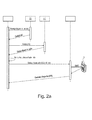
- Figure 2a shows a process for locating and notifying portable receivers,
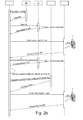
- Figure 2b shows an expanded process for locating and notifying portable receivers,
- Figure 3 shows a map of a wireless network, and
- Figure 4 shows a flow diagram of the logic implemented in one embodiment of an alert application.
DETAILED DESCRIPTION OF AN EMBODIMENT
-
With reference to FIG. 1, a location-based emergency warning system 1 according to one embodiment of the invention is shown. The location-based emergency warning system is based on an alert server 2 configured to receive, send and administer the information being circulated in the system. The alert server communicates with portable transceivers 3 to activate an alarm on portable transceivers, such as mobile devices, cellular phones or smart phones, located inside an alert area 5, shown in FIG. 3. The server and the portable transceivers 3 communicate via one or more wireless networks 10, which may be any of various types of networks, know to the skilled person, such as a GSM-network, GPRS-network, 3G-, 4G-, and 5G-networks etc. Further, the portable transceivers may be configured to communicate with positioning systems, such as the GPS-system, and with other wireless networks e.g. via WIFI-technology. The system may further comprise an alert central 4 associated with a predefined alert area 5 (shown in FIG. 3).
-
Fig. 3 shows a wireless network 10 in the form of a cellular network divided into a plurality of cells 101 grouped in local areas 102 defined by a local area code (LAC). An alert area 5 is defined inside the local area 102 by a circle having a central point of interest (POI) and a predefined radius. The location of the point of interest being defined by geographic coordinates. It is envisaged by the skilled person that an alert area may be defined in a number of other ways without departing from the scope of the invention, such as by any polygon associated with a POI. The alert area usually overlaps several cells 101 and the alert server comprises a database containing information about predefined alert areas, i.e. the coordinates of POIs and associated radiuses.
-
On the portable transceivers an executable software application, denoted an alert application, is installed. The alert application is able to override or take full control of the portable transceiver, such as to wake it from an idle-mode, turn on the display or control the sound level. When the alert application is loaded, the portable transceiver may be instructed to locate itself based on positioning systems, such as the GPS-system, available wireless connections, such as a WIFI-connection or other positioning means known to the skilled person. The position of the portable transceiver may then be retrieved by the alert application.
-
Referring to FIG. 2a and 2b, the functionality of the system and method is described based on how an alert is initial received in warming system and transferred to the portable transceivers. When an incident, such as a fire, occurs in a predefined alert area 5, an alert signal is sent to the alert server 2. The alert signal may be sent from an alert central associated with the alert area, via the Internet of via SMS. The alert server then determines which cells of the wireless network that covers the alert area. In one embodiment this is done by contacting a zone server ZS with the information about the relevant alert area. The zone server contains information about the LAC and the cells of the wireless network and may be located at a mobile network operator, from the zone server, the alert server receives a cell list specifying the LAC and the cells of the wireless network that overlap with the alert area as shown in FIG. 3. The alert server then sends the cell list to a location cache server containing information about which portable transceiver that are registered as being located in the LAC and the cells on the cell list. The portable transceivers may for example be identified based on identification numbers, such as MSISDN-numbers. The location cache server that may also be arranged at a mobile network operator returns to the alert server a first transceiver list of portable transceivers likely to be positioned within the specified cells. Optionally, this list of portable transceivers may be filtered based on a subscriber list of portable transceiver which a previously subscribed to receive alert notifications.
-
In another embodiment, the first transceiver list is created using the alert application on each of the portable transceivers by the alert sending regularly retrieving and sending the position of the portable transceiver to the alert server. This may be done at regular intervals and in terms of the cell in which the portable transceiver is located and/or the geographical coordinates. Hereby the alert server may comprise an updated first transceiver list usable for sending out alert notifications.
-
Based on the first transceiver list, a primary alert notification is sent via the wireless network 10, such as a cellular network, from the alert server to the portable transceivers. The primary alert notification contains information about the location and extension of the alert area, possibly also about the nature of the alert, the location of the incident causing the alert inside the alert area, etc.
-
Referring to FIG. 4, when portable transceiver receives the primary alert notification the alert application is automatically started. The alert application then instructs the portable transceiver to locate itself as described above and retrieves the position of the portable transceiver. The position of the portable transceiver is then compares to the information received about the location and extension of the alert area. If the portable transceiver is located inside the alert area, an alarm on the portable receiver is activated. If the alert application determines that the portable transceiver is located outside the alert area, the alert application goes back to an idle-mode. In addition, the alert application may be able to determine whether the retrieved location is accurate. If the location data is not sufficiently accurate, the alert application waits for a predetermined period before trying to retrieving the location of the portable transceiver again.
-
Following, when the portable transceiver receives the alert notification from the alert server, a delivery report is returned to the alert server. Hereby the alert server knows that the alert notification has been delivered and the alert application activated. If no delivery report is returned a backup procedure is initiated with the purpose of locating additional portable transceivers located inside the alert area, and to ensure that the alert application is started on portable transceivers in which the primary alert notification did not succeed in starting the alert application.
-
A challenge in this regard is that the location of some portable transceiver may not be known or the time since the position of the portable transceiver was last determined, denoted the age of location (AOL), may be significant. The AOL of a portable transceiver in a present cellular network may vary considerable from minutes to several hours. This is due to the fact that portable transceivers are located based on their activity in a wireless network. If the portable transceiver does not send or receive signals, their location cannot be determined. However, when a portable transceiver leaves or enters a local area (LAC), the position of the portable transceiver will always be updated.
-
Further, the AOL may be used to predict which portable devices are most likely to be in the alert area and which portable devices may have entered or left the alert area since the position was determined. For example, the position of portable transceivers with a low AOL is considered more reliable than those with a greater AOL. In addition, the AOL and the distance between the last registered position of a portable transceiver and the alert area may be used to determine the likelihood of a portable transceiver having entered an alert area. In one exemplary embodiment the algorithm;
is used to determine whether a portable transceiver may be inside the alert area. D represents the distance between the alert area and the last determined position of the portable transceiver and X is a predetermined speed variable. In one embodiment, X may be set to 100 km/h and as an example; the AOL may be 1 hour. Consequently, if D is greater than 100 km the portable transceiver is considered to be outside the alert area, as it is considered unlikely that the portable transceiver has been able to move such a distance in such a timeframe. On the contrary, if D is less that 100 km, it is considered probable that the portable transceiver is inside the alert area. Continuing with the same example, if D is 10 for a first portable transceiver and 50 for a second portable transceiver, it is considered more likely that the first portable transceiver is inside the alert area.
-
Based on the AOL and determined the likelihood of a portable transceiver being located inside the alert area a ping message is sent to the portable transceivers on the first transceiver list that have not received the alert notification. The ping message causes the receiving portable transceivers to leave a trace in the wireless network whereby the location of the portable transceivers may be determined. Thus by sending a ping message real time information about the location of the portable transceivers is gathered by the alert server. The ping message may be sent directly from the alert server or from the alert server via a mobile network operator.
-
Further, depending on the number of portable transceivers registered in a LAC or in the cells overlapping the alert area, the push messages may be sent to all portable transceivers within the LAC or only to portable transceivers within the cells.
-
Based on the updated location data a second transceiver list is compiled of portable transceivers likely to be positioned within the cells covering the alert area. The alert server then sends a backup alert notification to the portable transceivers on the second transceiver list. The backup alert notification is sent via a wireless network, which in one embodiment may be a cellular network. If the backup alert notification is sent via a cellular network no data network or data connection to the portable transceiver is required which may increase the reach of the warning system. The backup notification may be sent directly from the alert server or from the alert server via a mobile network operator as shown in Fig. 1. Referring again to FIG. 4, when portable transceiver receives the backup alert notification the alert application is automatically started and the alert is activated as described above in relation to the primary alert notification.
-
If the alarm is activated, the alert application may download alert area map data from the alert server or a local server associated with the alert area. Based on the alert area map data a map of the alert is generated, and the position of the portable receiver inside the alert area may be determined and shown in the alert area map. An indoor position of a portable transceiver may be determined in a number of different ways known to the skilled person. Further, the alert area map data may also contain information about evacuation plans for the alert area, and an escape route may be calculated and shown in the map of the alert area. In addition, the location of the incident(s) causing the alert may be shown in the alert area map. Further, the position of the portable transceivers in the alert area may be forwarded to rescue services to ease evacuation. Hereby a two-way communication link may be established between the portable transceivers and rescue services and instructions regarding evacuation may be forwarded to the alert application to optimise evacuation.
-
Although the present invention has been described in connection with the specified embodiments, it should not be construed as being in any way limited to the presented examples. The scope of the present invention is set out by the accompanying claim set. In the context of the claims, the terms "comprising" or "comprises" do not exclude other possible elements or steps. In addition, the mentioning of references such as "a" or "an" etc. should not be construed as excluding a plurality. The use of reference signs in the claims with respect to elements indicated in the figures shall also not be construed as limiting the scope of the invention. Furthermore, individual features mentioned in different claims, may possibly be advantageously combined, and the mentioning of these features in different claims does not exclude that a combination of features is not possible and advantageous.