EP2928690B1 - Substrat mit einer semitransparenten beschichtung - Google Patents
Substrat mit einer semitransparenten beschichtung Download PDFInfo
- Publication number
- EP2928690B1 EP2928690B1 EP13821074.5A EP13821074A EP2928690B1 EP 2928690 B1 EP2928690 B1 EP 2928690B1 EP 13821074 A EP13821074 A EP 13821074A EP 2928690 B1 EP2928690 B1 EP 2928690B1
- Authority
- EP
- European Patent Office
- Prior art keywords
- substrate according
- coating
- substrate
- range
- sol
- Prior art date
- Legal status (The legal status is an assumption and is not a legal conclusion. Google has not performed a legal analysis and makes no representation as to the accuracy of the status listed.)
- Active
Links
Images
Classifications
-
- C—CHEMISTRY; METALLURGY
- C03—GLASS; MINERAL OR SLAG WOOL
- C03C—CHEMICAL COMPOSITION OF GLASSES, GLAZES OR VITREOUS ENAMELS; SURFACE TREATMENT OF GLASS; SURFACE TREATMENT OF FIBRES OR FILAMENTS MADE FROM GLASS, MINERALS OR SLAGS; JOINING GLASS TO GLASS OR OTHER MATERIALS
- C03C1/00—Ingredients generally applicable to manufacture of glasses, glazes, or vitreous enamels
- C03C1/006—Ingredients generally applicable to manufacture of glasses, glazes, or vitreous enamels to produce glass through wet route
- C03C1/008—Ingredients generally applicable to manufacture of glasses, glazes, or vitreous enamels to produce glass through wet route for the production of films or coatings
-
- C—CHEMISTRY; METALLURGY
- C09—DYES; PAINTS; POLISHES; NATURAL RESINS; ADHESIVES; COMPOSITIONS NOT OTHERWISE PROVIDED FOR; APPLICATIONS OF MATERIALS NOT OTHERWISE PROVIDED FOR
- C09D—COATING COMPOSITIONS, e.g. PAINTS, VARNISHES OR LACQUERS; FILLING PASTES; CHEMICAL PAINT OR INK REMOVERS; INKS; CORRECTING FLUIDS; WOODSTAINS; PASTES OR SOLIDS FOR COLOURING OR PRINTING; USE OF MATERIALS THEREFOR
- C09D183/00—Coating compositions based on macromolecular compounds obtained by reactions forming in the main chain of the macromolecule a linkage containing silicon, with or without sulfur, nitrogen, oxygen, or carbon only; Coating compositions based on derivatives of such polymers
- C09D183/04—Polysiloxanes
- C09D183/06—Polysiloxanes containing silicon bound to oxygen-containing groups
-
- C—CHEMISTRY; METALLURGY
- C03—GLASS; MINERAL OR SLAG WOOL
- C03C—CHEMICAL COMPOSITION OF GLASSES, GLAZES OR VITREOUS ENAMELS; SURFACE TREATMENT OF GLASS; SURFACE TREATMENT OF FIBRES OR FILAMENTS MADE FROM GLASS, MINERALS OR SLAGS; JOINING GLASS TO GLASS OR OTHER MATERIALS
- C03C17/00—Surface treatment of glass, not in the form of fibres or filaments, by coating
- C03C17/006—Surface treatment of glass, not in the form of fibres or filaments, by coating with materials of composite character
- C03C17/008—Surface treatment of glass, not in the form of fibres or filaments, by coating with materials of composite character comprising a mixture of materials covered by two or more of the groups C03C17/02, C03C17/06, C03C17/22 and C03C17/28
- C03C17/009—Mixtures of organic and inorganic materials, e.g. ormosils and ormocers
-
- C—CHEMISTRY; METALLURGY
- C08—ORGANIC MACROMOLECULAR COMPOUNDS; THEIR PREPARATION OR CHEMICAL WORKING-UP; COMPOSITIONS BASED THEREON
- C08K—Use of inorganic or non-macromolecular organic substances as compounding ingredients
- C08K3/00—Use of inorganic substances as compounding ingredients
- C08K3/02—Elements
- C08K3/08—Metals
-
- C—CHEMISTRY; METALLURGY
- C03—GLASS; MINERAL OR SLAG WOOL
- C03C—CHEMICAL COMPOSITION OF GLASSES, GLAZES OR VITREOUS ENAMELS; SURFACE TREATMENT OF GLASS; SURFACE TREATMENT OF FIBRES OR FILAMENTS MADE FROM GLASS, MINERALS OR SLAGS; JOINING GLASS TO GLASS OR OTHER MATERIALS
- C03C2217/00—Coatings on glass
- C03C2217/40—Coatings comprising at least one inhomogeneous layer
- C03C2217/43—Coatings comprising at least one inhomogeneous layer consisting of a dispersed phase in a continuous phase
- C03C2217/44—Coatings comprising at least one inhomogeneous layer consisting of a dispersed phase in a continuous phase characterized by the composition of the continuous phase
- C03C2217/445—Organic continuous phases
-
- C—CHEMISTRY; METALLURGY
- C03—GLASS; MINERAL OR SLAG WOOL
- C03C—CHEMICAL COMPOSITION OF GLASSES, GLAZES OR VITREOUS ENAMELS; SURFACE TREATMENT OF GLASS; SURFACE TREATMENT OF FIBRES OR FILAMENTS MADE FROM GLASS, MINERALS OR SLAGS; JOINING GLASS TO GLASS OR OTHER MATERIALS
- C03C2217/00—Coatings on glass
- C03C2217/40—Coatings comprising at least one inhomogeneous layer
- C03C2217/43—Coatings comprising at least one inhomogeneous layer consisting of a dispersed phase in a continuous phase
- C03C2217/44—Coatings comprising at least one inhomogeneous layer consisting of a dispersed phase in a continuous phase characterized by the composition of the continuous phase
- C03C2217/45—Inorganic continuous phases
-
- C—CHEMISTRY; METALLURGY
- C03—GLASS; MINERAL OR SLAG WOOL
- C03C—CHEMICAL COMPOSITION OF GLASSES, GLAZES OR VITREOUS ENAMELS; SURFACE TREATMENT OF GLASS; SURFACE TREATMENT OF FIBRES OR FILAMENTS MADE FROM GLASS, MINERALS OR SLAGS; JOINING GLASS TO GLASS OR OTHER MATERIALS
- C03C2217/00—Coatings on glass
- C03C2217/40—Coatings comprising at least one inhomogeneous layer
- C03C2217/43—Coatings comprising at least one inhomogeneous layer consisting of a dispersed phase in a continuous phase
- C03C2217/46—Coatings comprising at least one inhomogeneous layer consisting of a dispersed phase in a continuous phase characterized by the dispersed phase
- C03C2217/48—Coatings comprising at least one inhomogeneous layer consisting of a dispersed phase in a continuous phase characterized by the dispersed phase having a specific function
- C03C2217/485—Pigments
-
- C—CHEMISTRY; METALLURGY
- C03—GLASS; MINERAL OR SLAG WOOL
- C03C—CHEMICAL COMPOSITION OF GLASSES, GLAZES OR VITREOUS ENAMELS; SURFACE TREATMENT OF GLASS; SURFACE TREATMENT OF FIBRES OR FILAMENTS MADE FROM GLASS, MINERALS OR SLAGS; JOINING GLASS TO GLASS OR OTHER MATERIALS
- C03C2218/00—Methods for coating glass
- C03C2218/10—Deposition methods
- C03C2218/11—Deposition methods from solutions or suspensions
- C03C2218/113—Deposition methods from solutions or suspensions by sol-gel processes
-
- C—CHEMISTRY; METALLURGY
- C08—ORGANIC MACROMOLECULAR COMPOUNDS; THEIR PREPARATION OR CHEMICAL WORKING-UP; COMPOSITIONS BASED THEREON
- C08K—Use of inorganic or non-macromolecular organic substances as compounding ingredients
- C08K3/00—Use of inorganic substances as compounding ingredients
- C08K3/02—Elements
- C08K3/08—Metals
- C08K2003/0843—Cobalt
-
- C—CHEMISTRY; METALLURGY
- C08—ORGANIC MACROMOLECULAR COMPOUNDS; THEIR PREPARATION OR CHEMICAL WORKING-UP; COMPOSITIONS BASED THEREON
- C08K—Use of inorganic or non-macromolecular organic substances as compounding ingredients
- C08K3/00—Use of inorganic substances as compounding ingredients
- C08K3/02—Elements
- C08K3/08—Metals
- C08K2003/085—Copper
-
- Y—GENERAL TAGGING OF NEW TECHNOLOGICAL DEVELOPMENTS; GENERAL TAGGING OF CROSS-SECTIONAL TECHNOLOGIES SPANNING OVER SEVERAL SECTIONS OF THE IPC; TECHNICAL SUBJECTS COVERED BY FORMER USPC CROSS-REFERENCE ART COLLECTIONS [XRACs] AND DIGESTS
- Y10—TECHNICAL SUBJECTS COVERED BY FORMER USPC
- Y10T—TECHNICAL SUBJECTS COVERED BY FORMER US CLASSIFICATION
- Y10T428/00—Stock material or miscellaneous articles
- Y10T428/26—Web or sheet containing structurally defined element or component, the element or component having a specified physical dimension
- Y10T428/263—Coating layer not in excess of 5 mils thick or equivalent
- Y10T428/264—Up to 3 mils
- Y10T428/265—1 mil or less
-
- Y—GENERAL TAGGING OF NEW TECHNOLOGICAL DEVELOPMENTS; GENERAL TAGGING OF CROSS-SECTIONAL TECHNOLOGIES SPANNING OVER SEVERAL SECTIONS OF THE IPC; TECHNICAL SUBJECTS COVERED BY FORMER USPC CROSS-REFERENCE ART COLLECTIONS [XRACs] AND DIGESTS
- Y10—TECHNICAL SUBJECTS COVERED BY FORMER USPC
- Y10T—TECHNICAL SUBJECTS COVERED BY FORMER US CLASSIFICATION
- Y10T428/00—Stock material or miscellaneous articles
- Y10T428/31504—Composite [nonstructural laminate]
- Y10T428/31511—Of epoxy ether
- Y10T428/31525—Next to glass or quartz
-
- Y—GENERAL TAGGING OF NEW TECHNOLOGICAL DEVELOPMENTS; GENERAL TAGGING OF CROSS-SECTIONAL TECHNOLOGIES SPANNING OVER SEVERAL SECTIONS OF THE IPC; TECHNICAL SUBJECTS COVERED BY FORMER USPC CROSS-REFERENCE ART COLLECTIONS [XRACs] AND DIGESTS
- Y10—TECHNICAL SUBJECTS COVERED BY FORMER USPC
- Y10T—TECHNICAL SUBJECTS COVERED BY FORMER US CLASSIFICATION
- Y10T428/00—Stock material or miscellaneous articles
- Y10T428/31504—Composite [nonstructural laminate]
- Y10T428/31551—Of polyamidoester [polyurethane, polyisocyanate, polycarbamate, etc.]
- Y10T428/31609—Particulate metal or metal compound-containing
- Y10T428/31612—As silicone, silane or siloxane
Definitions
- the invention relates to a substrate with a semi-transparent coating.
- the present invention describes a coating material which serves to coat transparent glass or glass ceramic, particularly preferably a glass or glass ceramic cooking surface.
- the coating material according to the invention may be a printable material, for example a screen printing paste.
- Coating material according to the invention may also be an imprint adhering to the substrate, for example the coating itself.
- Semi-transparent coatings on glass and glass ceramic are known from the prior art, which are used, for example, in display areas in cooking surfaces.
- 7-segment displays used, which, for example, the heat level reflect or mark by a point, which cooking zones have higher temperatures.
- the 7-segment display is not sufficiently sharp contours.
- the use of transparent glass ceramic for cooktops has been established in recent years. This has no knobs on the bottom and therefore no scattering.
- the transparent glass ceramic has the disadvantage that the components are visible below the cooking surface.
- the glass ceramic as known from the prior art, be provided with a variety of coatings. As a rule, the glass ceramic is first provided with a coloring layer and then with a sealing layer.
- this area requires a semi-transparent coating.
- a semitransparent coating is required which ensures a sufficient opacity, but which, for example, transmits red light of the 7-segment display and has no scattering centers in the visible wavelength range.
- the semitransparent coating is to be printed on the adjacent layer combination of coloring layer and sealing layer and should fill only the recessed display area, they must be compatible, ie the semi-transparent coating must adhere well to the already printed layer composite.
- Semi-transparent coatings based on coloring pigments are known from the prior art. These coatings have a high light absorption capacity but at the same time a large dispersion.
- the semitransparent coating of the substrate is formed by a coating material which has a sol-gel matrix and also dyes. Furthermore, polyester- and / or epoxy-functionalized silicone resins, for example polyester-modified silicone resins are provided.
- the coating is applied to a partially transparent substrate, namely to a glass or a glass ceramic.
- sol-gel starting materials for the sol-gel matrix preference is given to using metal alcoholates, preferably in the form of alkoxysilanes. These can be obtained inexpensively as a standard product. Preference is always given to a tetraalkoxysilane, for. As tetraethoxysilane (TEOS) in combination with a trialkoxysilane, which has an organically crosslinkable functionality used. In addition, these substances cause little shrinkage on heating, so that a good adhesion to the substrate surface results. In order to ensure a high degree of crosslinking within the hybrid polymer sol-gel matrix, inter alia alkoxysilanes with the following functionalities used: epoxy, acrylate, methacrylate, vinyl or allyl silanes.
- TEOS tetraethoxysilane
- GPTES glycidoxypropyltriethoxysilane
- MEMO methacryloxypropyltrimethoxysilane
- MPTES methacryloxypropyltriethoxysilane
- VTES vinyltriethoxysilane
- the sol-gel matrix is produced in the form of a hydrolyzate.
- the production of the hydrolyzate is carried out by the targeted reaction of the monomers with water. This is preferably carried out in the presence of a catalyst, in particular an acid (for example HCl, para-toluenesulfonic acid).
- a catalyst in particular an acid (for example HCl, para-toluenesulfonic acid).
- the hydrolysis is carried out with an aqueous nanoparticle dispersion.
- aqueous nanoparticle dispersion preferably SiO 2 nanoparticles, improves scratch resistance.
- the degree of inorganic crosslinking of the hydrolyzate is adjusted via the ratio of water to monomers, the inorganic degree of crosslinking being preferably between 11 and 50%. In this context, sufficient flexibility for organic crosslinking is provided.
- the inorganic degree of crosslinking is particularly preferably between 15 and 35%. Since the sol-gel matrix is not yet completely ironed out, this results in good durability.
- the coating material is stable for several years.
- the degree of inorganic crosslinking is determined by 29 Si-NMR spectroscopy.
- the viscosity of the hydrolyzate is 200-1,000 mPas. At this viscosity, the degree of inorganic crosslinking is low, so that the organic crosslinking can be sufficiently ensured.
- good durability of the printed coating results when the viscosity is selected in the range between 250-600 mPas.
- the residual solvent content of the hydrolyzate is preferably below 10% in order to obtain good printability when used as a screen printing paste.
- polyester-modified silicone resins By adding one or more polyester-modified silicone resins, good adhesion of the semi-transparent coating to the sealant layer and at the same time an improvement in screen printability can be achieved.
- polyester-modified silicone resins for example, SILIKOFTAL®s can be used.
- the hydrolyzate further silicone resins such as SILIKOPHEN® can be added.
- various colorants can be used which ensure an opaque coating with little scattering.
- organic dyes such as. Orasole can be added to the binder.
- Orasol RLi may be preferred.
- temperature-resistant dyes are also azo dyes such as methyl orange, Alizaringelb or Congo red; Triphenylmethane dyes such as malachite green, eosin, fluorescein, aurin and phenolphthalein; Vat dyes such as anthraquinone dyes, indigo and thioindigo; Fluorescent dyes; perylene
- phthalocyanines with, for example, Cr, Cu, Ni, Zn or Co as the central atom.
- These dyes are particularly suitable for use in the printing of a glass ceramic cooktop. In particular, these dyes are sufficiently resistant to temperatures up to 150 ° C.
- High-boiling solvents having a vapor pressure of ⁇ 5 bar, preferably ⁇ 1 bar, more preferably ⁇ 0.1 bar, can be used as the solvent.
- Solvents which have a boiling point of more than 120 ° C. and an evaporation number of> 10 are preferably added.
- a solvent having a boiling point above 150 ° C and an evaporation number of> 500, more preferably having a boiling point above 200 ° C and an evaporation number of> 1000 used.
- Such high-boiling solvents are in particular glycols and glycol ethers, terpenes and polyols, as well as mixtures of several of these solvents.
- polyethylene glycol ethers such as diethylene glycol monoethyl ether, tripropylene glycol monomethyl ether and terpineol may be used as the solvent.
- the use of solvent mixtures is possible.
- the solvents may be added to both the sol-gel based matrix and the coating material.
- the semitransparent coating according to the invention is curable even at low temperatures between 100 ° C. and 230 ° C., preferably between 150 ° C. and 200 ° C. At temperatures below 230 ° C it is guaranteed that the sensitive dyes will not be destroyed.
- the low curing temperature of the sealing layer ensures that the tempered glass substrate does not relax.
- the curing time of the semitransparent coating is between 15 and 120 minutes, in particular preferably less than 75 minutes, particularly preferably less than 60 minutes. This ensures a high cycle time in production plants and thus has a direct positive influence on the production costs of a product.
- the inorganic degree of crosslinking of the layers is 11% -40%, preferably 15-35%.
- the determination of the inorganic degree of crosslinking can take place via the method of NMR spectroscopy known to the person skilled in the art.
- thermally activatable initiators may be added to the coating solution.
- thermally activatable initiators may be, for example, 1,5-diazobicyclo (4.3.0) non-5-ene, aluminum acetylacetonate or methylimidazole.
- UV-activatable initiators for cationic or free-radical polymerization such as triarylsulphonium salts, diaryliodinium salts (eg Irgacure 250), ferrocenium salts, benzoin derivatives, ⁇ -hydroxyalkylphenones (eg Irgacure 184), ⁇ -aminoacetophenones (eg 2-methyl-1 [4- (2-methyl-1-yl) can also be added to the coating solution. methylthio) phenyl] -2-morpholinopropanone) or acylphosphine oxides (eg Irgacure 819), for example.
- triarylsulphonium salts diaryliodinium salts (eg Irgacure 250), ferrocenium salts, benzoin derivatives, ⁇ -hydroxyalkylphenones (eg Irgacure 184), ⁇ -aminoacetophenones (eg 2-methyl-1 [4-
- bisepoxide, bismethacrylate or the like may be added to the coating material with organic hardeners or crosslinkers having a plurality of organic crosslinkable groups.
- the molar ratio of crosslinkable organic silanes to monomer of the hardener or crosslinker used may be 35: 1 to 10: 1. In this case, a degree of organic crosslinking can be achieved in which the flexibility and hardness of the coating are balanced. For rapid curing, the molar ratio may preferably be 25: 1 to 15: 1.
- the curing agent or crosslinker may be, for example, the (3,4-epoxycyclomethyl) 3,4-epoxycyclohexanecarboxylate.
- adhesion promoters can be added to the coating. These may be, for example, amino and / or mercaptosilanes, for example. This may be 3-aminopropyltriethoxysilane or 3-mercaptopropyltriethoxysilane.
- the proportion of the adhesion promoter silanes can be between 1: 100 and 1:10, preferably 1:50 to 1:15, with respect to the other alkoxysilanes.
- the coating material may be applied by a printing process.
- This printing process may be an ink-jet printing, off-set printing, tampon printing, roll coating, dipping, spin coating or spraying process.
- the coating material is preferably applied to the substrate by screen printing.
- glass or glass ceramic are used as the substrate.
- Particularly preferred glass ceramic is used as a substrate.
- the substrate may also be precoated.
- a LAS lithium-aluminum-silicate glass-ceramic: Li 2 O-Al 2 O 3 -SiO 2
- LAS glass ceramics with TiO 2 and / or ZrO 2 and / or SnO 2 as nucleating agent.
- the substrates used preferably contain less than 1000 ppm, more preferably less than 500 ppm, most preferably less than 200 ppm Arsenic and / or antimony.
- the transparent glass-ceramic used is arsenic- and antimony-free.
- the crystal phase content of the glass ceramic disks is preferably 50-85%, particularly preferably 60-80%, very particularly 64-77%.
- the preferred thickness of the glass-ceramic pane to achieve the necessary strength values is 0.8-6 mm, preferably 2.5-5 mm, particularly preferably 3.5-4.5 mm.
- the semitransparent coating material can be produced as a screen-printable one- or multi-component, in particular as a 2-component lacquer based on hybrid polymers of a mixture of a first and a second component mixture, wherein the sol-gel binder and the remaining crosslinking components separate from Starter present.
- the organic dyes can be added to both the first and the second component.
- the scratch resistance of the layers is ⁇ 400 g.
- the scratch resistance was determined using a Scratch Hardness Tester 413 from Erichsen.
- the tip used was a tungsten carbide tip with a diameter of 1 mm.
- the viscosity of the dark, semitransparent ink in particular the thixotropic behavior for screen printing processes, can be adapted to the selected printing process before printing on the solvent content, the content of polyester-modified silicone resin or by varying additives.
- the viscosity of inventive Screen-printable paints is preferably 200 mPa * s - 1000 mPa * s, particularly preferably 250-600 mPa * s.
- the average layer thicknesses of the particularly dark semitransparent coating are in the range between 1 and 20 ⁇ m, preferably between 4 and 10 ⁇ m, particularly preferably between 4 and 8 ⁇ m. Layer thicknesses in the range between 4 and 10 microns can be easily achieved with common dyes, with layer thicknesses in the range between 4 and 7 microns are achieved with dyes with high light transmission (especially suitable for LED application).
- the transmission of the coating according to the invention can be in the wavelength range of 380-630 nm between 0-20%, preferably between 0-10%. In this case, commercially available LEDs with sufficiently high light output can then be used on the display side. In the wavelength range of 630-790 nm, the transmission of the dark coating increases up to 90%.
- the scattering within the dark semitransparent coating is in the range of 0-3.5%, preferably 0-2.5%.
- the scattering within the bright semitransparent coating is in the range of 5-85%, preferably 10-75%.
- GPTES glycoloxypropyltriethoxysilane
- TEOS tetraethoxysilane
- this binder 23.0 g of this binder are 12.5 g of polyester-modified silicone Silikoftal HTT, 0.50 g of silicone epoxy resin silica EF, 4.60 g of (3,4-epoxycyclomethyl) 3,4-epoxycyclohexane carboxylate, 5.00 g of dye Orasol RLI, 0.50 g Airex 931, 0.10 g BYK 307 and 0.20 g DC11.
- a 3-5 ⁇ m thick layer is applied to a transparent glass ceramic by means of screen printing with a 180 mm sieve. This layer is cured at 170 ° C for 1 h.
- this binder 23.0 g of this binder are 4.60 g (3,4-epoxycyclomethyl) 3,4-epoxycyclohexanecarboxylate, 5.00 g of dye Orasol RLI, 0.50 g of Airex 931, 23.0 g of diethylene glycol monoethyl ether, 0.10 BYK 307 and 0.20 g DC11 were added. The solution is stirred for 5 min in the Speedmixer.
- 23.0 g of this binder are 12.5 g of silicone polyester resin Silikoftal HTT, 0.50 g of silicone epoxy resin silica EF, 4.60 g of (3,4-epoxycyclomethyl) 3,4-epoxycyclohexanecarboxylate, 5.00 g of dye Orasol RLI, 0.50 g Airex 931, 23.0 g diethylene glycol monoethyl ether, 0.10 g BYK 307 and 0.20 g DC11. The solution is stirred for 5 min in the Speedmixer.
- Orasol RLi 4 4.00 g Orasol RLI and 1.00 g Orasol yellow are used in the embodiment.
- Silikoftal HTT 5 Silikoftal HTL and in the embodiment 6 Silikoftal HTL-2 is used in the embodiment.
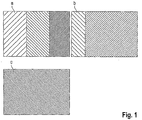
- FIG. 1 a scanning electron micrograph of a coated with Orasol RLI semitransparent coating on glass-ceramic with a mean layer thickness of 5 microns is shown.
- the area indicated by a in the diagram shows a magnification of 20,000 times that of b, a magnification of 50,000 times that of c, and a magnification of 200,000 times c.
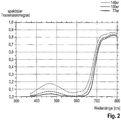
- FIG. 2 is the transmission of a colored with Orasol RLI semi-transparent coating on a glass ceramic depending on the used screen thickness a screen printing device shown. It shows a 77er, a 100er and a 140er sieve.
Landscapes
- Chemical & Material Sciences (AREA)
- Chemical Kinetics & Catalysis (AREA)
- Organic Chemistry (AREA)
- Life Sciences & Earth Sciences (AREA)
- Engineering & Computer Science (AREA)
- Materials Engineering (AREA)
- General Chemical & Material Sciences (AREA)
- Geochemistry & Mineralogy (AREA)
- Inorganic Chemistry (AREA)
- Composite Materials (AREA)
- Wood Science & Technology (AREA)
- Health & Medical Sciences (AREA)
- Medicinal Chemistry (AREA)
- Polymers & Plastics (AREA)
- Paints Or Removers (AREA)
- Laminated Bodies (AREA)
- Surface Treatment Of Glass (AREA)
- Inks, Pencil-Leads, Or Crayons (AREA)
Description
- Die Erfindung betrifft ein Substrat mit einer semitransparenten Beschichtung.
- Die vorliegende Erfindung beschreibt ein Beschichtungsmaterial, das zur Beschichtung von transparentem Glas oder Glaskeramik, besonders bevorzugt einer Glas- oder Glaskeramikkochfläche dient. Mithin kann das Beschichtungsmaterial gemäß der Erfindung ein druckbarer Werkstoff, beispielsweise eine Siebdruckpaste sein. Beschichtungsmaterial im Sinne der Erfindung kann auch ein auf dem Substrat anhaftender Aufdruck, beispielsweise die Beschichtung selbst sein.
- Aus dem Stand der Technik sind semitransparente Beschichtungen auf Glas und Glaskeramik bekannt, die beispielsweise in Anzeigenbereichen bei Kochflächen eingesetzt werden. Insbesondere im Bereich von Kochfeldern werden 7-SegmentAnzeigen verwendet, welche bspw. die Heizstufe widergeben oder durch einen Punkt kennzeichnen, welche Kochzonen höhere Temperaturen aufweisen.
- Da die hierfür verwendete Glaskeramik, bedingt durch den Herstellungsprozess, Noppen auf der Unterseite aufweist und daher das Licht auf unterschiedliche Weise bricht, ist die 7-Segment-Anzeige nicht ausreichend konturenscharf.
- Aufgrund einer Vielfalt an möglichen Farbeindrücken und Designs hat sich in den letzten Jahren die Verwendung von transparenter Glaskeramik für Kochflächen etabliert. Diese weist keine Noppen auf der Unterseite und daher keine Streuung auf. Die transparente Glaskeramik hat jedoch den Nachteil, dass die Bauteile unterhalb der Kochfläche sichtbar sind. Um eine entsprechende Blickdichte zu gewährleisten, kann die Glaskeramik, wie aus dem Stand der Technik bekannt, mit unterschiedlichsten Beschichtungen versehen werden. In der Regel wird die Glaskeramik zunächst mit einer farbgebenden Schicht und anschließend mit einer Versiegelungsschicht versehen.
- Um die Sichtbarkeit eines Displays, welches unter der Kochfläche angebracht ist, zu gewährleisten, bedarf es in diesem Bereich einer semitransparenten Beschichtung. Hierfür wird eine semitransparente Beschichtung benötigt, welche eine ausreichende Blickdichte gewährleistet, jedoch das beispielsweise rote Licht der 7-Segment-Anzeige durchlässt und im sichtbaren Wellenlängenbereich keine Streuzentren aufweist.
- Da die semitransparente Beschichtung auf den benachbarten Schichtverbund aus farbgebender Schicht und Versiegelungsschicht gedruckt werden soll und nur den ausgesparten Displaybereich füllen soll, müssen diese kompatibel sein, d.h. die semitransparente Beschichtung muss auf dem bereits gedruckten Schichtverbund gut anhaften.
- Aus dem Stand der Technik sind semitransparente Beschichtungen auf Basis von farbgebenden Pigmenten bekannt. Diese Beschichtungen weisen ein hohes Lichtabsorptionsvermögen, aber zeitgleich eine große Streuung auf.
- Weiterhin sind semitransparente Beschichtungen auf Basis organisch gebundener Edelmetalle bekannt, welche keine Streuung aufweisen. Allerdings sind diese Beschichtungen aufgrund der hohen Rohstoffpreise der Edelmetalle sehr teuer.
- Es ist Aufgabe der Erfindung, ein Substrat mit einer aufgedruckten Beschichtung bereitzustellen, wobei die Beschichtung semitransparent ist, eine hohe Kratzfestigkeit, Temperaturbeständigkeit und eine gute Anhaftung auf einer Versiegelungsschicht aufweist.
- Die Aufgabe wird dadurch gelöst, dass die semitransparente Beschichtung des Substrats von einem Beschichtungsmaterial gebildet ist, das eine Sol-Gel-Matrix sowie Farbstoffe, aufweist. Weiterhin sind polyester- und/oder epoxyfunktionalisierte Silikonharze, beispielsweise polyestermodifizierte Silikonharze vorgesehen. Die Beschichtung ist auf ein teiltransparentes Substrat, nämlich auf ein Glas oder eine Glaskeramik aufgebracht.
- Als Sol-Gel-Ausgangsstoffe für die Sol-Gel-Matrix werden bevorzugt Metallalkoholate verwendet, bevorzugt in Form von Alkoxysilanen. Diese können als Standardware kostengünstig bezogen werden. Bevorzugt wird immer ein Tetraalkoxysilan, z. B. Tetraethoxysilan (TEOS) in Kombination mit einem Trialkoxysilan, welches eine organisch vernetzbare Funktionalität besitzt, eingesetzt. Zusätzlich bewirken diese Stoffe einen geringen Schrumpf bei Erwärmung, sodass sich eine gute Anhaftung auf der Substratoberfläche ergibt. Um eine hohe Vernetzung innerhalb der hybridpolymeren Sol-Gel Matrix zu gewährleisten, werden u. a. Alkoxysilane mit folgenden Funktionalitäten eingesetzt: Epoxy-, Acrylat-, Methacrylat-, Vinyl- oder Allylsilane. Dabei können je nach Einstellung der Reste stabile oder flexible Netzstrukturen aufgebaut werden. Geeignet sind beispielsweise Glycidoxypropyltriethoxysilan (GPTES), Methacryloxypropyltrimethoxysilan (MEMO oder MPTMS), Methacryloxypropyltriethoxysilan (MPTES) oder Vinyltriethoxysilan (VTES).
- Die Sol-Gel-Matrix wird in Form eines Hydrolysates hergestellt. Die Herstellung des Hydrolysates erfolgt durch die gezielte Umsetzung der Monomere mit Wasser. Bevorzugt wird dies in Gegenwart eines Katalysators, insbesondere einer Säure durchgeführt (z. B. HCl, para-Toluolsulfonsäure).
- In einer speziellen Ausführungsform erfolgt die Hydrolyse mit einer wässrigen Nanopartikeldispersion. Durch den Einsatz von anorganischen Nanopartikeln, vorzugsweise SiO2-Nanopartikeln wird die Kratzbeständigkeit verbessert.
- Der anorganische Vernetzungsgrad des Hydrolysates wird über das Verhältnis Wasser zu Monomeren eingestellt, der anorganische Vernetzungsgrad liegt dabei bevorzugt zwischen 11 und 50 %.Dabei wird eine ausreichende Flexibilität für eine organische Vernetzung geboten. Besonders bevorzugt liegt der anorganische Vernetzungsgrad zwischen 15 und 35 %. Da die Sol-Gel-Matrix hierbei noch nicht vollständig durchgegelt ist, ergibt sich dann eine gute Haltbarkeit. Das Beschichtungsmaterial ist über mehrere Jahre stabil. Der anorganische Vernetzungsgrad wird über 29Si-NMR Spektroskopie bestimmt. Die Viskosität des Hydrolysates liegt bei 200-1.000 mPas. Bei dieser Viskosität ist der anorganische Vernetzungsgrad gering, sodass die organische Vernetzung ausreichend sichergestellt werden kann. Gute Haltbarkeiten der gedruckten Beschichtung ergeben sich zusätzlich dann, wenn die Viskosität im Bereich zwischen 250-600 mPas gewählt ist. Der Restlösungsmittelgehalt des Hydrolysates liegt bevorzugt unter 10 % um bei Verwendung als Siebdruckpaste eine gute Druckfähigkeit zu erhalten.
- Durch Zugabe von einem oder mehreren polyestermodifizierten Silikonharzen kann eine gute Anhaftung der semitransparenten Beschichtung auf der Versiegelungsschicht und gleichzeitig eine Verbesserung der Siebdruckfähigkeit erzielt werden. Als polyestermodifizierte Silikonharze können bspw. SILIKOFTAL®e verwendet werden. Weiterhin können dem Hydrolysat weitere Silikonharze wie bspw. SILIKOPHEN® zugegeben werden.
- Zum Einfärben der Schicht können verschiedene Farbmittel verwendet werden, welche eine blickdichte Beschichtung mit geringer Streuung gewährleisten.
- So können dem Bindemittel organische Farbstoffe, wie bspw. Orasole zugegeben werden. Für eine dunkle bzw. schwarze Beschichtung kann bevorzugt Orasol RLi verwendet werden. Als temperaturbeständige Farbstoffe eignen sich weiterhin Azofarbstoffe wie Methylorange, Alizaringelb oder Kongorot; Triphenylmethanfarbstoffe wie Malachitgrün, Eosin, Fluoreszein, Aurin und Phenolthalein; Küpenfarbstoffe wie Anthrachinon-Farbstoffe, Indigo und Thioindigo; Fluoreszenzfarbstoffe; Perylenfarbstoffe
Ebenfalls können Phthalocyanine mit z.B. Cr, Cu, Ni, Zn oder Co als Zentralatom zum Einsatz kommen. Diese Farbstoffe sind für die Anwendung im Bereich der Bedruckung eines Glaskeramik-Kochfeldes besonders geeignet. Insbesondere sind diese Farbstoffe bis 150°C ausreichend temperaturbeständig. - Als Lösungsmittel können hochsiedende Lösungsmittel mit einem Dampfdruck von < 5 bar, bevorzugt < 1 bar, besonders bevorzugt < 0,1 bar eingesetzt werden. Es werden bevorzugt Lösungsmittel zugesetzt, welche einen Siedepunkt von mehr als 120°C und eine Verdunstungszahl von >10 haben. Vorzugsweise wird ein Lösungsmittel mit einem Siedepunkt über 150°C und einer Verdunstungszahl von >500, besonders bevorzugt mit einem Siedepunkt über 200°C und einer Verdunstungszahl von >1000 verwendet. Derartige hoch siedende Lösungsmittel sind insbesondere Glykole und Glykolether, Terpene und Polyole, sowie Mischungen aus mehreren dieser Lösungsmittel. Es können Butylacetat, Methoxybutylacetat, Butyldiglykol, Butyldiglykolacetat, Butylglykol, Butylglykolacetat, Cyclohexanon, Diacetonalkohol, Diethylenglykol, Dipropylenglykolmonomethylether, Dipropylenglykolmonobuthylether, Propylenglykolmonobutylether, Propylenglykolmonopropylether, Propylenglykolmonoethylether, Ethoxypropylacetat, Hexanol, Methoxypropylacetat, Monoethylenglykol, Ethylpyrrolidon, Methylpyrrolidon, Dipropylenglykoldimethylether, Propylenglykol, Propylenglykolmonomethylether, Gemische aus parafinischen und naphthenischen Kohlenwasserstoffen, aromatische Kohlenwasserstoffgemische, Mischungen aromatischer alkylkierter Hydrocarbone und Gemische von n-, i- und cycloAliphaten als Lösungsmittel verwendet werden. Insbesondere können Polyethylenglykolether, wie beispielsweise Diethylenglykolmonoethylether, Tripropylenglykolmonomethylether und Terpineol als Lösungsmittel verwendet werden. Auch die Verwendung von Lösungsmittelgemischen ist möglich.Hierbei können die Lösungsmittel sowohl der Sol-Gel-basierten Matrix als auch dem Beschichtungsmaterial zugegeben werden.
- Die Verwendung eines hochsiedenden Lösungsmittels gewährleistet die Siebdruckfähigkeit des semitransparenten Beschichtungsmaterials.
- Die erfindungsgemäße semitransparente Beschichtung ist schon bei niedrigen Temperaturen zwischen 100 °C und 230 °C, bevorzugt zwischen 150 °C und 200 °C aushärtbar. Bei Temperaturen unter 230°C ist garantiert, dass die empfindlichen Farbstoffe nicht zerstört werden. Bei der Verwendung von vorgespannten Glassubstraten im Schichtpaket wird durch die niedrige Aushärtetemperatur der Versiegelungsschicht gewährleistet, dass sich das vorgespannte Glassubstrat nicht entspannt. Die Aushärtezeit der semitransparenten Beschichtung liegt zwischen 15 und 120 min, im Speziellen bevorzugt unter 75 min, besonders bevorzugt unter 60 min. Dies gewährleistet eine hohe Taktzeit in Produktionsanlagen und hat somit einen direkten positiven Einfluss auf die Herstellungskosten eines Produktes.
- Der anorganische Vernetzungsgrad der Schichten liegt bei 11 % - 40 %, bevorzugt bei 15 - 35 %. Die Bestimmung des anorganischen Vernetzungsgrades kann dabei über die dem Fachmann bekannte Methode der NMR-Spektroskopie erfolgen.
- Um die Vernetzungsreaktion der organischen funktionellen Gruppen zu starten, können der Beschichtungslösung thermisch aktivierbare Starter zugegeben sein. Dies können beispielsweise 1,5-Diazobicyclo(4.3.0)non-5-ene, Aluminiumacetylacetonat oder Methylimidazol sein.
- Auch können der Beschichtungslösung UV-aktivierbare Starter für kationische oder radikalische Polymerisation wie Triarylsulphoniumsalze, Diaryliodiniumsalze (z.B. Irgacure 250), Ferroceniumsalze, Benzoinderivate, α-Hydroxyalkylphenone (z.B. Irgacure 184), α-Aminoacetophenone (z.B. 2-Methyl-1[4-(methylthio)phenyl]-2-morpholinopropanone) oder Acylphosphinoxide (z.B. Irgacure 819) beispielsweise zugegeben werden.
- Um die Kratzbeständigkeit zu erhöhen, können dem Beschichtungsmaterial Bisepoxid, Bismethacrylat oder dergleichen organische Härter oder Vernetzer mit mehreren organischen vernetzbaren Gruppen zugegeben sein.
Das molare Verhältnis von vernetzbaren organischen Silanen zu Monomer des eingesetzten Härters oder Vernetzers kann 35:1 - 10:1. Dabei kann ein Gradt der organischen Vernetzung erreicht werden, bei dem Flexibilität und Härte der Beschichtung ausgewogen sind. Für eine schnelle Aushärtung kann das molare Verhältnis bevorzugt 25:1 - 15:1, betragen. Der Härter oder Vernetzer kann dabei z.B. das (3,4-Epoxycyclomethyl)3,4epoxycyclohexanecarboxylate sein. - Je nach Beschichtungsverfahren können auch noch verschiedene Verlaufsmittel, Entschäumer, Entlüfter oder Dispergierungsadditive wie beispielsweise PEG, BYK 302, BYK 306, BYK 307, DC11, DC57 oder Airex 931 bzw. Airex 930 zugegeben werden, um homogene Schichtdicken und eine homogene Farbverteilung der Beschichtung zu erreichen.
In einer besonderen erfindungsgemäßen Ausführungsform können der Beschichtung Haftvermittler zugegeben werden. Dies können bspw. Amino-und/oder Mercaptosilane sein, bspw. kann dies 3-Aminopropyltriethoxysilan oder 3-Mercaptopropyltriethoxysilan sein. Der Anteil der Haftvermittlersilane kann dabei bzgl. der weiteren Alkoxysilane zwischen 1:100 bis 1:10, bevorzugt 1:50 bis 1:15 sein. - Das Beschichtungsmaterial kann durch ein Druckverfahren aufgebracht werden. Dieses Druckverfahren kann ein Ink-Jet-Druck-, Off-Set-Druck-, Tampon-Druck-, Rollcoating-, Tauch-, Spin-Coating- oder Sprüh-Verfahren sein. Bevorzugt wird das Beschichtungsmaterial mittels Siebdruck auf das Substrat aufgebracht.
- Erfindungsgemäß sind als Substrat Glas oder Glaskeramik verwendet. Besonders bevorzugt wird Glaskeramik als Substrat verwendet. Das Substrat kann auch vorbeschichtet sein.
- Bevorzugt wird eine LAS (Lithium-Aluminium-Silikat-Glaskeramik: Li2O-Al2O3-SiO2) mit Hochquarz-Mischkristallen und/oder Keatit-Mischkristallen als vorherrschende Kristallphase verwendet. Bevorzugt werden LAS-Glaskeramiken mit TiO2 und/oder ZrO2 und oder SnO2 als Keimbildner verwendet.
- Die verwendeten Substrate enthalten bevorzugt weniger als 1000 ppm, besonders bevorzugt weniger als 500 ppm, ganz besonders bevorzugt weniger als 200 ppm Arsen und/oder Antimon. In einer Ausführungsform ist die verwendete transparente Glaskeramik Arsen- und Antimonfrei.
- Der Kristallphasengehalt der Glaskeramikscheiben beträgt bevorzugt 50 - 85 %, besonders bevorzugt 60 - 80 %, ganz besonders 64 - 77 %.
- Die bevorzugte Dicke der Glaskeramikscheibe zur Erzielung der notwendigen Festigkeitswerte beträgt 0,8 - 6 mm, bevorzugt 2,5 - 5 mm, besonders bevorzugt 3,5 - 4,5 mm.
- Gemäß der Erfindung kann das semitransparente Beschichtungsmaterial als siebdruckfähiger ein- oder mehrkomponentiger, insbesondere als 2-Komponenten-Lack auf Basis von Hybridpolymeren aus einer Mischung einer ersten und einer zweiten Komponentenmischung hergestellt, wobei der Sol-Gel-Binder sowie die restlichen vernetzenden Komponenten getrennt vom Starter vorliegen.
- Die organischen Farbstoffe können dabei sowohl zur ersten als auch zur zweiten Komponente zugegeben werden.
- Die Kratzfestigkeit der Schichten liegt bei ≥ 400 g. Die Bestimmung der Kratzfestigkeit erfolgte mit einem Scratch Hardness Tester 413 der Firma Erichsen. Als Messspitze wurde eine Wolframcarbid-Spitze mit einem Durchmesser von 1 mm verwendet.
- Die Viskosität der dunklen semitransparenten Farbe, insbesondere das Thixotropieverhalten für Siebdruckverfahren, kann vor dem Drucken über den Lösungsmittelgehalt, den Gehalt an polyestermodifiziertem Silikonharz oder durch Variation von Additiven an das ausgewählte Druckverfahren angepasst werden. Die Viskosität von erfindungsgemäßen siebdruckfähigen Lacken liegt bevorzugt bei 200 mPa*s - 1000 mPa*s, besonders bevorzugt bei 250 - 600 mPa*s.
- Die mittleren Schichtdicken der insbesondere dunklen semitransparenten Beschichtung liegen im Bereich zwischen 1 und 20 µm, bevorzugt zwischen 4 und 10 µm, besonders bevorzugt zwischen 4 und 8 µm. Schichtdicken im Bereich zwischen 4 und 10 µm lassen sich ohne weiteres mit gängigen Farbstoffen erreichen, wobei Schichtdicken im Bereich zwischen 4 und 7 µm mit Farbstoffen mit hoher Lichtdurchlässigkeit erreicht werden (besonders geeignet für LED-Anwendung).
- Die Transmission der erfindungsgemäßen Beschichtung kann im Wellenlängenbereich von 380-630 nm zwischen 0-20 %, bevorzugt zwischen 0-10 % liegen. Dabei können dann handelsübliche LEDs mit ausreichend hoher Lichtausbeute auf der Anzeigeseite eingesetzt werden. Im Wellenlängenbereich von 630-790 nm steigt die Transmission der dunklen Beschichtung auf bis zu 90 % an.
- Die LAB-Werte der dunklen semitransparenten Beschichtung liegen im Bereich von L= 22-27, a= -1,0 bis 1,0, b= -2,0 bis -0,5.
- Die LAB-Werte der hellen semitransparenten Beschichtung liegen im Bereich von L= 60-90, a= -1,5 bis -1,0, b= 5,0 bis 8,0.
- Prinzipiell ist es erfindungsgemäß möglich, durch eine gezielte Wahl des Farbmittels und Einarbeitung dieses Farbmittels in den Sol-Gel-Binder und anschließende Beschichtung eines Substrats mit der Sol-Gel-Farbe quasi jeden Farbort zu generieren.
- Die Streuung innerhalb der dunklen semitransparenten Beschichtung liegt im Bereich von 0-3,5 %, bevorzugt 0-2,5 %. Die Streuung innerhalb der hellen semitransparenten Beschichtung liegt im Bereich von 5-85 %, bevorzugt 10-75 %.
- Diese Werte werden mit einer dem Fachmann bekannten Haze-Messung bestimmt.
- Es werden 0,08 mol GPTES (Glycidyloxypropyltriethoxysilan) und 0,02 mol TEOS (Tetraethoxysilan) mit 0,02 mol para-Toluolsulfonsäure versetztem Wasser hydrolysiert.
- Anschließend wird das Lösungsmittel am Rotationsverdampfer entfernt und 23,0 g Binder erhalten.
- 23,0 g dieses Binders werden 12,5 g polyestermodifiziertes Silikon Silikoftal HTT, 0,50 g Silikonepoxidharz Silikopon EF, 4,60 g (3,4-Epoxycyclomethyl)3,4-epoxycyclo-hexan-carboxylat, 5,00 g Farbstoff Orasol RLI, 0,50 g Airex 931, 0,10 g BYK 307 und 0,20 g DC11 zugegeben.
- Die Lösung wird 5 min im Speedmixer gerührt.
- Nach vollständiger Vermischung der Lösung wird mittels Siebdruck mit einem 180er Sieb eine 3-5 µm dicke Schicht auf eine transparente Glaskeramik aufgebracht. Diese Schicht wird 1 h bei 170 °C ausgehärtet.
- Es werden 0,08 mol GPTES (Glycidyloxypropyltriethoxysilan) und 0,02 mol TEOS (Tetraethoxysilan) mit 0,02 mol para-Toluolsulfonsäure versetztem Wasser hydrolysiert. Anschließend wird das Lösungsmittel am Rotationsverdampfer entfernt und 23,0 g Binder erhalten.
- 23,0 g dieses Binders werden 4,60 g (3,4-Epoxycyclomethyl)3,4-epoxycyclo-hexancarboxylat, 5,00 g Farbstoff Orasol RLI, 0,50 g Airex 931, 23,0 g Diethylenglykolmonoethylether, 0,10 g BYK 307 und 0,20 g DC11 zugegeben. Die Lösung wird 5 min im Speedmixer gerührt.
- 12,5 g Silikonpolyesterharz Silikoftal HTT, 0,50 g Silikonepoxidharz Silikopon EF und 4,90 g Methylimidazol werden vermischt und 10 Minuten gerührt.
- Vor Aufbringen der Farbe auf das Substrat werden beide Komponenten 5 Minuten unter starkem Rühren vermischt. Mittels Siebdruck mit einem 180er Sieb wird eine 3-5 µm dicke Schicht auf eine transparente Glaskeramik aufgebracht. Diese Schicht wird 1 h bei 170 °C ausgehärtet.
- Es werden 0,08 mol GPTES (Glycidyloxypropyltriethoxysilan) und 0,02 mol TEOS (Tetraethoxysilan) mit 0,02 mol para-Toluolsulfonsäure versetztem Wasser hydrolysiert. Anschließend wird das Lösungsmittel am Rotationsverdampfer entfernt und 23,0 g Binder erhalten.
- 23,0 g dieses Binders werden 12,5 g Silikonpolyesterharz Silikoftal HTT, 0,50 g Silikonepoxidharz Silikopon EF , 4,60 g (3,4-Epoxycyclomethyl)3,4-epoxycyclo-hexancarboxylat, 5,00 g Farbstoff Orasol RLI, 0,50 g Airex 931, 23,0 g Diethylenglykolmonoethylether, 0,10 g BYK 307 und 0,20 g DC11 zugegeben. Die Lösung wird 5 min im Speedmixer gerührt.
- Vor Aufbringen der Farbe auf das Substrat werden beide Komponenten 5 Minuten unter starkem Rühren vermischt. Mittels Siebdruck mit einem 180er Sieb wird eine 3-5 µm dicke Schicht auf eine transparente Glaskeramik aufgebracht. Diese Schicht wird 1 h bei 170 °C ausgehärtet.
- Anstelle des in dem Ausführungsbeispiel 1, 2 und 3 eingesetzten Farbstoffes Orasol RLi werden im Ausführungsbeispiel 4 4,00 g Orasol RLI und 1,00 g Orasol gelb eingesetzt.
- Anstelle des in dem Ausführungsbeispiel 1, 2 und 3 eingesetzten Silikonpolyesterharzes Silikoftal HTT wird im Ausführungsbeispiel 5 Silikoftal HTL und im Ausführungsbeispiel 6 Silikoftal HTL-2 eingesetzt.
- In der anliegenden
Figur 1 ist eine Rasterelektronenmikroskop-Aufnahme einer mit Orasol RLI eingefärbten semitransparenten Beschichtung auf Glaskeramik mit einer mittleren Schichtdicke von 5 µm gezeigt. Der in der Skizze mit a bezeichnete Bereich zeigt eine 20.000-fache, der mit b bezeichnete eine 50,000-fache und der mit c bezeichnete eine 200.000-fache Vergrößerung. - In
Figur 2 ist die Transmission einer mit Orasol RLI eingefärbten semitransparenten Beschichtung auf einer Glaskeramik in Abhängigkeit von der verwendeten Siebstärke einer Siebdruckvorrichtung gezeigt. Dabei ist ein 77er, ein 100er und ein 140er Sieb dargestellt.
Claims (14)
- Substrat mit einer semitransparenten Beschichtung, die von einem Beschichtungsmaterial gebildet ist,
wobei das Substrat zumindest teiltransparent ist und aus Glas oder Glaskeramik besteht,
wobei das Beschichtungsmaterial eine Sol-Gel-Matrix, Farbstoffe und polyester- und/oder epoxyfunktionalisierte Silikonharze, insbesondere ein polyestermodifiziertes Silikonharz aufweist, und wobei die optische Streuung der Beschichtung im Bereich zwischen 0 - 3,5 %, beträgt. - Substrat nach Anspruch 1,
dadurch gekennzeichnet,
dass als Precursor für die Sol-Gel Matrix ein Metallalkoholat, vorzugsweise in Form von Alkoxysilanen, besonders bevorzugt ein Tetraalkoxysilan verwendet wird. - Substrat nach Anspruch 2,
dadurch gekennzeichnet,
dass als Precursoren für die Sol-Gel-Matrix eine Mischung aus Tetraethoxysilan und Trialkoxysilan verwendet wird. - Substrat nach einem der Ansprüche 1 bis 3,
dadurch gekennzeichnet,
dass das Alkoxysilan eine organisch vernetzbare Funktionalität, nämlich Epoxy-, Acrylat-, Methacrylat-, Vinyl- und/oder Allylsilan aufweist. - Substrat nach einem der Ansprüche 1 bis 4,
dadurch gekennzeichnet,
dass als Farbstoffe Orasol, insbesondere Orasol RLi, Azofarbstoffe, insbesondere Methylorange, Alizaringelb oder Kongorot, Triphenylmethanfarbstoff, insbesondere Malachitgrün, Eosin, Fluoreszin, Aurin, Phenolthalein, Küpenfarbstoff, insbesondere Anthrachinon-Farbstoffe, Indigo und Thioindigo, Fluoreszenfarbstoff, Perylenfarbstoff und/oder Phthalocyanin verwendet sind. - Substrat nach einem der Ansprüche 1 bis 5,
dadurch gekennzeichnet,
dass es organische Härter und/oder Vernetzer aufweist, die mehrere organisch vernetzbare Gruppen aufweisen, wobei bevorzugt Bisepoxid und/oder Bismethacrylat verwendet ist. - Substrat nach einem der Ansprüche 1 bis 6,
dadurch gekennzeichnet,
dass das molare Verhältnis von vernetzbarem organischen Silanen zu Monomer des Härters oder Vernetzers im Bereich zwischen 35:1 bis 10:1, bevorzugt 25:1 bis 15:1 beträgt. - Substrat nach einem der Ansprüche 1 bis 7,
dadurch gekennzeichnet,
dass der Sol-Gel-Anteil eine anorganische und eine organische Vernetzung aufweist. - Substrat nach einem der Ansprüche 1 bis 8,
dadurch gekennzeichnet,
dass die Silikonharze mit Halogenen und /oder organischen Gruppen funktionalisiert sind, insbesondere mit Alkanen, Alkenen, Aromaten, Aldehyden, Ketonen und/oder Ethern. - Substrat nach einem der Ansprüche 1 bis 9,
dadurch gekennzeichnet,
dass das Silikonharz wenigstens einen Phenyl- und/oder Vinylrest aufweist. - Substrat nach einem der Ansprüche 1 bis 10,
dadurch gekennzeichnet,
dass die mittlere Schichtdicke der von dem Beschichtungsmaterial gebildeten Beschichtung im Bereich zwischen 1-20 µm, bevorzugt zwischen 2-10 µm, besonders bevorzugt zwischen 4-8 µm beträgt. - Substrat nach einem der Ansprüche 1 bis 11,
dadurch gekennzeichnet,
dass die Transmission des semitransparenten, beschichteten Substrates im Wellenlängenbereich von 380 nm - 630 nm zwischen ≥ 0 % bis 20 %, bevorzugt ≥ 0 % bis 10 % liegt. - Substrat nach einem der Ansprüche 1 bis 12,
dadurch gekennzeichnet,
dass der LAB-Wert der Beschichtung bei Aufsicht durch das Substrat hindurch im Bereich zwischen L = 22 - 27, a = -1,0 bis 1,0; b = -2,0 bis -0,5 beträgt, oder dass der LAB-Wert der Beschichtung bei Aufsicht durch das Substrat hindurch im Bereich zwischen L = 60 - 90, a = -1,5 bis -1,0; b = 5,0 bis 8,0 beträgt. - Substrat nach einem der Ansprüche 1 bis 13,
dadurch gekennzeichnet,
dass die optische Streuung der Beschichtung im Bereich zwischen 0 - 2,5 %
Applications Claiming Priority (2)
| Application Number | Priority Date | Filing Date | Title |
|---|---|---|---|
| DE102012111836.1A DE102012111836A1 (de) | 2012-12-05 | 2012-12-05 | Beschichtungsmaterial und Substrat mit einer semitransparenten Beschichtung |
| PCT/EP2013/074724 WO2014086619A2 (de) | 2012-12-05 | 2013-11-26 | Substrat mit einer semitransparenten beschichtung |
Publications (2)
| Publication Number | Publication Date |
|---|---|
| EP2928690A2 EP2928690A2 (de) | 2015-10-14 |
| EP2928690B1 true EP2928690B1 (de) | 2018-12-12 |
Family
ID=49956125
Family Applications (1)
| Application Number | Title | Priority Date | Filing Date |
|---|---|---|---|
| EP13821074.5A Active EP2928690B1 (de) | 2012-12-05 | 2013-11-26 | Substrat mit einer semitransparenten beschichtung |
Country Status (7)
| Country | Link |
|---|---|
| US (1) | US20150267079A1 (de) |
| EP (1) | EP2928690B1 (de) |
| JP (1) | JP6053949B2 (de) |
| KR (1) | KR101800519B1 (de) |
| CN (1) | CN104936775B (de) |
| DE (1) | DE102012111836A1 (de) |
| WO (1) | WO2014086619A2 (de) |
Families Citing this family (13)
| Publication number | Priority date | Publication date | Assignee | Title |
|---|---|---|---|---|
| DE102013110783A1 (de) * | 2013-09-30 | 2015-04-02 | Schott Ag | Teilweise beschichtete Verbundglasscheibe sowie Verfahren zu deren Herstellung und Beschichtung für eine Verbundglasscheibe |
| FR3014890B1 (fr) * | 2013-12-12 | 2017-02-03 | Seb Sa | Article culinaire muni d'un revetement hybride et procede pour realiser un tel article |
| CN104987834B (zh) * | 2015-06-24 | 2017-07-11 | 慧智科技(中国)有限公司 | 耐刮擦玻璃涂层 |
| FR3052770B1 (fr) * | 2016-06-17 | 2018-07-13 | Eurokera S.N.C. | Article verrier de type vitroceramique et procede d'obtention |
| DE102016223662A1 (de) * | 2016-11-29 | 2018-05-30 | Siemens Aktiengesellschaft | Vergussmasse, Isolationswerkstoff und Verwendung dazu |
| DE102018109102A1 (de) * | 2018-04-17 | 2019-10-17 | Schott Ag | Bedruckte Gerätekomponente |
| EP3564200A1 (de) | 2018-05-04 | 2019-11-06 | Merck Patent GmbH | Keramische farben |
| GB201904453D0 (en) * | 2019-03-29 | 2019-05-15 | Pilkington Group Ltd | coated substrate and process of preparation |
| WO2021005616A1 (en) * | 2019-07-08 | 2021-01-14 | Saint-Gobain Glass France' | A composition for lacquering temperable glass substrates |
| DE202020001408U1 (de) * | 2020-04-07 | 2020-05-29 | Schott Ag | Pigment-beschichtetes Glassubstrat für ein Kochfeld |
| KR20210157627A (ko) | 2020-06-22 | 2021-12-29 | 한국항공우주산업 주식회사 | 양면 코팅 투명체 |
| DE102021202222A1 (de) | 2021-03-08 | 2022-09-08 | Schott Ag | Verbundmaterial |
| DE102022118562A1 (de) * | 2022-07-25 | 2024-01-25 | Schott Ag | Glas- oder Glaskeramikplatte umfassend wenigstens eine auf einer Seite angeordnete Beschichtung sowie Verfahren zu deren Herstellung |
Citations (4)
| Publication number | Priority date | Publication date | Assignee | Title |
|---|---|---|---|---|
| EP1288270A1 (de) * | 2001-08-29 | 2003-03-05 | Satoshi Sawamura | Transparente filmbildende Silikonzusammensetzung und Verfahren zu ihrer Härtung |
| DE102010031866A1 (de) * | 2010-07-21 | 2012-01-26 | Schott Ag | Silikonbeschichtung als Versiegelungsschicht für eine Dekorbeschichtung |
| EP2412846A1 (de) * | 2010-07-26 | 2012-02-01 | Seb Sa | Artikel, der mit einer Sol-Gel-Beschichtung mit funktionellem Dekor ausgestattet ist, und Herstellungsverfahren dieses Artikels |
| EP2484732A1 (de) * | 2011-02-04 | 2012-08-08 | Schott AG | Verbundstoff und Verfahren zu seiner Herstellung |
Family Cites Families (21)
| Publication number | Priority date | Publication date | Assignee | Title |
|---|---|---|---|---|
| JPH083996B2 (ja) * | 1987-06-26 | 1996-01-17 | 松下電子工業株式会社 | 表示素子用蛍光ランプ |
| US4919871A (en) * | 1989-01-04 | 1990-04-24 | Ppg Industries, Inc. | Forming glass fibers from sol-gel compositions |
| JP2732324B2 (ja) * | 1991-10-24 | 1998-03-30 | 信越化学工業株式会社 | 塗料被覆ガラス板 |
| KR19980079940A (ko) * | 1997-03-05 | 1998-11-25 | 후지이 히로시 | 빗물오염방지성 도막, 도료 조성물, 도막 형성방법 및 도장물 |
| US6342762B1 (en) * | 1997-07-03 | 2002-01-29 | Osram Sylvania Inc. | Amber vehicle lamp |
| WO2000002224A1 (en) * | 1998-07-01 | 2000-01-13 | Osram Sylvania Inc. | Amber vehicle lamp |
| DE19816136A1 (de) * | 1998-04-09 | 1999-10-14 | Inst Neue Mat Gemein Gmbh | Nanostrukturierte Formkörper und Schichten und deren Herstellung über stabile wasserlösliche Vorstufen |
| JP2001081895A (ja) * | 1999-09-10 | 2001-03-27 | Nippon Electric Glass Co Ltd | 着色ガラスブロック |
| JP3818836B2 (ja) | 2000-07-25 | 2006-09-06 | 富士フイルムエレクトロニクスマテリアルズ株式会社 | 被膜形成用組成物 |
| JP2002309170A (ja) * | 2001-04-11 | 2002-10-23 | Nippon Yushi Basf Coatings Kk | 塗料組成物、塗装仕上げ方法及び塗装物品 |
| DE10355160B4 (de) * | 2003-11-26 | 2008-04-03 | Schott Ag | Beschichtete Glaskeramikplatte, Verfahren zu ihrer Herstellung und Kochfeld mit einer solchen Glaskeramikplatte |
| US7553519B2 (en) * | 2004-03-26 | 2009-06-30 | Eurokera | Glass-ceramic and glass plates, heating plates, and preparation |
| US7834121B2 (en) * | 2004-09-15 | 2010-11-16 | Ppg Industries Ohio, Inc. | Silicone resin containing coating compositions, related coated substrates and methods |
| DE102005046570B4 (de) * | 2005-10-01 | 2010-01-21 | Schott Ag | Unterseitig beschichtete Glaskeramikplatte |
| DE102006028715A1 (de) * | 2005-12-16 | 2007-12-27 | Koenig & Bauer Aktiengesellschaft | Antihaftschicht aus vernetzten Nanopartikeln |
| EP2001965B1 (de) * | 2006-03-31 | 2016-10-05 | SDC Technologies, Inc. | Beschichtungszusammensetzungen, gegenstände und verfahren zum beschichten von gegenständen |
| DE102006027739B4 (de) * | 2006-06-16 | 2008-05-29 | Schott Ag | Kochfeld mit einer Glaskeramikplatte als Kochfläche |
| FR2913262B1 (fr) | 2007-03-02 | 2013-09-06 | Eurokera | Plaque vitroceramique et son procede de fabrication. |
| DE102009010952A1 (de) * | 2009-02-27 | 2010-09-09 | Schott Ag | Beschichtung für den Anzeigebereich von Glas- oder Glaskeramik-Scheiben, Verfahren zur Herstellung einer solchen Beschichtung und deren Verwendung |
| CN101580593B (zh) * | 2009-06-16 | 2013-09-11 | 深圳市永丰源实业有限公司 | 一种着色溶胶-凝胶组合物的制造方法及其应用 |
| DE102010045149A1 (de) * | 2010-09-11 | 2012-03-15 | Bayer Material Science Ag | Beschichtung auf Polyurethanbasis für Anzeigebereiche |
-
2012
- 2012-12-05 DE DE102012111836.1A patent/DE102012111836A1/de not_active Ceased
-
2013
- 2013-11-26 EP EP13821074.5A patent/EP2928690B1/de active Active
- 2013-11-26 JP JP2015545736A patent/JP6053949B2/ja active Active
- 2013-11-26 WO PCT/EP2013/074724 patent/WO2014086619A2/de not_active Ceased
- 2013-11-26 KR KR1020157011819A patent/KR101800519B1/ko active Active
- 2013-11-26 CN CN201380063875.XA patent/CN104936775B/zh active Active
-
2015
- 2015-06-04 US US14/730,523 patent/US20150267079A1/en not_active Abandoned
Patent Citations (4)
| Publication number | Priority date | Publication date | Assignee | Title |
|---|---|---|---|---|
| EP1288270A1 (de) * | 2001-08-29 | 2003-03-05 | Satoshi Sawamura | Transparente filmbildende Silikonzusammensetzung und Verfahren zu ihrer Härtung |
| DE102010031866A1 (de) * | 2010-07-21 | 2012-01-26 | Schott Ag | Silikonbeschichtung als Versiegelungsschicht für eine Dekorbeschichtung |
| EP2412846A1 (de) * | 2010-07-26 | 2012-02-01 | Seb Sa | Artikel, der mit einer Sol-Gel-Beschichtung mit funktionellem Dekor ausgestattet ist, und Herstellungsverfahren dieses Artikels |
| EP2484732A1 (de) * | 2011-02-04 | 2012-08-08 | Schott AG | Verbundstoff und Verfahren zu seiner Herstellung |
Also Published As
| Publication number | Publication date |
|---|---|
| KR101800519B1 (ko) | 2017-11-22 |
| EP2928690A2 (de) | 2015-10-14 |
| CN104936775B (zh) | 2018-09-18 |
| JP2016505417A (ja) | 2016-02-25 |
| KR20150065858A (ko) | 2015-06-15 |
| JP6053949B2 (ja) | 2016-12-27 |
| DE102012111836A1 (de) | 2014-06-05 |
| WO2014086619A3 (de) | 2014-08-14 |
| CN104936775A (zh) | 2015-09-23 |
| US20150267079A1 (en) | 2015-09-24 |
| WO2014086619A2 (de) | 2014-06-12 |
Similar Documents
| Publication | Publication Date | Title |
|---|---|---|
| EP2928690B1 (de) | Substrat mit einer semitransparenten beschichtung | |
| WO2012167977A1 (de) | Semitransparentes beschichtungsmaterial | |
| EP2868718B1 (de) | Substrat mit elektrisch leitfähiger Beschichtung sowie Verfahren zur Herstellung eines Substrates mit einer elektrisch leitfähigen Beschichtung | |
| DE102013111267B4 (de) | Kochfeld mit einem transparenten elektrischen Leiter und Verfahren zur Herstellung | |
| EP2595933B1 (de) | Silikonbeschichtung als versiegelungsschicht für eine dekorbeschichtung | |
| DE69603164T2 (de) | Wässriger lack für glasscheiben | |
| EP2578649B2 (de) | Zusammensetzung für die herstellung einer beschichtung mit hoher haft- und kratzfestigkeit | |
| EP2838861B1 (de) | Verbundmaterial mit dekorativer beschichtung sowie verfahren zu dessen herstellung | |
| WO2016008848A1 (de) | Keramische tintenstrahldrucktinte für niedrigausdehnendes glas und/oder niedrigausdehnende glaskeramik und deren verwendung | |
| KR20200016274A (ko) | 자동차 루프를 위한, 무기 페인트로 피복된 색유리의 기계적 내성 기재 | |
| DE102012109808A1 (de) | Verbundmaterial mit dekorativer Beschichtung sowie Verfahren zu dessen Herstellung | |
| CN103576227B (zh) | 光学滤波器、其制造和用途 | |
| US20250178956A1 (en) | Photocurable inks and primers for automotive interior applications and glass articles comprising same | |
| EP3556736B1 (de) | Bedruckte gerätekomponente | |
| DE4241411A1 (de) | Auf Glas- oder Glaskeramiksubstrate aufgebrachte Dekorschichten aus keramischen Farben | |
| DE112018001039T5 (de) | Verfahren zur Herstellung eines Schichtkörpers und lichthärtbare Harzzusammensetzung | |
| EP2853387A1 (de) | Teilweise beschichtete Verbundglasscheibe sowie Verfahren zu deren Herstellung und Beschichtung für eine Verbundglasscheibe | |
| DE102016105039A1 (de) | Glas- oder Glaskeramikelement mit verminderter Lichtstreuung sowie Verfahren zu dessen Herstellung | |
| CN105907299B (zh) | 树脂镜片用涂料组合物及其制备方法 | |
| JP2006273942A (ja) | 塗料および塗膜 | |
| JP3369882B2 (ja) | 印刷性を改善した塗料およびこれを用いたガラス基材 | |
| DE102006055734A1 (de) | Permanenter Griffschutz durch UV-Härtung | |
| JPH03203971A (ja) | カラーフィルター用インキ組成物及びこれを用いたカラーフィルターの製造方法 |
Legal Events
| Date | Code | Title | Description |
|---|---|---|---|
| PUAI | Public reference made under article 153(3) epc to a published international application that has entered the european phase |
Free format text: ORIGINAL CODE: 0009012 |
|
| 17P | Request for examination filed |
Effective date: 20150706 |
|
| AK | Designated contracting states |
Kind code of ref document: A2 Designated state(s): AL AT BE BG CH CY CZ DE DK EE ES FI FR GB GR HR HU IE IS IT LI LT LU LV MC MK MT NL NO PL PT RO RS SE SI SK SM TR |
|
| AX | Request for extension of the european patent |
Extension state: BA ME |
|
| DAX | Request for extension of the european patent (deleted) | ||
| GRAP | Despatch of communication of intention to grant a patent |
Free format text: ORIGINAL CODE: EPIDOSNIGR1 |
|
| STAA | Information on the status of an ep patent application or granted ep patent |
Free format text: STATUS: GRANT OF PATENT IS INTENDED |
|
| INTG | Intention to grant announced |
Effective date: 20180720 |
|
| GRAS | Grant fee paid |
Free format text: ORIGINAL CODE: EPIDOSNIGR3 |
|
| GRAA | (expected) grant |
Free format text: ORIGINAL CODE: 0009210 |
|
| STAA | Information on the status of an ep patent application or granted ep patent |
Free format text: STATUS: THE PATENT HAS BEEN GRANTED |
|
| AK | Designated contracting states |
Kind code of ref document: B1 Designated state(s): AL AT BE BG CH CY CZ DE DK EE ES FI FR GB GR HR HU IE IS IT LI LT LU LV MC MK MT NL NO PL PT RO RS SE SI SK SM TR |
|
| REG | Reference to a national code |
Ref country code: GB Ref legal event code: FG4D Free format text: NOT ENGLISH |
|
| REG | Reference to a national code |
Ref country code: CH Ref legal event code: EP |
|
| REG | Reference to a national code |
Ref country code: AT Ref legal event code: REF Ref document number: 1075389 Country of ref document: AT Kind code of ref document: T Effective date: 20181215 |
|
| REG | Reference to a national code |
Ref country code: DE Ref legal event code: R096 Ref document number: 502013011818 Country of ref document: DE |
|
| REG | Reference to a national code |
Ref country code: IE Ref legal event code: FG4D Free format text: LANGUAGE OF EP DOCUMENT: GERMAN |
|
| REG | Reference to a national code |
Ref country code: NL Ref legal event code: MP Effective date: 20181212 |
|
| REG | Reference to a national code |
Ref country code: LT Ref legal event code: MG4D |
|
| PG25 | Lapsed in a contracting state [announced via postgrant information from national office to epo] |
Ref country code: BG Free format text: LAPSE BECAUSE OF FAILURE TO SUBMIT A TRANSLATION OF THE DESCRIPTION OR TO PAY THE FEE WITHIN THE PRESCRIBED TIME-LIMIT Effective date: 20190312 Ref country code: FI Free format text: LAPSE BECAUSE OF FAILURE TO SUBMIT A TRANSLATION OF THE DESCRIPTION OR TO PAY THE FEE WITHIN THE PRESCRIBED TIME-LIMIT Effective date: 20181212 Ref country code: LV Free format text: LAPSE BECAUSE OF FAILURE TO SUBMIT A TRANSLATION OF THE DESCRIPTION OR TO PAY THE FEE WITHIN THE PRESCRIBED TIME-LIMIT Effective date: 20181212 Ref country code: HR Free format text: LAPSE BECAUSE OF FAILURE TO SUBMIT A TRANSLATION OF THE DESCRIPTION OR TO PAY THE FEE WITHIN THE PRESCRIBED TIME-LIMIT Effective date: 20181212 Ref country code: ES Free format text: LAPSE BECAUSE OF FAILURE TO SUBMIT A TRANSLATION OF THE DESCRIPTION OR TO PAY THE FEE WITHIN THE PRESCRIBED TIME-LIMIT Effective date: 20181212 Ref country code: LT Free format text: LAPSE BECAUSE OF FAILURE TO SUBMIT A TRANSLATION OF THE DESCRIPTION OR TO PAY THE FEE WITHIN THE PRESCRIBED TIME-LIMIT Effective date: 20181212 Ref country code: NO Free format text: LAPSE BECAUSE OF FAILURE TO SUBMIT A TRANSLATION OF THE DESCRIPTION OR TO PAY THE FEE WITHIN THE PRESCRIBED TIME-LIMIT Effective date: 20190312 |
|
| PG25 | Lapsed in a contracting state [announced via postgrant information from national office to epo] |
Ref country code: GR Free format text: LAPSE BECAUSE OF FAILURE TO SUBMIT A TRANSLATION OF THE DESCRIPTION OR TO PAY THE FEE WITHIN THE PRESCRIBED TIME-LIMIT Effective date: 20190313 Ref country code: RS Free format text: LAPSE BECAUSE OF FAILURE TO SUBMIT A TRANSLATION OF THE DESCRIPTION OR TO PAY THE FEE WITHIN THE PRESCRIBED TIME-LIMIT Effective date: 20181212 Ref country code: AL Free format text: LAPSE BECAUSE OF FAILURE TO SUBMIT A TRANSLATION OF THE DESCRIPTION OR TO PAY THE FEE WITHIN THE PRESCRIBED TIME-LIMIT Effective date: 20181212 Ref country code: SE Free format text: LAPSE BECAUSE OF FAILURE TO SUBMIT A TRANSLATION OF THE DESCRIPTION OR TO PAY THE FEE WITHIN THE PRESCRIBED TIME-LIMIT Effective date: 20181212 |
|
| PG25 | Lapsed in a contracting state [announced via postgrant information from national office to epo] |
Ref country code: NL Free format text: LAPSE BECAUSE OF FAILURE TO SUBMIT A TRANSLATION OF THE DESCRIPTION OR TO PAY THE FEE WITHIN THE PRESCRIBED TIME-LIMIT Effective date: 20181212 |
|
| PG25 | Lapsed in a contracting state [announced via postgrant information from national office to epo] |
Ref country code: CZ Free format text: LAPSE BECAUSE OF FAILURE TO SUBMIT A TRANSLATION OF THE DESCRIPTION OR TO PAY THE FEE WITHIN THE PRESCRIBED TIME-LIMIT Effective date: 20181212 Ref country code: IT Free format text: LAPSE BECAUSE OF FAILURE TO SUBMIT A TRANSLATION OF THE DESCRIPTION OR TO PAY THE FEE WITHIN THE PRESCRIBED TIME-LIMIT Effective date: 20181212 Ref country code: PT Free format text: LAPSE BECAUSE OF FAILURE TO SUBMIT A TRANSLATION OF THE DESCRIPTION OR TO PAY THE FEE WITHIN THE PRESCRIBED TIME-LIMIT Effective date: 20190412 Ref country code: PL Free format text: LAPSE BECAUSE OF FAILURE TO SUBMIT A TRANSLATION OF THE DESCRIPTION OR TO PAY THE FEE WITHIN THE PRESCRIBED TIME-LIMIT Effective date: 20181212 |
|
| PG25 | Lapsed in a contracting state [announced via postgrant information from national office to epo] |
Ref country code: EE Free format text: LAPSE BECAUSE OF FAILURE TO SUBMIT A TRANSLATION OF THE DESCRIPTION OR TO PAY THE FEE WITHIN THE PRESCRIBED TIME-LIMIT Effective date: 20181212 Ref country code: SM Free format text: LAPSE BECAUSE OF FAILURE TO SUBMIT A TRANSLATION OF THE DESCRIPTION OR TO PAY THE FEE WITHIN THE PRESCRIBED TIME-LIMIT Effective date: 20181212 Ref country code: SK Free format text: LAPSE BECAUSE OF FAILURE TO SUBMIT A TRANSLATION OF THE DESCRIPTION OR TO PAY THE FEE WITHIN THE PRESCRIBED TIME-LIMIT Effective date: 20181212 Ref country code: IS Free format text: LAPSE BECAUSE OF FAILURE TO SUBMIT A TRANSLATION OF THE DESCRIPTION OR TO PAY THE FEE WITHIN THE PRESCRIBED TIME-LIMIT Effective date: 20190412 Ref country code: RO Free format text: LAPSE BECAUSE OF FAILURE TO SUBMIT A TRANSLATION OF THE DESCRIPTION OR TO PAY THE FEE WITHIN THE PRESCRIBED TIME-LIMIT Effective date: 20181212 |
|
| REG | Reference to a national code |
Ref country code: DE Ref legal event code: R097 Ref document number: 502013011818 Country of ref document: DE |
|
| PLBE | No opposition filed within time limit |
Free format text: ORIGINAL CODE: 0009261 |
|
| STAA | Information on the status of an ep patent application or granted ep patent |
Free format text: STATUS: NO OPPOSITION FILED WITHIN TIME LIMIT |
|
| PG25 | Lapsed in a contracting state [announced via postgrant information from national office to epo] |
Ref country code: SI Free format text: LAPSE BECAUSE OF FAILURE TO SUBMIT A TRANSLATION OF THE DESCRIPTION OR TO PAY THE FEE WITHIN THE PRESCRIBED TIME-LIMIT Effective date: 20181212 Ref country code: DK Free format text: LAPSE BECAUSE OF FAILURE TO SUBMIT A TRANSLATION OF THE DESCRIPTION OR TO PAY THE FEE WITHIN THE PRESCRIBED TIME-LIMIT Effective date: 20181212 |
|
| 26N | No opposition filed |
Effective date: 20190913 |
|
| PG25 | Lapsed in a contracting state [announced via postgrant information from national office to epo] |
Ref country code: TR Free format text: LAPSE BECAUSE OF FAILURE TO SUBMIT A TRANSLATION OF THE DESCRIPTION OR TO PAY THE FEE WITHIN THE PRESCRIBED TIME-LIMIT Effective date: 20181212 |
|
| REG | Reference to a national code |
Ref country code: CH Ref legal event code: PL |
|
| PG25 | Lapsed in a contracting state [announced via postgrant information from national office to epo] |
Ref country code: LU Free format text: LAPSE BECAUSE OF NON-PAYMENT OF DUE FEES Effective date: 20191126 Ref country code: MC Free format text: LAPSE BECAUSE OF FAILURE TO SUBMIT A TRANSLATION OF THE DESCRIPTION OR TO PAY THE FEE WITHIN THE PRESCRIBED TIME-LIMIT Effective date: 20181212 Ref country code: CH Free format text: LAPSE BECAUSE OF NON-PAYMENT OF DUE FEES Effective date: 20191130 Ref country code: LI Free format text: LAPSE BECAUSE OF NON-PAYMENT OF DUE FEES Effective date: 20191130 |
|
| REG | Reference to a national code |
Ref country code: BE Ref legal event code: MM Effective date: 20191130 |
|
| GBPC | Gb: european patent ceased through non-payment of renewal fee |
Effective date: 20191126 |
|
| PG25 | Lapsed in a contracting state [announced via postgrant information from national office to epo] |
Ref country code: IE Free format text: LAPSE BECAUSE OF NON-PAYMENT OF DUE FEES Effective date: 20191126 Ref country code: GB Free format text: LAPSE BECAUSE OF NON-PAYMENT OF DUE FEES Effective date: 20191126 |
|
| PG25 | Lapsed in a contracting state [announced via postgrant information from national office to epo] |
Ref country code: BE Free format text: LAPSE BECAUSE OF NON-PAYMENT OF DUE FEES Effective date: 20191130 |
|
| REG | Reference to a national code |
Ref country code: AT Ref legal event code: MM01 Ref document number: 1075389 Country of ref document: AT Kind code of ref document: T Effective date: 20191126 |
|
| PG25 | Lapsed in a contracting state [announced via postgrant information from national office to epo] |
Ref country code: AT Free format text: LAPSE BECAUSE OF NON-PAYMENT OF DUE FEES Effective date: 20191126 |
|
| PG25 | Lapsed in a contracting state [announced via postgrant information from national office to epo] |
Ref country code: CY Free format text: LAPSE BECAUSE OF FAILURE TO SUBMIT A TRANSLATION OF THE DESCRIPTION OR TO PAY THE FEE WITHIN THE PRESCRIBED TIME-LIMIT Effective date: 20181212 |
|
| PG25 | Lapsed in a contracting state [announced via postgrant information from national office to epo] |
Ref country code: HU Free format text: LAPSE BECAUSE OF FAILURE TO SUBMIT A TRANSLATION OF THE DESCRIPTION OR TO PAY THE FEE WITHIN THE PRESCRIBED TIME-LIMIT; INVALID AB INITIO Effective date: 20131126 Ref country code: MT Free format text: LAPSE BECAUSE OF FAILURE TO SUBMIT A TRANSLATION OF THE DESCRIPTION OR TO PAY THE FEE WITHIN THE PRESCRIBED TIME-LIMIT Effective date: 20181212 |
|
| PG25 | Lapsed in a contracting state [announced via postgrant information from national office to epo] |
Ref country code: MK Free format text: LAPSE BECAUSE OF FAILURE TO SUBMIT A TRANSLATION OF THE DESCRIPTION OR TO PAY THE FEE WITHIN THE PRESCRIBED TIME-LIMIT Effective date: 20181212 |
|
| P01 | Opt-out of the competence of the unified patent court (upc) registered |
Effective date: 20230516 |
|
| PGFP | Annual fee paid to national office [announced via postgrant information from national office to epo] |
Ref country code: DE Payment date: 20251119 Year of fee payment: 13 |
|
| PGFP | Annual fee paid to national office [announced via postgrant information from national office to epo] |
Ref country code: FR Payment date: 20251125 Year of fee payment: 13 |