EP2933850A1 - Complexes métalliques comme matériaux émetteurs - Google Patents
Complexes métalliques comme matériaux émetteurs Download PDFInfo
- Publication number
- EP2933850A1 EP2933850A1 EP14183851.6A EP14183851A EP2933850A1 EP 2933850 A1 EP2933850 A1 EP 2933850A1 EP 14183851 A EP14183851 A EP 14183851A EP 2933850 A1 EP2933850 A1 EP 2933850A1
- Authority
- EP
- European Patent Office
- Prior art keywords
- group
- optionally
- atoms
- radicals
- aromatic
- Prior art date
- Legal status (The legal status is an assumption and is not a legal conclusion. Google has not performed a legal analysis and makes no representation as to the accuracy of the status listed.)
- Withdrawn
Links
Images


Classifications
-
- C—CHEMISTRY; METALLURGY
- C07—ORGANIC CHEMISTRY
- C07F—ACYCLIC, CARBOCYCLIC OR HETEROCYCLIC COMPOUNDS CONTAINING ELEMENTS OTHER THAN CARBON, HYDROGEN, HALOGEN, OXYGEN, NITROGEN, SULFUR, SELENIUM OR TELLURIUM
- C07F1/00—Compounds containing elements of Groups 1 or 11 of the Periodic Table
- C07F1/08—Copper compounds
-
- C—CHEMISTRY; METALLURGY
- C09—DYES; PAINTS; POLISHES; NATURAL RESINS; ADHESIVES; COMPOSITIONS NOT OTHERWISE PROVIDED FOR; APPLICATIONS OF MATERIALS NOT OTHERWISE PROVIDED FOR
- C09K—MATERIALS FOR MISCELLANEOUS APPLICATIONS, NOT PROVIDED FOR ELSEWHERE
- C09K11/00—Luminescent materials, e.g. electroluminescent or chemiluminescent
- C09K11/06—Luminescent materials, e.g. electroluminescent or chemiluminescent containing organic luminescent materials
-
- H—ELECTRICITY
- H10—SEMICONDUCTOR DEVICES; ELECTRIC SOLID-STATE DEVICES NOT OTHERWISE PROVIDED FOR
- H10K—ORGANIC ELECTRIC SOLID-STATE DEVICES
- H10K85/00—Organic materials used in the body or electrodes of devices covered by this subclass
- H10K85/30—Coordination compounds
- H10K85/361—Polynuclear complexes, i.e. complexes comprising two or more metal centers
-
- H—ELECTRICITY
- H10—SEMICONDUCTOR DEVICES; ELECTRIC SOLID-STATE DEVICES NOT OTHERWISE PROVIDED FOR
- H10K—ORGANIC ELECTRIC SOLID-STATE DEVICES
- H10K85/00—Organic materials used in the body or electrodes of devices covered by this subclass
- H10K85/30—Coordination compounds
- H10K85/371—Metal complexes comprising a group IB metal element, e.g. comprising copper, gold or silver
-
- C—CHEMISTRY; METALLURGY
- C09—DYES; PAINTS; POLISHES; NATURAL RESINS; ADHESIVES; COMPOSITIONS NOT OTHERWISE PROVIDED FOR; APPLICATIONS OF MATERIALS NOT OTHERWISE PROVIDED FOR
- C09K—MATERIALS FOR MISCELLANEOUS APPLICATIONS, NOT PROVIDED FOR ELSEWHERE
- C09K2211/00—Chemical nature of organic luminescent or tenebrescent compounds
- C09K2211/18—Metal complexes
- C09K2211/188—Metal complexes of other metals not provided for in one of the previous groups
-
- H—ELECTRICITY
- H10—SEMICONDUCTOR DEVICES; ELECTRIC SOLID-STATE DEVICES NOT OTHERWISE PROVIDED FOR
- H10K—ORGANIC ELECTRIC SOLID-STATE DEVICES
- H10K2101/00—Properties of the organic materials covered by group H10K85/00
- H10K2101/10—Triplet emission
-
- H—ELECTRICITY
- H10—SEMICONDUCTOR DEVICES; ELECTRIC SOLID-STATE DEVICES NOT OTHERWISE PROVIDED FOR
- H10K—ORGANIC ELECTRIC SOLID-STATE DEVICES
- H10K50/00—Organic light-emitting devices
- H10K50/10—OLEDs or polymer light-emitting diodes [PLED]
- H10K50/11—OLEDs or polymer light-emitting diodes [PLED] characterised by the electroluminescent [EL] layers
-
- Y—GENERAL TAGGING OF NEW TECHNOLOGICAL DEVELOPMENTS; GENERAL TAGGING OF CROSS-SECTIONAL TECHNOLOGIES SPANNING OVER SEVERAL SECTIONS OF THE IPC; TECHNICAL SUBJECTS COVERED BY FORMER USPC CROSS-REFERENCE ART COLLECTIONS [XRACs] AND DIGESTS
- Y02—TECHNOLOGIES OR APPLICATIONS FOR MITIGATION OR ADAPTATION AGAINST CLIMATE CHANGE
- Y02E—REDUCTION OF GREENHOUSE GAS [GHG] EMISSIONS, RELATED TO ENERGY GENERATION, TRANSMISSION OR DISTRIBUTION
- Y02E10/00—Energy generation through renewable energy sources
- Y02E10/50—Photovoltaic [PV] energy
- Y02E10/549—Organic PV cells
Definitions
- the invention relates to metal complexes (emitter materials) and their use as emitters in optoelectronic components, in particular OLEDs (organic light-emitting diodes), and as sensors.
- OLEDs organic light-emitting diodes
- OLED Organic Light Emitting Diodes
- the energy contained in the excitons can be emitted by the corresponding emitters in the form of light, in this case speaking of electroluminescence.
- An overview of the function of OLEDs can be found, for example H. Yersin, Top. Curr. Chem. 2004, 241, 1 and H. Yersin, "Highly Efficient OLEDs with Phosphorescent Materials”; Wiley-VCH, Weinheim, Germany, 2008 ,
- the object underlying the invention is to provide new emitter materials having improved properties.
- the molecules according to the invention comprise binuclear metal complexes having a structure according to formula A or consisting of a structure according to formula A.
- M / M ' independently selected from the group consisting of Cu, Ag, Au
- X independently selected from the group consisting of Cl, Br, I, pseudohalides
- E '/ E " independently selected from the group consisting of P, As
- Z / Z ' independently selected from the group consisting of N or C; being between Z / Z 'and N is either a single bond or a double bond
- B '/ B " bridge with at least 2 up to 17 members, the members may consist of CH 2 , CHR'", CR '"R"", O, S, Se, NR"', PR "', AsR"'whereinR''' is a radical selected from the group consisting of alkyl, aryl, hereroaryl, OR, SR, SeR, H, D;
- the binuclear metal complexes of the formula A have a structure according to formula A ': where the same definitions apply as for formula A.
- the ring system G1 / G2 is selected from the group consisting of an unsaturated or aromatic N-heterocyclic unit having 5 to 6 ring atoms, which is selected from the group consisting of pyridine, pyridazine, pyrimidine, pyrazine, triazine, Oxazole, thiazole, imidazole, pyrazole, isoxazole, isothiazole, 1,2,3-triazole, 1,2,4-triazole, 1,2,4-oxadiazole, 1,2,4-thiadiazole, tetrazole, 1,2, 3,4-Oxatriazole, 1,2,3,4-thiatriazole, which may be substituted by one or more radicals R, wherein two or more radicals R may be linked together and form a ring, wherein the radicals R together with the central 5- to 6-ring can also form fused ring systems, where the coordination to the M / M 'atom takes place via a nitrogen
- R 3 is an organic radical independently selected from the group consisting of hydrogen, halogen, and substituents substituted directly or via oxygen (-OR), nitrogen (-NR 2 ), silicon (-SiR 3 ) or sulfur atoms (-SR) are bonded and alkyl (unbranched, branched or cyclic), heteroalkyl, aryl, heteroaryl, alkenyl, alkynyl groups or substituted alkyl (unbranched, branched or cyclic), heteroalkyl -, aryl, heteroaryl and alkenyl groups (with substituents such as halogens or deuterium, alkyl groups (unbranched, branched or cyclic), heteroalkyl, aryl, heteroaryl groups), and other well-known donor and acceptor groups, such as Amines, carboxylates and their esters, and CF 3 groups, which are optionally further substituted and / or fused.
- the radicals R 3 optionally also lead to annelated ring systems
- the complex structures may have two, three or four bridges.
- the binuclear metal complexes of the formula A have two bridges: wherein the same definitions apply as for formula A, and in a preferred embodiment Z 1 to Z 4 are CR.
- binuclear metal complexes of the formula A have three bridges: wherein the same definitions apply as for formula A, and in a preferred embodiment Z 1 to Z 4 are CR.
- binuclear metal complexes of the formula A have four bridges: wherein the same definitions apply as for formula A, and wherein in a preferred embodiment Z 2 to Z 4 are CR.
- binuclear metal complexes of the formula A have a structure according to formula B: wherein the same definitions apply as for formula A, and in a preferred embodiment Z 1 to Z 4 are CR.
- binuclear metal complexes of the formula A have the following structures:
- the ligands for complexes having 2 bridges have the following structures:
- the ligands for complexes with 2 bridges can be varied at the following positions of the bridge:
- the invention allows the use of the base-type complexes in OLEDs, in particular as blue emitters.
- the complexes have the following structures:
- the invention in another aspect, relates to a process for producing a binuclear metal complex of the type described herein, comprising the step of substituting at least one EandenD ligand having at least one charge carrier transport functional group selected from electron conductor and hole conductor.
- the proportion of the metal complex at the emitter or absorber is 100% in one embodiment of the application. In an alternative embodiment, the proportion of metal complex at the emitter or absorber is 1% to 99%. In one embodiment of the invention, the proportion of the metal (I) complex as emitter in optical light-emitting components, in particular in OLEDs, is between 5% and 80%.
- the invention relates to an optoelectronic component comprising a metal complex according to the invention of the type described here.
- the optoelectronic component may be formed as a component selected from the group consisting of organic light emitting component, organic diode, organic solar cell, organic transistor, organic light emitting Diode, light emitting electrochemical cell, organic field effect transistor and organic laser.
- the metal complex according to the invention is used as the emission material in an emission layer of the component, wherein it is used either as a pure layer or in combination with a matrix material.
- the proportion of the metal complex as emission material in an emission layer in optical light-emitting components, in particular in OLEDs, in one embodiment is between 5% and 80%.
- the matrix material for the metal complex according to the invention is selected from the group consisting of ketones, phosphine oxides, sulfoxides, sulfones, triarylamines, carbazole derivatives, phenoxazine derivatives, phenothiazine derivatives, indolocarbazole derivatives, azacarbazoles, bipolar matrix materials, silanes, azaboroles, boronic esters, triazine derivatives, zinc complexes, diazasilol or Tetraazasilol derivatives, benzophenone derivatives, diphenylmethane derivatives, ultra-high-energy gap matrix materials (UHG matrix materials or wide-gap matrix materials, wherein the energy gap S0-T1 of the matrix material is at least 10 meV, preferably 50 meV and more preferably at least 100 meV is greater than the energy gap S0-T1 of a doped metal complex.) or mixtures of two or more of these matrix materials.
- the optoelectronic component has a substrate and at least one light-emitting layer which has a metal complex described here, wherein the light-emitting layer is applied to the substrate.
- the optoelectronic component has a substrate, an anode, a cathode and at least one light-emitting layer which has a metal complex described here, the anode and the cathode being on the substrate is applied and the light-emitting layer between the anode and cathode is applied.
- the optoelectronic component comprises a substrate, an anode, a cathode and at least one light-emitting layer which has exclusively a metal complex in 100% concentration, with the anode and the cathode being applied to the substrate, and the light-emitting layer between Anode and cathode is applied.
- the optoelectronic device in one embodiment comprises a substrate, an anode, a cathode, and at least one light emitting layer comprising a metal complex of the type described herein and a host material whose triplet (T1) and singlet (S1) energy levels are higher in energy as the triplet (T1) and singlet (S1) energy levels of the metal complex with the anode and cathode deposited on the substrate and the light emitting layer deposited between the anode and cathode.
- T1 and singlet (S1) energy levels are higher in energy as the triplet (T1) and singlet (S1) energy levels of the metal complex with the anode and cathode deposited on the substrate and the light emitting layer deposited between the anode and cathode.
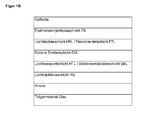
- the optoelectronic component has at least one hole- and electron-injecting layer, and at least one hole- and electron-transporting layer, wherein the hole- and electron-injecting layer between anode and cathode is applied, and the hole and electron-transporting layer between the hole- and the electron-injecting layer is applied, and the light-emitting layer is applied between hole- and electron-transporting layer.
- the invention relates to a method of making an optoelectronic device using a metal complex of the type described herein.
- the metal complex is applied to a support.
- the application can be carried out wet-chemically, by means of colloidal suspension or by sublimation.
- the invention relates to a method for changing the emission and / or absorption properties of an electronic component, wherein a metal (I) complex of the type described here is introduced into a matrix material for conducting electrons or holes of an optoelectronic component.
- the invention relates to a method for producing an optoelectronic component of the type described in the form of an organic electroluminescent device.
- One or more layers are coated with a sublimation process, or with an OVPD (Organic Vapor Phase Deposition) process, or with the aid of a carrier gas sublimation or with any printing process.
- OVPD Organic Vapor Phase Deposition
- the invention relates to the use of a metal complex according to the invention, in particular in an optoelectronic component, for converting UV radiation or blue light into visible light, in particular into green, yellow or red light (down conversion).
- the invention relates to a composition
- a composition comprising a metal complex according to the invention and a host material, wherein the triplet (T1) and singlet (S1) energy levels of the host material are higher in energy than the triplet (T1) and singlet (S1).
- the invention relates to a method for changing the emission and / or absorption properties of an electronic component, characterized by introducing a metal complex according to the invention by means of vacuum evaporation.
- AAV 2 Preparation of complexes without sonication (Cu 2 X 2 (N **, P **) 2
- the corresponding copper salt (1.00 equiv., 1.00 mmol)
- the ligands (1.50 equiv., 1.50 mmol;) under nitrogen in
- the mixture is mixed with 10 mL of dry dichloromethane and the reaction is stirred until a clear, mostly yellow solution is obtained
- the reaction mixture was filtered through a syringe filter (0.45 ⁇ m) and allowed to dry in at least 50 ml. excess volume of methanol, diethyl ether or n-hexane, the products were filtered off and dried under reduced pressure.
- the complex was prepared according to the general procedure in MeCN and crystallized from hot MeCN. The complex was filtered and dried in vacuo. Yellow crystals (70% yield). FAB-MS m / z (%): 778 [M + ], 745 [M-Cl + ], 645 [M-Cl-L + ], 454 [ML-Cl + ], 389 [M-CuLCl + ], 354 [M-CuCl 2 L + ].
- IR (ATR) 3044 (vw), 1593 (w), 1562 (vw), 1475 (m), 1448 (w), 1432 (s), 1310 (vw), 1262 (vw), 1184 (vw), 1096 (m), 1069 (w), 1025 (vw), 1009 (w), 898 (vw), 871 (m), 771 (s), 743 (vs), 694 (vs), 694 (vs), 675 (s), 636 (w), 522 (s), 503 (s), 478 (s), 414 (m) cm -1 .
- C 38 H 36 N 2 P 2 Cu 2 Cl 2 : calc. C 58.47; H 4.65; N 3.59; gef. C 58.43, H 4.64, N 3.20.
- C 38 H 36 N 2 P 2 Cu 2 Br 2 : calc. C 52.49; H 4.17; N 3.22; gef. C 52.40, H 4.17, N 3.01.
- the complex was prepared according to the general procedure in MeCN and crystallized from hot MeCN. The complex was filtered and dried in vacuo. Colorless crystals (92% yield). FAB-MS m / z (%): 836 [MI + ], 645 [MIL + ], 4354 [M-CuI 2 L + ].
- the complexes 10-Cl to 10-I behave analogously to the corresponding heteroleptic white complexes.
- the HOMO energies of 10-Br and 10-I were determined to be -5.30 eV and -5.43 eV using PESA. This reflects the localization of the HOMO on the Cu 2 X 2 unit: the transition from iodine to bromine increases the HOMO energy accordingly by about 0.1 eV, which leads photophysically to a redshift of the emission.
- DFT calculations show that the use of ligand 10 instead of pyridine A and triphenylphosphine a does not significantly affect the nature of the (M + X) LCT transition ( FIG. 2 ).
- Table 1 Photophysical parameters of WhitePHOS complexes.
- Table 1 contains important basic photophysical data for the complexes 10-Cl, 10-Br, and 10-I. Accordingly, as expected, the band gap and the energy of the emitted light increase from Cl to I. The quantum efficiency decreases at the same time, but still has a very high value of 35% for the deep blue iodo compound 10-I (430 nm). From the emission lifetime and the low-temperature behavior, it can be concluded that the WhitePHOS complexes, like the NHetPHOS complexes, are TADF emitters: the emission lifetime is relatively short, and it must be taken into account in the interpretation of the data that triexponential decay curves are obtained and the stated lifetimes Accordingly, means are.
- the emission lifetime increases by almost two orders of magnitude.
- the energy difference between excited singlet and triplet state, ⁇ E S 1 , T 1
- the value decreases in the series Cl - Br - I from 1469 to 1178 cm -1 , but is for all compounds in the range of the thermal energy k b T at 300 K (about 240 cm -1 ).
Landscapes
- Chemical & Material Sciences (AREA)
- Engineering & Computer Science (AREA)
- Materials Engineering (AREA)
- Organic Chemistry (AREA)
- Inorganic Chemistry (AREA)
- Physics & Mathematics (AREA)
- High Energy & Nuclear Physics (AREA)
- Electroluminescent Light Sources (AREA)
Priority Applications (4)
| Application Number | Priority Date | Filing Date | Title |
|---|---|---|---|
| EP14183851.6A EP2933850A1 (fr) | 2014-04-15 | 2014-09-05 | Complexes métalliques comme matériaux émetteurs |
| TW104111940A TWI670274B (zh) | 2014-04-15 | 2015-04-14 | 作為發射體材料之金屬錯合物 |
| PCT/EP2015/058034 WO2015158693A1 (fr) | 2014-04-15 | 2015-04-14 | Complexes métalliques servant de matériaux émetteurs |
| EP15717151.3A EP3132475B1 (fr) | 2014-04-15 | 2015-04-14 | Complexes métalliques comme matériaux émetteurs |
Applications Claiming Priority (2)
| Application Number | Priority Date | Filing Date | Title |
|---|---|---|---|
| EP14164815 | 2014-04-15 | ||
| EP14183851.6A EP2933850A1 (fr) | 2014-04-15 | 2014-09-05 | Complexes métalliques comme matériaux émetteurs |
Publications (1)
| Publication Number | Publication Date |
|---|---|
| EP2933850A1 true EP2933850A1 (fr) | 2015-10-21 |
Family
ID=50513044
Family Applications (2)
| Application Number | Title | Priority Date | Filing Date |
|---|---|---|---|
| EP14183851.6A Withdrawn EP2933850A1 (fr) | 2014-04-15 | 2014-09-05 | Complexes métalliques comme matériaux émetteurs |
| EP15717151.3A Active EP3132475B1 (fr) | 2014-04-15 | 2015-04-14 | Complexes métalliques comme matériaux émetteurs |
Family Applications After (1)
| Application Number | Title | Priority Date | Filing Date |
|---|---|---|---|
| EP15717151.3A Active EP3132475B1 (fr) | 2014-04-15 | 2015-04-14 | Complexes métalliques comme matériaux émetteurs |
Country Status (3)
| Country | Link |
|---|---|
| EP (2) | EP2933850A1 (fr) |
| TW (1) | TWI670274B (fr) |
| WO (1) | WO2015158693A1 (fr) |
Cited By (4)
| Publication number | Priority date | Publication date | Assignee | Title |
|---|---|---|---|---|
| CN106905956A (zh) * | 2017-03-01 | 2017-06-30 | 江苏科技大学 | 一种白光led用黄色荧光材料及其制备方法和应用 |
| CN106995696A (zh) * | 2017-03-01 | 2017-08-01 | 江苏科技大学 | 一种锌基发光金属有机骨架材料及其制备方法和应用 |
| CN108586499A (zh) * | 2018-07-27 | 2018-09-28 | 河南中医药大学 | 一种含咪唑环的氮杂环过渡金属铜配合物及其制备方法和应用 |
| CN112362626A (zh) * | 2020-11-11 | 2021-02-12 | 河南农业大学 | 正电性Ag@Au核壳结构纳米粒子在核酸酶活性检测中的应用 |
Citations (2)
| Publication number | Priority date | Publication date | Assignee | Title |
|---|---|---|---|---|
| WO2010149748A1 (fr) * | 2009-06-24 | 2010-12-29 | Hartmut Yersin | Complexes de cuivre pour applications optoélectroniques |
| WO2013014066A1 (fr) * | 2011-07-26 | 2013-01-31 | Eberhard Karls Universität Tübingen | Composés de type complexes dotés d'un ligand pourvu d'un donneur n et d'un donneur p, et leur utilisation dans le domaine électro-optique |
Family Cites Families (1)
| Publication number | Priority date | Publication date | Assignee | Title |
|---|---|---|---|---|
| DE10317556B4 (de) | 2003-04-15 | 2021-05-12 | Merck Patent Gmbh | Mischungen von organischen zur Emission befähigten Halbleitern und Matrixmaterialien, deren Verwendung und Elektronikbauteile enthaltend diese |
-
2014
- 2014-09-05 EP EP14183851.6A patent/EP2933850A1/fr not_active Withdrawn
-
2015
- 2015-04-14 EP EP15717151.3A patent/EP3132475B1/fr active Active
- 2015-04-14 WO PCT/EP2015/058034 patent/WO2015158693A1/fr not_active Ceased
- 2015-04-14 TW TW104111940A patent/TWI670274B/zh active
Patent Citations (2)
| Publication number | Priority date | Publication date | Assignee | Title |
|---|---|---|---|---|
| WO2010149748A1 (fr) * | 2009-06-24 | 2010-12-29 | Hartmut Yersin | Complexes de cuivre pour applications optoélectroniques |
| WO2013014066A1 (fr) * | 2011-07-26 | 2013-01-31 | Eberhard Karls Universität Tübingen | Composés de type complexes dotés d'un ligand pourvu d'un donneur n et d'un donneur p, et leur utilisation dans le domaine électro-optique |
Non-Patent Citations (4)
| Title |
|---|
| DANIEL M. ZINK ET AL: "Heteroleptic, Dinuclear Copper(I) Complexes for Application in Organic Light-Emitting Diodes", CHEMISTRY OF MATERIALS, vol. 25, no. 22, 17 October 2013 (2013-10-17), pages 4471 - 4486, XP055159310, ISSN: 0897-4756, DOI: 10.1021/cm4018375 * |
| H. YERSIN, TOP. CURR. CHEM., vol. 241, 2004, pages 1 |
| H. YERSIN: "Highly Efficient OLEDs with Phosphorescent Materials", 2008, WILEY-VCH |
| VOLZ DANIEL ET AL: "Small change, big red shift: syntheses, structure and photoluminescence of Cu2Br2(Ph3P)2py2(py=pyridine, 4-vinylpyridine)", INORGANIC CHEMISTRY COMMUNICATIONS, vol. 37, 23 September 2013 (2013-09-23), pages 106 - 109, XP028774965, ISSN: 1387-7003, DOI: 10.1016/J.INOCHE.2013.09.023 * |
Cited By (6)
| Publication number | Priority date | Publication date | Assignee | Title |
|---|---|---|---|---|
| CN106905956A (zh) * | 2017-03-01 | 2017-06-30 | 江苏科技大学 | 一种白光led用黄色荧光材料及其制备方法和应用 |
| CN106995696A (zh) * | 2017-03-01 | 2017-08-01 | 江苏科技大学 | 一种锌基发光金属有机骨架材料及其制备方法和应用 |
| CN108586499A (zh) * | 2018-07-27 | 2018-09-28 | 河南中医药大学 | 一种含咪唑环的氮杂环过渡金属铜配合物及其制备方法和应用 |
| CN108586499B (zh) * | 2018-07-27 | 2020-10-27 | 河南中医药大学 | 一种含咪唑环的氮杂环过渡金属铜配合物及其制备方法和应用 |
| CN112362626A (zh) * | 2020-11-11 | 2021-02-12 | 河南农业大学 | 正电性Ag@Au核壳结构纳米粒子在核酸酶活性检测中的应用 |
| CN112362626B (zh) * | 2020-11-11 | 2021-08-27 | 河南农业大学 | 正电性Ag@Au核壳结构纳米粒子在核酸酶活性检测中的应用 |
Also Published As
| Publication number | Publication date |
|---|---|
| EP3132475A1 (fr) | 2017-02-22 |
| TWI670274B (zh) | 2019-09-01 |
| EP3132475B1 (fr) | 2018-03-28 |
| WO2015158693A1 (fr) | 2015-10-22 |
| TW201604199A (zh) | 2016-02-01 |
Similar Documents
| Publication | Publication Date | Title |
|---|---|---|
| DE112011102366B4 (de) | Metallkomplexe | |
| EP2739702B1 (fr) | Prélèvement singulet doté de complexes cuivre(i) bi-coeur pour dispositifs opto-électroniques | |
| EP3216797B1 (fr) | Complexe de carbène/platine dinucléaire et son utilisation dans des delo | |
| EP2742054B1 (fr) | Complexes métalliques | |
| EP2288671B1 (fr) | Nouveaux complexes de métaux de transition et leur utilisation dans des diodes électroluminescentes organiques iii | |
| EP2726490B1 (fr) | Complexes metalliques | |
| EP2933853A1 (fr) | Matériaux hôtes pour des OLEDs | |
| EP3221294A1 (fr) | Composés hétérocycliques à utiliser dans des dispositifs électroniques | |
| EP1866978A1 (fr) | Utilisation de composes contenant des cycles aromatiques ou heteroaromatiques lies par des groupes qui contiennent des groupes carbonyle comme materiaux de matrice dans des diodes electroluminescentes organiques | |
| WO2005056712A1 (fr) | Utilisation de complexes de platine(ii) comme materiaux luminescents dans des diodes electroluminescentes organiques | |
| EP2493906A1 (fr) | Complexes hétéroleptiques à base de carbène et leur utilisation dans l'électronique organique | |
| WO2012013271A1 (fr) | Dispositif électroluminescent organique | |
| WO2008000727A1 (fr) | Utilisation dans des diodes électroluminescentes organiques de complexes carbène -métaux de transition qui ne contiennent pas de cyclométallation par l'intermédiaire de non carbènes | |
| WO2010102709A1 (fr) | Matériaux pour dispositifs électroluminescents organiques | |
| EP3120396A1 (fr) | Dispositif organique électroluminescent | |
| WO2008003464A1 (fr) | Oligomères de complexes métalliques d'isonitrile comme émetteur triple pour des applications oled | |
| DE112015003222T5 (de) | Lichtemittierendes Material für Lichtemittierende Dioden | |
| DE102012020167A1 (de) | Metallkomplexe | |
| EP2933850A1 (fr) | Complexes métalliques comme matériaux émetteurs | |
| WO2014166577A1 (fr) | Complexes métalliques et leur utilisation dans des dispositifs électroniques | |
| WO2021110720A1 (fr) | Complexes métalliques | |
| DE102011104169A1 (de) | Strahlungsemittierendes Bauelement und Verfahren zur Herstellung eines strahlungsemittierenden Bauelements | |
| EP3204463A1 (fr) | Complexes métalliques présentant des ligands tridentates pour des utilisations optoélectroniques | |
| DE102015006708A1 (de) | Metallkomplexe | |
| DE102014012818A1 (de) | Metallkomplexe |
Legal Events
| Date | Code | Title | Description |
|---|---|---|---|
| PUAI | Public reference made under article 153(3) epc to a published international application that has entered the european phase |
Free format text: ORIGINAL CODE: 0009012 |
|
| AK | Designated contracting states |
Kind code of ref document: A1 Designated state(s): AL AT BE BG CH CY CZ DE DK EE ES FI FR GB GR HR HU IE IS IT LI LT LU LV MC MK MT NL NO PL PT RO RS SE SI SK SM TR |
|
| AX | Request for extension of the european patent |
Extension state: BA ME |
|
| STAA | Information on the status of an ep patent application or granted ep patent |
Free format text: STATUS: THE APPLICATION IS DEEMED TO BE WITHDRAWN |
|
| 18D | Application deemed to be withdrawn |
Effective date: 20160422 |