EP2936849B1 - Integrierte multihop-mesh-netzwerke in mobilkommunikationsnetzwerken - Google Patents
Integrierte multihop-mesh-netzwerke in mobilkommunikationsnetzwerken Download PDFInfo
- Publication number
- EP2936849B1 EP2936849B1 EP12813829.4A EP12813829A EP2936849B1 EP 2936849 B1 EP2936849 B1 EP 2936849B1 EP 12813829 A EP12813829 A EP 12813829A EP 2936849 B1 EP2936849 B1 EP 2936849B1
- Authority
- EP
- European Patent Office
- Prior art keywords
- network
- devices
- information
- communication network
- hop
- Prior art date
- Legal status (The legal status is an assumption and is not a legal conclusion. Google has not performed a legal analysis and makes no representation as to the accuracy of the status listed.)
- Active
Links
Images



Classifications
-
- H—ELECTRICITY
- H04—ELECTRIC COMMUNICATION TECHNIQUE
- H04W—WIRELESS COMMUNICATION NETWORKS
- H04W84/00—Network topologies
- H04W84/02—Hierarchically pre-organised networks, e.g. paging networks, cellular networks, WLAN [Wireless Local Area Network] or WLL [Wireless Local Loop]
- H04W84/10—Small scale networks; Flat hierarchical networks
-
- H—ELECTRICITY
- H04—ELECTRIC COMMUNICATION TECHNIQUE
- H04W—WIRELESS COMMUNICATION NETWORKS
- H04W84/00—Network topologies
- H04W84/18—Self-organising networks, e.g. ad-hoc networks or sensor networks
- H04W84/22—Self-organising networks, e.g. ad-hoc networks or sensor networks with access to wired networks
-
- H—ELECTRICITY
- H04—ELECTRIC COMMUNICATION TECHNIQUE
- H04W—WIRELESS COMMUNICATION NETWORKS
- H04W4/00—Services specially adapted for wireless communication networks; Facilities therefor
- H04W4/70—Services for machine-to-machine communication [M2M] or machine type communication [MTC]
-
- H—ELECTRICITY
- H04—ELECTRIC COMMUNICATION TECHNIQUE
- H04W—WIRELESS COMMUNICATION NETWORKS
- H04W8/00—Network data management
- H04W8/005—Discovery of network devices, e.g. terminals
-
- H—ELECTRICITY
- H04—ELECTRIC COMMUNICATION TECHNIQUE
- H04W—WIRELESS COMMUNICATION NETWORKS
- H04W92/00—Interfaces specially adapted for wireless communication networks
- H04W92/02—Inter-networking arrangements
Definitions
- the present invention relates to the field of mobile communications and in particular to integrating the devices of a meshed multi-hop network in a mobile communication network.
- Short-range radio Today, there exist various examples of short-range radio technologies. Where short-range radio is deployed, it is often used in conjunction with multi-hop networking in a mesh configuration.
- Mesh networks may interconnect wirelessly and/or be wired between communication devices to form a cooperative communication infrastructure.
- Each device in the mesh network operates as a node for routing communication signals.
- communication signals originating from one device hop from node to node within the mesh network to arrive at the target device or to a mobile communication network. Allowing the packages to make multiple hops to reach the desired device or the internet improves the coverage area of short-range radio solutions, even without any public network base stations.
- Protocols such as the Routing Protocol for Low power and lossy networks, RPL, Ad hoc On-Demand Distance Vector, AODV, Routing and Dynamic MANET On-demand, DYMO, routing protocol are used to implement the multi-hop routing mechanisms.
- Machine to machine, M2M communication over mobile and wireless networks is expected to become increasingly important in the future.
- M2M applications are almost countless e.g. in private cars for communicating service needs, in water or electricity meters for remote control and/or remote meter reading, in street-side vending machines for communicating when goods are out-of-stock or when enough coins are present to justify a visit for emptying, in taxi cars for validating credit cards, in surveillance cameras for home or corporate security purposes etc.
- M2M devices will increase the demand for capacity in the mobile communication networks.
- a problem today is that the mesh networks may not always have enough routers to cover a wide area, or to reach all the M2M devices. It also becomes difficult in a network of many M2M devices to manage the set of devices that belong to a particular user. The devices for different users may all be mixed in the same local area network. In addition, if a user has devices in different places, they are not easily addressed at the same time.
- Prior art document US 2007/0291722 describes a method for centrally managing an ad-hoc network formed among dual mode mobile communication terminals that can support both a cellular mobile communication network service and an ad-hoc network service.
- a mobile communication terminal subscribes to the ad-hoc network service at a home subscriber server, HSS, of the mobile communication network, an IP address administration server allocates an IP address to the mobile terminal via a base station of the mobile communication network, and stores centrally an address table and a routing table.
- Topology changes of the ad-hoc network are reported to the IP address administration server by the terminals through the base station, or by the base station upon detection of particular events, the server updates its routing table accordingly, and transmits the updated table to the terminals.
- short-range radio technology is developed but is not widely used.
- There are problems with the current solutions in that there is almost no public short-range connectivity, it is very difficult to manage the devices that belongs to a particular user in a large network, it is difficult to manage devices of the same user that are located in different networks and when a device is used as the hot spot for the other devices to connect to the mobile communication network, the other devices are invisible to the network.
- the object of the present invention is to provide a method and a node for integrating the devices of a meshed multi-hop network in a mobile communication network which seeks to mitigate, alleviate, or eliminate one or more of the above-identified deficiencies in the art and disadvantages singly or in any combination.
- the disclosure provides for a method of integrating the devices of a meshed multi-hop network in a mobile communication network.
- the method comprises the following steps: attaching at least one device of the meshed multi-hop network to the cellular communication network, retrieving, in at least one node of the cellular communication network, from at least one base station of the cellular communication network, information defining which devices of said meshed multi-hop network that may be accessed through said base station; wherein said information further comprises information about a path or paths from the base station, through which path or paths said device may be accessed; storing, in the node, said information; and deciding, using said information, which path to use for accessing a particular device in the meshed multi-hop network from the cellular communication network.
- the devices in a multi-hop network are known to the mobile communication network even though they are not directly connected to the mobile communication network.
- the mobile communication network is also aware of how to access the devices and through which base stations.
- the information about the devices of said meshed multi-hop network further comprises information mapping each device to a user subscription for communication with the mobile communication network.
- the cellular communication network knows what devices are present in a multi-hop network and which devices belong to which user.
- the method comprises the step of continuously reporting, from each base station in said cellular communication network, information regarding which devices can be accessed from that particular base station.
- the cellular communication network always has updated information about which devices are reachable from which base stations.
- the method comprises to create a view of all devices belonging to a particular subscriber. With such a view, the user of the subscription has access to an overview of all his/her devices.
- the information about the devices of said meshed multi-hop network is used to determine which subset of devices in the multi-hop network a multicast message goes to, based on which subscriber the devices are associated with.
- a way to multicast messages to devices in a multi-hop network belonging to a specific user subscription is provided.
- the method comprises deciding, using the information about the devices of the meshed multi-hop network, which path to use for accessing a particular device.
- the cellular communication network may choose the most efficient way of accessing a device in the multi-hop network.
- the method comprises requesting, from one of said devices, to attach to a second meshed multi-hop network using the same global address as used in a first meshed multi-hop network.
- a device is for example a mobile entity, it is common that the device moves around and the user of the device may want to attach several meshed multi-hop networks at different locations.
- the node is configured to integrate the devices of a meshed multi-hop network in said mobile communication network.
- the node comprises the following: a network communication unit configured to communicate with said cellular communication network, a processor configured to retrieve, using said network communication unit from at least one base station of said cellular communication network, information defining which devices of said meshed multi-hop network that may be accessed through said base station, wherein said information further comprises information about a path or paths from the base station, through which path or paths said device may be accessed and decide, using said information, which path to use for accessing a particular device in the meshed multi-hop network from the cellular communication network; a memory configured to store, in said node, for each device, said retrieved information.
- the object of the present invention is to overcome at least some of the disadvantages of known technology as previously described.
- Embodiments of the present invention relate, in general, to the field of integrating the devices of a meshed multi-hop network in a mobile communication network and, in particular, to make devices in a mesh multi-hop network visible in a mobile communication network. By making them visible they may be accessed by the mobile communication network and the mobile communication may optimize the path that information is sent to and from the device.
- the mobile communication network may also create a view of the devices in a multi-hop network that belongs to a user subscription that the user may access to get an overview of his/her connected devices.
- a device referred to in this application could be any device capable of communicating with a multi-hop network. Examples of such devices are of course mobile phones, smartphones, laptops and Machine to Machine, M2M, devices etc. However, one must appreciate that capability to communicate with a multi-hop network could be built in almost any device e.g. a car, a lamp post, a scale and so on.
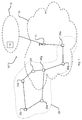
- Figure 1 show a mobile communication network 10 and a mesh multi-hop network 20 in connection with each other via a device 20a, which is connected to a base station 11.
- a mesh multi-hop network solution makes it possible to connect aggregated devices to a radio cloud using at least one aggregating or capillary device 20a connected directly to a base station.
- the mobile communication network may be any type of public network providing any services to a mobile entity 20a involving a connection and the communication of signals and data, such as a mobile access network using, e.g., GSM, UMTS, GPRS or LTE standards.
- the mobile communication network comprises a core network 12 and a radio access network 13.
- the radio access network comprises one or several base stations 11.
- the core network 12 provides various services to customers who are connected to the mobile communication network.
- a device 20a is connected to a meshed multi-hop network 20 with several devices 20a-20g.
- the device 20a is connected to a mobile communications network via a base station 11 using cellular access. If the base station 11 provides a short range radio network, such as a WLAN or ZigBee, the device 20a may according to another aspect of the invention be attached to the mobile communication network 20, using short range radio network connectivity.
- a short range radio network such as a WLAN or ZigBee
- the aggregating device 20a that is connected to the base station is authenticated in the network, i.e. has established a trusted communication.
- Such an authentication is today done by having a subscription tied to a SIM and performing a SIM authentication procedure as will be described below.
- the figure illustrates the networks where the method of integrating the devices of a meshed multi-hop network in a mobile communication network may be executed.
- Figure 2 is a flowchart illustrating the method steps of the method for of integrating the devices of a meshed multi-hop network in a mobile communication network.
- the first step of figure 2 comprises attaching 101 at least one device 20a of a meshed multi-hop network 20 to a mobile communication network 10.
- the device 20a comprises wireless communication means for attaching to a base station 11 of the mobile communication network.
- the wireless communication means are cellular communication means.
- the attaching requires that the device is authenticated to the network using a mobile network standard, for example the Extensible Authentication Protocol Method for 3rd Generation Authentication and Key Agreement, EAP-AKA.
- a mobile network standard for example the Extensible Authentication Protocol Method for 3rd Generation Authentication and Key Agreement, EAP-AKA.
- EAP-AKA Extensible Authentication Protocol Method for 3rd Generation Authentication and Key Agreement
- AKA requires that a pre-shared secret key K is stored in the mobile entity e.g. UMTS Subscriber Identity Module, USIM card, and an authentication server.
- the AS is for example a Home Subscriber Server, HSS, in the home network of the mobile entity.
- HSS Home Subscriber Server
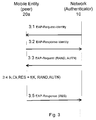
- the network requests the identity from the mobile entity, 3:1.
- the mobile entity sends 3:2 a subscriber/mobile entity identity e.g. International Mobile Subscriber Identity, IMSI.
- a subscriber/mobile entity identity e.g. International Mobile Subscriber Identity, IMSI.
- the serving network Based on the identity, the serving network, using the mobile entity's identity, requests the following data from the AS: a random challenge, RAND: an authentication token, AUTN, an expected response, XRES, and a set of keys.
- the random challenge and the authentication token which provides replay protection and enables the mobile entity to authenticate the network, are sent 3:3 to the mobile entity via the serving network.
- the USIM at the mobile entity verifies AUTN and computes two values from RAND: a set of keys, Ck and Ik, and a response, RES, 3:4.
- RES is sent 3:5 back to the serving network, which verifies that the response RES is as expected i.e. it matches XRES and, if so, draws the conclusion that it has been received from the expected sender. If so, the mobile entity is considered authenticated and subsequent data exchange is protected using the set of keys.
- AKA thus creates fresh session keys Ck and Ik used for secure communication between the mobile entity and serving.
- FIG. 3 The embodiments illustrated in figures 3 is based on Authentication and Key Agreement e.g. EAP AKA. However, the principle is not limited thereto, but may be implemented using any authentication protocol based on a shared secret.
- EAP AKA Authentication and Key Agreement
- the second step of figure 2 comprises retrieving 102, in at least one node 14 of said mobile communication network 10, from at least one base station 11 of said mobile communication network, information about the devices 20a-20g of said meshed multi-hop network 20 that may be accessed through said base station.
- the mobile communication network node 14 will know which devices are connected and how to access each device. This could for example be that the network topology is known, through a network map provided by the aggregating device. Since the device 20a is connected to the meshed multi-hop network it has information about the other devices 20b-20g in the network. The information about the devices is sent from the device 20a to the base station 11.
- the base station 11 is sent upon request from the base station 11 which in turn has received a request from a node 14 in the core network.
- the base station 11 receives the information from the device and sends it to the node on its own accord.
- the meshed network may itself initiate the sending of data.
- the third step in figure 2 comprises storing 103, in said node 14, for each device 20a-20g, said information; such that said node knows, for each device, through which base stations it may be accessed; thereby integrating said meshed multi-hop network 20 in said mobile communication network 10.
- the node 14 has storing means for storing the information.
- the storing means may be any type of memory, preferably of the non-volatile kind, such as a flash memory or any type of RAM.
- the node may send or request information directly from each device in the meshed network. In this way, the devices in the multi-hop network are visible to the mobile communication network 10 and may be accessed directly.
- the devices in a multi-hop network are known to the mobile communication network even though they are not directly connected to the base station.
- the mobile communication network is also aware of how to access the devices and through which base stations.
- the memory in the node 14 comprises, according to one aspect of the invention, information such as a routing view, subscription information, distance to base station from each device and/or IP addresses of connected devices.
- said information further comprises information mapping each device to a user subscription for communication with the mobile communication network.
- Each device connected to the mobile communication network has a user subscription associated with the SIM card of the device.
- the information specifies, for the devices of the meshed network to which user subscription it belongs.. Hence, the mobile communication network knows what devices are present in a multi-hop network and which devices belong to which user.
- an additional step in the method according to figure 2 comprises continuously reporting 104, from each base station 11 in said mobile communication network 10, information regarding which devices can be accessed from that particular base station.
- the node 14 With continuous or periodical updates, the node 14 will have up to date information about the meshed multi-hop network. The node will then have information if devices in are removed or added. Thus, the mobile communication network always has updated information about which devices are reachable from which base stations.
- FIG. 2 further illustrates a fifth step 105 according to an aspect of the invention.
- the step comprises creating 105 a view of all devices belonging to a particular subscriber.
- a global map of information regarding the devices belonging to a particular subscriber is created.
- the subscriber may be a user or a company.
- a processor in the node 14 uses the information obtained about the devices in the meshed multi-hop network to make a view, i.e. a visual representation, of the devices in the meshed multi-hop network 20 that belongs to a user subscription.
- the user's devices may be attached to different meshed networks and base stations.
- the user of the subscription may access the view by for example logging on to a user interface on a web page.
- the user of the subscription has access to an overview of all his/her devices. This may be particularly feasible if the devices are moving around e.g. between different multi hop networks. The user is then provided with a visual representation of his/her devices in the mobile communications network.
- the user desires to send certain information or to access one or several of the devices, it is possible to do so from the user interface according to an aspect of the invention.
- the devices in the multi-hop network are electricity meters in an area
- the electricity company that handles them may use the interface to access the meters separately to read the consumption.
- the electricity company saves time and money by not having to go out to each meter and check them individually.
- Another example of using the view created of the devices belonging to a subscriber is when the devices are parking meters in an area.
- the company owning the parking meters may use the view to get an overview over their devices and they may access each device to see their status.
- the status may for example be if the meter is mall-functioning or if the coin deposit box needs to be emptied.
- an additional step in the method according to figure 2 comprises using 106 said information to determine to which network nodes e.g. radio network controllers, a multicast message should be delivered.
- a network nodes e.g. radio network controllers
- the core network 12 there is a network of nodes which routes information to the radio access network. If a multicast message is to be sent to several devices in a multi-hop network one or several radio network controllers may be used to send the message to the base stations connected to the multi-hop network.
- the information may be used to determine how to route the message.
- said information is used to determine which subset of devices in the multi-hop network 20 a multicast message goes to, based on which subscriber the devices are associated with. If a multi-hop network comprises devices which belongs to different subscriptions and either the mobile communication network 10 or the user of a specific subscription wishes to send a multicast message to all the devices of the specific subscription the information in the node 14 is used to determine which devices to send the message to. Hence, a way to multicast messages to devices in a multi-hop network belonging to a specific user subscription is provided.
- said view comprises the path or paths to each device in said multi-hop network, from each base station through which said device may be accessed, respectively.
- a user of a subscription wants to access for example device 20b in figure 1 there are two possible ways.
- the information will go through the device 20a connecting the multi-hop network to the mobile communication network and in the case illustrated in figure 1 the information will then hop to device 20e and then to device 20g. After device 20g the information may either hop to device 20b via 20f or 20d and 20c.
- the path is chosen depending on the current load on the devices. If, for example, device 20f is busy with sending or receiving other information it may be faster to send the information to device 20b over the longer path via device 20d and 20c.
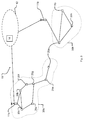
- Figure 4 show a mobile communication network 10 and a mesh multi-hop network 20 in connection with each other via two base stations 11 a, 11 b.
- the devices 20a, 20b and 20c are in this aspect of the invention all devices which can be authenticated according to above by the mobile communication network 10.
- the devices 20a, 20b, 20c each have different user subscription but it is also possible that two or more share the same user subscription.
- the meshed multi-hop network is of the type according to figure 4 , where more than one device is connected to the mobile communication network, it is of particular interest to provide the view of all devices belonging to a particular subscriber.
- a meshed multi-hop network where several devices are connected to the mobile communication network and where there are more than one user subscription connected to the multi-hop network, it is particularly useful to the users of a subscription to get a view over the devices in the network which are related to their own user subscription.
- Figure 2 further illustrates a seventh step according to an aspect of the invention.
- the step comprises deciding 107, using said information, which path to use for accessing a particular device.
- deciding which path to use for accessing a particular device is especially important. If the node wishes to access for example device 20f it seems, from the figure, like taking the path over 20b is the fastest path. However, if the load on device 20b is much larger than the load over any of the devices 20a, 20e, 20g, the path over those devices may be preferred.
- the mobile communication network may choose the most efficient way of accessing a device in the multi-hop network.
- Figure 2 further illustrates an eight step according to an aspect of the invention.
- the step comprises requesting 108 from one of said devices, to attach to a second meshed multi-hop network 30b using the same global address as used in a first meshed multi-hop network 30a.
- FIG 5 an example of where a device 20a is moving between two meshed multi-hop networks 30a, 30b is illustrated.
- the device 20 is connected to a first multi-hop network 30a.
- the device typically has an IP connection with a server, where the user has started an application e.g. streaming music.
- an application e.g. streaming music.
- the device 20a moves out of reach of the first network, this connection is lost.
- the device 20a discovers a second network 30b.
- the device 20a requests to attach to the second network using the same IP address, whereby the IP connection can be kept.
- the interrupt experienced by the user is shortened because no new PDP context needs to be established.
- An example of where it may be useful to connect a device to more than one multi-hop network is for regular cell phone users who has one network of devices at home and another close to his home.
- Another example is for companies or authorities providing lighting in an area. If the company wants to have several different networks with lights, for example one with lamp posts and one with lighting of buildings, but only one device 20a that is authenticated towards the mobile communication network, the device which is authenticated may be connected to two or several meshed multi-hop networks. The company will then have a separate view over each network with lights which provides a good overview. It will also be easy for the company to access for example a lamp post to see if it is functional or if they want to turn off a specific lamp. All the specific lamps that the company wishes to be able to control separately using the method of the invention need to be provided with means for short-range radio connectivity.
- step 104 to the eight step 108 of figure 2 are not necessarily performed in the order that they are presented in figure 2 .
- the meshed multi-hop network uses RPL as a routing protocol.
- Routing Protocol for LLNs or "RPL,” is a distance vector routing protocol.
- One or more instances of the RPL protocol can be used to build a routing topology that is deployed over the LLN using a set of metrics and constraints.
- Each RPL routing topology built by an RPL instance may be represented by a Directed Acyclic Graph, DAG that is rooted by a root node.
- Other nodes of the LLN may participate in the routing topology by discovering and attaching to the DAG based on configuration and policies.
- Figure 6 shows a block diagram over a node 14 in a mobile communication network 10.
- the node is configured to integrate the devices of a meshed multi-hop network 20 in said mobile communication network 10.
- the node comprises a network communication unit 131 configured to communicate with said mobile communication network 10.
- the network communication unit may be any communication unit suitable for this purpose such as a network interface.
- the network node 14 in figure 6 further comprises a processor 132 configured to retrieve, using said network communication unit 131, from at least one base station of said mobile communication network, information about the devices of said meshed multi-hop network that may be accessed through said base station.
- the processor 132 of the node 14 is configured to perform the second step 102 of the flowchart of figure 2 , which has been explained above.
- the network node 14 in figure 6 further comprises a memory 133 configured to store, in said node, for each device, said retrieved information; such that said node knows, for each device, through which base stations it may be accessed; thereby integrating said meshed multi-hop network in said mobile communication network.
- the memory 133 in the node 14 is configured to perform the third step 103 of the flowchart of figure 2 , which has been explained above.
- the node 14 comprises information mapping each device to a user subscription for communication with the mobile communication network.
- the device 20a connected to the base station 11 has a user subscription associated with the SIM card of the device.
- a processor 132 in the node 14 maps the devices to make it clear which devices belong to which user subscription.
- the information about which devices belongs to the subscription of the device 20a connected to the base station 11 is provided to the node 14 by that device 20a.
- the processor is further configured to execute the method of integrating the devices of a meshed multi-hop network in a mobile communication network as described above.
- the node 14 comprises decision means 134 configured to decide based on said information, which path to use for accessing a particular device.
- decision means 134 configured to decide based on said information, which path to use for accessing a particular device.
- the node looks at the example of a meshed multi-hop network 20 connected to a mobile communication network 10 of figure 4 , deciding which path to use for accessing a particular device is especially important. If the node wishes to access for example device 20f it seems, from the figure, like taking the path over 20b is the fastest path. However, if the load on device 20b is much larger than the load over any of the devices 20a, 20e, 20g, the path over those devices is preferred.
- the node 14 comprises creating means 135 configured to create a view of all devices belonging to a particular subscriber of said mobile communications network.
- a processor in the node 14 uses the information obtained about the devices in the meshed multi-hop network to make a view, i.e. a visual representation, of the devices in the meshed multi-hop network that belongs to a user subscription.
- the user of the subscription may access the view by for example logging on to a user interface on a web page.
- the user is then provided with a visual representation of his/her devices in a multi-hop network.
Landscapes
- Engineering & Computer Science (AREA)
- Computer Networks & Wireless Communication (AREA)
- Signal Processing (AREA)
- Mobile Radio Communication Systems (AREA)
Claims (13)
- Verfahren zum Integrieren der Vorrichtungen (20a-20g) eines Kurzstrecken-Multihop-Mesh-Netzwerks (20) in ein zelluläres Kommunikationsnetzwerk (10), Folgendes umfassend:- Anschließen (101) wenigstens einer Vorrichtung (20a) des Multihop-Mesh-Netzwerks (20) an das zelluläre Kommunikationsnetzwerk (10);- Abrufen (102) von Informationen in wenigstens einem Knoten (14) des zellulären Kommunikationsnetzwerks (10) von wenigstens einer Basisstation (11) des zellulären Kommunikationsnetzwerks (10), die definieren, auf welche Vorrichtungen (20a-20g) des Multihop-Mesh-Netzwerks (20) über die Basisstation (11) zugegriffen werden kann; wobei die Informationen ferner Informationen über einen Pfad oder Pfade von der Basisstation umfassen, über welchen Pfad oder welche Pfade auf die Vorrichtung zugegriffen werden kann;- Speichern (103) der Informationen in dem Knoten (14); und- Entscheiden (107), durch den wenigstens einen Knoten des zellulären Kommunikationsnetzwerks unter Verwendung der Informationen, welcher der Pfade zu verwenden ist, um aus dem zellulären Kommunikationsnetzwerk (10) auf eine bestimmte Vorrichtung in dem Multihop-Mesh-Netzwerk zuzugreifen.
- Verfahren nach Anspruch 1, wobei die Informationen weiter Informationszuordnungen jeder Vorrichtung (20a-20g) zu einem Benutzer-Abonnement zur Kommunikation mit dem zellulären Kommunikationsnetzwerk (10) umfasst.
- Verfahren nach einem der vorhergehenden Ansprüche, weiter umfassend den folgenden Schritt:- Kontinuierliches Melden (104) von jeder Basisstation (11) in dem zellulären Kommunikationsnetzwerk (10) von Informationen darüber, auf welche Vorrichtungen (20a-20g) von der bestimmten Basisstation aus (11) zugegriffen werden kann.
- Verfahren nach Anspruch 2, weiter umfassend:- Erzeugen (105) einer Ansicht aller Vorrichtungen (20a-20g), die zu einem bestimmten Benutzer gehören.
- Verfahren nach einem der vorhergehenden Ansprüche, weiter umfassend:- Verwenden (106) der Informationen, um zu bestimmen, welchen Netzwerkknoten eine Multicast-Nachricht zugestellt werden soll.
- Verfahren nach Anspruch 2, wobei die Informationen verwendet werden, um zu bestimmen, an welche Teilmenge von Vorrichtungen im Multihop-Netzwerk (20) eine Multicast-Nachricht geht, darauf basierend, welchem Benutzer die Vorrichtungen (20a-20g) zugeordnet sind.
- Verfahren nach Anspruch 4, wobei die Ansicht den Pfad oder die Pfade zu jeder Vorrichtung (20a-20g) in dem Multihop-Netzwerk (20), von jeder Basisstation (11), über die jeweils auf die Vorrichtung zugegriffen werden kann, umfasst.
- Verfahren nach einem der vorhergehenden Ansprüche, weiter umfassend:- Anfordern (108), von einer der Vorrichtungen, sich an ein zweites Multihop-Mesh-Netzwerk (30b) anzuschließen und dabei die gleiche globale Adresse zu verwenden, wie sie in einem ersten Multihop-Mesh-Netzwerk (20, 30a) verwendet wird.
- Verfahren nach einem der vorhergehenden Ansprüche, wobei das Multihop-Mesh-Netzwerk (20) RPL als Routingprotokoll verwendet.
- Knoten (13) in einem zellulären Kommunikationsnetzwerk (10), der dafür konfiguriert ist, die Vorrichtungen (20a-20g) eines Kurzstrecken-Multihop-Mesh-Netzwerks (20) in ein zelluläres Kommunikationsnetzwerk (10) zu integrieren, wobei der Knoten Folgendes umfasst:- eine Netzwerk-Kommunikationseinheit (131), die dafür konfiguriert ist, mit dem zellulären Kommunikationsnetzwerk (10) zu kommunizieren;- einen Prozessor (132), der dafür konfiguriert ist, unter Verwendung der Netzwerk-Kommunikationseinheit (131) von wenigstens einer Basisstation (11a, 11b) des zellulären Kommunikationsnetzwerks (10) Informationen abzurufen, die definieren, auf welche Vorrichtungen des Multihop-Mesh-Netzwerks (20) über die Basisstation zugegriffen werden kann; wobei die Informationen weiter Informationen über den Pfad oder die Pfade von der Basisstation umfassen, durch welchen Pfad oder welche Pfade auf die Vorrichtung zugegriffen werden kann, und unter Verwendung der Informationen zu entscheiden, welcher Pfad zum Zugreifen aus dem zellulären Kommunikationsnetzwerk (10) auf eine bestimmte Vorrichtung in dem Multihop-Mesh-Netzwerk zu verwenden ist.- einen Speicher (133), der dafür konfiguriert ist, die abgerufenen Informationen zu speichern.
- Knoten (13) nach Anspruch 10, wobei die Informationen weiter Informationszuordnungen jeder Vorrichtung (20a-20g) zu einem Benutzer-Abonnement zur Kommunikation mit dem zellulären Kommunikationsnetzwerk (10) umfasst.
- Knoten (13) nach Anspruch 10, weiter umfassend:- ein Entscheidungsmittel (134), das dafür konfiguriert ist, basierend auf den Informationen zu entscheiden, welcher Pfad zum Zugreifen auf eine bestimmte Vorrichtung zu verwenden ist.
- Knoten (13) nach Anspruch 10, weiter umfassend:- ein Erstellungsmittel (135), das dafür konfiguriert ist, eine Übersicht über alle Vorrichtungen (20a-20g) zu erstellen, die zu einem bestimmten Benutzer des zellulären Kommunikationsnetzwerks (10) gehören.
Applications Claiming Priority (1)
| Application Number | Priority Date | Filing Date | Title |
|---|---|---|---|
| PCT/EP2012/076267 WO2014094851A1 (en) | 2012-12-20 | 2012-12-20 | Integrating multi-hop mesh networks in mobile communication networks |
Publications (2)
| Publication Number | Publication Date |
|---|---|
| EP2936849A1 EP2936849A1 (de) | 2015-10-28 |
| EP2936849B1 true EP2936849B1 (de) | 2016-11-16 |
Family
ID=47557072
Family Applications (1)
| Application Number | Title | Priority Date | Filing Date |
|---|---|---|---|
| EP12813829.4A Active EP2936849B1 (de) | 2012-12-20 | 2012-12-20 | Integrierte multihop-mesh-netzwerke in mobilkommunikationsnetzwerken |
Country Status (3)
| Country | Link |
|---|---|
| US (1) | US9179494B2 (de) |
| EP (1) | EP2936849B1 (de) |
| WO (1) | WO2014094851A1 (de) |
Families Citing this family (4)
| Publication number | Priority date | Publication date | Assignee | Title |
|---|---|---|---|---|
| WO2015139026A2 (en) | 2014-03-14 | 2015-09-17 | Go Tenna Inc. | System and method for digital communication between computing devices |
| EP3016414B1 (de) * | 2014-10-31 | 2019-06-19 | Telia Company AB | Konfiguration einer Vorrichtung |
| JP6921546B2 (ja) * | 2017-02-16 | 2021-08-18 | キヤノン株式会社 | 管理装置、携帯端末、それらの方法、及びプログラム |
| US11032239B1 (en) * | 2019-12-05 | 2021-06-08 | AT&T Intellectual Propety I, L.P. | Methods and systems for providing global internet protocol (IP) addresses |
Family Cites Families (14)
| Publication number | Priority date | Publication date | Assignee | Title |
|---|---|---|---|---|
| US20030151513A1 (en) * | 2002-01-10 | 2003-08-14 | Falk Herrmann | Self-organizing hierarchical wireless network for surveillance and control |
| US6826385B2 (en) * | 2002-02-22 | 2004-11-30 | Nokia Corporation | Method and system for distributing geographical addresses across the surface of the earth |
| EP1483868A1 (de) * | 2002-03-12 | 2004-12-08 | Nokia Corporation | Verfahren und gerät zur errichtung von drahtlosen netzwerken |
| US7089323B2 (en) * | 2002-06-21 | 2006-08-08 | Microsoft Corporation | Method for multicasting a message on a computer network |
| US7574174B2 (en) * | 2002-07-10 | 2009-08-11 | Nokia Corporation | Apparatus, method and system for a remote-page device |
| TWI454113B (zh) * | 2006-04-25 | 2014-09-21 | Interdigital Tech Corp | 網狀無線區域網路中高通量頻道操作 |
| US7508787B2 (en) * | 2006-05-31 | 2009-03-24 | Cisco Technology, Inc. | Graphical selection of information display for wireless mesh hierarchies |
| KR100713626B1 (ko) | 2006-06-19 | 2007-05-02 | 삼성전자주식회사 | 애드-혹 네트워크 서비스를 제공하는 이동통신단말기 및그를 이용한 애드-혹 네트워크 관리 방법 |
| US8121053B2 (en) * | 2007-05-21 | 2012-02-21 | Arrowspan, Inc. | Multi-radio wireless mesh network solutions |
| EP2114095A1 (de) * | 2008-04-30 | 2009-11-04 | Nokia Siemens Networks Oy | Verfahren und Vorrichtung zur Auswahl eines Netzwerkknotens für die Weiterleitung, und Kommunikationssystem mit einer derartigen Vorrichtung |
| US8462707B2 (en) * | 2008-10-01 | 2013-06-11 | Digi International Inc. | Joining a mesh network in a multiple network environment |
| EP2230868B1 (de) | 2009-03-18 | 2012-03-07 | Nokia Siemens Networks OY | Verfahren und Vorrichtung zur Verteilung von Topologieinformationen in Kommunikationsnetzwerken |
| WO2010121205A1 (en) * | 2009-04-16 | 2010-10-21 | Nearverse, Inc. | Method and apapratus for distributed communication using short range and wide range communication links |
| US8799510B2 (en) * | 2011-07-05 | 2014-08-05 | Cisco Technology, Inc. | Managing host routes for local computer networks with a plurality of field area routers |
-
2012
- 2012-12-20 EP EP12813829.4A patent/EP2936849B1/de active Active
- 2012-12-20 US US13/723,091 patent/US9179494B2/en active Active
- 2012-12-20 WO PCT/EP2012/076267 patent/WO2014094851A1/en not_active Ceased
Non-Patent Citations (1)
| Title |
|---|
| None * |
Also Published As
| Publication number | Publication date |
|---|---|
| EP2936849A1 (de) | 2015-10-28 |
| US9179494B2 (en) | 2015-11-03 |
| US20140177505A1 (en) | 2014-06-26 |
| WO2014094851A1 (en) | 2014-06-26 |
Similar Documents
| Publication | Publication Date | Title |
|---|---|---|
| Palattella et al. | Internet of things in the 5G era: Enablers, architecture, and business models | |
| Frangoudis et al. | Wireless community networks: an alternative approach for nomadic broadband network access | |
| US10264140B2 (en) | Billing engine and method of use | |
| Reina et al. | The role of ad hoc networks in the internet of things: A case scenario for smart environments | |
| US7512783B2 (en) | Provision of security services for an ad-hoc network | |
| Grassi et al. | ACM HotMobile 2013 poster: Vehicular inter-networking via named data | |
| US10637997B2 (en) | Billing engine and method of use | |
| CN104247505B (zh) | 用于利用anqp服务器能力增强andsf的系统和方法 | |
| CN1947402B (zh) | 在近接和Ad-Hoc网络中提供安全的方法和系统 | |
| EP2807842B1 (de) | Verfahren und vorrichtungen zur geräteerkennung | |
| Lee et al. | A comprehensive evaluation of RPL under mobility | |
| WO2013174153A1 (zh) | 一种计费的方法及装置 | |
| EP2936849B1 (de) | Integrierte multihop-mesh-netzwerke in mobilkommunikationsnetzwerken | |
| Mišić et al. | Capillary machine-to-machine communications: the road ahead | |
| Garetto et al. | Capacity scaling in ad hoc networks with heterogeneous mobile nodes: The super-critical regime | |
| US20160088477A1 (en) | Coordinator and device in a radio communication network | |
| Cianci et al. | Content centric services in smart cities | |
| Tamariz-Flores et al. | Vehicular network systems in smart cities | |
| EP3292673B1 (de) | Fakturierungsmaschine und verfahren zur verwendung | |
| Schnaufer et al. | Beacon-based short message exchange in an inner city environment | |
| Wang et al. | Cooperative new flow handling scheme for wireless multi-hop software defined networks | |
| Rais et al. | Message delivery in heterogeneous networks prone to episodic connectivity | |
| Habault et al. | Lightweight service announcement: The case for Wi-Fi M2M service providers | |
| JP2022519316A (ja) | 決済エンジンおよび使用の方法 | |
| Braem et al. | Global Access to the Internet for All J. Saldana, Ed. Internet-Draft University of Zaragoza Intended status: Informational A. Arcia-Moret Expires: July 25, 2015 Universidad de Los Andes |
Legal Events
| Date | Code | Title | Description |
|---|---|---|---|
| PUAI | Public reference made under article 153(3) epc to a published international application that has entered the european phase |
Free format text: ORIGINAL CODE: 0009012 |
|
| 17P | Request for examination filed |
Effective date: 20150616 |
|
| AK | Designated contracting states |
Kind code of ref document: A1 Designated state(s): AL AT BE BG CH CY CZ DE DK EE ES FI FR GB GR HR HU IE IS IT LI LT LU LV MC MK MT NL NO PL PT RO RS SE SI SK SM TR |
|
| AX | Request for extension of the european patent |
Extension state: BA ME |
|
| DAX | Request for extension of the european patent (deleted) | ||
| REG | Reference to a national code |
Ref country code: DE Ref legal event code: R079 Ref document number: 602012025539 Country of ref document: DE Free format text: PREVIOUS MAIN CLASS: H04W0008000000 Ipc: H04W0084220000 |
|
| GRAJ | Information related to disapproval of communication of intention to grant by the applicant or resumption of examination proceedings by the epo deleted |
Free format text: ORIGINAL CODE: EPIDOSDIGR1 |
|
| GRAP | Despatch of communication of intention to grant a patent |
Free format text: ORIGINAL CODE: EPIDOSNIGR1 |
|
| GRAP | Despatch of communication of intention to grant a patent |
Free format text: ORIGINAL CODE: EPIDOSNIGR1 |
|
| RIC1 | Information provided on ipc code assigned before grant |
Ipc: H04W 84/22 20090101AFI20160629BHEP Ipc: H04W 92/02 20090101ALN20160629BHEP Ipc: H04W 4/00 20090101ALN20160629BHEP Ipc: H04W 8/00 20090101ALN20160629BHEP |
|
| INTG | Intention to grant announced |
Effective date: 20160718 |
|
| GRAS | Grant fee paid |
Free format text: ORIGINAL CODE: EPIDOSNIGR3 |
|
| GRAA | (expected) grant |
Free format text: ORIGINAL CODE: 0009210 |
|
| AK | Designated contracting states |
Kind code of ref document: B1 Designated state(s): AL AT BE BG CH CY CZ DE DK EE ES FI FR GB GR HR HU IE IS IT LI LT LU LV MC MK MT NL NO PL PT RO RS SE SI SK SM TR |
|
| REG | Reference to a national code |
Ref country code: GB Ref legal event code: FG4D |
|
| REG | Reference to a national code |
Ref country code: CH Ref legal event code: EP |
|
| REG | Reference to a national code |
Ref country code: IE Ref legal event code: FG4D |
|
| REG | Reference to a national code |
Ref country code: AT Ref legal event code: REF Ref document number: 846967 Country of ref document: AT Kind code of ref document: T Effective date: 20161215 |
|
| REG | Reference to a national code |
Ref country code: DE Ref legal event code: R096 Ref document number: 602012025539 Country of ref document: DE |
|
| REG | Reference to a national code |
Ref country code: DE Ref legal event code: R096 Ref document number: 602012025539 Country of ref document: DE |
|
| REG | Reference to a national code |
Ref country code: NL Ref legal event code: FP |
|
| PG25 | Lapsed in a contracting state [announced via postgrant information from national office to epo] |
Ref country code: LV Free format text: LAPSE BECAUSE OF FAILURE TO SUBMIT A TRANSLATION OF THE DESCRIPTION OR TO PAY THE FEE WITHIN THE PRESCRIBED TIME-LIMIT Effective date: 20161116 |
|
| REG | Reference to a national code |
Ref country code: LT Ref legal event code: MG4D |
|
| REG | Reference to a national code |
Ref country code: AT Ref legal event code: MK05 Ref document number: 846967 Country of ref document: AT Kind code of ref document: T Effective date: 20161116 |
|
| PG25 | Lapsed in a contracting state [announced via postgrant information from national office to epo] |
Ref country code: NO Free format text: LAPSE BECAUSE OF FAILURE TO SUBMIT A TRANSLATION OF THE DESCRIPTION OR TO PAY THE FEE WITHIN THE PRESCRIBED TIME-LIMIT Effective date: 20170216 Ref country code: LT Free format text: LAPSE BECAUSE OF FAILURE TO SUBMIT A TRANSLATION OF THE DESCRIPTION OR TO PAY THE FEE WITHIN THE PRESCRIBED TIME-LIMIT Effective date: 20161116 Ref country code: SE Free format text: LAPSE BECAUSE OF FAILURE TO SUBMIT A TRANSLATION OF THE DESCRIPTION OR TO PAY THE FEE WITHIN THE PRESCRIBED TIME-LIMIT Effective date: 20161116 Ref country code: GR Free format text: LAPSE BECAUSE OF FAILURE TO SUBMIT A TRANSLATION OF THE DESCRIPTION OR TO PAY THE FEE WITHIN THE PRESCRIBED TIME-LIMIT Effective date: 20170217 |
|
| PG25 | Lapsed in a contracting state [announced via postgrant information from national office to epo] |
Ref country code: PT Free format text: LAPSE BECAUSE OF FAILURE TO SUBMIT A TRANSLATION OF THE DESCRIPTION OR TO PAY THE FEE WITHIN THE PRESCRIBED TIME-LIMIT Effective date: 20170316 Ref country code: HR Free format text: LAPSE BECAUSE OF FAILURE TO SUBMIT A TRANSLATION OF THE DESCRIPTION OR TO PAY THE FEE WITHIN THE PRESCRIBED TIME-LIMIT Effective date: 20161116 Ref country code: BE Free format text: LAPSE BECAUSE OF NON-PAYMENT OF DUE FEES Effective date: 20161231 Ref country code: PL Free format text: LAPSE BECAUSE OF FAILURE TO SUBMIT A TRANSLATION OF THE DESCRIPTION OR TO PAY THE FEE WITHIN THE PRESCRIBED TIME-LIMIT Effective date: 20161116 Ref country code: ES Free format text: LAPSE BECAUSE OF FAILURE TO SUBMIT A TRANSLATION OF THE DESCRIPTION OR TO PAY THE FEE WITHIN THE PRESCRIBED TIME-LIMIT Effective date: 20161116 Ref country code: AT Free format text: LAPSE BECAUSE OF FAILURE TO SUBMIT A TRANSLATION OF THE DESCRIPTION OR TO PAY THE FEE WITHIN THE PRESCRIBED TIME-LIMIT Effective date: 20161116 Ref country code: RS Free format text: LAPSE BECAUSE OF FAILURE TO SUBMIT A TRANSLATION OF THE DESCRIPTION OR TO PAY THE FEE WITHIN THE PRESCRIBED TIME-LIMIT Effective date: 20161116 Ref country code: FI Free format text: LAPSE BECAUSE OF FAILURE TO SUBMIT A TRANSLATION OF THE DESCRIPTION OR TO PAY THE FEE WITHIN THE PRESCRIBED TIME-LIMIT Effective date: 20161116 |
|
| PG25 | Lapsed in a contracting state [announced via postgrant information from national office to epo] |
Ref country code: RO Free format text: LAPSE BECAUSE OF FAILURE TO SUBMIT A TRANSLATION OF THE DESCRIPTION OR TO PAY THE FEE WITHIN THE PRESCRIBED TIME-LIMIT Effective date: 20161116 Ref country code: DK Free format text: LAPSE BECAUSE OF FAILURE TO SUBMIT A TRANSLATION OF THE DESCRIPTION OR TO PAY THE FEE WITHIN THE PRESCRIBED TIME-LIMIT Effective date: 20161116 Ref country code: CZ Free format text: LAPSE BECAUSE OF FAILURE TO SUBMIT A TRANSLATION OF THE DESCRIPTION OR TO PAY THE FEE WITHIN THE PRESCRIBED TIME-LIMIT Effective date: 20161116 Ref country code: EE Free format text: LAPSE BECAUSE OF FAILURE TO SUBMIT A TRANSLATION OF THE DESCRIPTION OR TO PAY THE FEE WITHIN THE PRESCRIBED TIME-LIMIT Effective date: 20161116 Ref country code: SK Free format text: LAPSE BECAUSE OF FAILURE TO SUBMIT A TRANSLATION OF THE DESCRIPTION OR TO PAY THE FEE WITHIN THE PRESCRIBED TIME-LIMIT Effective date: 20161116 |
|
| REG | Reference to a national code |
Ref country code: CH Ref legal event code: PL |
|
| REG | Reference to a national code |
Ref country code: DE Ref legal event code: R097 Ref document number: 602012025539 Country of ref document: DE |
|
| PG25 | Lapsed in a contracting state [announced via postgrant information from national office to epo] |
Ref country code: BE Free format text: LAPSE BECAUSE OF FAILURE TO SUBMIT A TRANSLATION OF THE DESCRIPTION OR TO PAY THE FEE WITHIN THE PRESCRIBED TIME-LIMIT Effective date: 20161116 Ref country code: IT Free format text: LAPSE BECAUSE OF FAILURE TO SUBMIT A TRANSLATION OF THE DESCRIPTION OR TO PAY THE FEE WITHIN THE PRESCRIBED TIME-LIMIT Effective date: 20161116 Ref country code: BG Free format text: LAPSE BECAUSE OF FAILURE TO SUBMIT A TRANSLATION OF THE DESCRIPTION OR TO PAY THE FEE WITHIN THE PRESCRIBED TIME-LIMIT Effective date: 20170216 Ref country code: SM Free format text: LAPSE BECAUSE OF FAILURE TO SUBMIT A TRANSLATION OF THE DESCRIPTION OR TO PAY THE FEE WITHIN THE PRESCRIBED TIME-LIMIT Effective date: 20161116 |
|
| PLBE | No opposition filed within time limit |
Free format text: ORIGINAL CODE: 0009261 |
|
| STAA | Information on the status of an ep patent application or granted ep patent |
Free format text: STATUS: NO OPPOSITION FILED WITHIN TIME LIMIT |
|
| PG25 | Lapsed in a contracting state [announced via postgrant information from national office to epo] |
Ref country code: MC Free format text: LAPSE BECAUSE OF FAILURE TO SUBMIT A TRANSLATION OF THE DESCRIPTION OR TO PAY THE FEE WITHIN THE PRESCRIBED TIME-LIMIT Effective date: 20161116 |
|
| REG | Reference to a national code |
Ref country code: FR Ref legal event code: ST Effective date: 20170831 |
|
| REG | Reference to a national code |
Ref country code: IE Ref legal event code: MM4A |
|
| 26N | No opposition filed |
Effective date: 20170817 |
|
| PG25 | Lapsed in a contracting state [announced via postgrant information from national office to epo] |
Ref country code: FR Free format text: LAPSE BECAUSE OF NON-PAYMENT OF DUE FEES Effective date: 20170116 Ref country code: LU Free format text: LAPSE BECAUSE OF NON-PAYMENT OF DUE FEES Effective date: 20161220 Ref country code: LI Free format text: LAPSE BECAUSE OF NON-PAYMENT OF DUE FEES Effective date: 20161231 Ref country code: CH Free format text: LAPSE BECAUSE OF NON-PAYMENT OF DUE FEES Effective date: 20161231 |
|
| PG25 | Lapsed in a contracting state [announced via postgrant information from national office to epo] |
Ref country code: SI Free format text: LAPSE BECAUSE OF FAILURE TO SUBMIT A TRANSLATION OF THE DESCRIPTION OR TO PAY THE FEE WITHIN THE PRESCRIBED TIME-LIMIT Effective date: 20161116 Ref country code: IE Free format text: LAPSE BECAUSE OF NON-PAYMENT OF DUE FEES Effective date: 20161220 |
|
| PG25 | Lapsed in a contracting state [announced via postgrant information from national office to epo] |
Ref country code: HU Free format text: LAPSE BECAUSE OF FAILURE TO SUBMIT A TRANSLATION OF THE DESCRIPTION OR TO PAY THE FEE WITHIN THE PRESCRIBED TIME-LIMIT; INVALID AB INITIO Effective date: 20121220 |
|
| PG25 | Lapsed in a contracting state [announced via postgrant information from national office to epo] |
Ref country code: MK Free format text: LAPSE BECAUSE OF FAILURE TO SUBMIT A TRANSLATION OF THE DESCRIPTION OR TO PAY THE FEE WITHIN THE PRESCRIBED TIME-LIMIT Effective date: 20161116 Ref country code: CY Free format text: LAPSE BECAUSE OF FAILURE TO SUBMIT A TRANSLATION OF THE DESCRIPTION OR TO PAY THE FEE WITHIN THE PRESCRIBED TIME-LIMIT Effective date: 20161116 Ref country code: IS Free format text: LAPSE BECAUSE OF FAILURE TO SUBMIT A TRANSLATION OF THE DESCRIPTION OR TO PAY THE FEE WITHIN THE PRESCRIBED TIME-LIMIT Effective date: 20161116 |
|
| PG25 | Lapsed in a contracting state [announced via postgrant information from national office to epo] |
Ref country code: MT Free format text: LAPSE BECAUSE OF NON-PAYMENT OF DUE FEES Effective date: 20161220 |
|
| PG25 | Lapsed in a contracting state [announced via postgrant information from national office to epo] |
Ref country code: TR Free format text: LAPSE BECAUSE OF FAILURE TO SUBMIT A TRANSLATION OF THE DESCRIPTION OR TO PAY THE FEE WITHIN THE PRESCRIBED TIME-LIMIT Effective date: 20161116 |
|
| PG25 | Lapsed in a contracting state [announced via postgrant information from national office to epo] |
Ref country code: AL Free format text: LAPSE BECAUSE OF FAILURE TO SUBMIT A TRANSLATION OF THE DESCRIPTION OR TO PAY THE FEE WITHIN THE PRESCRIBED TIME-LIMIT Effective date: 20161116 |
|
| PGFP | Annual fee paid to national office [announced via postgrant information from national office to epo] |
Ref country code: GB Payment date: 20251229 Year of fee payment: 14 |
|
| PGFP | Annual fee paid to national office [announced via postgrant information from national office to epo] |
Ref country code: NL Payment date: 20251226 Year of fee payment: 14 |
|
| PGFP | Annual fee paid to national office [announced via postgrant information from national office to epo] |
Ref country code: DE Payment date: 20251229 Year of fee payment: 14 |