EP2982641A1 - Sattelbaum für einen Sattel - Google Patents
Sattelbaum für einen Sattel Download PDFInfo
- Publication number
- EP2982641A1 EP2982641A1 EP14179946.0A EP14179946A EP2982641A1 EP 2982641 A1 EP2982641 A1 EP 2982641A1 EP 14179946 A EP14179946 A EP 14179946A EP 2982641 A1 EP2982641 A1 EP 2982641A1
- Authority
- EP
- European Patent Office
- Prior art keywords
- saddle
- fork
- curvature
- cantle
- saddle tree
- Prior art date
- Legal status (The legal status is an assumption and is not a legal conclusion. Google has not performed a legal analysis and makes no representation as to the accuracy of the status listed.)
- Granted
Links
Images


Classifications
-
- B—PERFORMING OPERATIONS; TRANSPORTING
- B68—SADDLERY; UPHOLSTERY
- B68C—SADDLES; STIRRUPS
- B68C1/00—Saddling equipment for riding- or pack-animals
- B68C1/02—Saddles
- B68C1/025—Saddle-trees
Definitions
- the invention relates to a saddle tree for a saddle, in particular Western saddle, with a Fork, a Cantle, and with two interconnected via Fork and Cantle, rigid bars, each depending on the bottom along its center line in the longitudinal direction both at least one positive curvature and a Have twist.
- the US6263647 shows a saddle tree for a Western saddle with two bars, which are connected in the region of its front end on the fork and in the region of its rear end via the Cantle.
- the bars in the longitudinal direction of a curvature, which is referred to in the jargon as rock on. This skirt usually has a consistently positive curvature.
- the bars are twisted in the longitudinal direction in order to follow the course of the horse's back. This twisting is also referred to in the jargon as a twist.
- the bars are in US6263647 made of flexible rubber.
- the invention is therefore based on the object, starting from the above-described prior art, a saddle tree going to improve that the weight of the rider is distributed to the horseback area, the saddle tree but still allows enough shoulder room for the horse.
- the invention solves this problem in that the bars depending on their center line in the longitudinal direction from the front bar end to the rear approach of Fork positively curved, then curvature or negative curved to the front approach of Cantle and then positively curved to the rear bar end.
- curvature can be understood to mean the local deviation of a curve from a straight line, the tangent.
- the curvature of the center line of the bearing surface of the bars in the longitudinal direction, wherein for the consideration of the local deviation, the center line is traversed from the front to the rear Barende.
- a positive curvature may mean a deviation to the left and a negative curvature a deviation to the right.
- the positive curvature may mean a deviation from the rider and a negative curvature a deviation towards the horse.
- the description of the course of curvature under the front approach of the cantilever can be understood as the point on the center line which is closest to the foremost outer point of the cantilever.
- the saddle tree can allow the horse in the area of the rear saddle enough freedom of movement.
- the saddle tree has two flexurally soft tension elements, in particular straps, which are each fastened to a bar in their front and rear bar areas and each carry a fastening element which is loosely mounted on the respective tension element for connection to a girth, this can advantageously secure the saddle over the seat Allow saddle tree on the horse.
- Improvements in load distribution and guidance of the flexible traction elements may result when the flexible traction elements are fastened to the bar at one of its ends in the region of the front approach of Fork and at the other end in the region of the front approach of Cantle.
- the fastener is at least partially vertically below the rear approach of Fork, the transfer of the rider weight on the horse's back can be done very evenly.
- the flat part of the D-ring can advantageously be guided along the flexurally soft tension element, in particular a belt, which can be beneficial for the loose mounting of the D-ring.
- the D-ring has a web, whereby the D-ring forms a gap between its flat part and the web for the purpose of running the respective flexurally soft tension element, the D-ring can be guided on the flexible tension element, in particular a belt, without slipping Turning tension element or D-ring to fear. An easily movable and yet reliable guidance of the fastener is therefore possible.
- the saddle tree according to the invention can serve as a structure for a saddle.
- the saddle can be distinguished by a skirt, wherein the web of the skirt partially protruding D-ring is arranged above the lower edge of the Skirts. This can further enhance the transfer of rider weight to the horse's thoracic spine.
- the saddle can be attached to the horse with a girth harness attached to the fastener.
- a saddle tree in which the front bar end is designed to spring back from the fork can be advantageous in terms of shoulder clearance of the horse.
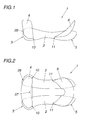
- Fig. 1 For example, a side view and in Fig.2 the corresponding top view of an exemplary saddle tree 1 for a western saddle, not shown.
- the saddle tree 1 has two bars 2. These are connected in the area of the front, pointing in the direction of the horse head Barendes 3 on the Fork 4 and in front of their rear bar end 5 with the Cantle 6.
- FIG. 4 arising from the profile of FIG. 3 along IV-IV results, recognizable, run the bars 2 each along its center line 9 in the longitudinal direction 12 from the front bar end 3 to the rear projection 10 of Fork 4 positively curved. Subsequently, up to the front approach 11 of Cantle 6, the course is curvature-free in the illustrated embodiment. Nevertheless, a negative curvature is conceivable in this area. The further course of the bars 2 is then positively curved up to the rear bar end 5.
- the rear lug 10 of Fork 4 may refer to an intersection resulting from a plane perpendicular to the longitudinal axis of the saddle tree, the two front lugs of the fork 4 at the two Bars 2, is cut with the center line 9.
- this plane corresponds to the straight region between the two reference symbols 10 and therefore does not follow the bent region 37 of the fork 4.
- the front lug 11 of Cantle 6 may refer to an intersection resulting when a plane perpendicular to the longitudinal axis of the saddle tree abuts the two forward lugs 11 of the cantilever 6 includes the two bars 2, is cut with the center line 9.
- Fig. 2 This level is indicated in the dashed connection of both reference numerals 11 to.
- a saddle tree 1 with such ausgestaltetem skirt transfers with the movement of the horse collected the load of the rider optimally on the horse's back - as this runs almost horizontally in a gathering movement in the rider's seating area.
- the straight or even negative curved course of the bars 2 between approach 10, 11 of Fork 4 and Cantle 6 in the longitudinal direction 12 is a particularly favorable adaptation to the horse's back in a gathered movement.
- An areal distribution of the weight of the rider on the horse's back is achieved by this course of the curvature 7, 33.
- the curvatures 7, 33 at the bar ends 3, 5 result in a good shoulder clearance at the front side in the direction of the horse's head, and a good adaptation in the region of the end of the thoracic spine on the other rear side of the bars 2.
- the saddle tree according to the invention 1 for Western riding offers both a flat weight distribution of the rider and a sufficient freedom of shoulder of the horse while riding.
- the front projection 11 of the cantilever 6 is understood to mean the point on the center line 9 of the bars 2 which is located closest to the foremost outer point of the cantilever 6.
- the posterior lug 10 of the fork 4 is on the imaginary straight join of the two posterior, outer points of the fork 4.
- the curvature 7 from the front bar end 3 to the rear approach 10 of fork 4 has a steadily increasing radius of curvature 25, 26, 27. Even with an overlap of the front ends of the bars 3 with the shoulder area so the necessary freedom of movement of the shoulder is given as it slides under the saddle tree 1 in the movement. The movement of the horse is thus not hindered or even blocked with such a saddle tree 1.
- the curvature 33 from the front approach Cantle 11 to the bar end 5 has a steadily decreasing radius of curvature 34, 35, 36. 2. A good adjustment in the area end of the thoracic spine is thus achieved.
- FIG. 5 shows side view of the saddle tree 1 with designed as a belt 13 flexible traction element 14 for connection to a girth 15.
- the complete tree 1 has, accordingly, two soft bending tension elements 14. These are attached to the respective bar 2 in the front and rear bar area 21, 22.
- a fastening element 16 is loosely mounted on the tension element 14. A simple fastening of the saddle by means of the saddle tree 1 is thus realized.
- the bending tension member 14 designed as a belt 13 runs with its upper edge 24 toward the front projection 28 of fork 4. On the other side of the flexurally soft tension element this runs with its lower edge on the front projection 11 of the cantilever 6.
- the position for the harness of the saddle so that the fastener 16 comes to rest under the rear approach 10 of the fork 4. An advantageous transfer of the rider weight on the horse is achieved.
- the flexurally soft tension elements 14 are fastened at one of their ends 17 in the region of the front projection 28 of fork 4 and at the other end 18 in the region of the front projection 11 of cantle 6. This allows constructive simplifications in the attachment and guidance of the flexible traction elements 14 and an improved load distribution of the rider weight.
- the attachment is made with a series of screws 31.
- the fastener 16 is at least partially vertically below the rear lug 10 of the fork 4, which improves the uniform transfer of the rider weight to the horse.
- a fastener 16 is according to Figure 5 a D-ring 19 with an additional web 20 is used.
- the belt 13 extends in the gap 29 between the flat part of the D-ring 19 and web 20.
- the fastener 16 can be moved for flexible saddle strap along the flexible tension member 14, due to the leadership between flat part of the D-ring 19 and web 20 the risk of twisting of tension element 14 or D-ring 19 is prevented.
- the D-ring 19 With the correct tuning of the D-ring 19 and length of the strap 13, the D-ring 19 is arranged with the saddle with its web 20 still above the lower edge of the Skirts 30.
- the D-ring 19 is accordingly the dashed in Fig. 5 indicated Skirt 30 only partially above.
Landscapes
- Engineering & Computer Science (AREA)
- Mechanical Engineering (AREA)
- Professional, Industrial, Or Sporting Protective Garments (AREA)
- Steering Devices For Bicycles And Motorcycles (AREA)
Abstract
Description
- Die Erfindung betrifft einen Sattelbaum für einen Sattel, insbesondere Westernsattel, mit einer Fork, einem Cantle, und mit zwei über Fork und Cantle miteinander verbundenen, biegesteifen Bars, die je auf der Unterseite entlang ihrer Mittellinie in Längsrichtung sowohl zumindest eine positive Krümmung als auch eine Verdrehung aufweisen.
- Die
US6263647 zeigt einen Sattelbaum für einen Westernsattel mit zwei Bars, die im Bereich ihres vorderen Endes über die Fork und im Bereich ihres hinteren Endes über die Cantle verbunden sind. Für die Passform des Sattelbaumes an den Pferderücken weisen die Bars in Längsrichtung eine Krümmung, die in der Fachsprache als Rock bezeichnet wird, auf. Dieser Rock weist üblicherweise eine durchgehend positive Krümmung auf. Zudem sind die Bars in Längsrichtung verdreht, um dem Verlauf des Pferderückens folgen zu können. Diese Verdrehung wird in der Fachsprache auch als Twist bezeichnet. Um eine möglichst gute Passform auch während der Bewegung des Pferdes zu erzielen, sind die Bars inUS6263647 aus flexiblen Gummi hergestellt. Nachteilig hat sich beim Reiten jedoch herausgestellt, dass die flexiblen Bars das Gewicht des Reiters nicht gut verteilen, was mit den bekannten Gefahren, wie Muskel-, Gelenks-, Knorpel- und Nervenschäden für das Pferd verbunden ist. Zudem ist trotz der flexiblen Bars die Schulterfreiheit für das Pferd meist nicht ausreichend gegeben. - Der Erfindung liegt somit die Aufgabe zugrunde, ausgehend vom eingangs geschilderten Stand der Technik, einen Sattelbaum dahin gehend zu verbessern, dass das Gewicht des Reiters auf den Pferderücken flächig verteilt wird, der Sattelbaum aber dennoch genügend Schulterfreiheit für das Pferd erlaubt.
- Die Erfindung löst die gestellte Aufgabe dadurch, dass die Bars je entlang ihrer Mittellinie in Längsrichtung vom vorderen Barende bis zum hinteren Ansatz von Fork positiv gekrümmt, anschließend bis zum vorderen Ansatz von Cantle krümmungsfrei oder negativ gekrümmt und dann bis zum hinteren Barende positiv gekrümmt verlaufen.
- Verlaufen die Bars je entlang ihrer Mittellinie in Längsrichtung vom vorderen Barende bis zum hinteren Ansatz von Fork positiv gekrümmt, kann dies für eine ausreichende Schulterfreiheit sorgen, da die Pferdeschulter in der Bewegung unter das vordere Ende der Bars gleiten kann. Eine vorteilhafte Übertragung des Reitergewichts auf den Pferderücken kann erreicht werden, wenn die Bars anschließend an den hinteren Ansatz von Fork bis zum vorderen Ansatz von Cantle krümmungsfrei oder negativ gekrümmt verlaufen. Ist dann der weitere Verlauf der Bars entlang ihrer Mittellinie in Längsrichtung bis zum hinteren Barende positiv gekrümmt, kann zudem eine vorteilhafte Passform im Bereich Ende Brustwirbelsäule erzielt werden. Der so entstehende Rock mit positiver Krümmung, folgender negativer oder keiner Krümmung sowie folgender positiver Krümmung, kann bei versammelter Bewegung des Pferdes die Last des Reiters optimal auf den Pferderücken übertragen. Ein durchgehend positiv gekrümmter Rock, entsprechend dem Stand der Technik, kann dies nämlich nicht gewährleisten. Erst der krümmungsfreie oder negativ gekrümmte Verlauf der Bars zwischen Ansatz von Fork und Cantle in Längsrichtung kann nämlich eine möglichst günstige Passform an den Pferderücken in der versammelten Bewegung darstellen, und damit eine flächige Verteilung des Gewichts des Reiters auf dem Pferderücken erlauben. Die positive Krümmung im Bereich der Barenden kann hingegen an der vorderen Seite eine gute Schulterfreiheit und auf der hinteren Seite der Bars eine gute Anpassung an den Pferderücken ergeben. Ein erfindungsgemäßer Sattelbaum zum Westernreiten kann somit eine vorteilhafte flächige Gewichtsverteilung des Reiters und auch eine ausreichende Schulterfreiheit des Pferdes beim Reiten ermöglichen.
- Im Allgemeinen wird festgehalten, dass unter Krümmung die lokale Abweichung einer Kurve von einer Geraden, der Tangente verstanden werden kann. Speziell von Interesse im Zuge dieser Anmeldung kann die Krümmung der Mittellinie der Auflagefläche der Bars in Längsrichtung sein, wobei für die Betrachtung der lokalen Abweichung die Mittellinie vom vorderen zum hinteren Barende durchlaufen wird. Dabei kann eine positive Krümmung eine Abweichung nach links und eine negative Krümmung eine Abweichung nach rechts bedeuten. Bei einem verwendungsgemäß befestigten Sattel kann die positive Krümmung eine Abweichung zum Reiter und eine negative Krümmung eine Abweichung in Richtung Pferd bedeuten. Dabei kann für die Beschreibung des Krümmungsverlaufs unter dem vorderen Ansatz des Cantles der Punkt auf der Mittellinie verstanden werden, der dem vordersten äußeren Punkt des Cantles am Nächsten gelegen ist.
- Vorstehende Vorteile können weiter verbessert werden, wenn die Krümmung vom vorderen Barende bis zum hinteren Ansatz von Fork einen stetig steigenden Krümmungsradius aufweist. Durch diesen Krümmungsverlauf kann - unter anderem im Zusammenwirken mit der sich nach außen, also vom Pferd abwendenden Verdrehung der Bars - selbst bei einer Überlappung der vorderen Barenden mit dem Schulterbereich eines Pferdes die Schulter unter den Sattelbaum gleiten. Somit wird es bei seiner Bewegung also weder behindert noch blockiert.
- Weist somit die Krümmung vom vorderen Ansatz von Cantle bis zum hinteren Barende einen stetig abnehmenden Krümmungsradius auf, kann der Sattelbaum dem Pferd im Bereich des hinteren Sattelendes genügend Bewegungsfreiheit erlauben.
- Weist der Sattelbaum zwei biegeweiche Zugelemente, insbesondere Gurte auf, die jeweils an einem Bar in ihrem vorderen und hinteren Barbereich befestigt sind und je ein, am jeweiligen Zugelement lose gelagertes Befestigungselement zum Anschluss an einen Sattelgurt tragen, kann dies ein vorteilhaftes Befestigen des Sattels über den Sattelbaum am Pferd erlauben.
- Dies kann weiter verbessert werden, wenn die Oberkante der biegeweichen Zugelemente auf den vorderen Ansatz von Fork und die Unterkante auf den vorderen Ansatz von Cantle zuläuft. Im Zusammenspiel mit der losen Lagerung des Befestigungselements kann sich die Position für die Gurtung des Sattels derart einstellen, dass das Befestigungselement unter dem hinteren Ansatz der Fork zu liegen kommt. Derart angeordnete Zugelemente können sich bei der Übertragung des Reitergewichts auf den Pferderücken aufgrund ihrer speziellen Anordnung auszeichnen.
- Verbesserungen in Lastverteilung und Führung der biegeweichen Zugelemente können sich ergeben, wenn die biegeweichen Zugelemente am Bar an einem seiner Enden im Bereich des vorderen Ansatzes von Fork und an dessen anderen Ende im Bereich des vorderen Ansatzes von Cantle befestigt sind.
- Befindet sich das Befestigungselement zumindest teilweise vertikal unterhalb des hinteren Ansatzes von Fork, kann die Übertragung des Reitergewichts auf den Pferderücken besonders gleichmäßig erfolgen.
- Dies kann weiter verbessert werden, wenn ein D-Ring das Befestigungselement ausbildet. Der flache Teil des D-Rings kann nämlich entlang des biegeweichen Zugelements, insbesondere eines Gurts, vorteilhaft geführt werden, was der losen Lagerung des D-Rings dienlich sein kann.
- Weist der D-Ring einen Steg auf, wobei der D-Ring zum Verlaufen des jeweiligen biegeweichen Zugelements zwischen seinem flachen Teil und dem Steg einen Spalt ausbildet, kann der D-Ring am biegeweichen Zugelement, insbesondere einem Gurt, geführt werden, ohne dabei ein Verdrehen von Zugelement oder D-Ring befürchten zu müssen. Eine einfach verschiebbare und dennoch zuverlässige Führung des Befestigungselements wird also möglich.
- Der erfindungsgemäße Sattelbaum kann als Aufbau für einen Sattel dienen.
- Weiter auszeichnen kann sich der Sattel mit einem Skirt, wobei der Steg des dem Skirt bereichsweise vorstehenden D-Rings oberhalb der Unterkante des Skirts angeordnet ist. Dies kann die Übertragung des Reitergewichts auf die Brustwirbelsäule des Pferdes weiter verbessern.
- Bekanntermaßen kann der Sattel mit einem Sattelgurt, der am Befestigungselement angeschlossen ist, am Pferd befestigt werden.
- Im Allgemeinen wird festgehalten, dass ein Sattelbaum, bei dem das vordere Barende gegenüber der Fork zurückspringend ausgeführt ist, bezüglich der Schulterfreiheit des Pferdes Vorteile bringen kann.
- In den Figuren ist beispielsweise der Erfindungsgegenstand anhand einer Ausführungsvariante näher dargestellt. Es zeigen
- Fig. 1
- eine Seitenansicht des Sattelbaums,
- Fig. 2
- eine Draufsicht auf den Sattelbaum,
- Fig. 3
- eine Ansicht der Auflagefläche eines Bars des Sattelbaums,
- Fig. 4
- ein Profil des Bars entlang der Mittellinie in Längsrichtung gemäß
Fig. 3 und - Fig. 5
- eine Seitenansicht des Sattelbaums mit biegeweichem Zugelement zum Anschluss eines Sattelgurts.
- Gemäß
Fig. 1 wird beispielsweise eine Seitenansicht und inFig.2 die dementsprechende Draufsicht auf einen beispielhaften Sattelbaum 1 für einen nicht näher dargestellten Westernsattel gezeigt. Wie aus den Figuren erkennbar, weist der Sattelbaum 1 zwei Bars 2 auf. Diese sind im Bereich des vorderen, in Richtung Pferdekopf weisenden Barendes 3 über die Fork 4 und vor ihrem hinteren Barende 5 mit der Cantle 6 verbunden. - Wie in
Fig. 3 bzw.Fig. 4 dargestellt, weisen die Bars 2 - um eine vorteilhafte Anpassung an den Pferderücken zu erreichen - sowohl eine Krümmung 7, 33 als auch eine Verdrehung 8 entlang ihrer Mittellinie 9 in Längsrichtung 12 auf. In der Fachsprache werden Krümmung 7, 33 als Rock und Verdrehung 8 als Twist bezeichnet. - Wie aus
Figur 4 , die sich aus dem Profil derFigur 3 entlang IV-IV ergibt, erkennbar, verlaufen die Bars 2 je entlang ihrer Mittellinie 9 in Längsrichtung 12 vom vorderen Barende 3 bis zum hinteren Ansatz 10 von Fork 4 positiv gekrümmt. Anschließend bis zum vorderen Ansatz 11 von Cantle 6 ist der Verlauf im gezeigten Ausführungsbeispiel krümmungsfrei. Dennoch ist in diesem Bereich auch eine negative Krümmung vorstellbar. Der weitere Verlauf der Bars 2 ist dann bis zum hinteren Barende 5 positiv gekrümmt. - Im Allgemeinen wird festgehalten, dass mit Sicht auf die Mittellinie 9 der hinter Ansatz 10 von Fork 4 sich auf einen Schnittpunkt beziehen kann, der sich ergibt, wenn eine zur Längsachse des Sattelbaums senkrechte Ebene, die die beiden vorderen Ansätze des Forks 4 an den beiden Bars 2 umfasst, mit der Mittellinie 9 geschnitten wird. Entsprechend
Fig. 2 entspricht diese Ebene dem geraden Bereich zwischen den beiden Bezugszeichen 10 und folgt daher nicht dem gebogenen Bereich 37 des Forks 4. - Im Allgemeinen wird weiter festgehalten, dass mit Sicht auf die Mittellinie 9 der vordere Ansatz 11 von Cantle 6 sich auf einen Schnittpunkt beziehen kann, der sich ergibt, wenn eine zur Längsachse des Sattelbaums senkrechte Ebene, die die beiden vorderen Ansätze 11 des Cantles 6 an den beiden Bars 2 umfasst, mit der Mittellinie 9 geschnitten wird. Entsprechend
Fig. 2 ist diese Ebene in der strichlierten Verbindung beider Bezugszeichen 11 zu angedeutet. - Ein Sattelbaum 1 mit derart ausgestaltetem Rock überträgt bei versammelter Bewegung des Pferdes die Last des Reiters optimal auf den Pferderücken - da dieser in versammelter Bewegung im Sitzbereich des Reiters nahezu waagrecht verläuft. So stellt der gerade oder gar negativ gekrümmte Verlauf der Bars 2 zwischen Ansatz 10, 11 von Fork 4 und Cantle 6 in Längsrichtung 12 eine besonders günstige Anpassung an den Pferderücken in versammelter Bewegung dar. Eine flächige Verteilung des Gewichts des Reiters auf dem Pferderücken wird durch diesen Verlauf der Krümmung 7, 33 erreicht. Die Krümmungen 7, 33 an den Barenden 3, 5 ergeben an der vorderen in Richtung Pferdekopf liegenden Seite eine gute Schulterfreiheit und auf der anderen hinteren Seite der Bars 2 eine gute Anpassung im Bereich Ende Brustwirbelsäule. Der erfindungsgemäße Sattelbaum 1 zum Westernreiten bietet sowohl eine flächige Gewichtsverteilung des Reiters als auch eine ausreichende Schulterfreiheit des Pferdes beim Reiten.
- Für die Beschreibung des Krümmungsverlaufs wird unter dem vorderen Ansatz 11 des Cantles 6 der Punkt auf der Mittellinie 9 der Bars 2 verstanden, der dem vordersten äußeren Punkt des Cantles 6 am nächsten gelegen ist. Genauso ist der hintere Ansatz 10 des Forks 4 auf der gedachten geraden Verbindung der beiden hinteren, äußeren Punkte des Forks 4. So ist trotz des in
Fig. 1 eingezeichneten theoretischen Verlaufs 37 der dem Reiter zugewandten Seite des Forks der Ansatz 10 des Forks 4 an der gleichen Position. - Wie in
Fig. 4 dargestellt, hat die Krümmung 7 vom vorderen Barende 3 bis zum hinteren Ansatz 10 von Fork 4 einen stetig steigenden Krümmungsradius 25, 26, 27. Selbst bei einer Überlappung der vorderen Enden der Bars 3 mit dem Schulterbereich ist also die notwendige Bewegungsfreiheit der Schulter gegeben, da diese in der Bewegung unter den Sattelbaum 1 gleitet. Die Bewegung des Pferdes wird mit einem derartigen Sattelbaum 1 somit nicht behindert oder gar blockiert. Genauso weist die Krümmung 33 vom vorderen Ansatz Cantle 11 bis zum Barende 5 einen stetig abnehmenden Krümmungsradius 34, 35, 36 auf. 2. Eine gute Anpassung im Bereich Ende Brustwirbelsäule wird damit erzielt. -
Fig.5 zeigt Seitenansicht des Sattelbaums 1 mit als Gurt 13 ausgeführtem biegeweichen Zugelement 14 zum Anschluss an einen Sattelgurt 15. Der komplette Sattelbaum 1 weist dementsprechend zwei biegeweiche Zugelemente 14 auf. Diese sind am jeweiligen Bar 2 im vorderen und hinteren Barbereich 21, 22 befestigt. Zum Anschluss an einen Sattelgurt 15 ist am Zugelement 14 ein Befestigungselement 16 lose gelagert. Ein einfaches Befestigen des Sattels mit Hilfe des Sattelbaums 1 wird damit realisiert. - Das als Gurt 13 ausgeführte biegeweiche Zugelement 14 läuft mit seiner Oberkante 24 auf den vorderen Ansatz 28 von Fork 4 zu. Auf der anderen Seite des biegeweichen Zugelements läuft dies mit seiner Unterkante auf den vorderen Ansatz 11 des Cantles 6 zu. Im Zusammenspiel mit der losen Lagerung des Befestigungselements 16 stellt sich die Position für die Gurtung des Sattels derart ein, dass das Befestigungselement 16 unter dem hinteren Ansatz 10 der Fork 4 zu liegen kommt. Eine vorteilhafte Übertragung des Reitergewichts auf das Pferd wird so erreicht.
- Die biegeweichen Zugelemente 14 sind an einem ihrer Enden 17 im Bereich des vorderen Ansatzes 28 von Fork 4 und am anderen Ende 18 im Bereich des vorderen Ansatzes 11 von Cantle 6 befestigt. Dies erlaubt konstruktive Vereinfachungen in der Befestigung und Führung der biegeweichen Zugelemente 14 sowie eine verbesserte Lastverteilung des Reitergewichts. Im gezeigten Beispiel der
Fig.5 erfolgt die Befestigung mit einer Reihe von Schrauben 31. - Aufgrund dieser Anordnung befindet sich das Befestigungselement 16 zumindest teilweise vertikal unterhalb des hinteren Ansatzes 10 der Fork 4, was die gleichmäßige Übertragung des Reitergewichts auf das Pferd verbessert.
- Als Befestigungselement 16 wird gemäß
Fig.5 ein D-Ring 19 mit einem zusätzlichen Steg 20 verwendet. Dabei verläuft der Gurt 13 im Spalt 29 zwischen flachem Teil des D-Rings 19 und Steg 20. So kann das Befestigungselement 16 für eine flexible Gurtung des Sattels entlang des biegeweichen Zugelements 14 verschoben werden, wobei aufgrund der Führung zwischen flachem Teil des D-Rings 19 und Steg 20 die Gefahr eines Verdrehens von Zugelement 14 oder D-Ring 19 verhindert wird. Bei der richtigen Abstimmung von D-Ring 19 und Länge des Gurts 13 ist der D-Ring 19 bei aufgelegtem Sattel mit seinem Steg 20 noch oberhalb der Unterkante des Skirts 30 angeordnet. Der D-Ring 19 ist dementsprechend dem strichliert inFig. 5 angedeutetem Skirt 30 nur bereichsweise vorstehend.
Claims (12)
- Sattelbaum für einen Sattel, insbesondere Westernsattel, mit einer Fork (4), einem Cantle (6), und mit zwei über Fork (4) und Cantle (6) miteinander verbundenen, biegesteifen Bars (2), die je auf der Unterseite (32) entlang ihrer Mittellinie (9) in Längsrichtung (12) sowohl zumindest eine positive Krümmung (7, 33) als auch eine Verdrehung (8) aufweisen, dadurch gekennzeichnet, dass die Bars (2) je entlang ihrer Mittellinie (9) in Längsrichtung (12) vom vorderen Barende (3) bis zum hinteren Ansatz (10) von Fork (4) positiv gekrümmt, anschließend bis zum vorderen Ansatz (11) von Cantle (6) krümmungsfrei oder negativ gekrümmt und dann bis zum hinteren Barende (5) positiv gekrümmt verlaufen.
- Sattelbaum nach Anspruch 1, dadurch gekennzeichnet, dass die Krümmung (7) vom vorderen Barende (3) bis zum hinteren Ansatz (10) von Fork (4) einen stetig steigenden Krümmungsradius (25, 26, 27) aufweist.
- Sattelbaum nach Anspruch 1 oder 2, dadurch gekennzeichnet, dass die Krümmung (33) vom vorderen Ansatz (11) von Cantle (6) bis zum hinteren Barende (5) einen stetig abnehmenden Krümmungsradius (34, 35, 36) aufweist.
- Sattelbaum nach Anspruch 1, 2 oder 3, dadurch gekennzeichnet, dass er zwei biegeweiche Zugelemente (14), insbesondere Gurte (13), aufweist, die jeweils an einem Bar (2) in ihrem vorderen und hinteren Barbereich (21, 22) befestigt sind und je ein, am jeweiligen Zugelement (14) lose gelagertes, Befestigungselement (16) zum Anschluss an einen Sattelgurt (15) tragen.
- Sattelbaum nach Anspruch 4, dadurch gekennzeichnet, dass die Oberkante (24) der biegeweichen Zugelemente (14) auf den vorderen Ansatz (28) von Fork (4) und die Unterkante (23) auf den vorderen Ansatz (11) von Cantle (6) zuläuft.
- Sattelbaum nach Anspruch 4 oder 5, dadurch gekennzeichnet, dass die biegeweichen Zugelemente (14) am Bar (2) an einem ihrer Enden (17) im Bereich des vorderen Ansatzes (28) von Fork (4) und an dessen anderen Ende (18) im Bereich des vorderen Ansatzes (11) von Cantle (6) befestigt sind.
- Sattelbaum nach Anspruch 4, 5 oder 6, dadurch gekennzeichnet, dass sich das Befestigungselement (16) zumindest teilweise vertikal unterhalb des hinteren Ansatzes (10) von Fork (4) befindet.
- Sattelbaum nach Anspruch einem der Ansprüche 4 bis 7, dadurch gekennzeichnet, dass ein D-Ring (19) das Befestigungselement (16) ausbildet.
- Sattelbaum nach Anspruch 8, dadurch gekennzeichnet, dass der D-Ring (19) einen Steg (20) aufweist, wobei der D-Ring (19) zum Verlaufen des jeweiligen biegeweichen Zugelements (14) zwischen seinem flachen Teil und dem Steg (20) einen Spalt (29) ausbildet.
- Sattel mit einem Sattelbaum (1) nach einem der Ansprüche 1 bis 9.
- Sattel nach Anspruch 9 und 10 mit einem Skirt (30), wobei der Steg (20) des dem Skirt (30) bereichsweise vorstehenden D-Rings (19) oberhalb der Unterkante des Skirts (30) angeordnet ist.
- Sattel nach Anspruch 10 oder 11 mit einem Sattelgurt (15), der am Befestigungselement (16) angeschlossen ist.
Priority Applications (2)
| Application Number | Priority Date | Filing Date | Title |
|---|---|---|---|
| EP14179946.0A EP2982641B1 (de) | 2014-08-05 | 2014-08-05 | Sattelbaum für einen Sattel |
| US14/819,781 US20160039660A1 (en) | 2014-08-05 | 2015-08-06 | Saddle tree for a saddle |
Applications Claiming Priority (1)
| Application Number | Priority Date | Filing Date | Title |
|---|---|---|---|
| EP14179946.0A EP2982641B1 (de) | 2014-08-05 | 2014-08-05 | Sattelbaum für einen Sattel |
Publications (2)
| Publication Number | Publication Date |
|---|---|
| EP2982641A1 true EP2982641A1 (de) | 2016-02-10 |
| EP2982641B1 EP2982641B1 (de) | 2016-12-28 |
Family
ID=51266167
Family Applications (1)
| Application Number | Title | Priority Date | Filing Date |
|---|---|---|---|
| EP14179946.0A Active EP2982641B1 (de) | 2014-08-05 | 2014-08-05 | Sattelbaum für einen Sattel |
Country Status (2)
| Country | Link |
|---|---|
| US (1) | US20160039660A1 (de) |
| EP (1) | EP2982641B1 (de) |
Cited By (1)
| Publication number | Priority date | Publication date | Assignee | Title |
|---|---|---|---|---|
| DE102022104894A1 (de) | 2022-03-02 | 2023-09-07 | Way Out West Inhaber Hartmut Schenck | Sattelbaum |
Citations (2)
| Publication number | Priority date | Publication date | Assignee | Title |
|---|---|---|---|---|
| DE51060C (de) * | FR. GROSS in Metz, Diedenhoferstrafse 74 | Bocksattel mit stählernem Sitze und Vorderzwiesel, sowie stählernen oder hölzernen Trachten | ||
| US6263647B1 (en) | 1999-10-21 | 2001-07-24 | Pro Saddlery, L.L.C. | Horse saddle tree having fabric reinforced rubber bars |
Family Cites Families (9)
| Publication number | Priority date | Publication date | Assignee | Title |
|---|---|---|---|---|
| US213418A (en) * | 1879-03-18 | Improvement in riding-saddles | ||
| US717307A (en) * | 1898-11-11 | 1902-12-30 | Royal E Whitman | Riding-saddle and saddle attachment. |
| US1111817A (en) * | 1913-04-01 | 1914-09-29 | Smith Worthington Company | Riding-saddletree. |
| US2153326A (en) * | 1938-01-22 | 1939-04-04 | Herbert E Crouter | Saddle |
| CH487797A (de) * | 1969-03-12 | 1970-03-31 | Roeoesli Fredy | Sattelbaum |
| US3835621A (en) * | 1972-08-14 | 1974-09-17 | M Gorenschek | Saddle construction, seat member for use therein, and method |
| US5187924A (en) * | 1991-01-29 | 1993-02-23 | Marshall Robert L | Saddle |
| US5809753A (en) * | 1997-05-30 | 1998-09-22 | Carney; John | Two person saddle tree and saddle |
| US20060080946A1 (en) * | 2004-10-18 | 2006-04-20 | Decosemo Peter A | Treeless riding saddle and method of making the same |
-
2014
- 2014-08-05 EP EP14179946.0A patent/EP2982641B1/de active Active
-
2015
- 2015-08-06 US US14/819,781 patent/US20160039660A1/en not_active Abandoned
Patent Citations (2)
| Publication number | Priority date | Publication date | Assignee | Title |
|---|---|---|---|---|
| DE51060C (de) * | FR. GROSS in Metz, Diedenhoferstrafse 74 | Bocksattel mit stählernem Sitze und Vorderzwiesel, sowie stählernen oder hölzernen Trachten | ||
| US6263647B1 (en) | 1999-10-21 | 2001-07-24 | Pro Saddlery, L.L.C. | Horse saddle tree having fabric reinforced rubber bars |
Cited By (1)
| Publication number | Priority date | Publication date | Assignee | Title |
|---|---|---|---|---|
| DE102022104894A1 (de) | 2022-03-02 | 2023-09-07 | Way Out West Inhaber Hartmut Schenck | Sattelbaum |
Also Published As
| Publication number | Publication date |
|---|---|
| EP2982641B1 (de) | 2016-12-28 |
| US20160039660A1 (en) | 2016-02-11 |
Similar Documents
| Publication | Publication Date | Title |
|---|---|---|
| DE102012103250B4 (de) | Vorrichtung für eine Sitzauflage eines Reit- oder Transporttieres | |
| EP3733591B1 (de) | Sattelbaum für einen reitsattel und reitsattel | |
| EP2982641B1 (de) | Sattelbaum für einen Sattel | |
| DE2532237C2 (de) | Wischblatteil eines Scheibenwischers | |
| EP3003963B1 (de) | Modularer sattelbaum mit einem kopfeisen | |
| DE102004022048A1 (de) | Sattel für Reittiere | |
| DE102011051014B4 (de) | Sattel und zugehöriger Sattelbaum | |
| DE102012025754A1 (de) | Vorrichtung für eine Sitzauflage eines Reit- oder Transporttieres | |
| DE2737438A1 (de) | Sattelbaum und auf diesem aufgebauter reitsattel | |
| DE102008055940B4 (de) | Sattel | |
| DE668424C (de) | Federsitzsattel fuer Fahr- und Motorraeder | |
| DE102014016721B4 (de) | Kopfeisen, Sattelbaum und Reitsattel | |
| DE102021133343A1 (de) | Sattelbaum | |
| DE2909113A1 (de) | Vorderzeug fuer reitpferde | |
| DE54339C (de) | Mit den Scheerbäumen verbundener Kammdeckel für Pferdegeschirre | |
| EP3069958B1 (de) | Zuggeschirr | |
| DE812630C (de) | Zughilfe fuer bespannte Wagen aller Art und Landmaschinen | |
| DE29608078U1 (de) | Zügel für Reitpferde | |
| EP4056525A1 (de) | Sattelbaum für einen reitsattel und sattel mit dem sattelbaum | |
| DE8913300U1 (de) | Fahrradrahmen | |
| AT50569B (de) | Gleitschutzkette für Radreifen. | |
| DE476937C (de) | Deichseltraeger fuer Landmaschinen | |
| DE122675C (de) | ||
| DE1880880U (de) | Federeinsatz fuer polster. | |
| DE202006019714U1 (de) | Zaumzeug |
Legal Events
| Date | Code | Title | Description |
|---|---|---|---|
| PUAI | Public reference made under article 153(3) epc to a published international application that has entered the european phase |
Free format text: ORIGINAL CODE: 0009012 |
|
| 17P | Request for examination filed |
Effective date: 20150401 |
|
| AK | Designated contracting states |
Kind code of ref document: A1 Designated state(s): AL AT BE BG CH CY CZ DE DK EE ES FI FR GB GR HR HU IE IS IT LI LT LU LV MC MK MT NL NO PL PT RO RS SE SI SK SM TR |
|
| AX | Request for extension of the european patent |
Extension state: BA ME |
|
| GRAP | Despatch of communication of intention to grant a patent |
Free format text: ORIGINAL CODE: EPIDOSNIGR1 |
|
| INTG | Intention to grant announced |
Effective date: 20160707 |
|
| GRAS | Grant fee paid |
Free format text: ORIGINAL CODE: EPIDOSNIGR3 |
|
| GRAA | (expected) grant |
Free format text: ORIGINAL CODE: 0009210 |
|
| AK | Designated contracting states |
Kind code of ref document: B1 Designated state(s): AL AT BE BG CH CY CZ DE DK EE ES FI FR GB GR HR HU IE IS IT LI LT LU LV MC MK MT NL NO PL PT RO RS SE SI SK SM TR |
|
| REG | Reference to a national code |
Ref country code: GB Ref legal event code: FG4D Free format text: NOT ENGLISH |
|
| REG | Reference to a national code |
Ref country code: CH Ref legal event code: EP |
|
| REG | Reference to a national code |
Ref country code: AT Ref legal event code: REF Ref document number: 857086 Country of ref document: AT Kind code of ref document: T Effective date: 20170115 |
|
| REG | Reference to a national code |
Ref country code: IE Ref legal event code: FG4D Free format text: LANGUAGE OF EP DOCUMENT: GERMAN |
|
| REG | Reference to a national code |
Ref country code: DE Ref legal event code: R096 Ref document number: 502014002313 Country of ref document: DE |
|
| PG25 | Lapsed in a contracting state [announced via postgrant information from national office to epo] |
Ref country code: LV Free format text: LAPSE BECAUSE OF FAILURE TO SUBMIT A TRANSLATION OF THE DESCRIPTION OR TO PAY THE FEE WITHIN THE PRESCRIBED TIME-LIMIT Effective date: 20161228 |
|
| REG | Reference to a national code |
Ref country code: CH Ref legal event code: NV Representative=s name: ISLER AND PEDRAZZINI AG, CH |
|
| REG | Reference to a national code |
Ref country code: LT Ref legal event code: MG4D |
|
| PG25 | Lapsed in a contracting state [announced via postgrant information from national office to epo] |
Ref country code: GR Free format text: LAPSE BECAUSE OF FAILURE TO SUBMIT A TRANSLATION OF THE DESCRIPTION OR TO PAY THE FEE WITHIN THE PRESCRIBED TIME-LIMIT Effective date: 20170329 Ref country code: NO Free format text: LAPSE BECAUSE OF FAILURE TO SUBMIT A TRANSLATION OF THE DESCRIPTION OR TO PAY THE FEE WITHIN THE PRESCRIBED TIME-LIMIT Effective date: 20170328 Ref country code: SE Free format text: LAPSE BECAUSE OF FAILURE TO SUBMIT A TRANSLATION OF THE DESCRIPTION OR TO PAY THE FEE WITHIN THE PRESCRIBED TIME-LIMIT Effective date: 20161228 Ref country code: LT Free format text: LAPSE BECAUSE OF FAILURE TO SUBMIT A TRANSLATION OF THE DESCRIPTION OR TO PAY THE FEE WITHIN THE PRESCRIBED TIME-LIMIT Effective date: 20161228 |
|
| REG | Reference to a national code |
Ref country code: NL Ref legal event code: MP Effective date: 20161228 |
|
| PG25 | Lapsed in a contracting state [announced via postgrant information from national office to epo] |
Ref country code: FI Free format text: LAPSE BECAUSE OF FAILURE TO SUBMIT A TRANSLATION OF THE DESCRIPTION OR TO PAY THE FEE WITHIN THE PRESCRIBED TIME-LIMIT Effective date: 20161228 Ref country code: RS Free format text: LAPSE BECAUSE OF FAILURE TO SUBMIT A TRANSLATION OF THE DESCRIPTION OR TO PAY THE FEE WITHIN THE PRESCRIBED TIME-LIMIT Effective date: 20161228 Ref country code: HR Free format text: LAPSE BECAUSE OF FAILURE TO SUBMIT A TRANSLATION OF THE DESCRIPTION OR TO PAY THE FEE WITHIN THE PRESCRIBED TIME-LIMIT Effective date: 20161228 |
|
| PG25 | Lapsed in a contracting state [announced via postgrant information from national office to epo] |
Ref country code: NL Free format text: LAPSE BECAUSE OF FAILURE TO SUBMIT A TRANSLATION OF THE DESCRIPTION OR TO PAY THE FEE WITHIN THE PRESCRIBED TIME-LIMIT Effective date: 20161228 |
|
| PG25 | Lapsed in a contracting state [announced via postgrant information from national office to epo] |
Ref country code: CZ Free format text: LAPSE BECAUSE OF FAILURE TO SUBMIT A TRANSLATION OF THE DESCRIPTION OR TO PAY THE FEE WITHIN THE PRESCRIBED TIME-LIMIT Effective date: 20161228 Ref country code: RO Free format text: LAPSE BECAUSE OF FAILURE TO SUBMIT A TRANSLATION OF THE DESCRIPTION OR TO PAY THE FEE WITHIN THE PRESCRIBED TIME-LIMIT Effective date: 20161228 Ref country code: IS Free format text: LAPSE BECAUSE OF FAILURE TO SUBMIT A TRANSLATION OF THE DESCRIPTION OR TO PAY THE FEE WITHIN THE PRESCRIBED TIME-LIMIT Effective date: 20170428 Ref country code: SK Free format text: LAPSE BECAUSE OF FAILURE TO SUBMIT A TRANSLATION OF THE DESCRIPTION OR TO PAY THE FEE WITHIN THE PRESCRIBED TIME-LIMIT Effective date: 20161228 Ref country code: EE Free format text: LAPSE BECAUSE OF FAILURE TO SUBMIT A TRANSLATION OF THE DESCRIPTION OR TO PAY THE FEE WITHIN THE PRESCRIBED TIME-LIMIT Effective date: 20161228 |
|
| REG | Reference to a national code |
Ref country code: FR Ref legal event code: PLFP Year of fee payment: 4 |
|
| PG25 | Lapsed in a contracting state [announced via postgrant information from national office to epo] |
Ref country code: SM Free format text: LAPSE BECAUSE OF FAILURE TO SUBMIT A TRANSLATION OF THE DESCRIPTION OR TO PAY THE FEE WITHIN THE PRESCRIBED TIME-LIMIT Effective date: 20161228 Ref country code: ES Free format text: LAPSE BECAUSE OF FAILURE TO SUBMIT A TRANSLATION OF THE DESCRIPTION OR TO PAY THE FEE WITHIN THE PRESCRIBED TIME-LIMIT Effective date: 20161228 Ref country code: PL Free format text: LAPSE BECAUSE OF FAILURE TO SUBMIT A TRANSLATION OF THE DESCRIPTION OR TO PAY THE FEE WITHIN THE PRESCRIBED TIME-LIMIT Effective date: 20161228 Ref country code: BG Free format text: LAPSE BECAUSE OF FAILURE TO SUBMIT A TRANSLATION OF THE DESCRIPTION OR TO PAY THE FEE WITHIN THE PRESCRIBED TIME-LIMIT Effective date: 20170328 Ref country code: PT Free format text: LAPSE BECAUSE OF FAILURE TO SUBMIT A TRANSLATION OF THE DESCRIPTION OR TO PAY THE FEE WITHIN THE PRESCRIBED TIME-LIMIT Effective date: 20170428 |
|
| REG | Reference to a national code |
Ref country code: DE Ref legal event code: R097 Ref document number: 502014002313 Country of ref document: DE |
|
| PLBE | No opposition filed within time limit |
Free format text: ORIGINAL CODE: 0009261 |
|
| STAA | Information on the status of an ep patent application or granted ep patent |
Free format text: STATUS: NO OPPOSITION FILED WITHIN TIME LIMIT |
|
| PG25 | Lapsed in a contracting state [announced via postgrant information from national office to epo] |
Ref country code: DK Free format text: LAPSE BECAUSE OF FAILURE TO SUBMIT A TRANSLATION OF THE DESCRIPTION OR TO PAY THE FEE WITHIN THE PRESCRIBED TIME-LIMIT Effective date: 20161228 |
|
| 26N | No opposition filed |
Effective date: 20170929 |
|
| PG25 | Lapsed in a contracting state [announced via postgrant information from national office to epo] |
Ref country code: SI Free format text: LAPSE BECAUSE OF FAILURE TO SUBMIT A TRANSLATION OF THE DESCRIPTION OR TO PAY THE FEE WITHIN THE PRESCRIBED TIME-LIMIT Effective date: 20161228 |
|
| PG25 | Lapsed in a contracting state [announced via postgrant information from national office to epo] |
Ref country code: MC Free format text: LAPSE BECAUSE OF FAILURE TO SUBMIT A TRANSLATION OF THE DESCRIPTION OR TO PAY THE FEE WITHIN THE PRESCRIBED TIME-LIMIT Effective date: 20161228 |
|
| REG | Reference to a national code |
Ref country code: IE Ref legal event code: MM4A |
|
| REG | Reference to a national code |
Ref country code: BE Ref legal event code: MM Effective date: 20170831 |
|
| PG25 | Lapsed in a contracting state [announced via postgrant information from national office to epo] |
Ref country code: LU Free format text: LAPSE BECAUSE OF NON-PAYMENT OF DUE FEES Effective date: 20170805 |
|
| PG25 | Lapsed in a contracting state [announced via postgrant information from national office to epo] |
Ref country code: IE Free format text: LAPSE BECAUSE OF NON-PAYMENT OF DUE FEES Effective date: 20170805 |
|
| REG | Reference to a national code |
Ref country code: FR Ref legal event code: PLFP Year of fee payment: 5 |
|
| PG25 | Lapsed in a contracting state [announced via postgrant information from national office to epo] |
Ref country code: BE Free format text: LAPSE BECAUSE OF NON-PAYMENT OF DUE FEES Effective date: 20170831 |
|
| PG25 | Lapsed in a contracting state [announced via postgrant information from national office to epo] |
Ref country code: MT Free format text: LAPSE BECAUSE OF FAILURE TO SUBMIT A TRANSLATION OF THE DESCRIPTION OR TO PAY THE FEE WITHIN THE PRESCRIBED TIME-LIMIT Effective date: 20161228 |
|
| GBPC | Gb: european patent ceased through non-payment of renewal fee |
Effective date: 20180805 |
|
| PG25 | Lapsed in a contracting state [announced via postgrant information from national office to epo] |
Ref country code: HU Free format text: LAPSE BECAUSE OF FAILURE TO SUBMIT A TRANSLATION OF THE DESCRIPTION OR TO PAY THE FEE WITHIN THE PRESCRIBED TIME-LIMIT; INVALID AB INITIO Effective date: 20140805 |
|
| PG25 | Lapsed in a contracting state [announced via postgrant information from national office to epo] |
Ref country code: GB Free format text: LAPSE BECAUSE OF NON-PAYMENT OF DUE FEES Effective date: 20180805 Ref country code: CY Free format text: LAPSE BECAUSE OF FAILURE TO SUBMIT A TRANSLATION OF THE DESCRIPTION OR TO PAY THE FEE WITHIN THE PRESCRIBED TIME-LIMIT Effective date: 20161228 |
|
| PG25 | Lapsed in a contracting state [announced via postgrant information from national office to epo] |
Ref country code: MK Free format text: LAPSE BECAUSE OF FAILURE TO SUBMIT A TRANSLATION OF THE DESCRIPTION OR TO PAY THE FEE WITHIN THE PRESCRIBED TIME-LIMIT Effective date: 20161228 |
|
| PG25 | Lapsed in a contracting state [announced via postgrant information from national office to epo] |
Ref country code: TR Free format text: LAPSE BECAUSE OF FAILURE TO SUBMIT A TRANSLATION OF THE DESCRIPTION OR TO PAY THE FEE WITHIN THE PRESCRIBED TIME-LIMIT Effective date: 20161228 |
|
| PG25 | Lapsed in a contracting state [announced via postgrant information from national office to epo] |
Ref country code: AL Free format text: LAPSE BECAUSE OF FAILURE TO SUBMIT A TRANSLATION OF THE DESCRIPTION OR TO PAY THE FEE WITHIN THE PRESCRIBED TIME-LIMIT Effective date: 20161228 |
|
| REG | Reference to a national code |
Ref country code: DE Ref legal event code: R082 Ref document number: 502014002313 Country of ref document: DE Representative=s name: LICHTNECKER & LICHTNECKER PATENT- UND RECHTSAN, DE Ref country code: DE Ref legal event code: R081 Ref document number: 502014002313 Country of ref document: DE Owner name: MAYRHOFER, ANTON, AT Free format text: FORMER OWNER: MAYRHOFER & PRAHER OG, LICHTENBERG, AT |
|
| REG | Reference to a national code |
Ref country code: AT Ref legal event code: PC Ref document number: 857086 Country of ref document: AT Kind code of ref document: T Owner name: ANTON MAYRHOFER, AT Effective date: 20210915 |
|
| PGFP | Annual fee paid to national office [announced via postgrant information from national office to epo] |
Ref country code: IT Payment date: 20220831 Year of fee payment: 9 |
|
| PGFP | Annual fee paid to national office [announced via postgrant information from national office to epo] |
Ref country code: FR Payment date: 20220822 Year of fee payment: 9 |
|
| PGFP | Annual fee paid to national office [announced via postgrant information from national office to epo] |
Ref country code: CH Payment date: 20220824 Year of fee payment: 9 |
|
| PGFP | Annual fee paid to national office [announced via postgrant information from national office to epo] |
Ref country code: AT Payment date: 20230818 Year of fee payment: 10 |
|
| PGFP | Annual fee paid to national office [announced via postgrant information from national office to epo] |
Ref country code: DE Payment date: 20230822 Year of fee payment: 10 |
|
| REG | Reference to a national code |
Ref country code: CH Ref legal event code: PL |
|
| PG25 | Lapsed in a contracting state [announced via postgrant information from national office to epo] |
Ref country code: CH Free format text: LAPSE BECAUSE OF NON-PAYMENT OF DUE FEES Effective date: 20230831 |
|
| PG25 | Lapsed in a contracting state [announced via postgrant information from national office to epo] |
Ref country code: IT Free format text: LAPSE BECAUSE OF NON-PAYMENT OF DUE FEES Effective date: 20230805 Ref country code: FR Free format text: LAPSE BECAUSE OF NON-PAYMENT OF DUE FEES Effective date: 20230831 |
|
| REG | Reference to a national code |
Ref country code: DE Ref legal event code: R119 Ref document number: 502014002313 Country of ref document: DE |
|
| REG | Reference to a national code |
Ref country code: AT Ref legal event code: MM01 Ref document number: 857086 Country of ref document: AT Kind code of ref document: T Effective date: 20240805 |
|
| PG25 | Lapsed in a contracting state [announced via postgrant information from national office to epo] |
Ref country code: AT Free format text: LAPSE BECAUSE OF NON-PAYMENT OF DUE FEES Effective date: 20240805 |
|
| PG25 | Lapsed in a contracting state [announced via postgrant information from national office to epo] |
Ref country code: DE Free format text: LAPSE BECAUSE OF NON-PAYMENT OF DUE FEES Effective date: 20250301 |