EP2983371A1 - Système et procédé pour des changements de canaux - Google Patents
Système et procédé pour des changements de canaux Download PDFInfo
- Publication number
- EP2983371A1 EP2983371A1 EP14180093.8A EP14180093A EP2983371A1 EP 2983371 A1 EP2983371 A1 EP 2983371A1 EP 14180093 A EP14180093 A EP 14180093A EP 2983371 A1 EP2983371 A1 EP 2983371A1
- Authority
- EP
- European Patent Office
- Prior art keywords
- channel
- data stream
- command
- data
- subscriber
- Prior art date
- Legal status (The legal status is an assumption and is not a legal conclusion. Google has not performed a legal analysis and makes no representation as to the accuracy of the status listed.)
- Withdrawn
Links
- 238000000034 method Methods 0.000 title claims abstract description 49
- 238000012545 processing Methods 0.000 claims abstract description 30
- 238000012790 confirmation Methods 0.000 claims abstract description 5
- 230000015654 memory Effects 0.000 claims description 17
- 230000008859 change Effects 0.000 claims description 15
- 238000004590 computer program Methods 0.000 claims description 9
- 230000004044 response Effects 0.000 claims description 6
- 238000010586 diagram Methods 0.000 description 8
- 230000005540 biological transmission Effects 0.000 description 3
- 230000003247 decreasing effect Effects 0.000 description 3
- 238000000605 extraction Methods 0.000 description 2
- 238000002360 preparation method Methods 0.000 description 2
- 230000008569 process Effects 0.000 description 2
- 230000009471 action Effects 0.000 description 1
- 238000011161 development Methods 0.000 description 1
- 238000012986 modification Methods 0.000 description 1
- 230000004048 modification Effects 0.000 description 1
- 238000009304 pastoral farming Methods 0.000 description 1
- 238000012360 testing method Methods 0.000 description 1
- 230000009466 transformation Effects 0.000 description 1
Images


Classifications
-
- H—ELECTRICITY
- H04—ELECTRIC COMMUNICATION TECHNIQUE
- H04N—PICTORIAL COMMUNICATION, e.g. TELEVISION
- H04N21/00—Selective content distribution, e.g. interactive television or video on demand [VOD]
- H04N21/40—Client devices specifically adapted for the reception of or interaction with content, e.g. set-top-box [STB]; Operations thereof
- H04N21/43—Processing of content or additional data, e.g. demultiplexing additional data from a digital video stream; Elementary client operations, e.g. monitoring of home network or synchronising decoder's clock; Client middleware
- H04N21/438—Interfacing the downstream path of the transmission network originating from a server, e.g. retrieving encoded video stream packets from an IP network
- H04N21/4383—Accessing a communication channel
- H04N21/4384—Accessing a communication channel involving operations to reduce the access time, e.g. fast-tuning for reducing channel switching latency
-
- H—ELECTRICITY
- H04—ELECTRIC COMMUNICATION TECHNIQUE
- H04N—PICTORIAL COMMUNICATION, e.g. TELEVISION
- H04N21/00—Selective content distribution, e.g. interactive television or video on demand [VOD]
- H04N21/20—Servers specifically adapted for the distribution of content, e.g. VOD servers; Operations thereof
- H04N21/23—Processing of content or additional data; Elementary server operations; Server middleware
- H04N21/234—Processing of video elementary streams, e.g. splicing of video streams or manipulating encoded video stream scene graphs
- H04N21/23424—Processing of video elementary streams, e.g. splicing of video streams or manipulating encoded video stream scene graphs involving splicing one content stream with another content stream, e.g. for inserting or substituting an advertisement
-
- H—ELECTRICITY
- H04—ELECTRIC COMMUNICATION TECHNIQUE
- H04N—PICTORIAL COMMUNICATION, e.g. TELEVISION
- H04N21/00—Selective content distribution, e.g. interactive television or video on demand [VOD]
- H04N21/20—Servers specifically adapted for the distribution of content, e.g. VOD servers; Operations thereof
- H04N21/23—Processing of content or additional data; Elementary server operations; Server middleware
- H04N21/234—Processing of video elementary streams, e.g. splicing of video streams or manipulating encoded video stream scene graphs
- H04N21/2343—Processing of video elementary streams, e.g. splicing of video streams or manipulating encoded video stream scene graphs involving reformatting operations of video signals for distribution or compliance with end-user requests or end-user device requirements
-
- H—ELECTRICITY
- H04—ELECTRIC COMMUNICATION TECHNIQUE
- H04N—PICTORIAL COMMUNICATION, e.g. TELEVISION
- H04N21/00—Selective content distribution, e.g. interactive television or video on demand [VOD]
- H04N21/20—Servers specifically adapted for the distribution of content, e.g. VOD servers; Operations thereof
- H04N21/23—Processing of content or additional data; Elementary server operations; Server middleware
- H04N21/238—Interfacing the downstream path of the transmission network, e.g. adapting the transmission rate of a video stream to network bandwidth; Processing of multiplex streams
- H04N21/2385—Channel allocation; Bandwidth allocation
-
- H—ELECTRICITY
- H04—ELECTRIC COMMUNICATION TECHNIQUE
- H04N—PICTORIAL COMMUNICATION, e.g. TELEVISION
- H04N21/00—Selective content distribution, e.g. interactive television or video on demand [VOD]
- H04N21/20—Servers specifically adapted for the distribution of content, e.g. VOD servers; Operations thereof
- H04N21/23—Processing of content or additional data; Elementary server operations; Server middleware
- H04N21/239—Interfacing the upstream path of the transmission network, e.g. prioritizing client content requests
- H04N21/2393—Interfacing the upstream path of the transmission network, e.g. prioritizing client content requests involving handling client requests
-
- H—ELECTRICITY
- H04—ELECTRIC COMMUNICATION TECHNIQUE
- H04N—PICTORIAL COMMUNICATION, e.g. TELEVISION
- H04N21/00—Selective content distribution, e.g. interactive television or video on demand [VOD]
- H04N21/80—Generation or processing of content or additional data by content creator independently of the distribution process; Content per se
- H04N21/83—Generation or processing of protective or descriptive data associated with content; Content structuring
- H04N21/845—Structuring of content, e.g. decomposing content into time segments
Definitions
- the present invention relates to a system and method for channels zapping.
- the present invention relates to improvements in channel change latency.
- Prior art includes an EP2228985 (A1 ) publication entitled "Combined television data stream, method for displaying television channel and method for generating combined television data stream”.
- This publication discloses a combined television data stream comprising a combined video data stream, comprising combined video frames, which comprise source video frames of at least two source television channels, the source video frames being arranged at spatially distinct sections of the combined video frames, at least two audio data streams each audio data stream comprising source audio data of one of the source television channels, description data, comprising video section descriptors, identifying the sections of the combined video frames the video section descriptors corresponding to each source television channel, and audio stream descriptors, identifying the audio data streams the audio stream descriptors corresponding to each source television channel.
- a drawback of this solution is that first of all high amount of data needs to be transmitted and secondly the headend must encode this high amount of data while also generating special descriptors, which is time consuming and heavy on encoding resources.
- Drawbacks of channel mosaics include lower video quality and a common mosaic channel audio stream. Moreover, such a mosaic is a separate television channel, which has to be transmitted in the transport stream, as defined with respect to Fig. 8 of US 5633683 . Therefore the quality of the remaining channels of the transport stream has to be reduced or number of channels in one transport stream has to be decreased in order to multiplex the additional mosaic channel according to that system.
- the aim of the development of the present invention is an improved and cost effective method and apparatus for channels zapping.
- An object of the present invention is a method for channels zapping in a digital television receiver, the method comprising the steps of: tuning to a first data stream and a first channel; processing the first channel data; generating first channel output data; receiving a command influencing the flow of the data stream is received; the method being characterized in that it further comprises the steps of: transmitting the command to a server; receiving the command execution confirmation from the server; receiving continuously the first data stream and the first channel wherein the content of the first channel data is modified in response to the command.
- the command influencing the flow of the data stream is a trick mode command wherein the command comprises: subscriber identifier, command type, identifier of a data stream and channel the subscriber is currently tuned to.
- the command influencing the flow of the data stream is a channel change command wherein the command comprises: subscriber identifier, command type, identifier of a data stream and channel the subscriber is currently tuned to.
- the content is at least audio and video content.
- the respective MPEG packet identifiers (PID) of video and audio data packets, encapsulating the first channel data remain the same while only the content of these packets is modified.
- the server is a headend or a gateway.
- Another object of the present invention is a computer program comprising program code means for performing all the steps of the computer-implemented method according to the present invention when said program is run on a computer.
- Another object of the present invention is a computer readable medium storing computer-executable instructions performing all the steps of the computer-implemented method according to the present invention when executed on a computer.
- Further objects of the present invention include a method for channels zapping in a digital television server, a system for channels zapping in a digital television server and a system for channels zapping in a digital television receiver.
- these quantities take the form of electrical or magnetic signals capable of being stored, transferred, combined, compared, and otherwise manipulated in a computer system.
- these signals are referred to as bits, packets, messages, values, elements, symbols, characters, terms, numbers, or the like.
- a computer-readable (storage) medium typically may be non-transitory and/or comprise a non-transitory device.
- a non-transitory storage medium may include a device that may be tangible, meaning that the device has a concrete physical form, although the device may change its physical state.
- non-transitory refers to a device remaining tangible despite a change in state.
- Fig. 1 presents a diagram of the subscriber system according to the present invention.
- the system is preferably a set-top box.
- the system comprises a data bus 101 communicatively coupled to a memory 105. Additionally, other components of the system are communicatively coupled to the system bus 101 so that they may be managed by a controller 104.
- the memory 105 may store computer program or programs executed by the controller 104 in order to execute steps of the method according to the present invention.
- the system comprises a signal reception and processing module 107, which is responsible for receiving audio/video data that is typically organized into channels.
- Channels may be grouped to form a single transport stream according to MPEG standard. Switching between transport streams will typically require retuning and initial processing of a new transport stream. This results in a significant latency (channels zapping latency), which may take over 10 seconds before a user sees video and is presented with audio.
- the signal reception and processing module 107 may comprise such internal modules as tuner(s), demodulator(s) configured to receive satellite, cable, terrestrial signal or the like.
- the content which is carried by that signal may be passed to content processing means 102.
- This section is responsible for descrambling, decoding and preparation for content presentation including but not limited to passing On-Screen Display layer(s) and providing the processed content to output means 108 such as a television screen or the like.
- a user may influence the operation of the subscriber system by inputting commands using a user input means 103 such as a remote control unit (abbrev. RCU) a keyboard a joystick or the like.
- a user input means 103 such as a remote control unit (abbrev. RCU) a keyboard a joystick or the like.
- RCU remote control unit
- Such commands may request execution of so called trick modes in case a video on demand services or channel change commands.
- the commands influencing the flow of the input data stream are not processed locally but instead sent via return channel means 106 to a headend system for processing.
- return channel shall be a channel providing significant transmission speed such as DOCSIS cable, xDSL line, Ethernet line in order to minimize channel zapping latency.
- the commands influencing the flow of the input data stream may be send as appropriate data messages comprising for example: subscriber identifier, command type such as trick mode or channel change (includes identifier of a trick mode type or channel identifier), identifier of a data stream the subscriber is currently tuned to.
- command type such as trick mode or channel change (includes identifier of a trick mode type or channel identifier)
- identifier of a data stream the subscriber is currently tuned to identifier of a data stream the subscriber is currently tuned to.
- the channel identifiers may be provided by the headend (using for example PSI/SI messages in MPEG data stream), retrieved by the subscriber device and stored in the memory 105.
- Fig. 2 presents a block diagram of the headend system according to the present invention.
- headend device may be a mini-headend implemented in a gateway device that are becoming increasingly popular.
- Home Gateways typically operate as mini-headends with respect to local premise subscriber devices (typically up to five local devices).
- a headend or a gateway is referred herein as a server.
- the headend system comprises a data bus 201 communicatively coupled to a memory 205. Additionally, other components of the system are communicatively coupled to the system bus 201 so that they may be managed by a central controller 204.
- the memory 205 may store computer program or programs executed by the controller 204 in order to execute steps of the method according to the present invention.
- the system comprises a signal reception and processing module 207, which is responsible for receiving audio/video data that is typically organized into channels.
- the headend comprises multiple signal reception and processing modules such that it may be simultaneously be tuned to a plurality (as many as possible) input data streams.
- the input data streams may be retrieved via different delivery means such as satellite, cable, terrestrial or IPTV signals.
- the signal reception and processing module 207 may comprise such internal modules as tuner(s), demodulator(s).
- the content which is carried by that signal may be passed to content processing means 202.
- This section is responsible for descrambling, decoding and preparation for content delivery to subscribers via output means 208 such as cable or Ethernet links or the like.
- the content processing may include content extraction and/or transcoding.
- the headend receives a terrestrial signal comprising an MPEG Transport Stream comprising Channel 1 in MPEG4 format.
- a subscriber is connected via a cable link to the headend and requests Channel 1 delivery in MPEG2 format.
- the headend must executed Channel 1 extraction from the terrestrial link and transcoding from MPEG4 format to MPEG2 format together with delivery via the cable connection.
- the headend further comprises a subscriber input channel 206 configured to receive commands influencing the flow of the subscriber's data stream.
- Such input channel 206 shall be a channel providing significant transmission speed such as DOCSIS cable, xDSL line, Ethernet line in order to minimize channel zapping latency.
- the headend further comprises a user command processing means 203 responsible for extracting commands influencing the flow of the subscriber's data stream.
- command provides subscriber identifier, command type such as trick mode or channel change (includes identifier of a trick mode type or channel identifier), identifier of a data stream the subscriber is currently tuned to.
- the headend is always aware to which data streams and channels the subscribers are tuned to. For example a given subscriber is tuned to data stream 1 and channel 1 and the headend receives a command notifying that the subscriber wishes to change channel to channel 5.
- the headend updates the memory 205 with new channel data, retrieves channel 5 data from the content processing means 202 (the content already available due to sufficient number of signal reception and processing means 207) and feeds channel 5 data into the same data feed (data stream 1) as previous channel 1.
- the channel 5 data feed includes all required descriptors such that the subscriber device is aware that channel change has been successful.
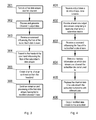
- Fig. 3 presents a diagram of the subscriber method according to the present invention.
- the process starts at step 301 from the subscribers device tuning to a first data stream and a given first channel.
- step 302 there are processed the first channel data and generated Channel 1 output data, for example via a HDMI output connector linked to a television set.
- step 303 a command influencing the flow of the subscriber's data stream is received. Such command may request channel change.
- step 304 there is transmitted to the headend (via the return channel) the command influencing the flow of the subscriber's data stream.
- step 305 there is obtained a channel change (or trick mode application) confirmation from the headend.
- step 306 the subscriber's device continues reception and processing of the first data stream having fed in modified channel 1 data.
- a trick mode Channel 1 data stream or a different Channel 2 stream without executing a typical retuning procedure thereby decreasing channel change latency.
- the respective packet identifiers (PID) of video and audio data packets remain the same while only the content of these packets changes.
- Fig. 4 shows a diagram of the server method according to the present invention.
- the procedure starts at step 401 from receiving and processing a plurality of input data streams (the more the better) in order to have instant access to data.
- step 402 there is provided at least one output data stream comprising at least one channel to a subscriber device. At this time it is not confirmed whether a subscriber device is tuned to any data stream.
- a command influencing the flow of the subscriber's data stream comprises for example: subscriber identifier, command type such as trick mode or channel change (includes identifier of a trick mode type or channel identifier), identifier of a data stream the subscriber is currently tuned to.
- command type such as trick mode or channel change (includes identifier of a trick mode type or channel identifier)
- identifier of a data stream the subscriber is currently tuned to identifier of a data stream the subscriber is currently tuned to.
- step 404 there is stored in the memory 205 information on which data stream and channel the subscriber device is tuned to. Subsequently, at step 405, there is replaced the current channel data in the data stream the subscriber is tuned to with different data. This different data is a requested other channel or trick mode data for the current channel. Lastly, at step 406, there is output a modified data stream to the subscriber that may received the modified data stream while remaining tuned to the same data stream and while processing the same channel data stream.
- the present invention when implemented in a system comprising a gateway and four thin client devices, may dedicate one fixed channel to each of the client devices and the gateway may output one MPEG Transport Stream comprising the four fixed channels to all of the local devices.
- Each of the devices tunes to its dedicated channel and remains tuned to this channel during its operation as retuning is not required since the gateway will feed all the requested data into one selected fixed channel in response to commands influencing the flow of particular subscriber's data stream. Accordingly, the aforementioned four thin client devices will neither switch the processed program streams within a single transport stream nor switch transport streams.
- the present invention is related to a useful result of decreased channel zapping latency in television signal reception devices. This result is measurable and is hence concrete and tangible. Therefore, the invention as described herein provides a useful, concrete and tangible result.
- the invention is applied in particular devices such as an improved digital television subscriber terminal and a television headend meaning that the idea underlying the invention is not abstract and is applied in particular improved machines. Thus the machine or transformation test is fulfilled.
- the aforementioned method for channels zapping may be performed and/or controlled by one or more computer programs.
- Such computer programs are typically executed by utilizing the computing resources in a computing device.
- Applications are stored on a non-transitory medium.
- An example of a non-transitory medium is a non-volatile memory, for example a flash memory or volatile memory, for example RAM.
- the computer instructions are executed by a processor.
- These memories are exemplary recording media for storing computer programs comprising computer-executable instructions performing all the steps of the computer-implemented method according the technical concept presented herein.
Landscapes
- Engineering & Computer Science (AREA)
- Multimedia (AREA)
- Signal Processing (AREA)
- Business, Economics & Management (AREA)
- Marketing (AREA)
- Computer Networks & Wireless Communication (AREA)
- Two-Way Televisions, Distribution Of Moving Picture Or The Like (AREA)
Priority Applications (2)
| Application Number | Priority Date | Filing Date | Title |
|---|---|---|---|
| EP14180093.8A EP2983371A1 (fr) | 2014-08-06 | 2014-08-06 | Système et procédé pour des changements de canaux |
| US14/819,582 US20160044371A1 (en) | 2014-08-06 | 2015-08-06 | System and method for channels zapping |
Applications Claiming Priority (1)
| Application Number | Priority Date | Filing Date | Title |
|---|---|---|---|
| EP14180093.8A EP2983371A1 (fr) | 2014-08-06 | 2014-08-06 | Système et procédé pour des changements de canaux |
Publications (1)
| Publication Number | Publication Date |
|---|---|
| EP2983371A1 true EP2983371A1 (fr) | 2016-02-10 |
Family
ID=51292840
Family Applications (1)
| Application Number | Title | Priority Date | Filing Date |
|---|---|---|---|
| EP14180093.8A Withdrawn EP2983371A1 (fr) | 2014-08-06 | 2014-08-06 | Système et procédé pour des changements de canaux |
Country Status (2)
| Country | Link |
|---|---|
| US (1) | US20160044371A1 (fr) |
| EP (1) | EP2983371A1 (fr) |
Citations (7)
| Publication number | Priority date | Publication date | Assignee | Title |
|---|---|---|---|---|
| US5633683A (en) | 1994-04-15 | 1997-05-27 | U.S. Philips Corporation | Arrangement and method for transmitting and receiving mosaic video signals including sub-pictures for easy selection of a program to be viewed |
| EP1783980A2 (fr) * | 2005-11-02 | 2007-05-09 | Alcatel Lucent | Traduction d'identificateur de programme (PID) du côté-client |
| US20090022165A1 (en) * | 2002-01-02 | 2009-01-22 | Candelore Brant L | Content replacement by PID mapping |
| US20090217318A1 (en) * | 2004-09-24 | 2009-08-27 | Cisco Technology, Inc. | Ip-based stream splicing with content-specific splice points |
| US20100023963A1 (en) * | 2005-05-12 | 2010-01-28 | Brian Crookes | Digital program management |
| EP2228985A1 (fr) | 2009-03-13 | 2010-09-15 | Advanced Digital Broadcast S.A. | Flux de données de télévision combiné, procédé pour afficher un canal de télévision et procédé pour générer un flux de données de télévision combiné |
| US20140196099A1 (en) * | 2013-01-07 | 2014-07-10 | Eric D. Hybertson | Methods and apparatus for supporting trick play functions in devices without local storage |
Family Cites Families (1)
| Publication number | Priority date | Publication date | Assignee | Title |
|---|---|---|---|---|
| US20050066357A1 (en) * | 2003-09-22 | 2005-03-24 | Ryal Kim Annon | Modifying content rating |
-
2014
- 2014-08-06 EP EP14180093.8A patent/EP2983371A1/fr not_active Withdrawn
-
2015
- 2015-08-06 US US14/819,582 patent/US20160044371A1/en not_active Abandoned
Patent Citations (7)
| Publication number | Priority date | Publication date | Assignee | Title |
|---|---|---|---|---|
| US5633683A (en) | 1994-04-15 | 1997-05-27 | U.S. Philips Corporation | Arrangement and method for transmitting and receiving mosaic video signals including sub-pictures for easy selection of a program to be viewed |
| US20090022165A1 (en) * | 2002-01-02 | 2009-01-22 | Candelore Brant L | Content replacement by PID mapping |
| US20090217318A1 (en) * | 2004-09-24 | 2009-08-27 | Cisco Technology, Inc. | Ip-based stream splicing with content-specific splice points |
| US20100023963A1 (en) * | 2005-05-12 | 2010-01-28 | Brian Crookes | Digital program management |
| EP1783980A2 (fr) * | 2005-11-02 | 2007-05-09 | Alcatel Lucent | Traduction d'identificateur de programme (PID) du côté-client |
| EP2228985A1 (fr) | 2009-03-13 | 2010-09-15 | Advanced Digital Broadcast S.A. | Flux de données de télévision combiné, procédé pour afficher un canal de télévision et procédé pour générer un flux de données de télévision combiné |
| US20140196099A1 (en) * | 2013-01-07 | 2014-07-10 | Eric D. Hybertson | Methods and apparatus for supporting trick play functions in devices without local storage |
Also Published As
| Publication number | Publication date |
|---|---|
| US20160044371A1 (en) | 2016-02-11 |
Similar Documents
| Publication | Publication Date | Title |
|---|---|---|
| US7644425B2 (en) | Picture-in-picture mosaic | |
| US8949912B2 (en) | ABR live to VOD system and method | |
| US20210329325A1 (en) | Systems and methods for processing timed text in video programming | |
| US20140223502A1 (en) | Method of Operating an IP Client | |
| US8925030B2 (en) | Fast channel change via a mosaic channel | |
| US8799966B2 (en) | Middleware bandwidth shifting | |
| EP3152910B1 (fr) | Minimisation de décalage d'entrée dans une application de tv à interface graphique utilisateur distante | |
| AU2015341687B2 (en) | Media content reception and playback control | |
| CN100481899C (zh) | 控制实时视频的屏幕大小的设备和方法 | |
| US9479738B2 (en) | Method and apparatus for transmitting and receiving broadcasting information using reserved channels | |
| TW201707464A (zh) | 音頻視頻內容呈現方法、實施此方法之解碼器及呈現此音頻視頻內容之呈現裝置 | |
| EP2228985A1 (fr) | Flux de données de télévision combiné, procédé pour afficher un canal de télévision et procédé pour générer un flux de données de télévision combiné | |
| CA2992715C (fr) | Enrichissement de texte actif par l'operateur | |
| US20170155962A1 (en) | Display apparatus and control method thereof | |
| JP7253477B2 (ja) | ストリームを同期させる方法及び生成する方法、並びに対応するコンピュータプログラム、記憶媒体、並びにレンダリングデバイス、実行デバイス、及び生成デバイス | |
| US20120008053A1 (en) | Method and system for fast channel change between programs utilizing a single decoder to concurrently decode multiple programs | |
| US9414096B2 (en) | Method and apparatus for processing multistream content | |
| US8978082B2 (en) | Method of switching digital TV application | |
| EP2983371A1 (fr) | Système et procédé pour des changements de canaux | |
| EP3089460A1 (fr) | Système et procédé de distribution de contenu via une attribution statique de canal dans une passerelle à contenu mobile | |
| US20190090012A1 (en) | Multiplexed delivery of media associated with guide display options | |
| US20160323621A1 (en) | System and a method for distributing content via dynamic channel assignment in a mobile content gateway | |
| US20160323622A1 (en) | System and a method for distributed processing of video content in a mobile content gateway | |
| KR20120076625A (ko) | 3차원 콘텐츠를 제공하는 방법 및 장치 |
Legal Events
| Date | Code | Title | Description |
|---|---|---|---|
| PUAI | Public reference made under article 153(3) epc to a published international application that has entered the european phase |
Free format text: ORIGINAL CODE: 0009012 |
|
| AK | Designated contracting states |
Kind code of ref document: A1 Designated state(s): AL AT BE BG CH CY CZ DE DK EE ES FI FR GB GR HR HU IE IS IT LI LT LU LV MC MK MT NL NO PL PT RO RS SE SI SK SM TR |
|
| AX | Request for extension of the european patent |
Extension state: BA ME |
|
| STAA | Information on the status of an ep patent application or granted ep patent |
Free format text: STATUS: THE APPLICATION IS DEEMED TO BE WITHDRAWN |
|
| 18D | Application deemed to be withdrawn |
Effective date: 20160811 |