EP2984692B1 - Dispositif électroluminescent organique comportant une matière à fluorescence retardée thermiquement activée - Google Patents
Dispositif électroluminescent organique comportant une matière à fluorescence retardée thermiquement activée Download PDFInfo
- Publication number
- EP2984692B1 EP2984692B1 EP14711446.6A EP14711446A EP2984692B1 EP 2984692 B1 EP2984692 B1 EP 2984692B1 EP 14711446 A EP14711446 A EP 14711446A EP 2984692 B1 EP2984692 B1 EP 2984692B1
- Authority
- EP
- European Patent Office
- Prior art keywords
- group
- aromatic
- radicals
- atoms
- substituted
- Prior art date
- Legal status (The legal status is an assumption and is not a legal conclusion. Google has not performed a legal analysis and makes no representation as to the accuracy of the status listed.)
- Active
Links
Classifications
-
- H—ELECTRICITY
- H10—SEMICONDUCTOR DEVICES; ELECTRIC SOLID-STATE DEVICES NOT OTHERWISE PROVIDED FOR
- H10K—ORGANIC ELECTRIC SOLID-STATE DEVICES
- H10K85/00—Organic materials used in the body or electrodes of devices covered by this subclass
- H10K85/60—Organic compounds having low molecular weight
- H10K85/649—Aromatic compounds comprising a hetero atom
- H10K85/654—Aromatic compounds comprising a hetero atom comprising only nitrogen as heteroatom
-
- H—ELECTRICITY
- H10—SEMICONDUCTOR DEVICES; ELECTRIC SOLID-STATE DEVICES NOT OTHERWISE PROVIDED FOR
- H10K—ORGANIC ELECTRIC SOLID-STATE DEVICES
- H10K50/00—Organic light-emitting devices
- H10K50/10—OLEDs or polymer light-emitting diodes [PLED]
- H10K50/11—OLEDs or polymer light-emitting diodes [PLED] characterised by the electroluminescent [EL] layers
-
- H—ELECTRICITY
- H10—SEMICONDUCTOR DEVICES; ELECTRIC SOLID-STATE DEVICES NOT OTHERWISE PROVIDED FOR
- H10K—ORGANIC ELECTRIC SOLID-STATE DEVICES
- H10K50/00—Organic light-emitting devices
- H10K50/10—OLEDs or polymer light-emitting diodes [PLED]
- H10K50/14—Carrier transporting layers
- H10K50/16—Electron transporting layers
-
- H—ELECTRICITY
- H10—SEMICONDUCTOR DEVICES; ELECTRIC SOLID-STATE DEVICES NOT OTHERWISE PROVIDED FOR
- H10K—ORGANIC ELECTRIC SOLID-STATE DEVICES
- H10K50/00—Organic light-emitting devices
- H10K50/10—OLEDs or polymer light-emitting diodes [PLED]
- H10K50/18—Carrier blocking layers
-
- H—ELECTRICITY
- H10—SEMICONDUCTOR DEVICES; ELECTRIC SOLID-STATE DEVICES NOT OTHERWISE PROVIDED FOR
- H10K—ORGANIC ELECTRIC SOLID-STATE DEVICES
- H10K71/00—Manufacture or treatment specially adapted for the organic devices covered by this subclass
-
- H—ELECTRICITY
- H10—SEMICONDUCTOR DEVICES; ELECTRIC SOLID-STATE DEVICES NOT OTHERWISE PROVIDED FOR
- H10K—ORGANIC ELECTRIC SOLID-STATE DEVICES
- H10K71/00—Manufacture or treatment specially adapted for the organic devices covered by this subclass
- H10K71/10—Deposition of organic active material
- H10K71/12—Deposition of organic active material using liquid deposition, e.g. spin coating
-
- H—ELECTRICITY
- H10—SEMICONDUCTOR DEVICES; ELECTRIC SOLID-STATE DEVICES NOT OTHERWISE PROVIDED FOR
- H10K—ORGANIC ELECTRIC SOLID-STATE DEVICES
- H10K71/00—Manufacture or treatment specially adapted for the organic devices covered by this subclass
- H10K71/10—Deposition of organic active material
- H10K71/12—Deposition of organic active material using liquid deposition, e.g. spin coating
- H10K71/13—Deposition of organic active material using liquid deposition, e.g. spin coating using printing techniques, e.g. ink-jet printing or screen printing
-
- H—ELECTRICITY
- H10—SEMICONDUCTOR DEVICES; ELECTRIC SOLID-STATE DEVICES NOT OTHERWISE PROVIDED FOR
- H10K—ORGANIC ELECTRIC SOLID-STATE DEVICES
- H10K85/00—Organic materials used in the body or electrodes of devices covered by this subclass
- H10K85/60—Organic compounds having low molecular weight
-
- H—ELECTRICITY
- H10—SEMICONDUCTOR DEVICES; ELECTRIC SOLID-STATE DEVICES NOT OTHERWISE PROVIDED FOR
- H10K—ORGANIC ELECTRIC SOLID-STATE DEVICES
- H10K85/00—Organic materials used in the body or electrodes of devices covered by this subclass
- H10K85/60—Organic compounds having low molecular weight
- H10K85/631—Amine compounds having at least two aryl rest on at least one amine-nitrogen atom, e.g. triphenylamine
- H10K85/633—Amine compounds having at least two aryl rest on at least one amine-nitrogen atom, e.g. triphenylamine comprising polycyclic condensed aromatic hydrocarbons as substituents on the nitrogen atom
-
- H—ELECTRICITY
- H10—SEMICONDUCTOR DEVICES; ELECTRIC SOLID-STATE DEVICES NOT OTHERWISE PROVIDED FOR
- H10K—ORGANIC ELECTRIC SOLID-STATE DEVICES
- H10K85/00—Organic materials used in the body or electrodes of devices covered by this subclass
- H10K85/60—Organic compounds having low molecular weight
- H10K85/649—Aromatic compounds comprising a hetero atom
- H10K85/657—Polycyclic condensed heteroaromatic hydrocarbons
- H10K85/6572—Polycyclic condensed heteroaromatic hydrocarbons comprising only nitrogen in the heteroaromatic polycondensed ring system, e.g. phenanthroline or carbazole
-
- H—ELECTRICITY
- H10—SEMICONDUCTOR DEVICES; ELECTRIC SOLID-STATE DEVICES NOT OTHERWISE PROVIDED FOR
- H10K—ORGANIC ELECTRIC SOLID-STATE DEVICES
- H10K2101/00—Properties of the organic materials covered by group H10K85/00
- H10K2101/10—Triplet emission
-
- H—ELECTRICITY
- H10—SEMICONDUCTOR DEVICES; ELECTRIC SOLID-STATE DEVICES NOT OTHERWISE PROVIDED FOR
- H10K—ORGANIC ELECTRIC SOLID-STATE DEVICES
- H10K2101/00—Properties of the organic materials covered by group H10K85/00
- H10K2101/20—Delayed fluorescence emission
-
- H—ELECTRICITY
- H10—SEMICONDUCTOR DEVICES; ELECTRIC SOLID-STATE DEVICES NOT OTHERWISE PROVIDED FOR
- H10K—ORGANIC ELECTRIC SOLID-STATE DEVICES
- H10K2101/00—Properties of the organic materials covered by group H10K85/00
- H10K2101/30—Highest occupied molecular orbital [HOMO], lowest unoccupied molecular orbital [LUMO] or Fermi energy values
-
- H—ELECTRICITY
- H10—SEMICONDUCTOR DEVICES; ELECTRIC SOLID-STATE DEVICES NOT OTHERWISE PROVIDED FOR
- H10K—ORGANIC ELECTRIC SOLID-STATE DEVICES
- H10K2101/00—Properties of the organic materials covered by group H10K85/00
- H10K2101/40—Interrelation of parameters between multiple constituent active layers or sublayers, e.g. HOMO values in adjacent layers
-
- H—ELECTRICITY
- H10—SEMICONDUCTOR DEVICES; ELECTRIC SOLID-STATE DEVICES NOT OTHERWISE PROVIDED FOR
- H10K—ORGANIC ELECTRIC SOLID-STATE DEVICES
- H10K85/00—Organic materials used in the body or electrodes of devices covered by this subclass
- H10K85/30—Coordination compounds
-
- H—ELECTRICITY
- H10—SEMICONDUCTOR DEVICES; ELECTRIC SOLID-STATE DEVICES NOT OTHERWISE PROVIDED FOR
- H10K—ORGANIC ELECTRIC SOLID-STATE DEVICES
- H10K85/00—Organic materials used in the body or electrodes of devices covered by this subclass
- H10K85/60—Organic compounds having low molecular weight
- H10K85/615—Polycyclic condensed aromatic hydrocarbons, e.g. anthracene
- H10K85/624—Polycyclic condensed aromatic hydrocarbons, e.g. anthracene containing six or more rings
-
- H—ELECTRICITY
- H10—SEMICONDUCTOR DEVICES; ELECTRIC SOLID-STATE DEVICES NOT OTHERWISE PROVIDED FOR
- H10K—ORGANIC ELECTRIC SOLID-STATE DEVICES
- H10K85/00—Organic materials used in the body or electrodes of devices covered by this subclass
- H10K85/60—Organic compounds having low molecular weight
- H10K85/615—Polycyclic condensed aromatic hydrocarbons, e.g. anthracene
- H10K85/626—Polycyclic condensed aromatic hydrocarbons, e.g. anthracene containing more than one polycyclic condensed aromatic rings, e.g. bis-anthracene
Definitions
- the present invention relates to organic electroluminescent devices containing mixtures of a luminescent material with a small singlet-triplet distance and an electron-conducting material.
- OLEDs organic electroluminescent devices
- OLEDs organic electroluminescent devices
- emissive materials MA Baldo et al., Appl. Phys. Lett. 1999, 75, 4-6 .
- organometallic compounds for quantum mechanical reasons, up to four times energy and power efficiency is possible using organometallic compounds as phosphorescence emitters.
- iridium and platinum are rare and expensive metals. It would therefore be desirable to conserve resources to avoid the use of these rare metals. Furthermore, such metal complexes sometimes have lower thermal stability during sublimation than purely organic compounds, so that the use of purely organic compounds would also be advantageous for this reason, provided that they lead to comparably good efficiencies. Furthermore, blue, especially deep blue phosphorescent iridium or platinum mesh with high efficiency and lifetime technically difficult to implement, so there is room for improvement. Furthermore, there is room for improvement in the lifetime of phosphorescent OLEDs containing Ir or Pt emitters when the OLED is operated at a higher temperature, as required for some applications.
- thermoly activated delayed fluorescence e.g. BH Uoyama et al., Nature 2012, Vol. 492, 234
- TADF thermally activated delayed fluorescence
- organic materials in which the energy gap between the lowest triplet state T 1 and the first excited singlet state S 1 is so small that this energy gap is smaller or in the range of thermal energy.
- electronic excited excitation in the OLED causes excited states to be 75% in the triplet state and 25% in the singlet state. Since purely organic molecules usually can not emit from the triplet state, 75% of the excited states can not be used for the emission, whereby in principle only 25% of the excitation energy can be converted into light.
- the first excited singlet state of the molecule can be accessed from the triplet state by thermal excitation and can be thermally occupied become. Since this singlet state is an emissive state from which fluorescence is possible, this state can be used to generate light. Thus, in principle, the conversion of up to 100% of the electrical energy in light is possible when using purely organic materials as an emitter. Thus, the prior art describes an external quantum efficiency of more than 19%, which is of the same order of magnitude as for phosphorescent OLEDs. Thus, it is possible with such purely organic materials to achieve very good efficiencies and at the same time to avoid the use of rare metals such as iridium or platinum. Furthermore, it is also possible with such materials to achieve highly efficient blue-emitting OLEDs.
- TADF compound thermally activated delayed fluorescence
- carbazole derivatives for example carbazole derivatives
- organic electroluminescent devices which exhibit emission by the TADF mechanism still require further improvement, in particular with regard to efficiency, voltage, service life and roll-off behavior.
- the technical problem underlying the present invention is therefore to provide OLEDs whose emission is based on TADF and which have improved properties, in particular with respect to one or more of the abovementioned properties.
- organic electroluminescent devices which have an organic TADF molecule and an electron-conducting matrix material in the emitting layer solve this problem and lead to improvements in the organic electroluminescent device.
- organic electroluminescent devices are therefore the subject of the present invention.
- organic compound in the sense of the present invention is a carbon-containing compound which contains no metals.
- the organic compound is composed of the elements C, H, D, B, Si, N, P, O, S, F, Cl, Br and I.
- a luminescent compound in the sense of the present invention is a compound which is capable of emitting light at room temperature under optical excitation in an environment as present in the organic electroluminescent device.
- the compound preferably has a luminescence quantum efficiency of at least 40%, particularly preferably of at least 50%, very particularly preferably of at least 60% and particularly preferably of at least 70%.
- the luminescence quantum efficiency is determined in a layer in admixture with the matrix material as it is to be used in the organic electroluminescent device. How the determination of the luminescence quantum yield in the sense of the present invention is carried out is described in detail in the examples section in general terms.
- the decay time is preferably ⁇ 50 ⁇ s. How the determination of the decay time is carried out in the sense of the present invention is described in detail in the example section in general terms.
- the energy of the lowest excited singlet state (S 1 ) and the lowest triplet state (T 1 ) are determined by quantum chemical calculation. How this determination is carried out in the sense of the present invention is described in detail in the example section in detail.
- the distance between S 1 and T 1 must not exceed 0.15 eV, so that the connection is a TADF connection in the sense of the present invention.
- the distance between S 1 and T 1 ⁇ 0.10 eV, more preferably ⁇ 0.08 eV, most preferably ⁇ 0.05 eV.
- the TADF compound is preferably an aromatic compound having both donor and acceptor substituents, with the LUMO and the HOMO of the compound overlapping only slightly in space.
- donor or acceptor substituents are known in principle to the person skilled in the art.
- Suitable donor substituents are, in particular, diaryl or heteroarylamino groups as well as carbazole groups or carbazole derivatives, which are each preferably linked via N to the aromatic compound. These groups may also be further substituted.
- Suitable acceptor substituents are in particular cyano groups, but also, for example, electron-deficient heteroaryl groups, which may also be further substituted.
- LUMO LUMO
- matrix ie the HOMO of the electron-transporting matrix
- LUMO TADF - HOMO matrix > S 1 TADF - 0.4 eV
- LUMO TADF - HOMO matrix > S 1 TADF - 0.3 eV
- LUMO TADF - HOMO matrix > S 1 TADF - 0.2 eV
- S 1 (TADF) is the first excited singlet state S 1 of the TADF compound.
- Suitable molecules that exhibit TADF are the structures listed in the following table.
- An electron transporting compound in the sense of the present invention is a compound which has a LUMO ⁇ -2.50 eV.
- the LUMO ⁇ -2.60 eV more preferably ⁇ -2.65 eV, most preferably ⁇ -2.70 eV.
- the LUMO is the lowest unoccupied molecular orbital. The value of the LUMO of the compound is determined by quantum chemical calculation, as generally described in the back of the examples section.
- the electron-conducting compound in the mixture is the matrix material that does not or does not significantly contribute to the emission of the mixture
- the TADF compound is the emitting compound, i. H. the compound whose emission is observed from the emitting layer.
- the emitting layer consists only of the electron-conducting compound and the TADF compound.
- the lowest triplet energy of the electron-conducting compound be at most 0.1 eV lower than the triplet energy of the TADF compound.
- T 1 (matrix) ⁇ T 1 (TADF) is preferred.
- T 1 (matrix) is the lowest triplet energy of the electron-transporting compound
- T 1 (TADF) is the lowest triplet energy of the TADF compound.
- the triplet energy of the matrix T 1 (matrix) is determined by quantum-chemical calculation, as generally described in the back of the example section.
- Suitable electron-conducting compounds are selected from the substance classes of the triazines, the pyrimidines, the lactams, the metal complexes, in particular the Be, Zn or Al complexes, the aromatic ketones, the aromatic phosphine oxides, the azaphospholes, the azaboroles, which with at least an electron-conducting substituent, and the quinoxaline. It is essential to the invention that these materials have a LUMO of ⁇ -2.50 eV. Many derivatives of the abovementioned substance classes have such a LUMO, so that these substance classes can generally be considered suitable, even if individual compounds of these substance classes possibly have a LUMO> -2.50 eV.
- the electron-conducting compound is a purely organic compound, i. a compound that does not contain metals.
- adjacent substituents are substituents which are either bonded to the same carbon atom or which are bonded to carbon atoms which are bonded directly to one another.
- An aryl group in the sense of this invention contains 6 to 60 C atoms; a heteroaryl group in the context of this invention contains 2 to 60 carbon atoms and at least one heteroatom, with the proviso that the sum of C atoms and heteroatoms at least 5 yields.
- the heteroatoms are preferably selected from N, O and / or S.
- aryl group or heteroaryl either a simple aromatic cycle, ie benzene, or a simple heteroaromatic cycle, for example pyridine, pyrimidine, thiophene, etc., or a fused (fused) aryl or heteroaryl group, for example naphthalene, anthracene, phenanthrene, quinoline, isoquinoline, etc., understood.
- aromatics linked to one another by single bond such as, for example, biphenyl, are not designated as aryl or heteroaryl group but as aromatic ring system.
- An aromatic ring system in the sense of this invention contains 6 to 80 carbon atoms in the ring system.
- a heteroaromatic ring system in the sense of this invention contains 2 to 60 C atoms and at least one heteroatom in the ring system, with the proviso that the sum of C atoms and heteroatoms gives at least 5.
- the heteroatoms are preferably selected from N, O and / or S.
- An aromatic or heteroaromatic ring system in the sense of this invention is to be understood as meaning a system which does not necessarily contain only aryl or heteroaryl groups but in which also several aryl or heteroaryl groups a non-aromatic moiety, such as As a C, N or O atom can be connected.
- systems such as fluorene, 9,9'-spirobifluorene, 9,9-diarylfluorene, triarylamine, diaryl ether, stilbene, etc. are to be understood as aromatic ring systems in the context of this invention, and also systems in which two or more aryl groups, for example are linked by a short alkyl group.
- an aliphatic hydrocarbon radical or an alkyl group or an alkenyl or alkynyl group which may contain 1 to 40 C atoms, and in which also individual H atoms or CH 2 groups, may be represented by the abovementioned groups
- the radicals are methyl, ethyl, n-propyl, i-propyl, n-butyl, i-butyl, s-butyl, t-butyl, 2-methylbutyl, n-pentyl, s-pentyl, neo-pentyl , Cyclopentyl, n-hexyl, neo -hexyl, cyclohexyl, n-heptyl, cycloheptyl, n-octyl, cyclooctyl, 2-ethylhexyl, trifluoromethyl, pentafluoroeth radical or n-propyl,
- alkoxy group having 1 to 40 carbon atoms methoxy, trifluoromethoxy, ethoxy, n-propoxy, i-propoxy, n-butoxy, i-butoxy, s-butoxy, t-butoxy, n-pentoxy, s-pentoxy, 2-methylbutoxy, n-hexoxy, cyclohexyloxy, n-heptoxy, cycloheptyloxy, n-octyloxy, cyclooctyloxy, 2-ethylhexyloxy, pentafluoroethoxy and 2,2,2-trifluoroethoxy understood.
- alkyl, alkoxy or thioalkyl groups according to the present invention may be straight-chain, branched or cyclic, wherein one or more non-adjacent CH 2 groups may be replaced by the above-mentioned groups;
- one or more H atoms can also be replaced by D, F, Cl, Br, I, CN or NO 2 , preferably F, Cl or CN, more preferably F or CN, particularly preferably CN.
- An aromatic or heteroaromatic ring system having 5 to 30 or 5 to 60 aromatic ring atoms, which may be substituted in each case by the abovementioned radicals R, R 1 or R 2 , is understood in particular to mean groups which are derived from benzene, naphthalene, Anthracene, benzanthracene, phenanthrene, pyrene, chrysene, perylene, fluoranthene, naphthacene, pentacene, benzpyrene, biphenyl, biphenylene, terphenyl, triphenylene, fluorene, spirobifluorene, dihydrophenanthrene, dihydropyrene, tetrahydropyrene, cis- or trans-indenofluorene, cis- or trans- Indenocarbazole, cis or trans indolocarbazole, truxene, isotruxene, spir
- At least one of the substituents R is an aromatic or heteroaromatic ring system.
- all three substituents R are particularly preferably an aromatic or heteroaromatic ring system which may each be substituted by one or more radicals R 1 .
- formula (2) are particularly preferably one, two or three substituents R is an aromatic or heteroaromatic ring system, which may be substituted by one or more radicals R 1 , and the other substituents R are H.
- Particularly preferred embodiments are thus the Compounds of the following formulas (1a) or (2a) to (2d), wherein R is the same or different for an aromatic or heteroaromatic ring system having 5 to 60 aromatic ring atoms, the each may be substituted with one or more radicals R 1 , and R 1 has the abovementioned meaning.
- the compounds of the formulas (2a) and (2d) are preferred, in particular compounds of the formula (2d).
- Preferred aromatic or heteroaromatic ring systems containing 5 to 30 aromatic ring atoms, in particular 6 to 24 aromatic ring atoms, and may be substituted by one or more radicals R 1 .
- the aromatic or heteroaromatic ring systems preferably contain no condensed aryl or heteroaryl groups in which more than two aromatic six-membered rings are directly fused to one another. With particular preference, they contain no aryl or heteroaryl groups at all, in which aromatic six-membered rings are directly fused to one another. This preference is due to the higher triplet energy of such substituents.
- R has, for example, no naphthyl groups or higher condensed aryl groups and likewise no quinoline groups, acridine groups, etc.
- R it is possible for R to have, for example, carbazole groups, dibenzofurangroups, etc., since in these structures no 6-ring Aromatics or heteroaromatics are condensed directly to each other.
- Preferred substituents R are the same or different at each occurrence selected from the group consisting of benzene, ortho-, meta- or para-biphenyl, ortho, meta, para or branched terphenyl, ortho, meta, para or branched Quaterphenyl, 1-, 2-, 3- or 4-fluorenyl, 1-, 2-, 3- or 4-spirobifluorenyl, 1- or 2-naphthyl, pyrrole, furan, thiophene, indole, benzofuran, benzothiophene, 1-, 2- or 3-carbazole, 1-, 2- or 3-dibenzofuran, 1-, 2- or 3-dibenzothiophene, indenocarbazole, indolocarbazole, 2-, 3- or 4-pyridine, 2-, 4- or 5-pyrimidine , Pyrazine, pyridazine, triazine, phenanthrene, or combinations of two or three of these groups, each of which may be substituted with one
- cycle refers to any single 5- or 6-membered ring within the structure.
- At most one symbol X per cycle represents N. More preferably, the symbol X is the same or different at each occurrence as CR 1 , in particular CH.
- groups of the formulas (3) to (44) have several groups Y, then all combinations from the definition of Y are suitable for this purpose. Preference is given to groups of the formulas (3) to (44) in which one group Y is NR 1 and the other group Y is C (R 1 ) 2 or in which both groups Y are NR 1 or in which both groups Y are stand for O
- At least one group Y in the formulas (3) to (44) is identical or different at each occurrence for C (R 1 ) 2 or for NR 1 .
- substituent R 1 which is bonded directly to a nitrogen atom, for an aromatic or heteroaromatic ring system having 5 to 24 aromatic ring atoms, which may also be substituted by one or more radicals R 2 .
- this substituent R 1 is identical or different at each occurrence for an aromatic or heteroaromatic ring system having 6 to 24 aromatic ring atoms, which has no condensed aryl groups and which does not have condensed heteroaryl groups in which two or more aromatic or heteroaromatic 6-membered groups are directly fused to each other, and which may each be substituted by one or more groups R 2 .
- R 1 is preferably the same or different each occurrence of a linear alkyl group having 1 to 10 C atoms or a branched or cyclic alkyl group having 3 to 10 C atoms or an aromatic or heteroaromatic ring system having 5 to 24 aromatic ring atoms, which may also be substituted by one or more radicals R 2 .
- R 1 is a methyl group or a phenyl group, which can be formed by ring formation of the two phenyl groups and a spiro system.
- the group of the abovementioned formulas (3) to (44) does not bind directly to the triazine in formula (1) or the pyrimidine in formula (2) but via a bridging group.
- This bridging group is then preferably selected from an aromatic or heteroaromatic ring system having 5 to 24 aromatic ring atoms, in particular having 6 to 12 aromatic ring atoms, each of which may be substituted by one or more radicals R 1 .
- the aromatic or heteroaromatic ring system preferably contains no aryl or heteroaryl groups in which more than two aromatic six-membered rings are fused together.
- the aromatic or heteroaromatic ring system contains no aryl or heteroaryl groups in which aromatic six-membered rings are fused together.
- Examples of preferred compounds according to formula (1) or (2) are the compounds listed in the following table.
- the group Ar 2 is a group according to one of the following formulas (53), (54) or (55), where the dashed bond indicates linkage with N, # indicates the position of the linkage with E and Ar 3 , * the linkage with E and Ar 1 indicates and W and V have the abovementioned meanings.
- the group Ar 3 is a group according to one of the following formulas (56), (57), (58) or (59), wherein the dashed bond indicates the linkage with N, * indicates the linkage with E and W and V have the meanings mentioned above.
- At least one group E is a single bond.
- Ar 1 , Ar 2 and Ar 3 are a 6-membered aryl or a 6-membered heteroaryl group.
- Ar 1 particularly preferably represents a group of the formula (47) and simultaneously Ar 2 represents a group of the formula (53), or Ar 1 represents a group of the formula (47) and at the same time Ar 3 represents a group of the formula (56) or Ar 2 represents a group of the formula (53) and at the same time, Ar 3 is a group of formula (59).
- W is CR or N and not a group of formula (51) or (52).
- a maximum of one symbol W stands for N per cycle and the remaining symbols W stand for CR.
- all symbols W stand for CR. Therefore, particularly preferred are the compounds according to the following formulas (60a) to (69a), wherein the symbols used have the meanings given above.
- the bridging group L in the compounds of the formula (46a) is preferably selected from a single bond or an aromatic or heteroaromatic ring system having 5 to 30 aromatic ring atoms, which may be substituted by one or more radicals R.
- the aromatic or heteroaromatic ring systems preferably contain no condensed aryl or heteroaryl groups in which more than two aromatic six-membered rings are directly fused to one another. With particular preference, they contain no aryl or heteroaryl groups at all, in which aromatic six-membered rings are directly fused to one another.
- the index m in compounds of the formula (46) is 2 or 3, in particular equal to 2. Very particular preference is given to using compounds of the formula (45).
- R in the abovementioned formulas is the same or different at each occurrence selected from the group consisting of H, D, F, Cl, Br, CN, a straight-chain alkyl group having 1 to 10 C atoms or a a branched or cyclic alkyl group having 3 to 10 carbon atoms, each of which may be substituted by one or more R 1 radicals, wherein one or more H atoms may be replaced by D or F, an aromatic or heteroaromatic ring system having 5 to 18 aromatic Ring atoms, which may each be substituted by one or more radicals R 1 , or a combination of these systems.
- radicals R when they contain aromatic or heteroaromatic ring systems, preferably contain no fused aryl or heteroaryl groups in which more than two aromatic six-membered rings are directly fused to one another. With particular preference, they contain no aryl or heteroaryl groups at all, in which aromatic six-membered rings are directly fused to one another. Particular preference is given here to phenyl, biphenyl, terphenyl, quaterphenyl, carbazole, dibenzothiophene, dibenzofuran, indenocarbazole, indolocarbazole, triazine or pyrimidine, which in each case may also be substituted by one or more radicals R 1 .
- the alkyl groups preferably have not more than five carbon atoms, more preferably not more than 4 carbon atoms, most preferably not more than 1 carbon atom.
- aromatic ketones or aromatic phosphine oxides are suitable as an electron-conducting compound, provided that the LUMO of these compounds ⁇ -2.5 eV.
- an aromatic ketone is understood as meaning a carbonyl group to which two aromatic or heteroaromatic groups or aromatic or heteroaromatic ring systems are directly bonded.
- Suitable compounds according to formula (70) and (71) are in particular those described in WO 2004/093207 and WO 2010/006680 revealed ketones and those in WO 2005/003253 disclosed phosphine oxides. These are via quote part of the present invention.
- the group Ar 4 in compounds of the formula (70) or (71) is preferably an aromatic ring system having 6 to 40 aromatic ring atoms, ie it contains no heteroaryl groups.
- the aromatic ring system need not necessarily have only aromatic groups, but also two aryl groups may be interrupted by a non-aromatic group, for example by another carbonyl group or phosphine oxide group.
- the group Ar 4 has no more than two condensed rings. It is therefore preferably composed only of phenyl and / or naphthyl groups, particularly preferably only of phenyl groups, but does not contain any larger condensed aromatics, such as, for example, anthracene.
- Preferred groups Ar 4 which are bonded to the carbonyl group, are the same or different at each occurrence, phenyl, 2-, 3- or 4-tolyl, 3- or 4-o-xylyl, 2- or 4-m-xylyl, 2 -p-xylyl, o-, m- or p-tert-butylphenyl, o-, m- or p-fluorophenyl, benzophenone, 1-, 2- or 3-phenylmethanone, 2-, 3- or 4-biphenyl, 2 -, 3- or 4-o-terphenyl, 2-, 3- or 4-m-terphenyl, 2-, 3- or 4-p-terphenyl, 2'-p-terphenyl, 2'-, 4'- or 5'-m-terphenyl, 3'- or 4'-o-terphenyl, p-, m, p-, o, p-, m, m-, o, m- or o, p
- the groups Ar 4 may be substituted by one or more radicals R.
- the group Ar is the same or different at each occurrence, an aromatic ring system having 6 to 24 aromatic ring atoms, which may be substituted by one or more radicals R 1 .
- Ar identical or different at each occurrence, an aromatic ring system having 6 to 12 aromatic ring atoms.
- benzophenone derivatives each substituted at the 3,5,3 ', 5' positions by an aromatic or heteroaromatic ring system having from 5 to 30 aromatic ring atoms which in turn are substituted by one or more Rs as defined above can be.
- Preference is furthermore given to ketones which are substituted by at least one spirobifluorene group.
- Ar 4 in the abovementioned formula (72) and (75) preferably represents an aromatic or heteroaromatic ring system having from 5 to 30 aromatic groups Ring atoms, which may be substituted by one or more radicals R 1 . Particularly preferred are the abovementioned groups Ar.
- Examples of suitable compounds according to formulas (70) and (71) are the compounds depicted in the following table.
- Suitable metal complexes which can be used as the electron-conducting matrix material in the organic electroluminescent device according to the invention are Be, Zn or Al complexes, if the LUMO of these compounds is ⁇ -2.5 eV. Suitable examples are the in WO 2009/062578 revealed Zn complexes.
- Suitable metal complexes are the complexes listed in the following table.
- Suitable azaphospholes which can be used as the electron-conducting matrix material in the organic electroluminescent device according to the invention are those compounds as described in US Pat WO 2010/054730 are disclosed, provided that the LUMO of these compounds ⁇ -2.5 eV. This application is via quotation part of the present invention.
- Suitable azaboroles which can be used as electron-conducting matrix material in the organic electroluminescent device according to the invention are azaborol derivatives which are substituted by at least one electron-conducting substituent, provided that the LUMO of these compounds is ⁇ -2.5 eV.
- Such compounds are in the not yet disclosed application EP 11010103.7 disclosed. This application is via quotation part of the present invention.
- the organic electroluminescent device includes cathode, anode and emitting layer. In addition to these layers, they may also contain further layers, for example one or more hole injection layers, hole transport layers, hole blocking layers, electron transport layers, electron injection layers, exciton blocking layers, electron blocking layers and / or charge generation layers. It should be noted, however, that not necessarily each of these layers must be present.
- the hole transport layers may also be p-doped or the electron transport layers may also be n-doped.
- a p-doped layer is understood as meaning a layer in which free holes are produced and whose conductivity is thereby increased.
- the p-dopant is able to oxidize the hole transport material in the hole transport layer, thus has a sufficiently high redox potential, in particular a higher redox potential than the hole transport material.
- dopants in principle, all compounds are suitable which represent electron acceptor compounds and the conductivity of the organic Layer can increase by oxidation of the host.
- dopants are those in WO 2011/073149 . EP 1968131 . EP 2276085 . EP 2213662 . EP 1722602 . EP 2045848 . DE 102007031220 . US 8044390 . US 8057712 . WO 2009/003455 . WO 2010/094378 . WO 2011/120709 and US 2010/0096600 disclosed compounds.
- low work function metals, metal alloys or multilayer structures of various metals are preferable, such as alkaline earth metals, alkali metals, main group metals or lathanoids (eg, Ca, Ba, Mg, Al, In, Mg, Yb, Sm, etc.).
- alkaline earth metals alkali metals
- main group metals or lathanoids eg, Ca, Ba, Mg, Al, In, Mg, Yb, Sm, etc.
- alloys of an alkali or alkaline earth metal and silver for example an alloy of magnesium and silver.
- further metals which have a relatively high work function such as, for example, B. Ag, which then usually combinations of metals, such as Ca / Ag or Ba / Ag are used.
- a metallic cathode and the organic semiconductor may also be preferred to introduce between a metallic cathode and the organic semiconductor a thin intermediate layer of a material with a high dielectric constant.
- Suitable examples of these are alkali metal or alkaline earth metal fluorides, but also the corresponding oxides or carbonates (eg LiF, Li 2 O, BaF 2 , MgO, NaF, CsF, Cs 2 CO 3 , etc.).
- the layer thickness of this layer is preferably between 0.5 and 5 nm.
- the anode high workfunction materials are preferred.
- the anode has a work function greater than 4.5 eV. Vacuum up.
- metals with a high redox potential such as Ag, Pt or Au, are suitable for this purpose.
- metal / metal oxide electrons for example Al / Ni / NiO x , Al / PtO x
- at least one of the electrodes must be transparent or partially transparent to the To enable coupling of light.
- a preferred construction uses a transparent anode.
- Preferred anode materials here are conductive mixed metal oxides. Particularly preferred are indium tin oxide (ITO) or indium zinc oxide (IZO). Preference is furthermore given to conductive, doped organic materials, in particular conductive doped polymers.
- the device is structured accordingly (depending on the application), contacted and finally hermetically sealed because the life of such devices drastically shortened in the presence of water and / or air.
- an organic electroluminescent device characterized in that one or more layers are coated with a sublimation process.
- the materials are vapor-deposited in vacuum sublimation systems at an initial pressure of less than 10 -5 mbar, preferably less than 10 -6 mbar. But it is also possible that the initial pressure is even lower, for example less than 10 -7 mbar.
- an organic electroluminescent device characterized in that one or more layers are coated with the OVPD (Organic Vapor Phase Deposition) method or with the aid of a carrier gas sublimation.
- the materials are applied at a pressure between 10 -5 mbar and 1 bar.
- OVJP Organic Vapor Jet Printing
- the materials are applied directly through a nozzle and thus structured (eg. MS Arnold et al., Appl. Phys. Lett. 2008, 92, 053301 ).
- an organic electroluminescent device characterized in that one or more layers of solution, such. B. by spin coating, or with any printing process, such.
- any printing process such as screen printing, flexographic printing, offset printing, LITI (Light Induced Thermal Imaging, thermal transfer printing), ink-jet printing (ink jet printing) or Nozzle Printing, are produced.
- soluble compounds are necessary, which are obtained for example by suitable substitution become.
- Another object of the present invention is therefore a method for producing an organic electroluminescent device according to the invention, characterized in that at least one layer is applied by a sublimation and / or that at least one layer with an OVPD (Organic Vapor Phase Deposition) method or by means of a Carrier gas sublimation is applied and / or that at least one layer of solution, by spin coating or by a printing process is applied.
- OVPD Organic Vapor Phase Deposition
- the HOMO and LUMO energy levels as well as the energy of the lowest triplet state T 1 and the lowest excited singlet state S 1 of the materials are determined by quantum-chemical calculations.
- the program package "Gaussian09W” (Gaussian Inc.) is used.
- a geometry optimization with the method “Ground State / Semi-empirical / Default Spin / AM1 / Batch 0 / Spin Singlet” is carried out first. This is followed by an energy bill based on the optimized geometry.
- the method “TD-SFC / DFT / Default Spin / B3PW91” with the basic set “6-31G (d)” is used (batch 0, spin singlet).
- M-org metal-containing compounds
- Table 4 For metal-containing compounds (referred to as "M-org.”
- the geometry is optimized using the "Ground State / Hartree-Fock / Default Spin / LanL2MB / Batch 0 / Spin Singlet” method.
- the energy calculation is analogous to the organic substances, as described above, with the difference that for the metal atom, the base set “LanL2DZ” and for the ligands of the basic set “6-31G (d)” is used.
- the energy bill gives the HOMO energy level HEh or LUMO energy level LEh in Hartree units.
- these values are to be regarded as HOMO or LUMO energy levels of the materials.
- the lowest triplet state T 1 is defined as the energy of the triplet state with the lowest energy, which results from the described quantum chemical calculation.
- the lowest excited singlet state S 1 is defined as the energy of the excited singlet state with the lowest energy, which results from the described quantum chemical calculation.
- Table 4 shows the HOMO and LUMO energy levels as well as S 1 and T 1 of the various materials.
- a 50 nm thick film is applied to a suitable transparent substrate, preferably quartz, ie the layer contains the same materials in the same concentration as in the OLED.
- the same manufacturing conditions as in the production of the emission layer for the OLEDs are used.
- an absorption spectrum in the wavelength range of 350-500 nm is measured.
- the reflection spectrum R ( ⁇ ) and the transmission spectrum T ( ⁇ ) of the sample is determined at an angle of incidence of 6 ° (ie almost vertical incidence).
- a ( ⁇ ) ⁇ 0.3 is in the range 350-500 nm, then the wavelength belonging to the maximum of the absorption spectrum is in the range 350-500 nm as ⁇ exc defined. If, for any wavelength ⁇ ( ⁇ )> 0.3, ⁇ exc is the maximum wavelength at which A ( ⁇ ) changes from a value less than 0.3 to a value greater than 0.3 or from a value greater than 0.3 to a value less than 0.3.
- a measuring station Hamamatsu C9920-02 is used for the determination of the PLQE.
- the principle is based on the excitation of the sample with light of defined wavelength and the measurement of the absorbed and emitted radiation.
- the sample is in an integrating sphere during the measurement.
- the spectrum of the excitation light is defined approximately Gaussian with a half-width of ⁇ 10 nm and the peak wavelength ⁇ exc above.
- the PLQE is determined according to the usual evaluation procedure for the named measuring station. It is very important to ensure that the sample does not come into contact with oxygen at any time, since the PLQE of materials with a small energetic distance between S 1 and T 1 is greatly reduced by oxygen ( H. Uoyama et al., Nature 2012, Vol. 492, 234 ).
- Table 2 shows the PLQE for the emission layers of the OLEDs as defined above together with the excitation wavelength used.
- a sample prepared as described above under “Determining the PL Quantum Efficiency (PLQE)" is used.
- the sample is excited by a laser pulse at a temperature of 295 K (wavelength 266 nm, pulse duration 1.5 ns, pulse energy 200 ⁇ J, beam diameter 4 mm).
- the sample is in a vacuum ( ⁇ 10 -5 mbar).
- t 0
- Photoluminescence initially shows a steep drop due to the prompt fluorescence of the TADF compound. In the further course of time, a slower decrease can be observed, the delayed fluorescence (see, for example, US Pat. H.
- the decay time t a for the purposes of this application is the decay time of the delayed fluorescence and is determined as follows: One chooses a time t d at which the prompt fluorescence has subsided well below the intensity of the delayed fluorescence ( ⁇ 1%), so that the following determination of the cooldown is not affected. This choice can be made by a person skilled in the art and is part of its general expertise.
- Table 2 shows the values of t a and t d , which are determined for the emission layers of the OLEDs according to the invention.
- Glass plates coated with structured ITO (Indium Tin Oxide) of thickness 50 nm form the substrates for the OLEDs.
- the substrates are wet-cleaned (dishwasher, Merck Extran cleaner), then baked at 250 ° C. for 15 minutes and treated with an oxygen plasma for 130 seconds before coating. These plasma-treated glass slides form the substrates to which the OLEDs are applied.
- the substrates remain in vacuum before coating.
- the coating begins at the latest 10 minutes after the plasma treatment.
- the OLEDs have in principle the following layer structure: Substrate / optional hole injection layer (HIL) / hole transport layer (HTL) / optional interlayer (IL) / electron blocker layer (EBL) / emission layer (EML) / optional hole blocking layer (HBL) / electron transport layer (ETL) / optional electron injection layer ( EIL) and finally a cathode.
- the cathode is formed by a 100 nm thick aluminum layer.
- the exact structure of the OLEDs is shown in Table 1.
- the Materials required to make the OLEDs are shown in Table 3.
- the emission layer always consists of a matrix material (host material, host material) and the emitting TADF compound, ie the material that shows a small energetic distance between S 1 and T 1 . This is added to the matrix material by co-evaporation in a certain volume fraction.
- An indication such as IC1: D1 (95%: 5%) here means that the material IC1 is present in a volume fraction of 95% and D1 in a proportion of 5% in the layer.
- the electron transport layer may consist of a mixture of two materials.
- the OLEDs are characterized by default.
- the electroluminescence spectra are determined at a luminance of 1000 cd / m 2 and from this the CIE 1931 x and y color coordinates are calculated.
- the indication U1000 in Table 2 indicates the voltage required for a luminance of 1000 cd / m 2 .
- SE1000 and LE1000 denote the current and power efficiency which can be reached at 1000 cd / m 2.
- EQE1000 refers to external quantum efficiency at an operating luminance of 1000 cd / m 2 .
- the roll-off is defined as EQE at 5000 cd / m 2 divided by EQE at 500 cd / m 2 , ie a high value corresponds to a small decrease in efficiency at high luminance, which is beneficial.
- the lifetime LD is defined as the time after which the luminance decreases from the start luminance to a certain proportion L1 when operating with a constant current.
- the compound D1 As the emitting dopant in the emission layer either the compound D1 is used, which has an energetic distance between S 1 and T 1 of 0.09 eV or the compound D2, for the difference between S 1 and T 1 is 0.06 eV.
- Examples V1-V10 are comparative examples according to the prior art, examples E1-E19 show data of OLEDs according to the invention.
- emission layers according to the invention provide significant improvements in terms of voltage and efficiency, which leads to a significant improvement in power efficiency.
- Z. B is obtained with the electron-conducting compound IC1 compared to CBP a 0.6 V lower operating voltage, about 45% better quantum efficiency and about 70% better power efficiency, at the same time improves the roll-off significantly from 0.60 to 0.72 (Examples V2, E2).
- Table 1 Structure of the OLEDs
Landscapes
- Physics & Mathematics (AREA)
- Engineering & Computer Science (AREA)
- Spectroscopy & Molecular Physics (AREA)
- Chemical & Material Sciences (AREA)
- Materials Engineering (AREA)
- Optics & Photonics (AREA)
- Manufacturing & Machinery (AREA)
- Electroluminescent Light Sources (AREA)
Claims (16)
- Dispositif électroluminescent organique comprenant une cathode, une anode et une couche d'émission, laquelle comprend les composés qui suivent :a) un composé de transport d'électrons ; etb) un composé organique luminescent qui présente une séparation entre l'état triplet le plus bas T1 et le premier état singulet excité S1 qui est ≤ 0,15 eV;le niveau d'énergie LUMO, l'état T1 et l'état S1 sont déterminés ici via des calculs de la chimie quantique qui utilisent le progiciel "Gaussian-09W" (Gaussian Inc.) comme suit :- afin de calculer les substances organiques sans métaux, une optimisation de géométrie est mise en oeuvre en utilisant le procédé "Ground State/Semi-empirical/Default Spin/AM1/Charge 0/Spin Singlet" ;- un calcul d'énergie est ensuite mis en oeuvre sur la base de la géométrie optimisée en utilisant le procédé "TD-SFC/DFT/Default Spin/ B3PW91" avec le jeu de base "6-31G(d)" (Charge 0, Spin Singlet) ;- pour le calcul des composés contenant des métaux, la géométrie est optimisée via le procédé "Ground State/Hartree-Fock/Default Spin/LanL2MB/Charge 0/Spin Singlet" et le calcul d'énergie est mis en oeuvre de manière analogue au cas des substances organiques, la différence résidant dans le fait que le jeu de base "LanL2DZ" est utilisé pour l'atome de métal et le jeu de base "6-31G(d)" est utilisé pour les ligands ;- le niveau d'énergie LUMO en électronvolts étalonné par référence à des mesures de voltamétrie cyclique est déterminé à partir du niveau d'énergie LUMO LEh en unités Hartree qui est obtenu à partir du calcul d'énergie comme suit :
 - T1 est l'énergie de l'état triplet qui présente l'énergie la plus basse, lequel résulte du calcul de la chimie quantique qui a été décrit ;- S1 est l'énergie de l'état singulet excité qui présente l'énergie la plus basse, lequel résulte du calcul de la chimie quantique qui a été décrit ;caractérisé en ce que le composé de transport d'électrons présente un LUMO ≤ -2,5 eV.
 - Dispositif électroluminescent organique selon la revendication 1, caractérisé en ce que le composé organique luminescent qui présente une séparation entre l'état triplet le plus bas T1 et le premier état singulet excité S1 qui est ≤ 0,15 eV présente un rendement quantique de luminescence d'au moins 40% dans une couche selon un mélange avec le composé de transport d'électrons.
- Dispositif électroluminescent organique selon la revendication 1 ou 2, caractérisé en ce que la séparation entre S1 et T1 du composé organique luminescent est ≤ 0,10 eV, de façon préférable ≤ 0,08 eV et de façon particulièrement préférable ≤ 0,05 eV.
- Dispositif électroluminescent organique selon une ou plusieurs des revendications 1 à 3, caractérisé en ce que le composé organique luminescent qui présente une séparation entre l'état triplet le plus bas T1 et le premier état singulet excité S1 qui est ≤ 0,15 eV est un composé aromatique qui comporte à la fois des substituants donneurs et également accepteurs.
- Dispositif électroluminescent organique selon une ou plusieurs des revendications 1 à 4, caractérisé en ce que ce qui suit s'applique au niveau d'énergie LUMO du composé organique luminescent qui présente une séparation entre l'état triplet le plus bas T1 et le premier état singulet excité S1 qui est ≤ 0,15 eV, au niveau d'énergie LUMO(TADF) et au niveau d'énergie HOMO de la matrice de transport d'électrons HO1MO(matrix) :

- Dispositif électroluminescent organique selon une ou plusieurs des revendications 1 à 5, caractérisé en ce que le composé de transport d'électrons présente un niveau d'énergie LUMO ≤ -2,60 eV, de façon préférable ≤ -2,65 eV.
- Dispositif électroluminescent organique selon une ou plusieurs des revendications 1 à 6, caractérisé en ce que l'énergie de triplet la plus basse du composé de transport d'électrons est d'un maximum de 0,1 eV inférieure à l'énergie de triplet du composé organique luminescent qui présente une séparation entre l'état triplet le plus bas T1 et le premier état singulet excité S1 qui est ≤ 0,15 eV .
- Dispositif électroluminescent organique selon une ou plusieurs des revendications 1 à 7, caractérisé en ce que le composé de transport d'électrons est sélectionné parmi les classes de substances qui sont constituées par les triazines, les pyrimidines, les lactames, les complexes de métaux, en particulier les complexes de Be, de Zn et d'AI, les cétones aromatiques, les oxydes de phosphine aromatiques, les azaphospholes, les azaboroles, lesquels sont substitués par au moins un substituant de conduction d'électrons, et les quinoxalines.
- Dispositif électroluminescent organique selon une ou plusieurs des revendications 1 à 8, caractérisé en ce que le composé de transport d'électrons est sélectionné parmi les composés des formules (1) et (2) qui suivent :
 R est sélectionné pour chaque occurrence, de manière identique ou différente, parmi le groupe qui est constitué par H, D, F, Cl, Br, I, CN, NO2, N(Ar)2, N(R1)2, C(=O)Ar, C(=O)R1, P(=O)(Ar)2, un groupe alkyle, alcoxy ou thioalkyle en chaîne droite qui comporte 1 à 40 atome(s) de C ou un groupe alkyle, alcoxy ou thioalkyle ramifié ou cyclique qui comporte 3 à 40 atomes de C ou un groupe alkényle ou alkynyle qui comporte 2 à 40 atomes de C, lequel peut dans chaque cas être substitué par un radical ou par plusieurs radicaux R1, où un ou plusieurs groupe(s) CH2 non adjacents peut/peuvent être remplacé(s) par R1C=CR1, C=C, Si(R1)2, C=O, C=S, C=NR1, P(=O)(R1), SO, SO2, NR1, O, S ou CONR1 et où un ou plusieurs atome(s) de H peut/peuvent être remplacé(s) par D, F, Cl, Br, I, CN ou NO2, un système de cycle aromatique ou hétéroaromatique qui comporte 5 à 80, de façon préférable 5 à 60, atomes de cycle aromatique, lequel peut dans chaque cas être substitué par un radical ou par plusieurs radicaux R1, un groupe aryloxy ou hétéroaryloxy qui comporte 5 à 60 atomes de cycle aromatique, lequel groupe peut être substitué par un radical ou par plusieurs radicaux R1, ou un groupe aralkyle ou hétéroaralkyle qui comporte 5 à 60 atomes de cycle aromatique, lequel peut être substitué par un radical ou par plusieurs radicaux R1, où deux substituants R adjacents ou plus peuvent en option former un système de cycle aliphatique, aromatique ou hétéroaromatique monocyclique ou polycyclique, lequel système de cycle peut être substitué par un radical ou par plusieurs radicaux R1 ;R1 est sélectionné pour chaque occurrence, de manière identique ou différente, parmi le groupe qui est constitué par H, D, F, Cl, Br, I, CN, NO2, N(Ar)2, N(R2)2, C(=O)Ar, C(=O)R2, P(=O)(Ar)2, un groupe alkyle, alcoxy ou thioalkyle en chaîne droite qui comporte 1 à 40 atome(s) de C ou un groupe alkyle, alcoxy ou thioalkyle ramifié ou cyclique qui comporte 3 à 40 atomes de C ou un groupe alkényle ou alkynyle qui comporte 2 à 40 atomes de C, lequel peut dans chaque cas être substitué par un radical ou par plusieurs radicaux R2, où un ou plusieurs groupe(s) CH2 non adjacents peut/peuvent être remplacé(s) par R2C=CR2, C=C, Si(R2)2, C=O, C=S, C=NR2, P(=O)(R2) , SO, SO2, NR2, O, S ou CONR2 et où un ou plusieurs atome(s) de H peut/peuvent être remplacé(s) par D, F, Cl, Br, I, CN ou NO2, un système de cycle aromatique ou hétéroaromatique qui comporte 5 à 60 atomes de cycle aromatique, lequel peut dans chaque cas être substitué par un radical ou par plusieurs radicaux R2, un groupe aryloxy ou hétéroaryloxy qui comporte 5 à 60 atomes de cycle aromatique, lequel groupe peut être substitué par un radical ou par plusieurs radicaux R2, ou un groupe aralkyle ou hétéroaralkyle qui comporte 5 à 60 atomes de cycle aromatique, où deux substituants R1 adjacents ou plus peuvent en option former un système de cycle aliphatique, aromatique ou hétéroaromatique monocyclique ou polycyclique, lequel système de cycle peut être substitué par un radical ou par plusieurs radicaux R2 ;Ar est pour chaque occurrence, de manière identique ou différente, un système de cycle aromatique ou hétéroaromatique qui comporte 5 à 30 atomes de cycle aromatique, lequel peut être substitué par un radical ou par plusieurs radicaux R2 non aromatiques, deux radicaux Ar qui sont liés au même atome de N ou au même atome de P peuvent ici également être pontés de l'un à l'autre au moyen d'une liaison simple ou d'un pont qui est sélectionné parmi N(R2), C(R2)2, O ou S ;R2 est sélectionné parmi le groupe qui est constitué par H, D, F, CN, un radical hydrocarbone aliphatique qui comporte 1 à 20 atome(s) de C, un système de cycle aromatique ou hétéroaromatique qui comporte 5 à 30 atomes de cycle aromatique, dans lequel un ou plusieurs atome(s) de H peut/peuvent être remplacé(s) par D, F, Cl, Br, I ou CN, où deux substituants R2 adjacents ou plus peuvent former un système de cycle aliphatique, aromatique ou hétéroaromatique monocyclique ou polycyclique l'un avec l'autre ou les uns avec les autres.
 - Dispositif électroluminescent organique selon une ou plusieurs des revendications 1 à 9, caractérisé en ce que le composé de transport d'électrons est sélectionné parmi les composés des formules (1a) et (2a) à (2d) qui suivent :

- Dispositif électroluminescent organique selon la revendication 10, caractérisé en ce que R est sélectionné, de manière identique ou différente pour chaque occurrence, parmi le groupe qui est constitué par benzène, ortho-biphényle, méta-biphényle ou para-biphényle, ortho-terphényle, méta-terphényle, para-terphényle ou terphényle ramifié, ortho-quaterphényle, méta-quaterphényle, para-quaterphényle ou quaterphényle ramifié, 1-, 2-, 3- ou 4-fluorényle, 1-, 2-, 3- ou 4-spiro-bifluorényle, 1- ou 2-naphtyle, pyrrole, furane, thiophène, indole, benzofurane, benzothiophène, 1-, 2- ou 3-carbazole, 1-, 2- ou 3-dibenzofurane, 1-, 2- ou 3-dibenzothiophène, indénocarbazole, indolocarbazole, 2-, 3- ou 4-pyridine, 2-, 4- ou 5-pyrimidine, pyrazine, pyridazine, triazine, anthracène, phénanthrène, triphénylène, pyrène, benzanthracène ou des combinaisons de deux ou trois de ces groupes, groupes dont chacun peut être substitué par un radical ou par plusieurs radicaux R1, ou parmi les structures des formules (3) à (44) qui suivent :


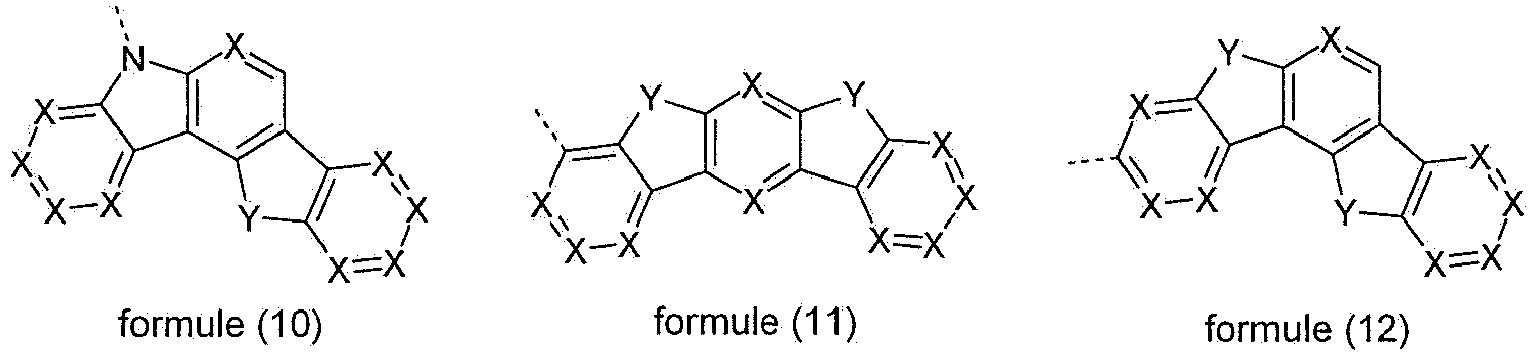


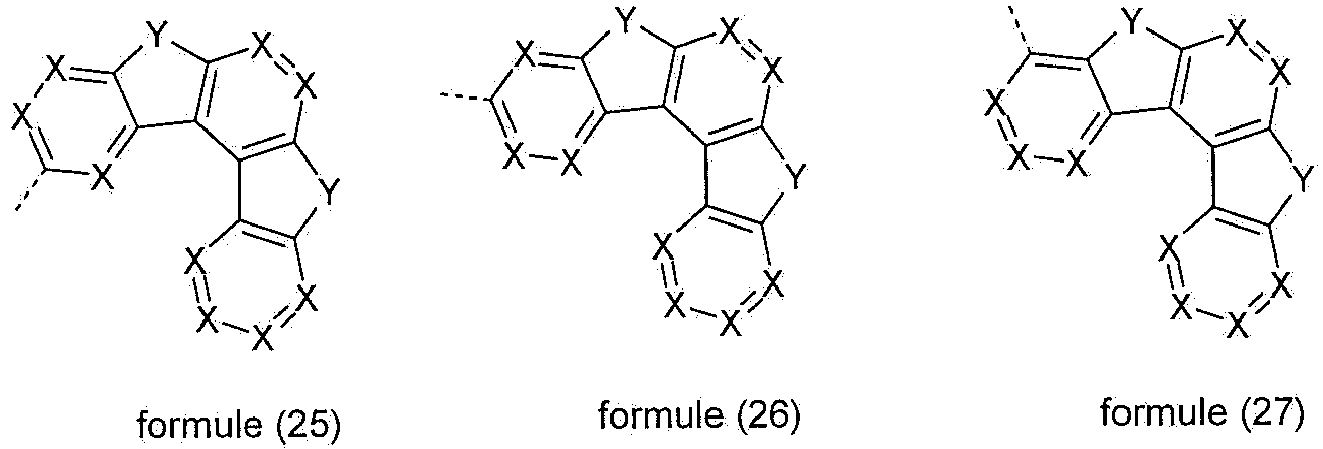


 X est pour chaque occurrence, de manière identique ou différente, CR1 ou N, où, de façon préférable, un maximum de 2 symboles X par cycle représentent N ;Y est pour chaque occurrence, de manière identique ou différente, C(R1)2, NR1, O ou S ;n est 0 ou 1, où n égal à 0 signifie qu'aucun groupe Y n'est lié au niveau de cette position et qu'en lieu et place, des radicaux R1 sont liés aux atomes de carbone correspondants.
 - Dispositif électroluminescent organique selon une ou plusieurs des revendications 1 à 8, caractérisé en ce que le composé de transport d'électrons est sélectionné parmi les composés des formules (45) et (46) :
 E est, de manière identique ou différente pour chaque occurrence, une liaison simple, NR, CR2, O ou S ;Ar1 est, en association avec les atomes de carbone représentés de manière explicite, un système de cycle aromatique ou hétéroaromatique qui comporte 5 à 30 atomes de cycle aromatique, lequel système de cycle peut être substitué par un radical ou par plusieurs radicaux R ;Ar2, Ar3 sont, de manière identique ou différente pour chaque occurrence, en association avec les atomes de carbone représentés de manière explicite, un système de cycle aromatique ou hétéroaromatique qui comporte 5 à 30 atomes de cycle aromatique, lequel système de cycle peut être substitué par un radical ou par plusieurs radicaux R ;L pour m = 2 est une liaison simple ou un groupe divalent, ou pour m = 3 est un groupe trivalent ou pour m = 4 est un groupe tétravalent, lequel groupe est dans chaque cas lié à Ar1, à Ar2 ou à Ar3 au niveau de n'importe quelle position souhaitée ou est lié à E en lieu et place d'un radical R ;m est 2, 3 ou 4.
 - Dispositif électroluminescent organique selon la revendication 12, caractérisé en ce que le groupe Ar1 représente un groupe des formules (47), (48), (49) ou (50) qui suivent :
 W est, de manière identique ou différente pour chaque occurrence, CR ou N ; ou deux groupes adjacents W représentent un groupe de la formule (51) ou (52) :
 V est NR, O ou S ;et/ou en ce que le groupe Ar2 représente un groupe de l'une des formules (53), (54) et (55) :
et/ou en ce que le groupe Ar3 représente un groupe de l'une des formules (56), (57), (58) ou (59) :
- Dispositif électroluminescent organique selon la revendication 8, caractérisé en ce que le composé de transport d'électrons est sélectionné parmi les composés des formules (70) et (71) :
 Ar4 est pour chaque occurrence, de manière identique ou différente, un système de cycle aromatique ou hétéroaromatique qui comporte 5 à 80 atomes de cycle aromatique, de façon préférable jusqu'à 60 atomes de cycle aromatique, lequel système de cycle peut dans chaque cas être substitué par un groupe ou par plusieurs groupes R.
 - Dispositif électroluminescent organique selon la revendication 14, caractérisé en ce que Ar4 est sélectionné, de manière identique ou différente pour chaque occurrence, parmi phényle, 2-, 3- ou 4-tolyle, 3-ou 4-o-xylyle, 2- ou 4-m-xylyle, 2-p-xylyle, o-, m- ou p-tert-butyl-phényle, o-, m- ou p-fluorophényle, benzophénone, 1-, 2- ou 3-phényl-méthanone, 2-, 3- ou 4-biphényle, 2-, 3- ou 4-o-terphényle, 2-, 3- ou 4-m-terphényle, 2-, 3- ou 4-p-terphényle, 2'-p-terphényle, 2'-, 4'- ou 5'-m-terphényle, 3'- ou 4'-o-terphényle, p-, m,p-, o,p-, m,m-, o,m- ou o,o-quaterphényle, quinquéphényle, sexiphényle, 1-, 2-, 3- ou 4-fluorényle, 2-, 3- ou 4-spiro-9,9'-bifluorényle, 1-, 2-, 3- ou 4-(9,10-dihydro)phénanthrényle, 1- ou 2-naphtyle, 2-, 3-, 4-, 5-, 6-, 7- ou 8-quinolinyle, 1-, 3-, 4-, 5-, 6-, 7- ou 8-isoquinolinyle, 1- ou 2-(4-méthylnaphtyle), 1- ou 2-(4-phénylnaphtyle), 1- ou 2-(4-naphtylnaphtyle), 1-, 2- ou 3-(4-naphtylphényle), 2-, 3- ou 4-pyridyle, 2-, 4- ou 5-pyrimidinyle, 2- ou 3-pyrazinyle, 3- ou 4-pyridazinyle, 2-(1,3,5-triazin)yle-, 2-, 3- ou 4-(phénylpyridyle), 3-, 4-, 5- ou 6-(2,2'-bipyridyle), 2-, 4-, 5- ou 6-(3,3'-bipyridyle), 2- ou 3-(4,4'-bipyridyle), et des combinaisons d'un ou de plusieurs de ces radicaux, lesquels radicaux peuvent être substitués par un radical ou par plusieurs radicaux R.
- Procédé pour la fabrication d'un dispositif électroluminescent organique selon une ou plusieurs des revendications 1 à 15, caractérisé en ce qu'au moins une couche est appliquée au moyen d'un procédé de sublimation et/ou en ce qu'au moins une couche est appliquée au moyen d'un procédé OVPD (dépôt organique en phase vapeur) ou à l'aide d'une sublimation par gaz porteur et/ou en ce qu'au moins une couche est appliquée à partir d'une solution, au moyen d'un procédé de dépôt à la tournette/par centrifugation ou au moyen d'un procédé d'impression.
Priority Applications (1)
| Application Number | Priority Date | Filing Date | Title |
|---|---|---|---|
| EP14711446.6A EP2984692B1 (fr) | 2013-04-08 | 2014-03-18 | Dispositif électroluminescent organique comportant une matière à fluorescence retardée thermiquement activée |
Applications Claiming Priority (3)
| Application Number | Priority Date | Filing Date | Title |
|---|---|---|---|
| EP13001797 | 2013-04-08 | ||
| EP14711446.6A EP2984692B1 (fr) | 2013-04-08 | 2014-03-18 | Dispositif électroluminescent organique comportant une matière à fluorescence retardée thermiquement activée |
| PCT/EP2014/000739 WO2014166584A1 (fr) | 2013-04-08 | 2014-03-18 | Dispositif électroluminescent organique comportant une matière à fluorescence retardée thermiquement activée |
Publications (2)
| Publication Number | Publication Date |
|---|---|
| EP2984692A1 EP2984692A1 (fr) | 2016-02-17 |
| EP2984692B1 true EP2984692B1 (fr) | 2018-01-31 |
Family
ID=48128051
Family Applications (1)
| Application Number | Title | Priority Date | Filing Date |
|---|---|---|---|
| EP14711446.6A Active EP2984692B1 (fr) | 2013-04-08 | 2014-03-18 | Dispositif électroluminescent organique comportant une matière à fluorescence retardée thermiquement activée |
Country Status (7)
| Country | Link |
|---|---|
| US (1) | US10069079B2 (fr) |
| EP (1) | EP2984692B1 (fr) |
| JP (2) | JP6567498B2 (fr) |
| KR (2) | KR102361072B1 (fr) |
| CN (1) | CN105074950B (fr) |
| TW (1) | TWI676669B (fr) |
| WO (1) | WO2014166584A1 (fr) |
Families Citing this family (37)
| Publication number | Priority date | Publication date | Assignee | Title |
|---|---|---|---|---|
| WO2013077362A1 (fr) | 2011-11-22 | 2013-05-30 | 出光興産株式会社 | Dérivé hétérocyclique aromatique, matière pour élément électroluminescent organique et élément électroluminescent organique |
| EP3005433B1 (fr) * | 2013-06-06 | 2023-02-22 | Merck Patent GmbH | Dispositif organique éléctroluminescent |
| CN105518103B (zh) | 2013-09-11 | 2018-12-21 | 默克专利有限公司 | 有机电致发光器件 |
| EP3040335B1 (fr) | 2013-11-13 | 2019-04-03 | Idemitsu Kosan Co., Ltd | Composé, élément électroluminescent organique et dispositif électronique |
| US10734587B2 (en) * | 2014-03-13 | 2020-08-04 | Merck Patent Gmbh | Formulations of luminescent compounds |
| WO2015170930A1 (fr) * | 2014-05-08 | 2015-11-12 | Rohm And Haas Electronic Materials Korea Ltd. | Matériau de transport d'électrons et dispositif électroluminescent organique comprenant celui-ci |
| WO2016084962A1 (fr) | 2014-11-28 | 2016-06-02 | 出光興産株式会社 | Composé, matériau pour élément électroluminescent organique, élément électroluminescent organique et dispositif électronique |
| CN107004777B (zh) * | 2014-12-04 | 2019-03-26 | 广州华睿光电材料有限公司 | 聚合物,包含其的混合物、组合物、有机电子器件,及其单体 |
| EP3230403B1 (fr) | 2014-12-12 | 2019-10-09 | Merck Patent GmbH | Composés organiques comprenant des groupes solubles |
| KR102660767B1 (ko) | 2015-02-06 | 2024-04-24 | 이데미쓰 고산 가부시키가이샤 | 유기 일렉트로루미네센스 소자 및 전자 기기 |
| KR102343572B1 (ko) * | 2015-03-06 | 2021-12-28 | 삼성디스플레이 주식회사 | 유기 발광 소자 |
| KR102626916B1 (ko) | 2015-09-09 | 2024-01-19 | 삼성전자주식회사 | 축합환 화합물 및 이를 포함한 유기 발광 소자 |
| CN105322099B (zh) * | 2015-11-30 | 2018-01-05 | 华南理工大学 | 一种全荧光白光有机发光二极管及其制备方法 |
| JP6788314B2 (ja) * | 2016-01-06 | 2020-11-25 | コニカミノルタ株式会社 | 有機エレクトロルミネッセンス素子、有機エレクトロルミネッセンス素子の製造方法、表示装置及び照明装置 |
| CN107056748B (zh) * | 2016-04-25 | 2020-12-11 | 中节能万润股份有限公司 | 一种以三嗪和酮为核心的化合物及其在有机电致发光器件上的应用 |
| WO2018074529A1 (fr) * | 2016-10-19 | 2018-04-26 | 保土谷化学工業株式会社 | Composé d'indénocarbazole et élément électroluminescent organique |
| CN106946850B (zh) * | 2017-02-17 | 2019-02-15 | 中节能万润股份有限公司 | 一种热激活延迟荧光发光材料及其应用 |
| CN107123749B (zh) * | 2017-04-01 | 2019-08-27 | 中山大学 | 一种高显色指数白光有机电致发光器件及其制备方法 |
| KR102536248B1 (ko) | 2017-06-21 | 2023-05-25 | 삼성디스플레이 주식회사 | 헤테로시클릭 화합물 및 이를 포함한 유기 발광 소자 |
| KR102415376B1 (ko) | 2017-08-04 | 2022-07-01 | 삼성디스플레이 주식회사 | 축합환 화합물 및 이를 포함한 유기 발광 소자 |
| KR102414108B1 (ko) * | 2017-08-08 | 2022-06-29 | 삼성디스플레이 주식회사 | 헤테로고리 화합물 및 이를 포함한 유기 발광 소자 |
| EP3467894B1 (fr) * | 2017-09-26 | 2023-08-02 | Samsung Display Co., Ltd. | Dispositif électroluminescent organique |
| KR102824094B1 (ko) * | 2017-09-26 | 2025-06-25 | 삼성디스플레이 주식회사 | 유기 발광 소자 |
| CN108048077B (zh) * | 2017-12-11 | 2019-04-30 | 中节能万润股份有限公司 | 一种热活化延迟荧光材料及其应用 |
| KR102536246B1 (ko) | 2018-03-23 | 2023-05-25 | 삼성디스플레이 주식회사 | 헤테로고리 화합물 및 이를 포함한 유기 발광 소자 |
| CN108219781A (zh) * | 2018-04-02 | 2018-06-29 | 长春海谱润斯科技有限公司 | 一种四嗪衍生物的热激活延迟荧光材料及其有机电致发光器件 |
| KR102692561B1 (ko) * | 2018-06-26 | 2024-08-06 | 삼성전자주식회사 | 유기 발광 소자 |
| EP3696167B1 (fr) | 2018-07-27 | 2024-11-20 | Idemitsu Kosan Co.,Ltd. | Composé, matériau pour élément électroluminescent organique, élément électroluminescent organique, et dispositif électronique |
| JP7542538B2 (ja) | 2018-09-18 | 2024-08-30 | ニカング セラピューティクス, インコーポレイテッド | Srcホモロジー-2ホスファターゼ阻害剤としての縮合三環式環誘導体 |
| TWI767148B (zh) | 2018-10-10 | 2022-06-11 | 美商弗瑪治療公司 | 抑制脂肪酸合成酶(fasn) |
| EP3975279B1 (fr) * | 2018-10-15 | 2024-03-13 | Samsung Display Co., Ltd. | Dispositif électroluminescent organique émettant une lumière bleue |
| CN109400590A (zh) * | 2018-11-21 | 2019-03-01 | 苏州大学 | 一种热活化延迟荧光材料及其在有机发光二极管中的应用 |
| CN110128423A (zh) * | 2019-05-21 | 2019-08-16 | 武汉华星光电半导体显示技术有限公司 | 热活化延迟荧光材料和其制作方法、电致发光器件 |
| CN110790751A (zh) * | 2019-11-07 | 2020-02-14 | 浙江虹舞科技有限公司 | 一种热活性延迟荧光材料及有机发光元件 |
| KR20220033736A (ko) | 2020-09-10 | 2022-03-17 | 엘지디스플레이 주식회사 | 유기 화합물, 이를 포함하는 유기발광다이오드 및 유기발광장치 |
| US12295198B2 (en) | 2021-04-16 | 2025-05-06 | Boe Technology Group Co., Ltd. | Organic electroluminescent device and display apparatus |
| CN117362292B (zh) * | 2023-06-15 | 2025-07-22 | 闽都创新实验室 | 酰胺衍生物热活化延迟荧光材料及其制备方法和应用 |
Citations (5)
| Publication number | Priority date | Publication date | Assignee | Title |
|---|---|---|---|---|
| US20120037896A1 (en) | 2009-04-09 | 2012-02-16 | Merck Patent Gmbh | Organic electroluminescence device |
| US20120091438A1 (en) | 2009-04-01 | 2012-04-19 | Idemitsu Kosan Co., Ltd. | Organic electroluminescent element |
| US20120256535A1 (en) | 2011-04-07 | 2012-10-11 | Semiconductor Energy Laboratory Co., Ltd. | Light-emitting element |
| EP2687530A1 (fr) | 2011-03-16 | 2014-01-22 | Nippon Steel & Sumikin Chemical Co., Ltd. | Composés aromatiques contenant de l'azote et éléments électroluminescents organiques |
| EP2733761A1 (fr) | 2011-07-15 | 2014-05-21 | Kyushu University, National University Corporation | Matériau à fluorescence retardée et élément d'électroluminescence organique utilisant ledit matériau |
Family Cites Families (18)
| Publication number | Priority date | Publication date | Assignee | Title |
|---|---|---|---|---|
| DE10224021B4 (de) | 2002-05-24 | 2006-06-01 | Novaled Gmbh | Phosphoreszentes lichtemittierendes Bauelement mit organischen Schichten |
| EP1645610A1 (fr) | 2004-10-11 | 2006-04-12 | Covion Organic Semiconductors GmbH | Dérivés de phenanthrene |
| EP1956022B1 (fr) | 2005-12-01 | 2012-07-25 | Nippon Steel Chemical Co., Ltd. | Compose pour element electroluminescent organique et element electroluminescent organique |
| EP2080762B1 (fr) | 2006-11-09 | 2016-09-14 | Nippon Steel & Sumikin Chemical Co., Ltd. | Composé pour un dispositif électroluminescent organique et dispositif électroluminescent organique |
| WO2009037155A1 (fr) | 2007-09-20 | 2009-03-26 | Basf Se | Dispositif électroluminescent |
| JP2010114070A (ja) * | 2008-10-10 | 2010-05-20 | Canon Inc | 白色有機el素子 |
| DE102009009277B4 (de) | 2009-02-17 | 2023-12-07 | Merck Patent Gmbh | Organische elektronische Vorrichtung, Verfahren zu deren Herstellung und Verwendung von Verbindungen |
| TWI468494B (zh) | 2009-03-31 | 2015-01-11 | Nippon Steel & Sumikin Chem Co | Organic electroluminescent elements |
| DE102009023155A1 (de) | 2009-05-29 | 2010-12-02 | Merck Patent Gmbh | Materialien für organische Elektrolumineszenzvorrichtungen |
| DE102009031021A1 (de) | 2009-06-30 | 2011-01-05 | Merck Patent Gmbh | Materialien für organische Elektrolumineszenzvorrichtungen |
| EP2511360A4 (fr) | 2009-12-07 | 2014-05-21 | Nippon Steel & Sumikin Chem Co | Matière électroluminescente organique et élément électroluminescent organique |
| EP2513125B1 (fr) | 2009-12-14 | 2014-10-29 | Basf Se | Complexes des metaux avec un ligand carbene diazabenzimidazole et leur usage en dispositifs d'éclairage à diodes électroluminescentes organiques |
| DE102010019306B4 (de) | 2010-05-04 | 2021-05-20 | Merck Patent Gmbh | Organische Elektrolumineszenzvorrichtungen |
| DE112011102558B4 (de) * | 2010-07-30 | 2022-01-05 | Merck Patent Gmbh | Organische Elektrolumineszenzvorrichtung |
| KR101650996B1 (ko) * | 2011-03-25 | 2016-08-24 | 이데미쓰 고산 가부시키가이샤 | 유기 일렉트로 루미네선스 소자 |
| US9142710B2 (en) * | 2012-08-10 | 2015-09-22 | Semiconductor Energy Laboratory Co., Ltd. | Light-emitting element, light-emitting device, display device, electronic device, and lighting device |
| JP2014187130A (ja) * | 2013-03-22 | 2014-10-02 | Nippon Hoso Kyokai <Nhk> | 有機エレクトロルミネッセンス素子、表示装置および照明装置、正孔輸送材料の評価方法 |
| KR20150122754A (ko) * | 2013-03-29 | 2015-11-02 | 코니카 미놀타 가부시키가이샤 | 유기 일렉트로루미네센스 소자, 조명 장치, 표시 장치, 유기 루미네센스 소자용 발광성 박막과 조성물 및 발광 방법 |
-
2014
- 2014-03-18 EP EP14711446.6A patent/EP2984692B1/fr active Active
- 2014-03-18 US US14/782,974 patent/US10069079B2/en active Active
- 2014-03-18 KR KR1020157031344A patent/KR102361072B1/ko active Active
- 2014-03-18 KR KR1020207033152A patent/KR20200133011A/ko not_active Ceased
- 2014-03-18 WO PCT/EP2014/000739 patent/WO2014166584A1/fr not_active Ceased
- 2014-03-18 JP JP2016506799A patent/JP6567498B2/ja active Active
- 2014-03-18 CN CN201480018865.9A patent/CN105074950B/zh active Active
- 2014-04-03 TW TW103112533A patent/TWI676669B/zh not_active IP Right Cessation
-
2019
- 2019-03-27 JP JP2019061067A patent/JP2019145807A/ja active Pending
Patent Citations (5)
| Publication number | Priority date | Publication date | Assignee | Title |
|---|---|---|---|---|
| US20120091438A1 (en) | 2009-04-01 | 2012-04-19 | Idemitsu Kosan Co., Ltd. | Organic electroluminescent element |
| US20120037896A1 (en) | 2009-04-09 | 2012-02-16 | Merck Patent Gmbh | Organic electroluminescence device |
| EP2687530A1 (fr) | 2011-03-16 | 2014-01-22 | Nippon Steel & Sumikin Chemical Co., Ltd. | Composés aromatiques contenant de l'azote et éléments électroluminescents organiques |
| US20120256535A1 (en) | 2011-04-07 | 2012-10-11 | Semiconductor Energy Laboratory Co., Ltd. | Light-emitting element |
| EP2733761A1 (fr) | 2011-07-15 | 2014-05-21 | Kyushu University, National University Corporation | Matériau à fluorescence retardée et élément d'électroluminescence organique utilisant ledit matériau |
Non-Patent Citations (6)
| Title |
|---|
| AYATAKA ENDO, KEIGO SATO, CHIHAYA ADACHI: "PL characteristics of high efficiency thermally activated delayed fluorescence materials and their application to organic light emitting diodes (English translation enclosed)", THE 57TH ANNUAL MEETING OF THE JAPAN SOCIETY OF APPLIED PHYSICS AND RELATED SOCIETIES, PROCEEDINGS, 2010, Tokai University, pages 12-340, XP055524913 |
| KEIGO SATO, AYATAKA ENDO, CHIHAYA ADACHI: "Emission mechenism of high efficiency thermally activated delayed fluorescence (English translation enclosed)", THE 57TH ANNUAL MEETING OF THE JAPAN SOCIETY OF APPLIED PHYSICS AND RELATED SOCIETIES, PROCEEDINGS, 2010, Tokai University, pages 12-341, XP055524910 |
| SHI-JIAN SU ET AL: "SUPPLEMENTARY INFORMATION - Tuning Energy Levels of Electron-Transport Materials by Nitrogen Orientation for Electrophosphorescent Devices with an 'Ideal' Operating Voltage", ADVANCED MATERIALS, vol. 22, no. 30, 15 June 2010 (2010-06-15), DE, pages 3311 - 3316, XP055322581, ISSN: 0935-9648, DOI: 10.1002/adma.200904249 * |
| TOMONORI YAMADA ET AL: "Supplementary Material - Revealing Bipolar Charge-Transport Property of 4,4'-N,N'-dicarbazolylbiphenyl (CBP) by Quantum Chemical Calculations", ORGANIC ELECTRONICS, 12 November 2010 (2010-11-12), pages 169 - 178, XP055322751, Retrieved from the Internet <URL:http://www.sciencedirect.com/science/MiamiMultiMediaURL/1-s2.0-S1566119910003551/1-s2.0-S1566119910003551-mmc1.doc/272178/html/S1566119910003551/5064d845ae00fec596af0c84ddfda12b/mmc1.doc> [retrieved on 20161124], DOI: 10.1016/j.orgel.2010.10.022 * |
| UOYAMA ET AL.: "Highly efficient organic light-emitting diodes from delayed fluorescence", NATURE, vol. 492, 13 December 2012 (2012-12-13), pages 234 - 238, XP055048388 |
| YAMADA T ET AL: "Revealing bipolar charge-transport property of 4,4'-N,N'-dicarbazolylbiphenyl (CBP) by quantum chemical calculations", ORGANIC ELECTRONICS, ELSEVIER, AMSTERDAM, NL, vol. 12, no. 1, 1 January 2011 (2011-01-01), pages 169 - 178, XP027577002, ISSN: 1566-1199, [retrieved on 20101227] * |
Also Published As
| Publication number | Publication date |
|---|---|
| US20160315268A1 (en) | 2016-10-27 |
| JP2019145807A (ja) | 2019-08-29 |
| TWI676669B (zh) | 2019-11-11 |
| JP6567498B2 (ja) | 2019-08-28 |
| KR20150140322A (ko) | 2015-12-15 |
| JP2016521455A (ja) | 2016-07-21 |
| CN105074950B (zh) | 2018-05-11 |
| WO2014166584A1 (fr) | 2014-10-16 |
| US10069079B2 (en) | 2018-09-04 |
| TW201502240A (zh) | 2015-01-16 |
| KR20200133011A (ko) | 2020-11-25 |
| EP2984692A1 (fr) | 2016-02-17 |
| CN105074950A (zh) | 2015-11-18 |
| KR102361072B1 (ko) | 2022-02-09 |
Similar Documents
| Publication | Publication Date | Title |
|---|---|---|
| EP2984692B1 (fr) | Dispositif électroluminescent organique comportant une matière à fluorescence retardée thermiquement activée | |
| EP2984152B1 (fr) | Dispositif électroluminescent organique | |
| EP2984151B1 (fr) | Dispositif électroluminescent organique | |
| EP3005433B1 (fr) | Dispositif organique éléctroluminescent | |
| EP2907173B1 (fr) | Dispositif électronique | |
| EP3117470B1 (fr) | Dispositif électroluminescent organique | |
| EP2695213B1 (fr) | Dispositif électroluminescent organique | |
| EP2984691B1 (fr) | Dispositif émetteur de lumière organique à fluorescence retardée | |
| EP3044286B1 (fr) | Dispositif d'électroluminescence organique | |
| DE112011102558B4 (de) | Organische Elektrolumineszenzvorrichtung | |
| EP2898042B1 (fr) | Matériaux pour dispositifs électroniques | |
| EP3210248B2 (fr) | Matériaux pour dispositifs électroniques | |
| EP2764558B1 (fr) | Dispositif électroluminescents organiques | |
| EP3120396B1 (fr) | Dispositif organique électroluminescent | |
| DE102009014513A1 (de) | Organische Elektrolumineszenzvorrichtung | |
| EP4707357A2 (fr) | Dispositifs électroniques | |
| EP3887479B1 (fr) | Dispositif électronique | |
| EP3209746B1 (fr) | Dispositif électroluminescent organique | |
| EP4193399B1 (fr) | Dispositif électronique | |
| WO2020108899A1 (fr) | Dispositif électronique | |
| WO2021028513A1 (fr) | Dispositif électronique | |
| EP3963641A1 (fr) | Dispositif électronique | |
| WO2023036747A1 (fr) | Dispositif électronique |
Legal Events
| Date | Code | Title | Description |
|---|---|---|---|
| PUAI | Public reference made under article 153(3) epc to a published international application that has entered the european phase |
Free format text: ORIGINAL CODE: 0009012 |
|
| 17P | Request for examination filed |
Effective date: 20150810 |
|
| AK | Designated contracting states |
Kind code of ref document: A1 Designated state(s): AL AT BE BG CH CY CZ DE DK EE ES FI FR GB GR HR HU IE IS IT LI LT LU LV MC MK MT NL NO PL PT RO RS SE SI SK SM TR |
|
| AX | Request for extension of the european patent |
Extension state: BA ME |
|
| DAX | Request for extension of the european patent (deleted) | ||
| STAA | Information on the status of an ep patent application or granted ep patent |
Free format text: STATUS: EXAMINATION IS IN PROGRESS |
|
| 17Q | First examination report despatched |
Effective date: 20161130 |
|
| GRAP | Despatch of communication of intention to grant a patent |
Free format text: ORIGINAL CODE: EPIDOSNIGR1 |
|
| STAA | Information on the status of an ep patent application or granted ep patent |
Free format text: STATUS: GRANT OF PATENT IS INTENDED |
|
| RIC1 | Information provided on ipc code assigned before grant |
Ipc: H01L 51/54 20060101ALI20170911BHEP Ipc: H01L 51/50 20060101AFI20170911BHEP |
|
| INTG | Intention to grant announced |
Effective date: 20171013 |
|
| GRAS | Grant fee paid |
Free format text: ORIGINAL CODE: EPIDOSNIGR3 |
|
| GRAA | (expected) grant |
Free format text: ORIGINAL CODE: 0009210 |
|
| STAA | Information on the status of an ep patent application or granted ep patent |
Free format text: STATUS: THE PATENT HAS BEEN GRANTED |
|
| AK | Designated contracting states |
Kind code of ref document: B1 Designated state(s): AL AT BE BG CH CY CZ DE DK EE ES FI FR GB GR HR HU IE IS IT LI LT LU LV MC MK MT NL NO PL PT RO RS SE SI SK SM TR |
|
| REG | Reference to a national code |
Ref country code: GB Ref legal event code: FG4D Free format text: NOT ENGLISH Ref country code: CH Ref legal event code: EP |
|
| REG | Reference to a national code |
Ref country code: AT Ref legal event code: REF Ref document number: 968105 Country of ref document: AT Kind code of ref document: T Effective date: 20180215 |
|
| REG | Reference to a national code |
Ref country code: IE Ref legal event code: FG4D Free format text: LANGUAGE OF EP DOCUMENT: GERMAN |
|
| REG | Reference to a national code |
Ref country code: DE Ref legal event code: R096 Ref document number: 502014007117 Country of ref document: DE |
|
| REG | Reference to a national code |
Ref country code: NL Ref legal event code: MP Effective date: 20180131 |
|
| REG | Reference to a national code |
Ref country code: LT Ref legal event code: MG4D |
|
| PG25 | Lapsed in a contracting state [announced via postgrant information from national office to epo] |
Ref country code: ES Free format text: LAPSE BECAUSE OF FAILURE TO SUBMIT A TRANSLATION OF THE DESCRIPTION OR TO PAY THE FEE WITHIN THE PRESCRIBED TIME-LIMIT Effective date: 20180131 Ref country code: HR Free format text: LAPSE BECAUSE OF FAILURE TO SUBMIT A TRANSLATION OF THE DESCRIPTION OR TO PAY THE FEE WITHIN THE PRESCRIBED TIME-LIMIT Effective date: 20180131 Ref country code: FI Free format text: LAPSE BECAUSE OF FAILURE TO SUBMIT A TRANSLATION OF THE DESCRIPTION OR TO PAY THE FEE WITHIN THE PRESCRIBED TIME-LIMIT Effective date: 20180131 Ref country code: NO Free format text: LAPSE BECAUSE OF FAILURE TO SUBMIT A TRANSLATION OF THE DESCRIPTION OR TO PAY THE FEE WITHIN THE PRESCRIBED TIME-LIMIT Effective date: 20180430 Ref country code: LT Free format text: LAPSE BECAUSE OF FAILURE TO SUBMIT A TRANSLATION OF THE DESCRIPTION OR TO PAY THE FEE WITHIN THE PRESCRIBED TIME-LIMIT Effective date: 20180131 Ref country code: NL Free format text: LAPSE BECAUSE OF FAILURE TO SUBMIT A TRANSLATION OF THE DESCRIPTION OR TO PAY THE FEE WITHIN THE PRESCRIBED TIME-LIMIT Effective date: 20180131 |
|
| PG25 | Lapsed in a contracting state [announced via postgrant information from national office to epo] |
Ref country code: IS Free format text: LAPSE BECAUSE OF FAILURE TO SUBMIT A TRANSLATION OF THE DESCRIPTION OR TO PAY THE FEE WITHIN THE PRESCRIBED TIME-LIMIT Effective date: 20180531 Ref country code: RS Free format text: LAPSE BECAUSE OF FAILURE TO SUBMIT A TRANSLATION OF THE DESCRIPTION OR TO PAY THE FEE WITHIN THE PRESCRIBED TIME-LIMIT Effective date: 20180131 Ref country code: LV Free format text: LAPSE BECAUSE OF FAILURE TO SUBMIT A TRANSLATION OF THE DESCRIPTION OR TO PAY THE FEE WITHIN THE PRESCRIBED TIME-LIMIT Effective date: 20180131 Ref country code: BG Free format text: LAPSE BECAUSE OF FAILURE TO SUBMIT A TRANSLATION OF THE DESCRIPTION OR TO PAY THE FEE WITHIN THE PRESCRIBED TIME-LIMIT Effective date: 20180430 Ref country code: SE Free format text: LAPSE BECAUSE OF FAILURE TO SUBMIT A TRANSLATION OF THE DESCRIPTION OR TO PAY THE FEE WITHIN THE PRESCRIBED TIME-LIMIT Effective date: 20180131 Ref country code: PL Free format text: LAPSE BECAUSE OF FAILURE TO SUBMIT A TRANSLATION OF THE DESCRIPTION OR TO PAY THE FEE WITHIN THE PRESCRIBED TIME-LIMIT Effective date: 20180131 Ref country code: GR Free format text: LAPSE BECAUSE OF FAILURE TO SUBMIT A TRANSLATION OF THE DESCRIPTION OR TO PAY THE FEE WITHIN THE PRESCRIBED TIME-LIMIT Effective date: 20180501 |
|
| PG25 | Lapsed in a contracting state [announced via postgrant information from national office to epo] |
Ref country code: MT Free format text: LAPSE BECAUSE OF FAILURE TO SUBMIT A TRANSLATION OF THE DESCRIPTION OR TO PAY THE FEE WITHIN THE PRESCRIBED TIME-LIMIT Effective date: 20180131 |
|
| REG | Reference to a national code |
Ref country code: DE Ref legal event code: R026 Ref document number: 502014007117 Country of ref document: DE |
|
| PLBI | Opposition filed |
Free format text: ORIGINAL CODE: 0009260 |
|
| PG25 | Lapsed in a contracting state [announced via postgrant information from national office to epo] |
Ref country code: AL Free format text: LAPSE BECAUSE OF FAILURE TO SUBMIT A TRANSLATION OF THE DESCRIPTION OR TO PAY THE FEE WITHIN THE PRESCRIBED TIME-LIMIT Effective date: 20180131 Ref country code: RO Free format text: LAPSE BECAUSE OF FAILURE TO SUBMIT A TRANSLATION OF THE DESCRIPTION OR TO PAY THE FEE WITHIN THE PRESCRIBED TIME-LIMIT Effective date: 20180131 Ref country code: EE Free format text: LAPSE BECAUSE OF FAILURE TO SUBMIT A TRANSLATION OF THE DESCRIPTION OR TO PAY THE FEE WITHIN THE PRESCRIBED TIME-LIMIT Effective date: 20180131 Ref country code: IT Free format text: LAPSE BECAUSE OF FAILURE TO SUBMIT A TRANSLATION OF THE DESCRIPTION OR TO PAY THE FEE WITHIN THE PRESCRIBED TIME-LIMIT Effective date: 20180131 |
|
| REG | Reference to a national code |
Ref country code: CH Ref legal event code: PL |
|
| PLAX | Notice of opposition and request to file observation + time limit sent |
Free format text: ORIGINAL CODE: EPIDOSNOBS2 |
|
| 26 | Opposition filed |
Opponent name: NIPPON STEEL CHEMICAL & MATERIAL CO., LTD. Effective date: 20181024 |
|
| PG25 | Lapsed in a contracting state [announced via postgrant information from national office to epo] |
Ref country code: DK Free format text: LAPSE BECAUSE OF FAILURE TO SUBMIT A TRANSLATION OF THE DESCRIPTION OR TO PAY THE FEE WITHIN THE PRESCRIBED TIME-LIMIT Effective date: 20180131 Ref country code: SK Free format text: LAPSE BECAUSE OF FAILURE TO SUBMIT A TRANSLATION OF THE DESCRIPTION OR TO PAY THE FEE WITHIN THE PRESCRIBED TIME-LIMIT Effective date: 20180131 Ref country code: MC Free format text: LAPSE BECAUSE OF FAILURE TO SUBMIT A TRANSLATION OF THE DESCRIPTION OR TO PAY THE FEE WITHIN THE PRESCRIBED TIME-LIMIT Effective date: 20180131 Ref country code: CZ Free format text: LAPSE BECAUSE OF FAILURE TO SUBMIT A TRANSLATION OF THE DESCRIPTION OR TO PAY THE FEE WITHIN THE PRESCRIBED TIME-LIMIT Effective date: 20180131 Ref country code: SM Free format text: LAPSE BECAUSE OF FAILURE TO SUBMIT A TRANSLATION OF THE DESCRIPTION OR TO PAY THE FEE WITHIN THE PRESCRIBED TIME-LIMIT Effective date: 20180131 |
|
| REG | Reference to a national code |
Ref country code: BE Ref legal event code: MM Effective date: 20180331 |
|
| GBPC | Gb: european patent ceased through non-payment of renewal fee |
Effective date: 20180430 |
|
| REG | Reference to a national code |
Ref country code: IE Ref legal event code: MM4A |
|
| PG25 | Lapsed in a contracting state [announced via postgrant information from national office to epo] |
Ref country code: LU Free format text: LAPSE BECAUSE OF NON-PAYMENT OF DUE FEES Effective date: 20180318 |
|
| PG25 | Lapsed in a contracting state [announced via postgrant information from national office to epo] |
Ref country code: IE Free format text: LAPSE BECAUSE OF NON-PAYMENT OF DUE FEES Effective date: 20180318 |
|
| PG25 | Lapsed in a contracting state [announced via postgrant information from national office to epo] |
Ref country code: BE Free format text: LAPSE BECAUSE OF NON-PAYMENT OF DUE FEES Effective date: 20180331 Ref country code: CH Free format text: LAPSE BECAUSE OF NON-PAYMENT OF DUE FEES Effective date: 20180331 Ref country code: LI Free format text: LAPSE BECAUSE OF NON-PAYMENT OF DUE FEES Effective date: 20180331 Ref country code: SI Free format text: LAPSE BECAUSE OF FAILURE TO SUBMIT A TRANSLATION OF THE DESCRIPTION OR TO PAY THE FEE WITHIN THE PRESCRIBED TIME-LIMIT Effective date: 20180131 Ref country code: GB Free format text: LAPSE BECAUSE OF NON-PAYMENT OF DUE FEES Effective date: 20180430 |
|
| PLAF | Information modified related to communication of a notice of opposition and request to file observations + time limit |
Free format text: ORIGINAL CODE: EPIDOSCOBS2 |
|
| PLBB | Reply of patent proprietor to notice(s) of opposition received |
Free format text: ORIGINAL CODE: EPIDOSNOBS3 |
|
| PG25 | Lapsed in a contracting state [announced via postgrant information from national office to epo] |
Ref country code: FR Free format text: LAPSE BECAUSE OF NON-PAYMENT OF DUE FEES Effective date: 20180331 |
|
| PLCK | Communication despatched that opposition was rejected |
Free format text: ORIGINAL CODE: EPIDOSNREJ1 |
|
| REG | Reference to a national code |
Ref country code: DE Ref legal event code: R100 Ref document number: 502014007117 Country of ref document: DE |
|
| PG25 | Lapsed in a contracting state [announced via postgrant information from national office to epo] |
Ref country code: TR Free format text: LAPSE BECAUSE OF FAILURE TO SUBMIT A TRANSLATION OF THE DESCRIPTION OR TO PAY THE FEE WITHIN THE PRESCRIBED TIME-LIMIT Effective date: 20180131 |
|
| PG25 | Lapsed in a contracting state [announced via postgrant information from national office to epo] |
Ref country code: PT Free format text: LAPSE BECAUSE OF FAILURE TO SUBMIT A TRANSLATION OF THE DESCRIPTION OR TO PAY THE FEE WITHIN THE PRESCRIBED TIME-LIMIT Effective date: 20180131 |
|
| PG25 | Lapsed in a contracting state [announced via postgrant information from national office to epo] |
Ref country code: HU Free format text: LAPSE BECAUSE OF FAILURE TO SUBMIT A TRANSLATION OF THE DESCRIPTION OR TO PAY THE FEE WITHIN THE PRESCRIBED TIME-LIMIT; INVALID AB INITIO Effective date: 20140318 Ref country code: CY Free format text: LAPSE BECAUSE OF FAILURE TO SUBMIT A TRANSLATION OF THE DESCRIPTION OR TO PAY THE FEE WITHIN THE PRESCRIBED TIME-LIMIT Effective date: 20180131 Ref country code: MK Free format text: LAPSE BECAUSE OF NON-PAYMENT OF DUE FEES Effective date: 20180131 |
|
| PLBN | Opposition rejected |
Free format text: ORIGINAL CODE: 0009273 |
|
| STAA | Information on the status of an ep patent application or granted ep patent |
Free format text: STATUS: OPPOSITION REJECTED |
|
| 27O | Opposition rejected |
Effective date: 20200306 |
|
| REG | Reference to a national code |
Ref country code: AT Ref legal event code: MM01 Ref document number: 968105 Country of ref document: AT Kind code of ref document: T Effective date: 20190318 |
|
| PG25 | Lapsed in a contracting state [announced via postgrant information from national office to epo] |
Ref country code: AT Free format text: LAPSE BECAUSE OF NON-PAYMENT OF DUE FEES Effective date: 20190318 |
|
| REG | Reference to a national code |
Ref country code: DE Ref legal event code: R079 Ref document number: 502014007117 Country of ref document: DE Free format text: PREVIOUS MAIN CLASS: H01L0051500000 Ipc: H10K0050000000 |
|
| P01 | Opt-out of the competence of the unified patent court (upc) registered |
Effective date: 20230518 |
|
| PGFP | Annual fee paid to national office [announced via postgrant information from national office to epo] |
Ref country code: DE Payment date: 20260219 Year of fee payment: 13 |