EP2985334A1 - Liquid-crystalline medium - Google Patents
Liquid-crystalline medium Download PDFInfo
- Publication number
- EP2985334A1 EP2985334A1 EP15002394.3A EP15002394A EP2985334A1 EP 2985334 A1 EP2985334 A1 EP 2985334A1 EP 15002394 A EP15002394 A EP 15002394A EP 2985334 A1 EP2985334 A1 EP 2985334A1
- Authority
- EP
- European Patent Office
- Prior art keywords
- khz
- cptp
- mixture
- denotes
- atoms
- Prior art date
- Legal status (The legal status is an assumption and is not a legal conclusion. Google has not performed a legal analysis and makes no representation as to the accuracy of the status listed.)
- Granted
Links
- 0 CCc1cc(-c2ccc(*)cc2F)cc(CC)c1CO Chemical compound CCc1cc(-c2ccc(*)cc2F)cc(CC)c1CO 0.000 description 20
- JTBMRKKDLFZDLY-UHFFFAOYSA-N C=CC(OCCCCc(cc1cc2)ccc1c(cc1)c2cc1OC(C=C)=O)=O Chemical compound C=CC(OCCCCc(cc1cc2)ccc1c(cc1)c2cc1OC(C=C)=O)=O JTBMRKKDLFZDLY-UHFFFAOYSA-N 0.000 description 1
- MISHTVMUAYPBCW-UHFFFAOYSA-N C=CC(OCCCc1ccc(C=C(c(cc2)ccc2OC(C=C)=O)C(O2)=O)c2c1)=O Chemical compound C=CC(OCCCc1ccc(C=C(c(cc2)ccc2OC(C=C)=O)C(O2)=O)c2c1)=O MISHTVMUAYPBCW-UHFFFAOYSA-N 0.000 description 1
- PYYSAQHEPOZCKN-AVUPNIHXSA-N C=CC(O[C@H](CO/C(/C1OC(C=C)=O)=[O]/C(C=C)=O)[C@H]1OC(C=C)=O)=O Chemical compound C=CC(O[C@H](CO/C(/C1OC(C=C)=O)=[O]/C(C=C)=O)[C@H]1OC(C=C)=O)=O PYYSAQHEPOZCKN-AVUPNIHXSA-N 0.000 description 1
- IFHAWCXEBMQMOC-UHFFFAOYSA-N CC(C(C)=C)OCC(Cc1ccc(-c(cc2)ccc2OC(C(C)=C)=O)c(F)c1)COC(C(C)=C)=O Chemical compound CC(C(C)=C)OCC(Cc1ccc(-c(cc2)ccc2OC(C(C)=C)=O)c(F)c1)COC(C(C)=C)=O IFHAWCXEBMQMOC-UHFFFAOYSA-N 0.000 description 1
- GDGKJBWPTLUYAW-UHFFFAOYSA-N CC(C(OCC(Cc(cc1)ccc1-c(c(F)c1)ccc1OC(C(C)=C)=O)COC(C(C)=C)=O)=C)=C Chemical compound CC(C(OCC(Cc(cc1)ccc1-c(c(F)c1)ccc1OC(C(C)=C)=O)COC(C(C)=C)=O)=C)=C GDGKJBWPTLUYAW-UHFFFAOYSA-N 0.000 description 1
- WHNVGSLZEKSBTB-UHFFFAOYSA-N CC(C(OCCOc1cc(-c(cc2)ccc2OC(C(C)=C)=O)cc(F)c1OCCOC(C(C)=C)=O)=O)=C Chemical compound CC(C(OCCOc1cc(-c(cc2)ccc2OC(C(C)=C)=O)cc(F)c1OCCOC(C(C)=C)=O)=O)=C WHNVGSLZEKSBTB-UHFFFAOYSA-N 0.000 description 1
- UNKIKEVVHIQDQU-UHFFFAOYSA-N CC(C(Oc(cc1)ccc1-c(c(OC)c1)ccc1OC(C(C)=C)=O)=O)=C Chemical compound CC(C(Oc(cc1)ccc1-c(c(OC)c1)ccc1OC(C(C)=C)=O)=O)=C UNKIKEVVHIQDQU-UHFFFAOYSA-N 0.000 description 1
- AGYNNTXLCRPTJS-UHFFFAOYSA-N CC(C)(C)CC(C)(C)c(cc1C[n]2nc(cccc3)c3n2)ccc1O Chemical compound CC(C)(C)CC(C)(C)c(cc1C[n]2nc(cccc3)c3n2)ccc1O AGYNNTXLCRPTJS-UHFFFAOYSA-N 0.000 description 1
- AXDBMPNWBLRCKV-UHFFFAOYSA-N CC(C)(C)c(cc(CCC(OC)=O)cc1N2N=C3C#CC=CC3N2)c1O Chemical compound CC(C)(C)c(cc(CCC(OC)=O)cc1N2N=C3C#CC=CC3N2)c1O AXDBMPNWBLRCKV-UHFFFAOYSA-N 0.000 description 1
- KHPFZICYTDYTTH-UHFFFAOYSA-N CC(C)C(Oc(c(N)c1C=C)ccc1-c(cc1C=C)cc(C(C)=C)c1OC(C(C)=C)=O)=O Chemical compound CC(C)C(Oc(c(N)c1C=C)ccc1-c(cc1C=C)cc(C(C)=C)c1OC(C(C)=C)=O)=O KHPFZICYTDYTTH-UHFFFAOYSA-N 0.000 description 1
- MQWCXKGKQLNYQG-UHFFFAOYSA-N CC(CC1)CCC1O Chemical compound CC(CC1)CCC1O MQWCXKGKQLNYQG-UHFFFAOYSA-N 0.000 description 1
- LKMGIVCCWAYZBG-UHFFFAOYSA-N CC(CC1)CCC1c(cc1)ccc1-c(c(N)c1N)ccc1[O](NC)=C Chemical compound CC(CC1)CCC1c(cc1)ccc1-c(c(N)c1N)ccc1[O](NC)=C LKMGIVCCWAYZBG-UHFFFAOYSA-N 0.000 description 1
- DLPTVLSTVKNHCW-UHFFFAOYSA-N CCCC(CC1)CCC1C1CCC(CCOC(C=C)=O)(CCOC(C=C)=O)CC1 Chemical compound CCCC(CC1)CCC1C1CCC(CCOC(C=C)=O)(CCOC(C=C)=O)CC1 DLPTVLSTVKNHCW-UHFFFAOYSA-N 0.000 description 1
- ODWKOALUUWLMNK-UHFFFAOYSA-N CCCCCCCCOC(CCc(cc1-[n]2nc(cccc3)c3n2)cc(C(C)(C)C)c1O)O Chemical compound CCCCCCCCOC(CCc(cc1-[n]2nc(cccc3)c3n2)cc(C(C)(C)C)c1O)O ODWKOALUUWLMNK-UHFFFAOYSA-N 0.000 description 1
- NFGJHIQLGQWRIN-UHFFFAOYSA-N CCCc1ccc(-c2ccc(CO)cc2)c(F)c1 Chemical compound CCCc1ccc(-c2ccc(CO)cc2)c(F)c1 NFGJHIQLGQWRIN-UHFFFAOYSA-N 0.000 description 1
- NODHTEKUSRFRPS-UHFFFAOYSA-O Cc(cc1[NH2+]N=C(C=CC=C2)C2=N)ccc1O Chemical compound Cc(cc1[NH2+]N=C(C=CC=C2)C2=N)ccc1O NODHTEKUSRFRPS-UHFFFAOYSA-O 0.000 description 1
Classifications
-
- C—CHEMISTRY; METALLURGY
- C09—DYES; PAINTS; POLISHES; NATURAL RESINS; ADHESIVES; COMPOSITIONS NOT OTHERWISE PROVIDED FOR; APPLICATIONS OF MATERIALS NOT OTHERWISE PROVIDED FOR
- C09K—MATERIALS FOR MISCELLANEOUS APPLICATIONS, NOT PROVIDED FOR ELSEWHERE
- C09K19/00—Liquid crystal materials
- C09K19/04—Liquid crystal materials characterised by the chemical structure of the liquid crystal components, e.g. by a specific unit
- C09K19/06—Non-steroidal liquid crystal compounds
- C09K19/32—Non-steroidal liquid crystal compounds containing condensed ring systems, i.e. fused, bridged or spiro ring systems
-
- C—CHEMISTRY; METALLURGY
- C09—DYES; PAINTS; POLISHES; NATURAL RESINS; ADHESIVES; COMPOSITIONS NOT OTHERWISE PROVIDED FOR; APPLICATIONS OF MATERIALS NOT OTHERWISE PROVIDED FOR
- C09K—MATERIALS FOR MISCELLANEOUS APPLICATIONS, NOT PROVIDED FOR ELSEWHERE
- C09K19/00—Liquid crystal materials
- C09K19/04—Liquid crystal materials characterised by the chemical structure of the liquid crystal components, e.g. by a specific unit
- C09K19/42—Mixtures of liquid crystal compounds covered by two or more of the preceding groups C09K19/06 - C09K19/40
- C09K19/44—Mixtures of liquid crystal compounds covered by two or more of the preceding groups C09K19/06 - C09K19/40 containing compounds with benzene rings directly linked
-
- C—CHEMISTRY; METALLURGY
- C09—DYES; PAINTS; POLISHES; NATURAL RESINS; ADHESIVES; COMPOSITIONS NOT OTHERWISE PROVIDED FOR; APPLICATIONS OF MATERIALS NOT OTHERWISE PROVIDED FOR
- C09K—MATERIALS FOR MISCELLANEOUS APPLICATIONS, NOT PROVIDED FOR ELSEWHERE
- C09K19/00—Liquid crystal materials
- C09K19/04—Liquid crystal materials characterised by the chemical structure of the liquid crystal components, e.g. by a specific unit
- C09K19/06—Non-steroidal liquid crystal compounds
- C09K19/062—Non-steroidal liquid crystal compounds containing one non-condensed benzene ring
-
- C—CHEMISTRY; METALLURGY
- C09—DYES; PAINTS; POLISHES; NATURAL RESINS; ADHESIVES; COMPOSITIONS NOT OTHERWISE PROVIDED FOR; APPLICATIONS OF MATERIALS NOT OTHERWISE PROVIDED FOR
- C09K—MATERIALS FOR MISCELLANEOUS APPLICATIONS, NOT PROVIDED FOR ELSEWHERE
- C09K19/00—Liquid crystal materials
- C09K19/04—Liquid crystal materials characterised by the chemical structure of the liquid crystal components, e.g. by a specific unit
- C09K19/06—Non-steroidal liquid crystal compounds
- C09K19/08—Non-steroidal liquid crystal compounds containing at least two non-condensed rings
- C09K19/10—Non-steroidal liquid crystal compounds containing at least two non-condensed rings containing at least two benzene rings
- C09K19/12—Non-steroidal liquid crystal compounds containing at least two non-condensed rings containing at least two benzene rings at least two benzene rings directly linked, e.g. biphenyls
-
- C—CHEMISTRY; METALLURGY
- C09—DYES; PAINTS; POLISHES; NATURAL RESINS; ADHESIVES; COMPOSITIONS NOT OTHERWISE PROVIDED FOR; APPLICATIONS OF MATERIALS NOT OTHERWISE PROVIDED FOR
- C09K—MATERIALS FOR MISCELLANEOUS APPLICATIONS, NOT PROVIDED FOR ELSEWHERE
- C09K19/00—Liquid crystal materials
- C09K19/04—Liquid crystal materials characterised by the chemical structure of the liquid crystal components, e.g. by a specific unit
- C09K19/06—Non-steroidal liquid crystal compounds
- C09K19/08—Non-steroidal liquid crystal compounds containing at least two non-condensed rings
- C09K19/10—Non-steroidal liquid crystal compounds containing at least two non-condensed rings containing at least two benzene rings
- C09K19/14—Non-steroidal liquid crystal compounds containing at least two non-condensed rings containing at least two benzene rings linked by a carbon chain
- C09K19/18—Non-steroidal liquid crystal compounds containing at least two non-condensed rings containing at least two benzene rings linked by a carbon chain the chain containing carbon-to-carbon triple bonds, e.g. tolans
-
- C—CHEMISTRY; METALLURGY
- C09—DYES; PAINTS; POLISHES; NATURAL RESINS; ADHESIVES; COMPOSITIONS NOT OTHERWISE PROVIDED FOR; APPLICATIONS OF MATERIALS NOT OTHERWISE PROVIDED FOR
- C09K—MATERIALS FOR MISCELLANEOUS APPLICATIONS, NOT PROVIDED FOR ELSEWHERE
- C09K19/00—Liquid crystal materials
- C09K19/04—Liquid crystal materials characterised by the chemical structure of the liquid crystal components, e.g. by a specific unit
- C09K19/06—Non-steroidal liquid crystal compounds
- C09K19/08—Non-steroidal liquid crystal compounds containing at least two non-condensed rings
- C09K19/30—Non-steroidal liquid crystal compounds containing at least two non-condensed rings containing saturated or unsaturated non-aromatic rings, e.g. cyclohexane rings
- C09K19/3001—Cyclohexane rings
-
- C—CHEMISTRY; METALLURGY
- C09—DYES; PAINTS; POLISHES; NATURAL RESINS; ADHESIVES; COMPOSITIONS NOT OTHERWISE PROVIDED FOR; APPLICATIONS OF MATERIALS NOT OTHERWISE PROVIDED FOR
- C09K—MATERIALS FOR MISCELLANEOUS APPLICATIONS, NOT PROVIDED FOR ELSEWHERE
- C09K19/00—Liquid crystal materials
- C09K19/04—Liquid crystal materials characterised by the chemical structure of the liquid crystal components, e.g. by a specific unit
- C09K19/06—Non-steroidal liquid crystal compounds
- C09K19/08—Non-steroidal liquid crystal compounds containing at least two non-condensed rings
- C09K19/30—Non-steroidal liquid crystal compounds containing at least two non-condensed rings containing saturated or unsaturated non-aromatic rings, e.g. cyclohexane rings
- C09K19/3001—Cyclohexane rings
- C09K19/3003—Compounds containing at least two rings in which the different rings are directly linked (covalent bond)
-
- C—CHEMISTRY; METALLURGY
- C09—DYES; PAINTS; POLISHES; NATURAL RESINS; ADHESIVES; COMPOSITIONS NOT OTHERWISE PROVIDED FOR; APPLICATIONS OF MATERIALS NOT OTHERWISE PROVIDED FOR
- C09K—MATERIALS FOR MISCELLANEOUS APPLICATIONS, NOT PROVIDED FOR ELSEWHERE
- C09K19/00—Liquid crystal materials
- C09K19/04—Liquid crystal materials characterised by the chemical structure of the liquid crystal components, e.g. by a specific unit
- C09K19/06—Non-steroidal liquid crystal compounds
- C09K19/08—Non-steroidal liquid crystal compounds containing at least two non-condensed rings
- C09K19/30—Non-steroidal liquid crystal compounds containing at least two non-condensed rings containing saturated or unsaturated non-aromatic rings, e.g. cyclohexane rings
- C09K19/3001—Cyclohexane rings
- C09K19/3066—Cyclohexane rings in which the rings are linked by a chain containing carbon and oxygen atoms, e.g. esters or ethers
-
- C—CHEMISTRY; METALLURGY
- C09—DYES; PAINTS; POLISHES; NATURAL RESINS; ADHESIVES; COMPOSITIONS NOT OTHERWISE PROVIDED FOR; APPLICATIONS OF MATERIALS NOT OTHERWISE PROVIDED FOR
- C09K—MATERIALS FOR MISCELLANEOUS APPLICATIONS, NOT PROVIDED FOR ELSEWHERE
- C09K19/00—Liquid crystal materials
- C09K19/04—Liquid crystal materials characterised by the chemical structure of the liquid crystal components, e.g. by a specific unit
- C09K19/06—Non-steroidal liquid crystal compounds
- C09K19/08—Non-steroidal liquid crystal compounds containing at least two non-condensed rings
- C09K19/30—Non-steroidal liquid crystal compounds containing at least two non-condensed rings containing saturated or unsaturated non-aromatic rings, e.g. cyclohexane rings
- C09K19/3001—Cyclohexane rings
- C09K19/3066—Cyclohexane rings in which the rings are linked by a chain containing carbon and oxygen atoms, e.g. esters or ethers
- C09K19/3068—Cyclohexane rings in which the rings are linked by a chain containing carbon and oxygen atoms, e.g. esters or ethers chain containing -COO- or -OCO- groups
-
- C—CHEMISTRY; METALLURGY
- C09—DYES; PAINTS; POLISHES; NATURAL RESINS; ADHESIVES; COMPOSITIONS NOT OTHERWISE PROVIDED FOR; APPLICATIONS OF MATERIALS NOT OTHERWISE PROVIDED FOR
- C09K—MATERIALS FOR MISCELLANEOUS APPLICATIONS, NOT PROVIDED FOR ELSEWHERE
- C09K19/00—Liquid crystal materials
- C09K19/04—Liquid crystal materials characterised by the chemical structure of the liquid crystal components, e.g. by a specific unit
- C09K19/06—Non-steroidal liquid crystal compounds
- C09K19/08—Non-steroidal liquid crystal compounds containing at least two non-condensed rings
- C09K19/30—Non-steroidal liquid crystal compounds containing at least two non-condensed rings containing saturated or unsaturated non-aromatic rings, e.g. cyclohexane rings
- C09K19/3098—Unsaturated non-aromatic rings, e.g. cyclohexene rings
-
- C—CHEMISTRY; METALLURGY
- C09—DYES; PAINTS; POLISHES; NATURAL RESINS; ADHESIVES; COMPOSITIONS NOT OTHERWISE PROVIDED FOR; APPLICATIONS OF MATERIALS NOT OTHERWISE PROVIDED FOR
- C09K—MATERIALS FOR MISCELLANEOUS APPLICATIONS, NOT PROVIDED FOR ELSEWHERE
- C09K19/00—Liquid crystal materials
- C09K19/52—Liquid crystal materials characterised by components which are not liquid crystals, e.g. additives with special physical aspect: solvents, solid particles
-
- C—CHEMISTRY; METALLURGY
- C09—DYES; PAINTS; POLISHES; NATURAL RESINS; ADHESIVES; COMPOSITIONS NOT OTHERWISE PROVIDED FOR; APPLICATIONS OF MATERIALS NOT OTHERWISE PROVIDED FOR
- C09K—MATERIALS FOR MISCELLANEOUS APPLICATIONS, NOT PROVIDED FOR ELSEWHERE
- C09K19/00—Liquid crystal materials
- C09K19/52—Liquid crystal materials characterised by components which are not liquid crystals, e.g. additives with special physical aspect: solvents, solid particles
- C09K19/54—Additives having no specific mesophase characterised by their chemical composition
-
- C—CHEMISTRY; METALLURGY
- C09—DYES; PAINTS; POLISHES; NATURAL RESINS; ADHESIVES; COMPOSITIONS NOT OTHERWISE PROVIDED FOR; APPLICATIONS OF MATERIALS NOT OTHERWISE PROVIDED FOR
- C09K—MATERIALS FOR MISCELLANEOUS APPLICATIONS, NOT PROVIDED FOR ELSEWHERE
- C09K19/00—Liquid crystal materials
- C09K19/52—Liquid crystal materials characterised by components which are not liquid crystals, e.g. additives with special physical aspect: solvents, solid particles
- C09K19/54—Additives having no specific mesophase characterised by their chemical composition
- C09K19/542—Macromolecular compounds
-
- G—PHYSICS
- G02—OPTICS
- G02F—OPTICAL DEVICES OR ARRANGEMENTS FOR THE CONTROL OF LIGHT BY MODIFICATION OF THE OPTICAL PROPERTIES OF THE MEDIA OF THE ELEMENTS INVOLVED THEREIN; NON-LINEAR OPTICS; FREQUENCY-CHANGING OF LIGHT; OPTICAL LOGIC ELEMENTS; OPTICAL ANALOGUE/DIGITAL CONVERTERS
- G02F1/00—Devices or arrangements for the control of the intensity, colour, phase, polarisation or direction of light arriving from an independent light source, e.g. switching, gating or modulating; Non-linear optics
- G02F1/01—Devices or arrangements for the control of the intensity, colour, phase, polarisation or direction of light arriving from an independent light source, e.g. switching, gating or modulating; Non-linear optics for the control of the intensity, phase, polarisation or colour
- G02F1/13—Devices or arrangements for the control of the intensity, colour, phase, polarisation or direction of light arriving from an independent light source, e.g. switching, gating or modulating; Non-linear optics for the control of the intensity, phase, polarisation or colour based on liquid crystals, e.g. single liquid crystal display cells
- G02F1/133—Constructional arrangements; Operation of liquid crystal cells; Circuit arrangements
- G02F1/1333—Constructional arrangements; Manufacturing methods
-
- C—CHEMISTRY; METALLURGY
- C09—DYES; PAINTS; POLISHES; NATURAL RESINS; ADHESIVES; COMPOSITIONS NOT OTHERWISE PROVIDED FOR; APPLICATIONS OF MATERIALS NOT OTHERWISE PROVIDED FOR
- C09K—MATERIALS FOR MISCELLANEOUS APPLICATIONS, NOT PROVIDED FOR ELSEWHERE
- C09K19/00—Liquid crystal materials
- C09K19/04—Liquid crystal materials characterised by the chemical structure of the liquid crystal components, e.g. by a specific unit
- C09K2019/0444—Liquid crystal materials characterised by the chemical structure of the liquid crystal components, e.g. by a specific unit characterized by a linking chain between rings or ring systems, a bridging chain between extensive mesogenic moieties or an end chain group
-
- C—CHEMISTRY; METALLURGY
- C09—DYES; PAINTS; POLISHES; NATURAL RESINS; ADHESIVES; COMPOSITIONS NOT OTHERWISE PROVIDED FOR; APPLICATIONS OF MATERIALS NOT OTHERWISE PROVIDED FOR
- C09K—MATERIALS FOR MISCELLANEOUS APPLICATIONS, NOT PROVIDED FOR ELSEWHERE
- C09K19/00—Liquid crystal materials
- C09K19/04—Liquid crystal materials characterised by the chemical structure of the liquid crystal components, e.g. by a specific unit
- C09K2019/0444—Liquid crystal materials characterised by the chemical structure of the liquid crystal components, e.g. by a specific unit characterized by a linking chain between rings or ring systems, a bridging chain between extensive mesogenic moieties or an end chain group
- C09K2019/0448—Liquid crystal materials characterised by the chemical structure of the liquid crystal components, e.g. by a specific unit characterized by a linking chain between rings or ring systems, a bridging chain between extensive mesogenic moieties or an end chain group the end chain group being a polymerizable end group, e.g. -Sp-P or acrylate
-
- C—CHEMISTRY; METALLURGY
- C09—DYES; PAINTS; POLISHES; NATURAL RESINS; ADHESIVES; COMPOSITIONS NOT OTHERWISE PROVIDED FOR; APPLICATIONS OF MATERIALS NOT OTHERWISE PROVIDED FOR
- C09K—MATERIALS FOR MISCELLANEOUS APPLICATIONS, NOT PROVIDED FOR ELSEWHERE
- C09K19/00—Liquid crystal materials
- C09K19/04—Liquid crystal materials characterised by the chemical structure of the liquid crystal components, e.g. by a specific unit
- C09K19/06—Non-steroidal liquid crystal compounds
- C09K19/08—Non-steroidal liquid crystal compounds containing at least two non-condensed rings
- C09K19/10—Non-steroidal liquid crystal compounds containing at least two non-condensed rings containing at least two benzene rings
- C09K19/12—Non-steroidal liquid crystal compounds containing at least two non-condensed rings containing at least two benzene rings at least two benzene rings directly linked, e.g. biphenyls
- C09K2019/121—Compounds containing phenylene-1,4-diyl (-Ph-)
- C09K2019/122—Ph-Ph
-
- C—CHEMISTRY; METALLURGY
- C09—DYES; PAINTS; POLISHES; NATURAL RESINS; ADHESIVES; COMPOSITIONS NOT OTHERWISE PROVIDED FOR; APPLICATIONS OF MATERIALS NOT OTHERWISE PROVIDED FOR
- C09K—MATERIALS FOR MISCELLANEOUS APPLICATIONS, NOT PROVIDED FOR ELSEWHERE
- C09K19/00—Liquid crystal materials
- C09K19/04—Liquid crystal materials characterised by the chemical structure of the liquid crystal components, e.g. by a specific unit
- C09K19/06—Non-steroidal liquid crystal compounds
- C09K19/08—Non-steroidal liquid crystal compounds containing at least two non-condensed rings
- C09K19/10—Non-steroidal liquid crystal compounds containing at least two non-condensed rings containing at least two benzene rings
- C09K19/14—Non-steroidal liquid crystal compounds containing at least two non-condensed rings containing at least two benzene rings linked by a carbon chain
- C09K19/18—Non-steroidal liquid crystal compounds containing at least two non-condensed rings containing at least two benzene rings linked by a carbon chain the chain containing carbon-to-carbon triple bonds, e.g. tolans
- C09K2019/181—Ph-C≡C-Ph
-
- C—CHEMISTRY; METALLURGY
- C09—DYES; PAINTS; POLISHES; NATURAL RESINS; ADHESIVES; COMPOSITIONS NOT OTHERWISE PROVIDED FOR; APPLICATIONS OF MATERIALS NOT OTHERWISE PROVIDED FOR
- C09K—MATERIALS FOR MISCELLANEOUS APPLICATIONS, NOT PROVIDED FOR ELSEWHERE
- C09K19/00—Liquid crystal materials
- C09K19/04—Liquid crystal materials characterised by the chemical structure of the liquid crystal components, e.g. by a specific unit
- C09K19/06—Non-steroidal liquid crystal compounds
- C09K19/08—Non-steroidal liquid crystal compounds containing at least two non-condensed rings
- C09K19/10—Non-steroidal liquid crystal compounds containing at least two non-condensed rings containing at least two benzene rings
- C09K19/14—Non-steroidal liquid crystal compounds containing at least two non-condensed rings containing at least two benzene rings linked by a carbon chain
- C09K19/18—Non-steroidal liquid crystal compounds containing at least two non-condensed rings containing at least two benzene rings linked by a carbon chain the chain containing carbon-to-carbon triple bonds, e.g. tolans
- C09K2019/183—Ph-Ph-C≡C-Ph
-
- C—CHEMISTRY; METALLURGY
- C09—DYES; PAINTS; POLISHES; NATURAL RESINS; ADHESIVES; COMPOSITIONS NOT OTHERWISE PROVIDED FOR; APPLICATIONS OF MATERIALS NOT OTHERWISE PROVIDED FOR
- C09K—MATERIALS FOR MISCELLANEOUS APPLICATIONS, NOT PROVIDED FOR ELSEWHERE
- C09K19/00—Liquid crystal materials
- C09K19/04—Liquid crystal materials characterised by the chemical structure of the liquid crystal components, e.g. by a specific unit
- C09K19/06—Non-steroidal liquid crystal compounds
- C09K19/08—Non-steroidal liquid crystal compounds containing at least two non-condensed rings
- C09K19/30—Non-steroidal liquid crystal compounds containing at least two non-condensed rings containing saturated or unsaturated non-aromatic rings, e.g. cyclohexane rings
- C09K19/3001—Cyclohexane rings
- C09K19/3003—Compounds containing at least two rings in which the different rings are directly linked (covalent bond)
- C09K2019/3004—Cy-Cy
-
- C—CHEMISTRY; METALLURGY
- C09—DYES; PAINTS; POLISHES; NATURAL RESINS; ADHESIVES; COMPOSITIONS NOT OTHERWISE PROVIDED FOR; APPLICATIONS OF MATERIALS NOT OTHERWISE PROVIDED FOR
- C09K—MATERIALS FOR MISCELLANEOUS APPLICATIONS, NOT PROVIDED FOR ELSEWHERE
- C09K19/00—Liquid crystal materials
- C09K19/04—Liquid crystal materials characterised by the chemical structure of the liquid crystal components, e.g. by a specific unit
- C09K19/06—Non-steroidal liquid crystal compounds
- C09K19/08—Non-steroidal liquid crystal compounds containing at least two non-condensed rings
- C09K19/30—Non-steroidal liquid crystal compounds containing at least two non-condensed rings containing saturated or unsaturated non-aromatic rings, e.g. cyclohexane rings
- C09K19/3001—Cyclohexane rings
- C09K19/3003—Compounds containing at least two rings in which the different rings are directly linked (covalent bond)
- C09K2019/3009—Cy-Ph
-
- C—CHEMISTRY; METALLURGY
- C09—DYES; PAINTS; POLISHES; NATURAL RESINS; ADHESIVES; COMPOSITIONS NOT OTHERWISE PROVIDED FOR; APPLICATIONS OF MATERIALS NOT OTHERWISE PROVIDED FOR
- C09K—MATERIALS FOR MISCELLANEOUS APPLICATIONS, NOT PROVIDED FOR ELSEWHERE
- C09K19/00—Liquid crystal materials
- C09K19/04—Liquid crystal materials characterised by the chemical structure of the liquid crystal components, e.g. by a specific unit
- C09K19/06—Non-steroidal liquid crystal compounds
- C09K19/08—Non-steroidal liquid crystal compounds containing at least two non-condensed rings
- C09K19/30—Non-steroidal liquid crystal compounds containing at least two non-condensed rings containing saturated or unsaturated non-aromatic rings, e.g. cyclohexane rings
- C09K19/3001—Cyclohexane rings
- C09K19/3003—Compounds containing at least two rings in which the different rings are directly linked (covalent bond)
- C09K2019/301—Cy-Cy-Ph
-
- C—CHEMISTRY; METALLURGY
- C09—DYES; PAINTS; POLISHES; NATURAL RESINS; ADHESIVES; COMPOSITIONS NOT OTHERWISE PROVIDED FOR; APPLICATIONS OF MATERIALS NOT OTHERWISE PROVIDED FOR
- C09K—MATERIALS FOR MISCELLANEOUS APPLICATIONS, NOT PROVIDED FOR ELSEWHERE
- C09K19/00—Liquid crystal materials
- C09K19/04—Liquid crystal materials characterised by the chemical structure of the liquid crystal components, e.g. by a specific unit
- C09K19/06—Non-steroidal liquid crystal compounds
- C09K19/08—Non-steroidal liquid crystal compounds containing at least two non-condensed rings
- C09K19/30—Non-steroidal liquid crystal compounds containing at least two non-condensed rings containing saturated or unsaturated non-aromatic rings, e.g. cyclohexane rings
- C09K19/3001—Cyclohexane rings
- C09K19/3003—Compounds containing at least two rings in which the different rings are directly linked (covalent bond)
- C09K2019/3015—Cy-Cy-Ph-Cy
-
- C—CHEMISTRY; METALLURGY
- C09—DYES; PAINTS; POLISHES; NATURAL RESINS; ADHESIVES; COMPOSITIONS NOT OTHERWISE PROVIDED FOR; APPLICATIONS OF MATERIALS NOT OTHERWISE PROVIDED FOR
- C09K—MATERIALS FOR MISCELLANEOUS APPLICATIONS, NOT PROVIDED FOR ELSEWHERE
- C09K19/00—Liquid crystal materials
- C09K19/04—Liquid crystal materials characterised by the chemical structure of the liquid crystal components, e.g. by a specific unit
- C09K19/06—Non-steroidal liquid crystal compounds
- C09K19/08—Non-steroidal liquid crystal compounds containing at least two non-condensed rings
- C09K19/30—Non-steroidal liquid crystal compounds containing at least two non-condensed rings containing saturated or unsaturated non-aromatic rings, e.g. cyclohexane rings
- C09K19/3001—Cyclohexane rings
- C09K19/3003—Compounds containing at least two rings in which the different rings are directly linked (covalent bond)
- C09K2019/3016—Cy-Ph-Ph
-
- C—CHEMISTRY; METALLURGY
- C09—DYES; PAINTS; POLISHES; NATURAL RESINS; ADHESIVES; COMPOSITIONS NOT OTHERWISE PROVIDED FOR; APPLICATIONS OF MATERIALS NOT OTHERWISE PROVIDED FOR
- C09K—MATERIALS FOR MISCELLANEOUS APPLICATIONS, NOT PROVIDED FOR ELSEWHERE
- C09K19/00—Liquid crystal materials
- C09K19/04—Liquid crystal materials characterised by the chemical structure of the liquid crystal components, e.g. by a specific unit
- C09K19/06—Non-steroidal liquid crystal compounds
- C09K19/08—Non-steroidal liquid crystal compounds containing at least two non-condensed rings
- C09K19/30—Non-steroidal liquid crystal compounds containing at least two non-condensed rings containing saturated or unsaturated non-aromatic rings, e.g. cyclohexane rings
- C09K19/3001—Cyclohexane rings
- C09K19/3003—Compounds containing at least two rings in which the different rings are directly linked (covalent bond)
- C09K2019/3021—Cy-Ph-Ph-Cy
-
- C—CHEMISTRY; METALLURGY
- C09—DYES; PAINTS; POLISHES; NATURAL RESINS; ADHESIVES; COMPOSITIONS NOT OTHERWISE PROVIDED FOR; APPLICATIONS OF MATERIALS NOT OTHERWISE PROVIDED FOR
- C09K—MATERIALS FOR MISCELLANEOUS APPLICATIONS, NOT PROVIDED FOR ELSEWHERE
- C09K19/00—Liquid crystal materials
- C09K19/04—Liquid crystal materials characterised by the chemical structure of the liquid crystal components, e.g. by a specific unit
- C09K19/06—Non-steroidal liquid crystal compounds
- C09K19/08—Non-steroidal liquid crystal compounds containing at least two non-condensed rings
- C09K19/30—Non-steroidal liquid crystal compounds containing at least two non-condensed rings containing saturated or unsaturated non-aromatic rings, e.g. cyclohexane rings
- C09K19/3001—Cyclohexane rings
- C09K19/3003—Compounds containing at least two rings in which the different rings are directly linked (covalent bond)
- C09K2019/3025—Cy-Ph-Ph-Ph
-
- C—CHEMISTRY; METALLURGY
- C09—DYES; PAINTS; POLISHES; NATURAL RESINS; ADHESIVES; COMPOSITIONS NOT OTHERWISE PROVIDED FOR; APPLICATIONS OF MATERIALS NOT OTHERWISE PROVIDED FOR
- C09K—MATERIALS FOR MISCELLANEOUS APPLICATIONS, NOT PROVIDED FOR ELSEWHERE
- C09K19/00—Liquid crystal materials
- C09K19/04—Liquid crystal materials characterised by the chemical structure of the liquid crystal components, e.g. by a specific unit
- C09K19/06—Non-steroidal liquid crystal compounds
- C09K19/08—Non-steroidal liquid crystal compounds containing at least two non-condensed rings
- C09K19/30—Non-steroidal liquid crystal compounds containing at least two non-condensed rings containing saturated or unsaturated non-aromatic rings, e.g. cyclohexane rings
- C09K19/3001—Cyclohexane rings
- C09K19/3003—Compounds containing at least two rings in which the different rings are directly linked (covalent bond)
- C09K2019/3027—Compounds comprising 1,4-cyclohexylene and 2,3-difluoro-1,4-phenylene
-
- C—CHEMISTRY; METALLURGY
- C09—DYES; PAINTS; POLISHES; NATURAL RESINS; ADHESIVES; COMPOSITIONS NOT OTHERWISE PROVIDED FOR; APPLICATIONS OF MATERIALS NOT OTHERWISE PROVIDED FOR
- C09K—MATERIALS FOR MISCELLANEOUS APPLICATIONS, NOT PROVIDED FOR ELSEWHERE
- C09K19/00—Liquid crystal materials
- C09K19/04—Liquid crystal materials characterised by the chemical structure of the liquid crystal components, e.g. by a specific unit
- C09K19/06—Non-steroidal liquid crystal compounds
- C09K19/08—Non-steroidal liquid crystal compounds containing at least two non-condensed rings
- C09K19/30—Non-steroidal liquid crystal compounds containing at least two non-condensed rings containing saturated or unsaturated non-aromatic rings, e.g. cyclohexane rings
- C09K19/3001—Cyclohexane rings
- C09K19/3059—Cyclohexane rings in which at least two rings are linked by a carbon chain containing carbon to carbon triple bonds
- C09K2019/3063—Cy-Ph-C≡C-Ph
-
- C—CHEMISTRY; METALLURGY
- C09—DYES; PAINTS; POLISHES; NATURAL RESINS; ADHESIVES; COMPOSITIONS NOT OTHERWISE PROVIDED FOR; APPLICATIONS OF MATERIALS NOT OTHERWISE PROVIDED FOR
- C09K—MATERIALS FOR MISCELLANEOUS APPLICATIONS, NOT PROVIDED FOR ELSEWHERE
- C09K19/00—Liquid crystal materials
- C09K19/04—Liquid crystal materials characterised by the chemical structure of the liquid crystal components, e.g. by a specific unit
- C09K19/06—Non-steroidal liquid crystal compounds
- C09K19/08—Non-steroidal liquid crystal compounds containing at least two non-condensed rings
- C09K19/30—Non-steroidal liquid crystal compounds containing at least two non-condensed rings containing saturated or unsaturated non-aromatic rings, e.g. cyclohexane rings
- C09K19/3001—Cyclohexane rings
- C09K19/3066—Cyclohexane rings in which the rings are linked by a chain containing carbon and oxygen atoms, e.g. esters or ethers
- C09K19/3068—Cyclohexane rings in which the rings are linked by a chain containing carbon and oxygen atoms, e.g. esters or ethers chain containing -COO- or -OCO- groups
- C09K2019/3071—Cy-Cy-COO-Cy
-
- C—CHEMISTRY; METALLURGY
- C09—DYES; PAINTS; POLISHES; NATURAL RESINS; ADHESIVES; COMPOSITIONS NOT OTHERWISE PROVIDED FOR; APPLICATIONS OF MATERIALS NOT OTHERWISE PROVIDED FOR
- C09K—MATERIALS FOR MISCELLANEOUS APPLICATIONS, NOT PROVIDED FOR ELSEWHERE
- C09K19/00—Liquid crystal materials
- C09K19/04—Liquid crystal materials characterised by the chemical structure of the liquid crystal components, e.g. by a specific unit
- C09K19/06—Non-steroidal liquid crystal compounds
- C09K19/08—Non-steroidal liquid crystal compounds containing at least two non-condensed rings
- C09K19/30—Non-steroidal liquid crystal compounds containing at least two non-condensed rings containing saturated or unsaturated non-aromatic rings, e.g. cyclohexane rings
- C09K19/3001—Cyclohexane rings
- C09K19/3066—Cyclohexane rings in which the rings are linked by a chain containing carbon and oxygen atoms, e.g. esters or ethers
- C09K19/3068—Cyclohexane rings in which the rings are linked by a chain containing carbon and oxygen atoms, e.g. esters or ethers chain containing -COO- or -OCO- groups
- C09K2019/3075—Cy-COO-Ph
-
- C—CHEMISTRY; METALLURGY
- C09—DYES; PAINTS; POLISHES; NATURAL RESINS; ADHESIVES; COMPOSITIONS NOT OTHERWISE PROVIDED FOR; APPLICATIONS OF MATERIALS NOT OTHERWISE PROVIDED FOR
- C09K—MATERIALS FOR MISCELLANEOUS APPLICATIONS, NOT PROVIDED FOR ELSEWHERE
- C09K19/00—Liquid crystal materials
- C09K19/04—Liquid crystal materials characterised by the chemical structure of the liquid crystal components, e.g. by a specific unit
- C09K19/06—Non-steroidal liquid crystal compounds
- C09K19/08—Non-steroidal liquid crystal compounds containing at least two non-condensed rings
- C09K19/30—Non-steroidal liquid crystal compounds containing at least two non-condensed rings containing saturated or unsaturated non-aromatic rings, e.g. cyclohexane rings
- C09K19/3001—Cyclohexane rings
- C09K19/3066—Cyclohexane rings in which the rings are linked by a chain containing carbon and oxygen atoms, e.g. esters or ethers
- C09K19/3068—Cyclohexane rings in which the rings are linked by a chain containing carbon and oxygen atoms, e.g. esters or ethers chain containing -COO- or -OCO- groups
- C09K2019/3077—Cy-Cy-COO-Ph
-
- C—CHEMISTRY; METALLURGY
- C09—DYES; PAINTS; POLISHES; NATURAL RESINS; ADHESIVES; COMPOSITIONS NOT OTHERWISE PROVIDED FOR; APPLICATIONS OF MATERIALS NOT OTHERWISE PROVIDED FOR
- C09K—MATERIALS FOR MISCELLANEOUS APPLICATIONS, NOT PROVIDED FOR ELSEWHERE
- C09K19/00—Liquid crystal materials
- C09K19/04—Liquid crystal materials characterised by the chemical structure of the liquid crystal components, e.g. by a specific unit
- C09K19/06—Non-steroidal liquid crystal compounds
- C09K19/08—Non-steroidal liquid crystal compounds containing at least two non-condensed rings
- C09K19/30—Non-steroidal liquid crystal compounds containing at least two non-condensed rings containing saturated or unsaturated non-aromatic rings, e.g. cyclohexane rings
- C09K19/3001—Cyclohexane rings
- C09K19/3066—Cyclohexane rings in which the rings are linked by a chain containing carbon and oxygen atoms, e.g. esters or ethers
- C09K19/3068—Cyclohexane rings in which the rings are linked by a chain containing carbon and oxygen atoms, e.g. esters or ethers chain containing -COO- or -OCO- groups
- C09K2019/3078—Cy-Cy-COO-Ph-Cy
-
- C—CHEMISTRY; METALLURGY
- C09—DYES; PAINTS; POLISHES; NATURAL RESINS; ADHESIVES; COMPOSITIONS NOT OTHERWISE PROVIDED FOR; APPLICATIONS OF MATERIALS NOT OTHERWISE PROVIDED FOR
- C09K—MATERIALS FOR MISCELLANEOUS APPLICATIONS, NOT PROVIDED FOR ELSEWHERE
- C09K19/00—Liquid crystal materials
- C09K19/52—Liquid crystal materials characterised by components which are not liquid crystals, e.g. additives with special physical aspect: solvents, solid particles
- C09K19/54—Additives having no specific mesophase characterised by their chemical composition
- C09K19/542—Macromolecular compounds
- C09K2019/548—Macromolecular compounds stabilizing the alignment; Polymer stabilized alignment
Definitions
- the invention relates to a liquid-crystalline medium for LC displays, especially for displays without any orientation layer, i.e. polyimide layer which contain at least one self-aligning additive.
- Media of this type can be used, in particular, for electro-optical displays having active-matrix or passive-matrix addressing based on the ECB effect.
- VAN v ertically a ligned n ematic displays, for example in the MVA ( m ulti-domain v ertical a lignment, for example: Yoshide, H. et al., paper 3.1: "MVA LCD for Notebook or Mobile PCs ", SID 2004 International Symposium, Digest of Technical Papers, XXXV, Book I, pp. 6 to 9 , and Liu, C.T. et al., paper 15.1: "A 46-inch TFT-LCD HDTV Technology ", SID 2004 International Symposium, Digest of Technical Papers, XXXV, Book II, pp.
- PVA p atterned v ertical a lignment, for example: Kim, Sang Soo, paper 15.4: “Super PVA Sets New State-of-the-Art for LCD-TV", SID 2004 International Symposium, Digest of Technical Papers, XXXV, Book II, pp. 760 to 763
- ASV a dvanced s uper v iew, for example: Shigeta, Mitzuhiro and Fukuoka, Hirofumi, paper 15.2: "Development of High Quality LCDTV", SID 2004 International Symposium, Digest of Technical Papers, XXXV, Book II, pp.
- LC phases which have to satisfy a multiplicity of requirements.
- Particularly important here are chemical resistance to moisture, air and physical influences, such as heat, infrared, visible and ultraviolet radiation and direct and alternating electric fields.
- LC phases are required to have a liquid-crystalline mesophase in a suitable temperature range and low viscosity.
- None of the hitherto-disclosed series of compounds having a liquid-crystalline mesophase includes a single compound which meets all these requirements. Mixtures of two to 25, preferably three to 18, compounds are therefore generally prepared in order to obtain substances which can be used as LC phases. However, it has not been possible to prepare optimum phases easily in this way since no liquid-crystal materials having significantly negative dielectric anisotropy and adequate long-term stability were hitherto available.
- Matrix liquid-crystal displays are known.
- Non-linear elements which can be used for individual switching of the individual pixels are, for example, active elements (i.e. transistors).
- active matrix is then used, where a distinction can be made between two types:
- the electro-optical effect used is usually dynamic scattering or the guest-host effect.
- the use of single-crystal silicon as substrate material restricts the display size, since even modular assembly of various part-displays results in problems at the joints.
- the electro-optical effect used is usually the TN effect.
- TFTs comprising compound semiconductors, such as, for example, CdSe, or TFTs based on polycrystalline or amorphous silicon.
- CdSe compound semiconductors
- TFTs based on polycrystalline or amorphous silicon The latter technology is being worked on intensively worldwide.
- the TFT matrix is applied to the inside of one glass plate of the display, while the other glass plate carries the transparent counterelectrode on its inside. Compared with the size of the pixel electrode, the TFT is very small and has virtually no adverse effect on the image.
- This technology can also be extended to fully colour-capable displays, in which a mosaic of red, green and blue filters is arranged in such a way that a filter element is opposite each switchable pixel.
- MLC displays of this type are particularly suitable for TV applications (for example pocket TVs) or for high-information displays in automobile or aircraft construction.
- TV applications for example pocket TVs
- high-information displays in automobile or aircraft construction Besides problems regarding the angle dependence of the contrast and the response times, difficulties also arise in MLC displays due to insufficiently high specific resistance of the liquid-crystal mixtures [ TOGASHI, S., SEKIGUCHI, K., TANABE, H., YAMAMOTO, E., SORI-MACHI, K., TAJIMA, E., WATANABE, H., SHIMIZU, H., Proc. Eurodisplay 84, Sept. 1984: A 210-288 Matrix LCD Controlled by Double Stage Diode Rings, pp. 141 ff. , Paris; STROMER, M., Proc.
- VA displays have significantly better viewing-angle dependencies and are therefore principally used for televisions and monitors.
- frame rates image change frequency/repetition rates
- the properties such as, for example, the low-temperature stability, must not be impaired.
- LC liquid crystal
- a main aspect is the stability of the liquid crystal molecules towards the light emitted from the backlight unit of the LCD. Light induced reactions of the LC material can cause display defects known as image sticking. This strongly reduces the lifetime of the LCD and is one of the main reliability criterions in LCD industry.
- liquid crystal mixtures containing LC materials with alkenyl-moieties often show some kind of degradation during long term backlight irradiation. This degradation can be observed by measuring the Voltage Holding Ratio (VHR) of the LC mixtures which have been objected to backlight irradiation for a defined time period.
- VHR Voltage Holding Ratio
- the invention thus has an object of providing self-aligning additives and liquid-crystal mixtures, in particular for monitor and TV applications, which are based on the ECB effect especially for VA, PSA and PS-VA applications, which do not have the above-mentioned disadvantages or only do so to a reduced extent.
- it must be ensured for monitors and televisions that they also operate at extremely high and extremely low temperatures and have short response times and at the same time have improved reliability behaviour, in particular have no or significantly reduced image sticking after long operating times.
- PI polyimide
- LC mixtures which contain at least one compound of the formula I are already known from WO 2014/090362 A1 . Contrary to the mixtures of the prior art the LC mixtures of the present invention combines the use of the aligning additive and of relatively large amounts of materials to enhance to clearing temperature by maintaining a good low temperature stability of at least 1000 h at -20 °C so that the mixtures are preferably suitable for outdoor use.
- the gist of the present invention is that it is possible to provide such mixtures with high clearing points of preferably > 80°C and good low temperature stability (LTS).
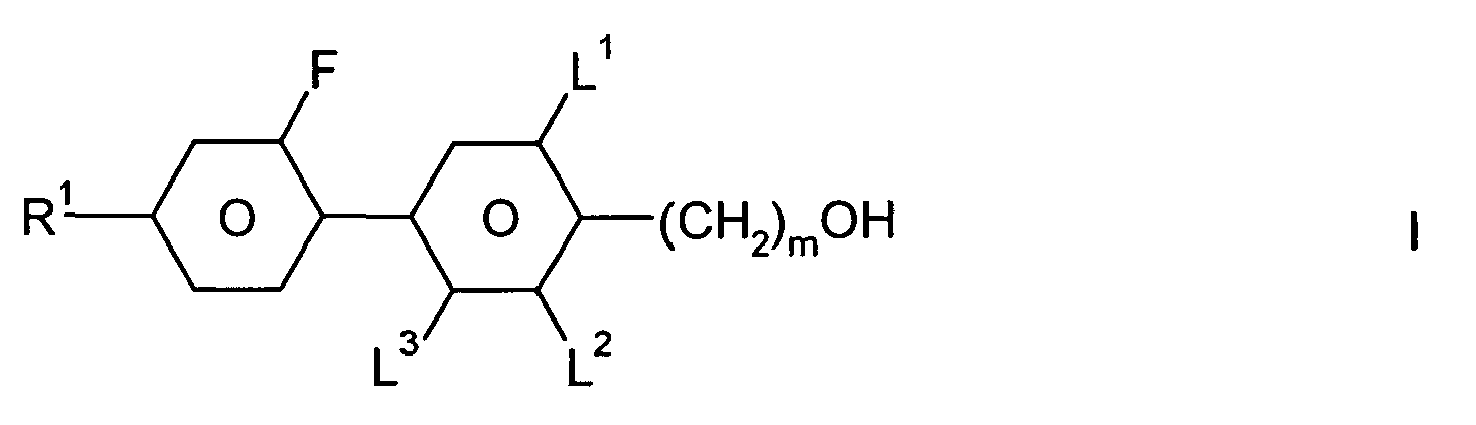
- the invention thus relates to a liquid-crystalline medium which contains
- Preferred LC mixtures according to the present invention are characterized by a negative dielectrically anisotropy ( ⁇ ).
- Liquid crystal display devices in general have a structure in which a liquid crystal mixture is sealed between a pair of insulating substrates, such as glass substrates, in such a manner that the liquid crystal molecules thereof are orientated in a predetermined direction, and an orientation film is formed on the respective substrates on the side of the liquid crystal mixture.
- a material of an orientation film there is usually used a polyimide (PI).
- PI polyimide
- Homeotropic orientation of the LC molecules is especially necessary for LC modes like PVA, PS-VA, VA, PM (passive matrix)-VA, etc., and can be achieved by the use of self-aligning additives, without the need of an orientation film.
- the mixtures according to the invention show an improved light and temperature stability compared to LC mixtures without any self-aligning additives.
- the LC mixture according to the invention contains additionally at least one polymerisable compound (also called reactive mesogen (RM)).
- RM reactive mesogen
- Such kinds of LC mixtures are highly suitable for PI-free PS-VA displays.
- the alignment of the LC molecules is induced by the self-aligning additives and the induced orientation (pre-tilt) may be additionally tuned or stabilized by the polymerization of the RMs, under conditions suitable for a multidomain switching. By the tuning of the UV-curing conditions it is possible in one single step to improve simultaneously switching time and contrast ratio.
- VHR Reliability of the mixture (VHR) after light stress (both UV-curing and Backlight (BLT)) is improved compared to LC mixtures without any self-aligning additive filled in a "classical" PI-coated test cell.
- UV-curing may be performed by using cut-filters at a wavelength by which the polymerization of the RMs is still reasonably fast and the VHR values are on an acceptable level.
- the mixtures according to the invention preferably exhibit very broad nematic phase ranges having clearing points ⁇ 70 °C, preferably ⁇ 80 °C, in particular ⁇ 90 °C, very favourable values for the capacitive threshold, relatively high values for the holding ratio and at the same time very good low-temperature stabilities at -20 °C and -30 °C, as well as relatively low rotational viscosities and short response times.
- L 1 , L 2 and L 3 are each independently preferably H or F or alkyl with 1-5 carbon atoms. In the compounds of the formula I L 1 , L 2 and L 3 denotes most preferably H.
- m is preferably 0 or 1.
- Preferred compounds of the formula I are the compounds of the sub-formulae I-1 to I-36, in which R 1 has the meanings given in Claim 1, preferably denotes a straight-chain alkyl radical having 1-7 C atoms.
- the mixture according to the invention very particularly contains at least one self-aligning additive selected from the following group of compounds of the sub-formulae in which alkyl denotes a straight-chain alkyl radical having 1 to 7 carbon atoms, preferably C 2 H 5 , n-C 3 H 7 , n-C 4 H 9 , n-C 5 H 11 , n-C 6 H 13 or n-C 7 H 15 , most preferably n-C 3 H 7 .
- alkyl denotes a straight-chain alkyl radical having 1 to 7 carbon atoms, preferably C 2 H 5 , n-C 3 H 7 , n-C 4 H 9 , n-C 5 H 11 , n-C 6 H 13 or n-C 7 H 15 , most preferably n-C 3 H 7 .
- Especially preferred mixtures contain a compound of the formula I-2a-1
- the compounds of the formula I can be prepared by methods known per se, which are described in standard works for organic chemistry as such, for example, Houben-Weyl, Methoden der organischen Chemie, Thieme-Verlag, Stuttgart.
- the compounds of the formula I can be prepared for example as follows:
- the media according to the invention preferably contain one, two, three, four or more, preferably one, self-aligning additive, preferably selected from the compounds of the formulae I-1 to I-36.
- the self-aligning additives of the formula I are preferably employed in the liquid-crystalline medium in amounts of ⁇ 0.01 % by weight, preferably 0.1-10 % by weight, based on the mixture as a whole. Particular preference is given to liquid-crystalline media which contain 0.1-5 %, preferably 0.1-4 %, by weight of one or more self-aligning additives, based on the total mixture, especially additives which are selected from the group of compounds of the formula I-1 to I-36.
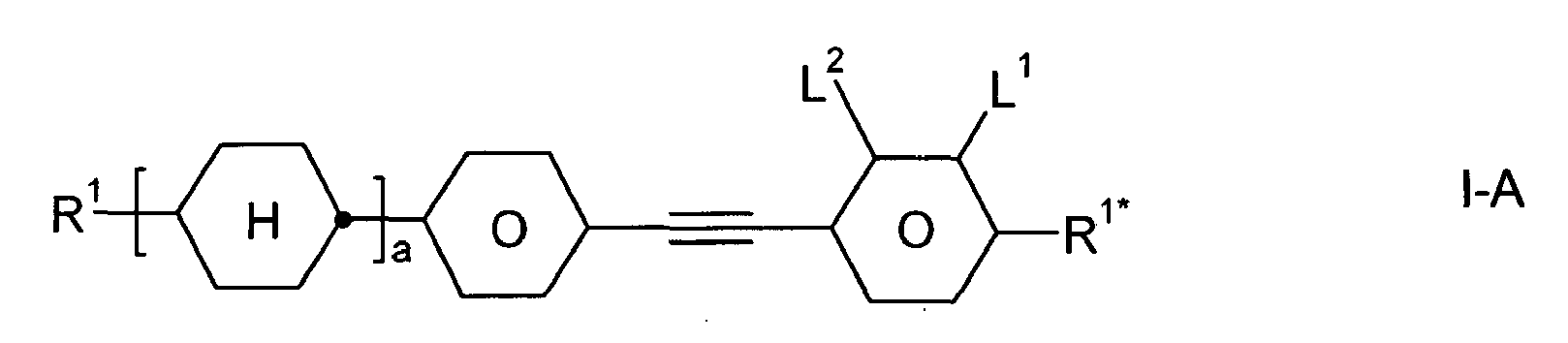
- Preferred compounds of the formulae I-A to I-K are the compounds of the formula in which alkyl and alkyl* each, independently of one another, denote a straight-chain alkyl radical having 1-6 C atoms, alkoxy or O-alkyl denotes a straight-chain alkoxy radical having 1-6 C atoms and L 1 and L 2 each, independently of one another, denote H, F, Cl, CF 3 or CHF 2 , preferably H or F.
- Preferred sub-formulae of the formula I-A are the compounds of the formula I-A-2a, I-A-4a, I-A-6a and I-A-7a.
- Preferred mixtures contain at least one compound of the formula I-A-2a and/or at least one compound of the formula I-A-4a.
- Preferred mixtures contain at least one compound of the formula IA-4a and at least one compound of the formula I-A-7a.
- Preferred mixtures contain at least one compound of the formula I-A-2a and at least one compound of the formula I-A-4a and at least one compound of the formula I-A-7a.
- Especially preferred mixtures contain at least one compound of the formula IA-2a and at least one compound of the formula I-A-4a.
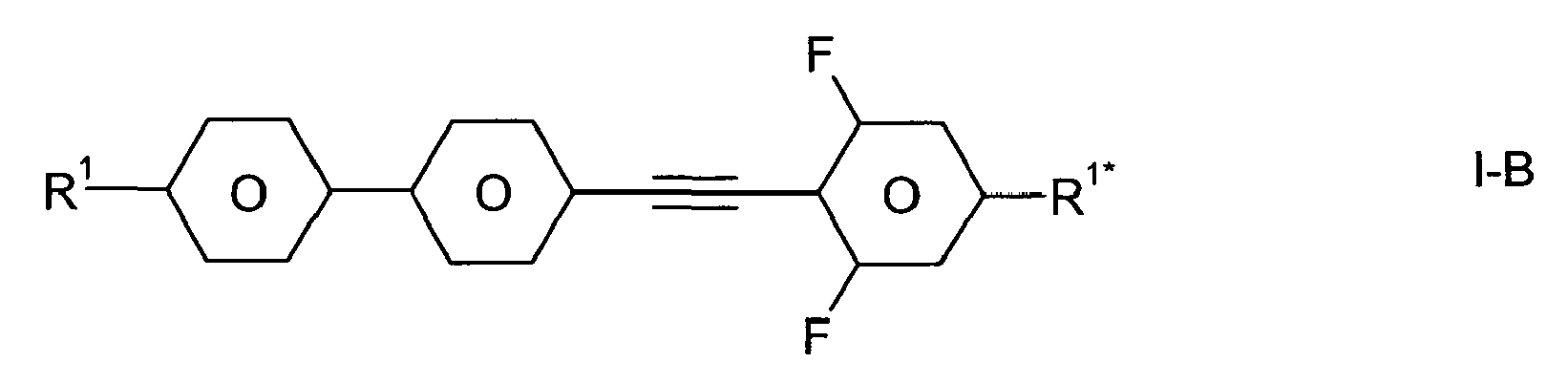
- Especially preferred mixtures contain at least one compound of the formula I-A-2a and at least one compound of the formula I-A-4a and at least one compound of the formula I-B-1.
- the media according to the invention preferably comprise one, two, three, four or more, preferably one, two or three, compounds of the formula I.
- the media according to the invention preferably comprise one, two, three, four or more, preferably one, two or three, compounds of the formulae I-A.
- the media according to the invention preferably comprise one, two, three, four or more, preferably one or two compounds of the formula I-B.
- the compounds of the formula I-A are preferably employed in the liquid crystalline medium in amounts of 5-60 % by weight, preferably 10 - 60 % by weight, based on the mixture as a whole.
- the compounds of the formula IB are preferably employed in the liquid crystalline medium in amounts of 0-35 % by weight, preferably 2 - 25 % by weight, based on the mixture as a whole.
- the compounds of the formula I-A and I-B are preferably employed in the liquid crystalline medium in amounts of ⁇ 20 % by weight, preferably 25 -60 % by weight, in particular 30-60 % by weight, based on the mixture as a whole.
- the compounds of the formula I-C to I-I are preferably employed in the liquid crystalline medium in amounts of 0.5-25 % by weight, preferably 5 - 20 % by weight, based on the mixture as a whole.
- mixtures according to the invention which comprise the following mixture concepts (the acronyms used are explained in Table A. n and m, each independently of one another denote 1-6):
- the invention furthermore relates to an electro-optical display, preferably a PI-free display, having active or passive-matrix addressing based on the ECB, VA, PS-VA, PSA, characterised in that it contains, as dielectric, a liquid-crystalline medium according to one or more of Claims 1 to 15.
- an electro-optical display preferably a PI-free display, having active or passive-matrix addressing based on the ECB, VA, PS-VA, PSA, characterised in that it contains, as dielectric, a liquid-crystalline medium according to one or more of Claims 1 to 15.
- the liquid-crystalline medium according to the invention preferably has a nematic phase from ⁇ -20 °C to ⁇ 70 °C, particularly preferably from ⁇ -30 °C to ⁇ 80 °C, very particularly preferably from ⁇ -40°C to ⁇ 110 °C.
- the expression "have a nematic phase” here means on the one hand that no smectic phase and no crystallisation are observed at low temperatures at the corresponding temperature and on the other hand that clearing still does not occur on heating from the nematic phase.
- the investigation at low temperatures is carried out in a flow viscometer at the corresponding temperature and checked by storage in test cells having a layer thickness corresponding to the electro-optical use for at least 100 hours. If the storage stability at a temperature of -20 °C in a corresponding test cell is 1000 h or more, the medium is referred to as stable at this temperature. At temperatures of -30 °C and -40 °C, the corresponding times are 500 h and 250 h respectively. At high temperatures, the clearing point is measured by conventional methods in capillaries.
- the liquid-crystal mixture preferably has a nematic phase range of at least 60 K and a flow viscosity ⁇ 20 of at most 30 mm 2 s -1 at 20 °C.
- the values of the birefringence ⁇ n in the liquid-crystal mixture are generally between 0.07 and 0.26, preferably between 0.09 and 0.20.
- the liquid-crystal mixture according to the invention has a ⁇ of -0.5 to -8.0, in particular -2.5 to -6.0, where ⁇ denotes the dielectric anisotropy.
- the rotational viscosity ⁇ 1 at 20 °C is preferably ⁇ 200 mPa ⁇ s, in particular ⁇ 150 mPa ⁇ s.
- the liquid-crystal media according to the invention have relatively low values for the threshold voltage (V 0 ). They are preferably in the range from 1.7 V to 3.0 V, particularly preferably ⁇ 2.5 V and very particularly preferably ⁇ 2.3 V.
- threshold voltage relates to the capacitive threshold (V 0 ), also known as the Freedericks threshold, unless explicitly indicated otherwise.
- liquid-crystal media according to the invention have high values for the voltage holding ratio in liquid-crystal cells.
- dielectrically positive compounds denotes compounds having a ⁇ > 1.5
- dielectrically neutral compounds denotes those having -1.5 ⁇ ⁇ ⁇ 1.5
- dielectrically negative compounds denotes those having ⁇ ⁇ -1.5.
- the dielectric anisotropy of the compounds is determined here by dissolving 10 % of the compounds in a liquid-crystalline host and determining the capacitance of the resultant mixture in at least one test cell in each case having a layer thickness of 20 ⁇ m with homeotropic and with homogeneous surface alignment at 1 kHz.
- the measurement voltage is typically 0.5 V to 1.0 V, but is always lower than the capacitive threshold of the respective liquid-crystal mixture investigated.
- the mixtures according to the invention are suitable for all VA-applications, such as, for example, VAN, MVA, (S)-PVA, ASV, PSA (polymer sustained VA) and PS-VA (polymer stabilized VA), preferably for Passive Matrix (PM) Addressing, but are also suitable for Active Matrix Addressing.
- VA-applications such as, for example, VAN, MVA, (S)-PVA, ASV, PSA (polymer sustained VA) and PS-VA (polymer stabilized VA), preferably for Passive Matrix (PM) Addressing, but are also suitable for Active Matrix Addressing.
- the nematic liquid-crystal mixtures in the displays according to the invention generally comprise two components A and B, which themselves consist of one or more individual compounds.
- Component A has significantly negative dielectric anisotropy and gives the nematic phase a dielectric anisotropy of ⁇ -0.5.
- component A comprises the compounds of the formulae IIA, IIB and/or IIC, furthermore compounds of the formula III.
- the proportion of component A is preferably between 45 and 100 %, in particular between 60 and 100 %.
- one (or more) individual compound(s) which has (have) a value of ⁇ ⁇ -0.8 is (are) preferably selected. This value must be more negative, the smaller the proportion A in the mixture as a whole.
- Component B has pronounced nematogeneity and a flow viscosity of not greater than 30 mm 2 ⁇ s -1 , preferably not greater than 25 mm 2 ⁇ s -1 , at 20 °C.
- Particularly preferred individual compounds in component B are extremely low-viscosity nematic liquid crystals having a flow viscosity of not greater than 18 mm 2 ⁇ s -1 , preferably not greater than 12 mm 2 ⁇ s -1 , at 20 °C.
- Component B is monotropically or enantiotropically nematic, has no smectic phases and is able to prevent the occurrence of smectic phases down to very low temperatures in liquid-crystal mixtures. For example, if various materials of high nematogeneity are added to a smectic liquid-crystal mixture, the nematogeneity of these materials can be compared through the degree of suppression of smectic phases that is achieved.
- the mixture may optionally also comprise a component C, comprising compounds having a dielectric anisotropy of ⁇ ⁇ 1.5.
- a component C comprising compounds having a dielectric anisotropy of ⁇ ⁇ 1.5.
- positive compounds are generally present in a mixture of negative dielectric anisotropy in amounts of ⁇ 20 % by weight, based on the mixture as a whole.
- these liquid-crystal phases may also comprise more than 18 components, preferably 18 to 25 components.
- the mixtures according to the invention contain one or more compounds of the formula I and one or more compounds of the formula I-A to I-K and preferably contain 4 to 15, in particular 5 to 12, and particularly preferably ⁇ 10, compounds of the formulae IIA, IIB and/or IIC and optionally III.
- the other constituents are preferably selected from nematic or nematogenic substances, in particular known substances, from the classes of the azoxybenzenes, benzylideneanilines, biphenyls, terphenyls, phenyl or cyclohexyl benzoates, phenyl or cyclohexyl cyclohexanecarboxylates, phenylcyclohexanes, cyclohexylbiphenyls, cyclohexylcyclohexanes, cyclohexylnaphthalenes, 1,4-biscyclohexylbiphenyls or cyclohexylpyrimidines, phenyl- or cyclohexyldioxanes, optionally halogenated stilbenes, benzyl phenyl ethers, tolans and substituted cinnamic acid esters.
- R 20 and R 21 are different from one another, one of these radicals usually being an alkyl or alkoxy group.
- Other variants of the proposed substituents are also common. Many such substances or also mixtures thereof are commercially available. All these substances can be prepared by methods known from the literature.
- VA mixture according to the invention may also comprise compounds in which, for example, H, N, O, Cl and F have been replaced by the corresponding isotopes.
- Polymerisable compounds so-called reactive mesogens (RMs), for example as disclosed in U.S. 6,861,107 , may furthermore be added to the mixtures according to the invention in concentrations of preferably 0.12 - 5% by weight, particularly preferably 0.2 - 2 % by weight, based on the mixture.
- These mixtures may optionally also comprise an initiator, as described, for example, in U.S. 6,781,665 .
- the initiator for example Irganox-1076 from Ciba, is preferably added to the mixture comprising polymerisable compounds in amounts of 0-1 %.
- PS-VA polymer-stabilised VA modes
- PSA polymer sustained VA
- the polymerisable compounds are selected from the compounds of the formula M, R Ma -AM 1 -(Z M1 -A M2 ) m1 -R Mb M in which the individual radicals have the following meanings:
- Particularly preferred compounds of the formula M are those in which
- Suitable and preferred mesogenic comonomers are selected, for example, from the following formulae: in which the individual radicals have the following meanings:
- L on each occurrence is preferably wherein L on each occurrence, identically or differently, has one of the meanings given above or below, and is preferably F, Cl, CN, NO 2 , CH 3 , C 2 H 5 , C(CH 3 ) 3 , CH(CH 3 ) 2 , CH 2 CH(CH 3 )C 2 H 5 , OCH 3 , OC 2 H 5 , COCH 3 , COC 2 H 5 , COOCH 3 , COOC 2 H 5 , CF 3 , OCF 3 , OCHF 2 , OC 2 F 5 or P-Sp-, very preferably F, Cl, CN, CH 3 , C 2 H 5 , OCH 3 , COCH 3 , OCF 3 or P-Sp-, more preferably F, Cl, CH 3 , OCH 3 , COCH 3 or OCF 3 , especially F or CH 3 .
- Suitable polymerisable compounds are furthermore listed, for example, in Table D.
- LC mixtures containing at least one polymerisable compound listed in Table D are especially preferred.
- the liquid-crystalline media in accordance with the present application preferably comprise in total 0.1 to 10 %, preferably 0.2 to 4.0 %, particularly preferably 0.2 to 2.0 %, of polymerisable compounds.
- the polymerisable compounds are preferably polymerised by photopolymerisation, for example by UV irradiation, often in the presence of at least one suitable initiator.
- the polymerisation takes place under conditions where the single components of the liquid crystalline mixture as such containing for example single compounds containing an alkenyl side chain like CC-n-V or an alkenyloxy side chain do not polymerize.
- Suitable conditions for the polymerisation and suitable types and amounts of initiator(s) are known to a person skilled in the art and are described in the literature.
- Suitable for free-radical polymerisation are, for example, commercially available photoinitiators, for example Irgacure ® 651, Irgacure ® 184 or Darocure ® 1173 (BASF).
- the polymerisable compound(s) preferably comprise from 0 to 5 % by weight, particularly preferably 0.1 to 3 % by weight of one or more photoinitiators.
- the combination of at least two liquid crystalline compounds, at least one self-aligning additive and preferably with at least one polymerisable compound, in particular one selected from the formula M and/or the formulae M1 to M41, produces low threshold voltages, low rotational viscosities, very good low temperature stabilities (LTS) in the media but at the same time high clearing points and high HR values, and enables the setting or a pretilt angle in VA displays without the need of any alignment layer, e.g., a polyimide layer.
- the mixtures according to the invention may furthermore comprise conventional additives, such as, for example, stabilisers, antioxidants, UV absorbers, nanoparticles, microparticles, etc.
- the structure of the liquid-crystal displays according to the invention corresponds to the usual geometry, as described, for example, in EP 0 240 379 .
- the following examples are intended to explain the invention without limiting it.
- per cent data denote per cent by weight; all temperatures are indicated in degrees Celsius.
- one or more compounds of the formula I and at least one compound of the formulae I-A to I-K preferably comprise one or more of the compounds from Table A indicated below.
- liquid-crystal mixtures which can be used in accordance with the invention are prepared in a manner which is conventional per se.
- the desired amount of the components used in lesser amount is dissolved in the components making up the principal constituent, advantageously at elevated temperature. It is also possible to mix solutions of the components in an organic solvent, for example in acetone, chloroform or methanol, and to remove the solvent again, for example by distillation, after thorough mixing.
- liquid-crystal phases according to the invention can be modified in such a way that they can be employed in any type of, for example, ECB, VAN, GH or ASM-VA, IPS, FFS, PS-VA, PS-IPS, PS-FFS LCD display that has been disclosed to date.
- the dielectrics may also comprise further additives known to the person skilled in the art and described in the literature, such as, for example, UV absorbers, antioxidants, nanoparticles and free-radical scavengers.
- further additives known to the person skilled in the art and described in the literature, such as, for example, UV absorbers, antioxidants, nanoparticles and free-radical scavengers.
- 0-15% of pleochroic dyes, stabilisers or chiral dopants may be added.
- Suitable stabilisers for the mixtures according to the invention are, in particular, those listed in Table C.
- pleochroic dyes may be added, furthermore conductive salts, preferably ethyldimethyldodecylammonium 4-hexoxybenzoate, tetrabutylammonium tetraphenylboranate or complex salts of crown ethers (cf., for example, Haller et al., Mol. Cryst. Liq. Cryst. Volume 24, pages 249-258 (1973 )), may be added in order to improve the conductivity or substances may be added in order to modify the dielectric anisotropy, the viscosity and/or the alignment of the nematic phases. Substances of this type are described, for example, in DE-A 22 09 127 , 22 40 864 , 23 21 632 , 23 38 281 , 24 50 088 , 26 37 430 and 28 53 728 .
- Table B shows possible dopants which can be added to the mixtures according to the invention. If the mixtures comprise a dopant, it is employed in amounts of 0.01-4% by weight, preferably 0.1-1.0% by weight.
- Stabilisers which can be added, for example, to the mixtures according to the invention in amounts of up to 10% by weight, based on the total amount of the mixture, preferably 0.01 to 6% by weight, in particular 0.1 to 3% by weight, are shown below in Table C.
- Preferred stabilisers are, in particular, BHT derivatives, for example 2,6-di-tert-butyl-4-alkylphenols, and Tinuvin 770, as well as Tunivin P and Tempol.
- Preferred reactive mesogens (polymerisable compounds) for use in the mixtures according to the invention preferably in PSA and PS-VA applications are shown in Table D below:
- m.p. denotes the melting point and C denotes the clearing point of a liquid-crystalline substance in degrees Celsius; boiling points are denoted by b.p. Furthermore:
- Step 1.2 2'-Fluoro-4'-propyl-biphenyl-4-carboxylic acid
- the display used for measurement of the threshold voltage has two plane-parallel outer plates at a separation of 20 ⁇ m and electrode layers with overlying alignment layers of JALS-2096 on the insides of the outer plates, which effect a homeotropic alignment of the liquid crystals.
- parts or per cent data denote parts by weight or per cent by weight.
- H1 Nematic host-mixture CY-3-O2 10.00 % Clearing point [°C]: 100 CY-3-O4 20.00 % ⁇ n [589 nm, 20°C]: 0.0865 CY-5-O4 20.00 % ⁇ [1 kHz, 20°C]: -5.4 CCY-3-O2 6.00 % ⁇
- the compound of the formula I-2a-1 (4 %) is added to the nematic host mixture H1 .
- the resulting mixture is homogenised and filled into an "alignment-free" test cell (cell thickness d ⁇ 4.0 ⁇ m, ITO coating on both sides (structured ITO in case of a multi-domain switching), no alignment layer and no passivation layer).
- the LC-mixture shows a spontaneous homeotropic (vertical) orientation with respect to the surface of the substrates.
- the orientation is stable until the clearing point and the resulting VA-cell can be reversibly switched.
- Crossed polarizers are needed to display the switching.
- no alignment layer e.g. no PI coating
- PVA polyvinyl alcohol
- MVA polyvinyl acrylate
- other analogue display technologies with vertically aligned liquid crystals.
- the compound of the formula I-2a-1 (2 %) is added to the nematic host mixture H1 .
- the resulting mixture is homogenised and filled into an "alignment-free" test cell (cell thickness d ⁇ 4.0 ⁇ m, ITO coating on both sides (structured ITO in case of a multi-domain switching), no alignment layer and no passivation layer).
- the LC-mixture shows a spontaneous homeotropic (vertical) orientation with respect to the surface of the substrates.
- the orientation is stable until the clearing point and the resulting VA-cell can be reversibly switched.
- Crossed polarizers are needed to display the switching.
- no alignment layer e.g. no PI coating
- PVA polyvinyl alcohol
- MVA polyvinyl acrylate
- other analogue display technologies with vertically aligned liquid crystals.
- the polymerizable derivative RM-1 (0.3 %) is added to the nematic LC-mixture of Example M1-a .
- the resulting mixture is homogenised and filled into an "alignment-free" test cell (cell thickness d ⁇ 4.0 ⁇ m, ITO coating on both sides (structured ITO in case of a multi-domain switching), no alignment layer and no passivation layer).
- the LC-mixture shows a spontaneous homeotropic (vertical) orientation, with respect to the surface of the substrates.
- the resulting VA-cell is treated with UV-light (15 min, 100 mW/cm 2 ) after having applied to the cell a voltage higher than the optical threshold.
- the polymerizable derivative polymerizes and, as a consequence, the homeotropic self-orientation is stabilized and the tilt of the mixture is tuned.
- the resulting PSA-VA-cell can be reversibly switched even at high temperatures. The switching times are reduced, compared to the not polymerized system.
- Additives like Irganox 1076 may be added (e.g. 0.001%) for preventing spontaneous polymerization.
- UV-cut filter may be used during polymerization for preventing damage of the mixtures (e.g. 340 nm cut-off-filter).
- the polymerizable derivative RM-41 (0.3 %) is added to the nematic LC-mixture of Example M1-a.
- the resulting mixture is homogenised and filled into an "alignment-free" test cell (cell thickness d ⁇ 4.0 ⁇ m, ITO coating on both sides (structured ITO in case of a multi-domain switching), no alignment layer and no passivation layer).
- the resulting cell is treated according to Example 1 P a) and similar results are obtained.
- the compound of the formula I-2a-1 (4%) is added to the nematic host mixtures H2 - H134 .
- the resulting mixtures M2 to M134 are homogenised and filled into an "alignment-free" test cell (cell thickness d ⁇ 4.0 ⁇ m, ITO coating on both sides (structured ITO in case of a multi-domain switching), no alignment layer and no passivation layer).
- the LC-mixtures show a spontaneous homeotropic (vertical) orientation with respect to the surface of the substrates.
- the orientation is stable until the clearing point and the resulting VA-cell can be reversibly switched.
- Crossed polarizers are needed to display the switching.
- the polymerizable derivative RM-1 (0.3 %) or RM-41 (0.3 %) is added to the nematic LC mixtures of Examples M2 - M134 .
- the resulting mixtures are homogenised and filled into an "alignment-free" test cell (cell thickness d ⁇ 4.0 ⁇ m, ITO coating on both sides (structured ITO in case of a multi-domain switching), no alignment layer and no passivation layer).
- the resulting cell is treated according to example 1 P a). Equivalent results are obtained.
- Analogues mixtures like 1 P a) to 134 P b) are obtained by mixing the nematic LC mixtures M1 to M134 with RM35 (0.3 %), RM43 (0.3 %), RM55 (0.3 %) or RM83 (0.3 %), obtaining mixtures 1 P c) to 134 P f). These mixtures are treated according to Example 1 P a). In all cases an improvement of the switching times is found.
- the multi bottle bottle system is prepared by mixing of
- Examples M135 to M139 are highly suitable for PM (passive matrix)-VA applications.
Landscapes
- Chemical & Material Sciences (AREA)
- Crystallography & Structural Chemistry (AREA)
- Engineering & Computer Science (AREA)
- Materials Engineering (AREA)
- Organic Chemistry (AREA)
- Physics & Mathematics (AREA)
- Nonlinear Science (AREA)
- Mathematical Physics (AREA)
- General Physics & Mathematics (AREA)
- Optics & Photonics (AREA)
- Liquid Crystal Substances (AREA)
- Liquid Crystal (AREA)
Abstract
• at least one compound of the formula I,
• at least one compound selected from the group of compounds of the formulae IA to I-K,









and to the use of the LC mixtures for an active- or passive matrix addressed displays, in particular based on the VA, PSA,PS-VA, IPS, FFS, PS-IPS, PS-FFS technology, preferably in optical displays for the self-aligning VA mode.
Description
- The invention relates to a liquid-crystalline medium for LC displays, especially for displays without any orientation layer, i.e. polyimide layer which contain at least one self-aligning additive.
- Media of this type can be used, in particular, for electro-optical displays having active-matrix or passive-matrix addressing based on the ECB effect.
- The principle of electrically controlled birefringence, the ECB effect or also DAP (deformation of aligned phases) effect, was described for the first time in 1971 (M.F. Schieckel and K. Fahrenschon, "Deformation of nematic liquid crystals with vertical orientation in electrical fields", Appl. Phys. Lett. 19 (1971), 3912). This was followed by papers by J.F. Kahn (Appl. Phys. Lett. 20 (1972), 1193) and G. Labrunie and J. Robert (J. App!. Phys. 44 (1973), 4869).
- The papers by J. Robert and F. Clerc (SID 80 Digest Techn. Papers (1980), 30), J. Duchene (Displays 7 (1986), 3) and H. Schad (SID 82 Digest Techn. Papers (1982), 244) showed that liquid-crystalline phases must have high values for the ratio of the elastic constants K3/K1, high values for the optical anisotropy Δn and values for the dielectric anisotropy of Aε ≤ -0.5 in order to be suitable for use in high-information display elements based on the ECB effect. Electro-optical display elements based on the ECB effect have a homeotropic edge alignment (VA technology = vertically aligned).
- Displays which use the ECB effect, as so-called VAN vertically aligned nematic) displays, for example in the MVA (multi-domain vertical alignment, for example: Yoshide, H. et al., paper 3.1: "MVA LCD for Notebook or Mobile PCs ...", SID 2004 International Symposium, Digest of Technical Papers, XXXV, Book I, pp. 6 to 9, and Liu, C.T. et al., paper 15.1: "A 46-inch TFT-LCD HDTV Technology ...", SID 2004 International Symposium, Digest of Technical Papers, XXXV, Book II, pp. 750 to 753), PVA (patterned vertical alignment, for example: Kim, Sang Soo, paper 15.4: "Super PVA Sets New State-of-the-Art for LCD-TV", SID 2004 International Symposium, Digest of Technical Papers, XXXV, Book II, pp. 760 to 763), ASV (advanced super view, for example: Shigeta, Mitzuhiro and Fukuoka, Hirofumi, paper 15.2: "Development of High Quality LCDTV", SID 2004 International Symposium, Digest of Technical Papers, XXXV, Book II, pp. 754 to 757) modes, have established themselves as one of the three more recent types of liquid-crystal display that are currently the most important, in particular for television applications, besides IPS (in-plane switching) displays (for example: Yeo, S.D., paper 15.3: "An LC Display for the TV Application", SID 2004 International Symposium, Digest of Technical Papers, XXXV, Book II, pp. 758 & 759) and the long-known TN (twisted nematic) displays. The technologies are compared in general form, for example, in Souk, Jun, SID Seminar 2004, seminar M-6: "Recent Advances in LCD Technology", Seminar Lecture Notes, M-6/1 to M-6/26, and Miller, Ian, SID Seminar 2004, seminar M-7: "LCD-Television", Seminar Lecture Notes, M-7/1 to M-7/32. Although the response times of modern ECB displays have already been significantly improved by addressing methods with overdrive, for example: Kim, Hyeon Kyeong et al., paper 9.1: "A 57-in. Wide UXGA TFT-LCD for HDTV Application", SID 2004 International Symposium, Digest of Technical Papers, XXXV, Book I, pp. 106 to 109, the achievement of video-compatible response times, in particular on switching of grey shades, is still a problem which has not yet been satisfactorily solved.
- Industrial application of this effect in electro-optical display elements requires LC phases, which have to satisfy a multiplicity of requirements. Particularly important here are chemical resistance to moisture, air and physical influences, such as heat, infrared, visible and ultraviolet radiation and direct and alternating electric fields.
- Furthermore, industrially usable LC phases are required to have a liquid-crystalline mesophase in a suitable temperature range and low viscosity.
- None of the hitherto-disclosed series of compounds having a liquid-crystalline mesophase includes a single compound which meets all these requirements. Mixtures of two to 25, preferably three to 18, compounds are therefore generally prepared in order to obtain substances which can be used as LC phases. However, it has not been possible to prepare optimum phases easily in this way since no liquid-crystal materials having significantly negative dielectric anisotropy and adequate long-term stability were hitherto available.
- Matrix liquid-crystal displays (MLC displays) are known. Non-linear elements which can be used for individual switching of the individual pixels are, for example, active elements (i.e. transistors). The term "active matrix" is then used, where a distinction can be made between two types:
- 1. MOS (metal oxide semiconductor) transistors on a silicon wafer as substrate
- 2. thin-film transistors (TFTs) on a glass plate as substrate.
- In the case of type 1, the electro-optical effect used is usually dynamic scattering or the guest-host effect. The use of single-crystal silicon as substrate material restricts the display size, since even modular assembly of various part-displays results in problems at the joints.
- In the case of the more promising type 2, which is preferred, the electro-optical effect used is usually the TN effect.
- A distinction is made between two technologies: TFTs comprising compound semiconductors, such as, for example, CdSe, or TFTs based on polycrystalline or amorphous silicon. The latter technology is being worked on intensively worldwide.
- The TFT matrix is applied to the inside of one glass plate of the display, while the other glass plate carries the transparent counterelectrode on its inside. Compared with the size of the pixel electrode, the TFT is very small and has virtually no adverse effect on the image. This technology can also be extended to fully colour-capable displays, in which a mosaic of red, green and blue filters is arranged in such a way that a filter element is opposite each switchable pixel.
- The term MLC displays here covers any matrix display with integrated non-linear elements, i.e. besides the active matrix, also displays with passive elements, such as varistors or diodes (MIM = metal-insulator-metal).
- MLC displays of this type are particularly suitable for TV applications (for example pocket TVs) or for high-information displays in automobile or aircraft construction. Besides problems regarding the angle dependence of the contrast and the response times, difficulties also arise in MLC displays due to insufficiently high specific resistance of the liquid-crystal mixtures [TOGASHI, S., SEKIGUCHI, K., TANABE, H., YAMAMOTO, E., SORI-MACHI, K., TAJIMA, E., WATANABE, H., SHIMIZU, H., Proc. Eurodisplay 84, Sept. 1984: A 210-288 Matrix LCD Controlled by Double Stage Diode Rings, pp. 141 ff., Paris; STROMER, M., Proc. Eurodisplay 84, Sept. 1984: Design of Thin Film Transistors for Matrix Addressing of Television Liquid Crystal Displays, pp. 145 ff., Paris]. With decreasing resistance, the contrast of an MLC display deteriorates. Since the specific resistance of the liquid-crystal mixture generally drops over the life of an MLC display owing to interaction with the inside surfaces of the display, a high (initial) resistance is very important for displays that have to have acceptable resistance values over a long operating period.
- There thus continues to be a great demand for MLC displays having very high specific resistance at the same time as a large working-temperature range, short response times and a low threshold voltage with the aid of which various grey shades can be produced.
- The disadvantage of the frequently-used MLC-TN displays is due to their comparatively low contrast, the relatively high viewing-angle dependence and the difficulty of generating grey shades in these displays.
- VA displays have significantly better viewing-angle dependencies and are therefore principally used for televisions and monitors. However, there continues to be a need here to improve the response times, in particular with respect to the use of televisions having frame rates (image change frequency/repetition rates) of greater than 60 Hz. At the same time, however, the properties, such as, for example, the low-temperature stability, must not be impaired.
- The reliability of liquid crystal (LC) mixtures is one of the major issues in today's LCD industry. A main aspect is the stability of the liquid crystal molecules towards the light emitted from the backlight unit of the LCD. Light induced reactions of the LC material can cause display defects known as image sticking. This strongly reduces the lifetime of the LCD and is one of the main reliability criterions in LCD industry.
- For example, liquid crystal mixtures containing LC materials with alkenyl-moieties often show some kind of degradation during long term backlight irradiation. This degradation can be observed by measuring the Voltage Holding Ratio (VHR) of the LC mixtures which have been objected to backlight irradiation for a defined time period.
- Also other kinds of irradiation, like the UV-light, necessary for the curing of reactive mesogens (RMs), especially for the PS-VA technology, may lead to a reduction of the VHR values of a test-cell or of a display. The use of cut-filters in order to reduce this effect is of limited applicability. By increasing the wavelength of the curing-light the VHR is improved, but at the same time the reaction speed of the RMs is reduced and this effect does not fit with the requirements of the LCD industry.
- Thus, a solution is needed by which the light induced degradation of a LC mixture is strongly reduced. Especially, in terms of LCD performance, there is an interest to use liquid-crystalline compounds containing an alkenyl side chain in order to achieve faster switching times and hence better moving picture performances. Especially since the trend for LCD TC clearly is to go to higher frame rates, e.g. 200 Hz or higher, also including 3D applications.
- The invention thus has an object of providing self-aligning additives and liquid-crystal mixtures, in particular for monitor and TV applications, which are based on the ECB effect especially for VA, PSA and PS-VA applications, which do not have the above-mentioned disadvantages or only do so to a reduced extent. In particular, it must be ensured for monitors and televisions that they also operate at extremely high and extremely low temperatures and have short response times and at the same time have improved reliability behaviour, in particular have no or significantly reduced image sticking after long operating times.
- In conventional VA-displays a polyimide (PI) layer is needed for inducing the required homeotropic orientation of the LC. Beside the significant costs due to its production, unfavourable interaction between PI and LC often leads to a reduction of the electric resistance of the VA-display. The number of useful LC molecules is thus significantly reduced, at the expenses of the overall switching performances (e.g. higher switching times) of the display. Getting rid of PI is thus desirable, while providing an alternative for the required homeotropic orientation.
- It has now been found that these and other objects can be achieved if LC media according to the invention are used in LC displays, especially in displays without any orientation layer (polyimide layer).
- LC mixtures which contain at least one compound of the formula I are already known from
WO 2014/090362 A1 . Contrary to the mixtures of the prior art the LC mixtures of the present invention combines the use of the aligning additive and of relatively large amounts of materials to enhance to clearing temperature by maintaining a good low temperature stability of at least 1000 h at -20 °C so that the mixtures are preferably suitable for outdoor use. - The gist of the present invention is that it is possible to provide such mixtures with high clearing points of preferably > 80°C and good low temperature stability (LTS).
- The invention thus relates to a liquid-crystalline medium which contains
- at least one compound of the formula I,

- R1
- denotes an alkyl or alkoxy radical having 1 to 15 C atoms, where, in addition, one or more CH2 groups in these radicals may each be replaced, independently of one another, by -C≡C-, -CF2O-, -CH=CH-,
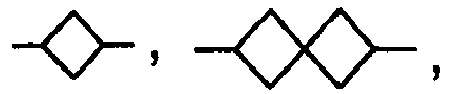
- L1, L2 and L3
- each, independently of one another, denote H, F, Cl, CF3, CHF2 or alkyl with 1-5 carbon atoms, preferably F or alkyl, and
- m
- denotes 0, 1, 2, 3, 4, 5 or 6
- at least one compound selected from the group of compounds of the formulae IA to I-K,



- R1, R1* and R2
- each, independently of one another, denote an alkyl or alkoxy radical having 1 to 15 C atoms, where, in addition, one or more CH2 groups in these radicals may each be replaced, independently of one another, by -C≡C-, -CF2O-, -CH=CH-,

- a
- 0 or 1,
- L1 and L2
- each, independently of one another, denote H, F, Cl, CF3 or CHF2, preferably H or F.
- Preferred LC mixtures according to the present invention are characterized by a negative dielectrically anisotropy (Δε).
- Such kinds of mixtures are highly suitable for the use in displays which do not contain any orientation layer. Liquid crystal display devices, in general have a structure in which a liquid crystal mixture is sealed between a pair of insulating substrates, such as glass substrates, in such a manner that the liquid crystal molecules thereof are orientated in a predetermined direction, and an orientation film is formed on the respective substrates on the side of the liquid crystal mixture. As a material of an orientation film, there is usually used a polyimide (PI). Homeotropic orientation of the LC molecules is especially necessary for LC modes like PVA, PS-VA, VA, PM (passive matrix)-VA, etc., and can be achieved by the use of self-aligning additives, without the need of an orientation film. The mixtures according to the invention show an improved light and temperature stability compared to LC mixtures without any self-aligning additives.
- In a preferred embodiment, the LC mixture according to the invention contains additionally at least one polymerisable compound (also called reactive mesogen (RM)). Such kinds of LC mixtures are highly suitable for PI-free PS-VA displays. The alignment of the LC molecules is induced by the self-aligning additives and the induced orientation (pre-tilt) may be additionally tuned or stabilized by the polymerization of the RMs, under conditions suitable for a multidomain switching. By the tuning of the UV-curing conditions it is possible in one single step to improve simultaneously switching time and contrast ratio. Reliability of the mixture (VHR) after light stress (both UV-curing and Backlight (BLT)) is improved compared to LC mixtures without any self-aligning additive filled in a "classical" PI-coated test cell. Furthermore, the UV-curing may be performed by using cut-filters at a wavelength by which the polymerization of the RMs is still reasonably fast and the VHR values are on an acceptable level.
- The mixtures according to the invention preferably exhibit very broad nematic phase ranges having clearing points ≥ 70 °C, preferably ≥ 80 °C, in particular ≥ 90 °C, very favourable values for the capacitive threshold, relatively high values for the holding ratio and at the same time very good low-temperature stabilities at -20 °C and -30 °C, as well as relatively low rotational viscosities and short response times.
- Some preferred embodiments of the mixtures according to the invention are indicated below.
- In the compounds of the formulae I R1 preferably denotes straight-chain alkyl, in particular CH3, C2H5, n-C3H7, n-C4H9, n-C5H11, n-C6H13, furthermore alkenyloxy, in particular OCH2CH=CH2, OCH2CH=CHCH3, OCH2CH=CHC2H5, alkoxy, in particular OC2H5, OC3H7, OC4H9, OC5H11 and OC6H13.
- In the compounds of the formula I L1, L2 and L3 are each independently preferably H or F or alkyl with 1-5 carbon atoms. In the compounds of the formula I L1, L2 and L3 denotes most preferably H.
- m is preferably 0 or 1.
- Preferred compounds of the formula I are the compounds of the sub-formulae I-1 to I-36,











R1 has the meanings given in Claim 1, preferably denotes a straight-chain alkyl radical having 1-7 C atoms. - The mixture according to the invention very particularly contains at least one self-aligning additive selected from the following group of compounds of the sub-formulae



alkyl denotes a straight-chain alkyl radical having 1 to 7 carbon atoms, preferably C2H5, n-C3H7, n-C4H9, n-C5H11, n-C6H13 or n-C7H15, most preferably n-C3H7. - Especially preferred mixtures contain a compound of the formula I-2a-1

- The compounds of the formula I can be prepared by methods known per se, which are described in standard works for organic chemistry as such, for example, Houben-Weyl, Methoden der organischen Chemie, Thieme-Verlag, Stuttgart.
- The compounds of the formula I can be prepared for example as follows:

- The media according to the invention preferably contain one, two, three, four or more, preferably one, self-aligning additive, preferably selected from the compounds of the formulae I-1 to I-36.
- The self-aligning additives of the formula I are preferably employed in the liquid-crystalline medium in amounts of ≥ 0.01 % by weight, preferably 0.1-10 % by weight, based on the mixture as a whole. Particular preference is given to liquid-crystalline media which contain 0.1-5 %, preferably 0.1-4 %, by weight of one or more self-aligning additives, based on the total mixture, especially additives which are selected from the group of compounds of the formula I-1 to I-36.
- The use of preferably 2.5 to 5 % by weight of the compounds of the formula I results in a complete homeotropic alignment of the LC layer for conventional LC thickness (3 to 4 µm) and for the substrate materials used in the display industry. Special surface treatment may allow to significantly reduce the amount of the compound(s) of the formula I which means less than 2.5 % by weight.
- Preferred compounds of the formulae I-A to I-K are the compounds of the formula


alkyl and alkyl* each, independently of one another, denote a straight-chain alkyl radical having 1-6 C atoms,
alkoxy or O-alkyl denotes a straight-chain alkoxy radical having 1-6 C atoms and
L1 and L2 each, independently of one another, denote H, F, Cl, CF3 or CHF2, preferably H or F. - In particular, the following compounds of the formula I-A are preferred


alkyl, alkyl* and alkoxy have the meanings indicated above. - Preferred sub-formulae of the formula I-A are the compounds of the formula I-A-2a, I-A-4a, I-A-6a and I-A-7a.
- Preferred mixtures contain at least one compound of the formula I-A-2a and/or at least one compound of the formula I-A-4a.
- Preferred mixtures contain at least one compound of the formula IA-4a and at least one compound of the formula I-A-7a.
- Preferred mixtures contain at least one compound of the formula I-A-2a and at least one compound of the formula I-A-4a and at least one compound of the formula I-A-7a.
- Especially preferred mixtures contain at least one compound of the formula IA-2a and at least one compound of the formula I-A-4a.
- Especially preferred mixtures contain at least one compound of the formula I-A-2a and at least one compound of the formula I-A-4a and at least one compound of the formula I-B-1.
- The media according to the invention preferably comprise one, two, three, four or more, preferably one, two or three, compounds of the formula I.
- The media according to the invention preferably comprise one, two, three, four or more, preferably one, two or three, compounds of the formulae I-A.
- The media according to the invention preferably comprise one, two, three, four or more, preferably one or two compounds of the formula I-B.
- The compounds of the formula I-A are preferably employed in the liquid crystalline medium in amounts of 5-60 % by weight, preferably 10 - 60 % by weight, based on the mixture as a whole. The compounds of the formula IB are preferably employed in the liquid crystalline medium in amounts of 0-35 % by weight, preferably 2 - 25 % by weight, based on the mixture as a whole. The compounds of the formula I-A and I-B are preferably employed in the liquid crystalline medium in amounts of ≥ 20 % by weight, preferably 25 -60 % by weight, in particular 30-60 % by weight, based on the mixture as a whole.
- The compounds of the formula I-C to I-I are preferably employed in the liquid crystalline medium in amounts of 0.5-25 % by weight, preferably 5 - 20 % by weight, based on the mixture as a whole.
- Preferred embodiments of the liquid-crystalline medium according to the invention are indicated below:
- a) Liquid-crystalline medium which additionally comprises one or more compounds selected from the group of the compounds of the formulae IIA, IIB and IIC:


- R2A, R2B and R2C
- each, independently of one another, denote H, an alkyl or alkenyl radical having up to 15 C atoms which is unsubstituted, monosubstituted by CN or CF3 or at least monosubstituted by halogen, where, in addition, one or more CH2 groups in these radicals may be replaced by -O-, -S-,

- L1-4
- each, independently of one another, denote F, Cl, CF3 or CHF2,
- Z2 and Z2'
- each, independently of one another, denote a single bond, -CH2CH2-, -CH=CH-, -CF2O-, -OCF2-, -CH2O-, -OCH2-, -COO-, -OCO-, -C2F4-, -CF=CF-, -CH=CHCH2O-,
- p
- denotes 0, 1 or 2,
- q
- denotes 0 or 1, and
- v
- denotes 1 to 6.
In the compounds of the formulae IIA, IIB and IIC, R2A, R2B and R2C each preferably denote alkyl having 1-6 C atoms, in particular CH3, C2H5, n-C4H9, n-C5H11.
In the compounds of the formulae IIA and IIB, L1, L2, L3 and L4 preferably denote L1 = L2 = F and L3 = L4 = F, furthermore L1 = F and L2 = Cl, L1 = Cl and L2 = F, L3 = F and L4 = Cl, L3 = Cl and L4 = F. Z2 and Z2' in the formulae IIA and IIB preferably each, independently of one another, denote a single bond, furthermore a -C2H4- or -CH2O-bridge.
If in the formula IIB Z2 = -C2H4- or -CH2O-, Z2' is preferably a single bond or, if Z2' = -C2H4- or -CH2O-, Z2 is preferably a single bond. In the compounds of the formulae IIA and IIB, (O)CvH2v+1 preferably denotes OCvH2v+1, furthermore CvH2v+1. In the compounds of the formula IIC, (O)CvH2v+1 preferably denotes CvH2v+1. In the compounds of the formula IIC, L3 and L4 preferably each denote F.
Preferred compounds of the formulae IIA, IIB and IIC are indicated below:









































Particularly preferred mixtures according to the invention comprise one or more compounds of the formulae IIA-2, IIA-8, IIA-14, IIA-29, IIA-35, IIA-74, IIB-2, IIB-11, IIB-16 and IIC-1.
The proportion of compounds of the formulae IIA and/or IIB in the mixture as a whole is preferably at least 10 % by weight.
Particularly preferred media according to the invention comprise at least one compound of the formula IIC-1,
- b) Liquid-crystalline medium which additionally comprises one or more compounds of the formula III,

- R31 and R32
- each, independently of one another, denote a straight-chain alkyl, alkoxyalkyl, alkenyl or alkoxy radical having up to 12 C atoms, and


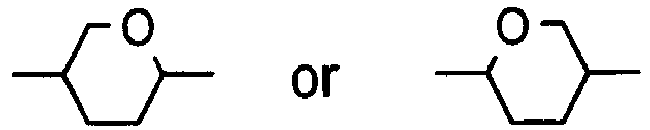
- Z3
- denotes a single bond, -CH2CH2-, -CH=CH-, -CF2O-, -OCF2-, -CH2O-, -OCH2-, -COO-, -OCO-, -C2F4-, -C4H8-, -CF=CF-.




- alkyl and alkyl*
- each, independently of one another, denote a straight-chain alkyl radical having 1-6 C atoms.
The proportion of compounds of the formula III in the mixture as a whole is preferably at least 5% by weight. - c) Liquid-crystalline medium additionally comprising a compound of the formula


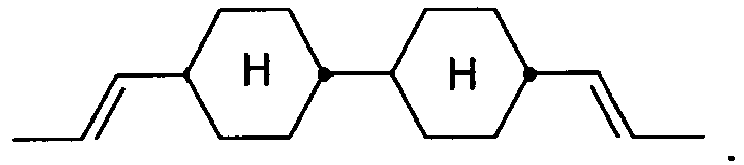
Preference is given to mixtures according to the invention comprising the compound
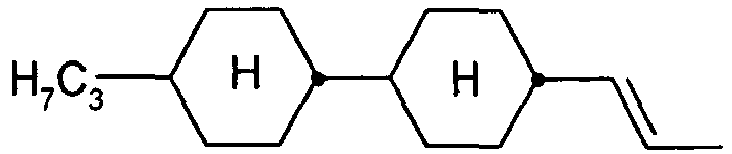

- d) Liquid-crystalline medium which additionally comprises one or more tetracyclic compounds of the formulae



- R7-10
- each, independently of one another, have one of the meanings indicated for R2A in Claim 5, and
- w and x
- each, independently of one another, denote 1 to 6.
- e) Liquid-crystalline medium which additionally comprises one or more compounds of the formulae Y-1 to Y-6,




The medium according to the invention particularly preferably comprises one or more compounds of the formulae Y-1 to Y-6, preferably in amounts of ≥ 5% by weight. - f) Liquid-crystalline medium additionally comprising one or more fluorinated terphenyls of the formulae T-1 to T-21,











R denotes a straight-chain alkyl or alkoxy radical having 1-7 C atoms, and m = 0, 1, 2, 3, 4, 5 or 6 and n denotes 0, 1, 2, 3 or 4.
R preferably denotes methyl, ethyl, propyl, butyl, pentyl, hexyl, methoxy, ethoxy, propoxy, butoxy, pentoxy.
The medium according to the invention preferably comprises the terphenyls of the formulae T-1 to T-21 in amounts of 2-30 % by weight, in particular 5-20 % by weight.
Particular preference is given to compounds of the formulae T-1, T-2, T-20 and T-21. In these compounds, R preferably denotes alkyl, furthermore alkoxy, each having 1-5 C atoms. In the compounds of the formula T-20, R preferably denotes alkyl or alkenyl, in particular alkyl. In the compound of the formula T-21, R preferably denotes alkyl.
The terphenyls are preferably employed in the mixtures according to the invention if the Δn value of the mixture is to be ≥ 0.1. Preferred mixtures comprise 2-20 % by weight of one or more terphenyl compounds selected from the group of the compounds T-1 to T-21. - g) Liquid-crystalline medium additionally comprising one or more biphenyls of the formulae B-1 to B-3,


- alkyl and alkyl*
- each, independently of one another, denote a straight-chain alkyl radical having 1-6 C atoms, and
- alkenyl and alkenyl*
- each, independently of one another, denote a straight-chain alkenyl radical having 2-6 C atoms.
Of the compounds of the formulae B-1 to B-3, the compounds of the formula B-2 are particularly preferred.
Particularly preferred biphenyls are



- h) Liquid-crystalline medium comprising at least one compound of the formulae Z-1 to Z-7,




- i) Liquid-crystalline medium comprising at least one compound of the formulae O-1 to O-11,






Mixtures according to the invention very particularly preferably comprise the compounds of the formula O-5, O-7, O-9, O-10 and/or O-11, in particular in amounts of 5-30 %.
Preferred compounds of the formulae O-5 and O-10 are indicated below:





Very particularly preferred mixtures comprise compounds O-5a and O-10a:

Very particularly preferred mixtures comprise compounds O-5b and O-10a:

Very particularly preferred mixtures comprise the following three compounds:


- j) Preferred liquid-crystalline media according to the invention comprise one or more substances which contain a tetrahydronaphthyl or naphthyl unit, such as, for example, the compounds of the formulae N-1 to N-5,
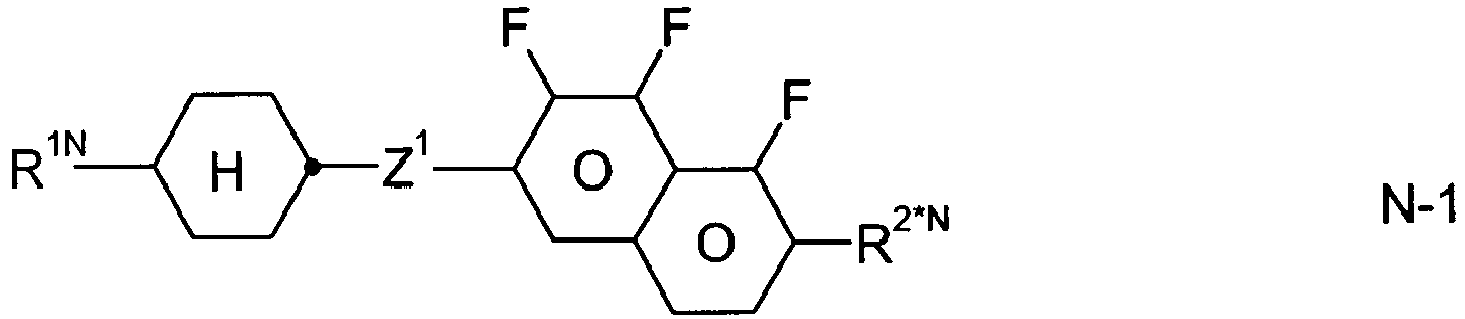


- Z1 and Z2
- each, independently of one another, denote -C2H4-, -CH=CH-, -(CH2)4-, -(CH2)3O-, -O(CH2)3-, -CH=CHCH2CH2-, -CH2CH2CH=CH-, -CH2O-, -OCH2-, -COO-, -OCO-, -C2F4-, -CF=CF-, -CF=CH-, -CH=CF-, -CF2O-, -OCF2-, -CH2- or a single bond.
- k) Preferred mixtures comprise one or more compounds selected from the group of the difluorodibenzochromane compounds of the formula BC, chromans of the formula CR, fluorinated phenanthrenes of the formulae PH-1 and PH-2, fluorinated dibenzofurans of the formula BF-1 and BF-2 and fluorinated dibenzothiophene compounds of the formula BS-1 and BS-2,





RB1, RB2, RCR1, RCR2, R1, R2 each, independently of one another, have the meaning of R2A. c denotes 0, 1 or 2 and d denotes 1 or 2.
The mixtures according to the invention preferably comprise the compounds of the formulae BC, CR, PH-1, PH-2, BF-1, BF-2, BS-1 and/or BS-2 in amounts of 3 to 20 % by weight, in particular in amounts of 3 to 15 % by weight.
Particularly preferred compounds of the formulae BC, CR, BF-1 are the compounds BC-1 to BC-7 and CR-1 to CR-5,















- alkyl and alkyl*
- each, independently of one another, denote a straight-chain alkyl radical having 1-6 C atoms, and
- alkenyl and alkenyl*
- each, independently of one another, denote a straight-chain alkenyl radical having 2-6 C atoms.
- l) Preferred mixtures comprise one or more indane compounds of the formula In,

- R13
- each, independently of one another, denote a straight-chain alkyl, alkoxy, alkoxyalkyl or alkenyl radical having 1-6 C atoms,
- R12 and R13
- additionally denote H or halogen,


- i
- denotes 0, 1 or 2.
Preferred compounds of the formula In are the compounds of the formulae In-1 to In-16 indicated below:


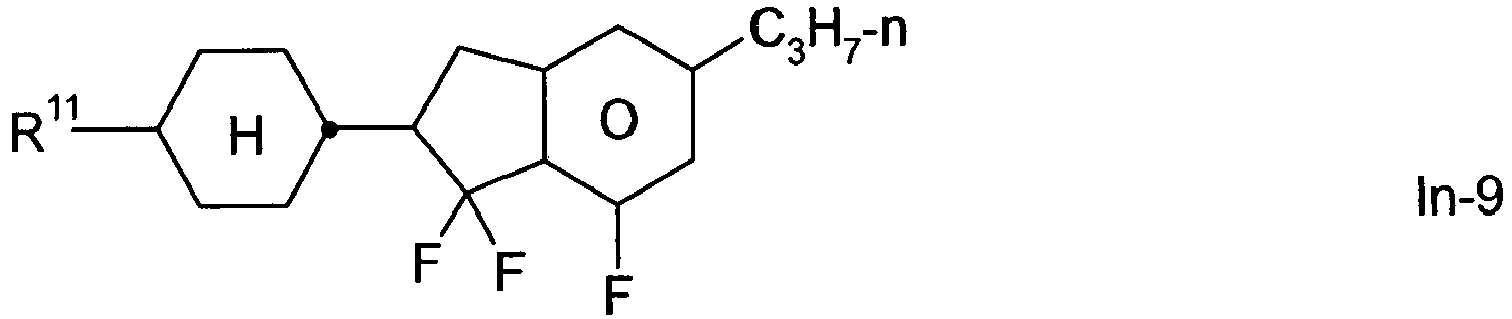


The compounds of the formula In and the sub-formulae In-1 to In-16 are preferably employed in the mixtures according to the invention in concentrations ≥ 5 % by weight, in particular 5 - 30 % by weight and very particularly preferably 5 - 25 % by weight. - m) Preferred mixtures additionally comprise one or more compounds of the formulae L-1 to L-11,





R, R1 and R2 each, independently of one another, have the meanings indicated for R2A in Claim 5, and alkyl denotes an alkyl radical having 1-6 C atoms. s denotes 1 or 2.
Particular preference is given to the compounds of the formulae L-1 and L-4, in particular L-4.
The compounds of the formulae L-1 to L-11 are preferably employed in concentrations of 5 - 50 % by weight, in particular 5 - 40 % by weight and very particularly preferably 10 - 40 % by weight.
Preferred mixtures having negative dielectric anisotropy contain at least one compound of the formula P,
- Preference in particular is given to mixtures according to the invention which comprise the following mixture concepts (the acronyms used are explained in Table A. n and m, each independently of one another denote 1-6):
- The mixture according to the invention preferably contains
- at least one self-aligning additive of the formula I-2a-1,

and/or- PTP-nOmFF and CPTP-nOmFF and PPTUI-n-m,
- PTP-nOmFF and CPTP-nOmFF and PPTUI-n-m and CC-n-V,
- PTP-nOmFF and CPTP-nOmFF and CPTP-nm,
- Y-nO-Om, PTP-nOmFF and CPTP-nOmFF,
- PTP-nOmFF and CPTP-nOmFF and CCPC-nm,
- CY-nOm and/or PY-n-Om, CCY-nOm, CPY-n-Om and CCPC-nm and/or CH-nm and/or CP-nm,
- CY-nOm and/or PY-n-Om and PTP-nOmFF and/or CPTP-nOmFF,
- CY-nOm and/or and PPTUI-n-m and PTP-nOmFF and/or CPTP-nOmFF,
- CY-nOm and/or and PPTUI-n-m and PTP-nOmFF and/or CPTP-nOmFF and CCPC-nm and/or CH-nm,
- CY-nOm and CCOC-n-m and/or CCPC-nm,
- CY-nOm and CPYP-n-m,
- D-nOmFF and PPT-nOmFF and/or CPTP-nOmFF
- D-nOmFF and PPT-nOm and/or CPTP-nOm and/or CCPC-nm,
- D-nOmFF and CP-nOmFF and/or PPT-nOm and/or CPTP-nOm and/or CCPC-nm,
- D-nOmFF and CP-nOmFF and/or PPT-nOm and/or CPTP-nOm and/or CBC-nm(F),
- CPY-n-Om, in particular CPY-2-O2, CPY-3-O2 and/or CPY-5-02, preferably in concentrations > 5 %, in particular 10-30 %, based on the mixture as a whole,
- CY-n-Om, preferably CY-3-O2, CY-3-O4, CY-5-O2 and/or CY-5-04, preferably in concentrations > 5 %, in particular 15-50 %, based on the mixture as a whole,
- CCY-n-Om, preferably CCY-4-02, CCY-3-O2, CCY-3-O3, CCY-3-01 and/or CCY-5-O2, preferably in concentrations > 5 %, in particular 10-30 %, based on the mixture as a whole,
- CLY-n-Om, preferably CLY-2-O4, CLY-3-O2 and/or CLY-3-03, preferably in concentrations > 5 %, in particular 10-30 %, based on the mixture as a whole,
- CPY-n-Om and CY-n-Om, preferably in concentrations of 10-80%, based on the mixture as a whole,
- CPY-n-Om and CK-n-F, preferably in concentrations of 10-70 %, based on the mixture as a whole,
- CPY-n-Om and CLY-n-Om, preferably in concentrations of 10-80 %, based on the mixture as a whole.
- PYP-n-m, preferably one, two or three compounds, preferably in concentrations of 1-20 % of the mixture as a whole.
- PY-n-Om, preferably one, two or three compounds, preferably in concentrations of 1-20 % of the mixture as a whole.
- PTP-nOmFF, in particular PTP-3O2FF and PTP-5O2FF, preferably in concentrations > 5 %, in particular 10-30 %, based on the mixture as a whole,
- CPTP-nOmFF, in particular CPTP-3O2FF and CPTP-502FF, preferably in concentrations > 10 %, in particular 15-50 %, based on the mixture as a whole,
- PPTUI-n-m, in particular PPTUI-3-2 and PPTUI-3-4, preferably in concentrations > 10 %, in particular 15-50 %, based on the mixture as a whole,
- Y-nO-Om, in particular Y-4O-O4, preferably in concentrations > 3 %, in particular 5-15 %, based on the mixture as a whole,
- CCPC-nm, in particular CCPC-33, CCPC-34, CCPC-35, preferably in concentrations > 3 %, in particular 5 - 15 %, based on the mixture as a whole,
- CH-nm, in particular CH-33, CH-35, CH-43 and CH-45, preferably in concentrations > 3 %, in particular 5 - 15 %, based on the mixture as a whole.
- at least one self-aligning additive of the formula I-2a-1,
- The invention furthermore relates to an electro-optical display, preferably a PI-free display, having active or passive-matrix addressing based on the ECB, VA, PS-VA, PSA, characterised in that it contains, as dielectric, a liquid-crystalline medium according to one or more of Claims 1 to 15.
- The liquid-crystalline medium according to the invention preferably has a nematic phase from ≤ -20 °C to ≥ 70 °C, particularly preferably from ≤ -30 °C to ≥ 80 °C, very particularly preferably from ≤ -40°C to ≥ 110 °C.
- The expression "have a nematic phase" here means on the one hand that no smectic phase and no crystallisation are observed at low temperatures at the corresponding temperature and on the other hand that clearing still does not occur on heating from the nematic phase. The investigation at low temperatures is carried out in a flow viscometer at the corresponding temperature and checked by storage in test cells having a layer thickness corresponding to the electro-optical use for at least 100 hours. If the storage stability at a temperature of -20 °C in a corresponding test cell is 1000 h or more, the medium is referred to as stable at this temperature. At temperatures of -30 °C and -40 °C, the corresponding times are 500 h and 250 h respectively. At high temperatures, the clearing point is measured by conventional methods in capillaries.
- The liquid-crystal mixture preferably has a nematic phase range of at least 60 K and a flow viscosity ν20 of at most 30 mm2 s-1 at 20 °C.
- The values of the birefringence Δn in the liquid-crystal mixture are generally between 0.07 and 0.26, preferably between 0.09 and 0.20.
- The liquid-crystal mixture according to the invention has a Δε of -0.5 to -8.0, in particular -2.5 to -6.0, where Δε denotes the dielectric anisotropy.
- The rotational viscosity γ1 at 20 °C is preferably ≤ 200 mPa·s, in particular ≤ 150 mPa·s.
- The liquid-crystal media according to the invention have relatively low values for the threshold voltage (V0). They are preferably in the range from 1.7 V to 3.0 V, particularly preferably ≤ 2.5 V and very particularly preferably ≤ 2.3 V.
- For the present invention, the term "threshold voltage" relates to the capacitive threshold (V0), also known as the Freedericks threshold, unless explicitly indicated otherwise.
- In addition, the liquid-crystal media according to the invention have high values for the voltage holding ratio in liquid-crystal cells.
- For the present invention, the term "dielectrically positive compounds" denotes compounds having a Δε > 1.5, the term "dielectrically neutral compounds" denotes those having -1.5 ≤ Δε ≤ 1.5 and the term "dielectrically negative compounds" denotes those having Δε < -1.5. The dielectric anisotropy of the compounds is determined here by dissolving 10 % of the compounds in a liquid-crystalline host and determining the capacitance of the resultant mixture in at least one test cell in each case having a layer thickness of 20 µm with homeotropic and with homogeneous surface alignment at 1 kHz. The measurement voltage is typically 0.5 V to 1.0 V, but is always lower than the capacitive threshold of the respective liquid-crystal mixture investigated.
- All temperature values indicated for the present invention are in °C.
- The mixtures according to the invention are suitable for all VA-applications, such as, for example, VAN, MVA, (S)-PVA, ASV, PSA (polymer sustained VA) and PS-VA (polymer stabilized VA), preferably for Passive Matrix (PM) Addressing, but are also suitable for Active Matrix Addressing.
- The nematic liquid-crystal mixtures in the displays according to the invention generally comprise two components A and B, which themselves consist of one or more individual compounds.
- Component A has significantly negative dielectric anisotropy and gives the nematic phase a dielectric anisotropy of ≥ -0.5. Preferably component A comprises the compounds of the formulae IIA, IIB and/or IIC, furthermore compounds of the formula III.
- The proportion of component A is preferably between 45 and 100 %, in particular between 60 and 100 %.
- For component A, one (or more) individual compound(s) which has (have) a value of Δε ≤ -0.8 is (are) preferably selected. This value must be more negative, the smaller the proportion A in the mixture as a whole.
- Component B has pronounced nematogeneity and a flow viscosity of not greater than 30 mm2·s-1, preferably not greater than 25 mm2·s-1, at 20 °C.
- Particularly preferred individual compounds in component B are extremely low-viscosity nematic liquid crystals having a flow viscosity of not greater than 18 mm2·s-1, preferably not greater than 12 mm2·s-1, at 20 °C.
- Component B is monotropically or enantiotropically nematic, has no smectic phases and is able to prevent the occurrence of smectic phases down to very low temperatures in liquid-crystal mixtures. For example, if various materials of high nematogeneity are added to a smectic liquid-crystal mixture, the nematogeneity of these materials can be compared through the degree of suppression of smectic phases that is achieved.
- The mixture may optionally also comprise a component C, comprising compounds having a dielectric anisotropy of Δε ≥1.5. These so-called positive compounds are generally present in a mixture of negative dielectric anisotropy in amounts of ≥ 20 % by weight, based on the mixture as a whole.
- A multiplicity of suitable materials is known to the person skilled in the art from the literature. Particular preference is given to compounds of the formula III.
- R2A in addition, these liquid-crystal phases may also comprise more than 18 components, preferably 18 to 25 components.
- The mixtures according to the invention contain one or more compounds of the formula I and one or more compounds of the formula I-A to I-K and preferably contain 4 to 15, in particular 5 to 12, and particularly preferably < 10, compounds of the formulae IIA, IIB and/or IIC and optionally III.
- Besides compounds of the formula I and at least one compound selected from the group of compounds of the formulae I-A to I-K and the compounds of the formulae IIA, IIB and/or IIC and optionally III, other constituents may also be present, for example in an amount of up to 45 % of the mixture as a whole, but preferably up to 35 %, in particular up to 10 %.
- The other constituents are preferably selected from nematic or nematogenic substances, in particular known substances, from the classes of the azoxybenzenes, benzylideneanilines, biphenyls, terphenyls, phenyl or cyclohexyl benzoates, phenyl or cyclohexyl cyclohexanecarboxylates, phenylcyclohexanes, cyclohexylbiphenyls, cyclohexylcyclohexanes, cyclohexylnaphthalenes, 1,4-biscyclohexylbiphenyls or cyclohexylpyrimidines, phenyl- or cyclohexyldioxanes, optionally halogenated stilbenes, benzyl phenyl ethers, tolans and substituted cinnamic acid esters.
- The most important compounds which are suitable as constituents of liquid-crystal phases of this type can be characterised by the formula IV
R20-L-G-E-R21 IV
in which L and E each denote a carbo- or heterocyclic ring system from the group formed by 1,4-disubstituted benzene and cyclohexane rings, 4,4'-disubstituted biphenyl, phenylcyclohexane and cyclohexylcyclohexane systems, 2,5-disubstituted pyrimidine and 1,3-dioxane rings, 2,6-disubstituted naphthalene, di- and tetrahydronaphthalene, quinazoline and tetrahydroquinazoline,G denotes -CH=CH- -N(O)=N- -CH=CQ- -CH=N(O)- -C≡C- -CH2-CH2- -CO-O- -CH2-O- -CO-S- -CH2-S- -CH=N- -COO-Phe-COO- -CF2O- -CF=CF- -OCF2- -OCH2- -(CH2)4- -(CH2)3O- - In most of these compounds, R20 and R21 are different from one another, one of these radicals usually being an alkyl or alkoxy group. Other variants of the proposed substituents are also common. Many such substances or also mixtures thereof are commercially available. All these substances can be prepared by methods known from the literature.
- It goes without saying for the person skilled in the art that the VA mixture according to the invention may also comprise compounds in which, for example, H, N, O, Cl and F have been replaced by the corresponding isotopes.
- Polymerisable compounds, so-called reactive mesogens (RMs), for example as disclosed in
U.S. 6,861,107 , may furthermore be added to the mixtures according to the invention in concentrations of preferably 0.12 - 5% by weight, particularly preferably 0.2 - 2 % by weight, based on the mixture. These mixtures may optionally also comprise an initiator, as described, for example, inU.S. 6,781,665 . The initiator, for example Irganox-1076 from Ciba, is preferably added to the mixture comprising polymerisable compounds in amounts of 0-1 %. Mixtures of this type can be used for so-called polymer-stabilised VA modes (PS-VA) or PSA (polymer sustained VA), in which polymerisation of the reactive mesogens is intended to take place in the liquid-crystalline mixture. The prerequisite for this is that the liquid-crystal mixture does not itself comprise any polymerisable components. - In a preferred embodiment of the invention, the polymerisable compounds are selected from the compounds of the formula M,
RMa-AM1-(ZM1-AM2)m1-RMb M
in which the individual radicals have the following meanings: - RMa and RMb
- each, independently of one another, denote P, P-Sp-, H, halogen, SF5, NO2, an alkyl, alkenyl or alkynyl group, where at least one of the radicals RMa and RMb preferably denotes or contains a group P or P-Sp-,
- P
- denotes a polymerisable group,
- Sp
- denotes a spacer group or a single bond,
- AM1 and AM2
- each, independently of one another, denote an aromatic, heteroaromatic, alicyclic or heterocyclic group, preferably having 4 to 25 ring atoms, preferably C atoms, which may also encompass or contain fused rings, and which may optionally be mono- or polysubstituted by L,
- L
- denotes P, P-Sp-, OH, CH2OH, F, Cl, Br, I, -CN, -NO2, -NCO, -NCS, -OCN, -SCN, -C(=O)N(Rx)2, -C(=O)Y1, -C(=O)Rx, -N(Rx)2, optionally substituted silyl, optionally substituted aryl having 6 to 20 C atoms, or straight-chain or branched alkyl, alkoxy, alkylcarbonyl, alkoxycarbonyl, alkylcarbonyloxy or alkoxycarbonyloxy having 1 to 25 C atoms, in which, in addition, one or more H atoms may be replaced by F, Cl, P or P-Sp-, preferably P, P-Sp-, H, OH, CH2OH, halogen, SF5, NO2, an alkyl, alkenyl or alkynyl group,
- Y1
- denotes halogen,
- ZM1
- denotes -O-, -S-, -CO-, -CO-O-, -OCO-, -O-CO-O-, -OCH2-, -CH2O-, -SCH2-, -CH2S-, -CF2O-, -OCF2-, -CF2S-, -SCF2-, -(CH2)n1-, -CF2CH2-, -CH2CF2-, -(CF2)n1-, -CH=CH-, -CF=CF-, -C≡C-, -CH=CH-, -COO-, -OCO-CH=CH-, CR0R00 or a single bond,
- R0 and R00
- each, independently of one another, denote H or alkyl having 1 to 12 C atoms,
- Rx
- denotes P, P-Sp-, H, halogen, straight-chain, branched or cyclic alkyl having 1 to 25 C atoms, in which, in addition, one or more non-adjacent CH2 groups may be replaced by -O-, -S-, -CO-, -CO-O-, -O-CO-, -O-CO-O- in such a way that O and/or S atoms are not linked directly to one another, and in which, in addition, one or more H atoms may be replaced by F, Cl, P or P-Sp-, an optionally substituted aryl or aryloxy group having 6 to 40 C atoms, or an optionally substituted heteroaryl or heteroaryloxy group having 2 to 40 C atoms,
- m1
- denotes 0, 1, 2, 3 or 4, and
- n1
- denotes 1, 2, 3 or 4,
- Particularly preferred compounds of the formula M are those in which
- RMa and RMb
- each, independently of one another, denote P, P-Sp-, H, F, Cl, Br, I, -CN, -NO2, -NCO, -NCS, -OCN, -SCN, SF5 or straight-chain or branched alkyl having 1 to 25 C atoms, in which, in addition, one or more non-adjacent CH2 groups may each be replaced, independently of one another, by -C(R0)=C(R00)-, -C≡C-, -N(R00)-, -O-, -S-, -CO-, -CO-O-, -O-CO-, -O-CO-O- in such a way that O and/or S atoms are not linked directly to one another, and in which, in addition, one or more H atoms may be replaced by F, Cl, Br, I, CN, P or P-Sp-, where at least one of the radicals RMa and RMb preferably denotes or contains a group P or P-Sp-,
- AM1 and AM2
- each, independently of one another, denote 1,4-phenylene, naphthalene-1,4-diyl, naphthalene-2,6-diyl, phenanthrene-2,7-diyl, anthracene-2,7-diyl, fluorene-2,7-diyl, coumarine, flavone, where, in addition, one or more CH groups in these groups may be replaced by N, cyclohexane-1,4-diyl, in which, in addition, one or more non-adjacent CH2 groups may be replaced by O and/or S, 1,4-cyclohexenylene, bicyclo[1.1.1]-pentane-1,3-diyl, bicyclo[2.2.2]octane-1,4-diyl, spiro[3.3]heptane-2,6-diyl, piperidine-1,4-diyl, decahydronaphthalene-2,6-diyl, 1,2,3,4-tetrahydronaphthalene-2,6-diyl, indane-2,5-diyl or octahydro-4,7-methanoindane-2,5-diyl, where all these groups may be unsubstituted or mono- or polysubstituted by L,
- L
- denotes P, P-Sp-, OH, CH2OH, F, Cl, Br, I, -CN, -NO2, -NCO, -NCS, -OCN, -SCN, -C(=O)N(Rx)2, -C(=O)Y1, -C(=O)Rx, -N(Rx)2, optionally substituted silyl, optionally substituted aryl having 6 to 20 C atoms, or straight-chain or branched alkyl, alkoxy, alkylcarbonyl, alkoxycarbonyl, alkylcarbonyloxy or alkoxycarbonyloxy having 1 to 25 C atoms, in which, in addition, one or more H atoms may be replaced by F, Cl, P or P-Sp-,
- P
- denotes a polymerisable group,
- Y1
- denotes halogen,
- Rx
- denotes P, P-Sp-, H, halogen, straight-chain, branched or cyclic alkyl having 1 to 25 C atoms, in which, in addition, one or more non-adjacent CH2 groups may be replaced by -O-, -S-, -CO-, -CO-O-, -O-CO-, -O-CO-O- in such a way that O and/or S atoms are not linked directly to one another, and in which, in addition, one or more H atoms may be replaced by F, Cl, P or P-Sp-, an optionally substituted aryl or aryloxy group having 6 to 40 C atoms, or an optionally substituted heteroaryl or heteroaryloxy group having 2 to 40 C atoms.
- Very particular preference is given to compounds of the formula M in which one of RMa and RMb or both denote(s) P or P-Sp-.
- Suitable and preferred mesogenic comonomers, particularly for use in PS VA displays, are selected, for example, from the following formulae:


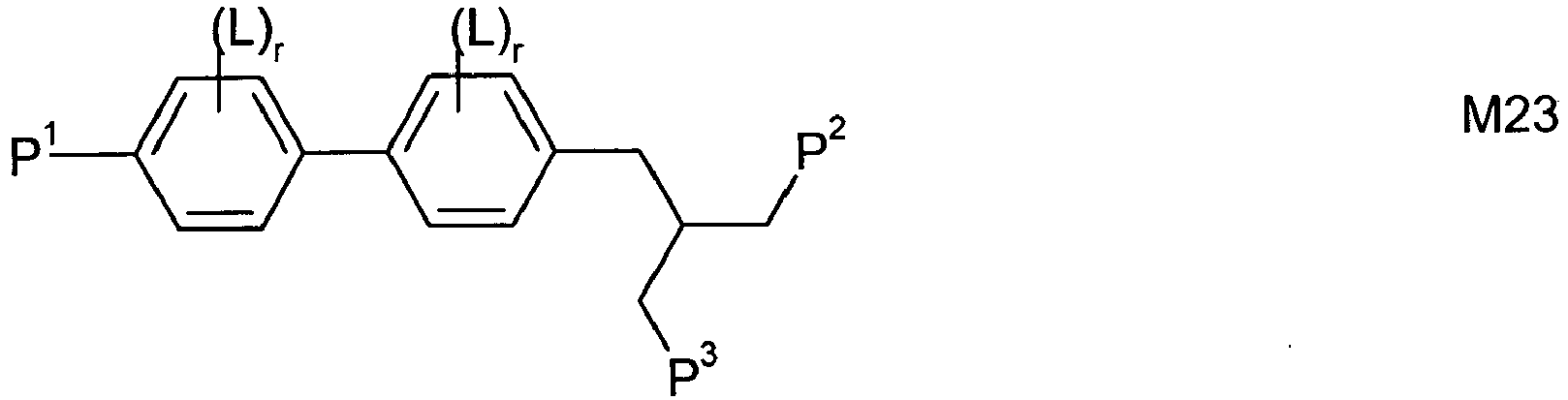


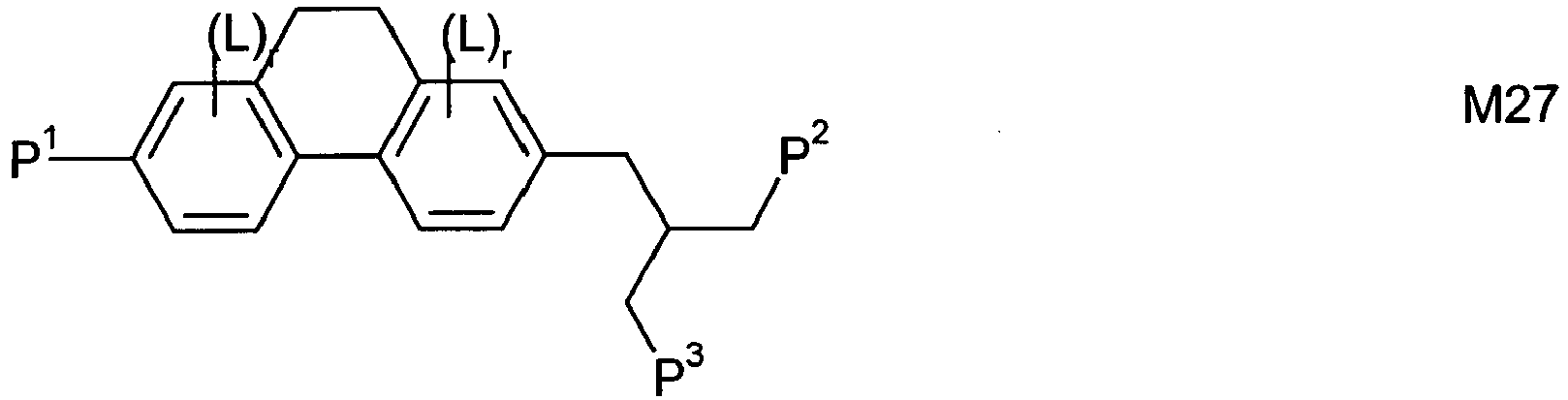





- P1, P2 and P3
- each, independently of one another, denote a polymerisable group, preferably having one of the meanings indicated above and below for P, particularly preferably an acrylate, methacrylate, fluoroacrylate, oxetane, vinyl, vinyloxy or epoxide group,
- Sp1,Sp2 and Sp3
- each, independently of one another, denote a single bond or a spacer group, preferably having one of the meanings indicated above and below for Sp, and particularly preferably denote -(CH2)p1-, -(CH2)p1-O-, -(CH2)p1-CO-O- or -(CH2)p1-O-CO-O-, in which p1 is an integer from 1 to 12, and where the linking to the adjacent ring in the last-mentioned groups takes place via the O atom,
where, in addition, one or more of the radicals P1-Sp1-, P2-Sp2- and P3-Sp3- may denote Raa, with the proviso that at least one of the radicals P1-Sp1-, P2-Sp2- and P3-Sp3- present does not denote Raa, - Raa
- denotes H, F, Cl, CN or straight-chain or branched alkyl having 1 to 25 C atoms, in which, in addition, one or more non-adjacent CH2 groups may each be replaced, independently of one another, by C(R0)=C(R00)-, -C≡C-, -N(R0)-, -O-, -S-, -CO-, -CO-O-, -O-CO-, -O-CO-O- in such a way that O and/or S atoms are not linked directly to one another, and in which, in addition, one or more H atoms may be replaced by F, Cl, CN or P1-Sp1-, particularly preferably straight-chain or branched, optionally mono- or polyfluorinated alkyl, alkoxy, alkenyl, alkynyl, alkylcarbonyl, alkoxycarbonyl, alkylcarbonyloxy or alkoxycarbonyloxy having 1 to 12 C atoms (where the alkenyl and alkynyl radicals have at least two C atoms and the branched radicals have at least three C atoms),
- R0, R00
- each, independently of one another and identically or differently on each occurrence, denote H or alkyl having 1 to 12 C atoms,
- Ry and Rz
- each, independently of one another, denote H, F, CH3 or CF3,
- X1, X2 and X3
- each, independently of one another, denote -CO-O-, -O-CO- or a single bond,
- Z1
- denotes -O-, -CO-, -C(RyRz)- or -CF2CF2-,
- Z2 and Z3
- each, independently of one another, denote -CO-O-, -O-CO-, -CH2O-, -OCH2-, -CF2O-, -OCF2- or -(CH2)n-, where n is 2, 3 or 4,
- L
- on each occurrence, identically or differently, denotes F, Cl, CN or straight-chain or branched, optionally mono- or poly-fluorinated alkyl, alkoxy, alkenyl, alkynyl, alkylcarbonyl, alkoxycarbonyl, alkylcarbonyloxy or alkoxycarbonyloxy having 1 to 12 C atoms, preferably F,
- L' and L"
- each, independently of one another, denote H, F or Cl,
- r
- denotes 0, 1, 2, 3 or 4,
- s
- denotes 0, 1, 2 or 3,
- t
- denotes 0, 1 or 2,
- x
- denotes 0 or 1.
- In the compounds of formulae M1 to M41


- Suitable polymerisable compounds are furthermore listed, for example, in Table D. LC mixtures containing at least one polymerisable compound listed in Table D are especially preferred.
- The liquid-crystalline media in accordance with the present application preferably comprise in total 0.1 to 10 %, preferably 0.2 to 4.0 %, particularly preferably 0.2 to 2.0 %, of polymerisable compounds.
- Particular preference is given to the polymerisable compounds of the formula M.
- The polymerisable compounds are preferably polymerised by photopolymerisation, for example by UV irradiation, often in the presence of at least one suitable initiator. The polymerisation takes place under conditions where the single components of the liquid crystalline mixture as such containing for example single compounds containing an alkenyl side chain like CC-n-V or an alkenyloxy side chain do not polymerize. Suitable conditions for the polymerisation and suitable types and amounts of initiator(s) are known to a person skilled in the art and are described in the literature. Suitable for free-radical polymerisation are, for example, commercially available photoinitiators, for example Irgacure® 651, Irgacure® 184 or Darocure® 1173 (BASF). The polymerisable compound(s) preferably comprise from 0 to 5 % by weight, particularly preferably 0.1 to 3 % by weight of one or more photoinitiators.
- The combination of at least two liquid crystalline compounds, at least one self-aligning additive and preferably with at least one polymerisable compound, in particular one selected from the formula M and/or the formulae M1 to M41, produces low threshold voltages, low rotational viscosities, very good low temperature stabilities (LTS) in the media but at the same time high clearing points and high HR values, and enables the setting or a pretilt angle in VA displays without the need of any alignment layer, e.g., a polyimide layer.
- The mixtures according to the invention may furthermore comprise conventional additives, such as, for example, stabilisers, antioxidants, UV absorbers, nanoparticles, microparticles, etc.
- The structure of the liquid-crystal displays according to the invention corresponds to the usual geometry, as described, for example, in
EP 0 240 379 . The following examples are intended to explain the invention without limiting it. Above and below, per cent data denote per cent by weight; all temperatures are indicated in degrees Celsius. - Throughout the patent application, 1,4-cyclohexylene rings and 1,4-phenylene rings are depicted as follows:


- Throughout the patent application and in the working examples, the structures of the liquid-crystalline compounds are indicated by means of acronyms. Unless indicated otherwise, the transformation into chemical formulae is carried out in accordance with Tables 1-3. All radicals CnH2n+1, CmH2m+1 and Cm'H2m'+1 or CnH2n and CmH2m are straight-chain alkyl radicals or alkylene radicals in each case having n, m, m' or z C atoms respectively. n, m, m', z each denote, independently of one another, 1, 2, 3, 4, 5, 6, 7, 8, 9, 10, 11 or 12, preferably 1, 2, 3, 4, 5 or 6. In Table 1 the ring elements of the respective compound are coded, in Table 2 the bridging members are listed and in Table 3 the meanings of the symbols for the left-hand or right-hand side chains of the compounds are indicated.
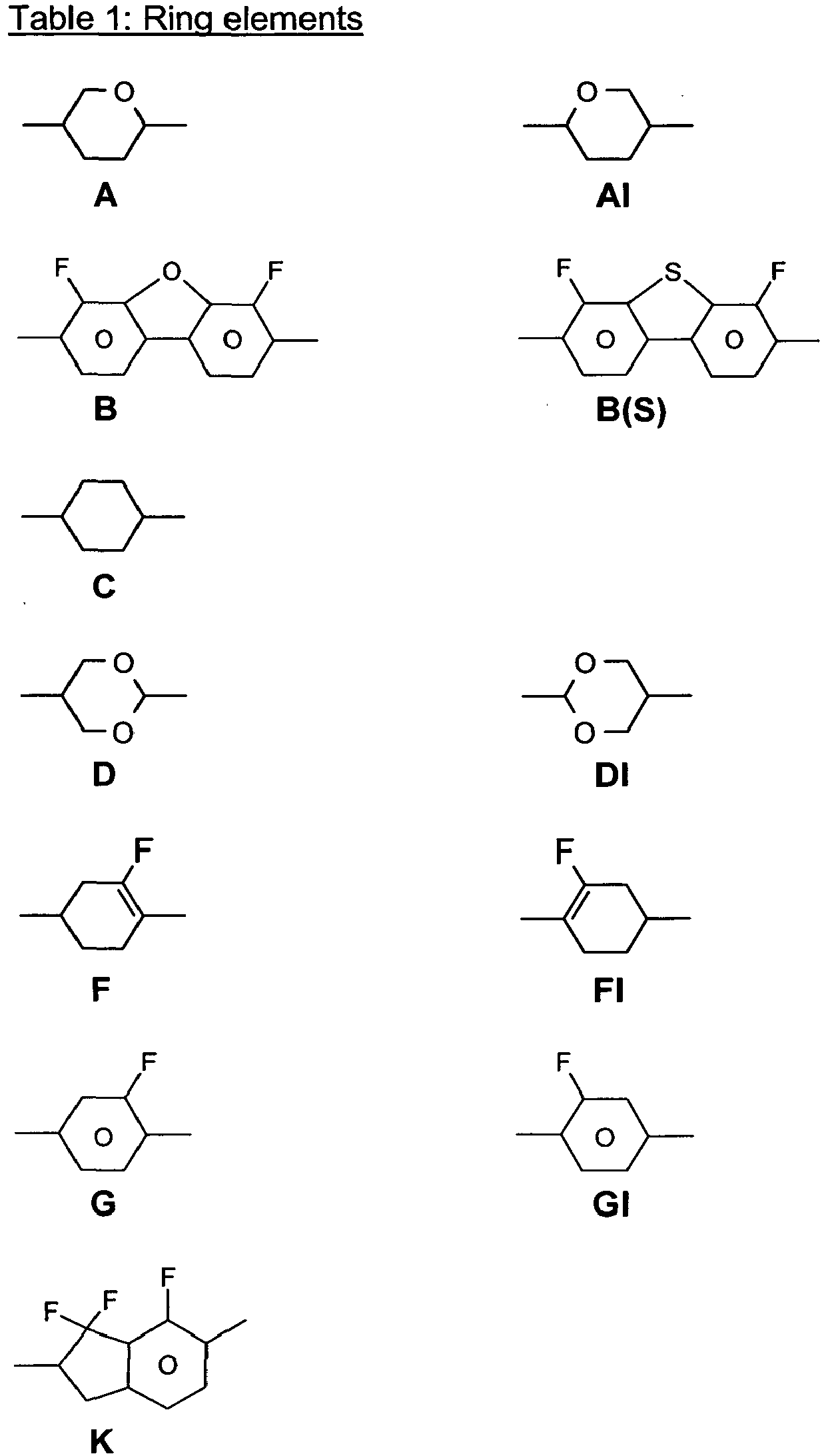
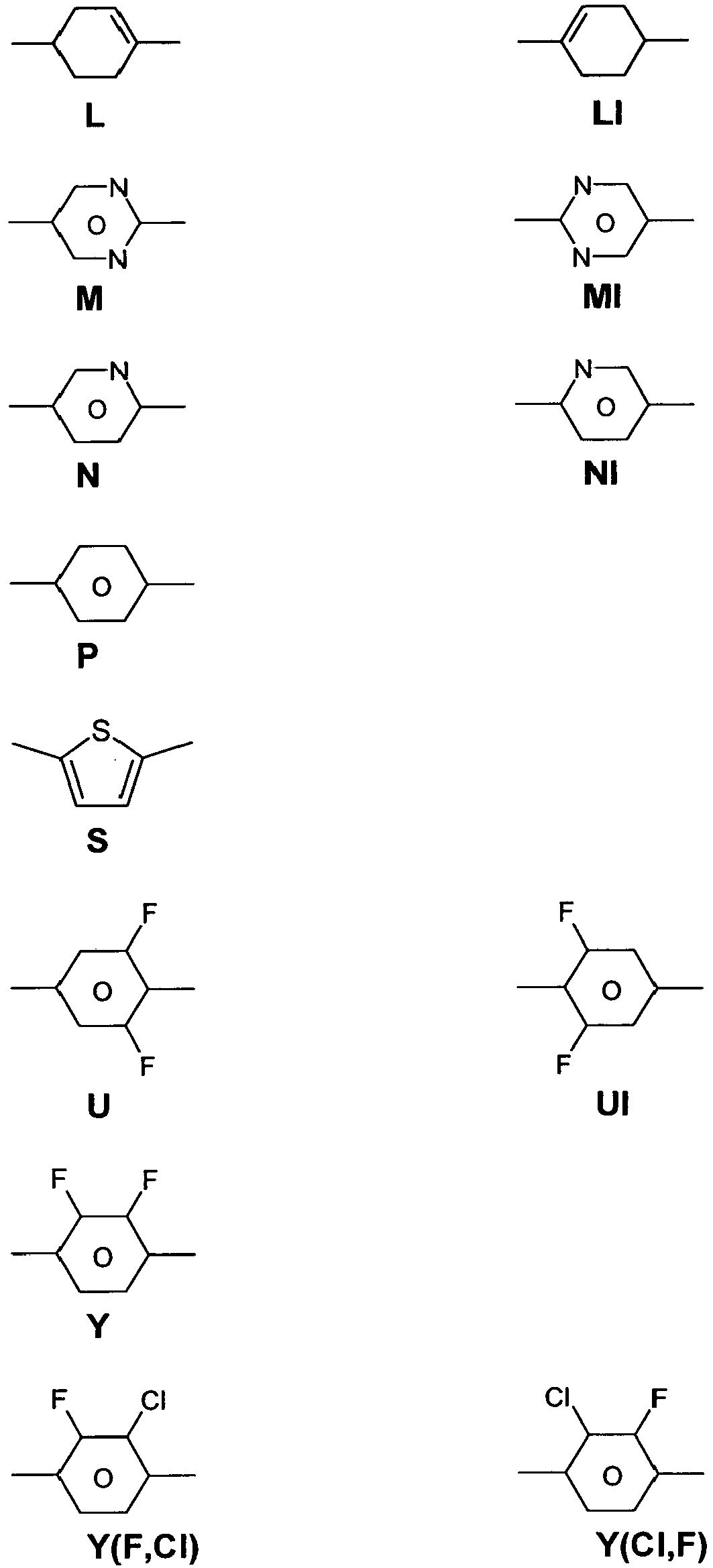
Table 2: Bridging members E -CH2CH2- V -CH=CH- T -C≡C- W -CF2CF2- Z -COO- ZI -OCO- O -CH2O- OI -OCH2- Q -CF2O- QI -OCF2- Table 3: Side chains Left-hand side chain Right-hand side chain n- CnH2n+1- -n -CnH2n+1 nO- CnH2n+1-O- -On -O-CnH2n+1 V- CH2=CH- -V -CH=CH2 nV- CnH2n+1-CH=CH- -nV -CnH2n-CH=CH2 Vn- CH2=CH- CnH2n- -Vn -CH=CH-CnH2n+1 nVm- CnH2n+1-CH=CH-CmH2m- -nVm -CnH2n-CH=CH-CmH2m+1 N- N=C- -N -C=N F- F- -F -F Cl- Cl- -Cl -Cl M- CFH2- -M -CFH2 D- CF2H- -D -CF2H T- CF3- -T -CF3 MO- CFH2O- -OM -OCFH2 DO- CF2HO- -OD -OCF2H TO- CF3O- -OT -OCF3 T- CF3- -T -CF3 A- H-C≡C- -A -C=C-H - Besides the compounds of the formulae IIA and/or IIB and/or IIC, one or more compounds of the formula I and at least one compound of the formulae I-A to I-K the mixtures according to the invention preferably comprise one or more of the compounds from Table A indicated below.


- The liquid-crystal mixtures which can be used in accordance with the invention are prepared in a manner which is conventional per se. In general, the desired amount of the components used in lesser amount is dissolved in the components making up the principal constituent, advantageously at elevated temperature. It is also possible to mix solutions of the components in an organic solvent, for example in acetone, chloroform or methanol, and to remove the solvent again, for example by distillation, after thorough mixing.
- By means of suitable additives, the liquid-crystal phases according to the invention can be modified in such a way that they can be employed in any type of, for example, ECB, VAN, GH or ASM-VA, IPS, FFS, PS-VA, PS-IPS, PS-FFS LCD display that has been disclosed to date.
- The dielectrics may also comprise further additives known to the person skilled in the art and described in the literature, such as, for example, UV absorbers, antioxidants, nanoparticles and free-radical scavengers. For example, 0-15% of pleochroic dyes, stabilisers or chiral dopants may be added. Suitable stabilisers for the mixtures according to the invention are, in particular, those listed in Table C.
- For example, 0-15 % of pleochroic dyes may be added, furthermore conductive salts, preferably ethyldimethyldodecylammonium 4-hexoxybenzoate, tetrabutylammonium tetraphenylboranate or complex salts of crown ethers (cf., for example, Haller et al., Mol. Cryst. Liq. Cryst. Volume 24, pages 249-258 (1973)), may be added in order to improve the conductivity or substances may be added in order to modify the dielectric anisotropy, the viscosity and/or the alignment of the nematic phases. Substances of this type are described, for example, in
DE-A 22 09 127 ,22 40 864 ,23 21 632 ,23 38 281 ,24 50 088 ,26 37 430 and28 53 728 . - Table B shows possible dopants which can be added to the mixtures according to the invention. If the mixtures comprise a dopant, it is employed in amounts of 0.01-4% by weight, preferably 0.1-1.0% by weight.


- Stabilisers which can be added, for example, to the mixtures according to the invention in amounts of up to 10% by weight, based on the total amount of the mixture, preferably 0.01 to 6% by weight, in particular 0.1 to 3% by weight, are shown below in Table C. Preferred stabilisers are, in particular, BHT derivatives, for example 2,6-di-tert-butyl-4-alkylphenols, and Tinuvin 770, as well as Tunivin P and Tempol.


- Preferred reactive mesogens (polymerisable compounds) for use in the mixtures according to the invention, preferably in PSA and PS-VA applications are shown in Table D below:

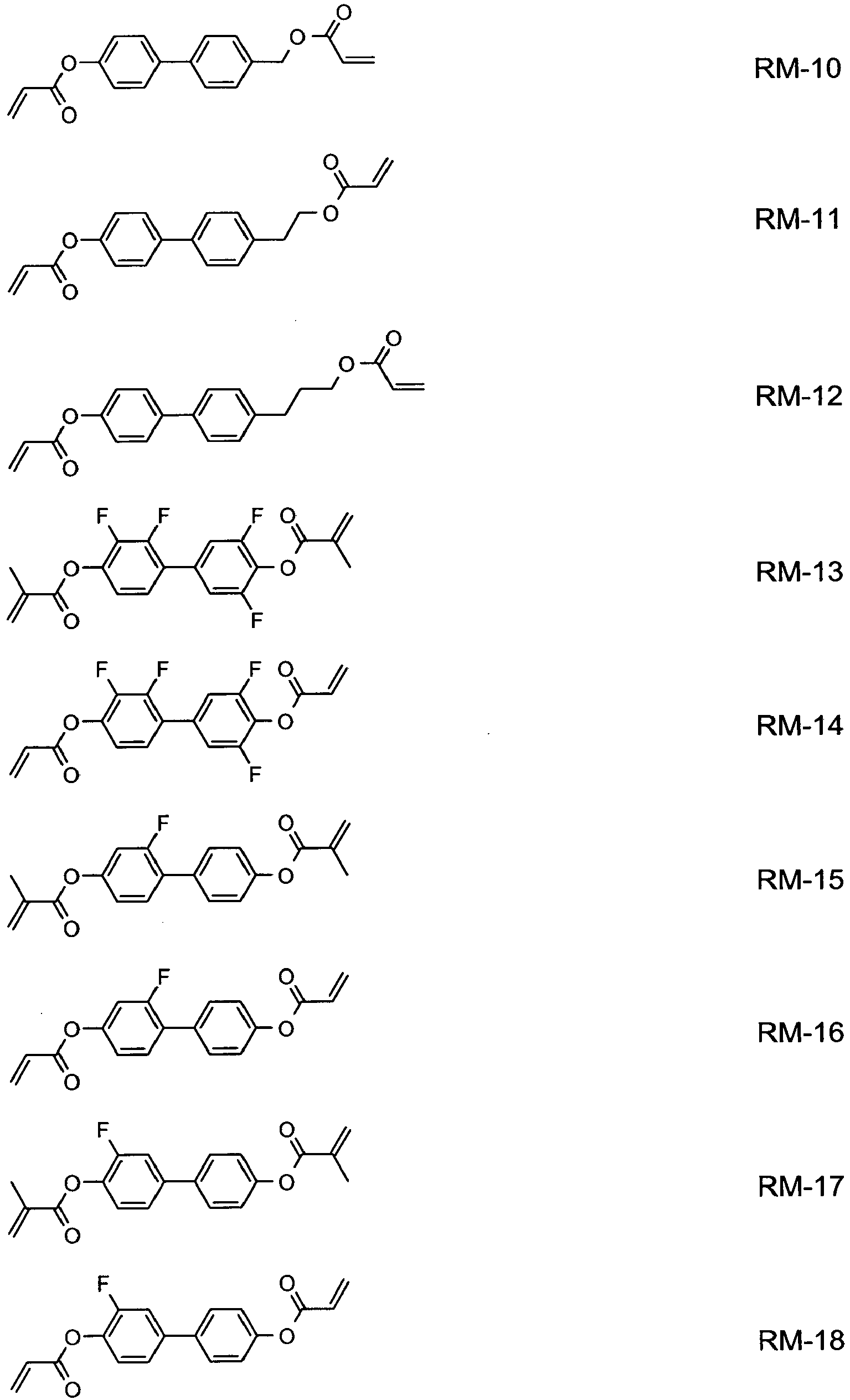
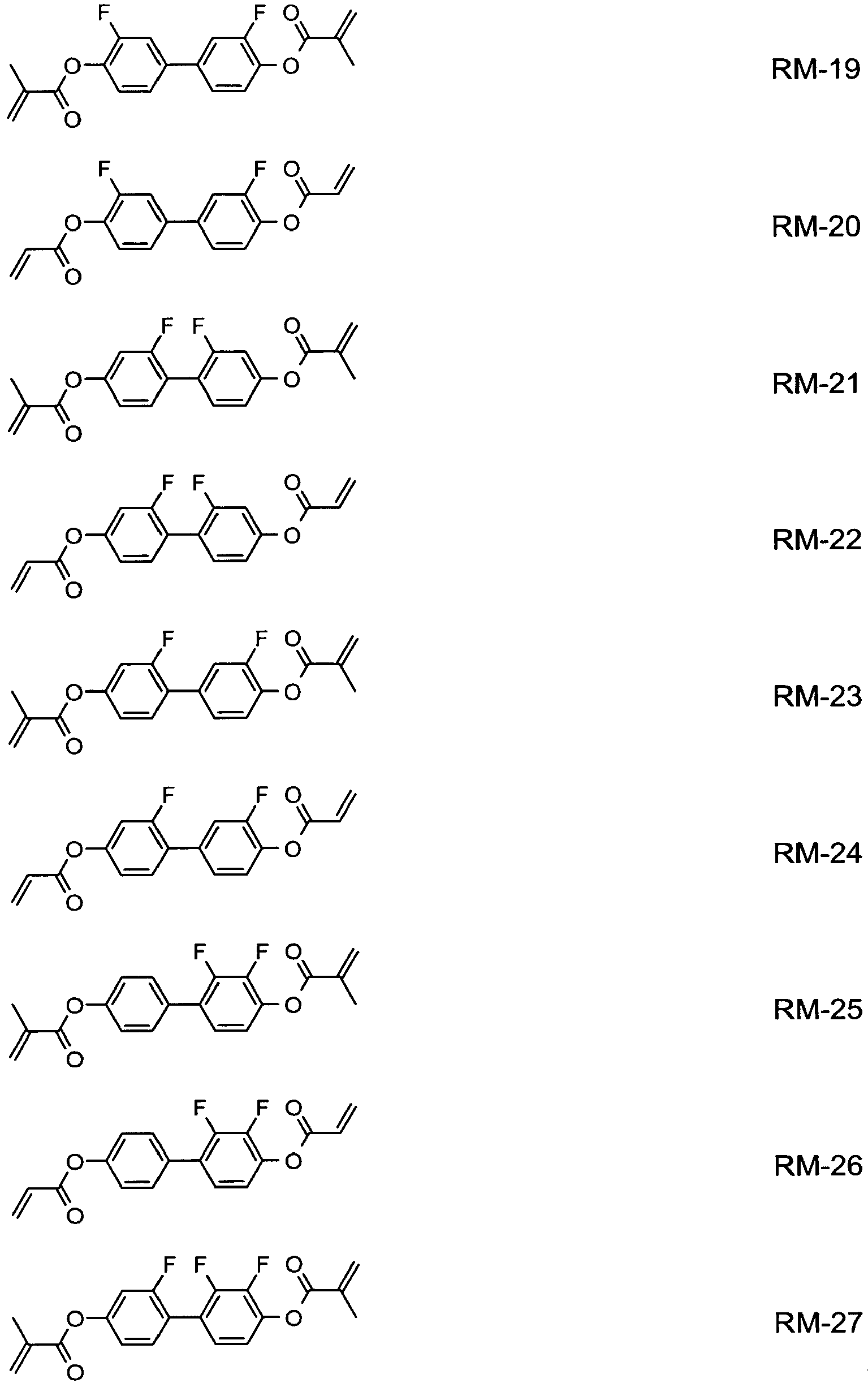


- The following examples are intended to explain the invention without restricting it. In the examples, m.p. denotes the melting point and C denotes the clearing point of a liquid-crystalline substance in degrees Celsius; boiling points are denoted by b.p. Furthermore:
- C denotes crystalline solid state, S denotes smectic phase (the index denotes the phase type), N denotes nematic state, Ch denotes cholesteric phase, I denotes isotropic phase, Tg denotes glass transition temperature. The number between two symbols indicates the conversion temperature in degrees Celsius.
- Conventional work-up means: water is added, the mixture is extracted with methylene chloride, the phases are separated, the organic phase is dried and evaporated, and the product is purified by crystallisation and/or chromatography.
-

-

- 29.3 g (0.100 mol) 4-propyl-4'-bromo-2-fluorobiphenyl are dissolved in THF (800 ml) and cooled to -70°C. After addition of 66 ml (0.105 mol) n-butyl lithium the reaction is stirred for 30 min and then a CO2 stream is passed through the solution until the exothermic reaction ceases. The reaction is warmed to -10 °C, poured onto water and acidified with conc. hydrochloric acid. The mixture is extracted with methyl tert. butyl ether (MBT ether) and dried over sodium sulfate. The solvent is evaporated and the residue is recrystallised from n-heptane to give 2'-fluoro-4'-propyl-biphenyl-4-carboxylic acid as colourless crystals.
-

- 1.45 g (38 mmol) lithiumaluminium hydride are placed in a flask under toluene (10ml) and a solution of 12.0 g (46.0 mmol) 2'-fluoro-4'-propylbiphenyl-4-carboxylic acid in THF (250 ml) is added dropwise. The reaction is stirred at room temperature over night and is then hydrolised carefully with 2M hydrochloric acid (100 ml) under ice-cooling. After addition of MTB-ether (50 ml) the aqueous layer was separated and extracted tree times with MTB-ether. The combined organic layers are washed saturated sodium bicarbonate solution and dried over sodium sulfate. The solvent is evaporated and the crude product filtered through silica with heptane/ethyl acetate (8:2). Crystallisation from n-heptane gives (2'-fluoro-4'-propyl-biphenyl-4-yl)-methanol as colourless crystals. K 50 I
- Above and below,
- V0
- denotes the threshold voltage, capacitive [V] at 20°C
- Δn
- denotes the optical anisotropy measured at 20°C and 589 nm
- Δε
- denotes the dielectric anisotropy at 20°C and 1 kHz
- cl.p.
- denotes the clearing point [°C]
- K1
- denotes the elastic constant, "splay" deformation at 20°C [pN]
- K3
- denotes the elastic constant, "bend" deformation at 20°C [pN]
- γ1
- denotes the rotational viscosity measured at 20°C [mPa·s], determined by the rotation method in a magnetic field
- LTS
- denotes the low-temperature stability (nematic phase), determined in test cells
- The display used for measurement of the threshold voltage has two plane-parallel outer plates at a separation of 20 µm and electrode layers with overlying alignment layers of JALS-2096 on the insides of the outer plates, which effect a homeotropic alignment of the liquid crystals.
- All concentrations in this application relate to the corresponding mixture or mixture component, unless explicitly indicated otherwise. All physical properties are determined as described in "Merck Liquid Crystals, Physical Properties of Liquid Crystals", status November 1997, Merck KGaA, Germany, and apply for a temperature of 20 °C, unless explicitly indicated otherwise.
- Unless indicated otherwise, parts or per cent data denote parts by weight or per cent by weight.
- For the production of the so-called SA (self-alignment)-VA mixtures according to the present invention the following host mixtures H1 to H120 are used:
H1: Nematic host-mixtureCY-3-O2 10.00 % Clearing point [°C]: 100 CY-3-O4 20.00 % Δn [589 nm, 20°C]: 0.0865 CY-5-O4 20.00 % Δε [1 kHz, 20°C]: -5.4 CCY-3-O2 6.00 % ε|| [1 kHz, 20°C]: 3.9 CCY-3-O3 6.00 % ε⊥ [1 kHz, 20°C]: 9.3 CCY-4-O2 6.00 % K1 [pN, 20°C]: 15.6 CCY-5-O2 6.00 % K3 [pN, 20°C]: 16.6 CH-33 3.00 % V0 [20°C, V]: 1.84 CH-35 3.50 % CH-43 3.50 % CH-45 3.50 % CCPC-33 4.00 % CCPC-34 4.50 % CCPC-35 4.00 % Y-4O-O4 12.00% Clearing point [°C]: 89 CCY-3-O2 5.00% Δn [589 nm, 20°C]: 0.2108 CCY-3-O3 4.00% Δε [1 kHz, 20°C]: -3.2 CC-4-V 10.00% ε|| [1 kHz, 20°C]: 4.3 CCP-V2-1 12.00% ε⊥ [1 kHz, 20°C]: 7.5 PPTUI-3-2 15.00% K3 [pN, 20°C]: 19.3 PPTUI-3-4 8.00% K3/K1 [20°C]: 1.19 PTP-3O2FF 12.00% Vo [20°C, V]: 2.58 PTP-5O2FF 12.00% CPTP-3O2FF 5.00% CPTP-5O2FF 5.00% Y-4O-O4 10.00% Clearing point [°C]: 91 CCY-3-O2 6.00% Δn [589 nm, 20°C]: 0.2099 CCY-3-O3 3.50% Δε [1 kHz, 20°C]: -3.0 CC-4-V 13.50% ε|| [1 kHz, 20°C]: 4.2 CCP-V2-1 10.00% ε⊥ [1 kHz, 20°C]: 7.2 PPTUI-3-2 15.00% K3 [pN, 20°C]: 19.2 PPTUI-3-4 8.00% K3/K1 [20°C]: 1.21 PTP-3O2FF 12.00% γ1 [mPa·s, 20°C]: 190 PTP-5O2FF 12.00% V0 [20°C, V]: 2.66 CPTP-3O2FF 5.00% CPTP-5O2FF 5.00% Y-4O-O4 12.00% Clearing point [°C]: 89 CCY-3-O2 4.00% Δn [589 nm, 20°C]: 0.2089 CC-4-V 13.50% Δε [1 kHz, 20°C]: -2.8 CC-5-V 4.00% ε|| [1 kHz, 20°C]: 4.3 PPTUI-3-2 15.00% ε⊥ [1 kHz, 20°C]: 7.1 PPTUI-3-4 9.50% K3 [pN, 20°C]: 19.0 PTP-3O2FF 12.00% K3/K1 [20°C]: 1.27 PTP-5O2FF 12.00% V0 [20°C, V]: 2.70 CPTP-3O2FF 5.00% CPTP-5O2FF 5.00% CCPC-33 4.00% CCPC-34 4.00% Y-4O-O4 12.00% Clearing point [°C]: 91 CCY-3-O2 2.50% Δn [589 nm, 20°C]: 0.2101 CPY-2-O2 3.50% Δε [1 kHz, 20°C]: -3.0 CC-4-V 13.50% ε|| [1 kHz, 20°C]: 4.3 CC-5-V 2.50% ε⊥ [1 kHz, 20°C]: 7.3 PPTUI-3-2 15.00% K3 [pN, 20°C]: 19.3 PPTUI-3-4 8.50% K3/K1 [20°C]: 1.32 PTP-302FF 12.00% γ1 [mPa·s, 20°C]: 201 PTP-5O2FF 12.00% V0 [20°C, V]: 2.64 CPTP-3O2FF 5.00% CPTP-5O2FF 5.00% CCPC-33 4.50% CCPC-34 4.00% Y-4O-O4 10.00% Clearing point [°C]: 91 CCY-3-O2 5.50% Δn [589 nm, 20°C]: 0.2102 CPY-2-O2 3.50% Δε [1 kHz, 20°C]: -3.0 CC-4-V 13.50% ε|| [1 kHz, 20°C]: 4.2 CC-5-V 5.00% ε⊥ [1 kHz, 20°C]: 7.2 PPTUI-3-2 15.00% K3 [pN, 20°C]: 19.2 PPTUI-3-4 8.50% K3/K1 [20°C]: 1.25 PTP-3O2FF 12.00% γ1 [mPa·s, 20°C]: 195 PTP-5O2FF 12.00% V0 [20°C, V]: 2.66 CPTP-3O2FF 5.00% CPTP-5O2FF 5.00% CCPC-33 5.00% Y-4O-O4 15.00% Clearing point [°C]: 88 CC-4-V 13.50% Δn [589 nm, 20°C]: 0.2089 PPTUI-3-2 15.00% Δε [1 kHz, 20°C]: -3.0 PPTUI-3-4 9.50% ε|| [1 kHz, 20°C]: 4.4 PTP-3O2FF 12.00% ε⊥ [1 kHz, 20°C]: 7.4 PTP-5O2FF 12.00% K3 [pN, 20°C]: 19.1 CPTP-3O2FF 5.00% K3/K1 [20°C]: 1.30 CPTP-5O2FF 5.00% V0 [20°C, V]: 2.67 CCPC-33 4.50% CCPC-34 4.50% CCPC-35 4.00% 
Y-4O-O4 15.00% Clearing point [°C]: 90 CPY-2-O2 1.50% Δn [589 nm, 20°C]: 0.2115 CC-4-V 12.00% Δε [1 kHz, 20°C]: -3.1 PPTUI-3-2 15.00% ε|| [1 kHz, 20°C]: 4.5 PPTUI-3-4 9.00% ε⊥ [1 kHz, 20°C]: 7.6 PTP-3O2FF 12.00% K3 [pN, 20°C]: 19.6 PTP-5O2FF 12.00% K3/K1 [20°C]: 1.30 CPTP-3O2FF 5.00% Vo [20°C, V]: 2.63 CPTP-5O2FF 5.00% CCPC-33 4.50% CCPC-34 4.50% CCPC-35 4.50% CY-3-O4 5.50% Clearing point [°C]: 91 PY3-O2 8.00% Δn [589 nm, 20°C]: 0.2099 CCY-3-O2 5.50% Δε [1 kHz, 20°C]: -3.0 CCY-3-O3 5.00% ε|| [1 kHz, 20°C]: 3.9 CC-4-V 13.00% ε⊥ [1 kHz, 20°C]: 6.9 CC-5-V 8.00% K3 [pN, 20°C]: 19.6 PPTUI-3-2 15.00% K3/K1 [20°C]: 1.20 PPTUI-3-4 6.00% γ1 [mPa·s, 20°C]: 195 PTP-3O2FF 12.00% V0 [20°C, V]: 2.68 PTP-5O2FF 12.00% CPTP-3O2FF 5.00% CPTP-5O2FF 5.00% Y-4O-O4 15.50% Clearing point [°C]: 90 CC-4-V 12.00% Δn [589 nm, 20°C]: 0.2098 PPTUI-3-2 15.00% Δε [1 kHz, 20°C]: -3.1 PPTUI-3-4 8.50% ε|| [1 kHz, 20°C]: 4.5 PTP-3O2FF 12.00% ε⊥ [1 kHz, 20°C]: 7.6 PTP-5O2FF 12.00% K3 [pN, 20°C]: 19.5 CPTP-3O2FF 5.00% K3/K1 [20°C]: 1.28 CPTP-5O2FF 5.00% γ1 [mPa·s, 20°C]: 227 CCPC-33 5.00% V0 [20°C, V]: 2.65 CCPC-34 5.00% CCPC-35 5.00% Y-4O-O4 13.50% Clearing point [°C]: 80 CC-4-V 14.00% Δn [589 nm, 20°C]: 0.2076 CCP-V-1 9.00% Δε [1 kHz, 20°C]: -2.6 BCH-32 5.00% ε|| [1 kHz, 20°C]: 4.3 CPTP-31 5.00% ε⊥ [1 kHz, 20°C]: 6.9 PPTUI-3-2 19.50% K3 [pN, 20°C]: 16.9 PTP-3O2FF 12.00% K3/K1 [20°C]: 1.23 PTP-5O2FF 12.00% γ1 [mPa·s, 20°C]: 145 CPTP-3O2FF 5.00% V0 [20°C, V]: 2.67 CPTP-5O2FF 5.00% Y-4O-O4 13.00% Clearing point [°C]: 90 CPY-3-O2 4.00% Δn [589 nm, 20°C]: 0.2097 CC-4-V 5.00% Δε [1 kHz, 20°C]: -3.0 CCP-V-1 12.00% ε|| [1 kHz, 20°C]: 4.3 CCP-V2-1 12.00% ε⊥ [1 kHz, 20°C]: 7.3 PPTUI-3-2 15.00% PPTUI-3-4 5.00% PTP-3O2FF 12.00% PTP-5O2FF 12.00% CPTP-3O2FF 5.00% CPTP-5O2FF 5.00% Y-4O-O4 12.50% Clearing point [°C]: 91 CPY-3-O2 4.50% Δn [589 nm, 20°C]: 0.2097 CC-4-V 6.00% Δε [1 kHz, 20°C]: -3.0 CCP-V-1 11.00% ε|| [1 kHz, 20°C]: 4.3 CCP-V2-1 12.00% ε⊥ [1 kHz, 20°C]: 7.3 PPTUI-3-2 15.00% K3 [pN, 20°C]: 19.8 PPTUI-3-4 5.00% K3/K1 [20°C]: 1.22 PTP-3O2FF 12.00% γ1 [mPa·s, 20°C]: 186 PTP-5O2FF 12.00% V0 [20°C, V]: 2.69 CPTP-3O2FF 5.00% CPTP-5O2FF 5.00% Y-4O-O4 10.50% Clearing point [°C]: 91 CPY-2-O2 4.00% Δn [589 nm, 20°C]: 0.2102 CPY-3-O2 4.00% Δε [1 kHz, 20°C]: -3.0 CC-4-V 10.50% ε|| [1 kHz, 20°C]: 4.2 CCP-V-1 6.00% ε⊥ [1 kHz, 20°C]: 7.2 CCP-V2-1 11.00% K3 [pN, 20°C]: 19.3 PPTUI-3-2 15.00% K3/K1 [20°C]: 1.22 PPTUI-3-4 5.00% γ1 [mPa·s, 20°C]: 187 PTP-3O2FF 12.00% V0 [20°C, V]: 2.67 PTP-5O2FF 12.00% CPTP-3O2FF 5.00% CPTP-5O2FF 5.00% Y-4O-O4 10.00% Clearing point [°C]: 91 CCY-3-O2 4.50% Δn [589 nm, 20°C]: 0.2106 CPY-3-O2 4.50% Δε [1 kHz, 20°C]: -3.0 CC-4-V 14.00% ε|| [1 kHz, 20°C]: 4.2 CCP-V2-1 11.00% ε⊥ [1 kHz, 20°C]: 7.2 PPTUI-3-2 15.00% K3 [pN, 20°C]: 19.3 PPTUI-3-4 7.00% K3/K1 [20°C]: 1.19 PTP-3O2FF 12.00% γ1 [mPa·s, 20°C]: 186 PTP-5O2FF 12.00% Vo [20°C, V]: 2.68 CPTP-3O2FF 5.00% CPTP-5O2FF 5.00% Y-4O-O4 12.50% Clearing point [°C]: 91 CPY-3-O2 4.50% Δn [589 nm, 20°C]: 0.2106 CC-4-V 5.50% Δε [1 kHz, 20°C]: -3.0 CCP-V-1 12.00% ε|| [1 kHz, 20°C]: 4.3 CCP-V2-1 8.00% ε⊥ [1 kHz, 20°C]: 7.3 BCH-32 5.00% K3 [pN, 20°C]: 19.5 PPTUI-3-2 15.00% K3/K1 [20°C]: 1.22 PPTUI-3-4 3.50% γ1 [mPa·s, 20°C]: 190 PTP-3O2FF 12.00% Vo [20°C, V]: 2.69 PTP-5O2FF 12.00% CPTP-3O2FF 5.00% CPTP-5O2FF 5.00% Y-4O-O4 12.50% Clearing point [°C]: 91 CPY-3-O2 5.00% Δn [589 nm, 20°C]: 0.2090 CC-4-V 6.00% Δε [1 kHz, 20°C]: -3.0 CCP-V-1 12.00% ε|| [1 kHz, 20°C]: 4.3 CCP-V2-1 7.50% ε⊥ [1 kHz, 20°C]: 7.3 BCH-32 5.00% K3 [pN, 20°C]: 19.4 PPTUI-3-2 18.00% K3/K1 [20°C]: 1.22 PTP-3O2FF 12.00% γ1 [mPa·s, 20°C]: 181 PTP-5O2FF 12.00% V0 [20°C, V]: 2.66 CPTP-3O2FF 5.00% CPTP-5O2FF 5.00% Y-4O-O4 12.50% Clearing point [°C]: 90 CPY-3-O2 4.50% Δn [589 nm, 20°C]: 0.2091 CC-4-V 9.50% Δε [1 kHz, 20°C]: -3.0 CCP-V-1 5.00% ε|| [1 kHz, 20°C]: 4.2 CCP-V2-1 12.00% ε⊥ [1 kHz, 20°C]: 7.2 CPTP-3-1 6.00% K3 [pN, 20°C]: 19.6 PPTUI-3-2 16.50% K3/K1 [20°C]: 1.23 PTP-3O2FF 12.00% γ1 [mPa·s, 20°C]: 182 PTP-5O2FF 12.00% V0 [20°C, V]: 2.70 CPTP-3O2FF 5.00% CPTP-5O2FF 5.00% Y-4O-O4 12.50% Clearing point [°C]: 91 CPY-3-O2 5.00% Δn [589 nm, 20°C]: 0.2091 CC-4-V 6.00% Δε [1 kHz, 20°C]: -3.1 CCP-V-1 11.00% ε|| [1 kHz, 20°C]: 4.2 CCP-V2-1 12.00% ε⊥ [1 kHz, 20°C]: 7.3 PPTUI-3-2 19.50% K3 [pN, 20°C]: 19.5 PTP-3O2FF 12.00% K3/K1 [20°C]: 1.20 PTP-5O2FF 12.00% γ1 [mPa·s, 20°C]: 188 CPTP-3O2FF 5.00% V0 [20°C, V]: 2.66 CPTP-5O2FF 5.00% Y-4O-O4 12.50% Clearing point [°C]: 91 CPY-3-O2 5.00% Δn [589 nm, 20°C]: 0.2094 CC-4-V 7.00% Δε [1 kHz, 20°C]: -3.0 CCP-V-1 5.00% ε|| [1 kHz, 20°C]: 4.3 CCP-V2-1 13.00% ε⊥ [1 kHz, 20°C]: 7.3 BCH-32 5.00% K3 [pN, 20°C]: 19.7 PPTUI-3-2 18.50% K3/K1 [20°C]: 1.19 PTP-3O2FF 12.00% γ1 [mPa·s, 20°C]: 185 PTP-5O2FF 12.00% V0 [20°C, V]: 2.67 CPTP-3O2FF 5.00% CPTP-5O2FF 5.00% Y-4O-O4 10.00% Clearing point [°C]: 91 CCY-3-O2 4.50% Δn [589 nm, 20°C]: 0.2094 CPY-3-O2 4.50% Δε [1 kHz, 20°C]: -3.1 CC-4-V 12.50% ε|| [1 kHz, 20°C]: 4.1 CCP-V-1 10.00% ε⊥ [1 kHz, 20°C]: 7.2 BCH-32 5.00% K3 [pN, 20°C]: 19.2 PPTUI-3-2 19.50% K3/K1 [20°C]: 1.21 PTP-3O2FF 12.00% γ1 [mPa·s, 20°C]: 187 PTP-5O2FF 12.00% V0 [20°C, V]: 2.66 CPTP-3O2FF 5.00% CPTP-5O2FF 5.00% Y-4O-O4 15.00% Clearing point [°C]: 73 CCY-3-O2 5.00% CPY-3-O2 3.00% CC-3-V 15.00% CCP-V2-1 3.50% PPTUI-3-2 15.00% PPTUI-3-4 9.50% PTP-3O2FF 12.00% PTP-5O2FF 12.00% CPTP-3O2FF 5.00% CPTP-5O2FF 5.00% Y-4O-O4 12.50% Clearing point [°C]: 90 CPY-3-O2 4.50% Δn [589 nm, 20°C]: 0.2100 CC-4-V 10.00% Δε [1 kHz, 20°C]: -3.0 CCP-V2-1 12.50% ε|| [1 kHz, 20°C]: 4.2 BCH-32 5.00% ε⊥ [1 kHz, 20°C]: 7.2 CPTP-31 6.00% K3 [pN, 20°C]: 19.3 PPTUI-3-2 15.50% K3/K1 [20°C]: 1.19 PTP-3O2FF 12.00% γ1 [mPa·s, 20°C]: 185 PTP-5O2FF 12.00% V0 [20°C, V]: 2.69 CPTP-3O2FF 5.00% CPTP-5O2FF 5.00% Y-4O-O4 12.50% Clearing point [°C]: 91 CPY-3-O2 4.50% Δn [589 nm, 20°C]: 0.2088 CC-4-V 8.00% Δε [1 kHz, 20°C]: -3.0 CCP-V-1 12.50% ε|| [1 kHz, 20°C]: 4.2 CCP-V2-1 3.00% ε⊥ [1 kHz, 20°C]: 7.2 BCH-32 5.00% K3 [pN, 20°C]: 19.6 CPTP-31 6.00% K3/K1 [20°C]: 1.23 PPTUI-3-2 14.50% γ1 [mPa·s, 20°C]: 182 PTP-3O2FF 12.00% V0 [20°C, V]: 2.70 PTP-5O2FF 12.00% CPTP-3O2FF 5.00% CPTP-5O2FF 5.00% Y-4O-O4 12.50% Clearing point [°C]: 90 CPY-3-O2 5.00% Δn [589 nm, 20°C]: 0.2117 CC-4-V 12.50% Δε [1 kHz, 20°C]: -3.1 CVCP-1V-O1 5.00% ε|| [1 kHz, 20°C]: 4.1 PTP-102 5.00% ε⊥ [1 kHz, 20°C]: 7.2 PTP-201 3.00% K3 [pN, 20°C]: 20.9 CPTP-301 5.00% K3/K1 [20°C]: 1.38 CPTP-31 6.00% γ1 [mPa·s, 20°C]: 193 CPTP-32 6.00% V0 [20°C, V]: 2.72 CPTP-41 6.00% PTP-3O2FF 12.00% PTP-5O2FF 12.00% CPTP-3O2FF 5.00% CPTP-5O2FF 5.00% Y-4O-O4 14.50% Clearing point [°C]: 91 CPY-3-O2 2.00% Δn [589 nm, 20°C]: 0.2103 CC-4-V 12.50% Δε [1 kHz, 20°C]: -3.1 CVCP-1V-O1 5.00% ε|| [1 kHz, 20°C]: 4.2 PTP-102 4.50% ε⊥ [1 kHz, 20°C]: 7.3 CPTP-3O1 5.00% K3 [pN, 20°C]: 21.0 CPTP-3O2 4.50% K3/K1 [20°C]: 1.34 CPTP-31 6.00% γ1 [mPa·s, 20°C]: 195 CPTP-32 6.00% V0 [20°C, V]: 2.72 CPTP-41 6.00% PTP-3O2FF 12.00% PTP-5O2FF 12.00% CPTP-3O2FF 5.00% CPTP-5O2FF 5.00% Y-4O-O4 16.00% Clearing point [°C]: 90 CC-4-V 12.00% Δn [589 nm, 20°C]: 0.2084 CVCP-1V-O1 5.00% Δε [1 kHz, 20°C]: -3.1 PTP-102 2.50% ε|| [1 kHz, 20°C]: 4.2 CPTP-301 5.00% ε⊥ [1 kHz, 20°C]: 7.3 CPTP-302 5.00% K3 [pN, 20°C]: 20.5 CPTP-303 2.50% K3/K1 [20°C]: 1.31 CPTP-31 6.00% γ1 [mPa·s, 20°C]: 194 CPTP-32 6.00% V0 [20°C, V]: 2.69 CPTP-41 6.00% PTP-3O2FF 12.00% PTP-5O2FF 12.00% CPTP-3O2FF 5.00% CPTP-5O2FF 5.00% Y-4O-O4 12.50% Clearing point [°C]: 91 CPY-2-O2 5.00% Δn [589 nm, 20°C]: 0.2093 CC-4-V 12.00% Δε [1 kHz, 20°C]: -3.1 CCP-V-1 1.50% ε|| [1 kHz, 20°C]: 4.1 CVCP-1V-O1 5.00% ε⊥ [1 kHz, 20°C]: 7.2 PTP-1O2 5.00% K3 [pN, 20°C]: 19.4 PTP-2O1 2.00% K3/K1 [20°C]: 1.22 CPTP-3O1 5.00% V0 [20°C, V]: 2.64 CPTP-31 6.00% CPTP-32 6.00% CPTP-41 6.00% PTP-3O2FF 12.00% PTP-5O2FF 12.00% CPTP-3O2FF 5.00% CPTP-5O2FF 5.00% Y-4O-O4 12.50% Clearing point [°C]: 92 CPY-3-O2 5.00% Δn [589 nm, 20°C]: 0.2092 CC-4-V 12.00% Δε [1 kHz, 20°C]: -3.1 CCP-V-1 3.50% ε|| [1 kHz, 20°C]: 4.0 BCH-32 5.00% ε⊥ [1 kHz, 20°C]: 7.1 PTP-1O2 5.00% K3 [pN, 20°C]: 20.2 CPTP-3O1 5.00% K3/K1 [20°C]: 1.25 CPTP-31 6.00% γ1 [mPa·s, 20°C]: 193 CPTP-32 6.00% Vo [20°C, V]: 2.70 CPTP-41 6.00% PTP-3O2FF 12.00% PTP-5O2FF 12.00% CPTP-3O2FF 5.00% CPTP-5O2FF 5.00% Y-4O-O4 12.50% Clearing point [°C]: 91 CPY-3-O2 5.00% Δn [589 nm, 20°C]: 0.2108 CC-4-V 7.50% Δε [1 kHz, 20°C]: -3.1 CCP-V-1 12.00% ε|| [1 kHz, 20°C]: 4.2 CVCP-1V-O1 5.00% ε⊥ [1 kHz, 20°C]: 7.3 BCH-32 5.50% K3 [pN, 20°C]: 19.7 PPTUI-3-2 18.50% K3/K1 [20°C]: 1.25 PTP-3O2FF 12.00% γ1 [mPa·s, 20°C]: 193 PTP-5O2FF 12.00% V0 [20°C, V]: 2.67 CPTP-3O2FF 5.00% CPTP-5O2FF 5.00% Y-4O-O4 12.50% Clearing point [°C]: 80 CPY-2-O2 2.50% Δε [589 nm, 20°C]: 0.2081 CC-3-V 16.00% Δε [1 kHz, 20°C]: -2.7 CCP-V-1 6.00% ε∥ [1 kHz, 20°C]: 4.3 BCH-32 5.00% ε⊥ [1 kHz, 20°C]: 7.0 CPTP-31 5.00% K3 [pN, 20°C]: 17.5 PPTUI-3-2 19.00% K3/K1 [20°C]: 1.23 PTP-3O2FF 12.00% y1 [mPa·s, 20°C]: 143 PTP-5O2FF 12.00% Vo [20°C, V]: 2.67 CPTP-3O2FF 5.00% CPTP-5O2FF 5.00% Y-4O-O4 12.50% Clearing point [°C]: 91 CPY-3-O2 4.00% Δn [589 nm, 20°C]: 0.1973 CC-4-V 15.50% Δε [1 kHz, 20°C]: -3.0 BCH-32 5.00% ε∥ [1 kHz, 20°C]: 4.0 CVCP-1V-O1 5.00% ε⊥ [1 kHz, 20°C]: 7.0 PTP-1O2 3.00% K3 [pN, 20°C]: 19.6 CPTP-3O1 3.00% K3/K1 [20°C]: 1.26 CPTP-31 6.00% y1 [mPa·s, 20°C]: 174 CPTP-32 6.00% V0 [20°C, V]: 2.69 CPTP-41 6.00% PTP-3O2FF 12.00% PTP-5O2FF 12.00% CPTP-3O2FF 5.00% CPTP-5O2FF 5.00% Y-4O-O4 12.00% Clearing point [°C]: 79 CPY-2-O2 2.00% Δn [589 nm, 20°C]: 0.2084 CC-4-V 18.50% Δε [1 kHz, 20°C]: -2.5 CCP-V-1 2.50% ε∥ [1 kHz, 20°C]: 4.3 BCH-32 5.50% ε⊥ [1 kHz, 20°C]: 6.8 CPTP-31 5.50% K3 [pN, 20°C]: 16.6 PPTUI-3-2 20.00% K3/K1 [20°C]: 1.19 PTP-3O2FF 12.00% y1 [mPa·s, 20°C]: 142 PTP-5O2FF 12.00% Vo [20°C, V]: 2.68 CPTP-3O2FF 5.00% CPTP-502FF 5.00% Y-4O-O4 12.50% Clearing point [°C]: 90 CPY-3-O2 5.00% Δn [589 nm, 20°C]: 0.1985 CC-4-V 13.50% Δε [1 kHz, 20°C]: -3.1 CCP-V-1 5.00% ε∥ [1 kHz, 20°C]: 4.1 CVCP-1V-O1 5.00% ε⊥ [1 kHz, 20°C]: 7.2 PTP-102 5.00% K3[pN,20°C]: 19.9 CPTP-301 2.00% K3/K1 [20°C]: 1.28 CPTP-31 6.00% y1 [mPa·s, 20°C]: 176 CPTP-32 6.00% Vo [20°C, V]: 2.67 CPTP-41 6.00% PTP-3O2FF 12.00% PTP-5O2FF 12.00% CPTP-3O2FF 5.00% CPTP-5O2FF 5.00% Y-4O-O4 12.50% Clearing point [°C]: 79 CPY-2-O2 2.50% Δn [589 nm, 20°C]: 0.2105 CC-3-V 17.00% Δε [1 kHz, 20°C]: -2.7 CCP-V-1 3.00% ε∥ [1 kHz, 20°C]: 4.2 BCH-32 6.00% ε⊥ [1 kHz, 20°C]: 6.9 CPTP-31 6.00% K3 [pN, 20°C]: 17.6 PPTUI-3-2 19.00% K3/K1 [20°C]: 1.23 PTP-3O2FF 12.00% γ1 [mPa·s, 20°C]: 143 PTP-5O2FF 12.00% V0 [20°C, V]: 2.69 CPTP-3O2FF 5.00% CPTP-5O2FF 5.00% Y-4O-O4 14.00% Clearing point [°C]: 80 CC-3-V 12.00% Δn [589 nm, 20°C]: 0.2093 CCP-V-1 10.00% Δε [1 kHz, 20°C]: -2.7 BCH-32 6.00% ε∥ [1 kHz, 20°C]: 4.3 CPTP-31 5.00% ε⊥ [1 kHz, 20°C]: 7.0 PPTUI-3-2 19.00% K3 [pN, 20°C]: 17.7 PTP-3O2FF 12.00% K3/K1 [20°C]: 1.22 PTP-5O2FF 12.00% γ1 [mPa·s, 20°C]: 147 CPTP-3O2FF 5.00% V0 [20°C, V]: 2.68 CPTP-5O2FF 5.00% Y-4O-O4 11.00% Clearing point [°C]: 80 CPY-2-O2 5.50% Δn [589 nm, 20°C]: 0.2098 CC-3-V 20.00% Δε [1 kHz, 20°C]: -2.8 BCH-32 5.00% ε∥ [1 kHz, 20°C]: 4.2 CPTP-31 5.00% ε⊥ [1 kHz, 20°C]: 7.0 PPTUI-3-2 19.50% K3 [pN, 20°C]: 17.6 PTP-3O2FF 12.00% K3/K1 [20°C]: 1.21 PTP-5O2FF 12.00% γ1 [mPa·s, 20°C]: 146 CPTP-3O2FF 5.00% Vo [20°C, V]: 2.66 CPTP-5O2FF 5.00% Y-4O-O4 12.50% Clearing point [°C]: 79 CPY-2-O2 2.50% Δn [589 nm, 20°C]: 0.2096 CC-3-V 16.50% Δε [1 kHz, 20°C]: -2.7 CCP-V-1 4.50% ε∥ [1 kHz, 20°C]: 4.2 BCH-32 5.00% ε⊥ [1 kHz, 20°C]: 6.9 CPTP-31 6.00% K3 [pN, 20°C]: 17.7 PPTUI-3-2 19.00% K3/K1 [20°C]: 1.24 PTP-3O2FF 12.00% γ1 [mPa·s, 20°C]: 145 PTP-5O2FF 12.00% Vo [20°C, V]: 2.68 CPTP-3O2FF 5.00% CPTP-5O2FF 5.00% Y-4O-O4 12.50% Clearing point [°C]: 80 CPY-2-O2 2.50% Δn [589 nm, 20°C]: 0.2110 CC-3-V 18.00% Δε [1 kHz, 20°C]: -2.7 BCH-32 6.00% ε∥ [1 kHz, 20°C]: 4.2 CPTP-31 6.00% ε⊥ [1 kHz, 20°C]: 6.9 CPTP-32 3.50% K3 [pN, 20°C]: 16.9 PPTUI-3-2 17.50% K3/K1 [20°C]: 1.30 PTP-3O2FF 12.00% γ1 [mPa·s, 20°C]: 145 PTP-5O2FF 12.00% V0 [20°C, V]: 2.65 CPTP-3O2FF 5.00% CPTP-5O2FF 5.00% Y-4O-O4 13.00% Clearing point [°C]: 100 CPY-3-O2 7.00% Δn [589 nm, 20°C]: 0.2139 CCP-V-1 13.00% Δε [1 kHz, 20°C]: -3.4 CCP-V2-1 10.00% ε∥ [1 kHz, 20°C]: 4.2 BCH-32 5.00% ε⊥ [1 kHz, 20°C]: 7.6 PPTUI-3-2 16.00% K3 [pN, 20°C]: 22.0 CCPC-33 2.00% K3/K1 [20°C]: 1.28 PTP-3O2FF 12.00% V0 [20°C, V]: 2.68 PTP-5O2FF 12.00% CPTP-3O2FF 5.00% CPTP-5O2FF 5.00% Y-4O-O4 13.00% Clearing point [°C]: 100 CPY-3-O2 7.00% Δn [589 nm, 20°C]: 0.2103 CCP-V-1 13.00% Δε [1 kHz, 20°C]: -3.4 CCP-V2-1 11.00% ε∥ [1 kHz, 20°C]: 4.2 BCH-32 5.50% ε⊥ [1 kHz, 20°C]: 7.6 PPTUI-3-2 14.50% K3 [pN, 20°C]: 22.0 CCPC-33 2.00% K3/K1 [20°C]: 1.24 PTP-3O2FF 12.00% γ1 [mPa·s, 20°C]: 230 PTP-5O2FF 12.00% V0 [20°C, V]: 2.67 CPTP-3O2FF 5.00% CPTP-5O2FF 5.00% Y-4O-O4 13.00% Clearing point [°C]: 100 CPY-3-O2 6.00% Δn [589 nm, 20°C]: 0.2091 CC-4-V 3.00% Δε [1 kHz, 20°C]: -3.3 CCP-V-1 12.50% ε∥ [1 kHz, 20°C]: 4.2 CCP-V2-1 5.50% ε⊥ [1 kHz, 20°C]: 7.5 BCH-32 5.50% K3 [pN, 20°C]: 21.7 PPTUI-3-2 15.50% K3/K1 [20°C]: 1.27 CCPC-33 5.00% γ1 [mPa·s, 20°C]: 228 PTP-3O2FF 12.00% V0 [20°C, V]: 2.68 PTP-5O2FF 12.00% CPTP-3O2FF 5.00% CPTP-5O2FF 5.00% Y-4O-O4 10.00% Clearing point [°C]: 103 CC-4-V 15.00% Δn [589 nm, 20°C]: 0.1613 CC-3-V1 3.00% Δε [1 kHz, 20°C]: -2.0 CCP-V-1 13.00% ε∥ [1 kHz, 20°C]: 3.6 CCP-V2-1 13.00% ε⊥ [1 kHz, 20°C]: 5.6 BCH-32 5.00% K3 [pN, 20°C]: 19.3 PPTUI-3-2 9.00% K3/K1 [20°C]: 1.19 PTP-3O2FF 8.00% Vo [20°C, V]: 3.31 PTP-5O2FF 8.00% CPTP-3O2FF 5.00% CPTP-5O2FF 5.00% CCPC-33 4.00% CCPC-34 2.00% Y-4O-O4 10.00% Clearing point [°C]: 105 CC-4-V 8.00% Δn [589 nm, 20°C]: 0.2201 CCP-V-1 12.00% Δε [1 kHz, 20°C]: -1.9 CCP-V2-1 10.00% ε∥ [1 kHz, 20°C]: 3.9 BCH-32 5.00% ε⊥ [1 kHz, 20°C]: 5.8 PPTUI-3-2 15.00% K3 [pN, 20°C]: 20.9 PPTUI-3-4 13.00% K3/K1 [20°C]: 1.20 PTP-3O2FF 12.00% V0 [20°C, V]: 3.51 PTP-5O2FF 5.00% CPTP-3O2FF 5.00% CPTP-5O2FF 5.00% Y-4O-O4 10.00% Clearing point [°C]: 100 CCY-3-O2 6.00% Δn [589 nm, 20°C]: 0.1608 CCY-3-O3 6.00% Δε [1 kHz, 20°C]: -4.2 CCY-4-O2 6.00% ε∥ [1 kHz, 20°C]: 4.1 CPY-2-O2 5.00% ε⊥ [1 kHz, 20°C]: 8.3 CC-4-V 7.00% K3 [pN, 20°C]: 19.4 CCP-V-1 13.00% K3/K1 [20°C]: 1.13 CCP-V2-1 13.00% V0 [20°C, V]: 2.26 PPTUI-3-2 2.00% PTP-3O2FF 11.00% PTP-5O2FF 11.00% CPTP-3O2FF 5.00% CPTP-5O2FF 5.00% Y-4O-O4 10.00% Clearing point [°C]: 102 CC-4-V 11.50% Δn [589 nm, 20°C]: 0.1604 CC-3-V1 8.00% Δε [1 kHz, 20°C]: -2.0 CCP-V-1 13.00% ε∥ [1 kHz, 20°C]: 3.6 CCP-V2-1 13.00% ε⊥ [1 kHz, 20°C]: 5.6 BCH-32 5.00% K3 [pN,20°C]: 19.5 PPTUI-3-2 8.50% K3/K1 [20°C]: 1.16 PTP-3O2FF 8.00% γ1 [mPa·s, 20°C]: 143 PTP-5O2FF 8.00% V0 [20°C, V]: 3.34 CPTP-3O2FF 5.00% CPTP-5O2FF 5.00% CCPC-33 5.00% Y-4O-O4 10.00% Clearing point [°C]: 101 CC-4-V 9.50% Δn [589 nm, 20°C]: 0.2207 CCP-V-1 10.00% Δε [1 kHz, 20°C]: -1.9 CCP-V2-1 9.00% ε∥ [1 kHz, 20°C]: 4.0 BCH-32 5.00% ε⊥ [1 kHz, 20°C]: 5.9 PPTUI-3-2 15.50% K3 [pN, 20°C]: 20.2 PPTUI-3-4 13.00% K3/K1 [20°C]: 1.20 PTP-3O2FF 9.00% Vo [20°C, V]: 3.45 PTP-5O2FF 9.00% CPTP-3O2FF 5.00% CPTP-5O2FF 5.00% Y-4O-O4 10.00% Clearing point [°C]: 101 CC-4-V 8.50% Δn [589 nm, 20°C]: 0.2209 CCP-V-1 12.00% Δε [1 kHz, 20°C]: -2.0 CCP-V2-1 8.00% ε∥ [1 kHz, 20°C]: 4.0 BCH-32 5.00% ε⊥ [1 kHz, 20°C]: 6.0 PPTUI-3-2 18.00% K3 [pN, 20°C]: 20.5 PPTUI-3-4 9.50% K3/K1 [20°C]: 1.23 PTP-3O2FF 9.50% V0 [20°C, V]: 3.38 PTP-5O2FF 9.50% CPTP-3O2FF 5.00% CPTP-5O2FF 5.00% Y-4O-O4 10.00% Clearing point [°C]: 103 CCY-3-O2 6.00% Δn [589 nm, 20°C]: 0.2184 CCY-3-O3 6.00% Δε [1 kHz, 20°C]: -4.2 CCY-4-O2 6.00% ε∥ [1 kHz, 20°C]: 4.3 CPY-2-O2 5.00% ε⊥ [1 kHz, 20°C]: 8.5 CC-4-V 3.00% K3 [pN, 20°C]: 22.1 CCP-V-1 7.00% K3/K1 [20°C]: 1.23 BCH-32 5.00% Vo [20°C, V]: 2.41 PPTUI-3-2 18.00% PTP-3O2FF 12.00% PTP-5O2FF 12.00% CPTP-3O2FF 5.00% CPTP-5O2FF 5.00% Y-4O-O4 10.00% Clearing point [°C]: 102 CCY-3-O2 6.00% Δn [589 nm, 20°C]: 0.1601 CCY-3-O3 6.00% Δε [1 kHz, 20°C]: -4.0 CCY-4-O2 5.50% ε∥ [1 kHz, 20°C]: 4.0 CPY-2-O2 5.00% ε⊥ [1 kHz, 20°C]: 8.0 CC-4-V 7.50% K3 [pN, 20°C]: 19.1 CCP-V-1 12.00% K3/K1 [20°C]: 1.14 CCP-V2-1 12.00% γ1 [mPa·s, 20°C]: 201 BCH-32 4.00% V0 [20°C, V]: 2.32 PPTUI-3-2 2.00% PTP-3O2FF 10.00% PTP-5O2FF 10.00% CPTP-3O2FF 5.00% CPTP-5O2FF 5.00% Y-4O-O4 10.00% Clearing point [°C]: 102 CCY-3-O2 6.00% Δn [589 nm, 20°C]: 0.2197 CCY-3-O3 6.00% Δε [1 kHz, 20°C]: -4.1 CCY-4-O2 4.50% ε∥ [1 kHz, 20°C]: 4.3 CPY-2-O2 5.00% ε⊥ [1 kHz, 20°C]: 8.4 CC-4-V 4.00% K3 [pN, 20°C]: 21.7 CCP-V-1 6.50% K3/K1 [20°C]: 1.25 BCH-32 5.00% γ1 [mPa·s, 20°C]: 285 PPTUI-3-2 19.00% V0 [20°C, V]: 2.43 PTP-3O2FF 12.00% PTP-5O2FF 12.00% CPTP-3O2FF 5.00% CPTP-5O2FF 5.00% Y-4O-O4 10.00% Clearing point [°C]: 102 CC-4-V 8.00% Δn [589 nm, 20°C]: 0.2203 CCP-V-1 13.00% Δε [1 kHz, 20°C]: -2.0 CCP-V2-1 8.00% ε∥ [1 kHz, 20°C]: 4.0 BCH-32 5.00% ε⊥ [1 kHz, 20°C]: 6.0 PPTUI-3-2 18.00% K3 [pN, 20°C]: 20.3 PPTUI-3-4 9.00% K3/K1 [20°C]: 1.20 PTP-3O2FF 9.50% γ1 [mPa·s, 20°C]: 190 PTP-5O2FF 9.50% V0 [20°C, V]: 3.38 CPTP-3O2FF 5.00% CPTP-5O2FF 5.00% Y-4O-O4 4.00% Clearing point [°C]: 101 CPY-3-O2 5.00% Δn [589 nm, 20°C]: 0.2000 CC-3-V 15.00% Δε [1 kHz, 20°C]: -2.1 CC-4-V 5.00% ε∥ [1 kHz, 20°C]: 3.7 CCP-V-1 12.00% ε⊥ [1 kHz, 20°C]: 5.8 CCP-V2-1 4.00% K3 [pN, 20°C]: 20.6 BCH-32 5.00% K3/K1 [20°C]: 1.26 PPTUI-3-2 16.00% γ1 [mPa·s, 20°C]: 157 PTP-3O2FF 12.00% V0 [20°C, V]: 3.32 PTP-5O2FF 12.00% CPTP-3O2FF 5.00% CPTP-5O2FF 5.00% Y-4O-O4 4.00% Clearing point [°C]: 101 CPY-3-O2 4.00% Δn [589 nm, 20°C]: 0.1976 CC-3-V 15.00% Δε [1 kHz, 20°C]: -2.0 CC-4-V 5.00% ε∥ [1 kHz, 20°C]: 3.7 CCP-V-1 13.00% ε⊥ [1 kHz, 20°C]: 5.7 CCP-V2-1 4.50% K3 [pN, 20°C]: 20.5 BCH-32 5.00% K3/K1 [20°C]: 1.25 PPTUI-3-2 15.50% γ1 [mPa·s, 20°C]: 150 PTP-3O2FF 12.00% V0 [20°C, V]: 3.35 PTP-5O2FF 12.00% CPTP-3O2FF 5.00% CPTP-5O2FF 5.00% Y-4O-O4 8.00% Clearing point [°C]: 104 CPY-2-O2 5.00% Δn [589 nm, 20°C]: 0.1952 CPY-3-O2 5.00% Δε [1 kHz, 20°C]: -1.1 CC-3-V 15.00% ε∥ [1 kHz, 20°C]: 3.6 CC-4-V 12.00% ε⊥ [1 kHz, 20°C]: 4.7 CCP-V-1 7.00% BCH-32 5.00% PPTUI-3-2 17.00% PPTUI-3-4 16.00% CPTP-3O2FF 5.00% CPTP-5O2FF 5.00% Y-4O-O4 10.00% Clearing point [°C]: 101 CPY-2-O2 8.00% Δn [589 nm, 20°C]: 0.1995 CPY-3-O2 8.00% Δε [1 kHz, 20°C]: -1.6 CC-3-V 15.00% ε∥ [1 kHz, 20°C]: 3.9 CC-4-V 9.50% ε⊥ [1 kHz, 20°C]: 5.5 CCP-V-1 2.00% K3 [pN, 20°C]: 18.6 BCH-32 5.00% K3/K1 [20°C]: 1.18 PPTUI-3-2 17.00% γ1 [mPa·s, 20°C]: 153 PPTUI-3-4 15.50% V0 [20°C, V]: 3.52 CPTP-3O2FF 5.00% CPTP-5O2FF 5.00% Y-4O-O4 14.00% Clearing point [°C]: 102 CCY-3-O2 6.00% Δn [589 nm, 20°C]: 0.1457 CCY-3-O3 6.00% Δε [1 kHz, 20°C]: -4.1 CCY-4-O2 6.00% ε∥ [1 kHz, 20°C]: 4.2 CPY-2-O2 8.00% ε⊥ [1 kHz, 20°C]: 8.3 CPY-3-O2 8.00% CC-4-V 10.00% CCP-V-1 12.00% CCP-V2-1 9.00% PPTUI-3-2 6.00% PTP-3O2FF 5.00% CPTP-3O2FF 5.00% CPTP-5O2FF 5.00% Y-4O-O4 12.00% Clearing point [°C]: 100 CCY-3-O2 6.00% Δn [589 nm, 20°C]: 0.1476 CCY-3-O3 6.00% Δε [1 kHz, 20°C]: -4.2 CCY-4-O2 5.00% ε∥ [1 kHz, 20°C]: 4.0 CPY-2-O2 5.00% ε⊥ [1 kHz, 20°C]: 8.2 CPY-3-O2 5.00% K3 [pN, 20°C]: 18.5 CC-4-V 9.00% K3/K1 [20°C]: 1.09 CCP-V-1 11.00% γ1 [mPa·s, 20°C]: 191 CCP-V2-1 11.00% V0 [20°C, V]: 2.21 BCH-32 5.00% PTP-302FF 7.50% PTP-5O2FF 7.50% CPTP-3O2FF 5.00% CPTP-5O2FF 5.00% Y-4O-O4 4.00% Clearing point [°C]: 100 CPY-3-O2 8.00% Δn [589 nm, 20°C]: 0.1998 CC-3-V 15.00% Δε [1 kHz, 20°C]: -2.0 CC-4-V 9.00% ε∥ [1 kHz, 20°C]: 3.7 CCP-V-1 10.00% ε⊥ [1 kHz, 20°C]: 5.7 BCH-32 5.00% K3 [pN, 20°C]: 20.0 PPTUI-3-2 19.00% K3/K1 [20°C]: 1.25 PTP-3O2FF 10.00% γ1 [mPa·s, 20°C]: 152 PTP-5O2FF 10.00% V0 [20°C, V]: 3.37 CPTP-3O2FF 5.00% CPTP-5O2FF 5.00% Y-4O-O4 4.00% Clearing point [°C]: 99 CPY-3-O2 5.50% Δn [589 nm, 20°C]: 0.2201 CC-3-V 15.00% Δε [1 kHz, 20°C]: -2.0 CC-4-V 7.00% ε∥ [1 kHz, 20°C]: 3.8 CCP-V-1 5.00% ε⊥ [1 kHz, 20°C]: 5.8 BCH-32 5.00% PPTUI-3-2 19.00% PPTUI-3-4 5.50% PTP-3O2FF 12.00% PTP-5O2FF 12.00% CPTP-3O2FF 5.00% CPTP-5O2FF 5.00% Y-4O-O4 2.00% Clearing point [°C]: 100 CCY-3-O2 3.00% Δn [589 nm, 20°C]: 0.1983 CPY-3-O2 5.00% Δε [1 kHz, 20°C]: -2.0 CC-3-V 15.00% ε∥ [1 kHz, 20°C]: 3.6 CC-4-V 12.50% ε⊥ [1 kHz, 20°C]: 5.6 CCP-V2-1 6.50% K3 [pN, 20°C]: 19.7 BCH-32 5.00% K3/K1 [20°C]: 1.14 PPTUI-3-2 17.00% γ1 [mPa·s, 20°C]: 149 PTP-3O2FF 12.00% V0 [20°C, V]: 3.30 PTP-5O2FF 12.00% CPTP-3O2FF 5.00% CPTP-5O2FF 5.00% Y-4O-O4 6.00% Clearing point [°C]: 100 CC-3-V 15.00% Δn [589 nm, 20°C]: 0.2010 CC-5-V 8.00% Δε [1 kHz, 20°C]: -2.1 CCP-V-1 11.50% ε∥ [1 kHz, 20°C]: 3.8 BCH-32 5.00% ε⊥ [1 kHz, 20°C]: 5.9 PPTUI-3-2 16.50% K3 [pN, 20°C]: 20.3 PTP-3O2FF 10.00% K3/K1 [20°C]: 1.18 PTP-5O2FF 10.00% γ1 [mPa·s, 20°C]: 154 CPTP-3O2FF 9.00% V0 [20°C, V]: 3.26 CPTP-5O2FF 9.00% Y-4O-O4 2.00% Clearing point [°C]: 99 CC-3-V 25.00% Δn [589 nm, 20°C]: 0.1985 CC-4-V 6.00% Δε [1 kHz, 20°C]: -0.6 CCP-V-1 12.00% ε∥ [1 kHz, 20°C]: 3.4 BCH-32 5.00% ε⊥ [1 kHz, 20°C]: 4.0 PPTUI-3-2 20.00% PPTUI-3-4 10.50% PTP-3O2FF 7.50% PTP-5O2FF 7.50% CPTP-3O2FF 4.50% Y-4O-O4 4.00% Clearing point [°C]: 100 CCY-3-O2 6.00% Δn [589 nm, 20°C]: 0.1998 CCY-3-O3 3.50% Δε [1 kHz, 20°C]: -3.0 CPY-3-O2 3.00% ε∥ [1 kHz, 20°C]: 3.8 CC-3-V 25.00% ε⊥ [1 kHz, 20°C]: 6.8 BCH-32 5.00% PPTUI-3-2 13.50% PTP-3O2FF 12.00% PTP-5O2FF 12.00% CPTP-3O2FF 8.00% CPTP-5O2FF 8.00% Y-4O-O4 2.00% Clearing point [°C]: 100 CC-3-V 25.00% Δn [589 nm, 20°C]: 0.2006 CC-4-V 10.00% Δε [1 kHz, 20°C]: -0.5 CCP-V-1 6.50% ε∥ [1 kHz, 20°C]: 3.4 BCH-32 5.00% ε⊥ [1 kHz, 20°C]: 3.9 PPTUI-3-2 20.00% PPTUI-3-4 12.00% PTP-3O2FF 12.00% CPTP-3O2FF 7.50% Y-4O-O4 4.00% Clearing point [°C]: 100 CCY-3-O2 6.00% Δn [589 nm, 20°C]: 0.1793 CPY-3-O2 4.50% Δε [1 kHz, 20°C]: -2.9 CC-3-V 25.00% ε∥ [1 kHz, 20°C]: 3.7 CCP-V-1 5.00% ε⊥ [1 kHz, 20°C]: 6.6 CCP-V2-1 5.00% BCH-32 5.00% PPTUI-3-2 5.50% PTP-3O2FF 12.00% PTP-5O2FF 12.00% CPTP-3O2FF 8.00% CPTP-5O2FF 8.00% Y-4O-O4 2.00% Clearing point [°C]: 100 CC-3-V 25.00% Δn [589 nm, 20°C): 0.1995 CC-4-V 7.50% Δε [1 kHz, 20°C]: -0.6 CCP-V-1 9.50% ε∥ [1 kHz, 20°C]: 3.4 BCH-32 5.00% ε⊥ [1 kHz, 20°C]: 4.0 PPTUI-3-2 20.00% PPTUI-3-4 11.00% PTP-3O2FF 7.00% PTP-5O2FF 7.00% CPTP-3O2FF 6.00% Y-4O-O4 3.50% Clearing point [°C]: 100 CCY-3-O2 6.00% Δn [589 nm, 20°C]: 0.1796 CPY-3-O2 4.50% Δε [1 kHz, 20°C]: -2.9 CC-3-V 25.00% ε∥ [1 kHz, 20°C]: 3.7 CC-4-V 4.00% ε⊥ [1 kHz, 20°C]: 6.6 CCP-V-1 4.50% BCH-32 5.00% PPTUI-3-2 5.50% PTP-3O2FF 11.00% PTP-5O2FF 11.00% CPTP-3O2FF 10.00% CPTP-5O2FF 10.00% Y-4O-O4 2.00% Clearing point [°C]: 100 CC-3-V 25.00% Δn [589 nm, 20°C]: 0.1803 CC-4-V 8.00% Δε [1 kHz, 20°C]: -0.7 CCP-V-1 12.00% ε∥ [1 kHz, 20°C]: 3.3 CCP-V2-1 5.00% ε⊥ [1 kHz, 20°C]: 4.0 BCH-32 5.00% PPTUI-3-2 20.00% PPTUI-3-4 3.00% PTP-3O2FF 7.00% PTP-5O2FF 7.00% CPTP-3O2FF 6.00% Y-4O-O4 3.00% Clearing point [°C]: 100 CCY-3-O2 5.00% Δn [589 nm, 20°C]: 0.1996 CPY-3-O2 5.00% Δε [1 kHz, 20°C]: -2.9 CC-3-V 25.00% ε∥ [1 kHz, 20°C]: 3.8 CC-4-V 4.00% ε⊥ [1 kHz, 20°C]: 6.7 BCH-32 2.00% PPTUI-3-2 12.00% PTP-3O2FF 12.00% PTP-5O2FF 12.00% CPTP-3O2FF 10.00% CPTP-5O2FF 10.00% Y-4O-O4 2.50% Clearing point [°C]: 100 CCY-3-O2 5.50% Δn [589 nm, 20°C]: 0.1787 CPY-3-O2 5.00% Δε [1 kHz, 20°C]: -2.9 CC-3-V 25.00% ε∥ [1 kHz, 20°C]: 3.6 CC-4-V 5.50% ε⊥ [1 kHz, 20°C]: 6.5 CCP-V-1 3.50% BCH-32 5.00% PPTUI-3-2 4.00% PTP-302FF 12.00% PTP-5O2FF 12.00% CPTP-3O2FF 10.00% CPTP-5O2FF 10.00% Y-4O-O4 2.00% Clearing point [°C]: 100 CC-3-V 25.00% Δn [589 nm, 20°C]: 0.1798 CC-4-V 8.00% Δε [1 kHz, 20°C]: -0.6 CCP-V-1 11.00% ε∥ [1 kHz, 20°C]: 3.3 CCP-V2-1 6.50% ε⊥ [1 kHz, 20°C]: 3.9 BCH-32 5.00% PPTUI-3-2 20.00% PPTUI-3-4 3.00% PTP-3O2FF 7.00% PTP-5O2FF 7.00% CPTP-302FF 5.50% Y-4O-O4 5.00% Clearing point [°C]: 100 CCY-3-O2 2.00% Δn [589 nm, 20°C]: 0.2211 CPY-3-O2 6.00% Δε [1 kHz, 20°C]: -3.0 CC-3-V 24.00% ε∥ [1 kHz, 20°C]: 4.0 PPTUI-3-2 19.00% ε⊥ [1 kHz, 20°C]: 7.0 PTP-3O2FF 12.00% PTP-5O2FF 12.00% CPTP-3O2FF 10.00% CPTP-5O2FF 10.00% Y-4O-O4 2.00% Clearing point [°C]: 100 CC-3-V 25.00% Δn [589 nm, 20°C]: 0.2215 CC-4-V 8.00% Δε [1 kHz, 20°C]: -0.5 BCH-32 5.00% ε∥ [1 kHz, 20°C]: 3.5 PPTUI-3-2 20.00% ε⊥ [1 kHz, 20°C]: 4.0 PPTUI-3-4 19.50% PTP-3O2FF 7.00% PTP-5O2FF 7.00% CPTP-3O2FF 6.50% Y-4O-O4 3.00% Clearing point [°C]: 100 CC-3-V 18.00% Δn [589 nm, 20°C]: 0.2003 CC-4-V 14.00% Δε [1 kHz, 20°C]: -2.1 BCH-32 4.50% ε∥ [1 kHz, 20°C]: 3.7 CPY-3-O2 5.00% ε⊥ [1 kHz, 20°C]: 5.8 PTP-3O2FF 10.00% K3 [pN, 20°C]: 19.9 PTP-5O2FF 9.00% K3/K1 [20°C]: 1.16 CPTP-3O2FF 10.00% V0 [20°C, V]: 3.21 CPTP-5O2FF 10.00% PPTUI-3-2 16.50% Y-4O-O4 15.00% Clearing point [°C]: 81 CY-3-O2 15.00% Δn [589 nm, 20°C]: 0.1470 CY-3-O4 4.00% Δε [1 kHz, 20°C]: -8.2 CCY-3-O2 6.50% ε∥ [1 kHz, 20°C]: 5.3 CCY-3-O3 6.50% ε⊥ [1 kHz, 20°C]: 13.5 CLY-3-O2 6.50% K3 [pN, 20°C]: 17.0 CLY-3-O3 6.00% K3/K1 [20°C]: 1.17 CPY-2-O2 10.00% V0 [20°C, V]: 1.51 CPY-3-O2 10.00% PTP-3O2FF 4.50% CPTP-3O2FF 8.00% CPTP-5O2FF 8.00% Y-4O-O4 15.00% Clearing point [°C]: 80 CY-3-O2 10.00% Δn [589 nm, 20°C]: 0.1420 CY-3-O4 10.00% Δε [1 kHz, 20°C]: -8.1 CCY-3-O2 6.50% ε∥ [1 kHz, 20°C]: 5.3 CCY-3-O3 6.50% ε⊥ [1 kHz, 20°C]: 13.4 CCY-4-O2 6.00% K3 [pN, 20°C]: 17.0 CLY-3-O2 6.00% K3/K1 [20°C]: 1.25 CPY-2-O2 10.00% V0 [20°C, V]: 1.52 CPY-3-O2 10.00% PTP-3O2FF 4.00% CPTP-3O2FF 8.00% CPTP-5O2FF 8.00% Y-4O-O4 3.00% Clearing point [°C]: 100 CCY-3-O2 6.00% Δn [589 nm, 20°C]: 0.1798 CPY-3-O2 5.00% Δε [1 kHz, 20°C]: -3.0 CC-3-V 25.00% ε∥ [1 kHz, 20°C]: 3.6 CC-4-V 5.00% ε⊥ [1 kHz, 20°C]: 6.6 CCP-V-1 3.00% γ1 [mPa·s, 20°C]: 155 BCH-32 5.00% PPTUI-3-2 5.00% PTP-3O2FF 11.50% PTP-5O2FF 11.50% CPTP-3O2FF 10.00% CPTP-5O2FF 10.00% Y-4O-O4 5.00% Clearing point [°C]: 100 CCY-3-O2 3.00% Δn [589 nm, 20°C]: 0.2203 CPY-3-O2 5.00% Δε [1 kHz, 20°C]: -3.0 CC-3-V 24.00% ε∥ [1 kHz, 20°C]: 4.0 PPTUI-3-2 19.00% ε⊥ [1 kHz, 20°C]: 7.0 PTP-3O2FF 12.00% γ1 [mPa·s, 20°C]: 184 PTP-5O2FF 12.00% CPTP-3O2FF 10.00% CPTP-5O2FF 10.00% Y-4O-O4 12.00% Clearing point [°C]: 70 CY-3-O2 15.00% Δn [589 nm, 20°C]: 0.1423 PY-1-O4 11.00% Δε [1 kHz, 20°C]: -8.1 PY-3-O2 6.00% ε∥ [1 kHz, 20°C]: 5.4 CCY-3-O2 6.00% ε⊥ [1 kHz, 20°C]: 13.5 CCY-3-O3 6.00% K3 [pN, 20°C]: 15.8 CCY-4-O2 6.00% K3/K1 [20°C]: 1.24 CLY-3-O2 5.00% V0 [20°C, V]: 1.46 CPY-2-O2 10.00% CPY-3-O2 10.00% CPTP-3O2FF 6.50% CPTP-5O2FF 6.50% Y-4O-O4 15.00% Clearing point [°C]: 70 CY-3-O2 15.00% Δn [589 nm, 20°C]: 0.1429 CY-3-O4 11.00% Δε [1 kHz, 20°C]: -7.9 CCY-3-O2 6.00% ε∥ [1 kHz, 20°C]: 5.5 CCY-3-O3 6.00% ε⊥ [1 kHz, 20°C]: 13.4 CCY-4-O2 4.00% K3 [pN, 20°C]: 15.0 CPY-2-O2 10.00% K3/K1 [20°C]: 1.21 CPY-3-O2 10.00% V0 [20°C, V]: 1.45 PTP-3O2FF 3.00% CPTP-3O2FF 10.00% CPTP-5O2FF 10.00% Y-4O-O4 3.50% Clearing point [°C]: 100 CCY-3-O2 4.50% Δn [589 nm, 20°C]: 0.1999 CPY-3-O2 5.00% Δε [1 kHz, 20°C]: -3.0 CC-3-V 25.00% ε∥ [1 kHz, 20°C]: 3.8 CC-4-V 3.00% ε⊥ [1 kHz, 20°C]: 6.8 BCH-32 3.50% γ1 [mPa·s, 20°C]: 169 PPTUI-3-2 11.50% PTP-3O2FF 12.00% PTP-5O2FF 12.00% CPTP-3O2FF 10.00% CPTP-5O2FF 10.00% Y-4O-O4 3.50% Clearing point [°C]: 100 PYP-2-3 13.00% Δn [589 nm, 20°C]: 0.2189 CPY-3-O2 4.50% Δε [1 kHz, 20°C]: -2.9 CC-3-V 24.00% ε∥ [1 kHz, 20°C]: 3.9 PPTUI-3-2 13.00% ε⊥ [1 kHz, 20°C]: 6.8 PTP-3O2FF 11.00% PTP-5O2FF 11.00% CPTP-3O2FF 10.00% CPTP-5O2FF 10.00% Y-4O-O4 3.50% Clearing point [°C]: 100 PYP-2-3 12.00% Δn [589 nm, 20°C]: 0.2205 CPY-3-O2 5.00% Δε [1 kHz, 20°C]: -3.0 CC-3-V 23.50% ε∥ [1 kHz, 20°C]: 3.9 PPTUI-3-2 13.00% ε⊥ [1 kHz, 20°C]: 6.9 PTP-3O2FF 11.50% γ1 [mPa·s, 20°C]: 188 PTP-5O2FF 11.50% CPTP-3O2FF 10.00% CPTP-5O2FF 10.00% Y-4O-O4 2.00% Clearing point [°C]: 100 CC-3-V 25.00% Δn [589 nm, 20°C]: 0.1799 CC-4-V 5.50% Δε [1 kHz, 20°C]: -0.7 CCP-V-1 12.50% ε∥ [1 kHz, 20°C]: 3.3 CCP-V2-1 8.00% ε⊥ [1 kHz, 20°C]: 4.0 BCH-32 5.00% PPTUI-3-2 20.00% PPTUI-3-4 2.00% PTP-3O2FF 8.00% PTP-5O2FF 8.00% CPTP-3O2FF 4.00% Y-4O-O4 3.00% Clearing point [°C]: 99 CC-3-V 20.00% Δn [589 nm, 20°C]: 0.1992 CC-5-V 14.00% Δε [1 kHz, 20°C]: -2.1 BCH-32 3.00% ε∥ [1 kHz, 20°C]: 3.6 CPY-2-O2 4.00% ε⊥ [1 kHz, 20°C]: 5.7 PTP-3O2FF 10.00% K3 [pN, 20°C]: 20.5 PTP-5O2FF 9.00% K3/K1 [20°C]: 1.23 CPTP-3O2FF 10.00% γ1 [mPa·s, 20°C]: 149 CPTP-5O2FF 10.00% V0 [20°C, V]: 3.30 PPTUI-3-2 17.00% Y-4O-O4 3.00% Clearing point [°C]: 100 CC-3-V 33.00% Δn [589 nm, 20°C]: 0.2009 BCH-32 3.00% Δε [1 kHz, 20°C]: -2.2 CPY-3-O2 5.00% ε∥ [1 kHz, 20°C]: 3.6 PTP-3O2FF 10.00% ε⊥ [1 kHz, 20°C]: 5.8 PTP-5O2FF 9.00% K3 [pN, 20°C]: 21.0 CPTP-3O2FF 10.00% K3/K1 [20°C]: 1.30 CPTP-5O2FF 10.00% V0 [20°C, V]: 3.29 PPTUI-3-2 17.00% Y-4O-O4 5.00% Clearing point [°C]: 101 CCY-3-O2 6.00% Δn [589 nm, 20°C]: 0.2033 CCY-3-O3 6.00% Δε [1 kHz, 20°C]: -3.0 CC-3-V 20.50% ε∥ [1 kHz, 20°C]: 3.9 CCP-V-1 3.50% ε⊥ [1 kHz, 20°C]: 6.9 BCH-32 5.00% PPTUI-3-2 15.00% PTP-3O2FF 12.00% PTP-5O2FF 12.00% CPTP-3O2FF 7.50% CPTP-5O2FF 7.50% Y-4O-O4 2.00% Clearing point [°C]: 102 PCH-301 5.00% Δn [589 nm, 20°C]: 0.2018 CC-3-V 25.00% Δε [1 kHz, 20°C]: -0.7 CCP-V-1 9.00% ε∥ [1 kHz, 20°C]: 3.4 CCP-V2-1 4.50% ε⊥ [1 kHz, 20°C]: 4.1 BCH-32 5.00% PPTUI-3-2 20.00% PPTUI-3-4 9.50% PTP-3O2FF 7.00% PTP-5O2FF 7.00% CPTP-3O2FF 6.00% Y-4O-O4 5.00% Clearing point [°C]: 100 CCY-3-O2 6.00% Δn [589 nm, 20°C]: 0.1995 CCY-3-O3 6.00% Δε [1 kHz, 20°C]: -3.0 CC-3-V 21.50% ε∥ [1 kHz, 20°C]: 3.9 CCP-V-1 3.50% ε⊥ [1 kHz, 20°C]: 6.9 BCH-32 5.00% PPTUI-3-2 14.00% PTP-3O2FF 12.00% PTP-5O2FF 12.00% CPTP-3O2FF 7.50% CPTP-5O2FF 7.50% Y-4O-O4 2.00% Clearing point [°C]: 100 PCH-301 4.50% Δn [589 nm, 20°C]: 0.1989 CC-3-V 25.00% Δε [1 kHz, 20°C]: -0.6 CCP-V-1 13.00% ε∥ [1 kHz, 20°C]: 3.4 CCP-V2-1 2.00% ε⊥ [1 kHz, 20°C]: 4.0 BCH-32 5.00% PPTUI-3-2 20.00% PPTUI-3-4 9.00% PTP-3O2FF 7.50% PTP-5O2FF 7.50% CPTP-3O2FF 4.50% Y-4O-O4 3.00% Clearing point [°C]: 100 PYP-2-3 10.00% Δn [589 nm, 20°C]: 0.1603 PYP-2-4 10.00% Δε [1 kHz, 20°C]: -0.7 CC-3-V 25.00% ε∥ [1 kHz, 20°C]: 3.1 CCP-V-1 11.00% ε⊥ [1 kHz, 20°C]: 3.8 CCP-V2-1 10.00% BCH-32 5.00% CVCP-1V-O1 5.00% PTP-3O2FF 3.00% CPTP-3O2FF 2.50% PTP-101 5.00% PTP-201 5.00% CPTP-301 5.00% PPTUI-3-2 0.50% 
CY-3-O2 15.00 % Clearing point [°C]: 91 CY-3-O4 20.00 % Δn [589 nm, 20°C]: 0.0909 CY-5-O2 10.00 % ε∥ [1 kHz, 20°C]: 4.1 CY-5-O4 7.00 % ε⊥ [1 kHz, 20°C]: 10.1 CCY-3-O2 6.50 % Δε [1 kHz, 20°C]: -6.0 CCY-3-O3 6.50 % γ1 [mPa·s, 20°C]: 310 CCY-4-O2 6.50 % CCY-5-O2 6.50 % CPY-2-O2 3.00 % CH-33 3.00 % CH-35 3.00 % CH-43 3.00 % CCPC-33 5.00 % CCPC-34 5.00 % CY-3-O2 15.00 % Clearing point [°C]: 91 CY-3-O4 20.00 % Δn [589 nm, 20°C]: 0.1099 CY-5-O2 10.00 % ε∥ [1 kHz, 20°C]: 4.2 CCY-3-O2 6.50 % ε⊥ [1 kHz, 20°C]: 10.3 CCY-3-O3 6.00 % Δε [1 kHz, 20°C]: -6.1 CCY-4-O2 6.00 % γ1 [mPa·s, 20°C]: 297 CCY-5-O2 6.00 % CPY-2-O2 8.00 % CPY-3-O2 8.00 % CC-4-V 2.50 % CCP-V-1 3.50 % CPTP-3-1 2.50 % CCPC-33 4.00 % CCPC-34 2.00 % CY-3-O2 15.00 % Clearing point [°C]: 91 CY-3-O4 20.00 % Δn [589 nm, 20°C]: 0.0897 CY-5-O2 6.00 % ε∥ [1 kHz, 20°C]: 3.7 CCY-3-O2 6.00 % ε⊥ [1 kHz, 20°C]: 8.0 CCY-3-O3 6.00 % Δε [1 kHz, 20°C]: -4.3 CCY-4-O2 6.00 % γ1 [mPa·s, 20°C]: 204 CPY-2-O2 6.00 % CC-4-V 15.00 % CCP-V2-1 6.50 % CCPC-33 4.50 % CCPC-34 4.50 % CCPC-35 4.50 % CY-3-O2 15.00 % Clearing point [°C]: 91 CY-3-O4 20.00 % Δn[589 nm, 20°C]: 0.1106 CCY-3-O2 6.00 % ε∥ [1 kHz, 20°C]: 3.9 CCY-3-O3 6.00 % ε⊥ [1 kHz, 20°C]: 8.4 CCY-4-O2 6.00 % Δε [1 kHz, 20°C]: -4.5 CCY-5-O2 2.00 % γ1 [mPa·s, 20°C]: 202 CPY-2-O2 8.00 % CPY-3-O2 8.00 % CC-4-V 8.00 % CCP-V-1 12.00 % CCP-V2-1 5.00 % CPTP-3-1 4.00 % CY-3-O2 15.00 % Clearing point [°C]: 95 CY-3-O4 20.00 % Δn [589 nm, 20°C]: 0.0974 CY-5-O2 8.50 % ε∥ [1 kHz, 20°C]: 4.1 CCY-3-O2 6.50 % ε⊥ [1 kHz, 20°C]: 9.9 CCY-3-O3 6.50 % Δε [1 kHz, 20°C]: -5.8 CCY-4-O2 6.50 % K1 [pN, 20°C]: 14.3 CCY-5-O2 6.50 % K3 [pN, 20°C]: 16.8 CPY-2-O2 7.50 % V0 [pN, 20°C]: 1.79 CPY-3-O2 3.50 % γ1 [mPa·s, 20°C]: 292 CC-4-V 6.00 % CH-33 3.50 % CCPC-33 5.00 % CCPC-34 5.00 % CY-3-O2 15.00 % Clearing point [°C]: 95 CY-3-O4 20.00 % Δn [589 nm, 20°C]: 0.1126 CY-5-O2 2.00 % ε∥ [1 kHz, 20°C]: 4.0 CCY-3-O2 6.50 % ε⊥ [1 kHz, 20°C]: 9.8 CCY-3-O3 6.50 % Δε [1 kHz, 20°C]: -5.8 CCY-4-O2 6.50 % K1 [pN, 20°C]: 15.1 CCY-5-O2 6.50 % K3 [pN, 20°C]: 17.8 CPY-2-O2 8.00 % V0 [pN, 20°C]: 1.84 CPY-3-O2 8.00 % γ1 [mPa·s, 20°C]: 270 CPTP-3O2FF 4.00 % CC-4-V 5.00 % CCP-V-1 10.50 % CCPC-33 1.50 % CY-3-O2 12.00 % Clearing point [°C]: 95 CY-3-O4 16.00 % Δn [589 nm, 20°C]: 0.0972 CCY-3-O2 6.50 % ε∥ [1 kHz, 20°C]: 3.6 CCY-3-O3 6.50 % ε⊥ [1 kHz, 20°C]: 7.6 CCY-4-O2 6.50 % Δε [1 kHz, 20°C]: -4.0 CCY-5-02 6.00 % K1 [pN, 20°C]: 14.9 CPY-2-O2 6.00 % K3 [pN, 20°C]: 17.0 CPY-3-O2 5.50 % V0 [pN, 20°C]: 2.17 CC-4-V 15.00 % γ1 [mPa·s, 20°C]: 180 CCP-V-1 10.00 % CCP-V2-1 10.00 % 
CY-3-O2 11.00 % Clearing point [°C]: 95 CY-3-O4 16.00 % Δn [589 nm, 20°C]: 0.1121 CCY-3-O2 6.50 % ε∥ [1 kHz, 20°C]: 3.7 CCY-3-O3 6.00 % ε⊥ [1 kHz, 20°C]: 7.7 CCY-4-O2 6.00 % Δε [1 kHz, 20°C]: -4.0 CPY-2-O2 8.00 % K1 [pN, 20°C]: 14.8 CPY-3-O2 8.00 % K3 [pN, 20°C]: 16.2 CPTP-3O2FF 5.00 % V0 [pN, 20°C]: 2.13 CC-4-V 16.00 % γ1 [mPa·s, 20°C]: 179 CCP-V-1 12.00 % BCH-32 5.50 % CY-3-O2 3.50 % Clearing point [°C]: 102.5 CY-3-O4 16.00 % Δn [589 nm, 20°C]: 0.1112 CY-5-O2 8.75 % ε∥ [1 kHz, 20°C]: 3.8 CCY-3-O2 6.00 % ε⊥ [1 kHz, 20°C]: 8.8 CCY-3-O3 6.00 % Δε [1 kHz, 20°C]: -5.0 CCY-4-O2 6.00 % K1 [pN, 20°C]: 15.0 CCY-5-O2 6.00 % K3 [pN, 20°C]: 18.7 CPY-2-O2 8.00 % V0 [pN, 20°C]: 2.04 CPY-3-O2 8.50 % γ1 [mPa·s, 20°C]: 280 CC-4-V 3.00 % CCP-V-1 7.25 % CCP-V2-1 3.25 % CCPC-33 2.75 % CY-5-O4 6.50 % CC-5-V 3.50 % CCPC-34 2.00 % CPTP-301 1.75 % PTP-102 1.25 % CCY-5-O2 5.25 % Clearing point [°C]: 102 CPY-2-O2 11.75 % Δn [589 nm, 20°C]: 0.1133 CPY-3-O2 11.75 % ε∥ [1 kHz, 20°C]: 4.1 CC-5-V 3.00 % ε⊥ [1 kHz, 20°C]: 10.5 CCPC-33 1.50 % Δε [1 kHz, 20°C]: -6.4 CCPC-34 1.50 % K1 [pN, 20°C]: 15.4 CCPC-35 1.00 % K3 [pN, 20°C]: 18.8 CY-3-O2 8.50 % V0 [pN, 20°C]: 1.81 CY-3-O4 23.00 % γ1 [mPa·s, 20°C]: 367 CCY-3-O2 7.25 % CCY-3-O3 6.75 % CCY-4-O2 6.75 % CY-5-O4 4.50 % CCY-3-1 4.00 % CCP-V-1 2.00 % CBC-33F 1.50 % CY-3-O2 6.00 % Clearing point [°C]: 102 CY-3-O4 14.00 % Δn [589 nm, 20°C]: 0.0898 CCY-3-O2 4.00 % ε∥ [1 kHz, 20°C]: 3.1 CCY-3-O3 4.00 % ε⊥ [1 kHz, 20°C]: 5.3 CPY-2-O2 9.00 % Δε [1 kHz, 20°C]: -2.1 CCH-301 5.00 % K1 [pN, 20°C]: 16.7 CC-3-V1 8.00 % K3 [pN, 20°C]: 18.3 CC-5-V 13.00 % V0 [pN, 20°C]: 3.11 CCP-V-1 13.00 % γ1 [mPa·s, 20°C]: 133 CCP-V2-1 13.00 % CH-33 3.00 % CH-35 3.00 % CP-43 3.00 % CCPC-33 2.00 % CY-3-O2 8.00 % Clearing point [°C]: 102 CY-3-O4 4.00 % Δn [589 nm, 20°C]: 0.1501 CY-5-O2 12.00 % ε∥ [1 kHz, 20°C]: 4.1 CY-5-O4 6.00 % ε⊥ [1 kHz, 20°C]: 10.2 CCY-3-O2 6.00 % Δε [1 kHz, 20°C]: -6.1 CCY-4-O2 6.00 % K1 [pN, 20°C]: 15.9 CCY-5-O2 6.00 % K3 [pN, 20°C]: 18.3 CCY-3-O3 6.00 % V0 [pN, 20°C]: 1.83 CPY-2-O2 12.00 % γ1 [mPa·s, 20°C]: 404 CPY-3-O2 12.00 % PYP-2-3 10.00 % PYP-2-4 10.00 % CPTP-301 2.00 % CY-3-O2 2.00 % Clearing point [°C]: 100 CY-3-O4 6.00 % Δn [589 nm, 20°C]: 0.1508 CY-5-O4 2.00 % ε∥ [1 kHz, 20°C]: 3.3 CCY-3-O2 1.50 % ε⊥ [1 kHz, 20°C]: 5.3 CPY-2-O2 9.00 % Δε [1 kHz, 20°C]: -1.9 CPY-3-O2 9.00 % K1 [pN, 20°C]: 15.7 PYP-2-3 10.00 % K3 [pN, 20°C]: 16.4 PYP-2-4 10.00 % V0 [pN, 20°C]: 3.06 PTP-102 1.50 % γ1 [mPa·s, 20°C]: 122 CPTP-301 5.00 % CPTP-302 4.00 % PCH-301 5.50 % CC-4-V 14.00 % CC-5-V 8.00 % CCP-V-1 7.50 % BCH-32 5.00 % CY-3-O2 17.00 % Clearing point [°C]: 101 CY-3-O4 20.00 % Δn [589 nm, 20°C]: 0.0969 CY-5-O2 5.50 % ε∥ [1 kHz, 20°C]: 4.0 CCY-3-O2 6.50 % ε⊥ [1 kHz, 20°C]: 10.0 CCY-3-O3 6.50 % Δε [1 kHz, 20°C]: -6.0 CCY-4-O2 6.50 % K1 [pN, 20°C]: 14.5 CCY-5-O2 6.50 % K3 [pN, 20°C]: 17.3 CPY-2-O2 10.50 % V0 [pN, 20°C]: 1.80 CCH-34 3.00 % γ1 [mPa·s, 20°C]: 322 CH-33 3.00 % CH-35 3.00 % CH-43 3.00 % CCPC-33 3.00 % CCPC-34 3.00 % CCPC-35 3.00 % CY-3-O2 2.40 % Clearing point [°C]: 101 CY-3-O4 18.80 % Δn [589 nm, 20°C]: 0.0970 CY-5-O2 2.40 % ε∥ [1 kHz, 20°C]: 3.7 CCY-3-O2 7.00 % ε⊥ [1 kHz, 20°C]: 8.2 CCY-5-O2 7.90 % Δε [1 kHz, 20°C]: -4.5 CCY-2-1 4.90 % K1 [pN, 20°C]: 14.8 CCY-3-1 5.30 % K3 [pN, 20°C]: 17.6 CPY-2-O2 5.70 % V0 [pN, 20°C]: 2.09 CCH-301 8.50 % γ1 [mPa·s, 20°C]: 244 CH-33 0.90 % CH-35 0.90 % CP-33 1.20 % CP-35 1.20 % CCPC-33 3.00 % CCPC-34 2.70 % CCPC-35 0.60 % CCY-3-O3 4.90 % CCY-4-O2 4.90 % CPY-3-O2 4.20 % PYP-2-3 3.50 % CCH-303 4.20 % CCH-501 4.90 % CY-3-O2 17.00 % Clearing point [°C]: 101 CY-3-O4 20.00 % Δn [589 nm, 20°C]: 0.0969 CY-5-O2 5.50 % ε∥ [1 kHz, 20°C]: 4.0 CCY-3-O2 6.50 % ε⊥ [1 kHz, 20°C]: 10.0 CCY-3-O3 6.50 % Δε [1 kHz, 20°C]: -6.0 CCY-4-O2 6.50 % K1 [pN, 20°C]: 14.5 CCY-5-O2 6.50 % K3 [pN, 20°C]: 17.3 CPY-2-02 10.50 % V0 [pN, 20°C]: 1.80 CCH-34 3.00 % γ1 [mPa·s, 20°C]: 322 CH-33 3.00 % CH-35 3.00 % CH-43 3.00 % CCPC-33 3.00 % CCPC-34 3.00 % CCPC-35 3.00 % CY-3-O2 16.00 % Clearing point [°C]: 101 CY-3-O4 20.00 % Δn [589 nm, 20°C]: 0.0953 CCY-3-O2 5.00 % ε∥ [1 kHz, 20°C]: 3.9 CCY-3-O3 5.00 % ε┴ [1 kHz, 20°C]: 9.4 CCY-4-O2 5.00 % Δε [1 kHz, 20°C]: -5.5 CCY-5-O2 5.00 % K1 [pN, 20°C]: 16.2 CLY-2-O4 5.00 % K3 [pN, 20°C]: 17.2 CLY-3-O2 5.00 % V0 [pN, 20°C]: 1.85 CLY-3-O3 5.00 % γ1 [mPa·s, 20°C]: 276 CPY-2-02 5.00 % CC-5-V 9.00 % CH-33 3.00 % CH-35 3.00 % CP-33 3.00 % CCPC-33 3.00 % CCPC-34 3.00 % CY-3-O2 8.00 % Clearing point [°C]: 100 CY-3-O4 15.00 % Δn [589 nm, 20°C]: 0.0948 CY-5-O2 8.00 % ε∥ [1 kHz, 20°C]: 3.9 CY-5-O4 10.00 % ε┴ [1 kHz, 20°C]: 9.2 CCY-3-02 6.00 % Δε [1 kHz, 20°C]: -5.3 CCY-3-O3 6.00 % K1 [pN, 20°C]: 14.6 CCY-4-O2 6.00 % K3 [pN, 20°C]: 17.3 CCY-5-O2 6.00 % V0 [pN, 20°C]: 1.90 CPY-2-O2 10.00 % γ1 [mPa·s, 20°C]: 298 CC-5-V 7.00 % CH-33 3.00 % CH-35 3.00 % CP-33 3.00 % CCPC-33 3.00 % CCPC-34 3.00 % CCPC-35 3.00 % CY-3-O2 9.00 % Clearing point [°C]: 106 CY-3-O4 9.00 % Δn [589 nm, 20°C]: 0.1077 CY-5-O2 12.00 % ε∥ [1 kHz, 20°C]: 3.9 CY-5-O4 11.00 % ε┴ [1 kHz, 20°C]: 9.5 CCY-3-O2 6.00 % Δε [1 kHz, 20°C]: -5.6 CCY-3-O3 6.00 % K1 [pN, 20°C]: 15.8 CCY-4-O2 6.00 % K3 [pN, 20°C]: 19.4 CCY-5-O2 6.00 % V0 [pN, 20°C]: 1.96 CPY-2-O2 8.00 % γ1 [mPa·s, 20°C]: 341 CPY-3-O2 7.00 % CCP-V-1 11.00 % CCPC-33 3.00 % CCPC-34 3.00 % CCPC-35 3.00 % CY-3-O2 8.00 % Clearing point [°C]: 98 CY-3-O4 17.00 % Δn [589 nm, 20°C]: 0.0914 CY-5-O2 8.00 % ε∥ [1 kHz, 20°C]: 3.8 CCY-3-O2 8.00 % ε┴ [1 kHz, 20°C]: 8.9 CCY-3-O3 8.00 % Δε [1 kHz, 20°C]: -5.1 CCY-4-O2 8.00 % K1 [pN, 20°C]: 15.5 CCY-5-O2 8.00 % K3 [pN, 20°C]: 16.8 CPY-2-O2 8.00 % V0 [pN, 20°C]: 1.92 CCH-301 3.00 % γ1 [mPa·s, 20°C]: 256 CC-5-V 10.00 % CH-33 3.00 % CH-35 3.00 % CP-33 3.00 % CP-35 2.00 % CCPC-33 3.00 % CY-3-O2 7.00 % Clearing point [°C]: 105 CY-3-O4 16.00 % Δn [589 nm, 20°C]: 0.1024 CCY-3-O2 6.00 % ε∥ [1 kHz, 20°C]: 3.4 CCY-3-O3 6.00 % ε┴ [1 kHz, 20°C]: 6.6 CCY-4-O2 6.00 % Δε [1 kHz, 20°C]: -3.2 CPY-2-O2 7.50 % K1 [pN, 20°C]: 18.4 CPY-3-O2 7.50 % K3 [pN, 20°C]: 21.2 CC-3-V1 8.00 % V0 [pN, 20°C]: 2.79 CC-5-V 9.00 % γ1 [mPa·s, 20°C]: 171 CCP-V-1 13.50 % CCP-V2-1 13.50 % CY-3-O2 9.00 % Clearing point [°C]: 106 CY-3-O4 9.00 % Δn [589 nm, 20°C]: 0.1077 CY-5-O2 12.00 % ε∥ [1 kHz, 20°C]: 3.9 CY-5-O4 11.00 % ε┴ [1 kHz, 20°C]: 9.5 CCY-3-O2 6.00 % Δε [1 kHz, 20°C]: -5.6 CCY-3-O3 6.00 % K1 [pN, 20°C]: 15.8 CCY-4-O2 6.00 % K3 [pN, 20°C]: 19.4 CCY-5-O2 6.00 % V0 [pN, 20°C]: 1.96 CPY-2-O2 8.00 % γ1 [mPa·s, 20°C]: 341 CPY-3-O2 7.00 % CCP-V-1 11.00 % CCPC-33 3.00 % CCPC-34 3.00 % CCPC-35 3.00 % CY-3-O2 4.00 % Clearing point [°C]: 100 CY-3-O4 12.50 % Δn [589 nm, 20°C]: 0.1566 CCY-3-O2 3.50 % ε∥ [1 kHz, 20°C]: 3.6 CPY-2-O2 12.00 % ε┴ [1 kHz, 20°C]: 6.6 CPY-3-O2 12.00 % Δε [1 kHz, 20°C]: -3.0 PYP-2-3 11.00 % K1 [pN, 20°C]: 15.5 PYP-2-4 11.00 % K3 [pN, 20°C]: 17.1 CPTP-301 5.00 % V0 [pN, 20°C]: 2.50 CPTP-302 5.00 % γ1 [mPa·s, 20°C]: 202 CC-4-V 14.00 % CC-5-V 7.00 % BCH-32 3.00 % CY-3-O2 8.00 % Clearing point [°C]: 98 CY-3-O4 17.00 % Δn [589 nm, 20°C]: 0.0914 CY-5-O2 8.00 % ε∥ [1 kHz, 20°C]: 3.8 CCY-3-O2 8.00 % ε┴ [1 kHz, 20°C]: 8.9 CCY-3-O3 8.00 % Δε [1 kHz, 20°C]: -5.1 CCY-4-O2 8.00 % K1 [pN, 20°C]: 15.5 CCY-5-O2 8.00 % K3 [pN, 20°C]: 16.8 CPY-2-O2 8.00 % V0 [pN, 20°C]: 1.92 CCH-301 3.00 % γ1 [mPa·s, 20°C]: 256 CC-5-V 10.00 % CH-33 3.00 % CH-35 3.00 % CP-33 3.00 % CP-35 2.00 % CCPC-33 3.00 % CY-3-O2 2.40 % Clearing point [°C]: 101 CY-3-O4 18.80 % Δn [589 nm, 20°C]: 0.0970 CY-5-O2 2.40 % ε∥ [1 kHz, 20°C]: 3.7 CCY-3-O2 7.00 % ε┴ [1 kHz, 20°C]: 8.2 CCY-5-O2 7.90 % Δε [1 kHz, 20°C]: -4.5 CCY-2-1 4.90 % K1 [pN, 20°C]: 14.8 CCY-3-1 5.30 % K3 [pN, 20°C]: 17.6 CPY-2-O2 5.70 % V0 [pN, 20°C]: 2.09 CCH-301 8.50 % γ1 [mPa·s, 20°C]: 244 CH-33 0.90 % CH-35 0.90 % CP-33 1.20 % CP-35 1.20 % CCPC-33 3.00 % CCPC-34 2.70 % CCPC-35 0.60 % CCY-3-O3 4.90 % CCY-4-O2 4.90 % CPY-3-O2 4.20 % PYP-2-3 3.50 % CCH-303 4.20 % CCH-501 4.90 % CY-3-O2 6.00 % Clearing point [°C]: 101 CY-3-O4 13.00 % Δn [589 nm, 20°C]: 0.1483 CCY-3-O2 6.00 % ε∥ [1 kHz, 20°C]: 3.6 CCY-3-O3 5.00 % ε┴ [1 kHz, 20°C]: 7.0 CPY-2-O2 4.00 % Δε [1 kHz, 20°C]: -3.4 CC-4-V 14.00 % K1 [pN, 20°C]: 16.6 CCP-V-1 10.00 % K3 [pN, 20°C]: 18.8 CCP-V2-1 11.00 % V0 [pN, 20°C]: 2.47 CPTP-3-1 5.00 % γ1 [mPa·s, 20°C]: PTP-3O2FF 8.00 % PTP-5O2FF 8.00 % CPTP-3O2FF 5.00 % CPTP-5O2FF 5.00 % CY-3-O2 10.00 % Clearing point [°C]: 100 CY-3-O4 20.00 % Δn [589 nm, 20°C]: 0.0865 CY-5-O4 20.00 % ε∥ [1 kHz, 20°C]: 3.9 CCY-3-02 6.00 % ε┴ [1 kHz, 20°C]: 9.3 CCY-3-O3 6.00 % Δε [1 kHz, 20°C]: -5.4 CCY-4-O2 6.00 % K1 [pN, 20°C]: 15.6 CCY-5-O2 6.00 % K3 [pN, 20°C]: 16.6 CH-33 3.00 % V0 [pN, 20°C]: 1.84 CH-35 3.50 % γ1 [mPa·s, 20°C]: 347 CH-43 3.50 % CH-45 3.50 % CCPC-33 4.00 % CCPC-34 4.50 % CCPC-35 4.00 % CY-3-O2 3.00 % Clearing point [°C]: 102 CY-3-O4 10.00 % Δn [589 nm, 20°C]: 0.1602 CCY-3-O2 6.00 % ε∥ [1 kHz, 20°C]: 3.8 CCY-3-O3 6.00 % ε┴ [1 kHz, 20°C]: 7.8 CCY-4-O2 6.00 % Δε [1 kHz, 20°C]: -4.0 CPY-2-O2 5.00 % K1 [pN, 20°C]: 16.8 CC-4-V 14.00 % K3 [pN, 20°C]: 19.3 CCP-V-1 5.00 % V0 [pN, 20°C]: 2.32 CCP-V2-1 10.00 % γ1 [mPa·s, 20°C]: 216 PPTUI-3-2 3.00 % PTP-3O2FF 11.00 % PTP-5O2FF 11.00 % CPTP-3O2FF 5.00 % CPTP-5O2FF 5.00 % CY-3-O2 5.00 % Clearing point [°C]: 102 CY-3-O4 15.00 % Δn [589 nm, 20°C]: 0.2503 CCY-3-O2 6.00 % ε∥ [1 kHz, 20°C]: 4.3 CCY-3-O3 6.00 % ε┴ [1 kHz, 20°C]: 8.3 CPY-2-O2 3.00 % Δε [1 kHz, 20°C]: -4.0 PTP-102 5.00 % K1 [pN, 20°C]: 19.5 PPTUI-3-2 15.00 % K3 [pN, 20°C]: 24.0 PPTUI-3-4 11.00 % V0 [pN, 20°C]: 2.57 PTP-3O2FF 12.00 % γ1 [mPa·s, 20°C]: 392 PTP-5O2FF 12.00 % CPTP-3O2FF 5.00 % CPTP-5O2FF 5.00 % CY-3-O4 12.00 % Clearing point [°C]: 91 PY-3-O2 6.50 % Δn [589 nm, 20°C]: 0.2100 CCY-3-O2 2.00 % ε∥ [1 kHz, 20°C]: 4.0 CPY-2-O2 3.50 % ε┴ [1 kHz, 20°C]: 7.1 CC-4-V 13.50 % Δε [1 kHz, 20°C]: -3.1 CC-5-V 4.00 % K1 [pN, 20°C]: 15.3 PPTUI-3-2 15.00 % K3 [pN, 20°C]: 19.3 PPTUI-3-4 5.50 % V0 [pN, 20°C]: 2.64 PTP-3O2FF 12.00 % γ1 [mPa·s, 20°C]: 211 PTP-5O2FF 12.00 % CPTP-3O2FF 5.00 % CPTP-5O2FF 5.00 % CCPC-33 4.00 % D-302FF 8.00 % Clearing point [°C]: 102 D-402FF 8.00 % Δn [589 nm, 20°C]: 0.14780 D-502FF 8.00 % ε∥ [1 kHz, 20°C]: 3.4 PCH-301 18.00 % ε┴ [1 kHz, 20°C]: 5.1 PCH-302 15.00 % Δε [1 kHz, 20°C]: -1.7 PCH-304 4.00 % PTP-102 4.00 % PTP-201 4.00 % CPTP-301 6.00 % CPTP-302 6.00 % CPTP-303 7.00 % CCPC-33 4.00 % CCPC-34 4.00 % CCPC-35 4.00 % D-302FF 15.00 % Clearing point [°C]: 109 D-402FF 15.00 % Δn [589 nm, 20°C]: 0.1727 D-502FF 15.00 % ε∥ [1 kHz, 20°C]: 5.2 CP-302FF 5.00 % ε┴ [1 kHz, 20°C]: 13.2 CP-402FF 5.00 % Δε [1 kHz, 20°C]: -8.0 CP-502FF 5.00 % K1 [pN, 20°C]: 15.6 PTP-3O2FF 10.00 % K3 [pN, 20°C]: 22.8 PTP-5O2FF 10.00 % CPTP-3O2FF 10.00 % CPTP-5O2FF 10.00 % D-302FF 7.00 % Clearing point [°C]: 85 D-402FF 7.00 % Δn [589 nm, 20°C]: 0.1640 D-502FF 7.00 % ε∥ [1 kHz, 20°C]: 3.7 PTP-3O2FF 10.00 % ε┴ [1 kHz, 20°C]: 6.4 PTP-5O2FF 10.00 % Δε [1 kHz, 20°C]: -2.7 CPTP-301 5.00 % CPTP-302 5.00 % CPTP-303 5.00 % PCH-301 19.00 % PCH-302 17.00 % CBC-33F 5.00 % CBC-53F 3.00 % CCPC-33 1.50 % Clearing point [°C]: 91 CCPC-34 1.50 % Δn [589 nm, 20°C]: 0.1029 CCPC-35 1.50 % ε∥ [1 kHz, 20°C]: 3.5 CCY-2-1 4.50 % ε┴ [1 kHz, 20°C]: 7.2 CCY-3-1 3.50 % Δε [1 kHz, 20°C]: -3.7 CCY-3-O2 7.00 % K1 [pN, 20°C]: 15.5 CCY-3-O3 8.00 % K3 [pN, 20°C]: 15.2 CCY-4-O2 7.00 % V0 [pN, 20°C]: 2.21 CPY-2-O2 6.00 % γ1 [mPa·s, 20°C]: 231 CPY-3-O2 6.00 % CY-3-O4 12.00 % CY-5-O4 12.00 % PCH-53 10.50 % CCH-34 5.50 % CCOC-3-3 2.00 % CCOC-4-3 2.00 % CCOC-3-5 2.00 % CBC-33 1.50 % PP-1-2V1 6.00 % CY-5-O2 7.00 % Clearing point [°C]: 95 CPY-2-O2 11.00 % Δn [589 nm, 20°C]: 0.1268 CPY-3-O2 10.00 % ε∥ [1 kHz, 20°C]: 4.0 PYP-2-3 6.00 % ε┴ [1 kHz, 20°C]: 7.7 PYP-2-4 7.00 % Δε [1 kHz, 20°C]: -3.7 CC-4-V 17.00 % K1 [pN, 20°C]: 15.5 CC-3-V1 9.00 % K3 [pN, 20°C]: 15.2.0 CCH-34 5.00 % V0 [pN, 20°C]: 2.15 CPYP-3-2 5.00 % γ1 [mPa·s, 20°C]: 155 CPYP-2-1 5.00 % CK-3-F 9.00 % CK-5-F 9.00 % CY-3-O4 18.00 % Clearing point [°C]: 96 CY-5-O2 10.00 % Δn [589 nm, 20°C]: 0.1275 CCY-4-O2 10.00 % ε∥ [1 kHz, 20°C]: 4.0 CCY-3-O3 10.00 % ε┴ [1 kHz, 20°C]: 9.1 CPY-2-O2 11.00 % Δε [1 kHz, 20°C]: -5.1 CPY-3-O2 12.00 % K1 [pN, 20°C]: 14.4 PYP-2-3 5.00 % K3 [pN, 20°C]: 15.6 PYP-2-4 4.00 % V0 [pN, 20°C]: 1.84 CC-4-V 13.00 % γ1 [mPa·s, 20°C]: 253 CPYP-3-2 7.00 % CY-3-O2 3.00 % Clearing point [°C]: 102 CY-3-O4 10.00 % Δn [589 nm, 20°C]: 0.1602 CCY-3-O2 6.00 % ε∥ [1 kHz, 20°C]: 3.8 CCY-3-O3 6.00 % ε┴ [1 kHz, 20°C]: 7.8 CCY-4-O2 6.00 % Δε [1 kHz, 20°C]: -4.0 CPY-2-O2 5.00 % K1 [pN, 20°C]: 16.8 CC-4-V 14.00 % K3 [pN, 20°C]: 19.3 CCP-V-1 5.00 % V0 [pN, 20°C]: 2.32 CCP-V2-1 10.00 % LTS [bulk, -20 °C]: > 1000 h PPTUI-3-2 3.00 % PTP-302FF 11.00 % PTP-502FF 11.00 % CPTP-302FF 5.00 % CPTP-502FF 5.00 % CY-3-O2 10.00 % Clearing point [°C]: 100 CY-3-O4 20.00 % Δn [589 nm, 20°C]: 0.0865 CY-5-O4 20.00 % ε∥ [1 kHz, 20°C]: 3.9 CCY-3-O2 6.00 % ε┴ [1 kHz, 20°C]: 9.3 CCY-3-O3 6.00 % Δε [1 kHz, 20°C]: -5.4 CCY-4-O2 6.00 % K1 [pN, 20°C]: 15.6 CCY-5-O2 6.00 % K3 [pN, 20°C]: 16.6 CH-33 3.00 % V0 [pN, 20°C]: 1.84 CH-35 3.50 % CH-43 3.50 % CH-45 3.50 % CCPC-33 4.00 % CCPC-34 4.50 % CCPC-35 4.00 % Y-4O-O4 4.50% Clearing point [°C]: 100 PYP-2-3 2.00% Δn [589 nm, 20°C]: 0.1716 CC-3-V 25.00% ε∥ [1 kHz, 20°C]: 3.4 CC-4-V 10.00% ε┴ [1 kHz, 20°C]: 4.9 CCP-V-1 14.00% Δε [1 kHz, 20°C]: -1.5 PTP-302FF 10.00% K1 [pN, 20°C]: 15.2 CPTP-302FF 10.00% K3 [pN, 20°C]: 18.5 CPTP-502FF 10.00% V0 [pN, 20°C]: 3.76 PPTUI-3-2 14.50% LTS [bulk, -20 °C]: > 1000 h Y-4O-O4 6.00% Clearing point [°C]: 110 CC-3-V 25.00% Δn [589 nm, 20°C]: 0.1745 CCP-V-1 13.00% ε∥ [1 kHz, 20°C]: 3.5 CCP-V2-1 12.50% ε┴ [1 kHz, 20°C]: 5.1 PTP-302FF 10.00% Δε [1 kHz, 20°C]: -1.6 CPTP-302FF 10.00% K1 [pN, 20°C]: 17.6 CPTP-502FF 10.00% K3 [pN, 20°C]: 21.2 PPTUI-3-2 13.50% V0 [pN, 20°C]: 3.79 LTS [bulk, -40 °C]: > 1000 h Y-4O-O4 12.50% Clearing point [°C]: 105 CY-3-O4 5.00% Δn [589 nm, 20°C]: 0.0868 CY-5-O4 18.00% ε∥ [1 kHz, 20°C]: 4.2 CCY-3-O1 4.00% ε┴ [1 kHz, 20°C]: 9.6 CCY-3-O2 6.00% Δε [1 kHz, 20°C]: -5.4 CCY-3-03 6.00% K1 [pN, 20°C]: 16.7 CCY-4-O2 6.00% K3 [pN, 20°C]: 16.5 CCY-5-O2 6.00% V0 [pN, 20°C]: 1.85 CPY-3-O2 4.50% CH-33 4.00% CH-35 4.00% CH-43 4.00% CH-45 4.00% CCOC-3-3 2.00% CCOC-4-3 2.00% CCPC-33 4.00% CCPC-34 4.00% CCPC-35 4.00% CY-3-02 5.00% Clearing point [°C]: 102 CY-3-04 15.00% Δn [589 nm, 20°C]: 0.2503 CCY-3-O2 6.00% ε∥ [1 kHz, 20°C]: 4.3 CCY-3-O3 6.00% ε┴ [1 kHz, 20°C]: 8.3 CPY-2-O2 3.00% Δε [1 kHz, 20°C]: -4.0 PTP-102 5.00% K1 [pN, 20°C]: 19.5 PPTUI-3-2 15.00% K3 [pN, 20°C]: 24.0 PPTUI-3-4 11.00% V0 [pN, 20°C]: 2.57 PTP-302FF 12.00% γ1 [mPa·s, 20°C]: PTP-502FF 12.00% LTS [bulk, -20 °C]: > 1000 h CPTP-302FF 5.00% CPTP-502FF 5.00% - The compound of the formula I-2a-1 (4 %) is added to the nematic host mixture H1. The resulting mixture is homogenised and filled into an "alignment-free" test cell (cell thickness d ∼ 4.0 µm, ITO coating on both sides (structured ITO in case of a multi-domain switching), no alignment layer and no passivation layer).
- The LC-mixture shows a spontaneous homeotropic (vertical) orientation with respect to the surface of the substrates. The orientation is stable until the clearing point and the resulting VA-cell can be reversibly switched. Crossed polarizers are needed to display the switching.
- By using additives like the compound of the formula I-2a-1, no alignment layer (e.g. no PI coating) is required anymore for PVA, MVA, and other analogue display technologies with vertically aligned liquid crystals.
- The compound of the formula I-2a-1 (2 %) is added to the nematic host mixture H1. The resulting mixture is homogenised and filled into an "alignment-free" test cell (cell thickness d ∼ 4.0 µm, ITO coating on both sides (structured ITO in case of a multi-domain switching), no alignment layer and no passivation layer).
- The LC-mixture shows a spontaneous homeotropic (vertical) orientation with respect to the surface of the substrates. The orientation is stable until the clearing point and the resulting VA-cell can be reversibly switched. Crossed polarizers are needed to display the switching.
- By using additives like the compound of the formula I-2a-1, no alignment layer (e.g. no PI coating) is required anymore for PVA, MVA, and other analogue display technologies with vertically aligned liquid crystals.
- The polymerizable derivative RM-1 (0.3 %) is added to the nematic LC-mixture of Example M1-a. The resulting mixture is homogenised and filled into an "alignment-free" test cell (cell thickness d ∼ 4.0 µm, ITO coating on both sides (structured ITO in case of a multi-domain switching), no alignment layer and no passivation layer).
- The LC-mixture shows a spontaneous homeotropic (vertical) orientation, with respect to the surface of the substrates. The resulting VA-cell is treated with UV-light (15 min, 100 mW/cm2) after having applied to the cell a voltage higher than the optical threshold. The polymerizable derivative polymerizes and, as a consequence, the homeotropic self-orientation is stabilized and the tilt of the mixture is tuned. The resulting PSA-VA-cell can be reversibly switched even at high temperatures. The switching times are reduced, compared to the not polymerized system.
- Additives like Irganox 1076 (BASF) may be added (e.g. 0.001%) for preventing spontaneous polymerization. UV-cut filter may be used during polymerization for preventing damage of the mixtures (e.g. 340 nm cut-off-filter).
- By using additives like the compound of the formula I-2a-1 in combination with RM-1, no alignment layer is required anymore for PSA, PS-VA, and other analogue display technologies with vertically aligned liquid crystals.
- The polymerizable derivative RM-41 (0.3 %) is added to the nematic LC-mixture of Example M1-a. The resulting mixture is homogenised and filled into an "alignment-free" test cell (cell thickness d ∼ 4.0 µm, ITO coating on both sides (structured ITO in case of a multi-domain switching), no alignment layer and no passivation layer). The resulting cell is treated according to Example 1 P a) and similar results are obtained.
- By using additives like the compound of the formula I-2a-1 in combination with RM-41, no alignment layer is required anymore for PSA, PS-VA, and other analogue display technologies with vertically aligned liquid crystals.
- The compound of the formula I-2a-1 (4%) is added to the nematic host mixtures H2 - H134. The resulting mixtures M2 to M134 are homogenised and filled into an "alignment-free" test cell (cell thickness d ∼ 4.0 µm, ITO coating on both sides (structured ITO in case of a multi-domain switching), no alignment layer and no passivation layer).
- The LC-mixtures show a spontaneous homeotropic (vertical) orientation with respect to the surface of the substrates. The orientation is stable until the clearing point and the resulting VA-cell can be reversibly switched. Crossed polarizers are needed to display the switching.
- The polymerizable derivative RM-1 (0.3 %) or RM-41 (0.3 %) is added to the nematic LC mixtures of Examples M2 - M134. The resulting mixtures are homogenised and filled into an "alignment-free" test cell (cell thickness d ∼ 4.0 µm, ITO coating on both sides (structured ITO in case of a multi-domain switching), no alignment layer and no passivation layer). The resulting cell is treated according to example 1 P a). Equivalent results are obtained.
- Analogues mixtures like 1 P a) to 134 P b) are obtained by mixing the nematic LC mixtures M1 to M134 with RM35 (0.3 %), RM43 (0.3 %), RM55 (0.3 %) or RM83 (0.3 %), obtaining mixtures 1 P c) to 134 P f). These mixtures are treated according to Example 1 P a). In all cases an improvement of the switching times is found.
- To the following nematic host mixture
Y-4O-O4 12.50 % Clearing point [°C]: 105 CY-3-O4 5.00% Δn [589 nm, 20°C]: 0.0868 CY-5-O4 18.00% Δε [1 kHz, 20°C]: -5.4 CCY-3-O1 4.00 % ε∥ [1 kHz, 20°C]: 4.2 CCY-3-O2 6.00 % CCY-3-O3 6.00 % CCY-4-O2 6.00 % CCY-5-O2 6.00 % CPY-3-O2 4.50 % CH-33 4.00 % CH-35 4.00 % CH-43 4.00 % CH-45 4.00 % CCOC-3-3 2.00 % CCOC-4-3 2.00 % CCPC-33 4.00 % CCPC-34 4.00 % CCPC-35 4.00 %
0.4 % of the compound of the formula
- To the following nematic host mixture
CY-3-O4 16.00 % Clearing point [°C]: 109 CCY-3-O1 4.00 % Δn [589 nm, 20°C]: 0.0854 CCY-3-O2 6.00 % Δε [1 kHz, 20°C]: -5.3 CCY-3-O3 6.00 % ε∥ [1 kHz, 20°C]: 4.3 CCY-4-O2 6.00 % CCY-5-O2 5.00 % CCH-301 6.00 % CC-4-V 15.00 % CC-3-V1 6.00 % CCP-V-1 13.00 % CCP-V2-1 13.00 % CCPC-33 4.00%
0.4 % of the compound of the formula
- To the following nematic host mixture
Y-4-O-O4 10.00 % Clearing point [°C]: 107 CY-3-O2 7.00 % Δn [589 nm, 20°C]: 0.1104 CY-3-O4 15.00 % Δε [1 kHz, 20°C]: -6.0 CCY-3-O1 4.00 % ε∥ [1 kHz, 20°C]: 4.3 CCY-3-O2 6.00 % CCY-3-O3 6.00 % CCY-4-O2 6.00 % CCY-5-O2 6.00 % CPY-3-O2 9.00 % CPY-3-O2 9.00 % CCP-V-1 8.50 % CCPC-33 4.00 % CCPC-34 4.00 % CCPC-35 3.50 % CBC-33F 2.00 %
0.4 % of the compound of the formula
- To the following nematic host mixture
Y-4O-O4 3.00 % Clearing point [°C]: 108 CY-3-O4 8.00 % Δn [589 nm, 20°C]: 0.1096 CCY-3-O1 4.00 % Δε [1 kHz, 20°C]: -2.4 CCY-3-O2 6.00 % ε∥ [1 kHz, 20°C]: 3.2 CCY-3-O3 6.00 % CPY-2-O2 8.00 % CPY-3-O2 8.00 % PCH-301 5.50 % CC-4-V 15.00 % CC-3-V1 5.50 % CCP-V-1 13.00 % CCP-V2-1 13.00 % CPTP-301 5.00 %
0.4 % of the compound of the formula
- The multi bottle bottle system is prepared by mixing of
- 25 % of M135
- 25 % of M136
- 25 % of M137
- 25 % of M138
- The mixtures of Examples M135 to M139 are highly suitable for PM (passive matrix)-VA applications.
| CBC-33F | 0.48 % | Clearing point [°C]: | 100 |
| CC-3-V1 | 2.76 % | Δn [589 nm, 20°C]: | 0.0993 |
| CC-4-V | 7.20 % | ε∥ [1 kHz, 20°C]: | 3.8 |
| CCH-301 | 1.44 % | ε┴ [1 kHz, 20°C]: | 7.6 |
| CCOC-3-3 | 0.48 % | Δε [1 kHz, 20°C]: | -3.8 |
| CCOC-4-3 | 0.48 % | K1 [pN, 20°C]: | 15.3 |
| CCP-V-1 | 8.28 % | K3 [pN, 20°C]: | 17.8 |
| CCP-V2-1 | 6.24 % | V0 [pN, 20°C]: | 2.29 |
| CCPC-33 | 2.88 % | ||
| CCPC-34 | 1.92 % | ||
| CCPC-35 | 1.80 % | ||
| CCY-3-O1 | 3.84 % | ||
| CCY-3-O2 | 5.76 % | ||
| CCY-3-O3 | 5.76 % | ||
| CCY-4-O2 | 4.32 % | ||
| CCY-5-O2 | 4.08 % | ||
| CH-33 | 0.96 % | ||
| CH-35 | 0.96 % | ||
| CH-43 | 0.96 % | ||
| CH-45 | 0.96 % | ||
| CPTP-301 | 1.20 % | ||
| CPY-2-O2 | 4.08 % | ||
| CPY-3-O2 | 5.16 % | ||
| CY-3-O2 | 1.68 % | ||
| CY-3-O4 | 10.56 % | ||
| CY-5-O4 | 4.32 % | ||
| PCH-301 | 1.32 % | ||
| Y-4O-O4 | 6.12 % | ||
| 4.00 % | |||
 | |||
Claims (20)
- Liquid-crystalline medium based on a mixture of polar compounds characterized in that it contains• at least one compound of the formula I,
 R1 denotes an alkyl or alkoxy radical having 1 to 15 C atoms, where, in addition, one or more CH2 groups in these radicals may each be replaced, independently of one another, by -C≡C-, -CF2O-, -CH=CH-,
 L1, L2 and L3 each, independently of one another, denote H, F, Cl, CF3, CHF2 or alkyl with 1-5 carbon atoms, preferably F or alkyl, andm denotes 0, 1, 2, 3, 4, 5 or 6.and• at least one compound selected from the group of compounds of the formulae IA to I-K,






 R1, R1* and R2 each, independently of one another, denote an alkyl or alkoxy radical having 1 to 15 C atoms, where, in addition, one or more CH2 groups in these radicals may each be replaced, independently of one another, by -C≡C-, -CF2O-, -CH=CH-,
 a 0 or 1,L1 and L2 each, independently of one another, denote H, F, Cl, CF3 or CHF2.
 - Liquid-crystalline medium according to Claim 1 characterized in that it contains one or more compounds of the formulae I-1 to I-36,





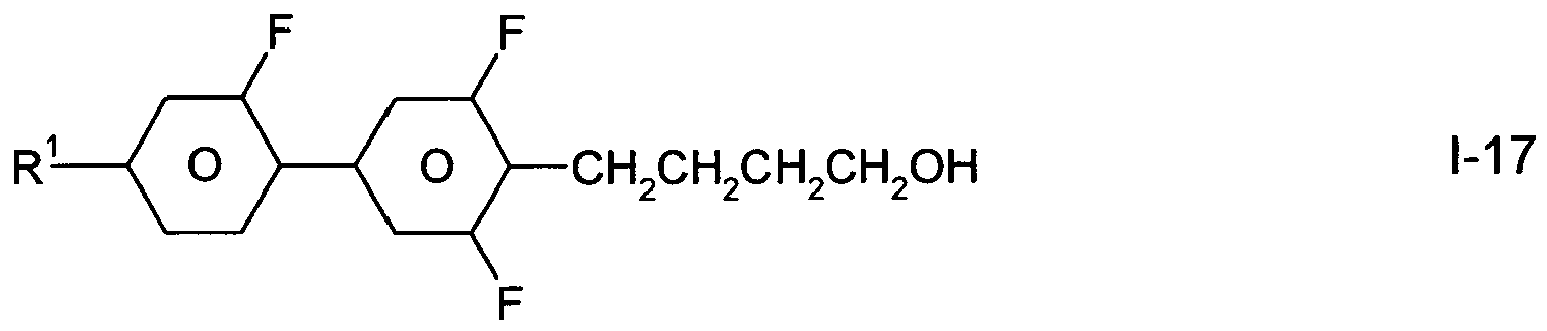





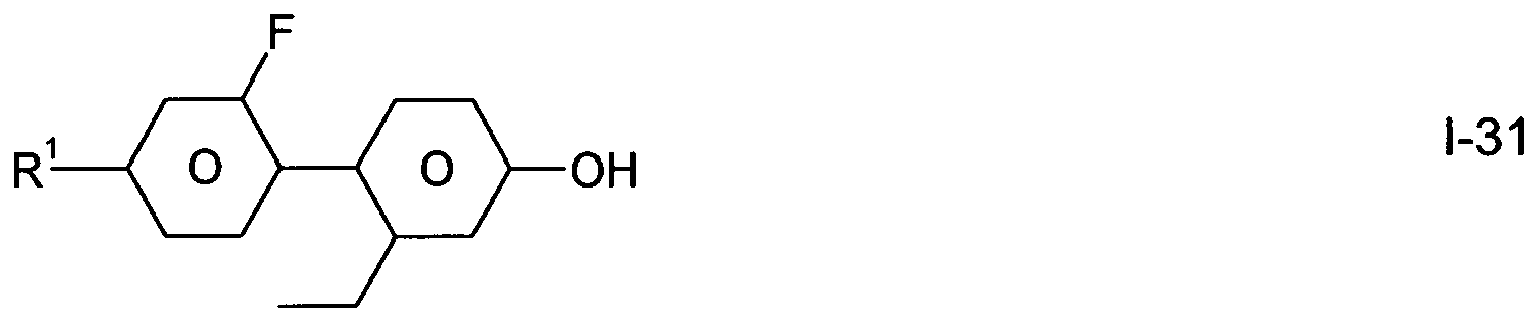



- Liquid-crystalline medium according to Claim 1 or 2 characterized in that it contains one or more compounds of the formulae I-1a, I-2a or I-2b,



alkyl denotes a straight-chain alkyl radical having 1 to 7 carbon atoms. - Liquid-crystalline medium according to one or more of Claims 1 to 3 characterized in that it contains one or more compounds of the formulae I-A-1 to I-K-1,






alkyl and alkyl* each, independently of one another, denote a straight-chain alkyl radical having 1-6 C atoms, and
alkoxy denotes a straight-chain alkoxy radical having 1-6 C atoms.
L1 and L2 each, independently of one another, denote H, F, Cl, CF3 or CHF2. - Liquid-crystalline medium according to one or more of Claims 1 to 4 characterized in that it additionally contains one or more compounds of the formulae IIA to IIC,


 R2A, R2B and R2C each, independently of one another, denote H, an alkyl or alkenyl radical having up to 15 C atoms which is unsubstituted, monosubstituted by CN or CF3 or at least monosubstituted by halogen, where, in addition, one or more CH2 groups in these radicals may be replaced by -O-, -S-,
 L1-4 each, independently of one another, denote F or Cl,Z2 and Z2' each, independently of one another, denote a single bond, -CH2CH2-, -CH=CH-, -CF2O-, -OCF2-, -CH2O-, -OCH2-, -COO-, -OCO-, -C2F4-, -CF=CF-, -CH=CHCH2O-,p denotes 1 or 2,q denotes 0 or 1, andv denotes 1 to 6.
 - Liquid-crystalline medium according to one or more of Claims 1 to 5 characterized in that it additionally contains one or more compounds of the formula III,
 R31 and R32 each, independently of one another, denote a straight-chain alkyl, alkoxyalkyl, alkenyl, or alkoxy radical having up to 12 C atoms, and

 Z3 denotes a single bond, -CH2CH2-, -CH=CH-, -CF2O-, -OCF2-, -CH2O-, -OCH2-, -COO-, -OCO-, -C2F4-, -C4H9-, -CF=CF-.
 - Liquid-crystalline medium according to one or more of Claims 1 to 6 characterized in that it additionally contains one or more compounds of the formulae L-1 to L-11,


R, R1 and R2 each, independently of one another, have the meanings indicated for R2A in Claim 5, and alkyl denotes an alkyl radical having 1-6 C atoms, ands denotes 1 or 2. - Liquid-crystalline medium according to one or more of Claims 1 to 7 characterized in that it additionally contains one or more compounds of the formulae T-1 to T-21,











 R denotes a straight-chain alkyl or alkoxy radical having 1-7 C atoms, andm denotes 1-6.
 - Liquid-crystalline medium according to one or more of Claims 1 to 8 characterized in that it additionally contains one or more compounds of the formulae O-1 to O-11,








R1 and R2 each, independently of one another, have the meanings indicated for R2A in Claim 5. - Liquid-crystalline medium according to one or more of Claims 1 to 9 characterized in that the mixture contains 0.01 to 10 % by weight of the compound of the formula I based on the mixture as a whole.
- Liquid-crystalline medium according to one or more of Claims 1 to 10 characterized in that the mixture additionally contains one or more additives.
- Liquid-crystalline medium according to one or more of Claims 1 to 11 characterized in that the additives are selected from the group of antioxidants, stabilisers, reactive mesogens, dopants, microparticles, nanoparticles and dyes.
- Liquid-crystalline medium according to one or more of Claims 1 to 12 characterized in that the medium additionally contains at least one stabilizer selected from the following group of stabilizers:


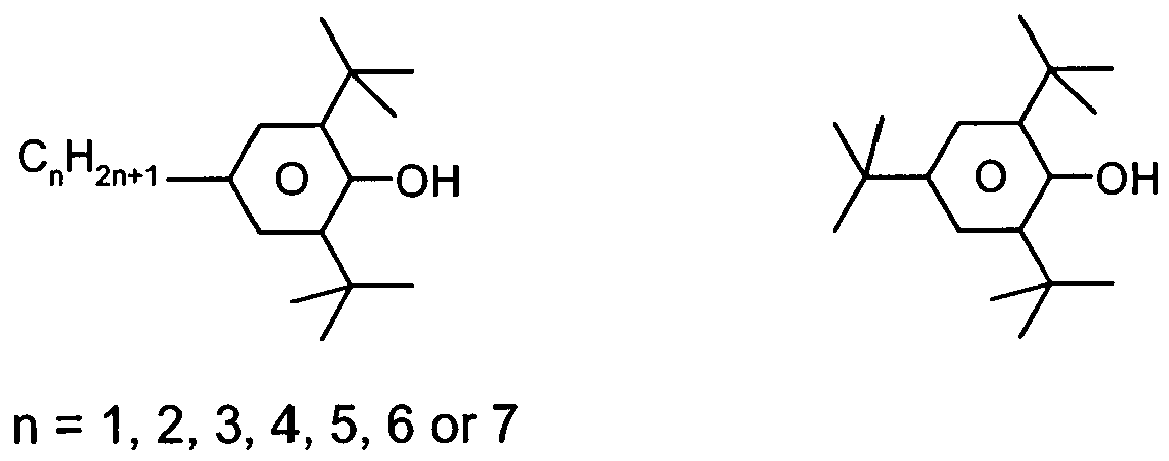


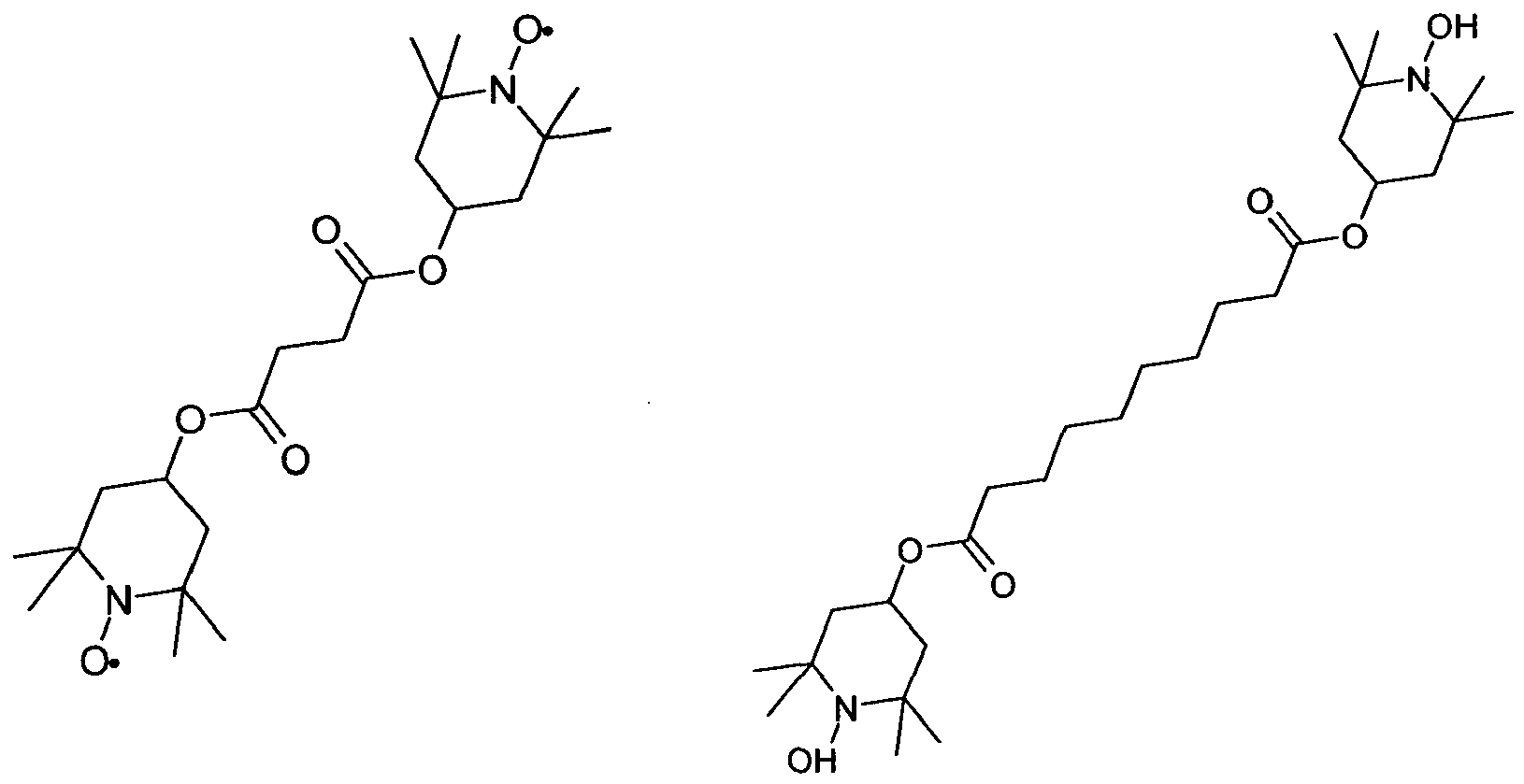
- Liquid-crystalline medium according to one or more of Claims 1 to 13 characterized in that the medium additionally contains at least one reactive mesogen selected from the following group of compounds of the formulae M1 to M41,





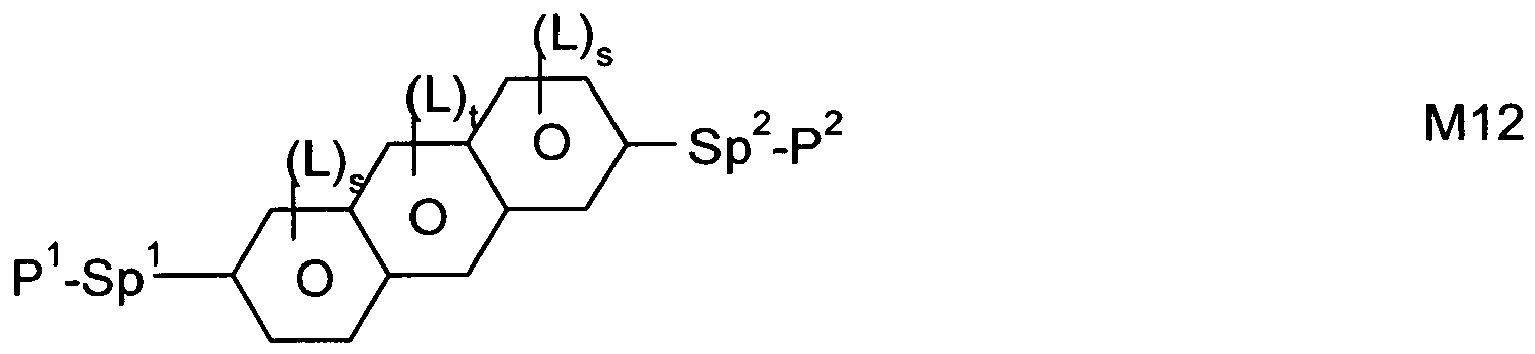


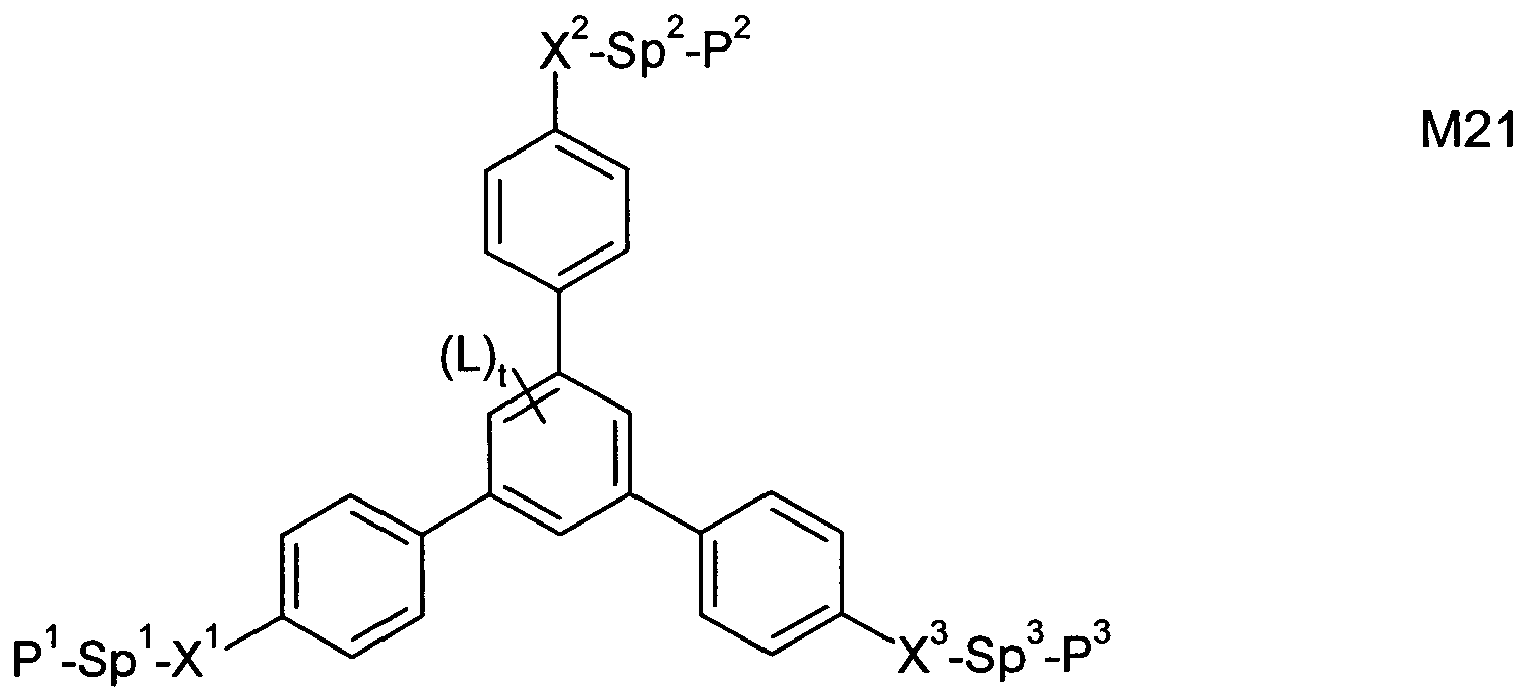

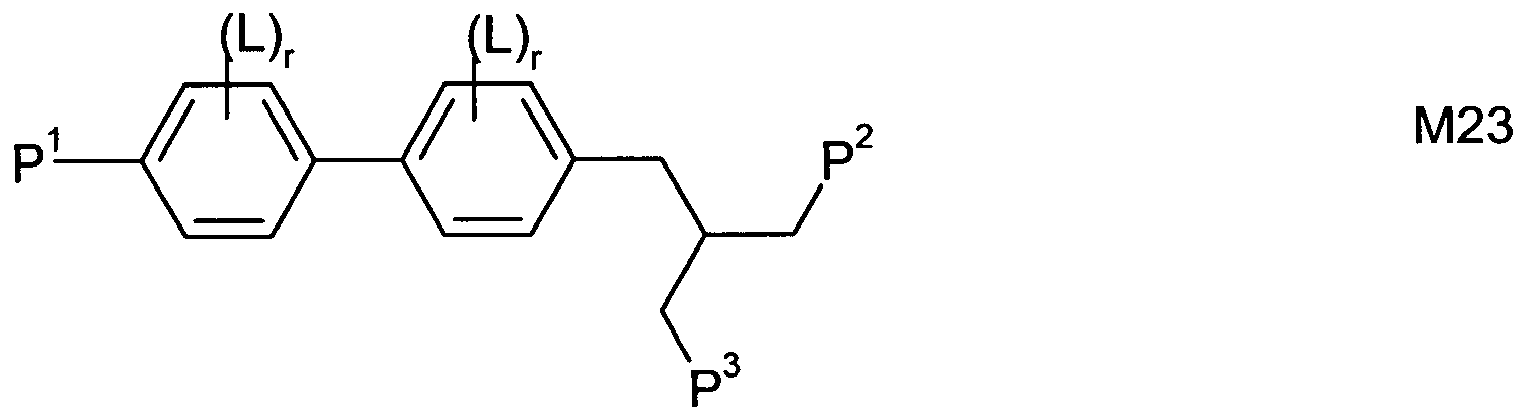


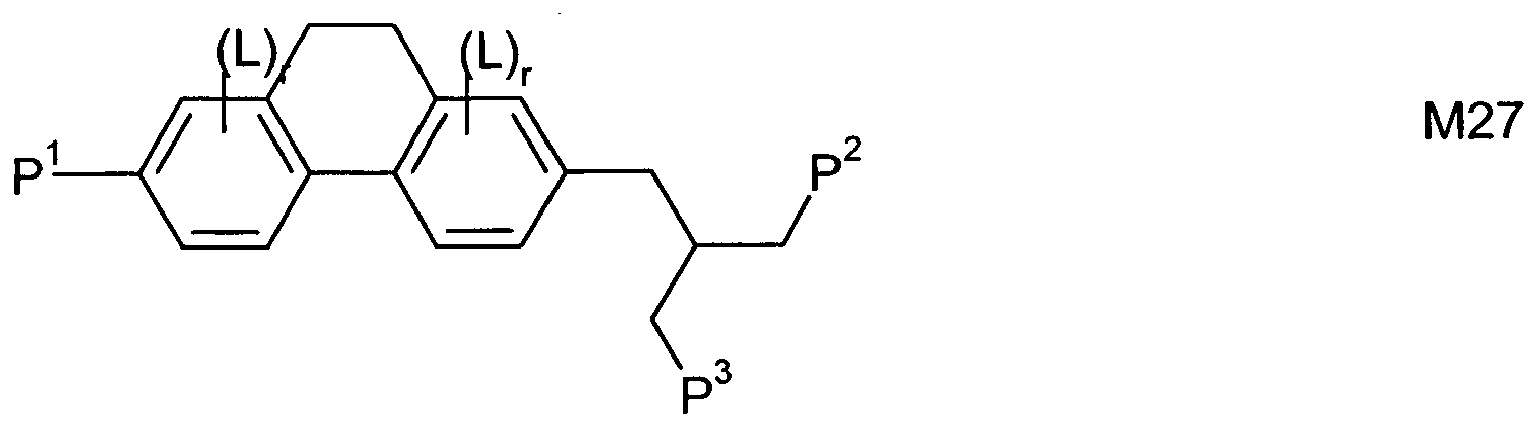






 P1, P2 and P3 each, independently of one another, denote a polymerisable group, preferably having one of the meanings indicated above and below for P, particularly preferably an acrylate, methacrylate, fluoroacrylate, oxetane, vinyl, vinyloxy or epoxide group,Sp1,Sp2 and Sp3 each, independently of one another, denote a single bond or a spacer group, preferably having one of the meanings indicated above and below for Sp, and particularly preferably denote -(CH2)p1-, -(CH2)p1-O-, -(CH2)p1-CO-O- or -(CH2)p1-O-CO-O-, in which p1 is an integer from 1 to 12, and where the linking to the adjacent ring in the last-mentioned groups takes place via the O atom,
where, in addition, one or more of the radicals P1-Sp1-, P2-Sp2- and P3-Sp3- may denote Raa, with the proviso that at least one of the radicals P1-Sp1-, P2-Sp2- and P3-Sp3- present does not denote Raa,Raa denotes H, F, Cl, CN or straight-chain or branched alkyl having 1 to 25 C atoms, in which, in addition, one or more non-adjacent CH2 groups may each be replaced, independently of one another, by C(R0)=C(R00)-, -C≡C-, -N(R0)-, -O-, -S-, -CO-, -CO-O-, -O-CO-, -O-CO-O- in such a way that O and/or S atoms are not linked directly to one another, and in which, in addition, one or more H atoms may be replaced by F, Cl, CN or P1-Sp1-, particularly preferably straight-chain or branched, optionally mono- or polyfluorinated alkyl, alkoxy, alkenyl, alkynyl, alkylcarbonyl, alkoxycarbonyl, alkylcarbonyloxy or alkoxycarbonyloxy having 1 to 12 C atoms (where the alkenyl and alkynyl radicals have at least two C atoms and the branched radicals have at least three C atoms),R0, R00 each, independently of one another and identically or differently on each occurrence, denote H or alkyl having 1 to 12 C atoms,Ry and Rz each, independently of one another, denote H, F, CH3 or CF3,X1, X2 and X3 each, independently of one another, denote -CO-O-, -O-CO- or a single bond,Z1 denotes -O-, -CO-, -C(RyRz)- or -CF2CF2-,Z2 and Z3 each, independently of one another, denote -CO-O-, -O-CO-, -CH2O-, -OCH2-, -CF2O-, -OCF2- or -(CH2)n-, where n is 2, 3 or 4,L on each occurrence, identically or differently, denotes F, Cl, CN or straight-chain or branched, optionally mono- or polyfluorinated alkyl, alkoxy, alkenyl, alkynyl, alkylcarbonyl, alkoxycarbonyl, alkylcarbonyloxy or alkoxycarbonyloxy having 1 to 12 C atoms, preferably F,L' and L" each, independently of one another, denote H, F or Cl,r denotes 0, 1, 2, 3 or 4,s denotes 0, 1, 2 or 3,t denotes 0, 1 or 2,x denotes 0 or 1. - Liquid-crystalline medium according to one or more of Claims 1 to 14 characterized in that the medium additionally contains at least one reactive mesogen selected from the following group of compounds of the formulae RM-1 to RM-98,


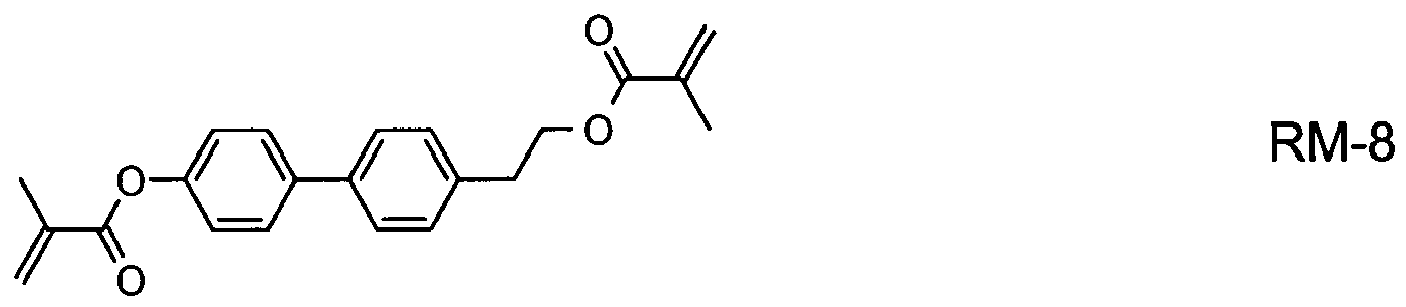
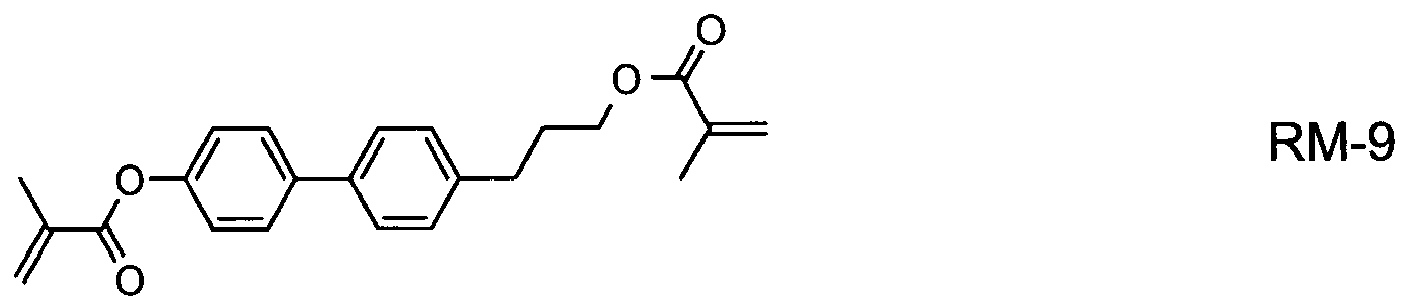












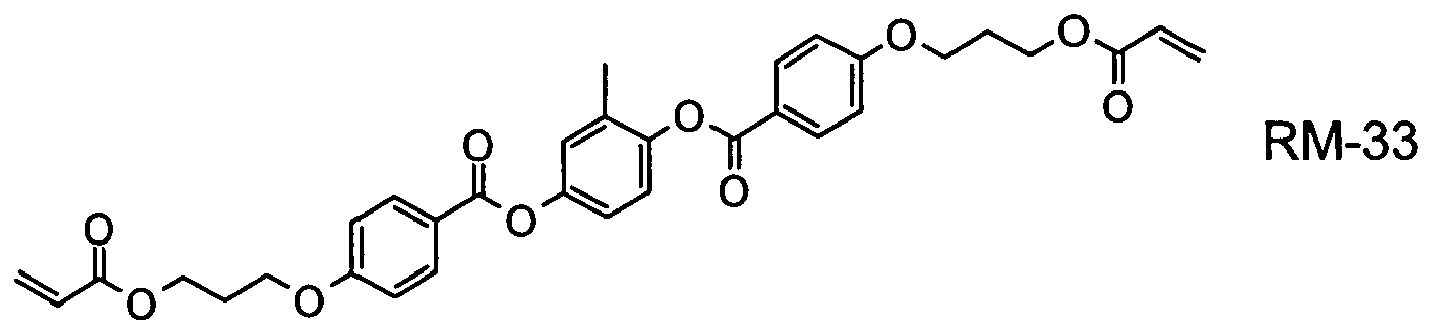





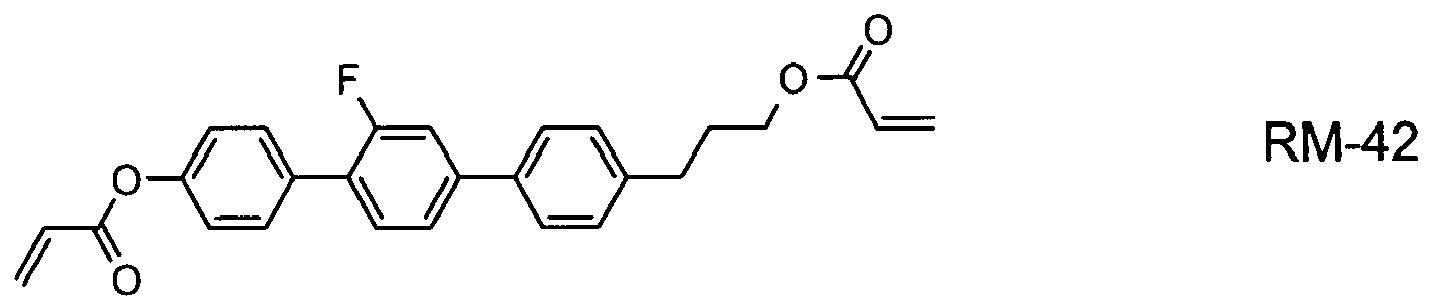


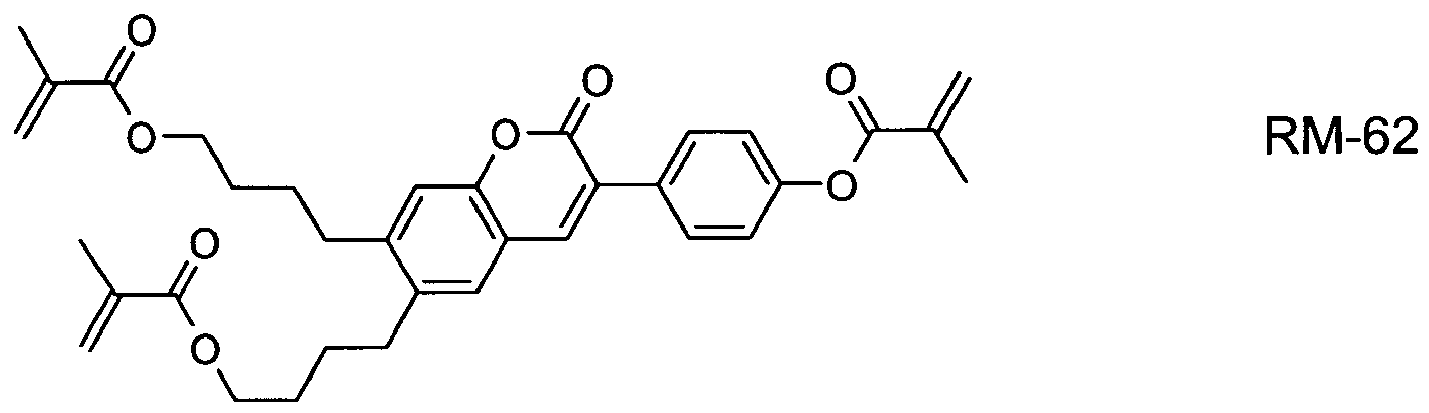


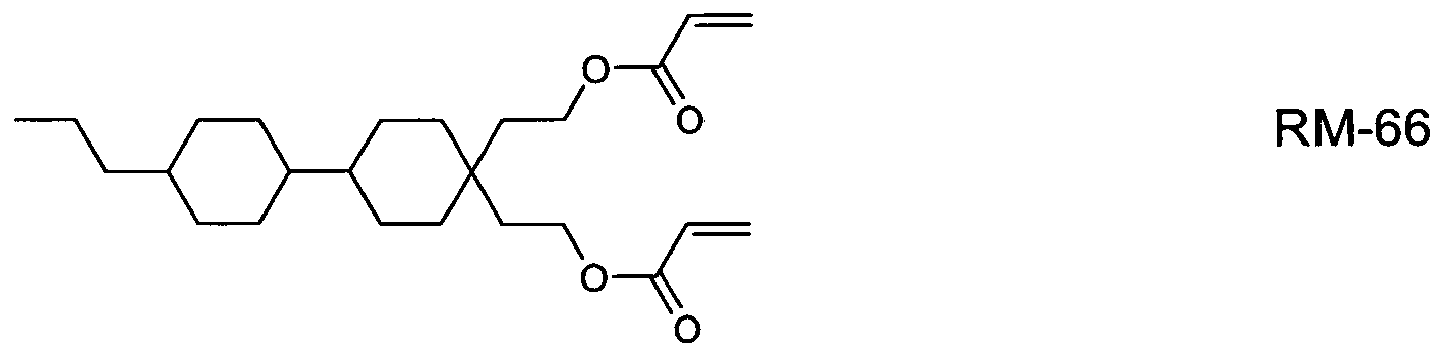





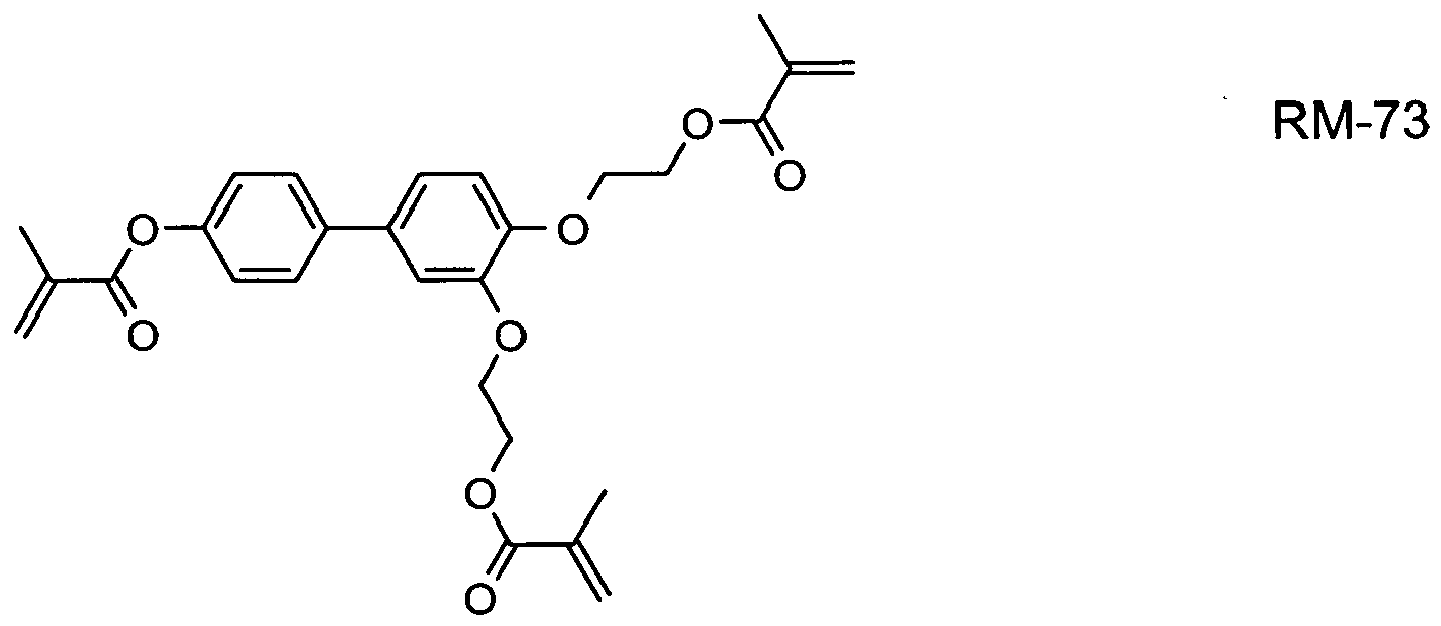
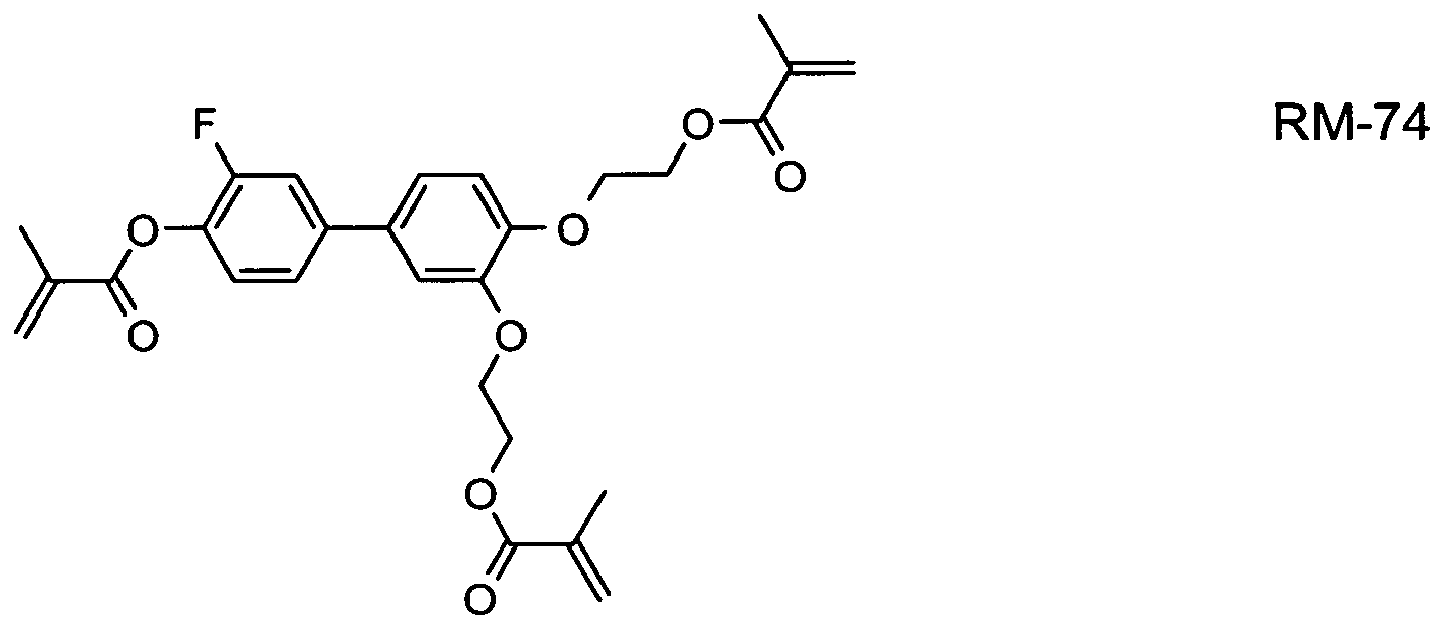


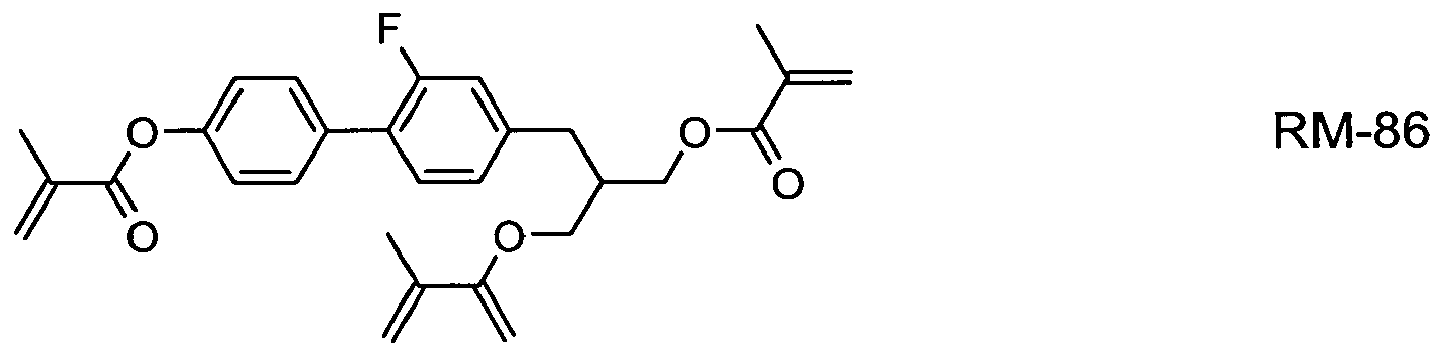

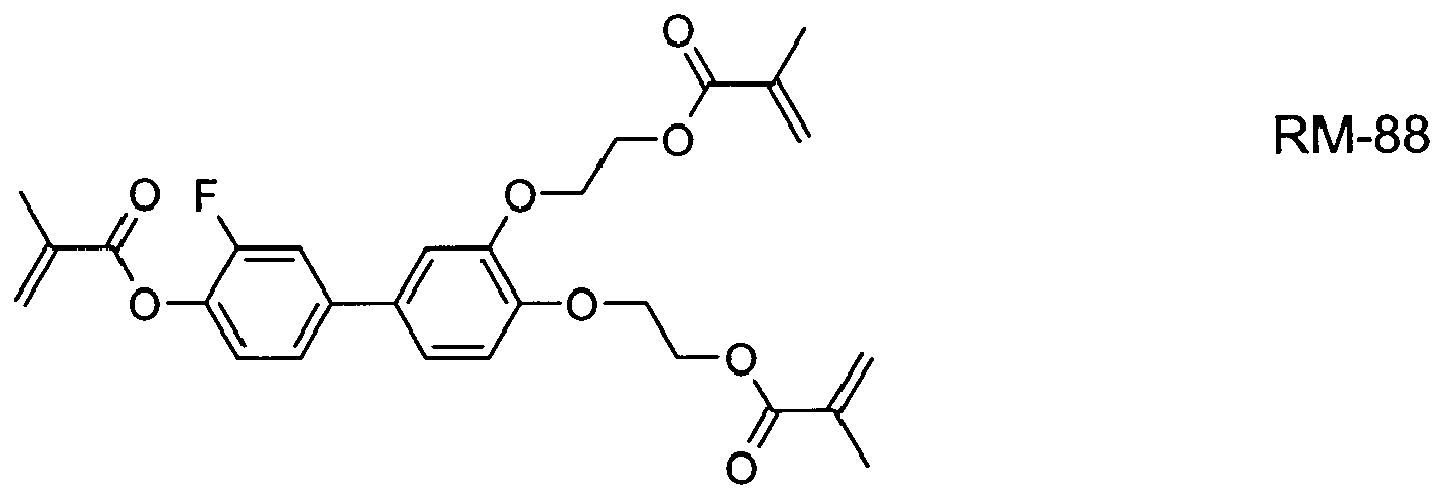


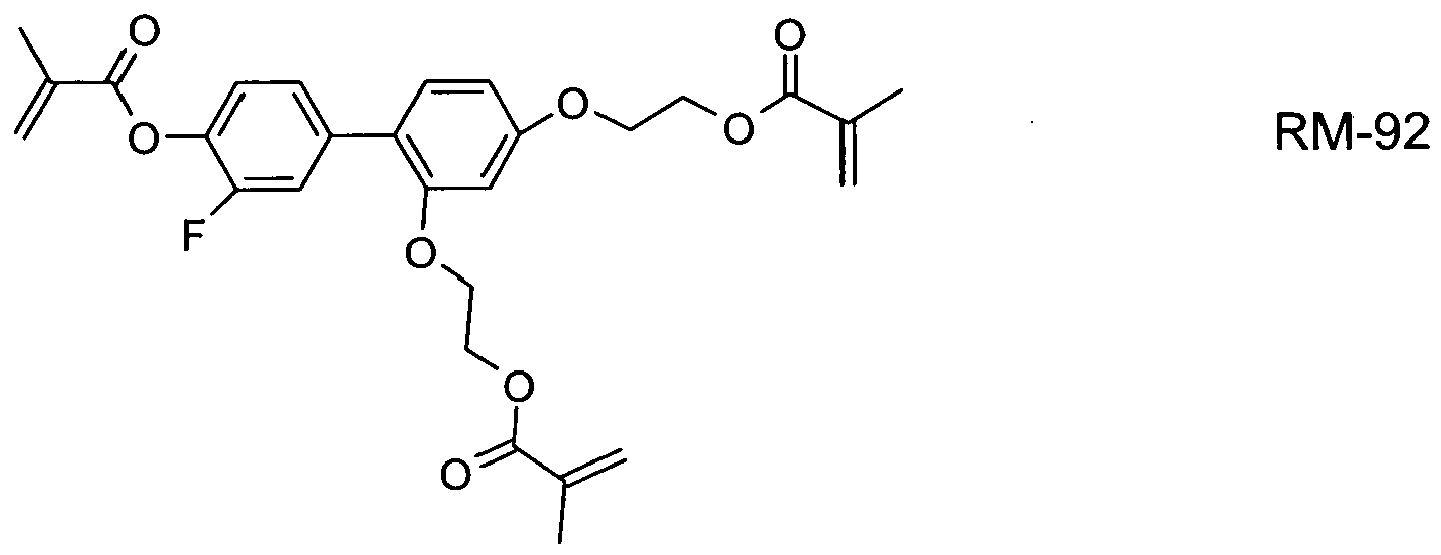


- Process for the preparation of a liquid-crystalline medium according to one or more of Claims 1 to 15, characterised in that at least one compound of the formula I and at least one compound of the formulae I-A to I-K are mixed with at least one further liquid-crystalline compound, and additives are optionally added.
- Use of the liquid-crystalline medium according to one or more of Claims 1 to 15 in electro-optical displays.
- Use of the liquid-crystalline medium according to Claim 17 in electro-optical displays for the self-aligning VA mode.
- Electro-optical display having active-matrix or passive matrix addressing, characterised in that it contains, as dielectric, a liquid-crystalline medium according to one or more of Claims 1 to 15.
- Electro-optical display according to Claim 19 characterised in that it is a VA, PM-VA, PSA, PS-VA, PALC, FFS, PS-FFS, IPS or PS-IPS display.
Priority Applications (1)
| Application Number | Priority Date | Filing Date | Title |
|---|---|---|---|
| EP15002394.3A EP2985334B1 (en) | 2014-08-15 | 2015-08-13 | Liquid-crystalline medium |
Applications Claiming Priority (2)
| Application Number | Priority Date | Filing Date | Title |
|---|---|---|---|
| EP14002851 | 2014-08-15 | ||
| EP15002394.3A EP2985334B1 (en) | 2014-08-15 | 2015-08-13 | Liquid-crystalline medium |
Publications (2)
| Publication Number | Publication Date |
|---|---|
| EP2985334A1 true EP2985334A1 (en) | 2016-02-17 |
| EP2985334B1 EP2985334B1 (en) | 2018-06-20 |
Family
ID=51357710
Family Applications (1)
| Application Number | Title | Priority Date | Filing Date |
|---|---|---|---|
| EP15002394.3A Not-in-force EP2985334B1 (en) | 2014-08-15 | 2015-08-13 | Liquid-crystalline medium |
Country Status (6)
| Country | Link |
|---|---|
| US (1) | US9714381B2 (en) |
| EP (1) | EP2985334B1 (en) |
| JP (1) | JP2016041804A (en) |
| KR (1) | KR20160021062A (en) |
| CN (1) | CN105400522B (en) |
| TW (1) | TWI677564B (en) |
Cited By (12)
| Publication number | Priority date | Publication date | Assignee | Title |
|---|---|---|---|---|
| EP3121247A1 (en) * | 2015-06-09 | 2017-01-25 | Merck Patent GmbH | Polymerisable compounds and the use thereof in liquid-crystal displays |
| EP3130650A1 (en) * | 2015-08-10 | 2017-02-15 | Merck Patent GmbH | Liquid-crystalline medium |
| EP3263673A1 (en) * | 2016-06-30 | 2018-01-03 | Merck Patent GmbH | Liquid-crystalline medium |
| JP2018009143A (en) * | 2016-04-21 | 2018-01-18 | メルク・パテント・ゲゼルシヤフト・ミツト・ベシユレンクテル・ハフツングMerck Patent GmbH | Liquid crystal medium |
| CN110093166A (en) * | 2018-01-31 | 2019-08-06 | 北京八亿时空液晶科技股份有限公司 | A kind of liquid-crystal composition containing from orientation compound and its application |
| US10450269B1 (en) | 2013-11-18 | 2019-10-22 | Global Blood Therapeutics, Inc. | Compounds and uses thereof for the modulation of hemoglobin |
| CN110396414A (en) * | 2018-04-25 | 2019-11-01 | 北京八亿时空液晶科技股份有限公司 | A kind of self-alignment additive and its preparation method and application |
| CN110452709A (en) * | 2018-05-07 | 2019-11-15 | 达兴材料股份有限公司 | Silicon-containing compound, liquid-crystal composition and liquid crystal display device using this silicon-containing compound |
| KR20190143824A (en) * | 2018-06-21 | 2019-12-31 | 메르크 파텐트 게엠베하 | Liquid-crystalline medium |
| EP3450523A4 (en) * | 2016-04-27 | 2020-01-01 | DIC Corporation | LIQUID CRYSTAL COMPOSITION AND LIQUID CRYSTAL DISPLAY ELEMENT |
| US11053195B2 (en) | 2013-03-15 | 2021-07-06 | Global Blood Therapeutics, Inc. | Compounds and uses thereof for the modulation of hemoglobin |
| EP4273207A1 (en) * | 2022-05-06 | 2023-11-08 | Merck Patent GmbH | Liquid-crystal medium |
Families Citing this family (25)
| Publication number | Priority date | Publication date | Assignee | Title |
|---|---|---|---|---|
| US9279082B2 (en) * | 2011-01-20 | 2016-03-08 | Merck Patent Gmbh | Polymerisable compounds and the use thereof in liquid-crystal displays |
| EP2993216B1 (en) | 2014-09-02 | 2017-07-26 | Merck Patent GmbH | Compounds and liquid crystalline medium |
| TR201904583T4 (en) * | 2015-05-22 | 2019-04-22 | Merck Patent Gmbh | Liquid crystal medium. |
| KR20160139126A (en) * | 2015-05-26 | 2016-12-07 | 삼성디스플레이 주식회사 | Composition for liquid crystal and liquid crystal display device comprising the same |
| EP3246374B1 (en) * | 2016-05-19 | 2019-08-14 | Merck Patent GmbH | Liquid-crystal medium |
| MX388576B (en) | 2016-06-07 | 2025-03-20 | Jacobio Pharmaceuticals Co Ltd | NOVEL HETEROCYCLIC DERIVATIVES USEFUL AS SHP2 INHIBITORS. |
| CN106281363B (en) * | 2016-07-18 | 2019-01-22 | 深圳市华星光电技术有限公司 | Auto-orientation Liquid crystal medium composition, liquid crystal display panel and preparation method thereof |
| CN106281364B (en) * | 2016-07-21 | 2019-01-22 | 深圳市华星光电技术有限公司 | Auto-orientation Liquid crystal medium composition, liquid crystal display panel and preparation method thereof |
| US11299673B2 (en) * | 2016-08-12 | 2022-04-12 | Merck Patent Gmbh | Liquid-crystal medium |
| WO2018155323A1 (en) * | 2017-02-24 | 2018-08-30 | Jnc株式会社 | Liquid crystal display element and liquid crystal composition |
| EA202190196A1 (en) | 2017-03-23 | 2021-08-31 | Джакобио Фармасьютикалс Ко., Лтд. | NEW HETEROCYCLIC DERIVATIVES USED AS SHP2 INHIBITORS |
| KR20200016215A (en) | 2017-06-01 | 2020-02-14 | 디아이씨 가부시끼가이샤 | Polymerizable monomer, liquid crystal composition and liquid crystal display element using the same |
| CN110719948B (en) * | 2017-06-23 | 2023-05-26 | Dic株式会社 | Liquid crystal composition and liquid crystal display element using same |
| WO2019003935A1 (en) | 2017-06-29 | 2019-01-03 | Dic株式会社 | Liquid crystal composition and liquid crystal display element |
| JP6699799B2 (en) * | 2017-11-17 | 2020-05-27 | Dic株式会社 | Polymerizable compound, liquid crystal composition and liquid crystal display device using the same |
| CN110229678B (en) * | 2018-03-06 | 2020-10-27 | 北京八亿时空液晶科技股份有限公司 | A kind of self-aligning additive and its preparation method and application |
| CN110396415B (en) * | 2018-04-25 | 2021-01-26 | 北京八亿时空液晶科技股份有限公司 | A new type of liquid crystal vertical alignment agent and its preparation method and application |
| CR20210175A (en) | 2018-09-18 | 2021-06-01 | Nikang Therapeutics Inc | Fused tricyclic ring derivatives as src homology-2 phosphatase inhibitors |
| US20210393623A1 (en) | 2018-09-26 | 2021-12-23 | Jacobio Pharmaceuticals Co., Ltd. | Novel Heterocyclic Derivatives Useful as SHP2 Inhibitors |
| TWI767148B (en) | 2018-10-10 | 2022-06-11 | 美商弗瑪治療公司 | Inhibiting fatty acid synthase (fasn) |
| JP2020176255A (en) * | 2019-04-18 | 2020-10-29 | Jnc株式会社 | Liquid crystal composition and liquid crystal display element |
| BR112022010924A2 (en) | 2019-12-06 | 2022-09-06 | Vertex Pharma | SUBSTITUTED TETRAHYDROFURANS AS SODIUM CHANNEL MODULATION |
| WO2021253628A1 (en) * | 2020-06-16 | 2021-12-23 | 石家庄诚志永华显示材料有限公司 | Liquid crystal composition, liquid crystal display element, and liquid crystal display |
| SMT202500481T1 (en) | 2021-06-04 | 2026-01-12 | Vertex Pharma | N-(hydroxyalkyl (hetero)aryl) tetrahydrofuran carboxamides as modulators of sodium channels |
| CN113755184B (en) * | 2021-10-12 | 2023-11-10 | 重庆汉朗精工科技有限公司 | Liquid crystal composition with large optical anisotropy and application thereof |
Citations (14)
| Publication number | Priority date | Publication date | Assignee | Title |
|---|---|---|---|---|
| DE2209127A1 (en) | 1972-02-26 | 1973-09-06 | Merck Patent Gmbh | MODIFIED NEMATIC PHASES |
| DE2338281A1 (en) | 1972-08-03 | 1974-02-21 | Ibm | PROCESS FOR THE CONTROLLED CHANGE OF THE ELECTRICAL PROPERTIES OF NEMATIC LIQUIDS AND DOPING AGENTS THEREFORE |
| DE2240864A1 (en) | 1972-08-19 | 1974-02-28 | Merck Patent Gmbh | NEMATIC ESTERS AND THEIR USE TO INFLUENCE THE ELECTROOPTICAL PROPERTIES OF NEMATIC PHASES |
| DE2321632A1 (en) | 1973-04-28 | 1974-11-21 | Merck Patent Gmbh | MODIFIED NEMATIC MIXTURES WITH POSITIVE DIELECTRIC ANISOTROPY |
| DE2450088A1 (en) | 1974-10-22 | 1976-04-29 | Merck Patent Gmbh | Liquid crystalline dielectrics for electronic components - contg biphenylyl carboxylic acid phenyl ester or benzoic acid biphenylyl ester components |
| DE2637430A1 (en) | 1976-08-20 | 1978-02-23 | Merck Patent Gmbh | Heterocyclic diaza cpd. in liquid crystalline dielectric - for electrooptical registration devices, giving stable orientation parallel to electrode surfaces |
| DE2853728A1 (en) | 1978-12-13 | 1980-07-17 | Merck Patent Gmbh | LIQUID CRYSTALLINE CARBONIC ACID ESTER, METHOD FOR THE PRODUCTION THEREOF, ITS CONTAINING DIELECTRICS AND ELECTRO-OPTICAL DISPLAY ELEMENT |
| EP0240379A1 (en) | 1986-02-28 | 1987-10-07 | Commissariat A L'energie Atomique | Double layer liquid-crystal cell using electrically controlled birefringence |
| WO1989003821A1 (en) | 1987-10-19 | 1989-05-05 | The Secretary Of State For Defence In Her Britanni | Laterally cyano- and fluoro-substituted terphenyls |
| US6781665B2 (en) | 2002-02-04 | 2004-08-24 | Fujitsu Display Technologies Corporation | Liquid crystal display and method of manufacturing the same |
| US6861107B2 (en) | 2002-07-06 | 2005-03-01 | Merck Patent Gmbh | Liquid-crystalline medium |
| US20130182202A1 (en) * | 2010-09-25 | 2013-07-18 | Merck Patent Gesellschaft Mit Beschrankter Haftung | Liquid crystal displays and liquid crystalline media with homeotropic alignment |
| US20140138581A1 (en) * | 2011-07-07 | 2014-05-22 | Merck Patent Gmbh | Liquid-crystalline medium |
| WO2014090362A1 (en) | 2012-12-12 | 2014-06-19 | Merck Patent Gmbh | Liquid-crystalline medium |
Family Cites Families (3)
| Publication number | Priority date | Publication date | Assignee | Title |
|---|---|---|---|---|
| JP5885903B2 (en) * | 2008-07-17 | 2016-03-16 | メルク パテント ゲゼルシャフト ミット ベシュレンクテル ハフツングMerck Patent Gesellschaft mit beschraenkter Haftung | Liquid crystal media |
| US9249355B2 (en) * | 2011-02-05 | 2016-02-02 | Merck Patent Gmbh | Liquid-crystal displays having homeotropic alignment |
| CN103589437B (en) * | 2012-06-29 | 2018-01-12 | 默克专利股份有限公司 | Liquid crystal media |
-
2015
- 2015-08-13 EP EP15002394.3A patent/EP2985334B1/en not_active Not-in-force
- 2015-08-14 US US14/826,346 patent/US9714381B2/en not_active Expired - Fee Related
- 2015-08-14 CN CN201510715617.6A patent/CN105400522B/en not_active Expired - Fee Related
- 2015-08-14 JP JP2015160011A patent/JP2016041804A/en active Pending
- 2015-08-17 KR KR1020150115109A patent/KR20160021062A/en not_active Withdrawn
- 2015-08-17 TW TW104126738A patent/TWI677564B/en not_active IP Right Cessation
Patent Citations (14)
| Publication number | Priority date | Publication date | Assignee | Title |
|---|---|---|---|---|
| DE2209127A1 (en) | 1972-02-26 | 1973-09-06 | Merck Patent Gmbh | MODIFIED NEMATIC PHASES |
| DE2338281A1 (en) | 1972-08-03 | 1974-02-21 | Ibm | PROCESS FOR THE CONTROLLED CHANGE OF THE ELECTRICAL PROPERTIES OF NEMATIC LIQUIDS AND DOPING AGENTS THEREFORE |
| DE2240864A1 (en) | 1972-08-19 | 1974-02-28 | Merck Patent Gmbh | NEMATIC ESTERS AND THEIR USE TO INFLUENCE THE ELECTROOPTICAL PROPERTIES OF NEMATIC PHASES |
| DE2321632A1 (en) | 1973-04-28 | 1974-11-21 | Merck Patent Gmbh | MODIFIED NEMATIC MIXTURES WITH POSITIVE DIELECTRIC ANISOTROPY |
| DE2450088A1 (en) | 1974-10-22 | 1976-04-29 | Merck Patent Gmbh | Liquid crystalline dielectrics for electronic components - contg biphenylyl carboxylic acid phenyl ester or benzoic acid biphenylyl ester components |
| DE2637430A1 (en) | 1976-08-20 | 1978-02-23 | Merck Patent Gmbh | Heterocyclic diaza cpd. in liquid crystalline dielectric - for electrooptical registration devices, giving stable orientation parallel to electrode surfaces |
| DE2853728A1 (en) | 1978-12-13 | 1980-07-17 | Merck Patent Gmbh | LIQUID CRYSTALLINE CARBONIC ACID ESTER, METHOD FOR THE PRODUCTION THEREOF, ITS CONTAINING DIELECTRICS AND ELECTRO-OPTICAL DISPLAY ELEMENT |
| EP0240379A1 (en) | 1986-02-28 | 1987-10-07 | Commissariat A L'energie Atomique | Double layer liquid-crystal cell using electrically controlled birefringence |
| WO1989003821A1 (en) | 1987-10-19 | 1989-05-05 | The Secretary Of State For Defence In Her Britanni | Laterally cyano- and fluoro-substituted terphenyls |
| US6781665B2 (en) | 2002-02-04 | 2004-08-24 | Fujitsu Display Technologies Corporation | Liquid crystal display and method of manufacturing the same |
| US6861107B2 (en) | 2002-07-06 | 2005-03-01 | Merck Patent Gmbh | Liquid-crystalline medium |
| US20130182202A1 (en) * | 2010-09-25 | 2013-07-18 | Merck Patent Gesellschaft Mit Beschrankter Haftung | Liquid crystal displays and liquid crystalline media with homeotropic alignment |
| US20140138581A1 (en) * | 2011-07-07 | 2014-05-22 | Merck Patent Gmbh | Liquid-crystalline medium |
| WO2014090362A1 (en) | 2012-12-12 | 2014-06-19 | Merck Patent Gmbh | Liquid-crystalline medium |
Non-Patent Citations (18)
| Title |
|---|
| "Merck Liquid Crystals, Physical Properties of Liquid Crystals", November 1997, MERCK KGAA |
| G. LABRUNIE; J. ROBERT, J. APPL. PHYS., vol. 44, 1973, pages 4869 |
| H. SCHAD, SID 82 DIGEST TECHN. PAPERS, 1982, pages 244 |
| HALLER ET AL., MOL. CRYST. LIQ. CRYST, vol. 24, 1973, pages 249 - 258 |
| J. DUCHENE, DISPLAYS, vol. 7, 1986, pages 3 |
| J. ROBERT; F. CLERC, STD 80 DIGEST TECHN. PAPERS, 1980, pages 30 |
| J.F. KAHN, APPL. PHYS. LETT., vol. 20, 1972, pages 1193 |
| KIM, HYEON KYEONG ET AL.: "SID 2004 International Symposium, Digest of Technical Papers", vol. XXXV, article "A 57-in. Wide UXGA TFT-LCD for HDTV Application", pages: 106 - 109 |
| KIM, SANG SOO: "SID 2004 International Symposium, Digest of Technical Papers", vol. XXXV, article "Super PVA Sets New State-of-the-Art for LCD-TV", pages: 760 - 763 |
| LIU, C.T. ET AL.: "SID 2004 International Symposium, Digest of Technical Papers", vol. XXXV, article "A 46-inch TFT-LCD HDTV Technology", pages: 750 - 753 |
| M.F. SCHIECKEL; K. FAHRENSCHON: "Deformation of nematic liquid crystals with vertical orientation in electrical fields", APPL. PHYS. LETT., vol. 19, 1971, pages 3912 |
| MILLER, IAN: "LCD-Televisio", SID SEMINAR 2004, SEMINAR M-7, pages M-7,1 - M-7,32 |
| SHIGETA, MITZUHIRO; FUKUOKA, HIROFUMI: "SID 2004 International Symposium, Digest of Technical Papers", vol. XXXV, article "Development of High Quality LCDTV", pages: 754 - 757 |
| SOUK, JUN: "Recent Advances in LCD Technology", SID SEMINAR 2004, SEMINAR M-6, pages M-6,1 - M-6,26 |
| STROMER, M.: "Design of Thin Film Transistors for Matrix Addressing of Television Liquid Crystal Displays", PROC. EURODISPLAY 84, September 1984 (1984-09-01), pages 145 FF |
| TOGASHI, S.; SEKIGUCHI, K.; TANABE, H.; YAMAMOTO, E.; SORI-MACHI, K.; TAJIMA, E.; WATANABE, H.; SHIM1ZU, H.: "A 210-288 Matrix LCD Controlled by Double Stage Diode Rings", PROC. EURODISPLAY 84, September 1984 (1984-09-01), pages 141 FF |
| YEO, S.D.: "SID 2004 International Symposium, Digest of Technical Papers", vol. XXXV, article "An LC Display for the TV Application", pages: 758,759 |
| YOSHIDE, H. ET AL.: "SID 2004 International Symposium, Digest of Technical Papers", vol. XXXV, article "MVA LCD for Notebook or Mobile PCs ...", pages: 6 - 9 |
Cited By (19)
| Publication number | Priority date | Publication date | Assignee | Title |
|---|---|---|---|---|
| US11053195B2 (en) | 2013-03-15 | 2021-07-06 | Global Blood Therapeutics, Inc. | Compounds and uses thereof for the modulation of hemoglobin |
| US10450269B1 (en) | 2013-11-18 | 2019-10-22 | Global Blood Therapeutics, Inc. | Compounds and uses thereof for the modulation of hemoglobin |
| EP3121247A1 (en) * | 2015-06-09 | 2017-01-25 | Merck Patent GmbH | Polymerisable compounds and the use thereof in liquid-crystal displays |
| US11225606B2 (en) | 2015-06-09 | 2022-01-18 | Merck Patent Gmbh | Polymerizable compounds and the use thereof in liquid-crystal displays |
| US10344215B2 (en) | 2015-06-09 | 2019-07-09 | Merck Patent Gmbh | Polymerizable compounds and the use thereof in liquid-crystal displays |
| US11414599B2 (en) | 2015-06-09 | 2022-08-16 | Merck Patent Gmbh | Polymerizable compounds and the use thereof in liquid-crystal displays |
| EP3130650A1 (en) * | 2015-08-10 | 2017-02-15 | Merck Patent GmbH | Liquid-crystalline medium |
| JP2018009143A (en) * | 2016-04-21 | 2018-01-18 | メルク・パテント・ゲゼルシヤフト・ミツト・ベシユレンクテル・ハフツングMerck Patent GmbH | Liquid crystal medium |
| JP2022101586A (en) * | 2016-04-21 | 2022-07-06 | メルク・パテント・ゲゼルシヤフト・ミツト・ベシユレンクテル・ハフツング | Liquid crystal medium |
| US11555152B2 (en) | 2016-04-27 | 2023-01-17 | Dic Corporation | Liquid crystal composition and liquid crystal display element |
| EP3450523A4 (en) * | 2016-04-27 | 2020-01-01 | DIC Corporation | LIQUID CRYSTAL COMPOSITION AND LIQUID CRYSTAL DISPLAY ELEMENT |
| EP3263673A1 (en) * | 2016-06-30 | 2018-01-03 | Merck Patent GmbH | Liquid-crystalline medium |
| CN110093166A (en) * | 2018-01-31 | 2019-08-06 | 北京八亿时空液晶科技股份有限公司 | A kind of liquid-crystal composition containing from orientation compound and its application |
| CN110396414A (en) * | 2018-04-25 | 2019-11-01 | 北京八亿时空液晶科技股份有限公司 | A kind of self-alignment additive and its preparation method and application |
| CN110452709A (en) * | 2018-05-07 | 2019-11-15 | 达兴材料股份有限公司 | Silicon-containing compound, liquid-crystal composition and liquid crystal display device using this silicon-containing compound |
| CN110452709B (en) * | 2018-05-07 | 2021-05-18 | 达兴材料股份有限公司 | Silicon-containing compound, liquid crystal composition using the same, and liquid crystal display device |
| EP3587536A1 (en) * | 2018-06-21 | 2020-01-01 | Merck Patent GmbH | Liquid crystalline medium |
| KR20190143824A (en) * | 2018-06-21 | 2019-12-31 | 메르크 파텐트 게엠베하 | Liquid-crystalline medium |
| EP4273207A1 (en) * | 2022-05-06 | 2023-11-08 | Merck Patent GmbH | Liquid-crystal medium |
Also Published As
| Publication number | Publication date |
|---|---|
| US9714381B2 (en) | 2017-07-25 |
| CN105400522B (en) | 2021-05-07 |
| TW201612298A (en) | 2016-04-01 |
| TWI677564B (en) | 2019-11-21 |
| CN105400522A (en) | 2016-03-16 |
| US20160046863A1 (en) | 2016-02-18 |
| JP2016041804A (en) | 2016-03-31 |
| KR20160021062A (en) | 2016-02-24 |
| EP2985334B1 (en) | 2018-06-20 |
Similar Documents
| Publication | Publication Date | Title |
|---|---|---|
| EP2985334B1 (en) | Liquid-crystalline medium | |
| EP3347434B1 (en) | Liquid-crystalline medium | |
| EP2931836B1 (en) | Liquid-crystalline medium | |
| US10131841B2 (en) | Liquid-crystalline medium | |
| KR102763509B1 (en) | Liquid-crystalline medium | |
| EP2729550B1 (en) | Liquid-crystalline medium | |
| EP2817388B1 (en) | Liquid crystalline medium | |
| KR102415381B1 (en) | Liquid-crystalline medium | |
| US9777216B2 (en) | Liquid crystalline medium | |
| KR20230090307A (en) | Liquid-crystalline medium | |
| KR102784841B1 (en) | Liquid-crystalline medium | |
| EP3246374A2 (en) | Liquid-crystal medium | |
| EP3130650B1 (en) | Liquid-crystalline medium | |
| EP3103855A1 (en) | Liquid-crystalline medium |
Legal Events
| Date | Code | Title | Description |
|---|---|---|---|
| PUAI | Public reference made under article 153(3) epc to a published international application that has entered the european phase |
Free format text: ORIGINAL CODE: 0009012 |
|
| 17P | Request for examination filed |
Effective date: 20150813 |
|
| AK | Designated contracting states |
Kind code of ref document: A1 Designated state(s): AL AT BE BG CH CY CZ DE DK EE ES FI FR GB GR HR HU IE IS IT LI LT LU LV MC MK MT NL NO PL PT RO RS SE SI SK SM TR |
|
| AX | Request for extension of the european patent |
Extension state: BA ME |
|
| 17Q | First examination report despatched |
Effective date: 20170327 |
|
| GRAP | Despatch of communication of intention to grant a patent |
Free format text: ORIGINAL CODE: EPIDOSNIGR1 |
|
| RIC1 | Information provided on ipc code assigned before grant |
Ipc: C09K 19/06 20060101ALI20171204BHEP Ipc: C09K 19/30 20060101ALI20171204BHEP Ipc: C09K 19/54 20060101ALI20171204BHEP Ipc: C09K 19/18 20060101ALI20171204BHEP Ipc: C09K 19/32 20060101ALI20171204BHEP Ipc: C09K 19/12 20060101AFI20171204BHEP Ipc: C09K 19/52 20060101ALI20171204BHEP Ipc: C09K 19/04 20060101ALI20171204BHEP |
|
| INTG | Intention to grant announced |
Effective date: 20171220 |
|
| GRAJ | Information related to disapproval of communication of intention to grant by the applicant or resumption of examination proceedings by the epo deleted |
Free format text: ORIGINAL CODE: EPIDOSDIGR1 |
|
| GRAR | Information related to intention to grant a patent recorded |
Free format text: ORIGINAL CODE: EPIDOSNIGR71 |
|
| GRAS | Grant fee paid |
Free format text: ORIGINAL CODE: EPIDOSNIGR3 |
|
| GRAA | (expected) grant |
Free format text: ORIGINAL CODE: 0009210 |
|
| INTC | Intention to grant announced (deleted) | ||
| AK | Designated contracting states |
Kind code of ref document: B1 Designated state(s): AL AT BE BG CH CY CZ DE DK EE ES FI FR GB GR HR HU IE IS IT LI LT LU LV MC MK MT NL NO PL PT RO RS SE SI SK SM TR |
|
| INTG | Intention to grant announced |
Effective date: 20180516 |
|
| REG | Reference to a national code |
Ref country code: GB Ref legal event code: FG4D |
|
| REG | Reference to a national code |
Ref country code: IE Ref legal event code: FG4D |
|
| REG | Reference to a national code |
Ref country code: AT Ref legal event code: REF Ref document number: 1010594 Country of ref document: AT Kind code of ref document: T Effective date: 20180715 |
|
| REG | Reference to a national code |
Ref country code: DE Ref legal event code: R096 Ref document number: 602015012414 Country of ref document: DE |
|
| REG | Reference to a national code |
Ref country code: NL Ref legal event code: MP Effective date: 20180620 |
|
| PG25 | Lapsed in a contracting state [announced via postgrant information from national office to epo] |
Ref country code: SE Free format text: LAPSE BECAUSE OF FAILURE TO SUBMIT A TRANSLATION OF THE DESCRIPTION OR TO PAY THE FEE WITHIN THE PRESCRIBED TIME-LIMIT Effective date: 20180620 Ref country code: LT Free format text: LAPSE BECAUSE OF FAILURE TO SUBMIT A TRANSLATION OF THE DESCRIPTION OR TO PAY THE FEE WITHIN THE PRESCRIBED TIME-LIMIT Effective date: 20180620 Ref country code: NO Free format text: LAPSE BECAUSE OF FAILURE TO SUBMIT A TRANSLATION OF THE DESCRIPTION OR TO PAY THE FEE WITHIN THE PRESCRIBED TIME-LIMIT Effective date: 20180920 Ref country code: FI Free format text: LAPSE BECAUSE OF FAILURE TO SUBMIT A TRANSLATION OF THE DESCRIPTION OR TO PAY THE FEE WITHIN THE PRESCRIBED TIME-LIMIT Effective date: 20180620 Ref country code: BG Free format text: LAPSE BECAUSE OF FAILURE TO SUBMIT A TRANSLATION OF THE DESCRIPTION OR TO PAY THE FEE WITHIN THE PRESCRIBED TIME-LIMIT Effective date: 20180920 |
|
| REG | Reference to a national code |
Ref country code: LT Ref legal event code: MG4D |
|
| PG25 | Lapsed in a contracting state [announced via postgrant information from national office to epo] |
Ref country code: RS Free format text: LAPSE BECAUSE OF FAILURE TO SUBMIT A TRANSLATION OF THE DESCRIPTION OR TO PAY THE FEE WITHIN THE PRESCRIBED TIME-LIMIT Effective date: 20180620 Ref country code: LV Free format text: LAPSE BECAUSE OF FAILURE TO SUBMIT A TRANSLATION OF THE DESCRIPTION OR TO PAY THE FEE WITHIN THE PRESCRIBED TIME-LIMIT Effective date: 20180620 Ref country code: GR Free format text: LAPSE BECAUSE OF FAILURE TO SUBMIT A TRANSLATION OF THE DESCRIPTION OR TO PAY THE FEE WITHIN THE PRESCRIBED TIME-LIMIT Effective date: 20180921 Ref country code: HR Free format text: LAPSE BECAUSE OF FAILURE TO SUBMIT A TRANSLATION OF THE DESCRIPTION OR TO PAY THE FEE WITHIN THE PRESCRIBED TIME-LIMIT Effective date: 20180620 |
|
| REG | Reference to a national code |
Ref country code: AT Ref legal event code: MK05 Ref document number: 1010594 Country of ref document: AT Kind code of ref document: T Effective date: 20180620 |
|
| PG25 | Lapsed in a contracting state [announced via postgrant information from national office to epo] |
Ref country code: NL Free format text: LAPSE BECAUSE OF FAILURE TO SUBMIT A TRANSLATION OF THE DESCRIPTION OR TO PAY THE FEE WITHIN THE PRESCRIBED TIME-LIMIT Effective date: 20180620 |
|
| PG25 | Lapsed in a contracting state [announced via postgrant information from national office to epo] |
Ref country code: AT Free format text: LAPSE BECAUSE OF FAILURE TO SUBMIT A TRANSLATION OF THE DESCRIPTION OR TO PAY THE FEE WITHIN THE PRESCRIBED TIME-LIMIT Effective date: 20180620 Ref country code: EE Free format text: LAPSE BECAUSE OF FAILURE TO SUBMIT A TRANSLATION OF THE DESCRIPTION OR TO PAY THE FEE WITHIN THE PRESCRIBED TIME-LIMIT Effective date: 20180620 Ref country code: IS Free format text: LAPSE BECAUSE OF FAILURE TO SUBMIT A TRANSLATION OF THE DESCRIPTION OR TO PAY THE FEE WITHIN THE PRESCRIBED TIME-LIMIT Effective date: 20181020 Ref country code: SK Free format text: LAPSE BECAUSE OF FAILURE TO SUBMIT A TRANSLATION OF THE DESCRIPTION OR TO PAY THE FEE WITHIN THE PRESCRIBED TIME-LIMIT Effective date: 20180620 Ref country code: RO Free format text: LAPSE BECAUSE OF FAILURE TO SUBMIT A TRANSLATION OF THE DESCRIPTION OR TO PAY THE FEE WITHIN THE PRESCRIBED TIME-LIMIT Effective date: 20180620 Ref country code: PL Free format text: LAPSE BECAUSE OF FAILURE TO SUBMIT A TRANSLATION OF THE DESCRIPTION OR TO PAY THE FEE WITHIN THE PRESCRIBED TIME-LIMIT Effective date: 20180620 Ref country code: CZ Free format text: LAPSE BECAUSE OF FAILURE TO SUBMIT A TRANSLATION OF THE DESCRIPTION OR TO PAY THE FEE WITHIN THE PRESCRIBED TIME-LIMIT Effective date: 20180620 |
|
| PG25 | Lapsed in a contracting state [announced via postgrant information from national office to epo] |
Ref country code: ES Free format text: LAPSE BECAUSE OF FAILURE TO SUBMIT A TRANSLATION OF THE DESCRIPTION OR TO PAY THE FEE WITHIN THE PRESCRIBED TIME-LIMIT Effective date: 20180620 Ref country code: IT Free format text: LAPSE BECAUSE OF FAILURE TO SUBMIT A TRANSLATION OF THE DESCRIPTION OR TO PAY THE FEE WITHIN THE PRESCRIBED TIME-LIMIT Effective date: 20180620 Ref country code: SM Free format text: LAPSE BECAUSE OF FAILURE TO SUBMIT A TRANSLATION OF THE DESCRIPTION OR TO PAY THE FEE WITHIN THE PRESCRIBED TIME-LIMIT Effective date: 20180620 |
|
| REG | Reference to a national code |
Ref country code: DE Ref legal event code: R097 Ref document number: 602015012414 Country of ref document: DE |
|
| PG25 | Lapsed in a contracting state [announced via postgrant information from national office to epo] |
Ref country code: MC Free format text: LAPSE BECAUSE OF FAILURE TO SUBMIT A TRANSLATION OF THE DESCRIPTION OR TO PAY THE FEE WITHIN THE PRESCRIBED TIME-LIMIT Effective date: 20180620 |
|
| REG | Reference to a national code |
Ref country code: CH Ref legal event code: PL |
|
| PLBE | No opposition filed within time limit |
Free format text: ORIGINAL CODE: 0009261 |
|
| STAA | Information on the status of an ep patent application or granted ep patent |
Free format text: STATUS: NO OPPOSITION FILED WITHIN TIME LIMIT |
|
| PG25 | Lapsed in a contracting state [announced via postgrant information from national office to epo] |
Ref country code: LU Free format text: LAPSE BECAUSE OF NON-PAYMENT OF DUE FEES Effective date: 20180813 Ref country code: CH Free format text: LAPSE BECAUSE OF NON-PAYMENT OF DUE FEES Effective date: 20180831 Ref country code: LI Free format text: LAPSE BECAUSE OF NON-PAYMENT OF DUE FEES Effective date: 20180831 |
|
| REG | Reference to a national code |
Ref country code: BE Ref legal event code: MM Effective date: 20180831 |
|
| 26N | No opposition filed |
Effective date: 20190321 |
|
| REG | Reference to a national code |
Ref country code: IE Ref legal event code: MM4A |
|
| PG25 | Lapsed in a contracting state [announced via postgrant information from national office to epo] |
Ref country code: DK Free format text: LAPSE BECAUSE OF FAILURE TO SUBMIT A TRANSLATION OF THE DESCRIPTION OR TO PAY THE FEE WITHIN THE PRESCRIBED TIME-LIMIT Effective date: 20180620 |
|
| PG25 | Lapsed in a contracting state [announced via postgrant information from national office to epo] |
Ref country code: IE Free format text: LAPSE BECAUSE OF NON-PAYMENT OF DUE FEES Effective date: 20180813 |
|
| PG25 | Lapsed in a contracting state [announced via postgrant information from national office to epo] |
Ref country code: SI Free format text: LAPSE BECAUSE OF FAILURE TO SUBMIT A TRANSLATION OF THE DESCRIPTION OR TO PAY THE FEE WITHIN THE PRESCRIBED TIME-LIMIT Effective date: 20180620 Ref country code: BE Free format text: LAPSE BECAUSE OF NON-PAYMENT OF DUE FEES Effective date: 20180831 Ref country code: FR Free format text: LAPSE BECAUSE OF NON-PAYMENT OF DUE FEES Effective date: 20180820 |
|
| PG25 | Lapsed in a contracting state [announced via postgrant information from national office to epo] |
Ref country code: AL Free format text: LAPSE BECAUSE OF FAILURE TO SUBMIT A TRANSLATION OF THE DESCRIPTION OR TO PAY THE FEE WITHIN THE PRESCRIBED TIME-LIMIT Effective date: 20180620 |
|
| PGFP | Annual fee paid to national office [announced via postgrant information from national office to epo] |
Ref country code: GB Payment date: 20190814 Year of fee payment: 5 |
|
| PG25 | Lapsed in a contracting state [announced via postgrant information from national office to epo] |
Ref country code: MT Free format text: LAPSE BECAUSE OF NON-PAYMENT OF DUE FEES Effective date: 20180813 |
|
| PG25 | Lapsed in a contracting state [announced via postgrant information from national office to epo] |
Ref country code: TR Free format text: LAPSE BECAUSE OF FAILURE TO SUBMIT A TRANSLATION OF THE DESCRIPTION OR TO PAY THE FEE WITHIN THE PRESCRIBED TIME-LIMIT Effective date: 20180620 |
|
| PG25 | Lapsed in a contracting state [announced via postgrant information from national office to epo] |
Ref country code: PT Free format text: LAPSE BECAUSE OF FAILURE TO SUBMIT A TRANSLATION OF THE DESCRIPTION OR TO PAY THE FEE WITHIN THE PRESCRIBED TIME-LIMIT Effective date: 20180620 |
|
| PG25 | Lapsed in a contracting state [announced via postgrant information from national office to epo] |
Ref country code: CY Free format text: LAPSE BECAUSE OF FAILURE TO SUBMIT A TRANSLATION OF THE DESCRIPTION OR TO PAY THE FEE WITHIN THE PRESCRIBED TIME-LIMIT Effective date: 20180620 Ref country code: HU Free format text: LAPSE BECAUSE OF FAILURE TO SUBMIT A TRANSLATION OF THE DESCRIPTION OR TO PAY THE FEE WITHIN THE PRESCRIBED TIME-LIMIT; INVALID AB INITIO Effective date: 20150813 Ref country code: MK Free format text: LAPSE BECAUSE OF NON-PAYMENT OF DUE FEES Effective date: 20180620 |
|
| GBPC | Gb: european patent ceased through non-payment of renewal fee |
Effective date: 20200813 |
|
| PG25 | Lapsed in a contracting state [announced via postgrant information from national office to epo] |
Ref country code: GB Free format text: LAPSE BECAUSE OF NON-PAYMENT OF DUE FEES Effective date: 20200813 |
|
| P01 | Opt-out of the competence of the unified patent court (upc) registered |
Effective date: 20230518 |
|
| PGFP | Annual fee paid to national office [announced via postgrant information from national office to epo] |
Ref country code: DE Payment date: 20230620 Year of fee payment: 9 |
|
| REG | Reference to a national code |
Ref country code: DE Ref legal event code: R119 Ref document number: 602015012414 Country of ref document: DE |
|
| PG25 | Lapsed in a contracting state [announced via postgrant information from national office to epo] |
Ref country code: DE Free format text: LAPSE BECAUSE OF NON-PAYMENT OF DUE FEES Effective date: 20250301 |