EP3001408A1 - Procédé de commande d'un écran, pour représenter des zones de tolérance de couleur dans un espace de couleur tridimensionnel - Google Patents
Procédé de commande d'un écran, pour représenter des zones de tolérance de couleur dans un espace de couleur tridimensionnel Download PDFInfo
- Publication number
- EP3001408A1 EP3001408A1 EP14186854.7A EP14186854A EP3001408A1 EP 3001408 A1 EP3001408 A1 EP 3001408A1 EP 14186854 A EP14186854 A EP 14186854A EP 3001408 A1 EP3001408 A1 EP 3001408A1
- Authority
- EP
- European Patent Office
- Prior art keywords
- color
- tolerance
- screen
- dimensional
- tolerance range
- Prior art date
- Legal status (The legal status is an assumption and is not a legal conclusion. Google has not performed a legal analysis and makes no representation as to the accuracy of the status listed.)
- Withdrawn
Links
Images




Classifications
-
- G—PHYSICS
- G09—EDUCATION; CRYPTOGRAPHY; DISPLAY; ADVERTISING; SEALS
- G09G—ARRANGEMENTS OR CIRCUITS FOR CONTROL OF INDICATING DEVICES USING STATIC MEANS TO PRESENT VARIABLE INFORMATION
- G09G5/00—Control arrangements or circuits for visual indicators common to cathode-ray tube indicators and other visual indicators
- G09G5/02—Control arrangements or circuits for visual indicators common to cathode-ray tube indicators and other visual indicators characterised by the way in which colour is displayed
-
- G—PHYSICS
- G01—MEASURING; TESTING
- G01J—MEASUREMENT OF INTENSITY, VELOCITY, SPECTRAL CONTENT, POLARISATION, PHASE OR PULSE CHARACTERISTICS OF INFRARED, VISIBLE OR ULTRAVIOLET LIGHT; COLORIMETRY; RADIATION PYROMETRY
- G01J3/00—Spectrometry; Spectrophotometry; Monochromators; Measuring colours
- G01J3/46—Measurement of colour; Colour measuring devices, e.g. colorimeters
- G01J3/462—Computing operations in or between colour spaces; Colour management systems
-
- G—PHYSICS
- G06—COMPUTING OR CALCULATING; COUNTING
- G06F—ELECTRIC DIGITAL DATA PROCESSING
- G06F3/00—Input arrangements for transferring data to be processed into a form capable of being handled by the computer; Output arrangements for transferring data from processing unit to output unit, e.g. interface arrangements
- G06F3/01—Input arrangements or combined input and output arrangements for interaction between user and computer
- G06F3/048—Interaction techniques based on graphical user interfaces [GUI]
- G06F3/0484—Interaction techniques based on graphical user interfaces [GUI] for the control of specific functions or operations, e.g. selecting or manipulating an object, an image or a displayed text element, setting a parameter value or selecting a range
- G06F3/04847—Interaction techniques to control parameter settings, e.g. interaction with sliders or dials
-
- G—PHYSICS
- G06—COMPUTING OR CALCULATING; COUNTING
- G06F—ELECTRIC DIGITAL DATA PROCESSING
- G06F3/00—Input arrangements for transferring data to be processed into a form capable of being handled by the computer; Output arrangements for transferring data from processing unit to output unit, e.g. interface arrangements
- G06F3/01—Input arrangements or combined input and output arrangements for interaction between user and computer
- G06F3/048—Interaction techniques based on graphical user interfaces [GUI]
- G06F3/0487—Interaction techniques based on graphical user interfaces [GUI] using specific features provided by the input device, e.g. functions controlled by the rotation of a mouse with dual sensing arrangements, or of the nature of the input device, e.g. tap gestures based on pressure sensed by a digitiser
- G06F3/0489—Interaction techniques based on graphical user interfaces [GUI] using specific features provided by the input device, e.g. functions controlled by the rotation of a mouse with dual sensing arrangements, or of the nature of the input device, e.g. tap gestures based on pressure sensed by a digitiser using dedicated keyboard keys or combinations thereof
- G06F3/04897—Special input arrangements or commands for improving display capability
-
- G—PHYSICS
- G09—EDUCATION; CRYPTOGRAPHY; DISPLAY; ADVERTISING; SEALS
- G09G—ARRANGEMENTS OR CIRCUITS FOR CONTROL OF INDICATING DEVICES USING STATIC MEANS TO PRESENT VARIABLE INFORMATION
- G09G2340/00—Aspects of display data processing
- G09G2340/14—Solving problems related to the presentation of information to be displayed
Definitions
- the present invention relates to a method of controlling a screen, displaying color tolerance ranges within a three-dimensional color space, and an image processing system having a processor and a screen.
- the term "color” from a technical point of view is in each case a “color range”, ie a tolerance range.
- a color range ie a tolerance range.
- a color “red” could be defined by the user, which has certain tolerances in terms of brightness, saturation and hue. Such tolerances can be specified in the respective acquisition of the color in a technical model (eg color space).
- the user has concrete ideas about the tolerance range of a color.
- z. B the task of controlling a two-color LED (red / green), it can be chosen to distinguish whether the LED red or green, a relatively large tolerance range for the two colors. However, if there are errors in which the LED can light up yellow or orange, then the tolerance range for the colors red and green must be limited so far that the error colors are not contained therein. If, on the other hand, color fidelity is also to be inspected, the user will select the tolerance range according to his idea of the color tolerance (probably correspondingly small).
- a tolerance range of a color generally includes a 3D body in a color space. Depending on which tolerance values can be set, different geometric shapes are created to describe the tolerance range. So describes z. B. a Cuboid in the RGB color space a tolerance range in which lower and upper limits are specified for all three color components. Are you giving z. For example, if the tolerance range is "Delta E" color deviation, a sphere is created in the CIELab color space. If you enter z. B. each lower and upper limits for the three components in the HSV color space, so creates a hollow cylinder sector.
- the disadvantage of the previously existing solutions is that the representation of the tolerance range is insufficient in combinations of 1D or 2D representations.
- the user can not form a complete picture of the entire tolerance range. This makes it difficult to define such tolerance ranges. Users who do not have detailed knowledge of color spaces are usually overwhelmed when defining acceptable color tolerances for color matching using a sensor array.
- the invention is based on the idea of representing one or more tolerance ranges in a color space such that all maximum permissible tolerances are already recognizable. Similarly, the constellation, so the arrangement and separateness, multiple tolerance ranges easily recognizable. This allows an inexperienced user to quickly and easily define tolerance ranges that are necessary to solve his image processing task on a sensor array.
- a color tolerance range can be z. B. by a specific "central" color and thresholds are defined with respect to individual color components, as the following examples show.
- a color with its associated tolerance range is also referred to as a "color class”.
- an assignment to a previously learned color class is made for each pixel of the color image (or a work area), as long as the pixel falls within the tolerance range of a color class.
- This application can, for. B. serve to check the presence of crayons in a pack by evaluating a work area as just described in the image "above" each pen position of the pack. If exactly one color class has been defined for each pen color, then for each work area an overlap measure for all color classes can be specified (number of pixels assigned to a specific color class). From the coverage values can z. B. by thresholding the presence of the expected there colored pencil can be detected.
- the invention discloses a technique of representing color tolerances within a 3D color space.
- the outer shell of the tolerance range is represented in all the color combinations present therein.
- the constellation of several colors can also be fully displayed.
- the representation of the 3D color space or a tolerance range of a color takes place with the help of a rotating model on the screen.
- the user gets through that slowly rotating model a spatial impression of the color space and thus the constellation of all tolerance ranges to each other.
- the tolerance range By displaying the tolerance range as a dyed outer shell, the user can usually record all the colors of the outer limits of the tolerance range in the course of a complete revolution of the model.
- the user can get an accurate impression of the tolerance range - especially when using a calibrated screen.
- the following methods and image processing systems are based on the representation of color tolerance ranges within three-dimensional color spaces.
- All the colors of a color model that can actually be output by a coloring method can be displayed three-dimensionally - as a color space.
- a plurality of color spaces have been defined.
- the YUV color model or the YUV color space uses two components to represent the color information, the luminance (luminous intensity per area) Y and the chrominance (color component), which in turn consists of the two subcomponents U and V.
- the Lab color space is a color space that covers the range of perceptible colors.
- the color space is constructed on the basis of the counter color theory.
- the Lab color model is device-independent, meaning that the colors are defined as they are, regardless of the nature of their generation and rendering technique.
- the CIELab color space denotes the Lab color space standardized by the CIE (Commission Internationale de l'Eclairage).
- the HSV color space is the color space of color models in which the color is defined by means of the color value H, the color saturation S and the light value V.
- RGB color space is an additive color space that replicates color perceptions by the additive mixing of three primary colors (red, green and blue). This color space is basically based on the three-color theory.
- the CIELCh color space denotes the representation of Lab in polar coordinates.
- the invention relates to a method for controlling a screen to display color tolerance ranges within a three-dimensional color space, comprising: detecting at least one color tolerance range within the three-dimensional color space by the processor, wherein the at least one color tolerance range is defined by at least one color value in each dimension and at least determines a tolerance parameter in at least one dimension or metric of the three-dimensional color space; Generating, by the processor, a control signal for controlling the screen, the control signal instructing the screen to generate a rotating three-dimensional representation of the at least one color tolerance range based on the tolerance parameters of the at least one color tolerance range on the screen; and controlling the screen by the control signal to display the rotating three-dimensional representation of the at least one color tolerance range on the screen.
- the screen control enables the user to easily visualize the rotating three-dimensional representation of the at least one color tolerance range generated on the screen. Due to the rotation of the three-dimensional representation of the one or more color tolerance ranges, the user can perceive the color tolerance range (s) of each page and easily recognize whether the color tolerance ranges are suitable for his image recognition task. For example, the user can quickly recognize from the rotating display whether the color tolerance ranges overlap at any point. Such a simple detection on the basis of a static display on the screen is not possible, only the rotation gives the user insight into all points of the / color tolerance ranges, so that the color tolerances based on these color tolerances image processing can be made reliable with these exactly specified color tolerance ranges.
- the detection of the at least one color tolerance range by the processor is based on a user-based input of the tolerance parameters of the color tolerance range.
- the three-dimensional color space comprises one of the following color spaces: CIELab color space, LCh color space, RGB color space, HSV color space, YUV color space.
- the rotating three-dimensional representation of the at least one color tolerance range rotates at a rotational speed of about one revolution per minute to about 60 revolutions per minute.
- the method comprises controlling the screen by the control signal to display a rotating three-dimensional representation of the at least one color tolerance range on the screen based on a geometric shape that results from the boundaries of the at least one color tolerance range.
- the method comprises determining coordinates of an outer envelope of the at least one color tolerance range by the processor based on the tolerance parameters of the at least one color tolerance range; generating a control signal by the processor for controlling the screen, wherein the control signal instructs the screen, a rotating three-dimensional representation of the outer shell of the at least one color tolerance range based on the generate the processor on certain coordinates of the outer shell of the at least one color tolerance area on the screen; and controlling the screen by the control signal to display the rotating three-dimensional representation of the outer shell of the at least one color tolerance area on the screen.
- the method comprises displaying the outer shell of the at least one color tolerance range by a central color of the at least one color tolerance range.
- the method comprises displaying the outer envelope of the at least one color tolerance range by colors of the color space corresponding to the respective coordinates of the outer envelope.
- the tolerance parameters of the at least one color tolerance range comprise a desired value and a maximum deviation in each dimension of the three-dimensional color space.
- a color tolerance range becomes the maximum deviation in each dimension of the three-dimensional color space given tolerance parameters in polar coordinates in the form of a rotating hollow cylinder sector on the screen.
- a color tolerance range is displayed on the screen at the maximum deviation in tolerance parameters in Cartesian coordinates in the form of a rotating cuboid in each dimension of the three-dimensional color space.
- a color tolerance range with a tolerance parameter that indicates the maximum distance to the desired value in the three-dimensional color space according to a metric is displayed in the form of a rotating sphere on the screen.
- the method includes issuing a warning by the processor if two of the color tolerance ranges within the three-dimensional color space overlap.
- the warning can be visual, tactile or acoustic.
- the method comprises determining maximum possible color tolerance ranges in the presence of at least two color tolerance ranges such that the at least two color tolerance ranges in the three-dimensional color space do not overlap.
- the method further comprises determining the maximum possible color tolerance ranges such that the at least two color tolerance ranges in the three-dimensional color space maintain a predetermined distance from one another.
- the invention relates to an image processing system, comprising: a processor configured to detect at least one color tolerance range within a three-dimensional color space, the at least one color tolerance range being at least one color value in each dimension and at least one tolerance parameter in at least one dimension or metric of the three-dimensional color space, and configured to generate a control signal for generating a rotating three-dimensional representation of the at least one color tolerance range on a screen based on the tolerance parameters of the at least one color tolerance range; and a screen configured to generate the rotating three-dimensional representation of the at least one color tolerance region on the screen in response to the control signal of the processor.
- the image processing system comprises a sensor arrangement which is designed to detect a color of an object to be processed and to represent the color as coordinates within the three-dimensional color space.
- the processor is configured to determine based on the coordinates of the color of the object whether the color is within the at least one color tolerance range of the three-dimensional color space.
- the processor is configured to adjust the at least one color tolerance range such that the color of the subject is within the at least one color tolerance range of the three-dimensional color space.
- aspects of the invention solve the representation of color tolerances within a 3D color space.
- the rotating model gives the user a spatial impression of the 3D color space. Color tolerances are indicated by the appearance of the outer Cover of the tolerance range simply recorded.
- the constellation of several tolerance ranges can be seen directly from the illustration.
- Embodiments provide the tolerance ranges in other color spaces, e.g. B. LCh, RGB, HSV, YUV, ...
- Other embodiments represent any geometric shapes that result from the limits of tolerance ranges.
- Further embodiments represent the separation of tolerance ranges in that the outer shell of a tolerance range is represented by its central color and, if necessary, one or more imaginary light sources produce a 3D impression.
- Further embodiments automatically determine the maximum possible tolerance ranges for a set of color values under the proviso that all tolerance ranges are separated and possibly have a minimum distance. Other embodiments generate a message as soon as tolerance ranges overlap.
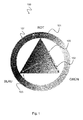
- FIG. 11 shows a representation of a snapshot 300 of three tolerance ranges in the CIELab color space for the colors red, orange and green according to one embodiment.
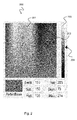
- Fig. 4a 2 shows an illustration of an exemplary parameterization 400a of a color value on the basis of the parameters L, a, b and the tolerance range on the basis of the parameters .DELTA.L, .DELTA.C, .DELTA.h according to an embodiment.
- the capture of a color can be done by directly entering a color value.
- a color value For example, in the in Fig. 4a represented dialogue of the color value of a "target color” by entering the parameters L, a and b (or in another color space) done.
- the color value can be determined from a region in the image and adopted by clicking on the arrow symbol.
- the tolerance limits are entered by specifying three tolerance values: brightness ( ⁇ L), saturation ( ⁇ C) and color angle ( ⁇ h).
- Fig. 4b shows a representation of an exemplary parameterization 400b of a color value on the basis of the parameters L, a, b and the tolerance range on the basis of the parameter .DELTA.E according to an embodiment.
- the color value is the same as above in Fig. 4a
- the tolerance range is entered in this example by only one parameter ( ⁇ E).
- the aforementioned input options for color values and tolerance ranges are exemplary. In general, there are other ways to edit color values and tolerance limits.
- the detection of a color can also be, for example, by that in the document EP14158638 illustrated method done.
- a preferred easy way to describe color boundaries is by using the parameter ⁇ E, which corresponds to the Euclidean distance between two color values in the CIELab color space.
- the human perception of color differences can be with the Parameter ⁇ E can be simulated technically. For an inexperienced user, specifying only one tolerance parameter makes sense, as long as the image processing task on the sensor arrangement can be solved with it.
- Fig. 6 shows such a case. If color fidelity is of importance, the user can already assess in this representation whether the selected tolerance range 601, 603 corresponds to his idea of color fidelity.
- Fig. 7a is the color shading in the area yellow / orange, while in Fig. 7b the color shading is yellow / green.
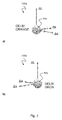
- Fig. 8 11 shows an illustration 800 of an actual color value (cross-hair) 810 and a tolerance range 801 of a desired color (sphere) according to an embodiment.
- Fig. 8 the tolerance range 801 of a desired color (sphere), in this case the color red, and the position of an actual color value (crosshairs) 810 outside the sphere are shown.
- the sensor arrangement can determine this color deviation quantitatively. The user can immediately recognize from the display to what extent the tolerance range 801 is the actual color 810 not detected and so adjust the tolerance range 801 if necessary, so that this actual color 810 is also recorded (reparameterization).
- the user is further assisted by receiving a warning when tolerance ranges overlap.
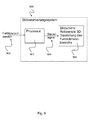
- Fig. 9 shows a schematic representation of an image processing system 900 according to an embodiment.
- the image processing system 900 includes a processor 901 and a screen 903.
- the processor 901 is configured to capture at least one color tolerance region 902 within a three-dimensional color space, wherein the at least one color tolerance region 902 is characterized by at least one color value in each dimension and at least one tolerance parameter in at least a dimension or metric of the three-dimensional color space determined.
- the processor 901 is further configured to generate, based on the tolerance parameters of the at least one color tolerance range 902, a control signal 904 for generating a rotating three-dimensional representation of the at least one color tolerance range on a screen.
- the screen 903 is configured to generate the rotating three-dimensional representation of the at least one color tolerance region 902 on the screen 903 in response to the control signal 904 of the processor 901.
- the detection of the at least one color tolerance range 902 by the processor 901 may be based on a user-based input of the tolerance parameters of the color tolerance range.
- the three-dimensional color space includes one of the following color spaces: CIELab color space, LCh color space, RGB color space, HSV color space, YUV color space.
- the rotating three-dimensional representation of the at least one color tolerance range may be at a rotational speed of about one Rotate revolutions per minute to about 60 revolutions per minute.
- the control signal 904 may instruct the screen to generate a rotating three-dimensional representation of the at least one color tolerance range on the screen based on a geometric shape resulting from the boundaries of the at least one color tolerance range.
- the processor 901 may determine coordinates of an outer shell of the at least one color tolerance range based on the tolerance parameters of the at least one color tolerance range.
- the processor 901 may further generate the control signal for controlling the screen, wherein the control signal 904 directs the screen 903, a rotating three-dimensional representation of the outer shell of the at least one color tolerance range based on the determined by the processor 901 coordinates of the outer shell of the at least one color tolerance range to generate the screen.
- the control signal 904 generated by the processor 901 may instruct the screen to display the outer shell of the at least one color tolerance region by a central color of the at least one color tolerance region.
- the control signal 904 generated by the processor 901 may instruct the screen 903 to represent the outer envelope of the at least one color tolerance range by colors of the color space corresponding to the respective coordinates of the outer envelope.
- the tolerance parameters of the at least one color tolerance range may include a nominal value and a maximum deviation in each dimension of the three-dimensional color space.
- a color tolerance range can be displayed on the screen at the maximum deviation in each dimension of the three-dimensional color space indicating tolerance parameters in the form of a rotating hollow cylinder sector (polar coordinates) or cuboid (Cartesian coordinates).
- a color tolerance range can be displayed on the screen 903 in the form of a rotating sphere in the form of a rotating sphere given a tolerance given as a maximum distance from the target value according to a metric.
- the specification of an upper and lower tolerance limit for a dimension can be attributed to the above-described case of a setpoint value (mean value of the two tolerance limits) and a tolerance parameter (upper limit minus setpoint value).
- the processor 901 may issue a warning if two of the color tolerance regions 902 overlap within the three-dimensional color space.
- the processor 901 may determine maximum possible color tolerance ranges in the presence of at least two color tolerance ranges 902 such that the at least two color tolerance ranges 902 in the three-dimensional color space do not overlap. Of the Processor 901 may further determine the maximum possible color tolerance ranges such that the at least two color tolerance ranges in the three-dimensional color space maintain a predetermined distance from one another.
- Fig. 10 shows a schematic representation of an image processing system 1000 with additional sensor array 905 according to one embodiment.
- the image processing system 1000 corresponds to the above-described image processing system 900 of FIG Fig. 9 but still includes an additional sensor array 905.
- the sensor array 905 is configured to detect a color 908 of an object 907 to be processed and to represent the color 908 as coordinates 906 within the three-dimensional color space, approximately as described Fig. 8 when the color 908 of the object 907 is specified by the coordinate system 810.
- the sensor array 905 is configured to detect a color 908 of an object 907 to be processed and to indicate the color 908 as a number triplet, approximately as described Fig. 4a B.
- the processor 901 is configured to determine, based on the coordinates 906 of the color 908 of the item 907, whether the color 908 is within the at least one color tolerance range 902 of the three-dimensional color space.
- the processor 901 may further be configured to adjust the at least one color tolerance region 902 such that the color 908 of the article 907 is within the at least one color tolerance region 902 of the three-dimensional color space.
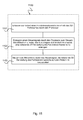
- FIG. 12 is a schematic illustration of a method for controlling a screen to display color tolerance ranges within a three-dimensional color space according to an embodiment.
- the method comprises detecting 1101 at least one color tolerance range within the three-dimensional color space by the processor, wherein the at least one color tolerance range is determined by at least one tolerance parameter in at least one dimension or metric of the three-dimensional color space.
- the method includes generating, by the processor, a control signal 1102 for controlling the screen, wherein the control signal instructs the screen to generate a rotating three-dimensional representation of the at least one color tolerance range based on the tolerance parameters of the at least one color tolerance range on the screen.
- the method includes controlling the screen by the control signal to display the rotating three-dimensional representation of the at least one color tolerance region on the screen.
- the detection 1101 of the at least one color tolerance range by the processor may be based on a user-based input of the tolerance parameters of the color tolerance range.
- the three-dimensional color space may include one of the following color spaces: CIELab color space, LCh color space, RGB color space, HSV color space, YUV color space.
- the rotating three-dimensional representation of the at least one color tolerance range can rotate at a rotational speed of about one revolution per minute to about 60 revolutions per minute.
- the method 1100 may further include controlling the screen by the control signal to display a rotating three-dimensional representation of the at least one color tolerance region on the screen based on a geometric shape resulting from the boundaries of the at least one color tolerance range.
- the method 1100 may further include: determining, by the processor, coordinates of an outer shell of the at least one color tolerance range based on the tolerance parameters of the at least one color tolerance range; Generating, by the processor, a control signal for controlling the screen, the control signal instructing the screen to generate a rotating three-dimensional representation of the outer shell of the at least one color tolerance region based on the processor determined coordinates of the outer shell of the at least one color tolerance region on the screen; and controlling the screen by the control signal to display the rotating three-dimensional representation of the outer shell of the at least one color tolerance area on the screen.
- the method 1100 may further include: representing the outer shell of the at least one color tolerance region by a central color of the at least one color tolerance region; or representing the outer envelope of the at least one color tolerance range by colors of the color space that correspond to the respective coordinates of the outer envelope.
- the tolerance parameters of the at least one color tolerance range may include a nominal value and a maximum deviation in each dimension of the three-dimensional color space.
- a color tolerance range can be displayed on the screen at the maximum deviation in each dimension of the three-dimensional color space indicating tolerance parameters in the form of a rotating hollow cylinder sector (polar coordinates) or cuboid (Cartesian coordinates).
- a color tolerance range can be displayed in the form of a rotating sphere on the screen in the case of a tolerance parameter that indicates, according to a metric, the maximum distance to the target value.
- the method may further include issuing a warning by the processor if two of the color tolerance ranges within the three-dimensional color space overlap.
- the method 1100 may further include determining maximum possible color tolerance ranges in the presence of at least two color tolerance ranges, such that the at least two color tolerance ranges in the three-dimensional color space do not overlap.
- the method 1100 may further include determining the maximum possible color tolerance ranges, such that the at least two color tolerance ranges in the three-dimensional color space comply with a predetermined distance from one another.
- One aspect of the invention also includes a computer program product that can be loaded directly into the internal memory of a digital computer and includes software code portions that enable it Fig. 11 described method 1100 can be run when the product is running on a computer.
- the computer program product may be stored on a computer-suitable medium and comprising: computer-readable program means for causing a computer to capture at least one color tolerance region within the three-dimensional color space by the processor 1101, the at least one color tolerance region being defined by at least one color value in each dimension and at least determines a tolerance parameter in at least one dimension or metric of the three-dimensional color space; generating a control signal by the processor to control the screen 1102, the control signal instructing the screen to generate a rotating three-dimensional representation of the at least one color tolerance range based on the tolerance parameters of the at least one color tolerance range on the screen; and control the screen by the control signal 1103 to display the rotating three-dimensional representation of the at least one color tolerance region on the screen.
- the computer may be a PC, for example a PC of a computer network.
- the computer may be implemented as a chip, an ASIC, a microprocessor, a multiprocessor, or a signal processor, and may be implemented in a computer network, such as an image processing system 900, 1000, such as the Figures 9 and 10 described, be arranged.
Landscapes
- Engineering & Computer Science (AREA)
- Physics & Mathematics (AREA)
- Computer Hardware Design (AREA)
- General Physics & Mathematics (AREA)
- Theoretical Computer Science (AREA)
- Image Processing (AREA)
- Spectrometry And Color Measurement (AREA)
Priority Applications (1)
| Application Number | Priority Date | Filing Date | Title |
|---|---|---|---|
| EP14186854.7A EP3001408A1 (fr) | 2014-09-29 | 2014-09-29 | Procédé de commande d'un écran, pour représenter des zones de tolérance de couleur dans un espace de couleur tridimensionnel |
Applications Claiming Priority (1)
| Application Number | Priority Date | Filing Date | Title |
|---|---|---|---|
| EP14186854.7A EP3001408A1 (fr) | 2014-09-29 | 2014-09-29 | Procédé de commande d'un écran, pour représenter des zones de tolérance de couleur dans un espace de couleur tridimensionnel |
Publications (1)
| Publication Number | Publication Date |
|---|---|
| EP3001408A1 true EP3001408A1 (fr) | 2016-03-30 |
Family
ID=51625921
Family Applications (1)
| Application Number | Title | Priority Date | Filing Date |
|---|---|---|---|
| EP14186854.7A Withdrawn EP3001408A1 (fr) | 2014-09-29 | 2014-09-29 | Procédé de commande d'un écran, pour représenter des zones de tolérance de couleur dans un espace de couleur tridimensionnel |
Country Status (1)
| Country | Link |
|---|---|
| EP (1) | EP3001408A1 (fr) |
Cited By (3)
| Publication number | Priority date | Publication date | Assignee | Title |
|---|---|---|---|---|
| CN110111744A (zh) * | 2019-04-08 | 2019-08-09 | 重庆惠科金渝光电科技有限公司 | 一种显示模组的驱动方法、驱动系统和显示装置 |
| CN116188608A (zh) * | 2022-12-27 | 2023-05-30 | 上海元彩科技有限公司 | 一种在平面排列颜色的方法和装置 |
| WO2026067091A1 (fr) * | 2024-09-27 | 2026-04-02 | 北京小米移动软件有限公司 | Procédé et appareil d'évaluation de couleur, dispositif électronique et support |
Citations (3)
| Publication number | Priority date | Publication date | Assignee | Title |
|---|---|---|---|---|
| US6496599B1 (en) * | 1998-04-01 | 2002-12-17 | Autodesk Canada Inc. | Facilitating the compositing of video images |
| JP3601060B2 (ja) * | 1993-02-17 | 2004-12-15 | ソニー株式会社 | 測色データ処理装置 |
| US20090214109A1 (en) * | 2007-12-26 | 2009-08-27 | Keisuke Nakashima | Dropout color processing method and processing apparatus using same |
-
2014
- 2014-09-29 EP EP14186854.7A patent/EP3001408A1/fr not_active Withdrawn
Patent Citations (3)
| Publication number | Priority date | Publication date | Assignee | Title |
|---|---|---|---|---|
| JP3601060B2 (ja) * | 1993-02-17 | 2004-12-15 | ソニー株式会社 | 測色データ処理装置 |
| US6496599B1 (en) * | 1998-04-01 | 2002-12-17 | Autodesk Canada Inc. | Facilitating the compositing of video images |
| US20090214109A1 (en) * | 2007-12-26 | 2009-08-27 | Keisuke Nakashima | Dropout color processing method and processing apparatus using same |
Cited By (5)
| Publication number | Priority date | Publication date | Assignee | Title |
|---|---|---|---|---|
| CN110111744A (zh) * | 2019-04-08 | 2019-08-09 | 重庆惠科金渝光电科技有限公司 | 一种显示模组的驱动方法、驱动系统和显示装置 |
| CN116188608A (zh) * | 2022-12-27 | 2023-05-30 | 上海元彩科技有限公司 | 一种在平面排列颜色的方法和装置 |
| CN116188608B (zh) * | 2022-12-27 | 2024-03-12 | 上海元彩科技有限公司 | 一种在平面排列颜色的方法和装置 |
| WO2024140594A1 (fr) * | 2022-12-27 | 2024-07-04 | 上海元彩科技有限公司 | Procédé et appareil pour agencer des couleurs sur un plan |
| WO2026067091A1 (fr) * | 2024-09-27 | 2026-04-02 | 北京小米移动软件有限公司 | Procédé et appareil d'évaluation de couleur, dispositif électronique et support |
Similar Documents
| Publication | Publication Date | Title |
|---|---|---|
| DE102016012744B4 (de) | Robotersystem mit einer CNC-Steuerung und einer Robotersteuereinrichtung, die über ein Kommunikationsnetzwerk miteinander verbunden sind | |
| DE102019131702A1 (de) | Anhängerwinkelerfassung unter verwendung von ende-zu-ende-lernen | |
| DE102014225482A1 (de) | System und Verfahren zum Programmieren von Operationen zum Inspizieren von Werkstückmerkmalen für eine Koordinatenmessmaschine | |
| DE102011106050A1 (de) | Schattenentfernung in einem durch eine fahrzeugbasierte Kamera erfassten Bild zur Detektion eines freien Pfads | |
| DE10311711A1 (de) | Farbjustierverfahren, Farbjustiervorrichtung, Vorrichtung zur Editierung einer Farbkonversionsdefinition, Bildverarbeitungsvorrichtung, Programm und Speichermedium | |
| DE102015207902A1 (de) | Verfahren und Vorrichtung zur Bestätigung des relevanten inneren weißen Kreises bei der Erkennung des Umfelds eines kreisförmigen Verkehrszeichens | |
| DE102014207095A1 (de) | Kantenmessungs-Videowerkzeug mit robustem Kantenunterscheidungs-Spielraum | |
| EP3001408A1 (fr) | Procédé de commande d'un écran, pour représenter des zones de tolérance de couleur dans un espace de couleur tridimensionnel | |
| DE102012220619A1 (de) | Farberfassungsvorrichtung für ein Fahrzeug | |
| DE112018005497T5 (de) | Vermeiden eines propellerkontakts in einem unbemannten luftfahrzeug | |
| AT519722B1 (de) | Verfahren zur Detektion zumindest eines Jetonobjekts | |
| DE102022208083A1 (de) | Trainieren eines neuronalen Netzwerks mit Hilfe von Wissensgraphen | |
| DE102022108603A1 (de) | Bildprüfvorrichtung und Bildprüfverfahren | |
| DE102016100134B4 (de) | Verfahren und Vorrichtung zum Untersuchen eines Objekts unter Verwendung von maschinellem Sehen | |
| DE2262914A1 (de) | Verfahren und vorrichtung zum erzeugen einer visuellen darstellung der bildpunkte des zu analysierenden feldes und der zugehoerigen information | |
| DE102013217347B4 (de) | Verfahren und vorrichtung zur parametereinstellung für kantenmessungsvideowerkzeuge | |
| DE102014007565A1 (de) | Verfahren zum Ermitteln einer jeweiligen Grenze zumindest eines Objekts, Sensorvorrichtung, Fahrerassistenzeinrichtung und Kraftfahrzeug | |
| DE10112732C2 (de) | Verfahren zur Bestimmung der Lage von Meßbildern eines Objektes relativ zum Objekt | |
| WO2015169675A1 (fr) | Procédé de segmentation d'une image en couleurs et microscope numérique | |
| EP2661070B1 (fr) | Procédé et dispositif de mesure de la couleur sur une image imprimée | |
| DE102019107453A1 (de) | System und Verfahren zum Darstellen und Anzeigen der Farbgenauigkeit beim Musterabgleich durch ein Sichtsystem | |
| DE4419395C2 (de) | Verfahren und Einrichtung zur Analyse und Verarbeitung von Farbbildern | |
| DE102021130505B4 (de) | Verfahren zur Bestimmung einer Beleuchtungsfarbe, Bildverarbeitungsvorrichtung und Aufnahmesystem | |
| EP2919195B1 (fr) | Système de capteurs pour la détermination d'une valeur de couleur | |
| EP3119035A1 (fr) | Procede de verification de dispositifs reseaux et reseau |
Legal Events
| Date | Code | Title | Description |
|---|---|---|---|
| PUAI | Public reference made under article 153(3) epc to a published international application that has entered the european phase |
Free format text: ORIGINAL CODE: 0009012 |
|
| AK | Designated contracting states |
Kind code of ref document: A1 Designated state(s): AL AT BE BG CH CY CZ DE DK EE ES FI FR GB GR HR HU IE IS IT LI LT LU LV MC MK MT NL NO PL PT RO RS SE SI SK SM TR |
|
| AX | Request for extension of the european patent |
Extension state: BA ME |
|
| STAA | Information on the status of an ep patent application or granted ep patent |
Free format text: STATUS: THE APPLICATION IS DEEMED TO BE WITHDRAWN |
|
| 18D | Application deemed to be withdrawn |
Effective date: 20161001 |