EP3020770A1 - Black trisazo dyes, their preparation and their use - Google Patents
Black trisazo dyes, their preparation and their use Download PDFInfo
- Publication number
- EP3020770A1 EP3020770A1 EP14020086.6A EP14020086A EP3020770A1 EP 3020770 A1 EP3020770 A1 EP 3020770A1 EP 14020086 A EP14020086 A EP 14020086A EP 3020770 A1 EP3020770 A1 EP 3020770A1
- Authority
- EP
- European Patent Office
- Prior art keywords
- group
- general formula
- cooch
- dye
- carbon atoms
- Prior art date
- Legal status (The legal status is an assumption and is not a legal conclusion. Google has not performed a legal analysis and makes no representation as to the accuracy of the status listed.)
- Withdrawn
Links
- 239000000975 dye Substances 0.000 title claims abstract description 111
- 238000002360 preparation method Methods 0.000 title claims abstract description 19
- 238000007641 inkjet printing Methods 0.000 claims abstract description 13
- 238000004043 dyeing Methods 0.000 claims abstract description 8
- 239000000463 material Substances 0.000 claims abstract description 6
- 238000007639 printing Methods 0.000 claims abstract description 6
- 239000000976 ink Substances 0.000 claims description 34
- 125000004432 carbon atom Chemical group C* 0.000 claims description 30
- 125000004435 hydrogen atom Chemical group [H]* 0.000 claims description 22
- XLYOFNOQVPJJNP-UHFFFAOYSA-N water Substances O XLYOFNOQVPJJNP-UHFFFAOYSA-N 0.000 claims description 20
- 125000003545 alkoxy group Chemical group 0.000 claims description 16
- 150000001408 amides Chemical class 0.000 claims description 16
- 125000001424 substituent group Chemical group 0.000 claims description 16
- 239000000243 solution Substances 0.000 claims description 15
- 125000000565 sulfonamide group Chemical class 0.000 claims description 15
- 239000007788 liquid Substances 0.000 claims description 14
- 125000000956 methoxy group Chemical group [H]C([H])([H])O* 0.000 claims description 13
- 239000000203 mixture Substances 0.000 claims description 12
- 238000000034 method Methods 0.000 claims description 11
- 230000003287 optical effect Effects 0.000 claims description 9
- 239000002253 acid Substances 0.000 claims description 8
- 125000000217 alkyl group Chemical group 0.000 claims description 6
- 230000015572 biosynthetic process Effects 0.000 claims description 6
- 150000001768 cations Chemical class 0.000 claims description 6
- 239000000758 substrate Substances 0.000 claims description 6
- ZUQOBHTUMCEQBG-UHFFFAOYSA-N 4-amino-5-hydroxynaphthalene-1,7-disulfonic acid Chemical compound OS(=O)(=O)C1=CC(O)=C2C(N)=CC=C(S(O)(=O)=O)C2=C1 ZUQOBHTUMCEQBG-UHFFFAOYSA-N 0.000 claims description 5
- 125000004185 ester group Chemical group 0.000 claims description 5
- 125000005843 halogen group Chemical group 0.000 claims description 5
- 230000007935 neutral effect Effects 0.000 claims description 5
- QGZKDVFQNNGYKY-UHFFFAOYSA-O Ammonium Chemical compound [NH4+] QGZKDVFQNNGYKY-UHFFFAOYSA-O 0.000 claims description 4
- 229910052751 metal Inorganic materials 0.000 claims description 4
- 239000002184 metal Substances 0.000 claims description 4
- 239000002904 solvent Substances 0.000 claims description 4
- SECXISVLQFMRJM-UHFFFAOYSA-N N-Methylpyrrolidone Chemical compound CN1CCCC1=O SECXISVLQFMRJM-UHFFFAOYSA-N 0.000 claims description 3
- 150000001450 anions Chemical class 0.000 claims description 3
- 229910052799 carbon Inorganic materials 0.000 claims description 3
- 150000001875 compounds Chemical class 0.000 claims description 3
- 238000006193 diazotization reaction Methods 0.000 claims description 3
- 239000010985 leather Substances 0.000 claims description 3
- 238000004519 manufacturing process Methods 0.000 claims description 3
- -1 2-Hexylpyrrolidone Chemical compound 0.000 claims description 2
- 229910052782 aluminium Inorganic materials 0.000 claims description 2
- XAGFODPZIPBFFR-UHFFFAOYSA-N aluminium Chemical compound [Al] XAGFODPZIPBFFR-UHFFFAOYSA-N 0.000 claims description 2
- 150000001412 amines Chemical class 0.000 claims description 2
- 125000003277 amino group Chemical group 0.000 claims description 2
- 230000003115 biocidal effect Effects 0.000 claims description 2
- 239000003139 biocide Substances 0.000 claims description 2
- 238000005859 coupling reaction Methods 0.000 claims description 2
- 230000005693 optoelectronics Effects 0.000 claims description 2
- 229920002994 synthetic fiber Polymers 0.000 claims description 2
- 239000012209 synthetic fiber Substances 0.000 claims description 2
- 239000007791 liquid phase Substances 0.000 claims 10
- 125000000449 nitro group Chemical group [O-][N+](*)=O 0.000 claims 6
- 125000001174 sulfone group Chemical class 0.000 claims 3
- PEDCQBHIVMGVHV-UHFFFAOYSA-N Glycerine Chemical compound OCC(O)CO PEDCQBHIVMGVHV-UHFFFAOYSA-N 0.000 claims 2
- 125000002560 nitrile group Chemical group 0.000 claims 2
- 229940015975 1,2-hexanediol Drugs 0.000 claims 1
- WDQFELCEOPFLCZ-UHFFFAOYSA-N 1-(2-hydroxyethyl)pyrrolidin-2-one Chemical compound OCCN1CCCC1=O WDQFELCEOPFLCZ-UHFFFAOYSA-N 0.000 claims 1
- MRABAEUHTLLEML-UHFFFAOYSA-N Butyl lactate Chemical compound CCCCOC(=O)C(C)O MRABAEUHTLLEML-UHFFFAOYSA-N 0.000 claims 1
- ZJCCRDAZUWHFQH-UHFFFAOYSA-N Trimethylolpropane Chemical compound CCC(CO)(CO)CO ZJCCRDAZUWHFQH-UHFFFAOYSA-N 0.000 claims 1
- 239000007983 Tris buffer Substances 0.000 claims 1
- 125000001931 aliphatic group Chemical group 0.000 claims 1
- 239000000987 azo dye Substances 0.000 claims 1
- BMRWNKZVCUKKSR-UHFFFAOYSA-N butane-1,2-diol Chemical compound CCC(O)CO BMRWNKZVCUKKSR-UHFFFAOYSA-N 0.000 claims 1
- 239000001191 butyl (2R)-2-hydroxypropanoate Substances 0.000 claims 1
- 150000001989 diazonium salts Chemical class 0.000 claims 1
- MTHSVFCYNBDYFN-UHFFFAOYSA-N diethylene glycol Chemical compound OCCOCCO MTHSVFCYNBDYFN-UHFFFAOYSA-N 0.000 claims 1
- 239000004210 ether based solvent Substances 0.000 claims 1
- 235000011187 glycerol Nutrition 0.000 claims 1
- FHKSXSQHXQEMOK-UHFFFAOYSA-N hexane-1,2-diol Chemical compound CCCCC(O)CO FHKSXSQHXQEMOK-UHFFFAOYSA-N 0.000 claims 1
- 229910052739 hydrogen Inorganic materials 0.000 claims 1
- 239000007783 nanoporous material Substances 0.000 claims 1
- HNJBEVLQSNELDL-UHFFFAOYSA-N pyrrolidin-2-one Chemical compound O=C1CCCN1 HNJBEVLQSNELDL-UHFFFAOYSA-N 0.000 claims 1
- 229920006395 saturated elastomer Polymers 0.000 claims 1
- HXJUTPCZVOIRIF-UHFFFAOYSA-N sulfolane Chemical compound O=S1(=O)CCCC1 HXJUTPCZVOIRIF-UHFFFAOYSA-N 0.000 claims 1
- 239000004753 textile Substances 0.000 abstract description 4
- 239000012530 fluid Substances 0.000 abstract description 3
- 229920002678 cellulose Polymers 0.000 abstract description 2
- 239000001913 cellulose Substances 0.000 abstract description 2
- 239000000725 suspension Substances 0.000 description 14
- HEMHJVSKTPXQMS-UHFFFAOYSA-M Sodium hydroxide Chemical compound [OH-].[Na+] HEMHJVSKTPXQMS-UHFFFAOYSA-M 0.000 description 13
- 239000011734 sodium Substances 0.000 description 13
- 239000007864 aqueous solution Substances 0.000 description 10
- 238000003756 stirring Methods 0.000 description 9
- 0 *C([C@]1*=*c2ccc(*=*c3c(*)cc(*)cc3)cc2)=C(C(*)=C(*=*c2ccc(*=*c3c(*)cc(*)cc3)cc2)C([N+]([I-])=O)=C2)C2=CC1N Chemical compound *C([C@]1*=*c2ccc(*=*c3c(*)cc(*)cc3)cc2)=C(C(*)=C(*=*c2ccc(*=*c3c(*)cc(*)cc3)cc2)C([N+]([I-])=O)=C2)C2=CC1N 0.000 description 8
- VEXZGXHMUGYJMC-UHFFFAOYSA-N Hydrochloric acid Chemical compound Cl VEXZGXHMUGYJMC-UHFFFAOYSA-N 0.000 description 8
- 125000000664 diazo group Chemical group [N-]=[N+]=[*] 0.000 description 8
- LPXPTNMVRIOKMN-UHFFFAOYSA-M sodium nitrite Chemical compound [Na+].[O-]N=O LPXPTNMVRIOKMN-UHFFFAOYSA-M 0.000 description 6
- 230000001747 exhibiting effect Effects 0.000 description 5
- ALYNCZNDIQEVRV-UHFFFAOYSA-N 4-aminobenzoic acid Chemical compound NC1=CC=C(C(O)=O)C=C1 ALYNCZNDIQEVRV-UHFFFAOYSA-N 0.000 description 4
- 238000006243 chemical reaction Methods 0.000 description 4
- 238000001035 drying Methods 0.000 description 4
- QTBSBXVTEAMEQO-UHFFFAOYSA-N Acetic acid Chemical compound CC(O)=O QTBSBXVTEAMEQO-UHFFFAOYSA-N 0.000 description 3
- OKKJLVBELUTLKV-UHFFFAOYSA-N Methanol Chemical compound OC OKKJLVBELUTLKV-UHFFFAOYSA-N 0.000 description 3
- IOVCWXUNBOPUCH-UHFFFAOYSA-N Nitrous acid Chemical compound ON=O IOVCWXUNBOPUCH-UHFFFAOYSA-N 0.000 description 3
- CBENFWSGALASAD-UHFFFAOYSA-N Ozone Chemical compound [O-][O+]=O CBENFWSGALASAD-UHFFFAOYSA-N 0.000 description 3
- DNIAPMSPPWPWGF-UHFFFAOYSA-N Propylene glycol Chemical compound CC(O)CO DNIAPMSPPWPWGF-UHFFFAOYSA-N 0.000 description 3
- 238000004040 coloring Methods 0.000 description 3
- LNOPIUAQISRISI-UHFFFAOYSA-N n'-hydroxy-2-propan-2-ylsulfonylethanimidamide Chemical compound CC(C)S(=O)(=O)CC(N)=NO LNOPIUAQISRISI-UHFFFAOYSA-N 0.000 description 3
- 235000010288 sodium nitrite Nutrition 0.000 description 3
- 238000003860 storage Methods 0.000 description 3
- 238000012360 testing method Methods 0.000 description 3
- 229920000742 Cotton Polymers 0.000 description 2
- LFQSCWFLJHTTHZ-UHFFFAOYSA-N Ethanol Chemical compound CCO LFQSCWFLJHTTHZ-UHFFFAOYSA-N 0.000 description 2
- 229920000297 Rayon Polymers 0.000 description 2
- VYPSYNLAJGMNEJ-UHFFFAOYSA-N Silicium dioxide Chemical compound O=[Si]=O VYPSYNLAJGMNEJ-UHFFFAOYSA-N 0.000 description 2
- FAPWRFPIFSIZLT-UHFFFAOYSA-M Sodium chloride Chemical compound [Na+].[Cl-] FAPWRFPIFSIZLT-UHFFFAOYSA-M 0.000 description 2
- 229960004050 aminobenzoic acid Drugs 0.000 description 2
- 239000003086 colorant Substances 0.000 description 2
- 239000000706 filtrate Substances 0.000 description 2
- 238000007654 immersion Methods 0.000 description 2
- 239000002609 medium Substances 0.000 description 2
- 239000003960 organic solvent Substances 0.000 description 2
- TWNQGVIAIRXVLR-UHFFFAOYSA-N oxo(oxoalumanyloxy)alumane Chemical compound O=[Al]O[Al]=O TWNQGVIAIRXVLR-UHFFFAOYSA-N 0.000 description 2
- 238000004806 packaging method and process Methods 0.000 description 2
- WXWCDTXEKCVRRO-UHFFFAOYSA-N para-Cresidine Chemical compound COC1=CC=C(C)C=C1N WXWCDTXEKCVRRO-UHFFFAOYSA-N 0.000 description 2
- 150000003839 salts Chemical class 0.000 description 2
- OAYXUHPQHDHDDZ-UHFFFAOYSA-N 2-(2-butoxyethoxy)ethanol Chemical compound CCCCOCCOCCO OAYXUHPQHDHDDZ-UHFFFAOYSA-N 0.000 description 1
- XGLVDUUYFKXKPL-UHFFFAOYSA-N 2-(2-methoxyethoxy)-n,n-bis[2-(2-methoxyethoxy)ethyl]ethanamine Chemical compound COCCOCCN(CCOCCOC)CCOCCOC XGLVDUUYFKXKPL-UHFFFAOYSA-N 0.000 description 1
- HZAXFHJVJLSVMW-UHFFFAOYSA-N 2-Aminoethan-1-ol Chemical compound NCCO HZAXFHJVJLSVMW-UHFFFAOYSA-N 0.000 description 1
- ASDQMECUMYIVBG-UHFFFAOYSA-N 2-[2-(2-aminoethoxy)ethoxy]ethanol Chemical compound NCCOCCOCCO ASDQMECUMYIVBG-UHFFFAOYSA-N 0.000 description 1
- AOMZHDJXSYHPKS-DROYEMJCSA-L Amido Black 10B Chemical compound [Na+].[Na+].[O-]S(=O)(=O)C1=CC2=CC(S([O-])(=O)=O)=C(\N=N\C=3C=CC=CC=3)C(O)=C2C(N)=C1\N=N\C1=CC=C(N(=O)=O)C=C1 AOMZHDJXSYHPKS-DROYEMJCSA-L 0.000 description 1
- 206010013786 Dry skin Diseases 0.000 description 1
- VMHLLURERBWHNL-UHFFFAOYSA-M Sodium acetate Chemical compound [Na+].CC([O-])=O VMHLLURERBWHNL-UHFFFAOYSA-M 0.000 description 1
- GSEJCLTVZPLZKY-UHFFFAOYSA-N Triethanolamine Chemical compound OCCN(CCO)CCO GSEJCLTVZPLZKY-UHFFFAOYSA-N 0.000 description 1
- 238000010521 absorption reaction Methods 0.000 description 1
- 230000002378 acidificating effect Effects 0.000 description 1
- 239000000654 additive Substances 0.000 description 1
- 230000002411 adverse Effects 0.000 description 1
- 239000003513 alkali Substances 0.000 description 1
- 229910052783 alkali metal Inorganic materials 0.000 description 1
- 150000001340 alkali metals Chemical class 0.000 description 1
- 150000001447 alkali salts Chemical class 0.000 description 1
- 229910052784 alkaline earth metal Inorganic materials 0.000 description 1
- 150000001342 alkaline earth metals Chemical class 0.000 description 1
- 150000003863 ammonium salts Chemical class 0.000 description 1
- 239000013011 aqueous formulation Substances 0.000 description 1
- 239000012736 aqueous medium Substances 0.000 description 1
- 229910052788 barium Inorganic materials 0.000 description 1
- 239000002585 base Substances 0.000 description 1
- CRVGTESFCCXCTH-UHFFFAOYSA-O bis(2-hydroxyethyl)-methylazanium Chemical compound OCC[NH+](C)CCO CRVGTESFCCXCTH-UHFFFAOYSA-O 0.000 description 1
- ZBCBWPMODOFKDW-UHFFFAOYSA-O bis(2-hydroxyethyl)azanium Chemical compound OCC[NH2+]CCO ZBCBWPMODOFKDW-UHFFFAOYSA-O 0.000 description 1
- 230000000740 bleeding effect Effects 0.000 description 1
- 239000006227 byproduct Substances 0.000 description 1
- 229910052792 caesium Inorganic materials 0.000 description 1
- 229910052791 calcium Inorganic materials 0.000 description 1
- 238000010924 continuous production Methods 0.000 description 1
- 238000012864 cross contamination Methods 0.000 description 1
- 230000003247 decreasing effect Effects 0.000 description 1
- 239000008367 deionised water Substances 0.000 description 1
- 238000011033 desalting Methods 0.000 description 1
- 230000006866 deterioration Effects 0.000 description 1
- 238000011026 diafiltration Methods 0.000 description 1
- 150000008049 diazo compounds Chemical class 0.000 description 1
- 239000000982 direct dye Substances 0.000 description 1
- UZZFFIUHUDOYPS-UHFFFAOYSA-L disodium 4-amino-3,6-bis[[4-[(2,4-diaminophenyl)diazenyl]phenyl]diazenyl]-5-oxido-7-sulfonaphthalene-2-sulfonate Chemical compound [Na+].[Na+].Nc1ccc(N=Nc2ccc(cc2)N=Nc2c(N)c3c(O)c(N=Nc4ccc(cc4)N=Nc4ccc(N)cc4N)c(cc3cc2S([O-])(=O)=O)S([O-])(=O)=O)c(N)c1 UZZFFIUHUDOYPS-UHFFFAOYSA-L 0.000 description 1
- 238000005516 engineering process Methods 0.000 description 1
- 238000010438 heat treatment Methods 0.000 description 1
- XLYOFNOQVPJJNP-UHFFFAOYSA-M hydroxide Chemical compound [OH-] XLYOFNOQVPJJNP-UHFFFAOYSA-M 0.000 description 1
- 238000005286 illumination Methods 0.000 description 1
- 150000002484 inorganic compounds Chemical class 0.000 description 1
- 229910010272 inorganic material Inorganic materials 0.000 description 1
- 238000002955 isolation Methods 0.000 description 1
- 229910052744 lithium Inorganic materials 0.000 description 1
- 229910052749 magnesium Inorganic materials 0.000 description 1
- 231100000219 mutagenic Toxicity 0.000 description 1
- 230000003505 mutagenic effect Effects 0.000 description 1
- 231100000252 nontoxic Toxicity 0.000 description 1
- 230000003000 nontoxic effect Effects 0.000 description 1
- 239000000049 pigment Substances 0.000 description 1
- 239000011148 porous material Substances 0.000 description 1
- 229910052700 potassium Inorganic materials 0.000 description 1
- 239000000047 product Substances 0.000 description 1
- 229910052701 rubidium Inorganic materials 0.000 description 1
- 239000012047 saturated solution Substances 0.000 description 1
- 229910052708 sodium Inorganic materials 0.000 description 1
- 239000001632 sodium acetate Substances 0.000 description 1
- 235000017281 sodium acetate Nutrition 0.000 description 1
- 239000011780 sodium chloride Substances 0.000 description 1
- 159000000000 sodium salts Chemical class 0.000 description 1
- 239000007858 starting material Substances 0.000 description 1
- 229910052712 strontium Inorganic materials 0.000 description 1
- 125000000547 substituted alkyl group Chemical group 0.000 description 1
- 229940124530 sulfonamide Drugs 0.000 description 1
- 150000003456 sulfonamides Chemical class 0.000 description 1
- 238000004381 surface treatment Methods 0.000 description 1
- 238000003786 synthesis reaction Methods 0.000 description 1
- 238000004154 testing of material Methods 0.000 description 1
- 125000005207 tetraalkylammonium group Chemical group 0.000 description 1
- DZLFLBLQUQXARW-UHFFFAOYSA-N tetrabutylammonium Chemical compound CCCC[N+](CCCC)(CCCC)CCCC DZLFLBLQUQXARW-UHFFFAOYSA-N 0.000 description 1
- QEMXHQIAXOOASZ-UHFFFAOYSA-N tetramethylammonium Chemical compound C[N+](C)(C)C QEMXHQIAXOOASZ-UHFFFAOYSA-N 0.000 description 1
- 210000002268 wool Anatomy 0.000 description 1
- 229910052724 xenon Inorganic materials 0.000 description 1
- FHNFHKCVQCLJFQ-UHFFFAOYSA-N xenon atom Chemical compound [Xe] FHNFHKCVQCLJFQ-UHFFFAOYSA-N 0.000 description 1
Classifications
-
- B—PERFORMING OPERATIONS; TRANSPORTING
- B41—PRINTING; LINING MACHINES; TYPEWRITERS; STAMPS
- B41J—TYPEWRITERS; SELECTIVE PRINTING MECHANISMS, i.e. MECHANISMS PRINTING OTHERWISE THAN FROM A FORME; CORRECTION OF TYPOGRAPHICAL ERRORS
- B41J2/00—Typewriters or selective printing mechanisms characterised by the printing or marking process for which they are designed
- B41J2/005—Typewriters or selective printing mechanisms characterised by the printing or marking process for which they are designed characterised by bringing liquid or particles selectively into contact with a printing material
- B41J2/01—Ink jet
-
- C—CHEMISTRY; METALLURGY
- C09—DYES; PAINTS; POLISHES; NATURAL RESINS; ADHESIVES; COMPOSITIONS NOT OTHERWISE PROVIDED FOR; APPLICATIONS OF MATERIALS NOT OTHERWISE PROVIDED FOR
- C09B—ORGANIC DYES OR CLOSELY-RELATED COMPOUNDS FOR PRODUCING DYES, e.g. PIGMENTS; MORDANTS; LAKES
- C09B31/00—Disazo and polyazo dyes of the type A->B->C, A->B->C->D, or the like, prepared by diazotising and coupling
- C09B31/16—Trisazo dyes
- C09B31/26—Trisazo dyes from other coupling components "D"
-
- C—CHEMISTRY; METALLURGY
- C09—DYES; PAINTS; POLISHES; NATURAL RESINS; ADHESIVES; COMPOSITIONS NOT OTHERWISE PROVIDED FOR; APPLICATIONS OF MATERIALS NOT OTHERWISE PROVIDED FOR
- C09B—ORGANIC DYES OR CLOSELY-RELATED COMPOUNDS FOR PRODUCING DYES, e.g. PIGMENTS; MORDANTS; LAKES
- C09B33/00—Disazo and polyazo dyes of the types A->K<-B, A->B->K<-C, or the like, prepared by diazotising and coupling
- C09B33/18—Trisazo or higher polyazo dyes
- C09B33/22—Trisazo dyes of the type A->B->K<-C
-
- C—CHEMISTRY; METALLURGY
- C09—DYES; PAINTS; POLISHES; NATURAL RESINS; ADHESIVES; COMPOSITIONS NOT OTHERWISE PROVIDED FOR; APPLICATIONS OF MATERIALS NOT OTHERWISE PROVIDED FOR
- C09B—ORGANIC DYES OR CLOSELY-RELATED COMPOUNDS FOR PRODUCING DYES, e.g. PIGMENTS; MORDANTS; LAKES
- C09B67/00—Influencing the physical, e.g. the dyeing or printing properties of dyestuffs without chemical reactions, e.g. by treating with solvents grinding or grinding assistants, coating of pigments or dyes; Process features in the making of dyestuff preparations; Dyestuff preparations of a special physical nature, e.g. tablets, films
- C09B67/0033—Blends of pigments; Mixtured crystals; Solid solutions
- C09B67/0046—Mixtures of two or more azo dyes
-
- C—CHEMISTRY; METALLURGY
- C09—DYES; PAINTS; POLISHES; NATURAL RESINS; ADHESIVES; COMPOSITIONS NOT OTHERWISE PROVIDED FOR; APPLICATIONS OF MATERIALS NOT OTHERWISE PROVIDED FOR
- C09D—COATING COMPOSITIONS, e.g. PAINTS, VARNISHES OR LACQUERS; FILLING PASTES; CHEMICAL PAINT OR INK REMOVERS; INKS; CORRECTING FLUIDS; WOODSTAINS; PASTES OR SOLIDS FOR COLOURING OR PRINTING; USE OF MATERIALS THEREFOR
- C09D11/00—Inks
- C09D11/02—Printing inks
- C09D11/03—Printing inks characterised by features other than the chemical nature of the binder
- C09D11/037—Printing inks characterised by features other than the chemical nature of the binder characterised by the pigment
-
- C—CHEMISTRY; METALLURGY
- C09—DYES; PAINTS; POLISHES; NATURAL RESINS; ADHESIVES; COMPOSITIONS NOT OTHERWISE PROVIDED FOR; APPLICATIONS OF MATERIALS NOT OTHERWISE PROVIDED FOR
- C09D—COATING COMPOSITIONS, e.g. PAINTS, VARNISHES OR LACQUERS; FILLING PASTES; CHEMICAL PAINT OR INK REMOVERS; INKS; CORRECTING FLUIDS; WOODSTAINS; PASTES OR SOLIDS FOR COLOURING OR PRINTING; USE OF MATERIALS THEREFOR
- C09D11/00—Inks
- C09D11/16—Writing inks
- C09D11/17—Writing inks characterised by colouring agents
-
- C—CHEMISTRY; METALLURGY
- C09—DYES; PAINTS; POLISHES; NATURAL RESINS; ADHESIVES; COMPOSITIONS NOT OTHERWISE PROVIDED FOR; APPLICATIONS OF MATERIALS NOT OTHERWISE PROVIDED FOR
- C09D—COATING COMPOSITIONS, e.g. PAINTS, VARNISHES OR LACQUERS; FILLING PASTES; CHEMICAL PAINT OR INK REMOVERS; INKS; CORRECTING FLUIDS; WOODSTAINS; PASTES OR SOLIDS FOR COLOURING OR PRINTING; USE OF MATERIALS THEREFOR
- C09D11/00—Inks
- C09D11/30—Inkjet printing inks
- C09D11/32—Inkjet printing inks characterised by colouring agents
- C09D11/328—Inkjet printing inks characterised by colouring agents characterised by dyes
Definitions
- the invention relates to novel trisazo black dyes and their salts, a method of their preparation and their use in dying and printing operations. It also relates to liquid dye preparations containing these trisazo dyes, in particular to aqueous recording fluids for ink jet printing and for writing utensils.
- recording sheets for such printers comprise nanoporous inorganic compounds such as for example silicium dioxide, aluminum oxide/hydroxide, aluminum oxide or their mixtures.
- Such recording sheets are known as "nanoporous recording sheets”. Images printed onto these recording sheets need to have a good storage stability even under adverse conditions. This can only be achieved by using a finely tuned system of inks, respectively the dyes contained therein.
- black dyes Although quite a number black dyes have already been proposed as black dyes for ink jet printing. However, none satisfies all of the required properties.
- dyes should present a good water solubility being human and ecologically safe.
- This dye is too bluish and present poor waterfastness when printed on standard plain paper.
- the direct black 19 that present a good waterfastness is usually available as a mixture containing different side products and is described to be tested mutagenic (Patent US 5,340,929 ).
- black dyes Although quite a number black dyes have already been proposed as black dyes for ink jet printing as in the US patent 5,423,906 and US 2012/0090503 A1 . However, none satisfies all of the required properties.
- Typical inks comprise one or more dyes or pigments, water, organic co-solvents and other additives.
- the inks have to satisfy the following criteria:
- An objective of the invention is the provision of novel black trisazo dyes with black, as far as possible neutral hue and their use in aqueous inks, in particular in recording fluids for ink jet printing and for writing utensils. They are particularly advantageous in ink jet printing for the preparation of images or colourings on rapidly drying nanoporous recording sheets.
- These novel black trisazo dyes with high colouring strength have an excellent solubility in aqueous formulations, they give images or colourings having good overall properties, in particular ink jet printing, where they provide images with brilliant hue, where the sharpness of the images is not or only slightly deteriorated during long periods of storage under conditions of high temperature and humidity.
- the images also show good light stability and excellent ozone fastness and low bleeding.
- a further objective of the invention is the provision of liquid dye preparations, in particular of inks for ink jet printing and for writing utensils, giving a spectrally unchanged hue on any type of recording sheet.
- a dyeing composition such as an ink, a recording liquid, or a textile colorant with at least one of the dyes to a substrate, preferably without using volatile organic solvents.
- a further objective of the invention is the provision of inks having all the required properties mentioned before.
- the present invention relates to novel trisazo dyes of general formula (V) where
- the cations of the alkali metals (Li, Na, K, Rb, Cs), of the alkaline earth metals (Mg, Ca, Sr, Ba) and the ammonium cation are preferred.
- trisazo dyes of general formula (IV) are the following,where the substituent M is defined in Table 1.
- the prepared trisazo dyes of general formulas (V) are listed in Table 1 together with their absorption maximum in aqueous solution: Tabelle 1 Farbstoff Nr. M ⁇ max in H 2 O (nm) 10 Na 610/460 11 Na 600/460 12 Na 621/486 13 Na 600/468 14 Na 622/487 15 Me 2 NCH 2 CH 2 OH 622/484 16 Li 600/464 17 Li 601/475 18 Li 601/468 19 Na 600/468 20 Me 2 NCH 2 CH 2 OH 616/487 21 K 616/459 22 Na 602/456 23 Na 601/462 24 Li 599/466 25 Li 592 26 Na 594 27 Na 608 28 Na 618/481 29 Na 615/495 30 NH4 622/487
- the trisazo dyes of general formulas (V) may be in the free acid form or in the form of inorganic or organic salts thereof. Preferably, they are in the form of their alkali or ammonium salts, wherein the ammonium cation may be substituted.
- Examples of such substituted ammonium cations are 2-hydroxyethylammonium, bis-(2-hydroxyethyl)-ammonium, tris-(2-hydroxyethyl)-ammonium, bis-(2-hydroxyethyl)-methylammonium, tris-[2-(2-methoxyethoxy)-ethyl]-ammonium, 8-hydroxy-3,6-dioxaoctylammonium and tetraalkylammonium such as tetramethylammonium or tetrabutylammonium.
- the invention does not only relate to pure trisazo dyes of general formulas (V), but also to mixtures of these trisazo dyes.
- the invention also relates to a method of preparation of the trisazo dyes of general formula (V) according to the invention, wherein an amine of general formula (VIII), where R 1 and R 2 are as defined before, is diazotized and subsequently coupled with a compound of general formula (IX), where R 3 and R 4 are as defined before, at an acid value of pH situated between about 1.0 and 3.0 under formation of the intermediate dye of general formula (X).
- the intermediate dye of general formula (XII) is further coupled with a diazo compound of general formula (XIII) where R 6 , R 7 , R 8 , R 9 and R 10 are as defined before, or of general formula (XIV) where o, R 11 , R 12 , R 13 and R 14 are as defined before and X is the anion of the acid used during the diazotization, , at a more or less neutral pH situated between a value of 5.0 and 9.0 under formation of the dyes of general formula (V) according to the invention.
- the trisazo dyes of general formulas (V) according to the invention are used for dying cellulose containing materials, paper, cotton, viscose, leather and wool to provide dyed materials with good water fastness and light stability.
- the trisazo dyes may also be used in the dyeing of yarns and piece goods of cotton, viscose and linen by the exhaustion process from a long liquor or in a continuous process.
- the trisazo dyes according to the invention are particularly suitable for recording text and images on recording sheets, coated or uncoated paper, for dyeing or printing of natural or synthetic fiber materials, nanoporous recording sheets, leather and aluminum.
- the invention furthermore relates to liquid dye preparations comprising at least one trisazo dye of general formula (V).
- liquid dye preparations comprising at least one trisazo dye of general formula (V).
- the use of such liquid dye preparations is particularly preferred for paper dyeing.
- Such stable, liquid, preferably aqueous, concentrated dye preparations may be obtained by using methods well known in the art, preferably by dissolving in suitable solvents.
- the possibility of preparation of such stable, aqueous, concentrated preparations in the course of dye synthesis itself, without intermediate isolation of the dye, for example after a desalting step by diafiltration of the reaction solution, is of particular advantage.
- Trisazo dyes or mixtures of trisazo dyes of general formula (V) are excellent dyes for the preparation of inks for ink jet printing and for writing utensils.
- trisazo dyes of general formula (V) may be combined with toning dyes, in particular dyes as described in patent applications EP 0,755,984 , EP 1,219,682 , as well as in Patents US 5'074'914 , US 5'684'140 and US 5'824'785 , in order to obtain a still more neutral black hue.
- Such an ink comprises one or more of the trisazo dyes according to the invention in a liquid aqueous medium.
- the ink contains from 0.5 percent by weight to 20 percent by weight, preferably from 0.5 percent by weight to 8 percent by weight, of these trisazo dyes, based on the total weight of the ink.
- the liquid medium is preferably water or a mixture of water and water-miscible organic solvents. Suitable solvents are given for example in U.S. Pat. No. 4,626,284 , US 4'703'113 , US 4'963'189 and patent applications GB 2'289'473 , EP 0'425'150 and EP 0'597'672 .
- the trisazo dye no. 17 was prepared in the following way:
- the diazo suspension A was added over a period of 30 minutes at an internal temperature between 5°C and 10°C to the suspension of the 5-Methyl-o-anisidine keeping the pH at a value between 0.5 and 1 by adding a solution of sodium hydroxide (30%). The addition terminated, stirring was continued for 18 hours at room temperature.
- the diazo suspension B was added to this suspension over a period of 30 minutes at an internal temperature between 5° C and 10° C keeping the pH to a value between 1 and 2 by a simultaneously addition of a saturated solution of sodium acetate. The addition terminated, stirring was continued for 18 hours at room temperature.
- the thick suspension was then heated to 80°C , and brought into a solution by the addition of a solution of sodium hydroxide (30%) adjusting the pH to a value of 9.
- the hot solution was then clear filtrated over celite.
- Dye (XXVI) contained in the filtrate was then precipitated by decreasing the pH to a value of 6 with the addition of acetic acid and by the addition of 10g sodium chloride.
- the intermediate dye (XXVI ) was then filtered off and washed up with 50ml of water. After drying 26.4g of the dye of formula (XXVI) were obtained.
- the raw dye was purified with 60 ml of an aqueous solution (80%) of ethanol. After dry-ing, 6g of dye 17 in the form of its sodium salt were obtained.
- the trisazo dyes no. (10) to (30) according to the invention may be prepared in a similar way by using appropriate starting materials.
- the present invention as far as it relates to inks, is illustrated by the following examples using trisazo dyes according to the invention, listed in Table 1, and dyes representing the state of the art.
- 100 g of ink were prepared by heating the necessary amount of dye (4 - 9 g),propylene glycol (5 g), butyl carbitol (5 g), Surfinol 465 (0.5 g, available from Air Products®) and a solution of the biocide Mergal K 10N (0.2 g, available from Riedel-de-Ha ⁇ n, Seelze, Germany) together with water to a temperature of 50° C. under stirring for approximately 1 hour.
- the resulting solution was cooled down to a temperature of 20° C., its value of pH was adjusted to 7.5 and the solution was passed through a Millipore® filter of 0.5 ⁇ m pore diameter.
- the dye quantity was adjusted in such a way that the optical density of the printed image was similar for all the dyes.
- the recording liquids were subsequently printed with an ink jet printer Canon Pixma IP4300 onto the following recording sheets:
- the printed samples were irradiated using a Weather-Ometer® Ci4000 (available from Atlas Material Testing Technology, Chicago, USA) with a 6500 W xenon lamp at a temperature of 20° C. and relative humidity of 50% until an illumination of 20 megalux hours was reached.
- the density loss was measured with a densitometer Spectrolino®. The percent density loss of initial density gives an indication of the light stability of the dyes on the printed recording sheet.
- the color coordinates L*a*b* of the printed samples were measured with a spectrophotometer Spectrolino® (available from Gretag Macbeth, Regensdorf, Switzerland).
- the optical density (UnsoakedPattern OD) of the coloured patterns on the samples was measured with a Spectrolino® densitometer 1 day after it has been printed. Then the samples with the patterns were immersed into de-ionized water at ambient temperature for 1 minute. Then, the samples with the patterns were removed and hung vertically to dry for 1 hour. Separate containers were used for each sample to avoid cross contamination.
- inks containing the trisazo dyes according to the invention give black image regions having lower values of b* in comparison to image regions printed with inks containing the trisazo dye (I).
- the trisazo dyes according to the invention are therefore particularly suitable in ink jet printing, because they allow a more neutral reproduction of blacks comparable to dye (II) representing the start of the art.
- the waterfastness (WF) on the recording sheets 1 and 2 are listed in Table 4 Table 4 Dye Water-fastness (WF) Recording sheet 1 Recording sheet 2 Optical Density vis. at 100% print density WF [%] Optical Density vis. at 100% print density WF [%] 12 1.12 18.4 1.14 3.1 14 1.1 6.3 1.12 0 (I) 1.2 38.0 1.1 5.1 (II) 1.2 2.0 1.15 0
- dyes 12 and 14 have a considerably better light and water-fastness than commercial dye (I) and much better light fastness than commercial dye (II) representing the start of the art.
Landscapes
- Chemical & Material Sciences (AREA)
- Organic Chemistry (AREA)
- Engineering & Computer Science (AREA)
- Life Sciences & Earth Sciences (AREA)
- Materials Engineering (AREA)
- Wood Science & Technology (AREA)
- Chemical Kinetics & Catalysis (AREA)
- General Chemical & Material Sciences (AREA)
- Inks, Pencil-Leads, Or Crayons (AREA)
- Ink Jet Recording Methods And Recording Media Thereof (AREA)
- Manufacturing & Machinery (AREA)
- Coloring (AREA)
- Optical Filters (AREA)
Abstract
Triazo dyes of general formula (V)
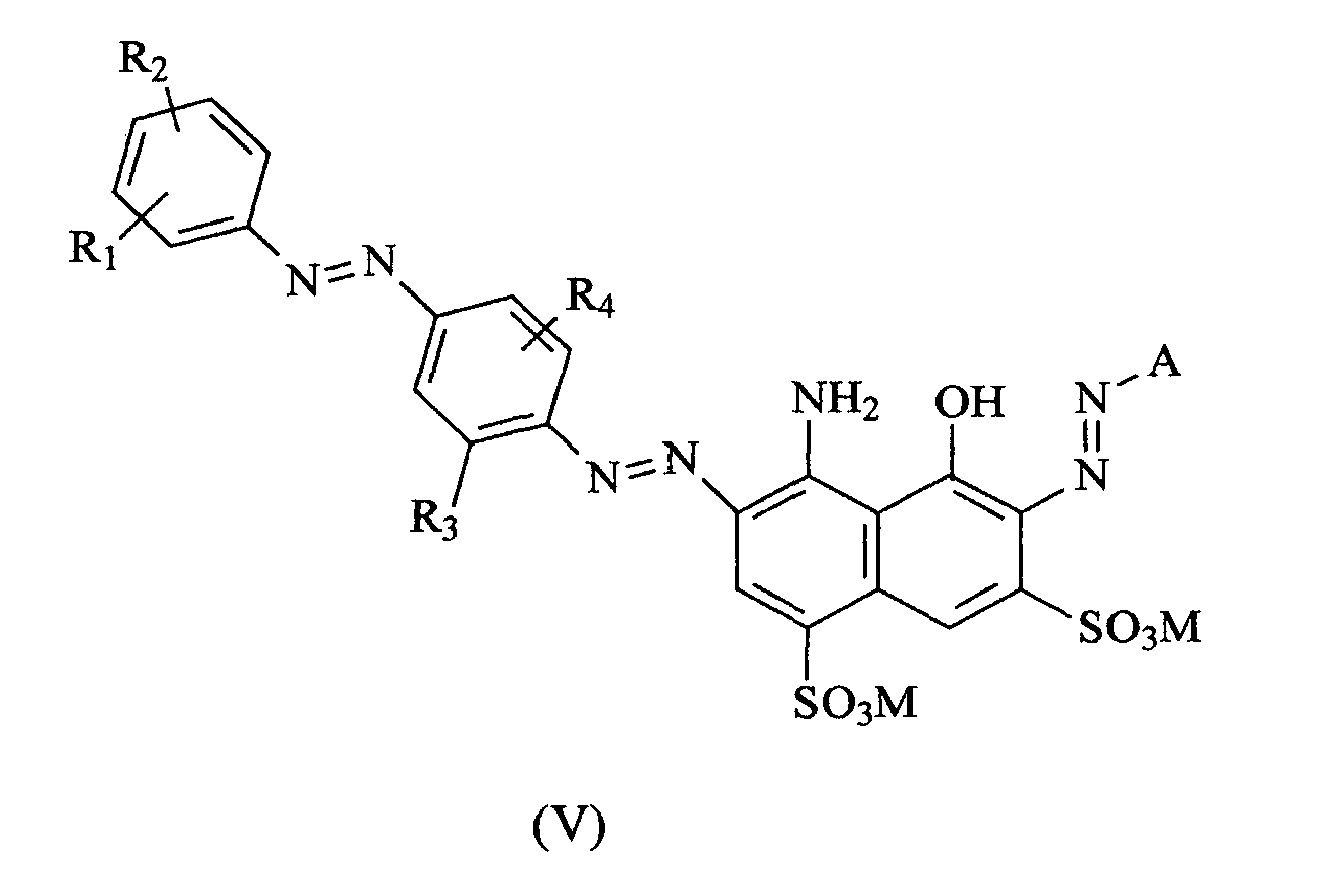
wherein A, R1, R2, R3, R4 and M are as described in the specification, are excellent black dyes for dyeing and printing of paper, other cellulose containing materials and textiles materials and, in particular, for the preparation of recording fluids for ink jet printing and for writing utensils.
Description
- The invention relates to novel trisazo black dyes and their salts, a method of their preparation and their use in dying and printing operations. It also relates to liquid dye preparations containing these trisazo dyes, in particular to aqueous recording fluids for ink jet printing and for writing utensils.
- The speed of modern ink jet printers has to increase steadily for economic reasons. Particularly suitable recording sheets for such printers comprise nanoporous inorganic compounds such as for example silicium dioxide, aluminum oxide/hydroxide, aluminum oxide or their mixtures. Such recording sheets are known as "nanoporous recording sheets". Images printed onto these recording sheets need to have a good storage stability even under adverse conditions. This can only be achieved by using a finely tuned system of inks, respectively the dyes contained therein.
- Up to now, these images do not satisfy all required properties. In particular, the water fastness, the light stability, the ozone stability, the hue and the brilliance of images printed onto these recording sheets are not satisfactory. Thus, new dyes are looked for which would improve the properties mentioned above of images printed onto these recording sheets, in particular in areas with black hue.
- In addition to this, industrial ink jet is getting more and more significant in the packaging and food packaging industry. In that segment waterfastness, lightfastness and the use of safe components is a must. It is also required that these properties are the same independently to the recording medium used.
- Although quite a number black dyes have already been proposed as black dyes for ink jet printing. However, none satisfies all of the required properties.
- In addition to this the dyes should present a good water solubility being human and ecologically safe.
- The following black dyes are often used in industrial ink jet Printers:
C.I. Acid Black 1 with the formula (I)
- This dye is too bluish and present poor waterfastness when printed on standard plain paper.

- The direct black 19 that present a good waterfastness is usually available as a mixture containing different side products and is described to be tested mutagenic (Patent
US 5,340,929 ). - Although quite a number black dyes have already been proposed as black dyes for ink jet printing as in the
US patent 5,423,906 andUS 2012/0090503 A1 . However, none satisfies all of the required properties. - Various types of ink compositions have been proposed. Typical inks comprise one or more dyes or pigments, water, organic co-solvents and other additives.
- The inks have to satisfy the following criteria:
- ∘ (1) The ink gives images of excellent quality on any type of recording sheet.
- ∘ (2) The ink gives printed images exhibiting good water fastness.
- ∘ (3) The ink gives printed images exhibiting good light stability.
- ∘ (4) The ink gives printed images exhibiting good ozone fastness.
- ∘ (5) The ink gives printed images exhibiting excellent smudge behavior.
- ∘ (6) The ink gives printed images exhibiting excellent storage stability under conditions of high temperature and humidity.
- ∘ (7) The ink does not clog jetting nozzles of the ink jet printers even when these are kept uncapped while recording is suspended for long periods.
- ∘ (8) The ink may be stored for long periods without deterioration of its quality.
- ∘ (9) The ink has to be non-toxic, non-flammable and safe.
- An objective of the invention is the provision of novel black trisazo dyes with black, as far as possible neutral hue and their use in aqueous inks, in particular in recording fluids for ink jet printing and for writing utensils. They are particularly advantageous in ink jet printing for the preparation of images or colourings on rapidly drying nanoporous recording sheets. These novel black trisazo dyes with high colouring strength have an excellent solubility in aqueous formulations, they give images or colourings having good overall properties, in particular in ink jet printing, where they provide images with brilliant hue, where the sharpness of the images is not or only slightly deteriorated during long periods of storage under conditions of high temperature and humidity. The images also show good light stability and excellent ozone fastness and low bleeding.
- A further objective of the invention is the provision of liquid dye preparations, in particular of inks for ink jet printing and for writing utensils, giving a spectrally unchanged hue on any type of recording sheet.
- It is further object of the invention to provide a method of manufacturing dyes and/or dying compositions, such as inks, recording liquids, textile colorants and dyeing solutions for manufacturing colour filters for optical and/or opto-electronic applications, which all have at least some, preferably all of the aforementioned advantageous properties. Further, it is an object of the invention to provide a method of applying a dyeing composition, such as an ink, a recording liquid, or a textile colorant with at least one of the dyes to a substrate, preferably without using volatile organic solvents.
- A further objective of the invention is the provision of inks having all the required properties mentioned before.
- The present invention relates to novel trisazo dyes of general formula (V)

- M
- represents a hydrogen atom, a metal cation or an ammonium cation, which optionally may be substituted by one or more alkyl or substituted alkyl groups each having from 1 to 18 C atoms;
where - R1, R2
- independently represent a hydrogen atom, a SO3M group, a COOM group, a Halogen atom, a NO2 group, an ester group, an alkyl- or alkoxy group each having from 1 to 6 carbon atoms, an unsubstituted or substituted amide or sulfonamide group each having up to 12 carbon atoms, wherein the substituents are selected from the group consisting of COOM, OH, OCH3, NH2, Cl, COOCH3 and COOCH2CH3 where
- R3, R4
- independently represent a hydrogen atom, an alkyl- or alkoxy group each having from 1 to 6 carbon atoms, an unsubstituted or substituted amide or sulfonamide or sulfonamide group each having up to 6 carbon atoms, wherein the substituents are selected from the group consisting of COOM, OH, OCH3, NH2, Cl, COOCH3 and COOCH2CH3.
- A
- either represents a moiety of general formula (VI)

R6, R7, R8, R9, R10 independently represent a hydrogen atom, a SO3M group, a NO2 group,an amino group, a COOM group, a Halogen atom, an ester group, an alkyl or alkoxy group each having from 1 to 2 carbon atoms, an unsubstituted or substituted amide or sulfonamide group each having up to 6 carbon atoms, wherein the substituents are selected from the group consisting of COOM, OH, OCH3, COOCH3, COOCH2CH3; Or a moiety of general formula (VII)
o is 0 or 1 and
R11, R12, R13, R14 independently represent a hydrogen atom, a SO3M group, a NO2 group, a COOM group, an unsubstituted or substituted amide or sulfonamide group having up to 6 carbon atom, wherein the substituents are selected from the group consisting of COOM, OH, OCH3, NH2, Cl, COOCH3 and COOCH2CH3; - Preferred are trisazo dyes of general formula (V), wherein M is as defined before,
- R1, R2
- independently represent a hydrogen atom, a SO3M group, or a COOM group;
- R3,R4
- independently represent a hydrogen atom, an alkyl or an alkoxy group each having 1 to 2 carbon atoms, an unsubstituted or substituted amide or sulfonamide group having up to 4 carbon atom, wherein the substituents are selected from the group consisting of COOM, OH, OCH3, NH2, Cl, COOCH3 and COOCH2CH3;
- A
- represent a moiety of general formula (VI) as described before
- R6, R10
- independently represent a hydrogen atom, a NO2 group,
and - R7, R9
- represent a hydrogen atom
and - R8,
- represent an substituted amide or sulfonamid group having up to 8 carbon atoms, wherein the substituents are selected from the group consisting of COOM, OH, OCH3, NH2, Cl, COOCH3 and COOCH2CH3;
- Particularly preferred are trisazo dyes of general formula (V), wherein M is as defined before,
- R1, R2
- independently represent a hydrogen atom, a COOM group;
- R3,R4
- independently represent a hydrogen atom, an alkyl or alkoxy group each having 1 to 2 carbon atoms, an unsubstituted or substituted amide or sulfonamide group having up to 4 carbon atoms, wherein the substituentsare selected from the group consisting of COOM, OH, OCH3, COOCH3 andCOOCH2CH3 ;
- A
- represent a moiety of general formula (VI) as described before

R6, R10 independently represent a hydrogen atom, a NO2 group,
and
R8, represent a substituted amide or sulfonamide group having up to 8 carbon atoms, wherein the substituents are selected from the group consisting of COOM, Cl, COOCH3 and COOCH2CH3 as defined before; - As metal cations, the cations of the alkali metals (Li, Na, K, Rb, Cs), of the alkaline earth metals (Mg, Ca, Sr, Ba) and the ammonium cation, optionally substituted by one or more alkyl groups having each from 1 to 4 carbon atoms or by hydroxy substituted alkyl each having from 1 to 6 carbon atoms are preferred.
- Specific examples of trisazo dyes of general formula (IV) are the following,where the substituent M is defined in Table 1.


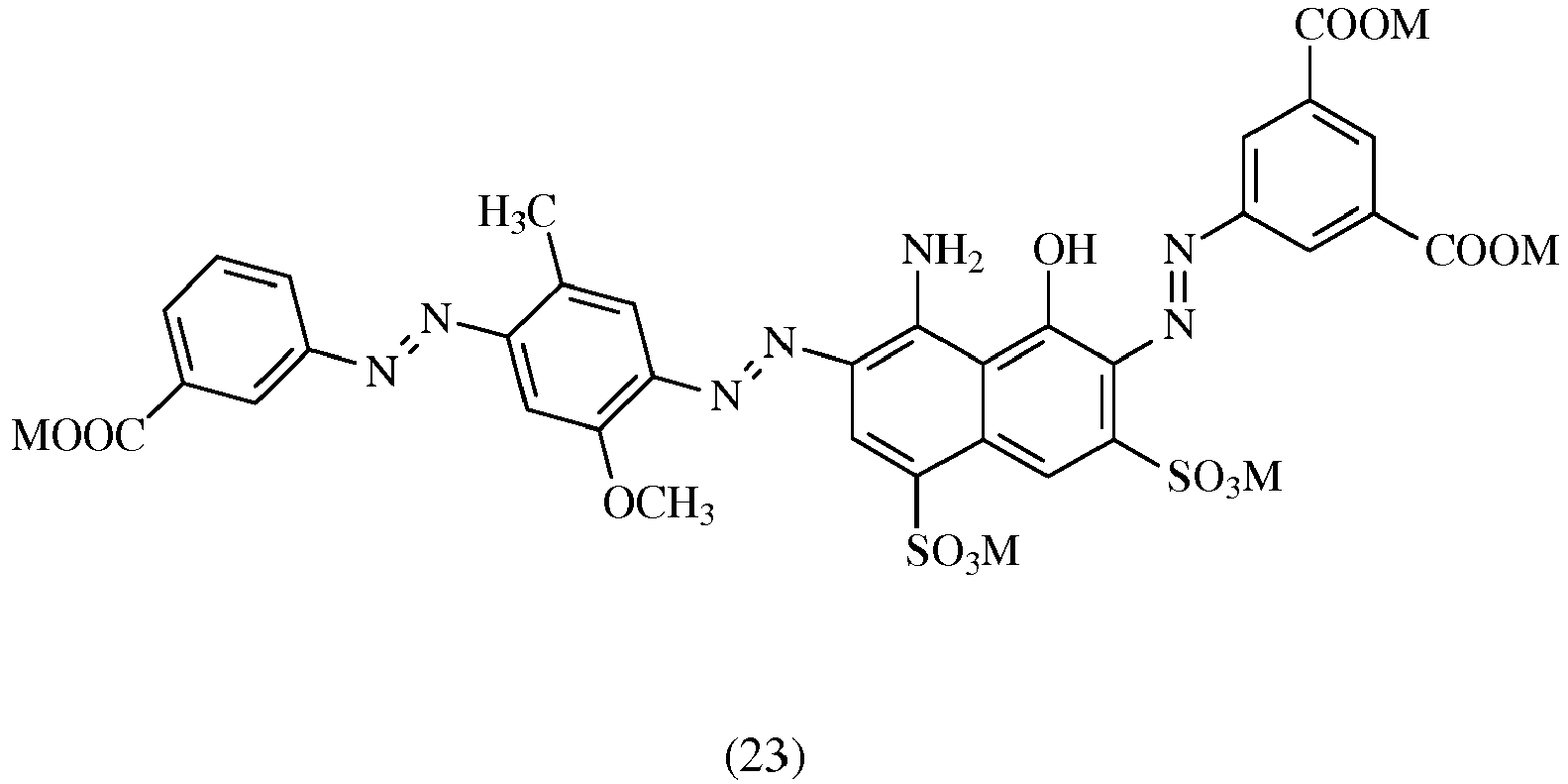


- The prepared trisazo dyes of general formulas (V) are listed in Table 1 together with their absorption maximum in aqueous solution:
Tabelle 1 Farbstoff Nr. M λmax in H2O (nm) 10 Na 610/460 11 Na 600/460 12 Na 621/486 13 Na 600/468 14 Na 622/487 15 Me2NCH2CH2OH 622/484 16 Li 600/464 17 Li 601/475 18 Li 601/468 19 Na 600/468 20 Me2NCH2CH2OH 616/487 21 K 616/459 22 Na 602/456 23 Na 601/462 24 Li 599/466 25 Li 592 26 Na 594 27 Na 608 28 Na 618/481 29 Na 615/495 30 NH4 622/487 - The trisazo dyes of general formulas (V) may be in the free acid form or in the form of inorganic or organic salts thereof. Preferably, they are in the form of their alkali or ammonium salts, wherein the ammonium cation may be substituted. Examples of such substituted ammonium cations are 2-hydroxyethylammonium, bis-(2-hydroxyethyl)-ammonium, tris-(2-hydroxyethyl)-ammonium, bis-(2-hydroxyethyl)-methylammonium, tris-[2-(2-methoxyethoxy)-ethyl]-ammonium, 8-hydroxy-3,6-dioxaoctylammonium and tetraalkylammonium such as tetramethylammonium or tetrabutylammonium.
- The invention does not only relate to pure trisazo dyes of general formulas (V), but also to mixtures of these trisazo dyes.
- The invention also relates to a method of preparation of the trisazo dyes of general formula (V) according to the invention, wherein an amine of general formula (VIII),


- The intermediate dye of general formula (X), wherein R1, R2, R3 and R4 are as defined before, is diazotized and subsequently coupled with K-Acid at an acidic pH situated between a value of 0.5 and 2.0 under formation of the intermediate dye of general formula (XII) where R1, R2, R3 and R4 are as defined before and M is the metal cation of the base used to maintain the pH during the coupling reaction,

- The intermediate dye of general formula (XII) is further coupled with a diazo compound of general formula (XIII)

or of general formula (XIV)
at a more or less neutral pH situated between a value of 5.0 and 9.0 under formation of the dyes of general formula (V) according to the invention. - The trisazo dyes of general formulas (V) according to the invention are used for dying cellulose containing materials, paper, cotton, viscose, leather and wool to provide dyed materials with good water fastness and light stability.
- All methods well known in the textile and paper industries for dyeing with substantive dyes may be used with the trisazo dyes, preferably for the bulk or surface treatment of sized or unsized paper. The dyes may also be used in the dyeing of yarns and piece goods of cotton, viscose and linen by the exhaustion process from a long liquor or in a continuous process.
- The trisazo dyes according to the invention are particularly suitable for recording text and images on recording sheets, coated or uncoated paper, for dyeing or printing of natural or synthetic fiber materials, nanoporous recording sheets, leather and aluminum.
- The invention furthermore relates to liquid dye preparations comprising at least one trisazo dye of general formula (V). The use of such liquid dye preparations is particularly preferred for paper dyeing. Such stable, liquid, preferably aqueous, concentrated dye preparations may be obtained by using methods well known in the art, preferably by dissolving in suitable solvents. The possibility of preparation of such stable, aqueous, concentrated preparations in the course of dye synthesis itself, without intermediate isolation of the dye, for example after a desalting step by diafiltration of the reaction solution, is of particular advantage.
- Trisazo dyes or mixtures of trisazo dyes of general formula (V) are excellent dyes for the preparation of inks for ink jet printing and for writing utensils.
- The trisazo dyes of general formula (V) according to the invention may be combined with toning dyes, in particular dyes as described in patent applications
EP 0,755,984 ,EP 1,219,682 , as well as in PatentsUS 5'074'914 ,US 5'684'140 andUS 5'824'785 , in order to obtain a still more neutral black hue. - Such an ink comprises one or more of the trisazo dyes according to the invention in a liquid aqueous medium. The ink contains from 0.5 percent by weight to 20 percent by weight, preferably from 0.5 percent by weight to 8 percent by weight, of these trisazo dyes, based on the total weight of the ink. The liquid medium is preferably water or a mixture of water and water-miscible organic solvents. Suitable solvents are given for example in
U.S. Pat. No. 4,626,284 ,US 4'703'113 ,US 4'963'189 and patent applicationsGB 2'289'473 EP 0'425'150 andEP 0'597'672 . - The present invention will be illustrated in more detail by the following examples without limiting the scope of the claimed compounds in any way.
- The trisazo dye no. 17 was prepared in the following way:
- 30.8 g (0.22 Mol) of 4-Aminobenzoic acid (98%ig) were suspended at room temperature in 200 ml of water and then cooled down to a temperature between 0° C and 5° C and an aqueous solution of hydrochloric acid (37%) were added drop-wise over a period of 10 minutes at a temperature between 0° C and 10° C under stirring and 55 ml of an aqueous solution (4N) of sodium nitrite were slowly added keeping the temperature below 10°C. Afterwards, stirring was continued for 1 hour at a temperature between 0°C and 5°C. The excess of nitrous acid was removed subsequently by reaction with sulfamic acid.
- 28.3 g (0.2 Mol) of 5-Methyl-o-anisidine (97 %) were suspended in 200 ml of water and 22 ml of an aqueous solution of hydrochloric acid (37 %) and the suspension was stirred for 2h at room temperature. Afterwards, the suspension was cooled down to a temperature between 5 and 10 °C.
- The diazo suspension A was added over a period of 30 minutes at an internal temperature between 5°C and 10°C to the suspension of the 5-Methyl-o-anisidine keeping the pH at a value between 0.5 and 1 by adding a solution of sodium hydroxide (30%). The addition terminated, stirring was continued for 18 hours at room temperature.
- The precipitated was filtered off and washed up with 50ml of a 3.5% solution of hydrochloric acid. After drying, 45.7 g of the dye of formula (XXV) were obtained.

- 14.3 g (50 mMol) of dye of formula (XXV) were dissolved in 100 ml of water and 10 ml of N-Methylpyrrolidone at 80°C by adjusting the pH to a value of 9.0 with the addition of a solution of NaOH 30%.
- The obtained solution was then cooled down to 0° C to 5° C and 12.5 ml of an aqueous solution (4N) of sodium nitrite were added. Under stirring 13ml of an aqueous solution of hydrochloric acid (37%) were slowly added drop-wise over a period of 10 minutes at a temperature between 0°C and 10°C. The addition terminated, stirring was continued for 2 hours at this temperature. The excess of nitrous acid was removed subsequently by reaction with sulfamic acid.
- 21.3 g (50 mMol) of K-acid (CAS: 130-23-4) (75 %) were suspended in 200 ml water and 5 ml of an aqueous solution of sodium hydroxyde (30 %). The suspension was then stirred 30 minutes at room temperature and then cooled down to 5°C.
- The diazo suspension B was added to this suspension over a period of 30 minutes at an internal temperature between 5° C and 10° C keeping the pH to a value between 1 and 2 by a simultaneously addition of a saturated solution of sodium acetate. The addition terminated, stirring was continued for 18 hours at room temperature. The thick suspension was then heated to 80°C , and brought into a solution by the addition of a solution of sodium hydroxide (30%) adjusting the pH to a value of 9. The hot solution was then clear filtrated over celite. Dye (XXVI) contained in the filtrate was then precipitated by decreasing the pH to a value of 6 with the addition of acetic acid and by the addition of 10g sodium chloride. The intermediate dye (XXVI ) was then filtered off and washed up with 50ml of water. After drying 26.4g of the dye of formula (XXVI) were obtained.

- 30.8 g (0.22 Mol) of 4-Aminobenzoic acid (98%) were suspended in 200 ml of water and then cooled down to a temperature between 5°C and 10°C. 50 ml of an aqueous solution of hydrochloric (37%) acid were added drop-wise to the suspension over a period of 10 minutes under stirring and 55 ml of an aqueous solution (4N) of sodium nitrite were slowly added keeping the temperature between 0° C and 10° C. The excess of nitrous acid was removed by reaction with sulfamic acid.
- 7.4 g (12 mMol) of dye of formula (XXVI) were suspended in 100 ml water and cooled down to 0° C to 5° C. Afterwards, 12 mMol of the Diazo suspension C were slowly added to the suspension over a period of 30 min keeping the temperature below 5°C and maintaining the pH at a value of 6.0 to 7.5 by a simultaneous addition of a solution of sodium hydroxide (20%).
- The addition terminated , stirring was continued for 2 hours at a temperature between 0°C and 5°C and then allowed to warm up to Room temperature. After 2 hours the dark solution was clear filtered and the filtrate was concentrated with a rotating evaporator. The dye No. 17 was then precipitated by the addition of methanol and filtered off.
- The raw dye was purified with 60 ml of an aqueous solution (80%) of ethanol. After dry-ing, 6g of dye 17 in the form of its sodium salt were obtained.
- The trisazo dyes no. (10) to (30) according to the invention may be prepared in a similar way by using appropriate starting materials.
- The present invention, as far as it relates to inks, is illustrated by the following examples using trisazo dyes according to the invention, listed in Table 1, and dyes representing the state of the art. For each dye, 100 g of ink were prepared by heating the necessary amount of dye (4 - 9 g),propylene glycol (5 g), butyl carbitol (5 g), Surfinol 465 (0.5 g, available from Air Products®) and a solution of the biocide Mergal K 10N (0.2 g, available from Riedel-de-Haën, Seelze, Germany) together with water to a temperature of 50° C. under stirring for approximately 1 hour. The resulting solution was cooled down to a temperature of 20° C., its value of pH was adjusted to 7.5 and the solution was passed through a Millipore® filter of 0.5 µm pore diameter. The dye quantity was adjusted in such a way that the optical density of the printed image was similar for all the dyes.
- The recording liquids were subsequently printed with an ink jet printer Canon Pixma IP4300 onto the following recording sheets:
- 1) START® PRINT IT ALL High Volume Printing Paper (75 g/m2
and - 2) HP® Printing Paper (CHP 150)
- The printed samples were irradiated using a Weather-Ometer® Ci4000 (available from Atlas Material Testing Technology, Chicago, USA) with a 6500 W xenon lamp at a temperature of 20° C. and relative humidity of 50% until an illumination of 20 megalux hours was reached. The density loss was measured with a densitometer Spectrolino®. The percent density loss of initial density gives an indication of the light stability of the dyes on the printed recording sheet.
- The color coordinates L*a*b* of the printed samples were measured with a spectrophotometer Spectrolino® (available from Gretag Macbeth, Regensdorf, Switzerland).
- Patterns were printed on recording media 1 and 2 and tested as described in ISO test 18935:2005(E), Method 3 - Water soak, with the following differences:
- a. the time of immersion in the present tests was set than 1 minute compared ISO 18935:2005(E), in which the time of immersion is set to 1 hour;
- b. only black pattern are prepared according to the procedure described above.
- First, the optical density (UnsoakedPattern OD) of the coloured patterns on the samples was measured with a Spectrolino® densitometer 1 day after it has been printed. Then the samples with the patterns were immersed into de-ionized water at ambient temperature for 1 minute. Then, the samples with the patterns were removed and hung vertically to dry for 1 hour. Separate containers were used for each sample to avoid cross contamination. The optical density (SoakedPattern OD) of the coloured, water-treated patterns was measured with a Spectrolino® densitometer. The calculated percent water-fastness is given according the following formula:

- Low values of Optical Density Loss indicate good water fastness of a dye.
- The measured values of L*a*b* (illuminant D65) of the trisazo dyes according to the invention and the trisazo dyes (I) and (II) representing the state of the art are listed in Table 2.
Table 2 Dyes Nr. L*a*b*-Value recording sheet 1 L*a*b*-Value recording sheet 2 12 33.1/-0.4/-3.7 32.4/1.4/-0.8 14 34.2/1.4/-0.8 33.2/3.0/2.2 (I) 32.2/-3.4/-14.8 33.8/3.7/-10.4 (II) 31.1/-0.5/-3.1 31.5/1.3/1.6 - A comparison of the measured L*a*b* values in Table 2 immediately shows that inks containing the trisazo dyes according to the invention give black image regions having lower values of b* in comparison to image regions printed with inks containing the trisazo dye (I). The trisazo dyes according to the invention are therefore particularly suitable in ink jet printing, because they allow a more neutral reproduction of blacks comparable to dye (II) representing the start of the art.
- A comparison of the measured density losses of printed samples in Table 3 immediately shows that the trisazo dyes (12) and (14) according to the invention have a considerably improved light stability in comparison to the trisazo dyes (I) and (II) representing the state of the art.
Table 3 Dye Nr. Density loss in percent Red-/Green-/Yellow-channel Recording sheet 1 Density loss in percent Red-/Green-/Yellow-channel Recording sheet 2 12 -5.9/-5.2/-5.1 -1.9/-1.9/-3.8 14 -5.1/-3.0/-4.6 0/-0.9/-3.4 (I) -34/-24/-11.6 -5.9/-9.5-6.0 (II) -19.8/-15.1/-11.9 -6.1/-5.1/-6.9 - The waterfastness (WF) on the recording sheets 1 and 2 are listed in Table 4
Table 4 Dye Water-fastness (WF) Recording sheet 1 Recording sheet 2 Optical Density vis. at 100% print density WF [%] Optical Density vis. at 100% print density WF [%] 12 1.12 18.4 1.14 3.1 14 1.1 6.3 1.12 0 (I) 1.2 38.0 1.1 5.1 (II) 1.2 2.0 1.15 0 - With regard to the light-fastness and water-fastness respectively reported in Table 3 and 4, dyes 12 and 14 have a considerably better light and water-fastness than commercial dye (I) and much better light fastness than commercial dye (II) representing the start of the art.
- This means that the waterfast ink jet printed black images using the trisazo dyes according to the invention fade much less than black images containing the known trisazo dyes representing the state of the art.

Claims (13)
- Trisazo dye of general formula (V)
 M is selected from the group consisting of H, a metal cation, an ammonium cation N(HkR5 m),wherein
each R5 is selected from the group consisting of -H, an substituted or unsubstituted, saturated or unsaturated aliphatic group having 1 to 18 carbon atoms, and
k is an integer selected from 0, 1, 2, 3, 4 and m=4-k,
whereR1, R2 independently represent a hydrogen atom, a SO3M group, a COOM group, a Halogen atom, a NO2 group, an ester group, an alkyl- or alkoxy group each having from 1 to 6 carbon atoms, an unsubstituted or substituted amide or sulfonamide group or sulfone group each having up to 12 carbon atoms, wherein the substituents are selected from the group consisting of COOM, OH, OCH3, NH2, Cl, COOCH3 and COOCH2CH3whereR3, R4 independently represent a hydrogen atom, an alkyl- or alkoxy group each having from 1 to 6 carbon atoms, an unsubstituted or substituted amide or sulfonamide group each having up to 6 carbon atoms, wherein the substituents are selected from the group consisting of COOM, OH, OCH3, NH2, Cl, COOCH3 and COOCH2CH3.A either represents a moiety of general formula (VI)Or A a moiety of general formula (VII) R6, R7, R8, R9, R10 independently represent a hydrogen atom, a SO3M group, a NO2 group, a nitrile group, an amino group, a COOM group, a Halogen atom, an ester group, an alkyl or alkoxy group each having from 1 to 2 carbon atoms, an unsubstituted or substituted amide or sulfonamide group or sulfone group each having up to 6 carbon atoms, wherein the substituents are selected from the group consisting of COOM, Cl, OH, OCH3, COOCH3, COOCH2CH3;
 o is 0 or 1
andR11, R12, R13, R14 independently represent a hydrogen atom, a SO3M group, a NO2 group, a COOM group, an unsubstituted or substituted amide or sulfonamide group having up to 6 carbon atom, wherein the substituents are selected from the group consisting of COOM, OH, OCH3, NH2, Cl, COOCH3 and COOCH2CH3; - Trisazo dye of general formula (V) according to claim 1,
whereinM is as defined in claim 1,R1, R2 independently represent a hydrogen atom, a SO3M group, a COOM group, a Halogen atom, a NO2 group, an ester group, an alkyl- or alkoxy group each having from 1 to 6 carbon atoms, an unsubstituted or substituted amide or sulfonamide group each having up to 6 carbon atoms, wherein the substituents are selected from the group consisting of COOM, COOCH3 and COOCH2CH3.R3, R4 independently represent a hydrogen atom, an alkyl- or alkoxy group each having from 1 to 2 carbon atoms, an unsubstituted or substituted amide or sulfonamide group each having up to 4 carbon atoms, wherein the substituents are selected from the group consisting of COOM, OH, OCH3, COOCH3 and COOCH2CH3.A either represents a moiety of general formula (VI) R6, R10 independently represent a hydrogen atom, a nitro group, a nitrile group,
andR7, R9 represent a hydrogen atom,
andR8, represent a substituted amide or sulfonamide group or Sulfone group having up to 8 carbon atoms, wherein the substituents are selected from the group consisting of COOM, OH, OCH3, NH2, Cl, COOCH3, COOCH2CH3; - Trisazo dye of the general Formula (V) according to claim 1
Wherein
M, R1, R2, R3, R4 are as defined in claim 2A either represents a moiety of general formula (VI) R6, R10 independently represent a hydrogen atom, a nitro group,
andR7, R9 represent a hydrogen atom,
andR8, represent a substituted amide or sulfonamide group having up to 8 carbon atoms, wherein the substituents are selected from the group consisting of COOM, COOCH3 and COOCH2CH3; - Method of preparation of the tris azo dyes according to the invention of general formula (V) according to claim 1, wherein
an amine of general formula (VIII)
is diazotized and subsequently coupled with a compound of general formula (IX),
at an acid value of pH situated between 1.0 and 3.0, under formation of the intermediate dye of general formula (X).
R1, R2, R3 and R4 are as defined in claim 1 and M the cation of the base used during the coupling reaction to maintain the pH value at the defined pH range,

or of general formula (XIV)
at a more or less neutral value of pH situated between about 5.0 and 9.0 yielding the dye of general formula (V).
- Process for recording text and images on recording sheets and for dying and printing of natural or synthetic fiber materials, nanoporous materials, leather and aluminum by applying thereto a black trisazo dye or a mixture of black trisazo dyes according to claims 1-3.
- Liquid dye preparations containing at least one trisazo dye or a mixture of trisazo dyes according to claims 1-3.
- Recording liquids for ink jet printing and for writing utensils containing at least one trisazo dye or a mixture of trisazo dyes according to claims 1-3.
- Recording liquids for ink jet printing and for writing utensils containing in addition to at least one trisazo dye or a mixture of trisazo dyes according to claim 1 in addition one or more other dyes.
- The liquid phase according to claim 6, wherein the liquid phase comprises one or more dyes according to claims 1 through 3 , wherein the amount of said dyes in the liquid phase is in the range of from 0.5 to 20 wt.-%, based on the total weight of the liquid phase.
- The liquid phase according to claim 6, wherein the liquid phase further comprises one or more of the following components: N-methyl-2-pyrrolidone, 2-pyrrolidone, 2-Hexylpyrrolidone, Hydroxyethyl-pyrrolidone, 1,2-Hexanediol, 1,2-Butandiol, Trimethylolpropane, Diethylene glykol-monobutylether, Triethylene glykol-monobutylether, Dipropylene glykol-monobutylether, glycerine, Butyl lactate, sulfolane, glycol ether solvents, biocide in a range of from 0.01 to 50 wt-%, based on the total weight of the liquid phase.
- A method for applying a liquid phase on a substrate comprising at least the following steps
α ) Providing a substrate, and
β ) Providing a reservoir comprising the liquid phase according to any of claims 6 through 10,
γ ) Transferring of at least a part of the liquid phase from the reservoir to the substrate, δ) Removing of water, and optionally solvents, from the substrate - A printed article, comprisingA. a substrate, andB. a layer comprising at least a dye (V) according to any of claims 1 through 3
- A use of a dye according to any of claims 1 through 3 in inks for inkjet printing, writing utensil, or in dyeing solutions for manufacturing color filters for optical and opto-electronic applications.
Priority Applications (11)
| Application Number | Priority Date | Filing Date | Title |
|---|---|---|---|
| EP14020086.6A EP3020770A1 (en) | 2014-11-17 | 2014-11-17 | Black trisazo dyes, their preparation and their use |
| US15/527,175 US10259942B2 (en) | 2014-11-17 | 2015-11-11 | Black trisazo dyes, their preparation and their use |
| PCT/EP2015/076355 WO2016078988A1 (en) | 2014-11-17 | 2015-11-11 | Black trisazo dyes, their preparation and their use |
| JP2017544831A JP6748093B2 (en) | 2014-11-17 | 2015-11-11 | Black trisazo dyes, their preparation and their use |
| EP15791670.1A EP3221406B1 (en) | 2014-11-17 | 2015-11-11 | Black trisazo dyes, their preparation and use |
| PL15791670T PL3221406T3 (en) | 2014-11-17 | 2015-11-11 | Black trisazo dyes, their preparation and use |
| HUE15791670A HUE060874T2 (en) | 2014-11-17 | 2015-11-11 | Black trisazo dyes, their preparation and use |
| DK15791670.1T DK3221406T3 (en) | 2014-11-17 | 2015-11-11 | BLACK TRISAZO DYES AND THEIR MANUFACTURE AND USE |
| CN202210335087.2A CN114656799A (en) | 2014-11-17 | 2015-11-11 | Black trisazo dye and preparation method and application thereof |
| CN201580062535.4A CN107087414A (en) | 2014-11-17 | 2015-11-11 | Black trisazo dye and its preparation method and application |
| ES15791670T ES2905409T3 (en) | 2014-11-17 | 2015-11-11 | Black trisazo dyes, their preparation and use |
Applications Claiming Priority (1)
| Application Number | Priority Date | Filing Date | Title |
|---|---|---|---|
| EP14020086.6A EP3020770A1 (en) | 2014-11-17 | 2014-11-17 | Black trisazo dyes, their preparation and their use |
Publications (1)
| Publication Number | Publication Date |
|---|---|
| EP3020770A1 true EP3020770A1 (en) | 2016-05-18 |
Family
ID=52338803
Family Applications (2)
| Application Number | Title | Priority Date | Filing Date |
|---|---|---|---|
| EP14020086.6A Withdrawn EP3020770A1 (en) | 2014-11-17 | 2014-11-17 | Black trisazo dyes, their preparation and their use |
| EP15791670.1A Active EP3221406B1 (en) | 2014-11-17 | 2015-11-11 | Black trisazo dyes, their preparation and use |
Family Applications After (1)
| Application Number | Title | Priority Date | Filing Date |
|---|---|---|---|
| EP15791670.1A Active EP3221406B1 (en) | 2014-11-17 | 2015-11-11 | Black trisazo dyes, their preparation and use |
Country Status (9)
| Country | Link |
|---|---|
| US (1) | US10259942B2 (en) |
| EP (2) | EP3020770A1 (en) |
| JP (1) | JP6748093B2 (en) |
| CN (2) | CN114656799A (en) |
| DK (1) | DK3221406T3 (en) |
| ES (1) | ES2905409T3 (en) |
| HU (1) | HUE060874T2 (en) |
| PL (1) | PL3221406T3 (en) |
| WO (1) | WO2016078988A1 (en) |
Cited By (1)
| Publication number | Priority date | Publication date | Assignee | Title |
|---|---|---|---|---|
| WO2020245052A1 (en) | 2019-06-06 | 2020-12-10 | Lanxess Deutschland Gmbh | Trisazo compounds for ink-jet printing |
Citations (5)
| Publication number | Priority date | Publication date | Assignee | Title |
|---|---|---|---|---|
| US4097476A (en) * | 1974-06-17 | 1978-06-27 | Sandoz Ltd. | Trisazo dyes having a 2,7-(1-amino-3,6-or 4,6-disulfo-8-hydroxynaphthylene) radical |
| GB2200918A (en) * | 1987-02-10 | 1988-08-17 | Ciba Geigy | Trisazo anionic dyes |
| US20040158050A1 (en) * | 2003-02-08 | 2004-08-12 | Samsung Electronics Co., Ltd. | Lightfast colorant and lightfast ink composition including the same |
| EP1693422A1 (en) * | 2003-12-02 | 2006-08-23 | Nippon Kayaku Kabushiki Kaisha | Trisazo compound, ink composition, and colored object |
| WO2010057830A1 (en) * | 2008-11-20 | 2010-05-27 | Dystar Colours Deutschland Gmbh | Ring fluorinated reactive dyes |
Family Cites Families (5)
| Publication number | Priority date | Publication date | Assignee | Title |
|---|---|---|---|---|
| GB9217964D0 (en) * | 1992-08-24 | 1992-10-07 | Ici Plc | Compound |
| JP2002003740A (en) * | 2000-06-21 | 2002-01-09 | Kiriya Kagaku Kk | Black dye composition and method for producing the same |
| JP2002003742A (en) * | 2000-06-21 | 2002-01-09 | Kiriya Kagaku Kk | Method for producing dye composition |
| DE10337636A1 (en) * | 2003-08-16 | 2005-03-17 | Dystar Textilfarben Gmbh & Co. Deutschland Kg | Dye mixtures of fiber-reactive azo dyes, their preparation and their use |
| CN1886467A (en) * | 2003-12-02 | 2006-12-27 | 日本化药株式会社 | Trisazo compound, ink composition, and colored object |
-
2014
- 2014-11-17 EP EP14020086.6A patent/EP3020770A1/en not_active Withdrawn
-
2015
- 2015-11-11 DK DK15791670.1T patent/DK3221406T3/en active
- 2015-11-11 CN CN202210335087.2A patent/CN114656799A/en active Pending
- 2015-11-11 EP EP15791670.1A patent/EP3221406B1/en active Active
- 2015-11-11 HU HUE15791670A patent/HUE060874T2/en unknown
- 2015-11-11 JP JP2017544831A patent/JP6748093B2/en active Active
- 2015-11-11 US US15/527,175 patent/US10259942B2/en active Active
- 2015-11-11 WO PCT/EP2015/076355 patent/WO2016078988A1/en not_active Ceased
- 2015-11-11 ES ES15791670T patent/ES2905409T3/en active Active
- 2015-11-11 CN CN201580062535.4A patent/CN107087414A/en active Pending
- 2015-11-11 PL PL15791670T patent/PL3221406T3/en unknown
Patent Citations (5)
| Publication number | Priority date | Publication date | Assignee | Title |
|---|---|---|---|---|
| US4097476A (en) * | 1974-06-17 | 1978-06-27 | Sandoz Ltd. | Trisazo dyes having a 2,7-(1-amino-3,6-or 4,6-disulfo-8-hydroxynaphthylene) radical |
| GB2200918A (en) * | 1987-02-10 | 1988-08-17 | Ciba Geigy | Trisazo anionic dyes |
| US20040158050A1 (en) * | 2003-02-08 | 2004-08-12 | Samsung Electronics Co., Ltd. | Lightfast colorant and lightfast ink composition including the same |
| EP1693422A1 (en) * | 2003-12-02 | 2006-08-23 | Nippon Kayaku Kabushiki Kaisha | Trisazo compound, ink composition, and colored object |
| WO2010057830A1 (en) * | 2008-11-20 | 2010-05-27 | Dystar Colours Deutschland Gmbh | Ring fluorinated reactive dyes |
Cited By (1)
| Publication number | Priority date | Publication date | Assignee | Title |
|---|---|---|---|---|
| WO2020245052A1 (en) | 2019-06-06 | 2020-12-10 | Lanxess Deutschland Gmbh | Trisazo compounds for ink-jet printing |
Also Published As
| Publication number | Publication date |
|---|---|
| JP2018501387A (en) | 2018-01-18 |
| US10259942B2 (en) | 2019-04-16 |
| CN107087414A (en) | 2017-08-22 |
| EP3221406A1 (en) | 2017-09-27 |
| DK3221406T3 (en) | 2022-03-21 |
| US20170335110A1 (en) | 2017-11-23 |
| CN114656799A (en) | 2022-06-24 |
| JP6748093B2 (en) | 2020-08-26 |
| WO2016078988A1 (en) | 2016-05-26 |
| EP3221406B1 (en) | 2022-01-05 |
| ES2905409T3 (en) | 2022-04-08 |
| PL3221406T3 (en) | 2022-04-19 |
| HUE060874T2 (en) | 2023-04-28 |
Similar Documents
| Publication | Publication Date | Title |
|---|---|---|
| US6302949B1 (en) | Metallized bisazo dyes, their preparation and use | |
| EP1563012B1 (en) | Trisazo dyes for inks for ink jet printing | |
| US6562115B2 (en) | Azo dyes and their preparation and use | |
| AU2005252551B2 (en) | Black ink composition and ink jet recording method | |
| EP3126452B1 (en) | Bisazo dyes and mixtures thereof | |
| CN103097471B (en) | Ink composition, inkjet recording method, and colored material | |
| CN102558899B (en) | Black trisazo dyestuff, production and use thereof | |
| US6320031B1 (en) | Monoazo dyes and their preparation and use | |
| EP2441805B1 (en) | Black disazo dyes, their preparation and their use | |
| EP3221406B1 (en) | Black trisazo dyes, their preparation and use | |
| TW201437291A (en) | Azo compound, ink composition, recording method, and pigment body | |
| JP2001072884A (en) | Anthrapyridone compound, water-base magenta ink composition and ink-jet recording method | |
| EP2641940A1 (en) | Water soluble and water fast dyes for ink jet printing | |
| JP4822390B2 (en) | Aqueous black ink composition and colored body | |
| JPWO2007032377A1 (en) | Azo compound, ink composition, recording method and colored body | |
| US20180362767A1 (en) | Anthrapyridone Azo Dyes, Their Preparation And Use | |
| GB2440422A (en) | Arylazo, hydroxy and sulpho substituted 2-aryl-naphtho[1,2-d]imidazoles for use as dyes in ink jet printing | |
| HK1088920B (en) | Trisazo dyes for inks for ink jet printing |
Legal Events
| Date | Code | Title | Description |
|---|---|---|---|
| PUAI | Public reference made under article 153(3) epc to a published international application that has entered the european phase |
Free format text: ORIGINAL CODE: 0009012 |
|
| AK | Designated contracting states |
Kind code of ref document: A1 Designated state(s): AL AT BE BG CH CY CZ DE DK EE ES FI FR GB GR HR HU IE IS IT LI LT LU LV MC MK MT NL NO PL PT RO RS SE SI SK SM TR |
|
| AX | Request for extension of the european patent |
Extension state: BA ME |
|
| RAP1 | Party data changed (applicant data changed or rights of an application transferred) |
Owner name: DFI CHEM GMBH |
|
| 18D | Application deemed to be withdrawn |
Effective date: 20161119 |
|
| STAA | Information on the status of an ep patent application or granted ep patent |
Free format text: STATUS: THE APPLICATION IS DEEMED TO BE WITHDRAWN |