EP3068510B1 - Système et procédé pour l'absorption et la désorption de co2 - Google Patents
Système et procédé pour l'absorption et la désorption de co2 Download PDFInfo
- Publication number
- EP3068510B1 EP3068510B1 EP13895964.8A EP13895964A EP3068510B1 EP 3068510 B1 EP3068510 B1 EP 3068510B1 EP 13895964 A EP13895964 A EP 13895964A EP 3068510 B1 EP3068510 B1 EP 3068510B1
- Authority
- EP
- European Patent Office
- Prior art keywords
- absorption liquid
- droplets
- desorber
- gas stream
- desorption
- Prior art date
- Legal status (The legal status is an assumption and is not a legal conclusion. Google has not performed a legal analysis and makes no representation as to the accuracy of the status listed.)
- Active
Links
Images


Classifications
-
- B—PERFORMING OPERATIONS; TRANSPORTING
- B01—PHYSICAL OR CHEMICAL PROCESSES OR APPARATUS IN GENERAL
- B01D—SEPARATION
- B01D3/00—Distillation or related exchange processes in which liquids are contacted with gaseous media, e.g. stripping
- B01D3/08—Distillation or related exchange processes in which liquids are contacted with gaseous media, e.g. stripping in rotating vessels; Atomisation on rotating discs
-
- B—PERFORMING OPERATIONS; TRANSPORTING
- B01—PHYSICAL OR CHEMICAL PROCESSES OR APPARATUS IN GENERAL
- B01D—SEPARATION
- B01D53/00—Separation of gases or vapours; Recovering vapours of volatile solvents from gases; Chemical or biological purification of waste gases, e.g. engine exhaust gases, smoke, fumes, flue gases, aerosols
- B01D53/14—Separation of gases or vapours; Recovering vapours of volatile solvents from gases; Chemical or biological purification of waste gases, e.g. engine exhaust gases, smoke, fumes, flue gases, aerosols by absorption
- B01D53/1456—Removing acid components
- B01D53/1475—Removing carbon dioxide
-
- B—PERFORMING OPERATIONS; TRANSPORTING
- B01—PHYSICAL OR CHEMICAL PROCESSES OR APPARATUS IN GENERAL
- B01D—SEPARATION
- B01D53/00—Separation of gases or vapours; Recovering vapours of volatile solvents from gases; Chemical or biological purification of waste gases, e.g. engine exhaust gases, smoke, fumes, flue gases, aerosols
- B01D53/14—Separation of gases or vapours; Recovering vapours of volatile solvents from gases; Chemical or biological purification of waste gases, e.g. engine exhaust gases, smoke, fumes, flue gases, aerosols by absorption
- B01D53/18—Absorbing units; Liquid distributors therefor
-
- B—PERFORMING OPERATIONS; TRANSPORTING
- B01—PHYSICAL OR CHEMICAL PROCESSES OR APPARATUS IN GENERAL
- B01D—SEPARATION
- B01D53/00—Separation of gases or vapours; Recovering vapours of volatile solvents from gases; Chemical or biological purification of waste gases, e.g. engine exhaust gases, smoke, fumes, flue gases, aerosols
- B01D53/24—Separation of gases or vapours; Recovering vapours of volatile solvents from gases; Chemical or biological purification of waste gases, e.g. engine exhaust gases, smoke, fumes, flue gases, aerosols by centrifugal force
-
- B—PERFORMING OPERATIONS; TRANSPORTING
- B01—PHYSICAL OR CHEMICAL PROCESSES OR APPARATUS IN GENERAL
- B01D—SEPARATION
- B01D2252/00—Absorbents, i.e. solvents and liquid materials for gas absorption
- B01D2252/20—Organic absorbents
- B01D2252/204—Amines
- B01D2252/20405—Monoamines
-
- B—PERFORMING OPERATIONS; TRANSPORTING
- B01—PHYSICAL OR CHEMICAL PROCESSES OR APPARATUS IN GENERAL
- B01D—SEPARATION
- B01D2252/00—Absorbents, i.e. solvents and liquid materials for gas absorption
- B01D2252/20—Organic absorbents
- B01D2252/204—Amines
- B01D2252/20431—Tertiary amines
-
- B—PERFORMING OPERATIONS; TRANSPORTING
- B01—PHYSICAL OR CHEMICAL PROCESSES OR APPARATUS IN GENERAL
- B01D—SEPARATION
- B01D2252/00—Absorbents, i.e. solvents and liquid materials for gas absorption
- B01D2252/20—Organic absorbents
- B01D2252/204—Amines
- B01D2252/20478—Alkanolamines
- B01D2252/20484—Alkanolamines with one hydroxyl group
-
- B—PERFORMING OPERATIONS; TRANSPORTING
- B01—PHYSICAL OR CHEMICAL PROCESSES OR APPARATUS IN GENERAL
- B01D—SEPARATION
- B01D2252/00—Absorbents, i.e. solvents and liquid materials for gas absorption
- B01D2252/20—Organic absorbents
- B01D2252/204—Amines
- B01D2252/20478—Alkanolamines
- B01D2252/20489—Alkanolamines with two or more hydroxyl groups
-
- B—PERFORMING OPERATIONS; TRANSPORTING
- B01—PHYSICAL OR CHEMICAL PROCESSES OR APPARATUS IN GENERAL
- B01D—SEPARATION
- B01D2252/00—Absorbents, i.e. solvents and liquid materials for gas absorption
- B01D2252/30—Ionic liquids and zwitter-ions
-
- B—PERFORMING OPERATIONS; TRANSPORTING
- B01—PHYSICAL OR CHEMICAL PROCESSES OR APPARATUS IN GENERAL
- B01D—SEPARATION
- B01D53/00—Separation of gases or vapours; Recovering vapours of volatile solvents from gases; Chemical or biological purification of waste gases, e.g. engine exhaust gases, smoke, fumes, flue gases, aerosols
- B01D53/14—Separation of gases or vapours; Recovering vapours of volatile solvents from gases; Chemical or biological purification of waste gases, e.g. engine exhaust gases, smoke, fumes, flue gases, aerosols by absorption
- B01D53/1425—Regeneration of liquid absorbents
-
- Y—GENERAL TAGGING OF NEW TECHNOLOGICAL DEVELOPMENTS; GENERAL TAGGING OF CROSS-SECTIONAL TECHNOLOGIES SPANNING OVER SEVERAL SECTIONS OF THE IPC; TECHNICAL SUBJECTS COVERED BY FORMER USPC CROSS-REFERENCE ART COLLECTIONS [XRACs] AND DIGESTS
- Y02—TECHNOLOGIES OR APPLICATIONS FOR MITIGATION OR ADAPTATION AGAINST CLIMATE CHANGE
- Y02C—CAPTURE, STORAGE, SEQUESTRATION OR DISPOSAL OF GREENHOUSE GASES [GHG]
- Y02C20/00—Capture or disposal of greenhouse gases
- Y02C20/40—Capture or disposal of greenhouse gases of CO2
-
- Y—GENERAL TAGGING OF NEW TECHNOLOGICAL DEVELOPMENTS; GENERAL TAGGING OF CROSS-SECTIONAL TECHNOLOGIES SPANNING OVER SEVERAL SECTIONS OF THE IPC; TECHNICAL SUBJECTS COVERED BY FORMER USPC CROSS-REFERENCE ART COLLECTIONS [XRACs] AND DIGESTS
- Y02—TECHNOLOGIES OR APPLICATIONS FOR MITIGATION OR ADAPTATION AGAINST CLIMATE CHANGE
- Y02P—CLIMATE CHANGE MITIGATION TECHNOLOGIES IN THE PRODUCTION OR PROCESSING OF GOODS
- Y02P70/00—Climate change mitigation technologies in the production process for final industrial or consumer products
- Y02P70/10—Greenhouse gas [GHG] capture, material saving, heat recovery or other energy efficient measures, e.g. motor control, characterised by manufacturing processes, e.g. for rolling metal or metal working
Definitions
- the present invention relates to a system and a process for absorption and desorption of CO 2 .
- a standard design of a plant used for carbon dioxide removal from a gas stream such as a flue gas or natural gas comprises a blower either before or after an indirect or direct contact cooler to boost the gas pressure, a separate boiler, followed by a cooler for the gas before the carbon dioxide is removed in an absorption column where the gas is contacted counter-currently to an absorbent flowing downwards.
- a wash section is fitted to remove, essentially with water, remnants of absorbent following the flue gas from the CO 2 removal section.
- the known plants and processes for removing CO 2 from a gas stream involve equipment that causes a significant pressure drop in the gas.
- Absorbent rich in CO 2 from the lower part of the absorber column is pumped to the top of a desorption column via a heat recovery heat exchanger rendering the rich absorbent pre-heated before entering the desorption tower.
- the absorbent rich in CO 2 is introduced at the top and is stripped by steam moving up the tower. Steam and absorption liquid following CO 2 over the top is recovered in a condenser over the desorber top. Vapour is then formed in a reboiler from where the absorption liquid lean in CO 2 is pumped via a heat recovery heat exchanger and a cooler to the top of the absorption column.
- a further problem is that there is a lot of energy and heat exchange involved with circulating large amounts of diluted absorbent through the absorption-desorption process.
- the amount of solution that has to be circulated is highly influenced by the concentration of absorbent that is used in the process. The higher the concentration the less diluent has to be heated, cooled and circulated.
- the factors that influence the applicable concentration is the viscosity of the solution, the corrosiveness of the solution, the solubility as well as other chemical and physical properties of the solution and the equipment to be used.
- An object of at least the preferred embodiments of the present invention is to achieve a system and a process allowing the use of highly concentrated CO 2 absorption liquid in the CO 2 absorption and desorption process.
- WO 2012/092981 A1 discloses background information.
- the invention provides a system for accelerated absorption and desorption of CO 2 as defined in claim 1, and a process for accelerated absorption and desorption of CO 2 as defined in claim 10.
- centrifugal effect due to rotation both in the absorber and the desorber By using centrifugal effect due to rotation both in the absorber and the desorber it is achieved that the system can handle very viscous solutions.
- the centrifugal effect improves the efficiency and in both the absorber and the desorber and allows the use of very viscous and highly concentrated absorption liquid.
- the system is therefore significantly more efficient, up to 30% higher efficiency than conventional plants using standard MEA solutions.
- Embodiments of the present invention utilize a high amine concentration, up to 95 % by weight, in particular an amine concentration of approximately 50-70% by weight, and the absorption liquid may have a viscosity of up to 1500 nPa ⁇ s.
- Another advantage is that the retention times of solvents are short in both absorber and desorber and hence the oxidative and thermal degeneration of solvent is also reduced, thus the system and process provides an accelerated absorption and desorption of CO 2 in comparison to previous known processes. Both the absorber and the desorber are very compact and fewer elements are necessary to carry out the absorption of CO 2 and the regeneration of absorption liquid in the desorption process.
- Another advantage is that since the desorber is operated under pressure, the compressor investments is reduced in comparison to the conventional case. An operating pressure of 5 bara in the desorber gives that one CO 2 compressor stage can be omitted in the plant. The footprint (equipment size) and the investment costs for the system according to the invention is therefore significantly reduced in comparison to previously known plants.
- the energy consumption for compression compared to standard capture processes amounts to almost 20% reduced energy consumption for an operational pressure of 3 bara, and an energy consumption reduced by almost 30% for an operation pressure of 5 bara in comparison to a design case where the operational pressure is 1.7 bara.
- FIG. 1 a system 1 according to the invention is schematically illustrated.
- the system shows an absorber 100, also referred to compact atmospheric rotating absorber (CARA) arranged to receive a gas stream 10 such as flue gas or exhaust gas and lean absorption liquid, also referred to as lean amine, to be used for the absorption process.
- a desorber 200 also referred to as rotating desorber wheel (RDW 2.0) arranged to receive absorption liquid 3 rich in CO 2 and pressurized steam 4 to be used as heating medium in the desorption process where C02 is desorbed from the CO 2 rich absorption liquid 3 which is regenerated and leaves the desorber as lean absorption liquid (2).
- the system is further provided with conventional equipment such as compressors, heat exchanger 5 , fans, pumps 6, storage tanks 7,14 , pipes, tubes and fittings and similar to complete the system for the accelerated process of absorption and desorption of CO 2 according to the invention.
- conventional equipment such as compressors, heat exchanger 5 , fans, pumps 6, storage tanks 7,14 , pipes, tubes and fittings and similar to complete the system for the accelerated process of absorption and desorption of CO 2 according to the invention.
- the system and process according to the invention allows for using a high amine concentration, up to 95 % by weight, and in particular approximately 50-70% by weight.
- the present invention is suitable to be used with absorption liquid comprising one of the following MEA, MDEA, DEA, or a mixture of different amines or other absorption liquids such as ionic liquid.
- Fig. 2 shows the absorber 100 which is provided with a stationary casing 101 having a longitudinal axis and a gas stream inlet 102 and outlet.
- a gas stream 10 containing CO 2 is supplied to the gas stream inlet of the absorber.
- the casing 101 encloses a rotatable main cylinder 104 which has an absorption section 105 , a demister section 106 and a washing section 107 arranged in series in direction of the gas flow.
- the mantle surface 108 of the main cylinder functions as the outer perimeter in the radial direction of each section.
- the absorption section 105 is provided with a plurality of spray means 109 arranged in the centre of the main cylinder.
- the spray means 109 are arranged to spray absorption liquid 14 into the gas stream 10 in the radial direction towards the perimeter of the main cylinder.
- the spray means and the perimeter of the main cylinder are means for disintegration 111 of the droplets provided to atomize the droplets and improve the turbulence inside the droplets thereby increasing the absorption efficiency. This is particularly important since the absorption liquid is very viscous and highly concentrated.
- the droplet disintegration means 111 are formed as a plurality of rotatable cylinders of permeable material, such as densely perforated plates, which are perforated all around the circumference and along the whole length of the cylinder.
- the perforations 114 are shown in Figure 3 .
- the main cylinder 104 and the perforated cylinders 111 are coaxial and are arranged to rotate about the common longitudinal axis by mechanical driving means 112 of conventional type provided in the absorber.
- the means for disintegration of droplets comprises 3-50 or more coaxial cylinder which are arranged between the spray means and the mantle surface of the main cylinder.
- the cylinders are arranged such that the gas stream passes in the axial direction in between the cylinders and is treated by the absorption liquid droplets which are moved in cross-flow direction to the gas stream by aid of the centrifugal effect caused by the rotation of the cylinders.
- the distance between the cylinders is adapted such that the droplets of absorption liquid (113) are well exposed to the passing gas stream in order to achieve good absorption without blocking or hindering the gas stream.
- the cylinders 111 are densely perforated such that the droplets pass through the perforations 114 by aid of centrifugal forces without forming a liquid layer on the inside surface of the perforated cylinder. Since the perforated cylinders rotate together with the main cylinder, the droplets are atomized and finely divided when passing through the perforations, thus very good mixing inside the droplets is achieved which improves the absorption of CO 2 .
- the finely atomised absorption liquid droplets provide that large surfaces for mass transfer purpose are exposed to the passing flue gas comprising CO 2 .
- the average droplet size of absorption liquid decreases with the distance from the centre and the volume of gas between the cylinders increases further out from the hollow axle which allows for high level of absorption of CO 2
- the absorption liquid collected at the perimeter of the main cylinder is thus rich in CO 2 .
- the perforated cylinders 111 are attached to the main cylinder 104 by conventional fastening means not shown in the figure but this may easily be done with use of appropriate stays, such that the main cylinder and the inner perforated cylinders rotate together about a common axis.
- the absorber 100 is further provided with a demister section 106 arranged in the main cylinder directly after the absorption section.
- the demister section collects and removes remaining droplets of absorption liquid 113 in the treated gas stream 10.
- the demister is provided with a packed bed material 115, which is arranged to rotate together with the main cylinder. The treated gas stream 10 flows through the packed bed material 115 and droplets of absorption liquid 113 are moved by centrifugal force to the perimeter of the main cylinder.
- the absorber 100 is further provided with a wash section 107 arranged in the main cylinder directly after the demister section 106.
- the wash section is arranged like the absorption section and has spray means 109 arranged in the centre for spraying wash liquid into the treated gas stream.
- the wash section is also provided with means for disintegration of droplets 111 comprising a plurality of rotatable perforated cylinders for atomizing the wash liquid droplets. The droplets are moved by aid of centrifugal force in a cross-flow direction through the gas stream and through the perforated cylinders such that the wash liquid droplets 119 absorb absorption liquid dissolved in the treated gas stream.
- demister section arranged after the wash section such that all wash liquid is removed from the cleaned gas before the gas vented to the atmosphere.
- the absorber 100 is operated at atmospheric pressure. Pressure drop is an important design parameter for atmospheric CO 2 capture. It is therefore preferred to install sufficient pressure generation (fans) at the gas inlet (not shown in the figures) have to overcome pressure drop throughout the absorber.
- Rich absorption liquid RA is collected at the perimeter of the main cylinder 104 and forms a liquid layer on the inside of the main cylinder surface.
- the main cylinder is provided with liquid outlets 116 , through holes in the mantle surface 104 where the collected liquid is discharged.
- the liquid outlets are distributed over the whole main cylinder surface such that both the absorption liquid and the wash liquid is collected and removed via the liquid outlets in respective sections.
- the liquid outlets 116 arranged on the surface of the main cylinder may optionally be provided with energy recovering means.
- the energy recovery means comprises diffusers 117 connected to the liquid outlets 116.
- the diffusers 117 are formed such that the kinetic energy in the liquid layer collected and formed on the inside of the main cylinder is converted into hydrodynamic energy.
- the diffusers 117 are formed like short tubes with a decreasing cross - section and are directed towards the casing 101 enclosing the main cylinder.
- the hydrodynamic energy is used as hydrodynamic driving force to rotate the cylinder. This is advantageous in that less power is used by the means for rotating the absorber.
- the system is further provided with a desorber 200 which is connected to the absorber 100 to receive CO 2 rich absorption liquid.
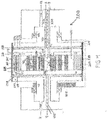
- the desorber 200 has a rotatable desorption cylinder 201 which is provided with a desorption chamber 202 and a steam chamber 203.
- the desorption cylinder 201 is also provided with an absorbent collection chamber 204 for collecting lean absorption liquid (2).
- the desorption cylinder is rotated by conventional drive means 205 arranged in a suitable manner.
- the desorption chamber 202 and the steam chamber 203 are integrated in the desorption cylinder 201 to achieve a compact desorber 200. Efficient desorption is achieved without mixing the fluids, thus there is no exchange of substances or mass transfer between the fluids present in the chambers.
- the chambers are completely separated such that the chambers can be operated with different operating pressures.
- the system 1 can thus be used with highly pressurized fluids of up to 10 Bar which is advantageous in that energy consumption for desorption is reduced . By using an increased pressure of the released CO 2 the energy consumption for compression in the system 1 is also reduced.
- the integrated design of the desorption cylinder 201 and the utilisation of centrifugal force created by rotation of the desorption cylinder to force the absorption liquid droplets through the gas stream results in that the desorber is more compact compared to a conventional column and reboiler design.
- the desorption chamber 202 is provided with spray means 206 in the core region 209 close to the axis of rotation for spraying CO 2 rich absorption liquid 3 into the chamber.
- the chamber is further provided with a stripper unit 207 arranged between the core region 209 of the chamber and the perimeter 216 of the desorption cylinder 201.
- the stripper unit 207 is formed as a rotatable tube bundle heat exchanger having a large number of tubes 208 which are attached to the desorption cylinder 201 and rotate together with the cylinder about a rotation axis.
- the steam chamber 203 is connected to the tubes 208 in the rotating tube bundle heat exchanger 207 such that heated steam 4 is supplied to the inside of the tubes from the steam chamber.
- the steam condenses in the tubes in the desorption process and the steam condensate 9 is returned via a steam condensate chamber 211 and steam condensate channels 224 (shown in the upper part of the desorption chamber illustrated in Fig. 4 ) to the steam chamber.
- the absorption liquid droplets 212 are sprayed into the core of the desorption chamber 202 and moved by aid of centrifugal force through the tube bundle heat exchanger 207.
- the desorption process takes place on the outside surface of the tubes 208 where absorption liquid droplets 212 are indirectly heated and releases CO 2 and vapours 13.
- the desorption cylinder 201 is also provided with an absorbent collection chamber 204 for collecting lean absorption liquid 2.
- the lean absorption liquid 2 moves to the periphery 216 of the desorption chamber.
- Absorbent channels 217 (shown in the lower part of the desorption chamber in Fig. 4 ) are provided on the perimeter 216 of the desorption chamber and connects the desorption chamber 202 to the absorbent collection chamber 204.
- the lean absorption liquid 2 is transferred via the absorbent channels 217 to the absorbent collection chamber where the lean absorbent forms a layer 218 on the perimeter of the rotating desorption cylinder.
- CO 2 and vapours 13 released in the desorption process flows towards the core region 209 of the desorption chamber and preheats the absorption liquid droplets moving outwards.
- CO 2 is removed from the desorption chamber via an outlet 220 arranged in the core region of the desorption chamber.
- the absorbent channels 217 and the condensate channels 224 are arranged all around the perimeter of the desorption cylinder.
- the desorber is provided with means for recovery of kinetic energy in the liquid layer formed on the inside surface of the desorption cylinder in the absorbent collecting chamber 204.
- the absorbent collection chamber 204 is provided with the diffuser means 221 to remove the lean absorbent from the chamber.
- the diffuser means are formed of a plurality of stationary diffuser arms, which are connected to a lean absorbent outlet conduit 222 arranged along the axis of rotation of the desorption cylinder.
- Each diffuser arm 221 is formed like a hollow pipe 223 provided with a liquid inlet arranged in near proximity of the outer perimeter of the absorbent collection chamber.
- the liquid inlet 228 is funnel shaped and has a cross-section which decreases in the flow direction of the absorbent.
- the kinetic energy in the rotating layer 218 of the lean absorption liquid 2 is recovered and converted into hydrodynamic energy such as a pressure head.
- the pressure head has a pumping effect and the liquid is pumped out from the absorbent collection chamber to a storage tank by aid of this pumping effect.
- the diffuser means By using the diffuser means, at least a part of the supplied energy in order to rotate the desorption cylinder is recovered. Also investments in separate pumps can be avoided.
- the steam chamber 203 is also provided with diffuser means 221 of the same type as in the absorbent collection chamber 204 for removing steam condensate 9 in the same manner from the desorber.
- the desorption cylinder 201 is designed such that conduits 230,231 for supplying CO 2 rich absorption liquid 3 and removal of lean absorption liquid 2 are provided in the core region along the axis of rotation of the desorption cylinder, and also the conduit 232 for removing steam condensate 9 from the desorber is provided along the axis of rotation of the desorption cylinder 201.
- This design decreases the size of the desorber 200 and provides efficient liquid supply and removal systems and demands less energy and investments in pumps and other equipment.
- the regeneration of the CO 2 rich absorption liquid 3 results in a stream of lean absorption liquid 2 and a gas stream 13 of CO 2 and vapour.
- the desorber 200 contributes to the steam consumption in the system by use of steam for heating of preheated rich amine to desorption exit temperature, heat for desorption of CO 2 and water vapor leaving the desorber together with CO 2 .
- Trials indicate that the steam consumption of the desorber amounts to a 30% reduction in steam consumption compared to conventional CO 2 capture process cwhich implies less water vapor leaving with the CO 2 .
- amine solution 70 wt% MEA in water. This will reduce steam consumption needed for CO 2 desorption by almost 30% compared to prior known processes using an amine solution of 30 wt% MEA in water amine.
- a system 1 according to the invention where the desorber 200 is operated at pressure of 3 bara reduces the compressor energy by almost 20% compared to a desorber of alternative type having operational pressure of 1.7 bara (no compressor steps avoided).
- the rotating desorber in the system according to the invention is operated at pressure of 5 bara the compressor energy is reduced by almost 30% compared to a desorber of different type having operational pressure of 1.7 bara.
- the absorption liquid 2, 3 is circulated in the system.
- the system provides for efficient circulation of the absorption liquid, water, CO 2 , and vapour.
- Heat exchangers and condensers of different types are used in various process steps for recovering heat and adjusting the operational parameters to achieve high energy efficiency of the system.
- Rich Amine from the absorber CARA is pumped via a storage tank to the desorber RDW 2.0.
- the rich amine flow which is fed to the desorber 200 is pre-heated by cooling warm desorbed lean amine 2 coming from the desorber 200, and then heated to desorber operating temperature by steam.
- the lean amine is further cooled by water to the desired temperature before it is pumped back to the lean amine storage tank 7 of the absorber
- Warm gases, water vapour and CO 2 , 13 from the gas outlet of the desorber are cooled and water separated in a gas/liquid separator. Energy can be recovered from this stream by condensing of water vapor. Released CO 2 is washed with water and is either sent to atmosphere or recycled to increase CO 2 concentration in the gas feed.
Landscapes
- Chemical & Material Sciences (AREA)
- Chemical Kinetics & Catalysis (AREA)
- Engineering & Computer Science (AREA)
- Analytical Chemistry (AREA)
- General Chemical & Material Sciences (AREA)
- Oil, Petroleum & Natural Gas (AREA)
- Gas Separation By Absorption (AREA)
- Treating Waste Gases (AREA)
Claims (10)
- Système pour une absorption et une désorption accélérées de CO2 comprenant un élément absorbant (100) destiné à absorber le CO2 d'un flux de gaz (10) à l'aide de liquide d'absorption et d'un désorbeur (200) permettant de désorber le CO2 d'un liquide d'absorption riche en CO2, caractérisé en ce que
l'élément absorbant (100) comprend un cylindre principal rotatif (104) comportant une section d'absorption (105) dotée d'un moyen rotatif de désintégration de gouttelettes (111) d'un liquide d'absorption et d'un moyen de rotation (112) de l'élément absorbant (100), de manière que des gouttelettes de liquide d'absorption (113) sont déplacées à l'aide d'une force centrifuge dans une direction d'écoulement transversal par rapport au flux de gaz (10), de manière que la direction de l'écoulement des gouttelettes de liquide d'absorption (113) est sensiblement perpendiculaire à la direction de l'écoulement du flux de gaz (10), et étant atomisé par les moyens en vue de la désintégration de gouttelettes, moyennant quoi le CO2 est absorbé du flux de gaz par les gouttelettes de liquide d'absorption,
le désorbeur (200) est relié à l'élément absorbant pour recevoir le liquide d'absorption riche en CO2,
le désorbeur (200) est rotatif et comprend une chambre de désorption (202) dotée d'un échangeur thermique rotatif (207) et d'un moyen de rotation (205) du désorbeur, de manière que les gouttelettes de liquide d'absorption (212) sont déplacées à l'aide d'une force centrifuge à travers l'échangeur thermique (207) moyennant quoi les gouttelettes de liquide d'absorption sont chauffées et le CO2 est désorbé et séparé des gouttelettes de liquide d'absorption, et un liquide d'absorption pauvre (2) est mis en circulation vers l'élément absorbant (100). - Système selon la revendication 1, dans lequel le moyen de désintégration de gouttelettes (111) comprend une pluralité de cylindres perforés rotatifs.
- Système selon l'une quelconque des revendications précédentes, dans lequel le désorbeur est doté d'un moyen de récupération d'énergie cinétique (221) dans le liquide d'absorption pauvre (2) et/ou d'un condensat de vapeur (9) ;
le désorbeur étant doté de diffuseurs stationnaires (221) disposés dans une chambre de recueil d'élément absorbant (204) conçue pour convertir l'énergie cinétique dans le liquide d'absorption pauvre (2) en énergie hydrodynamique ; et/ou
le désorbeur étant doté de diffuseurs stationnaires (221) disposés dans une chambre à vapeur (203) pour convertir l'énergie cinétique dans un condensat de vapeur (9) en énergie hydrodynamique. - Système selon l'une quelconque des revendications précédentes, dans lequel le cylindre principal de l'élément absorbant comporte une section anti-buée (106) disposée après la section d'absorption (105) qui est conçue pour retirer des gouttelettes de liquide d'absorption (113) du flux de gaz traité.
- Système selon l'une quelconque des revendications précédentes, dans lequel le cylindre principal (104) de l'élément absorbant comporte une section de lavage (107) disposée après la section anti-buée où le liquide de lavage est pulvérisé dans le flux de gaz, et doté d'une moyen de désintégration de gouttelettes (111), et les gouttelettes de liquide de lavage (119) sont déplacées à l'aide d'une force centrifuge dans une direction d'écoulement transversal par rapport au flux de gaz, de manière que la direction de l'écoulement de gouttelettes de liquide de lavage (119) est sensiblement perpendiculaire à la direction de l'écoulement du flux de gaz, moyennant quoi les gouttelettes du liquide de lavage absorbent le liquide d'absorption dissous dans le flux de gaz traité.
- Système selon la revendication 5, dans lequel le cylindre principal (104) de l'élément absorbant est doté d'une section anti-buée qui est disposée après la section d'absorption (107), et la section anti-buée est conçue pour retirer des gouttelettes du liquide de lavage du flux de gaz traité.
- Système selon l'une quelconque des revendications précédentes, dans lequel le désorbeur (200) comprend une chambre à vapeur (203), et que la chambre de désorption (202) et la chambre à vapeur (203) sont conçues de manière qu'un liquide d'absorption (2, 3) dans la chambre de désorption (202) et un moyen de chauffage (4, 9) dans la chambre à vapeur ne sont pas mélangés dans le désorbeur.
- Système selon l'une quelconque des revendications précédentes, le système étant conçu pour fournir et retirer un liquide d'absorption (2, 3) du désorbeur le long de l'axe de rotation du cylindre de désorption.
- Système selon l'une quelconque des revendications précédentes conçu pour retirer un condensat de vapeur (9) du désorbeur le long de l'axe de rotation du cylindre de désorption.
- Procédé d'absorption et de désorption accélérées de CO2 comprenant les étapes de :- fourniture d'un flux de gaz (10) contenant du CO2 à un élément absorbant (100) comportant un cylindre principal rotatif (104),- pulvérisation d'un liquide d'absorption pauvre dans le flux de gaz,- déplacement de gouttelettes de liquide d'absorption (113, 212) dans une direction d'écoulement transversal vers le flux de gaz à l'aide d'une force centrifuge de manière que la direction de l'écoulement de gouttelettes de liquide d'absorption (113, 212) est sensiblement perpendiculaire à la direction de l'écoulement du flux de gaz,- atomisation des gouttelettes du liquide d'absorption (113) par les moyens en vue de la désintégration de gouttelettes (111),- absorption de CO2 du flux de gaz (10) par les gouttelettes de liquide d'absorption (113),- mise en circulation de liquide d'absorption riche en CO2 (3) de l'élément absorbant vers un désorbeur rotatif (200) comportant une chambre de désorption (202) dotée d'un échangeur thermique rotatif (207),- pulvérisation d'un liquide d'absorption riche en CO2 dans la chambre de désorption (202),- fourniture de vapeur (4) à l'échangeur thermique,- déplacement de gouttelettes de liquide d'absorption (212) à travers l'échangeur thermique (207) à l'aide d'une force centrifuge,- désorption de CO2 d'un liquide d'absorption,- séparation de CO2 d'un liquide d'absorption pauvre,- mise en circulation d'un liquide d'absorption pauvre (2) du désorbeur (200) vers l'élément absorbant (100).
Applications Claiming Priority (1)
| Application Number | Priority Date | Filing Date | Title |
|---|---|---|---|
| PCT/NO2013/050178 WO2015060723A1 (fr) | 2013-10-22 | 2013-10-22 | Système et procédé pour l'absorption et la désorption de co2 |
Publications (3)
| Publication Number | Publication Date |
|---|---|
| EP3068510A1 EP3068510A1 (fr) | 2016-09-21 |
| EP3068510A4 EP3068510A4 (fr) | 2017-05-24 |
| EP3068510B1 true EP3068510B1 (fr) | 2019-09-11 |
Family
ID=52993212
Family Applications (1)
| Application Number | Title | Priority Date | Filing Date |
|---|---|---|---|
| EP13895964.8A Active EP3068510B1 (fr) | 2013-10-22 | 2013-10-22 | Système et procédé pour l'absorption et la désorption de co2 |
Country Status (2)
| Country | Link |
|---|---|
| EP (1) | EP3068510B1 (fr) |
| WO (1) | WO2015060723A1 (fr) |
Cited By (1)
| Publication number | Priority date | Publication date | Assignee | Title |
|---|---|---|---|---|
| WO2024046597A1 (fr) * | 2022-08-30 | 2024-03-07 | Nuovo Pignone Tecnologie - S.R.L. | Absorbeur à lit rotatif à mailles en spirale destiné au capture de carbone compacte |
Families Citing this family (9)
| Publication number | Priority date | Publication date | Assignee | Title |
|---|---|---|---|---|
| CN114632402B (zh) * | 2020-12-16 | 2022-11-11 | 中冶京诚工程技术有限公司 | 烟气二氧化碳捕集系统的捕集方法 |
| CN116492816B (zh) * | 2023-03-23 | 2024-03-12 | 中国能源建设集团广东省电力设计研究院有限公司 | 一种高co2负荷吸收剂碳捕集解吸系统及方法 |
| WO2025038416A1 (fr) | 2023-08-14 | 2025-02-20 | ExxonMobil Technology and Engineering Company | Adsorbeur à lit à garnissage rotatif intégré, refroidisseur et unité d'entraînement d'amine |
| NL2036127B1 (en) * | 2023-10-26 | 2025-05-12 | Carbonoro Tech B V | Process for removing co2 from gas |
| NL2036128B1 (en) * | 2023-10-26 | 2025-05-12 | Carbonoro Tech B V | Process for removing co2 from gas |
| NL2036130B1 (en) * | 2023-10-26 | 2025-05-12 | Carbonoro Tech B V | Process for removing co2 from gas |
| WO2025089950A1 (fr) | 2023-10-26 | 2025-05-01 | Carbonoro Technology B.V. | Procédé d'élimination du co2 d'un gaz |
| NL2036131B1 (en) * | 2023-10-26 | 2025-05-12 | Carbonoro Tech B V | Process for removing co2 from gas |
| CN117815842B (zh) * | 2024-03-04 | 2024-05-14 | 西安热工研究院有限公司 | 基于压缩空气储能耦合直接空气碳捕集的系统及方法 |
Family Cites Families (6)
| Publication number | Priority date | Publication date | Assignee | Title |
|---|---|---|---|---|
| US2176982A (en) * | 1937-08-06 | 1939-10-24 | Sinclair Refining Co | Centrifugal countercurrent contacting machine |
| GB8300096D0 (en) * | 1982-01-19 | 1983-02-09 | Ici Plc | Removal of hydrogen sulphide from gas streams |
| US7252703B2 (en) * | 2003-06-30 | 2007-08-07 | Honeywell International, Inc. | Direct contact liquid air contaminant control system |
| US20110131937A1 (en) * | 2009-12-08 | 2011-06-09 | Yang Hsien Ming | absorptive device to carbon dioxide in the air |
| NO333941B1 (no) * | 2010-12-09 | 2013-10-28 | Statoil Petroleum As | Fremgangsmåte og absorber for fjerning av sur gass fra naturgass |
| WO2012092981A1 (fr) * | 2011-01-07 | 2012-07-12 | Statoil Petroleum As | Procédé et absorbant pour l'élimination d'un contaminant du gaz naturel |
-
2013
- 2013-10-22 EP EP13895964.8A patent/EP3068510B1/fr active Active
- 2013-10-22 WO PCT/NO2013/050178 patent/WO2015060723A1/fr not_active Ceased
Non-Patent Citations (1)
| Title |
|---|
| None * |
Cited By (1)
| Publication number | Priority date | Publication date | Assignee | Title |
|---|---|---|---|---|
| WO2024046597A1 (fr) * | 2022-08-30 | 2024-03-07 | Nuovo Pignone Tecnologie - S.R.L. | Absorbeur à lit rotatif à mailles en spirale destiné au capture de carbone compacte |
Also Published As
| Publication number | Publication date |
|---|---|
| EP3068510A1 (fr) | 2016-09-21 |
| WO2015060723A1 (fr) | 2015-04-30 |
| EP3068510A4 (fr) | 2017-05-24 |
Similar Documents
| Publication | Publication Date | Title |
|---|---|---|
| EP3068510B1 (fr) | Système et procédé pour l'absorption et la désorption de co2 | |
| US10155194B2 (en) | Method and apparatus for collecting carbon dioxide from flue gas | |
| US9381463B2 (en) | Method and absorber for removal of acid gas from natural gas | |
| JP5465246B2 (ja) | 化石燃料発電所設備の排ガスから二酸化炭素を分離するための方法及び装置 | |
| CN101423214A (zh) | 氨法捕集电站烟气中二氧化碳的方法及其设备 | |
| JPWO2018190104A1 (ja) | 燃焼排ガス中の二酸化炭素を回収するための装置及び方法 | |
| US20250058270A1 (en) | Integrated rotating packed bed adsorber, cooler, and amine entrainment unit | |
| CN104107616A (zh) | 一种nmp气体处理设备及处理工艺 | |
| CN113374552A (zh) | 一种胺法捕集二氧化碳解析塔能量利用的装置系统及方法 | |
| CN215486191U (zh) | 一种胺法捕集二氧化碳解析塔能量利用的装置系统 | |
| US20120174782A1 (en) | Compact absorption-desorption process and apparatus using concentrated solution | |
| CN116272315B (zh) | 微界面振荡吸收器、再生器、碳捕集和再生系统及方法 | |
| JPH06315613A (ja) | 溶剤回収装置 | |
| CN112391216A (zh) | 一种三甘醇溶剂的再生装置和方法 | |
| CA2909907C (fr) | Systeme et procede de desorption de gaz acide d'un liquide absorbant | |
| CN210057794U (zh) | 一种降低湿法洗涤湿烟气温度和含水量的设备 | |
| EP3068509B1 (fr) | Appareil et procédé d'absorption du co2 à partir de fumées | |
| CN210584416U (zh) | 废气处理装置 | |
| CN112691495A (zh) | 一种合成革生产过程废气的处理方法 | |
| WO2015060725A1 (fr) | Appareil et procédé d'absorption du co2 à partir de gaz naturel | |
| CN222943202U (zh) | 复合型尾气处理系统 | |
| CN215982493U (zh) | 一种胺法二氧化碳捕集耦合燃煤锅炉的能量回收装置系统 | |
| CN204051369U (zh) | 一种nmp气体处理设备 | |
| US9702269B2 (en) | Device for capture of acid gas contained in combustion fumes | |
| CN121846901A (zh) | 船舶碳捕集系统动态水平衡控制系统 |
Legal Events
| Date | Code | Title | Description |
|---|---|---|---|
| PUAI | Public reference made under article 153(3) epc to a published international application that has entered the european phase |
Free format text: ORIGINAL CODE: 0009012 |
|
| 17P | Request for examination filed |
Effective date: 20160426 |
|
| AK | Designated contracting states |
Kind code of ref document: A1 Designated state(s): AL AT BE BG CH CY CZ DE DK EE ES FI FR GB GR HR HU IE IS IT LI LT LU LV MC MK MT NL NO PL PT RO RS SE SI SK SM TR |
|
| AX | Request for extension of the european patent |
Extension state: BA ME |
|
| DAX | Request for extension of the european patent (deleted) | ||
| A4 | Supplementary search report drawn up and despatched |
Effective date: 20170424 |
|
| RIC1 | Information provided on ipc code assigned before grant |
Ipc: B01D 53/48 20060101ALI20170418BHEP Ipc: B01D 3/08 20060101AFI20170418BHEP Ipc: B01D 53/14 20060101ALI20170418BHEP Ipc: B01D 53/18 20060101ALI20170418BHEP Ipc: B01D 53/78 20060101ALI20170418BHEP Ipc: B01D 53/96 20060101ALI20170418BHEP Ipc: B01D 53/52 20060101ALI20170418BHEP Ipc: B01D 53/40 20060101ALI20170418BHEP Ipc: B01D 53/62 20060101ALI20170418BHEP |
|
| STAA | Information on the status of an ep patent application or granted ep patent |
Free format text: STATUS: EXAMINATION IS IN PROGRESS |
|
| RAP1 | Party data changed (applicant data changed or rights of an application transferred) |
Owner name: ADVANCED MASS TRANSFER TECHNOLOGY AS |
|
| 17Q | First examination report despatched |
Effective date: 20180322 |
|
| RAP1 | Party data changed (applicant data changed or rights of an application transferred) |
Owner name: FJELL BIODRY AS |
|
| GRAP | Despatch of communication of intention to grant a patent |
Free format text: ORIGINAL CODE: EPIDOSNIGR1 |
|
| STAA | Information on the status of an ep patent application or granted ep patent |
Free format text: STATUS: GRANT OF PATENT IS INTENDED |
|
| INTG | Intention to grant announced |
Effective date: 20190319 |
|
| RAP1 | Party data changed (applicant data changed or rights of an application transferred) |
Owner name: COMPACT CARBON CAPTURE AS |
|
| GRAS | Grant fee paid |
Free format text: ORIGINAL CODE: EPIDOSNIGR3 |
|
| GRAA | (expected) grant |
Free format text: ORIGINAL CODE: 0009210 |
|
| STAA | Information on the status of an ep patent application or granted ep patent |
Free format text: STATUS: THE PATENT HAS BEEN GRANTED |
|
| AK | Designated contracting states |
Kind code of ref document: B1 Designated state(s): AL AT BE BG CH CY CZ DE DK EE ES FI FR GB GR HR HU IE IS IT LI LT LU LV MC MK MT NL NO PL PT RO RS SE SI SK SM TR |
|
| REG | Reference to a national code |
Ref country code: GB Ref legal event code: FG4D |
|
| REG | Reference to a national code |
Ref country code: CH Ref legal event code: EP |
|
| REG | Reference to a national code |
Ref country code: AT Ref legal event code: REF Ref document number: 1177715 Country of ref document: AT Kind code of ref document: T Effective date: 20190915 |
|
| REG | Reference to a national code |
Ref country code: DE Ref legal event code: R096 Ref document number: 602013060547 Country of ref document: DE Ref country code: IE Ref legal event code: FG4D |
|
| REG | Reference to a national code |
Ref country code: NL Ref legal event code: MP Effective date: 20190911 |
|
| REG | Reference to a national code |
Ref country code: LT Ref legal event code: MG4D Ref country code: NO Ref legal event code: T2 Effective date: 20190911 |
|
| PG25 | Lapsed in a contracting state [announced via postgrant information from national office to epo] |
Ref country code: HR Free format text: LAPSE BECAUSE OF FAILURE TO SUBMIT A TRANSLATION OF THE DESCRIPTION OR TO PAY THE FEE WITHIN THE PRESCRIBED TIME-LIMIT Effective date: 20190911 Ref country code: SE Free format text: LAPSE BECAUSE OF FAILURE TO SUBMIT A TRANSLATION OF THE DESCRIPTION OR TO PAY THE FEE WITHIN THE PRESCRIBED TIME-LIMIT Effective date: 20190911 Ref country code: FI Free format text: LAPSE BECAUSE OF FAILURE TO SUBMIT A TRANSLATION OF THE DESCRIPTION OR TO PAY THE FEE WITHIN THE PRESCRIBED TIME-LIMIT Effective date: 20190911 Ref country code: LT Free format text: LAPSE BECAUSE OF FAILURE TO SUBMIT A TRANSLATION OF THE DESCRIPTION OR TO PAY THE FEE WITHIN THE PRESCRIBED TIME-LIMIT Effective date: 20190911 Ref country code: BG Free format text: LAPSE BECAUSE OF FAILURE TO SUBMIT A TRANSLATION OF THE DESCRIPTION OR TO PAY THE FEE WITHIN THE PRESCRIBED TIME-LIMIT Effective date: 20191211 |
|
| PG25 | Lapsed in a contracting state [announced via postgrant information from national office to epo] |
Ref country code: GR Free format text: LAPSE BECAUSE OF FAILURE TO SUBMIT A TRANSLATION OF THE DESCRIPTION OR TO PAY THE FEE WITHIN THE PRESCRIBED TIME-LIMIT Effective date: 20191212 Ref country code: LV Free format text: LAPSE BECAUSE OF FAILURE TO SUBMIT A TRANSLATION OF THE DESCRIPTION OR TO PAY THE FEE WITHIN THE PRESCRIBED TIME-LIMIT Effective date: 20190911 Ref country code: ES Free format text: LAPSE BECAUSE OF FAILURE TO SUBMIT A TRANSLATION OF THE DESCRIPTION OR TO PAY THE FEE WITHIN THE PRESCRIBED TIME-LIMIT Effective date: 20190911 Ref country code: AL Free format text: LAPSE BECAUSE OF FAILURE TO SUBMIT A TRANSLATION OF THE DESCRIPTION OR TO PAY THE FEE WITHIN THE PRESCRIBED TIME-LIMIT Effective date: 20190911 Ref country code: RS Free format text: LAPSE BECAUSE OF FAILURE TO SUBMIT A TRANSLATION OF THE DESCRIPTION OR TO PAY THE FEE WITHIN THE PRESCRIBED TIME-LIMIT Effective date: 20190911 |
|
| REG | Reference to a national code |
Ref country code: AT Ref legal event code: MK05 Ref document number: 1177715 Country of ref document: AT Kind code of ref document: T Effective date: 20190911 |
|
| PG25 | Lapsed in a contracting state [announced via postgrant information from national office to epo] |
Ref country code: NL Free format text: LAPSE BECAUSE OF FAILURE TO SUBMIT A TRANSLATION OF THE DESCRIPTION OR TO PAY THE FEE WITHIN THE PRESCRIBED TIME-LIMIT Effective date: 20190911 Ref country code: RO Free format text: LAPSE BECAUSE OF FAILURE TO SUBMIT A TRANSLATION OF THE DESCRIPTION OR TO PAY THE FEE WITHIN THE PRESCRIBED TIME-LIMIT Effective date: 20190911 Ref country code: PL Free format text: LAPSE BECAUSE OF FAILURE TO SUBMIT A TRANSLATION OF THE DESCRIPTION OR TO PAY THE FEE WITHIN THE PRESCRIBED TIME-LIMIT Effective date: 20190911 Ref country code: PT Free format text: LAPSE BECAUSE OF FAILURE TO SUBMIT A TRANSLATION OF THE DESCRIPTION OR TO PAY THE FEE WITHIN THE PRESCRIBED TIME-LIMIT Effective date: 20200113 Ref country code: EE Free format text: LAPSE BECAUSE OF FAILURE TO SUBMIT A TRANSLATION OF THE DESCRIPTION OR TO PAY THE FEE WITHIN THE PRESCRIBED TIME-LIMIT Effective date: 20190911 Ref country code: IT Free format text: LAPSE BECAUSE OF FAILURE TO SUBMIT A TRANSLATION OF THE DESCRIPTION OR TO PAY THE FEE WITHIN THE PRESCRIBED TIME-LIMIT Effective date: 20190911 Ref country code: AT Free format text: LAPSE BECAUSE OF FAILURE TO SUBMIT A TRANSLATION OF THE DESCRIPTION OR TO PAY THE FEE WITHIN THE PRESCRIBED TIME-LIMIT Effective date: 20190911 |
|
| PG25 | Lapsed in a contracting state [announced via postgrant information from national office to epo] |
Ref country code: SM Free format text: LAPSE BECAUSE OF FAILURE TO SUBMIT A TRANSLATION OF THE DESCRIPTION OR TO PAY THE FEE WITHIN THE PRESCRIBED TIME-LIMIT Effective date: 20190911 Ref country code: SK Free format text: LAPSE BECAUSE OF FAILURE TO SUBMIT A TRANSLATION OF THE DESCRIPTION OR TO PAY THE FEE WITHIN THE PRESCRIBED TIME-LIMIT Effective date: 20190911 Ref country code: CZ Free format text: LAPSE BECAUSE OF FAILURE TO SUBMIT A TRANSLATION OF THE DESCRIPTION OR TO PAY THE FEE WITHIN THE PRESCRIBED TIME-LIMIT Effective date: 20190911 Ref country code: IS Free format text: LAPSE BECAUSE OF FAILURE TO SUBMIT A TRANSLATION OF THE DESCRIPTION OR TO PAY THE FEE WITHIN THE PRESCRIBED TIME-LIMIT Effective date: 20200224 |
|
| REG | Reference to a national code |
Ref country code: CH Ref legal event code: PL |
|
| REG | Reference to a national code |
Ref country code: DE Ref legal event code: R097 Ref document number: 602013060547 Country of ref document: DE |
|
| PLBE | No opposition filed within time limit |
Free format text: ORIGINAL CODE: 0009261 |
|
| STAA | Information on the status of an ep patent application or granted ep patent |
Free format text: STATUS: NO OPPOSITION FILED WITHIN TIME LIMIT |
|
| PG2D | Information on lapse in contracting state deleted |
Ref country code: IS |
|
| PG25 | Lapsed in a contracting state [announced via postgrant information from national office to epo] |
Ref country code: DK Free format text: LAPSE BECAUSE OF FAILURE TO SUBMIT A TRANSLATION OF THE DESCRIPTION OR TO PAY THE FEE WITHIN THE PRESCRIBED TIME-LIMIT Effective date: 20190911 Ref country code: LU Free format text: LAPSE BECAUSE OF NON-PAYMENT OF DUE FEES Effective date: 20191022 Ref country code: LI Free format text: LAPSE BECAUSE OF NON-PAYMENT OF DUE FEES Effective date: 20191031 Ref country code: CH Free format text: LAPSE BECAUSE OF NON-PAYMENT OF DUE FEES Effective date: 20191031 Ref country code: IS Free format text: LAPSE BECAUSE OF FAILURE TO SUBMIT A TRANSLATION OF THE DESCRIPTION OR TO PAY THE FEE WITHIN THE PRESCRIBED TIME-LIMIT Effective date: 20200112 |
|
| REG | Reference to a national code |
Ref country code: BE Ref legal event code: MM Effective date: 20191031 |
|
| 26N | No opposition filed |
Effective date: 20200615 |
|
| PG25 | Lapsed in a contracting state [announced via postgrant information from national office to epo] |
Ref country code: MC Free format text: LAPSE BECAUSE OF FAILURE TO SUBMIT A TRANSLATION OF THE DESCRIPTION OR TO PAY THE FEE WITHIN THE PRESCRIBED TIME-LIMIT Effective date: 20190911 Ref country code: SI Free format text: LAPSE BECAUSE OF FAILURE TO SUBMIT A TRANSLATION OF THE DESCRIPTION OR TO PAY THE FEE WITHIN THE PRESCRIBED TIME-LIMIT Effective date: 20190911 Ref country code: BE Free format text: LAPSE BECAUSE OF NON-PAYMENT OF DUE FEES Effective date: 20191031 |
|
| PG25 | Lapsed in a contracting state [announced via postgrant information from national office to epo] |
Ref country code: IE Free format text: LAPSE BECAUSE OF NON-PAYMENT OF DUE FEES Effective date: 20191022 |
|
| PG25 | Lapsed in a contracting state [announced via postgrant information from national office to epo] |
Ref country code: CY Free format text: LAPSE BECAUSE OF FAILURE TO SUBMIT A TRANSLATION OF THE DESCRIPTION OR TO PAY THE FEE WITHIN THE PRESCRIBED TIME-LIMIT Effective date: 20190911 |
|
| PG25 | Lapsed in a contracting state [announced via postgrant information from national office to epo] |
Ref country code: MT Free format text: LAPSE BECAUSE OF FAILURE TO SUBMIT A TRANSLATION OF THE DESCRIPTION OR TO PAY THE FEE WITHIN THE PRESCRIBED TIME-LIMIT Effective date: 20190911 Ref country code: HU Free format text: LAPSE BECAUSE OF FAILURE TO SUBMIT A TRANSLATION OF THE DESCRIPTION OR TO PAY THE FEE WITHIN THE PRESCRIBED TIME-LIMIT; INVALID AB INITIO Effective date: 20131022 |
|
| PG25 | Lapsed in a contracting state [announced via postgrant information from national office to epo] |
Ref country code: TR Free format text: LAPSE BECAUSE OF FAILURE TO SUBMIT A TRANSLATION OF THE DESCRIPTION OR TO PAY THE FEE WITHIN THE PRESCRIBED TIME-LIMIT Effective date: 20190911 |
|
| PG25 | Lapsed in a contracting state [announced via postgrant information from national office to epo] |
Ref country code: MK Free format text: LAPSE BECAUSE OF FAILURE TO SUBMIT A TRANSLATION OF THE DESCRIPTION OR TO PAY THE FEE WITHIN THE PRESCRIBED TIME-LIMIT Effective date: 20190911 |
|
| P01 | Opt-out of the competence of the unified patent court (upc) registered |
Effective date: 20230526 |
|
| PGFP | Annual fee paid to national office [announced via postgrant information from national office to epo] |
Ref country code: NO Payment date: 20250925 Year of fee payment: 13 |
|
| PGFP | Annual fee paid to national office [announced via postgrant information from national office to epo] |
Ref country code: GB Payment date: 20250923 Year of fee payment: 13 |
|
| PGFP | Annual fee paid to national office [announced via postgrant information from national office to epo] |
Ref country code: FR Payment date: 20250923 Year of fee payment: 13 |
|
| PGFP | Annual fee paid to national office [announced via postgrant information from national office to epo] |
Ref country code: DE Payment date: 20250923 Year of fee payment: 13 |