EP3070105A1 - Modified conjugated diene polymer, method for preparing same, and rubber composition containing same - Google Patents
Modified conjugated diene polymer, method for preparing same, and rubber composition containing same Download PDFInfo
- Publication number
- EP3070105A1 EP3070105A1 EP14862792.0A EP14862792A EP3070105A1 EP 3070105 A1 EP3070105 A1 EP 3070105A1 EP 14862792 A EP14862792 A EP 14862792A EP 3070105 A1 EP3070105 A1 EP 3070105A1
- Authority
- EP
- European Patent Office
- Prior art keywords
- conjugated diene
- based polymer
- modified conjugated
- chemical formula
- compound represented
- Prior art date
- Legal status (The legal status is an assumption and is not a legal conclusion. Google has not performed a legal analysis and makes no representation as to the accuracy of the status listed.)
- Granted
Links
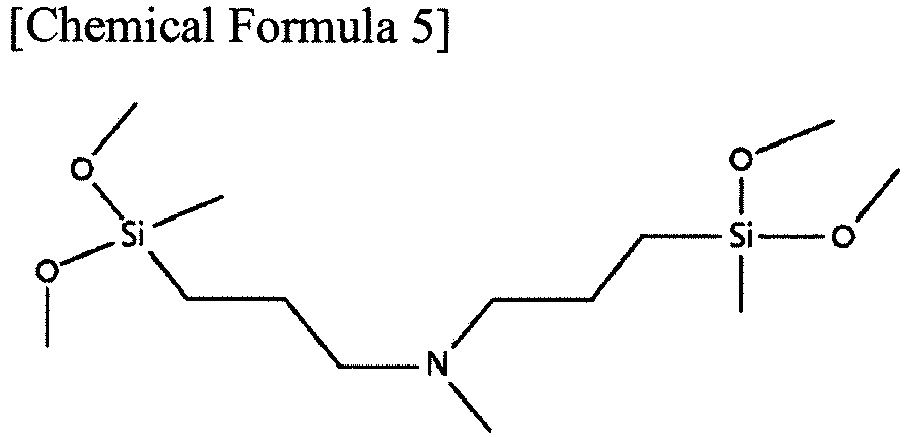
- UPXWZFVMEDWRDU-UHFFFAOYSA-O CN(CCC[Si](C)(OC)OC)CCC[SH+](C)(OC)OC Chemical compound CN(CCC[Si](C)(OC)OC)CCC[SH+](C)(OC)OC UPXWZFVMEDWRDU-UHFFFAOYSA-O 0.000 description 1
Classifications
-
- C—CHEMISTRY; METALLURGY
- C08—ORGANIC MACROMOLECULAR COMPOUNDS; THEIR PREPARATION OR CHEMICAL WORKING-UP; COMPOSITIONS BASED THEREON
- C08C—TREATMENT OR CHEMICAL MODIFICATION OF RUBBERS
- C08C19/00—Chemical modification of rubber
-
- C—CHEMISTRY; METALLURGY
- C07—ORGANIC CHEMISTRY
- C07F—ACYCLIC, CARBOCYCLIC OR HETEROCYCLIC COMPOUNDS CONTAINING ELEMENTS OTHER THAN CARBON, HYDROGEN, HALOGEN, OXYGEN, NITROGEN, SULFUR, SELENIUM OR TELLURIUM
- C07F7/00—Compounds containing elements of Groups 4 or 14 of the Periodic Table
- C07F7/02—Silicon compounds
- C07F7/08—Compounds having one or more C—Si linkages
- C07F7/18—Compounds having one or more C—Si linkages as well as one or more C—O—Si linkages
- C07F7/1804—Compounds having Si-O-C linkages
-
- B—PERFORMING OPERATIONS; TRANSPORTING
- B60—VEHICLES IN GENERAL
- B60C—VEHICLE TYRES; TYRE INFLATION; TYRE CHANGING; CONNECTING VALVES TO INFLATABLE ELASTIC BODIES IN GENERAL; DEVICES OR ARRANGEMENTS RELATED TO TYRES
- B60C1/00—Tyres characterised by the chemical composition or the physical arrangement or mixture of the composition
-
- B—PERFORMING OPERATIONS; TRANSPORTING
- B60—VEHICLES IN GENERAL
- B60C—VEHICLE TYRES; TYRE INFLATION; TYRE CHANGING; CONNECTING VALVES TO INFLATABLE ELASTIC BODIES IN GENERAL; DEVICES OR ARRANGEMENTS RELATED TO TYRES
- B60C1/00—Tyres characterised by the chemical composition or the physical arrangement or mixture of the composition
- B60C1/0016—Compositions of the tread
-
- C—CHEMISTRY; METALLURGY
- C08—ORGANIC MACROMOLECULAR COMPOUNDS; THEIR PREPARATION OR CHEMICAL WORKING-UP; COMPOSITIONS BASED THEREON
- C08C—TREATMENT OR CHEMICAL MODIFICATION OF RUBBERS
- C08C19/00—Chemical modification of rubber
- C08C19/02—Hydrogenation
-
- C—CHEMISTRY; METALLURGY
- C08—ORGANIC MACROMOLECULAR COMPOUNDS; THEIR PREPARATION OR CHEMICAL WORKING-UP; COMPOSITIONS BASED THEREON
- C08C—TREATMENT OR CHEMICAL MODIFICATION OF RUBBERS
- C08C19/00—Chemical modification of rubber
- C08C19/22—Incorporating nitrogen atoms into the molecule
-
- C—CHEMISTRY; METALLURGY
- C08—ORGANIC MACROMOLECULAR COMPOUNDS; THEIR PREPARATION OR CHEMICAL WORKING-UP; COMPOSITIONS BASED THEREON
- C08C—TREATMENT OR CHEMICAL MODIFICATION OF RUBBERS
- C08C19/00—Chemical modification of rubber
- C08C19/25—Incorporating silicon atoms into the molecule
-
- C—CHEMISTRY; METALLURGY
- C08—ORGANIC MACROMOLECULAR COMPOUNDS; THEIR PREPARATION OR CHEMICAL WORKING-UP; COMPOSITIONS BASED THEREON
- C08C—TREATMENT OR CHEMICAL MODIFICATION OF RUBBERS
- C08C19/00—Chemical modification of rubber
- C08C19/26—Incorporating metal atoms into the molecule
-
- C—CHEMISTRY; METALLURGY
- C08—ORGANIC MACROMOLECULAR COMPOUNDS; THEIR PREPARATION OR CHEMICAL WORKING-UP; COMPOSITIONS BASED THEREON
- C08C—TREATMENT OR CHEMICAL MODIFICATION OF RUBBERS
- C08C19/00—Chemical modification of rubber
- C08C19/30—Addition of a reagent which reacts with a hetero atom or a group containing hetero atoms of the macromolecule
- C08C19/42—Addition of a reagent which reacts with a hetero atom or a group containing hetero atoms of the macromolecule reacting with metals or metal-containing groups
- C08C19/44—Addition of a reagent which reacts with a hetero atom or a group containing hetero atoms of the macromolecule reacting with metals or metal-containing groups of polymers containing metal atoms exclusively at one or both ends of the skeleton
-
- C—CHEMISTRY; METALLURGY
- C08—ORGANIC MACROMOLECULAR COMPOUNDS; THEIR PREPARATION OR CHEMICAL WORKING-UP; COMPOSITIONS BASED THEREON
- C08F—MACROMOLECULAR COMPOUNDS OBTAINED BY REACTIONS ONLY INVOLVING CARBON-TO-CARBON UNSATURATED BONDS
- C08F236/00—Copolymers of compounds having one or more unsaturated aliphatic radicals, at least one having two or more carbon-to-carbon double bonds
- C08F236/02—Copolymers of compounds having one or more unsaturated aliphatic radicals, at least one having two or more carbon-to-carbon double bonds the radical having only two carbon-to-carbon double bonds
- C08F236/04—Copolymers of compounds having one or more unsaturated aliphatic radicals, at least one having two or more carbon-to-carbon double bonds the radical having only two carbon-to-carbon double bonds conjugated
- C08F236/10—Copolymers of compounds having one or more unsaturated aliphatic radicals, at least one having two or more carbon-to-carbon double bonds the radical having only two carbon-to-carbon double bonds conjugated with vinyl-aromatic monomers
-
- C—CHEMISTRY; METALLURGY
- C08—ORGANIC MACROMOLECULAR COMPOUNDS; THEIR PREPARATION OR CHEMICAL WORKING-UP; COMPOSITIONS BASED THEREON
- C08K—Use of inorganic or non-macromolecular organic substances as compounding ingredients
- C08K3/00—Use of inorganic substances as compounding ingredients
- C08K3/02—Elements
- C08K3/04—Carbon
-
- C—CHEMISTRY; METALLURGY
- C08—ORGANIC MACROMOLECULAR COMPOUNDS; THEIR PREPARATION OR CHEMICAL WORKING-UP; COMPOSITIONS BASED THEREON
- C08K—Use of inorganic or non-macromolecular organic substances as compounding ingredients
- C08K3/00—Use of inorganic substances as compounding ingredients
- C08K3/34—Silicon-containing compounds
- C08K3/36—Silica
-
- C—CHEMISTRY; METALLURGY
- C08—ORGANIC MACROMOLECULAR COMPOUNDS; THEIR PREPARATION OR CHEMICAL WORKING-UP; COMPOSITIONS BASED THEREON
- C08L—COMPOSITIONS OF MACROMOLECULAR COMPOUNDS
- C08L15/00—Compositions of rubber derivatives
-
- C—CHEMISTRY; METALLURGY
- C08—ORGANIC MACROMOLECULAR COMPOUNDS; THEIR PREPARATION OR CHEMICAL WORKING-UP; COMPOSITIONS BASED THEREON
- C08L—COMPOSITIONS OF MACROMOLECULAR COMPOUNDS
- C08L9/00—Compositions of homopolymers or copolymers of conjugated diene hydrocarbons
Definitions
- the present invention relates to a method of preparing a modified conjugated diene-based polymer, and more particularly, to a method of preparing a modified conjugated diene-based polymer having superior heat build-up, tensile strength, wear resistance, and wet skid resistance, a modified conjugated diene-based polymer prepared thereby, and a rubber composition including the modified conjugated diene-based polymer.
- the rubber composition for vehicle tires includes a conjugated diene-based polymer such as polybutadiene or a butadiene-styrene copolymer.
- a conjugated diene-based polymer such as polybutadiene or a butadiene-styrene copolymer.
- the present inventors have proposed the present invention to develop, as a material for a tire tread, rubber having superior heat build-up, tensile strength, wear resistance, and wet skid resistance.
- An object of the present invention is to provide a modified conjugated diene-based polymer having superior heat build-up, tensile strength, wear resistance, and wet skid resistance, and a method of preparing the same.
- Another object of the present invention is to provide a modified conjugated diene-based polymer rubber composition including the modified conjugated diene-based polymer.
- Still another object of the present invention is to provide a modifier for use in preparing the modified conjugated diene-based polymer.
- Yet another object of the present invention is to provide a tire including the rubber composition.
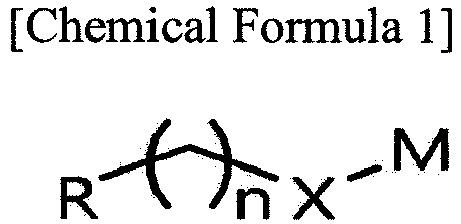
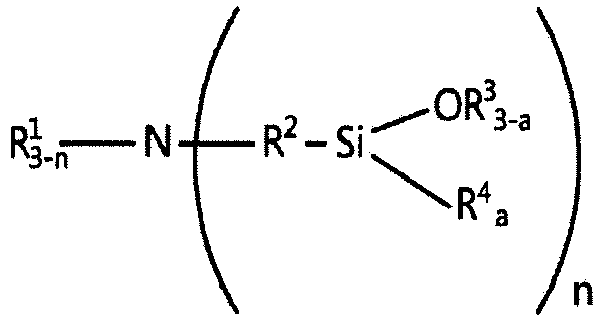
- the present invention provides a method of preparing a modified conjugated diene-based polymer, comprising: (a) polymerizing a conjugated diene monomer, or a conjugated diene monomer and an aromatic vinyl monomer, using the compound represented by Chemical Formula 1 below in the presence of a hydrocarbon solvent, thus forming an active polymer having an alkali metal end; and (b) coupling or reacting the active polymer with the compound represented by Chemical Formula 2 below: in Chemical Formula 1, R is a nitrogen-containing group, X is a hydrocarbon obtained by polymerizing a conjugated diene monomer or an aromatic vinyl monomer, n is an integer of 1 to 10, and M is an alkali metal; and in Chemical Formula 2, R 1 is a C1-C8 alkyl group or alkylsilyl group, R 2 is a C1-C8 alkylene group, R 3 and R 4 are each independently a C1-C8 alkyl group, a is an integer of 0 to
- the present invention provides a modified conjugated diene-based polymer prepared by the above method, as represented by Chemical Formula 3 below: in Chemical Formula 3, R 1 is a C1-C8 alkyl group or alkylsilyl group, R 2 is a C1-C8 alkylene group, R 3 and R 4 are each independently a C1-C8 alkyl group, P is a conjugated diene-based polymer chain, a is 0, 1, or 2, b is 1,2, or 3, a+b is 1, 2, or 3, and n is an integer of 1 to 3.
- the present invention provides a modified conjugated diene-based polymer rubber composition, comprising a modified conjugated diene-based polymer prepared by the above method.
- the present invention provides a modifier comprising the compound represented by Chemical Formula 2 below: in Chemical Formula 2, R 1 is a C1-C8 alkyl group or alkylsilyl group, R 2 is a C1-C8 alkylene group, R 3 and R 4 are each independently a C1-C8 alkyl group, a is an integer of 0 to 2, and n is an integer of 1 to 3.
- the present invention provides a tire or tire tread comprising the modified conjugated diene-based polymer rubber composition.
- a modified conjugated diene-based polymer having superior heat build-up, tensile strength, wear resistance, and wet skid resistance can be prepared, and can be used for a rubber composition for a tire.
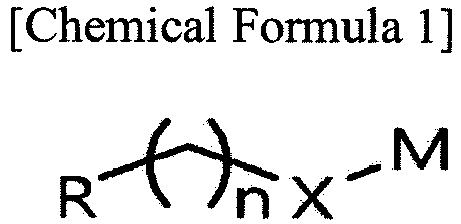
- the present invention addresses a method of preparing a modified conjugated diene-based polymer, comprising: (a) polymerizing a conjugated diene monomer, or a conjugated diene monomer and an aromatic vinyl monomer, using the compound represented by Chemical Formula 1 below, in the presence of a hydrocarbon solvent, thus forming an active polymer having an alkali metal end; and (b) coupling or reacting the active polymer with the compound represented by Chemical Formula 2 below.
- R is a nitrogen-containing group
- X is a hydrocarbon obtained by polymerizing a conjugated diene monomer or an aromatic vinyl monomer
- n is an integer of 1 to 10
- M is an alkali metal
- R 1 is a C1-C8 alkyl group or alkylsilyl group
- R 2 is a C1-C8 alkylene group
- R 3 and R 4 are each independently a C1-C8 alkyl group
- a is an integer of 0 to 2
- n is an integer of 1 to 3.
- the conjugated diene monomer may include, but is not necessarily limited to, at least one selected from the group consisting of 1,3-butadiene, 2,3-dimethyl-1,3-butadiene, piperylene, 3-butyl-1,3-octadiene, isoprene, and 2-phenyl-1,3-butadiene.
- the aromatic vinyl monomer may include at least one selected from the group consisting of styrene, ⁇ -methylstyrene, 3-methylstyrene, 4-methylstyrene, 4-propylstyrene, 1-vinylnaphthalene, 4-cyclohexylstyrene, 4-(p-methylphenyl)styrene, and 1-vinyl-5-hexylnaphthalene. Particularly useful is styrene or ⁇ -methylstyrene.
- the amount of the aromatic vinyl monomer is 0.0001 to 40 wt%, preferably 10 to 35 wt%, and more preferably 20 to 30 wt%, based on 100 wt% in total of the conjugated diene monomer and the aromatic vinyl monomer.
- the hydrocarbon solvent may be exemplified by a hydrocarbon, or may include at least one selected from the group consisting of n-pentane, n-hexane, n-heptane, isooctane, cyclohexane, toluene, benzene, and xylene, but is not limited thereto.
- the nitrogen-containing group may include an amino group; an alkylamino group, such as methylamino, dimethylamino, ethylamino, propylamino, butylamino, and cyclohexylamino; and an arylamino group, such as phenylamino, tolylamino, and naphthylamino.
- an alkylamino group such as methylamino, dimethylamino, ethylamino, propylamino, butylamino, and cyclohexylamino
- an arylamino group such as phenylamino, tolylamino, and naphthylamino.
- n is an integer from 1 to 10. Given the above range, the resulting tire may exhibit superior heat build-up, tensile strength, wear resistance, and wet skid resistance.
- M is an alkali metal, which may be any one selected from the group consisting of lithium, sodium, potassium, rubidium, and cesium.
- the compound represented by Chemical Formula 1 may be a compound represented by Chemical Formula 4 below.
- the compound represented by Chemical Formula 1 may be used in an amount of 0.01 to 10 mmol, 0.05 to 5 mmol, 0.1 to 2 mmol, or 0.1 to 1 mmol, based on 100 g in total of the monomer.
- the amount of the compound represented by Chemical Formula 1 falls in the above range, a conjugated diene-based polymer optimal for use in preparing a modified conjugated diene-based polymer may be obtained.
- the active polymer having the alkali metal end indicates a polymer comprising a polymer anion and an alkali metal cation, which are linked with each other.
- the polymerizing in (a) may be performed with the additional use of a polar additive.
- the polar additive may be a base, or may include ether, amine, or mixtures thereof, and may be specifically selected from the group consisting of tetrahydrofuran, ditetrahydrofurylpropane, diethylether, cycloamylether, dipropylether, ethylenedimethylether, ethylenedimethylether, diethyleneglycol, dimethylether, tert-butoxyethoxyethane bis(2-dimethylaminoethyl)ether, (dimethylaminoethyl)ethylether, trimethylamine, triethylamine, tripropylamine, and tetramethylethylenediamine.
- ditetrahydropropylpropane triethylamine or tetramethylethylenediamine.
- the polar additive is used in an amount of 0.001 to 50 g, preferably 0.001 to 10 g, and more preferably 0.005 to 1 g, based on 100 g in total of the added monomer.
- the polar additive is used in an amount of 0.001 to 10 g, preferably 0.005 to 1 g, and more preferably 0.005 to 0.1 g, based on 1 mmol in total of the added compound represented by Chemical Formula 1.
- the conjugated diene monomer and the aromatic vinyl monomer are copolymerized, it is easy to prepare a block copolymer due to the difference in the reaction rates therebetween.
- the polar additive is added, the low reaction rate of the aromatic vinyl monomer may be increased to thus induce the microstructure of the corresponding copolymer, for example, a random copolymer.
- the polymerizing may be exemplified by anionic polymerization.
- the polymerizing in (a) may be living anionic polymerization for forming an active end through a growth reaction by anions.
- the polymerizing in (a) may be high-temperature polymerization or room-temperature polymerization.
- High-temperature polymerization is a polymerization process including adding an organometallic compound and then applying heat to increase the reaction temperature
- room-temperature polymerization is a polymerization process that takes place in such a way that heat is not applied after the addition of an organometallic compound.
- the polymerizing in (a) is carried out at a temperature ranging from -20 to 200°C, preferably 0 to 150°C, and more preferably 10 to 120°C.
- the active polymer formed in (a) is coupled or reacted with the compound represented by Chemical Formula 2 below, thus preparing the modified conjugated diene-based polymer represented by Chemical Formula 3: in Chemical Formula 2, R 1 is a C1-C8 alkyl group or alkylsilyl group, R 2 is a C1-C8 alkylene group, R 3 and R 4 are each independently a C1-C8 alkyl group, a is an integer of 0 to 2, and n is an integer of 1 to 3.
- the compound represented by Chemical Formula 2 may be a compound represented by Chemical Formula 5 below.
- (b) may be performed at 0 to 90°C for 1 min to 5 hr.
- the method of preparing the modified conjugated diene-based polymer may be carried out in a batch manner, or alternatively in a continuous manner using at least one reactor.
- the molar ratio of the compound represented by Chemical Formula 1 and the compound represented by Chemical Formula 2 is, for example, 1:0.1 to 1:10, and preferably 1:0.3 to 1:2. Given the above molar ratio, the conjugated diene-based polymer may undergo a modification reaction to ensure optimal performance.
- the method of preparing the modified conjugated diene-based polymer may be carried out in a batch manner, or alternatively in a continuous manner using at least one reactor.
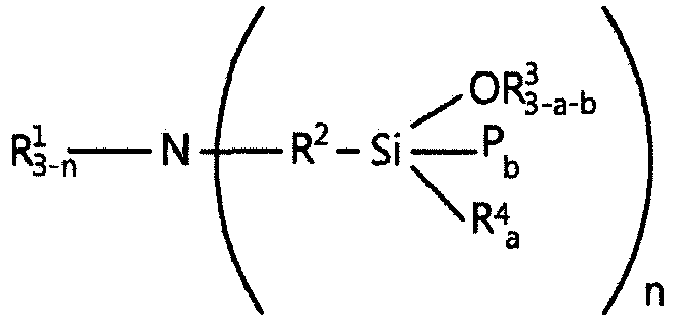
- the present invention addresses a modified conjugated diene-based polymer prepared by the above method, as represented by Chemical Formula 3 below: in Chemical Formula 3, R 1 is a C1-C8 alkyl group or alkylsilyl group, R 2 is a C1-C8 alkylene group, R 3 and R 4 are each independently a C1-C8 alkyl group, P is a conjugated diene-based polymer chain, a is 0, 1, or 2, b is 1, 2, or 3, a+b is 1, 2, or 3, and n is an integer of 1 to 3.
- the conjugated diene-based polymer chain represented by P in Chemical Formula 3 may be derived from a homopolymer of a conjugated diene monomer, or a copolymer of a conjugated diene monomer and an aromatic vinyl monomer.
- the conjugated diene-based polymer chain may be a polymer chain comprising 0.0001 to 40 wt%, preferably 10 to 35 wt%, and more preferably 20 to 30 wt% of the aromatic vinyl monomer, based on 100 wt% in total of the conjugated diene monomer and the aromatic vinyl monomer.
- the polymer chain comprising the conjugated diene monomer and the aromatic vinyl monomer may be, for example, a random polymer chain.
- the modified conjugated diene-based polymer has a number average molecular weight of 1,000 to 2,000,000 g/mol, preferably 10,000 to 1,000,000 g/mol, and more preferably 100,000 to 500,000 g/mol.
- the modified conjugated diene-based polymer has a vinyl content of 18 wt% or more, preferably 25 wt% or more, and more preferably 30 to 70 wt%.
- the glass transition temperature of the polymer may be elevated, and thus, when such a polymer is applied to tires, the properties required of tires, such as running resistance and braking force, may be satisfied, and fuel economy may be improved.
- the vinyl content indicates the amount of a monomer having a vinyl group, or the amount of not 1,4- but 1,2-added conjugated diene monomer based on 100 wt% of the conjugated diene monomer.
- the modified conjugated diene-based polymer has a Mooney viscosity of 40 or more, preferably 40 to 100, and more preferably 45 to 90. Given the above Mooney viscosity range, it is possible to prepare a modified conjugated diene-based polymer having excellent processability, compatibility, heat build-up, tensile strength, wear resistance, fuel economy, and wet skid resistance.
- the modified conjugated diene-based polymer has a polydispersity index (PDI) of 0.5 to 10, preferably 0.5 to 5, and more preferably 1.0 to 2.0.
- PDI polydispersity index
- the modified conjugated diene-based polymer may exhibit viscoelastic properties.
- Tan ⁇ at 0°C may be in the range of 0.6 to 1, or 0.9 to 1. Given the above Tan ⁇ range, skid resistance or wet resistance may be significantly improved.
- Tan ⁇ at 60°C may be in the range of 0.06 to 0.09, or 0.07 to 0.08. Given the above Tan ⁇ range, rolling resistance or rotational resistance (RR) may be significantly improved.
- R 1 is a C1-C8 alkyl group or alkylsilyl group
- R 2 is a C1-C8 alkylene group
- R 3 and R 4 are each independently a C1-C8 alkyl group
- a is an integer of 0 to 2
- n is an integer of 1 to 3.
- the present invention addresses a modified conjugated diene-based polymer rubber composition, comprising the modified conjugated diene-based polymer.
- the modified conjugated diene-based polymer rubber composition comprises 10 to 100 parts by weight of the modified conjugated diene-based polymer, and 0.1 to 200 parts by weight of an inorganic filler based on 100 parts by weight of the modified conjugated diene-based polymer.
- the amount of the inorganic filler may be 10 to 150 parts by weight, or 50 to 100 parts by weight.
- the inorganic filler may include, for example, carbon black, a silica-based filler, or mixtures thereof.
- the inorganic filler may be silica.
- dispersibility is greatly improved and the end of the modified conjugated diene-based polymer of the invention is coupled (capped) with silica particles, thereby significantly decreasing hysteresis loss.
- the modified conjugated diene-based polymer rubber composition may further comprise an additional conjugated diene-based polymer.
- the additional conjugated diene-based polymer may include SBR (styrene-butadiene rubber), BR (butadiene rubber), natural rubber, or mixtures thereof.
- SBR may be exemplified by SSBR (solution styrene-butadiene rubber).
- the modified conjugated diene-based polymer rubber composition according to the present invention may comprise 20 to 100 parts by weight of the modified conjugated diene-based polymer and 0 to 80 parts by weight of the additional conjugated diene-based polymer.
- the modified conjugated diene-based polymer rubber composition according to the present invention may comprise 20 to 99 parts by weight of the modified conjugated diene-based polymer and 1 to 80 parts by weight of the additional conjugated diene-based polymer.
- the modified conjugated diene-based polymer rubber composition according to the present invention may comprise 10 to 100 parts by weight of the modified conjugated diene-based polymer, 0 to 90 parts by weight of the additional conjugated diene-based polymer, 0 to 100 parts by weight of carbon black, 5 to 200 parts by weight of silica, and 2 to 20 parts by weight of a silane coupling agent.
- the modified conjugated diene-based polymer rubber composition according to the present invention may comprise 10 to 100 parts by weight of the modified conjugated diene-based polymer, 0 to 90 parts by weight of the additional conjugated diene-based polymer, 0 to 100 parts by weight of carbon black, 5 to 200 parts by weight of silica, and 2 to 20 parts by weight of a silane coupling agent, in which the total weight of the modified conjugated diene-based polymer and the additional conjugated diene-based polymer may be 100 parts by weight.
- the modified conjugated diene-based polymer rubber composition according to the present invention may comprise 100 parts by weight of a polymer mixture comprising 10 to 99 wt% of the modified conjugated diene-based polymer and 1 to 90 wt% of the additional conjugated diene-based polymer, 1 to 100 parts by weight of carbon black, 5 to 200 parts by weight of silica, and 2 to 20 parts by weight of a silane coupling agent.
- modified conjugated diene-based polymer rubber composition may further comprise 1 to 100 parts by weight of oil.
- the oil may be exemplified by mineral oil or a softener.
- the oil may be used in an amount of, for example, 10 to 100 parts by weight, or 20 to 80 parts by weight, based on 100 parts by weight of the conjugated diene-based polymer.
- amount of oil falls in the above range, desired properties may be exhibited, and the rubber composition may be appropriately softened, thus improving processability.
- the present invention addresses a tire or tire tread comprising the rubber composition.
- styrene 710 g of 1,3-butadiene, 5000 g of n-hexane, and 0.9 g of 2,2-bis(2-oxoranyl)propane as a polar additive were placed in a 20 L autoclave reactor, and then the temperature inside the reactor was elevated to 40°C. When the temperature inside the reactor reached 40°C, 4.3 mmol of 3-(dimethylamino)-1-propyllithium-(isoprene) 2 was placed in the reactor, followed by an adiabatic heating reaction. About 20 min after the adiabatic heating reaction, 20 g of 1,3-butadiene was added.
- Three reactors were prepared. Among them, the first and the second reactor were used as polymerization reactors, and the third reactor was used as a modification reactor.
- 2,2-bis(2-oxoranyl)propane, as a polar additive, and 3-(dimethylamino)-1-propyllithium-(isoprene) 2 were fed at rates of 3.6 g/h and 22.4 mmol/h, respectively, into the first reactor, and the temperature inside the reactor was adjusted to 70°C.
- the polymer output from the first reactor was continuously fed into the upper portion of the second reactor, and a polymerization reaction was carried out while the temperature was maintained at 85°C.
- the polymer output from the second reactor was continuously fed into the upper portion of the third reactor, bis(triethoxysilylpropyl)-N-methylamine was continuously fed at a rate of 10.6 mmol/h, and a modification reaction was carried out.
- a mixed solution of isopropylalcohol and an antioxidant (Wingstay-K) at a ratio of 8:2 was added at a rate of 32.5 g/h to stop the polymerization reaction, yielding a polymer.
- TDAE oil a distilled aromatic extract having a glass transition temperature of about -44 to about -50°C
- a modified conjugated diene-based polymer was prepared in the same manner as in Example 1, with the exception that 4 mmol of n-butyllithium was used as the initiator.
- the results of analysis of the modified conjugated diene-based polymer thus obtained are shown in Table 1 below.
- a modified conjugated diene-based polymer was prepared in the same manner as in Example 2, with the exception that n-butyllithium was added at 39.57 mmol/h as the initiator.
- the results of analysis of the modified conjugated diene-based polymer thus obtained are shown in Table 2 below.
- RAE oil was used, in lieu of TDAE oil.
- the conjugated diene-based polymer rubber compositions of Preparation Examples 1 and 2 and Comparative Preparation Examples 1 to 4 were prepared using, as raw rubber, samples A, B, C, D, E, and F, shown in Tables 1 and 2, under the mixing conditions set forth in Table 3 below.
- the unit of material in Table 2 is phr, based on 100 parts by weight of rubber.
- the conjugated diene-based polymer rubber composition was kneaded through primary kneading and secondary kneading.
- raw rubber conjugated diene-based polymer
- a filler an organosilane coupling agent, oil, zinc oxide, a stearic acid antioxidant, an anti-aging agent, wax and an accelerator were kneaded using a Banbury mixer provided with a temperature controller.
- the temperature of the kneader was controlled, and a first mixture was obtained at a discharge temperature of 145 to 155°C.
- the first mixture was cooled to room temperature, after which rubber, sulfur and a vulcanization accelerator were placed in the kneader, followed by mixing at 100°C or less, thus obtaining a second mixture. Finally, curing was performed at 100°C for 20 min, yielding the conjugated diene-based polymer rubber compositions of Preparation Examples 1 and 2 using, as raw rubber, the polymers of Examples 1 and 2, and of Comparative Preparation Examples 1 to 4 using the polymers of Comparative Examples 1 to 4 as raw rubber.
- the properties of the prepared rubber compositions were measured through the following methods.
- tensile testing method of ASTM 412 the tensile strength upon cutting a test sample and tensile stress (300% modulus) at 300% elongation were measured.
- a Universal Test Machine 4204 made by Instron, was used, and the tensile strength, modulus, and elongation were measured at a tensile speed of 50 cm/min at room temperature.
- a dynamic mechanical analyzer made by TA was used. When undergoing deformation under conditions of a frequency of 10 Hz in a distortion mode and a measurement temperature (ranging from -60 to 60°C), the Tan ⁇ of each sample was measured.
- the Payne effect was represented by the difference between the minimum and the maximum in the deformation range of 0.28 to 40%. The lower the Payne effect, the higher the dispersibility of the filler such as silica.
- Tan ⁇ at 0°C that is a low temperature was increased, wet skid resistance became superior, and when Tan ⁇ at 60°C that is a high temperature was decreased, hysteresis loss was reduced, and low rolling resistance of tires, namely, improved fuel economy, resulted.
- Tables 4 and 5 below show the properties of the vulcanized rubber.
- the modified conjugated diene-based polymer rubber compositions of Preparation Examples 1 and 2 according to the present invention were significantly improved in 300% modulus (tensile stress) and tensile strength, compared to Comparative Preparation Examples 2 and 4, and also exhibited low Tan ⁇ at 60°C.
- rolling resistance was decreased, whereby desired fuel efficiency resulted.
- the modified conjugated diene-based polymer rubber compositions of Preparation Examples 1 and 2 according to the present invention exhibited high Tan ⁇ at 0°C, compared to Comparative Preparation Examples 1 to 4.
- high wet skid resistance resulted.
- modified conjugated diene-based polymer rubber compositions of Preparation Examples 1 and 2 according to the present invention exhibited low ⁇ G' at 60°C, compared to Comparative Preparation Examples 1 to 4, thus improving wet skid resistance, rolling resistance, and silica dispersibility.
Landscapes
- Chemical & Material Sciences (AREA)
- Organic Chemistry (AREA)
- Health & Medical Sciences (AREA)
- Chemical Kinetics & Catalysis (AREA)
- Medicinal Chemistry (AREA)
- Polymers & Plastics (AREA)
- General Chemical & Material Sciences (AREA)
- Engineering & Computer Science (AREA)
- Mechanical Engineering (AREA)
- Addition Polymer Or Copolymer, Post-Treatments, Or Chemical Modifications (AREA)
- Compositions Of Macromolecular Compounds (AREA)
Abstract
Description
- This application claims the benefit of Korean Patent Application No.
KR 10-2013-0138840, filed November 15, 2013 - The present invention relates to a method of preparing a modified conjugated diene-based polymer, and more particularly, to a method of preparing a modified conjugated diene-based polymer having superior heat build-up, tensile strength, wear resistance, and wet skid resistance, a modified conjugated diene-based polymer prepared thereby, and a rubber composition including the modified conjugated diene-based polymer.
- With the recent trends in the vehicle industry, there is always the need for increased durability, stability and fuel economy, and continuous efforts to meet such needs have been made.
- In particular, many attempts have been made to enhance the properties of rubber, which is the material for vehicle tires, especially tire treads, which are in contact with roads. The rubber composition for vehicle tires includes a conjugated diene-based polymer such as polybutadiene or a butadiene-styrene copolymer. To improve the performance of vehicle tires, research is currently ongoing into mixing a conjugated diene-based rubber composition with various enhancers.
- The present inventors have proposed the present invention to develop, as a material for a tire tread, rubber having superior heat build-up, tensile strength, wear resistance, and wet skid resistance.
- An object of the present invention is to provide a modified conjugated diene-based polymer having superior heat build-up, tensile strength, wear resistance, and wet skid resistance, and a method of preparing the same.
- Another object of the present invention is to provide a modified conjugated diene-based polymer rubber composition including the modified conjugated diene-based polymer.
- Still another object of the present invention is to provide a modifier for use in preparing the modified conjugated diene-based polymer.
- Yet another object of the present invention is to provide a tire including the rubber composition.
- In order to accomplish the above objects, the present invention provides a method of preparing a modified conjugated diene-based polymer, comprising: (a) polymerizing a conjugated diene monomer, or a conjugated diene monomer and an aromatic vinyl monomer, using the compound represented by Chemical Formula 1 below in the presence of a hydrocarbon solvent, thus forming an active polymer having an alkali metal end; and (b) coupling or reacting the active polymer with the compound represented by Chemical Formula 2 below:

- In addition, the present invention provides a modified conjugated diene-based polymer prepared by the above method, as represented by Chemical Formula 3 below:

- In addition, the present invention provides a modified conjugated diene-based polymer rubber composition, comprising a modified conjugated diene-based polymer prepared by the above method.
- In addition, the present invention provides a modifier comprising the compound represented by Chemical Formula 2 below:

- In addition, the present invention provides a tire or tire tread comprising the modified conjugated diene-based polymer rubber composition.
- According to the present invention, a modified conjugated diene-based polymer having superior heat build-up, tensile strength, wear resistance, and wet skid resistance can be prepared, and can be used for a rubber composition for a tire.
- Hereinafter, a detailed description will be given of the present invention.
- The present invention addresses a method of preparing a modified conjugated diene-based polymer, comprising: (a) polymerizing a conjugated diene monomer, or a conjugated diene monomer and an aromatic vinyl monomer, using the compound represented by Chemical Formula 1 below, in the presence of a hydrocarbon solvent, thus forming an active polymer having an alkali metal end; and (b) coupling or reacting the active polymer with the compound represented by Chemical Formula 2 below.

- In the present invention, the conjugated diene monomer may include, but is not necessarily limited to, at least one selected from the group consisting of 1,3-butadiene, 2,3-dimethyl-1,3-butadiene, piperylene, 3-butyl-1,3-octadiene, isoprene, and 2-phenyl-1,3-butadiene.
- In the present invention, the aromatic vinyl monomer may include at least one selected from the group consisting of styrene, α-methylstyrene, 3-methylstyrene, 4-methylstyrene, 4-propylstyrene, 1-vinylnaphthalene, 4-cyclohexylstyrene, 4-(p-methylphenyl)styrene, and 1-vinyl-5-hexylnaphthalene. Particularly useful is styrene or α-methylstyrene.
- The amount of the aromatic vinyl monomer is 0.0001 to 40 wt%, preferably 10 to 35 wt%, and more preferably 20 to 30 wt%, based on 100 wt% in total of the conjugated diene monomer and the aromatic vinyl monomer.
- The hydrocarbon solvent may be exemplified by a hydrocarbon, or may include at least one selected from the group consisting of n-pentane, n-hexane, n-heptane, isooctane, cyclohexane, toluene, benzene, and xylene, but is not limited thereto.
- In Chemical Formula 1, the nitrogen-containing group may include an amino group; an alkylamino group, such as methylamino, dimethylamino, ethylamino, propylamino, butylamino, and cyclohexylamino; and an arylamino group, such as phenylamino, tolylamino, and naphthylamino.
- In Chemical Formula 1, n is an integer from 1 to 10. Given the above range, the resulting tire may exhibit superior heat build-up, tensile strength, wear resistance, and wet skid resistance.
- In Chemical Formula 1, M is an alkali metal, which may be any one selected from the group consisting of lithium, sodium, potassium, rubidium, and cesium.
- For example, the compound represented by Chemical Formula 1 may be a compound represented by Chemical Formula 4 below.

- In an embodiment of the present invention, the compound represented by Chemical Formula 1 may be used in an amount of 0.01 to 10 mmol, 0.05 to 5 mmol, 0.1 to 2 mmol, or 0.1 to 1 mmol, based on 100 g in total of the monomer. When the amount of the compound represented by Chemical Formula 1 falls in the above range, a conjugated diene-based polymer optimal for use in preparing a modified conjugated diene-based polymer may be obtained.
- The active polymer having the alkali metal end indicates a polymer comprising a polymer anion and an alkali metal cation, which are linked with each other.
- In the method of preparing the modified conjugated diene-based polymer according to the present invention, the polymerizing in (a) may be performed with the additional use of a polar additive.
- The polar additive may be a base, or may include ether, amine, or mixtures thereof, and may be specifically selected from the group consisting of tetrahydrofuran, ditetrahydrofurylpropane, diethylether, cycloamylether, dipropylether, ethylenedimethylether, ethylenedimethylether, diethyleneglycol, dimethylether, tert-butoxyethoxyethane bis(2-dimethylaminoethyl)ether, (dimethylaminoethyl)ethylether, trimethylamine, triethylamine, tripropylamine, and tetramethylethylenediamine. Preferably useful is ditetrahydropropylpropane, triethylamine or tetramethylethylenediamine.
- The polar additive is used in an amount of 0.001 to 50 g, preferably 0.001 to 10 g, and more preferably 0.005 to 1 g, based on 100 g in total of the added monomer.
- Also, the polar additive is used in an amount of 0.001 to 10 g, preferably 0.005 to 1 g, and more preferably 0.005 to 0.1 g, based on 1 mmol in total of the added compound represented by Chemical Formula 1.
- When the conjugated diene monomer and the aromatic vinyl monomer are copolymerized, it is easy to prepare a block copolymer due to the difference in the reaction rates therebetween. However, when the polar additive is added, the low reaction rate of the aromatic vinyl monomer may be increased to thus induce the microstructure of the corresponding copolymer, for example, a random copolymer.
- In (a), the polymerizing may be exemplified by anionic polymerization.
- Also, the polymerizing in (a) may be living anionic polymerization for forming an active end through a growth reaction by anions.
- Also, the polymerizing in (a) may be high-temperature polymerization or room-temperature polymerization.
- High-temperature polymerization is a polymerization process including adding an organometallic compound and then applying heat to increase the reaction temperature, and room-temperature polymerization is a polymerization process that takes place in such a way that heat is not applied after the addition of an organometallic compound.
- The polymerizing in (a) is carried out at a temperature ranging from -20 to 200°C, preferably 0 to 150°C, and more preferably 10 to 120°C.
- In (b), the active polymer formed in (a) is coupled or reacted with the compound represented by Chemical Formula 2 below, thus preparing the modified conjugated diene-based polymer represented by Chemical Formula 3:

- For example, the compound represented by Chemical Formula 2 may be a compound represented by Chemical Formula 5 below.
- Also, (b) may be performed at 0 to 90°C for 1 min to 5 hr.
- According to the present invention, the method of preparing the modified conjugated diene-based polymer may be carried out in a batch manner, or alternatively in a continuous manner using at least one reactor.
- The molar ratio of the compound represented by Chemical Formula 1 and the compound represented by Chemical Formula 2 is, for example, 1:0.1 to 1:10, and preferably 1:0.3 to 1:2. Given the above molar ratio, the conjugated diene-based polymer may undergo a modification reaction to ensure optimal performance.
- According to the present invention, the method of preparing the modified conjugated diene-based polymer may be carried out in a batch manner, or alternatively in a continuous manner using at least one reactor.
- In addition, the present invention addresses a modified conjugated diene-based polymer prepared by the above method, as represented by Chemical Formula 3 below:

- The conjugated diene-based polymer chain represented by P in Chemical Formula 3 may be derived from a homopolymer of a conjugated diene monomer, or a copolymer of a conjugated diene monomer and an aromatic vinyl monomer.
- The conjugated diene-based polymer chain may be a polymer chain comprising 0.0001 to 40 wt%, preferably 10 to 35 wt%, and more preferably 20 to 30 wt% of the aromatic vinyl monomer, based on 100 wt% in total of the conjugated diene monomer and the aromatic vinyl monomer.
- The polymer chain comprising the conjugated diene monomer and the aromatic vinyl monomer may be, for example, a random polymer chain.
- The modified conjugated diene-based polymer has a number average molecular weight of 1,000 to 2,000,000 g/mol, preferably 10,000 to 1,000,000 g/mol, and more preferably 100,000 to 500,000 g/mol.
- The modified conjugated diene-based polymer has a vinyl content of 18 wt% or more, preferably 25 wt% or more, and more preferably 30 to 70 wt%. When the vinyl content of the modified conjugated diene-based polymer falls in the above range, the glass transition temperature of the polymer may be elevated, and thus, when such a polymer is applied to tires, the properties required of tires, such as running resistance and braking force, may be satisfied, and fuel economy may be improved.
- The vinyl content indicates the amount of a monomer having a vinyl group, or the amount of not 1,4- but 1,2-added conjugated diene monomer based on 100 wt% of the conjugated diene monomer.
- The modified conjugated diene-based polymer has a Mooney viscosity of 40 or more, preferably 40 to 100, and more preferably 45 to 90. Given the above Mooney viscosity range, it is possible to prepare a modified conjugated diene-based polymer having excellent processability, compatibility, heat build-up, tensile strength, wear resistance, fuel economy, and wet skid resistance.
- The modified conjugated diene-based polymer has a polydispersity index (PDI) of 0.5 to 10, preferably 0.5 to 5, and more preferably 1.0 to 2.0.
- The modified conjugated diene-based polymer may exhibit viscoelastic properties. When measured at 10 Hz using DMA after mixing with silica, Tanδ at 0°C may be in the range of 0.6 to 1, or 0.9 to 1. Given the above Tanδ range, skid resistance or wet resistance may be significantly improved.
- Also, Tanδ at 60°C may be in the range of 0.06 to 0.09, or 0.07 to 0.08. Given the above Tanδ range, rolling resistance or rotational resistance (RR) may be significantly improved.
- In addition, the present invention addresses a modifier comprising the compound represented by Chemical Formula 2 below:

- In addition, the present invention addresses a modified conjugated diene-based polymer rubber composition, comprising the modified conjugated diene-based polymer.
- For example, the modified conjugated diene-based polymer rubber composition comprises 10 to 100 parts by weight of the modified conjugated diene-based polymer, and 0.1 to 200 parts by weight of an inorganic filler based on 100 parts by weight of the modified conjugated diene-based polymer.
- The amount of the inorganic filler may be 10 to 150 parts by weight, or 50 to 100 parts by weight.
- The inorganic filler may include, for example, carbon black, a silica-based filler, or mixtures thereof.
- Alternatively, the inorganic filler may be silica. In this case, dispersibility is greatly improved and the end of the modified conjugated diene-based polymer of the invention is coupled (capped) with silica particles, thereby significantly decreasing hysteresis loss.
- The modified conjugated diene-based polymer rubber composition may further comprise an additional conjugated diene-based polymer.
- The additional conjugated diene-based polymer may include SBR (styrene-butadiene rubber), BR (butadiene rubber), natural rubber, or mixtures thereof.
- SBR may be exemplified by SSBR (solution styrene-butadiene rubber).
- The modified conjugated diene-based polymer rubber composition according to the present invention may comprise 20 to 100 parts by weight of the modified conjugated diene-based polymer and 0 to 80 parts by weight of the additional conjugated diene-based polymer.
- Alternatively, the modified conjugated diene-based polymer rubber composition according to the present invention may comprise 20 to 99 parts by weight of the modified conjugated diene-based polymer and 1 to 80 parts by weight of the additional conjugated diene-based polymer.
- Alternatively, the modified conjugated diene-based polymer rubber composition according to the present invention may comprise 10 to 100 parts by weight of the modified conjugated diene-based polymer, 0 to 90 parts by weight of the additional conjugated diene-based polymer, 0 to 100 parts by weight of carbon black, 5 to 200 parts by weight of silica, and 2 to 20 parts by weight of a silane coupling agent.
- Alternatively, the modified conjugated diene-based polymer rubber composition according to the present invention may comprise 10 to 100 parts by weight of the modified conjugated diene-based polymer, 0 to 90 parts by weight of the additional conjugated diene-based polymer, 0 to 100 parts by weight of carbon black, 5 to 200 parts by weight of silica, and 2 to 20 parts by weight of a silane coupling agent, in which the total weight of the modified conjugated diene-based polymer and the additional conjugated diene-based polymer may be 100 parts by weight.
- Alternatively, the modified conjugated diene-based polymer rubber composition according to the present invention may comprise 100 parts by weight of a polymer mixture comprising 10 to 99 wt% of the modified conjugated diene-based polymer and 1 to 90 wt% of the additional conjugated diene-based polymer, 1 to 100 parts by weight of carbon black, 5 to 200 parts by weight of silica, and 2 to 20 parts by weight of a silane coupling agent.
- Also, the modified conjugated diene-based polymer rubber composition may further comprise 1 to 100 parts by weight of oil.
- The oil may be exemplified by mineral oil or a softener.
- The oil may be used in an amount of, for example, 10 to 100 parts by weight, or 20 to 80 parts by weight, based on 100 parts by weight of the conjugated diene-based polymer. When the amount of oil falls in the above range, desired properties may be exhibited, and the rubber composition may be appropriately softened, thus improving processability.
- In addition, the present invention addresses a tire or tire tread comprising the rubber composition.
- A better understanding of the present invention may be obtained via the following examples, which are set forth to illustrate but are not to be construed as limiting the present invention, and those skilled in the art will appreciate that diverse variations or substitutions are possible, without departing from the spirit of the present invention. Accordingly, such variations or substitutions fall within the scope of the present invention as defined in the accompanying claims.
- 270 g of styrene, 710 g of 1,3-butadiene, 5000 g of n-hexane, and 0.9 g of 2,2-bis(2-oxoranyl)propane as a polar additive were placed in a 20 L autoclave reactor, and then the temperature inside the reactor was elevated to 40°C. When the temperature inside the reactor reached 40°C, 4.3 mmol of 3-(dimethylamino)-1-propyllithium-(isoprene)2 was placed in the reactor, followed by an adiabatic heating reaction. About 20 min after the adiabatic heating reaction, 20 g of 1,3-butadiene was added. After 5 min, 4.3 mmol of bis(triethoxysilylpropyl)-N-methylamine was added, and the reaction was carried out for 15 min. Thereafter, the polymerization reaction was stopped using ethanol, and 45 mL of a solution of 0.3 wt% BHT (butylated hydroxytoluene) antioxidant in hexane was added.
- The resulting polymer was placed in water warmed with steam and stirred to remove the solvent, followed by roll drying to remove the remaining solvent and water, yielding a modified conjugated diene-based polymer. The results of analysis of the modified conjugated diene-based polymer thus obtained are shown in Table 1 below.
- Three reactors were prepared. Among them, the first and the second reactor were used as polymerization reactors, and the third reactor was used as a modification reactor.
- Styrene, 1,3-butadiene, and n-hexane, without impurities such as water, were mixed at rates of 1.788 kg/h, 4.477 kg/h, and 4.176 kg/h, respectively, before being placed in the reactors. The resulting mixed solution was continuously fed into the first reactor. Subsequently, 2,2-bis(2-oxoranyl)propane, as a polar additive, and 3-(dimethylamino)-1-propyllithium-(isoprene)2 were fed at rates of 3.6 g/h and 22.4 mmol/h, respectively, into the first reactor, and the temperature inside the reactor was adjusted to 70°C.
- The polymer output from the first reactor was continuously fed into the upper portion of the second reactor, and a polymerization reaction was carried out while the temperature was maintained at 85°C. The polymer output from the second reactor was continuously fed into the upper portion of the third reactor, bis(triethoxysilylpropyl)-N-methylamine was continuously fed at a rate of 10.6 mmol/h, and a modification reaction was carried out. To the polymer output from the third reactor, a mixed solution of isopropylalcohol and an antioxidant (Wingstay-K) at a ratio of 8:2 was added at a rate of 32.5 g/h to stop the polymerization reaction, yielding a polymer.
- 100 parts by weight of the polymer thus obtained was mixed with 37.5 phr of TDAE oil (a distilled aromatic extract having a glass transition temperature of about -44 to about -50°C), placed in water warmed with steam, stirred to remove the solvent, and then roll dried to remove the remaining solvent and water, yielding a modified conjugated diene-based polymer. The results of analysis of the modified conjugated diene-based polymer thus obtained are shown in Table 2 below.
- A modified conjugated diene-based polymer was prepared in the same manner as in Example 1, with the exception that 4 mmol of n-butyllithium was used as the initiator. The results of analysis of the modified conjugated diene-based polymer thus obtained are shown in Table 1 below.
- The results of analysis of a commercially available non-modified conjugated diene-based polymer (5025-2HM grade, made by LANXESS Deutschland GmbH) are shown in Table 1 below. For the non-modified conjugated diene-based polymer (TUFDENETM 3835), RAE oil was used.
- A modified conjugated diene-based polymer was prepared in the same manner as in Example 2, with the exception that n-butyllithium was added at 39.57 mmol/h as the initiator. The results of analysis of the modified conjugated diene-based polymer thus obtained are shown in Table 2 below.
- The results of analysis of a commercially available non-modified conjugated diene-based polymer (5025-2HM grade, made by LANXESS Deutschland GmbH) are shown in Table 2 below.
- For the non-modified conjugated diene-based polymer (TUFDENETM 3835), RAE oil was used, in lieu of TDAE oil.
- The conjugated diene-based polymers prepared in Examples 1 and 2 and Comparative Examples 1 to 4 were analyzed through the following methods.
- a) Mooney viscosity: Two samples having a weight of 15 g or more were preheated for 1 min and then measured at 100°C for 4 min using an MV-2000, made by ALPHA Technologies.
- b) Styrene monomer (SM) and Vinyl content: Measurement was conducted using NMR.
- c) Weight average molecular weight (Mw), Number average molecular weight (Mn), and Polydispersity Index (PDI): Measurement was conducted via GPC at 40°C. For this, a column was composed of a combination of two PLgel Olexis columns and one PLgel mixed-C column, made by Polymer Laboratories, and all newly replaced columns were mixed bed type columns. Also, polystyrene (PS) was a GPC standard material for the calculation of molecular weight.
- The conjugated diene-based polymer rubber compositions of Preparation Examples 1 and 2 and Comparative Preparation Examples 1 to 4 were prepared using, as raw rubber, samples A, B, C, D, E, and F, shown in Tables 1 and 2, under the mixing conditions set forth in Table 3 below. The unit of material in Table 2 is phr, based on 100 parts by weight of rubber.
- Specifically, the conjugated diene-based polymer rubber composition was kneaded through primary kneading and secondary kneading. Upon primary kneading, raw rubber (conjugated diene-based polymer), a filler, an organosilane coupling agent, oil, zinc oxide, a stearic acid antioxidant, an anti-aging agent, wax and an accelerator were kneaded using a Banbury mixer provided with a temperature controller. For this, the temperature of the kneader was controlled, and a first mixture was obtained at a discharge temperature of 145 to 155°C. Upon secondary kneading, the first mixture was cooled to room temperature, after which rubber, sulfur and a vulcanization accelerator were placed in the kneader, followed by mixing at 100°C or less, thus obtaining a second mixture. Finally, curing was performed at 100°C for 20 min, yielding the conjugated diene-based polymer rubber compositions of Preparation Examples 1 and 2 using, as raw rubber, the polymers of Examples 1 and 2, and of Comparative Preparation Examples 1 to 4 using the polymers of Comparative Examples 1 to 4 as raw rubber.
[Table 3] Material Amount (unit: phr) Primary kneading Rubber 137.5 Silica 70.0 Coupling agent 11.2 Oil - Zinc oxide 3.0 Stearic acid 2.0 Antioxidant 2.0 Anti-aging agent 2.0 Wax 1.0 Secondary kneading Rubber accelerator 1.75 Sulfur 1.5 Vulcanization accelerator 2.0 Total weight 234.0 - The properties of the prepared rubber compositions were measured through the following methods.
- According to a tensile testing method of ASTM 412, the tensile strength upon cutting a test sample and tensile stress (300% modulus) at 300% elongation were measured. To this end, a Universal Test Machine 4204, made by Instron, was used, and the tensile strength, modulus, and elongation were measured at a tensile speed of 50 cm/min at room temperature.
- A dynamic mechanical analyzer made by TA was used. When undergoing deformation under conditions of a frequency of 10 Hz in a distortion mode and a measurement temperature (ranging from -60 to 60°C), the Tanδ of each sample was measured. The Payne effect was represented by the difference between the minimum and the maximum in the deformation range of 0.28 to 40%. The lower the Payne effect, the higher the dispersibility of the filler such as silica. When Tanδ at 0°C that is a low temperature was increased, wet skid resistance became superior, and when Tanδ at 60°C that is a high temperature was decreased, hysteresis loss was reduced, and low rolling resistance of tires, namely, improved fuel economy, resulted. Tables 4 and 5 below show the properties of the vulcanized rubber.
[Table 4] Prep.Ex.1 C.Prep.Ex.1 C.Prep.Ex.2 Sample A B C 300% Modulus (Kgf/cm2) 131 101 97 Tensile strength (Kgf/cm2) 210 165 159 Tanδ at 0°C 0.957 0.544 0.645 Tanδ at 60°C 0.109 0.116 0.135 ΔG' at 60°C (Payne Effect) 0.39 0.75 0.56 [Table 5] Prep.Ex.2 C.Prep.Ex.3 C.Prep.Ex.4 Sample D E F 300% Modulus (Kgf/cm2) 127 122 105 Tensile strength (Kgf/cm2) 195 193 177 Tanδ at 0°C 0.945 0.905 0.766 Tanδ at 60°C 0.098 0.105 0.142 ΔG' at 60°C (Payne Effect) 0.32 0.34 0.45 - As is apparent from the results of Tables 4 and 5, the modified conjugated diene-based polymer rubber compositions of Preparation Examples 1 and 2 according to the present invention were significantly improved in 300% modulus (tensile stress) and tensile strength, compared to Comparative Preparation Examples 2 and 4, and also exhibited low Tanδ at 60°C. Thus, when manufacturing a tire using the modified conjugated diene-based polymer rubber composition of the invention, rolling resistance was decreased, whereby desired fuel efficiency resulted.
- Also, the modified conjugated diene-based polymer rubber compositions of Preparation Examples 1 and 2 according to the present invention exhibited high Tanδ at 0°C, compared to Comparative Preparation Examples 1 to 4. Thus, when a tire was manufactured using the modified conjugated diene-based polymer rubber composition of the invention, high wet skid resistance resulted.
- Also, the modified conjugated diene-based polymer rubber compositions of Preparation Examples 1 and 2 according to the present invention exhibited low ΔG' at 60°C, compared to Comparative Preparation Examples 1 to 4, thus improving wet skid resistance, rolling resistance, and silica dispersibility.
| Ex.1 | C.Ex.1 | C.Ex.2 | ||
| Sample | A | B | C | |
| Initiator (mmol) | n-Butyllithium | - | 4 | - |
| a* | 4.3 | - | - | |
| Polar additive (g) | 0.9 | 0.9 | - | |
| Modifier (mmol) | b* | 4.3 | - | - |
| Mooney viscosity (MV) | 61 | 50 | 61 | |
| TDAE oil (phr) | - | - | RAE 37.5 | |
| NMR (%) | SM | 27 | 27 | 25 |
| Vinyl | 43 | 43 | 49 | |
| GPC (x104) | Mn | 34 | 30 | 39 |
| Mw | 46 | 40 | 69 | |
| PDI | 1.4 | 1.3 | 1.8 | |
| a*: 3 -(Dimethylamino)-1-propyllithium-(isoprene)2 b*: Bis(triethoxysilylpropyl)-N-methylamine C: 5025-2HM grade, made by LANXESS Deutschland GmbH |
| Ex.2 | C.Ex.3 | C.Ex.4 | ||
| Sample | D | E | F | |
| Initiator (mmol) | n-Butyllithium | - | 39.57 | - |
| a* | 22.4 | - | - | |
| Polar additive (g/h) | 3.6 | 3.6 | - | |
| Modifier (mmol) | b* | 10.6 | 10.6 | - |
| Mooney viscosity (MV) | 89 | 70 | - | |
| TDAE oil (phr) | 37.5 | 37.5 | RAE 37.5 | |
| NMR (%) | SM | 36 | 36 | 36 |
| Vinyl | 26 | 26 | 26 | |
| GPC (x104) | Mn | 48 | 47 | 33 |
| Mw | 107 | 93 | 94 | |
| PDI | 2.2 | 2.0 | 2.8 | |
| a*: 3 -(Dimethylamino)-1-propyllithium-(isoprene)2 b*: Bis(triethoxysilylpropyl)-N-methylamine F: 5025-2HM grade, made by LANXESS Deutschland GmbH |
Claims (18)
- A method of preparing a modified conjugated diene-based polymer, comprising:(a) polymerizing a conjugated diene monomer or a conjugated diene monomer and an aromatic vinyl monomer with a compound represented by Chemical Formula 1 below using a hydrocarbon solvent, thus forming an active polymer having an alkali metal end; and(b) coupling or reacting the active polymer with a compound represented by Chemical Formula 2 below:


- The method of claim 1, wherein the compound represented by Chemical Formula 1 is a compound represented by Chemical Formula 4 below.


- The method of claim 1, wherein the compound represented by Chemical Formula 1 is used in an amount of 0.01 to 10 mmol based on 100 g in total of the monomer.
- The method of claim 1, wherein the compound represented by Chemical Formula 2 is a compound represented by Chemical Formula 5 below.

- The method of claim 1, wherein a molar ratio of the compound represented by Chemical Formula 1 and the compound represented by Chemical Formula 2 is 1:0.1 to 1:10.
- The method of claim 1, wherein the polymerizing in (a) is performed with additional use of a polar additive.
- The method of claim 1, wherein the polar additive is added in an amount of 0.001 to 10 g based on 1 mmol in total of the compound represented by Chemical Formula 1.
- A modified conjugated diene-based polymer, prepared by the method of any one of claims 1 to 7, and represented by Chemical Formula 3 below:

- The modified conjugated diene-based polymer of claim 8, wherein the modified conjugated diene-based polymer has a number average molecular weight (Mn) of 1,000 to 2,000,000 g/mol.
- The modified conjugated diene-based polymer of claim 8, wherein the modified conjugated diene-based polymer has a vinyl content of 10 wt% or more.
- The modified conjugated diene-based polymer of claim 8, wherein the conjugated diene-based polymer chain is derived from a homopolymer of a conjugated diene monomer or a copolymer of a conjugated diene monomer and an aromatic vinyl monomer.
- The modified conjugated diene-based polymer of claim 8, wherein the modified conjugated diene-based polymer includes 0.0001 to 50 wt% of an aromatic vinyl monomer based on 100 wt% in total of a conjugated diene monomer and the aromatic vinyl monomer.
- The modified conjugated diene-based polymer of claim 8, wherein the modified conjugated diene-based polymer has a Mooney viscosity of 40 or more.
- The modified conjugated diene-based polymer of claim 8, wherein the modified conjugated diene-based polymer has a polydispersity index (Mw/Mn) of 0.5 to 10.
- A modified conjugated diene-based polymer rubber composition, comprising 10 to 100 parts by weight of the modified conjugated diene-based polymer of any one of claims 8 to 14, and 0.1 to 200 parts by weight of an inorganic filler based on 100 parts by weight of the modified conjugated diene-based polymer.
- The modified conjugated diene-based polymer rubber composition of claim 15, wherein the inorganic filler comprises at least one selected from the group consisting of a silica-based filler, carbon black, and mixtures thereof.
- A modifier, comprising a compound represented by Chemical Formula 2 below:

- A tire or tire tread, comprising the modified conjugated diene-based polymer rubber composition of claim 15.
Applications Claiming Priority (2)
| Application Number | Priority Date | Filing Date | Title |
|---|---|---|---|
| KR20130138840 | 2013-11-15 | ||
| PCT/KR2014/010962 WO2015072781A1 (en) | 2013-11-15 | 2014-11-14 | Modified conjugated diene polymer, method for preparing same, and rubber composition containing same |
Publications (3)
| Publication Number | Publication Date |
|---|---|
| EP3070105A1 true EP3070105A1 (en) | 2016-09-21 |
| EP3070105A4 EP3070105A4 (en) | 2016-11-16 |
| EP3070105B1 EP3070105B1 (en) | 2021-06-23 |
Family
ID=53391759
Family Applications (1)
| Application Number | Title | Priority Date | Filing Date |
|---|---|---|---|
| EP14862792.0A Active EP3070105B1 (en) | 2013-11-15 | 2014-11-14 | Modified conjugated diene polymer, method for preparing same, and rubber composition containing same |
Country Status (5)
| Country | Link |
|---|---|
| US (1) | US9944741B2 (en) |
| EP (1) | EP3070105B1 (en) |
| JP (1) | JP6476179B2 (en) |
| KR (1) | KR101554363B1 (en) |
| CN (1) | CN105473624B (en) |
Cited By (6)
| Publication number | Priority date | Publication date | Assignee | Title |
|---|---|---|---|---|
| US20190256635A1 (en) | 2017-01-03 | 2019-08-22 | Lg Chem, Ltd. | Method for Preparing Modified Conjugated Diene-based Polymer |
| EP3508508A4 (en) * | 2017-01-03 | 2019-11-06 | LG Chem, Ltd. | MODIFIED CONJUGATED DIENE BASED POLYMER AND RUBBER COMPOSITION CONTAINING THE SAME |
| EP3553095A4 (en) * | 2017-01-03 | 2020-01-01 | LG Chem, Ltd. | MODIFIED CONJUGATED DIENE POLYMER AND RUBBER COMPOSITION COMPRISING SAME |
| EP3536722A4 (en) * | 2017-01-03 | 2020-01-08 | LG Chem, Ltd. | MODIFIED CONJUGATED DIENE-BASED POLYMER AND RUBBER COMPOSITION COMPRISING SAME |
| EP3567062A4 (en) * | 2017-01-03 | 2020-01-15 | LG Chem, Ltd. | MODIFIED CONJUGATED DIENE-BASED POLYMER AND RUBBER COMPOSITION COMPRISING SAME |
| US11254801B2 (en) * | 2017-08-24 | 2022-02-22 | Lg Chem, Ltd. | Modified polymerization initiator and modified conjugated diene- based polymer including functional group derived therefrom |
Families Citing this family (23)
| Publication number | Priority date | Publication date | Assignee | Title |
|---|---|---|---|---|
| KR101877100B1 (en) | 2015-06-19 | 2018-07-10 | 주식회사 엘지화학 | method for preparing rubber composition using terminal modifier of functionalized aminosilane, and rubber composition prepared using the same |
| KR101943408B1 (en) * | 2015-11-02 | 2019-01-30 | 주식회사 엘지화학 | Organic lithium compounds, a method for preparing modified diene polymer using the same and a modified diene polymer |
| KR102150526B1 (en) * | 2016-06-17 | 2020-09-01 | 주식회사 엘지화학 | preparation method of modified conjugated diene polymer and modified conjugated diene polymer prepared by using the same |
| KR102128570B1 (en) * | 2016-06-17 | 2020-07-08 | 주식회사 엘지화학 | Modifying agent and modified conjugated diene polymer prepared by using the same |
| KR102106458B1 (en) * | 2016-10-11 | 2020-05-04 | 주식회사 엘지화학 | Method for preparing modified polymerization initiator |
| KR102111119B1 (en) * | 2016-10-11 | 2020-05-14 | 주식회사 엘지화학 | Method for preparing modified polymerization initiator and modified polymerization initiator prepared by the method |
| KR102078313B1 (en) * | 2016-10-11 | 2020-02-17 | 주식회사 엘지화학 | Method for preparing modified polymerization initiator |
| JP7387247B2 (en) | 2016-12-07 | 2023-11-28 | 旭化成株式会社 | Modified conjugated diene polymer, modified conjugated diene polymer composition, and tire |
| WO2019039835A2 (en) * | 2017-08-24 | 2019-02-28 | 주식회사 엘지화학 | Modified conjugated diene-based polymer comprising modified polymerization initiator and functional group derived therefrom |
| KR102080257B1 (en) * | 2017-10-23 | 2020-02-24 | 주식회사 엘지화학 | Preparation method of modified polymerization initiator by continuous reactor |
| KR102224737B1 (en) * | 2018-03-16 | 2021-03-08 | 주식회사 엘지화학 | Method for preparing modified polymerization initiator by continuous reaction |
| WO2019177436A1 (en) * | 2018-03-16 | 2019-09-19 | 주식회사 엘지화학 | Modified polymerization initiator and preparation method therefor |
| US12103334B2 (en) | 2018-05-04 | 2024-10-01 | Bridgestone Americas Tire Operations, Llc | Tire tread rubber composition |
| WO2019213226A1 (en) | 2018-05-04 | 2019-11-07 | Bridgestone Americas Tire Operations, Llc | Tire tread rubber composition |
| WO2019213233A1 (en) | 2018-05-04 | 2019-11-07 | Bridgestone Americas Tire Operations, Llc | Tire tread rubber composition |
| JP2021523260A (en) | 2018-05-04 | 2021-09-02 | ブリヂストン アメリカズ タイヤ オペレーションズ、 エルエルシー | Tire tread rubber composition |
| EP3680229B1 (en) * | 2018-06-20 | 2023-08-02 | Lg Chem, Ltd. | Modification polymerization initiator and method for preparing the same |
| FR3088333A3 (en) * | 2018-11-08 | 2020-05-15 | Michelin & Cie | RUBBER COMPOSITION BASED ON A MODIFIED DIENE ELASTOMER |
| FR3088335A3 (en) * | 2018-11-08 | 2020-05-15 | Michelin & Cie | RUBBER COMPOSITION BASED ON A MODIFIED DIENE ELASTOMER |
| KR102549890B1 (en) * | 2019-03-07 | 2023-06-29 | 가부시키가이샤 에네오스 마테리아루 | Method for producing modified conjugated diene-based polymer, modified conjugated diene-based polymer, polymer composition, crosslinked product and tire |
| WO2020243304A1 (en) | 2019-05-29 | 2020-12-03 | Bridgestone Americas Tire Operations, Llc | Tire tread rubber composition and related methods |
| WO2020243308A1 (en) | 2019-05-29 | 2020-12-03 | Bridgestone Americas Tire Operations, Llc | Tire tread rubber composition and related methods |
| WO2020243311A1 (en) | 2019-05-29 | 2020-12-03 | Bridgestone Americas Tire Operations, Llc | Tire tread rubber composition and related methods |
Family Cites Families (14)
| Publication number | Priority date | Publication date | Assignee | Title |
|---|---|---|---|---|
| DE69417195T2 (en) * | 1993-12-29 | 1999-07-29 | Bridgestone Corp., Tokio/Tokyo | Diene polymers and diene copolymers with an alkoxysilane group |
| JP2005290355A (en) | 2004-03-11 | 2005-10-20 | Sumitomo Chemical Co Ltd | Modified diene polymer rubber and process for producing the same |
| JP4655706B2 (en) * | 2005-03-17 | 2011-03-23 | 住友化学株式会社 | Modified diene polymer rubber and process for producing the same |
| WO2007114203A1 (en) | 2006-03-31 | 2007-10-11 | Zeon Corporation | Conjugated diene rubber, method for producing the same, rubber composition for tire, and tire |
| CN101724185B (en) | 2008-10-16 | 2013-10-23 | 住友橡胶工业株式会社 | Rubber composition and tire |
| PL2700658T3 (en) | 2010-04-16 | 2017-09-29 | Asahi Kasei Kabushiki Kaisha | Process for producing modified conjugated diene polymer, modified conjugated diene polymer, and composition of modified conjugated diene polymer |
| JP5592809B2 (en) | 2011-01-24 | 2014-09-17 | 住友ゴム工業株式会社 | Copolymer, rubber composition and pneumatic tire |
| KR101909767B1 (en) * | 2011-08-03 | 2018-10-18 | 스미토모 고무 고교 가부시키가이샤 | Rubber composition and pneumatic tire |
| JP6032880B2 (en) | 2011-10-12 | 2016-11-30 | 旭化成株式会社 | Modified conjugated diene polymer composition, tread composition, sidewall composition and tire |
| RU2605250C9 (en) | 2011-11-24 | 2017-04-20 | Сумитомо Раббер Индастриз, Лтд. | Rubber mixture and pneumatic tire |
| CN103917588B (en) | 2011-11-24 | 2016-02-17 | 住友橡胶工业株式会社 | Rubber composition and pneumatic tire |
| JP2013133387A (en) | 2011-12-26 | 2013-07-08 | Sumitomo Rubber Ind Ltd | Rubber composition and pneumatic tire |
| JP6202779B2 (en) | 2011-12-28 | 2017-09-27 | 住友ゴム工業株式会社 | Copolymer, rubber composition and pneumatic tire |
| KR101455508B1 (en) * | 2012-02-06 | 2014-10-27 | 주식회사 엘지화학 | Modified Conjugated Diene Polymer And Method For Preparing The Same |
-
2014
- 2014-11-14 US US14/909,902 patent/US9944741B2/en active Active
- 2014-11-14 EP EP14862792.0A patent/EP3070105B1/en active Active
- 2014-11-14 JP JP2016529734A patent/JP6476179B2/en active Active
- 2014-11-14 CN CN201480045549.0A patent/CN105473624B/en active Active
- 2014-11-14 KR KR1020140158674A patent/KR101554363B1/en active Active
Cited By (16)
| Publication number | Priority date | Publication date | Assignee | Title |
|---|---|---|---|---|
| EP3553095B1 (en) | 2017-01-03 | 2021-02-17 | LG Chem, Ltd. | Modified conjugated diene-based polymer and rubber composition including the same |
| EP3792291A1 (en) * | 2017-01-03 | 2021-03-17 | Lg Chem, Ltd. | Method for preparing modified conjugated diene-based polymer |
| EP3511350A4 (en) * | 2017-01-03 | 2019-11-06 | LG Chem, Ltd. | PROCESS FOR THE PREPARATION OF A MODIFIED CONJUGATED DIENE POLYMER |
| EP3553095A4 (en) * | 2017-01-03 | 2020-01-01 | LG Chem, Ltd. | MODIFIED CONJUGATED DIENE POLYMER AND RUBBER COMPOSITION COMPRISING SAME |
| EP3536722A4 (en) * | 2017-01-03 | 2020-01-08 | LG Chem, Ltd. | MODIFIED CONJUGATED DIENE-BASED POLYMER AND RUBBER COMPOSITION COMPRISING SAME |
| EP3567062A4 (en) * | 2017-01-03 | 2020-01-15 | LG Chem, Ltd. | MODIFIED CONJUGATED DIENE-BASED POLYMER AND RUBBER COMPOSITION COMPRISING SAME |
| EP3508508A4 (en) * | 2017-01-03 | 2019-11-06 | LG Chem, Ltd. | MODIFIED CONJUGATED DIENE BASED POLYMER AND RUBBER COMPOSITION CONTAINING THE SAME |
| EP3508508B1 (en) | 2017-01-03 | 2020-07-29 | LG Chem, Ltd. | Modified conjugated diene-based polymer and rubber composition comprising same |
| US20190256635A1 (en) | 2017-01-03 | 2019-08-22 | Lg Chem, Ltd. | Method for Preparing Modified Conjugated Diene-based Polymer |
| US10920004B2 (en) | 2017-01-03 | 2021-02-16 | Lg Chem, Ltd. | Method for preparing modified conjugated diene-based polymer |
| RU2746726C2 (en) * | 2017-01-03 | 2021-04-19 | ЭлДжи КЕМ, ЛТД. | Modified polymer based on conjugated diene and rubber composition including the polymer |
| US11001661B2 (en) | 2017-01-03 | 2021-05-11 | Lg Chem, Ltd. | Modified conjugated diene-based polymer and rubber composition including the same |
| US11427668B2 (en) | 2017-01-03 | 2022-08-30 | Lg Chem, Ltd. | Modified conjugated diene-based polymer and rubber composition including the same |
| US11254755B2 (en) | 2017-01-03 | 2022-02-22 | Lg Chem, Ltd. | Modified conjugated diene-based polymer and rubber composition including the same |
| US11339238B2 (en) | 2017-01-03 | 2022-05-24 | Lg Chem, Ltd. | Modified conjugated diene-based polymer and rubber composition including the same |
| US11254801B2 (en) * | 2017-08-24 | 2022-02-22 | Lg Chem, Ltd. | Modified polymerization initiator and modified conjugated diene- based polymer including functional group derived therefrom |
Also Published As
| Publication number | Publication date |
|---|---|
| KR101554363B1 (en) | 2015-09-18 |
| KR20150056484A (en) | 2015-05-26 |
| US20160159957A1 (en) | 2016-06-09 |
| EP3070105B1 (en) | 2021-06-23 |
| US9944741B2 (en) | 2018-04-17 |
| CN105473624B (en) | 2017-10-13 |
| JP6476179B2 (en) | 2019-02-27 |
| CN105473624A (en) | 2016-04-06 |
| EP3070105A4 (en) | 2016-11-16 |
| JP2016527359A (en) | 2016-09-08 |
Similar Documents
| Publication | Publication Date | Title |
|---|---|---|
| EP3070105B1 (en) | Modified conjugated diene polymer, method for preparing same, and rubber composition containing same | |
| EP3059257B1 (en) | Modified conjugated diene-based polymer, preparation method therefor, and rubber composition comprising same | |
| EP3059258B1 (en) | Modified conjugated diene-based polymer, method for preparing same, and rubber composition comprising same | |
| EP3091040B1 (en) | Anionic polymerization initiator having anionic terminal comprising amine group, production method for modified conjugated diene-based copolymer using same, and rubber composition comprising modified conjugated diene-based copolymer produced in accordance therewith | |
| EP3059260B1 (en) | End-functionalized conjugated diene-based polymer and process for producing same | |
| EP3101036B1 (en) | Modified conjugated diene polymer, a modified rubber composition containing same, and method for preparing modified conjugated diene polymer | |
| EP2813523B1 (en) | Modified conjugated diene polymer and method for producing same | |
| EP3093297B1 (en) | Modified conjugated diene polymer, method for preparing same, and rubber composition containing same | |
| EP3103816B1 (en) | End-functional conjugated diene-based polymer and method of preparing same | |
| US10030079B2 (en) | End-functional conjugated diene-based polymer and manufacturing method therefor | |
| KR20140127716A (en) | Method for continuous preparing modified conjugated diene polymers, polymers obtained from the method, and rubber composition comprising the same | |
| EP3098260B1 (en) | Conjugated diene-based polymer rubber composition containing dispersant | |
| US10266614B2 (en) | Modified conjugated diene polymer, modified rubber composition comprising same, and method for preparing modified conjugated diene polymer | |
| EP3106469B1 (en) | Modified conjugated diene polymer, modified rubber composition comprising same, and method for preparing modified conjugated diene polymer | |
| KR20140098716A (en) | Modified Conjugated Diene Polymer And Method For Preparing The Same |
Legal Events
| Date | Code | Title | Description |
|---|---|---|---|
| PUAI | Public reference made under article 153(3) epc to a published international application that has entered the european phase |
Free format text: ORIGINAL CODE: 0009012 |
|
| 17P | Request for examination filed |
Effective date: 20160223 |
|
| AK | Designated contracting states |
Kind code of ref document: A1 Designated state(s): AL AT BE BG CH CY CZ DE DK EE ES FI FR GB GR HR HU IE IS IT LI LT LU LV MC MK MT NL NO PL PT RO RS SE SI SK SM TR |
|
| AX | Request for extension of the european patent |
Extension state: BA ME |
|
| A4 | Supplementary search report drawn up and despatched |
Effective date: 20161014 |
|
| RIC1 | Information provided on ipc code assigned before grant |
Ipc: C08C 19/26 20060101ALI20161010BHEP Ipc: C08F 236/10 20060101ALI20161010BHEP Ipc: C08C 19/25 20060101ALI20161010BHEP Ipc: B60C 1/00 20060101ALI20161010BHEP Ipc: C08K 3/36 20060101ALI20161010BHEP Ipc: C08C 19/22 20060101ALI20161010BHEP Ipc: C08K 3/04 20060101ALI20161010BHEP Ipc: C08L 15/00 20060101ALI20161010BHEP Ipc: C08C 19/00 20060101AFI20161010BHEP Ipc: C08L 9/00 20060101ALI20161010BHEP |
|
| DAX | Request for extension of the european patent (deleted) | ||
| STAA | Information on the status of an ep patent application or granted ep patent |
Free format text: STATUS: EXAMINATION IS IN PROGRESS |
|
| 17Q | First examination report despatched |
Effective date: 20190502 |
|
| GRAP | Despatch of communication of intention to grant a patent |
Free format text: ORIGINAL CODE: EPIDOSNIGR1 |
|
| STAA | Information on the status of an ep patent application or granted ep patent |
Free format text: STATUS: GRANT OF PATENT IS INTENDED |
|
| INTG | Intention to grant announced |
Effective date: 20210316 |
|
| GRAS | Grant fee paid |
Free format text: ORIGINAL CODE: EPIDOSNIGR3 |
|
| GRAA | (expected) grant |
Free format text: ORIGINAL CODE: 0009210 |
|
| STAA | Information on the status of an ep patent application or granted ep patent |
Free format text: STATUS: THE PATENT HAS BEEN GRANTED |
|
| AK | Designated contracting states |
Kind code of ref document: B1 Designated state(s): AL AT BE BG CH CY CZ DE DK EE ES FI FR GB GR HR HU IE IS IT LI LT LU LV MC MK MT NL NO PL PT RO RS SE SI SK SM TR |
|
| REG | Reference to a national code |
Ref country code: GB Ref legal event code: FG4D |
|
| REG | Reference to a national code |
Ref country code: CH Ref legal event code: EP |
|
| REG | Reference to a national code |
Ref country code: DE Ref legal event code: R096 Ref document number: 602014078351 Country of ref document: DE Ref country code: AT Ref legal event code: REF Ref document number: 1404245 Country of ref document: AT Kind code of ref document: T Effective date: 20210715 |
|
| REG | Reference to a national code |
Ref country code: IE Ref legal event code: FG4D |
|
| REG | Reference to a national code |
Ref country code: LT Ref legal event code: MG9D |
|
| PG25 | Lapsed in a contracting state [announced via postgrant information from national office to epo] |
Ref country code: BG Free format text: LAPSE BECAUSE OF FAILURE TO SUBMIT A TRANSLATION OF THE DESCRIPTION OR TO PAY THE FEE WITHIN THE PRESCRIBED TIME-LIMIT Effective date: 20210923 Ref country code: LT Free format text: LAPSE BECAUSE OF FAILURE TO SUBMIT A TRANSLATION OF THE DESCRIPTION OR TO PAY THE FEE WITHIN THE PRESCRIBED TIME-LIMIT Effective date: 20210623 Ref country code: FI Free format text: LAPSE BECAUSE OF FAILURE TO SUBMIT A TRANSLATION OF THE DESCRIPTION OR TO PAY THE FEE WITHIN THE PRESCRIBED TIME-LIMIT Effective date: 20210623 Ref country code: HR Free format text: LAPSE BECAUSE OF FAILURE TO SUBMIT A TRANSLATION OF THE DESCRIPTION OR TO PAY THE FEE WITHIN THE PRESCRIBED TIME-LIMIT Effective date: 20210623 |
|
| REG | Reference to a national code |
Ref country code: AT Ref legal event code: MK05 Ref document number: 1404245 Country of ref document: AT Kind code of ref document: T Effective date: 20210623 |
|
| PG25 | Lapsed in a contracting state [announced via postgrant information from national office to epo] |
Ref country code: LV Free format text: LAPSE BECAUSE OF FAILURE TO SUBMIT A TRANSLATION OF THE DESCRIPTION OR TO PAY THE FEE WITHIN THE PRESCRIBED TIME-LIMIT Effective date: 20210623 Ref country code: GR Free format text: LAPSE BECAUSE OF FAILURE TO SUBMIT A TRANSLATION OF THE DESCRIPTION OR TO PAY THE FEE WITHIN THE PRESCRIBED TIME-LIMIT Effective date: 20210924 Ref country code: RS Free format text: LAPSE BECAUSE OF FAILURE TO SUBMIT A TRANSLATION OF THE DESCRIPTION OR TO PAY THE FEE WITHIN THE PRESCRIBED TIME-LIMIT Effective date: 20210623 Ref country code: SE Free format text: LAPSE BECAUSE OF FAILURE TO SUBMIT A TRANSLATION OF THE DESCRIPTION OR TO PAY THE FEE WITHIN THE PRESCRIBED TIME-LIMIT Effective date: 20210623 Ref country code: NO Free format text: LAPSE BECAUSE OF FAILURE TO SUBMIT A TRANSLATION OF THE DESCRIPTION OR TO PAY THE FEE WITHIN THE PRESCRIBED TIME-LIMIT Effective date: 20210923 |
|
| REG | Reference to a national code |
Ref country code: NL Ref legal event code: MP Effective date: 20210623 |
|
| PG25 | Lapsed in a contracting state [announced via postgrant information from national office to epo] |
Ref country code: SK Free format text: LAPSE BECAUSE OF FAILURE TO SUBMIT A TRANSLATION OF THE DESCRIPTION OR TO PAY THE FEE WITHIN THE PRESCRIBED TIME-LIMIT Effective date: 20210623 Ref country code: SM Free format text: LAPSE BECAUSE OF FAILURE TO SUBMIT A TRANSLATION OF THE DESCRIPTION OR TO PAY THE FEE WITHIN THE PRESCRIBED TIME-LIMIT Effective date: 20210623 Ref country code: CZ Free format text: LAPSE BECAUSE OF FAILURE TO SUBMIT A TRANSLATION OF THE DESCRIPTION OR TO PAY THE FEE WITHIN THE PRESCRIBED TIME-LIMIT Effective date: 20210623 Ref country code: EE Free format text: LAPSE BECAUSE OF FAILURE TO SUBMIT A TRANSLATION OF THE DESCRIPTION OR TO PAY THE FEE WITHIN THE PRESCRIBED TIME-LIMIT Effective date: 20210623 Ref country code: AT Free format text: LAPSE BECAUSE OF FAILURE TO SUBMIT A TRANSLATION OF THE DESCRIPTION OR TO PAY THE FEE WITHIN THE PRESCRIBED TIME-LIMIT Effective date: 20210623 Ref country code: RO Free format text: LAPSE BECAUSE OF FAILURE TO SUBMIT A TRANSLATION OF THE DESCRIPTION OR TO PAY THE FEE WITHIN THE PRESCRIBED TIME-LIMIT Effective date: 20210623 Ref country code: PT Free format text: LAPSE BECAUSE OF FAILURE TO SUBMIT A TRANSLATION OF THE DESCRIPTION OR TO PAY THE FEE WITHIN THE PRESCRIBED TIME-LIMIT Effective date: 20211025 Ref country code: NL Free format text: LAPSE BECAUSE OF FAILURE TO SUBMIT A TRANSLATION OF THE DESCRIPTION OR TO PAY THE FEE WITHIN THE PRESCRIBED TIME-LIMIT Effective date: 20210623 Ref country code: ES Free format text: LAPSE BECAUSE OF FAILURE TO SUBMIT A TRANSLATION OF THE DESCRIPTION OR TO PAY THE FEE WITHIN THE PRESCRIBED TIME-LIMIT Effective date: 20210623 |
|
| PG25 | Lapsed in a contracting state [announced via postgrant information from national office to epo] |
Ref country code: PL Free format text: LAPSE BECAUSE OF FAILURE TO SUBMIT A TRANSLATION OF THE DESCRIPTION OR TO PAY THE FEE WITHIN THE PRESCRIBED TIME-LIMIT Effective date: 20210623 |
|
| REG | Reference to a national code |
Ref country code: DE Ref legal event code: R097 Ref document number: 602014078351 Country of ref document: DE |
|
| PG25 | Lapsed in a contracting state [announced via postgrant information from national office to epo] |
Ref country code: DK Free format text: LAPSE BECAUSE OF FAILURE TO SUBMIT A TRANSLATION OF THE DESCRIPTION OR TO PAY THE FEE WITHIN THE PRESCRIBED TIME-LIMIT Effective date: 20210623 |
|
| PLBE | No opposition filed within time limit |
Free format text: ORIGINAL CODE: 0009261 |
|
| STAA | Information on the status of an ep patent application or granted ep patent |
Free format text: STATUS: NO OPPOSITION FILED WITHIN TIME LIMIT |
|
| 26N | No opposition filed |
Effective date: 20220324 |
|
| PG25 | Lapsed in a contracting state [announced via postgrant information from national office to epo] |
Ref country code: AL Free format text: LAPSE BECAUSE OF FAILURE TO SUBMIT A TRANSLATION OF THE DESCRIPTION OR TO PAY THE FEE WITHIN THE PRESCRIBED TIME-LIMIT Effective date: 20210623 |
|
| PG25 | Lapsed in a contracting state [announced via postgrant information from national office to epo] |
Ref country code: MC Free format text: LAPSE BECAUSE OF FAILURE TO SUBMIT A TRANSLATION OF THE DESCRIPTION OR TO PAY THE FEE WITHIN THE PRESCRIBED TIME-LIMIT Effective date: 20210623 |
|
| REG | Reference to a national code |
Ref country code: CH Ref legal event code: PL |
|
| PG25 | Lapsed in a contracting state [announced via postgrant information from national office to epo] |
Ref country code: LU Free format text: LAPSE BECAUSE OF NON-PAYMENT OF DUE FEES Effective date: 20211114 Ref country code: BE Free format text: LAPSE BECAUSE OF NON-PAYMENT OF DUE FEES Effective date: 20211130 |
|
| REG | Reference to a national code |
Ref country code: BE Ref legal event code: MM Effective date: 20211130 |
|
| PG25 | Lapsed in a contracting state [announced via postgrant information from national office to epo] |
Ref country code: LI Free format text: LAPSE BECAUSE OF NON-PAYMENT OF DUE FEES Effective date: 20211130 Ref country code: CH Free format text: LAPSE BECAUSE OF NON-PAYMENT OF DUE FEES Effective date: 20211130 |
|
| PG25 | Lapsed in a contracting state [announced via postgrant information from national office to epo] |
Ref country code: IE Free format text: LAPSE BECAUSE OF NON-PAYMENT OF DUE FEES Effective date: 20211114 |
|
| PG25 | Lapsed in a contracting state [announced via postgrant information from national office to epo] |
Ref country code: HU Free format text: LAPSE BECAUSE OF FAILURE TO SUBMIT A TRANSLATION OF THE DESCRIPTION OR TO PAY THE FEE WITHIN THE PRESCRIBED TIME-LIMIT; INVALID AB INITIO Effective date: 20141114 |
|
| PG25 | Lapsed in a contracting state [announced via postgrant information from national office to epo] |
Ref country code: CY Free format text: LAPSE BECAUSE OF FAILURE TO SUBMIT A TRANSLATION OF THE DESCRIPTION OR TO PAY THE FEE WITHIN THE PRESCRIBED TIME-LIMIT Effective date: 20210623 |
|
| PG25 | Lapsed in a contracting state [announced via postgrant information from national office to epo] |
Ref country code: MK Free format text: LAPSE BECAUSE OF FAILURE TO SUBMIT A TRANSLATION OF THE DESCRIPTION OR TO PAY THE FEE WITHIN THE PRESCRIBED TIME-LIMIT Effective date: 20210623 |
|
| PG25 | Lapsed in a contracting state [announced via postgrant information from national office to epo] |
Ref country code: MT Free format text: LAPSE BECAUSE OF FAILURE TO SUBMIT A TRANSLATION OF THE DESCRIPTION OR TO PAY THE FEE WITHIN THE PRESCRIBED TIME-LIMIT Effective date: 20210623 |
|
| PG25 | Lapsed in a contracting state [announced via postgrant information from national office to epo] |
Ref country code: TR Free format text: LAPSE BECAUSE OF FAILURE TO SUBMIT A TRANSLATION OF THE DESCRIPTION OR TO PAY THE FEE WITHIN THE PRESCRIBED TIME-LIMIT Effective date: 20210623 |
|
| PGFP | Annual fee paid to national office [announced via postgrant information from national office to epo] |
Ref country code: DE Payment date: 20251020 Year of fee payment: 12 |
|
| PGFP | Annual fee paid to national office [announced via postgrant information from national office to epo] |
Ref country code: GB Payment date: 20251023 Year of fee payment: 12 |
|
| PGFP | Annual fee paid to national office [announced via postgrant information from national office to epo] |
Ref country code: IT Payment date: 20251021 Year of fee payment: 12 |
|
| PGFP | Annual fee paid to national office [announced via postgrant information from national office to epo] |
Ref country code: FR Payment date: 20251021 Year of fee payment: 12 |