EP3080177B1 - Verfahren zur herstellung von formaldehyd-alkylencarbonat-copolymeren - Google Patents
Verfahren zur herstellung von formaldehyd-alkylencarbonat-copolymeren Download PDFInfo
- Publication number
- EP3080177B1 EP3080177B1 EP14812430.8A EP14812430A EP3080177B1 EP 3080177 B1 EP3080177 B1 EP 3080177B1 EP 14812430 A EP14812430 A EP 14812430A EP 3080177 B1 EP3080177 B1 EP 3080177B1
- Authority
- EP
- European Patent Office
- Prior art keywords
- catalyst
- carbonate
- bar
- group
- alkylene carbonate
- Prior art date
- Legal status (The legal status is an assumption and is not a legal conclusion. Google has not performed a legal analysis and makes no representation as to the accuracy of the status listed.)
- Not-in-force
Links
Classifications
-
- C—CHEMISTRY; METALLURGY
- C08—ORGANIC MACROMOLECULAR COMPOUNDS; THEIR PREPARATION OR CHEMICAL WORKING-UP; COMPOSITIONS BASED THEREON
- C08G—MACROMOLECULAR COMPOUNDS OBTAINED OTHERWISE THAN BY REACTIONS ONLY INVOLVING UNSATURATED CARBON-TO-CARBON BONDS
- C08G64/00—Macromolecular compounds obtained by reactions forming a carbonic ester link in the main chain of the macromolecule
- C08G64/02—Aliphatic polycarbonates
- C08G64/0208—Aliphatic polycarbonates saturated
-
- C—CHEMISTRY; METALLURGY
- C08—ORGANIC MACROMOLECULAR COMPOUNDS; THEIR PREPARATION OR CHEMICAL WORKING-UP; COMPOSITIONS BASED THEREON
- C08G—MACROMOLECULAR COMPOUNDS OBTAINED OTHERWISE THAN BY REACTIONS ONLY INVOLVING UNSATURATED CARBON-TO-CARBON BONDS
- C08G2/00—Addition polymers of aldehydes or cyclic oligomers thereof or of ketones; Addition copolymers thereof with less than 50 molar percent of other substances
-
- C—CHEMISTRY; METALLURGY
- C08—ORGANIC MACROMOLECULAR COMPOUNDS; THEIR PREPARATION OR CHEMICAL WORKING-UP; COMPOSITIONS BASED THEREON
- C08G—MACROMOLECULAR COMPOUNDS OBTAINED OTHERWISE THAN BY REACTIONS ONLY INVOLVING UNSATURATED CARBON-TO-CARBON BONDS
- C08G18/00—Polymeric products of isocyanates or isothiocyanates
- C08G18/06—Polymeric products of isocyanates or isothiocyanates with compounds having active hydrogen
- C08G18/08—Processes
-
- C—CHEMISTRY; METALLURGY
- C08—ORGANIC MACROMOLECULAR COMPOUNDS; THEIR PREPARATION OR CHEMICAL WORKING-UP; COMPOSITIONS BASED THEREON
- C08G—MACROMOLECULAR COMPOUNDS OBTAINED OTHERWISE THAN BY REACTIONS ONLY INVOLVING UNSATURATED CARBON-TO-CARBON BONDS
- C08G18/00—Polymeric products of isocyanates or isothiocyanates
- C08G18/06—Polymeric products of isocyanates or isothiocyanates with compounds having active hydrogen
- C08G18/28—Polymeric products of isocyanates or isothiocyanates with compounds having active hydrogen characterised by the compounds used containing active hydrogen
- C08G18/40—High-molecular-weight compounds
- C08G18/42—Polycondensates having carboxylic or carbonic ester groups in the main chain
- C08G18/44—Polycarbonates
-
- C—CHEMISTRY; METALLURGY
- C08—ORGANIC MACROMOLECULAR COMPOUNDS; THEIR PREPARATION OR CHEMICAL WORKING-UP; COMPOSITIONS BASED THEREON
- C08G—MACROMOLECULAR COMPOUNDS OBTAINED OTHERWISE THAN BY REACTIONS ONLY INVOLVING UNSATURATED CARBON-TO-CARBON BONDS
- C08G18/00—Polymeric products of isocyanates or isothiocyanates
- C08G18/06—Polymeric products of isocyanates or isothiocyanates with compounds having active hydrogen
- C08G18/70—Polymeric products of isocyanates or isothiocyanates with compounds having active hydrogen characterised by the isocyanates or isothiocyanates used
- C08G18/72—Polyisocyanates or polyisothiocyanates
-
- C—CHEMISTRY; METALLURGY
- C08—ORGANIC MACROMOLECULAR COMPOUNDS; THEIR PREPARATION OR CHEMICAL WORKING-UP; COMPOSITIONS BASED THEREON
- C08L—COMPOSITIONS OF MACROMOLECULAR COMPOUNDS
- C08L59/00—Compositions of polyacetals; Compositions of derivatives of polyacetals
Definitions
- the present invention relates to a process for the preparation of formaldehyde-alkylene carbonate copolymer comprising the step of reacting trimeric, oligomeric and / or polymeric formaldehyde with an alkylene carbonate in the presence of a catalyst. It further relates to copolymers obtainable by this process and their reaction products with polyisocyanates.
- Formaldehyde-alkylene carbonate copolymers are of particular interest because the incorporation of carbon dioxide units in the polymer chain makes it possible to use freely available and otherwise environmentally detrimental starting materials.
- the aim of the developments in this field is to develop an economical production process, which achieves the highest possible carbon dioxide content in the polymer.
- DE 2055045 A1 relates to a process for the preparation of high molecular weight copolymers of trioxane with ethylene oxide derivatives. It is characteristic in the process described herein that the copolymerization is carried out in the presence of alkylene carbonates, in particular ethylene carbonate or propylene carbonate.
- the present invention has the object to provide an improved process for the preparation of formaldehyde-alkylene carbonate copolymers in which a high proportion of CO 2 is incorporated into the copolymer.
- CO 2 which in the process according to the invention a CO 2 partial pressure of> 1 bar is understood, can be carried out continuously or discontinuously.
- an autoclave reactor can be operated after the intended pressure has been reached with the CO 2 bottle open or closed, or with regulated CO 2 addition by means of a mass flow controller.
- alkylene carbonate is a cyclic alkylene carbonate.
- Alkylene carbonates can be formally derived from the reaction of alkylene oxides with CO 2 . Examples of these are ethylene carbonate and propylene carbonate.
- the CO 2 partial pressure is ⁇ 15 bar, preferably> 20 bar and more preferably> 25 bar. It is possible that the CO 2 partial pressure is ⁇ 15 bar to ⁇ 100 bar. Conveniently, this partial pressure is ⁇ 20 bar to ⁇ 85 bar and more preferably> 20 bar to ⁇ 75 bar.
- the CO 2 partial pressure corresponds to the total pressure in the gas phase of the reaction space, or the proportion of the CO 2 partial pressure in the total pressure is 90% or more. This can then be the case if slightly boiling or gas-releasing reaction components are used. It is also possible, by means of a gas mixture in the gas phase of the reaction chamber to set a higher total pressure, as long as the lower limit for the CO 2 partial pressure according to the invention is not exceeded.
- 1,3,5-trioxane is used.
- the alkylene carbonate corresponds to the following formula: wherein R 1 and R 2 are independently selected from the group consisting of hydrogen, linear C 1 - to C 16 -alkyl, C 3 - to C 16 -cycloalkyl, C 2 - to C 16 -alkenyl and / or aryl.
- alkyl in the context of this invention comprises acyclic saturated or unsaturated aliphatic hydrocarbon radicals which may each be branched or unbranched and unsubstituted or monosubstituted or polysubstituted.
- alkyl is selected from the group consisting of methyl, ethyl, n-propyl, 2-propyl, n-butyl, iso-butyl, sec-butyl, tert-butyl, n-pentyl, iso-pentyl, neo-pentyl , n-hexyl, n-heptyl, n-octyl, n-nonyl, n-decyl.
- cycloalkyl for the purposes of this invention means cyclic aliphatic (cycloaliphatic) hydrocarbons wherein the hydrocarbons may be saturated or unsaturated (but not aromatic), unsubstituted or mono- or polysubstituted.
- the bonding of the cycloalkyl to the respective general structure above can take place via any and possible ring member of the cycloalkyl radical.
- the cycloalkyl radicals can also be condensed with further saturated, (partially) unsaturated, (hetero) cyclic, aromatic or heteroaromatic ring systems, ie with cycloalkyl, heterocyclyl, aryl or heteroaryl, which in turn may be unsubstituted or monosubstituted or polysubstituted.
- the cycloalkyl radicals may furthermore be mono- or polysubstituted, for example. in the case of adamantyl, bicyclo [2.2.1] heptyl or bicyclo [2.2.2] octyl.
- cycloalkyl is selected from the group consisting of cyclopropyl, cyclobutyl, cyclopentyl, cyclohexyl, cycloheptyl, cyclooctyl, cyclononyl, cyclodecyl, adamantyl, Cyclopentenyl, cyclohexenyl, cycloheptenyl and cyclooctenyl.
- aryl in the context of this invention means aromatic hydrocarbons, including phenyls and naphthyls.
- Each aryl radical may be unsubstituted or monosubstituted or polysubstituted, wherein the aryl substituents may be the same or different and may be in any desired and possible position of the aryl.
- the attachment of the aryl to the general structure above can take place via any and possible ring member of the aryl radical.
- the aryl radicals may also be condensed with further saturated, (partially) unsaturated, (hetero) cyclic, aromatic or heteroaromatic ring systems, i.
- Example 12 Catalyst SnCl 2 at 15 bar CO 2
Landscapes
- Chemical & Material Sciences (AREA)
- Health & Medical Sciences (AREA)
- Chemical Kinetics & Catalysis (AREA)
- Medicinal Chemistry (AREA)
- Polymers & Plastics (AREA)
- Organic Chemistry (AREA)
- Polyesters Or Polycarbonates (AREA)
- Low-Molecular Organic Synthesis Reactions Using Catalysts (AREA)
Description
- Die vorliegende Erfindung betrifft ein Verfahren zur Herstellung von Formaldehyd-Alkylencarbonat-Copolymer, umfassend den Schritt der Reaktion von trimerem, oligomerem und/oder polymerem Formaldehyd mit einem Alkylencarbonat in Gegenwart eines Katalysators. Sie betrifft weiterhin nach diesem Verfahren erhältliche Copolymere sowie deren Umsetzungsprodukte mit Polyisocyanaten.
- Formaldehyd-Alkylencarbonat-Copolymere sind insbesondere deshalb von Interesse, weil durch den Einbau von Kohlendioxid-Einheiten in die Polymerkette frei verfügbare und ansonsten klimaschädliche Ausgangsmaterialien eingesetzt werden können. Das Ziel der Entwicklungen auf diesem Gebiet ist es, einen wirtschaftlichen Herstellungsprozess zu entwickeln, bei dem ein möglichst hoher Kohlendioxid-Gehalt in dem Polymer erzielt wird.
-
US 3,012,990 offenbart eine Copolymerisation von zyklischem Ethylencarbonat (CO2-Quelle) mit 1,3,5-Trioxan (Formaldehyd-Quelle) in Gegenwart von Bortrifluorid-Katalysatoren. - Militskova et al. (Plasticheskie Massy, 1973, 3, 9, Polymerization and copolymerization of formaldehyde in the presence of alkylene carbonates) beschreiben die BF3-Etherat-katalysierte Copolymerisation von Trioxan in zyklischem Propylencarbonat. Allerdings entwicht bei erhöhten Temperaturen (80 °C bis 90 °C) und erhöhten Katalysatorkonzentrationen das CO2 aus dem Propylencarbonat, so dass das Copolymerprodukt kein Carbonat mehr enthält. Dieses wird durch das Fehlen entsprechender Signale im IR-Spektrum belegt.
-
DE 2055045 A1 betrifft ein Verfahren zur Herstellung hochmolekularer Copolymerisate von Trioxan mit Ethylenoxidderivaten. Charakteristisch in dem hierin beschriebenen Verfahren ist, dass die Copolymerisation in Gegenwart von Alkylencarbonaten, insbesondere Ethylencarbonat oder Propylencarbonat, durchgeführt wird. - Die vorliegende Erfindung hat sich die Aufgabe gestellt, ein verbessertes Verfahren zur Herstellung von Formaldehyd-Alkylencarbonat-Copolymeren bereitzustellen, bei dem ein hoher Anteil an CO2 in das Copolymer eingebaut wird.
- Erfindungsgemäß gelöst wird diese Aufgabe durch ein Verfahren zur Herstellung von Formaldehyd-Alkylencarbonat-Copolymeren, umfassend den Schritt der Reaktion von trimerem, oligomerem und/oder polymerem Formaldehyd mit einem Alkylencarbonat in Gegenwart eines Katalysators, wobei die Reaktion unter Beaufschlagung von CO2 durchgeführt wird.
- Es wurde überraschenderweise festgestellt, dass sich durch das erfindungsgemäße Verfahren Copolymere erhalten lassen, deren Reflexion im IR-Spektrum in einem für Carbonylbanden charakteristischen Bereich (1735 cm-1 ± 5 cm-1) verringert ist. Dieses lässt auf einen hohen Anteil an eingebautem CO2 schließen.
- Das Beaufschlagen mit CO2, worunter im erfindungsgemäßen Verfahren ein CO2-Partialdruck von > 1 bar verstanden wird, kann kontinuierlich oder diskontinuierlich erfolgen. So lässt sich beispielsweise ein Autoklavreaktor nach Erreichen des vorgesehenen Druckes bei geöffneter oder geschlossener CO2-Flasche oder aber bei geregelter CO2-Zugabe mittels eines Massenflussreglers betreiben.
- Als Formaldehydquelle kann trimeres, oligomeres und/oder polymeres Formaldehyd eingesetzt werden. In Gegenwart des Katalysators findet die Reaktion mit dem Alkylencarbonat statt. Es ist bevorzugt, dass das Alkylencarbonat ein zyklisches Alkylencarbonat ist. Alkylencarbonate lassen sich formal aus der Reaktion von Alkylenoxiden mit CO2 ableiten. Beispiele hierfür sind Ethylencarbonat und Propylencarbonat.
- Die molaren Verhältnisse des eingesetzten Formaldehyds zum Alkylencarbonat liegen vorzugsweise in einem Bereich von 1:10 bis 10:1, mehr bevorzugt 1:6 bis 6:1 und besonders bevorzugt 1:4 bis 4:1.
- Die Menge des Katalysators, bezogen auf das Alkylencarbonat, beträgt vorzugsweise 0.01 mol-% bis 10 mol-%, mehr bevorzugt 0.05 mol-% bis 5 mol-% und besonders bevorzugt 0.1 mol-% bis 2 mol-%.
- Die vorliegende Erfindung wird nachfolgend im Zusammenhang mit weiteren Aspekten und Ausführungsformen beschrieben. Sie können beliebig miteinander kombiniert werden, sofern sich aus dem Kontext nicht eindeutig das Gegenteil ergibt.
- In einer Ausführungsform des erfindungsgemäßen Verfahrens beträgt der CO2-Partialdruck ≥ 15 bar, vorzugsweise > 20 bar und mehr bevorzugt > 25 bar. Es ist möglich, dass der CO2-Partialdruck ≥ 15 bar bis ≤ 100 bar beträgt. Günstigerweise beträgt dieser Partialdruck ≥ 20 bar bis ≤ 85 bar und mehr bevorzugt > 20 bar bis ≤ 75 bar. Vorzugsweise entspricht der CO2-Partialdruck dem Gesamtdruck in der Gasphase des Reaktionsraumes oder der Anteil des CO2-Partialdrucks am Gesamtdruck beträgt 90% oder mehr. Dieses kann dann der Fall sein, wenn leicht siedende oder Gase abspaltende Reaktionskomponenten eingesetzt werden. Es ist ferner möglich, mittels eines Gasgemisches in der Gasphase des Reaktionsraumes einen höheren Gesamtdruck einzustellen, solange die erfindungsgemäße Untergrenze für den CO2-Partialdruck nicht unterschritten wird.
- In einer weiteren Ausführungsform des erfindungsgemäßen Verfahrens umfasst der Katalysator ein Metall M in einer Oxidationsstufe von ≥ III, wobei M ausgewählt ist aus der Gruppe B, Sc, Y, Ti, Zr, Hf und/oder ein Lanthanoid; und/oder der Katalysator umfasst Zinn einer Oxidationsstufe von ≥ II. "Lanthanoide" im Sinne der vorliegenden Erfindung sind die Metalle Lanthan, Cer, Praseodym, Neodym, Promethium, Samarium, Europium, Gadolinium, Terbium, Dysprosium, Holmium, Erbium, Thulium, Ytterbium und Lutetium.
- In einer weiteren Ausführungsform des erfindungsgemäßen Verfahrens wird 1,3,5-Trioxan eingesetzt.
- In einer weiteren Ausführungsform des erfindungsgemäßen Verfahrens entspricht das Alkylencarbonat der nachfolgenden Formel:

- Der Ausdruck "Alkyl" umfasst im Sinne dieser Erfindung acyclische gesättigte oder ungesättigte aliphatische Kohlenwasserstoffreste, die jeweils verzweigt oder unverzweigt sowie unsubstituiert oder ein- oder mehrfach substituiert sein können. Bevorzugt ist "Alkyl" aus der Gruppe ausgewählt, die Methyl, Ethyl, n-Propyl, 2-Propyl, n-Butyl, iso-Butyl, sec.-Butyl, tert.-Butyl, n-Pentyl, isoPentyl, neo-Pentyl, n-Hexyl, n-Heptyl, n-Octyl, n-Nonyl, n-Decyl umfasst.
- Der Ausdruck "Cycloalkyl" bedeutet für die Zwecke dieser Erfindung cyclische aliphatische (cycloaliphatische) Kohlenwasserstoffe, wobei die Kohlenwasserstoffe gesättigt oder ungesättigt (aber nicht aromatisch), unsubstituiert oder ein- oder mehrfach substituiert sein können. Die Bindung des Cycloalkyls an die jeweilige übergeordnete allgemeine Struktur kann über jedes beliebige und mögliche Ringglied des Cycloalkyl-Restes erfolgen. Die Cycloalkyl-Reste können auch mit weiteren gesättigten, (partiell) ungesättigten, (hetero)cyclischen, aromatischen oder heteroaromatischen Ringsystemen , d.h. mit Cycloalkyl, Heterocyclyl, Aryl oder Heteroaryl kondensiert sein, die wiederum unsubstituiert oder einfach oder mehrfach substituiert sein können. Die Cycloalkyl-Reste können weiterhin einfach oder mehrfach verbrückt sein wie beispielsweise. im Fall von Adamantyl, Bicyclo[2.2.1]heptyl oder Bicyclo[2.2.2]octyl. Bevorzugt ist Cycloalkyl aus der Gruppe ausgewählt, die Cyclopropyl, Cyclobutyl, Cyclopentyl, Cyclohexyl, Cycloheptyl, Cyclooctyl, Cyclononyl, Cyclodecyl, Adamantyl,
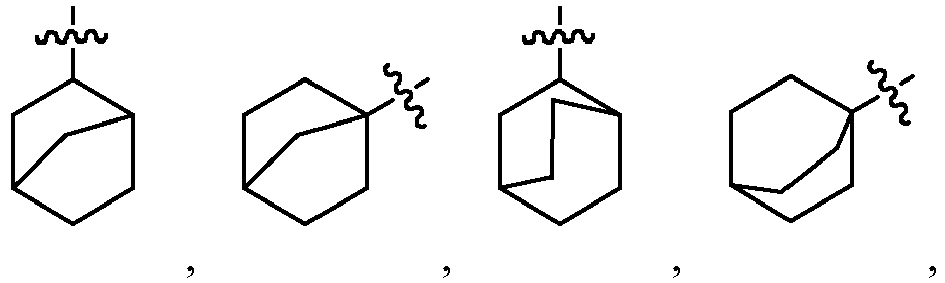
- Vorzugsweise sind Alkenylsubstituenten aus der Gruppe ausgewählt, die Ethenyl (Vinyl), Ethinyl, Propenyl (-CH2CH=CH2, -CH=CH-CH3, -C(=CH2)-CH3) umfasst.
- Der Begriff "Aryl" bedeutet im Sinne dieser Erfindung aromatische Kohlenwasserstoffe, unter anderem Phenyle und Naphthyle. Jeder Aryl-Rest kann unsubstituiert oder einfach oder mehrfach substituiert vorliegen, wobei die Aryl-Substituenten gleich oder verschieden und in jeder beliebigen und möglichen Position des Aryls sein können. Die Bindung des Aryls an die übergeordnete allgemeine Struktur kann über jedes beliebige und mögliche Ringglied des Aryl-Restes erfolgen. Die Aryl-Reste können auch mit weiteren gesättigten, (partiell) ungesättigten, (hetero)cyclischen, aromatischen oder heteroaromatischen Ringsystemen kondensiert sein, d.h. mit Cycloalkyl, Heterocyclyl, Aryl oder Heteroaryl, die wiederum unsubstituiert oder einfach oder mehrfach substituiert sein können. Beispiele für kondensierte Aryl-Reste sind Benzodioxolanyl und Benzodioxanyl. Bevorzugt ist Aryl aus der Gruppe ausgewählt, die Phenyl, 1-Naphthyl und 2-Naphthyl enthält, welche jeweils unsubstituiert oder ein- oder mehrfach substituiert sein können. Ein besonders bevorzugtes Aryl ist Phenyl, unsubstituiert oder einfach oder mehrfach substituiert.
- Hierbei ist es bevorzugt, dass als Alkylencarbonat Ethylencarbonat, Propylencarbonat und/oder Butylencarbonat eingesetzt wird.
- In einer weiteren Ausführungsform des erfindungsgemäßen Verfahrens ist der Katalysator ausgewählt aus der Gruppe BF3·OEt2, TiCl4, ZrCl4, YbCl3 und/oder SnCl2.
- In einer weiteren Ausführungsform des erfindungsgemäßen Verfahrens wird die Reaktion bei einer Temperatur von ≥ 80 °C bis ≤ 150 °C durchgeführt. Vorzugsweise beträgt die Temperatur ≥ 90 °C bis ≤ 145 °C, mehr bevorzugt ≥ 100 °C bis ≤ 140 °C.
- In einer weiteren Ausführungsform des erfindungsgemäßen Verfahrens umfasst dieses weiterhin den Schritt der Reaktion des erhaltenen Copolymers mit einer gegenüber OH-Gruppen reaktiven Verbindung. Auf diese Weise können Polymere mit erhaltenen Endgruppen zum Beispiel stabilisiert werden. Dieses wird auch als "End-Capping" bezeichnet. Weiterhin ermöglicht dieses Vorgehen den Einbau von Verzweigungsstellen und eine weitere Kettenverlängerung des Polymers.
- In einer weiteren Ausführungsform des erfindungsgemäßen Verfahrens ist die gegenüber OH-Gruppen reaktive Verbindung ausgewählt aus der Gruppe der Anhydride und/oder der Alkylenoxide. Beispiele für geeignete Anhydride sind Essigsäureanhydrid, Succinsäureanhydrid, Maleinsäureanhydrid, Phthalsäureanhydrid, 1,2-Cyclohexandicarbonsäureanhydrid, Diphensäureanhydrid, Tetrahydrophthalsäureanhydrid, Methyltetrahydrophthalsäureanhydrid, Norbornendisäureanhydrid und ihre Chlorierungsprodukte, Bernsteinsäureanhydrid, Glutarsäureanhydrid, Diglykolsäureanhydrid, 1,8-Naphthalsäureanhydrid, Bernsteinsäureanhydrid, Dodecenylbernsteinsäureanhydrid, Tetradecenylbernsteinsäureanhydrid, Hexadecenylbernsteinsäureanhydrid, Octadecenylbernsteinsäureanhydrid, 3- und 4-Nitrophthalsäureanhydrid, Tetrachlorphthalsäureanhydrid, Tetrabromphthalsäureanhydrid, Itaconsäureanhydrid, Dimethylmaleinsäureanhydrid, Allylnorbornendisäureanhydrid, 3-Methylfuran-2,5-dion, 3-Methyldihydrofuran-2,5-dion, Dihydro-2H-pyran-2,6(3H)-dion, 1,4-Dioxane-2,6-dion, 2H-Pyran-2,4,6(3H,5H)-trion, 3-Ethyldihydrofuran-2,5-dion, 3-Methoxydihydrofuran-2,5-dion, 3-(Prop-2-en-1-yl)dihydrofuran-2,5-dion, N-(2,5-Dioxotetrahydrofuran-3-yl)formamid und 3[(2E)-But-2-en-1-yl]dihydrofuran-2,5-dion. Besonders bevorzugt sind Succinsäureanhydrid, Maleinsäureanhydrid und Phthalsäureanhydrid.
- Bei den Alkylenoxiden handelt es sich bevorzugt um Alkylenoxide mit 2 - 4 Kohlenstoffatomen. Dabei kann es sich beispielsweise um eine oder mehrere Verbindungen ausgewählt aus der Gruppe Styroloxid, Ethylenoxid, Propylenoxid, 2,3-Butenoxid und/oder 2-Methyl-1,2-propenoxid (Isobutenoxid) handeln. Es ist weiterhin möglich, dass Alkylenoxide mit mehr als einer Epoxygruppe eingesetzt werden können.
- In einer weiteren Ausführungsform des erfindungsgemäßen Verfahrens ist die gegenüber OH-Gruppen reaktive Verbindung ausgewählt aus der Gruppe der Polyisocyanate. Als Polyisocyanat eignen sich erfindungsgemäß beispielsweise 1,4-Butylendiisocyanat, 1,6 Hexamethylendiisocyanat (HDI), Isophorondiisocyanat (IPDI), 2,2,4 und/oder 2,4,4-Trimethylhexamethylendiisocyanat, die isomeren Bis-(4,4'-isocyanatocyclohexyl)methane oder deren Mischungen beliebigen Isomerengehalts, 1,4-Cyclohexylendiisocyanat, 4-Isocyanatomethyl-1,8-octandiisocyanat (Nonantriisocyanat), 1,4-Phenylendiisocyanat, 2,4- und/oder 2,6-Toluylendiisocyanat, 1,5-Naphthylendiisocyanat, 2,2'- und/oder 2,4'- und/oder 4,4'-Diphenylmethandiisocyanat, 1,3- und/oder 1,4-Bis-(2-isocyanato-prop-2-yl)-benzol (TMXDI), 1,3-Bis(isocyanatomethyl)benzol (XDI), Alkyl-2,6-diisocyanatohexanoate (Lysindiisocyanate) mit Alkylgruppen mit 1 bis 8 Kohlenstoffatomen sowie Mischungen davon. Weiterhin sind Uretdion-, Isocyanurat-, Biuret-, Iminooxadiazindion- oder Oxadiazintrionstruktur enthaltende Verbindungen basierend auf den genannten Diisocyanaten geeignete Bausteine.
- Geeignete Isocyanat-Komponenten sind vor allem die technisch leicht zugänglichen Polyisocyanate, zum Beispiel das 2,4- und 2,6-Toluylendiisocyanat, sowie beliebige Gemische dieser Isomeren ("TDI"); Polyphenylpolymethylenpolyisocyanate, wie sie durch Anilin-Formaldehyd-Kondensation und anschließende Phosgenierung hergestellt werden ("rohes MDI") und Carbodiimidgruppen, Urethangruppen, Allophanatgruppen, Isocyanuratgruppen, Harnstoffgruppen oder Biuretgruppen aufweisenden Polyisocyanate ("modifizierte Polyisocyanate"), insbesondere solche modifizierten Polyisocyanate, die sich vom 2,4- und/oder 2,6-Toluylendiisocyanat bzw. vom 4,4'- und/oder 2,4'-Diphenylmethandiisocyanat ableiten. Vorzugsweise wird als Polyisocyanat mindestens eine Verbindung ausgewählt aus der Gruppe bestehend aus 2,4- und 2,6-Toluylendiisocyanat, 4,4'- und 2,4'- und 2,2'-Diphenylmethandiisocyanat und Polyphenylpolymethylenpolyisocyanat ("Mehrkern-MDI") eingesetzt.
- In einer weiteren Ausführungsform des erfindungsgemäßen Verfahrens wird der Katalysator erst bei Erreichen einer vorbestimmten Temperatur hinzugegeben. Der Vorteil an dieser Vorgehensweise ist, dass eine unerwünschte Lewis-saure Polymerisation des Formaldehyds zu Polyoxymethylen (POM) verhindert werden kann. Vorzugsweise wird der Katalysator kurz vor oder bei Erreichen der vorbestimmten Reaktionstemperatur hinzugegeben. So kann dieses bei ≤ 90%, ≤ 80% oder ≤ 70% der vorbestimmten Reaktionstemperatur geschehen. Beispielsweise kann die Katalysatorzugabe bei Erreichen von 140 °C, im Fall von BF3 von 120 °C, erfolgen.
- Ein weiterer Aspekt der vorliegenden Erfindung ist ein Formaldehyd-Alkylencarbonat-Copolymer, welches durch ein erfindungsgemäßes Verfahren erhältlich ist und eine Reflexion im Infrarot-Spektrum bei 1735 cm-1 ± 5 cm-1 von ≤ 86% aufweist. Vorzugsweise beträgt diese Reflexion ≤ 80% und mehr bevorzugt ≤ 75%.
- In einer Ausführungsform des erfindungsgemäßen Copolymers weist dieses einen CO2-Gehalt von ≥ 3.0 Gewichts-% bis ≤ 33 Gewichts-% auf. Besonders bevorzugt liegt der CO2-Gehalt der erfindungsgemäßen Copolymeren zwischen ≥ 3.5 Gewichts-% und ≤ 25 Gewichts-%.
- Schließlich betrifft die vorliegende Erfindung auch ein Polyurethan-Polymer, welches durch das oben genannte erfindungsgemäße Verfahren erhältlich ist.
- Die Erfindung wird anhand der nachfolgenden Beispiele weiter erläutert, ohne jedoch darauf beschränkt zu sein.
- Die folgenden Beispiele beschreiben die Herstellung von Polymeren aus cyclischem Propylencarbonat und 1,3,5-Trioxan. Die gebildete Polymere wurde mittels IR-Spektroskopie (Nicolet Magna FT-IR 550 Spektrometer, Aufnahmesoftware: OMNIC Version 7.3, Methode nach Herstellerangaben) auf CO2-Einbau analysiert, wobei das Signal der linearen Carbonat-Gruppe bei ∼1735 cm-1 (Reflexion) als Maß für den Einbau herangezogen wurde.
- Die Quantifizierung des CO2-Einbaus erfolgte über eine Referenzmessung mit einem Polyethercarbonatpolyol, dessen CO2-Gehalt bekannt war. Dieses Referenzpolyol wies laut NMR-Spektroskopie einen CO2-Gehalt von 12 Gewichts-% auf. Details sind unter anderem in
WO 2012/049162 A1 angegeben, auf die vollumfänglich Bezug genommen wird. - In einen 300 mL Druckreaktor mit Gasdosierungseinrichtung wurden in einem 1:1 Verhältnis 35,0 g (0,39 mol) 1,3,5-Trioxan (handelsüblich, Acros) und 39,7 g (0,39 mol) cyclischem Propylencarbonat (handelsüblich, Merck), welches zuvor über 14 Å Molsieb gelagert wurde, vorgelegt und der Reaktor verschlossen. Anschließend wurde die Rührerdrehzahl auf 500 Upm eingestellt und der Reaktor durch nachfolgendes 3-faches Evakuieren und Beaufschlagung mit N2 (ca. 3 bar) inertisiert. Bei 120 °C und 36 bar CO2 wurde durch Zugabe von 1.3 mmol BF3·OEt2 als Katalysator zur Reaktionsmischung die Polymerisation gestartet. Anschließend wurden eine T von 140 °C und ein Druck von 36 bar CO2 eingestellt. Nach der entsprechenden Reaktionszeit von 60 min wurde der Reaktor auf Raumtemperatur abgekühlt.
- Der erhalte farblose Feststoff wurde drei Mal mit Wasser und einmal Diethylether gewaschen, und unter vermindertem Druck (50 mbar) bei 23 °C getrocknet.
- Es ergab sich die in Tabelle 1 dargestellte Reflexion und CO2-Einbau im Polymer.
- Es wurde ein Versuch gemäß des Beispiels 1 durchgeführt, wobei 70,0 g (0,78 mol) 1,3,5-Trioxan und 76,4 g (0,75 mol) cyclischem Propylencarbonat und als Katalysator 1.3 mmol (eq. ∼ 0.1 mol-%) TiCl4 eingesetzt wurde. Die Zugabe erfolgte bei 140 °C und es wurde ein Druck von 48 bar CO2 eingestellt. Es ergab sich die in Tabelle 1 dargestellte Reflexion und CO2-Einbau im Polymer.
- Es wurde ein Versuch gemäß des Beispiels 2 durchgeführt, wobei als Katalysator TiCl4 eingesetzt bzw. ein Druck von 11 bar CO2 eingestellt wurde. Es ergab sich die in Tabelle 1 dargestellte Reflexion und CO2-Einbau im Polymer.
- Es wurde ein Versuch gemäß des Beispiels 2 durchgeführt, wobei in Abweichung davon die Temperatur bei der Zugabe 125 °C betrug. Als Katalysator ZrCl4 wurde eingesetzt und es wurde ein Druck von 40 bar CO2 eingestellt. Es ergab sich die in Tabelle 1 dargestellte Reflexion und CO2-Einbau im Polymer.
- Es wurde ein Versuch gemäß des Beispiels 2 durchgeführt, wobei als Katalysator YbCl3 eingesetzt bzw. ein Druck von 35 bar CO2 eingestellt wurde. Die Zugabe erfolgte bei 140 °C. Es ergab sich die in Tabelle 1 dargestellt Reflexion und CO2-Einbau im Polymer.
- Es wurde ein Versuch gemäß des Beispiels 1 durchgeführt, wobei als Katalysator TiCl4 eingesetzt wurde bzw. ein Druck von 41 bar N2 eingestellt wurde. Die Zugabe erfolgte bei 140 °C. Es ergab sich die in Tabelle 1 dargestellte Reflexion und CO2-Einbau im Polymer.
Tabelle 1: Bsp. Nr. Kat. Zeit [min] Temp. [°C] Druck [bar] [Reflexion-%] bei 1735 cm-1 Ausbeute [%] CO2 [Gew.-%] 1 BF3·OEt2 60 140 36 / CO2 77,2 23,28 5,1 2 TiCl4 60 140 48 / CO2 71,4 4,77 6,4 3 TiCl4 60 140 11 / CO2 90 5,13 2,2 4 ZrCl4 60 140 40 / CO2 72,3 11,2 6,2 5 YbCl3 60 140 35 / CO2 85,2 6,2 3,3 6 TiCl4 60 140 41 / N2 93,2 22,97 1,5 - In einen 300 mL Druckreaktor mit Gasdosierungseinrichtung wurden in einem 1:1 Verhältnis 35,0 g (0,39 mol) 1,3,5-Trioxan (handelsüblich, Acros) und 39,7 g (0,39 mol) cyclischem Propylencarbonat (handelsüblich, Aldrich), welches zuvor über 14 Å Molsieb gelagert wurde, zusammen mit 2,5 g (0,0132 mol) SnCl2 vorgelegt und der Reaktor verschlossen. Anschließend wurde die Rührerdrehzahl auf 500 Upm eingestellt und der Reaktor durch nachfolgendes 3-faches Evakuieren und Beaufschlagung mit N2 (ca. 3 bar) inertisiert. Anschließend wurde durch Evakuieren und Beaufschlagung ein Druck von 1 bar CO2 eingestellt und der Reaktor auf T = 140 °C erwärmt. Nach der entsprechenden Reaktionszeit von 60 min wurde dieser auf Raumtemperatur abgekühlt. Es wurde ein Anstieg des Innendruckes auf ca. 8 bar beobachtet.
- Der erhalten farblose Feststoff wurde drei Mal mit Wasser und einmal Diethylether gewaschen, und unter vermindertem Druck (50 mbar) bei 23 °C getrocknet. Es ergab sich die in Tabelle 2 dargestellt Reflexion und CO2-Einbau im Polymer.
- Es wurde ein Versuch gemäß des Beispiels 7 durchgeführt, wobei ein Druck von 53 bar CO2 eingestellt wurde. Es ergab sich die in Tabelle 2 dargestellt Reflexion und CO2-Einbau im Polymer.
- Es wurde ein Versuch gemäß des Beispiels 7 durchgeführt, wobei ein Druck von 1 bar N2 eingestellt wurde. Es wurde ein konstanter Anstieg des Innendruckes auf ca. 10 bar beobachtet. Es ergab sich die in Tabelle 2 dargestellt Reflexion und CO2-Einbau im Polymer.
- Es wurde ein Versuch gemäß des Beispiels 7 durchgeführt, wobei ein Druck von 35 bar N2 eingestellt wurde. Es ergab sich die in Tabelle 2 dargestellt Reflexion und CO2-Einbau im Polymer.
- Es wurde ein Versuch gemäß des Beispiels 7 durchgeführt, wobei ein Druck von 35 bar CO2 eingestellt wurde. Es ergab sich die in Tabelle 2 dargestellt Reflexion und CO2-Einbau im Polymer.
- Es wurde ein Versuch gemäß des Beispiels 7 durchgeführt, wobei ein Druck von 15 bar CO2 eingestellt wurde. Es ergab sich die in Tabelle 2 dargestellt Reflexion und CO2-Einbau im Polymer.
Tabelle 2: Bsp. Nr. Kat. Zeit [min] Temp. [°C] Druck [bar] [Reflexion-%] bei 1735 cm-1 Ausbeute [%] CO2 [Gew.-%] 7 SnCl2 60 140 1 / CO2 85,6 12,3 3,2 8 SnCl2 60 140 53 / CO2 69,4 14,88 6,8 9 SnCl2 60 140 1 / N2 90,3 7,2 2,2 10 SnCl2 60 140 35 / N2 79,2 13,47 4,6 11 SnCl2 60 140 35 / CO2 76,2 15,3 5,3 12 SnCl2 60 140 15 / CO2 80,4 (bei 1730 cm-1) 8,62 4,4
Claims (15)
- Verfahren zur Herstellung von Formaldehyd-Alkylencarbonat-Copolymeren, umfassend den Schritt der Reaktion von trimerem, oligomerem und/oder polymerem Formaldehyd mit einem Alkylencarbonat in Gegenwart eines Katalysators,
dadurch gekennzeichnet, dass
die Reaktion unter Beaufschlagung von CO2 durchgeführt wird. - Verfahren gemäß Anspruch 1, wobei das Beaufschlagen mit CO2 derart durchgeführt wird, dass der CO2-Partialdruck ≥ 15 bar beträgt.
- Verfahren gemäß Anspruch 1 oder 2, wobei:der Katalysator ein Metall M in einer Oxidationsstufe von ≥ III umfasst, wobei M ausgewählt ist aus der Gruppe B, Sc, Y, Ti, Zr, Hf und/oder ein Lanthanoid;und/oderder Katalysator Zinn einer Oxidationsstufe von ≥ II umfasst.
- Verfahren gemäß einem oder mehreren der vorhergehenden Ansprüche, wobei 1,3,5-Trioxan eingesetzt wird.
- Verfahren gemäß einem oder mehreren der vorhergehenden Ansprüche, wobei das Alkylencarbonat der nachfolgenden Formel entspricht:

- Verfahren gemäß Anspruch 5, wobei als Alkylencarbonat Ethylencarbonat, Propylencarbonat und/oder Butylencarbonat eingesetzt wird.
- Verfahren gemäß einem oder mehreren der vorhergehenden Ansprüche, wobei der Katalysator ausgewählt ist aus der Gruppe BF3·OEt2, TiCl4, ZrCl4, YbCl3 und/oder SnCl2.
- Verfahren gemäß einem oder mehreren der vorhergehenden Ansprüche, wobei die Reaktion bei einer Temperatur von ≥ 80 °C bis ≤ 150 °C durchgeführt wird.
- Verfahren gemäß einem oder mehreren der vorhergehenden Ansprüche, weiterhin umfassend den Schritt der Reaktion des erhaltenen Copolymers mit einer gegenüber OH-Gruppen reaktiven Verbindung.
- Verfahren gemäß Anspruch 9, wobei die gegenüber OH-Gruppen reaktive Verbindung ausgewählt ist aus der Gruppe der Anhydride und/oder der Alkylenoxide.
- Verfahren gemäß Anspruch 9, wobei die gegenüber OH-Gruppen reaktive Verbindung ausgewählt ist aus der Gruppe der Polyisocyanate.
- Verfahren gemäß einem oder mehreren der vorhergehenden Ansprüche, wobei der Katalysator erst bei Erreichen einer vorbestimmten Temperatur hinzugegeben wird.
- Formaldehyd-Alkylencarbonat-Copolymer, erhältlich durch ein Verfahren gemäß einem oder mehreren der Ansprüche 1-12, mit einer Reflexion im Infrarot-Spektrum bei 1735 cm-1 ± 5 cm-1 von ≤ 86%.
- Copolymer gemäß einem oder mehreren der Ansprüche 11-13 mit einem CO2-Gehalt von ≥ 3.0 Gewichts-% bis ≤ 33 Gewichts-%.
- Polyurethan-Polymer, erhältlich durch ein Verfahren gemäß Anspruch 11.
Priority Applications (1)
| Application Number | Priority Date | Filing Date | Title |
|---|---|---|---|
| EP14812430.8A EP3080177B1 (de) | 2013-12-10 | 2014-12-05 | Verfahren zur herstellung von formaldehyd-alkylencarbonat-copolymeren |
Applications Claiming Priority (3)
| Application Number | Priority Date | Filing Date | Title |
|---|---|---|---|
| EP13196346.4A EP2883893A1 (de) | 2013-12-10 | 2013-12-10 | Verfahren zur Herstellung von Formaldehyd-Alkylencarbonat-Copolymeren |
| EP14812430.8A EP3080177B1 (de) | 2013-12-10 | 2014-12-05 | Verfahren zur herstellung von formaldehyd-alkylencarbonat-copolymeren |
| PCT/EP2014/076707 WO2015086452A1 (de) | 2013-12-10 | 2014-12-05 | Verfahren zur herstellung von formaldehyd-alkylencarbonat-copolymeren |
Publications (2)
| Publication Number | Publication Date |
|---|---|
| EP3080177A1 EP3080177A1 (de) | 2016-10-19 |
| EP3080177B1 true EP3080177B1 (de) | 2017-08-02 |
Family
ID=49876359
Family Applications (2)
| Application Number | Title | Priority Date | Filing Date |
|---|---|---|---|
| EP13196346.4A Withdrawn EP2883893A1 (de) | 2013-12-10 | 2013-12-10 | Verfahren zur Herstellung von Formaldehyd-Alkylencarbonat-Copolymeren |
| EP14812430.8A Not-in-force EP3080177B1 (de) | 2013-12-10 | 2014-12-05 | Verfahren zur herstellung von formaldehyd-alkylencarbonat-copolymeren |
Family Applications Before (1)
| Application Number | Title | Priority Date | Filing Date |
|---|---|---|---|
| EP13196346.4A Withdrawn EP2883893A1 (de) | 2013-12-10 | 2013-12-10 | Verfahren zur Herstellung von Formaldehyd-Alkylencarbonat-Copolymeren |
Country Status (4)
| Country | Link |
|---|---|
| US (1) | US10030100B2 (de) |
| EP (2) | EP2883893A1 (de) |
| CN (1) | CN105940029B (de) |
| WO (1) | WO2015086452A1 (de) |
Cited By (3)
| Publication number | Priority date | Publication date | Assignee | Title |
|---|---|---|---|---|
| EP3653657A1 (de) | 2018-11-16 | 2020-05-20 | Covestro Deutschland AG | Verfahren zur herstellung von präpolymeren umfassend einen polyoxymethylen-block |
| EP4015555A1 (de) | 2020-12-18 | 2022-06-22 | Covestro Deutschland AG | Verfahren zur herstellung eines monols oder polyols umfassend einen polyoxymethylen-block |
| EP4201973A1 (de) | 2021-12-21 | 2023-06-28 | Covestro Deutschland AG | Präpolymer umfassend einen polyoxymethylen-block und dessen herstellungsverfahren |
Family Cites Families (8)
| Publication number | Priority date | Publication date | Assignee | Title |
|---|---|---|---|---|
| US3012990A (en) | 1959-03-25 | 1961-12-12 | Celanese Corp | Moldable copolymers |
| US3103499A (en) * | 1959-04-02 | 1963-09-10 | Thermal stabilization of oxymethylene | |
| GB1002761A (en) * | 1960-10-17 | 1965-08-25 | British Industrial Plastics | Polymeric products from trioxan and aldehydes |
| DE2055045A1 (en) | 1970-11-09 | 1972-05-18 | Angarskij Nef | Trioxane copolymers prepared in the pres- - ence of alkylene carbonates |
| FR2113776A7 (en) * | 1970-11-13 | 1972-06-30 | Angarsky Neftekhimichesk | Trioxane copolymers prepared in the pres- - ence of alkylene carbonates |
| ES2243486T3 (es) * | 2000-08-24 | 2005-12-01 | UNION CARBIDE CHEMICALS & PLASTICS TECHNOLOGY CORPORATION | Copolimeros de esteres ciclicos y formales ciclicos. |
| EP2441788A1 (de) | 2010-10-14 | 2012-04-18 | Bayer MaterialScience AG | Verfahren zur Herstellung von Polyetherpolyolen |
| AU2011333792A1 (en) * | 2010-11-23 | 2013-05-30 | Dsm Ip Assets B.V. | Polycarbonate polyol compositions |
-
2013
- 2013-12-10 EP EP13196346.4A patent/EP2883893A1/de not_active Withdrawn
-
2014
- 2014-12-05 WO PCT/EP2014/076707 patent/WO2015086452A1/de not_active Ceased
- 2014-12-05 CN CN201480067533.XA patent/CN105940029B/zh not_active Expired - Fee Related
- 2014-12-05 EP EP14812430.8A patent/EP3080177B1/de not_active Not-in-force
- 2014-12-05 US US15/103,329 patent/US10030100B2/en not_active Expired - Fee Related
Non-Patent Citations (1)
| Title |
|---|
| None * |
Cited By (5)
| Publication number | Priority date | Publication date | Assignee | Title |
|---|---|---|---|---|
| EP3653657A1 (de) | 2018-11-16 | 2020-05-20 | Covestro Deutschland AG | Verfahren zur herstellung von präpolymeren umfassend einen polyoxymethylen-block |
| WO2020099601A1 (de) | 2018-11-16 | 2020-05-22 | Covestro Deutschland Ag | Verfahren zur herstellung von präpolymeren umfassend einen polyoxymethylen-block |
| EP4015555A1 (de) | 2020-12-18 | 2022-06-22 | Covestro Deutschland AG | Verfahren zur herstellung eines monols oder polyols umfassend einen polyoxymethylen-block |
| WO2022128748A1 (de) | 2020-12-18 | 2022-06-23 | Covestro Deutschland Ag | Verfahren zur herstellung eines monols oder polyols umfassend einen polyoxymethylen-block |
| EP4201973A1 (de) | 2021-12-21 | 2023-06-28 | Covestro Deutschland AG | Präpolymer umfassend einen polyoxymethylen-block und dessen herstellungsverfahren |
Also Published As
| Publication number | Publication date |
|---|---|
| CN105940029B (zh) | 2018-03-16 |
| WO2015086452A1 (de) | 2015-06-18 |
| US10030100B2 (en) | 2018-07-24 |
| US20160311974A1 (en) | 2016-10-27 |
| CN105940029A (zh) | 2016-09-14 |
| EP2883893A1 (de) | 2015-06-17 |
| EP3080177A1 (de) | 2016-10-19 |
Similar Documents
| Publication | Publication Date | Title |
|---|---|---|
| EP1194468B2 (de) | Aus polyetherpolyolen hergestellte polyurethan-weichschäume | |
| EP2430062B2 (de) | Verfahren zur herstellung von carbodiimiden | |
| EP2100886B1 (de) | Herstellung von Polyisocyanaten vom Trimertyp | |
| EP3328914B1 (de) | Blockierte polyisocyanatzusammensetzung auf basis von 1,5-pentamethylendiisocyanat | |
| EP3080177B1 (de) | Verfahren zur herstellung von formaldehyd-alkylencarbonat-copolymeren | |
| DE1520529A1 (de) | Verfahren zur Herstellung von Polyurethan-Schaumstoffen | |
| DE1935485A1 (de) | Verfahren zur Herstellung von Polyamiden mit Urethan- und/oder Harnstoffgruppierungen | |
| DE2527241B2 (de) | Verfahren zur Herstellung eines Polyurethanschaumstoffs | |
| EP4359473A2 (de) | Verfahren zum chemischen recycling von polyethylenfuranoat (pef), pur/pir-hartschaum und verfahren zur herstellung von pur/pir-hartschäumen | |
| EP3794049B1 (de) | Verfahren zur herstellung eines polyisocyanatpolymers und eines polyisocyanuratkunststoffs | |
| EP3728369B1 (de) | Polyurethanverbundwerkstoffe basierend auf thermolatenten katalysatoren | |
| DE19547974A1 (de) | Verbindungen mit Isocyanatgruppen und verkappten gegenüber Isocyanaten reaktiven Gruppen | |
| EP0002662B1 (de) | Verfahren zur Herstellung von (Thio)Hydantoinen | |
| EP3286238B1 (de) | Polyisocyanatmischung auf basis von 1,5-diisocyanatopentan | |
| EP4015546A1 (de) | Nichtionisch hydrophilierte polyisocyanate mit sehr niedrigem monomergehalt | |
| EP1683818B1 (de) | Uretdionbildung in Lösung | |
| EP3024862A1 (de) | Einsatz von succinnitril bei der herstellung von iminooxadiazindiongruppen enthaltenden polyisocyanaten | |
| EP3498743A1 (de) | Verfahren zur herstellung eines polyoxymethylen-gruppen enthaltenden präpolymers | |
| EP1240235A1 (de) | Verfahren zur herstellung von polyetherpolyolen | |
| DE3713670A1 (de) | Verfahren zur herstellung von ueberzuegen mit hydantoin-strukturen durch umsetzung carbodiimidgruppen enthaltender verbindungen mit ungesaettigten carbonsaeuren | |
| EP3024863B1 (de) | Verfahren zur herstellung von iminooxadiazindiongruppen enthaltenden polyisocyanaten und deren verwendung. | |
| WO2023036861A1 (de) | Herstellung eines blockierten härters auf der basis eines teilweise bio-basierten polyisocyanates und verwendung als 1k-pur einbrennlack | |
| EP4105251A1 (de) | Vernetzbare zusammensetzungen, enthaltend imin- und/oder aminal-bildende komponenten | |
| EP3885387A1 (de) | Polyisocyanat-basierte polyadditionsverbindungen mit fünfgliedrigen cyclischen iminoether-strukturelementen | |
| DE2418951A1 (de) | Verfahren zum stabilisieren von endstaendige hydroxylgruppen aufweisenden polyacetalen durch umsetzung mit organischen isocyanaten oder isothiocyanaten |
Legal Events
| Date | Code | Title | Description |
|---|---|---|---|
| PUAI | Public reference made under article 153(3) epc to a published international application that has entered the european phase |
Free format text: ORIGINAL CODE: 0009012 |
|
| 17P | Request for examination filed |
Effective date: 20160711 |
|
| AK | Designated contracting states |
Kind code of ref document: A1 Designated state(s): AL AT BE BG CH CY CZ DE DK EE ES FI FR GB GR HR HU IE IS IT LI LT LU LV MC MK MT NL NO PL PT RO RS SE SI SK SM TR |
|
| AX | Request for extension of the european patent |
Extension state: BA ME |
|
| DAX | Request for extension of the european patent (deleted) | ||
| GRAP | Despatch of communication of intention to grant a patent |
Free format text: ORIGINAL CODE: EPIDOSNIGR1 |
|
| INTG | Intention to grant announced |
Effective date: 20170428 |
|
| GRAS | Grant fee paid |
Free format text: ORIGINAL CODE: EPIDOSNIGR3 |
|
| GRAA | (expected) grant |
Free format text: ORIGINAL CODE: 0009210 |
|
| AK | Designated contracting states |
Kind code of ref document: B1 Designated state(s): AL AT BE BG CH CY CZ DE DK EE ES FI FR GB GR HR HU IE IS IT LI LT LU LV MC MK MT NL NO PL PT RO RS SE SI SK SM TR |
|
| REG | Reference to a national code |
Ref country code: CH Ref legal event code: EP Ref country code: AT Ref legal event code: REF Ref document number: 914399 Country of ref document: AT Kind code of ref document: T Effective date: 20170815 |
|
| REG | Reference to a national code |
Ref country code: IE Ref legal event code: FG4D Free format text: LANGUAGE OF EP DOCUMENT: GERMAN |
|
| REG | Reference to a national code |
Ref country code: DE Ref legal event code: R096 Ref document number: 502014004861 Country of ref document: DE |
|
| REG | Reference to a national code |
Ref country code: NL Ref legal event code: MP Effective date: 20170802 |
|
| REG | Reference to a national code |
Ref country code: LT Ref legal event code: MG4D |
|
| PG25 | Lapsed in a contracting state [announced via postgrant information from national office to epo] |
Ref country code: NO Free format text: LAPSE BECAUSE OF FAILURE TO SUBMIT A TRANSLATION OF THE DESCRIPTION OR TO PAY THE FEE WITHIN THE PRESCRIBED TIME-LIMIT Effective date: 20171102 Ref country code: SE Free format text: LAPSE BECAUSE OF FAILURE TO SUBMIT A TRANSLATION OF THE DESCRIPTION OR TO PAY THE FEE WITHIN THE PRESCRIBED TIME-LIMIT Effective date: 20170802 Ref country code: LT Free format text: LAPSE BECAUSE OF FAILURE TO SUBMIT A TRANSLATION OF THE DESCRIPTION OR TO PAY THE FEE WITHIN THE PRESCRIBED TIME-LIMIT Effective date: 20170802 Ref country code: HR Free format text: LAPSE BECAUSE OF FAILURE TO SUBMIT A TRANSLATION OF THE DESCRIPTION OR TO PAY THE FEE WITHIN THE PRESCRIBED TIME-LIMIT Effective date: 20170802 Ref country code: NL Free format text: LAPSE BECAUSE OF FAILURE TO SUBMIT A TRANSLATION OF THE DESCRIPTION OR TO PAY THE FEE WITHIN THE PRESCRIBED TIME-LIMIT Effective date: 20170802 Ref country code: FI Free format text: LAPSE BECAUSE OF FAILURE TO SUBMIT A TRANSLATION OF THE DESCRIPTION OR TO PAY THE FEE WITHIN THE PRESCRIBED TIME-LIMIT Effective date: 20170802 |
|
| PG25 | Lapsed in a contracting state [announced via postgrant information from national office to epo] |
Ref country code: BG Free format text: LAPSE BECAUSE OF FAILURE TO SUBMIT A TRANSLATION OF THE DESCRIPTION OR TO PAY THE FEE WITHIN THE PRESCRIBED TIME-LIMIT Effective date: 20171102 Ref country code: GR Free format text: LAPSE BECAUSE OF FAILURE TO SUBMIT A TRANSLATION OF THE DESCRIPTION OR TO PAY THE FEE WITHIN THE PRESCRIBED TIME-LIMIT Effective date: 20171103 Ref country code: PL Free format text: LAPSE BECAUSE OF FAILURE TO SUBMIT A TRANSLATION OF THE DESCRIPTION OR TO PAY THE FEE WITHIN THE PRESCRIBED TIME-LIMIT Effective date: 20170802 Ref country code: IS Free format text: LAPSE BECAUSE OF FAILURE TO SUBMIT A TRANSLATION OF THE DESCRIPTION OR TO PAY THE FEE WITHIN THE PRESCRIBED TIME-LIMIT Effective date: 20171202 Ref country code: ES Free format text: LAPSE BECAUSE OF FAILURE TO SUBMIT A TRANSLATION OF THE DESCRIPTION OR TO PAY THE FEE WITHIN THE PRESCRIBED TIME-LIMIT Effective date: 20170802 Ref country code: RS Free format text: LAPSE BECAUSE OF FAILURE TO SUBMIT A TRANSLATION OF THE DESCRIPTION OR TO PAY THE FEE WITHIN THE PRESCRIBED TIME-LIMIT Effective date: 20170802 Ref country code: LV Free format text: LAPSE BECAUSE OF FAILURE TO SUBMIT A TRANSLATION OF THE DESCRIPTION OR TO PAY THE FEE WITHIN THE PRESCRIBED TIME-LIMIT Effective date: 20170802 |
|
| PG25 | Lapsed in a contracting state [announced via postgrant information from national office to epo] |
Ref country code: CZ Free format text: LAPSE BECAUSE OF FAILURE TO SUBMIT A TRANSLATION OF THE DESCRIPTION OR TO PAY THE FEE WITHIN THE PRESCRIBED TIME-LIMIT Effective date: 20170802 Ref country code: DK Free format text: LAPSE BECAUSE OF FAILURE TO SUBMIT A TRANSLATION OF THE DESCRIPTION OR TO PAY THE FEE WITHIN THE PRESCRIBED TIME-LIMIT Effective date: 20170802 |
|
| REG | Reference to a national code |
Ref country code: DE Ref legal event code: R097 Ref document number: 502014004861 Country of ref document: DE |
|
| PG25 | Lapsed in a contracting state [announced via postgrant information from national office to epo] |
Ref country code: SK Free format text: LAPSE BECAUSE OF FAILURE TO SUBMIT A TRANSLATION OF THE DESCRIPTION OR TO PAY THE FEE WITHIN THE PRESCRIBED TIME-LIMIT Effective date: 20170802 Ref country code: SM Free format text: LAPSE BECAUSE OF FAILURE TO SUBMIT A TRANSLATION OF THE DESCRIPTION OR TO PAY THE FEE WITHIN THE PRESCRIBED TIME-LIMIT Effective date: 20170802 Ref country code: IT Free format text: LAPSE BECAUSE OF FAILURE TO SUBMIT A TRANSLATION OF THE DESCRIPTION OR TO PAY THE FEE WITHIN THE PRESCRIBED TIME-LIMIT Effective date: 20170802 Ref country code: EE Free format text: LAPSE BECAUSE OF FAILURE TO SUBMIT A TRANSLATION OF THE DESCRIPTION OR TO PAY THE FEE WITHIN THE PRESCRIBED TIME-LIMIT Effective date: 20170802 |
|
| PLBE | No opposition filed within time limit |
Free format text: ORIGINAL CODE: 0009261 |
|
| STAA | Information on the status of an ep patent application or granted ep patent |
Free format text: STATUS: NO OPPOSITION FILED WITHIN TIME LIMIT |
|
| 26N | No opposition filed |
Effective date: 20180503 |
|
| REG | Reference to a national code |
Ref country code: CH Ref legal event code: PL |
|
| PG25 | Lapsed in a contracting state [announced via postgrant information from national office to epo] |
Ref country code: SI Free format text: LAPSE BECAUSE OF FAILURE TO SUBMIT A TRANSLATION OF THE DESCRIPTION OR TO PAY THE FEE WITHIN THE PRESCRIBED TIME-LIMIT Effective date: 20170802 |
|
| REG | Reference to a national code |
Ref country code: IE Ref legal event code: MM4A |
|
| PG25 | Lapsed in a contracting state [announced via postgrant information from national office to epo] |
Ref country code: LU Free format text: LAPSE BECAUSE OF NON-PAYMENT OF DUE FEES Effective date: 20171205 Ref country code: MT Free format text: LAPSE BECAUSE OF FAILURE TO SUBMIT A TRANSLATION OF THE DESCRIPTION OR TO PAY THE FEE WITHIN THE PRESCRIBED TIME-LIMIT Effective date: 20170802 |
|
| REG | Reference to a national code |
Ref country code: FR Ref legal event code: ST Effective date: 20180831 |
|
| REG | Reference to a national code |
Ref country code: BE Ref legal event code: MM Effective date: 20171231 |
|
| PG25 | Lapsed in a contracting state [announced via postgrant information from national office to epo] |
Ref country code: IE Free format text: LAPSE BECAUSE OF NON-PAYMENT OF DUE FEES Effective date: 20171205 Ref country code: FR Free format text: LAPSE BECAUSE OF NON-PAYMENT OF DUE FEES Effective date: 20180102 |
|
| PG25 | Lapsed in a contracting state [announced via postgrant information from national office to epo] |
Ref country code: LI Free format text: LAPSE BECAUSE OF NON-PAYMENT OF DUE FEES Effective date: 20171231 Ref country code: CH Free format text: LAPSE BECAUSE OF NON-PAYMENT OF DUE FEES Effective date: 20171231 Ref country code: BE Free format text: LAPSE BECAUSE OF NON-PAYMENT OF DUE FEES Effective date: 20171231 |
|
| PG25 | Lapsed in a contracting state [announced via postgrant information from national office to epo] |
Ref country code: HU Free format text: LAPSE BECAUSE OF FAILURE TO SUBMIT A TRANSLATION OF THE DESCRIPTION OR TO PAY THE FEE WITHIN THE PRESCRIBED TIME-LIMIT; INVALID AB INITIO Effective date: 20141205 Ref country code: MC Free format text: LAPSE BECAUSE OF FAILURE TO SUBMIT A TRANSLATION OF THE DESCRIPTION OR TO PAY THE FEE WITHIN THE PRESCRIBED TIME-LIMIT Effective date: 20170802 |
|
| GBPC | Gb: european patent ceased through non-payment of renewal fee |
Effective date: 20181205 |
|
| PG25 | Lapsed in a contracting state [announced via postgrant information from national office to epo] |
Ref country code: RO Free format text: LAPSE BECAUSE OF FAILURE TO SUBMIT A TRANSLATION OF THE DESCRIPTION OR TO PAY THE FEE WITHIN THE PRESCRIBED TIME-LIMIT Effective date: 20170802 |
|
| PG25 | Lapsed in a contracting state [announced via postgrant information from national office to epo] |
Ref country code: CY Free format text: LAPSE BECAUSE OF FAILURE TO SUBMIT A TRANSLATION OF THE DESCRIPTION OR TO PAY THE FEE WITHIN THE PRESCRIBED TIME-LIMIT Effective date: 20170802 |
|
| PG25 | Lapsed in a contracting state [announced via postgrant information from national office to epo] |
Ref country code: MK Free format text: LAPSE BECAUSE OF FAILURE TO SUBMIT A TRANSLATION OF THE DESCRIPTION OR TO PAY THE FEE WITHIN THE PRESCRIBED TIME-LIMIT Effective date: 20170802 |
|
| PG25 | Lapsed in a contracting state [announced via postgrant information from national office to epo] |
Ref country code: GB Free format text: LAPSE BECAUSE OF NON-PAYMENT OF DUE FEES Effective date: 20181205 |
|
| PG25 | Lapsed in a contracting state [announced via postgrant information from national office to epo] |
Ref country code: TR Free format text: LAPSE BECAUSE OF FAILURE TO SUBMIT A TRANSLATION OF THE DESCRIPTION OR TO PAY THE FEE WITHIN THE PRESCRIBED TIME-LIMIT Effective date: 20170802 |
|
| PG25 | Lapsed in a contracting state [announced via postgrant information from national office to epo] |
Ref country code: PT Free format text: LAPSE BECAUSE OF FAILURE TO SUBMIT A TRANSLATION OF THE DESCRIPTION OR TO PAY THE FEE WITHIN THE PRESCRIBED TIME-LIMIT Effective date: 20170802 |
|
| PG25 | Lapsed in a contracting state [announced via postgrant information from national office to epo] |
Ref country code: AL Free format text: LAPSE BECAUSE OF FAILURE TO SUBMIT A TRANSLATION OF THE DESCRIPTION OR TO PAY THE FEE WITHIN THE PRESCRIBED TIME-LIMIT Effective date: 20170802 |
|
| PGFP | Annual fee paid to national office [announced via postgrant information from national office to epo] |
Ref country code: DE Payment date: 20201124 Year of fee payment: 7 |
|
| REG | Reference to a national code |
Ref country code: AT Ref legal event code: MM01 Ref document number: 914399 Country of ref document: AT Kind code of ref document: T Effective date: 20191205 |
|
| PG25 | Lapsed in a contracting state [announced via postgrant information from national office to epo] |
Ref country code: AT Free format text: LAPSE BECAUSE OF NON-PAYMENT OF DUE FEES Effective date: 20191205 |
|
| REG | Reference to a national code |
Ref country code: DE Ref legal event code: R119 Ref document number: 502014004861 Country of ref document: DE |
|
| PG25 | Lapsed in a contracting state [announced via postgrant information from national office to epo] |
Ref country code: DE Free format text: LAPSE BECAUSE OF NON-PAYMENT OF DUE FEES Effective date: 20220701 |