EP3090793B1 - Filtre de média comprenant une coagulation/floculation à plusieurs étapes - Google Patents
Filtre de média comprenant une coagulation/floculation à plusieurs étapes Download PDFInfo
- Publication number
- EP3090793B1 EP3090793B1 EP16157758.0A EP16157758A EP3090793B1 EP 3090793 B1 EP3090793 B1 EP 3090793B1 EP 16157758 A EP16157758 A EP 16157758A EP 3090793 B1 EP3090793 B1 EP 3090793B1
- Authority
- EP
- European Patent Office
- Prior art keywords
- mixing
- coagulation
- raw water
- turbulence
- basin
- Prior art date
- Legal status (The legal status is an assumption and is not a legal conclusion. Google has not performed a legal analysis and makes no representation as to the accuracy of the status listed.)
- Active
Links
Images



Classifications
-
- C—CHEMISTRY; METALLURGY
- C02—TREATMENT OF WATER, WASTE WATER, SEWAGE, OR SLUDGE
- C02F—TREATMENT OF WATER, WASTE WATER, SEWAGE, OR SLUDGE
- C02F1/00—Treatment of water, waste water, or sewage
- C02F1/52—Treatment of water, waste water, or sewage by flocculation or precipitation of suspended impurities
- C02F1/5209—Regulation methods for flocculation or precipitation
-
- C—CHEMISTRY; METALLURGY
- C02—TREATMENT OF WATER, WASTE WATER, SEWAGE, OR SLUDGE
- C02F—TREATMENT OF WATER, WASTE WATER, SEWAGE, OR SLUDGE
- C02F1/00—Treatment of water, waste water, or sewage
- C02F1/52—Treatment of water, waste water, or sewage by flocculation or precipitation of suspended impurities
- C02F1/5281—Installations for water purification using chemical agents
-
- B—PERFORMING OPERATIONS; TRANSPORTING
- B01—PHYSICAL OR CHEMICAL PROCESSES OR APPARATUS IN GENERAL
- B01D—SEPARATION
- B01D61/00—Processes of separation using semi-permeable membranes, e.g. dialysis, osmosis or ultrafiltration; Apparatus, accessories or auxiliary operations specially adapted therefor
- B01D61/02—Reverse osmosis; Hyperfiltration ; Nanofiltration
- B01D61/04—Feed pretreatment
-
- C—CHEMISTRY; METALLURGY
- C02—TREATMENT OF WATER, WASTE WATER, SEWAGE, OR SLUDGE
- C02F—TREATMENT OF WATER, WASTE WATER, SEWAGE, OR SLUDGE
- C02F9/00—Multistage treatment of water, waste water or sewage
-
- B—PERFORMING OPERATIONS; TRANSPORTING
- B01—PHYSICAL OR CHEMICAL PROCESSES OR APPARATUS IN GENERAL
- B01D—SEPARATION
- B01D2311/00—Details relating to membrane separation process operations and control
- B01D2311/04—Specific process operations in the feed stream; Feed pretreatment
-
- B—PERFORMING OPERATIONS; TRANSPORTING
- B01—PHYSICAL OR CHEMICAL PROCESSES OR APPARATUS IN GENERAL
- B01D—SEPARATION
- B01D2311/00—Details relating to membrane separation process operations and control
- B01D2311/26—Further operations combined with membrane separation processes
- B01D2311/2649—Filtration
-
- C—CHEMISTRY; METALLURGY
- C02—TREATMENT OF WATER, WASTE WATER, SEWAGE, OR SLUDGE
- C02F—TREATMENT OF WATER, WASTE WATER, SEWAGE, OR SLUDGE
- C02F1/00—Treatment of water, waste water, or sewage
- C02F1/001—Processes for the treatment of water whereby the filtration technique is of importance
- C02F1/004—Processes for the treatment of water whereby the filtration technique is of importance using large scale industrial sized filters
-
- C—CHEMISTRY; METALLURGY
- C02—TREATMENT OF WATER, WASTE WATER, SEWAGE, OR SLUDGE
- C02F—TREATMENT OF WATER, WASTE WATER, SEWAGE, OR SLUDGE
- C02F1/00—Treatment of water, waste water, or sewage
- C02F1/24—Treatment of water, waste water, or sewage by flotation
-
- C—CHEMISTRY; METALLURGY
- C02—TREATMENT OF WATER, WASTE WATER, SEWAGE, OR SLUDGE
- C02F—TREATMENT OF WATER, WASTE WATER, SEWAGE, OR SLUDGE
- C02F1/00—Treatment of water, waste water, or sewage
- C02F1/28—Treatment of water, waste water, or sewage by sorption
- C02F1/283—Treatment of water, waste water, or sewage by sorption using coal, charred products, or inorganic mixtures containing them
-
- C—CHEMISTRY; METALLURGY
- C02—TREATMENT OF WATER, WASTE WATER, SEWAGE, OR SLUDGE
- C02F—TREATMENT OF WATER, WASTE WATER, SEWAGE, OR SLUDGE
- C02F1/00—Treatment of water, waste water, or sewage
- C02F1/44—Treatment of water, waste water, or sewage by dialysis, osmosis or reverse osmosis
- C02F1/441—Treatment of water, waste water, or sewage by dialysis, osmosis or reverse osmosis by reverse osmosis
-
- C—CHEMISTRY; METALLURGY
- C02—TREATMENT OF WATER, WASTE WATER, SEWAGE, OR SLUDGE
- C02F—TREATMENT OF WATER, WASTE WATER, SEWAGE, OR SLUDGE
- C02F1/00—Treatment of water, waste water, or sewage
- C02F1/52—Treatment of water, waste water, or sewage by flocculation or precipitation of suspended impurities
-
- C—CHEMISTRY; METALLURGY
- C02—TREATMENT OF WATER, WASTE WATER, SEWAGE, OR SLUDGE
- C02F—TREATMENT OF WATER, WASTE WATER, SEWAGE, OR SLUDGE
- C02F2103/00—Nature of the water, waste water, sewage or sludge to be treated
- C02F2103/08—Seawater, e.g. for desalination
-
- C—CHEMISTRY; METALLURGY
- C02—TREATMENT OF WATER, WASTE WATER, SEWAGE, OR SLUDGE
- C02F—TREATMENT OF WATER, WASTE WATER, SEWAGE, OR SLUDGE
- C02F2301/00—General aspects of water treatment
- C02F2301/02—Fluid flow conditions
- C02F2301/024—Turbulent
-
- Y—GENERAL TAGGING OF NEW TECHNOLOGICAL DEVELOPMENTS; GENERAL TAGGING OF CROSS-SECTIONAL TECHNOLOGIES SPANNING OVER SEVERAL SECTIONS OF THE IPC; TECHNICAL SUBJECTS COVERED BY FORMER USPC CROSS-REFERENCE ART COLLECTIONS [XRACs] AND DIGESTS
- Y02—TECHNOLOGIES OR APPLICATIONS FOR MITIGATION OR ADAPTATION AGAINST CLIMATE CHANGE
- Y02A—TECHNOLOGIES FOR ADAPTATION TO CLIMATE CHANGE
- Y02A20/00—Water conservation; Efficient water supply; Efficient water use
- Y02A20/124—Water desalination
- Y02A20/131—Reverse-osmosis
-
- Y—GENERAL TAGGING OF NEW TECHNOLOGICAL DEVELOPMENTS; GENERAL TAGGING OF CROSS-SECTIONAL TECHNOLOGIES SPANNING OVER SEVERAL SECTIONS OF THE IPC; TECHNICAL SUBJECTS COVERED BY FORMER USPC CROSS-REFERENCE ART COLLECTIONS [XRACs] AND DIGESTS
- Y02—TECHNOLOGIES OR APPLICATIONS FOR MITIGATION OR ADAPTATION AGAINST CLIMATE CHANGE
- Y02W—CLIMATE CHANGE MITIGATION TECHNOLOGIES RELATED TO WASTEWATER TREATMENT OR WASTE MANAGEMENT
- Y02W10/00—Technologies for wastewater treatment
- Y02W10/10—Biological treatment of water, waste water, or sewage
Definitions
- the present disclosure relates to a media filter having a nonpowered mixing and coagulation basin and a seawater desalination plant using the same, and a nonpowered mixing and coagulation basin and a dissolved air floatation device using the same, and more particularly, to a nonpowered mixing and coagulation basin which generates at least two different turbulent flows inside the mixing and flocculation basin to which raw water so that particles contained in raw water circulate and come into contact with each other by a water current to coagulate into a predetermined size, and a media filter and a dissolved air floatation device having the nonpowered mixing and coagulation basin.
- Reverse osmosis out of various sea water desalination methods is a method for obtaining fresh water by applying pressure to seawater to desalt seawater through a reverse osmosis (RO) membrane.
- the RO membrane is a semipermeable membrane having ultrafine pores with a diameter of about 0.1 nm to 0.5 nm, and has been widely used to desalinate seawater, having the property to selectively penetrate only water molecules but not to penetrate impurities, such as salt.
- seawater which is raw water contains not only the impurities, such as salt, but also fine suspended matters having coarse particles. Therefore, in order to prevent pollution of the RO membrane by the fine suspended matters, a pre-treatment process for removing the fine suspended matters from seawater is carried out at the front end of various plants for seawater desalination water treatment including the desalination treatment by the RO membrane. Moreover, in order to remove fine suspended matters contained in seawater, a pre-treatment process having a mixing basin, a coagulation basin and a filter basin or a water treatment process having a mixing basin, a coagulation basin and a floatation basin has been generally used.
- the mixing basin rapidly mixes chemicals and raw water, first coagulates fine suspended matters, and discharges the coagulated fine suspended matters to the coagulation basin.
- the coagulation basin grows the suspended matters first coagulated by the mixing basin into the size filterable in the filter basin, and then, discharges the suspended matters to the filter basin arranged at the rear end.
- mechanical agitators are mounted inside the mixing basin and the coagulation basin in order to form a circulating water flow for inducement of coagulation and growth of aggregates through contact between an injected coagulant or an auxiliary coagulant and the suspended matters.
- the filter basin filters grown flocculated matters passing a filter media or a membrane made of sand or activated carbon, and especially, sand filtering is a method to remove suspended matters by inducing raw water to the filter basin in which the filter media having a sand layer and a support gravel layer is mounted and passing and passes the filter basin.
- dual media filtration (DMF) that has different filter media, such as sand, activated carbon and anthracite, arranged doubly has been used widely.
- the dual media filtration is a method to remove suspended matters by passing and filtering suspended matters through a two-layered grain filter media made with sand and anthracite.
- the dual media filtration has an advantage in that it is easy to secure filter media and it is possible to treat dissolved organic matters because a double-layered filter is provided.
- the mixing basin and the coagulation basin of the water treatment system are generally identical or similar to those of the media filter, but the water treatment system is different from the media filter in that the water treatment system uses not the filter basin but the floatation basin.
- the floatation basin can collect and remove particles by skimming when the particles rise to the surface. That is, the floatation basin attaches microbubbles to a suspended phase contained in a dispersion medium by a physical action to raise to a limiting surface where the dispersion medium gets in contact with the air in order to induce solid-liquid separation.
- Such a flotation basin adopts dissolved air floatation (DAF), induced air flotation (IAF), vacuum flotation, electrolytic flotation, microbiological auto flotation and so on according to microbubble generating methods.
- DAF dissolved air floatation
- IAF induced air flotation
- vacuum flotation vacuum flotation
- electrolytic flotation electrolytic flotation
- microbiological auto flotation microbiological auto flotation and so on according to microbubble generating methods.
- Dissolved air floatation is a water treatment method including the steps of: sufficiently dissolving air in water at high pressure; injecting the dissolved air into raw water; forming the air supersaturated in the water, which is decompressed under water, into microbubbles; combining the microbubbles with flocs in the treated raw water; and rapidly raising the bubble-floc combination to the surface of water in order to achieve solid-liquid separation.
- the mixing method there are a mechanical type, a water current type, a diffusion pump type and so on.
- the mechanical mixing has been used the most widely in the water treatment process.
- one or more mechanical mixing devices are mounted on a tank or a water channel.
- General design standards are mixing intensity of 300 sec- 1 (G value), mixing period of 10 seconds to 30 seconds, and required power of 2.23 hp to 2.62 hp per 10,000 m 3 /d.
- the mechanical flash mixing has several disadvantages in that it is difficult to mix in a moment, in that the mechanical flash mixing causes lots of short circuits, in that it takes too much time and a lot of energy to mix a metal salt coagulant, and in that a rotary shaft and a gear drive frequently get into trouble.
- the mechanical flash mixing device has additional disadvantage in that it increases facility installation fees and maintenance fees, such as electric charges for operating the mechanical agitators. Furthermore, the mechanical flash mixing device has a further disadvantage in that bad smell is spread when the mechanical agitator is operated because the conventional flash mixing basin has an open structure at the upper part.
- Japanese Patent Publication No. 1993-038492 published on February 19, 1993 discloses a method for removing pollutants from seawater supplied to a seawater desalination system, more particularly, a method for removing pollutants by putting an inorganic compound solution and a sulfuric acid solution or a chloride solution into a coagulant and passing the solution through a double-layered filter tower which is filled with sand and anthracite.
- Korean Patent No. 0916709 published on September 11, 2009 discloses a nonpowered mixing apparatus within a pipe to maximize mixing efficiency using scattering elements to get in contact with raw water by chemicals which are scattered in the reverse direction to the raw water.
- Korean Patent No. 1133174 published on April 06, 2012 discloses a movable water treatment system and an automatic control method using DAF with an independent power supply for small and medium sized water bodies.
- Korean Patent No. 1133174 proposes a water treatment system utilizing DAF to a movable vehicle having self-power source which does not need supply of driving power from an external supply source.
- a mechanical agitator must be continuously operated for water treatment and it causes equipment installation expenses and maintenance fees for operating the mechanical agitator.
- US 2 275 954 A describes a water treatment plant having a coagulating basin.
- the coagulating basin is divided into a plurality of flocculating chambers, by transverse walls, and water is admitted to alternate chambers at the bottom and discharged at the top.
- a series of upright pedals rotating within a first chamber upon a vertical axis, constituting a mechanical rotary flocculator the inflowing and upflowing water is caused to be rolled and to be mixed with an added chemical.
- JP S57 50513 A describes a filtration tank.
- a flocculant is injected from a flocculant injection pipe into raw water of high turbidity, and both are quickly agitated with an agitator in a mixing tank to form small flocs.
- the mixed water is flowed from an outlet pipe into the inflow passage of a contact settling tank, where it is passed horizontally in packings. As the mixed water is passed through the voids in the packings in this way, the mixed water is slowly and quickly agitated by the packings, to grow the flocs further and settle the large floes in the packing.
- the present disclosure has been made to solve the above-mentioned problems, and it is an object to provide a media filter having a nonpowered mixing and coagulation basin, which generates turbulent flows inside raw water by layered different materials filling the mixing and coagulation basin so that particles contained in the raw water circulate therein and come into contact with each other by a water current to coagulate into a predetermined size, a media filter disposed inside a channel mounted to supply and distribute raw water to a filter basin, and a seawater desalination plant using the same.
- a media filter having a nonpowered mixing and coagulation basin including: a mixing and coagulation basin for coagulating particles to form flocs and growing up them when a coagulant is put in raw water; and a plurality of filter basins for filtering and removing the flocs contained in the raw water using media filling the inside of the filter basin, wherein the mixing and coagulation basin includes: a first mixing and coagulation part which is filled with first turbulence derivatives to generate high speed turbulence to form flocs in the raw water; and a second mixing and coagulation part which is filled with second turbulence derivatives to generate turbulence slower than the turbulence of the first mixing and coagulation part so as to grow the flocs in the raw water passing the first mixing and coagulation part.
- the mixing and coagulation basin may be disposed inside a supply channel through which the raw water is transferred to a filter basin.
- the supply channel may include: an inflow channel through which the raw water to be treated is flown in from the outside; and/or a distribution channel which supplies the raw water to at least one of the filter basins.
- the inflow channel may include: a first partition which is mounted at right angles to the bottom at a position spaced apart from the bottom of the inflow channel at a predetermined interval to partition an inner space of the inflow channel.
- the inner spaces of the inflow channel partitioned by the first partition may be respectively filled with the first turbulence derivatives.
- the inflow channel may be configured such that the raw water passes the first turbulence derivatives in the downstream direction and passes the first turbulence derivatives in the upstream direction to be transferred to the distribution channel.
- the second mixing and coagulation part may be disposed inside the distribution channel.
- the second turbulence derivatives may fill the inner spaces of the distribution channel side by side in the downstream direction.
- the distribution channel may include: a main flow path having the second mixing and coagulation part. Further, the distribution channel may include a bypass flow path disposed in parallel with the main flow path. A second partition for partitioning the main flow path from the bypass flow path may be provided. At least one sluice may be disposed on the second partition in order to transfer the treated water flown into the main flow path to the bypass flow path.
- the first turbulence derivatives may be mesh-type materials which are stacked manifold, and/or a plurality of fiber aggregates which get tangled together.
- the first turbulence derivatives may be a plurality of pall ring type materials.
- the second mixing and coagulation part may be filled with the second turbulence derivatives.
- the second mixing and coagulation part may have separate stages which are filled with a plurality of the pall ring type materials.
- the separate stages may be arranged side by side in series. The stages may be disposed to get smaller in packing density of the pall ring type materials toward the downstream side.
- the filter basin may be a dual media filtration (DMF) basin.
- DMF media filtration
- the present disclosure provides a seawater desalination plant for producing fresh water by carrying out desalination treatment after carrying out a pre-treatment process to remove pollutants inside seawater through the media filter.
- the present disclosure provides a nonpowered mixing and coagulation basin which coagulates coagulant injected into raw water and particles inside the raw water to form and grow up flocs, including: a first mixing and coagulation part which is filled with first turbulence derivatives to generate high speed turbulence to first form flocs in the raw water; and a second mixing and coagulation part which is filled with second turbulence derivatives to generate turbulence slower than the turbulence of the first mixing and coagulation part so as to second grow the flocs in the raw water passing the first mixing and coagulation part.
- the nonpowered mixing and coagulation basin may further include a porous separation membrane for partitioning the first mixing and coagulation part from the second mixing and coagulation part in order to maintain different turbulence intensities between the first mixing and coagulation part and the second mixing and coagulation part.
- the first mixing and coagulation part may be disposed above the second mixing and coagulation part so that the raw water passing the first mixing and coagulation part is supplied to the second mixing and coagulation part by gravity.
- the first turbulence derivatives may be mesh-type materials which are stacked manifold and/or a plurality of fiber aggregates which get tangled together.
- the second turbulence derivatives may be a plurality of pall ring type materials.
- the second mixing and coagulation part may have a plurality of stages which may be filled with a plurality of the pall ring type materials.
- the stages may be spaced apart from each other.
- the stages may be disposed to get smaller in packing density of the pall ring type materials toward the downstream side.
- the present disclosure provides a dissolved air floatation (DAF) apparatus which includes a mixing and coagulation basin for coagulating flocs when coagulant is put in raw water and a floatation basin for floating and removing flocs when microbubbles are injected to the raw water, the DAF apparatus further including: a first mixing and coagulation part which is filled with first turbulence derivatives to generate high speed turbulence to form flocs in the raw water; and a second mixing and coagulation part which is filled with second turbulence derivatives to generate turbulence slower than the turbulence of the first mixing and coagulation part so as to grow the flocs in the raw water passing the first mixing and coagulation part.
- DAF dissolved air floatation
- the DAF apparatus may further include an additional coagulation basin having an agitator mounted between the mixing and coagulation basin and the floatation basin. Further, the DAF apparatus may include a bypass channel disposed below the first mixing and coagulation part to transfer treated water passing the first mixing and coagulation part to the rear end without passing through the second mixing and coagulation part.
- the first mixing and coagulation part may be disposed above the second mixing and coagulation part so that the raw water passing the first mixing and coagulation part is supplied to the second mixing and coagulation part by gravity.
- the first turbulence derivatives may be mesh-type materials which are stacked manifold and/or a plurality of fiber aggregates which get tangled together.
- the second turbulence derivatives may be a plurality of pall ring type materials. The stages may be disposed to get smaller in packing density of the pall ring type materials toward the downstream side.
- the present disclosure relates to a media filter having a nonpowered mixing and coagulation basin, a seawater desalination plant using the same, and a dissolved air floatation apparatus using the nonpowered mixing and coagulation basin.
- the media filter may generate turbulent flows by injecting mesh-type materials to an upstream zone of raw water flowing into the media filter or to the upper part of the mixing and coagulation basin of the dissolved air floatation apparatus in order to rapidly mix particles contained in the raw water with a coagulant.
- the media filter may carry out slow coagulation by filling a downstream zone of the raw water with packing materials (Pall Ring) to form two different turbulent strengths at the upstream zone and the downstream zone, thereby reducing power consumption without using any power unit.
- the media filter according to the present disclosure can miniaturize the entire equipment, reduce engineering costs and maximize efficiency of the supply/distribution channel which was not good in space occupation conventionally, because the mixing/filter basin which was conventionally mounted at the front end of the filter basin can be disposed integrally on the channel which supplies and distributes raw water to the filter basin.
- the media filter having the nonpowered mixing and coagulation basin can realize a compact size because it can simultaneously carry out mixing and coagulation inside the supply channel through which the raw water is transferred, reduce equipment expenses because it does not need an electric motor and an agitator, and reduce capital expenditures (CAPEX) and operating expenditures (OPEX) by reducing power consumption because it does not use any power unit.
- CAEX capital expenditures
- OPEX operating expenditures
- nonpowered mixing and coagulation basin may be formed to have multiple stages with different packing materials and packing densities to form turbulent flows inside the raw water and control a flow speed, thereby uniformly mixing raw water and coagulant to enhance coagulation efficiency.
- the nonpowered mixing and coagulation basin can miniaturize the entire water treatment system because the nonpowered mixing and coagulation basin can simultaneously carry out mixing and coagulation at the front end part of the water treatment system, reduce equipment expenses because it does not need an electric motor and an agitator, and reduce capital expenditures (CAPEX) and operating expenditures (OPEX) by reducing power consumption because it does not use any power unit.
- CAEX capital expenditures
- OPEX operating expenditures
- 'raw water' means water, such as wastewater and seawater containing various pollutants, requiring water treatment. Therefore, 'particles' contained in the raw water means various impurities, such as various pollutants containing alga and high concentration organic matters.
- 'treated water' means raw water goes through each stage or step, and 'coagulation' means the phenomenon that particles contained in the raw water form a big floc by being tangled by contact with a coagulant.
- the phenomenon that the particles are coagulated into a big floc has a wide meaning including the meaning of flocculation.
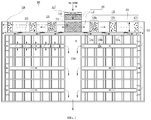
- FIG. 1 is a mimetic diagram showing the media filter having the nonpowered mixing and coagulation basin according to an exemplary embodiment.
- the media filter having the mixing and coagulation basin according to the present disclosure includes: a mixing and coagulation basin 100 for coagulating particles to form flocs and growing them when a coagulant is put in raw water; and a plurality of filter basins 200 for filtering and removing the flocs contained in the raw water using media filling the inside of the filter basin, wherein the mixing and coagulation basin 100 includes: a first mixing and coagulation part 110 which is filled with first turbulence derivatives 111 to generate high speed turbulence to form flocs in the raw water; and a second mixing and coagulation part 120 which is filled with second turbulence derivatives 121 to generate turbulence slower than the turbulence of the first mixing and coagulation part 110 so as to grow the flocs in the raw water passing the first mixing and coagulation part 110 so that particles contained in the raw water are
- the media filter having the mixing and coagulation basin according to the present disclosure can be supplied with raw water from the outside through the supply channel 300.
- the supply channel 300 includes: an inflow channel 310 through which the raw water to be treated flows in from the outside; and a distribution channel 320 which supplies the raw water to a plurality of the filter basins 200.
- the first mixing and coagulation part 110 is disposed inside the inflow channel 310, and the second mixing and coagulation part 120 is disposed inside the distribution channel 320.
- a partition be disposed to divide the inflow channel 310 and the distribution channel 320 so that the raw water passing the inflow channel 310 is supplied to the distribution channel 320 by a waterfall through the partition.
- the inflow channel 310 includes: a first partition 311 which is mounted at right angles to the bottom at a position spaced apart from the bottom of the inflow channel 310 at a predetermined interval to partition an inner space of the inflow channel 310, and the inner spaces of the inflow channel 310 partitioned by the first partition 311 are respectively filled with the first turbulence derivatives 111a and 111b. So, the raw water passes the first turbulence derivative 111a in the downstream direction, and then, passes the first turbulence derivative 111b in the upstream direction to be transferred to the distribution channel 320.
- the first mixing and coagulation part 110 is a watertight space where the particles contained in the raw water can form flocs by contact with the coagulant while being circulated by the turbulences, and includes the first turbulence derivatives 111 disposed in the downstream direction and/or in the upstream direction and an inflow pipe disposed at an upper part of the first mixing and coagulation part 110.
- the raw water flown in through the inflow pipe in the form of a straight water flow forms a rapid turbulent flow while passing the first turbulent derivatives 111 filling the inside of the first mixing and coagulation part 110, so that the particles contained in the raw water come into contact with the coagulant to form flocs by the turbulences.
- the first turbulent derivatives 111 may have the form that mesh-type materials are stacked manifold or the form that a plurality of fiber aggregates get tangled together, preferably, may be stacked asymmetrically not to vertically coincide pores with each other between the mesh-type material having pores and the neighboring mesh-type material.
- the filter media according to the present disclosure can generate turbulences by gravity while the raw water passes the mesh-type materials and control the speed of turbulences generated according to sizes of the pores.
- the treated water passing the first mixing and coagulation part 110 is transferred to the distribution channel 320 by waterfall, the treated water passes the second mixing and coagulation part 120 disposed inside the distribution channel or passes a bypass flow path 322 in parallel with the downstream direction of the second mixing and coagulation part 120, and then, is transferred to the filter basins 200.
- the distribution channel 320 includes: a main flow path 321 having the second mixing and coagulation part 120; the bypass flow path 322 disposed in parallel with the main flow path 321; a second partition 323 for partitioning the main flow path 321 from the bypass flow path 322; and at least one sluice 324 (342a, 324b, 324c) disposed on the second partition 323 in order to transfer the treated water flown into the main flow path 321 to the bypass flow path 322.
- the sluice 324 of the second partition 323 for partitioning the second mixing and coagulation part 120 from the bypass flow path 322 can control a flow of the raw water to pass a stage of the second mixing and coagulation part 120 which is filled with a plurality of pall ring type materials according to conditions of the raw water.
- the second mixing and coagulation part 120 is a space for growing the flocs contained in the treated water by the slow turbulence generated while the treated water passing the first mixing and coagulation part 110 passes the second turbulence derivatives 121.
- the downstream area of the second mixing and coagulation part 120 can communicate with the filter basin 200A for filtering the treated water containing the flocs.
- the rapid turbulence of the first mixing and coagulation part 110 and the slow turbulence of the second mixing and coagulation part 120 are not specifically limited in speed, and can be defined by a relative difference in turbulent strength inside the first mixing and coagulation part 110 and the second mixing and coagulation part 120.
- the second turbulence derivatives 121 are filled with a plurality of the pall ring type materials, and preferably, a plurality of separate stages which are filled with a plurality of the pall ring type materials are arranged side by side in multiple stages.
- the number of the stages can be controlled according to conditions of the raw water, and it is preferable that the stages be separated from each other and packing density get gradually smaller toward the downstream area. The reason is that turbulence diminishes in speed and flocs can grow more when packing density becomes lower.
- the filter basin 200A is a dual media filtration basin which is filled with media with different specific gravities in two stages in order to provide effective filtration.
- the dual media filtration method and the media used for the dual media filtration are not specifically limited if they are used to filter suspended matters and foreign matters which are generally contained in raw water, their detailed descriptions will be omitted.
- the media filter having the nonpowered mixing and coagulation basin can control the number of the stages of the second mixing and coagulation part 120 and control the flow of the raw water through the bypass flow path 322 according to the conditions of the raw water.
- the flocs can be controlled in flow to select a first flow to direct the flocs toward the filter basin 200A not through the multiple stages of the second mixing and coagulation part 120 but through the bypass flow path 322, a second flow to direct the flocs toward the filter basin 200A in such a way that the flocs pass some of the multiple stages of the second mixing and coagulation part 120 from the first mixing and coagulation part 110 and are transferred to the bypass flow path 322 through the sluice 324 included in the second partition 323, and a third flow to direct the flocs toward the filter basin 200A after passing the first mixing and coagulation part 110 and the second mixing and coagulation part 120.
- the media filter according to the present disclosure can selectively control the flow of the treated water from the first flow to the third flow according to conditions, temporary problems and states of the raw water, thereby reducing operation expenses.
- a seawater desalination plant carries out desalination using reverse osmosis after carrying out pre-treatment to seawater through the media filter having the nonpowered mixing and coagulation basin.
- the seawater desalination plant obtains fresh water through the steps of: making raw water, namely, seawater, get in contact with a coagulant through the media filter having the nonpowered mixing and coagulation basin to form and grow up flocs; carrying out pre-treatment by filtering the flocs through the filter basin 200A to remove organic contaminants or inorganic solid bodies in the seawater; and desalting seawater by passing the pre-treated seawater through a desalinator.
- the desalinator includes a reverse osmosis membrane with a hole diameter of about 1 nm to 2 nm. It is preferable that the reverse osmosis membrane be in a spiral form, a tubular form or a hollow fiber membrane form to treat a great deal of seawater.
- the seawater desalination plant using the media filter having the nonpowered mixing and coagulation basin can recover efficiency through backwash when the media filter or the desalinator which are the pre-treatment devices are deteriorated in efficiency by long-term operation, and can desalinate seawater through repeated recycling.
- the present disclosure provides a nonpowered mixing and coagulation basin and a dissolved air floatation apparatus using the same according to a further preferred embodiment.
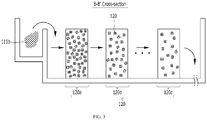
- FIG. 4 is a mimetic diagram showing a nonpowered mixing and coagulation basin 100 according to an exemplary embodiment of the present disclosure.
- the nonpowered mixing and coagulation basin which coagulates coagulant injected into raw water and particles inside the raw water to form and grow up flocs, in order to substitute for functions of the conventional mechanical mixing and coagulation basin, includes: a first mixing and coagulation part 110 which is filled with first turbulence derivatives 111 to generate high speed turbulence to first form flocs in the raw water; and a second mixing and coagulation part 120 which is filled with second turbulence derivatives 121 to generate turbulence slower than the turbulence of the first mixing and coagulation part 110 so as to second grow the flocs in the raw water passing the first mixing and coagulation part 110, so that the particles contained in the raw water are coagulated into a predetermined size by coming into contact with the coagulant while circulating inside the mixing and coagulation basin by turbulent flows without any stirring power.
- the nonpowered mixing and coagulation basin 100 further includes a porous separation membrane 130 for partitioning the first mixing and coagulation part 110 and the second mixing and coagulation part 120 in order to maintain different turbulence intensities between the first mixing and coagulation part 110 and the second mixing and coagulation part 120.
- the first mixing and coagulation part 110 is a watertight space to form flocs while the particles contained in the raw water are circulated by turbulent flows generated when the raw water flowing into the first mixing and coagulation part 110 passes the first turbulent derivatives 111, and has an inflow pipe disposed at the upper side to make the raw water flow in.
- the raw water flowing through the inflow pipe in the form of a straight flow forms a high-speed turbulence while passing the first turbulent derivatives 111 charged in the first mixing and coagulation part 110, and the particles contained in the raw water and the coagulant come into contact with each other by the turbulence so as to form floes.
- the first turbulent derivatives 111 are mesh-type materials which are stacked manifold ora plurality of fiber aggregates which get tangled together, and preferably, may be stacked asymmetrically not to vertically coincide pores with each other between the mesh-type material having pores and the neighboring mesh-type material.
- the filter media according to the present disclosure can generate turbulences by gravity while the raw water passes the mesh-type materials and control the speed of turbulences generated according to sizes of the pores.
- the second mixing and coagulation part 120 is a space for growing the flocs contained in the raw water due to a slow-speed turbulence generated when the treated water passing the first mixing and coagulation part 110 passes the second turbulent derivatives 121, and includes a treated water discharge pipe mounted at the lower side for discharging the treated water in which the flocs are contained.
- the second turbulent derivatives 121 has the form that is filled with a plurality of pall ring type materials, preferably, may be formed by a plurality of separate stages filled with the plural pall ring type materials which are stacked in multilayers.
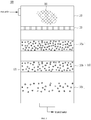
- FIG. 5 is a schematically mimetic diagram showing a nonpowered mixing and coagulation basin 100 having the second mixing and coagulation basin 120 which has the form that the stages filled with the plural pall ring type materials are stacked in multilayers.
- the number of the stages of the separated type which are respectively filled with the pall ring type materials can be regulated according to conditions of the raw water. It is preferable that the stages be disposed to get smaller in packing density of the pall ring type materials toward the downstream side. The reason is that it can grow up the flocs bigger because turbulence speed gets slower when packing density gets lower.
- the separation membrane 130 is to partition the first mixing and coagulation part 110 from the second mixing and coagulation part 120 in order to maintain different turbulence speeds between the first mixing and coagulation part 110 and the second mixing and coagulation part 120.
- the first mixing and coagulation part 110 generates rapid-speed turbulence and the second mixing and coagulation part 120 generates slow-speed turbulence to form and grow up the flocs by coagulating the particles contained in the raw water.
- the first mixing and coagulation part 110 is disposed above the second mixing and coagulation part 120, so that the raw water put in the first mixing and coagulation part generates rapid-speed turbulence while passing the first turbulent derivatives 111 to first form flocs. After that, the raw water goes through the pores of the separation membrane 130 by gravity, and grows up the flocs formed in the first mixing and coagulation part due to slow-speed turbulence formed while passing the stages 120a, 120b and 120c filled with the second turbulent derivatives 121 of the second mixing and coagulation part.
- FIG. 6 is a mimetic diagram showing a dissolved air floatation apparatus having a nonpowered mixing and coagulation basin according to a further exemplary embodiment of the present disclosure.
- the dissolved air flotation (DAF) apparatus includes a mixing and coagulation basin for coagulating foreign matters when coagulant is put in raw water and a floatation basin 200B for floating and removing flocs when microbubbles are injected to the raw water.
- DAF dissolved air flotation
- the nonpowered mixing and coagulation basin includes: a first mixing and coagulation part 110 which is filled with first turbulence derivatives 111 to generate high speed turbulence to form flocs in the raw water; and a second mixing and coagulation part 120 which is filled with second turbulence derivatives 121 to generate turbulence slower than the turbulence of the first mixing and coagulation part 110 so as to grow the flocs in the raw water passing the first mixing and coagulation part 110.
- the nonpowered mixing and coagulation basin 100 is disposed at the front end of the floatation basin 200B.
- the dissolved air floatation apparatus may further include: an additional coagulation basin 150 which has an agitator 160 mounted between the mixing and coagulation basin 100 and the floatation basin 200B; and a bypass channel 140 to directly transfer the flocs from the first mixing and coagulation part 110 to the additional coagulation basin 150.
- the first mixing and coagulation part 110 is disposed above the second mixing and coagulation part 120, so that the raw water put in the first mixing and coagulation part 110 passes the second mixing and coagulation part 120 by gravity.
- the dissolved air floatation apparatus having the nonpowered mixing and coagulation basin can control the number of the stages 120a, 120b and 120c of the second mixing and coagulation part 120 or control the flow through the bypass channel 140 and the agitator 160 according to the conditions of the raw water requiring water treatment.
- the agitator 160 included in the additional coagulation basin is operated, and then, a first flow to direct the floatation basin 200B through the second mixing and coagulation part 120 and the additional coagulation basin 150 from the first mixing and coagulation part 110 and a second flow to direct the floatation basin 200B through the bypass channel 140 and the additional coagulation basin 150 from the first mixing and coagulation part 110 are selectively controlled.
- a third flow to direct the floatation basin 200B through the second mixing and coagulation part 120 from the first mixing and coagulation part 110 and a fourth flow to direct the floatation basin 200B through the bypass channel 140 from the first mixing and coagulation part 110 are selectively controlled.
- the flow of the treated water can be selectively controlled into the first flow to the fourth flow according to conditions of the raw water, temporary problems and situations, so that operating costs can be reduced.
- the treated waters discharged before and after the nonpowered mixing and coagulation basin is installed at the front end of the floatation basin of the dissolved air floatation apparatus were measured in turbidity and total suspended solids (TSS).
Landscapes
- Chemical & Material Sciences (AREA)
- Engineering & Computer Science (AREA)
- Water Supply & Treatment (AREA)
- Life Sciences & Earth Sciences (AREA)
- Hydrology & Water Resources (AREA)
- Environmental & Geological Engineering (AREA)
- Organic Chemistry (AREA)
- Chemical Kinetics & Catalysis (AREA)
- Nanotechnology (AREA)
- General Chemical & Material Sciences (AREA)
- Separation Of Suspended Particles By Flocculating Agents (AREA)
Claims (13)
- Média filtrant incluant :un bassin de mélange et de coagulation (100) configuré pour faire coaguler des particules pour former des flocs et pour développer les flocs lorsqu'un coagulant est placé dans de l'eau brute, etune pluralité de bassins de filtration (200A) configurés pour filtrer et retirer les flocs contenus dans l'eau brute en utilisant un média remplissant l'intérieur du bassin de filtration,dans lequel le bassin de mélange et de coagulation (100) est disposé à l'intérieur d'un chenal d'alimentation (300) par lequel l'eau brute est transférée vers la pluralité de bassins de filtration (200A) et comporte :une première partie de mélange et de coagulation (110) qui est remplie de premiers éléments de dérivation turbulents (111) pour générer des turbulences pour former des flocs dans l'eau brute ; etune seconde partie de mélange et de coagulation (120) qui est remplie de seconds éléments de dérivation turbulents (121) pour générer des turbulences plus lentes que les turbulences de la première partie de mélange et de coagulation (110) de manière à développer en plus les flocs dans l'eau brute passant à partir de la première partie de mélange et de coagulation (110) ; etdans lequel le chenal d'alimentation (300) comporte : un chenal d'écoulement d'entrée (310) par lequel l'eau brute à traiter entre par écoulement depuis l'extérieur et un chenal de distribution (320) qui fournit l'eau brute à la pluralité de bassins de filtration (200A) ;caractérisé en ce que le chenal de distribution (320) comporte :un trajet d'écoulement principal (321) ayant la seconde partie de mélange et de coagulation (120), et un trajet d'écoulement de dérivation (322) disposé parallèlement au trajet d'écoulement principal (321) ;une seconde séparation (323) pour séparer le trajet d'écoulement principal (321) du trajet d'écoulement de dérivation (322) ; etau moins une vanne de vidange (324) disposée sur la seconde séparation (323) afin de transférer l'eau traitée s'étant écoulée dans le trajet d'écoulement principal (321) vers le trajet d'écoulement de dérivation (322).
- Média filtrant selon la revendication 1, dans lequel le chenal d'écoulement d'entrée (310) comporte : une première séparation (311) qui est montée à angles droits par rapport à un fond du chenal d'écoulement d'entrée (310) et à une position espacée du fond du chenal d'écoulement d'entrée (310) à un intervalle prédéterminé pour séparer un espace intérieur du chenal d'écoulement d'entrée (310) en une pluralité d'espaces intérieurs.
- Média filtrant selon la revendication 2, dans lequel les espaces intérieurs du chenal d'écoulement d'entrée (310) séparé par la première séparation (311) sont respectivement remplis des premiers éléments de dérivation turbulents (111), de telle sorte que l'eau brute passe dans les premiers éléments de dérivation turbulents (111) dans la direction aval et passe dans les premiers éléments de dérivation turbulents (311) dans la direction amont pour être transférée vers le chenal de distribution (320).
- Média filtrant selon l'une quelconque des revendications 1, 2 et 3, dans lequel la seconde partie de mélange et de coagulation (120) est disposée à l'intérieur du chenal de distribution (320), et les seconds éléments de dérivation turbulents (121) remplissent les espaces intérieurs du chenal de distribution (320) côte à côte dans la direction aval.
- Média filtrant selon l'une quelconque des revendications précédentes, dans lequel une pluralité d'étages qui sont remplis des seconds éléments de dérivation turbulents (121) sont espacés les uns des autres et agencés côte à côte en série.
- Média filtrant selon l'une quelconque des revendications précédentes, dans lequel le bassin de filtration inclut une filtration sur média double (DMF).
- Média filtrant selon l'une quelconque des revendications précédentes, dans lequel le bassin de mélange et de coagulation (100) comporte en outre :
une membrane de séparation poreuse (130) qui sépare la première partie de mélange et de coagulation (110) de la seconde partie de mélange et de coagulation (120) afin de maintenir différentes intensités de turbulence entre la première partie de mélange et de coagulation (110) et la seconde partie de mélange et de coagulation (120). - Média filtrant selon l'une quelconque des revendications précédentes, dans lequel la première partie de mélange et de coagulation (110) est disposée au-dessus de la seconde partie de mélange et de coagulation (120) de sorte que l'eau brute passant dans la première partie de mélange et de coagulation (110) est fournie à la seconde partie de mélange et de coagulation (120) par gravité.
- Média filtrant selon l'une quelconque des revendications précédentes, dans lequel les premiers éléments de dérivation turbulents (111) incluent des matériaux de type maillage qui sont empilés à la manière d'un collecteur et/ou une pluralité d'agrégats de fibres qui s'enchevêtrent ensemble.
- Média filtrant selon l'une quelconque des revendications précédentes, dans lequel les seconds éléments de dérivation turbulents (121) incluent une pluralité de matériaux de type anneau Pall.
- Média filtrant selon la revendication 10, dans lequel la seconde partie de mélange et de coagulation (120) a une pluralité d'étages qui sont remplis d'une pluralité de matériaux de type anneau Pall et sont espacés les uns des autres.
- Média filtrant selon la revendication 11, dans lequel les étages sont disposés de manière à réduire la densité de tassement des matériaux de type anneau Pall vers le côté aval.
- Installation de désalinisation d'eau de mer comportant un média filtrant selon l'une quelconque des revendications 1 à 12 pour exécuter un processus de pré-traitement pour éliminer des polluants à l'intérieur de l'eau de mer à travers le média filtrant.
Applications Claiming Priority (2)
| Application Number | Priority Date | Filing Date | Title |
|---|---|---|---|
| KR1020150062718A KR101694919B1 (ko) | 2015-05-04 | 2015-05-04 | 무동력 혼화응집조 및 이를 포함하는 용존공기부상장치 |
| KR1020150064887A KR101697357B1 (ko) | 2015-05-08 | 2015-05-08 | 무동력 혼화응집조를 포함한 여과장치 및 이를 이용한 해수담수화 플랜트 |
Publications (2)
| Publication Number | Publication Date |
|---|---|
| EP3090793A1 EP3090793A1 (fr) | 2016-11-09 |
| EP3090793B1 true EP3090793B1 (fr) | 2020-07-22 |
Family
ID=55913431
Family Applications (1)
| Application Number | Title | Priority Date | Filing Date |
|---|---|---|---|
| EP16157758.0A Active EP3090793B1 (fr) | 2015-05-04 | 2016-02-28 | Filtre de média comprenant une coagulation/floculation à plusieurs étapes |
Country Status (2)
| Country | Link |
|---|---|
| US (2) | US10550018B2 (fr) |
| EP (1) | EP3090793B1 (fr) |
Families Citing this family (4)
| Publication number | Priority date | Publication date | Assignee | Title |
|---|---|---|---|---|
| US11141702B1 (en) * | 2018-10-04 | 2021-10-12 | Terrence W. Aylesworth | Multi-functional multi-layer hollow fiber membrane containing embedded magnetic particles |
| CN110950403B (zh) * | 2019-12-19 | 2022-08-09 | 饶玉明 | 一种基于水体湍动防堵的石墨烯海水盐分去除装置 |
| CN212687795U (zh) * | 2020-07-06 | 2021-03-12 | 华电水务工程有限公司 | 一种海水淡化用气浮预处理系统 |
| CN115259321B (zh) * | 2022-08-23 | 2023-08-08 | 哈尔滨优方净水科技有限公司 | 一种可调节气液多相异向混合絮凝一体化网格混凝系统 |
Citations (1)
| Publication number | Priority date | Publication date | Assignee | Title |
|---|---|---|---|---|
| WO2011139089A2 (fr) * | 2010-05-06 | 2011-11-10 | 주식회사 두합 크린텍 | Dispositif de traitement de l'eau propre et des eaux d'égout/eaux usées de type à courant descendant naturel permettant d'économiser de l'énergie |
Family Cites Families (22)
| Publication number | Priority date | Publication date | Assignee | Title |
|---|---|---|---|---|
| US2242139A (en) * | 1938-03-25 | 1941-05-13 | Walter C Munroe | Method and apparatus for water purification |
| US2275954A (en) | 1939-01-09 | 1942-03-10 | Gibson William Robert | Water treatment plant |
| US3235234A (en) * | 1963-02-11 | 1966-02-15 | Pacific Flush Tank Co | Apparatus for aerating water |
| US3545619A (en) * | 1969-04-09 | 1970-12-08 | Neptune Microfloc Inc | Water treatment plant |
| JPS5750513A (en) * | 1980-09-11 | 1982-03-25 | Japan Organo Co Ltd | Filtration tank added with contact settling tank |
| JPH0538492A (ja) | 1991-08-05 | 1993-02-19 | Mitsubishi Heavy Ind Ltd | 海水の淡水化装置における海水の濾過方法 |
| JP3640285B2 (ja) | 1997-12-26 | 2005-04-20 | オルガノ株式会社 | 凝集沈殿装置 |
| FR2890651B1 (fr) | 2005-09-09 | 2007-11-09 | Degremont Sa | Appareil de clarification des eaux et procede de mise en oeuvre. |
| KR20080001604A (ko) | 2006-06-29 | 2008-01-03 | 주식회사 하이닉스반도체 | 테스트용 듀얼 인 라인 메모리 모듈 및 그 테스트시스템 |
| US20100133196A1 (en) * | 2007-08-18 | 2010-06-03 | Boris Mikhail Khudenko | Combined gravity separation-filtration for conducting treatment processes in solid-liquid systems |
| KR100916709B1 (ko) | 2007-08-21 | 2009-09-11 | 한국수자원공사 | 무동력 관내 혼화장치 |
| KR20080001604U (ko) | 2008-05-10 | 2008-06-09 | 김상철 | 가압기체용해장치 |
| KR101133174B1 (ko) | 2009-10-07 | 2012-04-06 | 한국건설기술연구원 | 용존공기부상법을 이용한 자가동력식 이동형 수처리 시스템 및 이를 이용한 중소규모 수체에 대한 자동제어 방식의 수처리 방법 |
| CN201908018U (zh) | 2009-12-01 | 2011-07-27 | 李进民 | 污水处理装置 |
| KR101253054B1 (ko) | 2009-12-15 | 2013-04-10 | 한국건설기술연구원 | 역삼투 방식의 해수담수화 공정에서의 순환형 농축침전조와 분리막 여과조 일체식 전처리 장치 및 전처리 방법 |
| KR100988474B1 (ko) | 2010-06-01 | 2010-10-18 | 주식회사두합크린텍 | 상수 및 하폐수 처리용 플록형성지 |
| KR101081771B1 (ko) | 2011-05-25 | 2011-11-09 | 한밭대학교 산학협력단 | 조합이 가능한 압력수로식 혼화 응집장치 |
| KR101322610B1 (ko) | 2011-07-26 | 2013-10-29 | 주식회사 오이코스 | 수처리용 생물막 여과장치 |
| KR101289699B1 (ko) | 2011-09-01 | 2013-07-26 | 이봉기 | 위어식 혼화기와 배플을 이용한 응집제 혼화 방법 |
| FR2995603B1 (fr) * | 2012-09-19 | 2014-09-26 | Veolia Water Solutions & Tech | Procede de traitement d’eau comprenant une flottation combinee a une filtration gravitaire et installation correspondante |
| KR101529272B1 (ko) | 2012-10-11 | 2015-06-17 | 주식회사 생 | 정수장치 모듈 구조 |
| KR101491001B1 (ko) | 2014-05-13 | 2015-02-24 | 주식회사 에스디알앤디 | 다단 부상분리장치 |
-
2016
- 2016-01-06 US US14/989,308 patent/US10550018B2/en active Active
- 2016-02-28 EP EP16157758.0A patent/EP3090793B1/fr active Active
-
2019
- 2019-12-26 US US16/727,868 patent/US11427486B2/en active Active
Patent Citations (1)
| Publication number | Priority date | Publication date | Assignee | Title |
|---|---|---|---|---|
| WO2011139089A2 (fr) * | 2010-05-06 | 2011-11-10 | 주식회사 두합 크린텍 | Dispositif de traitement de l'eau propre et des eaux d'égout/eaux usées de type à courant descendant naturel permettant d'économiser de l'énergie |
Also Published As
| Publication number | Publication date |
|---|---|
| US10550018B2 (en) | 2020-02-04 |
| EP3090793A1 (fr) | 2016-11-09 |
| US11427486B2 (en) | 2022-08-30 |
| US20160326029A1 (en) | 2016-11-10 |
| US20200131060A1 (en) | 2020-04-30 |
Similar Documents
| Publication | Publication Date | Title |
|---|---|---|
| KR100988474B1 (ko) | 상수 및 하폐수 처리용 플록형성지 | |
| US11427486B2 (en) | Media filter having nonpowered mixing and coagulation basin, and seawater desalination plant and dissolved air floatation apparatus using same | |
| KR100999369B1 (ko) | 하·폐수 및 오·탁수 처리용 일체형 수처리장치 | |
| KR101820864B1 (ko) | 섬유볼을 내장한 용존 공기 부상형 전처리 장치 및 이를 이용한 용존 공기 부상형 수처리 방법 | |
| KR101336169B1 (ko) | 침전과 부상을 연계한 고도정수처리장치 | |
| KR100980464B1 (ko) | 하수고도처리장치 | |
| KR101999229B1 (ko) | 총인제거를 위한 응집혼화반응 일체형 직접여과장치 | |
| KR101740264B1 (ko) | 하폐수처리 시스템용 완속교반 침전조 | |
| KR101689151B1 (ko) | 폐수 처리 장치 및 이에 적합한 양방향 여과 장치 | |
| KR101539727B1 (ko) | 전기응집과 전자석을 이용한 총인 제거방법 및 장치 | |
| Watanabe et al. | Enhanced flocculation/sedimentation process by a jet mixed separator | |
| JP2006043626A (ja) | 水処理装置 | |
| KR20140099060A (ko) | 고속 침전 여과장치를 이용한 터널폐수 처리 시스템 | |
| KR101697357B1 (ko) | 무동력 혼화응집조를 포함한 여과장치 및 이를 이용한 해수담수화 플랜트 | |
| KR101416070B1 (ko) | 오폐수 정화 설비용 인 회수장치 | |
| KR101694919B1 (ko) | 무동력 혼화응집조 및 이를 포함하는 용존공기부상장치 | |
| JP2011140003A (ja) | 濁水処理装置及び濁水処理方法 | |
| KR101045878B1 (ko) | 상하수 고도 처리를 위한 고효율 하이브리드 침전지 | |
| KR20050092154A (ko) | 폐수 처리 장치 | |
| KR101852005B1 (ko) | 슬러지의 침전 및 탈수를 이용한 수처리 장치 및 이를 이용한 수처리 방법 | |
| KR101734513B1 (ko) | 고농도 인 및 부유물질 함유 하·폐수처리 시스템 | |
| CN108996770B (zh) | 一种快速高效除油气浮滤池 | |
| JP2017159213A (ja) | 凝集処理方法および装置 | |
| KR100963290B1 (ko) | 슬러지 순환기능을 갖춘 2단 여과장치 | |
| KR101787078B1 (ko) | 부상형 여과장치 및 여과방법 |
Legal Events
| Date | Code | Title | Description |
|---|---|---|---|
| PUAI | Public reference made under article 153(3) epc to a published international application that has entered the european phase |
Free format text: ORIGINAL CODE: 0009012 |
|
| AK | Designated contracting states |
Kind code of ref document: A1 Designated state(s): AL AT BE BG CH CY CZ DE DK EE ES FI FR GB GR HR HU IE IS IT LI LT LU LV MC MK MT NL NO PL PT RO RS SE SI SK SM TR |
|
| AX | Request for extension of the european patent |
Extension state: BA ME |
|
| STAA | Information on the status of an ep patent application or granted ep patent |
Free format text: STATUS: REQUEST FOR EXAMINATION WAS MADE |
|
| 17P | Request for examination filed |
Effective date: 20170125 |
|
| RBV | Designated contracting states (corrected) |
Designated state(s): AL AT BE BG CH CY CZ DE DK EE ES FI FR GB GR HR HU IE IS IT LI LT LU LV MC MK MT NL NO PL PT RO RS SE SI SK SM TR |
|
| STAA | Information on the status of an ep patent application or granted ep patent |
Free format text: STATUS: EXAMINATION IS IN PROGRESS |
|
| 17Q | First examination report despatched |
Effective date: 20181015 |
|
| RAP1 | Party data changed (applicant data changed or rights of an application transferred) |
Owner name: DOOSAN HEAVY INDUSTRIES & CONSTRUCTION CO., LTD. |
|
| REG | Reference to a national code |
Ref country code: DE Ref legal event code: R079 Ref document number: 602016040259 Country of ref document: DE Free format text: PREVIOUS MAIN CLASS: B01D0021080000 Ipc: B01D0061040000 |
|
| RIC1 | Information provided on ipc code assigned before grant |
Ipc: B01D 61/04 20060101AFI20200317BHEP Ipc: C02F 1/44 20060101ALI20200317BHEP Ipc: C02F 1/28 20060101ALI20200317BHEP Ipc: C02F 1/52 20060101ALI20200317BHEP Ipc: C02F 1/00 20060101ALI20200317BHEP Ipc: C02F 103/08 20060101ALI20200317BHEP Ipc: C02F 1/24 20060101ALI20200317BHEP Ipc: C02F 9/00 20060101ALI20200317BHEP |
|
| GRAP | Despatch of communication of intention to grant a patent |
Free format text: ORIGINAL CODE: EPIDOSNIGR1 |
|
| STAA | Information on the status of an ep patent application or granted ep patent |
Free format text: STATUS: GRANT OF PATENT IS INTENDED |
|
| INTG | Intention to grant announced |
Effective date: 20200507 |
|
| GRAS | Grant fee paid |
Free format text: ORIGINAL CODE: EPIDOSNIGR3 |
|
| GRAA | (expected) grant |
Free format text: ORIGINAL CODE: 0009210 |
|
| STAA | Information on the status of an ep patent application or granted ep patent |
Free format text: STATUS: THE PATENT HAS BEEN GRANTED |
|
| AK | Designated contracting states |
Kind code of ref document: B1 Designated state(s): AL AT BE BG CH CY CZ DE DK EE ES FI FR GB GR HR HU IE IS IT LI LT LU LV MC MK MT NL NO PL PT RO RS SE SI SK SM TR |
|
| REG | Reference to a national code |
Ref country code: GB Ref legal event code: FG4D |
|
| REG | Reference to a national code |
Ref country code: CH Ref legal event code: EP |
|
| REG | Reference to a national code |
Ref country code: DE Ref legal event code: R096 Ref document number: 602016040259 Country of ref document: DE |
|
| REG | Reference to a national code |
Ref country code: AT Ref legal event code: REF Ref document number: 1292886 Country of ref document: AT Kind code of ref document: T Effective date: 20200815 |
|
| REG | Reference to a national code |
Ref country code: IE Ref legal event code: FG4D |
|
| REG | Reference to a national code |
Ref country code: LT Ref legal event code: MG4D |
|
| REG | Reference to a national code |
Ref country code: AT Ref legal event code: MK05 Ref document number: 1292886 Country of ref document: AT Kind code of ref document: T Effective date: 20200722 |
|
| PG25 | Lapsed in a contracting state [announced via postgrant information from national office to epo] |
Ref country code: ES Free format text: LAPSE BECAUSE OF FAILURE TO SUBMIT A TRANSLATION OF THE DESCRIPTION OR TO PAY THE FEE WITHIN THE PRESCRIBED TIME-LIMIT Effective date: 20200722 Ref country code: BG Free format text: LAPSE BECAUSE OF FAILURE TO SUBMIT A TRANSLATION OF THE DESCRIPTION OR TO PAY THE FEE WITHIN THE PRESCRIBED TIME-LIMIT Effective date: 20201022 Ref country code: FI Free format text: LAPSE BECAUSE OF FAILURE TO SUBMIT A TRANSLATION OF THE DESCRIPTION OR TO PAY THE FEE WITHIN THE PRESCRIBED TIME-LIMIT Effective date: 20200722 Ref country code: NO Free format text: LAPSE BECAUSE OF FAILURE TO SUBMIT A TRANSLATION OF THE DESCRIPTION OR TO PAY THE FEE WITHIN THE PRESCRIBED TIME-LIMIT Effective date: 20201022 Ref country code: GR Free format text: LAPSE BECAUSE OF FAILURE TO SUBMIT A TRANSLATION OF THE DESCRIPTION OR TO PAY THE FEE WITHIN THE PRESCRIBED TIME-LIMIT Effective date: 20201023 Ref country code: SE Free format text: LAPSE BECAUSE OF FAILURE TO SUBMIT A TRANSLATION OF THE DESCRIPTION OR TO PAY THE FEE WITHIN THE PRESCRIBED TIME-LIMIT Effective date: 20200722 Ref country code: AT Free format text: LAPSE BECAUSE OF FAILURE TO SUBMIT A TRANSLATION OF THE DESCRIPTION OR TO PAY THE FEE WITHIN THE PRESCRIBED TIME-LIMIT Effective date: 20200722 Ref country code: PT Free format text: LAPSE BECAUSE OF FAILURE TO SUBMIT A TRANSLATION OF THE DESCRIPTION OR TO PAY THE FEE WITHIN THE PRESCRIBED TIME-LIMIT Effective date: 20201123 Ref country code: HR Free format text: LAPSE BECAUSE OF FAILURE TO SUBMIT A TRANSLATION OF THE DESCRIPTION OR TO PAY THE FEE WITHIN THE PRESCRIBED TIME-LIMIT Effective date: 20200722 Ref country code: LT Free format text: LAPSE BECAUSE OF FAILURE TO SUBMIT A TRANSLATION OF THE DESCRIPTION OR TO PAY THE FEE WITHIN THE PRESCRIBED TIME-LIMIT Effective date: 20200722 |
|
| PG25 | Lapsed in a contracting state [announced via postgrant information from national office to epo] |
Ref country code: IS Free format text: LAPSE BECAUSE OF FAILURE TO SUBMIT A TRANSLATION OF THE DESCRIPTION OR TO PAY THE FEE WITHIN THE PRESCRIBED TIME-LIMIT Effective date: 20201122 Ref country code: PL Free format text: LAPSE BECAUSE OF FAILURE TO SUBMIT A TRANSLATION OF THE DESCRIPTION OR TO PAY THE FEE WITHIN THE PRESCRIBED TIME-LIMIT Effective date: 20200722 Ref country code: LV Free format text: LAPSE BECAUSE OF FAILURE TO SUBMIT A TRANSLATION OF THE DESCRIPTION OR TO PAY THE FEE WITHIN THE PRESCRIBED TIME-LIMIT Effective date: 20200722 Ref country code: RS Free format text: LAPSE BECAUSE OF FAILURE TO SUBMIT A TRANSLATION OF THE DESCRIPTION OR TO PAY THE FEE WITHIN THE PRESCRIBED TIME-LIMIT Effective date: 20200722 |
|
| PG25 | Lapsed in a contracting state [announced via postgrant information from national office to epo] |
Ref country code: NL Free format text: LAPSE BECAUSE OF FAILURE TO SUBMIT A TRANSLATION OF THE DESCRIPTION OR TO PAY THE FEE WITHIN THE PRESCRIBED TIME-LIMIT Effective date: 20200722 |
|
| REG | Reference to a national code |
Ref country code: DE Ref legal event code: R097 Ref document number: 602016040259 Country of ref document: DE |
|
| PG25 | Lapsed in a contracting state [announced via postgrant information from national office to epo] |
Ref country code: RO Free format text: LAPSE BECAUSE OF FAILURE TO SUBMIT A TRANSLATION OF THE DESCRIPTION OR TO PAY THE FEE WITHIN THE PRESCRIBED TIME-LIMIT Effective date: 20200722 Ref country code: SM Free format text: LAPSE BECAUSE OF FAILURE TO SUBMIT A TRANSLATION OF THE DESCRIPTION OR TO PAY THE FEE WITHIN THE PRESCRIBED TIME-LIMIT Effective date: 20200722 Ref country code: EE Free format text: LAPSE BECAUSE OF FAILURE TO SUBMIT A TRANSLATION OF THE DESCRIPTION OR TO PAY THE FEE WITHIN THE PRESCRIBED TIME-LIMIT Effective date: 20200722 Ref country code: IT Free format text: LAPSE BECAUSE OF FAILURE TO SUBMIT A TRANSLATION OF THE DESCRIPTION OR TO PAY THE FEE WITHIN THE PRESCRIBED TIME-LIMIT Effective date: 20200722 Ref country code: CZ Free format text: LAPSE BECAUSE OF FAILURE TO SUBMIT A TRANSLATION OF THE DESCRIPTION OR TO PAY THE FEE WITHIN THE PRESCRIBED TIME-LIMIT Effective date: 20200722 Ref country code: DK Free format text: LAPSE BECAUSE OF FAILURE TO SUBMIT A TRANSLATION OF THE DESCRIPTION OR TO PAY THE FEE WITHIN THE PRESCRIBED TIME-LIMIT Effective date: 20200722 |
|
| PLBE | No opposition filed within time limit |
Free format text: ORIGINAL CODE: 0009261 |
|
| STAA | Information on the status of an ep patent application or granted ep patent |
Free format text: STATUS: NO OPPOSITION FILED WITHIN TIME LIMIT |
|
| PG25 | Lapsed in a contracting state [announced via postgrant information from national office to epo] |
Ref country code: AL Free format text: LAPSE BECAUSE OF FAILURE TO SUBMIT A TRANSLATION OF THE DESCRIPTION OR TO PAY THE FEE WITHIN THE PRESCRIBED TIME-LIMIT Effective date: 20200722 |
|
| 26N | No opposition filed |
Effective date: 20210423 |
|
| PG25 | Lapsed in a contracting state [announced via postgrant information from national office to epo] |
Ref country code: SK Free format text: LAPSE BECAUSE OF FAILURE TO SUBMIT A TRANSLATION OF THE DESCRIPTION OR TO PAY THE FEE WITHIN THE PRESCRIBED TIME-LIMIT Effective date: 20200722 |
|
| PG25 | Lapsed in a contracting state [announced via postgrant information from national office to epo] |
Ref country code: SI Free format text: LAPSE BECAUSE OF FAILURE TO SUBMIT A TRANSLATION OF THE DESCRIPTION OR TO PAY THE FEE WITHIN THE PRESCRIBED TIME-LIMIT Effective date: 20200722 |
|
| PG25 | Lapsed in a contracting state [announced via postgrant information from national office to epo] |
Ref country code: MC Free format text: LAPSE BECAUSE OF FAILURE TO SUBMIT A TRANSLATION OF THE DESCRIPTION OR TO PAY THE FEE WITHIN THE PRESCRIBED TIME-LIMIT Effective date: 20200722 |
|
| REG | Reference to a national code |
Ref country code: NL Ref legal event code: MP Effective date: 20200722 |
|
| GBPC | Gb: european patent ceased through non-payment of renewal fee |
Effective date: 20210228 |
|
| REG | Reference to a national code |
Ref country code: BE Ref legal event code: MM Effective date: 20210228 |
|
| PG25 | Lapsed in a contracting state [announced via postgrant information from national office to epo] |
Ref country code: LI Free format text: LAPSE BECAUSE OF NON-PAYMENT OF DUE FEES Effective date: 20210228 Ref country code: LU Free format text: LAPSE BECAUSE OF NON-PAYMENT OF DUE FEES Effective date: 20210228 Ref country code: CH Free format text: LAPSE BECAUSE OF NON-PAYMENT OF DUE FEES Effective date: 20210228 |
|
| PG25 | Lapsed in a contracting state [announced via postgrant information from national office to epo] |
Ref country code: FR Free format text: LAPSE BECAUSE OF NON-PAYMENT OF DUE FEES Effective date: 20210228 Ref country code: GB Free format text: LAPSE BECAUSE OF NON-PAYMENT OF DUE FEES Effective date: 20210228 Ref country code: IE Free format text: LAPSE BECAUSE OF NON-PAYMENT OF DUE FEES Effective date: 20210228 |
|
| PG25 | Lapsed in a contracting state [announced via postgrant information from national office to epo] |
Ref country code: BE Free format text: LAPSE BECAUSE OF NON-PAYMENT OF DUE FEES Effective date: 20210228 |
|
| PG25 | Lapsed in a contracting state [announced via postgrant information from national office to epo] |
Ref country code: HU Free format text: LAPSE BECAUSE OF FAILURE TO SUBMIT A TRANSLATION OF THE DESCRIPTION OR TO PAY THE FEE WITHIN THE PRESCRIBED TIME-LIMIT; INVALID AB INITIO Effective date: 20160228 |
|
| PG25 | Lapsed in a contracting state [announced via postgrant information from national office to epo] |
Ref country code: CY Free format text: LAPSE BECAUSE OF FAILURE TO SUBMIT A TRANSLATION OF THE DESCRIPTION OR TO PAY THE FEE WITHIN THE PRESCRIBED TIME-LIMIT Effective date: 20200722 |
|
| REG | Reference to a national code |
Ref country code: DE Ref legal event code: R082 Ref document number: 602016040259 Country of ref document: DE Representative=s name: TER MEER STEINMEISTER & PARTNER PATENTANWAELTE, DE |
|
| PG25 | Lapsed in a contracting state [announced via postgrant information from national office to epo] |
Ref country code: MK Free format text: LAPSE BECAUSE OF FAILURE TO SUBMIT A TRANSLATION OF THE DESCRIPTION OR TO PAY THE FEE WITHIN THE PRESCRIBED TIME-LIMIT Effective date: 20200722 |
|
| PG25 | Lapsed in a contracting state [announced via postgrant information from national office to epo] |
Ref country code: TR Free format text: LAPSE BECAUSE OF FAILURE TO SUBMIT A TRANSLATION OF THE DESCRIPTION OR TO PAY THE FEE WITHIN THE PRESCRIBED TIME-LIMIT Effective date: 20200722 |
|
| PG25 | Lapsed in a contracting state [announced via postgrant information from national office to epo] |
Ref country code: MT Free format text: LAPSE BECAUSE OF FAILURE TO SUBMIT A TRANSLATION OF THE DESCRIPTION OR TO PAY THE FEE WITHIN THE PRESCRIBED TIME-LIMIT Effective date: 20200722 |
|
| PGFP | Annual fee paid to national office [announced via postgrant information from national office to epo] |
Ref country code: DE Payment date: 20260102 Year of fee payment: 11 |