EP3106389B1 - Verfahren zum betreiben eines fahrwerksystems - Google Patents
Verfahren zum betreiben eines fahrwerksystems Download PDFInfo
- Publication number
- EP3106389B1 EP3106389B1 EP15382312.5A EP15382312A EP3106389B1 EP 3106389 B1 EP3106389 B1 EP 3106389B1 EP 15382312 A EP15382312 A EP 15382312A EP 3106389 B1 EP3106389 B1 EP 3106389B1
- Authority
- EP
- European Patent Office
- Prior art keywords
- landing gear
- extension
- nose
- main
- main landing
- Prior art date
- Legal status (The legal status is an assumption and is not a legal conclusion. Google has not performed a legal analysis and makes no representation as to the accuracy of the status listed.)
- Active
Links
Images



Classifications
-
- B—PERFORMING OPERATIONS; TRANSPORTING
- B64—AIRCRAFT; AVIATION; COSMONAUTICS
- B64C—AEROPLANES; HELICOPTERS
- B64C25/00—Alighting gear
- B64C25/02—Undercarriages
- B64C25/08—Undercarriages non-fixed, e.g. jettisonable
- B64C25/10—Undercarriages non-fixed, e.g. jettisonable retractable, foldable, or the like
- B64C25/18—Operating mechanisms
-
- B—PERFORMING OPERATIONS; TRANSPORTING
- B64—AIRCRAFT; AVIATION; COSMONAUTICS
- B64C—AEROPLANES; HELICOPTERS
- B64C25/00—Alighting gear
-
- B—PERFORMING OPERATIONS; TRANSPORTING
- B64—AIRCRAFT; AVIATION; COSMONAUTICS
- B64C—AEROPLANES; HELICOPTERS
- B64C25/00—Alighting gear
- B64C25/02—Undercarriages
- B64C25/04—Arrangement or disposition on aircraft
-
- B—PERFORMING OPERATIONS; TRANSPORTING
- B64—AIRCRAFT; AVIATION; COSMONAUTICS
- B64C—AEROPLANES; HELICOPTERS
- B64C25/00—Alighting gear
- B64C25/02—Undercarriages
- B64C25/08—Undercarriages non-fixed, e.g. jettisonable
- B64C25/10—Undercarriages non-fixed, e.g. jettisonable retractable, foldable, or the like
- B64C25/16—Fairings movable in conjunction with undercarriage elements
-
- B—PERFORMING OPERATIONS; TRANSPORTING
- B64—AIRCRAFT; AVIATION; COSMONAUTICS
- B64C—AEROPLANES; HELICOPTERS
- B64C25/00—Alighting gear
- B64C25/02—Undercarriages
- B64C25/08—Undercarriages non-fixed, e.g. jettisonable
- B64C25/10—Undercarriages non-fixed, e.g. jettisonable retractable, foldable, or the like
- B64C25/18—Operating mechanisms
- B64C25/26—Control or locking systems therefor
- B64C25/30—Control or locking systems therefor emergency actuated
-
- B—PERFORMING OPERATIONS; TRANSPORTING
- B64—AIRCRAFT; AVIATION; COSMONAUTICS
- B64C—AEROPLANES; HELICOPTERS
- B64C25/00—Alighting gear
- B64C25/001—Devices not provided for in the groups B64C25/02 - B64C25/68
- B64C2025/003—Means for reducing landing gear noise, or turbulent flow around it, e.g. landing gear doors used as deflectors
Definitions
- the present invention refers in general to aircraft landing gear systems, and more specifically to a method for extending and/or retracting a landing gear.
- An object of the present invention is to provide a method for operating a landing gear system, which reduces maintenance costs during an aircraft operational life, caused by fatigue damages in the main landing gear doors and ancillary components.
- the most widespread landing gear configuration in jet aircrafts is the "tricycle" configuration, which consists of two sets of main landing gear (port and starboard), and one set of forward or nose landing gear.
- the main landing gear is fitted to the aircraft wing, and the nose landing gear is fitted to a forward fuselage section.
- the main role of the main landing gear is to withstand the main loads transmitted between the ground and the aircraft during landing, whereas the main role of the nose landing gear is to provide an additional point of support for the aircraft, and to steer the aircraft on the ground during taxing.
- aircrafts are equipped with a hydraulic system to operate the landing gear, such as to extend or lower the landing gears for landing operations, and to retract the landing gear into corresponding gear bays for flight.
- Modern aircrafts also include gear doors for the main and nose landing gears, which closes the landing gear bays during flight and during part of the landing operation.
- the gear doors When an aircraft is rolling for taking off, the gear doors are normally closed and remain in this position after liftoff. As soon as the aircraft reaches a positive rate of climb, the pilot activates the landing gear retraction, and then the landing gear doors are open for receiving the landing gear into the landing gear bays, and after that, the gear doors are closed for the flight.
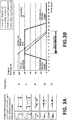
- the sequence traditionally used in prior art aircrafts for extending the landing gear for landings is illustrated in drawings 1 A,B, whereas the landing gear retraction for take-offs is illustrated in figures 3A, B .
- Landing gear extension begins with the opening of the gear doors to expose the gear bays.
- the extension of the nose and main landing gears is started, such as both nose and main lading gears are lowered at the same time, while the gear doors remain open. Once nose and main landing gears reach their final extended position, the gear doors are closed to cover the landing gear bays.
- the present invention avoids impacts on the main landing gear doors of the wake originated at the nose landing gear, by modifying the landing gear extension and/or retraction sequence in a way to significantly reduce the interface vibration loads of the Main Landing Gear Door (MLGD) attachments, with the purpose of enhancing fatigue life of the (MLGD) attachments, and to reduce thereby the associated maintenance costs during aircraft operational life.
- MLGD Main Landing Gear Door
- An aspect of the invention refers to a method for operating a landing gear system with a main landing gear arranged at a central section of an aircraft, for example two sets of landing gear symmetrically fitted to the aircraft wings, and a nose landing gear fitted to a forward section of the aircraft near its nose.
- the method is implemented in an aircraft having a main landing gear and nose landing gear arranged to form together a tricycle landing gear configuration.
- the main landing gear and the nose landing gear are operable reversely from a retracted position where they are housed inside corresponding landing gear bays, to an extended position where they are extended for landing and taxing the aircraft.
- the extension of the nose landing gear is delayed in time with respect to the extension of the main landing gear. That is, for extending the landing gear, first the extension of the main landing gear is started while the nose landing gear is kept retracted within a nose landing gear bay. For example, the extension of the nose landing gear is started once the main landing gear has reached their fully extended position or down position, and when the main landing gear doors are again closed or retracted (total decoupled movement).
- the extension of the nose landing gear is started when the main landing gear doors, during their closing movement of the extension operation, reach a predefined angular position (partially decoupled movement).
- predefined angular position of the main landing gear doors is less 50% of its fully extended position, and most preferably that predefined angular position is less than 10% of its fully extended position.
- the extension sequence according to the invention implies that the extension of the nose landing gear (NLG) is started shortly before, shortly after or at the same time as the beginning of the retraction of the main landing gear doors (MLGD), in such a manner that the nose landing gear (NLG) is kept retracted during the major part of the time that the main landing gear doors (MLGD) are fully extended.
- the technical effect associated to this extension sequence is that the vibration levels on the (MLGD) and especially in the doors fittings caused by the (NLG) presence are significantly reduced, simply by eliminating the cause of the excitation.
- the delayed extension of the nose landing gear may also refer to its angular speed, such as extension of the nose and main landing gear is started approximately at the same time, but the nose landing gear is extended at a slower angular speed than the main landing gear, in order to obtain the previously mentioned effect.
- the invention also applies to the retraction operation, such as the retraction of the main landing gear (MLG) is delayed in time with respect to the retraction of the nose landing gear (NLG).
- MLG main landing gear
- NVG nose landing gear
- the opposite procedure is performed for the retraction sequence in which the nose landing gear starts to retract first, while keeping the main landing gear extended and the main landing gear doors closed. Once the nose landing gear reach preferably less than 10% of it is fully retracted position, then the main landing gear doors starts to being extended.
- the retraction sequence according to the invention implies that the retraction of the nose landing gear (NLG) is finished shortly before, shortly after or at the same time that the beginning of the extension of the main landing gear doors (MLGD).
- gear doors refers to the gear bay doors that serve to at least partially cover the gear bays after extension of the corresponding landing gear.
- Another aspect of the invention refers to the landing gear operation control system, which is configured to operate in two modes.
- the landing gear controls system operates the landing gear in a decoupling mode between the nose and main landing gear as explained above with respect to the method of the invention, whereas in a second mode the landing gear is operated with both nose and main landing gears at the same time (nominal mode).
- the mode can either be selected by the pilot (the first mode is for normal everyday operation, and the second mode is used under a failure scenario when it is necessary to operate the landing gear quickly, for example during a free fall wherein both landing gears are extended by gravity at the same time), based on speed (nominal operation below a certain threshold, decoupled mode above a threshold limit for which the target loads are exceeded under normal operation), or based on the type of landing gear movement (nominal operation for retraction in order to not penalize take-off performance, decoupled operation for extension which generally occurs at higher speeds).
- FIG. 1 An exemplary embodiment of the method for operating a landing gear (LG) system according to the invention, in particular for extending or lowering the landing gear, is represented in drawings 2 A,B, which is shown in comparison with the prior art extension sequence (drawings 1 A,B).
- LG landing gear
- the sequence for extending the main landing gear (MLG) and the main landing gear doors (MLGD) is similar to the traditional sequence shown in drawings 1A,B.
- the extension of the nose landing gear (NLG) is delayed in time with respect to the extension of the main landing gear (MLG).
- the extension of the (MLGD) is initiated and the fully extended position of the same is reached approximately in two seconds. Once the (MLGD) reach their final extended position, the extension of the (MLG) is started and approximately in six seconds, the (MLG) reaches its final or fully extended position. Once the (MLG) is fully extended, the main landing gear bays have to be closed again, and for that the (MLGD) are retracted.
- the extension of the nose landing gear (NLG) is delayed in time with respect to the extension of the main landing gear (MLG), in the case of figure 2B this delay is represented as the time frame ((NLG) Timing Shift).
- the extension of the (NLG) in fig 2B is started after the beginning of the extension of the (NLG) of fig 1B , for example the extension of the nose landing gear (NLG) is started after the (MLG) reach their fully extended position (80° in figure 2B ), and before or after starting the retraction of the main landing gear doors (MLGD).
- This time delay ((NLG) Time Shift) with respect to the extension of the (MLG) is represented in drawings 1B and 2B in combination, and it can be adjusted, that is, it can be made shorter or longer for each particular application (aircraft type), in order to be compatible with the acceptable load levels for new aircraft designs or for retrofit solutions, taking into account the landing gear timing and the aircraft performance requirements.
- the extension of the (NLG) is coordinated with the extension of the (MLGD), such as the extension position of the nose landing gear (NLG) is less than 50% of its fully extended position, when the main landing gear doors (MLGD) start their closing movement.
- the extension of the (NLG) is coordinated with the extension of the (MLGD), such as the extension position of the nose landing gear is less than 10% of its fully extended position, when the main landing gear doors (MLGD) starts their closing movement.
- the extension of the nose landing gear (NLG) is started when the main landing gear (MLG) has reached at least less than 50% of its fully extended position.
- the retraction time sequence is shown in figures 4A,4B , and follows an inverse sequence as the one described above for the extension time sequence.
- Nose and main landing gears (NLG,MLG) are in their extended position, and nose and main landing gear doors (NLGD,MLGD) are in their retracted position.
- NLGD nose landing gear door
- main landing gear and main landing gear doors remains in the same position.
- the operation of the nose landing gear (NLG) is coordinated with the operation of the main landing gear doors (MLGD), such as the nose landing gear (NLG) is kept retracted (housed within a nose landing gear bay) during a major part of the time that the main landing gear doors (MLGD) are fully extended, either for the extension and for the retraction operation, wherein the major part of the time means more than 50% of the time, for example 80% or 90% of the time. In this manner, vibrations on the main landing gear doors are reduced with yields on great reduction on maintenance costs.
- MLGD main landing gear doors
- the method of the invention is applied only during normal flight conditions (without emergency), however during emergency procedures the traditional extension operation described with respect to figure 1B is applied.
- the method of the invention can be retrofitted in existing aircrafts or forward fitted in future aircraft, by modifying the control program of the landing gear actuation hydraulic system.
- An additional advantage of the invention is that since the vibrations on the (MLGD) are now reduced, the (MLG) can be lowered earlier in order to have the (LG) drag acting more time to slow down the aircraft, which is beneficial in a normal landing approach.
Landscapes
- Engineering & Computer Science (AREA)
- Mechanical Engineering (AREA)
- Aviation & Aerospace Engineering (AREA)
- Business, Economics & Management (AREA)
- Emergency Management (AREA)
- Gear Transmission (AREA)
Claims (12)
- Verfahren zum Betreiben eines Fahrwerksystems,
wobei das Fahrwerksystem ein Hauptfahrwerk (MLG), das an einem zentralen Abschnitt eines Flugzeugs angeordnet ist, und ein Bugfahrwerk (NLG) aufweist, das an einem vorderen Abschnitt des Flugzeugs angeordnet ist, wobei das Hauptfahrwerk und das Bugfahrwerk aus einer eingefahrenen Position, in der sie in jeweiligen Fahrwerkschächten untergebracht sind, in eine voll ausgefahrene Position bewegbar sind, in der sie zum Durchführen des Landevorgangs des Flugzeugs angeordnet sind,
wobei das Fahrwerksystem ferner Hauptfahrwerksklappen (MLGD) aufweist, die von einer eingefahrenen Position in eine voll ausgefahrene Position bewegbar sind,
dadurch gekennzeichnet, dass das Ausfahren des Bugfahrwerks (NLG) relativ zu dem Ausfahren des Hauptfahrwerks (MLG) zeitlich verzögert wird und/oder das Einfahren des Hauptfahrwerks (MLG) relativ zu dem Einfahren des Bugfahrwerks (NLG) zeitlich verzögert wird. - Verfahren nach Anspruch 1, bei dem das Ausfahren des Bugfahrwerks (NLG) nach dem Beginn des Ausfahrens des Hauptfahrwerks (MLG) gestartet wird.
- Verfahren nach Anspruch 2, bei dem das Ausfahren des Bugfahrwerks (NLG) gestartet wird, nachdem das Hauptfahrwerk (MLG) seine voll ausgefahrene Position erreicht hat.
- Verfahren nach Anspruch 2 oder 3, bei dem die Hauptfahrwerksklappen (MLGD) eingefahren werden, nachdem das Hauptfahrwerk (MLG) seine voll ausgefahrene Position erreicht hat, und bei dem das Ausfahren des Bugfahrwerks (NLG) vor dem Beginn dieses Einfahrens der Hauptfahrwerksklappen (MLGD) gestartet wird.
- Verfahren nach Anspruch 2 oder 3, bei dem die Hauptfahrwerksklappen (MLGD) eingefahren werden, nachdem das Hauptfahrwerk (MLG) seine voll ausgefahrene Position erreicht hat, und bei dem das Ausfahren des Bugfahrwerks (NLG) nach dem Beginn des Einfahrens der Hauptfahrwerksklappen (MLGD) gestartet wird.
- Verfahren nach einem der Ansprüche 2 bis 5, bei dem das Ausfahren des NLG mit dem Ausfahren des MLGD derart koordiniert wird, dass das Ausfahren des Bugfahrwerks weniger als 50% von dessen voll ausgefahrener Position erreicht hat, wenn die Hauptfahrwerksklappen ihre Schließbewegung starten.
- Verfahren nach einem der Ansprüche 2 bis 5, bei dem das Ausfahren des NLG mit dem Ausfahren des MLGD derart koordiniert wird, das das Ausfahren des Bugfahrwerks weniger als 10% von dessen voll ausgefahrener Position erreicht hat, wenn die Hauptfahrwerksklappen ihre Schließbewegung starten.
- Verfahren nach Anspruch 1, bei dem das Ausfahren des Bug- und des Hauptfahrwerks im Wesentlichen zur gleichen Zeit gestartet wird, das Bugfahrwerk jedoch mit einer niedrigeren Winkelgeschwindigkeit als das Hauptfahrwerk ausgefahren wird.
- Verfahren nach Anspruch 1, bei dem das Einfahren des Bugfahrwerks gestartet wird, während die Hauptfahrwerksklappen in einer eingefahrenen Position gehalten werden.
- Verfahren nach Anspruch 9, bei dem während der Einfahroperation, sobald das Bugfahrwerk weniger als 10% seiner voll ausgefahrenen Position erreicht hat, dann das Ausfahren der Hauptfahrwerksklappen gestartet wird.
- Verfahren nach Anspruch 1, bei dem für die Operation der Fahrwerke zwei Betriebsarten mit zugeordnetem Steuersystem vorgesehen sind, wobei eine dieser beiden Betriebsarten die normale Operation mit verzögerter Betätigung zwischen dem NLG und dem MLG ist und die andere eine anormale Operation ist, bei der in einer Notfallsituation sämtliche Fahrwerke unter Schwerkrafteinfluss herausfallen.
- Verfahren nach einem der vorhergehenden Ansprüche, implementiert in einem Flugzeug, bei dem das Hauptfahrwerk und das Bugfahrwerk derart angeordnet sind, dass sie zusammen eine Dreirad-Fahrwerkkonfiguration bilden.
Priority Applications (4)
| Application Number | Priority Date | Filing Date | Title |
|---|---|---|---|
| EP15382312.5A EP3106389B1 (de) | 2015-06-15 | 2015-06-15 | Verfahren zum betreiben eines fahrwerksystems |
| ES15382312.5T ES2668445T3 (es) | 2015-06-15 | 2015-06-15 | Procedimiento de operación de un sistema de tren de aterrizaje |
| US15/183,428 US10179644B2 (en) | 2015-06-15 | 2016-06-15 | Method for operating a landing gear system |
| CA2933251A CA2933251C (en) | 2015-06-15 | 2016-06-15 | Method for operating a landing gear system |
Applications Claiming Priority (1)
| Application Number | Priority Date | Filing Date | Title |
|---|---|---|---|
| EP15382312.5A EP3106389B1 (de) | 2015-06-15 | 2015-06-15 | Verfahren zum betreiben eines fahrwerksystems |
Publications (2)
| Publication Number | Publication Date |
|---|---|
| EP3106389A1 EP3106389A1 (de) | 2016-12-21 |
| EP3106389B1 true EP3106389B1 (de) | 2018-02-14 |
Family
ID=53476806
Family Applications (1)
| Application Number | Title | Priority Date | Filing Date |
|---|---|---|---|
| EP15382312.5A Active EP3106389B1 (de) | 2015-06-15 | 2015-06-15 | Verfahren zum betreiben eines fahrwerksystems |
Country Status (4)
| Country | Link |
|---|---|
| US (1) | US10179644B2 (de) |
| EP (1) | EP3106389B1 (de) |
| CA (1) | CA2933251C (de) |
| ES (1) | ES2668445T3 (de) |
Families Citing this family (5)
| Publication number | Priority date | Publication date | Assignee | Title |
|---|---|---|---|---|
| GB2563437A (en) * | 2017-06-16 | 2018-12-19 | Airbus Operations Ltd | Landing gear controller |
| US10266253B1 (en) * | 2017-11-10 | 2019-04-23 | The Boeing Company | Methods and apparatus for controlling landing gear shrink |
| GB2580954A (en) | 2019-01-31 | 2020-08-05 | Airbus Operations Ltd | Landing gear deployment |
| GB2585065A (en) * | 2019-06-27 | 2020-12-30 | Airbus Operations Ltd | Controlling movement of landing gear or landing gear bay doors |
| GB2587205A (en) * | 2019-09-17 | 2021-03-24 | Airbus Operations Ltd | Aircraft system |
Family Cites Families (5)
| Publication number | Priority date | Publication date | Assignee | Title |
|---|---|---|---|---|
| US6311927B1 (en) * | 2000-07-11 | 2001-11-06 | Lockheed Martin Corporation | Emergency landing gear extension system using pyrotechnic operated high pressure bottle |
| GB0308002D0 (en) * | 2003-04-07 | 2003-05-14 | Airbus Uk Ltd | Landing gear door assembly |
| GB201113030D0 (en) * | 2011-07-28 | 2011-09-14 | Airbus Operations Ltd | Aircraft landing gear |
| US8944364B2 (en) * | 2012-11-30 | 2015-02-03 | The Boeing Company | Quiet landing gear door |
| US9102403B2 (en) * | 2013-12-02 | 2015-08-11 | Embraer S.A. | Emergency gravity free-fall deployment systems for retractable aircraft landing gear assemblies |
-
2015
- 2015-06-15 ES ES15382312.5T patent/ES2668445T3/es active Active
- 2015-06-15 EP EP15382312.5A patent/EP3106389B1/de active Active
-
2016
- 2016-06-15 US US15/183,428 patent/US10179644B2/en active Active
- 2016-06-15 CA CA2933251A patent/CA2933251C/en active Active
Non-Patent Citations (1)
| Title |
|---|
| None * |
Also Published As
| Publication number | Publication date |
|---|---|
| US10179644B2 (en) | 2019-01-15 |
| ES2668445T3 (es) | 2018-05-18 |
| CA2933251C (en) | 2023-09-26 |
| US20160362177A1 (en) | 2016-12-15 |
| EP3106389A1 (de) | 2016-12-21 |
| CA2933251A1 (en) | 2016-12-15 |
Similar Documents
| Publication | Publication Date | Title |
|---|---|---|
| US11753151B2 (en) | Landing gear controller | |
| CA2933251C (en) | Method for operating a landing gear system | |
| EP3759018B1 (de) | Fahrwerkssteuerungssystem | |
| EP1718525B1 (de) | Verfahren und systeme zur betätigung von flugzeugfahrwerken | |
| EP3914512B1 (de) | Steuerung der bewegung von fahrwerken oder fahrwerkeinschubklappen | |
| US10752331B2 (en) | Aircraft emergency exit door with integrated mechanisms and method for opening/closing such a door | |
| EP3702270B1 (de) | Einfahren des fahrwerks | |
| US9567067B2 (en) | Aircraft with a nacelle-housed main landing gear | |
| EP4049928B1 (de) | Flugzeugsystem | |
| US11958586B2 (en) | Canopy and door arrangement for a non-pressurized aircraft | |
| CN114954922A (zh) | 飞行器系统 |
Legal Events
| Date | Code | Title | Description |
|---|---|---|---|
| PUAI | Public reference made under article 153(3) epc to a published international application that has entered the european phase |
Free format text: ORIGINAL CODE: 0009012 |
|
| STAA | Information on the status of an ep patent application or granted ep patent |
Free format text: STATUS: THE APPLICATION HAS BEEN PUBLISHED |
|
| AK | Designated contracting states |
Kind code of ref document: A1 Designated state(s): AL AT BE BG CH CY CZ DE DK EE ES FI FR GB GR HR HU IE IS IT LI LT LU LV MC MK MT NL NO PL PT RO RS SE SI SK SM TR |
|
| AX | Request for extension of the european patent |
Extension state: BA ME |
|
| STAA | Information on the status of an ep patent application or granted ep patent |
Free format text: STATUS: REQUEST FOR EXAMINATION WAS MADE |
|
| 17P | Request for examination filed |
Effective date: 20170619 |
|
| RBV | Designated contracting states (corrected) |
Designated state(s): AL AT BE BG CH CY CZ DE DK EE ES FI FR GB GR HR HU IE IS IT LI LT LU LV MC MK MT NL NO PL PT RO RS SE SI SK SM TR |
|
| RIC1 | Information provided on ipc code assigned before grant |
Ipc: B64C 25/00 20060101AFI20170719BHEP |
|
| GRAP | Despatch of communication of intention to grant a patent |
Free format text: ORIGINAL CODE: EPIDOSNIGR1 |
|
| STAA | Information on the status of an ep patent application or granted ep patent |
Free format text: STATUS: GRANT OF PATENT IS INTENDED |
|
| INTG | Intention to grant announced |
Effective date: 20170829 |
|
| GRAS | Grant fee paid |
Free format text: ORIGINAL CODE: EPIDOSNIGR3 |
|
| GRAA | (expected) grant |
Free format text: ORIGINAL CODE: 0009210 |
|
| STAA | Information on the status of an ep patent application or granted ep patent |
Free format text: STATUS: THE PATENT HAS BEEN GRANTED |
|
| AK | Designated contracting states |
Kind code of ref document: B1 Designated state(s): AL AT BE BG CH CY CZ DE DK EE ES FI FR GB GR HR HU IE IS IT LI LT LU LV MC MK MT NL NO PL PT RO RS SE SI SK SM TR |
|
| REG | Reference to a national code |
Ref country code: GB Ref legal event code: FG4D |
|
| REG | Reference to a national code |
Ref country code: CH Ref legal event code: EP |
|
| REG | Reference to a national code |
Ref country code: IE Ref legal event code: FG4D |
|
| REG | Reference to a national code |
Ref country code: DE Ref legal event code: R096 Ref document number: 602015008024 Country of ref document: DE Ref country code: AT Ref legal event code: REF Ref document number: 969680 Country of ref document: AT Kind code of ref document: T Effective date: 20180315 |
|
| REG | Reference to a national code |
Ref country code: ES Ref legal event code: FG2A Ref document number: 2668445 Country of ref document: ES Kind code of ref document: T3 Effective date: 20180518 |
|
| REG | Reference to a national code |
Ref country code: NL Ref legal event code: MP Effective date: 20180214 Ref country code: FR Ref legal event code: PLFP Year of fee payment: 4 |
|
| REG | Reference to a national code |
Ref country code: AT Ref legal event code: MK05 Ref document number: 969680 Country of ref document: AT Kind code of ref document: T Effective date: 20180214 |
|
| PG25 | Lapsed in a contracting state [announced via postgrant information from national office to epo] |
Ref country code: FI Free format text: LAPSE BECAUSE OF FAILURE TO SUBMIT A TRANSLATION OF THE DESCRIPTION OR TO PAY THE FEE WITHIN THE PRESCRIBED TIME-LIMIT Effective date: 20180214 Ref country code: NO Free format text: LAPSE BECAUSE OF FAILURE TO SUBMIT A TRANSLATION OF THE DESCRIPTION OR TO PAY THE FEE WITHIN THE PRESCRIBED TIME-LIMIT Effective date: 20180514 Ref country code: CY Free format text: LAPSE BECAUSE OF FAILURE TO SUBMIT A TRANSLATION OF THE DESCRIPTION OR TO PAY THE FEE WITHIN THE PRESCRIBED TIME-LIMIT Effective date: 20180214 Ref country code: NL Free format text: LAPSE BECAUSE OF FAILURE TO SUBMIT A TRANSLATION OF THE DESCRIPTION OR TO PAY THE FEE WITHIN THE PRESCRIBED TIME-LIMIT Effective date: 20180214 Ref country code: HR Free format text: LAPSE BECAUSE OF FAILURE TO SUBMIT A TRANSLATION OF THE DESCRIPTION OR TO PAY THE FEE WITHIN THE PRESCRIBED TIME-LIMIT Effective date: 20180214 Ref country code: LT Free format text: LAPSE BECAUSE OF FAILURE TO SUBMIT A TRANSLATION OF THE DESCRIPTION OR TO PAY THE FEE WITHIN THE PRESCRIBED TIME-LIMIT Effective date: 20180214 |
|
| PG25 | Lapsed in a contracting state [announced via postgrant information from national office to epo] |
Ref country code: AT Free format text: LAPSE BECAUSE OF FAILURE TO SUBMIT A TRANSLATION OF THE DESCRIPTION OR TO PAY THE FEE WITHIN THE PRESCRIBED TIME-LIMIT Effective date: 20180214 Ref country code: RS Free format text: LAPSE BECAUSE OF FAILURE TO SUBMIT A TRANSLATION OF THE DESCRIPTION OR TO PAY THE FEE WITHIN THE PRESCRIBED TIME-LIMIT Effective date: 20180214 Ref country code: BG Free format text: LAPSE BECAUSE OF FAILURE TO SUBMIT A TRANSLATION OF THE DESCRIPTION OR TO PAY THE FEE WITHIN THE PRESCRIBED TIME-LIMIT Effective date: 20180514 Ref country code: LV Free format text: LAPSE BECAUSE OF FAILURE TO SUBMIT A TRANSLATION OF THE DESCRIPTION OR TO PAY THE FEE WITHIN THE PRESCRIBED TIME-LIMIT Effective date: 20180214 Ref country code: SE Free format text: LAPSE BECAUSE OF FAILURE TO SUBMIT A TRANSLATION OF THE DESCRIPTION OR TO PAY THE FEE WITHIN THE PRESCRIBED TIME-LIMIT Effective date: 20180214 Ref country code: GR Free format text: LAPSE BECAUSE OF FAILURE TO SUBMIT A TRANSLATION OF THE DESCRIPTION OR TO PAY THE FEE WITHIN THE PRESCRIBED TIME-LIMIT Effective date: 20180515 |
|
| PG25 | Lapsed in a contracting state [announced via postgrant information from national office to epo] |
Ref country code: PL Free format text: LAPSE BECAUSE OF FAILURE TO SUBMIT A TRANSLATION OF THE DESCRIPTION OR TO PAY THE FEE WITHIN THE PRESCRIBED TIME-LIMIT Effective date: 20180214 Ref country code: EE Free format text: LAPSE BECAUSE OF FAILURE TO SUBMIT A TRANSLATION OF THE DESCRIPTION OR TO PAY THE FEE WITHIN THE PRESCRIBED TIME-LIMIT Effective date: 20180214 Ref country code: RO Free format text: LAPSE BECAUSE OF FAILURE TO SUBMIT A TRANSLATION OF THE DESCRIPTION OR TO PAY THE FEE WITHIN THE PRESCRIBED TIME-LIMIT Effective date: 20180214 Ref country code: IT Free format text: LAPSE BECAUSE OF FAILURE TO SUBMIT A TRANSLATION OF THE DESCRIPTION OR TO PAY THE FEE WITHIN THE PRESCRIBED TIME-LIMIT Effective date: 20180214 Ref country code: AL Free format text: LAPSE BECAUSE OF FAILURE TO SUBMIT A TRANSLATION OF THE DESCRIPTION OR TO PAY THE FEE WITHIN THE PRESCRIBED TIME-LIMIT Effective date: 20180214 |
|
| REG | Reference to a national code |
Ref country code: DE Ref legal event code: R097 Ref document number: 602015008024 Country of ref document: DE |
|
| PG25 | Lapsed in a contracting state [announced via postgrant information from national office to epo] |
Ref country code: CZ Free format text: LAPSE BECAUSE OF FAILURE TO SUBMIT A TRANSLATION OF THE DESCRIPTION OR TO PAY THE FEE WITHIN THE PRESCRIBED TIME-LIMIT Effective date: 20180214 Ref country code: SK Free format text: LAPSE BECAUSE OF FAILURE TO SUBMIT A TRANSLATION OF THE DESCRIPTION OR TO PAY THE FEE WITHIN THE PRESCRIBED TIME-LIMIT Effective date: 20180214 Ref country code: DK Free format text: LAPSE BECAUSE OF FAILURE TO SUBMIT A TRANSLATION OF THE DESCRIPTION OR TO PAY THE FEE WITHIN THE PRESCRIBED TIME-LIMIT Effective date: 20180214 Ref country code: SM Free format text: LAPSE BECAUSE OF FAILURE TO SUBMIT A TRANSLATION OF THE DESCRIPTION OR TO PAY THE FEE WITHIN THE PRESCRIBED TIME-LIMIT Effective date: 20180214 |
|
| PLBE | No opposition filed within time limit |
Free format text: ORIGINAL CODE: 0009261 |
|
| STAA | Information on the status of an ep patent application or granted ep patent |
Free format text: STATUS: NO OPPOSITION FILED WITHIN TIME LIMIT |
|
| 26N | No opposition filed |
Effective date: 20181115 |
|
| REG | Reference to a national code |
Ref country code: CH Ref legal event code: PL |
|
| PG25 | Lapsed in a contracting state [announced via postgrant information from national office to epo] |
Ref country code: SI Free format text: LAPSE BECAUSE OF FAILURE TO SUBMIT A TRANSLATION OF THE DESCRIPTION OR TO PAY THE FEE WITHIN THE PRESCRIBED TIME-LIMIT Effective date: 20180214 |
|
| REG | Reference to a national code |
Ref country code: BE Ref legal event code: MM Effective date: 20180630 |
|
| REG | Reference to a national code |
Ref country code: IE Ref legal event code: MM4A |
|
| PG25 | Lapsed in a contracting state [announced via postgrant information from national office to epo] |
Ref country code: MC Free format text: LAPSE BECAUSE OF FAILURE TO SUBMIT A TRANSLATION OF THE DESCRIPTION OR TO PAY THE FEE WITHIN THE PRESCRIBED TIME-LIMIT Effective date: 20180214 Ref country code: LU Free format text: LAPSE BECAUSE OF NON-PAYMENT OF DUE FEES Effective date: 20180615 |
|
| PG25 | Lapsed in a contracting state [announced via postgrant information from national office to epo] |
Ref country code: LI Free format text: LAPSE BECAUSE OF NON-PAYMENT OF DUE FEES Effective date: 20180630 Ref country code: IE Free format text: LAPSE BECAUSE OF NON-PAYMENT OF DUE FEES Effective date: 20180615 Ref country code: CH Free format text: LAPSE BECAUSE OF NON-PAYMENT OF DUE FEES Effective date: 20180630 |
|
| PG25 | Lapsed in a contracting state [announced via postgrant information from national office to epo] |
Ref country code: BE Free format text: LAPSE BECAUSE OF NON-PAYMENT OF DUE FEES Effective date: 20180630 |
|
| PG25 | Lapsed in a contracting state [announced via postgrant information from national office to epo] |
Ref country code: MT Free format text: LAPSE BECAUSE OF NON-PAYMENT OF DUE FEES Effective date: 20180615 |
|
| PG25 | Lapsed in a contracting state [announced via postgrant information from national office to epo] |
Ref country code: TR Free format text: LAPSE BECAUSE OF FAILURE TO SUBMIT A TRANSLATION OF THE DESCRIPTION OR TO PAY THE FEE WITHIN THE PRESCRIBED TIME-LIMIT Effective date: 20180214 |
|
| PG25 | Lapsed in a contracting state [announced via postgrant information from national office to epo] |
Ref country code: PT Free format text: LAPSE BECAUSE OF FAILURE TO SUBMIT A TRANSLATION OF THE DESCRIPTION OR TO PAY THE FEE WITHIN THE PRESCRIBED TIME-LIMIT Effective date: 20180214 |
|
| PG25 | Lapsed in a contracting state [announced via postgrant information from national office to epo] |
Ref country code: MK Free format text: LAPSE BECAUSE OF NON-PAYMENT OF DUE FEES Effective date: 20180214 Ref country code: HU Free format text: LAPSE BECAUSE OF FAILURE TO SUBMIT A TRANSLATION OF THE DESCRIPTION OR TO PAY THE FEE WITHIN THE PRESCRIBED TIME-LIMIT; INVALID AB INITIO Effective date: 20150615 |
|
| PG25 | Lapsed in a contracting state [announced via postgrant information from national office to epo] |
Ref country code: IS Free format text: LAPSE BECAUSE OF FAILURE TO SUBMIT A TRANSLATION OF THE DESCRIPTION OR TO PAY THE FEE WITHIN THE PRESCRIBED TIME-LIMIT Effective date: 20180614 |
|
| PGFP | Annual fee paid to national office [announced via postgrant information from national office to epo] |
Ref country code: DE Payment date: 20250618 Year of fee payment: 11 |
|
| PGFP | Annual fee paid to national office [announced via postgrant information from national office to epo] |
Ref country code: GB Payment date: 20250618 Year of fee payment: 11 |
|
| PGFP | Annual fee paid to national office [announced via postgrant information from national office to epo] |
Ref country code: FR Payment date: 20250625 Year of fee payment: 11 |
|
| PGFP | Annual fee paid to national office [announced via postgrant information from national office to epo] |
Ref country code: ES Payment date: 20250728 Year of fee payment: 11 |