EP3131914B1 - Nucléosides méthyle ou alcynyle substitués en position 3 pour le traitement du virus de l'hépatite c - Google Patents
Nucléosides méthyle ou alcynyle substitués en position 3 pour le traitement du virus de l'hépatite c Download PDFInfo
- Publication number
- EP3131914B1 EP3131914B1 EP15719385.5A EP15719385A EP3131914B1 EP 3131914 B1 EP3131914 B1 EP 3131914B1 EP 15719385 A EP15719385 A EP 15719385A EP 3131914 B1 EP3131914 B1 EP 3131914B1
- Authority
- EP
- European Patent Office
- Prior art keywords
- hydrogen
- alkyl
- compound
- amino
- hydroxyl
- Prior art date
- Legal status (The legal status is an assumption and is not a legal conclusion. Google has not performed a legal analysis and makes no representation as to the accuracy of the status listed.)
- Active
Links
Classifications
-
- C—CHEMISTRY; METALLURGY
- C07—ORGANIC CHEMISTRY
- C07H—SUGARS; DERIVATIVES THEREOF; NUCLEOSIDES; NUCLEOTIDES; NUCLEIC ACIDS
- C07H19/00—Compounds containing a hetero ring sharing one ring hetero atom with a saccharide radical; Nucleosides; Mononucleotides; Anhydro-derivatives thereof
- C07H19/02—Compounds containing a hetero ring sharing one ring hetero atom with a saccharide radical; Nucleosides; Mononucleotides; Anhydro-derivatives thereof sharing nitrogen
- C07H19/04—Heterocyclic radicals containing only nitrogen atoms as ring hetero atom
- C07H19/16—Purine radicals
- C07H19/20—Purine radicals with the saccharide radical esterified by phosphoric or polyphosphoric acids
-
- A—HUMAN NECESSITIES
- A61—MEDICAL OR VETERINARY SCIENCE; HYGIENE
- A61K—PREPARATIONS FOR MEDICAL, DENTAL OR TOILETRY PURPOSES
- A61K31/00—Medicinal preparations containing organic active ingredients
- A61K31/70—Carbohydrates; Sugars; Derivatives thereof
- A61K31/7042—Compounds having saccharide radicals and heterocyclic rings
- A61K31/7052—Compounds having saccharide radicals and heterocyclic rings having nitrogen as a ring hetero atom, e.g. nucleosides, nucleotides
- A61K31/706—Compounds having saccharide radicals and heterocyclic rings having nitrogen as a ring hetero atom, e.g. nucleosides, nucleotides containing six-membered rings with nitrogen as a ring hetero atom
- A61K31/7064—Compounds having saccharide radicals and heterocyclic rings having nitrogen as a ring hetero atom, e.g. nucleosides, nucleotides containing six-membered rings with nitrogen as a ring hetero atom containing condensed or non-condensed pyrimidines
- A61K31/7068—Compounds having saccharide radicals and heterocyclic rings having nitrogen as a ring hetero atom, e.g. nucleosides, nucleotides containing six-membered rings with nitrogen as a ring hetero atom containing condensed or non-condensed pyrimidines having oxo groups directly attached to the pyrimidine ring, e.g. cytidine, cytidylic acid
-
- A—HUMAN NECESSITIES
- A61—MEDICAL OR VETERINARY SCIENCE; HYGIENE
- A61K—PREPARATIONS FOR MEDICAL, DENTAL OR TOILETRY PURPOSES
- A61K31/00—Medicinal preparations containing organic active ingredients
- A61K31/70—Carbohydrates; Sugars; Derivatives thereof
- A61K31/7042—Compounds having saccharide radicals and heterocyclic rings
- A61K31/7052—Compounds having saccharide radicals and heterocyclic rings having nitrogen as a ring hetero atom, e.g. nucleosides, nucleotides
- A61K31/706—Compounds having saccharide radicals and heterocyclic rings having nitrogen as a ring hetero atom, e.g. nucleosides, nucleotides containing six-membered rings with nitrogen as a ring hetero atom
- A61K31/7064—Compounds having saccharide radicals and heterocyclic rings having nitrogen as a ring hetero atom, e.g. nucleosides, nucleotides containing six-membered rings with nitrogen as a ring hetero atom containing condensed or non-condensed pyrimidines
- A61K31/7068—Compounds having saccharide radicals and heterocyclic rings having nitrogen as a ring hetero atom, e.g. nucleosides, nucleotides containing six-membered rings with nitrogen as a ring hetero atom containing condensed or non-condensed pyrimidines having oxo groups directly attached to the pyrimidine ring, e.g. cytidine, cytidylic acid
- A61K31/7072—Compounds having saccharide radicals and heterocyclic rings having nitrogen as a ring hetero atom, e.g. nucleosides, nucleotides containing six-membered rings with nitrogen as a ring hetero atom containing condensed or non-condensed pyrimidines having oxo groups directly attached to the pyrimidine ring, e.g. cytidine, cytidylic acid having two oxo groups directly attached to the pyrimidine ring, e.g. uridine, uridylic acid, thymidine, zidovudine
-
- A—HUMAN NECESSITIES
- A61—MEDICAL OR VETERINARY SCIENCE; HYGIENE
- A61K—PREPARATIONS FOR MEDICAL, DENTAL OR TOILETRY PURPOSES
- A61K31/00—Medicinal preparations containing organic active ingredients
- A61K31/70—Carbohydrates; Sugars; Derivatives thereof
- A61K31/7042—Compounds having saccharide radicals and heterocyclic rings
- A61K31/7052—Compounds having saccharide radicals and heterocyclic rings having nitrogen as a ring hetero atom, e.g. nucleosides, nucleotides
- A61K31/706—Compounds having saccharide radicals and heterocyclic rings having nitrogen as a ring hetero atom, e.g. nucleosides, nucleotides containing six-membered rings with nitrogen as a ring hetero atom
- A61K31/7064—Compounds having saccharide radicals and heterocyclic rings having nitrogen as a ring hetero atom, e.g. nucleosides, nucleotides containing six-membered rings with nitrogen as a ring hetero atom containing condensed or non-condensed pyrimidines
- A61K31/7076—Compounds having saccharide radicals and heterocyclic rings having nitrogen as a ring hetero atom, e.g. nucleosides, nucleotides containing six-membered rings with nitrogen as a ring hetero atom containing condensed or non-condensed pyrimidines containing purines, e.g. adenosine, adenylic acid
-
- A—HUMAN NECESSITIES
- A61—MEDICAL OR VETERINARY SCIENCE; HYGIENE
- A61K—PREPARATIONS FOR MEDICAL, DENTAL OR TOILETRY PURPOSES
- A61K45/00—Medicinal preparations containing active ingredients not provided for in groups A61K31/00 - A61K41/00
- A61K45/06—Mixtures of active ingredients without chemical characterisation, e.g. antiphlogistics and cardiaca
-
- A—HUMAN NECESSITIES
- A61—MEDICAL OR VETERINARY SCIENCE; HYGIENE
- A61P—SPECIFIC THERAPEUTIC ACTIVITY OF CHEMICAL COMPOUNDS OR MEDICINAL PREPARATIONS
- A61P31/00—Antiinfectives, i.e. antibiotics, antiseptics, chemotherapeutics
- A61P31/12—Antivirals
- A61P31/14—Antivirals for RNA viruses
-
- C—CHEMISTRY; METALLURGY
- C07—ORGANIC CHEMISTRY
- C07H—SUGARS; DERIVATIVES THEREOF; NUCLEOSIDES; NUCLEOTIDES; NUCLEIC ACIDS
- C07H19/00—Compounds containing a hetero ring sharing one ring hetero atom with a saccharide radical; Nucleosides; Mononucleotides; Anhydro-derivatives thereof
- C07H19/02—Compounds containing a hetero ring sharing one ring hetero atom with a saccharide radical; Nucleosides; Mononucleotides; Anhydro-derivatives thereof sharing nitrogen
- C07H19/04—Heterocyclic radicals containing only nitrogen atoms as ring hetero atom
- C07H19/06—Pyrimidine radicals
- C07H19/10—Pyrimidine radicals with the saccharide radical esterified by phosphoric or polyphosphoric acids
-
- C—CHEMISTRY; METALLURGY
- C07—ORGANIC CHEMISTRY
- C07H—SUGARS; DERIVATIVES THEREOF; NUCLEOSIDES; NUCLEOTIDES; NUCLEIC ACIDS
- C07H19/00—Compounds containing a hetero ring sharing one ring hetero atom with a saccharide radical; Nucleosides; Mononucleotides; Anhydro-derivatives thereof
- C07H19/02—Compounds containing a hetero ring sharing one ring hetero atom with a saccharide radical; Nucleosides; Mononucleotides; Anhydro-derivatives thereof sharing nitrogen
- C07H19/04—Heterocyclic radicals containing only nitrogen atoms as ring hetero atom
- C07H19/06—Pyrimidine radicals
- C07H19/10—Pyrimidine radicals with the saccharide radical esterified by phosphoric or polyphosphoric acids
- C07H19/11—Pyrimidine radicals with the saccharide radical esterified by phosphoric or polyphosphoric acids containing cyclic phosphate
-
- A—HUMAN NECESSITIES
- A61—MEDICAL OR VETERINARY SCIENCE; HYGIENE
- A61K—PREPARATIONS FOR MEDICAL, DENTAL OR TOILETRY PURPOSES
- A61K31/00—Medicinal preparations containing organic active ingredients
- A61K31/70—Carbohydrates; Sugars; Derivatives thereof
- A61K31/7042—Compounds having saccharide radicals and heterocyclic rings
- A61K31/7052—Compounds having saccharide radicals and heterocyclic rings having nitrogen as a ring hetero atom, e.g. nucleosides, nucleotides
-
- A—HUMAN NECESSITIES
- A61—MEDICAL OR VETERINARY SCIENCE; HYGIENE
- A61K—PREPARATIONS FOR MEDICAL, DENTAL OR TOILETRY PURPOSES
- A61K31/00—Medicinal preparations containing organic active ingredients
- A61K31/70—Carbohydrates; Sugars; Derivatives thereof
- A61K31/7042—Compounds having saccharide radicals and heterocyclic rings
- A61K31/7052—Compounds having saccharide radicals and heterocyclic rings having nitrogen as a ring hetero atom, e.g. nucleosides, nucleotides
- A61K31/706—Compounds having saccharide radicals and heterocyclic rings having nitrogen as a ring hetero atom, e.g. nucleosides, nucleotides containing six-membered rings with nitrogen as a ring hetero atom
-
- A—HUMAN NECESSITIES
- A61—MEDICAL OR VETERINARY SCIENCE; HYGIENE
- A61K—PREPARATIONS FOR MEDICAL, DENTAL OR TOILETRY PURPOSES
- A61K31/00—Medicinal preparations containing organic active ingredients
- A61K31/70—Carbohydrates; Sugars; Derivatives thereof
- A61K31/7042—Compounds having saccharide radicals and heterocyclic rings
- A61K31/7052—Compounds having saccharide radicals and heterocyclic rings having nitrogen as a ring hetero atom, e.g. nucleosides, nucleotides
- A61K31/706—Compounds having saccharide radicals and heterocyclic rings having nitrogen as a ring hetero atom, e.g. nucleosides, nucleotides containing six-membered rings with nitrogen as a ring hetero atom
- A61K31/7064—Compounds having saccharide radicals and heterocyclic rings having nitrogen as a ring hetero atom, e.g. nucleosides, nucleotides containing six-membered rings with nitrogen as a ring hetero atom containing condensed or non-condensed pyrimidines
-
- A—HUMAN NECESSITIES
- A61—MEDICAL OR VETERINARY SCIENCE; HYGIENE
- A61K—PREPARATIONS FOR MEDICAL, DENTAL OR TOILETRY PURPOSES
- A61K31/00—Medicinal preparations containing organic active ingredients
- A61K31/70—Carbohydrates; Sugars; Derivatives thereof
- A61K31/7042—Compounds having saccharide radicals and heterocyclic rings
- A61K31/7052—Compounds having saccharide radicals and heterocyclic rings having nitrogen as a ring hetero atom, e.g. nucleosides, nucleotides
- A61K31/706—Compounds having saccharide radicals and heterocyclic rings having nitrogen as a ring hetero atom, e.g. nucleosides, nucleotides containing six-membered rings with nitrogen as a ring hetero atom
- A61K31/7064—Compounds having saccharide radicals and heterocyclic rings having nitrogen as a ring hetero atom, e.g. nucleosides, nucleotides containing six-membered rings with nitrogen as a ring hetero atom containing condensed or non-condensed pyrimidines
- A61K31/7076—Compounds having saccharide radicals and heterocyclic rings having nitrogen as a ring hetero atom, e.g. nucleosides, nucleotides containing six-membered rings with nitrogen as a ring hetero atom containing condensed or non-condensed pyrimidines containing purines, e.g. adenosine, adenylic acid
- A61K31/708—Compounds having saccharide radicals and heterocyclic rings having nitrogen as a ring hetero atom, e.g. nucleosides, nucleotides containing six-membered rings with nitrogen as a ring hetero atom containing condensed or non-condensed pyrimidines containing purines, e.g. adenosine, adenylic acid having oxo groups directly attached to the purine ring system, e.g. guanosine, guanylic acid
Definitions
- 3'-substituted methyl or alkynyl nucleosides are provided which display remarkable efficacy and bioavailability for the treatment of, for example, HCV infection in a human.
- HCV hepatitis C virus
- HCV infection becomes chronic in about 55-85% of cases, with many patients initially being asymptomatic. About 15 to 30% of patients with chronic hepatitis due to HCV develop cirrhosis within about 20 years. ( Hepatitis C Fact Sheet, World Health Organization Fact Sheet No., 164, April 2014 ). Development of cirrhosis due to HCV also increases the risk of hepatocellular cancer ( The Merck Manual Online, Chronic Hepatitis, available at www.merckmanuals.com/professional/hepatic_and_biliary_disorders/hepatitis/chronic_hepatitis. html, last revision February 2014 ).
- WO0190121 relates to 1', 2' or 3'-modified nucleosides suitable for treating a host infected with hepatitis C.
- WO02057425 relates to nucleoside derivatives which are inhibitors of RNA-dependent RNA viral polymerase.
- US2011008788 relates to chemically modified ligase cofactors, donors and acceptors. Aparna, V. et al., 2006. Bioorganic & Medicinal Chemistry Letters, 16(4), pp.1014-1020 relates to 3D-QSAR studies on antitubercular thymidine monophosphate kinase inhibitors. Gopalakrishnan, B. et al., 2005.
- Journal of Chemical Information and Modeling, 45(4), pp.1101-1108 relates to a virtual screening approach for thymidine monophosphate kinase inhibitors as antitubercular agents based on docking and pharmacophore models.
- Journal of Molecular Modeling, 19(1), pp.179-192 relates to fragment-based QSAR and QM/MM docking studies of mycobacterial thymidine monophosphate kinase inhibitors. Müller, H. et al., 2003.
- Nucleosides, Nucleotides and Nucleic Acids, 22(5-8), pp.821-823 relates to nucleotide analogues as potential substrates for thymidine monophosphate kinase. Sofia, M., 2011. Antiviral Chemistry and Chemotherapy, 22(1), pp.23-49 relates to nucleotide prodrugs for HCV therapy.
- the compounds are 3'-substituted methyl or alkynyl nucleosides.
- the 3'-substituted methyl or alkynyl nucleosides display remarkable efficacy or bioavailability, or both, for the treatment of, for example, HCV infection in a human.
- the compounds provided herein are useful in the prevention and treatment of Flaviviridae infections and other related conditions such as anti-Flaviviridae antibody positive and Flaviviridae-positive conditions, chronic liver inflammation caused by HCV, cirrhosis, fibrosis, acute hepatitis, fulminant hepatitis, chronic persistent hepatitis and fatigue.
- These compounds or formulations can also be used prophylactically to prevent or retard the progression of clinical illness in individuals who are anti-Flaviviridae antibody or Flaviviridae-antigen positive or who have been exposed to a Flaviviridae.
- the Flaviviridae is hepatitis C.
- the compounds are used to treat any virus that replicates through an RNA-dependent RNA polymerase.
- Compounds provided herein may be used in a method for the treatment of a Flaviviridae infection in a host, including a human.
- the method includes administering an effective amount of a compound provided herein, administered either alone or in combination or alternation with another anti-Flaviviridae agent, optionally in a pharmaceutically acceptable carrier.
- the compounds provided herein are provided or administered in combination with a second therapeutic agent, such as one useful for the treatment or prevention of HCV infections.
- a second therapeutic agent such as one useful for the treatment or prevention of HCV infections.
- Exemplary second therapeutic agents are provided in detail elsewhere herein.
- compositions, single unit dosage forms, and kits suitable for use in treating or preventing disorders such as HCV infections which comprise a therapeutically or prophylactically effective amount of a compound provided herein, e.g., of Formula 1001, I-XI,VI, 101-122bii, 201, 203, 236, 301-315, 319-321, 324-326, 328-332, 336, 340-342, 123a to 125bii, 128a, 129a, 131a to 135, 138 to 140aii, 142 to 149, 152 to 157b, 161 to 161b, 163a-164, 167-168, 173-177bii, 178a-186, 188, 190-190b, 191 to 193, and 401-404, or a pharmaceutically acceptable salt thereof, and optionally with a therapeutically or prophylactically effective amount of a second therapeutic agent such as one useful for the treatment or prevention of HCV infections.
- a compound provided herein
- 3'-substituted methyl or alkynyl nucleoside compounds are useful in the treatment of liver disorders.
- Flaviviridae which can be treated are, e.g., discussed generally in Fields Virology, Fifth Ed., Editors: Knipe, D. M., and Howley, P. M., Lippincott Williams & Wilkins Publishers, Philadelphia, PA, Chapters 33-35, 2006 .
- the Flaviviridae is HCV.
- the Flaviviridae is a flavivirus or pestivirus.
- the Flaviviridae can be from any class of Flaviviridae.
- the Flaviviridae is a mammalian tick-borne virus.
- the Flaviviridae is a seabird tick-borne virus.
- the Flaviviridae is a mosquito-borne virus. In certain embodiments, the Flaviviridae is an Aroa virus. In certain embodiments, the Flaviviridae is a Dengue virus. In certain embodiments, the Flaviviridae is a Japanese encephalitis virus. In certain embodiments, the Flaviviridae is a Kokobera virus. In certain embodiments, the Flaviviridae is a Ntaya virus. In certain embodiments, the Flaviviridae is a Spondweni virus. In certain embodiments, the Flaviviridae is a Yellow fever virus. In certain embodiments, the Flaviviridae is a Entebbe virus. In certain embodiments, the Flaviviridae is a Modoc virus. In certain embodiments, the Flaviviridae is a Rio Bravo virus.
- flaviviruses which can be treated include, without limitation: Absettarov, Aedes, Alfuy, Alkhurma, aba, Aroa, Bagaza, Banzi, Bukalasa bat, Bouboui, Bussuquara, Cacipacore, Calbertado, Carey Island, Cell fusing agent, Cowbone Ridge, Culex, Dakar bat, Dengue 1, Dengue 2, Dengue 3, Dengue 4, Edge Hill, Entebbe bat, Gadgets Gully, Hanzalova, Hypr, Ilheus, Israel turkey meningoencephalitis, Japanese encephalitis, Jugra, Jutiapa, Kadam, Kamiti River, Karshi, Kedougou, Kokobera, Koutango, Kumlinge, Kunjin, Kyasanur Forest disease, Langat, Louping ill, Meaban, Modoc, Montana myotis leukoencephalitis, Murray valley encephalitis, Nakiwogo, Naranjal, Negishi, Nt
- Pestiviruses which can be treated are discussed generally in Fields Virology, Fifth Ed., Editors: Knipe, D. M., and Howley, P. M., Lippincott Williams & Wilkins Publishers, Philadelphia, PA, Chapters 33-35, 2006 .
- Specific pestiviruses which can be treated include, without limitation: bovine viral diarrhea virus (“BVDV”), classical swine fever virus (“CSFV,” also called hog cholera virus), and border disease virus (“BDV”).
- BVDV bovine viral diarrhea virus
- CSFV classical swine fever virus
- BDV border disease virus
- compositions useful for treating liver disorders such as HCV infection in a subject.
- dosage forms useful for treating liver disorders are provided herein.
- alkyl refers to a saturated straight or branched hydrocarbon.
- the alkyl group is a primary, secondary, or tertiary hydrocarbon.
- the alkyl group includes one to ten carbon atoms, i.e., C 1 to C 10 alkyl.
- the alkyl group is methyl, CF 3 , CCl 3 , CFCl 2 , CF 2 Cl, ethyl, CH 2 CF 3 , CF 2 CF 3 , propyl, isopropyl, butyl, isobutyl, secbutyl, t -butyl, pentyl, isopentyl, neopentyl, hexyl, isohexyl, 3-methylpentyl, 2,2-dimethylbutyl, or 2,3-dimethylbutyl.
- the term includes both substituted and unsubstituted alkyl groups, preferably unsubstituted or halogenated alkyl groups.
- the alkyl group is a fluorinated alkyl group.
- the alkyl group can be substituted with 1, 2, 3, 4, or 5 groups independently selected from halogen (fluoro, chloro, bromo, or iodo), hydroxyl, alkylcarbonyl, alkylsulfanyl, amino (in some embodiments, -NH 2 , NH(alkyl), -N(alkyl) 2 ), arylamino, alkoxy (in some embodiments, -O-(unsubstituted alkyl), or -O-(unsubstituted cycloalkyl), alkoxycarbonyl, alkoxycarbonyloxy, alkylcarbonylthio, aryloxy, nitro, cyano, sulfonic acid, sulfate, phosphonic acid, phosphate, and phosphonate, either unprotected, or protected as necessary, as known to those skilled in the art, for example
- lower alkyl refers to a saturated straight or branched hydrocarbon having one to six carbon atoms, i.e., C 1 to C 6 alkyl.
- the lower alkyl group is a primary, secondary, or tertiary hydrocarbon.
- the term includes both substituted and unsubstituted moieties, preferably unsubstituted.
- upper alkyl refers to a saturated straight or branched hydrocarbon having seven to thirty carbon atoms, i.e., C 7 to C 30 alkyl.
- the upper alkyl group is a primary, secondary, or tertiary hydrocarbon.
- the term includes both substituted and unsubstituted moieties, preferably unsubstituted.
- alkylcarbonyl refers to a -C(O)R group where R is alkyl as defined herein. In some embodiments, the alkyl is unsubstituted.
- alkylsulfanyl refers to a -SR group where R is alkyl as defined herein. In some embodiments, the alkyl is unsubstituted.
- cycloalkyl refers to a saturated cyclic hydrocarbon.
- the cycloalkyl group is a bridged, non-bridged, spirocyclic and/or a fused bicyclic group.
- the cycloalkyl group includes three to ten carbon atoms, i.e., C 3 to C 10 cycloalkyl.
- the cycloalkyl has from 3 to 15 (C 3-15 ), from 3 to 10 (C 3-10 ), or from 3 to 7 (C 3-7 ) carbon atoms.
- the cycloalkyl group is cyclopropyl, cyclobutyl, cyclopentyl, cyclohexyl, cyclohexylmethyl, cycloheptyl, bicyclo[2.1. 1]hexyl, bicyclo[2.2.1]heptyl, decalinyl, or adamantyl.
- the term includes both substituted and unsubstituted cycloalkyl groups, including halogenated cycloalkyl groups.
- the cycloalkyl group is a fluorinated cycloalkyl group.
- the cycloalkyl is unsubstituted or fluorinated.
- the cycloalkyl group can be substituted with 1, 2, or 3 groups independently selected from halogen (fluoro, chloro, bromo, or iodo), hydroxyl, alkylcarbonyl, alkylsulfanyl, amino (in some embodiments, -NH 2 , NH(alkyl), - N(alkyl) 2 ), arylamino, alkoxy (in some embodiments, -O-(unsubstituted alkyl), or -O-(unsubstituted cycloalkyl), aryloxy, nitro, cyano, sulfonic acid, sulfate, phosphonic acid, phosphate, and phosphonate, either unprotected, or protected as necessary.
- halogen fluoro, chloro, bromo, or iodo
- hydroxyl alkylcarbonyl
- alkylsulfanyl amino
- amino in some embodiments, -NH 2 , NH
- cycloalkyloxy refers to an -OR group where R is cycloalkyl as defined herein. In some embodiments, the cycloalkyl is unsubstituted.
- cycloalkylalkyl refers to an alkyl group substituted with a cycloalkyl as defined herein. In some embodiments, the cycloalkyl is unsubstituted.
- cycloalkylalkyloxy refers to an -OR group where R is cycloalkylalkyl as defined herein. In some embodiments, the cycloalkyl is unsubstituted.
- Alkylene refers to divalent saturated aliphatic hydrocarbon groups particularly having from one to eleven carbon atoms which can be straight-chained or branched. In certain embodiments, the alkylene group contains 1 to 10 carbon atoms. The term includes both substituted and unsubstituted moieties, preferable unsubstituted. This term is exemplified by groups such as methylene (-CH 2 -), ethylene (-CH 2 CH 2 -), the propylene isomers ( e.g., - CH 2 CH 2 CH 2 - and -CH(CH 3 )CH 2 -) and the like. The term includes halogenated alkylene groups.
- the alkylene group is a fluorinated alkylene group.
- the alkylene group can be substituted with 1, 2, 3, 4, or 5 groups independently selected from halogen (fluoro, chloro, bromo, or iodo), hydroxyl, alkylcarbonyl, alkylsulfanyl, amino (in some embodiments, -NH 2 , NH(alkyl), -N(alkyl) 2 ), alkylaryl, arylamino, alkoxy (in some embodiments, -O-(unsubstituted alkyl), or -O-(unsubstituted cycloalkyl), aryloxy, nitro, cyano, sulfonic acid, sulfate, phosphonic acid, phosphate, and phosphonate, either unprotected, or protected as necessary.
- Alkenyl refers to monovalent olefinically unsaturated hydrocarbon groups, in certain embodiment, having 2 to 11 carbon atoms, from 2 to 8 carbon atoms, or from 2 to 6 carbon atoms, which can be straight-chained or branched and having at least 1 or from 1 to 2 sites of olefinic unsaturation.
- the term includes both substituted and unsubstituted moieties, preferable unsubstituted.
- the alkenyl group is a fluorinated alkenyl group.
- the alkenyl group can be substituted with 1, 2, 3, 4, or 5 groups independently selected from halogen (fluoro, chloro, bromo, or iodo), hydroxyl, alkylcarbonyl, alkylsulfanyl, amino (in some embodiments, -NH 2 , NH(alkyl), -N(alkyl) 2 ), arylamino, alkoxy (in some embodiments, -O-(unsubstituted alkyl), or -O-(unsubstituted cycloalkyl), aryloxy, nitro, cyano, sulfonic acid, sulfate, phosphonic acid, phosphate, and phosphonate, either unprotected, or protected as necessary.
- Alkenylene refers to divalent olefinically unsaturated hydrocarbon groups, in certain embodiment, having 2 to 11 carbon atoms, from 2 to 8 carbon atoms, or from 2 to 6 carbon atoms, which can be straight-chained or branched and having at least 1 or from 1 to 2 sites of olefinic unsaturation.
- the term includes both substituted and unsubstituted moieties, preferable unsubstituted.
- the term includes halogenated alkenylene groups.
- the alkenylene group is a fluorinated alkenyl group.
- the alkenylene group can be substituted with 1, 2, 3, 4, or 5 groups independently selected from halogen (fluoro, chloro, bromo, or iodo), hydroxyl, alkylcarbonyl, alkylsulfanyl, amino (in some embodiments, -NH 2 , NH(alkyl), -N(alkyl) 2 ), arylamino, alkoxy (in some embodiments, -O-(unsubstituted alkyl), or -O-(unsubstituted cycloalkyl), aryloxy, nitro, cyano, sulfonic acid, sulfate, phosphonic acid, phosphate, and phosphonate, either unprotected, or protected as necessary.
- Alkynyl refers to acetylenically unsaturated hydrocarbon groups, in certain embodiments, having up to about 11 carbon atoms or from 2 to 6 carbon atoms which can be straight-chained or branched and having at least 1 or from 1 to 2 sites of alkynyl unsaturation.
- alkynyl group is a fluorinated alkynyl group or unsubstituted.
- the alkynyl group can be with 1, 2, 3, 4, or 5 groups independently selected from halogen (fluoro, chloro, bromo, or iodo), hydroxyl, alkylcarbonyl, alkylsulfanyl, amino (in some embodiments, -NH 2 , NH(alkyl), - N(alkyl) 2 ), arylamino, alkoxy (in some embodiments, -O-(unsubstituted alkyl), or -O-(unsubstituted cycloalkyl), aryloxy, nitro, cyano, sulfonic acid, sulfate, phosphonic acid, phosphate, and phosphonate, either unprotected, or protected as necessary.
- halogen fluoro, chloro, bromo, or iodo
- hydroxyl alkylcarbonyl
- alkylsulfanyl amino
- amino in some embodiments, -NH 2 , NH(
- alkynylene refers to a divalent hydrocarbon radical which contains at least one (in some embodiments, 1 or 2 triple bonds), having 2 to 11 carbon atoms in certain embodiments, 2-11 or from 2 to 6 carbon atoms which can be straight-chained or branched.
- the term includes both substituted and unsubstituted alkynylene groups, including halogenated alkynylene groups.
- the alkynylene group is a fluorinated alkenylene group.
- the alkynylene group is substituted with 1, 2, 3, 4, or 5 groups independently selected from halogen (fluoro, chloro, bromo, or iodo), hydroxyl, alkylcarbonyl, alkylsulfanyl, amino (in some embodiments, -NH 2 , NH(alkyl), -N(alkyl) 2 ), arylamino, alkoxy (in some embodiments, -O-(unsubstituted alkyl), or -O-(unsubstituted cycloalkyl), aryloxy, nitro, cyano, sulfonic acid, sulfate, phosphonic acid, phosphate, and phosphonate, either unprotected, or protected as necessary.
- halogen fluoro, chloro, bromo, or iodo
- hydroxyl alkylcarbonyl
- alkylsulfanyl amino
- amino in some embodiments, -NH 2 , NH
- aryl refers to a substituent derived from an aromatic ring.
- an aryl group is a C 6 -C 12 aryl group.
- an aryl group is phenyl, biphenyl, or naphthyl. The term includes both substituted and unsubstituted moieties.
- An aryl group can be substituted with any described moiety, including, but not limited to, one or more moieties (in some embodiments, 1, 2, 3, or 4) independently selected from halogen (fluoro, chloro, bromo, or iodo), alkyl, haloalkyl, hydroxyl, amino (in some embodiments, -NH 2 , NH(alkyl), -N(alkyl) 2 ), arylamino, alkoxy(in some embodiments, -O-(unsubstituted alkyl), or -O-(unsubstituted cycloalkyl), aryloxy, nitro, cyano, sulfonic acid, sulfate, phosphonic acid, phosphate, and phosphonate, either unprotected, or protected as necessary, as known to those skilled in the art, for example, as taught in Greene, et al., Protective Groups in Organic Synthesis, John Wiley and Sons, Second Edition,
- aryloxy refers to the group -OR where R is aryl, as defined herein. In some embodiments, the aryl is unsubstituted.
- aralkyloxy refers to the group -OR where R is aralkyl, as defined herein. In some embodiments, the aryl and alkyl in aralkyl are unsubstituted.
- Alkoxy and “alkoxyl” refer to the group -OR' where R' is alkyl or cycloalkyl as defined herein. In certain embodiments, the alkoxyl or alkoxy group is -O R' , wherein R' is alkyl or cycloalkyl, and wherein alkyl is C 1 to C 10 alkyl and cycloalkyl is C 3 to C 15 cycloalkyl.
- Alkoxy and alkoxyl groups include, by way of example, methoxy, ethoxy, n-propoxy, isopropoxy, n-butoxy, tert-butoxy, sec-butoxy, n-pentoxy, n-hexoxy, 1,2-dimethylbutoxy, and the like.
- R' is unsubstituted.
- alkoxycarbonyl refers to a -C(O)OR group where R is alkyl as defined herein. In some embodiments, the alkyl is unsubstituted.
- alkoxycarbonyloxy refers to an -OR there R is alkoxycarbonyl as defined herein. In some embodiment the alkyl in alkoxycarbonyl is unsubstituted.
- alkoxycarbonyloxyalkyl refers to an alkyl group substituted with -OR there R is alkoxycarbonyloxy as defined herein. In some embodiment the alkyl in alkoxycarbonyloxy is unsubstituted.
- Alkylcarbonyloxy refers to a radical -O-C(O)-alkyl, wherein alkyl is as defined herein. In some embodiments, the alkyl is unsubstituted.
- Alkylcarbonylamino refers to a radical -amino-C(O)-alkyl, wherein alkyl and amino are as defined herein. In some embodiments, the alkyl is unsubstituted. In some embodiments, the amino is -NH-.
- Alkylcarbonylthio refers to an -SC(O)R where R is unsubstituted or substituted alkyl, as defined herein. In some embodiments R is unsubstituted alkyl. In some embodiments, R is hydroxyalkyl or unsubstituted alkyl.
- Alkylcarbonylthioalkyl refers to an alkyl group, as defined herein, substituted with -SC(O)R where R is unsubstituted or substituted alkyl, as defined herein. In some embodiments each alkyl in “alkylcarbonylthioalkyl” is not further substituted. In some embodiments, R is hydroxyalkyl or unsubstituted alkyl.
- Alkoxylcarbonylalkyl refers to a radical -alkyl-C(O)-alkoxyl where alkoxyl and alkyl are as defined herein. In some embodiments, each alkyl is unsubstituted.
- Amino refers to the group -NR 1' R 2' or -NR 1' -, wherein R 1' and R 2' are independently selected from hydrogen, alkyl, and cycloalkyl. In some embodiments, the alkyl and cycloalkyl are unsubstituted.
- Amino alcohol refers to the radical -NHLOH, wherein L is alkylene. In some embodiments, the alkylene is unsubstituted.
- Carboxyl or “carboxy” refers to the radical -C(O)OH.
- alkylamino or “arylamino” refers to an amino group that has one or two alkyl or aryl substituents, respectively.
- the alkyl substituent is upper alkyl.
- the alkyl substituent is lower alkyl.
- the alkyl, upper alkyl, or lower alkyl is unsubstituted.
- Halogen or halo refers to chloro, bromo, fluoro, or iodo.
- haloalkyl is an alkyl group substituted with 1, 2, 3, 4, or 5 halo groups. In some embodiments, the alkyl group is substituted with only 1, 2, 3, 4, or 5 halo groups.
- heterocyclyl refers to a monovalent monocyclic non-aromatic ring system and/or multicyclic ring system that contains at least one non-aromatic ring, wherein one or more of the non-aromatic ring atoms are heteroatoms independently selected from O, S, or N; and the remaining ring atoms are carbon atoms.
- the heterocyclyl or heterocyclic group has from 3 to 20, from 3 to 15, from 3 to 10, from 3 to 8, from 4 to 7, or from 5 to 6 ring atoms.
- Heterocyclyl groups are bonded to the rest of the molecule through the non-aromatic ring.
- the heterocyclyl is a monocyclic, bicyclic, tricyclic, or tetracyclic ring system, which may include a fused or bridged ring system, and in which the nitrogen or sulfur atoms may be optionally oxidized, the nitrogen atoms may be optionally quaternized, and some rings may be partially or fully saturated, or aromatic.
- the heterocyclyl may be attached to the main structure at any heteroatom or carbon atom which results in the creation of a stable compound.
- heterocyclic radicals include, but are not limited to, azepinyl, benzodioxanyl, benzodioxolyl, benzofuranonyl, benzopyranonyl, benzopyranyl, benzotetrahydrofuranyl, benzotetrahydrothienyl, benzothiopyranyl, benzoxazinyl, ⁇ -carbolinyl, chromanyl, chromonyl, cinnolinyl, coumarinyl, decahydroisoquinolinyl, dihydrobenzisothiazinyl, dihydrobenzisoxazinyl, dihydrofuryl, dihydroisoindolyl, dihydropyranyl, dihydropyrazolyl, dihydropyrazinyl, dihydropyridinyl, dihydropyrimidinyl, dihydropyrrolyl, dioxolanyl, 1,4-dithiany
- heterocyclic may also be optionally substituted as described herein.
- the heterocyclyl is optionally substituted with 1, 2, 3, or 4 groups independently selected from halogen (fluoro, chloro, bromo, or iodo), alkyl, haloalkyl, hydroxyl, amino (in some embodiments, -NH 2 , NH(alkyl), -N(alkyl) 2 ), arylamino, alkoxy(in some embodiments, -O-(unsubstituted alkyl), or -O-(unsubstituted cycloalkyl), aryloxy, nitro, cyano, sulfonic acid, sulfate, phosphonic acid, phosphate, and phosphonate, either unprotected, or protected as necessary, as known to those skilled in the art, for example, as taught in Greene, et al., Protective Groups in Organic Synthesis, John Wiley and Sons, Second Edition
- heteroaryl refers to a monovalent monocyclic aromatic group and/or multicyclic aromatic group that contain at least one aromatic ring, wherein at least one aromatic ring contains one or more heteroatoms which are independently O, S, or N in the ring. Heteroaryl groups are bonded to the rest of the molecule through the aromatic ring.
- Each ring of a heteroaryl group can contain one or two O atoms, one or two S atoms, and/or one to four N atoms, provided that the total number of heteroatoms in each ring is four or less and each ring contains at least one carbon atom.
- the heteroaryl has from 5 to 20, from 5 to 15, or from 5 to 10 ring atoms.
- monocyclic heteroaryl groups include, but are not limited to, furanyl, imidazolyl, isothiazolyl, isoxazolyl, oxadiazolyl, oxadiazolyl, oxazolyl, pyrazinyl, pyrazolyl, pyridazinyl, pyridyl, pyrimidinyl, pyrrolyl, thiadiazolyl, thiazolyl, thienyl, tetrazolyl, triazinyl and triazolyl.
- bicyclic heteroaryl groups include, but are not limited to, benzofuranyl, benzimidazolyl, benzoisoxazolyl, benzopyranyl, benzothiadiazolyl, benzothiazolyl, benzothienyl, benzotriazolyl, benzoxazolyl, furopyridyl, imidazopyridinyl, imidazothiazolyl, indolizinyl, indolyl, indazolyl, isobenzofuranyl, isobenzothienyl, isoindolyl, isoquinolinyl, isothiazolyl, naphthyridinyl, oxazolopyridinyl, phthalazinyl, pteridinyl, purinyl, pyridopyridyl, pyrrolopyridyl, quinolinyl, quinoxalinyl, quinazolinyl, thiadiazolopyrimi
- tricyclic heteroaryl groups include, but are not limited to, acridinyl, benzindolyl, carbazolyl, dibenzofuranyl, perimidinyl, phenanthrolinyl, phenanthridinyl, phenarsazinyl, phenazinyl, phenothiazinyl, phenoxazinyl, and xanthenyl.
- heteroaryl may also be optionally substituted as described herein.
- the heteroaryl is optionally substituted with 1, 2, 3, or 4 groups independently selected from halogen (fluoro, chloro, bromo, or iodo), alkyl, haloalkyl, hydroxyl, amino (in some embodiments, -NH 2 , NH(alkyl), -N(alkyl) 2 ), arylamino, alkoxy(in some embodiments, -O-(unsubstituted alkyl), or -O-(unsubstituted cycloalkyl), aryloxy, nitro, cyano, sulfonic acid, sulfate, phosphonic acid, phosphate, and phosphonate, either unprotected, or protected as necessary, as known to those skilled in the art, for example, as taught in Greene, et al., Protective Groups in Organic Synthesis, John Wiley and Sons, Second Edition, 1991 .
- halogen fluoro, chloro, bromo, or iod
- alkylaryl refers to an aryl group with an alkyl substituent, wherein aryl and alkyl are as defined herein.
- aralkyl or arylalkyl refers to an alkyl group with an aryl substituent, wherein aryl and alkyl are as defined herein.
- phosphonic acid refers to -P(O)(OH) 2 .
- phosphate refers to the group -OP(O)(OR) 2 where each R is independently alkyl or arylalkyl.
- phosphonate refers to the group -P(O)(OR) 2 where each R is independently alkyl or arylalkyl.
- sulfonic acid refers to the group -S(O) 2 OH.
- sulfonate ester refers to the group -OS(O) 2 R where R is , alkyl or arylalkyl.
- sulfate refers to the group -OS(O) 2 OR where R is hydrogen, alkyl or arylalkyl.
- protecting group refers to a group that is added to an oxygen, nitrogen, or phosphorus atom to prevent its further reaction or for other purposes.
- oxygen and nitrogen protecting groups are known to those skilled in the art of organic synthesis.
- “Pharmaceutically acceptable salt” refers to any salt of a compound provided herein which retains its biological properties and which is not toxic or otherwise undesirable for pharmaceutical use. Such salts may be derived from a variety of organic and inorganic counterions well known in the art.
- Such salts include, but are not limited to: (1) acid addition salts formed with organic or inorganic acids such as hydrochloric, hydrobromic, sulfuric, nitric, phosphoric, sulfamic, acetic, trifluoroacetic, trichloroacetic, propionic, hexanoic, cyclopentylpropionic, glycolic, glutaric, pyruvic, lactic, malonic, succinic, sorbic, ascorbic, malic, maleic, fumaric, tartaric, citric, benzoic, 3-(4-hydroxybenzoyl)benzoic, picric, cinnamic, mandelic, phthalic, lauric, methanesulfonic, ethanesulfonic, 1,2-ethane-disulfonic, 2-hydroxyethanesulfonic, benzenesulfonic, 4-chlorobenzenesulfonic, 2-naphthalenesulfonic, 4-to
- Pharmaceutically acceptable salts further include, by way of example only and without limitation, sodium, potassium, calcium, magnesium, ammonium, tetraalkylammonium and the like, and when the compound contains a basic functionality, salts of non-toxic organic or inorganic acids, such as hydrohalides, e.g.
- nucleobase refers to the base portion of a nucleoside or nucleotide.
- a nucleobase is a purine (which is used interchangeably with purinyl) or pyrimidine (which is used interchangeably with pyrimidinyl) base, as defined herein.
- the nucleobase is adeninyl, purinyl, thyminyl, cytosinyl, pyrimidinyl, uracilyl, triazolopyridinyl, imidazolopyridinyl, pyrrolopyrimidinyl, triazolopyrimidinyl, pyrazolopyrimidinyl, guaninyl, adeninyl, hypoxanthinyl, 7-deazaguaninyl, 7-deazaadeninyl, or pyrrolotriazinyl; each of which is optionally substituted with 1, 2, or 3 groups independently selected from acyl (where is acyl is -C(O)R and R is alkyl, aryl, alkylaryl, or arylalkyl), azido, hydroxy, amino, alkoxy, halo, alkyl, aminoalkyl, alkenyl, aralkyl, alkynyl, hydroxy
- the term "purine" or "pyrimidine” base refers to, but is not limited to, adenine, N 6 -alkylpurines, N 6 -acylpurines, N 6 -benzylpurine, N 6 -halopurine, N 6 -vinylpurine, N 6 -acetylenic purine, N 6 -acyl purine, N 6 -hydroxyalkyl purine, N 6 -alkylaminopurine, N 6 -alkylthio purine, N 2 -alkylpurines, N 2 -alkyl-6-thiopurines, thymine, cytosine, 5-fluorocytosine, 5-methylcytosinyle, 6-azapyrimidineyl (including 6-azacytosine), 2- and/or 4-mercaptopyrmidine, uracil, benzyloxymethyluracil, 5-halouracil (including 5-fluorouracil), C 5 -alkylpyrimidines,
- Purine bases include, but are not limited to, guanine, adenine, hypoxanthine, 7-deazaguanine, 7-deazaadenine, 2-aminopurine, 6-aminopurine, 2,6-diaminopurine, 6-chloropurine, 7-fluoro-7-deazaguanine, 7-fluoro-7-deazaadenine, 2-amino-6-chloropurine, 6-methoxypurine, 6-ethoxypurine, 2-amino-6-hydroxypurine, 2-amino-6-methoxypurine, 2-amino-6-ethoxypurine, 2-amino-6-(n-propoxy)-purine, 2-amino-6-isopropoxypurine, 6-alkylthio-2-aminopurine, 4-azido-2-hydroxy-pyrimidine, and pyrrolotriazine.
- the purine or pyrimidine is optionally substituted with 1, 2, or 3 groups independently selected from acyl (where is acyl is -C(O)R and R is alkyl, aryl, alkylaryl, or arylalkyl), azido, hydroxy, amino, alkoxy, halo, alkyl, aminoalkyl, alkenyl, aralkyl, alkynyl, hydroxyalkyl, alkylthio, mercapto, thio, amido, cyano, benzyloxymethyl, and nitro.
- acyl as defined for nucleobase (e.g.
- purinyl and pyrimidinyl is -C(O)R where R is alkyl, aryl, alkylaryl, or arylalkyl.
- R is alkyl, aryl, alkylaryl, or arylalkyl.
- Functional oxygen and nitrogen groups on the base can be protected as necessary or desired.
- Suitable protecting groups are well known to those skilled in the art, and include trimethylsilyl, dimethylhexylsilyl, t -butyldimethylsilyl, and t- butyldiphenylsilyl, trityl, alkyl groups, and acyl groups such as acetyl and propionyl, methanesulfonyl, and p-toluenesulfonyl.
- acyl refers to a group of the formula -C(O)R', wherein R' is alkyl (including unsubstituted and substituted alkyl and lower alkyl), cycloalkyl, aryl (including phenyl), alkaryl, arylalkyl (including benzyl), alkoxyalkyl (including methoxymethyl), aryloxyalkyl (such as phenoxymethyl); where each aryl and phenyl is optionally substituted with 1,2 ,3 or 4 groups selected from chloro, bromo, fluoro, iodo, C 1 to C 4 alkyl, C 1 to C 4 alkoxy, sulfonate ester, alkylsulphonyl (including methanesulfonyl), alkaryl, arylalkyl (including benzyl), alkoxyalkyl (including methoxymethyl), and aryloxyalkyl (such as phenoxymethyl).
- Aryl groups in acyl optimally comprise a phenyl group.
- acyl groups include acetyl, trifluoroacetyl, methylacetyl, cyclpropylacetyl, propionyl, butyryl, hexanoyl, heptanoyl, octanoyl, neo-heptanoyl, phenylacetyl, 2-acetoxy-2-phenylacetyl, diphenylacetyl, ⁇ -methoxy- ⁇ -trifluoromethyl-phenylacetyl, bromoacetyl, 2-nitro-benzeneacetyl, 4-chloro-benzeneacetyl, 2-chloro-2,2-diphenylacetyl, 2-chloro-2-phenylacetyl, trimethylacetyl, chlorodifluoroacetyl, perfluoroacetyl, fluoroacetyl, bromodifluor
- amino acid refers to naturally occurring and synthetic ⁇ , ⁇ , ⁇ , or ⁇ amino acids, and includes but is not limited to, amino acids found in proteins, i.e. glycine, alanine, valine, leucine, isoleucine, methionine, phenylalanine, tryptophan, proline, serine, threonine, cysteine, tyrosine, asparagine, glutamine, aspartate, glutamate, lysine, arginine and histidine.
- the amino acid is in the L-configuration.
- the amino acid is in the D-configuration.
- the amino acid is provided as a substituent of a compound described herein, wherein the amino acid is a residue including alanyl, valinyl, leucinyl, isoleuccinyl, prolinyl, phenylalaninyl, tryptophanyl, methioninyl, glycinyl, serinyl, threoninyl, cysteinyl, tyrosinyl, asparaginyl, glutaminyl, aspartoyl, glutaroyl, lysinyl, argininyl, histidinyl, ⁇ -alanyl, ⁇ -valinyl, ⁇ -leucinyl, ⁇ -isoleuccinyl, ⁇ -prolinyl, ⁇ -phenylalaninyl, ⁇ -tryptophanyl, ⁇ -methioninyl, ⁇ -glycinyl, ⁇ -serin
- amino acid derivative refers to a group derivable from a naturally or non-naturally occurring amino acid, as described and exemplified herein.
- Amino acid derivatives are apparent to those of skill in the art and include, but are not limited to, ester, amino alcohol, amino aldehyde, amino lactone, and N-methyl derivatives of naturally and non-naturally occurring amino acids.
- an amino acid derivative is provided as a substituent of a compound described herein, wherein the substituent is -N R x - G1 (S C1 )-C(O)- Q 1 , wherein Q 1 is -S R Y , - N R Y R Y , alkoxyl, cycloalkyloxy, cycloalkylalkyloxy, aryloxy, or aralkyloxy, R Y is hydrogen or alkyl, Sc is a side chain of a naturally occurring or non-naturally occurring amino acid, G1 is C 1 -C 2 alkylene, and R X is hydrogen or R X and Sci, together with the atoms to which they are attached, combine to form a five-membered heterocyclic ring.
- an amino acid derivative is provided as a substituent of a compound described herein, wherein the substituent is - N R X - G1 (S C1 )-C(O)- Q 1 , wherein Q 1 is -S R Y , -N R Y R Y , alkoxyl, R Y is hydrogen or alkyl, Sc is a side chain of a naturally occurring or non-naturally occurring amino acid, G1 is C 1 -C 2 alkylene, and R X is hydrogen or R X and Sci, together with the atoms to which they are attached, combine to form a five-membered heterocyclic ring.
- an amino acid derivative is provided as a substituent of a compound described herein, wherein the substituent is -O-C(O)- G2 ( S C2 )-NH- Q 2 , wherein Q 2 is hydrogen, alkoxyl, alkyl, aryl, or aralkyl, S C2 is a side chain of a naturally occurring or non-naturally occurring amino acid and G2 is C 1 -C 2 alkylene.
- an amino acid derivative is provided as a substituent of a compound described herein, wherein the substituent is -O-C(O)-G2(S C2 )-NH-Q 2 , wherein Q 2 is hydrogen or alkoxyl, S C2 is a side chain of a naturally occurring or non-naturally occurring amino acid and G2 is C 1 -C 2 alkyl.
- Q 2 and S C2 together with the atoms to which they are attached, combine to form a five-membered heterocyclic ring.
- each of G1 and G2 is independently C 1 alkylene and each of Sci and S C2 is independently hydrogen, alkyl, arylalkyl, heterocycloalkyl, carboxylalkyl, heteroarylalkyl, aminoalkyl, hydroxylalkyl, aminoiminoaminoalkyl, aminocarbonylalkyl, sulfanylalkyl, carbamoylalkyl, alkylsulfanylalkyl, or hydroxylarylalkyl.
- an amino acid derivative is provided as a substituent of a compound described herein, wherein the amino acid derivative is in the D-configuration.
- an amino acid derivative is provided as a substituent of a compound described herein, wherein the amino acid derivative is in the L-configuration.
- the amino derivative is -NR X -G1(S C1 )-C(O)-Q 1 , where R X is H, G1(S c1 ) is CH(CH 3 ) and Q 1 is O-C 3- C 6 unsubstituted alkyl, where CH(CH 3 ) is a D-configuration and in further embodiment a L-configuration.
- hydroxylalkyl refers an alkyl group substituted with 1, 2, or 3 hydroxy groups.
- hydroxyalkyl refers to the group -alkyl-OH, where alkyl is as described herein.
- aminoalkyl refers to an alkyl group with an amino substituent, where alkyl and amino are as described herein.
- alkylaryl refers to an aryl group with an alkyl substituent, wherein aryl and alkyl are as defined herein.
- aralkyl or arylalkyl refers to an alkyl group with an aryl substituent, wherein aryl and alkyl are as defined herein.
- alkylheterocyclyl or “alkylheterocyclo” refers to a heterocyclyl or heterocyclo group with an alkyl substituent.
- heterocycloalkyl refers to an alkyl group with a heterocyclo substituent.
- alkylheteroaryl refers to a heteroaryl group with an alkyl substituent.
- heteroarylalkyl refers to an alkyl group with a heteroaryl substituent.
- Alkylthio refers to an -SR group where R is alkyl, as defined herein, In some embodiments, R is hydroxyalkyl, In some embodiments, the alkyl is unsubstituted.
- carboxylalkyl refers to the group -alkyl-C(O)OH, where alkyl is as described herein.
- aminocarbonylalkyl refers to the group -alkyl-C(O)-amino, where alkyl and amino are as described herein.
- sulfanylalkyl refers to the group -alkyl-SH, where alkyl is as described herein.
- carbamoylalkyl refers to the group -alkyl-C(O)-amino, where alkyl and amino are as described herein.
- alkylsulfanylalkyl refers to the group -alkyl-S-alkyl, where alkyl is as described herein.
- alkylsulfonyl refers to the group -S(O) 2 R where R is unsubstituted or substituted alkyl.
- hydroxylarylalkyl refers to the group -alkyl-aryl-OH, where alkyl and aryl are as described herein.
- nucleoside composition refers to a nucleoside composition that includes at least 85% or 90% by weight, in certain embodiments, 95%, 98 %, 99%, or 100% by weight, of the designated article.
- nucleoside composition refers to a nucleoside composition that includes at least 85% or 90% by weight, in certain embodiments, 95%, 98 %, 99%, or 100% by weight, of the designated diastereomer of that nucleoside.
- the compounds are substantially free of undesignated diastereomers.
- the term “substantially free of” or “substantially in the absence of” with respect to a solid form can refer to a solid form that includes at least 85% or 90% by weight, in certain embodiments, 95%, 98%, 99%, or 100% by weight, of the designated solid form.
- the solid form is substantially free of other solid forms.
- nucleoside composition refers to a nucleoside composition that includes at least 85%, 90%, 95%, 98%, or 99% to 100% by weight, of the nucleoside, the remainder comprising other chemical species or diastereomers.
- isolated with respect to a solid form of a compound refers to a solid that includes at least 85%, 90%, 95%, 98%, or 99% to 100% by weight, of such solid form of the compound, the remainder comprising other solid forms of the compound, other compounds, solvents, and/or other impurities
- the term “about” or “approximately” means an acceptable error for a particular value as determined by one of ordinary skill in the art, which depends in part on how the value is measured or determined. In certain embodiments, the term “about” or “approximately” means within 1, 2, 3, or 4 standard deviations. In certain embodiments, the term “about” or “approximately” means within 50%, 20%, 15%, 10%, 9%, 8%, 7%, 6%, 5%, 4%, 3%, 2%, 1%, 0.5%, or 0.05% of a given value or range.
- Solvate refers to a compound provided herein or a salt thereof, that further includes a stoichiometric or non-stoichiometric amount of solvent bound by non-covalent intermolecular forces. Where the solvent is water, the solvate is a hydrate.
- Isotopic enrichment refers to the percentage of incorporation of an amount of a specific isotope at a given atom in a molecule in the place of that atom's natural isotopic abundance. For example, deuterium enrichment of 1% at a given position means that 1% of the molecules in a given sample contain deuterium at the specified position. Because the naturally occurring distribution of deuterium is about 0.0156%, deuterium enrichment at any position in a compound synthesized using non-enriched starting materials is about 0.0156%.
- the isotopic enrichment of the compounds provided herein can be determined using conventional analytical methods known to one of ordinary skill in the art, including mass spectrometry and nuclear magnetic resonance spectroscopy.
- Isotopic enrichment refers to the percentage of incorporation of an amount of a specific isotope at a given atom in a molecule in the place of that atom's natural isotopic abundance. For example, deuterium enrichment of 1% at a given position means that 1% of the molecules in a given sample contain deuterium at the specified position. Because the naturally occurring distribution of deuterium is about 0.0156%, deuterium enrichment at any position in a compound synthesized using non-enriched starting materials is about 0.0156%.
- the isotopic enrichment of the compounds provided herein can be determined using conventional analytical methods known to one of ordinary skill in the art, including mass spectrometry and nuclear magnetic resonance spectroscopy.
- “Isotopically enriched” refers to an atom having an isotopic composition other than the natural isotopic composition of that atom. “Isotopically enriched” may also refer to a compound containing at least one atom having an isotopic composition other than the natural isotopic composition of that atom.
- alkyl As used herein, “alkyl,” “cycloalkyl,” “alkenyl,” “alkynyl,” “alkoxy,” “alkoxycarbonyl,” “amino,” “carboxyl,” “alkylamino,” “arylamino,” “thioalkyoxy,” “heterocyclo,” “heteroaryl,” “alkylheterocyclo,” “alkylheteroaryl,” “acyl,” “aralkyl,” “alkaryl,” “purine,” “pyrimidine,” “carboxyl,” and “amino acid” groups optionally comprise deuterium at one or more positions where hydrogen atoms are present, and wherein the deuterium composition of the atom or atoms is other than the natural isotopic composition.
- alkyl “cycloalkyl,” “alkenyl,” “alkynyl,” “aryl,” “alkoxy,” “alkoxycarbonyl,” “alkoxycarbonylalkyl,” “carboxyl,” “alkylamino,” “arylamino,” “thioalkyoxy,” “heterocyclo,” “heteroaryl,” “alkylheterocyclo,” “alkylheteroaryl,” “acyl,” “aralkyl,” “alkaryl,” “purine,” “pyrimidine,” “carboxyl” and “amino acid” groups optionally comprise carbon-13 at an amount other than the natural isotopic composition.
- alkyl cycloalkyl
- alkenyl alkynyl
- aryl alkoxy
- alkoxycarbonyl alkoxycarbonylalkyl
- carboxyl alkylamino
- thioalkyoxy alkyoxy
- heterocyclo heteroaryl
- alkylheterocyclo alkylheteroaryl
- acyl amino acid residues
- EC 50 refers to a dosage, concentration or amount of a particular test compound that elicits a dose-dependent response at 50% of maximal expression of a particular response that is induced, provoked or potentiated by the particular test compound.
- the IC 50 refers to an amount, concentration or dosage of a particular test compound that achieves a 50% inhibition of a maximal response in an assay that measures such response.
- the term "host,” as used herein, refers to any unicellular or multicellular organism in which the virus can replicate, including cell lines and animals, and in certain embodiments, a human. Alternatively, the host can be carrying a part of the Flaviviridae viral genome, whose replication or function can be altered by the compounds of the present invention.
- the term host specifically includes infected cells, cells transfected with all or part of the Flaviviridae genome and animals, in particular, primates (including chimpanzees) and humans. In most animal applications of the present invention, the host is a human patient. Veterinary applications, in certain indications, however, are clearly anticipated by the present invention (such as chimpanzees).
- the terms “subject” and “patient” are used interchangeably herein.
- the terms “subject” and “subjects” refer to an animal, such as a mammal including a non-primate (e.g., a cow, pig, horse, cat, dog, rat, and mouse) and a primate (e.g., a monkey such as a cynomolgous monkey, a chimpanzee and a human), and for example, a human.
- the subject is refractory or non-responsive to current treatments for hepatitis C infection.
- the subject is a farm animal (e.g., a horse, a cow, a pig, etc.) or a pet ( e.g., a dog or a cat). In certain embodiments, the subject is a human.
- terapéutica agent refers to any agent(s) which can be used in the treatment or prevention of a disorder or one or more symptoms thereof.
- therapeutic agent includes a compound provided herein.
- a therapeutic agent is an agent which is known to be useful for, or has been or is currently being used for the treatment or prevention of a disorder or one or more symptoms thereof.
- “Therapeutically effective amount” refers to an amount of a compound or composition that, when administered to a subject for treating a disease, is sufficient to effect such treatment for the disease.
- a “therapeutically effective amount” can vary depending on, inter alia, the compound, the disease and its severity, and the age, weight, etc., of the subject to be treated.
- Treating” or “treatment” of any disease or disorder refers, in certain embodiments, to ameliorating a disease or disorder that exists in a subject.
- “treating” or “treatment” includes ameliorating at least one physical parameter, which may be indiscernible by the subject.
- “treating” or “treatment” includes modulating the disease or disorder, either physically ( e.g., stabilization of a discernible symptom) or physiologically ( e.g., stabilization of a physical parameter) or both.
- “treating” or “treatment” includes delaying the onset of the disease or disorder.
- prophylactic agent and “prophylactic agents” as used refer to any agent(s) which can be used in the prevention of a disorder or one or more symptoms thereof.
- the term “prophylactic agent” includes a compound provided herein.
- the term “prophylactic agent” does not refer a compound provided herein.
- a prophylactic agent is an agent which is known to be useful for, or has been or is currently being used to prevent or impede the onset, development, progression and/or severity of a disorder.
- prophylactically effective amount refers to the amount of a therapy (e.g., prophylactic agent) which is sufficient to result in the prevention or reduction of the development, recurrence or onset of one or more symptoms associated with a disorder, or to enhance or improve the prophylactic effect(s) of another therapy (e.g., another prophylactic agent).
- a therapy e.g., prophylactic agent
- another therapy e.g., another prophylactic agent
- 3'-substituted methyl or alkynyl nucleoside compounds useful for the treatment of Flaviviridae infections such as HCV infection.
- the 3'-substituted methyl or alkynyl nucleoside compounds can be formed as described herein and used for the treatment of Flaviviridae infections such as HCV infection.
- references to compounds or pharmaceutically salts thereof would include compounds in present form as well as in different forms, such as polymorphs and solvates (including hydrates), as applicable.
- PD is W is S or O;
- X is OH, Y is -O R 1 and R 1 is phenyl optionally substituted with 1, 2, or 3 groups independently selected from halo, unsubstituted C 1 -C 3 alkyl, and NH 2 .
- a compound of Formula I is provided wherein R C is hydrogen.
- provided herein are compounds according to Formula II: or a pharmaceutically acceptable salt thereof, wherein PD, Base, and R A are as described in the context of Formula I.
- provided herein are compounds according to Formula III: or a pharmaceutically acceptable salt thereof, wherein PD, Base, and R A are as described in the context of Formula I.
- provided herein are compounds according to Formula IV: or a pharmaceutically acceptable salt thereof, wherein PD, Base, and R A are as described in the context of Formula I.
- provided herein are compounds according to Formula XXXVII: or a pharmaceutically acceptable salt thereof, wherein PD, Base, and R A are as described in the context of Formula I.
- provided herein are compounds according to Formula XXXIX: or a pharmaceutically acceptable salt thereof, wherein PD, Base, and R A are as described in the context of Formula I.
- X is-O R 1 , - SR 1 , -N R 1 R 2 , or an N-linked or O-linked amino acid residue, or derivative thereof; and Base, W, R 1 , R 2 , R A , R B1 , R B2 and R C are as described in the context of Formula I.
- R 3 is alkyl, alkoxyl, or hydroxylalkyl
- Base, Y , Z , R A , R B1 , R B2 and R C are as described in the context of Formula I.
- provided herein are compounds according to any of Formulas VII-VIIbii: or a pharmaceutically acceptable salt thereof, wherein Base, Z , R A , R B1 , R B2 and R C are as described in the context of Formula I.
- provided herein are compounds according to any of Formulas XLII-XLIIbii: or a pharmaceutically acceptable salt thereof, wherein Base, Z, R A , R B1 , R B2 and R C are as described in the context of Formula I.
- provided herein are compounds according to any of Formulas VIII-VIIIbii: or a pharmaceutically acceptable salt thereof, wherein Base, Z, R A , R B1 , R B2 and R C are as described in the context of Formula I.
- provided herein are compounds according to any of Formulas XXXV-XXXVbii: or a pharmaceutically acceptable salt thereof, wherein Base, Z, R A , R B1 , R B2 and R C are as described in the context of Formula I.
- provided herein are compounds according to any of Formulas VII-1 to VII-1bii: or a pharmaceutically acceptable salt thereof, wherein Base, Z , R A , R B1 , R B2 and R C are as described in the context of Formula I, and wherein M is unsubstituted C 1 -C 6 alkyl or unsubstituted benzyl group. In some embodiments, M is unsubstituted isopropyl.
- provided herein are compounds according to any of Formulas XLII-1 to XLII-1bii: or a pharmaceutically acceptable salt thereof, wherein Base , Z , R A , R B1 , R B2 and R C are as described in the context of Formula I, and wherein M is unsubstituted C 1 -C 6 alkyl or unsubstituted benzyl group. In some embodiments, M is unsubstituted isopropyl.
- provided herein are compounds according to any of Formulas VIII-1-VIII-1bii: or a pharmaceutically acceptable salt thereof, wherein Base , Z , R A , R B1 , R B2 and R C are as described in the context of Formula I, and wherein M is unsubstituted C 1 -C 6 alkyl or unsubstituted benzyl group. In some embodiments, M is unsubstituted isopropyl.
- provided herein are compounds according to any of Formulas XXXV-1-XXXV-1bii: or a pharmaceutically acceptable salt thereof, wherein Base, Z, R A , R B1 , R B2 and R C are as described in the context of Formula I, and wherein M is unsubstituted C 1 -C 6 alkyl or unsubstituted benzyl group. In some embodiments, M is unsubstituted isopropyl.
- R 4 is hydrogen, hydroxyl, alkylthio, alkoxyl, halo, amino, or aminoalkyl
- R 5 is hydrogen, hydroxyl, amino, or alkoxyl
- R 6 is hydrogen, halogen, or alkyl
- R 7 is hydrogen, hydroxyl or amino.
- R 4 is hydroxy and R 7 is hydrogen; R 4 is hydroxy and R 7 is NH 2 ; or R 4 is hydroxy, alkylthio, alkoxy, halo and R 7 is NH 2 ; and all other groups are as defined in any Formula or embodiment herein.
- R 5 and R 6 are hydrogen; R 5 is hydroxy and R 6 is hydrogen or halo; R 5 is hydroxy and R 6 is hydrogen or fluoro; or R 5 is amino and R 6 is hydrogen; and all other groups are as defined in any Formula or embodiment herein.
- each Base is independently: or tautomeric form thereof, wherein: R 4 is hydrogen, hydroxyl, alkoxyl, amino or aminoalkyl; R 5 is hydrogen, hydroxyl, amino, or alkoxyl; R 6 is hydrogen, halogen, or alkyl; and R 7 is hydrogen, hydroxyl or amino.
- PD is hydrogen, halogen, or alkyl
- R 7 is hydrogen, hydroxyl, or amino.
- provided herein are compounds according to any of Formulas XIII-XXI: or a pharmaceutically acceptable salt thereof, wherein PD, R A , R B1 , R B2 , R C and Z are as described in the context of Formula I.
- provided herein are compounds according to Formula XI,III or XLIV: or a pharmaceutically acceptable salt thereof, wherein PD, R A , R B1 , R B2 , R C , and Z are as described in the context of Formula I.
- any of Formulas I-XXI or XXXV-XLIV wherein R A is acetyloxy, fluoro, or hydroxyl. In certain embodiments provided herein are compounds according to any of Formulas I-XXI or XXXV-XLIV, wherein R A is fluoro or hydroxyl. In certain embodiments provided herein are compounds according to any of Formulas I-XXI or XXXV-XLIV, wherein R A is fluoro. In certain embodiments provided herein are compounds of any of Formulas I-XXI or XXV-XLIV, wherein R A is hydroxyl. In certain embodiments provided herein are compounds of any of Formulas I-XXI or XXV-XLIV, wherein R A is acetyloxy.
- each R 1 is independently alkyl, aryl, arylalkyl, cycloalkyl, heterocycloalkyl, alkoxylcarbonylalkyl, alkoxycarbonyloxyalkyl, or alkylcarbonylthioalkyl.
- each R 1 is independently alkyl, aryl, arylalkyl, cycloalkyl, heterocycloalkyl, alkoxylcarbonylalkyl, alkoxycarbonyloxyalkyl, or alkylcarbonylthioalkyl; and R A is acetyloxy, fluoro, or hydroxyl.
- each R 1 is independently alkyl, aryl, arylalkyl, cycloalkyl, heterocycloalkyl, alkoxylcarbonylalkyl, alkoxycarbonyloxyalkyl, or alkylcarbonylthioalkyl; and R A is fluoro or hydroxyl.
- each R 1 is independently alkyl, aryl, arylalkyl, cycloalkyl, heterocycloalkyl, alkoxylcarbonylalkyl, alkoxycarbonyloxyalkyl, or alkylcarbonylthioalkyl; and R A is fluoro.
- each R 1 is independently alkyl, aryl, arylalkyl, cycloalkyl, heterocycloalkyl, alkoxylcarbonylalkyl, alkoxycarbonyloxyalkyl, or alkylcarbonylthioalkyl; and R A is hydroxyl.
- each R 1 is independently alkyl, aryl, arylalkyl, cycloalkyl, heterocycloalkyl, alkoxylcarbonylalkyl, alkoxycarbonyloxyalkyl, or alkylcarbonylthioalkyl; and R A is acetyloxy.
- each R 1 is independently alkyl, aryl, arylalkyl, cycloalkyl, heterocycloalkyl, alkoxylcarbonylalkyl, or alkylcarbonylthioalkyl.
- each R 1 is independently alkyl, aryl, arylalkyl, cycloalkyl, heterocycloalkyl, alkoxylcarbonylalkyl, or alkylcarbonylthioalkyl; and R A is acetyloxy, fluoro, or hydroxyl.
- each R 1 is independently alkyl, aryl, arylalkyl, cycloalkyl, heterocycloalkyl, alkoxylcarbonylalkyl, or alkylcarbonylthioalkyl; and R A is fluoro or hydroxyl.
- each R 1 is independently alkyl, aryl, arylalkyl, cycloalkyl, heterocycloalkyl, alkoxylcarbonylalkyl, or alkylcarbonylthioalkyl; and R A is fluoro.
- each R 1 is independently alkyl, aryl, arylalkyl, cycloalkyl, heterocycloalkyl, alkoxylcarbonylalkyl, or alkylcarbonylthioalkyl; and R A is hydroxyl.
- each R 1 is independently alkyl, aryl, arylalkyl, cycloalkyl, heterocycloalkyl, alkoxylcarbonylalkyl, or alkylcarbonylthioalkyl; and R A is acetyloxy.
- a compound according to any of Formulas I-XXI, XXXV, XLIII, or XLIV wherein R C is hydrogen.
- compounds according to any of Formulas I-XXI, XXXV, XLIII, or XLIV wherein R A is fluoro or hydroxyl; and R C is hydrogen.
- any of Formulas I-XXI, XXXV, XLIII, or XLIV wherein R A is fluoro and R C is hydrogen.
- compounds of any of Formulas I-XXI, XXXV, XLIII, or XLIV wherein R A is hydroxyl and R C is hydrogen.
- compounds of any of Formulas I-XXI, XXXV, XLIII, or XLIV wherein R A is acetyloxy and R C is hydrogen.
- each R 1 is independently alkyl, aryl, arylalkyl, cycloalkyl, heterocycloalkyl, alkoxylcarbonylalkyl, alkoxycarbonyloxyalkyl, or alkylcarbonylthioalkyl: and R C is hydrogen.
- each R 1 is independently alkyl, aryl, arylalkyl, cycloalkyl, heterocycloalkyl, alkoxylcarbonylalkyl, alkoxycarbonyloxyalkyl, or alkylcarbonylthioalkyl;
- R C is hydrogen; and
- R A is acetyloxy, fluoro, or hydroxyl.
- each R 1 is independently alkyl, aryl, arylalkyl, cycloalkyl, heterocycloalkyl, alkoxylcarbonylalkyl, alkoxycarbonyloxyalkyl, or alkylcarbonylthioalkyl;
- R C is hydrogen; and
- R A is fluoro or hydroxyl.
- each R 1 is independently alkyl, aryl, arylalkyl, cycloalkyl, heterocycloalkyl, alkoxylcarbonylalkyl, alkoxycarbonyloxyalkyl, or alkylcarbonylthioalkyl;
- R C is hydrogen; and
- R A is fluoro.
- each R 1 is independently alkyl, aryl, arylalkyl, cycloalkyl, heterocycloalkyl, alkoxylcarbonylalkyl, alkoxycarbonyloxyalkyl, or alkylcarbonylthioalkyl;
- R C is hydrogen; and
- R A is hydroxyl.
- each R 1 is independently alkyl, aryl, arylalkyl, cycloalkyl, heterocycloalkyl, alkoxylcarbonylalkyl, alkoxycarbonyloxyalkyl, or alkylcarbonylthioalkyl;
- R C is hydrogen; and
- R A is acetyloxy.
- each R 1 is independently alkyl, aryl, arylalkyl, cycloalkyl, heterocycloalkyl, alkoxylcarbonylalkyl, or alkylcarbonylthioalkyl: and R C is hydrogen.
- each R 1 is independently alkyl, aryl, arylalkyl, cycloalkyl, heterocycloalkyl, alkoxylcarbonylalkyl, or alkylcarbonylthioalkyl;
- R C is hydrogen; and
- R A is acetyloxy, fluoro, or hydroxyl.
- each R 1 is independently alkyl, aryl, arylalkyl, cycloalkyl, heterocycloalkyl, alkoxylcarbonylalkyl, or alkylcarbonylthioalkyl;
- R C is hydrogen; and
- R A is fluoro or hydroxyl.
- each R 1 is independently alkyl, aryl, arylalkyl, cycloalkyl, heterocycloalkyl, alkoxylcarbonylalkyl, or alkylcarbonylthioalkyl; R C is hydrogen; and R A is fluoro.
- each R 1 is independently alkyl, aryl, arylalkyl, cycloalkyl, heterocycloalkyl, alkoxylcarbonylalkyl, or alkylcarbonylthioalkyl; R C is hydrogen; and R A is hydroxyl.
- each R 1 is independently alkyl, aryl, arylalkyl, cycloalkyl, heterocycloalkyl, alkoxylcarbonylalkyl, or alkylcarbonylthioalkyl;
- R C is hydrogen; and
- R A is acetyloxy.
- R A is -OH, -OAc, or -F; and all other groups are as defined in any of the formula or embodiments described herein.
- R A is -OH; and all other groups are as defined in any of the formula or embodiments described herein.
- R A is -OAc; and all other groups are as defined in any of the formula or embodiments described herein.
- R A is -F; and all other groups are as defined in any of the formula or embodiments described herein.
- R C is hydrogen or -N 3 ; and all other groups are as defined in any of the formula or embodiments described herein. In some embodiments, R C is hydrogen; and all other groups are as defined in any of the formula or embodiments described herein. In some embodiments, R C is -N 3 ; and all other groups are as defined in any of the formula or embodiments described herein.
- -C(R B1 )(R B2 )(Z) is -CH 2 F, -CH 2 OH, -CHF 2 ,
- W is O; and all other groups are as defined in any of the formula or embodiments described herein. In some embodiments, W is S; and all other groups are as defined in any of the formula or embodiments described herein.
- Base is adeninyl, purinyl, thyminyl, cytosinyl, pyrimidinyl, uracilyl, cytidinyl, triazolopyridinyl, imidazolopyridinyl, pyrrolopyrimidinyl, triazolopyrimidinyl, pyrazolopyrimidinyl, guaninyl, adeninyl, hypoxanthinyl, 7-deazaguaninyl, 7-deazaadeninyl, or pyrrolotriazinyl; each of which is optionally substituted with 1, 2, or 3 groups independently selected from acyl (where is acyl is -C(O)R and R is alkyl, aryl, alkylaryl, or arylalkyl), hydroxy, amino, alkoxy, halo, alkyl, aminoalkyl, alkenyl, aralkyl, alkynyl,
- X is hydrogen, an N-linked amino acid residue or derivative thereof, or -OR 1 and Y is -OR 1 or Y and Z together with the atoms to which they are attached, combine to form a seven membered heterocyclic ring wherein Y and Z together represent a single divalent -O-; and all other groups are as defined in any of the formula or embodiments described herein.
- R 1 is unsubstituted aryl; and all other groups are as defined in any of the Formula or embodiments described herein.
- R 1 is unsubstituted phenyl; and all other groups are as defined in any of the Formula or embodiments described herein.
- R 1 is phenyl substituted with 1, 2, or 3 groups independently selected from halo, unsubstituted C 1 -C 3 alkyl, and NH 2 ; and all other groups are as defined in any of the Formula or embodiments described herein.
- X is hydrogen, an N-linked amino acid residue or derivative thereof, or -OR 1 and Y is -OR 1 ; and all other groups are as defined in any of the formula or embodiments described herein.
- X is hydrogen and Y is OR 1 ; and all other groups are as defined in any of the formula or embodiments described herein.
- X and Y are OR 1 ; and all other groups are as defined in any of the formula or embodiments described herein.
- each R 1 is independently hydrogen or unsubstituted aryl; and all other groups are as defined in any of the Formula or embodiments described herein.
- each R 1 is independently hydrogen or unsubstituted phenyl; and all other groups are as defined in any of the Formula or embodiments described herein. In some embodiments, each R 1 is independently hydrogen or phenyl substituted with 1, 2, or 3 groups independently selected from halo, unsubstituted C 1 -C 3 alkyl, and NH 2 ; and all other groups are as defined in any of the Formula or embodiments described herein. In some embodiments, one R 1 is hydrogen and the other R 1 is phenyl substituted with 1, 2, or 3 groups independently selected from halo, unsubstituted C 1 -C 3 alkyl, and NH 2 ; and all other groups are as defined in any of the Formula or embodiments described herein.
- X is an N-linked amino acid residue or derivative thereof and Y is OR 1 ; and all other groups are as defined in any of the formula or embodiments described herein.
- X is -N R x - G1 (S C1 )-C(O)- Q 1 , where Q 1 is alkoxy, cycloalkyloxy, cycloalkylalkyloxy, aryloxy, or aralkyloxy; G1 is C 1 -C 2 alkylene;
- R X is hydrogen and S C1 is hydrogen, alkyl, arylalkyl, heterocycloalkyl, carboxylalkyl, heteroarylalkyl, aminoalkyl, hydroxylalkyl, aminoiminoaminoalkyl, aminocarbonylalkyl, sulfanylalkyl, carbamoylalkyl, alkylsulfanylalkyl, or hydroxylarylalkyl; or R X and Sci, together
- X is -N R x - G1 (S C1 )-C(O)- Q 1 , where Q 1 is alkoxy, cycloalkyloxy, or aralkyloxy; G1 is C 1 alkylene; R X is hydrogen and S C1 is alkyl, or arylalkyl; and Y is OR 1 ; and all other groups are as defined in any of the Formula or embodiments described herein.
- R 1 is unsubstituted aryl; and all other groups are as defined in any of the Formula or embodiments described herein.
- R 1 is unsubstituted phenyl; and all other groups are as defined in any of the Formula or embodiments described herein.
- X is hydrogen, an N-linked amino acid residue or derivative thereof, or -OR 1 and Y and Z together with the atoms to which they are attached, combine to form a seven membered heterocyclic ring wherein Y and Z together represent a single divalent - O-; and all other groups are as defined in any of the formula or embodiments described herein.
- X is hydrogen and Y and Z together with the atoms to which they are attached, combine to form a seven membered heterocyclic ring wherein Y and Z together represent a single divalent -O-; and all other groups are as defined in any of the formula or embodiments described herein.
- X is -OR 1 and Y and Z together with the atoms to which they are attached, combine to form a seven membered heterocyclic ring wherein Y and Z together represent a single divalent -O-; and all other groups are as defined in any of the formula or embodiments described herein.
- R 1 is unsubstituted aryl; and all other groups are as defined in any of the Formula or embodiments described herein.
- R 1 is unsubstituted phenyl; and all other groups are as defined in any of the Formula or embodiments described herein.
- X is an N-linked amino acid residue or derivative thereof and Y and Z together with the atoms to which they are attached, combine to form a seven membered heterocyclic ring wherein Y and Z together represent a single divalent -O-; and all other groups are as defined in any of the formula or embodiments described herein.
- X is -N R x - G1 (S C1 )-C(O)- Q 1 , where Q 1 is alkoxy, cycloalkyloxy, cycloalkylalkyloxy, aryloxy, or aralkyloxy; G1 is C 1 -C 2 alkylene; R X is hydrogen and S C1 is hydrogen, alkyl, arylalkyl, heterocycloalkyl, carboxylalkyl, heteroarylalkyl, aminoalkyl, hydroxylalkyl, aminoiminoaminoalkyl, aminocarbonylalkyl, sulfanylalkyl, carbamoylalkyl, alkylsulfanylalkyl, or hydroxylarylalkyl; or R X and Sci, together with the atoms to which they are attached, combine to form a five-membered heterocyclic ring; and Y and Z together with the atoms to which they are attached, combine
- X is -N R x - G1 (S C1 )-C(O)- Q 1 , where Q 1 is alkoxy, cycloalkyloxy, or aralkyloxy; G1 is C 1 alkylene; R X is hydrogen and S C1 is alkyl or, arylalkyl; and Y and Z together with the atoms to which they are attached, combine to form a seven membered heterocyclic ring wherein Y and Z together represent a single divalent -O-; and all other groups are as defined in any of the formula or embodiments described herein.
- the compound of Formula I is that where
- provided herein are compounds according to any of Formulas 401-404: or a pharmaceutically acceptable salt thereof.
- provided herein are compounds according to any of Formulae 191 to 193: or a pharmaceutically acceptable salt thereof.
- R A is hydroxyl, halo, hydrogen, azido, - NH 2 , or alkylcarbonyloxy
- R C hydrogen, azido or methyl
- Base is a nucleobase
- PD is hydrogen, alkylcarbonyl
- W is S or O
- each of X and Y is independently hydrogen, -O R 1 , -S R 1 , - N R 1 R 2 , or an N-linked or O-linked amino acid residue, or derivative thereof
- Z is hydrogen, methyl, azido, amino, or cyano; or, in the alternative, Y and Z, together with the atoms to which they are attached, combine to form a seven-membered heterocyclic ring wherein Y and Z together represent a single divalent -O-, and X is -O R 1 , -S R 1 , -N R 1 R 2 , or an N-
- the compound of Formula (1001) is that where R A is hydroxyl, halo, hydrogen or alkylcarbonyloxy; R C hydrogen, azido or methyl; Base is a nucleobase; PD is hydrogen, W is S or O; each of X and Y is independently hydrogen, -O R 1 , -S R 1 , -N R 1 R 2 , or an N-linked or O-linked amino acid residue, or derivative thereof; Z is hydrogen, methyl, azido, amino, or cyano; or, in the alternative, Y and Z, together with the atoms to which they are attached, combine to form a seven-membered heterocyclic ring wherein Y and Z together represent a single divalent -O-, and X is -O R 1 , -S R 1 , -N R 1 R 2 , or an N-linked or O-linked amino acid residue, or derivative thereof; or Z , R B1 and R B2 combine to form C 2-6
- provided herein are compounds according to Formula 1001, wherein Base is: or tautomeric form thereof, wherein: R 4 is hydrogen, hydroxyl, alkoxyl, amino, or aminoalkyl; R 5 is hydrogen, hydroxyl, amino, or alkoxyl; R 6 is hydrogen, halogen, or alkyl; and R 7 is hydrogen, hydroxyl or amino.
- Base is: or tautomeric form thereof, wherein: R 4 is hydrogen, hydroxyl, alkoxyl, amino or aminoalkyl; R 5 is hydrogen, hydroxyl, amino, or alkoxyl; R 6 is hydrogen, halogen, or alkyl; and R 7 is hydrogen, hydroxyl or amino.
- PD is hydrogen, halogen, or alkyl
- R 7 is hydrogen, hydroxyl, or amino.
- any of Formulas 1001, XXII-XXXIV, XLV, or XLVI wherein R A is acetyloxy, fluoro, or hydroxyl.
- compounds according to any of Formulas 1001, XXII-XXXIV, XLV, or XLVI wherein R A is fluoro or hydroxyl.
- each R 1 is independently alkyl, aryl, arylalkyl, cycloalkyl, heterocycloalkyl, alkoxylcarbonylalkyl, alkoxycarbonyloxyalkyl, or alkylcarbonylthioalkyl.
- each R 1 is independently alkyl, aryl, arylalkyl, cycloalkyl, heterocycloalkyl, alkoxylcarbonylalkyl, alkoxycarbonyloxyalkyl, or alkylcarbonylthioalkyl; and R A is acetyloxy, fluoro, or hydroxyl.
- each R 1 is independently alkyl, aryl, arylalkyl, cycloalkyl, heterocycloalkyl, alkoxylcarbonylalkyl, alkoxycarbonyloxyalkyl, or alkylcarbonylthioalkyl; and R A is fluoro or hydroxyl.
- each R 1 is independently alkyl, aryl, arylalkyl, cycloalkyl, heterocycloalkyl, alkoxylcarbonylalkyl, alkoxycarbonyloxyalkyl, or alkylcarbonylthioalkyl; and R A is fluoro.
- each R 1 is independently alkyl, aryl, arylalkyl, cycloalkyl, heterocycloalkyl, alkoxylcarbonylalkyl, alkoxycarbonyloxyalkyl, or alkylcarbonylthioalkyl; and R A is hydroxyl.
- each R 1 is independently alkyl, aryl, arylalkyl, cycloalkyl, heterocycloalkyl, alkoxylcarbonylalkyl, alkoxycarbonyloxyalkyl, or alkylcarbonylthioalkyl; and R A is acetyloxy.
- each R 1 is independently alkyl, aryl, arylalkyl, cycloalkyl, heterocycloalkyl, alkoxylcarbonylalkyl or alkylcarbonylthioalkyl.
- each R 1 is independently alkyl, aryl, arylalkyl, cycloalkyl, heterocycloalkyl, alkoxylcarbonylalkyl or alkylcarbonylthioalkyl; and R A is acetyloxy, fluoro or hydroxyl.
- each R 1 is independently alkyl, aryl, arylalkyl, cycloalkyl, heterocycloalkyl, alkoxylcarbonylalkyl or alkylcarbonylthioalkyl; and R A is fluoro or hydroxyl.
- each R 1 is independently alkyl, aryl, arylalkyl, cycloalkyl, heterocycloalkyl, alkoxylcarbonylalkyl or alkylcarbonylthioalkyl; and R A is fluoro.
- each R 1 is independently alkyl, aryl, arylalkyl, cycloalkyl, heterocycloalkyl, alkoxylcarbonylalkyl or alkylcarbonylthioalkyl; and R A is hydroxyl.
- each R 1 is independently alkyl, aryl, arylalkyl, cycloalkyl, heterocycloalkyl, alkoxylcarbonylalkyl or alkylcarbonylthioalkyl; and R A is acetyloxy.
- provided herein are:
- the 1' and 4' carbons of a nucleoside are chiral, their non-hydrogen substituents (the base and the CHOR groups, respectively) can be either cis (on the same side) or trans (on opposite sides) with respect to the sugar ring system.
- the four optical isomers therefore are represented by the following configurations (when orienting the sugar moiety in a horizontal plane such that the oxygen atom is in the back): cis (with both groups “up”, which corresponds to the configuration of naturally occurring ⁇ -D nucleosides), cis (with both groups “down”, which is a non-naturally occurring ⁇ -L configuration), trans (with the C2' substituent "up” and the C4' substituent "down”), and trans (with the C2' substituent "down” and the C4' substituent "up”).
- the "D-nucleosides” are cis nucleosides in a natural configuration and the "L-nucleosides” are cis nucleosides in the non-naturally occurring configuration.
- the compounds of and formula described herein may have one or more chiral (asymmetric) centers. Unless specified, the present invention encompasses all stereoisomeric forms of the compounds. Unspecified centers of asymmetry that are present in the compounds can all independently of one another have ( R ) or ( S ) configuration. When bonds to a chiral atom are depicted as straight lines in a provide structure, or when a compound name is recited without an ( R ) or ( S ) chiral designation for a chiral atom, it is understood that both the ( R ) and ( S ) configurations of each such chiral atom, and hence each enantiomer or diastereomer and mixtures thereof, are embraced.
- optically active materials examples include at least the following.
- a composition of a 3'-substituted methyl or alkynyl nucleoside compound that comprises a substantially pure designated stereoisomers of the 3'-substituted methyl or alkynyl nucleoside compound.
- the compounds are substantially free of other stereoisomers.
- a composition includes a compound that is at least 85%, 90%, 95%, 98%, 99% or 100% by weight, of the compound, the remainder comprising other chemical species or stereoisomers.
- isotopically enriched compounds including but not limited to isotopically enriched 3'-substituted methyl or alkynyl nucleoside compounds.
- Isotopic enrichment of a drug can be used, for example, to (1) reduce or eliminate unwanted metabolites, (2) increase the half-life of the parent drug, (3) decrease the number of doses needed to achieve a desired effect, (4) decrease the amount of a dose necessary to achieve a desired effect, (5) increase the formation of active metabolites, if any are formed, and/or (6) decrees the production of deleterious metabolites in specific tissues and/or create a more effective drug and/or a safer drug for combination therapy, whether the combination therapy is intentional or not.
- KIE Kinetic Isotope Effect
- DKIE Deuterium Kinetic Isotope Effect
- the magnitude of the DKIE can be expressed as the ratio between the rates of a given reaction in which a C-H bond is broken, and the same reaction where deuterium is substituted for hydrogen.
- the DKIE can range from about 1 (no isotope effect) to very large numbers, such as 50 or more, meaning that the reaction can be fifty, or more, times slower when deuterium is substituted for hydrogen.
- High DKIE values may be due in part to a phenomenon known as tunneling, which is a consequence of the uncertainty principle. Tunneling is ascribed to the small mass of a hydrogen atom, and occurs because transition states involving a proton can sometimes form in the absence of the required activation energy. Because deuterium has more mass than hydrogen, it statistically has a much lower probability of undergoing this phenomenon.
- substitution of tritium ("T") for hydrogen results in yet a stronger bond than deuterium and gives numerically larger isotope effects.
- substitution of isotopes for other elements including, but not limited to, 13 C or 14 C for carbon, 33 S, 34 S, or 36 S for sulfur, 15 N for nitrogen, and 17 O or 18 O for oxygen, may lead to a similar kinetic isotope effect.
- the DKIE was used to decrease the hepatotoxicity of halothane by presumably limiting the production of reactive species such as trifluoroacetyl chloride.
- this method may not be applicable to all drug classes.
- deuterium incorporation can lead to metabolic switching.
- the concept of metabolic switching asserts that xenogens, when sequestered by Phase I enzymes, may bind transiently and re-bind in a variety of conformations prior to the chemical reaction (e.g., oxidation). This hypothesis is supported by the relatively vast size of binding pockets in many Phase I enzymes and the promiscuous nature of many metabolic reactions. Metabolic switching can potentially lead to different proportions of known metabolites as well as altogether new metabolites. This new metabolic profile may impart more or less toxicity.
- the animal body expresses a variety of enzymes for the purpose of eliminating foreign substances, such as therapeutic agents, from its circulation system.
- enzymes include the cytochrome P450 enzymes ("CYPs"), esterases, proteases, reductases, dehydrogenases, and monoamine oxidases, to react with and convert these foreign substances to more polar intermediates or metabolites for renal excretion.
- CYPs cytochrome P450 enzymes
- esterases esterases
- proteases proteases
- reductases reductases
- dehydrogenases dehydrogenases
- monoamine oxidases monoamine oxidases
- the resultant metabolites may be stable or unstable under physiological conditions, and can have substantially different pharmacokinetic, pharmacodynamic, and acute and long-term toxicity profiles relative to the parent compounds. For many drugs, such oxidations are rapid. These drugs therefore often require the administration of multiple or high daily doses.
- isotopic enrichment at certain positions of a compound provided herein will produce a detectable KIE that will affect the pharmacokinetic, pharmacologic, and/or toxicological profiles of a compound provided herein in comparison with a similar compound having a natural isotopic composition.
- the compounds provided herein can be prepared, isolated, or obtained, in certain instances, by a method apparent to those of skill in the art.
- Compounds provided herein can be prepared according to the Exemplary Preparation Schemes provided below. Reaction conditions, steps, and reactants not provided in the Exemplary Preparation Schemes would be apparent to, and known by, those skilled in the art.
- B is a nucleobase as described herein and R is a protecting group as known to those of skill in the art. Additional steps and reagents not provided in the Exemplary Preparation Schemes would be known to those of skill in the art. Exemplary methods of preparation are described in detail in the Examples herein.
- 3'-substituted methyl or alkynyl nucleoside compounds can be formulated into pharmaceutical compositions using methods available in the art and those disclosed herein. Any of the compounds disclosed herein can be provided in the appropriate pharmaceutical composition and be administered by a suitable route of administration.
- the methods provided herein encompass administering pharmaceutical compositions containing at least one compound as described herein, including a compound of general Formula 1001, I-XI,VI, 201-255, 301-336, 340-345, 123a to 125bii, 128a-130bii, 131a to 140aii, 142 to 161b, 163a-165, 167-170, 172-190b, 191 to 193, and 401-404, if appropriate in the salt form, either used alone or in the form of a combination with one or more compatible and pharmaceutically acceptable carriers, such as diluents or adjuvants, or with another anti-HCV agent.
- a compound of general Formula 1001, I-XI,VI, 201-255, 301-336, 340-345 123a to 125bii, 128a-130bii, 131a to 140aii, 142 to 161b, 163a-165, 167-170, 172-190b, 191 to 193, and
- the second agent can be formulated or packaged with the compound provided herein.
- the second agent will only be formulated with the compound provided herein when, according to the judgment of those of skill in the art, such co-formulation should not interfere with the activity of either agent or the method of administration.
- the compound provided herein and the second agent may be formulated separately. They can be packaged together, or packaged separately, for the convenience of the practitioner of skill in the art.
- the active agents provided herein may be administered by any conventional route, in particular orally, parenterally, rectally or by inhalation (e.g . in the form of aerosols).
- the compound provided herein may be administered orally.
- compositions for oral administration of tablets, pills, hard gelatin capsules, powders or granules.
- the active product is mixed with one or more inert diluents or adjuvants, such as sucrose, lactose or starch.
- compositions can comprise substances other than diluents, for example a lubricant, such as magnesium stearate, or a coating intended for controlled release.
- a lubricant such as magnesium stearate
- compositions for oral administration of solutions which are pharmaceutically acceptable, suspensions, emulsions, syrups and elixirs containing inert diluents, such as water or liquid paraffin.
- solutions which are pharmaceutically acceptable, suspensions, emulsions, syrups and elixirs containing inert diluents, such as water or liquid paraffin.
- inert diluents such as water or liquid paraffin.
- These compositions can also comprise substances other than diluents, for example wetting, sweetening or flavoring products.
- compositions for parenteral administration can be emulsions or sterile solutions. Use may be made, as solvent or vehicle, of propylene glycol, a polyethylene glycol, vegetable oils, in particular olive oil, or injectable organic esters, for example ethyl oleate. These compositions can also contain adjuvants, in particular wetting, isotonizing, emulsifying, dispersing and stabilizing agents. Sterilization can be carried out in several ways, for example using a bacteriological filter, by radiation or by heating. They can also be prepared in the form of sterile solid compositions which can be dissolved at the time of use in sterile water or any other injectable sterile medium.
- compositions for rectal administration are suppositories or rectal capsules which contain, in addition to the active principle, excipients such as cocoa butter, semi-synthetic glycerides or polyethylene glycols.
- compositions can also be aerosols.
- the compositions can be stable sterile solutions or solid compositions dissolved at the time of use in apyrogenic sterile water, in saline or any other pharmaceutically acceptable vehicle.
- the active principle is finely divided and combined with a water-soluble solid diluent or vehicle, for example dextran, mannitol or lactose.
- compositions provided herein is a pharmaceutical composition or a single unit dosage form.
- Pharmaceutical compositions and single unit dosage forms provided herein comprise a prophylactically or therapeutically effective amount of one or more prophylactic or therapeutic agents (e.g ., a compound provided herein, or other prophylactic or therapeutic agent), and a typically one or more pharmaceutically acceptable carriers or excipients.
- prophylactic or therapeutic agents e.g ., a compound provided herein, or other prophylactic or therapeutic agent
- carriers or excipients e.g., a typically one or more pharmaceutically acceptable carriers or excipients.
- pharmaceutically acceptable means approved by a regulatory agency of the Federal or a state government or listed in the U.S. Pharmacopeia or other generally recognized pharmacopeia for use in animals, and more particularly in humans.
- carrier includes a diluent, adjuvant (e.g.
- Such pharmaceutical carriers can be sterile liquids, such as water and oils, including those of petroleum, animal, vegetable or synthetic origin, such as peanut oil, soybean oil, mineral oil, sesame oil and the like. Water can be used as a carrier when the pharmaceutical composition is administered intravenously. Saline solutions and aqueous dextrose and glycerol solutions can also be employed as liquid carriers, particularly for injectable solutions. Examples of suitable pharmaceutical carriers are described in "Remington's Pharmaceutical Sciences" by E.W. Martin.
- Typical pharmaceutical compositions and dosage forms comprise one or more excipients.
- Suitable excipients are well-known to those skilled in the art of pharmacy, and non-limiting examples of suitable excipients include starch, glucose, lactose, sucrose, gelatin, malt, rice, flour, chalk, silica gel, sodium stearate, glycerol monostearate, talc, sodium chloride, dried skim milk, glycerol, propylene, glycol, water, ethanol and the like.
- a particular excipient is suitable for incorporation into a pharmaceutical composition or dosage form depends on a variety of factors well known in the art including, but not limited to, the way in which the dosage form will be administered to a subject and the specific active ingredients in the dosage form.
- the composition or single unit dosage form if desired, can also contain minor amounts of wetting or emulsifying agents, or pH buffering agents.
- Lactose free compositions can comprise excipients that are well known in the art and are listed, for example, in the U.S. Pharmocopia (USP) SP (XXI)/NF (XVI).
- USP U.S. Pharmocopia
- XXI U.S. Pharmocopia
- NF NF
- lactose free compositions comprise an active ingredient, a binder/filler, and a lubricant in pharmaceutically compatible and pharmaceutically acceptable amounts.
- Exemplary lactose free dosage forms comprise an active ingredient, microcrystalline cellulose, pre gelatinized starch, and magnesium stearate.
- anhydrous pharmaceutical compositions and dosage forms comprising active ingredients, since water can facilitate the degradation of some compounds.
- water e.g. , 5%
- water is widely accepted in the pharmaceutical arts as a means of simulating long term storage in order to determine characteristics such as shelf life or the stability of formulations over time. See, e.g., Jens T. Carstensen, Drug Stability: Principles & Practice, 2d. Ed., Marcel Dekker, New York, 1995, pp. 379 80 .
- water and heat accelerate the decomposition of some compounds.
- the effect of water on a formulation can be of great significance since moisture and/or humidity are commonly encountered during manufacture, handling, packaging, storage, shipment, and use of formulations.
- Anhydrous pharmaceutical compositions and dosage forms provided herein can be prepared using anhydrous or low moisture containing ingredients and low moisture or low humidity conditions.
- Pharmaceutical compositions and dosage forms that comprise lactose and at least one active ingredient that comprises a primary or secondary amine can be anhydrous if substantial contact with moisture and/or humidity during manufacturing, packaging, and/or storage is expected.
- anhydrous pharmaceutical composition should be prepared and stored such that its anhydrous nature is maintained. Accordingly, anhydrous compositions can be packaged using materials known to prevent exposure to water such that they can be included in suitable formulary kits. Examples of suitable packaging include, but are not limited to, hermetically sealed foils, plastics, unit dose containers (e.g., vials), blister packs, and strip packs.
- compositions and dosage forms that comprise one or more compounds that reduce the rate by which an active ingredient will decompose.
- compounds which are referred to herein as “stabilizers,” include, but are not limited to, antioxidants such as ascorbic acid, pH buffers, or salt buffers.
- compositions and single unit dosage forms can take the form of solutions, suspensions, emulsion, tablets, pills, capsules, powders, sustained-release formulations and the like.
- Oral formulation can include standard carriers such as pharmaceutical grades of mannitol, lactose, starch, magnesium stearate, sodium saccharine, cellulose, magnesium carbonate, etc.
- Such compositions and dosage forms will contain a prophylactically or therapeutically effective amount of a prophylactic or therapeutic agent, in certain embodiments, in purified form, together with a suitable amount of carrier so as to provide the form for proper administration to the subject.
- the formulation should suit the mode of administration.
- the pharmaceutical compositions or single unit dosage forms are sterile and in suitable form for administration to a subject, for example, an animal subject, such as a mammalian subject, for example, a human subject.
- a pharmaceutical composition is formulated to be compatible with its intended route of administration.
- routes of administration include, but are not limited to, parenteral, e.g ., intravenous, intradermal, subcutaneous, intramuscular, subcutaneous, oral, buccal, sublingual, inhalation, intranasal, transdermal, topical, transmucosal, intra-tumoral, intra-synovial and rectal administration.
- the composition is formulated in accordance with routine procedures as a pharmaceutical composition adapted for intravenous, subcutaneous, intramuscular, oral, intranasal or topical administration to human beings.
- a pharmaceutical composition is formulated in accordance with routine procedures for subcutaneous administration to human beings.
- compositions for intravenous administration are solutions in sterile isotonic aqueous buffer.
- the composition may also include a solubilizing agent and a local anesthetic such as lignocamne to ease pain at the site of the injection.
- dosage forms include, but are not limited to: tablets; caplets; capsules, such as soft elastic gelatin capsules; cachets; troches; lozenges; dispersions; suppositories; ointments; cataplasms (poultices); pastes; powders; dressings; creams; plasters; solutions; patches; aerosols ( e.g., nasal sprays or inhalers); gels; liquid dosage forms suitable for oral or mucosal administration to a subject, including suspensions ( e.g., aqueous or non-aqueous liquid suspensions, oil in water emulsions, or a water in oil liquid emulsions), solutions, and elixirs; liquid dosage forms suitable for parenteral administration to a subject; and sterile solids (e.g., crystalline or amorphous solids) that can be reconstituted to provide liquid dosage forms suitable for parenteral administration to a subject.
- suspensions e.g., aqueous or non-
- compositions, shape, and type of dosage forms provided herein will typically vary depending on their use.
- a dosage form used in the initial treatment of viral infection may contain larger amounts of one or more of the active ingredients it comprises than a dosage form used in the maintenance treatment of the same infection.
- a parenteral dosage form may contain smaller amounts of one or more of the active ingredients it comprises than an oral dosage form used to treat the same disease or disorder.
- compositions are supplied either separately or mixed together in unit dosage form, for example, as a dry lyophilized powder or water free concentrate in a hermetically sealed container such as an ampoule or sachette indicating the quantity of active agent.
- a hermetically sealed container such as an ampoule or sachette indicating the quantity of active agent.
- the composition is to be administered by infusion, it can be dispensed with an infusion bottle containing sterile pharmaceutical grade water or saline.
- an ampoule of sterile water for injection or saline can be provided so that the ingredients may be mixed prior to administration.
- Typical dosage forms comprise a compound provided herein, or a pharmaceutically acceptable salt, solvate or hydrate thereof lie within the range of from about 0.1 mg to about 1000 mg per day, given as a single once-a-day dose in the morning or as divided doses throughout the day taken with food.
- Particular dosage forms can have about 0.1, 0.2, 0.3, 0.4, 0.5, 1.0, 2.0, 2.5, 5.0, 10.0, 15.0, 20.0, 25.0, 50.0, 100, 200, 250, 500 or 1000 mg of the active compound.
- compositions that are suitable for oral administration can be presented as discrete dosage forms, such as, but are not limited to, tablets (e.g., chewable tablets), caplets, capsules, and liquids (e.g., flavored syrups).
- dosage forms contain predetermined amounts of active ingredients, and may be prepared by methods of pharmacy well known to those skilled in the art. See generally, Remington's Pharmaceutical Sciences, 20th ed., Mack Publishing, Easton PA (2000 ).
- the oral dosage forms are solid and prepared under anhydrous conditions with anhydrous ingredients, as described in detail herein.
- anhydrous ingredients as described in detail herein.
- the scope of the compositions provided herein extends beyond anhydrous, solid oral dosage forms. As such, further forms are described herein.
- Typical oral dosage forms are prepared by combining the active ingredient(s) in an intimate admixture with at least one excipient according to conventional pharmaceutical compounding techniques.
- Excipients can take a wide variety of forms depending on the form of preparation desired for administration.
- excipients suitable for use in oral liquid or aerosol dosage forms include, but are not limited to, water, glycols, oils, alcohols, flavoring agents, preservatives, and coloring agents.
- excipients suitable for use in solid oral dosage forms e.g., powders, tablets, capsules, and caplets
- tablets and capsules represent the most advantageous oral dosage unit forms, in which case solid excipients are employed. If desired, tablets can be coated by standard aqueous or non-aqueous techniques. Such dosage forms can be prepared by any of the methods of pharmacy. In general, pharmaceutical compositions and dosage forms are prepared by uniformly and intimately admixing the active ingredients with liquid carriers, finely divided solid carriers, or both, and then shaping the product into the desired presentation if necessary.
- a tablet can be prepared by compression or molding.
- Compressed tablets can be prepared by compressing in a suitable machine the active ingredients in a free flowing form such as powder or granules, optionally mixed with an excipient.
- Molded tablets can be made by molding in a suitable machine a mixture of the powdered compound moistened with an inert liquid diluent.
- excipients that can be used in oral dosage forms include, but are not limited to, binders, fillers, disintegrants, and lubricants.
- Binders suitable for use in pharmaceutical compositions and dosage forms include, but are not limited to, corn starch, potato starch, or other starches, gelatin, natural and synthetic gums such as acacia, sodium alginate, alginic acid, other alginates, powdered tragacanth, guar gum, cellulose and its derivatives ( e.g., ethyl cellulose, cellulose acetate, carboxymethyl cellulose calcium, sodium carboxymethyl cellulose), polyvinyl pyrrolidone, methyl cellulose, pre gelatinized starch, hydroxypropyl methyl cellulose, ( e.g., Nos. 2208, 2906, 2910), microcrystalline cellulose, and mixtures thereof.
- fillers suitable for use in the pharmaceutical compositions and dosage forms disclosed herein include, but are not limited to, talc, calcium carbonate (e.g., granules or powder), microcrystalline cellulose, powdered cellulose, dextrates, kaolin, mannitol, silicic acid, sorbitol, starch, pre gelatinized starch, and mixtures thereof.
- the binder or filler in pharmaceutical compositions is typically present in from about 50 to about 99 weight percent of the pharmaceutical composition or dosage form.
- Suitable forms of microcrystalline cellulose include, but are not limited to, the materials sold as AVICEL PH 101, AVICEL PH 103 AVICEL RC 581, AVICEL PH 105 (available from FMC Corporation, American Viscose Division, Avicel Sales, Marcus Hook, PA), and mixtures thereof.
- a specific binder is a mixture of microcrystalline cellulose and sodium carboxymethyl cellulose sold as AVICEL RC 581.
- Suitable anhydrous or low moisture excipients or additives include AVICEL PH 103 TM and Starch 1500 LM.
- Disintegrants are used in the compositions to provide tablets that disintegrate when exposed to an aqueous environment. Tablets that contain too much disintegrant may disintegrate in storage, while those that contain too little may not disintegrate at a desired rate or under the desired conditions. Thus, a sufficient amount of disintegrant that is neither too much nor too little to detrimentally alter the release of the active ingredients should be used to form solid oral dosage forms.
- the amount of disintegrant used varies based upon the type of formulation, and is readily discernible to those of ordinary skill in the art.
- Typical pharmaceutical compositions comprise from about 0.5 to about 15 weight percent of disintegrant, specifically from about 1 to about 5 weight percent of disintegrant.
- Disintegrants that can be used in pharmaceutical compositions and dosage forms include, but are not limited to, agar, alginic acid, calcium carbonate, microcrystalline cellulose, croscarmellose sodium, crospovidone, polacrilin potassium, sodium starch glycolate, potato or tapioca starch, pre gelatinized starch, other starches, clays, other algins, other celluloses, gums, and mixtures thereof.
- Lubricants that can be used in pharmaceutical compositions and dosage forms include, but are not limited to, calcium stearate, magnesium stearate, mineral oil, light mineral oil, glycerin, sorbitol, mannitol, polyethylene glycol, other glycols, stearic acid, sodium lauryl sulfate, talc, hydrogenated vegetable oil (e.g., peanut oil, cottonseed oil, sunflower oil, sesame oil, olive oil, corn oil, and soybean oil), zinc stearate, ethyl oleate, ethyl laureate, agar, and mixtures thereof.
- Additional lubricants include, for example, a syloid silica gel (AEROSIL 200, manufactured by W.R.
- lubricants are typically used in an amount of less than about 1 weight percent of the pharmaceutical compositions or dosage forms into which they are incorporated.
- Active ingredients such as the compounds provided herein can be administered by controlled release means or by delivery devices that are well known to those of ordinary skill in the art. Examples include, but are not limited to, those described in U.S. Patent Nos.: 3,845,770 ; 3,916,899 ; 3,536,809 ; 3,598,123 ; and 4,008,719 ; 5,674,533 ; 5,059,595 ; 5,591,767 ; 5,120,548 ; 5,073,543 ; 5,639,476 ; 5,354,556 ; 5,639,480 ; 5,733,566 ; 5,739,108 ; 5,891,474 ; 5,922,356 ; 5,972,891 ; 5,980,945 ; 5,993,855 ; 6,045,830 ; 6,087,324 ; 6,113,943 ; 6,197,350 ; 6,248,363 ; 6,264,970 ; 6,267,981 ; 6,376,461 ; 6,4
- Such dosage forms can be used to provide slow or controlled release of one or more active ingredients using, for example, hydropropylmethyl cellulose, other polymer matrices, gels, permeable membranes, osmotic systems, multilayer coatings, microparticles, liposomes, microspheres, or a combination thereof to provide the desired release profile in varying proportions.
- Suitable controlled release formulations known to those of ordinary skill in the art, including those described herein, can be readily selected for use with the active ingredients provided herein.
- single unit dosage forms suitable for oral administration such as, but not limited to, tablets, capsules, gelcaps, and caplets that are adapted for controlled release.
- controlled release pharmaceutical products have a common goal of improving drug therapy over that achieved by their non-controlled counterparts.
- the use of an optimally designed controlled release preparation in medical treatment is characterized by a minimum of drug substance being employed to cure or control the condition in a minimum amount of time.
- Advantages of controlled release formulations include extended activity of the drug, reduced dosage frequency, and increased subject compliance.
- controlled release formulations can be used to affect the time of onset of action or other characteristics, such as blood levels of the drug, and can thus affect the occurrence of side ( e.g., adverse) effects.
- Controlled release of an active ingredient can be stimulated by various conditions including, but not limited to, pH, temperature, enzymes, water, or other physiological conditions or compounds.
- the drug may be administered using intravenous infusion, an implantable osmotic pump, a transdermal patch, liposomes, or other modes of administration.
- a pump may be used (see, Sefton, CRC Crit. Ref. Biomed. Eng. 14:201 (1987 ); Buchwald et al., Surgery 88:507 (1980 ); Saudek et al., N. Engl. J. Med. 321:574 (1989 )).
- polymeric materials can be used.
- a controlled release system can be placed in a subject at an appropriate site determined by a practitioner of skill, i.e., thus requiring only a fraction of the systemic dose (see, e.g., Goodson, Medical Applications of Controlled Release, vol. 2, pp. 115-138 (1984 )). Other controlled release systems are discussed in the review by Langer (Science 249:1527-1533 (1990 )).
- the active ingredient can be dispersed in a solid inner matrix, e.g ., polymethylmethacrylate, polybutylmethacrylate, plasticized or unplasticized polyvinylchloride, plasticized nylon, plasticized polyethyleneterephthalate, natural rubber, polyisoprene, polyisobutylene, polybutadiene, polyethylene, ethylene-vinylacetate copolymers, silicone rubbers, polydimethylsiloxanes, silicone carbonate copolymers, hydrophilic polymers such as hydrogels of esters of acrylic and methacrylic acid, collagen, cross-linked polyvinylalcohol and cross-linked partially hydrolyzed polyvinyl acetate, that is surrounded by an outer polymeric membrane, e.g ., polyethylene, polypropylene, ethylene/propylene copolymers, ethylene/ethyl acrylate copolymers, ethylene/vinylacetate copolymers, silicone rubbers, polydimethyl siloxanes,
- parenteral dosage forms can be administered to subjects by various routes including, but not limited to, subcutaneous, intravenous (including bolus injection), intramuscular, and intraarterial. Because their administration typically bypasses subjects' natural defenses against contaminants, parenteral dosage forms are typically, sterile or capable of being sterilized prior to administration to a subject. Examples of parenteral dosage forms include, but are not limited to, solutions ready for injection, dry products ready to be dissolved or suspended in a pharmaceutically acceptable vehicle for injection, suspensions ready for injection, and emulsions.
- Suitable vehicles that can be used to provide parenteral dosage forms are well known to those skilled in the art. Examples include, but are not limited to: Water for Injection USP; aqueous vehicles such as, but not limited to, Sodium Chloride Injection, Ringer's Injection, Dextrose Injection, Dextrose and Sodium Chloride Injection, and Lactated Ringer's Injection; water miscible vehicles such as, but not limited to, ethyl alcohol, polyethylene glycol, and polypropylene glycol; and non-aqueous vehicles such as, but not limited to, corn oil, cottonseed oil, peanut oil, sesame oil, ethyl oleate, isopropyl myristate, and benzyl benzoate.
- aqueous vehicles such as, but not limited to, Sodium Chloride Injection, Ringer's Injection, Dextrose Injection, Dextrose and Sodium Chloride Injection, and Lactated Ringer's Injection
- Transdermal, topical, and mucosal dosage forms include, but are not limited to, ophthalmic solutions, sprays, aerosols, creams, lotions, ointments, gels, solutions, emulsions, suspensions, or other forms known to one of skill in the art. See, e.g. , Remington's Pharmaceutical Sciences, 16th, 18th and 20th eds., Mack Publishing, Easton PA (1980, 1990 & 2000 ); and Introduction to Pharmaceutical Dosage Forms, 4th ed., Lea & Febiger, Philadelphia (1985 ).
- transdermal dosage forms suitable for treating mucosal tissues within the oral cavity can be formulated as mouthwashes or as oral gels.
- transdermal dosage forms include "reservoir type” or “matrix type” patches, which can be applied to the skin and worn for a specific period of time to permit the penetration of a desired amount of active ingredients.
- Suitable excipients e.g., carriers and diluents
- other materials that can be used to provide transdermal, topical, and mucosal dosage forms encompassed herein are well known to those skilled in the pharmaceutical arts, and depend on the particular tissue to which a given pharmaceutical composition or dosage form will be applied.
- typical excipients include, but are not limited to, water, acetone, ethanol, ethylene glycol, propylene glycol, butane 1,3 diol, isopropyl myristate, isopropyl palmitate, mineral oil, and mixtures thereof to form lotions, tinctures, creams, emulsions, gels or ointments, which are nontoxic and pharmaceutically acceptable.
- Moisturizers or humectants can also be added to pharmaceutical compositions and dosage forms if desired. Examples of such additional ingredients are well known in the art. See, e.g. , Remington's Pharmaceutical Sciences, 16th, 18th and 20th eds., Mack Publishing, Easton PA (1980, 1990 & 2000 ).
- penetration enhancers can be used to assist in delivering the active ingredients to the tissue.
- Suitable penetration enhancers include, but are not limited to: acetone; various alcohols such as ethanol, oleyl, and tetrahydrofuryl; alkyl sulfoxides such as dimethyl sulfoxide; dimethyl acetamide; dimethyl formamide; polyethylene glycol; pyrrolidones such as polyvinylpyrrolidone; Kollidon grades (Povidone, Polyvidone); urea; and various water soluble or insoluble sugar esters such as Tween 80 (polysorbate 80) and Span 60 (sorbitan monostearate).
- the pH of a pharmaceutical composition or dosage form, or of the tissue to which the pharmaceutical composition or dosage form is applied may also be adjusted to improve delivery of one or more active ingredients.
- the polarity of a solvent carrier, its ionic strength, or tonicity can be adjusted to improve delivery.
- Compounds such as stearates can also be added to pharmaceutical compositions or dosage forms to advantageously alter the hydrophilicity or lipophilicity of one or more active ingredients so as to improve delivery.
- stearates can serve as a lipid vehicle for the formulation, as an emulsifying agent or surfactant, and as a delivery enhancing or penetration enhancing agent.
- Different salts, hydrates or solvates of the active ingredients can be used to further adjust the properties of the resulting composition.
- doses are from about 1 to about 1000 mg per day for an adult, or from about 5 to about 250 mg per day or from about 10 to 50 mg per day for an adult. In certain embodiments, doses are from about 5 to about 400 mg per day or 25 to 200 mg per day per adult. In certain embodiments, dose rates of from about 50 to about 500 mg per day are also contemplated.
- kits for use in methods of treating or preventing an HCV infection in a subject comprising administering, to a subject in need thereof, an effective amount of a compound provided herein, or a pharmaceutically acceptable salt thereof.
- the amount of the compound or composition which will be effective in the prevention or treatment of a disorder or one or more symptoms thereof will vary with the nature and severity of the disease or condition, and the route by which the active ingredient is administered.
- the frequency and dosage will also vary according to factors specific for each subject depending on the specific therapy (e.g., therapeutic or prophylactic agents) administered, the severity of the disorder, disease, or condition, the route of administration, as well as age, body, weight, response, and the past medical history of the subject.
- Effective doses may be extrapolated from dose-response curves derived from in vitro or animal model test systems.
- exemplary doses of a composition include milligram or microgram amounts of the active compound per kilogram of subject or sample weight (e.g., about 10 micrograms per kilogram to about 50 milligrams per kilogram, about 100 micrograms per kilogram to about 25 milligrams per kilogram, or about 100 microgram per kilogram to about 10 milligrams per kilogram).
- the dosage administered to a subject is 0.140 mg/kg to 3 mg/kg of the subject's body weight, based on weight of the active compound.
- the dosage administered to a subject is between 0.20 mg/kg and 2.00 mg/kg, or between 0.30 mg/kg and 1.50 mg/kg of the subject's body weight.
- the recommended daily dose range of a composition provided herein for the conditions described herein lie within the range of from about 0.1 mg to about 1000 mg per day, given as a single once-a-day dose or as divided doses throughout a day.
- the daily dose is administered twice daily in equally divided doses.
- a daily dose range should be from about 10 mg to about 200 mg per day, in other embodiments, between about 10 mg and about 150 mg per day, in further embodiments, between about 25 and about 100 mg per day. It may be necessary to use dosages of the active ingredient outside the ranges disclosed herein in some cases, as will be apparent to those of ordinary skill in the art.
- the clinician or treating physician will know how and when to interrupt, adjust, or terminate therapy in conjunction with subject response.
- compositions provided herein are also encompassed by the herein described dosage amounts and dose frequency schedules.
- dosage amounts and dose frequency schedules are also encompassed by the herein described dosage amounts and dose frequency schedules.
- the dosage administered to the subject may be increased to improve the prophylactic or therapeutic effect of the composition or it may be decreased to reduce one or more side effects that a particular subject is experiencing.
- the dosage of the composition provided herein, based on weight of the active compound, administered to prevent, treat, manage, or ameliorate a disorder, or one or more symptoms thereof in a subject is 0.1 mg/kg, 1 mg/kg, 2 mg/kg, 3 mg/kg, 4 mg/kg, 5 mg/kg, 6 mg/kg, 10 mg/kg, or 15 mg/kg or more of a subject's body weight.
- the dosage of the composition or a composition provided herein administered to prevent, treat, manage, or ameliorate a disorder, or one or more symptoms thereof in a subject is a unit dose of 0.1 mg to 200 mg, 0.1 mg to 100 mg, 0.1 mg to 50 mg, 0.1 mg to 25 mg, 0.1 mg to 20 mg, 0.1 mg to 15 mg, 0.1 mg to 10 mg, 0.1 mg to 7.5 mg, 0.1 mg to 5 mg, 0.1 to 2.5 mg, 0.25 mg to 20 mg, 0.25 to 15 mg, 0.25 to 12 mg, 0.25 to 10 mg, 0.25 mg to 7.5 mg, 0.25 mg to 5 mg, 0.5 mg to 2.5 mg, 1 mg to 20 mg, 1 mg to 15 mg, 1 mg to 12 mg, 1 mg to 10 mg, 1 mg to 7.5 mg, 1 mg to 5 mg, or 1 mg to 2.5 mg.
- treatment or prevention can be initiated with one or more loading doses of a compound or composition provided herein followed by one or more maintenance doses.
- the loading dose can be, for instance, about 60 to about 400 mg per day, or about 100 to about 200 mg per day for one day to five weeks.
- the loading dose can be followed by one or more maintenance doses.
- each maintenance does is, independently, about from about 10 mg to about 200 mg per day, between about 25 mg and about 150 mg per day, or between about 25 and about 80 mg per day.
- Maintenance doses can be administered daily and can be administered as single doses, or as divided doses.
- a dose of a compound or composition provided herein can be administered to achieve a steady-state concentration of the active ingredient in blood or serum of the subject.
- the steady-state concentration can be determined by measurement according to techniques available to those of skill or can be based on the physical characteristics of the subject such as height, weight and age.
- a sufficient amount of a compound or composition provided herein is administered to achieve a steady-state concentration in blood or serum of the subject of from about 300 to about 4000 ng/mL, from about 400 to about 1600 ng/mL, or from about 600 to about 1200 ng/mL.
- loading doses can be administered to achieve steady-state blood or serum concentrations of about 1200 to about 8000 ng/mL, or about 2000 to about 4000 ng/mL for one to five days.
- maintenance doses can be administered to achieve a steady-state concentration in blood or serum of the subject of from about 300 to about 4000 ng/mL, from about 400 to about 1600 ng/mL, or from about 600 to about 1200 ng/mL.
- administration of the same composition may be repeated and the administrations may be separated by at least 1 day, 2 days, 3 days, 5 days, 10 days, 15 days, 30 days, 45 days, 2 months, 75 days, 3 months, or 6 months.
- administration of the same prophylactic or therapeutic agent may be repeated and the administration may be separated by at least at least 1 day, 2 days, 3 days, 5 days, 10 days, 15 days, 30 days, 45 days, 2 months, 75 days, 3 months, or 6 months.
- unit dosages comprising a compound, or a pharmaceutically acceptable salt thereof, in a form suitable for administration. Such forms are described in detail herein.
- the unit dosage comprises 1 to 1000 mg, 5 to 250 mg or 10 to 50 mg active ingredient.
- the unit dosages comprise about 1, 5, 10, 25, 50, 100, 125, 250, 500 or 1000 mg active ingredient.
- Such unit dosages can be prepared according to techniques familiar to those of skill in the art.
- the dosages of the second agents are to be used in the combination therapies provided herein. In certain embodiments, dosages lower than those which have been or are currently being used to prevent or treat HCV infection are used in the combination therapies provided herein.
- the recommended dosages of second agents can be obtained from the knowledge of those of skill. For those second agents that are approved for clinical use, recommended dosages are described in, for example, Hardman et al., eds., 1996, Goodman & Gilman's The Pharmacological Basis Of Basis Of Therapeutics 9th Ed, Mc-Graw-Hill, New York ; Physician's Desk Reference (PDR) 57th Ed., 2003, Medical Economics Co., Inc., Montvale, NJ .
- the therapies are administered less than 5 minutes apart, less than 30 minutes apart, 1 hour apart, at about 1 hour apart, at about 1 to about 2 hours apart, at about 2 hours to about 3 hours apart, at about 3 hours to about 4 hours apart, at about 4 hours to about 5 hours apart, at about 5 hours to about 6 hours apart, at about 6 hours to about 7 hours apart, at about 7 hours to about 8 hours apart, at about 8 hours to about 9 hours apart, at about 9 hours to about 10 hours apart, at about 10 hours to about 11 hours apart, at about 11 hours to about 12 hours apart, at about 12 hours to 18 hours apart, 18 hours to 24 hours apart, 24 hours to 36 hours apart, 36 hours to 48 hours apart, 48 hours to 52 hours apart, 52 hours to 60 hours apart, 60 hours to 72 hours apart, 72 hours to 84 hours apart, 84 hours to 96 hours apart, or 96 hours to 120 hours apart.
- the therapies are administered no more than 24 hours apart or no more than 48 hours apart,
- the compound provided herein and the second agent are administered at about 2 to 4 days apart, at about 4 to 6 days apart, at about 1 week part, at about 1 to 2 weeks apart, or more than 2 weeks apart.
- administration of the same agent may be repeated and the administrations may be separated by at least 1 day, 2 days, 3 days, 5 days, 10 days, 15 days, 30 days, 45 days, 2 months, 75 days, 3 months, or 6 months. In other embodiments, administration of the same agent may be repeated and the administration may be separated by at least at least 1 day, 2 days, 3 days, 5 days, 10 days, 15 days, 30 days, 45 days, 2 months, 75 days, 3 months, or 6 months.
- a compound provided herein and a second agent are administered to a human patient in a sequence and within a time interval such that the compound provided herein can act together with the other agent to provide an increased benefit than if they were administered otherwise.
- the second active agent can be administered at the same time or sequentially in any order at different points in time; however, if not administered at the same time, they should be administered sufficiently close in time so as to provide the desired therapeutic or prophylactic effect.
- the compound provided herein and the second active agent exert their effect at times which overlap.
- Each second active agent can be administered separately, in any appropriate form and by any suitable route.
- the compound provided herein is administered before, concurrently or after administration of the second active agent.
- the compound provided herein and the second agent are cyclically administered to a patient.
- Cycling therapy involves the administration of a first agent (e.g., a first prophylactic or therapeutic agents) for a period of time, followed by the administration of a second agent and/or third agent (e.g., a second and/or third prophylactic or therapeutic agents) for a period of time and repeating this sequential administration. Cycling therapy can reduce the development of resistance to one or more of the therapies, avoid or reduce the side effects of one of the therapies, and/or improve the efficacy of the treatment.
- a first agent e.g., a first prophylactic or therapeutic agents
- third agent e.g., a second and/or third prophylactic or therapeutic agents
- the compound provided herein and the second active agent are administered in a cycle of less than about 3 weeks, about once every two weeks, about once every 10 days or about once every week.
- One cycle can comprise the administration of a compound provided herein and the second agent by infusion over about 90 minutes every cycle, about 1 hour every cycle, about 45 minutes every cycle.
- Each cycle can comprise at least 1 week of rest, at least 2 weeks of rest, at least 3 weeks of rest.
- the number of cycles administered is from about 1 to about 12 cycles, more typically from about 2 to about 10 cycles, and more typically from about 2 to about 8 cycles.
- courses of treatment are administered concurrently to a patient, i.e. , individual doses of the second agent are administered separately yet within a time interval such that the compound provided herein can work together with the second active agent.
- one component can be administered once per week in combination with the other components that can be administered once every two weeks or once every three weeks.
- the dosing regimens are carried out concurrently even if the therapeutics are not administered simultaneously or during the same day.
- the second agent can act additively or synergistically with the compound provided herein.
- the compound provided herein is administered concurrently with one or more second agents in the same pharmaceutical composition.
- a compound provided herein is administered concurrently with one or more second agents in separate pharmaceutical compositions.
- a compound provided herein is administered prior to or subsequent to administration of a second agent.
- administration of a compound provided herein and a second agent by the same or different routes of administration, e.g. , oral and parenteral.
- the second active agent when the compound provided herein is administered concurrently with a second agent that potentially produces adverse side effects including, but not limited to, toxicity, can advantageously be administered at a dose that falls below the threshold that the adverse side effect is elicited.
- kits for use in methods of treatment of a liver disorder such as HCV infections.
- the kits can include a compound or composition provided herein, a second agent or composition, and instructions providing information to a health care provider regarding usage for treating the disorder. Instructions may be provided in printed form or in the form of an electronic medium such as a floppy disc, CD, or DVD, or in the form of a website address where such instructions may be obtained.
- a unit dose of a compound or composition provided herein, or a second agent or composition can include a dosage such that when administered to a subject, a therapeutically or prophylactically effective plasma level of the compound or composition can be maintained in the subject for at least 1 days.
- a compound or composition can be included as a sterile aqueous pharmaceutical composition or dry powder ( e.g., lyophilized) composition.
- Suitable packaging may be provided.
- "packaging” includes a solid matrix or material customarily used in a system and capable of holding within fixed limits a compound provided herein and/or a second agent suitable for administration to a subject.
- materials include glass and plastic (e.g., polyethylene, polypropylene, and polycarbonate) bottles, vials, paper, plastic, and plastic-foil laminated envelopes and the like. If e-beam sterilization techniques are employed, the packaging should have sufficiently low density to permit sterilization of the contents.
- a method for inhibiting replication of a virus in a host which comprises contacting the host with a therapeutically effective amount of a 3'-substituted methyl or alkynyl nucleoside disclosed herein, e.g.
- the 3'-substituted methyl or alkynyl nucleoside may be of Formula I: or a pharmaceutically acceptable salt thereof, wherein: R A is hydroxyl, halo, hydrogen, azido, - NH 2 , or alkylcarbonyloxy; R B1 is hydroxyl, C 2 -C 6 alkenyl, C 2 -C 6 alkynyl, fluoro, azido, -NH 2 , CN, benzyloxycarbonyloxy, or alkylcarbonyloxy; R B2 is hydrogen, methyl, or fluoro; R C is hydrogen, azido or methyl; Base is a nucleobase; PD is alkylcarbonyl, W is S or O; each of X and Y is independently hydrogen, -O R 1 , -S R 1 , -N R 1 R 2 , or an N-linked or O-linked amino acid residue, or derivative thereof; Z is hydrogen, methyl, azido, amino,
- the 3'-substituted methyl or alkynyl nucleoside may be of Formula I where R A is hydroxyl, halo, hydrogen or alkylcarbonyloxy; R B1 is hydroxyl, fluoro or alkylcarbonyloxy; PD is each of X and Y is independently hydrogen, -OR 1 , -SR 1 , -NR 1 R 2 , or an N-linked or O-linked amino acid residue, or derivative thereof; Z is hydrogen, methyl, azido, amino, cyano or fluoro; or, in the alternative, Y and Z, together with the atoms to which they are attached, combine to form a seven-membered heterocyclic ring wherein Y and Z together represent a single divalent -O-, and X is -OR 1 , - SR 1 , -NR 1 R 2 , or an N-linked or O-linked amino acid residue, or derivative thereof; or Z, R B1 and R B2 combine to form C 2-6
- a method for inhibiting replication of a virus in a cell which comprises contacting the cell with a therapeutically effective amount of a 3'-substituted methyl or alkynyl nucleoside compound disclosed herein, e.g ., a 3'-substituted methyl or alkynyl nucleoside compound of Formula 1001, I-XI,VI, 201-255, 301-336, 340-345, 123a to 125bii, 128a-130bii, 131a to 140aii, 142 to 161b, 163a-165, 167-170, 172-190b, 191 to 193, and 401-404, or a pharmaceutically acceptable salt or active metabolite thereof.
- a 3'-substituted methyl or alkynyl nucleoside compound disclosed herein e.g ., a 3'-substituted methyl or alkynyl nucleoside compound of Formula 1001, I-XI
- the 3'-substituted methyl or alkynyl nucleoside may be of Formula I: or a pharmaceutically acceptable salt thereof, wherein: R A is hydroxyl, halo, hydrogen, azido, -NH 2 , or alkylcarbonyloxy; R B1 is hydrogen, C 2 -C 6 alkenyl, C 2 -C 6 alkynyl, hydroxyl, fluoro, azido, -NH 2 , CN, benzyloxycarbonyloxy, or alkylcarbonyloxy; R B2 is hydrogen, methyl or fluoro; R C is hydrogen, azido or methyl; Base is a nucleobase; PD is alkylcarbonyl, or W is S or O; each of X and Y is independently hydrogen, -O R 1 , -S R 1 , -N R 1 R 2 , or an N-linked or O-linked amino acid residue, or derivative thereof; Z is hydrogen, methyl, azido, amino
- R A is hydroxyl, halo, hydrogen or alkylcarbonyloxy
- R B1 is hydroxyl, fluoro or alkylcarbonyloxy
- PD is each of X and Y is independently hydrogen, -O R 1 , -S R 1 , -N R 1 R 2 , or an N-linked or O-linked amino acid residue, or derivative thereof
- Z is hydrogen, methyl, azido, amino, cyano or fluoro; or, in the alternative, Y and Z, together with the atoms to which they are attached, combine to form a seven-membered heterocyclic ring wherein Y and Z together represent a single divalent -O-, and X is -O R 1 , -S R 1 , -N R 1 R 2 , or an N-linked or O-linked amino acid residue, or derivative thereof; or Z, R B1 and R B2 combine to form C 2-6 alkynylene; each R 1 is independently hydrogen, alkyl, ary
- a method for inhibiting replication of a virus which comprises contacting the virus with a therapeutically effective amount of a 3'-substituted methyl or alkynyl nucleoside compound disclosed herein, e.g ., a 3'-substituted methyl or alkynyl nucleoside compound of Formula 1001, I-XI,VI, 201-255, 301-336, 340-345, 123a to 125bii, 128a-130bii, 131a to 140aii, 142 to 161b, 163a-165, 167-170, 172-190b, 191 to 193, and 401-404, thereof; or a pharmaceutically acceptable salt or active metabolite thereof.
- a 3'-substituted methyl or alkynyl nucleoside compound disclosed herein e.g ., a 3'-substituted methyl or alkynyl nucleoside compound of Formula 1001, I-XI,VI
- the 3'-substituted methyl or alkynyl nucleoside may be of Formula I: or a pharmaceutically acceptable salt thereof, wherein: R A is hydroxyl, halo, hydrogen, azido, -NH 2 , or alkylcarbonyloxy; R B1 is hydrogen, C 2 -C 6 alkenyl, C 2 -C 6 alkynyl, hydroxyl, fluoro, azido, -NH 2 , CN, benzyloxycarbonyloxy, or alkylcarbonyloxy; R B2 is hydrogen, methyl or fluoro; R C is hydrogen, azido or methyl; Base is a nucleobase; PD is alkylcarbonyl, W is S or O; each of X and Y is independently hydrogen, -O R 1 , -S R 1 , -N R 1 R 2 , or an N-linked or O-linked amino acid residue, or derivative thereof; Z is hydrogen, methyl, azido, amino,
- R A is hydroxyl, halo, hydrogen or alkylcarbonyloxy
- R B1 is hydroxyl, fluoro or alkylcarbonyloxy
- PD is each of X and Y is independently hydrogen, -O R 1 , -S R 1 , -N R 1 R 2 , or an N-linked or O-linked amino acid residue, or derivative thereof
- Z is hydrogen, methyl, azido, amino, cyano or fluoro; or, in the alternative, Y and Z, together with the atoms to which they are attached, combine to form a seven-membered heterocyclic ring wherein Y and Z together represent a single divalent -O-, and X is -O R 1 , -S R 1 , -N R 1 R 2 , or an N-linked or O-linked amino acid residue, or derivative thereof; or Z, R B1 and R B2 combine to form C 2-6 alkynylene; each R 1 is independently hydrogen, alkyl, ary
- a method for inhibiting the activity of a polymerase which comprises contacting the polymerase with a 3'-substituted methyl or alkynyl nucleoside compound disclosed herein, e.g.
- the 3'-substituted methyl or alkynyl nucleoside may be of Formula I: or a pharmaceutically acceptable salt thereof, wherein: R A is hydroxyl, halo, hydrogen, azido, -NH 2 , or alkylcarbonyloxy; R B1 is hydrogen, C 2 -C 6 alkenyl, C 2 -C 6 alkynyl, hydroxyl, fluoro, azido, -NH 2 , CN, benzyloxycarbonyloxy, or alkylcarbonyloxy; R B2 is hydrogen, methyl or fluoro; R C is hydrogen, azido or methyl; Base is a nucleobase; PD is alkylcarbonyl, W is S or O; each of X and Y is independently hydrogen, -O R 1 , -S R 1 , -N R 1 R 2 , or an N-linked or O-linked amino acid residue, or derivative thereof; Z is hydrogen, methyl, azido, amino,
- R A is hydroxyl, halo, hydrogen or alkylcarbonyloxy
- R B1 is hydroxyl, fluoro or alkylcarbonyloxy
- each of X and Y is independently hydrogen, -O R 1 , -S R 1 , -N R 1 R 2 , or an N-linked or O-linked amino acid residue, or derivative thereof
- Z is hydrogen, methyl, azido, amino, cyano or fluoro; or, in the alternative, Y and Z, together with the atoms to which they are attached, combine to form a seven-membered heterocyclic ring wherein Y and Z together represent a single divalent -O-, and X is -O R 1 , -S R 1 , -N R 1 R 2 , or an N-linked or O-linked amino acid residue, or derivative thereof; or Z, R B1 and R B2 combine to form C 2-6 alkynylene; each R 1 is independently hydrogen, alkyl, aryl,
- provided herein are compounds for use in the treatment of a human host infected with Flaviviridae, the treatment including the administration of an effective amount of a 3'-substituted methyl or alkynyl nucleoside compound disclosed herein, e.g.
- a 3'-substituted methyl or alkynyl nucleoside compound of Formula 1001 I-XLVI, 201, 203, 236, 301-315, 319-321, 324-326, 328-332, 336, 340-342, 123a to 125bii, 128a, 129a, 131a to 135, 138 to 140aii, 142 to 149, 152 to 157b, 161 to 161b, 163a-164, 167-168, 173-177bii, 178a-186, 188, 190-190b, 191 to 193, and 401-404, or a pharmaceutically acceptable salt thereof.
- the 3'-substituted methyl or alkynyl nucleoside is of Formula I: or a pharmaceutically acceptable salt thereof, wherein: R A is hydroxyl, halo, or alkylcarbonyloxy; R B1 is C 2 -C 6 alkenyl, C 2 -C 6 alkynyl, hydroxyl, fluoro, CN, benzyloxycarbonyloxy, or alkylcarbonyloxy; R B2 is hydrogen or methyl; R C is hydrogen, azido or methyl; Base is a nucleobase; PD is alkylcarbonyl, W is S or O; each of X and Y is independently hydrogen, -O R 1 , -S R 1 , -N R 1 R 2 , or an N-linked or O-linked amino acid residue, or derivative thereof; Z is hydrogen, methyl, cyano, or fluoro; or, in the alternative, Y and Z, together with the atoms to which they are attached
- R A is hydroxyl, halo, or alkylcarbonyloxy
- R B1 is hydroxyl, fluoro or alkylcarbonyloxy
- PD is each of X and Y is independently hydrogen, -O R 1 , -S R 1 , -N R 1 R 2 , or an N-linked or O-linked amino acid residue, or derivative thereof
- Z is hydrogen, methyl, cyano or fluoro; or, in the alternative, Y and Z, together with the atoms to which they are attached, combine to form a seven-membered heterocyclic ring wherein Y and Z together represent a single divalent -O-, and X is -O R 1 , -S R 1 , -N R 1 R 2 , or an N-linked or O-linked amino acid residue, or derivative thereof; or Z, R B1 and R B2 combine to form C 2-6 alkynylene; each R 1 is independently hydrogen, alkyl, aryl, arylal
- kits for use in the treatment of a human host infected with HCV encompasses the step of administering to the subject in need thereof an amount of a compound effective for the treatment or prevention of an HCV infection in combination with a second agent effective for the treatment or prevention of the infection.
- the compound can be any compound as described herein, and the second agent can be any second agent described in the art or herein.
- the compound is in the form of a pharmaceutical composition or dosage form, as described elsewhere herein.
- provided herein are compounds for use in the treatment of a human host infected with Flaviviridae, the treatment including the administration of an effective amount of a compound provided herein, or a pharmaceutically acceptable salt thereof.
- provided herein are compounds for use in the treatment of a human host infected with HCV.
- the treatment encompasses the step of administering to the subject in need thereof an amount of a compound effective for the treatment or prevention of an HCV infection in combination with a second agent effective for the treatment or prevention of the infection.
- the compound can be any compound as described herein, and the second agent can be any second agent described in the art or herein.
- the compound is in the form of a pharmaceutical composition or dosage form, as described elsewhere herein.
- Flaviviridae which can be treated are, e.g., discussed generally in Fields Virology, Fifth Ed., Editors: Knipe, D. M., and Howley, P. M., Lippincott Williams & Wilkins Publishers, Philadelphia, PA, Chapters 33-35, 2006 .
- the Flaviviridae is HCV.
- the Flaviviridae is a flavivirus or pestivirus.
- the Flaviviridae can be from any class of Flaviviridae.
- the Flaviviridae is a mammalian tick-borne virus.
- the Flaviviridae is a seabird tick-borne virus.
- the Flaviviridae is a mosquito-borne virus. In certain embodiments, the Flaviviridae is an Aroa virus. In certain embodiments, the Flaviviridae is a Dengue virus. In certain embodiments, the Flaviviridae is a Japanese encephalitis virus. In certain embodiments, the Flaviviridae is a Kokobera virus. In certain embodiments, the Flaviviridae is a Ntaya virus. In certain embodiments, the Flaviviridae is a Spondweni virus. In certain embodiments, the Flaviviridae is a Yellow fever virus. In certain embodiments, the Flaviviridae is a Entebbe virus. In certain embodiments, the Flaviviridae is a Modoc virus. In certain embodiments, the Flaviviridae is a Rio Bravo virus.
- flaviviruses which can be treated include, without limitation: Absettarov, Aedes, Alfuy, Alkhurma, aba, Aroa, Bagaza, Banzi, Bukalasa bat, Bouboui, Bussuquara, Cacipacore, Calbertado, Carey Island, Cell fusing agent, Cowbone Ridge, Culex, Dakar bat, Dengue 1, Dengue 2, Dengue 3, Dengue 4, Edge Hill, Entebbe bat, Gadgets Gully, Hanzalova, Hypr, Ilheus, Israel turkey meningoencephalitis, Japanese encephalitis, Jugra, Jutiapa, Kadam, Kamiti River, Karshi, Kedougou, Kokobera, Koutango, Kumlinge, Kunjin, Kyasanur Forest disease, Langat, Louping ill, Meaban, Modoc, Montana myotis leukoencephalitis, Murray valley encephalitis, Nakiwogo, Naranjal, Negishi, Nt
- Pestiviruses which can be treated are discussed generally in Fields Virology, Fifth Ed., Editors: Knipe, D. M., and Howley, P. M., Lippincott Williams & Wilkins Publishers, Philadelphia, PA, Chapters 33-35, 2006 .
- Specific pestiviruses which can be treated include, without limitation: bovine viral diarrhea virus (“BVDV”), classical swine fever virus (“CSFV,” also called hog cholera virus), and border disease virus (“BDV”).
- BVDV bovine viral diarrhea virus
- CSFV classical swine fever virus
- BDV border disease virus
- the subject can be any subject infected with, or at risk for infection with, HCV. Infection or risk for infection can be determined according to any technique deemed suitable by the practitioner of skill in the art. In certain embodiments, subjects are humans infected with HCV.
- the subject has never received therapy or prophylaxis for an HCV infection.
- the subject has previously received therapy or prophylaxis for an HCV infection.
- the subject has not responded to an HCV therapy.
- the subject can be a subject that received therapy but continued to suffer from viral infection or one or more symptoms thereof.
- the subject can be a subject that received therapy but failed to achieve a sustained virologic response.
- the subject has received therapy for an HCV infection but has failed to show, for example, a 2 log 10 decline in HCV RNA levels after 12 weeks of therapy. It is believed that subjects who have not shown more than 2 logic reduction in serum HCV RNA after 12 weeks of therapy have a 97-100% chance of not responding.
- the subject is a subject that discontinued an HCV therapy because of one or more adverse events associated with the therapy.
- the subject is a subject where current therapy is not indicated.
- certain therapies for HCV are associated with neuropsychiatric events.
- Interferon (IFN)-alfa plus ribavirin is associated with a high rate of depression.
- Depressive symptoms have been linked to a worse outcome in a number of medical disorders.
- Life-threatening or fatal neuropsychiatric events including suicide, suicidal and homicidal ideation, depression, relapse of drug addiction/overdose, and aggressive behavior have occurred in subjects with and without a previous psychiatric disorder during HCV therapy.
- Interferon-induced depression is a limitation for the treatment of chronic hepatitis C, especially for subjects with psychiatric disorders. Psychiatric side effects are common with interferon therapy and responsible for about 10% to 20% of discontinuations of current therapy for HCV infection.
- methods of treating or preventing HCV infection in subjects where a neuropsychiatric event, such as depression, or risk of such indicates dose reduction of current HCV therapy.
- Current therapy is also contraindicated in subjects that are hypersensitive to interferon or ribavirin, or both, or any other component of a pharmaceutical product for administration of interferon or ribavirin.
- Current therapy is not indicated in subjects with hemoglobinopathies (e.g., thalassemia major, sickle-cell anemia) and other subjects at risk from the hematologic side effects of current therapy.
- hemoglobinopathies e.g., thalassemia major, sickle-cell anemia
- Common hematologic side effects include bone marrow suppression, neutropenia and thrombocytopenia.
- ribavirin is toxic to red blood cells and is associated with hemolysis.
- a hemoglobinopathy for instance thalassemia major subjects and sickle-cell anemia subjects
- the subject has received an HCV therapy and discontinued that therapy prior to administration of a method provided herein. In further embodiments, the subject has received therapy and continues to receive that therapy along with administration of a method provided herein.
- the methods can be co-administered with other therapy for HBC and/or HCV according to the judgment of one of skill in the art. In certain embodiments, the methods or compositions provided herein can be co-administered with a reduced dose of the other therapy for HBC and/or HCV.
- the subject can be a subject that has failed to respond to treatment with one or more agents.
- the one or more agent is an interferon, interferon ⁇ , pegylated interferon ⁇ , interferon plus ribavirin, interferon ⁇ plus ribavirin, pegylated interferon ⁇ plus ribavirin, or a combination thereof.
- the subject can be a subject that has responded poorly to treatment with one or more agents.
- the one or more agent is interferon, interferon ⁇ , pegylated interferon ⁇ , interferon plus ribavirin, interferon ⁇ plus ribavirin, pegylated interferon ⁇ plus ribavirin, or a combination thereof.
- a pro-drug form of ribavirin, such as taribavirin, may also be used.
- the subject has, or is at risk for, co-infection of HCV with HIV.
- 30% of HIV subjects are co-infected with HCV and evidence indicates that people infected with HIV have a much more rapid course of their hepatitis C infection.
- the methods provided herein can be used to treat or prevent HCV infection in such subjects. It is believed that elimination of HCV in these subjects will lower mortality due to end-stage liver disease. Indeed, the risk of progressive liver disease is higher in subjects with severe AIDS-defining immunodeficiency than in those without.
- compounds provided herein have been shown to suppress HIV in HIV subjects.
- the compounds or compositions are administered to a subject following liver transplant.
- Hepatitis C is a leading cause of liver transplantation in the U.S., and many subjects that undergo liver transplantation remain HCV positive following transplantation.
- Compounds can be assayed for HCV activity according to any assay known to those of skill in the art.
- compounds can be assayed for accumulation in liver cells of a subject according to any assay known to those of skill in the art.
- a compound can be administered to the subject, and a liver cell of the subject can be assayed for the compound or a derivative thereof, e.g. a nucleoside, nucleoside phosphate or nucleoside triphosphate derivative thereof.
- a 3'-substituted methyl or alkynyl nucleoside compound is administered to cells, such as liver cells, in vivo or in vitro, and the nucleoside triphosphate levels delivered intracellularly are measured, to indicate delivery of the compound and triphosphorylation in the cell.
- the levels of intracellular nucleoside triphosphate can be measured using analytical techniques known in the art. Methods of detecting ddATP are described herein below by way of example, but other nucleoside triphosphates can be readily detected using the appropriate controls, calibration samples and assay techniques.
- ddATP concentrations are measured in a sample by comparison to calibration standards made from control samples.
- the ddATP concentrations in a sample can be measured using an analytical method such as HPLC LC MS.
- a test sample is compared to a calibration curve created with known concentrations of ddATP to thereby obtain the concentration of that sample.
- the samples are manipulated to remove impurities such as salts (Na + , K + , etc.) before analysis.
- the lower limit of quantitation is about ⁇ 0.2 pmol / mL for hepatocyte cellular extracts particularly where reduced salt is present.
- the method allows successfully measuring triphosphate nucleotides formed at levels of 1 - 10,000 pmol per million cells in e.g. cultured hepatocytes and HepG2 cells.
- the compounds and compositions provided herein are useful in methods of treatment of a liver disorder, that comprise further administration of a second agent effective for the treatment of the disorder, such as HCV infection in a subject in need thereof.
- a second agent effective for the treatment of the disorder such as HCV infection in a subject in need thereof.
- the second agent can be any agent known to those of skill in the art to be effective for the treatment of the disorder, including those currently approved by the FDA.
- a compound provided herein is administered in combination with one second agent.
- a second agent is administered in combination with two second agents.
- a second agent is administered in combination with two or more second agents.
- the term "in combination” includes the use of more than one therapy (e.g., one or more prophylactic and/or therapeutic agents).
- the use of the term “in combination” does not restrict the order in which therapies (e.g., prophylactic and/or therapeutic agents) are administered to a subject with a disorder.
- a first therapy e.g., a prophylactic or therapeutic agent such as a compound provided herein
- a prophylactic or therapeutic agent such as a compound provided herein
- can be administered prior to e.g., 5 minutes, 15 minutes, 30 minutes, 45 minutes, 1 hour, 2 hours, 4 hours, 6 hours, 12 hours, 24 hours, 48 hours, 72 hours, 96 hours, 1 week, 2 weeks, 3 weeks, 4 weeks, 5 weeks, 6 weeks, 8 weeks, or 12 weeks before
- a second therapy e.g., a prophylactic or therapeutic agent
- the term "synergistic” includes a combination of a compound provided herein and another therapy (e.g., a prophylactic or therapeutic agent) which has been or is currently being used to prevent, manage or treat a disorder, which is more effective than the additive effects of the therapies.
- a synergistic effect of a combination of therapies e.g., a combination of prophylactic or therapeutic agents permits the use of lower dosages of one or more of the therapies and/or less frequent administration of said therapies to a subject with a disorder.
- a therapy e.g., a prophylactic or therapeutic agent
- a synergistic effect can result in improved efficacy of agents in the prevention or treatment of a disorder.
- a synergistic effect of a combination of therapies e.g., a combination of prophylactic or therapeutic agents
- the active compounds provided herein can be administered in combination or alternation with another therapeutic agent, in particular an anti-HCV agent.
- combination therapy effective dosages of two or more agents are administered together, whereas in alternation or sequential-step therapy, an effective dosage of each agent is administered serially or sequentially.
- the dosages given will depend on absorption, inactivation and excretion rates of the drug as well as other factors known to those of skill in the art. It is to be noted that dosage values will also vary with the severity of the condition to be alleviated. It is to be further understood that for any particular subject, specific dosage regimens and schedules should be adjusted over time according to the individual need and the professional judgment of the person administering or supervising the administration of the compositions.
- an anti-HCV (or anti-pestivirus or anti-flavivirus) compound that exhibits an EC 50 of 10-15 ⁇ M. In certain embodiments, less than 1-5 ⁇ M, is desirable.
- Non-limiting examples of second agents include:
- HCV Protease inhibitors examples include Medivir HCV Protease Inhibitor TMC 435 (simeprevir, Medivir, Tibotec, Johnson & Johnson); MK-7009 (Merck), RG7227 (ITMN-191) (Roche/Pharmasset/InterMune), boceprevir (SCH 503034) (Schering), SCH 446211 (Schering), narlaprevir SCH900518 (Schering/Merck), ABT-450 (Abbott/Enanta), ACH-1625 (Achillion), BI 201335 (Boehringer Ingelheim), PHX1766 (Phenomix), VX-500 (Vertex) and telaprevir (VX-950) (Vertex).
- protease inhibitors include substrate-based NS3 protease inhibitors ( Attwood et al., Antiviral peptide derivatives , PCT WO 98/22496, 1998 ; Attwood et al., Antiviral Chemistry and Chemotherapy 1999, 10, 259-273 ; Attwood et al., Preparation and use of amino acid derivatives as anti-viral agents , German Patent Pub.
- SCH 351633 isolated from the fungus Penicillium griseofulvum, was identified as a protease inhibitor ( Chu M. et al., Bioorganic and Medicinal Chemistry Letters 9:1949-1952 ).
- Eglin c isolated from leech, is a potent inhibitor of several serine proteases such as S. griseus proteases A and B, ⁇ -chymotrypsin, chymase and subtilisin. Qasim M.A. et al., Biochemistry 36:1598-1607, 1997 ;
- U.S. patents disclosing protease inhibitors for the treatment of HCV include, for example, U.S. Patent No. 6,004,933 to Spruce et al ., which discloses a class of cysteine protease inhibitors for inhibiting HCV endopeptidase 2; U.S. Patent No. 5,990,276 to Zhang et al. , which discloses synthetic inhibitors of hepatitis C virus NS3 protease; U.S. Patent No. 5,538,865 to Reyes et a; WO 02/008251 to Corvas International, Inc.
- HCV inhibitor tripeptides are disclosed in US Patent Nos. 6,534,523 , 6,410,531 , and 6,420,380 to Boehringer Ingelheim and WO 02/060926 to Bristol Myers Squibb .
- Diaryl peptides as NS3 serine protease inhibitors of HCV are disclosed in WO 02/48172 and US 6,911,428 to Schering Corporation .
- Imidazoleidinones as NS3 serine protease inhibitors of HCV are disclosed in WO 02/08198 and US 6,838,475 to Schering Corporation and WO 02/48157 and US 6,727,366 to Bristol Myers Squibb .
- WO 98/17679 and US 6,265,380 to Vertex Pharmaceuticals and WO 02/48116 and US 6,653,295 to Bristol Myers Squibb also disclose HCV protease inhibitors.
- HCV serine protease inhibitors are provided in US 6,872,805 (Bristol-Myers Squibb) ; WO 2006000085 (Boehringer Ingelheim ); US 7,208,600 (Vertex) ; US 2006/0046956 (Schering-Plough ); WO 2007/001406 (Chiron) ; US 2005/0153877 ; WO 2006/119061 (Merck) ; WO 00/09543 (Boehringer Ingelheim) , US 6,323,180 (Boehringer Ingelheim) WO 03/064456 (Boehringer Ingelheim) , US 6,642,204(Boehringer Ingelheim) , WO 03/064416 (Boehringer Ingelheim) , US 7,091,184 (Boehringer Ingelheim) , WO 03/053349 (Bristol-Myers Squibb) , US 6,867,185 , WO 03/099316 (Bristol-Myers S
- Thiazolidine derivatives which show relevant inhibition in a reverse-phase HPLC assay with an NS3/4A fusion protein and NS5A/5B substrate ( Sudo K. et al., Antiviral Research, 1996, 32, 9-18 ), especially compound RD-1-6250, possessing a fused cinnamoyl moiety substituted with a long alkyl chain, RD4 6205 and RD4 6193;
- a phenanthrenequinone possessing activity against protease in a SDS-PAGE and autoradiography assay isolated from the fermentation culture broth of Streptomyces sp., SCH 68631 ( Chu M. et al., Tetrahedron Letters, 1996, 37, 7229-7232 ), and SCH 351633, isolated from the fungus Penicillium griseofulvum, which demonstrates activity in a scintillation proximity assay ( Chu M. et al., Bioorganic and Medicinal Chemistry Letters 9, 1949-1952 );
- Helicase inhibitors ( Diana G.D. et al., Compounds, compositions and methods for treatment of hepatitis C , U.S. Pat. No. 5,633,358 ; Diana G.D. et al., Piperidine derivatives, pharmaceutical compositions thereof and their use in the treatment of hepatitis C , PCT WO 97/36554 );
- HCV polymerase inhibitors including nucleoside and non-nucleoside polymerase inhibitors, such as ribavirin, viramidine, clemizole, filibuvir (PF-00868554), HCV POL, NM 283 (valopicitabine), MK-0608, 7-Fluoro-MK-0608, MK-3281, IDX-375, ABT-072, ABT-333, ANA598, BI 207127, GS 9190, PSI-6130, R1626, PSI-6206, PSI-938, PSI-7851, GS-7977 (sofosbuvir, Pharmasset, Gilead), RG1479, RG7128, HCV-796 VCH-759 or VCH-916;
- nucleoside and non-nucleoside polymerase inhibitors such as ribavirin, viramidine, clemizole, filibuvir (PF-00868554), HCV POL,
- Interfering RNA (iRNA) based antivirals including short interfering RNA (siRNA) based antivirals, such as Sirna-034 and others described in International Patent Publication Nos. WO/03/070750 and WO 2005/012525 , and US Patent Publication No. US 2004/0209831 ;
- HCV NS5A inhibitors such as BMS-790052 (daclatasvir, Bristol-Myers Squibb), PPI-461 (Presidio Pharmaceuticals), PPI-1301 (Presidio Pharmaceuticals), samatasvir (IDX-719, Idenix Pharmaceuticals), AZD7295 (Arrow Therapeutics, AstraZeneca), EDP-239 (Enanta), ACH-2928 (Achillion), ACH-3102 (Achillion), ABT-267 (Abbott), or GS-5885 (Gilead);
- S-ODN Antisense phosphorothioate oligodeoxynucleotides (S-ODN) complementary to sequence stretches in the 5' non-coding region (NCR) of the virus ( Alt M. et al., Hepatology, 1995, 22, 707-717 ), or nucleotides 326-348 comprising the 3' end of the NCR and nucleotides 371-388 located in the core coding region of the HCV RNA ( Alt M. et al., Archives of Virology, 1997, 142, 589-599 ; Galderisi U. et al., Journal of Cellular Physiology, 1999, 181, 251-257 );
- Inhibitors of IRES-dependent translation Ikeda N et al., Agent for the prevention and treatment of hepatitis C , Japanese Patent Pub. JP-08268890 ; Kai Y. et al., Prevention and treatment of viral diseases , Japanese Patent Pub. JP-10101591 );
- HCV entry inhibitors such as celgosivir (MK-3253) (MIGENIX Inc.), SP-30 (Samaritan Pharmaceuticals), ITX4520 (iTherX), ITX5061 (iTherX), PRO-206 (Progenics Pharmaceuticals) and other entry inhibitors by Progenics Pharmaceuticals, e.g. , as disclosed in U.S. Patent Publication No. 2006/0198855 ;
- Ribozymes such as nuclease-resistant ribozymes ( Maccjak, D. J. et al., Hepatology 1999, 30, abstract 995 ) and those disclosed in U.S. Patent No. 6,043,077 to Barber et al. , and U.S. Patent Nos. 5,869,253 and 5,610,054 to Draper et al .; and
- the compounds provided herein can be administered in combination with any of the compounds described by Idenix Pharmaceuticals in International Publication Nos. WO 01/90121 , WO 01/92282 , WO 2004/003000 , 2004/002422 and WO 2004/002999 .
- Other compounds that can be used as second agents include 1-amino-alkylcyclohexanes ( U.S. Patent No. 6,034,134 to Gold et al .), alkyl lipids ( U.S. Pat. No. 5,922,757 to Chojkier et al .), vitamin E and other antioxidants ( U.S. Pat. No. 5,922,757 to Chojkier et al .), squalene, amantadine, bile acids ( U.S. Pat. No. 5,846,964 to Ozeki et al .), N-(phosphonoacetyl)-L-aspartic acid, ( U.S. Pat. No.
- the second anti-viral agent is an interferon, a nucleotide analogue, a polymerase inhibitor, an NS3 protease inhibitor, an NS5A inhibitor, an entry inhibitor, a non-nucleoside polymerase inhibitor, a cyclosporine immune inhibitor, an NS4A antagonist, an NS4B-RNA binding inhibitor, a locked nucleic acid mRNA inhibitor, a cyclophilin inhibitor, or a combination thereof.
- one or more compounds provided herein can be administered in combination or alternation with an anti-hepatitis C virus interferon, such as Intron A ® (interferon alfa-2b) and; Roferon A ® (Recombinant interferon alfa-2a), Infergen ® (consensus interferon; interferon alfacon-1), PEG-Intron ® (pegylated interferon alfa-2b), and Pegasys ® (pegylated interferon alfa-2a).
- an anti-hepatitis C virus interferon such as Intron A ® (interferon alfa-2b) and; Roferon A ® (Recombinant interferon alfa-2a), Infergen ® (consensus interferon; interferon alfacon-1), PEG-Intron ® (pegylated interferon alfa-2b), and Pegasys ® (pegylated interferon alfa-2a
- one or more compounds provided herein can be administered in combination or alternation with ribavirin, in combination or alternation with an anti-hepatitis C virus interferon, and in combination or alternation with an anti-hepatitis C virus protease inhibitor. In certain embodiments, one or more compounds provided herein can be administered in combination or alternation with ribavirin. In certain embodiments, one or more compounds provided herein can be administered in combination or alternation with an anti-hepatitis C virus interferon and without ribavirin. In certain embodiments, one or more compounds provided herein can be administered in combination or alternation with an anti-hepatitis C virus interferon, in combination or alternation with an anti-hepatitis C virus protease inhibitor, and without ribavirin.
- the anti-hepatitis C virus interferon is infergen, IL-29 (PEGInterferon lambda), R7025 (Maxy-alpha), Belerofon, Oral Interferon alpha, BLX-883 (Locteron), omega interferon, multiferon, medusa interferon, Albuferon or REBIF ® .
- one or more compounds provided herein can be administered in combination or alternation with an anti-hepatitis C virus polymerase inhibitor, such as ribavirin, viramidine, HCV POL, NM 283 (valopicitabine), MK-0608, 7-Fluoro-MK-0608, PSI-6130, R1626, PSI-6206, PSI-938, R1479, HCV-796, VX-950 (Telaprevir, Vertex), GS 9190 NN (Gilead), GS 9256 (Gilead), PSI-7792 (BMS), BI 207127 (BI), R7128 (Roche), GS-7977 (sofosbuvir, Pharmasset, Gilead), PSI-938 (Pharmasset), VX-222 (Vertex), ALS-2200 (Vertex), ALS-2158 (Vertex), MK-0608 (Merck), TMC649128 (Medivir), PF-868554 (Pf
- the one or more compounds provided herein can be administered in combination with ribavarin and an anti-hepatitis C virus interferon, such as Intron A ® (interferon alfa-2b) and Pegasys ® (Peginterferon alfa-2a); Roferon A ® (Recombinant interferon alfa-2a), Infergen ® (consensus interferon; interferon alfacon-1), PEG-Intron ® (pegylated interferon alfa-2b), Zalbin (albinterferon alfa-2b), omega interferon, pegylated interferon lambda, and Pegasys ® (pegylated interferon alfa-2a).
- Intron A ® interferon alfa-2b
- Pegasys ® Peginterferon alfa-2a
- Roferon A ® Recombinant interferon alfa-2a
- Infergen ® consensus inter
- one or more compounds provided herein can be administered in combination or alternation with an anti-hepatitis C virus protease inhibitor such as ITMN-191, SCH 503034 (boceprevir), VX950 (telaprevir), VX985, VX500, VX813, PHX1766, BMS-650032, GS 9256, BI 201335, IDX320, R7227, MK-7009 (vaniprevir), TMC 435 (simeprevir, Medivir, Tibotec, Johnson & Johnson), BMS-791325, ACH-1625, ACH-2684, ABT-450, or AVL-181.
- an anti-hepatitis C virus protease inhibitor such as ITMN-191, SCH 503034 (boceprevir), VX950 (telaprevir), VX985, VX500, VX813, PHX1766, BMS-650032, GS 9256, BI 201335, IDX320, R7227, MK-7009 (vanipre
- one or more compounds provided herein can be administered in combination or alternation with an HCV NS5A inhibitor, such as BMS-790052 (daclatasvir , Bristol-Myers Squibb), PPI-461 (Presidio Pharmaceuticals), PPI-1301 (Presidio Pharmaceuticals), samatasvir (IDX-719, Idenix Pharmaceuticals), AZD7295 (Arrow Therapeutics, AstraZeneca), EDP-239 (Enanta), ACH-2928 (Achillion), ACH-3102 (Achillion), ABT-267 (Abbott), or GS-5885 (Gilead).
- an HCV NS5A inhibitor such as BMS-790052 (daclatasvir , Bristol-Myers Squibb), PPI-461 (Presidio Pharmaceuticals), PPI-1301 (Presidio Pharmaceuticals), samatasvir (IDX-719, Idenix Pharmaceuticals), AZD7295 (Arrow Therapeutics, AstraZeneca),
- one or more compounds provided herein can be administered in combination or alternation with an anti-hepatitis C virus vaccine, such as TG4040, PeviPROTM, CGI-5005, HCV/MF59, GV1001, IC41, GNI-103, GenPhar HCV vaccine, C-Vaxin, CSL123, Hepavaxx C, ChronVac-C ® or INNO0101 (E1).
- an anti-hepatitis C virus vaccine such as TG4040, PeviPROTM, CGI-5005, HCV/MF59, GV1001, IC41, GNI-103, GenPhar HCV vaccine, C-Vaxin, CSL123, Hepavaxx C, ChronVac-C ® or INNO0101 (E1).
- one or more compounds provided herein can be administered in combination or alternation with an anti-hepatitis C virus monoclonal antibody, such as MBL-HCV1, AB68 or XTL-6865 (formerly HepX-C); or an anti-hepatitis C virus polyclonal antibody, such as cicavir.
- an anti-hepatitis C virus monoclonal antibody such as MBL-HCV1, AB68 or XTL-6865 (formerly HepX-C)
- an anti-hepatitis C virus polyclonal antibody such as cicavir.
- one or more compounds provided herein can be administered in combination or alternation with an anti-hepatitis C virus immunomodulator, such as Zadaxin ® (thymalfasin), SCV-07, NOV-205 or Oglufanide.
- an anti-hepatitis C virus immunomodulator such as Zadaxin ® (thymalfasin), SCV-07, NOV-205 or Oglufanide.
- one or more compounds provided herein can be administered in combination or alternation with cyclophilin inhibitor, such as Enanta cyclophilin binder, SCY-635, or Debio-025.
- cyclophilin inhibitor such as Enanta cyclophilin binder, SCY-635, or Debio-025.
- one or more compounds provided herein can be administered in combination or alternation with Nexavar, doxorubicin, PI-88, amantadine, JBK-122, VGX-410C, MX-3253 (Ceglosivir), Suvus (BIVN-401 or virostat), PF-03491390 (formerly IDN-6556), G126270, UT-231B, DEBIO-025, EMZ702, ACH-0137171, MitoQ, ANA975, AVI-4065, Bavituxinab (Tarvacin), Alinia (nitrazoxanide) or PYN17.
- one or more compounds provided herein can be administered in combination or alternation with telaprevir, boceprevir, simeprevir, interferon alfacon-1, interferon alfa-2b, pegylated interferon alpha 2a, pegylated interferon alpha 2b, ribavirin, or combinations thereof.
- one or more compounds provided herein can be administered in combination or alternation with a protease inhibitor. In certain embodiments, one or more compounds provided herein can be administered in combination or alternation with telaprevir. In certain embodiments, one or more compounds provided herein can be administered in combination or alternation with boceprevir.
- one or more compounds provided herein can be administered in combination or alternation with a protease inhibitor and in combination or alternation with ribavirin. In certain embodiments, one or more compounds provided herein can be administered in combination or alternation with telaprevir and in combination or alternation with ribavirin. In certain embodiments, one or more compounds provided herein can be administered in combination or alternation with boceprevir and in combination or alternation with ribavirin.
- one or more compounds provided herein can be administered in combination or alternation with a protease inhibitor and not in combination or alternation with ribavirin. In certain embodiments, one or more compounds provided herein can be administered in combination or alternation with telaprevir and not in combination or alternation with ribavirin. In certain embodiments, one or more compounds provided herein can be administered in combination or alternation with boceprevir and not in combination or alternation with ribavirin.
- one or more compounds provided herein can be administered in combination or alternation with an interferon. In certain embodiments, one or more compounds provided herein can be administered in combination or alternation with interferon alfacon-1. In certain embodiments, one or more compounds provided herein can be administered in combination or alternation with interferon alfa-2b. In certain embodiments, one or more compounds provided herein can be administered in combination or alternation with pegylated interferon alpha 2a. In certain embodiments, one or more compounds provided herein can be administered in combination or alternation with pegylated interferon alpha 2b.
- one or more compounds provided herein can be administered in combination or alternation with an interferon and in combination or alternation with ribavirin. In certain embodiments, one or more compounds provided herein can be administered in combination or alternation with interferon alfacon-1and in combination or alternation with ribavirin. In certain embodiments, one or more compounds provided herein can be administered in combination or alternation with interferon alfa-2b and in combination or alternation with ribavirin. In certain embodiments, one or more compounds provided herein can be administered in combination or alternation with pegylated interferon alpha 2a and in combination or alternation with ribavirin. In certain embodiments, one or more compounds provided herein can be administered in combination or alternation with pegylated interferon alpha 2b and in combination or alternation with ribavirin.
- one or more compounds can be administered in combination or alternation with one or more of the second agents provided herein and not in combination or alternation with ribavirin. In certain embodiments, one or more compounds provided herein can be administered in combination or alternation with an interferon and not in combination or alternation with ribavirin. In certain embodiments, one or more compounds provided herein can be administered in combination or alternation with interferon alfacon-1and not in combination or alternation with ribavirin. In certain embodiments, one or more compounds provided herein can be administered in combination or alternation with interferon alfa-2b and not in combination or alternation with ribavirin.
- one or more compounds provided herein can be administered in combination or alternation with pegylated interferon alpha 2a and not in combination or alternation with ribavirin. In certain embodiments, one or more compounds provided herein can be administered in combination or alternation with pegylated interferon alpha 2b and not in combination or alternation with ribavirin.
- the reaction mixture was stirred at room temperature during 6.5 hours, then stopped by addition of NH 4 OH (25 mL) and filtered on celite. The filtrate was diluted with ethyl acetate and washed with water. The aqueous layer was extracted with ethyl acetate and the combined organic layers were dried over Na 2 SO 4 , filtered and concentrated under reduced pressure.
- the crude mixture was dissolved in anhydrous pyridine (600 mL) and TBDMSCl (1.1eq) was added. The reaction mixture was stirred at room temperature overnight and concentrated under reduced pressure. The residue was diluted in dichloromethane and washed with HCl 1N and saturated aqueous solution of NaHCO 3 . The organic layer was dried over Na 2 SO 4 , filtered and concentrated under reduced pressure to give the expected compound as an orange oil in 74% (over 3 steps).
- reaction mixture was cooled down to 0°C under nitrogen and successively treated with THF/water 1:1 (58 mL), 2N NaOH (67 mL) and hydrogen peroxide 30% in water (1.6 mL/mmol).
- the reaction mixture was stirred at room temperature during 2 hours then extracted twice with diethyl ether.
- the organic layers were combined, dried and evaporated under vacuum.
- the crude residue was purified by chromatography on silica gel column (eluent: petroleum ether/diethyl ether) to give the expected compound as a yellow oil in 72% yield.
- reaction mixture was stirred at room temperature during 2 days, then washed successively with HCl 1N, a saturated solution of NaHCO 3 and brine.
- the dried organic layer was concentrated under reduced pressure and the crude residue was purified by chromatography on silica gel column (eluent: petroleum ether/diethyl ether, PMA stain) to give the expected compound as a yellowish oil in 82% yield.
- the reaction mixture was stirred at room temperature during 30 minutes and the mixture was concentrated under reduced pressure.
- the crude residue was purified by chromatography on silica gel column (eluent: dichloromethane/ethyl acetate 0 to 20%) to give the expected compound.
- reaction mixture was heated at 60°C and a solution of diisopropyl azodicarboxylate (3.021 mmol) in 1,4-dioxane (10mL/mmol) was added dropwise.
- the reaction mixture was stirred at 60°C during 1 hour.
- the residue was purified by chromatography on silica gel column (eluent: CH 2 Cl 2 /CH 3 OH 0 to 5%) to give the expected compound as a white solid in 96% yield.
- Compound 321 was synthesized from compound 221 according to general method A.
- Compound 325 was synthesized from compound 321 according to general method B.
- the crude mixture was dissolved in 10 ml of water and purified using a Sephadex DEAE A-25 column with a linear gradient of 0-1M NaCl buffered with 20 mM Tris-HCl (pH 7.0) (triphosphates eluted at ⁇ 0.4 M NaCl) and desalted on a C18 column to give the expected compound, or with a linear gradient of 0-1 M triethylammonium (pH 7.5) to afford after evaporation a residue solid which was dissolved in water and the concentration was adjusted to 10 mM with water.
- the purified acetyl protected triphosphate (10-100 mg) was dissolved in concentrated aqueous ammonia and the reaction solution was left in refrigerator (4°C) overnight.
- the product was purified using a Sephadex DEAE A-25 column with a linear gradient of 0-1M triethylammonium bicarbonate. The product containing fractions were pooled, concentrated and freeze-dried to give the desired compound.
- the purified azido triphosphate (10-100 mg) was dissolved in water (10 ml). Pd/C (5%, 10 mg) was added and the reaction mixture was stirred under hydrogen atmosphere during 30 minutes.
- the product was purified using a Sephadex DEAE A-25 column with a linear gradient of 0-1M triethylammonium bicarbonate. The product containing fractions were pooled and concentrated and freeze-dried to give the desired compound.
- the appropriate nucleoside was dissolved in anhydrous DMF and anhydrous pyridine (0.15 mL). A freshly prepared 0.5M solution of 2-chloro-4H-1,3,2-benzodioxaphosphorin-4-one in anhydrous DMF (0.55 mL) was added. After 10 min, a 1 M solution (2.5 ml) of tributylammonium pyrophosphate was added to the reaction mixture. After 30 min, tributylamine (1.0 mL) and a solution of 2M borane-dimethyl sulfide in THF were added (5 mL). The reaction mixture was stirred for 60 min, and water (2 mL) was added.
- reaction was concentrated to dryness and the residue was treated with concentrated ammonium hydroxide (10 mL) at room temperature for 5 h.
- the reaction mixture was concentrated to dryness again and the residue was partitioned between water (20 mL) and diethyl ether (20 mL).
- the aqueous layer was purified using a Sephadex DEAE A-25 column with a linear gradient of 0-1 M triethylammonium (pH 7.5) to give the expected compound.
- the residue solid was dissolved in water and the concentration was adjusted to 10 mM with water (2.5 ml).
- the crude mixture was dissolved in 10 mL of water and purified using a Sephadex DEAE A-25 column with a linear gradient of 0-1M NaCl buffered with 20 mM Tris-HCl (pH 7.0) (diphosphates eluted at ⁇ 0.2 M NaCl) and desalted on a C18 column to give the expected compound.
- nucleoside 100 mg was dried under vacuum overnight.
- Trimethylphosphate 1.9 mL
- proton sponge 100 mg were added to the flask and the reaction mixture was stirred under nitrogen cooled by an ice/water bath.
- Distilled phosphorus oxychloride 45 ⁇ L was added and the reaction mixture was stirred for 4 hours with cooling.
- the reaction was quenched with triethylammonium bicarbonate (0.5 M, 20 mL) and the reaction mixture was concentrated under reduced pressure.
- the crude mixture was dissolved in 10 mL of water and purified using a Sephadex DEAE A-25 column with a linear gradient of 0-1M NaCl buffered with 20 mM Tris-HCl (pH 7.0) (monophosphates eluted at ⁇ 0.1 M NaCl) and desalted on a C18 column to give the expected compound.
- Test compounds in the form of nucleoside triphosphates were examined for inhibitory activity against purified HCV polymerase in a standard assay.
- Bacterial expression constructs encoding the approximately 65 kDa HCV genotype 1b NS5B protein were used to generate recombinant HCV polymerases (with a deletion of the 21 carboxy terminal amino acids). Both the wild-type genotype 1b protein and protein containing the S282T mutation were expressed and purified for use in the enzymatic activity assay.
- the enzymatic activity assay measured the inhibitory effect of increasing concentrations of test compound on the incorporation of ⁇ -[ 33 P]-labeled nucleotide into trichloroacetic acid-precipitable material.
- Recombinant polymerase and synthetic RNA template were combined in reaction buffer containing ribonucleoside triphosphates, ⁇ -[ 33 P]-labeled nucleotide and eight concentrations of test compound in three-fold dilutions. Reactions were incubated for two hours at 30°C.
- Reactions were terminated by the addition of ice-cold trichloroacetic acid and sodium pyrophosphate to promote precipitation of newly-synthesized ribonucleic acid.
- Precipitable material from the reactions was collected by filtration onto 96-well filter plates, washed extensively with water, and quantified by liquid scintillation.
- test compounds The inhibitory activity of test compounds was determined by fitting results to dose-response curves using XLfit software.
- Results are provided in Table 1. Compounds marked * are provided for reference only. Table 1 - HCV Polymerase Enzyme Activity Compound Wild-Type IC 50 ( ⁇ M) S282T IC 50 ( ⁇ M) Compound 301 ++ Compound 302 ++++ ++++ Compound 305 ++++ ++++ Compound 307 +++ Compound 308 ++++++++ Compound 325 ++ Compound 326 ++ Compound 327 ++++ ++++++ Compound 330 +++ ++++++ Compound 331 + Compound 332 +++ Compound 334* + Compound 335* + Compound 401 + Compound 402 ++ IC 50 is provided as follows: ++++ ⁇ 250 nM ⁇ +++ ⁇ 1 ⁇ M ⁇ ++ ⁇ 10 ⁇ M ⁇ +
- Huh-7-derived cell line that harbors an HCV genotype 1b replicon and a luciferase reporter gene was grown in Dulbecco's Modified Eagle Medium (DMEM) supplemented with 10% fetal bovine serum, 2 mM GlutaMAX, 1% MEM nonessential amino acids, 100 IU/mL penicillin, 100 ⁇ g/mL streptomycin, and 0.5 mg/mL Geneticin ® (G418).
- DMEM Dulbecco's Modified Eagle Medium
- the inhibition of HCV replication was measured by quantification of photons emitted after mono-oxygenation of 5'-fluoroluciferin to oxyfluoroluciferin by firefly luciferase. For this, media was removed from the plates via gentle tapping. Fifty microliters of ONE-glo luciferase assay reagent was added to each well. The plates were shaken gently for 3 min at room temperature and luminescence was measured on a Victor 3 V 1420 multilabel counter (Perkin Elmer) with a 1 second read time using a 700 nm cut-off filter. The EC 50 values were calculated from dose response curves from the resulting best-fit equations determined by Microsoft Excel and XLfit 4.1 software. When screening at two fixed concentrations, the results were expressed as % inhibition at 1 ⁇ M and 10 ⁇ M.
- Zluc cells were treated with compound as described herein, and cell viability was monitored using the CellTiter-Blue Cell Viability Assay (Promega) by adding 20 ⁇ L of the assay solution to each well. The plates were then incubated at 37°C/5% CO 2 for at least 3 hours. Fluorescence was detected in plates using excitation and emission wavelengths of 560 and 590 nm, respectively, in a Victor 3 V 1420 multilabel counter (Perkin Elmer) and CC 50 values were determined using Microsoft Excel and XLfit 4.1 software.
- CellTiter-Blue Cell Viability Assay Promega
Landscapes
- Health & Medical Sciences (AREA)
- Chemical & Material Sciences (AREA)
- Life Sciences & Earth Sciences (AREA)
- General Health & Medical Sciences (AREA)
- Molecular Biology (AREA)
- Organic Chemistry (AREA)
- Medicinal Chemistry (AREA)
- Veterinary Medicine (AREA)
- Public Health (AREA)
- Animal Behavior & Ethology (AREA)
- Pharmacology & Pharmacy (AREA)
- Epidemiology (AREA)
- Biotechnology (AREA)
- Genetics & Genomics (AREA)
- Biochemistry (AREA)
- Engineering & Computer Science (AREA)
- Virology (AREA)
- Chemical Kinetics & Catalysis (AREA)
- General Chemical & Material Sciences (AREA)
- Oncology (AREA)
- Nuclear Medicine, Radiotherapy & Molecular Imaging (AREA)
- Communicable Diseases (AREA)
- Pharmaceuticals Containing Other Organic And Inorganic Compounds (AREA)
Claims (29)
- Composé selon la Formule 1 :
 RA est un hydroxyle, un halo ou un alkylcarbonyloxy ;RB1 est un C2-C6 alcényle, un C2-C6 alcynyle, un hydroxyle, un fluoro, CN, un benzyloxycarbonyloxy ou un alkylcarbonyloxy ;RB2 est un hydrogène ou un méthyle ;RC est un hydrogène, un alkyle, un alcényle, un alcynyle ou un azido ;la Base est une nucléobase ;PD est
 W est un soufre ou un oxygène ;chacun de X et Y est indépendamment un hydrogène, -OR1, -SR1, -NR1R2 ou un résidu d'acide aminé N-lié ou O-lié ou un dérivé de ceux-ci ;Z est un hydrogène, un méthyle, un cyano ou un fluoro ; ou, selon une variante, Y et Z, accompagnés des atomes auxquels ils sont liés, se combinent pour former un cycle hétérocyclique à sept chaînons dans lequel Y et Z représentent ensemble un -O- divalent unique et X est -OR1, - SR1, -NR1R2 ou un résidu d'acide aminé N-lié ou O-lié ou un dérivé de celui-ci ; ou Z, RB1 et RB2 se combinent pour former un C2-6 alcénylène ou un C2-6 alcynylène ;chaque R1 est indépendamment un hydrogène, un alkyle, un aryle, un arylalkyle, un cycloalkyle, un hétérocycloalkyle, un alcoxylcarbonylalkyle, un alcoxycarbonyloxyalkyle ou un alkylcarbonylthioalkyle ; etchaque R2 est indépendamment un hydrogène, un alkyle, un cycloalkyle, un aryle ou un arylalkyle ;sous réserve que lorsque PD est
- Composé selon la revendication 1, dans lequel la nucléobase est : purine, pyrimidine, adénine, N6-alkylpurines, N6-acylpurines, N6-benzylpurine, N6-halopurine, N6-vinylpurine, N6-purine acétylénique, N6-acylpurine, N6-hydroxyalkylpurine, N6-alkylaminopurine, N6-alkylthiopurine, N2-alkylpurines, N2-alkyl-6-thiopurines, thymine, cytosine, 5-fluorocytosine, 5-méthylcytosine, 6-azapyrimidine, incluant 6-azacytosine, 2- et/ou 4-mercaptopyrimidine, uracile, benzyloxyméthyluracile, 5-halouracile, 5-fluorouracile, C5-alkylpyrimidines, C5-benzylpyrimidines, C5-halopyrimidines, C5-vinylpyrimidine, C5-pyrimidine acétylénique, C5-acylpyrimidine, C5-hydroxyalkylpurine, C5-amidopyrimidine, C5-cyanopyrimidine, C5-iodopyrimidine, C6-iodo-pyrimidine, C5-Br-vinylpyrimidine, C6-Br-vinylpyrimidine, C5-nitropyrimidine, C5-amino-pyrimidine, 5-azacytosine, 5-azauracile, triazolopyridine, imidazolopyridine, pyrrolopyrimidine, triazolopyrimidine, pyrazolopyrimidine, 8-azaguanine, guanine, hypoxanthine, 7-déazaguanine, 7-déazaadénine, 2-aminopurine, 6-aminopurine, 2,6-diaminopurine, 6-chloropurine, 7-fluoro-7-déazaguanine, 7-fluoro-7-déazaadénine, 2-amino-6-chloropurine, 6-méthoxypurine, 6-éthoxypurine, 2-amino-6-hydroxypurine, 2-amino-6-méthoxypurine, 2-amino-6-éthoxypurine, 2-amino-6-(n-propoxy)-purine, 2-amino-6-isopropoxypurine, 6-alkylthio-2-aminopurine, 4-azido-2-hydroxy-pyrimidine ou pyrrolotriazine ; dans lequel acyle est -C(O)R et R est un alkyle, un aryle, un alkylaryle ou un arylalkyle ;RA est un hydroxyle, un halo ou un alkylcarbonyloxy ;RB1 est un C2-C6 alcényle, un C2-C6 alcynyle, un hydroxyle, un fluoro, CN, un benzyloxycarbonyloxy ou un alkylcarbonyloxy ;RB2 est un hydrogène ou un méthyle ;RC est un hydrogène, un alkyle, un alcényle, un alcynyle ou un azido ;PD est

 W est un soufre ou un oxygène ;chacun de X et Y est indépendamment un hydrogène, -OR1, -SR1, -NR1R2 ou un résidu d'acide aminé N-lié ou O-lié ou un dérivé de ceux-ci ;Z est un hydrogène, un méthyle, un cyano ou un fluoro ; ou, selon une variante, Y et Z, accompagnés des atomes auxquels ils sont liés, se combinent pour former un cycle hétérocyclique à sept chaînons dans lequel Y et Z représentent ensemble un -O- divalent unique et X est -OR1, - SR1, -NR1R2 ou un résidu d'acide aminé N-lié ou O-lié ou un dérivé de ceux-ci ; ou Z, RB1 et RB2 se combinent pour former un C2-6 alcénylène ou un C2-6 alcynylène ;chaque R1 est indépendamment un hydrogène, un alkyle, un aryle, un arylalkyle, un cycloalkyle, un hétérocycloalkyle, un alcoxycarbonylalkyle, un alcoxycarbonyloxyalkyle ou un alkylcarbonylthioalkyle ;chaque R2 est indépendamment un hydrogène, un alkyle, un cycloalkyle, un aryle ou un arylalkyle ;chaque alkyle est indépendamment un C1-10 alkyle linéaire ou ramifié, non substitué ou substitué par un ou plusieurs groupes indépendamment choisis parmi : halogène, fluoro, chloro, bromo, iodo, hydroxyle, carbonyle, C3-15 cycloalkyle, phényl-C1-10 alkyle, biphényl-C1-10 alkyle, naphtyl-C1-10 alkyle, sulfanyle, amino, C1-10 alkyl-amino, phényl-amino, biphényl-amino, naphtyl-amino, C1-10 alcoxy, alcoxycarbonyle, alcoxycarbonyloxy, alkylcarbonylthio, phényloxy, biphényloxy, naphtyloxy, nitro, cyano, acide sulfonique, sulfate, acide phosphonique, phosphate ou phosphonate ;chaque cycloalkyle est indépendamment un C3-15 cycloalkyle, non substitué ou substitué par un ou plusieurs groupes indépendamment choisis parmi : halogène, fluoro, chloro, bromo, iodo, hydroxyle, carbonyle, sulfanyle, amino, C1-10 alkylamino, phényl-amino, biphényl-amino, naphtylamino, C1-10 alcoxy, phényloxy, biphényloxy, naphtyloxy, nitro, cyano, acide sulfonique, sulfate, acide phosphonique, phosphate et phosphonate ;chaque aryle est indépendamment un phényle, un biphényle ou un naphtyle, non substitué ou substitué par un ou plusieurs groupes indépendamment choisis parmi : halogène, fluoro, chloro, bromo, iodo, C1-10 alkyle, halo-C1-10 alkyle, hydroxyle, amino, C1-10 alkyl-amino, phényl-amino, biphényl-amino, naphtyl-amino, C1-10 alcoxy, phényloxy, biphényloxy, naphtyloxy, nitro, cyano, acide sulfonique, sulfate, acide phosphonique, phosphate ou phosphonate ;chaque arylalkyle est indépendamment un aryl-C1-10 alkyle ; dans lequel l'aryle est tel que défini ci-dessus ;chaque hétéroaryle est indépendamment : furanyle, imidazolyle, isothiazolyle, isoxazolyle, oxadiazolyle, oxazolyle, pyrazinyle, pyrazolyle, pyridazinyle, pyridyle, pyrimidinyle, pyrrolyle, thiadiazolyle, thiazolyle, thiényle, tétrazolyle, triazinyle, triazolyle, benzofuranyle, benzimidazolyle, benzisoxazolyle, benzopyranyle, benzothiadiazolyle, benzothiazolyle, benzothiényle, benzotriazolyle, benzoxazolyle, furopyridyle, imidazopyridinyle, imidazothiazolyle, indolizinyle, indolyle, indazolyle, isobenzofuranyle, isobenzothiényle, isoindolyle, isoquinoléinyle, naphtyridinyle, oxazolopyridinyle, phtalazinyle, ptéridinyle, purinyle, pyridopyridyle, pyrrolopyridyle, quinoléinyle, quinoxalinyle, quinazolinyle, thiadiazolopyrimidyle, thiénopyridyle, acridinyle, benzindolyle, carbazolyle, dibenzofuranyle, périmidinyle, phénanthrolinyle, phénanthridinyle, phénarsazinyle, phénazinyle, phénothiazinyle, phénoxazinyle ou xanthényle ; et il est non substitué ou substitué par un ou plusieurs groupes indépendamment choisis parmi : fluoro, chloro, bromo, iodo, C1-10 alkyle, halo-C1-10 alkyle, hydroxyle, amino, C1-10 alkyl-amino, phényl-amino, biphényl-amino, naphtyl-amino, C1-10 alcoxy, phényloxy, biphényloxy, naphtyloxy, nitro, cyano, acide sulfonique, sulfate, acide phosphonique, phosphate ou phosphonate ;chaque alcényle et alcénylène est indépendamment un alcényle et alcénylène linéaire ou ramifié, respectivement, chacun possédant deux à onze atomes de carbone et il est non substitué ou substitué par un ou plusieurs groupes indépendamment choisis parmi : fluoro, chloro, bromo, iodo, hydroxyle, carbonyle, sulfanyle, amino, alkylamino, arylamino, alcoxy, aryloxy, nitro, cyano, acide sulfonique, sulfate, acide phosphonique, phosphate ou phosphonate ;chaque alcynyle et alcynylène est indépendamment un alcynyle et alcynylène linéaire ou ramifié, respectivement, chacun possédant deux à onze atomes de carbone (sauf indication contraire) et il est non substitué ou substitué par un ou plusieurs groupes indépendamment choisis parmi : fluoro, chloro, bromo, iodo, hydroxyle, carbonyle, sulfanyle, amino, C1-10 alkyl-amino, phényl-amino, biphényl-amino, naphtyl-amino, C1-10 alcoxy, phényloxy, biphényloxy, naphtyloxy, nitro, cyano, acide sulfonique, sulfate, acide phosphonique, phosphate ou phosphonate ;chaque hétéroarylalkyle est indépendamment un hétéroaryl-C1-10 alkyle ; dans lequel l'hétéroaryle est tel que défini ci-dessus ;chaque alcoxy est indépendamment -OR', dans lequel R' est un alkyle ou un cycloalkyle et dans lequel l'alkyle est un C1-10 alkyle et le cycloalkyle est un C3-15 cycloalkyle ;chaque amino est indépendamment -NR1'R2' ou -NR1'-, dans lequel R1' et R2' sont indépendamment un hydrogène, un alkyle ou un cycloalkyle.
 - Composé selon la revendication 1 ou 2, dans lequel :RA est un hydroxyle, un halo ou un alkylcarbonyloxy ;RB1 est un hydroxyle, un fluoro ou un alkylcarbonyloxy ;RB2 est un hydrogène ou un méthyle ;RC est un hydrogène, un azido ou un méthyle ;la Base est une nucléobase ;PD est
 chacun de X et Y est indépendamment un hydrogène, -OR1, -SR1, -NR1R2 ou un résidu d'acide aminé N-lié ou O-lié ou un dérivé de ceux-ci ;Z est un hydrogène, un méthyle, un cyano ou un fluoro ; ou, selon une variante, Y et Z, accompagnés des atomes auxquels ils sont liés, se combinent pour former un cycle hétérocyclique à sept chaînons dans lequel Y et Z représentent ensemble un -O- divalent unique et X est -OR1, - SR1, -NR1R2 ou un résidu d'acide aminé N-lié ou O-lié ou un dérivé de ceux-ci ; ou Z, RB1 et RB2 se combinent pour former un C2-6 alcynylène ;chaque R1 est indépendamment un hydrogène, un alkyle, un aryle, un arylalkyle, un cycloalkyle, un hétérocycloalkyle, un alcoxylcarbonylalkyle ou un alkylcarbonylthioalkyle ; etchaque R2 est indépendamment un hydrogène, un alkyle, un cycloalkyle, un aryle ou un arylalkyle ;sous réserve que lorsque PD est
- Composé selon la revendication 1, 2 ou 3, dans lequel PD est

- Composé selon la revendication 1, 2, 3 ou 4 selon les Formules


- Composé selon la revendication 1, 2, 3 ou 4 selon la Formule V

dans lequel X est -OR1, -SR1, -NR1R2 ou un résidu d'acide aminé N-lié ou O-lié ou un dérivé de ceux-ci. - Composé selon la revendication 1, 2 ou 4 selon la Formule VI

dans lequel R3 est un alkyle, un alcoxyle ou un hydroxyalkyle non substitués. - Composé selon la revendication 1, 2 ou 4 selon l'une quelconque des Formules VII ou XLII

- Composé selon la revendication 1, 2, 3 ou 4 selon la Formule VIII

- Composé selon l'une quelconque des revendications 1-9, dans lequel chaque Base est indépendamment :
 R4 est un hydrogène, un hydroxyle, un alkylthio, un alcoxyle, un halo, un amino ou un aminoalkyle ;R5 est un hydrogène, un hydroxyle, un amino ou un alcoxyle ;R6 est un hydrogène, un halogène ou un alkyle ; etR7 est un hydrogène, un hydroxyle ou un amino.
 - Composé selon la revendication 10, dans lequel la Base est :
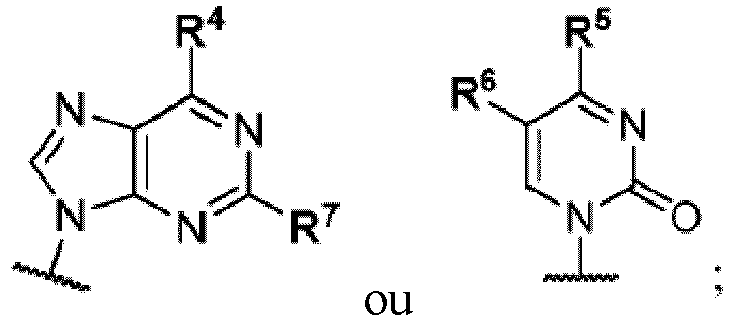
- Composé selon la revendication 1, 2, 3 ou 4 selon l'une quelconque des Formules IX-XII :
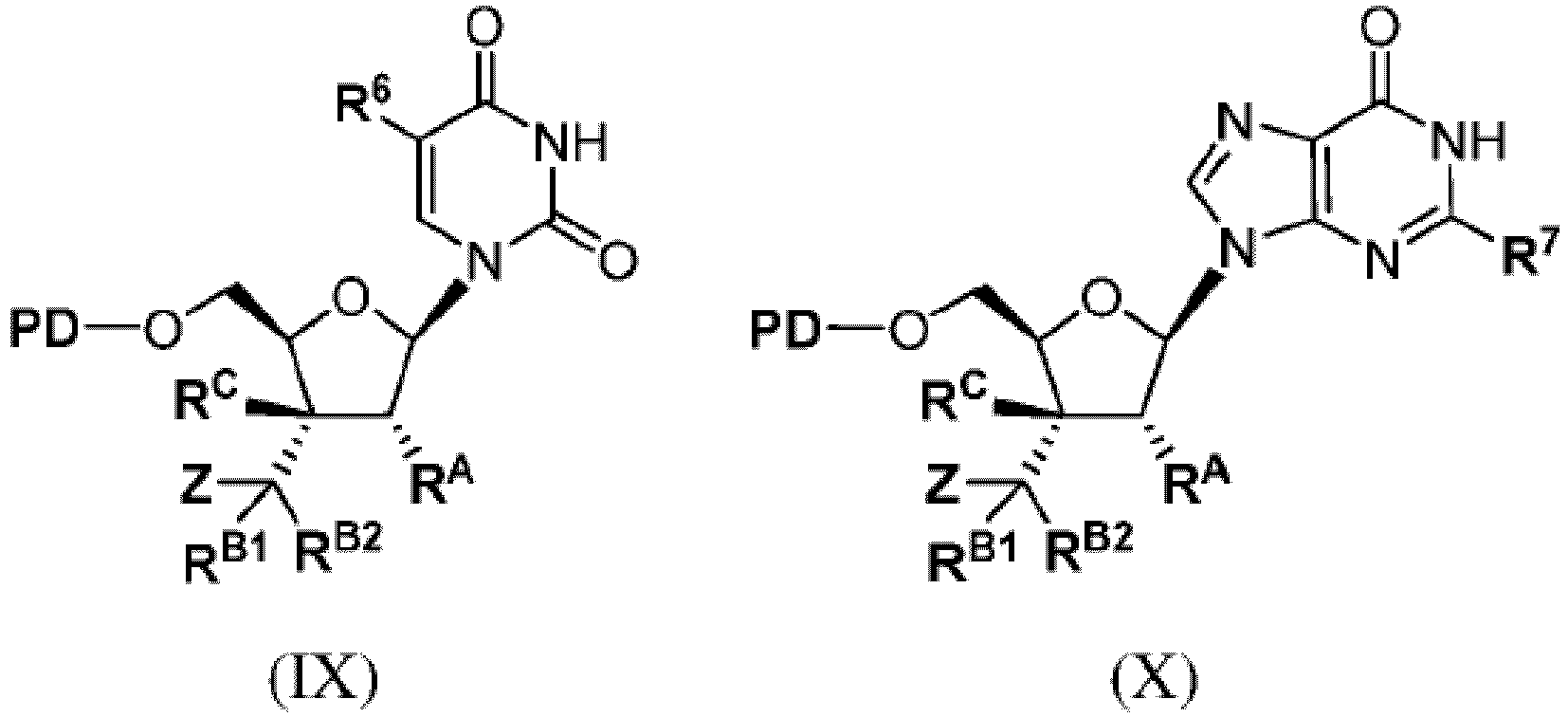

- Composé selon la revendication 1, 2, 3 ou 4 selon l'une quelconque des Formules XIII-XVIII :


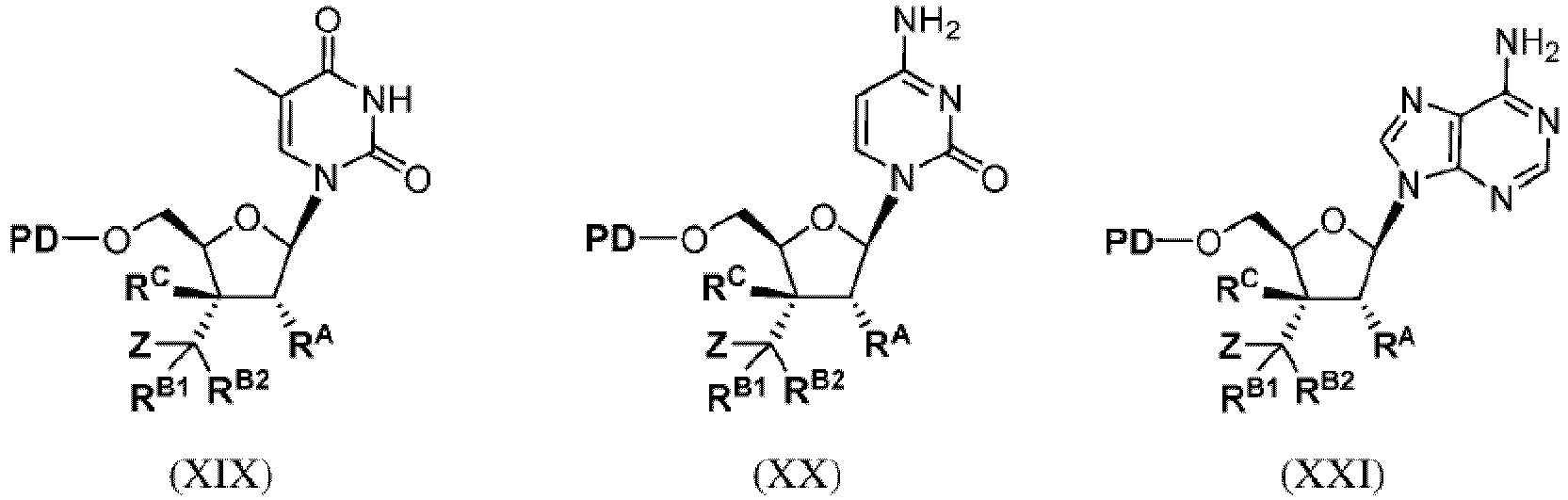
- Composé selon la revendication 1, 2, 3 ou 4 selon la Formule XLIII ou XLIV :

- Composé selon l'une quelconque des revendications 1-4 ou 6-9, dans lequel RC est un hydrogène.
- Composé selon l'une quelconque des revendications 1-5 ou 8-15, dans lequel X est un résidu d'acide aminé N-lié ou un dérivé de celui-ci et Y est -OR1.
- Composé selon la revendication 16, dans lequel X est -NRX-G1(SC1)-C(O)-Q1, dans lequel Q1 est un alcoxy, un cycloalkyloxy ou un aralkyloxy ; G1 est -CH2- ; RX est un hydrogène ; SC1 est un alkyle ou un arylalkyle ; et Y est -OR1.
- Composé selon l'une quelconque des revendications 1-17, dans lequel RA est un acétyloxy, un fluoro ou un hydroxyle.
- Composé selon la revendication 1, 2, 3 ou 4 selon l'une quelconque des Formules 101-122 :


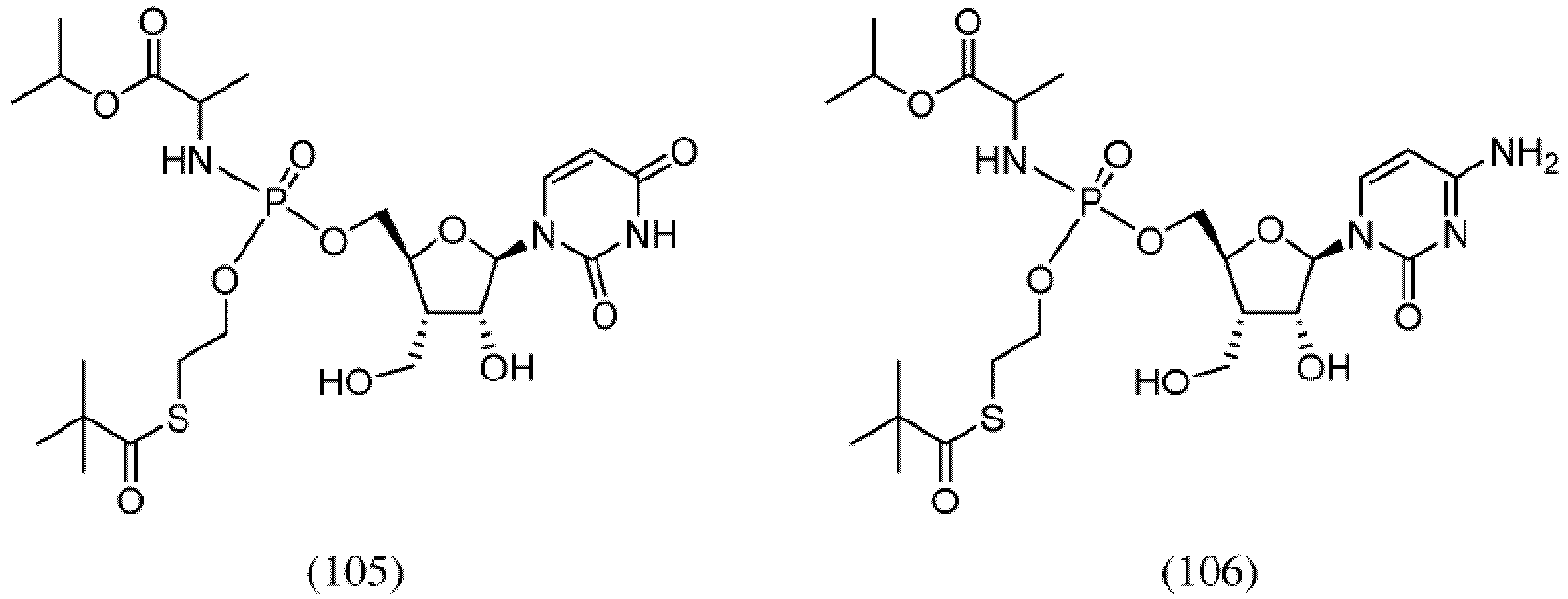


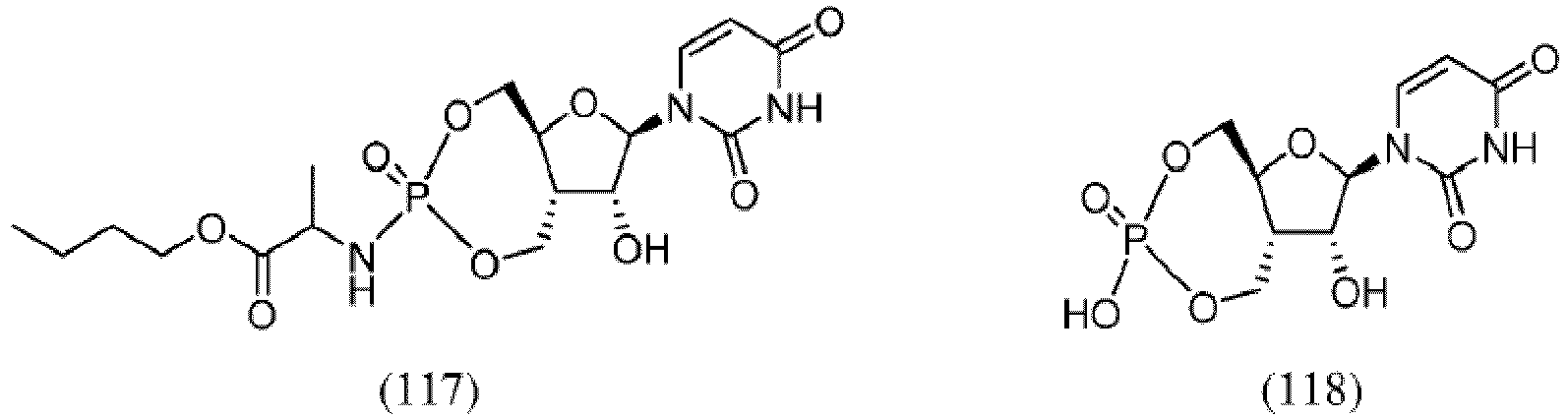


- Composé selon la revendication 1, 2, 3 ou 4 selon l'une quelconque des Formules 301-315, 319-321 ou 324-329 :

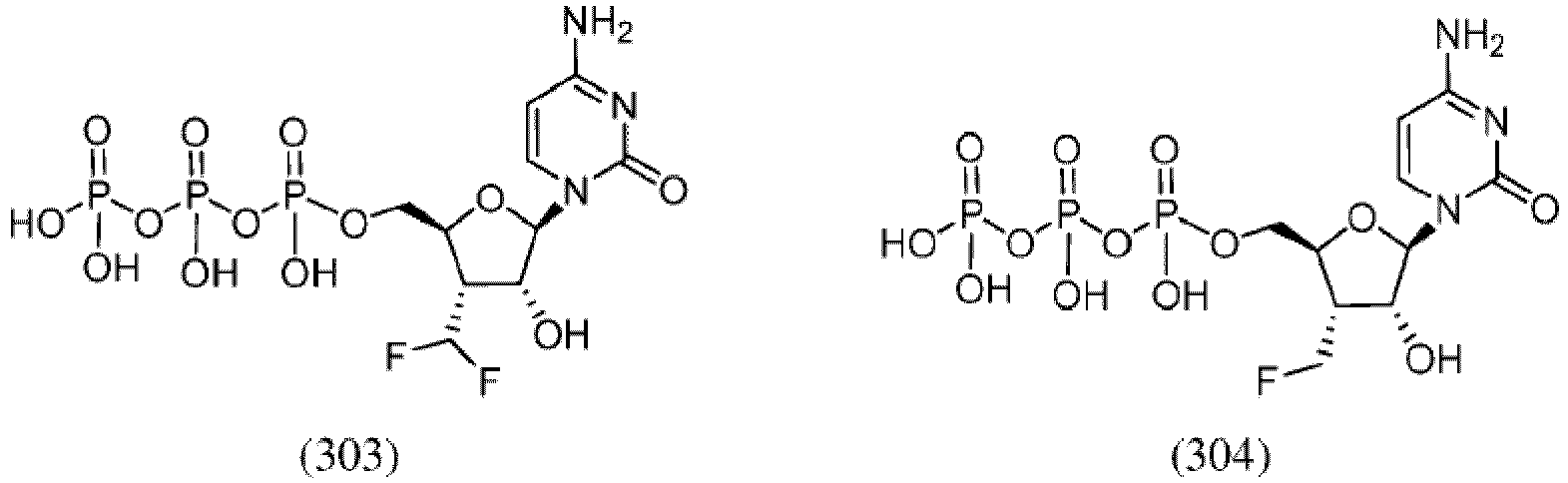


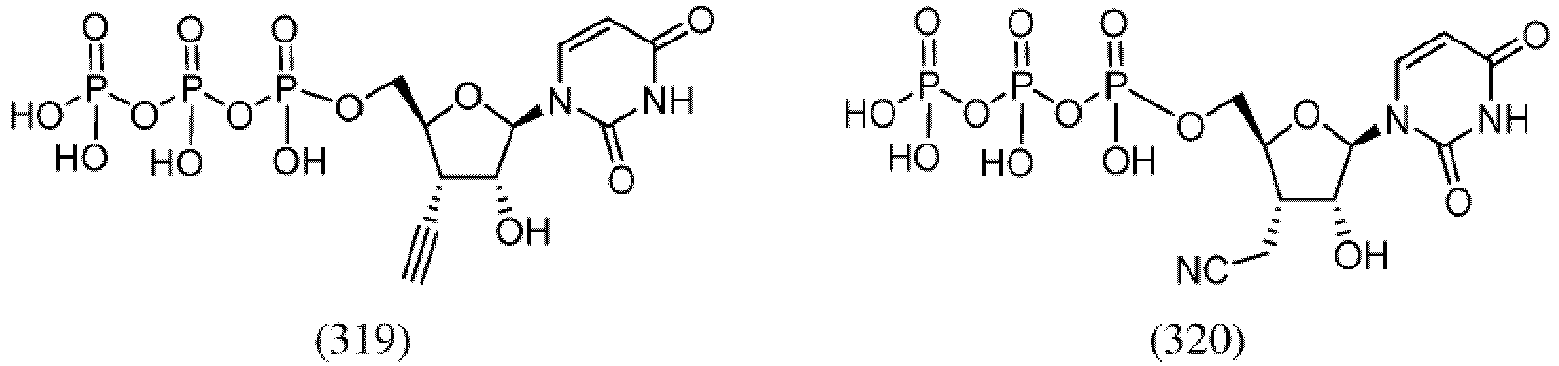
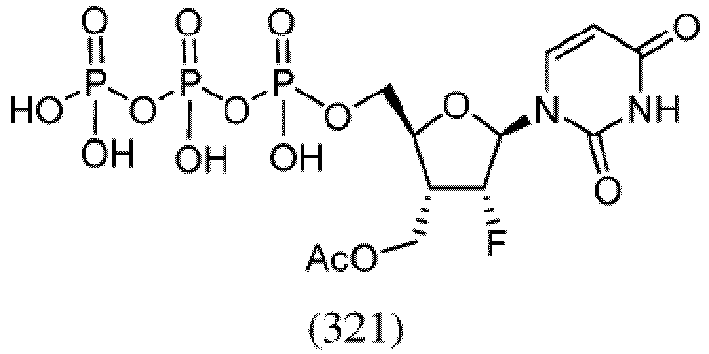


- Composé selon la revendication 1, 2, 3 ou 4 selon l'une quelconque des formules suivantes :


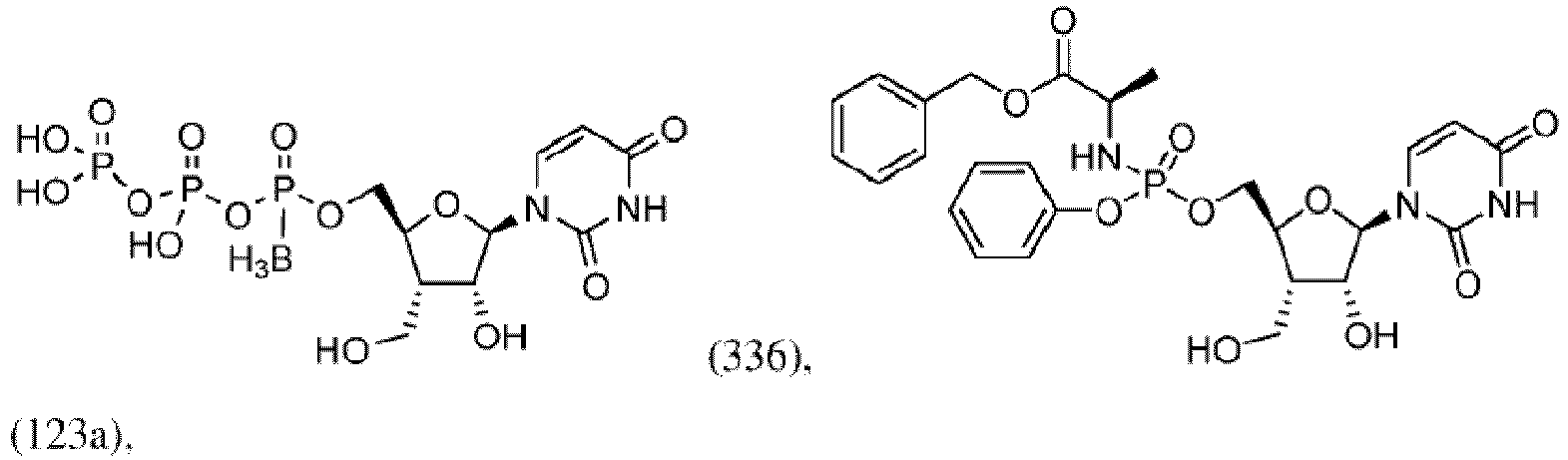


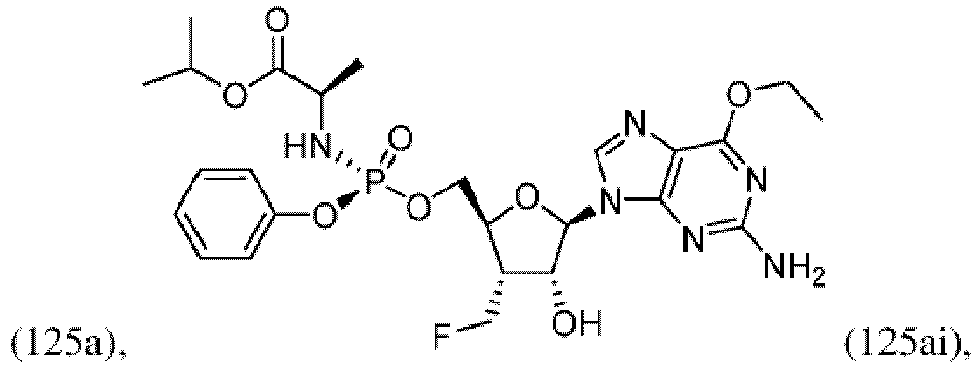


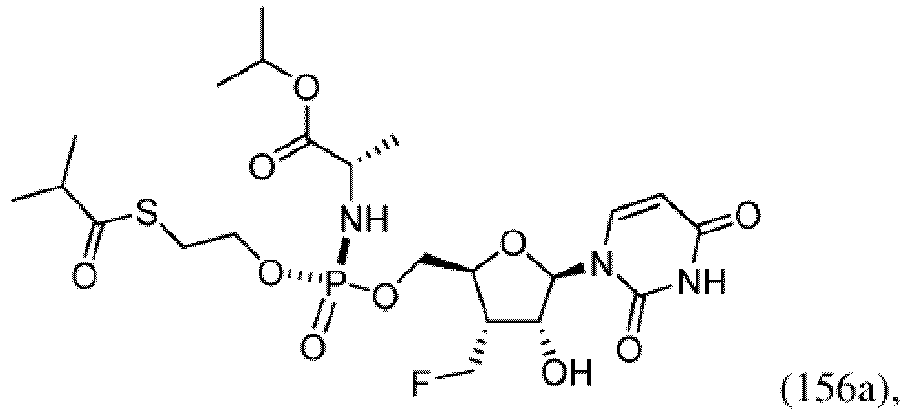

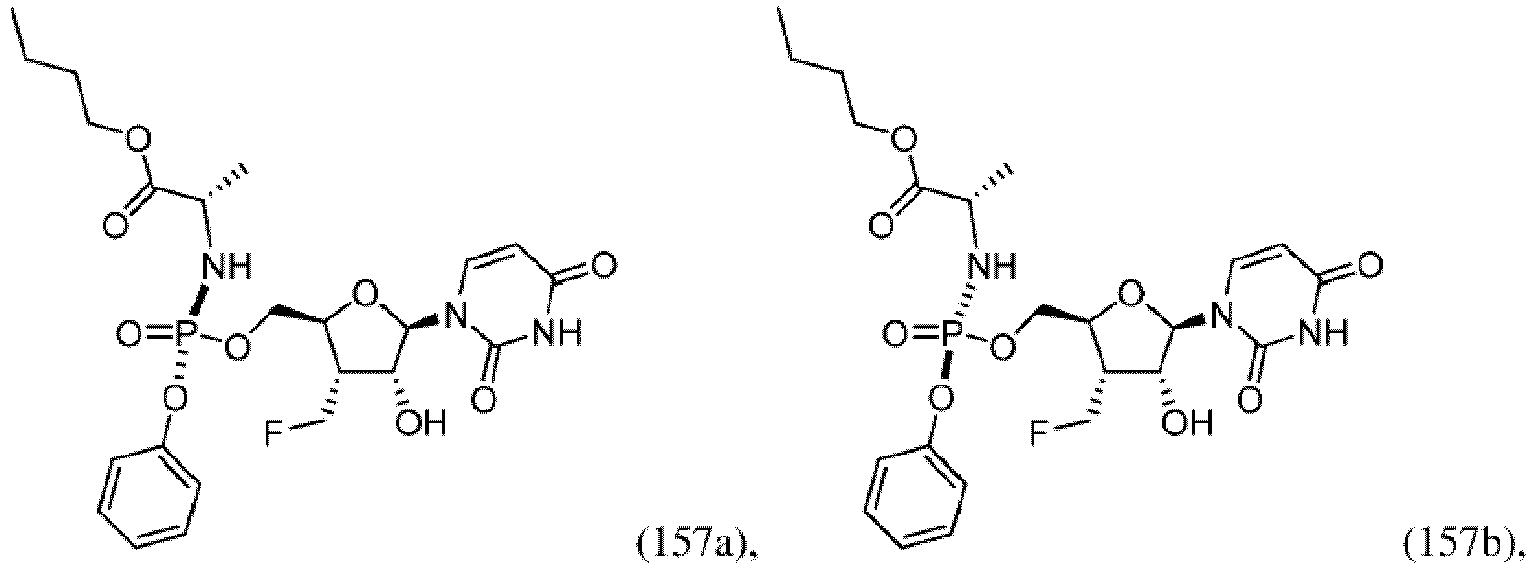


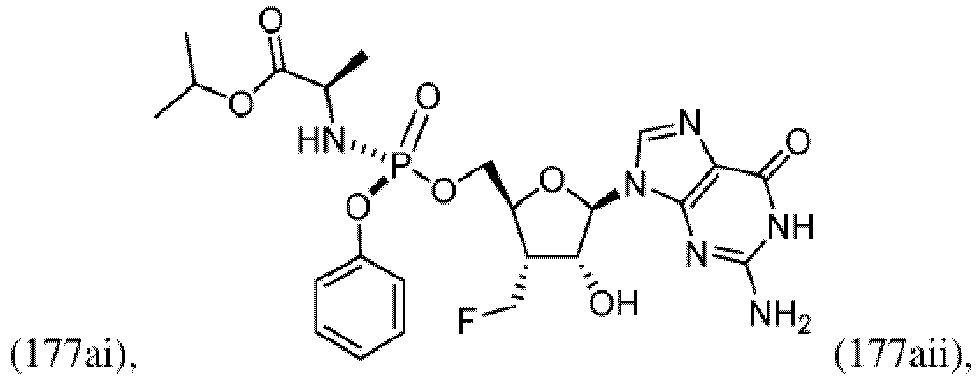
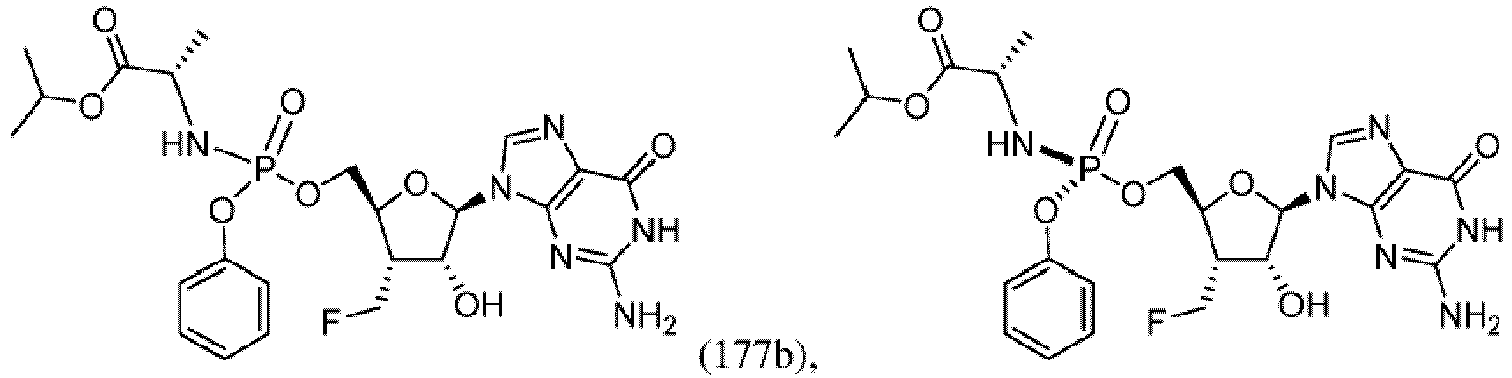
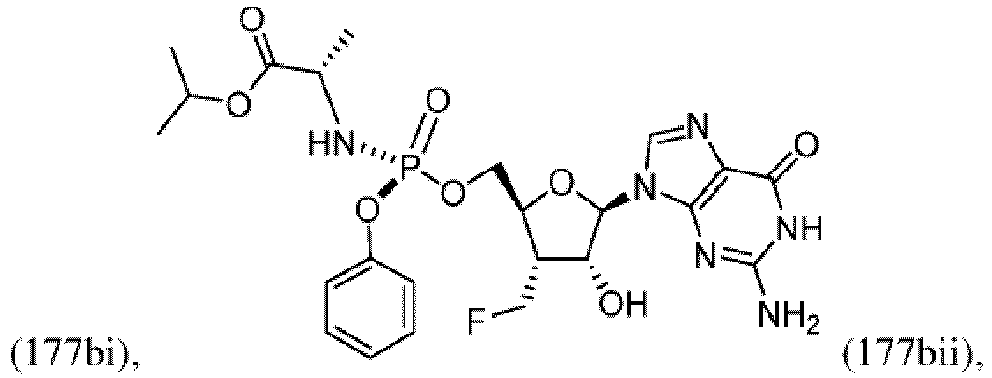


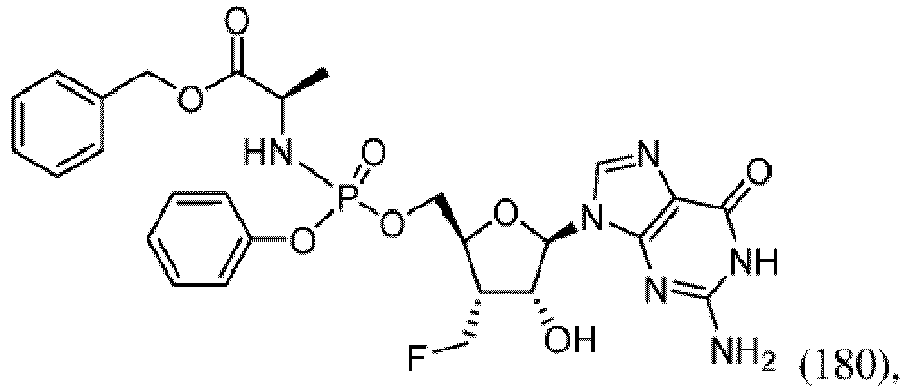


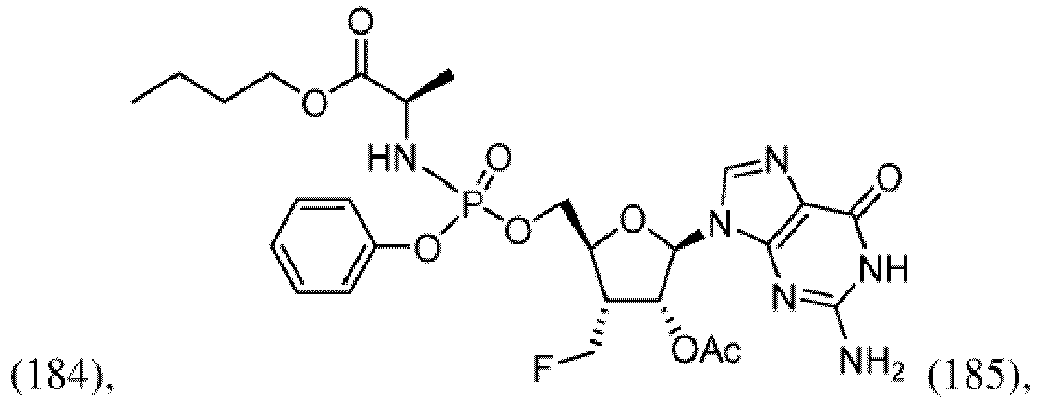


- Composé selon la Formule 1001 :
 RA est un hydroxyle, un halo, un hydrogène, un azido, -NH2 ou un alkylcarbonyloxy ;RC est un hydrogène, un azido ou un méthyle ;la Base est une nucléobase ;PD est un hydrogène, un alkylcarbonyle,
 W est un soufre ou un oxygène ;chacun de X et Y est indépendamment un hydrogène, -OR1, -SR1, -NR1R2 ou un résidu d'acide aminé N-lié ou O-lié ou un dérivé de ceux-ci ;Z est un hydrogène, un méthyle, un azido, un amino ou un cyano ; ou, selon une variante, Y et Z, accompagnés des atomes auxquels ils sont liés, se combinent pour former un cycle hétérocyclique à sept chaînons dans lequel Y et Z représentent ensemble un -O- divalent unique et X est -OR1, -SR1, -NR1R2 ou un résidu d'acide aminé N-lié ou O-lié ou un dérivé de ceux-ci ; ou Z, RB1 et RB2 se combinent pour former un C2-6 alcénylène ou un C2-6 alcynylène ;chaque R1 est indépendamment un hydrogène, un alkyle, un aryle, un arylalkyle, un cycloalkyle, un hétérocycloalkyle, un alcoxylcarbonylalkyle, un alcoxycarbonyloxyalkyle ou un alkylcarbonylthioalkyle ; etchaque R2 est indépendamment un hydrogène, un alkyle, un cycloalkyle, un aryle ou un arylalkyle.
 - Composé selon la revendication 22, dans lequel :RA est un hydroxyle, un halo, un hydrogène ou un alkylcarbonyloxy ;RC est un hydrogène, un azido ou un méthyle ;la Base est une nucléobase ;PD est un hydrogène,

 W est un soufre ou un oxygène ;chacun de X et Y est indépendamment un hydrogène, -OR1, -SR1, -NR1R2 ou un résidu d'acide aminé N-lié ou O-lié ou un dérivé de ceux-ci ;Z est un hydrogène, un méthyle, un azido, un amino ou un cyano ; ou, selon une variante, Y et Z, accompagnés des atomes auxquels ils sont liés, se combinent pour former un cycle hétérocyclique à sept chaînons dans lequel Y et Z ensemble représentent un -O- divalent unique et X est -OR1, -SR1, -NR1R2 ou un résidu d'acide aminé N-lié ou O-lié ou un dérivé de ceux-ci ; ou Z, RB1 et RB2 se combinent pour former un C2-6 alcynylène ;chaque R1 est indépendamment un hydrogène, un alkyle, un aryle, un arylalkyle, un cycloalkyle, un hétérocycloalkyle, un alcoxylcarbonylalkyle ou un alkylcarbonylthioalkyle ; etchaque R2 est indépendamment un hydrogène, un alkyle, un cycloalkyle, un aryle ou un arylalkyle.
 - Composé selon la revendication 22 ou 23, dans lequel PD est :

- Composition pharmaceutique comprenant le composé selon l'une quelconque des revendications 1-24, ou un sel pharmaceutiquement acceptable, un solvate, une forme tautomère ou une forme polymorphe de celui-ci, et un excipient, un véhicule ou un diluant pharmaceutiquement acceptables.
- Composé selon l'une quelconque des revendications 1-24, pour utilisation dans le traitement d'un hôte humain infecté par un virus.
- Composé pour utilisation selon la revendication 26, où le virus est un virus de l'hépatite C.
- Composé pour utilisation selon la revendication 26 ou la revendication 27, où le traitement comprend en outre l'administration d'un deuxième agent antiviral en combinaison ou en alternance avec le composé ou la composition, où le deuxième agent antiviral est un interféron, un analogue de nucléotide, un inhibiteur de polymérase, un inhibiteur de NS3 protéase, un inhibiteur de NS5A, un inhibiteur d'entrée, un inhibiteur de polymérase non nucléosidique, un inhibiteur immun de cyclosporine, un antagoniste de NS4A, un inhibiteur de liaison NS4B-ARN, un inhibiteur d'ARNm à acide nucléique bloqué, un inhibiteur de cyclophiline ou une combinaison de ceux-ci.
- Composé pour utilisation selon la revendication 26, où le composé est de Formule 1 :
 RA est un hydroxyle, un halo ou un alkylcarbonyloxy ;RB1 est un C2-C6 alcényle, un C2-C6 alcynyle, un hydroxyle, un fluoro, CN, un benzyloxycarbonyloxy ou un alkylcarbonyloxy ;RB2 est un hydrogène ou un méthyle ;RC est un hydrogène, un azido ou un méthyle ;la Base est une nucléobase ;PD est un alkylcarbonyle,
 W est un soufre ou un oxygène ;chacun de X et Y est indépendamment un hydrogène, -OR1, -SR1, -NR1R2 ou un résidu d'acide aminé N-lié ou O-lié ou un dérivé de ceux-ci ;Z est un hydrogène, un méthyle, un cyano ou un fluoro ; ou, selon une variante, Y et Z, accompagnés des atomes auxquels ils sont liés, se combinent pour former un cycle hétérocyclique à sept chaînons dans lequel Y et Z représentent ensemble un -O- divalent unique et X est -OR1, - SR1, -NR1R2 ou un résidu d'acide aminé N-lié ou O-lié ou un dérivé de ceux-ci ; ou Z, RB1 et RB2 se combinent pour former un C2-6 alcénylène ou un C2-6 alcynylène ;chaque R1 est indépendamment un hydrogène, un alkyle, un aryle, un arylalkyle, un cycloalkyle, un hétérocycloalkyle, un alcoxylcarbonylalkyle, un alcoxycarbonyloxyalkyle ou un alkylcarbonylthioalkyle ; etchaque R2 est indépendamment un hydrogène, un alkyle, un cycloalkyle, un aryle ou un arylalkyle ;sous réserve que lorsque PD est :
Applications Claiming Priority (2)
| Application Number | Priority Date | Filing Date | Title |
|---|---|---|---|
| US201461980326P | 2014-04-16 | 2014-04-16 | |
| PCT/US2015/026264 WO2015161137A1 (fr) | 2014-04-16 | 2015-04-16 | Nucléosides méthyle ou alcynyle substitués en position 3 pour le traitement du virus de l'hépatite c |
Publications (2)
| Publication Number | Publication Date |
|---|---|
| EP3131914A1 EP3131914A1 (fr) | 2017-02-22 |
| EP3131914B1 true EP3131914B1 (fr) | 2023-05-10 |
Family
ID=53015958
Family Applications (1)
| Application Number | Title | Priority Date | Filing Date |
|---|---|---|---|
| EP15719385.5A Active EP3131914B1 (fr) | 2014-04-16 | 2015-04-16 | Nucléosides méthyle ou alcynyle substitués en position 3 pour le traitement du virus de l'hépatite c |
Country Status (3)
| Country | Link |
|---|---|
| US (1) | US10202411B2 (fr) |
| EP (1) | EP3131914B1 (fr) |
| WO (1) | WO2015161137A1 (fr) |
Families Citing this family (27)
| Publication number | Priority date | Publication date | Assignee | Title |
|---|---|---|---|---|
| CA2873315A1 (fr) | 2012-05-22 | 2013-11-28 | Idenix Pharamaceuticals, Inc. | Composes d'acide d-amine contre les maladies hepatiques |
| KR102001280B1 (ko) | 2012-10-08 | 2019-07-17 | 아이데닉스 파마슈티칼스 엘엘씨 | Hcv 감염에 대한 2'-클로로 뉴클레오시드 유사체 |
| WO2014160484A1 (fr) | 2013-03-13 | 2014-10-02 | Idenix Pharmaceuticals, Inc. | Pronucléotides de phosphoramidate d'acide aminé de 2'-cyano, azido et amino nucléosides pour le traitement du virus de l'hépatite c (vhc) |
| WO2015017713A1 (fr) | 2013-08-01 | 2015-02-05 | Idenix Pharmaceuticals, Inc. | Pronucléotides phosphoramidates avec acides aminés d de composés halogéno pyrimidines pour le traitement des hépatopathies |
| WO2015161137A1 (fr) | 2014-04-16 | 2015-10-22 | Idenix Pharmaceuticals, Inc. | Nucléosides méthyle ou alcynyle substitués en position 3 pour le traitement du virus de l'hépatite c |
| WO2016134051A1 (fr) * | 2015-02-18 | 2016-08-25 | Abbvie Inc. | Composés anti-viraux |
| CR20180101A (es) | 2015-08-13 | 2018-04-12 | Merck Sharp & Dohme | Compuestos di-nucleóticos cíclicos como agonistas de sting |
| US11453697B1 (en) | 2015-08-13 | 2022-09-27 | Merck Sharp & Dohme Llc | Cyclic di-nucleotide compounds as sting agonists |
| JP6743135B2 (ja) | 2015-09-02 | 2020-08-19 | アッヴィ・インコーポレイテッド | 抗ウィルス性テトラヒドロフラン誘導体 |
| EP3471738A4 (fr) * | 2016-06-20 | 2020-01-01 | Merck Sharp & Dohme Corp. | Dérivés de nucléosides cycliques à substitution phosphate et leurs procédés d'utilisation pour le traitement de maladies virales |
| US10414747B2 (en) | 2016-10-04 | 2019-09-17 | Merck Sharp & Dohme Corp. | Benzo[b]thiophene compounds as sting agonists |
| EP3541825B1 (fr) * | 2016-11-21 | 2026-04-01 | Idenix Pharmaceuticals LLC | Dérivés nucléosides cycliques substitués par phosphate pour le traitement de maladies hépatiques |
| US11466047B2 (en) | 2017-05-12 | 2022-10-11 | Merck Sharp & Dohme Llc | Cyclic di-nucleotide compounds as sting agonists |
| GB201709471D0 (en) * | 2017-06-14 | 2017-07-26 | Nucana Biomed Ltd | Diastereoselective synthesis of hosphate derivatives |
| CN109305989B (zh) * | 2017-07-28 | 2021-02-26 | 四川海思科制药有限公司 | 一种磷酰胺衍生物及制备方法和用途 |
| US11312772B2 (en) | 2017-08-04 | 2022-04-26 | Merck Sharp & Dohme Corp. | Combinations of PD-1 antagonists and benzo [b] thiophene STING agonists for cancer treatment |
| US11285131B2 (en) | 2017-08-04 | 2022-03-29 | Merck Sharp & Dohme Corp. | Benzo[b]thiophene STING agonists for cancer treatment |
| EP3727401A4 (fr) | 2017-12-20 | 2022-04-06 | Merck Sharp & Dohme Corp. | Composés dinucléotidiques cycliques utilisés comme agonistes sting |
| US10793557B2 (en) | 2018-04-03 | 2020-10-06 | Merck Sharp & Dohme Corp. | Sting agonist compounds |
| US11702430B2 (en) | 2018-04-03 | 2023-07-18 | Merck Sharp & Dohme Llc | Aza-benzothiophene compounds as STING agonists |
| CN109651468A (zh) * | 2018-12-20 | 2019-04-19 | 刘洪海 | 具有抑制病毒复制活性的核苷氨基磷酸酯类似物、制备方法及其药物用途 |
| AU2020263283B2 (en) * | 2019-04-22 | 2026-04-23 | Ligand Pharmaceuticals Incorporated | Cyclic phosphate compounds |
| US12552820B2 (en) | 2020-04-21 | 2026-02-17 | Ligand Pharmaceuticals Incorporated | Benzyloxy phosph(on)ate compounds |
| WO2022086958A1 (fr) * | 2020-10-21 | 2022-04-28 | Ligand Pharmaceuticals Incorporated | Composés de promédicaments antiviraux |
| US20250188111A1 (en) * | 2021-11-02 | 2025-06-12 | Ligand Pharmaceuticals Incorporated | Cyclic phosphoramidate compounds |
| WO2025058573A1 (fr) * | 2023-09-15 | 2025-03-20 | National Science And Technology Development Agency | Dérivés de cordycépine ou un sel pharmaceutiquement acceptable de ceux-ci utilisés en tant qu'agents pan-antiviraux |
| KR102705428B1 (ko) * | 2023-09-25 | 2024-09-11 | 주식회사 에스켐 | 신규한 테트라-치환된 다이포스페이트-삼불화붕소계 화합물 및 이의 제조방법 |
Citations (3)
| Publication number | Priority date | Publication date | Assignee | Title |
|---|---|---|---|---|
| WO2001090121A2 (fr) * | 2000-05-23 | 2001-11-29 | Idenix (Cayman) Limited | Methodes et compositions permettant de traiter le virus de l'hepatite c |
| WO2002057425A2 (fr) * | 2001-01-22 | 2002-07-25 | Merck & Co., Inc. | Derives de nucleoside comme inhibiteurs de l'arn polymerase virale arn-dependante |
| WO2008016473A2 (fr) * | 2006-07-28 | 2008-02-07 | Applera Corporation | ANALOGUES DE COIFFES DE NUCLÉOTIDE D'ARNm |
Family Cites Families (282)
| Publication number | Priority date | Publication date | Assignee | Title |
|---|---|---|---|---|
| US3480613A (en) | 1967-07-03 | 1969-11-25 | Merck & Co Inc | 2-c or 3-c-alkylribofuranosyl - 1-substituted compounds and the nucleosides thereof |
| US3536809A (en) | 1969-02-17 | 1970-10-27 | Alza Corp | Medication method |
| US3598123A (en) | 1969-04-01 | 1971-08-10 | Alza Corp | Bandage for administering drugs |
| US3845770A (en) | 1972-06-05 | 1974-11-05 | Alza Corp | Osmatic dispensing device for releasing beneficial agent |
| US3916899A (en) | 1973-04-25 | 1975-11-04 | Alza Corp | Osmotic dispensing device with maximum and minimum sizes for the passageway |
| US4008719A (en) | 1976-02-02 | 1977-02-22 | Alza Corporation | Osmotic system having laminar arrangement for programming delivery of active agent |
| HU196714B (en) | 1984-10-04 | 1989-01-30 | Monsanto Co | Process for producing non-aqueous composition comprising somatotropin |
| IE58110B1 (en) | 1984-10-30 | 1993-07-14 | Elan Corp Plc | Controlled release powder and process for its preparation |
| US5073543A (en) | 1988-07-21 | 1991-12-17 | G. D. Searle & Co. | Controlled release formulations of trophic factors in ganglioside-lipsome vehicle |
| IT1229203B (it) | 1989-03-22 | 1991-07-25 | Bioresearch Spa | Impiego di acido 5 metiltetraidrofolico, di acido 5 formiltetraidrofolico e dei loro sali farmaceuticamente accettabili per la preparazione di composizioni farmaceutiche in forma a rilascio controllato attive nella terapia dei disturbi mentali organici e composizioni farmaceutiche relative. |
| PH30995A (en) | 1989-07-07 | 1997-12-23 | Novartis Inc | Sustained release formulations of water soluble peptides. |
| US5120548A (en) | 1989-11-07 | 1992-06-09 | Merck & Co., Inc. | Swelling modulated polymeric drug delivery device |
| US5026687A (en) | 1990-01-03 | 1991-06-25 | The United States Of America As Represented By The Department Of Health And Human Services | Treatment of human retroviral infections with 2',3'-dideoxyinosine alone and in combination with other antiviral compounds |
| CA2079912C (fr) | 1990-04-06 | 2000-07-11 | Gregory Reyes | Epitopes du virus de l'hepatite c |
| US5733566A (en) | 1990-05-15 | 1998-03-31 | Alkermes Controlled Therapeutics Inc. Ii | Controlled release of antiparasitic agents in animals |
| US5580578A (en) | 1992-01-27 | 1996-12-03 | Euro-Celtique, S.A. | Controlled release formulations coated with aqueous dispersions of acrylic polymers |
| DE4207363A1 (de) | 1992-03-04 | 1993-09-09 | Max Delbrueck Centrum | Antivirale nucleosidanaloga, ihre herstellung und ihre pharmazeutische verwendung |
| US5610054A (en) | 1992-05-14 | 1997-03-11 | Ribozyme Pharmaceuticals, Inc. | Enzymatic RNA molecule targeted against Hepatitis C virus |
| US6995146B2 (en) | 1992-09-10 | 2006-02-07 | Isis Pharmaceuticals, Inc. | Compositions and methods for treatment of hepatitis C virus-associated diseases |
| US6391542B1 (en) | 1992-09-10 | 2002-05-21 | Isis Pharmaceuticals, Inc. | Compositions and methods for treatment of Hepatitis C virus-associated diseases |
| US6423489B1 (en) | 1992-09-10 | 2002-07-23 | Isis Pharmaceuticals, Inc. | Compositions and methods for treatment of Hepatitis C virus-associated diseases |
| US6174868B1 (en) | 1992-09-10 | 2001-01-16 | Isis Pharmaceuticals, Inc. | Compositions and methods for treatment of hepatitis C virus-associated diseases |
| US6433159B1 (en) | 1992-09-10 | 2002-08-13 | Isis Pharmaceuticals, Inc. | Compositions and methods for treatment of Hepatitis C virus associated diseases |
| CA2143678A1 (fr) | 1992-09-10 | 1994-03-17 | Kevin P. Anderson | Compositions et methodes servant a traiter les maladies associees au virus de l'hepatite c |
| TW333456B (en) | 1992-12-07 | 1998-06-11 | Takeda Pharm Ind Co Ltd | A pharmaceutical composition of sustained-release preparation the invention relates to a pharmaceutical composition of sustained-release preparation which comprises a physiologically active peptide. |
| US5591767A (en) | 1993-01-25 | 1997-01-07 | Pharmetrix Corporation | Liquid reservoir transdermal patch for the administration of ketorolac |
| WO1994019012A2 (fr) | 1993-02-24 | 1994-09-01 | Wang Jui H | Compositions et procedes d'application de polymeres antiviraux reactifs |
| US6087324A (en) | 1993-06-24 | 2000-07-11 | Takeda Chemical Industries, Ltd. | Sustained-release preparation |
| WO1995003056A1 (fr) | 1993-07-19 | 1995-02-02 | Tokyo Tanabe Company Limited | Inhibiteur de proliferation du virus de l'hepatite c |
| DE4415539C2 (de) | 1994-05-03 | 1996-08-01 | Osama Dr Dr Med Omer | Pflanzen mit virustatischer und antiviraler Wirkung |
| IT1270594B (it) | 1994-07-07 | 1997-05-07 | Recordati Chem Pharm | Composizione farmaceutica a rilascio controllato di moguisteina in sospensione liquida |
| DE4432623A1 (de) | 1994-09-14 | 1996-03-21 | Huels Chemische Werke Ag | Verfahren zur Bleichung von wäßrigen Tensidlösungen |
| GB9505025D0 (en) | 1995-03-13 | 1995-05-03 | Medical Res Council | Chemical compounds |
| JP3786447B2 (ja) | 1995-03-31 | 2006-06-14 | エーザイ株式会社 | C型肝炎の予防・治療剤 |
| AU6242096A (en) | 1995-06-27 | 1997-01-30 | Takeda Chemical Industries Ltd. | Method of producing sustained-release preparation |
| TW448055B (en) | 1995-09-04 | 2001-08-01 | Takeda Chemical Industries Ltd | Method of production of sustained-release preparation |
| JP2909418B2 (ja) | 1995-09-18 | 1999-06-23 | 株式会社資生堂 | 薬物の遅延放出型マイクロスフイア |
| US5980945A (en) | 1996-01-16 | 1999-11-09 | Societe De Conseils De Recherches Et D'applications Scientifique S.A. | Sustained release drug formulations |
| JP2000506010A (ja) | 1996-02-29 | 2000-05-23 | イミューソル インコーポレイテッド | C型肝炎ウイルスリボザイム |
| US5633388A (en) | 1996-03-29 | 1997-05-27 | Viropharma Incorporated | Compounds, compositions and methods for treatment of hepatitis C |
| US5830905A (en) | 1996-03-29 | 1998-11-03 | Viropharma Incorporated | Compounds, compositions and methods for treatment of hepatitis C |
| US5990276A (en) | 1996-05-10 | 1999-11-23 | Schering Corporation | Synthetic inhibitors of hepatitis C virus NS3 protease |
| US5891874A (en) | 1996-06-05 | 1999-04-06 | Eli Lilly And Company | Anti-viral compound |
| US6264970B1 (en) | 1996-06-26 | 2001-07-24 | Takeda Chemical Industries, Ltd. | Sustained-release preparation |
| US5837257A (en) | 1996-07-09 | 1998-11-17 | Sage R&D | Use of plant extracts for treatment of HIV, HCV and HBV infections |
| US6419961B1 (en) | 1996-08-29 | 2002-07-16 | Takeda Chemical Industries, Ltd. | Sustained release microcapsules of a bioactive substance and a biodegradable polymer |
| JP3927630B2 (ja) | 1996-09-27 | 2007-06-13 | エーザイ・アール・アンド・ディー・マネジメント株式会社 | ウイルス感染症の予防・治療剤 |
| US5922757A (en) | 1996-09-30 | 1999-07-13 | The Regents Of The University Of California | Treatment and prevention of hepatic disorders |
| CA2217134A1 (fr) | 1996-10-09 | 1998-04-09 | Sumitomo Pharmaceuticals Co., Ltd. | Formulation a liberation-retard |
| AP1019A (en) | 1996-10-18 | 2001-10-16 | Vertex Pharma | Inhibitors of serinre proteases, particularly hepatitis C virus NS3 protease. |
| DE69730093T2 (de) | 1996-10-31 | 2006-07-20 | Takeda Pharmaceutical Co. Ltd. | Zubereitung mit verzögerter Freisetzung |
| GB9623908D0 (en) | 1996-11-18 | 1997-01-08 | Hoffmann La Roche | Amino acid derivatives |
| IL119833A (en) | 1996-12-15 | 2001-01-11 | Lavie David | Hypericum perforatum extracts for the preparation of pharmaceutical compositions for the treatment of hepatitis |
| WO1998027980A2 (fr) | 1996-12-20 | 1998-07-02 | Takeda Chemical Industries, Ltd. | Procede de production d'une preparation a liberation prolongee |
| US5891474A (en) | 1997-01-29 | 1999-04-06 | Poli Industria Chimica, S.P.A. | Time-specific controlled release dosage formulations and method of preparing same |
| US6004933A (en) | 1997-04-25 | 1999-12-21 | Cortech Inc. | Cysteine protease inhibitors |
| GB9708611D0 (en) | 1997-04-28 | 1997-06-18 | Univ Cardiff | Chemical compounds |
| UA61962C2 (uk) | 1997-06-30 | 2003-12-15 | Мерц Фарма Гмбх Унд Ко. Кгаа | Сполука 1-аміноалкілциклогексану, фармацевтична композиція на її основі та спосіб лікування |
| EP1012180B1 (fr) | 1997-08-11 | 2004-12-01 | Boehringer Ingelheim (Canada) Ltd. | Analogues de peptides inhibiteurs de l'hepatite c |
| KR100719606B1 (ko) | 1998-02-25 | 2007-05-17 | 에모리 유니버시티 | 2'-플루오로뉴클레오사이드 |
| US6613358B2 (en) | 1998-03-18 | 2003-09-02 | Theodore W. Randolph | Sustained-release composition including amorphous polymer |
| GB9806815D0 (en) | 1998-03-30 | 1998-05-27 | Hoffmann La Roche | Amino acid derivatives |
| KR19990085365A (ko) | 1998-05-16 | 1999-12-06 | 허영섭 | 지속적으로 약물 조절방출이 가능한 생분해성 고분자 미립구 및그 제조방법 |
| US6833361B2 (en) | 1998-05-26 | 2004-12-21 | Ribapharm, Inc. | Nucleosides having bicyclic sugar moiety |
| US6323180B1 (en) | 1998-08-10 | 2001-11-27 | Boehringer Ingelheim (Canada) Ltd | Hepatitis C inhibitor tri-peptides |
| GB9821058D0 (en) | 1998-09-28 | 1998-11-18 | Univ Cardiff | Chemical compound |
| CZ20012908A3 (cs) | 1999-02-12 | 2002-10-16 | Glaxo Group Limited | Analogy (1R, cis)-4-(6-amino-9H-purin-9-yl)-2-cyklopenten-1-methanolu |
| US6248363B1 (en) | 1999-11-23 | 2001-06-19 | Lipocine, Inc. | Solid carriers for improved delivery of active ingredients in pharmaceutical compositions |
| US6566365B1 (en) | 1999-11-04 | 2003-05-20 | Biochem Pharma Inc. | Method for the treatment of Flaviviridea viral infection using nucleoside analogues |
| CN1427722A (zh) | 2000-02-18 | 2003-07-02 | 希拉生物化学股份有限公司 | 用核苷类似物治疗或预防黄病毒感染的方法 |
| EP1964569A3 (fr) | 2000-04-13 | 2009-07-22 | Pharmasset, Inc. | Dérivés de nucléoside substitué 3'-Or 2'-hydroxymethyl pour le traitement des infections virales |
| GB0009486D0 (en) | 2000-04-17 | 2000-06-07 | Univ Cardiff | Chemical compounds |
| GB0011203D0 (en) | 2000-05-09 | 2000-06-28 | Univ Cardiff | Chemical compounds |
| KR20080021797A (ko) | 2000-05-26 | 2008-03-07 | 이데닉스(케이만)리미티드 | 플라비바이러스 및 페스티바이러스의 치료방법 및 조성물 |
| AR029851A1 (es) | 2000-07-21 | 2003-07-16 | Dendreon Corp | Nuevos peptidos como inhibidores de ns3-serina proteasa del virus de hepatitis c |
| WO2002008251A2 (fr) | 2000-07-21 | 2002-01-31 | Corvas International, Inc. | Nouveaux peptides utilises comme inhibiteurs de ns3-serine protease du virus de l'hepatite c |
| AR034127A1 (es) | 2000-07-21 | 2004-02-04 | Schering Corp | Imidazolidinonas como inhibidores de ns3-serina proteasa del virus de hepatitis c, composicion farmaceutica, un metodo para su preparacion, y el uso de las mismas para la manufactura de un medicamento |
| SK742003A3 (en) | 2000-07-21 | 2003-06-03 | Schering Corp | Novel peptides as NS3-serine protease inhibitors of hepatitis C virus |
| US20030008841A1 (en) | 2000-08-30 | 2003-01-09 | Rene Devos | Anti-HCV nucleoside derivatives |
| CN1133642C (zh) | 2000-10-09 | 2004-01-07 | 清华大学 | 核苷5’-硫代磷酰氨基酸酯化合物 |
| KR20090089922A (ko) | 2000-10-18 | 2009-08-24 | 파마셋 인코포레이티드 | 바이러스 감염 및 비정상적인 세포 증식의 치료를 위한 변형된 뉴클레오시드 |
| ES2263687T3 (es) | 2000-11-20 | 2006-12-16 | Bristol-Myers Squibb Company | Inhibidores tripeptidicos de la hepatitis c. |
| AU3659102A (en) | 2000-12-12 | 2002-06-24 | Schering Corp | Diaryl peptides as ns3-serine protease inhibitors of hepatits c virus |
| US6653295B2 (en) | 2000-12-13 | 2003-11-25 | Bristol-Myers Squibb Company | Inhibitors of hepatitis C virus NS3 protease |
| WO2002048116A2 (fr) | 2000-12-13 | 2002-06-20 | Bristol-Myers Squibb Pharma Company | Inhibiteurs de la protease ns3 du virus de l'hepatite c |
| WO2002048157A2 (fr) | 2000-12-13 | 2002-06-20 | Bristol-Myers Squibb Pharma Company | Imidazolidinones et leurs derives associes, utiles en tant qu'inhibiteurs des proteases ns3 du virus de l'hepatite c |
| WO2002048165A2 (fr) | 2000-12-15 | 2002-06-20 | Pharmasset Ltd. | Agents antiviraux utilises dans le traitement des infections par les flaviviridae |
| US8481712B2 (en) | 2001-01-22 | 2013-07-09 | Merck Sharp & Dohme Corp. | Nucleoside derivatives as inhibitors of RNA-dependent RNA viral polymerase |
| US7105499B2 (en) | 2001-01-22 | 2006-09-12 | Merck & Co., Inc. | Nucleoside derivatives as inhibitors of RNA-dependent RNA viral polymerase |
| RU2003129164A (ru) | 2001-03-01 | 2005-03-20 | Фармассет Лтд. (Bb) | Способ синтеза 2`,3`-дидезокси-2`,3`-дидегидронуклеозидов |
| US20040209831A1 (en) | 2002-02-20 | 2004-10-21 | Mcswiggen James | RNA interference mediated inhibition of hepatitis C virus (HCV) gene expression using short interfering nucleic acid (siNA) |
| GB0112617D0 (en) | 2001-05-23 | 2001-07-18 | Hoffmann La Roche | Antiviral nucleoside derivatives |
| GB0114286D0 (en) | 2001-06-12 | 2001-08-01 | Hoffmann La Roche | Nucleoside Derivatives |
| JP2004534830A (ja) | 2001-06-21 | 2004-11-18 | グラクソ グループ リミテッド | Hcvにおけるヌクレオシド化合物 |
| US7022323B2 (en) | 2001-06-26 | 2006-04-04 | Progenics Pharmaceuticals, Inc. | Uses of DC-SIGN and DC-SIGNR for inhibiting hepatitis C virus infection |
| JP2005536440A (ja) | 2001-09-28 | 2005-12-02 | イデニクス(ケイマン)リミテツド | 4’位が修飾されたヌクレオシドを使用するフラビウイルスおよびペスチウイルスの治療のための方法および組成物 |
| AU2002330154A1 (en) | 2001-09-28 | 2003-04-07 | Centre National De La Recherche Scientifique | Methods and compositions for treating hepatitis c virus using 4'-modified nucleosides |
| US6867185B2 (en) | 2001-12-20 | 2005-03-15 | Bristol-Myers Squibb Company | Inhibitors of hepatitis C virus |
| CA2369970A1 (fr) | 2002-02-01 | 2003-08-01 | Boehringer Ingelheim (Canada) Ltd. | Tri-peptides inhibiteur de l'hepatite c |
| US7091184B2 (en) | 2002-02-01 | 2006-08-15 | Boehringer Ingelheim International Gmbh | Hepatitis C inhibitor tri-peptides |
| CA2370396A1 (fr) | 2002-02-01 | 2003-08-01 | Boehringer Ingelheim (Canada) Ltd. | Tri-peptides inhibiteur de l'hepatite c |
| US6642204B2 (en) | 2002-02-01 | 2003-11-04 | Boehringer Ingelheim International Gmbh | Hepatitis C inhibitor tri-peptides |
| JP2005527499A (ja) | 2002-02-13 | 2005-09-15 | メルク エンド カムパニー インコーポレーテッド | ヌクレオシド化合物を用いてオルトポックスウイルスの複製を阻害する方法 |
| GB2397062B (en) | 2002-02-20 | 2005-06-15 | Sirna Therapeutics Inc | RNA interference mediated inhibition of hepatitis c virus (HCV) gene expression using short interfering nucleic acid (siNA) |
| RU2004128943A (ru) | 2002-02-28 | 2005-04-20 | Байота, Инк. (Us) | Средства, имитирующие нуклеотиды, и их пролекарственные формы |
| ES2361011T3 (es) | 2002-05-20 | 2011-06-13 | Bristol-Myers Squibb Company | Inhibidores del virus de la hepatitis c. |
| DE60324552D1 (en) | 2002-05-20 | 2008-12-18 | Bristol Myers Squibb Co | Substituierte cycloalkyl p1' hepatitis c virus inhibitoren |
| MY140680A (en) | 2002-05-20 | 2010-01-15 | Bristol Myers Squibb Co | Hepatitis c virus inhibitors |
| ATE481106T1 (de) | 2002-05-20 | 2010-10-15 | Bristol Myers Squibb Co | Heterocyclische sulfonamid-hepatitis-c-virus- hemmer |
| AU2003241621A1 (en) | 2002-05-24 | 2003-12-12 | Isis Pharmaceuticals, Inc. | Oligonucleotides having modified nucleoside units |
| WO2003105770A2 (fr) | 2002-06-17 | 2003-12-24 | Merck & Co., Inc. | Derives de nucleosides carbocycliques utilises comme inhibiteurs de l'arn polymerase arn-dependante virale |
| US20070004669A1 (en) | 2002-06-21 | 2007-01-04 | Carroll Steven S | Nucleoside derivatives as inhibitors of rna-dependent rna viral polymerase |
| EP1572945A2 (fr) | 2002-06-27 | 2005-09-14 | Merck & Co., Inc. | Derives nucleosidiques utilises comme inhibiteurs de l'arn polymerase arn-dependante virale |
| MXPA04012779A (es) | 2002-06-28 | 2005-08-19 | Idenix Cayman Ltd | Profarmacos de 2'- y 3'-nucleosido para tratar infecciones por flaviviridae. |
| PL374781A1 (en) | 2002-06-28 | 2005-10-31 | Idenix (Cayman) Limited | 2'-c-methyl-3'-o-l-valine ester ribofuranosyl cytidine for treatment of flaviviridae infections |
| NZ537662A (en) | 2002-06-28 | 2007-10-26 | Idenix Cayman Ltd | 2'-C-methyl-3'-O-L-valine ester ribofuranosyl cytidine for treatment of flaviviridae infections |
| BR0312271A (pt) | 2002-06-28 | 2007-11-06 | Idenix Cayman Ltd | compostos, composições e seus usos para o tratamento de infecções por flaviviridae |
| US7608600B2 (en) | 2002-06-28 | 2009-10-27 | Idenix Pharmaceuticals, Inc. | Modified 2′ and 3′-nucleoside prodrugs for treating Flaviviridae infections |
| JP2005533108A (ja) | 2002-07-16 | 2005-11-04 | メルク エンド カムパニー インコーポレーテッド | Rna依存性rnaウイルスポリメラーゼの阻害剤としてのヌクレオシド誘導体 |
| AU2003256619A1 (en) | 2002-07-24 | 2004-02-09 | Isis Pharmaceuticals, Inc. | Pyrrolopyrimidine thionucleoside analogs as antivirals |
| US20040067877A1 (en) | 2002-08-01 | 2004-04-08 | Schinazi Raymond F. | 2', 3'-Dideoxynucleoside analogues for the treatment or prevention of Flaviviridae infections |
| US20040229840A1 (en) | 2002-10-29 | 2004-11-18 | Balkrishen Bhat | Nucleoside derivatives as inhibitors of RNA-dependent RNA viral polymerase |
| HUE033832T2 (en) | 2002-11-15 | 2018-01-29 | Idenix Pharmaceuticals Llc | 2'-methyl nucleosides in combination with interferon and Flaviviridae mutation |
| TWI332507B (en) | 2002-11-19 | 2010-11-01 | Hoffmann La Roche | Antiviral nucleoside derivatives |
| RU2005121904A (ru) | 2002-12-12 | 2006-01-20 | Айденикс (Кайман) Лимитед (Ky) | Способ получения 2`-разветвленных нуклеозидов |
| US7601709B2 (en) | 2003-02-07 | 2009-10-13 | Enanta Pharmaceuticals, Inc. | Macrocyclic hepatitis C serine protease inhibitors |
| AR043006A1 (es) | 2003-02-12 | 2005-07-13 | Merck & Co Inc | Proceso para preparar ribonucleosidos ramificados |
| US7300924B2 (en) | 2003-04-25 | 2007-11-27 | Gilead Sciences, Inc. | Anti-infective phosphonate analogs |
| EP2359833A1 (fr) | 2003-04-25 | 2011-08-24 | Gilead Sciences, Inc. | Analogues antiviraux du phosphonate |
| WO2005002626A2 (fr) | 2003-04-25 | 2005-01-13 | Gilead Sciences, Inc. | Composes de phosphonate therapeutiques |
| US7452901B2 (en) | 2003-04-25 | 2008-11-18 | Gilead Sciences, Inc. | Anti-cancer phosphonate analogs |
| WO2005020884A2 (fr) | 2003-05-14 | 2005-03-10 | Idenix (Cayman) Limited | Nucleosides pour traitement des infections a coronavirus, a togavirus et a picornavirus |
| WO2005020885A2 (fr) * | 2003-05-21 | 2005-03-10 | Isis Pharmaceuticals, Inc. | Compositions et methodes pour le traitement du syndrome respiratoire aigu severe (sras) |
| EP2345657A1 (fr) | 2003-05-30 | 2011-07-20 | Pharmasset, Inc. | Analogues de nucléosides fluores modifiés |
| ATE346078T1 (de) | 2003-06-19 | 2006-12-15 | Hoffmann La Roche | Verfahren zur herstellung von 4'- azidonukleosidderivaten |
| GB0317009D0 (en) | 2003-07-21 | 2003-08-27 | Univ Cardiff | Chemical compounds |
| US20050043266A1 (en) | 2003-07-25 | 2005-02-24 | Sumedha Jayasena | Short interfering RNA as an antiviral agent for hepatitis C |
| WO2005037860A2 (fr) | 2003-10-10 | 2005-04-28 | Vertex Pharmaceuticals Incoporated | Inhibiteurs de serine proteases, en particulier la ns3-ns4a protease du hcv |
| GB0401088D0 (en) | 2004-01-19 | 2004-02-18 | Univ Cardiff | Phosphoramidate derivatives |
| SG10201501376XA (en) | 2004-03-04 | 2015-04-29 | Leuven K U Res & Dev | Phosponate nucleosides useful as active ingredients in pharmaceutical compositions for the treatment of viral infections, and intermediates for their production |
| AU2005254057B2 (en) | 2004-06-15 | 2011-02-17 | Isis Pharmaceuticals, Inc. | C-purine nucleoside analogs as inhibitors of RNA-dependent RNA viral polymerase |
| EP1912643A2 (fr) | 2004-06-23 | 2008-04-23 | Idenix (Cayman) Limited | Derives de5-aza-7-deazapurine pour le traitement des infections a flaviviridae |
| EP1773355B1 (fr) | 2004-06-24 | 2014-06-25 | Merck Sharp & Dohme Corp. | Phosphoramidates d'aryle nucleosidiques pour le traitement d'infection virale arn dependante de l'arn |
| EP1763531A4 (fr) | 2004-06-28 | 2009-07-01 | Boehringer Ingelheim Int | Analogues peptidiques d'inhibiteurs de l'hepatite c |
| CN101023094B (zh) | 2004-07-21 | 2011-05-18 | 法莫赛特股份有限公司 | 烷基取代的2-脱氧-2-氟代-d-呋喃核糖基嘧啶和嘌呤及其衍生物的制备 |
| ME03423B (fr) | 2004-07-27 | 2020-01-20 | Gilead Sciences Inc | Analogues phosphonates de composés inhibiteurs du VIH |
| DE602005015466D1 (de) | 2004-08-23 | 2009-08-27 | Hoffmann La Roche | Antivirale 4'-azidonucleoside |
| CA2577812A1 (fr) | 2004-08-27 | 2006-03-09 | Schering Corporation | Composes d'acylsulfonamide inhibiteurs de la serine protease ns3 du virus de l'hepatite c |
| WO2007001406A2 (fr) | 2004-10-05 | 2007-01-04 | Chiron Corporation | Composes macrocycliques contenant un aryle |
| CA2584367A1 (fr) | 2004-10-21 | 2006-06-22 | Merck & Co., Inc. | Nucleosides de pyrrolo[2,3-d]pyrimidine fluores destines au traitement d'infections ribovirales dependantes de l'arn |
| CA2589935A1 (fr) | 2004-12-09 | 2006-06-15 | Regents Of The University Of Minnesota | Nucleosides presentant une activite antivirale et anticancereuse |
| HRP20070436A2 (hr) | 2005-02-28 | 2008-02-29 | Genelabs Technologies | Triciklički nukleozidni predlijekovi za liječenjevirusnih infekcija |
| EP1858889A1 (fr) | 2005-03-08 | 2007-11-28 | Biota Scientific Management Pty. Ltd. | Nucleosides bicycliques et nucleotides servant d agents therapeutiques |
| JP2008535932A (ja) | 2005-03-09 | 2008-09-04 | イデニクス(ケイマン)リミテツド | 抗ウィルス剤としての非天然塩基を有するヌクレオシド |
| AR056327A1 (es) | 2005-04-25 | 2007-10-03 | Genelabs Tech Inc | Compuestos de nucleosidos para el tratamiento de infecciones virales |
| CA2606195C (fr) | 2005-05-02 | 2015-03-31 | Merck And Co., Inc. | Inhibiteurs de la protease ns3 du vhc |
| WO2007027248A2 (fr) | 2005-05-16 | 2007-03-08 | Valeant Research & Development | Analogues de nucleoside cyclique 3', 5' pour le traitement du virus de l'hepatite c (vhc) |
| CA2618560A1 (fr) | 2005-08-09 | 2007-02-22 | Merck & Co., Inc. | Derives d'acetaux cycliques de ribonucleosides pour traiter une infection virale d'arn arn dependante |
| US20090118223A1 (en) | 2005-08-12 | 2009-05-07 | Erion Mark D | Novel 2'-c-methyl and 4'c-methyl nucleoside derivatives |
| WO2007020193A2 (fr) | 2005-08-15 | 2007-02-22 | F. Hoffmann-La Roche Ag | Phosphoramidates antiviraux |
| NZ567272A (en) | 2005-09-26 | 2012-02-24 | Pharmasset Inc | Modified 4'-nucleosides as antiviral agents |
| US7951788B2 (en) | 2005-12-02 | 2011-05-31 | Yale University | Method of treating cancer and other conditions or disease states using L-cytosine nucleoside analogs |
| MY150667A (en) | 2005-12-09 | 2014-02-28 | Gilead Pharmasset Llc | Antiviral nucleosides |
| EP1976382B1 (fr) | 2005-12-23 | 2013-04-24 | IDENIX Pharmaceuticals, Inc. | Procede pour la preparation d'un intermediaire synthetique pour la preparation de nucleosides ramifies |
| WO2007095269A2 (fr) | 2006-02-14 | 2007-08-23 | Merck & Co., Inc. | phosphoramidates d'aryle nucleosidiques pour le traitement d'infections ribovirales dependantes de l'arn |
| JP2009532411A (ja) | 2006-04-04 | 2009-09-10 | エフ.ホフマン−ラ ロシュ アーゲー | Hcv治療のための3’,5’−ジ−o−アシル化ヌクレオシド |
| WO2008005542A2 (fr) | 2006-07-07 | 2008-01-10 | Gilead Sciences, Inc., | Composés antiviraux à base de phosphinate |
| NZ575437A (en) | 2006-09-27 | 2012-02-24 | Coley Pharm Gmbh | Cpg oligonucleotide analogs containing hydrophobic t analogs with enhanced immunostimulatory activity |
| US8912321B2 (en) | 2006-10-10 | 2014-12-16 | Gilead Pharmasset Llc | Preparation of nucleosides ribofuranosyl pyrimidines |
| WO2008043704A1 (fr) | 2006-10-10 | 2008-04-17 | Medivir Ab | Inhibiteur nucléosidique du hcv |
| GB0623493D0 (en) | 2006-11-24 | 2007-01-03 | Univ Cardiff | Chemical compounds |
| ES2348687T3 (es) | 2006-12-11 | 2010-12-10 | F. Hoffmann-La Roche Ag | Procedimiento para la preparaciã“n de derivados de 4'-azidocitidina. |
| WO2008079206A1 (fr) | 2006-12-20 | 2008-07-03 | Merck & Co., Inc. | Phosphoramidates cycliques nucléosidiques pour le traitement d'infections virales arn dépendantes |
| US20080261913A1 (en) | 2006-12-28 | 2008-10-23 | Idenix Pharmaceuticals, Inc. | Compounds and pharmaceutical compositions for the treatment of liver disorders |
| WO2008083465A1 (fr) | 2007-01-08 | 2008-07-17 | University Health Network | Dérivés de pyrimidine comme agents anti-cancer |
| WO2008100447A2 (fr) | 2007-02-09 | 2008-08-21 | Gilead Sciences, Inc. | Analogues nucléosidiques pour traitement antiviral |
| US7964580B2 (en) | 2007-03-30 | 2011-06-21 | Pharmasset, Inc. | Nucleoside phosphoramidate prodrugs |
| WO2008143846A1 (fr) | 2007-05-14 | 2008-11-27 | Rfs Pharma, Llc | Azido purine nucléosides pour le traitement d'infections virales |
| US20090048189A1 (en) | 2007-08-15 | 2009-02-19 | Genelabs Technologies, Inc. | Tricyclic-nucleoside compounds for treating viral infections |
| GB0718575D0 (en) | 2007-09-24 | 2007-10-31 | Angeletti P Ist Richerche Bio | Nucleoside derivatives as inhibitors of viral polymerases |
| US20090318380A1 (en) | 2007-11-20 | 2009-12-24 | Pharmasset, Inc. | 2',4'-substituted nucleosides as antiviral agents |
| US20090176732A1 (en) | 2007-12-21 | 2009-07-09 | Alios Biopharma Inc. | Protected nucleotide analogs |
| GB2471806B (en) | 2008-04-03 | 2012-12-19 | Spring Bank Pharmaceuticals Inc | Compositions and methods for treating viral infections |
| ES2398684T3 (es) | 2008-04-23 | 2013-03-21 | Gilead Sciences, Inc. | Análogos de carbanucleósido para el tratamiento antiviral |
| US8173621B2 (en) | 2008-06-11 | 2012-05-08 | Gilead Pharmasset Llc | Nucleoside cyclicphosphates |
| KR20110065440A (ko) | 2008-07-02 | 2011-06-15 | 아이데닉스 파마슈티칼스, 인코포레이티드 | 바이러스 감염의 치료를 위한 화합물 및 제약 조성물 |
| EP2313102A2 (fr) | 2008-07-03 | 2011-04-27 | Biota Scientific Management | Nucléosides bicycliques et nucléotides convenant comme agents thérapeutiques |
| GB0815968D0 (en) | 2008-09-03 | 2008-10-08 | Angeletti P Ist Richerche Bio | Antiviral agents |
| EP2342616A2 (fr) | 2008-09-23 | 2011-07-13 | Alnylam Pharmaceuticals Inc. | Modifications chimiques de monomères et d oligonucléotides par cycloaddition |
| PT2376088T (pt) | 2008-12-23 | 2017-05-02 | Gilead Pharmasset Llc | Fosforamidatos de nucleósidos de 2-amino-purina 6-osubstituída |
| KR20110098849A (ko) | 2008-12-23 | 2011-09-01 | 파마셋 인코포레이티드 | 뉴클레오시드 유사체 |
| SG194404A1 (en) | 2008-12-23 | 2013-11-29 | Gilead Pharmasset Llc | Synthesis of purine nucleosides |
| SG172921A1 (en) | 2009-01-09 | 2011-08-29 | Univ Cardiff | Phosphoramidate derivatives of guanosine nucleoside compounds for treatment of viral infections |
| GB0900914D0 (en) | 2009-01-20 | 2009-03-04 | Angeletti P Ist Richerche Bio | Antiviral agents |
| JP2012517443A (ja) | 2009-02-06 | 2012-08-02 | アールエフエス ファーマ,エルエルシー | 癌及びウイルス感染の治療のためのプリンヌクレオシド一リン酸プロドラッグ |
| NZ594370A (en) | 2009-02-10 | 2014-01-31 | Gilead Sciences Inc | Carba-nucleoside analogs for antiviral treatment |
| AU2010226466A1 (en) | 2009-03-20 | 2011-10-20 | Alios Biopharma, Inc. | Substituted nucleoside and nucleotide analogs |
| WO2010108135A1 (fr) | 2009-03-20 | 2010-09-23 | Alios Biopharma, Inc. | Analogues nucleotidiques protégés |
| US8618076B2 (en) | 2009-05-20 | 2013-12-31 | Gilead Pharmasset Llc | Nucleoside phosphoramidates |
| TWI598358B (zh) | 2009-05-20 | 2017-09-11 | 基利法瑪席特有限責任公司 | 核苷磷醯胺 |
| WO2010135520A1 (fr) | 2009-05-20 | 2010-11-25 | Chimerix, Inc. | Composés, compositions, et procédés pour le traitement d'une infection virale |
| US8728725B2 (en) | 2009-07-06 | 2014-05-20 | Trilink Biotechnologies | Chemically modified ligase cofactors, donors and acceptors |
| US8455451B2 (en) | 2009-09-21 | 2013-06-04 | Gilead Sciences, Inc. | 2'-fluoro substituted carba-nucleoside analogs for antiviral treatment |
| US7973013B2 (en) | 2009-09-21 | 2011-07-05 | Gilead Sciences, Inc. | 2'-fluoro substituted carba-nucleoside analogs for antiviral treatment |
| US20100077085A1 (en) | 2009-09-23 | 2010-03-25 | Joseph Chyam Cohen | Systems and method for configuring display resolution in a terminal server environment |
| WO2011039221A2 (fr) | 2009-09-29 | 2011-04-07 | Centocor Ortho Biotech Products L.P. | Dérivés phosphoramidates nucléosides |
| AU2010319999B2 (en) | 2009-11-16 | 2014-01-16 | University Of Georgia Research Foundation, Inc. | 2'-Fluoro-6'-methylene carbocyclic nucleosides and methods of treating viral infections |
| US8816074B2 (en) | 2009-11-16 | 2014-08-26 | University of Georgia Foundation, Inc. | 2′-fluoro-6′-methylene carbocyclic nucleosides and methods of treating viral infections |
| DK2528930T3 (da) | 2010-01-28 | 2013-11-11 | Hoffmann La Roche | 4'-azido-nukleosider som anti-hcv-forbindelser |
| KR20120124495A (ko) | 2010-03-04 | 2012-11-13 | 이난타 파마슈티칼스, 인코포레이티드 | Hcv 복제의 억제제로서의 조합 제약 작용제 |
| PT2609923T (pt) | 2010-03-31 | 2017-08-30 | Gilead Pharmasset Llc | Processo para a cristalização de 2-(((s)- (perfluorofenoxi)(fenoxi)fosforil)amino)propanoato de (s)-isopropilo |
| PL3290428T3 (pl) | 2010-03-31 | 2022-02-07 | Gilead Pharmasset Llc | Tabletka zawierająca krystaliczny (S)-2-(((S)-(((2R,3R,4R,5R)-5-(2,4-diokso-3,4-dihydropirymidyn-1(2H)-ylo)-4-fluoro-3-hydroksy-4-metylotetrahydrofuran-2-ylo)metoksy)(fenoksy)fosforylo)amino)propanian izopropylu |
| MX2012011222A (es) | 2010-04-01 | 2013-01-18 | Centre Nat Rech Scient | Compuestos y composiciones farmaceuticas para el tratamiento de infecciones virales. |
| TW201201815A (en) | 2010-05-28 | 2012-01-16 | Gilead Sciences Inc | 1'-substituted-carba-nucleoside prodrugs for antiviral treatment |
| US20110306541A1 (en) | 2010-06-10 | 2011-12-15 | Gilead Sciences, Inc. | Methods for treating hcv |
| KR101995598B1 (ko) | 2010-07-19 | 2019-07-02 | 길리애드 사이언시즈, 인코포레이티드 | 부분입체 이성질성으로 순수한 포스포라미데이트 전구약물의 제조 방법 |
| TW201305185A (zh) | 2010-09-13 | 2013-02-01 | 吉李德科學股份有限公司 | 用於抗病毒治療之2’-氟取代之碳-核苷類似物 |
| EP2619215B1 (fr) | 2010-09-22 | 2018-09-05 | Alios Biopharma, Inc. | Azido nucléosides et analogues nucléotidiques |
| US20120070411A1 (en) | 2010-09-22 | 2012-03-22 | Alios Biopharma, Inc. | Substituted nucleotide analogs |
| BR112013005872A2 (pt) | 2010-09-22 | 2019-09-24 | Alios Biopharma Inc | compostos, composição farmacêutica e respectivos usos |
| WO2012048013A2 (fr) | 2010-10-06 | 2012-04-12 | Inhibitex, Inc. | Dérivés phosphorodiamidate de composés nucléosidiques à base de guanosine destinés à traiter des infections virales |
| EP2638054B1 (fr) | 2010-11-10 | 2014-12-03 | Janssen Products, L.P. | Phosphoramidates de nucléoside d'uracyle spirooxétane |
| EP2638053B1 (fr) | 2010-11-10 | 2016-08-31 | Janssen Products, L.P. | Phosphoramidates de nucléoside d'uracyle spirooxétane |
| AU2011336632B2 (en) | 2010-11-30 | 2015-09-03 | Gilead Pharmasset Llc | Compounds |
| AU2011349844B2 (en) | 2010-12-20 | 2017-06-01 | Gilead Sciences, Inc. | Combinations for treating HCV |
| AU2011349278C1 (en) | 2010-12-22 | 2017-01-19 | Alios Biopharma, Inc. | Cyclic nucleotide analogs |
| US9351989B2 (en) | 2010-12-29 | 2016-05-31 | Inhibitex, Inc. | Substituted purine nucleosides, phosphoroamidate and phosphorodiamidate derivatives for treatment of viral infections |
| US9156874B2 (en) | 2011-01-03 | 2015-10-13 | Nanjing Molecular Research, Inc. | Double-liver-targeting phosphoramidate and phosphonoamidate prodrugs |
| US9095599B2 (en) | 2011-01-03 | 2015-08-04 | Nanjing Molecular Research, Inc. | O-(substituted benzyl) phosphoramidate compounds and therapeutic use |
| WO2012125900A1 (fr) | 2011-03-16 | 2012-09-20 | Enanta Pharmaceuticals, Inc. | Dérivés de nucléosides substitués en 2' par un allène |
| EP2691409B1 (fr) | 2011-03-31 | 2018-02-21 | Idenix Pharmaceuticals LLC. | Composés et compositions pharmaceutiques pour le traitement d'infections virales |
| BR112013026345A2 (pt) | 2011-04-13 | 2019-04-24 | Merck Sharp & Dohe Corp. | composto, composição farmacêutica, uso de um composto, e, método para tratar um paciente infectado com hcv |
| WO2012142075A1 (fr) | 2011-04-13 | 2012-10-18 | Merck Sharp & Dohme Corp. | Dérivés de nucléosides à substitution 2'-azido et leurs procédés d'utilisation pour le traitement de maladies virales |
| WO2012142093A2 (fr) | 2011-04-13 | 2012-10-18 | Merck Sharp & Dohme Corp. | Dérivés nucléosides à substitution 2'-cyano et leurs procédés d'utilisation pour traitement de maladies virales |
| EA201391264A1 (ru) | 2011-04-13 | 2014-03-31 | Джилид Сайэнс, Инк. | 1'-замещенные пиримидиновые n-нуклеозидные аналоги для противовирусного лечения |
| CA2836579A1 (fr) | 2011-05-19 | 2012-11-22 | Rfs Pharma, Llc | Promedicaments a base de monophosphate de purine pour traiter les infections virales |
| WO2013009737A1 (fr) | 2011-07-13 | 2013-01-17 | Merck Sharp & Dohme Corp. | Analogues de nucléosides 5'-substitués et leurs procédés d'utilisation pour le traitement de maladies virales |
| US9416154B2 (en) | 2011-07-13 | 2016-08-16 | Merck Sharp & Dohme Corp. | 5′-substituted nucleoside derivatives and methods of use thereof for the treatment of viral diseases |
| US20140315850A1 (en) | 2011-07-19 | 2014-10-23 | Nanjing Molecular Research, Inc. | 2',3'-Dideoxy-2'-alpha-Fluoro-2'-beta-C-Methylnucleosides and Prodrugs Thereof |
| TW201329096A (zh) | 2011-09-12 | 2013-07-16 | Idenix Pharmaceuticals Inc | 經取代羰氧基甲基磷酸醯胺化合物及用於治療病毒感染之藥學組成物 |
| EP2755985B1 (fr) | 2011-09-12 | 2017-11-01 | Idenix Pharmaceuticals LLC | Composés et compositions pharmaceutiques pour le traitement d'infections virales |
| WO2013044030A1 (fr) | 2011-09-23 | 2013-03-28 | Enanta Pharmaceuticals, Inc. | Dérivés de nucléosides substitués par un groupe 2'-chloroacétylényle |
| US8507460B2 (en) | 2011-10-14 | 2013-08-13 | Idenix Pharmaceuticals, Inc. | Substituted 3′,5′-cyclic phosphates of purine nucleotide compounds and pharmaceutical compositions for the treatment of viral infections |
| US8889159B2 (en) | 2011-11-29 | 2014-11-18 | Gilead Pharmasset Llc | Compositions and methods for treating hepatitis C virus |
| WO2013084165A1 (fr) | 2011-12-05 | 2013-06-13 | Medivir Ab | Inhibiteurs de vhc polymérase |
| HK1200835A1 (en) | 2011-12-20 | 2015-08-14 | Riboscience Llc | 4'-azido, 3'-fluoro substituted nucleoside derivatives as inhibitors of hcv rna replication |
| MY171577A (en) | 2011-12-20 | 2019-10-21 | Hoffmann La Roche | 2',4'-difluoro-2'-methyl substituted nucleoside derivatives as inhibitors of hcv rna replication |
| WO2013106344A1 (fr) | 2012-01-12 | 2013-07-18 | Ligand Pharmaceuticals, Inc. | Nucléosides 2'-c-méthyl comprenant un diester de phosphate cyclique de 1,3-propanediol (2-oxo-[1,3,2]-dioxaphosphorinane à la position 5' |
| US9296778B2 (en) | 2012-05-22 | 2016-03-29 | Idenix Pharmaceuticals, Inc. | 3′,5′-cyclic phosphate prodrugs for HCV infection |
| CA2873315A1 (fr) | 2012-05-22 | 2013-11-28 | Idenix Pharamaceuticals, Inc. | Composes d'acide d-amine contre les maladies hepatiques |
| WO2013177188A1 (fr) | 2012-05-22 | 2013-11-28 | Idenix Pharmaceuticals, Inc. | Promédicaments de 3',5'-phosphoramidate cyclique pour traiter une infection par le virus de l'hépatite c |
| WO2014052638A1 (fr) | 2012-09-27 | 2014-04-03 | Idenix Pharmaceuticals, Inc. | Esters et malonates de promédicaments à base de s-acyl-2-thioéthyle (sate) |
| KR102001280B1 (ko) | 2012-10-08 | 2019-07-17 | 아이데닉스 파마슈티칼스 엘엘씨 | Hcv 감염에 대한 2'-클로로 뉴클레오시드 유사체 |
| AR092959A1 (es) | 2012-10-17 | 2015-05-06 | Merck Sharp & Dohme | Derivados de nucleosidos 2-metil sustituidos y metodos de uso de los mismos para el tratamiento de enfermedades virales |
| EP2909210A4 (fr) | 2012-10-17 | 2016-04-06 | Merck Sharp & Dohme | Dérivés nucléosides substitués 2'-disubstitués et leurs procédés d'utilisation pour le traitement de maladies virales |
| WO2014059901A1 (fr) | 2012-10-17 | 2014-04-24 | Merck Sharp & Dohme Corp. | Dérivés nucléosides à substitution 2'-cyano et leurs méthodes d'utilisation pour le traitement de maladies virales |
| US20140112886A1 (en) | 2012-10-19 | 2014-04-24 | Idenix Pharmaceuticals, Inc. | Dinucleotide compounds for hcv infection |
| WO2014066239A1 (fr) | 2012-10-22 | 2014-05-01 | Idenix Pharmaceuticals, Inc. | Nucléosides 2', 4'-pontés pour l'infection par le vhc |
| EP2920195A1 (fr) | 2012-11-14 | 2015-09-23 | IDENIX Pharmaceuticals, Inc. | Ester de d-alanine d'analogue de rp-nucléoside |
| US20140140952A1 (en) | 2012-11-14 | 2014-05-22 | Idenix Pharmaceuticals, Inc. | D-Alanine Ester of Sp-Nucleoside Analog |
| US20140205566A1 (en) | 2012-11-30 | 2014-07-24 | Novartis Ag | Cyclic nucleuoside derivatives and uses thereof |
| EP2935304A1 (fr) | 2012-12-19 | 2015-10-28 | IDENIX Pharmaceuticals, Inc. | 4'-fluoro-nucléosides pour le traitement du vhc |
| WO2014124430A1 (fr) | 2013-02-11 | 2014-08-14 | Emory University | Compositions thérapeutiques renfermant des nucléotides et des nucléosides et utilisations associées |
| US9339541B2 (en) | 2013-03-04 | 2016-05-17 | Merck Sharp & Dohme Corp. | Thiophosphate nucleosides for the treatment of HCV |
| US9309275B2 (en) | 2013-03-04 | 2016-04-12 | Idenix Pharmaceuticals Llc | 3′-deoxy nucleosides for the treatment of HCV |
| WO2014160484A1 (fr) | 2013-03-13 | 2014-10-02 | Idenix Pharmaceuticals, Inc. | Pronucléotides de phosphoramidate d'acide aminé de 2'-cyano, azido et amino nucléosides pour le traitement du virus de l'hépatite c (vhc) |
| RU2534613C2 (ru) | 2013-03-22 | 2014-11-27 | Александр Васильевич Иващенко | Алкил 2-{ [(2r,3s,5r)-5-(4-амино-2-оксо-2н-пиримидин-1-ил)- -гидрокси-тетрагидро-фуран-2-илметокси]-фенокси-фосфориламино} -пропионаты, нуклеозидные ингибиторы рнк-полимеразы hcv ns5b, способы их получения и применения |
| CN103848876B (zh) | 2013-03-25 | 2016-05-11 | 安徽贝克联合制药有限公司 | 一种核苷磷酰胺前药及其制备方法和其应用 |
| EP2981542B1 (fr) | 2013-04-01 | 2021-09-15 | Idenix Pharmaceuticals LLC | 2',4'-fluoronucléosides pour le traitement du vhc |
| US10005779B2 (en) | 2013-06-05 | 2018-06-26 | Idenix Pharmaceuticals Llc | 1′,4′-thio nucleosides for the treatment of HCV |
| EP3010512B1 (fr) | 2013-06-18 | 2017-12-27 | Merck Sharp & Dohme Corp. | Dérivés de nucléosides cycliques à substitution phosphonate et leurs méthodes d'utilisation pour le traitement de maladies virales |
| WO2015017713A1 (fr) | 2013-08-01 | 2015-02-05 | Idenix Pharmaceuticals, Inc. | Pronucléotides phosphoramidates avec acides aminés d de composés halogéno pyrimidines pour le traitement des hépatopathies |
| WO2015061683A1 (fr) | 2013-10-25 | 2015-04-30 | Idenix Pharmaceuticals, Inc. | Pronucléotides thiophosphoramidates à acide aminé d et pronucléotides thiophosphoramidates à d-analine de composés de nucléoside utiles pour le traitement du vhc |
| EP3063165A1 (fr) | 2013-11-01 | 2016-09-07 | Idenix Pharmaceuticals LLC | Pronucléotides phosphoramidates de d-alanine de composés de nucléoside 2'-méthyl 2'-fluoro guanosine dans le traitement du vhc |
| WO2015077360A2 (fr) | 2013-11-20 | 2015-05-28 | Idenix Pharmaceuticals, Inc. | Analogues nucléosidiques renfermant un cyclopentane ou un cyclopentène pour le traitement de l'hépatite c |
| WO2015081297A1 (fr) | 2013-11-27 | 2015-06-04 | Idenix Pharmaceuticals, Inc. | Analogues de nucléoside 2'-dichloro et 2'-fluoro-2'-chloro analogues pour l'infection par le vhc |
| RU2016125213A (ru) | 2013-11-27 | 2017-12-29 | АЙДЕНИКС ФАРМАСЬЮТИКАЛЗ ЭлЭлСи | Нуклеотиды для лечения рака печени |
| CN103848877B (zh) | 2013-12-16 | 2016-08-24 | 安徽贝克联合制药有限公司 | 核苷环磷酸酯化合物及其制备方法和其应用 |
| WO2015095305A1 (fr) | 2013-12-17 | 2015-06-25 | Idenix Pharmaceuticals, Inc. | Production de composés cycliques de type phosphate, phosphoramidate, thiophosphate, et phosphonate nucléosidique |
| WO2015095419A1 (fr) | 2013-12-18 | 2015-06-25 | Idenix Pharmaceuticals, Inc. | Nucléosides 4'-or pour le traitement du vhc |
| US20170066795A1 (en) | 2014-03-05 | 2017-03-09 | Idenix Pharmaceuticals Llc | Solid prodrug forms of 2'-chloro-2'-methyl uridine for hcv |
| WO2015161137A1 (fr) | 2014-04-16 | 2015-10-22 | Idenix Pharmaceuticals, Inc. | Nucléosides méthyle ou alcynyle substitués en position 3 pour le traitement du virus de l'hépatite c |
-
2015
- 2015-04-16 WO PCT/US2015/026264 patent/WO2015161137A1/fr not_active Ceased
- 2015-04-16 US US15/304,506 patent/US10202411B2/en active Active
- 2015-04-16 EP EP15719385.5A patent/EP3131914B1/fr active Active
Patent Citations (3)
| Publication number | Priority date | Publication date | Assignee | Title |
|---|---|---|---|---|
| WO2001090121A2 (fr) * | 2000-05-23 | 2001-11-29 | Idenix (Cayman) Limited | Methodes et compositions permettant de traiter le virus de l'hepatite c |
| WO2002057425A2 (fr) * | 2001-01-22 | 2002-07-25 | Merck & Co., Inc. | Derives de nucleoside comme inhibiteurs de l'arn polymerase virale arn-dependante |
| WO2008016473A2 (fr) * | 2006-07-28 | 2008-02-07 | Applera Corporation | ANALOGUES DE COIFFES DE NUCLÉOTIDE D'ARNm |
Non-Patent Citations (4)
| Title |
|---|
| APARNA V ET AL: "3D-QSAR studies on antitubercular thymidine monophosphate kinase inhibitors based on different alignment methods", BIORGANIC & MEDICINAL CHEMISTRY LETTERS,, vol. 16, no. 4, 15 February 2006 (2006-02-15), pages 1014 - 1020, XP027965800, ISSN: 0960-894X, [retrieved on 20060215] * |
| GOPALAKRISHNAN B ET AL: "A Virtual Screening Approach for Thymidine Monophosphate Kinase Inhibitors as Antitubercular Agents Based on Docking and Pharmacophore Models", JOURNAL OF CHEMICAL INFORMATION AND MODELING, AMERICAN CHEMICAL SOCIETY, WASHINGTON, DC, US, vol. 45, no. 4, 1 January 2005 (2005-01-01), pages 1101 - 1108, XP002443827, ISSN: 1549-9596, DOI: 10.1021/CI050064Z * |
| RENATA V BUENO ET AL: "Structural and chemical basis for enhanced affinity to a series of mycobacterial thymidine monophosphate kinase inhibitors: fragment-based QSAR and QM/MM docking studies", JOURNAL OF MOLECULAR MODELING, SPRINGER, DE, vol. 19, no. 1, 31 July 2012 (2012-07-31), pages 179 - 192, XP035158018, ISSN: 0948-5023, DOI: 10.1007/S00894-012-1527-8 * |
| SOFIA M J: "Nucleotide prodrugs for HCV therapy", ANTIVIRAL CHEMISTRY & CHEMOTHERAPY, INTERNATIONAL MEDICAL PRESS, GB, vol. 22, 1 January 2011 (2011-01-01), pages 23 - 49, XP009162098, ISSN: 0956-3202, DOI: 10.3851/IMP1797 * |
Also Published As
| Publication number | Publication date |
|---|---|
| US10202411B2 (en) | 2019-02-12 |
| EP3131914A1 (fr) | 2017-02-22 |
| WO2015161137A1 (fr) | 2015-10-22 |
| US20170044205A1 (en) | 2017-02-16 |
Similar Documents
| Publication | Publication Date | Title |
|---|---|---|
| EP3131914B1 (fr) | Nucléosides méthyle ou alcynyle substitués en position 3 pour le traitement du virus de l'hépatite c | |
| EP2970357B1 (fr) | Pronucléotides de phosphoramidate d'acide aminé de 2'-cyano, azido et amino nucléosides pour le traitement du virus de l'hépatite c (vhc) | |
| EP2906579B1 (fr) | Analogues de nucléosides 2'-chloro pour traiter une infection par le virus de l'hépatite c | |
| EP3004130B1 (fr) | 1',4'-thio nucléosides pour le traitement du virus de l'hépatite c (vhc) | |
| EP2852603B1 (fr) | Composés d'acide d-aminé contre les maladies hépatiques | |
| EP2852605B1 (fr) | Promédicaments de 3',5'-phosphate cyclique pour traiter une infection par le virus de l'hépatite c | |
| EP2981542B1 (fr) | 2',4'-fluoronucléosides pour le traitement du vhc | |
| EP2755985B1 (fr) | Composés et compositions pharmaceutiques pour le traitement d'infections virales | |
| EP2970358B1 (fr) | 3'-désoxynucléosides utilisables en vue du traitement d'une infection par le vhc | |
| EP2909222B1 (fr) | Nucléosides 2', 4'-pontés pour l'infection par le vhc | |
| WO2015081297A1 (fr) | Analogues de nucléoside 2'-dichloro et 2'-fluoro-2'-chloro analogues pour l'infection par le vhc | |
| WO2014137930A1 (fr) | Nucléosides de thiophosphate pour le traitement du vhc | |
| EP3027636A1 (fr) | Pronucléotides phosphoramidates avec acides aminés d de composés halogéno pyrimidines pour le traitement des hépatopathies | |
| WO2015095419A1 (fr) | Nucléosides 4'-or pour le traitement du vhc |
Legal Events
| Date | Code | Title | Description |
|---|---|---|---|
| STAA | Information on the status of an ep patent application or granted ep patent |
Free format text: STATUS: THE INTERNATIONAL PUBLICATION HAS BEEN MADE |
|
| PUAI | Public reference made under article 153(3) epc to a published international application that has entered the european phase |
Free format text: ORIGINAL CODE: 0009012 |
|
| STAA | Information on the status of an ep patent application or granted ep patent |
Free format text: STATUS: REQUEST FOR EXAMINATION WAS MADE |
|
| 17P | Request for examination filed |
Effective date: 20160930 |
|
| AK | Designated contracting states |
Kind code of ref document: A1 Designated state(s): AL AT BE BG CH CY CZ DE DK EE ES FI FR GB GR HR HU IE IS IT LI LT LU LV MC MK MT NL NO PL PT RO RS SE SI SK SM TR |
|
| AX | Request for extension of the european patent |
Extension state: BA ME |
|
| DAV | Request for validation of the european patent (deleted) | ||
| DAX | Request for extension of the european patent (deleted) | ||
| PUAG | Search results despatched under rule 164(2) epc together with communication from examining division |
Free format text: ORIGINAL CODE: 0009017 |
|
| STAA | Information on the status of an ep patent application or granted ep patent |
Free format text: STATUS: EXAMINATION IS IN PROGRESS |
|
| 17Q | First examination report despatched |
Effective date: 20201120 |
|
| B565 | Issuance of search results under rule 164(2) epc |
Effective date: 20201120 |
|
| RIC1 | Information provided on ipc code assigned before grant |
Ipc: C07H 19/11 20060101ALI20201117BHEP Ipc: A61P 31/14 20060101ALI20201117BHEP Ipc: C07H 19/10 20060101AFI20201117BHEP Ipc: A61K 31/708 20060101ALI20201117BHEP Ipc: C07H 19/20 20060101ALI20201117BHEP Ipc: A61K 31/7072 20060101ALI20201117BHEP |
|
| GRAP | Despatch of communication of intention to grant a patent |
Free format text: ORIGINAL CODE: EPIDOSNIGR1 |
|
| STAA | Information on the status of an ep patent application or granted ep patent |
Free format text: STATUS: GRANT OF PATENT IS INTENDED |
|
| INTG | Intention to grant announced |
Effective date: 20221116 |
|
| GRAS | Grant fee paid |
Free format text: ORIGINAL CODE: EPIDOSNIGR3 |
|
| GRAA | (expected) grant |
Free format text: ORIGINAL CODE: 0009210 |
|
| STAA | Information on the status of an ep patent application or granted ep patent |
Free format text: STATUS: THE PATENT HAS BEEN GRANTED |
|
| AK | Designated contracting states |
Kind code of ref document: B1 Designated state(s): AL AT BE BG CH CY CZ DE DK EE ES FI FR GB GR HR HU IE IS IT LI LT LU LV MC MK MT NL NO PL PT RO RS SE SI SK SM TR |
|
| REG | Reference to a national code |
Ref country code: GB Ref legal event code: FG4D |
|
| REG | Reference to a national code |
Ref country code: AT Ref legal event code: REF Ref document number: 1566586 Country of ref document: AT Kind code of ref document: T Effective date: 20230515 Ref country code: CH Ref legal event code: EP |
|
| REG | Reference to a national code |
Ref country code: DE Ref legal event code: R096 Ref document number: 602015083515 Country of ref document: DE |
|
| REG | Reference to a national code |
Ref country code: IE Ref legal event code: FG4D |
|
| P01 | Opt-out of the competence of the unified patent court (upc) registered |
Effective date: 20230526 |
|
| REG | Reference to a national code |
Ref country code: LT Ref legal event code: MG9D |
|
| REG | Reference to a national code |
Ref country code: NL Ref legal event code: MP Effective date: 20230510 |
|
| REG | Reference to a national code |
Ref country code: AT Ref legal event code: MK05 Ref document number: 1566586 Country of ref document: AT Kind code of ref document: T Effective date: 20230510 |
|
| PG25 | Lapsed in a contracting state [announced via postgrant information from national office to epo] |
Ref country code: SE Free format text: LAPSE BECAUSE OF FAILURE TO SUBMIT A TRANSLATION OF THE DESCRIPTION OR TO PAY THE FEE WITHIN THE PRESCRIBED TIME-LIMIT Effective date: 20230510 Ref country code: PT Free format text: LAPSE BECAUSE OF FAILURE TO SUBMIT A TRANSLATION OF THE DESCRIPTION OR TO PAY THE FEE WITHIN THE PRESCRIBED TIME-LIMIT Effective date: 20230911 Ref country code: NO Free format text: LAPSE BECAUSE OF FAILURE TO SUBMIT A TRANSLATION OF THE DESCRIPTION OR TO PAY THE FEE WITHIN THE PRESCRIBED TIME-LIMIT Effective date: 20230810 Ref country code: NL Free format text: LAPSE BECAUSE OF FAILURE TO SUBMIT A TRANSLATION OF THE DESCRIPTION OR TO PAY THE FEE WITHIN THE PRESCRIBED TIME-LIMIT Effective date: 20230510 Ref country code: ES Free format text: LAPSE BECAUSE OF FAILURE TO SUBMIT A TRANSLATION OF THE DESCRIPTION OR TO PAY THE FEE WITHIN THE PRESCRIBED TIME-LIMIT Effective date: 20230510 Ref country code: AT Free format text: LAPSE BECAUSE OF FAILURE TO SUBMIT A TRANSLATION OF THE DESCRIPTION OR TO PAY THE FEE WITHIN THE PRESCRIBED TIME-LIMIT Effective date: 20230510 |
|
| PG25 | Lapsed in a contracting state [announced via postgrant information from national office to epo] |
Ref country code: RS Free format text: LAPSE BECAUSE OF FAILURE TO SUBMIT A TRANSLATION OF THE DESCRIPTION OR TO PAY THE FEE WITHIN THE PRESCRIBED TIME-LIMIT Effective date: 20230510 Ref country code: PL Free format text: LAPSE BECAUSE OF FAILURE TO SUBMIT A TRANSLATION OF THE DESCRIPTION OR TO PAY THE FEE WITHIN THE PRESCRIBED TIME-LIMIT Effective date: 20230510 Ref country code: LV Free format text: LAPSE BECAUSE OF FAILURE TO SUBMIT A TRANSLATION OF THE DESCRIPTION OR TO PAY THE FEE WITHIN THE PRESCRIBED TIME-LIMIT Effective date: 20230510 Ref country code: LT Free format text: LAPSE BECAUSE OF FAILURE TO SUBMIT A TRANSLATION OF THE DESCRIPTION OR TO PAY THE FEE WITHIN THE PRESCRIBED TIME-LIMIT Effective date: 20230510 Ref country code: IS Free format text: LAPSE BECAUSE OF FAILURE TO SUBMIT A TRANSLATION OF THE DESCRIPTION OR TO PAY THE FEE WITHIN THE PRESCRIBED TIME-LIMIT Effective date: 20230910 Ref country code: HR Free format text: LAPSE BECAUSE OF FAILURE TO SUBMIT A TRANSLATION OF THE DESCRIPTION OR TO PAY THE FEE WITHIN THE PRESCRIBED TIME-LIMIT Effective date: 20230510 Ref country code: GR Free format text: LAPSE BECAUSE OF FAILURE TO SUBMIT A TRANSLATION OF THE DESCRIPTION OR TO PAY THE FEE WITHIN THE PRESCRIBED TIME-LIMIT Effective date: 20230811 |
|
| PG25 | Lapsed in a contracting state [announced via postgrant information from national office to epo] |
Ref country code: FI Free format text: LAPSE BECAUSE OF FAILURE TO SUBMIT A TRANSLATION OF THE DESCRIPTION OR TO PAY THE FEE WITHIN THE PRESCRIBED TIME-LIMIT Effective date: 20230510 |
|
| PG25 | Lapsed in a contracting state [announced via postgrant information from national office to epo] |
Ref country code: SK Free format text: LAPSE BECAUSE OF FAILURE TO SUBMIT A TRANSLATION OF THE DESCRIPTION OR TO PAY THE FEE WITHIN THE PRESCRIBED TIME-LIMIT Effective date: 20230510 |
|
| PG25 | Lapsed in a contracting state [announced via postgrant information from national office to epo] |
Ref country code: SM Free format text: LAPSE BECAUSE OF FAILURE TO SUBMIT A TRANSLATION OF THE DESCRIPTION OR TO PAY THE FEE WITHIN THE PRESCRIBED TIME-LIMIT Effective date: 20230510 Ref country code: SK Free format text: LAPSE BECAUSE OF FAILURE TO SUBMIT A TRANSLATION OF THE DESCRIPTION OR TO PAY THE FEE WITHIN THE PRESCRIBED TIME-LIMIT Effective date: 20230510 Ref country code: RO Free format text: LAPSE BECAUSE OF FAILURE TO SUBMIT A TRANSLATION OF THE DESCRIPTION OR TO PAY THE FEE WITHIN THE PRESCRIBED TIME-LIMIT Effective date: 20230510 Ref country code: EE Free format text: LAPSE BECAUSE OF FAILURE TO SUBMIT A TRANSLATION OF THE DESCRIPTION OR TO PAY THE FEE WITHIN THE PRESCRIBED TIME-LIMIT Effective date: 20230510 Ref country code: DK Free format text: LAPSE BECAUSE OF FAILURE TO SUBMIT A TRANSLATION OF THE DESCRIPTION OR TO PAY THE FEE WITHIN THE PRESCRIBED TIME-LIMIT Effective date: 20230510 Ref country code: CZ Free format text: LAPSE BECAUSE OF FAILURE TO SUBMIT A TRANSLATION OF THE DESCRIPTION OR TO PAY THE FEE WITHIN THE PRESCRIBED TIME-LIMIT Effective date: 20230510 |
|
| REG | Reference to a national code |
Ref country code: DE Ref legal event code: R097 Ref document number: 602015083515 Country of ref document: DE |
|
| PLBE | No opposition filed within time limit |
Free format text: ORIGINAL CODE: 0009261 |
|
| STAA | Information on the status of an ep patent application or granted ep patent |
Free format text: STATUS: NO OPPOSITION FILED WITHIN TIME LIMIT |
|
| 26N | No opposition filed |
Effective date: 20240213 |
|
| PG25 | Lapsed in a contracting state [announced via postgrant information from national office to epo] |
Ref country code: SI Free format text: LAPSE BECAUSE OF FAILURE TO SUBMIT A TRANSLATION OF THE DESCRIPTION OR TO PAY THE FEE WITHIN THE PRESCRIBED TIME-LIMIT Effective date: 20230510 |
|
| PG25 | Lapsed in a contracting state [announced via postgrant information from national office to epo] |
Ref country code: SI Free format text: LAPSE BECAUSE OF FAILURE TO SUBMIT A TRANSLATION OF THE DESCRIPTION OR TO PAY THE FEE WITHIN THE PRESCRIBED TIME-LIMIT Effective date: 20230510 Ref country code: IT Free format text: LAPSE BECAUSE OF FAILURE TO SUBMIT A TRANSLATION OF THE DESCRIPTION OR TO PAY THE FEE WITHIN THE PRESCRIBED TIME-LIMIT Effective date: 20230510 |
|
| PG25 | Lapsed in a contracting state [announced via postgrant information from national office to epo] |
Ref country code: BG Free format text: LAPSE BECAUSE OF FAILURE TO SUBMIT A TRANSLATION OF THE DESCRIPTION OR TO PAY THE FEE WITHIN THE PRESCRIBED TIME-LIMIT Effective date: 20230510 |
|
| PG25 | Lapsed in a contracting state [announced via postgrant information from national office to epo] |
Ref country code: MC Free format text: LAPSE BECAUSE OF FAILURE TO SUBMIT A TRANSLATION OF THE DESCRIPTION OR TO PAY THE FEE WITHIN THE PRESCRIBED TIME-LIMIT Effective date: 20230510 |
|
| PG25 | Lapsed in a contracting state [announced via postgrant information from national office to epo] |
Ref country code: MC Free format text: LAPSE BECAUSE OF FAILURE TO SUBMIT A TRANSLATION OF THE DESCRIPTION OR TO PAY THE FEE WITHIN THE PRESCRIBED TIME-LIMIT Effective date: 20230510 Ref country code: BG Free format text: LAPSE BECAUSE OF FAILURE TO SUBMIT A TRANSLATION OF THE DESCRIPTION OR TO PAY THE FEE WITHIN THE PRESCRIBED TIME-LIMIT Effective date: 20230510 |
|
| REG | Reference to a national code |
Ref country code: CH Ref legal event code: PL |
|
| PG25 | Lapsed in a contracting state [announced via postgrant information from national office to epo] |
Ref country code: LU Free format text: LAPSE BECAUSE OF NON-PAYMENT OF DUE FEES Effective date: 20240416 |
|
| REG | Reference to a national code |
Ref country code: BE Ref legal event code: MM Effective date: 20240430 |
|
| PG25 | Lapsed in a contracting state [announced via postgrant information from national office to epo] |
Ref country code: LU Free format text: LAPSE BECAUSE OF NON-PAYMENT OF DUE FEES Effective date: 20240416 |
|
| PG25 | Lapsed in a contracting state [announced via postgrant information from national office to epo] |
Ref country code: BE Free format text: LAPSE BECAUSE OF NON-PAYMENT OF DUE FEES Effective date: 20240430 |
|
| PG25 | Lapsed in a contracting state [announced via postgrant information from national office to epo] |
Ref country code: BE Free format text: LAPSE BECAUSE OF NON-PAYMENT OF DUE FEES Effective date: 20240430 Ref country code: CH Free format text: LAPSE BECAUSE OF NON-PAYMENT OF DUE FEES Effective date: 20240430 |
|
| PG25 | Lapsed in a contracting state [announced via postgrant information from national office to epo] |
Ref country code: IE Free format text: LAPSE BECAUSE OF NON-PAYMENT OF DUE FEES Effective date: 20240416 |
|
| PGFP | Annual fee paid to national office [announced via postgrant information from national office to epo] |
Ref country code: DE Payment date: 20250317 Year of fee payment: 11 |
|
| PG25 | Lapsed in a contracting state [announced via postgrant information from national office to epo] |
Ref country code: CY Free format text: LAPSE BECAUSE OF FAILURE TO SUBMIT A TRANSLATION OF THE DESCRIPTION OR TO PAY THE FEE WITHIN THE PRESCRIBED TIME-LIMIT; INVALID AB INITIO Effective date: 20150416 |
|
| PG25 | Lapsed in a contracting state [announced via postgrant information from national office to epo] |
Ref country code: HU Free format text: LAPSE BECAUSE OF FAILURE TO SUBMIT A TRANSLATION OF THE DESCRIPTION OR TO PAY THE FEE WITHIN THE PRESCRIBED TIME-LIMIT; INVALID AB INITIO Effective date: 20150416 |
|
| PGFP | Annual fee paid to national office [announced via postgrant information from national office to epo] |
Ref country code: GB Payment date: 20260320 Year of fee payment: 12 |
|
| PGFP | Annual fee paid to national office [announced via postgrant information from national office to epo] |
Ref country code: FR Payment date: 20260317 Year of fee payment: 12 |