EP3132817B1 - Systèmes de traitement et de lavage d'un produit de cellules mononucléaires de photophérèse - Google Patents
Systèmes de traitement et de lavage d'un produit de cellules mononucléaires de photophérèse Download PDFInfo
- Publication number
- EP3132817B1 EP3132817B1 EP16183386.8A EP16183386A EP3132817B1 EP 3132817 B1 EP3132817 B1 EP 3132817B1 EP 16183386 A EP16183386 A EP 16183386A EP 3132817 B1 EP3132817 B1 EP 3132817B1
- Authority
- EP
- European Patent Office
- Prior art keywords
- treated
- container
- separator
- mononuclear cells
- chamber
- Prior art date
- Legal status (The legal status is an assumption and is not a legal conclusion. Google has not performed a legal analysis and makes no representation as to the accuracy of the status listed.)
- Active
Links
Images





Classifications
-
- A—HUMAN NECESSITIES
- A61—MEDICAL OR VETERINARY SCIENCE; HYGIENE
- A61M—DEVICES FOR INTRODUCING MEDIA INTO, OR ONTO, THE BODY; DEVICES FOR TRANSDUCING BODY MEDIA OR FOR TAKING MEDIA FROM THE BODY; DEVICES FOR PRODUCING OR ENDING SLEEP OR STUPOR
- A61M1/00—Suction or pumping devices for medical purposes; Devices for carrying-off, for treatment of, or for carrying-over, body-liquids; Drainage systems
- A61M1/36—Other treatment of blood in a by-pass of the natural circulatory system, e.g. temperature adaptation, irradiation ; Extra-corporeal blood circuits
- A61M1/3693—Other treatment of blood in a by-pass of the natural circulatory system, e.g. temperature adaptation, irradiation ; Extra-corporeal blood circuits using separation based on different densities of components, e.g. centrifuging
-
- A—HUMAN NECESSITIES
- A61—MEDICAL OR VETERINARY SCIENCE; HYGIENE
- A61K—PREPARATIONS FOR MEDICAL, DENTAL OR TOILETRY PURPOSES
- A61K35/00—Medicinal preparations containing materials or reaction products thereof with undetermined constitution
- A61K35/12—Materials from mammals; Compositions comprising non-specified tissues or cells; Compositions comprising non-embryonic stem cells; Genetically modified cells
- A61K35/14—Blood; Artificial blood
-
- A—HUMAN NECESSITIES
- A61—MEDICAL OR VETERINARY SCIENCE; HYGIENE
- A61K—PREPARATIONS FOR MEDICAL, DENTAL OR TOILETRY PURPOSES
- A61K41/00—Medicinal preparations obtained by treating materials with wave energy or particle radiation ; Therapies using these preparations
- A61K41/0057—Photodynamic therapy with a photosensitizer, i.e. agent able to produce reactive oxygen species upon exposure to light or radiation, e.g. UV or visible light; photocleavage of nucleic acids with an agent
-
- A—HUMAN NECESSITIES
- A61—MEDICAL OR VETERINARY SCIENCE; HYGIENE
- A61M—DEVICES FOR INTRODUCING MEDIA INTO, OR ONTO, THE BODY; DEVICES FOR TRANSDUCING BODY MEDIA OR FOR TAKING MEDIA FROM THE BODY; DEVICES FOR PRODUCING OR ENDING SLEEP OR STUPOR
- A61M1/00—Suction or pumping devices for medical purposes; Devices for carrying-off, for treatment of, or for carrying-over, body-liquids; Drainage systems
- A61M1/34—Filtering material out of the blood by passing it through a membrane, i.e. hemofiltration or diafiltration
- A61M1/3496—Plasmapheresis; Leucopheresis; Lymphopheresis
-
- A—HUMAN NECESSITIES
- A61—MEDICAL OR VETERINARY SCIENCE; HYGIENE
- A61M—DEVICES FOR INTRODUCING MEDIA INTO, OR ONTO, THE BODY; DEVICES FOR TRANSDUCING BODY MEDIA OR FOR TAKING MEDIA FROM THE BODY; DEVICES FOR PRODUCING OR ENDING SLEEP OR STUPOR
- A61M1/00—Suction or pumping devices for medical purposes; Devices for carrying-off, for treatment of, or for carrying-over, body-liquids; Drainage systems
- A61M1/36—Other treatment of blood in a by-pass of the natural circulatory system, e.g. temperature adaptation, irradiation ; Extra-corporeal blood circuits
- A61M1/3621—Extra-corporeal blood circuits
- A61M1/3622—Extra-corporeal blood circuits with a cassette forming partially or totally the blood circuit
- A61M1/36222—Details related to the interface between cassette and machine
- A61M1/362227—Details related to the interface between cassette and machine the interface providing means for actuating on functional elements of the cassette, e.g. plungers
-
- A—HUMAN NECESSITIES
- A61—MEDICAL OR VETERINARY SCIENCE; HYGIENE
- A61M—DEVICES FOR INTRODUCING MEDIA INTO, OR ONTO, THE BODY; DEVICES FOR TRANSDUCING BODY MEDIA OR FOR TAKING MEDIA FROM THE BODY; DEVICES FOR PRODUCING OR ENDING SLEEP OR STUPOR
- A61M1/00—Suction or pumping devices for medical purposes; Devices for carrying-off, for treatment of, or for carrying-over, body-liquids; Drainage systems
- A61M1/36—Other treatment of blood in a by-pass of the natural circulatory system, e.g. temperature adaptation, irradiation ; Extra-corporeal blood circuits
- A61M1/3621—Extra-corporeal blood circuits
- A61M1/3622—Extra-corporeal blood circuits with a cassette forming partially or totally the blood circuit
- A61M1/36225—Extra-corporeal blood circuits with a cassette forming partially or totally the blood circuit with blood pumping means or components thereof
-
- A—HUMAN NECESSITIES
- A61—MEDICAL OR VETERINARY SCIENCE; HYGIENE
- A61M—DEVICES FOR INTRODUCING MEDIA INTO, OR ONTO, THE BODY; DEVICES FOR TRANSDUCING BODY MEDIA OR FOR TAKING MEDIA FROM THE BODY; DEVICES FOR PRODUCING OR ENDING SLEEP OR STUPOR
- A61M1/00—Suction or pumping devices for medical purposes; Devices for carrying-off, for treatment of, or for carrying-over, body-liquids; Drainage systems
- A61M1/36—Other treatment of blood in a by-pass of the natural circulatory system, e.g. temperature adaptation, irradiation ; Extra-corporeal blood circuits
- A61M1/3621—Extra-corporeal blood circuits
- A61M1/3622—Extra-corporeal blood circuits with a cassette forming partially or totally the blood circuit
- A61M1/36226—Constructional details of cassettes, e.g. specific details on material or shape
- A61M1/362261—Constructional details of cassettes, e.g. specific details on material or shape at least one cassette surface or portion thereof being flexible, e.g. the cassette having a rigid base portion with preformed channels and being covered with a foil
-
- A—HUMAN NECESSITIES
- A61—MEDICAL OR VETERINARY SCIENCE; HYGIENE
- A61M—DEVICES FOR INTRODUCING MEDIA INTO, OR ONTO, THE BODY; DEVICES FOR TRANSDUCING BODY MEDIA OR FOR TAKING MEDIA FROM THE BODY; DEVICES FOR PRODUCING OR ENDING SLEEP OR STUPOR
- A61M1/00—Suction or pumping devices for medical purposes; Devices for carrying-off, for treatment of, or for carrying-over, body-liquids; Drainage systems
- A61M1/36—Other treatment of blood in a by-pass of the natural circulatory system, e.g. temperature adaptation, irradiation ; Extra-corporeal blood circuits
- A61M1/3621—Extra-corporeal blood circuits
- A61M1/3622—Extra-corporeal blood circuits with a cassette forming partially or totally the blood circuit
- A61M1/36226—Constructional details of cassettes, e.g. specific details on material or shape
- A61M1/362265—Details of valves
-
- A—HUMAN NECESSITIES
- A61—MEDICAL OR VETERINARY SCIENCE; HYGIENE
- A61M—DEVICES FOR INTRODUCING MEDIA INTO, OR ONTO, THE BODY; DEVICES FOR TRANSDUCING BODY MEDIA OR FOR TAKING MEDIA FROM THE BODY; DEVICES FOR PRODUCING OR ENDING SLEEP OR STUPOR
- A61M1/00—Suction or pumping devices for medical purposes; Devices for carrying-off, for treatment of, or for carrying-over, body-liquids; Drainage systems
- A61M1/36—Other treatment of blood in a by-pass of the natural circulatory system, e.g. temperature adaptation, irradiation ; Extra-corporeal blood circuits
- A61M1/3681—Other treatment of blood in a by-pass of the natural circulatory system, e.g. temperature adaptation, irradiation ; Extra-corporeal blood circuits by irradiation
- A61M1/3683—Other treatment of blood in a by-pass of the natural circulatory system, e.g. temperature adaptation, irradiation ; Extra-corporeal blood circuits by irradiation using photoactive agents
-
- A—HUMAN NECESSITIES
- A61—MEDICAL OR VETERINARY SCIENCE; HYGIENE
- A61M—DEVICES FOR INTRODUCING MEDIA INTO, OR ONTO, THE BODY; DEVICES FOR TRANSDUCING BODY MEDIA OR FOR TAKING MEDIA FROM THE BODY; DEVICES FOR PRODUCING OR ENDING SLEEP OR STUPOR
- A61M1/00—Suction or pumping devices for medical purposes; Devices for carrying-off, for treatment of, or for carrying-over, body-liquids; Drainage systems
- A61M1/36—Other treatment of blood in a by-pass of the natural circulatory system, e.g. temperature adaptation, irradiation ; Extra-corporeal blood circuits
- A61M1/3681—Other treatment of blood in a by-pass of the natural circulatory system, e.g. temperature adaptation, irradiation ; Extra-corporeal blood circuits by irradiation
- A61M1/3683—Other treatment of blood in a by-pass of the natural circulatory system, e.g. temperature adaptation, irradiation ; Extra-corporeal blood circuits by irradiation using photoactive agents
- A61M1/3686—Other treatment of blood in a by-pass of the natural circulatory system, e.g. temperature adaptation, irradiation ; Extra-corporeal blood circuits by irradiation using photoactive agents by removing photoactive agents after irradiation
-
- A—HUMAN NECESSITIES
- A61—MEDICAL OR VETERINARY SCIENCE; HYGIENE
- A61M—DEVICES FOR INTRODUCING MEDIA INTO, OR ONTO, THE BODY; DEVICES FOR TRANSDUCING BODY MEDIA OR FOR TAKING MEDIA FROM THE BODY; DEVICES FOR PRODUCING OR ENDING SLEEP OR STUPOR
- A61M1/00—Suction or pumping devices for medical purposes; Devices for carrying-off, for treatment of, or for carrying-over, body-liquids; Drainage systems
- A61M1/36—Other treatment of blood in a by-pass of the natural circulatory system, e.g. temperature adaptation, irradiation ; Extra-corporeal blood circuits
- A61M1/3693—Other treatment of blood in a by-pass of the natural circulatory system, e.g. temperature adaptation, irradiation ; Extra-corporeal blood circuits using separation based on different densities of components, e.g. centrifuging
- A61M1/3696—Other treatment of blood in a by-pass of the natural circulatory system, e.g. temperature adaptation, irradiation ; Extra-corporeal blood circuits using separation based on different densities of components, e.g. centrifuging with means for adding or withdrawing liquid substances during the centrifugation, e.g. continuous centrifugation
-
- A—HUMAN NECESSITIES
- A61—MEDICAL OR VETERINARY SCIENCE; HYGIENE
- A61M—DEVICES FOR INTRODUCING MEDIA INTO, OR ONTO, THE BODY; DEVICES FOR TRANSDUCING BODY MEDIA OR FOR TAKING MEDIA FROM THE BODY; DEVICES FOR PRODUCING OR ENDING SLEEP OR STUPOR
- A61M1/00—Suction or pumping devices for medical purposes; Devices for carrying-off, for treatment of, or for carrying-over, body-liquids; Drainage systems
- A61M1/36—Other treatment of blood in a by-pass of the natural circulatory system, e.g. temperature adaptation, irradiation ; Extra-corporeal blood circuits
- A61M1/38—Removing constituents from donor blood and storing or returning remainder to body, e.g. for transfusion
-
- A—HUMAN NECESSITIES
- A61—MEDICAL OR VETERINARY SCIENCE; HYGIENE
- A61M—DEVICES FOR INTRODUCING MEDIA INTO, OR ONTO, THE BODY; DEVICES FOR TRANSDUCING BODY MEDIA OR FOR TAKING MEDIA FROM THE BODY; DEVICES FOR PRODUCING OR ENDING SLEEP OR STUPOR
- A61M1/00—Suction or pumping devices for medical purposes; Devices for carrying-off, for treatment of, or for carrying-over, body-liquids; Drainage systems
- A61M1/02—Blood transfusion apparatus
- A61M1/0209—Multiple bag systems for separating or storing blood components
-
- A—HUMAN NECESSITIES
- A61—MEDICAL OR VETERINARY SCIENCE; HYGIENE
- A61M—DEVICES FOR INTRODUCING MEDIA INTO, OR ONTO, THE BODY; DEVICES FOR TRANSDUCING BODY MEDIA OR FOR TAKING MEDIA FROM THE BODY; DEVICES FOR PRODUCING OR ENDING SLEEP OR STUPOR
- A61M2202/00—Special media to be introduced, removed or treated
- A61M2202/04—Liquids
- A61M2202/0405—Lymph
- A61M2202/0407—Lymphocytes
-
- A—HUMAN NECESSITIES
- A61—MEDICAL OR VETERINARY SCIENCE; HYGIENE
- A61M—DEVICES FOR INTRODUCING MEDIA INTO, OR ONTO, THE BODY; DEVICES FOR TRANSDUCING BODY MEDIA OR FOR TAKING MEDIA FROM THE BODY; DEVICES FOR PRODUCING OR ENDING SLEEP OR STUPOR
- A61M2202/00—Special media to be introduced, removed or treated
- A61M2202/04—Liquids
- A61M2202/0413—Blood
- A61M2202/0439—White blood cells; Leucocytes
-
- A—HUMAN NECESSITIES
- A61—MEDICAL OR VETERINARY SCIENCE; HYGIENE
- A61M—DEVICES FOR INTRODUCING MEDIA INTO, OR ONTO, THE BODY; DEVICES FOR TRANSDUCING BODY MEDIA OR FOR TAKING MEDIA FROM THE BODY; DEVICES FOR PRODUCING OR ENDING SLEEP OR STUPOR
- A61M2205/00—General characteristics of the apparatus
- A61M2205/12—General characteristics of the apparatus with interchangeable cassettes forming partially or totally the fluid circuit
-
- A—HUMAN NECESSITIES
- A61—MEDICAL OR VETERINARY SCIENCE; HYGIENE
- A61M—DEVICES FOR INTRODUCING MEDIA INTO, OR ONTO, THE BODY; DEVICES FOR TRANSDUCING BODY MEDIA OR FOR TAKING MEDIA FROM THE BODY; DEVICES FOR PRODUCING OR ENDING SLEEP OR STUPOR
- A61M2205/00—General characteristics of the apparatus
- A61M2205/12—General characteristics of the apparatus with interchangeable cassettes forming partially or totally the fluid circuit
- A61M2205/128—General characteristics of the apparatus with interchangeable cassettes forming partially or totally the fluid circuit with incorporated valves
Definitions
- the present disclosure is directed to methods and systems for the processing and washing of a photopheresis-treated mononuclear cell product. More particularly, the present disclosure is directed to methods and systems of washing a treated mononuclear cell product to remove excess photoactivation agent and excess solution prior to return of the treated product to the subject.
- Light irradiation therapy is used for the treatment of various blood diseases to, e.g., eliminate immunogenicity in cells, inactivate or kill selected cells, inactivate viruses or bacteria, or activate desirable immune responses.
- various blood diseases e.g., eliminate immunogenicity in cells, inactivate or kill selected cells, inactivate viruses or bacteria, or activate desirable immune responses.
- 8-MOP photoactivatable compound 8-methoxypsoralen
- ECP extracorporeal photopheresis
- blood is withdrawn from the patient and the white blood cells, which are mononuclear cells, are separated (typically by centrifugation) from the remainder of the whole blood components.
- the separated white blood cells are combined with a selected dose of 8-MOP and subjected to light (typically UV-A) to activate the 8-MOP molecules.
- the light crosslinks 8-MOP to DNA strands inside the cell and on the cell wall of the exposed leukocytes, eventually causing cell apoptosis.
- the fluid with the altered white blood cells is reinfused back into the patient to induce an immune system response. Examples of a photopheresis method and system of the type described above are set forth in U.S. Patent Application Publication Nos. US2013/0197419 and US2014/0370491 .
- the mononuclear cell product In order to administer an effective amount of activating light (e.g., UV-A) to the mononuclear cells, the mononuclear cell product must have a hematocrit and thickness that allows for the administered light to be effective in the treatment of the mononuclear cells. For example, if the hematocrit is too high--indicating too many red cells--the residual red blood cells may interfere with the light treatment, i.e., activation of the photoactivation agent, resulting in a less than fully treated mononuclear cell product.
- activating light e.g., UV-A
- a conditioning solution such as saline, may be used to increase the volume of and dilute the fluid in which the collected mononuclear cells reside to ensure that the correct thickness and hematocrit is reached in the container of cells to be treated.
- the photoactivation agent is likewise added to the mononuclear cells (e.g., in an irradiation container) and this mixture is irradiated in an illumination device with light. The treated cells are then returned to the patient.
- the document EP 2 641 623 A1 describes an apparatus for providing cryopreserved mononuclear cells that have been treated by extracorporeal photopheresis ("ECP").
- the document WO 99/01197 A1 describes systems that rotate a chamber, in which whole blood is centrifugally separated into an interface between the packed red blood cells and the plasma constituent.
- the interface carries platelets and mononuclear cells.
- the systems include an interface control unit which is operative in a first state to enable removal of platelet-poor plasma in a first container for use as a diluting liquid, and in a second state, to retain mononuclear cells in the chamber, while removing platelet-rich plasma from the chamber, bypassing the platelet-poor collection container, thereby maintaining its platelet-poor character, and in a third state to enable the removal of mononuclear cells from the chamber in a path that leads to a second container, where the mononuclear cells are collected.
- the document EP 2 520 165 A1 describes white blood cell products and storage media for white blood cells.
- the post-published document EP 3 015 125 A1 describes a method for obtaining MNCs. The method includes: separating mononuclear cells from a biological fluid that includes red blood cells, plasma and platelets and collecting a targeted number of mononuclear cells in a suspension including plasma and residual red blood cells and platelets; concentrating the separated mononuclear cells; removing plasma from the concentrated mononuclear cells until the amount of residual plasma remaining with the concentrated mononuclear cells reaches a pre-determined volume; and adding a crystalloid solution to the concentrated mononuclear cell.
- EP 2620 171 A1 refers to a system for performing online extracorporeal photopheresis.
- the system comprises a first reusable hardware unit with a separator, a disposable fluid circuit and a second hardware unit for extracorporeal photopheresis.
- a controller is configured to drive, control and adjust the fluid flow through the fluid circuit.
- the reinfusion of the treated cells may, however, also cause some undesired side effects in the patient.
- the presence of unbound photoactivation agent in the patient's circulatory system may create certain discomforting conditions for the patient, such as light sensitivity and an increased susceptibility to sun burn.
- the amount of the conditioning solution used may be excessive and result in hypervolemia, which can be problematic for patients with cardiovascular problems.
- the amount of anticoagulant and saline returned to the patient is often much greater than the collected MNC volume, thereby causing a fluid imbalance in the patient. Therefore, it would be desirable to remove the excess conditioning solution and photoactivation agent from the treated cells, divert them and prevent them from being returned to the patient during an extracorporeal photopheresis procedure.
- the methods and systems described herein address this need.
- the present disclosure refers to a method for treating a cellular product in a cell therapy.
- the method includes collecting, in a unitary disposable fluid circuit, a desired cellular product from a source of a biological fluid that includes the desired cells.
- the collected cellular product is then combined with (1) a conditioning solution in an amount effective to arrive at a desired hematocrit for the collected cell product and (2) a treating agent in an amount effective for the cell treatment within the fluid circuit.
- the method includes treating the cellular product to arrive at a treated product.
- the treated product is introduced into a separation chamber mounted on a separator device where it is separated within the fluid circuit into a treated mononuclear cell fraction and a supernatant fraction.
- the treated mononuclear cell fraction is directed through the fluid circuit to a patient, while the supernatant fraction is diverted elsewhere.
- a system for washing a cellular product in a cell therapy includes a first reusable hardware unit that includes a separator, one or more pumps, one or more valves, a sensing unit for monitoring an interface between treated mononuclear cells and supernatant and a controller programmed for selectively operating the one or more pumps based on information obtained from the sensing unit and for withdrawing treated mononuclear cells from a container of treated mononuclear cells and introducing the treated mononuclear cells to said separator, wherein said controller is further configured to adjust the pumps and thereby the interface between treated mononuclear cells and supernatant to a more optimal position when the sensing unit senses when the location of the interface between said treated mononuclear cells and said supernatant is outside of the optimal position.
- the system also includes a second reusable hardware unit that includes at least one light source and a chamber positioned in a field of light emitted by the at least one light source,
- the system further includes a disposable fluid circuit that is mountable on the reusable hardware unit.
- the disposable fluid circuit includes a venipuncture needle, , a container for receiving a supernatant fraction of a treated cell product and at least one chamber associated with the separator for separating a treated mononuclear cell fraction from said supernatant fraction.
- the disposable fluid circuit further includes ports associated with the at least one chamber for directing the treated mononuclear cell fraction to the access member and a port for diverting the supernatant fraction elsewhere.
- the present disclosure is directed to methods and systems for the collection, treatment and reinfusion of mononuclear cells.
- the methods and systems of the present disclosure are described in connection with particular apheresis and irradiation/illumination devices for purposes of exemplification only. It will be understood that the methods and systems described and claimed herein may be carried out and provided in combination with other apheresis and/or irradiation/illumination devices that will be known to those of skill in the art.
- Fig. 1 diagrammatically shows the system and processing steps in the method described herein.
- the system includes a separation component or separator 10 and a treatment or irradiation component 20.
- irradiation component 20 is independent and housed separately from separator 10. Although separately housed and independent devices, it is preferable that separator 10 and irradiation device 20 be located adjacent to each other.
- Fig. 1 shows a preferred embodiment of the individual separation and irradiation components, it will be appreciated that the methods described herein may also be used with devices having integrated separation and irradiation components housed in one device.
- whole blood is withdrawn from the patient 100 and introduced into the separator 10 where the whole blood is separated to provide a target cell population. More particularly, whole blood is withdrawn from the patient through venipuncture needle 82 ( Fig. 2 ) and introduced into the separation chamber of separation container 12 carried within and/or mounted on a centrifuge device of separator 10. Within the separator 10, the target cell population is separated from other components. In a preferred embodiment in accordance with the present disclosure, the target cell population is the patient's mononuclear cells (MNC). Other components separated from the whole blood in this initial separation, such as red blood cells and platelets, may be returned to the patient or collected in pre-attached containers of the blood processing set, as shown by line 11.
- MNC mononuclear cells
- the separated target cell population e.g., mononuclear cells with residual red blood cells and plasma
- the separated target cell population is then prepared for treatment and irradiation in treatment component 20.
- effective treatment of the mononuclear cells with ultraviolet light requires that the collected mononuclear cells be provided in a suspension having a reduced amount of light attenuating material, such as red blood cells.
- the amount of red blood cells in the MNC suspension to be treated affects the amount of UV light that the MNC are exposed to as the red blood cells in the MNC suspension will block at least a portion the UV light from reaching the targeted MNCs.
- the collected cell product may be combined (diluted) with a conditioning solution to adjust the hematocrit of the collected cell product and arrive at a selected thickness of the cell product in the treatment container to allow for effective and at least substantially complete treatment of the product within the treatment chamber of treatment apparatus 20.
- the collected cell product is also combined with an effective amount of the photoactivation agent.
- addition of the conditioning solution and the photoactivation agent may occur after collection of the desired cellular product in separator 10.
- the conditioning solution may be added from a container 64 (shown in Fig. 2 ) directly to the container that holds the collected MNC product.
- the photoactivation agent may likewise be added from a container or by a syringe or other delivery device.
- the conditioning solution and/or photoactivation agent may be introduced elsewhere in the processing circuit 200 of Fig. 2 for combination with the collected cell product (in, for example, container 68).
- the conditioning solution may be saline and the photoactive agent may be 8-methoxypsoralen (8-MOP).
- the now-treated mononuclear cells are subjected to further processing in separator 10 prior to return to the patient.
- the treated cell products will typically include excess conditioning solution and unbound photoactivation agent, it may be desirable to remove the same by "washing" the treated cell product.
- the suspension of mononuclear cells is preferably subjected to a centrifugal field (or other separation principle which can effect separation of the fluid components) in a separation chamber of separator 10, whereby the mononuclear cells are concentrated into a treated mononuclear cell fraction and separated from the supernatant fraction which includes any remaining unbound photoactivation agent and excess conditioning solution.
- the supernatant fraction may then be diverted to an appropriate waste container 66, while the treated mononuclear cell fraction is returned to the patient, as generally shown in Fig. 1 .
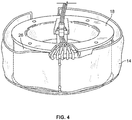
- device/separator 10 useful in the collection (and washing) of mononuclear cells include the Amicus® Separator made and sold by Fresenius-Kabi USA, of Lake Zurich, Illinois. Mononuclear cell collections using a device such as the Amicus® are described in greater detail in U.S. Patent No. 6,027,657 .. Briefly, Figs. 3-4 show a representative blood centrifuge device/ separator 10 with fluid circuit 200 mounted thereon, the fluid circuit 200 having a blood processing container 14 (see Fig. 2 ) defining a separation chamber suitable for harvesting mononuclear cells from whole blood. As shown in Fig.
- a portion of disposable processing set or fluid circuit 200 is mounted on the front panel of device/ separator 10.
- separation chamber 12 which is integral with the rest of circuit 200, is defined by the walls of a flexible processing container 14 carried within an annular gap defined by a rotating spool element 18 and an outer bowl element (not shown) housed within the cabinet of device/separator 10.
- the processing container 14 takes the form of an elongated tube or belt which is wrapped about the spool element 18 before use.
- the bowl and spool element 18 are pivoted on a yoke between an upright position and a suspended position, also not shown.
- the centrifuge device within separator 10 rotates the suspended bowl and spool element 18 about an axis, creating a centrifugal field within the processing chamber of container 14. Details of the mechanism for causing relative movement of the spool 18 and bowl elements as just described are disclosed in U.S. Patent No. 5,360,542 entitled “Centrifuge with Separable Bowl and Spool Elements Providing Access to the Separation Chamber,”.
- fluid circuit 200 includes a plurality of processing fluid flow cassettes 23L, 23M and 23R with tubing loops for association with peristaltic pumps 24 on device 10.
- cassettes 23L, 23M and 23R include molded plastic bodies with integrally molded liquid flow channels.
- Valve stations (depicted as numbered circles within each cassette and best seen in Figs. 7-9 ) are molded into the backside of cassette bodies.
- a flexible diaphragm covers and seals the backside of the cassette (23) body.
- Valve stations align with valve actuators of pump stations (PSL, PSM and PSR) located on the front panel of device 10.
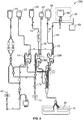
- Fluid circuit 200 also includes a network of tubing and pre-connected containers for establishing flow communication with the patient and for processing and collecting fluids and blood and blood components, as shown in greater detail in Fig. 2 .
- disposable processing set 200 may include a container 60 for supplying anticoagulant, a waste container 62 for collecting waste from one or more steps in the process for collecting, treating and/or washing mononuclear cells, a container 64 for holding saline or other wash or resuspension medium, a container 66 for collecting plasma, a container 68 for collecting the mononuclear cells and, optionally, container 69 for holding the photoactivation agent.
- Container 68 may also serve as the illumination container, and is preferably pre-attached to the disposable set 200. Alternatively, container 68 may be attached to set 200 by known sterile connection techniques, such as sterile docking or the like.
- fluid circuit includes inlet line 72, an anticoagulant (AC) line 74 for delivering AC from container 60, an RBC line 76 for conveying red blood cells from chamber 12 of container 14 to container 67, a platelet-poor plasma (PPP) line 78 for conveying PPP to container 66 and line 80 for conveying mononuclear cells to and from separation chamber 14 and collection/illumination container 68.
- AC anticoagulant
- RBC red blood cells from chamber 12 of container 14 to container 67
- PPP platelet-poor plasma
- the blood processing set includes one or more venipuncture needle(s) for accessing the circulatory system of the patient.
- fluid circuit 200 includes inlet needle 70 and return needle 82.
- a single needle can serve as both the inlet and outlet needle.
- Container 68 is suitable for irradiation by light of a selected wavelength.
- suitable for irradiation it is meant that the walls of the container are sufficiently transparent to light of the selected wavelength to activate the photoactive agent.
- container walls made of ethylene vinyl acetate (EVA) are suitable.
- container 68 in which the mononuclear cells are collected may serve both as the collection container and the irradiation container.
- Container 68 may be placed inside irradiation device 20 by the operator or, more preferably, may be placed inside the irradiation chamber of irradiation device 20 at the beginning of the ECP procedure and prior to whole blood withdrawal (as shown by the broken lines representing device 20 in Fig. 2 ). In any event, container 68 preferably remains integrally connected to the remainder of fluid circuit 200 during the entire procedure, thereby maintaining the closed or functionally closed condition of fluid circuit 200.
- Fluid flow through fluid circuit 200 is preferably driven, controlled and adjusted by a microprocessor-based controller in cooperation with the valves, pumps, weight scales and sensors of device 10, the details of which are described in the previously mentioned U.S. Patent No. 6,027,657 .
- the controller is programmed to activate rotation of pumps (and control the rotational speed thereof), associated with cassettes 23L, 23M and 23R, open and close valves, receive output signals from sensors and detectors, such as the interface detection system described below, and the like.
- the fluid circuit is further adapted for association with the treatment component (i.e., irradiation device) 20.
- fluid circuit 200 provides a sterile closed pathway between separation component 10 and irradiation component 20.
- the system described herein also preferably includes a washing component, which may be housed within the separation component.
- the separation component 10 and washing component are one and the same.
- the separation component and/or washing component 10 may be the centrifuge-based separator (such as, but not limited to the Amicus®) described above.
- washing component 10 may operate in accordance with a different separation principle.
- washing component 10 may include a separate device such as a spinning porous membrane of the type described in International Patent Application Publication No. WO 2012/125457 .
- the spinning membrane separator may be used for separating the treated mononuclear cell fraction from the supernatant fraction.
- a reusable hardware component utilizing a separation principle other than centrifugation such as the aforementioned spinning membrane may also include a microprocessor-based controller that controls the pumps, valves and sensors.
- the reusable hardware component utilizing a spinning membrane principle of separation will be configured to receive at least a portion of the disposable fluid circuit or a disposable fluid circuit of the type disclosed in WO2012/125457 .
- the system may include an interface detecting unit that monitors the location of the interface.
- the interface detection unit may be of the type described in U.S. Patent No. 6,027,657 , .
- the interface detection unit may be the same interface detection unit used during the initial separation of whole blood into two or more components. After the initial separation has been completed and separation chamber 12 is used to separate the treated mononuclear cell fraction from the supernatant fraction, an interface detection unit monitors the location of the interface between these fractions.
- a ramp 110 may be provided in combination with a light source and a light detector to determine the radial position of the interface between the treated mononuclear cell fraction and the supernatant fraction.
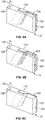
- Figs. 6(a)-6(c) show an exemplary ramp which extends from the inner surface of the bowl (not shown) toward spool 18 ( Figs. 6(a)-6(c) ).
- an interface 120 is formed between the fractions in separation chamber 12.
- the heavier treated mononuclear cell fraction 122 accumulates along the "high G" wall, while the supernatant fraction 124 occupies the area of chamber 12 nearer the "low G” wall 126.
- An exit port 130 communicates with chamber 12 and allows for removal of supernatant fraction from chamber 12 and diversion of supernatant fraction 124 to waste container 66.
- interface 120 is optimally positioned such that substantially all of the supernatant fraction can exit chamber 12 through port 130 to the substantial exclusion of the treated mononuclear cell fraction 122.
- interface 120 If interface 120 is positioned too close to the "high G" wall, as shown in Fig. 6(c) , some of the supernatant which includes some of the photoactivation agent and excess conditioning fluid will undesirably be sent back to the patient. On the other hand, if interface 120 approaches the "low G" wall 126, as shown in Fig. 6(b) , some of the treated mononuclear cell fraction 124 will undesirably be diverted to waste container 66.
- the interface detector unit senses the position of interface 120 outside of its optimal position, as shown in Fig. 6(a) , for example, it will send a signal output to the controller, as also described in U.S. Patent No. 5,316,667 , .
- the controller will adjust the speed of the peristaltic pump associated with cassette that acts on the line leading to the waste container to accelerate or slow the rotation of such pump and thereby adjust the interface to its more optimal position.
- the speed of pump rotation of the pump responsible for introducing fluid into separation chamber 12 (for example, pump 24L) associated with cassette 23L may be fixed.
- the speed of pump 24R which may be associated with the flow path for removing supernatant from separation chamber 12 may be varied by the controller depending on the location of the interface between the treated mononuclear cell fraction from the supernatant fraction.
- an interface detection and control system may not be required and a different type of sensing or sensing unit may be employed for ensuring efficient separation of the treated mononuclear cell fraction from the supernatant fraction.
- Fig. 5 whole blood is withdrawn from a patient (step 30) through inlet needle 70 and introduced into the separation chamber 12 of container 14 of processing set 200, where the whole blood is subjected to a centrifugal field provided by separator 10.
- the centrifugal field will separate the target cell population, i.e., mononuclear cells, from red blood cells, platelets and plasma (step 32).
- the components such as red blood cells and platelets may be returned to the patient or may be diverted to a container (e.g., container 67) for further processing.
- Collection of the mononuclear cells may proceed in one or more cycles.
- the number of processing cycles conducted in a given therapeutic procedure will depend upon the total volume of WB to be processed. For example, in a representative procedure, five collection cycles may be performed sequentially. During each cycle about 1500-3000 ml of whole blood can be processed to obtain a MNC volume of about 3 - 5 ml per cycle, resulting in a total volume of 15 - 25 ml of MNCs.
- the final volume of mononuclear cells is collected in collection container 68 ( Fig. 2 ) from which it is then provided for further treatment in accordance with the present disclosure.
- the collection of MNC is not limited to the method described above. MNCs may be collected in any manner known to those of skill in the art.
- Effective treatment of the mononuclear cells with light may require that the amount of collected mononuclear cells have a suitable hematocrit.
- a conditioning fluid such as saline, as shown in step 33.
- approximately 15 ml of MNC may be diluted in about 200 ml of saline.
- the diluted mononuclear cells (in container 68) are then combined with the suitable photoactivation agent in step 34.
- the desired volume of the agent may be pre-added to the container.
- the compound 8-methoxypsoralen (8-MOP) has been shown to be an effective photoactivation agent.
- other suitable photoactivation agents may be used, including, for example, other psoralen compounds.
- the system under the direction of the microprocessor-based controller, may be programmed to automatically deliver the desired amount of photoactive agent from, for example, container 69 before or after the MNC collection, based on the volume of MNC collected or to be collected.
- 8-MOP may be pre-added to container 68 at the beginning of a particular procedure or alternatively, added to the MNCs collected in the container just prior to irradiation.
- the 8-MOP is combined with the collected and diluted mononuclear cells to arrive at a mixture having, for example, a final 8-MOP concentration of 100-400 nanograms/mL.
- the mononuclear cells may be combined with the photoactivation agent to arrive at a final 8-MOP concentration in a range of about 200 nanograms/mL.
- the 8-MOP or other photoactivation agent may be added directly to container 68 by a syringe through a port in the container, or added elsewhere in fluid circuit 200 also by a syringe.
- the mononuclear cells with photoactivation agent (8-MOP) are then irradiated for a selected period of time (step 36).
- the mononuclear cell product may be exposed to UV bulbs having a wavelength in the UVA range of about 320 nm to 400 nm for a selected period of time, such as approximately 10-60 minutes, resulting in an average UVA exposure of approximately 0.5-5.0 J/cm 2 and use preferably approximately 1-2 J/cm 2 or even more preferably approximately 1.5 J/cm 2 per MNC.
- the treated mononuclear cells may be returned to separator 10 (and more specifically, the separation chamber 12 of container 14) as shown in step 38 of Fig. 5 .
- one of the pumps associated with cassette 23R may be actuated (automatically by the controller or under the manual control of the operator) to withdraw the treated MNC from container 68 and introduce the MNC into chamber 12 of container 14.
- the MNC may be concentrated (step 40). Supernatant, which will include unbound photoactivation agent is separated from the concentrated and treated cells and diverted to a waste container.
- the treated MNC are separated from remaining supernatant (step 44) under the influence of centrifugal field, in the case where a centrifugal separator is used (or by the spinning action of a spinning membrane).
- the interface between the treated mononuclear cell fraction and supernatant fraction is periodically or continuously observed or monitored for proper positioning (step 42). If necessary, the interface is adjusted. Any remaining unbound and excess photoactive agent and excess conditioning solution will be separated from the concentrated mononuclear cells and suspended in the supernatant.
- the supernatant may then be withdrawn to a waste container 62 ( Fig.
- the concentrated and washed mononuclear cells may optionally be resuspended with a resuspension solution (such as, but not limited to, plasma or saline) as shown in step 45, and returned back to the patient, as shown in step 46 of Fig. 5 .
- a resuspension solution such as, but not limited to, plasma or saline
- Other residual blood components remaining in the fluid circuit may also be used to flush or push out the concentrated and washed MNCs and return them to the patient.
- the treated mononuclear cells may be introduced back into the separator 10 together with whole blood from the patient (typically as an additional cycle after cell treatment) such that the combined streams are subjected to separation under the influence of the centrifugal field to undergo a combined collection/separation cycle.
- the mononuclear cells concentrate in the (separation chamber 12) of separator 10 while platelet-rich plasma separated from the incoming whole blood and the supernatant fraction from the treated mononuclear cells are sent to a waste container and concentrated red blood cells are sent back to the patient.
- the mononuclear cells are returned to the patient by, for example, flushing or pushing out the cells with saline or other blood components.
- This additional cycle is shown in Fig. 5 by dashed lines 90a and 90b where the treated cell product is combined with incoming whole blood at step 32.
- the MNC are concentrated as in step 40 and further processed as set forth in steps 42-46.
- Figs. 7-9 show a particular sequence of steps where the method of the present disclosure is carried out using the specific fluid circuit 200 including three (3) cassettes 23L, 23M and 23R. It will be understood that the particular sequence and use of particular pumps, valves and containers are not intended to limit the invention in any way or suggest that different sequences could not be employed. Thus, the description that follows is provided for exemplary purposes only.
- treated MNC in container 68
- emptied container 66 initially the PPP container
- pump 24R By selectively opening and closing valves of cassette 23R, the treated MNC may be delivered to chamber 12 of container 14.
- the treated MNC may be transferred to another container, such as (waste) container 62 from which the treated MNC product is pumped by pump 24L to chamber 12 of container 14 for separation of the treated mononuclear cell fraction from the supernatant fraction, as shown in Fig. 8 .
- the separated, treated MNC fraction is removed from chamber 12 through middle cassette 23M and returned to the patient (together with other residual blood components still residing in circuit 200), while the supernatant fraction is pumped out via action of pump 24 R to container 66 ( Fig. 9 ).
- pump 24R is operated by the controller based on output signals received from the interface detection unit.
Landscapes
- Health & Medical Sciences (AREA)
- Heart & Thoracic Surgery (AREA)
- Vascular Medicine (AREA)
- Life Sciences & Earth Sciences (AREA)
- Veterinary Medicine (AREA)
- Public Health (AREA)
- General Health & Medical Sciences (AREA)
- Animal Behavior & Ethology (AREA)
- Biomedical Technology (AREA)
- Hematology (AREA)
- Engineering & Computer Science (AREA)
- Anesthesiology (AREA)
- Cardiology (AREA)
- Chemical & Material Sciences (AREA)
- Pharmacology & Pharmacy (AREA)
- Medicinal Chemistry (AREA)
- Epidemiology (AREA)
- Molecular Biology (AREA)
- Biochemistry (AREA)
- Biotechnology (AREA)
- Cell Biology (AREA)
- Developmental Biology & Embryology (AREA)
- Immunology (AREA)
- Virology (AREA)
- Zoology (AREA)
- External Artificial Organs (AREA)
Claims (15)
- Système destiné à laver un produit cellulaire dans une thérapie cellulaire comprenant :a) une première unité matérielle réutilisable (10) comprenant :un séparateur, une ou plusieurs pompes (24), une ou plusieurs vannes et une unité de détection (110) pour surveiller une interface (120) entre des cellules mononucléaires traitées et un surnageant ;un contrôleur configuré pour faire fonctionner sélectivement lesdites une ou plusieurs pompes (24) et une ou plusieurs vannes sur la base d'informations obtenues depuis ladite unité de détection (110) et en vue de retirer des cellules mononucléaires traitées d'un récipient (68) de cellules mononucléaires traitées et introduire les cellules mononucléaires traitées dans ledit séparateur, ledit contrôleur étant également configuré pour régler les pompes et ainsi l'interface entre cellules mononucléaires traitées et surnageant à une position plus optimale quand l'unité de détection (110) détecte que l'emplacement de l'interface entre lesdites cellules mononucléaires traitées et ledit surnageant est hors de la position optimale ;b) une deuxième unité matérielle réutilisable (20) comprenant au moins une source de lumière et une chambre positionnée dans un champ de lumière émis par ladite au moins une source de lumière, ladite chambre étant configurée pour recevoir un récipient (68) de produit cellulaire ; etc) un circuit de fluide jetable (200) montable sur ladite première unité matérielle réutilisable (10) et attachable à ladite deuxième unité matérielle réutilisable (20), ledit circuit comportant une aiguille de ponction veineuse (82), un récipient (62) destiné à recevoir une fraction de surnageant de cellules mononucléaires traitées et au moins une chambre (12) associée audit séparateur pour séparer ladite fraction de cellules mononucléaires séparées traitées de ladite fraction de surnageant, et des orifices (130) associés à ladite au moins une chambre (12) pour détourner ladite fraction de cellules mononucléaires jusqu'à ladite aiguille de ponction veineuse (82) et pour détourner ladite fraction de surnageant jusqu'audit récipient (62), ledit circuit de fluide comportant un tubage définissant un chemin d'écoulement allant dudit orifice (130) audit récipient (62), ledit tubage étant accouplé à une pompe donnée parmi lesdites une ou plusieurs pompes (24), et ledit contrôleur étant également configuré pour faire tourner sélectivement ladite pompe donnée parmi lesdites une ou plusieurs pompes (24) pour agir sur la vitesse d'écoulement de ladite fraction de surnageant à travers ledit chemin d'écoulement en réponse auxdites informations sur l'emplacement de ladite interface (120) provenant de ladite unité de détection (110).
- Système de la revendication 1 dans lequel ledit contrôleur est configuré pour détourner ladite fraction de cellules mononucléaires traitées jusqu'à un sujet quand ladite unité de détection d'interface (110) détecte une position prédéterminée de l'interface entre ladite fraction de cellules mononucléaires traitées et ladite fraction de surnageant traité.
- Système de l'une quelconque des revendications 1 à 2 comprenant une pompe (24R, 24L) destinée à distribuer une fraction de cellules mononucléaires traitées par ledit circuit de fluide (200) à ladite au moins une chambre (12), et une pompe (24R) destinée à retirer ladite fraction de surnageant par ledit circuit de fluide (200) de ladite chambre (12).
- Système de l'une quelconque des revendications 1 à 3 dans lequel ledit circuit de fluide jetable (200) comprend au moins une cassette (23L, 23M, 23R) comportant des régions de vannes (1-10), ladite au moins une cassette étant configurée pour interagir avec un élément de pompage (24L, 24L', 24M, 24M', 24R, 24R'), dans lequel ladite cassette étant montable sur ladite unité matérielle réutilisable (10).
- Système de l'une quelconque des revendications 1 à 4 dans lequel ledit circuit de fluide jetable (200) comporte une partie associée à ladite première unité matérielle réutilisable (10) et une partie associée à ladite deuxième unité matérielle réutilisable (20).
- Système de la revendication 5 dans lequel ledit circuit de traitement de fluide jetable (200) comprend un système fonctionnellement fermé.
- Système de la revendication 5 dans lequel ledit circuit de traitement de fluide jetable (200) comprend un système fermé.
- Système de la revendication 1 dans lequel ledit séparateur comprend un séparateur centrifuge, ou comprend un séparateur à membrane tournante.
- Système de l'une quelconque des revendications 1 à 8 dans lequel ledit contrôleur est configuré pour régler la rotation desdites une ou plusieurs pompes (24) en réponse à un signal provenant de ladite unité de détection (110) .
- Système de la revendication 9 dans lequel l'unité de détection (110) est configurée pour surveiller l'emplacement d'une interface (120) entre ladite fraction de cellules mononucléaires traitées et ladite fraction de surnageant et ledit contrôleur est configuré pour faire varier la rotation de la pompe (24R) associée à un chemin d'écoulement destiné à retirer le surnageant de ladite séparation en réponse à une détection dudit emplacement de ladite interface.
- Système de l'une quelconque des revendications 1 à 10 dans lequel ledit contrôleur est configuré pour combiner une solution de conditionnement avec un produit cellulaire collecté.
- Système de l'une quelconque des revendications 1 à 11 dans lequel ledit contrôleur est configuré pour combiner une quantité souhaitée d'agent photoactif avec un produit cellulaire collecté.
- Système de l'une quelconque des revendications 1 à 12 dans lequel ladite unité de détection (110) est configurée pour surveiller périodiquement une interface (120) entre ladite fraction de cellules mononucléaires traitées et ladite fraction de surnageant.
- Système de l'une quelconque des revendications 1 à 13 dans lequel ledit contrôleur est également configuré pour effectuer un cycle combiné de collecte/introduction dans lequel des cellules mononucléaires traitées sont retournées à ladite au moins une chambre (12) et combinées avec du sang total.
- Système de la revendication 14 dans lequel ledit séparateur est adapté pour séparer des cellules mononucléaires de globules rouges et ledit contrôleur est également configuré pour effectuer (a) le retrait de globules rouges séparés dudit sang total de ladite chambre (12) associée audit séparateur et (b) le détournement de ladite fraction de surnageant et de plasma riche en plaquettes depuis ladite chambre (12) associée audit séparateur jusqu'audit récipient (62).
Applications Claiming Priority (1)
| Application Number | Priority Date | Filing Date | Title |
|---|---|---|---|
| US14/828,226 US10434240B2 (en) | 2015-08-17 | 2015-08-17 | Methods and systems for processing and washing a photopheresis mononuclear cell product |
Publications (2)
| Publication Number | Publication Date |
|---|---|
| EP3132817A1 EP3132817A1 (fr) | 2017-02-22 |
| EP3132817B1 true EP3132817B1 (fr) | 2021-02-17 |
Family
ID=56615915
Family Applications (1)
| Application Number | Title | Priority Date | Filing Date |
|---|---|---|---|
| EP16183386.8A Active EP3132817B1 (fr) | 2015-08-17 | 2016-08-09 | Systèmes de traitement et de lavage d'un produit de cellules mononucléaires de photophérèse |
Country Status (2)
| Country | Link |
|---|---|
| US (1) | US10434240B2 (fr) |
| EP (1) | EP3132817B1 (fr) |
Families Citing this family (7)
| Publication number | Priority date | Publication date | Assignee | Title |
|---|---|---|---|---|
| EP3461512B1 (fr) * | 2017-10-02 | 2022-04-13 | Fenwal, Inc. | Systèmes de surveillance et de contrôle d'équilibre de fluide pendant une procédure de fluide biologique |
| US11318239B2 (en) | 2018-03-01 | 2022-05-03 | Fenwal, Inc. | Systems and methods for performing online extracorporeal photopheresis |
| CA3100050A1 (fr) | 2018-05-11 | 2019-11-14 | Lupagen, Inc. | Systemes et methodes pour effectuer des modifications en temps reel en boucle fermee de cellules de patient |
| US11678825B2 (en) * | 2018-10-04 | 2023-06-20 | Fenwal, Inc. | Methods and systems for collecting samples in a photopheresis procedure |
| EP3666311B1 (fr) | 2018-12-13 | 2026-02-04 | Fenwal, Inc. | Systèmes et procédés de traitement d'un fluide biologique avec lumière dans le cas d'une panne d'une ampoule |
| US11883543B2 (en) | 2019-04-16 | 2024-01-30 | Fenwal, Inc. | Systems and methods for photoactivation of a biological fluid |
| US12558469B2 (en) | 2021-08-06 | 2026-02-24 | Fenwal, Inc. | Systems and methods for converting an apheresis fluid processing circuit to single or double needle mode |
Citations (1)
| Publication number | Priority date | Publication date | Assignee | Title |
|---|---|---|---|---|
| EP2620171A1 (fr) * | 2012-01-27 | 2013-07-31 | Fenwal, Inc. | Systèmes et procédés permettant d'effectuer une photophérèse extracorporelle en ligne |
Family Cites Families (35)
| Publication number | Priority date | Publication date | Assignee | Title |
|---|---|---|---|---|
| US4683889A (en) | 1983-03-29 | 1987-08-04 | Frederic A. Bourke, Jr. | Method and system for externally treating the blood |
| US4578056A (en) | 1984-10-29 | 1986-03-25 | Extracorporeal Medical Specialties, Inc. | Patient photopheresis treatment apparatus and method |
| US4568328A (en) | 1984-10-29 | 1986-02-04 | Extracorporeal Medical Specialties, Inc. | Automated photophoresis blood portion control methods and apparatus |
| US4838852A (en) | 1987-03-27 | 1989-06-13 | Therakos, Inc. | Active specific immune suppression |
| US5104373A (en) | 1988-09-22 | 1992-04-14 | American Immuno Tech, Inc. | Method and apparatus for extracorporeal blood treatment |
| US5316667A (en) | 1989-05-26 | 1994-05-31 | Baxter International Inc. | Time based interface detection systems for blood processing apparatus |
| US5383847A (en) | 1990-03-29 | 1995-01-24 | Therakos, Inc. | Non-specific immune system enhancement |
| WO1992019284A1 (fr) | 1991-05-08 | 1992-11-12 | Baxter International Inc. | RECIPIENT POUR l'IRRADIATION DES PRODUITS SANGUINS |
| JP4065927B2 (ja) | 1991-12-23 | 2008-03-26 | バクスター、インターナショナル、インコーポレイテッド | 分離チャンバーへのアクセスを提供する分離可能なボウル及びスプール要素を有する遠心機 |
| IL116765A0 (en) | 1995-01-17 | 1996-05-14 | Therakos Inc | On-line drug delivery system in extracorporeal therapy |
| CA2250919C (fr) | 1996-03-29 | 2008-05-13 | Therakos, Inc. | Traitement des leucocytes par photopherese |
| DE69737219T2 (de) | 1996-11-22 | 2007-11-08 | Therakos, Inc. | Apparat mit Rührvorrichtung zur Bestrahlung eines Blutproduktes |
| US5951509A (en) | 1996-11-22 | 1999-09-14 | Therakos, Inc. | Blood product irradiation device incorporating agitation |
| US6027657A (en) * | 1997-07-01 | 2000-02-22 | Baxter International Inc. | Systems and methods for collecting diluted mononuclear cells |
| US7025877B1 (en) | 1999-06-03 | 2006-04-11 | Baxter International Inc. | Processing set for processing and treating a biological fluid |
| US7068361B2 (en) | 1999-06-03 | 2006-06-27 | Baxter International | Apparatus, systems and methods for processing and treating a biological fluid with light |
| US6565802B1 (en) | 1999-06-03 | 2003-05-20 | Baxter International Inc. | Apparatus, systems and methods for processing and treating a biological fluid with light |
| US6219584B1 (en) | 1999-07-09 | 2001-04-17 | Therakos, Inc. | Method and system for determining an effective amount of light energy to delivery to fluids having targets for the light energy |
| US6793643B1 (en) | 2000-04-21 | 2004-09-21 | Therakos, Inc. | Low extracorporeal volume treatment system |
| US6582386B2 (en) | 2001-03-06 | 2003-06-24 | Baxter International Inc. | Multi-purpose, automated blood and fluid processing systems and methods |
| US7727523B2 (en) | 2001-08-13 | 2010-06-01 | Yale University | Method for suppressing immune system response to transplanted tissue or cells |
| US7479123B2 (en) | 2002-03-04 | 2009-01-20 | Therakos, Inc. | Method for collecting a desired blood component and performing a photopheresis treatment |
| DE10324668A1 (de) | 2003-05-30 | 2004-12-23 | Fresenius Medical Care Deutschland Gmbh | Vorrichtung zur extrakorporalen Bestrahlung einer Bilirubin enthaltenden Flüssigkeit und Verfahren hierfür |
| US7476209B2 (en) | 2004-12-21 | 2009-01-13 | Therakos, Inc. | Method and apparatus for collecting a blood component and performing a photopheresis treatment |
| JP2010519955A (ja) | 2007-03-01 | 2010-06-10 | ナノスペクトラ、バイオサイアンセズ、インク | 循環する細胞の体外アブレーションのためのデバイスおよび方法 |
| US8176828B2 (en) * | 2007-03-21 | 2012-05-15 | Schott Corporation | Glass-ceramic with laminates |
| US8556844B2 (en) | 2007-12-14 | 2013-10-15 | The Trustees Of Columbia University In The City Of New York | Systems, methods, and devices for blood treatment |
| US20100210989A1 (en) | 2008-12-23 | 2010-08-19 | Janet Lesley Macpherson | Processing blood |
| CA2825820C (fr) | 2011-03-11 | 2023-06-27 | Fenwal, Inc. | Systeme de collecte de sang a surface rotative et composante materielle reutilisable |
| US9089479B2 (en) | 2011-05-03 | 2015-07-28 | Fenwal, Inc. | Medium, solutions and methods for the washing, culturing and storage of white blood cells |
| US20130252227A1 (en) | 2012-03-20 | 2013-09-26 | Fenwal, Inc. | Apparatus and Method for Providing Cryopreserved ECP-Treated Mononuclear Cells |
| US10172995B2 (en) | 2013-02-06 | 2019-01-08 | Fenwal, Inc. | System and method for determining irradiation exposure time with irradiation sensors during extracorporeal photopheresis |
| WO2014123521A1 (fr) | 2013-02-06 | 2014-08-14 | Fenwal, Inc. | Procédé pour administrer une dose de lumière désirée à des cellules dans un milieu atténuant de la lumière |
| US10213544B2 (en) | 2013-06-13 | 2019-02-26 | Fenwal, Inc. | Methods for treating a suspension of mononuclear cells to facilitate extracorporeal photopheresis |
| US20160114095A1 (en) * | 2014-10-27 | 2016-04-28 | Fenwal, Inc. | Methods and systems for collecting mononuclear cells |
-
2015
- 2015-08-17 US US14/828,226 patent/US10434240B2/en active Active
-
2016
- 2016-08-09 EP EP16183386.8A patent/EP3132817B1/fr active Active
Patent Citations (1)
| Publication number | Priority date | Publication date | Assignee | Title |
|---|---|---|---|---|
| EP2620171A1 (fr) * | 2012-01-27 | 2013-07-31 | Fenwal, Inc. | Systèmes et procédés permettant d'effectuer une photophérèse extracorporelle en ligne |
Also Published As
| Publication number | Publication date |
|---|---|
| US10434240B2 (en) | 2019-10-08 |
| US20170049951A1 (en) | 2017-02-23 |
| EP3132817A1 (fr) | 2017-02-22 |
Similar Documents
| Publication | Publication Date | Title |
|---|---|---|
| EP3132817B1 (fr) | Systèmes de traitement et de lavage d'un produit de cellules mononucléaires de photophérèse | |
| EP2813253B1 (fr) | Système pour le traitement d'une suspension de cellules mononucléaires pour faciliter une photophérèse extracorporelle | |
| EP3015125B1 (fr) | Systèmes servant à recueillir des cellules mononucléaires | |
| EP3632484B1 (fr) | Systèmes de collecte d'échantillons dans une procédure de photophérèse | |
| US20160296691A1 (en) | Systems and methods for performing online extracorporeal photopheresis | |
| US10980933B2 (en) | System and method for platelet removal during mononuclear cell collection | |
| US20220305187A1 (en) | System And Method For Plasma Purification Prior To Mononuclear Cell Collection | |
| US9974899B2 (en) | Method for delivering desired light dose to cells in a light attenuating medium | |
| US20220273856A1 (en) | Methods and Systems for Maintaining Patient Fluid Balance During an Extracorporeal Therapeutic Cell Treatment | |
| EP3533482B1 (fr) | Systèmes et procédés permettant d'effectuer une photophérèse extracorporelle en ligne | |
| EP3300748B1 (fr) | Circuits de fluides jetables pour photopherèse extracorporelle ayant une source intégrée d'agent photoactif | |
| US10556053B2 (en) | System for collecting mononuclear cells having a suitable hematocrit for extracorporeal photopheresis | |
| EP4137171B1 (fr) | Systèmes et procédés permettant d'effectuer une photophérèse extracorporelle |
Legal Events
| Date | Code | Title | Description |
|---|---|---|---|
| PUAI | Public reference made under article 153(3) epc to a published international application that has entered the european phase |
Free format text: ORIGINAL CODE: 0009012 |
|
| STAA | Information on the status of an ep patent application or granted ep patent |
Free format text: STATUS: THE APPLICATION HAS BEEN PUBLISHED |
|
| AK | Designated contracting states |
Kind code of ref document: A1 Designated state(s): AL AT BE BG CH CY CZ DE DK EE ES FI FR GB GR HR HU IE IS IT LI LT LU LV MC MK MT NL NO PL PT RO RS SE SI SK SM TR |
|
| AX | Request for extension of the european patent |
Extension state: BA ME |
|
| STAA | Information on the status of an ep patent application or granted ep patent |
Free format text: STATUS: REQUEST FOR EXAMINATION WAS MADE |
|
| 17P | Request for examination filed |
Effective date: 20170822 |
|
| RBV | Designated contracting states (corrected) |
Designated state(s): AL AT BE BG CH CY CZ DE DK EE ES FI FR GB GR HR HU IE IS IT LI LT LU LV MC MK MT NL NO PL PT RO RS SE SI SK SM TR |
|
| STAA | Information on the status of an ep patent application or granted ep patent |
Free format text: STATUS: EXAMINATION IS IN PROGRESS |
|
| 17Q | First examination report despatched |
Effective date: 20181207 |
|
| GRAP | Despatch of communication of intention to grant a patent |
Free format text: ORIGINAL CODE: EPIDOSNIGR1 |
|
| STAA | Information on the status of an ep patent application or granted ep patent |
Free format text: STATUS: GRANT OF PATENT IS INTENDED |
|
| RIC1 | Information provided on ipc code assigned before grant |
Ipc: A61M 1/02 20060101ALI20200319BHEP Ipc: A61M 1/34 20060101ALI20200319BHEP Ipc: A61M 1/26 20060101ALI20200319BHEP Ipc: A61M 1/36 20060101AFI20200319BHEP Ipc: A61M 1/38 20060101ALI20200319BHEP |
|
| INTG | Intention to grant announced |
Effective date: 20200331 |
|
| GRAJ | Information related to disapproval of communication of intention to grant by the applicant or resumption of examination proceedings by the epo deleted |
Free format text: ORIGINAL CODE: EPIDOSDIGR1 |
|
| STAA | Information on the status of an ep patent application or granted ep patent |
Free format text: STATUS: EXAMINATION IS IN PROGRESS |
|
| INTC | Intention to grant announced (deleted) | ||
| GRAS | Grant fee paid |
Free format text: ORIGINAL CODE: EPIDOSNIGR3 |
|
| STAA | Information on the status of an ep patent application or granted ep patent |
Free format text: STATUS: GRANT OF PATENT IS INTENDED |
|
| GRAP | Despatch of communication of intention to grant a patent |
Free format text: ORIGINAL CODE: EPIDOSNIGR1 |
|
| INTG | Intention to grant announced |
Effective date: 20200903 |
|
| GRAA | (expected) grant |
Free format text: ORIGINAL CODE: 0009210 |
|
| STAA | Information on the status of an ep patent application or granted ep patent |
Free format text: STATUS: THE PATENT HAS BEEN GRANTED |
|
| AK | Designated contracting states |
Kind code of ref document: B1 Designated state(s): AL AT BE BG CH CY CZ DE DK EE ES FI FR GB GR HR HU IE IS IT LI LT LU LV MC MK MT NL NO PL PT RO RS SE SI SK SM TR |
|
| REG | Reference to a national code |
Ref country code: GB Ref legal event code: FG4D |
|
| REG | Reference to a national code |
Ref country code: CH Ref legal event code: EP |
|
| REG | Reference to a national code |
Ref country code: DE Ref legal event code: R096 Ref document number: 602016052480 Country of ref document: DE |
|
| REG | Reference to a national code |
Ref country code: AT Ref legal event code: REF Ref document number: 1360621 Country of ref document: AT Kind code of ref document: T Effective date: 20210315 |
|
| REG | Reference to a national code |
Ref country code: IE Ref legal event code: FG4D |
|
| REG | Reference to a national code |
Ref country code: LT Ref legal event code: MG9D |
|
| REG | Reference to a national code |
Ref country code: NL Ref legal event code: MP Effective date: 20210217 |
|
| PG25 | Lapsed in a contracting state [announced via postgrant information from national office to epo] |
Ref country code: PT Free format text: LAPSE BECAUSE OF FAILURE TO SUBMIT A TRANSLATION OF THE DESCRIPTION OR TO PAY THE FEE WITHIN THE PRESCRIBED TIME-LIMIT Effective date: 20210617 Ref country code: NO Free format text: LAPSE BECAUSE OF FAILURE TO SUBMIT A TRANSLATION OF THE DESCRIPTION OR TO PAY THE FEE WITHIN THE PRESCRIBED TIME-LIMIT Effective date: 20210517 Ref country code: BG Free format text: LAPSE BECAUSE OF FAILURE TO SUBMIT A TRANSLATION OF THE DESCRIPTION OR TO PAY THE FEE WITHIN THE PRESCRIBED TIME-LIMIT Effective date: 20210517 Ref country code: GR Free format text: LAPSE BECAUSE OF FAILURE TO SUBMIT A TRANSLATION OF THE DESCRIPTION OR TO PAY THE FEE WITHIN THE PRESCRIBED TIME-LIMIT Effective date: 20210518 Ref country code: FI Free format text: LAPSE BECAUSE OF FAILURE TO SUBMIT A TRANSLATION OF THE DESCRIPTION OR TO PAY THE FEE WITHIN THE PRESCRIBED TIME-LIMIT Effective date: 20210217 Ref country code: HR Free format text: LAPSE BECAUSE OF FAILURE TO SUBMIT A TRANSLATION OF THE DESCRIPTION OR TO PAY THE FEE WITHIN THE PRESCRIBED TIME-LIMIT Effective date: 20210217 Ref country code: LT Free format text: LAPSE BECAUSE OF FAILURE TO SUBMIT A TRANSLATION OF THE DESCRIPTION OR TO PAY THE FEE WITHIN THE PRESCRIBED TIME-LIMIT Effective date: 20210217 |
|
| REG | Reference to a national code |
Ref country code: AT Ref legal event code: MK05 Ref document number: 1360621 Country of ref document: AT Kind code of ref document: T Effective date: 20210217 |
|
| PG25 | Lapsed in a contracting state [announced via postgrant information from national office to epo] |
Ref country code: LV Free format text: LAPSE BECAUSE OF FAILURE TO SUBMIT A TRANSLATION OF THE DESCRIPTION OR TO PAY THE FEE WITHIN THE PRESCRIBED TIME-LIMIT Effective date: 20210217 Ref country code: PL Free format text: LAPSE BECAUSE OF FAILURE TO SUBMIT A TRANSLATION OF THE DESCRIPTION OR TO PAY THE FEE WITHIN THE PRESCRIBED TIME-LIMIT Effective date: 20210217 Ref country code: NL Free format text: LAPSE BECAUSE OF FAILURE TO SUBMIT A TRANSLATION OF THE DESCRIPTION OR TO PAY THE FEE WITHIN THE PRESCRIBED TIME-LIMIT Effective date: 20210217 Ref country code: RS Free format text: LAPSE BECAUSE OF FAILURE TO SUBMIT A TRANSLATION OF THE DESCRIPTION OR TO PAY THE FEE WITHIN THE PRESCRIBED TIME-LIMIT Effective date: 20210217 Ref country code: SE Free format text: LAPSE BECAUSE OF FAILURE TO SUBMIT A TRANSLATION OF THE DESCRIPTION OR TO PAY THE FEE WITHIN THE PRESCRIBED TIME-LIMIT Effective date: 20210217 |
|
| PG25 | Lapsed in a contracting state [announced via postgrant information from national office to epo] |
Ref country code: IS Free format text: LAPSE BECAUSE OF FAILURE TO SUBMIT A TRANSLATION OF THE DESCRIPTION OR TO PAY THE FEE WITHIN THE PRESCRIBED TIME-LIMIT Effective date: 20210617 |
|
| PG25 | Lapsed in a contracting state [announced via postgrant information from national office to epo] |
Ref country code: EE Free format text: LAPSE BECAUSE OF FAILURE TO SUBMIT A TRANSLATION OF THE DESCRIPTION OR TO PAY THE FEE WITHIN THE PRESCRIBED TIME-LIMIT Effective date: 20210217 Ref country code: CZ Free format text: LAPSE BECAUSE OF FAILURE TO SUBMIT A TRANSLATION OF THE DESCRIPTION OR TO PAY THE FEE WITHIN THE PRESCRIBED TIME-LIMIT Effective date: 20210217 Ref country code: AT Free format text: LAPSE BECAUSE OF FAILURE TO SUBMIT A TRANSLATION OF THE DESCRIPTION OR TO PAY THE FEE WITHIN THE PRESCRIBED TIME-LIMIT Effective date: 20210217 Ref country code: SM Free format text: LAPSE BECAUSE OF FAILURE TO SUBMIT A TRANSLATION OF THE DESCRIPTION OR TO PAY THE FEE WITHIN THE PRESCRIBED TIME-LIMIT Effective date: 20210217 |
|
| REG | Reference to a national code |
Ref country code: DE Ref legal event code: R097 Ref document number: 602016052480 Country of ref document: DE |
|
| PG25 | Lapsed in a contracting state [announced via postgrant information from national office to epo] |
Ref country code: DK Free format text: LAPSE BECAUSE OF FAILURE TO SUBMIT A TRANSLATION OF THE DESCRIPTION OR TO PAY THE FEE WITHIN THE PRESCRIBED TIME-LIMIT Effective date: 20210217 Ref country code: ES Free format text: LAPSE BECAUSE OF FAILURE TO SUBMIT A TRANSLATION OF THE DESCRIPTION OR TO PAY THE FEE WITHIN THE PRESCRIBED TIME-LIMIT Effective date: 20210217 Ref country code: SK Free format text: LAPSE BECAUSE OF FAILURE TO SUBMIT A TRANSLATION OF THE DESCRIPTION OR TO PAY THE FEE WITHIN THE PRESCRIBED TIME-LIMIT Effective date: 20210217 Ref country code: RO Free format text: LAPSE BECAUSE OF FAILURE TO SUBMIT A TRANSLATION OF THE DESCRIPTION OR TO PAY THE FEE WITHIN THE PRESCRIBED TIME-LIMIT Effective date: 20210217 |
|
| PLBE | No opposition filed within time limit |
Free format text: ORIGINAL CODE: 0009261 |
|
| STAA | Information on the status of an ep patent application or granted ep patent |
Free format text: STATUS: NO OPPOSITION FILED WITHIN TIME LIMIT |
|
| 26N | No opposition filed |
Effective date: 20211118 |
|
| PG25 | Lapsed in a contracting state [announced via postgrant information from national office to epo] |
Ref country code: AL Free format text: LAPSE BECAUSE OF FAILURE TO SUBMIT A TRANSLATION OF THE DESCRIPTION OR TO PAY THE FEE WITHIN THE PRESCRIBED TIME-LIMIT Effective date: 20210217 |
|
| PG25 | Lapsed in a contracting state [announced via postgrant information from national office to epo] |
Ref country code: SI Free format text: LAPSE BECAUSE OF FAILURE TO SUBMIT A TRANSLATION OF THE DESCRIPTION OR TO PAY THE FEE WITHIN THE PRESCRIBED TIME-LIMIT Effective date: 20210217 |
|
| REG | Reference to a national code |
Ref country code: CH Ref legal event code: PL |
|
| PG25 | Lapsed in a contracting state [announced via postgrant information from national office to epo] |
Ref country code: MC Free format text: LAPSE BECAUSE OF FAILURE TO SUBMIT A TRANSLATION OF THE DESCRIPTION OR TO PAY THE FEE WITHIN THE PRESCRIBED TIME-LIMIT Effective date: 20210217 |
|
| REG | Reference to a national code |
Ref country code: BE Ref legal event code: MM Effective date: 20210831 |
|
| PG25 | Lapsed in a contracting state [announced via postgrant information from national office to epo] |
Ref country code: LI Free format text: LAPSE BECAUSE OF NON-PAYMENT OF DUE FEES Effective date: 20210831 Ref country code: CH Free format text: LAPSE BECAUSE OF NON-PAYMENT OF DUE FEES Effective date: 20210831 |
|
| PG25 | Lapsed in a contracting state [announced via postgrant information from national office to epo] |
Ref country code: IS Free format text: LAPSE BECAUSE OF FAILURE TO SUBMIT A TRANSLATION OF THE DESCRIPTION OR TO PAY THE FEE WITHIN THE PRESCRIBED TIME-LIMIT Effective date: 20210617 Ref country code: LU Free format text: LAPSE BECAUSE OF NON-PAYMENT OF DUE FEES Effective date: 20210809 |
|
| PG25 | Lapsed in a contracting state [announced via postgrant information from national office to epo] |
Ref country code: IE Free format text: LAPSE BECAUSE OF NON-PAYMENT OF DUE FEES Effective date: 20210809 Ref country code: BE Free format text: LAPSE BECAUSE OF NON-PAYMENT OF DUE FEES Effective date: 20210831 |
|
| PG25 | Lapsed in a contracting state [announced via postgrant information from national office to epo] |
Ref country code: HU Free format text: LAPSE BECAUSE OF FAILURE TO SUBMIT A TRANSLATION OF THE DESCRIPTION OR TO PAY THE FEE WITHIN THE PRESCRIBED TIME-LIMIT; INVALID AB INITIO Effective date: 20160809 |
|
| P01 | Opt-out of the competence of the unified patent court (upc) registered |
Effective date: 20230515 |
|
| PG25 | Lapsed in a contracting state [announced via postgrant information from national office to epo] |
Ref country code: CY Free format text: LAPSE BECAUSE OF FAILURE TO SUBMIT A TRANSLATION OF THE DESCRIPTION OR TO PAY THE FEE WITHIN THE PRESCRIBED TIME-LIMIT Effective date: 20210217 |
|
| PG25 | Lapsed in a contracting state [announced via postgrant information from national office to epo] |
Ref country code: MK Free format text: LAPSE BECAUSE OF FAILURE TO SUBMIT A TRANSLATION OF THE DESCRIPTION OR TO PAY THE FEE WITHIN THE PRESCRIBED TIME-LIMIT Effective date: 20210217 |
|
| PG25 | Lapsed in a contracting state [announced via postgrant information from national office to epo] |
Ref country code: TR Free format text: LAPSE BECAUSE OF FAILURE TO SUBMIT A TRANSLATION OF THE DESCRIPTION OR TO PAY THE FEE WITHIN THE PRESCRIBED TIME-LIMIT Effective date: 20210217 |
|
| PG25 | Lapsed in a contracting state [announced via postgrant information from national office to epo] |
Ref country code: MT Free format text: LAPSE BECAUSE OF FAILURE TO SUBMIT A TRANSLATION OF THE DESCRIPTION OR TO PAY THE FEE WITHIN THE PRESCRIBED TIME-LIMIT Effective date: 20210217 |
|
| PGFP | Annual fee paid to national office [announced via postgrant information from national office to epo] |
Ref country code: DE Payment date: 20250827 Year of fee payment: 10 |
|
| PGFP | Annual fee paid to national office [announced via postgrant information from national office to epo] |
Ref country code: IT Payment date: 20250820 Year of fee payment: 10 |
|
| PGFP | Annual fee paid to national office [announced via postgrant information from national office to epo] |
Ref country code: GB Payment date: 20250827 Year of fee payment: 10 |
|
| PGFP | Annual fee paid to national office [announced via postgrant information from national office to epo] |
Ref country code: FR Payment date: 20250825 Year of fee payment: 10 |