EP3134402B1 - Composés 4-amino-imidazoquinoline - Google Patents
Composés 4-amino-imidazoquinoline Download PDFInfo
- Publication number
- EP3134402B1 EP3134402B1 EP15716824.6A EP15716824A EP3134402B1 EP 3134402 B1 EP3134402 B1 EP 3134402B1 EP 15716824 A EP15716824 A EP 15716824A EP 3134402 B1 EP3134402 B1 EP 3134402B1
- Authority
- EP
- European Patent Office
- Prior art keywords
- formula
- compound
- imidazo
- quinolin
- ethoxymethyl
- Prior art date
- Legal status (The legal status is an assumption and is not a legal conclusion. Google has not performed a legal analysis and makes no representation as to the accuracy of the status listed.)
- Active
Links
- 0 CC(C)(C[n]1c(c(ccc(*)c2*)c2nc2N)c2nc1*)O Chemical compound CC(C)(C[n]1c(c(ccc(*)c2*)c2nc2N)c2nc1*)O 0.000 description 9
- JYLCBICDNHHNAD-UHFFFAOYSA-N CCOCc1nc(c(N)nc2c3ccc(C(OC)=O)c2)c3[n]1CC(C)(C)O Chemical compound CCOCc1nc(c(N)nc2c3ccc(C(OC)=O)c2)c3[n]1CC(C)(C)O JYLCBICDNHHNAD-UHFFFAOYSA-N 0.000 description 1
- MMGIMCFVDIHCIY-UHFFFAOYSA-N CCOCc1nc2c(N)nc(cccc3)c3c2[n]1CC(C)(C)OCCN Chemical compound CCOCc1nc2c(N)nc(cccc3)c3c2[n]1CC(C)(C)OCCN MMGIMCFVDIHCIY-UHFFFAOYSA-N 0.000 description 1
- GPIWCXJTCPCNIQ-UHFFFAOYSA-N CCOCc1nc2c(N)nc(cccc3)c3c2[n]1CC(C)(C)OCCNC(C)=O Chemical compound CCOCc1nc2c(N)nc(cccc3)c3c2[n]1CC(C)(C)OCCNC(C)=O GPIWCXJTCPCNIQ-UHFFFAOYSA-N 0.000 description 1
Classifications
-
- C—CHEMISTRY; METALLURGY
- C07—ORGANIC CHEMISTRY
- C07D—HETEROCYCLIC COMPOUNDS
- C07D471/00—Heterocyclic compounds containing nitrogen atoms as the only ring hetero atoms in the condensed system, at least one ring being a six-membered ring with one nitrogen atom, not provided for by groups C07D451/00 - C07D463/00
- C07D471/02—Heterocyclic compounds containing nitrogen atoms as the only ring hetero atoms in the condensed system, at least one ring being a six-membered ring with one nitrogen atom, not provided for by groups C07D451/00 - C07D463/00 in which the condensed system contains two hetero rings
- C07D471/04—Ortho-condensed systems
-
- A—HUMAN NECESSITIES
- A61—MEDICAL OR VETERINARY SCIENCE; HYGIENE
- A61K—PREPARATIONS FOR MEDICAL, DENTAL OR TOILETRY PURPOSES
- A61K31/00—Medicinal preparations containing organic active ingredients
- A61K31/33—Heterocyclic compounds
- A61K31/395—Heterocyclic compounds having nitrogen as a ring hetero atom, e.g. guanethidine or rifamycins
- A61K31/41—Heterocyclic compounds having nitrogen as a ring hetero atom, e.g. guanethidine or rifamycins having five-membered rings with two or more ring hetero atoms, at least one of which being nitrogen, e.g. tetrazole
- A61K31/4164—1,3-Diazoles
- A61K31/4188—1,3-Diazoles condensed with other heterocyclic ring systems, e.g. biotin, sorbinil
-
- A—HUMAN NECESSITIES
- A61—MEDICAL OR VETERINARY SCIENCE; HYGIENE
- A61K—PREPARATIONS FOR MEDICAL, DENTAL OR TOILETRY PURPOSES
- A61K31/00—Medicinal preparations containing organic active ingredients
- A61K31/33—Heterocyclic compounds
- A61K31/395—Heterocyclic compounds having nitrogen as a ring hetero atom, e.g. guanethidine or rifamycins
- A61K31/435—Heterocyclic compounds having nitrogen as a ring hetero atom, e.g. guanethidine or rifamycins having six-membered rings with one nitrogen as the only ring hetero atom
- A61K31/4353—Heterocyclic compounds having nitrogen as a ring hetero atom, e.g. guanethidine or rifamycins having six-membered rings with one nitrogen as the only ring hetero atom ortho- or peri-condensed with heterocyclic ring systems
- A61K31/437—Heterocyclic compounds having nitrogen as a ring hetero atom, e.g. guanethidine or rifamycins having six-membered rings with one nitrogen as the only ring hetero atom ortho- or peri-condensed with heterocyclic ring systems the heterocyclic ring system containing a five-membered ring having nitrogen as a ring hetero atom, e.g. indolizine, beta-carboline
-
- A—HUMAN NECESSITIES
- A61—MEDICAL OR VETERINARY SCIENCE; HYGIENE
- A61K—PREPARATIONS FOR MEDICAL, DENTAL OR TOILETRY PURPOSES
- A61K31/00—Medicinal preparations containing organic active ingredients
- A61K31/33—Heterocyclic compounds
- A61K31/395—Heterocyclic compounds having nitrogen as a ring hetero atom, e.g. guanethidine or rifamycins
- A61K31/435—Heterocyclic compounds having nitrogen as a ring hetero atom, e.g. guanethidine or rifamycins having six-membered rings with one nitrogen as the only ring hetero atom
- A61K31/47—Quinolines; Isoquinolines
- A61K31/4738—Quinolines; Isoquinolines ortho- or peri-condensed with heterocyclic ring systems
-
- A—HUMAN NECESSITIES
- A61—MEDICAL OR VETERINARY SCIENCE; HYGIENE
- A61P—SPECIFIC THERAPEUTIC ACTIVITY OF CHEMICAL COMPOUNDS OR MEDICINAL PREPARATIONS
- A61P31/00—Antiinfectives, i.e. antibiotics, antiseptics, chemotherapeutics
-
- A—HUMAN NECESSITIES
- A61—MEDICAL OR VETERINARY SCIENCE; HYGIENE
- A61P—SPECIFIC THERAPEUTIC ACTIVITY OF CHEMICAL COMPOUNDS OR MEDICINAL PREPARATIONS
- A61P31/00—Antiinfectives, i.e. antibiotics, antiseptics, chemotherapeutics
- A61P31/12—Antivirals
- A61P31/20—Antivirals for DNA viruses
-
- A—HUMAN NECESSITIES
- A61—MEDICAL OR VETERINARY SCIENCE; HYGIENE
- A61P—SPECIFIC THERAPEUTIC ACTIVITY OF CHEMICAL COMPOUNDS OR MEDICINAL PREPARATIONS
- A61P35/00—Antineoplastic agents
-
- A—HUMAN NECESSITIES
- A61—MEDICAL OR VETERINARY SCIENCE; HYGIENE
- A61P—SPECIFIC THERAPEUTIC ACTIVITY OF CHEMICAL COMPOUNDS OR MEDICINAL PREPARATIONS
- A61P37/00—Drugs for immunological or allergic disorders
-
- A—HUMAN NECESSITIES
- A61—MEDICAL OR VETERINARY SCIENCE; HYGIENE
- A61P—SPECIFIC THERAPEUTIC ACTIVITY OF CHEMICAL COMPOUNDS OR MEDICINAL PREPARATIONS
- A61P37/00—Drugs for immunological or allergic disorders
- A61P37/02—Immunomodulators
-
- A—HUMAN NECESSITIES
- A61—MEDICAL OR VETERINARY SCIENCE; HYGIENE
- A61P—SPECIFIC THERAPEUTIC ACTIVITY OF CHEMICAL COMPOUNDS OR MEDICINAL PREPARATIONS
- A61P37/00—Drugs for immunological or allergic disorders
- A61P37/02—Immunomodulators
- A61P37/06—Immunosuppressants, e.g. drugs for graft rejection
-
- A—HUMAN NECESSITIES
- A61—MEDICAL OR VETERINARY SCIENCE; HYGIENE
- A61P—SPECIFIC THERAPEUTIC ACTIVITY OF CHEMICAL COMPOUNDS OR MEDICINAL PREPARATIONS
- A61P43/00—Drugs for specific purposes, not provided for in groups A61P1/00-A61P41/00
Definitions
- the present invention relates to novel 4-amino-imidazoquinoline derivatives having pharmaceutical activity, their manufacture, pharmaceutical compositions containing them and their potential use as medicaments.
- the present invention relates to compounds of the formula wherein R 1 to R 4 and X are as described below, or to pharmaceutically acceptable salts thereof.
- the compounds are TLR agonists.
- the compounds are TLR7 and/or TLR8 agonists and more particularly agonists of both TLR7 and TLR8 receptors.
- they may be useful for the treatment and prevention of cancer, autoimmune and infectious diseases.
- they may be useful in a vaccination against diseases such as cancer, autoimmune or infectious diseases.
- TLRs Toll-like receptors
- TLRs are a family of membrane-spanning receptors that are expressed on cells of the immune system like dendritic cells, macrophages, monocytes, T cells, B cells, NK cells and mast cells but also on endothelial and epithelial cells ( Kawai et al., Immunity, 2011, 34, 637-650 , Kawai et al., Nat. Immunol., 2010, 11, 373-384 ).
- TLRs that recognize bacterial and fungal components are expressed on the cell surface (i.e.
- TLR1, 2, 4, 5 and 6 while others that recognize viral or microbial nucleic acids like TLR3, 7, 8 and 9 are localized to the endolysosomal / phagosomal membrane ( Henessy et al. Nat. Rev. Drug Discovery 2010, 9, 293-307 ).
- TLR activation leads to the induction and release of pro-inflammatory cytokines, with the specific activation sequence and response depending on the specific TLR and cell type.
- TLR7 and TLR8 are both expressed in monocytes and macrophages, with TLR7 also highly expressed in plasmacytoid dendritic cells and TLR8 in myeloid dendritic cells and mast cells.
- Both receptors are activated by ssRNA and their activation stimulates the production of cytokines such as IL-6, IL-12, TNF- ⁇ and IFN- ⁇ and additional co-stimulatory molecules and chemokine receptors.
- cytokines such as IL-6, IL-12, TNF- ⁇ and IFN- ⁇ and additional co-stimulatory molecules and chemokine receptors.
- type I interferons IFN ⁇ (from plasmacytoid dendritic cells) and IPN ⁇ , are also produced by cells upon activation with TLR7/8 agonists ( Uematsu et al., J. Biol. Chem., 2007, 282, 15319-15323 ).
- TLR7 agonist imiquimod was approved by the U.S. Food and Drug Administration as a topical agent for the treatment of genital warts, superficial basal cell carcinoma and actinic keratosis.
- ALDARATM the TLR7 agonist imiquimod
- Systemic application however of the early TLR7 agonists like resiquimod has been abandoned due to intolerable cardiotoxicity observed upon global chemokine stimulation at therapeutic levels ( Holldack, Drug Discovery Today, 2013, 1-4 ).
- Knowledge about TLR8 agonists is less advanced and mostly restricted to data with early mixed TLR7/8 agonists like resiquimod and more recently to compounds described by VentiRX Pharmaceuticals (i.e. WO2010054215 , WO2012045090 ).
- VentiRX Pharmaceuticals i.e. WO2010054215 , WO2012045090
- the present invention is directed to 1H-imidazo[4,5-c]quinolin-4-amine-2-methylpropan-2-yloxy derivatives with improved cellular potency over known TLR7 and/or TLR8 agonists of this type for use in the treatment of cancer, preferably solid tumors and lymphomas, and for other uses including the treatment of certain skin conditions or diseases, such as atopic dermatitis, the treatment of infectious diseases, preferably viral diseases, and for use as adjuvants in vaccines formulated for use in cancer therapy or by desensitizing of the receptors by continuous stimulation in the treatment of autoimmune diseases.
- the present invention discloses 1H-imidazo[4,5-c]quinolin-4-amine-2-methylpropan-2-yloxy derivatives that are derivatized directly on the tertiary alcohol with an aminoethyl or glycine moiety. Due to the poor reactivity of the tertiary alcohol these derivatives had obviously eluded earlier attempts at synthesis.
- these new compounds possess high cellular potency at TLR7 that is comparable or even better than resiquimod itself, whereas close analogs that have been described earlier such as 1-(2-(2-Aminoethoxy)ethyl)-2-(ethoxymethyl)-1 H -imidazo[4,5-c]quinolin-4-amine (Example 69 of US20030187016 ) do not show the required activity.
- the described 1H-imidazo[4,5-c]quinolin-4-amine-2-methylpropan-2-yloxy derivatives are strong TLR8 receptor agonists with potency comparable or superior to so far disclosed TLR8 agonists from other chemical classes and much improved over resiquimod itself.
- the compounds of the present invention fulfil the need of activating both TLR7 and TLR8 receptors with improved potency.
- the present invention relates to 4-amino-imidazoquinoline derivatives of the formula wherein
- the invention is also concerned with processes for the manufacture of compounds of formula I.
- the invention also relates to pharmaceutical compositions comprising a compound of formula I as described above and a pharmaceutically acceptable carrier and/or adjuvant.
- a further aspect of the invention is the use of compounds of formula I as therapeutic active substances for the treatment of diseases that can be mediated with TLR agonists, in particular TLR7 and/or TLR8 agonists, more particularly TLR7 and TLR8 receptors.
- TLR agonists in particular TLR7 and/or TLR8 agonists, more particularly TLR7 and TLR8 receptors.
- the invention thus relates to a method for the treatment of a disease that can be mediated with TLR agonists such as for example cancer and autoimmune or infectious diseases.
- compound(s) of this invention and “compound(s) of the present invention” refers to compounds of formula I and solvates or salts thereof (e.g., pharmaceutically acceptable salts).
- substituted denotes an atom or a group of atoms replacing a hydrogen atom on the parent molecule.
- halogen refers to fluoro, chloro, bromo and iodo, with fluoro, chloro and bromo being of particular interest. More particularly, halogen refers to fluoro and chloro.
- alkyl refers to a branched or straight-chain monovalent saturated aliphatic hydrocarbon radical of one to twenty carbon atoms, particularly one to sixteen carbon atoms, more particularly one to ten carbon atoms.
- C 1-10 -alkyl refers to a branched or straight-chain monovalent saturated aliphatic hydrocarbon radical of one to ten carbon atoms, such as e.g., methyl, ethyl, n -propyl, isopropyl, n -butyl, sec- butyl, tert -butyl, pentyl, 1,1,3,3-tetramethyl-butyl. More particularly, the term “alkyl” also embraces lower alkyl groups as described below.
- lower alkyl or "C 1-7 -alkyl", alone or in combination, signifies a straight-chain or branched-chain alkyl group with 1 to 7 carbon atoms, in particular a straight or branched-chain alkyl group with 1 to 6 carbon atoms and more particularly a straight or branched-chain alkyl group with 1 to 4 carbon atoms.
- straight-chain and branched C 1-7 alkyl groups are methyl, ethyl, propyl, isopropyl, butyl, isobutyl, tert-butyl, the isomeric pentyls, the isomeric hexyls and the isomeric heptyls, in particular methyl and ethyl.
- lower alkenyl or "C 2-7 -alkenyl” signifies a straight-chain or branched chain hydrocarbon residue comprising an olefinic bond and 2 to 7, in particular 3 to 6, more particularly 3 to 4 carbon atoms.
- alkenyl groups are ethenyl, 1-propenyl, 2-propenyl, isopropenyl, 1-butenyl, 2-butenyl, 3-butenyl and isobutenyl, in particular ethenyl.
- lower alkoxy or "C 1-7 -alkoxy” refers to the group R'-O-, wherein R' is lower alkyl and the term “lower alkyl” has the previously given significance.
- lower alkoxy groups are methoxy, ethoxy, n-propoxy, isopropoxy, n-butoxy, isobutoxy, sec.-butoxy and tert-butoxy, in particular methoxy.
- lower alkoxycarbonyl or “C 1-7 -alkoxycarbonyl” refers to the group -COOR, wherein R is lower alkyl and the term “lower alkyl” has the previously given significance.
- Lower alkoxycarbonyl groups of particular interest are methoxycarbonyl or ethoxycarbonyl.
- lower alkoxycarbonylalkyl or "C 1-7 -alkoxycarbonyl-C 1-7 -alkyl” refers to lower alkyl groups as defined above wherein at least one of the hydrogen atoms of the lower alkyl group is replaced by a lower alkoxycarbonyl group.
- lower alkoxycarbonyl-alkyl groups is -(CH 2 ) 2 -COOC 2 H 5 .
- lower alkoxycarbonylalkenyl or "C 1-7 -alkoxycarbonyl-C 2-7 -alkenyl” refers to lower alkenyl groups as defined above wherein at least one of the hydrogen atoms of the lower alkenyl group is replaced by a lower alkoxycarbonyl group.
- lower alkoxycarbonyl-alkenyl groups is -(CH 2 ) 2 -COOC 2 H 5 .
- pharmaceutically acceptable denotes an attribute of a material which is useful in preparing a pharmaceutical composition that is generally safe, non-toxic, and neither biologically nor otherwise undesirable and is acceptable for veterinary as well as human pharmaceutical use.
- compositions of formula I can form pharmaceutically acceptable salts.
- pharmaceutically acceptable salts refers to those salts which retain the biological effectiveness and properties of the free bases or free acids, which are not biologically or otherwise undesirable.
- Pharmaceutically acceptable salts include both acid and base addition salts.
- the salts are for example acid addition salts of compounds of formula I with physiologically compatible mineral acids, such as hydrochloric acid, hydrobromic acid, nitric acid, carbonic acid, sulfuric acid, sulfurous acid or phosphoric acid; or with organic acids, such as methanesulfonic acid, ethanesulfonic acid, p-toluenesulfonic acid, formic acid, acetic acid, propionic acid, glycolic acid, pyruvic acid, oxalic acid, lactic acid, trifluoroacetic acid, citric acid, fumaric acid, maleic acid, malonic acid, tartaric acid, benzoic acid, cinnamic acid, mandelic acid, embonic acid, succinic acid or salicylic acid.
- physiologically compatible mineral acids such as hydrochloric acid, hydrobromic acid, nitric acid, carbonic acid, sulfuric acid, sulfurous acid or phosphoric acid
- organic acids such as methanesulfonic acid, e
- salts derived from an inorganic base include, but are not limited to, the sodium, potassium, lithium, ammonium, calcium, magnesium, zinc, copper, manganese and aluminum salts.
- Salts derived from organic bases include, but are not limited to salts of primary, secondary, and tertiary amines, substituted amines including naturally occurring substituted amines, cyclic amines and basic ion exchange resins, such as isopropylamine, trimethylamine, diethylamine, triethylamine, tripropylamine, ethanolamine, lysine, arginine, histidine, caffeine, procaine, hydrabamine, choline, betaine, ethylendiamine, glucosamine, methylglucamine, theobromine, piperazine, N-ethylpiperidine, piperidine and polyamine resins.
- the compound of formula I can also be present in the form of zwitterions.
- Pharmaceutically acceptable salts of compounds of formula I of particular interest are the sodium salts or salts with tertiary amines.
- the compounds of formula I can also be solvated, e.g., hydrated.
- the solvation can be effected in the course of the manufacturing process or can take place e.g. as a consequence of hygroscopic properties of an initially anhydrous compound of formula I (hydration).
- pharmaceutically acceptable salts also includes physiologically acceptable solvates.
- agonist denotes a compound that enhances the activity of another compound or receptor site as defined e.g. in Goodman and Gilman's "The Pharmacological Basis of Therapeutics, 7th ed.” in page 35, Macmillan Publ. Company, Canada, 1985 .
- a "full agonist” effects a full response whereas a “partial agonist” effects less than full activation even when occupying the total receptor population.
- An “inverse agonist” produces an effect opposite to that of an agonist, yet binds to the same receptor binding-site.
- EC 50 half maximal effective concentration
- therapeutically effective amount denotes an amount of a compound of the present invention that, when administered to a subject, (i) treats or prevents the particular disease, condition or disorder, (ii) attenuates, ameliorates or eliminates one or more symptoms of the particular disease, condition, or disorder, or (iii) prevents or delays the onset of one or more symptoms of the particular disease, condition or disorder described herein.
- the therapeutically effective amount will vary depending on the compound, disease state being treated, the severity or the disease treated, the age and relative health of the subject, the route and form of administration, the judgment of the attending medical or veterinary practitioner, and other factors.
- the present invention relates to compounds of the formula wherein
- the invention relates to compounds of formula I, wherein R 1 is C 1-7 -alkoxy-C 1-7 -alkyl. More particularly, R 1 is ethoxyethyl.
- the invention also relates to compounds of formula I, wherein R 4 is -O-(CO)-(CH 2 ) n -NHR 6 and wherein n is 1 or 2 and wherein R 6 is hydrogen.
- the invention relates to compounds of formula I, wherein R 2 is hydrogen.
- the invention relates to the following compounds of formula I: 1-(2-(2-aminoethoxy)-2-methylpropyl)-2-(ethoxymethyl)-1H-imidazo[4,5-c]quinolin-4-amine, or pharmaceutically acceptable salts thereof.
- the invention relates to compounds of formula I selected from the group consisting of 1-(4-amino-2-(ethoxymethyl)-1H-imidazo[4,5-c]quinolin-1-yl)-2-methylpropan-2-yl 2-aminoacetate, ethyl 3-(4-amino-1-(2-(2-aminoethoxy)-2-methylpropyl)-2-(ethoxymethyl)-1 H -imidazo[4,5-c]quinolin-7-yl)propanoate, and pharmaceutically acceptable salts thereof.
- the compounds of general formula I in this invention may be derivatised at functional groups to provide derivatives which are capable of conversion back to the parent compound in vivo.
- Physiologically acceptable and metabolically labile derivatives, which are capable of producing the parent compounds of general formula I in vivo are also within the scope of this invention.
- a further aspect of the present invention is the process for the manufacture of compounds of formula I as defined above, which process comprises
- a suitable protecting group PG is an amino-protecting group selected from trityl (TRT), or double protection by using an isoindoline-1,3-dione, bis-benzyl or bis-carboxybenzyl (bis-Z) protecting group.
- Under basic conditions means the presence of a base such as sodium hydride or potassium tert-butylate.
- a base such as sodium hydride or potassium tert-butylate.
- the reaction is carried out in a suitable solvent such as for example N,N- dimethylformamide (DMF), dimethylacetamide (DMA), dichloromethane or dioxane, at temperatures between 0 °C and room temperature.
- Removing the protecting groups PG and Boc under acidic conditions means treating the protected compound with acids in a suitable solvent, for instance trifluoroacetic acid (TFA) in a solvent such as dichloromethane (DCM) can be employed.
- a suitable solvent for instance trifluoroacetic acid (TFA) in a solvent such as dichloromethane (DCM) can be employed.
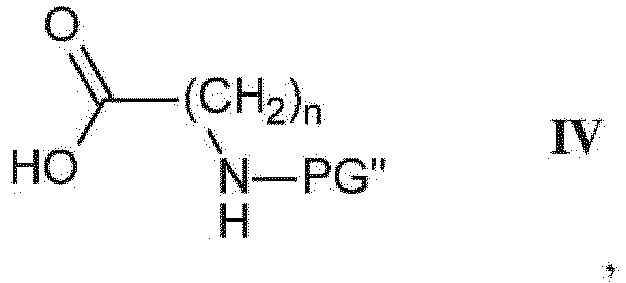
- Suitable protecting groups PG' and PG" are protecting groups that form a cyclic ring with the nitrogen atom of the amino group.
- An esterification agent is a compound that facilitates an esterification reaction.
- a particular esterification agent is N,N -diisopropyl-carbodiimide.
- the reaction is particularly carried out in an inert solvent, such as DCM.
- Removing the protecting groups PG' and PG" with a mild reducing agent means in particular treating the protected compound with hydrazine/water in an inert solvent, such as THF.
- the invention further relates to compounds of formula I as defined above obtainable according to a process as defined above.
- Compounds AB can be obtained from suitably substituted orthoesters AA by condensation with 2-amino-propanedinitrile and 1-amino-2-methyl-propan-2-olin an inert solvent, as for example THF in the presence of a base, like for example triethylamine.
- Suitable substituted orthoesters AA are commercially available, can be synthesized by a person skilled in the art or have been exemplified in the experimental part.
- Compounds AC can be obtained from compounds AB by diazotization/iodination as known in the art; specifically by using diiodomethane as iodide source and isoamylnitrite as nitrite source in an inert solvent like chloroform at temperatures from 0 °C to the boiling temperature of the solvent, preferably at a temperature of 80 °C.
- Compounds of formula AC can be coupled with compounds of formula AD where M denotes a metal leaving group and R' denotes a hydrogen and/or a suitable protecting group, by methods known in the art, to give compounds of formula AE.
- Suitable metal leaving groups may be boronic acids, boronate esters, and trifluoroborates but also tin or zinc based leaving groups.
- boronic acids or boronate esters can be used in Suzuki-Miyaura type couplings using a palladium catalyst, like Pd(OAc) 2 in the presence of triphenylphosphine, in an inert solvent, like DME, together with a suitable base, like sodium carbonate.
- the reaction temperature may range from room temperature to the boiling temperature of the solvent, with room temperature being a suitable choice in many cases.
- deprotection to yield compounds of type AF can be done by methods known in the art, with acidic cleavage of the protecting group using TFA being a preferred choice.
- Compounds of type AG can be obtained from compounds AF by thermal condensation (ring closure) in the presence of an acid catalyst. This can simply be achieved by heating compounds AF in an inert solvent, like dioxane, in the presence of an acid, like HCl, for an appropriate time, for example for 2 hours at 90 °C.
- Compound BA can be obtained from AG by reaction with tritylchloride in the presence of a base in an inert solvent at elevated temperature with or without microwave irradiation.
- a suitable base-solvent combination is, for example, triethylamine or DIEA and acetonitrile, especially if the reaction is performed at elevated temperature in a microwave reactor.
- Compounds of the general formula BC can be obtained from compounds of the general formula BA by reaction with the Boc-sulfamidate BB in a suitable solvent like DMF in the presence of a suitable base like sodium hydride of potassium tert-butylate.
- the reaction is advantageously performed at 0 °C to room temperature.
- Compounds of the general formula I-a can be obtained from compounds of the general formula BC by removal of the protecting groups by treatment with acids in a suitable solvent.
- acids in a suitable solvent.
- One such acid is TFA with or without additional DCM, used at room temperature.
- compound AG can be used as starting material for the synthesis of compounds I-b where R 4 is -O-(CO)-(CH 2 ) n -NH 2 .
- Compound CA can be obtained from AG by introduction of a suitable protecting group PG by methods known in the art.
- protecting groups may be for example the isoindoline-1,3-dione (phtalyl).
- compound CA can be reacted with phtaloylchloride in the presence of a base, like 1,4-diazabicyclo[2,2,2]octane, in an inert, high boiling solvent such as toluene, at elevated temperatures to give a compound of type CA with isoindoline-1,3-dione as protecting group.
- Compound CC can be obtained from compounds CB and CA by esterification using one of the many methods described in the art.
- esterification can be accomplished by combining CB and CA in an inert solvent, like DCM, in the presence of N,N -diisopropylcarbodiimide at elevated temperature.
- Suitable carboxylic acids CB are commercially available, can be prepared by procedures known in the art, or have been exemplified in the experimental part.
- Compounds of the general formula I-b can be obtained from compounds of the general formula CC by removal of the protecting groups with methods known in the art. Specifically, the isoindoline-1,3-dione can be removed by treatment with hydrazine/water in an inert solvent, like THF, at room temperature.
- an inert solvent like THF
- one of the starting materials compounds of the formula AA, AD, AG, DA, DB, DC or DD, contains one or more functional groups which are not stable or are reactive under the reaction conditions of one or more reaction steps
- appropriate protecting groups PG
- protecting groups can be introduced before the critical step applying methods well known in the art.
- Such protecting groups can be removed at a later stage of the synthesis using standard methods known in the art.
- compounds of formula I can be obtained as mixtures of diastereomers or enantiomers, which can be separated by methods well known in the art, e.g. (chiral) HPLC or crystallization. Racemic compounds can e.g. be separated into their antipodes via diastereomeric salts by crystallization or by separation of the antipodes by specific chromatographic methods using either a chiral adsorbent or a chiral eluent.
- the compounds of formula I of the present invention can be used as medicaments for the treatment of diseases which are mediated by TLR agonists, in particular for the treatment of diseases which are mediated by TLR7 and/or TLR8 agonists, more particularly for the treatment of diseases which are mediated by TLR7 and TL8 agonists.
- the compounds defined in the present invention are agonists of TLR7 and/or TLR8 receptors in cellular assays in vitro. More particularly, the compounds of the present invention are agonists of both TLR7 and TLR8 receptors. Accordingly, the compounds of the present invention are expected to be potentially useful agents in the treatment of diseases or medical conditions that may benefit from the activation of the immune system via TLR7 and/or TLR8 agonists, more particularly in the treatment of diseases or medical conditions that may benefit from the activation of the immune system via both TLR7 and TLR8 receptors. For example, the following diseases and conditions may be treatable with compounds of the present invention.
- the compounds of formula I of the present invention are useful in oncology, i.e. they may be used in the treatment of common cancers including bladder cancer, head and neck cancer, prostate cancer, colorectal cancer, kidney cancer, breast cancer, lung cancer, ovarian cancer, cervical cancer, pancreatic cancer, bowel and colon cancer, stomach cancer, thyroid cancer, melanoma, skin and brain tumors and malignancies affecting the bone marrow such as leukemias and lymphoproliferative systems, such as Hodgkin's and non-Hodgkin's lymphoma; including the prevention and treatment of metastatic cancer and tumor recurrences, and paraneoplastic syndromes.
- common cancers including bladder cancer, head and neck cancer, prostate cancer, colorectal cancer, kidney cancer, breast cancer, lung cancer, ovarian cancer, cervical cancer, pancreatic cancer, bowel and colon cancer, stomach cancer, thyroid cancer, melanoma, skin and brain tumors and malignancies affecting the bone marrow such as leukemia
- autoimmune disease is a disease or disorder arising from and directed against an individual's own tissues or organs or a co-segregate or manifestation thereof or resulting condition therefrom.
- Autoimmune disease can be an organ-specific disease (i.e., the immune response is specifically directed against an organ system such as the endocrine system, the hematopoietic system, the skin, the cardiopulmonary system, the gastrointestinal and liver systems, the renal system, the thyroid, the ears, the neuromuscular system, the central nervous system) or a systemic disease which can affect multiple organ systems (for example, systemic lupus erythematosus (SLE), rheumatoid arthritis, polymyositis).
- the autoimmune disease is associated with the skin, muscle tissue, and/or connective tissue.
- autoimmune diseases include autoimmune rheumatologic disorders (such as, for example, rheumatoid arthritis, Sjogren's syndrome, scleroderma, lupus such as SLE and lupus nephritis, polymyositis/dermatomyositis, cryoglobulinemia, anti-phospholipid antibody syndrome, and psoriatic arthritis), autoimmune gastrointestinal and liver disorders (such as, for example, inflammatory bowel diseases, ulcerative colitis and Crohn's disease), autoimmune gastritis and pernicious anemia, autoimmune hepatitis, primary biliary cirrhosis, primary sclerosing cholangitis, and celiac disease), vasculitis (such as, for example, ANCA-negative vasculitis and ANCA-associated vasculitis, including Churg-Strauss vasculitis, Wegener's granulomatosis, and microscopic polyangiitis), autoimmune neurological disorders (
- the compounds of formula I of the present invention are also useful in the treatment of infectious diseases.
- they may be useful in the treatment of viral diseases, in particular for diseases caused by infection with viruses selected from the group consisting of papilloma viruses, such as human papilloma virus (HPV) and those that cause genital warts, common warts and plantar warts, herpes simplex virus, molluscum contagiosum, hepatitis B virus (HBV), hepatitis C virus (HCV), Dengue virus, variola virus, human immunodeficiency virus (HIV), cytomegalovirus (CMV), varicella zoster virus (VZV), rhinovirus, enterovirus, adenovirus, coronavirus (e.g. SARS), influenza, mumps and parainfluenza.
- viruses selected from the group consisting of papilloma viruses, such as human papilloma virus (HPV) and those that cause genital warts, common
- the compounds of formula I of the present invention may further be useful in the treatment of other infectious diseases, such as chlamydia, fungal diseases, in particular fungal diseases selected from the group consisting of candidiasis, aspergillosis and cryptococcal meningitis, and parasitic diseases such as Pneumocystis carnii, pneumonia, cryptosporidiosis, histoplasmosis, toxoplasmosis, trypanosome infection and leishmaniasis.
- infectious diseases such as chlamydia, fungal diseases, in particular fungal diseases selected from the group consisting of candidiasis, aspergillosis and cryptococcal meningitis
- parasitic diseases such as Pneumocystis carnii, pneumonia, cryptosporidiosis, histoplasmosis, toxoplasmosis, trypanosome infection and leishmaniasis.
- the expression "diseases which are mediated by TLR agonists” means diseases which may be treated by activation of the immune system with TLR7 and /or TLR8 agonists such as cancer and infectious diseases.
- the expression “diseases which are mediated by TLR agonists” means cancers or autoimmune diseases or infectious diseases selected from the group consisting of viral diseases, bacterial diseases, fungal diseases and parasitic diseases.
- the expression "which are mediated by TLR agonists” relates to cancer selected from the group consisting of bladder cancer, head and neck cancer, prostate cancer, colorectal cancer, kidney cancer, breast cancer, lung cancer, ovarian cancer, cervical cancer, pancreatic cancer, bowel and colon cancer, stomach cancer, thyroid cancer, melanoma, skin and brain tumors and malignancies affecting the bone marrow such as leukemias and lymphoproliferative systems, such as Hodgkin's and non-Hodgkin's lymphoma; including the prevention and treatment of metastatic cancer and tumor recurrences, and paraneoplastic syndromes.
- cancer selected from the group consisting of bladder cancer, head and neck cancer, prostate cancer, colorectal cancer, kidney cancer, breast cancer, lung cancer, ovarian cancer, cervical cancer, pancreatic cancer, bowel and colon cancer, stomach cancer, thyroid cancer, melanoma, skin and brain tumors and malignancies affecting the bone marrow such as leukemias and lympho
- the invention also relates to pharmaceutical compositions comprising a compound of formula I as defined above and a pharmaceutically acceptable carrier and/or adjuvant. More specifically, the invention relates to pharmaceutical compositions useful for the treatment of diseases which are which are mediated by TLR agonists.
- the invention relates to compounds of formula I as defined above for use as therapeutically active substances, particularly as therapeutically active substances for the treatment of diseases which are which are mediated by TLR agonists.
- the invention relates to compounds of formula I for use in the treatment of cancers or autoimmune diseases or infectious diseases selected from the group consisting of viral diseases, bacterial diseases, fungal diseases and parasitic diseases.
- the invention further relates to the use of compounds of formula I as defined above for the treatment of diseases which are mediated by TLR agonists.
- the invention relates to the use of compounds of formula I as defined above for the preparation of medicaments for the treatment of diseases which are mediated by TLR agonists.
- the invention relates to the use of compounds of formula I as defined above for the preparation of medicaments for the treatment of cancers or autoimmune diseases or infectious diseases selected from the group consisting of viral diseases, bacterial diseases, fungal diseases and parasitic diseases.
- compounds of formula I can be in combination with one or more additional treatment modalities in a regimen for the treatment of cancer.
- Combination therapy encompasses, in addition to the administration of a compound of the invention, the adjunctive use of one or more modalities that are effective in the treatment of cancer.
- modalities include, but are not limited to, chemotherapeutic agents, immunotherapeutics, anti-angiogenic agents, cytokines, hormones, antibodies, polynucleotides, radiation and photodynamic therapeutic agents.
- combination therapy can be used to prevent the recurrence of cancer, inhibit metastasis, or inhibit the growth and/or spread of cancer or metastasis.
- "in combination with” means that the compound of formula I is administered as part of a treatment regimen that comprises one or more additional treatment modalities as mentioned above.
- the invention thus also relates to a method for the treatment of cancer, which method comprises administering a therapeutically active amount of a compound of formula I in combination with one or more other pharmaceutically active compounds to a human being or animal.
- Compounds of formula I can be used alone or in combination with one or more additional treatment modalities in treating autoimmune diseases.
- Combination therapy encompasses, in addition to the administration of a compound of the invention, the adjunctive use of one or more modalities that aid in the prevention or treatment of autoimmune diseases.
- modalities include, but are not limited to, chemotherapeutic agents, immunotherapeutics, anti-angiogenic agents, cytokines, hormones, antibodies, polynucleotides, radiation and photodynamic therapeutic agents.
- in combination with means that the compound of formula I is administered as part of a treatment regimen that comprises one or more additional treatment modalities as mentioned above.
- the invention thus also relates to a method for the treatment of autoimmune diseases, which method comprises administering a therapeutically active amount of a compound of formula I in combination with one or more other pharmaceutically active compounds to a human being or animal.
- compounds of formula I can be used alone or in combination with one or more additional treatment modalities in treating infectious diseases.
- Combination therapy encompasses, in addition to the administration of a compound of the invention, the adjunctive use of one or more modalities that aid in the prevention or treatment of infectious diseases.
- modalities include, but are not limited to, antiviral agents, antibiotics, and anti-fungal agents.
- in combination with means that the compound of formula I is administered as part of a treatment regimen that comprises one or more additional treatment modalities as mentioned above.
- the invention thus also relates to a method for the treatment of infectious diseases, which method comprises administering a therapeutically active amount of a compound of formula I in combination with one or more other pharmaceutically active compounds to a human being or animal.
- TLR8 and TLR7 activity testing were carried out in order to determine the activity of the compounds of formula I:
- HEK-Blue human TLR8 or TLR7 cells were used, in which the reporter expression is regulated by the NF- ⁇ B promoter upon stimulation for 24hr.
- the reporter activity was determined using Quanti Blue kit (Invivogen, San Diego, Ca, USA) at a wavelength of 640 nm.
- EC 50 values were determined using Activity Base analysis (ID Business Solution, Limited).
- the compounds according to formula I have an activity (EC 50 value) in the above assay for human TLR8 in the range of 0.01 nM to 11 ⁇ M, more particularly of 0.01 nM to 3 ⁇ M and in the above assay for human TLR7 in the range of 0.01 nM to 1 ⁇ M, in particular of 0.01 nM to 0.3 ⁇ M and more particularly of 0.01 nM to 0.1 ⁇ M.
- the compounds of formula I and their pharmaceutically acceptable salts can be used as medicaments, e.g ., in the form of pharmaceutical preparations for enteral, parenteral or topical administration.
- the compounds of formula I and their pharmaceutically acceptable salts may be administered by systemic (e.g., parenteral) or local (e.g., topical or intralesional injection) administration.
- the pharmaceutical formulation is topically, parenterally, orally, vaginally, intrauterine, intranasal, or by inhalation administered.
- certain tissues may be preferred targets for the TLR agonist.
- administration of the TLR agonist to lymph nodes, spleen, bone marrow, blood, as well as tissue exposed to virus, are preferred sites of administration.
- the pharmaceutical formulation comprising the compounds of formula I or its pharmaceutically acceptable salts is administered parenterally.
- Parenteral routes of administration include, but are not limited to, transdermal, transmucosal, nasopharyngeal, pulmonary and direct injection.
- Parenteral administration by injection may be by any parenteral injection route, including, but not limited to, intravenous (IV), including bolus and infusion (e.g., fast or slow), intraperitoneal (IP), intramuscular (IM), subcutaneous (SC) and intradermal (ID) routes.
- IV intravenous
- IP intraperitoneal
- IM intramuscular
- SC subcutaneous
- ID intradermal
- Transdermal and transmucosal administration may be accomplished by, for example, inclusion of a carrier (e.g., dimethylsulfoxide, DMSO), by application of electrical impulses (e.g., iontophoresis) or a combination thereof.
- a carrier e.g., dimethylsulfoxide, DMSO
- electrical impulses e.g., iontophoresis
- a variety of devices are available for transdermal administration which may be used.
- Formulations of the compounds of formula I suitable for parenteral administration are generally formulated in USP water or water for injection and may further comprise pH buffers, salts bulking agents, preservatives, and other pharmaceutically acceptable excipients.
- Transdermal administration is accomplished by application of a cream, rinse or gel capable of allowing the TLR agonist to penetrate the skin and enter the blood stream.
- compositions suitable for transdermal administration include, but are not limited to, pharmaceutically acceptable suspensions, oils, creams and ointments applied directly to the skin or incorporated into a protective carrier such as a transdermal device (so-called "patch"). Examples of suitable creams or ointments can be found, for instance, in the Physician's Desk Reference.
- Transdermal transmission may also be accomplished by iontophoresis, for example using commercially available patches which deliver their product continuously through unbroken skin for periods of several days or more. Use of this method allows for controlled transmission of pharmaceutical compositions in relatively great concentrations, permits infusion of combination drugs and allows for contemporaneous use of an absorption promoter. Administration via the transdermal and transmucosal routes may be continuous or pulsatile.
- Pulmonary administration is accomplished by inhalation, and includes delivery routes such as intranasal, transbronchial and transalveolar routes.
- Formulations of compounds of formula I suitable for administration by inhalation including, but not limited to, liquid suspensions for forming aerosols as well as powder forms for dry powder inhalation delivery systems are provided.
- Devices suitable for administration by inhalation include, but are not limited to, atomizers, vaporizers, nebulizers, and dry powder inhalation delivery devices.
- Other methods of delivering to respiratory mucosa include delivery of liquid formulations, such as by nose drops.
- Administration by inhalation is preferably accomplished in discrete doses (e.g., via a metered dose inhaler), although delivery similar to an infusion may be accomplished through use of a nebulizer.
- the compounds of formula I and pharmaceutically acceptable salts thereof may also be administered orally, e.g., in the form of tablets, coated tablets, dragées, hard and soft gelatine capsules.
- the production of the pharmaceutical preparations can be effected in a manner which will be familiar to any person skilled in the art by bringing the described compounds of formula I and their pharmaceutically acceptable salts, optionally in combination with other therapeutically valuable substances, into a galenical administration form together with suitable, non-toxic, inert, therapeutically compatible solid or liquid carrier materials and, if desired, usual pharmaceutical adjuvants.
- Suitable carrier materials are not only inorganic carrier materials, but also organic carrier materials.
- lactose, corn starch or derivatives thereof, talc, stearic acid or its salts can be used as carrier materials for tablets, coated tablets, dragées and hard gelatine capsules.
- Suitable carrier materials for soft gelatine capsules are, for example, vegetable oils, waxes, fats and semi-solid and liquid polyols (depending on the nature of the active ingredient no carriers might, however, be required in the case of soft gelatine capsules).
- Suitable carrier materials for the production of solutions and syrups are, for example, water, polyols, sucrose, invert sugar.
- Suitable carrier materials for injection solutions are, for example, water, alcohols, polyols, glycerol and vegetable oils.
- Suitable carrier materials for suppositories are, for example, natural or hardened oils, waxes, fats and semi-liquid or liquid polyols.
- Suitable carrier materials for topical preparations are glycerides, semi-synthetic and synthetic glycerides, hydrogenated oils, liquid waxes, liquid paraffins, liquid fatty alcohols, sterols, polyethylene glycols and cellulose derivatives.
- Usual stabilizers preservatives, wetting and emulsifying agents, consistency-improving agents, flavour-improving agents, salts for varying the osmotic pressure, buffer substances, solubilizers, colorants and masking agents and antioxidants come into consideration as pharmaceutical adjuvants.
- the dosage of the compounds of formula I can vary within wide limits depending on the disease to be controlled, the age and the individual condition of the patient and the mode of administration, and will, of course, be fitted to the individual requirements in each particular case. For adult patients a daily dosage of about 1 to 1000 mg, especially about 1 to 300 mg, comes into consideration. Depending on severity of the disease and the precise pharmacokinetic profile the compound could be administered with one or several daily dosage units, e.g., in 1 to 3 dosage units.
- the pharmaceutical preparations conveniently contain about 1-500 mg, preferably 1-100 mg, of a compound of formula I.
- Film coated tablets containing the following ingredients can be manufactured in a conventional manner: Ingredients Per tablet Kernel: Compound of formula I 10.0 mg 200.0 mg Microcrystalline cellulose 23.5 mg 43.5 mg Lactose hydrous 60.0 mg 70.0 mg Povidone K30 12.5 mg 15.0 mg Sodium starch glycolate 12.5 mg 17.0 mg Magnesium stearate 1.5 mg 4.5 mg (Kernel Weight) 120.0 mg 350.0 mg Film Coat: Hydroxypropyl methyl cellulose 3.5 mg 7.0 mg Polyethylene glycol 6000 0.8 mg 1.6 mg Talc 1.3 mg 2.6 mg Iron oxide (yellow) 0.8 mg 1.6 mg Titanium dioxide 0.8 mg 1.6 mg
- the active ingredient is sieved and mixed with microcrystalline cellulose and the mixture is granulated with a solution of polyvinylpyrrolidone in water.
- the granulate is mixed with sodium starch glycolate and magnesiumstearate and compressed to yield kernels of 120 or 350 mg respectively.
- the kernels are lacquered with an aqueous solution / suspension of the above mentioned film coat.
- Capsules containing the following ingredients can be manufactured in a conventional manner: Ingredients Per capsule Compound of formula I 25.0 mg Lactose 150.0 mg Maize starch 20.0 mg Talc 5.0 mg
- the components are sieved and mixed and filled into capsules of size 2.
- Injection solutions can have the following composition: Compound of formula I 3.0 mg Polyethylene glycol 400 150.0 mg Acetic acid q.s. ad pH 5.0 Water for injection solutions ad 1.0 ml
- the active ingredient is dissolved in a mixture of Polyethylene Glycol 400 and water for injection (part).
- the pH is adjusted to 5.0 by acetic acid.
- the volume is adjusted to 1.0 ml by addition of the residual amount of water.
- the solution is filtered, filled into vials using an appropriate overage and sterilized.
- N,N '-diisopropylcarbodiimide (1.68 mL, 10.8 mmol) and molecular sieves were added.
- the reaction mixture was heated to 50 °C and stirred for 2 hours and was, after cooling, filtered.
- the filtrate was diluted with DCM (150 mL) and washed with 1 N hydrochloric acid and water. Water phases were extracted with DCM, organic phases were combined, dried over MgSO 4 , filtered and concentrated in vacuo.
- the white precipitate a (phtalylhydrazide) was removed by filtration and the organic phase was discarded.
- the aqueous phase was lyophilized and the residue was taken up with acetonitrile (20 mL) and DIEA (pH 10). After evaporation of solvent, the residue was purified by preparative HPLC (Gemini NX 3u 50x4.6mm; acetonitrile/water/Et 3 N) to give the title compound (111 mg, 63%) as amorphous white solid; LC-MS (UV peak area, ESI) 99%, 372.4 (MH + ).
- Nicotinic acid (11.4 mg, 92.3 ⁇ mol) was combined with DMF (1.0 mL) to give a colorless solution. To this solution was added TBTU (29.6 mg, 92.3 ⁇ mol), and DIEA (54.2 mg, 71.8 ⁇ l) were added. Finally 1-(2-(2-aminoethoxy)-2-methylpropyl)-2-(ethoxymethyl)-1H-imidazo[4,5-c]quinolin-4-amine (30 mg, 83.9 ⁇ mol) was added and the reaction mixture was stirred for 1 hour at room temperature. Volatiles were removed in high vacuum at 40 °C. The residue was dissolve in a mixture of ethyl acetate (5 mL) and methanol (0.5 mL).
- the crude material was purified by flash chromatography (silica gel-NH2, 0% to 100% ethyl acetate in heptane) followed by another flash chromatography (silica gel, 0 to 10% methanol in ethyl acetate) to give the title compound (10 mg, 11%) as yellowish gum; LC-MS (UV peak area, ESI) 89%, 658.5 (MH + ).
- 6-( tert -Butoxycarbonylamino)hexanoicacid (197 mg, 850 ⁇ mol) was combined with DMF (10.9 mL) to give a colorless solution.
- O -(Benzotriazol-1-yl)- N,N,N',N '-tetramethyluronium tetrafluoroborate (TBTU, 300 mg, 936 ⁇ mol) and N,N -diisopropylethylamine (DIEA, 728 ⁇ l, 4.25 mmol) were added with stirring in an inert atmosphere.
- Triethylamine (5.28 ml, 37.9 mmol) was added with stirring to a suspension of 2-aminomalononitrile 4-methylbenzenesulfonate (8 g, 31.6 mmol) in THF (120 ml) to give a light brown solution.
- 1,1,1,2-Tetraethoxyethane (7.82 g, 37.9 mmol) was added and the reaction mixture was stirred under argon at reflux temperature. After 4 h an additional amount of 2.3g 1,1,1,2-tetraethoxyethane was added and the mixture heated for another 2 h.
- Diiodomethane (14.5 ml, 180 mmol) was added under argon with stirring to a suspension of 5-amino-2-(ethoxymethyl)-1-(2-hydroxy-2-methylpropyl)-1 H -imidazole-4-carbonitrile(4.36 g, 18.3 mmol)in chloroform (170 mL).
- the reaction mixture was heated to 80 °C, a solution of isoamyl nitrite (9.86 ml, 73.2 mmol) in chloroform (30 mL) was added with a syringe pump over a period of 40 min and the mixture was stirred for another 30 min at 80 °C.
- the solid was dissolved in ethyl acetate (500 mL) washed with a mixture of water (100 mL) and saturated sodium bicarbonate solution (250 mL). The water phase was extracted with ethyl acetate (2x250 mL), organic phases were combined, dried with MgSO 4 and concentrated in vacuo to obtain a yellow solid (3.05 g). The solid material was re-crystallized from ethyl acetate /heptane to give the title compound (2.4 g, 86%) as light yellow solid; LC-MS (UV peak area, ESI) 99%, 373.1884 (MH + ).
- the crude material was purified by flash chromatography (silica gel, 20g, 0% to 30% methanol in THF) to 27 mg of an impure sample that was further purified by preparative HPLC to give the title compound (6 mg, 5%) as light yellow oil; LC-MS (UV peak area, ESI) 79%, 516.5 (MHCOO - ).
Landscapes
- Health & Medical Sciences (AREA)
- Chemical & Material Sciences (AREA)
- Organic Chemistry (AREA)
- Life Sciences & Earth Sciences (AREA)
- Pharmacology & Pharmacy (AREA)
- Veterinary Medicine (AREA)
- Public Health (AREA)
- General Health & Medical Sciences (AREA)
- Animal Behavior & Ethology (AREA)
- Medicinal Chemistry (AREA)
- General Chemical & Material Sciences (AREA)
- Nuclear Medicine, Radiotherapy & Molecular Imaging (AREA)
- Chemical Kinetics & Catalysis (AREA)
- Immunology (AREA)
- Engineering & Computer Science (AREA)
- Epidemiology (AREA)
- Bioinformatics & Cheminformatics (AREA)
- Oncology (AREA)
- Communicable Diseases (AREA)
- Virology (AREA)
- Biotechnology (AREA)
- Molecular Biology (AREA)
- Transplantation (AREA)
- Pharmaceuticals Containing Other Organic And Inorganic Compounds (AREA)
- Nitrogen Condensed Heterocyclic Rings (AREA)
- Medicines Containing Antibodies Or Antigens For Use As Internal Diagnostic Agents (AREA)
Claims (11)
- Composé de formule
 R1 représente un alkyle en C1-7 ou un alcoxy en C1-7-alkyle en C1-7 ;R2 est choisi dans le groupe constitué par un hydrogène, un halogène, un alcoxy en C1-7-carbonyl-alkyle en C1-7 et un alcoxy en C1-7-carbonyl-alcényle en C2-7 ;R3 représente un hydrogène ;R4 est choisi dans le groupe constitué par -O-(CH2)m-NHR5, et -O-(CO)-(CH2)n-NHR6,dans laquellem représente 2,n représente 1,R5 représente un hydrogène etR6 représente un hydrogène ;ou les sels pharmaceutiquement acceptables de celui-ci.
 - Composé de formule I selon la revendication 1, dans lequel R1 représente un alcoxy en C1-7-alkyle en C1-7.
- Composé de formule I selon les revendications 1 ou 2, dans lequel R1 représente un éthoxyéthyle.
- Composé de formule I selon l'une quelconque des revendications 1 à 3, dans lequel R2 représente un hydrogène.
- Composé de formule I selon la revendication 1, choisi dans le groupe constitué par
la 1-(2-(2-aminoéthoxy)-2-méthylpropyl)-2-(éthoxyméthyl)-1H-imidazo[4,5-c]quinolin-4-amine,
le 2-aminoacétate de 1-(4-amino-2-(éthoxyméthyl)-1H-imidazo[4,5-c]quinolin-1-yl)-2-méthylpropan-2-yle,
le (E)-3-[4-amino-1-[2-(2-aminoéthoxy)-2-méthylpropyl]-2-(éthoxyméthyl)-1H-imidazo[4,5-c]quinolin-7-yl]prop-2-énoate d'éthyle,
le 3-(4-amino-1-(2-(2-aminoéthoxy)-2-méthylpropyl)-2-(éthoxyméthyl)-1H-imidazo[4,5-c]quinolin-7-yl)propanoate d'éthyle,
le 3-(4-amino-1-(2-(2-aminoacétoxy)-2-méthylpropyl)-2-(éthoxyméthyl)-1H-imidazo[4,5-c]quinolin-7-yl)propanoate d'éthyle,
la 1-(2-(2-aminoéthoxy)-2-méthylpropyl)-2-pentyl-1H-imidazo[4,5-c]quinolin-4-amine,
la 1-(2-(2-aminoéthoxy)-2-méthylpropyl)-7-bromo-2-(éthoxyméthyl)-1H-imidazo[4,5-c]quinolin-4-amine,
et les sels pharmaceutiquement acceptables de ceux-ci. - Composé de formule I selon la revendication 1, qui est
la 1-(2-(2-aminoéthoxy)-2-méthylpropyl)-2-(éthoxyméthyl)-1H-imidazo[4,5-c]quinolin-4-amine,
et les sels pharmaceutiquement acceptables de celle-ci. - Composé de formule I selon la revendication 1, choisi dans le groupe constitué par
le 2-aminoacétate de 1-(4-amino-2-(éthoxyméthyl)-1H-imidazo[4,5-c]quinolin-1-yl)-2-méthylpropan-2-yle,
le 3-(4-amino-1-(2-(2-aminoéthoxy)-2-méthylpropyl)-2-(éthoxyméthyl)-1H-imidazo[4,5-c]quinolin-7-yl)propanoate d'éthyle,
et les sels pharmaceutiquement acceptables de ceux-ci. - Composé de formule I selon l'une quelconque des revendications 1 à 7 pour une utilisation comme médicament.
- Composé de formule I selon l'une quelconque des revendications 1 à 7 pour une utilisation comme médicament dans le traitement de cancers ou de maladies auto-immunes ou de maladies infectieuses choisies dans le groupe constitué par les maladies virales, les maladies bactériennes, les maladies fongiques et les maladies parasitaires.
- Composition pharmaceutique comprenant un composé de formule I selon l'une quelconque des revendications 1 à 7 et un véhicule et/ou un adjuvant pharmaceutiquement acceptable.
- Procédé de fabrication d'un composé de formule I tel que défini dans la revendication 1, lequel procédé comprenda) la réaction d'un composé de formule II


 b) la réaction d'un composé de formule II-a


Priority Applications (4)
| Application Number | Priority Date | Filing Date | Title |
|---|---|---|---|
| HRP20201043TT HRP20201043T1 (hr) | 2014-04-22 | 2015-04-20 | Spojevi 4-amino-imidazokinolina |
| SI201531273T SI3134402T1 (sl) | 2014-04-22 | 2015-04-20 | 4-amino-imidazokinolinske spojine |
| PL15716824T PL3134402T3 (pl) | 2014-04-22 | 2015-04-20 | Związki 4-amino-imidazochinolinowe |
| RS20200734A RS60430B1 (sr) | 2014-04-22 | 2015-04-20 | Jedinjenja 4-amino-imidazohinolina |
Applications Claiming Priority (2)
| Application Number | Priority Date | Filing Date | Title |
|---|---|---|---|
| EP14165349 | 2014-04-22 | ||
| PCT/EP2015/058465 WO2015162075A1 (fr) | 2014-04-22 | 2015-04-20 | Composés de 4-amino-imidazoquinoline |
Publications (2)
| Publication Number | Publication Date |
|---|---|
| EP3134402A1 EP3134402A1 (fr) | 2017-03-01 |
| EP3134402B1 true EP3134402B1 (fr) | 2020-05-06 |
Family
ID=50489008
Family Applications (1)
| Application Number | Title | Priority Date | Filing Date |
|---|---|---|---|
| EP15716824.6A Active EP3134402B1 (fr) | 2014-04-22 | 2015-04-20 | Composés 4-amino-imidazoquinoline |
Country Status (22)
| Country | Link |
|---|---|
| US (2) | US9334268B2 (fr) |
| EP (1) | EP3134402B1 (fr) |
| JP (1) | JP6367366B2 (fr) |
| KR (1) | KR101905292B1 (fr) |
| CN (1) | CN106232599B (fr) |
| AR (1) | AR100137A1 (fr) |
| BR (1) | BR112016017261B1 (fr) |
| CA (1) | CA2938280C (fr) |
| DK (1) | DK3134402T3 (fr) |
| ES (1) | ES2804101T3 (fr) |
| HR (1) | HRP20201043T1 (fr) |
| HU (1) | HUE049656T2 (fr) |
| LT (1) | LT3134402T (fr) |
| MA (1) | MA39898B1 (fr) |
| MX (1) | MX377916B (fr) |
| PL (1) | PL3134402T3 (fr) |
| PT (1) | PT3134402T (fr) |
| RS (1) | RS60430B1 (fr) |
| RU (1) | RU2698902C2 (fr) |
| SI (1) | SI3134402T1 (fr) |
| TW (1) | TWI607007B (fr) |
| WO (1) | WO2015162075A1 (fr) |
Families Citing this family (78)
| Publication number | Priority date | Publication date | Assignee | Title |
|---|---|---|---|---|
| WO2017102652A1 (fr) * | 2015-12-14 | 2017-06-22 | Glaxosmithkline Biologicals S.A. | Imidazoquinoléines pégylées à utiliser en tant qu'agonistes de tlr7 et tlr8 |
| CA3005766A1 (fr) | 2015-12-17 | 2017-06-22 | Merck Patent Gmbh | Antagonistes de tlr7/8 polycyliques et leur utilisation dans le traitement de maladies immunes |
| EP3464274B1 (fr) | 2016-05-23 | 2020-05-27 | H. Hoffnabb-La Roche Ag | Composés de benzazépine dicarboxamide à fonction amide secondaire |
| JP6918838B2 (ja) | 2016-05-23 | 2021-08-11 | エフ・ホフマン−ラ・ロシュ・アクチェンゲゼルシャフト | 第三級アミド基を有するベンズアゼピンジカルボキサミド化合物 |
| JP7012668B2 (ja) | 2016-06-12 | 2022-02-14 | エフ・ホフマン-ラ・ロシュ・アクチェンゲゼルシャフト | ジヒドロピリミジニルベンズアゼピンジカルボキサミド化合物 |
| KR102726248B1 (ko) | 2016-07-07 | 2024-11-05 | 더 보드 어브 트러스티스 어브 더 리랜드 스탠포드 주니어 유니버시티 | 항체-애쥬번트 접합체 |
| JP7125385B2 (ja) | 2016-08-08 | 2022-08-24 | メルク パテント ゲゼルシャフト ミット ベシュレンクテル ハフツング | Tlr7/8アンタゴニストおよびそれらの使用 |
| IL265921B2 (en) | 2016-10-14 | 2024-05-01 | Prec Biosciences Inc | Engineered meganucleases specific for recognition sequences in the hepatitis b virus genome |
| RU2748833C2 (ru) | 2016-11-28 | 2021-05-31 | Цзянсу Хэнжуй Медсин Ко., Лтд. | Производное пиразоло-гетероарила, способ его получения и медицинское применение |
| US10757485B2 (en) * | 2017-08-25 | 2020-08-25 | Honda Motor Co., Ltd. | System and method for synchronized vehicle sensor data acquisition processing using vehicular communication |
| WO2019084060A1 (fr) | 2017-10-24 | 2019-05-02 | Silverback Therapeutics, Inc. | Conjugués et leurs procédés d'utilisation pour l'administration sélective d'agents immunomodulateurs |
| WO2019118884A1 (fr) | 2017-12-15 | 2019-06-20 | Silverback Therapeutics, Inc. | Conjugué de construction d'anticorps-médicament pour le traitement de l'hépatite |
| US10966999B2 (en) | 2017-12-20 | 2021-04-06 | Institute Of Organic Chemistry And Biochemistry Ascr, V.V.I. | 3′3′ cyclic dinucleotides with phosphonate bond activating the sting adaptor protein |
| CN111511754B (zh) | 2017-12-20 | 2023-09-12 | 捷克共和国有机化学与生物化学研究所 | 活化sting转接蛋白的具有膦酸酯键的2’3’环状二核苷酸 |
| EP3728255B1 (fr) | 2017-12-20 | 2022-01-26 | 3M Innovative Properties Company | Composés imidazo [4,5-c]quinoléine à substitution amide ayant un groupe de liaison à chaîne ramifiée destinés à être utilisés en tant que modificateur de la réponse immunitaire |
| CN108299421B (zh) * | 2018-01-30 | 2020-09-29 | 中国医学科学院药用植物研究所 | 一种瑞喹莫德的酰化衍生物及制备方法与应用 |
| PL3759109T3 (pl) | 2018-02-26 | 2024-03-04 | Gilead Sciences, Inc. | Podstawione związki pirolizyny jako inhibitory replikacji hbv |
| JP7251893B2 (ja) | 2018-02-28 | 2023-04-04 | スリーエム イノベイティブ プロパティズ カンパニー | N-1分枝基を有する置換イミダゾ[4,5-c]キノリン化合物 |
| WO2019195181A1 (fr) | 2018-04-05 | 2019-10-10 | Gilead Sciences, Inc. | Anticorps et leurs fragments qui se lient à la protéine x du virus de l'hépatite b |
| TW202005654A (zh) | 2018-04-06 | 2020-02-01 | 捷克科學院有機化學與生物化學研究所 | 2,2,─環二核苷酸 |
| TWI833744B (zh) | 2018-04-06 | 2024-03-01 | 捷克科學院有機化學與生物化學研究所 | 3'3'-環二核苷酸 |
| TWI818007B (zh) | 2018-04-06 | 2023-10-11 | 捷克科學院有機化學與生物化學研究所 | 2'3'-環二核苷酸 |
| TW201945388A (zh) | 2018-04-12 | 2019-12-01 | 美商精密生物科學公司 | 對b型肝炎病毒基因體中之識別序列具有特異性之最佳化之經工程化巨核酸酶 |
| WO2019211799A1 (fr) | 2018-05-03 | 2019-11-07 | Institute Of Organic Chemistry And Biochemistry Ascr, V.V.I. | Analogue de dinucléotide 2'3'-cyclique comprenant un nucléotide modifié par cyclopentanyle |
| CN112218864B (zh) | 2018-05-24 | 2023-09-08 | 3M创新有限公司 | N-1支链环烷基取代的咪唑并[4,5-c]喹啉化合物、组合物和方法 |
| CN110526917B (zh) * | 2018-05-25 | 2021-09-03 | 江苏恒瑞医药股份有限公司 | 一种吡唑并杂芳基类衍生物的可药用盐、晶型及其制备方法 |
| CN111819178B (zh) * | 2018-05-25 | 2022-04-12 | 江苏恒瑞医药股份有限公司 | 一种吡唑并杂芳基类衍生物盐酸盐的晶型及制备方法 |
| CN110526918B (zh) * | 2018-05-25 | 2021-09-03 | 江苏恒瑞医药股份有限公司 | 一种吡唑并杂芳基类衍生物的晶型及制备方法 |
| WO2020028097A1 (fr) | 2018-08-01 | 2020-02-06 | Gilead Sciences, Inc. | Formes solides d'acide (r)-11-(méthoxyméthyl)-12-(3-méthoxypropoxy)-3,3-diméthyl-8-0 x0-2,3,8,13b-tétrahydro-1h-pyrido[2,1-a] pyrrolo[1,2-c]phtalazine-7-carboxylique |
| CN112888677A (zh) | 2018-08-16 | 2021-06-01 | 先天肿瘤免疫公司 | 被取代的4-氨基-1H-咪唑并[4,5-c]喹啉化合物及其改进的制备方法 |
| US20210214354A1 (en) * | 2018-09-07 | 2021-07-15 | Birdie Biopharmaceuticals, Inc. | Imidazoquinoline compounds and uses thereof |
| US20200113912A1 (en) | 2018-09-12 | 2020-04-16 | Silverback Therapeutics, Inc. | Methods and Compositions for the Treatment of Disease with Immune Stimulatory Conjugates |
| JP2022500413A (ja) * | 2018-09-12 | 2022-01-04 | シルバーバック セラピューティックス インコーポレイテッド | Toll様受容体アゴニストの抗体コンジュゲート |
| TWI721623B (zh) | 2018-10-31 | 2021-03-11 | 美商基利科學股份有限公司 | 經取代之6-氮雜苯并咪唑化合物 |
| TW202136261A (zh) | 2018-10-31 | 2021-10-01 | 美商基利科學股份有限公司 | 經取代之6-氮雜苯并咪唑化合物 |
| WO2020160054A1 (fr) * | 2019-02-01 | 2020-08-06 | Canwell Biotech Limited | Dérivés d'imidazoquinoline amine, composition pharmaceutique, utilisation de ceux-ci |
| US11766447B2 (en) | 2019-03-07 | 2023-09-26 | Institute Of Organic Chemistry And Biochemistry Ascr, V.V.I. | 3′3′-cyclic dinucleotide analogue comprising a cyclopentanyl modified nucleotide as sting modulator |
| KR102707808B1 (ko) | 2019-03-07 | 2024-09-19 | 인스티튜트 오브 오가닉 케미스트리 앤드 바이오케미스트리 에이에스 씨알 브이.브이.아이. | 2'3'-사이클릭 다이뉴클레오티드 및 이의 프로드럭 |
| EP3935066A1 (fr) | 2019-03-07 | 2022-01-12 | Institute of Organic Chemistry and Biochemistry ASCR, V.V.I. | Dinucléotides 3'3'-cycliques et leurs promédicaments |
| AU2020241686A1 (en) | 2019-03-15 | 2021-11-04 | Bolt Biotherapeutics, Inc. | Immunoconjugates targeting HER2 |
| TW202210480A (zh) | 2019-04-17 | 2022-03-16 | 美商基利科學股份有限公司 | 類鐸受體調節劑之固體形式 |
| TW202212339A (zh) | 2019-04-17 | 2022-04-01 | 美商基利科學股份有限公司 | 類鐸受體調節劑之固體形式 |
| US11453681B2 (en) | 2019-05-23 | 2022-09-27 | Gilead Sciences, Inc. | Substituted eneoxindoles and uses thereof |
| MX2021015533A (es) | 2019-06-19 | 2022-02-10 | Silverback Therapeutics Inc | Anticuerpos anti-mesotelina e inmunoconjugados de los mismos. |
| CN112174903B (zh) * | 2019-07-01 | 2022-07-12 | 清华大学 | Tlr8的小分子调节剂 |
| US11339159B2 (en) * | 2019-07-17 | 2022-05-24 | Pfizer Inc. | Toll-like receptor agonists |
| WO2021034804A1 (fr) | 2019-08-19 | 2021-02-25 | Gilead Sciences, Inc. | Formulations pharmaceutiques de ténofovir alafénamide |
| CN119770638A (zh) | 2019-09-30 | 2025-04-08 | 吉利德科学公司 | Hbv疫苗和治疗hbv的方法 |
| CA3151322A1 (fr) | 2019-10-01 | 2021-04-08 | Silverback Therapeutics, Inc. | Polytherapie comprenant des conjugues immunostimulants |
| US20220411421A1 (en) * | 2019-10-29 | 2022-12-29 | Prime Reach Trading Limited | 4-amino-imidazoquinoline compounds and use thereof |
| US12410418B2 (en) | 2019-12-06 | 2025-09-09 | Precision Biosciences, Inc. | Optimized engineered meganucleases having specificity for a recognition sequence in the Hepatitis B virus genome |
| JP7735291B2 (ja) | 2020-02-21 | 2025-09-08 | エーアールエス ファーマシューティカルズ、インコーポレイテッド | ネクチン-4抗体コンジュゲートおよびその使用 |
| US11718637B2 (en) | 2020-03-20 | 2023-08-08 | Gilead Sciences, Inc. | Prodrugs of 4′-C-substituted-2-halo-2′- deoxyadenosine nucleosides and methods of making and using the same |
| AU2021258392A1 (en) | 2020-04-19 | 2022-12-15 | Ludwig ENGLMEIER | Prophylaxis and treatment of coronavirus infection |
| JP7832124B2 (ja) * | 2020-05-14 | 2026-03-17 | メルク ヘルスケア コマンディトゲゼルシャフト アウフ アクティーン | コロナウイルス感染症治療のためのtlr7/8拮抗薬 |
| WO2021237055A1 (fr) * | 2020-05-21 | 2021-11-25 | Ohio State Innovation Foundation | Dérivés lipidiques fonctionnels et leurs utilisations |
| JP2023532304A (ja) | 2020-07-01 | 2023-07-27 | エーアールエス ファーマシューティカルズ オペレーションズ,インク. | 抗asgr1抗体コンジュゲートおよびその使用 |
| WO2022153157A1 (fr) * | 2021-01-13 | 2022-07-21 | Pfizer Inc. | Forme cristalline de base libre de 2-((4-amino-2-(éthoxyméthyl)-6,7-diméthyl-1 h-imidazo[4,5-c]pyridin-1-yl)méthyl)-2-méthylpropane-1,3-diol |
| AU2022216598A1 (en) * | 2021-02-03 | 2023-08-03 | Regents Of The University Of Minnesota | Immunostimulatory compounds and conjugates |
| JP7717832B2 (ja) | 2021-04-10 | 2025-08-04 | ジェンマブ エー/エス | Folr1結合剤、そのコンジュゲートおよびこれを使用する方法 |
| WO2022226317A1 (fr) | 2021-04-23 | 2022-10-27 | Profoundbio Us Co. | Anticorps anti-cd70, leurs conjugués et leurs procédés d'utilisation |
| EP4337223A1 (fr) | 2021-05-13 | 2024-03-20 | Gilead Sciences, Inc. | Combinaison d'un composé de modulation de tlr8 et agent thérapeutique anti-arnsi de vhb |
| WO2022271677A1 (fr) | 2021-06-23 | 2022-12-29 | Gilead Sciences, Inc. | Composés de modulation de la diacylglycérol kinase |
| KR20240005901A (ko) | 2021-06-23 | 2024-01-12 | 길리애드 사이언시즈, 인코포레이티드 | 디아실글리세롤 키나제 조절 화합물 |
| WO2022271659A1 (fr) | 2021-06-23 | 2022-12-29 | Gilead Sciences, Inc. | Composés modulant les diacylglycérol kinases |
| CA3222277A1 (fr) | 2021-06-23 | 2022-12-29 | Gilead Sciences, Inc. | Composes modulant les diacylglycerol kinases |
| TW202320857A (zh) | 2021-07-06 | 2023-06-01 | 美商普方生物製藥美國公司 | 連接子、藥物連接子及其結合物及其使用方法 |
| US20250025447A1 (en) * | 2021-11-03 | 2025-01-23 | Regents Of The University Of Minnesota | Toll-like receptor agonists and antagonists and uses thereof |
| IL318450A (en) * | 2022-08-03 | 2025-03-01 | Seagen Inc | Immunostimulatory ANTI-PD-L1-Drug conjugates |
| KR20250102088A (ko) * | 2022-11-09 | 2025-07-04 | 메르크 파텐트 게엠베하 | 선천성 항종양 면역을 유발시키기 위한 면역-자극제로서 Toll-유사 수용체 7 효현제 |
| WO2024112932A1 (fr) * | 2022-11-23 | 2024-05-30 | Regents Of The University Of Minnesota | Immunomodulateurs et conjugués immunomodulateurs |
| AU2024353316A1 (en) | 2023-09-26 | 2026-03-26 | Genmab A/S | Ptk7 binding agents, conjugates thereof and methods of using the same |
| WO2025149661A1 (fr) | 2024-01-10 | 2025-07-17 | Genmab A/S | Agents de liaison à slitrk6, conjugués de ceux-ci et leurs procédés d'utilisation |
| WO2025181219A1 (fr) | 2024-02-29 | 2025-09-04 | Genmab A/S | Agents de liaison bispécifiques egfr et c-met, conjugués de ceux-ci et leurs procédés d'utilisation |
| WO2025240242A1 (fr) | 2024-05-13 | 2025-11-20 | Gilead Sciences, Inc. | Polythérapies avec ribavirine |
| US20250345389A1 (en) | 2024-05-13 | 2025-11-13 | Gilead Sciences, Inc. | Combination therapies |
| WO2025240246A1 (fr) | 2024-05-13 | 2025-11-20 | Gilead Sciences, Inc. | Polythérapies avec de la ribavirine |
| WO2025240244A1 (fr) | 2024-05-13 | 2025-11-20 | Gilead Sciences, Inc. | Polythérapies comprenant du bulévirtide et du lonafarnib destinées à être utilisées dans le traitement d'une infection par le virus de l'hépatite d |
Family Cites Families (21)
| Publication number | Priority date | Publication date | Assignee | Title |
|---|---|---|---|---|
| CA2289219C (fr) | 1991-03-01 | 2003-05-20 | Minnesota Mining And Manufacturing Company | 1h-imidazo-[4,5-c]quinoline-4-amines substituees en 1 et en 2 |
| US6451810B1 (en) * | 1999-06-10 | 2002-09-17 | 3M Innovative Properties Company | Amide substituted imidazoquinolines |
| US6664265B2 (en) * | 2000-12-08 | 2003-12-16 | 3M Innovative Properties Company | Amido ether substituted imidazoquinolines |
| US6861440B2 (en) * | 2001-10-26 | 2005-03-01 | Hoffmann-La Roche Inc. | DPP IV inhibitors |
| AU2002343728A1 (en) * | 2001-11-16 | 2003-06-10 | 3M Innovative Properties Company | Methods and compositions related to irm compounds and toll-like receptor pathways |
| EP1667694B1 (fr) * | 2003-09-05 | 2010-04-28 | Anadys Pharmaceuticals, Inc. | Ligands tlr7 destines au traitement du virus de l'hepatite c |
| US7939526B2 (en) * | 2003-12-04 | 2011-05-10 | 3M Innovative Properties Company | Sulfone substituted imidazo ring ethers |
| TWI404537B (zh) | 2005-08-19 | 2013-08-11 | Array Biopharma Inc | 作為類鐸受體(toll-like receptor)調節劑之8-經取代苯并氮雜呯 |
| PT2268618E (pt) | 2008-03-03 | 2015-10-12 | Novartis Ag | Compostos e composições moduladores da actividade tlr |
| AU2009313392B2 (en) | 2008-11-06 | 2016-05-05 | Array Biopharma, Inc. | Methods of synthesis of benzazepine derivatives |
| KR20110117705A (ko) | 2009-02-11 | 2011-10-27 | 더 리전트 오브 더 유니버시티 오브 캘리포니아 | 톨-유사 수용체 조정제 및 질병의 치료 |
| EP2461690A4 (fr) | 2009-08-07 | 2013-03-27 | Glaxosmithkline Biolog Sa | Dérivés d'oxoadénine lipidés |
| JP2013512859A (ja) | 2009-12-03 | 2013-04-18 | 大日本住友製薬株式会社 | トール様受容体(tlr)を介して作用するイミダゾキノリン |
| US20130202629A1 (en) | 2010-04-30 | 2013-08-08 | The Regents Of The University Of California | Uses of phospholipid conjugates of synthetic tlr7 agonists |
| JP5951615B2 (ja) | 2010-10-01 | 2016-07-13 | ベンティアールエックス ファーマシューティカルズ, インコーポレイテッドVentiRx Pharmaceuticals,Inc. | Tlrアゴニストの治療用途および組み合わせ治療 |
| WO2012066336A1 (fr) | 2010-11-19 | 2012-05-24 | Astrazeneca Ab | Composés de benzylamine à titre d'agonistes du récepteur toll-like 7 |
| EP3153180A1 (fr) | 2011-06-03 | 2017-04-12 | 3M Innovative Properties Company | Lieurs hétérobifonctionnels avec segments de polyéthylène glycol et conjugués de modificateur de réponse immunitaire fabriqués à partir de ceux-ci |
| WO2012167801A1 (fr) | 2011-06-07 | 2012-12-13 | Uglovsky Sergey Evgenievich | Installation à impulsions pour transformer une énergie thermique à faible potentiel en énergie électrique |
| WO2013033345A1 (fr) | 2011-08-30 | 2013-03-07 | Regents Of The University Of Minnesota | Immunomodulateurs et conjugués d'immunomodulateurs |
| IN2014CN04251A (fr) * | 2011-11-09 | 2015-07-17 | Ascend Biopharmaceuticals Ltd | |
| US9556167B2 (en) | 2012-05-02 | 2017-01-31 | Yale University | TLR-agonist-conjugated antibody recruiting molecules (TLR-ARMs) |
-
2015
- 2015-04-20 MX MX2016013689A patent/MX377916B/es unknown
- 2015-04-20 AR ARP150101179A patent/AR100137A1/es active IP Right Grant
- 2015-04-20 KR KR1020167032523A patent/KR101905292B1/ko active Active
- 2015-04-20 WO PCT/EP2015/058465 patent/WO2015162075A1/fr not_active Ceased
- 2015-04-20 CA CA2938280A patent/CA2938280C/fr active Active
- 2015-04-20 RU RU2016144386A patent/RU2698902C2/ru active
- 2015-04-20 MA MA39898A patent/MA39898B1/fr unknown
- 2015-04-20 ES ES15716824T patent/ES2804101T3/es active Active
- 2015-04-20 HU HUE15716824A patent/HUE049656T2/hu unknown
- 2015-04-20 PT PT157168246T patent/PT3134402T/pt unknown
- 2015-04-20 RS RS20200734A patent/RS60430B1/sr unknown
- 2015-04-20 CN CN201580020712.2A patent/CN106232599B/zh active Active
- 2015-04-20 DK DK15716824.6T patent/DK3134402T3/da active
- 2015-04-20 EP EP15716824.6A patent/EP3134402B1/fr active Active
- 2015-04-20 HR HRP20201043TT patent/HRP20201043T1/hr unknown
- 2015-04-20 JP JP2016564006A patent/JP6367366B2/ja active Active
- 2015-04-20 SI SI201531273T patent/SI3134402T1/sl unknown
- 2015-04-20 BR BR112016017261-2A patent/BR112016017261B1/pt not_active IP Right Cessation
- 2015-04-20 PL PL15716824T patent/PL3134402T3/pl unknown
- 2015-04-20 LT LTEP15716824.6T patent/LT3134402T/lt unknown
- 2015-04-21 TW TW104112767A patent/TWI607007B/zh active
- 2015-04-22 US US14/692,968 patent/US9334268B2/en active Active
-
2016
- 2016-04-07 US US15/093,481 patent/US9447097B2/en active Active
Non-Patent Citations (1)
| Title |
|---|
| None * |
Also Published As
Similar Documents
| Publication | Publication Date | Title |
|---|---|---|
| EP3134402B1 (fr) | Composés 4-amino-imidazoquinoline | |
| EP3350168B1 (fr) | Benzazépines sulfinylphenyl ou sulfonimidoyl | |
| US11046671B2 (en) | Dihydropyrimidinyl benzazepine carboxamide compounds | |
| US9890124B2 (en) | Benzazepine sulfonamide compounds | |
| EP3464274B1 (fr) | Composés de benzazépine dicarboxamide à fonction amide secondaire | |
| EP3464245B1 (fr) | Composés de benzazépine dicarboxamide à fonction amide tertiaire | |
| EP3265458B1 (fr) | Composés de benzazépine dicarboxamide | |
| HK1227845B (zh) | 4-氨基-咪唑并喹啉化合物 | |
| HK1227845A1 (en) | 4-amino-imidazoquinoline compounds | |
| HK40003985A (en) | Dihydropyrimidinyl benzazepine carboxamide compounds | |
| HK40003985B (zh) | 二氢嘧啶基苯并氮杂䓬甲酰胺化合物 |
Legal Events
| Date | Code | Title | Description |
|---|---|---|---|
| STAA | Information on the status of an ep patent application or granted ep patent |
Free format text: STATUS: THE INTERNATIONAL PUBLICATION HAS BEEN MADE |
|
| PUAI | Public reference made under article 153(3) epc to a published international application that has entered the european phase |
Free format text: ORIGINAL CODE: 0009012 |
|
| STAA | Information on the status of an ep patent application or granted ep patent |
Free format text: STATUS: REQUEST FOR EXAMINATION WAS MADE |
|
| 17P | Request for examination filed |
Effective date: 20161122 |
|
| AK | Designated contracting states |
Kind code of ref document: A1 Designated state(s): AL AT BE BG CH CY CZ DE DK EE ES FI FR GB GR HR HU IE IS IT LI LT LU LV MC MK MT NL NO PL PT RO RS SE SI SK SM TR |
|
| AX | Request for extension of the european patent |
Extension state: BA ME |
|
| DAX | Request for extension of the european patent (deleted) | ||
| STAA | Information on the status of an ep patent application or granted ep patent |
Free format text: STATUS: EXAMINATION IS IN PROGRESS |
|
| 17Q | First examination report despatched |
Effective date: 20181113 |
|
| GRAP | Despatch of communication of intention to grant a patent |
Free format text: ORIGINAL CODE: EPIDOSNIGR1 |
|
| STAA | Information on the status of an ep patent application or granted ep patent |
Free format text: STATUS: GRANT OF PATENT IS INTENDED |
|
| INTG | Intention to grant announced |
Effective date: 20190801 |
|
| GRAJ | Information related to disapproval of communication of intention to grant by the applicant or resumption of examination proceedings by the epo deleted |
Free format text: ORIGINAL CODE: EPIDOSDIGR1 |
|
| STAA | Information on the status of an ep patent application or granted ep patent |
Free format text: STATUS: EXAMINATION IS IN PROGRESS |
|
| GRAP | Despatch of communication of intention to grant a patent |
Free format text: ORIGINAL CODE: EPIDOSNIGR1 |
|
| STAA | Information on the status of an ep patent application or granted ep patent |
Free format text: STATUS: GRANT OF PATENT IS INTENDED |
|
| INTC | Intention to grant announced (deleted) | ||
| INTG | Intention to grant announced |
Effective date: 20191111 |
|
| GRAS | Grant fee paid |
Free format text: ORIGINAL CODE: EPIDOSNIGR3 |
|
| GRAA | (expected) grant |
Free format text: ORIGINAL CODE: 0009210 |
|
| STAA | Information on the status of an ep patent application or granted ep patent |
Free format text: STATUS: THE PATENT HAS BEEN GRANTED |
|
| AK | Designated contracting states |
Kind code of ref document: B1 Designated state(s): AL AT BE BG CH CY CZ DE DK EE ES FI FR GB GR HR HU IE IS IT LI LT LU LV MC MK MT NL NO PL PT RO RS SE SI SK SM TR |
|
| REG | Reference to a national code |
Ref country code: GB Ref legal event code: FG4D |
|
| REG | Reference to a national code |
Ref country code: CH Ref legal event code: EP Ref country code: AT Ref legal event code: REF Ref document number: 1266542 Country of ref document: AT Kind code of ref document: T Effective date: 20200515 |
|
| REG | Reference to a national code |
Ref country code: DE Ref legal event code: R096 Ref document number: 602015052156 Country of ref document: DE |
|
| REG | Reference to a national code |
Ref country code: IE Ref legal event code: FG4D |
|
| REG | Reference to a national code |
Ref country code: FI Ref legal event code: FGE |
|
| REG | Reference to a national code |
Ref country code: PT Ref legal event code: SC4A Ref document number: 3134402 Country of ref document: PT Date of ref document: 20200702 Kind code of ref document: T Free format text: AVAILABILITY OF NATIONAL TRANSLATION Effective date: 20200624 |
|
| REG | Reference to a national code |
Ref country code: DK Ref legal event code: T3 Effective date: 20200713 |
|
| REG | Reference to a national code |
Ref country code: NL Ref legal event code: FP |
|
| REG | Reference to a national code |
Ref country code: SE Ref legal event code: TRGR |
|
| REG | Reference to a national code |
Ref country code: MA Ref legal event code: VAGR Ref document number: 39898 Country of ref document: MA Kind code of ref document: B1 |
|
| REG | Reference to a national code |
Ref country code: SK Ref legal event code: T3 Ref document number: E 34636 Country of ref document: SK |
|
| REG | Reference to a national code |
Ref country code: NO Ref legal event code: T2 Effective date: 20200506 |
|
| REG | Reference to a national code |
Ref country code: GR Ref legal event code: EP Ref document number: 20200401827 Country of ref document: GR Effective date: 20200916 |
|
| REG | Reference to a national code |
Ref country code: HR Ref legal event code: T1PR Ref document number: P20201043 Country of ref document: HR |
|
| REG | Reference to a national code |
Ref country code: HU Ref legal event code: AG4A Ref document number: E049656 Country of ref document: HU |
|
| PG25 | Lapsed in a contracting state [announced via postgrant information from national office to epo] |
Ref country code: IS Free format text: LAPSE BECAUSE OF FAILURE TO SUBMIT A TRANSLATION OF THE DESCRIPTION OR TO PAY THE FEE WITHIN THE PRESCRIBED TIME-LIMIT Effective date: 20200906 |
|
| PG25 | Lapsed in a contracting state [announced via postgrant information from national office to epo] |
Ref country code: LV Free format text: LAPSE BECAUSE OF FAILURE TO SUBMIT A TRANSLATION OF THE DESCRIPTION OR TO PAY THE FEE WITHIN THE PRESCRIBED TIME-LIMIT Effective date: 20200506 |
|
| PG25 | Lapsed in a contracting state [announced via postgrant information from national office to epo] |
Ref country code: AL Free format text: LAPSE BECAUSE OF FAILURE TO SUBMIT A TRANSLATION OF THE DESCRIPTION OR TO PAY THE FEE WITHIN THE PRESCRIBED TIME-LIMIT Effective date: 20200506 |
|
| PG25 | Lapsed in a contracting state [announced via postgrant information from national office to epo] |
Ref country code: EE Free format text: LAPSE BECAUSE OF FAILURE TO SUBMIT A TRANSLATION OF THE DESCRIPTION OR TO PAY THE FEE WITHIN THE PRESCRIBED TIME-LIMIT Effective date: 20200506 Ref country code: SM Free format text: LAPSE BECAUSE OF FAILURE TO SUBMIT A TRANSLATION OF THE DESCRIPTION OR TO PAY THE FEE WITHIN THE PRESCRIBED TIME-LIMIT Effective date: 20200506 |
|
| REG | Reference to a national code |
Ref country code: ES Ref legal event code: FG2A Ref document number: 2804101 Country of ref document: ES Kind code of ref document: T3 Effective date: 20210203 |
|
| REG | Reference to a national code |
Ref country code: DE Ref legal event code: R097 Ref document number: 602015052156 Country of ref document: DE |
|
| PLBE | No opposition filed within time limit |
Free format text: ORIGINAL CODE: 0009261 |
|
| STAA | Information on the status of an ep patent application or granted ep patent |
Free format text: STATUS: NO OPPOSITION FILED WITHIN TIME LIMIT |
|
| 26N | No opposition filed |
Effective date: 20210209 |
|
| REG | Reference to a national code |
Ref country code: HR Ref legal event code: ODRP Ref document number: P20201043 Country of ref document: HR Payment date: 20210412 Year of fee payment: 7 |
|
| PG25 | Lapsed in a contracting state [announced via postgrant information from national office to epo] |
Ref country code: MC Free format text: LAPSE BECAUSE OF FAILURE TO SUBMIT A TRANSLATION OF THE DESCRIPTION OR TO PAY THE FEE WITHIN THE PRESCRIBED TIME-LIMIT Effective date: 20200506 |
|
| PG25 | Lapsed in a contracting state [announced via postgrant information from national office to epo] |
Ref country code: LU Free format text: LAPSE BECAUSE OF NON-PAYMENT OF DUE FEES Effective date: 20210420 |
|
| REG | Reference to a national code |
Ref country code: HR Ref legal event code: ODRP Ref document number: P20201043 Country of ref document: HR Payment date: 20220412 Year of fee payment: 8 |
|
| REG | Reference to a national code |
Ref country code: AT Ref legal event code: UEP Ref document number: 1266542 Country of ref document: AT Kind code of ref document: T Effective date: 20200506 |
|
| PGFP | Annual fee paid to national office [announced via postgrant information from national office to epo] |
Ref country code: NO Payment date: 20230327 Year of fee payment: 9 Ref country code: IE Payment date: 20230327 Year of fee payment: 9 Ref country code: FI Payment date: 20230328 Year of fee payment: 9 Ref country code: DK Payment date: 20230328 Year of fee payment: 9 Ref country code: CZ Payment date: 20230321 Year of fee payment: 9 |
|
| REG | Reference to a national code |
Ref country code: HR Ref legal event code: ODRP Ref document number: P20201043 Country of ref document: HR Payment date: 20230329 Year of fee payment: 9 |
|
| PGFP | Annual fee paid to national office [announced via postgrant information from national office to epo] |
Ref country code: SK Payment date: 20230331 Year of fee payment: 9 Ref country code: SE Payment date: 20230315 Year of fee payment: 9 Ref country code: RS Payment date: 20230323 Year of fee payment: 9 Ref country code: PT Payment date: 20230327 Year of fee payment: 9 Ref country code: PL Payment date: 20230322 Year of fee payment: 9 Ref country code: HR Payment date: 20230329 Year of fee payment: 9 Ref country code: GR Payment date: 20230327 Year of fee payment: 9 |
|
| PG25 | Lapsed in a contracting state [announced via postgrant information from national office to epo] |
Ref country code: CY Free format text: LAPSE BECAUSE OF FAILURE TO SUBMIT A TRANSLATION OF THE DESCRIPTION OR TO PAY THE FEE WITHIN THE PRESCRIBED TIME-LIMIT Effective date: 20200506 |
|
| PGFP | Annual fee paid to national office [announced via postgrant information from national office to epo] |
Ref country code: NL Payment date: 20230323 Year of fee payment: 9 |
|
| PGFP | Annual fee paid to national office [announced via postgrant information from national office to epo] |
Ref country code: RO Payment date: 20230403 Year of fee payment: 9 Ref country code: LT Payment date: 20230406 Year of fee payment: 9 Ref country code: BG Payment date: 20230331 Year of fee payment: 9 |
|
| PGFP | Annual fee paid to national office [announced via postgrant information from national office to epo] |
Ref country code: TR Payment date: 20230417 Year of fee payment: 9 Ref country code: SI Payment date: 20230331 Year of fee payment: 9 Ref country code: HU Payment date: 20230327 Year of fee payment: 9 Ref country code: AT Payment date: 20230327 Year of fee payment: 9 |
|
| REG | Reference to a national code |
Ref country code: DE Ref legal event code: R082 Ref document number: 602015052156 Country of ref document: DE Representative=s name: KRAUS & LEDERER PARTGMBB, DE |
|
| PG25 | Lapsed in a contracting state [announced via postgrant information from national office to epo] |
Ref country code: MK Free format text: LAPSE BECAUSE OF FAILURE TO SUBMIT A TRANSLATION OF THE DESCRIPTION OR TO PAY THE FEE WITHIN THE PRESCRIBED TIME-LIMIT Effective date: 20200506 |
|
| PGFP | Annual fee paid to national office [announced via postgrant information from national office to epo] |
Ref country code: IT Payment date: 20240320 Year of fee payment: 10 Ref country code: BE Payment date: 20240320 Year of fee payment: 10 |
|
| PGFP | Annual fee paid to national office [announced via postgrant information from national office to epo] |
Ref country code: ES Payment date: 20240502 Year of fee payment: 10 |
|
| PG25 | Lapsed in a contracting state [announced via postgrant information from national office to epo] |
Ref country code: MT Free format text: LAPSE BECAUSE OF FAILURE TO SUBMIT A TRANSLATION OF THE DESCRIPTION OR TO PAY THE FEE WITHIN THE PRESCRIBED TIME-LIMIT Effective date: 20200506 |
|
| REG | Reference to a national code |
Ref country code: HR Ref legal event code: PBON Ref document number: P20201043 Country of ref document: HR Effective date: 20240420 |
|
| REG | Reference to a national code |
Ref country code: LT Ref legal event code: MM4D Effective date: 20240420 |
|
| REG | Reference to a national code |
Ref country code: DK Ref legal event code: EBP Effective date: 20240430 |
|
| REG | Reference to a national code |
Ref country code: SE Ref legal event code: EUG |
|
| REG | Reference to a national code |
Ref country code: NL Ref legal event code: MM Effective date: 20240501 Ref country code: SK Ref legal event code: MM4A Ref document number: E 34636 Country of ref document: SK Effective date: 20240420 |
|
| PG25 | Lapsed in a contracting state [announced via postgrant information from national office to epo] |
Ref country code: PT Free format text: LAPSE BECAUSE OF NON-PAYMENT OF DUE FEES Effective date: 20241021 |
|
| REG | Reference to a national code |
Ref country code: AT Ref legal event code: MM01 Ref document number: 1266542 Country of ref document: AT Kind code of ref document: T Effective date: 20240420 |
|
| PG25 | Lapsed in a contracting state [announced via postgrant information from national office to epo] |
Ref country code: PT Free format text: LAPSE BECAUSE OF NON-PAYMENT OF DUE FEES Effective date: 20241021 |
|
| PG25 | Lapsed in a contracting state [announced via postgrant information from national office to epo] |
Ref country code: HU Free format text: LAPSE BECAUSE OF NON-PAYMENT OF DUE FEES Effective date: 20240421 |
|
| PG25 | Lapsed in a contracting state [announced via postgrant information from national office to epo] |
Ref country code: LT Free format text: LAPSE BECAUSE OF NON-PAYMENT OF DUE FEES Effective date: 20240420 |
|
| PG25 | Lapsed in a contracting state [announced via postgrant information from national office to epo] |
Ref country code: NO Free format text: LAPSE BECAUSE OF NON-PAYMENT OF DUE FEES Effective date: 20240430 |
|
| PG25 | Lapsed in a contracting state [announced via postgrant information from national office to epo] |
Ref country code: NL Free format text: LAPSE BECAUSE OF NON-PAYMENT OF DUE FEES Effective date: 20240501 Ref country code: GR Free format text: LAPSE BECAUSE OF NON-PAYMENT OF DUE FEES Effective date: 20241104 Ref country code: FI Free format text: LAPSE BECAUSE OF NON-PAYMENT OF DUE FEES Effective date: 20240420 |
|
| PG25 | Lapsed in a contracting state [announced via postgrant information from national office to epo] |
Ref country code: BG Free format text: LAPSE BECAUSE OF NON-PAYMENT OF DUE FEES Effective date: 20240420 |
|
| PG25 | Lapsed in a contracting state [announced via postgrant information from national office to epo] |
Ref country code: AT Free format text: LAPSE BECAUSE OF NON-PAYMENT OF DUE FEES Effective date: 20240420 |
|
| PG25 | Lapsed in a contracting state [announced via postgrant information from national office to epo] |
Ref country code: CZ Free format text: LAPSE BECAUSE OF NON-PAYMENT OF DUE FEES Effective date: 20240420 Ref country code: HR Free format text: LAPSE BECAUSE OF NON-PAYMENT OF DUE FEES Effective date: 20240420 |
|
| PG25 | Lapsed in a contracting state [announced via postgrant information from national office to epo] |
Ref country code: SK Free format text: LAPSE BECAUSE OF NON-PAYMENT OF DUE FEES Effective date: 20240420 Ref country code: RO Free format text: LAPSE BECAUSE OF NON-PAYMENT OF DUE FEES Effective date: 20240420 |
|
| PG25 | Lapsed in a contracting state [announced via postgrant information from national office to epo] |
Ref country code: RS Free format text: LAPSE BECAUSE OF NON-PAYMENT OF DUE FEES Effective date: 20240420 |
|
| PG25 | Lapsed in a contracting state [announced via postgrant information from national office to epo] |
Ref country code: SK Free format text: LAPSE BECAUSE OF NON-PAYMENT OF DUE FEES Effective date: 20240420 Ref country code: RS Free format text: LAPSE BECAUSE OF NON-PAYMENT OF DUE FEES Effective date: 20240420 Ref country code: RO Free format text: LAPSE BECAUSE OF NON-PAYMENT OF DUE FEES Effective date: 20240420 Ref country code: NO Free format text: LAPSE BECAUSE OF NON-PAYMENT OF DUE FEES Effective date: 20240430 Ref country code: NL Free format text: LAPSE BECAUSE OF NON-PAYMENT OF DUE FEES Effective date: 20240501 Ref country code: LT Free format text: LAPSE BECAUSE OF NON-PAYMENT OF DUE FEES Effective date: 20240420 Ref country code: HU Free format text: LAPSE BECAUSE OF NON-PAYMENT OF DUE FEES Effective date: 20240421 Ref country code: HR Free format text: LAPSE BECAUSE OF NON-PAYMENT OF DUE FEES Effective date: 20240420 Ref country code: GR Free format text: LAPSE BECAUSE OF NON-PAYMENT OF DUE FEES Effective date: 20241104 Ref country code: FI Free format text: LAPSE BECAUSE OF NON-PAYMENT OF DUE FEES Effective date: 20240420 Ref country code: CZ Free format text: LAPSE BECAUSE OF NON-PAYMENT OF DUE FEES Effective date: 20240420 Ref country code: BG Free format text: LAPSE BECAUSE OF NON-PAYMENT OF DUE FEES Effective date: 20240420 Ref country code: AT Free format text: LAPSE BECAUSE OF NON-PAYMENT OF DUE FEES Effective date: 20240420 |
|
| PG25 | Lapsed in a contracting state [announced via postgrant information from national office to epo] |
Ref country code: DK Free format text: LAPSE BECAUSE OF NON-PAYMENT OF DUE FEES Effective date: 20240430 |
|
| PG25 | Lapsed in a contracting state [announced via postgrant information from national office to epo] |
Ref country code: IE Free format text: LAPSE BECAUSE OF NON-PAYMENT OF DUE FEES Effective date: 20240420 |
|
| PGFP | Annual fee paid to national office [announced via postgrant information from national office to epo] |
Ref country code: FR Payment date: 20250319 Year of fee payment: 11 |
|
| PGFP | Annual fee paid to national office [announced via postgrant information from national office to epo] |
Ref country code: GB Payment date: 20250319 Year of fee payment: 11 |
|
| PGFP | Annual fee paid to national office [announced via postgrant information from national office to epo] |
Ref country code: DE Payment date: 20250319 Year of fee payment: 11 |
|
| PGFP | Annual fee paid to national office [announced via postgrant information from national office to epo] |
Ref country code: CH Payment date: 20250501 Year of fee payment: 11 |
|
| REG | Reference to a national code |
Ref country code: SI Ref legal event code: KO00 Effective date: 20240421 |
|
| PG25 | Lapsed in a contracting state [announced via postgrant information from national office to epo] |
Ref country code: SE Free format text: LAPSE BECAUSE OF NON-PAYMENT OF DUE FEES Effective date: 20240421 |
|
| VS25 | Lapsed in a validation state [announced via postgrant information from nat. office to epo] |
Ref country code: MA Free format text: LAPSE BECAUSE OF NON-PAYMENT OF DUE FEES Effective date: 20240421 |
|
| VSFP | Annual fee paid to validation state [announced via postgrant information from national office to epo] |
Ref country code: MA Payment date: 20230407 Year of fee payment: 9 |
|
| VSFP | Annual fee paid to validation state [announced via postgrant information from national office to epo] |
Ref country code: MA Payment date: 20220411 Year of fee payment: 8 Ref country code: MA Payment date: 20210409 Year of fee payment: 7 |
|
| REG | Reference to a national code |
Ref country code: BE Ref legal event code: MM Effective date: 20250430 |
|
| PG25 | Lapsed in a contracting state [announced via postgrant information from national office to epo] |
Ref country code: BE Free format text: LAPSE BECAUSE OF NON-PAYMENT OF DUE FEES Effective date: 20250430 |
|
| PG25 | Lapsed in a contracting state [announced via postgrant information from national office to epo] |
Ref country code: PL Free format text: LAPSE BECAUSE OF NON-PAYMENT OF DUE FEES Effective date: 20240420 |
|
| PG25 | Lapsed in a contracting state [announced via postgrant information from national office to epo] |
Ref country code: IT Free format text: LAPSE BECAUSE OF NON-PAYMENT OF DUE FEES Effective date: 20250420 |