EP3140255B1 - Individualisierte anorganische partikel - Google Patents
Individualisierte anorganische partikel Download PDFInfo
- Publication number
- EP3140255B1 EP3140255B1 EP15725838.5A EP15725838A EP3140255B1 EP 3140255 B1 EP3140255 B1 EP 3140255B1 EP 15725838 A EP15725838 A EP 15725838A EP 3140255 B1 EP3140255 B1 EP 3140255B1
- Authority
- EP
- European Patent Office
- Prior art keywords
- particles
- seconds
- equal
- temperature
- matrix
- Prior art date
- Legal status (The legal status is an assumption and is not a legal conclusion. Google has not performed a legal analysis and makes no representation as to the accuracy of the status listed.)
- Active
Links
Images






Classifications
-
- C—CHEMISTRY; METALLURGY
- C01—INORGANIC CHEMISTRY
- C01G—COMPOUNDS CONTAINING METALS NOT COVERED BY SUBCLASSES C01D OR C01F
- C01G9/00—Compounds of zinc
- C01G9/02—Oxides; Hydroxides
-
- C—CHEMISTRY; METALLURGY
- C08—ORGANIC MACROMOLECULAR COMPOUNDS; THEIR PREPARATION OR CHEMICAL WORKING-UP; COMPOSITIONS BASED THEREON
- C08K—Use of inorganic or non-macromolecular organic substances as compounding ingredients
- C08K3/00—Use of inorganic substances as compounding ingredients
- C08K3/18—Oxygen-containing compounds, e.g. metal carbonyls
- C08K3/20—Oxides; Hydroxides
- C08K3/22—Oxides; Hydroxides of metals
-
- C—CHEMISTRY; METALLURGY
- C01—INORGANIC CHEMISTRY
- C01G—COMPOUNDS CONTAINING METALS NOT COVERED BY SUBCLASSES C01D OR C01F
- C01G23/00—Compounds of titanium
-
- C—CHEMISTRY; METALLURGY
- C01—INORGANIC CHEMISTRY
- C01B—NON-METALLIC ELEMENTS; COMPOUNDS THEREOF; METALLOIDS OR COMPOUNDS THEREOF NOT COVERED BY SUBCLASS C01C
- C01B13/00—Oxygen; Ozone; Oxides or hydroxides in general
- C01B13/14—Methods for preparing oxides or hydroxides in general
- C01B13/18—Methods for preparing oxides or hydroxides in general by thermal decomposition of compounds, e.g. of salts or hydroxides
-
- C—CHEMISTRY; METALLURGY
- C01—INORGANIC CHEMISTRY
- C01B—NON-METALLIC ELEMENTS; COMPOUNDS THEREOF; METALLOIDS OR COMPOUNDS THEREOF NOT COVERED BY SUBCLASS C01C
- C01B13/00—Oxygen; Ozone; Oxides or hydroxides in general
- C01B13/14—Methods for preparing oxides or hydroxides in general
- C01B13/34—Methods for preparing oxides or hydroxides in general by oxidation or hydrolysis of sprayed or atomised solutions
-
- C—CHEMISTRY; METALLURGY
- C01—INORGANIC CHEMISTRY
- C01B—NON-METALLIC ELEMENTS; COMPOUNDS THEREOF; METALLOIDS OR COMPOUNDS THEREOF NOT COVERED BY SUBCLASS C01C
- C01B33/00—Silicon; Compounds thereof
- C01B33/113—Silicon oxides; Hydrates thereof
- C01B33/12—Silica; Hydrates thereof, e.g. lepidoic silicic acid
-
- C—CHEMISTRY; METALLURGY
- C01—INORGANIC CHEMISTRY
- C01B—NON-METALLIC ELEMENTS; COMPOUNDS THEREOF; METALLOIDS OR COMPOUNDS THEREOF NOT COVERED BY SUBCLASS C01C
- C01B33/00—Silicon; Compounds thereof
- C01B33/113—Silicon oxides; Hydrates thereof
- C01B33/12—Silica; Hydrates thereof, e.g. lepidoic silicic acid
- C01B33/18—Preparation of finely divided silica neither in sol nor in gel form; After-treatment thereof
- C01B33/181—Preparation of finely divided silica neither in sol nor in gel form; After-treatment thereof by a dry process
-
- C—CHEMISTRY; METALLURGY
- C01—INORGANIC CHEMISTRY
- C01B—NON-METALLIC ELEMENTS; COMPOUNDS THEREOF; METALLOIDS OR COMPOUNDS THEREOF NOT COVERED BY SUBCLASS C01C
- C01B33/00—Silicon; Compounds thereof
- C01B33/20—Silicates
- C01B33/26—Aluminium-containing silicates, i.e. silico-aluminates
-
- C—CHEMISTRY; METALLURGY
- C01—INORGANIC CHEMISTRY
- C01F—COMPOUNDS OF THE METALS BERYLLIUM, MAGNESIUM, ALUMINIUM, CALCIUM, STRONTIUM, BARIUM, RADIUM, THORIUM, OR OF THE RARE-EARTH METALS
- C01F5/00—Compounds of magnesium
- C01F5/02—Magnesia
-
- C—CHEMISTRY; METALLURGY
- C01—INORGANIC CHEMISTRY
- C01F—COMPOUNDS OF THE METALS BERYLLIUM, MAGNESIUM, ALUMINIUM, CALCIUM, STRONTIUM, BARIUM, RADIUM, THORIUM, OR OF THE RARE-EARTH METALS
- C01F7/00—Compounds of aluminium
- C01F7/02—Aluminium oxide; Aluminium hydroxide; Aluminates
-
- C—CHEMISTRY; METALLURGY
- C01—INORGANIC CHEMISTRY
- C01G—COMPOUNDS CONTAINING METALS NOT COVERED BY SUBCLASSES C01D OR C01F
- C01G1/00—Methods of preparing compounds of metals not covered by subclasses C01B, C01C, C01D, or C01F, in general
- C01G1/02—Oxides
-
- C—CHEMISTRY; METALLURGY
- C01—INORGANIC CHEMISTRY
- C01G—COMPOUNDS CONTAINING METALS NOT COVERED BY SUBCLASSES C01D OR C01F
- C01G23/00—Compounds of titanium
- C01G23/002—Compounds containing titanium, with or without oxygen or hydrogen, and containing two or more other elements
-
- C—CHEMISTRY; METALLURGY
- C01—INORGANIC CHEMISTRY
- C01G—COMPOUNDS CONTAINING METALS NOT COVERED BY SUBCLASSES C01D OR C01F
- C01G23/00—Compounds of titanium
- C01G23/003—Titanates
-
- C—CHEMISTRY; METALLURGY
- C01—INORGANIC CHEMISTRY
- C01G—COMPOUNDS CONTAINING METALS NOT COVERED BY SUBCLASSES C01D OR C01F
- C01G23/00—Compounds of titanium
- C01G23/04—Oxides; Hydroxides
- C01G23/047—Titanium dioxide
- C01G23/053—Producing by wet processes, e.g. hydrolysing titanium salts
-
- C—CHEMISTRY; METALLURGY
- C01—INORGANIC CHEMISTRY
- C01G—COMPOUNDS CONTAINING METALS NOT COVERED BY SUBCLASSES C01D OR C01F
- C01G25/00—Compounds of zirconium
-
- C—CHEMISTRY; METALLURGY
- C01—INORGANIC CHEMISTRY
- C01G—COMPOUNDS CONTAINING METALS NOT COVERED BY SUBCLASSES C01D OR C01F
- C01G25/00—Compounds of zirconium
- C01G25/02—Oxides
-
- C—CHEMISTRY; METALLURGY
- C01—INORGANIC CHEMISTRY
- C01G—COMPOUNDS CONTAINING METALS NOT COVERED BY SUBCLASSES C01D OR C01F
- C01G3/00—Compounds of copper
-
- C—CHEMISTRY; METALLURGY
- C01—INORGANIC CHEMISTRY
- C01G—COMPOUNDS CONTAINING METALS NOT COVERED BY SUBCLASSES C01D OR C01F
- C01G3/00—Compounds of copper
- C01G3/02—Oxides; Hydroxides
-
- C—CHEMISTRY; METALLURGY
- C01—INORGANIC CHEMISTRY
- C01G—COMPOUNDS CONTAINING METALS NOT COVERED BY SUBCLASSES C01D OR C01F
- C01G49/00—Compounds of iron
- C01G49/0018—Mixed oxides or hydroxides
- C01G49/0063—Mixed oxides or hydroxides containing zinc
-
- C—CHEMISTRY; METALLURGY
- C01—INORGANIC CHEMISTRY
- C01G—COMPOUNDS CONTAINING METALS NOT COVERED BY SUBCLASSES C01D OR C01F
- C01G49/00—Compounds of iron
- C01G49/0018—Mixed oxides or hydroxides
- C01G49/0072—Mixed oxides or hydroxides containing manganese
-
- C—CHEMISTRY; METALLURGY
- C01—INORGANIC CHEMISTRY
- C01G—COMPOUNDS CONTAINING METALS NOT COVERED BY SUBCLASSES C01D OR C01F
- C01G49/00—Compounds of iron
- C01G49/009—Compounds containing iron, with or without oxygen or hydrogen, and containing two or more other elements
-
- C—CHEMISTRY; METALLURGY
- C01—INORGANIC CHEMISTRY
- C01G—COMPOUNDS CONTAINING METALS NOT COVERED BY SUBCLASSES C01D OR C01F
- C01G49/00—Compounds of iron
- C01G49/02—Oxides; Hydroxides
-
- C—CHEMISTRY; METALLURGY
- C01—INORGANIC CHEMISTRY
- C01G—COMPOUNDS CONTAINING METALS NOT COVERED BY SUBCLASSES C01D OR C01F
- C01G51/00—Compounds of cobalt
-
- C—CHEMISTRY; METALLURGY
- C01—INORGANIC CHEMISTRY
- C01G—COMPOUNDS CONTAINING METALS NOT COVERED BY SUBCLASSES C01D OR C01F
- C01G53/00—Compounds of nickel
-
- C—CHEMISTRY; METALLURGY
- C01—INORGANIC CHEMISTRY
- C01G—COMPOUNDS CONTAINING METALS NOT COVERED BY SUBCLASSES C01D OR C01F
- C01G53/00—Compounds of nickel
- C01G53/40—Complex oxides containing nickel and at least one other metal element
- C01G53/42—Complex oxides containing nickel and at least one other metal element containing alkali metals, e.g. LiNiO2
- C01G53/44—Complex oxides containing nickel and at least one other metal element containing alkali metals, e.g. LiNiO2 containing manganese
-
- C—CHEMISTRY; METALLURGY
- C08—ORGANIC MACROMOLECULAR COMPOUNDS; THEIR PREPARATION OR CHEMICAL WORKING-UP; COMPOSITIONS BASED THEREON
- C08K—Use of inorganic or non-macromolecular organic substances as compounding ingredients
- C08K7/00—Use of ingredients characterised by shape
- C08K7/22—Expanded, porous or hollow particles
- C08K7/24—Expanded, porous or hollow particles inorganic
-
- C—CHEMISTRY; METALLURGY
- C09—DYES; PAINTS; POLISHES; NATURAL RESINS; ADHESIVES; COMPOSITIONS NOT OTHERWISE PROVIDED FOR; APPLICATIONS OF MATERIALS NOT OTHERWISE PROVIDED FOR
- C09C—TREATMENT OF INORGANIC MATERIALS, OTHER THAN FIBROUS FILLERS, TO ENHANCE THEIR PIGMENTING OR FILLING PROPERTIES ; PREPARATION OF CARBON BLACK ; PREPARATION OF INORGANIC MATERIALS WHICH ARE NO SINGLE CHEMICAL COMPOUNDS AND WHICH ARE MAINLY USED AS PIGMENTS OR FILLERS
- C09C1/00—Treatment of specific inorganic materials other than fibrous fillers; Preparation of carbon black
- C09C1/0081—Composite particulate pigments or fillers, i.e. containing at least two solid phases, except those consisting of coated particles of one compound
-
- C—CHEMISTRY; METALLURGY
- C09—DYES; PAINTS; POLISHES; NATURAL RESINS; ADHESIVES; COMPOSITIONS NOT OTHERWISE PROVIDED FOR; APPLICATIONS OF MATERIALS NOT OTHERWISE PROVIDED FOR
- C09C—TREATMENT OF INORGANIC MATERIALS, OTHER THAN FIBROUS FILLERS, TO ENHANCE THEIR PIGMENTING OR FILLING PROPERTIES ; PREPARATION OF CARBON BLACK ; PREPARATION OF INORGANIC MATERIALS WHICH ARE NO SINGLE CHEMICAL COMPOUNDS AND WHICH ARE MAINLY USED AS PIGMENTS OR FILLERS
- C09C1/00—Treatment of specific inorganic materials other than fibrous fillers; Preparation of carbon black
- C09C1/0081—Composite particulate pigments or fillers, i.e. containing at least two solid phases, except those consisting of coated particles of one compound
- C09C1/0084—Composite particulate pigments or fillers, i.e. containing at least two solid phases, except those consisting of coated particles of one compound containing titanium dioxide
- C09C1/0087—Composite particulate pigments or fillers, i.e. containing at least two solid phases, except those consisting of coated particles of one compound containing titanium dioxide only containing titanium dioxide and silica or silicate
-
- C—CHEMISTRY; METALLURGY
- C09—DYES; PAINTS; POLISHES; NATURAL RESINS; ADHESIVES; COMPOSITIONS NOT OTHERWISE PROVIDED FOR; APPLICATIONS OF MATERIALS NOT OTHERWISE PROVIDED FOR
- C09C—TREATMENT OF INORGANIC MATERIALS, OTHER THAN FIBROUS FILLERS, TO ENHANCE THEIR PIGMENTING OR FILLING PROPERTIES ; PREPARATION OF CARBON BLACK ; PREPARATION OF INORGANIC MATERIALS WHICH ARE NO SINGLE CHEMICAL COMPOUNDS AND WHICH ARE MAINLY USED AS PIGMENTS OR FILLERS
- C09C1/00—Treatment of specific inorganic materials other than fibrous fillers; Preparation of carbon black
- C09C1/02—Compounds of alkaline earth metals or magnesium
-
- C—CHEMISTRY; METALLURGY
- C09—DYES; PAINTS; POLISHES; NATURAL RESINS; ADHESIVES; COMPOSITIONS NOT OTHERWISE PROVIDED FOR; APPLICATIONS OF MATERIALS NOT OTHERWISE PROVIDED FOR
- C09C—TREATMENT OF INORGANIC MATERIALS, OTHER THAN FIBROUS FILLERS, TO ENHANCE THEIR PIGMENTING OR FILLING PROPERTIES ; PREPARATION OF CARBON BLACK ; PREPARATION OF INORGANIC MATERIALS WHICH ARE NO SINGLE CHEMICAL COMPOUNDS AND WHICH ARE MAINLY USED AS PIGMENTS OR FILLERS
- C09C1/00—Treatment of specific inorganic materials other than fibrous fillers; Preparation of carbon black
- C09C1/04—Compounds of zinc
-
- C—CHEMISTRY; METALLURGY
- C09—DYES; PAINTS; POLISHES; NATURAL RESINS; ADHESIVES; COMPOSITIONS NOT OTHERWISE PROVIDED FOR; APPLICATIONS OF MATERIALS NOT OTHERWISE PROVIDED FOR
- C09C—TREATMENT OF INORGANIC MATERIALS, OTHER THAN FIBROUS FILLERS, TO ENHANCE THEIR PIGMENTING OR FILLING PROPERTIES ; PREPARATION OF CARBON BLACK ; PREPARATION OF INORGANIC MATERIALS WHICH ARE NO SINGLE CHEMICAL COMPOUNDS AND WHICH ARE MAINLY USED AS PIGMENTS OR FILLERS
- C09C1/00—Treatment of specific inorganic materials other than fibrous fillers; Preparation of carbon black
- C09C1/28—Compounds of silicon
- C09C1/30—Silicic acid
-
- C—CHEMISTRY; METALLURGY
- C09—DYES; PAINTS; POLISHES; NATURAL RESINS; ADHESIVES; COMPOSITIONS NOT OTHERWISE PROVIDED FOR; APPLICATIONS OF MATERIALS NOT OTHERWISE PROVIDED FOR
- C09C—TREATMENT OF INORGANIC MATERIALS, OTHER THAN FIBROUS FILLERS, TO ENHANCE THEIR PIGMENTING OR FILLING PROPERTIES ; PREPARATION OF CARBON BLACK ; PREPARATION OF INORGANIC MATERIALS WHICH ARE NO SINGLE CHEMICAL COMPOUNDS AND WHICH ARE MAINLY USED AS PIGMENTS OR FILLERS
- C09C1/00—Treatment of specific inorganic materials other than fibrous fillers; Preparation of carbon black
- C09C1/28—Compounds of silicon
- C09C1/30—Silicic acid
- C09C1/3063—Treatment with low-molecular organic compounds
-
- C—CHEMISTRY; METALLURGY
- C09—DYES; PAINTS; POLISHES; NATURAL RESINS; ADHESIVES; COMPOSITIONS NOT OTHERWISE PROVIDED FOR; APPLICATIONS OF MATERIALS NOT OTHERWISE PROVIDED FOR
- C09C—TREATMENT OF INORGANIC MATERIALS, OTHER THAN FIBROUS FILLERS, TO ENHANCE THEIR PIGMENTING OR FILLING PROPERTIES ; PREPARATION OF CARBON BLACK ; PREPARATION OF INORGANIC MATERIALS WHICH ARE NO SINGLE CHEMICAL COMPOUNDS AND WHICH ARE MAINLY USED AS PIGMENTS OR FILLERS
- C09C1/00—Treatment of specific inorganic materials other than fibrous fillers; Preparation of carbon black
- C09C1/36—Compounds of titanium
-
- C—CHEMISTRY; METALLURGY
- C09—DYES; PAINTS; POLISHES; NATURAL RESINS; ADHESIVES; COMPOSITIONS NOT OTHERWISE PROVIDED FOR; APPLICATIONS OF MATERIALS NOT OTHERWISE PROVIDED FOR
- C09C—TREATMENT OF INORGANIC MATERIALS, OTHER THAN FIBROUS FILLERS, TO ENHANCE THEIR PIGMENTING OR FILLING PROPERTIES ; PREPARATION OF CARBON BLACK ; PREPARATION OF INORGANIC MATERIALS WHICH ARE NO SINGLE CHEMICAL COMPOUNDS AND WHICH ARE MAINLY USED AS PIGMENTS OR FILLERS
- C09C1/00—Treatment of specific inorganic materials other than fibrous fillers; Preparation of carbon black
- C09C1/40—Compounds of aluminium
- C09C1/407—Aluminium oxides or hydroxides
-
- C—CHEMISTRY; METALLURGY
- C09—DYES; PAINTS; POLISHES; NATURAL RESINS; ADHESIVES; COMPOSITIONS NOT OTHERWISE PROVIDED FOR; APPLICATIONS OF MATERIALS NOT OTHERWISE PROVIDED FOR
- C09C—TREATMENT OF INORGANIC MATERIALS, OTHER THAN FIBROUS FILLERS, TO ENHANCE THEIR PIGMENTING OR FILLING PROPERTIES ; PREPARATION OF CARBON BLACK ; PREPARATION OF INORGANIC MATERIALS WHICH ARE NO SINGLE CHEMICAL COMPOUNDS AND WHICH ARE MAINLY USED AS PIGMENTS OR FILLERS
- C09C1/00—Treatment of specific inorganic materials other than fibrous fillers; Preparation of carbon black
- C09C1/40—Compounds of aluminium
- C09C1/42—Clays
-
- C—CHEMISTRY; METALLURGY
- C09—DYES; PAINTS; POLISHES; NATURAL RESINS; ADHESIVES; COMPOSITIONS NOT OTHERWISE PROVIDED FOR; APPLICATIONS OF MATERIALS NOT OTHERWISE PROVIDED FOR
- C09C—TREATMENT OF INORGANIC MATERIALS, OTHER THAN FIBROUS FILLERS, TO ENHANCE THEIR PIGMENTING OR FILLING PROPERTIES ; PREPARATION OF CARBON BLACK ; PREPARATION OF INORGANIC MATERIALS WHICH ARE NO SINGLE CHEMICAL COMPOUNDS AND WHICH ARE MAINLY USED AS PIGMENTS OR FILLERS
- C09C1/00—Treatment of specific inorganic materials other than fibrous fillers; Preparation of carbon black
- C09C1/62—Metallic pigments or fillers
-
- C—CHEMISTRY; METALLURGY
- C09—DYES; PAINTS; POLISHES; NATURAL RESINS; ADHESIVES; COMPOSITIONS NOT OTHERWISE PROVIDED FOR; APPLICATIONS OF MATERIALS NOT OTHERWISE PROVIDED FOR
- C09C—TREATMENT OF INORGANIC MATERIALS, OTHER THAN FIBROUS FILLERS, TO ENHANCE THEIR PIGMENTING OR FILLING PROPERTIES ; PREPARATION OF CARBON BLACK ; PREPARATION OF INORGANIC MATERIALS WHICH ARE NO SINGLE CHEMICAL COMPOUNDS AND WHICH ARE MAINLY USED AS PIGMENTS OR FILLERS
- C09C1/00—Treatment of specific inorganic materials other than fibrous fillers; Preparation of carbon black
- C09C1/62—Metallic pigments or fillers
- C09C1/627—Copper
-
- C—CHEMISTRY; METALLURGY
- C01—INORGANIC CHEMISTRY
- C01P—INDEXING SCHEME RELATING TO STRUCTURAL AND PHYSICAL ASPECTS OF SOLID INORGANIC COMPOUNDS
- C01P2004/00—Particle morphology
- C01P2004/01—Particle morphology depicted by an image
- C01P2004/03—Particle morphology depicted by an image obtained by SEM
-
- C—CHEMISTRY; METALLURGY
- C01—INORGANIC CHEMISTRY
- C01P—INDEXING SCHEME RELATING TO STRUCTURAL AND PHYSICAL ASPECTS OF SOLID INORGANIC COMPOUNDS
- C01P2004/00—Particle morphology
- C01P2004/30—Particle morphology extending in three dimensions
- C01P2004/32—Spheres
-
- C—CHEMISTRY; METALLURGY
- C01—INORGANIC CHEMISTRY
- C01P—INDEXING SCHEME RELATING TO STRUCTURAL AND PHYSICAL ASPECTS OF SOLID INORGANIC COMPOUNDS
- C01P2004/00—Particle morphology
- C01P2004/30—Particle morphology extending in three dimensions
- C01P2004/32—Spheres
- C01P2004/34—Spheres hollow
-
- C—CHEMISTRY; METALLURGY
- C01—INORGANIC CHEMISTRY
- C01P—INDEXING SCHEME RELATING TO STRUCTURAL AND PHYSICAL ASPECTS OF SOLID INORGANIC COMPOUNDS
- C01P2004/00—Particle morphology
- C01P2004/60—Particles characterised by their size
- C01P2004/61—Micrometer sized, i.e. from 1-100 micrometer
-
- C—CHEMISTRY; METALLURGY
- C01—INORGANIC CHEMISTRY
- C01P—INDEXING SCHEME RELATING TO STRUCTURAL AND PHYSICAL ASPECTS OF SOLID INORGANIC COMPOUNDS
- C01P2004/00—Particle morphology
- C01P2004/60—Particles characterised by their size
- C01P2004/62—Submicrometer sized, i.e. from 0.1-1 micrometer
-
- C—CHEMISTRY; METALLURGY
- C01—INORGANIC CHEMISTRY
- C01P—INDEXING SCHEME RELATING TO STRUCTURAL AND PHYSICAL ASPECTS OF SOLID INORGANIC COMPOUNDS
- C01P2006/00—Physical properties of inorganic compounds
- C01P2006/12—Surface area
-
- C—CHEMISTRY; METALLURGY
- C01—INORGANIC CHEMISTRY
- C01P—INDEXING SCHEME RELATING TO STRUCTURAL AND PHYSICAL ASPECTS OF SOLID INORGANIC COMPOUNDS
- C01P2006/00—Physical properties of inorganic compounds
- C01P2006/14—Pore volume
-
- C—CHEMISTRY; METALLURGY
- C01—INORGANIC CHEMISTRY
- C01P—INDEXING SCHEME RELATING TO STRUCTURAL AND PHYSICAL ASPECTS OF SOLID INORGANIC COMPOUNDS
- C01P2006/00—Physical properties of inorganic compounds
- C01P2006/16—Pore diameter
-
- C—CHEMISTRY; METALLURGY
- C08—ORGANIC MACROMOLECULAR COMPOUNDS; THEIR PREPARATION OR CHEMICAL WORKING-UP; COMPOSITIONS BASED THEREON
- C08K—Use of inorganic or non-macromolecular organic substances as compounding ingredients
- C08K3/00—Use of inorganic substances as compounding ingredients
- C08K3/18—Oxygen-containing compounds, e.g. metal carbonyls
- C08K3/20—Oxides; Hydroxides
- C08K3/22—Oxides; Hydroxides of metals
- C08K2003/2217—Oxides; Hydroxides of metals of magnesium
- C08K2003/222—Magnesia, i.e. magnesium oxide
-
- C—CHEMISTRY; METALLURGY
- C08—ORGANIC MACROMOLECULAR COMPOUNDS; THEIR PREPARATION OR CHEMICAL WORKING-UP; COMPOSITIONS BASED THEREON
- C08K—Use of inorganic or non-macromolecular organic substances as compounding ingredients
- C08K3/00—Use of inorganic substances as compounding ingredients
- C08K3/18—Oxygen-containing compounds, e.g. metal carbonyls
- C08K3/20—Oxides; Hydroxides
- C08K3/22—Oxides; Hydroxides of metals
- C08K2003/2227—Oxides; Hydroxides of metals of aluminium
-
- C—CHEMISTRY; METALLURGY
- C08—ORGANIC MACROMOLECULAR COMPOUNDS; THEIR PREPARATION OR CHEMICAL WORKING-UP; COMPOSITIONS BASED THEREON
- C08K—Use of inorganic or non-macromolecular organic substances as compounding ingredients
- C08K3/00—Use of inorganic substances as compounding ingredients
- C08K3/18—Oxygen-containing compounds, e.g. metal carbonyls
- C08K3/20—Oxides; Hydroxides
- C08K3/22—Oxides; Hydroxides of metals
- C08K2003/2244—Oxides; Hydroxides of metals of zirconium
-
- C—CHEMISTRY; METALLURGY
- C08—ORGANIC MACROMOLECULAR COMPOUNDS; THEIR PREPARATION OR CHEMICAL WORKING-UP; COMPOSITIONS BASED THEREON
- C08K—Use of inorganic or non-macromolecular organic substances as compounding ingredients
- C08K3/00—Use of inorganic substances as compounding ingredients
- C08K3/18—Oxygen-containing compounds, e.g. metal carbonyls
- C08K3/20—Oxides; Hydroxides
- C08K3/22—Oxides; Hydroxides of metals
- C08K2003/2296—Oxides; Hydroxides of metals of zinc
-
- C—CHEMISTRY; METALLURGY
- C08—ORGANIC MACROMOLECULAR COMPOUNDS; THEIR PREPARATION OR CHEMICAL WORKING-UP; COMPOSITIONS BASED THEREON
- C08K—Use of inorganic or non-macromolecular organic substances as compounding ingredients
- C08K2201/00—Specific properties of additives
- C08K2201/002—Physical properties
- C08K2201/003—Additives being defined by their diameter
-
- C—CHEMISTRY; METALLURGY
- C08—ORGANIC MACROMOLECULAR COMPOUNDS; THEIR PREPARATION OR CHEMICAL WORKING-UP; COMPOSITIONS BASED THEREON
- C08K—Use of inorganic or non-macromolecular organic substances as compounding ingredients
- C08K2201/00—Specific properties of additives
- C08K2201/002—Physical properties
- C08K2201/006—Additives being defined by their surface area
Definitions
- the present invention relates to inorganic particles having the particular property of being spontaneously individualized, both in the dry state in powder form, and when they are dispersed in a matrix.
- the invention also relates to a process for preparing these particles, as well as materials obtained by inclusion of these particles in matrices.
- nano and/or microparticles are generally linked to the properties of the particles themselves, such as their morphological, structural and/or chemical properties in particular.
- Particles with spherical morphology are particularly interesting in different fields.
- Particles which are said to be spherical are often either aggregates of non-spherical particles, the aggregate itself having a shape approaching a sphere, or present an unsatisfactory sphericity.
- Different processes have been developed to optimize the sphericity of the synthesized particles. Most of these processes are optimized for a single type of particle, for example a chemical type (silica particles for example) or a morphology (hollow particles for example). Processes for the synthesis of inorganic particles are described in particular in the following documents: WO 2013/123517 ; US 5,851,715 ; FROM 10 2012206004 ; Mueller et al. Powder Tech.
- the dispersion of particles in matrices is also a classic technique for imparting a desired property to said matrix.
- pigments can be dispersed in matrices to impart color properties.
- the nature of the particles, their surface properties, and possibly their coating must be optimized to obtain satisfactory dispersion in the matrix.
- the optimization of the dispersibility of the particles in the matrix will depend both on the nature of the particles and the nature of the matrix. It is important to be able to disperse the particles relatively homogeneously in the matrix, in order to distribute the desired property evenly throughout the volume of the matrix.
- the desired properties are not imparted to the matrix in a homogeneous manner and the desired result (the matrix with the desired property) is not obtained satisfactorily.
- the Applicant has found a process making it possible to prepare perfectly spherical micrometric inorganic particles of different chemical natures and different morphologies. Surprisingly, the particles obtained by this process, whatever their chemical nature and their morphology, remain in the individualized state and do not form aggregates either in the dry state or when they are dispersed in a matrix. .
- a second object of the invention is a material comprising a set of particles according to the invention dispersed substantially homogeneously in a matrix.
- a final object of the invention is a process for preparing a material according to the invention, comprising bringing a matrix into contact with a set of particles according to the invention.
- Said particles are individualized, in particular in the dry state or in a matrix.
- a set of individualized particles designates a set of particles in which the particles are not aggregated, that is to say that each particle of the set is not linked to other particles by means. strong chemical bonds such as covalent bonds.
- a set of particles may possibly occasionally contain particles that do not meet this characteristic, provided that the non-aggregation criterion is respected by at least 50% by number of the particles in the set.
- a particle of the assembly is not constituted by the aggregation of several particles of smaller size. This can be clearly visualized for example by microscopy studies, in particular scanning or transmission electron microscopy. This means that the only possible constituents of the particles are crystallites of a size significantly smaller than that of the particles.
- a particle is preferably formed from at least two crystallites.
- a crystallite is a domain of matter having the same structure as a single crystal, that is to say that within each atomic plane defining this structure there is no major discontinuity of the crystalline order apart from point defects (vacancies, atoms in insertion or substitution) or linear (dislocations).
- atomization techniques conventionally used in the art generally provide aggregated non-spherical particles.
- the objects that are formed by these particle aggregates can be spherical.
- Figure 13 presents a scanning electron microscopy image of commercial mesoporous silica particles.
- the particles are not perfectly spherical and can be aggregated, which is not the case with the particles of the present invention.
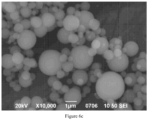
- the particles according to the description are spherical, that is to say they have a coefficient of sphericity greater than or equal to 0.75.
- the particles according to the invention have a coefficient of sphericity greater than or equal to 0.85, preferably greater than or equal to 0.9, or even greater than or equal to 0.95.
- the coefficient of sphericity of a particle is the ratio of the smallest diameter of the particle to its largest diameter. For a perfect sphere, this ratio is equal to 1.
- the coefficient of sphericity can be calculated for example by measuring the aspect ratio using any software adapted from images, for example images obtained by microscopy, in particular scanning or transmission electron microscopy of particles.
- the set of particles according to the invention may optionally contain particles that do not have the required sphericity criteria to the extent that the number-averaged sphericity of all the particles meets the criteria. fixed in the present invention.
- the terms “set of spherical particles” designate a plurality of particles of which at least 50% of the particles in number have sphericity as defined above.
- at least 60%, at least 70%, at least 80%, at least 90%, at least 95% by number of the particles of the set considered have a sphericity as defined above.
- inorganic particle we designate in the present invention a particle constituted at least in part by a non-organic product, that is to say which does not come from carbon chemistry (apart from CO 3 2- ).
- a non-organic product that is to say which does not come from carbon chemistry (apart from CO 3 2- ).
- the chemical diversity of inorganic particles is well known to those skilled in the art.
- the inorganic particles according to the invention are ZnO particles, alumina particles, boehmite particles, copper oxide particles, titanium oxide particles, mixed oxide particles of titanium and silicon. , montmorillonite particles, hydrotalcite particles, magnesium dihydroxide particles, magnesium oxide particles, zirconium dioxide particles, yttrium oxide particles Y 2 O 3 , particles of cerium dioxide, yttrium-stabilized zirconia particles, CaCu 3 Ti 4 O 12 particles, BaTiO 3 particles, iron oxide particles, magnesium sulfate particles, Zn 0 particles .18 Mn 0.82 Fe 2 O 4 , Mn 2 P 2 O 7 particles, nickel manganese oxide particles, mullite particles, ZnFe 2 O 4 particles, MnFe 2 O 4 particles , NiFe 2 O 4 particles, CoFe 2 O 3 particles, MgAl 2 O 4 particles, or Y 3 Al 5 O 12 particles.
- the inorganic particles according to the invention or according to the description may optionally comprise at least one dopant, such as for example aluminum, erbium, europium or ytterbium.
- the dopant is included in a proportion of 10% by mass maximum, preferably 5% by mass maximum, in particular 2% by mass maximum.
- the particles may include a minimal proportion, for example less than or equal to 5% by mass, of contaminants which may have a chemical nature different from that of said particles.
- the inorganic particles are ZnO particles, in particular hexagonal ZnO, optionally doped, for example doped with aluminum, alumina particles, in particular amorphous, cubic or rhombohedral alumina, boehmite particles, in particular orthorhombic, copper oxide particles, preferably cubic copper oxide, titanium oxide particles, in particular anatase or rutile, mixed titanium oxide particles and silicon, in particular anatase, particles of montmorillonite, in particular monoclinic, particles of hydrotalcite, in particular hexagonal, particles of magnesium dihydroxide, in particular hexagonal, magnesium oxide particles, in particular cubic, zirconium dioxide particles, in particular quadratic, yttrium oxide particles Y 2 O 3 , in particular cubic, optionally doped with europium and/or erbium and/or ytterbium, cerium dioxide particles, yttrium-stabilized zirconia particles, CaCu 3 Ti 4 O 12 particles, BaTiO particles 3
- the inorganic particles are particles of ZnO, in particular of hexagonal ZnO, optionally doped, for example doped with aluminum, particles of alumina, in particular of amorphous, cubic or rhombohedral alumina, particles of boehmite, in particular orthorhombic, particles of copper oxide, preferably cubic copper oxide, particles of montmorillonite, in particular monoclinic, particles of hydrotalcite, in particular hexagonal, particles of magnesium dihydroxide, in particular hexagonal, magnesium oxide particles, in particular cubic, cerium dioxide particles, yttrium-stabilized zirconia particles, CaCu 3 Ti 4 O 12 particles, BaTiO 3 particles, preferably cubic , particles of iron oxide, preferably in hematite form, particles of magnesium sulfate, preferably orthorombic, particles of Zn 0.18 Mn 0.82 Fe 2 O 4 , preferably cubic, particles of Mn 2 P 2 O 7 , preferably monoclinic, particles of nickel manganese oxide, particles
- the particles are particles of MgO, ZnO, ZrO2 stabilized with yttrium, Mullite (SiO2/Al2O3), alumina, or such doped particles.
- the particles are MgO particles, ZnO, yttrium-stabilized ZrO2, Mullite (SiO2/Al2O3), or such doped particles.
- the inorganic particle comprises several chemical elements, preferably from 2 to 16 different chemical elements, this number of elements not taking into account the elements O and H possibly included in the particle. These are then heterogeneous particles, that is to say which comprise different elements whose stoichiometry is preferably controlled by the synthesis process.
- these can include any chemical constituent that it It is possible to densify, in particular to crystallize, even metastable phases. Indeed, the particular conditions implemented in the process make it possible to obtain in densified form compounds whose degradation temperature is lower than the temperature actually applied, because the time spent at high temperature is very short.
- the terms “high temperature” preferably designate a temperature above 40°C.
- “Time spent at high temperature” generally refers to the time spent for the drying, pyrolysis and densification stages. Preferably, the time spent at high temperature does not exceed 70 seconds, in particular it is between 30 and 70 seconds.
- the quenching is characterized by a cooling rate greater than or equal to 100°C or greater than 300°C per second.
- the particles comprise a type of oxide which requires an input of energy to densify, in particular to crystallize.
- alumina we can mention for example alumina, zinc oxide, iron oxide, titanium dioxide (rutile), cubic or monoclinic ZrO 2 , and rare earth oxides (lanthanides and/or yttrium).
- alumina zinc oxide
- iron oxide titanium dioxide
- rutile cubic or monoclinic ZrO 2
- rare earth oxides lanthanides and/or yttrium
- Heterogeneous particles can either comprise several chemical elements (except O and H), preferably all the chemical elements (except O and H) constituting the particle, within each crystallite, or comprise crystallites each formed of a single chemical element (except O and H).
- each crystallite of the heterogeneous particle comprises a single chemical element (except O and H).
- the particles according to the invention have a number average diameter of between 0.5 and 5 ⁇ m, for example between 0.5 and 3 micrometers.
- the techniques suitable for determining the diameter of particles or sets of particles and they also know the degree of uncertainty existing in these measurements.
- the average diameter of the particles of a set, the standard deviation and the size distribution in particular can be determined by statistical studies from microscopy images, for example scanning electron microscopy (SEM) or in transmission (MET).
- the diameter values above may correspond to the number average particle diameter, even if some of the particles in the array have diameters outside this range.
- all the particles in the population have a diameter as defined above.
- the standard deviation relating to the size of particles in a population of particles is less than or equal to 25%, preferably less than or equal to 20%.
- the particle size distribution in the particle ensemble can be monomodal or multimodal.
- micrometric particles in the present invention makes it possible to promote the dispersion properties of particles because they are not too large but not to have the disadvantages (difficulties of implementation, toxicity, etc.) of nanoparticles.
- the particles can have different morphologies.
- they can be solid, hollow, porous, mesoporous, non-porous, and can also encapsulate or include other entities such as organic molecules, in which case they are organic-inorganic hybrid particles, or inorganic compounds. , particularly in the form of nanoparticles. Encapsulation can be carried out either during particle synthesis or in post-processing.
- the wall thickness can be controlled, in particular by means of the parameters of the synthesis process.
- a material in accordance with the IUPAC definition, is said to be microporous when it has pores of size less than 2 nm.
- a material is said to be mesoporous when it has pores of size between 2 and 50 nm.
- a material is said to be macroporous when it has pores larger than 50 nm.
- mesoporous materials can be compounds of the amorphous or paracrystalline silica type, in which the pores are generally distributed randomly, with a pore size distribution that can be very broad.
- One of the main advantages of the invention is to provide micrometric particles, in sizes as defined above, while being able to have high specific surface areas.
- the particles according to the invention have specific surface areas greater than or equal to 15m 2 /g, preferably greater than or equal to 30m 2 /g.
- the specific surface areas of the particles can be up to 700 m 2 /g or 600 m 2 /g.
- the specific surfaces vary, in particular depending on the diameter of the particles and their porosity.
- the diameter of the particles according to the invention is between 0.5 and 3 micrometers, and have specific surfaces greater than or equal to 15m 2 /g, preferably greater than or equal to 30m 2 /g.
- Specific surfaces can be measured according to different methods, in particular according to the Brunauer, Emmett, Teller (BET) method or the Barrett, Joyner, Halenda (BJH) method.
- BET Brunauer, Emmett, Teller
- BJH Halenda
- a second object of the invention is a material comprising particles according to the invention, dispersed substantially homogeneously in a matrix.
- the term matrix designates any material which can advantageously benefit from the inclusion of particles according to the invention. These may in particular be solid or liquid matrices, whatever the viscosity of the liquid matrix.
- the matrix is a liquid matrix, for example a solvent, preferably an aqueous solvent, such as water or an alcohol such as ethanol or ethylene glycol, or even an organic solvent such as methyl methacrylate.
- a solvent preferably an aqueous solvent, such as water or an alcohol such as ethanol or ethylene glycol, or even an organic solvent such as methyl methacrylate.
- the liquid matrix may also comprise a mixture of solvents, or a concentrated or non-concentrated premix of solvents.
- the matrix is a solid matrix, for example a metallic, ceramic or polymeric matrix, in particular a thermoplastic polymeric matrix.
- thermoplastic polymer matrices which can be used according to the invention, mention may in particular be made of polyethylene, polyethylene terephthalate, polypropylene, polyoxymethacrylate, ABS (Acrylonitrile Butyrene Styrene) or polyethylene vinyl acetate.
- the inclusion of the particles according to the invention in a matrix makes it possible to confer properties, in particular mechanical, thermal and/or physicochemical, particular to the matrix.
- the inclusion of the particles in the matrix can be carried out by techniques conventionally used in the art, in particular by mechanical agitation when the matrix is liquid.
- the material according to the invention can in particular be obtained in the form of liquid, powder, beads, pellets, granules, and/or extrudates, the shaping operations being carried out by conventional techniques known in the art. skilled in the art, in particular when the matrix is a polymeric matrix.
- the process of shaping the material does not require an additional step of dispersing the particles within the matrix compared to the shaping process conventionally used for matrices without inclusion of particles.
- the shaping process can preferably be implemented on the equipment and transformation lines conventionally used for matrices without the inclusion of particles.
- the dispersion of the particles within the matrix can, in certain embodiments, be carried out without additional chemical dispersing agent.
- the dispersion of the particles within the matrix is carried out in the presence or absence of a chemical dispersing agent, such as a surfactant.
- a chemical dispersing agent such as a surfactant.
- the dispersing agent can be used in an amount of 0.5 to 50% by mass relative to the mass of particles, in particular in an amount of 0.5 to 20% by mass relative to the mass of particles. .
- the particles according to the invention have the particularity of dispersing substantially homogeneously in volume in the matrix, whatever their chemical nature, their morphology and the nature of the matrix. This means that the particle density per unit volume is generally the same at any point in the matrix. In the case of a solid matrix, the density of particles per unit surface is preferably approximately the same whatever the surface of the matrix considered, whether it is an end surface of the matrix, or a surface obtained by cutting the material for example.
- the property(ies) which is/are conferred(s) on the matrix by the inclusion of the particles according to the invention is/are distributed(ies) substantially homogeneously throughout the matrix volume.
- the material according to the invention may comprise particles according to the invention in any proportion adapted to give it the desired properties.
- the material may comprise from 0.1 to 80% by mass of particles relative to the total mass of matrix and particles, preferably from 1 to 60% by mass, in particular from 2 to 25% by mass.
- the particles according to the invention are individualized non-deformable particles.
- the surface area of each particle that is in contact with other particles is generally very small.
- the radius of curvature of the meniscus forming the contact between two different particles of the assembly is less than 5%, preferably less than 2%, of the radius of each of the two particles, in particular within a matrix or in powder form.
- the sphericity of the particles according to the invention also makes it possible, for the same loading rate in a liquid matrix, to obtain a lower viscosity than with non-spherical particles.
- Another object of the present invention is a process for preparing a set of particles, as described above.
- the process according to the invention is a process known as “aerosol pyrolysis” (or spray pyrolysis) which is carried out at drying temperatures and not necessarily pyrolysis.
- This process is an improved process compared to the aerosol pyrolysis process described in particular in the application FR 2 973 260 .
- the process according to the invention is generally carried out in a reactor.
- the set of particles thus obtained can thus correspond to large quantities, more specifically the quantity obtained can be more than 100g, 500g, 1kg, 15 kg, or 20kg, this quantity varying depending on the supply of solution supplied and /or desired to the reactor.
- the set of particles thus obtained therefore has the advantage of being obtained in large quantities, while respecting the characteristics of the particles as described above.
- Nebulization step (1) is carried out at a temperature of 10 to 40°C, preferably for a period of less than or equal to 10 seconds, in particular less than or equal to 5 seconds.
- the liquid solution is generally in the form of an aqueous or hydroalcoholic solution or in the form of a colloidal sol. More specifically, the liquid solution from step (1) is introduced into a reactor by nebulization.
- Heating (drying) step (2) is carried out at a temperature of 40 to 120°C, preferably for a duration less than or equal to 10 seconds, in particular between 1 and 10 seconds.
- Step (3) called pyrolysis, is carried out at a temperature of 120 to 400°C, preferably for a duration less than or equal to 30 seconds, in particular between 10 and 30 seconds.
- the optional densification step (4) is carried out at a temperature between 200 and 1000°C. This step is preferably carried out at a temperature of 400 to 1000°C, in particular when the particles that we want to prepare are at least partly in crystallized form.
- the densification temperature can be lower, for example it can be around 200°C to 300°C, particularly for amorphous silica.
- the densification step is carried out for a duration less than or equal to 30 seconds, in particular between 20 and 30 seconds.
- Recovery step (5) is preferably carried out at a temperature below 100°C, and/or preferably for a duration of less than or equal to 10 seconds, in particular less than or equal to 5 seconds.
- Step (5) of particle recovery is preferably carried out by depositing the particles on a filter at the reactor outlet.
- the temperatures for each of the stages may lie outside the temperature ranges provided above. Indeed, for the same particles, the temperature to be applied may depend on the speed at which the drops and then the particles circulate in the reactor. The faster the drops and then the particles circulate in the reactor, the less they spend more time there and the higher the set temperature must be to obtain the same result.
- Steps (2), (3) and (4) are carried out in the same reactor. In particular, all of the process steps (except the post-treatment steps) are carried out in the same reactor.
- All of the steps of the process, in particular steps (2), (3) and (4), are carried out in continuity with each other.
- the temperature profile applied in the reactor is adapted according to the particles that we wish to form so that these three steps take place one after the other.
- the temperature in the reactor is adjusted via at least one, preferably 3, heating elements whose temperatures can be set independently.
- the method according to the present invention preferably further comprises between step (3), or optionally the particle densification step (4) when it is implemented, and the particle recovery step (5) a step (4') of quenching the particles.
- the quenching step (4') corresponds to a rapid decrease in temperature. More specifically, when the particle densification step (4) is implemented, the quenching step preferably takes place, and it advantageously corresponds to a temperature reduction of at least 300°C/s, for example to reach a temperature between 15 and 50°C. More specifically, when the particle densification step (4) is not implemented, the quenching step possibly takes place, and, if it takes place, it advantageously corresponds to a reduction in temperature of at least 100°C/s.
- the quenching step (4') is preferably carried out by entry of a cold gas, preferably air, over all or part of the circumference of the reactor.
- a gas is said to be cold in the present invention if it is at a temperature between 15 and 50°C, preferably between 15 and 30°C.
- the gas entering the reactor is a gas other than air.
- it may be a neutral gas (such as nitrogen or argon), a reducing gas (such as hydrogen or carbon monoxide), or any mixture of such gases.
- the process is preferably implemented in the absence of gas flow vectoring the fog from the start (e.g. the bottom) of the reactor.
- the laminar flow making it possible to bring the material into the zone in which the temperature is higher is advantageously created only by the suction at the end (e.g. top) of the reactor, producing a depression, for example of the order of a few pascals or a few dozen pascals.
- Such an embodiment makes it possible to use a reactor without gas inlet in its lower part, thus limiting process disturbances and losses, and thus optimizing the yield of the process and the size distribution of the particles obtained.
- the reactor in which the process is carried out also includes a gas inlet at the level where the fog is formed.
- the gas which enters the reactor at this level is preferably air, in particular hot air, that is to say at a temperature of 80 to 200°C.
- the process according to the invention does not include any other heating step than those carried out inside the aerosol pyrolysis reactor.
- the lower part (1) of the reactor comprises the liquid solution containing a precursor of the inorganic material(s) from which it is desired to form particles at a given molar concentration in a solvent.
- This solution is nebulized at the intermediate part (2), and the droplets rise by suction into the reactor.
- the entry of cold gas, in particular cold air, allows the particles to be quenched.
- the upper part (3) of the reactor is also at a cold temperature (less than 100°C, for example between 15 and 50°C).
- the precursor(s) of the inorganic material(s) from which particles are to be formed can be of any origin. It(s) is(are) introduced into step (1) of the process in the form of a liquid solution, in particular an aqueous or hydro-alcoholic solution containing the metal ions (such as an organic or mineral salt of the metal considered) or the precursor molecules (such as organosilanes) or even in the form of a colloidal sol (such as a colloidal dispersion of nanoparticles of the metal or the oxide of the metal considered).
- a liquid solution in particular an aqueous or hydro-alcoholic solution containing the metal ions (such as an organic or mineral salt of the metal considered) or the precursor molecules (such as organosilanes) or even in the form of a colloidal sol (such as a colloidal dispersion of nanoparticles of the metal or the oxide of the metal considered).
- the precursor or precursors of the or inorganic materials are(are) introduced into step (1) of the process in the form of a liquid solution, in particular an aqueous or hydroalcoholic solution containing metal ions (such as an organic or mineral salt of the metal considered ).
- the precursor(s) of the inorganic material(s) is(are) chosen according to the particles that it is desired to form. In a particular embodiment, this precursor is at least partly derived from plant or food waste, which represent biosources.
- inorganic material precursors we can in particular cite sodium silicate from rice hulls. Slaughterhouse residues, such as bones, may serve as a source of calcium phosphate, blood may serve as an iron oxide precursor, and/or crustacean shells may serve as a source of calcium carbonate.
- the particles according to the invention are constituted at least in part by a metallic component, possibly an organic-inorganic hybrid.
- This component can be obtained by sol-gel route from at least one metallic molecular precursor comprising one or more hydrolyzable groups, optionally in the presence of at least one amphiphilic surfactant (or particular texturizing agent), the surfactant possibly being preserved.
- the process according to the invention makes it possible to obtain particles having a high degree of purity. These particles do not necessarily require the implementation of subsequent processing steps, such as washing, heat treatment, grinding, etc., before their use.
- the method according to the invention may comprise at least one particle post-treatment step.
- it may be a washing step with a suitable solvent, a step of bringing into contact with reducing conditions, an encapsulation step with inside the particles, a step of heating the particles, and/or a step of coating the particles, in particular to “seale” said particles.
- a post-treatment step by heating the particles may be necessary to optimize the properties of the particles such as their composition or their crystal structure.
- a post-treatment step by heating the particles will generally be less necessary as the speed of the drops and then of the particles in the reactor is lower.
- the process according to the invention makes it possible to precisely control the size of the particles at the process outlet. Indeed, there is a constant ratio, which is around 5, between the diameter of the drops of the mist used and the diameter of the particles leaving the process when the concentrations of precursors are molar, which is usually the case. Those skilled in the art know how to determine, depending on the precursor concentration, the ratio between these two diameters. For example, if the precursor concentration is reduced by a factor of 10, then the size of the particles obtained is reduced by a cubic root factor of 10, or approximately 3.
- the diameter of the drops can also be controlled in particular by the parameters of the nebulization mode, for example the frequency of the piezoelectric elements used to form the fog.
- the drops comprise, in addition to the compound(s) of which it is desired to form particles, at least one so-called sacrificial compound which is for example either soluble in a solvent, such as water, acidic water or basic water, either thermosensitive, in particular this sacrificial compound is vaporized or degraded at the reactor temperature.
- a solvent such as water, acidic water or basic water
- thermosensitive thermosensitive
- this sacrificial compound is vaporized or degraded at the reactor temperature.
- the process advantageously comprises a post-treatment step comprising washing the particles with said solvent.
- the sacrificial compound can be any liquid, solid or gaseous chemical compound which has the desired properties, for example solubility and/or heat sensitivity.
- the method according to the invention may comprise a step of encapsulation within the inorganic particles of other entities such as organic molecules, in which case it is organic-inorganic hybrid particles, or inorganic compounds, in particular in the form of nanoparticles. Encapsulation can be carried out either during particle synthesis or in post-processing.
- Another object of the description is a set of particles capable of being prepared according to the process defined above, and in particular by the implementation of the process comprising or consisting of steps (1) to (5), as defined above.
- the particles thus prepared have the characteristics described above for the particles according to the invention and according to the description.
- This process makes it possible in particular to obtain individualized and micrometric spherical particles, and advantageously having specific surfaces as described above.
- it also allows each particle not to be constituted by the aggregation of several particles of smaller size.
- the particles obtained by this process are individualized and non-deformable.
- a final object of the invention is a process for preparing a material according to the invention, comprising bringing a matrix as previously defined into contact with at least one set of particles according to the invention. This process then preferably comprises a step of shaping the material as described above.
- the measurements of specific surface area, pore volume and pore diameter were carried out by the BET or BJH method.
- the LASER particle size measurements were carried out using a LASER Mastersizer 2000 particle size analyzer (Malvern Instruments), on dispersions of particles in water.
- Example 1 Mesoporous silica particles obtained by the process according to the invention
- Example 1.1 Mesoporous silica particles with in situ encapsulation of organic compounds
- Mesoporous silica particles encapsulating organic molecules were prepared from two different precursors: a commercial silica sol comprising particles of 10 to 30 nm, and TEOS (tetraethylorthosilicate).
- the “precursor” solution is nebulized by the spray pyrolysis process.
- the maximum temperature of the oven in which the drying, pyrolysis and densification stages take place is set at 250°C.
- the precursor solution is nebulized by the spray pyrolysis process.
- the maximum temperature of the oven in which the drying, pyrolysis and densification stages take place is set at 250°C.
- Example 1.2 Mesoporous silica particles with encapsulation of organic molecules in post-treatment
- mesoporous silica particles obtained by spray pyrolysis according to the invention (specific surface area of 124 m 2 /g (BET), average diameter 1.2 ⁇ m (laser particle size)) are introduced into a 500 mL vial provided with an exit to empty.
- the medium is heated to 140°C, under vacuum for 6 hours.
- the particles are then centrifuged and dried in air.
- the loading rate is then determined by mass difference and is of the order of 50% by weight.
- the particles were synthesized according to the method below.
- the precursor solution is nebulized by the spray pyrolysis process (SP100) according to the invention.
- SP100 spray pyrolysis process
- the maximum temperature reached in the reactor in which the drying, pyrolysis and densification stages take place is 500°C.
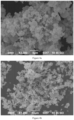
- FIG. 3 presents SEM images of the obtained boehmite particles.
- X-ray Diffraction analyzes made it possible to identify that it is orthorombic boehmite.
- the BET specific surface area of the powder obtained is 402 m 2 /g, and the average pore diameter (BET) is 3 nm.
- An aqueous solution is prepared with 241 g of trihydrated copper nitrate powder Cu(NO 3 ) 2.3H 2 O, dissolved in 1L of water.
- the precursor solution is nebulized by the spray pyrolysis process.
- the maximum temperature of the oven in which the drying, pyrolysis and densification stages take place is set at 800°C.
- the particles are then heat treated, in an oven under air, for 2 hours at 500°C in order to complete the decomposition of the nitrates which is not complete at the reactor outlet.
- Example 3 The CuO powder obtained in Example 3 is placed in an oven. A flow of reducing gas (for example 5% H 2 , 95% N 2 ) circulates in this oven throughout the reaction. The reduction is carried out for 3 hours at 500°C.
- reducing gas for example 5% H 2 , 95% N 2
- Example 5 Al alumina particles 2 O 3 mesoporous
- the precursor solution is nebulized by the pyrolysis spray process according to the invention.
- the profile of the maximum temperatures reached in the reactor in which the drying, pyrolysis and densification stages take place is as follows: 350°C, 600°C, 800°C.
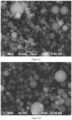
- FIG. 5 presents SEM images of the Al 2 O 3 particles obtained.
- X-ray Diffraction analyzes made it possible to identify that it is amorphous Al 2 O 3 .
- the BET specific surface area of the powder obtained is 383 m 2 /g, and the average pore diameter is 2.4 nm.
- Example 6 Mixed SiO particles 2 /TiO 2 mesoporous
- a surfactant such as Pluronic, CTAB (hexadecyltrimethylammonium bromide) or polyoxyethylene derivative from the Brij brand for example.
- a surfactant such as Pluronic, CTAB (hexadecyltrimethylammonium bromide) or polyoxyethylene derivative from the Brij brand for example.
- TEOS hexadecyltrimethylammonium bromide
- the mixture is kept under vigorous stirring for 15 hours to allow hydrolysis and condensation of the TEOS and thus form silica gel.
- a volume of 1.5 mL of nitric acid is introduced into a flask containing 100 mL of demineralized water.
- the solution is brought to 70°C, and 17 grams of titanium butoxide are added.
- the synthesis is left under vigorous stirring for 12 hours to allow the synthesis of the titanium oxide nanoparticles.
- the dispersion is left to settle for 2 hours to eliminate the butanol on the surface.
- the titanium sol is introduced into the silica sol with magnetic stirring for 5 minutes.
- the precursor solution is nebulized by the spray pyrolysis process according to the invention.
- the maximum temperature of the oven in which the drying, pyrolysis and densification stages take place is set to 500°C.
- the particles are then heat treated, in an oven under air, for 4 hours at 700°C.
- the process is reproduced by varying the quantity of TiO 2 , to obtain the following three samples: SITI_01, SITI_02 and SITI_03 (see table 1 below).
- Table 2 below summarizes the properties of the three samples obtained.
- Table 2 Reference Average diameter Laser particle size diameter (number) BET specific surface Specific surface BJH Average pore diameter XRD of the TiO 2 phase (amorphous SiO 2 )
- the average diameter values are obtained by statistical study on electron microcopy images.
- Example 7 Other particle types
- Table 3 below gives examples of different types of particles synthesized according to the invention.
- Bio-SiO 2 designates a biosourced silica derived from sodium silicate which can be obtained by extracting food plant waste.
- the size values in Table 3 are obtained by statistical study on electron microcopy images.
- the BET specific surface area of the rutile TiO2 powder obtained is 47 m 2 /g.
- the BET specific surface area of the TiO2 anatase powder obtained is 198 m 2 /g.
- the BET specific surface area of the powder obtained ZnO Wurtzite (or also called h-ZnO in table 3) is 39 m 2 /g,
- Example 8 Incorporation of the particles obtained in Example 2 into a polyethylene matrix
- the boehmite particles obtained according to Example 2 are introduced into a polyethylene matrix by extrusion-compounding.
- the proportions are as follows: 80% polyethylene, 20% boehmite particles by mass.
- the extrusion temperature profile is as follows: F Z11 Z10 Z9 Z8 Z7 Z6 Z5 Z4 Z3 Z2 Z1 T°C setpoint 180 180 180 180 180 180 180 180 180 180 180 170 150 100 15 Actual T°C 178 178 182 185 180 181 181 182 169 154 100 15
- the screw speed is 250 rpm
- the motor torque is 44%
- the head pressure is 40 bar
- the material temperature is 180°C
- drying is carried out at 50°C for 4 hours.
- Example 9 Incorporation of particles obtained in Example 4 into a matrix
- the metallic copper particles obtained in Example 4 were dispersed in a proportion of 58% by weight in an aqueous matrix comprising in particular 13% alcohol (ethanol or ethylene glycol + citric acid).
- the final solution obtained consists of 58% by weight of copper particles, 13% by weight of alcoholic solution (for example 90% ethanol + 10% citric acid by weight) and 29% by weight of aqueous solution.
- Example 10 Incorporation of ZrO particles 2 hollow in an enamel matrix
- the slip obtained can be deposited on a metal substrate by projection.
- the substrate, coated with enamel is dried in air at around 100°C then undergoes firing at high temperature (between 800 and 1000°C) depending on the quality of the enamel.
- FIG. 11 presents an SEM image of a dense enamel matrix containing 20% hollow zirconium oxide particles deposited by projection onto a steel substrate.
- Example 11 Incorporation of dense ZnO particles into an ABS matrix
- FIG. 12 is an SEM image of dense ZnO particles according to the invention incorporated in an ABS (Acrylonitrile Butadiene Styrene) matrix.
Landscapes
- Chemical & Material Sciences (AREA)
- Organic Chemistry (AREA)
- Inorganic Chemistry (AREA)
- Life Sciences & Earth Sciences (AREA)
- Geology (AREA)
- Environmental & Geological Engineering (AREA)
- General Life Sciences & Earth Sciences (AREA)
- Polymers & Plastics (AREA)
- Health & Medical Sciences (AREA)
- Chemical Kinetics & Catalysis (AREA)
- Medicinal Chemistry (AREA)
- Composite Materials (AREA)
- Dispersion Chemistry (AREA)
- Silicates, Zeolites, And Molecular Sieves (AREA)
- Compositions Of Macromolecular Compounds (AREA)
- Silicon Compounds (AREA)
- Compounds Of Alkaline-Earth Elements, Aluminum Or Rare-Earth Metals (AREA)
- Oxygen, Ozone, And Oxides In General (AREA)
- Catalysts (AREA)
Claims (12)
- Verfahren zur Herstellung eines Satzes anorganischer, sphärischer, mikrometrischer und individualisierter Partikel durch Aerosolpyrolyse, umfassend die Durchführung der folgenden Schritte in einem Reaktor:- die Zerstäubung einer flüssigen Lösung bei einer Temperatur von 10 bis 40 °C, die einen Vorläufer von einem der anorganischen Materialien, aus dem/denen man Partikel bilden möchte, in einer bestimmten molaren Konzentration in einem Lösungsmittel enthält, um einen Tröpfchennebel zu erhalten der Lösung,- Erhitzen des Nebels auf eine Temperatur, die die Verdampfung des Lösungsmittels und die Bildung von Partikeln gewährleistet, bei einer Temperatur von 40 bis 120 °C,- Erhitzen dieser Partikel auf eine Temperatur von 120 bis 400 °C, die die Zersetzung des Vorläufers unter Bildung des anorganischen Materials gewährleisten kann,- optional die Verdichtung der Partikel bei einer Temperatur zwischen 200 und 1000 °C,- gegebenenfalls Abschrecken der Partikel und- Wiedergewinnen der so gebildeten Partikel.
- Verfahren nach Anspruch 1, bei dem der Vernebelungsschritt (1) für eine Dauer kleiner oder gleich 10 Sekunden, insbesondere kleiner oder gleich 5 Sekunden, durchgeführt wird.
- Verfahren nach Anspruch 1 oder 2, bei dem der Erwärmungsschritt (2) für eine Dauer kleiner oder gleich 10 Sekunden, insbesondere zwischen 1 und 10 Sekunden, durchgeführt wird.
- Verfahren nach einem der Ansprüche 1-3, bei dem der Pyrolyseschritt (3) für eine Dauer kleiner oder gleich 30 Sekunden, insbesondere zwischen 10 und 30 Sekunden, durchgeführt wird.
- Verfahren nach einem der Ansprüche 1-4, bei dem der Verdichtungsschritt (4) für eine Dauer kleiner oder gleich 30 Sekunden, insbesondere zwischen 20 und 30 Sekunden, durchgeführt wird.
- Verfahren nach einem der Ansprüche 1-5, bei dem der Wiedergewinnungsschritt bei einer Temperatur von weniger als 100 °C und vorzugsweise für eine Dauer von weniger als oder gleich 10 Sekunden, insbesondere weniger als oder gleich 5 Sekunden, durchgeführt wird.
- Verfahren nach einem der Ansprüche 1-6, bei dem der Schritt des Abschreckens durch Einleiten eines kalten Gases, vorzugsweise Luft, über den gesamten oder einen Teil des Umfangs des Reaktors erfolgt.
- Verfahren zur Herstellung eines Materials, das einen Satz dispergierter Partikel umfasst, umfassend das In-Kontakt-Bringen einer Matrix mit mindestens einem Satz von Partikeln, die gemäß dem Verfahren nach einem der Ansprüche 1 bis 7 erhalten wurden.
- Verfahren nach Anspruch 8, weiterhin umfassend einen Schritt des Formens des Materials.
- Satz von anorganischen, sphärischen, mikrometrischen und individualisierten Partikeln, dadurch gekennzeichnet, dass die Partikel Folgendes aufweisen:- einen Durchmesser im zahlenmäßigen Durchschnitt zwischen 0,5 und 5 µm,- einen Sphärizitätskoeffizienten größer oder gleich 0,85 und- eine spezifische Oberfläche von mehr oder gleich 15 m2/g,wobei es sich bei den Partikeln um ZnO-Partikel, Aluminiumoxidpartikel, Böhmitpartikel, Kupferoxidpartikel, Titanoxidpartikel, Mischoxidpartikel aus Titan und Silizium, Partikel aus Montmorillonit, Hydrotalcitpartikel, Magnesiumdihydroxidpartikel, Magnesiumoxidpartikel, Zirkoniumdioxidpartikel, Yttriumoxid Y2O3-Partikel, Cerdioxid-Partikel, Yttrium-stabilisierte Zirkonoxi-Partikel, CaCu3Ti4O12-Partikel, BaTiO3-Partikel, Eisenoxid-Partikel, Magnesiumsulfat-Partikel, Zn0,18Mn0,82Fe2O4-Partikel, Mn2P2O7-Partikel, Nickel-Manganoxid, Mullit-Partikel, ZnFe2O4-Partikel, MnFe2O4-Partikel, NiFe2O4-Partikel, CoFe2O3-Partikel, MgAl2O4-Partikel oder Y3Al2O12-Partikel handelt.
- Satz von Partikeln nach Anspruch 10, wobei die Partikel aus MgO, aus ZnO, aus Yttrium-stabilisierten ZrO2, aus Mullit (SiO2/Al2O3) oder derart dotierte Partikel sind.
- Material, umfassend einen Satz von Partikeln nach Anspruch 10 oder 11, die homogen in einer Matrix dispergiert sind.
Applications Claiming Priority (2)
| Application Number | Priority Date | Filing Date | Title |
|---|---|---|---|
| FR1454141A FR3020766B1 (fr) | 2014-05-07 | 2014-05-07 | Particules inorganiques individualisees |
| PCT/FR2015/051223 WO2015170060A1 (fr) | 2014-05-07 | 2015-05-07 | Particules inorganiques individualisées |
Publications (2)
| Publication Number | Publication Date |
|---|---|
| EP3140255A1 EP3140255A1 (de) | 2017-03-15 |
| EP3140255B1 true EP3140255B1 (de) | 2024-06-12 |
Family
ID=51225752
Family Applications (1)
| Application Number | Title | Priority Date | Filing Date |
|---|---|---|---|
| EP15725838.5A Active EP3140255B1 (de) | 2014-05-07 | 2015-05-07 | Individualisierte anorganische partikel |
Country Status (16)
| Country | Link |
|---|---|
| US (1) | US9982109B2 (de) |
| EP (1) | EP3140255B1 (de) |
| JP (2) | JP2017514786A (de) |
| KR (1) | KR102417125B1 (de) |
| CN (1) | CN107074542B (de) |
| AU (1) | AU2015257525B2 (de) |
| CA (1) | CA2947499C (de) |
| EA (1) | EA035971B1 (de) |
| ES (1) | ES2985810T3 (de) |
| FR (1) | FR3020766B1 (de) |
| IL (1) | IL248761B (de) |
| MA (1) | MA39883A (de) |
| TN (1) | TN2016000478A1 (de) |
| UA (1) | UA120850C2 (de) |
| WO (1) | WO2015170060A1 (de) |
| ZA (1) | ZA201608300B (de) |
Families Citing this family (20)
| Publication number | Priority date | Publication date | Assignee | Title |
|---|---|---|---|---|
| FR3022785B1 (fr) | 2014-06-25 | 2017-10-13 | Pylote | Utilisation de materiaux incorporant des microparticules pour eviter la proliferation de contaminants. |
| FR3043683B1 (fr) * | 2015-11-12 | 2019-04-12 | Pylote | Particules spheriques et chargees en agents colorants |
| MY202228A (en) | 2017-09-11 | 2024-04-18 | Basf Se | Microspheres comprising polydisperse polymer nanospheres and porous metal oxide microspheres |
| US11179694B2 (en) | 2017-09-11 | 2021-11-23 | Basf Se | Method of forming porous metal oxide microspheres |
| JP2019055365A (ja) * | 2017-09-21 | 2019-04-11 | 太平洋セメント株式会社 | 噴霧熱分解装置 |
| CN108002425A (zh) * | 2017-12-22 | 2018-05-08 | 海安常州大学高新技术研发中心 | 一种中空ZnO的制备方法 |
| CN109607616B (zh) * | 2018-12-19 | 2021-02-19 | 大连理工大学 | 一种喷雾合成金属氧化物空心球粉体及其前驱体的方法 |
| CN109734102A (zh) * | 2019-01-28 | 2019-05-10 | 浙江理工大学 | 二氧化硅微米球的制备方法及其制备装置 |
| JP7364395B2 (ja) * | 2019-09-06 | 2023-10-18 | 太平洋セメント株式会社 | 中空粒子の製造方法 |
| EP4031195A4 (de) | 2019-09-16 | 2023-11-29 | ABK Biomedical Incorporated | Zusammensetzung von radioaktiven und nicht-radioaktiven mikropartikeln |
| TWI726724B (zh) * | 2020-05-18 | 2021-05-01 | 國立臺灣大學 | 製造二氧化矽顆粒之方法 |
| JP2023535924A (ja) * | 2020-07-22 | 2023-08-22 | ビーエーエスエフ ソシエタス・ヨーロピア | ハイブリッド金属酸化物粒子 |
| CN113371682B (zh) * | 2021-05-13 | 2023-04-07 | 中国恩菲工程技术有限公司 | 纳微米球形粉体及其制备方法和设备 |
| RU2768221C1 (ru) * | 2021-06-10 | 2022-03-23 | Общество С Ограниченной Ответственностью "Научно-Производственная Фирма "Материа Медика Холдинг" | Модификатор и способ изменения электрофизических и магнитных свойств керамики |
| CN114088572A (zh) * | 2021-12-21 | 2022-02-25 | 武汉理工大学 | 一种氧化钇稳定氧化锆中残余氧化钇的定量分析方法 |
| CA3249013A1 (en) * | 2022-01-18 | 2023-07-27 | Basf Se | ARTIFICIAL POLYMER ARTICLES SHAPED WITH HYBRID METAL OXIDE PARTICLES |
| CN114906877A (zh) * | 2022-04-01 | 2022-08-16 | 哈尔滨理工大学 | 一种能与ldpe复合制备磁性纳米电介质的钴铁氧体的制备方法 |
| CN115072793A (zh) * | 2022-07-12 | 2022-09-20 | 浙江大学台州研究院 | 一种高结晶性抗氧化磁性纳米颗粒的制备方法 |
| GR1010801B (el) * | 2023-07-18 | 2024-10-21 | Ιωαννης Γεωργιου Δεληγιαννακης | Μεθοδολογια για συνθεση υβριδικων νανουλικων με μονομοριακη αποθεση χαμηλων θερμοκρασιων και πυρολυση-ψεκασμου-φλογας |
| WO2025249535A1 (ja) * | 2024-05-31 | 2025-12-04 | 株式会社トクヤマ | コアシェル粒子及び中空粒子の製造方法、コアシェル粒子及び中空粒子 |
Citations (1)
| Publication number | Priority date | Publication date | Assignee | Title |
|---|---|---|---|---|
| US20100247914A1 (en) * | 2007-12-07 | 2010-09-30 | Jgc Catalysts And Chemicals Ltd. | Porous Silica-Based Particles Having Smooth Surface, Method for Production Thereof and Cosmetic Comprising Such Particles |
Family Cites Families (20)
| Publication number | Priority date | Publication date | Assignee | Title |
|---|---|---|---|---|
| JPS60112849A (ja) * | 1983-11-24 | 1985-06-19 | Teijin Ltd | 繊維用ポリエステル組成物 |
| JPS6187750A (ja) * | 1984-10-05 | 1986-05-06 | Mitsui Petrochem Ind Ltd | 着色された熱成形用ポリエチレンテレフタレ−ト組成物 |
| JPH01185340A (ja) * | 1988-01-18 | 1989-07-24 | Hosokawa Micron Corp | 遠赤外線放射面の製造方法 |
| CN1040932A (zh) * | 1988-09-08 | 1990-04-04 | 清华大学 | 超声雾化制备超细粉末 |
| GB9316437D0 (en) * | 1993-08-06 | 1993-09-22 | Harcros Chemicals Uk Limited | Zinc oxide and a process for making it |
| DE4419234A1 (de) * | 1994-06-01 | 1995-12-07 | Wacker Chemie Gmbh | Verfahren zur Silylierung von anorganischen Oxiden |
| EP0994085B1 (de) * | 1998-10-13 | 2003-09-03 | Ngk Spark Plug Co., Ltd | Verfahren zur Herstellung von kugelförmigen Formkörpern |
| JP3542319B2 (ja) * | 2000-07-07 | 2004-07-14 | 昭栄化学工業株式会社 | 単結晶フェライト微粉末 |
| CN1327950A (zh) * | 2001-07-27 | 2001-12-26 | 中国科学院上海硅酸盐研究所 | 组分分布均匀的球形稀土化合物的喷雾反应制备方法 |
| JP2003225573A (ja) * | 2002-01-31 | 2003-08-12 | National Institute For Materials Science | 酸化亜鉛系光触媒とその製造方法 |
| JP2005137955A (ja) | 2003-11-04 | 2005-06-02 | Nissan Motor Co Ltd | 粒子製造装置および粒子の製造方法 |
| JP4776910B2 (ja) * | 2004-04-13 | 2011-09-21 | 戸田工業株式会社 | ナノ構造体 |
| DE102005002659A1 (de) * | 2005-01-19 | 2006-07-27 | Merck Patent Gmbh | Verfahren zur Herstellung von Mischoxiden mittels Sprühpyrolyse |
| DE102005007036A1 (de) * | 2005-02-15 | 2006-08-17 | Merck Patent Gmbh | Verfahren zur Herstellung von kugelförmigen Mischoxid-Pulvern mittels Sprühpyrolyse in einem Heißwandreaktor |
| JP5116221B2 (ja) | 2005-08-03 | 2013-01-09 | 関西電力株式会社 | 酸化銅粒子を含有する電極材料及びそれを用いた固体酸化物形燃料電池の燃料極の製造方法 |
| FR2973260B1 (fr) | 2011-03-31 | 2015-02-20 | Pylote | Procede de preparation de particules d'oxyde de metal creuses utilisables en tant que barriere thermique |
| US20160015652A1 (en) * | 2012-02-16 | 2016-01-21 | The Administrators Of The Tulane Educational Fund | Hollow nanoparticles with hybrid double layers |
| DE102012206004A1 (de) * | 2012-04-12 | 2013-10-17 | Evonik Degussa Gmbh | Metallmischoxid enthaltendes Pulver, Verfahren zu dessen Herstellung und Verwendung |
| CN102908977B (zh) * | 2012-11-12 | 2015-08-26 | 江西理工大学 | 一种中空球形氧化镁吸附剂的制备方法 |
| FR3022785B1 (fr) * | 2014-06-25 | 2017-10-13 | Pylote | Utilisation de materiaux incorporant des microparticules pour eviter la proliferation de contaminants. |
-
2014
- 2014-05-07 FR FR1454141A patent/FR3020766B1/fr active Active
-
2015
- 2015-05-07 ES ES15725838T patent/ES2985810T3/es active Active
- 2015-05-07 UA UAA201612399A patent/UA120850C2/uk unknown
- 2015-05-07 MA MA039883A patent/MA39883A/fr unknown
- 2015-05-07 WO PCT/FR2015/051223 patent/WO2015170060A1/fr not_active Ceased
- 2015-05-07 KR KR1020167032792A patent/KR102417125B1/ko not_active Expired - Fee Related
- 2015-05-07 EP EP15725838.5A patent/EP3140255B1/de active Active
- 2015-05-07 US US15/308,651 patent/US9982109B2/en active Active
- 2015-05-07 CN CN201580036351.0A patent/CN107074542B/zh not_active Expired - Fee Related
- 2015-05-07 TN TN2016000478A patent/TN2016000478A1/fr unknown
- 2015-05-07 CA CA2947499A patent/CA2947499C/fr active Active
- 2015-05-07 JP JP2017510775A patent/JP2017514786A/ja active Pending
- 2015-05-07 EA EA201692251A patent/EA035971B1/ru not_active IP Right Cessation
- 2015-05-07 AU AU2015257525A patent/AU2015257525B2/en not_active Ceased
-
2016
- 2016-11-06 IL IL248761A patent/IL248761B/en active IP Right Grant
- 2016-12-01 ZA ZA2016/08300A patent/ZA201608300B/en unknown
-
2020
- 2020-07-16 JP JP2020121995A patent/JP7203792B2/ja active Active
Patent Citations (1)
| Publication number | Priority date | Publication date | Assignee | Title |
|---|---|---|---|---|
| US20100247914A1 (en) * | 2007-12-07 | 2010-09-30 | Jgc Catalysts And Chemicals Ltd. | Porous Silica-Based Particles Having Smooth Surface, Method for Production Thereof and Cosmetic Comprising Such Particles |
Non-Patent Citations (1)
| Title |
|---|
| TELEKI ET AL: "Flame-coating of titania particles with silica", JOURNAL OF MATERIALS RESEARCH, MATERIALS RESEARCH SOCIETY, WARRENDALE, PA, US, vol. 20, no. 5, 1 May 2005 (2005-05-01), pages 1336 - 1347, XP009112473, ISSN: 0884-2914, DOI: 10.1557/JMR.2005.0160 * |
Also Published As
| Publication number | Publication date |
|---|---|
| FR3020766B1 (fr) | 2020-05-08 |
| CA2947499A1 (fr) | 2015-11-12 |
| NZ727242A (en) | 2023-09-29 |
| JP7203792B2 (ja) | 2023-01-13 |
| EA201692251A1 (ru) | 2017-03-31 |
| ZA201608300B (en) | 2019-04-24 |
| UA120850C2 (uk) | 2020-02-25 |
| JP2017514786A (ja) | 2017-06-08 |
| CN107074542B (zh) | 2020-10-16 |
| AU2015257525B2 (en) | 2019-03-28 |
| US9982109B2 (en) | 2018-05-29 |
| WO2015170060A1 (fr) | 2015-11-12 |
| KR20170020326A (ko) | 2017-02-22 |
| AU2015257525A1 (en) | 2017-01-05 |
| EP3140255A1 (de) | 2017-03-15 |
| IL248761A0 (en) | 2017-01-31 |
| IL248761B (en) | 2021-04-29 |
| EA035971B1 (ru) | 2020-09-08 |
| JP2020172435A (ja) | 2020-10-22 |
| TN2016000478A1 (fr) | 2018-04-04 |
| KR102417125B1 (ko) | 2022-07-04 |
| MA39883A (fr) | 2017-03-15 |
| ES2985810T3 (es) | 2024-11-07 |
| FR3020766A1 (fr) | 2015-11-13 |
| CN107074542A (zh) | 2017-08-18 |
| US20170190867A1 (en) | 2017-07-06 |
| CA2947499C (fr) | 2023-03-14 |
Similar Documents
| Publication | Publication Date | Title |
|---|---|---|
| EP3140255B1 (de) | Individualisierte anorganische partikel | |
| EP2274235B1 (de) | Aus kugelförmigen partikeln von spezifischer grösse geformtes anorganisches material mit in einer mesostrukturierten matrix erfassten metallischen nanopartikeln | |
| EP2707437B1 (de) | Selbstdispergierende nanopartikel | |
| EP2202277B1 (de) | Herstellungsverfahren für hybride Cerium-Polymer-Nanopartikel vom Kern-Schalen-Typ und Dispersionssole davon | |
| WO2006128988A1 (fr) | Materiau inorganique presentant des nanoparticules metalliques piegees dans une matrice mesostructuree | |
| EP1639059B1 (de) | Vorläuferzusammensetzungen von erdalkali- oder seltenerdaluminate und verfahren zur deren herstellung | |
| EP1157072B1 (de) | Organische sol und feststoff auf basis von titaniumoxyd und einem amphiphilen stoff und verfahren zur herstellung | |
| CA2716595A1 (fr) | Aluminate de baryum et de magnesium submicronique, procede de preparation et utilisation comme luminophore | |
| WO2016097558A1 (fr) | Particules mésostructurées chargées en agents anticorrosion obtenues par aérosol | |
| US20070259176A1 (en) | Metal Oxide Sol, Layer Produced Therewith and Shaped Article | |
| CA2816385A1 (fr) | Composition a base d'un aluminate, de type coeur/coquille, luminophore issu de cette composition et procedes de preparation | |
| WO2003068678A2 (fr) | Compose mesoporeux comprenant une phase minérale d'alumine et des particules d'oxyde de cérium, de titane ou de zirconium, et éventuellement un élément en solution solide dans ces particules, procédés de préparation et ses utilisations | |
| KR100841880B1 (ko) | 수성/유기 금속 산화물 분산액 및 이로써 제조된 코팅 기판및 성형물 | |
| JP2012041232A (ja) | 酸化イットリウム粒子を含む水性分散液 | |
| JP5315704B2 (ja) | 微粒子充填メソポーラス体及びその製造方法 | |
| BE1004604A4 (fr) | Procede de fabrication d'une poudre d'oxydes metalliques mixtes. | |
| EP1537047B1 (de) | Verfahren zur herstellung von anorganischen oxidpulvern kristalline zusammensetzungen und ihre verwendung | |
| JPS62226814A (ja) | 酸化チタン微粒子の製造方法 | |
| TW202528235A (zh) | 金屬氧化物粒子及其製造方法 | |
| KR20040015951A (ko) | 표면이 코팅된 미세분말 제조방법 | |
| NZ727242B2 (en) | Individualised inorganic particles | |
| EP0493242A1 (de) | Reduzierte Verbindungen, insbesondere auf der Basis von Titan, Vanadium, Niobium, insbesondere von Typ Titanite und deren Herstellung |
Legal Events
| Date | Code | Title | Description |
|---|---|---|---|
| STAA | Information on the status of an ep patent application or granted ep patent |
Free format text: STATUS: THE INTERNATIONAL PUBLICATION HAS BEEN MADE |
|
| PUAI | Public reference made under article 153(3) epc to a published international application that has entered the european phase |
Free format text: ORIGINAL CODE: 0009012 |
|
| STAA | Information on the status of an ep patent application or granted ep patent |
Free format text: STATUS: REQUEST FOR EXAMINATION WAS MADE |
|
| 17P | Request for examination filed |
Effective date: 20161117 |
|
| AK | Designated contracting states |
Kind code of ref document: A1 Designated state(s): AL AT BE BG CH CY CZ DE DK EE ES FI FR GB GR HR HU IE IS IT LI LT LU LV MC MK MT NL NO PL PT RO RS SE SI SK SM TR |
|
| AX | Request for extension of the european patent |
Extension state: BA ME |
|
| DAX | Request for extension of the european patent (deleted) | ||
| STAA | Information on the status of an ep patent application or granted ep patent |
Free format text: STATUS: EXAMINATION IS IN PROGRESS |
|
| 17Q | First examination report despatched |
Effective date: 20180216 |
|
| RIC1 | Information provided on ipc code assigned before grant |
Ipc: C01G 23/00 20060101ALI20231117BHEP Ipc: C01G 23/053 20060101ALI20231117BHEP Ipc: C01G 25/00 20060101ALI20231117BHEP Ipc: C01G 25/02 20060101ALI20231117BHEP Ipc: C01G 49/02 20060101ALI20231117BHEP Ipc: C01G 3/02 20060101ALI20231117BHEP Ipc: C01G 49/00 20060101ALI20231117BHEP Ipc: C01G 53/00 20060101ALI20231117BHEP Ipc: C01G 51/00 20060101ALI20231117BHEP Ipc: C01G 3/00 20060101ALI20231117BHEP Ipc: C01G 1/02 20060101ALI20231117BHEP Ipc: C01F 5/14 20060101ALI20231117BHEP Ipc: C01F 5/40 20060101ALI20231117BHEP Ipc: C01F 7/02 20060101ALI20231117BHEP Ipc: C01F 17/00 20060101ALI20231117BHEP Ipc: C09C 1/30 20060101ALI20231117BHEP Ipc: C09C 1/40 20060101ALI20231117BHEP Ipc: C09C 1/62 20060101ALI20231117BHEP Ipc: C09C 1/36 20060101ALI20231117BHEP Ipc: C01G 9/02 20060101AFI20231117BHEP |
|
| GRAP | Despatch of communication of intention to grant a patent |
Free format text: ORIGINAL CODE: EPIDOSNIGR1 |
|
| STAA | Information on the status of an ep patent application or granted ep patent |
Free format text: STATUS: GRANT OF PATENT IS INTENDED |
|
| INTG | Intention to grant announced |
Effective date: 20240104 |
|
| GRAS | Grant fee paid |
Free format text: ORIGINAL CODE: EPIDOSNIGR3 |
|
| GRAA | (expected) grant |
Free format text: ORIGINAL CODE: 0009210 |
|
| STAA | Information on the status of an ep patent application or granted ep patent |
Free format text: STATUS: THE PATENT HAS BEEN GRANTED |
|
| AK | Designated contracting states |
Kind code of ref document: B1 Designated state(s): AL AT BE BG CH CY CZ DE DK EE ES FI FR GB GR HR HU IE IS IT LI LT LU LV MC MK MT NL NO PL PT RO RS SE SI SK SM TR |
|
| REG | Reference to a national code |
Ref country code: GB Ref legal event code: FG4D Free format text: NOT ENGLISH |
|
| REG | Reference to a national code |
Ref country code: CH Ref legal event code: EP |
|
| REG | Reference to a national code |
Ref country code: DE Ref legal event code: R096 Ref document number: 602015088956 Country of ref document: DE |
|
| REG | Reference to a national code |
Ref country code: IE Ref legal event code: FG4D Free format text: LANGUAGE OF EP DOCUMENT: FRENCH |
|
| PG25 | Lapsed in a contracting state [announced via postgrant information from national office to epo] |
Ref country code: BG Free format text: LAPSE BECAUSE OF FAILURE TO SUBMIT A TRANSLATION OF THE DESCRIPTION OR TO PAY THE FEE WITHIN THE PRESCRIBED TIME-LIMIT Effective date: 20240612 |
|
| PG25 | Lapsed in a contracting state [announced via postgrant information from national office to epo] |
Ref country code: FI Free format text: LAPSE BECAUSE OF FAILURE TO SUBMIT A TRANSLATION OF THE DESCRIPTION OR TO PAY THE FEE WITHIN THE PRESCRIBED TIME-LIMIT Effective date: 20240612 Ref country code: HR Free format text: LAPSE BECAUSE OF FAILURE TO SUBMIT A TRANSLATION OF THE DESCRIPTION OR TO PAY THE FEE WITHIN THE PRESCRIBED TIME-LIMIT Effective date: 20240612 |
|
| REG | Reference to a national code |
Ref country code: LT Ref legal event code: MG9D |
|
| PG25 | Lapsed in a contracting state [announced via postgrant information from national office to epo] |
Ref country code: GR Free format text: LAPSE BECAUSE OF FAILURE TO SUBMIT A TRANSLATION OF THE DESCRIPTION OR TO PAY THE FEE WITHIN THE PRESCRIBED TIME-LIMIT Effective date: 20240913 |
|
| REG | Reference to a national code |
Ref country code: NL Ref legal event code: MP Effective date: 20240612 |
|
| PG25 | Lapsed in a contracting state [announced via postgrant information from national office to epo] |
Ref country code: LV Free format text: LAPSE BECAUSE OF FAILURE TO SUBMIT A TRANSLATION OF THE DESCRIPTION OR TO PAY THE FEE WITHIN THE PRESCRIBED TIME-LIMIT Effective date: 20240612 |
|
| PG25 | Lapsed in a contracting state [announced via postgrant information from national office to epo] |
Ref country code: NO Free format text: LAPSE BECAUSE OF FAILURE TO SUBMIT A TRANSLATION OF THE DESCRIPTION OR TO PAY THE FEE WITHIN THE PRESCRIBED TIME-LIMIT Effective date: 20240912 Ref country code: LV Free format text: LAPSE BECAUSE OF FAILURE TO SUBMIT A TRANSLATION OF THE DESCRIPTION OR TO PAY THE FEE WITHIN THE PRESCRIBED TIME-LIMIT Effective date: 20240612 Ref country code: HR Free format text: LAPSE BECAUSE OF FAILURE TO SUBMIT A TRANSLATION OF THE DESCRIPTION OR TO PAY THE FEE WITHIN THE PRESCRIBED TIME-LIMIT Effective date: 20240612 Ref country code: GR Free format text: LAPSE BECAUSE OF FAILURE TO SUBMIT A TRANSLATION OF THE DESCRIPTION OR TO PAY THE FEE WITHIN THE PRESCRIBED TIME-LIMIT Effective date: 20240913 Ref country code: FI Free format text: LAPSE BECAUSE OF FAILURE TO SUBMIT A TRANSLATION OF THE DESCRIPTION OR TO PAY THE FEE WITHIN THE PRESCRIBED TIME-LIMIT Effective date: 20240612 Ref country code: BG Free format text: LAPSE BECAUSE OF FAILURE TO SUBMIT A TRANSLATION OF THE DESCRIPTION OR TO PAY THE FEE WITHIN THE PRESCRIBED TIME-LIMIT Effective date: 20240612 Ref country code: RS Free format text: LAPSE BECAUSE OF FAILURE TO SUBMIT A TRANSLATION OF THE DESCRIPTION OR TO PAY THE FEE WITHIN THE PRESCRIBED TIME-LIMIT Effective date: 20240912 |
|
| REG | Reference to a national code |
Ref country code: ES Ref legal event code: FG2A Ref document number: 2985810 Country of ref document: ES Kind code of ref document: T3 Effective date: 20241107 |
|
| PG25 | Lapsed in a contracting state [announced via postgrant information from national office to epo] |
Ref country code: NL Free format text: LAPSE BECAUSE OF FAILURE TO SUBMIT A TRANSLATION OF THE DESCRIPTION OR TO PAY THE FEE WITHIN THE PRESCRIBED TIME-LIMIT Effective date: 20240612 |
|
| REG | Reference to a national code |
Ref country code: AT Ref legal event code: MK05 Ref document number: 1694101 Country of ref document: AT Kind code of ref document: T Effective date: 20240612 |
|
| PG25 | Lapsed in a contracting state [announced via postgrant information from national office to epo] |
Ref country code: NL Free format text: LAPSE BECAUSE OF FAILURE TO SUBMIT A TRANSLATION OF THE DESCRIPTION OR TO PAY THE FEE WITHIN THE PRESCRIBED TIME-LIMIT Effective date: 20240612 |
|
| PG25 | Lapsed in a contracting state [announced via postgrant information from national office to epo] |
Ref country code: PT Free format text: LAPSE BECAUSE OF FAILURE TO SUBMIT A TRANSLATION OF THE DESCRIPTION OR TO PAY THE FEE WITHIN THE PRESCRIBED TIME-LIMIT Effective date: 20241014 |
|
| PG25 | Lapsed in a contracting state [announced via postgrant information from national office to epo] |
Ref country code: PT Free format text: LAPSE BECAUSE OF FAILURE TO SUBMIT A TRANSLATION OF THE DESCRIPTION OR TO PAY THE FEE WITHIN THE PRESCRIBED TIME-LIMIT Effective date: 20241014 |
|
| PG25 | Lapsed in a contracting state [announced via postgrant information from national office to epo] |
Ref country code: PL Free format text: LAPSE BECAUSE OF FAILURE TO SUBMIT A TRANSLATION OF THE DESCRIPTION OR TO PAY THE FEE WITHIN THE PRESCRIBED TIME-LIMIT Effective date: 20240612 |
|
| PG25 | Lapsed in a contracting state [announced via postgrant information from national office to epo] |
Ref country code: EE Free format text: LAPSE BECAUSE OF FAILURE TO SUBMIT A TRANSLATION OF THE DESCRIPTION OR TO PAY THE FEE WITHIN THE PRESCRIBED TIME-LIMIT Effective date: 20240612 |
|
| PG25 | Lapsed in a contracting state [announced via postgrant information from national office to epo] |
Ref country code: AT Free format text: LAPSE BECAUSE OF FAILURE TO SUBMIT A TRANSLATION OF THE DESCRIPTION OR TO PAY THE FEE WITHIN THE PRESCRIBED TIME-LIMIT Effective date: 20240612 Ref country code: IS Free format text: LAPSE BECAUSE OF FAILURE TO SUBMIT A TRANSLATION OF THE DESCRIPTION OR TO PAY THE FEE WITHIN THE PRESCRIBED TIME-LIMIT Effective date: 20241012 |
|
| PG25 | Lapsed in a contracting state [announced via postgrant information from national office to epo] |
Ref country code: CZ Free format text: LAPSE BECAUSE OF FAILURE TO SUBMIT A TRANSLATION OF THE DESCRIPTION OR TO PAY THE FEE WITHIN THE PRESCRIBED TIME-LIMIT Effective date: 20240612 |
|
| PG25 | Lapsed in a contracting state [announced via postgrant information from national office to epo] |
Ref country code: SK Free format text: LAPSE BECAUSE OF FAILURE TO SUBMIT A TRANSLATION OF THE DESCRIPTION OR TO PAY THE FEE WITHIN THE PRESCRIBED TIME-LIMIT Effective date: 20240612 Ref country code: RO Free format text: LAPSE BECAUSE OF FAILURE TO SUBMIT A TRANSLATION OF THE DESCRIPTION OR TO PAY THE FEE WITHIN THE PRESCRIBED TIME-LIMIT Effective date: 20240612 |
|
| PG25 | Lapsed in a contracting state [announced via postgrant information from national office to epo] |
Ref country code: SM Free format text: LAPSE BECAUSE OF FAILURE TO SUBMIT A TRANSLATION OF THE DESCRIPTION OR TO PAY THE FEE WITHIN THE PRESCRIBED TIME-LIMIT Effective date: 20240612 |
|
| PG25 | Lapsed in a contracting state [announced via postgrant information from national office to epo] |
Ref country code: SM Free format text: LAPSE BECAUSE OF FAILURE TO SUBMIT A TRANSLATION OF THE DESCRIPTION OR TO PAY THE FEE WITHIN THE PRESCRIBED TIME-LIMIT Effective date: 20240612 Ref country code: SK Free format text: LAPSE BECAUSE OF FAILURE TO SUBMIT A TRANSLATION OF THE DESCRIPTION OR TO PAY THE FEE WITHIN THE PRESCRIBED TIME-LIMIT Effective date: 20240612 Ref country code: RO Free format text: LAPSE BECAUSE OF FAILURE TO SUBMIT A TRANSLATION OF THE DESCRIPTION OR TO PAY THE FEE WITHIN THE PRESCRIBED TIME-LIMIT Effective date: 20240612 Ref country code: PL Free format text: LAPSE BECAUSE OF FAILURE TO SUBMIT A TRANSLATION OF THE DESCRIPTION OR TO PAY THE FEE WITHIN THE PRESCRIBED TIME-LIMIT Effective date: 20240612 Ref country code: IS Free format text: LAPSE BECAUSE OF FAILURE TO SUBMIT A TRANSLATION OF THE DESCRIPTION OR TO PAY THE FEE WITHIN THE PRESCRIBED TIME-LIMIT Effective date: 20241012 Ref country code: EE Free format text: LAPSE BECAUSE OF FAILURE TO SUBMIT A TRANSLATION OF THE DESCRIPTION OR TO PAY THE FEE WITHIN THE PRESCRIBED TIME-LIMIT Effective date: 20240612 Ref country code: CZ Free format text: LAPSE BECAUSE OF FAILURE TO SUBMIT A TRANSLATION OF THE DESCRIPTION OR TO PAY THE FEE WITHIN THE PRESCRIBED TIME-LIMIT Effective date: 20240612 Ref country code: AT Free format text: LAPSE BECAUSE OF FAILURE TO SUBMIT A TRANSLATION OF THE DESCRIPTION OR TO PAY THE FEE WITHIN THE PRESCRIBED TIME-LIMIT Effective date: 20240612 |
|
| REG | Reference to a national code |
Ref country code: DE Ref legal event code: R097 Ref document number: 602015088956 Country of ref document: DE |
|
| PG25 | Lapsed in a contracting state [announced via postgrant information from national office to epo] |
Ref country code: DK Free format text: LAPSE BECAUSE OF FAILURE TO SUBMIT A TRANSLATION OF THE DESCRIPTION OR TO PAY THE FEE WITHIN THE PRESCRIBED TIME-LIMIT Effective date: 20240612 |
|
| PLBE | No opposition filed within time limit |
Free format text: ORIGINAL CODE: 0009261 |
|
| STAA | Information on the status of an ep patent application or granted ep patent |
Free format text: STATUS: NO OPPOSITION FILED WITHIN TIME LIMIT |
|
| 26N | No opposition filed |
Effective date: 20250313 |
|
| PGFP | Annual fee paid to national office [announced via postgrant information from national office to epo] |
Ref country code: DE Payment date: 20250528 Year of fee payment: 11 |
|
| PGFP | Annual fee paid to national office [announced via postgrant information from national office to epo] |
Ref country code: GB Payment date: 20250526 Year of fee payment: 11 Ref country code: ES Payment date: 20250612 Year of fee payment: 11 |
|
| PGFP | Annual fee paid to national office [announced via postgrant information from national office to epo] |
Ref country code: BE Payment date: 20250526 Year of fee payment: 11 Ref country code: IT Payment date: 20250522 Year of fee payment: 11 |
|
| PGFP | Annual fee paid to national office [announced via postgrant information from national office to epo] |
Ref country code: FR Payment date: 20250519 Year of fee payment: 11 |
|
| PG25 | Lapsed in a contracting state [announced via postgrant information from national office to epo] |
Ref country code: SE Free format text: LAPSE BECAUSE OF FAILURE TO SUBMIT A TRANSLATION OF THE DESCRIPTION OR TO PAY THE FEE WITHIN THE PRESCRIBED TIME-LIMIT Effective date: 20240612 |
|
| REG | Reference to a national code |
Ref country code: CH Ref legal event code: H13 Free format text: ST27 STATUS EVENT CODE: U-0-0-H10-H13 (AS PROVIDED BY THE NATIONAL OFFICE) Effective date: 20251223 |
|
| PG25 | Lapsed in a contracting state [announced via postgrant information from national office to epo] |
Ref country code: LU Free format text: LAPSE BECAUSE OF NON-PAYMENT OF DUE FEES Effective date: 20250507 |
|
| PG25 | Lapsed in a contracting state [announced via postgrant information from national office to epo] |
Ref country code: CH Free format text: LAPSE BECAUSE OF NON-PAYMENT OF DUE FEES Effective date: 20250531 |
|
| PG25 | Lapsed in a contracting state [announced via postgrant information from national office to epo] |
Ref country code: MC Free format text: LAPSE BECAUSE OF FAILURE TO SUBMIT A TRANSLATION OF THE DESCRIPTION OR TO PAY THE FEE WITHIN THE PRESCRIBED TIME-LIMIT Effective date: 20240612 |
|
| VS25 | Lapsed in a validation state [announced via postgrant information from nat. office to epo] |
Ref country code: MA Free format text: FAILURE TO ELECT DOMICILE IN THE NATIONAL COUNTRY Effective date: 20240913 |
|
| VS25 | Lapsed in a validation state [announced via postgrant information from nat. office to epo] |
Ref country code: MA Free format text: LAPSE BECAUSE OF FAILURE TO SUBMIT A TRANSLATION OF THE DESCRIPTION OR TO PAY THE FEE WITHIN THE PRESCRIBED TIME-LIMIT Effective date: 20240612 |
|
| PG25 | Lapsed in a contracting state [announced via postgrant information from national office to epo] |
Ref country code: IE Free format text: LAPSE BECAUSE OF NON-PAYMENT OF DUE FEES Effective date: 20250507 |