EP3158103B1 - Metallische oder metallisierte, graphenisierte verstärkung - Google Patents
Metallische oder metallisierte, graphenisierte verstärkung Download PDFInfo
- Publication number
- EP3158103B1 EP3158103B1 EP15726052.2A EP15726052A EP3158103B1 EP 3158103 B1 EP3158103 B1 EP 3158103B1 EP 15726052 A EP15726052 A EP 15726052A EP 3158103 B1 EP3158103 B1 EP 3158103B1
- Authority
- EP
- European Patent Office
- Prior art keywords
- metal
- reinforcer
- graphene
- reinforcement
- reinforcer according
- Prior art date
- Legal status (The legal status is an assumption and is not a legal conclusion. Google has not performed a legal analysis and makes no representation as to the accuracy of the status listed.)
- Active
Links
- RZXMPPFPUUCRFN-UHFFFAOYSA-N Cc(cc1)ccc1N Chemical compound Cc(cc1)ccc1N RZXMPPFPUUCRFN-UHFFFAOYSA-N 0.000 description 2
Images




Classifications
-
- D—TEXTILES; PAPER
- D07—ROPES; CABLES OTHER THAN ELECTRIC
- D07B—ROPES OR CABLES IN GENERAL
- D07B1/00—Constructional features of ropes or cables
- D07B1/06—Ropes or cables built-up from metal wires, e.g. of section wires around a hemp core
- D07B1/0606—Reinforcing cords for rubber or plastic articles
- D07B1/0666—Reinforcing cords for rubber or plastic articles the wires being characterised by an anti-corrosive or adhesion promoting coating
-
- B—PERFORMING OPERATIONS; TRANSPORTING
- B60—VEHICLES IN GENERAL
- B60C—VEHICLE TYRES; TYRE INFLATION; TYRE CHANGING; CONNECTING VALVES TO INFLATABLE ELASTIC BODIES IN GENERAL; DEVICES OR ARRANGEMENTS RELATED TO TYRES
- B60C1/00—Tyres characterised by the chemical composition or the physical arrangement or mixture of the composition
- B60C1/0041—Compositions of the carcass layers
-
- B—PERFORMING OPERATIONS; TRANSPORTING
- B60—VEHICLES IN GENERAL
- B60C—VEHICLE TYRES; TYRE INFLATION; TYRE CHANGING; CONNECTING VALVES TO INFLATABLE ELASTIC BODIES IN GENERAL; DEVICES OR ARRANGEMENTS RELATED TO TYRES
- B60C9/00—Reinforcements or ply arrangement of pneumatic tyres
- B60C9/0007—Reinforcements made of metallic elements, e.g. cords, yarns, filaments or fibres made from metal
-
- C—CHEMISTRY; METALLURGY
- C01—INORGANIC CHEMISTRY
- C01B—NON-METALLIC ELEMENTS; COMPOUNDS THEREOF; METALLOIDS OR COMPOUNDS THEREOF NOT COVERED BY SUBCLASS C01C
- C01B32/00—Carbon; Compounds thereof
- C01B32/15—Nano-sized carbon materials
- C01B32/182—Graphene
- C01B32/184—Preparation
-
- C—CHEMISTRY; METALLURGY
- C01—INORGANIC CHEMISTRY
- C01B—NON-METALLIC ELEMENTS; COMPOUNDS THEREOF; METALLOIDS OR COMPOUNDS THEREOF NOT COVERED BY SUBCLASS C01C
- C01B32/00—Carbon; Compounds thereof
- C01B32/15—Nano-sized carbon materials
- C01B32/182—Graphene
- C01B32/184—Preparation
- C01B32/186—Preparation by chemical vapour deposition [CVD]
-
- C—CHEMISTRY; METALLURGY
- C01—INORGANIC CHEMISTRY
- C01B—NON-METALLIC ELEMENTS; COMPOUNDS THEREOF; METALLOIDS OR COMPOUNDS THEREOF NOT COVERED BY SUBCLASS C01C
- C01B32/00—Carbon; Compounds thereof
- C01B32/15—Nano-sized carbon materials
- C01B32/182—Graphene
- C01B32/194—After-treatment
-
- C—CHEMISTRY; METALLURGY
- C23—COATING METALLIC MATERIAL; COATING MATERIAL WITH METALLIC MATERIAL; CHEMICAL SURFACE TREATMENT; DIFFUSION TREATMENT OF METALLIC MATERIAL; COATING BY VACUUM EVAPORATION, BY SPUTTERING, BY ION IMPLANTATION OR BY CHEMICAL VAPOUR DEPOSITION, IN GENERAL; INHIBITING CORROSION OF METALLIC MATERIAL OR INCRUSTATION IN GENERAL
- C23C—COATING METALLIC MATERIAL; COATING MATERIAL WITH METALLIC MATERIAL; SURFACE TREATMENT OF METALLIC MATERIAL BY DIFFUSION INTO THE SURFACE, BY CHEMICAL CONVERSION OR SUBSTITUTION; COATING BY VACUUM EVAPORATION, BY SPUTTERING, BY ION IMPLANTATION OR BY CHEMICAL VAPOUR DEPOSITION, IN GENERAL
- C23C16/00—Chemical coating by decomposition of gaseous compounds, without leaving reaction products of surface material in the coating, i.e. chemical vapour deposition [CVD] processes
- C23C16/22—Chemical coating by decomposition of gaseous compounds, without leaving reaction products of surface material in the coating, i.e. chemical vapour deposition [CVD] processes characterised by the deposition of inorganic material, other than metallic material
- C23C16/26—Deposition of carbon only
-
- C—CHEMISTRY; METALLURGY
- C23—COATING METALLIC MATERIAL; COATING MATERIAL WITH METALLIC MATERIAL; CHEMICAL SURFACE TREATMENT; DIFFUSION TREATMENT OF METALLIC MATERIAL; COATING BY VACUUM EVAPORATION, BY SPUTTERING, BY ION IMPLANTATION OR BY CHEMICAL VAPOUR DEPOSITION, IN GENERAL; INHIBITING CORROSION OF METALLIC MATERIAL OR INCRUSTATION IN GENERAL
- C23C—COATING METALLIC MATERIAL; COATING MATERIAL WITH METALLIC MATERIAL; SURFACE TREATMENT OF METALLIC MATERIAL BY DIFFUSION INTO THE SURFACE, BY CHEMICAL CONVERSION OR SUBSTITUTION; COATING BY VACUUM EVAPORATION, BY SPUTTERING, BY ION IMPLANTATION OR BY CHEMICAL VAPOUR DEPOSITION, IN GENERAL
- C23C16/00—Chemical coating by decomposition of gaseous compounds, without leaving reaction products of surface material in the coating, i.e. chemical vapour deposition [CVD] processes
- C23C16/44—Chemical coating by decomposition of gaseous compounds, without leaving reaction products of surface material in the coating, i.e. chemical vapour deposition [CVD] processes characterised by the method of coating
- C23C16/453—Chemical coating by decomposition of gaseous compounds, without leaving reaction products of surface material in the coating, i.e. chemical vapour deposition [CVD] processes characterised by the method of coating passing the reaction gases through burners or torches, e.g. atmospheric pressure CVD
-
- C—CHEMISTRY; METALLURGY
- C25—ELECTROLYTIC OR ELECTROPHORETIC PROCESSES; APPARATUS THEREFOR
- C25D—PROCESSES FOR THE ELECTROLYTIC OR ELECTROPHORETIC PRODUCTION OF COATINGS; ELECTROFORMING; APPARATUS THEREFOR
- C25D3/00—Electroplating: Baths therefor
- C25D3/02—Electroplating: Baths therefor from solutions
- C25D3/38—Electroplating: Baths therefor from solutions of copper
-
- C—CHEMISTRY; METALLURGY
- C25—ELECTROLYTIC OR ELECTROPHORETIC PROCESSES; APPARATUS THEREFOR
- C25D—PROCESSES FOR THE ELECTROLYTIC OR ELECTROPHORETIC PRODUCTION OF COATINGS; ELECTROFORMING; APPARATUS THEREFOR
- C25D5/00—Electroplating characterised by the process; Pretreatment or after-treatment of workpieces
- C25D5/34—Pretreatment of metallic surfaces to be electroplated
-
- C—CHEMISTRY; METALLURGY
- C25—ELECTROLYTIC OR ELECTROPHORETIC PROCESSES; APPARATUS THEREFOR
- C25D—PROCESSES FOR THE ELECTROLYTIC OR ELECTROPHORETIC PRODUCTION OF COATINGS; ELECTROFORMING; APPARATUS THEREFOR
- C25D5/00—Electroplating characterised by the process; Pretreatment or after-treatment of workpieces
- C25D5/34—Pretreatment of metallic surfaces to be electroplated
- C25D5/36—Pretreatment of metallic surfaces to be electroplated of iron or steel
-
- C—CHEMISTRY; METALLURGY
- C25—ELECTROLYTIC OR ELECTROPHORETIC PROCESSES; APPARATUS THEREFOR
- C25D—PROCESSES FOR THE ELECTROLYTIC OR ELECTROPHORETIC PRODUCTION OF COATINGS; ELECTROFORMING; APPARATUS THEREFOR
- C25D5/00—Electroplating characterised by the process; Pretreatment or after-treatment of workpieces
- C25D5/48—After-treatment of electroplated surfaces
- C25D5/50—After-treatment of electroplated surfaces by heat-treatment
-
- C—CHEMISTRY; METALLURGY
- C25—ELECTROLYTIC OR ELECTROPHORETIC PROCESSES; APPARATUS THEREFOR
- C25D—PROCESSES FOR THE ELECTROLYTIC OR ELECTROPHORETIC PRODUCTION OF COATINGS; ELECTROFORMING; APPARATUS THEREFOR
- C25D7/00—Electroplating characterised by the article coated
- C25D7/06—Wires; Strips; Foils
- C25D7/0607—Wires
-
- D—TEXTILES; PAPER
- D02—YARNS; MECHANICAL FINISHING OF YARNS OR ROPES; WARPING OR BEAMING
- D02G—CRIMPING OR CURLING FIBRES, FILAMENTS, THREADS, OR YARNS; YARNS OR THREADS
- D02G3/00—Yarns or threads, e.g. fancy yarns; Processes or apparatus for the production thereof, not otherwise provided for
- D02G3/44—Yarns or threads characterised by the purpose for which they are designed
- D02G3/48—Tyre cords
-
- B—PERFORMING OPERATIONS; TRANSPORTING
- B60—VEHICLES IN GENERAL
- B60C—VEHICLE TYRES; TYRE INFLATION; TYRE CHANGING; CONNECTING VALVES TO INFLATABLE ELASTIC BODIES IN GENERAL; DEVICES OR ARRANGEMENTS RELATED TO TYRES
- B60C1/00—Tyres characterised by the chemical composition or the physical arrangement or mixture of the composition
- B60C2001/0066—Compositions of the belt layers
-
- B—PERFORMING OPERATIONS; TRANSPORTING
- B60—VEHICLES IN GENERAL
- B60C—VEHICLE TYRES; TYRE INFLATION; TYRE CHANGING; CONNECTING VALVES TO INFLATABLE ELASTIC BODIES IN GENERAL; DEVICES OR ARRANGEMENTS RELATED TO TYRES
- B60C9/00—Reinforcements or ply arrangement of pneumatic tyres
- B60C9/0007—Reinforcements made of metallic elements, e.g. cords, yarns, filaments or fibres made from metal
- B60C2009/0014—Surface treatments of steel cords
-
- B—PERFORMING OPERATIONS; TRANSPORTING
- B60—VEHICLES IN GENERAL
- B60C—VEHICLE TYRES; TYRE INFLATION; TYRE CHANGING; CONNECTING VALVES TO INFLATABLE ELASTIC BODIES IN GENERAL; DEVICES OR ARRANGEMENTS RELATED TO TYRES
- B60C9/00—Reinforcements or ply arrangement of pneumatic tyres
- B60C9/0007—Reinforcements made of metallic elements, e.g. cords, yarns, filaments or fibres made from metal
- B60C2009/0021—Coating rubbers for steel cords
-
- D—TEXTILES; PAPER
- D07—ROPES; CABLES OTHER THAN ELECTRIC
- D07B—ROPES OR CABLES IN GENERAL
- D07B2201/00—Ropes or cables
- D07B2201/20—Rope or cable components
- D07B2201/2001—Wires or filaments
- D07B2201/201—Wires or filaments characterised by a coating
- D07B2201/2011—Wires or filaments characterised by a coating comprising metals
-
- D—TEXTILES; PAPER
- D07—ROPES; CABLES OTHER THAN ELECTRIC
- D07B—ROPES OR CABLES IN GENERAL
- D07B2201/00—Ropes or cables
- D07B2201/20—Rope or cable components
- D07B2201/2001—Wires or filaments
- D07B2201/201—Wires or filaments characterised by a coating
- D07B2201/2013—Wires or filaments characterised by a coating comprising multiple layers
-
- D—TEXTILES; PAPER
- D07—ROPES; CABLES OTHER THAN ELECTRIC
- D07B—ROPES OR CABLES IN GENERAL
- D07B2205/00—Rope or cable materials
- D07B2205/30—Inorganic materials
- D07B2205/3007—Carbon
-
- D—TEXTILES; PAPER
- D07—ROPES; CABLES OTHER THAN ELECTRIC
- D07B—ROPES OR CABLES IN GENERAL
- D07B2205/00—Rope or cable materials
- D07B2205/30—Inorganic materials
- D07B2205/3021—Metals
-
- D—TEXTILES; PAPER
- D07—ROPES; CABLES OTHER THAN ELECTRIC
- D07B—ROPES OR CABLES IN GENERAL
- D07B2205/00—Rope or cable materials
- D07B2205/30—Inorganic materials
- D07B2205/3021—Metals
- D07B2205/3067—Copper (Cu)
-
- D—TEXTILES; PAPER
- D07—ROPES; CABLES OTHER THAN ELECTRIC
- D07B—ROPES OR CABLES IN GENERAL
- D07B2205/00—Rope or cable materials
- D07B2205/30—Inorganic materials
- D07B2205/3021—Metals
- D07B2205/3071—Zinc (Zn)
-
- D—TEXTILES; PAPER
- D07—ROPES; CABLES OTHER THAN ELECTRIC
- D07B—ROPES OR CABLES IN GENERAL
- D07B2205/00—Rope or cable materials
- D07B2205/30—Inorganic materials
- D07B2205/3021—Metals
- D07B2205/3085—Alloys, i.e. non ferrous
-
- D—TEXTILES; PAPER
- D07—ROPES; CABLES OTHER THAN ELECTRIC
- D07B—ROPES OR CABLES IN GENERAL
- D07B2205/00—Rope or cable materials
- D07B2205/30—Inorganic materials
- D07B2205/3021—Metals
- D07B2205/3085—Alloys, i.e. non ferrous
- D07B2205/3089—Brass, i.e. copper (Cu) and zinc (Zn) alloys
-
- D—TEXTILES; PAPER
- D07—ROPES; CABLES OTHER THAN ELECTRIC
- D07B—ROPES OR CABLES IN GENERAL
- D07B2205/00—Rope or cable materials
- D07B2205/30—Inorganic materials
- D07B2205/3021—Metals
- D07B2205/3085—Alloys, i.e. non ferrous
- D07B2205/3092—Zinc (Zn) and tin (Sn) alloys
Definitions
- the present invention relates to metallic or metallized reinforcements which can be used as reinforcing elements for polymer matrices such as for example rubber, in particular in tires, pneumatic or non-pneumatic, for vehicles.
- Composites of the metal / rubber type, in particular for tires, are well known. They generally consist of an unsaturated rubber matrix, generally diene, crosslinkable with sulfur, comprising metal reinforcing elements (or “reinforcements”) such as carbon steel wires or cables.
- these composites must in known manner satisfy a large number of technical criteria, sometimes contradictory, such as uniformity, flexibility, endurance in flexion and compression, tensile, wear and corrosion resistance, and maintain these performances at a very high level as long as possible.
- the traditional method for connecting rubber compositions to carbon steel consists in coating the surface of the steel with brass (copper-zinc alloy), the connection between the steel and the rubber matrix being ensured by sulfurization.
- brass formation of zinc and copper sulfides
- This sulfurization process results in particular in the in-situ formation of metal clusters on the surface brass called “dendrites”, around which it is assumed that the rubber matrix is anchored (by mechanical and chemical anchoring) during vulcanization.
- organic salts or cobalt complexes are generally incorporated into this rubber matrix as adhesion promoting additives.
- cobalt actively participates not only in the vulcanization process of rubber, but also in that of dendritization of brass by incorporating into the dendrites themselves (by formation of Cu-Zn-Co intermetallic sulfides), according to mechanisms redox reaction complexes leading to the corrosion of brass, the dissolution of the metal and its redeposition in the form of these metal sulfide dendrites (sulfide dendrites).
- RCT Rubber Chemistry and Technology
- vol. 78, pp 426-457 author W. Stephen Fulton, entitled “Steel tire cord-rubber adhesion, including the contribution of cobalt” ).
- the present invention relates to a wire, metallic or metallized reinforcement, as set out in claim 1.
- the reinforcement of the invention is able to directly reinforce this polymer matrix.
- the reinforcements according to the invention have the major advantage of being effectively protected against corrosion, also of being able to then be bonded directly, that is to say without adhesion primer or addition of metallic salt (in particular salt cobalt) to unsaturated rubber matrices such as natural rubber.
- any range of values designated by the expression “between a and b” represents the range of values going from more than a to less than b (ie limits a and b excluded) while any range of values designated by the expression “from a to b” means the range of values from a to b (that is to say including the strict limits a and b).
- the invention therefore relates to a threadlike reinforcement, metallic or metallized, at the periphery of which is disposed a layer of metal called "surface metal" chosen from copper, nickel and copper-nickel alloys; this surface metal layer is itself coated, at least in part, with at least one (that is to say one or more) graphene layer; in addition, at least one functional group crosslinkable with a polymer matrix is grafted onto the graphene.
- surface metal chosen from copper, nickel and copper-nickel alloys
- threadlike reinforcement in English “threadlike” is meant, in a manner well known to those skilled in the art, an elongated reinforcement, of very great length relative to its section, whatever the shape of the latter, for example circular, oblong, rectangular or square, or even flat, this reinforcement due to its great length being capable of being wound up in several turns on a receiving or storage reel; to fix ideas, the ratio of its length to the largest dimension of its cross section is typically greater than 10 3 , preferably greater than 10 4 .
- This threadlike reinforcement can be straight as non-straight, for example twisted, or wavy.
- the thickness (in the case of a non-circular cross section) of this reinforcement, or its diameter when its cross section is circular, is preferably between 0.05 and 5 mm, more preferably between 0.1 and 1 mm, in particular between 0.12 and 0.50 mm.
- the filiform reinforcement is a unitary thread or an assembly of threads such as, for example, a cable, a plied or else a fabric, in particular a crossed fabric.
- the filiform reinforcement is a ribbon (by convention, having a width of at most 5 cm) or a film (by convention, having a width greater than 5 cm), the thickness of which, as already indicated above, is preferably between 0.05 and 5 mm, more preferably between 0.1 and 1 mm, in particular between 0.12 and 0.50 mm.
- the reinforcement according to the invention may be metallic, that is to say entirely metallic, with a core as well as at the periphery, or even simply metallized in the case of a hybrid reinforcement consisting of metal at its periphery and with a core minus one other non-metallic material.
- the reinforcement could be textile, for example made of aramid, carbon or glass, but metallized at its periphery by depositing a coating of metal, identical to or different from the surface metal M S proper.
- the reinforcement is an entirely metallic reinforcement, at the core as well as at the skin or at the periphery.
- the metal at the heart of the metal reinforcement is a steel, in particular a carbon steel, the latter possibly being coated with another metal, optional, other than the surface metal M S , consequently placed between the steel and surface metal.
- Carbon steel is preferably as usually used in "steel cords " type cables for tires; but it is of course possible to use other steels, for example stainless steels.
- its carbon content is preferably between 0.4% and 1.2%, especially between 0.5% and 1.1%.
- the invention applies in particular to any steel of the steel cord type with standard resistance (called “NT” for “Normal Tensile” ), with high resistance (said “HT” for “High Tensile” ), with very high resistance ( says “SHT” for " Super High Tensile” ) as ultra-high resistance (says "UHT” for "Ultra High Tensile” ).
- the substrate metal is preferably chosen from the group consisting of aluminum, cobalt, tin, manganese, molybdenum, zinc, and alloys comprising at least one of these elements, more preferably chosen from the group consisting of cobalt, zinc, and alloys comprising at least one of these elements; this optional substrate metal can in particular be brass.
- An essential characteristic common to all the reinforcements according to the invention is that they are provided at their periphery, prior to the deposition of graphene, with a layer of metal known as “surface metal” (metal denoted “M S ”) on which is deposited graphene.
- surface metal metal denoted “M S ”
- This metal M S is chosen from copper, nickel and copper and nickel alloys; preferably, it is copper.
- the metal layer M S has a thickness which is preferably between 0.1 and 10 ⁇ m, more preferably between 0.5 and 5 ⁇ m. It can be deposited by any means known to those skilled in the art, for example electrochemically or chemically.
- the reinforcement of the invention has the essential characteristic that its surface metal is coated with at least one (that is to say one or more) layer of graphene.
- the essential characteristic of this surface treatment therefore is to include a flame spraying pyrolysis step, abbreviated as “FSP” (for Flame Spray Pyrolysis ), of a carbon precursor generating in the flame at least one carbonated gas.
- FSP flame Spray Pyrolysis
- the carbonaceous gas formed preferably carbon monoxide (CO) is propelled, projected by the flame towards the surface of the body to be treated, hence the name assigned to this technology.
- CO carbon monoxide
- Pyrolysis by flame projection is a well-known method today, which has been essentially developed for the synthesis of ultrafine powders of simple or mixed oxides of various metals (eg SiO 2 , Al 2 O 3 , B 2 O 3 , ZrO 2 GeO 2 , WO 3 , Nb 2 O 5 , SnO 2 , MgO, ZnO, Ce x Zr (1-x) O 2 ), with controlled morphologies, and / or their deposition on various substrates, starting from a wide variety of metallic precursors, generally in the form of sprayable liquids, organic or inorganic, preferably flammable; the liquids sprayed into the flame, when consumed, emit in particular nanoparticles of metal oxides which are projected by the flame itself on these various substrates.
- various metals eg SiO 2 , Al 2 O 3 , B 2 O 3 , ZrO 2 GeO 2 , WO 3 , Nb 2 O 5 , SnO 2 , MgO,
- carbon precursor capable of generating, during its combustion in the flame, at least one carbon gas, in particular and preferably carbon monoxide (CO), is understood in the present application the product which is projected into the flame, whatever the form or presentation of this product. It can be solid (for example in the form of a powder, sprayed and melted directly in the flame), liquid or even gaseous, at room temperature (20 ° C); preferably it is liquid or gaseous.
- CO carbon monoxide
- the carbon precursor is gaseous; it is for example chosen from the group consisting of methane, ethane, propane, acetylene, ethylene and their mixtures.
- the carbon precursor is liquid; it is more preferably an aromatic solvent which is liquid at room temperature, in particular of the flammable type; particular mention will be made of those chosen from the group consisting of benzene, toluene, xylene, naphthalene, tetrahydrofuran, ethylhexanoic acid and mixtures of such compounds.
- the FSP treatment can be carried out at any temperature, of course below the melting temperatures of the reinforcement (or of one of its constituent elements) and of its surface metal M S.
- the temperature of the surface metal M S is preferably between 300 ° C and 600 ° C, preferably between 400 ° C and 550 ° C.
- FIG 1 illustrates very schematically, without respecting a specific scale, the principle of an FSP (pyrolysis by flame projection) process usable for the manufacture of the reinforcement of the invention as well as an example of a device (1) usable for the implementation of this process.
- FSP pyrolysis by flame projection
- the principle of the method is to inject a carbon donor precursor (P) and then to spray it into a flame (F) using a propellant and oxidizing gas; the combustion of the precursor (P) in the flame (F) allows the formation of the target species (here, a carbon gas).
- the flame (F) generated by the combustion gas (14) and the oxidizing gas (13) which constitutes the FSP reactor a thermal reactor at very high temperature since the temperature inside the flame (F), according to the preferential operating conditions given above, is greater than 300 ° C, for example between 300 ° C and 600 ° C.
- the FSP treatment is implemented here in an atmosphere “poor in oxygen” (conditions called “reducing flame” or “reducing atmosphere”), that is to say with the minimum of necessary oxygen (we tend towards incomplete combustion), otherwise there would be no formation of carbon dioxide (and other reducing gaseous species); preferably, the oxygen level in the combustion chamber (measured immediately at the outlet of the chamber) is less than 200 ppm, in particular included in a range from 5 to 200 ppm, preferably less than 100 ppm, in particular included in a range from 10 to 100 ppm.
- the entire combustion chamber in the following examples, a simple closed glove box, fitted
- the height of the main flame (F) is typically between 5 and 10 cm.
- the flame is placed, depending on the intensity of the desired treatment, at a variable distance from the surface (17) of the surface metal M S to be treated, a distance that a person skilled in the art can easily define according to the particular conditions of implementation of the invention.
- This distance noted “d” on the figure 1 measured between the base of the flame (F) and the surface (17) of the metal M S is preferably between 30 and 100 mm, preferably between 50 and 80 mm, in particular between 55 and 75 mm.
- the duration of the graphenization treatment is typically from a few tenths of a second to a few seconds, depending on the particular conditions of implementation of the method, in particular according to the speed of travel of the reinforcement, the distance "d" and the temperature of the flame.
- the running speed of the reinforcement is between 0.5 cm / s and 50 cm / s, in particular between 1 and 5 cm / s.
- the installations used could of course include a combination of several flames arranged in line and / or in parallel, which constitutes an advantage. major of the present invention.
- the reinforcements could also be preheated by passage through heating means such as ovens, or even heated by Joule effect by passage of an electric current through the reinforcements during their graphenization treatment.
- the figure 2 very schematically represents the surface condition of a reinforcement R and its surface metal M S once it has been treated FSP as indicated above.
- graphene is a monolayer of carbon, in the form of benzene nuclei condensed together; it has typically been produced in the past from graphite by mechanical exfoliation. It is a two-dimensional crystal (monoplane) of carbon (hexagonal crystal system); each graphene layer, of thickness equal to approximately 0.4 nm (nanometer), essentially consists of sp 2 hybridized carbon atoms.
- the reinforcement R comprises 1 to 5 layers, more preferably 2 to 4 layers of graphene.
- a graphene monolayer absorbs approximately 1 to 3% of visible light. If the total graphene is deposited (in the form of a “sheet” comprising superimposed layers) on a transparent support, after having separated it from the reinforcement R, for example by chemical dissolution of the surface metal M S , it is known that the human eye sees through the graphene sheet up to a number of layers of graphene equal to 4. From 5 layers, the graphene sheet will appear black.
- the previously described graphenized reinforcement is treated with a view to grafting at least one group onto the graphene.
- functional crosslinkable with a polymer matrix thus making the reinforcement of the invention suitable for directly reinforcing this polymer matrix.
- the graphenized reinforcement (FSP treated)
- the latter is treated, always on parade, with a view to grafting on the graphene, preferably on the outermost layer if several layers of graphene are present, at least one functional group crosslinkable to the polymer matrix which it is intended to reinforce, so as to make said reinforcement capable of adhering by crosslinking to this polymer matrix.
- the polymer can be ethylenically unsaturated or not, the crosslinking can be done on the unsaturated polymer, or on components of the polymer matrix other than the polymer itself.
- the reinforcement of the invention is preferably a metal reinforcement intended to adhere subsequently to an ethylenically unsaturated rubber matrix such as a diene elastomer, to constitute a metal / rubber composite such as those usually encountered in rubber articles such as tires. for motor vehicles.
- the functional group may for example be of the vulcanizable type, that is to say crosslinkable by means of sulfur bridges.
- the crosslinkable functional group comprises at least one function denoted “FG” (Graphene Function) chosen from the functions - NH 2 , - NHR (R hydrocarbon radical), -OH, - COOH, -CHO, - SH, -S x - (polysulfide, "x" greater than 1), halogens (in particular -Cl, -Br, -F), acrylate, methacrylate, epoxy, vinyl, vinyloxy, isocyanate.
- FG Graphene Function
- the crosslinkable functional group comprising the “FG” function (here primary amine function - NH 2 ), corresponds to the following specific formula:
- the functionalization of graphene that is to say the grafting onto graphene of functional groups comprising at least one “FG” function as described above, can be carried out by any known means, for example by immersion, in particular in the parade, in a liquid bath of appropriate formulation.
- This liquid bath is for example a bath of an aqueous solution containing at least one diazonium salt of formula: in which Z, FG, "m” and “n” have the definitions already given and X - represents the anion of salt, for example chlorine.
- this diazonium salt has the formula:
- the figure 3 very schematically represents the surface condition of the reinforcement R and its surface metal M S once treated FSP, that is to say graphenized, then the outermost layer of functionalized graphene (graphene noted “GRf" in the figure) by treatment in an aqueous bath of the above diazonium salt.
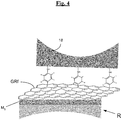
- FIG 4 is a diagram illustrating very simply the crosslinking, the anchoring of the functionalized graphene (GRf) after reaction of its functional groups (FG) on a polymer matrix (18) such as for example epoxidized natural rubber whose epoxy functions have reacted with the -NH 2 functions of the outermost graphene layer.
- a polymer matrix (18) such as for example epoxidized natural rubber whose epoxy functions have reacted with the -NH 2 functions of the outermost graphene layer.
- this wire with a diameter equal to about 0.30 mm (thickness of the brass layer between 200 and 500 nm) had been cleaned by passing through an aqueous solution of 1% NH 3 , rinsed with distilled water and dried, all under a stream of nitrogen (preferably protected from air to avoid re-oxidation).
- this wire as cathode (-0.5 V compared to an Ag / AgCl reference electrode) was subjected to a surface copper plating step by electrolytic means, by treatment of approximately 5 s in a bath containing 2 g of hydrated copper pyrophosphate (Aldrich, # 34,469-9) and an 85% solution of phosphoric acid in water.
- SEM scanning electron microscopy
- EDS Energy Dispersive Spectrometry
- the combustion chamber (1) was here continuously supplied with approximately 5 ml / min of liquid precursor P (mixture of 34% THF and 66% 2-ethylhexanoic acid), 5 l / min of oxygen (gas d oxidation 13) and a mixture of methane and oxygen (support gas 14) (CH 4 : 1.5 ml / min; O 2 : 2.4 ml / min).
- the height of the flame (F) was between 6 and 7 cm, the temperature inside the flame was approximately 500 ° C.
- the combustion and oxidation of the precursor (P) led to a gaseous composition, measured immediately after leaving the chamber by mass spectrometry (“Pfeiffer Quadstar 100”) which was as follows (molar%): 1% H 2 O, 1% H 2 , 0.5% CO 2 , less than 100 ppm O 2 ; moreover, the flame producing sufficient CO, no addition of such a gas was necessary.
- the figure 5 attached reproduces a very high resolution transmission electron microscope (TEM-FEG from FEI; power 300 kV; magnification 620,000) taken on a graphene sample taken from the surface of the wire according to the invention thus treated, by complete dissolution (overnight) of the surface metal M S in an aqueous solution (6 ml per graphene sample) of FeCl 3 (1 M); this reddish solution was then gradually (in 5 times), slowly, replaced by water until a clear solution was obtained, avoiding removing all of the solution as well as any contact with graphene, this ultimately allowing a very fine sheet of graphene to float freely on the surface of the water.
- TEM-FEG transmission electron microscope
- the figure 6 reproduces a Raman spectrum (confocal micro-Raman spectroscope "CRM 200" from the company Witec) recorded at 532 nm (excitation 2.33 eV; YAG-Nd laser) on another graphene sample (sheet) taken from the wire surface treated FSP as described above and deposited on a wafer ( "wafer") silicon. On the ordinate, the signal intensity is indicated (in arbitrary units) and the Raman displacement on the abscissa (in cm -1 ).
- the very narrow peak at 1587.8 cm -1 corresponds to a monolayer of graphene.
- the other peak (2D strip) at 2654 cm -1 strongly displaced towards the blue, with a half-width of 60 cm -1 corresponds rather to two superimposed graphene monolayers.
- the intensity ratio I G / I 2D greater than 1 is explained by an increased resonance of the G band caused by a strong coupling between 2 graphene layers oriented differently, as we can already perceive by the previous MET analysis ( Fig. 5 ).
- the figure 7 reproduces an XPS spectrum ( X-ray photoelectron spectroscopy ) (Axis Ultra equipment from the company Kratos; X-ray source: monochromatic Al K ⁇ (1486.6 eV), 10 mA, 15 kV; ultra-vacuum less than 10 -8 Torr) produced at the surface of the reinforcement with, on the ordinate, the relative intensity of the signal (in strokes / s) and, on the abscissa, the binding energy (in eV).
- this type of analysis provides access to the chemical composition of the surface of the material analyzed over a depth of a few nanometers, by comparison with known spectra.
- the figure 8 reproduces the XPS spectrum produced on the surface of the graphenized and then functionalized reinforcement, in accordance with the invention.
- This spectrum confirms the functionalization of the graphene, the two main peaks observed after deconvolution (91% of the total area of the 3 visible peaks) being typical of the presence of nitrogen.
- the highest intensity peak, at around 399 eV, reveals in particular the presence, in large quantities, of NH 2 functions attached to an aromatic nucleus.
- This conventional rubber composition for the reinforcement of a passenger car tire belt was based on epoxidized diene elastomer (natural rubber) (epoxidation rate of approximately 25% mol), carbon black and silica as filler, and a vulcanization system (sulfur and sulfenamide accelerator); this composition being devoid of cobalt salt.
- the metal / rubber composite test tube thus prepared was placed under a press and the whole cooked at 165 ° C for 30 min under a pressure of 20 bar.
- the reinforcements according to the invention can be effectively protected against corrosion thanks to the graphene present on their surface; advantageously, they can be bonded directly, without adhesion primer or addition of metallic salt (in particular cobalt salt) to matrices of unsaturated rubber such as natural rubber, thanks to the possible functionalization of this graphene.
Landscapes
- Chemical & Material Sciences (AREA)
- Engineering & Computer Science (AREA)
- Organic Chemistry (AREA)
- Materials Engineering (AREA)
- Chemical Kinetics & Catalysis (AREA)
- Metallurgy (AREA)
- Electrochemistry (AREA)
- Mechanical Engineering (AREA)
- Inorganic Chemistry (AREA)
- Nanotechnology (AREA)
- General Chemical & Material Sciences (AREA)
- Plasma & Fusion (AREA)
- Physics & Mathematics (AREA)
- Textile Engineering (AREA)
- Carbon And Carbon Compounds (AREA)
Claims (14)
- Fadenförmige, metallische oder metallisierte Verstärkung (V), auf deren Umfang eine als "Oberflächenmetall" bezeichnete Metallschicht (Ms), ausgewählt aus Kupfer, Nickel und Kupfer-Nickel-Legierungen, abgeschieden ist, wobei diese Oberflächenmetallschicht (Ms) selbst zumindest zum Teil mit mindestens einer Graphenschicht (GR, GRf) beschichtet ist, dadurch gekennzeichnet, dass auf das Graphen mindestens eine mit einer Polymermatrix vernetzbare funktionelle Gruppe gepfropft ist.
- Verstärkung nach Anspruch 1 in Form eines einzelnen Fadens, einer Gruppe von Fäden, eines Bandes oder einer Folie.
- Verstärkung nach einem der Ansprüche 1 oder 2, wobei das Oberflächenmetall Kupfer ist.
- Verstärkung nach einem der Ansprüche 1 bis 3, wobei die Verstärkung eine vollständig metallische Verstärkung ist.
- Verstärkung nach Anspruch 4, wobei das Kernmetall der metallischen Verstärkung ein Stahl, vorzugsweise ein Kohlenstoffstahl, ist.
- Verstärkung nach Anspruch 5, wobei der Stahl zumindest zum Teil mit einem als "Substratmetall" bezeichneten Metall beschichtet ist, das als Substrat für die Oberflächenmetallschicht dient.
- Verstärkung nach Anspruch 6, wobei das Substratmetall aus der Gruppe ausgewählt ist bestehend aus Aluminium, Kobalt, Zinn, Mangan, Molybdän, Zink und Legierungen, die mindestens eines dieser Elemente enthalten.
- Verstärkung nach Anspruch 7, wobei das Substratmetall aus der Gruppe ausgewählt ist bestehend aus Kobalt, Zink und Legierungen, die mindestens eines dieser Elemente enthalten.
- Verstärkung nach Anspruch 8, wobei das Substratmetall Messing ist.
- Verstärkung nach einem der Ansprüche 1 bis 9, wobei die Dicke der Verstärkung oder ihr Durchmesser, wenn ihr Querschnitt rund ist, zwischen 0,05 und 5 mm, vorzugsweise zwischen 0,1 und 1 mm, beträgt.
- Verstärkung nach einem der Ansprüche 1 bis 10, wobei die Anzahl der Graphenschichten von 1 bis 5, vorzugsweise von 2 bis 4, variiert.
- Verstärkung nach einem der Ansprüche 1 bis 11, wobei die vernetzbare funktionelle Gruppe mindestens eine als "FG" bezeichnete Funktion, ausgewählt aus den Funktionen -NH2, -NHR (R Kohlenwasserstoffrest), -OH, - COOH, -CHO, -SH, -Sx- (Polysulfid, wobei "x" größer als 1 ist), Halogenen, Acrylat, Methacrylat, Epoxy, Vinyl, Vinyloxy, Isocyanat, umfasst.
- Verstärkung nach Anspruch 12, wobei die vernetzbare funktionelle Gruppe der folgenden Formel entspricht:
 - "m" gleich 0 oder 1 ist,- "n" eine ganze Zahl von 1 bis 5 ist,- Z eine optionale, mindestens divalente Verbindungsgruppe ist.
 - Verstärkung nach Anspruch 13, wobei die vernetzbare funktionelle Gruppe der folgenden Formel entspricht:

Applications Claiming Priority (2)
| Application Number | Priority Date | Filing Date | Title |
|---|---|---|---|
| FR1455569A FR3022490B1 (fr) | 2014-06-18 | 2014-06-18 | Renfort, metallique ou metallise, graphenise |
| PCT/EP2015/061168 WO2015193051A1 (fr) | 2014-06-18 | 2015-05-20 | Renfort, metallique ou metallise, graphenise |
Publications (2)
| Publication Number | Publication Date |
|---|---|
| EP3158103A1 EP3158103A1 (de) | 2017-04-26 |
| EP3158103B1 true EP3158103B1 (de) | 2020-01-15 |
Family
ID=51518991
Family Applications (1)
| Application Number | Title | Priority Date | Filing Date |
|---|---|---|---|
| EP15726052.2A Active EP3158103B1 (de) | 2014-06-18 | 2015-05-20 | Metallische oder metallisierte, graphenisierte verstärkung |
Country Status (4)
| Country | Link |
|---|---|
| US (1) | US10655274B2 (de) |
| EP (1) | EP3158103B1 (de) |
| FR (1) | FR3022490B1 (de) |
| WO (1) | WO2015193051A1 (de) |
Families Citing this family (2)
| Publication number | Priority date | Publication date | Assignee | Title |
|---|---|---|---|---|
| FR3022559B1 (fr) | 2014-06-18 | 2016-07-01 | Michelin & Cie | Graphenisation de surface d'un renfort metallique ou metallise par pyrolyse par projection de flamme |
| CN116536646B (zh) * | 2023-04-24 | 2025-01-17 | 宁波杭州湾新材料研究院 | 一种钢铁表面耐磨绝缘复合涂层及其制备方法 |
Family Cites Families (21)
| Publication number | Priority date | Publication date | Assignee | Title |
|---|---|---|---|---|
| US5958361A (en) | 1993-03-19 | 1999-09-28 | Regents Of The University Of Michigan | Ultrafine metal oxide powders by flame spray pyrolysis |
| US6887566B1 (en) | 1999-11-17 | 2005-05-03 | Cabot Corporation | Ceria composition and process for preparing same |
| WO2001036332A1 (en) | 1999-11-17 | 2001-05-25 | Cabot Corporation | Ceria composition and process for preparing same |
| EP1378489A1 (de) | 2002-07-03 | 2004-01-07 | Eidgenössische Technische Hochschule Zürich | Durch Flammsprühpyrolyse hergestellte Metalloxide |
| JP2004263336A (ja) * | 2003-03-03 | 2004-09-24 | Kobe Steel Ltd | ゴム接着ブラス複合体 |
| CN100431946C (zh) | 2003-05-20 | 2008-11-12 | 苏黎世联合高等工业学校 | 生产金属氧化物的方法及所述方法生产的金属氧化物和用途 |
| EP1760043A1 (de) | 2005-09-06 | 2007-03-07 | ETH Zürich, ETH Transfer | Reduzierendes Flammensprühpyrolyse-Verfahren zur Herstellung von Pulvern und Nanopulvern aus Metallen, nicht-oxidischen Keramiken und reduzierten Metalloxiden. |
| EP1967645B1 (de) * | 2005-12-01 | 2012-01-11 | Sumitomo Rubber Industries, Ltd. | Metallkord, gummi-/kordverbundkörper sowie davon gebrauch machende luftreifen |
| US20090025846A1 (en) * | 2005-12-13 | 2009-01-29 | Sumitomo Rubber Industries, Ltd. | Metal Cord, Rubber-Cord Complex and Pneumatic Tire Using the Same |
| KR100736708B1 (ko) | 2006-03-28 | 2007-07-06 | 한국지질자원연구원 | 이류체 노즐을 적용시킨 화염분무열분해법에 의한 구형의 단일 입자들로 구성된 실리카 나노분말 제조 방법 |
| CN101528334B (zh) | 2006-10-24 | 2012-04-04 | Beneq有限公司 | 用于制造纳米颗粒的设备和方法 |
| US8663380B2 (en) | 2007-11-16 | 2014-03-04 | Cristal Usa Inc. | Gas phase production of coated titania |
| KR101027071B1 (ko) | 2008-08-28 | 2011-04-11 | 한국과학기술원 | 에멀젼 화염 분무 열분해법을 이용한 세라믹 입자의 코팅 방법 |
| US8658188B2 (en) | 2009-08-19 | 2014-02-25 | Eth Zurich | Radio-opaque bioactive glass materials |
| US20110314840A1 (en) | 2010-06-24 | 2011-12-29 | Hamid-Reza Jahangiri-Famenini | Various methods for industrial scale production of graphene and new devices/instruments to achieve the latter |
| US20130143067A1 (en) | 2011-12-05 | 2013-06-06 | K-Technology Usa, Inc. | Anti-oxidation coating using graphene |
| DE102012109261A1 (de) * | 2012-07-02 | 2014-01-02 | Casar Drahtseilwerk Saar Gmbh | Vorrichtung und Verfahren zur Herstellung von Drahtlitzen oder Drahtseilen |
| FR3000107B1 (fr) | 2012-12-20 | 2015-05-01 | Michelin & Cie | Sulfuration de surface d'un corps metallique par pyrolyse par projection de flamme |
| FR2999975B1 (fr) | 2012-12-20 | 2015-02-27 | Michelin & Cie | Renfort metallique pret a l'emploi dont la surface est pourvue de nanoparticules de sulfure metallique |
| US10012230B2 (en) * | 2014-02-18 | 2018-07-03 | Reme Technologies, Llc | Graphene enhanced elastomeric stator |
| FR3022559B1 (fr) | 2014-06-18 | 2016-07-01 | Michelin & Cie | Graphenisation de surface d'un renfort metallique ou metallise par pyrolyse par projection de flamme |
-
2014
- 2014-06-18 FR FR1455569A patent/FR3022490B1/fr not_active Expired - Fee Related
-
2015
- 2015-05-20 EP EP15726052.2A patent/EP3158103B1/de active Active
- 2015-05-20 US US15/319,552 patent/US10655274B2/en active Active
- 2015-05-20 WO PCT/EP2015/061168 patent/WO2015193051A1/fr not_active Ceased
Non-Patent Citations (1)
| Title |
|---|
| None * |
Also Published As
| Publication number | Publication date |
|---|---|
| US20170137993A1 (en) | 2017-05-18 |
| US10655274B2 (en) | 2020-05-19 |
| FR3022490A1 (fr) | 2015-12-25 |
| FR3022490B1 (fr) | 2018-05-18 |
| WO2015193051A1 (fr) | 2015-12-23 |
| EP3158103A1 (de) | 2017-04-26 |
Similar Documents
| Publication | Publication Date | Title |
|---|---|---|
| EP3158102B1 (de) | Oberflächengraphenisierung einer metallischen oder metallisierten verstärkung durch flammsprühpyrolyse | |
| EP2670609B1 (de) | Mit einer selbstklebenden, an kautschuk anhaftenden polymerschicht überzogene kompositverstärkung und entsprechendes herstellungsverfahren | |
| EP2934840B1 (de) | Gebrauchsfertige metallverstärkung mit einer oberfläche mit metallsulphidnanopartikeln | |
| EP1311591A1 (de) | Verbundmaterial (metall/kautschuk) für reifen | |
| US20150111449A1 (en) | Method for preparing graphene oxide films and fibers | |
| EP2935642B1 (de) | Oberflächensulfurierung eines metallstücks durch flammsprühpyrolyse | |
| EP2459358A1 (de) | Druckempfindliche verbundstoffverstärkung | |
| FR2965208A1 (fr) | Renfort composite | |
| EP3158103B1 (de) | Metallische oder metallisierte, graphenisierte verstärkung | |
| EP2449169A2 (de) | In-situ gummiertes dreilagiges stahlseil mit 3+m+n-struktur | |
| EP2449168A2 (de) | In-situ gummiertes dreilagiges stahlseil mit 2+m+n-struktur | |
| WO2010066990A2 (fr) | Procede de synthese de nanotubes de carbone sur materiaux micrometriques longs et particulaires | |
| CN104023971A (zh) | 阻气膜和阻气膜的制造方法 | |
| EP3157990B1 (de) | Reifen mit einer metallischen oder metallisierten graphenverstärkung | |
| KR101523849B1 (ko) | 금속-탄소 복합 입자의 제조 방법 | |
| CA2010287C (fr) | Procedes pour traiter un renfort metallique de facon a favoriser une composition a base de caoutchouc et pour realiser un article avec ce renfort; renforts et articles obtenus avec ces procedes | |
| WO2015055717A1 (de) | Verfahren zur vorbehandlung einer substratoberfläche, verfahren zur beschichtung der substratoberfläche und verfahren zum verbinden eines substrats mit einem element | |
| Yang et al. | Synergistic Inorganic–Organic Interfacial Modification for Colored and High‐Performance Carbon Fiber/Polyamide Composites |
Legal Events
| Date | Code | Title | Description |
|---|---|---|---|
| STAA | Information on the status of an ep patent application or granted ep patent |
Free format text: STATUS: THE INTERNATIONAL PUBLICATION HAS BEEN MADE |
|
| PUAI | Public reference made under article 153(3) epc to a published international application that has entered the european phase |
Free format text: ORIGINAL CODE: 0009012 |
|
| STAA | Information on the status of an ep patent application or granted ep patent |
Free format text: STATUS: REQUEST FOR EXAMINATION WAS MADE |
|
| 17P | Request for examination filed |
Effective date: 20170118 |
|
| AK | Designated contracting states |
Kind code of ref document: A1 Designated state(s): AL AT BE BG CH CY CZ DE DK EE ES FI FR GB GR HR HU IE IS IT LI LT LU LV MC MK MT NL NO PL PT RO RS SE SI SK SM TR |
|
| AX | Request for extension of the european patent |
Extension state: BA ME |
|
| RAP1 | Party data changed (applicant data changed or rights of an application transferred) |
Owner name: COMPAGNIE GENERALE DES ETABLISSEMENTS MICHELIN |
|
| RAP1 | Party data changed (applicant data changed or rights of an application transferred) |
Owner name: COMPAGNIE GENERALE DES ETABLISSEMENTS MICHELIN |
|
| DAV | Request for validation of the european patent (deleted) | ||
| DAX | Request for extension of the european patent (deleted) | ||
| STAA | Information on the status of an ep patent application or granted ep patent |
Free format text: STATUS: EXAMINATION IS IN PROGRESS |
|
| 17Q | First examination report despatched |
Effective date: 20180312 |
|
| RAP1 | Party data changed (applicant data changed or rights of an application transferred) |
Owner name: COMPAGNIE GENERALE DES ETABLISSEMENTS MICHELIN |
|
| GRAP | Despatch of communication of intention to grant a patent |
Free format text: ORIGINAL CODE: EPIDOSNIGR1 |
|
| STAA | Information on the status of an ep patent application or granted ep patent |
Free format text: STATUS: GRANT OF PATENT IS INTENDED |
|
| INTG | Intention to grant announced |
Effective date: 20190920 |
|
| GRAS | Grant fee paid |
Free format text: ORIGINAL CODE: EPIDOSNIGR3 |
|
| GRAA | (expected) grant |
Free format text: ORIGINAL CODE: 0009210 |
|
| STAA | Information on the status of an ep patent application or granted ep patent |
Free format text: STATUS: THE PATENT HAS BEEN GRANTED |
|
| AK | Designated contracting states |
Kind code of ref document: B1 Designated state(s): AL AT BE BG CH CY CZ DE DK EE ES FI FR GB GR HR HU IE IS IT LI LT LU LV MC MK MT NL NO PL PT RO RS SE SI SK SM TR |
|
| REG | Reference to a national code |
Ref country code: CH Ref legal event code: EP Ref country code: GB Ref legal event code: FG4D Free format text: NOT ENGLISH |
|
| REG | Reference to a national code |
Ref country code: IE Ref legal event code: FG4D Free format text: LANGUAGE OF EP DOCUMENT: FRENCH |
|
| REG | Reference to a national code |
Ref country code: DE Ref legal event code: R096 Ref document number: 602015045590 Country of ref document: DE |
|
| REG | Reference to a national code |
Ref country code: AT Ref legal event code: REF Ref document number: 1225213 Country of ref document: AT Kind code of ref document: T Effective date: 20200215 |
|
| REG | Reference to a national code |
Ref country code: NL Ref legal event code: MP Effective date: 20200115 |
|
| REG | Reference to a national code |
Ref country code: LT Ref legal event code: MG4D |
|
| PG25 | Lapsed in a contracting state [announced via postgrant information from national office to epo] |
Ref country code: RS Free format text: LAPSE BECAUSE OF FAILURE TO SUBMIT A TRANSLATION OF THE DESCRIPTION OR TO PAY THE FEE WITHIN THE PRESCRIBED TIME-LIMIT Effective date: 20200115 Ref country code: NL Free format text: LAPSE BECAUSE OF FAILURE TO SUBMIT A TRANSLATION OF THE DESCRIPTION OR TO PAY THE FEE WITHIN THE PRESCRIBED TIME-LIMIT Effective date: 20200115 Ref country code: NO Free format text: LAPSE BECAUSE OF FAILURE TO SUBMIT A TRANSLATION OF THE DESCRIPTION OR TO PAY THE FEE WITHIN THE PRESCRIBED TIME-LIMIT Effective date: 20200415 Ref country code: FI Free format text: LAPSE BECAUSE OF FAILURE TO SUBMIT A TRANSLATION OF THE DESCRIPTION OR TO PAY THE FEE WITHIN THE PRESCRIBED TIME-LIMIT Effective date: 20200115 Ref country code: PT Free format text: LAPSE BECAUSE OF FAILURE TO SUBMIT A TRANSLATION OF THE DESCRIPTION OR TO PAY THE FEE WITHIN THE PRESCRIBED TIME-LIMIT Effective date: 20200607 |
|
| PG25 | Lapsed in a contracting state [announced via postgrant information from national office to epo] |
Ref country code: SE Free format text: LAPSE BECAUSE OF FAILURE TO SUBMIT A TRANSLATION OF THE DESCRIPTION OR TO PAY THE FEE WITHIN THE PRESCRIBED TIME-LIMIT Effective date: 20200115 Ref country code: LV Free format text: LAPSE BECAUSE OF FAILURE TO SUBMIT A TRANSLATION OF THE DESCRIPTION OR TO PAY THE FEE WITHIN THE PRESCRIBED TIME-LIMIT Effective date: 20200115 Ref country code: GR Free format text: LAPSE BECAUSE OF FAILURE TO SUBMIT A TRANSLATION OF THE DESCRIPTION OR TO PAY THE FEE WITHIN THE PRESCRIBED TIME-LIMIT Effective date: 20200416 Ref country code: HR Free format text: LAPSE BECAUSE OF FAILURE TO SUBMIT A TRANSLATION OF THE DESCRIPTION OR TO PAY THE FEE WITHIN THE PRESCRIBED TIME-LIMIT Effective date: 20200115 Ref country code: IS Free format text: LAPSE BECAUSE OF FAILURE TO SUBMIT A TRANSLATION OF THE DESCRIPTION OR TO PAY THE FEE WITHIN THE PRESCRIBED TIME-LIMIT Effective date: 20200515 Ref country code: BG Free format text: LAPSE BECAUSE OF FAILURE TO SUBMIT A TRANSLATION OF THE DESCRIPTION OR TO PAY THE FEE WITHIN THE PRESCRIBED TIME-LIMIT Effective date: 20200415 |
|
| REG | Reference to a national code |
Ref country code: DE Ref legal event code: R097 Ref document number: 602015045590 Country of ref document: DE |
|
| PG25 | Lapsed in a contracting state [announced via postgrant information from national office to epo] |
Ref country code: RO Free format text: LAPSE BECAUSE OF FAILURE TO SUBMIT A TRANSLATION OF THE DESCRIPTION OR TO PAY THE FEE WITHIN THE PRESCRIBED TIME-LIMIT Effective date: 20200115 Ref country code: SK Free format text: LAPSE BECAUSE OF FAILURE TO SUBMIT A TRANSLATION OF THE DESCRIPTION OR TO PAY THE FEE WITHIN THE PRESCRIBED TIME-LIMIT Effective date: 20200115 Ref country code: LT Free format text: LAPSE BECAUSE OF FAILURE TO SUBMIT A TRANSLATION OF THE DESCRIPTION OR TO PAY THE FEE WITHIN THE PRESCRIBED TIME-LIMIT Effective date: 20200115 Ref country code: CZ Free format text: LAPSE BECAUSE OF FAILURE TO SUBMIT A TRANSLATION OF THE DESCRIPTION OR TO PAY THE FEE WITHIN THE PRESCRIBED TIME-LIMIT Effective date: 20200115 Ref country code: ES Free format text: LAPSE BECAUSE OF FAILURE TO SUBMIT A TRANSLATION OF THE DESCRIPTION OR TO PAY THE FEE WITHIN THE PRESCRIBED TIME-LIMIT Effective date: 20200115 Ref country code: DK Free format text: LAPSE BECAUSE OF FAILURE TO SUBMIT A TRANSLATION OF THE DESCRIPTION OR TO PAY THE FEE WITHIN THE PRESCRIBED TIME-LIMIT Effective date: 20200115 Ref country code: EE Free format text: LAPSE BECAUSE OF FAILURE TO SUBMIT A TRANSLATION OF THE DESCRIPTION OR TO PAY THE FEE WITHIN THE PRESCRIBED TIME-LIMIT Effective date: 20200115 Ref country code: SM Free format text: LAPSE BECAUSE OF FAILURE TO SUBMIT A TRANSLATION OF THE DESCRIPTION OR TO PAY THE FEE WITHIN THE PRESCRIBED TIME-LIMIT Effective date: 20200115 |
|
| REG | Reference to a national code |
Ref country code: AT Ref legal event code: MK05 Ref document number: 1225213 Country of ref document: AT Kind code of ref document: T Effective date: 20200115 |
|
| PLBE | No opposition filed within time limit |
Free format text: ORIGINAL CODE: 0009261 |
|
| STAA | Information on the status of an ep patent application or granted ep patent |
Free format text: STATUS: NO OPPOSITION FILED WITHIN TIME LIMIT |
|
| 26N | No opposition filed |
Effective date: 20201016 |
|
| PG25 | Lapsed in a contracting state [announced via postgrant information from national office to epo] |
Ref country code: CH Free format text: LAPSE BECAUSE OF NON-PAYMENT OF DUE FEES Effective date: 20200531 Ref country code: MC Free format text: LAPSE BECAUSE OF FAILURE TO SUBMIT A TRANSLATION OF THE DESCRIPTION OR TO PAY THE FEE WITHIN THE PRESCRIBED TIME-LIMIT Effective date: 20200115 Ref country code: AT Free format text: LAPSE BECAUSE OF FAILURE TO SUBMIT A TRANSLATION OF THE DESCRIPTION OR TO PAY THE FEE WITHIN THE PRESCRIBED TIME-LIMIT Effective date: 20200115 Ref country code: IT Free format text: LAPSE BECAUSE OF FAILURE TO SUBMIT A TRANSLATION OF THE DESCRIPTION OR TO PAY THE FEE WITHIN THE PRESCRIBED TIME-LIMIT Effective date: 20200115 Ref country code: LI Free format text: LAPSE BECAUSE OF NON-PAYMENT OF DUE FEES Effective date: 20200531 |
|
| PG25 | Lapsed in a contracting state [announced via postgrant information from national office to epo] |
Ref country code: SI Free format text: LAPSE BECAUSE OF FAILURE TO SUBMIT A TRANSLATION OF THE DESCRIPTION OR TO PAY THE FEE WITHIN THE PRESCRIBED TIME-LIMIT Effective date: 20200115 Ref country code: PL Free format text: LAPSE BECAUSE OF FAILURE TO SUBMIT A TRANSLATION OF THE DESCRIPTION OR TO PAY THE FEE WITHIN THE PRESCRIBED TIME-LIMIT Effective date: 20200115 |
|
| REG | Reference to a national code |
Ref country code: BE Ref legal event code: MM Effective date: 20200531 |
|
| GBPC | Gb: european patent ceased through non-payment of renewal fee |
Effective date: 20200520 |
|
| PG25 | Lapsed in a contracting state [announced via postgrant information from national office to epo] |
Ref country code: LU Free format text: LAPSE BECAUSE OF NON-PAYMENT OF DUE FEES Effective date: 20200520 |
|
| PG25 | Lapsed in a contracting state [announced via postgrant information from national office to epo] |
Ref country code: GB Free format text: LAPSE BECAUSE OF NON-PAYMENT OF DUE FEES Effective date: 20200520 Ref country code: IE Free format text: LAPSE BECAUSE OF NON-PAYMENT OF DUE FEES Effective date: 20200520 |
|
| PG25 | Lapsed in a contracting state [announced via postgrant information from national office to epo] |
Ref country code: BE Free format text: LAPSE BECAUSE OF NON-PAYMENT OF DUE FEES Effective date: 20200531 |
|
| PG25 | Lapsed in a contracting state [announced via postgrant information from national office to epo] |
Ref country code: TR Free format text: LAPSE BECAUSE OF FAILURE TO SUBMIT A TRANSLATION OF THE DESCRIPTION OR TO PAY THE FEE WITHIN THE PRESCRIBED TIME-LIMIT Effective date: 20200115 Ref country code: MT Free format text: LAPSE BECAUSE OF FAILURE TO SUBMIT A TRANSLATION OF THE DESCRIPTION OR TO PAY THE FEE WITHIN THE PRESCRIBED TIME-LIMIT Effective date: 20200115 Ref country code: CY Free format text: LAPSE BECAUSE OF FAILURE TO SUBMIT A TRANSLATION OF THE DESCRIPTION OR TO PAY THE FEE WITHIN THE PRESCRIBED TIME-LIMIT Effective date: 20200115 |
|
| PG25 | Lapsed in a contracting state [announced via postgrant information from national office to epo] |
Ref country code: MK Free format text: LAPSE BECAUSE OF FAILURE TO SUBMIT A TRANSLATION OF THE DESCRIPTION OR TO PAY THE FEE WITHIN THE PRESCRIBED TIME-LIMIT Effective date: 20200115 Ref country code: AL Free format text: LAPSE BECAUSE OF FAILURE TO SUBMIT A TRANSLATION OF THE DESCRIPTION OR TO PAY THE FEE WITHIN THE PRESCRIBED TIME-LIMIT Effective date: 20200115 |
|
| PGFP | Annual fee paid to national office [announced via postgrant information from national office to epo] |
Ref country code: DE Payment date: 20250521 Year of fee payment: 11 |
|
| PGFP | Annual fee paid to national office [announced via postgrant information from national office to epo] |
Ref country code: FR Payment date: 20250528 Year of fee payment: 11 |