EP3170808A1 - Polythiol composition and method for producing same - Google Patents
Polythiol composition and method for producing same Download PDFInfo
- Publication number
- EP3170808A1 EP3170808A1 EP15821668.9A EP15821668A EP3170808A1 EP 3170808 A1 EP3170808 A1 EP 3170808A1 EP 15821668 A EP15821668 A EP 15821668A EP 3170808 A1 EP3170808 A1 EP 3170808A1
- Authority
- EP
- European Patent Office
- Prior art keywords
- polythiol
- compound
- polythiol composition
- mass
- composition
- Prior art date
- Legal status (The legal status is an assumption and is not a legal conclusion. Google has not performed a legal analysis and makes no representation as to the accuracy of the status listed.)
- Withdrawn
Links
- 229920006295 polythiol Polymers 0.000 title claims abstract description 127
- 239000000203 mixture Substances 0.000 title claims abstract description 124
- 238000004519 manufacturing process Methods 0.000 title claims description 14
- 150000001875 compounds Chemical class 0.000 claims abstract description 83
- -1 nitrogen-containing compound Chemical class 0.000 claims abstract description 24
- 125000003396 thiol group Chemical group [H]S* 0.000 claims abstract description 24
- 238000000034 method Methods 0.000 claims description 35
- 239000000463 material Substances 0.000 claims description 32
- 230000003287 optical effect Effects 0.000 claims description 30
- XLYOFNOQVPJJNP-UHFFFAOYSA-N water Substances O XLYOFNOQVPJJNP-UHFFFAOYSA-N 0.000 claims description 30
- 238000004821 distillation Methods 0.000 claims description 17
- UMGDCJDMYOKAJW-UHFFFAOYSA-N thiourea Chemical class NC(N)=S UMGDCJDMYOKAJW-UHFFFAOYSA-N 0.000 claims description 15
- 238000005406 washing Methods 0.000 claims description 12
- 239000002253 acid Substances 0.000 claims description 9
- 230000000379 polymerizing effect Effects 0.000 claims description 7
- 230000003301 hydrolyzing effect Effects 0.000 claims description 4
- 239000002994 raw material Substances 0.000 claims description 3
- YXFVVABEGXRONW-UHFFFAOYSA-N Toluene Chemical compound CC1=CC=CC=C1 YXFVVABEGXRONW-UHFFFAOYSA-N 0.000 description 54
- JSNABGZJVWSNOB-UHFFFAOYSA-N [3-(sulfanylmethyl)phenyl]methanethiol Chemical compound SCC1=CC=CC(CS)=C1 JSNABGZJVWSNOB-UHFFFAOYSA-N 0.000 description 30
- 230000000052 comparative effect Effects 0.000 description 14
- 238000011156 evaluation Methods 0.000 description 14
- CEUQYYYUSUCFKP-UHFFFAOYSA-N 2,3-bis(2-sulfanylethylsulfanyl)propane-1-thiol Chemical compound SCCSCC(CS)SCCS CEUQYYYUSUCFKP-UHFFFAOYSA-N 0.000 description 13
- HEMHJVSKTPXQMS-UHFFFAOYSA-M Sodium hydroxide Chemical compound [OH-].[Na+] HEMHJVSKTPXQMS-UHFFFAOYSA-M 0.000 description 12
- 230000015572 biosynthetic process Effects 0.000 description 12
- 238000003786 synthesis reaction Methods 0.000 description 12
- VEXZGXHMUGYJMC-UHFFFAOYSA-N Hydrochloric acid Chemical compound Cl VEXZGXHMUGYJMC-UHFFFAOYSA-N 0.000 description 9
- 238000006243 chemical reaction Methods 0.000 description 9
- 238000010438 heat treatment Methods 0.000 description 9
- 239000000243 solution Substances 0.000 description 9
- 238000006116 polymerization reaction Methods 0.000 description 7
- 239000007864 aqueous solution Substances 0.000 description 6
- 238000000746 purification Methods 0.000 description 6
- 238000010992 reflux Methods 0.000 description 6
- 230000007062 hydrolysis Effects 0.000 description 5
- 238000006460 hydrolysis reaction Methods 0.000 description 5
- KSJBMDCFYZKAFH-UHFFFAOYSA-N 2-(2-sulfanylethylsulfanyl)ethanethiol Chemical compound SCCSCCS KSJBMDCFYZKAFH-UHFFFAOYSA-N 0.000 description 4
- QGZKDVFQNNGYKY-UHFFFAOYSA-N Ammonia Chemical compound N QGZKDVFQNNGYKY-UHFFFAOYSA-N 0.000 description 4
- IJGRMHOSHXDMSA-UHFFFAOYSA-N Atomic nitrogen Chemical compound N#N IJGRMHOSHXDMSA-UHFFFAOYSA-N 0.000 description 4
- XSQUKJJJFZCRTK-UHFFFAOYSA-N Urea Natural products NC(N)=O XSQUKJJJFZCRTK-UHFFFAOYSA-N 0.000 description 4
- 238000004458 analytical method Methods 0.000 description 4
- 238000001816 cooling Methods 0.000 description 4
- 229910001873 dinitrogen Inorganic materials 0.000 description 4
- 238000000605 extraction Methods 0.000 description 4
- 238000004321 preservation Methods 0.000 description 4
- 238000010926 purge Methods 0.000 description 4
- 238000003756 stirring Methods 0.000 description 4
- DGVVWUTYPXICAM-UHFFFAOYSA-N β‐Mercaptoethanol Chemical compound OCCS DGVVWUTYPXICAM-UHFFFAOYSA-N 0.000 description 4
- FDJWTMYNYYJBAT-UHFFFAOYSA-N 1,3,3-tris(sulfanylmethylsulfanyl)propylsulfanylmethanethiol Chemical compound SCSC(SCS)CC(SCS)SCS FDJWTMYNYYJBAT-UHFFFAOYSA-N 0.000 description 3
- 238000001914 filtration Methods 0.000 description 3
- GRJWOKACBGZOKT-UHFFFAOYSA-N 1,3-bis(chloromethyl)benzene Chemical compound ClCC1=CC=CC(CCl)=C1 GRJWOKACBGZOKT-UHFFFAOYSA-N 0.000 description 2
- VSSFYDMUTATOHG-UHFFFAOYSA-N 2-(2-sulfanylethylsulfanyl)-3-[3-sulfanyl-2-(2-sulfanylethylsulfanyl)propyl]sulfanylpropane-1-thiol Chemical compound SCCSC(CS)CSCC(CS)SCCS VSSFYDMUTATOHG-UHFFFAOYSA-N 0.000 description 2
- OCGYTRZLSMAPQC-UHFFFAOYSA-N 3-(2-sulfanylethylsulfanyl)-2-[1-sulfanyl-3-(2-sulfanylethylsulfanyl)propan-2-yl]sulfanylpropane-1-thiol Chemical compound SCCSCC(CS)SC(CS)CSCCS OCGYTRZLSMAPQC-UHFFFAOYSA-N 0.000 description 2
- NXYWIOFCVGCOCB-UHFFFAOYSA-N 3-(2-sulfanylethylsulfanyl)-2-[3-sulfanyl-2-(2-sulfanylethylsulfanyl)propyl]sulfanylpropane-1-thiol Chemical compound SCCSCC(CS)SCC(CS)SCCS NXYWIOFCVGCOCB-UHFFFAOYSA-N 0.000 description 2
- HEDRZPFGACZZDS-UHFFFAOYSA-N Chloroform Chemical compound ClC(Cl)Cl HEDRZPFGACZZDS-UHFFFAOYSA-N 0.000 description 2
- BRLQWZUYTZBJKN-UHFFFAOYSA-N Epichlorohydrin Chemical compound ClCC1CO1 BRLQWZUYTZBJKN-UHFFFAOYSA-N 0.000 description 2
- 238000005481 NMR spectroscopy Methods 0.000 description 2
- 239000004743 Polypropylene Substances 0.000 description 2
- RUDUCNPHDIMQCY-UHFFFAOYSA-N [3-(2-sulfanylacetyl)oxy-2,2-bis[(2-sulfanylacetyl)oxymethyl]propyl] 2-sulfanylacetate Chemical compound SCC(=O)OCC(COC(=O)CS)(COC(=O)CS)COC(=O)CS RUDUCNPHDIMQCY-UHFFFAOYSA-N 0.000 description 2
- JOBBTVPTPXRUBP-UHFFFAOYSA-N [3-(3-sulfanylpropanoyloxy)-2,2-bis(3-sulfanylpropanoyloxymethyl)propyl] 3-sulfanylpropanoate Chemical compound SCCC(=O)OCC(COC(=O)CCS)(COC(=O)CCS)COC(=O)CCS JOBBTVPTPXRUBP-UHFFFAOYSA-N 0.000 description 2
- IYPNRTQAOXLCQW-UHFFFAOYSA-N [4-(sulfanylmethyl)phenyl]methanethiol Chemical compound SCC1=CC=C(CS)C=C1 IYPNRTQAOXLCQW-UHFFFAOYSA-N 0.000 description 2
- COYTVZAYDAIHDK-UHFFFAOYSA-N [5-(sulfanylmethyl)-1,4-dithian-2-yl]methanethiol Chemical compound SCC1CSC(CS)CS1 COYTVZAYDAIHDK-UHFFFAOYSA-N 0.000 description 2
- 239000000654 additive Substances 0.000 description 2
- 229910021529 ammonia Inorganic materials 0.000 description 2
- 239000011521 glass Substances 0.000 description 2
- 239000012535 impurity Substances 0.000 description 2
- 238000004811 liquid chromatography Methods 0.000 description 2
- INBDPOJZYZJUDA-UHFFFAOYSA-N methanedithiol Chemical compound SCS INBDPOJZYZJUDA-UHFFFAOYSA-N 0.000 description 2
- 238000002156 mixing Methods 0.000 description 2
- 239000000178 monomer Substances 0.000 description 2
- 238000006386 neutralization reaction Methods 0.000 description 2
- 239000012299 nitrogen atmosphere Substances 0.000 description 2
- 239000004033 plastic Substances 0.000 description 2
- 229920003023 plastic Polymers 0.000 description 2
- 229920000139 polyethylene terephthalate Polymers 0.000 description 2
- 239000005020 polyethylene terephthalate Substances 0.000 description 2
- 229920001155 polypropylene Polymers 0.000 description 2
- 229920001343 polytetrafluoroethylene Polymers 0.000 description 2
- 239000004810 polytetrafluoroethylene Substances 0.000 description 2
- 238000011002 quantification Methods 0.000 description 2
- CWERGRDVMFNCDR-UHFFFAOYSA-N thioglycolic acid Chemical compound OC(=O)CS CWERGRDVMFNCDR-UHFFFAOYSA-N 0.000 description 2
- VYMPLPIFKRHAAC-UHFFFAOYSA-N 1,2-ethanedithiol Chemical compound SCCS VYMPLPIFKRHAAC-UHFFFAOYSA-N 0.000 description 1
- SRZXCOWFGPICGA-UHFFFAOYSA-N 1,6-Hexanedithiol Chemical compound SCCCCCCS SRZXCOWFGPICGA-UHFFFAOYSA-N 0.000 description 1
- IMQFZQVZKBIPCQ-UHFFFAOYSA-N 2,2-bis(3-sulfanylpropanoyloxymethyl)butyl 3-sulfanylpropanoate Chemical compound SCCC(=O)OCC(CC)(COC(=O)CCS)COC(=O)CCS IMQFZQVZKBIPCQ-UHFFFAOYSA-N 0.000 description 1
- MTZVWTOVHGKLOX-UHFFFAOYSA-N 2,2-bis(sulfanylmethyl)propane-1,3-dithiol Chemical compound SCC(CS)(CS)CS MTZVWTOVHGKLOX-UHFFFAOYSA-N 0.000 description 1
- SGLYOTGYKDFSSC-UHFFFAOYSA-N 2,2-dimethylpropane-1,3-dithiol Chemical compound SCC(C)(C)CS SGLYOTGYKDFSSC-UHFFFAOYSA-N 0.000 description 1
- CNDCQWGRLNGNNO-UHFFFAOYSA-N 2-(2-sulfanylethoxy)ethanethiol Chemical compound SCCOCCS CNDCQWGRLNGNNO-UHFFFAOYSA-N 0.000 description 1
- NQLQMVQEQFIDQB-UHFFFAOYSA-N 2-(2-sulfanylethylsulfanyl)propane-1,3-dithiol Chemical compound SCCSC(CS)CS NQLQMVQEQFIDQB-UHFFFAOYSA-N 0.000 description 1
- HAQZWTGSNCDKTK-UHFFFAOYSA-N 2-(3-sulfanylpropanoyloxy)ethyl 3-sulfanylpropanoate Chemical compound SCCC(=O)OCCOC(=O)CCS HAQZWTGSNCDKTK-UHFFFAOYSA-N 0.000 description 1
- FOBHCEPKFIUKPH-UHFFFAOYSA-N 2-(sulfanylmethyl)propane-1,3-dithiol Chemical compound SCC(CS)CS FOBHCEPKFIUKPH-UHFFFAOYSA-N 0.000 description 1
- HCZMHWVFVZAHCR-UHFFFAOYSA-N 2-[2-(2-sulfanylethoxy)ethoxy]ethanethiol Chemical compound SCCOCCOCCS HCZMHWVFVZAHCR-UHFFFAOYSA-N 0.000 description 1
- MXTOXODEXBYZFX-UHFFFAOYSA-N 2-[2-(2-sulfanylethylsulfanyl)ethylsulfanyl]ethanethiol Chemical compound SCCSCCSCCS MXTOXODEXBYZFX-UHFFFAOYSA-N 0.000 description 1
- QDSDVYIOITWEGM-UHFFFAOYSA-N 2-[5-(2-sulfanylethyl)-1,4-dithian-2-yl]ethanethiol Chemical compound SCCC1CSC(CCS)CS1 QDSDVYIOITWEGM-UHFFFAOYSA-N 0.000 description 1
- AJHCCBBKTPDSNT-UHFFFAOYSA-N 2-ethyl-2-(sulfanylmethyl)propane-1,3-dithiol Chemical compound CCC(CS)(CS)CS AJHCCBBKTPDSNT-UHFFFAOYSA-N 0.000 description 1
- KOCAIQHVJFBWHC-UHFFFAOYSA-N 3,4-dimethoxybutane-1,2-dithiol Chemical compound COCC(OC)C(S)CS KOCAIQHVJFBWHC-UHFFFAOYSA-N 0.000 description 1
- DKIDEFUBRARXTE-UHFFFAOYSA-M 3-mercaptopropionate Chemical compound [O-]C(=O)CCS DKIDEFUBRARXTE-UHFFFAOYSA-M 0.000 description 1
- WREGWRFRXHKFGE-UHFFFAOYSA-N 4-(4-sulfanylphenoxy)benzenethiol Chemical compound C1=CC(S)=CC=C1OC1=CC=C(S)C=C1 WREGWRFRXHKFGE-UHFFFAOYSA-N 0.000 description 1
- DIFMOXDTKAEVHX-UHFFFAOYSA-N 4-[2-(4-sulfanylphenyl)propan-2-yl]benzenethiol Chemical compound C=1C=C(S)C=CC=1C(C)(C)C1=CC=C(S)C=C1 DIFMOXDTKAEVHX-UHFFFAOYSA-N 0.000 description 1
- JLLMOYPIVVKFHY-UHFFFAOYSA-N Benzenethiol, 4,4'-thiobis- Chemical compound C1=CC(S)=CC=C1SC1=CC=C(S)C=C1 JLLMOYPIVVKFHY-UHFFFAOYSA-N 0.000 description 1
- SFPNVVXUUHYBQW-UHFFFAOYSA-N CSc1nc(N)nc(N)n1 Chemical compound CSc1nc(N)nc(N)n1 SFPNVVXUUHYBQW-UHFFFAOYSA-N 0.000 description 1
- 239000004970 Chain extender Substances 0.000 description 1
- PWGOWIIEVDAYTC-UHFFFAOYSA-N ICR-170 Chemical compound Cl.Cl.C1=C(OC)C=C2C(NCCCN(CCCl)CC)=C(C=CC(Cl)=C3)C3=NC2=C1 PWGOWIIEVDAYTC-UHFFFAOYSA-N 0.000 description 1
- NINIDFKCEFEMDL-UHFFFAOYSA-N Sulfur Chemical compound [S] NINIDFKCEFEMDL-UHFFFAOYSA-N 0.000 description 1
- NNJWFWSBENPGEY-UHFFFAOYSA-N [2-(sulfanylmethyl)phenyl]methanethiol Chemical compound SCC1=CC=CC=C1CS NNJWFWSBENPGEY-UHFFFAOYSA-N 0.000 description 1
- IDMCXJRWHDUNRT-UHFFFAOYSA-N [3-(sulfanylmethyl)cyclohexyl]methanethiol Chemical compound SCC1CCCC(CS)C1 IDMCXJRWHDUNRT-UHFFFAOYSA-N 0.000 description 1
- HRPVDGZEKVNVQW-UHFFFAOYSA-N [4-(sulfanylmethyl)cyclohexyl]methanethiol Chemical compound SCC1CCC(CS)CC1 HRPVDGZEKVNVQW-UHFFFAOYSA-N 0.000 description 1
- BPFAQZURMHOGLM-UHFFFAOYSA-N [4-[2-[4-(sulfanylmethyl)phenyl]propan-2-yl]phenyl]methanethiol Chemical compound C=1C=C(CS)C=CC=1C(C)(C)C1=CC=C(CS)C=C1 BPFAQZURMHOGLM-UHFFFAOYSA-N 0.000 description 1
- MSILJOYZYPRFDK-UHFFFAOYSA-N [4-[4-(sulfanylmethyl)phenoxy]phenyl]methanethiol Chemical compound C1=CC(CS)=CC=C1OC1=CC=C(CS)C=C1 MSILJOYZYPRFDK-UHFFFAOYSA-N 0.000 description 1
- WMOSGVRFIUEZSX-UHFFFAOYSA-N [4-[4-(sulfanylmethyl)phenyl]sulfanylphenyl]methanethiol Chemical compound C1=CC(CS)=CC=C1SC1=CC=C(CS)C=C1 WMOSGVRFIUEZSX-UHFFFAOYSA-N 0.000 description 1
- 230000001133 acceleration Effects 0.000 description 1
- 230000000996 additive effect Effects 0.000 description 1
- 230000003373 anti-fouling effect Effects 0.000 description 1
- 239000003963 antioxidant agent Substances 0.000 description 1
- 230000003078 antioxidant effect Effects 0.000 description 1
- SMTOKHQOVJRXLK-UHFFFAOYSA-N butane-1,4-dithiol Chemical compound SCCCCS SMTOKHQOVJRXLK-UHFFFAOYSA-N 0.000 description 1
- 239000007809 chemical reaction catalyst Substances 0.000 description 1
- 239000011248 coating agent Substances 0.000 description 1
- 238000000576 coating method Methods 0.000 description 1
- 239000003431 cross linking reagent Substances 0.000 description 1
- VSARMWHOISBCGR-UHFFFAOYSA-N cyclohexane-1,1-dithiol Chemical compound SC1(S)CCCCC1 VSARMWHOISBCGR-UHFFFAOYSA-N 0.000 description 1
- YKRCKUBKOIVILO-UHFFFAOYSA-N cyclohexane-1,2-dithiol Chemical compound SC1CCCCC1S YKRCKUBKOIVILO-UHFFFAOYSA-N 0.000 description 1
- UMSNERSLSHPBNT-UHFFFAOYSA-N cyclohexane-1,3-dithiol Chemical compound SC1CCCC(S)C1 UMSNERSLSHPBNT-UHFFFAOYSA-N 0.000 description 1
- QQKBIYRSRXCROF-UHFFFAOYSA-N cyclohexane-1,4-dithiol Chemical compound SC1CCC(S)CC1 QQKBIYRSRXCROF-UHFFFAOYSA-N 0.000 description 1
- 238000000354 decomposition reaction Methods 0.000 description 1
- 230000003247 decreasing effect Effects 0.000 description 1
- 238000004043 dyeing Methods 0.000 description 1
- 230000000694 effects Effects 0.000 description 1
- 239000000945 filler Substances 0.000 description 1
- 230000005484 gravity Effects 0.000 description 1
- 238000002347 injection Methods 0.000 description 1
- 239000007924 injection Substances 0.000 description 1
- 239000004611 light stabiliser Substances 0.000 description 1
- 238000005259 measurement Methods 0.000 description 1
- 239000006082 mold release agent Substances 0.000 description 1
- 238000000465 moulding Methods 0.000 description 1
- 238000006384 oligomerization reaction Methods 0.000 description 1
- 239000002245 particle Substances 0.000 description 1
- 230000000704 physical effect Effects 0.000 description 1
- 239000002685 polymerization catalyst Substances 0.000 description 1
- 229920002578 polythiourethane polymer Polymers 0.000 description 1
- 239000011148 porous material Substances 0.000 description 1
- UWHMFGKZAYHMDJ-UHFFFAOYSA-N propane-1,2,3-trithiol Chemical compound SCC(S)CS UWHMFGKZAYHMDJ-UHFFFAOYSA-N 0.000 description 1
- ZJLMKPKYJBQJNH-UHFFFAOYSA-N propane-1,3-dithiol Chemical compound SCCCS ZJLMKPKYJBQJNH-UHFFFAOYSA-N 0.000 description 1
- HMPSOEYFMTWOFC-UHFFFAOYSA-N propane-2,2-dithiol Chemical compound CC(C)(S)S HMPSOEYFMTWOFC-UHFFFAOYSA-N 0.000 description 1
- 238000011160 research Methods 0.000 description 1
- 229920005989 resin Polymers 0.000 description 1
- 239000011347 resin Substances 0.000 description 1
- 239000000126 substance Substances 0.000 description 1
- 229910052717 sulfur Inorganic materials 0.000 description 1
- 239000011593 sulfur Substances 0.000 description 1
- 238000004381 surface treatment Methods 0.000 description 1
- 238000012360 testing method Methods 0.000 description 1
- 239000006097 ultraviolet radiation absorber Substances 0.000 description 1
Classifications
-
- C—CHEMISTRY; METALLURGY
- C07—ORGANIC CHEMISTRY
- C07C—ACYCLIC OR CARBOCYCLIC COMPOUNDS
- C07C319/00—Preparation of thiols, sulfides, hydropolysulfides or polysulfides
- C07C319/26—Separation; Purification; Stabilisation; Use of additives
- C07C319/28—Separation; Purification
-
- C—CHEMISTRY; METALLURGY
- C07—ORGANIC CHEMISTRY
- C07C—ACYCLIC OR CARBOCYCLIC COMPOUNDS
- C07C321/00—Thiols, sulfides, hydropolysulfides or polysulfides
- C07C321/02—Thiols having mercapto groups bound to acyclic carbon atoms
- C07C321/06—Thiols having mercapto groups bound to acyclic carbon atoms of a saturated carbon skeleton containing rings
-
- C—CHEMISTRY; METALLURGY
- C07—ORGANIC CHEMISTRY
- C07C—ACYCLIC OR CARBOCYCLIC COMPOUNDS
- C07C321/00—Thiols, sulfides, hydropolysulfides or polysulfides
- C07C321/02—Thiols having mercapto groups bound to acyclic carbon atoms
- C07C321/10—Thiols having mercapto groups bound to acyclic carbon atoms of an unsaturated carbon skeleton containing rings
-
- C—CHEMISTRY; METALLURGY
- C07—ORGANIC CHEMISTRY
- C07C—ACYCLIC OR CARBOCYCLIC COMPOUNDS
- C07C321/00—Thiols, sulfides, hydropolysulfides or polysulfides
- C07C321/12—Sulfides, hydropolysulfides, or polysulfides having thio groups bound to acyclic carbon atoms
- C07C321/14—Sulfides, hydropolysulfides, or polysulfides having thio groups bound to acyclic carbon atoms of an acyclic saturated carbon skeleton
-
- C—CHEMISTRY; METALLURGY
- C08—ORGANIC MACROMOLECULAR COMPOUNDS; THEIR PREPARATION OR CHEMICAL WORKING-UP; COMPOSITIONS BASED THEREON
- C08G—MACROMOLECULAR COMPOUNDS OBTAINED OTHERWISE THAN BY REACTIONS ONLY INVOLVING UNSATURATED CARBON-TO-CARBON BONDS
- C08G75/00—Macromolecular compounds obtained by reactions forming a linkage containing sulfur with or without nitrogen, oxygen, or carbon in the main chain of the macromolecule
- C08G75/02—Polythioethers
- C08G75/04—Polythioethers from mercapto compounds or metallic derivatives thereof
-
- G—PHYSICS
- G02—OPTICS
- G02B—OPTICAL ELEMENTS, SYSTEMS OR APPARATUS
- G02B1/00—Optical elements characterised by the material of which they are made; Optical coatings for optical elements
- G02B1/04—Optical elements characterised by the material of which they are made; Optical coatings for optical elements made of organic materials, e.g. plastics
Definitions
- the present invention relates to a polythiol composition, wherein the generation of a suspended matter is suppressed, a composition for optical materials comprising the polythiol composition, and an optical material obtained by polymerizing and curing the composition.
- Plastic materials are lightweight, highly tough and easy to be dyed, and therefore are widely used for various types of optical materials. These optical materials are required to have low specific gravity, high transparency and low yellowness, and as optical properties, high refractive index, high Abbe number, etc.
- a sulfur-containing monomer in particular, a polythiol compound
- Patent Documents 1-2 many compositions for optical materials comprising a sulfur-containing monomer, in particular, a polythiol compound.
- an insoluble component suspended matter
- white turbidity may be generated in resins obtained by polymerization and curing using these polythiol compounds.
- the problem to be solved by the present invention is to provide a polythiol composition for optical materials, wherein the generation of a suspended matter at the time of preservation of the polythiol composition is suppressed.
- the present inventors diligently made researches in order to solve the above-described problem, and found that the cause of the generation of a suspended matter is a nitrogen-containing compound (b), in which at least one mercapto group contained in a polythiol compound (a) having two or more mercapto groups is substituted with a group represented by general formula (1) below, and that decomposition thereof at the time of preservation affects the generation of the suspended matter.
- a nitrogen-containing compound (b) in which at least one mercapto group contained in a polythiol compound (a) having two or more mercapto groups is substituted with a group represented by general formula (1) below, and that decomposition thereof at the time of preservation affects the generation of the suspended matter.
- the present invention is as follows:
- the generation of a suspended matter in the polythiol composition can be suppressed. Further, by polymerizing and curing a composition for optical materials comprising the polythiol composition of the present invention, an optical material excellent in color phase and transparency can be obtained.
- the present invention relates to a polythiol composition containing, as the main component, a polythiol compound (a) having two or more mercapto groups, and containing 0.5% by mass or less of a nitrogen-containing compound (b) in which at least one mercapto group in the polythiol compound (a) is substituted with a group represented by the aforementioned formula (1).
- the content percentage of the polythiol compound (a) in the polythiol composition of the present invention is usually 75% by mass or more, preferably 80% by mass or more, and particularly preferably 85% by mass or more.
- the polythiol compound (a) (hereinafter sometimes referred to as "the compound (a)") to be used in the present invention is not particularly limited as long as it is a compound having at least two mercapto groups in one molecule. Specific examples thereof include methanedithiol, 1,2-dimercaptoethane, 2,2-dimercaptopropane, 1,3-dimercaptopropane, 1,2,3-trimercaptopropane, 1,4-dimercaptobutane, 1,6-dimercaptohexane, bis(2-mercaptoethyl)sulfide, 1,2-bis(2-mercaptoethylthio)ethane, 1,5-dimercapto-3-oxapentane, 1,8-dimercapto-3,6-dioxaoctane, 2,2-dimethylpropane-1,3-dithiol, 3,4-dimethoxybutane-1,2-dithiol, 2-
- preferred compounds include bis(2-mercaptoethyl)sulfide, pentaerythritoltetrakis(2-mercaptoacetate), pentaerythritoltetrakis(3 -mercaptopropionate), 2,5-bis(mercaptomethyl)-1,4-dithiane, 1,2-bis(2-mercaptoethylthio)-3-mercaptopropane, 4,8-dimercaptomethyl-1,11-dimercapto-3,6,9-trithiaundecane, 4,7-dimercaptomethyl-1,11-dimercapto-3,6,9-trithiaundecane, 5,7-dimercaptomethyl-1,11-dimercapto-3,6,9-trithiaundecane, 1,1,3,3-tetrakis(mercaptomethylthio)propane, 1,3-bis(mercaptomethyl)benzene (also known as m
- more preferred compounds include bis(2-mercaptoethyl)sulfide, 1,3-bis(mercaptomethyl)benzene, 1,2-bis[(2-mercaptoethyl)thio]-3-mercaptopropane and 1,1,3,3-tetrakis(mercaptomethylthio)propane, and the most preferred compounds are bis(2-mercaptoethyl)sulfide and 1,3-bis(mercaptomethyl)benzene (also known as m-xylylene dithiol).
- the compound (a) as the target of the present invention is not limited thereto.
- the nitrogen-containing compound (b) (hereinafter sometimes referred to as "the compound (b)") contained in the polythiol composition of the present invention is a compound in which at least one mercapto group in the compound (a) is substituted with a group represented by the aforementioned formula (1).
- the content percentage of the compound (b) is preferably 0.5% by mass or less, more preferably 0.3% by mass or less, and even more preferably 0.05% by mass or less. The smaller the amount of the compound (b) is, the better, but in consideration of the purification cost, the content percentage is preferably 0.01% by mass or more.
- examples of methods for reducing the amount of the compound (b) to 0.5% by mass or less include: a method in which a polythiol composition produced is washed with water and then distilled; a method in which a product obtained by purification by distillation is washed with water again; a method in which distillation is performed a plurality of times; and a method in which a polythiol composition is washed with an acid of 6N or more (preferably an acid of 6N to 12N) and then washed with water.
- a method in which distillation is combined with a purification means other than distillation is preferred, and more preferred is a method in which a purification means other than distillation is combined with distillation and performed after or before and after distillation.
- a purification means other than distillation acid washing or water washing is preferred.
- a method in which water washing is performed after distillation is particularly preferred. Further, it is preferred to reduce the amount of water after water washing by reducing pressure, heating, etc.
- examples of methods for reducing the amount of the compound (b) to 0.5% by mass or less also include a method in which hydrolysis of an isothiuronium salt that is a raw material of the polythiol compound (a) is performed at 80°C or higher.
- the temperature for hydrolysis is more preferably 80 to 120°C. When the temperature is too high, oligomerization of a polythiol produced is caused, and therefore it is undesirable.
- quantification of the compound (b) in the polythiol composition can be carried out by performing preparative GPC and measuring the weight as described in detail in the Examples below. Further, in the present invention, identification of the compound (b) in the polythiol composition can be carried out by accurate mass analysis according to LC-Tof-MS analysis and NMR analysis as described in detail in the Examples below.
- the composition for optical materials of the present invention contains at least the aforementioned polythiol composition of the present invention.
- the composition for optical materials of the present invention may contain a polymerizable compound other than the polythiol compound.
- various publicly-known substances such as a chain extender, a crosslinking agent, a light stabilizer, an ultraviolet absorber, an antioxidant, an oil-soluble dye, a filler and an internal mold release agent may be added depending on purposes.
- a publicly-known reaction catalyst to be used in the production of polythiourethane for adjusting the reaction rate may also be suitably added.
- an optical material such as a plastic lens from the composition for optical materials of the present invention, it is usually carried out by cast polymerization.
- the degree of vacuum is 0.001 to 50 Torr, preferably 0.005 to 25 Torr, more preferably 0.01 to 10 Torr, and particularly preferably 0.1 to 5 Torr.
- the composition for optical materials (cast molding solution) thus obtained can be purified by filtering impurities, etc. with a filter or the like immediately before polymerization and curing. It is desirable to filter impurities and the like from the composition for optical materials to be purified using a filter for further improving the quality of the optical material of the present invention.
- the pore diameter of the filter to be used herein is about 0.05 to 10 ⁇ m, and generally 0.1 to 1.0 ⁇ m.
- the material of the filter is preferably polytetrafluoroethylene (PTFE), polyethylene terephthalate (PET), polypropylene (PP) or the like.
- the optical material of the present invention can be obtained by injecting the aforementioned composition for optical materials into a mold such as a glass mold and then polymerizing and curing the composition.
- the temperature and time for polymerization vary depending on the type of a monomer and additives, but the temperature is -10°C to 160°C, and usually -10°C to 140°C.
- the polymerization can be conducted by carrying out a step of holding the composition at a predetermined polymerization temperature for a predetermined amount of time, a step of increasing the temperature at a rate of 0.1°C to 100°C/h and a step of decreasing the temperature at a rate of 0.1°C to 100°C/h, or a combination of these steps.
- the material is preferred to anneal the material at a temperature of 50°C to 150°C for about 5 minutes to 5 hours after the polymerization is completed in terms of eliminating distortion of the optical material.
- it can be subjected to a surface treatment such as dyeing, hard coating, antireflection treatment and imparting antifog properties, antifouling properties, impact resistance, etc. according to need.
- the below-described preparative GPC was performed and the weight was measured. Further, identification of the compound (b) was carried out by accurate mass analysis according to LC-Tof-MS analysis and NMR analysis.
- conditions for high speed liquid chromatography are suitably selected according to the structures, physical properties, etc. of the polythiol compound (a) and the nitrogen-containing compound (b).
- Synthesis was carried out in a manner similar to that in Example 1 to the step of extraction with toluene. After that, the toluene solution was washed with 6N hydrochloric acid and then water washing was carried out, and after that, toluene and a slight amount of water were removed under reduced pressure with heating.
- the weight of the obtained polythiol composition was 58.0 g.
- the content percentage of the corresponding compound (b) was 0.07% by mass. Further, the content percentage of m-xylylene dithiol was 95.6% by mass.
- Synthesis was carried out in a manner similar to that in Comparative Example 1, except that the temperature of hydrolysis was kept at 80°C or higher, thereby obtaining 66.3 g of a polythiol composition containing m-xylylene dithiol.
- the content percentage of the corresponding compound (b) was 0.32% by mass.
- the content percentage of m-xylylene dithiol was 93.2% by mass.
- the toluene solution was washed with water, and toluene and a slight amount of water were removed under reduced pressure with heating. After that, it was filtered, thereby obtaining 271.2 g of a polythiol composition containing a 1,2-bis[(2-mercaptoethyl)thio]-3-mercaptopropane compound as the main component.
- the content percentage of the corresponding compound (b) was 1.2% by mass.
- the content percentage of 1,2-bis[(2-mercaptoethyl)thio]-3-mercaptopropane was 82.3% by mass.
- the toluene solution was washed with 1N acid and then with water, and toluene and a slight amount of water were removed under reduced pressure with heating.
- a polythiol composition containing a 1,2-bis[(2-mercaptoethyl)thio]-3-mercaptopropane compound as the main component obtained was purified by distillation, and after that, it was washed with water again. Water was removed under reduced pressure with heating, and then filtration was carried out, thereby obtaining 235.4 g of a polythiol composition.
- the content percentage of the corresponding compound (b) was 0.00% by mass.
- the content percentage of 1,2-bis[(2-mercaptoethyl)thio]-3-mercaptopropane was 86.4% by mass.
- Example 1 The polythiol compositions obtained in Example 1 and Comparative Example 1 were mixed together so that the amount of the compound (b) in the polythiol composition became the amount shown in Table 1. Subsequently, evaluation of suspended matter of the polythiol composition was carried out, and after that, as the acceleration test, the polythiol composition was preserved at 50°C for 7 days. Finally, evaluation of suspended matter of the polythiol composition after preserved was carried out. The results are shown in Table 1.
- Example 3 Evaluation was carried out in a manner similar to that in Example 5, except that the polythiol composition obtained in Example 3 was used directly. The results are shown in Table 1.
- Example 2 Evaluation was carried out in a manner similar to that in Example 5, except that the polythiol composition obtained in Example 2 was used directly. The results are shown in Table 1.
- Example 1 Evaluation was carried out in a manner similar to that in Example 5, except that the polythiol composition obtained in Example 1 was used directly. The results are shown in Table 1.
- Example 4 The polythiol compositions produced in Example 4 and Comparative Example 2 were mixed together so that the amount of the compound (b) in the polythiol composition became the amount shown in Table 1, and then evaluation was carried out in a manner similar to that in Example 5. The results are shown in Table 1.
- Synthesis was carried out in a manner similar to that in Example 1 to the step of extraction with toluene. After that, the toluene solution was washed with 1N acid and then washed with water 3 times, and after that, toluene and a slight amount of water were removed under reduced pressure with heating (purification by distillation was not performed).
- the weight of the obtained polythiol composition was 67.4 g.
- the content percentage of the corresponding compound (b) was 0.75% by mass. Further, the content percentage of m-xylylene dithiol was 94.9% by mass.
- Synthesis was carried out in a manner similar to that in Example 1, except that water washing after distillation was not performed.
- the weight of the obtained polythiol composition was 56.2 g.
- the content percentage of the corresponding compound (b) was 0.56% by mass.
- the content percentage of m-xylylene dithiol was 98.6% by mass.
Landscapes
- Chemical & Material Sciences (AREA)
- Organic Chemistry (AREA)
- Physics & Mathematics (AREA)
- Health & Medical Sciences (AREA)
- Chemical Kinetics & Catalysis (AREA)
- Medicinal Chemistry (AREA)
- Polymers & Plastics (AREA)
- General Physics & Mathematics (AREA)
- Optics & Photonics (AREA)
- Organic Low-Molecular-Weight Compounds And Preparation Thereof (AREA)
- Polymers With Sulfur, Phosphorus Or Metals In The Main Chain (AREA)
- Polyurethanes Or Polyureas (AREA)
Abstract
Description
- The present invention relates to a polythiol composition, wherein the generation of a suspended matter is suppressed, a composition for optical materials comprising the polythiol composition, and an optical material obtained by polymerizing and curing the composition.
- Plastic materials are lightweight, highly tough and easy to be dyed, and therefore are widely used for various types of optical materials. These optical materials are required to have low specific gravity, high transparency and low yellowness, and as optical properties, high refractive index, high Abbe number, etc. In order to satisfy these requirements, many compositions for optical materials comprising a sulfur-containing monomer, in particular, a polythiol compound have been developed (Patent Documents 1-2). However, in the case of the polythiol compounds described in the documents, an insoluble component (suspended matter) may be generated to cause turbidity during preservation, and white turbidity may be generated in resins obtained by polymerization and curing using these polythiol compounds.
-
- Patent Document 1: Japanese Laid-Open Patent Publication No.
H02-270859 - Patent Document 2: Japanese Laid-Open Patent Publication No.
H10-298287 - The problem to be solved by the present invention is to provide a polythiol composition for optical materials, wherein the generation of a suspended matter at the time of preservation of the polythiol composition is suppressed.
- The present inventors diligently made researches in order to solve the above-described problem, and found that the cause of the generation of a suspended matter is a nitrogen-containing compound (b), in which at least one mercapto group contained in a polythiol compound (a) having two or more mercapto groups is substituted with a group represented by general formula (1) below, and that decomposition thereof at the time of preservation affects the generation of the suspended matter.

- Specifically, the present invention is as follows:
- <1> A method for producing a polythiol composition, which comprising purifying a polythiol composition containing, as the main component, a polythiol compound (a) having two or more mercapto groups, and containing more than 0.5% by mass of a nitrogen-containing compound (b) in which at least one mercapto group in the polythiol compound (a) is substituted with a group represented by formula (1) below:
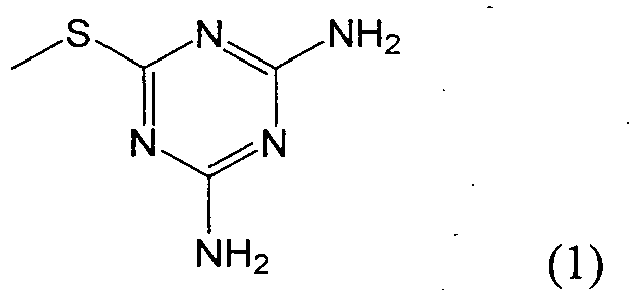
wherein the purifying process has at least:- a process (1) of distilling the polythiol composition; and
- a process (2) of purifying the polythiol composition by a means other than distillation.
- <2> The method for producing a polythiol composition according to item <1>, wherein the process (2) is carried out after the process (1).
- <3> The method for producing a polythiol composition according to item <1>, wherein the process (2) is carried out before and after the process (1).
- <4> The method for producing a polythiol composition according to any one of items <1> to <3>, wherein the means other than distillation is at least one means selected from water washing and acid washing.
- <5> A method for producing a polythiol composition, which comprising purifying a polythiol composition containing, as the main component, a polythiol compound (a) having two or more mercapto groups, and containing more than 0.5% by mass of a nitrogen-containing compound (b) in which at least one mercapto group in the polythiol compound (a) is substituted with a group represented by formula (1) below:

wherein the purifying process has a process of washing the polythiol composition containing more than 0.5% by mass of the nitrogen-containing compound
(b) with 6N or more of an acid. - <6> A method for producing a polythiol composition containing, as the main component, a polythiol compound (a) having two or more mercapto groups, and containing 0.5% by mass or less of a nitrogen-containing compound (b) in which at least one mercapto group in the polythiol compound (a) is substituted with a group represented by formula (1) below:

- <7> A polythiol composition containing, as the main component, a polythiol compound (a) having two or more mercapto groups, and containing 0.5% by mass or less of a nitrogen-containing compound (b) in which at least one mercapto group in the polythiol compound (a) is substituted with a group represented by formula (1) below:
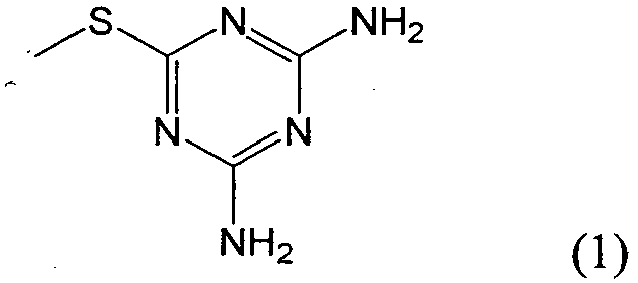
- <8> The polythiol composition according to item <7>, wherein the polythiol compound
- (a) is obtained by hydrolyzing an isothiuronium salt.
- <9> A polythiol composition produced by the method according to any one of items <1> to <6>.
- <10> A composition for optical materials containing the polythiol composition according to any one of items <7> to <9>.
- <11> An optical material obtained by polymerizing and curing the composition for optical materials according to item <10>.
- By using the polythiol composition of the present invention, the generation of a suspended matter in the polythiol composition can be suppressed. Further, by polymerizing and curing a composition for optical materials comprising the polythiol composition of the present invention, an optical material excellent in color phase and transparency can be obtained.
- The present invention relates to a polythiol composition containing, as the main component, a polythiol compound (a) having two or more mercapto groups, and containing 0.5% by mass or less of a nitrogen-containing compound (b) in which at least one mercapto group in the polythiol compound (a) is substituted with a group represented by the aforementioned formula (1). The content percentage of the polythiol compound (a) in the polythiol composition of the present invention is usually 75% by mass or more, preferably 80% by mass or more, and particularly preferably 85% by mass or more.
- The polythiol compound (a) (hereinafter sometimes referred to as "the compound (a)") to be used in the present invention is not particularly limited as long as it is a compound having at least two mercapto groups in one molecule. Specific examples thereof include methanedithiol, 1,2-dimercaptoethane, 2,2-dimercaptopropane, 1,3-dimercaptopropane, 1,2,3-trimercaptopropane, 1,4-dimercaptobutane, 1,6-dimercaptohexane, bis(2-mercaptoethyl)sulfide, 1,2-bis(2-mercaptoethylthio)ethane, 1,5-dimercapto-3-oxapentane, 1,8-dimercapto-3,6-dioxaoctane, 2,2-dimethylpropane-1,3-dithiol, 3,4-dimethoxybutane-1,2-dithiol, 2-mercaptomethyl-1,3-dimercaptopropane, 2-mercaptomethyl-1,4-dimercaptopropane, 2-(2-mercaptoethylthio)-1,3-dimercaptopropane, 1,2-bis(2-mercaptoethylthio)-3-mercaptopropane, 1,1,1-tris(mercaptomethyl)propane, tetrakis(mercaptomethyl)methane, 4,8-dimercaptomethyl-1,11-dimercapto-3,6,9-trithiaundecane, 4,7-dimercaptomethyl-1,11-dimercapto-3,6,9-trithiaundecane, 5,7-dimercaptomethyl-1,11-dimercapto-3,6,9-trithiaundecane, 1,1,3,3-tetrakis(mercaptomethylthio)propane, ethyleneglycolbis(2-mercaptoacetate), ethyleneglycolbis(3-mercaptopropionate), 1,4-butanediolbis(2-mercaptoacetate), 1,4-butanediolbis(3-mercaptopropionate), trimethylolpropanetris(2-mercaptoacetate), trimethylolpropanetris(3-mercaptopropionate), pentaerythritoltetrakis(2-mercaptoacetate), pentaerythritoltetrakis(3-mercaptopropionate), 1,1-dimercaptocyclohexane, 1,2-dimercaptocyclohexane, 1,3-dimercaptocyclohexane, 1,4-dimercaptocyclohexane, 1,3-bis(mercaptomethyl)cyclohexane, 1,4-bis(mercaptomethyl)cyclohexane, 2,5-bis(mercaptomethyl)-1,4-dithiane, 2,5-bis(mercaptoethyl)-1,4-dithiane, 1,2-bis(mercaptomethyl)benzene, 1,3-bis(mercaptomethyl)benzene (also known as m-xylylene dithiol), 1,4-bis(mercaptomethyl)benzene, bis(4-mercaptophenyl)sulfide, bis(4-mercaptophenyl)ether, 2,2-bis(4-mercaptophenyl)propane, bis(4-mercaptomethylphenyl)sulfide, bis(4-mercaptomethylphenyl)ether and 2,2-bis(4-mercaptomethylphenyl)propane.
- Among the above-described compounds, specific examples of preferred compounds include bis(2-mercaptoethyl)sulfide, pentaerythritoltetrakis(2-mercaptoacetate), pentaerythritoltetrakis(3 -mercaptopropionate), 2,5-bis(mercaptomethyl)-1,4-dithiane, 1,2-bis(2-mercaptoethylthio)-3-mercaptopropane, 4,8-dimercaptomethyl-1,11-dimercapto-3,6,9-trithiaundecane, 4,7-dimercaptomethyl-1,11-dimercapto-3,6,9-trithiaundecane, 5,7-dimercaptomethyl-1,11-dimercapto-3,6,9-trithiaundecane, 1,1,3,3-tetrakis(mercaptomethylthio)propane, 1,3-bis(mercaptomethyl)benzene (also known as m-xylylene dithiol) and 1,4-bis(mercaptomethyl)benzene.
- Specific examples of more preferred compounds include bis(2-mercaptoethyl)sulfide, 1,3-bis(mercaptomethyl)benzene, 1,2-bis[(2-mercaptoethyl)thio]-3-mercaptopropane and 1,1,3,3-tetrakis(mercaptomethylthio)propane, and the most preferred compounds are bis(2-mercaptoethyl)sulfide and 1,3-bis(mercaptomethyl)benzene (also known as m-xylylene dithiol). However, the compound (a) as the target of the present invention is not limited thereto.
- The nitrogen-containing compound (b) (hereinafter sometimes referred to as "the compound (b)") contained in the polythiol composition of the present invention is a compound in which at least one mercapto group in the compound (a) is substituted with a group represented by the aforementioned formula (1). The content percentage of the compound (b) is preferably 0.5% by mass or less, more preferably 0.3% by mass or less, and even more preferably 0.05% by mass or less. The smaller the amount of the compound (b) is, the better, but in consideration of the purification cost, the content percentage is preferably 0.01% by mass or more. Meanwhile, when the amount of the compound (b) is large, a suspended matter tends to be easily generated at the time of preservation of the polythiol composition, and when polymerizing and curing a composition for optical materials comprising the polythiol composition, white turbidity occurs in a cured product.
- In the present invention, examples of methods for reducing the amount of the compound (b) to 0.5% by mass or less include: a method in which a polythiol composition produced is washed with water and then distilled; a method in which a product obtained by purification by distillation is washed with water again; a method in which distillation is performed a plurality of times; and a method in which a polythiol composition is washed with an acid of 6N or more (preferably an acid of 6N to 12N) and then washed with water. Among them, preferred is a method in which distillation is combined with a purification means other than distillation, and more preferred is a method in which a purification means other than distillation is combined with distillation and performed after or before and after distillation. As the purification means other than distillation, acid washing or water washing is preferred. A method in which water washing is performed after distillation is particularly preferred. Further, it is preferred to reduce the amount of water after water washing by reducing pressure, heating, etc.
- Moreover, examples of methods for reducing the amount of the compound (b) to 0.5% by mass or less also include a method in which hydrolysis of an isothiuronium salt that is a raw material of the polythiol compound (a) is performed at 80°C or higher. The temperature for hydrolysis is more preferably 80 to 120°C. When the temperature is too high, oligomerization of a polythiol produced is caused, and therefore it is undesirable.
- In the present invention, quantification of the compound (b) in the polythiol composition can be carried out by performing preparative GPC and measuring the weight as described in detail in the Examples below. Further, in the present invention, identification of the compound (b) in the polythiol composition can be carried out by accurate mass analysis according to LC-Tof-MS analysis and NMR analysis as described in detail in the Examples below.
- The composition for optical materials of the present invention contains at least the aforementioned polythiol composition of the present invention. The composition for optical materials of the present invention may contain a polymerizable compound other than the polythiol compound. When obtaining an optical material by polymerizing and curing the composition for optical materials of the present invention, it is preferred to mix the composition for optical materials of the present invention with a polymerization catalyst and an additive, etc. according to need.
- In addition, various publicly-known substances such as a chain extender, a crosslinking agent, a light stabilizer, an ultraviolet absorber, an antioxidant, an oil-soluble dye, a filler and an internal mold release agent may be added depending on purposes. A publicly-known reaction catalyst to be used in the production of polythiourethane for adjusting the reaction rate may also be suitably added. When producing an optical material such as a plastic lens from the composition for optical materials of the present invention, it is usually carried out by cast polymerization.
- When producing the composition for optical materials of the present invention, it is preferred to carry out the defoaming treatment after mixing components. The degree of vacuum is 0.001 to 50 Torr, preferably 0.005 to 25 Torr, more preferably 0.01 to 10 Torr, and particularly preferably 0.1 to 5 Torr.
- The composition for optical materials (cast molding solution) thus obtained can be purified by filtering impurities, etc. with a filter or the like immediately before polymerization and curing. It is desirable to filter impurities and the like from the composition for optical materials to be purified using a filter for further improving the quality of the optical material of the present invention. The pore diameter of the filter to be used herein is about 0.05 to 10 µm, and generally 0.1 to 1.0 µm. The material of the filter is preferably polytetrafluoroethylene (PTFE), polyethylene terephthalate (PET), polypropylene (PP) or the like.
- The optical material of the present invention can be obtained by injecting the aforementioned composition for optical materials into a mold such as a glass mold and then polymerizing and curing the composition. The temperature and time for polymerization vary depending on the type of a monomer and additives, but the temperature is -10°C to 160°C, and usually -10°C to 140°C. The polymerization can be conducted by carrying out a step of holding the composition at a predetermined polymerization temperature for a predetermined amount of time, a step of increasing the temperature at a rate of 0.1°C to 100°C/h and a step of decreasing the temperature at a rate of 0.1°C to 100°C/h, or a combination of these steps.
- Further, it is preferred to anneal the material at a temperature of 50°C to 150°C for about 5 minutes to 5 hours after the polymerization is completed in terms of eliminating distortion of the optical material. Moreover, it can be subjected to a surface treatment such as dyeing, hard coating, antireflection treatment and imparting antifog properties, antifouling properties, impact resistance, etc. according to need.
- Hereinafter, the present invention will be specifically described by way of working examples and comparative examples, but the present invention is not limited only to these working examples. Note that polythiol compositions obtained were evaluated according to the below-described methods.
- Regarding quantification of the compound (b) in the polythiol composition, the below-described preparative GPC was performed and the weight was measured. Further, identification of the compound (b) was carried out by accurate mass analysis according to LC-Tof-MS analysis and NMR analysis.
-
- High speed liquid chromatography measurement conditions
- Column: Jordi GEL DVB 500 Å (inner diameter: 10 mm, length: 250 mm, particle diameter: 5 µm)
- Mobile phase: chloroform
- Temperature: room temperature
- Flow rate: 1.5 ml/min
- Detector: UV detector, wavelength: 260 nm
- Injection amount: 100 to 500 µL
- Note that conditions for high speed liquid chromatography are suitably selected according to the structures, physical properties, etc. of the polythiol compound (a) and the nitrogen-containing compound (b).
- 50 mL of the polythiol composition was put into a transparent glass bottle having a suitable size, and it was observed with a light being emitted from the side in a dark room. Regarding results, the case where there was almost no suspended matter was rated as A, the case where there was a slight amount of a suspended matter was rated as B, and the case where there was a large amount of a suspended matter was rated as C.
- In a 1L four-neck reaction flask equipped with a stirring machine, a reflux cooling tube, a nitrogen gas purge tube and a thermometer, 74.1 g of m-xylylene dichloride, 67.2 g of thiourea and 270 g of water were mixed together, and the mixture was heated to reflux for 2.5 hours. The mixture was cooled to room temperature, and then 134.1 g of 50% aqueous solution of sodium hydroxide was added thereto under nitrogen atmosphere, and the mixture was hydrolyzed at 70°C to 40°C for 2 hours. Next, the reaction solution was cooled to 40°C, dilute hydrochloric acid was added thereto until pH became 3, and subsequently the mixture was stirred for 30 minutes to carry out neutralization. After the reaction was completed, extraction was carried out with 360 mL of toluene, and then toluene and a slight amount of water were removed under reduced pressure with heating, thereby obtaining 68.7 g of a polythiol composition containing m-xylylene dithiol. In this polythiol composition, the content percentage of the corresponding compound (b) was 1.0% by mass. Further, the content percentage of m-xylylene dithiol was 94.2% by mass.
- In a 1L four-neck reaction flask equipped with a stirring machine, a reflux cooling tube, a nitrogen gas purge tube and a thermometer, 74.1 g of m-xylylene dichloride, 67.2 g of thiourea and 270 g of water were mixed together, and the mixture was heated to reflux for 2.5 hours. The mixture was cooled to room temperature, and then 134.1 g of 50% aqueous solution of sodium hydroxide was added thereto under nitrogen atmosphere, and the mixture was hydrolyzed at 70°C to 40°C for 2 hours. Next, the reaction solution was cooled to 40°C, hydrochloric acid was added thereto until pH became 2, and subsequently the mixture was stirred for 30 minutes to carry out neutralization. After the reaction was completed, extraction was carried out with 360 mL of toluene, and then toluene and a slight amount of water were removed under reduced pressure with heating. After that, a polythiol composition containing m-xylylene dithiol obtained was purified by distillation, and then washed with water. The pressure was reduced with heating to remove water, and then filtration was carried out, thereby obtaining 55.0 g of a polythiol composition. In this polythiol composition, the content percentage of the corresponding compound (b) was 0.05% by mass. Further, the content percentage of m-xylylene dithiol was 99.6% by mass.
- Synthesis was carried out in a manner similar to that in Example 1 to the step of extraction with toluene. After that, the toluene solution was washed with 6N hydrochloric acid and then water washing was carried out, and after that, toluene and a slight amount of water were removed under reduced pressure with heating. The weight of the obtained polythiol composition was 58.0 g. In this polythiol composition, the content percentage of the corresponding compound (b) was 0.07% by mass. Further, the content percentage of m-xylylene dithiol was 95.6% by mass.
- Synthesis was carried out in a manner similar to that in Comparative Example 1, except that the temperature of hydrolysis was kept at 80°C or higher, thereby obtaining 66.3 g of a polythiol composition containing m-xylylene dithiol. In this polythiol composition, the content percentage of the corresponding compound (b) was 0.32% by mass. Further, the content percentage of m-xylylene dithiol was 93.2% by mass.
- 76.0 g of water and 90.0 g (1.08 mol) of aqueous solution of sodium hydroxide (48% by mass) were put into a 2L four-neck reaction flask equipped with a stirring machine, a reflux cooling tube, a nitrogen gas purge tube and a thermometer. 169 g (2.16 mol) of 2-mercaptoethanol was added dropwise thereto at 30°C over 30 minutes, and after that, 99.9 g (1.08 mol) of epichlorohydrin was added dropwise thereto at the same temperature over 3 hours, and the mixture was matured for 1 hour. Next, 450.1 g (4.32 mol) of water containing hydrochloric acid (36% by mass) and 304.5 g (4.00 mol) of thiourea were added thereto, and the mixture was refluxed at 110°C for 8 hours to provide a thiuronium salt. After it was cooled to 50°C, 450.0 g of toluene and 298 g (5.21 mol) of aqueous solution of ammonia (28% by mass) were added thereto to perform hydrolysis, thereby obtaining a toluene solution of polythiol containing 1,2-bis[(2-mercaptoethyl)thio]-3-mercaptopropane as the main component. The toluene solution was washed with water, and toluene and a slight amount of water were removed under reduced pressure with heating. After that, it was filtered, thereby obtaining 271.2 g of a polythiol composition containing a 1,2-bis[(2-mercaptoethyl)thio]-3-mercaptopropane compound as the main component. In this polythiol composition, the content percentage of the corresponding compound (b) was 1.2% by mass. Further, the content percentage of 1,2-bis[(2-mercaptoethyl)thio]-3-mercaptopropane was 82.3% by mass.
- 76.0 g of water and 90.0 g (1.08 mol) of aqueous solution of sodium hydroxide (48% by mass) were put into a 2L four-neck reaction flask equipped with a stirring machine, a reflux cooling tube, a nitrogen gas purge tube and a thermometer. 169 g (2.16 mol) of 2-mercaptoethanol was added dropwise thereto at 30°C over 30 minutes, and after that, 99.9 g (1.08 mol) of epichlorohydrin was added dropwise thereto at the same temperature over 3 hours, and the mixture was matured for 1 hour. Next, 450.1 g (4.32 mol) of water containing hydrochloric acid (36% by mass) and 304.5 g (4.00 mol) of thiourea were added thereto, and the mixture was refluxed at 110°C for 8 hours to provide a thiuronium salt. After it was cooled to 50°C, 450.0 g of toluene and 298 g (5.21 mol) of aqueous solution of ammonia (28% by mass) were added thereto to perform hydrolysis, thereby obtaining a toluene solution of polythiol containing 1,2-bis[(2-mercaptoethyl)thio]-3-mercaptopropane as the main component. The toluene solution was washed with 1N acid and then with water, and toluene and a slight amount of water were removed under reduced pressure with heating. After that, a polythiol composition containing a 1,2-bis[(2-mercaptoethyl)thio]-3-mercaptopropane compound as the main component obtained was purified by distillation, and after that, it was washed with water again. Water was removed under reduced pressure with heating, and then filtration was carried out, thereby obtaining 235.4 g of a polythiol composition. In this polythiol composition, the content percentage of the corresponding compound (b) was 0.00% by mass. Further, the content percentage of 1,2-bis[(2-mercaptoethyl)thio]-3-mercaptopropane was 86.4% by mass.
- The polythiol compositions obtained in Example 1 and Comparative Example 1 were mixed together so that the amount of the compound (b) in the polythiol composition became the amount shown in Table 1. Subsequently, evaluation of suspended matter of the polythiol composition was carried out, and after that, as the acceleration test, the polythiol composition was preserved at 50°C for 7 days. Finally, evaluation of suspended matter of the polythiol composition after preserved was carried out. The results are shown in Table 1.
- Evaluation was carried out in a manner similar to that in Example 5, except that the polythiol composition obtained in Example 3 was used directly. The results are shown in Table 1.
- Evaluation was carried out in a manner similar to that in Example 5, except that the polythiol composition obtained in Example 2 was used directly. The results are shown in Table 1.
- Evaluation was carried out in a manner similar to that in Example 5, except that the polythiol composition obtained in Example 1 was used directly. The results are shown in Table 1.
- The polythiol compositions produced in Example 4 and Comparative Example 2 were mixed together so that the amount of the compound (b) in the polythiol composition became the amount shown in Table 1, and then evaluation was carried out in a manner similar to that in Example 5. The results are shown in Table 1.
- In a manner similar to that in Examples 5 and 10, mixing was carried out so that the amount of the compound (b) in the polythiol composition became the amount shown in Table 1, and then evaluation was carried out in a manner similar to that in Example 5. The results are shown in Table 1.
- Synthesis was carried out in a manner similar to that in Example 1 to the step of extraction with toluene. After that, the toluene solution was washed with 1N acid and then washed with water 3 times, and after that, toluene and a slight amount of water were removed under reduced pressure with heating (purification by distillation was not performed). The weight of the obtained polythiol composition was 67.4 g. In this polythiol composition, the content percentage of the corresponding compound (b) was 0.75% by mass. Further, the content percentage of m-xylylene dithiol was 94.9% by mass.
- Evaluation was carried out in a manner similar to that in Example 5, except that the obtained polythiol composition was used directly. The results are shown in Table 1.
- Synthesis was carried out in a manner similar to that in Example 1, except that water washing after distillation was not performed. The weight of the obtained polythiol composition was 56.2 g. In this polythiol composition, the content percentage of the corresponding compound (b) was 0.56% by mass. Further, the content percentage of m-xylylene dithiol was 98.6% by mass.
- Evaluation was carried out in a manner similar to that in Example 5, except that the obtained polythiol composition was used directly. The results are shown in Table 1.
Table 1 Compound (a) Compound (b) in composition (% by mass) Initial stage After preserved at 50°C for 7 days Example 5 a-1 0.48 A B Example 6 a-1 0.32 A B Example 7 a-1 0.15 A A Example 8 a-1 0.07 A A Example 9 a-1 0.05 A A Example 10 a-2 0.48 A A Example 11 a-2 0.01 A A Comparative Example 3 a-1 0.90 C C Comparative Example 4 a-1 0.55 B C Comparative Example 5 a-2 0.82 B C Comparative Example 6 a-1 0.75 B C Comparative Example 7 a-1 0.56 B C Evaluation of suspended matter
A: There was almost no suspended matter.
B: There was a slight amount of a suspended matter. The level at which there is no quality problem.
C: There was a large amount of a suspended matter. Compound (a)
a-1: m-xylylene dithiol
a-2: 1,2-bis[(2-mercaptoethyl)thio]-3-mercaptopropane
Claims (11)
- A method for producing a polythiol composition, which comprising purifying a polythiol composition containing, as the main component, a polythiol compound (a) having two or more mercapto groups, and containing more than 0.5% by mass of a nitrogen-containing compound (b) in which at least one mercapto group in the polythiol compound (a) is substituted with a group represented by formula (1) below:
 wherein the purifying process has at least:a process (1) of distilling the polythiol composition; anda process (2) of purifying the polythiol composition by a means other than distillation.
 - The method for producing a polythiol composition according to claim 1, wherein the process (2) is carried out after the process (1).
- The method for producing a polythiol composition according to claim 1, wherein the process (2) is carried out before and after the process (1).
- The method for producing a polythiol composition according to any one of claims 1 to 3, wherein the means other than distillation is at least one means selected from water washing and acid washing.
- A method for producing a polythiol composition, which comprising purifying a polythiol composition containing, as the main component, a polythiol compound (a) having two or more mercapto groups, and containing more than 0.5% by mass of a nitrogen-containing compound (b) in which at least one mercapto group in the polythiol compound (a) is substituted with a group represented by formula (1) below:
 wherein the purifying process has a process of washing the polythiol composition containing more than 0.5% by mass of the nitrogen-containing compound (b) with 6N or more of an acid.
 - A method for producing a polythiol composition containing, as the main component, a polythiol compound (a) having two or more mercapto groups, and containing 0.5% by mass or less of a nitrogen-containing compound (b) in which at least one mercapto group in the polythiol compound (a) is substituted with a group represented by formula (1) below:

- A polythiol composition containing, as the main component, a polythiol compound (a) having two or more mercapto groups, and containing 0.5% by mass or less of a nitrogen-containing compound (b) in which at least one mercapto group in the polythiol compound (a) is substituted with a group represented by formula (1) below:

- The polythiol composition according to claim 7, wherein the polythiol compound (a) is obtained by hydrolyzing an isothiuronium salt.
- A polythiol composition produced by the method according to any one of claims 1 to 6.
- A composition for optical materials containing the polythiol composition according to any one of claims 7 to 9.
- An optical material obtained by polymerizing and curing the composition for optical materials according to claim 10.
Applications Claiming Priority (3)
| Application Number | Priority Date | Filing Date | Title |
|---|---|---|---|
| JP2014147702 | 2014-07-18 | ||
| JP2014209774 | 2014-10-14 | ||
| PCT/JP2015/070231 WO2016010065A1 (en) | 2014-07-18 | 2015-07-15 | Polythiol composition and method for producing same |
Publications (2)
| Publication Number | Publication Date |
|---|---|
| EP3170808A1 true EP3170808A1 (en) | 2017-05-24 |
| EP3170808A4 EP3170808A4 (en) | 2018-02-21 |
Family
ID=55078555
Family Applications (1)
| Application Number | Title | Priority Date | Filing Date |
|---|---|---|---|
| EP15821668.9A Withdrawn EP3170808A4 (en) | 2014-07-18 | 2015-07-15 | Polythiol composition and method for producing same |
Country Status (7)
| Country | Link |
|---|---|
| US (1) | US10207987B2 (en) |
| EP (1) | EP3170808A4 (en) |
| JP (1) | JP6724780B2 (en) |
| KR (2) | KR102483128B1 (en) |
| CN (1) | CN106414401A (en) |
| TW (1) | TWI699389B (en) |
| WO (1) | WO2016010065A1 (en) |
Families Citing this family (6)
| Publication number | Priority date | Publication date | Assignee | Title |
|---|---|---|---|---|
| KR102582232B1 (en) * | 2018-03-30 | 2023-09-22 | 미쓰이 가가쿠 가부시키가이샤 | Method for producing organic mercapto compounds or intermediates thereof, (poly)thiol component, polymerizable composition for optical materials, molded body, optical material and lens |
| EP3841134A1 (en) * | 2018-08-20 | 2021-06-30 | PPG Industries Ohio Inc. | Polythiol composition |
| JP2021123541A (en) * | 2020-02-03 | 2021-08-30 | 三井化学株式会社 | Method for producing polythiol composition, polythiol composition and its use |
| CN115260427A (en) * | 2020-02-05 | 2022-11-01 | 三井化学株式会社 | Method for producing polyamine compound and use thereof |
| CN111855882B (en) * | 2020-09-04 | 2023-03-31 | 黄河三角洲京博化工研究院有限公司 | Method for representing structure distribution of multi-thiol polymer by liquid chromatography-mass spectrometry |
| CN119855808A (en) | 2022-09-26 | 2025-04-18 | 三井化学株式会社 | Method for producing polythiol composition and use thereof |
Citations (3)
| Publication number | Priority date | Publication date | Assignee | Title |
|---|---|---|---|---|
| JPH09136919A (en) | 1995-11-15 | 1997-05-27 | Mitsubishi Gas Chem Co Inc | Optical material for high refractive index lens |
| JP2011231305A (en) | 2010-04-08 | 2011-11-17 | Mitsubishi Gas Chemical Co Inc | Composition for optical material |
| EP2824126A1 (en) | 2012-08-14 | 2015-01-14 | Mitsui Chemicals, Inc. | Polythiol composition, polymerizable composition for optical materials, and use of polymerizable composition for optical materials |
Family Cites Families (24)
| Publication number | Priority date | Publication date | Assignee | Title |
|---|---|---|---|---|
| US2312688A (en) * | 1941-07-30 | 1943-03-02 | Gen Electric | Reaction product of aldehydes and triazine derivatives |
| US2324284A (en) * | 1942-03-17 | 1943-07-13 | Gen Electric | Reaction product of aldehydes and bis-(diamino triazinyl) cyanoalkylene disulphides |
| CN1040810A (en) | 1988-04-30 | 1990-03-28 | 三井东圧化学株式会社 | Polysulfide base resin lens and preparation method thereof |
| JP2621991B2 (en) * | 1988-12-22 | 1997-06-18 | 三井東圧化学株式会社 | Mercapto compound and method for producing the same |
| US5087758A (en) | 1988-12-22 | 1992-02-11 | Mitsui Toatsu Chemicals, Inc. | Mercapto compound, a high refractive index resin and lens and a process for preparing them |
| US5608115A (en) | 1994-01-26 | 1997-03-04 | Mitsui Toatsu Chemicals, Inc. | Polythiol useful for preparing sulfur-containing urethane-based resin and process for producing the same |
| EP0896972B1 (en) | 1997-02-21 | 2006-11-29 | Mitsui Chemicals, Inc. | Method for producing a selenized transparent optical material |
| JP3862382B2 (en) | 1997-10-22 | 2006-12-27 | 三井化学株式会社 | Trifunctional or higher selenium-containing polythiol |
| JP3465528B2 (en) | 1997-04-22 | 2003-11-10 | 三菱瓦斯化学株式会社 | New resin for optical materials |
| JPH1180308A (en) | 1997-09-01 | 1999-03-26 | Sumitomo Seika Chem Co Ltd | Curable composition and optical material obtained by using the same |
| US7126161B2 (en) * | 1998-10-13 | 2006-10-24 | Semiconductor Energy Laboratory Co., Ltd. | Semiconductor device having El layer and sealing material |
| EP1250369B1 (en) * | 1999-11-18 | 2005-06-08 | PPG Industries Ohio, Inc. | Method of preparing an optical polymerizate |
| US6891017B2 (en) | 2001-06-29 | 2005-05-10 | Essilor International Compagnie General D'optique | Fast polymerizable/curable episulfide based composition, polymerization/curing process and optical articles resulting therefrom |
| JP2006003624A (en) | 2004-06-17 | 2006-01-05 | Mitsui Chemicals Inc | Optical material comprising sulfur atom-containing resin |
| WO2006033406A1 (en) * | 2004-09-24 | 2006-03-30 | Hoya Corporation | Method for producing cyclic sulfide compound and intermediate thereof |
| JP4641407B2 (en) * | 2004-10-29 | 2011-03-02 | Hoya株式会社 | Method for purifying 4,5-dimercapto-1,3-dithiolane |
| JP4326455B2 (en) | 2004-11-04 | 2009-09-09 | 三井化学株式会社 | Polythiol for high heat resistance resin |
| JP4496121B2 (en) | 2005-03-31 | 2010-07-07 | 三井化学株式会社 | Method for producing sulfur atom-containing transparent resin with excellent hue |
| EP2008998B1 (en) * | 2006-04-19 | 2013-06-05 | Mitsui Chemicals, Inc. | Process for production of (poly)thiol compound for use as optical material |
| JP5357165B2 (en) * | 2008-09-22 | 2013-12-04 | 三井化学株式会社 | Polymerizable composition for optical material, optical material and method for producing optical material |
| JP5225797B2 (en) | 2008-09-30 | 2013-07-03 | 三井化学株式会社 | Composition, polymerizable composition containing the same, and method for producing the composition |
| US20130267673A1 (en) * | 2010-12-27 | 2013-10-10 | Mitsubishi Gas Chemical Company, Inc. | Composition for optical material |
| WO2014027428A1 (en) * | 2012-08-14 | 2014-02-20 | 三井化学株式会社 | Production method for polythiol compound, polymerizable composition for optical material and use therefor |
| EP3064488B1 (en) * | 2013-11-01 | 2022-10-05 | Mitsubishi Gas Chemical Company, Inc. | Polythiol compound and method for producing same |
-
2015
- 2015-07-02 TW TW104121490A patent/TWI699389B/en active
- 2015-07-15 KR KR1020167028903A patent/KR102483128B1/en active Active
- 2015-07-15 CN CN201580029266.1A patent/CN106414401A/en active Pending
- 2015-07-15 EP EP15821668.9A patent/EP3170808A4/en not_active Withdrawn
- 2015-07-15 KR KR1020227038006A patent/KR20220151035A/en not_active Ceased
- 2015-07-15 JP JP2016534465A patent/JP6724780B2/en active Active
- 2015-07-15 US US15/310,279 patent/US10207987B2/en active Active
- 2015-07-15 WO PCT/JP2015/070231 patent/WO2016010065A1/en not_active Ceased
Patent Citations (3)
| Publication number | Priority date | Publication date | Assignee | Title |
|---|---|---|---|---|
| JPH09136919A (en) | 1995-11-15 | 1997-05-27 | Mitsubishi Gas Chem Co Inc | Optical material for high refractive index lens |
| JP2011231305A (en) | 2010-04-08 | 2011-11-17 | Mitsubishi Gas Chemical Co Inc | Composition for optical material |
| EP2824126A1 (en) | 2012-08-14 | 2015-01-14 | Mitsui Chemicals, Inc. | Polythiol composition, polymerizable composition for optical materials, and use of polymerizable composition for optical materials |
Non-Patent Citations (2)
| Title |
|---|
| "Testing methods for industrial water", JAPANESE INDUSTRIAL STANDARD JIS K 0101:1998, 1998, pages 18 - 25, XP055491529 |
| See also references of WO2016010065A1 |
Also Published As
| Publication number | Publication date |
|---|---|
| WO2016010065A1 (en) | 2016-01-21 |
| JPWO2016010065A1 (en) | 2017-04-27 |
| TWI699389B (en) | 2020-07-21 |
| KR20170032218A (en) | 2017-03-22 |
| KR102483128B1 (en) | 2022-12-30 |
| KR20220151035A (en) | 2022-11-11 |
| CN106414401A (en) | 2017-02-15 |
| TW201615697A (en) | 2016-05-01 |
| US20170247322A1 (en) | 2017-08-31 |
| JP6724780B2 (en) | 2020-07-15 |
| EP3170808A4 (en) | 2018-02-21 |
| US10207987B2 (en) | 2019-02-19 |
Similar Documents
| Publication | Publication Date | Title |
|---|---|---|
| US10207987B2 (en) | Polythiol composition and method for producing same | |
| EP3088441B1 (en) | Optical material composition and method for producing same | |
| KR101464942B1 (en) | Method of Producing Polythiol Compound for Optical Material and Optical Material Composition Comprising the Polythiol Compound | |
| JPH11322930A (en) | Polymerizable composition | |
| JP6034997B1 (en) | Polymerizable composition and novel alkyne compound | |
| WO2023054577A1 (en) | Monomer for optical member, polymerizable composition for optical member, cured object, and spectacle lens | |
| EP2540714B1 (en) | Manufacturing method for episulphide compound | |
| JP2006284920A (en) | Method for manufacturing sulfur atom-containing transparent resin excellent in hue | |
| JP5732749B2 (en) | Method for producing (poly) episulfide compound for optical material | |
| KR102202261B1 (en) | Optical material composition and optical material using same | |
| JP2008143872A (en) | Method for stabilizing bis(isocyanatomethyl)norbornane | |
| JP2011073165A (en) | Optical lens and method of manufacturing the same | |
| KR20240044468A (en) | Monomer for optical members, polymerizable composition for optical members, cured product, spectacle lens, and method for producing monomers for optical members | |
| JP5827098B2 (en) | Process for producing polyglycidyl thioether | |
| EP4656633A1 (en) | Episulfide composition, polymerizable composition, cured product, optical material, and lens | |
| US10767015B2 (en) | Optical material composition and optical material |
Legal Events
| Date | Code | Title | Description |
|---|---|---|---|
| PUAI | Public reference made under article 153(3) epc to a published international application that has entered the european phase |
Free format text: ORIGINAL CODE: 0009012 |
|
| 17P | Request for examination filed |
Effective date: 20161215 |
|
| AK | Designated contracting states |
Kind code of ref document: A1 Designated state(s): AL AT BE BG CH CY CZ DE DK EE ES FI FR GB GR HR HU IE IS IT LI LT LU LV MC MK MT NL NO PL PT RO RS SE SI SK SM TR |
|
| AX | Request for extension of the european patent |
Extension state: BA ME |
|
| DAV | Request for validation of the european patent (deleted) | ||
| DAX | Request for extension of the european patent (deleted) | ||
| A4 | Supplementary search report drawn up and despatched |
Effective date: 20180123 |
|
| RIC1 | Information provided on ipc code assigned before grant |
Ipc: C07C 319/28 20060101AFI20180117BHEP Ipc: C08G 75/04 20160101ALI20180117BHEP Ipc: C07C 321/14 20060101ALI20180117BHEP Ipc: G02B 1/04 20060101ALI20180117BHEP Ipc: C07C 321/10 20060101ALI20180117BHEP |
|
| TPAC | Observations filed by third parties |
Free format text: ORIGINAL CODE: EPIDOSNTIPA |
|
| 17Q | First examination report despatched |
Effective date: 20180927 |
|
| STAA | Information on the status of an ep patent application or granted ep patent |
Free format text: STATUS: THE APPLICATION IS DEEMED TO BE WITHDRAWN |
|
| 18D | Application deemed to be withdrawn |
Effective date: 20190709 |