EP3197448B1 - Procédé de traitement d'une maladie hépatique - Google Patents
Procédé de traitement d'une maladie hépatique Download PDFInfo
- Publication number
- EP3197448B1 EP3197448B1 EP15775551.3A EP15775551A EP3197448B1 EP 3197448 B1 EP3197448 B1 EP 3197448B1 EP 15775551 A EP15775551 A EP 15775551A EP 3197448 B1 EP3197448 B1 EP 3197448B1
- Authority
- EP
- European Patent Office
- Prior art keywords
- alkyl
- heteroaryl
- aryl
- heterocyclyl
- cycloalkyl
- Prior art date
- Legal status (The legal status is an assumption and is not a legal conclusion. Google has not performed a legal analysis and makes no representation as to the accuracy of the status listed.)
- Active
Links
- YIDDLAAKOYYGJG-UHFFFAOYSA-N CC(C)[n]1c(-c2nc(NC(c3cc(-[n]4cnc(C5CC5)c4)c(C)cc3F)=O)ccc2)nnc1 Chemical compound CC(C)[n]1c(-c2nc(NC(c3cc(-[n]4cnc(C5CC5)c4)c(C)cc3F)=O)ccc2)nnc1 YIDDLAAKOYYGJG-UHFFFAOYSA-N 0.000 description 1
Classifications
-
- A—HUMAN NECESSITIES
- A61—MEDICAL OR VETERINARY SCIENCE; HYGIENE
- A61K—PREPARATIONS FOR MEDICAL, DENTAL OR TOILETRY PURPOSES
- A61K31/00—Medicinal preparations containing organic active ingredients
- A61K31/33—Heterocyclic compounds
- A61K31/395—Heterocyclic compounds having nitrogen as a ring hetero atom, e.g. guanethidine or rifamycins
- A61K31/435—Heterocyclic compounds having nitrogen as a ring hetero atom, e.g. guanethidine or rifamycins having six-membered rings with one nitrogen as the only ring hetero atom
- A61K31/44—Non condensed pyridines; Hydrogenated derivatives thereof
- A61K31/4427—Non condensed pyridines; Hydrogenated derivatives thereof containing further heterocyclic ring systems
- A61K31/4439—Non condensed pyridines; Hydrogenated derivatives thereof containing further heterocyclic ring systems containing a five-membered ring with nitrogen as a ring hetero atom, e.g. omeprazole
-
- A—HUMAN NECESSITIES
- A61—MEDICAL OR VETERINARY SCIENCE; HYGIENE
- A61K—PREPARATIONS FOR MEDICAL, DENTAL OR TOILETRY PURPOSES
- A61K31/00—Medicinal preparations containing organic active ingredients
- A61K31/33—Heterocyclic compounds
- A61K31/395—Heterocyclic compounds having nitrogen as a ring hetero atom, e.g. guanethidine or rifamycins
- A61K31/41—Heterocyclic compounds having nitrogen as a ring hetero atom, e.g. guanethidine or rifamycins having five-membered rings with two or more ring hetero atoms, at least one of which being nitrogen, e.g. tetrazole
- A61K31/42—Oxazoles
-
- A—HUMAN NECESSITIES
- A61—MEDICAL OR VETERINARY SCIENCE; HYGIENE
- A61K—PREPARATIONS FOR MEDICAL, DENTAL OR TOILETRY PURPOSES
- A61K45/00—Medicinal preparations containing active ingredients not provided for in groups A61K31/00 - A61K41/00
- A61K45/06—Mixtures of active ingredients without chemical characterisation, e.g. antiphlogistics and cardiaca
-
- A—HUMAN NECESSITIES
- A61—MEDICAL OR VETERINARY SCIENCE; HYGIENE
- A61K—PREPARATIONS FOR MEDICAL, DENTAL OR TOILETRY PURPOSES
- A61K9/00—Medicinal preparations characterised by special physical form
- A61K9/48—Preparations in capsules, e.g. of gelatin, of chocolate
-
- A—HUMAN NECESSITIES
- A61—MEDICAL OR VETERINARY SCIENCE; HYGIENE
- A61P—SPECIFIC THERAPEUTIC ACTIVITY OF CHEMICAL COMPOUNDS OR MEDICINAL PREPARATIONS
- A61P1/00—Drugs for disorders of the alimentary tract or the digestive system
- A61P1/16—Drugs for disorders of the alimentary tract or the digestive system for liver or gallbladder disorders, e.g. hepatoprotective agents, cholagogues, litholytics
-
- A—HUMAN NECESSITIES
- A61—MEDICAL OR VETERINARY SCIENCE; HYGIENE
- A61K—PREPARATIONS FOR MEDICAL, DENTAL OR TOILETRY PURPOSES
- A61K2300/00—Mixtures or combinations of active ingredients, wherein at least one active ingredient is fully defined in groups A61K31/00 - A61K41/00
Definitions
- the present invention relates to compounds for use in a method of preventing and/or treating nonalcoholic steatohepatitis (NASH).
- NASH nonalcoholic steatohepatitis
- Liver disease is generally classified as acute or chronic based upon the duration of the disease. Liver disease may be caused by infection, injury, exposure to drugs or toxic compounds, alcohol, impurities in foods, and the abnormal build-up of normal substances in the blood, an autoimmune process, a genetic defect (such as haemochromatosis), or unknown cause(s).
- Liver disease is a leading cause of death world wide. In particular, it has been seen that a diet high in fat damages the liver in ways that are surprisingly similar to hepatitis.
- the American Liver Foundation estimates that more than 20 percent of the population has non-alcoholic fatty liver disease (NAFLD). It is suggested that obesity, unhealthy diets, and sedentary lifestyles may contribute to the high prevalence of NAFLD. When left untreated, NAFLD can progress to non-alcoholic steatohepatitis (NASH) causing serious adverse effects. Once NASH is developed, it would cause the liver to swell and scar (i.e. cirrhosis) over time.
- NASH non-alcoholic steatohepatitis
- US Patent Application No. 2013/197037 relates to ASK1 inhibitors for use in the treatment of diseases such as kidney disease, diabetic nephropathy and kidney fibrosis.
- US Patent Application No. 2009/318425 relates to ASK1 inhibitors and pharmaceutical compositions, kits and articles of manufacture comprising such compounds; methods and intermediates for making the compounds; and methods of using said compounds.
- Yoshida, et al. Hepatol 2012 vol. 56, No. S1:771A-772A discloses that pharmacologic inhibition of ASK1 attenuates hepatocyte apoptosis and limits hepatotoxin-induced liver fibrosis progression in mice.
- Adorin,i et al. Drug Discov Today., 2012 vol. 17 (17-18):988-97 examines the evidence supporting activation of the farnesoid X receptor for the treatment of NASH.
- US Patent Application No. 2003/203939 relates to methods for the treatment of cholestatic liver disease reduction and prevention of hepatic injury resulting from cholestasis via administration of a FXR ligand.
- International Patent Application Publication No. 2005/032549 relates to methods for the treatment of fibrosis, including liver fibrosis, via administration of FXR agonists.
- liver diseases disclosed herein include chronic and/or metabolic liver diseases, nonalcoholic fatty liver disease (NAFLD), and nonalcoholic steatohepatitis (NASH).
- NAFLD nonalcoholic fatty liver disease
- NASH nonalcoholic steatohepatitis
- the present invention provides an ASK1 inhibitor for use in combination with a FXR agonist in a method of treating and/or preventing nonalcoholic steatohepatitis (NASH) in a patient in need thereof, wherein the ASK1 inhibitor is a compound of formula (I) .
- the present invention further provides a FXR agonist for use in combination with an ASK1 inhibitor in a method of treating and/or preventing non-alcoholic steatohepatitis. (NASH), wherein the ASK1 inhibitor is a compound of formula (I).
- the present invention further provides a pharmaceutical composition comprising an ASK1 inhibitor and a FXR agonist, wherein the ASK1 inhibitor is a compound of formula (I).
- the ASK1 inhibitor of formula (I) and the FXR agonist can be coadministered.
- the ASK1 inhibitor of formula (I) and the FXR agonist can be administered together as a single pharmaceutical composition, or separately in more than one pharmaceutical composition.
- a pharmaceutical composition comprising a therapeutically effective amount of an ASK1 inhibitor of formula (I) and a therapeutically effective amount of a FXR agonist.
- the term "about” used in the context of quantitative measurements means the indicated amount ⁇ 10%, or alternatively the indicated amount ⁇ 5% or ⁇ 1%.
- an "ASK1 inhibitor” may be any agent that is capable of inactivating an apoptosis signal regulating kinase 1 (ASK1) protein.
- the agent may be a chemical compound or biological molecule (e.g., a protein or antibody).
- the ASK1 protein activity may be measured by several different methods. For example, the activity of an ASK1 protein may be determined based on the ability of the ASK1 protein to phosphorylate a substrate protein. Methods for identifying an ASK1 inhibitor are known (see, e.g., U.S. 2007/0276050 and U.S. 2011/0009410 ).
- Exemplary ASK1 substrate proteins include MAPKK3, MAPKK4, MAPKK6, MAPKK7, or fragments thereof.
- the ASK1 protein activity may also be measured by the phosphorylation level of the ASK1 protein, for example, the phosphorylation level of a threonine residue in the ASK1 protein corresponding to threonine 838 (T838) of a human full-length ASK1 protein or threonine 845 (T845) of a mouse full-length ASK1 protein.
- the ASK1 protein comprises a full-length human ASK1 protein sequence
- an ASK1 inhibitor may attenuate phosphorylation of T838 in the full-length human ASK1 protein sequence.
- a site specific antibody against human ASK1 T838 or mouse ASK1 T845 may be used to detect the phosphorylation level.
- FXR agonist refers to any agent that is capable of binding and activating farnesoid X receptor (FXR) which may be referred to as bile acid receptor (BAR) or NR1H4 (nuclear receptor subfamily 1, group H, member 4) receptor.
- FXR agonist may act as agonists or partial agonists of FXR.
- the agent may be a chemical compound or biological molecule (e.g., a protein or antibody).
- the activity of a FXR agonist may be measured by several different methods, e.g. in an in vitro assay using the fluorescence resonance energy transfer (FRET) cell free assay as described in Pellicciari, et al. Journal of Medicinal Chemistry, 2002 vol. 15, No. 45:3569-72 .
- FRET fluorescence resonance energy transfer
- pharmaceutically acceptable salt refers to salts of pharmaceutical compounds e.g. compound of formula (I) that retain the biological effectiveness and properties of the underlying compound, and which are not biologically or otherwise undesirable.
- acid addition salts and base addition salts are acid addition salts and base addition salts.
- Pharmaceutically acceptable acid addition salts may be prepared from inorganic and organic acids.
- Acids and bases useful for reaction with an underlying compound to form pharmaceutically acceptable salts are known to one of skill in the art.
- methods of preparing pharmaceutically acceptable salts from an underlying compound are known to one of skill in the art and are disclosed in for example, Berge, et al. Journal of Pharmaceutical Science, Jan. 1977 vol. 66, No.1 , and other sources.
- pharmaceutically acceptable carrier includes excipients or agents such as solvents, diluents, dispersion media, coatings, antibacterial and antifungal agents, isotonic and absorption delaying agents and the like that are not deleterious to the disclosed compound or use thereof.
- excipients or agents such as solvents, diluents, dispersion media, coatings, antibacterial and antifungal agents, isotonic and absorption delaying agents and the like that are not deleterious to the disclosed compound or use thereof.
- the use of such carriers and agents to prepare compositions of pharmaceutically active substances is well known in the art (see, e.g., Remington's Pharmaceutical Sciences, Mace Publishing Co., Philadelphia, PA 17th Ed. (1985 ); and Modern Pharmaceutics, Marcel Dekker, Inc. 3rd Ed. (G.S. Banker & C.T. Rhodes, Eds .).
- therapeutically effective amount and “effective amount” are used interchangeably and refer to an amount of a compound that is sufficient to effect treatment as defined below, when administered to a patient (e.g., a human) in need of such treatment in one or more doses.
- the therapeutically effective amount will vary depending upon the patient, the disease being treated, the weight and/or age of the patient, the severity of the disease, or the manner of administration as determined by a qualified prescriber or care giver.
- treatment means administering a compound or pharmaceutically acceptable salt of formula (I) for the purpose of: (i) delaying the onset of a disease, that is, causing the clinical symptoms of the disease not to develop or delaying the development thereof; (ii) inhibiting the disease, that is, arresting the development of clinical symptoms; and/or (iii) relieving the disease, that is, causing the regression of clinical symptoms or the severity thereof.
- alkyl refers to a monoradical branched or unbranched saturated hydrocarbon chain having from 1 to 20 carbon atoms, or from 1 to 15 carbon atoms, or from 1 to 10 carbon atoms, or from 1 to 8 carbon atoms, or from 1 to 6 carbon atoms, or from 1 to 4 carbon atoms. This term is exemplified by groups such as methyl, ethyl, n-propyl, iso-propyl, n-butyl, iso-butyl, t-butyl, n-hexyl, n-decyl, tetradecyl, and the like.
- substituted alkyl refers to:
- lower alkyl refers to a monoradical branched or unbranched saturated hydrocarbon chain having 1, 2, 3, 4, 5 or 6 carbon atoms. This term is exemplified by groups such as methyl, ethyl, n-propyl, iso-propyl, n-butyl, iso-butyl, t-butyl, n-hexyl, and the like.
- substituted lower alkyl refers to lower alkyl as defined above having 1 to 5 substituents (in some embodiments, 1, 2 or 3 substituents), as defined for substituted alkyl or a lower alkyl group as defined above that is interrupted by 1, 2, 3, 4 or 5 atoms as defined for substituted alkyl or a lower alkyl group as defined above that has both 1, 2, 3, 4 or 5 substituents as defined above and is also interrupted by 1, 2, 3, 4 or 5 atoms as defined above.
- alkylene refers to a diradical of a branched or unbranched saturated hydrocarbon chain, in some embodiments, having from 1 to 20 carbon atoms (e.g. 1-10 carbon atoms or 1, 2, 3, 4, 5 or 6 carbon atoms). This term is exemplified by groups such as methylene (-CH 2 -), ethylene (-CH 2 CH 2 -), the propylene isomers (e.g., -CH 2 CH 2 CH 2 - and -CH(CH 3 )CH 2 -), and the like.
- lower alkylene refers to a diradical of a branched or unbranched saturated hydrocarbon chain, in some embodiments, having 1, 2, 3, 4, 5 or 6 carbon atoms.
- substituted alkylene refers to an alkylene group as defined above having 1 to 5 substituents (in some embodiments, 1, 2 or 3 substituents) as defined for substituted alkyl.
- aralkyl refers to an aryl group covalently linked to an alkylene group, where aryl and alkylene are defined herein.
- Optionally substituted aralkyl refers to an optionally substituted aryl group covalently linked to an optionally substituted alkylene group.
- Such aralkyl groups are exemplified by benzyl, phenylethyl, 3-(4-methoxyphenyl)propyl, and the like.
- aralkyloxy refers to the group -O-aralkyl.
- Optionally substituted aralkyloxy refers to an optionally substituted aralkyl group covalently linked to an optionally substituted alkylene group.
- Such aralkyl groups are exemplified by benzyloxy, phenylethyloxy, and the like.
- alkenyl refers to a monoradical of a branched or unbranched unsaturated hydrocarbon group having from 2 to 20 carbon atoms (in some embodiments, from 2 to 10 carbon atoms, e.g. 2 to 6 carbon atoms) and having from 1 to 6 carbon-carbon double bonds, e.g. 1, 2 or 3 carbon-carbon double bonds.
- lower alkenyl refers to alkenyl as defined above having from 2 to 6 carbon atoms.
- substituted alkenyl refers to an alkenyl group as defined above having 1 to 5 substituents (in some embodiments, 1, 2 or 3 substituents) as defined for substituted alkyl.
- alkenylene refers to a diradical of a branched or unbranched unsaturated hydrocarbon group having from 2 to 20 carbon atoms (in some embodiments, from 2 to 10 carbon atoms, e.g. 2 to 6 carbon atoms) and having from 1 to 6 carbon-carbon double bonds, e.g. 1, 2 or 3 carbon-carbon double bonds.
- alkynyl refers to a monoradical of an unsaturated hydrocarbon, in some embodiments, having from 2 to 20 carbon atoms (in some embodiments, from 2 to 10 carbon atoms, e.g. 2 to 6 carbon atoms) and having from 1 to 6 carbon-carbon triple bonds e.g. 1, 2 or 3 carbon-carbon triple bonds.
- substituted alkynyl refers to an alkynyl group as defined above having 1 to 5 substituents (in some embodiments, 1, 2 or 3 substituents) as defined for substituted alkyl.
- alkynylene refers to a diradical of an unsaturated hydrocarbon, in some embodiments, having from 2 to 20 carbon atoms (in some embodiments, from 2 to 10 carbon atoms, e.g. 2 to 6 carbon atoms) and having from 1 to 6 carbon-carbon triple bonds e.g. 1, 2 or 3 carbon-carbon triple bonds.
- hydroxy or "hydroxyl” refers to a group -OH.
- alkoxy refers to the group R-O-, where R is alkyl or -Y-Z, in which Y is alkylene and Z is alkenyl or alkynyl, where alkyl, alkenyl and alkynyl are as defined herein.
- alkoxy groups are alkyl-O- and includes, by way of example, methoxy, ethoxy, n-propoxy, iso-propoxy, n-butoxy, tert-butoxy, sec-butoxy, n-pentoxy, n-hexyloxy, 1,2-dimethylbutoxy, and the like.
- lower alkoxy refers to the group R-O- in which R is optionally substituted lower alkyl. This term is exemplified by groups such as methoxy, ethoxy, n-propoxy, iso-propoxy, n-butoxy, iso-butoxy, t-butoxy, n-hexyloxy, and the like.
- substituted alkoxy refers to the group R-O-, where R is substituted alkyl or -Y-Z, in which Y is substituted alkylene and Z is substituted alkenyl or substituted alkynyl, where substituted alkyl, substituted alkenyl and substituted alkynyl are as defined herein.
- C 1-3 haloalkyl refers to an alkyl group having from 1 to 3 carbon atoms covalently bonded to from 1 to 7, or from 1 to 6, or from 1 to 3, halogen(s), where alkyl and halogen are defined herein.
- C 1-3 haloalkyl includes, by way of example, trifluoromethyl, difluoromethyl, fluoromethyl, 2,2,2-trifluoroethyl, 2,2-difluoroethyl, 2-fluoroethyl, 3,3,3-trifluoropropyl, 3,3-difluoropropyl, 3-fluoropropyl.
- C 1-3 hydroxyalkyl refers to an alkyl group having a carbon atom covalently bonded to a hydroxy, where alkyl and hydroxy are defined herein.
- C 1-3 hydroxyalkyl includes, by way of example, 2-hydroxyethyl.
- C 1-3 cyanoalkyl refers to an alkyl group having a carbon atom covalently bonded to a cyano, where alkyl and cyano are defined herein.
- C 1-3 cyanoalkyl includes, by way of example, 2-cyanoethyl.
- cycloalkyl refers to cyclic alkyl groups of from 3 to 20 carbon atoms, or from 3 to 10 carbon atoms, having a single cyclic ring or multiple condensed rings.
- Such cycloalkyl groups include, by way of example, single ring structures such as cyclopropyl, cyclobutyl, cyclopentyl, cyclooctyl and the like or multiple ring structures such as adamantanyl and bicyclo[2.2.1]heptanyl or cyclic alkyl groups to which is fused an aryl group, for example indanyl, and the like, provided that the point of attachment is through the cyclic alkyl group.
- cycloalkenyl refers to cyclic alkyl groups of from 3 to 20 carbon atoms having a single cyclic ring or multiple condensed rings and having at least one double bond and in some embodiments, from 1 to 2 double bonds.
- substituted cycloalkyl and “substituted cycloalkenyl” refer to cycloalkyl or cycloalkenyl groups having 1, 2, 3, 4 or 5 substituents (in some embodiments, 1, 2 or 3 substituents), selected from the group consisting of alkyl, alkenyl, alkynyl, alkoxy, cycloalkyl, cycloalkenyl, cycloalkoxy, cycloalkenyloxy, acyl, acylamino, acyloxy, amino, substituted amino, aminocarbonyl, alkoxycarbonylamino, azido, cyano, halogen, hydroxy, keto, thiocarbonyl, carboxy, carboxyalkyl, arylthio, heteroarylthio, heterocyclylthio, thiol, alkylthio, aryl, aryloxy, heteroaryl, aminosulfonyl, aminocarbonylamino, hetero
- substituted cycloalkyl also includes cycloalkyl groups wherein one or more of the annular carbon atoms of the cycloalkyl group has an oxo group bonded thereto.
- a substituent on the cycloalkyl or cycloalkenyl may be attached to the same carbon atom as, or is geminal to, the attachment of the substituted cycloalkyl or cycloalkenyl to the 6,7-ring system.
- substituents may optionally be further substituted by 1, 2 or 3 substituents chosen from alkyl, alkenyl, alkynyl, carboxy, carboxyalkyl, aminocarbonyl, hydroxy, alkoxy, halogen, CF 3 , amino, substituted amino, cyano, cycloalkyl, heterocyclyl, aryl, heteroaryl, and -S(O) n R a , in which R a is alkyl, aryl or heteroaryl and n is 0, 1 or 2.
- cycloalkoxy refers to the group cycloalkyl-O-.
- substituted cycloalkoxy refers to the group substituted cycloalkyl-O-.
- cycloalkenyloxy refers to the group cycloalkenyl-O-.
- substituted cycloalkenyloxy refers to the group substituted cycloalkenyl-O-.
- aryl refers to an aromatic carbocyclic group of 6 to 20 carbon atoms having a single ring (e.g., phenyl) or multiple rings (e.g., biphenyl) or multiple condensed (fused) rings (e.g., naphthyl, fluorenyl and anthryl).
- aryls include phenyl, fluorenyl, naphthyl, anthryl, and the like.
- such aryl groups can optionally be substituted with 1, 2, 3, 4 or 5 substituents (in some embodiments, 1, 2 or 3 substituents), selected from the group consisting of alkyl, alkenyl, alkynyl, alkoxy, cycloalkyl, cycloalkenyl, cycloalkoxy, cycloalkenyloxy, acyl, acylamino, acyloxy, amino, substituted amino, aminocarbonyl, alkoxycarbonylamino, azido, cyano, halogen, hydroxy, keto, thiocarbonyl, carboxy, carboxyalkyl, arylthio, heteroarylthio, heterocyclylthio, thiol, alkylthio, aryl, aryloxy, heteroaryl, aminosulfonyl, aminocarbonylamino, heteroaryloxy, heterocyclyl, heterocyclooxy, hydroxyamino,
- substituents may optionally be further substituted by 1, 2 or 3 substituents chosen from alkyl, alkenyl, alkynyl, carboxy, carboxyalkyl, aminocarbonyl, hydroxy, alkoxy, halogen, CF 3 , amino, substituted amino, cyano, cycloalkyl, heterocyclyl, aryl, heteroaryl, and -S(O) n R a , in which R a is alkyl, aryl or heteroaryl and n is 0, 1 or 2.
- aryloxy refers to the group aryl-O- wherein the aryl group is as defined above, and includes optionally substituted aryl groups as also defined above.
- arylthio refers to the group R-S-, where R is as defined for aryl.
- heterocyclyl refers to a monoradical saturated group having a single ring or multiple condensed rings, having from 1 to 40 carbon atoms and from 1 to 10 hetero atoms, and from 1 to 4 heteroatoms, selected from nitrogen, sulfur, phosphorus, and/or oxygen within the ring.
- the heterocyclyl,” “heterocycle,” or “heterocyclic” group is linked to the remainder of the molecule through one of the heteroatoms within the ring.
- heterocyclic groups can be optionally substituted with 1 to 5 substituents (in some embodiments, 1, 2 or 3 substituents), selected from the group consisting of alkyl, alkenyl, alkynyl, alkoxy, cycloalkyl, cycloalkenyl, cycloalkoxy, cycloalkenyloxy, acyl, acylamino, acyloxy, amino, substituted amino, aminocarbonyl, alkoxycarbonylamino, azido, cyano, halogen, hydroxy, keto, thiocarbonyl, carboxy, carboxyalkyl, arylthio, heteroarylthio, heterocyclylthio, thiol, alkylthio, aryl, aryloxy, heteroaryl, aminosulfonyl, aminocarbonylamino, heteroaryloxy, heterocyclyl, heterocyclooxy, hydroxyamino, alkoxy
- a substituent on the heterocyclic group may be attached to the same carbon atom as, or is geminal to, the attachment of the substituted heterocyclic group to the 6,7-ring system.
- all substituents may optionally be further substituted by 1, 2 or 3 substituents chosen from alkyl, alkenyl, alkynyl, carboxy, carboxyalkyl, aminocarbonyl, hydroxy, alkoxy, halogen, CF 3 , amino, substituted amino, cyano, cycloalkyl, heterocyclyl, aryl, heteroaryl, and -S(O) n R a , in which R a is alkyl, aryl or heteroaryl and n is 0, 1 or 2.
- heterocyclics include tetrahydrofuranyl, morpholino, piperidinyl, and the like.
- heterocycloxy refers to the group -O-heterocyclyl.
- heteroaryl refers to a group comprising single or multiple rings comprising 1 to 15 carbon atoms and 1 to 4 heteroatoms selected from oxygen, nitrogen and sulfur within at least one ring.
- heteroaryl is generic to the terms “aromatic heteroaryl” and “partially saturated heteroaryl”.
- aromatic heteroaryl refers to a heteroaryl in which at least one ring is aromatic, regardless of the point of attachment. Examples of aromatic heteroaryls include pyrrole, thiophene, pyridine, quinoline, pteridine.
- partially saturated heteroaryl refers to a heteroaryl having a structure equivalent to an underlying aromatic heteroaryl which has had one or more double bonds in an aromatic ring of the underlying aromatic heteroaryl saturated.
- partially saturated heteroaryls include dihydropyrrole, dihydropyridine, chroman, 2-oxo-1,2-dihydropyridin-4-yl, and the like.
- heteroaryl groups can be optionally substituted with 1 to 5 substituents (in some embodiments, 1, 2 or 3 substituents) selected from the group consisting alkyl, alkenyl, alkynyl, alkoxy, cycloalkyl, cycloalkenyl, cycloalkoxy, cycloalkenyloxy, acyl, acylamino, acyloxy, amino, substituted amino, aminocarbonyl, alkoxycarbonylamino, azido, cyano, halogen, hydroxy, keto, thiocarbonyl, carboxy, carboxyalkyl, arylthio, heteroarylthio, heterocyclylthio, thiol, alkylthio, aryl, aryloxy, heteroaryl, aminosulfonyl, aminocarbonylamino, heteroaryloxy, heterocyclyl, heterocyclooxy, hydroxyamino, alkoxya
- substituents may optionally be further substituted by 1, 2 or 3 substituents chosen from alkyl, alkenyl, alkynyl, carboxy, carboxyalkyl, aminocarbonyl, hydroxy, alkoxy, halogen, CF 3 , amino, substituted amino, cyano, cycloalkyl, heterocyclyl, aryl, heteroaryl, and -S(O) n R a , in which R a is alkyl, aryl or heteroaryl and n is 0, 1 or 2.
- heteroaryl groups can have a single ring (e.g., pyridyl or furyl) or multiple condensed rings (e.g., indolizinyl, benzothiazole or benzothienyl).
- nitrogen heterocyclyls and heteroaryls include, but are not limited to, pyrrole, imidazole, pyrazole, pyridine, pyrazine, pyrimidine, pyridazine, indolizine, isoindole, indole, indazole, purine, quinolizine, isoquinoline, quinoline, phthalazine, naphthylpyridine, quinoxaline, quinazoline, cinnoline, pteridine, carbazole, carboline, phenanthridine, acridine, phenanthroline, isothiazole, phenazine, isoxazole, phenoxazine, phenothiazine
- heteroaryloxy refers to the group heteroaryl-O-.
- amino refers to the group -NH 2 .
- substituted amino refers to the group -NRR where each R is independently selected from the group consisting of hydrogen, alkyl, cycloalkyl, aryl, heteroaryl and heterocyclyl provided that both R groups are not hydrogen or a group -Y-Z, in which Y is optionally substituted alkylene and Z is alkenyl, cycloalkenyl or alkynyl.
- substituents may optionally be further substituted by 1, 2 or 3 substituents chosen from alkyl, alkenyl, alkynyl, carboxy, carboxyalkyl, aminocarbonyl, hydroxy, alkoxy, halogen, CF 3 , amino, substituted amino, cyano, cycloalkyl, heterocyclyl, aryl, heteroaryl, and -S(O) n R a , in which R a is alkyl, aryl or heteroaryl and n is 0, 1 or 2.
- alkyl amine refers to R-NH 2 in which R is optionally substituted alkyl.
- dialkyl amine refers to R-NHR in which each R is independently an optionally substituted alkyl.
- trialkyl amine refers to NR 3 in which each R is independently an optionally substituted alkyl.
- cyano refers to the group -CN.
- azido refers to a group .
- carboxy refers to a group -C(O)-OH.
- esters or “carboxyester” refers to the group -C(O)OR, where R is alkyl, cycloalkyl, aryl, heteroaryl or heterocyclyl, which may be optionally further substituted by alkyl, alkoxy, halogen, CF 3 , amino, substituted amino, cyano or -S(O) n R a , in which R a is alkyl, aryl or heteroaryl and n is 0, 1 or 2.
- acyl denotes the group -C(O)R, in which R is hydrogen, alkyl, cycloalkyl, heterocyclyl, aryl or heteroaryl. Unless otherwise constrained by the definition, all substituents may optionally be further substituted by 1, 2 or 3 substituents selected from the group consisting of alkyl, alkenyl, alkynyl, carboxy, carboxyalkyl, aminocarbonyl, hydroxy, alkoxy, halogen, CF 3 , amino, substituted amino, cyano, cycloalkyl, heterocyclyl, aryl, heteroaryl, and -S(O) n R a , in which R a is alkyl, aryl or heteroaryl and n is 0, 1 or 2.
- Carboxyalkyl refers to the groups -C(O)O-alkyl or -C(O)O-cycloalkyl, where alkyl and cycloalkyl are as defined herein, and may be optionally further substituted by alkyl, alkenyl, alkynyl, carboxy, carboxyalkyl, aminocarbonyl, hydroxy, alkoxy, halogen, CF 3 , amino, substituted amino, cyano, cycloalkyl, heterocyclyl, aryl, heteroaryl, and -S(O) n R a , in which R a is alkyl, aryl or heteroaryl and n is 0, 1 or 2.
- aminocarbonyl refers to the group -C(O)NRR where each R is independently hydrogen, alkyl, cycloalkyl, aryl, heteroaryl, or heterocyclyl, or where both R groups are joined to form a heterocyclic group (e.g., morpholino).
- substituents may optionally be further substituted by 1, 2 or 3 substituents selected from the group consisting of alkyl, alkenyl, alkynyl, carboxy, carboxyalkyl, aminocarbonyl, hydroxy, alkoxy, halogen, CF 3 , amino, substituted amino, cyano, cycloalkyl, heterocyclyl, aryl, heteroaryl, and -S(O) n R a , in which R a is alkyl, aryl or heteroaryl and n is 0, 1 or 2.
- acyloxy refers to the group -OC(O)-R, in which R is alkyl, cycloalkyl, heterocyclyl, aryl or heteroaryl. Unless otherwise constrained by the definition, all substituents may optionally be further substituted by 1, 2 or 3 substituents selected from the group consisting of alkyl, alkenyl, alkynyl, carboxy, carboxyalkyl, aminocarbonyl, hydroxy, alkoxy, halogen, CF 3 , amino, substituted amino, cyano, cycloalkyl, heterocyclyl, aryl, heteroaryl, and -S(O) n R a , in which R a is alkyl, aryl or heteroaryl and n is 0, 1 or 2.
- acylamino refers to the group -NRC(O)R where each R is independently hydrogen, alkyl, cycloalkyl, aryl, heteroaryl or heterocyclyl. Unless otherwise constrained by the definition, all substituents may optionally be further substituted by 1, 2 or 3 substituents selected from the group consisting of alkyl, alkenyl, alkynyl, carboxy, carboxyalkyl, aminocarbonyl, hydroxy, alkoxy, halogen, CF 3 , amino, substituted amino, cyano, cycloalkyl, heterocyclyl, aryl, heteroaryl, and -S(O) n R a , in which R a is alkyl, aryl or heteroaryl and n is 0, 1 or 2.
- alkoxycarbonylamino refers to the group -N(R d )C(O)OR in which R is alkyl and R d is hydrogen or alkyl. Unless otherwise constrained by the definition, each alkyl may optionally be further substituted by 1, 2 or 3 substituents selected from the group consisting of alkyl, alkenyl, alkynyl, carboxy, carboxyalkyl, aminocarbonyl, hydroxy, alkoxy, halogen, CF 3 , amino, substituted amino, cyano, cycloalkyl, heterocyclyl, aryl, heteroaryl, and -S(O) n R a , in which R a is alkyl, aryl or heteroaryl and n is 0, 1 or 2.
- aminocarbonylamino refers to the group -NR c C(O)NRR, wherein R c is hydrogen or alkyl and each R is hydrogen, alkyl, cycloalkyl, aryl, heteroaryl or heterocyclyl.
- substituents may optionally be further substituted by 1, 2 or 3 substituents selected from the group consisting of alkyl, alkenyl, alkynyl, carboxy, carboxyalkyl, aminocarbonyl, hydroxy, alkoxy, halogen, CF 3 , amino, substituted amino, cyano, cycloalkyl, heterocyclyl, aryl, heteroaryl, and -S(O) n R a , in which R a is alkyl, aryl or heteroaryl and n is 0, 1 or 2.
- thiol refers to the group -SH.
- alkylthio refers to the group -S-alkyl.
- substituted alkylthio refers to the group -S-substituted alkyl.
- heterocyclylthio refers to the group -S-heterocyclyl.
- arylthio refers to the group -S-aryl.
- heteroarylthiol refers to the group -S-heteroaryl wherein the heteroaryl group is as defined above including optionally substituted heteroaryl groups as also defined above.
- sulfoxide refers to a group -S(O)R, in which R is alkyl, cycloalkyl, heterocyclyl, aryl or heteroaryl.
- substituted sulfoxide refers to a group -S(O)R, in which R is substituted alkyl, substituted cycloalkyl, substituted heterocyclyl, substituted aryl or substituted heteroaryl, as defined herein.
- sulfone refers to a group -S(O) 2 R, in which R is alkyl, cycloalkyl, heterocyclyl, aryl or heteroaryl.
- substituted sulfone refers to a group -S(O) 2 R, in which R is substituted alkyl, substituted cycloalkyl, substituted heterocyclyl, substituted aryl or substituted heteroaryl, as defined herein.
- aminonosulfonyl refers to the group -S(O) 2 NRR, wherein each R is independently hydrogen, alkyl, cycloalkyl, aryl, heteroaryl or heterocyclyl. Unless otherwise constrained by the definition, all substituents may optionally be further substituted by 1, 2 or 3 substituents selected from the group consisting of alkyl, alkenyl, alkynyl, carboxy, carboxyalkyl, aminocarbonyl, hydroxy, alkoxy, halogen, CF 3 , amino, substituted amino, cyano, cycloalkyl, heterocyclyl, aryl, heteroaryl, and -S(O) n R a , in which R a is alkyl, aryl or heteroaryl and n is 0, 1 or 2.
- hydroxyamino refers to the group -NHOH.
- alkoxyamino refers to the group -NHOR in which R is optionally substituted alkyl.
- halogen refers to fluoro, bromo, chloro and iodo.
- a "substituted" group includes embodiments in which a monoradical substituent is bound to a single atom of the substituted group (e.g. forming a branch), and also includes embodiments in which the substituent may be a diradical bridging group bound to two adjacent atoms of the substituted group, thereby forming a fused ring on the substituted group.
- a given group (moiety) is described herein as being attached to a second group and the site of attachment is not explicit, the given group may be attached at any available site of the given group to any available site of the second group.
- a "lower alkyl-substituted phenyl" where the attachment sites are not explicit, may have any available site of the lower alkyl group attached to any available site of the phenyl group.
- an "available site” is a site of the group at which a hydrogen of the group may be replaced with a substituent.
- Liver diseases are acute or chronic damages to the liver based in the duration of the disease.
- the liver damage may be caused by infection, injury, exposure to drugs or toxic compounds such as alcohol or impurities in foods, an abnormal build-up of normal substances in the blood, an autoimmune process, a genetic defect (such as haemochromatosis), or other unknown causes.
- Liver diseases include, but are not limited to, cirrhosis, liver fibrosis, non-alcoholic fatty liver disease (NAFLD), non-alcoholic steatohepatitis (NASH), alcoholic steatohepatitis (ASH), hepatic ischemia reperfusion injury, primary biliary cirrhosis (PBC), and hepatitis, including both viral and alcoholic hepatitis.
- NAFLD non-alcoholic fatty liver disease
- NASH non-alcoholic steatohepatitis
- ASH alcoholic steatohepatitis
- hepatic ischemia reperfusion injury hepatic ischemia reperfusion injury
- PBC primary biliary cirrhosis
- hepatitis including both viral and alcoholic hepatitis.
- Non-alcoholic fatty liver disease is the build up of extra fat in liver cells that is not caused by alcohol.
- NAFLD may cause the liver to swell (i.e. steatohepatitis), which in turn may cause scarring (i.e. cirrhosis) over time and may lead to liver cancer or liver failure.
- NAFLD is characterized by the accumulation of fat in hepatocytes and is often associated with some aspects of metabolic syndrome (e.g. type 2 diabetes mellitus, insulin resistance, hyperlipidemia, hypertension). The frequency of this disease has become increasingly common due to consumption of carbohydrate-rich and high fat diets.
- a subset ( ⁇ 20%) of NAFLD patients develop nonalcoholic steatohepatitis (NASH).
- NASH a subtype of fatty liver disease
- NAFLD a subtype of fatty liver disease
- It is characterized by macrovesicular steatosis, balloon degeneration of hepatocytes, and/or inflammation ultimately leading to hepatic scarring (i.e. fibrosis).
- Patients diagnosed with NASH progress to advanced stage liver fibrosis and eventually cirrhosis.
- the current treatment for cirrhotic NASH patients with end-stage disease is liver transplant.
- PSC primary sclerosing cholangitis
- Liver fibrosis is the excessive accumulation of extracellular matrix proteins, including collagen, that occurs in most types of chronic liver diseases. Advanced liver fibrosis results in cirrhosis, liver failure, and portal hypertension and often requires liver transplantation.
- the present invention provides compounds for use in a method of treating and/or preventing nonalcoholic steatohepatitis (NASH) in a patient in need thereof, comprising administering to the patient a therapeutically effective amount of an ASK1 inhibitor of formula (I) in combination with a therapeutically effective amount of a FXR agonist.
- NASH nonalcoholic steatohepatitis
- the presence of active liver disease can be detected by the existence of elevated enzyme levels in the blood. Specifically, blood levels of alanine aminotransferase (ALT) and aspartate aminotransferase (AST), above clinically accepted normal ranges, are known to be indicative of on-going liver damage. Routine monitoring of liver disease patients for blood levels of ALT and AST is used clinically to measure progress of the liver disease while on medical treatment. Reduction of elevated ALT and AST to within the accepted normal range is taken as clinical evidence reflecting a reduction in the severity of the patients on-going liver damage.
- ALT alanine aminotransferase
- Liver disease can be a chronic liver disease.
- Chronic liver diseases involve the progressive destruction and regeneration of the liver parenchyma, leading to fibrosis and cirrhosis.
- chronic liver diseases can be caused by viruses (such as hepatitis B, hepatitis C, cytomegalovirus (CMV), or Epstein Barr Virus (EBV)), toxic agents or drugs (such as alcohol, methotrexate, or nitrofurantoin), a metabolic disease (such as non-alcoholic fatty liver disease (NAFLD), non-alcoholic steatohepatitis (NASH), haemochromatosis, or Wilson's Disease), an autoimmune disease (such as Autoimmune Chronic Hepatitis, Primary Biliary Cirrhosis, or Primary Sclerosing Cholangitis), or other causes (such as right heart failure).
- viruses such as hepatitis B, hepatitis C, cytomegalovirus (CMV), or Epstein Barr Virus (EBV)
- Cirrhosis is characterized pathologically by loss of the normal microscopic lobular architecture, with fibrosis and nodular regeneration. Methods for measuring the extent of cirrhosis are well known in the art. In one embodiment, the level of cirrhosis is reduced by about 5% to about 100%.
- the level of cirrhosis is reduced by at least about 5%, at least about 10%, at least about 15%, at least about 20%, at least about 25%, at least about 30%, at least about 35%, at least about 40%, at least about 45%, at least 50%, at least about 55%, at least about 60%, at least about 65%, at least about 70%, at least about 75%, at least about 80%, at least about 85%, at least about 90%, at least about 95%, or about 100% in the subject.
- the liver disease is a metabolic liver disease.
- the liver disease is non-alcoholic fatty liver disease (NAFLD).
- NAFLD is associated with insulin resistance and metabolic syndrome (obesity, combined hyperlipidemia, diabetes mellitus (type II) and high blood pressure).
- NAFLD is considered to cover a spectrum of disease activity, and begins as fatty accumulation in the liver (hepatic steatosis).
- NAFLD has several other known causes.
- NAFLD can be caused by certain medications, such as amiodarone, antiviral drugs (e.g., nucleoside analogues), aspirin (rarely as part of Reye's syndrome in children), corticosteroids, methotrexate, tamoxifen, or tetracycline.
- NAFLD has also been linked to the consumption of soft drinks through the presence of high fructose corn syrup which may cause increased deposition of fat in the abdomen, although the consumption of sucrose shows a similar effect (likely due to its breakdown into fructose). Genetics has also been known to play a role, as two genetic mutations for this susceptibility have been identified.
- NAFLD non-alcoholic steatohepatitis
- NASH non-alcoholic steatohepatitis
- the present invention provides compounds for use in a method of treating and/or preventing nonalcoholic steatohepatitis (NASH) in a patient in need thereof, comprising administering to the patient a therapeutically effective amount of an ASK1 inhibitor of formula (I) in combination with a therapeutically effective amount of a FXR agonist.
- Liver fibrosis is the excessive accumulation of extracellular matrix proteins including collagen that occurs in most types of chronic liver diseases. Advanced liver fibrosis can result in cirrhosis and liver failure. Methods for measuring liver histologies, such as changes in the extent of fibrosis, lobular hepatitis, and periportal bridging necrosis, are well known in the art.
- the level of liver fibrosis which is the formation of fibrous tissue, fibroid or fibrous degeneration, is reduced by more that about 90%. In one embodiment, the level of fibrosis, which is the formation of fibrous tissue, fibroid or fibrous degeneration, is reduced by at least about 90%, at least about 80%, at least about 70%, at least about 60%, at least about 50%, at least about 40%, at least about 30%, at least about 20%, at least about 10%, at least about 5% or at least about 2%.
- the compounds provided herein reduce the level of fibrogenesis in the liver.
- Liver fibrogenesis is the process leading to the deposition of an excess of extracellular matrix components in the liver known as fibrosis. It is observed in a number of conditions such as chronic viral hepatitis B and C, alcoholic liver disease, drug-induced liver disease, hemochromatosis, autoimmune hepatitis, Wilson disease, primary biliary cirrhosis, sclerosing cholangitis, liver schistosomiasis and others.
- the level of fibrogenesis is reduced by more that about 90%.
- the level of fibrogenesis is reduced by at least about 90%, at least about 80%, at least about 70%, at least about 60%, at least about 50%, at least 40%, at least about 30%, at least about 20%, at least about 10%, at least about 5% or at least 2%.
- ASK1 inhibitors are any chemical compound or biological molecule (e.g., a protein or antibody) capable of inactivating apoptosis signal regulating kinase 1 (ASK1) protein.
- ASK1 inhibitors for use in the methods described herein are known (see, e.g., U.S. Patent Application Publication Nos. 2011/0009410 , 2013/0197037 , and 2014/0018370 ) and/or can be identified via known methods (see, e.g., U.S. Patent Application Publication Nos. 2007/0276050 and 2011/0009410 ).
- the present invention provides an ASK1 inhibitor for use combination with a FXR agonist in the methods and pharmaceutical compositions, the ASK1 having the structure of formula (I): wherein:
- the compound of formula (I) has the structure of formula (IA): wherein:
- the ASK 1 inhibitors are the compounds described in U.S. Patent Application Publication Nos. 2011/0009410 , 2013/0197037 , and 2014/0018370 .
- the ASK1 inhibitor is: or or a pharmaceutically acceptable salt, isomer, or a mixture thereof.
- Compounds 1, 2, 3, 4, and 5 may be synthesized and characterized using the commonly used methods or those described in U.S. Patent Application Publication Nos. 2011/0009410 and 2013/0197037 .
- the ASK1 inhibitor is Compound 1 or a pharmaceutically acceptable salt thereof.
- the ASK1 inhibitor is Compound 2 or a pharmaceutically acceptable salt thereof.
- the ASK1 inhibitor is Compound 3 or a pharmaceutically acceptable salt thereof. In some further embodiments, the ASK1 inhibitor is Compound 4 or a pharmaceutically acceptable salt thereof. In certain further embodiments, the ASK1 inhibitor is Compound 5 or a pharmaceutically acceptable salt thereof.
- the compounds of the present application may be represented by structures or chemical names. Also, the compounds may be named using the nomenclature systems and symbols that are commonly recognized in the art of chemistry including; for example, ChemBioDraw Ultra 12.0, Chemical Abstract Service (CAS), and International Union of Pure and Applied Chemistry (IUPAC).
- Compound 3 may also be referred to as 5-(4-cyclopropyl-1H-imidazol-1-yl)-N-(6-(4-isopropyl-4H-1,2,4-triazol-3-yl)pyridin-2-yl)-2-fluoro-4-methylbenzamide, 5-(4-cyclopropylimidazol-1 -yl)-2-fluoro-4-methyl-N-[6-(4-propan-2-yl-1,2,4-triazol-3-yl)pyridin-2-yl]benzamide, or 5-(4-cyclopropyl-1H-imidazol-1-yl)-2-fluoro-N-(6-(4-isopropyl-4H-1,2,4-triazol-3-yl)pyridin-2-yl)-4-methylbenzamide.
- Compound 1 may be referred to as 3-(4-cyclopropyl-1H-imidazol-1-yl)-N-(6-(4-isopropyl-4H-1,2,4-triazol-3-yl)pyridin-2-yl)benzamide
- Compound 2 maybe referred to as 3-(4-cyclopropyl-1H-imidazol-1-yl)-N-(6-(4-cyclopropyl-4H-1,2,4-triazol-3-yl)pyridin-2-yl)-4-methylbenzamide
- Compound 3 may be referred to as 5-(4-cyclopropyl-1H-imidazol-1-yl)-2-fluoro-N-(6-(4-isopropyl-4H-1,2,4-triazol-3-yl)pyridin-2-yl)-4-methylbenzamide
- Compound 4 may be referred to as 4-(
- Farnesoid X receptors are known to be expressed in liver, intestine, kidney and adrenal tissues. Activated FXR translocates to the cell nucleus and forms a heterodimer with retinoid X receptor (RXR). The dimer binds to hormone response elements on DNA causing, among other effects, a suppression of cholesterol 7 alpha-hydroxylase (CYP7A1), the rate-limiting enzyme in bile acid synthesis from cholesterol, and stimulation of intestinal bile acid binding protein (IBABP). Both CYP7A1 and IBABP are involved in homeostasis of bile acid and cholesterol.
- CYP7A1 and IBABP are involved in homeostasis of bile acid and cholesterol.
- a FXR agonist for use in the methods and pharmaceutical compositions disclosed herein may be any chemical compound or biological molecule (e.g., a protein or antibody) capable of binding and activating FXR.
- GW4064 3-(2,6-Dichlorophenyl)-4-(3'-carboxy-2-chlorostilben-4-yl)oxymethyl-5-isopropylisoxazole
- bile acids such as chenodeoxycholic acid (CDCA), lithocholic acid (LCA) and deoxycholic acid (DCA) are known to act as agonists of FXR.
- Additional examples of FXR agonist may be found in U.S. Publication Nos. 20100184809 , 20100210660 , 2012 0232116 , 20140221659 , 20140039007 , 20140187633 , 20140134262 , and 20140057886 .
- FXR is a nuclear bile acid sensor that modulates the synthetic output of bile acids in the liver and their recycling in the intestine (by regulating bile acid binding proteins). Beyond bile acid physiology, FXR may be involved in the regulation of many diverse physiological processes which are relevant in the etiology and for the treatment of diseases as diverse as cholesterol gallstones, metabolic disorders such as Type II Diabetes, dyslipidemias or obesity, chronic inflammatory diseases such as inflammatory bowel diseases or chronic intrahepatic forms of cholestasis and many others diseases (see Claudel et al., Arteriosclerosis, Thrombosis, and Vascular Biology 2005 vol. 25, No. 10, 2020-2030 ; Westin et al., Mini Review Medicinal Chemistry 2005 vol. 5, No. 8, 719-727 ).
- FXR regulates a complex pattern of response genes in the liver.
- the gene products have impact on diverse physiological processes.
- the first regulatory network that was analyzed was the regulation of bile acid synthesis. While the LXRs induce the key enzyme of the conversion of cholesterol into bile acids, Cyp7A1, via the induction of the regulatory nuclear receptor LRH-1, FXR represses the induction of Cyp7A1 via the upregulation of mRNA encoding SHP, a further nuclear receptor that is dominant repressive over LRH-1.
- FXR binds the end products of this pathway
- primary bile acids such as cholic acid (CA) or chenodeoxycholic acid (CDCA)
- CA cholic acid
- DUA chenodeoxycholic acid
- FXR parallel to the repression of bile acid synthesis via SHP, FXR induces a range of so-called ABC (for ATP-binding cassette) transporters that are responsible for the export of toxic bile acids from the hepatocyte cytosol into the canaliculi, the small bile duct ramifications where the bile originates.
- ABC for ATP-binding cassette
- compositions both for veterinary and for human use, of the disclosure comprise at least one of the active ingredients, together with one or more acceptable carriers therefor and optionally other therapeutic ingredients.
- the carrier(s) must be "acceptable” in the sense of being compatible with the other ingredients of the formulation and physiologically innocuous to the recipient thereof.
- Each of the active ingredients can be formulated with conventional carriers and excipients, which will be selected in accord with ordinary practice.
- Tablets can contain excipients, glidants, fillers, binders and the like.
- Aqueous formulations are prepared in sterile form, and when intended for delivery by other than oral administration generally will be isotonic. All formulations will optionally contain excipients such as those set forth in the Handbook of Pharmaceutical Excipients (1986 ). Excipients include ascorbic acid and other antioxidants, chelating agents such as EDTA, carbohydrates such as dextrin, hydroxyalkylcellulose, hydroxyalkylmethylcellulose, stearic acid and the like.
- the pH of the formulations ranges from about 3 to about 11, but is ordinarily about 7 to 10.
- the therapeutically effective amount of active ingredient can be readily determined by a skilled clinician using conventional dose escalation studies.
- the active ingredient will be administered in a dose from 0.01 milligrams to 2 grams.
- the dosage will be from about 10 milligrams to 450 milligrams.
- the dosage will be from about 25 to about 250 milligrams.
- the dosage will be about 50 or 100 milligrams.
- the dosage will be about 100 milligrams.
- the active ingredient may be administered once, twice or three times a day.
- the active ingredient may be administered once or twice a week, once every two weeks, once every three weeks, once every four weeks, once every five weeks, or once every six weeks.
- the pharmaceutical composition for the active ingredient can include those suitable for the foregoing administration routes.
- the formulations can conveniently be presented in unit dosage form and may be prepared by any of the methods well known in the art of pharmacy. Techniques and formulations generally are found in Remington's Pharmaceutical Sciences (Mack Publishing Co., Easton, PA ). Such methods include the step of bringing into association the active ingredient with the carrier which constitutes one or more accessory ingredients. In general the formulations are prepared by uniformly and intimately bringing into association the active ingredient with liquid carriers or finely divided solid carriers or both, and then, if necessary, shaping the product.
- Formulations suitable for oral administration can be presented as discrete units such as capsules, cachets or tablets each containing a predetermined amount of the active ingredient; as a powder or granules; as a solution or a suspension in an aqueous or non-aqueous liquid; or as an oil-in-water liquid emulsion or a water-in-oil liquid emulsion.
- the active ingredient may also be administered as a bolus, electuary or paste.
- the active ingredient may be administered as a subcutaneous injection.
- a tablet can be made by compression or molding, optionally with one or more accessory ingredients.
- Compressed tablets can be prepared by compressing in a suitable machine the active ingredient in a free-flowing form such as a powder or granules, optionally mixed with a binder, lubricant, inert diluent, preservative, or surface active agent.
- Molded tablets may be made by molding in a suitable machine a mixture of the powdered active ingredient moistened with an inert liquid diluent.
- the tablets may optionally be coated or scored and optionally are formulated so as to provide slow or controlled release of the active ingredient therefrom.
- the active ingredient can be administered by any route appropriate to the condition. Suitable routes include oral, rectal, nasal, topical (including buccal and sublingual), vaginal and parenteral (including subcutaneous, intramuscular, intravenous, intradermal, intrathecal and epidural), and the like. It will be appreciated that the preferred route may vary with for example the condition of the recipient. In certain embodiments, the active ingredients are orally bioavailable and can therefore be dosed orally. In one embodiment, the patient is human.
- the ASK1 inhibitor of formula (I) and the FXR agonist can be administered together in a single pharmaceutical composition or separately (either concurrently or sequentially) in more than one pharmaceutical composition.
- the ASK1 inhibitor of formula (I) and the FXR agonist are administered together.
- the ASK1 inhibitor of formula (I) and the FXR agonist are administered separately.
- the ASK1 inhibitor of formula (I) is administered prior to the FXR agonist.
- the FXR agonist is administered prior to the ASK1 inhibitor.
- the ASK1 inhibitor and the FXR agonist can be administered to the patient by the same or different routes of delivery.
- compositions of the disclosure provide for an effective amount of an ASK1 inhibitor of formula (I) and an effective amount of a FXR agonist.
- compositions intended for oral use may be prepared according to any method known to the art for the manufacture of pharmaceutical compositions and such compositions may contain one or more agents including sweetening agents, flavoring agents, coloring agents and preserving agents, in order to provide a palatable preparation. Tablets containing the active ingredient in admixture with non-toxic pharmaceutically acceptable excipient which are suitable for manufacture of tablets are acceptable.
- excipients may be, for example, inert diluents, such as, for example, calcium or sodium carbonate, lactose, lactose monohydrate, croscarmellose sodium, povidone, calcium or sodium phosphate; granulating and disintegrating agents, such as, for example, maize starch, or alginic acid; binding agents, such as, for example, cellulose, microcrystalline cellulose, starch, gelatin or acacia; and lubricating agents, such as, for example, magnesium stearate, stearic acid or talc.
- inert diluents such as, for example, calcium or sodium carbonate, lactose, lactose monohydrate, croscarmellose sodium, povidone, calcium or sodium phosphate
- granulating and disintegrating agents such as, for example, maize starch, or alginic acid
- binding agents such as, for example, cellulose, microcrystalline cellulose, starch, gelatin or aca
- Tablets may be uncoated or may be coated by known techniques including microencapsulation to delay disintegration and adsorption in the gastrointestinal tract and thereby provide a sustained action over a longer period.
- a time delay material such as, for example, glyceryl monostearate or glyceryl distearate alone or with a wax may be employed.
- Formulations for oral use may be also presented as hard gelatin capsules where the active ingredient is mixed with an inert solid diluent, for example calcium phosphate or kaolin, or as soft gelatin capsules wherein the active ingredient is mixed with water or an oil medium, such as, for example, peanut oil, liquid paraffin or olive oil.
- an inert solid diluent for example calcium phosphate or kaolin
- an oil medium such as, for example, peanut oil, liquid paraffin or olive oil.
- Aqueous suspensions of the disclosure contain the active materials in admixture with excipients suitable for the manufacture of aqueous suspensions.
- excipients include a suspending agent, such as, for example, sodium carboxymethylcellulose, methylcellulose, hydroxypropyl methylcelluose, sodium alginate, polyvinylpyrrolidone, gum tragacanth and gum acacia, and dispersing or wetting agents such as, for example, a naturally occurring phosphatide (e.g., lecithin), a condensation product of an alkylene oxide with a fatty acid ( e.g., polyoxyethylene stearate), a condensation product of ethylene oxide with a long chain aliphatic alcohol ( e.g., heptadecaethyleneoxycetanol), a condensation product of ethylene oxide with a partial ester derived from a fatty acid and a hexitol anhydride (e.g., polyoxyethylene sorbitan monoo
- the aqueous suspension may also contain one or more preservatives such as, for example, ethyl or n-propyl p-hydroxy-benzoate, one or more coloring agents, one or more flavoring agents and one or more sweetening agents, such as, for example, sucrose or saccharin.
- Oil suspensions may be formulated by suspending the active ingredient in a vegetable oil, such as, for example, arachis oil, olive oil, sesame oil or coconut oil, or in a mineral oil such as, for example, liquid paraffin.
- the oral suspensions may contain a thickening agent, such as, for example, beeswax, hard paraffin or cetyl alcohol.
- Sweetening agents such as, for example, those set forth above, and flavoring agents may be added to provide a palatable oral preparation.
- These compositions may be preserved by the addition of an antioxidant such as, for example, ascorbic acid.
- Dispersible powders and granules of the disclosure suitable for preparation of an aqueous suspension by the addition of water provide the active ingredient in admixture with a dispersing or wetting agent, a suspending agent, and one or more preservatives.
- a dispersing or wetting agent and suspending agents are exemplified by those disclosed above. Additional excipients, for example sweetening, flavoring and coloring agents, may also be present.
- the pharmaceutical compositions of the disclosure may also be in the form of oil-in-water emulsions.
- the oily phase may be a vegetable oil, such as, for example, olive oil or arachis oil, a mineral oil, such as, for example, liquid paraffin, or a mixture of these.
- Suitable emulsifying agents include naturally-occurring gums, such as, for example, gum acacia and gum tragacanth, naturally occurring phosphatides, such as, for example, soybean lecithin, esters or partial esters derived from fatty acids and hexitol anhydrides, such as, for example, sorbitan monooleate, and condensation products of these partial esters with ethylene oxide, such as, for example, polyoxyethylene sorbitan monooleate.
- the emulsion may also contain sweetening and flavoring agents. Syrups and elixirs may be formulated with sweetening agents, such as, for example, glycerol, sorbitol or sucrose. Such formulations may also contain a demulcent, a preservative, a flavoring or a coloring agent.
- compositions of the disclosure may be in the form of a sterile injectable preparation, such as, for example, a sterile injectable aqueous or oleaginous suspension.
- a sterile injectable preparation such as, for example, a sterile injectable aqueous or oleaginous suspension.
- This suspension may be formulated according to the known art using those suitable dispersing or wetting agents and suspending agents which have been mentioned above.
- the sterile injectable preparation may also be a sterile injectable solution or suspension in a non-toxic parenterally acceptable diluent or solvent, such as, for example, a solution in 1,3-butane-diol or prepared as a lyophilized powder.
- a non-toxic parenterally acceptable diluent or solvent such as, for example, a solution in 1,3-butane-diol or prepared as a lyophilized powder.
- acceptable vehicles and solvents that may be employed are water, Ringer's solution
- sterile fixed oils may conventionally be employed as a solvent or suspending medium.
- any bland fixed oil may be employed including synthetic mono- or diglycerides.
- fatty acids such as, for example, oleic acid may likewise be used in the preparation of injectables.
- a time-release formulation intended for oral administration to humans may contain approximately 1 to 1000 mg of active material compounded with an appropriate and convenient amount of carrier material which may vary from about 5 to about 95% of the total compositions (weight:weight).
- the pharmaceutical composition can be prepared to provide easily measurable amounts for administration.
- an aqueous solution intended for intravenous infusion may contain from about 3 to 500 ⁇ g of the active ingredient per milliliter of solution in order that infusion of a suitable volume at a rate of about 30 mL/hr can occur.
- the formulation is typically administered about twice a month over a period of from about two to about four months.
- Formulations suitable for parenteral administration include aqueous and non-aqueous sterile injection solutions which may contain anti-oxidants, buffers, bacteriostats and solutes which render the formulation isotonic with the blood of the intended recipient; and aqueous and non-aqueous sterile suspensions which may include suspending agents and thickening agents.
- the formulations can be presented in unit-dose or multi-dose containers, for example sealed ampoules and vials, and may be stored in a freeze-dried (lyophilized) condition requiring only the addition of the sterile liquid carrier, for example water for injection, immediately prior to use.
- sterile liquid carrier for example water for injection
- Extemporaneous injection solutions and suspensions are prepared from sterile powders, granules and tablets of the kind previously described.
- Preferred unit dosage formulations are those containing a daily dose or unit daily sub-dose, as herein above recited, or an appropriate fraction thereof, of the active ingredient.
- the ASK1 inhibitor of formula (I) and the FXR agonist may be administered together in a combination formulation or in separate pharmaceutical compositions, where each inhibitor may be formulated in any suitable dosage form.
- the methods comprise administering separately a pharmaceutical composition comprising an ASK1 inhibitor of formula (I) and a pharmaceutically acceptable carrier or excipient and a pharmaceutical composition comprising a FXR agonist and a pharmaceutically acceptable carrier or excipient.
- Combination formulations according to the present disclosure comprise an ASK1 inhibitor of formula (I) and a FXR agonist together with one or more pharmaceutically acceptable carriers or excipients and optionally other therapeutic agents.
- Combination formulations containing the active ingredient may be in any form suitable for the intended method of administration.
Landscapes
- Health & Medical Sciences (AREA)
- Chemical & Material Sciences (AREA)
- Medicinal Chemistry (AREA)
- Pharmacology & Pharmacy (AREA)
- Life Sciences & Earth Sciences (AREA)
- Animal Behavior & Ethology (AREA)
- General Health & Medical Sciences (AREA)
- Public Health (AREA)
- Veterinary Medicine (AREA)
- Epidemiology (AREA)
- Gastroenterology & Hepatology (AREA)
- Engineering & Computer Science (AREA)
- Bioinformatics & Cheminformatics (AREA)
- Chemical Kinetics & Catalysis (AREA)
- General Chemical & Material Sciences (AREA)
- Nuclear Medicine, Radiotherapy & Molecular Imaging (AREA)
- Organic Chemistry (AREA)
- Pharmaceuticals Containing Other Organic And Inorganic Compounds (AREA)
- Medicines That Contain Protein Lipid Enzymes And Other Medicines (AREA)
- Medicines Containing Antibodies Or Antigens For Use As Internal Diagnostic Agents (AREA)
- Steroid Compounds (AREA)
- Heterocyclic Carbon Compounds Containing A Hetero Ring Having Nitrogen And Oxygen As The Only Ring Hetero Atoms (AREA)
- Plural Heterocyclic Compounds (AREA)
Claims (11)
- Inhibiteur de ASK1 pour une utilisation en combinaison avec un agoniste de FXR dans une méthode de traitement et/ou de prévention d'une stéatohépatite non alcoolique (NASH)
où l'inhibiteur de ASK1 est un composé de la formule (I): R1 est un alkyle, un alcényle, un alcynyle, un cycloalkyle, un aryle, un hétéroaryle ou un hétérocyclyle, dans lequel l'alkyle, l'alcényle, l'alcynyle, le cycloalkyle, l'aryle, l'hétéroaryle et l'hétérocyclyle sont optionnellement substitués avec de un à trois substituants choisis parmi halo, oxo, alkyle, cycloalkyle, hétérocyclyle, aryle, aryloxy,-NO2, R6, -C(O)-R6, -OC(O)-R6-C(O)-O-R6, C(O)-N(R6)(R7), -OC(O)-N(R6)(R7), -S-R6,-S(=O)-R6, -S(=O)2R6, -S(=O)2-N(R6)(R7), -S(=O)2-O-R6, -N(R6)(R7), -N(R6)-C(O)-R7,-N(R6)-C(O)-O-R7, -N(R6)-C(O)-N(R6)(R7), -N(R6)-S(=O)2-R6, -CN et -O-R6 et dans lequel l'alkyle, le cycloalkyle, l'hétérocyclyle, le phényle et le phénoxy sont optionnellement substitués par de un à trois substituants choisis parmi alkyle, cycloalkyle, alcoxy, hydroxyle et halo; dans lequel R6 et R7 sont indépendamment choisis dans le groupe constitué de: hydrogène, C1-C15 alkyle, cycloalkyle, hétérocyclyle, aryle et hétéroaryle, tous étant optionnellement substitués avec de un à trois substituants choisis parmi halo, alkyle, monoalkylamino, dialkylamino, alkylamide, arylamide, hétéroarylamide, -CN, alcoxy inférieur, -CF3, aryle et hétéroaryle; ouR6 et R7 lorsqu'ils sont pris ensemble avec l'azote auquel ils sont attachés forment un hétérocycle;R2 est un hydrogène, un halo, un cyano, un alcoxy ou un alkyle optionnellement substitué par un halo;R3 est un aryle, un hétéroaryle ou un hétérocyclyle, dans lequel l'aryle, l'hétéroaryle et l'hétérocyclyle sont optionnellement substitués avec de un à cinq substituants choisis parmi alkyle, alcoxy, cycloalkyle, cycloalkylalkyle, aryle, arylalkyle, hétéroaryle, hétéroarylalkyle, hétérocyclyle, hétérocyclylalkyle, halo, oxo, -NO2, haloalkyle, haloalcoxy, -CN, -O-R6, -O-C(O)-R6, -O-C(O)-N(R6)(R7), -S-R6, -N(R6)(R7), -S(=O)-R6, -S(=O)2R6, -S(=O)2-N(R6)(R7), -S(=O)2-O-R6, -N(R6)-C(O)-R7, -N(R6)-C(O)-O-R7, -N(R6)-C(O)-N(R6)(R7), -C(O)-R6, -C(O)-R6, -C(O)-N(R6)(R7) et -N(R6)-S(=O)2-R7, dans lequel l'alkyle, l'alcoxy, le cycloalkyle, l'aryle, l'hétéroaryle ou l'hétérocyclyle est optionnellement substitué avec de un à cinq substituants choisis parmi halo, oxo, - NO2, alkyle, haloalkyle, haloalcoxy, -N(R6)(R7), -C(O)-R6, -C(O)-O-R6, -C(O)-N(R6)(R7), -CN, -O-R6, cycloalkyle, aryle, hétéroaryle et hétérocyclyle; sous réserve que la fraction hétéroaryle ou hétérocyclyle inclue au moins un atome d'azote de cycle;X1, X2, X3, X4, X5, X6, X7 et X8 sont indépendamment C(R4) ou N, dans lequel chaque R4 est indépendamment un hydrogène, un alkyle, un alcoxy, un cycloalkyle, un aryle, un hétéroaryle, un hétérocyclyle, un halo, -NO2,un haloalkyle, un haloalcoxy, -CN, N(R6)-C(O)-R7, -N(R6)-C(O)-O-R7, -N(R6)-C(O)-N(R6)(R7), -C(O)-R6, -C(O)-O-R6,-C(O)-N(R6)(R7) ou -N(R6)-S(=O)2-R7, dans lequel l'alkyle, le cycloalkyle, l'aryle, l'hétéroaryle et l'hétérocyclyle sont en outre optionnellement substitués avec de un à cinq substituants choisis parmi halo, oxo, -NO2, -CF3, -O-CF3, -N(R6)(R7), -C(O)-R6, -C(O)-O-R7, -C(O)-N(R6)(R7), -CN, -O-R6; ouX5 et X6 ou X6 et X7 sont joints pour donner un aryle condensé optionnellement substitué ou un hétéroaryle condensé optionnellement substitué; etsous réserve que au moins un de X2, X3 et X4 soit C(R4); au moins deux de X5, X6, X7 et X8 soient C(R4); et au moins un de X2, X3, X4, X5, X6, X7 et X8 soit N;ou un sel pharmaceutiquement acceptable, un isomère ou un mélange de ceux-ci.
 - Inhibiteur de ASK1 pour une utilisation selon la revendication 1, où l'inhibiteur de ASK1 présente la structure suivante:

- Inhibiteur de ASK1 pour une utilisation selon la revendication 1 ou 2, où l'inhibiteur de ASK1 et l'agoniste de FXR sont administrés ensemble.
- Inhibiteur de ASK1 pour une utilisation selon la revendication 1 ou 2, où l'inhibiteur de ASK1 et l'agoniste de FXR sont administrés séparément.
- Agoniste de FXR pour une utilisation en combinaison avec un inhibiteur de ASK1 dans une méthode de traitement et/ou de prévention d'une stéatohépatite non alcoolique (NASH),
où l'inhibiteur de ASK1 est un composé de la formule (I): R1 est un alkyle, un alcényle, un alcynyle, un cycloalkyle, un aryle, un hétéroaryle ou un hétérocyclyle, dans lequel l'alkyle, l'alcényle, l'alcynyle, le cycloalkyle, l'aryle, l'hétéroaryle et l'hétérocyclyle sont optionnellement substitués avec de un à trois substituants choisis parmi halo, oxo, alkyle, cycloalkyle, hétérocyclyle, aryle, aryloxy,-NO2, R6, -C(O)-R6, -OC(O)-R6-C(O)-O-R6, C(O)-N(R6)(R7), -OC(O)-N(R6)(R7), -S-R6,-S(=O)-R6, -S(=O)2R6, -S(=O)2-N(R6)(R7), -S(=O)2-O-R6, -N(R6)(R7), -N(R6)-C(O)-R7,-N(R6)-C(O)-O-R7, -N(R6)-C(O)-N(R6)(R7), -N(R6)-S(=O)2-R6, -CN et -O-R6 et dans lequel l'alkyle, le cycloalkyle, l'hétérocyclyle, le phényle et le phénoxy sont optionnellement substitués par de un à trois substituants choisis parmi alkyle, cycloalkyle, alcoxy, hydroxyle et halo; dans lequel R6 et R7 sont indépendamment choisis dans le groupe constitué de: hydrogène, C1-C15 alkyle, cycloalkyle, hétérocyclyle, aryle et hétéroaryle, tous étant optionnellement substitués avec de un à trois substituants choisis parmi halo, alkyle, monoalkylamino, dialkylamino, alkylamide, arylamide, hétéroarylamide, -CN, alcoxy inférieur, -CF3, aryle et hétéroaryle; ouR6 et R7 lorsqu'ils sont pris ensemble avec l'azote auquel ils sont attachés forment un hétérocycle;R2 est un hydrogène, un halo, un cyano, un alcoxy ou un alkyle optionnellement substitué par un halo;R3 est un aryle, un hétéroaryle ou un hétérocyclyle, dans lequel l'aryle, l'hétéroaryle et l'hétérocyclyle sont optionnellement substitués avec de un à cinq substituants choisis parmi alkyle, alcoxy, cycloalkyle, cycloalkylalkyle, aryle, arylalkyle, hétéroaryle, hétéroarylalkyle, hétérocyclyle, hétérocyclylalkyle, halo, oxo, -NO2, haloalkyle, haloalcoxy, -CN, -O-R6, -O-C(O)-R6, -O-C(O)-N(R6)(R7), -S-R6, -N(R6)(R7), -S(=O)-R6, -S(=O)2R6, -S(=O)2-N(R6)(R7), -S(=O)2-O-R6, -N(R6)-C(O)-R7, -N(R6)-C(O)-O-R7, -N(R6)-C(O)-N(R6)(R7), -C(O)-R6, -C(O)-R6, -C(O)-N(R6)(R7) et -N(R6)-S(=O)2-R7, dans lequel l'alkyle, l'alcoxy, le cycloalkyle, l'aryle, l'hétéroaryle ou l'hétérocyclyle est optionnellement substitué avec de un à cinq substituants choisis parmi halo, oxo, - NO2, alkyle, haloalkyle, haloalcoxy, -N(R6)(R7), -C(O)-R6, -C(O)-O-R6, -C(O)-N(R6)(R7), -CN, -O-R6, cycloalkyle, aryle, hétéroaryle et hétérocyclyle; sous réserve que la fraction hétéroaryle ou hétérocyclyle inclue au moins un atome d'azote de cycle;X1, X2, X3, X4, X5, X6, X7 et X8 sont indépendamment C(R4) ou N, dans lequel chaque R4 est indépendamment un hydrogène, un alkyle, un alcoxy, un cycloalkyle, un aryle, un hétéroaryle, un hétérocyclyle, un halo, -NO2,un haloalkyle, un haloalcoxy, -CN, N(R6)-C(O)-R7, -N(R6)-C(O)-O-R7, -N(R6)-C(O)-N(R6)(R7), -C(O)-R6, -C(O)-O-R6,-C(O)-N(R6)(R7) ou -N(R6)-S(=O)2-R7, dans lequel l'alkyle, le cycloalkyle, l'aryle, l'hétéroaryle et l'hétérocyclyle sont en outre optionnellement substitués avec de un à cinq substituants choisis parmi halo, oxo, -NO2,-CF3, -O-CF3, -N(R6)(R7), -C(O)-R6, -C(O)-OR7, -C(O)-N(R6)(R7), -CN, -O-R6; ouX5 et X6 ou X6 et X7 sont joints pour donner un aryle condensé optionnellement substitué ou un hétéroaryle condensé optionnellement substitué; etsous réserve que au moins un de X2, X3 et X4 soit C(R4); au moins deux de X5, X6, X7 et X8 soient C(R4); et au moins un de X2, X3, X4, X5, X6, X7 et X8 soit N;ou un sel pharmaceutiquement acceptable, un isomère ou un mélange de ceux-ci.
 - Agoniste de FXR pour une utilisation selon la revendication 5, où l'inhibiteur de ASK1 présente la structure suivante:
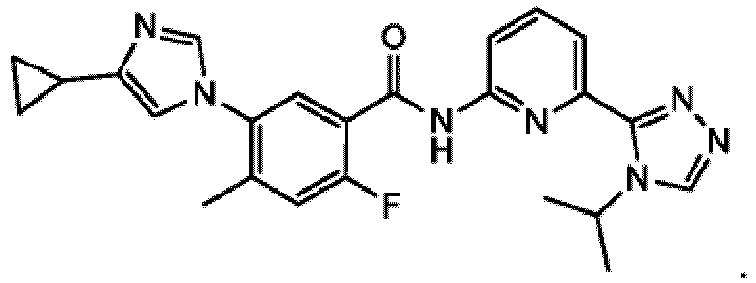
- Agoniste de FXR pour une utilisation selon la revendication 5 ou 6, où l'inhibiteur de ASK1 et l'agoniste de FXR sont administrés ensemble.
- Agoniste de FXR pour une utilisation selon la revendication 5 ou 6, où l'inhibiteur de ASK1 et l'agoniste de FXR sont administrés séparément.
- Composition pharmaceutique comprenant un inhibiteur de ASK1 et un agoniste de FXR, où l'inhibiteur de ASK1 est un composé de la formule (I):
 R1 est un alkyle, un alcényle, un alcynyle, un cycloalkyle, un aryle, un hétéroaryle ou un hétérocyclyle, dans lequel l'alkyle, l'alcényle, l'alcynyle, le cycloalkyle, l'aryle, l'hétéroaryle et l'hétérocyclyle sont optionnellement substitués avec de un à trois substituants choisis parmi halo, oxo, alkyle, cycloalkyle, hétérocyclyle, aryle, aryloxy,-NO2, R6, -C(O)-R6, -OC(O)-R6-C(O)-O-R6, C(O)-N(R6)(R7), -OC(O)-N(R6)(R7), -S-R6,-S(=O)-R6, -S(=O)2R6, -S(=O)2-N(R6)(R7), -S(=O)2-O-R6, -N(R6)(R7), -N(R6)-C(O)-R7,-N(R6)-C(O)-O-R7, -N(R6)-C(O)-N(R6)(R7), -N(R6)-S(=O)2-R6, -CN et -O-R6 et dans lequel l'alkyle, le cycloalkyle, l'hétérocyclyle, le phényle et le phénoxy sont optionnellement substitués par de un à trois substituants choisis parmi alkyle, cycloalkyle, alcoxy, hydroxyle et halo; dans lequel R6 et R7 sont indépendamment choisis dans le groupe constitué de: hydrogène, C1-C15 alkyle, cycloalkyle, hétérocyclyle, aryle et hétéroaryle, tous étant optionnellement substitués avec de un à trois substituants choisis parmi halo, alkyle, monoalkylamino, dialkylamino, alkylamide, arylamide, hétéroarylamide, -CN, alcoxy inférieur, -CF3, aryle et hétéroaryle; ouR6 et R7 lorsqu'ils sont pris ensemble avec l'azote auquel ils sont attachés forment un hétérocycle;R2 est un hydrogène, un halo, un cyano, un alcoxy ou un alkyle optionnellement substitué par un halo;R3 est un aryle, un hétéroaryle ou un hétérocyclyle, dans lequel l'aryle, l'hétéroaryle et l'hétérocyclyle sont optionnellement substitués avec de un à cinq substituants choisis parmi alkyle, alcoxy, cycloalkyle, cycloalkylalkyle, aryle, arylalkyle, hétéroaryle, hétéroarylalkyle, hétérocyclyle, hétérocyclylalkyle, halo, oxo, -NO2, haloalkyle, haloalcoxy, -CN, -O-R6, -O-C(O)-R6, -O-C(O)-N(R6)(R7), -S-R6, -N(R6)(R7), -S(=O)-R6, -S(=O)2R6, -S(=O)2-N(R6)(R7), -S(=O)2-O-R6, -N(R6)-C(O)-R7, -N(R6)-C(O)-O-R7, -N(R6)-C(O)-N(R6)(R7), -C(O)-R6, -C(O)-R6, -C(O)-N(R6)(R7) et -N(R6)-S(=O)2-R7, dans lequel l'alkyle, l'alcoxy, le cycloalkyle, l'aryle, l'hétéroaryle ou l'hétérocyclyle est optionnellement substitué avec de un à cinq substituants choisis parmi halo, oxo,-NO2, alkyle, haloalkyle, haloalcoxy, -N(R6)(R7), -C(O)-R6, -C(O)-O-R6, -C(O)-N(R6)(R7), -CN, -O-R6, cycloalkyle, aryle, hétéroaryle et hétérocyclyle; sous réserve que la fraction hétéroaryle ou hétérocyclyle inclue au moins un atome d'azote de cycle;X1, X2, X3, X4, X5, X6, X7 et X8 sont indépendamment C(R4) ou N, dans lequel chaque R4 est indépendamment un hydrogène, un alkyle, un alcoxy, un cycloalkyle, un aryle, un hétéroaryle, un hétérocyclyle, un halo, -NO2, un haloalkyle, un haloalcoxy, -CN, N(R6)-C(O)-R7, -N(R6)-C(O)-O-R7, -N(R6)-C(O)-N(R6)(R7), -C(O)-R6, -C(O)-O-R6,-C(O)-N(R6)(R7) ou -N(R6)-S(=O)2-R7, dans lequel l'alkyle, le cycloalkyle, l'aryle, l'hétéroaryle et l'hétérocyclyle sont en outre optionnellement substitués avec de un à cinq substituants choisis parmi halo, oxo, -NO2,-CF3, -O-CF3, -N(R6)(R7), -C(O)-R6, -C(O)-OR7, -C(O)-N(R6)(R7), -CN, -O-R6; ouX5 et X6 ou X6 et X7 sont joints pour donner un aryle condensé optionnellement substitué ou un hétéroaryle condensé optionnellement substitué; etsous réserve que au moins un de X2, X3 et X4 soit C(R4); au moins deux de X5, X6, X7 et X8 soient C(R4); et au moins un de X2, X3, X4, X5, X6, X7 et X8 soit N;ou un sel pharmaceutiquement acceptable, un isomère ou un mélange de ceux-ci.
 - Composition pharmaceutique selon la revendication 9, dans laquelle l'inhibiteur de ASK1 présente la structure suivante:

- Composition pharmaceutique selon la revendication 9 ou 10, comprenant en outre un véhicule pharmaceutiquement acceptable.
Priority Applications (1)
| Application Number | Priority Date | Filing Date | Title |
|---|---|---|---|
| EP19162659.7A EP3524243A1 (fr) | 2014-09-24 | 2015-09-22 | Procédés de traitement des maladies du foie |
Applications Claiming Priority (2)
| Application Number | Priority Date | Filing Date | Title |
|---|---|---|---|
| US201462054767P | 2014-09-24 | 2014-09-24 | |
| PCT/US2015/051529 WO2016049069A1 (fr) | 2014-09-24 | 2015-09-22 | Procédé de traitement d'une maladie hépatique |
Related Child Applications (2)
| Application Number | Title | Priority Date | Filing Date |
|---|---|---|---|
| EP19162659.7A Division EP3524243A1 (fr) | 2014-09-24 | 2015-09-22 | Procédés de traitement des maladies du foie |
| EP19162659.7A Division-Into EP3524243A1 (fr) | 2014-09-24 | 2015-09-22 | Procédés de traitement des maladies du foie |
Publications (2)
| Publication Number | Publication Date |
|---|---|
| EP3197448A1 EP3197448A1 (fr) | 2017-08-02 |
| EP3197448B1 true EP3197448B1 (fr) | 2019-04-24 |
Family
ID=54256843
Family Applications (2)
| Application Number | Title | Priority Date | Filing Date |
|---|---|---|---|
| EP15775551.3A Active EP3197448B1 (fr) | 2014-09-24 | 2015-09-22 | Procédé de traitement d'une maladie hépatique |
| EP19162659.7A Withdrawn EP3524243A1 (fr) | 2014-09-24 | 2015-09-22 | Procédés de traitement des maladies du foie |
Family Applications After (1)
| Application Number | Title | Priority Date | Filing Date |
|---|---|---|---|
| EP19162659.7A Withdrawn EP3524243A1 (fr) | 2014-09-24 | 2015-09-22 | Procédés de traitement des maladies du foie |
Country Status (14)
| Country | Link |
|---|---|
| US (1) | US10238636B2 (fr) |
| EP (2) | EP3197448B1 (fr) |
| JP (2) | JP2017528471A (fr) |
| KR (2) | KR20190035960A (fr) |
| CN (1) | CN106714841A (fr) |
| AU (2) | AU2015320792B2 (fr) |
| BR (1) | BR112017005693A2 (fr) |
| CA (1) | CA2962572A1 (fr) |
| EA (1) | EA201790398A1 (fr) |
| ES (1) | ES2731602T3 (fr) |
| MX (1) | MX2017003933A (fr) |
| NZ (1) | NZ729678A (fr) |
| SG (1) | SG11201701723XA (fr) |
| WO (1) | WO2016049069A1 (fr) |
Families Citing this family (32)
| Publication number | Priority date | Publication date | Assignee | Title |
|---|---|---|---|---|
| TWI491606B (zh) | 2009-07-13 | 2015-07-11 | Gilead Sciences Inc | 調節細胞凋亡信號之激酶的抑制劑 |
| TWI685491B (zh) | 2014-12-23 | 2020-02-21 | 美商基利科學股份有限公司 | 製備5-(4-環丙基-1h-咪唑-1-基)-n-(6-(4-異丙基-4h-1,2,4-三唑-3-基)吡啶-2-基)-2-氟-4-甲基苯甲醯胺之方法 |
| KR101974793B1 (ko) | 2015-07-06 | 2019-05-02 | 길리애드 사이언시즈, 인코포레이티드 | Cot 조정제 및 그의 사용 방법 |
| CA3042398A1 (fr) * | 2016-11-11 | 2018-05-17 | Gilead Sciences, Inc. | Procede de traitement d'une maladie hepatique |
| WO2018094964A1 (fr) * | 2016-11-25 | 2018-05-31 | 武汉大学 | Procédé avec 1n-dimérisation de kinase régulée par un signal apoptotique servant de cible pour le criblage d'un médicament utilisé pour traiter la stéatohépatite |
| CN108114284A (zh) * | 2016-11-30 | 2018-06-05 | 中国药科大学 | Fxr激动剂与凋亡抑制剂联用在制备优效抗肝纤维化药物中的应用 |
| JOP20190221A1 (ar) | 2017-04-05 | 2019-09-23 | Seal Rock Therapeutics Inc | مركبات مثبطات كيناز منظم لإشارات الاستماتة 1 (ask1) واستخداماتها |
| AU2018250614A1 (en) * | 2017-04-12 | 2019-10-17 | Gilead Sciences, Inc. | Methods of treating liver disease |
| CN110869017B (zh) | 2017-05-12 | 2023-05-05 | 英安塔制药有限公司 | 细胞凋亡信号调节激酶1抑制剂及其使用方法 |
| US10253018B2 (en) | 2017-05-25 | 2019-04-09 | Enanta Pharmaceuticals, Inc. | Apoptosis signal-regulating kinase 1 inhibitors and methods of use thereof |
| WO2018218044A2 (fr) | 2017-05-25 | 2018-11-29 | Enanta Pharmaceuticals Inc | Inhibiteurs de la kinase 1 de régulation de signal d'apoptose et leurs méthodes d'utilisation |
| WO2018218051A1 (fr) | 2017-05-25 | 2018-11-29 | Enanta Pharmaceuticals, Inc. | Inhibiteurs de kinase 1 de régulation du signal apoptotique, et leurs méthodes d'utilisation |
| CN109400625B (zh) * | 2017-08-17 | 2021-11-12 | 广东东阳光药业有限公司 | 稠合双环类化合物及其在药物中的应用 |
| WO2019046186A1 (fr) | 2017-08-28 | 2019-03-07 | Enanta Pharmaceuticals, Inc. | Inhibiteurs de la kinase 1 régulant le signal apoptotique contenant des tétrazoles et méthodes d'utilisation de ceux-ci |
| US10370352B2 (en) | 2017-09-07 | 2019-08-06 | Eli Lilly And Company | Cyclobutyl-imidazolidinone compounds |
| WO2019047094A1 (fr) * | 2017-09-07 | 2019-03-14 | Eli Lilly And Company | Composés de cyclobutyle-imidazolidinone |
| CN111801314B (zh) | 2018-01-02 | 2023-10-31 | 西尔洛克治疗公司 | Ask1抑制剂化合物及其用途 |
| EP3787621B1 (fr) | 2018-05-02 | 2024-12-18 | Enanta Pharmaceuticals, Inc. | Inhibiteurs de la kinase 1 régulant le signal d'apoptose contenant des tétrazoles et leurs méthodes d'utilisation |
| WO2019213239A1 (fr) | 2018-05-02 | 2019-11-07 | Enanta Pharmaceuticals Inc. | Inhibiteurs de la kinase 1 régulant le signal d'apoptose et leurs méthodes d'utilisation |
| US10968199B2 (en) | 2018-08-22 | 2021-04-06 | Enanta Pharmaceuticals, Inc. | Cycloalkyl-containing apoptosis signal-regulating kinase 1 inhibitors and methods of use thereof |
| WO2020106707A1 (fr) | 2018-11-19 | 2020-05-28 | Enanta Pharmaceuticals, Inc. | Inhibiteurs de la kinase 1 régulant le signal d'apoptose et leurs méthodes d'utilisation |
| US11466033B2 (en) | 2019-03-25 | 2022-10-11 | Enanta Pharmaceuticals, Inc. | Substituted pyridines as apoptosis signal-regulating kinase 1 inhibitors |
| TWI770527B (zh) | 2019-06-14 | 2022-07-11 | 美商基利科學股份有限公司 | Cot 調節劑及其使用方法 |
| US20230105984A1 (en) | 2019-12-23 | 2023-04-06 | Svetlana Marukian | Compositions and methods for the treatment of liver diseases and disorders |
| AU2021249010B2 (en) | 2020-03-30 | 2024-09-26 | Gilead Sciences, Inc. | Solid forms of (S)-6-(((1-(bicyclo[1.1.1]pentan-1-yl)-1H-1,2,3-triazol-4-yl)2-methyl-1-oxo-1,2- dihydroisoquinolin-5-yl)methyl)))amino)8-chloro-(neopentylamino)quinoline-3-carb onitrile a cot inhibitor compound |
| JP7446475B2 (ja) | 2020-04-02 | 2024-03-08 | ギリアード サイエンシーズ, インコーポレイテッド | Cot阻害剤化合物を調製するためのプロセス |
| US11478533B2 (en) | 2020-04-27 | 2022-10-25 | Novo Nordisk A/S | Semaglutide for use in medicine |
| CN111690657A (zh) * | 2020-05-22 | 2020-09-22 | 河南大学 | Fxr激动剂在生物人工肝种子细胞中的应用 |
| EP4304711A1 (fr) | 2021-03-11 | 2024-01-17 | Gilead Sciences, Inc. | Composés modulateurs de glp-1r |
| CA3214961A1 (fr) | 2021-03-29 | 2022-10-06 | Gilead Sciences, Inc. | Inhibiteurs de khk |
| TW202304435A (zh) | 2021-06-04 | 2023-02-01 | 美商基利科學股份有限公司 | 治療nash之方法 |
| TW202311256A (zh) | 2021-06-18 | 2023-03-16 | 美商基利科學股份有限公司 | 用於治療fxr誘發之搔癢之il-31調節劑 |
Family Cites Families (44)
| Publication number | Priority date | Publication date | Assignee | Title |
|---|---|---|---|---|
| WO1998034946A1 (fr) | 1997-02-12 | 1998-08-13 | Massachusetts Institute Of Technology | Daxx, nouvelle proteine fixatrice de fas activant une jnk (kinase n-terminale de jun) et l'apoptose |
| US6881555B2 (en) | 1999-03-19 | 2005-04-19 | Aventis Pharmaceuticals Inc. | AKT nucleic acids, polypeptides, and uses thereof |
| DE60039677D1 (de) | 1999-03-19 | 2008-09-11 | Aventis Pharma Inc | Akt-3 nukleinsäure, polypeptide und deren verwendung |
| US20070237770A1 (en) | 2001-11-30 | 2007-10-11 | Albert Lai | Novel compositions and methods in cancer |
| US6987121B2 (en) * | 2002-04-25 | 2006-01-17 | Smithkline Beecham Corporation | Compositions and methods for hepatoprotection and treatment of cholestasis |
| EP1661581A1 (fr) | 2003-07-28 | 2006-05-31 | Osaka Industrial Promotion Organization | Traitement de l'insuffisance cardiaque contenant comme principe actif un inhibiteur d'ask1 et procede de criblage de celui-ci |
| WO2005032549A1 (fr) * | 2003-09-26 | 2005-04-14 | Smithkline Beecham Corporation | Compositions et procedes pour traiter une fibrose |
| US7544697B2 (en) * | 2003-10-03 | 2009-06-09 | Coley Pharmaceutical Group, Inc. | Pyrazolopyridines and analogs thereof |
| WO2006036941A2 (fr) | 2004-09-27 | 2006-04-06 | Kosan Biosciences Incorporated | Inhibiteurs de kinases specifiques |
| EP1819341A4 (fr) | 2004-11-10 | 2011-06-29 | Synta Pharmaceuticals Corp | Composes modulateurs de la il-12 |
| EP1677113A1 (fr) | 2004-12-29 | 2006-07-05 | Max-Delbrück-Centrum für Molekulare Medizin (MDC) | Procédé d'identification des interactions protéine-protéine dans des réseaux de protéines associés aux maladies |
| US20070276050A1 (en) | 2006-02-27 | 2007-11-29 | Gilead Sciences, Inc. | Methods for identifying ASK1 inhibitors useful for preventing and/or treating cardiovascular diseases |
| US7932244B2 (en) | 2006-06-27 | 2011-04-26 | Intercept Pharmaceuticals, Inc. | Bile acid derivatives as FXR ligands for the prevention or treatment of FXR-mediated diseases or conditions |
| US20100029619A1 (en) | 2006-08-04 | 2010-02-04 | Takeda Pharmaceutical Company Limted | Fused heterocyclic compound |
| EP1894928A1 (fr) | 2006-08-29 | 2008-03-05 | PheneX Pharmaceuticals AG | Composes heterocycliques de liaison au fxr |
| EP1894924A1 (fr) | 2006-08-29 | 2008-03-05 | Phenex Pharmaceuticals AG | Composés hétérocycliques de liason du FXR |
| WO2008042867A2 (fr) | 2006-09-29 | 2008-04-10 | Emiliem Inc. | Modulateurs de kinases multiples |
| EP2104734A2 (fr) | 2006-12-08 | 2009-09-30 | Asuragen, INC. | Gènes et voies génétiques régulés par le mir-20 en tant que cibles en vue d'une intervention thérapeutique |
| MX2009013946A (es) * | 2007-07-02 | 2010-03-10 | Glaxosmithkline Llc | Agonistas del receptor de farnesoide x. |
| US20090069288A1 (en) | 2007-07-16 | 2009-03-12 | Breinlinger Eric C | Novel therapeutic compounds |
| CA2691448A1 (fr) | 2007-08-31 | 2009-03-05 | Dominique Swinnen | Composes de triazolopyridine et leur utilisation comme inhibiteurs de ask |
| EP2271646A1 (fr) | 2008-03-31 | 2011-01-12 | Takeda Pharmaceutical Company Limited | Inhibiteurs de kinase 1 de régulation de signal d'apoptose |
| US8178555B2 (en) | 2008-06-24 | 2012-05-15 | Takeda Pharmaceutical Company Limited | Apoptosis signal-regulating kinase 1 inhibitors |
| US20110263441A1 (en) | 2008-10-15 | 2011-10-27 | Golub Todd R | Compositions, kits, and methods for identification, assessment, prevention, and therapy of hepatic disorders |
| US20110294693A1 (en) | 2008-11-17 | 2011-12-01 | The George Washington University | Compositions and Methods for Identifying Autism Spectrum Disorders |
| JP2012521760A (ja) | 2009-03-27 | 2012-09-20 | メルク・シャープ・エンド・ドーム・コーポレイション | 低分子干渉核酸(siNA)を用いたアポトーシスシグナル調節キナーゼ1(ASK1)遺伝子発現のRNA干渉媒介性阻害 |
| TWI491606B (zh) | 2009-07-13 | 2015-07-11 | Gilead Sciences Inc | 調節細胞凋亡信號之激酶的抑制劑 |
| EP2289883A1 (fr) | 2009-08-19 | 2011-03-02 | Phenex Pharmaceuticals AG | Nouveaux composés modulant l'activité du recepteur FXR (NR1H4) |
| WO2011041293A1 (fr) | 2009-09-30 | 2011-04-07 | Takeda Pharmaceutical Company Limited | Dérivés pyrazolo [1, 5a] pyrimidines comme inhibiteurs de kinase 1 régulatrice de signal d'apoptose |
| PL2531501T3 (pl) | 2010-02-03 | 2014-05-30 | Takeda Pharmaceuticals Co | Inhibitory kinazy 1 regulującej sygnał apoptotyczny |
| WO2011097594A2 (fr) | 2010-02-08 | 2011-08-11 | Kinagen, Inc. | Methodes therapeutiques et compositions impliquant l'inhibition de la kinase allosterique |
| ES2677356T3 (es) | 2010-03-24 | 2018-08-01 | Amitech Therapeutics Solutions, Inc. | Compuestos heterocíclicos útiles para la inhibición de quinasas |
| SI2588475T1 (sl) | 2010-07-02 | 2015-12-31 | Gilead Sciences, Inc. | Kinazni inhibitorji za regulacijo apoptoznega signala |
| WO2012068464A2 (fr) | 2010-11-18 | 2012-05-24 | University Of Delaware | Procédés de traitement et de prévention de maladies thrombotiques utilisant des inhibiteurs de l'ask1 |
| EP2651417B1 (fr) | 2010-12-16 | 2016-11-30 | Calchan Limited | Dérivés pyrrolopyrimidine inhibant ask1 |
| WO2012087521A1 (fr) | 2010-12-20 | 2012-06-28 | Irm Llc | Compositions et procédés de modulation des récepteurs farnésoïdes x |
| WO2012115885A1 (fr) | 2011-02-22 | 2012-08-30 | Caris Life Sciences Luxembourg Holdings, S.A.R.L. | Biomarqueurs circulants |
| KR20140076543A (ko) | 2011-06-07 | 2014-06-20 | 카리스 라이프 사이언스 룩셈부르크 홀딩스, 에스.에이.알.엘. | 암에 대한 순환하는 생물지표들 |
| TW201837023A (zh) | 2011-07-01 | 2018-10-16 | 美商基利科學股份有限公司 | 作為離子通道調節劑之稠合雜環化合物 |
| ES2683350T3 (es) | 2011-07-08 | 2018-09-26 | Novartis Ag | Método para tratar la aterosclerosis en sujetos con alto nivel de triglicéridos |
| EP2545964A1 (fr) | 2011-07-13 | 2013-01-16 | Phenex Pharmaceuticals AG | Nouveaux composés se liant au fxr (nr1 h4) et modulant son activité |
| UY34573A (es) | 2012-01-27 | 2013-06-28 | Gilead Sciences Inc | Inhibidor de la quinasa que regula la señal de la apoptosis |
| UY35212A (es) | 2012-12-21 | 2014-06-30 | Gilead Sciences Inc | Inhibidores de la quinasa que regula la señal de la apoptosis |
| US20140187633A1 (en) | 2012-12-31 | 2014-07-03 | Amarin Pharmaceuticals Ireland Limited | Methods of treating or preventing nonalcoholic steatohepatitis and/or primary biliary cirrhosis |
-
2015
- 2015-09-22 EP EP15775551.3A patent/EP3197448B1/fr active Active
- 2015-09-22 US US15/508,968 patent/US10238636B2/en active Active
- 2015-09-22 MX MX2017003933A patent/MX2017003933A/es unknown
- 2015-09-22 ES ES15775551T patent/ES2731602T3/es active Active
- 2015-09-22 KR KR1020197008835A patent/KR20190035960A/ko not_active Withdrawn
- 2015-09-22 SG SG11201701723XA patent/SG11201701723XA/en unknown
- 2015-09-22 KR KR1020177010571A patent/KR20170049605A/ko not_active Ceased
- 2015-09-22 JP JP2017513625A patent/JP2017528471A/ja active Pending
- 2015-09-22 WO PCT/US2015/051529 patent/WO2016049069A1/fr not_active Ceased
- 2015-09-22 CN CN201580051481.1A patent/CN106714841A/zh active Pending
- 2015-09-22 AU AU2015320792A patent/AU2015320792B2/en not_active Ceased
- 2015-09-22 CA CA2962572A patent/CA2962572A1/fr not_active Abandoned
- 2015-09-22 BR BR112017005693A patent/BR112017005693A2/pt not_active Application Discontinuation
- 2015-09-22 EP EP19162659.7A patent/EP3524243A1/fr not_active Withdrawn
- 2015-09-22 NZ NZ729678A patent/NZ729678A/en not_active IP Right Cessation
- 2015-09-22 EA EA201790398A patent/EA201790398A1/ru unknown
-
2018
- 2018-09-05 JP JP2018165957A patent/JP2018188478A/ja active Pending
- 2018-11-28 AU AU2018271289A patent/AU2018271289A1/en not_active Abandoned
Non-Patent Citations (1)
| Title |
|---|
| None * |
Also Published As
| Publication number | Publication date |
|---|---|
| US20170273952A1 (en) | 2017-09-28 |
| JP2018188478A (ja) | 2018-11-29 |
| EP3197448A1 (fr) | 2017-08-02 |
| KR20170049605A (ko) | 2017-05-10 |
| AU2015320792B2 (en) | 2018-08-30 |
| US10238636B2 (en) | 2019-03-26 |
| NZ729678A (en) | 2018-07-27 |
| CA2962572A1 (fr) | 2016-03-31 |
| EP3524243A1 (fr) | 2019-08-14 |
| MX2017003933A (es) | 2017-06-30 |
| KR20190035960A (ko) | 2019-04-03 |
| BR112017005693A2 (pt) | 2017-12-12 |
| ES2731602T3 (es) | 2019-11-18 |
| AU2015320792A1 (en) | 2017-03-23 |
| CN106714841A (zh) | 2017-05-24 |
| JP2017528471A (ja) | 2017-09-28 |
| WO2016049069A1 (fr) | 2016-03-31 |
| SG11201701723XA (en) | 2017-04-27 |
| AU2018271289A1 (en) | 2018-12-20 |
| EA201790398A1 (ru) | 2017-11-30 |
Similar Documents
| Publication | Publication Date | Title |
|---|---|---|
| EP3197448B1 (fr) | Procédé de traitement d'une maladie hépatique | |
| JP7033642B2 (ja) | 選択的s1p1レセプターアゴニストを含む薬学的合剤 | |
| AU2017249602A1 (en) | Methods of treatment for cholestatic and fibrotic diseases | |
| WO2016049070A1 (fr) | Procédé de traitement d'une maladie hépatique | |
| KR101380140B1 (ko) | 트리아세틸-3-히드록실페닐아데노신 및 혈지조절에 대한 용도 | |
| KR20150063035A (ko) | 지질 이상증 치료제 | |
| AU2016235263A1 (en) | Methods of treating liver disease using indane acetic acid derivatives | |
| KR20160106052A (ko) | 심장 리모델링 및 기타 심장 병태의 치료 | |
| JP2019513762A (ja) | 胆汁うっ滞及び線維症の処置方法 | |
| EP3569250A1 (fr) | Médicament pour la prévention et le traitement de stéatose hépatique non alcoolique | |
| JP6878596B2 (ja) | Fxrアゴニストの組合せ | |
| US11607417B2 (en) | Uses of celastrol in preventing and/or treating cholestatic liver disease and liver fibrosis | |
| EP2573081B1 (fr) | Agent prophylactique et/ou thérapeutique pour une stéatohépatite non alcoolique | |
| HK40012742A (en) | Methods of treating liver disease | |
| HK1236398B (en) | Methods of treating liver disease | |
| HK1236398A1 (en) | Methods of treating liver disease | |
| HK1233970A1 (en) | Methods of treating liver disease | |
| KR20230043773A (ko) | 염증복합체 억제제를 유효성분으로 함유하는, 비알코올성 지방간염, 간 섬유화의 예방, 개선 또는 치료용 약학적 조성물 | |
| TW202311256A (zh) | 用於治療fxr誘發之搔癢之il-31調節劑 | |
| EP1844775A1 (fr) | Agent thérapeutique pour le traitement de l'herpès génital | |
| CN116925049A (zh) | 新型联苯类衍生物、其制备方法及其作为药物的用途 | |
| HK40073361A (en) | Drug for treatment of nonalcoholic fatty liver disease | |
| CN121606564A (zh) | 吡喃萘醌类化合物的应用及治疗肝纤维化的药物组合物 |
Legal Events
| Date | Code | Title | Description |
|---|---|---|---|
| STAA | Information on the status of an ep patent application or granted ep patent |
Free format text: STATUS: THE INTERNATIONAL PUBLICATION HAS BEEN MADE |
|
| PUAI | Public reference made under article 153(3) epc to a published international application that has entered the european phase |
Free format text: ORIGINAL CODE: 0009012 |
|
| STAA | Information on the status of an ep patent application or granted ep patent |
Free format text: STATUS: REQUEST FOR EXAMINATION WAS MADE |
|
| 17P | Request for examination filed |
Effective date: 20170327 |
|
| AK | Designated contracting states |
Kind code of ref document: A1 Designated state(s): AL AT BE BG CH CY CZ DE DK EE ES FI FR GB GR HR HU IE IS IT LI LT LU LV MC MK MT NL NO PL PT RO RS SE SI SK SM TR |
|
| AX | Request for extension of the european patent |
Extension state: BA ME |
|
| DAV | Request for validation of the european patent (deleted) | ||
| DAX | Request for extension of the european patent (deleted) | ||
| STAA | Information on the status of an ep patent application or granted ep patent |
Free format text: STATUS: EXAMINATION IS IN PROGRESS |
|
| REG | Reference to a national code |
Ref country code: HK Ref legal event code: DE Ref document number: 1236398 Country of ref document: HK |
|
| 17Q | First examination report despatched |
Effective date: 20180308 |
|
| GRAP | Despatch of communication of intention to grant a patent |
Free format text: ORIGINAL CODE: EPIDOSNIGR1 |
|
| STAA | Information on the status of an ep patent application or granted ep patent |
Free format text: STATUS: GRANT OF PATENT IS INTENDED |
|
| RIC1 | Information provided on ipc code assigned before grant |
Ipc: A61K 31/42 20060101AFI20181011BHEP Ipc: A61K 31/4439 20060101ALI20181011BHEP Ipc: A61P 1/16 20060101ALI20181011BHEP Ipc: A61K 45/06 20060101ALI20181011BHEP |
|
| INTG | Intention to grant announced |
Effective date: 20181105 |
|
| GRAS | Grant fee paid |
Free format text: ORIGINAL CODE: EPIDOSNIGR3 |
|
| GRAA | (expected) grant |
Free format text: ORIGINAL CODE: 0009210 |
|
| STAA | Information on the status of an ep patent application or granted ep patent |
Free format text: STATUS: THE PATENT HAS BEEN GRANTED |
|
| AK | Designated contracting states |
Kind code of ref document: B1 Designated state(s): AL AT BE BG CH CY CZ DE DK EE ES FI FR GB GR HR HU IE IS IT LI LT LU LV MC MK MT NL NO PL PT RO RS SE SI SK SM TR |
|
| REG | Reference to a national code |
Ref country code: GB Ref legal event code: FG4D |
|
| REG | Reference to a national code |
Ref country code: CH Ref legal event code: EP |
|
| REG | Reference to a national code |
Ref country code: AT Ref legal event code: REF Ref document number: 1123309 Country of ref document: AT Kind code of ref document: T Effective date: 20190515 Ref country code: IE Ref legal event code: FG4D |
|
| REG | Reference to a national code |
Ref country code: DE Ref legal event code: R096 Ref document number: 602015028957 Country of ref document: DE |
|
| REG | Reference to a national code |
Ref country code: NL Ref legal event code: MP Effective date: 20190424 |
|
| REG | Reference to a national code |
Ref country code: LT Ref legal event code: MG4D |
|
| PG25 | Lapsed in a contracting state [announced via postgrant information from national office to epo] |
Ref country code: NL Free format text: LAPSE BECAUSE OF FAILURE TO SUBMIT A TRANSLATION OF THE DESCRIPTION OR TO PAY THE FEE WITHIN THE PRESCRIBED TIME-LIMIT Effective date: 20190424 |
|
| PG25 | Lapsed in a contracting state [announced via postgrant information from national office to epo] |
Ref country code: SE Free format text: LAPSE BECAUSE OF FAILURE TO SUBMIT A TRANSLATION OF THE DESCRIPTION OR TO PAY THE FEE WITHIN THE PRESCRIBED TIME-LIMIT Effective date: 20190424 Ref country code: LT Free format text: LAPSE BECAUSE OF FAILURE TO SUBMIT A TRANSLATION OF THE DESCRIPTION OR TO PAY THE FEE WITHIN THE PRESCRIBED TIME-LIMIT Effective date: 20190424 Ref country code: AL Free format text: LAPSE BECAUSE OF FAILURE TO SUBMIT A TRANSLATION OF THE DESCRIPTION OR TO PAY THE FEE WITHIN THE PRESCRIBED TIME-LIMIT Effective date: 20190424 Ref country code: NO Free format text: LAPSE BECAUSE OF FAILURE TO SUBMIT A TRANSLATION OF THE DESCRIPTION OR TO PAY THE FEE WITHIN THE PRESCRIBED TIME-LIMIT Effective date: 20190724 Ref country code: PT Free format text: LAPSE BECAUSE OF FAILURE TO SUBMIT A TRANSLATION OF THE DESCRIPTION OR TO PAY THE FEE WITHIN THE PRESCRIBED TIME-LIMIT Effective date: 20190824 Ref country code: HR Free format text: LAPSE BECAUSE OF FAILURE TO SUBMIT A TRANSLATION OF THE DESCRIPTION OR TO PAY THE FEE WITHIN THE PRESCRIBED TIME-LIMIT Effective date: 20190424 Ref country code: FI Free format text: LAPSE BECAUSE OF FAILURE TO SUBMIT A TRANSLATION OF THE DESCRIPTION OR TO PAY THE FEE WITHIN THE PRESCRIBED TIME-LIMIT Effective date: 20190424 |
|
| REG | Reference to a national code |
Ref country code: ES Ref legal event code: FG2A Ref document number: 2731602 Country of ref document: ES Kind code of ref document: T3 Effective date: 20191118 |
|
| PG25 | Lapsed in a contracting state [announced via postgrant information from national office to epo] |
Ref country code: PL Free format text: LAPSE BECAUSE OF FAILURE TO SUBMIT A TRANSLATION OF THE DESCRIPTION OR TO PAY THE FEE WITHIN THE PRESCRIBED TIME-LIMIT Effective date: 20190424 Ref country code: GR Free format text: LAPSE BECAUSE OF FAILURE TO SUBMIT A TRANSLATION OF THE DESCRIPTION OR TO PAY THE FEE WITHIN THE PRESCRIBED TIME-LIMIT Effective date: 20190725 Ref country code: LV Free format text: LAPSE BECAUSE OF FAILURE TO SUBMIT A TRANSLATION OF THE DESCRIPTION OR TO PAY THE FEE WITHIN THE PRESCRIBED TIME-LIMIT Effective date: 20190424 Ref country code: BG Free format text: LAPSE BECAUSE OF FAILURE TO SUBMIT A TRANSLATION OF THE DESCRIPTION OR TO PAY THE FEE WITHIN THE PRESCRIBED TIME-LIMIT Effective date: 20190724 Ref country code: RS Free format text: LAPSE BECAUSE OF FAILURE TO SUBMIT A TRANSLATION OF THE DESCRIPTION OR TO PAY THE FEE WITHIN THE PRESCRIBED TIME-LIMIT Effective date: 20190424 |
|
| REG | Reference to a national code |
Ref country code: AT Ref legal event code: MK05 Ref document number: 1123309 Country of ref document: AT Kind code of ref document: T Effective date: 20190424 |
|
| PG25 | Lapsed in a contracting state [announced via postgrant information from national office to epo] |
Ref country code: IS Free format text: LAPSE BECAUSE OF FAILURE TO SUBMIT A TRANSLATION OF THE DESCRIPTION OR TO PAY THE FEE WITHIN THE PRESCRIBED TIME-LIMIT Effective date: 20190824 |
|
| REG | Reference to a national code |
Ref country code: DE Ref legal event code: R097 Ref document number: 602015028957 Country of ref document: DE |
|
| PG25 | Lapsed in a contracting state [announced via postgrant information from national office to epo] |
Ref country code: DK Free format text: LAPSE BECAUSE OF FAILURE TO SUBMIT A TRANSLATION OF THE DESCRIPTION OR TO PAY THE FEE WITHIN THE PRESCRIBED TIME-LIMIT Effective date: 20190424 Ref country code: AT Free format text: LAPSE BECAUSE OF FAILURE TO SUBMIT A TRANSLATION OF THE DESCRIPTION OR TO PAY THE FEE WITHIN THE PRESCRIBED TIME-LIMIT Effective date: 20190424 Ref country code: EE Free format text: LAPSE BECAUSE OF FAILURE TO SUBMIT A TRANSLATION OF THE DESCRIPTION OR TO PAY THE FEE WITHIN THE PRESCRIBED TIME-LIMIT Effective date: 20190424 Ref country code: RO Free format text: LAPSE BECAUSE OF FAILURE TO SUBMIT A TRANSLATION OF THE DESCRIPTION OR TO PAY THE FEE WITHIN THE PRESCRIBED TIME-LIMIT Effective date: 20190424 Ref country code: SK Free format text: LAPSE BECAUSE OF FAILURE TO SUBMIT A TRANSLATION OF THE DESCRIPTION OR TO PAY THE FEE WITHIN THE PRESCRIBED TIME-LIMIT Effective date: 20190424 Ref country code: CZ Free format text: LAPSE BECAUSE OF FAILURE TO SUBMIT A TRANSLATION OF THE DESCRIPTION OR TO PAY THE FEE WITHIN THE PRESCRIBED TIME-LIMIT Effective date: 20190424 |
|
| PG25 | Lapsed in a contracting state [announced via postgrant information from national office to epo] |
Ref country code: SM Free format text: LAPSE BECAUSE OF FAILURE TO SUBMIT A TRANSLATION OF THE DESCRIPTION OR TO PAY THE FEE WITHIN THE PRESCRIBED TIME-LIMIT Effective date: 20190424 |
|
| PLBE | No opposition filed within time limit |
Free format text: ORIGINAL CODE: 0009261 |
|
| STAA | Information on the status of an ep patent application or granted ep patent |
Free format text: STATUS: NO OPPOSITION FILED WITHIN TIME LIMIT |
|
| PG25 | Lapsed in a contracting state [announced via postgrant information from national office to epo] |
Ref country code: TR Free format text: LAPSE BECAUSE OF FAILURE TO SUBMIT A TRANSLATION OF THE DESCRIPTION OR TO PAY THE FEE WITHIN THE PRESCRIBED TIME-LIMIT Effective date: 20190424 |
|
| 26N | No opposition filed |
Effective date: 20200127 |
|
| PG25 | Lapsed in a contracting state [announced via postgrant information from national office to epo] |
Ref country code: SI Free format text: LAPSE BECAUSE OF FAILURE TO SUBMIT A TRANSLATION OF THE DESCRIPTION OR TO PAY THE FEE WITHIN THE PRESCRIBED TIME-LIMIT Effective date: 20190424 Ref country code: MC Free format text: LAPSE BECAUSE OF FAILURE TO SUBMIT A TRANSLATION OF THE DESCRIPTION OR TO PAY THE FEE WITHIN THE PRESCRIBED TIME-LIMIT Effective date: 20190424 |
|
| REG | Reference to a national code |
Ref country code: CH Ref legal event code: PL |
|
| PG25 | Lapsed in a contracting state [announced via postgrant information from national office to epo] |
Ref country code: LI Free format text: LAPSE BECAUSE OF NON-PAYMENT OF DUE FEES Effective date: 20190930 Ref country code: LU Free format text: LAPSE BECAUSE OF NON-PAYMENT OF DUE FEES Effective date: 20190922 Ref country code: CH Free format text: LAPSE BECAUSE OF NON-PAYMENT OF DUE FEES Effective date: 20190930 |
|
| REG | Reference to a national code |
Ref country code: BE Ref legal event code: MM Effective date: 20190930 |
|
| PG25 | Lapsed in a contracting state [announced via postgrant information from national office to epo] |
Ref country code: BE Free format text: LAPSE BECAUSE OF NON-PAYMENT OF DUE FEES Effective date: 20190930 |
|
| PG25 | Lapsed in a contracting state [announced via postgrant information from national office to epo] |
Ref country code: CY Free format text: LAPSE BECAUSE OF FAILURE TO SUBMIT A TRANSLATION OF THE DESCRIPTION OR TO PAY THE FEE WITHIN THE PRESCRIBED TIME-LIMIT Effective date: 20190424 |
|
| PG25 | Lapsed in a contracting state [announced via postgrant information from national office to epo] |
Ref country code: HU Free format text: LAPSE BECAUSE OF FAILURE TO SUBMIT A TRANSLATION OF THE DESCRIPTION OR TO PAY THE FEE WITHIN THE PRESCRIBED TIME-LIMIT; INVALID AB INITIO Effective date: 20150922 Ref country code: MT Free format text: LAPSE BECAUSE OF FAILURE TO SUBMIT A TRANSLATION OF THE DESCRIPTION OR TO PAY THE FEE WITHIN THE PRESCRIBED TIME-LIMIT Effective date: 20190424 |
|
| PG25 | Lapsed in a contracting state [announced via postgrant information from national office to epo] |
Ref country code: MK Free format text: LAPSE BECAUSE OF FAILURE TO SUBMIT A TRANSLATION OF THE DESCRIPTION OR TO PAY THE FEE WITHIN THE PRESCRIBED TIME-LIMIT Effective date: 20190424 |
|
| PGFP | Annual fee paid to national office [announced via postgrant information from national office to epo] |
Ref country code: DE Payment date: 20250702 Year of fee payment: 11 |
|
| PGFP | Annual fee paid to national office [announced via postgrant information from national office to epo] |
Ref country code: IT Payment date: 20250825 Year of fee payment: 11 |
|
| PGFP | Annual fee paid to national office [announced via postgrant information from national office to epo] |
Ref country code: GB Payment date: 20250703 Year of fee payment: 11 |
|
| PGFP | Annual fee paid to national office [announced via postgrant information from national office to epo] |
Ref country code: FR Payment date: 20250808 Year of fee payment: 11 |
|
| PGFP | Annual fee paid to national office [announced via postgrant information from national office to epo] |
Ref country code: IE Payment date: 20250702 Year of fee payment: 11 |
|
| PGFP | Annual fee paid to national office [announced via postgrant information from national office to epo] |
Ref country code: ES Payment date: 20251015 Year of fee payment: 11 |