EP3223330B1 - Élément électroluminescent organique - Google Patents
Élément électroluminescent organique Download PDFInfo
- Publication number
- EP3223330B1 EP3223330B1 EP15861554.2A EP15861554A EP3223330B1 EP 3223330 B1 EP3223330 B1 EP 3223330B1 EP 15861554 A EP15861554 A EP 15861554A EP 3223330 B1 EP3223330 B1 EP 3223330B1
- Authority
- EP
- European Patent Office
- Prior art keywords
- substituted
- group
- unsubstituted
- substituent
- carbon atoms
- Prior art date
- Legal status (The legal status is an assumption and is not a legal conclusion. Google has not performed a legal analysis and makes no representation as to the accuracy of the status listed.)
- Active
Links
- 0 CN(C)C1(*)c(cc(cc2)N(c3ccccc3)c(cc3)ccc3C(C=CC3)=CC3C(C=C3)=CCC3N(c3ccccc3)c3cccc4c3cccc4)c2-c2c1cccc2 Chemical compound CN(C)C1(*)c(cc(cc2)N(c3ccccc3)c(cc3)ccc3C(C=CC3)=CC3C(C=C3)=CCC3N(c3ccccc3)c3cccc4c3cccc4)c2-c2c1cccc2 0.000 description 46
- BALNSBUTXBXWBF-UHFFFAOYSA-N C(C1)C=CC=C1c1c(cccc2)c2c(-c2cc(-c3nc(-c(cc4)ccc4-c4cnccc4)cc(-c4ccccc4)n3)ccc2)c2c1cccc2 Chemical compound C(C1)C=CC=C1c1c(cccc2)c2c(-c2cc(-c3nc(-c(cc4)ccc4-c4cnccc4)cc(-c4ccccc4)n3)ccc2)c2c1cccc2 BALNSBUTXBXWBF-UHFFFAOYSA-N 0.000 description 1
- PBVXTPYYYXMFLY-UHFFFAOYSA-N C(C1)C=NC=C1c1cccc(-c2cc(-c3cccc(-c4cnccc4)c3)nc(-c3cccc(-c4c(cccc5)c5c(-c5ccccc5)c5c4cccc5)c3)n2)c1 Chemical compound C(C1)C=NC=C1c1cccc(-c2cc(-c3cccc(-c4cnccc4)c3)nc(-c3cccc(-c4c(cccc5)c5c(-c5ccccc5)c5c4cccc5)c3)n2)c1 PBVXTPYYYXMFLY-UHFFFAOYSA-N 0.000 description 1
- ZACZWFZZJJPLQO-UHFFFAOYSA-N CC(C)(C)c(cc1)ccc1N(c(cc1)ccc1[Si](C)(C)C)c(cc1C23c4ccccc4-c4ccccc24)ccc1-c(c1c2c4ccccc4[s]1)c3cc2N(c1ccc(C(C)(C)C)cc1)c(cc1)ccc1S(C)C Chemical compound CC(C)(C)c(cc1)ccc1N(c(cc1)ccc1[Si](C)(C)C)c(cc1C23c4ccccc4-c4ccccc24)ccc1-c(c1c2c4ccccc4[s]1)c3cc2N(c1ccc(C(C)(C)C)cc1)c(cc1)ccc1S(C)C ZACZWFZZJJPLQO-UHFFFAOYSA-N 0.000 description 1
- QXRDZNLDRDKTDV-UHFFFAOYSA-N CC1(C)c2cc(N(c(cc3)ccc3-c3ccccc3)c3ccccc3-c(cc3)ccc3-c(cccc3)c3N(c3ccccc3)c3cccc4c3cccc4)ccc2-c2c1cccc2 Chemical compound CC1(C)c2cc(N(c(cc3)ccc3-c3ccccc3)c3ccccc3-c(cc3)ccc3-c(cccc3)c3N(c3ccccc3)c3cccc4c3cccc4)ccc2-c2c1cccc2 QXRDZNLDRDKTDV-UHFFFAOYSA-N 0.000 description 1
- WQNSGVFQRADQIY-UHFFFAOYSA-N COC1=CC=CC2=CC[IH]N=C12 Chemical compound COC1=CC=CC2=CC[IH]N=C12 WQNSGVFQRADQIY-UHFFFAOYSA-N 0.000 description 1
- AFSGCRGBKICCFF-UHFFFAOYSA-N Cc(cc1)cc2c1c1ccccc1c1ccccc21 Chemical compound Cc(cc1)cc2c1c1ccccc1c1ccccc21 AFSGCRGBKICCFF-UHFFFAOYSA-N 0.000 description 1
- PVEMZXATQZZCON-UHFFFAOYSA-N Cc1ccc2c(-c3nc(-c4cc(-c5c(cccc6)c6c(-c6ccccc6)c6c5cccc6)ccc4)nc(-c4cc(-c5cccnc5)ccc4)c3)cc(cccc3)c3c2c1 Chemical compound Cc1ccc2c(-c3nc(-c4cc(-c5c(cccc6)c6c(-c6ccccc6)c6c5cccc6)ccc4)nc(-c4cc(-c5cccnc5)ccc4)c3)cc(cccc3)c3c2c1 PVEMZXATQZZCON-UHFFFAOYSA-N 0.000 description 1
- MQUOMZXGCHOVAB-UHFFFAOYSA-N Cc1cccc(N(c(cc2)ccc2-c2ccccc2)c(cc2)ccc2-c(cc2)ccc2-c(cc2)ccc2N(c(cc2)ccc2-c2ccccc2)c2cccc(C)c2)c1 Chemical compound Cc1cccc(N(c(cc2)ccc2-c2ccccc2)c(cc2)ccc2-c(cc2)ccc2-c(cc2)ccc2N(c(cc2)ccc2-c2ccccc2)c2cccc(C)c2)c1 MQUOMZXGCHOVAB-UHFFFAOYSA-N 0.000 description 1
- QEFWOJYFPHAVHR-UHFFFAOYSA-N c(cc1)ccc1-c(cc1)ccc1-[n]1c2ccncc2c2cc(-c(cc3)cc4c3c(-c3ccccc3)c(cccc3)c3c4-c3ccccc3)ccc12 Chemical compound c(cc1)ccc1-c(cc1)ccc1-[n]1c2ccncc2c2cc(-c(cc3)cc4c3c(-c3ccccc3)c(cccc3)c3c4-c3ccccc3)ccc12 QEFWOJYFPHAVHR-UHFFFAOYSA-N 0.000 description 1
- XKGCYUXTEWVZDI-UHFFFAOYSA-N c(cc1)ccc1-c1c(ccc(-c(cccc2)c2-c(cc2)cc(c3c4ccnc3)c2[n]4-c2ccccc2)c2)c2c(-c2ccccc2)c2c1cccc2 Chemical compound c(cc1)ccc1-c1c(ccc(-c(cccc2)c2-c(cc2)cc(c3c4ccnc3)c2[n]4-c2ccccc2)c2)c2c(-c2ccccc2)c2c1cccc2 XKGCYUXTEWVZDI-UHFFFAOYSA-N 0.000 description 1
- FVXWVNJHMBHFQZ-UHFFFAOYSA-N c(cc1)ccc1-c1c(cccc2)c2c(-c2cc(-c3nc(-c(cc4)ccc4-c4cnccc4)cc(-c4cc(cccc5)c5cc4)n3)ccc2)c2c1cccc2 Chemical compound c(cc1)ccc1-c1c(cccc2)c2c(-c2cc(-c3nc(-c(cc4)ccc4-c4cnccc4)cc(-c4cc(cccc5)c5cc4)n3)ccc2)c2c1cccc2 FVXWVNJHMBHFQZ-UHFFFAOYSA-N 0.000 description 1
- ROERWSUDUZDSHJ-UHFFFAOYSA-N c(cc1)ccc1-c1c(cccc2)c2c(-c2ccccc2)c2c1ccc(-c1cc(-c(cc3c4c5ccnc4)ccc3[n]5-c3ccccc3)ccc1)c2 Chemical compound c(cc1)ccc1-c1c(cccc2)c2c(-c2ccccc2)c2c1ccc(-c1cc(-c(cc3c4c5ccnc4)ccc3[n]5-c3ccccc3)ccc1)c2 ROERWSUDUZDSHJ-UHFFFAOYSA-N 0.000 description 1
- CZZLMMKKCPYCPU-UHFFFAOYSA-N c(cc1)ccc1-c1nccc2c1c1cc(-c(cc3)cc4c3c(-c3cccc5c3cccc5)c(cccc3)c3c4-c3c(cccc4)c4ccc3)ccc1[n]2-c1ccccc1 Chemical compound c(cc1)ccc1-c1nccc2c1c1cc(-c(cc3)cc4c3c(-c3cccc5c3cccc5)c(cccc3)c3c4-c3c(cccc4)c4ccc3)ccc1[n]2-c1ccccc1 CZZLMMKKCPYCPU-UHFFFAOYSA-N 0.000 description 1
- BXHAWLIXYVFTHN-UHFFFAOYSA-N c(ccc1c2)cc1ccc2-c1c(cccc2)c2c(-c2cc(cccc3)c3cc2)c2c1ccc(-c(cc1c3c4ccnc3-c3cnccc3)ccc1[n]4-c1cc(cccc3)c3c3c1cccc3)c2 Chemical compound c(ccc1c2)cc1ccc2-c1c(cccc2)c2c(-c2cc(cccc3)c3cc2)c2c1ccc(-c(cc1c3c4ccnc3-c3cnccc3)ccc1[n]4-c1cc(cccc3)c3c3c1cccc3)c2 BXHAWLIXYVFTHN-UHFFFAOYSA-N 0.000 description 1
Images

Classifications
-
- H—ELECTRICITY
- H10—SEMICONDUCTOR DEVICES; ELECTRIC SOLID-STATE DEVICES NOT OTHERWISE PROVIDED FOR
- H10K—ORGANIC ELECTRIC SOLID-STATE DEVICES
- H10K85/00—Organic materials used in the body or electrodes of devices covered by this subclass
- H10K85/60—Organic compounds having low molecular weight
- H10K85/631—Amine compounds having at least two aryl rest on at least one amine-nitrogen atom, e.g. triphenylamine
-
- C—CHEMISTRY; METALLURGY
- C09—DYES; PAINTS; POLISHES; NATURAL RESINS; ADHESIVES; COMPOSITIONS NOT OTHERWISE PROVIDED FOR; APPLICATIONS OF MATERIALS NOT OTHERWISE PROVIDED FOR
- C09B—ORGANIC DYES OR CLOSELY-RELATED COMPOUNDS FOR PRODUCING DYES, e.g. PIGMENTS; MORDANTS; LAKES
- C09B57/00—Other synthetic dyes of known constitution
- C09B57/008—Triarylamine dyes containing no other chromophores
-
- C—CHEMISTRY; METALLURGY
- C07—ORGANIC CHEMISTRY
- C07C—ACYCLIC OR CARBOCYCLIC COMPOUNDS
- C07C211/00—Compounds containing amino groups bound to a carbon skeleton
- C07C211/43—Compounds containing amino groups bound to a carbon skeleton having amino groups bound to carbon atoms of six-membered aromatic rings of the carbon skeleton
- C07C211/54—Compounds containing amino groups bound to a carbon skeleton having amino groups bound to carbon atoms of six-membered aromatic rings of the carbon skeleton having amino groups bound to two or three six-membered aromatic rings
-
- C—CHEMISTRY; METALLURGY
- C07—ORGANIC CHEMISTRY
- C07C—ACYCLIC OR CARBOCYCLIC COMPOUNDS
- C07C211/00—Compounds containing amino groups bound to a carbon skeleton
- C07C211/43—Compounds containing amino groups bound to a carbon skeleton having amino groups bound to carbon atoms of six-membered aromatic rings of the carbon skeleton
- C07C211/57—Compounds containing amino groups bound to a carbon skeleton having amino groups bound to carbon atoms of six-membered aromatic rings of the carbon skeleton having amino groups bound to carbon atoms of six-membered aromatic rings being part of condensed ring systems of the carbon skeleton
- C07C211/58—Naphthylamines; N-substituted derivatives thereof
-
- C—CHEMISTRY; METALLURGY
- C07—ORGANIC CHEMISTRY
- C07C—ACYCLIC OR CARBOCYCLIC COMPOUNDS
- C07C211/00—Compounds containing amino groups bound to a carbon skeleton
- C07C211/43—Compounds containing amino groups bound to a carbon skeleton having amino groups bound to carbon atoms of six-membered aromatic rings of the carbon skeleton
- C07C211/57—Compounds containing amino groups bound to a carbon skeleton having amino groups bound to carbon atoms of six-membered aromatic rings of the carbon skeleton having amino groups bound to carbon atoms of six-membered aromatic rings being part of condensed ring systems of the carbon skeleton
- C07C211/61—Compounds containing amino groups bound to a carbon skeleton having amino groups bound to carbon atoms of six-membered aromatic rings of the carbon skeleton having amino groups bound to carbon atoms of six-membered aromatic rings being part of condensed ring systems of the carbon skeleton with at least one of the condensed ring systems formed by three or more rings
-
- C—CHEMISTRY; METALLURGY
- C07—ORGANIC CHEMISTRY
- C07D—HETEROCYCLIC COMPOUNDS
- C07D209/00—Heterocyclic compounds containing five-membered rings, condensed with other rings, with one nitrogen atom as the only ring hetero atom
- C07D209/02—Heterocyclic compounds containing five-membered rings, condensed with other rings, with one nitrogen atom as the only ring hetero atom condensed with one carbocyclic ring
- C07D209/04—Indoles; Hydrogenated indoles
- C07D209/10—Indoles; Hydrogenated indoles with substituted hydrocarbon radicals attached to carbon atoms of the hetero ring
- C07D209/14—Radicals substituted by nitrogen atoms, not forming part of a nitro radical
-
- C—CHEMISTRY; METALLURGY
- C07—ORGANIC CHEMISTRY
- C07D—HETEROCYCLIC COMPOUNDS
- C07D209/00—Heterocyclic compounds containing five-membered rings, condensed with other rings, with one nitrogen atom as the only ring hetero atom
- C07D209/56—Ring systems containing three or more rings
- C07D209/96—Spiro-condensed ring systems
-
- C—CHEMISTRY; METALLURGY
- C07—ORGANIC CHEMISTRY
- C07D—HETEROCYCLIC COMPOUNDS
- C07D307/00—Heterocyclic compounds containing five-membered rings having one oxygen atom as the only ring hetero atom
- C07D307/77—Heterocyclic compounds containing five-membered rings having one oxygen atom as the only ring hetero atom ortho- or peri-condensed with carbocyclic rings or ring systems
-
- C—CHEMISTRY; METALLURGY
- C07—ORGANIC CHEMISTRY
- C07D—HETEROCYCLIC COMPOUNDS
- C07D493/00—Heterocyclic compounds containing oxygen atoms as the only ring hetero atoms in the condensed system
- C07D493/02—Heterocyclic compounds containing oxygen atoms as the only ring hetero atoms in the condensed system in which the condensed system contains two hetero rings
- C07D493/10—Spiro-condensed systems
-
- C—CHEMISTRY; METALLURGY
- C07—ORGANIC CHEMISTRY
- C07D—HETEROCYCLIC COMPOUNDS
- C07D495/00—Heterocyclic compounds containing in the condensed system at least one hetero ring having sulfur atoms as the only ring hetero atoms
- C07D495/02—Heterocyclic compounds containing in the condensed system at least one hetero ring having sulfur atoms as the only ring hetero atoms in which the condensed system contains two hetero rings
- C07D495/10—Spiro-condensed systems
-
- C—CHEMISTRY; METALLURGY
- C07—ORGANIC CHEMISTRY
- C07F—ACYCLIC, CARBOCYCLIC OR HETEROCYCLIC COMPOUNDS CONTAINING ELEMENTS OTHER THAN CARBON, HYDROGEN, HALOGEN, OXYGEN, NITROGEN, SULFUR, SELENIUM OR TELLURIUM
- C07F7/00—Compounds containing elements of Groups 4 or 14 of the Periodic Table
- C07F7/02—Silicon compounds
- C07F7/08—Compounds having one or more C—Si linkages
- C07F7/0803—Compounds with Si-C or Si-Si linkages
- C07F7/081—Compounds with Si-C or Si-Si linkages comprising at least one atom selected from the elements N, O, halogen, S, Se or Te
- C07F7/0812—Compounds with Si-C or Si-Si linkages comprising at least one atom selected from the elements N, O, halogen, S, Se or Te comprising a heterocyclic ring
-
- C—CHEMISTRY; METALLURGY
- C09—DYES; PAINTS; POLISHES; NATURAL RESINS; ADHESIVES; COMPOSITIONS NOT OTHERWISE PROVIDED FOR; APPLICATIONS OF MATERIALS NOT OTHERWISE PROVIDED FOR
- C09K—MATERIALS FOR MISCELLANEOUS APPLICATIONS, NOT PROVIDED FOR ELSEWHERE
- C09K11/00—Luminescent materials, e.g. electroluminescent or chemiluminescent
- C09K11/06—Luminescent materials, e.g. electroluminescent or chemiluminescent containing organic luminescent materials
-
- H—ELECTRICITY
- H10—SEMICONDUCTOR DEVICES; ELECTRIC SOLID-STATE DEVICES NOT OTHERWISE PROVIDED FOR
- H10K—ORGANIC ELECTRIC SOLID-STATE DEVICES
- H10K50/00—Organic light-emitting devices
-
- H—ELECTRICITY
- H10—SEMICONDUCTOR DEVICES; ELECTRIC SOLID-STATE DEVICES NOT OTHERWISE PROVIDED FOR
- H10K—ORGANIC ELECTRIC SOLID-STATE DEVICES
- H10K50/00—Organic light-emitting devices
- H10K50/10—OLEDs or polymer light-emitting diodes [PLED]
- H10K50/11—OLEDs or polymer light-emitting diodes [PLED] characterised by the electroluminescent [EL] layers
-
- H—ELECTRICITY
- H10—SEMICONDUCTOR DEVICES; ELECTRIC SOLID-STATE DEVICES NOT OTHERWISE PROVIDED FOR
- H10K—ORGANIC ELECTRIC SOLID-STATE DEVICES
- H10K85/00—Organic materials used in the body or electrodes of devices covered by this subclass
- H10K85/40—Organosilicon compounds, e.g. TIPS pentacene
-
- H—ELECTRICITY
- H10—SEMICONDUCTOR DEVICES; ELECTRIC SOLID-STATE DEVICES NOT OTHERWISE PROVIDED FOR
- H10K—ORGANIC ELECTRIC SOLID-STATE DEVICES
- H10K85/00—Organic materials used in the body or electrodes of devices covered by this subclass
- H10K85/60—Organic compounds having low molecular weight
- H10K85/615—Polycyclic condensed aromatic hydrocarbons, e.g. anthracene
-
- H—ELECTRICITY
- H10—SEMICONDUCTOR DEVICES; ELECTRIC SOLID-STATE DEVICES NOT OTHERWISE PROVIDED FOR
- H10K—ORGANIC ELECTRIC SOLID-STATE DEVICES
- H10K85/00—Organic materials used in the body or electrodes of devices covered by this subclass
- H10K85/60—Organic compounds having low molecular weight
- H10K85/631—Amine compounds having at least two aryl rest on at least one amine-nitrogen atom, e.g. triphenylamine
- H10K85/633—Amine compounds having at least two aryl rest on at least one amine-nitrogen atom, e.g. triphenylamine comprising polycyclic condensed aromatic hydrocarbons as substituents on the nitrogen atom
-
- H—ELECTRICITY
- H10—SEMICONDUCTOR DEVICES; ELECTRIC SOLID-STATE DEVICES NOT OTHERWISE PROVIDED FOR
- H10K—ORGANIC ELECTRIC SOLID-STATE DEVICES
- H10K85/00—Organic materials used in the body or electrodes of devices covered by this subclass
- H10K85/60—Organic compounds having low molecular weight
- H10K85/631—Amine compounds having at least two aryl rest on at least one amine-nitrogen atom, e.g. triphenylamine
- H10K85/636—Amine compounds having at least two aryl rest on at least one amine-nitrogen atom, e.g. triphenylamine comprising heteroaromatic hydrocarbons as substituents on the nitrogen atom
-
- H—ELECTRICITY
- H10—SEMICONDUCTOR DEVICES; ELECTRIC SOLID-STATE DEVICES NOT OTHERWISE PROVIDED FOR
- H10K—ORGANIC ELECTRIC SOLID-STATE DEVICES
- H10K85/00—Organic materials used in the body or electrodes of devices covered by this subclass
- H10K85/60—Organic compounds having low molecular weight
- H10K85/649—Aromatic compounds comprising a hetero atom
- H10K85/657—Polycyclic condensed heteroaromatic hydrocarbons
-
- H—ELECTRICITY
- H10—SEMICONDUCTOR DEVICES; ELECTRIC SOLID-STATE DEVICES NOT OTHERWISE PROVIDED FOR
- H10K—ORGANIC ELECTRIC SOLID-STATE DEVICES
- H10K85/00—Organic materials used in the body or electrodes of devices covered by this subclass
- H10K85/60—Organic compounds having low molecular weight
- H10K85/649—Aromatic compounds comprising a hetero atom
- H10K85/657—Polycyclic condensed heteroaromatic hydrocarbons
- H10K85/6572—Polycyclic condensed heteroaromatic hydrocarbons comprising only nitrogen in the heteroaromatic polycondensed ring system, e.g. phenanthroline or carbazole
-
- C—CHEMISTRY; METALLURGY
- C07—ORGANIC CHEMISTRY
- C07C—ACYCLIC OR CARBOCYCLIC COMPOUNDS
- C07C2603/00—Systems containing at least three condensed rings
- C07C2603/02—Ortho- or ortho- and peri-condensed systems
- C07C2603/04—Ortho- or ortho- and peri-condensed systems containing three rings
- C07C2603/06—Ortho- or ortho- and peri-condensed systems containing three rings containing at least one ring with less than six ring members
- C07C2603/10—Ortho- or ortho- and peri-condensed systems containing three rings containing at least one ring with less than six ring members containing five-membered rings
- C07C2603/12—Ortho- or ortho- and peri-condensed systems containing three rings containing at least one ring with less than six ring members containing five-membered rings only one five-membered ring
- C07C2603/18—Fluorenes; Hydrogenated fluorenes
-
- C—CHEMISTRY; METALLURGY
- C07—ORGANIC CHEMISTRY
- C07C—ACYCLIC OR CARBOCYCLIC COMPOUNDS
- C07C2603/00—Systems containing at least three condensed rings
- C07C2603/02—Ortho- or ortho- and peri-condensed systems
- C07C2603/40—Ortho- or ortho- and peri-condensed systems containing four condensed rings
- C07C2603/42—Ortho- or ortho- and peri-condensed systems containing four condensed rings containing only six-membered rings
-
- C—CHEMISTRY; METALLURGY
- C07—ORGANIC CHEMISTRY
- C07C—ACYCLIC OR CARBOCYCLIC COMPOUNDS
- C07C2603/00—Systems containing at least three condensed rings
- C07C2603/93—Spiro compounds
- C07C2603/95—Spiro compounds containing "not free" spiro atoms
- C07C2603/96—Spiro compounds containing "not free" spiro atoms containing at least one ring with less than six members
- C07C2603/97—Spiro compounds containing "not free" spiro atoms containing at least one ring with less than six members containing five-membered rings
-
- C—CHEMISTRY; METALLURGY
- C07—ORGANIC CHEMISTRY
- C07D—HETEROCYCLIC COMPOUNDS
- C07D209/00—Heterocyclic compounds containing five-membered rings, condensed with other rings, with one nitrogen atom as the only ring hetero atom
- C07D209/56—Ring systems containing three or more rings
- C07D209/80—[b, c]- or [b, d]-condensed
-
- C—CHEMISTRY; METALLURGY
- C07—ORGANIC CHEMISTRY
- C07D—HETEROCYCLIC COMPOUNDS
- C07D495/00—Heterocyclic compounds containing in the condensed system at least one hetero ring having sulfur atoms as the only ring hetero atoms
- C07D495/02—Heterocyclic compounds containing in the condensed system at least one hetero ring having sulfur atoms as the only ring hetero atoms in which the condensed system contains two hetero rings
- C07D495/04—Ortho-condensed systems
-
- C—CHEMISTRY; METALLURGY
- C09—DYES; PAINTS; POLISHES; NATURAL RESINS; ADHESIVES; COMPOSITIONS NOT OTHERWISE PROVIDED FOR; APPLICATIONS OF MATERIALS NOT OTHERWISE PROVIDED FOR
- C09K—MATERIALS FOR MISCELLANEOUS APPLICATIONS, NOT PROVIDED FOR ELSEWHERE
- C09K2211/00—Chemical nature of organic luminescent or tenebrescent compounds
- C09K2211/10—Non-macromolecular compounds
- C09K2211/1003—Carbocyclic compounds
- C09K2211/1007—Non-condensed systems
-
- C—CHEMISTRY; METALLURGY
- C09—DYES; PAINTS; POLISHES; NATURAL RESINS; ADHESIVES; COMPOSITIONS NOT OTHERWISE PROVIDED FOR; APPLICATIONS OF MATERIALS NOT OTHERWISE PROVIDED FOR
- C09K—MATERIALS FOR MISCELLANEOUS APPLICATIONS, NOT PROVIDED FOR ELSEWHERE
- C09K2211/00—Chemical nature of organic luminescent or tenebrescent compounds
- C09K2211/10—Non-macromolecular compounds
- C09K2211/1003—Carbocyclic compounds
- C09K2211/1011—Condensed systems
-
- C—CHEMISTRY; METALLURGY
- C09—DYES; PAINTS; POLISHES; NATURAL RESINS; ADHESIVES; COMPOSITIONS NOT OTHERWISE PROVIDED FOR; APPLICATIONS OF MATERIALS NOT OTHERWISE PROVIDED FOR
- C09K—MATERIALS FOR MISCELLANEOUS APPLICATIONS, NOT PROVIDED FOR ELSEWHERE
- C09K2211/00—Chemical nature of organic luminescent or tenebrescent compounds
- C09K2211/10—Non-macromolecular compounds
- C09K2211/1003—Carbocyclic compounds
- C09K2211/1014—Carbocyclic compounds bridged by heteroatoms, e.g. N, P, Si or B
-
- C—CHEMISTRY; METALLURGY
- C09—DYES; PAINTS; POLISHES; NATURAL RESINS; ADHESIVES; COMPOSITIONS NOT OTHERWISE PROVIDED FOR; APPLICATIONS OF MATERIALS NOT OTHERWISE PROVIDED FOR
- C09K—MATERIALS FOR MISCELLANEOUS APPLICATIONS, NOT PROVIDED FOR ELSEWHERE
- C09K2211/00—Chemical nature of organic luminescent or tenebrescent compounds
- C09K2211/10—Non-macromolecular compounds
- C09K2211/1018—Heterocyclic compounds
-
- H—ELECTRICITY
- H10—SEMICONDUCTOR DEVICES; ELECTRIC SOLID-STATE DEVICES NOT OTHERWISE PROVIDED FOR
- H10K—ORGANIC ELECTRIC SOLID-STATE DEVICES
- H10K2101/00—Properties of the organic materials covered by group H10K85/00
- H10K2101/10—Triplet emission
-
- H—ELECTRICITY
- H10—SEMICONDUCTOR DEVICES; ELECTRIC SOLID-STATE DEVICES NOT OTHERWISE PROVIDED FOR
- H10K—ORGANIC ELECTRIC SOLID-STATE DEVICES
- H10K50/00—Organic light-emitting devices
- H10K50/10—OLEDs or polymer light-emitting diodes [PLED]
- H10K50/14—Carrier transporting layers
- H10K50/15—Hole transporting layers
-
- H—ELECTRICITY
- H10—SEMICONDUCTOR DEVICES; ELECTRIC SOLID-STATE DEVICES NOT OTHERWISE PROVIDED FOR
- H10K—ORGANIC ELECTRIC SOLID-STATE DEVICES
- H10K50/00—Organic light-emitting devices
- H10K50/10—OLEDs or polymer light-emitting diodes [PLED]
- H10K50/14—Carrier transporting layers
- H10K50/15—Hole transporting layers
- H10K50/156—Hole transporting layers comprising a multilayered structure
-
- H—ELECTRICITY
- H10—SEMICONDUCTOR DEVICES; ELECTRIC SOLID-STATE DEVICES NOT OTHERWISE PROVIDED FOR
- H10K—ORGANIC ELECTRIC SOLID-STATE DEVICES
- H10K50/00—Organic light-emitting devices
- H10K50/10—OLEDs or polymer light-emitting diodes [PLED]
- H10K50/14—Carrier transporting layers
- H10K50/16—Electron transporting layers
-
- H—ELECTRICITY
- H10—SEMICONDUCTOR DEVICES; ELECTRIC SOLID-STATE DEVICES NOT OTHERWISE PROVIDED FOR
- H10K—ORGANIC ELECTRIC SOLID-STATE DEVICES
- H10K85/00—Organic materials used in the body or electrodes of devices covered by this subclass
- H10K85/30—Coordination compounds
- H10K85/341—Transition metal complexes, e.g. Ru(II)polypyridine complexes
- H10K85/342—Transition metal complexes, e.g. Ru(II)polypyridine complexes comprising iridium
-
- H—ELECTRICITY
- H10—SEMICONDUCTOR DEVICES; ELECTRIC SOLID-STATE DEVICES NOT OTHERWISE PROVIDED FOR
- H10K—ORGANIC ELECTRIC SOLID-STATE DEVICES
- H10K85/00—Organic materials used in the body or electrodes of devices covered by this subclass
- H10K85/60—Organic compounds having low molecular weight
- H10K85/615—Polycyclic condensed aromatic hydrocarbons, e.g. anthracene
- H10K85/622—Polycyclic condensed aromatic hydrocarbons, e.g. anthracene containing four rings, e.g. pyrene
-
- H—ELECTRICITY
- H10—SEMICONDUCTOR DEVICES; ELECTRIC SOLID-STATE DEVICES NOT OTHERWISE PROVIDED FOR
- H10K—ORGANIC ELECTRIC SOLID-STATE DEVICES
- H10K85/00—Organic materials used in the body or electrodes of devices covered by this subclass
- H10K85/60—Organic compounds having low molecular weight
- H10K85/615—Polycyclic condensed aromatic hydrocarbons, e.g. anthracene
- H10K85/626—Polycyclic condensed aromatic hydrocarbons, e.g. anthracene containing more than one polycyclic condensed aromatic rings, e.g. bis-anthracene
-
- H—ELECTRICITY
- H10—SEMICONDUCTOR DEVICES; ELECTRIC SOLID-STATE DEVICES NOT OTHERWISE PROVIDED FOR
- H10K—ORGANIC ELECTRIC SOLID-STATE DEVICES
- H10K85/00—Organic materials used in the body or electrodes of devices covered by this subclass
- H10K85/60—Organic compounds having low molecular weight
- H10K85/649—Aromatic compounds comprising a hetero atom
- H10K85/657—Polycyclic condensed heteroaromatic hydrocarbons
- H10K85/6574—Polycyclic condensed heteroaromatic hydrocarbons comprising only oxygen in the heteroaromatic polycondensed ring system, e.g. cumarine dyes
Definitions
- the present invention relates to an organic electroluminescent device which is a preferred self-luminous device for various display devices. Specifically, this invention relates to organic electroluminescent devices (hereinafter referred to as organic EL devices) using specific arylamine compounds and specific amine derivatives having a condensed ring structure (and specific compounds having an anthracene ring structure).
- organic EL devices organic electroluminescent devices
- the organic EL device is a self-luminous device and has been actively studied for their brighter, superior visibility and the ability to display clearer images in comparison with liquid crystal devices.
- Non-Patent Document 2 for example
- Non-Patent Document 3 Devices that use light emission caused by thermally activated delayed fluorescence (TADF) have also been developed.
- TADF thermally activated delayed fluorescence
- the light emitting layer can be also fabricated by doping a charge-transporting compound generally called a host material, with a fluorescent compound, a phosphorescence-emitting compound, or a delayed fluorescent-emitting material.
- a charge-transporting compound generally called a host material
- a fluorescent compound e.g., a fluorescent compound
- a phosphorescence-emitting compound e.g., a fluorescent compound
- a delayed fluorescent-emitting material e.g., a delayed fluorescent-emitting material.
- Heat resistance and amorphousness of the materials are also important with respect to the lifetime of the device.
- the materials with low heat resistance cause thermal decomposition even at a low temperature by heat generated during the drive of the device, which leads to the deterioration of the materials.
- the materials with low amorphousness cause crystallization of a thin film even in a short time and lead to the deterioration of the device.
- the materials in use are therefore required to have characteristics of high heat resistance and satisfactory amorphousness.
- NPD N,N'-diphenyl-N,N'-di( ⁇ -naphthyl)benzidine
- various aromatic amine derivatives are known as the hole transport materials used for the organic EL device (refer to Patent Documents 1 and 2, for example).
- NPD has desirable hole transportability, its glass transition point (Tg), which is an index of heat resistance, is as low as 96°C, which causes the degradation of device characteristics by crystallization under a high-temperature condition (refer to Non-Patent Document 4, for example).
- Tg glass transition point
- the aromatic amine derivatives described in the Patent Documents include a compound known to have an excellent hole mobility of 10 -3 cm 2 /Vs or higher (refer to Patent Documents 1 and 2, for example).
- WO2014129201 (A ) discloses an organic electroluminescence device which is a self-luminous element suitable for various display devices, and more particularly an organic electroluminescence device using a specific arylamine compound.
- Arylamine compounds having a substituted carbazole structure are proposed as compounds improved in the characteristics such as heat resistance and hole injectability (refer to Patent Documents 4 and 5, for example).
- the devices using these compounds for the hole injection layer or the hole transport layer have been improved in heat resistance, luminous efficiency and the like, the improvements are still insufficient. Further lower driving voltage and higher luminous efficiency are therefore needed.
- An object of the present invention is to provide an organic EL device having low driving voltage, high luminous efficiency, and a long lifetime, by combining various materials for an organic EL device, which are excellent, as materials for an organic EL device having high efficiency and high durability, in hole and electron injection/transport performances, electron blocking ability, stability in a thin-film state and durability, so as to allow the respective materials to effectively reveal their characteristics.
- Physical properties of the organic EL device to be provided by the present invention include (1) high luminous efficiency and high power efficiency, (2) low actual driving voltage, and (3) a long lifetime.
- an arylamine material is excellent in hole injection and transport abilities, stability as a thin film and durability
- amine derivatives having a condensed ring structure are excellent in luminous efficiency. They have selected specific arylamine compounds and amine derivatives having specific structures and having a condensed ring structure, and have produced various organic EL devices by combining a hole transport material and a light-emitting material such that holes can be efficiently injected and transported into a light emitting layer. Then, they have intensively conducted characteristic evaluations of the devices. Also, they have noted that compounds having an anthracene ring structure are excellent in electron injection and transport abilities, stability as a thin film and durability.
- the organic EL devices according to the claims are provided.
- aromatic hydrocarbon group the "aromatic heterocyclic group”, or the “condensed polycyclic aromatic group” in the "substituted or unsubstituted aromatic hydrocarbon group", the "substituted or unsubstituted aromatic heterocyclic group”, or the "substituted or unsubstituted condensed polycyclic aromatic group” represented by Ar 1 to Ar 4 in the general formula (1)
- substituted aromatic hydrocarbon group examples include a deuterium atom; cyano; nitro; halogen atoms such as a fluorine atom, a chlorine atom, a bromine atom, and an iodine atom; linear or branched alkyls of 1 to 6 carbon atoms such as methyl, ethyl, n-propyl, isopropyl, n-butyl, isobutyl, tert-butyl, n-pentyl, isopentyl, neopentyl, and n-hexyl; linear or branched alkyloxy of 1 to 6 carbon atoms such as methyloxy, ethyloxy, and propyloxy; alkenyl such
- substituents may be further substituted with the exemplified substituents above. These substituents may bind to each other via a single bond, substituted or unsubstituted methylene, an oxygen atom, or a sulfur atom to form a ring.
- the "divalent group of a substituted or unsubstituted aromatic hydrocarbon”, the "divalent group of a substituted or unsubstituted aromatic heterocyclic ring”, or the “divalent group of substituted or unsubstituted condensed polycyclic aromatics” represented by A 1 in the general formula (2) is a divalent group that results from the removal of two hydrogen atoms from the above “aromatic hydrocarbon", “aromatic heterocyclic ring”, or "condensed polycyclic aromatics”.
- These divalent groups may have a substituent, and examples of the substituent include the same substituents exemplified as the "substituent" in the "substituted aromatic hydrocarbon group", the "substituted aromatic heterocyclic group", or the "substituted condensed polycyclic aromatic group” represented by Ar 1 to Ar 4 in the general formula (1), and possible embodiments may also be the same embodiments as the exemplified embodiments.
- Examples of the "aromatic hydrocarbon group”, the "aromatic heterocyclic group”, or the “condensed polycyclic aromatic group” in the “substituted or unsubstituted aromatic hydrocarbon group", the "substituted or unsubstituted aromatic heterocyclic group", or the “substituted or unsubstituted condensed polycyclic aromatic group” represented by Ar 5 and Ar 6 in the general formula (2) include the same groups exemplified as the groups for the "aromatic hydrocarbon group", the "aromatic heterocyclic group”, or the “condensed polycyclic aromatic group” in the "substituted or unsubstituted aromatic hydrocarbon group", the "substituted or unsubstituted aromatic heterocyclic group", or the "substituted or unsubstituted condensed polycyclic aromatic group” represented by Ar 2 to Ar 4 in the general formula (1).
- These groups may have a substituent, and examples of the substituent include the same substituents exemplified as the "substituent" in the "substituted aromatic hydrocarbon group", the "substituted aromatic heterocyclic group", or the "substituted condensed polycyclic aromatic group” represented by Ar 1 to Ar 4 in the general formula (1), and possible embodiments may also be the same embodiments as the exemplified embodiments.
- These groups may bind to each other via a single bond, substituted or unsubstituted methylene, an oxygen atom, or a sulfur atom to form a ring.
- These groups (R 1 to R 7 ) and the benzene ring directly binding with these groups (R 1 to R 7 ) may bind to each other via a linking group such as substituted or unsubstituted methylene, an oxygen atom, a sulfur atom, or a mono-substituted amino group to form a ring.
- the "substituent" in the "linear or branched alkyl of 1 to 6 carbon atoms having a substituent", the “cycloalkyl of 5 to 10 carbon atoms having a substituent", or the “linear or branched alkenyl of 2 to 6 carbon atoms having a substituent” represented by R 1 to R 7 in the general formula (2) include a deuterium atom; cyano; nitro; halogen atoms such as a fluorine atom, a chlorine atom, a bromine atom, and an iodine atom; linear or branched alkyloxy of 1 to 6 carbon atoms such as methyloxy, ethyloxy, and propyloxy; alkenyl such as vinyl, and allyl; aryloxy such as phenyloxy, and tolyloxy; arylalkyloxy such as benzyloxy, and phenethyloxy; aromatic hydrocarbon groups or condensed polycyclic aromatic
- substituents may be further substituted with the exemplified substituents above. These substituents may bind to each other via a single bond, substituted or unsubstituted methylene, an oxygen atom, or a sulfur atom to form a ring.
- These groups may bind to each other via a single bond, substituted or unsubstituted methylene, an oxygen atom, or a sulfur atom to form a ring.
- These groups (R 1 to R 7 ) and the benzene ring directly binding with these groups (R 1 to R 7 ) may bind to each other via a linking group such as substituted or unsubstituted methylene, an oxygen atom, a sulfur atom, or a mono-substituted amino group to form a ring.
- substituents may have a substituent, and examples of the substituent include the same substituents exemplified as the "substituent" in the "linear or branched alkyl of 1 to 6 carbon atoms having a substituent", the “cycloalkyl of 5 to 10 carbon atoms having a substituent”, or the “linear or branched alkenyl of 2 to 6 carbon atoms having a substituent” represented by R 1 to R 7 in the general formula (2), and possible embodiments may also be the same embodiments as the exemplified embodiments.
- Examples of the "aromatic hydrocarbon group”, the "aromatic heterocyclic group”, or the “condensed polycyclic aromatic group” in the “substituted or unsubstituted aromatic hydrocarbon group", the "substituted or unsubstituted aromatic heterocyclic group", or the “substituted or unsubstituted condensed polycyclic aromatic group” represented by R 1 to R 7 in the general formula (2) include the same groups exemplified as the groups for the "aromatic hydrocarbon group", the "aromatic heterocyclic group”, or the “condensed polycyclic aromatic group” in the "substituted or unsubstituted aromatic hydrocarbon group", the "substituted or unsubstituted aromatic heterocyclic group", or the "substituted or unsubstituted condensed polycyclic aromatic group” represented by Ar 1 to Ar 4 in the general formula (1).
- These groups may bind to each other via a single bond, substituted or unsubstituted methylene, an oxygen atom, or a sulfur atom to form a ring.
- These groups (R 1 to R 7 ) and the benzene ring directly binding with these groups (R 1 to R 7 ) may bind to each other via a linking group such as substituted or unsubstituted methylene, an oxygen atom, a sulfur atom, or a mono-substituted amino group to form a ring.
- substituents include a deuterium atom; cyano; nitro; halogen atoms such as a fluorine atom, a chlorine atom, a bromine atom, and an iodine atom; linear or branched alkyls of 1 to 6 carbon atoms such as methyl, ethyl, n-propyl, isopropyl, n-butyl, isobutyl, tert-butyl, n-pentyl, isopentyl, neopentyl, and n-hexyl; linear or branched alkyloxy of 1 to 6 carbon atoms such as methyloxy, ethyloxy, and propyloxy; alkenyl such as vinyl, and allyl; aryloxy such as phenyloxy, and tolyloxy; arylalkyloxy such as benzyloxy, and phenethyloxy;
- substituents may be further substituted with the exemplified substituents above. These substituents may bind to each other via a single bond, substituted or unsubstituted methylene, an oxygen atom, or a sulfur atom to form a ring.
- aryloxy in the "substituted or unsubstituted aryloxy” represented by R 1 to R 7 in the general formula (2) include phenyloxy, biphenylyloxy, terphenylyloxy, naphthyloxy, anthracenyloxy, phenanthrenyloxy, fluorenyloxy, indenyloxy, pyrenyloxy, and perylenyloxy. These groups may bind to each other via a single bond, substituted or unsubstituted methylene, an oxygen atom, or a sulfur atom to form a ring.
- These groups (R 1 to R 7 ) and the benzene ring directly binding with these groups (R 1 to R 7 ) may bind to each other via a linking group such as substituted or unsubstituted methylene, an oxygen atom, a sulfur atom, or a mono-substituted amino group to form a ring.
- a linking group such as substituted or unsubstituted methylene, an oxygen atom, a sulfur atom, or a mono-substituted amino group to form a ring.
- These groups may have a substituent, and examples of the substituent include the same substituents exemplified as the "substituent" in the "substituted aromatic hydrocarbon group", the “substituted aromatic heterocyclic group", or the "substituted condensed polycyclic aromatic group” represented by R 1 to R 7 in the general formula (2), and possible embodiments may also be the same embodiments as the exemplified embodiments.
- Examples of the "aromatic hydrocarbon group”, the “aromatic heterocyclic group”, or the “condensed polycyclic aromatic group” in the "disubstituted amino group substituted with a group selected from an aromatic hydrocarbon group, an aromatic heterocyclic group, and a condensed polycyclic aromatic group” represented by R 1 to R 4 in the general formula (2) include the same groups exemplified as the groups for the "aromatic hydrocarbon group", the "aromatic heterocyclic group”, or the “condensed polycyclic aromatic group” in the "substituted or unsubstituted aromatic hydrocarbon group", the "substituted or unsubstituted aromatic heterocyclic group", or the "substituted or unsubstituted condensed polycyclic aromatic group” represented by R 1 to R 7 in the general formula (2).
- These groups may have a substituent, and examples of the substituent include the same substituents exemplified as the "substituent" in the "substituted aromatic hydrocarbon group", the "substituted aromatic heterocyclic group", or the "substituted condensed polycyclic aromatic group” represented by Ar 1 to Ar 4 in the general formula (1), and possible embodiments may also be the same embodiments as the exemplified embodiments.
- these groups (R 1 to R 4 ) may bind to each other via the "aromatic hydrocarbon group", the "aromatic heterocyclic group”, or the “condensed polycyclic aromatic group” of these groups (R 1 to R 4 ), and a single bond, substituted or unsubstituted methylene, an oxygen atom, or a sulfur atom to form a ring.
- These groups (R 1 to R 4 ) and the benzene ring directly binding with these groups (R 1 to R 4 ) may bind to each other via the "aromatic hydrocarbon group", the "aromatic heterocyclic group”, or the “condensed polycyclic aromatic group” of these groups (R 1 to R 4 ), and a linking group such as substituted or unsubstituted methylene, an oxygen atom, a sulfur atom, or a mono-substituted amino group to form a ring.
- Examples of the "aromatic hydrocarbon group”, the "aromatic heterocyclic group”, or the “condensed polycyclic aromatic group” in the “substituted or unsubstituted aromatic hydrocarbon group", the "substituted or unsubstituted aromatic heterocyclic group”, or the “substituted or unsubstituted condensed polycyclic aromatic group” represented by R 8 and R 9 in the general formula (2) include the same groups exemplified as the groups for the "aromatic hydrocarbon group", the "aromatic heterocyclic group”, or the “condensed polycyclic aromatic group” in the "substituted or unsubstituted aromatic hydrocarbon group", the "substituted or unsubstituted aromatic heterocyclic group", or the "substituted or unsubstituted condensed polycyclic aromatic group” represented by R 1 to R 7 in the general formula (2).
- These groups may bind to each other via a linking group such as a single bond, substituted
- These groups may have a substituent, and examples of the substituent include the same substituents exemplified as the "substituent" in the "substituted aromatic hydrocarbon group", the “substituted aromatic heterocyclic group", or the "substituted condensed polycyclic aromatic group” represented by R 1 to R 7 in the general formula (2), and possible embodiments may also be the same embodiments as the exemplified embodiments.
- Examples of the "aryloxy" in the "substituted or unsubstituted aryloxy” represented by R 8 and R 9 in the general formula (2) include the same groups exemplified as the groups for the "aryloxy” in the "substituted or unsubstituted aryloxy” represented by R 1 to R 7 in the general formula (2). These groups may bind to each other via a linking group such as a single bond, substituted or unsubstituted methylene, an oxygen atom, a sulfur atom, or a mono-substituted amino group to form a ring.
- a linking group such as a single bond, substituted or unsubstituted methylene, an oxygen atom, a sulfur atom, or a mono-substituted amino group to form a ring.
- These groups may have a substituent, and examples of the substituent include the same substituents exemplified as the "substituent" in the "substituted aromatic hydrocarbon group", the “substituted aromatic heterocyclic group", or the "substituted condensed polycyclic aromatic group” represented by R 1 to R 7 in the general formula (2), and possible embodiments may also be the same embodiments as the exemplified embodiments.
- Examples of the "substituent" in the "mono-substituted amino group” of the linking group in the general formula (2) include the same substituents exemplified as the "substituent” of the "linear or branched alkyl of 1 to 6 carbon atoms", the “cycloalkyl of 5 to 10 carbon atoms", the “aromatic hydrocarbon group”, the “aromatic heterocyclic group”, or the “condensed polycyclic aromatic group” in the "linear or branched alkyl of 1 to 6 carbon atoms that may have a substituent", the "cycloalkyl of 5 to 10 carbon atoms that may have a substituent", the "substituted or unsubstituted aromatic hydrocarbon group", the "substituted or unsubstituted aromatic heterocyclic group”, or the "substituted or unsubstituted condensed polycyclic aromatic group” represented by R 1 to R 7 in the general formula (2) .
- substituents may have a substituent, and examples of the substituent include the same substituents exemplified as the "substituent” in the "linear or branched alkyl of 1 to 6 carbon atoms having a substituent", the “cycloalkyl of 5 to 10 carbon atoms having a substituent", the "substituted aromatic hydrocarbon group", the “substituted aromatic heterocyclic group”, or the “substituted condensed polycyclic aromatic group” represented by R 1 to R 7 in the general formula (2), and possible embodiments may also be the same embodiments as the exemplified embodiments.
- the "divalent group of a substituted or unsubstituted aromatic hydrocarbon”, the "divalent group of a substituted or unsubstituted aromatic heterocyclic ring”, or the “divalent group of substituted or unsubstituted condensed polycyclic aromatics” represented by A 2 in the general formula (3), the general formula (3a), the general formula (3b), and the general formula (3c) is a divalent group that results from the removal of two hydrogen atoms from the above "aromatic hydrocarbon", “aromatic heterocyclic ring”, or "condensed polycyclic aromatics".
- These divalent groups may have a substituent, and examples of the substituent include the same substituents exemplified as the "substituent" in the "substituted aromatic hydrocarbon group", the "substituted aromatic heterocyclic group", or the "substituted condensed polycyclic aromatic group” represented by Ar 1 to Ar 4 in the general formula (1), and possible embodiments may also be the same embodiments as the exemplified embodiments.
- substituted aromatic heterocyclic group represented by B in the general formula (3)
- substituents include a deuterium atom; cyano; nitro; halogen atoms such as a fluorine atom, a chlorine atom, a bromine atom, and an iodine atom; linear or branched alkyls of 1 to 6 carbon atoms such as methyl, ethyl, n-propyl, isopropyl, n-butyl, isobutyl, tert-butyl, n-pentyl, isopentyl, neopentyl, and n-hexyl; cycloalkyls of 5 to 10 carbon atoms such as cyclopentyl, cyclohexyl, 1-adamantyl, and 2-adamantyl; linear or branched alkyloxys of 1 to 6 carbon atoms such as methyloxy, ethoxy, a fluorine atom, a
- substituents may be further substituted with the exemplified substituents above. These substituents may bind to each other via a single bond, substituted or unsubstituted methylene, an oxygen atom, or a sulfur atom to form a ring.
- Examples of the "aromatic hydrocarbon group”, the "aromatic heterocyclic group”, or the “condensed polycyclic aromatic group” in the “substituted or unsubstituted aromatic hydrocarbon group", the “substituted or unsubstituted aromatic heterocyclic group”, or the “substituted or unsubstituted condensed polycyclic aromatic group” represented by C in the general formula (3) include the same groups exemplified as the groups for the "aromatic hydrocarbon group”, the "aromatic heterocyclic group”, or the “condensed polycyclic aromatic group” in the "substituted or unsubstituted aromatic hydrocarbon group", the "substituted or unsubstituted aromatic heterocyclic group", or the "substituted or unsubstituted condensed polycyclic aromatic group” represented by Ar 1 to Ar 4 in the general formula (1).
- these groups bind to the same anthracene ring when q is 2), these groups
- These groups may have a substituent, and examples of the substituent include the same substituents exemplified as the "substituent" in the "substituted aromatic hydrocarbon group", the "substituted aromatic heterocyclic group", or the "substituted condensed polycyclic aromatic group” represented by Ar 1 to Ar 4 in the general formula (1), and possible embodiments may also be the same embodiments as the exemplified embodiments.
- linear or branched alkyl of 1 to 6 carbon atoms represented by D in the general formula (3) include methyl, ethyl, n-propyl, isopropyl, n-butyl, isobutyl, tert-butyl, n-pentyl, isopentyl, neopentyl, and n-hexyl.
- the plurality of D may be the same or different, and these groups may bind to each other via a single bond, substituted or unsubstituted methylene, an oxygen atom, or a sulfur atom to form a ring.
- Examples of the "aromatic hydrocarbon group”, the "aromatic heterocyclic group”, or the “condensed polycyclic aromatic group” in the “substituted or unsubstituted aromatic hydrocarbon group", the "substituted or unsubstituted aromatic heterocyclic group", or the “substituted or unsubstituted condensed polycyclic aromatic group” represented by D in the general formula (3) include the same groups exemplified as the groups for the "aromatic hydrocarbon group", the "aromatic heterocyclic group”, or the “condensed polycyclic aromatic group” in the "substituted or unsubstituted aromatic hydrocarbon group", the "substituted or unsubstituted aromatic heterocyclic group", or the "substituted or unsubstituted condensed polycyclic aromatic group” represented by Ar 1 to Ar 4 in the general formula (1).
- the plurality of D may be the same or different, and these groups may bind to each other via a single bond
- These groups may have a substituent, and examples of the substituent include the same substituents exemplified as the "substituent" in the "substituted aromatic hydrocarbon group", the "substituted aromatic heterocyclic group", or the "substituted condensed polycyclic aromatic group” represented by Ar 1 to Ar 4 in the general formula (1), and possible embodiments may also be the same embodiments as the exemplified embodiments.
- Examples of the "aromatic hydrocarbon group”, the "aromatic heterocyclic group”, or the “condensed polycyclic aromatic group” in the “substituted or unsubstituted aromatic hydrocarbon group", the "substituted or unsubstituted aromatic heterocyclic group”, or the “substituted or unsubstituted condensed polycyclic aromatic group” represented by Ar 7 , Ar 8 , and Ar 9 in the general formula (3a) include the same groups exemplified as the groups for the "aromatic hydrocarbon group", the "aromatic heterocyclic group", or the “condensed polycyclic aromatic group” in the "substituted or unsubstituted aromatic hydrocarbon group", the "substituted or unsubstituted aromatic heterocyclic group", or the "substituted or unsubstituted condensed polycyclic aromatic group” represented by Ar 1 to Ar 4 in the general formula (1).
- These groups may have a substituent, and examples of the substituent include the same substituents exemplified as the "substituent" in the "substituted aromatic hydrocarbon group", the "substituted aromatic heterocyclic group", or the "substituted condensed polycyclic aromatic group” represented by Ar 1 to Ar 4 in the general formula (1), and possible embodiments may also be the same embodiments as the exemplified embodiments.
- substituted alkyl of 1 to 6 carbon atoms having a substituent examples include a deuterium atom; cyano; nitro; halogen atoms such as a fluorine atom, a chlorine atom, a bromine atom, and an iodine atom; linear or branched alkyloxy of 1 to 6 carbon atoms such as methyloxy, ethyloxy, and propyloxy; alkenyl such as vinyl, and allyl; aryloxy such as phenyloxy, and tolyloxy; arylalkyloxy such as benzyloxy, and phenethyloxy; aromatic hydrocarbon groups or condensed polycycl
- substituents may be further substituted with the substituents exemplified above. These substituents may bind to each other via a single bond, substituted or unsubstituted methylene, an oxygen atom, or a sulfur atom to form a ring.
- substituents may have a substituent, and examples of the substituent include the same substituents exemplified as the "substituent" in the "linear or branched alkyl of 1 to 6 carbon atoms having a substituent", the “cycloalkyl of 5 to 10 carbon atoms having a substituent”, or the “linear or branched alkenyl of 2 to 6 carbon atoms having a substituent” represented by R 10 to R 16 in the general formula (3a), and possible embodiments may also be the same embodiments as the exemplified embodiments.
- Examples of the "aromatic hydrocarbon group”, the "aromatic heterocyclic group”, or the “condensed polycyclic aromatic group” in the “substituted or unsubstituted aromatic hydrocarbon group", the "substituted or unsubstituted aromatic heterocyclic group”, or the “substituted or unsubstituted condensed polycyclic aromatic group” represented by R 10 to R 16 in the general formula (3a) include the same groups exemplified as the groups for the "aromatic hydrocarbon group", the "aromatic heterocyclic group”, or the “condensed polycyclic aromatic group” in the "substituted or unsubstituted aromatic hydrocarbon group", the "substituted or unsubstituted aromatic heterocyclic group", or the "substituted or unsubstituted condensed polycyclic aromatic group” represented by Ar 1 to Ar 4 in the general formula (1). These groups may bind to each other via a single bond, substituted or unsubstitute
- These groups may have a substituent, and examples of the substituent include the same substituents exemplified as the "substituent" in the "substituted aromatic hydrocarbon group", the "substituted aromatic heterocyclic group", or the "substituted condensed polycyclic aromatic group” represented by Ar 1 to Ar 4 in the general formula (1), and possible embodiments may also be the same embodiments as the exemplified embodiments.
- aryloxy in the "substituted or unsubstituted aryloxy” represented by R 10 to R 16 in the general formula (3a) include phenyloxy, biphenylyloxy, terphenylyloxy, naphthyloxy, anthracenyloxy, phenanthrenyloxy, fluorenyloxy, indenyloxy, pyrenyloxy, and perylenyloxy. These groups may bind to each other via a single bond, substituted or unsubstituted methylene, an oxygen atom, or a sulfur atom to form a ring.
- These groups may have a substituent, and examples of the substituent include the same substituents exemplified as the "substituent" in the "substituted aromatic hydrocarbon group", the "substituted aromatic heterocyclic group", or the "substituted condensed polycyclic aromatic group” represented by Ar 1 to Ar 4 in the general formula (1), and possible embodiments may also be the same embodiments as the exemplified embodiments.
- X 1 , X 2 , X 3 , and X 4 represent a carbon atom or a nitrogen atom, and only one of X 1 , X 2 , X 3 , and X 4 is a nitrogen atom.
- the nitrogen atom in this case does not have the hydrogen atom or the substituent for R 1 to R 4 . That is, R 10 does not exist when X 1 is a nitrogen atom, R 11 does not exist when X 2 is a nitrogen atom, R 12 does not exist when X 3 is a nitrogen atom, and R 13 does not exist when X 4 is a nitrogen atom.
- Examples of the "aromatic hydrocarbon group”, the "aromatic heterocyclic group”, or the “condensed polycyclic aromatic group” in the “substituted or unsubstituted aromatic hydrocarbon group", the "substituted or unsubstituted aromatic heterocyclic group”, or the “substituted or unsubstituted condensed polycyclic aromatic group” represented by Ar 10 , Ar 11 , and Ar 12 in the general formula (3b) include the same groups exemplified as the groups for the "aromatic hydrocarbon group", the "aromatic heterocyclic group", or the “condensed polycyclic aromatic group” in the "substituted or unsubstituted aromatic hydrocarbon group", the "substituted or unsubstituted aromatic heterocyclic group", or the "substituted or unsubstituted condensed polycyclic aromatic group” represented by Ar 1 to Ar 4 in the general formula (1).
- These groups may have a substituent, and examples of the substituent include the same substituents exemplified as the "substituent" in the "substituted aromatic hydrocarbon group", the "substituted aromatic heterocyclic group", or the "substituted condensed polycyclic aromatic group” represented by Ar 1 to Ar 4 in the general formula (1), and possible embodiments may also be the same embodiments as the exemplified embodiments.
- Examples of the "aromatic hydrocarbon group”, the "aromatic heterocyclic group”, or the “condensed polycyclic aromatic group” in the “substituted or unsubstituted aromatic hydrocarbon group", the "substituted or unsubstituted aromatic heterocyclic group”, or the “substituted or unsubstituted condensed polycyclic aromatic group” represented by Ar 13 , Ar 14 , and Ar 15 in the general formula (3c) include the same groups exemplified as the groups for the "aromatic hydrocarbon group", the "aromatic heterocyclic group", or the “condensed polycyclic aromatic group” in the "substituted or unsubstituted aromatic hydrocarbon group", the "substituted or unsubstituted aromatic heterocyclic group", or the "substituted or unsubstituted condensed polycyclic aromatic group” represented by Ar 1 to Ar 4 in the general formula (1).
- These groups may have a substituent, and examples of the substituent include the same substituents exemplified as the "substituent" in the "substituted aromatic hydrocarbon group", the "substituted aromatic heterocyclic group", or the "substituted condensed polycyclic aromatic group” represented by Ar 1 to Ar 4 in the general formula (1), and possible embodiments may also be the same embodiments as the exemplified embodiments.
- Examples of the "linear or branched alkyl of 1 to 6 carbon atoms", the “cycloalkyl of 5 to 10 carbon atoms", or the “linear or branched alkenyl of 2 to 6 carbon atoms” in the “linear or branched alkyl of 1 to 6 carbon atoms that may have a substituent", the "cycloalkyl of 5 to 10 carbon atoms that may have a substituent”, or the “linear or branched alkenyl of 2 to 6 carbon atoms that may have a substituent” represented by R 17 in the general formula (3c) include the same groups exemplified as the groups for the "linear or branched alkyl of 1 to 6 carbon atoms", the “cycloalkyl of 5 to 10 carbon atoms", or the “linear or branched alkenyl of 2 to 6 carbon atoms” in the "linear or branched alkyl of 1 to 6 carbon atoms that may have a substituent", the "cyclo
- substituents may have a substituent, and examples of the substituent include the same substituents exemplified as the "substituent" in the "linear or branched alkyl of 1 to 6 carbon atoms having a substituent", the “cycloalkyl of 5 to 10 carbon atoms having a substituent”, or the “linear or branched alkenyl of 2 to 6 carbon atoms having a substituent” represented by R 10 to R 16 in the general formula (3a).
- Examples of the "linear or branched alkyloxy of 1 to 6 carbon atoms", or the “cycloalkyloxy of 5 to 10 carbon atoms” in the “linear or branched alkyloxy of 1 to 6 carbon atoms that may have a substituent", or the “cycloalkyloxy of 5 to 10 carbon atoms that may have a substituent” represented by R 17 in the general formula (3c) include the same groups exemplified as the groups for the "linear or branched alkyloxy of 1 to 6 carbon atoms", or the “cycloalkyloxy of 5 to 10 carbon atoms” in the "linear or branched alkyloxy of 1 to 6 carbon atoms that may have a substituent", or the "cycloalkyloxy of 5 to 10 carbon atoms that may have a substituent” represented by R 10 to R 16 in the general formula (3a).
- substituents may have a substituent, and examples of the substituent include the same substituents exemplified as the "substituent" in the "linear or branched alkyl of 1 to 6 carbon atoms having a substituent", the “cycloalkyl of 5 to 10 carbon atoms having a substituent”, or the “linear or branched alkenyl of 2 to 6 carbon atoms having a substituent” represented by R 10 to R 16 in the general formula (3a).
- Examples of the "aromatic hydrocarbon group”, the "aromatic heterocyclic group”, or the “condensed polycyclic aromatic group” in the “substituted or unsubstituted aromatic hydrocarbon group", the "substituted or unsubstituted aromatic heterocyclic group", or the “substituted or unsubstituted condensed polycyclic aromatic group” represented by R 17 in the general formula (3c) include the same groups exemplified as the groups for the "aromatic hydrocarbon group", the "aromatic heterocyclic group”, or the “condensed polycyclic aromatic group” in the "substituted or unsubstituted aromatic hydrocarbon group", the "substituted or unsubstituted aromatic heterocyclic group", or the "substituted or unsubstituted condensed polycyclic aromatic group” represented by Ar 1 to Ar 4 in the general formula (1).
- These groups may have a substituent, and examples of the substituent include the same substituents exemplified as the "substituent" in the "substituted aromatic hydrocarbon group", the "substituted aromatic heterocyclic group", or the "substituted condensed polycyclic aromatic group” represented by Ar 1 to Ar 4 in the general formula (1), and possible embodiments may also be the same embodiments as the exemplified embodiments.
- Examples of the "aryloxy" in the "substituted or unsubstituted aryloxy” represented by R 17 in the general formula (3c) include the same groups exemplified as the groups for the "aryloxy” in the “substituted or unsubstituted aryloxy” represented by R 10 to R 16 in the general formula (3a).
- These groups may have a substituent, and examples of the substituent include the same substituents exemplified as the "substituent" in the "substituted aromatic hydrocarbon group", the "substituted aromatic heterocyclic group", or the "substituted condensed polycyclic aromatic group” represented by Ar 1 to Ar 4 in the general formula (1), and possible embodiments may also be the same embodiments as the exemplified embodiments.
- the arylamine compound of the general formula (1) the arylamine compound represented by the following general formulas (1a-a), (1a-b), (1b-a), (1c-a), (1c-b), or (1c-c) are preferable.
- Ar 1 to Ar 4 are as defined in the general formula (1).
- Ar 1 to Ar 4 in the general formula (1) are preferably the "substituted or unsubstituted aromatic hydrocarbon group", the "substituted or unsubstituted oxygen-containing aromatic heterocyclic group", or the "substituted or unsubstituted condensed polycyclic aromatic group", far preferably, phenyl, biphenylyl, terphenylyl, naphthyl, phenanthrenyl, fluorenyl, or dibenzofuranyl.
- Ar 1 and Ar 2 , or Ar 3 and Ar 4 in the general formula (1) are different groups, and it is far preferable that Ar 1 and Ar 2 , and Ar 3 and Ar 4 are different groups.
- the "substituent” in the "substituted aromatic hydrocarbon group", the “substituted aromatic heterocyclic group”, or the “substituted condensed polycyclic aromatic group” represented by Ar 1 to Ar 4 in the general formula (1) is preferably a deuterium atom, the "linear or branched alkyl of 1 to 6 carbon atoms that may have a substituent", the “linear or branched alkenyl of 2 to 6 carbon atoms that may have a substituent", the "substituted or unsubstituted aromatic hydrocarbon group", or the "substituted or unsubstituted condensed polycyclic aromatic group", far preferably, a deuterium atom, phenyl, biphenylyl, naphthyl, or vinyl. It is also preferable that these groups bind to each other via a single bond to form a condensed aromatic ring.
- a 1 in the general formula (2) is preferably the "divalent group of a substituted or unsubstituted aromatic hydrocarbon" or a single bond, far preferably, a divalent group that results from the removal of two hydrogen atoms from benzene, biphenyl, or naphthalene; or a single bond, particularly preferably a single bond.
- Ar 5 and Ar 6 in the general formula (2) are preferably phenyl, biphenylyl, naphthyl, fluorenyl, indenyl, pyridyl, dibenzofuranyl, pyridobenzofuranyl.
- Ar 5 and Ar 6 in the general formula (2) may directly bind to each other via a single bond, substituted or unsubstituted methylene, an oxygen atom, or a sulfur atom to form a ring, or Ar 5 and Ar 6 in the general formula (2) may bind to each other via substituents of these groups, and single bond, substituted or unsubstituted methylene, an oxygen atom, or a sulfur atom to form a ring.
- At least one of R 1 to R 4 in the general formula (2) is preferably the "disubstituted amino group substituted with a group selected from an aromatic hydrocarbon group, an aromatic heterocyclic group, and a condensed polycyclic aromatic group"; or the "aromatic hydrocarbon group", the “aromatic heterocyclic group”, or the “condensed polycyclic aromatic group” having, as a substituent, the "disubstituted amino group substituted with a group selected from an aromatic hydrocarbon group, an aromatic heterocyclic group, and a condensed polycyclic aromatic group", far preferably, the "disubstituted amino group substituted with a group selected from an aromatic hydrocarbon group, an aromatic heterocyclic group, and a condensed polycyclic aromatic group".
- R 2 is preferably the "disubstituted amino group substituted with a group selected from an aromatic hydrocarbon group, an aromatic heterocyclic group, and a condensed polycyclic aromatic group", far preferably, only R 2 is the "disubstituted amino group substituted with a group selected from an aromatic hydrocarbon group, an aromatic heterocyclic group, and a condensed polycyclic aromatic group".
- aromatic hydrocarbon group the "aromatic heterocyclic group”, or the “condensed polycyclic aromatic group” in the "disubstituted amino group substituted with a group selected from an aromatic hydrocarbon group, an aromatic heterocyclic group, and a condensed polycyclic aromatic group” in this case is preferably phenyl, biphenylyl, naphthyl, fluorenyl, indenyl, pyridyl, dibenzofuranyl, pyridobenzofuranyl.
- adjacent two groups of R 1 to R 4 or all groups of R 1 to R 4 are vinyl, and adjacent two vinyl groups may bind to each other via a single bond to form a condensed ring, that is, to form a naphthalene ring or a phenanthrene ring with the benzene ring binding with R 1 to R 4 .
- R 1 to R 4 is the "aromatic hydrocarbon group", and the group and the benzene ring binding with R 1 to R 4 bind to each other via substituted or unsubstituted methylene, an oxygen atom, or a sulfur atom to form a ring.
- the "aromatic hydrocarbon group” in this case is phenyl
- the group and the benzene ring binding with R 1 to R 4 may bind to each other via an oxygen atom, or a sulfur atom to form a ring, that is, to form a dibenzofuran ring or a dibenzothiophene ring with the benzene ring binding with R 1 to R 4 , or at least one of R 5 to R 7 is the "aromatic hydrocarbon group”
- the group and the benzene ring binding with R 5 to R 7 bind to each other via substituted or unsubstituted methylene, an oxygen atom, or a sulfur atom to form a ring.
- the "aromatic hydrocarbon group” in this case is phenyl, and the group and the benzene ring binding with R 5 to R 7 may bind to each other via an oxygen atom, or a sulfur atom to form a ring, that is, to form a dibenzofuran ring or a dibenzothiophene ring.
- X and Y may be the same or different, each representing an oxygen atom or a sulfur atom.
- a 1 , Ar 5 , Ar 6 , R 1 to R 4 , R 7 , R 8 , and R 9 are as defined in the general formula (2).
- R 8 and R 9 in the general formula (2) are the "substituted or unsubstituted aromatic hydrocarbon group", the "substituted or unsubstituted oxygen-containing aromatic heterocyclic group", or the "substituted or unsubstituted condensed polycyclic aromatic group", far preferably, phenyl, naphthyl, phenanthrenyl, pyridyl, quinolyl, isoquinolyl, dibenzofuranyl, particularly preferably phenyl.
- R 8 and R 9 may bind to each other via a linking group such as a single bond, substituted or unsubstituted methylene, an oxygen atom, a sulfur atom, or a mono-substituted amino group to form a ring, and it is far preferred that these groups may bind to each other via a single bond to form a ring.
- a linking group such as a single bond, substituted or unsubstituted methylene, an oxygen atom, a sulfur atom, or a mono-substituted amino group to form a ring
- X and Y may be the same or different, each representing an oxygen atom or a sulfur atom.
- a 1 , Ar 5 , Ar 6 , R 1 to R 4 , and R 7 are as defined in the general formula (2) .
- a 1 is preferably bonded to the 2-position (or 7-position) of the fluorene ring.
- aromatic heterocyclic group in the "substituted or unsubstituted aromatic heterocyclic group” represented by B in the general formula (3) is preferably a nitrogen-containing aromatic heterocyclic group such as pyridyl, pyrimidinyl, pyrrolyl, quinolyl, isoquinolyl, indolyl, carbazolyl, benzoxazolyl, benzothiazolyl, quinoxalinyl, benzoimidazolyl, pyrazolyl, or carbolinyl, far preferably, pyridyl, pyrimidinyl, quinolyl, isoquinolyl, indolyl, pyrazolyl, benzoimidazolyl or carbolinyl.
- a nitrogen-containing aromatic heterocyclic group such as pyridyl, pyrimidinyl, pyrrolyl, quinolyl, isoquinolyl, indolyl, carbazolyl, benzoxazolyl, benzothiazoly
- p represents 7 or 8
- q represents 1 or 2 while maintaining a relationship that a sum of p and q (p + q) is 9.
- the compounds of the general formula (3) having an anthracene ring structure are far preferably used.
- a 2 in the general formula (3), the general formula (3a), the general formula (3b), or the general formula (3c) is preferably the "divalent group of a substituted or unsubstituted aromatic hydrocarbon", or the "divalent group of substituted or unsubstituted condensed polycyclic aromatics", far preferably, a divalent group that results from the removal of two hydrogen atoms from benzene, biphenyl, naphthalene, or phenanthrene.
- the organic EL device of the present invention it is preferable that two hole transport layers are laminated. That is, the organic EL device of the present invention in this case have at least an anode, a first hole transport layer, a second hole transport layer, a light emitting layer, an electron transport layer, and a cathode in this order.
- the second hole transport layer preferably includes the arylamine compounds of the general formula (1).
- the first hole transport layer far preferably includes an arylamine compound having a structure in which two to six triphenylamine structures are joined within a molecule via a single bond, or a divalent group that does not contain a heteroatom.
- the arylamine compounds having a structure in which two to six triphenylamine structures are joined within a molecule via a single bond, or a divalent group that does not contain a heteroatom is preferably the arylamine compounds of the general formula (4) having two triphenylamine structures within a molecule, or the arylamine compounds of the general formula (5) having four triphenylamine structures within a molecule.
- R 18 to R 23 represent a deuterium atom, a fluorine atom, a chlorine atom, cyano, nitro, linear or branched alkyl of 1 to 6 carbon atoms that may have a substituent, cycloalkyl of 5 to 10 carbon atoms that may have a substituent, linear or branched alkenyl of 2 to 6 carbon atoms that may have a substituent, linear or branched alkyloxy of 1 to 6 carbon atoms that may have a substituent, cycloalkyloxy of 5 to 10 carbon atoms that may have a substituent, a substituted or unsubstituted aromatic hydrocarbon group, a substituted or unsubstituted aromatic heterocyclic group, a substituted or unsubstituted condensed polycyclic aromatic group, or substituted or unsubstituted aryloxy.
- r 18 to r 23 may be the same or different, r 18 , r 19 , r 22 , and r 23 representing an integer of 0 to 5, and r 20 and r 21 representing an integer of 0 to 4.
- R 18 to R 23 a plurality of which bind to the same benzene ring, may be the same or different, and may bind to each other via a single bond, substituted or unsubstituted methylene, an oxygen atom, or a sulfur atom to form a ring.
- L 1 represents a divalent group represented by the following structural formulas (C) to (G), or a single bond.
- R 24 to R 35 represent a deuterium atom, a fluorine atom, a chlorine atom, cyano, nitro, linear or branched alkyl of 1 to 6 carbon atoms that may have a substituent, cycloalkyl of 5 to 10 carbon atoms that may have a substituent, linear or branched alkenyl of 2 to 6 carbon atoms that may have a substituent, linear or branched alkyloxy of 1 to 6 carbon atoms that may have a substituent, cycloalkyloxy of 5 to 10 carbon atoms that may have a substituent, a substituted or unsubstituted aromatic hydrocarbon group, a substituted or unsubstituted aromatic heterocyclic group, a substituted or unsubstituted condensed polycyclic aromatic group, or substituted or unsubstituted aryloxy.
- r 24 to r 35 may be the same or different, r 24 , r 25 , r 28 , r 31 , r 34 , and r 35 representing an integer of 0 to 5, and r 26 , r 27 , r 29 , r 30 , r 32 , and r 33 representing an integer of 0 to 4.
- R 24 to R 35 a plurality of which bind to the same benzene ring, may be the same or different, and may bind to each other via a single bond, substituted or unsubstituted methylene, an oxygen atom, or a sulfur atom to form a ring.
- L 2 , L 3 , and L 4 may be the same or different, and represent a divalent group represented by the following structural formulas (B) to (G), or a single bond.
- n an integer of 1 to 3.
- Examples of the "linear or branched alkyl of 1 to 6 carbon atoms", the “cycloalkyl of 5 to 10 carbon atoms", or the “linear or branched alkenyl of 2 to 6 carbon atoms” in the “linear or branched alkyl of 1 to 6 carbon atoms that may have a substituent", the "cycloalkyl of 5 to 10 carbon atoms that may have a substituent”, or the “linear or branched alkenyl of 2 to 6 carbon atoms that may have a substituent” represented by R 18 to R 23 in the general formula (4) include the same groups exemplified as the groups for the "linear or branched alkyl of 1 to 6 carbon atoms", the “cycloalkyl of 5 to 10 carbon atoms", or the “linear or branched alkenyl of 2 to 6 carbon atoms” in the "linear or branched alkyl of 1 to 6 carbon atoms that may have a substituent", the "
- substituents may have a substituent, and examples of the substituent include the same substituents exemplified as the "substituent" in the "linear or branched alkyl of 1 to 6 carbon atoms having a substituent", the “cycloalkyl of 5 to 10 carbon atoms having a substituent”, or the “linear or branched alkenyl of 2 to 6 carbon atoms having a substituent” represented by R 10 to R 16 in the general formula (3a), and possible embodiments may also be the same embodiments as the exemplified embodiments.
- Examples of the "linear or branched alkyloxy of 1 to 6 carbon atoms" or the “cycloalkyloxy of 5 to 10 carbon atoms” in the “linear or branched alkyloxy of 1 to 6 carbon atoms that may have a substituent", or the “cycloalkyloxy of 5 to 10 carbon atoms that may have a substituent” represented by R 18 to R 23 in the general formula (4) include the same groups exemplified as the groups for the "linear or branched alkyloxy of 1 to 6 carbon atoms", or the "cycloalkyloxy of 5 to 10 carbon atoms" in the "linear or branched alkyloxy of 1 to 6 carbon atoms that may have a substituent” or the "cycloalkyloxy of 5 to 10 carbon atoms that may have a substituent” represented by R 10 to R 16 in the general formula (3a), and possible embodiments may also be the same embodiments as the exemplified embodiments.
- substituents may have a substituent, and examples of the substituent include the same substituents exemplified as the "substituent" in the "linear or branched alkyl of 1 to 6 carbon atoms having a substituent", the “cycloalkyl of 5 to 10 carbon atoms having a substituent”, or the “linear or branched alkenyl of 2 to 6 carbon atoms having a substituent” represented by R 10 to R 16 in the general formula (3a), and possible embodiments may also be the same embodiments as the exemplified embodiments.
- Examples of the "aromatic hydrocarbon group”, the "aromatic heterocyclic group”, or the “condensed polycyclic aromatic group” in the “substituted or unsubstituted aromatic hydrocarbon group", the "substituted or unsubstituted aromatic heterocyclic group”, or the “substituted or unsubstituted condensed polycyclic aromatic group” represented by R 18 to R 23 in the general formula (4) include the same groups exemplified as the groups for the "aromatic hydrocarbon group", the "aromatic heterocyclic group”, or the “condensed polycyclic aromatic group” in the "substituted or unsubstituted aromatic hydrocarbon group", the "substituted or unsubstituted aromatic heterocyclic group", or the "substituted or unsubstituted condensed polycyclic aromatic group” represented by Ar 1 to Ar 4 in the general formula (1).
- These groups may bind to each other via a single bond, substituted or unsubstit
- These groups may have a substituent, and examples of the substituent include the same substituents exemplified as the "substituent" in the "substituted aromatic hydrocarbon group", the "substituted aromatic heterocyclic group", or the "substituted condensed polycyclic aromatic group” represented by Ar 1 to Ar 4 in the general formula (1), and possible embodiments may also be the same embodiments as the exemplified embodiments.
- Examples of the "aryloxy" in the "substituted or unsubstituted aryloxy” represented by R 18 to R 23 in the general formula (4) include the same groups exemplified as the groups for the "aryloxy” in the "substituted or unsubstituted aryloxy” represented by R 10 to R 16 in the general formula (3a), and possible embodiments may also be the same embodiments as the exemplified embodiments.
- These groups may have a substituent, and examples of the substituent include the same substituents exemplified as the "substituent" in the "substituted aromatic hydrocarbon group", the "substituted aromatic heterocyclic group", or the "substituted condensed polycyclic aromatic group” represented by Ar 1 to Ar 4 in the general formula (1), and possible embodiments may also be the same embodiments as the exemplified embodiments.
- r 18 to r 23 may be the same or different, r 18 , r 19 , r 22 , and r 23 representing an integer of 0 to 5, and r 20 and r 21 representing an integer of 0 to 4.
- R 18 to R 23 a plurality of which bind to the same benzene ring, may be the same or different, and may bind to each other via a single bond, substituted or unsubstituted methylene, an oxygen atom, or a sulfur atom to form a ring.
- Examples of the "linear or branched alkyl of 1 to 6 carbon atoms", the “cycloalkyl of 5 to 10 carbon atoms", or the “linear or branched alkenyl of 2 to 6 carbon atoms” in the “linear or branched alkyl of 1 to 6 carbon atoms that may have a substituent", the "cycloalkyl of 5 to 10 carbon atoms that may have a substituent”, or the “linear or branched alkenyl of 2 to 6 carbon atoms that may have a substituent” represented by R 24 to R 35 in the general formula (5) include the same groups exemplified as the groups for the "linear or branched alkyl of 1 to 6 carbon atoms", the “cycloalkyl of 5 to 10 carbon atoms", or the “linear or branched alkenyl of 2 to 6 carbon atoms” in the "linear or branched alkyl of 1 to 6 carbon atoms that may have a substituent", the "
- substituents may have a substituent, and examples of the substituent include the same substituents exemplified as the "substituent" in the "linear or branched alkyl of 1 to 6 carbon atoms having a substituent", the “cycloalkyl of 5 to 10 carbon atoms having a substituent”, or the “linear or branched alkenyl of 2 to 6 carbon atoms having a substituent” represented by R 10 to R 16 in the general formula (3a), and possible embodiments may also be the same embodiments as the exemplified embodiments.
- Examples of the "linear or branched alkyloxy of 1 to 6 carbon atoms” or the “cycloalkyloxy of 5 to 10 carbon atoms” in the “linear or branched alkyloxy of 1 to 6 carbon atoms that may have a substituent", or the “cycloalkyloxy of 5 to 10 carbon atoms that may have a substituent” represented by R 24 to R 35 in the general formula (5) include the same groups exemplified as the groups for the "linear or branched alkyloxy of 1 to 6 carbon atoms", or the “cycloalkyloxy of 5 to 10 carbon atoms” in the "linear or branched alkyloxy of 1 to 6 carbon atoms that may have a substituent", or the "cycloalkyloxy of 5 to 10 carbon atoms that may have a substituent” represented by R 10 to R 16 in the general formula (3a), and possible embodiments may also be the same embodiments as the exemplified embodiments.
- substituents may have a substituent, and examples of the substituent include the same substituents exemplified as the "substituent" in the "linear or branched alkyl of 1 to 6 carbon atoms having a substituent", the “cycloalkyl of 5 to 10 carbon atoms having a substituent”, or the “linear or branched alkenyl of 2 to 6 carbon atoms having a substituent” represented by R 10 to R 16 in the general formula (3a), and possible embodiments may also be the same embodiments as the exemplified embodiments.
- These groups may have a substituent, and examples of the substituent include the same substituents exemplified as the "substituent" in the "substituted aromatic hydrocarbon group", the "substituted aromatic heterocyclic group", or the "substituted condensed polycyclic aromatic group” represented by Ar 1 to Ar 4 in the general formula (1), and possible embodiments may also be the same embodiments as the exemplified embodiments.
- Examples of the "aryloxy" in the "substituted or unsubstituted aryloxy” represented by R 24 to R 35 in the general formula (5) include the same groups exemplified as the groups for the "aryloxy” in the "substituted or unsubstituted aryloxy” represented by R 10 to R 16 in the general formula (3a), and possible embodiments may also be the same embodiments as the exemplified embodiments.
- These groups may have a substituent, and examples of the substituent include the same substituents exemplified as the "substituent" in the "substituted aromatic hydrocarbon group", the "substituted aromatic heterocyclic group", or the "substituted condensed polycyclic aromatic group” represented by Ar 1 to Ar 4 in the general formula (1), and possible embodiments may also be the same embodiments as the exemplified embodiments.
- r 24 to r 35 in the general formula (5) may be the same or different, r 24 , r 25 , r 28 , r 31 , r 34 , and r 35 representing an integer of 0 to 5, and r 26 , r 27 , r 29 , r 30 , r 32 , and r 33 representing an integer of 0 to 4.
- R 24 to R 35 a plurality of which bind to the same benzene ring, may be the same or different, and may bind to each other via a single bond, substituted or unsubstituted methylene, an oxygen atom, or a sulfur atom to form a ring.
- n represents an integer of 1 to 3.
- the arylamine compounds of the general formula (1) for preferred use in the organic EL device of the present invention, can be used as a constitutive material of a hole injection layer, an electron blocking layer, or a hole transport layer of an organic EL device.
- the arylamine compounds of the general formula (1) have high hole mobility, and are therefore preferred compounds as material of a hole injection layer or a hole transport layer. Further, the arylamine compounds of the general formula (1) have high electron blocking performance, and are therefore preferred compounds as material of an electron blocking layer.
- the amine derivatives of the general formula (2) having a condensed ring structure for preferred use in the organic EL device of the present invention, can be used as a constitutive material of a light emitting layer of an organic EL device.
- the amine derivatives of the general formula (2) having a condensed ring structure excel in luminous efficiency compared with conventional materials, and are therefore preferred compounds as dopant material of a light emitting layer.
- the compounds of the general formula (3) having an anthracene ring structure for preferable use in the organic EL device of the present invention, can be used as a constitutive material of an electron transport layer of an organic EL device.
- the compounds of the general formula (3) having an anthracene ring structure excel in electron injection and transport abilities, and further excel in stability as a thin film and durability.
- the compounds are therefore preferred compounds as material of an electron transport layer.
- the arylamine compounds of the general formula (4) having two triphenylamine structures within a molecule and the arylamine compounds of the general formula (5) having four triphenylamine structures within a molecule, for preferable use in a first hole transport layer are preferred compounds as a constitutive material of a hole injection layer or a hole transport layer of an organic EL device in the case where a hole transport layer has a two-layer structure of a first hole transport layer and a second hole transport layer for preferable embodiments in the organic EL device of the present invention.
- a second hole transport layer preferably includes the arylamine compounds of the general formula (1) in the case where a hole transport layer has a two-layer structure of a first hole transport layer and a second hole transport layer for preferable embodiments in the organic EL device of the present invention.
- the organic EL device of the present invention combines materials for an organic EL device exceling in hole and electron injection/transport performances, stability as a thin film and durability, taking carrier balance that matching characteristics of a light-emitting material having a specific structure into consideration. Therefore, compared with the conventional organic EL devices, hole transport efficiency to a light emitting layer from a hole transport layer is improved, and electron transport efficiency to a light emitting layer from an electron transport layer is also improved (further, the organic EL device of the present invention combines two kinds of arylamine compounds having specific structures taking carrier balance and characteristics of materials into consideration in the case where a hole transport layer has a two-layer structure of a first hole transport layer and a second hole transport layer). As a result, driving voltage is low, luminous efficiency is improved, and durability of the organic EL device can thereby be improved.
- an organic EL device having low driving voltage, and high luminous efficiency, in particular, a long lifetime can be attained in the present invention.
- the organic EL device of the present invention can achieve an organic EL device having high efficiency, low driving voltage, and a long lifetime as a result of attaining efficient hole injection/transport into a light emitting layer by selecting specific arylamine compounds which excel in hole and electron injection/transport performances, stability as a thin film and durability, and which can effectively exhibit hole injection/transport roles, and by combining those compounds and amine derivatives having specific structures and having a condensed ring structure which excel in luminous efficiency.
- An organic EL device having low driving voltage, higher efficiency, and a long lifetime can be achieved by selecting specific arylamine compounds, and by combining those compounds and a specific electron transport material so as to achieve good carrier balance that matching characteristics of a light-emitting material having a specific structure.
- the organic EL device of the present invention can achieve an organic EL device having high efficiency and a long lifetime by combining two kinds of arylamine compounds having specific structures taking carrier balance and characteristics of materials into consideration.
- the organic EL device of the present invention can improve luminous efficiency, driving voltage, and durability of the conventional organic EL devices.
- FIG. 1 is a diagram illustrating the configuration of the organic EL devices of Examples 37 to 42 and Comparative Examples 1 and 2.
- the following presents specific examples of preferred compounds among the arylamine compounds of the general formula (4) having two triphenylamine structures within a molecule and preferably used in the first hole transport layer in the case where the hole transport layer has a two-layer structure of the first hole transport layer and the second hole transport layer.
- the present invention is not restricted to these compounds.
- the following presents specific examples of preferred compounds in the arylamine compounds preferably used in the first hole transport layer and having two triphenylamine structures within a molecule in the arylamine compounds having a structure in which two to six triphenylamine structures are joined within a molecule via a single bond or a divalent group that does not contain a heteroatom in the case where the hole transport layer has a two-layer structure of the first hole transport layer and the second hole transport layer, besides the arylamine compounds of the general formula (4) having two triphenylamine structures within a molecule.
- the present invention is not restricted to these compounds.
- the following presents specific examples of preferred compounds among the arylamine compounds of the general formula (5) having four triphenylamine structures within a molecule and preferably used in the first hole transport layer in the case where the hole transport layer has a two-layer structure of the first hole transport layer and the second hole transport layer.
- the present invention is not restricted to these compounds.
- the arylamine compounds of the general formula (4) having two triphenylamine structures within a molecule, and the arylamine compounds of the general formula (5) having four triphenylamine structures within a molecule can be synthesized by a known method (refer to Patent Documents 9 to 11, for example).
- the arylamine compounds of the general formula (1) were purified by methods such as column chromatography; adsorption using, for example, a silica gel, activated carbon, or activated clay; recrystallization or crystallization using a solvent; and sublimation.
- the compounds were identified by an NMR analysis.
- a glass transition point (Tg) and a work function were measured as material property values.
- the glass transition point (Tg) can be used as an index of stability in a thin-film state, and the work function can be used as an index of hole transportability.
- the glass transition point (Tg) was measured by a high-sensitive differential scanning calorimeter (DSC3100S produced by Bruker AXS) using powder.
- a 100 nm-thick thin film was fabricated on an ITO substrate, and an ionization potential measuring device (PYS-202 produced by Sumitomo Heavy Industries, Ltd.) was used.
- the organic EL device of the present invention may have a structure including an anode, a hole injection layer, a hole transport layer, a light emitting layer, an electron transport layer, and a cathode successively formed on a substrate, optionally with an electron blocking layer between the hole transport layer and the light emitting layer, a hole blocking layer between the light emitting layer and the electron transport layer, and an electron injection layer between the electron transport layer and the cathode.
- Some of the organic layers in the multilayer structure may be omitted, or may serve more than one function.
- a single organic layer may serve as the hole injection layer and the hole transport layer, or as the electron injection layer and the electron transport layer.
- the organic layers having a same function may have a laminate structure of two or more layers, for example, the hole transport layer may have a two-layer structure, the light emitting layer may have a two-layer structure, or the electron transport layer may have a two-layer structure.
- the hole transport layer preferably also has a two-layer structure of a first hole transport layer and a second hole transport layer as a structure of the organic EL device of the present invention.
- Electrode materials with high work functions such as ITO and gold are used as the anode of the organic EL device of the present invention.
- the hole injection layer of the organic EL device of the present invention may be made of, for example, material such as starburst-type triphenylamine derivatives and various triphenylamine tetramers; porphyrin compounds as represented by copper phthalocyanine; accepting heterocyclic compounds such as hexacyano azatriphenylene; and coating-type polymer materials, in addition to the arylamine compounds of the general formula (1). These materials may be formed into a thin film by a vapor deposition method or other known methods such as a spin coating method and an inkjet method.
- the arylamine compounds of the general formula (1) are used as the hole transport layer of the organic EL device of the present invention. These may be individually deposited for film forming, may be used as a single layer deposited mixed with other hole transporting materials, or may be formed as a laminate of individually deposited layers, a laminate of mixedly deposited layers, or a laminate of the individually deposited layer and the mixedly deposited layer. These materials may be formed into a thin-film by a vapor deposition method or other known methods such as a spin coating method and an inkjet method.
- Examples of a hole transporting material that can be mixed or can be used at the same time with the arylamine compounds of the general formula (1) can be benzidine derivatives such as N,N'-diphenyl-N,N'-di(m-tolyl)benzidine (TPD), N,N'-diphenyl-N,N'-di( ⁇ -naphthyl)benzidine (NPD), and N,N,N',N'-tetrabiphenylylbenzidine; 1,1-bis[4-(di-4-tolylamino)phenyl]cyclohexane (TAPC); arylamine compounds having a structure in which two triphenylamine structures are joined within a molecule via a single bond or a divalent group that does not contain a heteroatom such as the arylamine compounds of the general formula (4); arylamine compounds having a structure in which four triphenylamine structures are joined within a molecule via a single bond or a divalent
- the material used for the hole injection layer or the hole transport layer may be obtained by p-doping materials such as trisbromophenylamine hexachloroantimony, and radialene derivatives (refer to WO2014/009310 , for example) into a material commonly used for these layers, or may be, for example, polymer compounds each having, as a part of the compound structure, a structure of a benzidine derivative such as TPD.
- p-doping materials such as trisbromophenylamine hexachloroantimony, and radialene derivatives (refer to WO2014/009310 , for example) into a material commonly used for these layers, or may be, for example, polymer compounds each having, as a part of the compound structure, a structure of a benzidine derivative such as TPD.
- the above hole transporting materials are used as the first hole transport layer, in addition to the arylamine compounds of the general formula (4) having two triphenylamine structures within a molecule, and the arylamine compounds of the general formula (5) having four triphenylamine structures within a molecule.
- the above hole transporting materials are used as the second hole transport layer in addition to the arylamine compounds of the general formula (1).
- Examples of material used for the electron blocking layer of the organic EL device of the present invention can be compounds having an electron blocking effect, including, for example, carbazole derivatives such as 4,4',4''-tri(N-carbazolyl)triphenylamine (TCTA), 9,9-bis[4-(carbazol-9-yl)phenyl]fluorene, 1,3-bis(carbazol-9-yl)benzene (mCP), and 2,2-bis(4-carbazol-9-ylphenyl)adamantane (Ad-Cz); and compounds having a triphenylsilyl group and a triarylamine structure, as represented by 9-[4-(carbazol-9-yl)phenyl]-9-[4-(triphenylsilyl)phenyl]-9H-fluorene, in addition to the arylamine compounds of the general formula (1).
- carbazole derivatives such as 4,4',4''-tri(N-carbazolyl)tri
- These may be individually deposited for film forming, may be used as a single layer deposited mixed with other materials, or may be formed as a laminate of individually deposited layers, a laminate of mixedly deposited layers, or a laminate of the individually deposited layer and the mixedly deposited layer. These materials may be formed into a thin-film by using a vapor deposition method or other known methods such as a spin coating method and an inkjet method.
- Examples of material used for the light emitting layer of the organic EL device of the present invention can be various metal complexes including, for example, quinolinol derivative metal complexes such as Alq 3 ; anthracene derivatives; bis(styryl)benzene derivatives; pyrene derivatives; oxazole derivatives; and polyparaphenylene vinylene derivatives; in addition to the amine derivatives of the general formula (2) having a condensed ring structure.
- the light emitting layer may be made of a host material and a dopant material. Examples of the host material can be thiazole derivatives, benzimidazole derivatives, and polydialkyl fluorene derivatives, in addition to the above light-emitting materials.
- Examples of the dopant material can be quinacridone, coumarin, rubrene, perylene, pyrene, derivatives thereof, benzopyran derivatives, indenophenanthrene derivatives, rhodamine derivatives, and aminostyryl derivatives in addition to the amine derivatives of the general formula (2) having a condensed ring structure.
- These may be individually deposited for film forming, may be used as a single layer deposited mixed with other materials, or may be formed as a laminate of individually deposited layers, a laminate of mixedly deposited layers, or a laminate of the individually deposited layer and the mixedly deposited layer.
- the dopant material in the light emitting layer of the organic EL device of the present invention is preferably the amine derivatives of the general formula (2) having a condensed ring structure.
- the light-emitting material may be a phosphorescent material.
- Phosphorescent materials as metal complexes of metals such as iridium and platinum may be used.
- the phosphorescent materials include green phosphorescent materials such as Ir(ppy) 3 , blue phosphorescent materials such as FIrpic and FIr6, and red phosphorescent materials such as Btp 2 Ir(acac).
- carbazole derivatives such as 4,4'-di(N-carbazolyl)biphenyl (CBP), TCTA, and mCP may be used as the hole injecting and transporting host material.
- the doping of the host material with the phosphorescent light-emitting material should preferably be made by coevaporation in a range of 1 to 30 weight percent with respect to the whole light emitting layer.
- Examples of the light-emitting material may be delayed fluorescent-emitting material such as a CDCB derivative of PIC-TRZ, CC2TA, PXZ-TRZ, 4CzIPN or the like (refer to Non-Patent Document 3, for example).
- These materials may be formed into a thin-film by using a vapor deposition method or other known methods such as a spin coating method and an inkjet method.
- the hole blocking layer of the organic EL device of the present invention may be formed by using hole blocking compounds such as various rare earth complexes, triazole derivatives, triazine derivatives, and oxadiazole derivatives, in addition to the metal complexes of phenanthroline derivatives such as bathocuproin (BCP), and the metal complexes of quinolinol derivatives such as aluminum(III) bis(2-methyl-8-quinolinate)-4-phenylphenolate (BAlq). These materials may also serve as the material of the electron transport layer.
- hole blocking compounds such as various rare earth complexes, triazole derivatives, triazine derivatives, and oxadiazole derivatives
- phenanthroline derivatives such as bathocuproin (BCP)
- BCP bathocuproin
- quinolinol derivatives such as aluminum(III) bis(2-methyl-8-quinolinate)-4-phenylphenolate (BAlq).
- These may be individually deposited for film forming, may be used as a single layer deposited mixed with other materials, or may be formed as a laminate of individually deposited layers, a laminate of mixedly deposited layers, or a laminate of the individually deposited layer and the mixedly deposited layer. These materials may be formed into a thin-film by using a vapor deposition method or other known methods such as a spin coating method and an inkjet method.
- Material used for the electron transport layer of the organic EL device of the present invention can be the compounds of the general formula (3) having an anthracene ring structure, far preferably, the compounds of the general formulas (3a), (3b), or (3c) having an anthracene ring structure.
- These may be individually deposited for film forming, may be used as a single layer deposited mixed with other electron transporting materials, or may be formed as a laminate of individually deposited layers, a laminate of mixedly deposited layers, or a laminate of the individually deposited layer and the mixedly deposited layer.
- These materials may be formed into a thin film by a vapor deposition method or other known methods such as a spin coating method and an inkjet method.
- Examples of the electron transporting material that can be mixed or can be used at the same time with the compounds of the general formula (3) having an anthracene ring structure can be various metal complexes, including, for example, metal complexes of quinolinol derivatives such as Alq 3 and BAlq, triazole derivatives, triazine derivatives, oxadiazole derivatives, pyridine derivatives, pyrimidine derivatives, benzimidazole derivatives, thiadiazole derivatives, anthracene derivatives, carbodiimide derivatives, quinoxaline derivatives, pyridoindole derivatives, phenanthroline derivatives, and silole derivatives.
- quinolinol derivatives such as Alq 3 and BAlq
- triazole derivatives triazine derivatives, oxadiazole derivatives, pyridine derivatives, pyrimidine derivatives, benzimidazole derivatives, thiadiazole derivatives, anthracene derivatives, carbod
- Examples of material used for the electron injection layer of the organic EL device of the present invention can be alkali metal salts such as lithium fluoride and cesium fluoride; alkaline earth metal salts such as magnesium fluoride; and metal oxides such as aluminum oxide.
- the electron injection layer may be omitted in the preferred selection of the electron transport layer and the cathode.
- the cathode of the organic EL device of the present invention may be made of an electrode material with a low work function such as aluminum, or an alloy of an electrode material with an even lower work function such as a magnesium-silver alloy, a magnesium-indium alloy, or an aluminum-magnesium alloy.
- N-(biphenyl-4-yl)-N-(4-bromophenyl)aniline (8.0 g), N-(9,9-dimethyl-9H-fluoren-2-yl)-N- ⁇ 3'-(4,4,5,5-tetramethyl-[1,3,2]dioxaborolan-2-yl)biphenyl-4-yl ⁇ aniline (11.4 g), potassium carbonate (7.5 g), water (64 ml), toluene (64 ml), ethanol (16 ml), and tetrakis (triphenylphosphine) palladium (0.8 g) were added into a nitrogen-substituted reaction vessel, and the mixture was heated and stirred at 70°C for 16 hours.
- the structure of the obtained white powder was identified by NMR.
- the reaction was carried out under the same conditions as those of Example 1, except that N-(biphenyl-4-yl)-N-(4-bromophenyl)aniline was replaced with N-(3'-bromobiphenyl-4-yl)-N-(naphthalene-1-yl)aniline, and N-(9,9-dimethyl-9H-fluoren-2-yl)-N- ⁇ 3'-(4,4,5,5-tetramethyl-[1,3,2]dioxaborolan-2-yl)biphenyl-4-yl ⁇ aniline was replaced with 4- ⁇ N-(9,9-dimethyl-9H-fluorene-2-yl)-phenylamino ⁇ -phenylboronic acid.
- the structure of the obtained pale yellowish white powder was identified by NMR.
- 1,4-dibromobenzene (6.20 g), (biphenyl-4-yl)- ⁇ 3-(4,4,5,5-tetramethyl-[1,3,2]dioxaborolan-2-yl)phenyl ⁇ -phenylamine (25.1 g), potassium carbonate (10.8 g), water (39 ml), toluene (380 ml), and ethanol (95 ml) were added into a nitrogen-substituted reaction vessel and aerated with nitrogen gas under ultrasonic irradiation for 30 minutes. The mixture was heated after adding tetrakis(triphenylphosphine)palladium (0.95 g), and stirred for 18 hours under reflux.
- the mixture was cooled to a room temperature, and water (200 ml), and heptane (190 ml) was added. A precipitate was collected by filtration. The precipitate was dissolved under heat in 1,2-dichlorobenzene (1200 ml) and purified by adsorption with a silica gel (39 g) and further purified by adsorption with an activated clay (19 g). A crude product precipitated by adding methanol (725 ml) was collected by filtration.
- the structure of the obtained white powder was identified by NMR.
- the structure of the obtained white powder was identified by NMR.
- N-(biphenyl-4-yl)-N-(2''-bromo-1,1':4',1''-terphenyl-4-yl)aniline (10.0 g), 2-(phenylamino)-9,9-dimethyl-9H-fluoren (6.2 g), palladium acetate (0.081 g), tert-butoxy sodium (3.5 g), a toluene solution (0.146 g) containing 50% (w/v) tri-tert-butylphosphine, toluene (100 ml) were added into a nitrogen-substituted reaction vessel, and the mixture was heated and stirred at 100°C overnight.
- the structure of the obtained white powder was identified by NMR.
- the structure of the obtained white powder was identified by NMR.
- the structure of the obtained white powder was identified by NMR.
- the structure of the obtained white powder was identified by NMR.
- the structure of the obtained white powder was identified by NMR.
- the structure of the obtained white powder was identified by NMR.
- the structure of the obtained white powder was identified by NMR.
- the structure of the obtained white powder was identified by NMR.
- the reaction was carried out under the same conditions as those of Example 3, except that 1,4-dibromobenzene was replaced with 1,3-diiodobenzene, and (biphenyl-4-yl)- ⁇ 3-(4,4,5,5-tetramethyl-[1,3,2]dioxaborolan-2-yl)phenyl ⁇ -phenylamine was replaced with 2- ⁇ (9,9-dimethyl-9H-fluorene-2-yl)-phenylamino ⁇ -phenylboronic acid.
- the structure of the obtained white powder was identified by NMR.
- the structure of the obtained white powder was identified by NMR.
- the structure of the obtained white powder was identified by NMR.
- the structure of the obtained pale yellowish white powder was identified by NMR.
- the structure of the obtained white powder was identified by NMR.
- the glass transition points of the arylamine compounds of the general formula (1) were determined using a high-sensitive differential scanning calorimeter (DSC3100S produced by Bruker AXS). Glass transition point Compound of Example 1 117°C Compound of Example 2 117°C Compound of Example 3 103°C Compound of Example 5 115°C Compound of Example 6 124°C Compound of Example 7 114°C Compound of Example 8 119°C Compound of Example 9 106°C Compound of Example 10 127°C Compound of Example 11 111°C Compound of Example 12 122°C Compound of Example 13 116°C Compound of Example 14 117°C Compound of Example 15 163°C Compound of Example 16 125°C Compound of Example 17 124°C Compound of Example 18 115°C Compound of Example 19 122°C
- the arylamine compounds of the general formula (1) have glass transition points of 100°C or higher, demonstrating that the compounds have a stable thin-film state.
- a 100 nm-thick vapor-deposited film was fabricated on an ITO substrate using the arylamine compounds of the general formula (1), and a work function was measured using an ionization potential measuring device (PYS-202 produced by Sumitomo Heavy Industries, Ltd.).
- Example 1 5.68 eV Compound of Example 2 5.65 eV Compound of Example 3 5.79 eV Compound of Example 4 5.83 eV Compound of Example 5 5.69 eV Compound of Example 6 5.65 eV Compound of Example 7 5.67 eV Compound of Example 8 5.64 eV Compound of Example 9 5.66 eV Compound of Example 10 5.69 eV Compound of Example 11 5.75 eV Compound of Example 12 5.76 eV Compound of Example 13 5.72 eV Compound of Example 14 5.72 eV Compound of Example 15 5.62 eV Compound of Example 16 5.67 eV Compound of Example 17 5.67 eV Compound of Example 18 5.75 eV Compound of Example 19 5.76 eV
- the arylamine compounds of the general formula (1) have desirable energy levels compared to the work function 5.4 eV of common hole transport materials such as NPD and TPD, and thus possess desirable hole transportability.
- the reaction was carried out under the same conditions as those of Example 22, except that 5',9'-dibromospiro(fluorene-9,7'-fluoreno[4,3-b]benzofuran) was replaced with 5',9'-dibromo-2-fluorospiro(fluorene-9,7'-fluoreno[4,3-b]benzofuran), and bis ⁇ 4-(tert-butyl)phenyl ⁇ amine was replaced with (biphenyl-4-yl)- ⁇ 4-(tert-butyl)phenyl ⁇ amine.
- the organic EL device as shown in FIG. 1 , was fabricated by vapor-depositing a hole injection layer 3, a first hole transport layer 4, a second hole transport layer 5, a light emitting layer 6, an electron transport layer 7, an electron injection layer 8, and a cathode (aluminum electrode) 9 in this order on a glass substrate 1 on which an ITO electrode was formed as a transparent anode 2 beforehand.
- the glass substrate 1 having ITO (film thickness of 150 nm) formed thereon was subjected to ultrasonic washing in isopropyl alcohol for 20 minutes and then dried for 10 minutes on a hot plate heated to 200°C. After UV ozone treatment for 15 minutes, the glass substrate with ITO was installed in a vacuum vapor deposition apparatus, and the pressure was reduced to 0.001 Pa or lower. Compound HIM-1 of the structural formula below was then formed in a film thickness of 5 nm as the hole injection layer 3 so as to cover the transparent anode 2.
- the first hole transport layer 4 was formed on the hole injection layer 3 by forming the arylamine compounds (4-1) of the structural formula below having two triphenylamine structures within a molecule in a film thickness of 45 nm.
- the second hole transport layer 5 was formed on the first hole transport layer 4 by forming the compound (1-21) of Example 3 in a film thickness of 5 nm.
- the electron injection layer 8 was formed on the electron transport layer 7 by forming lithium fluoride in a film thickness of 1 nm.
- the cathode 9 was formed by vapor-depositing aluminum in a thickness of 100 nm.
- Table 1 summarizes the results of emission characteristics measurements performed by applying a DC voltage to the fabricated organic EL device.
- An organic EL device was fabricated under the same conditions used in Example 37, except that the second hole transport layer 5 was formed by forming the compound (1-37) of Example 7 in a film thickness of 5 nm, instead of using the compound (1-21) of Example 3.
- the characteristics of the organic EL device thus fabricated were measured in the atmosphere at an ordinary temperature. Table 1 summarizes the results of emission characteristics measurements performed by applying a DC voltage to the fabricated organic EL device.
- An organic EL device was fabricated under the same conditions used in Example 37, except that the second hole transport layer 5 was formed by forming the compound (1-45) of Example 12 in a film thickness of 5 nm, instead of using the compound (1-21) of Example 3.
- the characteristics of the organic EL device thus fabricated were measured in the atmosphere at an ordinary temperature. Table 1 summarizes the results of emission characteristics measurements performed by applying a DC voltage to the fabricated organic EL device.
- the characteristics of the organic EL device thus fabricated were measured in the atmosphere at an ordinary temperature. Table 1 summarizes the results of emission characteristics measurements performed by applying a DC voltage to the fabricated organic EL device.
- An organic EL device was fabricated under the same conditions used in Example 40, except that the second hole transport layer 5 was formed by forming the compound (1-37) of Example 7 in a film thickness of 5 nm, instead of using the compound (1-21) of Example 3.
- the characteristics of the organic EL device thus fabricated were measured in the atmosphere at an ordinary temperature. Table 1 summarizes the results of emission characteristics measurements performed by applying a DC voltage to the fabricated organic EL device.
- An organic EL device was fabricated under the same conditions used in Example 40, except that the second hole transport layer 5 was formed by forming the compound (1-45) of Example 12 in a film thickness of 5 nm, instead of using the compound (1-21) of Example 3.
- the characteristics of the organic EL device thus fabricated were measured in the atmosphere at an ordinary temperature. Table 1 summarizes the results of emission characteristics measurements performed by applying a DC voltage to the fabricated organic EL device.
- an organic EL device was fabricated under the same conditions used in Example 37, except that the first hole transport layer 4 was formed by forming the arylamine compound (4'-2) of the structural formula below having two triphenylamine structures within a molecule in a film thickness of 45 nm, instead of using the compound (4-1) of the structural formula having two triphenylamine structures within a molecule, then the second hole transport layer 5 was formed by forming the arylamine compound (4'-2) of the structural formula below having two triphenylamine structures within a molecule in a film thickness of 5 nm, instead of using the compound (1-21) of Example 3.
- the characteristics of the organic EL device thus fabricated were measured in the atmosphere at an ordinary temperature. Table 1 summarizes the results of emission characteristics measurements performed by applying a DC voltage to the fabricated organic EL device.
- an organic EL device was fabricated under the same conditions used in Example 40, except that the first hole transport layer 4 was formed by forming the arylamine compound (4'-2) of the structural formula having two triphenylamine structures within a molecule in a film thickness of 45 nm, instead of using the compound (4-1) of the structural formula having two triphenylamine structures within a molecule, then the second hole transport layer 5 was formed by forming the arylamine compound (4'-2) of the structural formula having two triphenylamine structures within a molecule in a film thickness of 5 nm, instead of using the compound (1-21) of Example 3.
- the characteristics of the organic EL device thus fabricated were measured in the atmosphere at an ordinary temperature. Table 1 summarizes the results of emission characteristics measurements performed by applying a DC voltage to the fabricated organic EL device.
- Table 1 summarizes the results of the device lifetime measurements performed with the organic EL devices fabricated in Examples 37 to 42 and Comparative Examples 1 to 2.
- a device lifetime was measured as the time elapsed until the emission luminance of 2,000 cd/m 2 (initial luminance) at the start of emission was attenuated to 1,900 cd/m 2 (corresponding to attenuation to 95% when taking the initial luminance as 100%) when carrying out constant current driving.
- the current efficiency upon passing a current with a current density of 10 mA/cm 2 was 7.41 to 7.88 cd/A for the organic EL devices in Examples 37 to 42, which was higher than 5.86 cd/A for the organic EL devices in Comparative Examples 1 to 2.
- the power efficiency was 5.55 to 5.89 lm/W for the organic EL devices in Examples 37 to 42, which was higher than 4.52 to 4.53 lm/W for the organic EL devices in Comparative Examples 1 to 2.
- Table 1 also shows that the device lifetime (attenuation to 95%) was 105 to 135 hours for the organic EL devices in Examples 37 to 42, showing achievement of a far longer lifetime than 47 to 54 hours for the organic EL devices in Comparative Examples 1 to 2.
- the combination of specific arylamine compounds and specific amine derivatives having a condensed ring structure can improve carrier balance inside the organic EL devices. Further, the organic EL devices of the present invention can achieve high luminous efficiency and a long lifetime, compared to the conventional organic EL devices by combining those compounds in carrier balance matching characteristics of the light-emitting material.
- organic EL devices of the present invention with the combination of specific arylamine compounds and specific amine derivatives having a condensed ring structure (and specific compounds having an anthracene ring structure), luminous efficiency and durability of an organic EL device can be improved to attain potential applications for, for example, home electric appliances and illuminations.
Landscapes
- Chemical & Material Sciences (AREA)
- Organic Chemistry (AREA)
- Engineering & Computer Science (AREA)
- Materials Engineering (AREA)
- Physics & Mathematics (AREA)
- Spectroscopy & Molecular Physics (AREA)
- Optics & Photonics (AREA)
- Electroluminescent Light Sources (AREA)
- Organic Low-Molecular-Weight Compounds And Preparation Thereof (AREA)
- Led Devices (AREA)
Claims (8)
- Dispositif organique électroluminescent, ayant au moins une anode, une couche de transport de trous, une couche émettant de de lumière, une couche de transport d'électrons et une cathode, en cet ordre, dans lequel la couche de transport de trous comprend un composé arylamine représenté par la formule générale (1) suivante, et la couche émettant de la lumière comprend un dérivé amine de la formule générale (2) suivante, ayant une structure cyclique condensée :


- Dispositif organique électroluminescent selon la revendication 1, dans lequel la couche de transport d'électrons comprend un composé de la formule générale (3) suivante, ayant une structure cyclique anthracénique,

- Dispositif organique électroluminescent selon la revendication 2, dans lequel le composé ayant une structure cyclique anthracénique est un composé de la formule générale (3a) suivante, ayant une structure cyclique anthracénique,
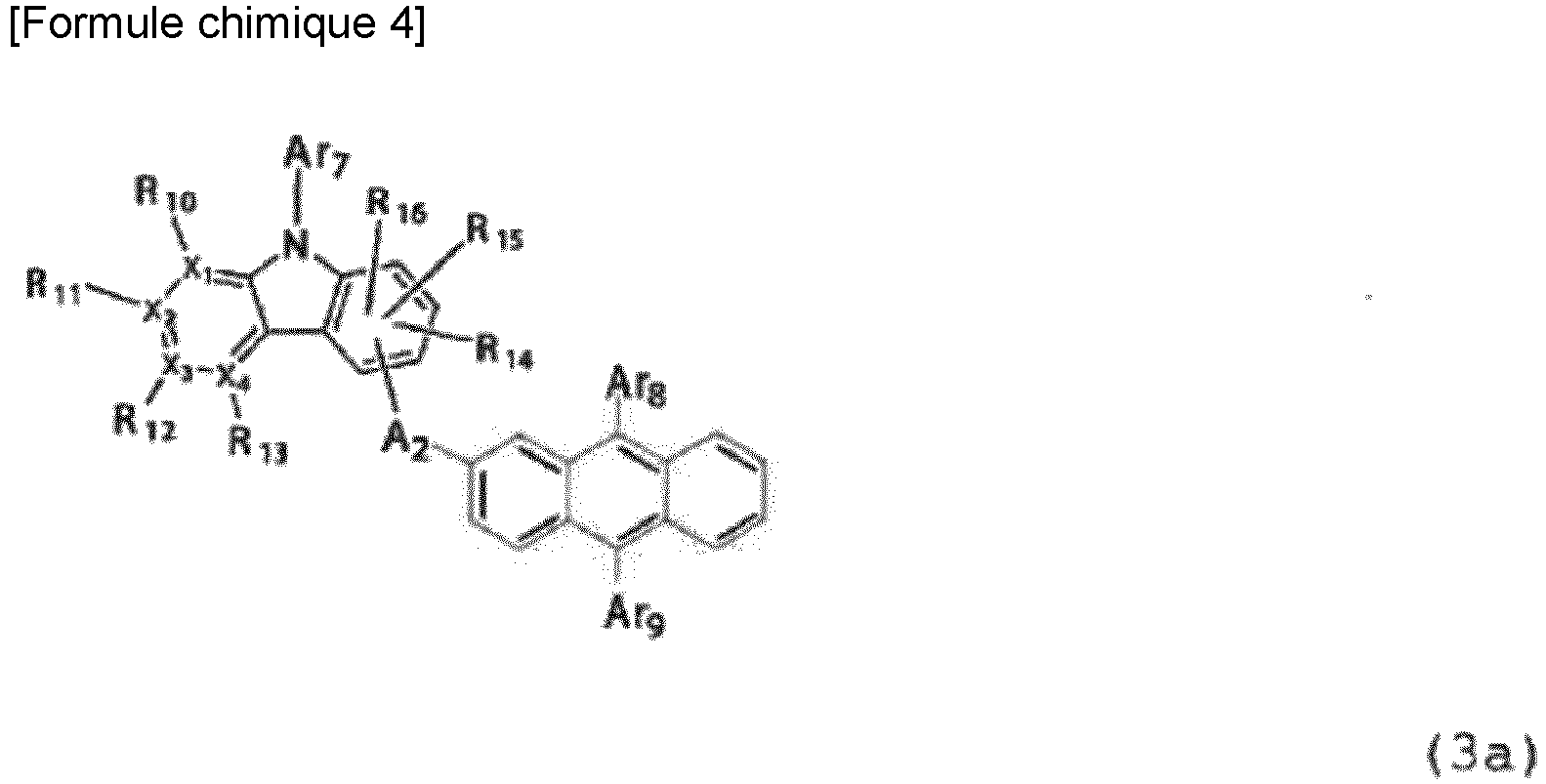
- Dispositif organique électroluminescent selon la revendication 2, dans lequel le composé ayant une structure cyclique anthracénique est un composé de la formule générale (3b) suivante, ayant une structure cyclique anthracénique :

- Dispositif organique électroluminescent selon la revendication 2, dans lequel le composé ayant une structure cyclique anthracénique est un composé de la formule générale (3c) suivante, ayant une structure cyclique anthracénique :


- Dispositif organique électroluminescent selon l'une quelconque des revendications 1 à 5, dans lequel la couche de transport de trous présente une structure bicouche composée d'une première couche de transport de trous et d'une deuxième couche de transport de trous, la deuxième couche de transport de trous comprenant le composé arylamine de formule générale (1).
- Dispositif organique électroluminescent selon l'une quelconque des revendications 1 6, dans lequel la couche émettant de la lumière comprend un dérivé de l'anthracène.
- Dispositif organique électroluminescent selon la revendication 7, dans lequel la couche émettant de la lumière comprend un matériau hôte, qui est un dérivé de l'anthracène.
Applications Claiming Priority (2)
| Application Number | Priority Date | Filing Date | Title |
|---|---|---|---|
| JP2014233722 | 2014-11-18 | ||
| PCT/JP2015/005572 WO2016079944A1 (fr) | 2014-11-18 | 2015-11-06 | Élément électroluminescent organique |
Publications (3)
| Publication Number | Publication Date |
|---|---|
| EP3223330A1 EP3223330A1 (fr) | 2017-09-27 |
| EP3223330A4 EP3223330A4 (fr) | 2018-08-15 |
| EP3223330B1 true EP3223330B1 (fr) | 2022-02-23 |
Family
ID=56013519
Family Applications (1)
| Application Number | Title | Priority Date | Filing Date |
|---|---|---|---|
| EP15861554.2A Active EP3223330B1 (fr) | 2014-11-18 | 2015-11-06 | Élément électroluminescent organique |
Country Status (7)
| Country | Link |
|---|---|
| US (1) | US10892420B2 (fr) |
| EP (1) | EP3223330B1 (fr) |
| JP (1) | JP6038387B2 (fr) |
| KR (1) | KR102425263B1 (fr) |
| CN (1) | CN107078226B (fr) |
| TW (1) | TWI682919B (fr) |
| WO (1) | WO2016079944A1 (fr) |
Families Citing this family (13)
| Publication number | Priority date | Publication date | Assignee | Title |
|---|---|---|---|---|
| KR102030354B1 (ko) * | 2014-05-13 | 2019-10-10 | 에스에프씨주식회사 | 방향족 아민기를 포함하는 헤테로고리 화합물 및 이를 포함하는 유기 발광 소자 |
| KR102030377B1 (ko) | 2014-07-28 | 2019-10-10 | 에스에프씨주식회사 | 헤테로고리를 포함하는 축합 플루오렌 유도체 |
| KR102190108B1 (ko) * | 2014-12-31 | 2020-12-11 | 에스에프씨주식회사 | 고효율과 장수명을 갖는 유기 발광 소자 |
| KR102201104B1 (ko) * | 2015-01-13 | 2021-01-11 | 에스에프씨주식회사 | 고효율과 장수명을 갖는 유기 발광 소자 |
| US10367147B2 (en) | 2015-05-27 | 2019-07-30 | Samsung Display Co., Ltd. | Organic light-emitting device |
| US10312449B2 (en) | 2015-05-27 | 2019-06-04 | Samsung Display Co., Ltd. | Organic light-emitting device |
| WO2018095940A1 (fr) | 2016-11-25 | 2018-05-31 | Merck Patent Gmbh | Dérivés d'indéno [1,2-b] fluorène à fusion bisbenzofurane et composés apparentés en tant que matériaux pour des dispositifs électroluminescents organiques (oled) |
| US11584753B2 (en) | 2016-11-25 | 2023-02-21 | Merck Patent Gmbh | Bisbenzofuran-fused 2,8-diaminoindeno[1,2-b]fluorene derivatives and related compounds as materials for organic electroluminescent devices (OLED) |
| JP7417350B2 (ja) * | 2017-03-28 | 2024-01-18 | キヤノン株式会社 | 光学素子、光学材料、光学機器及びトリアリールアミン化合物 |
| KR102704439B1 (ko) * | 2018-10-04 | 2024-09-09 | 삼성디스플레이 주식회사 | 유기 발광 소자 및 이를 포함하는 표시 장치 |
| CN113321588B (zh) * | 2020-02-28 | 2023-04-07 | 陕西莱特光电材料股份有限公司 | 含氮化合物、电子元件和电子装置 |
| KR102866465B1 (ko) * | 2020-07-20 | 2025-10-01 | 삼성디스플레이 주식회사 | 유기 전계 발광 소자 및 유기 전계 발광 소자용 아민 화합물 |
| CN116041243B (zh) * | 2023-01-17 | 2025-11-21 | 上海钥熠电子科技有限公司 | 一种基于芴的三芳胺类化合物及其在有机电致发光器件中的应用 |
Family Cites Families (35)
| Publication number | Priority date | Publication date | Assignee | Title |
|---|---|---|---|---|
| JPS4943840B1 (fr) | 1970-12-25 | 1974-11-25 | ||
| JP3194657B2 (ja) | 1993-11-01 | 2001-07-30 | 松下電器産業株式会社 | 電界発光素子 |
| JP3828595B2 (ja) | 1994-02-08 | 2006-10-04 | Tdk株式会社 | 有機el素子 |
| EP0891121B8 (fr) * | 1996-12-28 | 2013-01-02 | Futaba Corporation | Elements electroluminescents organiques |
| CN100482634C (zh) * | 1998-12-28 | 2009-04-29 | 出光兴产株式会社 | 有机电致发光装置 |
| JP4117093B2 (ja) * | 1998-12-28 | 2008-07-09 | 出光興産株式会社 | 有機エレクトロルミネッセンス素子用材料およびそれを使用した有機エレクトロルミネッセンス素子 |
| JP3639479B2 (ja) * | 1999-10-29 | 2005-04-20 | 日立マクセル株式会社 | インク組成物 |
| JP3998903B2 (ja) * | 2000-09-05 | 2007-10-31 | 出光興産株式会社 | 新規アリールアミン化合物及び有機エレクトロルミネッセンス素子 |
| KR100691543B1 (ko) | 2002-01-18 | 2007-03-09 | 주식회사 엘지화학 | 새로운 전자 수송용 물질 및 이를 이용한 유기 발광 소자 |
| JP3902993B2 (ja) * | 2002-08-27 | 2007-04-11 | キヤノン株式会社 | フルオレン化合物及びそれを用いた有機発光素子 |
| KR20050057518A (ko) * | 2002-09-20 | 2005-06-16 | 이데미쓰 고산 가부시키가이샤 | 유기 전기발광 소자 |
| JP4464070B2 (ja) * | 2003-05-15 | 2010-05-19 | 出光興産株式会社 | アリールアミン化合物及びそれを用いた有機エレクトロルミネッセンス素子 |
| JP4487587B2 (ja) | 2003-05-27 | 2010-06-23 | 株式会社デンソー | 有機el素子およびその製造方法 |
| KR100787425B1 (ko) | 2004-11-29 | 2007-12-26 | 삼성에스디아이 주식회사 | 페닐카바졸계 화합물 및 이를 이용한 유기 전계 발광 소자 |
| US20090261711A1 (en) * | 2005-09-15 | 2009-10-22 | Idemitsu Kosan Co., Ltd. | Asymmetric fluorene derivative and organic electroluminescent element containing the same |
| CN102643161B (zh) * | 2006-04-13 | 2015-10-14 | 东曹株式会社 | 苯并芴化合物及其用途 |
| CN101473464B (zh) * | 2006-06-22 | 2014-04-23 | 出光兴产株式会社 | 应用含有杂环的芳胺衍生物的有机电致发光元件 |
| JP5133259B2 (ja) | 2006-11-24 | 2013-01-30 | 出光興産株式会社 | 芳香族アミン誘導体及びそれを用いた有機エレクトロルミネッセンス素子 |
| DE102009005289B4 (de) * | 2009-01-20 | 2023-06-22 | Merck Patent Gmbh | Materialien für organische Elektrolumineszenzvorrichtungen, Verfahren zu deren Herstellung und elektronische Vorrichtungen, enthaltend diese |
| US8367222B2 (en) * | 2009-02-27 | 2013-02-05 | Idemitsu Kosan Co., Ltd. | Organic electroluminescent device |
| US8932735B2 (en) | 2009-04-24 | 2015-01-13 | Idemitsu Kosan Co., Ltd. | Aromatic amine derivative and organic electroluminescent element comprising the same |
| JP5585044B2 (ja) * | 2009-10-20 | 2014-09-10 | 東ソー株式会社 | カルバゾール化合物及びその用途 |
| US8748014B2 (en) * | 2009-11-12 | 2014-06-10 | Hodogaya Chemical Co., Ltd. | Compound having a substituted anthracene ring structure and pyridoindole ring structure, and organic electroluminescent device |
| KR101135541B1 (ko) * | 2010-04-01 | 2012-04-13 | 삼성모바일디스플레이주식회사 | 유기 발광 장치 |
| DE102010013806B4 (de) * | 2010-04-03 | 2021-06-10 | Merck Patent Gmbh | Materialien für organische Elektrolumineszenzvorrichtungen |
| JP5499972B2 (ja) * | 2010-07-23 | 2014-05-21 | コニカミノルタ株式会社 | 有機エレクトロルミネッセンス素子用材料、および有機エレクトロルミネッセンス素子、これを用いた表示装置、照明装置 |
| US9065060B2 (en) * | 2011-01-17 | 2015-06-23 | Lg Chem, Ltd. | Compound and organic light-emitting device comprising same |
| WO2013056776A1 (fr) * | 2011-10-20 | 2013-04-25 | Merck Patent Gmbh | Matériaux destinés à des dispositifs électroluminescents organiques |
| KR102013399B1 (ko) | 2011-11-29 | 2019-08-22 | 에스에프씨 주식회사 | 안트라센 유도체 및 이를 포함하는 유기전계발광소자 |
| US10026905B2 (en) * | 2012-01-18 | 2018-07-17 | Duk San Neolux Co., Ltd. | Compound, organic electric element using the same, and an electronic device thereof |
| JP6158542B2 (ja) * | 2012-04-13 | 2017-07-05 | 株式会社半導体エネルギー研究所 | 発光素子、発光装置、電子機器、および照明装置 |
| DE102012011335A1 (de) | 2012-06-06 | 2013-12-12 | Merck Patent Gmbh | Verbindungen für Organische Elekronische Vorrichtungen |
| WO2014129201A1 (fr) * | 2013-02-22 | 2014-08-28 | 保土谷化学工業株式会社 | Élément électroluminescent organique |
| KR102098738B1 (ko) * | 2013-07-09 | 2020-06-01 | 삼성디스플레이 주식회사 | 유기 발광 소자 |
| JP3194657U (ja) | 2014-09-19 | 2014-12-04 | 恵美子 青柳 | 温熱首巻 |
-
2015
- 2015-11-06 WO PCT/JP2015/005572 patent/WO2016079944A1/fr not_active Ceased
- 2015-11-06 KR KR1020177016723A patent/KR102425263B1/ko active Active
- 2015-11-06 EP EP15861554.2A patent/EP3223330B1/fr active Active
- 2015-11-06 CN CN201580058535.7A patent/CN107078226B/zh active Active
- 2015-11-06 US US15/525,134 patent/US10892420B2/en active Active
- 2015-11-06 JP JP2016507712A patent/JP6038387B2/ja active Active
- 2015-11-17 TW TW104137803A patent/TWI682919B/zh active
Also Published As
| Publication number | Publication date |
|---|---|
| TWI682919B (zh) | 2020-01-21 |
| WO2016079944A1 (fr) | 2016-05-26 |
| JPWO2016079944A1 (ja) | 2017-04-27 |
| KR102425263B1 (ko) | 2022-07-25 |
| EP3223330A1 (fr) | 2017-09-27 |
| US10892420B2 (en) | 2021-01-12 |
| KR20170085119A (ko) | 2017-07-21 |
| US20180277761A1 (en) | 2018-09-27 |
| EP3223330A4 (fr) | 2018-08-15 |
| TW201623217A (zh) | 2016-07-01 |
| CN107078226A (zh) | 2017-08-18 |
| JP6038387B2 (ja) | 2016-12-07 |
| CN107078226B (zh) | 2020-02-28 |
Similar Documents
| Publication | Publication Date | Title |
|---|---|---|
| EP2960958B1 (fr) | Élément électroluminescent organique | |
| EP3223330B1 (fr) | Élément électroluminescent organique | |
| EP3671885B1 (fr) | Dispositif électroluminescent organique | |
| EP3222613B1 (fr) | Composé ayant une structure de noyau indénocarbazole et dispositif électroluminescent organique | |
| EP3229284B1 (fr) | Élément électroluminescent organique | |
| EP3255692B1 (fr) | Élément électroluminescent organique | |
| EP3282496B1 (fr) | Élément électroluminescent organique | |
| US10693078B2 (en) | Organic electroluminescent device | |
| EP2530069B1 (fr) | Composé ayant une structure de triphénylamine, et élément électroluminescent organique | |
| EP3240057B1 (fr) | Élément électroluminescent organique | |
| EP2578572A1 (fr) | Composés avec structures cycliques d'acridane et éléments électroluminescents organiques | |
| EP2894155B1 (fr) | Composé possédant une structure de noyau indéno acridane, et élément électroluminescent organique | |
| EP3370272A1 (fr) | Dispositif électroluminescent organique | |
| EP3404735B1 (fr) | Élément électroluminescent organique | |
| EP3544073A1 (fr) | Élément électroluminescent organique | |
| EP3343657A1 (fr) | Élément électroluminescent organique | |
| EP4116393A1 (fr) | Élément électroluminescent organique | |
| EP4050083B1 (fr) | Élément électroluminescent organique | |
| EP4438590A1 (fr) | Composé arylamine, élément électroluminescent organique et dispositif électronique | |
| EP3163644B1 (fr) | Élément électroluminescent organique | |
| EP4198104A1 (fr) | Élément électroluminescent organique |
Legal Events
| Date | Code | Title | Description |
|---|---|---|---|
| STAA | Information on the status of an ep patent application or granted ep patent |
Free format text: STATUS: THE INTERNATIONAL PUBLICATION HAS BEEN MADE |
|
| PUAI | Public reference made under article 153(3) epc to a published international application that has entered the european phase |
Free format text: ORIGINAL CODE: 0009012 |
|
| STAA | Information on the status of an ep patent application or granted ep patent |
Free format text: STATUS: REQUEST FOR EXAMINATION WAS MADE |
|
| 17P | Request for examination filed |
Effective date: 20170614 |
|
| AK | Designated contracting states |
Kind code of ref document: A1 Designated state(s): AL AT BE BG CH CY CZ DE DK EE ES FI FR GB GR HR HU IE IS IT LI LT LU LV MC MK MT NL NO PL PT RO RS SE SI SK SM TR |
|
| AX | Request for extension of the european patent |
Extension state: BA ME |
|
| DAV | Request for validation of the european patent (deleted) | ||
| DAX | Request for extension of the european patent (deleted) | ||
| A4 | Supplementary search report drawn up and despatched |
Effective date: 20180712 |
|
| RIC1 | Information provided on ipc code assigned before grant |
Ipc: C07D 209/80 20060101ALI20180706BHEP Ipc: H01L 51/00 20060101ALI20180706BHEP Ipc: H01L 51/50 20060101AFI20180706BHEP Ipc: C07D 495/04 20060101ALI20180706BHEP Ipc: C07D 493/10 20060101ALI20180706BHEP Ipc: C09K 11/06 20060101ALI20180706BHEP Ipc: C07C 211/61 20060101ALI20180706BHEP Ipc: C07C 211/58 20060101ALI20180706BHEP Ipc: C07C 211/54 20060101ALI20180706BHEP Ipc: C07D 307/77 20060101ALI20180706BHEP |
|
| STAA | Information on the status of an ep patent application or granted ep patent |
Free format text: STATUS: EXAMINATION IS IN PROGRESS |
|
| 17Q | First examination report despatched |
Effective date: 20201002 |
|
| REG | Reference to a national code |
Ref country code: DE Ref legal event code: R079 Ref document number: 602015077153 Country of ref document: DE Free format text: PREVIOUS MAIN CLASS: H01L0051500000 Ipc: H01L0051540000 |
|
| RIC1 | Information provided on ipc code assigned before grant |
Ipc: C07D 209/80 20060101ALI20210701BHEP Ipc: C07D 307/77 20060101ALI20210701BHEP Ipc: C09K 11/06 20060101ALI20210701BHEP Ipc: C07C 211/61 20060101ALI20210701BHEP Ipc: C07D 493/10 20060101ALI20210701BHEP Ipc: C07C 211/58 20060101ALI20210701BHEP Ipc: C07D 495/04 20060101ALI20210701BHEP Ipc: C07C 211/54 20060101ALI20210701BHEP Ipc: H01L 51/54 20060101AFI20210701BHEP |
|
| GRAP | Despatch of communication of intention to grant a patent |
Free format text: ORIGINAL CODE: EPIDOSNIGR1 |
|
| STAA | Information on the status of an ep patent application or granted ep patent |
Free format text: STATUS: GRANT OF PATENT IS INTENDED |
|
| INTG | Intention to grant announced |
Effective date: 20210927 |
|
| GRAS | Grant fee paid |
Free format text: ORIGINAL CODE: EPIDOSNIGR3 |
|
| GRAA | (expected) grant |
Free format text: ORIGINAL CODE: 0009210 |
|
| STAA | Information on the status of an ep patent application or granted ep patent |
Free format text: STATUS: THE PATENT HAS BEEN GRANTED |
|
| AK | Designated contracting states |
Kind code of ref document: B1 Designated state(s): AL AT BE BG CH CY CZ DE DK EE ES FI FR GB GR HR HU IE IS IT LI LT LU LV MC MK MT NL NO PL PT RO RS SE SI SK SM TR |
|
| REG | Reference to a national code |
Ref country code: GB Ref legal event code: FG4D |
|
| REG | Reference to a national code |
Ref country code: CH Ref legal event code: EP |
|
| REG | Reference to a national code |
Ref country code: AT Ref legal event code: REF Ref document number: 1471129 Country of ref document: AT Kind code of ref document: T Effective date: 20220315 |
|
| REG | Reference to a national code |
Ref country code: IE Ref legal event code: FG4D |
|
| REG | Reference to a national code |
Ref country code: DE Ref legal event code: R096 Ref document number: 602015077153 Country of ref document: DE |
|
| REG | Reference to a national code |
Ref country code: LT Ref legal event code: MG9D |
|
| REG | Reference to a national code |
Ref country code: NL Ref legal event code: MP Effective date: 20220223 |
|
| REG | Reference to a national code |
Ref country code: AT Ref legal event code: MK05 Ref document number: 1471129 Country of ref document: AT Kind code of ref document: T Effective date: 20220223 |
|
| PG25 | Lapsed in a contracting state [announced via postgrant information from national office to epo] |
Ref country code: SE Free format text: LAPSE BECAUSE OF FAILURE TO SUBMIT A TRANSLATION OF THE DESCRIPTION OR TO PAY THE FEE WITHIN THE PRESCRIBED TIME-LIMIT Effective date: 20220223 Ref country code: RS Free format text: LAPSE BECAUSE OF FAILURE TO SUBMIT A TRANSLATION OF THE DESCRIPTION OR TO PAY THE FEE WITHIN THE PRESCRIBED TIME-LIMIT Effective date: 20220223 Ref country code: PT Free format text: LAPSE BECAUSE OF FAILURE TO SUBMIT A TRANSLATION OF THE DESCRIPTION OR TO PAY THE FEE WITHIN THE PRESCRIBED TIME-LIMIT Effective date: 20220623 Ref country code: NO Free format text: LAPSE BECAUSE OF FAILURE TO SUBMIT A TRANSLATION OF THE DESCRIPTION OR TO PAY THE FEE WITHIN THE PRESCRIBED TIME-LIMIT Effective date: 20220523 Ref country code: NL Free format text: LAPSE BECAUSE OF FAILURE TO SUBMIT A TRANSLATION OF THE DESCRIPTION OR TO PAY THE FEE WITHIN THE PRESCRIBED TIME-LIMIT Effective date: 20220223 Ref country code: LT Free format text: LAPSE BECAUSE OF FAILURE TO SUBMIT A TRANSLATION OF THE DESCRIPTION OR TO PAY THE FEE WITHIN THE PRESCRIBED TIME-LIMIT Effective date: 20220223 Ref country code: HR Free format text: LAPSE BECAUSE OF FAILURE TO SUBMIT A TRANSLATION OF THE DESCRIPTION OR TO PAY THE FEE WITHIN THE PRESCRIBED TIME-LIMIT Effective date: 20220223 Ref country code: ES Free format text: LAPSE BECAUSE OF FAILURE TO SUBMIT A TRANSLATION OF THE DESCRIPTION OR TO PAY THE FEE WITHIN THE PRESCRIBED TIME-LIMIT Effective date: 20220223 Ref country code: BG Free format text: LAPSE BECAUSE OF FAILURE TO SUBMIT A TRANSLATION OF THE DESCRIPTION OR TO PAY THE FEE WITHIN THE PRESCRIBED TIME-LIMIT Effective date: 20220523 |
|
| PG25 | Lapsed in a contracting state [announced via postgrant information from national office to epo] |
Ref country code: PL Free format text: LAPSE BECAUSE OF FAILURE TO SUBMIT A TRANSLATION OF THE DESCRIPTION OR TO PAY THE FEE WITHIN THE PRESCRIBED TIME-LIMIT Effective date: 20220223 Ref country code: LV Free format text: LAPSE BECAUSE OF FAILURE TO SUBMIT A TRANSLATION OF THE DESCRIPTION OR TO PAY THE FEE WITHIN THE PRESCRIBED TIME-LIMIT Effective date: 20220223 Ref country code: GR Free format text: LAPSE BECAUSE OF FAILURE TO SUBMIT A TRANSLATION OF THE DESCRIPTION OR TO PAY THE FEE WITHIN THE PRESCRIBED TIME-LIMIT Effective date: 20220524 Ref country code: FI Free format text: LAPSE BECAUSE OF FAILURE TO SUBMIT A TRANSLATION OF THE DESCRIPTION OR TO PAY THE FEE WITHIN THE PRESCRIBED TIME-LIMIT Effective date: 20220223 Ref country code: AT Free format text: LAPSE BECAUSE OF FAILURE TO SUBMIT A TRANSLATION OF THE DESCRIPTION OR TO PAY THE FEE WITHIN THE PRESCRIBED TIME-LIMIT Effective date: 20220223 |
|
| PG25 | Lapsed in a contracting state [announced via postgrant information from national office to epo] |
Ref country code: IS Free format text: LAPSE BECAUSE OF FAILURE TO SUBMIT A TRANSLATION OF THE DESCRIPTION OR TO PAY THE FEE WITHIN THE PRESCRIBED TIME-LIMIT Effective date: 20220623 |
|
| PG25 | Lapsed in a contracting state [announced via postgrant information from national office to epo] |
Ref country code: SM Free format text: LAPSE BECAUSE OF FAILURE TO SUBMIT A TRANSLATION OF THE DESCRIPTION OR TO PAY THE FEE WITHIN THE PRESCRIBED TIME-LIMIT Effective date: 20220223 Ref country code: SK Free format text: LAPSE BECAUSE OF FAILURE TO SUBMIT A TRANSLATION OF THE DESCRIPTION OR TO PAY THE FEE WITHIN THE PRESCRIBED TIME-LIMIT Effective date: 20220223 Ref country code: RO Free format text: LAPSE BECAUSE OF FAILURE TO SUBMIT A TRANSLATION OF THE DESCRIPTION OR TO PAY THE FEE WITHIN THE PRESCRIBED TIME-LIMIT Effective date: 20220223 Ref country code: EE Free format text: LAPSE BECAUSE OF FAILURE TO SUBMIT A TRANSLATION OF THE DESCRIPTION OR TO PAY THE FEE WITHIN THE PRESCRIBED TIME-LIMIT Effective date: 20220223 Ref country code: DK Free format text: LAPSE BECAUSE OF FAILURE TO SUBMIT A TRANSLATION OF THE DESCRIPTION OR TO PAY THE FEE WITHIN THE PRESCRIBED TIME-LIMIT Effective date: 20220223 Ref country code: CZ Free format text: LAPSE BECAUSE OF FAILURE TO SUBMIT A TRANSLATION OF THE DESCRIPTION OR TO PAY THE FEE WITHIN THE PRESCRIBED TIME-LIMIT Effective date: 20220223 |
|
| REG | Reference to a national code |
Ref country code: DE Ref legal event code: R097 Ref document number: 602015077153 Country of ref document: DE |
|
| REG | Reference to a national code |
Ref country code: DE Ref legal event code: R079 Ref document number: 602015077153 Country of ref document: DE Free format text: PREVIOUS MAIN CLASS: H01L0051540000 Ipc: H10K0085000000 |
|
| PG25 | Lapsed in a contracting state [announced via postgrant information from national office to epo] |
Ref country code: AL Free format text: LAPSE BECAUSE OF FAILURE TO SUBMIT A TRANSLATION OF THE DESCRIPTION OR TO PAY THE FEE WITHIN THE PRESCRIBED TIME-LIMIT Effective date: 20220223 |
|
| PLBE | No opposition filed within time limit |
Free format text: ORIGINAL CODE: 0009261 |
|
| STAA | Information on the status of an ep patent application or granted ep patent |
Free format text: STATUS: NO OPPOSITION FILED WITHIN TIME LIMIT |
|
| 26N | No opposition filed |
Effective date: 20221124 |
|
| PG25 | Lapsed in a contracting state [announced via postgrant information from national office to epo] |
Ref country code: SI Free format text: LAPSE BECAUSE OF FAILURE TO SUBMIT A TRANSLATION OF THE DESCRIPTION OR TO PAY THE FEE WITHIN THE PRESCRIBED TIME-LIMIT Effective date: 20220223 |
|
| PG25 | Lapsed in a contracting state [announced via postgrant information from national office to epo] |
Ref country code: MC Free format text: LAPSE BECAUSE OF FAILURE TO SUBMIT A TRANSLATION OF THE DESCRIPTION OR TO PAY THE FEE WITHIN THE PRESCRIBED TIME-LIMIT Effective date: 20220223 |
|
| REG | Reference to a national code |
Ref country code: CH Ref legal event code: PL |
|
| GBPC | Gb: european patent ceased through non-payment of renewal fee |
Effective date: 20221106 |
|
| REG | Reference to a national code |
Ref country code: BE Ref legal event code: MM Effective date: 20221130 |
|
| PG25 | Lapsed in a contracting state [announced via postgrant information from national office to epo] |
Ref country code: LI Free format text: LAPSE BECAUSE OF NON-PAYMENT OF DUE FEES Effective date: 20221130 Ref country code: IT Free format text: LAPSE BECAUSE OF FAILURE TO SUBMIT A TRANSLATION OF THE DESCRIPTION OR TO PAY THE FEE WITHIN THE PRESCRIBED TIME-LIMIT Effective date: 20220223 Ref country code: CH Free format text: LAPSE BECAUSE OF NON-PAYMENT OF DUE FEES Effective date: 20221130 |
|
| PG25 | Lapsed in a contracting state [announced via postgrant information from national office to epo] |
Ref country code: LU Free format text: LAPSE BECAUSE OF NON-PAYMENT OF DUE FEES Effective date: 20221106 |
|
| PG25 | Lapsed in a contracting state [announced via postgrant information from national office to epo] |
Ref country code: IE Free format text: LAPSE BECAUSE OF NON-PAYMENT OF DUE FEES Effective date: 20221106 Ref country code: GB Free format text: LAPSE BECAUSE OF NON-PAYMENT OF DUE FEES Effective date: 20221106 |
|
| PG25 | Lapsed in a contracting state [announced via postgrant information from national office to epo] |
Ref country code: FR Free format text: LAPSE BECAUSE OF NON-PAYMENT OF DUE FEES Effective date: 20221130 Ref country code: BE Free format text: LAPSE BECAUSE OF NON-PAYMENT OF DUE FEES Effective date: 20221130 |
|
| PG25 | Lapsed in a contracting state [announced via postgrant information from national office to epo] |
Ref country code: HU Free format text: LAPSE BECAUSE OF FAILURE TO SUBMIT A TRANSLATION OF THE DESCRIPTION OR TO PAY THE FEE WITHIN THE PRESCRIBED TIME-LIMIT; INVALID AB INITIO Effective date: 20151106 |
|
| PG25 | Lapsed in a contracting state [announced via postgrant information from national office to epo] |
Ref country code: CY Free format text: LAPSE BECAUSE OF FAILURE TO SUBMIT A TRANSLATION OF THE DESCRIPTION OR TO PAY THE FEE WITHIN THE PRESCRIBED TIME-LIMIT Effective date: 20220223 |
|
| PG25 | Lapsed in a contracting state [announced via postgrant information from national office to epo] |
Ref country code: MK Free format text: LAPSE BECAUSE OF FAILURE TO SUBMIT A TRANSLATION OF THE DESCRIPTION OR TO PAY THE FEE WITHIN THE PRESCRIBED TIME-LIMIT Effective date: 20220223 |
|
| PG25 | Lapsed in a contracting state [announced via postgrant information from national office to epo] |
Ref country code: TR Free format text: LAPSE BECAUSE OF FAILURE TO SUBMIT A TRANSLATION OF THE DESCRIPTION OR TO PAY THE FEE WITHIN THE PRESCRIBED TIME-LIMIT Effective date: 20220223 |
|
| PG25 | Lapsed in a contracting state [announced via postgrant information from national office to epo] |
Ref country code: MT Free format text: LAPSE BECAUSE OF FAILURE TO SUBMIT A TRANSLATION OF THE DESCRIPTION OR TO PAY THE FEE WITHIN THE PRESCRIBED TIME-LIMIT Effective date: 20220223 |
|
| PGFP | Annual fee paid to national office [announced via postgrant information from national office to epo] |
Ref country code: DE Payment date: 20251119 Year of fee payment: 11 |