EP3230162B1 - Einziehbarer vorrichtungshalter für einen flugzeugsitz - Google Patents
Einziehbarer vorrichtungshalter für einen flugzeugsitz Download PDFInfo
- Publication number
- EP3230162B1 EP3230162B1 EP15813121.9A EP15813121A EP3230162B1 EP 3230162 B1 EP3230162 B1 EP 3230162B1 EP 15813121 A EP15813121 A EP 15813121A EP 3230162 B1 EP3230162 B1 EP 3230162B1
- Authority
- EP
- European Patent Office
- Prior art keywords
- device holder
- support
- display device
- video system
- slider
- Prior art date
- Legal status (The legal status is an assumption and is not a legal conclusion. Google has not performed a legal analysis and makes no representation as to the accuracy of the status listed.)
- Active
Links
Images








Classifications
-
- B—PERFORMING OPERATIONS; TRANSPORTING
- B64—AIRCRAFT; AVIATION; COSMONAUTICS
- B64D—EQUIPMENT FOR FITTING IN OR TO AIRCRAFT; FLIGHT SUITS; PARACHUTES; ARRANGEMENT OR MOUNTING OF POWER PLANTS OR PROPULSION TRANSMISSIONS IN AIRCRAFT
- B64D11/00—Passenger or crew accommodation; Flight-deck installations not otherwise provided for
- B64D11/0015—Arrangements for entertainment or communications, e.g. radio, television
- B64D11/00152—Seat back fixtures for removable monitors, e.g. tablet computers
-
- B—PERFORMING OPERATIONS; TRANSPORTING
- B60—VEHICLES IN GENERAL
- B60R—VEHICLES, VEHICLE FITTINGS, OR VEHICLE PARTS, NOT OTHERWISE PROVIDED FOR
- B60R11/00—Arrangements for holding or mounting articles, not otherwise provided for
- B60R11/02—Arrangements for holding or mounting articles, not otherwise provided for for radio sets, television sets, telephones, or the like; Arrangement of controls thereof
-
- B—PERFORMING OPERATIONS; TRANSPORTING
- B60—VEHICLES IN GENERAL
- B60R—VEHICLES, VEHICLE FITTINGS, OR VEHICLE PARTS, NOT OTHERWISE PROVIDED FOR
- B60R11/00—Arrangements for holding or mounting articles, not otherwise provided for
- B60R2011/0001—Arrangements for holding or mounting articles, not otherwise provided for characterised by position
- B60R2011/0003—Arrangements for holding or mounting articles, not otherwise provided for characterised by position inside the vehicle
- B60R2011/0012—Seats or parts thereof
- B60R2011/0015—Back-rests
-
- B—PERFORMING OPERATIONS; TRANSPORTING
- B60—VEHICLES IN GENERAL
- B60R—VEHICLES, VEHICLE FITTINGS, OR VEHICLE PARTS, NOT OTHERWISE PROVIDED FOR
- B60R11/00—Arrangements for holding or mounting articles, not otherwise provided for
- B60R2011/0042—Arrangements for holding or mounting articles, not otherwise provided for characterised by mounting means
- B60R2011/0049—Arrangements for holding or mounting articles, not otherwise provided for characterised by mounting means for non integrated articles
- B60R2011/0064—Connection with the article
- B60R2011/0075—Connection with the article using a containment or docking space
Definitions
- the field of the invention relates to retractable portable display device holding assemblies for use with passenger seats or the like.
- passenger vehicles such as aircraft, buses, trains, ships, and automobiles
- passenger seats with a wide assortment of portable electronic and entertainment options to encourage passengers to remain seated as much as possible during transport for safety, crew mobility, and to enable efficient cabin service.
- Some passenger seats may provide video and audio entertainment, including television, video games, internet access, and other on-board entertainment (“OBE”) or in-flight entertainment (“IFE”) components.
- OBE on-board entertainment
- IFE in-flight entertainment
- these entertainment devices are mounted in the seat backs and arm rests of the passenger seats.
- a part of these systems commonly involves a screen, as a visual and/or touch interface, usually located in the back of the seat located before the passengers, and commonly located at an angle and position ideal for the passenger to watch the video screen while seated.
- PEDs portable electronic devices
- PDAs personal digital assistants
- Integrated solutions should accommodate aircraft seat design, which requires that space in front of the passenger be clear of potentially injurious objects and sharp edges.
- the general goal is to prevent the head trajectory of a passenger, in the case of crash, from contacting any sharp or protruding edges.
- a support system for PEDs that is always available and adaptable to a wide range of PED sizes, shapes, and thicknesses.
- a support system that does not create the need for an extra coupling assembly There is also a need for a support system that does not pose a safety hazard to passengers.
- a support system that accommodates a suitable viewing angle, or that can accommodate adjustments to a viewing angle for the comfort of a passenger.
- Document WO2013/126421 describes personal electronics device mounting structures including a base with an aft surface, wherein the base is configured to fit substantially within a recess so that the aft surface of the base is substantially flush with an aft surface surrounding the recess in a stowed position.
- a cradle coupled to the base comprises a pair of arms configured to hold a personal electronics device securely in place adjacent a passenger seat back when the base is in the deployed position.
- Document US2009/089841 describes a seat-mounted electronics assembly for a vehicle including a seat with a back portion and a rear surface.
- a display panel having a screen mounted on a screen-side and a mounting assembly mounting the display panel on the rear surface.
- the mounting assembly allows pivotal movement of the display panel relative to the seat between a stowed position and at least one viewing position so that when the display panel is in the viewing position, the display panel is located higher than when the display panel is in the stowed position.
- Document WO2011/092348 describes a device for attaching a tablet computer, in particular to the rear-side of a motor vehicle seat such as a back rest, head rest, or head rest mounting of a vehicle seat.
- the device comprises a fastening device for attaching the device to the vehicle seat part and a carrier element which is displacably connected to the fastening device.
- a system for holding a display device can be configured to connect with the back of a seat.
- a system for holding a display device can be configured to connect with a structure attached with the back of a seat.
- a system for holding a display device can include a device holder connectible with an IFE system or components of an IFE system, such as with a video screen or video system.
- a device holder may be connectible with video system via a support structure, and in some cases may be configured to support a display device in a display position.
- a device holder may be configured to hold a display device in front of a video system. The device holder can be stowed in a stowed position or deployed in a deployed position.
- the support structure and the device holder When in the stowed position, the support structure and the device holder can be at least partially hidden behind the video system. Also within the stowed position, the support structure and the device holder may be arranged in a stowage space.
- a stowage space can include a cavity in a seat back.
- the device holder when the device holder is in the stowed position, the device holder may be tucked into the stowage space such that the device holder does not protrude, or only minimally intrudes, into a passenger space.
- the device holder When in the deployed position, the device holder may be arranged in front of the video system and configured to hold a display device, for example a tablet computer, for viewing by a user.
- a device holder does include a front support element and a rear support element that provide a space between the rear and front elements into which a display device, for example a smartphone or tablet, can be positioned.
- the device holder may further include a spring and a spring sliding assembly operably connecting the rear and front support elements, allowing the rear and front support elements to separate and retract with respect to each other. This allows the rear and front support elements to act as a clip in order to secure a display device.
- the device holder further includes a support structure, which may include hinge and a sliding assembly connecting the device holder with aspects of the environment.
- the device holder may be connected with features such as with a back of an IFE system such as a video screen, a support for an IFE system, or with a seat back.
- the position of the device holder may be adjustable via the support structure.
- the device holder can have a deployed position, wherein the front and rear support elements are positioned in front of aspects of the environment, such as in front of a video screen in a seat back, such that the device holder can hold a display device in front of the video screen.
- the system can provide a suitable viewing angle to a passenger.
- the device may also have a stowed position, wherein the front and rear support elements can rotate down via the hinge, and the hinge and front and rear support elements may be slid upward into a stowage space behind aspects of the environment, such as behind an IFE system or video screen.
- the stowed position can provide that the device holder is tucked out of the way of passengers and does not protrude into a space in front of a passenger where the device holder might otherwise pose a safety hazard.
- a device holder that can include a supporting structure configured to connect with a back of a video system of a seat back, and a pair of supporting surfaces connected with the supporting structure.
- the pair of supporting surfaces can include a the first support surface connected with the supporting member and configured to support a display device in a viewing orientation, and a second support surface connected with the first support surface and opposing the first support surface.
- a supporting region between the first and second support surfaces can hold the display device in a viewing orientation.
- a system for holding a display device can include a device holder configured to be connected with a video system in a seat back and configured for holding a display device in front of the video system.
- the system can have a stowed position and a deployed position.
- the device holder can be at least partially hidden behind the video system when the system is in a stowed position; and in the deployed position, the device holder can be positioned in front of the video system for holding the display device in view of a user.
- the described embodiments generally provide a retractable display device holder for passenger seats and systems for holding a portable display device. While systems for retractable display devices are discussed for use with aircraft seats, they are by no means so limited. Rather, embodiments of the retractable display device holder and system may be used in any type of seat that has a surface located in front of the seat.
- Figures 1-17 illustrate embodiments of a retractable device holder and a system for holding a display device.
- the retractable device holder may be connected with an IFE system, which can be a video system.
- the retractable device holder may be connected with a support system or enclosure of the video display of video system.
- the support system may form a skeleton or base structure that supports the video display.
- the support system may be mounted with respect to a seat back or other structure.
- the support system may have a pivot point along one or both edges.
- the video system may be mounted with respect to the support system such that it is connectible to the seat back and able to swivel about the pivot.
- the retractable device holder may be able to move relative to the video system.
- the retractable device holder can be stowed behind the video system. In other cases, the retractable device holder can be deployed for holding the display device in front of the video system. When the video system is rotated, this may cause the retractable device holder to rotate alongwith. For example, a passenger may be able to adjust a viewing angle of their own display device in the device holder by rotating the video system.
- embodiments herein are referred to as connectible with respect to a video system, it should be understood that embodiments of a retractable device holder may be supported by or connected with any other suitable IFE system component that presents a suitable viewing angle to a user.
- Figures 1-4 illustrate a system 100 for supporting a display device 106 can include a seat 102 having a video system 104 associated there with.
- the video system 104 may provide a video screen 104b configured to connect with audiovisual programming provided by, for example, an airplane.
- the video system 104 can include a video screen 104b of an IFE system and a support structure 104a for supporting the video screen.
- the video screen 104b may define a front surface of the video system 104.
- the support structure for supporting the video screen can be rotated or inclined about a pivot in order to rotate or incline the video screen.
- the system 100 may support a display device 106 in use. There may be provided a stowage space 108 in the seat 102 and extending behind the video system 104.
- a retractable device holder 110 may be connected with the support structure 104a.
- the retractable device holder 110 may be connected with the support structure portion of the video system 104, and may be connected therewith behind the video system 104 within and/or above the stowage space 108.
- the retractable display device 110 may be stored in the stowage space 108 when not in use.
- the retractable display device 110 can be deployed in order to accommodate the display device, e.g. a smartphone, an electronic reader, a tablet or tablet computer; or other suitable device in an orientation suitable for display to a user.
- the display device 106 can be oriented by the display device 110 to conform to the same viewing angle as the video system 104.
- the retractable device holder 110 can also be stowed in order to secure parts of the device holder behind the video system 104 and below the video system 104 in a configuration that minimizes protrusion of the retractable device holder 110 from the seat body 102.
- a viewing angle can be modified by tilting the video system 104 relative to the seat 102, or the viewing angle can be modified by tiling the display device 110 relative to the video system 104, or both.
- the retractable display device 110 may be formed of materials including but not limited to aluminum, stainless steel, aramid fibers, polycarbonate, polypropylene, other metallic materials, composite materials, or other similar materials.
- Figure 2 shows the system 100 of Figure 1 in a side view, showing the video system 104 in the seat 102, the retractable device holder 110 in a deployed configuration in front of the video system 104, and a tablet-sized display device 106 mounted in the retractable device holder 110 in front of the video system 104.
- the stowage space 108 may be located underneath and behind the video system 104, and may be sized such that the retractable device holder 110 can be rotated and slid upwardly in the stowage space 108 to be secured behind the video system 104.
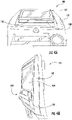
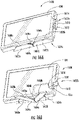
- Figure 3A shows a system 300 for supporting a display device (not shown), similar to system 100 of Figure 1 , from a low angle, illustrating a device holder 110 in a stowed configuration. While stowed, part of the device holder 110 may be secured behind the video system 104 in the stowage space 108, and part of the device holder 110 may be visible to a user but out of the way and below the video system 104 in the stowage space 108.
- Figure 3B shows the system 300 of Figure 3A from a side perspective angle, illustrating the device holder 110 in a stowed configuration, as in Figure 3A .
- the device holder 110 is stowed in the stowage space 108, and does not protrude from the stowage space 108 beyond the video system 104.
- a portion of the device holder 110 may be visible and can be reached from outside the stowage space 108 in order to permit a user to deploy the device holder 110.
- the device holder 110 While stowed, the device holder 110 may be approximately flush with the screen 104b of the video system 104. In some case the device holder may be approximately flush with a front portion of the video system, such that it does not impede passenger safety.
- flush is used to mean that the device holder 110 does not extend past the front portion of the video system 104 to an extent that would cause injury to a passerby.
- flush may include an embodiment in which the device holder 110 lays generally against the video system 104 without creating a space therebetween.
- Flush may include an embodiment in which the device holder 110 does not protrude outwardly in front of the video system.
- Figure 4A shows a system 400 for supporting a display device (not shown) similar to system 300 of Figures 3A-3B from a low angle, illustrating the device holder 110 in a deployed configuration. While deployed, the device holder 110 projects from the stowage space 108 in the seat 102 below the video system 104.
- Figure 4B shows the system 400 of Figure 4A from a side perspective angle, illustrating the device holder 110 in a deployed configuration, as in Figure 4A .
- the device holder 110 does not extend beyond the video system 104 behind the seat 102.
- the device holder 110 extends outside the stowage space 108 and in front of the video system 104 in order to permit a user to insert a display device (not shown) in the device holder 110.
- the device holder 110 can be reconfigured between the stowed position (as in system 300 of Figures 3A-3B ) and the deployed position (as in system 400 of Figures 4A-4B ).
- deploying or stowing the device holder 110 can be performed manually.
- a user can deploy a stowed device holder 110 gripping the device holder and pulling the device down from the stowage space 108, and then rotating the device holder 110 upward.
- a user can stow a deployed device holder 110 by tilting the device holder down, and then sliding the device holder 110 up into the stowage space 108 behind the video system 104.
- the retractable device holder 110 may be stowed or deployed via an electromechanical actuator controlled by an electronic pushbutton, such that the configuration of the retractable device holder 110 can be adjusted by a passenger pressing the pushbutton.
- the retractable device holder 110 may be secured in the stowed position or secured in the deployed position by means of, for example, a mechanical catch with a release, such that actuating the release can allow the retractable device holder to move between the stowed and released positions.
- an actuator may be connected with a release mechanism, such that the retractable device holder 110 may be locked in a stowed position until released by the actuator.
- the release mechanism may be controllable by crew, so as to prevent passengers from using the retractable device holder 110 at certain times, such as when it is unsafe to do so.
- Various other specific mechanisms may be suitable for stowing and deploying a retractable device holder 110, as described below.
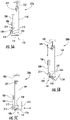
- Figures 5A-5C illustrate a retractable device holder 110 in a stowed configuration 500a, partially deployed position 500b, and deployed position 500c, for supporting a display device, with specific attention to features for stowing and deploying the retractable device holder 110, in accordance with embodiments.
- various other features may be used to stow and deploy the retractable device holder 110 in accordance with embodiments.
- FIG. 5A is a side schematic view showing the device holder 110 in a stowed configuration 500a.
- a video system 104 can be connected with a video system support 502 in, for example, a back of a seat (not shown).
- the video system 104 can be rotatingly connected with the support.
- the video system 104 can be connected via a video system hinge 504 with the support 502, such that the video system 104 can be tilted upward.
- the device holder 110 can include a first slider support 506. As illustrated by Figure 5A , the first slider support 506 may be generally positioned rearwardly of a video system 104 or other in-flight entertainment unit or screen position on a seat back.
- the device holder 110 can include a rear support element 514 and a front support element 518 which can be configured to grip an object placed in-between the rear and front support elements, such as a display device. Elements of the device holder 110 make up a supporting structure for connecting the device holder 110 with the video system 104 such that the device holder 110 can be oriented in a deployed or stowed position relative to the video system 104.
- the device holder 110 can include a first slider support 506, which can be connected with the video system 104, and may support a first slider 508.
- the first slider support 506 may be any suitable structure for supporting a sliding member, such as a bracket or guide.
- the first slider 508 may be any suitable structure for cooperating with a sliding support in order to extend and retract, such as a rod or slide.
- the first slider 508 may also be connected with a hinge 510, such that the position of the hinge 510 can be varied by moving the slider 508 within the sliding support 506. In some cases, the hinge 510 can be retracted to a region behind the video system 104, or deployed to a region below the video system 104.
- the hinge can be connected with a second slider support 512, such that a position of the second slider support 512 can be varied by moving the first slider 508 within the sliding support 506, and can also be varied by tilting the second sliding support 512 at the hinge 510.
- the second slider support 512 can also be connected with the rear support element 514.
- a second slider 516 can be operably coupled with the second slider support 512, such that the second slider can slide relative to the second slider support.
- the second slider can be connected with the front support element 518, such that the front support element 518 can slide relative to the rear support element 514.
- the second slider 516 and second slider support 512 can be operably coupled with a spring assembly 520 which can cause the front support element 518 and rear support element 514 to be elastically coupled.
- the front support element 518 when pulled away from the rear support element 514, may tend to exert a force pulling the front support element 518 back toward the rear support element 514, so as to grip an object placed in-between the rear and front support elements 514, 518.
- the first slider 508 may be fully retracted in the first slider support 506, and the second slider support 512 may be tilted down at the hinge 510 in a fully stowed position, such that the rear support element 514 and front support element 518 are each tucked below the video system 104.
- Figure 5B is a side view schematic showing the device holder 110 in a partially deployed configuration 500b.
- the first slider 508 may extend downward in the first slider support 506, lowering the hinge 510 below the video system 104.
- the second slider support 512 may be tilted up at the hinge 510 in order to bring the rear support element 514 and front support element 518 toward a user.
- Figure 5C is a side view schematic showing the device holder 110 in a deployed configuration 500c.
- the first slider 508 may be fully extended downward in the first slider support 506, so that the hinge 510 may be below the video system 104, or sufficiently low so as not to be obstructed by the video system 104.
- the second slider support 512 may be tilted up at the hinge 510 so that the rear support element 514 and front support element 518 are oriented toward a user.
- the hinge 510 may support a weight of a display device when the device holder 110 is deployed.
- the hinge 510 can include one or more stops, a catch, a ratcheting mechanism, a friction bearing, or any suitable mechanism for providing that the hinge 510 can resist rotation when a downward force exerted on the front and rear support elements 518, 514 by, for example, a display device when a display device is placed between the front and rear support elements.
- Figures 6A-6C illustrate a retractable device holder 110 in a deployed configuration.
- Figure 6A shows the retractable device holder 110 supporting a small device 600a.
- Figure 6B shows the retractable device holder 110 supporting a mid-sized device 600b.
- Figure 6C shows the retractable device holder 110 supporting a large device 600c.
- various other features may be used in conjunction with the retractable device holder 110 in accordance with embodiments.
- Figure 6A shows a side view schematic of the device holder 110 in a deployed configuration with a first display device 600a, such as a smartphone, in accordance with embodiments.
- a video system 104 may be connected with a video system support 502, and the device holder 110 may be connected with respect to the video system 104 as shown above with respect to Figures 5A-5C .
- the device holder 110 includes a front support element 518 which may partially wrap around a bottom of the first display device 106a, and a rear support 514 which may further support the first display device 106a.
- the front support element 518 can be pulled away from the rear support element 514, which can compress the spring 520 until a first clearance distance 620a is available for accommodating the first display device 106a.
- the first display device can have a height 604 which extends above the front and rear support elements 518, 514.
- Figure 6B shows a side view schematic of the device holder 110 in a deployed configuration, supporting a second display device 106b, such as a tablet, in accordance with embodiments.
- This device holder 110 is similar to that described above except that a second clearance distance 620b may be wider than the first clearance distance 620a.
- the second height 606 may be significantly taller than the first or second support elements 518, 514.
- a portion of one or both of the first and second support elements 518, 514 may extend up along a side of the second display device 106b (not shown).
- FIG. 6C shows a side view schematic of the device holder 110 in a deployed configuration with a third display device 106c, such as a large tablet device or a flip-screen laptop computer, in accordance with embodiments.
- This device holder 110 is similar to that described above except that a third clearance distance 620c may be wider than the first or second clearance distances 620a-b.
- the third height 606 may be significantly taller than the first or second support elements 518, 514.
- a portion of one or both of the first and second support elements 518, 514 may extend up along a side of the third display device 106c (not shown) to lend additional support to the third display device 106c.
- the third display device 106c may be allowed to lean, e.g. against the video system 104, so as to provide additional vertical stability to the third display device 106c.
- the first and second support elements 518, 514 can exert sufficient gripping force to secure a display device, such as a smartphone or tablet.
- a display device can be supported from a side or top of the display device.
- a device holder may be configured to extend from around a side or the top of the video system 104 and grip the display device from a top or side of the display device.
- Figure 7 illustrates a top perspective view of a system 700 similar to the system 100 shown in Figure 1 , showing additional retention features of the device holder 110.
- the system 700 includes a seat 102, a video system 104, and the device holder 110 which may be connected with the video system (connection not shown) as described above with reference to Figures 5A-5C and 6A-6C .
- the device holder 110 can include a front support element 518 and a rear support element 514.
- the rear support element 514 can include a low portion 530 and a high portion 532.
- the low portion 530 of the rear support element 514 can be sized to permit access to the video system 104, such as access to controls of the video system and/or access to an audiovisual port.
- the high portion 532 can be any suitable height for supporting the back of a display device (not shown) when a display device is inserted into the device holder 110, but is preferably low enough that the device holder 110 can be folded into a stowed position (as describe above with respect to Figure 5A ) without the rear support element 514 protruding past a face of the video system 104.
- the front support element 518 can also include a low portion 534 and a high portion 536, with the high portion 536 arranged at a side of the device holder 110 so that, when a display device (not shown) is positioned in the device holder 110, the high portion 536 can support an edge of the display device without obstructing the screen.
- the low portion 534 of the front support element 518 may be sufficiently low to avoid obstructing the screen and/or buttons of a display device, or may be sized to permit viewing of the screen of a display device when the a display device is placed in the device holder 110.
- Contact surfaces 538 of the rear and front support elements 514, 518 can include any or all surfaces configured to contact a display device, and can be formed of or with a material coating for gripping and/or protecting a display device. In some embodiments, contact surfaces 538 can include smooth materials for preventing scratching, such as a rubber or soft plastic surface. Contact surfaces 538 may include a cushioning layer, such as a soft rubber, gel, and/or a fabric layer.
- contact surfaces 538 may include gripping features, such as one or more soft rubber protrusions, and/or any suitable positive material features for stopping a display device from being slid laterally out of the device holder 110.
- the front support element 518 may be pulled back a clearance region 704 from the rear support element 514, e.g. by a user 702, such that a display device can be placed within the clearance 704.
- FIG 8 is a side-schematic view showing a system 800 for holding a display device, in accordance with an example not falling within the scope of the claims.
- the system 800 can include a video system 104 connected with a video system support 802 via a hinged connection 804.
- the system 800 can include a rear support element 820, and a front support element 818 configured for supporting a display device.
- Elements connecting the rear support element 820 and front support element 818 can include a first slider support 806 with a first slider 808 movably engaged therein, a hinge 810, a second sliding support 812, and a second slider 814 movably engaged with the second slider support 812 in conjunction with a spring assembly 816.
- the system 800 differs from systems employing the device holder 110 in that the front support element 818 can be static with respect to the second slider support 812, and the rear support element 814 can be configured to move backwards and compress the spring assembly 816.
- a display device may be inserted into the system 800 by pressing back on the rear support element 814, e.g.
- the system 800 may enable a user to insert a display device with one hand, i.e. without first expanding the front and rear support elements 818, 814.
- FIG. 9 is a side-schematic view showing a system 900 for holding a display device and tilting the display device for viewing, not falling within the scope of the claims.
- the system 900 can include a video system 104 connected with a video system support 902 via a hinged connection 904, and a display device holder 110 connected with the video system 104.
- the display device holder 110 is shown holding a display device 106.
- the video system 104 can be tilted upward 906, which may cause the attached device holder 110 to tilt along with the video system 104, in order to adjust the position of the display device 106.
- FIG 10 is a side-schematic view showing an alternative example of a system 1000 for holding a display device, not falling within the claimed scope.
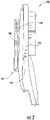
- the system 1000 can include a video system 104 connected with a video system support 1002 via a hinged connection 1004. Aspects of the system 1000 may function similarly to the device holder 110 described above in Figures 5A-5C , but may differ in particular by providing that the video system 104 may tilt 1030 relative to the video system support 1002 via the hinged connection 1004. The system 1000 may further or alternatively provide that the front and rear support elements 1020, 1022 can tilt together 1032 relative to video system 104, e.g.
- the system 1000 can include a first slider support 1006 with a first slider 1008 movably engaged to the first slider support 1006, a first hinge 1010, and an intermediate member 1012.
- the position of the first hinge 1010 can be varied by extending or retracting the first slider 1008 relative to the first slider support 1006.
- the intermediate member 1012 can thus tilt at the first hinge 1010.
- the intermediate member 1012 can connect with a second hinge 1024, so that a position of the second hinge 1024 can be varied via the intermediate member 1012.
- a second sliding support 1014 can be connected with the second hinge 1024 and operable connected with a second slider 1016, which may be movably engaged to the second sliding support 1014 in conjunction with a spring assembly 1018.
- the rear support element 1022 can be connected with the second sliding support 1014
- the front support element 1024 can be connected with the second slider, such that the rear and front support elements 1022, 1024 may be elastically connected with each other.
- the front support element 1020 may be pulled away from the rear support element 1022 in order to compress the spring assembly 1018, so that the front and rear support elements 1020, 1022 tend to produce a gripping force on an object disposed between them.
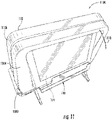
- FIG 11 is a perspective view of a system 1100 for holding a display device with a video shroud, in accordance with embodiments.
- the system 1100 can include a seat 102, a video system 104, and a display device holder 110, similar to the display device holder 110 shown above in, for example, Figure 1 .
- a video shroud 1104 can be connected with the seat 102 and configured to extend around the video display 104 and above the device holder 110.
- the shroud 1104 may be configured to block incident light above the device holder 110, such that glare on any device placed in the device holder 110 can be reduced.
- the shroud 1104 may be static with respect to the seat 102.
- the shroud 1104 can be configured to extend from the seat 102, e.g. from a pocket inside a main portion 1106 of the seat, by rotating about a hinge 1102 or other suitable connector.
- FIG 12 is a perspective view of a system 1200 for holding a display device without impinging on an audiovisual port, such as a headphone jack, in accordance with embodiments.
- the system 1200 can include a seat 102, a video system 104 with an audiovisual port 112, and a device holder 110.
- the device holder 110 may be sized to enable access to the video system 104, for example by not extending an entire width of the video system 104. Thus, portions of the video system 104, for example one or more controls, audiovisual ports, or other aspects of the video system 104, may be unobstructed by the device holder 110.
- Figure 13 is a perspective view of a system 1300 for holding a display device in conjunction with a complimentary retention feature, for example a support arm 1302, in accordance with embodiments.
- the system 1300 can include a seat 102, a video system 104, and a device holder 110.
- the device holder 110 can include a support arm 1302 which may be movably connected with the device holder 110. The support arm 1302 so may be moved to retain a display device.
- the support arm 1302 can be rotatably connected with the device holder 110 with a stowed position 1306, in which the support arm does not obstruct access to the device holder 110, and with a deployed position 1308, in which the support arm further supports a display device placed in the device holder 110.
- FIG 14 is a perspective view of a system 1400 for holding a display device in conjunction with an alternative embodiment of a complimentary retention feature, for example a complimentary support arm 1402.
- the system 1400 can include a seat 102, a video system 104, and a device holder 110.
- the support arm 1402 can be movably connected with one of the seat 102, the video system 104, or the device holder 110 so as to enable the support arm 1402 to move to retain a display device.
- the support arm 1402 may be connected with the seat 102 or with the video system 104 independently of the device holder 110.
- the support arm 1402 can be rotatably connected with the video system 104 via a hinged connection 1404 with a stowed position 1408a and a deployed position 1408b.
- the support arm 1402 can be configured to extend or retract, e.g. via a telescoping or sliding connection 1406, so as to accommodate display devices of varying sizes.
- the support arm 1402 may be slidingly connected with the video system 104, such that a vertical position of the support arm 1402 can be adjusted by a user.
- FIG 15 is a perspective view of a system 1500 for holding a display device in conjunction with a support structure 104a of an IFE system, such as a support structure of a video display part of the IFE system.
- the system 1500 may be similar in structure and function to the system 100 shown in Figures 1-4 , and is shown oriented in a deployed position, similar to the deployed position 500c of the device holder 110 as shown in Figure 5C .
- the system 1500 includes a video system support structure 104a.
- the video system support structure 104a may be a component of a video system or an IFE system, such as the video system 104 referred to in Figures 1-14 .
- the video system support structure 104a may be configured to support a video display of an IFE system or video system.
- Slider support brackets 1504 can be connected with the video support structure 104a for interacting with a sliding part 1508, which is similar to the slider 508 described above in reference to Figures 5A-5C .
- the sliding part 1508 can be connected with a hinge assembly 1510, which can further connect with a rear support part 1512.
- the rear support part 1512 may function similarly to the second slider support 512 described above in reference to figures 5A-5C .
- the rear support part 1512 may extend on either side of the hinge assembly 1510, such that a portion of the rear support part 1512 may act as a stop against rotation about the hinge assembly 1510.
- a rear support element 1514 may be connected with, or may be formed of the same part with, the rear support part 1512, and may be arranged to support a back of a display device (e.g. may be substantially vertical).
- a second sliding part 1516 can be slidingly connected with the rear support part 1512.
- the second sliding part 1516 may be further connected with the rear support part 1512 via a spring-sliding connection 1520.
- the second sliding part 1516 may be further connected with a front support element 1518, which may be oriented parallel to the rear support element 1514.
- the front and rear support elements 1518, 1514 may be slidable away from each other, similar to the front and rear support elements 518, 514 described in Figures 5A-5C , such that the front and rear support elements 1518, 1514 can accommodate a display device, such as a tablet, therebetween.
- the front and rear support elements 1518, 1514 can be elastically coupled via the spring-sliding connection 1520, such that they can exert a gripping force between them to grip a display device.
- Figure 16A is a perspective view of a system 1600 for holding a display device in conjunction with a video system 104, in accordance with an alternate example not falling within the scope of the claims, showing the system 1600 in a stowed position 1620a.
- the system 1600 can include first and second support members 1602a, 1602b, which can be connected with the video system 104 via first and second pivots 1604a, 1604b.
- the video system 104 may refer to a support structure of an IFE system, or a support structure for a video screen of an IFE system.
- the first and second support members 1602a, 1602b may be arranged, in the closed position 1620a, extending away from one another along an edge of and/or underneath the video system 104.
- the first and second support members 1602a, 1602b can further include one or more grooves 1608a, 1608b, which may be arranged at an angle in or on the support members 1602a, 1602b.
- the first and second support members 1602a, 1602b can further include coordinating features 1606a, 1606b, which coordinate the motion of the support members 1602a, 1602b, relative to each other.
- the coordinating features 1606a, 1606b may be interlocking teeth on mating surfaces.
- various other forms of coordinating features are possible, such as abutting surfaces, abutting friction surfaces (e.g. rubber), externally connected gears, or other suitable coordinating features.
- a complimentary support 1610 may be provided.
- the complimentary support 1610 may be connected with a different part of the video system 104 than the first and second support members 1602a, 1602b.
- the complimentary support 1610 can include a pivot 1612 connecting the complimentary support 1610 with the video system 104.
- the complimentary support 1610 can further include a grooved part 1614 in an end opposite the pivot 1612 configured to accept a display device.
- the grooved part 1614 can include a single groove in a rotating part that rotates relative to the complimentary support 1610, or it can include two grooves passing through each other or near each other at different angles. In some cases, the grooved part 1614 can include a single groove shaped to fit a display device at one angle or at multiple angles.
- the complimentary support 1610 is shown in a stowed position 1622, which may be parallel to the video system 104.
- Figure 16B is a perspective view of the system 1600 shown in Figure 16A , in a deployed position 1620b holding a small display device 106a.
- the first and second support members 1602a, 1602b may be oriented at an angle to the video system 104, such that the grooves 1608a, 1608b are aligned with each other and with the small display device 106a.
- the grooves 1608a, 1608b may be kept in alignment by way of, for example, the coordinating features 1606a, 1606b.
- the complimentary support 1610 may be oriented in a first deployed position 1622b, which may be a low deployed position, such that the complimentary support 1610 is rotated out and down from the pivot 1612, and such that the grooved part 1614 can interact with the small display device 106a to further restrain the small display device 106a.
- the small display device 106a may rest entirely on one of the first and second support members 1602a, 1602b, for example the second support member 1602b.
- the complimentary support 1610 may be provided on one side or on the other side of the video system 104.
- an additional complimentary support 1610 may be provided, such that a display device may be accommodated at either side of the video system 104.
- Figure 16C is a perspective view of the system 1600 shown in Figure 16A , in a deployed position 1620b supporting a mid-sized display device 106b.
- the first and second support members 1602a, 1602b may both support the mid-sized display device.
- the complimentary support 1610 may be oriented in a second deployed position 1622b, which may be a high deployed position, such that the complimentary support 1610 is rotated out and up from the pivot 1612, and such that the grooved part 1614 can interact with the mid-sized display device 106a to further restrain the mid-sized display device 106a.
- Figure 17A is a perspective view showing an alternative example, not falling within the scope of the claims, of a device holder 122 for holding a display device in conjunction with a video system 104, in a stowed position 120a.
- the device holder 122 can be slidingly connected with the video system 104 such that the device holder is approximately flush with the video system 104, e.g. with the video screen 104b when in the stowed position.
- the device holder 122 may be provided as having an upper arm 122a and a lower arm 122b, with an L-shape or angle formed between the arms.
- the arms may form an interior cavity 136 that can be positioned around the sides of the video system 104.
- the interior cavity 136 can receive the video system 104.
- a clearance distance 124 of the device holder 122 in front of the video screen 104b may be small, for example, on an order of approximately 1-5mm. In some cases, a gap may be provided between the video system 104 and the device holder 122 in order to allow a user to grip the device holder 122.
- Figure 17B is a perspective viewing showing the device holder 122 of Figure 17A in a deployed position 120b, holding a display device 106.
- the device holder 122 can be slidingly connected with the video system 104.
- the device holder 122 can operate via tracks 128 in the device holder that interact with corresponding features 130 of the device holder 122.
- Corresponding features 130 may be, for example, protrusions of the interior cavity 136.
- various forms of sliding connection are possible.
- positive features may instead be provided on the video system 104 for interacting with tracks in the device holder 122.
- a different form of connection than a sliding connection may be provided.
- the device holder 122 may swivel forward from the stowed position 120a to the deployed position 120b on one or more hinged connectors (not shown).
- a spring assembly 132 may be provided to elastically couple the device holder 122 with the video system 104.
- a spring may be provided in a track 128 of the sliding connection. The spring assembly 132 may cause the device holder 122 to resist being pulled out from the stowed position 120a to the deployed position 120b.
- the device holder 122 may exert a gripping force against the display device 106 when the display device is inserted in the device holder.
- the device holder 122 may hold the display device 106 against the video system 104, for example, abutting the video screen 104b, or another suitable portion of the video system 104.
- Figure 17C illustrates an alternate example not falling withing the scope of the claims, in which the shroud of the video system 104 has a depression 134 sized and shaped to correspond to contours of the device holder 122.
- the entirety of the device holder 122 slides into the depression for storing.
- the device holder 122 slides out of the depression.
- the device holder 122 may be structurally similar to other embodiments described, such that an interior cavity 136 can receive a display tablet or device in use.
- the video screen 104b may support a rear surface of the display tablet or device to be viewed.
Landscapes
- Engineering & Computer Science (AREA)
- Mechanical Engineering (AREA)
- Aviation & Aerospace Engineering (AREA)
- Fittings On The Vehicle Exterior For Carrying Loads, And Devices For Holding Or Mounting Articles (AREA)
- Devices For Indicating Variable Information By Combining Individual Elements (AREA)
Claims (7)
- System (100) zum Halten einer Anzeigevorrichtung (106), wobei das System (100) umfasst:ein Rückenlehnen-Videosystem (104), das einen Videobildschirm (104b) umfasst,eine Stützstruktur (104a), die zum Zusammenwirken mit dem Videosystem (104) ausgelegt ist, undeinen einziehbaren Vorrichtungshalter (110), der mit der Stützstruktur (104a) verbunden ist und zum Halten der Anzeigevorrichtung (106) vor dem Videosystem (104) ausgelegt ist, wobei der Vorrichtungshalter (110) eine verstaute Position und eine ausgefahrene Position aufweist,wobei der Vorrichtungshalter (110) ungefähr bündig mit dem Videosystem (104) ist, wenn sich der Vorrichtungshalter (110) in einer verstauten Position befindet, undwobei der Vorrichtungshalter (110) so angeordnet ist, dass er die Anzeigevorrichtung (106) vor dem Videosystem (104) haltet, wenn sich der Vorrichtungshalter (110) in der ausgefahrenen Position befindet, wobei der Vorrichtungshalter (110) ein hinteres Stützelement (514) und ein vorderes Stützelement (518), welche zum Greifen eines zwischen dem hinteren Stützelement (514) und dem vorderen Stützelement (518) angeordneten Gegenstandes ausgelegt sein können,- dadurch gekennzeichnet, dass der Vorrichtungshalter (110) eine erste Schieberstütze (506) umfasst, der mit dem Videosystem (104) verbunden ist und einen ersten Schieber (508) stützt,- wobei der erste Schieber (508) mit einem Scharnier (510) verbunden ist, so dass die Position des Scharniers (510) durch Bewegen des ersten Schiebers (508) innerhalb der ersten Schieberstütze modifiziert werden kann,- wobei das Scharnier (510) mit einer zweiten Schieberstütze (512) verbunden ist, so dass eine Position der zweiten Schieberstütze (512) durch Bewegen des ersten Schiebers (508) innerhalb der ersten Schieberstütze (506) und auch durch Kippen der zweiten Schieberstütze (512) am Scharnier (510) modifiziert werden kann,- wobei die zweite Schieberstütze (512) mit dem hinteren Stützelement (514) verbunden ist,- wobei ein zweiter Schieber (516) mit der zweiten Schieberstütze (512) wirkverbunden ist, so dass der zweite Schieber (516) relativ zu der zweiten Schieberstütze (512) schieben kann,- wobei der zweite Schieber (516) mit dem vorderen Stützelement (518) verbunden ist, so dass das vordere Stützelement (518) relativ zum hinteren Stützelement (514) schieben kann.
- System nach Anspruch 1, dadurch gekennzeichnet, dass das Videosystem (104) neigungsverstellbar ist und die Stützstruktur (104a) mit dem Videosystem (104) verbunden und damit mit dem Videosystem (104) bewegbar ist, so dass ein Betrachtungswinkel der Anzeigevorrichtung (106) durch Einstellen des Videosystems (104) einstellbar ist.
- System nach Anspruch 1, dadurch gekennzeichnet, dass es ferner ein komplementäres Rückhalteelement umfasst, wobei das komplementäre Rückhalteelement getrennt vom Vorrichtungshalter (110) mit dem Vorrichtungshalter (110) oder dem Videosystem (104) verbunden ist und zum Halten der Anzeigevorrichtung (106) zusammen mit dem Vorrichtungshalter (110) ausgelegt ist, wenn die Anzeigevorrichtung (106) im Vorrichtungshalter (110) positioniert ist.
- System nach Anspruch 1, dadurch gekennzeichnet, dass es ferner einen Flugzeugsitz (102) umfasst, wobei das Videosystem (104) mit einer Rückenlehne des Flugzeugsitzes (102) verbunden ist.
- System nach Anspruch 1, dadurch gekennzeichnet, dass:
das vordere Stützelement (518) ferner einen unteren Abschnitt (534) und einen oberen Abschnitt (536) umfasst, wobei der untere Abschnitt (534) so bemessen ist, dass er das Betrachten eines Bildschirms der Anzeigevorrichtung (106) ermöglicht, und der obere Abschnitt (536) angeordnet ist, um eine Kante der Anzeigevorrichtung (106) zu stützen. - System nach Anspruch 1, dadurch gekennzeichnet, dass der Vorrichtungshalter (110) zum Stützen entweder ein Smartphone oder einen Tablet-Computer ausgelegt ist.
- System nach Anspruch 1, dadurch gekennzeichnet, dass das vordere Stützelement (518) relativ zum hinteren Stützelement (514) in einer Federkonfiguration verschiebbar ausgelegt ist, so dass die vorderen und hinteren Stützelemente (514, 518) dazu neigen, eine Klemmkraft zwischen den vorderen und hinteren Stützelementen (514, 518) zu erzeugen, wenn die vorderen und hinteren Stützelemente (514, 518) voneinander getrennt sind.
Applications Claiming Priority (2)
| Application Number | Priority Date | Filing Date | Title |
|---|---|---|---|
| US201462090189P | 2014-12-10 | 2014-12-10 | |
| PCT/IB2015/059528 WO2016092509A1 (en) | 2014-12-10 | 2015-12-10 | Retractable device holder for an aircraft seat |
Publications (2)
| Publication Number | Publication Date |
|---|---|
| EP3230162A1 EP3230162A1 (de) | 2017-10-18 |
| EP3230162B1 true EP3230162B1 (de) | 2022-06-29 |
Family
ID=54884110
Family Applications (1)
| Application Number | Title | Priority Date | Filing Date |
|---|---|---|---|
| EP15813121.9A Active EP3230162B1 (de) | 2014-12-10 | 2015-12-10 | Einziehbarer vorrichtungshalter für einen flugzeugsitz |
Country Status (2)
| Country | Link |
|---|---|
| EP (1) | EP3230162B1 (de) |
| WO (1) | WO2016092509A1 (de) |
Families Citing this family (10)
| Publication number | Priority date | Publication date | Assignee | Title |
|---|---|---|---|---|
| SG11201707083UA (en) | 2015-04-13 | 2017-09-28 | Singapore Tech Aerospace Ltd | Portable electronic device holder |
| WO2018044272A1 (en) * | 2016-08-30 | 2018-03-08 | Zodiac Seats Us Llc | Adjustable torque hinge assembly for headrests |
| GB2559948B (en) * | 2016-12-23 | 2020-08-05 | Thompson Aero Seating Ltd | Electronic device retaining apparatus |
| JP6949135B6 (ja) | 2017-03-24 | 2021-11-24 | サフラン パッセンジャー イノベーションズ, エルエルシー | 固定された画面を備える旋回内部表示ユニット |
| FR3072921B1 (fr) * | 2017-10-27 | 2019-09-27 | Psa Automobiles Sa | Support d’appareils multimedia integre dans le dossier de siege de vehicule |
| US12280873B2 (en) | 2019-06-27 | 2025-04-22 | Safran Seats Usa Llc | Portable electronic device holder for seat |
| WO2021086386A1 (en) * | 2019-10-31 | 2021-05-06 | Safran Seats Usa Llc | Adjustable device holder |
| US11979048B2 (en) | 2020-09-18 | 2024-05-07 | B/E Aerospace, Inc. | Inductive charging device holder |
| FR3139115A1 (fr) * | 2022-08-31 | 2024-03-01 | Safran Seats | Logement de charge à induction pour un siège muni d'un dispositif de retenue transversal |
| DE102023135422A1 (de) * | 2023-12-15 | 2025-06-18 | Recaro Aircraft Seating Gmbh & Co. Kg | Passagiersitzvorrichtung mit PED-Halter |
Citations (3)
| Publication number | Priority date | Publication date | Assignee | Title |
|---|---|---|---|---|
| US20050140191A1 (en) * | 2003-12-11 | 2005-06-30 | Thomas Curran | Stowable seat mounted display screen |
| US20130242523A1 (en) * | 2012-03-14 | 2013-09-19 | B/E Aerospace, Inc. | Deployable in-flight entertainment monitor |
| GB2524132A (en) * | 2014-10-16 | 2015-09-16 | Bentley Motors Ltd | Display screen mount |
Family Cites Families (5)
| Publication number | Priority date | Publication date | Assignee | Title |
|---|---|---|---|---|
| US7604273B2 (en) * | 2003-11-07 | 2009-10-20 | Vitito Christopher J | Vehicle entertainment system |
| US20070096517A1 (en) * | 2005-11-02 | 2007-05-03 | Chang Chung L | Headrest mounted entertainment system |
| US20090089841A1 (en) * | 2007-10-01 | 2009-04-02 | Lear Corporation | Seat-mounted electronics assembly |
| WO2011101083A1 (de) * | 2010-01-28 | 2011-08-25 | Kinetix Ag | Vorrichtung zum anbringen eines tablet-computers |
| US9908624B2 (en) * | 2012-02-20 | 2018-03-06 | Zodiac Seats Us Llc | Personal electronic device mounting structures |
-
2015
- 2015-12-10 EP EP15813121.9A patent/EP3230162B1/de active Active
- 2015-12-10 WO PCT/IB2015/059528 patent/WO2016092509A1/en not_active Ceased
Patent Citations (3)
| Publication number | Priority date | Publication date | Assignee | Title |
|---|---|---|---|---|
| US20050140191A1 (en) * | 2003-12-11 | 2005-06-30 | Thomas Curran | Stowable seat mounted display screen |
| US20130242523A1 (en) * | 2012-03-14 | 2013-09-19 | B/E Aerospace, Inc. | Deployable in-flight entertainment monitor |
| GB2524132A (en) * | 2014-10-16 | 2015-09-16 | Bentley Motors Ltd | Display screen mount |
Also Published As
| Publication number | Publication date |
|---|---|
| EP3230162A1 (de) | 2017-10-18 |
| WO2016092509A1 (en) | 2016-06-16 |
Similar Documents
| Publication | Publication Date | Title |
|---|---|---|
| EP3230162B1 (de) | Einziehbarer vorrichtungshalter für einen flugzeugsitz | |
| EP3303133B1 (de) | Entfaltbare rückenlehnenhalterung für tragbare elektronische vorrichtungen | |
| EP2673549B1 (de) | System zum halten und verstauen von tablets | |
| EP3283376B1 (de) | Flugzeugsitzeanordnung | |
| EP2569187B1 (de) | Kupplungseinheit | |
| US8827341B2 (en) | Vehicle portable device holding system | |
| EP2981464B1 (de) | Stützstruktur zur befestigung an einem serviertisch für einen passagiersitz, serviertisch für einen passagiersitz sowie passagiersitz | |
| CN105358377B (zh) | 用于便携式电子设备的可调支撑组件 | |
| US12280873B2 (en) | Portable electronic device holder for seat | |
| CN105121226B (zh) | 显示屏支座 | |
| EP3221188B1 (de) | Fahrzeugsitz mit integrierter halterung für elektronische vorrichtungen | |
| US10744921B2 (en) | Portable electronic device holder for tray tables | |
| EP2760743A1 (de) | Flugzeugcockpit, insbesondere frontteil eines flugzeugcockpits | |
| EP3498605B1 (de) | Annehmlichkeitsmodul | |
| US12083962B2 (en) | Tape holder for portable electronic device | |
| EP4051586B1 (de) | Einstellbarer gerätehalter | |
| WO2018151664A1 (en) | Portable electronic device holder for a passenger seat | |
| US11858427B2 (en) | PED holder arm concept | |
| KR20260020551A (ko) | 프로젝터 어셈블리 |
Legal Events
| Date | Code | Title | Description |
|---|---|---|---|
| STAA | Information on the status of an ep patent application or granted ep patent |
Free format text: STATUS: THE INTERNATIONAL PUBLICATION HAS BEEN MADE |
|
| PUAI | Public reference made under article 153(3) epc to a published international application that has entered the european phase |
Free format text: ORIGINAL CODE: 0009012 |
|
| STAA | Information on the status of an ep patent application or granted ep patent |
Free format text: STATUS: REQUEST FOR EXAMINATION WAS MADE |
|
| 17P | Request for examination filed |
Effective date: 20170601 |
|
| AK | Designated contracting states |
Kind code of ref document: A1 Designated state(s): AL AT BE BG CH CY CZ DE DK EE ES FI FR GB GR HR HU IE IS IT LI LT LU LV MC MK MT NL NO PL PT RO RS SE SI SK SM TR |
|
| AX | Request for extension of the european patent |
Extension state: BA ME |
|
| DAV | Request for validation of the european patent (deleted) | ||
| DAX | Request for extension of the european patent (deleted) | ||
| STAA | Information on the status of an ep patent application or granted ep patent |
Free format text: STATUS: EXAMINATION IS IN PROGRESS |
|
| 17Q | First examination report despatched |
Effective date: 20190729 |
|
| GRAP | Despatch of communication of intention to grant a patent |
Free format text: ORIGINAL CODE: EPIDOSNIGR1 |
|
| STAA | Information on the status of an ep patent application or granted ep patent |
Free format text: STATUS: GRANT OF PATENT IS INTENDED |
|
| INTG | Intention to grant announced |
Effective date: 20220425 |
|
| GRAS | Grant fee paid |
Free format text: ORIGINAL CODE: EPIDOSNIGR3 |
|
| GRAA | (expected) grant |
Free format text: ORIGINAL CODE: 0009210 |
|
| STAA | Information on the status of an ep patent application or granted ep patent |
Free format text: STATUS: THE PATENT HAS BEEN GRANTED |
|
| AK | Designated contracting states |
Kind code of ref document: B1 Designated state(s): AL AT BE BG CH CY CZ DE DK EE ES FI FR GB GR HR HU IE IS IT LI LT LU LV MC MK MT NL NO PL PT RO RS SE SI SK SM TR |
|
| REG | Reference to a national code |
Ref country code: GB Ref legal event code: FG4D |
|
| REG | Reference to a national code |
Ref country code: CH Ref legal event code: EP |
|
| REG | Reference to a national code |
Ref country code: DE Ref legal event code: R096 Ref document number: 602015079686 Country of ref document: DE |
|
| REG | Reference to a national code |
Ref country code: AT Ref legal event code: REF Ref document number: 1501196 Country of ref document: AT Kind code of ref document: T Effective date: 20220715 |
|
| REG | Reference to a national code |
Ref country code: IE Ref legal event code: FG4D |
|
| REG | Reference to a national code |
Ref country code: LT Ref legal event code: MG9D |
|
| PG25 | Lapsed in a contracting state [announced via postgrant information from national office to epo] |
Ref country code: SE Free format text: LAPSE BECAUSE OF FAILURE TO SUBMIT A TRANSLATION OF THE DESCRIPTION OR TO PAY THE FEE WITHIN THE PRESCRIBED TIME-LIMIT Effective date: 20220629 Ref country code: NO Free format text: LAPSE BECAUSE OF FAILURE TO SUBMIT A TRANSLATION OF THE DESCRIPTION OR TO PAY THE FEE WITHIN THE PRESCRIBED TIME-LIMIT Effective date: 20220929 Ref country code: LT Free format text: LAPSE BECAUSE OF FAILURE TO SUBMIT A TRANSLATION OF THE DESCRIPTION OR TO PAY THE FEE WITHIN THE PRESCRIBED TIME-LIMIT Effective date: 20220629 Ref country code: HR Free format text: LAPSE BECAUSE OF FAILURE TO SUBMIT A TRANSLATION OF THE DESCRIPTION OR TO PAY THE FEE WITHIN THE PRESCRIBED TIME-LIMIT Effective date: 20220629 Ref country code: GR Free format text: LAPSE BECAUSE OF FAILURE TO SUBMIT A TRANSLATION OF THE DESCRIPTION OR TO PAY THE FEE WITHIN THE PRESCRIBED TIME-LIMIT Effective date: 20220930 Ref country code: FI Free format text: LAPSE BECAUSE OF FAILURE TO SUBMIT A TRANSLATION OF THE DESCRIPTION OR TO PAY THE FEE WITHIN THE PRESCRIBED TIME-LIMIT Effective date: 20220629 Ref country code: BG Free format text: LAPSE BECAUSE OF FAILURE TO SUBMIT A TRANSLATION OF THE DESCRIPTION OR TO PAY THE FEE WITHIN THE PRESCRIBED TIME-LIMIT Effective date: 20220929 |
|
| REG | Reference to a national code |
Ref country code: NL Ref legal event code: MP Effective date: 20220629 |
|
| REG | Reference to a national code |
Ref country code: AT Ref legal event code: MK05 Ref document number: 1501196 Country of ref document: AT Kind code of ref document: T Effective date: 20220629 |
|
| PG25 | Lapsed in a contracting state [announced via postgrant information from national office to epo] |
Ref country code: RS Free format text: LAPSE BECAUSE OF FAILURE TO SUBMIT A TRANSLATION OF THE DESCRIPTION OR TO PAY THE FEE WITHIN THE PRESCRIBED TIME-LIMIT Effective date: 20220629 Ref country code: LV Free format text: LAPSE BECAUSE OF FAILURE TO SUBMIT A TRANSLATION OF THE DESCRIPTION OR TO PAY THE FEE WITHIN THE PRESCRIBED TIME-LIMIT Effective date: 20220629 |
|
| PG25 | Lapsed in a contracting state [announced via postgrant information from national office to epo] |
Ref country code: NL Free format text: LAPSE BECAUSE OF FAILURE TO SUBMIT A TRANSLATION OF THE DESCRIPTION OR TO PAY THE FEE WITHIN THE PRESCRIBED TIME-LIMIT Effective date: 20220629 |
|
| PG25 | Lapsed in a contracting state [announced via postgrant information from national office to epo] |
Ref country code: SM Free format text: LAPSE BECAUSE OF FAILURE TO SUBMIT A TRANSLATION OF THE DESCRIPTION OR TO PAY THE FEE WITHIN THE PRESCRIBED TIME-LIMIT Effective date: 20220629 Ref country code: SK Free format text: LAPSE BECAUSE OF FAILURE TO SUBMIT A TRANSLATION OF THE DESCRIPTION OR TO PAY THE FEE WITHIN THE PRESCRIBED TIME-LIMIT Effective date: 20220629 Ref country code: RO Free format text: LAPSE BECAUSE OF FAILURE TO SUBMIT A TRANSLATION OF THE DESCRIPTION OR TO PAY THE FEE WITHIN THE PRESCRIBED TIME-LIMIT Effective date: 20220629 Ref country code: PT Free format text: LAPSE BECAUSE OF FAILURE TO SUBMIT A TRANSLATION OF THE DESCRIPTION OR TO PAY THE FEE WITHIN THE PRESCRIBED TIME-LIMIT Effective date: 20221031 Ref country code: ES Free format text: LAPSE BECAUSE OF FAILURE TO SUBMIT A TRANSLATION OF THE DESCRIPTION OR TO PAY THE FEE WITHIN THE PRESCRIBED TIME-LIMIT Effective date: 20220629 Ref country code: EE Free format text: LAPSE BECAUSE OF FAILURE TO SUBMIT A TRANSLATION OF THE DESCRIPTION OR TO PAY THE FEE WITHIN THE PRESCRIBED TIME-LIMIT Effective date: 20220629 Ref country code: AT Free format text: LAPSE BECAUSE OF FAILURE TO SUBMIT A TRANSLATION OF THE DESCRIPTION OR TO PAY THE FEE WITHIN THE PRESCRIBED TIME-LIMIT Effective date: 20220629 |
|
| PG25 | Lapsed in a contracting state [announced via postgrant information from national office to epo] |
Ref country code: PL Free format text: LAPSE BECAUSE OF FAILURE TO SUBMIT A TRANSLATION OF THE DESCRIPTION OR TO PAY THE FEE WITHIN THE PRESCRIBED TIME-LIMIT Effective date: 20220629 Ref country code: IS Free format text: LAPSE BECAUSE OF FAILURE TO SUBMIT A TRANSLATION OF THE DESCRIPTION OR TO PAY THE FEE WITHIN THE PRESCRIBED TIME-LIMIT Effective date: 20221029 |
|
| REG | Reference to a national code |
Ref country code: DE Ref legal event code: R097 Ref document number: 602015079686 Country of ref document: DE |
|
| PG25 | Lapsed in a contracting state [announced via postgrant information from national office to epo] |
Ref country code: AL Free format text: LAPSE BECAUSE OF FAILURE TO SUBMIT A TRANSLATION OF THE DESCRIPTION OR TO PAY THE FEE WITHIN THE PRESCRIBED TIME-LIMIT Effective date: 20220629 |
|
| PG25 | Lapsed in a contracting state [announced via postgrant information from national office to epo] |
Ref country code: DK Free format text: LAPSE BECAUSE OF FAILURE TO SUBMIT A TRANSLATION OF THE DESCRIPTION OR TO PAY THE FEE WITHIN THE PRESCRIBED TIME-LIMIT Effective date: 20220629 Ref country code: CZ Free format text: LAPSE BECAUSE OF FAILURE TO SUBMIT A TRANSLATION OF THE DESCRIPTION OR TO PAY THE FEE WITHIN THE PRESCRIBED TIME-LIMIT Effective date: 20220629 |
|
| PLBE | No opposition filed within time limit |
Free format text: ORIGINAL CODE: 0009261 |
|
| STAA | Information on the status of an ep patent application or granted ep patent |
Free format text: STATUS: NO OPPOSITION FILED WITHIN TIME LIMIT |
|
| 26N | No opposition filed |
Effective date: 20230330 |
|
| REG | Reference to a national code |
Ref country code: CH Ref legal event code: PL |
|
| REG | Reference to a national code |
Ref country code: BE Ref legal event code: MM Effective date: 20221231 |
|
| PG25 | Lapsed in a contracting state [announced via postgrant information from national office to epo] |
Ref country code: SI Free format text: LAPSE BECAUSE OF FAILURE TO SUBMIT A TRANSLATION OF THE DESCRIPTION OR TO PAY THE FEE WITHIN THE PRESCRIBED TIME-LIMIT Effective date: 20220629 Ref country code: LU Free format text: LAPSE BECAUSE OF NON-PAYMENT OF DUE FEES Effective date: 20221210 |
|
| PG25 | Lapsed in a contracting state [announced via postgrant information from national office to epo] |
Ref country code: LI Free format text: LAPSE BECAUSE OF NON-PAYMENT OF DUE FEES Effective date: 20221231 Ref country code: IE Free format text: LAPSE BECAUSE OF NON-PAYMENT OF DUE FEES Effective date: 20221210 Ref country code: CH Free format text: LAPSE BECAUSE OF NON-PAYMENT OF DUE FEES Effective date: 20221231 |
|
| PG25 | Lapsed in a contracting state [announced via postgrant information from national office to epo] |
Ref country code: BE Free format text: LAPSE BECAUSE OF NON-PAYMENT OF DUE FEES Effective date: 20221231 |
|
| PG25 | Lapsed in a contracting state [announced via postgrant information from national office to epo] |
Ref country code: IT Free format text: LAPSE BECAUSE OF FAILURE TO SUBMIT A TRANSLATION OF THE DESCRIPTION OR TO PAY THE FEE WITHIN THE PRESCRIBED TIME-LIMIT Effective date: 20220629 |
|
| PG25 | Lapsed in a contracting state [announced via postgrant information from national office to epo] |
Ref country code: HU Free format text: LAPSE BECAUSE OF FAILURE TO SUBMIT A TRANSLATION OF THE DESCRIPTION OR TO PAY THE FEE WITHIN THE PRESCRIBED TIME-LIMIT; INVALID AB INITIO Effective date: 20151210 |
|
| PG25 | Lapsed in a contracting state [announced via postgrant information from national office to epo] |
Ref country code: CY Free format text: LAPSE BECAUSE OF FAILURE TO SUBMIT A TRANSLATION OF THE DESCRIPTION OR TO PAY THE FEE WITHIN THE PRESCRIBED TIME-LIMIT Effective date: 20220629 |
|
| PG25 | Lapsed in a contracting state [announced via postgrant information from national office to epo] |
Ref country code: MK Free format text: LAPSE BECAUSE OF FAILURE TO SUBMIT A TRANSLATION OF THE DESCRIPTION OR TO PAY THE FEE WITHIN THE PRESCRIBED TIME-LIMIT Effective date: 20220629 |
|
| PG25 | Lapsed in a contracting state [announced via postgrant information from national office to epo] |
Ref country code: MC Free format text: LAPSE BECAUSE OF FAILURE TO SUBMIT A TRANSLATION OF THE DESCRIPTION OR TO PAY THE FEE WITHIN THE PRESCRIBED TIME-LIMIT Effective date: 20220629 |
|
| PG25 | Lapsed in a contracting state [announced via postgrant information from national office to epo] |
Ref country code: MC Free format text: LAPSE BECAUSE OF FAILURE TO SUBMIT A TRANSLATION OF THE DESCRIPTION OR TO PAY THE FEE WITHIN THE PRESCRIBED TIME-LIMIT Effective date: 20220629 |
|
| PG25 | Lapsed in a contracting state [announced via postgrant information from national office to epo] |
Ref country code: MT Free format text: LAPSE BECAUSE OF FAILURE TO SUBMIT A TRANSLATION OF THE DESCRIPTION OR TO PAY THE FEE WITHIN THE PRESCRIBED TIME-LIMIT Effective date: 20220629 |
|
| PG25 | Lapsed in a contracting state [announced via postgrant information from national office to epo] |
Ref country code: BG Free format text: LAPSE BECAUSE OF FAILURE TO SUBMIT A TRANSLATION OF THE DESCRIPTION OR TO PAY THE FEE WITHIN THE PRESCRIBED TIME-LIMIT Effective date: 20220629 |
|
| PG25 | Lapsed in a contracting state [announced via postgrant information from national office to epo] |
Ref country code: BG Free format text: LAPSE BECAUSE OF FAILURE TO SUBMIT A TRANSLATION OF THE DESCRIPTION OR TO PAY THE FEE WITHIN THE PRESCRIBED TIME-LIMIT Effective date: 20220629 |
|
| PG25 | Lapsed in a contracting state [announced via postgrant information from national office to epo] |
Ref country code: TR Free format text: LAPSE BECAUSE OF FAILURE TO SUBMIT A TRANSLATION OF THE DESCRIPTION OR TO PAY THE FEE WITHIN THE PRESCRIBED TIME-LIMIT Effective date: 20220629 |
|
| PGFP | Annual fee paid to national office [announced via postgrant information from national office to epo] |
Ref country code: GB Payment date: 20251229 Year of fee payment: 11 |
|
| PGFP | Annual fee paid to national office [announced via postgrant information from national office to epo] |
Ref country code: FR Payment date: 20251222 Year of fee payment: 11 |
|
| PGFP | Annual fee paid to national office [announced via postgrant information from national office to epo] |
Ref country code: DE Payment date: 20251222 Year of fee payment: 11 |