EP3256547B1 - Procédé de production d'hydrocarbures à partir d'une charge d'huile renouvelable - Google Patents
Procédé de production d'hydrocarbures à partir d'une charge d'huile renouvelable Download PDFInfo
- Publication number
- EP3256547B1 EP3256547B1 EP16705216.6A EP16705216A EP3256547B1 EP 3256547 B1 EP3256547 B1 EP 3256547B1 EP 16705216 A EP16705216 A EP 16705216A EP 3256547 B1 EP3256547 B1 EP 3256547B1
- Authority
- EP
- European Patent Office
- Prior art keywords
- oil
- feedstock
- pfad
- particle size
- fatty acid
- Prior art date
- Legal status (The legal status is an assumption and is not a legal conclusion. Google has not performed a legal analysis and makes no representation as to the accuracy of the status listed.)
- Active
Links
Images



Classifications
-
- C—CHEMISTRY; METALLURGY
- C10—PETROLEUM, GAS OR COKE INDUSTRIES; TECHNICAL GASES CONTAINING CARBON MONOXIDE; FUELS; LUBRICANTS; PEAT
- C10G—CRACKING HYDROCARBON OILS; PRODUCTION OF LIQUID HYDROCARBON MIXTURES, e.g. BY DESTRUCTIVE HYDROGENATION, OLIGOMERISATION, POLYMERISATION; RECOVERY OF HYDROCARBON OILS FROM OIL-SHALE, OIL-SAND, OR GASES; REFINING MIXTURES MAINLY CONSISTING OF HYDROCARBONS; REFORMING OF NAPHTHA; MINERAL WAXES
- C10G3/00—Production of liquid hydrocarbon mixtures from oxygen-containing organic materials, e.g. fatty oils, fatty acids
- C10G3/50—Production of liquid hydrocarbon mixtures from oxygen-containing organic materials, e.g. fatty oils, fatty acids in the presence of hydrogen, hydrogen donors or hydrogen generating compounds
-
- C—CHEMISTRY; METALLURGY
- C10—PETROLEUM, GAS OR COKE INDUSTRIES; TECHNICAL GASES CONTAINING CARBON MONOXIDE; FUELS; LUBRICANTS; PEAT
- C10G—CRACKING HYDROCARBON OILS; PRODUCTION OF LIQUID HYDROCARBON MIXTURES, e.g. BY DESTRUCTIVE HYDROGENATION, OLIGOMERISATION, POLYMERISATION; RECOVERY OF HYDROCARBON OILS FROM OIL-SHALE, OIL-SAND, OR GASES; REFINING MIXTURES MAINLY CONSISTING OF HYDROCARBONS; REFORMING OF NAPHTHA; MINERAL WAXES
- C10G3/00—Production of liquid hydrocarbon mixtures from oxygen-containing organic materials, e.g. fatty oils, fatty acids
- C10G3/42—Catalytic treatment
- C10G3/44—Catalytic treatment characterised by the catalyst used
- C10G3/45—Catalytic treatment characterised by the catalyst used containing iron group metals or compounds thereof
- C10G3/46—Catalytic treatment characterised by the catalyst used containing iron group metals or compounds thereof in combination with chromium, molybdenum, tungsten metals or compounds thereof
-
- C—CHEMISTRY; METALLURGY
- C10—PETROLEUM, GAS OR COKE INDUSTRIES; TECHNICAL GASES CONTAINING CARBON MONOXIDE; FUELS; LUBRICANTS; PEAT
- C10G—CRACKING HYDROCARBON OILS; PRODUCTION OF LIQUID HYDROCARBON MIXTURES, e.g. BY DESTRUCTIVE HYDROGENATION, OLIGOMERISATION, POLYMERISATION; RECOVERY OF HYDROCARBON OILS FROM OIL-SHALE, OIL-SAND, OR GASES; REFINING MIXTURES MAINLY CONSISTING OF HYDROCARBONS; REFORMING OF NAPHTHA; MINERAL WAXES
- C10G45/00—Refining of hydrocarbon oils using hydrogen or hydrogen-generating compounds
-
- C—CHEMISTRY; METALLURGY
- C11—ANIMAL OR VEGETABLE OILS, FATS, FATTY SUBSTANCES OR WAXES; FATTY ACIDS THEREFROM; DETERGENTS; CANDLES
- C11B—PRODUCING, e.g. BY PRESSING RAW MATERIALS OR BY EXTRACTION FROM WASTE MATERIALS, REFINING OR PRESERVING FATS, FATTY SUBSTANCES, e.g. LANOLIN, FATTY OILS OR WAXES; ESSENTIAL OILS; PERFUMES
- C11B1/00—Production of fats or fatty oils from raw materials
- C11B1/02—Pretreatment
-
- C—CHEMISTRY; METALLURGY
- C11—ANIMAL OR VEGETABLE OILS, FATS, FATTY SUBSTANCES OR WAXES; FATTY ACIDS THEREFROM; DETERGENTS; CANDLES
- C11B—PRODUCING, e.g. BY PRESSING RAW MATERIALS OR BY EXTRACTION FROM WASTE MATERIALS, REFINING OR PRESERVING FATS, FATTY SUBSTANCES, e.g. LANOLIN, FATTY OILS OR WAXES; ESSENTIAL OILS; PERFUMES
- C11B3/00—Refining fats or fatty oils
-
- C—CHEMISTRY; METALLURGY
- C11—ANIMAL OR VEGETABLE OILS, FATS, FATTY SUBSTANCES OR WAXES; FATTY ACIDS THEREFROM; DETERGENTS; CANDLES
- C11B—PRODUCING, e.g. BY PRESSING RAW MATERIALS OR BY EXTRACTION FROM WASTE MATERIALS, REFINING OR PRESERVING FATS, FATTY SUBSTANCES, e.g. LANOLIN, FATTY OILS OR WAXES; ESSENTIAL OILS; PERFUMES
- C11B3/00—Refining fats or fatty oils
- C11B3/008—Refining fats or fatty oils by filtration, e.g. including ultra filtration, dialysis
-
- C—CHEMISTRY; METALLURGY
- C11—ANIMAL OR VEGETABLE OILS, FATS, FATTY SUBSTANCES OR WAXES; FATTY ACIDS THEREFROM; DETERGENTS; CANDLES
- C11C—FATTY ACIDS FROM FATS, OILS OR WAXES; CANDLES; FATS, OILS OR FATTY ACIDS BY CHEMICAL MODIFICATION OF FATS, OILS, OR FATTY ACIDS OBTAINED THEREFROM
- C11C3/00—Fats, oils, or fatty acids by chemical modification of fats, oils, or fatty acids obtained therefrom
- C11C3/12—Fats, oils, or fatty acids by chemical modification of fats, oils, or fatty acids obtained therefrom by hydrogenation
-
- B—PERFORMING OPERATIONS; TRANSPORTING
- B01—PHYSICAL OR CHEMICAL PROCESSES OR APPARATUS IN GENERAL
- B01D—SEPARATION
- B01D3/00—Distillation or related exchange processes in which liquids are contacted with gaseous media, e.g. stripping
- B01D3/14—Fractional distillation or use of a fractionation or rectification column
-
- C—CHEMISTRY; METALLURGY
- C10—PETROLEUM, GAS OR COKE INDUSTRIES; TECHNICAL GASES CONTAINING CARBON MONOXIDE; FUELS; LUBRICANTS; PEAT
- C10G—CRACKING HYDROCARBON OILS; PRODUCTION OF LIQUID HYDROCARBON MIXTURES, e.g. BY DESTRUCTIVE HYDROGENATION, OLIGOMERISATION, POLYMERISATION; RECOVERY OF HYDROCARBON OILS FROM OIL-SHALE, OIL-SAND, OR GASES; REFINING MIXTURES MAINLY CONSISTING OF HYDROCARBONS; REFORMING OF NAPHTHA; MINERAL WAXES
- C10G2300/00—Aspects relating to hydrocarbon processing covered by groups C10G1/00 - C10G99/00
- C10G2300/10—Feedstock materials
- C10G2300/1011—Biomass
- C10G2300/1014—Biomass of vegetal origin
-
- C—CHEMISTRY; METALLURGY
- C10—PETROLEUM, GAS OR COKE INDUSTRIES; TECHNICAL GASES CONTAINING CARBON MONOXIDE; FUELS; LUBRICANTS; PEAT
- C10G—CRACKING HYDROCARBON OILS; PRODUCTION OF LIQUID HYDROCARBON MIXTURES, e.g. BY DESTRUCTIVE HYDROGENATION, OLIGOMERISATION, POLYMERISATION; RECOVERY OF HYDROCARBON OILS FROM OIL-SHALE, OIL-SAND, OR GASES; REFINING MIXTURES MAINLY CONSISTING OF HYDROCARBONS; REFORMING OF NAPHTHA; MINERAL WAXES
- C10G2300/00—Aspects relating to hydrocarbon processing covered by groups C10G1/00 - C10G99/00
- C10G2300/10—Feedstock materials
- C10G2300/1011—Biomass
- C10G2300/1018—Biomass of animal origin
-
- C—CHEMISTRY; METALLURGY
- C11—ANIMAL OR VEGETABLE OILS, FATS, FATTY SUBSTANCES OR WAXES; FATTY ACIDS THEREFROM; DETERGENTS; CANDLES
- C11B—PRODUCING, e.g. BY PRESSING RAW MATERIALS OR BY EXTRACTION FROM WASTE MATERIALS, REFINING OR PRESERVING FATS, FATTY SUBSTANCES, e.g. LANOLIN, FATTY OILS OR WAXES; ESSENTIAL OILS; PERFUMES
- C11B1/00—Production of fats or fatty oils from raw materials
- C11B1/02—Pretreatment
- C11B1/04—Pretreatment of vegetable raw material
-
- G—PHYSICS
- G01—MEASURING; TESTING
- G01N—INVESTIGATING OR ANALYSING MATERIALS BY DETERMINING THEIR CHEMICAL OR PHYSICAL PROPERTIES
- G01N23/00—Investigating or analysing materials by the use of wave or particle radiation, e.g. X-rays or neutrons, not covered by groups G01N3/00 – G01N17/00, G01N21/00 or G01N22/00
- G01N23/20—Investigating or analysing materials by the use of wave or particle radiation, e.g. X-rays or neutrons, not covered by groups G01N3/00 – G01N17/00, G01N21/00 or G01N22/00 by using diffraction of the radiation by the materials, e.g. for investigating crystal structure; by using scattering of the radiation by the materials, e.g. for investigating non-crystalline materials; by using reflection of the radiation by the materials
- G01N23/201—Investigating or analysing materials by the use of wave or particle radiation, e.g. X-rays or neutrons, not covered by groups G01N3/00 – G01N17/00, G01N21/00 or G01N22/00 by using diffraction of the radiation by the materials, e.g. for investigating crystal structure; by using scattering of the radiation by the materials, e.g. for investigating non-crystalline materials; by using reflection of the radiation by the materials by measuring small-angle scattering
-
- Y—GENERAL TAGGING OF NEW TECHNOLOGICAL DEVELOPMENTS; GENERAL TAGGING OF CROSS-SECTIONAL TECHNOLOGIES SPANNING OVER SEVERAL SECTIONS OF THE IPC; TECHNICAL SUBJECTS COVERED BY FORMER USPC CROSS-REFERENCE ART COLLECTIONS [XRACs] AND DIGESTS
- Y02—TECHNOLOGIES OR APPLICATIONS FOR MITIGATION OR ADAPTATION AGAINST CLIMATE CHANGE
- Y02E—REDUCTION OF GREENHOUSE GAS [GHG] EMISSIONS, RELATED TO ENERGY GENERATION, TRANSMISSION OR DISTRIBUTION
- Y02E50/00—Technologies for the production of fuel of non-fossil origin
- Y02E50/10—Biofuels, e.g. bio-diesel
-
- Y—GENERAL TAGGING OF NEW TECHNOLOGICAL DEVELOPMENTS; GENERAL TAGGING OF CROSS-SECTIONAL TECHNOLOGIES SPANNING OVER SEVERAL SECTIONS OF THE IPC; TECHNICAL SUBJECTS COVERED BY FORMER USPC CROSS-REFERENCE ART COLLECTIONS [XRACs] AND DIGESTS
- Y02—TECHNOLOGIES OR APPLICATIONS FOR MITIGATION OR ADAPTATION AGAINST CLIMATE CHANGE
- Y02P—CLIMATE CHANGE MITIGATION TECHNOLOGIES IN THE PRODUCTION OR PROCESSING OF GOODS
- Y02P30/00—Technologies relating to oil refining and petrochemical industry
- Y02P30/20—Technologies relating to oil refining and petrochemical industry using bio-feedstock
Definitions
- This invention relates to the field of renewable oil compositions and especially to the use of renewable oil compositions for production of hydrocarbon compositions, which can be used for traffic fuels and other solutions.
- the invention relates to the use of renewable oil compositions in hydrotreatment processes, such as hydrodeoxygenation, to produce straight chain paraffinic compositions (n-paraffins).
- Vegetable oils and animal based fats can be processed to decompose the ester and/or fatty acid structure and to saturate the double bonds of the hydrocarbon backbone thus obtaining about 80 - 85 % of n-paraffins relative to the mass of the starting material.
- This product can be directly used as a middle distillate fuel component or the cold flow properties of n-paraffins can be enhanced in an isomerisation step where iso-paraffins are formed.
- a method of producing iso-paraffins from vegetable oils and animal fats is presented in publication EP1396531 .
- US 2009/163744 A1 discloses a process for producing a hydrocarbon from biomass comprising a two-stage hydrodeoxygenation (HDO) process.
- WO 2008/058664 discloses a method for producing hydrocarbons from a renewable oil feedstock.
- Vegetable oils and animal fats mainly consist of triacylglycerides or triglycerides and fatty acids.
- Triglycerides have a glycerol backbone to which three fatty acids are linked through an ester bonds. Carbon chain length of natural fatty acids is typically between C 4 to C 22 . Generally, C 18 is the most common.
- fatty acids can have up to 20 % of unsaturated double bonds and the location of these may vary.
- Triglycerides can be readily hydrolyzed to fatty acids acid either in chemical processes, during the treatment of the natural oil or in nature. Therefore, all industrially available natural oils contain mixtures of tri-, di-, monoglycerides and free fatty acids. Typically, a small amount of water is also present. Triglycerides can also be transesterified to obtain alkylesters such as fatty acid methyl ester (FAME) which can be used as biodiesel.
- FAME fatty acid methyl ester
- Non-esterified fatty acids or so called free fatty acids have very little industrial or food applications. Instead the streams containing high amounts of free fatty acids are usually considered waste streams.
- the hydrocarbon backbone of the free fatty acids is as useful as hydrocarbon source as the hydrocarbon chain of triglycerides.
- the current invention relates to a method for producing hydrocarbons from a renewable oil feedstock, comprising the steps of
- the hydrocarbons obtained from said hydrotreatment process are predominantly straight chain paraffinic compositions (n-paraffins) wherein minor amount of side products is present.
- Said paraffins may be further processed, for example isomerized.
- FFA increases the corrosiveness of the feed, which can be handled with e.g. suitable material choices. However, at concentrations up to 50 wt-% the corrosion effect by FFA is tolerable at normal process conditions. Therefore, FFA concentration from 20 wt-% to 50 wt-% is particularly preferable in embodiments wherein corrosion needs to be taken into account.
- Renewable oil feedstock of natural oils contain mixtures of tri-, di-, monoglycerides and free fatty acids. Such feedstocks are typically composed of vegetable oil or animal fat providing predominantly triglycerides, but also di-and monoglycerides and free fatty acids, wherein small amounts or traces of water and other impurities are present.
- Vegetable oil refers to oils retrievable from any vegetation, wild or cultivated, including but not restricted to wood, crops, nuts, fruits, seeds, kernels etc.
- suitable materials are wood-based and other plant-based and vegetable-based fats and oils such as rapeseed oil, colza oil, canola oil, tall oil, sunflower oil, soybean oil, hempseed oil, olive oil, linseed oil, mustard oil, palm oil, peanut oil, castor oil, coconut oil, as well as fats contained in plants bred by means of gene manipulation, animal-based fats such as lard, tallow, train oil, and fats contained in milk, as well as recycled fats of the food industry and mixtures of the above.
- rapeseed oil colza oil
- canola oil tall oil
- sunflower oil soybean oil
- hempseed oil olive oil
- linseed oil mustard oil
- palm oil peanut oil
- castor oil coconut oil
- Oils and fat suitable as feedstock may comprise C 12 -C 24 fatty acids, derivatives thereof such as anhydrides or esters of fatty acids as well as triglycerides of fatty acids or combinations of thereof.
- Fatty acids may be produced via hydrolysis of oils or fats or by their fractionalization, or reactions of triglycerides.
- Renewable oil feedstock may be pretreated with suitable methods such as biologically, chemically and physically prior to the hydrodeoxygenation (HDO) step that breaks the structure thereof.
- HDO hydrodeoxygenation
- the present method provides benefits in physical pretreatment processes, such as sieving, filtering, decanting etc.
- the pretreatment according to the invention is any process including filtration.
- Especially the pretreatment is a purification process for removing impurities such as phospholipids, metals and solids.
- HDO means removal of oxygen by means of hydrogen, that is, oxygen is removed while the structure of the material cut. Olefinic double bonds are hydrogenated and optional sulphur and nitrogen compounds are removed. Pretreatment and purity of the raw materials contribute to the service life of the HDO catalyst.
- the pretreated feedstock can be subjected to any suitable hydrotreatment process requiring a purification step before introductions to the catalytic process.
- the hydrotreatment process is a catalytic hydrodeoxygenation process using a metal catalyst selected from the group consisting of Fe, Pd, Pt, Ni, Mo, Co, Ru, Rh, W and any combination thereof, and optionally supported on a support selected from alumina, silica and active carbon.
- the current invention is suitable for any mixture of vegetable oil, animal fat and a free fatty acid stream.
- the FFA stream can e.g. be selected from palm fatty acid distillate (PFAD), sludge palm oil (SPO), crude tall oil (CTO), crude fatty oil (CFO), tall oil fatty acid (TOFA), acid oils, free fatty acid side streams from oleochemistry, lauric fatty acid, palm kernel fatty acid, brown grease and any mixture thereof, but the invention is not limited to the use of these FFA streams.
- Yet another embodiment of the current invention is the use of renewable oil in a hydrotreatment process for producing hydrocarbons, wherein the feed for the process contains free fatty acids from 50 wt-% to 80 wt-% of the total feedstock weight and the rest is predominantly triglycerides, wherein said hydrotreatment process includes a pretreatment process comprising a filtration. Hydrocarbons thereby produced are preferably paraffinic.
- FFA are preferred feedstock in production of renewable fuel, and other applications, due to their waste status and cheaper price. Streams containing high amounts of FFA have very few, if any, other applications. Especially the food industry, which is the biggest user of vegetable oils and animal fats, does not tolerate FFA
- the feedstock comprises free fatty acids from 50 %-wt up to 80 %-wt.
- the invented method provides possibilities to use mixtures of FFA with triglycerides without problems in pretreatment process. Otherwise it would be necessary to build separate pretreatment procedures for the FFA and triglyceride stream.
- the current invention enables combined pretreatment processes for FFA and triglyceride mixtures.
- Micelles and aggregates formed by amphiphilic structures in fats and oils may be determined measuring for example particle size, droplet distribution and critical micelle concentration (CMC) analyses.
- CMC critical micelle concentration
- Factors effecting the processing of renewable oil feedstock, especially in relation to physical pretreatment processes were studied by two experiments.
- example 1 the particle size distribution and particle and agglomerate shapes were assessed.
- the free fatty acid content was varied in relation to total feedstock weight.
- the roles of water and surface active agents within the mixture of free fatty acids and triglycerides were studied as well.
- Example 2 studies the presence of micelles at varying FFA %-wt as detected with a TCNQ method.
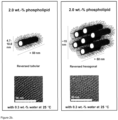
- Micellar structures in oil were measured by Malvern Zetasizer Nano ZS90 (Malvern Instruments Ltd., Worcestershire, UK) and JEOL-Transmission Electron Microscopy (cryo-TEM) (JEOL, Tokyo, Japan).
- the sample size was according to instrument standard,1.2 ml. The measurements were conducted at 60 °C. Results were obtained as particle size distributions from which different populations were identified. Thereby the particles in the reference sample, the background, was taken into consideration. Sample requirements were met :(1) dispersant should be transparent, (2) refractive index of dispersant should be different from particles, (3) refractive index and viscosity of dispersant should be known with an accuracy better than 0.5 %, (4) dispersant should be compatible with particles (i.e. not cause swelling, dissolution or aggregation) and (5) it should be clean and filterable. However, measurements are sensitive to the presence of large particles, aggregates and dust.
- Cryo-TEM was used for imaging the shape of micellar structures in oil. Measurements showed that the cryogenic samples were sensitive to ice contamination as they easily adsorb humidity from the surrounding air. The humidity formed easily water crystals interfering with the actual sample structures (seen as dark spots in the image).
- Sample preparation was done by mixing the ingredients together in a glass container. The aim was to form homogenous and fully diluted samples with clear appearance. Lecithin was difficult to dissolve in oil due to its granular shape. Thus, it was first dissolved in 18 g n-heptane which was then mixed with oil. After this, all n-heptane and moisture from the oil-lecithin mixture was removed using vacuum at 85 °C and ⁇ 30 mbar. After this, PFAD was mixed straight to the oil. This was done at 60 °C due to high melting point of PFAD. Finally, distilled water was added into the oil mixture to ensure the needed moisture content and formation of micellar structures. The experimental design and sample preparation is shown below.
- each sample was mixed for 10 seconds using T25 Digital ULTRA-TURRAX ® (IKA ® Works, Inc., Wilmington, North Carolina, USA) to break down the water droplets.
- the mixing speed was 7800 rpm. After this, the sample was let to settle for 35 seconds for air bubbles to clear out and micellar structures to form.
- the particle size measurements were conducted with different phospholipid and FFA concentrations in rapeseed oil. Additionally, the synergistic properties were determined using both ingredients in the same sample. Phospholipid samples were analyzed at 25 °C while FFA samples were analyzed at 60 °C.
- Samples were collected after mixing near the bottom of the container and placed into a disposable sizing cuvette. After this, the particle size distribution of the sample was measured.
- Cryo-TEM-samples were prepared by vitrifying them onto Quantifoil 3.5/1 holey carbon copper grids (Quantifoil Micro Tools GmbH, suprabichau, Germany) with the hole size of 3.5 ⁇ m.
- grids were plasma cleaned using Gatan Solarus 9500 plasma cleaner (Gatan, Inc., Pleasanton, California, USA). The vitrification was conducted by transferring samples into an environmental chamber of an automated FEI Vitrobot (FEI, Hillsboro, Oregon, USA). The samples were collected near the top of the container. Images of phospholipid samples were obtained at 25 °C while FFA samples were obtained at 60 °C.
- the chamber operated at room temperature and 80 % humidity.
- the samples were vitrified in a mixture of liquid ethane and propane (1:1) at -180 °C. After this, the grids with the vitrified samples were maintained at liquid nitrogen temperature (-195 °C) and cryo-transferred in to JEOL JEM-3200FSC cryo-Transmission electron microscope (JEOL Ltd., Tokyo, Japan). The microscope operated at 300 kV voltages.
- Cryo-TEM-images were taken in bright field mode and using zero loss energy filtering (omega type) with the slit width of 20 eV.
- Micrographs were recorded using Gatan Ultrascan 4000 CCD camera (Gatan, Inc., Pleasanton, California, USA) and analyzed using Gatan DigitalMicrograph software (Gatan, Inc., Pleasanton, California, USA).
- Particle size results were based on intensity size distributions. The distribution was obtained by plotting the intensity of light scattered by particles (%) versus the particle size (nm).
- the particle size stayed relatively stable at PFAD concentrations 0 wt.-%, 0.3 wt.-% and 1.0 wt.-%. At these concentrations there were two populations present. These populations included a large population (> 95.0 %) of small particles (100-150 nm) and a small population ( ⁇ 5.0 %) of very large particles (4700-5500 nm). Both populations could be considered as background particles as they were equally present in 0 wt.-% PFAD concentration.
- PFAD 2.5 wt.-% the number of large population was slightly increased as its intensity increased to 6.7 % when compared to 1.0 wt.-% PFAD. Again, two other populations (peak 1 and 2) were considered as background.
- PFAD 5.0 wt.-% the size of large population seemed to decrease to -2200 nm while their amount increased up to 50.6 %.
- PFAD 10.0 wt.-% there was only one population of large particles (-1100 nm). Somewhat similar population was also present at PFAD 20.0 %. However, the average size of particles was higher (-1500 nm).
- the synergistic properties of lecithin and PFAD could be analyzed more closely when comparing the results to selected lecithin and PFAD samples. It was notable that the synergistic particle size results were not similar compared to either lecithin or PFAD samples. For example, at constant lecithin concentration 0.3 wt.-% with 0.0 wt.-% PFAD, the particle size was 158.6 nm while at same lecithin concentration in lecithin samples the particle size was 84.99 nm. This indicates that there was some variation between the two similar sets of samples.
- Both lecithin and PFAD seemed to have an effect on particle size in rapeseed oil. This indicates that both hydratable phospholipids and FFAs can act as surface active agents in oil in the presence of small amounts of water (0.3 wt.-% and 0.9 wt.-%, respectively).
- the change in the particle size was most likely caused by the formation of liquid crystal structures caused by the self-association of surfactants. Liquid crystal structures seemed to increase the particle size of fats and oils as surfactants aggregated into larger structures rather than remained as free monomers in the oil phase.
- the particle size increased from initial 108 nm up to 2422 nm when the PFAD concentration increased from 0.0 wt.% to 60.0 wt-.%. At 80.0 wt-.% it seemed to again decrease. Increase in the particle size was probably caused by the formation of FFA liquid crystal structures in oil.
- the background was measured and observed in the reference sample 0 % PFAD. The largest particles (amount-wise) were present at 5 wt.-% and 10 wt.-% PFAD concentrations. Larger particles were also present at PFAD concentrations 60 wt.-% and 80 wt.-% but their amount was much lower (40 % and 57.9 %, respectively).
- Sample materials were presumably relatively clean. However, by the looks of the greenish color of food grade rapeseed oil, it still contained some pigments such as chlorophylls. Moisture content was important factor in sample materials. Most of the sample materials contained some initial moisture. Micellar structures are known to be very eager to adsorb moisture which affects their sizeThe surface chemical phenomena have most likely an effect on the total purification efficiency since both hydratable phospholipids and FFAs seem to be able to act as surface active agents in oil in the presence of small amount of water (0.3 wt.-% and 0.9 wt.-%).
- the most populous particles were quite small ( ⁇ 170 nm) between 0.0 to 2.15 wt.-% FFA concentrations (equal to 0.0 wt.-% and 2.5 wt.-% PFAD). After this, the particle size seemed to increase up to 2400-5400 nm, depending on the calculation method. The particle size seemed to be highest (amount-wise) at 4.3 wt.-%, and 8.6 wt.-% FFA concentrations (equal to 5.0 wt.-%, 10.0 wt.-%, PFAD, respectively). At these concentrations the particle size of most populous particles were 2182 nm and 1144 nm, respectively.
Landscapes
- Chemical & Material Sciences (AREA)
- Oil, Petroleum & Natural Gas (AREA)
- Engineering & Computer Science (AREA)
- Chemical Kinetics & Catalysis (AREA)
- Organic Chemistry (AREA)
- General Chemical & Material Sciences (AREA)
- Life Sciences & Earth Sciences (AREA)
- Wood Science & Technology (AREA)
- Microbiology (AREA)
- Fats And Perfumes (AREA)
- Production Of Liquid Hydrocarbon Mixture For Refining Petroleum (AREA)
- Catalysts (AREA)
Claims (5)
- Procédé de production d'hydrocarbures à partir d'une charge d'huile renouvelable, comprenant les étapes suivantes- soumettre la charge à un processus de prétraitement, comprenant une étape de filtration,- soumettre ladite charge prétraitée à un processus d'hydrotraitement,- obtenir des hydrocarbures à partir de ce processus d'hydrotraitement,dans lequel ladite charge comprend des acides gras libres de 50 % en poids à 80 % en poids du poids total de la charge, et le reste étant principalement des triglycérides.
- Procédé selon la revendication 1, dans laquelle ledit processus de prétraitement est un processus de purification pour éliminer les impuretés telles que les phospholipides, les métaux et les solides.
- Procédé selon la revendication 1 ou 2, dans laquelle ledit procédé d'hydrotraitement est un procédé d'hydrodésoxygénation catalytique utilisant un catalyseur métallique dans lequel ledit métal est choisi dans le groupe constitué de Fe, Pd, Pt, Ni, Mo, Co, Ru, Rh, W et toute combinaison de ceux-ci, et éventuellement supporté sur un support choisi parmi l'alumine, la silice et le carbone actif.
- Procédé selon l'une quelconque des revendications précédentes, dans lequel la charge est un mélange comprenant- de l'huile végétale, de la graisse animale ou un mélange de celles-ci, et- un flux d'acides gras libres choisi parmi le distillat d'acide gras de palme (PFAD), de la boue d'huile de palme (SPO), de l'huile de tall brut (CTO), de l'huile grasse brute (CFO), de l'acide gras d'huile de tall (TOFA), des huiles acides, des flux secondaires d'acides gras libres issus de l'oléochimie, de l'acide gras laurique, de l'acide gras de palmiste, de la graisse brune, et tout mélange de ceux-ci.
- Utilisation d'une huile renouvelable dans un procédé d'hydrotraitement pour la production d'hydrocarbures, dans lequel ladite huile renouvelable contient des acides gras libres représentant de 50 à 80 % en poids de la matière première totale, le reste étant principalement constitué de triglycérides, dans lequel ledit processus d'hydrotraitement comprend un processus de prétraitement comprenant une étape de filtration.
Priority Applications (1)
| Application Number | Priority Date | Filing Date | Title |
|---|---|---|---|
| EP24186282.0A EP4450599A3 (fr) | 2015-02-09 | 2016-02-09 | Procédé de production d'hydrocarbures à partir d'une charge d'huile renouvelable |
Applications Claiming Priority (2)
| Application Number | Priority Date | Filing Date | Title |
|---|---|---|---|
| FI20150044A FI128441B (en) | 2015-02-09 | 2015-02-09 | Fatty acid composition |
| PCT/FI2016/050080 WO2016128617A1 (fr) | 2015-02-09 | 2016-02-09 | Composition d'acide gras |
Related Child Applications (2)
| Application Number | Title | Priority Date | Filing Date |
|---|---|---|---|
| EP24186282.0A Division EP4450599A3 (fr) | 2015-02-09 | 2016-02-09 | Procédé de production d'hydrocarbures à partir d'une charge d'huile renouvelable |
| EP24186282.0A Division-Into EP4450599A3 (fr) | 2015-02-09 | 2016-02-09 | Procédé de production d'hydrocarbures à partir d'une charge d'huile renouvelable |
Publications (2)
| Publication Number | Publication Date |
|---|---|
| EP3256547A1 EP3256547A1 (fr) | 2017-12-20 |
| EP3256547B1 true EP3256547B1 (fr) | 2024-08-14 |
Family
ID=55398317
Family Applications (2)
| Application Number | Title | Priority Date | Filing Date |
|---|---|---|---|
| EP16705216.6A Active EP3256547B1 (fr) | 2015-02-09 | 2016-02-09 | Procédé de production d'hydrocarbures à partir d'une charge d'huile renouvelable |
| EP24186282.0A Pending EP4450599A3 (fr) | 2015-02-09 | 2016-02-09 | Procédé de production d'hydrocarbures à partir d'une charge d'huile renouvelable |
Family Applications After (1)
| Application Number | Title | Priority Date | Filing Date |
|---|---|---|---|
| EP24186282.0A Pending EP4450599A3 (fr) | 2015-02-09 | 2016-02-09 | Procédé de production d'hydrocarbures à partir d'une charge d'huile renouvelable |
Country Status (12)
| Country | Link |
|---|---|
| US (1) | US20180010051A1 (fr) |
| EP (2) | EP3256547B1 (fr) |
| CN (2) | CN118440717A (fr) |
| BR (1) | BR112017014681A2 (fr) |
| CA (1) | CA2974058C (fr) |
| DK (1) | DK3256547T3 (fr) |
| ES (1) | ES2986714T3 (fr) |
| FI (2) | FI128441B (fr) |
| HU (1) | HUE068666T2 (fr) |
| LT (1) | LT3256547T (fr) |
| PL (1) | PL3256547T3 (fr) |
| WO (1) | WO2016128617A1 (fr) |
Cited By (1)
| Publication number | Priority date | Publication date | Assignee | Title |
|---|---|---|---|---|
| EP4450599A2 (fr) | 2015-02-09 | 2024-10-23 | Neste Oyj | Procédé de production d'hydrocarbures à partir d'une charge d'huile renouvelable |
Families Citing this family (4)
| Publication number | Priority date | Publication date | Assignee | Title |
|---|---|---|---|---|
| EP3309239A1 (fr) * | 2016-10-11 | 2018-04-18 | Shell International Research Maatschappij B.V. | Procédé pour la préparation d'hydrocarbures à partir de matières premières végétales |
| WO2021094645A1 (fr) * | 2019-11-15 | 2021-05-20 | Neste Oyj | Production de produits paraffiniques |
| US12497572B2 (en) | 2020-04-20 | 2025-12-16 | Desmet Belgium | Versatile method for purifying glyceridic materials |
| WO2022129335A1 (fr) | 2020-12-17 | 2022-06-23 | Shell Internationale Research Maatschappij B.V. | Procédé de prétraitement de charges d'alimentation renouvelables |
Citations (5)
| Publication number | Priority date | Publication date | Assignee | Title |
|---|---|---|---|---|
| DE102005061098A1 (de) * | 2005-12-21 | 2007-06-28 | Tangkam, Kamol, M.Sc. | Diglyceride durch lipasekatalysierte Veresterung von freien Fettsäuren aus Raffinationsrückständen von Fetten und Ölen mit Glycerin |
| US20100056833A1 (en) | 2008-08-29 | 2010-03-04 | Julio Suarez | Pretreatment of biological feedstocks for hydroconversion in fixed-bed reactors |
| US20110152588A1 (en) | 2009-12-23 | 2011-06-23 | Conocophillips Company | Production of hydrocarbon from high free fatty acid containing feedstocks |
| US20130131360A1 (en) | 2008-06-04 | 2013-05-23 | Syntroleum Corporation | Biorenewable naphtha |
| US8530715B2 (en) | 2008-11-04 | 2013-09-10 | Energy & Environmental Research Center Foundation | Process for the conversion of renewable oils to liquid transportation fuels |
Family Cites Families (16)
| Publication number | Priority date | Publication date | Assignee | Title |
|---|---|---|---|---|
| CA2149685C (fr) * | 1994-06-30 | 1999-09-14 | Jacques Monnier | Conversion en additif pour carburant diesel de tallol dont on a extrait le brai |
| ATE356858T1 (de) | 2002-09-06 | 2007-04-15 | Neste Oil Oyj | Vefahren zur herstellung einer kohlenwasserstoffkomponente biologischer herkunft |
| US8022258B2 (en) * | 2005-07-05 | 2011-09-20 | Neste Oil Oyj | Process for the manufacture of diesel range hydrocarbons |
| RU2393201C2 (ru) * | 2005-12-12 | 2010-06-27 | Несте Ойл Ойй | Способ получения насыщенного углеводородного компонента |
| US20070137097A1 (en) * | 2005-12-16 | 2007-06-21 | Michio Ikura | Production of biodiesel from triglycerides via a thermal route |
| ITMI20062193A1 (it) * | 2006-11-15 | 2008-05-16 | Eni Spa | Processo per produrre frazioni idrocarburiche da miscele di origine biologica |
| US7982076B2 (en) * | 2007-09-20 | 2011-07-19 | Uop Llc | Production of diesel fuel from biorenewable feedstocks |
| US8026401B2 (en) * | 2007-12-20 | 2011-09-27 | Syntroleum Corporation | Hydrodeoxygenation process |
| US7989671B2 (en) * | 2008-11-04 | 2011-08-02 | Energy & Environmental Research Center Foundation | Process for the conversion of renewable oils to liquid transportation fuels |
| WO2011073431A2 (fr) * | 2009-12-17 | 2011-06-23 | Shell Internationale Research Maatschappij B.V. | Procédé de production d'hydrocarbures à partir de lipides microbiens |
| US8586515B2 (en) * | 2010-10-25 | 2013-11-19 | Marathon Oil Canada Corporation | Method for making biofuels and biolubricants |
| EP2809745B8 (fr) * | 2012-01-31 | 2016-07-13 | Neste Oyj | Production simultanée d'huile de base et de composants de carburant à partir de matière première renouvelable |
| CN102719319B (zh) * | 2012-07-12 | 2013-05-15 | 湖南未名创林生物能源有限公司 | 一种利用光皮树油制备生物航空燃料的方法 |
| EP2935545B1 (fr) * | 2012-12-21 | 2020-08-19 | SunPine AB | Bioraffinage de tallöl brut |
| FI128441B (en) | 2015-02-09 | 2020-05-15 | Neste Oil Oyj | Fatty acid composition |
| EP4032964A1 (fr) * | 2021-01-26 | 2022-07-27 | Infineum International Limited | Transport de pétrole brut |
-
2015
- 2015-02-09 FI FI20150044A patent/FI128441B/en active IP Right Review Request
-
2016
- 2016-02-09 CN CN202410504695.0A patent/CN118440717A/zh active Pending
- 2016-02-09 WO PCT/FI2016/050080 patent/WO2016128617A1/fr not_active Ceased
- 2016-02-09 HU HUE16705216A patent/HUE068666T2/hu unknown
- 2016-02-09 ES ES16705216T patent/ES2986714T3/es active Active
- 2016-02-09 CN CN201680009449.1A patent/CN107207970A/zh active Pending
- 2016-02-09 CA CA2974058A patent/CA2974058C/fr active Active
- 2016-02-09 LT LTEPPCT/FI2016/050080T patent/LT3256547T/lt unknown
- 2016-02-09 EP EP16705216.6A patent/EP3256547B1/fr active Active
- 2016-02-09 DK DK16705216.6T patent/DK3256547T3/da active
- 2016-02-09 PL PL16705216.6T patent/PL3256547T3/pl unknown
- 2016-02-09 EP EP24186282.0A patent/EP4450599A3/fr active Pending
- 2016-02-09 US US15/545,408 patent/US20180010051A1/en active Pending
- 2016-02-09 FI FIEP16705216.6T patent/FI3256547T3/fi active
- 2016-02-09 BR BR112017014681A patent/BR112017014681A2/pt not_active Application Discontinuation
Patent Citations (5)
| Publication number | Priority date | Publication date | Assignee | Title |
|---|---|---|---|---|
| DE102005061098A1 (de) * | 2005-12-21 | 2007-06-28 | Tangkam, Kamol, M.Sc. | Diglyceride durch lipasekatalysierte Veresterung von freien Fettsäuren aus Raffinationsrückständen von Fetten und Ölen mit Glycerin |
| US20130131360A1 (en) | 2008-06-04 | 2013-05-23 | Syntroleum Corporation | Biorenewable naphtha |
| US20100056833A1 (en) | 2008-08-29 | 2010-03-04 | Julio Suarez | Pretreatment of biological feedstocks for hydroconversion in fixed-bed reactors |
| US8530715B2 (en) | 2008-11-04 | 2013-09-10 | Energy & Environmental Research Center Foundation | Process for the conversion of renewable oils to liquid transportation fuels |
| US20110152588A1 (en) | 2009-12-23 | 2011-06-23 | Conocophillips Company | Production of hydrocarbon from high free fatty acid containing feedstocks |
Non-Patent Citations (3)
| Title |
|---|
| KHINE M M ET AL: "Statistical optimization of esterification reaction to produce biodiesel from the mixture of PFAD and palm stearin oil using two-step reaction", ADVANCED MATERIALS RESEARCH - BIOMATERIALS AND APPLICATIONS 2012 TRANS TECH PUBLICATIONS DEU, vol. 506, 9 August 2011 (2011-08-09), pages 98 - 101, XP009526925, DOI: 10.4028/WWW.SCIENTIFIC.NET/AMR.506.98 * |
| STEVEN P. PYL; CARL M. SCHIETEKAT; MARIE-FRANOISE REYNIERS; RAMIN ABHARI; GUY. B. MARIN; KEVIN M. VAN GEEM;: "Biomass to olefins: Cracking of renewable naphtha", CHEMICAL ENGENEERING JOURNAL, vol. 176, 12 April 2011 (2011-04-12), NL, pages 178 - 187, XP028115203, ISSN: 1385-8947, DOI: 10.1016/j.cej.2011.04.062 |
| TAY YEN PING BONNIE ET AL: "Characteristics and Properties of Fatty Acid Distillates from Palm Oil", OIL PALM BULLETIN 59, 30 November 2009 (2009-11-30), pages 5 - 11, XP055189953, Retrieved from the Internet <URL:http://www.researchgate.net/profile/Bonnie_Tay_yen_ping/publication/233981539_Characteristics_and_Properties_of_Fatty_Acid_Distillates_from_Palm_Oil/links/0fcfd50db92b4e6370000000.pdf> [retrieved on 20150519] * |
Cited By (1)
| Publication number | Priority date | Publication date | Assignee | Title |
|---|---|---|---|---|
| EP4450599A2 (fr) | 2015-02-09 | 2024-10-23 | Neste Oyj | Procédé de production d'hydrocarbures à partir d'une charge d'huile renouvelable |
Also Published As
| Publication number | Publication date |
|---|---|
| EP4450599A2 (fr) | 2024-10-23 |
| ES2986714T3 (es) | 2024-11-12 |
| CA2974058C (fr) | 2023-08-22 |
| FI128441B (en) | 2020-05-15 |
| BR112017014681A2 (pt) | 2018-01-02 |
| EP4450599A3 (fr) | 2025-01-01 |
| CN107207970A (zh) | 2017-09-26 |
| DK3256547T3 (da) | 2024-10-21 |
| HUE068666T2 (hu) | 2025-01-28 |
| LT3256547T (lt) | 2024-09-25 |
| US20180010051A1 (en) | 2018-01-11 |
| CN118440717A (zh) | 2024-08-06 |
| WO2016128617A1 (fr) | 2016-08-18 |
| CA2974058A1 (fr) | 2016-08-18 |
| FI20150044A7 (fi) | 2016-08-10 |
| FI3256547T3 (fi) | 2024-10-28 |
| EP3256547A1 (fr) | 2017-12-20 |
| PL3256547T3 (pl) | 2024-12-23 |
Similar Documents
| Publication | Publication Date | Title |
|---|---|---|
| EP3256547B1 (fr) | Procédé de production d'hydrocarbures à partir d'une charge d'huile renouvelable | |
| CA3103242C (fr) | Procedes de raffinage d'une matiere premiere de composition d'huile d'oleagineux, et systemes, compositions et utilisations associes | |
| Silitonga et al. | Schleichera oleosa L oil as feedstock for biodiesel production | |
| Akbar et al. | Characteristic and composition of Jatropha curcas oil seed from Malaysia and its potential as biodiesel feedstock feedstock | |
| Kareem et al. | Enzymatic biodiesel production from palm oil and palm kernel oil using free lipase | |
| Dawodu et al. | Biodiesel production from Sesamum indicum L. seed oil: An optimization study | |
| US9260678B2 (en) | Integrated process for the production of biofuels from different types of starting materials and related products | |
| WO2008002643A4 (fr) | Mélanges d'acides gras et leurs utilisations | |
| CN1688673A (zh) | 通过脂肪酸加氢和分解制得的含有基于生物原料的组分的柴油组合物 | |
| Santin et al. | Comparison of macauba and soybean oils as substrates for the enzymatic biodiesel production in ultrasound-assisted system | |
| Wyse-Mason et al. | An investigation of restaurant waste oil characteristics for biodiesel production in Trinidad and Tobago | |
| Kalsoom et al. | Fatty acid chain length optimization for biodiesel production using different chemical and biochemical approaches–a comprehensive | |
| Halek et al. | Biodiesel as an alternative fuel for diesel engines | |
| Uliana et al. | Acidity reduction of enzymatic biodiesel using alkaline washing | |
| US10982160B2 (en) | Method of preparing combustible oil | |
| EP1885823A2 (fr) | Production de biodiesel a partir de balanites aegyptiaca | |
| EP4065670B1 (fr) | Additif de lubrifiance pour carburant | |
| Mustapha et al. | Synthesis, Characterization and Properties of Trimethylolpropane Triesters from Coconut (Cocos nucifera) Methyl Esters | |
| Omotoso et al. | Comparative Study of the properties of biodiesel prepared from Jatropha curcas oil and palm oil | |
| FR3145936A1 (fr) | Procédé de traitement d’une composition comprenant un mélange riche en acides gras | |
| Patel et al. | Microwave Heating Stability of Multi Oil Blends of Rice Bran Oil and Linseed Oil with other Oils | |
| AU2017203882A1 (en) | Integrated process for the production of biofuels from different types of starting materials and related products | |
| Sangle et al. | A Review: Biodiesel from Castor & Karanja Oil |
Legal Events
| Date | Code | Title | Description |
|---|---|---|---|
| STAA | Information on the status of an ep patent application or granted ep patent |
Free format text: STATUS: THE INTERNATIONAL PUBLICATION HAS BEEN MADE |
|
| PUAI | Public reference made under article 153(3) epc to a published international application that has entered the european phase |
Free format text: ORIGINAL CODE: 0009012 |
|
| STAA | Information on the status of an ep patent application or granted ep patent |
Free format text: STATUS: REQUEST FOR EXAMINATION WAS MADE |
|
| 17P | Request for examination filed |
Effective date: 20170824 |
|
| AK | Designated contracting states |
Kind code of ref document: A1 Designated state(s): AL AT BE BG CH CY CZ DE DK EE ES FI FR GB GR HR HU IE IS IT LI LT LU LV MC MK MT NL NO PL PT RO RS SE SI SK SM TR |
|
| AX | Request for extension of the european patent |
Extension state: BA ME |
|
| DAV | Request for validation of the european patent (deleted) | ||
| DAX | Request for extension of the european patent (deleted) | ||
| STAA | Information on the status of an ep patent application or granted ep patent |
Free format text: STATUS: EXAMINATION IS IN PROGRESS |
|
| 17Q | First examination report despatched |
Effective date: 20180611 |
|
| GRAP | Despatch of communication of intention to grant a patent |
Free format text: ORIGINAL CODE: EPIDOSNIGR1 |
|
| STAA | Information on the status of an ep patent application or granted ep patent |
Free format text: STATUS: GRANT OF PATENT IS INTENDED |
|
| INTG | Intention to grant announced |
Effective date: 20240315 |
|
| GRAS | Grant fee paid |
Free format text: ORIGINAL CODE: EPIDOSNIGR3 |
|
| GRAA | (expected) grant |
Free format text: ORIGINAL CODE: 0009210 |
|
| STAA | Information on the status of an ep patent application or granted ep patent |
Free format text: STATUS: THE PATENT HAS BEEN GRANTED |
|
| AK | Designated contracting states |
Kind code of ref document: B1 Designated state(s): AL AT BE BG CH CY CZ DE DK EE ES FI FR GB GR HR HU IE IS IT LI LT LU LV MC MK MT NL NO PL PT RO RS SE SI SK SM TR |
|
| P01 | Opt-out of the competence of the unified patent court (upc) registered |
Free format text: CASE NUMBER: APP_39821/2024 Effective date: 20240704 |
|
| REG | Reference to a national code |
Ref country code: GB Ref legal event code: FG4D |
|
| REG | Reference to a national code |
Ref country code: CH Ref legal event code: EP |
|
| REG | Reference to a national code |
Ref country code: DE Ref legal event code: R096 Ref document number: 602016088866 Country of ref document: DE |
|
| REG | Reference to a national code |
Ref country code: IE Ref legal event code: FG4D |
|
| REG | Reference to a national code |
Ref country code: NL Ref legal event code: FP |
|
| REG | Reference to a national code |
Ref country code: DK Ref legal event code: T3 Effective date: 20241017 |
|
| REG | Reference to a national code |
Ref country code: FI Ref legal event code: FGE |
|
| REG | Reference to a national code |
Ref country code: SE Ref legal event code: TRGR |
|
| REG | Reference to a national code |
Ref country code: SK Ref legal event code: T3 Ref document number: E 44964 Country of ref document: SK |
|
| REG | Reference to a national code |
Ref country code: ES Ref legal event code: FG2A Ref document number: 2986714 Country of ref document: ES Kind code of ref document: T3 Effective date: 20241112 |
|
| REG | Reference to a national code |
Ref country code: EE Ref legal event code: FG4A Ref document number: E024616 Country of ref document: EE Effective date: 20240926 |
|
| REG | Reference to a national code |
Ref country code: AT Ref legal event code: UEP Ref document number: 1713303 Country of ref document: AT Kind code of ref document: T Effective date: 20240814 |
|
| PG25 | Lapsed in a contracting state [announced via postgrant information from national office to epo] |
Ref country code: PT Free format text: LAPSE BECAUSE OF FAILURE TO SUBMIT A TRANSLATION OF THE DESCRIPTION OR TO PAY THE FEE WITHIN THE PRESCRIBED TIME-LIMIT Effective date: 20241216 Ref country code: GR Free format text: LAPSE BECAUSE OF FAILURE TO SUBMIT A TRANSLATION OF THE DESCRIPTION OR TO PAY THE FEE WITHIN THE PRESCRIBED TIME-LIMIT Effective date: 20241115 |
|
| PG25 | Lapsed in a contracting state [announced via postgrant information from national office to epo] |
Ref country code: BG Free format text: LAPSE BECAUSE OF FAILURE TO SUBMIT A TRANSLATION OF THE DESCRIPTION OR TO PAY THE FEE WITHIN THE PRESCRIBED TIME-LIMIT Effective date: 20240814 |
|
| PG25 | Lapsed in a contracting state [announced via postgrant information from national office to epo] |
Ref country code: IS Free format text: LAPSE BECAUSE OF FAILURE TO SUBMIT A TRANSLATION OF THE DESCRIPTION OR TO PAY THE FEE WITHIN THE PRESCRIBED TIME-LIMIT Effective date: 20241214 |
|
| PG25 | Lapsed in a contracting state [announced via postgrant information from national office to epo] |
Ref country code: HR Free format text: LAPSE BECAUSE OF FAILURE TO SUBMIT A TRANSLATION OF THE DESCRIPTION OR TO PAY THE FEE WITHIN THE PRESCRIBED TIME-LIMIT Effective date: 20240814 |
|
| PG25 | Lapsed in a contracting state [announced via postgrant information from national office to epo] |
Ref country code: RS Free format text: LAPSE BECAUSE OF FAILURE TO SUBMIT A TRANSLATION OF THE DESCRIPTION OR TO PAY THE FEE WITHIN THE PRESCRIBED TIME-LIMIT Effective date: 20241114 |
|
| REG | Reference to a national code |
Ref country code: HU Ref legal event code: AG4A Ref document number: E068666 Country of ref document: HU |
|
| PG25 | Lapsed in a contracting state [announced via postgrant information from national office to epo] |
Ref country code: RS Free format text: LAPSE BECAUSE OF FAILURE TO SUBMIT A TRANSLATION OF THE DESCRIPTION OR TO PAY THE FEE WITHIN THE PRESCRIBED TIME-LIMIT Effective date: 20241114 Ref country code: PT Free format text: LAPSE BECAUSE OF FAILURE TO SUBMIT A TRANSLATION OF THE DESCRIPTION OR TO PAY THE FEE WITHIN THE PRESCRIBED TIME-LIMIT Effective date: 20241216 Ref country code: IS Free format text: LAPSE BECAUSE OF FAILURE TO SUBMIT A TRANSLATION OF THE DESCRIPTION OR TO PAY THE FEE WITHIN THE PRESCRIBED TIME-LIMIT Effective date: 20241214 Ref country code: HR Free format text: LAPSE BECAUSE OF FAILURE TO SUBMIT A TRANSLATION OF THE DESCRIPTION OR TO PAY THE FEE WITHIN THE PRESCRIBED TIME-LIMIT Effective date: 20240814 Ref country code: GR Free format text: LAPSE BECAUSE OF FAILURE TO SUBMIT A TRANSLATION OF THE DESCRIPTION OR TO PAY THE FEE WITHIN THE PRESCRIBED TIME-LIMIT Effective date: 20241115 Ref country code: BG Free format text: LAPSE BECAUSE OF FAILURE TO SUBMIT A TRANSLATION OF THE DESCRIPTION OR TO PAY THE FEE WITHIN THE PRESCRIBED TIME-LIMIT Effective date: 20240814 |
|
| PG25 | Lapsed in a contracting state [announced via postgrant information from national office to epo] |
Ref country code: RO Free format text: LAPSE BECAUSE OF FAILURE TO SUBMIT A TRANSLATION OF THE DESCRIPTION OR TO PAY THE FEE WITHIN THE PRESCRIBED TIME-LIMIT Effective date: 20240814 Ref country code: SM Free format text: LAPSE BECAUSE OF FAILURE TO SUBMIT A TRANSLATION OF THE DESCRIPTION OR TO PAY THE FEE WITHIN THE PRESCRIBED TIME-LIMIT Effective date: 20240814 |
|
| PGFP | Annual fee paid to national office [announced via postgrant information from national office to epo] |
Ref country code: EE Payment date: 20250103 Year of fee payment: 10 Ref country code: LV Payment date: 20250103 Year of fee payment: 10 Ref country code: CH Payment date: 20250301 Year of fee payment: 10 |
|
| PGFP | Annual fee paid to national office [announced via postgrant information from national office to epo] |
Ref country code: PL Payment date: 20250103 Year of fee payment: 10 Ref country code: CZ Payment date: 20250127 Year of fee payment: 10 |
|
| PGFP | Annual fee paid to national office [announced via postgrant information from national office to epo] |
Ref country code: SK Payment date: 20250113 Year of fee payment: 10 |
|
| REG | Reference to a national code |
Ref country code: DE Ref legal event code: R026 Ref document number: 602016088866 Country of ref document: DE |
|
| PLBI | Opposition filed |
Free format text: ORIGINAL CODE: 0009260 |
|
| PLAX | Notice of opposition and request to file observation + time limit sent |
Free format text: ORIGINAL CODE: EPIDOSNOBS2 |
|
| 26 | Opposition filed |
Opponent name: UPM-KYMMENE CORPORATION Effective date: 20250512 |
|
| PLBB | Reply of patent proprietor to notice(s) of opposition received |
Free format text: ORIGINAL CODE: EPIDOSNOBS3 |
|
| PG25 | Lapsed in a contracting state [announced via postgrant information from national office to epo] |
Ref country code: MC Free format text: LAPSE BECAUSE OF FAILURE TO SUBMIT A TRANSLATION OF THE DESCRIPTION OR TO PAY THE FEE WITHIN THE PRESCRIBED TIME-LIMIT Effective date: 20240814 |
|
| PG25 | Lapsed in a contracting state [announced via postgrant information from national office to epo] |
Ref country code: LU Free format text: LAPSE BECAUSE OF NON-PAYMENT OF DUE FEES Effective date: 20250209 |
|
| PGFP | Annual fee paid to national office [announced via postgrant information from national office to epo] |
Ref country code: FR Payment date: 20251231 Year of fee payment: 11 |
|
| PG25 | Lapsed in a contracting state [announced via postgrant information from national office to epo] |
Ref country code: IE Free format text: LAPSE BECAUSE OF NON-PAYMENT OF DUE FEES Effective date: 20250209 |
|
| PGFP | Annual fee paid to national office [announced via postgrant information from national office to epo] |
Ref country code: NL Payment date: 20260106 Year of fee payment: 11 |
|
| REG | Reference to a national code |
Ref country code: CH Ref legal event code: U11 Free format text: ST27 STATUS EVENT CODE: U-0-0-U10-U11 (AS PROVIDED BY THE NATIONAL OFFICE) Effective date: 20260301 |
|
| PGFP | Annual fee paid to national office [announced via postgrant information from national office to epo] |
Ref country code: SE Payment date: 20260105 Year of fee payment: 11 |
|
| PGFP | Annual fee paid to national office [announced via postgrant information from national office to epo] |
Ref country code: GB Payment date: 20260106 Year of fee payment: 11 Ref country code: LT Payment date: 20260102 Year of fee payment: 11 |
|
| PGFP | Annual fee paid to national office [announced via postgrant information from national office to epo] |
Ref country code: ES Payment date: 20260311 Year of fee payment: 11 |
|
| PGFP | Annual fee paid to national office [announced via postgrant information from national office to epo] |
Ref country code: DE Payment date: 20260102 Year of fee payment: 11 Ref country code: NO Payment date: 20260211 Year of fee payment: 11 Ref country code: DK Payment date: 20260213 Year of fee payment: 11 |
|
| PGFP | Annual fee paid to national office [announced via postgrant information from national office to epo] |
Ref country code: AT Payment date: 20260127 Year of fee payment: 11 |
|
| PGFP | Annual fee paid to national office [announced via postgrant information from national office to epo] |
Ref country code: BE Payment date: 20260105 Year of fee payment: 11 Ref country code: FI Payment date: 20260213 Year of fee payment: 11 Ref country code: IT Payment date: 20260122 Year of fee payment: 11 |
|
| PGFP | Annual fee paid to national office [announced via postgrant information from national office to epo] |
Ref country code: HU Payment date: 20260130 Year of fee payment: 11 |