EP3316228A1 - Metalldetektion für medienzuführung - Google Patents
Metalldetektion für medienzuführung Download PDFInfo
- Publication number
- EP3316228A1 EP3316228A1 EP17196782.1A EP17196782A EP3316228A1 EP 3316228 A1 EP3316228 A1 EP 3316228A1 EP 17196782 A EP17196782 A EP 17196782A EP 3316228 A1 EP3316228 A1 EP 3316228A1
- Authority
- EP
- European Patent Office
- Prior art keywords
- metal detection
- infeed
- readings
- metal
- depository
- Prior art date
- Legal status (The legal status is an assumption and is not a legal conclusion. Google has not performed a legal analysis and makes no representation as to the accuracy of the status listed.)
- Withdrawn
Links
Images



Classifications
-
- B—PERFORMING OPERATIONS; TRANSPORTING
- B65—CONVEYING; PACKING; STORING; HANDLING THIN OR FILAMENTARY MATERIAL
- B65H—HANDLING THIN OR FILAMENTARY MATERIAL, e.g. SHEETS, WEBS, CABLES
- B65H7/00—Controlling article feeding, separating, pile-advancing, or associated apparatus, to take account of incorrect feeding, absence of articles, or presence of faulty articles
- B65H7/02—Controlling article feeding, separating, pile-advancing, or associated apparatus, to take account of incorrect feeding, absence of articles, or presence of faulty articles by feelers or detectors
- B65H7/06—Controlling article feeding, separating, pile-advancing, or associated apparatus, to take account of incorrect feeding, absence of articles, or presence of faulty articles by feelers or detectors responsive to presence of faulty articles or incorrect separation or feed
-
- G—PHYSICS
- G01—MEASURING; TESTING
- G01V—GEOPHYSICS; GRAVITATIONAL MEASUREMENTS; DETECTING MASSES OR OBJECTS; TAGS
- G01V3/00—Electric or magnetic prospecting or detecting; Measuring magnetic field characteristics of the earth, e.g. declination, deviation
- G01V3/08—Electric or magnetic prospecting or detecting; Measuring magnetic field characteristics of the earth, e.g. declination, deviation operating with magnetic or electric fields produced or modified by objects or geological structures or by detecting devices
- G01V3/10—Electric or magnetic prospecting or detecting; Measuring magnetic field characteristics of the earth, e.g. declination, deviation operating with magnetic or electric fields produced or modified by objects or geological structures or by detecting devices using induction coils
- G01V3/101—Electric or magnetic prospecting or detecting; Measuring magnetic field characteristics of the earth, e.g. declination, deviation operating with magnetic or electric fields produced or modified by objects or geological structures or by detecting devices using induction coils by measuring the impedance of the search coil; by measuring features of a resonant circuit comprising the search coil
-
- B—PERFORMING OPERATIONS; TRANSPORTING
- B65—CONVEYING; PACKING; STORING; HANDLING THIN OR FILAMENTARY MATERIAL
- B65H—HANDLING THIN OR FILAMENTARY MATERIAL, e.g. SHEETS, WEBS, CABLES
- B65H5/00—Feeding articles separated from piles; Feeding articles to machines
- B65H5/06—Feeding articles separated from piles; Feeding articles to machines by rollers or balls, e.g. between rollers
-
- G—PHYSICS
- G01—MEASURING; TESTING
- G01V—GEOPHYSICS; GRAVITATIONAL MEASUREMENTS; DETECTING MASSES OR OBJECTS; TAGS
- G01V3/00—Electric or magnetic prospecting or detecting; Measuring magnetic field characteristics of the earth, e.g. declination, deviation
- G01V3/08—Electric or magnetic prospecting or detecting; Measuring magnetic field characteristics of the earth, e.g. declination, deviation operating with magnetic or electric fields produced or modified by objects or geological structures or by detecting devices
-
- G—PHYSICS
- G07—CHECKING-DEVICES
- G07D—HANDLING OF COINS OR VALUABLE PAPERS, e.g. TESTING, SORTING BY DENOMINATIONS, COUNTING, DISPENSING, CHANGING OR DEPOSITING
- G07D7/00—Testing specially adapted to determine the identity or genuineness of valuable papers or for segregating those which are unacceptable, e.g. banknotes that are alien to a currency
- G07D7/04—Testing magnetic properties of the materials thereof, e.g. by detection of magnetic imprint
-
- G—PHYSICS
- G07—CHECKING-DEVICES
- G07D—HANDLING OF COINS OR VALUABLE PAPERS, e.g. TESTING, SORTING BY DENOMINATIONS, COUNTING, DISPENSING, CHANGING OR DEPOSITING
- G07D7/00—Testing specially adapted to determine the identity or genuineness of valuable papers or for segregating those which are unacceptable, e.g. banknotes that are alien to a currency
- G07D7/181—Testing mechanical properties or condition, e.g. wear or tear
-
- G—PHYSICS
- G07—CHECKING-DEVICES
- G07D—HANDLING OF COINS OR VALUABLE PAPERS, e.g. TESTING, SORTING BY DENOMINATIONS, COUNTING, DISPENSING, CHANGING OR DEPOSITING
- G07D7/00—Testing specially adapted to determine the identity or genuineness of valuable papers or for segregating those which are unacceptable, e.g. banknotes that are alien to a currency
- G07D7/181—Testing mechanical properties or condition, e.g. wear or tear
- G07D7/187—Detecting defacement or contamination, e.g. dirt
-
- G—PHYSICS
- G07—CHECKING-DEVICES
- G07D—HANDLING OF COINS OR VALUABLE PAPERS, e.g. TESTING, SORTING BY DENOMINATIONS, COUNTING, DISPENSING, CHANGING OR DEPOSITING
- G07D7/00—Testing specially adapted to determine the identity or genuineness of valuable papers or for segregating those which are unacceptable, e.g. banknotes that are alien to a currency
- G07D7/181—Testing mechanical properties or condition, e.g. wear or tear
- G07D7/189—Detecting attached objects, e.g. tapes or clips
-
- B—PERFORMING OPERATIONS; TRANSPORTING
- B65—CONVEYING; PACKING; STORING; HANDLING THIN OR FILAMENTARY MATERIAL
- B65H—HANDLING THIN OR FILAMENTARY MATERIAL, e.g. SHEETS, WEBS, CABLES
- B65H2553/00—Sensing or detecting means
- B65H2553/20—Sensing or detecting means using electric elements
- B65H2553/24—Inductive detectors
Definitions
- Media handing devices that process media documents and bunches of media documents after separating the media documents for individual processing downstream within the media handling devices.
- Media handing devices include a variety of integrated components.
- sensors are activated and deactivated to track movement of the media document and indicate where the media document is located along the transport pathway.
- sensors include image sensors for taking different image characteristics of the media document and other sensors for other purposes.
- One such other sensor is a metal detection sensor located in an infeed module of the media handling device.
- This sensor is configured to detect metal that may have inadvertently been included within a bunch of media documents inserted through the infeed mouth of the media handling device.
- Metal e.g., coins, paperclips, staples, wires, etc.
- This sensor can be very problematic for other componentry of the media handling device, causing such componentry to: malfunction, jam, suspend a current transaction, and place the media handling device in a condition where it is unusable until serviced by a technician (offline).
- methods and an infeed module of a valuable media depository are provided for metal detection processing.
- a method including obtaining pre-pinch metal detection readings when an item is inserted into an infeed mouth of a depository; adjusting the pre-pinch metal detection readings when the item is pinched within the depository to establish adjusted baseline readings; calculating metal detection values based on the adjusted baseline readings and variations in ongoing metal detection readings; and determining whether at least some metal is associated with the item based on comparison of the metal detection values to at least one predefined value.
- the method may further include providing a result based on the determining for driving mechanical components of an infeed module for urging the item into the depository or for ejecting the item out of the depository through the infeed mouth.
- the method may further include providing the result to a controller associated with the depository to report a type of metal detected when the determining indicates that at least some metal is present.
- providing may further include identifying by the result that the type of metal is one of: a coin, a paperclip, a staple, or a non-coin type of metal.
- adjusting may further include establishing the adjusted baseline readings to account for variations in the adjusted baseline readings when a shutter associated with the infeed mouth is activated when attempting to close after insertion of the item through the infeed mouth.
- calculating may further include calculating the metal detection values as: a magnitude in changes in resistance values present in the ongoing metal detection readings, a positive value trend in inductance values present in the ongoing metal detection readings, and a negative value trend present in the inductance values present in the ongoing metal detection readings.
- calculating may further include applying a width sampling or time based filter against the ongoing metal detection readings when determining the positive and the negative value trends for the inductance values.
- calculating may further include processing at least some preconfigured values with the adjusted baseline readings when calculating the metal detection values.
- processing may further include doubling those preconfigured values associated with metal detection resistance values.
- a method including (i) establishing baseline metal detection values during a first processing stage before a pinch mechanism is activated in response to at least one media item being detected at an infeed mouth of a depository; (ii) performing concurrent processing during a second processing stage after the pinch mechanism is activated to pinch the at least one item to a track of a pathway within the depository, wherein the concurrent processing includes processing the baseline metal detection values with further processing for: (a) calculating a first value representing a magnitude of changes occurring in resistance values obtained from a metal detection sensor; (b) deriving a second value representing a positive trend occurring in inductance values obtain from the metal detection sensor; and (c) resolving a third value representing a negative trend occurring in the inductance values obtained from the metal detection sensor; (iii) selecting as a maximum value, a maximum of the first value, the second value, and the third value; and (iv) reporting the maximum value for further processing of the at least one media item within the
- the method may further include (v) providing pre-pinch values, the first value, the second value, and the third value with the maximum value in a priority order.
- (ii)(a) may further include applying a resistance value width filter when calculating the first value.
- (ii)(c) may further include applying an inductance value width filter when calculating the third value.
- the media depository may be one of: a Self-Service Terminal (SST), an Automated Teller Machine (ATM), and a Point-Of-Sale (POS) terminal.
- SST Self-Service Terminal
- ATM Automated Teller Machine
- POS Point-Of-Sale
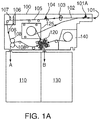
- FIG. 1A is a diagram depicting a one-sided view of a valuable media depository 100, according to an example embodiment (also referred to as a deposit module). It is to be noted that the valuable media depository is shown with only those components relevant to understanding what has been added and modified to a conventional depository for purposes of providing metal detection processing within an infeed module 101 A integrated within the depository 100.
- the depository 100 is suitable for use within an Automated Teller Machine (ATM), which can be utilized to process deposited banknotes and checks (valuable media as a mixed bunch if desired).
- the deposit module 100 has an access mouth 101 (media or document infeed) through which incoming checks and/or banknotes are deposited or outgoing checks and/or banknotes are dispensed. This mouth 101 is aligned with an infeed aperture in the fascia of the ATM in which the depository 100 is located, which thus provides an input/output slot to the customer.
- a novel infeed module 101 A (described in greater detail in the FIGS. 1B and 2-4 herein and below) accepts or rejects (dispenses back) a bunch of received items (valuable media).
- a bunch (stack) of one or more items (valuable media) is input or output.
- Accepted incoming checks and/or banknotes follow a first transport path 102 away from the mouth 101 and infeed module 101 A in a substantially horizontal direction from right to left shown in the FIG. 1A . They then pass through a novel separator module 103 and from the separator 103 to a deskew module 104 along another pathway portion 105, which is also substantially horizontal and right to left.
- the items are now de-skewed and aligned for reading by imaging cameras 106 and a Magnetic Ink Character Recognition (MICR) reader 107.
- MICR Magnetic Ink Character Recognition
- nip rollers 108 Items are then directed substantially vertically downwards to a point between two nip rollers 108. These nip rollers cooperate and are rotated in opposite directions with respect to each other to either draw deposited checks and/or banknotes inwards (and urge those checks and/or banknotes towards the right hand side in the FIG. 1 A) , or during another mode of operation, the rollers can be rotated in an opposite fashion to direct processed checks and/or banknotes downwards in the direction shown by arrow A in the FIG. 1A into a check or banknote bin 110. Incoming checks and/or banknotes, which are moved by the nip rollers 108 towards the right, enter a diverter mechanism 120.
- the diverter mechanism 120 can either divert the incoming checks and/or banknotes upwards (in the FIG. 1 A) into a re-buncher unit 125, or downwards in the direction of arrow B in the FIG. 1 A into a cash bin 130, or to the right hand side shown in the FIG. 1A into an escrow 140. Items of media from the escrow 140 can selectively be removed from the drum and re-processed after temporary storage. This results in items of media moving from the escrow 140 towards the left hand side of the FIG. 1A where again they will enter the diverter mechanism 120.
- the diverter mechanism 120 can be utilized to allow the transported checks (a type of valuable media/document) and/or banknotes (another type of valuable media/document) to move substantially unimpeded towards the left hand side and thus the nip rollers 108 or upwards towards the re-buncher 125. Currency notes from the escrow can be directed to the re-buncher 125 or downwards into the banknote bin 130.
- FIG. 1B is a diagram depicting processing within an infeed module 101 A for metal detection, according to an example embodiment.
- the infeed module is interface to or receives readings of values from a metal detection integrated circuit board having a metal sensor.
- these sensor includes a coil that is connected to a driver board and conducts a signal in response to the presence of metal in proximity to the coil (induction and/or resistance).
- These sensors are known in the industry and provide a variety of known data, such as LDC1101® high-speed high-resolution inductance-to-digital converter metal sensor circuity distributed by Texas Instruments®.
- the sensor-coil boards are integrated into the depository's infeed module circuit board. Moreover, many in the industry integrated their own proprietary sensor-coil boards into their infeed module circuit boards.
- These sensor-circuit boards provide raw L data (inductance data) and RP data (resistance data) readings in the presence of metal based on the proximity of any metal to the sensors (coils).
- the values and ranges of values for the raw L data and the RP data are known in the industry.
- the digitally converted readings are provided in a known format (such as in specific bits or byte ranges).
- the integrated controller associated with the infeed module is typically programmed to control the infeed electromechanical components based on the raw L and RP values provided in the known digital formats from the metal sensor circuit boards. For example, a known reading may cause the infeed integrated controller to reject a bunch of media items provided through the infeed mouth causing the electromechanical componentry of the infeed module to reverse the bunch and eject the bunch out the infeed mouth.
- the detailed processing reflected in the FIG. 1B is programmed in the firmware/software of an infeed module or in an external controller that controls the infeed electromechanical components.
- the processing relies on raw L and RP readings communicated from a single metal sensor circuit board or a plurality of metal sensor circuit boards.
- the metal sensors can be very sensitive instruments, such that noise can be detected as raw L and RP data that cause the controller of the infeed module 101 A to believe that metal is present in the infeed mount. This noise can be detected even when the depository 100 is not actively been used for a deposit transaction, such as when something bumps into the depository 100. Temperatures for an external environment in which the depository 100 is operated and internal temperatures of the of the componentry of the depository 100 can also generate noise. Other sources that can generate noise include stepper motors, or any other source of electromagnetic fields present within the depository 100. Particularly, any stepper motor located within the infeed module 101 A or in close proximity to the metal sensor circuit board can generate a decent amount of electromagnetic noise detected by the metal sensor circuit board.
- Combinations of raw L data and raw RP data can form digital signatures for the presence or non-presence of metal within the infeed module 101 A.
- the processing for detecting metal and distinguishing between legitimate metal presence and false noise within the infeed module 101 A is now discussed with reference to the FIG. 1B .
- the processing is part of or a subcomponent of the infeed controller associated with controlling the infeed electromechanical components. Therefore, the processing as discussed herein and below is referred to as the infeed controller (firmware/software).
- a variety of parameter values are configurable and provided through settings to the infeed controller. Some of these parameter values include: pre-pinch L data negative metal threshold value, pre-pinch L data positive metal threshold, L data width filter, post-pinch L data negative metal threshold, post-pitch L data negative metal threshold, RP data width filter, pre-pinch RP threshold value (absolute value), post-pinch RP threshold (absolute value).
- the L data values calculated by the infeed controller are identified in the upper-right corner of the FIG. 1B and include calculations for: a L data baseline value (LB), a L data first difference value (LD1), a L data second difference value (LD2), a L data third difference value (LD3); and for non-coin based metal detection: a L data first B difference value (LD1 B), a L data second B difference value (LD2B), and a L data difference third value (LD3B).
- LB L data baseline value
- LD1 L data first difference value
- LD2B L data second B difference value
- L3B L data difference third value
- the upper-right corner of the FIG. 1B also identifies what is returned from the infeed controller processing that drives other infeed processing by the infeed controller. This includes a peak value selected from the calculated LD3, LD3B, and RPD3 (discussed below).
- the processing is comprised of two zones: a first zone for pre-pinch L data and RP data and a second zone for post-pinch L data and RP data.
- the processing is measuring how far the L data goes negative and positive from the first zone to the second zone and the magnitude of change with respect to the L data width filter.
- the processing is measuring absolute change (differential) that the RP changes for the RP width filter from the first zone to the second zone.
- the processing assumes that something was detected as having entered the infeed mouth 101, which initiates, at 150, the infeed controller to start metal detection processing.
- the L data and RP data values are obtained from the metal detection sensor circuit, at 150.
- the infeed controller knows when the infeed paddle has pinched and not pinched on the bunch of media items inserted through the infeed mouth 101; therefore, the L data and RP data are data obtained before the paddle has pinched against the bunch 160 and 170. As the paddle is pinched against the bunch the L data and RP data changes as a result of movement in the paddle and accounted for at 161 and 171.
- the variation in the pre-pinch L data and RP data from the pre-pinch to the post-pinch allows for the LB and RPB to be noted accurately at 162 and 172.
- This processing reduces the likelihood of noise created simply by the paddle moving from a non-pinched position to a pinched position.
- the infeed controller notes L data and RP data received from the metal detection circuit as the shutter of the infeed mouth 101 moves or is activated to being closing, post-pinch. That is, comparing against a newly determined baseline each time the shutter opens is how temperature variation is eliminated as a source of noise. So, the raw baseline level is not as significant as the difference from the initial baseline.
- the infeed controller three primary branches in processing (each of which may be performed in parallel with one another) as identified in the top-middle of the FIG. 1B as: (1) detection of coins based on negative going (trending) L data; (2) detection of other metals (such as paper clips) based on positive going (trending) L data; and (3) detection of other metals based on large variations in RP data.
- Each branch of processing is labeled in the FIG. 1B as (1) beginning at 187, (2) beginning at 184, and (3) beginning at 181.
- the three branches of processing can be performed in parallel and simultaneously with one another.
- some branches of processing can be excluded, such that just a single branch is processed, or just two branches are processed in parallel with one another.
- the branch (3) may be excluded since foil is known to affect just RP data and not the L data.
- the RPD1 is calculated as the absolute value of the difference between the current RP data less the RPB (
- the RPD2 is calculated as the greater of the RPD1 value and the RP threshold metal value (passed parameter to the infeed controller).
- the processing at 182 represents a threshold filter.
- the RPD3 is calculated as the greater of RPD2 and RP data sampled width value (sampled or time based RP data and the RP data width filter for sampling provided as a parameter). The final calculated RPD3 indicates that metal is present when RPD3 is greater than zero; this determination is based on the determination with this processing branch that there is a large or significant magnitude changes appearing in the raw RP data.
- the LD1 B is calculated as the difference between the current L data less LB (LD1 B-LB), here only positive values are kept.
- the LD2B is calculated as the greater of the LD1 B and the post-pinch positive metal threshold (passed as a parameter to the infeed controller; this represents a threshold filter.
- the LD3B is calculated as the greater of the LD2B and L data sampled width value (sampled or time based L data width filter for sampling provided as a parameter).
- the final calculated LD3B indicates that a non-coin but other type of metal, such as a paperclip, is present when the LD3B is greater than zero; this is based on the determination with this processing branch that there is a positive trend (going) appearing in the raw L data.
- the calculated RPD3, LD3B, and LD3 is received at 190 and the maximum value of the three is returned to the higher level infeed controller processing where additional processing may or may not be driven by the retuned value, such as ejecting the bunch of items, or allowing the bunch of items to proceed along the pathway 102 to other downstream components of the depository 100.
- the maximum value returned from the three calculated values can be processed to identify the type of metal detected in the infeed module 101 A, such that should the bunch be unable to be ejected, a service technician can be appropriately prepared to deal with the type of metal detected.
- FIGS. 2-4 These and other embodiments are now discussed with reference to the FIGS. 2-4 .
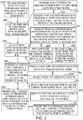
- FIG. 2 is a diagram of a method 200 metal detection, according to an example embodiment.
- the method 200 when processed controls operation for an infeed module integrated into a valuable media depository.
- the method 200 is implemented as executable instructions representing one or more firmware/software modules referred to as an "infeed controller.”
- the instructions reside in a non-transitory computer-readable medium and are executed by one or more processors of the infeed module and/or valuable media depository.
- the valuable media depository is the depository 100 of the FIG. 1A .
- the valuable media depository is a recycler module.
- the valuable media depository is a peripheral device integrated into a Self-Service Terminal (SST).
- the SST is an ATM.
- the SST is a kiosk.
- the infeed controller is implemented within the infeed module 101 A of the FIGS. 1A-1B .
- the infeed controller performs the processing depicted in the FIG. 1B .
- the infeed controller obtains pre-pinch metal detection readings when an item is inserted into an infeed mouth 101 of a valuable media depository 100.
- the item can be a single media document (check, note, etc. ) or the item can be a bunch of media documents.
- the infeed module continually obtaining resistance and inductance metal readings from a metal detection sensor/circuit situated in the depository 100 adjacent or proximate to the infeed mouth 101.
- the infeed controller adjusts the pre-pinch metal detection readings when the item is pinched (post-pinch) by a pinching (or clamping) mechanism within the depository 100 for purposes of establishing adjusted baseline readings.
- the adjusted baseline readings account for inductance and resistance values that are changed when the pinching mechanism is activated/moving and changes again when the item is finally pinched along a track of pathway 102 within the depository 100.
- the infeed controller establishes the adjusted baseline readings to account for variations that occur when the pinch mechanism is activated to pinch the item and variations once the item is pinched by the pinching mechanism.
- the infeed controller establishes the adjusted baseline readings to account for variations in the adjusted baseline readings when a shutter associated with the infeed mouth 101 when the shutter is attempting and begins to close after insertion of the item through the infeed mouth 101.
- the infeed controller calculates metal detection values based on the fully adjusted baseline values and variations (and trends) appearing in ongoing metal detection readings being obtained from the infeed controller from the metal detection sensor/circuit.
- the infeed controller calculates the metal detection values as: 1) a magnitude in changes in resistance values presenting in the ongoing metal detection readings (the processing branch (3) in the FIG. 1B for non-coin metals having large variations in RP data), 2) a positive value trend (going) in inductance values appearing in the ongoing metal detection values (the processing branch (2) in the FIG. 1B for paperclip type metals and non-coin metals with positive trending L data), and 3) a negative value trend (going) in the inductance values appearing in the ongoing metal detection values (the processing branch (1) in the FIG. 1B for detecting coin-type metals with negative trending L data).
- the infeed controller applies a width sampling or time-based filter against the ongoing metal detection readings when determining the magnitude in the changes for the resistance values provided in the ongoing metal detection readings.
- the infeed controller applies a width sampling or time-based filter against the ongoing metal detection readings when determining both the negative and positive trends in the inductance values provided in the ongoing metal detection readings.
- the predefined values (thresholds) that are associated with the resistance values are doubled. This is done to improve the ranges provided in the thresholds for resistance-based values (RP data).
- the infeed controller determines whether at least some metal is associated with the item based on comparison of the metal detection values to at least one predefined value.
- the predefined value is 0 (as presented in the FIG. 1 B) .
- the infeed controller selects a maximum value from the metal detection values and compares that maximum value against the at least one predefined value. This is selection of the maximum value from the results of the three branches of processing discussed in the FIG. 1B and the processing identified at 190.
- the infeed controller provides a result based on the processing of 240 for driving components of an infeed module 101 A and for urging the item into the depository 100 or for ejection the item out of the depository 100 through the infeed mouth 101.
- the infeed controller provides the result to a controller associated with the depository 100 to report a type of metal detected when the processing at 240 indicates that at least some metal is present and associated with the item.
- the infeed controller identifies by the result that the type of metal is one of: a coin, a paperclip, a staple, and/or a non-coin type of metal.
- the infeed controller provides pre-pinch and post-pinch calculated values in a priority order with the result.
- the pre-pinch values include negative L data, positive L data, and RP data all pre-pinch.
- the post-pinch data includes the negative L data, positive L data, and the RP data all post-pinch.
- the priority order is based on a highest to lowest value with highest being most likely to be detection of metal.
- the valuable media depository is a recycler module.
- the valuable media depository is a peripheral device integrated into a Self-Service Terminal (SST).
- the SST is an ATM.
- the SST is a kiosk.
- the metal detector is executed as firmware programmed instructions in memory of an infeed module and/or an integrated circuit of a valuable media depository.
- the metal detector performs, inter alia, the processing discussed above with the FIGS. 1B and 2 .
- the metal detector establishes baseline metal detection values during a first processing stage or zone (processing 150-172 of the FIG. 1 B) and before a pinching mechanism is activated in response to at least one media item being detected at an infeed mouth 101 of a depository 100.
- the baseline metal detection values also accounting for movement and pinch of the item within the depository 100.
- the metal detector further adjusts the baseline metal detection values in response to activation and movement of the shutter for the infeed mouth 101 that may begin to close behind the item.
- the metal detector performs concurrent processing during a second stage of zone (processing 181-189 (post-pinch of item) and described more completely in the FIG. 1 B) after the pinching mechanism is activated and has pinched the at least one media item to a track of a pathway 102 within the depository.
- the concurrent processing performed by the metal detector includes all, one, or some combination that is less than all of the processing 321-323 (described below) and includes usage of the adjusted baseline metal detection readings.
- the metal detector calculates a first value designed to represent a magnitude of changes occurring in resistance values obtained from a metal detection sensor/circuit. This is the processing 181-183 of the FIG. 1B .
- the metal detector applies a resistance value width filter (data sampled or time sampled) when calculating the first value.
- the metal detector derives a second value represent a positive trend (going) occurring in inductance values obtained from the metal detection sensor/circuit. This is the processing 184-186 of the FIG. 1B .
- the metal detector applies an inductance value width filter (data sampled or time sampled) when calculating the second value.
- the metal detector resolves a third value representing a negative trend (going) in the inductance values obtained from the metal detection sensor/circuit. This is the processing 187-189 of the FIG. 1B .
- the metal detector applies an inductance value width filter (data sampled or time sampled) when calculating the second value.
- the first, second, and third values are known and fed to 330, where the metal detector selects a maximum value from the first, second, and third values.
- the metal detector reports the maximum value for further processing of the at least one item within the depository 100.
- the processing 330 and 340 represent the processing 190 of the FIG. 1B .
- the metal detector causes all belts within the depository to stop and the customer is given a chance to pull the media item back out the infeed mouth 101 before any ejection processing by reversing the belts is caused to be initiated by the metal detector.
- the metal detector provides pre-pinch calculated values, the first, second, and third values along with the maximum value in a priority order.
- the priority is determined based on any value being identified as a potential metal.
- the pre-pinch values include the negative L value, the positive L value, and the RP value.
- FIG. 4 is a diagram of an infeed module 400 within a valuable media depository, according to an example embodiment.
- infeed module 400 includes a variety of mechanical, electrical, and programmed software/firmware components, some of which were discussed above with reference to the FIGS. 1A-1B and the FIGS. 2-3 .
- the infeed module 400 is any of or some combination of the infeed modules discussed above with reference to the FIGS. 1A-1B and 2-3 .
- the infeed module 400 includes one or more processors 401 and an infeed controller 402.
- the infeed controller 402 includes one or more integrated metal-sensor circuit boards.
- the infeed controller 402 is configured to: i) execute on the processor 401, ii) establish baseline metal detection readings before a pre-pinch mechanism is activated to pinch at least one media item presented at an infeed mouth of a media depository against a track of a pathway for the media depository, iii) calculate a maximum metal detection value based on the baseline metal detection readings, preconfigured threshold values, and ongoing variations in resistance and inductance values provided by a metal detection sensor, and iv) determine based on the maximum metal detection value whether: a) to urge the at least one media item along the pathway, b) stop transportation of the at least one media item within the depository 100; or c) eject the at least one media item back out the infeed mouth.
Landscapes
- Physics & Mathematics (AREA)
- General Physics & Mathematics (AREA)
- Engineering & Computer Science (AREA)
- Remote Sensing (AREA)
- Life Sciences & Earth Sciences (AREA)
- General Life Sciences & Earth Sciences (AREA)
- Electromagnetism (AREA)
- Environmental & Geological Engineering (AREA)
- Geology (AREA)
- Geophysics (AREA)
- Mechanical Engineering (AREA)
- Controlling Sheets Or Webs (AREA)
- Inspection Of Paper Currency And Valuable Securities (AREA)
- Sorting Of Articles (AREA)
Applications Claiming Priority (1)
| Application Number | Priority Date | Filing Date | Title |
|---|---|---|---|
| US15/337,369 US10099878B1 (en) | 2016-10-28 | 2016-10-28 | Media infeed metal detection |
Publications (1)
| Publication Number | Publication Date |
|---|---|
| EP3316228A1 true EP3316228A1 (de) | 2018-05-02 |
Family
ID=60119939
Family Applications (1)
| Application Number | Title | Priority Date | Filing Date |
|---|---|---|---|
| EP17196782.1A Withdrawn EP3316228A1 (de) | 2016-10-28 | 2017-10-17 | Metalldetektion für medienzuführung |
Country Status (3)
| Country | Link |
|---|---|
| US (2) | US10099878B1 (de) |
| EP (1) | EP3316228A1 (de) |
| CN (1) | CN108061919B (de) |
Cited By (1)
| Publication number | Priority date | Publication date | Assignee | Title |
|---|---|---|---|---|
| EP4012398A4 (de) * | 2019-08-07 | 2022-10-05 | Glory Ltd. | Vorrichtung zur handhabung von papierbögen und verfahren zur detektion von fremdkörpern |
Citations (8)
| Publication number | Priority date | Publication date | Assignee | Title |
|---|---|---|---|---|
| US4722443A (en) * | 1982-10-14 | 1988-02-02 | Tokyo Shibaura Denki Kabushiki Kaisha | Paper sheet processing apparatus |
| CA2259234A1 (en) * | 1996-06-28 | 1998-01-08 | Coinstar, Inc. | Coin discrimination apparatus and method |
| US5715926A (en) * | 1994-03-11 | 1998-02-10 | Mars, Incorporated | Money validation |
| JP3199605B2 (ja) * | 1995-06-07 | 2001-08-20 | ローレルバンクマシン株式会社 | 紙幣入金機における混入金属検知装置 |
| US20040046023A1 (en) * | 2001-01-08 | 2004-03-11 | John Buttifant | Magnetic thread reader |
| CN103035060A (zh) * | 2011-10-04 | 2013-04-10 | 日立欧姆龙金融系统有限公司 | 介质处理装置及介质处理方法 |
| EP2738745A1 (de) * | 2012-11-30 | 2014-06-04 | Outerwall Inc. | Münzerkennungssystem mit differentieller Erkennung und Verfahren zur Verwendung mit verbraucherbetätigten Kiosks und dergleichen |
| JP2014170386A (ja) * | 2013-03-04 | 2014-09-18 | Glory Ltd | 貨幣処理装置および貨幣処理方法 |
Family Cites Families (26)
| Publication number | Priority date | Publication date | Assignee | Title |
|---|---|---|---|---|
| US20030173402A1 (en) * | 2000-06-15 | 2003-09-18 | Hiroshi Ogawa | Medium processing apparatus |
| DE10105082A1 (de) * | 2001-02-05 | 2002-08-14 | Wincor Nixdorf Gmbh & Co Kg | Vorrichtung zur Entgegennahme von Banknoten |
| GB0300381D0 (en) * | 2003-01-08 | 2003-02-05 | Ncr Int Inc | Detector |
| WO2007044570A2 (en) * | 2005-10-05 | 2007-04-19 | Cummins-Allison Corp. | Currency processing system with fitness detection |
| KR101276063B1 (ko) * | 2008-09-09 | 2013-06-14 | 삼성전자주식회사 | 화상형성장치, 화상형성시스템 및 그 제어방법 |
| EP2530658A4 (de) * | 2010-01-29 | 2013-07-10 | Glory Kogyo Kk | Währungsverarbeitungsvorrichtung |
| DE102010039946A1 (de) * | 2010-08-30 | 2012-03-01 | Robert Bosch Gmbh | Messvorrichtung, insbesondere Messvorrichtung zur Erfassung metallischer Gegenstände |
| JP6035711B2 (ja) * | 2011-07-21 | 2016-11-30 | ソニー株式会社 | 検知装置、受電装置、送電装置、非接触電力伝送システム及び検知方法 |
| US9368002B2 (en) * | 2013-05-09 | 2016-06-14 | Bank Of America Corporation | Sensor system for detection of a partial retrieval of dispensed currency at an automated teller machine |
| KR101534412B1 (ko) * | 2013-11-29 | 2015-07-07 | 노틸러스효성 주식회사 | 매체 처리 장치 |
| JP6303775B2 (ja) * | 2014-04-28 | 2018-04-04 | 沖電気工業株式会社 | 媒体集積装置及び媒体取引装置 |
| JP2016048439A (ja) * | 2014-08-27 | 2016-04-07 | グローリー株式会社 | 紙葉類処理装置 |
| CN104355191B (zh) * | 2014-09-04 | 2016-12-07 | 广州广电运通金融电子股份有限公司 | 递钞式纸币输送装置 |
| JP2016057968A (ja) * | 2014-09-11 | 2016-04-21 | 沖電気工業株式会社 | 媒体取引装置 |
| JP6539983B2 (ja) * | 2014-10-29 | 2019-07-10 | 沖電気工業株式会社 | 媒体取扱装置 |
| JP6443733B2 (ja) * | 2014-11-04 | 2018-12-26 | 株式会社リコー | 給紙装置、画像形成装置および画像形成システム |
| US9938100B2 (en) * | 2014-12-30 | 2018-04-10 | Kodak Alaris Inc. | System and method for metallic object detection in a media transport system |
| CN104802514B (zh) * | 2015-05-13 | 2017-12-22 | 广州广电运通金融电子股份有限公司 | 一种表面粘贴异物的薄片类介质检测装置 |
| US9772422B2 (en) * | 2015-05-18 | 2017-09-26 | The Boeing Company | System and method for detecting objects |
| US9754434B2 (en) * | 2015-05-29 | 2017-09-05 | Diebold, Inc. | Moveable platen in document handling systems for an automated teller machine |
| KR101911711B1 (ko) * | 2015-06-14 | 2018-10-25 | 디에볼드 닉스도르프, 인코포레이티드 | 자동 금융거래 단말기를 위한 코어 모듈 |
| JP2017054354A (ja) * | 2015-09-10 | 2017-03-16 | 株式会社東芝 | 厚さ検出装置 |
| US9850084B2 (en) * | 2015-10-21 | 2017-12-26 | Kodak Alaris Inc. | Detection of process abnormalities in a media processing system |
| CN105374106B (zh) * | 2015-11-04 | 2018-03-16 | 东方通信股份有限公司 | 一种atm机纸币检测装置及检测方法 |
| CN105427447B (zh) * | 2015-11-04 | 2018-03-16 | 东方通信股份有限公司 | Atm机纸币检测装置及检测方法 |
| US10424154B2 (en) * | 2016-01-22 | 2019-09-24 | Global Payments Gaming Services, Inc | Converting monetary value to player points |
-
2016
- 2016-10-28 US US15/337,369 patent/US10099878B1/en active Active
-
2017
- 2017-10-17 EP EP17196782.1A patent/EP3316228A1/de not_active Withdrawn
- 2017-10-26 CN CN201711019284.9A patent/CN108061919B/zh active Active
- 2017-11-10 US US15/809,026 patent/US10167153B2/en active Active
Patent Citations (8)
| Publication number | Priority date | Publication date | Assignee | Title |
|---|---|---|---|---|
| US4722443A (en) * | 1982-10-14 | 1988-02-02 | Tokyo Shibaura Denki Kabushiki Kaisha | Paper sheet processing apparatus |
| US5715926A (en) * | 1994-03-11 | 1998-02-10 | Mars, Incorporated | Money validation |
| JP3199605B2 (ja) * | 1995-06-07 | 2001-08-20 | ローレルバンクマシン株式会社 | 紙幣入金機における混入金属検知装置 |
| CA2259234A1 (en) * | 1996-06-28 | 1998-01-08 | Coinstar, Inc. | Coin discrimination apparatus and method |
| US20040046023A1 (en) * | 2001-01-08 | 2004-03-11 | John Buttifant | Magnetic thread reader |
| CN103035060A (zh) * | 2011-10-04 | 2013-04-10 | 日立欧姆龙金融系统有限公司 | 介质处理装置及介质处理方法 |
| EP2738745A1 (de) * | 2012-11-30 | 2014-06-04 | Outerwall Inc. | Münzerkennungssystem mit differentieller Erkennung und Verfahren zur Verwendung mit verbraucherbetätigten Kiosks und dergleichen |
| JP2014170386A (ja) * | 2013-03-04 | 2014-09-18 | Glory Ltd | 貨幣処理装置および貨幣処理方法 |
Cited By (1)
| Publication number | Priority date | Publication date | Assignee | Title |
|---|---|---|---|---|
| EP4012398A4 (de) * | 2019-08-07 | 2022-10-05 | Glory Ltd. | Vorrichtung zur handhabung von papierbögen und verfahren zur detektion von fremdkörpern |
Also Published As
| Publication number | Publication date |
|---|---|
| US20180118490A1 (en) | 2018-05-03 |
| US10099878B1 (en) | 2018-10-16 |
| CN108061919A (zh) | 2018-05-22 |
| US10167153B2 (en) | 2019-01-01 |
| CN108061919B (zh) | 2020-01-24 |
Similar Documents
| Publication | Publication Date | Title |
|---|---|---|
| CN103177503B (zh) | 纸币操作装置及现金自动交易装置 | |
| CN101266702B (zh) | 纸币处理装置 | |
| US11055679B2 (en) | Bunch document recycler | |
| WO2008050462A1 (fr) | Dispositif d'identification/comptage de billets de banque | |
| US10167153B2 (en) | Media infeed metal detection | |
| JPWO2011086665A1 (ja) | 紙葉類識別装置および紙葉類識別方法 | |
| JPWO2015015588A1 (ja) | 紙葉類処理装置 | |
| EP3410409B1 (de) | Mediensicherheitsvalidierung | |
| US9336638B2 (en) | Media item validation | |
| EP2960877A1 (de) | Ausgabegerät für wertvolle medien | |
| JP2014044682A (ja) | 紙葉類疲労判別装置、紙幣処理装置、紙葉類疲労判別方法 | |
| CN104794814A (zh) | 自动交易装置 | |
| US9969583B2 (en) | Ejecting damaged/deformed media | |
| JP2011173672A (ja) | 紙葉類の選別装置、選別方法及び自動取引装置 | |
| CN102459044B (zh) | 用于存入一张或多张有价票券的设备 | |
| US10296800B2 (en) | Media validation processing | |
| EP4700727A1 (de) | Medienelementvalidierung für medienendgeräte | |
| US10167152B2 (en) | Folded media detection and processing | |
| KR101579379B1 (ko) | 금융기기 및 그의 제어방법 | |
| JP7300520B2 (ja) | 紙葉類識別装置、紙葉類処理装置及び紙葉類識別方法 | |
| JP2011028531A (ja) | 磁気インク文字読取装置 | |
| EP3364380B1 (de) | Ausgabe von gefensterten und ungefensterten medien | |
| JP2016004389A (ja) | 紙幣識別装置 | |
| US20190266827A1 (en) | Valuable Media Substrate Validation | |
| JP2021140488A (ja) | 紙葉類識別装置 |
Legal Events
| Date | Code | Title | Description |
|---|---|---|---|
| PUAI | Public reference made under article 153(3) epc to a published international application that has entered the european phase |
Free format text: ORIGINAL CODE: 0009012 |
|
| STAA | Information on the status of an ep patent application or granted ep patent |
Free format text: STATUS: THE APPLICATION HAS BEEN PUBLISHED |
|
| AK | Designated contracting states |
Kind code of ref document: A1 Designated state(s): AL AT BE BG CH CY CZ DE DK EE ES FI FR GB GR HR HU IE IS IT LI LT LU LV MC MK MT NL NO PL PT RO RS SE SI SK SM TR |
|
| AX | Request for extension of the european patent |
Extension state: BA ME |
|
| RAP1 | Party data changed (applicant data changed or rights of an application transferred) |
Owner name: NCR CORPORATION |
|
| STAA | Information on the status of an ep patent application or granted ep patent |
Free format text: STATUS: REQUEST FOR EXAMINATION WAS MADE |
|
| 17P | Request for examination filed |
Effective date: 20181102 |
|
| RBV | Designated contracting states (corrected) |
Designated state(s): AL AT BE BG CH CY CZ DE DK EE ES FI FR GB GR HR HU IE IS IT LI LT LU LV MC MK MT NL NO PL PT RO RS SE SI SK SM TR |
|
| STAA | Information on the status of an ep patent application or granted ep patent |
Free format text: STATUS: EXAMINATION IS IN PROGRESS |
|
| 17Q | First examination report despatched |
Effective date: 20200624 |
|
| STAA | Information on the status of an ep patent application or granted ep patent |
Free format text: STATUS: THE APPLICATION HAS BEEN WITHDRAWN |
|
| 18W | Application withdrawn |
Effective date: 20210813 |