EP3320570B1 - Wellenlängenkonvertierte lichtemittierende vorrichtung - Google Patents
Wellenlängenkonvertierte lichtemittierende vorrichtung Download PDFInfo
- Publication number
- EP3320570B1 EP3320570B1 EP16732645.3A EP16732645A EP3320570B1 EP 3320570 B1 EP3320570 B1 EP 3320570B1 EP 16732645 A EP16732645 A EP 16732645A EP 3320570 B1 EP3320570 B1 EP 3320570B1
- Authority
- EP
- European Patent Office
- Prior art keywords
- phosphor
- dopant concentration
- light
- light source
- region
- Prior art date
- Legal status (The legal status is an assumption and is not a legal conclusion. Google has not performed a legal analysis and makes no representation as to the accuracy of the status listed.)
- Active
Links
Images
Classifications
-
- H—ELECTRICITY
- H10—SEMICONDUCTOR DEVICES; ELECTRIC SOLID-STATE DEVICES NOT OTHERWISE PROVIDED FOR
- H10H—INORGANIC LIGHT-EMITTING SEMICONDUCTOR DEVICES HAVING POTENTIAL BARRIERS
- H10H20/00—Individual inorganic light-emitting semiconductor devices having potential barriers, e.g. light-emitting diodes [LED]
- H10H20/80—Constructional details
- H10H20/85—Packages
- H10H20/851—Wavelength conversion means
- H10H20/8516—Wavelength conversion means having a non-uniform spatial arrangement or non-uniform concentration, e.g. patterned wavelength conversion layer or wavelength conversion layer with a concentration gradient
-
- H—ELECTRICITY
- H10—SEMICONDUCTOR DEVICES; ELECTRIC SOLID-STATE DEVICES NOT OTHERWISE PROVIDED FOR
- H10H—INORGANIC LIGHT-EMITTING SEMICONDUCTOR DEVICES HAVING POTENTIAL BARRIERS
- H10H20/00—Individual inorganic light-emitting semiconductor devices having potential barriers, e.g. light-emitting diodes [LED]
- H10H20/80—Constructional details
- H10H20/85—Packages
- H10H20/851—Wavelength conversion means
- H10H20/8511—Wavelength conversion means characterised by their material, e.g. binder
- H10H20/8512—Wavelength conversion materials
-
- H—ELECTRICITY
- H10—SEMICONDUCTOR DEVICES; ELECTRIC SOLID-STATE DEVICES NOT OTHERWISE PROVIDED FOR
- H10H—INORGANIC LIGHT-EMITTING SEMICONDUCTOR DEVICES HAVING POTENTIAL BARRIERS
- H10H20/00—Individual inorganic light-emitting semiconductor devices having potential barriers, e.g. light-emitting diodes [LED]
- H10H20/80—Constructional details
- H10H20/85—Packages
- H10H20/851—Wavelength conversion means
- H10H20/8511—Wavelength conversion means characterised by their material, e.g. binder
- H10H20/8512—Wavelength conversion materials
- H10H20/8513—Wavelength conversion materials having two or more wavelength conversion materials
-
- H—ELECTRICITY
- H10—SEMICONDUCTOR DEVICES; ELECTRIC SOLID-STATE DEVICES NOT OTHERWISE PROVIDED FOR
- H10H—INORGANIC LIGHT-EMITTING SEMICONDUCTOR DEVICES HAVING POTENTIAL BARRIERS
- H10H20/00—Individual inorganic light-emitting semiconductor devices having potential barriers, e.g. light-emitting diodes [LED]
- H10H20/80—Constructional details
- H10H20/85—Packages
- H10H20/851—Wavelength conversion means
- H10H20/8511—Wavelength conversion means characterised by their material, e.g. binder
Definitions
- the present invention relates to wavelength converted light emitting devices such as light emitting diodes.
- LEDs light emitting diodes
- RCLEDs resonant cavity light emitting diodes
- VCSELs vertical cavity laser diodes
- edge emitting lasers are among the most efficient light sources currently available.
- Materials systems currently of interest in the manufacture of high-brightness light emitting devices capable of operation across the visible spectrum include Group III-V semiconductors, particularly binary, ternary, and quaternary alloys of gallium, aluminum, indium, and nitrogen, also referred to as III-nitride materials.
- III-nitride light emitting devices are fabricated by epitaxially growing a stack of semiconductor layers of different compositions and dopant concentrations on a sapphire, silicon carbide, III-nitride, or other suitable substrate by metal-organic chemical vapor deposition (MOCVD), molecular beam epitaxy (MBE), or other epitaxial techniques.
- MOCVD metal-organic chemical vapor deposition
- MBE molecular beam epitaxy
- the stack often includes one or more n-type layers doped with, for example, Si, formed over the substrate, one or more light emitting layers in an active region formed over the n-type layer or layers, and one or more p-type layers doped with, for example, Mg, formed over the active region. Electrical contacts are formed on the n- and p-type regions.
- the blue light from an LED or laser illuminates a yellow-green phosphor, such as a YAG:Ce phosphor, or a combination of red and green phosphors, so that the combination of the light generated by the phosphor and the blue light leaking through creates white light.
- a yellow-green phosphor such as a YAG:Ce phosphor, or a combination of red and green phosphors
- Some phosphors are quenched or saturated under very bright blue light (e.g., above 100 W/cm 2 ) produced by a high power blue light source. Quenching or saturation may lead to undesirable color shifts and reduced light output.
- a phosphor is essentially a crystalline host material (sometimes called a lattice) doped with activators or dopants ("activators” and “dopants” are used interchangeably herein). Examples of common activator species include Eu 2+ , Eu 3+ , and Ce 3+ . When the phosphor is exposed to light in a particular wavelength range (the excitation spectrum), the activators absorb the excitation light and emit light of a longer wavelength (the emission spectrum).
- some phosphors become saturated when exposed to, for example, blue light from an LED.
- the efficiency of the phosphor decreases.
- the reduction in efficiency with increasing excitation density may be referred to herein as "droop.”
- Excited state interaction may include exited state absorption (ESA) and quantum-mechanical interaction (QMI).
- ESA may depend on the electronic band structure of the host, and/or the energetic position of dopant levels relative to the host band structure.
- QMI may depend on the crystal structure of the host; in particular, the distance between the emitting and the absorbing exited dopants.
- a photon emitted by an excited activator may absorbed by another already excited activator, exciting an electron into the host material conduction band rather than emitting a photon, thereby reducing the efficiency of the phosphor. This effect may be more prevalent at higher temperatures.
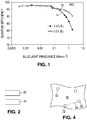
- Fig. 1 is a plot of measured quantum efficiency as a function of irradiance from a blue-emitting laser (in W/mm 2 ).
- the two phosphors illustrated in Fig. 1 have the same host material, (Ba 0.1 Sr 0.9 ) 2 Si 5 N 8 , and the same activator, Eu 2+ .
- Two different activator concentrations are illustrated, 0.5% (curve 10) and 2.4% (curve 14).
- the efficiency of the phosphor at the highest excitation densities is lower than the efficiency of the phosphor with the lowest activator concentration at the highest excitation densities.
- phosphors are synthesized or applied to a device in such a way as to reduce or eliminate droop, the observed efficiency drop at increasing excitation density.
- the host material of the phosphors in the embodiments described below may be, for example, CaS, (Ca,Sr)Ga 2 S 4 , Ba 2-x M x Si 5-y Al y N 8-y O y , wherein M represents Sr or Ca, 0 ⁇ x ⁇ 1, and 0.0005 ⁇ y ⁇ 0.05 (BSSNE), Ca 1-x Sr x AlSiN3, wherein 0 ⁇ x ⁇ 1, preferably 0 ⁇ x ⁇ 0.95 (SCASN), eCas, YAG, or any other suitable host material.
- the activator in the phosphors in the embodiments described herein may be, for example, a rare earth material, Europium, Eu 2+ , Cerium, Ce 3+ , or any other suitable material.
- the activator is Europium.
- Cerium-doped phosphors may also experience droop, often at much higher incident power densities than Europium-doped phosphors.
- a Ce 3+ phosphor may exhibit similar droop at about 50 W/mm 2 that an Eu 2+ phosphor exhibits at 1 W/mm 2 .
- Fig. 2 illustrates a device according to embodiments of the invention.
- a wavelength converting structure 20 is disposed in a path of light emitted from a light emitting device 18 such as a light emitting diode (LED).
- the wavelength converting structure 20 is a phosphor, which includes a host and a dopant.
- Wavelength converting structure 20 may be in direct contact with light emitting device 18 or it may be spaced apart from the light emitting device 18.
- Wavelength converting structure 20 includes one or more phosphors.
- one or more optical elements such as lenses (not shown in Fig. 2 ) may be included in the device of Fig. 2 .
- an optical element may be disposed between light emitting device 18 and wavelength converting structure 20, in order to shape, filter, and/or at least partially collimate light extracted from the light emitting device 18.
- an optical element may be disposed over wavelength converting structure 20, in order to shape, filter, and/or at least partially collimate light extracted from the wavelength converting structure 20.
- optical elements include filters, dome lenses, Fresnel lenses, compound parabolic concentrators, and any other suitable structure.
- a maximum average dopant concentration in the wavelength converting structure 20 is selected for a predetermined amount of light produced by the light emitting device 18 and converted by wavelength converting structure 20, and for a predetermined maximum reduction in efficiency of the wavelength converting structure at increasing excitation density (i.e. maximum allowed droop).
- the predetermined maximum reduction in efficiency may result in a color shift of the resulting total emission.
- the wavelength converting structure 20 may be a phosphor layer of substantially uniform average dopant concentration, a layered structure, or a graded composition structure, such as the phosphors described in any of the examples below.
- the thickness of the wavelength converting structure 20 of Fig. 2 is limited.
- droop may be reduced by lowering the dopant concentration, but as the dopant concentration is reduced, a predetermined amount of converted light demands greater thickness, to a limit where a dopant concentration approaching zero requires an infinite thickness.
- a maximum average dopant concentration in the wavelength converting structure 20 is selected for a predetermined wavelength converting structure thickness 20, and for a predetermined maximum reduction in efficiency of the wavelength converting structure at increasing excitation density (i.e. maximum allowed droop).
- the light emitting device 18 may be any suitable device that emits light that may excite one or more wavelength converting materials in wavelength converting structure 20.
- light emitting device 18 is a III-nitride LED that emits blue or UV light.
- a III-nitride LED may be, for example, a flip chip device, where a majority of light is extracted through a surface of the LED opposite a surface on which electrical contacts are formed; a vertical device, where electrical contacts are formed on opposite sides of the device; or a lateral device, where both electrical contacts are formed on a surface of the device through which a majority of light is extracted.
- the growth substrate on which the III-nitride device layers are grown may be part of the device, may be thinned, or may be completely removed. Any suitable light emitting device may be used.
- semiconductor light emitting devices are III-nitride LEDs that emit blue or UV light
- semiconductor light emitting devices besides LEDs such as laser diodes and semiconductor light emitting devices made from other materials systems such as other III-V materials, III-phosphide, III-arsenide, II-VI materials, ZnO, or Si-based materials may be used, as long as the emission of the device overlaps with the excitation spectrum of the wavelength converting structure 20.
- Suitable wavelength converting structures 20 may include one or more of the phosphors and/or structures described in the embodiments below.
- the wavelength converting structure 20 may be disposed on the LED, or spaced apart from the LED.
- the concentration of dopant in the wavelength converting structure, and/or the arrangement of the dopant are selected such that a predetermined light emission from the light emitting structure 18, a predetermined maximum reduction of the efficiency of the wavelength converting structure is not surpassed (i.e., a maximum droop level is not exceeded).
- the wavelength converting structure includes one or more wavelength converting materials which may be, for example, conventional phosphors, organic phosphors, quantum dots, organic semiconductors, II-VI or III-V semiconductors, II-VI or III-V semiconductor quantum dots or nanocrystals, dyes, polymers, or other materials that luminesce.
- the wavelength converting material absorbs light emitted by the LED and emits light of one or more different wavelengths. Unconverted light emitted by the LED is often part of the final spectrum of light extracted from the structure, though it need not be.
- the final spectrum of light extracted from the structure may be white, polychromatic, or monochromatic.
- Examples of common combinations include a blue-emitting LED combined with a yellow-emitting wavelength converting material, a blue-emitting LED combined with green- and red-emitting wavelength converting materials, a UV-emitting LED combined with blue- and yellow-emitting wavelength converting materials, and a UV-emitting LED combined with blue-, green-, and red-emitting wavelength converting materials.
- Wavelength converting materials emitting other colors of light may be added to tailor the spectrum of light extracted from the structure.
- the wavelength converting structure may include light scattering or light diffusing elements e.g. TiO 2 .
- wavelength converting structure 20 is a structure that is fabricated separately from the LED and attached to the LED, for example through wafer bonding or a suitable adhesive such as silicone or epoxy.
- a prefabricated wavelength converting element is a ceramic phosphor, which is formed by, for example, sintering powder phosphor or the precursor materials of phosphor into a ceramic slab, which may then be diced into individual wavelength converting elements.
- a ceramic phosphor may also be formed by, for example tape casting, where the ceramic is fabricated to the correct shape, with no dicing or cutting necessary.
- suitable non-ceramic preformed wavelength converting elements include powder phosphors that are dispersed in transparent material such as silicone or glass that is rolled, cast, or otherwise formed into a sheet, then singulated into individual wavelength converting elements, and phosphor mixed with silicone and disposed on a transparent substrate.
- a reflecting material (not shown in Fig. 2 ) may be disposed on the sides of the LEDs and the wavelength converting element, in order to force light to exit the device through the top surface.
- wavelength converting structure 20 includes a phosphor including a host material and an activator that at certain activator concentrations does suffer from droop.
- the phosphor is doped to an activator concentration that does not exhibit a decrease in efficiency at increasing excitation intensity.
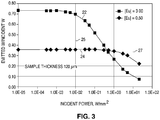
- the efficiency curve of such a phosphor is illustrated in Fig. 3 (the phosphor illustrated in Fig. 3 may be the same phosphor illustrated in Fig. 1 ).
- Fig. 3 is a plot, for two phosphors with the same host and different dopant concentrations, of emitted power/incident power for a given phosphor thickness, as a function of incident power (excitation density).
- Curve 22 represents a phosphor with a higher activator concentration than the phosphor of curve 24.
- the phosphor with the higher activator concentration exhibits droop (curve 22) at the incident power indicated at 25, while the phosphor with the lower activator concentration (curve 24) does not exhibit droop at the incident power indicated at 25.
- the phosphor includes a host material that at certain activator concentrations does suffer from droop at a selected excitation density (i.e., curve 22 at incident power 25). The activator concentration may be reduced such that the phosphor does not suffer from droop at a given excitation density (i.e., curve 24 at incident power 25). At excitation densities other than the selected excitation density, the phosphor may exhibit droop (i.e., curve 24 at incident power 27).
- the activator in the phosphors represented by curves 22 and 24 may be, for example, a rare earth material, Europium, or Eu 2+ in some embodiments.
- the phosphor illustrated by curve 24 may emit less light at a given incident power density than the phosphor illustrated by curve 22. Accordingly, to reach a given brightness, more phosphor may be used in a device where the wavelength converting structure 20 includes phosphor represented by curve 24.
- the phosphor illustrated by curve 24 is included in wavelength converting structure 20.
- the phosphor illustrated by curve 22 is not included in the device, rather it is described above as a reference against which the performance of the phosphors illustrated by curve 24 is compared.
- the phosphor illustrated by curve 24 may be, in some embodiments, the only phosphor with that host material included in wavelength converting structure 20.
- the phosphor illustrated by curve 24 may be disposed in a single layer of substantially uniform dopant concentration.
- the activator concentration in the phosphor illustrated by curve 24 is substantially uniform throughout wavelength converting structure 20, i.e. the activator concentration is not graded in a horizontal or vertical plane in wavelength converting structure 20.
- wavelength converting structure 20 includes a powder phosphor that is produced to increase the distance between activators within each phosphor particle, which may reduce or eliminate droop.
- a phosphor portion 30 may be characterized by a spacing 34 between activators 32, as illustrated in Fig. 4 .
- the spacing 34 may be increased, as compared to a given commercially used phosphor with the same host material and the same activator concentration.
- the activator 32 is a rare earth material, Europium, or Eu 2+ .
- the average spacing 34 may be at least 15 ⁇ in some embodiments, at least 18 ⁇ in some embodiments, at least 20 ⁇ in some embodiments, at least 25 ⁇ in some embodiments, and no more than 50 ⁇ in some embodiments.
- the wavelength converting structure 20 includes a phosphor with a graded concentration of activators.
- the activator concentration may be graded in a direction perpendicular to a major surface of the wavelength converting structure 20.
- the activator concentration is lowest in a region closest to the excitation light source, and highest in a region furthest from the excitation light source.
- the excitation power decreases exponentially with depth into the phosphor.
- the excitation density is reduced.
- the droop exhibited by the phosphor may also decrease.
- droop may be reduced or eliminated, as compared to the same phosphor when homogeneously doped.
- graded the activator concentration may refer to any change in concentration other than a single, stepwise change in concentration.
- the graded activator concentration profile may take any shape including, for example, a linear, step-graded, or a power law profile, and may include multiple or no regions of constant activator concentration.
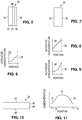
- Fig. 5 illustrates one example of a slab-type graded wavelength converting structure 20.
- the wavelength converting structure 20 includes multiple layers 52, 54, 56, and 58 of different activator concentration. Within each of layers 52, 54, 56, and 58, the activator concentration may be constant and uniform, though this is not required.
- the wavelength converting structure 20 of Fig. 5 may be a ceramic, or any other suitable structure. Though four layers are illustrated in Fig. 5 , more or fewer layers may be used. In some embodiments, two to ten layers are included.
- the total thickness of the wavelength converting structure 20 of Fig. 5 may be at least 100 ⁇ m thick in some embodiments, no more than 400 ⁇ m thick in some embodiments, at least 200 ⁇ m thick in some embodiments, and no more than 300 ⁇ m thick in some embodiments.
- Each layer may be the same thickness, though this is not required.
- Each layer may have a thickness of at least 10 ⁇ m in some embodiments and no more than 100 ⁇ m in some embodiments.
- the surface 50 of wavelength converting structure 20 faces the light source 18. Accordingly, layer 52 has the lowest activator concentration.
- the surface 60 of wavelength converting structure 20 is furthest from the light source. Accordingly, layer 58 has the highest activator concentration.
- Fig. 6 illustrates the activator concentration as a function of position from surface 50 to surface 60 for one example of a wavelength converting structure 20. Four layers of constant and different activator concentration are illustrated. The concentration increases from surface 50 to surface 60 in multiple steps.
- Fig. 7 illustrates another example of a slab-type wavelength converting structure 20.
- the wavelength converting structure of Fig. 7 is continuously graded, rather than stepwise graded, as illustrated in Fig. 5 .
- surface 50 is closest to the light source and surface 60 is furthest from the light source.
- Figs. 8 and 9 illustrate two possible grading profiles for the structure of Fig. 7 , in plots of activator concentration as a function of position. In each grading profile, the activator concentration increases from a lowest concentration at surface 50 to a highest concentration at surface 60.
- Fig. 8 illustrates a linear grading profile.
- Fig. 9 illustrates a quadratic grading profile. Other profiles such as exponential, polynomial, or any other suitable profile can be used to grade the wavelength converting structure 20.
- the individual particles in a powder phosphor have a dopant concentration that varies across the particle.
- An individual particle has a first region with a first average dopant concentration and a second region with a second average dopant concentration, where the first and second average dopant concentrations are different. The first and second regions are arranged to reduce or eliminate droop.
- the same effect described in the graded phosphors of Figs. 5 and 7 , where a more highly doped portion of the phosphor is "screened" by a lower doped portion of the phosphor, reducing the excitation density in the more highly doped portion, may be achieved in a powder phosphor by forming the phosphor particles with a dopant concentration that varies across the particle, such that the center portion of each particle is more highly doped than the outer portion of each particle.
- Fig. 11 is a plot of dopant concentration as a function of diameter for one example of such a phosphor particle.
- 70 and 72 represent the outer edges of the particle
- 74 represents the center.
- the dopant concentration is lower at the edges of the particle than at the center, where it is highest.
- the lower doped outer portion of each particle is the first part of the particle that "sees" light from the light emitting diode.
- the lower doped outer portion of each particle therefore reduces the excitation density at the more highly doped center, which may reduce the droop and may increase the efficiency of the phosphor.
- the concentration gradient in the phosphor particle is not limited to the particular profile illustrated in Fig. 11 .
- Phosphor particles with the center more highly doped than the outer portion may be formed by providing or synthesizing a doped core, growing a non-doped shell around the doped core, and diffusing the dopant in a thermal process partially into the outer region.
- the activator may be, for example, a rare earth material, Cerium, Ce 3+ , Europium, or Eu 2+ .
- Fig. 10 illustrates a wavelength converting structure 20 with a structure that screens a phosphor that exhibits droop, in order to reduce the excitation density of that phosphor.
- the screening structure 66 is disposed closest to the light source.
- a phosphor 68 which exhibits a drop in efficiency at increasing excitation density is disposed furthest from the light source.
- the screening structure 66 absorbs light from the light source, effectively reducing the excitation density incident on phosphor 68.
- the characteristics of the screening structure 66 such as the material, thickness, and absorption coefficient, may be selected to reduce the excitation density incident on the phosphor 68 to a point where a predetermined maximum reduction of the phosphor's efficiency is not surpassed.
- suitable screening structures 66 include non-wavelength converting materials, wavelength converting materials, phosphors, layers designed to scatter light, filters, reflectors, and any other suitable structure.
- structure 66 is a second phosphor, which does not exhibit a drop in efficiency at increasing excitation density, or which exhibits less droop than phosphor 68.
- structure 66 is a garnet phosphor, a YAG:Ce phosphor, or any other suitable phosphor.
Landscapes
- Luminescent Compositions (AREA)
- Led Device Packages (AREA)
Claims (13)
- Struktur, umfassend:eine Festkörper-Lichtquelle (18), die blaues Licht emittiert, undeinen gelb-grünen keramischen Phosphor (20), der in einem Weg von Licht angeordnet ist, das von der Lichtquelle emittiert wird, wobei eine Oberfläche (50, 62) des Phosphors der Lichtquelle (18) zugewandt ist und eine Oberfläche (60, 64) des Phosphors (20) am weitesten von der Lichtquelle (18) entfernt ist, wobei der Phosphor zum Absorbieren von Licht, das von der Lichtquelle emittiert wird, und zum Emittieren von Licht mit einer zweiten Peak-Wellenlänge bestimmt ist, wobei der Phosphor Folgendes umfasst:ein kristallines Wirtsmaterial und einen Dotierstoff,einen ersten Bereich mit einer ersten Dotierstoffkonzentration undeinen zweiten Bereich mit einer zweiten Dotierstoffkonzentration, wobei die zweite Dotierstoffkonzentration geringer ist als die erste Dotierstoffkonzentration und der Phosphor (20) derart angeordnet ist, dass Licht, das von der Lichtquelle emittiert wird, den zweiten Bereich vor dem ersten Bereich erreicht,dadurch gekennzeichnet, dassdie Dotierstoffkonzentration von der Oberfläche (50, 62), die der Lichtquelle (18) am nächsten ist, zu der Oberfläche (60, 64), die am weitesten von der Lichtquelle (18) entfernt ist, zunimmt.
- Struktur nach Anspruch 1, wobei der erste und der zweite Bereich eine erste und eine zweite Schicht umfassen, wobei die zweite Schicht zwischen der Lichtquelle und der ersten Schicht angeordnet ist.
- Struktur nach Anspruch 1, wobei:der zweite Bereich eine Schicht nahe der Lichtquelle ist,der erste Bereich eine Schicht gegenüber dem zweiten Bereich ist unddie Dotierstoffkonzentration zwischen dem zweiten und dem ersten Bereich gestaffelt ist.
- Struktur nach einem der vorhergehenden Ansprüche, wobei der Phosphor mehrere Schichten (52, 54, 56, 58) mit verschiedenen Dotierstoffkonzentrationen beinhaltet.
- Struktur nach Anspruch 4, wobei die Dotierstoffkonzentration innerhalb jeder der Schichten (52, 54, 56, 58) konstant und gleichmäßig ist.
- Struktur nach Anspruch 1, wobei der Dotierstoff ein beliebiger von Europium, Eu2+, Cer, Ce3+ ist.
- Struktur, umfassend:eine blaue Leuchtdiode (18) undeinen gelb-grünen Phosphor (20), der Phosphorpartikel umfasst, die in einem Weg von Licht angeordnet sind, das von der Leuchtdiode emittiert wird, wobei jeder Phosphorpartikel Folgendes umfasst:einen ersten Bereich (74) in der Mitte des Partikels mit einer ersten Dotierstoffkonzentration und einen zweiten Bereich (76, 78) am äußeren Abschnitt des Partikels mit einer zweiten Dotierstoffkonzentration, wobei die zweite Dotierstoffkonzentration geringer ist als die erste Dotierstoffkonzentration.
- Struktur nach Anspruch 7,
wobei die Phosphorpartikel durch Bereitstellen eines dotierten Kerns, Aufwachsen eines undotierten Mantels um den dotierten Kern und Diffundieren des Dotierstoffs in den äußeren Bereich in einem thermischen Prozess gebildet werden. - Struktur nach Anspruch 7, wobei die Phosphorpartikel einen mittleren Durchmesser von nicht mehr als 20 µm aufweisen.
- Struktur nach Anspruch 7, wobei die Phosphorpartikel einen mittleren Durchmesser von mindestens 2 µm aufweisen.
- Struktur nach Anspruch 10, wobei die Phosphorpartikel einen mittleren Durchmesser von nicht mehr als 50 µm aufweisen.
- Struktur nach Anspruch 7, wobei die Dotierstoffkonzentration entlang eines Abschnitts des Durchmessers jedes Phosphorpartikels gestaffelt ist.
- Struktur nach Anspruch 7, wobei der Dotierstoff ein beliebiger von Europium, Eu2+, Cer, Ce3+ ist.
Applications Claiming Priority (2)
| Application Number | Priority Date | Filing Date | Title |
|---|---|---|---|
| US201562188009P | 2015-07-02 | 2015-07-02 | |
| PCT/EP2016/064987 WO2017001390A1 (en) | 2015-07-02 | 2016-06-28 | Wavelength converted light emitting device |
Publications (2)
| Publication Number | Publication Date |
|---|---|
| EP3320570A1 EP3320570A1 (de) | 2018-05-16 |
| EP3320570B1 true EP3320570B1 (de) | 2019-06-12 |
Family
ID=56263714
Family Applications (1)
| Application Number | Title | Priority Date | Filing Date |
|---|---|---|---|
| EP16732645.3A Active EP3320570B1 (de) | 2015-07-02 | 2016-06-28 | Wellenlängenkonvertierte lichtemittierende vorrichtung |
Country Status (7)
| Country | Link |
|---|---|
| US (2) | US10910529B2 (de) |
| EP (1) | EP3320570B1 (de) |
| JP (1) | JP6890556B2 (de) |
| KR (1) | KR102553495B1 (de) |
| CN (1) | CN108337918B (de) |
| TW (1) | TWI729987B (de) |
| WO (1) | WO2017001390A1 (de) |
Families Citing this family (4)
| Publication number | Priority date | Publication date | Assignee | Title |
|---|---|---|---|---|
| DE102018120584A1 (de) * | 2018-08-23 | 2020-02-27 | Osram Opto Semiconductors Gmbh | Optoelektronisches halbleiterbauelement und verfahren zur herstellung eines optoelektronischen halbleiterbauelements |
| US10873009B2 (en) * | 2018-11-21 | 2020-12-22 | Osram Opto Semiconductors Gmbh | Barrier layer functioned novel-structure ceramic converter materials and light emitting devices |
| US20220140206A1 (en) * | 2019-03-27 | 2022-05-05 | Tdk Corporation | Phosphor and light irradiation device |
| CN115667458B (zh) * | 2020-04-08 | 2024-06-25 | 鲁米那其有限公司 | 显示元件和用于制造显示元件的方法 |
Family Cites Families (11)
| Publication number | Priority date | Publication date | Assignee | Title |
|---|---|---|---|---|
| US7554258B2 (en) | 2002-10-22 | 2009-06-30 | Osram Opto Semiconductors Gmbh | Light source having an LED and a luminescence conversion body and method for producing the luminescence conversion body |
| US7361938B2 (en) * | 2004-06-03 | 2008-04-22 | Philips Lumileds Lighting Company Llc | Luminescent ceramic for a light emitting device |
| DE102005046450A1 (de) * | 2005-09-28 | 2007-04-05 | Osram Opto Semiconductors Gmbh | Optoelektronischer Halbleiterchip, Verfahren zu dessen Herstellung und optoelektronisches Bauteil |
| US7902564B2 (en) | 2006-12-22 | 2011-03-08 | Koninklijke Philips Electronics N.V. | Multi-grain luminescent ceramics for light emitting devices |
| DE102007010719A1 (de) * | 2007-03-06 | 2008-09-11 | Merck Patent Gmbh | Leuchtstoffe bestehend aus dotierten Granaten für pcLEDs |
| CN101577297A (zh) * | 2008-05-09 | 2009-11-11 | 旭丽电子(广州)有限公司 | 发光封装结构及其制造方法 |
| EP2531571A1 (de) * | 2010-02-04 | 2012-12-12 | Nitto Denko Corporation | Lichtdurchlässiges keramiklaminat und herstellungsverfahren dafür |
| WO2012075018A1 (en) | 2010-12-01 | 2012-06-07 | Nitto Denko Corporation | Emissive ceramic materials having a dopant concentration gradient and methods of making and using the same |
| MX341099B (es) | 2010-12-23 | 2016-08-08 | Lts Lohmann Therapie Systeme Ag | Empaque de bolsa altamente inerte a prueba de niños para peliculas con dosis individuales que contienen un ingrediente activo. |
| KR101546510B1 (ko) * | 2012-07-18 | 2015-08-21 | 인터매틱스 코포레이션 | 적색-발광 질화물계 인광체 |
| JP5783302B2 (ja) | 2013-07-03 | 2015-09-24 | 日亜化学工業株式会社 | フッ化物蛍光体及びそれを用いた発光装置並びに蛍光体の製造方法 |
-
2016
- 2016-06-28 EP EP16732645.3A patent/EP3320570B1/de active Active
- 2016-06-28 WO PCT/EP2016/064987 patent/WO2017001390A1/en not_active Ceased
- 2016-06-28 JP JP2017567620A patent/JP6890556B2/ja active Active
- 2016-06-28 KR KR1020187003354A patent/KR102553495B1/ko active Active
- 2016-06-28 US US15/740,549 patent/US10910529B2/en active Active
- 2016-06-28 CN CN201680039252.2A patent/CN108337918B/zh active Active
- 2016-07-01 TW TW105121017A patent/TWI729987B/zh active
-
2021
- 2021-01-27 US US17/159,528 patent/US11742463B2/en active Active
Non-Patent Citations (1)
| Title |
|---|
| None * |
Also Published As
| Publication number | Publication date |
|---|---|
| EP3320570A1 (de) | 2018-05-16 |
| US11742463B2 (en) | 2023-08-29 |
| US10910529B2 (en) | 2021-02-02 |
| CN108337918B (zh) | 2021-07-09 |
| US20180198040A1 (en) | 2018-07-12 |
| KR20180026509A (ko) | 2018-03-12 |
| TW201709567A (zh) | 2017-03-01 |
| US20210151642A1 (en) | 2021-05-20 |
| WO2017001390A1 (en) | 2017-01-05 |
| CN108337918A (zh) | 2018-07-27 |
| KR102553495B1 (ko) | 2023-07-10 |
| JP2018527743A (ja) | 2018-09-20 |
| JP6890556B2 (ja) | 2021-06-18 |
| TWI729987B (zh) | 2021-06-11 |
Similar Documents
| Publication | Publication Date | Title |
|---|---|---|
| US11742463B2 (en) | Wavelength converted light emitting device | |
| JP5951180B2 (ja) | 飽和変換材料を有するエミッタパッケージ | |
| EP1601027B1 (de) | Lichtemittierendes Halbleiterbauelement mit photonischem Bandlückenmaterial und Lumineszenzmaterial | |
| US7902564B2 (en) | Multi-grain luminescent ceramics for light emitting devices | |
| US20070228931A1 (en) | White light emitting device | |
| KR102145647B1 (ko) | 발광 사파이어를 하향-변환기로 사용하는 led | |
| US10312417B2 (en) | Wavelength converted light emitting device | |
| CN102734752B (zh) | 用于发光的可调荧光粉 | |
| US20240266482A1 (en) | Material arrangements in cover structures for light-emitting diodes | |
| US8952399B2 (en) | Light emitting device comprising a wavelength conversion layer having indirect bandgap energy and made of an N-type doped AlInGaP material | |
| KR102422468B1 (ko) | 발광 디바이스를 위한 파장 변환 재료 |
Legal Events
| Date | Code | Title | Description |
|---|---|---|---|
| STAA | Information on the status of an ep patent application or granted ep patent |
Free format text: STATUS: THE INTERNATIONAL PUBLICATION HAS BEEN MADE |
|
| PUAI | Public reference made under article 153(3) epc to a published international application that has entered the european phase |
Free format text: ORIGINAL CODE: 0009012 |
|
| STAA | Information on the status of an ep patent application or granted ep patent |
Free format text: STATUS: REQUEST FOR EXAMINATION WAS MADE |
|
| 17P | Request for examination filed |
Effective date: 20180202 |
|
| AK | Designated contracting states |
Kind code of ref document: A1 Designated state(s): AL AT BE BG CH CY CZ DE DK EE ES FI FR GB GR HR HU IE IS IT LI LT LU LV MC MK MT NL NO PL PT RO RS SE SI SK SM TR |
|
| AX | Request for extension of the european patent |
Extension state: BA ME |
|
| DAV | Request for validation of the european patent (deleted) | ||
| DAX | Request for extension of the european patent (deleted) | ||
| GRAP | Despatch of communication of intention to grant a patent |
Free format text: ORIGINAL CODE: EPIDOSNIGR1 |
|
| STAA | Information on the status of an ep patent application or granted ep patent |
Free format text: STATUS: GRANT OF PATENT IS INTENDED |
|
| INTG | Intention to grant announced |
Effective date: 20190110 |
|
| GRAS | Grant fee paid |
Free format text: ORIGINAL CODE: EPIDOSNIGR3 |
|
| GRAA | (expected) grant |
Free format text: ORIGINAL CODE: 0009210 |
|
| STAA | Information on the status of an ep patent application or granted ep patent |
Free format text: STATUS: THE PATENT HAS BEEN GRANTED |
|
| AK | Designated contracting states |
Kind code of ref document: B1 Designated state(s): AL AT BE BG CH CY CZ DE DK EE ES FI FR GB GR HR HU IE IS IT LI LT LU LV MC MK MT NL NO PL PT RO RS SE SI SK SM TR |
|
| REG | Reference to a national code |
Ref country code: GB Ref legal event code: FG4D |
|
| REG | Reference to a national code |
Ref country code: CH Ref legal event code: EP |
|
| REG | Reference to a national code |
Ref country code: AT Ref legal event code: REF Ref document number: 1143742 Country of ref document: AT Kind code of ref document: T Effective date: 20190615 |
|
| REG | Reference to a national code |
Ref country code: IE Ref legal event code: FG4D |
|
| REG | Reference to a national code |
Ref country code: DE Ref legal event code: R096 Ref document number: 602016015243 Country of ref document: DE |
|
| REG | Reference to a national code |
Ref country code: NL Ref legal event code: MP Effective date: 20190612 |
|
| REG | Reference to a national code |
Ref country code: LT Ref legal event code: MG4D |
|
| PG25 | Lapsed in a contracting state [announced via postgrant information from national office to epo] |
Ref country code: NO Free format text: LAPSE BECAUSE OF FAILURE TO SUBMIT A TRANSLATION OF THE DESCRIPTION OR TO PAY THE FEE WITHIN THE PRESCRIBED TIME-LIMIT Effective date: 20190912 Ref country code: FI Free format text: LAPSE BECAUSE OF FAILURE TO SUBMIT A TRANSLATION OF THE DESCRIPTION OR TO PAY THE FEE WITHIN THE PRESCRIBED TIME-LIMIT Effective date: 20190612 Ref country code: AL Free format text: LAPSE BECAUSE OF FAILURE TO SUBMIT A TRANSLATION OF THE DESCRIPTION OR TO PAY THE FEE WITHIN THE PRESCRIBED TIME-LIMIT Effective date: 20190612 Ref country code: HR Free format text: LAPSE BECAUSE OF FAILURE TO SUBMIT A TRANSLATION OF THE DESCRIPTION OR TO PAY THE FEE WITHIN THE PRESCRIBED TIME-LIMIT Effective date: 20190612 Ref country code: SE Free format text: LAPSE BECAUSE OF FAILURE TO SUBMIT A TRANSLATION OF THE DESCRIPTION OR TO PAY THE FEE WITHIN THE PRESCRIBED TIME-LIMIT Effective date: 20190612 Ref country code: LT Free format text: LAPSE BECAUSE OF FAILURE TO SUBMIT A TRANSLATION OF THE DESCRIPTION OR TO PAY THE FEE WITHIN THE PRESCRIBED TIME-LIMIT Effective date: 20190612 |
|
| PG25 | Lapsed in a contracting state [announced via postgrant information from national office to epo] |
Ref country code: RS Free format text: LAPSE BECAUSE OF FAILURE TO SUBMIT A TRANSLATION OF THE DESCRIPTION OR TO PAY THE FEE WITHIN THE PRESCRIBED TIME-LIMIT Effective date: 20190612 Ref country code: BG Free format text: LAPSE BECAUSE OF FAILURE TO SUBMIT A TRANSLATION OF THE DESCRIPTION OR TO PAY THE FEE WITHIN THE PRESCRIBED TIME-LIMIT Effective date: 20190912 Ref country code: GR Free format text: LAPSE BECAUSE OF FAILURE TO SUBMIT A TRANSLATION OF THE DESCRIPTION OR TO PAY THE FEE WITHIN THE PRESCRIBED TIME-LIMIT Effective date: 20190913 Ref country code: LV Free format text: LAPSE BECAUSE OF FAILURE TO SUBMIT A TRANSLATION OF THE DESCRIPTION OR TO PAY THE FEE WITHIN THE PRESCRIBED TIME-LIMIT Effective date: 20190612 |
|
| REG | Reference to a national code |
Ref country code: AT Ref legal event code: MK05 Ref document number: 1143742 Country of ref document: AT Kind code of ref document: T Effective date: 20190612 |
|
| PG25 | Lapsed in a contracting state [announced via postgrant information from national office to epo] |
Ref country code: RO Free format text: LAPSE BECAUSE OF FAILURE TO SUBMIT A TRANSLATION OF THE DESCRIPTION OR TO PAY THE FEE WITHIN THE PRESCRIBED TIME-LIMIT Effective date: 20190612 Ref country code: CZ Free format text: LAPSE BECAUSE OF FAILURE TO SUBMIT A TRANSLATION OF THE DESCRIPTION OR TO PAY THE FEE WITHIN THE PRESCRIBED TIME-LIMIT Effective date: 20190612 Ref country code: AT Free format text: LAPSE BECAUSE OF FAILURE TO SUBMIT A TRANSLATION OF THE DESCRIPTION OR TO PAY THE FEE WITHIN THE PRESCRIBED TIME-LIMIT Effective date: 20190612 Ref country code: EE Free format text: LAPSE BECAUSE OF FAILURE TO SUBMIT A TRANSLATION OF THE DESCRIPTION OR TO PAY THE FEE WITHIN THE PRESCRIBED TIME-LIMIT Effective date: 20190612 Ref country code: NL Free format text: LAPSE BECAUSE OF FAILURE TO SUBMIT A TRANSLATION OF THE DESCRIPTION OR TO PAY THE FEE WITHIN THE PRESCRIBED TIME-LIMIT Effective date: 20190612 Ref country code: SK Free format text: LAPSE BECAUSE OF FAILURE TO SUBMIT A TRANSLATION OF THE DESCRIPTION OR TO PAY THE FEE WITHIN THE PRESCRIBED TIME-LIMIT Effective date: 20190612 Ref country code: PT Free format text: LAPSE BECAUSE OF FAILURE TO SUBMIT A TRANSLATION OF THE DESCRIPTION OR TO PAY THE FEE WITHIN THE PRESCRIBED TIME-LIMIT Effective date: 20191014 |
|
| REG | Reference to a national code |
Ref country code: CH Ref legal event code: PL |
|
| PG25 | Lapsed in a contracting state [announced via postgrant information from national office to epo] |
Ref country code: IT Free format text: LAPSE BECAUSE OF FAILURE TO SUBMIT A TRANSLATION OF THE DESCRIPTION OR TO PAY THE FEE WITHIN THE PRESCRIBED TIME-LIMIT Effective date: 20190612 Ref country code: IS Free format text: LAPSE BECAUSE OF FAILURE TO SUBMIT A TRANSLATION OF THE DESCRIPTION OR TO PAY THE FEE WITHIN THE PRESCRIBED TIME-LIMIT Effective date: 20191012 Ref country code: SM Free format text: LAPSE BECAUSE OF FAILURE TO SUBMIT A TRANSLATION OF THE DESCRIPTION OR TO PAY THE FEE WITHIN THE PRESCRIBED TIME-LIMIT Effective date: 20190612 Ref country code: ES Free format text: LAPSE BECAUSE OF FAILURE TO SUBMIT A TRANSLATION OF THE DESCRIPTION OR TO PAY THE FEE WITHIN THE PRESCRIBED TIME-LIMIT Effective date: 20190612 |
|
| REG | Reference to a national code |
Ref country code: DE Ref legal event code: R097 Ref document number: 602016015243 Country of ref document: DE |
|
| REG | Reference to a national code |
Ref country code: BE Ref legal event code: MM Effective date: 20190630 |
|
| PG25 | Lapsed in a contracting state [announced via postgrant information from national office to epo] |
Ref country code: TR Free format text: LAPSE BECAUSE OF FAILURE TO SUBMIT A TRANSLATION OF THE DESCRIPTION OR TO PAY THE FEE WITHIN THE PRESCRIBED TIME-LIMIT Effective date: 20190612 Ref country code: MC Free format text: LAPSE BECAUSE OF FAILURE TO SUBMIT A TRANSLATION OF THE DESCRIPTION OR TO PAY THE FEE WITHIN THE PRESCRIBED TIME-LIMIT Effective date: 20190612 |
|
| PLBE | No opposition filed within time limit |
Free format text: ORIGINAL CODE: 0009261 |
|
| STAA | Information on the status of an ep patent application or granted ep patent |
Free format text: STATUS: NO OPPOSITION FILED WITHIN TIME LIMIT |
|
| PG25 | Lapsed in a contracting state [announced via postgrant information from national office to epo] |
Ref country code: DK Free format text: LAPSE BECAUSE OF FAILURE TO SUBMIT A TRANSLATION OF THE DESCRIPTION OR TO PAY THE FEE WITHIN THE PRESCRIBED TIME-LIMIT Effective date: 20190612 Ref country code: PL Free format text: LAPSE BECAUSE OF FAILURE TO SUBMIT A TRANSLATION OF THE DESCRIPTION OR TO PAY THE FEE WITHIN THE PRESCRIBED TIME-LIMIT Effective date: 20190612 Ref country code: IE Free format text: LAPSE BECAUSE OF NON-PAYMENT OF DUE FEES Effective date: 20190628 |
|
| 26N | No opposition filed |
Effective date: 20200313 |
|
| PG25 | Lapsed in a contracting state [announced via postgrant information from national office to epo] |
Ref country code: BE Free format text: LAPSE BECAUSE OF NON-PAYMENT OF DUE FEES Effective date: 20190630 Ref country code: CH Free format text: LAPSE BECAUSE OF NON-PAYMENT OF DUE FEES Effective date: 20190630 Ref country code: IS Free format text: LAPSE BECAUSE OF FAILURE TO SUBMIT A TRANSLATION OF THE DESCRIPTION OR TO PAY THE FEE WITHIN THE PRESCRIBED TIME-LIMIT Effective date: 20200224 Ref country code: SI Free format text: LAPSE BECAUSE OF FAILURE TO SUBMIT A TRANSLATION OF THE DESCRIPTION OR TO PAY THE FEE WITHIN THE PRESCRIBED TIME-LIMIT Effective date: 20190612 Ref country code: LI Free format text: LAPSE BECAUSE OF NON-PAYMENT OF DUE FEES Effective date: 20190630 Ref country code: LU Free format text: LAPSE BECAUSE OF NON-PAYMENT OF DUE FEES Effective date: 20190628 |
|
| PG2D | Information on lapse in contracting state deleted |
Ref country code: IS |
|
| PG25 | Lapsed in a contracting state [announced via postgrant information from national office to epo] |
Ref country code: CY Free format text: LAPSE BECAUSE OF FAILURE TO SUBMIT A TRANSLATION OF THE DESCRIPTION OR TO PAY THE FEE WITHIN THE PRESCRIBED TIME-LIMIT Effective date: 20190612 |
|
| PG25 | Lapsed in a contracting state [announced via postgrant information from national office to epo] |
Ref country code: HU Free format text: LAPSE BECAUSE OF FAILURE TO SUBMIT A TRANSLATION OF THE DESCRIPTION OR TO PAY THE FEE WITHIN THE PRESCRIBED TIME-LIMIT; INVALID AB INITIO Effective date: 20160628 Ref country code: MT Free format text: LAPSE BECAUSE OF FAILURE TO SUBMIT A TRANSLATION OF THE DESCRIPTION OR TO PAY THE FEE WITHIN THE PRESCRIBED TIME-LIMIT Effective date: 20190612 |
|
| PG25 | Lapsed in a contracting state [announced via postgrant information from national office to epo] |
Ref country code: MK Free format text: LAPSE BECAUSE OF FAILURE TO SUBMIT A TRANSLATION OF THE DESCRIPTION OR TO PAY THE FEE WITHIN THE PRESCRIBED TIME-LIMIT Effective date: 20190612 |
|
| P01 | Opt-out of the competence of the unified patent court (upc) registered |
Effective date: 20230530 |
|
| REG | Reference to a national code |
Ref country code: DE Ref legal event code: R079 Ref document number: 602016015243 Country of ref document: DE Free format text: PREVIOUS MAIN CLASS: H01L0033580000 Ipc: H10H0020855000 |
|
| PGFP | Annual fee paid to national office [announced via postgrant information from national office to epo] |
Ref country code: DE Payment date: 20250626 Year of fee payment: 10 |
|
| PGFP | Annual fee paid to national office [announced via postgrant information from national office to epo] |
Ref country code: GB Payment date: 20250617 Year of fee payment: 10 |
|
| PGFP | Annual fee paid to national office [announced via postgrant information from national office to epo] |
Ref country code: FR Payment date: 20250624 Year of fee payment: 10 |