EP3320770B1 - Système de noueur pour presse à balles - Google Patents
Système de noueur pour presse à balles Download PDFInfo
- Publication number
- EP3320770B1 EP3320770B1 EP17200750.2A EP17200750A EP3320770B1 EP 3320770 B1 EP3320770 B1 EP 3320770B1 EP 17200750 A EP17200750 A EP 17200750A EP 3320770 B1 EP3320770 B1 EP 3320770B1
- Authority
- EP
- European Patent Office
- Prior art keywords
- twine
- during
- knot
- billhook
- needle
- Prior art date
- Legal status (The legal status is an assumption and is not a legal conclusion. Google has not performed a legal analysis and makes no representation as to the accuracy of the status listed.)
- Active
Links
- 238000010408 sweeping Methods 0.000 claims description 5
- 230000000717 retained effect Effects 0.000 description 5
- 230000015572 biosynthetic process Effects 0.000 description 4
- 239000000463 material Substances 0.000 description 4
- 230000036961 partial effect Effects 0.000 description 4
- 230000008901 benefit Effects 0.000 description 3
- 230000000694 effects Effects 0.000 description 3
- 230000007246 mechanism Effects 0.000 description 3
- 230000001105 regulatory effect Effects 0.000 description 3
- 230000000295 complement effect Effects 0.000 description 2
- 238000000034 method Methods 0.000 description 2
- 230000002093 peripheral effect Effects 0.000 description 2
- 230000008569 process Effects 0.000 description 2
- 230000004044 response Effects 0.000 description 2
- 241000251468 Actinopterygii Species 0.000 description 1
- 230000009471 action Effects 0.000 description 1
- 238000013459 approach Methods 0.000 description 1
- 230000001276 controlling effect Effects 0.000 description 1
- 230000008878 coupling Effects 0.000 description 1
- 238000010168 coupling process Methods 0.000 description 1
- 238000005859 coupling reaction Methods 0.000 description 1
- 230000003247 decreasing effect Effects 0.000 description 1
- 230000000977 initiatory effect Effects 0.000 description 1
- 230000000670 limiting effect Effects 0.000 description 1
- 230000002035 prolonged effect Effects 0.000 description 1
- 230000002829 reductive effect Effects 0.000 description 1
- 239000011435 rock Substances 0.000 description 1
Images


Classifications
-
- A—HUMAN NECESSITIES
- A01—AGRICULTURE; FORESTRY; ANIMAL HUSBANDRY; HUNTING; TRAPPING; FISHING
- A01F—PROCESSING OF HARVESTED PRODUCE; HAY OR STRAW PRESSES; DEVICES FOR STORING AGRICULTURAL OR HORTICULTURAL PRODUCE
- A01F15/00—Baling presses for straw, hay or the like
- A01F15/08—Details
- A01F15/14—Tying devices specially adapted for baling presses
- A01F15/145—Twine knotters
-
- A—HUMAN NECESSITIES
- A01—AGRICULTURE; FORESTRY; ANIMAL HUSBANDRY; HUNTING; TRAPPING; FISHING
- A01F—PROCESSING OF HARVESTED PRODUCE; HAY OR STRAW PRESSES; DEVICES FOR STORING AGRICULTURAL OR HORTICULTURAL PRODUCE
- A01F15/00—Baling presses for straw, hay or the like
- A01F15/04—Plunger presses
- A01F15/042—Plungers
Definitions
- the present invention relates to a knotter system, and in particular to a knotter system for a baler for forming two consecutive knots during a single knotter cycle.
- Rectangular bales are able to maintain their shape by means of a series of parallel extending twine loops, provided lengthwise around the bales.
- Known balers typically use automatic knotters by which two knots are made on every loop for binding a bale.
- An example of such a knotter system for a baler is disclosed in US 2006/0012176 in the name of the Applicant.
- the knotter system disclosed in US 2006/0012176 has the advantage that two consecutive knots can be formed during one operation cycle, without the formation of twine tails.
- Similar improved knotter systems are disclosed in patent applications in the name of the Applicant with publications numbers US2009/0250930 , WO2015/014616 and WO2014/060245 .
- the object of embodiments of the present invention is to further improve the knotter system of US 2006/0012176 and WO2014/060245 , and more in particular to improve the forming of the second knot.
- the knotter system is a knotter system for performing a knotter cycle comprising a first knot forming cycle and a second knot forming cycle.
- the knotter system comprises a needle, a tucker arm, a twine receiver, a billhook, a cutting arm, a twine finger and a drive means.
- the needle is configured for delivering a needle twine.
- the tucker arm is configured for delivering a tucker twine.
- the twine receiver is configured for holding the needle twine and the tucker twine.
- the cutting arm is adapted for cutting twines between the billhook and the twine receiver.
- the twine finger is configured for guiding at least the needle twine, said twine finger being mounted moveably below the billhook and the cutting arm.
- the drive means is adapted to make the billhook perform at least a first full rotation during the first knot forming cycle and a second full rotation during the second knot forming cycle; to move the cutting arm a first time from a rest position to an extended position and back during the first knot forming cycle and a second time during the second knot forming cycle, and to move the twine finger at least a first time during the first knot forming cycle and a second time during the second knot forming cycle.
- the twine finger is configured to guide, during the second knot forming cycle, the needle twine between the needle and the twine receiver, and to guide the tucker twine between the tucker arm and the twine receiver.
- the twine finger is configured such that during the second knot forming cycle the needle twine is moved away from the tucker twine in order to drape it adjacent to the tucker twine on the billhook. Preferably this is achieved by giving the twine finger a suitable shape.
- the needle twine and tucker twine cross each other on the billhook.
- Moving the needle twine away from the tucker twine allows for a neat and accurate arranging of the needle twine on the billhook, adjacent to the tucker twine, resulting in an improved second knot.
- the invention is based amongst others on the inventive insight that by arranging the needle twine and the tucker twine in a controlled manner on the billhook, the position of the needle twine and tucker twine between the lower and upper lip of the billhook during rotation of the billhook, is controlled, resulting in an improved second knot.
- the twine finger is configured such that during its movement during the second knot forming cycle it drapes first the needle twine on the billhook and next the tucker twine, such that the needle twine is further away from a tip of the billhook than the tucker twine.
- this is achieved by giving the twine finger a suitable shape.
- the billhook comprises a lower lip and an upper lip mounted pivotally with respect to each other around a pivot axis.
- the twine finger is configured such that during the second knot forming cycle the needle twine is moved away from the tucker twine in the direction of the pivot axis of the billhook, in order to drape it adjacent to the tucker twine on the billhook.
- twine finger is mounted on an upright pivot for lateral swinging movement between a retracted position and an extended position.
- Such a swing movement in combination with a suitable shape of the twine finger results in an accurate controlling of the guiding of the needle twine and tucker twine during the second knot forming cycle.
- the twine finger comprises a first portion adapted to pick up, during a first part of the swinging movement during the second knot forming cycle, the needle twine whilst not picking up the tucker twine; and a second portion adapted to pick up, during a second part of the swinging movement during the second knot forming cycle, the tucker twine after the needle twine has been picked up and moved away by the first portion.
- the twine finger has a more or less elongated plate shape with the pivot at one end and a mouth at the other end, said mouth being directed towards the tucker twine at the start of the second knot forming cycle.
- the first portion may then be located on an edge of the twine finger between the mouth and the pivot, and the second portion is located at an edge of the mouth.
- the twine finger the drive means comprise an operating link, a crank and a transversely extending shaft, said operating link being attached at one end to the twine finger and at the opposite end to the crank for driving a swinging movement of the twine finger, said crank being fixed to said transversely extending shaft configured to be rotated such that the twine finger performs the swinging movement.
- the transversely extending shaft may carry a second crank which carries a cam follower at its outermost end, said cam follower being in position for operating engagement with a cam fixed to a driving shaft for rotation therewith.
- the cam has at least a first and second lobe for swinging the twine finger during the first and the second knot forming cycle, respectively.
- the second lobe has two peaks and a valley between the two peaks, such that the twine finger is moved, during the second knot forming cycle, to a fully extended position, next to a non-fully extended position and then again to the fully extended position.
- the cutting arm is configured for sweeping a formed knot from the billhook during the first knot forming cycle and during the second knot forming cycle, respectively.
- the twine receiver is adapted to let the twines slip during the second knot forming cycle so that cutting of the needle and tucker twine is avoided when forming the second knot. By allowing the twines to slip during the second full rotation of the billhook, the cutting of the twines is avoided.
- the drive means comprise a pinion and at least a first and second gear stretch provided along the circumference of a disc, said pinion being adapted to cooperate with said first and second gear stretch for making the billhook perform a first and second full rotation respectively when said disc is rotated for forming the first and the second knot, respectively.
- the drive means may further comprise a cam track and a cam follower, said cam follower being connected with the cutting arm, and said cam track being provided in said disc or in a member mounted for rotating synchronously with said disc, and being adapted for moving the cutting arm a first time and a second time during the first and the second knot forming cycle, respectively.
- the billhook comprises a lower lip, an upper lip and a positioning means for positioning the upper lip with respect to the lower lip.
- the positioning means may be adapted to move the lower lip away from the upper lip during the second knot forming cycle. By moving the lower lip away from the upper lip, the removal of the second knot from the billhook may be improved.
- the drive means may be adapted to make the billhook perform a third full rotation during the knotter cycle, and to maintain the cutting arm in the extended position during at least a first part of said third rotation. More preferably, the positioning means are adapted to move the upper lip away from the lower lip during at least said first part of the third rotation, so that the second knot may be removed from the billhook during the first part of the third full rotation of the billhook.
- the drive means may comprise a third gear stretch on the disc. The pinion may then be adapted to cooperate with the first, second and third gear stretch for making the billhook perform the first, second and third full rotation, respectively, when the disc is rotated.
- the twine receiver comprises a twine disc and a twine holder.
- the twine holder is adapted to clamp twines against the twine disc.
- the knotter system may further comprise second drive means adapted for rotating the twine disc during a first turn whilst clamping twines for forming the first knot, and for rotating the twine disc during a second turn whilst letting twines slip for the forming of the second knot.
- the twine disc is provided with at least a first and a second notch for receiving the twines. The twines are typically in the first notch during the first turn and in the second notch during the second turn.
- the twine receiver is provided with biasing means for setting a bias for the clamping action by the twine holder.
- the biasing means may then be adapted to set a first bias during the first turn, and a second bias during the second turn.
- the first bias is chosen such that the twines are firmly clamped, while the second bias is chosen such that the twines are allowed to slip out of the twine receiver.
- the cutting arm is provided with a cutter and a removal means.
- the cutter is adapted for cutting twines between the billhook and the twine receiver, whilst moving from the rest position to the extended position
- the removal means are adapted for sweeping twines from the billhook whilst moving from the rest position to the extended position.
- the removal means have a shape which is complementary to the shape of the billhook in order to facilitate the removal of the twines.
- the baler 20 illustrated in FIG. 1 has a rectangular bale case 22 that is supported by ground wheels 24.
- the bale case 22 defines a bale chamber 26 wherein material is pushed in through a curved duct 28.
- a plunger 30 reciprocates within the bale case 22 to intermittently pack fresh charges of material from the duct 28 rearward in the chamber 26 in the direction of the arrow 32.
- a trigger 34 is pulled by a rod 36.
- This rod 36 engages a dog clutch 38, the clutch 38 in turn being connected to a tying mechanism 40 and a set of needles 42.
- the tying mechanism comprises a set of individual knotters 40 provided crosswise on top of the bale chamber 26 at intervals.
- Each knotter 40 has an associated needle 42 for assisting in forming an individual loop around a finished bale.
- the dog clutch 38 connects the knotter 40 and their needles 42 via a drive chain 44 to a source of driving power to initiate the tying operation.
- the individual knotters 40 all operate in an identical manner, it suffices to describe the present invention in relation to only one such knotter 40.
- the needle 42 is swingably mounted on the bale case 22 by a pivot 46 and is swung back and forth across the bale chamber 26 by a linkage 48, which is activated by the clutch 38.
- the needle 42 has an "at-home” or rest position fully below the bale case 22 as illustrated in FIG. 1 and a "full-throw” position extending completely across the bale case 22 as illustrated, for example, in FIG. 9 .
- the tip 50 of needle 42 has an eyelet 52 in conjunction with a pair of longitudinally spaced, transversely extending rollers 58 and 60.
- roller 58 is positioned inwardly from the outer extremity of the tip 50, while the roller 60 is positioned outwardly from the roller 58 more closely adjacent this extremity.
- the roller 60 is positioned a short distance inwardly from the outer extremity of the tip 50, and both of the rollers 58 and 60 may be tapered toward their mid points, comparable to a diabolo, so as to provide secure seats for the twine.
- a partial loop 62a which is in the process of being formed.
- the already completed bale on the right is wrapped by a loop 62 formed by a top and bottom twine 64, 66 which are knotted in the two top corners of the bale, see knots 68 and 77.
- the partial loop 62a around the bale that is being formed comprises a top twine 64a (also called tucker twine) and a bottom twine 66a (also called needle twine).
- the top twine 64a emanates from a source of twine supply 72
- the bottom twine 66a emanates from an entirely separate, second source of twine supply 74.
- a knot 68a (this is the second knot of an already executed knotter cycle where knot 70 was formed as the first knot and knot 68a as the second knot) is in existence, and the bale is approaching that length where the needle 42 is ready to swing into operation and present the twines 64a and 66a to the knotter 40 to start a knotter cycle in which two consecutive knots are being formed.
- the loop 62 is made from two strands of binding material, i.e., one strand of twine 64 along the top side of the bale and a second strand of twine 66 along the bottom side of the bale and its two opposite, vertical ends.
- the strands of twine 64 and 66 together form the continuous loop 62. Together, they fully circumscribe the bale.
- the knot 70 (this is the first knot of a knotter cycle) is typically a traditional knot.
- the knot 68, 68a of a bale (this is the second knot of a knotter cycle) may be a traditional knot or a so called loop-knot. In a loop-knot the ends of the twines 64, 64a and 66, 66a of the knot 68, 68a are released from a retained position so they can be pulled back as will be described further to form a small loop on top of the knot.
- the knot 68, 68a itself holds the ends of the twines 64, 64a and 66, 66a united with the knot 68, 68a.
- FIG. 3 illustrates a first embodiment according to the invention
- FIGS. 4, 5, 6 and 7 illustrate a second embodiment.
- the knotter 40 is similar in many respects to the knotters disclosed in US2006/0012176 , WO2015/014616 and WO2014/060245 in the name of the Applicant.
- the knotter 40 of FIG. 3 and 4 comprises a generally circular element, also called knotter disc 76 that is secured to a drive shaft 78 for rotation with the latter through one full revolution when the clutch 38 is engaged.
- the shaft 78 is supported by a forwardly inclined frame 80 attached to the top of the bale case 22, and the frame 80 also supports the knotter components for forming the knots in response to rotation of the knotter disc 76.
- knotter components include a rotary billhook member 82, supported by the frame 80 for rotation about an inclined axis 84; a twine disc 86 rearwardly of and adjacent to the billhook 82 for holding strand 64a of tucker twine and strand 66a of needle twine in position for engagement by the billhook 82 during rotation of the latter; and a cutting arm 88 with a knife 94 and with removal means 92 for sweeping the connected strands from the billhook 82.
- the cutting arm 88 is pivotally attached to the frame 80 by a bolt 90.
- the strands 64a and 66a are held in notches 87 (see FIG. 3 and FIG.
- the lower end of the cutting arm 88 is shaped in such a way that it opens away from the twine disc 86 beneath the billhook 82.
- the cutting arm 88 further carries a knife 94 between the billhook 82 and the twine disc 86 for severing the strands 64a and 66a in response to a swinging movement of the cutting arm 88 in the proper direction.
- Such movement of the cutting arm 88 to operate the knife 94 also serves to bring the removal means 92 in engagement with a knot formed on the billhook 82 for stripping such knot off of the billhook 82.
- the removal means 92 preferably have a shape which is substantially complementary to the shape of the billhook 82 to improve this sweeping of the billhook.
- the knotter disc 76 is provided with a pinion 96 which is disposed for meshing engagement with a pair of circumferentially spaced gear stretches 98, 100 and 101 on the knotter disc 76.
- driving power is transmitted to the discs of the twine disc 86 through, a twine disc pinion 103, a worm gear drive 102 and a bevel gear 104 in position for sequential meshing engagement with a pair of circumferentially spaced gear sections 106, and 108 on the knotter disc 76.
- a twine finger 118 is located below the billhook 82 and the cutting arm 88 of the knotter 40 and is mounted on an upright pivot 120 for lateral swinging movement between a standby position illustrated in FIGS. 4 and 5 and a laterally extended position somewhat beyond that illustrated in FIG. 6 , as will be further illustrated below with reference to FIGS. 18A-18F .
- An operating link 122 attached at one end to the twine finger 118 and at the opposite end to a crank 124 serves to effect swinging of the twine finger 118.
- the crank 124 is in turn fixed to a transversely extending shaft 126 that extends to a point behind the knotter disc 76 where it may carry a second crank 128 as illustrated in FIG. 7 .
- the crank 128 is biased upwardly in a counter-clockwise direction by a coil spring 130 and carries a cam follower 132 at its outermost end.
- the follower 132 is in position for operating engagement with a multiple-lobed cam 134 fixed to the shaft 78 for rotation therewith, its lobes 136 and 138 being circumferentially spaced apart in accordance with the desired timed relationship between the twine finger 118 and the knot-forming components of the knotter 40, as will be further explained below.
- the first lobe 136 is for performing a first swinging movement during the first knot forming cycle of a knotter cycle
- the second lobe 138 is for performing a second swinging movement during the second knot forming cycle of a knotter cycle.
- the second lobe 138 is formed with two peaks 138a and 138b and a valley 138c between the two peaks 138a, 138b such that the twine finger 118 is moved first to a first extended position (see also FIG. 18C ) corresponding with peak 138a, then to a second position (corresponding with valley 138c, see also FIG. 18D ) which is slightly retracted with respect to the first extended position, and next to a second extended position corresponding with peak 138b (see also FIG. 18E ).
- a second cam 140 having a peripheral land stretch 142 over approximately 180 degrees of its circumference and a peripheral valley stretch 144 over the remaining approximately 180 degrees of its circumference.
- Such stretches 142 and 144 are disposed for operating engagement with a cam roller 146 located at the outer end of a lever 148 that is fixed at its inner end to a transverse shaft 150.
- the lever 148, and hence the shaft 150 are biased in a counter-clockwise direction viewing FIG. 7 by a coil spring 152.
- the shaft 150 extends back out to the opposite side of the knotter disc 76 parallel with the shafts 78 and 126 to a point substantially in fore-and-aft alignment with the billhook 82.
- the shaft 150 fixedly carries a rearward extending tucker arm 154 of a slack take-up device.
- the tucker arm 154 may carry a pair of spaced rollers 156 and 158 at its rearmost end around which the strand 64a of tucker twine is entrained as illustrated in FIG. 4 .
- a length of the strand 64a is also looped upwardly around another roller 160 disposed above the device 154.
- the strand 64a may be clamped between a pair of opposed plates 162 and 164 ( FIG. 4 ) of a tensioning unit 166.
- the force with which the plates 162 and 164 clamp the strand 64a may be controlled by a wing nut 168 operating against a spring 170 that in turn presses against the movable plate 164.
- a tensioning unit similar to unit 166 may also be provided for the strand 66a of needle twine, although such additional unit is not illustrated.
- the tucker arm 154 may carry only one roller 156, and further rollers may be included in other parts 160 of the slack take-up device, see e.g. FIG. 3 where the tucker arm 154 has a roller 156 receiving a twine 64a directly from roller 160 of an upper part of the slack take-up device.
- the skilled person understands that yet other embodiments are possible with more or less rollers for guiding twine 64a.
- the bale has reached its desired length and it is time to complete the loop around the bale and make the top left knot in the loop 62a.
- the strand 64a of tucker twine stretches along the top of the bale directly beneath the cutting arm 88 but, at least for all effective purposes, is out of contact with the knotter 40. As illustrated in FIG.
- the needle 42 swings upwardly toward the knotter 40, it carries with it the strand 66a of needle twine as the latter is paid out by source 74.
- the strand 66a is threaded through the eyelet 52 of needle 42, a length of that strand on the twine source side of the needle 42 is also carried upwardly toward the knotter 40, such extra length being hereinafter denoted 66b.
- the needle 42 approaches the knotter 40, no additional length of the strand 64a of tucker twine is pulled from the source 72. Even as the tip of the needle 42, and more particularly, the roller 60, snares the strand 64a as illustrated in FIG.
- the twine finger 118 While the strands 64a and 66a are being delivered across the billhook 82 to the twine disc 86, the twine finger 118 is actuated to swing inwardly and engage at least the strand 66a of needle twine as illustrated in FIGS. 9 and 10 so as to assure that the strands 64a and 66a are both in proper position across the billhook 82.
- the twine finger 118 holds the strand 66a on the billhook 82 during the entire first knot forming cycle of a knotter cycle.
- the needle 42 actually drapes the strands 64a, 66a across the billhook 82 and thence into awaiting notches of the twine disc 86, whereupon rotation of co-operating discs in the latter, in combination with a pressing twine holder 220, serve to firmly grip the strands and prevent their escape as the billhook 82 begins its rotation as illustrated in FIG. 10 .
- the needle 42 reaches its highest position and starts to go down, see FIG. 11 .
- the twine disc 86 rotates a quarter of a turn and clamps the twines 64b and 66b firmly together.
- the two twines on the back of the needle 42 are placed in the next notch of the twine disc 86 for the second knot ( FIG. 12 ).
- the billhook 82 rotates to form the first knot 70a.
- the cutting arm 88 swings out to cut the twines under the twine disc and sweeps the first knot 70a from the billhook.
- FIG. 3A shows the billhook 82 in more detail.
- the billhook 82 comprises a lower lip 83b and an upper lip 83a mounted pivotally around pivot axis P with respect to lower lip 83b.
- a cam follower 85 (see FIG. 3A ), which is connected to the upper lip 83a, engages an element having a cam shoulder (not shown).
- the cam follower will push the upper lip 83a away from the lower lip 83b, thus enabling the strands 64a and 66a to enter in between the two lips 83a and 83b while the billhook is rotated.
- the twine disc 86 rotates in such a manner that the strands 64b and 66b are retained twice in different notches in the twine disc 86.
- two knots 70a and 68b can be formed during one knotter cycle as will be explained further, whereby the knife 94 severs the strands 64a and 66a from the strands 64b and 66b after the first knot 70 is formed and the removal part 92 of the cutting arm 88 removes the first knot 70a from the billhook 82, thus separating the two loops from each other.
- the adjustable leaf-spring 200 pushes against the twine holder 220, thus co-operating with the twine disc 86 to retain the strands.
- the cam shoulder 114 of the knotter disc 76 comes into engagement with the roller 110 of the cutting arm 88 so as to swing the bottom of the latter, and hence the knife 94, across that portion of the strands between the billhook 82 and the twine disc 86, thereby severing the same as illustrated in FIG. 12 and previously explained.
- the strands 64a and 66a extend from in between the lips 83a and 83b towards the twine disc 86.
- the free ends of the cut strands 64a and 66a extend only over a very short distance out of the lips 83a and 83b.
- the removal part 92 of cutting arm 88 engages the strands 64a and 66a which are retained around the billhook 82. In so doing, the strand parts lying on top of the lip 83a are pulled over the strand parts laying in between the lips 83a and 83b, thereby forming the first knot 70a. As described above, since the free ends of the strands 64a and 66a are very short, they are pulled completely through the first knot during its final formation, resulting in the so-called conventional knot 70a, as best seen in FIG. 13 . Besides completing the first knot, further motion of the cutting arm 88 also strips the finished knot 70a completely from the billhook 82 and drops the completed loop 62a on the bale as illustrated in FIG. 13 .
- the strands 64b and 66b are in position for initiating the second knot forming cycle which is started by the twine finger 118 (which has been previously returned to its standby position) swinging inwardly to engage the strands 64b and 66b and to assure that the strands 64b and 66b are properly positioned across and in engagement with the billhook 82, see FIG. 15 , whereupon the latter and the twine disc 86 are operated by their second respective gear stretch 100 and gear section 108 on the knotter disc 76 to form the second knot 68b on the billhook 82.
- twine finger 118 and the movement thereof during the second knot forming cycle will be discussed in more detail with reference to FIG. 18A-F .
- the twine finger has been moved back to a rest position which is illustrated in FIG. 18A .
- Strand 64b of tucker twine extends from the tucker arm 54, across billhook 82, to the twine receiver 86, 220.
- the strand 64b is at a location 64X.
- the strand 64b is at a location 64Y, which is at a distance from the billhook 82 in the start position of the second knot forming cycle illustrated in Fig. 18A .
- the strand 64b is at a location 64Z.
- Strand 66b of needle twine extends from the needle 42, across billhook 82, to the twine receiver 86, 220.
- the strand 66b is at a location 66X, at a distance of the strand 64b of tucker twine.
- the strand 66b In a horizontal plane Y at the level of the billhook 82, the strand 66b is at a location 66Y, which is at a distance from the billhook 82. In a horizontal plane Z at the level of the twine receiver 86, 220, the strand 66b is at a location 66Z. From FIG. 18A and FIG. 13 it can be observed that the strand 66b of needle twine is closer to the billhook 82 than the strand 64b of tucker twine: the cross section 66X is closer to the billhook 82 than the cross section 64X, and the cross section 66Y is closer to the billhook 82 than the cross section 64Y.
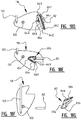
- the twine finger 118 is configured to guide and position, during the second knot forming cycle, the needle twine between the needle 42 and the twine receiver 86, 220, and to guide and position the tucker twine between the tucker arm 54 and the twine receiver 86, 220, wherein the twine finger 118 is shaped such that during the second knot forming cycle the needle twine is moved away from the tucker twine, in the direction of the pivot axis P between the lower and the upper lip of the billhook 82, in order to drape it adjacent to the tucker twine on the billhook. This is illustrated in FIG. 18B .
- the strand 66b of needle twine is picked up first by first portion 201 of twine finger 118 and moved underneath billhook 82, see reference 66X in FIG. 18B referring to the cross section of strand 66b with a horizontal plane X at the level of the twine finger 118.
- This first portion 201 moves underneath strand 64b of tucker twine, such that the tucker twine is not picked up by first portion 201.
- Strand 64b of tucker twine is picked up by a second portion 202, see reference 64X in FIG. 18B referring to the cross section of strand 64b with a horizontal plane X at the level of the twine finger 118.
- twine finger 118 This movement of the twine finger 118 will also drape the strands 64b, 66b along the billhook 82, see reference 64Y and 66Y showing the cross section of strand 64b and 66b with a horizontal plane Y at the level of the billhook 82, respectively. More in particular, the twine finger 118 is shaped such that during its movement during the second knot forming cycle it drapes first the needle twine 66b on the billhook 82 and next the tucker twine 64b and such that the needle twine 66b is further away from a tip of the billhook 82 than the tucker twine 64b. This will avoid that the strands 64b, 66b cross each other and provides a good control of the location of the needle and tucker twine on the billhook 82.
- the twine finger 118 comprises a first portion 201 adapted to pick up, during a first part of the swinging movement during the second knot forming cycle, the needle twine 66b whilst not picking up the tucker twine 64b, as explained above. Further the twine finger 118 comprises a second portion 202 adapted to pick up, during a second part of the swinging movement during the second knot forming cycle, the tucker twine 64b after the needle twine 66b has been picked up and moved away by the first portion 201.
- a suitable shape of the twine finger is a fish shaped plate portion with a mouth 205, wherein the first portion 201 is located at an edge 206 of the twine finger 118 between the mouth 205 and the pivot 120, and the second portion 202 is located at an edge of the mouth 205.
- the twine finger 118 may be further swung to its extended position, see FIG. 18C causing strand 66b to loose contact with the first portion 201 and to jump to a location 66X in FIG. 18C next to the strand 64a in mouth 205. As explained above, this may be achieved by providing a peak 138a in second lobe 138. Now the billhook 82 can be rotated to form the second knot, see FIG. 18D whilst the twine finger 118 may be swung slightly backward. In that manner additional twine length is provided to form the second knot.
- FIG. 18G shows the twines 64b, 66b on the billhook 82 during the rotation to form the second knot, wherein the twine are neatly arranged above the upper lip 83a and between the upper lip 83a and the lower lip 83b.
- the twine finger 118 is again moved forward to its fully extended position (peak 138b of second lobe 138) and the cutting arm 88 is moved to remove the second knot 68b from the billhook 82, see FIG. 16 and FIG. 18E .
- the twine finger may be moved back to its rest position, see FIG. 18F , ready for a next knotter cycle.
- the second knot 68b becomes formed as illustrated in FIG. 16 , whereupon the cutting arm 88 is once again actuated, but this time by the second cam shoulder 116.
- the pressure of the twine holder 220 on the twine disc 86 and/or the shape of those elements should be such that a controlled slipping of the strands 64b and 66b is obtained during the formation of the second knot 68b. This may be reached by a suitable form of the twine disc 86, and in particular by a suitable shape of the recess in which the strands 64b and 66b are taken up.
- the pressure exerted by a leaf spring on the twine holder 220 may be regulated using a setting means adapted to decrease this pressure when the gear 96 engages gear section 100.
- the twine holder 220 may be pushed away against the force of the leaf spring during the formation of the second knot.
- this regulating of the pressure/pushing away of the twine holder can be reached using any suitable mechanical or hydraulic transfer, e.g. by a mechanically coupling the rotation of the knotter disc 76 and the setting means for setting the pressure exerted on the twine holder 220.
- the cam shoulder 116 may extend over a part of the circumference, see also reference numeral 117 in FIG. 4 , so as to create a large shoulder which keeps the knife 94 in its furthest extended position after removal of the knot 68b of the billhook 82.
- This position of the cutting arm 88 is best illustrated in FIG. 3 .
- Pinion 96 will now engage gear stretch 101 and continue to rotate while the upper and lower lips 83a and 83b open a little.
- a supplementary gear section 109 providing a prolonged operation of the twine disc 86. In that way the strands 64b and 66b will no longer be retained between the twine disc 86 and the twine holder 220, causing a further slipping of the twines during the forming of the second knot.
- the knife 94 is very sharp, it will not be able to cut the strands because instead of holding the strands, the twine disc 86 is releasing them on account of the continued rotation of the twine disc 86 and the low pressure of the twine holder 220 on the twine disc 86, while the cutting arm 88 continues moving and stripping of the almost completed knot from the billhook 82, thus pulling the strands out of the twine disc 86.
- the supplementary gear section 109 is not necessary, and that substantially the same effect can be reached when the tensioning force of a spring means on the twine holder 220 is sufficiently decreased.
- the second knot 68b is the start of a new bight for the next bale.
- Such bight is in position to receive new material that is packed into the bale chamber 26 by the plunger 30, and the bight grows in length as additional lengths of the strands 64b and 66b are simultaneously pulled from their sources 72 and 74.
- the sequence returns to its starting point, whereupon the bight is closed by operation of the needle 42 to complete the loop around the bale and form the other knot.
Landscapes
- Life Sciences & Earth Sciences (AREA)
- Environmental Sciences (AREA)
- Basic Packing Technique (AREA)
- Sewing Machines And Sewing (AREA)
- Braiding, Manufacturing Of Bobbin-Net Or Lace, And Manufacturing Of Nets By Knotting (AREA)
Claims (15)
- Système noueur destiné à la réalisation d'un cycle de noueur comprenant un premier cycle de formation de nœud et un second cycle de formation de nœud, ledit système noueur comprenant :une aiguille configurée pour délivrer une ficelle à travers l'aiguille ;un bras plieur (154) configuré pour délivrer une ficelle pour plieur ;un récepteur de ficelle (220, 86) configuré pour maintenir la ficelle de l'aiguille et la ficelle du plieur ;une serpe (82),un bras de coupe (88) adapté pour couper des ficelles entre la serpe et le récepteur de ficelle ;un doigt à ficelle (118) configuré pour guider au moins la ficelle à travers aiguille, ledit doigt à ficelle étant monté de façon mobile sous la serpe (82) et le bras de coupe (88),un moyen d'entraînement (96, 98, 100 ; 110, 112 ; 122, 124, 126, 128, 134) adaptédans lequel le doigt à ficelle (118) est configuré pour guider et positionner, pendant le second cycle de formation de nœud, la ficelle à travers l'aiguille entre l'aiguille et le récepteur de ficelle, et pour guider et positionner la ficelle du plieur entre le bras de plieur et le récepteur de ficelle ; caractérisé en ce que le doigt à ficelle (118) est configuré de telle manière que, pendant le second cycle de formation de nœud, la ficelle à travers l'aiguille soit écartée de la ficelle du plieur afin de l'envelopper de façon adjacente à la ficelle du plieur sur la serpe.pour faire la serpe (82) exécuter au moins une première rotation complète pendant le premier cycle de formation de nœud et une seconde rotation complète pendant le second cycle de formation de nœud,pour déplacer le bras de coupe (88) une première fois d'une position de repos à une position étendue et inversement pendant le premier cycle de formation de nœud et une seconde fois pendant le second cycle de formation de nœud, etpour déplacer le doigt à ficelle (118) au moins une première fois pendant le premier cycle de formation de nœud et une seconde fois pendant le second cycle de formation de nœud,
- Système noueur selon la revendication précédente, dans lequel le doigt à ficelle est configuré de telle manière qu'il enveloppe, pendant son déplacement durant le second cycle de formation de nœud, d'abord la ficelle pour aiguille sur la serpe et ensuite la ficelle du plieur de telle façon que la ficelle pour aiguille soit se trouve plus loin d'une pointe de la serpe que la ficelle du plieur.
- Système noueur selon l'une quelconque des revendications précédentes, dans lequel le doigt à ficelle est monté sur un pivot vertical (120) pour un mouvement de balancement latéral entre une position rétractée et une position étendue.
- Système noueur selon la revendication précédente, dans lequel le doigt à ficelle comprend une première partie (201) adaptée pour attraper, pendant une première partie du mouvement de balancement durant le second cycle de formation de nœud, la ficelle à travers l'aiguille (66b) tout en n'attrapant pas la ficelle de plieur (64b), et
une seconde partie (202) adaptée pour attraper, pendant une seconde partie du mouvement de balancement durant le second cycle de formation de nœud, la ficelle du plieur (64b) après que la ficelle à travers l'aiguille ait été attrapée et éloignée par la première partie. - Système noueur selon la revendication 3 ou 4, dans lequel le doigt à ficelle possède une première extrémité où le pivot (120) est prévu et une seconde extrémité comprenant une ouverture (205) en face de la ficelle de plieur.
- Système noueur selon la revendication 4 et 5, dans lequel la première partie (201) est située sur un bord (206) du doigt à ficelle (118) entre l'ouverture (205) et le pivot (120), et la seconde partie (202) est située à un bord de l'ouverture (205).
- Système noueur selon l'une quelconque des revendications précédentes, dans lequel les moyens d'entraînement sont configurés pour déplacer le doigt à ficelle, durant le second cycle de formation de nœud, d'une position de repos jusqu'à une position entièrement étendue, puis jusqu'à une seconde position moins étendue en faisant tourner la serpe, et ensuite jusqu'à une troisième position entièrement étendue tout en déplaçant le bras de coupe.
- Système noueur selon l'une quelconque des revendications précédentes, dans lequel les moyens d'entraînement comprennent une liaison fonctionnelle (122), une manivelle (124) et un arbre (126) s'étendant transversalement, ladite liaison fonctionnelle (122) étant fixée à une extrémité au doigt à ficelle (118) et à l'extrémité opposée à la manivelle (124) afin d'entraîner un mouvement de balancement du doigt à ficelle (118), ladite manivelle (124) étant fixée au dit arbre (126) s'étendant transversalement configuré pour être mis en rotation de telle manière que le doigt à ficelle (118) exécute le mouvement de balancement.
- Système noueur selon la revendication 8, dans lequel l'arbre s'étendant transversalement (126) porte une seconde manivelle (128) qui porte un galet suiveur (132) à son extrémité la plus extérieure, ledit galet suiveur (132) étant dans une position de mise en prise fonctionnelle avec une came (134) fixée à un arbre d'entraînement (78) pour tourner avec celui-ci, ladite came (134) possédant un premier et un second lobes (136, 138) pour faire balancer le doigt à ficelle pendant le premier cycle et, respectivement, le second cycle de formation de nœud.
- Système noueur selon la revendication 9, dans lequel le second lobe (138) est constitué de deux crêtes (138a, 138b) et d'un creux (138c) entre les deux crêtes permettant d'engendrer un balancement du doigt à ficelle (118) durant le second cycle de formation de nœud, d'une position de repos à une première position complètement étendue, puis à une seconde position moins étendue, et ensuite jusqu'à une troisième position complètement étendue.
- Système noueur selon l'une quelconque des revendications précédentes, dans lequel le bras de coupe (88) est configuré pour balayer un nœud formé à partir de la serpe (82) durant le premier cycle de formation de nœud et, respectivement, durant le second cycle de formation de nœud.
- Système noueur selon l'une quelconque des revendications précédentes, dans lequel le récepteur de ficelle (220, 86) est adapté pour laisser glisser les ficelles durant le second cycle de formation de nœud de manière à éviter la coupe de la ficelle de l'aiguille et du plieur lors de la formation du second nœud.
- Système noueur selon l'une quelconque des revendications précédentes, dans lequel les moyens d'entraînement comprennent un pignon (96) et au moins une première et une seconde extensions d'engrenage (98, 100) prévues le long de la circonférence d'un disque (76), ledit pignon (96) étant adapté pour coopérer avec lesdites première et seconde extensions d'engrenage afin de faire exécuter par la serpe (82) une première et, respectivement, une seconde rotations complètes lorsque ledit disque (76) est mis en rotation pour former le premier nœud et, respectivement, le second nœud.
- Système noueur selon la revendication précédente, dans lequel lesdits moyens d'entraînement comprennent un chemin de came (112) et un galet suiveur (110), ledit galet suiveur (110) étant connecté au bras de coupe (88), et ledit chemin de came (112) étant prévu dans ledit disque (76) ou dans un élément monté pour tourner de façon synchronisée avec ledit disque (76), et étant adapté pour déplacer le bras de coupe (88) une première fois et, respectivement, une seconde fois pendant le premier et le second cycles de formation de nœud.
- Ramasseuse-presse à balles comprenant plusieurs systèmes noueurs selon l'une quelconque des revendications précédentes.
Applications Claiming Priority (1)
| Application Number | Priority Date | Filing Date | Title |
|---|---|---|---|
| BE2016/5848A BE1023911B1 (nl) | 2016-11-10 | 2016-11-10 | Knopersysteem voor een balenpers |
Publications (2)
| Publication Number | Publication Date |
|---|---|
| EP3320770A1 EP3320770A1 (fr) | 2018-05-16 |
| EP3320770B1 true EP3320770B1 (fr) | 2020-01-08 |
Family
ID=58017863
Family Applications (1)
| Application Number | Title | Priority Date | Filing Date |
|---|---|---|---|
| EP17200750.2A Active EP3320770B1 (fr) | 2016-11-10 | 2017-11-09 | Système de noueur pour presse à balles |
Country Status (3)
| Country | Link |
|---|---|
| US (1) | US10945379B2 (fr) |
| EP (1) | EP3320770B1 (fr) |
| BE (1) | BE1023911B1 (fr) |
Families Citing this family (4)
| Publication number | Priority date | Publication date | Assignee | Title |
|---|---|---|---|---|
| BE1024940B1 (nl) * | 2017-06-20 | 2018-08-21 | Cnh Industrial Belgium Nv | Balenpers met bescherming tegen overbelasting van de naalden |
| BE1026246B1 (nl) * | 2018-05-03 | 2019-12-02 | Cnh Ind Belgium Nv | Knopersysteem voor een balenpers |
| WO2020128663A1 (fr) | 2018-12-21 | 2020-06-25 | Agco Corporation | Verrou à libération rapide pour tête de noueur de presse à balles |
| PL4039081T3 (pl) * | 2021-02-04 | 2025-09-29 | Schumacher Bergische Werke Gmbh | Supłacz sznurka i sposób formowania dwóch węzłów na sznurku |
Family Cites Families (8)
| Publication number | Priority date | Publication date | Assignee | Title |
|---|---|---|---|---|
| US3086450A (en) | 1959-02-02 | 1963-04-23 | Sperry Rand Corp | Wire tier |
| US3443511A (en) | 1967-08-16 | 1969-05-13 | Sperry Rand Corp | Drive shaft for knotter mechanisms for baler |
| GB0407858D0 (en) * | 2004-04-07 | 2004-05-12 | Cnh Belgium Nv | Double knotting system for an agricultural baler |
| US20090020930A1 (en) | 2007-07-18 | 2009-01-22 | Freudenberg-Nok General Partnership | Strut Top Mount With Dual Axial Rate Tuning |
| ATE471660T1 (de) * | 2008-04-08 | 2010-07-15 | Cnh Belgium Nv | Knüpfmaschine für eine ballenpresse |
| BE1021116B1 (nl) | 2012-10-16 | 2016-01-18 | Cnh Industrial Belgium Nv | Knopersysteem voor een balenpers |
| US9192105B2 (en) | 2012-10-29 | 2015-11-24 | Deere & Company | Agricultural baler tucker finger protection |
| BE1021102B1 (nl) * | 2013-07-31 | 2016-01-12 | Cnh Industrial Belgium Nv | Knopersysteem met een verbeterde twijndraadopnermer |
-
2016
- 2016-11-10 BE BE2016/5848A patent/BE1023911B1/nl active IP Right Grant
-
2017
- 2017-11-09 EP EP17200750.2A patent/EP3320770B1/fr active Active
- 2017-11-10 US US15/809,370 patent/US10945379B2/en not_active Expired - Fee Related
Non-Patent Citations (1)
| Title |
|---|
| None * |
Also Published As
| Publication number | Publication date |
|---|---|
| US10945379B2 (en) | 2021-03-16 |
| BE1023911B1 (nl) | 2017-09-11 |
| EP3320770A1 (fr) | 2018-05-16 |
| US20180125012A1 (en) | 2018-05-10 |
Similar Documents
| Publication | Publication Date | Title |
|---|---|---|
| EP2908618B1 (fr) | Système de noueur pour une presse à fourrage | |
| US9736989B2 (en) | Knotter system having an improved twine receiver | |
| EP3618606B1 (fr) | Système noueur pour presse à balles | |
| US7296828B2 (en) | Double knotting system for an agricultural baler | |
| US4142746A (en) | Strand tying mechanism | |
| EP2108247B1 (fr) | Lieur pour ramasseuse-presse | |
| EP2721920B1 (fr) | Système de noueur de boucle amélioré pour presse à balles | |
| EP3618605B1 (fr) | Améliorations apportées à un système noueur pour presse à balles | |
| EP3320770B1 (fr) | Système de noueur pour presse à balles | |
| EP3563666B1 (fr) | Système noueur pour presse à balles | |
| CA1116934A (fr) | Mecanisme noueur |
Legal Events
| Date | Code | Title | Description |
|---|---|---|---|
| PUAI | Public reference made under article 153(3) epc to a published international application that has entered the european phase |
Free format text: ORIGINAL CODE: 0009012 |
|
| STAA | Information on the status of an ep patent application or granted ep patent |
Free format text: STATUS: THE APPLICATION HAS BEEN PUBLISHED |
|
| AK | Designated contracting states |
Kind code of ref document: A1 Designated state(s): AL AT BE BG CH CY CZ DE DK EE ES FI FR GB GR HR HU IE IS IT LI LT LU LV MC MK MT NL NO PL PT RO RS SE SI SK SM TR |
|
| AX | Request for extension of the european patent |
Extension state: BA ME |
|
| STAA | Information on the status of an ep patent application or granted ep patent |
Free format text: STATUS: REQUEST FOR EXAMINATION WAS MADE |
|
| 17P | Request for examination filed |
Effective date: 20181116 |
|
| RBV | Designated contracting states (corrected) |
Designated state(s): AL AT BE BG CH CY CZ DE DK EE ES FI FR GB GR HR HU IE IS IT LI LT LU LV MC MK MT NL NO PL PT RO RS SE SI SK SM TR |
|
| GRAP | Despatch of communication of intention to grant a patent |
Free format text: ORIGINAL CODE: EPIDOSNIGR1 |
|
| STAA | Information on the status of an ep patent application or granted ep patent |
Free format text: STATUS: GRANT OF PATENT IS INTENDED |
|
| INTG | Intention to grant announced |
Effective date: 20190702 |
|
| GRAS | Grant fee paid |
Free format text: ORIGINAL CODE: EPIDOSNIGR3 |
|
| GRAA | (expected) grant |
Free format text: ORIGINAL CODE: 0009210 |
|
| STAA | Information on the status of an ep patent application or granted ep patent |
Free format text: STATUS: THE PATENT HAS BEEN GRANTED |
|
| AK | Designated contracting states |
Kind code of ref document: B1 Designated state(s): AL AT BE BG CH CY CZ DE DK EE ES FI FR GB GR HR HU IE IS IT LI LT LU LV MC MK MT NL NO PL PT RO RS SE SI SK SM TR |
|
| REG | Reference to a national code |
Ref country code: GB Ref legal event code: FG4D |
|
| REG | Reference to a national code |
Ref country code: CH Ref legal event code: EP |
|
| REG | Reference to a national code |
Ref country code: DE Ref legal event code: R096 Ref document number: 602017010629 Country of ref document: DE |
|
| REG | Reference to a national code |
Ref country code: IE Ref legal event code: FG4D |
|
| REG | Reference to a national code |
Ref country code: AT Ref legal event code: REF Ref document number: 1221515 Country of ref document: AT Kind code of ref document: T Effective date: 20200215 |
|
| REG | Reference to a national code |
Ref country code: NL Ref legal event code: MP Effective date: 20200108 |
|
| REG | Reference to a national code |
Ref country code: LT Ref legal event code: MG4D |
|
| PG25 | Lapsed in a contracting state [announced via postgrant information from national office to epo] |
Ref country code: PT Free format text: LAPSE BECAUSE OF FAILURE TO SUBMIT A TRANSLATION OF THE DESCRIPTION OR TO PAY THE FEE WITHIN THE PRESCRIBED TIME-LIMIT Effective date: 20200531 Ref country code: NL Free format text: LAPSE BECAUSE OF FAILURE TO SUBMIT A TRANSLATION OF THE DESCRIPTION OR TO PAY THE FEE WITHIN THE PRESCRIBED TIME-LIMIT Effective date: 20200108 Ref country code: LT Free format text: LAPSE BECAUSE OF FAILURE TO SUBMIT A TRANSLATION OF THE DESCRIPTION OR TO PAY THE FEE WITHIN THE PRESCRIBED TIME-LIMIT Effective date: 20200108 Ref country code: NO Free format text: LAPSE BECAUSE OF FAILURE TO SUBMIT A TRANSLATION OF THE DESCRIPTION OR TO PAY THE FEE WITHIN THE PRESCRIBED TIME-LIMIT Effective date: 20200408 Ref country code: FI Free format text: LAPSE BECAUSE OF FAILURE TO SUBMIT A TRANSLATION OF THE DESCRIPTION OR TO PAY THE FEE WITHIN THE PRESCRIBED TIME-LIMIT Effective date: 20200108 Ref country code: RS Free format text: LAPSE BECAUSE OF FAILURE TO SUBMIT A TRANSLATION OF THE DESCRIPTION OR TO PAY THE FEE WITHIN THE PRESCRIBED TIME-LIMIT Effective date: 20200108 |
|
| PG25 | Lapsed in a contracting state [announced via postgrant information from national office to epo] |
Ref country code: SE Free format text: LAPSE BECAUSE OF FAILURE TO SUBMIT A TRANSLATION OF THE DESCRIPTION OR TO PAY THE FEE WITHIN THE PRESCRIBED TIME-LIMIT Effective date: 20200108 Ref country code: LV Free format text: LAPSE BECAUSE OF FAILURE TO SUBMIT A TRANSLATION OF THE DESCRIPTION OR TO PAY THE FEE WITHIN THE PRESCRIBED TIME-LIMIT Effective date: 20200108 Ref country code: IS Free format text: LAPSE BECAUSE OF FAILURE TO SUBMIT A TRANSLATION OF THE DESCRIPTION OR TO PAY THE FEE WITHIN THE PRESCRIBED TIME-LIMIT Effective date: 20200508 Ref country code: HR Free format text: LAPSE BECAUSE OF FAILURE TO SUBMIT A TRANSLATION OF THE DESCRIPTION OR TO PAY THE FEE WITHIN THE PRESCRIBED TIME-LIMIT Effective date: 20200108 Ref country code: GR Free format text: LAPSE BECAUSE OF FAILURE TO SUBMIT A TRANSLATION OF THE DESCRIPTION OR TO PAY THE FEE WITHIN THE PRESCRIBED TIME-LIMIT Effective date: 20200409 Ref country code: BG Free format text: LAPSE BECAUSE OF FAILURE TO SUBMIT A TRANSLATION OF THE DESCRIPTION OR TO PAY THE FEE WITHIN THE PRESCRIBED TIME-LIMIT Effective date: 20200408 |
|
| REG | Reference to a national code |
Ref country code: DE Ref legal event code: R097 Ref document number: 602017010629 Country of ref document: DE |
|
| PG25 | Lapsed in a contracting state [announced via postgrant information from national office to epo] |
Ref country code: SM Free format text: LAPSE BECAUSE OF FAILURE TO SUBMIT A TRANSLATION OF THE DESCRIPTION OR TO PAY THE FEE WITHIN THE PRESCRIBED TIME-LIMIT Effective date: 20200108 Ref country code: EE Free format text: LAPSE BECAUSE OF FAILURE TO SUBMIT A TRANSLATION OF THE DESCRIPTION OR TO PAY THE FEE WITHIN THE PRESCRIBED TIME-LIMIT Effective date: 20200108 Ref country code: RO Free format text: LAPSE BECAUSE OF FAILURE TO SUBMIT A TRANSLATION OF THE DESCRIPTION OR TO PAY THE FEE WITHIN THE PRESCRIBED TIME-LIMIT Effective date: 20200108 Ref country code: CZ Free format text: LAPSE BECAUSE OF FAILURE TO SUBMIT A TRANSLATION OF THE DESCRIPTION OR TO PAY THE FEE WITHIN THE PRESCRIBED TIME-LIMIT Effective date: 20200108 Ref country code: ES Free format text: LAPSE BECAUSE OF FAILURE TO SUBMIT A TRANSLATION OF THE DESCRIPTION OR TO PAY THE FEE WITHIN THE PRESCRIBED TIME-LIMIT Effective date: 20200108 Ref country code: SK Free format text: LAPSE BECAUSE OF FAILURE TO SUBMIT A TRANSLATION OF THE DESCRIPTION OR TO PAY THE FEE WITHIN THE PRESCRIBED TIME-LIMIT Effective date: 20200108 Ref country code: DK Free format text: LAPSE BECAUSE OF FAILURE TO SUBMIT A TRANSLATION OF THE DESCRIPTION OR TO PAY THE FEE WITHIN THE PRESCRIBED TIME-LIMIT Effective date: 20200108 |
|
| PLBE | No opposition filed within time limit |
Free format text: ORIGINAL CODE: 0009261 |
|
| STAA | Information on the status of an ep patent application or granted ep patent |
Free format text: STATUS: NO OPPOSITION FILED WITHIN TIME LIMIT |
|
| REG | Reference to a national code |
Ref country code: AT Ref legal event code: MK05 Ref document number: 1221515 Country of ref document: AT Kind code of ref document: T Effective date: 20200108 |
|
| 26N | No opposition filed |
Effective date: 20201009 |
|
| PG25 | Lapsed in a contracting state [announced via postgrant information from national office to epo] |
Ref country code: AT Free format text: LAPSE BECAUSE OF FAILURE TO SUBMIT A TRANSLATION OF THE DESCRIPTION OR TO PAY THE FEE WITHIN THE PRESCRIBED TIME-LIMIT Effective date: 20200108 |
|
| PG25 | Lapsed in a contracting state [announced via postgrant information from national office to epo] |
Ref country code: SI Free format text: LAPSE BECAUSE OF FAILURE TO SUBMIT A TRANSLATION OF THE DESCRIPTION OR TO PAY THE FEE WITHIN THE PRESCRIBED TIME-LIMIT Effective date: 20200108 Ref country code: PL Free format text: LAPSE BECAUSE OF FAILURE TO SUBMIT A TRANSLATION OF THE DESCRIPTION OR TO PAY THE FEE WITHIN THE PRESCRIBED TIME-LIMIT Effective date: 20200108 |
|
| PG25 | Lapsed in a contracting state [announced via postgrant information from national office to epo] |
Ref country code: MC Free format text: LAPSE BECAUSE OF FAILURE TO SUBMIT A TRANSLATION OF THE DESCRIPTION OR TO PAY THE FEE WITHIN THE PRESCRIBED TIME-LIMIT Effective date: 20200108 |
|
| REG | Reference to a national code |
Ref country code: CH Ref legal event code: PL |
|
| PG25 | Lapsed in a contracting state [announced via postgrant information from national office to epo] |
Ref country code: LU Free format text: LAPSE BECAUSE OF NON-PAYMENT OF DUE FEES Effective date: 20201109 |
|
| REG | Reference to a national code |
Ref country code: BE Ref legal event code: MM Effective date: 20201130 |
|
| PG25 | Lapsed in a contracting state [announced via postgrant information from national office to epo] |
Ref country code: LI Free format text: LAPSE BECAUSE OF NON-PAYMENT OF DUE FEES Effective date: 20201130 Ref country code: CH Free format text: LAPSE BECAUSE OF NON-PAYMENT OF DUE FEES Effective date: 20201130 |
|
| PG25 | Lapsed in a contracting state [announced via postgrant information from national office to epo] |
Ref country code: IE Free format text: LAPSE BECAUSE OF NON-PAYMENT OF DUE FEES Effective date: 20201109 |
|
| PG25 | Lapsed in a contracting state [announced via postgrant information from national office to epo] |
Ref country code: TR Free format text: LAPSE BECAUSE OF FAILURE TO SUBMIT A TRANSLATION OF THE DESCRIPTION OR TO PAY THE FEE WITHIN THE PRESCRIBED TIME-LIMIT Effective date: 20200108 Ref country code: MT Free format text: LAPSE BECAUSE OF FAILURE TO SUBMIT A TRANSLATION OF THE DESCRIPTION OR TO PAY THE FEE WITHIN THE PRESCRIBED TIME-LIMIT Effective date: 20200108 Ref country code: CY Free format text: LAPSE BECAUSE OF FAILURE TO SUBMIT A TRANSLATION OF THE DESCRIPTION OR TO PAY THE FEE WITHIN THE PRESCRIBED TIME-LIMIT Effective date: 20200108 |
|
| PG25 | Lapsed in a contracting state [announced via postgrant information from national office to epo] |
Ref country code: MK Free format text: LAPSE BECAUSE OF FAILURE TO SUBMIT A TRANSLATION OF THE DESCRIPTION OR TO PAY THE FEE WITHIN THE PRESCRIBED TIME-LIMIT Effective date: 20200108 Ref country code: AL Free format text: LAPSE BECAUSE OF FAILURE TO SUBMIT A TRANSLATION OF THE DESCRIPTION OR TO PAY THE FEE WITHIN THE PRESCRIBED TIME-LIMIT Effective date: 20200108 |
|
| PG25 | Lapsed in a contracting state [announced via postgrant information from national office to epo] |
Ref country code: BE Free format text: LAPSE BECAUSE OF NON-PAYMENT OF DUE FEES Effective date: 20201130 |
|
| PGFP | Annual fee paid to national office [announced via postgrant information from national office to epo] |
Ref country code: DE Payment date: 20241128 Year of fee payment: 8 |
|
| PGFP | Annual fee paid to national office [announced via postgrant information from national office to epo] |
Ref country code: GB Payment date: 20241126 Year of fee payment: 8 |
|
| PGFP | Annual fee paid to national office [announced via postgrant information from national office to epo] |
Ref country code: FR Payment date: 20241126 Year of fee payment: 8 |
|
| PGFP | Annual fee paid to national office [announced via postgrant information from national office to epo] |
Ref country code: IT Payment date: 20241125 Year of fee payment: 8 |