EP3476998B1 - Aufgerautes kunstleder und verfahren zur herstellung davon - Google Patents
Aufgerautes kunstleder und verfahren zur herstellung davon Download PDFInfo
- Publication number
- EP3476998B1 EP3476998B1 EP17815429.0A EP17815429A EP3476998B1 EP 3476998 B1 EP3476998 B1 EP 3476998B1 EP 17815429 A EP17815429 A EP 17815429A EP 3476998 B1 EP3476998 B1 EP 3476998B1
- Authority
- EP
- European Patent Office
- Prior art keywords
- napped
- artificial leather
- fibers
- ultrafine fibers
- grain direction
- Prior art date
- Legal status (The legal status is an assumption and is not a legal conclusion. Google has not performed a legal analysis and makes no representation as to the accuracy of the status listed.)
- Active
Links
Images

Classifications
-
- D—TEXTILES; PAPER
- D06—TREATMENT OF TEXTILES OR THE LIKE; LAUNDERING; FLEXIBLE MATERIALS NOT OTHERWISE PROVIDED FOR
- D06N—WALL, FLOOR, OR LIKE COVERING MATERIALS, e.g. LINOLEUM, OILCLOTH, ARTIFICIAL LEATHER, ROOFING FELT, CONSISTING OF A FIBROUS WEB COATED WITH A LAYER OF MACROMOLECULAR MATERIAL; FLEXIBLE SHEET MATERIAL NOT OTHERWISE PROVIDED FOR
- D06N3/00—Artificial leather, oilcloth or other material obtained by covering fibrous webs with macromolecular material, e.g. resins, rubber or derivatives thereof
- D06N3/0002—Artificial leather, oilcloth or other material obtained by covering fibrous webs with macromolecular material, e.g. resins, rubber or derivatives thereof characterised by the substrate
- D06N3/0004—Artificial leather, oilcloth or other material obtained by covering fibrous webs with macromolecular material, e.g. resins, rubber or derivatives thereof characterised by the substrate using ultra-fine two-component fibres, e.g. island/sea, or ultra-fine one component fibres (< 1 denier)
-
- D—TEXTILES; PAPER
- D06—TREATMENT OF TEXTILES OR THE LIKE; LAUNDERING; FLEXIBLE MATERIALS NOT OTHERWISE PROVIDED FOR
- D06N—WALL, FLOOR, OR LIKE COVERING MATERIALS, e.g. LINOLEUM, OILCLOTH, ARTIFICIAL LEATHER, ROOFING FELT, CONSISTING OF A FIBROUS WEB COATED WITH A LAYER OF MACROMOLECULAR MATERIAL; FLEXIBLE SHEET MATERIAL NOT OTHERWISE PROVIDED FOR
- D06N3/00—Artificial leather, oilcloth or other material obtained by covering fibrous webs with macromolecular material, e.g. resins, rubber or derivatives thereof
- D06N3/007—Artificial leather, oilcloth or other material obtained by covering fibrous webs with macromolecular material, e.g. resins, rubber or derivatives thereof characterised by mechanical or physical treatments
- D06N3/0075—Napping, teasing, raising or abrading of the resin coating
-
- D—TEXTILES; PAPER
- D06—TREATMENT OF TEXTILES OR THE LIKE; LAUNDERING; FLEXIBLE MATERIALS NOT OTHERWISE PROVIDED FOR
- D06N—WALL, FLOOR, OR LIKE COVERING MATERIALS, e.g. LINOLEUM, OILCLOTH, ARTIFICIAL LEATHER, ROOFING FELT, CONSISTING OF A FIBROUS WEB COATED WITH A LAYER OF MACROMOLECULAR MATERIAL; FLEXIBLE SHEET MATERIAL NOT OTHERWISE PROVIDED FOR
- D06N3/00—Artificial leather, oilcloth or other material obtained by covering fibrous webs with macromolecular material, e.g. resins, rubber or derivatives thereof
- D06N3/0002—Artificial leather, oilcloth or other material obtained by covering fibrous webs with macromolecular material, e.g. resins, rubber or derivatives thereof characterised by the substrate
- D06N3/004—Artificial leather, oilcloth or other material obtained by covering fibrous webs with macromolecular material, e.g. resins, rubber or derivatives thereof characterised by the substrate using flocked webs or pile fabrics upon which a resin is applied; Teasing, raising web before resin application
-
- D—TEXTILES; PAPER
- D06—TREATMENT OF TEXTILES OR THE LIKE; LAUNDERING; FLEXIBLE MATERIALS NOT OTHERWISE PROVIDED FOR
- D06N—WALL, FLOOR, OR LIKE COVERING MATERIALS, e.g. LINOLEUM, OILCLOTH, ARTIFICIAL LEATHER, ROOFING FELT, CONSISTING OF A FIBROUS WEB COATED WITH A LAYER OF MACROMOLECULAR MATERIAL; FLEXIBLE SHEET MATERIAL NOT OTHERWISE PROVIDED FOR
- D06N3/00—Artificial leather, oilcloth or other material obtained by covering fibrous webs with macromolecular material, e.g. resins, rubber or derivatives thereof
-
- D—TEXTILES; PAPER
- D06—TREATMENT OF TEXTILES OR THE LIKE; LAUNDERING; FLEXIBLE MATERIALS NOT OTHERWISE PROVIDED FOR
- D06N—WALL, FLOOR, OR LIKE COVERING MATERIALS, e.g. LINOLEUM, OILCLOTH, ARTIFICIAL LEATHER, ROOFING FELT, CONSISTING OF A FIBROUS WEB COATED WITH A LAYER OF MACROMOLECULAR MATERIAL; FLEXIBLE SHEET MATERIAL NOT OTHERWISE PROVIDED FOR
- D06N3/00—Artificial leather, oilcloth or other material obtained by covering fibrous webs with macromolecular material, e.g. resins, rubber or derivatives thereof
- D06N3/0002—Artificial leather, oilcloth or other material obtained by covering fibrous webs with macromolecular material, e.g. resins, rubber or derivatives thereof characterised by the substrate
- D06N3/0006—Artificial leather, oilcloth or other material obtained by covering fibrous webs with macromolecular material, e.g. resins, rubber or derivatives thereof characterised by the substrate using woven fabrics
-
- D—TEXTILES; PAPER
- D06—TREATMENT OF TEXTILES OR THE LIKE; LAUNDERING; FLEXIBLE MATERIALS NOT OTHERWISE PROVIDED FOR
- D06N—WALL, FLOOR, OR LIKE COVERING MATERIALS, e.g. LINOLEUM, OILCLOTH, ARTIFICIAL LEATHER, ROOFING FELT, CONSISTING OF A FIBROUS WEB COATED WITH A LAYER OF MACROMOLECULAR MATERIAL; FLEXIBLE SHEET MATERIAL NOT OTHERWISE PROVIDED FOR
- D06N3/00—Artificial leather, oilcloth or other material obtained by covering fibrous webs with macromolecular material, e.g. resins, rubber or derivatives thereof
- D06N3/0002—Artificial leather, oilcloth or other material obtained by covering fibrous webs with macromolecular material, e.g. resins, rubber or derivatives thereof characterised by the substrate
- D06N3/0009—Artificial leather, oilcloth or other material obtained by covering fibrous webs with macromolecular material, e.g. resins, rubber or derivatives thereof characterised by the substrate using knitted fabrics
-
- D—TEXTILES; PAPER
- D06—TREATMENT OF TEXTILES OR THE LIKE; LAUNDERING; FLEXIBLE MATERIALS NOT OTHERWISE PROVIDED FOR
- D06N—WALL, FLOOR, OR LIKE COVERING MATERIALS, e.g. LINOLEUM, OILCLOTH, ARTIFICIAL LEATHER, ROOFING FELT, CONSISTING OF A FIBROUS WEB COATED WITH A LAYER OF MACROMOLECULAR MATERIAL; FLEXIBLE SHEET MATERIAL NOT OTHERWISE PROVIDED FOR
- D06N3/00—Artificial leather, oilcloth or other material obtained by covering fibrous webs with macromolecular material, e.g. resins, rubber or derivatives thereof
- D06N3/0002—Artificial leather, oilcloth or other material obtained by covering fibrous webs with macromolecular material, e.g. resins, rubber or derivatives thereof characterised by the substrate
- D06N3/0011—Artificial leather, oilcloth or other material obtained by covering fibrous webs with macromolecular material, e.g. resins, rubber or derivatives thereof characterised by the substrate using non-woven fabrics
-
- D—TEXTILES; PAPER
- D06—TREATMENT OF TEXTILES OR THE LIKE; LAUNDERING; FLEXIBLE MATERIALS NOT OTHERWISE PROVIDED FOR
- D06N—WALL, FLOOR, OR LIKE COVERING MATERIALS, e.g. LINOLEUM, OILCLOTH, ARTIFICIAL LEATHER, ROOFING FELT, CONSISTING OF A FIBROUS WEB COATED WITH A LAYER OF MACROMOLECULAR MATERIAL; FLEXIBLE SHEET MATERIAL NOT OTHERWISE PROVIDED FOR
- D06N3/00—Artificial leather, oilcloth or other material obtained by covering fibrous webs with macromolecular material, e.g. resins, rubber or derivatives thereof
- D06N3/007—Artificial leather, oilcloth or other material obtained by covering fibrous webs with macromolecular material, e.g. resins, rubber or derivatives thereof characterised by mechanical or physical treatments
-
- D—TEXTILES; PAPER
- D06—TREATMENT OF TEXTILES OR THE LIKE; LAUNDERING; FLEXIBLE MATERIALS NOT OTHERWISE PROVIDED FOR
- D06N—WALL, FLOOR, OR LIKE COVERING MATERIALS, e.g. LINOLEUM, OILCLOTH, ARTIFICIAL LEATHER, ROOFING FELT, CONSISTING OF A FIBROUS WEB COATED WITH A LAYER OF MACROMOLECULAR MATERIAL; FLEXIBLE SHEET MATERIAL NOT OTHERWISE PROVIDED FOR
- D06N3/00—Artificial leather, oilcloth or other material obtained by covering fibrous webs with macromolecular material, e.g. resins, rubber or derivatives thereof
- D06N3/007—Artificial leather, oilcloth or other material obtained by covering fibrous webs with macromolecular material, e.g. resins, rubber or derivatives thereof characterised by mechanical or physical treatments
- D06N3/0077—Embossing; Pressing of the surface; Tumbling and crumbling; Cracking; Cooling; Heating, e.g. mirror finish
-
- D—TEXTILES; PAPER
- D06—TREATMENT OF TEXTILES OR THE LIKE; LAUNDERING; FLEXIBLE MATERIALS NOT OTHERWISE PROVIDED FOR
- D06N—WALL, FLOOR, OR LIKE COVERING MATERIALS, e.g. LINOLEUM, OILCLOTH, ARTIFICIAL LEATHER, ROOFING FELT, CONSISTING OF A FIBROUS WEB COATED WITH A LAYER OF MACROMOLECULAR MATERIAL; FLEXIBLE SHEET MATERIAL NOT OTHERWISE PROVIDED FOR
- D06N3/00—Artificial leather, oilcloth or other material obtained by covering fibrous webs with macromolecular material, e.g. resins, rubber or derivatives thereof
- D06N3/12—Artificial leather, oilcloth or other material obtained by covering fibrous webs with macromolecular material, e.g. resins, rubber or derivatives thereof with macromolecular compounds obtained otherwise than by reactions only involving carbon-to-carbon unsaturated bonds, e.g. gelatine proteins
- D06N3/14—Artificial leather, oilcloth or other material obtained by covering fibrous webs with macromolecular material, e.g. resins, rubber or derivatives thereof with macromolecular compounds obtained otherwise than by reactions only involving carbon-to-carbon unsaturated bonds, e.g. gelatine proteins with polyurethanes
-
- D—TEXTILES; PAPER
- D06—TREATMENT OF TEXTILES OR THE LIKE; LAUNDERING; FLEXIBLE MATERIALS NOT OTHERWISE PROVIDED FOR
- D06N—WALL, FLOOR, OR LIKE COVERING MATERIALS, e.g. LINOLEUM, OILCLOTH, ARTIFICIAL LEATHER, ROOFING FELT, CONSISTING OF A FIBROUS WEB COATED WITH A LAYER OF MACROMOLECULAR MATERIAL; FLEXIBLE SHEET MATERIAL NOT OTHERWISE PROVIDED FOR
- D06N3/00—Artificial leather, oilcloth or other material obtained by covering fibrous webs with macromolecular material, e.g. resins, rubber or derivatives thereof
- D06N3/12—Artificial leather, oilcloth or other material obtained by covering fibrous webs with macromolecular material, e.g. resins, rubber or derivatives thereof with macromolecular compounds obtained otherwise than by reactions only involving carbon-to-carbon unsaturated bonds, e.g. gelatine proteins
- D06N3/14—Artificial leather, oilcloth or other material obtained by covering fibrous webs with macromolecular material, e.g. resins, rubber or derivatives thereof with macromolecular compounds obtained otherwise than by reactions only involving carbon-to-carbon unsaturated bonds, e.g. gelatine proteins with polyurethanes
- D06N3/145—Artificial leather, oilcloth or other material obtained by covering fibrous webs with macromolecular material, e.g. resins, rubber or derivatives thereof with macromolecular compounds obtained otherwise than by reactions only involving carbon-to-carbon unsaturated bonds, e.g. gelatine proteins with polyurethanes two or more layers of polyurethanes
-
- D—TEXTILES; PAPER
- D06—TREATMENT OF TEXTILES OR THE LIKE; LAUNDERING; FLEXIBLE MATERIALS NOT OTHERWISE PROVIDED FOR
- D06N—WALL, FLOOR, OR LIKE COVERING MATERIALS, e.g. LINOLEUM, OILCLOTH, ARTIFICIAL LEATHER, ROOFING FELT, CONSISTING OF A FIBROUS WEB COATED WITH A LAYER OF MACROMOLECULAR MATERIAL; FLEXIBLE SHEET MATERIAL NOT OTHERWISE PROVIDED FOR
- D06N3/00—Artificial leather, oilcloth or other material obtained by covering fibrous webs with macromolecular material, e.g. resins, rubber or derivatives thereof
- D06N3/18—Artificial leather, oilcloth or other material obtained by covering fibrous webs with macromolecular material, e.g. resins, rubber or derivatives thereof with two layers of different macromolecular materials
- D06N3/183—Artificial leather, oilcloth or other material obtained by covering fibrous webs with macromolecular material, e.g. resins, rubber or derivatives thereof with two layers of different macromolecular materials the layers are one next to the other
-
- D—TEXTILES; PAPER
- D06—TREATMENT OF TEXTILES OR THE LIKE; LAUNDERING; FLEXIBLE MATERIALS NOT OTHERWISE PROVIDED FOR
- D06N—WALL, FLOOR, OR LIKE COVERING MATERIALS, e.g. LINOLEUM, OILCLOTH, ARTIFICIAL LEATHER, ROOFING FELT, CONSISTING OF A FIBROUS WEB COATED WITH A LAYER OF MACROMOLECULAR MATERIAL; FLEXIBLE SHEET MATERIAL NOT OTHERWISE PROVIDED FOR
- D06N2211/00—Specially adapted uses
- D06N2211/12—Decorative or sun protection articles
- D06N2211/28—Artificial leather
-
- D—TEXTILES; PAPER
- D06—TREATMENT OF TEXTILES OR THE LIKE; LAUNDERING; FLEXIBLE MATERIALS NOT OTHERWISE PROVIDED FOR
- D06N—WALL, FLOOR, OR LIKE COVERING MATERIALS, e.g. LINOLEUM, OILCLOTH, ARTIFICIAL LEATHER, ROOFING FELT, CONSISTING OF A FIBROUS WEB COATED WITH A LAYER OF MACROMOLECULAR MATERIAL; FLEXIBLE SHEET MATERIAL NOT OTHERWISE PROVIDED FOR
- D06N2213/00—Others characteristics
- D06N2213/03—Fibrous web coated on one side with at least two layers of the same polymer type, e.g. two coatings of polyolefin
Definitions
- the present invention relates to a napped artificial leather for use as surface materials for clothing, shoes, articles of furniture, car seats and general merchandise. More particularly, the invention relates to a napped artificial leather that can maintain an elegant appearance when the surface there of is rubbed.
- a napped artificial leather such as a suede-like artificial leather and a nubuck-like artificial leather are known.
- a napped artificial leather has a napped surface formed by napping the surface of a fabric such as a non-woven fabric of ultrafine fibers that has been impregnated with an elastic polymer.
- the napped artificial leather may have a nonuniform and coarse appearance with a rough dry touch as a result of the napped surface thereof being rubbed.
- PTL 1 listed below discloses an artificial leather including a fiber-entangled body including ultrafine fibers with a single fiber fineness of 0.01 dtex or more and 0.50 dtex or less, and an elastic polymer, and having at least one napped surface.
- the arithmetic mean height Pa of a primary profile of the napped surface is 26 ⁇ m or more and 100 ⁇ m or less, and the arithmetic mean height Pa of a primary profile of the other surface is 20% or more and 80% or less of the surface roughness Pa of the napped surface.
- PLT 2 and PLT 3 disclose napped artificial leathers.
- the napped artificial leather may have a nonuniform and coarse appearance with a rough dry touch as a result of the napped surface thereof being rubbed. Such an appearance tends to be prominent as the strength per one ultrafine fiber is increased.
- the present inventors have investigated the causes thereof, and have gain the following knowledge. When the strength per one ultrafine fiber is increased, ultrafine fibers become difficult to be cut in a napping treatment, and the ultrafine fibers forming the napped fibers existing on the napped surface become longer. Consequently, when the napped surface is rubbed, the ultrafine fibers that can easily move freely gather and become entangled.
- the rigidity of each of the ultrafine fibers is increased, so that the ultrafine fibers that have been concealing a base layer are excessively raised from the laid-down state.
- the base layer which is a coarse portion with little napped ultrafine fibers, is exposed in some locations, so that a dry-touch surface with a nonuniform fiber density is formed, resulting in a coarse appearance.
- the inventors have found that the occurrence of the above-described phenomenon can be significantly inhibited by fixing the ultrafine fibers of the napped surface in a laid-down state, and adjusting the surface state such that the ultrafine fibers cannot be easily raised above a certain height from the laid-down state when the fibers are rubbed in either a grain direction or a reverse grain direction, and thus the inventors have arrived at the present invention.
- an aspect of the present invention is directed to a napped artificial leather according to claim 1 and including: a fabric, such as a non-woven fabric, a woven fabric, or a knitted fabric, that has been impregnated with a first elastic polymer and that has a napped surface including napped ultrafine fibers with an average fineness of 0.01 to 0.5 dtex, wherein the napped surface has, as measured by a surface roughness measurement in accordance with ISO 25178, an arithmetic mean height (Sa) of 30 ⁇ m or less in both a grain direction and a reverse grain direction, and a density of peaks (Spd) having a height of 100 ⁇ m or more from a mean height, of 30/432 mm 2 or less in both of the grain direction and the reverse grain direction, and a difference (absolute value) in the density of peaks (Spd) between the grain direction and the reverse grain direction is 20/432 mm 2 or less.
- a fabric such as a non-woven fabric,
- the ultrafine fibers that can be freely moved by friction become short and are brought into an appropriately laid-down state. This can provide a napped artificial leather that is less likely to have a nonuniform and coarse appearance with a rough dry touch even when the napped surface thereof is rubbed.
- the ultrafine fibers that form the napped fibers on the napped surface have a second elastic polymer attached thereto. More particularly, it is preferable that the ultrafine fibers, or the ultrafine fibers and the first elastic polymer, are fixed to each other by the second elastic polymer. Specifically, for example, the ultrafine fibers in the vicinity of the base, or the ultrafine fibers and the first elastic polymer in the vicinity of the base, are fixed to each other by the second elastic polymer. This is preferable in that the freely movable ultrafine fibers become short in the grain direction and the reverse grain direction, and are fixed so as to be difficult to be raised from the laid-down state.
- the fiber toughness which is an index indicating the tenacity and the level of rigidity per one ultrafine fiber is preferably 8 to 40 cN ⁇ % on the average. This is preferable in that the fiber will not become too hard, and the fibers can be easily moved by friction, so that the fibers on the surface are appropriately laid down, thus improving the appearance.
- the ultrafine fibers are long fibers. This is preferable in that the ultrafine fibers become difficult to be pulled out by friction, so that the ultrafine fibers can be easily fixed so as to be difficult to be raised from the laid-down state.
- the napped artificial leather has an apparent density of 0.4 to 0.7 g/cm 3 .
- An apparent density within such a range is preferable in that a napped artificial leather that is well-balanced in fullness and a flexible texture that can prevent poor bending involving buckling, which is also called sharp bending.
- the production method of a napped artificial leather includes the steps of: preparing an artificial leather base material including a fabric, such as a non-woven fabric, a woven fabric, or a knitted fabric, that has been impregnated with a first elastic polymer and that includes a surface to be napped including ultrafine fibers with an average fineness of 0.01 to 0.5 dtex; napping the surface to be napped of the artificial leather base material, to form a napped surface; attaching a second elastic polymer to the ultrafine fibers on the napped surface; and thermally setting the artificial leather base material in a state in which the artificial leather base material is shrunk along a longitudinal direction that is an advancing direction of the production line.
- a fabric such as a non-woven fabric, a woven fabric, or a knitted fabric
- the present invention it is possible to provide a napped artificial leather that is less likely to have a nonuniform and coarse appearance with a rough dry touch even when the napped surface thereof is rubbed.
- a napped artificial leather according to the present embodiment will be described in detail, in conjunction with an exemplary production method thereof.
- the napped artificial leather of the present embodiment first, there is prepared a fabric that has been impregnated with a first elastic polymer, and that includes a surface to be napped, the surface including ultrafine fibers with an average fineness of 0.01 to 0.5 dtex.
- the fabric include fabrics into which the first elastic polymer has been impregnated, such as a non-woven fabric of ultrafine fibers, as well as a woven fabric of ultrafine fibers, a knitted fabric of ultrafine fibers, and a fiber structure formed by combination thereof.
- a non-woven fabric of ultrafine fibers that has been impregnated with the first elastic polymer is used as the fabric will be described in detail as a representative example.
- a fiber web of ultrafine fiber-generating fibers is produced.
- the production method of the fiber web include a method involving melt-spinning ultrafine fiber-generating fibers and directly collecting the resultant fibers as long fibers without intentionally cutting them, and a method involving cutting the resultant fibers into staples and subjecting them to a known entangling treatment.
- the long fibers may also be referred to as "filaments", and are continuous fibers other than staples that have been cut into a predetermined length. From the viewpoint of sufficiently increasing the fiber density, the length of the long fibers is preferably 100 mm or more, more preferably 200 mm or more.
- the upper limit for the length of the long fibers may be several meters, several hundred meters, several kilometers, or longer, and continuously spun.
- the production of a long-fiber web of ultrafine fiber-generating fibers will be described in detail as a representative example.
- ultrafine fiber-generating fibers refer to fibers for forming ultrafine fibers by subjecting spun fibers to a chemical or physical post-treatment.
- specific examples thereof include an island-in-the-sea composite fiber in which a polymer of an island component serving as a domain different from a sea component is dispersed in a polymer of the sea component serving as a matrix on the fiber cross section, and the sea component is later removed to form a fiber bundle-like ultrafine fiber composed mainly of the island component polymer; and a strip/division-type composite fiber in which a plurality of different resin components are alternately disposed around the periphery of a fiber to form a petaline shape or a superposed shape, and the fiber is divided as a result of the resin components being stripped from the fiber by a physical treatment, thereby forming a bundle-like ultrafine fiber.
- the use of the island-in-the-sea composite fiber can prevent damage to the fibers such as cracking, bending, and breaking during an entangling treatment such as needle punching, which will be described below.
- the formation of ultrafine fibers of long fibers (ultrafine long fibers) by using the island-in-the-sea composite fibers will be described in detail as a representative example.
- the island-in-the-sea composite fiber is a multicomponent composite fiber composed of at least two polymers, and has a cross section on which an island component polymer is dispersed in a matrix composed of a sea component polymer.
- a long-fiber web of the island-in-the-sea composite fibers is formed by melt-spinning the island-in-the-sea composite fibers and directly collecting the resultant fibers as long fibers on a net without cutting them.
- the island component polymer is a polymer capable of forming an ultrafine fiber.
- polyester-based resins such as polyethylene terephthalate (PET), polytrimethylene terephthalate (PTT), polybutylene terephthalate(PBT) and a polyester elastic body or modified products thereof with isophthalic acid; polyamide-based resins such as polyamide 6, polyamide 66, polyamide 610, polyamide 12, an aromatic polyamide, a semi-aromatic polyamide, a polyamide elastic body or modified products thereof; polyolefin-based resins such as polypropylene; and polyurethane-based resins such as a polyester-based polyurethane.
- polyester-based resins such as PET, PTT, PBT and modified polyesters thereof are preferable in that they are easily shrinkable by a heat treatment and thus can provide a napped artificial leather having fullness.
- polyamide-based resins such as polyamide 6 and polyamide 66 are preferable in that they can provide ultrafine fibers having hygroscopicity and pliability as compared with those obtained by polyester-based resins, and thus can provide a napped artificial leather having fluffiness and a soft texture.
- the island component polymer may further contain a colorant such as a pigment, an antioxidant, an ultraviolet absorber, a fluorescent agent, an antifungal agent, an inorganic fine particles, so long as the effects of the present invention are not impaired.
- sea component polymer a polymer having higher solubility in a solvent or higher decomposability by a decomposition agent than those of the island component polymer is selected. Also, a polymer having low affinity for the island component polymer and a smaller melt viscosity and/or surface tension than the island component polymer under the spinning condition is preferable in terms of the excellent stability in spinning of the island-in-the-sea composite fibers.
- such a sea component polymer examples include a water-soluble polyvinyl alcohol-based resin (water-soluble PVA), polyethylene, polypropylene, polystyrene, an ethylene-propylene-based copolymer, an ethylene-vinyl acetate-based copolymer, a styrene-ethylene-based copolymer, and a styrene-acryl-based copolymer.
- water-soluble PVA is preferable in that it can be removed by dissolution using an aqueous solvent without using an organic solvent and thus has a low environmental load.
- the island-in-the-sea composite fibers can be produced by melt spinning in which the sea component polymer and the island component polymer are melt-extruded from a multicomponent fiber spinning spinneret.
- the temperature of the multicomponent fiber spinning spinneret is a temperature at which melt spinning can be performed and is higher than the melting point of each of the polymers constituting the island-in-the-sea composite fibers, and is usually selected from the range of 180 to 350°C.
- the average fineness of the island-in-the-sea composite fibers suitable to generate ultrafine fibers of 0.01 to 0.5 dtex and the average fineness is preferably 0.5 to 10 dtex, more preferably 0.7 to 5 dtex.
- An average area ratio between the sea component polymer and the island component polymer on the cross section of the island-in-the-sea composite fiber is preferably 5/95 to 70/30, more preferably 10/90 to 50/50.
- the number of domains of the island component on the cross section of the island-in-the-sea composite fiber is preferably about 5 to 1000, more preferably about 10 to 300, from the viewpoint of the industrial productivity.
- the molten island-in-the-sea composite fibers discharged from the multicomponent fiber spinning spinneret are cooled by a cooling apparatus, and are further drawn out and attenuated with a high-velocity air stream at a velocity corresponding to a take-up speed of 1000 to 6000 m/min by a suction apparatus such as an air jet nozzle so as to have a desired fineness.
- a suction apparatus such as an air jet nozzle so as to have a desired fineness.
- the drawn and attenuated long fibers are piled on a collection surface of a movable net, thereby obtaining a long-fiber web.
- a portion of the long-fiber web may be further pressure-bonded by hot pressing the long-fiber web if necessary.
- the basis weight of the long-fiber web thus obtained is preferably in the range of 10 to 1000 g/m 2 , for example.
- the obtained long-fiber web is subjected to an entangling treatment, thereby producing an entangled web.
- the entangling treatment for the long-fiber web include a treatment in which a plurality of layers of long-fiber webs are superposed in the thickness direction by using a cross lapper, and subsequently needle-punched simultaneously or alternately from both sides such that at least one barb penetrates the web.
- the needle density (punch/cm 2 ) by needle punching per cm 2 is preferably 2000 to 5000 punch/cm 2 , more preferably 2500 to 4500 punch/cm 2 .
- the needle density per cm 2 is too small, the level of entanglement of the non-woven fabric is reduced, so that the ultrafine fibers tend to fall out by friction on the napped surface.
- the needle density per cm 2 is too large, the ultrafine fibers tend to be cut, thus reducing the entangling properties.
- an antistatic agent may be added to the long-fiber web in any stage from the spinning step to the entangling treatment of the island-in-the-sea composite fibers. Furthermore, if necessary, the entangled state of the long-fiber web may be densified in advance by performing a shrinking treatment in which the long-fiber web is immersed in hot water at about 70 to 150°C. The fiber density may be increased by performing hot pressing after needle punching so as to provide shape stability.
- the entangled web may be subjected to a treatment in which the entangled web is heat-shrunk such that the fiber density and the degree of entanglement thereof are increased.
- the heat-shrinking treatment include a method involving bringing the entangled web into contact with water vapor, and a method involving applying water to the entangled web, and subsequently heating the water applied to the entangled web by using hot air or electromagnetic waves such as infrared rays.
- the fiber density may be further increased by performing hot pressing as needed.
- the change in the basis weight of the entangled web during the shrinking treatment step is preferably 1.1 times (mass ratio) or more, more preferably 1.3 times or more and 2 times or less, further preferably 1.6 times or less, as compared with the basis weight before the shrinking treatment.
- the basis weight of the entangled web thus obtained is preferably in the range of about 100 to 2000 g/m 2 .
- the sea component polymer is removed from the island-in-the-sea composite fibers in the entangled web that has been densified, thereby obtaining an ultrafine-long-fiber non-woven fabric, which is an entangled body of fiber bundle-like ultrafine long fibers.
- a conventionally known ultrafine fiber formation method such as a method involving treating the entangled web with a solvent or decomposition agent capable of selectively removing only the sea component polymer can be used.
- a water-soluble PVA as the sea component polymer
- an alkaline decomposition agent such as an aqueous sodium hydroxide solution.
- the water-soluble PVA as the sea component polymer, it is preferable to remove the water-soluble PVA by extraction until the removal rate of the water-soluble PVA becomes about 95 to 100 mass% by treating the web in hot water at 80 to 100°C for 100 to 600 seconds.
- the water-soluble PVA can be efficiently removed by extraction by repeating a dip-nipping treatment.
- the use of the water-soluble PVA is preferable in terms of a low environmental load and reduced generation of VOCs since the sea component polymer can be selectively removed without using an organic solvent.
- the average fineness of the ultrafine fibers is preferably 0.01 to 0.5 dtex, more preferably 0.05 to 0.4 dtex, particularly preferably 0.1 to 0.35 dtex.
- the average fineness of the ultrafine fibers exceeds 0.5 dtex, the rigidity of the ultrafine fibers becomes too high, so that the ultrafine fibers on the napped surface become easily raised by friction, making it difficult to obtain a surface state as described below.
- the average fineness of the ultrafine fibers is less than 0.01 dtex, the color development and the light resistance are reduced.
- the average fineness is determined by imaging a cross section of the napped artificial leather that is parallel to the thickness direction thereof using a scanning electron microscope (SEM) at a magnification of 3000X, and calculating an average value of the diameters of evenly selected 15 fibers by using the densities of the resins that form the fibers.
- SEM scanning electron microscope
- the basis weight of the non-woven fabric of ultrafine fibers is preferably 140 to 3000 g/m 2 , more preferably 200 to 2000 g/m 2 .
- a first elastic polymer is impregnated into the internal voids of the non-woven fabric of ultrafine fibers before or after generating ultrafine fibers from ultrafine fiber-generating fibers such as island-in-the-sea composite fibers in order to impart shape stability and fullness to the resulting non-woven fabric of ultrafine fibers.
- the first elastic polymer include elastic bodies such as polyurethane, an acryl-based resin, an acrylonitrile-based resin, an olefin-based resin, and a polyester-based resin.
- elastic bodies such as polyurethane, an acryl-based resin, an acrylonitrile-based resin, an olefin-based resin, and a polyester-based resin.
- polyurethane is preferable.
- polyurethane it is particularly preferable to use a polyurethane emulsion, or a polyurethane that is solidified from a polyurethane dispersion dispersed in an aqueous solvent.
- a polyurethane emulsion has thermal gelation properties, particles of the emulsion are thermally gelled without migration, thus making it possible to evenly apply the elastic polymer to the non-woven fabric.
- the method for impregnating the first elastic polymer into the non-woven fabric it is preferable to use a method in which an emulsion, dispersion or solution containing the first elastic polymer is impregnated into an entangled web before generating ultrafine fibers, and thereafter dried and solidified by a dry method, or solidified by a wet method, since the ultrafine fibers will not become too hard as a result of voids being formed between the first elastic polymer and the surfaces of the ultrafine fibers.
- a curing treatment in which the polymer is heat-treated after being solidified and dried may be performed in order to promote crosslinking, if necessary.
- Examples of the method for impregnating the emulsion, dispersion or solution of the first elastic polymer include dip-nipping in which a treatment of nipping by a press roll to achieve a predetermined impregnated state is performed once or a plurality of times, bar coating, knife coating, roll coating, comma coating, and spray coating.
- the first elastic polymer may further contain a colorant such as a dye or a pigment, a coagulation regulator, an antioxidant, an ultraviolet absorber, a fluorescent agent, an antifungal agent, a penetrant, an antifoaming agent, a lubricant, a water-repellent agent, an oil-repellent agent, a thickener, a filler, a curing accelerator, a foaming agent, a water-soluble polymer compound such as polyvinyl alcohol or carboxymethyl cellulose, inorganic fine particles, and a conductive agent, so long as the effects of the present invention are not impaired.
- a colorant such as a dye or a pigment, a coagulation regulator, an antioxidant, an ultraviolet absorber, a fluorescent agent, an antifungal agent, a penetrant, an antifoaming agent, a lubricant, a water-repellent agent, an oil-repellent agent, a thickener, a filler, a curing accelerator,
- the content ratio of the first elastic polymer is preferably 0.1 to 60 mass%, more preferably 0.5 to 50 mass%, particularly preferably 1 to 30 mass%, relative to the mass of the ultrafine fibers, since a napped artificial leather having well-balanced fullness and pliability can be obtained.
- the content ratio of the first elastic polymer is too high, the napped artificial leather becomes rubber-like and tends to be hard.
- the content ratio of the first elastic polymer is too low, the ultrafine fibers become easily pulled out from the napped surface by friction, so that the ultrafine fibers tend to be easily raised by friction.
- a fiber base material that is a non-woven fabric of ultrafine fibers that has been impregnated with the first elastic polymer is obtained.
- the fiber base material thus obtained is sliced into a plurality of pieces or ground in a direction perpendicular to the thickness direction so as to adjust the thickness thereof if necessary, and is then preferably napped by being buffed on at least on one surface by using sand paper or emery paper with a grit number of preferably about 120 to 600, more preferably about 320 to 600.
- sand paper or emery paper with a grit number of preferably about 120 to 600, more preferably about 320 to 600.
- a second elastic polymer is attached to the napped surface of the artificial leather base material in order to inhibit the napped ultrafine fibers from falling out and to make them difficult to be raised by friction.
- a resin solution containing the second elastic polymer is applied to the napped surface, and thereafter solidified, to attach the second elastic polymer to the ultrafine fibers.
- the second elastic polymer may be the same as the first elastic polymer, or may be different from the first elastic polymer in type, molecular weight.
- Specific examples of the second elastic polymer also include elastic bodies such as polyurethane, an acryl-based resin, an acrylonitrile-based resin, an olefin-based resin, and a polyester-based resin.
- polyurethane is preferable since it can be easily attached to the ultrafine fibers.
- the resin solution it is possible to use a solution in which a resin is dissolved in a solvent, an emulsion in which a resin is emulsified and dispersed, and a dispersion in which a resin is dispersed in an aqueous solvent.
- a resin solution in which a resin is dissolved in a solvent such as N,N-dimethylformamide (DMF) is preferable in that the vicinity of the base of the ultrafine fibers can be fixed especially firmly, thus making the ultrafine fibers difficult be raised by friction.
- a solvent such as N,N-dimethylformamide (DMF)
- Examples of the method for applying the resin solution containing the second elastic polymer to the napped surface of the artificial leather base material include gravure coating, bar coating, knife coating, roll coating, comma coating, and spray coating. Then, the resin solution containing the second elastic polymer is applied to the ultrafine fibers on the napped surface of the artificial leather base material, and optionally dried and solidified, thus attaching the second elastic polymer to the napped ultrafine fibers on the napped surface. In order to further increase the adhesion to the ultrafine fibers, it is preferable that the dried second elastic polymer is redissolved by being dissolved in a solvent, and thereafter dried.
- the second elastic polymer may also further contain a colorant such as a dye or a pigment, a coagulation regulator, an antioxidant, an ultraviolet absorber, a fluorescent agent, an antifungal agent, a penetrant, an antifoaming agent, a lubricant, a water-repellent agent, an oil-repellent agent, a thickener, a filler, a curing accelerator, a foaming agent, a water-soluble polymer compound such as polyvinyl alcohol or carboxymethyl cellulose, inorganic fine particles, a conductive agent, so long as the effects of the present invention are not impaired.
- a colorant such as a dye or a pigment, a coagulation regulator, an antioxidant, an ultraviolet absorber, a fluorescent agent, an antifungal agent, a penetrant, an antifoaming agent, a lubricant, a water-repellent agent, an oil-repellent agent, a thickener, a filler, a curing accelerator,
- the content ratio (solid content) of the second elastic polymer is preferably 1 to 10 g/m 2 , more preferably 2 to 8 g/m 2 , relative to the napped surface of the artificial leather base material, because it is possible to firmly fix the ultrafine fibers without making the napped surface too hard, thus making it possible to decrease the length of the freely movable ultrafine fibers.
- the artificial leather base material is usually dyed.
- a suitable dye is selected as appropriate according to the type of the ultrafine fibers.
- the ultrafine fibers are made from a polyester-based resin, it is preferable that the artificial leather substrate is dyed with a disperse dye or a cation dye.
- the disperse dye examples include benzene azo-based dyes (e.g., monoazo and disazo), heterocyclic azo-based dyes (e.g., thiazole azo, benzothiazole azo, quinoline azo, pyridine azo, imidazole azo, and thiophene azo); anthraquinone-based dyes, and condensate-based dyes (e.g., quinophthalone, styryl, and coumarin). These are commercially available as dyes with the prefix "Disperse", for example. These may be used alone or in a combination of two or more.
- the dyeing method it is possible to use a high-pressure jet dyeing method, a jigger dyeing method, a thermosol continuous dyeing machine method, a dyeing method using a sublimation printing process.
- the artificial leather base material may be further subjected to a shrinkage processing treatment or a flexibilizing treatment by crumpling or a relaxing treatment to adjust the texture, or a finishing treatment such as a reverse seal brushing treatment, an antifouling treatment, a hydrophilization treatment, a lubricant treatment, a softener treatment, an antioxidant treatment, an ultraviolet absorber treatment, a fluorescent agent treatment and a flame retardant treatment.
- a shrinkage processing treatment or a flexibilizing treatment by crumpling or a relaxing treatment to adjust the texture
- a finishing treatment such as a reverse seal brushing treatment, an antifouling treatment, a hydrophilization treatment, a lubricant treatment, a softener treatment, an antioxidant treatment, an ultraviolet absorber treatment, a fluorescent agent treatment and a flame retardant treatment.
- shrinkage processing treatment examples include a treatment in which the artificial leather base material is brought into close contact with an elastic sheet, and mechanically shrunk in a longitudinal direction, and then subjected to a heat treatment in the shrunk state for heat setting. This shrinkage processing treatment will be described in further detail.
- the artificial leather base material is mechanically shrunk in the longitudinal direction (the advancing direction of the production line, or the orientation direction of the fibers), and is then heat-treated for heat setting, with the fibers being kept shrunk, thereby forming micro-waviness in the fibers in the cross section parallel to the longitudinal direction, which is the orientation direction of the fibers.
- the fibers are set in a shrunk state without being fully stretched, so that elasticity is imparted to the fibers in the longitudinal direction.
- Examples of the shrinkage processing treatment include a method in which the artificial leather base material is brought into close contact with a thick elastic sheet (e.g., a rubber sheet or felt) with a thickness of several centimeters on a surface thereof that has been extended in the longitudinal direction, and the surface of the elastic sheet is elastically recovered from the extended state to the state before being extended, thereby shrinking the artificial leather base material in the longitudinal direction.
- a thick elastic sheet e.g., a rubber sheet or felt
- the artificial leather base material is firmly shrunk in the advancing direction (longitudinal direction).
- the artificial leather base material that has been subjected to the shrinkage processing treatment has a micro-buckling structure (waviness structure) composed of a fiber bundle of ultrafine fibers and a given elastic polymer.
- the micro-buckling structure is a waviness structure that is formed along the longitudinal direction as a result of the artificial leather base material having been shrunk in the longitudinal direction. Since the artificial leather base material that has been subjected to the shrinkage processing treatment includes a fabric including ultrafine fibers, the waviness structure is likely to be formed.
- the waviness structure is not necessarily continuous, and may be discontinuous in the longitudinal direction.
- the artificial leather base material that has been subjected to the shrinkage processing treatment is stretched and shrunk in the longitudinal direction, not by the elasticity of the fibers, but by a change (extension) in such a buckling structure.
- a dyed napped artificial leather having a napped surface is obtained.
- the napped artificial leather of the present embodiment is adjusted such that the napped surface has, as measured by a surface roughness measurement in accordance with ISO 25178, an arithmetic mean height (Sa) of 30 ⁇ m or less in both a grain direction and a reverse grain direction, and a density of peaks (Spd) having a height of 100 ⁇ m or more from a mean height, of 30/432 mm 2 or less in both of the grain direction and the reverse grain direction, and a difference (absolute value) in the density of peaks (Spd) between the grain direction and the reverse grain direction is 20/432 mm 2 or less.
- Sa arithmetic mean height
- Spd density of peaks
- ISO 25178 surface roughness measurement prescribes a method for three-dimensionally measuring a surface state by using a contact or non-contact surface roughness/shape measuring machine.
- the arithmetic mean height (Sa) represents the mean of absolute values of the height differences of various points with respect to the mean plane of the surface.
- a density of peaks (Spd) having a height of 100 ⁇ m or more from the mean height indicates the number of peaks having a height of 100 ⁇ m or more from the mean height, in the number of peaks per unit area.
- the grain direction of the napped surface is a direction in which napped fibers collapse and are laid down when the napped surface is brushed with a seal brush
- the reverse grain direction is a direction in which the napped fibers are raised when the napped surface is brushed with a seal brush.
- the napped artificial leather of the present embodiment is adjusted such that the napped surface of the napped artificial leather has an arithmetic mean height (Sa) of 30 ⁇ m or less in both a grain direction and a reverse grain direction, and a density of peaks (Spd) having a height of 100 ⁇ m or more from a mean height, of 30/432 mm 2 or less in both of the grain direction and the reverse grain direction, and a difference (absolute value) in the density of peaks (Spd) between the grain direction and the reverse grain direction is 20/432 mm 2 or less.
- Sa arithmetic mean height
- Spd density of peaks
- the ultrafine fibers will not be raised above a certain height, and can form a certain degree of writing.
- the arithmetic mean height (Sa) of the napped surface of the napped artificial leather is 30 ⁇ m or less, preferably 28 ⁇ m or less, more preferably 26 ⁇ m or less, most preferably 24 ⁇ m or less, in both of the grain direction and the reverse grain direction.
- the arithmetic mean height (Sa) exceeds 30 ⁇ m in one of the grain direction and the reverse grain direction, the length of the freely movable ultrafine fibers tends to be excessively increased by the napped surface being rubbed, resulting in a nonuniform and coarse appearance with a dry touch.
- the arithmetic mean height exceeds 30 ⁇ m in only one of the grain direction and the reverse grain direction, the difference in appearance between the two direction is increased, thus impairing the uniformity.
- the density of peaks (Spd) having a height of 100 ⁇ m or more from the mean height of the napped surface of the napped artificial leather is 30/432 mm 2 or less, preferably 20/432 mm 2 or less, more preferably 18/432 mm 2 or less, in both of the grain direction and the reverse grain direction.
- the density of peaks (Spd) exceeds 30/432 mm 2 in one of the grain direction and the reverse grain direction a coarse appearance with a dry touch is formed as a result of the napped surface being rubbed.
- the density of peaks (Spd) exceeds 30/432 mm 2 in only one of the grain direction and the reverse grain direction the difference in appearance between the two direction is increased, thus impairing the uniformity.
- the above-described density of peaks (Spd) is the number of peaks with which the difference between the grain direction and the reverse grain direction, as an absolute value, is 20/432 mm 2 or less, and is preferably 18/432 mm 2 or less, more preferably 16/432 mm 2 or less.
- the difference in the density of peaks (Spd) between the grain direction and the reverse grain direction exceeds 20/432 mm 2 as an absolute value, the number of ultrafine fibers that easily move as a result of the napped surface being rubbed is increased, resulting in a rough, coarse appearance.
- the density of peaks (Spd) exceeds 30/432 mm 2 in one of the grain direction and the reverse grain direction, the difference in appearance between the two direction is increased, thus impairing the uniformity.
- the napped artificial leather by the following treatment. For example, by appropriately decreasing the length of the ultrafine fibers when napping the surface to be napped, it is possible to suppress the appearance change caused by the ultrafine fibers moving in a random direction when the napped surface is rubbed. By fixing the ultrafine fibers while adjusting the amount of the second elastic polymer applied, it is possible to inhibit a phenomenon that the ultrafine fibers fall out from the surface and the sticking-out ultrafine fibers gradually become longer, and these ultrafine fibers gather to form a large mass of fibers.
- the ultrafine fibers on the napped surface are thermally set by application of heat in an appropriately laid-down state, and, thereby, the ultrafine fibers become difficult to be raised above a certain height, making it possible to achieve a state in which the ultrafine fibers are restrained, with the napped state being fixed to a certain degree.
- the fiber toughness serving as an index indicating the tenacity and the level of rigidity per one ultrafine fiber is preferably 8 to 40 cN ⁇ %, more preferably 10 to 30 cN ⁇ %, on the average.
- the fiber toughness is a tensile toughness per one ultrafine fiber that can be calculated as described below.
- the fiber toughness When the fiber toughness is too high, the ultrafine fibers tend to be easily raised when the napped surface is rubbed, resulting in a nonuniform and coarse appearance with a rough dry touch. On the other hand, when the fiber toughness is too low, the color development and the fastness tend to be degraded when the napped artificial leather is dyed.
- the apparent density of the napped artificial leather is preferably 0.4 to 0.7 g/cm 3 , more preferably 0.45 to 0.6 g/cm 3 , since a napped artificial leather that is well-balanced in fullness and a flexible texture that does not cause sharp bending can be obtained.
- sharp bending tends to occur due to a low level of fullness.
- the ultrafine fibers tend to be easily pulled out by rubbing the napped surface, resulting in a nonuniform and coarse appearance with a rough dry touch.
- the apparent density of the napped artificial leather is too high, the flexible texture tends to be reduced.
- Ethylene-modified polyvinyl alcohol (PVA) as a thermoplastic resin serving as a sea component and a modified PET that had been isophthalic acid-modified (content ratio of isophthalic acid unit: 6 mol%) as a thermoplastic resin serving as an island component were molten separately. Then, each of the molten resins was supplied to a composite fiber spinning spinneret having 12 nozzle holes disposed in parallel so as to form a cross section on which 12 island component portions having a uniform cross-sectional area were distributed in the sea component.
- the molten fibers discharged from the nozzle holes were stretched by suction using an air-jet nozzle suction apparatus with an air stream pressure regulated so as to provide a spinning speed of 3700 m/min, and thereby to spin island-in-the-sea composite long fibers with an average fineness of 4.8 dtex.
- the spun island-in-the-sea composite long fibers were continuously piled on a movable net while being suctioned from the back side of the net.
- a long-fiber web (spunbonded sheet) having a basis weight of about 54 g/m 2 was obtained.
- the superposed web was needle-punched, and thereby to perform a three-dimensional entangling treatment.
- the superposed body was needle-punched using 1-barb 42-gauge needles and 6-barb 42-gauge needles at 4189 punch/cm 2 , to achieve entanglement, and thereby to obtain a web entangled sheet.
- the obtained web entangled sheet had a basis weight of 795 g/m 2 and a delamination strength of 10.5 kg/2.5 cm.
- the area shrinkage due to the needle punching was 21.5%.
- the obtained web entangled sheet was subjected to a steam treatment under the conditions of 110°C and 23.5% RH, to shrink the area by 48%. Then, the web entangled sheet was dried in an oven at 90 to 110°C, and thereafter further hot-pressed at 115°C, thereby obtaining a heat-shrunk web entangled sheet having a basis weight of 1382 g/m 2 , an apparent density of 0.682 g/cm 3 , and a thickness of 2.03 mm.
- the heat-shrunk web entangled sheet was impregnated with an emulsion (solid content: 22.5 mass%) of a polyurethane elastic body at a pick up of 50%.
- the polyurethane elastic body is a polycarbonate-based non-yellowing polyurethane.
- To the emulsion were added 4.9 parts by mass of a carbodiimide-based crosslinking agent and 6.4 parts by mass of ammonium sulfate, per 100 parts by mass of the polyurethane elastic body, and the solid content of the polyurethane elastic body was adjusted to be 13% relative to the mass of the ultrafine fibers.
- the polyurethane elastic body forms a cross-linked structure by being heat-treated.
- the heat-shrunk web entangled sheet that had been impregnated with the emulsion was dried under an atmosphere of 115°C and 25% RH, and further dried at 150°C.
- the web entangled sheet into which the polyurethane elastic body had been added was immersed in hot water at 95°C for 10 minutes, while being subjected to nipping and high-pressure water jetting, to remove PVA by dissolution, and was further dried.
- the composite body of the polyurethane elastic body and the non-woven fabric that was the entangled body of a fiber bundle of ultrafine long fibers was sliced into two pieces with a uniform thickness. Then, both sides of each of the sliced pieces were ground under the conditions of a speed of 3 m/min and a rotation rate of 650 rpm, using a paper with a grid number of 120 for the back surface and papers with grid numbers of 240, 320, and 600 for the main surface, to obtain an artificial leather base material having a basis weight of 391 g/m 2 , an apparent density of 0.536 g/cm 3 , and a thickness of 0.73 mm.
- a flame retardancy treatment was performed on the back surface of the napped artificial leather base material, followed by a shrinkage processing treatment.
- a shrinkage processing apparatus (a sanforizing machine manufactured by Komatsubara Tekko K.K.) including a humidifying unit, a shrinking portion for shrinking the napped artificial leather base material continuously sent from the humidifying unit, and a heat-setting portion for heat-setting the fabric that had been shrunk by the shrinking portion
- the treatment was performed at a temperature of the shrinking portion of 120°C, a drum temperature of the heat setting portion of 120°C, and a transport speed of 10 m/min, and thereby to obtain a suede-like napped artificial leather having an ultrafine fiber fineness of 0.323 dtex, a basis weight of 442 g/m 2 , an apparent density 0.526 g/cm 3 , and a thickness of 0.84 mm.
- the fiber toughness which is a tensile toughness per one ultrafine fiber that formed the non
- a plurality of island-in-the-sea composite long fibers that had been spun were attached with cellophane adhesive tape to the surface of a polyester film in a state in which the long fibers were slightly loosened. Then, the sea component was removed by extraction by immersing the island-in-the-sea composite long fibers in hot water at 95°C for 30 minutes or more, thereby obtaining ultrafine long fibers. Next, the polyester film to which the ultrafine long fibers had been fixed was dyed using a Pot dyeing machine at 120°C for 20 minuets, to obtain dyed fibers.
- the surface state of the napped surface was measured according to the following evaluation method.
- the surface state of the napped surface of the napped artificial leather was measured in accordance with ISO 25178 (surface roughness measurement), using "One-Shot 3D Measuring Macroscope VR-3200" (manufactured by KEYENCE CORPORATION), which was a non-contact surface roughness/shape tester. Specifically, the napped surface of the napped artificial leather was brushed with a seal brush in each of the grain direction and the reverse grain direction.
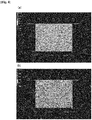
- FIG. 3 shows a 3D image obtained when the surface of the napped artificial leather obtained in Example 1 was measured in the above-described manner.
- FIG. 3(a) shows the image in the grain direction
- FIG. 3(b) shows the image in the reverse grain direction.
- the quality of the napped surface after being rubbed was measured according to the following evaluation method.
- the napped surface of the obtained napped artificial leather was subjected to an inverse Martindale measurement of the Martindale measurement (JIS L 1096). Specifically, the napped surface of an original fabric of the napped artificial leather that was set on a pedestal in an unloaded state was rubbed with the standard rubbing cloth SM25 for 50 times, and the appearance at that time was evaluated according to the following criteria.
- the napped surface had a uniform and dense appearance even after being brushed in the grain direction and the reverse grain direction.
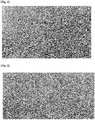
- FIG. 1 shows a photograph of the napped surface of the napped artificial leather obtained in Example 1 after evaluating the quality after being rubbed.
- FIG. 2 shows a photograph of the napped surface of a napped artificial leather obtained in Comparative Example 1, which will be described later, after evaluating the quality after being rubbed.
- a napped artificial leather was obtained in the same manner as in Example 1, except that ultrafine fibers having a design value of a single fiber fineness of 0.25 dtex were formed instead of forming the ultrafine fibers having a design value of a single fiber fineness of 0.30 dtex, and the obtained napped artificial leather was evaluated.
- the results are shown in Table 1.
- a napped artificial leather was obtained in the same manner as in Example 1, except that ultrafine fibers having a design value of a single fiber fineness of 0.20 dtex were formed instead of forming the ultrafine fibers having a design value of a single fiber fineness of 0.30 dtex, and that the superposed body was needle-punched at 4277 punch/cm 2 instead of being needle-punched at 4189 punch/cm 2 in the formation of the web entangled sheet, and the obtained napped artificial leather was evaluated. The results are shown in Table 1.
- a napped artificial leather was obtained in the same manner as in Example 1, except that ultrafine fibers having a design value of a single fiber fineness of 0.10 dtex were formed instead of forming the ultrafine fibers having a design value of a single fiber fineness of 0.30 dtex, and that the superposed body was needle-punched at 3745 punch/cm 2 instead of being needle-punched at 4189 punch/cm 2 in the formation of the web entangled sheet, and the obtained napped artificial leather was evaluated. The results are shown in Table 1.
- a napped artificial leather was obtained in the same manner as in Example 1, except that ultrafine fibers having a design value of a single fiber fineness of 0.08 dtex were formed instead of forming the ultrafine fibers having a design value of a single fiber fineness of 0.30 dtex, and that the superposed body was needle-punched at 3745 punch/cm 2 instead of being needle-punched at 4189 punch/cm 2 in the formation of the web entangled sheet, and the obtained napped artificial leather was evaluated. The results are shown in Table 1.
- a napped artificial leather was obtained in the same manner as in Example 4, except that a polyurethane emulsion was applied instead of applying the polyurethane solution in the step of applying the second elastic polymer, and the obtained napped artificial leather was evaluated.
- the results are shown in Table 1.
- FIG. 4 shows a 3D image obtained when the surface of the napped artificial leather obtained in Comparative Example 1 was measured in the above-described manner.
- FIG. 4 (a) shows the image in the grain direction
- FIG. 4(b) shows the image in the reverse grain direction.
- a napped artificial leather was obtained in the same manner as in Example 1, except that the step of applying the second elastic polymer was omitted, and that the step of performing the flame retardancy treatment and the shrinkage processing treatment on the back surface of the napped artificial leather base material was omitted, and the obtained napped artificial leather was evaluated.
- the results are shown in Table 1.
- a napped artificial leather was obtained in the same manner as in Example 2, except that the step of applying the second elastic polymer was omitted, and the obtained napped artificial leather was evaluated. The results are shown in Table 1.
- a napped artificial leather was obtained in the same manner as in Example 2, except that the step of applying the second elastic polymer was omitted, and that the step of performing the flame retardancy treatment and the shrinkage processing treatment on the back surface of the napped artificial leather base material was omitted, and the obtained napped artificial leather was evaluated.
- the results are shown in Table 1.
- the napped artificial leather of Example 6 to which the polyurethane emulsion was applied as the second elastic polymer had a slightly degraded appearance.
- each of the napped artificial leathers of Comparative Examples 1 to 4 had a nonuniform and coarse appearance with a dry touch as shown in FIG. 2 .
- a napped artificial leather obtained according to the present invention can be preferably used as a skin material for clothing, shoes, articles of furniture, car seats, general merchandise.
Landscapes
- Engineering & Computer Science (AREA)
- Textile Engineering (AREA)
- Chemical & Material Sciences (AREA)
- Chemical Kinetics & Catalysis (AREA)
- Dispersion Chemistry (AREA)
- Synthetic Leather, Interior Materials Or Flexible Sheet Materials (AREA)
Claims (6)
- Ein aufgerautes Kunstleder, umfassend:ein Vlies, welches mit einem ersten elastischen Polymer imprägniert wurde und welches eine aufgeraute Oberfläche einschließlich ultrafeinen aufgerauten Fasern mit einer durchschnittlichen Feinheit von 0,01 bis 0,5 dtex aufweist und wobei die ultrafeinen Fasern auf der aufgerauten Oberfläche ein daran gebundenes zweites elastisches Polymer aufweisen, wobeidie aufgeraute Oberfläche, nachdem sie gebürstet wurde, gemessen mittels einer Messung der Oberflächenrauheit gemäß ISO 25178,eine arithmetische mittlere Höhe (Sa) von 30 µm oder weniger sowohl in einer Faserrichtung, in der die angerauten Fasern kollabieren und abgelegt werden, als auch in einer umgekehrten Faserrichtung, in der die angerauten Fasern angehoben werden,aufweist undeine Peakdichte (Spd) mit einer Höhe von 100 µm oder mehr von einer mittleren Höhe, von 30/432 mm2 oder weniger in sowohl der Faserrichtung und der umgekehrten Faserrichtung, und eine Differenz (absoluter Wert) in der Peakdichte (Spd) zwischen der Faserrichtung und der umgekehrten Faserrichtung 20/432 mm2 oder weniger beträgt.
- Das aufgeraute Kunstleder gemäß Anspruch 1, wobei
die ultrafeinen Fasern auf der aufgerauten Oberfläche das zweite elastische Polymer, welches zumindest in der Nähe einer Basis davon aufgebracht ist, aufweisen. - Das aufgeraute Kunstleder gemäß Anspruch 1 oder 2, wobei
das aufgeraute Kunstleder eine durchschnittliche Faserzähigkeit von 8 bis 40 cN % aufweist, wobei die durchschnittliche Faserzähigkeit des aufgerauten Kunstleders wie in der Beschreibung dargestellt gemessen wird. - Das aufgeraute Kunstleder gemäß einem der Ansprüche 1 bis 3, wobei die ultrafeinen Fasern Fäden mit einer Länge von 100 mm oder mehr sind.
- Das aufgeraute Kunstleder gemäß einem der Ansprüche 1 bis 4, wobei die scheinbare Dichte 0,4 bis 0,7 g/cm3 beträgt.
- Ein Verfahren zur Herstellung des aufgerauten Kunstleders gemäß einem der Ansprüche 1 bis 5, wobei das Verfahren die Schritte umfasst:Herstellen eines Kunstledergrundstoffes einschließlich eines Vliesstoffes, welcher mit einem ersten elastischen Polymer imprägniert wurde und welcher eine aufzurauhende Oberfläche beinhaltet, einschließlich ultrafeinen Fasern mit einer durchschnittlichen Feinheit von 0,01 bis 0,5 dtex;Aufrauen der aufzurauhenden Oberfläche des Kunstledergrundstoffes, um eine aufgeraute Oberfläche zu bilden;Anbringen eines zweiten elastischen Polymers auf die ultrafeinen Fasern der aufgerauten Oberfläche; undthermisches Fixieren des Kunstledergrundstoffes in einem Zustand, in welchem der Kunstledergrundstoff entlang einer Längsrichtung, welche eine Vorschubrichtung der Fertigungslinie darstellt, geschrumpft wird.
Applications Claiming Priority (2)
| Application Number | Priority Date | Filing Date | Title |
|---|---|---|---|
| JP2016123411 | 2016-06-22 | ||
| PCT/JP2017/022802 WO2017221961A1 (ja) | 2016-06-22 | 2017-06-21 | 立毛調人工皮革及びその製造方法 |
Publications (3)
| Publication Number | Publication Date |
|---|---|
| EP3476998A1 EP3476998A1 (de) | 2019-05-01 |
| EP3476998A4 EP3476998A4 (de) | 2020-01-01 |
| EP3476998B1 true EP3476998B1 (de) | 2021-09-08 |
Family
ID=60784305
Family Applications (1)
| Application Number | Title | Priority Date | Filing Date |
|---|---|---|---|
| EP17815429.0A Active EP3476998B1 (de) | 2016-06-22 | 2017-06-21 | Aufgerautes kunstleder und verfahren zur herstellung davon |
Country Status (7)
| Country | Link |
|---|---|
| US (1) | US10689802B2 (de) |
| EP (1) | EP3476998B1 (de) |
| JP (1) | JP7008018B2 (de) |
| KR (1) | KR102332017B1 (de) |
| CN (1) | CN109154134B (de) |
| TW (1) | TWI732890B (de) |
| WO (1) | WO2017221961A1 (de) |
Families Citing this family (5)
| Publication number | Priority date | Publication date | Assignee | Title |
|---|---|---|---|---|
| CN111433404B (zh) | 2017-12-13 | 2022-09-20 | 株式会社可乐丽 | 经印刷的起毛片及印刷用起毛片 |
| JP7359536B2 (ja) * | 2018-10-31 | 2023-10-11 | 株式会社クラレ | 絡合不織布及び人工皮革 |
| JP7349251B2 (ja) * | 2019-03-28 | 2023-09-22 | 富士紡ホールディングス株式会社 | 保持パッド |
| JP2023037422A (ja) * | 2021-09-03 | 2023-03-15 | 旭化成株式会社 | ヌバック調人工皮革 |
| JP7819313B2 (ja) * | 2022-07-01 | 2026-02-24 | 旭化成株式会社 | 人工皮革及びその製法 |
Family Cites Families (23)
| Publication number | Priority date | Publication date | Assignee | Title |
|---|---|---|---|---|
| JPH06299471A (ja) * | 1993-04-13 | 1994-10-25 | Sumitomo Chem Co Ltd | 繊維布帛の圧縮・収縮仕上方法 |
| KR100475542B1 (ko) * | 1997-12-30 | 2005-12-21 | 주식회사 효성 | 초극세사 부직포 인공피혁의 제조방법 |
| JP4128312B2 (ja) * | 1999-02-24 | 2008-07-30 | 株式会社クラレ | 表面立毛を有する皮革様シート |
| TW476834B (en) * | 1999-08-23 | 2002-02-21 | Kuraray Co | Oil tone artificial leather sheet |
| JP2003089984A (ja) * | 2001-09-20 | 2003-03-28 | Toray Ind Inc | 伸縮性に優れた人工皮革およびその製造方法 |
| JP2003094320A (ja) * | 2001-09-25 | 2003-04-03 | Toray Ind Inc | 研磨布 |
| DE60302938T2 (de) * | 2002-06-12 | 2006-09-21 | KURARAY CO., LTD, Kurashiki | Flammfestes, lederartiges bahnenförmiges Substrat und Verfahren zu seiner Herstellung |
| US7951452B2 (en) * | 2002-09-30 | 2011-05-31 | Kuraray Co., Ltd. | Suede artificial leather and production method thereof |
| JP4464119B2 (ja) * | 2003-12-12 | 2010-05-19 | 株式会社クラレ | 人工皮革用基材、これをベースとする各種人工皮革、および人工皮革用基材の製造方法 |
| JP2008208510A (ja) * | 2007-01-29 | 2008-09-11 | Toray Ind Inc | 皮革様シート状物、その製造方法、並びに該皮革様シート状物を用いた内装材、衣料用資材および工業用資材および研磨布 |
| KR101310119B1 (ko) * | 2007-12-13 | 2013-10-14 | 현대자동차주식회사 | 인공피혁 및 그의 제조방법 |
| KR101192924B1 (ko) * | 2009-03-16 | 2012-10-18 | 코오롱인더스트리 주식회사 | 인공피혁 및 그 제조방법 |
| JP5555468B2 (ja) * | 2009-09-30 | 2014-07-23 | 株式会社クラレ | 耐ピリング性の良好な立毛調人工皮革 |
| JP6007505B2 (ja) * | 2011-02-18 | 2016-10-12 | 東レ株式会社 | 人工皮革とその製造方法 |
| JP5746074B2 (ja) * | 2012-02-29 | 2015-07-08 | 株式会社クラレ | 伸縮性人工皮革の製造方法 |
| WO2013129388A1 (ja) | 2012-02-29 | 2013-09-06 | 株式会社クラレ | 伸縮性人工皮革及びその製造方法 |
| CN103015185B (zh) * | 2012-11-29 | 2014-06-25 | 上海华峰超纤材料股份有限公司 | 耐磨超细纤维绒面革及其制备方法 |
| JP2014163005A (ja) * | 2013-02-22 | 2014-09-08 | Kuraray Co Ltd | 伸縮性人工皮革の製造方法 |
| EP3054048B1 (de) * | 2013-09-30 | 2018-10-31 | Kuraray Co., Ltd. | Nappa-kunstleder und herstellungsverfahren dafür |
| EP3128071B1 (de) * | 2014-03-31 | 2020-06-17 | Toray Industries, Inc. | Kunstleder |
| CN105178052A (zh) * | 2015-08-07 | 2015-12-23 | 无锡双象超纤材料股份有限公司 | 超纤软皮沙发革的制备工艺 |
| CN205134073U (zh) * | 2015-09-21 | 2016-04-06 | 安徽安利材料科技股份有限公司 | 一种弹力绒面仿真皮效果聚氨酯合成革 |
| JP6745078B2 (ja) * | 2015-12-07 | 2020-08-26 | 株式会社クラレ | 立毛調人工皮革 |
-
2017
- 2017-06-21 EP EP17815429.0A patent/EP3476998B1/de active Active
- 2017-06-21 CN CN201780031500.3A patent/CN109154134B/zh active Active
- 2017-06-21 TW TW106120674A patent/TWI732890B/zh active
- 2017-06-21 WO PCT/JP2017/022802 patent/WO2017221961A1/ja not_active Ceased
- 2017-06-21 JP JP2018524129A patent/JP7008018B2/ja active Active
- 2017-06-21 KR KR1020187033725A patent/KR102332017B1/ko active Active
- 2017-06-21 US US16/306,697 patent/US10689802B2/en active Active
Also Published As
| Publication number | Publication date |
|---|---|
| WO2017221961A1 (ja) | 2017-12-28 |
| KR20190020657A (ko) | 2019-03-04 |
| TW201802322A (zh) | 2018-01-16 |
| US10689802B2 (en) | 2020-06-23 |
| EP3476998A4 (de) | 2020-01-01 |
| US20190127908A1 (en) | 2019-05-02 |
| JPWO2017221961A1 (ja) | 2019-04-18 |
| KR102332017B1 (ko) | 2021-11-26 |
| TWI732890B (zh) | 2021-07-11 |
| CN109154134A (zh) | 2019-01-04 |
| CN109154134B (zh) | 2021-04-13 |
| JP7008018B2 (ja) | 2022-01-25 |
| EP3476998A1 (de) | 2019-05-01 |
Similar Documents
| Publication | Publication Date | Title |
|---|---|---|
| US20200123702A1 (en) | Napped artificial leather and production method thereof | |
| EP3476998B1 (de) | Aufgerautes kunstleder und verfahren zur herstellung davon | |
| EP3202974B1 (de) | Raulederartige bahn und verfahren zur herstellung davon | |
| JP6752579B2 (ja) | 人工皮革基材及びその製造方法、並びにオイル調,起毛調,または銀面調人工皮革 | |
| US10982382B2 (en) | Napped artificial leather dyed with cationic dye, and method for manufacturing the same | |
| JP7522175B2 (ja) | 立毛調人工皮革 | |
| JP6745078B2 (ja) | 立毛調人工皮革 | |
| US12571158B2 (en) | Napped artificial leather | |
| US12584256B2 (en) | Printed napped sheet and napped sheet for printing | |
| EP3708708A1 (de) | Kunstrauleder | |
| JP7455072B2 (ja) | 立毛調人工皮革 |
Legal Events
| Date | Code | Title | Description |
|---|---|---|---|
| STAA | Information on the status of an ep patent application or granted ep patent |
Free format text: STATUS: THE INTERNATIONAL PUBLICATION HAS BEEN MADE |
|
| PUAI | Public reference made under article 153(3) epc to a published international application that has entered the european phase |
Free format text: ORIGINAL CODE: 0009012 |
|
| STAA | Information on the status of an ep patent application or granted ep patent |
Free format text: STATUS: REQUEST FOR EXAMINATION WAS MADE |
|
| 17P | Request for examination filed |
Effective date: 20190122 |
|
| AK | Designated contracting states |
Kind code of ref document: A1 Designated state(s): AL AT BE BG CH CY CZ DE DK EE ES FI FR GB GR HR HU IE IS IT LI LT LU LV MC MK MT NL NO PL PT RO RS SE SI SK SM TR |
|
| AX | Request for extension of the european patent |
Extension state: BA ME |
|
| DAV | Request for validation of the european patent (deleted) | ||
| DAX | Request for extension of the european patent (deleted) | ||
| A4 | Supplementary search report drawn up and despatched |
Effective date: 20191202 |
|
| RIC1 | Information provided on ipc code assigned before grant |
Ipc: D06N 3/00 20060101AFI20191126BHEP Ipc: D06N 3/18 20060101ALI20191126BHEP Ipc: D06N 3/14 20060101ALI20191126BHEP |
|
| GRAP | Despatch of communication of intention to grant a patent |
Free format text: ORIGINAL CODE: EPIDOSNIGR1 |
|
| RIC1 | Information provided on ipc code assigned before grant |
Ipc: D06N 3/00 20060101AFI20201023BHEP Ipc: D06N 3/18 20060101ALI20201023BHEP Ipc: D06N 3/14 20060101ALI20201023BHEP |
|
| STAA | Information on the status of an ep patent application or granted ep patent |
Free format text: STATUS: GRANT OF PATENT IS INTENDED |
|
| INTG | Intention to grant announced |
Effective date: 20201203 |
|
| GRAS | Grant fee paid |
Free format text: ORIGINAL CODE: EPIDOSNIGR3 |
|
| GRAJ | Information related to disapproval of communication of intention to grant by the applicant or resumption of examination proceedings by the epo deleted |
Free format text: ORIGINAL CODE: EPIDOSDIGR1 |
|
| GRAL | Information related to payment of fee for publishing/printing deleted |
Free format text: ORIGINAL CODE: EPIDOSDIGR3 |
|
| STAA | Information on the status of an ep patent application or granted ep patent |
Free format text: STATUS: REQUEST FOR EXAMINATION WAS MADE |
|
| INTC | Intention to grant announced (deleted) | ||
| GRAP | Despatch of communication of intention to grant a patent |
Free format text: ORIGINAL CODE: EPIDOSNIGR1 |
|
| STAA | Information on the status of an ep patent application or granted ep patent |
Free format text: STATUS: GRANT OF PATENT IS INTENDED |
|
| GRAA | (expected) grant |
Free format text: ORIGINAL CODE: 0009210 |
|
| STAA | Information on the status of an ep patent application or granted ep patent |
Free format text: STATUS: THE PATENT HAS BEEN GRANTED |
|
| INTG | Intention to grant announced |
Effective date: 20210727 |
|
| AK | Designated contracting states |
Kind code of ref document: B1 Designated state(s): AL AT BE BG CH CY CZ DE DK EE ES FI FR GB GR HR HU IE IS IT LI LT LU LV MC MK MT NL NO PL PT RO RS SE SI SK SM TR |
|
| REG | Reference to a national code |
Ref country code: GB Ref legal event code: FG4D |
|
| REG | Reference to a national code |
Ref country code: CH Ref legal event code: EP Ref country code: AT Ref legal event code: REF Ref document number: 1428704 Country of ref document: AT Kind code of ref document: T Effective date: 20210915 |
|
| REG | Reference to a national code |
Ref country code: DE Ref legal event code: R096 Ref document number: 602017045778 Country of ref document: DE |
|
| REG | Reference to a national code |
Ref country code: IE Ref legal event code: FG4D |
|
| REG | Reference to a national code |
Ref country code: LT Ref legal event code: MG9D |
|
| REG | Reference to a national code |
Ref country code: NL Ref legal event code: MP Effective date: 20210908 |
|
| PG25 | Lapsed in a contracting state [announced via postgrant information from national office to epo] |
Ref country code: ES Free format text: LAPSE BECAUSE OF FAILURE TO SUBMIT A TRANSLATION OF THE DESCRIPTION OR TO PAY THE FEE WITHIN THE PRESCRIBED TIME-LIMIT Effective date: 20210908 Ref country code: FI Free format text: LAPSE BECAUSE OF FAILURE TO SUBMIT A TRANSLATION OF THE DESCRIPTION OR TO PAY THE FEE WITHIN THE PRESCRIBED TIME-LIMIT Effective date: 20210908 Ref country code: HR Free format text: LAPSE BECAUSE OF FAILURE TO SUBMIT A TRANSLATION OF THE DESCRIPTION OR TO PAY THE FEE WITHIN THE PRESCRIBED TIME-LIMIT Effective date: 20210908 Ref country code: RS Free format text: LAPSE BECAUSE OF FAILURE TO SUBMIT A TRANSLATION OF THE DESCRIPTION OR TO PAY THE FEE WITHIN THE PRESCRIBED TIME-LIMIT Effective date: 20210908 Ref country code: SE Free format text: LAPSE BECAUSE OF FAILURE TO SUBMIT A TRANSLATION OF THE DESCRIPTION OR TO PAY THE FEE WITHIN THE PRESCRIBED TIME-LIMIT Effective date: 20210908 Ref country code: BG Free format text: LAPSE BECAUSE OF FAILURE TO SUBMIT A TRANSLATION OF THE DESCRIPTION OR TO PAY THE FEE WITHIN THE PRESCRIBED TIME-LIMIT Effective date: 20211208 Ref country code: LT Free format text: LAPSE BECAUSE OF FAILURE TO SUBMIT A TRANSLATION OF THE DESCRIPTION OR TO PAY THE FEE WITHIN THE PRESCRIBED TIME-LIMIT Effective date: 20210908 Ref country code: NO Free format text: LAPSE BECAUSE OF FAILURE TO SUBMIT A TRANSLATION OF THE DESCRIPTION OR TO PAY THE FEE WITHIN THE PRESCRIBED TIME-LIMIT Effective date: 20211208 |
|
| REG | Reference to a national code |
Ref country code: AT Ref legal event code: MK05 Ref document number: 1428704 Country of ref document: AT Kind code of ref document: T Effective date: 20210908 |
|
| PG25 | Lapsed in a contracting state [announced via postgrant information from national office to epo] |
Ref country code: LV Free format text: LAPSE BECAUSE OF FAILURE TO SUBMIT A TRANSLATION OF THE DESCRIPTION OR TO PAY THE FEE WITHIN THE PRESCRIBED TIME-LIMIT Effective date: 20210908 Ref country code: GR Free format text: LAPSE BECAUSE OF FAILURE TO SUBMIT A TRANSLATION OF THE DESCRIPTION OR TO PAY THE FEE WITHIN THE PRESCRIBED TIME-LIMIT Effective date: 20211209 |
|
| PG25 | Lapsed in a contracting state [announced via postgrant information from national office to epo] |
Ref country code: AT Free format text: LAPSE BECAUSE OF FAILURE TO SUBMIT A TRANSLATION OF THE DESCRIPTION OR TO PAY THE FEE WITHIN THE PRESCRIBED TIME-LIMIT Effective date: 20210908 |
|
| PG25 | Lapsed in a contracting state [announced via postgrant information from national office to epo] |
Ref country code: IS Free format text: LAPSE BECAUSE OF FAILURE TO SUBMIT A TRANSLATION OF THE DESCRIPTION OR TO PAY THE FEE WITHIN THE PRESCRIBED TIME-LIMIT Effective date: 20220108 Ref country code: SM Free format text: LAPSE BECAUSE OF FAILURE TO SUBMIT A TRANSLATION OF THE DESCRIPTION OR TO PAY THE FEE WITHIN THE PRESCRIBED TIME-LIMIT Effective date: 20210908 Ref country code: SK Free format text: LAPSE BECAUSE OF FAILURE TO SUBMIT A TRANSLATION OF THE DESCRIPTION OR TO PAY THE FEE WITHIN THE PRESCRIBED TIME-LIMIT Effective date: 20210908 Ref country code: RO Free format text: LAPSE BECAUSE OF FAILURE TO SUBMIT A TRANSLATION OF THE DESCRIPTION OR TO PAY THE FEE WITHIN THE PRESCRIBED TIME-LIMIT Effective date: 20210908 Ref country code: PT Free format text: LAPSE BECAUSE OF FAILURE TO SUBMIT A TRANSLATION OF THE DESCRIPTION OR TO PAY THE FEE WITHIN THE PRESCRIBED TIME-LIMIT Effective date: 20220110 Ref country code: PL Free format text: LAPSE BECAUSE OF FAILURE TO SUBMIT A TRANSLATION OF THE DESCRIPTION OR TO PAY THE FEE WITHIN THE PRESCRIBED TIME-LIMIT Effective date: 20210908 Ref country code: NL Free format text: LAPSE BECAUSE OF FAILURE TO SUBMIT A TRANSLATION OF THE DESCRIPTION OR TO PAY THE FEE WITHIN THE PRESCRIBED TIME-LIMIT Effective date: 20210908 Ref country code: EE Free format text: LAPSE BECAUSE OF FAILURE TO SUBMIT A TRANSLATION OF THE DESCRIPTION OR TO PAY THE FEE WITHIN THE PRESCRIBED TIME-LIMIT Effective date: 20210908 Ref country code: CZ Free format text: LAPSE BECAUSE OF FAILURE TO SUBMIT A TRANSLATION OF THE DESCRIPTION OR TO PAY THE FEE WITHIN THE PRESCRIBED TIME-LIMIT Effective date: 20210908 Ref country code: AL Free format text: LAPSE BECAUSE OF FAILURE TO SUBMIT A TRANSLATION OF THE DESCRIPTION OR TO PAY THE FEE WITHIN THE PRESCRIBED TIME-LIMIT Effective date: 20210908 |
|
| REG | Reference to a national code |
Ref country code: DE Ref legal event code: R097 Ref document number: 602017045778 Country of ref document: DE |
|
| PLBE | No opposition filed within time limit |
Free format text: ORIGINAL CODE: 0009261 |
|
| STAA | Information on the status of an ep patent application or granted ep patent |
Free format text: STATUS: NO OPPOSITION FILED WITHIN TIME LIMIT |
|
| PG25 | Lapsed in a contracting state [announced via postgrant information from national office to epo] |
Ref country code: DK Free format text: LAPSE BECAUSE OF FAILURE TO SUBMIT A TRANSLATION OF THE DESCRIPTION OR TO PAY THE FEE WITHIN THE PRESCRIBED TIME-LIMIT Effective date: 20210908 |
|
| 26N | No opposition filed |
Effective date: 20220609 |
|
| PG25 | Lapsed in a contracting state [announced via postgrant information from national office to epo] |
Ref country code: SI Free format text: LAPSE BECAUSE OF FAILURE TO SUBMIT A TRANSLATION OF THE DESCRIPTION OR TO PAY THE FEE WITHIN THE PRESCRIBED TIME-LIMIT Effective date: 20210908 |
|
| PG25 | Lapsed in a contracting state [announced via postgrant information from national office to epo] |
Ref country code: MC Free format text: LAPSE BECAUSE OF FAILURE TO SUBMIT A TRANSLATION OF THE DESCRIPTION OR TO PAY THE FEE WITHIN THE PRESCRIBED TIME-LIMIT Effective date: 20210908 |
|
| REG | Reference to a national code |
Ref country code: CH Ref legal event code: PL |
|
| REG | Reference to a national code |
Ref country code: BE Ref legal event code: MM Effective date: 20220630 |
|
| PG25 | Lapsed in a contracting state [announced via postgrant information from national office to epo] |
Ref country code: LU Free format text: LAPSE BECAUSE OF NON-PAYMENT OF DUE FEES Effective date: 20220621 Ref country code: LI Free format text: LAPSE BECAUSE OF NON-PAYMENT OF DUE FEES Effective date: 20220630 Ref country code: IE Free format text: LAPSE BECAUSE OF NON-PAYMENT OF DUE FEES Effective date: 20220621 Ref country code: CH Free format text: LAPSE BECAUSE OF NON-PAYMENT OF DUE FEES Effective date: 20220630 |
|
| PG25 | Lapsed in a contracting state [announced via postgrant information from national office to epo] |
Ref country code: BE Free format text: LAPSE BECAUSE OF NON-PAYMENT OF DUE FEES Effective date: 20220630 |
|
| P01 | Opt-out of the competence of the unified patent court (upc) registered |
Effective date: 20230529 |
|
| PG25 | Lapsed in a contracting state [announced via postgrant information from national office to epo] |
Ref country code: HU Free format text: LAPSE BECAUSE OF FAILURE TO SUBMIT A TRANSLATION OF THE DESCRIPTION OR TO PAY THE FEE WITHIN THE PRESCRIBED TIME-LIMIT; INVALID AB INITIO Effective date: 20170621 |
|
| PG25 | Lapsed in a contracting state [announced via postgrant information from national office to epo] |
Ref country code: MK Free format text: LAPSE BECAUSE OF FAILURE TO SUBMIT A TRANSLATION OF THE DESCRIPTION OR TO PAY THE FEE WITHIN THE PRESCRIBED TIME-LIMIT Effective date: 20210908 Ref country code: CY Free format text: LAPSE BECAUSE OF FAILURE TO SUBMIT A TRANSLATION OF THE DESCRIPTION OR TO PAY THE FEE WITHIN THE PRESCRIBED TIME-LIMIT Effective date: 20210908 |
|
| PG25 | Lapsed in a contracting state [announced via postgrant information from national office to epo] |
Ref country code: TR Free format text: LAPSE BECAUSE OF FAILURE TO SUBMIT A TRANSLATION OF THE DESCRIPTION OR TO PAY THE FEE WITHIN THE PRESCRIBED TIME-LIMIT Effective date: 20210908 |
|
| PG25 | Lapsed in a contracting state [announced via postgrant information from national office to epo] |
Ref country code: MT Free format text: LAPSE BECAUSE OF FAILURE TO SUBMIT A TRANSLATION OF THE DESCRIPTION OR TO PAY THE FEE WITHIN THE PRESCRIBED TIME-LIMIT Effective date: 20210908 |
|
| PGFP | Annual fee paid to national office [announced via postgrant information from national office to epo] |
Ref country code: DE Payment date: 20250429 Year of fee payment: 9 |
|
| PGFP | Annual fee paid to national office [announced via postgrant information from national office to epo] |
Ref country code: GB Payment date: 20250501 Year of fee payment: 9 |
|
| PGFP | Annual fee paid to national office [announced via postgrant information from national office to epo] |
Ref country code: IT Payment date: 20250522 Year of fee payment: 9 |
|
| PGFP | Annual fee paid to national office [announced via postgrant information from national office to epo] |
Ref country code: FR Payment date: 20250508 Year of fee payment: 9 |