EP3481829B1 - Kondensierte pyrimidinderivate - Google Patents
Kondensierte pyrimidinderivate Download PDFInfo
- Publication number
- EP3481829B1 EP3481829B1 EP17734104.7A EP17734104A EP3481829B1 EP 3481829 B1 EP3481829 B1 EP 3481829B1 EP 17734104 A EP17734104 A EP 17734104A EP 3481829 B1 EP3481829 B1 EP 3481829B1
- Authority
- EP
- European Patent Office
- Prior art keywords
- pyrrolo
- dihydro
- methyl
- pyrimidine
- diamine
- Prior art date
- Legal status (The legal status is an assumption and is not a legal conclusion. Google has not performed a legal analysis and makes no representation as to the accuracy of the status listed.)
- Active
Links
- 0 *C(*)(CN1*)c2c1nc(*)nc2N* Chemical compound *C(*)(CN1*)c2c1nc(*)nc2N* 0.000 description 4
- YPSVPFFHOULTRF-UHFFFAOYSA-N CC(C)(CN(c1n2)c(cc3)ccc3F)c1c(NC)nc2Cl Chemical compound CC(C)(CN(c1n2)c(cc3)ccc3F)c1c(NC)nc2Cl YPSVPFFHOULTRF-UHFFFAOYSA-N 0.000 description 2
- CEFANFYOCOZVKR-UHFFFAOYSA-N Fc(cc1)ccc1N(CC1)c2c1c(Cl)nc(Cl)n2 Chemical compound Fc(cc1)ccc1N(CC1)c2c1c(Cl)nc(Cl)n2 CEFANFYOCOZVKR-UHFFFAOYSA-N 0.000 description 2
- KYESVJIRUQPQIX-UHFFFAOYSA-N CC(C)(C1)c2c(NC)nc(Nc(cc3)cc(F)c3-[n]3nc(C)nc3)nc2N1c(ccc(F)c1)c1F Chemical compound CC(C)(C1)c2c(NC)nc(Nc(cc3)cc(F)c3-[n]3nc(C)nc3)nc2N1c(ccc(F)c1)c1F KYESVJIRUQPQIX-UHFFFAOYSA-N 0.000 description 1
- QNQQNTHXCNFOHF-UHFFFAOYSA-N CC(C)(C1)c2c(NC)nc(Nc(cc3)ccc3-[n]3cnc(C)c3)nc2N1c(cc1)ccc1F Chemical compound CC(C)(C1)c2c(NC)nc(Nc(cc3)ccc3-[n]3cnc(C)c3)nc2N1c(cc1)ccc1F QNQQNTHXCNFOHF-UHFFFAOYSA-N 0.000 description 1
- VJWCFJFQNOOOLM-UHFFFAOYSA-N CC(C)(C1)c2c(NC)nc(Nc3cc(OC)c(-[n]4cnc(C)c4)nc3)nc2N1C(C1)C(C2)C12C(F)(F)F Chemical compound CC(C)(C1)c2c(NC)nc(Nc3cc(OC)c(-[n]4cnc(C)c4)nc3)nc2N1C(C1)C(C2)C12C(F)(F)F VJWCFJFQNOOOLM-UHFFFAOYSA-N 0.000 description 1
- KZDQTLUJGVMTNR-UHFFFAOYSA-N CC(C)(CN(C(C1)(C2)C12C(F)(F)F)c1n2)c1c(NC)nc2Cl Chemical compound CC(C)(CN(C(C1)(C2)C12C(F)(F)F)c1n2)c1c(NC)nc2Cl KZDQTLUJGVMTNR-UHFFFAOYSA-N 0.000 description 1
- ZQZQBAGTHLDQND-UHFFFAOYSA-N CC(C)(CN1c(c(F)c2)ccc2F)c(c(NC)n2)c1nc2Cl Chemical compound CC(C)(CN1c(c(F)c2)ccc2F)c(c(NC)n2)c1nc2Cl ZQZQBAGTHLDQND-UHFFFAOYSA-N 0.000 description 1
- JEJKKTYNUKTPTJ-UHFFFAOYSA-N CC(CC1CCCC1)N Chemical compound CC(CC1CCCC1)N JEJKKTYNUKTPTJ-UHFFFAOYSA-N 0.000 description 1
- PESPXEOPJRNJIG-UHFFFAOYSA-N CC(CN(c(cc1)ccc1F)c(nc(nc1Cl)Cl)c1Br)=C Chemical compound CC(CN(c(cc1)ccc1F)c(nc(nc1Cl)Cl)c1Br)=C PESPXEOPJRNJIG-UHFFFAOYSA-N 0.000 description 1
- WJBYQYBRXOCFFR-UHFFFAOYSA-N CC(CN(c(cc1)ccc1F)c(nc(nc1NC)Cl)c1Br)=C Chemical compound CC(CN(c(cc1)ccc1F)c(nc(nc1NC)Cl)c1Br)=C WJBYQYBRXOCFFR-UHFFFAOYSA-N 0.000 description 1
- IRJOKJALTMOLDQ-UHFFFAOYSA-N CN(/C(/O)=N\C(O)=C)O Chemical compound CN(/C(/O)=N\C(O)=C)O IRJOKJALTMOLDQ-UHFFFAOYSA-N 0.000 description 1
- DFDDLFCSYLTQBP-UHFFFAOYSA-N CNCC1CCC1 Chemical compound CNCC1CCC1 DFDDLFCSYLTQBP-UHFFFAOYSA-N 0.000 description 1
- KBFOCDFPJBIMBD-UHFFFAOYSA-N COC(C(CCO1)C1=O)=O Chemical compound COC(C(CCO1)C1=O)=O KBFOCDFPJBIMBD-UHFFFAOYSA-N 0.000 description 1
- HTUABWCJCYDAIA-CQSZACIVSA-N C[C@H](C1)c2c(NC)nc(Nc(cc3)cc(F)c3-[n]3cnc(C)c3)nc2N1c(cc1)ccc1F Chemical compound C[C@H](C1)c2c(NC)nc(Nc(cc3)cc(F)c3-[n]3cnc(C)c3)nc2N1c(cc1)ccc1F HTUABWCJCYDAIA-CQSZACIVSA-N 0.000 description 1
- GKNMZBKPHYTRGF-CYBMUJFWSA-N C[C@H](CN(c1nc(Nc(cc2)cc(F)c2-[n]2cnc(C)c2)n2)c(cc3)ccc3F)c1c2Cl Chemical compound C[C@H](CN(c1nc(Nc(cc2)cc(F)c2-[n]2cnc(C)c2)n2)c(cc3)ccc3F)c1c2Cl GKNMZBKPHYTRGF-CYBMUJFWSA-N 0.000 description 1
- HVHZNBXRVKVGNF-SSDOTTSWSA-N C[C@H](CN1c(cc2)ccc2F)c(c(Cl)n2)c1nc2Cl Chemical compound C[C@H](CN1c(cc2)ccc2F)c(c(Cl)n2)c1nc2Cl HVHZNBXRVKVGNF-SSDOTTSWSA-N 0.000 description 1
- HXYNPUPINMSUIJ-UHFFFAOYSA-N Cc(nc1)c[n]1-c(ccc(Nc1nc(Cl)c(CCN2c(cc3)ccc3F)c2n1)c1)c1F Chemical compound Cc(nc1)c[n]1-c(ccc(Nc1nc(Cl)c(CCN2c(cc3)ccc3F)c2n1)c1)c1F HXYNPUPINMSUIJ-UHFFFAOYSA-N 0.000 description 1
- CHEILUWMPYEIMK-UHFFFAOYSA-N Cc(nc1)c[n]1-c(ccc(Nc1nc(NC)c(CCN2c(cc3)ccc3F)c2n1)c1)c1F Chemical compound Cc(nc1)c[n]1-c(ccc(Nc1nc(NC)c(CCN2c(cc3)ccc3F)c2n1)c1)c1F CHEILUWMPYEIMK-UHFFFAOYSA-N 0.000 description 1
- HXIRAOQURHWMLX-UHFFFAOYSA-N ClCCc(c(Cl)nc(Cl)n1)c1Cl Chemical compound ClCCc(c(Cl)nc(Cl)n1)c1Cl HXIRAOQURHWMLX-UHFFFAOYSA-N 0.000 description 1
- GKTWIIVEUYLSCS-UHFFFAOYSA-N Clc(nc(nc1Cl)Cl)c1Br Chemical compound Clc(nc(nc1Cl)Cl)c1Br GKTWIIVEUYLSCS-UHFFFAOYSA-N 0.000 description 1
- WZVRKAYIOJLHHL-UHFFFAOYSA-N Fc(cc1)ccc1Nc(nc(nc1Cl)Cl)c1Br Chemical compound Fc(cc1)ccc1Nc(nc(nc1Cl)Cl)c1Br WZVRKAYIOJLHHL-UHFFFAOYSA-N 0.000 description 1
- KRZCOLNOCZKSDF-UHFFFAOYSA-N Nc(cc1)ccc1F Chemical compound Nc(cc1)ccc1F KRZCOLNOCZKSDF-UHFFFAOYSA-N 0.000 description 1
Classifications
-
- C—CHEMISTRY; METALLURGY
- C07—ORGANIC CHEMISTRY
- C07D—HETEROCYCLIC COMPOUNDS
- C07D487/00—Heterocyclic compounds containing nitrogen atoms as the only ring hetero atoms in the condensed system, not provided for by groups C07D451/00 - C07D477/00
- C07D487/02—Heterocyclic compounds containing nitrogen atoms as the only ring hetero atoms in the condensed system, not provided for by groups C07D451/00 - C07D477/00 in which the condensed system contains two hetero rings
- C07D487/04—Ortho-condensed systems
-
- A—HUMAN NECESSITIES
- A61—MEDICAL OR VETERINARY SCIENCE; HYGIENE
- A61P—SPECIFIC THERAPEUTIC ACTIVITY OF CHEMICAL COMPOUNDS OR MEDICINAL PREPARATIONS
- A61P25/00—Drugs for disorders of the nervous system
- A61P25/28—Drugs for disorders of the nervous system for treating neurodegenerative disorders of the central nervous system, e.g. nootropic agents, cognition enhancers, drugs for treating Alzheimer's disease or other forms of dementia
-
- A—HUMAN NECESSITIES
- A61—MEDICAL OR VETERINARY SCIENCE; HYGIENE
- A61P—SPECIFIC THERAPEUTIC ACTIVITY OF CHEMICAL COMPOUNDS OR MEDICINAL PREPARATIONS
- A61P43/00—Drugs for specific purposes, not provided for in groups A61P1/00-A61P41/00
-
- C—CHEMISTRY; METALLURGY
- C07—ORGANIC CHEMISTRY
- C07D—HETEROCYCLIC COMPOUNDS
- C07D471/00—Heterocyclic compounds containing nitrogen atoms as the only ring hetero atoms in the condensed system, at least one ring being a six-membered ring with one nitrogen atom, not provided for by groups C07D451/00 - C07D463/00
- C07D471/02—Heterocyclic compounds containing nitrogen atoms as the only ring hetero atoms in the condensed system, at least one ring being a six-membered ring with one nitrogen atom, not provided for by groups C07D451/00 - C07D463/00 in which the condensed system contains two hetero rings
- C07D471/04—Ortho-condensed systems
Definitions
- the present invention relates to compounds of formula I, (the terms “lower alkyl” and “lower alkoxy” mean C1-C7 alkyl and C1-C7 alkoxy, respectively) wherein
- the present compounds of formula I are modulators of ⁇ -secretase, they may be useful for the treatment or prevention of a disease associated with the deposition of ⁇ -amyloid in the brain, in particular Alzheimer's disease, and other diseases such as cerebral amyloid angiopathy, hereditary cerebral hemorrhage with amyloidosis, Dutch-type (HCHWA-D), multi-infarct dementia, dementia pugilistica and Down syndrome.
- a disease associated with the deposition of ⁇ -amyloid in the brain in particular Alzheimer's disease, and other diseases such as cerebral amyloid angiopathy, hereditary cerebral hemorrhage with amyloidosis, Dutch-type (HCHWA-D), multi-infarct dementia, dementia pugilistica and Down syndrome.
- AD Alzheimer's disease
- APP ⁇ -Amyloid Precursor Protein
- a ⁇ peptides are produced from APP through the sequential action of two proteolytic enzymes termed ⁇ - and ⁇ -secretase.
- ⁇ -Secretase cleaves first in the extracellular domain of APP just outside of the trans-membrane domain (TM) to produce a C-terminal fragment of APP (CTF ⁇ ) containing the TM- and cytoplasmatic domain.
- CTF ⁇ is the substrate for ⁇ -secretase which cleaves at several adjacent positions within the TM to produce the A ⁇ peptides and the cytoplasmic fragment.
- TM trans-membrane domain
- CTF ⁇ C-terminal fragment of APP
- CTF ⁇ is the substrate for ⁇ -secretase which cleaves at several adjacent positions within the TM to produce the A ⁇ peptides and the cytoplasmic fragment.
- the ⁇ -secretase is a typical aspartyl protease.
- the ⁇ -secretase is a high molecular weight complex that consists of four essential subunits: Presenilin (PS, including PS1 and PS2), nicastrin, anterior pharynx defective 1 (APH-1), and presenilin enhancer 2 (PEN-2).
- Presenilin PS, including PS1 and PS2
- nicastrin nicastrin
- anterior pharynx defective 1 APH-1
- PEN-2 presenilin enhancer 2
- the atomic structure of human ⁇ -secretaseat 3.4 ⁇ resolution has been published ( X. Bai, C. Yan, G. Yang, P. Lu, D. Ma, L. Sun, R. Zhou, S. H. W. Scheres, Y. Shi, Nature 2015, 525, pages 212-217 ).
- the presenilins are bearing the catalytic site and represent a group of atypical aspartyl proteases which cleave their substrates within the TM of and which are themselves polytopic membrane proteins.
- the other essential components of ⁇ -secretase, nicastrin and the products of the aph1 and pen-2 genes are believed to be responsible for substrate recognition and recruitment.
- the ⁇ -secretaseactivity is absolutely required for the production of A ⁇ peptides. This has been shown both by genetic means, i.e., ablation of the presenilin genes and by low-molecular-weight inhibitory compounds. According to the amyloid cascade hypothesis for AD the production and deposition of A ⁇ is the ultimate cause for the disease. Therefore, it was believed that selective and potent inhibition of ⁇ -secretasemight be useful for the prevention and treatment of AD.
- An alternative mode of treatment is the modulation of the ⁇ -secretaseactivity which results in a selective reduction of the A ⁇ 42 production. This will lead in an increase of shorter A ⁇ isoforms, such as A ⁇ 38, A ⁇ 37 or others, which have no or reduced capability for aggregation and plaque formation, and are not or less neurotoxic.
- Compounds which show this effect on modulating ⁇ -secretaseactivity include certain non-steroidal anti-inflammatory drugs (NSAIDs) and related analogues ( Weggen et al. Nature, 414 (2001) 212-16 ).
- the compounds of this invention will be useful for the treatment or prevention of a disease associated with the deposition of ⁇ -amyloid in the brain, in particular Alzheimer's disease, and other diseases such as cerebral amyloid angiopathy, hereditary cerebral hemorrhage with amyloidosis, Dutch-type (HCHWA-D), multi-infarct dementia, dementia pugilistica and Down syndrome.
- a disease associated with the deposition of ⁇ -amyloid in the brain in particular Alzheimer's disease, and other diseases such as cerebral amyloid angiopathy, hereditary cerebral hemorrhage with amyloidosis, Dutch-type (HCHWA-D), multi-infarct dementia, dementia pugilistica and Down syndrome.
- lower alkoxy denotes a saturated straight- or branched-chain group containing from 1 to 7 carbon atoms as defined for lower alky, which group is connected via an O-atom, for example methoxy, ethoxy and the like.
- Preferred alkoxy group is methoxy (OCH 3 ).
- lower alkyl substituted by halogen denotes an alkyl group as defined above, wherein at least one hydrogen atom is replaced by halogen, for example CF 3 , CHF 2 , CH 2 F, CHFCF 3 , CH 2 CHF 2 , CH 2 CH 2 F, CH 2 C(CH 3 ) 2 CF 3 , CH 2 CF 2 CF 3 , CH(CF 3 ) 2 , CH 2 CF 3 , (CH 2 ) 2 CF 3 , (CH 2 ) 3 CF 3 , CH(CH 3 )CF 3 , CF 2 CF 3 , and the like.
- lower alkyl substituted by hydroxy denotes an alkyl group as defined above, wherein at least one hydrogen atom is replaced by hydroxy, for example (CH 2 ) 2 OH.
- halogen denotes chlorine, iodine, fluorine and bromine.
- C 3-6 -cycloalkyl is selected from the group consisting of or
- bridged C 4-7 -cycloalkyl is an alkyl ring system, containing 4 to 7 ring-carbon atoms, in which two carbon atoms of a basic C 3-6 - C ycloalkyl ring system as defined above are bridged by a single bond, -CH 2 - or -CH 2 CH 2 -. for example
- pharmaceutically acceptable acid addition salts embraces salts with inorganic and organic acids, such as hydrochloric acid, nitric acid, sulfuric acid, phosphoric acid, citric acid, formic acid, fumaric acid, maleic acid, acetic acid, succinic acid, tartaric acid, methanesulfonic acid, p-toluenesulfonic acid and the like.
- Objects of the present invention are compounds of formula I, the use of such compounds for the preparation of medicaments for the treatment of Alzheimer's disease, cerebral amyloid angiopathy, hereditary cerebral hemorrhage with amyloidosis, Dutch-type (HCHWA-D), multi-infarct dementia, dementia pugilistica or Down syndrome, their manufacture and medicaments based on a compound of formula I in accordance with the invention.
- One object of the invention is a compound of formula I-1 wherein
- One object of the invention is a compound of formula 1-2 wherein
- One object of the invention is a compound of formula 1-3 wherein
- One object of the invention is a compound of formula 1-4 wherein
- 2-dicyclohexylphosphino-2'-(N,N-dimethylamino)biphenyl and, furthermore, in the presence of a suitable base, e.g. alkali carbonate or alkaliphosphate, e.g. cesium carbonate.
- a suitable base e.g. alkali carbonate or alkaliphosphate, e.g. cesium carbonate.
- the reaction can be carried out in a polar, aprotic solvent, e.g. N-methylpyrrolidinone or dimethylformamide, at temperatures between 100°C and 170°C, peferably between 140°C and 160°C, optionally under microwave radiation in a closed vial.
- compounds of formula I can be synthesized as shown in Scheme 2 in a two step process.
- an intermediate of formula IV wherein n, R 1 , R 5 , R 5' are as defined above and Y is each independently selected from halogen, preferably chorine
- a compound of formula III wherein X, R 2 , R 3 are as defined above, in the presence of a suitable base, e.g. trialkylamine, such as triethylamine or diisopropylethyl amine, in a polar solvent, e.g. N-methylpyrrolidinone, at elevated temperatures between 120° and 180°C, preferably between 150°C and 170°C.
- a suitable base e.g. trialkylamine, such as triethylamine or diisopropylethyl amine
- a polar solvent e.g. N-methylpyrrolidinone
- an intermediate of formula V can be formed by reaction of an intermediate of formula IV with an intermediate of formula III in the presence of at least two equivalents of a strong, non-nucleophilic base, such as alkali bis(trialkylsilyl)amide or alkali diisopropylamide, e.g. lithium bis(trimethylsilyl)amide.
- a strong, non-nucleophilic base such as alkali bis(trialkylsilyl)amide or alkali diisopropylamide, e.g. lithium bis(trimethylsilyl)amide.
- the base is added slowly during the reaction.
- the reaction can be carried out in a polar, aprotic solvent, e.g. tetrahydrofuran, at temperatures between 0°C and 80°C, preferably between 50°C and 60°C.
- the second step reaction of intermediate of formula V with an amine of formula H 2 NR 4 , wherein R 4 is as defined above, can be carried out using an excess of amine H 2 NR 4 , optionally as solution in a suitable solvent, such as ethanol or methanol.
- a suitable solvent such as ethanol or methanol.
- the transformation can be carried out at elevated temperatures of 100°C to 140°C, preferably between 110°C and 130°C, in a polar, high boiling solvent, such as N-methylpyrrolidinone or dimethylsulfoxide.
- a polar, high boiling solvent such as N-methylpyrrolidinone or dimethylsulfoxide.
- the reaction is best carried out in a closed pressure vial or autoklave at high concentrations.
- intermediates of formula II can be prepared by methods known in the art.
- intermediates of formula II wherein R 1 , R 4 , R 5' and R 5' are as defined above with the exception R 5' is not hydrogen, and R 5 is methyl
- R 5 is methyl
- Pyrimidines of formula VI wherein Y is each individually selected from halogen, preferably chlorine, and Z is selected from halogen, preferably bromine, can be reacted with amines of formula H 2 NR 1 , wherein R 1 is as defined above, in the presence of a non-nucleophilic base, such as sodium acetate or trialkylamine, e.g.
- a suitable non-nucleophilic base e.g. sodium hydride
- the intermediate of formula VIII can be transformed into an intermediate of formula IX by reaction with an amine H 2 NR 4 in an appropriate polar solvent, e.g. tetrahydrofuran.
- an appropriate polar solvent e.g. tetrahydrofuran.
- the resulting mixture of regioisomers can be separated by chromatography or, alternatively, the mixture can be used in the next step and the resulting products seperared at this stage.
- the intermediate of formula IX is cyclized to the intermediate of formula II by means of a Heck reaction.
- the intermediate of formula IX can be reacted with sub-stoichiometric or stoichiometric amounts of a suitable transition metal containing compound, e.g. palladium (II) acetate, optionally in the presence of a suitable phosphine ligand, for example triphenyl phosphine, furthermore in the presence of a suitable base, such as a trialkyl amine, e.g. triethyl amine, and in the presence of a suitable reducing agent, e.g. sodium formate.
- a suitable transition metal containing compound e.g. palladium (II) acetate
- a suitable phosphine ligand for example triphenyl phosphine
- a suitable base such as a trialkyl amine, e.g. triethyl amine
- a suitable reducing agent e.g. sodium formate.
- the reaction can take place in an appropriate polar solvent, e.g.
- dimethylformamide, N-methylpyrrolidinone, or methanol optionally in the presence of a suitable tetraalkyl ammonium salt, e.g. tetrabutylammonium chloride, at elevated temperatures of 40°C to 100°C, preferably 70°C to 90°C.
- a suitable tetraalkyl ammonium salt e.g. tetrabutylammonium chloride
- R 5' is as defined above, with the exception R 5' is not hydrogen, in the presence of a suitable base, e.g. alkali carbonate, such as potassium carbonate, or sodium hydride, in an appropriate polar solvent, e.g. dimethylformamide or N-methylpyrrolidinone, at temperatures between 20°C and 120°C, preferably between 70°C and 90°C.
- a suitable base e.g. alkali carbonate, such as potassium carbonate, or sodium hydride
- an appropriate polar solvent e.g. dimethylformamide or N-methylpyrrolidinone
- a building block of formula VI wherein Y, Z are as defined above, in the presence of a non-nucleophilic base, such as sodium acetate, in a suitable solvent, e.g. tetrahydrofuran, acetonitrile, water, or in a mixture thereof.
- a non-nucleophilic base such as sodium acetate
- a suitable solvent e.g. tetrahydrofuran, acetonitrile, water, or in a mixture thereof.
- An intermediate of formula IV wherein Y is chlorine, n is 1, R 1 is as defined above, and R 5 , R 5' are as defined above, preferably hydrogen, can be synthesized according to the sequence depicted in Scheme 5.
- a compound of formula XI that is either commercially available or can be accessed as described, e.g., in patent EP2050749 (2009) , can be reacted with urea in the presence of at least 1 equivalent, preferably, 2-3 equivalents of a suitable base, such as alkali alkoxide, e.g. sodium ethoxide, in an appropriate polar protic or aprotic solvent, e.g. ethanol, at elevated temperatures of 30°C to 120°C, preferably 60°C to 80°C.
- a suitable base such as alkali alkoxide, e.g. sodium ethoxide
- an appropriate polar protic or aprotic solvent e.g. ethanol
- the crude product of formula XII that can be isolated as sodium salt, can thereafter be reacted with a chlorinating agent, such as phosphorus oxychloride, phosphorus pentachloride, or thionyl chloride, optionally in the presence of stoichiometric amounts of N,N-dimethylaniline, at temperatures between 60°C and 110°C, preferably between 90°C and 100°C.
- a chlorinating agent such as phosphorus oxychloride, phosphorus pentachloride, or thionyl chloride, optionally in the presence of stoichiometric amounts of N,N-dimethylaniline, at temperatures between 60°C and 110°C, preferably between 90°C and 100°C.
- R', R" are selected from lower alkyl, preferably methyl or ethyl, that is either commercially available or can be synthesized using methods known in the art, e.g. as described in Chinese Chemical Letters 2015, 26, pages 619-622 , can be condensed with urea in the presence of a suitable base, such as alkali alkoxide, e.g. sodium ethoxide, in an appropriate polar protic or aprotic solvent, e.g. ethanol.
- a suitable base such as alkali alkoxide, e.g. sodium ethoxide
- an appropriate polar protic or aprotic solvent e.g. ethanol.
- the intermediate of formula XV can be converted into the trichloropyrimidine of formula XVI under standard chlorination conditions known in the art, for example by treatment with phosphorus oxychloride, phosphorus pentachloride, or thionyl chloride e.g. by treatment with phosphorus oxychloride, in the presence of a suitable base, e.g. a trialkyl amine, such as diisopropylethyl amine, optionally in the presence of an appropriate solvent, e.g. toluene, at elevated temperatures of 60°C to 130°C, preferably 80°C to 110°C.
- a suitable base e.g. a trialkyl amine, such as diisopropylethyl amine
- an appropriate solvent e.g. toluene
- the resulting intermediate of formula XVI can thereafter be alkylated using a strong non nucleophilic base, such as alkali hexamethyldisilazide or alkali diisopropylamide, such as lithium hexamethyldisilazide (LHMDS) or lithium diisopropylamide (LDA), under anhydrous conditions in a suitable solvent, e.g. tetrahydrofuran, and in the presence of ca.
- a strong non nucleophilic base such as alkali hexamethyldisilazide or alkali diisopropylamide, such as lithium hexamethyldisilazide (LHMDS) or lithium diisopropylamide (LDA)
- LHMDS lithium hexamethyldisilazide
- LDA lithium diisopropylamide
- R 5 -X 1 equivalent of the appropriate alkylating agent R 5 -X, wherein R 5 is as defined above but not hydrogen, X is halogen or OSO 2 R', wherein R' is lower alkyl, optionally substituted by 1-7 fluorine, or phenyl, optionally substituted by 1-2 halogen, nitro or lower alkyl, e.g. bromine, methylsulfonate, trifluoromethylsulfonate or tolylsulfonate, preferably bromine, or iodine.
- the reaction is carried out at low temperatures of -80°C to room temperature.
- this alkylation step can be repeated using similar conditions and an alkylation agent R 5' -X, wherein R 5' is as defined above but not hydrogen, X is halogen or OSO 2 R', wherein R' is lower alkyl, optionally substituted by 1-7 fluorine, or phenyl, optionally substituted by 1-2 halogen, nitro or lower alkyl, e.g. bromine, iodine methylsulfonate, trifluoromethylsulfonate or tolylsulfonate, preferably bromine, or iodine.
- R 5' is hydrogen
- intermediate XVIII is identical with intermediate XVII.
- the intermediate of formula XVIII can be transformed into the intermediate of formula XX by reaction with amine H 2 NR 1 , wherein R 1 is as defined above, in the presence of a suitable base, such as trialkyl amine, e.g. diisopropylethyl amine, in a suitable polar solvent, e.g. tetrahydrofuran, at elevated temperatures of 30°C to 100°C, preferably 50°C to 80°C.
- a suitable base such as trialkyl amine, e.g. diisopropylethyl amine
- a suitable polar solvent e.g. tetrahydrofuran
- the cyclization to the intermediate of formula XX can be achieved by treatment with an appropriate strong non nucleophilic base, such as alkali bis(trialkylsilyl)amide or alkali diisopropylamide, e.g. lithium bis(trimethylsilyl)amide, in a suitable polar aprotic solvent, e.g. tetrahydrofuran, under anhydrous conditions.
- an appropriate strong non nucleophilic base such as alkali bis(trialkylsilyl)amide or alkali diisopropylamide, e.g. lithium bis(trimethylsilyl)amide
- a suitable polar aprotic solvent e.g. tetrahydrofuran
- borane tetrahydrofuran complex in a suitable polar, aprotic solvent, e.g. tetrahydrofuran, under anhydrous conditions, and at temperatures between 0°C and 100°C.
- a suitable polar, aprotic solvent e.g. tetrahydrofuran
- the addition of the borane is done at lower temperatures, whereas the reaction is best carried out at higher temperatures.
- R 5 is not the same as R 5' , a pair of enantiomers exists for all compounds that contain R 5' and R 5' .
- the two enantiomers can be separated either as final compounds of formula I or at the stage of an intermediate of formulas II to XXV, preferably an advanced intermediate, e.g. an intermediate of formula II or IV, by means known in the art, e.g. by chromatography on a stationary phase that consists of chiral material (preparative chiral chromatography).
- the compound of formula XXVII can be reduced to give amines of formula III using reduction methods known in the art. As example, they can be treated with iron powder and acetic acid in a suitable polar, protic solvent, e.g. ethanol. Alternatively, this transformation can be achieved by stirring the compound of formula XXVII under a hydrogen atmosphere in the presence of a suitable transition metal containing catalyst, e.g. palladium on charcoal, in a suitable polar protic or aprotic solvent, such as ethanol or methanol.
- a suitable transition metal containing catalyst e.g. palladium on charcoal
- halides of formula XXVI are either commercially available, known in the literature so they can be prepared by methods known in the art.
- Human neuroglioma H4 cells overexpressing human APP695 with the Swedish double mutation were plated at 30,000 cells/well/100 ⁇ l in 96-well plates in IMDM media containing 10% FCS, 0.2 mg/l Hygromycin B and incubated at 37°C, 5% CO 2 .
- compounds are a diluted in media and 50 ⁇ l is added as 1.5-fold concentrate to achieve the final concentration.
- Compound incubation is performed for 24 hr.
- Final doses typically range from 4 ⁇ M down to 0.0013 ⁇ M in half-log steps resulting in a eight point dose response curve. Appropriate controls using vehicle only and reference compound were applied to this assay.
- the final concentration of Me 2 SO was 0.4%.
- the supernatant was subjected to quantification of secreted A ⁇ 42 by the means of an AlphaLisa assay kit (Human Amyloid beta 1-42 Kit: Cat# AL203C, Perkin Elmer). 20 ⁇ l of the cell culture supernatant was transferred to an assay plate. Then 10 ⁇ l of a mixture of the AlphaLisa coupled capture antibody and the biotinylated detection antibody was added and incubated for 3 hours at room temperature while softly shaking the assay plate. After a further addition of 20 ⁇ l of the Donor beads the assay plate was incubated for 30 min at room temperature and constant shaking without exposure to direct light.
- an AlphaLisa assay kit Human Amyloid beta 1-42 Kit: Cat# AL203C, Perkin Elmer
- the assay plate was then read on a Paradigm AlphaLisa Reader using the build-in program with excitation at 680 nm and emission at 570 nm. The measured signals were then used to calculate IC 50 values for inhibition of A ⁇ 42 secretion by nonlinear regression fit analysis using XLfit 5.3 software (IDBS).
- IDBS XLfit 5.3 software
- Example No. EC 50 A ⁇ 42 (nM) Example No. EC 50 A ⁇ 42 (nM)
- Example No. EC 50 A ⁇ 42 (nM) 1 5 2 8 3 16 4 7 5 22 6 9 7 5 8 5 9 26 10 51 11 33 12 13 13 23 14 10 15 8 16 30 17 19 18 14 19 8 20 8 21 72 22 30 23 8 24 22 25 8 26 6 27 30 28 8 29 6 30 11 31 15 32 10 33 6 34 8 35 13 36 14 37 8 38 6 39 6 40 6 41 9 42 8 43 5 44 5 45 4 46p 5 46q 7 47 55
- the compounds of formula I and the pharmaceutically acceptable salts of the compounds of formula I can be used as medicaments, e.g. in the form of pharmaceutical preparations.
- the pharmaceutical preparations can be administered orally, e.g. in the form of tablets, coated tablets, dragées, hard and soft gelatine capsules, solutions, emulsions or suspensions.
- the administration can, however, also be effected rectally, e.g. in the form of suppositories, parenterally, e.g. in the form of injection solutions.
- the administration can also be effected topically, e.g. transdermal administration, or in form of eye drops or ear drops.
- the compounds of formula I can be processed with pharmaceutically inert, inorganic or organic carriers for the production of pharmaceutical preparations.
- Lactose, corn starch or derivatives thereof, talc, stearic acids or its salts and the like can be used, for example, as such carriers for tablets, coated tablets, dragées and hard gelatine capsules.
- Suitable carriers for soft gelatine capsules are, for example, vegetable oils, waxes, fats, semi-solid and liquid polyols and the like. Depending on the nature of the active substance no carriers are, however, usually required in the case of soft gelatine capsules.
- Suitable carriers for the production of solutions and syrups are, for example, water, polyols, glycerol, vegetable oil and the like.
- Suitable carriers for suppositories are, for example, natural or hardened oils, waxes, fats, semi-liquid or liquid polyols and the like.
- the pharmaceutical preparations can, moreover, contain preservatives, solubilizers, stabilizers, wetting agents, emulsifiers, sweeteners, colorants, flavorants, salts for varying the osmotic pressure, buffers, masking agents or antioxidants. They can also contain still other therapeutically valuable substances.
- Medicaments containing a compound of formula I or a pharmaceutically acceptable salt thereof and a therapeutically inert carrier are also an object of the present invention, as is a process for their production, which comprises bringing one or more compounds of formula I and/or pharmaceutically acceptable acid addition salts and, if desired, one or more other therapeutically valuable substances into a galenical administration form together with one or more therapeutically inert carriers.
- compounds of formula I as well as their pharmaceutically acceptable salts are useful in the control or prevention of illnesses based on the inhibition of A ⁇ 42 secretion, such as of Alzheimer's disease.
- the dosage can vary within wide limits and will, of course, have to be adjusted to the individual requirements in each particular case.
- the dosage for adults can vary from about 0.01 mg to about 1000 mg per day of a compound of general formula I or of the corresponding amount of a pharmaceutically acceptable salt thereof.
- the daily dosage may be administered as single dose or in divided doses and, in addition, the upper limit can also be exceeded when this is found to be indicated.
- Tablet Formulation (Wet Granulation) Item Ingredients mg/tablet 5 25 100 500 1.
- Compound of formula I 5 25 100 500 2.
- Lactose Anhydrous DTG 125 105 30 150 3.
- Sta-Rx 1500 6 6 6 30 4.
- Microcrystalline Cellulose 30 30 30 150 5.
- Item Ingredients mg/capsule 5 25 100 500 1.
- Compound of formula I 5 25 100 500 2.
- Talc 10 15 10 25 5.
- Step 1 5-Bromo-2,6-dichloro-N-(4-fluorophenyl)pyrimidin-4-amine (Int-2)
- Step 2 5-Bromo-2,6-dichloro-N-(4-fluorophenyl)-N-(2-methylallyl)pyrimidin-4-amine (Int-3)
- Step 3 5-Bromo-2-chloro-N4-(4-fluorophenyl)-N6-methyl-N4-(2-methylallyl)-pyrimidine-4,6-diamine (Int-4)
- Step 4 2-Chloro-7-(4-fluorophenyl)-N,5,5-trimethyl-6,7-dihydro-5H-pyrrolo[2,3-d]pyrimidin-4-amine (Int-5)
- Step 1 5-Bromo-2,6-dichloro-N-(3,4-difluorophenyl)pyrimidin-4-amine (Int-6)
- Step 2 5-Bromo-2,6-dichloro-N-(3,4-difluorophenyl)-N-(2-methylallyl)pyrimidin-4-amine (Int-7)
- Step 3 5-Bromo-2-chloro-N4-(3,4-difluorophenyl)-N6-methyl-N4-(2-methylallyl)-pyrimidine-4,6-diamine (Int-8)
- Step 4 2-Chloro-7-(3,4-difluorophenyl)-N,5,5-trimethyl-6,7-dihydro-5H-pyrrolo[2,3-d]pyrimidin-4-amine (Int-9)
- Step 1 5-Bromo-2,6-dichloro-N-(2,4-difluorophenyl)pyrimidin-4-amine (Int-10)
- Step 2 5-Bromo-2,6-dichloro-N-(2,4-difluorophenyl)-N-(2-methylallyl)pyrimidin-4-amine (Int-11)
- Step 3 5-Bromo-2-chloro-N4-(2,4-difluorophenyl)-N6-methyl-N4-(2-methylallyl)-pyrimidine-4,6-diamine (Int-12)
- Step 4 2-Chloro-7-(2,4-difluorophenyl)-N,5,5-trimethyl-6,7-dihydro-5H-pyrrolo[2,3-d]pyrimidin-4-amine (Int-13)
- Step 1 5-Bromo-2,6-dichloro-N-(3,3-difluorocyclobutyl)pyrimidin-4-amine (Int-14)
- Step 2 5-Bromo-2,6-dichloro-N-(3,3-difluorocyclobutyl)-N-(2-methylallyl)pyrimidin-4-amine (Int-15)
- Step 3 5-Bromo-2-chloro-N4-(3,3-difluorocyclobutyl)-N6-methyl-N4-(2-methylallyl)-pyrimidine-4,6-diamine (Int-16)
- Step 4 2-Chloro-7-(3,3-difluorocyclobutyl)-N,5,5-trimethyl-6,7-dihydro-5H-pyrrolo[2,3-d]pyrimidin-4-amine (Int-17)
- Step 1 5-Bromo-2,6-dichloro-N-(3-(trifluoromethyl)bicyclo[1.1.1]pentan-1-yl)pyrimi-din-4-amine (Int-18)
- Step 2 5-Bromo-2,6-dichloro-N-(2-methylallyl)-N-(3-(trifluoromethyl)bicyclo[1.1.1]-pentan-1-yl)pyrimidin-4-amine (Int-19)
- Step 3 5-Bromo-2-chloro-N4-methyl-N6-(2-methylallyl)-N6-(3-(trifluoromethyl)bi- cyclo[1.1.1]pentan-1-yl)pyrimidine-4,6-diamine (Int-20)
- Step 4 2-Chloro-N,5,5-trimethyl-7-(3-(trifluoromethyl)bicyclo[1.1.1]pentan-1-yl)-6,7-dihydro-5H-pyrrolo[2,3-d]pyrimidin-4-amine (Int-21)
- Step 1 2-((5-Bromo-2-chloro-6-((4-fluorophenyl)(2-methylallyl)amino)pyrimidin-4-yl)amino)ethanol (Int-22)
- Step 2 2-((2-Chloro-7-(4-fluorophenyl)-5,5-dimethyl-6,7-dihydro-5H-pyrrolo[2,3-d]pyrimidin-4-yl)amino)ethanol (Int-23)
- Step 1 4-Fluoro-N-(3-methylbut-3-en-1-yl)aniline (Int-24)
- Step 2 5-Bromo-2,6-dichloro-N-(4-fluorophenyl)-N-(3-methylbut-3-en-1-yl)pyrimidin-4-amine (Int-25)
- Step 3 5-Bromo-2-chloro-N4-(4-fluorophenyl)-N6-methyl-N4-(3-methylbut-3-en-1-yl)pyrimidine-4,6-diamine (Int-26)
- Step 4 2-Chloro-8-(4-fluorophenyl)-N,5,5-trimethyl-5,6,7,8-tetrahydropyrido[2,3-d]pyrimidin-4-amine (Int-27)
- Methyl 2-oxotetrahydrofuran-3-carboxylate (Int-28, 5.20 g, 36.1 mmol) was dissolved in ethanol (40 mL) and urea (2.17 g, 36.1 mmol) was added, followed by a solution of sodium ethoxide in ethanol (21% m/m, 24.3 g, 28 mL, 75 mmol). The resulting suspension was stirred at 75°C for 18 h. After that, it was cooled to room temperature and concentrated in vacuo. The residue, a light brown solid (8.87 g), was added carefully in small portions to precooled (0-5°C, ice bath) phosphorus oxychloride (57.6 g, 35 mL).
- Step 2 2,4-Dichloro-7-(4-fluorophenyl)-6,7-dihydro-5H-pyrrolo[2,3-d]pyrimidine (Int-30)
- Ethyl 2-(2,4,6-trichloropyrimidin-5-yl)acetate (Int-31, prepared as described in WO20120928800 , 3.3 g, 12.2 mmol) was dissolved in dry tetrahydrofuran (75 mL) and the solution was cooled to -76°C (dry ice/acetone bath). A solution of lithium hexamethyldisilazide in tetrahydrofuran/ethylbenzene (1M, 12.2 mL, 12.2 mmol) was added over 10 min, and the resulting orange solution was stirred at -76°C for 45 min.
- Step 2 2,4-Dichloro-7-(4-fluorophenyl)-5-methyl-5H-pyrrolo[2,3-d]pyrimidin-6(7H)-one (Int-33)
- Step 3 2,4-Dichloro-7-(4-fluorophenyl)-5-methyl-6,7-dihydro-5H-pyrrolo[2,3-d]pyrimidine (Int-34)
- Racemic 2,4-dichloro-7-(4-fluorophenyl)-5-methyl-6,7-dihydro-5H-pyrrolo[2,3-d]pyrimidine (Int-34, 100 mg) was separated in the enantiomers using preparative chiral HPLC (Reprosil Chiral-NR, eluting with n-heptane / 2-propanol 80:20 (v/v)) to yield, after concentration of the combined product containing fractions in vacuo, Int-34p as first eluting, (-)-rotating enantiomer (37 mg, 37%), and Int-34q as second eluting, (+)-rotating enantiomer (41 mg, 41%).
- preparative chiral HPLC Reprosil Chiral-NR, eluting with n-heptane / 2-propanol 80:20 (v/v)
- Step 1 5-Bromo-2,6-dichloro-N-(2,3-difluorophenyl)pvnmidin-4-amine (Int-40)
- Step 2 5-Bromo-2,6-dichloro-N-(2,3-difluorophenyl)-N-(2-methylallyl)pyrimidin-4-amine (Int-41)
- Step 3 5-Bromo-2-chloro-N4-(2,3-difluorophenyl)-N6-methyl-N4-(2-methylallyl )- pyrimidine-4,6-diamine (Int-42)
- Step 4 2-Chloro-7-(2,3-difluorophenyl)-N,5,5-trimethyl-6,7-dihydro-5H-pyrrolo[2,3-d]pyrimidin-4-amine (Int-43)
- Step 1 5-Bromo-2,6-dichloro-N-(2-chloro-4-fluorophenyl)pyrimidin-4-amine (Int-44)
- Step 2 5-Bromo-2,6-dichloro-N-(2-chloro-4-fluorophenyl)-N-(2-methylallyl)pyrimidin-4-amine (Int-45)
- Step 3 5-Bromo-2-chloro-N4-(2-chloro-4-fluorophenyl)-N6-methyl-N4-(2-methylallyl)-pyrimidine-4,6-diamine (Int-46)
- Step 4 2-Chloro-7-(2-chloro-4-fluorophenyl)-N,5,5-trimethyl-6,7-dihydro-5H-pyrrolo[2,3-d]pyrimidin-4-amine (Int-47)
- the vial was flushed with Argon and sealed.
- the reaction mixture was heated under microwave irradiation at 150°C for 30 minutes. After that, water (3 mL) was added and the mixture was extracted with tertbutylmethyl ether (TBME, 2 x 30 mL). The organic layers were washed with water (5 x 3 mL) and brine (1 x 3 mL), combined, dried (sodium sulfate) and concentrated in vacuo.
- the crude product was purified by column chromatography (silica gel, 12 g, eluting with methanol / dichloromethane, gradient 0:100 to 5:95) to yield a yellow oil.
- the vial was flushed with Argon and sealed.
- the reaction mixture was heated under microwave irradiation at 150°C for 30 minutes. After that, water (3 mL) was added and the mixture was extracted with tertbutylmethyl ether (TBME, 2 x 30 mL). The organic layers were washed with water (5 x 3 mL) and brine (1 x 3 mL), combined, dried (sodium sulfate) and concentrated in vacuo.
- the crude product was purified by column chromatography (silica gel, 12 g, eluting with methanol / dichloromethane, gradient 0:100 to 5:95) to yield the title compound as a light yellow foam (71 mg, 78%).
- the vial was flushed with Argon and sealed.
- the reaction mixture was heated under microwave irradiation at 150°C for 30 minutes. After that, water (3 mL) was added and the mixture was extracted with tertbutylmethyl ether (TBME, 2 x 30 mL). The organic layers were washed with water (5 x 3 mL) and brine (1 x 3 mL), combined, dried (sodium sulfate) and concentrated in vacuo.
- the crude product was purified by column chromatography (silica gel, 12 g, eluting with methanol / dichloromethane, gradient 0:100 to 5:95) to yield the title compound as a light yellow foam (31 mg, 46%).
- the vial was flushed with Argon and sealed.
- the reaction mixture was heated under microwave irradiation at 150°C for 30 minutes. After that, water (3 mL) was added and the mixture was extracted with tertbutylmethyl ether (TBME, 2 x 30 mL). The organic layers were washed with water (5 x 3 mL) and brine (1 x 3 mL), combined, dried (sodium sulfate) and concentrated in vacuo.
- the crude product was purified by column chromatography (silica gel, 25 g, eluting with ethylacetate / n-heptane, gradient 0:100 to 50:50) to afford the title compound as an off-white foam (46 mg, 54%).
- the vial was flushed with Argon and sealed.
- the reaction mixture was heated under microwave irradiation at 150°C for 30 minutes. After that, water (3 mL) was added and the mixture was extracted with tertbutylmethyl ether (TBME, 2 x 30 mL). The organic layers were washed with water (5 x 3 mL) and brine (1 x 3 mL), combined, dried (sodium sulfate) and concentrated in vacuo.
- the crude product was purified by column chromatography (silica gel, 12 g, eluting with ethylacetate / n-heptane, gradient 0:100 to 70:30) to afford the title compound as a light yellow solid (51 mg, 68%).
- the vial was flushed with Argon and sealed.
- the reaction mixture was heated under microwave irradiation at 150°C for 30 minutes. After that, water (3 mL) was added and the mixture was extracted with tertbutylmethyl ether (TBME, 2 x 30 mL). The organic layers were washed with water (5 x 3 mL) and brine (1 x 3 mL), combined, dried (sodium sulfate) and concentrated in vacuo.
- the crude product was purified by column chromatography (silica gel, 25 g, eluting with ethylacetate / n-heptane, gradient 0:100 to 50:50) to afford the title compound as a light yellow solid (49 mg, 48%).
- the vial was flushed with Argon and sealed.
- the reaction mixture was heated under microwave irradiation at 150°C for 30 minutes. After that, water (3 mL) was added and the mixture was extracted with tertbutylmethyl ether (TBME, 2 x 30 mL). The organic layers were washed with water (5 x 3 mL) and brine (1 x 3 mL), combined, dried (sodium sulfate) and concentrated in vacuo.
- the crude product was purified by column chromatography (silica gel, 25 g, eluting with methanol / dichloromethane, gradient 0:100 to 5:95) to yield the title compound as a light yellow solid (33 mg, 34%).
- the vial was flushed with Argon and sealed.
- the reaction mixture was heated under microwave irradiation at 150°C for 30 minutes. After that, water (3 mL) was added and the mixture was extracted with tertbutylmethyl ether (TBME, 2 x 30 mL). The organic layers were washed with water (5 x 3 mL) and brine (1 x 3 mL), combined, dried (sodium sulfate) and concentrated in vacuo.
- the crude product was purified by column chromatography (silica gel, 12 g, eluting with ethyl acetate / n-heptane, gradient 0:100 to 80:20) to afford the title compound as a light yellow solid (56 mg, 61%).
- the vial was flushed with Argon and sealed.
- the reaction mixture was heated under microwave irradiation at 150°C for 30 minutes. After that, water (3 mL) was added and the mixture was extracted with tertbutylmethyl ether (TBME, 2 x 30 mL).
- TBME tertbutylmethyl ether
- the organic layers were washed with water (5 x 3 mL) and brine (1 x 3 mL), combined, dried (sodium sulfate) and concentrated in vacuo.
- the crude product was purified by column chromatography (silica gel, 12 g, eluting with ethyl acetate / n-heptane, gradient 0:100 to 50:50) to yield the title compound as a light yellow solid (33 mg, 45%).
- the vial was flushed with Argon and sealed.
- the reaction mixture was heated under microwave irradiation at 150°C for 30 minutes. After that, water (3 mL) was added and the mixture was extracted with tertbutylmethyl ether (TBME, 2 x 30 mL). The organic layers were washed with water (5 x 3 mL) and brine (1 x 3 mL), combined, dried (sodium sulfate) and concentrated in vacuo.
- the crude product was purified by column chromatography (silica gel, 12 g, eluting with ethyl acetate / n-heptane, gradient 0:100 to 70:30) to afford the title compound as a light yellow solid (49 mg, 53%).
- the vial was flushed with Argon and sealed.
- the reaction mixture was heated under microwave irradiation at 150°C for 30 minutes. After that, water (3 mL) was added and the mixture was extracted with tertbutylmethyl ether (TBME, 2 x 30 mL). The organic layers were washed with water (5 x 3 mL) and brine (1 x 3 mL), combined, dried (sodium sulfate) and concentrated in vacuo.
- the crude product was purified by column chromatography (silica gel, 12 g, eluting with methanol / dichloromethane, gradient 0:100 to 5:95) to yield the title compound as a light yellow foam (58 mg, 62%).
- the vial was flushed with Argon and sealed.
- the reaction mixture was heated under microwave irradiation at 150°C for 30 minutes. After that, water (3 mL) was added and the mixture was extracted with tertbutylmethyl ether (TBME, 2 x 30 mL). The organic layers were washed with water (5 x 3 mL) and brine (1 x 3 mL), combined, dried (sodium sulfate) and concentrated in vacuo.
- the crude product was purified by column chromatography (silica gel, 25 g, eluting with methanol / dichloromethane, gradient 0:100 to 5:95).
- the vial was flushed with Argon and sealed.
- the reaction mixture was heated under microwave irradiation at 150°C for 30 minutes. After that, water (3 mL) was added and the mixture was extracted with tertbutylmethyl ether (TBME, 2 x 30 mL). The organic layers were washed with water (5 x 3 mL) and brine (1 x 3 mL), combined, dried (sodium sulfate) and concentrated in vacuo.
- the crude product was purified by column chromatography (silica gel, 12 g, eluting with ethyl acetate / n-heptane, gradient 0:100 to 70:30) to afford the title compound as a light yellow solid (61 mg, 66%).
- the vial was flushed with Argon and sealed.
- the reaction mixture was heated under microwave irradiation at 150°C for 30 minutes. After that, water (3 mL) was added and the mixture was extracted with tertbutylmethyl ether (TBME, 2 x 30 mL). The organic layers were washed with water (5 x 3 mL) and brine (1 x 3 mL), combined, dried (sodium sulfate) and concentrated in vacuo.
- the crude product was purified by column chromatography (silica gel, 12 g, eluting with ethyl acetate / n-heptane, gradient 0:100 to 60:40) to afford the title compound as a light brown solid (53 mg, 56%).
- the vial was flushed with Argon and sealed.
- the reaction mixture was heated under microwave irradiation at 150°C for 30 minutes. After that, water (3 mL) was added and the mixture was extracted with tertbutylmethyl ether (TBME, 2 x 30 mL). The organic layers were washed with water (5 x 3 mL) and brine (1 x 3 mL), combined, dried (sodium sulfate) and concentrated in vacuo.
- the crude product was purified by column chromatography (silica gel, 25 g, eluting with methanol / dichloromethane, gradient 0:100 to 5:95) to yield the title compound as a light yellow solid (73 mg, 76%).
- the vial was flushed with Argon and sealed.
- the reaction mixture was heated under microwave irradiation at 150°C for 30 minutes. After that, water (3 mL) was added and the mixture was extracted with tertbutylmethyl ether (TBME, 2 x 30 mL). The organic layers were washed with water (5 x 3 mL) and brine (1 x 3 mL), combined, dried (sodium sulfate) and concentrated in vacuo.
- the crude product was purified by column chromatography (silica gel, 12 g, eluting with ethyl acetate / n-heptane, gradient 0:100 to 50:50) to afford the title compound as a light yellow foam (59 mg, 65%).
- the vial was flushed with Argon and sealed.
- the reaction mixture was heated under microwave irradiation at 150°C for 30 minutes. After that, water (3 mL) was added and the mixture was extracted with tertbutylmethyl ether (TBME, 2 x 30 mL). The organic layers were washed with water (5 x 3 mL) and brine (1 x 3 mL), combined, dried (sodium sulfate) and concentrated in vacuo.
- the crude product was purified by column chromatography (silica gel, 12 g, eluting with ethyl acetate / n-heptane, gradient 0:100 to 70:30) to yield the title compound as a light yellow foam (50 mg, 64%).
- the vial was flushed with Argon and sealed.
- the reaction mixture was heated under microwave irradiation at 150°C for 30 minutes. After that, water (3 mL) was added and the mixture was extracted with tertbutylmethyl ether (TBME, 2 x 30 mL). The organic layers were washed with water (5 x 3 mL) and brine (1 x 3 mL), combined, dried (sodium sulfate) and concentrated in vacuo.
- TBME tertbutylmethyl ether
- the vial was flushed with Argon and sealed.
- the reaction mixture was heated under microwave irradiation at 150°C for 30 minutes. After that, water (3 mL) was added and the mixture was extracted with tertbutylmethyl ether (TBME, 2 x 30 mL). The organic layers were washed with water (5 x 3 mL) and brine (1 x 3 mL), combined, dried (sodium sulfate) and concentrated in vacuo.
- the crude product was purified by column chromatography (silica gel, 12 g, eluting with ethyl acetate / n-heptane, gradient 0:100 to 70:30) to yield the title compound as a light yellow foam (55 mg, 66%).
- the vial was flushed with Argon and sealed.
- the reaction mixture was heated under microwave irradiation at 150°C for 30 minutes. After that, water (3 mL) was added and the mixture was extracted with tertbutylmethyl ether (TBME, 2 x 30 mL). The organic layers were washed with water (5 x 3 mL) and brine (1 x 3 mL), combined, dried (sodium sulfate) and concentrated in vacuo.
- the crude product was purified by column chromatography (silica gel, 25 g, eluting with methanol / dichloromethane, gradient 0:100 to 5:95) to yield the title compound as a light yellow foam (36 mg, 40%).
- the vial was flushed with Argon and sealed.
- the reaction mixture was heated under microwave irradiation at 150°C for 30 minutes. After that, water (3 mL) was added and the mixture was extracted with tertbutylmethyl ether (TBME, 2 x 30 mL). The organic layers were washed with water (5 x 3 mL) and brine (1 x 3 mL), combined, dried (sodium sulfate) and concentrated in vacuo.
- the crude product was purified by column chromatography (silica gel, 12 g, eluting with ethyl acetate / n-heptane, gradient 0:100 to 70:30) to yield the title compound as a light yellow foam (47 mg, 53%).
- the vial was flushed with Argon and sealed.
- the reaction mixture was heated under microwave irradiation at 150°C for 30 minutes. After that, water (3 mL) was added and the mixture was extracted with tertbutylmethyl ether (TBME, 2 x 30 mL). The organic layers were washed with water (5 x 3 mL) and brine (1 x 3 mL), combined, dried (sodium sulfate) and concentrated in vacuo.
- the crude product was purified by column chromatography (silica gel, 25 g, eluting with methanol / dichloromethane, gradient 0:100 to 5:95) to afford the title compound as an off-white solid (64 mg, 72%).
- the vial was flushed with Argon and sealed.
- the reaction mixture was heated under microwave irradiation at 150°C for 30 minutes. After that, water (3 mL) was added and the mixture was extracted with tertbutylmethyl ether (TBME, 2 x 30 mL).
- TBME tertbutylmethyl ether
- the organic layers were washed with water (5 x 3 mL) and brine (1 x 3 mL), combined, dried (sodium sulfate) and concentrated in vacuo.
- the crude product was purified by column chromatography (silica gel, 25 g, eluting with ethyl acetate / n-heptane, gradient 0:100 to 70:30) to yield the title compound as a light yellow foam (58 mg, 58%).
- the vial was flushed with Argon and sealed.
- the reaction mixture was heated under microwave irradiation at 150°C for 30 minutes. After that, water (3 mL) was added and the mixture was extracted with tertbutylmethyl ether (TBME, 2 x 30 mL). The organic layers were washed with water (5 x 3 mL) and brine (1 x 3 mL), combined, dried (sodium sulfate) and concentrated in vacuo.
- the crude product was purified by column chromatography (silica gel, 25 g, ethyl acetate / n-heptane, gradient 0:100 to 60:40) to yield the title compound as a light yellow foam (34 mg, 44%).
- the vial was flushed with Argon and sealed.
- the reaction mixture was heated under microwave irradiation at 150°C for 30 minutes. After that, water (3 mL) was added and the mixture was extracted with tertbutylmethyl ether (TBME, 2 x 30 mL). The organic layers were washed with water (5 x 3 mL) and brine (1 x 3 mL), combined, dried (sodium sulfate) and concentrated in vacuo.
- the crude product was purified by column chromatography (silica gel, 25 g, eluting with methanol / dichloromethane, gradient 0:100 to 5:95) to yield the title compound as a light yellow solid (60 mg, 66%).
- the vial was flushed with Argon and sealed.
- the reaction mixture was heated under microwave irradiation at 150°C for 30 minutes. After that, water (3 mL) was added and the mixture was extracted with tertbutylmethyl ether (TBME, 2 x 30 mL). The organic layers were washed with water (5 x 3 mL) and brine (1 x 3 mL), combined, dried (sodium sulfate) and concentrated in vacuo.
- the crude product was purified by column chromatography (silica gel, 25 g, eluting with methanol / dichloromethane, gradient 0:100 to 5:95) to yield the title compound as an off-white solid (45 mg, 51%).
- the vial was flushed with Argon and sealed.
- the reaction mixture was heated under microwave irradiation at 150°C for 30 minutes. After that, water (3 mL) was added and the mixture was extracted with tertbutylmethyl ether (TBME, 2 x 30 mL). The organic layers were washed with water (5 x 3 mL) and brine (1 x 3 mL), combined, dried (sodium sulfate) and concentrated in vacuo.
- the crude product was purified by column chromatography (silica gel, 25 g, ethyl acetate / n-heptane, gradient 0:100 to 100:0) to afford the title compound as a light yellow foam (66 mg, 67%).
- the vial was flushed with Argon and sealed.
- the reaction mixture was heated under microwave irradiation at 150°C for 30 minutes. After that, water (3 mL) was added and the mixture was extracted with tertbutylmethyl ether (TBME, 2 x 30 mL). The organic layers were washed with water (5 x 3 mL) and brine (1 x 3 mL), combined, dried (sodium sulfate) and concentrated in vacuo.
- TBME tertbutylmethyl ether
- the vial was flushed with Argon and sealed.
- the reaction mixture was heated under microwave irradiation at 150°C for 30 minutes. After that, water (3 mL) was added and the mixture was extracted with tertbutylmethyl ether (TBME, 2 x 30 mL). The organic layers were washed with water (5 x 3 mL) and brine (1 x 3 mL), combined, dried (sodium sulfate) and concentrated in vacuo.
- the crude product was purified by column chromatography (silica gel, 25 g, eluting with methanol / dichloromethane, gradient 0:100 to 5:95) to yield the title compound as a light yellow foam (34 mg, 36%).
- the vial was flushed with Argon and sealed.
- the reaction mixture was heated under microwave irradiation at 150°C for 30 minutes. After that, water (3 mL) was added and the mixture was extracted with tertbutylmethyl ether (TBME, 2 x 30 mL). The organic layers were washed with water (5 x 3 mL) and brine (1 x 3 mL), combined, dried (sodium sulfate) and concentrated in vacuo.
- the crude product was purified by column chromatography (silica gel, 12 g, eluting with methanol / dichloromethane, gradient 0:100 to 5:95) to yield the title compound as a brown solid (50 mg, 53%).
- the vial was flushed with Argon and sealed.
- the reaction mixture was heated under microwave irradiation at 150°C for 30 minutes. After that, water (3 mL) was added and the mixture was extracted with tertbutylmethyl ether (TBME, 2 x 30 mL). The organic layers were washed with water (5 x 3 mL) and brine (1 x 3 mL), combined, dried (sodium sulfate) and concentrated in vacuo.
- the crude product was purified by column chromatography (silica gel, 12 g, eluting with methanol / dichloromethane, gradient 0:100 to 5:95) to yield the title compound as a light brown solid (39 mg, 44%).
- Step 1 4-Chloro-7-(4-fluorophenyl)-N-(3-methoxy-4-(3-methyl-1H-1,2,4-triazol-1-yl)phenyl)-6,7-dihydro-5H-pyrrolo[2,3-d]pyrimidin-2-amine (Int-35)
- Step 2 7-(4-Fluorophenyl)-N2-(3-methoxy-4-(3-methyl-1H-1,2,4-triazol-1-yl)phenyl)-N4-methyl-6,7-dihydro-5H-pyrrolo[2,3-d]pyrimidine-2,4-diamine (32)
- Step 1 4-Chloro-7-(4-fluorophenyl)-N-(5-methoxy-6-(4-methyl-1H-imidazol-1-yl)pyridin-3-yl)-6,7-dihydro-5H-pyrrolo[2,3-d]pyrimidin-2-amine (Int-36)
- Step 2 7-(4-Fluorophenyl)-N2-(5-methoxy-6-(4-methyl-1H-imidazol-1-yl)pyridin-3-yl)-N4-methyl-6,7-dihydro-5H-pyrrolo[2,3-d]pyrimidine-2,4-diamine (33)
- the vial was flushed with Argon and sealed.
- the reaction mixture was heated under microwave irradiation at 150°C for 30 minutes. After that, water (3 mL) was added and the mixture was extracted with tertbutylmethyl ether (TBME, 2 x 30 mL). The organic layers were washed with water (5 x 3 mL) and brine (1 x 3 mL), combined, dried (sodium sulfate) and concentrated in vacuo.
- TBME tertbutylmethyl ether
- the vial was flushed with Argon and sealed.
- the reaction mixture was heated under microwave irradiation at 150°C for 30 minutes. After that, water (3 mL) was added and the mixture was extracted with tertbutylmethyl ether (2 x 30 mL). The organic layers were washed with water (5 x 3 mL) and brine (1 x 3 mL), combined, dried (sodium sulfate) and concentrated in vacuo.
- the crude product was purified by column chromatography (silica gel, 12 g, eluting with ethyl acetate / n-heptane, gradient 0:100 to 80:20) to afford the title compound as an off-white foam (46 mg, 60%).
- the vial was flushed with Argon and sealed.
- the reaction mixture was heated under microwave irradiation at 150°C for 30 minutes. After that, water (3 mL) was added and the mixture was extracted with tertbutylmethyl ether (2 x 30 mL). The organic layers were washed with water (5 x 3 mL) and brine (1 x 3 mL), combined, dried (sodium sulfate) and concentrated in vacuo.
- the crude product was purified by column chromatography (silica gel, 25 g, eluting with ethyl acetate / n-heptane, gradient 0:100 to 80:20) to yield the title compound as a light yellow foam (42 mg, 54%).
- the vial was flushed with Argon and sealed.
- the reaction mixture was heated under microwave irradiation at 150°C for 30 minutes. After that, water (3 mL) was added and the mixture was extracted with tertbutylmethyl ether (2 x 30 mL). The organic layers were washed with water (5 x 3 mL) and brine (1 x 3 mL), combined, dried (sodium sulfate) and concentrated in vacuo.
- the crude product was purified by column chromatography (silica gel, 24 g, eluting with ethyl acetate / n-heptane, gradient 0:100 to 80:20) to afford the title compound as an off-white solid (36 mg, 46%).
- Step 1 4-Chloro-N- (3 -fluoro-4-(4-methyl-1H-imidazol-1-yl)phenyl)-7-(4-fluorophenyl)-6,7-dihydro-5H-pyrrolo[2,3-d]pyrimidin-2-amine (Int-37)
- Step 2 N2-(3-Fluoro-4-(4-methyl-1H-imidazol-1-yl)phenyl)-7-(4-fluorophenyl)-N4-methyl-6,7-dihydro-5H-pyrrolo[2,3-d]pyrimidine-2,4-diamine (38)
- Step 1 4-Chloro-7-(4-fluorophenyl)-N-(3-methoxy-4-(3-methyl-1H-1,2,4-triazol-1-yl)phenyl)-5-methyl-6,7-dihydro-5H-pyrrolo[2,3-d]pyrimidin-2-amine (Int-38)
- Step 2 7-(4-Fluorophenyl)-N2-(3-methoxy-4-(3-methyl-1H-1,2,4-triazol-1-yl)phenyl)-N4,5-dimethyl-6,7-dihydro-5H-pyrrolo[2,3-d]pyrimidine-2,4-diamine (39)
- Step 1 4-Chloro-7-(4-fluorophenyl)-N-(5-methoxy-6-(4-methyl-1H-imidazol-1-yl)pyridin-3-yl)-5-methyl-6,7-dihydro-5H-pyrrolo[2,3-d]pyrimidin-2-amine (Int-39)
- Step 2 7-(4-Fluorophenyl)-N2-(5-methoxy-6-(4-methyl-1H-imidazol-1-yl)pyridin-3-yl)-N4,5-dimethyl-6,7-dihydro-5H-pyrrolo[2,3-d]pyrimidine-2,4-diamine (40)
- the vial was flushed with Argon and sealed.
- the reaction mixture was heated under microwave irradiation at 150°C for 30 minutes. After that, water (3 mL) was added and the mixture was extracted with tertbutylmethyl ether (TBME, 2 x 30 mL).
- TBME tertbutylmethyl ether
- the organic layers were washed with water (5 x 3 mL) and brine (1 x 3 mL), combined, dried (sodium sulfate) and concentrated in vacuo.
- the crude product was purified by column chromatography (silica gel, 12 g, eluting with ethyl acetate / n-heptane, gradient 0:100 to 60:40) to yield the title compound as a light yellow foam (44 mg, 58%).
- the vial was flushed with Argon and sealed.
- the reaction mixture was heated under microwave irradiation at 150°C for 30 minutes. After that, water (3 mL) was added and the mixture was extracted with tertbutylmethyl ether (TBME, 2 x 30 mL). The organic layers were washed with water (5 x 3 mL) and brine (1 x 3 mL), combined, dried (sodium sulfate) and concentrated in vacuo.
- TBME tertbutylmethyl ether
- the vial was flushed with Argon and sealed.
- the reaction mixture was heated under microwave irradiation at 150°C for 30 minutes. After that, water (3 mL) was added and the mixture was extracted with tertbutylmethyl ether (TBME, 2 x 30 mL). The organic layers were washed with water (5 x 3 mL) and brine (1 x 3 mL), combined, dried (sodium sulfate) and concentrated in vacuo.
- the crude product was purified by column chromatography (silica gel, 12 g, eluting with ethyl acetate / n-heptane, gradient 0:100 to 80:20) to yield the title compound as a light yellow foam (49 mg, 66%).
- the vial was flushed with Argon and sealed.
- the reaction mixture was heated under microwave irradiation at 150°C for 30 minutes. After that, water (3 mL) was added and the mixture was extracted with tertbutylmethyl ether (TBME, 2 x 30 mL). The organic layers were washed with water (5 x 3 mL) and brine (1 x 3 mL), combined, dried (sodium sulfate) and concentrated in vacuo.
- the crude product was purified by column chromatography (silica gel, 12 g, eluting with methanol / dichloromethane, gradient 0:100 to 5:95) to yield the title compound as a light yellow foam (51 mg, 67%).
- the vial was flushed with Argon and sealed.
- the reaction mixture was heated under microwave irradiation at 150°C for 30 minutes. After that, water (3 mL) was added and the mixture was extracted with tertbutylmethyl ether (TBME, 2 x 30 mL). The organic layers were washed with water (5 x 3 mL) and brine (1 x 3 mL), combined, dried (sodium sulfate) and concentrated in vacuo.
- TBME tertbutylmethyl ether
- Step 1 (S)- or (R)-4-Chloro-N-(3-fluoro-4-(4-methyl-1H-imidazol-1-yl)phenyl)-7-(4-fluorophenyl)-5-methyl-6,7-dihydro-5H-pyrrolo[2,3-d]pyrimidin-2-amine (Int-48p)
- Step 2 (S)- or (R)-N2-(3-Fluoro-4-(4-methyl-1H-imidazol-1-yl)phenyl)-7-(4-fluorophenyl)-N4,5-dimethyl-6,7-dihydro-5H-pyrrolo[2,3-d]pyrimidine-2,4-diamine (46p)
- Step 1 (R)- or (S)-4-Chloro-N-(3-fluoro-4-(4-methyl-1H-imidazol-1-yl)phenyl)-7-(4-fluorophenyl)-5-methyl-6,7-dihydro-5H-pyrrolo[2,3-d]pyrimidin-2-amine (Int-48q)
- (+)-2,4-Dichloro-7-(4-fluorophenyl)-5-methyl-6,7-dihydro-5H-pyrrolo[2,3-d]pyrimidine (Int-34q, 69 mg, 231 ⁇ mol) and 3-fluoro-4-(4-methyl-1H-imidazol-1-yl)aniline (48.7 mg, 255 ⁇ mol) were dissolved in THF (3.0 mL) and a solution of lithium bis(trimethylsilyl)amide in THF/ ethylbenzene (1.0 M, 278 ⁇ L, 278 ⁇ mol) was added at room temperature. The mixture was stirred for 30 min at room temperature.
- Step 2 (R)- or (S)-N2-(3-Fluoro-4-(4-methyl-1H-imidazol-1-yl)phenyl)-7-(4-fluorophenyl)-N4,5-dimethyl-6,7-dihydro-5H-pyrrolo[2,3-d]pyrimidine-2,4-diamine (46q)
- the vial was flushed with Argon and sealed.
- the reaction mixture was heated under microwave irradiation at 150°C for 30 minutes. After that, water (3 mL) was added and the mixture was extracted with tertbutylmethyl ether (TBME, 2 x 30 mL). The combined organic layers were washed with water (4 x 3 mL) and brine (1 x 20 mL), dried (sodium sulfate) and concentrated in vacuo.
- TBME tertbutylmethyl ether
Landscapes
- Organic Chemistry (AREA)
- Chemical & Material Sciences (AREA)
- Health & Medical Sciences (AREA)
- Engineering & Computer Science (AREA)
- Bioinformatics & Cheminformatics (AREA)
- Neurosurgery (AREA)
- Biomedical Technology (AREA)
- Neurology (AREA)
- Chemical Kinetics & Catalysis (AREA)
- Life Sciences & Earth Sciences (AREA)
- Veterinary Medicine (AREA)
- General Chemical & Material Sciences (AREA)
- Medicinal Chemistry (AREA)
- Nuclear Medicine, Radiotherapy & Molecular Imaging (AREA)
- Pharmacology & Pharmacy (AREA)
- Public Health (AREA)
- Animal Behavior & Ethology (AREA)
- General Health & Medical Sciences (AREA)
- Psychiatry (AREA)
- Hospice & Palliative Care (AREA)
- Nitrogen Condensed Heterocyclic Rings (AREA)
- Pharmaceuticals Containing Other Organic And Inorganic Compounds (AREA)
Claims (14)
- Verbindung der Formel
 R1 Phenyl, C1-C7-Alkyl, C3-6-Cycloalkyl, -CH2-C3-6-Cycloalkyl oder verbrücktes C3-5-Cycloalkyl ist, gegebenenfalls substituiert mit einem, zwei oder drei Substituenten, ausgewählt aus Halogen, C1-C7-Alkyl oder halogensubstituiertem C1-C7-Alkyl;R2 Wasserstoff, Halogen, C1-C7-Alkoxy, halogensubstituiertes C1-C7-Alkyl oder halogensubstituiertes C1-C7-Alkoxy ist;R3 eine fünfgliedrige Heteroarylgruppe ist, ausgewählt aus
 R6 Wasserstoff oder C1-C7-Alkyl ist;R7 Halogen oder C1-C7-Alkyl ist;R8 Wasserstoff oder C1-C7-Alkyl ist;R9 Wasserstoff oder C1-C7-Alkyl ist;R4 C1-C7-Alkyl oder hydroxysubstituiertes C1-C7-Alkyl ist;R5/R5' unabhängig voneinander Wasserstoff oder C1-C7-Alkyl sind;-( )n- -CH2- oder -CH2CH2- ist, wobei n 1 oder 2 ist;X CH oder N ist;oder pharmazeutisch aktive Säureadditionssalze davon, racemische Gemische oder ihre entsprechenden Enantiomere und/oder optischen Isomere und/oder Stereoisomere davon.
 - Verbindung der Formel I-1 nach Anspruch 1,
 R1 Phenyl, C1-C7-Alkyl, C3-6-Cycloalkyl, -CH2-C3-6-Cycloalkyl oder verbrücktes C3-5-Cycloalkyl ist, gegebenenfalls substituiert mit einem, zwei oder drei Substituenten, ausgewählt aus Halogen, C1-C7-Alkyl oder halogensubstituiertem C1-C7-Alkyl;R2 Wasserstoff, Halogen, C1-C7-Alkoxy, halogensubstituiertes C1-C7-Alkyl oder halogensubstituiertes C1-C7-Alkoxy ist;R4 C1-C7-Alkyl oder hydroxysubstituiertes C1-C7-Alkyl ist;R5/R5' unabhängig voneinander Wasserstoff oder C1-C7-Alkyl sind;R6 Wasserstoff oder C1-C7-Alkyl ist;R7 Halogen oder C1-C7-Alkyl ist;-( )n- -CH2- oder -CH2CH2- ist, wobei n 1 oder 2 ist;X CH oder N ist;oder pharmazeutisch aktive Säureadditionssalze davon, racemische Gemische oder ihre entsprechenden Enantiomere und/oder optischen Isomere und/oder Stereoisomere davon.
 - Verbindung der Formel I-1 nach Anspruch 2, wobei die Verbindung
N2-(4-(4-Chlor-1H-imidazol-1-yl)-3-methoxyphenyl)-7-(4-fluorphenyl)-N4,5,5-trimethyl-6,7-dihydro-5H-pyrrolo[2,3-d]pyrimidin-2,4-diamin,
N2-(6-(4-Chlor-1H-imidazol-1-yl)-5-methoxypyridin-3-yl)-7-(4-fluorphenyl)-N4,5,5-trimethyl-6,7-dihydro-5H-pyrrolo[2,3-d]pyrimidin-2,4-diamin,
7-(4-Fluorphenyl)-N2-(5-methoxy-6-(4-methyl-1H-imidazol-1-yl)pyridin-3-yl)-N4,5,5-trimethyl-6,7-dihydro-5H-pyrrolo[2,3-d]pyrimidin-2,4-diamin,
N2-(4-(2,4-Dimethyl-1H-imidazol-1-yl)-3-fluorphenyl)-7-(4-fluorphenyl)-N4,5,5-trimethyl-6,7-dihydro-5H-pyrrolo[2,3-d]pyrimidin-2,4-diamin,
7-(4-Fluorphenyl)-N4,5,5-trimethyl-N2-(4-(4-methyl-1H-imidazol-1-yl)phenyl)-6,7-dihydro-5H-pyrrolo[2,3-d]pyrimidin-2,4-diamin,
N2-(6-(4-Chlor-1H-imidazol-1-yl)-5-methoxypyridin-3-yl)-7 -(3,4-difluorphenyl)- N4,5,5-trimethyl-6,7-dihydro-5H-pyrrolo[2,3-d]pyrimidin-2,4-diamin,
7-(3,4-Difluorphenyl)-N2-(5-methoxy-6-(4-methyl-1H-imidazol-1-yl)pyridin-3-yl)-N4,5,5-trimethyl-6,7-dihydro-5H-pyrrolo[2,3-d]pyrimidin-2,4-diamin,
7-(3,3-Difluorcyclobutyl)-N2-(5-methoxy-6-(4-methyl-1H-imidazol-1-yl)pyridin-3-yl)-N4,5,5-trimethyl-6,7-dihydro-5H-pyrrolo[2,3-d]pyrimidin-2,4-diamin,
7-(2,4-Difluorphenyl)-N2-(5-methoxy-6-(4-methyl-1H-imidazol-1-yl)pyridin-3-yl)-N4,5,5-trimethyl-6,7-dihydro-5H-pyrrolo[2,3-d]pyrimidin-2,4-diamin,
N2-(5-Methoxy-6-(4-methyl-1H-imidazol-1-yl)pyridin-3-yl)-N4,5,5-trimethyl-7-(3-(trifluormethyl)bicyclo[1.1.1]pentan-1-yl)-6,7-dihydro-5H-pyrrolo[2,3-d]pyrimidin-2,4-diamin,
N2-(6-(4-Chlor-1H-imidazol-1-yl)-5-methoxypyridin-3-yl)-7-(2,4-difluorphenyl)- N4,5,5-trimethyl-6,7-dihydro-5H-pyrrolo[2,3-d]pyrimidin-2,4-diamin,
N2-(5-Fluor-6-(4-methyl-1H-imidazol-1-yl)pyridin-3-yl)-7-(4-fluorphenyl)-N4,5,5-trimethyl-6,7-dihydro-5H-pyrrolo[2,3-d]pyrimidin-2,4-diamin,
7-(2,4-Difluorphenyl)-N2-(5-fluor-6-(4-methyl-1H-imidazol-1-yl)pyridin-3-yl)-N4,5,5-trimethyl-6,7-dihydro-5H-pyrrolo[2,3-d]pyrimidin-2,4-diamin,
2-((7-(4-Fluorphenyl)-2-((5-methoxy-6-(4-methyl-1H-imidazol-1-yl)pyridin-3-yl)amino)-5,5-dimethyl-6,7-dihydro-5H-pyrrolo[2,3-d]pyrimidin-4-yl)amino)ethanol,
2-((2-((6-(4-Chlor-1H-imidazol-1-yl)-5-methoxypyridin-3-yl)amino)-7-(4-fluorphenyl)-5,5-dimethyl-6,7-dihydro-5H-pyrrolo[2,3-d]pyrimidin-4-yl)amino)ethanol,
7-(4-Fluorphenyl)-N2-(5-methoxy-6-(4-methyl-1H-imidazol-1-yl)pyridin-3-yl)-N4-methyl-6,7-dihydro-5H-pyrrolo[2,3-d]pyrimidin-2,4-diamin,
N2-(3-Fluor-4-(4-methyl-1H-imidazol-1-yl)phenyl)-7-(4-fluorphenyl)-N4,5,5-trimethyl-6,7-dihydro-5H-pyrrolo[2,3-d]pyrimidin-2,4-diamin,
N2-(5-Fluor-6-(4-methyl-1H-imidazol-1-yl)pyridin-3-yl)-8-(4-fluorphenyl)-N4,5,5-trimethyl-5,6,7,8-tetrahydropyrido[2,3-d]pyrimidin-2,4-diamin,
N2-(3-Fluor-4-(4-methyl-1H-imidazol-1-yl)phenyl)-8-(4-fluorphenyl)-N4,5,5-trimethyl-5,6,7,8-tetrahydropyrido[2,3-d]pyrimidin-2,4-diamin,
N2-(3-Fluor-4-(4-methyl-1H-imidazol-1-yl)phenyl)-7-(4-fluorphenyl)-N4-methyl-6,7-dihydro-5H-pyrrolo[2,3-d]pyrimidin-2,4-diamin,
7-(4-Fluorphenyl)-N2-(5-methoxy-6-(4-methyl-1H-imidazol-1-yl)pyridin-3-yl)-N4,5-dimethyl-6,7-dihydro-5H-pyrrolo[2,3-d]pyrimidin-2,4-diamin,
7-(2,3-Difluorphenyl)-N2-(5-fluor-6-(4-methyl-1H-imidazol-1-yl)pyridin-3-yl)-N4,5,5-trimethyl-6,7-dihydro-5H-pyrrolo[2,3-d]pyrimidin-2,4-diamin,
7-(2,3-Difluorphenyl)-N2-(3-fluor-4-(4-methyl-1H-imidazol-1-yl)phenyl)-N4,5,5-trimethyl-6,7-dihydro-5H-pyrrolo[2,3-d]pyrimidin-2,4-diamin,
7-(2,3-Difluorphenyl)-N2-(5-methoxy-6-(4-methyl-1H-imidazol-1-yl)pyridin-3-yl)-N4,5,5-trimethyl-6,7-dihydro-5H-pyrrolo[2,3-d]pyrimidin-2,4-diamin,
7-(2-Chlor-4-fluorphenyl)-N2-(3-fluor-4-(4-methyl-1H-imidazol-1-yl)phenyl)-N4,5,5-trimethyl-6,7-dihydro-5H-pyrrolo[2,3-d]pyrimidin-2,4-diamin,
(S)-N2-(3-Fluor-4-(4-methyl-1H-imidazol-1-yl)phenyl)-7-(4-fluorphenyl)-N4,5-dimethyl-6,7-dihydro-5H-pyrrolo[2,3-d]pyrimidin-2,4-diamin oder
(R)-N2-(3-Fluor-4-(4-methyl-1H-imidazol-1-yl)phenyl)-7-(4-fluorphenyl)-N4,5-dimethyl-6,7-dihydro-5H-pyrrolo[2,3-d]pyrimidin-2,4-diamin ist. - Verbindung der Formel I-2 nach Anspruch 1
 R1 Phenyl, C1-C7-Alkyl, C3-6-Cycloalkyl, -CH2-C3-6-Cycloalkyl oder verbrücktes C3-5-Cycloalkyl ist, gegebenenfalls substituiert mit einem, zwei oder drei Substituenten, ausgewählt aus Halogen, C1-C7-Alkyl oder halogensubstituiertem C1-C7-Alkyl;R2 Wasserstoff, Halogen, C1-C7-Alkoxy, halogensubstituiertes C1-C7-Alkyl oder halogensubstituiertes C1-C7-Alkoxy ist;R4 C1-C7-Alkyl oder hydroxysubstituiertes C1-C7-Alkyl ist;R5/R5' unabhängig voneinander Wasserstoff oder C1-C7-Alkyl sind;R8 Wasserstoff oder C1-C7-Alkyl ist;R9 Halogen oder C1-C7-Alkyl ist;-( )n- -CH2- oder -CH2CH2- ist, wobei n 1 oder 2 ist;X CH oder N ist;oder pharmazeutisch aktive Säureadditionssalze davon, racemische Gemische oder ihre entsprechenden Enantiomere und/oder optischen Isomere und/oder Stereoisomere davon.
 - Verbindung der Formel I-2 nach Anspruch 4, wobei die Verbindungen
7-(4-Fluorphenyl)-N2-(3-methoxy-4-(3-methyl-1H-1,2,4-triazol-1-yl)phenyl)-N4,5,5-trimethyl-6,7-dihydro-5H-pyrrolo[2,3-d]pyrimidin-2,4-diamin,
N2-(3-(Difluormethoxy)-4-(3-methyl-1H-1,2,4-triazol-1-yl)phenyl)-7-(4-fluorphenyl)-N4,5,5-trimethyl-6,7-dihydro-5H-pyrrolo[2,3-d]pyrimidin-2,4-diamin,
N2-(3-Fluor-4-(3-methyl-1H-1,2,4-triazol-1-yl)phenyl)-7-(4-fluorphenyl)-N4,5,5-trimethyl-6,7-dihydro-5H-pyrrolo[2,3-d]pyrimidin-2,4-diamin,
N2-(3-Fluor-4-(5-methyl-1H-1,2,4-triazol-1-yl)phenyl)-7-(4-fluorphenyl)-N4,5,5-trimethyl-6,7-dihydro-5H-pyrrolo[2,3-d]pyrimidin-2,4-diamin,
7-(3,4-Difluorphenyl)-N2-(3-methoxy-4-(3-methyl-1H-1,2,4-triazol-1-yl)phenyl)-N4,5,5-trimethyl-6,7-dihydro-5H-pyrrolo[2,3-d]pyrimidin-2,4-diamin,
7-(3,4-Difluorphenyl)-N2-(3-fluor-4-(3-methyl-1H-1,2,4-triazol-1-yl)phenyl)-N4,5,5-trimethyl-6,7-dihydro-5H-pyrrolo[2,3-d]pyrimidin-2,4-diamin,
7-(4-Fluorphenyl)-N4,5,5-trimethyl-N2-(4-(3-methyl-1H-1,2,4-triazol-1-yl)phenyl)-6,7-dihydro-5H-pyrrolo[2,3-d]pyrimidin-2,4-diamin,
7-(4-Fluorphenyl)-N4,5,5-trimethyl-N2-(6-(3-methyl-1H-1,2,4-triazol-1-yl)pyridin-3-yl)-6,7-dihydro-5H-pyrrolo[2,3-d]pyrimidin-2,4-diamin,
7-(3,3-Difluorcyclobutyl)-N2-(3-methoxy-4-(3-methyl-1H-1,2,4-triazol-1-yl)phenyl)-N4,5,5-trimethyl-6,7-dihydro-5H-pyrrolo[2,3-d]pyrimidin-2,4-diamin,
7-(2,4-Difluorphenyl)-N2-(3-methoxy-4-(3-methyl-1H-1,2,4-triazol-1-yl)phenyl)-N4,5,5-trimethyl-6,7-dihydro-5H-pyrrolo[2,3-d]pyrimidin-2,4-diamin,
N2-(3-Methoxy-4-(3-methyl-1H-1,2,4-triazol-1-yl)phenyl)-N4,5,5-trimethyl-7-(3-(trifluormethyl)bicyclo[1.1.1]pentan-1-yl)-6,7-dihydro-5H-pyrrolo[2,3-d]pyrimidin-2,4-diamin,
7-(2,4-Difluorphenyl)-N2-(3-fluor-4-(3-methyl-1H-1,2,4-triazol-1-yl)phenyl)-N4,5,5-trimethyl-6,7-dihydro-5H-pyrrolo[2,3-d]pyrimidin-2,4-diamin,
2-((7-(4-Fluorphenyl)-2-((3-methoxy-4-(3-methyl-1H-1,2,4-triazol-1-yl)phenyl)amino)-5,5-dimethyl-6,7-dihydro-5H-pyrrolo[2,3-d]pyrimidin-4-yl)amino)ethanol,
2-((2-((3-Fluor-4-(3-methyl-1H-1,2,4-triazol-1-yl)phenyl)amino)-7-(4-fluorphenyl)-5,5-dimethyl-6,7-dihydro-5H-pyrrolo[2,3-d]pyrimidin-4-yl)amino)ethanol,
7-(4-Fluorphenyl)-N2-(3-methoxy-4-(3-methyl-1H-1,2,4-triazol-1-yl)phenyl)-N4-methyl-6,7-dihydro-5H-pyrrolo[2,3-d]pyrimidin-2,4-diamin,
8-(4-Fluorphenyl)-N2-(3-methoxy-4-(3-methyl-1H-1,2,4-triazol-1-yl)phenyl)-N4,5,5-trimethyl-5,6,7,8-tetrahydropyrido[2,3-d]pyrimidin-2,4-diamin,
7-(4-Fluorphenyl)-N2-(3-methoxy-4-(3-methyl-1H-1,2,4-triazol-1-yl)phenyl)-N4,5-dimethyl-6,7-dihydro-5H-pyrrolo[2,3-d]pyrimidin-2,4-diamin oder
7-(2,3-Difluorphenyl)-N2-(3-methoxy-4-(3-methyl-1H-1,2,4-triazol-1-yl)phenyl)-N4,5,5-trimethyl-6,7-dihydro-5H-pyrrolo[2,3-d]pyrimidin-2,4-diamin sind. - Verbindung der Formel I-3 nach Anspruch 1
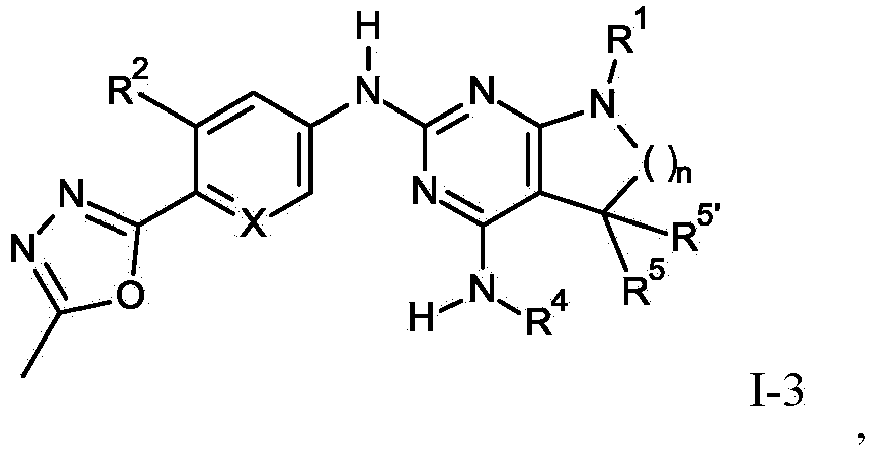 R1 Phenyl, C1-C7-Alkyl, C3-6-Cycloalkyl, -CH2-C3-6-Cycloalkyl oder verbrücktes C3-5-Cycloalkyl ist, gegebenenfalls substituiert mit einem, zwei oder drei Substituenten, ausgewählt aus Halogen, C1-C7-Alkyl oder halogensubstituiertem C1-C7-Alkyl;R2 Wasserstoff, Halogen, C1-C7-Alkoxy, halogensubstituiertes C1-C7-Alkyl oder halogensubstituiertes C1-C7-Alkoxy ist;R4 C1-C7-Alkyl oder hydroxysubstituiertes C1-C7-Alkyl ist;R5/R5' unabhängig voneinander Wasserstoff oder C1-C7-Alkyl sind;-( )n- -CH2- oder -CH2CH2- ist, wobei n 1 oder 2 ist;X CH oder N ist;oder pharmazeutisch aktive Säureadditionssalze davon, racemische Gemische oder ihre entsprechenden Enantiomere und/oder optischen Isomere und/oder Stereoisomere davon.
 - Verbindung der Formel I-3 nach Anspruch 6, wobei die Verbindung
7-(4-Fluorphenyl)-N2-(3-methoxy-4-(5-methyl-1,3,4-oxadiazol-2-yl)phenyl)-N4,5,5-trimethyl-6,7-dihydro-5H-pyrrolo[2,3-d]pyrimidin-2,4-diamin oder
7-(4-Fluorphenyl)-N4,5,5-trimethyl-N2-(4-(5-methyl-1,3,4-oxadiazol-2-yl)phenyl)-6,7-dihydro-5H-pyrrolo[2,3-d]pyrimidin-2,4-diamin ist. - Verbindung der Formel I-4 nach Anspruch 1,
 R1 Phenyl, C1-C7-Alkyl, C3-6-Cycloalkyl, -CH2-C3-6-Cycloalkyl oder verbrücktes C3-5-Cycloalkyl ist, gegebenenfalls substituiert mit einem, zwei oder drei Substituenten, ausgewählt aus Halogen, C1-C7-Alkyl oder halogensubstituiertem C1-C7-Alkyl;R2 Wasserstoff, Halogen, C1-C7-Alkoxy, halogensubstituiertes C1-C7-Alkyl oder halogensubstituiertes C1-C7-Alkoxy ist;R4 C1-C7-Alkyl oder hydroxysubstituiertes C1-C7-Alkyl ist;R5/R5' unabhängig voneinander Wasserstoff oder C1-C7-Alkyl sind;-( )n- -CH2- oder -CH2CH2- ist, wobei n 1 oder 2 ist;X CH oder N ist;oder pharmazeutisch aktive Säureadditionssalze davon, racemische Gemische oder ihre entsprechenden Enantiomere und/oder optischen Isomere und/oder Stereoisomere davon.
 - Verbindung der Formel I-4 nach Anspruch 8, wobei die Verbindung N2-(3-Fluor-4-(2-methyloxazol-5-yl)phenyl)-7-(4-fluorphenyl)-N4,5,5-trimethyl-6,7-dihydro-5H-pyrrolo[2,3-d]pyrimidin-2,4-diamin ist.
- Verfahren zum Herstellen einer Verbindung der Formel I, wie in einem der Ansprüche 1 - 9 definiert, wobei das Verfahren Folgendes umfassta) Reagieren einer Verbindung der Formel II


oderb) Reagieren einer Verbindung der Formel V
H2NR4
zu einer Verbindung der Formel
- Medikament, enthaltend eine oder mehrere Verbindungen nach einem der Ansprüche 1 - 9 und pharmazeutisch unbedenkliche Hilfsstoffe.
- Medikament nach Anspruch 11 zur Verwendung bei der Behandlung von Alzheimer-Krankheit, zerebraler Amyloidangiopathie, hereditärer zerebraler Hämorrhagie mit Amyloidose, holländischer Typ (HCHWA-D), Multiinfarkt-Demenz, Dementia pugilistica oder Down-Syndrom.
- Verbindung nach einem der Ansprüche 1 - 9 zur Verwendung als therapeutisch wirksame Substanz.
- Verbindung nach einem der Ansprüche 1 - 9 zur Verwendung bei der Behandlung von Alzheimer-Krankheit, zerebraler Amyloidangiopathie, hereditärer zerebraler Hämorrhagie mit Amyloidose, holländischer Typ (HCHWA-D), Multiinfarkt-Demenz, Dementia pugilistica oder Down-Syndrom.
Applications Claiming Priority (2)
| Application Number | Priority Date | Filing Date | Title |
|---|---|---|---|
| EP16178674 | 2016-07-08 | ||
| PCT/EP2017/066521 WO2018007331A1 (en) | 2016-07-08 | 2017-07-03 | Fused pyrimidine derivatives |
Publications (2)
| Publication Number | Publication Date |
|---|---|
| EP3481829A1 EP3481829A1 (de) | 2019-05-15 |
| EP3481829B1 true EP3481829B1 (de) | 2021-04-07 |
Family
ID=56372845
Family Applications (1)
| Application Number | Title | Priority Date | Filing Date |
|---|---|---|---|
| EP17734104.7A Active EP3481829B1 (de) | 2016-07-08 | 2017-07-03 | Kondensierte pyrimidinderivate |
Country Status (5)
| Country | Link |
|---|---|
| US (1) | US10669276B2 (de) |
| EP (1) | EP3481829B1 (de) |
| JP (1) | JP6975514B2 (de) |
| CN (1) | CN109415369B (de) |
| WO (1) | WO2018007331A1 (de) |
Families Citing this family (6)
| Publication number | Priority date | Publication date | Assignee | Title |
|---|---|---|---|---|
| EP3523304B1 (de) | 2016-10-04 | 2021-01-27 | H. Hoffnabb-La Roche Ag | Bicyclische heteroarylderivate |
| TW202034900A (zh) | 2018-10-02 | 2020-10-01 | 美商頻率醫療公司 | 有關耳用治療劑之醫藥組成物及方法 |
| EP3902805A4 (de) * | 2018-12-28 | 2023-03-01 | SPV Therapeutics Inc. | Cyclinabhängige kinaseinhibitoren |
| KR20220007050A (ko) | 2019-04-08 | 2022-01-18 | 프리퀀시 테라퓨틱스, 인크. | 난청을 치료하기 위한 chir99021과 발프로산의 조합 |
| CN110305140B (zh) * | 2019-07-30 | 2020-08-04 | 上海勋和医药科技有限公司 | 二氢吡咯并嘧啶类选择性jak2抑制剂 |
| EP4333852A4 (de) * | 2021-05-04 | 2025-03-26 | Enalare Therapeutics Inc. | Kaliumkanalmodulatoren mit hoher leitfähigkeit, zusammensetzungen davon, verfahren zur herstellung davon und verfahren zur verwendung davon |
Family Cites Families (13)
| Publication number | Priority date | Publication date | Assignee | Title |
|---|---|---|---|---|
| HRP20020599A2 (en) * | 2000-01-18 | 2004-08-31 | Pfizer Prod Inc | Corticotropin releasing factor antagonists |
| DK2050749T3 (en) | 2006-08-08 | 2018-01-08 | Chugai Pharmaceutical Co Ltd | PYRIMIDINE DERIVATIVES AS PI3K INHIBITOR AND USE THEREOF |
| MX2010006244A (es) * | 2007-12-06 | 2010-12-02 | Schering Corp | Moduladores de gamma secretasa. |
| CN101970433A (zh) * | 2007-12-11 | 2011-02-09 | 先灵公司 | γ分泌酶调节剂 |
| BR112012017310A2 (pt) | 2010-01-15 | 2016-04-19 | Janssen Pharmaceuticals Inc | derivados de triazol substituídos como moduladores de gama secretase |
| FR2964394B1 (fr) | 2010-09-03 | 2012-08-31 | Arkema France | Procede de delignification et de blanchiment de pate a papier au moyen de peroxyde d'hydrogene active |
| CN102093364B (zh) * | 2011-01-07 | 2015-01-28 | 北京赛林泰医药技术有限公司 | 作为FAK/Pyk2抑制剂的2,4-二氨基-6,7-二氢-5H-吡咯并[2,3]嘧啶衍生物 |
| WO2014195323A1 (en) * | 2013-06-04 | 2014-12-11 | Acturum Life Science AB | Pyrimidine compounds and their use as gamma secretase modulators |
| HUE035967T2 (hu) * | 2013-08-09 | 2018-06-28 | Gruenenthal Gmbh | Új helyettesített kondenzált pirimidinvegyületek |
| US9824250B2 (en) | 2013-11-04 | 2017-11-21 | Trimble Inc. | Location information within an area defined by a grid of radio-frequency tag circuits |
| WO2015109109A1 (en) | 2014-01-15 | 2015-07-23 | Forum Pharmaceuticals Inc. | Fused morpholinopyrimidines and methods of use thereof |
| US9833454B2 (en) | 2014-04-02 | 2017-12-05 | Bristol-Myers Squibb Company | Difluoromethoxy compound with low bioactivation potential for the reduction of beta-amyloid production |
| EP3484884B1 (de) * | 2016-07-14 | 2021-01-27 | Hoffmann-La Roche AG | Kondensierte pyrimidinderivate |
-
2017
- 2017-07-03 EP EP17734104.7A patent/EP3481829B1/de active Active
- 2017-07-03 JP JP2019500408A patent/JP6975514B2/ja active Active
- 2017-07-03 CN CN201780039858.0A patent/CN109415369B/zh active Active
- 2017-07-03 WO PCT/EP2017/066521 patent/WO2018007331A1/en not_active Ceased
-
2018
- 2018-12-21 US US16/231,177 patent/US10669276B2/en active Active
Non-Patent Citations (1)
| Title |
|---|
| None * |
Also Published As
| Publication number | Publication date |
|---|---|
| WO2018007331A1 (en) | 2018-01-11 |
| US10669276B2 (en) | 2020-06-02 |
| JP6975514B2 (ja) | 2021-12-01 |
| CN109415369A (zh) | 2019-03-01 |
| US20190256517A1 (en) | 2019-08-22 |
| CN109415369B (zh) | 2021-12-07 |
| JP2019520399A (ja) | 2019-07-18 |
| EP3481829A1 (de) | 2019-05-15 |
Similar Documents
| Publication | Publication Date | Title |
|---|---|---|
| EP3481829B1 (de) | Kondensierte pyrimidinderivate | |
| EP3484884B1 (de) | Kondensierte pyrimidinderivate | |
| EP3442947B1 (de) | Amine-substituierte aryl- oder heteroaryl-verbindungen als ehmt1 and ehmt2 inhibitoren | |
| EP3288945B1 (de) | Imidazopyrazine und pyrazolopyrimidine und ihre verwendung als ampa-rezeptormodulatoren | |
| TW202417455A (zh) | 新穎三雜環化合物及藥學組成物 | |
| JP2025532125A (ja) | 新規なテトラヘテロサイクル化合物 | |
| EP3519418B1 (de) | Verbrückte piperidinderivate | |
| EP3538516B1 (de) | Phenoxytriazole | |
| AU2019395774A1 (en) | 7-phenoxy-N-(3-azabicyclo[3.2.1]octan-8-yl)-6,7-dihydro-5H-pyrrolo[1,2-b][1,2,4]triazol-2-amine derivatives and related compounds as gamma-secretase modulators for the treatment of Alzheimer's disease | |
| EP3523304B1 (de) | Bicyclische heteroarylderivate | |
| CN116888127A (zh) | 三并环类hpk1抑制剂及其用途 | |
| EP3475279B1 (de) | Triazolopyridine als gamma-secretase-modulatoren | |
| EP3717472B1 (de) | Pyrimidinderivate | |
| KR102829709B1 (ko) | 바이사이클릭 헤테로아릴 유도체 | |
| CN117736198A (zh) | 大环含氮冠醚化合物及其作为蛋白激酶抑制剂的应用 | |
| HK40004853B (en) | Amine-substituted aryl or heteroaryl compounds as ehmt1 and ehmt2 inhibitors | |
| HK40004853A (en) | Amine-substituted aryl or heteroaryl compounds as ehmt1 and ehmt2 inhibitors | |
| HK40000736A (en) | Fused pyrimidine derivatives | |
| HK40000736B (zh) | 稠合嘧啶衍生物 |
Legal Events
| Date | Code | Title | Description |
|---|---|---|---|
| STAA | Information on the status of an ep patent application or granted ep patent |
Free format text: STATUS: UNKNOWN |
|
| STAA | Information on the status of an ep patent application or granted ep patent |
Free format text: STATUS: THE INTERNATIONAL PUBLICATION HAS BEEN MADE |
|
| PUAI | Public reference made under article 153(3) epc to a published international application that has entered the european phase |
Free format text: ORIGINAL CODE: 0009012 |
|
| STAA | Information on the status of an ep patent application or granted ep patent |
Free format text: STATUS: REQUEST FOR EXAMINATION WAS MADE |
|
| 17P | Request for examination filed |
Effective date: 20190208 |
|
| AK | Designated contracting states |
Kind code of ref document: A1 Designated state(s): AL AT BE BG CH CY CZ DE DK EE ES FI FR GB GR HR HU IE IS IT LI LT LU LV MC MK MT NL NO PL PT RO RS SE SI SK SM TR |
|
| AX | Request for extension of the european patent |
Extension state: BA ME |
|
| DAV | Request for validation of the european patent (deleted) | ||
| DAX | Request for extension of the european patent (deleted) | ||
| STAA | Information on the status of an ep patent application or granted ep patent |
Free format text: STATUS: EXAMINATION IS IN PROGRESS |
|
| 17Q | First examination report despatched |
Effective date: 20200123 |
|
| GRAP | Despatch of communication of intention to grant a patent |
Free format text: ORIGINAL CODE: EPIDOSNIGR1 |
|
| STAA | Information on the status of an ep patent application or granted ep patent |
Free format text: STATUS: GRANT OF PATENT IS INTENDED |
|
| INTG | Intention to grant announced |
Effective date: 20201126 |
|
| GRAS | Grant fee paid |
Free format text: ORIGINAL CODE: EPIDOSNIGR3 |
|
| GRAA | (expected) grant |
Free format text: ORIGINAL CODE: 0009210 |
|
| STAA | Information on the status of an ep patent application or granted ep patent |
Free format text: STATUS: THE PATENT HAS BEEN GRANTED |
|
| AK | Designated contracting states |
Kind code of ref document: B1 Designated state(s): AL AT BE BG CH CY CZ DE DK EE ES FI FR GB GR HR HU IE IS IT LI LT LU LV MC MK MT NL NO PL PT RO RS SE SI SK SM TR |
|
| REG | Reference to a national code |
Ref country code: GB Ref legal event code: FG4D |
|
| REG | Reference to a national code |
Ref country code: AT Ref legal event code: REF Ref document number: 1379560 Country of ref document: AT Kind code of ref document: T Effective date: 20210415 Ref country code: CH Ref legal event code: EP |
|
| REG | Reference to a national code |
Ref country code: DE Ref legal event code: R096 Ref document number: 602017036184 Country of ref document: DE |
|
| REG | Reference to a national code |
Ref country code: IE Ref legal event code: FG4D |
|
| REG | Reference to a national code |
Ref country code: LT Ref legal event code: MG9D |
|
| REG | Reference to a national code |
Ref country code: NL Ref legal event code: MP Effective date: 20210407 Ref country code: AT Ref legal event code: MK05 Ref document number: 1379560 Country of ref document: AT Kind code of ref document: T Effective date: 20210407 |
|
| PG25 | Lapsed in a contracting state [announced via postgrant information from national office to epo] |
Ref country code: FI Free format text: LAPSE BECAUSE OF FAILURE TO SUBMIT A TRANSLATION OF THE DESCRIPTION OR TO PAY THE FEE WITHIN THE PRESCRIBED TIME-LIMIT Effective date: 20210407 Ref country code: LT Free format text: LAPSE BECAUSE OF FAILURE TO SUBMIT A TRANSLATION OF THE DESCRIPTION OR TO PAY THE FEE WITHIN THE PRESCRIBED TIME-LIMIT Effective date: 20210407 Ref country code: AT Free format text: LAPSE BECAUSE OF FAILURE TO SUBMIT A TRANSLATION OF THE DESCRIPTION OR TO PAY THE FEE WITHIN THE PRESCRIBED TIME-LIMIT Effective date: 20210407 Ref country code: BG Free format text: LAPSE BECAUSE OF FAILURE TO SUBMIT A TRANSLATION OF THE DESCRIPTION OR TO PAY THE FEE WITHIN THE PRESCRIBED TIME-LIMIT Effective date: 20210707 Ref country code: HR Free format text: LAPSE BECAUSE OF FAILURE TO SUBMIT A TRANSLATION OF THE DESCRIPTION OR TO PAY THE FEE WITHIN THE PRESCRIBED TIME-LIMIT Effective date: 20210407 Ref country code: NL Free format text: LAPSE BECAUSE OF FAILURE TO SUBMIT A TRANSLATION OF THE DESCRIPTION OR TO PAY THE FEE WITHIN THE PRESCRIBED TIME-LIMIT Effective date: 20210407 |
|
| PG25 | Lapsed in a contracting state [announced via postgrant information from national office to epo] |
Ref country code: RS Free format text: LAPSE BECAUSE OF FAILURE TO SUBMIT A TRANSLATION OF THE DESCRIPTION OR TO PAY THE FEE WITHIN THE PRESCRIBED TIME-LIMIT Effective date: 20210407 Ref country code: SE Free format text: LAPSE BECAUSE OF FAILURE TO SUBMIT A TRANSLATION OF THE DESCRIPTION OR TO PAY THE FEE WITHIN THE PRESCRIBED TIME-LIMIT Effective date: 20210407 Ref country code: PT Free format text: LAPSE BECAUSE OF FAILURE TO SUBMIT A TRANSLATION OF THE DESCRIPTION OR TO PAY THE FEE WITHIN THE PRESCRIBED TIME-LIMIT Effective date: 20210809 Ref country code: PL Free format text: LAPSE BECAUSE OF FAILURE TO SUBMIT A TRANSLATION OF THE DESCRIPTION OR TO PAY THE FEE WITHIN THE PRESCRIBED TIME-LIMIT Effective date: 20210407 Ref country code: NO Free format text: LAPSE BECAUSE OF FAILURE TO SUBMIT A TRANSLATION OF THE DESCRIPTION OR TO PAY THE FEE WITHIN THE PRESCRIBED TIME-LIMIT Effective date: 20210707 Ref country code: IS Free format text: LAPSE BECAUSE OF FAILURE TO SUBMIT A TRANSLATION OF THE DESCRIPTION OR TO PAY THE FEE WITHIN THE PRESCRIBED TIME-LIMIT Effective date: 20210807 Ref country code: LV Free format text: LAPSE BECAUSE OF FAILURE TO SUBMIT A TRANSLATION OF THE DESCRIPTION OR TO PAY THE FEE WITHIN THE PRESCRIBED TIME-LIMIT Effective date: 20210407 Ref country code: GR Free format text: LAPSE BECAUSE OF FAILURE TO SUBMIT A TRANSLATION OF THE DESCRIPTION OR TO PAY THE FEE WITHIN THE PRESCRIBED TIME-LIMIT Effective date: 20210708 |
|
| REG | Reference to a national code |
Ref country code: DE Ref legal event code: R097 Ref document number: 602017036184 Country of ref document: DE |
|
| PG25 | Lapsed in a contracting state [announced via postgrant information from national office to epo] |
Ref country code: SK Free format text: LAPSE BECAUSE OF FAILURE TO SUBMIT A TRANSLATION OF THE DESCRIPTION OR TO PAY THE FEE WITHIN THE PRESCRIBED TIME-LIMIT Effective date: 20210407 Ref country code: SM Free format text: LAPSE BECAUSE OF FAILURE TO SUBMIT A TRANSLATION OF THE DESCRIPTION OR TO PAY THE FEE WITHIN THE PRESCRIBED TIME-LIMIT Effective date: 20210407 Ref country code: CZ Free format text: LAPSE BECAUSE OF FAILURE TO SUBMIT A TRANSLATION OF THE DESCRIPTION OR TO PAY THE FEE WITHIN THE PRESCRIBED TIME-LIMIT Effective date: 20210407 Ref country code: EE Free format text: LAPSE BECAUSE OF FAILURE TO SUBMIT A TRANSLATION OF THE DESCRIPTION OR TO PAY THE FEE WITHIN THE PRESCRIBED TIME-LIMIT Effective date: 20210407 Ref country code: DK Free format text: LAPSE BECAUSE OF FAILURE TO SUBMIT A TRANSLATION OF THE DESCRIPTION OR TO PAY THE FEE WITHIN THE PRESCRIBED TIME-LIMIT Effective date: 20210407 Ref country code: RO Free format text: LAPSE BECAUSE OF FAILURE TO SUBMIT A TRANSLATION OF THE DESCRIPTION OR TO PAY THE FEE WITHIN THE PRESCRIBED TIME-LIMIT Effective date: 20210407 Ref country code: ES Free format text: LAPSE BECAUSE OF FAILURE TO SUBMIT A TRANSLATION OF THE DESCRIPTION OR TO PAY THE FEE WITHIN THE PRESCRIBED TIME-LIMIT Effective date: 20210407 |
|
| PLBE | No opposition filed within time limit |
Free format text: ORIGINAL CODE: 0009261 |
|
| STAA | Information on the status of an ep patent application or granted ep patent |
Free format text: STATUS: NO OPPOSITION FILED WITHIN TIME LIMIT |
|
| 26N | No opposition filed |
Effective date: 20220110 |
|
| PG25 | Lapsed in a contracting state [announced via postgrant information from national office to epo] |
Ref country code: MC Free format text: LAPSE BECAUSE OF FAILURE TO SUBMIT A TRANSLATION OF THE DESCRIPTION OR TO PAY THE FEE WITHIN THE PRESCRIBED TIME-LIMIT Effective date: 20210407 |
|
| REG | Reference to a national code |
Ref country code: BE Ref legal event code: MM Effective date: 20210731 |
|
| PG25 | Lapsed in a contracting state [announced via postgrant information from national office to epo] |
Ref country code: IS Free format text: LAPSE BECAUSE OF FAILURE TO SUBMIT A TRANSLATION OF THE DESCRIPTION OR TO PAY THE FEE WITHIN THE PRESCRIBED TIME-LIMIT Effective date: 20210807 Ref country code: LU Free format text: LAPSE BECAUSE OF NON-PAYMENT OF DUE FEES Effective date: 20210703 Ref country code: AL Free format text: LAPSE BECAUSE OF FAILURE TO SUBMIT A TRANSLATION OF THE DESCRIPTION OR TO PAY THE FEE WITHIN THE PRESCRIBED TIME-LIMIT Effective date: 20210407 |
|
| PG25 | Lapsed in a contracting state [announced via postgrant information from national office to epo] |
Ref country code: IT Free format text: LAPSE BECAUSE OF FAILURE TO SUBMIT A TRANSLATION OF THE DESCRIPTION OR TO PAY THE FEE WITHIN THE PRESCRIBED TIME-LIMIT Effective date: 20210407 Ref country code: IE Free format text: LAPSE BECAUSE OF NON-PAYMENT OF DUE FEES Effective date: 20210703 Ref country code: BE Free format text: LAPSE BECAUSE OF NON-PAYMENT OF DUE FEES Effective date: 20210731 |
|
| PG25 | Lapsed in a contracting state [announced via postgrant information from national office to epo] |
Ref country code: CY Free format text: LAPSE BECAUSE OF FAILURE TO SUBMIT A TRANSLATION OF THE DESCRIPTION OR TO PAY THE FEE WITHIN THE PRESCRIBED TIME-LIMIT Effective date: 20210407 |
|
| PG25 | Lapsed in a contracting state [announced via postgrant information from national office to epo] |
Ref country code: HU Free format text: LAPSE BECAUSE OF FAILURE TO SUBMIT A TRANSLATION OF THE DESCRIPTION OR TO PAY THE FEE WITHIN THE PRESCRIBED TIME-LIMIT; INVALID AB INITIO Effective date: 20170703 |
|
| REG | Reference to a national code |
Ref country code: DE Ref legal event code: R082 Ref document number: 602017036184 Country of ref document: DE Representative=s name: KRAUS & LEDERER PARTGMBB, DE |
|
| PG25 | Lapsed in a contracting state [announced via postgrant information from national office to epo] |
Ref country code: MK Free format text: LAPSE BECAUSE OF FAILURE TO SUBMIT A TRANSLATION OF THE DESCRIPTION OR TO PAY THE FEE WITHIN THE PRESCRIBED TIME-LIMIT Effective date: 20210407 |
|
| PG25 | Lapsed in a contracting state [announced via postgrant information from national office to epo] |
Ref country code: TR Free format text: LAPSE BECAUSE OF FAILURE TO SUBMIT A TRANSLATION OF THE DESCRIPTION OR TO PAY THE FEE WITHIN THE PRESCRIBED TIME-LIMIT Effective date: 20210407 |
|
| PG25 | Lapsed in a contracting state [announced via postgrant information from national office to epo] |
Ref country code: MT Free format text: LAPSE BECAUSE OF FAILURE TO SUBMIT A TRANSLATION OF THE DESCRIPTION OR TO PAY THE FEE WITHIN THE PRESCRIBED TIME-LIMIT Effective date: 20210407 |
|
| PGFP | Annual fee paid to national office [announced via postgrant information from national office to epo] |
Ref country code: GB Payment date: 20250619 Year of fee payment: 9 |
|
| PGFP | Annual fee paid to national office [announced via postgrant information from national office to epo] |
Ref country code: FR Payment date: 20250620 Year of fee payment: 9 |
|
| PGFP | Annual fee paid to national office [announced via postgrant information from national office to epo] |
Ref country code: DE Payment date: 20250620 Year of fee payment: 9 |
|
| PGFP | Annual fee paid to national office [announced via postgrant information from national office to epo] |
Ref country code: CH Payment date: 20250801 Year of fee payment: 9 |