EP3483516A1 - Klimatisierungssteuerungsvorrichtung, klimatisierungssteuerungsverfahren, klimatisierungssystem und haus mit klimaanlage - Google Patents
Klimatisierungssteuerungsvorrichtung, klimatisierungssteuerungsverfahren, klimatisierungssystem und haus mit klimaanlage Download PDFInfo
- Publication number
- EP3483516A1 EP3483516A1 EP16908162.7A EP16908162A EP3483516A1 EP 3483516 A1 EP3483516 A1 EP 3483516A1 EP 16908162 A EP16908162 A EP 16908162A EP 3483516 A1 EP3483516 A1 EP 3483516A1
- Authority
- EP
- European Patent Office
- Prior art keywords
- room
- status
- time
- air
- rate
- Prior art date
- Legal status (The legal status is an assumption and is not a legal conclusion. Google has not performed a legal analysis and makes no representation as to the accuracy of the status listed.)
- Withdrawn
Links
Images









Classifications
-
- F—MECHANICAL ENGINEERING; LIGHTING; HEATING; WEAPONS; BLASTING
- F24—HEATING; RANGES; VENTILATING
- F24F—AIR-CONDITIONING; AIR-HUMIDIFICATION; VENTILATION; USE OF AIR CURRENTS FOR SCREENING
- F24F11/00—Control or safety arrangements
- F24F11/62—Control or safety arrangements characterised by the type of control or by internal processing, e.g. using fuzzy logic, adaptive control or estimation of values
-
- F—MECHANICAL ENGINEERING; LIGHTING; HEATING; WEAPONS; BLASTING
- F24—HEATING; RANGES; VENTILATING
- F24F—AIR-CONDITIONING; AIR-HUMIDIFICATION; VENTILATION; USE OF AIR CURRENTS FOR SCREENING
- F24F11/00—Control or safety arrangements
- F24F11/30—Control or safety arrangements for purposes related to the operation of the system, e.g. for safety or monitoring
- F24F11/46—Improving electric energy efficiency or saving
-
- F—MECHANICAL ENGINEERING; LIGHTING; HEATING; WEAPONS; BLASTING
- F24—HEATING; RANGES; VENTILATING
- F24F—AIR-CONDITIONING; AIR-HUMIDIFICATION; VENTILATION; USE OF AIR CURRENTS FOR SCREENING
- F24F11/00—Control or safety arrangements
- F24F11/70—Control systems characterised by their outputs; Constructional details thereof
- F24F11/80—Control systems characterised by their outputs; Constructional details thereof for controlling the temperature of the supplied air
-
- F—MECHANICAL ENGINEERING; LIGHTING; HEATING; WEAPONS; BLASTING
- F24—HEATING; RANGES; VENTILATING
- F24F—AIR-CONDITIONING; AIR-HUMIDIFICATION; VENTILATION; USE OF AIR CURRENTS FOR SCREENING
- F24F2120/00—Control inputs relating to users or occupants
- F24F2120/10—Occupancy
-
- F—MECHANICAL ENGINEERING; LIGHTING; HEATING; WEAPONS; BLASTING
- F24—HEATING; RANGES; VENTILATING
- F24F—AIR-CONDITIONING; AIR-HUMIDIFICATION; VENTILATION; USE OF AIR CURRENTS FOR SCREENING
- F24F2120/00—Control inputs relating to users or occupants
- F24F2120/10—Occupancy
- F24F2120/12—Position of occupants
-
- G—PHYSICS
- G05—CONTROLLING; REGULATING
- G05B—CONTROL OR REGULATING SYSTEMS IN GENERAL; FUNCTIONAL ELEMENTS OF SUCH SYSTEMS; MONITORING OR TESTING ARRANGEMENTS FOR SUCH SYSTEMS OR ELEMENTS
- G05B15/00—Systems controlled by a computer
- G05B15/02—Systems controlled by a computer electric
Definitions
- the present invention relates to an air-conditioning control apparatus, an air-conditioning control method, an air-conditioning system, and a house with air conditioner.
- control of an air conditioner is performed for increasing a target room temperature during heating and lowering the target room temperature during cooling when a person is present, and for lowering the target room temperature during heating and increasing the target room temperature during cooling when no person is present.
- a set temperature of a fan heater main body is set to 18 °C or 20 °C when presence of a human body is detected (paragraphs 0021 and 0022), while the set temperature of the fan heater main body is set to 15 °C or off when presence of a human body is not detected (paragraph 0023).
- an air-conditioning device is controlled based on a remote-controller set value when it is determined that a room is in a state of being in use, and control for absence is performed when it is determined that the room is in a state of being not in use (paragraph 0032).
- a purpose of the present invention is to improve comfort of air-conditioning and to reduce energy required for air-conditioning.
- the present invention is directed to an air-conditioning control apparatus.
- An air conditioner performs air-conditioning of a room to be air-conditioned.
- a presence-in-room status of at least one room including the room to be air-conditioned is acquired.
- the presence-in-room status of at least one room includes a presence-in-room status of the room to be air-conditioned.
- a time history of a presence-in-room status of at least one room is stored. From the time history of the presence-in-room status of at least one room, a conditional presence-in-room rate is calculated indicating a probability that a person is present in the room to be air-conditioned in response to a change in the presence-in-room status of at least one room.
- control is performed on the air conditioner such that an air-conditioning heat quantity decreases as the conditional presence-in-room rate decreases.
- the present invention is also directed to an air-conditioning control method, an air-conditioning system, and a house with air conditioner.
- a change in an in-room state of each room affecting an in-room state of the room to be air-conditioned is reflected in the air-conditioning heat quantity, and the air-conditioning heat quantity approaches one that is suitable for an in-room state of the room to be air-conditioned. This improves comfort of air-conditioning and reduces energy required for air-conditioning.
- a first embodiment relates to a house with air conditioner, an air-conditioning system, and a controller.
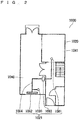
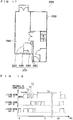
- Fig. 1 is a schematic view showing a first floor portion of a house in which an air-conditioning system of the first embodiment is to be installed.
- a house 1020 shown in Fig. 1 has a living room 1040, a kitchen 1041, a hall 1042, and a toilet 1043.
- Each of the living room 1040, the kitchen 1041, the hall 1042, and the toilet 1043 may be replaced by another type of room.
- the house 1020 may have rooms other than the living room 1040, the kitchen 1041, the hall 1042, and the toilet 1043.
- the house 1020 may have a dining room.
- the house 1020 does not have part or all of the living room 1040, the kitchen 1041, the hall 1042, and the toilet 1043.
- the house 1020 is configured such that a person can freely move from one room of the house 1020 to another room of the house 1020.
- the kitchen 1041, and the hall 1042 windows 1060, 1061, and 1062 are formed, respectively.
- an entrance 1063 is formed in the living room 1040.
- a stairway 1064 heading toward a second floor is installed in the hall 1042.
- Fig. 2 is a schematic view showing the house with air conditioner of the first embodiment.
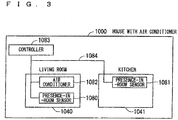
- Fig. 3 is a block diagram showing the house with air conditioner of the first embodiment.
- a house with air conditioner 1000 shown in Fig. 2 includes the house 1020 and an air-conditioning system 1021.
- the house with air conditioner 1000 may include components other than these components.
- the air-conditioning system 1021 includes a presence-in-room sensor 1080, a presence-in-room sensor 1081, an air conditioner 1082, a controller 1083, and a communication path 1084.
- the air-conditioning system 1021 may include components other than these components.
- the presence-in-room sensor 1080 is installed in the living room 1040 and detects a presence-in-room status of the living room 1040.
- the presence-in-room sensor 1081 is installed in the kitchen 1041 and detects a presence-in-room status of the kitchen 1041.
- the presence-in-room sensors 1080 and 1081 serve as detection mechanisms that detect presence-in-room statuses of the living room 1040 and the kitchen 1041.
- the presence-in-room status of the living room 1040 indicates whether or not a person is present in the living room 1040, and is in an in-room state or an absent state.
- the presence-in-room status of the kitchen 1041 indicates whether or not a person is present in the kitchen 1041, and is in an in-room state or an absent state. Presence-in-room statuses of three or more rooms including the living room 1040 and the kitchen 1041 may be detected.
- the air conditioner 1082 is installed in the living room 1040 and performs air-conditioning of the living room 1040 such that a room temperature of the living room 1040 approaches a target room temperature of the living room 1040.
- the air conditioner 1082 performs air-conditioning of the living room 1040 that is a target room for air-conditioning
- the presence-in-room sensor 1080 detects the presence-in-room status of the living room 1040 that is the target room for air-conditioning
- the presence-in-room sensor 1081 detects the presence-in-room status of the kitchen 1041 that is a second room different from the living room 1040 that is a first room.
- the target room for air-conditioning, that is, the first room may be a room other than the living room 1040.
- the second room may be a room other than the kitchen 1041.
- the controller 1083 is communicably coupled to each of the presence-in-room sensors 1080 and 1081 via the communication path 1084, receives a detection signal indicating the presence-in-room status of the living room 1040 from the presence-in-room sensor 1080 via the communication path 1084, and receives a detection signal indicating the presence-in-room status of the kitchen 1041 from the presence-in-room sensor 1081 via the communication path 1084.
- the controller 1083 is communicably connected to the air conditioner 1082 via the communication path 1084, and transmits a control signal indicating a target room temperature of the living room 1040 to the air conditioner 1082 via the communication path 1084.
- the controller 1083 functions as an air-conditioning control apparatus that controls the air conditioner 1082.
- Fig. 4 is a block diagram showing an air-conditioning system of the first embodiment.
- the controller 1083 includes a communication unit 1100, a central processing unit (CPU) 1101, a memory 1102, a timer 1104, and an input unit 1105.
- the controller 1083 may include components other than these components.
- the CPU 1101 By executing a control program for defining a control algorithm, the CPU 1101 functions as a conditional presence-in-room rate calculation unit 1121, a standard pattern calculation unit 1122, a control presence-in-room rate calculation unit 1123, and a target room temperature determination unit 1124.
- An arithmetic unit constituted of the CPU 1101 may be replaced with another type of arithmetic unit.
- the arithmetic unit constituted of the CPU 1101 may be replaced with an arithmetic unit constituted of an electronic circuit that does not execute a program, and the conditional presence-in-room rate calculation unit 1121, the standard pattern calculation unit 1122, the control presence-in-room rate calculation unit 1123, and the target room temperature determination unit 1124 may be implemented by an electronic circuit that does not execute a program.
- the communication unit 1100 is connected to each of the presence-in-room sensors 1080 and 1081 via the communication path 1084, receives a detection signal indicating a presence-in-room status of the living room 1040 from the presence-in-room sensor 1080, and receives a detection signal indicating a presence-in-room status of the kitchen 1041 from the presence-in-room sensor 1081.
- the communication unit 1100 functions as an acquisition unit that acquires presence-in-room statuses of the living room 1040 and the kitchen 1041 from the presence-in-room sensors 1080 and 1081.
- the communication unit 1100 causes the memory 1102 to store the obtained presence-in-room statuses of the living room 1040 and the kitchen 1041.
- the memory 1102 functions as a storage unit that stores a time history 1140 of a presence-in-room status of the living room 1040 and a time history 1141 of a presence-in-room status of the kitchen 1041.
- a storage device constituted of the memory 1102 may be replaced with another type of storage device.
- the storage device constituted of the memory 1102 may be replaced with a storage device constituted of a hard disk drive.
- the conditional presence-in-room rate calculation unit 1121 reads the time history 1140 of the presence-in-room status of the living room 1040 and the time history 1141 of the presence-in-room status of the kitchen 1041 from the memory 1102, calculates a conditional presence-in-room rate 1161 of the living room 1040 from the read time history 1140 of the presence-in-room status of the living room 1040 and from the read time history 1141 of the presence-in-room status of the kitchen 1041, and causes the memory 1102 to store the calculated conditional presence-in-room rate 1161 of the living room 1040.
- the conditional presence-in-room rate 1161 of the living room 1040 indicates a conditional probability, which is a probability that a person is present in the living room 1040 in response to a change from an in-room state to an absent state in the presence-in-room status of the kitchen 1041, and is a time series of the conditional probability.
- the standard pattern calculation unit 1122 reads the time history 1140 of the presence-in-room status of the living room 1040 from the memory 1102, calculates a standard pattern 1162 of the presence-in-room rate of the living room 1040 from the read time history 1140 of the presence-in-room status of the living room 1040, and causes the memory 1102 to store the calculated standard pattern 1162 of the presence-in-room rate of the living room 1040.
- the standard pattern 1162 of the presence-in-room rate of the living room 1040 indicates a standard probability that a person is present in the living room 1040, and is a time series of this probability.
- the timer 1104 measures a time period.
- the control presence-in-room rate calculation unit 1123 causes the timer 1104 to reset time measurement, causes the timer 1104 to start time measurement, and obtains a time period being measured from the timer 1104.
- the control presence-in-room rate calculation unit 1123 reads the conditional presence-in-room rate 1161 of the living room 1040 and the standard pattern 1162 of the presence-in-room rate of the living room 1040 from the memory 1102, obtains the time period being measured from the timer 1104, calculates a control presence-in-room rate 1180 to be used for controlling the air conditioner 1082, and causes the memory 1102 to store the calculated control presence-in-room rate 1180.
- the input unit 1105 accepts an input of a set room temperature 1200 of the living room 1040 by a user 1900 and causes the memory 1102 to store the input set room temperature 1200 of the living room 1040.
- the target room temperature determination unit 1124 reads the control presence-in-room rate 1180 and the set room temperature 1200 of the living room 1040 from the memory 1102, determines a target room temperature 1220 of the living room 1040, and causes the memory 1102 to store the determined target room temperature 1220 of the living room 1040.
- the target room temperature 1220 of the living room 1040 during heating in which the air conditioner 1082 performs heating decreases as the control presence-in-room rate 1180 decreases.
- the target room temperature 1220 of the living room 1040 during cooling in which the air conditioner 1082 performs cooling increases as the control presence-in-room rate 1180 decreases. Therefore, an air-conditioning heat quantity of the air conditioner 1082 decreases as the control presence-in-room rate 1180 decreases.
- the air-conditioning heat quantity of the air conditioner 1082 is an amount of heat supplied to the living room 1040 by the air conditioner 1082 during heating, and is an amount of heat recovered from the living room 1040 by the air conditioner 1082 during cooling.
- the target room temperature determination unit 1124 functions as a control unit that controls the air conditioner 1082 such that the air-conditioning heat quantity decreases as the control presence-in-room rate 1180 decreases.
- the communication unit 1100 reads the target room temperature 1220 of the living room 1040 from the memory 1102, and transmits a control signal indicating the read target room temperature 1220 of the living room 1040 to the air conditioner 1082 via the communication path 1084.
- Fig. 5 is a flowchart showing an operation of the controller before control of an air conditioner is performed in the first embodiment.
- step S101 shown in Fig. 5 the input unit 1105 determines whether or not there is an input of the set room temperature 1200 of the living room 1040. When there is the input, the process proceeds to step S102. When there is no input, the process proceeds to step S103.
- step S102 the input unit 1105 causes the memory 1102 to store the input set room temperature 1200 of the living room 1040.
- the set room temperature 1200 of the living room 1040 When the set room temperature 1200 of the living room 1040 is newly input in steps S101 and S102, the set room temperature 1200 of the living room 1040 that has been newly input and newly stored in the memory 1102 is used for controlling the air conditioner 1082, and when the set room temperature 1200 of the living room 1040 is not newly input, the set room temperature 1200 of the living room 1040 that has been input and stored in the memory 1102 in the past is used for controlling the air conditioner 1082.
- step S103 the communication unit 1100 determines whether or not an update timing of presence-in-room statuses of the living room 1040 and the kitchen 1041, which are to be periodically updated, has arrived.
- the process proceeds to step S104.
- the process proceeds to step S101 again.
- the input unit 1105 repeatedly accepts an input of the set room temperature 1200 of the living room 1040 until the update timing arrives.
- step S104 the communication unit 1100 receives presence-in-room statuses of the living room 1040 and the kitchen 1041, and causes the memory 1102 to store the received presence-in-room statuses of the living room 1040 and the kitchen 1041.
- presence-in-room statuses of the living room 1040 and the kitchen 1041 stored in the memory 1102 in the past are kept stored in the memory 1102 without being erased from the memory 1102 until a certain time period elapses.
- the time history 1140 of the presence-in-room status of the living room 1040 and the time history 1141 of the presence-in-room status of the kitchen 1041 are stored.
- step S105 the standard pattern calculation unit 1122 calculates the standard pattern 1162 of a presence-in-room rate of the living room 1040, and in step S106 following step S105, the standard pattern calculation unit 1122 causes the memory 1102 to store the calculated standard pattern 1162 of the presence-in-room rate of the living room 1040.
- step S107 the conditional presence-in-room rate calculation unit 1121 calculates the conditional presence-in-room rate 1161 of the living room 1040, and in step S108 following step S107, the conditional presence-in-room rate calculation unit 1121 causes the memory 1102 to store the calculated conditional presence-in-room rate 1161 of the living room 1040.
- step S109 it is determined whether or not the operation of the air-conditioning system 1021 has been ended.
- the process is ended.
- the process proceeds to step S101 again.
- the set room temperature 1200 of the living room 1040 to be used for controlling the air conditioner 1082 is updated each time the set room temperature 1200 of the living room 1040 is input, and the presence-in-room status of the living room 1040, the presence-in-room status of the kitchen 1041, the conditional presence-in-room rate 1161 of the living room 1040, and the standard pattern 1162 of the presence-in-room rate of the living room 1040 are updated each time the update timing of the presence-in-room statuses of the living room 1040 and the kitchen 1041 arrives.
- conditional presence-in-room rate 1161 of the living room 1040 and the standard pattern 1162 of the presence-in-room rate of the living room 1040 are not necessarily updated each time the update timing of the presence-in-room statuses of the living room 1040 and the kitchen 1041 arrives. Therefore, the conditional presence-in-room rate 1161 of the living room 1040 and the standard pattern 1162 of the presence-in-room rate of the living room 1040 are allowed to be updated, for example, only once a day or once a month.
- Fig. 6 is a flowchart showing an operation of the controller when control of the air conditioner is performed in the first embodiment.
- step S111 shown in Fig. 6 the control presence-in-room rate calculation unit 1123 calculates the control presence-in-room rate 1180, and in step S112 following step S111, the control presence-in-room rate calculation unit 1123 causes the memory 1102 to store the calculated control presence-in-room rate 1180.
- step S113 the target room temperature determination unit 1124 determines the target room temperature 1220 of the living room 1040, and in step S114 following step S113, the target room temperature determination unit 1124 causes the memory 1102 to store the determined target room temperature 1220 of the living room 1040.
- step S115 following step S114 the communication unit 1100 transmits the determined target room temperature 1220 of the living room 1040 to the air conditioner 1082.
- step S116 it is determined whether or not the operation of the air conditioner 1082 has been ended.
- the process is ended.
- the process proceeds to step S111 again.
- the control presence-in-room rate 1180 and the target room temperature 1220 of the living room 1040 are repeatedly updated.
- Fig. 7 is a view for explaining random variables in the first embodiment.
- a random variable A shown in Fig. 7 expresses a presence-in-room status of the living room 1040.
- a random variable B shown in Fig. 7 expresses an occurrence state of an event that a presence-in-room status of the kitchen 1041 has changed from an absent state to an in-room state.
- the random variable A takes an in-room state A0 or an absent state A1.
- the random variable B takes a state B0 in which the event has occurred or a state B1 in which the event has not occurred.
- the random variable A When the target room for air-conditioning is changed to a room other than the living room 1040, what is expressed by the random variable A is changed to a presence-in-room status of the room other than the living room 1040.
- What is expressed by the random variable B may be changed to other than the occurrence state of the event that the presence-in-room status of the kitchen 1041 has changed from an absent state to an in-room state.
- what is expressed by the random variable B may be changed to an occurrence state of an event that a time period during which a presence-in-room status of the kitchen 1041 or the room other than the kitchen 1041 continues to be in an absent state is a set time period or more.
- a probability P that a person is present in the living room 1040 is obtained by dividing the number of counts that a presence-in-room status of the living room 1040 has been in an in-room state in the past by the total number of counts of the number of counts that the presence-in-room status of the living room 1040 has been in an in-room state in the past and the number of counts that the presence-in-room status of the living room 1040 has been in an absent state in the past.
- the probability P expresses the standard pattern 1162 of the presence-in-room rate of the living room 1040. From the standard pattern 1162 of the presence-in-room rate of the living room 1040, a habit regarding a time at which a person is present in the living room 1040 and the like is grasped.
- Fig. 8 is a time chart showing a time history of a presence-in-room status of a living room when a person has a habit of staying in the living room at a specific time.
- Fig. 9 is a graph showing a standard pattern of a presence-in-room rate of a living room when a person has a habit of staying in the living room at a specific time in the first embodiment.
- a standard pattern 1162 of a presence-in-room rate of the living room 1040 shown in Fig. 9 is obtained from a time history 1140 of a presence-in-room status of the living room 1040 shown in Fig. 8 .
- the standard pattern 1162 of the presence-in-room rate of the living room 1040 having clear peaks at around 7 o'clock and around 19 o'clock is obtained as shown in Fig. 9 .
- the target room temperature 1220 of the living room 1040 during heating is brought close to the set room temperature 1200 of the living room 1040 while the target room temperature 1220 of the living room 1040 during cooling is brought close to the set room temperature 1200 of the living room 1040 when the presence-in-room status of the living room 1040 is in an absent state but a possibility that a person enters the living room 1040 is high. Therefore, when a person enters the living room 1040, there is a high possibility that a thermal environment of the living room 1040 is in a comfortable state.
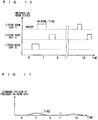
- Fig. 10 is a time chart showing a time history of a presence-in-room status of the living room when a person does not have a habit of staying in the living room at a specific time.
- Fig. 11 is a graph showing a standard pattern of a presence-in-room rate of the living room when a person does not have a habit of staying in the living room at a specific time in the first embodiment.
- a standard pattern 1162 of a presence-in-room rate of the living room 1040 shown in Fig. 11 is obtained from a time history 1140 of a presence-in-room status of the living room 1040 shown in Fig. 10 .
- the standard pattern 1162 of the presence-in-room rate of the living room 1040 having no definite peak is obtained as shown in Fig. 11 .
- the standard pattern 1162 of the presence-in-room rate of the living room 1040 shown in Fig. 11 is obtained when the control presence-in-room rate 1180 is the standard pattern 1162 of the presence-in-room rate of the living room 1040, and the target room temperature 1220 of the living room 1040 during heating increases and the target room temperature 1220 of the living room 1040 during cooling decreases as the control presence-in-room rate 1180 increases, the target room temperature 1220 of the living room 1040 during heating is maintained lower than the set room temperature 1200 of the living room 1040 while the target room temperature 1220 of the living room 1040 during cooling is maintained higher than the set room temperature 1200 of the living room 1040 when the presence-in-room status of the living room 1040 is in an absent state.
- Fig. 12 is shows a time history of presence-in-room statuses of a living room and a kitchen when a person does not have a habit of staying in the living room at a specific time.
- the time history 1140 of the presence-in-room status of the living room 1040 shown in Fig. 12 is the same as the time history 1140 of the presence-in-room status of the living room 1040 shown in Fig. 10 .
- a time period from a time at which the presence-in-room status of the kitchen 1041 has changed from an in-room state to an absent state to a time at which the presence-in-room status of the living room 1040 has changed from an absent state to an in-room state is 30 to 60 minutes, which is approximately constant.
- a time period from the time at which the presence-in-room status of the kitchen 1041 has changed from an in-room state to an absent state to the time at which the presence-in-room status of the living room 1040 has changed from an absent state to an in-room state has regularity.
- This regularity comes from people's habit of cooking in the kitchen 1041, dining in the dining room, and spending time in the living room 1040.
- the control presence-in-room rate 1180 changes from the standard pattern 1162 of the presence-in-room rate of the living room 1040 to the conditional presence-in-room rate 1161 of the living room 1040, thereby an actual presence-in-room status of the living room 1040 is reflected by the control presence-in-room rate 1180.
- conditional presence-in-room rate 1161 of the living room 1040 is calculated by using, as prior information, the random variable B expressing the occurrence state of the event that the presence-in-room status of the kitchen 1041 has changed from an absent state to an in-room state.
- B0) expressing the conditional presence-in-room rate 1161 of the living room 1040 is 1, as shown in Equation 2. Equation 2 P A 0
- B 0 1
- B0) expressing the conditional presence-in-room rate 1161 of the living room 1040 is less than 1, as shown in Equation 3. Equation 3 P A0
- the time history 1140 of the presence-in-room status of the living room 1040 includes a time history of a presence-in-room status of the living room 1040 for the past M days.
- a time history of the presence-in-room status of the living room 1040 for one day includes N presence-in-room statuses of living room 1040.
- the N presence-in-room statuses of the living room 1040 are discretely recorded.
- the standard pattern 1162 of the presence-in-room rate of the living room 1040 may be calculated by another method. For example, a technique described in Japanese Patent Publication No. 3119082 may be used, the time history 1140 of the presence-in-room status of the living room 1040 may be classified into a plurality of clusters, a standard pattern of the presence-in-room rate of the living room 1040 may be created for each of the plurality of clusters, a cluster that is most similar to the time history of the presence-in-room status of the living room 1040 on that day may be selected from the plurality of clusters, and the standard pattern of the presence-in-room rate of the living room 1040 created for the selected cluster may be set as the standard pattern 1162 of the presence-in-room rate of the living room 1040 on that day.
- the standard pattern 1162 of the presence-in-room rate of the living room 1040 is calculated and stored in the memory 1102 before control of the air conditioner 1082 is performed.
- the conditional presence-in-room rate 1161 of the living room 1040 indicates a probability that a person is present in the living room 1040 by a second time after a set time period T2 from a first time at which a change from an in-room state to an absent state has occurred in the presence-in-room status of the kitchen 1041.
- the set time period T2 may be a fixed value or may be a variable value that can be changed by the user 1900.
- the conditional presence-in-room rate 1161 of the living room 1040 is calculated to take a value between the first time and the second time. Thus, only when an elapsed time from the first time is short and the conditional presence-in-room rate 1161 of the living room 1040 is accurately calculated, the conditional presence-in-room rate 1161 of the living room 1040 is used for controlling the air conditioner 1082.
- conditional presence-in-room rate 1161 of the living room 1040 In the calculation of the conditional presence-in-room rate 1161 of the living room 1040 by the conditional presence-in-room rate calculation unit 1121, the number of counts N2 that a change from an in-room state to an absent state has occurred in the presence-in-room status of the kitchen 1041 is obtained from the time history 1141 of the presence-in-room status of the kitchen 1041.
- the number of counts n2(t) indicating the number of changes in the presence-in-room status of the living room 1040 to an in-room state between the first time and a time after a time period t from the first time is obtained.
- the number of counts n2(t) is obtained for each of all possible values of t between 0 and T2.
- the number of counts n2(t) indicating the number of changes in the presence-in-room status of the living room 1040 to an in-room state between the first time and the second time after the set time period T2 from the first time is also obtained.
- the number of counts that the presence-in-room status of the living room 1040 becomes an in-room state between the time after the time period t from the first time and the second time is n2(T2) - n2(t).
- the conditional presence-in-room rate 1161 of the living room 1040 is a ratio of a count difference n2(T2) - n2(t) obtained by subtracting the number of counts n2(t) from the number of counts n2(T2) to the first number of counts N2, as shown in Equation 5. Equation 5 n 2 T 2 ⁇ n 2 t N 2
- conditional presence-in-room rate 1161 of the living room 1040 is the ratio shown in the Equation 5 at the time after the time period t from the first time
- a value of the conditional presence-in-room rate 1161 of the living room 1040 taken at the time after the time period t from the first time decreases as the ratio of the number of counts n2(t) to the number of counts N2 increases. This reflects that the possibility that a person is present in the living room 1040 by the second time decreases as the ratio of the number of counts n2(t) to the number of counts N2 increases.
- conditional presence-in-room rate 1161 of the living room 1040 is calculated and stored in the memory 1102 before control of the air conditioner 1082 is performed.
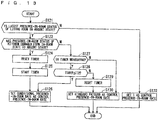
- Fig. 13 is a flowchart showing an operation of the controller when a control presence-in-room rate is calculated in the first embodiment.
- step S121 shown in Fig. 13 the control presence-in-room rate calculation unit 1123 determines whether or not a latest presence-in-room status of the living room 1040 is in an absent state. When the presence-in-room status is not in an absent state, the process proceeds to step S122. When the presence-in-room status is in an absent state, the process proceeds to step S123.
- step S122 the control presence-in-room rate calculation unit 1123 sets 1 as the control presence-in-room rate 1180.
- the air conditioner 1082 is controlled such that the target room temperature 1220 of the living room 1040 serves as the set room temperature 1200 of the living room 1040.
- step S123 the control presence-in-room rate calculation unit 1123 compares a latest presence-in-room status of the kitchen 1041 with a presence-in-room status of the kitchen 1041 immediately before thereof, and determines whether or not a change from an in-room state to an absent state has occurred in the presence-in-room status of the kitchen 1041.
- the process proceeds to step S124.
- step S127 the process proceeds to step S127 when a state where the presence-in-room status of the kitchen 1041 is in an in-room state is continuing, or a state where the presence-in-room status of the kitchen 1041 is in an absent state is continuing.
- step S124 the control presence-in-room rate calculation unit 1123 causes the timer 1104 to reset time measurement
- step S125 following step S124 the control presence-in-room rate calculation unit 1123 causes the timer 1104 to start time measurement.
- the timer 1104 can measure an elapsed time from a time at which a change from an in-room state to an absent state has occurred in the presence-in-room status of the kitchen 1041, and the control presence-in-room rate calculation unit 1123 can obtain this elapsed time from the timer 1104.
- step S126 the control presence-in-room rate calculation unit 1123 sets the conditional presence-in-room rate 1161 of the living room 1040 as the control presence-in-room rate 1180, and the process is ended.
- the air conditioner 1082 is controlled such that the air-conditioning heat quantity decreases as the conditional presence-in-room rate 1161 of the living room 1040 decreases.
- step S127 the control presence-in-room rate calculation unit 1123 determines whether or not the timer 1104 is measuring a time period. When the timer 1104 is measuring a time period, the process proceeds to step S128. When the timer 1104 is not measuring a time period, the process proceeds to step S130.
- step S1208 the control presence-in-room rate calculation unit 1123 determines whether or not the time period being measured by the timer 1104 is equal to or less than the set time period T2. When the time period is equal to or less than the set time period T2, the process proceeds to step S126. When the time period is not equal to or not less than the set time period T2, the process proceeds to step S129.
- step S126 the control presence-in-room rate calculation unit 1123 sets the conditional presence-in-room rate 1161 of the living room 1040 as the control presence-in-room rate 1180, and the process is ended.
- the air conditioner 1082 is controlled such that the air-conditioning heat quantity decreases as the conditional presence-in-room rate 1161 of the living room 1040 decreases.
- step S129 the control presence-in-room rate calculation unit 1123 causes the timer 1104 to reset time measurement.
- step S130 following step S129 the control presence-in-room rate calculation unit 1123 sets the standard pattern 1162 of the presence-in-room rate of the living room 1040 as the control presence-in-room rate 1180, and the process is ended.
- the air conditioner 1082 is controlled such that the air-conditioning heat quantity decreases as the standard pattern 1162 of the presence-in-room rate of the living room 1040 decreases.
- the control presence-in-room rate 1180 adopts the conditional presence-in-room rate 1161 of the living room 1040 immediately after the first time at which a change from an in-room state to an absent state has occurred in the presence-in-room status of the kitchen 1041.
- the control presence-in-room rate 1180 that adopts the conditional presence-in-room rate 1161 of the living room 1040 remains to be the conditional presence-in-room rate 1161 of the living room 1040 until the presence-in-room status of the living room 1040 changes to an in-room state or until the second time after the set time period T2 from the first time.
- the control presence-in-room rate 1180 that adopts the conditional presence-in-room rate 1161 of the living room 1040 changes to 1 when the presence-in-room status of the living room 1040 has changed to an in-room state, and changes to the standard pattern 1162 of the presence-in-room rate of the living room 1040 after the second time.
- the air conditioner 1082 is controlled such that the air-conditioning heat quantity decreases as the conditional presence-in-room rate 1161 of the living room 1040 decreases.
- This control is continued until the presence-in-room status of the living room 1040 changes to an in-room state or until the second time after the set time period T2 from the first time.
- the air conditioner 1082 is controlled such that the air-conditioning heat quantity decreases as the standard pattern 1162 of the presence-in-room rate of the living room 1040 decreases.
- the target room temperature 1220 of the living room 1040 during heating is equal to or higher than a lower limit value and equal to or lower than an upper limit value, and increases as the control presence-in-room rate 1180 increases.
- the upper limit value of the target room temperature 1220 of the living room 1040 during heating is the set room temperature 1200 of the living room 1040.
- the lower limit value of the target room temperature 1220 of the living room 1040 during heating is predetermined.
- the target room temperature 1220 of the living room 1040 during cooling is equal to or higher than a lower limit value and equal to or lower than an upper limit value, and decreases as the control presence-in-room rate 1180 increases.
- the lower limit value of the target room temperature 1220 of the living room 1040 during cooling is the set room temperature 1200 of the living room 1040.
- the upper limit value of the target room temperature 1220 of the living room 1040 during cooling is predetermined.
- Each of the lower limit value of the target room temperature 1220 of the living room 1040 during heating and the upper limit value of the target room temperature 1220 of the living room 1040 during cooling may be a fixed value determined not to lose comfort or may be a variable value that can be changed by the user 1900 depending on the situation.
- Fig. 14 is a graph showing a relationship between a control presence-in-room rate and a target room temperature of the living room during heating in the first embodiment.
- the target room temperature 1220 of the living room 1040 during heating linearly increases as the control presence-in-room rate 1180 increases. According to the relationship between the control presence-in-room rate 1180 and the target room temperature 1220 of the living room 1040 during heating shown in Fig.
- the target room temperature 1220 of the living room 1040 during heating is brought close to the set room temperature 1200 of the living room 1040, which is the upper limit value, and comfort of air-conditioning is improved, while in a case where the control presence-in-room rate 1180 is low, the target room temperature 1220 of the living room 1040 during heating is brought close to the lower limit value, and energy required for air-conditioning is reduced.
- Fig. 15 is a graph showing a relationship between a control presence-in-room rate and a target room temperature of the living room during heating in the first embodiment.
- a line indicating the relationship between the control presence-in-room rate 1180 and the target room temperature 1220 of the living room during heating has a sigmoid curve shape, and the target room temperature 1220 of the living room 1040 during heating nonlinearly increases as the control presence-in-room rate 1180 increases.
- the target room temperature 1220 of the living room 1040 during heating becomes extremely close to the lower limit value
- the target room temperature 1220 of the living room 1040 during heating is extremely close to the set room temperature 1200 of the living room 1040, which is the upper limit value
- the target room temperature 1220 of the living room 1040 increases as the control presence-in-room rate 1180 during heating increases.
- the target room temperature 1220 of the living room 1040 during heating is brought close to the set room temperature 1200 of the living room 1040, which is the upper limit value, and comfort of air-conditioning is improved
- the target room temperature 1220 of the living room 1040 during heating is brought close to the lower limit value, and energy required for air-conditioning is reduced.
- the effect of improving comfort of air-conditioning increases when the control presence-in-room rate 1180 is high, and the effect of reducing energy required for air-conditioning increases when the control presence-in-room rate 1180 is low.
- the relationship between the control presence-in-room rate 1180 and the target room temperature 1220 of the living room 1040 during heating may be other than those shown in Fig. 14 or Fig. 15 .
- the relationship between the control presence-in-room rate 1180 and the target room temperature 1220 of the living room 1040 during heating is defined such that, when considering the target room temperature 1220 of the living room 1040 during heating, which is a function of the control presence-in-room rate 1180, the function is a monotonically increasing function, and the target room temperature 1220 of the living room 1040 during heating takes a value equal to or greater than the lower limit value and equal to or less than the set room temperature 1200 of the living room 1040, which is the upper limit value.
- the relationship between the control presence-in-room rate 1180 and the target room temperature 1220 of the living room 1040 during cooling is defined such that, when considering the target room temperature 1220 of the living room 1040, which is a function of the control presence-in-room rate 1180, the function is a monotonically decreasing function, and the target room temperature 1220 of the living room 1040 during cooling takes a value that is equal to or greater than the set room temperature 1200 of the living room 1040, which is the lower limit value, and is equal to or less than the upper limit value.
- Fig. 16 is a time chart showing an operation example of the air conditioner in the first embodiment.
- Fig. 16 shows a time history 1141 of a presence-in-room status of the kitchen 1041, a standard pattern 1162 of a presence-in-room rate of the living room 1040, a time history 1140 of a presence-in-room status of the living room 1040, a target room temperature 1221 when control as a reference example is performed, a control presence-in-room rate 1180, and a target room temperature 1220 when control as an implementation example is performed.
- the control presence-in-room rate 1180 is 1 when a presence-in-room status of the living room 1040 is in an in-room state. Further, when the presence-in-room status of the living room 1040 is in an absent state, between a time ta at which the presence-in-room status of the kitchen 1041 has changed from an in-room state to an absent state and a time tb at which the presence-in-room status of the living room 1040 has changed from an absent state to an in-room state, the control presence-in-room rate 1180 adopts the conditional presence-in-room rate 1161 of the living room 1040, and after the second time, the control presence-in-room rate 1180 adopts the standard pattern 1162 of the presence-in-room rate of the living room 1040.
- the target room temperature 1220 of the living room 1040 adopts the set room temperature 1200 of the living room 1040, and when the presence-in-room status of the living room 1040 is in an absent state, the target room temperature 1220 of the living room 1040 increases as the conditional presence-in-room rate 1161 of the living room 1040 increases between the time ta and the time tb, and the target room temperature 1220 of the living room 1040 increases as the standard pattern 1162 of the presence-in-room rate of the living room 1040 increases after the second time.
- the control presence-in-room rate 1180 is 1 when a presence-in-room status of the living room 1040 is in an in-room state. Further, when the presence-in-room status of the living room 1040 is an absent state, the control presence-in-room rate 1180 adopts the standard pattern 1162 of the presence-in-room rate of the living room 1040. Therefore, as shown in Fig.
- the target room temperature 1221 of the living room 1040 adopts the set room temperature 1200 of the living room 1040, and when the presence-in-room status of the living room 1040 is in an absent state, the target room temperature 1221 of the living room 1040 increases as the standard pattern 1162 of the presence-in-room rate of the living room 1040 increases.
- the target room temperature 1220 of the living room 1040 when the control as the implementation example is performed is different from the target room temperature 1221 of the living room 1040 when the control as the reference example is performed in that the target room temperature 1220 of the living room 1040 increases as the conditional presence-in-room rate 1161 of the living room 1040 increases between the time ta and the time tb.
- the target room temperature 1220 of the living room 1040 increases when the control as the implementation example is performed, and the target room temperature 1221 of the living room 1040 decreases when the control as the reference example is performed, between the time ta and the time tb.
- the room temperature of the living room 1040 is close to the set room temperature 1200 when a person enters the living room 1040, but in a case where the control as the reference example is performed, the room temperature of the living room 1040 has not become close to the set room temperature 1200 when a person enters the living room 1040, and it takes time until the room temperature of the living room 1040 approaches the set room temperature 1200.
- a change from an in-room state to an absent state in a presence-in-room status of the kitchen 1041, which affects the presence-in-room status of the living room 1040, is reflected in the air-conditioning heat quantity, and the air-conditioning heat quantity approaches the one suitable for the presence-in-room status of the living room 1040. This improves comfort of air-conditioning and reduces energy required for air-conditioning.
- a second embodiment relates to a house with air conditioner, an air-conditioning system, and a controller.
- a main difference between the first embodiment and the second embodiment is that, in the first embodiment, the prior information of the conditional presence-in-room rate 1161 of the living room 1040 is an occurrence state of a change from an in-room state to an absent state in the presence-in-room status of the kitchen 1041, but in the second embodiment, prior information of a conditional presence-in-room rate of the living room is an occurrence state of exceeding of a threshold value of a time period during which a presence-in-room status of the living room is in an absent state.
- a main difference between the first embodiment and the second embodiment is also that, in the first embodiment, a change from an in-room state to an absent state in the presence-in-room status of the kitchen 1041 serves as a trigger to use the conditional presence-in-room rate 1161 of the living room 1040, but in the second embodiment, a change from an in-room state to an absent state in the presence-in-room status of the living room serves as a trigger to use a conditional presence-in-room rate of the living room.
- the technique adopted in the first embodiment may also be adopted in the second embodiment as long as the above main difference is not lost.
- Fig. 17 is a schematic view showing a house with air conditioner of the second embodiment.
- a house with air conditioner 2000 shown in Fig. 17 includes a house 2020 and an air-conditioning system 2021.
- the house 2020 has a living room 2040.
- the air-conditioning system 2021 includes a presence-in-room sensor 2080, an air conditioner 2082, a controller 2083, and a communication path 2084.
- the house 2020 and the living room 2040 are similar to the house 1020 and the living room 1040 of the first embodiment, respectively.
- the presence-in-room sensor 2080 is installed in the living room 2040 and detects a presence-in-room status of the living room 2040.
- the presence-in-room sensor 2080 serves as a detection mechanism that detects a presence-in-room status of the living room 2040.
- the air conditioner 2082 is installed in the living room 2040 and performs air-conditioning of the living room 2040 such that a room temperature of the living room 2040 approaches a set room temperature of the living room 2040.
- the controller 2083 is communicably connected to the presence-in-room sensor 2080 via the communication path 2084 and receives a detection signal indicating a presence-in-room status of the living room 2040 from the presence-in-room sensor 2080 via the communication path 2084.
- the controller 2083 is communicably connected to the air conditioner 2082 via the communication path 2084, and transmits a control signal indicating a target room temperature of the living room 2040, to the air conditioner 2082 via the communication path 2084.
- the controller 2083 functions as an air-conditioning control apparatus that controls the air conditioner 2082.
- Fig. 18 is a time chart showing a time history of a presence-in-room status of the living room.
- time history of the presence-in-room status of the living room 2040 shown in Fig. 18 changes from an in-room state to an absent state in the presence-in-room status of the living room 2040 and changes from an absent state to an in-room state in the presence-in-room status of the living room 2040 frequently occur.
- the time history of the presence-in-room status of the living room 2040 shown in Fig. 18 is obtained in a case where a person enters the living room 2040 and a person leaves from the living room 2040 frequently.
- a set room temperature of the living room 2040 is set as the target room temperature of the living room 2040 when the presence-in-room status of the living room 2040 is in an in-room state
- a target room temperature 2220 of the living room 2040 increases as a standard pattern of a presence-in-room rate of the living room 2040 increases when the presence-in-room status of the living room 2040 is in an absent state
- the target room temperature fluctuates frequently in the living room 2040 when the time history of the presence-in-room status of the living room 2040 is as shown in Fig. 18 .
- the time period during which the presence-in-room status of the living room 2040 is in an absent state is measured by a timer or the like, and the air conditioner 2082 is controlled to set the set room temperature of the living room 2040 as the target room temperature of the living room 2040 when the measured time period does not exceed the threshold value, and to lower the target room temperature of the living room 2040 during heating and increase the target room temperature of the living room 2040 during cooling when the measured time period exceeds the threshold value.
- Fig. 19 is a block diagram showing an air-conditioning system of the second embodiment.
- the controller 2083 includes a communication unit 2100, a CPU 2101, a memory 2102, a timer 2103, and an input unit 2105.
- the CPU 2101 functions as a conditional presence-in-room rate calculation unit 2120, a standard pattern calculation unit 2122, a control presence-in-room rate calculation unit 2123, and a target room temperature determination unit 2124.
- the communication unit 2100 is connected to the presence-in-room sensor 2080 via the communication path 2084 and receives a detection signal indicating a presence-in-room status of the living room 2040, from the presence-in-room sensor 2080.
- the communication unit 2100 functions as an acquisition unit that acquires a presence-in-room status of the living room 2040, from the presence-in-room sensor 2080.
- the communication unit 2100 causes the memory 2102 to store the obtained presence-in-room status of the living room 2040.
- the memory 2102 functions as a storage unit that stores a time history 2140 of a presence-in-room status of the living room 2040.
- the conditional presence-in-room rate calculation unit 2120 reads the time history 2140 of the presence-in-room status of the living room 2040 from the memory 2102, calculates a conditional presence-in-room rate 2160 of the living room 2040 from the read time history 2140 of the presence-in-room status of the living room 2040, and causes the memory 2102 to store the calculated conditional presence-in-room rate 2160 of the living room 2040.
- the conditional presence-in-room rate 2160 of the living room 2040 indicates a conditional probability, which is a probability that a person is present in the living room 1040 in response to a change from an in-room state to an absent state in the presence-in-room status of the living room 2040, and is a time series of the conditional probability.
- the standard pattern calculation unit 2122 reads the time history 2140 of the presence-in-room status of the living room 2040 from the memory 2102, calculates a standard pattern 2162 of the presence-in-room rate of the living room 2040 from the read time history 2140 of the presence-in-room status of the living room 2040, and causes the memory 2102 to store the calculated standard pattern 2162 of the presence-in-room rate of the living room 2040.
- the standard pattern 2162 of the presence-in-room rate of the living room 2040 indicates a standard probability that a person is present in the living room 2040, and is a time series showing a time change of this probability.
- the standard pattern 2162 of the presence-in-room rate of the living room 2040 is calculated similarly to the standard pattern 1162 of the presence-in-room rate of the living room 1040 of the first embodiment.
- the timer 2103 measures a time period.
- the control presence-in-room rate calculation unit 2123 causes the timer 2103 to reset time measurement, causes the timer 2103 to start time measurement, and obtains a time period being measured from the timer 2103.
- the control presence-in-room rate calculation unit 2123 reads the conditional presence-in-room rate 2160 of the living room 2040 and the standard pattern 2162 of the presence-in-room rate of the living room 2040 from the memory 2102, obtains a time period being measured from the timer 2103, calculates a control presence-in-room rate 2180 to be used for controlling the air conditioner 2082, and causes the memory 2102 to store the calculated control presence-in-room rate 2180.
- the input unit 2105 accepts an input of a set room temperature 2200 of the living room 2040 by a user 2900 and causes the memory 2102 to store the input set room temperature 2200 of the living room 2040.
- the target room temperature determination unit 2124 reads the control presence-in-room rate 2180 and the set room temperature 2200 of the living room 2040 from the memory 2102, determines the target room temperature 2220 of the living room 2040, and causes the memory 2102 to store the determined target room temperature 2220 of the living room 2040.
- the target room temperature 2220 of the living room 2040 during heating decreases as the control presence-in-room rate 2180 decreases.
- the target room temperature 2220 of the living room 2040 during cooling increases as the control presence-in-room rate 2180 decreases.
- an air-conditioning heat quantity of the air conditioner 2082 decreases as the control presence-in-room rate 2180 decreases. Since the air conditioner 2082 performs air-conditioning of the living room 2040 in accordance with the target room temperature 2220 of the living room 2040 determined by the target room temperature determination unit 2124, the target room temperature determination unit 2124 functions as a control unit that controls the air conditioner 2082 such that the air-conditioning heat quantity decreases as the control presence-in-room rate 2180 decreases.
- the communication unit 2100 reads the target room temperature 2220 of the living room 2040 from the memory 2102, and transmits a control signal indicating the read target room temperature 2220 of the living room 2040, to the air conditioner 2082 via the communication path 2084.
- Fig. 7 is a view also for explaining random variables in the second embodiment.
- a random variable A shown in Fig. 7 expresses a presence-in-room status of the living room 2040.
- a random variable B shown in Fig. 7 expresses an occurrence state of exceeding of a threshold of a time period during which a presence-in-room status of the living room 2040 is in an absent state.
- the random variable A takes an in-room state A0 or an absent state A1.
- the random variable B takes a state B0 where a time period during which the presence-in-room status of the living room 2040 is in an absent state is equal to or more than the threshold value, or a state B1 where a time period during which the presence-in-room status of the living room 2040 is in an absent state is equal to or less than the threshold value.
- the target room temperature 2220 of the living room 2040 during heating may decrease and the target room temperature 2220 of the living room 2040 during cooling may increase immediately after the presence-in-room status of the living room 2040 has changed from an in-room state to an absent state.
- a conditional presence-in-room rate PI indicating a conditional probability, which is a probability that a person is present in the living room 2040 when the time period during which a presence-in-room status of the living room 2040 is in an absent state is equal to or less than the threshold, is set as the control presence-in-room rate 2180.
- Equation 6 P A 0
- B 1 P 1
- the conditional presence-in-room rate 2160 of the living room 2040 indicates a probability that a person is present in the living room 2040 by a second time after a set time period T1 from a first time at which a change from an in-room state to an absent state has occurred in the presence-in-room status of the living room 2040.
- the set time period T1 may be a fixed value or may be a variable value that can be changed by the user 2900.
- the conditional presence-in-room rate 2160 of the living room 2040 is calculated to take a value between the first time and the second time. Thus, only when an elapsed time from the first time is short and the conditional presence-in-room rate 2160 of the living room 2040 can be accurately calculated, the conditional presence-in-room rate 2160 of the living room 2040 is used for controlling the air conditioner 2082.
- conditional presence-in-room rate 2160 of the living room 2040 In the calculation of the conditional presence-in-room rate 2160 of the living room 2040 by the conditional presence-in-room rate calculation unit 2120, the number of counts N1 that a change from an in-room state to an absent state has occurred in the presence-in-room status of the living room 2040 is obtained from the time history 2140 of the presence-in-room status of the living room 2040.
- the number of counts n1(t) indicating the number of changes in the presence-in-room status of the living room 2040 to an in-room state between the first time at which a change from an in-room state to an absent state has occurred in the presence-in-room status of the living room 2040 and a time after a time period t from the first time is obtained.
- the number of counts n1(t) is obtained for each of all possible values of t between 0 and T1. Therefore, by obtaining the number of counts n1(t), the number of counts n1(T1) indicating the number of changes in the presence-in-room status of the living room 2040 to an in-room state between the first time and the second time after the set time period T1 from the first time is also obtained.
- the number of counts that the presence-in-room status of the living room 2040 becomes an in-room state between the time after the time period t from the first time and the second time is n1(T1) - n1(t).
- the conditional presence-in-room rate 2160 of the living room 2040 is a ratio of a count difference n1(T1) - n1(t) obtained by subtracting the number of counts n1(t) from the number of counts n1(T1) to the number of counts N1, as shown in Equation 7. Equation 7 n 1 T 1 ⁇ n 1 t N 1
- conditional presence-in-room rate 2160 of the living room 2040 is the ratio shown in the Equation 7 at the time after the time period t from the first time
- a value of the conditional presence-in-room rate 2160 of the living room 2040 taken at the time after the time t from the first time decreases as the ratio of the number of counts n1(t) to the number of counts N1 increases. This reflects that the possibility that a person is present in the living room 2040 by the second time decreases as the ratio of the number of counts n1(t) to the number of counts N1 increases.
- the conditional presence-in-room rate 2160 of the living room 2040 is calculated and stored in the memory 2102 before control of the air conditioner 2082 is performed.
- the conditional presence-in-room rate calculation unit 2120 calculates the conditional presence-in-room rate 2160 of the living room 2040 and causes the memory 2102 to store the calculated conditional presence-in-room rate 2160 of the living room 2040, while the standard pattern calculation unit 2122 calculates the standard pattern 2162 of the presence-in-room rate of the living room 2040 and causes the memory 2102 to store the calculated standard pattern 2162 of the presence-in-room rate of the living room 2040.
- the conditional presence-in-room rate 2160 of the living room 2040 and the standard pattern 2162 of the presence-in-room rate of the living room 2040 that are stored in the memory 2102 are referred to when control of the air conditioner 2082 is performed.
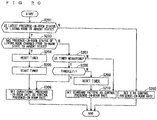
- Fig. 20 is a flowchart showing an operation of the controller when a control presence-in-room rate is calculated in the second embodiment.
- step S201 shown in Fig. 20 the control presence-in-room rate calculation unit 2123 determines whether or not a latest presence-in-room status of the living room 2040 is in an absent state. When the presence-in-room status is not in an absent state, the process proceeds to step S202. When the presence-in-room status is in an absent state, the process proceeds to step S203.
- step S202 the control presence-in-room rate calculation unit 2123 sets 1 as the control presence-in-room rate 2180.
- the air conditioner 2082 is controlled such that the target room temperature 2220 of the living room 2040 adopts the set room temperature 2200 of the living room 2040.
- step S203 the control presence-in-room rate calculation unit 2123 compares the latest presence-in-room status of the living room 2040 with a presence-in-room status of the living room 2040 immediately before thereof, and determines whether or not the presence-in-room status of the living room 2040 has changed from an in-room state to an absent state.
- step S204 the process proceeds to step S204.
- step S207 the process proceeds to step S207.
- step S204 the control presence-in-room rate calculation unit 2123 causes the timer 2103 to reset time measurement
- step S205 following step S204 the control presence-in-room rate calculation unit 2123 causes the timer 2103 to start time measurement.
- the timer 2103 can measure an elapsed time from a time at which a change from an in-room state to an absent state has occurred in the presence-in-room status of the living room 2040, and the control presence-in-room rate calculation unit 2123 can obtain the elapsed time from the timer 2103.
- step S206 the control presence-in-room rate calculation unit 2123 sets the conditional presence-in-room rate 2160 of the living room 2040 that is determined according to the elapsed time as the control presence-in-room rate 2180, and the process is ended.
- the air conditioner 2082 is controlled such that the air-conditioning heat quantity decreases as the conditional presence-in-room rate 2160 of the living room 2040 decreases.
- step S207 the control presence-in-room rate calculation unit 2123 determines whether or not the timer 2103 is measuring a time period. When the timer 2103 is measuring a time period, the process proceeds to step S208. When the timer 2103 is not measuring a time period, the process proceeds to step S210.
- step S208 the control presence-in-room rate calculation unit 2123 determines whether or not the time period being measured by the timer 2103 is equal to or less than the set time period T1. When the time period is equal to or less than the set time period T1, the process proceeds to step S206. When the time period is not equal to or not less than the set time period T1, the process proceeds to step S209.
- step S206 the control presence-in-room rate calculation unit 2123 sets the conditional presence-in-room rate 2160 of the living room 2040 as the control presence-in-room rate 2180, and the process is ended.
- the air conditioner 2082 is controlled such that the air-conditioning heat quantity decreases as the conditional presence-in-room rate 2160 of the living room 2040 decreases.
- step S209 the control presence-in-room rate calculation unit 2123 causes the timer 2103 to reset time measurement.
- step S210 following step S209 the control presence-in-room rate calculation unit 2123 sets the standard pattern 2162 of the presence-in-room rate of the living room 2040 as the control presence-in-room rate 2180, and the process is ended.
- the air conditioner 2082 is controlled such that the air-conditioning heat quantity decreases as the standard pattern 2162 of the presence-in-room rate of the living room 2040 decreases.
- Pavg may be set as the control presence-in-room rate 2180.
- Fig. 21 is a time chart showing an operation example of the air conditioner in the second embodiment.
- Fig. 21 shows a time change of a target room temperature of the living room when control as an implementation example and a reference example is performed.
- the control presence-in-room rate 2180 is 1 when the presence-in-room status of the living room 2040 is in an in-room state. Further, when the presence-in-room status of the living room 2040 is in an absent state, between the first time at which the presence-in-room status of the living room 2040 has changed from an in-room state to an absent state and the second time after the set time period T1 from the first time, the control presence-in-room rate 2180 adopts the conditional presence-in-room rate 2160 of the living room 2040, and after the second time, the control presence-in-room rate 2180 adopts the standard pattern 2162 of the presence-in-room rate of the living room 2040.
- the target room temperature adopts the set room temperature. Further, when the presence-in-room status of the living room 2040 is in an absent state, the target room temperature increases as the conditional presence-in-room rate 2160 of the living room 2040 increases between the first time and the second time, and the target room temperature increases as the standard pattern 2162 of the presence-in-room rate in the living room 2040 increases after the second time.
- the control presence-in-room rate 2180 is 1 when the presence-in-room status of the living room 2040 is in an in-room state. Further, when the presence-in-room status of the living room 2040 is an absent state, the control presence-in-room rate 2180 adopts the standard pattern 2162 of the presence-in-room rate of the living room 2040. Therefore, as shown in Fig. 21 , when the presence-in-room status of the living room 2040 is an in-room state, the target room temperature adopts the set room temperature. Further, when the presence-in-room status of the living room 2040 is in an absent state, the target room temperature increases as the standard pattern 2162 of the presence-in-room rate of the living room 2040 increases.
- the target room temperature 2220 of the living room when the control as the implementation example is performed is different from a target room temperature 2221 of the living room 2040 when the control as the reference example is performed in that the target room temperature 2220 of the living room 2040 increases as the conditional presence-in-room rate 2160 of the living room 2040 increases between the first time and the second time.
- the target room temperature 2220 of the living room 2040 is high when the control as the implementation example is performed, and the target room temperature 2221 of the living room 2040 is low when the control as the reference example is performed, between the first time and the second time.
- the room temperature of the living room 2040 is close to the set room temperature 2200 of the living room 2040 when a person enters the living room 2040, but in a case where the control as the reference example is performed, the room temperature of the living room 2040 has not become close to the set room temperature 2200 of the living room 2040 when a person enters the living room 2040, and it takes time until the room temperature of the living room 2040 approaches the set room temperature 2200 of the living room 2040. Therefore, in the case where the control as the implementation example is performed, a comfortable thermal environment is provided to a person entering the living room 2040, as compared with the case where the control as the reference example is performed.
- a change from an in-room state to an absent state of the presence-in-room status of the living room 2040, which affects an presence-in-room status of the living room 2040, is reflected in the air-conditioning heat quantity, and the air-conditioning heat quantity approaches the one suitable for a current presence-in-room status of the living room 2040. This improves comfort of air-conditioning and reduces energy required for air-conditioning.
- a third embodiment relates to a set time period T2 for replacing the set time period T2 in the first embodiment.
- a main difference between the first embodiment and the third embodiment is that, in the first embodiment, the set time period T2 is a fixed value or a variable value that can be changed by the user 1900, but in the third embodiment, the set time period T2 is determined from a time history 1140 of a presence-in-room status of a living room 1040 and a time history 1141 of a presence-in-room status of a kitchen 1041.
- M time periods t(1), t(2),..., t(M) arranged in ascending order is obtained.
- Each of the M time periods t(1), t(2),..., t(M) is a time period from a time at which a presence-in-room status of the kitchen 1041 has changed from an presence-in-room status to an absent state to a time at which a presence-in-room status of the living room has changed from an absent state to the presence-in-room status.
- M is an integer of 2 or more.
- a time difference ⁇ t(i) is obtained, which is a time difference t(i+1) - t(i) obtained by subtracting a time period t(i) from a time period t(i + 1) where i is each of 1 to M - 1.
- a time difference ⁇ t(j) is obtained, which is a maximum time difference out of the time difference ⁇ t(1) to the time difference ⁇ t(M - 1).
- a time period t(j) is set as the set time period T2.
- the time period t(i) is a short time period of about one minute, five minutes, and the like when i is small, is a time period of about several ten minutes when i increases, and is a long time period of about several hours when i further increases.
- a time period t(i) that is a short time period of about several minutes corresponds to a movement from the kitchen 1041 to the living room 1040.
- a long time period t(i) of about several hours corresponds to a long-term absent state such as going to bed or going out.
- the time difference ⁇ t(j) is the maximum time difference
- time periods t(1), ..., t(j) and time periods t(j + 1), ..., t(M) are clearly stratified
- the time periods t(1), ..., t(j) correspond to a movement from the kitchen 1041 to the living room 1040
- the time periods t(j + 1), ..., t(M) correspond to a long-term absent state
- the time period t(j) serves as a threshold for discriminating between the movement from the kitchen 1041 to the living room 1040 and the long-term absence.
- the conditional presence-in-room rate 1161 of the living room 1040 is set as the control presence-in-room rate 1180 when the movement from the kitchen 1041 to the living room 1040 is performed, and the standard pattern 1162 of the presence-in-room rate of the living room 1040 is set as the control presence-in-room rate 1180 when the presence-in-room status becomes a long-term absent state, making it possible to reduce energy required for air-conditioning while improving comfort of air-conditioning.
- an appropriate set time period T2 is obtained from the time history 1140 of the presence-in-room status of the living room 1040 and from the time history 1141 of the presence-in-room status of the kitchen 1041.
- a fourth embodiment relates to a set time period T1 for replacing the set time period T1 in the second embodiment.
- a main difference between the second embodiment and the fourth embodiment is that, in the second embodiment, the set time period T1 is a fixed value or a variable value that can be changed by the user 2900, but in the fourth embodiment, the set time period T1 is determined from a time history 2140 of a presence-in-room status of a living room 2040.
- M time periods t(1), t(2),..., t(M) arranged in ascending order is obtained.
- Each of the M time periods t(1), t(2),..., t(M) is a time period from a time at which a presence-in-room status of the living room 2040 has changed from an in-room state to an absent state to a time at which a presence-in-room status of the living room 2040 has changed from an absent state to an in-room state.
- M is an integer of 2 or more.
- a time difference ⁇ t(i) is obtained, which is a time difference t(i+1) - t(i) obtained by subtracting a time period t(i) from a time period t(i + 1) where i is each of 1 to M - 1.
- a time difference ⁇ t(j) is obtained, which is a maximum time difference out of the time difference ⁇ t(1) to the time difference ⁇ t(M - 1).
- time period t(j) is set as the set time period T1.
- the time period t(i) is a short time period of about one minute, five minutes, and the like when i is small, is a time period of about several ten minutes when i increases, and is a long time period of about several hours when i further increases.
- a time period t(i) that is a short time period of about several minutes corresponds to a short-term absent state.
- a long time period t(i) of about several hours corresponds to a long-term absent state such as going to bed or going out.
- the time difference ⁇ t(j) is the maximum time difference
- the time periods t(1), ..., t(j) and the time periods t(j + 1), ..., t(M) are clearly stratified
- the time periods t(1), ..., t(j) correspond to a short-term absent state
- the time periods t(j + 1), ..., t(M) correspond to a long-term absent state
- the time period t(j) serves as a threshold for discriminating between the short-term absent state and the long-term absence.
- the conditional presence-in-room rate 2160 of the living room 2040 is set as the control presence-in-room rate 2180 when the presence-in-room status of the living room 2040 becomes a short-term absent state
- the standard pattern 2162 of the presence-in-room rate of the living room 2040 is set as the control presence-in-room rate 2180 when the presence-in-room status of the living room 2040 becomes a long-term absent state, making it possible to reduce energy required for air-conditioning while improving comfort of air-conditioning.
- dependence on an experience of the user 2900 is eliminated, and an appropriate set time period T1 is obtained from the time history 2140 of the presence-in-room status of the living room 2040 and from the time history of the presence-in-room status of the kitchen.
- a fifth embodiment relates to a conditional presence-in-room rate 1161 of a living room 1040 for replacing the conditional presence-in-room rate 1161 of the living room 1040 in the first embodiment.
- the conditional presence-in-room rate 1161 of the living room 1040 is the ratio ⁇ n2(T2) - n2(t) ⁇ /N2 at the time after the time period t from the first time at which a change from an in-room state to an absent state has occurred in the presence-in-room status of the kitchen 1041, but in the fifth embodiment, between a first time and a second time after a set time period T2 from the first time, the conditional presence-in-room rate 1161 of the living room 1040 is a ratio n2(T2)/N2 of the number of counts n2(T2) to the number of counts N2. According to the fifth embodiment, a calculation amount required for calculating the conditional presence-in-room rate 1161 of the living room 1040 is reduced.
- a sixth embodiment relates to a conditional presence-in-room rate 2160 of a living room 2040 for replacing the conditional presence-in-room rate 2160 of the living room 2040 in the second embodiment.
- the conditional presence-in-room rate 2160 of the living room 2040 is the ratio ⁇ n1(T1) - n1(t) ⁇ /N1 at the time after the time period t from the first time at which a change from an in-room state to an absent state has occurred in the presence-in-room status of the living room 2040, but in the sixth embodiment, between a first time and a second time after a set time period T1 from the first time, the conditional presence-in-room rate 2160 of the living room 2040 is a ratio n1(T1)/N1 of the number of counts n1(T1) to the number of counts N1. According to the sixth embodiment, a calculation amount required for calculating the conditional presence-in-room rate 2160 of the living room 2040 is reduced.
- a seventh embodiment relates to a controller for replacing the controller in the first embodiment.
- a main difference between the first embodiment and the seventh embodiment is that, in the first embodiment, the prior information of the conditional presence-in-room rate 1161 of the living room 1040 is an occurrence state of a change from an in-room state to an absent state in the presence-in-room status of the kitchen 1041, but in the seventh embodiment, prior information of a conditional presence-in-room rate of a living room 1040 is an occurrence state of a change from an in-room state to an absent state in a presence-in-room status of a kitchen 1041, and an occurrence state of exceeding of a threshold of a time period during which a presence-in-room status of a living room 1040 is in an absent state.
- the technique adopted in the first embodiment or the second embodiment may also be adopted in the seventh embodiment as long as the above main difference is not lost.
- Fig. 22 is a block diagram showing an air-conditioning system including the controller of the seventh embodiment.
- a controller 7083 shown in Fig. 22 includes a communication unit 7100, a CPU 7101, a memory 7102, a timer 7103, a timer 7104, and an input unit 7105.
- the CPU 7101 functions as a conditional presence-in-room rate calculation unit 7120, a conditional presence-in-room rate calculation unit 7121, a standard pattern calculation unit 7122, a control presence-in-room rate calculation unit 7123, and a target room temperature determination unit 7124.
- the communication unit 7100 is connected to each of presence-in-room sensors 1080 and 1081 via a communication path 1084, receives a detection signal indicating a presence-in-room status of the living room 1040 from the presence-in-room sensor 1080, and receives a detection signal indicating a presence-in-room status of the kitchen 1041 from the presence-in-room sensor 1081.
- the communication unit 7100 functions as an acquisition unit that acquires presence-in-room statuses of the living room 1040 and the kitchen 1041 from the presence-in-room sensors 1080 and 1081.
- the communication unit 7100 causes the memory 7102 to store the obtained presence-in-room statuses of the living room 1040 and the kitchen 1041.
- the memory 7102 functions as a storage unit that stores a time history 7140 of the presence-in-room status of the living room 1040 and a time history 7141 of the presence-in-room status of the kitchen 1041.
- the conditional presence-in-room rate calculation unit 7120 reads the time history 7140 of the presence-in-room status of the living room 1040 from the memory 7102, calculates a conditional presence-in-room rate 7160 of the living room 1040 from the read time history 7140 of the presence-in-room status of the living room 1040, and causes the memory 7102 to store the calculated conditional presence-in-room rate 7160 of the living room 1040.
- the conditional presence-in-room rate 7160 of the living room 1040 indicates a conditional probability, which is a probability that a person is present in the living room 1040 in response to a change from an in-room state to an absent state in the presence-in-room status of the living room 1040, and is a time series showing a time change of the conditional probability.
- the conditional presence-in-room rate 7160 of the living room 1040 is calculated similarly to the conditional presence-in-room rate 2160 of the living room 1040 of the second or sixth embodiment.
- the conditional presence-in-room rate calculation unit 7121 reads the time history 7140 of the presence-in-room status of the living room 1040 and the time history 7141 of the presence-in-room status of the kitchen 1041 from the memory 7102, calculates a conditional presence-in-room rate 7161 of the living room 1040 from the read time history 7140 of the presence-in-room status of the living room 1040 and from the read time history 7141 of the presence-in-room status of the kitchen 1041, and causes the memory 7102 to store the calculated conditional presence-in-room rate 7161 of the living room 1040.
- the conditional presence-in-room rate 7161 of the living room 1040 indicates a conditional probability, which is a probability that a person is present in the living room 1040 in response to a change from an in-room state to an absent state in the presence-in-room status of the kitchen 1041, and is a time series showing a time change of the conditional probability.
- the conditional presence-in-room rate 7161 of the living room 1040 is calculated similarly to the conditional presence-in-room rate 1161 of the living room 1040 of the first or fifth embodiment.
- the standard pattern calculation unit 7122 reads the time history 7140 of the presence-in-room status of the living room 1040 from the memory 7102, calculates a standard pattern 7162 of the presence-in-room rate of the living room 1040 from the read time history 7140 of the presence-in-room status of the living room 1040, and causes the memory 7102 to store the calculated standard pattern 7162 of the presence-in-room rate of the living room 1040.
- the standard pattern 7162 of the presence-in-room rate of the living room 1040 indicates a standard probability that a person is present in the living room 1040, and is a time series showing a time change of this probability.
- the standard pattern 7162 of the presence-in-room rate of the living room 1040 is calculated similarly to the standard pattern 1162 of the presence-in-room rate of the living room 1040 of the first embodiment.
- Each of the timers 7103 and 7104 measures a time period.
- the control presence-in-room rate calculation unit 7123 causes each of the timers 7103 and 7104 to reset time measurement, causes each of the timers 7103 and 7104 to start time measurement, and obtains a time period being measured from each of the timers 7103 and 7104.
- the control presence-in-room rate calculation unit 7123 reads the conditional presence-in-room rate 7160 of the living room 1040, the conditional presence-in-room rate 7161 of the living room 1040, and the standard pattern 7162 of the presence-in-room rate of the living room 1040 from the memory 7102, obtains a time period being measured from each of the timers 7103 and 7104, calculates a control presence-in-room rate 7180 to be used for controlling an air conditioner 1082, and causes the memory 7102 to store the calculated control presence-in-room rate 7180.
- the input unit 7105 accepts an input of a set room temperature 7200 of the living room 1040 by a user 7900 and causes the memory 7102 to store the input set room temperature 7200 of the living room 1040.
- the target room temperature determination unit 7124 reads the control presence-in-room rate 7180 and the set room temperature 7200 of the living room 1040 from the memory 7102, sets a target room temperature 7220 of the living room 1040, and causes the memory 7102 to store the set target room temperature 7220 of the living room 1040.
- the target room temperature 7220 of the living room 1040 during heating decreases as the control presence-in-room rate 7180 decreases.
- the target room temperature 7220 of the living room 1040 during cooling increases as the control presence-in-room rate 7180 decreases.
- an air-conditioning heat quantity of the air conditioner 1082 decreases as the control presence-in-room rate 7180 decreases. Since the air conditioner 1082 performs air-conditioning of the living room 1040 in accordance with the target room temperature 7220 of the living room 1040 determined by the target room temperature determination unit 7124, the target room temperature determination unit 7124 functions as a control unit that controls the air conditioner 1082 such that the air-conditioning heat quantity decreases as the control presence-in-room rate 7180 decreases.
- the communication unit 7100 reads the target room temperature 7220 of the living room 1040 from the memory 7102, and transmits a control signal indicating the read target room temperature 7220 of the living room 1040 to the air conditioner 1082 via the communication path 1084.
- the conditional presence-in-room rate calculation unit 7120 calculates the conditional presence-in-room rate 7160 of the living room 1040 and causes the memory 7102 to store the calculated conditional presence-in-room rate 7160 of the living room 1040
- the conditional presence-in-room rate calculation unit 7121 calculates the conditional presence-in-room rate 7161 of the living room 1040 and causes the memory 7102 to store the calculated conditional presence-in-room rate 7161 of the living room 1040
- the standard pattern calculation unit 7122 calculates the standard pattern 7162 of the presence-in-room rate of the living room 1040 and causes the memory 7102 to store the calculated standard pattern 7162 of the presence-in-room rate of the living room 1040.
- the set time period T1 is determined similarly to the set time period T2 in the second or fourth embodiment.
- a set time period T2 is determined similarly to the set time period T1 in the first or third embodiment.
- FIGS. 23 and 24 are flowcharts showing an operation of the controller when a control presence-in-room rate is calculated in the seventh embodiment.
- step S701 shown in Fig. 23 the control presence-in-room rate calculation unit 7123 determines whether or not a latest presence-in-room status of the living room 1040 is in an absent state. When the presence-in-room status is not in an absent state, the process proceeds to step S702. When the presence-in-room status is in an absent state, the process proceeds to step S703.
- step S702 the control presence-in-room rate calculation unit 7123 sets 1 as the control presence-in-room rate 7180.
- the air conditioner 1082 is controlled such that the target room temperature 7220 of the living room 1040 adopts the set room temperature 7200 of the living room 1040.
- step S703 the control presence-in-room rate calculation unit 7123 compares the latest presence-in-room status of the living room 1040 with a presence-in-room status of the living room 1040 immediately before thereof, and determines whether or not the presence-in-room status of the living room 1040 has changed from an in-room state to an absent state.
- step S704. the process proceeds to step S707.
- step S704 processing immediately after the presence-in-room status of the living room 1040 has changed from an in-room state to an absent state is executed.
- step S704 the control presence-in-room rate calculation unit 7123 causes the timer 7103 to reset time measurement
- step S705 following step S704 the control presence-in-room rate calculation unit 7123 causes the timer 7103 to start time measurement.
- the timer 7103 can measure an elapsed time from a time at which a change from an in-room state to an absent state has occurred in the presence-in-room status of the living room 1040, and the control presence-in-room rate calculation unit 7123 can obtain the elapsed time from the timer 7103.
- step S706 the control presence-in-room rate calculation unit 7123 sets, as the control presence-in-room rate 7180, a conditional presence-in-room rate PI that is the conditional presence-in-room rate 7160 of the living room 1040 when the presence-in-room status of the living room 1040 has changed from an absent state to an in-room state, and the process is ended.
- the air conditioner 1082 is controlled such that the air-conditioning heat quantity decreases as the conditional presence-in-room rate 7160 of the living room 1040 decreases.
- step S707 the control presence-in-room rate calculation unit 7123 compares a latest presence-in-room status of the kitchen 1041 with a presence-in-room status of the kitchen 1041 immediately before thereof, and determines whether or not a change from an in-room state to an absent state has occurred in the presence-in-room status of the kitchen 1041.
- the process proceeds to step S708.
- the process proceeds to step S720.
- step S708 processing immediately after the presence-in-room status of the kitchen 1041 has changed from an in-room state to an absent state is executed.
- step S708 the control presence-in-room rate calculation unit 7123 causes the timer 7104 to reset time measurement, and in step S709 following step S708, the control presence-in-room rate calculation unit 7123 causes the timer 7104 to start time measurement.
- the timer 7104 can measure an elapsed time from a time at which a change from an in-room state to an absent state has occurred in the presence-in-room status of the kitchen 1041, and the control presence-in-room rate calculation unit 7123 can obtain this elapsed time from the timer 7104.
- step S710 the control presence-in-room rate calculation unit 7123 determines whether or not the timer 7103 is measuring a time period. When the timer 7103 is not measuring a time period, the process proceeds to step S711. When the timer 7103 is measuring a time period, the process proceeds to step S712.
- step S711 following step S710 the control presence-in-room rate calculation unit 7123 sets, as the control presence-in-room rate 7180, a conditional presence-in-room rate P2 that is the conditional presence-in-room rate 7161 of the living room 1040 when the presence-in-room status of the kitchen 1041 has changed from an in-room state to an absent state, and the process is ended.
- the air conditioner 1082 is controlled such that the air-conditioning heat quantity decreases as the conditional presence-in-room rate 7161 of the living room 1040 decreases.
- step S712 the control presence-in-room rate calculation unit 7123 determines whether or not the time period being measured by the timer 7103 is equal to or less than the set time period T1. When the time period is equal to or less than the set time period T1, the process proceeds to step S713. When the time period is not equal to or not less than the set time period T1, the process proceeds to step S715.
- step S713 the control presence-in-room rate calculation unit 7123 determines whether or not the time period being measured by the timer 7104 is equal to or less than the set time period T2. When the time period is equal to or less than the set time period T2, the process proceeds to step S714. When the time period is not equal to or not less than the set time period T2, the process proceeds to step S719.
- step S714 the control presence-in-room rate calculation unit 7123 sets, as the control presence-in-room rate 7180, a maximum conditional presence-in-room rate out of the conditional presence-in-room rate 7160 and the conditional presence-in-room rate 7161 of the living room 1040, and the process is ended.
- the air conditioner 1082 is controlled such that the air-conditioning heat quantity decreases as the maximum conditional presence-in-room rate out of the conditional presence-in-room rate 7160 and the conditional presence-in-room rate 7161 of the living room 1040 decreases.
- step S715 the control presence-in-room rate calculation unit 7123 causes the timer 7103 to reset time measurement, and in step S716 following step S715, the control presence-in-room rate calculation unit 7123 determines whether or not the time period being measured by the timer 7104 is equal to or less than the set time period T2. When the time period is equal to or less than the set time period T2, the process proceeds to step S711. When the time period is not equal to or not less than the set time period T2, the process proceeds to step S717.
- step S711 following step S716, the control presence-in-room rate calculation unit 7123 sets, as the control presence-in-room rate 7180, the conditional presence-in-room rate P2 that is the conditional presence-in-room rate 7161 of the living room 1040 when the presence-in-room status of the kitchen 1041 has changed from an in-room state to an absent state.
- the air conditioner 1082 is controlled such that the air-conditioning heat quantity decreases as the conditional presence-in-room rate 7161 of the living room 1040 decreases.
- step S717 the control presence-in-room rate calculation unit 7123 causes the timer 7104 to reset time measurement.
- step S718 following step S717 the control presence-in-room rate calculation unit 7123 sets the standard pattern 7162 of the presence-in-room rate of the living room 1040 as the control presence-in-room rate 7180, and the process is ended.
- the air conditioner 1082 is controlled such that the air-conditioning heat quantity decreases as the standard pattern 7162 of a presence-in-room rate of the living room 1040 decreases.
- step S719 the control presence-in-room rate calculation unit 7123 causes the timer 7104 to reset time measurement.
- step S706 following step S719 the control presence-in-room rate calculation unit 7123 sets, as the control presence-in-room rate 7180, the conditional presence-in-room rate PI that is the conditional presence-in-room rate 7160 of the living room 1040 when the presence-in-room status of the living room 1040 has changed from an absent state to an in-room state, and the process is ended.
- the air conditioner 1082 is controlled such that the air-conditioning heat quantity decreases as the conditional presence-in-room rate 7160 of the living room 1040 decreases.
- step S720 processing is executed, which is for a case of not immediately after the presence-in-room status of the living room 1040 has changed from an in-room state to an absent state and also not immediately after the presence-in-room status of the kitchen 1041 has changed from an in-room state to an absent state.
- step S720 the control presence-in-room rate calculation unit 7123 determines whether or not the timer 7104 is measuring a time period. When the timer 7104 is measuring a time period, the process proceeds to step S721. When the timer 7104 is not measuring a time period, the process proceeds to step S722.
- step S721 the control presence-in-room rate calculation unit 7123 determines whether or not the timer 7103 is measuring a time period. When the timer 7103 is measuring a time period, the process proceeds to step S712. When the timer 7103 is not measuring a time period, the process proceeds to step S716.
- step S712 By advancing the process from step S721 to step S712, in a case where each of the timers 7103 and 7104 is measuring a time period, when the set time period T1 has not elapsed from the time at which the presence-in-room status of the living room 1040 has changed from an in-room state to an absent state, and the set time period T2 has not elapsed from the time at which the presence-in-room status of the kitchen 1041 has changed from an in-room state to an absent state, the control presence-in-room rate 7180 adopts a maximum conditional presence-in-room rate out of the conditional presence-in-room rate 7160 and the conditional presence-in-room rate 7161 of the living room 1040, and the air conditioner 1082 is controlled such that the air-conditioning heat quantity decreases as the maximum conditional presence-in-room rate out of the conditional presence-in-room rate 7160 and the conditional presence-in-room rate 7161 of the living room 1040 decreases.
- the control presence-in-room rate 7180 adopts the conditional presence-in-room rate P2 that is the conditional presence-in-room rate 7161 of the living room 1040 when the presence-in-room status of the kitchen 1041 has changed from an absent state to an in-room state, and the air conditioner 1082 is controlled such that the air-conditioning heat quantity decreases as the conditional presence-in-room rate 7161 of the living room 1040 decreases.
- the control presence-in-room rate 7180 adopts the conditional presence-in-room rate PI that is the conditional presence-in-room rate 7160 of the living room 1040 when the presence-in-room status of the living room 1040 has changed from an absent state to an in-room state, and the air conditioner 1082 is controlled such that the air-conditioning heat quantity decreases as the conditional presence-in-room rate 7160 of the living room 1040 decreases.
- the control presence-in-room rate 7180 adopts the standard pattern 7162 of the presence-in-room rate of the living room 1040, and the air conditioner 1082 is controlled such that the air-conditioning heat quantity decreases as the standard pattern 7162 of the presence-in-room rate of the living room 1040 decreases.
- step S722 the control presence-in-room rate calculation unit 7123 determines whether or not the timer 7103 is measuring a time period. When the timer 7103 is not measuring a time period, the process proceeds to step S718. When the timer 7103 is measuring a time period, the process proceeds to step S723.
- step S718 following step S722 the control presence-in-room rate calculation unit 7123 sets the standard pattern 7162 of the presence-in-room rate of the living room 1040 as the control presence-in-room rate 7180, and the process is ended.
- the air conditioner 1082 is controlled such that the air-conditioning heat quantity decreases as the standard pattern 7162 of the presence-in-room rate of the living room 1040 decreases.
- step S723 the control presence-in-room rate calculation unit 7123 determines whether or not the time period being measured by the timer 7103 is equal to or less than the set time period T1. When the time period is equal to or less than the set time period T1, the process proceeds to step S706. When the time period is not equal to or not less than the set time period T1, the process proceeds to step S724.
- step S706 following step S723, the control presence-in-room rate calculation unit 7123 sets, as the control presence-in-room rate 7180, the conditional presence-in-room rate PI that is the conditional presence-in-room rate 7160 of the living room 1040 when the presence-in-room status of the living room 1040 has changed from an absent state to an in-room state, and the process is ended.
- the air conditioner 1082 is controlled such that the air-conditioning heat quantity decreases as the conditional presence-in-room rate 7160 of the living room 1040 decreases.
- step S724 the control presence-in-room rate calculation unit 7123 causes the timer 7103 to reset time measurement.
- step S718 following step S724, the control presence-in-room rate calculation unit 7123 sets the standard pattern 7162 of the presence-in-room rate of the living room 1040 as the control presence-in-room rate 7180, and the process is ended.
- the air conditioner 1082 is controlled such that the air-conditioning heat quantity decreases as the standard pattern 7162 of the presence-in-room rate of the living room 1040 decreases.
- an occurrence state of exceeding of the threshold of a time period during which the presence-in-room status of the living room 1040 is in an absent state is set as the prior information of the conditional presence-in-room rate 7160 of the living room 1040, and when a state where the presence-in-room status of the living room 1040 is in an absent state is continuing, an occurrence state of the change from an in-room state to an absent state in the presence-in-room status of the kitchen 1041 is set as the prior information of the conditional presence-in-room rate 7161 of the living room 1040.
- conditional presence-in-room rate of the living room 1040 can be determined by using together the change in the presence-in-room status of the kitchen 1041 with a duration of the presence-in-room status of the living room 10 40.
- a eighth embodiment relates to a conditional presence-in-room rate calculation unit 1121 and a standard pattern calculation unit 1122 for respectively replacing the conditional presence-in-room rate calculation unit 1121 and the standard pattern calculation unit 1122 in the first embodiment.
- a main difference between the first embodiment and the eighth embodiment is that, in the first embodiment, the conditional presence-in-room rate calculation unit 1121 calculates the conditional presence-in-room rate 1161 of the living room 1040 without considering a time of a day, difference between a weekday and a holiday, and a day of a week, while the standard pattern calculation unit 1122 calculates the standard pattern 1162 of the presence-in-room rate of the living room 1040 without considering a time of a day, difference between a weekday and a holiday, and a day of a week, but in the eighth embodiment, the conditional presence-in-room rate calculation unit 1121 calculates a conditional presence-in-room rate 1161 of a living room 1040 such that the conditional presence-in-room rate 1161 of the living room 1040 varies depending on a time of a day, difference between a weekday and a holiday, or a day of a week, while the standard pattern calculation unit 1122 calculates a standard pattern 1162 of a presence-in-
- Fig. 25 is a graph showing a distribution of a time of returning home on each day of a week.
- the graph of Fig. 25 shows distribution of a time of returning home on each day of the week in a case where Monday to Friday are working days, Saturday and Sunday are holidays, Wednesday is a day for leaving an office at a regular time, and it is possible to go home earlier on Wednesday than other working days.
- Fig. 26 is a graph showing a standard pattern of presence-in-room rates of a kitchen and a living room on each of Monday and the days other than Monday. From the standard pattern of the presence-in-room rates of the kitchen and the living room on Monday shown in Fig. 26 , it is possible to grasp that, on Monday, the presence-in-room status of the living room does not become an in-room state after the presence-in-room status of the kitchen has changed from an in-room state to an absent state, but on the days of the week other than Monday, the presence-in-room status of the living room becomes an in-room state after the presence-in-room status of the kitchen has changed from an in-room state to an absent state.
- the eighth embodiment in a situation where it is desired to set a set room temperature of the living room as a target room temperature of the living room, setting a room temperature far from the set room temperature of the living room as the target room temperature of the living room is suppressed, and in a situation where it is permitted to set a room temperature far from a set room temperature of the living room as the target room temperature of the living room, setting a room temperature close to the set room temperature of the living room as the target room temperature of the living room is suppressed. Therefore, comfort of air-conditioning is improved, and energy required for air-conditioning is reduced.
- conditional presence-in-room rate calculation unit 2120 of the second embodiment, the conditional presence-in-room rate calculation unit 7120 of the seventh embodiment, and the conditional presence-in-room rate calculation unit 7121 of the seventh embodiment may be replaced with a conditional presence-in-room rate calculation unit that performs calculation of the conditional presence-in-room rate of the living room such that the conditional presence-in-room rate of the living room varies depending on a time of a day, difference between a weekday and a holiday, or a day of a week.
- Each of the standard pattern calculation unit 2122 of the second embodiment and the standard pattern calculation unit 7122 of the seventh embodiment may be replaced with a standard pattern calculation unit that performs calculation of a standard pattern of the presence-in-room rate of the living room such that the standard pattern of the presence-in-room rate of the living room varies depending on a time of a day, difference between a weekday and a holiday, or a day of a week.
- a ninth embodiment relates to a presence-in-room sensor 1081 and a conditional presence-in-room rate calculation unit 1121 for respectively replacing the presence-in-room sensor 1081 and the conditional presence-in-room rate calculation unit 1121 in the first embodiment.
- a main difference between the first embodiment and the ninth embodiment is that, in the first embodiment, a presence-in-room status detected by the presence-in-room sensor 1081 indicates exclusively whether or not a person is present in the kitchen 1041, but in the ninth embodiment, a presence-in-room status detected by the presence-in-room sensor 1081 includes the number of people present in a kitchen 1041.
- conditional presence-in-room rate calculation unit 1121 calculates the conditional presence-in-room rate 1161 of the living room 1040 indicating a conditional probability, which is a probability that a person is present in the living room 1040 in response to a change from an in-room state to an absent state in the presence-in-room status of the kitchen 1041, but in the ninth embodiment, the conditional presence-in-room rate calculation unit 1121 calculates a conditional presence-in-room rate 1161 of the living room 1040 indicating a conditional probability, which is a probability that a person is present in the living room 1040 when reduction has occurred in the number of people present in the kitchen 1041.
- the number of people present in the kitchen 1041 is specified by detecting entering of a person into the kitchen 1041 and leaving of a person from the kitchen 1041. Entering of a person into the kitchen 1041 and leaving of a person from the kitchen 1041 are detected, for example, by photographing entering of a person into the kitchen 1041 and leaving of a person from the kitchen 1041 with a camera, recording an image obtained by the photographing, and analyzing the recorded image.
- the specified number of people present in the kitchen 1041 forms a time series. A decrease in the number of people present in the kitchen 1041 indicates leaving of a person from the kitchen 1041.
- the first embodiment when a person leaves the kitchen 1041 but a person other than that person is still present in the kitchen 1041, a state where the presence-in-room status of the kitchen 1041 is in an in-room state is continued and it is impossible to detect that the person has left the kitchen 1041.
- the ninth embodiment even when a person leaves the kitchen 1041 but a person other than that person is still present in the kitchen 1041, it is possible to detect that the person has left the kitchen 1041, and leaving can be used as prior information, which cannot be used as the prior information in the first embodiment.
- a tenth embodiment relates to a presence-in-room sensor 1080, a presence-in-room sensor 1081, a conditional presence-in-room rate calculation unit 1121, and a standard pattern calculation unit 1122, for respectively replacing the presence-in-room sensor 1080, the presence-in-room sensor 1081, the conditional presence-in-room rate calculation unit 1121, and the standard pattern calculation unit 1122 in the first embodiment.
- a main difference between the first embodiment and the tenth embodiment is that, in the first embodiment, a presence-in-room status detected by the presence-in-room sensor 1080 does not include information for identifying a person present in the living room 1040, and a presence-in-room status detected by the presence-in-room sensor 1081 does not include information for identifying a person present in the kitchen 1041, but in the tenth embodiment, a presence-in-room status detected by the presence-in-room sensor 1080 includes information for identifying a person present in a living room 1040, and a presence-in-room status detected by the presence-in-room sensor 1081 includes information for identifying a person present in a kitchen 1041.
- conditional presence-in-room rate calculation unit 1121 calculates the conditional presence-in-room rate 1161 of the living room 1040 without considering a person, but in the tenth embodiment, the conditional presence-in-room rate calculation unit 1121 calculates a conditional presence-in-room rate 1161 of the living room 1040 for each of a plurality of people.
- a main difference between the first embodiment and the tenth embodiment is also that, in the first embodiment, the standard pattern calculation unit 1122 calculates the standard pattern 1162 of the presence-in-room rate of the living room 1040 without considering a person, but in the tenth embodiment, the standard pattern calculation unit 1122 calculates a standard pattern 1162 of a presence-in-room rate of the living room 1040 for each of a plurality of people.
- the identification of a person entering a room or a person leaving a room is performed, for example, by photographing a face of the person entering the room or the person leaving the room with a camera, recording a face image obtained by photographing, and analyzing the recorded face image.
- a movement of each of a plurality of people from one room of a house 1020 to another room of the house 1020 is detected, the conditional presence-in-room rate 1161 of the living room 1040 is calculated for each of the plurality of people, and control suitable for behavior of each of the plurality of people is performed on an air conditioner 1082.
- conditional presence-in-room rate calculation unit 1121 calculates a plurality of conditional presence-in-room rates of living room 1040
- standard pattern calculation unit 1122 calculates a plurality of standard pattern of presence-in-room rates of the living room 1040.
- the conditional presence-in-room rate 1161 of the living room 1040 which is used by the target room temperature determination unit 7124 to control the air conditioner 1082, is a maximum conditional presence-in-room rate out of the plurality of conditional presence-in-room rates of living room 1040, while the standard pattern of the presence-in-room rate of the living room 1040, which is used by the target room temperature determination unit 7124 to control the air conditioner 1082, is a maximum standard pattern out of the plurality of standard patterns of presence-in-room rates of the living room 1040.
- control suitable for a presence-in-room status having the highest possibility of occurrence is performed on an air conditioner 1082.
- conditional presence-in-room rate 1161 of the living room 1040 and the standard pattern 1162 of the presence-in-room rate of the living room 1040 are calculated for each of a plurality of people, the target room temperature 1220 of the living room 1040 is set reflecting behavior of each of the plurality of people, and comfort of air-conditioning is improved while energy required for air-conditioning is reduced. Similar modification may be made in the second or seventh embodiment.
Landscapes
- Engineering & Computer Science (AREA)
- Chemical & Material Sciences (AREA)
- Combustion & Propulsion (AREA)
- Mechanical Engineering (AREA)
- General Engineering & Computer Science (AREA)
- Physics & Mathematics (AREA)
- Fuzzy Systems (AREA)
- Mathematical Physics (AREA)
- Signal Processing (AREA)
- Air Conditioning Control Device (AREA)
Applications Claiming Priority (1)
| Application Number | Priority Date | Filing Date | Title |
|---|---|---|---|
| PCT/JP2016/070059 WO2018008118A1 (ja) | 2016-07-07 | 2016-07-07 | 空調制御装置、空調制御方法、空調システムおよび空調付き住宅 |
Publications (2)
| Publication Number | Publication Date |
|---|---|
| EP3483516A1 true EP3483516A1 (de) | 2019-05-15 |
| EP3483516A4 EP3483516A4 (de) | 2020-03-04 |
Family
ID=60912094
Family Applications (1)
| Application Number | Title | Priority Date | Filing Date |
|---|---|---|---|
| EP16908162.7A Withdrawn EP3483516A4 (de) | 2016-07-07 | 2016-07-07 | Klimatisierungssteuerungsvorrichtung, klimatisierungssteuerungsverfahren, klimatisierungssystem und haus mit klimaanlage |
Country Status (4)
| Country | Link |
|---|---|
| EP (1) | EP3483516A4 (de) |
| JP (1) | JP6580264B2 (de) |
| CN (1) | CN109416192B (de) |
| WO (1) | WO2018008118A1 (de) |
Cited By (2)
| Publication number | Priority date | Publication date | Assignee | Title |
|---|---|---|---|---|
| EP3835680A1 (de) * | 2019-12-10 | 2021-06-16 | Electricité de France | System zur steuerung einer lufterneuerungsvorrichtung für eine zone und einer heizvorrichtung für die zone |
| GB2628439A (en) * | 2023-03-23 | 2024-09-25 | Sano Development Ltd | Building system control |
Families Citing this family (5)
| Publication number | Priority date | Publication date | Assignee | Title |
|---|---|---|---|---|
| US10845082B2 (en) * | 2018-12-18 | 2020-11-24 | Honeywell International Inc. | Operating heating, ventilation, and air conditioning systems using occupancy sensing systems |
| JP7433841B2 (ja) * | 2019-11-01 | 2024-02-20 | 東芝ライフスタイル株式会社 | 機器操作システム、機器操作方法、情報処理装置及びコンピュータプログラム |
| JP7359197B2 (ja) * | 2020-10-09 | 2023-10-11 | 株式会社富士通ゼネラル | 空気調和機 |
| JP7656856B2 (ja) * | 2021-02-25 | 2025-04-04 | パナソニックIpマネジメント株式会社 | 環境制御システム、環境制御方法及びプログラム |
| CN116265831A (zh) * | 2021-12-16 | 2023-06-20 | 广东美的制冷设备有限公司 | 空调器控制方法、存储介质及空调器 |
Family Cites Families (11)
| Publication number | Priority date | Publication date | Assignee | Title |
|---|---|---|---|---|
| JP2578972B2 (ja) * | 1989-03-27 | 1997-02-05 | 松下電器産業株式会社 | 在室パターン予測装置 |
| JP3119082B2 (ja) * | 1994-08-23 | 2000-12-18 | 松下電器産業株式会社 | 在室予測装置及びそれを用いた応用機器 |
| JP5405901B2 (ja) * | 2009-05-27 | 2014-02-05 | パナソニック株式会社 | 空気調和機 |
| CN101893851A (zh) * | 2010-07-12 | 2010-11-24 | 郭栋才 | 一种室内温度模糊控制系统及其方法 |
| US8510255B2 (en) * | 2010-09-14 | 2013-08-13 | Nest Labs, Inc. | Occupancy pattern detection, estimation and prediction |
| JP5538289B2 (ja) * | 2011-04-11 | 2014-07-02 | 三菱電機株式会社 | 空気調和システム及び空気調和方法 |
| CN104823121B (zh) * | 2012-09-30 | 2017-08-15 | 谷歌公司 | 智能控制器内的自动存在检测及与存在相关的控制 |
| JP6148505B2 (ja) * | 2013-03-21 | 2017-06-14 | 株式会社東芝 | 在室確率推定装置およびその方法、ならびにプログラム |
| KR102252263B1 (ko) * | 2014-04-04 | 2021-05-14 | 삼성전자주식회사 | Hvac 시스템의 에너지를 제어하기 위한 방법 및 장치 |
| EP3141831B1 (de) * | 2014-05-09 | 2020-10-07 | Mitsubishi Electric Corporation | Klimaanlagen- und belüftungssystem |
| US10012406B2 (en) * | 2014-05-15 | 2018-07-03 | Samsung Electronics Co., Ltd. | Method and apparatus for controlling temperature |
-
2016
- 2016-07-07 CN CN201680087318.5A patent/CN109416192B/zh active Active
- 2016-07-07 EP EP16908162.7A patent/EP3483516A4/de not_active Withdrawn
- 2016-07-07 JP JP2018525887A patent/JP6580264B2/ja active Active
- 2016-07-07 WO PCT/JP2016/070059 patent/WO2018008118A1/ja not_active Ceased
Cited By (3)
| Publication number | Priority date | Publication date | Assignee | Title |
|---|---|---|---|---|
| EP3835680A1 (de) * | 2019-12-10 | 2021-06-16 | Electricité de France | System zur steuerung einer lufterneuerungsvorrichtung für eine zone und einer heizvorrichtung für die zone |
| GB2628439A (en) * | 2023-03-23 | 2024-09-25 | Sano Development Ltd | Building system control |
| GB2628439B (en) * | 2023-03-23 | 2025-04-02 | Sano Development Ltd | Building system control |
Also Published As
| Publication number | Publication date |
|---|---|
| CN109416192A (zh) | 2019-03-01 |
| EP3483516A4 (de) | 2020-03-04 |
| JPWO2018008118A1 (ja) | 2018-11-22 |
| JP6580264B2 (ja) | 2019-09-25 |
| WO2018008118A1 (ja) | 2018-01-11 |
| CN109416192B (zh) | 2021-04-16 |
Similar Documents
| Publication | Publication Date | Title |
|---|---|---|
| EP3483516A1 (de) | Klimatisierungssteuerungsvorrichtung, klimatisierungssteuerungsverfahren, klimatisierungssystem und haus mit klimaanlage | |
| US11549706B2 (en) | Control unit with automatic setback capabtility | |
| KR102252263B1 (ko) | Hvac 시스템의 에너지를 제어하기 위한 방법 및 장치 | |
| US8849771B2 (en) | Rules engine with database triggering | |
| US8849462B2 (en) | Method and apparatus for automation of a programmable device | |
| JP3119082B2 (ja) | 在室予測装置及びそれを用いた応用機器 | |
| US11076758B2 (en) | Controlling devices based on physiological measurements | |
| US20160320081A1 (en) | Method and System for Personalization of Heating, Ventilation, and Air Conditioning Services | |
| US20180156484A1 (en) | Environmental condition manipulation control | |
| JPWO2015173842A1 (ja) | パラメータ学習装置およびパラメータ学習方法 | |
| US20160321564A1 (en) | Operational parameter value learning device, operational parameter value learning method, and controller for learning device | |
| JPH11132530A (ja) | 室別空調制御装置 | |
| JP6452593B2 (ja) | 情報処理装置及び情報処理方法 | |
| EP2722606B1 (de) | Klimaanlagenregelungsvorrichtung, klimaanlagenregelungsverfahren und programm | |
| US20150226445A1 (en) | Apparatus And Method For Analysing The Operation Of A Temperature Management System By A User | |
| Spencer et al. | Forecasting internal temperature in a home with a sensor network | |
| CN116907037A (zh) | 基于室内外环境参数的空调控制方法、装置和智能空调 | |
| CN103081413B (zh) | 房间的能量监控 | |
| JP2010054086A (ja) | トイレ室温度調節装置 | |
| Scott et al. | Home heating using gps-based arrival prediction | |
| US20250164134A1 (en) | Air conditioning controller and air conditioning control method | |
| JP2024047953A (ja) | 制御装置および制御方法 | |
| Miklušcak et al. | Exploring possibilities of predictive self-programming thermostats for energy savings |
Legal Events
| Date | Code | Title | Description |
|---|---|---|---|
| STAA | Information on the status of an ep patent application or granted ep patent |
Free format text: STATUS: THE INTERNATIONAL PUBLICATION HAS BEEN MADE |
|
| PUAI | Public reference made under article 153(3) epc to a published international application that has entered the european phase |
Free format text: ORIGINAL CODE: 0009012 |
|
| STAA | Information on the status of an ep patent application or granted ep patent |
Free format text: STATUS: REQUEST FOR EXAMINATION WAS MADE |
|
| 17P | Request for examination filed |
Effective date: 20190102 |
|
| AK | Designated contracting states |
Kind code of ref document: A1 Designated state(s): AL AT BE BG CH CY CZ DE DK EE ES FI FR GB GR HR HU IE IS IT LI LT LU LV MC MK MT NL NO PL PT RO RS SE SI SK SM TR |
|
| AX | Request for extension of the european patent |
Extension state: BA ME |
|
| DAV | Request for validation of the european patent (deleted) | ||
| DAX | Request for extension of the european patent (deleted) | ||
| A4 | Supplementary search report drawn up and despatched |
Effective date: 20200205 |
|
| RIC1 | Information provided on ipc code assigned before grant |
Ipc: G05B 15/02 20060101ALI20200130BHEP Ipc: F24F 11/80 20180101ALI20200130BHEP Ipc: F24F 11/46 20180101ALI20200130BHEP Ipc: F24F 11/00 20180101AFI20200130BHEP Ipc: F24F 11/62 20180101ALI20200130BHEP |
|
| STAA | Information on the status of an ep patent application or granted ep patent |
Free format text: STATUS: EXAMINATION IS IN PROGRESS |
|
| 17Q | First examination report despatched |
Effective date: 20221006 |
|
| STAA | Information on the status of an ep patent application or granted ep patent |
Free format text: STATUS: THE APPLICATION HAS BEEN WITHDRAWN |
|
| 18W | Application withdrawn |
Effective date: 20251007 |