EP3492794A1 - Anordnung zum ableiten von blow-by-gasen aus einem kurbelgehäuse eines verbrennungsmotors - Google Patents
Anordnung zum ableiten von blow-by-gasen aus einem kurbelgehäuse eines verbrennungsmotors Download PDFInfo
- Publication number
- EP3492794A1 EP3492794A1 EP18207711.5A EP18207711A EP3492794A1 EP 3492794 A1 EP3492794 A1 EP 3492794A1 EP 18207711 A EP18207711 A EP 18207711A EP 3492794 A1 EP3492794 A1 EP 3492794A1
- Authority
- EP
- European Patent Office
- Prior art keywords
- hose device
- line
- blow
- coupling part
- hose
- Prior art date
- Legal status (The legal status is an assumption and is not a legal conclusion. Google has not performed a legal analysis and makes no representation as to the accuracy of the status listed.)
- Granted
Links
Images

Classifications
-
- F—MECHANICAL ENGINEERING; LIGHTING; HEATING; WEAPONS; BLASTING
- F01—MACHINES OR ENGINES IN GENERAL; ENGINE PLANTS IN GENERAL; STEAM ENGINES
- F01M—LUBRICATING OF MACHINES OR ENGINES IN GENERAL; LUBRICATING INTERNAL COMBUSTION ENGINES; CRANKCASE VENTILATING
- F01M13/00—Crankcase ventilating or breathing
- F01M13/02—Crankcase ventilating or breathing by means of additional source of positive or negative pressure
- F01M13/021—Crankcase ventilating or breathing by means of additional source of positive or negative pressure of negative pressure
- F01M13/022—Crankcase ventilating or breathing by means of additional source of positive or negative pressure of negative pressure using engine inlet suction
-
- F—MECHANICAL ENGINEERING; LIGHTING; HEATING; WEAPONS; BLASTING
- F01—MACHINES OR ENGINES IN GENERAL; ENGINE PLANTS IN GENERAL; STEAM ENGINES
- F01M—LUBRICATING OF MACHINES OR ENGINES IN GENERAL; LUBRICATING INTERNAL COMBUSTION ENGINES; CRANKCASE VENTILATING
- F01M13/00—Crankcase ventilating or breathing
- F01M13/0011—Breather valves
-
- F—MECHANICAL ENGINEERING; LIGHTING; HEATING; WEAPONS; BLASTING
- F01—MACHINES OR ENGINES IN GENERAL; ENGINE PLANTS IN GENERAL; STEAM ENGINES
- F01M—LUBRICATING OF MACHINES OR ENGINES IN GENERAL; LUBRICATING INTERNAL COMBUSTION ENGINES; CRANKCASE VENTILATING
- F01M11/00—Component parts, details or accessories, not provided for in, or of interest apart from, groups F01M1/00 - F01M9/00
- F01M11/10—Indicating devices; Other safety devices
-
- F—MECHANICAL ENGINEERING; LIGHTING; HEATING; WEAPONS; BLASTING
- F01—MACHINES OR ENGINES IN GENERAL; ENGINE PLANTS IN GENERAL; STEAM ENGINES
- F01M—LUBRICATING OF MACHINES OR ENGINES IN GENERAL; LUBRICATING INTERNAL COMBUSTION ENGINES; CRANKCASE VENTILATING
- F01M13/00—Crankcase ventilating or breathing
-
- F—MECHANICAL ENGINEERING; LIGHTING; HEATING; WEAPONS; BLASTING
- F01—MACHINES OR ENGINES IN GENERAL; ENGINE PLANTS IN GENERAL; STEAM ENGINES
- F01M—LUBRICATING OF MACHINES OR ENGINES IN GENERAL; LUBRICATING INTERNAL COMBUSTION ENGINES; CRANKCASE VENTILATING
- F01M13/00—Crankcase ventilating or breathing
- F01M13/02—Crankcase ventilating or breathing by means of additional source of positive or negative pressure
- F01M13/021—Crankcase ventilating or breathing by means of additional source of positive or negative pressure of negative pressure
-
- F—MECHANICAL ENGINEERING; LIGHTING; HEATING; WEAPONS; BLASTING
- F01—MACHINES OR ENGINES IN GENERAL; ENGINE PLANTS IN GENERAL; STEAM ENGINES
- F01M—LUBRICATING OF MACHINES OR ENGINES IN GENERAL; LUBRICATING INTERNAL COMBUSTION ENGINES; CRANKCASE VENTILATING
- F01M13/00—Crankcase ventilating or breathing
- F01M13/04—Crankcase ventilating or breathing having means for purifying air before leaving crankcase, e.g. removing oil
-
- F—MECHANICAL ENGINEERING; LIGHTING; HEATING; WEAPONS; BLASTING
- F02—COMBUSTION ENGINES; HOT-GAS OR COMBUSTION-PRODUCT ENGINE PLANTS
- F02D—CONTROLLING COMBUSTION ENGINES
- F02D41/00—Electrical control of supply of combustible mixture or its constituents
- F02D41/22—Safety or indicating devices for abnormal conditions
-
- F—MECHANICAL ENGINEERING; LIGHTING; HEATING; WEAPONS; BLASTING
- F02—COMBUSTION ENGINES; HOT-GAS OR COMBUSTION-PRODUCT ENGINE PLANTS
- F02M—SUPPLYING COMBUSTION ENGINES IN GENERAL WITH COMBUSTIBLE MIXTURES OR CONSTITUENTS THEREOF
- F02M25/00—Engine-pertinent apparatus for adding non-fuel substances or small quantities of secondary fuel to combustion-air, main fuel or fuel-air mixture
- F02M25/06—Engine-pertinent apparatus for adding non-fuel substances or small quantities of secondary fuel to combustion-air, main fuel or fuel-air mixture adding lubricant vapours
-
- F—MECHANICAL ENGINEERING; LIGHTING; HEATING; WEAPONS; BLASTING
- F02—COMBUSTION ENGINES; HOT-GAS OR COMBUSTION-PRODUCT ENGINE PLANTS
- F02M—SUPPLYING COMBUSTION ENGINES IN GENERAL WITH COMBUSTIBLE MIXTURES OR CONSTITUENTS THEREOF
- F02M35/00—Combustion-air cleaners, air intakes, intake silencers, or induction systems specially adapted for, or arranged on, internal-combustion engines
- F02M35/10—Air intakes; Induction systems
- F02M35/10091—Air intakes; Induction systems characterised by details of intake ducts: shapes; connections; arrangements
- F02M35/10144—Connections of intake ducts to each other or to another device
-
- F—MECHANICAL ENGINEERING; LIGHTING; HEATING; WEAPONS; BLASTING
- F02—COMBUSTION ENGINES; HOT-GAS OR COMBUSTION-PRODUCT ENGINE PLANTS
- F02M—SUPPLYING COMBUSTION ENGINES IN GENERAL WITH COMBUSTIBLE MIXTURES OR CONSTITUENTS THEREOF
- F02M35/00—Combustion-air cleaners, air intakes, intake silencers, or induction systems specially adapted for, or arranged on, internal-combustion engines
- F02M35/10—Air intakes; Induction systems
- F02M35/10209—Fluid connections to the air intake system; their arrangement of pipes, valves or the like
- F02M35/10222—Exhaust gas recirculation [EGR]; Positive crankcase ventilation [PCV]; Additional air admission, lubricant or fuel vapour admission
-
- F—MECHANICAL ENGINEERING; LIGHTING; HEATING; WEAPONS; BLASTING
- F16—ENGINEERING ELEMENTS AND UNITS; GENERAL MEASURES FOR PRODUCING AND MAINTAINING EFFECTIVE FUNCTIONING OF MACHINES OR INSTALLATIONS; THERMAL INSULATION IN GENERAL
- F16J—PISTONS; CYLINDERS; SEALINGS
- F16J15/00—Sealings
- F16J15/02—Sealings between relatively-stationary surfaces
-
- F—MECHANICAL ENGINEERING; LIGHTING; HEATING; WEAPONS; BLASTING
- F16—ENGINEERING ELEMENTS AND UNITS; GENERAL MEASURES FOR PRODUCING AND MAINTAINING EFFECTIVE FUNCTIONING OF MACHINES OR INSTALLATIONS; THERMAL INSULATION IN GENERAL
- F16L—PIPES; JOINTS OR FITTINGS FOR PIPES; SUPPORTS FOR PIPES, CABLES OR PROTECTIVE TUBING; MEANS FOR THERMAL INSULATION IN GENERAL
- F16L25/00—Construction or details of pipe joints not provided for in, or of interest apart from, groups F16L13/00 - F16L23/00
- F16L25/0036—Joints for corrugated pipes
- F16L25/0045—Joints for corrugated pipes of the quick-acting type
-
- F—MECHANICAL ENGINEERING; LIGHTING; HEATING; WEAPONS; BLASTING
- F16—ENGINEERING ELEMENTS AND UNITS; GENERAL MEASURES FOR PRODUCING AND MAINTAINING EFFECTIVE FUNCTIONING OF MACHINES OR INSTALLATIONS; THERMAL INSULATION IN GENERAL
- F16L—PIPES; JOINTS OR FITTINGS FOR PIPES; SUPPORTS FOR PIPES, CABLES OR PROTECTIVE TUBING; MEANS FOR THERMAL INSULATION IN GENERAL
- F16L33/00—Arrangements for connecting hoses to rigid members; Rigid hose-connectors, i.e. single members engaging both hoses
- F16L33/01—Arrangements for connecting hoses to rigid members; Rigid hose-connectors, i.e. single members engaging both hoses specially adapted for hoses having a multi-layer wall
-
- F—MECHANICAL ENGINEERING; LIGHTING; HEATING; WEAPONS; BLASTING
- F16—ENGINEERING ELEMENTS AND UNITS; GENERAL MEASURES FOR PRODUCING AND MAINTAINING EFFECTIVE FUNCTIONING OF MACHINES OR INSTALLATIONS; THERMAL INSULATION IN GENERAL
- F16L—PIPES; JOINTS OR FITTINGS FOR PIPES; SUPPORTS FOR PIPES, CABLES OR PROTECTIVE TUBING; MEANS FOR THERMAL INSULATION IN GENERAL
- F16L39/00—Joints or fittings for double-walled or multi-channel pipes or pipe assemblies
-
- F—MECHANICAL ENGINEERING; LIGHTING; HEATING; WEAPONS; BLASTING
- F16—ENGINEERING ELEMENTS AND UNITS; GENERAL MEASURES FOR PRODUCING AND MAINTAINING EFFECTIVE FUNCTIONING OF MACHINES OR INSTALLATIONS; THERMAL INSULATION IN GENERAL
- F16L—PIPES; JOINTS OR FITTINGS FOR PIPES; SUPPORTS FOR PIPES, CABLES OR PROTECTIVE TUBING; MEANS FOR THERMAL INSULATION IN GENERAL
- F16L39/00—Joints or fittings for double-walled or multi-channel pipes or pipe assemblies
- F16L39/005—Joints or fittings for double-walled or multi-channel pipes or pipe assemblies for concentric pipes
-
- F—MECHANICAL ENGINEERING; LIGHTING; HEATING; WEAPONS; BLASTING
- F16—ENGINEERING ELEMENTS AND UNITS; GENERAL MEASURES FOR PRODUCING AND MAINTAINING EFFECTIVE FUNCTIONING OF MACHINES OR INSTALLATIONS; THERMAL INSULATION IN GENERAL
- F16L—PIPES; JOINTS OR FITTINGS FOR PIPES; SUPPORTS FOR PIPES, CABLES OR PROTECTIVE TUBING; MEANS FOR THERMAL INSULATION IN GENERAL
- F16L39/00—Joints or fittings for double-walled or multi-channel pipes or pipe assemblies
- F16L39/02—Joints or fittings for double-walled or multi-channel pipes or pipe assemblies for hoses
-
- G—PHYSICS
- G01—MEASURING; TESTING
- G01M—TESTING STATIC OR DYNAMIC BALANCE OF MACHINES OR STRUCTURES; TESTING OF STRUCTURES OR APPARATUS, NOT OTHERWISE PROVIDED FOR
- G01M3/00—Investigating fluid-tightness of structures
- G01M3/02—Investigating fluid-tightness of structures by using fluid or vacuum
- G01M3/26—Investigating fluid-tightness of structures by using fluid or vacuum by measuring rate of loss or gain of fluid, e.g. by pressure-responsive devices, by flow detectors
- G01M3/28—Investigating fluid-tightness of structures by using fluid or vacuum by measuring rate of loss or gain of fluid, e.g. by pressure-responsive devices, by flow detectors for pipes, cables or tubes; for pipe joints or seals; for valves ; for welds
- G01M3/2807—Investigating fluid-tightness of structures by using fluid or vacuum by measuring rate of loss or gain of fluid, e.g. by pressure-responsive devices, by flow detectors for pipes, cables or tubes; for pipe joints or seals; for valves ; for welds for pipes
- G01M3/2815—Investigating fluid-tightness of structures by using fluid or vacuum by measuring rate of loss or gain of fluid, e.g. by pressure-responsive devices, by flow detectors for pipes, cables or tubes; for pipe joints or seals; for valves ; for welds for pipes using pressure measurements
-
- F—MECHANICAL ENGINEERING; LIGHTING; HEATING; WEAPONS; BLASTING
- F01—MACHINES OR ENGINES IN GENERAL; ENGINE PLANTS IN GENERAL; STEAM ENGINES
- F01M—LUBRICATING OF MACHINES OR ENGINES IN GENERAL; LUBRICATING INTERNAL COMBUSTION ENGINES; CRANKCASE VENTILATING
- F01M13/00—Crankcase ventilating or breathing
- F01M13/02—Crankcase ventilating or breathing by means of additional source of positive or negative pressure
- F01M13/021—Crankcase ventilating or breathing by means of additional source of positive or negative pressure of negative pressure
- F01M2013/027—Crankcase ventilating or breathing by means of additional source of positive or negative pressure of negative pressure with a turbo charger or compressor
-
- F—MECHANICAL ENGINEERING; LIGHTING; HEATING; WEAPONS; BLASTING
- F01—MACHINES OR ENGINES IN GENERAL; ENGINE PLANTS IN GENERAL; STEAM ENGINES
- F01M—LUBRICATING OF MACHINES OR ENGINES IN GENERAL; LUBRICATING INTERNAL COMBUSTION ENGINES; CRANKCASE VENTILATING
- F01M13/00—Crankcase ventilating or breathing
- F01M13/04—Crankcase ventilating or breathing having means for purifying air before leaving crankcase, e.g. removing oil
- F01M2013/0488—Crankcase ventilating or breathing having means for purifying air before leaving crankcase, e.g. removing oil with oil trap in the return conduit to the crankcase
-
- F—MECHANICAL ENGINEERING; LIGHTING; HEATING; WEAPONS; BLASTING
- F01—MACHINES OR ENGINES IN GENERAL; ENGINE PLANTS IN GENERAL; STEAM ENGINES
- F01M—LUBRICATING OF MACHINES OR ENGINES IN GENERAL; LUBRICATING INTERNAL COMBUSTION ENGINES; CRANKCASE VENTILATING
- F01M2250/00—Measuring
- F01M2250/60—Operating parameters
-
- F—MECHANICAL ENGINEERING; LIGHTING; HEATING; WEAPONS; BLASTING
- F02—COMBUSTION ENGINES; HOT-GAS OR COMBUSTION-PRODUCT ENGINE PLANTS
- F02D—CONTROLLING COMBUSTION ENGINES
- F02D2250/00—Engine control related to specific problems or objectives
- F02D2250/08—Engine blow-by from crankcase chamber
-
- F—MECHANICAL ENGINEERING; LIGHTING; HEATING; WEAPONS; BLASTING
- F16—ENGINEERING ELEMENTS AND UNITS; GENERAL MEASURES FOR PRODUCING AND MAINTAINING EFFECTIVE FUNCTIONING OF MACHINES OR INSTALLATIONS; THERMAL INSULATION IN GENERAL
- F16L—PIPES; JOINTS OR FITTINGS FOR PIPES; SUPPORTS FOR PIPES, CABLES OR PROTECTIVE TUBING; MEANS FOR THERMAL INSULATION IN GENERAL
- F16L2201/00—Special arrangements for pipe couplings
- F16L2201/30—Detecting leaks
-
- Y—GENERAL TAGGING OF NEW TECHNOLOGICAL DEVELOPMENTS; GENERAL TAGGING OF CROSS-SECTIONAL TECHNOLOGIES SPANNING OVER SEVERAL SECTIONS OF THE IPC; TECHNICAL SUBJECTS COVERED BY FORMER USPC CROSS-REFERENCE ART COLLECTIONS [XRACs] AND DIGESTS
- Y02—TECHNOLOGIES OR APPLICATIONS FOR MITIGATION OR ADAPTATION AGAINST CLIMATE CHANGE
- Y02T—CLIMATE CHANGE MITIGATION TECHNOLOGIES RELATED TO TRANSPORTATION
- Y02T10/00—Road transport of goods or passengers
- Y02T10/10—Internal combustion engine [ICE] based vehicles
- Y02T10/40—Engine management systems
Definitions
- the invention relates to an arrangement for deriving blow-by gases from a crankcase of an internal combustion engine having the features of the preamble of patent claim 1.
- blow-by gases pass into a crankcase of the internal combustion engine due to unavoidable leakage between the piston and the cylinder. So that the crankcase no unacceptably high pressure, the blow-by gases are removed using a hose device.
- the blow-by gases are supplied to the fresh air system. This allows the blow-by gases to be recirculated to the combustion engine.
- the hose device has for this purpose a blow-by line.
- a hose is connected via a connecting piece to a line of the fresh air system.
- the hose is attached with an outlet section directly to the inlet section of the nozzle.
- the hose is designed at least at its outlet section by the shaping and / or the choice of material so that it reversibly deformed when plugging onto the inlet section of the nozzle.
- the at least one side opening is designed as a slot which extends over 30 ° to 45 ° in the circumferential direction.
- the nozzle is designed at its inlet portion with two annular grooves. In each of these annular grooves a sealing ring is inserted.
- the hose is designed as a corrugated hose.
- the WO 2007/000125 A1 An arrangement for draining blow-by gases from a crankcase of an internal combustion engine is known.
- This arrangement includes Coupling system for connecting a hose with a socket on.
- the hose has at its ends a connection piece which can be inserted into the socket and which has on its outer side at least one annular groove and a fastening contour.
- the socket has on its outer side a latching contour.
- a respect to the socket and the nozzle separately prepared coupling element is provided, which is externally fitted on the neck, wherein the coupling element has a plurality of latching hooks which engage behind the locking contour.
- the coupling element has at least one fastening hook, which cooperates with the fastening contour for axial fixation of the coupling element on the connecting piece.
- the hose can be configured together with the respective nozzle as blow molding.
- Each of the locking hooks is provided with a release lever. By actuating the release lever, the respective latching hook can be disengaged from the latching contour.
- the release levers form an extension of the respective latching hook.
- One area of a base ring acts as a pivot bearing for the extended by the release lever locking hooks.
- the generic arrangement is not yet optimally formed. Although the connection of the hoses is simplified, it is desirable to avoid leaking or incorrectly mounted hose assemblies safely.
- the invention is therefore based on the object to avoid the risk of leaking or incorrectly mounted hose devices.
- the hose device has a diagnostic line, wherein a false air flow can be detected via the diagnostic line if the hose device is leaking or leaking or not connected.
- This has the advantage that the operation of the hose device for venting is ensured safe. If the hose assembly is mounted correctly and the hose assembly itself is not leaking, no leakage air flow will flow through the diagnostic line. However, if the hose assembly is leaking, improperly connected, or not connected at all, a false airflow will flow through the diagnostic line, which will be detected by a pressure sensor. The incorrect air flow leads to the fresh air system, in particular to the intake manifold.
- a free, open end of the diagnostic lead sealingly abuts a component.
- the outer jacket is attached to the turbocharger housing as a blind, sealed end.
- a sealing ring Between the front of the Coupling part, which forms the end of the diagnostic line, and the component is preferably arranged a sealing ring to ensure the tightness of the connection.
- the hose device has a tube-in-tube construction.
- the hose device has an inner tube and an outer tube, wherein the inner tube is disposed within the outer tube.
- the inner tube thus serves as a blow-by line.
- blow-by gases are pumped from the oil separator into the fresh air tract.
- a full load of the exhaust gas turbocharger ensures a high pressure build-up and there is an increased pressure in the intake manifold.
- a partial load of the internal combustion engine creates a vacuum in the intake manifold and the turbocharger provides little or no pressure build-up.
- the outer tube and / or the inner tube are formed as a corrugated tube.
- the hose device has a coupling part, wherein the inner hose acts on a first outer peripheral surface of the coupling part and the outer hose acts on a second outer peripheral surface, wherein an inlet opening opens into an outer line in the coupling part, wherein the outer line serves as a diagnostic line.
- the hose device can be connected to an oil separator housing, wherein the oil separator housing is in fluid communication with a suction pipe and the oil separator housing has a diagnosis channel in fluid communication with the diagnostic line.
- a pressure fluctuation in the diagnostic channel can be detected by means of a pressure sensor.
- the incorrect air flow is guided into the suction pipe and can be detected there by means of a pressure sensor.
- a damaged outer hose and incorrect mounting on the intake manifold an opening to the outside air is created, whereby the intake manifold can suck in air. This incorrect air is detected by a charge cycle control of the internal combustion engine, whereupon an error is detected and output.
- the coupling part represents the connection between the inner tube and the outer tube and, for example, the connecting piece.
- the coupling part has a first outer peripheral surface onto which the inner tube is slipped.
- the coupling part has a second outer peripheral surface onto which the outer tube is attached.
- the coupling part may be substantially tubular.
- the coupling part has an outer line, which extends in particular at least partially in a lateral surface of the coupling part. Through this external line, the fault current of the diagnostic line to the diagnostic channel is forwarded.
- This outer conduit has an orifice on an outer peripheral surface which is bounded by an inner peripheral surface of the connecting piece in the inserted state.
- This interior is preferably limited by two seals arranged on the outer circumference of the inner part, in particular according to O-rings.
- a particularly easy-to-install connection is provided by the fact that the coupling part can be connected by means of a latching connection to a nozzle.
- the latching connection can be formed in a manner that is simple to manufacture in that at least one latching lug is formed on the outer ring, wherein the at least one latching lug cooperates with a holding contour formed on an outer peripheral surface of the connecting piece.
- the hose device can be connected to the oil separator housing, wherein the oil separator housing has a diagnosis channel in fluid communication with the suction pipe and the diagnostic line.
- the incorrect air flow is routed to the intake manifold via this diagnostic channel.
- a corresponding sensor may be arranged, which detects the Fehlluftstrom.
- the sensor can be designed as a pressure sensor.
- the one component in particular the oil separator has a connection piece.
- the hose assembly has a coupling part at each end.
- a corresponding coupling part is arranged at each end, wherein the coupling parts need not be made identical.
- the coupling part may itself be formed in two parts or in several parts. These two or more parts may be connected to each other by a welded connection, an adhesive connection, a plug connection or the like, in order to be as dense as possible To connect.
- the connecting piece and the coupling part are preferably connected to one another via a latching connection.
- the locking connection is designed in particular openable.
- the coupling part may have a connection which surrounds the outside of the ring, wherein the ring interacts with the outer surface of the connecting piece via a latching connection.
- the ring may have corresponding latching lugs, which engage in a latching contour on the outer peripheral surface of the connecting piece in the mounted state. This represents a particularly easy to handle connection.
- the hose device may be connected by a screw connection with the corresponding components.
- Fig. 1 to 4 is an arrangement 1 for deriving blow-by gases 5 from a crankcase, not shown, of an internal combustion engine to recognize well.
- the blow-by gases 5 can be supplied via a hose device 2 to a fresh air system 3. Shown here is only part of an exhaust gas turbocharger housing 4.
- the corresponding blow-by gases 5 (indicated here by corresponding arrows) are passed starting from an oil separator 6 through the hose device 2 to the compressor side of the exhaust gas turbocharger.
- the oil separator 6 is in particular the corresponding oil separator housing 7 is shown.
- the oil separator 6 is in fluid communication with the crankcase.
- the hose device 2 is connected, on the one hand, to a component 8 assigned to the fresh air system, namely to the exhaust-gas turbocharger housing 4 and, on the other hand, to a component 9 in fluid communication with the crankcase, namely a connecting piece 10.
- the nozzle 10 is mounted on the oil separator housing 7.
- the hose device 2 now has a blow-by line 11.
- the hose device 2 has a diagnostic line 12, wherein a faulty air flow 13 detectable via the diagnostic line 12 when the hose device 2 is leaking, is not connected or is not connected.
- the Fehl Kunststoffstrom 13 is indicated here again by corresponding arrows.
- the diagnostic line 12 ends blind with correct mounting of the hose device 2, on an end face 14 on the turbocharger housing 4.
- a sealing ring 15 between the end faces of the mouth of the diagnostic line 12 and the exhaust gas turbocharger housing 4 and the end face 14 is arranged here.
- the hose device 2 has an outer hose 16 and an inner hose 17.
- the inner tube 17 serves as a blow-by line, i. inside the inner tube 17, the blow-by gases 5 are forwarded.
- the outer tube 16 has a larger diameter than the inner tube 17. Between the outer tube 16 and the inner tube 17 remains an annular space 18, which forms part of the diagnostic line 12.
- the hose device 2 now has two coupling parts 19, 20.
- the coupling parts 19, 20 have the hose side, i. in the direction of the outer tube 16 and the inner tube 17, a first outer peripheral surface 21, on which the inner tube 17 is attached. Furthermore, the coupling parts 19, 20 on a second outer peripheral surface 22, on which the outer tube 16 is attached. Between the first outer peripheral surface 21 and the second outer peripheral surface 22 is at least one inlet opening 23, in particular a plurality of inlet openings 23 are formed, which open into an outer conduit 24.
- the outer line 24 forms part of the diagnostic line 12.
- the coupling parts 19, 20 are tubular and pass in their interior, ie in the corresponding cylindrical cavity 25, the blow-by gases.
- the cavity 25 thus forms part of the blow-by line 11.
- This first region of the coupling parts 19, 20 can be formed by a first component 26 or 27.
- a particular cranked formed component 28 is provided, which is beispielswiese welded to the component 27 or connected by an adhesive connection or Flugtagen.
- the component 28 now has a channel 29 for the blow-by gases and a channel 30, which forms part of the diagnostic power 12.
- the channel 30 terminates at the front side of the exhaust gas turbocharger housing 4 and is sealingly arranged there with the sealing ring 15.
- the channel 30 extends slightly further into the exhaust gas turbocharger housing 4 and is sealingly arranged there on the outer peripheral surface by means of a sealing ring 31.
- a corresponding tubular edge region 32 limits the channel 30.
- the component 26 is connected to a further component 33, in which the outer line 24 is continued.
- the outer line 24 emerges here on an outer peripheral surface 34 which lies between two annular grooves 35, 36.
- each O-rings 37, 38 are arranged.
- the outer peripheral surface 34 delimits a part of an annular space with an inner peripheral surface 39 of the nozzle 10.
- a diagnostic channel 40 is within the component 9 or the corresponding nozzle 10, which in turn opens into the exhaust gas turbocharger housing 4 in a further diagnostic channel 41.
- the O-rings 37, 38 seal the annular space between the outer peripheral surface 34 with respect to the corresponding adjacent inner peripheral surfaces of the neck 10.
- the coupling part 19 is screwed in particular to the exhaust gas turbocharger housing 4.
- the coupling part 20 is connected to the nozzle 10 by means of a latching connection.
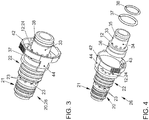
- the coupling part 20 has an outer ring 42 on which at least one latching lug 43 is formed.
- the outer ring 42 is connected via two arms 44 with the rest of the body. Now, if the component 9 is pushed onto the nozzle 10, the locking lugs 43 are pushed over a retaining contour 45 on the outer circumference of the nozzle 10 and rest there.
Landscapes
- Engineering & Computer Science (AREA)
- General Engineering & Computer Science (AREA)
- Mechanical Engineering (AREA)
- Chemical & Material Sciences (AREA)
- Combustion & Propulsion (AREA)
- Physics & Mathematics (AREA)
- General Physics & Mathematics (AREA)
- Lubrication Details And Ventilation Of Internal Combustion Engines (AREA)
Abstract
Description
- Die Erfindung betrifft eine Anordnung zum Ableiten von Blow-By-Gasen aus einem Kurbelgehäuse eines Verbrennungsmotors mit den Merkmalen des Oberbegriffs des Patentanspruchs 1.
- Im Betrieb eines Verbrennungsmotors gelangen Blow-By-Gase aufgrund unvermeidlicher Leckagen zwischen dem Kolben und dem Zylinder in ein Kurbelgehäuse des Verbrennungsmotors. Damit im Kurbelgehäuse kein unzulässig hoher Druck entsteht, werden die Blow-By-Gase mit Hilfe einer Schlauchvorrichtung abgeführt. Um dabei eine Umweltverschmutzung durch die schadstoffbeladenen Blow-By-Gase zu vermeiden, werden die Blow-By-Gase der Frischluftanlage zugeleitet. Damit können die Blow-By-Gase erneut der Verbrennung im Verbrennungsmotor zugeführt werden. Die Schlauchvorrichtung weist dazu eine Blow-By-Leitung auf.
- Um die Schlauchvorrichtung an die entsprechenden Bauteile anzuschließen, sind nun im Stand der Technik verschiedene Möglichkeiten bekannt.
- Aus der
DE 2004 063 459 A1 ist eine Anordnung bekannt, wobei ein Schlauch über einen Stutzen an eine Leitung der Frischluftanlage angeschlossen ist. Der Schlauch wird dazu mit einem Austrittsabschnitt direkt auf den Eintrittsabschnitt des Stutzens aufgesteckt. Zur Sicherung der Verbindung ist wenigstens eine fensterartige Seitenöffnung im Austrittsabschnitt vorhanden, in welche ein am Eintrittsabschnitt ausgebildeter Widerhaken eingreift. Der Schlauch ist zumindest an seinem Austrittsabschnitt durch die Formgebung und/oder die Materialauswahl so ausgestaltet, dass er sich beim Aufstecken auf den Eintrittsabschnitt des Stutzens reversibel verformt. Die wenigstens eine Seitenöffnung ist als Langloch ausgestaltet, das sich über 30° bis 45° in Umfangsrichtung erstreckt. Der Stutzen ist an seinem Eintrittsabschnitt mit zwei Ringnuten ausgestaltet. In diese Ringnuten ist jeweils ein Dichtring eingesetzt. Der Schlauch ist als Wellschlauch ausgebildet. - Der
WO 2007/000125 A1 ist eine Anordnung zum Ableiten von Blow-By-Gasen aus einem Kurbelgehäuse eines Verbrennungsmotors bekannt. Diese Anordnung weist ein Kupplungssystem zum Verbinden eines Schlauchs mit einer Buchse auf. Der Schlauch weist an seinem Enden einen Stutzen auf, der in die Buchse einsteckbar ist und der an seiner Außenseite wenigstens eine Ringnut und eine Befestigungskontur aufweist. Die Buchse weist an ihrer Außenseite eine Rastkontur auf. Ein bezüglich der Buchse und des Stutzens separat hergestelltes Kupplungselement ist vorgesehen, das außen auf den Stutzen aufgesteckt ist, wobei das Kupplungselement mehrere Rasthaken aufweist, die die Rastkontur hintergreifen. Das Kupplungselement weist wenigstens einen Befestigungshaken auf, der zu axialen Fixierung des Kupplungselementes am Stutzen mit der Befestigungskontur zusammenwirkt. Der Schlauch kann zusammen mit dem jeweiligen Stutzen als Blasformteil ausgestaltet sein. Jeder der Rasthaken ist mit einem Lösehebel versehen. Durch die Betätigung des Lösehebels kann der jeweilige Rasthaken von der Rastkontur ausgerastet werden. Die Lösehebel bilden eine Verlängerung des jeweiligen Rasthakens. Ein Bereich eines Basisrings wirkt dabei als Drehlager für die durch die Lösehebel verlängerten Rasthaken. - Die gattungsbildende Anordnung ist noch nicht optimal ausgebildet. Der Anschluss der Schläuche ist zwar vereinfacht, es ist jedoch wünschenswert undichte bzw. nicht korrekt montierte Schlauchanordnungen sicher zu vermeiden.
- Der Erfindung liegt daher die Aufgabe zugrunde, die Gefahr von undichten bzw. nicht richtig montierten Schlauchvorrichtungen zu vermeiden.
- Diese der Erfindung der zugrunde liegende Aufgabe wird nun durch eine Anordnung mit den Merkmalen des Patentanspruchs 1 gelöst. Die Schlauchvorrichtung weist eine Diagnoseleitung auf, wobei über die Diagnoseleitung ein Fehlluftstrom detektierbar ist, wenn die Schlauchvorrichtung undicht ist oder undicht angeschlossen oder nicht angeschlossen ist. Dies hat den Vorteil, dass die Funktionsweise der Schlauchvorrichtung zur Entlüftung sicher gewährleistet ist. Wenn die Schlauchvorrichtung korrekt montiert ist und die Schlauchvorrichtung selbst nicht undicht ist, strömt über die Diagnoseleitung kein Fehlluftstrom. Wenn die Schlauchvorrichtung jedoch undicht ist, nicht richtig angeschlossen ist oder überhaupt nicht angeschlossen ist, so strömt über die Diagnoseleitung ein Fehlluftstrom, der mittels eines Drucksensors detektiert wird. Der Fehlluftstrom führt dabei zur Frischluftanlage, insbesondere zum Saugrohr.
- Wenn die Schlauchvorrichtung korrekt montiert und dicht ist, so liegt ein freies, offenes Ende der Diagnoseleitung abdichtend an einem Bauteil an. Der Außenmantel ist am Turboladergehäuse als blindes, abgedichtetes Ende befestigt. Zwischen der Stirnseite des Kupplungsteils, das das Ende der Diagnoseleitung bildet, und dem Bauteil ist vorzugsweise ein Dichtring angeordnet, um die Dichtigkeit der Verbindung zu gewährleisten.
- In besonders bevorzugter Ausgestaltung weist die Schlauchvorrichtung eine Rohr-In-RohrKonstruktion auf. Hierzu weist die Schlauchvorrichtung einen Innenschlauch und einen Außenschlauch auf, wobei der Innenschlauch innerhalb des Außenschlauchs angeordnet ist. Durch den Innenschlauch werden nun die Blow-By-Gase abgeleitet. Der Innenschlauch dient somit als Blow-By-Leitung. Während eines Vollastbetriebs werden Blow-By-Gase aus dem Ölabscheider in den Frischlufttrakt gefördert. Während einer Vollast gewährleistet der Abgasturbolader einen hohen Druckaufbau und es herrscht im Saugrohr ein erhöhter Druck. Während einer Teillast des Verbrennungsmotors entsteht im Saugrohr ein Unterdruck und der Turbolader liefert nur einen geringen oder keinen Druckaufbau. Hierbei wird Frischluft vom Einlasstrakt, nämlich vom Turbolader ins Saugrohr über die Blow-By-Lietung gefördert. Zwischen dem Innenschlauch und dem Außenschlauch verbleibt insbesondere ein Ringraum, der nun als Diagnoseleitung dient. Wenn der Innenschlauch undicht ist, entsteht wiederum ein Fehlluftstrom in der Diagnoseleitung, d.h. im Ringraum zwischen dem Innenschlauch und dem Außenschlauch. Diese Anordnung erfordert nur einen geringen Baurum. In besonders bevorzugter Ausgestaltung sind der Außenschlauch und/oder der Innenschlauch als Wellschlauch ausgebildet.
- Die Schlauchvorrichtung weist ein Kupplungsteil auf, wobei der Innenschlauch an einer ersten Außenumfangsfläche des Kupplungsteils angreift und der Außenschlauch an einer zweiten Außenumfangsfläche angreift, wobei eine Eintrittsöffnung in eine Außenleitung im Kupplungsteil mündet, wobei die Außenleitung als Diagnoseleitung dient.
- Die Schlauchvorrichtung ist einerseits an einem Ölabscheidergehäuse anschließbar, wobei das Ölabscheidergehäuse mit einem Saugrohr in Fluidverbindung steht und das Ölabscheidergehäuse ein mit der Diagnoseleitung in Fluidverbindung stehenden Diagnosekanal aufweist. Eine Druckschwankung im Diagnosekanal kann dabei mittels eines Drucksensors detektiert werden. Der Fehlluftstrom wird in das Saugrohr geführt und kann dort mittels eines Drucksensors detektiert werden. Bei einer Fehlmontage am Turbolader, einem beschädigten Außenschlauch und Fehlmontage am Saugrohr ist eine Öffnung zur Außenluft geschaffen, wodurch das Saugrohr Luft ansaugen kann. Diese Fehlluft wird über eine Ladungswechselregelung des Verbrennungsmotors erkannt, woraufhin ein Fehler erkannt und ausgegeben wird.
- Das Kupplungsteil stellt die Verbindung zwischen dem Innenschlauch und dem Außenschlauch und beispielsweise dem Anschlussstutzen dar. Das Kupplungsteil weist eine erste Außenumfangsfläche auf, auf die der Innenschlauch aufgesteckt ist. Ferner weist das Kupplungsteil eine zweite Außenumfangsfläche auf, auf die der Außenschlauch aufgesteckt ist. Hierzu kann das Kupplungsteil im Wesentlichen rohrförmig ausgebildet sein. Durch diese Innenleitung sind nun die Blow-By-Gase aus dem Innenschlauch weiterleitbar. Ferner weist das Kupplungsteil eine Außenleitung auf, die sich insbesondere zumindest teilweise in einer Mantelfläche des Kupplungsteil erstreckt. Durch diese Außenleitung ist der Fehlstrom der Diagnoseleitung zu dem Diagnosekanal weiterleitbar. Diese Außenleitung weist eine Mündung an einer Außenumfangsfläche auf, die von einer Innenumfangsfläche des Anschlussstutzens im eingesteckten Zustand begrenzt ist. Dieser Innenraum wird vorzugsweise durch zwei am Außenumfang des Innenteils angeordneten Dichtungen, insbesondere entsprechend O-Ringe, begrenzt.
- Eine besonders einfach zu montierende Verbindung ist dadurch bereitgestellt, dass das Kupplungsteil mittels einer Rastverbindung an einem Stutzen anschließbar ist.
- Die Rastverbindung kann in einfach herzustellender Weise dadurch gebildet sein, dass an dem Außenring mindestens eine Rastnase ausgebildet ist, wobei die mindestens eine Rastnase mit einer an einer Außenumfangsfläche des Stutzens ausgebildeten Haltekontur zusammenwirkt.
- Die Schlauchvorrichtung ist einerseits an dem Ölabscheidergehäuse anschließbar, wobei das Ölabscheidergehäuse einen mit dem Saugrohr und der Diagnoseleitung in Fluidverbindung stehenden Diagnosekanal aufweist. Über diesen Diagnosekanal wird der Fehlluftstrom weitergeleitet zum Saugrohr. Im Saugrohr kann ein entsprechender Sensor angeordnet sein, der den Fehlluftstrom detektiert. Der Sensor kann als Drucksensor ausgebildet sein.
- Das eine Bauteil, insbesondere der Ölabscheider weist einen Anschlussstutzen auf. Die Schlauchvorrichtung weist an jedem Ende ein Kupplungsteil auf. In bevorzugter Ausgestaltung ist an jedem Ende ein entsprechendes Kupplungsteil angeordnet, wobei die Kupplungsteile nicht baugleich ausgeführt sein müssen.
- Das Kupplungsteil kann selbst zweiteilig oder mehrteilig ausgebildet sein. Diese beiden oder mehrere Teile können durch eine Schweißverbindung, eine Klebeverbindung, eine Steckverbindung oder dergleichen miteinander verbunden sein, um eine möglichst dichte Verbindung zu erzielen. Der Anschlussstutzen und das Kupplungsteil sind vorzugsweise über eine Rastverbindung miteinander verbunden. Die Rastverbindung ist insbesondere öffenbar ausgebildet. Hierzu kann das Kupplungsteil einen den Anschlussstutzen außen umgreifenden Ring aufweisen, wobei der Ring über eine Rastverbindung mit der Außenfläche des Anschlussstutzens zusammenwirkt. Der Ring kann dazu entsprechende Rastnasen aufweisen, die an einer Rastkontur an der Außenumfangsfläche des Anschlussstutzens im montierten Zustand eingreifen. Dies stellt eine besonders einfach handhabbare Verbindung dar.
- In alternativer Ausgestaltung kann die Schlauchvorrichtung durch eine Schraubverbindung mit den entsprechenden Bauteilen verbunden sein.
- Es gibt nun eine Vielzahl von Möglichkeiten, die erfindungsgemäße Anordnung auszugestalten und weiterzubilden. Hierfür darf zunächst auf die dem Patentanspruch 1 nachgeordneten Patentansprüche verwiesen werden. Im Folgenden darf eine bevorzugte Ausgestaltung der Erfindung anhand der Zeichnung und der dazugehörigen Beschreibung näher erläutert werden. In der Zeichnung zeigt:
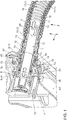
- Fig. 1
- in einer schematischen Schnittansicht ein Ende einer Schlauchvorrichtung, die an einem Ölabscheider angeschlossen ist,
- Fig. 2
- in einer weiteren schematischen Schnittansicht einen weiteren Teil der Schlauchvorrichtung, das an einem Turboladergehäuse angeschlossen ist,
- Fig. 3
- in einer schematischen perspektivischen Ansicht ein Kupplungsteil der Schlauchvorrichtung, das zum Anschluss an einen Stutzen am Ölabscheidergehäuse dient,
- Fig. 4
- in einer schematischen Explosionsdarstellung das Kupplungsteil.
- In den
Fig. 1 bis 4 ist eine Anordnung 1 zum Ableiten von Blow-By-Gasen 5 aus einem nicht dargestellten Kurbelgehäuse eines Verbrennungsmotors gut zu erkennen. Die Blow-By-Gase 5 sind über eine Schlauchvorrichtung 2 einer Frischluftanlage 3 zuführbar. Dargestellt ist hier nur ein Teil eines Abgasturboladergehäuses 4. Die entsprechenden Blow-By-Gase 5 (hier durch entsprechende Pfeile angedeutet) werden ausgehend von einem Ölabscheider 6 durch die Schlauchvorrichtung 2 zu der Verdichterseite des Abgasturboladers geleitet. Von dem Ölabscheider 6 ist hier insbesondere das entsprechende Ölabscheidergehäuse 7 dargestellt. Der Ölabscheider 6 steht in Fluidverbindung mit dem Kurbelgehäuse. Die Schlauchvorrichtung 2 ist einerseits an einem der Frischluftanlage zugeordneten Bauteil 8, nämlich an dem Abgasturboladergehäuse 4 und andererseits an einem mit dem Kurbelgehäuse in Fluidverbindung stehenden Bauteil 9, nämlich hier einem Stutzen 10 angeschlossen. Der Stutzen 10 ist am Ölabscheidergehäuse 7 montiert. Die Schlauchvorrichtung 2 weist nun eine Blow-By-Leitung 11 auf. - Die eingangs genannten Nachteile sind nun dadurch vermieden, dass die Schlauchvorrichtung 2 eine Diagnoseleitung 12 aufweist, wobei über die Diagnoseleitung 12 ein Fehlluftstrom 13 detektierbar, wenn die Schlauchvorrichtung 2 undicht ist, undicht angeschlossen ist oder gar nicht angeschlossen ist. Der Fehlluftstrom 13 ist hier wiederrum durch entsprechende Pfeile angedeutet. Die Diagnoseleitung 12 endet bei korrekter Montierung der Schlauchvorrichtung 2 blind, an einer Stirnseite 14 am Abgasturboladergehäuse 4. Insbesondere ist hier ein Dichtring 15 zwischen den Stirnflächen der Mündung der Diagnoseleitung 12 und dem Abgasturboladergehäuse 4 bzw. der Stirnseite 14 angeordnet.
- Die Schlauchvorrichtung 2 weist in besonders bevorzugter Ausgestaltung einen Außenschlauch 16 und einen Innenschlauch 17 auf. Der Innenschlauch 17 dient als Blow-By-Leitung, d.h. im Inneren des Innenschlauchs 17 werden die Blow-By-Gase 5 weitergeleitet. Der Außenschlauch 16 weist einen größeren Durchmesser als der Innenschlauch 17 auf. Zwischen dem Außenschlauch 16 und dem Innenschlauch 17 verbleibt ein Ringraum 18, der einen Teil der Diagnoseleitung 12 bildet.
- Die Schlauchvorrichtung 2 weist nun zwei Kupplungsteile 19, 20 auf. Die Kupplungsteile 19, 20 weisen schlauchseitig, d.h. in Richtung des Außenschlauchs 16 und des Innenschlauchs 17, eine erste Außenumfangsfläche 21 auf, auf die der Innenschlauch 17 aufgesteckt ist. Ferner weisen die Kupplungsteile 19, 20 eine zweite Außenumfangsfläche 22 auf, auf die der Außenschlauch 16 aufgesteckt ist. Zwischen der ersten Außenumfangsfläche 21 und der zweiten Außenumfangsfläche 22 ist mindestens eine Eintrittsöffnung 23, insbesondere sind mehrere Eintrittsöffnungen 23 ausgebildet, die in eine Außenleitung 24 münden. Die Außenleitung 24 bildet einen Teil der Diagnoseleitung 12.
- Die Kupplungsteile 19, 20 sind röhrenförmig ausgebildet und leiten in ihrem Inneren, d.h. in dem entsprechenden zylindrischen Hohlraum 25 die Blow-By-Gase. Der Hohlraum 25 bildet damit einen Teil der Blow-By-Leitung 11. Dieser erste Bereich der Kupplungsteile 19, 20 kann durch ein erstes Bauteil 26 bzw. 27 gebildet sein. Zum Anschluss der Schlauchvorrichtung 2 an die Frischluftanlage 3 bzw. an das Abgasturboladergehäuse 4 ist nun hier ein insbesondere gekröpft ausgebildetes Bauteil 28 vorgesehen, das mit dem Bauteil 27 beispielswiese verschweißt ist oder durch eine Klebeverbindung oder Flügeverbindung verbunden ist. Das Bauteil 28 weist nun einen Kanal 29 für die Blow-By-Gase und einen Kanal 30 auf, der einen Teil der Diagnoseleistung 12 bildet. Der Kanal 30 endet stirnseitig am Abgasturboladergehäuse 4 und ist dort mit dem Dichtring 15 dichtend angeordnet. Der Kanal 30 erstreckt sich etwas weiter in das Abgasturboladergehäuse 4 hinein und ist dort an der Außenumfangsfläche mittels eines Dichtrings 31 abdichtend angeordnet. Ein entsprechend röhrenförmiger Randbereich 32 begrenzt hierbei den Kanal 30. An der Außenumfangsfläche des röhrenförmigen Wandbereichs 32 liegt der Dichtring 31 an.
- Im Folgenden darf nun auf
Fig. 1 undFig. 4 näher eingegangen werden:
Das Bauteil 26 ist mit einem weiteren Bauteil 33 verbunden, in dem die Außenleitung 24 weitergeführt ist. Die Außenleitung 24 tritt hier an einer Außenumfangsfläche 34 aus, die zwischen zwei Ringnuten 35, 36 liegt. In den Ringnuten 35, 36 sind jeweils O-Ringe 37, 38 angeordnet. Die Außenumfangsfläche 34 begrenzt dabei einen Teil eines Ringraumes mit einer Innenumfangsfläche 39 des Stutzens 10. Von der Innenumfangsfläche 39 geht ein Diagnosekanal 40 innerhalb des Bauteils 9 bzw. des entsprechenden Stutzens 10 ab, der wiederrum in einem weiteren Diagnosekanal 41 in das Abgasturboladergehäuse 4 mündet. Die O-Ringe 37, 38 dichten hier den Ringraum zwischen der Außenumfangsfläche 34 gegenüber den entsprechenden anliegenden Innenumfangsflächen des Stutzens 10 ab. - Das Kupplungsteil 19 ist insbesondere mit dem Abgasturboladergehäuse 4 verschraubt. Das Kupplungsteil 20 wird an dem Stutzen 10 mittels einer Rastverbindung verbunden. Dazu weist das Kupplungsteil 20 einen Außenring 42 auf, an dem mindestens eine Rastnase 43 ausgebildet ist. Der Außenring 42 ist über zwei Arme 44 mit dem restlichen Körper verbunden. Wenn nun das Bauteil 9 auf den Stutzen 10 aufgeschoben wird, so werden die Rastnasen 43 über eine Haltekontur 45 am Außenumfang des Stutzens 10 aufgeschoben und rasten dort ein.
-
- 1
- Anordnung
- 2
- Schlauchvorrichtung
- 3
- Frischluftanlage
- 4
- Abgasturboladergehäuse
- 5
- Blow-By-Gase
- 6
- Ölabscheider
- 7
- Ölabscheidergehäuse
- 8
- Bauteil
- 9
- Bauteil
- 10
- Stutzen
- 11
- Blow-By-Leitung
- 12
- Diagnoseleitung
- 13
- Fehlluftstrom
- 14
- Stirnseite
- 15
- Dichtring
- 16
- Außenschlauch
- 17
- Innenschlauch
- 18
- Ringraum
- 19
- Kupplungsteil
- 20
- Kupplungsteil
- 21
- erste Außenumfangsfläche
- 22
- zweite Außenumfangsfläche
- 23
- Eintrittsöffnung
- 24
- Außenleitung
- 25
- Hohlraum
- 26
- Bauteil
- 27
- Bauteil
- 28
- Bauteil
- 29
- Kanal für Blow-By-Gase
- 30
- Kanal
- 31
- Dichtring
- 32
- röhrenförmiger Wandbereich
- 33
- Bauteil
- 34
- Außenumfangsfläche
- 35
- Ringnut
- 36
- Ringnut
- 37
- O-Ring
- 38
- O-Ring
- 39
- Innenumfangsfläche
- 40
- Diagnosekanal
- 41
- Diagnosekanal
- 42
- Außenring
- 43
- Rastnase
- 44
- Arm
- 45
- Haltekontur
Claims (9)
- Anordnung (1) zum Ableiten von Blow-By-Gasen (5) aus einem Kurbelgehäuse eines Verbrennungsmotors, wobei die Blow-By-Gase (5) über eine Schlauchvorrichtung (2) einer Frischluftanlage (3) zuführbar sind, wobei die Schlauchvorrichtung (2) einerseits an einem der Frischluftanlage (3) zugeordneten Bauteil (8) und andererseits und an einem mit dem Kurbelgehäuse in Fluidverbindung stehenden Bauteil (9) angeschlossen oder anschließbar ist, wobei die Schlauchvorrichtung (2) eine Blow-By-Leitung (11) aufweist, dadurch gekennzeichnet, dass die Schlauchvorrichtung (2) eine Diagnoseleitung (12) aufweist, wobei über die Diagnoseleitung (12) ein Fehlluftstrom (13) detektierbar ist, wenn die Schlauchvorrichtung (2) undicht angeschlossen oder nicht angeschlossen ist.
- Anordnung nach Anspruch 1, dadurch gekennzeichnet, dass ein offenes Ende der Diagnoseleitung (12) im korrekt montierten Zustand der Schlauchvorrichtung (2) abdichtend an einem der Bauteile (8, 9) anliegt.
- Anordnung nach Anspruch 2, dadurch gekennzeichnet, dass zwischen einer Stirnseite der Schlauchvorrichtung (2), nämlich um das Ende der Diagnoseleitung (12), und dem Bauteil (8) ein Dichtring (15) angeordnet ist.
- Anordnung nach einem der vorstehenden Ansprüche, dadurch gekennzeichnet, dass die Schlauchvorrichtung (2) einen Außenschlauch (16) und einen Innenschlauch (17) aufweist.
- Anordnung nach dem vorstehenden Anspruch, dadurch gekennzeichnet, dass der Innenschlauch (17) als Blow-By-Leitung (11) dient und ein Ringraum (18) zwischen dem Außenschlauch (16) und dem Innenschlauch (17) als Diagnoseleitung (12) dient.
- Anordnung nach einem der vorstehenden Ansprüche, dadurch gekennzeichnet, dass die Schlauchvorrichtung (2) mindestens ein Kupplungsteil (19, 20) aufweist, wobei der Innenschlauch (17) an einer ersten Außenumfangsfläche (21) des Kupplungsteils (19, 20) angreift und der Außenschlauch (16) an einer zweiten Außenumfangsfläche (22) des Kupplungsteils (19, 20) angreift, wobei eine Eintrittsöffnung (23) in eine Außenleitung (24) im Kupplungsteil (19, 20) mündet, wobei die Außenleitung (24) als Diagnoseleitung (12) dient.
- Anordnung nach einem der vorstehenden Ansprüche, dadurch gekennzeichnet, dass die Schlauchvorrichtung (2) einerseits an einem Ölabscheidergehäuse (7) anschließbar ist, wobei das Ölabscheidergehäuse (7) mit einem Saugrohr in Fluidverbindung steht und das Ölabscheidergehäuse (7) einen mit der Diagnoseleitung (12) in Fluidverbindung stehenden Diagnosekanal (41) aufweist.
- Anordnung nach einem der vorstehenden Ansprüche, dadurch gekennzeichnet, dass das Kupplungsteil (19) mittels einer Rastverbindung an einem Stutzen (10) anschließbar ist.
- Anordnung nach dem vorstehenden Anspruch, dadurch gekennzeichnet, dass an einem Außenring (42) des Kupplungsteils (19, 20) mindestens eine Rastnase (43) ausgebildet ist, wobei die mindestens eine Rastnase (43) mit einer an der Außenumfangsfläche des Stutzens (10) ausgebildeten Haltekontur (45) zusammenwirkt.
Applications Claiming Priority (1)
| Application Number | Priority Date | Filing Date | Title |
|---|---|---|---|
| DE102017221735.9A DE102017221735A1 (de) | 2017-12-01 | 2017-12-01 | Anordnung zum Ableiten von Blow-By-Gasen aus einem Kurbelgehäuse eines Verbrennungsmotors |
Publications (2)
| Publication Number | Publication Date |
|---|---|
| EP3492794A1 true EP3492794A1 (de) | 2019-06-05 |
| EP3492794B1 EP3492794B1 (de) | 2021-04-14 |
Family
ID=64453324
Family Applications (1)
| Application Number | Title | Priority Date | Filing Date |
|---|---|---|---|
| EP18207711.5A Active EP3492794B1 (de) | 2017-12-01 | 2018-11-22 | Anordnung zum ableiten von blow-by-gasen aus einem kurbelgehäuse eines verbrennungsmotors |
Country Status (5)
| Country | Link |
|---|---|
| US (1) | US10619535B2 (de) |
| EP (1) | EP3492794B1 (de) |
| KR (1) | KR102160787B1 (de) |
| CN (1) | CN109989803B (de) |
| DE (1) | DE102017221735A1 (de) |
Cited By (1)
| Publication number | Priority date | Publication date | Assignee | Title |
|---|---|---|---|---|
| WO2024042039A1 (de) * | 2022-08-24 | 2024-02-29 | Aft Automotive Gmbh | Fluidkupplung, verfahren zum herstellen einer fluidkupplung sowie fluidkupplungsanordnung |
Families Citing this family (2)
| Publication number | Priority date | Publication date | Assignee | Title |
|---|---|---|---|---|
| KR102895782B1 (ko) * | 2020-02-04 | 2025-12-04 | 현대자동차주식회사 | 엔진오일이 니플을 따라 역류하는 것을 방지하는 흡기 구조 및 엔진오일이 니플을 따라 역류하는 것을 방지하는 흡기 구조에 니플을 장착하는 방법 |
| CN111608766A (zh) * | 2020-06-02 | 2020-09-01 | 江阴标榜汽车部件股份有限公司 | 一种双管结构 |
Citations (4)
| Publication number | Priority date | Publication date | Assignee | Title |
|---|---|---|---|---|
| WO2002103236A1 (en) * | 2001-06-14 | 2002-12-27 | Srock Bryan J | Fluid reclamation device |
| DE102005030457A1 (de) * | 2005-06-28 | 2007-01-04 | Mahle International Gmbh | Kupplungssystem |
| EP2012052A1 (de) * | 2007-06-19 | 2009-01-07 | FRÄNKISCHE ROHRWERKE GEBR. KIRCHNER GmbH & Co KG | Kupplungssystem |
| US20140306448A1 (en) * | 2013-04-11 | 2014-10-16 | Omega Flex, Inc. | Fitting For Tubing Containment System |
Family Cites Families (14)
| Publication number | Priority date | Publication date | Assignee | Title |
|---|---|---|---|---|
| FR826980A (fr) * | 1936-10-27 | 1938-04-13 | Deutsche Roehrenwerke Ag | Procédé et dispositif de contrôle de l'étanchéité des bouts de tube et raccords pour tubes et tuyaux |
| GB724288A (en) * | 1951-11-06 | 1955-02-16 | Lang Alfred | Improvements in and relating to a petrol economizing device for internal combustion engines |
| JP3750572B2 (ja) * | 2000-09-25 | 2006-03-01 | 東海ゴム工業株式会社 | バルブ付き接続部材及び接続構造体 |
| US6464520B2 (en) * | 2000-11-16 | 2002-10-15 | Sumitomo Wiring Systems, Ltd. | Connector |
| DE10310182B4 (de) * | 2003-03-08 | 2008-11-13 | Audi Ag | Vorrichtung an einer Anschlussverbindung |
| JP2005221348A (ja) * | 2004-02-04 | 2005-08-18 | Laserfront Technologies Inc | リーク検出機能付配管及びリーク検出装置 |
| DE102004063459A1 (de) | 2004-12-23 | 2006-07-06 | Mahle Filtersysteme Gmbh | Brennkraftmaschine mit Frischluftanlage und Entlüftungseinrichtung |
| US20120049509A1 (en) * | 2005-08-22 | 2012-03-01 | Lininger Thomas B | Secondary contained csst pipe and fitting assembly |
| DE102007017668A1 (de) * | 2007-04-14 | 2008-10-16 | Bayerische Motoren Werke Aktiengesellschaft | Aufgeladene Brennkraftmaschine und Verfahren zur Überwachung, ob die Kurbelgehäuseentlüftung angeschlossen worden ist |
| JP6285829B2 (ja) * | 2014-09-10 | 2018-02-28 | 株式会社ニフコ | 流体用の配管装置 |
| DE102015009505A1 (de) * | 2015-07-23 | 2017-01-26 | Daimler Ag | Verbrennungskraftmaschine, insbesondere für einen Kraftwagen |
| DE102016005972A1 (de) * | 2016-05-13 | 2017-02-16 | Daimler Ag | Kurbelgehäuseentlüftung für eine Verbrennungskraftmaschine, insbesondere eines Kraftfahrzeugs |
| DE102016015299A1 (de) * | 2016-12-22 | 2018-06-28 | Daimler Ag | Entlüftungsvorrichtung für eine Verbrennungskraftmaschine |
| DE102017002501B4 (de) * | 2017-03-15 | 2020-07-02 | Audi Ag | Brennkraftmaschine mit einer Entlüftungsleitung, Kraftfahrzeug sowie Verfahren zur Überwachung einer Entlüftungsleitung einer Brennkraftmaschine |
-
2017
- 2017-12-01 DE DE102017221735.9A patent/DE102017221735A1/de not_active Withdrawn
-
2018
- 2018-11-22 EP EP18207711.5A patent/EP3492794B1/de active Active
- 2018-11-28 KR KR1020180149230A patent/KR102160787B1/ko active Active
- 2018-12-03 CN CN201811463998.3A patent/CN109989803B/zh active Active
- 2018-12-03 US US16/207,569 patent/US10619535B2/en active Active
Patent Citations (4)
| Publication number | Priority date | Publication date | Assignee | Title |
|---|---|---|---|---|
| WO2002103236A1 (en) * | 2001-06-14 | 2002-12-27 | Srock Bryan J | Fluid reclamation device |
| DE102005030457A1 (de) * | 2005-06-28 | 2007-01-04 | Mahle International Gmbh | Kupplungssystem |
| EP2012052A1 (de) * | 2007-06-19 | 2009-01-07 | FRÄNKISCHE ROHRWERKE GEBR. KIRCHNER GmbH & Co KG | Kupplungssystem |
| US20140306448A1 (en) * | 2013-04-11 | 2014-10-16 | Omega Flex, Inc. | Fitting For Tubing Containment System |
Cited By (1)
| Publication number | Priority date | Publication date | Assignee | Title |
|---|---|---|---|---|
| WO2024042039A1 (de) * | 2022-08-24 | 2024-02-29 | Aft Automotive Gmbh | Fluidkupplung, verfahren zum herstellen einer fluidkupplung sowie fluidkupplungsanordnung |
Also Published As
| Publication number | Publication date |
|---|---|
| CN109989803A (zh) | 2019-07-09 |
| DE102017221735A1 (de) | 2019-06-06 |
| US20190170032A1 (en) | 2019-06-06 |
| CN109989803B (zh) | 2021-11-19 |
| KR20190065135A (ko) | 2019-06-11 |
| US10619535B2 (en) | 2020-04-14 |
| EP3492794B1 (de) | 2021-04-14 |
| KR102160787B1 (ko) | 2020-09-29 |
Similar Documents
| Publication | Publication Date | Title |
|---|---|---|
| DE102013001389B4 (de) | Kurbelgehäuseentlüftung für eine Brennkraftmaschine, Tankentlüftungsleitung und Verbindungssytem hierfür | |
| DE102012010939B4 (de) | Saugölfiltereinheit für Getriebe oder Verbrennungsmotoren | |
| DE102011110285B4 (de) | Ansaugrohrelement und Verdichteranordnung daraus | |
| DE102011118790B4 (de) | Kurbelgehäuseentlüftung für eine Brennkraftmaschine und Verbindungssystem hierfür | |
| EP3492794A1 (de) | Anordnung zum ableiten von blow-by-gasen aus einem kurbelgehäuse eines verbrennungsmotors | |
| EP2418361A2 (de) | Fluidleiteinrichtung | |
| EP2501922A1 (de) | Saugrohrabschnitt und sauganlage | |
| EP3597898A1 (de) | Brennkraftmaschine mit einer in einem fluidführenden, fluidal mit einer tankentlüftungsleitung verbundenen bauteil vorgesehene venturidüse | |
| DE112006003344T5 (de) | Anschluss für eine Kopplungsvorrichtung für Fluidtransfer | |
| EP2596271A1 (de) | Sicherungseinrichtung für eine verbindungsanordnung | |
| DE102018004060A1 (de) | Entlüftungseinrichtung für eine Verbrennungskraftmaschine, insbesondere eines Kraftfahrzeugs | |
| DE10310182B4 (de) | Vorrichtung an einer Anschlussverbindung | |
| EP2557281B1 (de) | Brennkraftmaschine | |
| EP3759328B1 (de) | Verdichteranordnung für eine brennkraftmaschine sowie verfahren zum betreiben einer verdichteranordnung | |
| EP1756463B1 (de) | Drehdurchführung mit einer gasrückführung | |
| DE202014007835U1 (de) | Verbrennungsmotor | |
| DE102016007887B4 (de) | Fluidleitungsanordnung sowie Verfahren zum Betreiben einer Fluidleitungsanordnung | |
| EP3719373B1 (de) | Verbindungsanordnung, vorzugsweise für eine fluidleitung eines fahrzeugs | |
| DE102022208752A1 (de) | Fluidkupplung, Verfahren zum Herstellen einer Fluidkupplung sowie Fluidkupplungsanordnung | |
| DE102018211450B3 (de) | Diagnosefähige Anschlussvorrichtung einer Entlüftungsvorrichtung für eine Brennkraftmaschine | |
| DE19651188C2 (de) | Kraftstoffversorgungseinheit | |
| DE102011122967B3 (de) | Kurbelgehäuseentlüftung für eine Brennkraftmaschine, Kraftstofftankentlüftungsleitung und Verbindungssystem hierfür | |
| DE102019219937B4 (de) | Brennkraftmaschine mit einer in einem fluidführenden, fluidal mit einer Tankentlüftungsleitung verbundenen Bauteil vorgesehenen Venturidüse | |
| DE102017010761A1 (de) | Verbindungsvorrichtung für eine Verbrennungskraftmaschine | |
| DE102018112928A1 (de) | Kompaktes Entlüftungsmodul; Betätigungseinrichtung sowie Kupplungssystem |
Legal Events
| Date | Code | Title | Description |
|---|---|---|---|
| PUAI | Public reference made under article 153(3) epc to a published international application that has entered the european phase |
Free format text: ORIGINAL CODE: 0009012 |
|
| STAA | Information on the status of an ep patent application or granted ep patent |
Free format text: STATUS: THE APPLICATION HAS BEEN PUBLISHED |
|
| AK | Designated contracting states |
Kind code of ref document: A1 Designated state(s): AL AT BE BG CH CY CZ DE DK EE ES FI FR GB GR HR HU IE IS IT LI LT LU LV MC MK MT NL NO PL PT RO RS SE SI SK SM TR |
|
| AX | Request for extension of the european patent |
Extension state: BA ME |
|
| STAA | Information on the status of an ep patent application or granted ep patent |
Free format text: STATUS: REQUEST FOR EXAMINATION WAS MADE |
|
| 17P | Request for examination filed |
Effective date: 20191205 |
|
| RBV | Designated contracting states (corrected) |
Designated state(s): AL AT BE BG CH CY CZ DE DK EE ES FI FR GB GR HR HU IE IS IT LI LT LU LV MC MK MT NL NO PL PT RO RS SE SI SK SM TR |
|
| STAA | Information on the status of an ep patent application or granted ep patent |
Free format text: STATUS: EXAMINATION IS IN PROGRESS |
|
| 17Q | First examination report despatched |
Effective date: 20200123 |
|
| REG | Reference to a national code |
Ref country code: DE Ref legal event code: R079 Ref document number: 502018004787 Country of ref document: DE Free format text: PREVIOUS MAIN CLASS: F16L0039000000 Ipc: F02M0025060000 |
|
| GRAP | Despatch of communication of intention to grant a patent |
Free format text: ORIGINAL CODE: EPIDOSNIGR1 |
|
| STAA | Information on the status of an ep patent application or granted ep patent |
Free format text: STATUS: GRANT OF PATENT IS INTENDED |
|
| RIC1 | Information provided on ipc code assigned before grant |
Ipc: F02D 41/22 20060101ALI20201130BHEP Ipc: F16L 39/00 20060101ALI20201130BHEP Ipc: F01M 11/10 20060101ALI20201130BHEP Ipc: F02M 25/06 20160101AFI20201130BHEP Ipc: F01M 13/04 20060101ALI20201130BHEP Ipc: F16L 39/02 20060101ALI20201130BHEP Ipc: F01M 13/02 20060101ALI20201130BHEP Ipc: F02M 35/10 20060101ALI20201130BHEP |
|
| INTG | Intention to grant announced |
Effective date: 20201223 |
|
| GRAS | Grant fee paid |
Free format text: ORIGINAL CODE: EPIDOSNIGR3 |
|
| GRAA | (expected) grant |
Free format text: ORIGINAL CODE: 0009210 |
|
| STAA | Information on the status of an ep patent application or granted ep patent |
Free format text: STATUS: THE PATENT HAS BEEN GRANTED |
|
| AK | Designated contracting states |
Kind code of ref document: B1 Designated state(s): AL AT BE BG CH CY CZ DE DK EE ES FI FR GB GR HR HU IE IS IT LI LT LU LV MC MK MT NL NO PL PT RO RS SE SI SK SM TR |
|
| REG | Reference to a national code |
Ref country code: GB Ref legal event code: FG4D Free format text: NOT ENGLISH |
|
| REG | Reference to a national code |
Ref country code: CH Ref legal event code: EP |
|
| REG | Reference to a national code |
Ref country code: DE Ref legal event code: R096 Ref document number: 502018004787 Country of ref document: DE |
|
| REG | Reference to a national code |
Ref country code: IE Ref legal event code: FG4D Free format text: LANGUAGE OF EP DOCUMENT: GERMAN |
|
| REG | Reference to a national code |
Ref country code: AT Ref legal event code: REF Ref document number: 1382596 Country of ref document: AT Kind code of ref document: T Effective date: 20210515 |
|
| REG | Reference to a national code |
Ref country code: LT Ref legal event code: MG9D |
|
| REG | Reference to a national code |
Ref country code: NL Ref legal event code: MP Effective date: 20210414 |
|
| PG25 | Lapsed in a contracting state [announced via postgrant information from national office to epo] |
Ref country code: NL Free format text: LAPSE BECAUSE OF FAILURE TO SUBMIT A TRANSLATION OF THE DESCRIPTION OR TO PAY THE FEE WITHIN THE PRESCRIBED TIME-LIMIT Effective date: 20210414 Ref country code: BG Free format text: LAPSE BECAUSE OF FAILURE TO SUBMIT A TRANSLATION OF THE DESCRIPTION OR TO PAY THE FEE WITHIN THE PRESCRIBED TIME-LIMIT Effective date: 20210714 Ref country code: FI Free format text: LAPSE BECAUSE OF FAILURE TO SUBMIT A TRANSLATION OF THE DESCRIPTION OR TO PAY THE FEE WITHIN THE PRESCRIBED TIME-LIMIT Effective date: 20210414 Ref country code: LT Free format text: LAPSE BECAUSE OF FAILURE TO SUBMIT A TRANSLATION OF THE DESCRIPTION OR TO PAY THE FEE WITHIN THE PRESCRIBED TIME-LIMIT Effective date: 20210414 Ref country code: HR Free format text: LAPSE BECAUSE OF FAILURE TO SUBMIT A TRANSLATION OF THE DESCRIPTION OR TO PAY THE FEE WITHIN THE PRESCRIBED TIME-LIMIT Effective date: 20210414 |
|
| PG25 | Lapsed in a contracting state [announced via postgrant information from national office to epo] |
Ref country code: GR Free format text: LAPSE BECAUSE OF FAILURE TO SUBMIT A TRANSLATION OF THE DESCRIPTION OR TO PAY THE FEE WITHIN THE PRESCRIBED TIME-LIMIT Effective date: 20210715 Ref country code: IS Free format text: LAPSE BECAUSE OF FAILURE TO SUBMIT A TRANSLATION OF THE DESCRIPTION OR TO PAY THE FEE WITHIN THE PRESCRIBED TIME-LIMIT Effective date: 20210814 Ref country code: LV Free format text: LAPSE BECAUSE OF FAILURE TO SUBMIT A TRANSLATION OF THE DESCRIPTION OR TO PAY THE FEE WITHIN THE PRESCRIBED TIME-LIMIT Effective date: 20210414 Ref country code: PT Free format text: LAPSE BECAUSE OF FAILURE TO SUBMIT A TRANSLATION OF THE DESCRIPTION OR TO PAY THE FEE WITHIN THE PRESCRIBED TIME-LIMIT Effective date: 20210816 Ref country code: PL Free format text: LAPSE BECAUSE OF FAILURE TO SUBMIT A TRANSLATION OF THE DESCRIPTION OR TO PAY THE FEE WITHIN THE PRESCRIBED TIME-LIMIT Effective date: 20210414 Ref country code: NO Free format text: LAPSE BECAUSE OF FAILURE TO SUBMIT A TRANSLATION OF THE DESCRIPTION OR TO PAY THE FEE WITHIN THE PRESCRIBED TIME-LIMIT Effective date: 20210714 Ref country code: SE Free format text: LAPSE BECAUSE OF FAILURE TO SUBMIT A TRANSLATION OF THE DESCRIPTION OR TO PAY THE FEE WITHIN THE PRESCRIBED TIME-LIMIT Effective date: 20210414 Ref country code: RS Free format text: LAPSE BECAUSE OF FAILURE TO SUBMIT A TRANSLATION OF THE DESCRIPTION OR TO PAY THE FEE WITHIN THE PRESCRIBED TIME-LIMIT Effective date: 20210414 |
|
| REG | Reference to a national code |
Ref country code: DE Ref legal event code: R097 Ref document number: 502018004787 Country of ref document: DE |
|
| PG25 | Lapsed in a contracting state [announced via postgrant information from national office to epo] |
Ref country code: SM Free format text: LAPSE BECAUSE OF FAILURE TO SUBMIT A TRANSLATION OF THE DESCRIPTION OR TO PAY THE FEE WITHIN THE PRESCRIBED TIME-LIMIT Effective date: 20210414 Ref country code: SK Free format text: LAPSE BECAUSE OF FAILURE TO SUBMIT A TRANSLATION OF THE DESCRIPTION OR TO PAY THE FEE WITHIN THE PRESCRIBED TIME-LIMIT Effective date: 20210414 Ref country code: EE Free format text: LAPSE BECAUSE OF FAILURE TO SUBMIT A TRANSLATION OF THE DESCRIPTION OR TO PAY THE FEE WITHIN THE PRESCRIBED TIME-LIMIT Effective date: 20210414 Ref country code: ES Free format text: LAPSE BECAUSE OF FAILURE TO SUBMIT A TRANSLATION OF THE DESCRIPTION OR TO PAY THE FEE WITHIN THE PRESCRIBED TIME-LIMIT Effective date: 20210414 Ref country code: RO Free format text: LAPSE BECAUSE OF FAILURE TO SUBMIT A TRANSLATION OF THE DESCRIPTION OR TO PAY THE FEE WITHIN THE PRESCRIBED TIME-LIMIT Effective date: 20210414 Ref country code: DK Free format text: LAPSE BECAUSE OF FAILURE TO SUBMIT A TRANSLATION OF THE DESCRIPTION OR TO PAY THE FEE WITHIN THE PRESCRIBED TIME-LIMIT Effective date: 20210414 Ref country code: CZ Free format text: LAPSE BECAUSE OF FAILURE TO SUBMIT A TRANSLATION OF THE DESCRIPTION OR TO PAY THE FEE WITHIN THE PRESCRIBED TIME-LIMIT Effective date: 20210414 |
|
| PLBE | No opposition filed within time limit |
Free format text: ORIGINAL CODE: 0009261 |
|
| STAA | Information on the status of an ep patent application or granted ep patent |
Free format text: STATUS: NO OPPOSITION FILED WITHIN TIME LIMIT |
|
| 26N | No opposition filed |
Effective date: 20220117 |
|
| PG25 | Lapsed in a contracting state [announced via postgrant information from national office to epo] |
Ref country code: IS Free format text: LAPSE BECAUSE OF FAILURE TO SUBMIT A TRANSLATION OF THE DESCRIPTION OR TO PAY THE FEE WITHIN THE PRESCRIBED TIME-LIMIT Effective date: 20210814 Ref country code: AL Free format text: LAPSE BECAUSE OF FAILURE TO SUBMIT A TRANSLATION OF THE DESCRIPTION OR TO PAY THE FEE WITHIN THE PRESCRIBED TIME-LIMIT Effective date: 20210414 |
|
| PG25 | Lapsed in a contracting state [announced via postgrant information from national office to epo] |
Ref country code: MC Free format text: LAPSE BECAUSE OF FAILURE TO SUBMIT A TRANSLATION OF THE DESCRIPTION OR TO PAY THE FEE WITHIN THE PRESCRIBED TIME-LIMIT Effective date: 20210414 |
|
| REG | Reference to a national code |
Ref country code: CH Ref legal event code: PL |
|
| PG25 | Lapsed in a contracting state [announced via postgrant information from national office to epo] |
Ref country code: LU Free format text: LAPSE BECAUSE OF NON-PAYMENT OF DUE FEES Effective date: 20211122 Ref country code: IT Free format text: LAPSE BECAUSE OF FAILURE TO SUBMIT A TRANSLATION OF THE DESCRIPTION OR TO PAY THE FEE WITHIN THE PRESCRIBED TIME-LIMIT Effective date: 20210414 Ref country code: BE Free format text: LAPSE BECAUSE OF NON-PAYMENT OF DUE FEES Effective date: 20211130 |
|
| REG | Reference to a national code |
Ref country code: BE Ref legal event code: MM Effective date: 20211130 |
|
| PG25 | Lapsed in a contracting state [announced via postgrant information from national office to epo] |
Ref country code: IE Free format text: LAPSE BECAUSE OF NON-PAYMENT OF DUE FEES Effective date: 20211122 |
|
| P01 | Opt-out of the competence of the unified patent court (upc) registered |
Effective date: 20230523 |
|
| PG25 | Lapsed in a contracting state [announced via postgrant information from national office to epo] |
Ref country code: CY Free format text: LAPSE BECAUSE OF FAILURE TO SUBMIT A TRANSLATION OF THE DESCRIPTION OR TO PAY THE FEE WITHIN THE PRESCRIBED TIME-LIMIT Effective date: 20210414 |
|
| PG25 | Lapsed in a contracting state [announced via postgrant information from national office to epo] |
Ref country code: LI Free format text: LAPSE BECAUSE OF NON-PAYMENT OF DUE FEES Effective date: 20220701 Ref country code: HU Free format text: LAPSE BECAUSE OF FAILURE TO SUBMIT A TRANSLATION OF THE DESCRIPTION OR TO PAY THE FEE WITHIN THE PRESCRIBED TIME-LIMIT; INVALID AB INITIO Effective date: 20181122 Ref country code: CH Free format text: LAPSE BECAUSE OF NON-PAYMENT OF DUE FEES Effective date: 20220701 |
|
| PG25 | Lapsed in a contracting state [announced via postgrant information from national office to epo] |
Ref country code: MK Free format text: LAPSE BECAUSE OF FAILURE TO SUBMIT A TRANSLATION OF THE DESCRIPTION OR TO PAY THE FEE WITHIN THE PRESCRIBED TIME-LIMIT Effective date: 20210414 |
|
| PG25 | Lapsed in a contracting state [announced via postgrant information from national office to epo] |
Ref country code: TR Free format text: LAPSE BECAUSE OF FAILURE TO SUBMIT A TRANSLATION OF THE DESCRIPTION OR TO PAY THE FEE WITHIN THE PRESCRIBED TIME-LIMIT Effective date: 20210414 |
|
| PG25 | Lapsed in a contracting state [announced via postgrant information from national office to epo] |
Ref country code: MT Free format text: LAPSE BECAUSE OF FAILURE TO SUBMIT A TRANSLATION OF THE DESCRIPTION OR TO PAY THE FEE WITHIN THE PRESCRIBED TIME-LIMIT Effective date: 20210414 |
|
| REG | Reference to a national code |
Ref country code: AT Ref legal event code: MM01 Ref document number: 1382596 Country of ref document: AT Kind code of ref document: T Effective date: 20231122 |
|
| PG25 | Lapsed in a contracting state [announced via postgrant information from national office to epo] |
Ref country code: AT Free format text: LAPSE BECAUSE OF NON-PAYMENT OF DUE FEES Effective date: 20231122 |
|
| PG25 | Lapsed in a contracting state [announced via postgrant information from national office to epo] |
Ref country code: AT Free format text: LAPSE BECAUSE OF NON-PAYMENT OF DUE FEES Effective date: 20231122 |
|
| PGFP | Annual fee paid to national office [announced via postgrant information from national office to epo] |
Ref country code: DE Payment date: 20251130 Year of fee payment: 8 |
|
| PGFP | Annual fee paid to national office [announced via postgrant information from national office to epo] |
Ref country code: GB Payment date: 20251125 Year of fee payment: 8 |
|
| PGFP | Annual fee paid to national office [announced via postgrant information from national office to epo] |
Ref country code: FR Payment date: 20251124 Year of fee payment: 8 |
|
| PGFP | Annual fee paid to national office [announced via postgrant information from national office to epo] |
Ref country code: AT Payment date: 20260410 Year of fee payment: 5 |