EP3499454B1 - Procédé de suivi d'objet, dispositif de suivi d'objet, et programme - Google Patents
Procédé de suivi d'objet, dispositif de suivi d'objet, et programme Download PDFInfo
- Publication number
- EP3499454B1 EP3499454B1 EP17839122.3A EP17839122A EP3499454B1 EP 3499454 B1 EP3499454 B1 EP 3499454B1 EP 17839122 A EP17839122 A EP 17839122A EP 3499454 B1 EP3499454 B1 EP 3499454B1
- Authority
- EP
- European Patent Office
- Prior art keywords
- image
- feature
- neural network
- objects
- identical structures
- Prior art date
- Legal status (The legal status is an assumption and is not a legal conclusion. Google has not performed a legal analysis and makes no representation as to the accuracy of the status listed.)
- Active
Links
Images







Classifications
-
- G—PHYSICS
- G06—COMPUTING OR CALCULATING; COUNTING
- G06V—IMAGE OR VIDEO RECOGNITION OR UNDERSTANDING
- G06V10/00—Arrangements for image or video recognition or understanding
- G06V10/20—Image preprocessing
- G06V10/255—Detecting or recognising potential candidate objects based on visual cues, e.g. shapes
-
- G—PHYSICS
- G06—COMPUTING OR CALCULATING; COUNTING
- G06F—ELECTRIC DIGITAL DATA PROCESSING
- G06F18/00—Pattern recognition
- G06F18/20—Analysing
- G06F18/22—Matching criteria, e.g. proximity measures
-
- G—PHYSICS
- G06—COMPUTING OR CALCULATING; COUNTING
- G06T—IMAGE DATA PROCESSING OR GENERATION, IN GENERAL
- G06T7/00—Image analysis
- G06T7/20—Analysis of motion
- G06T7/246—Analysis of motion using feature-based methods, e.g. the tracking of corners or segments
-
- G—PHYSICS
- G06—COMPUTING OR CALCULATING; COUNTING
- G06T—IMAGE DATA PROCESSING OR GENERATION, IN GENERAL
- G06T7/00—Image analysis
- G06T7/20—Analysis of motion
- G06T7/246—Analysis of motion using feature-based methods, e.g. the tracking of corners or segments
- G06T7/248—Analysis of motion using feature-based methods, e.g. the tracking of corners or segments involving reference images or patches
-
- G—PHYSICS
- G06—COMPUTING OR CALCULATING; COUNTING
- G06T—IMAGE DATA PROCESSING OR GENERATION, IN GENERAL
- G06T7/00—Image analysis
- G06T7/70—Determining position or orientation of objects or cameras
- G06T7/73—Determining position or orientation of objects or cameras using feature-based methods
- G06T7/74—Determining position or orientation of objects or cameras using feature-based methods involving reference images or patches
-
- G—PHYSICS
- G06—COMPUTING OR CALCULATING; COUNTING
- G06V—IMAGE OR VIDEO RECOGNITION OR UNDERSTANDING
- G06V10/00—Arrangements for image or video recognition or understanding
- G06V10/40—Extraction of image or video features
- G06V10/44—Local feature extraction by analysis of parts of the pattern, e.g. by detecting edges, contours, loops, corners, strokes or intersections; Connectivity analysis, e.g. of connected components
- G06V10/443—Local feature extraction by analysis of parts of the pattern, e.g. by detecting edges, contours, loops, corners, strokes or intersections; Connectivity analysis, e.g. of connected components by matching or filtering
- G06V10/449—Biologically inspired filters, e.g. difference of Gaussians [DoG] or Gabor filters
- G06V10/451—Biologically inspired filters, e.g. difference of Gaussians [DoG] or Gabor filters with interaction between the filter responses, e.g. cortical complex cells
- G06V10/454—Integrating the filters into a hierarchical structure, e.g. convolutional neural networks [CNN]
-
- G—PHYSICS
- G06—COMPUTING OR CALCULATING; COUNTING
- G06F—ELECTRIC DIGITAL DATA PROCESSING
- G06F18/00—Pattern recognition
- G06F18/20—Analysing
- G06F18/21—Design or setup of recognition systems or techniques; Extraction of features in feature space; Blind source separation
- G06F18/214—Generating training patterns; Bootstrap methods, e.g. bagging or boosting
-
- G—PHYSICS
- G06—COMPUTING OR CALCULATING; COUNTING
- G06T—IMAGE DATA PROCESSING OR GENERATION, IN GENERAL
- G06T2207/00—Indexing scheme for image analysis or image enhancement
- G06T2207/20—Special algorithmic details
- G06T2207/20081—Training; Learning
-
- G—PHYSICS
- G06—COMPUTING OR CALCULATING; COUNTING
- G06T—IMAGE DATA PROCESSING OR GENERATION, IN GENERAL
- G06T2207/00—Indexing scheme for image analysis or image enhancement
- G06T2207/20—Special algorithmic details
- G06T2207/20084—Artificial neural networks [ANN]
-
- G—PHYSICS
- G06—COMPUTING OR CALCULATING; COUNTING
- G06T—IMAGE DATA PROCESSING OR GENERATION, IN GENERAL
- G06T2207/00—Indexing scheme for image analysis or image enhancement
- G06T2207/30—Subject of image; Context of image processing
- G06T2207/30196—Human being; Person
-
- G—PHYSICS
- G06—COMPUTING OR CALCULATING; COUNTING
- G06T—IMAGE DATA PROCESSING OR GENERATION, IN GENERAL
- G06T2207/00—Indexing scheme for image analysis or image enhancement
- G06T2207/30—Subject of image; Context of image processing
- G06T2207/30232—Surveillance
-
- G—PHYSICS
- G06—COMPUTING OR CALCULATING; COUNTING
- G06T—IMAGE DATA PROCESSING OR GENERATION, IN GENERAL
- G06T2207/00—Indexing scheme for image analysis or image enhancement
- G06T2207/30—Subject of image; Context of image processing
- G06T2207/30248—Vehicle exterior or interior
- G06T2207/30252—Vehicle exterior; Vicinity of vehicle
-
- G—PHYSICS
- G06—COMPUTING OR CALCULATING; COUNTING
- G06T—IMAGE DATA PROCESSING OR GENERATION, IN GENERAL
- G06T7/00—Image analysis
- G06T7/50—Depth or shape recovery
- G06T7/55—Depth or shape recovery from multiple images
-
- G—PHYSICS
- G06—COMPUTING OR CALCULATING; COUNTING
- G06V—IMAGE OR VIDEO RECOGNITION OR UNDERSTANDING
- G06V10/00—Arrangements for image or video recognition or understanding
- G06V10/40—Extraction of image or video features
- G06V10/62—Extraction of image or video features relating to a temporal dimension, e.g. time-based feature extraction; Pattern tracking
-
- G—PHYSICS
- G06—COMPUTING OR CALCULATING; COUNTING
- G06V—IMAGE OR VIDEO RECOGNITION OR UNDERSTANDING
- G06V40/00—Recognition of biometric, human-related or animal-related patterns in image or video data
- G06V40/10—Human or animal bodies, e.g. vehicle occupants or pedestrians; Body parts, e.g. hands
- G06V40/103—Static body considered as a whole, e.g. static pedestrian or occupant recognition
Definitions
- the present disclosure relates to an object tracking method, an object tracking apparatus, and a program, and more particularly relates to an object tracking method, an object tracking apparatus, and a program executed by a computer using a neural network.
- NPL 1 to 3 For example, the use of deep learning for object tracking technology that tracks multiple target objects appearing in a moving image has been proposed (for example, NPL 1 to 3).
- NPL 1 to 3 a recurrent neural network able to handle chronological information is utilized for the neural network used in deep learning. With this arrangement, temporal information such as the flows of multiple objects appearing among moving images can be handled, and thus object tracking technology using deep learning may be realized.
- NPL 4 discloses using a Siamese deep neural network for tracking objects in a sequence of video frames. According to this article, the network is trained to match an initial patch of the target with candidates in a new frame and to return the most similar patch by a learned matching function.
- Object tracking has been developing rapidly, along with increased interest in machine vision perception.
- object tracking is becoming one of the most active topics in computer vision.
- There already exist wide approaches to improve tracking performance such as changing the goal from operating heteronomously by a surveillance system to operating autonomously, and even in the field of sports analytics.
- NPL 1 to 3 a recurrent neural network
- temporal information chronological information
- Temporal information such as the movement flow of an object is important not only for the flow relationships of target objects in a moving image, but also for the tracking of an object across moving images.
- ADAS Advanced Driver Assistance System
- the present disclosure has been devised in light of the above circumstances, and provides an object tracking method, an object tracking apparatus, and a program capable of further improving the processing speed of object tracking using deep learning.
- An object tracking method is an object tracking method executed by a computer using a neural network, comprising: an inputting step of inputting, into the neural network, two or more chronologically consecutive images, each depicting one or more objects; and an outputting step of matching similarity by comparing features extracted by the neural network, namely features of each of the two or more images input in the inputting step, and thereby outputting, as an identification result, identification information and position information about one or more objects depicted in a chronologically later image than a chronologically earlier image, which match one or more objects which are tracking candidates depicted in the chronologically earlier image among the two or more images, wherein the neural network includes two or more identical structures having zero or more fully-connected layers and one or more convolution layers, and shares parameters among corresponding layers across the identical structures.
- an object tracking method capable of further improving the processing speed of object tracking using deep learning may be realized.
- a configuration is also possible in which, for example, in the inputting step, a first image and a second image which are chronologically consecutive, each depicting one or more objects, are input into the neural network, in the outputting step, the neural network is made to extract a first feature of each of one or more objects which are tracking candidates depicted in the first image input in the inputting step, and a second feature of each of one or more objects depicted in the second image, and the similarity is matched by comparing the extracted first feature and the second feature, thereby outputting, as an identification result, identification information and position information about one or more objects depicted in the second image that match each tracking candidate depicted in the first image, and the neural network includes two of the identical structures, and extracts the first feature of the first image and the second feature of the second image with the two identical structures.
- a configuration is also possible in which, for example, in the inputting step, a first image, a second image, and a third image which are chronologically consecutive, each depicting one or more objects, are input into the neural network, in the outputting step, the neural network is made to extract a first feature of each of one or more objects which are tracking candidates depicted in the first image input in the inputting step, a second feature of each of one or more objects depicted in the second image, and a third feature of each of one or more objects depicted in the third image, and the similarity is matched by comparing the extracted first feature, second feature, and third feature, thereby outputting, as an identification result, identification information and position information about one or more objects depicted in the second image and the third image that match each tracking candidate depicted in the first image, and the neural network includes three of the identical structures, and extracts the first feature of the first image, the second feature of the second image, and the third feature of the third image with the three identical structures.
- the object tracking method further comprises: a training step that, before executing the inputting step, uses training data including multiple matching pairs, which are two or more images depicting identical objects, and non-matching pairs, which are two or more images depicting non-identical objects, to train parameters for causing the neural network to extract features indicating identical objects in the similarity matching by comparison from each of the matching pairs.
- the neural network additionally includes, outside of the two or more identical structures, additional layers that compute position variants and area variants in an image of the one or more objects depicted in the two or more images input in the inputting step.
- the object tracking method further comprises: a first training step that, before executing the inputting step, uses training data including multiple matching pairs, which are two or more images depicting identical objects, and non-matching pairs, which are two or more images depicting non-identical objects, to train parameters for causing the two or more identical structures included in the neural network to extract features indicating identical objects in the similarity matching by comparison from each of the matching pairs; and a second training step that use the training data to train the parameters for causing the neural network in which the parameters trained in the first training step are reflected in the two or more identical structures to extract features indicating identical objects in the similarity matching by comparison from each of the matching pairs.
- a configuration is also possible in which, for example, the similarity by comparison is evaluated by comparing a distance of the features of each of the two or more images input in the inputting step extracted by the two or more identical structures.
- a configuration is also possible in which, for example, the similarity by comparison is evaluated by using a loss function using a Euclidean distance of the features of each of the two or more images.
- each of the two or more identical structures extracts a feature of a corresponding image among the two or more images input in the inputting step by a dimensionality further reduced than the dimensionality of the image, and the dimensionality of the features extracted by each of the two or more identical structures is the same.
- a configuration is also possible in which, for example, the one or more objects depicted in the two or more images are at least one of a person and a vehicle.
- Fig. 1 is a block diagram illustrating an example of the configuration of the object tracking apparatus 10 according to the present embodiment.
- Fig. 2 is a block diagram illustrating an example of the detailed configuration of the output unit 12 illustrated in Fig. 1 .
- the object tracking apparatus 10 is realized by a computer or the like using a neural network, and includes an input unit 11 and an output unit 12 as illustrated in Fig. 1 .
- the object tracking apparatus 10 When video depicting a tracking target is input, the object tracking apparatus 10 outputs a tracking result including identification information and position information about the object of the tracking target. Note that the object tracking apparatus 10 may also output video to which the tracking result is attached.
- the input unit 11 inputs into the neural network two or more chronologically consecutive images, each depicting one or more objects. More specifically, the input unit 11 inputs into the neural network a first image and a second image which are chronologically consecutive, each depicting one or more objects. Note that the input unit 11 may also input into the neural network a first image, a second image, and a third image which are chronologically consecutive, each depicting one or more objects.
- the input unit 11 is described as inputting two chronologically consecutive images, namely a first image and a second image, into an extraction unit 121 of the output unit 12.
- the input unit 11 may also input three chronologically consecutive images, namely a first image, a second image, and a third image, into the extraction unit 121 of the output unit 12.
- the one or more objects may be at least one of a person and a vehicle, but may also be something else.
- the output unit 12 is provided with an extraction unit 121, a matching unit 122, and a tracking result output unit 123.
- the output unit 12 outputs a tracking result with respect to the video input into the input unit 11. For example, in the chronological images included in the video input into the input unit 11, identification information and position information about an object included in a chronologically later image that matches the tracking target object included in a chronologically earlier image is output as a tracking result.
- the output unit 12 may also output the tracking result attached to the video input into the input unit 11. In other words, the output unit 12 may output a video in which the same identification information as the identification information given to the same object included in a chronologically earlier image is given to an object included in a chronologically later image.
- the extraction unit 121 uses the neural network to extract features (a feature map) from each of the two or more images input by the input unit 11.
- the features may also be a feature map.
- the neural network includes two or more identical structures having zero or more fully-connected layers and one or more convolution layers, and shares parameters among the corresponding layers across the identical structures.
- the neural network includes additional layers that compute position variants and area variants in an image of the one or more objects depicted in the two or more images input by the input unit 11.
- the two or more identical structures extract the features of a corresponding image among the two or more images input by the input unit 11 by a dimensionality further reduced than the dimensionality of the images, and the dimensionality of the features extracted by each of the two or more identical structures is the same.
- the extraction unit 121 uses a neural network that includes two identical structures having zero or more fully-connected layers and one or more convolution layers, shares parameters among the corresponding layers across the identical structures, and outside of the two identical structures, includes additional layers that compute position variants and area variants in an image of the one or more objects depicted in the two images input by the input unit 11.
- the extraction unit 121 uses the neural network to extract a first feature of each of the one or more objects which are tracking candidates depicted in the first image input by the input unit 11, and a second feature of each of the one or more objects depicted in the second image.
- the extraction unit 121 may also use a neural network that includes three identical structures having zero or more fully-connected layers and one or more convolution layers, shares parameters among the corresponding layers across the identical structures, and outside of the three identical structures, includes additional layers that compute position variants and area variants in an image of the one or more objects depicted in the three images input by the input unit 11.
- the extraction unit 121 may also use the neural network to extract a first feature of each of the one or more objects which are tracking candidates depicted in the first image input by the input unit 11, a second feature of each of the one or more objects depicted in the second image, and a third feature of each of the one or more objects depicted in the third image.
- Fig. 3 is an explanatory diagram of an example of the structure of a neural network 121a used by the extraction unit 121 illustrated in Fig. 2 .
- Fig. 4 is an explanatory diagram of an example of the structure of the base neural network 1211 illustrated in Fig. 3 .
- the structure of the neural network 121a used by the extraction unit 121 of the present embodiment corresponds to an enhancement of the base neural network 1211 (N B ) illustrated in Fig. 4 , for example.
- the base neural network 1211 illustrated in Fig. 4 includes two identical structures having five convolution layers (conv1 to conv5), two pooling layers (poo1, poo2), and two fully-connected layers (fc1, fc2), and shares parameters between the corresponding five convolution layers and the two fully-connected layers across the identical structures.
- a neural network that shares parameters between corresponding players of the same structure except pooling layers in this way is also called a siamese neural network.
- the hyperbolic tangent (tanh) is used as an activation function, for example.
- a ramp function (Rectified Linear Unit (ReLU)) is used as an activation function, for example.
- the size of the filter that is, the kernel size, is taken to be 5x5 in conv1, 2x2 in pool1, 3x3 in conv2, 2x2 in pool2, 3x3 in conv3, 2x2 in conv4, 2x2 in conv5, 2048 in fc1, and 1024 in fc2, for example. Note that these are merely an example, and activation functions and kernel sizes which are different from the above may also be set.
- the base neural network 1211 illustrated in Fig. 4 a case in which five convolution layers are included in the identical structures is given as an example, but the configuration is not limited thereto. If the number of convolution layers in the identical structures is increased, the recognition precision when extracting features from an image is improved, while the computation complexity and required processing time increases. For this reason, the number may be decided appropriately.
- the base neural network 1211 it is sufficient for the base neural network 1211 to have two more identical structures, and share parameters between the corresponding layers of the structures. Additionally, such a base neural network 1211 is able to extract features from the input first image and second image by the same dimensionality and a dimensionality further reduced than the dimensionality of the first image and the second image.
- the neural network 121a illustrated in Fig. 3 also at least includes an additional layer 1217 and an additional layer 1219 that compute the position variants and area variants in an image of one or more objects depicted in the two or more images input by the input unit 11.
- the neural network 121a includes a feature layer 1212 and a feature layer 1213.
- the neural network 121a is an enhancement of a siamese neural network, namely the base neural network 1211 (N B : Base Network), and thus is also designated an enhanced siamese neural network (ESNN) in some cases.
- the neural network 121a illustrated in Fig. 3 is made up of the base neural network 1211, the feature layer 1212, the feature layer 1213, a feature concatenation layer 1214, a feature concatenation layer 1215, a dimensionality processing layer 1216, a dimensionality processing layer 1218, the additional layer 1217, and the additional layer 1219.
- the feature layer 1212 is a layer that outputs, for example, two-dimensional or four-dimensional features (a feature map) for the first image extracted by the base neural network 1211.
- the kernel size of the feature layer 1212 is 2 or 4.
- the features of the first image output by the feature layer 1212 in this way are greatly reduced compared to the dimensionality (several million) of the first image.
- the feature layer 1213 is a layer that outputs, for example, two-dimensional or four-dimensional features (a feature map) for the second image extracted by the base neural network 1211.
- the kernel size of the feature layer 1213 is 2 or 4.
- the features of the second image output by the feature layer 1213 in this way are greatly reduced compared to the dimensionality (several million) of the second image.
- the kernel size of the feature layer 1212 and the feature layer 1213 is not limited to 2 or 4, and may be 1 or greater.
- the feature layer 1212 and the feature layer 1213 are positioned outside of the base neural network 1211, but are also output layers of the base neural network 1211.
- the dimensionality processing layer 1216 is made up of a convolution layer that uses a ramp function (Rectified Linear Unit (ReLU)) as an activation function, for example, and executes a process of increasing the dimensionality and a process of decreasing the dimensionality.
- the dimensionality processing layer 1216 increases the dimensionality of the features held in the feature layer 1212 and the feature layer 1213, and inputs into the additional layer 1217. Also, the dimensionality processing layer 1216 decreases the dimensionality of a position score output by the additional layer 1217, and inputs into the feature concatenation layer 1214 and the feature concatenation layer 1215.
- the dimensionality processing layer 1218 is made up of a convolution layer that uses a ramp function (Rectified Linear Unit (ReLU)) as an activation function, for example, and executes a process of increasing the dimensionality and a process of decreasing the dimensionality.
- the dimensionality processing layer 1218 increases the dimensionality of the features held in the feature layer 1212 and the feature layer 1213, and inputs into the additional layer 1219.
- the dimensionality processing layer 1218 decreases the dimensionality of an area size score output by the additional layer 1217, and inputs into the feature concatenation layer 1214 and the feature concatenation layer 1215.
- the additional layer 1217 computes position variants of one or more objects appearing in the first image and the second image, that is, the tracking target objects, as additional features.
- the additional layer 1217 executes the calculation in areas of boxes that include the tracking target objects illustrated in the first image and the second image (area of intersection/area of union), for example. In this way, by calculating the Intersection-over-Union (IoU), the additional layer 1217 computes the position variants of the tracking target objects as additional features.
- IoU Intersection-over-Union
- the additional layer 1219 computes variants in the area sizes of one or more objects appearing in the first image and the second image, that is, the tracking target objects, as additional features.
- the additional layer 1219 executes the calculation in areas of boxes that indicate the tracking target objects illustrated in the first image and the second image (minimum area/maximum area), for example. In this way, by calculating the change in the area size as an area ratio, the additional layer 1219 computes the area variants of the tracking target objects as additional features.
- the dimensionality processing layer 1216 and the dimensionality processing layer 1218 are necessary if the dimensionality is different between the features held in the feature layer 1212 and the feature layer 1213, and the additional features computed in the additional layer 1217 and the additional layer 1217, but are not necessary if the dimensionality is the same.
- the feature concatenation layer 1214 concatenates the features in the first image included in the feature layer 1212 with the additional features computed in the additional layer 1217 and the additional layer 1219.
- the feature concatenation layer 1215 concatenates the features in the second image included in the feature layer 1213 with the additional features computed in the additional layer 1217 and the additional layer 1219.
- the extraction unit 121 uses the neural network 121a to extract features (a feature map) from each of the two or more images input into the input unit 11, and thereby is able to obtain the similarity in the images of tracking candidates while accounting for position variants and area variants of the tracking candidates.
- the feature map may be obtained in the form of a similarity matrix, or may be obtained in the form of a vector representation. Also, since the feature map indicates the similarity in the images of tracking candidates, the feature map is also designated a similarity mapping in some cases.
- the matching unit 122 matches the features (feature map) extracted by the neural network.
- the matching unit 122 matches the first features of each of one or more objects which are tracking candidates depicted in the first image extracted by the extraction unit 121 with second features of each of one or more objects depicted in the second image. More specifically, the matching unit 122 uses a designated algorithm to match the first features and the second features extracted by the extraction unit 121.
- the matching unit 122 uses the Euclidean distance to score the distances between the first features and the second features extracted by the extraction unit 121, and thereby matches the similarity in the images of tracking candidates while accounting for position variants and area variants of the tracking candidates.
- the method of scoring the distances between the first features and the second features is not limited to the case of using the Euclidean distance. For example, the Manhattan distance or the Mahalanobis distance may also be used.
- the tracking result output unit 123 outputs, as an identification result, identification information and position information about one or more objects depicted in a chronologically later image than an earlier image, which match one or more objects which are tracking candidates depicted in the chronologically earlier image among the two or more images.
- the tracking result output unit 123 outputs, as an identification result, identification information and position information about one or more objects depicted in the second image which match each tracking candidate depicted in the first image. Also, in the case in which three chronologically consecutive images, namely a first image, a second image, and a third image are input by the input unit 11, the tracking result output unit 123 outputs, as an identification result, identification information and position information about one or more objects depicted in the second image and the third image which match each tracking candidate depicted in the first image.
- the tracking result output unit 123 may also output a second image with attached identification information indicating the same object as each tracking candidate depicted in the first image. For example, in the case in which an identification number for example is attached to a tracking candidate depicted in the first image, the tracking result output unit 123 may output, as an identification result, a second image in which the same identification number is attached to the tracking candidate depicted in the second image of the same object as the tracking candidate depicted in the first image.
- the tracking result output unit 123 may also, as an identification result, a second image and a third image in which identification information indicating the same object as each tracking candidate depicted in the first image is attached to one or more objects depicted in the second image and the third image which match each tracking candidate depicted in the first image.
- Fig. 5 is a flowchart illustrating an exemplary process of the object tracking apparatus 10 according to the present embodiment.
- Figs. 6A and 6B are diagrams illustrating examples of input images into the object tracking apparatus 10 according to the present embodiment.
- Figs. 7 and 8 are diagrams illustrating representations of the process executed by the object tracking apparatus 10 according to the present embodiment.
- Figs. 9A and 9B are diagrams illustrating examples of process results of the object tracking apparatus 10 according to the present embodiment.
- video depicting tracking targets is input into the object tracking apparatus 10 (S1). More specifically, the computer of the object tracking apparatus 10 inputs into the neural network 121a two or more chronologically consecutive images from among the images constituting the video, each image depicting one or more objects. For example, the computer of the object tracking apparatus 10 inputs into the neural network 121a the chronologically consecutive images 50 t-1 and 50 t depicting tracking targets as illustrated in Figs. 6A and 6B .
- the image 50 t-1 illustrated in Fig. 6A is an example of the chronologically earlier first image input into the object tracking apparatus 10, and the identification numbers 1 and 2 are assigned to boxes, which are areas including two persons which are the tracking targets.
- the image 50 t illustrated in Fig. 6B is an example of the chronologically later second image input into the object tracking apparatus 10, and identification numbers are not assigned to boxes, which are areas including two persons which are the tracking targets.
- the computer of the object tracking apparatus 10 causes the neural network 121a to estimate feature maps, that is, features of the tracking target objects in the two or more images input in S1, and outputs a tracking result obtained by matching the estimated feature maps (S2).
- the computer of the object tracking apparatus 10 first causes the neural network 121a to extract the feature maps, that is, the features of each of the two or more images input in S1.
- the feature maps that is, the features of each of the two or more images input in S1.
- Fig. 7 a representation of a process that extracts feature maps using the neural network 121a that shares parameters between the corresponding layers of identical structures is illustrated.
- the computer of the object tracking apparatus 10 matches the feature maps obtained using the neural network 121a, and thereby identifies one or more objects depicted in the chronologically later image which match the one or more objects which are the tracking candidates depicted in the chronologically earlier image.
- the example illustrated in Fig. 8 illustrates a representation of a process of identifying whether or not a person is the same person by comparing the feature maps of a tracking target person included in a box of the first image, namely the image 50 t-1 and a tracking target person included in a box of the second image, namely the image 50 t , with a designated matching algorithm to thereby compare the similarity.
- the computer of the object tracking apparatus 10 outputs, as an identification result, identification information and position information about one or more objects depicted in a chronologically later image which match one or more objects which are tracking candidates depicted in the chronologically earlier image.
- the computer of the object tracking apparatus 10 outputs, as the tracking result, the later image attached with identification information indicating that the one or more objects depicted in the later image are the same objects as each tracking candidate depicted in the earlier image.
- the computer of the object tracking apparatus 10 attaches the same number as the identification number attached to the box including the tracking target person depicted in the image 50 t-1 illustrated in Fig. 9A to the box including a person depicted in the image 50 t illustrated in Fig. 9B , who is the same person as the tracking target person depicted in the image 50 t-1 illustrated in Fig. 9A .
- the box is an example of the position information
- the identification number is an example of the identification information.
- the image 50 t-1 illustrated in Fig. 9A is an example of the same first image as Fig. 6A .
- the image 50 t illustrated in Fig. 9B is an example of the same second image as Fig. 6B , but identification numbers have been attached as a tracking result to the boxes which are the areas including the two persons who are the tracking targets.
- the siamese neural network (base neural network 1211) is trained, and after that, a second-stage training that trains the enhanced siamese neural network (neural network 121a) is executed.
- the siamese neural network used in the first-stage training is designated the base neural network 1211a
- the enhanced siamese neural network used in the second-stage training is designated the neural network 121b.
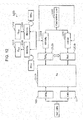
- Fig. 10 is a flowchart illustrating an outline of the training process according to the present embodiment.
- Fig. 11 is an explanatory diagram of an example of the structure of the base neural network 1211a used in the first-stage training process according to the present embodiment.
- Fig. 12 is an explanatory diagram of an example of the structure of the neural network 121b used in the second-stage training process according to the present embodiment. Note that elements similar to those in Figs. 3 and 4 are denoted with like signs, and detailed description of such elements will be reduced or omitted.
- training data is prepared, including multiple matching pairs, which are two images depicting identical objects, and non-matching pairs, which are two images depicting non-identical objects (S10). More specifically, training data to use in the first-stage training process (hereinafter designated the first training process) and training data to use in the second-stage training process (hereinafter designated the second training process) is prepared.
- training data including multiple matching pairs and non-matching pairs generated from the Market-1501 data set is prepared.
- a matching pair is two images of the same size depicting identical objects of the same size.
- a non-matching pair is two images of the same size depicting non-identical objects of the same size.
- training data including multiple matching pairs, which are two images depicting identical objects, and non-matching pairs, which are two images depicting non-identical objects, generated from the MOT16 data set is prepared.
- the Market-1501 data set includes 1501 identical persons given annotations (correct labels) which are usable for both testing and training, and may be used for re-identification of a person.
- the Market-1501 data set is collected by six camera from different angles.
- the MOT16 data set includes seven test sequences usable for testing, such as MOT16-02, 04, 05, 09, 10, 11, and 13, and seven training sequences usable for training, such as MOT16-01, 03, 06, 07, 08, 12, and 14.
- the training sequences include 79,790 detections, while the test sequences include detections indicating 135,376 pedestrians.
- a single sequence included in the MOT16 data set is a video sequence taken from a single perspective, and the sequences are collected from various perspectives, such as cameras attached to an automobile, a handheld camera, and the like.
- the computer uses the training data prepared in S10 to execute the first training process that trains the base neural network 1211a (S11). More specifically, the computer uses training data including multiple matching pairs, which are two images depicting identical objects, and non-matching pairs, which are two images depicting non-identical objects, to execute the first training process that trains parameters for causing the base neural network 1211a to extract features indicating identical objects in the similarity matching by comparison from each of the matching pairs.
- the similarity by comparison is scored by comparing the distances of the features of each of the two or more images extracted by the base neural network 1211a. As an example, the similarity by comparison is scored using a loss function using the Euclidean distances of the features of each of the two or more images.
- the computer executes the first training process using the base neural network 1211a as illustrated in Fig. 11 .
- the base neural network 1211a illustrated in Fig. 11 is additionally provided with a data input layer 51, a data input layer 51p, and a scoring layer 1220.
- the data input layer 51 and the data input layer 51p input a matching pair or a non-matching pair into the base neural network 1211 illustrated in Fig. 4 .
- the data input layer 51 inputs one image of a matching pair or a non-matching pair included in the training data prepared for the first training process into the base neural network 1211a.
- the data input layer 51p inputs the other image of the matching pair or the non-matching pair into the base neural network 1211a.
- E n indicates the Euclidean distance between a feature F p output from the feature layer 1212a and a feature F output from the feature layer 1213a.
- y in (Formula 2) indicates a label of the two images input from the data input layer 51 and the data input layer 51p.
- the computer adjusts or updates the parameters of the base neural network 1211a so that the loss computed in the scoring layer 1220 becomes smaller.
- the parameters are weights of the convolution layers and the fully-connected layers constituting the base neural network 1211a, and weights shared between the feature layer 1212a and the feature layer 1213a.
- the computer adjusts or updates the parameters until the loss computed in the first training process reaches a minimum or ceases to fluctuate.
- the computer uses the training data prepared in S10 to execute a second training process that trains the neural network 121b reflecting the parameters of the base neural network 1211a trained in S11 (S12). More specifically, the computer uses the training data prepared in S10 to execute the second training process that trains parameters for causing the neural network 121b, in which the parameters trained in S11 are reflected in the base neural network 1211b, to extract features indicating identical objects in the similarity matching by comparison from each of the matching pairs.
- the computer executes the second training process using the neural network 121b as illustrated in Fig. 12 .
- a scoring layer 1222 has been added. Note that in the neural network 121b illustrated in Fig. 12 , the parameters trained in S11 are reflected in the base neural network 1211b and temporarily locked.
- the data input layer 51 inputs one image of a matching pair or a non-matching pair included in the training data prepared for the second training process into the base neural network 1211b.
- the data input layer 51p inputs the other image of the matching pair or the non-matching pair into the base neural network 1211b.
- the scoring layer 1222 computes a loss function for scoring the features output by the feature layer 1212b and the feature layer 1213b using the Euclidean distances with respect to the neural network 121a. Similarly to the scoring layer 1220, the scoring layer 1222 may compute a loss function using the Euclidean distances according to (Formula 1) and (Formula 2), for example. In this case, the feature F p in (Formula 1) may be taken to be the concatenation of the features output from the feature layer 1212b and the additional features computed by the additional layer 1217 and the additional layer 1219.
- the feature F in (Formula 1) may be taken to be the concatenation of the features output from the feature layer 1213b and the additional features computed by the additional layer 1217 and the additional layer 1219.
- E n may be taken to be the Euclidean distance between the feature F p and the feature F.
- b i and b j are boxes indicating areas that include the objects depicted in each of the two images input into the data input layer 51 and the data input layer 51p.
- the additional layer 1217 computes D IoU as an additional feature
- the additional layer 1219 computes D ARAT as an additional feature.
- the computer executes the second training process with the parameters trained in S11 reflected in the base neural network 1211b of the neural network 121b illustrated in Fig. 12 , but in the first phase, the parameters are locked.
- the computer locks the parameters of the base neural network 1211b, and trains only the parameters shared between the feature layer 1212b and the feature layer 1213b using the training data prepared for the second training process. Specifically, the computer adjusts or updates the parameters shared between the feature layer 1212b and the feature layer 1213b using the training data prepared for the second training process so that the loss computed by the scoring layer 1222 becomes smaller.
- the parameters are adjusted or updated so that the loss computed by the scoring layer 1222 reaches a minimum or ceases to fluctuate.
- the computer unlocks the parameters of the base neural network 1211b, and executes the second training process.
- the computer trains all parameters of the neural network 121b using the training data prepared for the second training process.
- training only the parameters shared between the feature layer 1212b and the feature layer 1213b in the first phase is for utilizing the parameters of the base neural network 1211a trained in the first training process.
- all parameters of the neural network 121b are trained using the training data prepared for the second training process, without providing the first and last phases.
- the parameters trained in the first training process may become greatly altered, and there is a possibility of not only a drop in training efficiency, but also non-convergence of the parameters.
- the parameters of the neural network 121a to use in the object tracking apparatus 10 may be trained.
- an enhanced siamese neural network is used to incorporate position variants and area variants as additional features into a feature map that indicates the similarity in an image of tracking candidates in input images input chronologically, and in addition, the additional features may be acquired at a dimensionality greatly reduced compared to the dimensionality of the input images. Additionally, by comparing the acquired feature maps and matching the similarity of tracking candidates in the input images input chronologically, object tracking may be executed. In this way, by using an enhanced siamese neural network, the object tracking apparatus 10 in the present embodiment is able to match the similarity of tracking candidates using feature maps that account for temporal information with reduced dimensionality.
- the object tracking apparatus 10 in the present embodiment is able to more quickly process object tracking utilizing a recurrent neural network.
- the processing speed of object tracking using deep learning may be improved. Consequently, the object tracking apparatus 10 in the present embodiment may be applied to a system where real-time object tracking is demanded, such as ADAS.
- the neural network used in the object tracking apparatus 10 is an enhanced siamese neural network
- the neural network is not limited thereto.
- the neural network used in the object tracking apparatus 10 may also be a siamese neural network, or in other words, include only the base neural network 1211 and the feature layers 1212 and 1213.
- the computer uses the training data prepared in S10 and training images including multiple matching pairs, which are two or more images depicting identical objects, and non-matching pairs, which are two or more images depicting non-identical objects, to execute a training process that trains the parameters for causing the neural network made up of the base neural network 1211a to extract features indicating identical objects in the similarity matching by comparison from each of the matching pairs.
- the seven test sequences included in the MOT16 data set do not have ground truth information, that is, correct answer information. Accordingly, the seven training sequences included in the MOT16 data set were divided into six training sequences and one testing sequence. In the six sequences, a total of approximately 222,400 matching pairs and non-matching pairs as well as data indicating IoU (position variants) and AreaRatio (area variants) are generated from two consecutive frames, and treated as the training data to use in the second training process. In the remaining sequence, a total of approximately 198,800 matching pairs and non-matching pairs as well as data indicating IoU (position variants) and AreaRatio (area variants) are generated from two consecutive frames, and used for testing the effectiveness of the second training process.
- the training data generated from the Market-1501 data set is used to train the base neural network 1211a by a stochastic gradient descent method in which a single batch size is set to 128, and the learning rate is set to 0.01.
- Fig. 13 is a diagram illustrating training loss using the Market-1501 data set according to Working Example 1.
- Fig. 14 is a diagram illustrating testing loss using the Market-1501 data set according to Working Example 1. The vertical axis represents loss, while the horizontal axis represents a count in which one count equals 100 iterations.
- Fig. 14 illustrates the results of testing with the base neural network 1211a after the first training process for the count in Fig. 13 .
- TP indicates the number of true positives, that is, an output data count in which, when divided into the two classes of positive and negative, the truth is positive and the prediction result is also positive.
- FP indicates the number of false positives, that is, the output data count in which the truth is negative and the prediction result is positive.
- FN indicates the number of false negatives, that is, the output data count in which the truth is negative and the prediction result is negative.
- Figs. 15A and 15B are diagrams illustrating the Euclidean distance of features obtained using the Market-1501 data set for testing according to Working Example 1.
- the vertical axis represents the Euclidean distance of two features output by the trained base neural network 1211a.
- the graph on the left side indicates, on a linear and a logarithmic scale, the Euclidean distance of two features output when non-matching pairs are input into the base neural network 1211a after the first training process.
- the graph on the right side indicates, on a linear and a logarithmic scale, the Euclidean distance of two features output when matching pairs are input into the base neural network 1211a after the first training process.
- Fig. 15B corresponds to the result of converting the vertical axis in Fig. 15A to a logarithmic scale.
- the base neural network 1211a after the first training process extracts features indicating identical objects for matching pairs, and extracts features indicating non-identical objects for non-matching pairs.
- the parameters trained by the first training process are reflected in the base neural network 1211b constituting part of the neural network 121b.
- the training data generated from the MOT16 data set is used to train the neural network 121b while locking the parameters of the base neural network 1211 b in the first phase. Additionally, in the last phase, the parameters of the base neural network 1211b are unlocked, and the neural network 121b is trained.
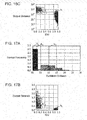
- Figs. 16A to 17C are diagrams illustrating the Euclidean distance of features obtained using the Mot16 data set for testing according to Working Example 1.
- Figs. 16A to 16C illustrate the Euclidean distance of two features obtained by the base neural network 1211b after the second training process.
- Figs. 17A to 17C illustrate the Euclidean distance of two features obtained by the neural network 121b after the second training process.
- the dark-colored points represent features extracted from matching pairs, while the light-colored points represent features extracted from non-matching pairs.
- Fig. 16A illustrates a histogram of the Euclidean distance of two features obtained by the base neural network 1211b after the second training process.
- the vertical axis indicates the normalized frequency, while the horizontal axis represents the Euclidean distance.
- the dashed line v 1 indicates the mean value of the Euclidean distance of two features extracted from the matching pairs, while the dashed line v 2 indicates the mean value of the Euclidean distance of two features extracted from the non-matching pairs.
- Fig. 16B is a plot of the results in Fig. 16A with IoU (area of intersection/area of union) on the horizontal axis, and linear-scale Euclidean distance on the vertical axis.
- IoU area of intersection/area of union
- FIG. 16C is a plot of the results in Fig. 16A with IoU (area of intersection/area of union) on the horizontal axis, and logarithmic-scale Euclidean distance on the vertical axis. Note that Fig. 16C corresponds to the result of converting the vertical axis in Fig. 16A to a logarithmic scale.
- Fig. 17A illustrates a histogram of the Euclidean distance of two features obtained by the base neural network 1211b after the second training process.
- the vertical axis indicates the normalized frequency, while the horizontal axis represents the Euclidean distance.
- the dashed line v 3 indicates the mean value of the Euclidean distance of two features extracted from the matching pairs, while the dashed line v 4 indicates the mean value of the Euclidean distance of two features extracted from the non-matching pairs.
- Fig. 17B is a plot of the results in Fig. 17A with IoU (area of intersection/area of union) on the horizontal axis, and linear-scale Euclidean distance on the vertical axis.
- IoU area of intersection/area of union
- FIG. 17C is a plot of the results in Fig. 17A with IoU (area of intersection/area of union) on the horizontal axis, and logarithmic-scale Euclidean distance on the vertical axis. Note that Fig. 17C corresponds to the result of converting the vertical axis in Fig. 17A to a logarithmic scale.
- a comparison of Fig. 16C and Fig. 17C demonstrates that the similarity may be classified more effectively in the example illustrated in Fig. 17C .
- the neural network 121b after the second training process more effectively extracts features indicating identical objects for matching pairs, and features indicating non-identical objects for non-matching pairs. For example, it is demonstrated that features of non-matching pairs with loU ⁇ 0.05 which are incorrectly classified by the base neural network 1211b after the second training process are correctly classified by the neural network 121b after the second training process.
- Figs. 18A to 19C are diagrams illustrating the Euclidean distance of features obtained using the Mot16 data set for training according to Working Example 1.
- Figs. 18A to 19C are diagrams similar to Figs. 16A to 17C , except that the MOT16 data set is used for training.
- the dashed line v 5 indicates the mean value of the Euclidean distance of two features extracted from the matching pairs by the base neural network 1211b after the second training process
- the dashed line v 6 indicates the mean value of the Euclidean distance of two features extracted from the non-matching pairs by the base neural network 1211b after the second training process.
- Fig. 18A the dashed line v 5 indicates the mean value of the Euclidean distance of two features extracted from the matching pairs by the base neural network 1211b after the second training process
- the dashed line v 6 indicates the mean value of the Euclidean distance of two features extracted from the non-matching pairs by the base neural network 1211b after the
- the dashed line v 7 indicates the mean value of the Euclidean distance of two features extracted from the matching pairs by the neural network 121b after the second training process
- the dashed line v 8 indicates the mean value of the Euclidean distance of two features extracted from the non-matching pairs by the neural network 121b after the second training process.
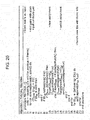
- Fig. 20 is a diagram illustrating an example of a designated algorithm according to Working Example 1.
- Fig. 20 illustrates an example of a designated algorithm used to match similarity by comparing features extracted by the base neural networks 1211a and 1211b, and features extracted by the neural network 121b.
- b i and b j are boxes indicating areas that include objects such as persons depicted in each of the two chronologically consecutive images B t-1 and B t input into the data input layers 51 and 51p illustrated in Fig. 11 or Fig. 12 .
- S Dist indicated in (Formula 5) may be derived from the Euclidean distance D(b i , b j ) of the features extracted by the base neural networks 1211a and 1211b from b i and b j , and a bias term ⁇ .
- S IoU may be derived by shifting the IoU (position variant) of bi and bj by 1.0.
- S Arat may be derived from the AreaRatio (area variant) of b i and b j .
- the matching of similarity according to features extracted by the neural network 121b is executed using S Dist which may be computed according to (Formula 6) below.
- similarity matching according to features may be executed using the score function S new indicated in (Formula 9) below.
- the score function S new indicated in (Formula 9) is derived using a designated algorithm as illustrated in Fig. 20 .
- n input on Line 1 of Fig. 20 decides how many frames back to search to generate pairs with the current frame.
- the same ID as the tracking target object of the current frame is assigned.
- the MOT16 Train Data set and the MOT16 Test Data set were used to evaluate the performance of the neural network used in the object tracking apparatus 10, and the effects will be described.
- the neural network used in the object tracking apparatus 10 is taken to be a siamese neural network.
- performance is evaluated for the neural network used in the object tracking apparatus 10 according to the modification.
- the use of MOT16 to benchmark the performance of object tracking that tracks multiple target objects is one of the most well-established evaluation methods, and is widely used.
- Fig. 21 is a diagram illustrating benchmark results for the MOT16 Train Data set according to Working Example 2.
- the highest object tracking accuracy (MOTA) value of 48.6 is the score from the case of using the MOT16-11 sequence.
- the lowest object tracking accuracy (MOTA) value of 6.2 is the score from the case of using the MOT16-13 sequence.
- the MOT16-13 sequence is known to be the most difficult sequence for object tracking among the sequences included in the MOT16 Train Data set.
- the mean object tracking accuracy (MOTA) value for the case of using the MOT16 Train Data set is 31.0.
- the running time (Hz) is different for each sequence included in the MOT16 Train Data set. This is because the running time depends on the density of the sequence, and as the density of the sequence becomes greater, that is, as the number of target object detections in the image frames becomes greater, the computational cost also becomes greater, thus requiring more time. Note that the running times in the present working examples were evaluated using an NVIDIA GeForce GTX 970 card.
- Fig. 22 is a diagram illustrating benchmark results for the MOT16 Test Data set according to Working Example 2.
- "Ours" corresponds to the performance score, that is, the benchmark, of object detection executed by the object tracking apparatus 10 according to the present disclosure.
- the others are the benchmarks of object detection by methods which do not use a siamese neural network.
- the benchmarks illustrated in Fig. 22 are executed 1) online, namely, a method that uses current and past information without using future information, and 2) by a method that uses the provided detection set without preparing tracking targets of one's own.
- the object tracking accuracy (MOTA) is 35.2
- the running time (Hz) is 5.6 Hz.
- an object tracking method with further improvement in the processing speed of object tracking using deep learning may be realized. Consequently, the object tracking apparatus and object tracking method according to the present disclosure is favorably applicable to systems where real-time object tracking is demanded, such as ADAS.
- a process may be executed by a processor or the like (described below) embedded into a specific device disposed locally. Additionally, a process may also be executed by a cloud server or the like disposed in a different location from a local device.
- training data or the input images into the object tracking method may be images taken by a car-mounted camera (full images), or images from a part of a full image (partial images).
- the partial images may be images of an area including a tracking target object.
- the full images may be images including multiple tracking target objects.
- present disclosure furthermore includes cases like the following.
- the present disclosure may also be realized by transmitting the computer program or the digital signal over an electrical communication link, a wired or wireless communication link, a network such as the Internet, or a data broadcast.
- the present disclosure may also be a computer system equipped with a microprocessor and memory, in which the memory stores the above computer program, and the microprocessor operates according to the computer program.
- one aspect of the present disclosure may also be carried out by another independent computer system by recording and transporting the program or the digital signal on a recording medium, or transporting the program or the digital signal over a medium such as a network.
- the present disclosure may be used in an object tracking method, an object tracking apparatus, and a program using deep learning, and more particularly may be used in a system where real-time object tracking is demanded, such as ADAS.
Landscapes
- Engineering & Computer Science (AREA)
- Theoretical Computer Science (AREA)
- General Physics & Mathematics (AREA)
- Physics & Mathematics (AREA)
- Computer Vision & Pattern Recognition (AREA)
- Multimedia (AREA)
- Evolutionary Computation (AREA)
- Life Sciences & Earth Sciences (AREA)
- Artificial Intelligence (AREA)
- Biodiversity & Conservation Biology (AREA)
- Health & Medical Sciences (AREA)
- Data Mining & Analysis (AREA)
- Biomedical Technology (AREA)
- General Health & Medical Sciences (AREA)
- Molecular Biology (AREA)
- Bioinformatics & Computational Biology (AREA)
- Evolutionary Biology (AREA)
- Bioinformatics & Cheminformatics (AREA)
- General Engineering & Computer Science (AREA)
- Image Analysis (AREA)
Claims (11)
- Procédé de suivi d'objet exécuté par un ordinateur utilisant un réseau neuronal, comprenant :une étape d'entrée d'entrée, dans le réseau neuronal, de deux images chronologiquement consécutives ou plus qui inclut une première image et une deuxième image étant une image chronologiquement postérieure à la première image et chacune desquelles décrit un ou plusieurs objets, dans lequel la première image est l'image la plus antérieure chronologiquement parmi les deux images ou plus ; etune étape de sortie de correspondance de similarité par comparaison d'une première caractéristique et d'une deuxième caractéristique extraites par le réseau neuronal, la première caractéristique et la deuxième caractéristique étant des caractéristiques de chacune de la première image et de la deuxième image parmi les deux images ou plus entrées à l'étape d'entrée, et générant ainsi en sortie, en tant que résultat d'identification, des informations d'identification et des informations de position relatives à un ou plusieurs objets décrits dans la deuxième image, qui correspondent à un ou plusieurs objets qui sont des candidats au suivi décrits dans la première image,dans lequel, le réseau neuronal inclut deux structures identiques ou plus affichant zéro couche ou plus complètement connectées et une ou plusieurs couches de convolution, et partage des paramètres parmi des couches correspondantes à l'échelle des structures identiques,caractérisé en ce quele réseau neuronal inclut en outre, hors des deux structures identiques ou plus, des couches supplémentaires (1217, 1219) configurées pour calculer une intersection-sur-union et un rapport d'aire dans des zones qui incluent l'un ou plusieurs objets décrits dans la première image et la deuxième image entrées à l'étape d'entrée,dans lequel, le réseau neuronal extrait la première caractéristique de la première image et la deuxième caractéristique de la deuxième image avec deux des deux structures identiques ou plus et les couches supplémentaires (1217, 1219),dans lequel, une première couche de concaténation du réseau neuronal extrait la première caractéristique en concaténant une caractéristique dans la première image générée en sortie par une des deux des deux structures identiques ou plus avec l'intersection-sur-union et le rapport d'aire, etdans lequel, une deuxième couche de concaténation du réseau neuronal extrait la deuxième caractéristique en concaténant une caractéristique dans la deuxième image générée en sortie par une autre des deux des deux structures identiques ou plus avec l'intersection-sur-union et le rapport d'aire.
- Le procédé de suivi d'objet selon la revendication 1, dans lequel
les deux images chronologiquement consécutives ou plus sont la première image et la deuxième image, et
les deux structures identiques ou plus sont deux structures identiques. - Le procédé de suivi d'objet selon la revendication 1, dans lequel
à l'étape d'entrée, la première image, la deuxième image, et une troisième image qui sont chronologiquement consécutives, chacune décrivant un ou plusieurs objets, sont entrées dans le réseau neuronal, la troisième image étant une image chronologiquement postérieure à la deuxième,
à l'étape de sortie, le réseau neuronal est configuré pour extraire la première caractéristique de chacun d'un ou plusieurs objets qui sont des candidats au suivi décrits dans la première image entrée à l'étape d'entrée, la deuxième caractéristique de chacun d'un ou plusieurs objets décrits dans la deuxième image, et une troisième caractéristique de chacun d'un ou plusieurs objets décrits dans la troisième image,
et la similarité est mise en correspondance par comparaison des première caractéristique, deuxième caractéristique, et troisième caractéristique extraites, générant ainsi en sortie, en tant que résultat d'identification, des informations d'identification et des informations de position sur un ou plusieurs objets décrits dans la deuxième image et la troisième image qui correspondent à chaque candidat au suivi décrit dans la première image,
les deux structures identiques ou plus sont trois structures identiques, et
le réseau neuronal extrait la première caractéristique de la première image, la deuxième caractéristique de la deuxième image, et la troisième caractéristique de la troisième image avec les trois structures identiques. - Le procédé de suivi d'objet selon l'une quelconque des revendications 1 à 3, comprenant en outre :
une étape d'entraînement qui, avant une exécution de l'étape d'entrée, utilise des données d'entraînement incluant plusieurs paires correspondantes, qui sont deux images ou plus décrivant des objets identiques, et des paires non correspondantes, qui sont deux images ou plus décrivant des objets non identiques, pour entraîner des paramètres à faire extraire par le réseau neuronal des caractéristiques indiquant des objets identiques dans la correspondance de similarité par comparaison à partir de chacune des paires correspondantes. - Le procédé de suivi d'objet selon la revendication 1, comprenant en outre :une première étape d'entraînement qui, avant une exécution de l'étape d'entrée, utilise des données d'entraînement incluant plusieurs paires correspondantes, qui sont deux images ou plus décrivant des objets identiques, et des paires non correspondantes, qui sont deux images ou plus décrivant des objets non identiques, pour entraîner des paramètres qui font extraire aux deux structures identiques ou plus incluses dans le réseau neuronal des caractéristiques indiquant des objets identiques dans la correspondance de similarité par comparaison à partir de chacune des paires correspondantes ; etune deuxième étape d'entraînement qui utilise les données d'entraînement pour entraîner les paramètres à faire extraire par le réseau neuronal dans lequel les paramètres entraînés à la première étape d'entraînement sont reflétés dans les deux structures identiques ou plus des caractéristiques indiquant des objets identiques dans la correspondance de similarité par comparaison à partir de chacune des paires correspondantes.
- Le procédé de suivi d'objet selon la revendication 4 ou 5, dans lequel
la similarité par comparaison est évaluée en comparant une distance des caractéristiques de chacune des deux images ou plus entrées à l'étape d'entrée extraites par les deux structures identiques ou plus. - Le procédé de suivi d'objet selon la revendication 6, dans lequel
la similarité par comparaison est évaluée en utilisant une fonction de perte utilisant une distance euclidienne des caractéristiques de chacune des deux images ou plus. - Le procédé de suivi d'objet selon l'une quelconque des revendications 1 à 7, dans lequel
chacune des deux structures identiques ou plus extrait une caractéristique d'une image correspondante parmi les deux images ou plus entrées à l'étape d'entrée par une dimensionnalité plus réduite que la dimensionnalité de l'image, et
la dimensionnalité des caractéristiques extraites par chacune des deux structures identiques ou plus est la même. - Le procédé de suivi d'objet selon l'une quelconque des revendications 1 à 6, dans lequel
l'un ou plusieurs objets décrits dans les deux images ou plus sont au moins un d'une personne et d'un véhicule. - Programme informatique comprenant des instructions qui, lorsque le programme est exécuté par un ordinateur, font exécuter à l'ordinateur des étapes incluant :une étape d'entrée d'entrée de deux images chronologiquement consécutives ou plus qui inclut une première image et une deuxième image étant une image chronologiquement postérieure à la première image et chacune desquelles décrit un ou plusieurs objets, dans un réseau neuronal qui inclut deux structures identiques ou plus présentant zéro couche ou plus complètement connectées et une ou plusieurs couches de convolution, et partage des paramètres parmi des couches correspondantes à l'échelle des structures identiques, dans lequel la première image est l'image la plus antérieure chronologiquement parmi les deux images ou plus ; etune étape de sortie de correspondance de similarité par comparaison d'une première caractéristique et d'une deuxième caractéristique extraites par le réseau neuronal, la première caractéristique et la deuxième caractéristique étant des caractéristiques de chacune de la première image et de la deuxième image parmi les deux images ou plus entrées à l'étape d'entrée, et générant ainsi en sortie, en tant que résultat d'identification, des informations d'identification et des informations de position relatives à un ou plusieurs objets décrits dans la deuxième image, qui correspondent à un ou plusieurs objets qui sont des candidats au suivi décrits dans la première image,caractérisé en ce quele réseau neuronal inclut en outre, hors des deux structures identiques ou plus, des couches supplémentaires (1217, 1219) configurées pour calculer une intersection-sur-union et un rapport d'aire dans des zones qui incluent l'un ou plusieurs objets décrits dans la première image et la deuxième image à l'étape d'entrée,dans lequel, le réseau neuronal extrait la première caractéristique de la première image et la deuxième caractéristique de la deuxième image avec deux des deux structures identiques ou plus et les couches supplémentaires (1217, 1219),dans lequel, une première couche de concaténation du réseau neuronal extrait la première caractéristique en concaténant une caractéristique dans la première image générée en sortie par une des deux des deux structures identiques ou plus avec l'intersection-sur-union et le rapport d'aire, etdans lequel, une deuxième couche de concaténation du réseau neuronal extrait la deuxième caractéristique en concaténant une caractéristique dans la deuxième image générée en sortie par une autre des deux des deux structures identiques ou plus avec l'intersection-sur-union et le rapport d'aire.
- Dispositif de suivi d'objet (10) comprenant :une unité d'entrée (11) configurée pour entrer, dans un réseau neuronal, deux images chronologiquement consécutives ou plus qui inclut une première image et une deuxième image étant une image chronologiquement postérieure à la première image et chacune desquelles décrit un ou plusieurs objets, dans lequel la première image est l'image la plus antérieure chronologiquement parmi les deux images ou plus ; etune unité de sortie (12) configurée pour établir une correspondance de similarité par comparaison d'une première caractéristique et d'une deuxième caractéristique extraites par le réseau neuronal, la première caractéristique et la deuxième caractéristique étant des caractéristiques de chacune de la première image et de la deuxième image parmi les deux images ou plus entrées par l'unité d'entrée, et générer ainsi en sortie, en tant que résultat d'identification, des informations d'identification et des informations de position relatives à un ou plusieurs objets décrits dans la deuxième image, qui correspondent à un ou plusieurs objets qui sont des candidats au suivi décrits dans la première image,dans lequel, le réseau neuronal inclut deux structures identiques ou plus affichant zéro couche ou plus complètement connectées et une ou plusieurs couches de convolution, et partage des paramètres parmi des couches correspondantes à l'échelle des structures identiques,caractérisé en ce quele réseau neuronal inclut en outre, hors des deux structures identiques ou plus, des couches supplémentaires (1217, 1219) configurées pour calculer une intersection-sur-union et un rapport d'aire dans des zones qui incluent l'un ou plusieurs objets décrits dans la première image et la deuxième image entrées à l'étape d'entrée,dans lequel, le réseau neuronal extrait la première caractéristique de la première image et la deuxième caractéristique de la deuxième image avec deux des deux structures identiques ou plus et les couches supplémentaires (1217, 1219),dans lequel, le réseau neuronal extrait la première caractéristique de la première image et la deuxième caractéristique de la deuxième image avec deux des deux structures identiques ou plus et les couches supplémentaires (1217, 1219),dans lequel, une première couche de concaténation du réseau neuronal extrait la première caractéristique en concaténant une caractéristique dans la première image générée en sortie par une des deux des deux structures identiques ou plus avec l'intersection-sur-union et le rapport d'aire, etdans lequel, une deuxième couche de concaténation du réseau neuronal extrait la deuxième caractéristique en concaténant une caractéristique dans la deuxième image générée en sortie par une autre des deux des deux structures identiques ou plus avec l'intersection-sur-union et le rapport d'aire.
Applications Claiming Priority (3)
| Application Number | Priority Date | Filing Date | Title |
|---|---|---|---|
| US201662371962P | 2016-08-08 | 2016-08-08 | |
| JP2017098560A JP6832504B2 (ja) | 2016-08-08 | 2017-05-17 | 物体追跡方法、物体追跡装置およびプログラム |
| PCT/JP2017/024932 WO2018030048A1 (fr) | 2016-08-08 | 2017-07-07 | Procédé de suivi d'objet, dispositif de suivi d'objet, et programme |
Publications (3)
| Publication Number | Publication Date |
|---|---|
| EP3499454A4 EP3499454A4 (fr) | 2019-06-19 |
| EP3499454A1 EP3499454A1 (fr) | 2019-06-19 |
| EP3499454B1 true EP3499454B1 (fr) | 2020-06-03 |
Family
ID=61194124
Family Applications (1)
| Application Number | Title | Priority Date | Filing Date |
|---|---|---|---|
| EP17839122.3A Active EP3499454B1 (fr) | 2016-08-08 | 2017-07-07 | Procédé de suivi d'objet, dispositif de suivi d'objet, et programme |
Country Status (4)
| Country | Link |
|---|---|
| US (1) | US10803602B2 (fr) |
| EP (1) | EP3499454B1 (fr) |
| JP (1) | JP6832504B2 (fr) |
| CN (1) | CN108352072B (fr) |
Families Citing this family (68)
| Publication number | Priority date | Publication date | Assignee | Title |
|---|---|---|---|---|
| JP2018060268A (ja) * | 2016-10-03 | 2018-04-12 | 株式会社日立製作所 | 認識装置および学習システム |
| US12223689B2 (en) | 2017-07-26 | 2025-02-11 | Vizit Labs, Inc. | Systems and methods for automatic image generation and arrangement using a machine learning architecture |
| US12142027B1 (en) | 2017-07-26 | 2024-11-12 | Vizit Labs, Inc. | Systems and methods for automatic image generation and arrangement using a machine learning architecture |
| US12283084B2 (en) | 2017-07-26 | 2025-04-22 | Vizit Labs, Inc. | Systems and methods implementing a machine learning architecture for video processing |
| US11417085B2 (en) | 2017-07-26 | 2022-08-16 | Vizit Labs, Inc. | Systems and methods for automating benchmark generation using neural networks for image or video selection |
| US12249118B2 (en) | 2017-07-26 | 2025-03-11 | Vizit Labs, Inc. | Systems and methods for using image scoring for an improved search engine |
| US12482227B1 (en) | 2017-07-26 | 2025-11-25 | Vizit Labs, Inc. | Explanatory model architecture for image scoring reasoning |
| US12254669B1 (en) | 2017-07-26 | 2025-03-18 | Vizit Labs, Inc. | Systems and methods for training a multi-modal machine learning architecture for content generation |
| US12020470B1 (en) | 2017-07-26 | 2024-06-25 | Vizit Labs, Inc. | Systems and methods for using image scoring an improved search engine |
| US12118769B1 (en) | 2017-07-26 | 2024-10-15 | Vizit Labs, Inc. | Machine learning architecture for peer-based image scoring |
| US12198403B1 (en) | 2017-07-26 | 2025-01-14 | Vizit Labs, Inc. | Systems and methods for automating benchmark generation using neural networks for image or video selection |
| US11763546B1 (en) | 2017-07-26 | 2023-09-19 | Vizit Labs, Inc. | Systems and methods for managing computer memory for scoring images or videos using selective web crawling |
| US12260611B1 (en) | 2017-07-26 | 2025-03-25 | Vizit Labs, Inc. | Systems and methods for contextual machine learning prompt generation |
| CN107562805B (zh) * | 2017-08-08 | 2020-04-03 | 浙江大华技术股份有限公司 | 一种以图搜图的方法及装置 |
| CN108230359B (zh) * | 2017-11-12 | 2021-01-26 | 北京市商汤科技开发有限公司 | 目标检测方法和装置、训练方法、电子设备、程序和介质 |
| US11087273B1 (en) * | 2017-12-14 | 2021-08-10 | Amazon Technologies, Inc. | Item recognition system using reference images |
| JP7163372B2 (ja) * | 2018-03-06 | 2022-10-31 | 北京市商▲湯▼科技▲開▼▲発▼有限公司 | 目標トラッキング方法及び装置、電子機器並びに記憶媒体 |
| CN108460787B (zh) | 2018-03-06 | 2020-11-27 | 北京市商汤科技开发有限公司 | 目标跟踪方法和装置、电子设备、程序、存储介质 |
| KR102103770B1 (ko) * | 2018-04-02 | 2020-04-24 | 동국대학교 산학협력단 | 보행자 검출 장치 및 방법 |
| JP6988698B2 (ja) * | 2018-05-31 | 2022-01-05 | トヨタ自動車株式会社 | 物体認識装置 |
| US11741568B2 (en) | 2018-06-29 | 2023-08-29 | Baidu Usa Llc | Systems and methods for low-power, real-time object detection |
| EP3588441B1 (fr) * | 2018-06-29 | 2023-08-09 | Fujitsu Limited | Imagification de séquences de données à plusieurs variables |
| TWI679612B (zh) * | 2018-08-14 | 2019-12-11 | 國立交通大學 | 影像追蹤方法 |
| SG11202101826WA (en) * | 2018-08-23 | 2021-03-30 | Univ Texas | Controlling a device by tracking movement of hand using acoustic signals |
| CN109344661B (zh) * | 2018-09-06 | 2023-05-30 | 南京聚铭网络科技有限公司 | 一种基于机器学习的微代理的网页防篡改方法 |
| US10872424B2 (en) * | 2018-11-19 | 2020-12-22 | Accenture Global Solutions Limited | Object tracking using object attributes |
| US10861170B1 (en) * | 2018-11-30 | 2020-12-08 | Snap Inc. | Efficient human pose tracking in videos |
| US12079999B2 (en) | 2019-03-13 | 2024-09-03 | Nec Corporation | Object tracking device, object tracking method, and recording medium |
| WO2020196165A1 (fr) * | 2019-03-25 | 2020-10-01 | ソニーセミコンダクタソリューションズ株式会社 | Dispositif de traitement d'informations, procédé de traitement d'informations, programme de traitement d'informations et système de traitement d'informations |
| CN110349147B (zh) * | 2019-07-11 | 2024-02-02 | 腾讯医疗健康(深圳)有限公司 | 模型的训练方法、眼底黄斑区病变识别方法、装置及设备 |
| JP7404125B2 (ja) * | 2019-09-13 | 2023-12-25 | パナソニック インテレクチュアル プロパティ コーポレーション オブ アメリカ | 物体追跡方法及びプログラム |
| JP7453767B2 (ja) * | 2019-09-25 | 2024-03-21 | キヤノン株式会社 | 情報処理装置、情報処理方法 |
| JP7518609B2 (ja) * | 2019-11-07 | 2024-07-18 | キヤノン株式会社 | 画像処理装置、画像処理方法、及びプログラム |
| JP7331947B2 (ja) * | 2019-12-24 | 2023-08-23 | 日本電気株式会社 | 物体識別装置、物体識別方法、学習装置、学習方法、及び、プログラム |
| JP7196058B2 (ja) * | 2019-12-24 | 2022-12-26 | 株式会社日立製作所 | 物体検索装置及び物体検索方法 |
| JP7310927B2 (ja) * | 2019-12-26 | 2023-07-19 | 日本電気株式会社 | 物体追跡装置、物体追跡方法及び記録媒体 |
| SG10201913754XA (en) * | 2019-12-30 | 2020-12-30 | Sensetime Int Pte Ltd | Image processing method and apparatus, electronic device, and storage medium |
| US11450021B2 (en) | 2019-12-30 | 2022-09-20 | Sensetime International Pte. Ltd. | Image processing method and apparatus, electronic device, and storage medium |
| JP7226368B2 (ja) * | 2020-02-17 | 2023-02-21 | トヨタ自動車株式会社 | 物体状態識別装置 |
| CN111460906B (zh) * | 2020-03-05 | 2023-05-26 | 重庆大学 | 一种基于集成学习的脉冲神经网络模式识别方法及系统 |
| JP7115502B2 (ja) | 2020-03-23 | 2022-08-09 | トヨタ自動車株式会社 | 物体状態識別装置、物体状態識別方法及び物体状態識別用コンピュータプログラムならびに制御装置 |
| JP7381388B2 (ja) | 2020-04-03 | 2023-11-15 | トヨタ自動車株式会社 | 信号灯状態識別装置、信号灯状態識別方法及び信号灯状態識別用コンピュータプログラムならびに制御装置 |
| JP7359735B2 (ja) | 2020-04-06 | 2023-10-11 | トヨタ自動車株式会社 | 物体状態識別装置、物体状態識別方法及び物体状態識別用コンピュータプログラムならびに制御装置 |
| US12505595B2 (en) * | 2020-05-15 | 2025-12-23 | Nvidia Corporation | Content-aware style encoding using neural networks |
| TWI831016B (zh) * | 2020-06-05 | 2024-02-01 | 宏達國際電子股份有限公司 | 機器學習方法、機器學習系統以及非暫態電腦可讀取媒體 |
| CN111885384B (zh) * | 2020-07-10 | 2023-08-22 | 郑州大学 | 带宽受限下基于生成对抗网络的图片处理和传输方法 |
| WO2022044222A1 (fr) * | 2020-08-27 | 2022-03-03 | 日本電気株式会社 | Dispositif d'apprentissage, procédé d'apprentissage, procédé de suivi et support de stockage |
| WO2022054124A1 (fr) * | 2020-09-08 | 2022-03-17 | 楽天グループ株式会社 | Dispositif de détermination d'image, procédé de détermination d'image et programme |
| US11818373B1 (en) * | 2020-09-08 | 2023-11-14 | Block, Inc. | Machine-learning based data compression for streaming media |
| US11741712B2 (en) * | 2020-09-28 | 2023-08-29 | Nec Corporation | Multi-hop transformer for spatio-temporal reasoning and localization |
| FR3115387A1 (fr) * | 2020-10-20 | 2022-04-22 | Biomerieux | Procédé de classification d’une image d’entrée représentant une particule dans un échantillon |
| US11964654B2 (en) * | 2020-10-30 | 2024-04-23 | GM Global Technology Operations LLC | Spatially invariant 3D convolutional network over spherical coordinate input |
| CN112509008B (zh) * | 2020-12-15 | 2022-05-03 | 重庆邮电大学 | 一种基于交并比引导孪生网络的目标跟踪方法 |
| KR102308752B1 (ko) * | 2021-02-22 | 2021-10-05 | 주식회사 에스아이에이 | 객체 추적 방법 및 장치 |
| DE102021202934A1 (de) * | 2021-03-25 | 2022-09-29 | Robert Bosch Gesellschaft mit beschränkter Haftung | Verfolgung mehrerer Objekte mit neuronalen Netzwerken, lokalen Speichern und einem gemeinsamen Speicher |
| JP7655789B2 (ja) * | 2021-06-03 | 2025-04-02 | キヤノン株式会社 | 画像処理装置、画像処理方法、撮像装置 |
| SE546810C2 (en) * | 2021-06-09 | 2025-02-25 | Saab Ab | Method and Device for object tracking |
| KR102373753B1 (ko) * | 2021-06-28 | 2022-03-14 | 주식회사 아센디오 | 딥러닝 기반의 차량식별추적 방법, 및 시스템 |
| KR102373752B1 (ko) * | 2021-06-28 | 2022-03-14 | 주식회사 아센디오 | 복수 모델을 이용한 차량식별추적 방법, 및 시스템 |
| CN113628244B (zh) * | 2021-07-05 | 2023-11-28 | 上海交通大学 | 基于无标注视频训练的目标跟踪方法、系统、终端及介质 |
| US12437552B2 (en) * | 2021-07-19 | 2025-10-07 | Kookmin University Industry Academy Cooperation Foundation | Method and apparatus for detecting an object based on identification information of the object in continuous images |
| KR102878939B1 (ko) * | 2021-07-19 | 2025-10-30 | 국민대학교산학협력단 | 객체 검출 방법 및 장치 |
| KR102810435B1 (ko) * | 2021-07-19 | 2025-05-23 | 국민대학교산학협력단 | 연속된 영상의 추적 키에 기반한 객체 검출 방법 및 장치 |
| EP4145405A1 (fr) * | 2021-09-02 | 2023-03-08 | Bull SAS | Procédé d'entrainement d'un réseau neuronal d'analyse d'image, et procédé de ré-identification d'objet mettant en oeuvre un tel réseau neuronal |
| CN114332169B (zh) * | 2022-03-14 | 2022-05-06 | 南京甄视智能科技有限公司 | 基于行人重识别的行人跟踪方法、装置、存储介质及设备 |
| CN115272963A (zh) * | 2022-07-22 | 2022-11-01 | 福建工程学院 | 基于YOLOv5s网络的白对虾加工前质量检测方法 |
| JP2025121224A (ja) * | 2024-02-06 | 2025-08-19 | Astemo株式会社 | 画像処理装置 |
| US12340557B1 (en) | 2024-11-14 | 2025-06-24 | Vizit Labs, Inc. | Systems and methods for contextual machine learning prompt generation |
Family Cites Families (9)
| Publication number | Priority date | Publication date | Assignee | Title |
|---|---|---|---|---|
| JP4859025B2 (ja) * | 2005-12-16 | 2012-01-18 | 株式会社リコー | 類似画像検索装置、類似画像検索処理方法、プログラム及び情報記録媒体 |
| JP4290164B2 (ja) * | 2006-01-31 | 2009-07-01 | キヤノン株式会社 | 識別領域を示す表示を画像と共に表示させる表示方法、コンピュータ装置に実行させるプログラム、および、撮像装置 |
| CN101299233B (zh) * | 2008-04-08 | 2010-11-10 | 西安交通大学 | 基于fpga实现的运动目标识别与跟踪方法 |
| JP5248236B2 (ja) * | 2008-08-08 | 2013-07-31 | パナソニック株式会社 | 画像処理装置および画像処理方法 |
| CN104299245B (zh) * | 2014-10-13 | 2017-12-26 | 深圳先进技术研究院 | 基于神经网络的增强现实跟踪方法 |
| CN104915643B (zh) * | 2015-05-26 | 2018-06-22 | 中山大学 | 一种基于深度学习的行人再标识方法 |
| US10019631B2 (en) * | 2015-11-05 | 2018-07-10 | Qualcomm Incorporated | Adapting to appearance variations when tracking a target object in video sequence |
| US9858496B2 (en) * | 2016-01-20 | 2018-01-02 | Microsoft Technology Licensing, Llc | Object detection and classification in images |
| JP2018005420A (ja) * | 2016-06-29 | 2018-01-11 | 富士通株式会社 | 情報処理装置、学習ネットワーク学習値算出プログラムおよび学習ネットワーク学習値算出方法 |
-
2017
- 2017-05-17 JP JP2017098560A patent/JP6832504B2/ja active Active
- 2017-07-07 CN CN201780003689.5A patent/CN108352072B/zh active Active
- 2017-07-07 EP EP17839122.3A patent/EP3499454B1/fr active Active
-
2018
- 2018-10-26 US US16/171,923 patent/US10803602B2/en active Active
Non-Patent Citations (1)
| Title |
|---|
| None * |
Also Published As
| Publication number | Publication date |
|---|---|
| CN108352072A (zh) | 2018-07-31 |
| EP3499454A4 (fr) | 2019-06-19 |
| EP3499454A1 (fr) | 2019-06-19 |
| US10803602B2 (en) | 2020-10-13 |
| US20190066313A1 (en) | 2019-02-28 |
| JP2018026108A (ja) | 2018-02-15 |
| CN108352072B (zh) | 2023-11-03 |
| JP6832504B2 (ja) | 2021-02-24 |
Similar Documents
| Publication | Publication Date | Title |
|---|---|---|
| EP3499454B1 (fr) | Procédé de suivi d'objet, dispositif de suivi d'objet, et programme | |
| Keller et al. | The benefits of dense stereo for pedestrian detection | |
| Keller et al. | A new benchmark for stereo-based pedestrian detection | |
| Hoang et al. | Enhanced detection and recognition of road markings based on adaptive region of interest and deep learning | |
| Satzoda et al. | Multipart vehicle detection using symmetry-derived analysis and active learning | |
| Breitenstein et al. | Online multiperson tracking-by-detection from a single, uncalibrated camera | |
| US9621779B2 (en) | Face recognition device and method that update feature amounts at different frequencies based on estimated distance | |
| EP4139831B1 (fr) | Procédé et système de détection de points clés basés sur des réseaux neuronaux | |
| EP3144851A1 (fr) | Procédé de reconnaissance d'images | |
| EP3107038B1 (fr) | Procédé et appareil pour la détection de cibles | |
| Kim et al. | Similarity mapping with enhanced siamese network for multi-object tracking | |
| EP2202672A1 (fr) | Appareil, procédé et programme de traitement d'informations | |
| US20040017930A1 (en) | System and method for detecting and tracking a plurality of faces in real time by integrating visual ques | |
| US20110243434A1 (en) | Feature value extracting device, object identification device, and feature value extracting method | |
| US12406532B2 (en) | Behavior recognition artificial intelligence network system and method for efficient recognition of hand signals and gestures | |
| WO2018030048A1 (fr) | Procédé de suivi d'objet, dispositif de suivi d'objet, et programme | |
| EP3267395B1 (fr) | Procédé de suivi de personne et dispositif de suivi de personne | |
| EP3107039B1 (fr) | Procédé et appareil de suivi de cibles | |
| Guindel et al. | Joint object detection and viewpoint estimation using CNN features | |
| Gabb et al. | High-performance on-road vehicle detection in monocular images | |
| Thakoor et al. | Structural signatures for passenger vehicle classification in video | |
| El Jaafari et al. | A novel approach for on-road vehicle detection and tracking | |
| Mittal et al. | Pedestrian detection and tracking using deformable part models and Kalman filtering | |
| CN116229241B (zh) | 算力资源的分配方法、计算机设备及存储介质 | |
| Klinger et al. | A dynamic bayes network for visual pedestrian tracking |
Legal Events
| Date | Code | Title | Description |
|---|---|---|---|
| STAA | Information on the status of an ep patent application or granted ep patent |
Free format text: STATUS: THE INTERNATIONAL PUBLICATION HAS BEEN MADE |
|
| PUAI | Public reference made under article 153(3) epc to a published international application that has entered the european phase |
Free format text: ORIGINAL CODE: 0009012 |
|
| STAA | Information on the status of an ep patent application or granted ep patent |
Free format text: STATUS: REQUEST FOR EXAMINATION WAS MADE |
|
| 17P | Request for examination filed |
Effective date: 20181107 |
|
| A4 | Supplementary search report drawn up and despatched |
Effective date: 20190520 |
|
| AK | Designated contracting states |
Kind code of ref document: A1 Designated state(s): AL AT BE BG CH CY CZ DE DK EE ES FI FR GB GR HR HU IE IS IT LI LT LU LV MC MK MT NL NO PL PT RO RS SE SI SK SM TR |
|
| AX | Request for extension of the european patent |
Extension state: BA ME |
|
| DAV | Request for validation of the european patent (deleted) | ||
| DAX | Request for extension of the european patent (deleted) | ||
| GRAP | Despatch of communication of intention to grant a patent |
Free format text: ORIGINAL CODE: EPIDOSNIGR1 |
|
| STAA | Information on the status of an ep patent application or granted ep patent |
Free format text: STATUS: GRANT OF PATENT IS INTENDED |
|
| INTG | Intention to grant announced |
Effective date: 20200221 |
|
| GRAS | Grant fee paid |
Free format text: ORIGINAL CODE: EPIDOSNIGR3 |
|
| GRAA | (expected) grant |
Free format text: ORIGINAL CODE: 0009210 |
|
| STAA | Information on the status of an ep patent application or granted ep patent |
Free format text: STATUS: THE PATENT HAS BEEN GRANTED |
|
| AK | Designated contracting states |
Kind code of ref document: B1 Designated state(s): AL AT BE BG CH CY CZ DE DK EE ES FI FR GB GR HR HU IE IS IT LI LT LU LV MC MK MT NL NO PL PT RO RS SE SI SK SM TR |
|
| REG | Reference to a national code |
Ref country code: GB Ref legal event code: FG4D |
|
| REG | Reference to a national code |
Ref country code: CH Ref legal event code: EP Ref country code: AT Ref legal event code: REF Ref document number: 1277796 Country of ref document: AT Kind code of ref document: T Effective date: 20200615 |
|
| REG | Reference to a national code |
Ref country code: DE Ref legal event code: R096 Ref document number: 602017017838 Country of ref document: DE |
|
| REG | Reference to a national code |
Ref country code: LT Ref legal event code: MG4D |
|
| PG25 | Lapsed in a contracting state [announced via postgrant information from national office to epo] |
Ref country code: LT Free format text: LAPSE BECAUSE OF FAILURE TO SUBMIT A TRANSLATION OF THE DESCRIPTION OR TO PAY THE FEE WITHIN THE PRESCRIBED TIME-LIMIT Effective date: 20200603 Ref country code: FI Free format text: LAPSE BECAUSE OF FAILURE TO SUBMIT A TRANSLATION OF THE DESCRIPTION OR TO PAY THE FEE WITHIN THE PRESCRIBED TIME-LIMIT Effective date: 20200603 Ref country code: GR Free format text: LAPSE BECAUSE OF FAILURE TO SUBMIT A TRANSLATION OF THE DESCRIPTION OR TO PAY THE FEE WITHIN THE PRESCRIBED TIME-LIMIT Effective date: 20200904 Ref country code: NO Free format text: LAPSE BECAUSE OF FAILURE TO SUBMIT A TRANSLATION OF THE DESCRIPTION OR TO PAY THE FEE WITHIN THE PRESCRIBED TIME-LIMIT Effective date: 20200903 Ref country code: SE Free format text: LAPSE BECAUSE OF FAILURE TO SUBMIT A TRANSLATION OF THE DESCRIPTION OR TO PAY THE FEE WITHIN THE PRESCRIBED TIME-LIMIT Effective date: 20200603 |
|
| REG | Reference to a national code |
Ref country code: NL Ref legal event code: MP Effective date: 20200603 |
|
| PG25 | Lapsed in a contracting state [announced via postgrant information from national office to epo] |
Ref country code: HR Free format text: LAPSE BECAUSE OF FAILURE TO SUBMIT A TRANSLATION OF THE DESCRIPTION OR TO PAY THE FEE WITHIN THE PRESCRIBED TIME-LIMIT Effective date: 20200603 Ref country code: BG Free format text: LAPSE BECAUSE OF FAILURE TO SUBMIT A TRANSLATION OF THE DESCRIPTION OR TO PAY THE FEE WITHIN THE PRESCRIBED TIME-LIMIT Effective date: 20200903 Ref country code: LV Free format text: LAPSE BECAUSE OF FAILURE TO SUBMIT A TRANSLATION OF THE DESCRIPTION OR TO PAY THE FEE WITHIN THE PRESCRIBED TIME-LIMIT Effective date: 20200603 Ref country code: RS Free format text: LAPSE BECAUSE OF FAILURE TO SUBMIT A TRANSLATION OF THE DESCRIPTION OR TO PAY THE FEE WITHIN THE PRESCRIBED TIME-LIMIT Effective date: 20200603 |
|
| REG | Reference to a national code |
Ref country code: AT Ref legal event code: MK05 Ref document number: 1277796 Country of ref document: AT Kind code of ref document: T Effective date: 20200603 |
|
| PG25 | Lapsed in a contracting state [announced via postgrant information from national office to epo] |
Ref country code: AL Free format text: LAPSE BECAUSE OF FAILURE TO SUBMIT A TRANSLATION OF THE DESCRIPTION OR TO PAY THE FEE WITHIN THE PRESCRIBED TIME-LIMIT Effective date: 20200603 Ref country code: NL Free format text: LAPSE BECAUSE OF FAILURE TO SUBMIT A TRANSLATION OF THE DESCRIPTION OR TO PAY THE FEE WITHIN THE PRESCRIBED TIME-LIMIT Effective date: 20200603 |
|
| PG25 | Lapsed in a contracting state [announced via postgrant information from national office to epo] |
Ref country code: RO Free format text: LAPSE BECAUSE OF FAILURE TO SUBMIT A TRANSLATION OF THE DESCRIPTION OR TO PAY THE FEE WITHIN THE PRESCRIBED TIME-LIMIT Effective date: 20200603 Ref country code: IT Free format text: LAPSE BECAUSE OF FAILURE TO SUBMIT A TRANSLATION OF THE DESCRIPTION OR TO PAY THE FEE WITHIN THE PRESCRIBED TIME-LIMIT Effective date: 20200603 Ref country code: SM Free format text: LAPSE BECAUSE OF FAILURE TO SUBMIT A TRANSLATION OF THE DESCRIPTION OR TO PAY THE FEE WITHIN THE PRESCRIBED TIME-LIMIT Effective date: 20200603 Ref country code: EE Free format text: LAPSE BECAUSE OF FAILURE TO SUBMIT A TRANSLATION OF THE DESCRIPTION OR TO PAY THE FEE WITHIN THE PRESCRIBED TIME-LIMIT Effective date: 20200603 Ref country code: CZ Free format text: LAPSE BECAUSE OF FAILURE TO SUBMIT A TRANSLATION OF THE DESCRIPTION OR TO PAY THE FEE WITHIN THE PRESCRIBED TIME-LIMIT Effective date: 20200603 Ref country code: ES Free format text: LAPSE BECAUSE OF FAILURE TO SUBMIT A TRANSLATION OF THE DESCRIPTION OR TO PAY THE FEE WITHIN THE PRESCRIBED TIME-LIMIT Effective date: 20200603 Ref country code: AT Free format text: LAPSE BECAUSE OF FAILURE TO SUBMIT A TRANSLATION OF THE DESCRIPTION OR TO PAY THE FEE WITHIN THE PRESCRIBED TIME-LIMIT Effective date: 20200603 Ref country code: PT Free format text: LAPSE BECAUSE OF FAILURE TO SUBMIT A TRANSLATION OF THE DESCRIPTION OR TO PAY THE FEE WITHIN THE PRESCRIBED TIME-LIMIT Effective date: 20201006 |
|
| PG25 | Lapsed in a contracting state [announced via postgrant information from national office to epo] |
Ref country code: SK Free format text: LAPSE BECAUSE OF FAILURE TO SUBMIT A TRANSLATION OF THE DESCRIPTION OR TO PAY THE FEE WITHIN THE PRESCRIBED TIME-LIMIT Effective date: 20200603 Ref country code: PL Free format text: LAPSE BECAUSE OF FAILURE TO SUBMIT A TRANSLATION OF THE DESCRIPTION OR TO PAY THE FEE WITHIN THE PRESCRIBED TIME-LIMIT Effective date: 20200603 Ref country code: IS Free format text: LAPSE BECAUSE OF FAILURE TO SUBMIT A TRANSLATION OF THE DESCRIPTION OR TO PAY THE FEE WITHIN THE PRESCRIBED TIME-LIMIT Effective date: 20201003 |
|
| REG | Reference to a national code |
Ref country code: CH Ref legal event code: PL |
|
| REG | Reference to a national code |
Ref country code: DE Ref legal event code: R097 Ref document number: 602017017838 Country of ref document: DE |
|
| PG25 | Lapsed in a contracting state [announced via postgrant information from national office to epo] |
Ref country code: MC Free format text: LAPSE BECAUSE OF FAILURE TO SUBMIT A TRANSLATION OF THE DESCRIPTION OR TO PAY THE FEE WITHIN THE PRESCRIBED TIME-LIMIT Effective date: 20200603 |
|
| PLBE | No opposition filed within time limit |
Free format text: ORIGINAL CODE: 0009261 |
|
| STAA | Information on the status of an ep patent application or granted ep patent |
Free format text: STATUS: NO OPPOSITION FILED WITHIN TIME LIMIT |
|
| REG | Reference to a national code |
Ref country code: BE Ref legal event code: MM Effective date: 20200731 |
|
| PG25 | Lapsed in a contracting state [announced via postgrant information from national office to epo] |
Ref country code: FR Free format text: LAPSE BECAUSE OF NON-PAYMENT OF DUE FEES Effective date: 20200803 Ref country code: DK Free format text: LAPSE BECAUSE OF FAILURE TO SUBMIT A TRANSLATION OF THE DESCRIPTION OR TO PAY THE FEE WITHIN THE PRESCRIBED TIME-LIMIT Effective date: 20200603 Ref country code: CH Free format text: LAPSE BECAUSE OF NON-PAYMENT OF DUE FEES Effective date: 20200731 Ref country code: LU Free format text: LAPSE BECAUSE OF NON-PAYMENT OF DUE FEES Effective date: 20200707 Ref country code: LI Free format text: LAPSE BECAUSE OF NON-PAYMENT OF DUE FEES Effective date: 20200731 Ref country code: IE Free format text: LAPSE BECAUSE OF NON-PAYMENT OF DUE FEES Effective date: 20200707 |
|
| 26N | No opposition filed |
Effective date: 20210304 |
|
| PG25 | Lapsed in a contracting state [announced via postgrant information from national office to epo] |
Ref country code: SI Free format text: LAPSE BECAUSE OF FAILURE TO SUBMIT A TRANSLATION OF THE DESCRIPTION OR TO PAY THE FEE WITHIN THE PRESCRIBED TIME-LIMIT Effective date: 20200603 Ref country code: BE Free format text: LAPSE BECAUSE OF NON-PAYMENT OF DUE FEES Effective date: 20200731 |
|
| GBPC | Gb: european patent ceased through non-payment of renewal fee |
Effective date: 20210707 |
|
| PG25 | Lapsed in a contracting state [announced via postgrant information from national office to epo] |
Ref country code: GB Free format text: LAPSE BECAUSE OF NON-PAYMENT OF DUE FEES Effective date: 20210707 |
|
| PG25 | Lapsed in a contracting state [announced via postgrant information from national office to epo] |
Ref country code: TR Free format text: LAPSE BECAUSE OF FAILURE TO SUBMIT A TRANSLATION OF THE DESCRIPTION OR TO PAY THE FEE WITHIN THE PRESCRIBED TIME-LIMIT Effective date: 20200603 Ref country code: MT Free format text: LAPSE BECAUSE OF FAILURE TO SUBMIT A TRANSLATION OF THE DESCRIPTION OR TO PAY THE FEE WITHIN THE PRESCRIBED TIME-LIMIT Effective date: 20200603 Ref country code: CY Free format text: LAPSE BECAUSE OF FAILURE TO SUBMIT A TRANSLATION OF THE DESCRIPTION OR TO PAY THE FEE WITHIN THE PRESCRIBED TIME-LIMIT Effective date: 20200603 |
|
| PG25 | Lapsed in a contracting state [announced via postgrant information from national office to epo] |
Ref country code: MK Free format text: LAPSE BECAUSE OF FAILURE TO SUBMIT A TRANSLATION OF THE DESCRIPTION OR TO PAY THE FEE WITHIN THE PRESCRIBED TIME-LIMIT Effective date: 20200603 |
|
| PGFP | Annual fee paid to national office [announced via postgrant information from national office to epo] |
Ref country code: DE Payment date: 20250722 Year of fee payment: 9 |