EP3513448B1 - Électrolytes contenant des sulfates cycliques à noyau à six chaînons - Google Patents
Électrolytes contenant des sulfates cycliques à noyau à six chaînons Download PDFInfo
- Publication number
- EP3513448B1 EP3513448B1 EP17765185.8A EP17765185A EP3513448B1 EP 3513448 B1 EP3513448 B1 EP 3513448B1 EP 17765185 A EP17765185 A EP 17765185A EP 3513448 B1 EP3513448 B1 EP 3513448B1
- Authority
- EP
- European Patent Office
- Prior art keywords
- electrolyte
- carbonate
- coo
- electrolyte composition
- fluorinated
- Prior art date
- Legal status (The legal status is an assumption and is not a legal conclusion. Google has not performed a legal analysis and makes no representation as to the accuracy of the status listed.)
- Active
Links
Classifications
-
- H—ELECTRICITY
- H01—ELECTRIC ELEMENTS
- H01M—PROCESSES OR MEANS, e.g. BATTERIES, FOR THE DIRECT CONVERSION OF CHEMICAL ENERGY INTO ELECTRICAL ENERGY
- H01M10/00—Secondary cells; Manufacture thereof
- H01M10/05—Accumulators with non-aqueous electrolyte
- H01M10/052—Li-accumulators
- H01M10/0525—Rocking-chair batteries, i.e. batteries with lithium insertion or intercalation in both electrodes; Lithium-ion batteries
-
- H—ELECTRICITY
- H01—ELECTRIC ELEMENTS
- H01M—PROCESSES OR MEANS, e.g. BATTERIES, FOR THE DIRECT CONVERSION OF CHEMICAL ENERGY INTO ELECTRICAL ENERGY
- H01M10/00—Secondary cells; Manufacture thereof
- H01M10/05—Accumulators with non-aqueous electrolyte
- H01M10/056—Accumulators with non-aqueous electrolyte characterised by the materials used as electrolytes, e.g. mixed inorganic/organic electrolytes
- H01M10/0564—Accumulators with non-aqueous electrolyte characterised by the materials used as electrolytes, e.g. mixed inorganic/organic electrolytes the electrolyte being constituted of organic materials only
- H01M10/0566—Liquid materials
- H01M10/0567—Liquid materials characterised by the additives
-
- H—ELECTRICITY
- H01—ELECTRIC ELEMENTS
- H01M—PROCESSES OR MEANS, e.g. BATTERIES, FOR THE DIRECT CONVERSION OF CHEMICAL ENERGY INTO ELECTRICAL ENERGY
- H01M10/00—Secondary cells; Manufacture thereof
- H01M10/05—Accumulators with non-aqueous electrolyte
- H01M10/056—Accumulators with non-aqueous electrolyte characterised by the materials used as electrolytes, e.g. mixed inorganic/organic electrolytes
- H01M10/0564—Accumulators with non-aqueous electrolyte characterised by the materials used as electrolytes, e.g. mixed inorganic/organic electrolytes the electrolyte being constituted of organic materials only
- H01M10/0566—Liquid materials
- H01M10/0568—Liquid materials characterised by the solutes
-
- H—ELECTRICITY
- H01—ELECTRIC ELEMENTS
- H01M—PROCESSES OR MEANS, e.g. BATTERIES, FOR THE DIRECT CONVERSION OF CHEMICAL ENERGY INTO ELECTRICAL ENERGY
- H01M10/00—Secondary cells; Manufacture thereof
- H01M10/05—Accumulators with non-aqueous electrolyte
- H01M10/056—Accumulators with non-aqueous electrolyte characterised by the materials used as electrolytes, e.g. mixed inorganic/organic electrolytes
- H01M10/0564—Accumulators with non-aqueous electrolyte characterised by the materials used as electrolytes, e.g. mixed inorganic/organic electrolytes the electrolyte being constituted of organic materials only
- H01M10/0566—Liquid materials
- H01M10/0569—Liquid materials characterised by the solvents
-
- H—ELECTRICITY
- H01—ELECTRIC ELEMENTS
- H01M—PROCESSES OR MEANS, e.g. BATTERIES, FOR THE DIRECT CONVERSION OF CHEMICAL ENERGY INTO ELECTRICAL ENERGY
- H01M2300/00—Electrolytes
- H01M2300/0017—Non-aqueous electrolytes
- H01M2300/0025—Organic electrolyte
- H01M2300/0028—Organic electrolyte characterised by the solvent
- H01M2300/0034—Fluorinated solvents
-
- H—ELECTRICITY
- H01—ELECTRIC ELEMENTS
- H01M—PROCESSES OR MEANS, e.g. BATTERIES, FOR THE DIRECT CONVERSION OF CHEMICAL ENERGY INTO ELECTRICAL ENERGY
- H01M2300/00—Electrolytes
- H01M2300/0017—Non-aqueous electrolytes
- H01M2300/0025—Organic electrolyte
- H01M2300/0028—Organic electrolyte characterised by the solvent
- H01M2300/0037—Mixture of solvents
-
- H—ELECTRICITY
- H01—ELECTRIC ELEMENTS
- H01M—PROCESSES OR MEANS, e.g. BATTERIES, FOR THE DIRECT CONVERSION OF CHEMICAL ENERGY INTO ELECTRICAL ENERGY
- H01M4/00—Electrodes
- H01M4/02—Electrodes composed of, or comprising, active material
- H01M4/36—Selection of substances as active materials, active masses, active liquids
- H01M4/48—Selection of substances as active materials, active masses, active liquids of inorganic oxides or hydroxides
- H01M4/50—Selection of substances as active materials, active masses, active liquids of inorganic oxides or hydroxides of manganese
- H01M4/505—Selection of substances as active materials, active masses, active liquids of inorganic oxides or hydroxides of manganese of mixed oxides or hydroxides containing manganese for inserting or intercalating light metals, e.g. LiMn2O4 or LiMn2OxFy
-
- H—ELECTRICITY
- H01—ELECTRIC ELEMENTS
- H01M—PROCESSES OR MEANS, e.g. BATTERIES, FOR THE DIRECT CONVERSION OF CHEMICAL ENERGY INTO ELECTRICAL ENERGY
- H01M4/00—Electrodes
- H01M4/02—Electrodes composed of, or comprising, active material
- H01M4/36—Selection of substances as active materials, active masses, active liquids
- H01M4/48—Selection of substances as active materials, active masses, active liquids of inorganic oxides or hydroxides
- H01M4/52—Selection of substances as active materials, active masses, active liquids of inorganic oxides or hydroxides of nickel, cobalt or iron
- H01M4/525—Selection of substances as active materials, active masses, active liquids of inorganic oxides or hydroxides of nickel, cobalt or iron of mixed oxides or hydroxides containing iron, cobalt or nickel for inserting or intercalating light metals, e.g. LiNiO2, LiCoO2 or LiCoOxFy
-
- H—ELECTRICITY
- H01—ELECTRIC ELEMENTS
- H01M—PROCESSES OR MEANS, e.g. BATTERIES, FOR THE DIRECT CONVERSION OF CHEMICAL ENERGY INTO ELECTRICAL ENERGY
- H01M4/00—Electrodes
- H01M4/02—Electrodes composed of, or comprising, active material
- H01M4/36—Selection of substances as active materials, active masses, active liquids
- H01M4/58—Selection of substances as active materials, active masses, active liquids of inorganic compounds other than oxides or hydroxides, e.g. sulfides, selenides, tellurides, halogenides or LiCoFy; of polyanionic structures, e.g. phosphates, silicates or borates
- H01M4/5825—Oxygenated metallic salts or polyanionic structures, e.g. borates, phosphates, silicates, olivines
-
- Y—GENERAL TAGGING OF NEW TECHNOLOGICAL DEVELOPMENTS; GENERAL TAGGING OF CROSS-SECTIONAL TECHNOLOGIES SPANNING OVER SEVERAL SECTIONS OF THE IPC; TECHNICAL SUBJECTS COVERED BY FORMER USPC CROSS-REFERENCE ART COLLECTIONS [XRACs] AND DIGESTS
- Y02—TECHNOLOGIES OR APPLICATIONS FOR MITIGATION OR ADAPTATION AGAINST CLIMATE CHANGE
- Y02E—REDUCTION OF GREENHOUSE GAS [GHG] EMISSIONS, RELATED TO ENERGY GENERATION, TRANSMISSION OR DISTRIBUTION
- Y02E60/00—Enabling technologies; Technologies with a potential or indirect contribution to GHG emissions mitigation
- Y02E60/10—Energy storage using batteries
Definitions
- the disclosure herein relates to electrolyte compositions comprising at least one electrolyte component comprising a cyclic carbonate, wherein said cyclic carbonate comprises at least one fluoroethylene carbonate and further comprising a fluorinated acyclic carboxylic acid ester, and at least one additive comprising a 6-member ring heterocyclic sulfate, such as a 1,3 propylene sulfate.
- the improved battery performances including high temperature cycling conditions and/or room temperature stability, make these electrolyte compositions useful in electrochemical cells, such as lithium ion batteries.
- Electrolyte solvents used in lithium ion batteries typically incorporate organic carbonate compounds or mixtures, and typically include one or more linear carbonates such as, for example, ethyl methyl carbonate, dimethyl carbonate, or diethyl carbonate. Cyclic carbonates, such as ethylene carbonate, can also be included. However, at cathode potentials above about 4.35 V these electrolyte solvents can decompose, which can result in a loss of battery performance.
- some lithium ion batteries which utilize a graphite anode or an anode composite contain electrolyte formulations with specific organic additives that participate in reactions to form passivating or solid electrolyte interphase layers (SEI's) on the electrode surfaces.
- SEI's passivating or solid electrolyte interphase layers
- These layers are ideally electrically insulating but ionically conducting, and help prevent decomposition of the electrolyte, thereby extending the cycle life and improving the performance of the battery at low and high temperatures.
- the SEI can suppress the reductive decomposition of the electrolyte
- the cathode electrode the SEI can suppress the oxidation of the electrolyte components.
- electrolyte solvent formulations comprising 1,3-propylene sulfate.
- WO2015/179205 discloses an electrolyte composition comprising an electrolyte salt, ethylene carbonate and 2,2-difluoro ethyl acetate and 1wt% of 1,3-propylene sulfate.
- Xia Jian et al. in Journal of Power Sources 2016, 330, 175-185 disclose an electrolyte composition comprising 1M LIPF 6 , fluoro ethylene carbonate, bis(2,2,2-trifluoroethyl)carbonate and 1wt% of 1,3-propylene sulfate.
- WO2015/153716A1 discloses an electrolyte composition comprising 1M LIPF 6 , a cyclic carbonate solvent such as ethylene carbonate and several additive among them 1,3-propylene sulfate.
- CN102569885 discloses an electrolyte composition comprising lithium salt, ethylene carbonate, a fluorinated ether and 1wt.% of 1,3-propylene sulfate.
- CN102593513 discloses an electrolyte composition comprising LiPF 6 , ethylene carbonate, fluoroethylene carbonate and 1wt.% of 1,3-propylene sulfate.
- US2013/122379 an electrolyte composition comprising 1M LIPF 6 , a cyclic carbonate solvent such as ethylene carbonate and 1wt.% of 1,3-propylene sulfate.
- an electrolyte composition comprising:
- electrolyte composition refers to a chemical composition that includes -- at a minimum -- a solvent for an electrolyte salt and an electrolyte salt, wherein the composition is capable of supplying an electrolyte in an electrochemical cell.
- An electrolyte composition can include other components, for example additives to enhance the performance of the battery in safety, reliability, and or efficiency.
- electrolyte salt refers to an ionic salt that is at least partially soluble in the solvent of the electrolyte composition and that at least partially dissociates into ions in the solvent of the electrolyte composition to form a conductive electrolyte composition.
- an “electrolyte solvent” as defined herein is a solvent or a solvent mixture for an electrolyte composition that comprises a fluorinated solvent.
- anode refers to the electrode of an electrochemical cell, at which oxidation occurs.
- the anode is the electrode at which oxidation occurs during discharge and reduction occurs during charging.
- cathode refers to the electrode of an electrochemical cell, at which reduction occurs.
- the cathode is the electrode at which reduction occurs during discharge and oxidation occurs during charging.
- lithium ion battery refers to a type of rechargeable battery in which lithium ions move from the anode to the cathode during discharge and from the cathode to the anode during charge.
- the equilibrium potential between lithium and lithium ion is the potential of a reference electrode using lithium metal in contact with the non-aqueous electrolyte containing lithium salt at a concentration sufficient to give about 1 mole/liter of lithium ion concentration, and subjected to sufficiently small currents so that the potential of the reference electrode is not significantly altered from its equilibrium value (Li/Li + ).
- the potential of such a Li/Li + reference electrode is assigned here the value of 0.0 V.
- Potential of an anode or cathode means the potential difference between the anode or cathode and that of a Li/Li + reference electrode.
- voltage means the voltage difference between the cathode and the anode of a cell, neither electrode of which may be operating at a potential of 0.0 V.
- An energy storage device is a device that is designed to provide electrical energy on demand, such as a battery or a capacitor. Energy storage devices contemplated herein at least in part provide energy from electrochemical sources.
- these layers which are electrically insulating but ionically conducting, help prevent decomposition of the electrolyte and can extend the cycle life and improve the performance of the battery.
- the SEI can suppress the reductive decomposition of the electrolyte; on the cathode, the SEI can suppress the oxidation of the electrolyte components.
- Examples of branched chain isomers of straight chain alkyl groups include isopropyl, iso-butyl, tert-butyl, sec-butyl, isopentyl, neopentyl, isohexyl, neohexyl, and isooctyl.
- Examples of cyclic alkyl groups include cyclopropyl, cyclobutyl, cyclopentyl, cyclohexyl, cycloheptyl, and cyclooctyl.
- fluoroalkyl group refers to an alkyl group wherein at least one hydrogen is replaced by fluorine.
- carbonate refers specifically to an organic carbonate, wherein the organic carbonate is a dialkyl diester derivative of carbonic acid, the organic carbonate having a general formula R a OCOOR b , wherein R a and R b are each independently selected from alkyl groups having at least one carbon atom, wherein the alkyl substituents can be the same or different, can be saturated or unsaturated, substituted or unsubstituted, can form a cyclic structure via interconnected atoms, or include a cyclic structure as a substituent of either or both of the alkyl groups.
- an electrolyte composition comprising:
- the disclosed electrolyte composition can include one or more six-membered ring heterocyclic sulfate represented by Formula (I): R 15 to R 18 each independently represent a hydrogen or an optionally fluorinated vinyl, allyl, acetylenic, propargyl, or C 1 -C 3 alkyl group, wherein the vinyl, allyl, acetylenic, propargyl, or C 1 -C 3 alkyl groups may each be unsubstituted or partially or totally fluorinated; and n is 1.
- R 15 to R 18 each independently represent a hydrogen or an optionally fluorinated vinyl, allyl, acetylenic, propargyl, or C 1 -C 3 alkyl group, wherein the vinyl, allyl, acetylenic, propargyl, or C 1 -C 3 alkyl groups may each be unsubstituted or partially or totally fluorinated; and n is 1.
- the heterocyclic sulfate is present at about 0.1 weight percent to about 12 weight percent of the total electrolyte composition, or about 0.5 weight percent to less than about 10 weight percent, about 0.5 weight percent to less than about 5 weight percent, or about 0.5 weight percent to about 3 weight percent, or about 1.0 weight percent to about 2 weight percent. In one embodiment the heterocyclic sulfate is present at about 1 weight percent to about 3 weight percent or about 1.5 weight percent to about 2.5 weight percent, or about 2 weight percent of the total electrolyte composition.
- the disclosed electrolyte composition can include one or more cyclic carbonates.
- the cyclic carbonate can be fluorinated or non-fluorinated.
- Suitable cyclic carbonates include, for example, ethylene carbonate; propylene carbonate; vinylene carbonate; vinyl ethylene carbonate; dimethylvinylene carbonate; ethyl propyl vinylene carbonate; 4-fluoroethylene carbonate; 4,5-difluoro -1,3-dioxolan-2-one; 4,5-difluoro-4-methyl-1,3-dioxolan-2-one; 4,5-difluoro-4,5-dimethyl-1,3-dioxolan-2-one; 4,4-difluoro-1,3-dioxolan-2-one; 4,4,5-trifluoro-1,3-dioxolan-2-one; tetrafluoroethylene carbonate; and mixtures thereof.
- 4-Fluoroethylene carbonate is also known as 4-fluoro-1,3-dioxolan-2-one or fluoroethylene carbonate.
- the cyclic carbonate comprises ethylene carbonate; propylene carbonate; vinylene carbonate; vinyl ethylene carbonate; dimethylvinylene carbonate; ethyl propyl vinylene carbonate; 4-fluoroethylene carbonate; 4,5-difluoro -1,3-dioxolan-2-one; 4,5-difluoro-4-methyl-1,3-dioxolan-2-one; 4,5-difluoro-4,5-dimethyl-1,3-dioxolan-2-one; 4,4-difluoro-1,3-dioxolan-2-one; or 4,4,5-trifluoro-1,3-dioxolan-2-one.
- the cyclic carbonate comprises ethylene carbonate. In one embodiment, the cyclic carbonate comprises propylene carbonate. In one embodiment, the cyclic carbonate comprises fluoroethylene carbonate. In one embodiment, the cyclic carbonate comprises vinylene carbonate. It is desirable to use as a first solvent a cyclic carbonate that is battery grade in purity, or has a purity level of at least about 99.9%, and more particularly at least about 99.99%. Such cyclic carbonates are typically commercially available.
- the disclosed electrolyte composition can include one or more non-fluorinated acyclic carbonates.
- Suitable non-fluorinated acyclic carbonates include, for example, dimethyl carbonate, diethyl carbonate, dipropyl carbonate, dibutyl carbonate, di-tert-butyl carbonate, ethyl methyl carbonate, methyl propyl carbonate, methyl butyl carbonate, ethyl propyl carbonate, ethyl butyl carbonate, propyl butyl carbonate, or mixtures thereof.
- the non-fluorinated acyclic carbonate comprises dimethyl carbonate, diethyl carbonate, dipropyl carbonate, dibutyl carbonate, or ethyl methyl carbonate. In one embodiment, the non-fluorinated acyclic carbonate comprises dimethyl carbonate. In one embodiment, the non-fluorinated acyclic carbonate comprises diethyl carbonate. In one embodiment, the non-fluorinated acyclic carbonate comprises ethyl methyl carbonate. It is desirable to use as a second solvent a non-fluorinated acyclic carbonate that is battery grade in purity, or has a purity level of at least about 99.9%, and more particularly at least about 99.99%. Such non-fluorinated acyclic carbonates are typically commercially available.
- the electrolyte compositions disclosed herein also comprise at least one electrolyte component selected from a fluorinated acyclic carboxylic acid ester, a fluorinated acyclic carbonate, a fluorinated acyclic ether, or a mixture thereof.
- electrolyte components as disclosed herein in the electrolyte compositions disclosed herein can, after electrochemical cycling, modify the composition of the solid electrolyte interphase (SEI) layer formed on the active material of an electrode. This modification may have a beneficial impact on the performance of the battery and its cycle life durability.
- SEI solid electrolyte interphase
- the at least one electrolyte component comprises a fluorinated acyclic carboxylic acid ester represented by the formula: R 1 -COO-R 2 wherein
- R 5 is a fluoroalkyl group and R 6 is an alkyl group. In one embodiment, R 5 is a fluoroalkyl group and R 6 is a fluoroalkyl group, and R 5 and R 6 can be either the same as or different from each other. In one embodiment, R 5 comprises one carbon atom. In one embodiment, R 5 comprises two carbon atoms.
- the electrolyte compositions disclosed herein can further comprise additives that are known to those of ordinary skill in the art to be useful in conventional electrolyte compositions, particularly for use in lithium ion batteries.
- electrolyte compositions disclosed herein can also include gas-reduction additives which are useful for reducing the amount of gas generated during charging and discharging of lithium ion batteries.
- Gas-reduction additives can be used in any effective amount, but can be included to comprise from about 0.05 weight % to about 10 weight %, alternatively from about 0.05 weight % to about 5 weight % of the electrolyte composition, or alternatively from about 0.5 weight % to about 2 weight % of the electrolyte composition.
- the housing may be any suitable container to house the electrochemical cell components.
- Housing materials are well-known in the art and can include, for example, metal and polymeric housings. While the shape of the housing is not particularly important, suitable housings can be fabricated in the shape of a small or large cylinder, a prismatic case, or a pouch.
- the anode and the cathode may be comprised of any suitable conducting material depending on the type of electrochemical cell. Suitable examples of anode materials include without limitation lithium metal, lithium metal alloys, lithium titanate, aluminum, platinum, palladium, graphite, transition metal oxides, and lithiated tin oxide. Suitable examples of cathode materials include without limitation graphite, aluminum, platinum, palladium, electroactive transition metal oxides comprising lithium or sodium, indium tin oxide, and conducting polymers such as polypyrrole and polyvinylferrocene.
- the cathode can include, for example, cathode electroactive materials comprising lithium and transition metals, such as LiCoO 2 , LiNiO 2 , LiMn 2 O 4 , LiCo 0.2 Ni 0.2 O 2 , LiV 3 O 8 , LiNi 0.5 Mn 1.5 O 4 ; LiFePO 4 , LiMnPO 4 , LiCoPO 4 , and LiVPO 4 F.
- the cathode active materials can include, for example:
- M is one or more of Li, Cr, Fe, Co and Ga.
- Stabilized manganese cathodes may also comprise spinel-layered composites which contain a manganese-containing spinel component and a lithium rich layered structure, as described in U.S. Patent No. 7,303,840 .
- the cathode comprises a composite material represented by the structure of Formula: x(Li 2-w A 1-v Q w+v O 3-e ) • (1-x)(Li y Mn 2-z M z O 4-d ) wherein:
- the cathode in the lithium ion battery ore electrochemical cell disclosed herein comprises a cathode active material which is charged to a potential greater than or equal to about 4.1 V, or greater than or equal to 4.35 V, or greater than 4.5 V, or greater than or equal to 4.6 V versus a Li/Li + reference electrode.
- a cathode active material which is charged to a potential greater than or equal to about 4.1 V, or greater than or equal to 4.35 V, or greater than 4.5 V, or greater than or equal to 4.6 V versus a Li/Li + reference electrode.
- Other examples are layered-layered high-capacity oxygen-release cathodes such as those described in U.S. Patent No. 7,468,223 charged to upper charging potentials above 4.5 V.
- a cathode, in which the cathode active material is contained, suitable for use herein may be prepared by methods such as mixing an effective amount of the cathode active material (e.g. about 70 wt% to about 97 wt%), a polymer binder, such as polyvinylidene difluoride, and conductive carbon in a suitable solvent, such as N-methylpyrrolidone, to generate a paste, which is then coated onto a current collector such as aluminum foil, and dried to form the cathode.
- a suitable solvent such as N-methylpyrrolidone
- An electrochemical cell or lithium ion battery as disclosed herein further contains an anode, which comprises an anode active material that is capable of storing and releasing lithium ions.
- suitable anode active materials include, for example, lithium alloys such as lithium-aluminum alloy, lithium-lead alloy, lithium-silicon alloy, and lithium-tin alloy; carbon materials such as graphite and mesocarbon microbeads (MCMB); phosphorus-containing materials such as black phosphorus, MnP 4 and CoP 3 ; metal oxides such as SnO 2, SnO and TiO 2 ; nanocomposites containing antimony or tin, for example nanocomposites containing antimony, oxides of aluminum, titanium, or molybdenum, and carbon, such as those described by Yoon et al (Chem.
- the components can be combined in any suitable order.
- the step of combining can be accomplished by adding the individual components of the electrolyte composition sequentially or at the same time. After the formation of the first solution, an amount of the electrolyte salt is added to the first solution in order to produce the electrolyte composition having the desired concentration of electrolyte salt, and then the desired amount of the electrolyte component is added. Typically, the electrolyte composition is stirred during and/or after the addition of the components in order to form a homogeneous mixture.
- the 2,2-difluoroethyl acetate used in the following Examples was prepared by reacting potassium acetate with HCF 2 CH 2 Br. The following is procedure used for the preparation.
- Potassium acetate (Aldrich, Milwaukee, WI, 99%) was dried at 100°C under a vacuum of 0.5-1 mm of Hg (66.7-133 Pa) for 4 to 5 h.
- the dried material had a water content of less than 5 ppm, as determined by Karl Fischer titration.
- 212 g (2.16 mol, 8 mol% excess) of the dried potassium acetate was placed into a 1.0-L, 3 neck round bottom flask containing a heavy magnetic stir bar. The flask was removed from the dry box, transferred into a fume hood, and equipped with a thermocouple well, a dry-ice condenser, and an additional funnel.
- the starting bromide was not detectable by NMR and the crude reaction medium contained 0.2-0.5% of 1,1-difluoroethanol.
- the dry-ice condenser on the reaction flask was replaced by a hose adapter with a Teflon ® valve and the flask was connected to a mechanical vacuum pump through a cold trap (-78°C, dry-ice/acetone).
- the reaction product was transferred into the cold trap at 40-50 °C under a vacuum of 1-2 mm Hg (133 to 266 Pa).
- the fraction having a boiling point between 106.5-106.7°C was collected and the impurity profile was monitored using GC/MS (capillary column HP5MS, phenyl-methyl siloxane, Agilent 19091S-433, 30.m, 250 ⁇ m, 0.25 ⁇ m; carrier gas - He, flow rate 1 mL/min; temperature program: 40 °C, 4 min, temp. ramp 30°C/min, 230°C, 20 min).
- the distillation of 240 g of crude product gave about 120 g of HCF 2 CH 2 OC(O)CH 3 of 99.89% purity, (250-300 ppm H 2 O) and 80 g of material of 99.91% purity (containing about 280 ppm of water). Water was removed from the distilled product by treatment with 3A molecular sieves, until water was not detectable by Karl Fischer titration (i.e., ⁇ 1 ppm).
- LiBOB purification Lithium bis(oxalate)borate purification (LiBOB)
- lithium bis(oxalato)borate (LiBOB, Sigma Aldrich, 757136-25G) was purified using the following procedure. 25 grams of LiBOB was added to a 500 mL Erlenmeyer flask equipped with a Teflon-coated stir bar. To this, 125 mL of anhydrous acetonitrile (Sigma Aldrich, Fluka, molecular sieves) was added. The flask was heated at 45°C for 10 minutes using an oil bath. The mixture was filtered through a fine-pore glass frit (Chemglass, F, 60 mL) into a 500 mL filter flask with the use of vacuum.
- LiBOB lithium bis(oxalato)borate
- the solution was allowed to cool to room temperature, forming a clear solution, and 125 mL of cold toluene (Freezer @ -25°C, Sigma Aldrich CHROMASOLV ® ) was added. Immediate precipitation was observed and this mixture was allowed to sit for 20 minutes to allow additional solid formation.
- the solution was filtered through a fine-pore glass frit (Chemglass, F, 60 mL) into a 500 mL round bottom.
- the filter cake was washed with cold anhydrous toluene (2 ⁇ 20 mL) and using a glass funnel, transferred to a cylindrical long neck flask. This flask was capped tightly, removed from the glove box, and attached to a Kugelrohr, which was subsequently attached to a high vacuum.
- This flask was dried under high vacuum (60-100 millitorr) at room temperature overnight, and then at 140°C under high vacuum (60-80 millitorr) for an additional three days. At this time, the flask was capped and returned to the dry box for further purification. Propylene carbonate was used to further purify the LiBOB, as described below.
- PC Propylene carbonate
- the receiver flask was surrounded by a dry ice/acetone trap, and the LiBOB/PC flask was heated in an oil bath (55-70°C). The temperature was adjusted based on the efficiency of the high vacuum. If the temperature is too high, the LiBOB will start to collect in the top of the distillation head. After most of the PC was removed, a heat gun was used to help droplets move from the distillation head. This was repeated until no droplets appeared. The dry ice/acetone receiver trap was then replaced by a liquid nitrogen trap, and the oil bath temperature was slowly increased to 115-130°C (again depending on the vacuum). A heat gun was again used to remove droplets of PC in the distillation head. This was repeated until no more PC was being removed.
- the apparatus was then removed from heat/liquid nitrogen and put under nitrogen. After the LiBOB had cooled, and the PC had warmed to room temperature, the apparatus tubing was then clamped using forceps to keep it under nitrogen. It was then transferred to the dry box by purging the antechamber with a continuous flow of nitrogen for ⁇ 20 minutes.
- the material in the dry ice/acetone trap was then emptied, and the outside of the sublimator was cleaned off. This was transferred into the glove box, and the white solid was collected into a dried glass container using a plastic funnel. An NMR of the MA in CDCl3 was then obtained to verify purity, and the glass container was stored in the dry box until needed.
- the electrolyte was prepared by combining 2,2-difluoroethyl acetate with fluoroethylene carbonate (FEC, BASF, Independence, OH) in a 3:1 weight ratio in a nitrogen purged dry box. Molecular sieves (3A) were added and the mixture was dried to less than 1 ppm water and filtered through a 0.25 micron PTFE syringe filter.
- FEC fluoroethylene carbonate
- NMR samples were prepared in Norell ® natural quartz 5 mm tubes, by filling to with ⁇ 0.6 mL of aged electrolyte sample.
- Proton and fluorine NMR were collected at 500MHz on a Varian Inova NMR, using a 5mm HF ⁇ C ⁇ probe with low fluorine background. Samples were analyzed at 27°C as neat material in 5mm quartz tubes and were prepared in a dry box; upon removal from the dry box, samples were quickly placed in the magnet under N 2 flow to avoid potential for exposure to moisture. A standard sample of 50% DMSO-d6, 50% electrolyte of similar composition was first run to set the reference frequency (one scan, proton NMR). Proton or fluorine gradient shimmaps were used to shim the neat samples, and samples were run unlocked. The probe was double-tuned to proton and fluorine simultaneously, slightly favoring fluorine. Receiver gain was adjusted as needed, often setting slightly below the value selected by the software's automatic gain routine.
- Proton NMR 128 transients (or scans) were collected using a spectral window of 8998.9 Hz, acquisition time of 4.67 s, relaxation delay of 30 s, 84058 number of points collected, transmitter offset at -156.9 Hz, pulse-width of 1 ⁇ s at 57 dB (approximately 15-degree pulse), unlocked with solvent reference set to DMSO. Spectra were processed with LB of 0.5Hz and zero-filled out to 128k points.
- NMR samples were prepared in Norell ® natural quartz 5 mm tubes, by filling to with ⁇ 0.6 mL of aged electrolyte sample.
- An oxygenated product of FEC was used as an indicator of the extent of reaction the stability of the formulation at room temperature.
- the same procedures as described in Example 1 to quantify the concentration of this product, except that propylene carbonate was also measured and quantified in the 1H NMR data.
- the oxygenated product of FEC, 4-hydroxy-1,3-dioxolan-2-one was only 0.00081 mole % of the entire formulation composition.
- the NMR of this reaction product showed, compared to Example 1, an increased level of the oxygenated product of FEC, 4-hydroxy-1,3-dioxolan-2-one, at 6.8 ppm in the 1H NMR spectrum.
- the level is approximately 2.2 mole %, which is greater than 400 times greater than what was observed in example 1.
- Examples 1 and 2 and comparative examples A and B clearly show that electrolytes containing sulfates described in this invention are more stable, with respect to reaction with FEC, to electrolytes containing ethylene sulfate, and do not discolor after aging at room temperature for at least five weeks.
- This Example describes a solution of 10 weight % of 1,3 propylene sulfate was prepared in FEC. A mixture containing 10 wt % 1,3 propylene sulfate and 90 wt % fluoroethylene carbonate was allowed to age at 25°C. After thirteen days, this solution was slightly colored, but clearly developed much less color than the comparative solution with ethylene sulfate shown below in comparative Example D.
Landscapes
- Chemical & Material Sciences (AREA)
- Engineering & Computer Science (AREA)
- Chemical Kinetics & Catalysis (AREA)
- Electrochemistry (AREA)
- General Chemical & Material Sciences (AREA)
- Manufacturing & Machinery (AREA)
- Inorganic Chemistry (AREA)
- Condensed Matter Physics & Semiconductors (AREA)
- General Physics & Mathematics (AREA)
- Physics & Mathematics (AREA)
- Materials Engineering (AREA)
- Crystallography & Structural Chemistry (AREA)
- Secondary Cells (AREA)
- Battery Electrode And Active Subsutance (AREA)
Claims (14)
- Composition d'électrolyte comprenant :au moins un composant d'électrolyte comprenant un carbonate cyclique, ledit carbonate cyclique comprenant au moins un carbonate fluoré, et en outre comprenant un ester d'acide carboxylique acyclique fluoré ;au moins un additif comprenant un sulfate hétérocyclique à cycle à 6 chaînons représenté par la formule (I) :
 n = 1, et R15 à R18 représentant chacun indépendamment un hydrogène ou un groupe vinyle, allyle, acétylénique, propargyle ou alkyle en C1-3, les groupes vinyle, allyle, acétylénique, propargyle ou alkyle en C1-3 pouvant chacun être non substitués ou partiellement ou totalement fluorés ; etau moins un sel d'électrolyte.
 - Composition d'électrolyte selon la revendication 1, le sulfate hétérocyclique de cycle à 6 chaînons comprenant le sulfate de 1,3-propylène.
- Composition d'électrolyte selon la revendication 1 ou la revendication 2, le carbonate cyclique comprenant le carbonate de fluoroéthylène.
- Composition d'électrolyte selon l'une quelconque des revendications 1 à 3, l'ester d'acide carboxylique acyclique fluoré comprenant CH3-COO-CH2CF2H, CH3CH2-COO-CH2CF2H, F2CHCH2-COO-CH3, F2CHCH2-COO-CH2CH3, CH3-COO-CH2CH2CF2H, CH3CH2-COO-CH2CH2CF2H, F2CHCH2CH2-COO-CH2CH3, CH3-COO-CH2CF3, CH3CH2-COO-CH2CF2H, CH3-COO-CH2CF3, H-COO-CH2CF2H, H-COO-CH2CF3, ou des mélanges correspondants, et préférablement l'ester d'acide carboxylique acyclique fluoré comprenant CH3-COO-CH2CF2H.
- Composition d'électrolyte selon l'une quelconque des revendications 1 à 4, comprenant en outre un carbonate acyclique non fluoré.
- Composition d'électrolyte selon l'une quelconque des revendications 1 à 5, l'au moins un composant d'électrolyte comprenant en outre un carbonate acyclique fluoré.
- Composition d'électrolyte selon la revendication 6, le carbonate acyclique fluoré comprenant CH3-OC(O)O-CH2CF2H, CH3-OC (0) O-CH2CF3, CH3-OC (0) O-CH2CF2CF2H, HCF2CH2-OCOO-CH2CH3, CF3CH2-OCOO-CH2CH3 ou des mélanges correspondants, et préférablement le carbonate acyclique fluoré comprenant CH3-OC (O)O-CH2CF2H.
- Composition d'électrolyte selon l'une quelconque des revendications 1 à 7, l'au moins un composant d'électrolyte comprenant en outre un éther acyclique fluoré.
- Composition d'électrolyte selon l'une quelconque des revendications 1 à 8, comprenant en outre un additif choisi parmi un composé de lithium et de bore, une sultone cyclique, un sulfate cyclique, un anhydride d'acide carboxylique cyclique ou des combinaisons correspondantes, et préférablement l'additif comprenant l'anhydride maléique.
- Composition d'électrolyte selon l'une quelconque des revendications 1 à 9, ledit au moins un additif comprenant un sulfate hétérocyclique à cycle à 6 chaînons étant présent en une quantité dans la plage de 0,1 pour cent en poids à environ 12 pour cent en poids de la composition d'électrolyte totale.
- Cellule électrochimique comprenant :(a) un boîtier ;(b) une anode et une cathode disposées dans le boîtier et en contact conducteur de manière ionique l'une avec l'autre ;(c) une composition d'électrolyte comprenant :au moins un composant d'électrolyte comprenant un carbonate cyclique, ledit carbonate cyclique comprenant au moins un carbonate fluoré, et en outre comprenant un ester d'acide carboxylique acyclique fluoré ; etau moins un additif comprenant un sulfate hétérocyclique à cycle à 6 chaînons représenté par la formule (I) :
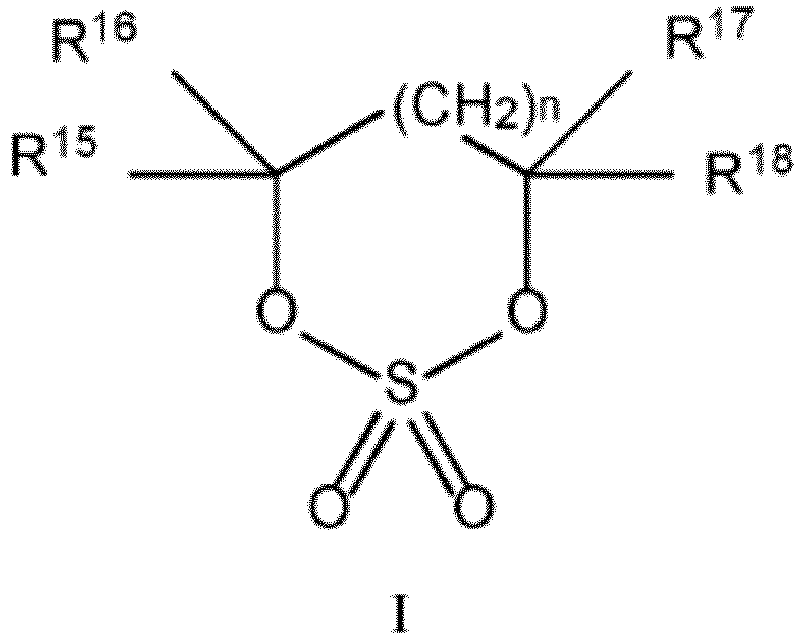 n = 1, et R15 à R18 représentant chacun indépendamment un hydrogène ou un groupe vinyle, allyle, acétylénique, propargyle ou alkyle en C1-3, les groupes vinyle, allyle, acétylénique, propargyle ou alkyle en C1-3 pouvant chacun être non substitués ou partiellement ou totalement fluorés ; etau moins un sel d'électrolyte,ladite composition d'électrolyte étant disposée dans le boîtier et fournissant un passage conducteur de manière ionique entre l'anode et la cathode ; et(d) un séparateur poreux entre l'anode et la cathode.
 - Cellule électrochimique selon la revendication 11, la cellule électrochimique étant une batterie lithium ion.
- Cellule électrochimique selon la revendication 12, la cathode comprenant un matériau actif de cathode présentant plus de 30 mAh/g de capacité dans la plage de potentiels supérieure à 4,6 V par rapport à une électrode de référence de Li/Li+.
- Dispositif électronique, dispositif de transport ou dispositif de télécommunications, comprenant une cellule électrochimique selon l'une quelconque des revendications 11 à 13.
Applications Claiming Priority (2)
| Application Number | Priority Date | Filing Date | Title |
|---|---|---|---|
| US201662394284P | 2016-09-14 | 2016-09-14 | |
| PCT/EP2017/072921 WO2018050652A1 (fr) | 2016-09-14 | 2017-09-12 | Électrolytes contenant des sulfates cycliques à noyau à six chaînons |
Publications (2)
| Publication Number | Publication Date |
|---|---|
| EP3513448A1 EP3513448A1 (fr) | 2019-07-24 |
| EP3513448B1 true EP3513448B1 (fr) | 2024-07-10 |
Family
ID=59856537
Family Applications (1)
| Application Number | Title | Priority Date | Filing Date |
|---|---|---|---|
| EP17765185.8A Active EP3513448B1 (fr) | 2016-09-14 | 2017-09-12 | Électrolytes contenant des sulfates cycliques à noyau à six chaînons |
Country Status (8)
| Country | Link |
|---|---|
| US (1) | US11038196B2 (fr) |
| EP (1) | EP3513448B1 (fr) |
| JP (2) | JP7389648B2 (fr) |
| KR (1) | KR102488908B1 (fr) |
| CN (2) | CN109997258A (fr) |
| HU (1) | HUE068211T2 (fr) |
| PL (1) | PL3513448T3 (fr) |
| WO (1) | WO2018050652A1 (fr) |
Families Citing this family (12)
| Publication number | Priority date | Publication date | Assignee | Title |
|---|---|---|---|---|
| EP3544110B1 (fr) | 2016-12-20 | 2023-12-20 | Daikin Industries, Ltd. | Solution électrolytique, dispositif électrochimique, batterie secondaire au lithium-ion, et module |
| US10978742B2 (en) * | 2016-12-27 | 2021-04-13 | Daikin Industries, Ltd. | Electrolytic solution, electrochemical device, lithium-ion secondary cell, and module |
| JP7311537B2 (ja) * | 2018-05-04 | 2023-07-19 | ユミコア | 高電圧用途のためのフッ素化電解質及び正極材料を含むリチウムコバルト酸化物二次バッテリ |
| HUE068135T2 (hu) * | 2018-05-04 | 2024-12-28 | Umicore Nv | NI-alapú lítium-ionos másodlagos akkumulátor, amely fluorozott elektrolitot tartalmaz |
| US20210234199A1 (en) * | 2018-05-04 | 2021-07-29 | Solvay Sa | Non-aqueous liquid electrolyte composition |
| KR102887987B1 (ko) * | 2020-01-20 | 2025-11-19 | 닝더 엠프렉스 테크놀로지 리미티드 | 전해액 및 이를 사용하는 전기화학 디바이스 |
| DE112021001189T5 (de) | 2020-02-21 | 2022-12-15 | Gs Yuasa International Ltd. | Nichtwässriger-elektrolyt-energiespeichervorrichtung und verfahren zum herstellen einer nichtwässriger-elektrolyt-energiespeichervorrichtung |
| KR102879726B1 (ko) | 2020-02-28 | 2025-10-30 | 에스케이온 주식회사 | 리튬 이차 전지용 전해질 및 이를 포함하는 리튬 이차 전지 |
| CN113258136A (zh) * | 2021-04-16 | 2021-08-13 | 惠州市豪鹏科技有限公司 | 一种电解液及锂离子电池 |
| KR20230100270A (ko) * | 2021-12-28 | 2023-07-05 | 에스케이온 주식회사 | 비수 전해액 및 이를 포함하는 리튬 이차 전지 |
| CN120076904A (zh) | 2022-10-18 | 2025-05-30 | 软银集团股份有限公司 | 作业机器人调整方法、感测系统、感测方法、移动式机器人、动作改变系统、动作改变方法、作业机器人、作业再现系统、作业再现方法、作业熟悉系统、作业熟悉方法以及作业再现机器人 |
| CN116759648B (zh) * | 2023-08-16 | 2024-02-23 | 宁德新能源科技有限公司 | 一种电化学装置及包括其的电子装置 |
Family Cites Families (34)
| Publication number | Priority date | Publication date | Assignee | Title |
|---|---|---|---|---|
| JP3606289B2 (ja) | 1995-04-26 | 2005-01-05 | 日本電池株式会社 | リチウム電池用正極活物質およびその製造法 |
| US5962166A (en) | 1997-08-18 | 1999-10-05 | Covalent Associates, Inc. | Ultrahigh voltage mixed valence materials |
| US7468223B2 (en) | 2000-06-22 | 2008-12-23 | Uchicago Argonne, Llc | Lithium metal oxide electrodes for lithium cells and batteries |
| JP2002237331A (ja) | 2001-02-08 | 2002-08-23 | Tdk Corp | リチウム二次電池 |
| US6964828B2 (en) | 2001-04-27 | 2005-11-15 | 3M Innovative Properties Company | Cathode compositions for lithium-ion batteries |
| US6680145B2 (en) | 2001-08-07 | 2004-01-20 | 3M Innovative Properties Company | Lithium-ion batteries |
| EP1304752B1 (fr) | 2001-10-18 | 2010-04-14 | Nec Corporation | Materiau actif d'électrode positive, électrode positive et pile secondaire à électrolyte non-aqueux l'utilisant |
| JP4197237B2 (ja) | 2002-03-01 | 2008-12-17 | パナソニック株式会社 | 正極活物質の製造方法 |
| US7381496B2 (en) | 2004-05-21 | 2008-06-03 | Tiax Llc | Lithium metal oxide materials and methods of synthesis and use |
| ES2620809T3 (es) | 2004-09-03 | 2017-06-29 | Uchicago Argonne, Llc | Electrodos compuestos de óxido de manganeso par baterías de litio |
| EP2339684B1 (fr) * | 2005-06-10 | 2013-01-09 | Mitsubishi Chemical Corporation | Solution d électrolyte non aqueuse, accumulateur à électrolyte non aqueux et composé carbonate |
| EP2067198A2 (fr) | 2006-09-25 | 2009-06-10 | Board of Regents, The University of Texas System | Cathodes d'oxyfluorure et d'oxyde de spinelle à substituants cationiques pour batteries au lithium |
| JP5153156B2 (ja) | 2007-02-13 | 2013-02-27 | 三洋電機株式会社 | 非水電解質二次電池用正極の製造方法 |
| WO2009040367A1 (fr) | 2007-09-28 | 2009-04-02 | Solvay (Société Anonyme) | Procédé de préparation d'un composé organique à teneur en fluor |
| US8389160B2 (en) | 2008-10-07 | 2013-03-05 | Envia Systems, Inc. | Positive electrode materials for lithium ion batteries having a high specific discharge capacity and processes for the synthesis of these materials |
| TWI429132B (zh) | 2009-08-27 | 2014-03-01 | Envia Systems Inc | 具有高比容量及優異循環之層層富含鋰的複合金屬氧化物 |
| TWI437753B (zh) | 2009-08-27 | 2014-05-11 | 安維亞系統公司 | 鋰基電池之經金屬氧化物塗佈之正電極材料 |
| US8518525B2 (en) | 2010-12-09 | 2013-08-27 | E I Du Pont De Nemours And Company | Polyimide nanoweb with amidized surface and method for preparing |
| JP6178317B2 (ja) * | 2011-09-02 | 2017-08-09 | イー・アイ・デュポン・ドウ・ヌムール・アンド・カンパニーE.I.Du Pont De Nemours And Company | リチウムイオン電池 |
| TWI487161B (zh) * | 2011-11-16 | 2015-06-01 | Univ Nat Taiwan Science Tech | 鋰離子電池及其製造方法 |
| CN102569885B (zh) | 2011-12-29 | 2015-12-16 | 深圳新宙邦科技股份有限公司 | 锂离子电池用非水电解液及锂离子二次电池 |
| CN102593513A (zh) * | 2012-02-17 | 2012-07-18 | 深圳新宙邦科技股份有限公司 | 锂离子二次电池及其电解液 |
| JP2013211224A (ja) | 2012-03-30 | 2013-10-10 | Mitsubishi Chemicals Corp | 非水系電解液及びそれを用いたリチウム二次電池 |
| JP6319305B2 (ja) * | 2012-06-01 | 2018-05-09 | ソルベー エスアー | リチウムイオンバッテリ |
| JP6219635B2 (ja) | 2013-08-09 | 2017-10-25 | 株式会社日本触媒 | リチウムイオン二次電池 |
| CN106170886A (zh) | 2014-04-03 | 2016-11-30 | 3M创新有限公司 | 用于锂离子电池的电解质添加剂 |
| EP3146588B1 (fr) * | 2014-05-23 | 2018-07-25 | Solvay Sa | Compositions d'électrolyte non aqueux comprenant des sulfates cycliques et des borates de lithium |
| WO2015179205A1 (fr) * | 2014-05-23 | 2015-11-26 | E. I. Du Pont De Nemours And Company | Compositions d'électrolyte non aqueux comprenant des sulfates cycliques |
| KR20190027957A (ko) * | 2014-08-14 | 2019-03-15 | 솔베이(소시에떼아노님) | 술톤 및 플루오린화된 용매를 포함하는 비수성 전해질 조성물 |
| JP2016143536A (ja) | 2015-01-30 | 2016-08-08 | 三菱化学株式会社 | 非水系電解質、及びそれを用いた非水系電解質二次電池 |
| CN104600364B (zh) * | 2015-02-06 | 2017-08-25 | 宁德新能源科技有限公司 | 一种电解液及应用该电解液的锂离子电池 |
| HUE063650T2 (hu) * | 2015-08-04 | 2024-01-28 | Solvay | Lítium-oxaláto-foszfátokat tartalmazó nemvizes elektrolit-összetételek |
| WO2017069278A1 (fr) | 2015-10-23 | 2017-04-27 | 宇部興産株式会社 | Solution électrolytique non aqueuse et dispositif de stockage d'électricité l'utilisant |
| JP6866183B2 (ja) * | 2016-03-01 | 2021-04-28 | Muアイオニックソリューションズ株式会社 | 非水電解液及びそれを用いた蓄電デバイス |
-
2017
- 2017-09-12 US US16/333,316 patent/US11038196B2/en active Active
- 2017-09-12 HU HUE17765185A patent/HUE068211T2/hu unknown
- 2017-09-12 KR KR1020197010243A patent/KR102488908B1/ko active Active
- 2017-09-12 CN CN201780070381.2A patent/CN109997258A/zh active Pending
- 2017-09-12 WO PCT/EP2017/072921 patent/WO2018050652A1/fr not_active Ceased
- 2017-09-12 JP JP2019514230A patent/JP7389648B2/ja active Active
- 2017-09-12 PL PL17765185.8T patent/PL3513448T3/pl unknown
- 2017-09-12 EP EP17765185.8A patent/EP3513448B1/fr active Active
- 2017-09-12 CN CN202311399757.8A patent/CN117613381A/zh active Pending
-
2022
- 2022-08-26 JP JP2022134615A patent/JP2022180376A/ja active Pending
Also Published As
| Publication number | Publication date |
|---|---|
| EP3513448A1 (fr) | 2019-07-24 |
| JP2019530157A (ja) | 2019-10-17 |
| CN117613381A (zh) | 2024-02-27 |
| US20190334197A1 (en) | 2019-10-31 |
| PL3513448T3 (pl) | 2024-11-12 |
| JP7389648B2 (ja) | 2023-11-30 |
| US11038196B2 (en) | 2021-06-15 |
| KR20190047004A (ko) | 2019-05-07 |
| JP2022180376A (ja) | 2022-12-06 |
| KR102488908B1 (ko) | 2023-01-17 |
| HUE068211T2 (hu) | 2024-12-28 |
| WO2018050652A1 (fr) | 2018-03-22 |
| CN109997258A (zh) | 2019-07-09 |
Similar Documents
| Publication | Publication Date | Title |
|---|---|---|
| EP3513448B1 (fr) | Électrolytes contenant des sulfates cycliques à noyau à six chaînons | |
| US11476502B2 (en) | Nonaqueous electrolyte compositions comprising cyclic carbonate and non-fluorinated acyclic carbonate | |
| EP3146588B1 (fr) | Compositions d'électrolyte non aqueux comprenant des sulfates cycliques et des borates de lithium | |
| EP3501057B1 (fr) | Compositions d'électrolyte non aqueuse comprenant des oxalates de silyle | |
| US10673096B2 (en) | Nonaqueous electrolyte compositions comprising sultone and fluorinated solvent | |
| US10559850B2 (en) | Nonaqueous electrolyte compositions comprising cyclic sulfates | |
| EP3738167B1 (fr) | Compositions d'électrolytes non-aqueux comprenant du bis(fluorosulfonyl)imidure de lithium | |
| EP3332441B1 (fr) | Compositions d'électrolyte non aqueux comprenant des oxalato-phosphates de lithium | |
| EP3369125B1 (fr) | Électrolytique non aqueuse comprenant un solvant fluoré et une 2-furanone | |
| US10535898B2 (en) | Nonaqueous electrolyte compositions comprising lithium malonatoborate and fluorinated solvent | |
| EP3604276A1 (fr) | Nouveaux composants pour compositions d'électrolyte | |
| EP3605698A1 (fr) | Nouveaux composants pour compositions d'électrolyte |
Legal Events
| Date | Code | Title | Description |
|---|---|---|---|
| STAA | Information on the status of an ep patent application or granted ep patent |
Free format text: STATUS: UNKNOWN |
|
| STAA | Information on the status of an ep patent application or granted ep patent |
Free format text: STATUS: THE INTERNATIONAL PUBLICATION HAS BEEN MADE |
|
| PUAI | Public reference made under article 153(3) epc to a published international application that has entered the european phase |
Free format text: ORIGINAL CODE: 0009012 |
|
| STAA | Information on the status of an ep patent application or granted ep patent |
Free format text: STATUS: REQUEST FOR EXAMINATION WAS MADE |
|
| 17P | Request for examination filed |
Effective date: 20190415 |
|
| AK | Designated contracting states |
Kind code of ref document: A1 Designated state(s): AL AT BE BG CH CY CZ DE DK EE ES FI FR GB GR HR HU IE IS IT LI LT LU LV MC MK MT NL NO PL PT RO RS SE SI SK SM TR |
|
| AX | Request for extension of the european patent |
Extension state: BA ME |
|
| DAV | Request for validation of the european patent (deleted) | ||
| DAX | Request for extension of the european patent (deleted) | ||
| STAA | Information on the status of an ep patent application or granted ep patent |
Free format text: STATUS: EXAMINATION IS IN PROGRESS |
|
| 17Q | First examination report despatched |
Effective date: 20200511 |
|
| RAP1 | Party data changed (applicant data changed or rights of an application transferred) |
Owner name: SYENSQO SA |
|
| GRAP | Despatch of communication of intention to grant a patent |
Free format text: ORIGINAL CODE: EPIDOSNIGR1 |
|
| STAA | Information on the status of an ep patent application or granted ep patent |
Free format text: STATUS: GRANT OF PATENT IS INTENDED |
|
| INTG | Intention to grant announced |
Effective date: 20240404 |
|
| RIN1 | Information on inventor provided before grant (corrected) |
Inventor name: LEVY-POLIS, BRIAN Inventor name: KOURTAKIS, KOSTANTINOS Inventor name: BURKHARDT, STEPHEN |
|
| GRAS | Grant fee paid |
Free format text: ORIGINAL CODE: EPIDOSNIGR3 |
|
| GRAA | (expected) grant |
Free format text: ORIGINAL CODE: 0009210 |
|
| STAA | Information on the status of an ep patent application or granted ep patent |
Free format text: STATUS: THE PATENT HAS BEEN GRANTED |
|
| AK | Designated contracting states |
Kind code of ref document: B1 Designated state(s): AL AT BE BG CH CY CZ DE DK EE ES FI FR GB GR HR HU IE IS IT LI LT LU LV MC MK MT NL NO PL PT RO RS SE SI SK SM TR |
|
| REG | Reference to a national code |
Ref country code: CH Ref legal event code: EP |
|
| P01 | Opt-out of the competence of the unified patent court (upc) registered |
Free format text: CASE NUMBER: APP_37809/2024 Effective date: 20240625 |
|
| REG | Reference to a national code |
Ref country code: DE Ref legal event code: R096 Ref document number: 602017083196 Country of ref document: DE |
|
| REG | Reference to a national code |
Ref country code: SE Ref legal event code: TRGR |
|
| REG | Reference to a national code |
Ref country code: LT Ref legal event code: MG9D |
|
| REG | Reference to a national code |
Ref country code: NL Ref legal event code: MP Effective date: 20240710 |
|
| PG25 | Lapsed in a contracting state [announced via postgrant information from national office to epo] |
Ref country code: PT Free format text: LAPSE BECAUSE OF FAILURE TO SUBMIT A TRANSLATION OF THE DESCRIPTION OR TO PAY THE FEE WITHIN THE PRESCRIBED TIME-LIMIT Effective date: 20241111 |
|
| REG | Reference to a national code |
Ref country code: AT Ref legal event code: MK05 Ref document number: 1702838 Country of ref document: AT Kind code of ref document: T Effective date: 20240710 |
|
| PG25 | Lapsed in a contracting state [announced via postgrant information from national office to epo] |
Ref country code: NL Free format text: LAPSE BECAUSE OF FAILURE TO SUBMIT A TRANSLATION OF THE DESCRIPTION OR TO PAY THE FEE WITHIN THE PRESCRIBED TIME-LIMIT Effective date: 20240710 |
|
| REG | Reference to a national code |
Ref country code: HU Ref legal event code: AG4A Ref document number: E068211 Country of ref document: HU |
|
| PG25 | Lapsed in a contracting state [announced via postgrant information from national office to epo] |
Ref country code: PT Free format text: LAPSE BECAUSE OF FAILURE TO SUBMIT A TRANSLATION OF THE DESCRIPTION OR TO PAY THE FEE WITHIN THE PRESCRIBED TIME-LIMIT Effective date: 20241111 Ref country code: NL Free format text: LAPSE BECAUSE OF FAILURE TO SUBMIT A TRANSLATION OF THE DESCRIPTION OR TO PAY THE FEE WITHIN THE PRESCRIBED TIME-LIMIT Effective date: 20240710 |
|
| PG25 | Lapsed in a contracting state [announced via postgrant information from national office to epo] |
Ref country code: NO Free format text: LAPSE BECAUSE OF FAILURE TO SUBMIT A TRANSLATION OF THE DESCRIPTION OR TO PAY THE FEE WITHIN THE PRESCRIBED TIME-LIMIT Effective date: 20241010 |
|
| PG25 | Lapsed in a contracting state [announced via postgrant information from national office to epo] |
Ref country code: GR Free format text: LAPSE BECAUSE OF FAILURE TO SUBMIT A TRANSLATION OF THE DESCRIPTION OR TO PAY THE FEE WITHIN THE PRESCRIBED TIME-LIMIT Effective date: 20241011 Ref country code: FI Free format text: LAPSE BECAUSE OF FAILURE TO SUBMIT A TRANSLATION OF THE DESCRIPTION OR TO PAY THE FEE WITHIN THE PRESCRIBED TIME-LIMIT Effective date: 20240710 |
|
| PG25 | Lapsed in a contracting state [announced via postgrant information from national office to epo] |
Ref country code: BG Free format text: LAPSE BECAUSE OF FAILURE TO SUBMIT A TRANSLATION OF THE DESCRIPTION OR TO PAY THE FEE WITHIN THE PRESCRIBED TIME-LIMIT Effective date: 20240710 |
|
| PG25 | Lapsed in a contracting state [announced via postgrant information from national office to epo] |
Ref country code: LV Free format text: LAPSE BECAUSE OF FAILURE TO SUBMIT A TRANSLATION OF THE DESCRIPTION OR TO PAY THE FEE WITHIN THE PRESCRIBED TIME-LIMIT Effective date: 20240710 |
|
| PG25 | Lapsed in a contracting state [announced via postgrant information from national office to epo] |
Ref country code: IS Free format text: LAPSE BECAUSE OF FAILURE TO SUBMIT A TRANSLATION OF THE DESCRIPTION OR TO PAY THE FEE WITHIN THE PRESCRIBED TIME-LIMIT Effective date: 20241110 Ref country code: AT Free format text: LAPSE BECAUSE OF FAILURE TO SUBMIT A TRANSLATION OF THE DESCRIPTION OR TO PAY THE FEE WITHIN THE PRESCRIBED TIME-LIMIT Effective date: 20240710 |
|
| PG25 | Lapsed in a contracting state [announced via postgrant information from national office to epo] |
Ref country code: HR Free format text: LAPSE BECAUSE OF FAILURE TO SUBMIT A TRANSLATION OF THE DESCRIPTION OR TO PAY THE FEE WITHIN THE PRESCRIBED TIME-LIMIT Effective date: 20240710 |
|
| PG25 | Lapsed in a contracting state [announced via postgrant information from national office to epo] |
Ref country code: ES Free format text: LAPSE BECAUSE OF FAILURE TO SUBMIT A TRANSLATION OF THE DESCRIPTION OR TO PAY THE FEE WITHIN THE PRESCRIBED TIME-LIMIT Effective date: 20240710 Ref country code: RS Free format text: LAPSE BECAUSE OF FAILURE TO SUBMIT A TRANSLATION OF THE DESCRIPTION OR TO PAY THE FEE WITHIN THE PRESCRIBED TIME-LIMIT Effective date: 20241010 |
|
| PG25 | Lapsed in a contracting state [announced via postgrant information from national office to epo] |
Ref country code: RS Free format text: LAPSE BECAUSE OF FAILURE TO SUBMIT A TRANSLATION OF THE DESCRIPTION OR TO PAY THE FEE WITHIN THE PRESCRIBED TIME-LIMIT Effective date: 20241010 Ref country code: NO Free format text: LAPSE BECAUSE OF FAILURE TO SUBMIT A TRANSLATION OF THE DESCRIPTION OR TO PAY THE FEE WITHIN THE PRESCRIBED TIME-LIMIT Effective date: 20241010 Ref country code: LV Free format text: LAPSE BECAUSE OF FAILURE TO SUBMIT A TRANSLATION OF THE DESCRIPTION OR TO PAY THE FEE WITHIN THE PRESCRIBED TIME-LIMIT Effective date: 20240710 Ref country code: IS Free format text: LAPSE BECAUSE OF FAILURE TO SUBMIT A TRANSLATION OF THE DESCRIPTION OR TO PAY THE FEE WITHIN THE PRESCRIBED TIME-LIMIT Effective date: 20241110 Ref country code: HR Free format text: LAPSE BECAUSE OF FAILURE TO SUBMIT A TRANSLATION OF THE DESCRIPTION OR TO PAY THE FEE WITHIN THE PRESCRIBED TIME-LIMIT Effective date: 20240710 Ref country code: GR Free format text: LAPSE BECAUSE OF FAILURE TO SUBMIT A TRANSLATION OF THE DESCRIPTION OR TO PAY THE FEE WITHIN THE PRESCRIBED TIME-LIMIT Effective date: 20241011 Ref country code: FI Free format text: LAPSE BECAUSE OF FAILURE TO SUBMIT A TRANSLATION OF THE DESCRIPTION OR TO PAY THE FEE WITHIN THE PRESCRIBED TIME-LIMIT Effective date: 20240710 Ref country code: ES Free format text: LAPSE BECAUSE OF FAILURE TO SUBMIT A TRANSLATION OF THE DESCRIPTION OR TO PAY THE FEE WITHIN THE PRESCRIBED TIME-LIMIT Effective date: 20240710 Ref country code: BG Free format text: LAPSE BECAUSE OF FAILURE TO SUBMIT A TRANSLATION OF THE DESCRIPTION OR TO PAY THE FEE WITHIN THE PRESCRIBED TIME-LIMIT Effective date: 20240710 Ref country code: AT Free format text: LAPSE BECAUSE OF FAILURE TO SUBMIT A TRANSLATION OF THE DESCRIPTION OR TO PAY THE FEE WITHIN THE PRESCRIBED TIME-LIMIT Effective date: 20240710 |
|
| REG | Reference to a national code |
Ref country code: DE Ref legal event code: R097 Ref document number: 602017083196 Country of ref document: DE |
|
| PG25 | Lapsed in a contracting state [announced via postgrant information from national office to epo] |
Ref country code: SM Free format text: LAPSE BECAUSE OF FAILURE TO SUBMIT A TRANSLATION OF THE DESCRIPTION OR TO PAY THE FEE WITHIN THE PRESCRIBED TIME-LIMIT Effective date: 20240710 Ref country code: DK Free format text: LAPSE BECAUSE OF FAILURE TO SUBMIT A TRANSLATION OF THE DESCRIPTION OR TO PAY THE FEE WITHIN THE PRESCRIBED TIME-LIMIT Effective date: 20240710 |
|
| PG25 | Lapsed in a contracting state [announced via postgrant information from national office to epo] |
Ref country code: EE Free format text: LAPSE BECAUSE OF FAILURE TO SUBMIT A TRANSLATION OF THE DESCRIPTION OR TO PAY THE FEE WITHIN THE PRESCRIBED TIME-LIMIT Effective date: 20240710 Ref country code: MC Free format text: LAPSE BECAUSE OF FAILURE TO SUBMIT A TRANSLATION OF THE DESCRIPTION OR TO PAY THE FEE WITHIN THE PRESCRIBED TIME-LIMIT Effective date: 20240710 |
|
| PG25 | Lapsed in a contracting state [announced via postgrant information from national office to epo] |
Ref country code: SK Free format text: LAPSE BECAUSE OF FAILURE TO SUBMIT A TRANSLATION OF THE DESCRIPTION OR TO PAY THE FEE WITHIN THE PRESCRIBED TIME-LIMIT Effective date: 20240710 Ref country code: IT Free format text: LAPSE BECAUSE OF FAILURE TO SUBMIT A TRANSLATION OF THE DESCRIPTION OR TO PAY THE FEE WITHIN THE PRESCRIBED TIME-LIMIT Effective date: 20240710 |
|
| REG | Reference to a national code |
Ref country code: CH Ref legal event code: PL |
|
| PLBE | No opposition filed within time limit |
Free format text: ORIGINAL CODE: 0009261 |
|
| STAA | Information on the status of an ep patent application or granted ep patent |
Free format text: STATUS: NO OPPOSITION FILED WITHIN TIME LIMIT |
|
| PG25 | Lapsed in a contracting state [announced via postgrant information from national office to epo] |
Ref country code: LU Free format text: LAPSE BECAUSE OF NON-PAYMENT OF DUE FEES Effective date: 20240912 |
|
| 26N | No opposition filed |
Effective date: 20250411 |
|
| REG | Reference to a national code |
Ref country code: BE Ref legal event code: MM Effective date: 20240930 |
|
| PG25 | Lapsed in a contracting state [announced via postgrant information from national office to epo] |
Ref country code: BE Free format text: LAPSE BECAUSE OF NON-PAYMENT OF DUE FEES Effective date: 20240930 |
|
| PG25 | Lapsed in a contracting state [announced via postgrant information from national office to epo] |
Ref country code: CH Free format text: LAPSE BECAUSE OF NON-PAYMENT OF DUE FEES Effective date: 20240930 |
|
| PG25 | Lapsed in a contracting state [announced via postgrant information from national office to epo] |
Ref country code: IE Free format text: LAPSE BECAUSE OF NON-PAYMENT OF DUE FEES Effective date: 20240912 |
|
| PGFP | Annual fee paid to national office [announced via postgrant information from national office to epo] |
Ref country code: DE Payment date: 20250730 Year of fee payment: 9 |
|
| PGFP | Annual fee paid to national office [announced via postgrant information from national office to epo] |
Ref country code: HU Payment date: 20250828 Year of fee payment: 9 Ref country code: GB Payment date: 20250731 Year of fee payment: 9 |
|
| PGFP | Annual fee paid to national office [announced via postgrant information from national office to epo] |
Ref country code: FR Payment date: 20250808 Year of fee payment: 9 |
|
| PGFP | Annual fee paid to national office [announced via postgrant information from national office to epo] |
Ref country code: SE Payment date: 20250812 Year of fee payment: 9 |
|
| PGFP | Annual fee paid to national office [announced via postgrant information from national office to epo] |
Ref country code: CZ Payment date: 20250821 Year of fee payment: 9 |
|
| PGFP | Annual fee paid to national office [announced via postgrant information from national office to epo] |
Ref country code: RO Payment date: 20250828 Year of fee payment: 9 |
|
| PGFP | Annual fee paid to national office [announced via postgrant information from national office to epo] |
Ref country code: PL Payment date: 20250812 Year of fee payment: 9 |
|
| PG25 | Lapsed in a contracting state [announced via postgrant information from national office to epo] |
Ref country code: CY Free format text: LAPSE BECAUSE OF FAILURE TO SUBMIT A TRANSLATION OF THE DESCRIPTION OR TO PAY THE FEE WITHIN THE PRESCRIBED TIME-LIMIT; INVALID AB INITIO Effective date: 20170912 |